EP1273650A1 - Fuel for use in fuel cell - Google Patents
Fuel for use in fuel cell Download PDFInfo
- Publication number
- EP1273650A1 EP1273650A1 EP01917866A EP01917866A EP1273650A1 EP 1273650 A1 EP1273650 A1 EP 1273650A1 EP 01917866 A EP01917866 A EP 01917866A EP 01917866 A EP01917866 A EP 01917866A EP 1273650 A1 EP1273650 A1 EP 1273650A1
- Authority
- EP
- European Patent Office
- Prior art keywords
- fuel
- vol
- cell system
- fuel cell
- less
- Prior art date
- Legal status (The legal status is an assumption and is not a legal conclusion. Google has not performed a legal analysis and makes no representation as to the accuracy of the status listed.)
- Withdrawn
Links
Images


Classifications
-
- C—CHEMISTRY; METALLURGY
- C01—INORGANIC CHEMISTRY
- C01B—NON-METALLIC ELEMENTS; COMPOUNDS THEREOF; METALLOIDS OR COMPOUNDS THEREOF NOT COVERED BY SUBCLASS C01C
- C01B3/00—Hydrogen; Gaseous mixtures containing hydrogen; Separation of hydrogen from mixtures containing it; Purification of hydrogen; Reversible storage of hydrogen
- C01B3/02—Production of hydrogen; Production of gaseous mixtures containing hydrogen
- C01B3/32—Production of hydrogen; Production of gaseous mixtures containing hydrogen by reaction of gaseous or liquid organic compounds with gasifying agents, e.g. water, carbon dioxide or air
- C01B3/34—Production of hydrogen; Production of gaseous mixtures containing hydrogen by reaction of gaseous or liquid organic compounds with gasifying agents, e.g. water, carbon dioxide or air by reaction of hydrocarbons with gasifying agents
- C01B3/48—Production of hydrogen; Production of gaseous mixtures containing hydrogen by reaction of gaseous or liquid organic compounds with gasifying agents, e.g. water, carbon dioxide or air by reaction of hydrocarbons with gasifying agents followed by reaction of water vapour with carbon monoxide
-
- C—CHEMISTRY; METALLURGY
- C01—INORGANIC CHEMISTRY
- C01B—NON-METALLIC ELEMENTS; COMPOUNDS THEREOF; METALLOIDS OR COMPOUNDS THEREOF NOT COVERED BY SUBCLASS C01C
- C01B3/00—Hydrogen; Gaseous mixtures containing hydrogen; Separation of hydrogen from mixtures containing it; Purification of hydrogen; Reversible storage of hydrogen
- C01B3/02—Production of hydrogen; Production of gaseous mixtures containing hydrogen
- C01B3/32—Production of hydrogen; Production of gaseous mixtures containing hydrogen by reaction of gaseous or liquid organic compounds with gasifying agents, e.g. water, carbon dioxide or air
- C01B3/323—Catalytic reaction of gaseous or liquid organic compounds other than hydrocarbons with gasifying agents
-
- C—CHEMISTRY; METALLURGY
- C01—INORGANIC CHEMISTRY
- C01B—NON-METALLIC ELEMENTS; COMPOUNDS THEREOF; METALLOIDS OR COMPOUNDS THEREOF NOT COVERED BY SUBCLASS C01C
- C01B3/00—Hydrogen; Gaseous mixtures containing hydrogen; Separation of hydrogen from mixtures containing it; Purification of hydrogen; Reversible storage of hydrogen
- C01B3/50—Separation of hydrogen or hydrogen-containing gases from gaseous mixtures, e.g. purification
- C01B3/56—Separation of hydrogen or hydrogen-containing gases from gaseous mixtures, e.g. purification by contacting with solids; Regeneration of used solids
- C01B3/58—Separation of hydrogen or hydrogen-containing gases from gaseous mixtures, e.g. purification by contacting with solids; Regeneration of used solids including a catalytic reaction
- C01B3/583—Separation of hydrogen or hydrogen-containing gases from gaseous mixtures, e.g. purification by contacting with solids; Regeneration of used solids including a catalytic reaction the reaction being the selective oxidation of carbon monoxide
-
- C—CHEMISTRY; METALLURGY
- C10—PETROLEUM, GAS OR COKE INDUSTRIES; TECHNICAL GASES CONTAINING CARBON MONOXIDE; FUELS; LUBRICANTS; PEAT
- C10L—FUELS NOT OTHERWISE PROVIDED FOR; NATURAL GAS; SYNTHETIC NATURAL GAS OBTAINED BY PROCESSES NOT COVERED BY SUBCLASSES C10G OR C10K; LIQUIFIED PETROLEUM GAS; USE OF ADDITIVES TO FUELS OR FIRES; FIRE-LIGHTERS
- C10L1/00—Liquid carbonaceous fuels
- C10L1/02—Liquid carbonaceous fuels essentially based on components consisting of carbon, hydrogen, and oxygen only
-
- H—ELECTRICITY
- H01—ELECTRIC ELEMENTS
- H01M—PROCESSES OR MEANS, e.g. BATTERIES, FOR THE DIRECT CONVERSION OF CHEMICAL ENERGY INTO ELECTRICAL ENERGY
- H01M8/00—Fuel cells; Manufacture thereof
- H01M8/06—Combination of fuel cells with means for production of reactants or for treatment of residues
- H01M8/0606—Combination of fuel cells with means for production of reactants or for treatment of residues with means for production of gaseous reactants
- H01M8/0612—Combination of fuel cells with means for production of reactants or for treatment of residues with means for production of gaseous reactants from carbon-containing material
-
- C—CHEMISTRY; METALLURGY
- C01—INORGANIC CHEMISTRY
- C01B—NON-METALLIC ELEMENTS; COMPOUNDS THEREOF; METALLOIDS OR COMPOUNDS THEREOF NOT COVERED BY SUBCLASS C01C
- C01B2203/00—Integrated processes for the production of hydrogen or synthesis gas
- C01B2203/02—Processes for making hydrogen or synthesis gas
- C01B2203/0205—Processes for making hydrogen or synthesis gas containing a reforming step
- C01B2203/0227—Processes for making hydrogen or synthesis gas containing a reforming step containing a catalytic reforming step
- C01B2203/0233—Processes for making hydrogen or synthesis gas containing a reforming step containing a catalytic reforming step the reforming step being a steam reforming step
-
- C—CHEMISTRY; METALLURGY
- C01—INORGANIC CHEMISTRY
- C01B—NON-METALLIC ELEMENTS; COMPOUNDS THEREOF; METALLOIDS OR COMPOUNDS THEREOF NOT COVERED BY SUBCLASS C01C
- C01B2203/00—Integrated processes for the production of hydrogen or synthesis gas
- C01B2203/02—Processes for making hydrogen or synthesis gas
- C01B2203/025—Processes for making hydrogen or synthesis gas containing a partial oxidation step
- C01B2203/0261—Processes for making hydrogen or synthesis gas containing a partial oxidation step containing a catalytic partial oxidation step [CPO]
-
- C—CHEMISTRY; METALLURGY
- C01—INORGANIC CHEMISTRY
- C01B—NON-METALLIC ELEMENTS; COMPOUNDS THEREOF; METALLOIDS OR COMPOUNDS THEREOF NOT COVERED BY SUBCLASS C01C
- C01B2203/00—Integrated processes for the production of hydrogen or synthesis gas
- C01B2203/02—Processes for making hydrogen or synthesis gas
- C01B2203/0283—Processes for making hydrogen or synthesis gas containing a CO-shift step, i.e. a water gas shift step
-
- C—CHEMISTRY; METALLURGY
- C01—INORGANIC CHEMISTRY
- C01B—NON-METALLIC ELEMENTS; COMPOUNDS THEREOF; METALLOIDS OR COMPOUNDS THEREOF NOT COVERED BY SUBCLASS C01C
- C01B2203/00—Integrated processes for the production of hydrogen or synthesis gas
- C01B2203/04—Integrated processes for the production of hydrogen or synthesis gas containing a purification step for the hydrogen or the synthesis gas
- C01B2203/0435—Catalytic purification
- C01B2203/044—Selective oxidation of carbon monoxide
-
- C—CHEMISTRY; METALLURGY
- C01—INORGANIC CHEMISTRY
- C01B—NON-METALLIC ELEMENTS; COMPOUNDS THEREOF; METALLOIDS OR COMPOUNDS THEREOF NOT COVERED BY SUBCLASS C01C
- C01B2203/00—Integrated processes for the production of hydrogen or synthesis gas
- C01B2203/04—Integrated processes for the production of hydrogen or synthesis gas containing a purification step for the hydrogen or the synthesis gas
- C01B2203/0465—Composition of the impurity
- C01B2203/047—Composition of the impurity the impurity being carbon monoxide
-
- C—CHEMISTRY; METALLURGY
- C01—INORGANIC CHEMISTRY
- C01B—NON-METALLIC ELEMENTS; COMPOUNDS THEREOF; METALLOIDS OR COMPOUNDS THEREOF NOT COVERED BY SUBCLASS C01C
- C01B2203/00—Integrated processes for the production of hydrogen or synthesis gas
- C01B2203/06—Integration with other chemical processes
- C01B2203/066—Integration with other chemical processes with fuel cells
-
- C—CHEMISTRY; METALLURGY
- C01—INORGANIC CHEMISTRY
- C01B—NON-METALLIC ELEMENTS; COMPOUNDS THEREOF; METALLOIDS OR COMPOUNDS THEREOF NOT COVERED BY SUBCLASS C01C
- C01B2203/00—Integrated processes for the production of hydrogen or synthesis gas
- C01B2203/08—Methods of heating or cooling
- C01B2203/0805—Methods of heating the process for making hydrogen or synthesis gas
- C01B2203/085—Methods of heating the process for making hydrogen or synthesis gas by electric heating
-
- C—CHEMISTRY; METALLURGY
- C01—INORGANIC CHEMISTRY
- C01B—NON-METALLIC ELEMENTS; COMPOUNDS THEREOF; METALLOIDS OR COMPOUNDS THEREOF NOT COVERED BY SUBCLASS C01C
- C01B2203/00—Integrated processes for the production of hydrogen or synthesis gas
- C01B2203/10—Catalysts for performing the hydrogen forming reactions
- C01B2203/1041—Composition of the catalyst
- C01B2203/1047—Group VIII metal catalysts
- C01B2203/1064—Platinum group metal catalysts
-
- C—CHEMISTRY; METALLURGY
- C01—INORGANIC CHEMISTRY
- C01B—NON-METALLIC ELEMENTS; COMPOUNDS THEREOF; METALLOIDS OR COMPOUNDS THEREOF NOT COVERED BY SUBCLASS C01C
- C01B2203/00—Integrated processes for the production of hydrogen or synthesis gas
- C01B2203/12—Feeding the process for making hydrogen or synthesis gas
- C01B2203/1205—Composition of the feed
-
- C—CHEMISTRY; METALLURGY
- C01—INORGANIC CHEMISTRY
- C01B—NON-METALLIC ELEMENTS; COMPOUNDS THEREOF; METALLOIDS OR COMPOUNDS THEREOF NOT COVERED BY SUBCLASS C01C
- C01B2203/00—Integrated processes for the production of hydrogen or synthesis gas
- C01B2203/12—Feeding the process for making hydrogen or synthesis gas
- C01B2203/1288—Evaporation of one or more of the different feed components
-
- C—CHEMISTRY; METALLURGY
- C01—INORGANIC CHEMISTRY
- C01B—NON-METALLIC ELEMENTS; COMPOUNDS THEREOF; METALLOIDS OR COMPOUNDS THEREOF NOT COVERED BY SUBCLASS C01C
- C01B2203/00—Integrated processes for the production of hydrogen or synthesis gas
- C01B2203/16—Controlling the process
- C01B2203/1642—Controlling the product
- C01B2203/1647—Controlling the amount of the product
- C01B2203/1652—Measuring the amount of product
-
- H—ELECTRICITY
- H01—ELECTRIC ELEMENTS
- H01M—PROCESSES OR MEANS, e.g. BATTERIES, FOR THE DIRECT CONVERSION OF CHEMICAL ENERGY INTO ELECTRICAL ENERGY
- H01M8/00—Fuel cells; Manufacture thereof
- H01M8/06—Combination of fuel cells with means for production of reactants or for treatment of residues
- H01M8/0606—Combination of fuel cells with means for production of reactants or for treatment of residues with means for production of gaseous reactants
- H01M8/0612—Combination of fuel cells with means for production of reactants or for treatment of residues with means for production of gaseous reactants from carbon-containing material
- H01M8/0618—Reforming processes, e.g. autothermal, partial oxidation or steam reforming
-
- H—ELECTRICITY
- H01—ELECTRIC ELEMENTS
- H01M—PROCESSES OR MEANS, e.g. BATTERIES, FOR THE DIRECT CONVERSION OF CHEMICAL ENERGY INTO ELECTRICAL ENERGY
- H01M8/00—Fuel cells; Manufacture thereof
- H01M8/10—Fuel cells with solid electrolytes
- H01M8/1007—Fuel cells with solid electrolytes with both reactants being gaseous or vaporised
-
- Y—GENERAL TAGGING OF NEW TECHNOLOGICAL DEVELOPMENTS; GENERAL TAGGING OF CROSS-SECTIONAL TECHNOLOGIES SPANNING OVER SEVERAL SECTIONS OF THE IPC; TECHNICAL SUBJECTS COVERED BY FORMER USPC CROSS-REFERENCE ART COLLECTIONS [XRACs] AND DIGESTS
- Y02—TECHNOLOGIES OR APPLICATIONS FOR MITIGATION OR ADAPTATION AGAINST CLIMATE CHANGE
- Y02E—REDUCTION OF GREENHOUSE GAS [GHG] EMISSIONS, RELATED TO ENERGY GENERATION, TRANSMISSION OR DISTRIBUTION
- Y02E60/00—Enabling technologies; Technologies with a potential or indirect contribution to GHG emissions mitigation
- Y02E60/30—Hydrogen technology
- Y02E60/50—Fuel cells
Definitions
- the present invention relates to a fuel to be used for a fuel cell system.
- hydrogen is advantageous in a point that it does not require a reformer, however, because of a gas phase at a normal temperature, it has difficulties in storage and loading in a vehicle and special facilities are required for its supply. Further, the risk of inflammation is high and therefore, it has to be handled carefully.
- methanol is advantageous in a point that it is relatively easy to reform, however power generation quantity per weight is low and owing to its toxicity, handling has to be careful. Further, it has a corrosive property, special facilities are required for its storage and supply.
- a fuel to sufficiently utilize the performances of a fuel cell system has not yet been developed.
- a fuel for a fuel cell system the following are required: power generation quantity per weight is high; power generation quantity per CO 2 emission is high; a fuel consumption is low in a fuel cell system as a whole; an evaporative gas (evapo-emission) is a little; deterioration of a fuel cell system comprising such as a reforming catalyst, a water gas shift reaction catalyst, a carbon monoxide conversion catalyst, fuel cell stacks and the like is scarce to keep the initial performances for a long duration; a starting time for the system is short; and storage stability and handling easiness are excellent.
- the net power generation quantity of the entire fuel cell system is equivalent to the value calculated by subtracting the energy necessary for keeping the temperature (the energy for keeping balance endothermic and exothermic reaction following the preheating energy) from the actual power generation quantity. Consequently, if the temperature for the reforming is lower, the energy for preheating is low and that is therefore advantageous and further the system starting time is advantageously shortened. In addition, it is also necessary that the energy for preheating per fuel weight is low. If the preheating is insufficient, unreacted hydrocarbon (THC) in an exhaust gas increases and it results in not only decrease of the power generation quantity per weight but also possibility of becoming causes of air pollution. To say conversely, when some kind of fuels are reformed by the same reformer and the same temperature, it is more advantageous that THC in an exhaust gas is lower and the conversion efficiency to hydrogen is higher.
- THC unreacted hydrocarbon
- the present invention aims to provide a fuel suitable for a fuel cell system satisfying the above-described requirements in good balance.
- Inventors of the present invention have extensively investigated to solve the above-described problems and found that a fuel comprising a specific amount of oxygenates (oxygen-containing compounds) is suitable for a fuel cell system.
- a fuel for a fuel cell system comprises;
- the oxygenates mean alcohols having carbon numbers of 2 to 4, ethers having carbon numbers of 2 to 8 and the like. More particularly, the oxygenates include methanol, ethanol, dimethyl ether, methyl tertiary butyl ether (MTBE), ethyl tertiary butyl ether, tertiary amyl methyl ether (TAME), tertiary amyl ethyl ether and the like.
- MTBE methyl tertiary butyl ether
- TAME tertiary amyl methyl ether
- the content of these oxygenates is required to be 0.5 mass % or more in terms of an oxygen content based on the whole fuel in view of a low fuel consumption of a fuel cell system as a whole, a small THC in an exhaust gas, short starting time of a system and the like, and further is required to be 40 mass % or below, preferably 20 mass % or below and most preferably 3 mass % or below taking into consideration of a balance between a power generation quantity per weight and a power generation quantity per CO 2 emission.
- the fuel for a fuel cell system of the invention may contain only oxygenates mentioned-above, the fuel is preferably a mixture of oxygenates and hydrocarbons and it is more preferable that the amount of formulation for hydrocarbons is 5 vol.% or more based on the whole fuel in view of a high power generation quantity per weight, a high power generation quantity per CO 2 emission and the like.
- hydrocarbon compounds having specific carbon numbers contained in hydrocarbons are not restricted when the oxygenates are mixed with the hydrocarbons in the invention, however, the following requirements are preferable.
- the content of hydrocarbon compounds having a carbon number of 4 is not restricted, the content of hydrocarbon compounds having a carbon number of (V (C 4 )) shows the content of hydrocarbon compounds having 4 carbon atoms based on the whole hydrocarbons and is required to be 15 vol.% or less since the evaporative gas (evapo-emission) can be suppressed to low and the handling property is good in view of inflammability or the like and preferably 10 vol.% or less and most preferably 5 vol.% or less.
- the content of hydrocarbon compounds having a carbon number of 5 is not restricted, the content of hydrocarbon compounds having a carbon number of 5 (V (C 5 )) shows the content of hydrocarbon compounds having 5 carbon atoms based on the whole hydrocarbons and is required to be 5 vol.% or more because of a high power generation quantity per weight, a high power generation quantity per CO 2 emission, and a low fuel consumption of a fuel cell system as a whole and preferably 10 vol.% or more, more preferably 15 vol.% or more, further more preferably 20 vol.% or more, much further more preferably 25 vol.% or more, and most preferably 30 vol.% or more.
- the content of hydrocarbon compounds having a carbon number of 6 is not restricted, the content of hydrocarbon compounds having a carbon number of 6 (V (C 6 )) shows the content of hydrocarbon compounds having 6 carbon atoms based on the whole hydrocarbons and is required to be 10 vol.% or more because of a high power generation quantity and a low fuel consumption of a fuel cell system as a whole and preferably 15 vol.% or more, more preferably 20 vol.% or more, further more preferably 25 vol.% or more, and most preferably 30 vol.% or more.
- hydrocarbon compounds having carbon numbers of 7 and 8 are not particularly restricted in the invention, hydrocarbon compounds containing 20 vol.% or less as the (V (C 7 + C 8 )) in total based on the whole hydrocarbons are preferably used.
- the content of hydrocarbons having carbon numbers of 10 or more is not particularly restricted, however, because of a high power generation quantity per CO 2 emission, a low fuel consumption of a fuel cell system as a whole, and small deterioration of a reforming catalyst to maintain initial performances for a long duration, the total amount of hydrocarbon compounds having carbon numbers of 10 or more (V (C 10+ ) based on the whole hydrocarbons is preferably 20 vol.% or less, more preferably 10 vol.% or less and most preferably 5 vol.% or less.
- V (C 4 ), V (C 5 ), V (C 6 ), V (C 7 + C 8 ), and V (C 10+ ) are values quantitatively measured by the following gas chromatography. That is, these values are measured in conditions: employing capillary columns of methyl silicon for columns; using helium or nitrogen as a carrier gas; employing a hydrogen ionization detector (FID) as a detector; the column length of 25 to 50 m; the carrier gas flow rate of 0.5 to 1.5 ml/min, the split ratio of (1 : 50) to (1 : 250); the injection inlet temperature of 150 to 250 °C; the initial column temperature of -10 to 10 °C; the final column temperature of 150 to 250 °C, and the detector temperature of 150 to 250 °C.
- FID hydrogen ionization detector
- the initial boiling point is preferably 24 °C or higher and 40 °C or lower, and more preferably 26 °C or higher.
- the 10 vol.% distillation temperature (T 10 ) is preferably 25 °C or higher and 50 °C or lower, and more preferably 30 °C or higher.
- the 90 vol.% distillation temperature (T 90 ) is preferably 45 °C or higher and 130 °C or lower, more preferably 100 °C or lower and furthermore preferably 80 °C or lower.
- the final boiling point in distillation is preferably 55 °C or higher and 150 °C or lower and more preferably 130 °C or lower and further more preferably 100 °C or lower.
- the fuel is highly inflammable and an evaporative gas (THC) is easy to be generated and there is a problem to handle the fuel.
- T 10 10 vol.% distillation temperature
- the upper limit values of the 90 vol.% distillation temperature (T 90 ) and the final boiling point in distillation are determined in view of a high power generation quantity per weight, a high power generation quantity per CO 2 emission, a low fuel consumption of a fuel cell system as a whole, a small THC in an exhaust gas, short starting time of a system, small deterioration of a reforming catalyst to retain the initial properties, and the like.
- the 30 vol.% distillation temperature (T 30 ), 50 vol.% distillation temperature (T 50 ), and 70 vol.% distillation temperature (T 70 ) of the fuel of the invention are not particularly restricted, however, the 30 vol.% distillation temperature (T 30 ) is preferably 30 °C or higher and 60 °C or lower, the 50 vol.% distillation temperature (T 50 ) is preferably 35 °C or higher and 70 °C or lower, and the 70 vol.% distillation temperature (T 70 ) is 35 °C or higher and 60 °C or lower.
- the above-described initial boiling point (initial boiling point 0) in distillation, the 10 vol.% distillation temperature (T 10 ), the 30 vol.% distillation temperature (T 30 ), the 50 vol.% distillation temperature (T 50 ), the 70 vol.% distillation temperature (T 70 ), the 90 vol.% distillation temperature (T 90 ), and the final boiling point in distillation are distillation properties measured by JIS K 2254, "Petroleum products-Determination of distillation characteristics".
- the content of sulfur in a fuel of the invention is not particularly restricted, however, because deterioration of a fuel cell system comprising such as a reforming catalyst, a water gas shift reaction catalyst, a carbon monoxide removal catalyst, fuel cell stacks, and the like can be suppressed to low and the initial performances can be maintained for a long duration, the content is preferably 50 ppm by mass or less, more preferably 30 ppm by mass or less, further more preferably 10 ppm by mass or less, much further more preferably 1 ppm by mass or less, and most preferably 0.1 ppm by mass or less.
- sulfur means sulfur measured by JIS K 2541, "Crude Oil and Petroleum Products-Determination of sulfur content", in case of 1 ppm by mass or more and means sulfur measured by ASTM D4045-96, "Standard Test Method for Sulfur in Petroleum Products by Hydrogenolysis and Rateometric Colorimetry” in the case of less than 1 ppm by mass.
- the respective contents of saturates, olefins and aromatics are not particularly restricted, however, saturates (V (S)), olefins (V (O)) and aromatics (V (Ar)) are preferably 30 vol.% or more, 35 vol.% or less, and 50 vol.% or less, respectively based on the whole hydrocarbons.
- V (S) saturates
- V (O) olefins
- Ar aromatics
- V (S) is preferably 30 vol.% or more, more preferably 40 vol.% or more, further more preferably 50 vol.% or more, much further more preferably 60 vol.% or more, much further more preferably 70 vol.% or more, much further more preferably 80 vol.% or more, much further more preferably 90 vol.% or more, and most preferably 95 vol.% or more.
- V (O) is preferably 35 vol.% or less, more preferably 25 vol.% or less, further more preferably 20 vol.% or less, much further more preferably 15 vol.% or less, and most preferably 10 vol.% or less based on the whole hydrocarbons.
- V (Ar) is preferably 50 vol.% or less, more preferably 45 vol.% or less, further more preferably 40 vol.% or less, much further more preferably 35 vol.% or less, much further more preferably 30 vol.% or less, much further more preferably 20 vol.% or less, much further more preferably 10 vol.% or less, and most preferably 5 vol.% or less.
- V (S), V (O), and V (Ar) are all measured value according to the fluorescent indicator adsorption method of JIS K 2536, "Liquid petroleum products-Testing method of components".
- the ratio of paraffins in saturates of a fuel is not particularly restricted, however, because of a high H 2 generation quantity, a high power generation quantity per weight, a high power generation quantity per CO 2 emission and the like, the ratio of paraffins in saturates is preferably 60 vol.% or more, more preferably 65 vol.% or more, further more preferably 70 vol.% or more, much further more preferably 80 vol.% or more, much further more preferably 85 vol.% or more, much further more preferably 90 vol.% or more, and most preferably 95 vol.% or more.
- the ratio of branched paraffins in the above-described paraffins is not particularly restricted, however, the ratio of branched paraffins in paraffins is preferably 30 vol.% or more, more preferably 50 vol.% or more, and most preferably 70 vol.% or more because of a high power generation quantity per weight, a high power generation quantity per CO 2 emission, a low fuel consumption of a fuel cell system as a whole, small THC in an exhaust gas, and a short starting time of the system.
- the amounts of the above-described paraffin and branched-type paraffin are values quantitatively measured by the above-described gas chromatography.
- the heat capacity of a fuel is not particularly restricted, however, the heat capacity is preferably 2.6 kJ/kg• °C or less at 15 °C and 1 atm in liquid phase in view of a low fuel consumption of a fuel cell system as a whole.
- the heat of vaporization of a fuel is not particularly restricted, the heat of vaporization is preferably 400 kJ/kg or less in view of a low fuel consumption of a fuel cell system as a whole.
- the Reid vapor pressure (RVP) of a fuel is not particularly restricted, however, it is preferably 10 kPa or more in relation to the power generation quantity per weight and preferably less than 100 kPa in relation to suppression of the amount of an evaporative gas (evapo-emission). It is more preferably 40 kPa or more and less than 100 kPa and further more preferably 60 kPa or more and less than 100 kPa.
- the Reid vapor pressure (RVP) means the vapor pressure (Reid vapor pressure (RVP)) measured by JIS K 2258, "Testing Method for Vapor Pressure of Crude Oil and Products (Reid Method)".
- the research octane number (RON, the octane number by research method) is not particularly restricted, however, it is preferably 101.0 or less since deterioration of a reforming catalyst can be suppressed to low and the initial performances of a reforming catalyst can be maintained for a long duration owing to a high power generation quantity per weight, a low fuel consumption of a fuel cell system as a whole, small THC in an exhaust gas, and a short starting time of the system.
- the octane number by research method means the research method octane number measured by JIS K 2280, "Petroleum products-Fuels-Determination of octane number, cetane number and calculation of cetane number index".
- the oxidation stability of a fuel is not particularly restricted, however, it is preferably 240 minutes or longer in view of storage stability.
- the oxidation stability is the oxidation stability measured according to JIS K 2287, "Testing Method for Oxidation Stability of Gasoline (Induction Period Method)".
- the density of a fuel is not particularly restricted, however, it is preferably 0.78 g/cm 3 or less since deterioration of a reforming catalyst can be suppressed to low and the initial performances of a reforming catalyst can be maintained for a long duration owing to small THC in an exhaust gas and a short starting time of the system.
- the density means the density measured according to JIS K 2249, "Crude petroleum and petroleum products-Determination of density and petroleum measurement tables based on a reference temperature (15°C)".
- a production method for the fuel of the invention is not particularly restricted. Practical method is, for example, the fuel can be prepared by blending one or more kinds of oxygenates, and further by blending hydrocarbons at need.
- the hydrocarbons can be produced by using one or more kinds of the following hydrocarbon base materials; light naphtha obtained by the atmospheric distillation of crude oil, heavy naphtha obtained by the atmospheric distillation of crude oil, desulfurized light naphtha obtained by desulfurization of light naphtha, desulfurized heavy naphtha obtained by desulfurization of heavy naphtha, isomerate obtained by converting light naphtha into isoparaffins by an isomerization process, alkylate obtained by the addition reaction (alkylation) of low molecule weight olefins to hydrocarbons such as isobutane, desulfurized alkylate obtained by desulfurizing alkylate, low sulfur alkylate produced from desulfurized hydrocarbons such as isobutane and desulfurized low molecule weight olefins, reformate obtained by catalytic reforming, raffinate which is residue after extraction of aromatics from distillate of reformate, light distillate of reformate
- preferable materials as the base materials for the production of the fuel of the invention are light naphtha, desulfurized light naphtha, isomerate, desulfurized alkylates obtained by desulfurizing alkylates, low sulfur alkylates produced from desulfurized hydrocarbons such as isobutane and desulfurized low molecule weight olefins, desulfurized light distillate of cracked gasoline obtained by desulfurizing a light distillate of cracked gasoline, a light distillate of GTL, desulfurized LPG obtained by desulfurizing LPG, and the like.
- a fuel for a fuel cell system of the invention may comprise additives such as dyes for identification, oxidation inhibitors for improvement of oxidation stability, metal deactivators, corrosion inhibitors for corrosion prevention, detergents for keeping cleanness of a fuel system, lubricity improvers for improvement of lubricating property and the like.
- the amount of dyes is preferably 10 ppm or less and more preferably 5 ppm or less.
- the amount of oxidation inhibitors is preferably 300 ppm or less, more preferably 200 ppm or less, further more preferably 100 ppm or less, and most preferably 10 ppm or less.
- the amount of metal deactivators is preferably 50 ppm or less, more preferably 30 ppm or less, further more preferably 10 ppm or less, and most preferably 5 ppm or less.
- the amount of corrosion inhibitors is preferably 50 ppm or less, more preferably 30 ppm or less, further more preferably 10 ppm or less, and most preferably 5 ppm or less.
- the amount of detergents is preferably 300 ppm or less, more preferably 200 ppm or less, and most preferably 100 ppm or less.
- the amount of lubricity improvers is preferably 300 ppm or less, more preferably 200 ppm or less, and most preferably 100 ppm or less.
- a fuel of the invention is to be employed as a fuel for a fuel cell system.
- a fuel cell system mentioned herein comprises a reformer for a fuel, a carbon monoxide conversion apparatus, fuel cells and the like, however, a fuel of the invention may be suitable for any fuel cell system.
- the reformer is an apparatus for obtaining hydrogen, by reforming a fuel. Practical examples of the reformer are:
- the carbon monoxide conversion apparatus is an apparatus for removing carbon monoxide which is contained in a gas produced by the above-described reformer and becomes a catalyst poison in a fuel cell and practical examples thereof are:
- PEFC proton exchange membrane type fuel cell
- PAFC phosphoric acid type fuel cell
- MCFC molten carbonate type fuel cell
- SOFC solid oxide type fell cell
- the above-described fuel cell system can be employed for an electric automobile, a hybrid automobile comprising a conventional engine and electric power, a portable power source, a dispersion type power source, a power source for domestic use, a cogeneration system and the like.
- a fuel and water were evaporated by electric heating and led to a reformer filled with a noble metal type catalyst and kept at a prescribed temperature by an electric heater to generate a reformed gas enriched with hydrogen.
- the temperature of the reformer was adjusted to be the minimum temperature (the minimum temperature at which no THC was contained in a reformed gas) at which reforming was completely carried out in an initial stage of the test.
- a reformed gas was led to a carbon monoxide conversion apparatus (a water gas shift reaction) to convert carbon monoxide in the reformed gas to carbon dioxide and then the produced gas was led to a solid polymer type fuel cell to carry out power generation.
- a carbon monoxide conversion apparatus a water gas shift reaction
- FIG. 1 A flow chart of a steam reforming type fuel cell system employed for the evaluation was illustrated in Fig. 1.
- a fuel is evaporated by electric heating and together with air, the evaporated fuel was led to a reformer filled with a noble metal type catalyst and kept at a 1100 °C by an electric heater to generate a reformed gas enriched with hydrogen.
- a reformed gas was led to a carbon monoxide conversion apparatus (a water gas shift reaction) to convert carbon monoxide in the reformed gas to carbon dioxide and then the produced gas was led to a solid polymer type fuel cell to carry out power generation.
- a carbon monoxide conversion apparatus a water gas shift reaction
- FIG. 2 A flow chart of a partial oxidation type fuel cell system employed for the evaluation was illustrated in Fig. 2.
- the power generation quantity, the fuel consumption, and the CO 2 amount emitted out of a fuel cell were measured immediately after starting of the evaluation test and 100 hours later from the starting.
- the energy (preheating quantities) necessary to heat the respective fuels to a prescribed reforming temperature were calculated from the heat capacities and the heat of vaporization.
- these measured values, calculated values and the heating values of respective fuels were employed for calculation of the performance deterioration ratio of a reforming catalyst (the power generation amount after 100 hours later from the starting divided by the power generation amount immediately after the starting), the thermal efficiency (the power generation amount immediately after the starting divided by the net heat of combustion of a fuel), and the preheating energy ratio (preheating energy divided by the power generation amount).
- a hose for filling a sample was attached to a fuel supply port of a 20 liter portable gasoline can and the installation part was completely sealed. While an air venting valve of the can being opened, 5 liter of each fuel was loaded. On completion of the loading, the air venting valve was closed and the can was left still for 30 minutes. After the can being kept still, an activated carbon adsorption apparatus was attached to the air venting valve and the valve was opened. Immediately, 10 liter of each fuel was supplied from the fuel supply port. After 5 minutes of the fuel supply, while the air releasing valve being opened and kept as it was, the vapor was absorbed in the activated carbon and after that, the weight increase of the activated carbon was measured. Incidentally, the test was carried out at a constant temperature of 25 °C.
- a pressure resistant closed container was filled with each fuel and oxygen, heated to 100 °C and while the temperature being kept as it was, the container was kept still for 24 hours. Evaluation was carried out according to "Petroleum products -Motor gasoline and aviation fuels-Determination of existent gum" defined as JIS K 2261.
- a fuel for a fuel cell system of the invention comprising a specific amount of oxygenates has performances with small deterioration and can provide high output of electric energy and other than that, the fuel can satisfy a variety of performances for a fuel cell system.
Landscapes
- Chemical & Material Sciences (AREA)
- Chemical Kinetics & Catalysis (AREA)
- Organic Chemistry (AREA)
- Engineering & Computer Science (AREA)
- Combustion & Propulsion (AREA)
- Inorganic Chemistry (AREA)
- General Chemical & Material Sciences (AREA)
- Health & Medical Sciences (AREA)
- General Health & Medical Sciences (AREA)
- Oil, Petroleum & Natural Gas (AREA)
- Life Sciences & Earth Sciences (AREA)
- Sustainable Energy (AREA)
- Electrochemistry (AREA)
- Sustainable Development (AREA)
- Manufacturing & Machinery (AREA)
- Fuel Cell (AREA)
- Liquid Carbonaceous Fuels (AREA)
Abstract
Description

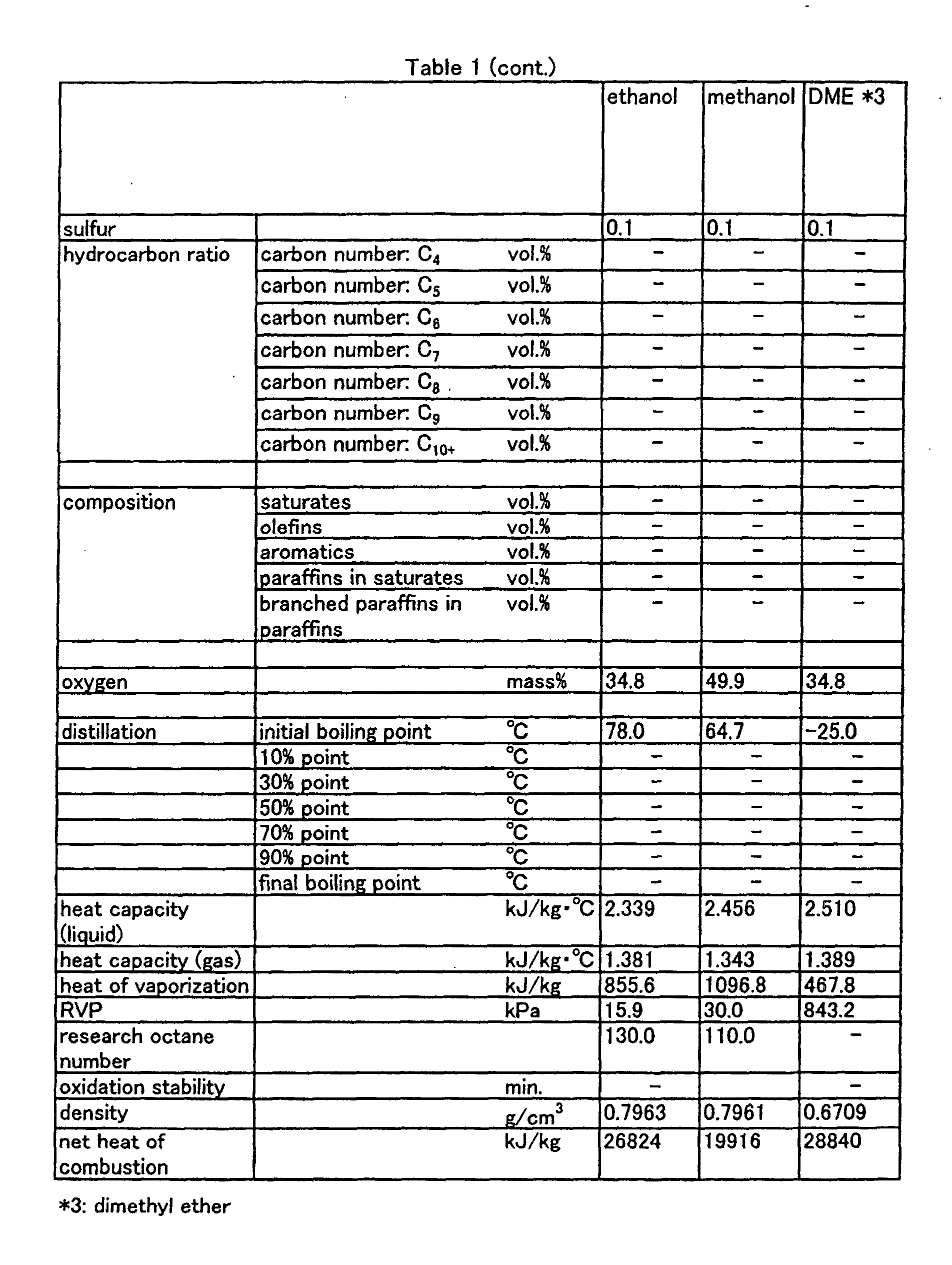


Claims (16)
- A fuel for a fuel cell system comprising 0.5-40 mass % of oxygenates in terms of an oxygen content based on the whole fuel.
- A fuel for a fuel cell system according to claim 1, wherein the fuel contains 5 vol.% or more of hydrocarbons based on the whole fuel.
- A fuel for a fuel cell system according to claim 2, wherein a content of hydrocarbon compounds having 4 carbon atoms is 15 vol.% or less, a content of hydrocarbon compounds having 5 carbon atoms is 5 vol.% or more and a content of hydrocarbon compounds having 6 carbon atoms is 10 vol.% or more based on the whole hydrocarbons.
- A fuel for a fuel cell system according to claim 2, wherein said fuel has distillation properties of the initial boiling point in distillation of 24 °C or higher and 40 °C or lower, the 10 vol.% distillation temperature (T10) of 25 °C or higher and 50 °C or lower, the 90 vol.% distillation temperature (T90) of 45 °C or higher and 130 °C or lower, and the final boiling point in distillation of 55 °C or higher and 150 °C or lower.
- A fuel for a fuel cell system according to any one of claims 1 to 4, wherein a sulfur content is 50 ppm by mass or less based on the whole fuel.
- A fuel for a fuel cell system according to any one of claims 1 to 5, wherein saturates are 30 vol.% or more based on the whole hydrocarbons.
- A fuel for a fuel cell system according to any one of claims 1 to 6, wherein olefins are 35 vol.% or less based on the whole hydrocarbons.
- A fuel for a fuel cell system according to any one of claims 1 to 7, wherein aromatics are 50 vol.% or less based on the whole hydrocarbons.
- A fuel for a fuel cell system according to any one of claims 1 to 8, wherein a ratio of paraffins in saturates is 60 vol.% or more.
- A fuel for a fuel cell system according to any one of claims 1 to 9, wherein a ratio of branched paraffins in paraffins is 30 vol.% or more.
- A fuel for a fuel cell system according to any one of claims 1 to 10, wherein heat capacity of the fuel is 2.6 kJ/kg °C or less at 15 °C and 1 atm in liquid phase.
- A fuel for a fuel cell system according to any one of claims 1 to 11, wherein heat of vaporization of the fuel is 400 kJ/kg or less.
- A fuel for a fuel cell system according to any one of claims 1 to 12, wherein Reid vapor pressure of the fuel is 10 kPa or more and less than 100 kPa.
- A fuel for a fuel cell system according to any one of claims 1 to 13, wherein research octane number of the fuel is 101.0 or less.
- A fuel for a fuel cell system according to any one of claims 1 to 14, wherein oxidation stability of the fuel is 240 minutes or longer.
- A fuel for a fuel cell system according to any one of claims 1 to 15, wherein density of the fuel is 0.78 g/cm3 or less.
Applications Claiming Priority (3)
| Application Number | Priority Date | Filing Date | Title |
|---|---|---|---|
| JP2000108462 | 2000-04-10 | ||
| JP2000108462 | 2000-04-10 | ||
| PCT/JP2001/003093 WO2001077264A1 (en) | 2000-04-10 | 2001-04-10 | Fuel for use in fuel cell |
Publications (2)
| Publication Number | Publication Date |
|---|---|
| EP1273650A1 true EP1273650A1 (en) | 2003-01-08 |
| EP1273650A4 EP1273650A4 (en) | 2004-10-06 |
Family
ID=18621294
Family Applications (1)
| Application Number | Title | Priority Date | Filing Date |
|---|---|---|---|
| EP01917866A Withdrawn EP1273650A4 (en) | 2000-04-10 | 2001-04-10 | FUEL FOR USE IN A FUEL CELL |
Country Status (5)
| Country | Link |
|---|---|
| US (1) | US6824573B2 (en) |
| EP (1) | EP1273650A4 (en) |
| JP (1) | JP4598894B2 (en) |
| AU (1) | AU4474401A (en) |
| WO (1) | WO2001077264A1 (en) |
Cited By (3)
| Publication number | Priority date | Publication date | Assignee | Title |
|---|---|---|---|---|
| EP1281748A4 (en) * | 2000-04-10 | 2004-10-06 | Nippon Oil Corp | FUEL FOR USE IN A FUEL CELL SYSTEM |
| EP1340800A4 (en) * | 2000-10-11 | 2004-10-06 | Nippon Oil Corp | DOUBLE-PURPOSE FUEL OR FUEL FOR PETROL ENGINE AND FUEL CELL SYSTEM AND SYSTEM FOR STORING AND / OR DELIVERY THEREOF |
| EP1273651A4 (en) * | 2000-04-10 | 2004-10-13 | Nippon Oil Corp | FUEL FOR A FUEL CELL DEVICE |
Families Citing this family (6)
| Publication number | Priority date | Publication date | Assignee | Title |
|---|---|---|---|---|
| US20030187310A1 (en) * | 2000-06-29 | 2003-10-02 | Kenichirou Saitou | Fuel for fuel cell system |
| US8999590B2 (en) * | 2007-07-25 | 2015-04-07 | Fuelcell Energy, Inc. | On-line monitoring assembly for detection of sulfur breakthrough in a desulfurizer assembly and sulfur breakthrough detection method |
| WO2018172737A1 (en) | 2017-03-23 | 2018-09-27 | Bae Systems Plc | Electrical power generation on a vehicle |
| WO2018172736A1 (en) | 2017-03-23 | 2018-09-27 | Bae Systems Plc | Electrical power generation on a vehicle |
| GB2560773A (en) * | 2017-03-23 | 2018-09-26 | Bae Systems Plc | Electrical power generation on a vehicle |
| GB2560771A (en) * | 2017-03-23 | 2018-09-26 | Bae Systems Plc | Electrical power generation on a vehicle |
Family Cites Families (21)
| Publication number | Priority date | Publication date | Assignee | Title |
|---|---|---|---|---|
| GB520564A (en) * | 1938-03-11 | 1940-04-26 | Standard Oil Dev Co | An improved manufacture of motor fuel |
| JPS50126005A (en) * | 1974-03-25 | 1975-10-03 | ||
| JPS606988B2 (en) | 1981-03-31 | 1985-02-21 | 繁信 藤本 | Method for producing stable and homogeneous engine fuel composition |
| JPS6340702A (en) * | 1986-08-01 | 1988-02-22 | Nippon Oil Co Ltd | Production of hydrogen for fuel cell |
| JPH0570780A (en) | 1991-09-12 | 1993-03-23 | Sekiyu Sangyo Kasseika Center | Deep light desulfurization method for medium and light oils |
| JPH07188678A (en) | 1993-12-27 | 1995-07-25 | Tonen Corp | Gasoline composition |
| JPH07315801A (en) * | 1994-05-23 | 1995-12-05 | Ngk Insulators Ltd | System for producing high-purity hydrogen, production of high-purity hydrogen and fuel cell system |
| JP3682784B2 (en) * | 1995-05-23 | 2005-08-10 | 株式会社コスモ総合研究所 | Fuel oil composition |
| JPH0971788A (en) * | 1995-09-07 | 1997-03-18 | Cosmo Sogo Kenkyusho:Kk | Unleaded high performance gasoline |
| JP2981645B2 (en) * | 1995-09-19 | 1999-11-22 | 富士通株式会社 | Magneto-optical recording method |
| US5747185A (en) * | 1995-11-14 | 1998-05-05 | Ztek Corporation | High temperature electrochemical converter for hydrocarbon fuels |
| JP3129670B2 (en) * | 1997-02-28 | 2001-01-31 | 三菱電機株式会社 | Fuel reformer |
| JPH10255830A (en) * | 1997-03-13 | 1998-09-25 | Toshiba Corp | Operating method of fuel cell |
| JPH1179703A (en) * | 1997-09-04 | 1999-03-23 | Aisin Seiki Co Ltd | Reformer for fuel cell |
| FR2771419B1 (en) * | 1997-11-25 | 1999-12-31 | Inst Francais Du Petrole | HIGH-INDEX OCTANE ESSENCES AND THEIR PRODUCTION BY A PROCESS COMBINING HYDRO-ISOMERIZATION AND SEPARATION |
| JPH11311136A (en) | 1998-04-28 | 1999-11-09 | Hitachi Ltd | Hybrid vehicle and its driving device |
| US6132479A (en) * | 1998-05-04 | 2000-10-17 | Chevron U.S.A. Inc. | Low emission, non-oxygenated fuel composition |
| CA2364537A1 (en) * | 1999-03-31 | 2000-10-19 | Harvard L. Tomlinson, Jr. | Fuel-cell fuels, methods, and systems |
| US20020020107A1 (en) * | 1999-07-02 | 2002-02-21 | Bailey Brent K. | Low molecular weight compression ignition fuel |
| JP4646345B2 (en) * | 1999-12-27 | 2011-03-09 | Jx日鉱日石エネルギー株式会社 | Fuel oil additive and fuel oil composition containing the additive |
| JP2001262163A (en) * | 2000-03-23 | 2001-09-26 | Idemitsu Kosan Co Ltd | Fuel oil for internal combustion engines and fuel cells |
-
2001
- 2001-04-10 US US10/240,746 patent/US6824573B2/en not_active Expired - Fee Related
- 2001-04-10 AU AU44744/01A patent/AU4474401A/en not_active Abandoned
- 2001-04-10 JP JP2001575118A patent/JP4598894B2/en not_active Expired - Fee Related
- 2001-04-10 WO PCT/JP2001/003093 patent/WO2001077264A1/en not_active Ceased
- 2001-04-10 EP EP01917866A patent/EP1273650A4/en not_active Withdrawn
Cited By (3)
| Publication number | Priority date | Publication date | Assignee | Title |
|---|---|---|---|---|
| EP1281748A4 (en) * | 2000-04-10 | 2004-10-06 | Nippon Oil Corp | FUEL FOR USE IN A FUEL CELL SYSTEM |
| EP1273651A4 (en) * | 2000-04-10 | 2004-10-13 | Nippon Oil Corp | FUEL FOR A FUEL CELL DEVICE |
| EP1340800A4 (en) * | 2000-10-11 | 2004-10-06 | Nippon Oil Corp | DOUBLE-PURPOSE FUEL OR FUEL FOR PETROL ENGINE AND FUEL CELL SYSTEM AND SYSTEM FOR STORING AND / OR DELIVERY THEREOF |
Also Published As
| Publication number | Publication date |
|---|---|
| JP4598894B2 (en) | 2010-12-15 |
| AU4474401A (en) | 2001-10-23 |
| US6824573B2 (en) | 2004-11-30 |
| WO2001077264A1 (en) | 2001-10-18 |
| EP1273650A4 (en) | 2004-10-06 |
| US20030056429A1 (en) | 2003-03-27 |
Similar Documents
| Publication | Publication Date | Title |
|---|---|---|
| US6824573B2 (en) | Fuel for use in fuel cell | |
| US6958117B2 (en) | Fuel for use in a fuel cell system | |
| JPWO2002031090A1 (en) | Gasoline vehicle and fuel for fuel cell system, and storage and / or supply system thereof | |
| US6939459B2 (en) | Fuel for use in fuel cell system | |
| EP1273651A1 (en) | Fuel for use in fuel cell system | |
| JPWO2001077264A1 (en) | Fuel for fuel cell systems | |
| US6837909B2 (en) | Fuel for use in a fuel cell system | |
| JPWO2001077262A1 (en) | Fuel for fuel cell systems | |
| US6884272B2 (en) | Fuel for fuel cell system | |
| US6962650B2 (en) | Fuel for use in a fuel cell system | |
| JP4598890B2 (en) | Fuel for fuel cell system | |
| US7141084B2 (en) | Fuel for fuel cell system | |
| JP4598897B2 (en) | Fuel for fuel cell system | |
| JPWO2001077268A1 (en) | Fuel for fuel cell systems | |
| JPWO2002046334A1 (en) | Mixed gasoline and its storage and / or supply system | |
| JP4598896B2 (en) | Fuel for fuel cell system | |
| JPWO2001077261A1 (en) | Fuel for fuel cell systems | |
| JPWO2001077266A1 (en) | Fuel for fuel cell systems |
Legal Events
| Date | Code | Title | Description |
|---|---|---|---|
| PUAI | Public reference made under article 153(3) epc to a published international application that has entered the european phase |
Free format text: ORIGINAL CODE: 0009012 |
|
| 17P | Request for examination filed |
Effective date: 20021031 |
|
| AK | Designated contracting states |
Kind code of ref document: A1 Designated state(s): AT BE CH CY DE DK ES FI FR GB GR IE IT LI LU MC NL PT SE TR |
|
| AX | Request for extension of the european patent |
Free format text: AL;LT;LV;MK;RO;SI |
|
| RAP1 | Party data changed (applicant data changed or rights of an application transferred) |
Owner name: NIPPON OIL CORPORATION |
|
| A4 | Supplementary search report drawn up and despatched |
Effective date: 20040824 |
|
| RIC1 | Information provided on ipc code assigned before grant |
Ipc: 7B 60K 1/04 B Ipc: 7C 10L 1/06 A |
|
| 17Q | First examination report despatched |
Effective date: 20041215 |
|
| STAA | Information on the status of an ep patent application or granted ep patent |
Free format text: STATUS: THE APPLICATION IS DEEMED TO BE WITHDRAWN |
|
| 18D | Application deemed to be withdrawn |
Effective date: 20050426 |