EP1271240A2 - Silver halide color photographic material - Google Patents
Silver halide color photographic material Download PDFInfo
- Publication number
- EP1271240A2 EP1271240A2 EP02254138A EP02254138A EP1271240A2 EP 1271240 A2 EP1271240 A2 EP 1271240A2 EP 02254138 A EP02254138 A EP 02254138A EP 02254138 A EP02254138 A EP 02254138A EP 1271240 A2 EP1271240 A2 EP 1271240A2
- Authority
- EP
- European Patent Office
- Prior art keywords
- group
- coupler
- alkyl group
- silver halide
- photographic material
- Prior art date
- Legal status (The legal status is an assumption and is not a legal conclusion. Google has not performed a legal analysis and makes no representation as to the accuracy of the status listed.)
- Granted
Links
- 0 C[C@]1C(*)(CC2)C[C@]2CC1 Chemical compound C[C@]1C(*)(CC2)C[C@]2CC1 0.000 description 10
- CVZDIUZSWUDGOP-UHFFFAOYSA-N CN(C1=O)SC(Cl)=C1Cl Chemical compound CN(C1=O)SC(Cl)=C1Cl CVZDIUZSWUDGOP-UHFFFAOYSA-N 0.000 description 1
- DHNRXBZYEKSXIM-UHFFFAOYSA-N CN1SC(Cl)=CC1=O Chemical compound CN1SC(Cl)=CC1=O DHNRXBZYEKSXIM-UHFFFAOYSA-N 0.000 description 1
- BEGLCMHJXHIJLR-UHFFFAOYSA-N CN1SC=CC1=O Chemical compound CN1SC=CC1=O BEGLCMHJXHIJLR-UHFFFAOYSA-N 0.000 description 1
Images

Classifications
-
- C—CHEMISTRY; METALLURGY
- C07—ORGANIC CHEMISTRY
- C07D—HETEROCYCLIC COMPOUNDS
- C07D487/00—Heterocyclic compounds containing nitrogen atoms as the only ring hetero atoms in the condensed system, not provided for by groups C07D451/00 - C07D477/00
- C07D487/02—Heterocyclic compounds containing nitrogen atoms as the only ring hetero atoms in the condensed system, not provided for by groups C07D451/00 - C07D477/00 in which the condensed system contains two hetero rings
- C07D487/04—Ortho-condensed systems
-
- C—CHEMISTRY; METALLURGY
- C07—ORGANIC CHEMISTRY
- C07D—HETEROCYCLIC COMPOUNDS
- C07D231/00—Heterocyclic compounds containing 1,2-diazole or hydrogenated 1,2-diazole rings
- C07D231/02—Heterocyclic compounds containing 1,2-diazole or hydrogenated 1,2-diazole rings not condensed with other rings
- C07D231/10—Heterocyclic compounds containing 1,2-diazole or hydrogenated 1,2-diazole rings not condensed with other rings having two or three double bonds between ring members or between ring members and non-ring members
- C07D231/14—Heterocyclic compounds containing 1,2-diazole or hydrogenated 1,2-diazole rings not condensed with other rings having two or three double bonds between ring members or between ring members and non-ring members with hetero atoms or with carbon atoms having three bonds to hetero atoms with at the most one bond to halogen, e.g. ester or nitrile radicals, directly attached to ring carbon atoms
- C07D231/18—One oxygen or sulfur atom
- C07D231/20—One oxygen atom attached in position 3 or 5
- C07D231/22—One oxygen atom attached in position 3 or 5 with aryl radicals attached to ring nitrogen atoms
-
- C—CHEMISTRY; METALLURGY
- C07—ORGANIC CHEMISTRY
- C07D—HETEROCYCLIC COMPOUNDS
- C07D233/00—Heterocyclic compounds containing 1,3-diazole or hydrogenated 1,3-diazole rings, not condensed with other rings
- C07D233/54—Heterocyclic compounds containing 1,3-diazole or hydrogenated 1,3-diazole rings, not condensed with other rings having two double bonds between ring members or between ring members and non-ring members
- C07D233/66—Heterocyclic compounds containing 1,3-diazole or hydrogenated 1,3-diazole rings, not condensed with other rings having two double bonds between ring members or between ring members and non-ring members with hetero atoms or with carbon atoms having three bonds to hetero atoms with at the most one bond to halogen, e.g. ester or nitrile radicals, directly attached to ring carbon atoms
- C07D233/72—Two oxygen atoms, e.g. hydantoin
- C07D233/74—Two oxygen atoms, e.g. hydantoin with only hydrogen atoms or radicals containing only hydrogen and carbon atoms, attached to other ring members
-
- G—PHYSICS
- G03—PHOTOGRAPHY; CINEMATOGRAPHY; ANALOGOUS TECHNIQUES USING WAVES OTHER THAN OPTICAL WAVES; ELECTROGRAPHY; HOLOGRAPHY
- G03C—PHOTOSENSITIVE MATERIALS FOR PHOTOGRAPHIC PURPOSES; PHOTOGRAPHIC PROCESSES, e.g. CINE, X-RAY, COLOUR, STEREO-PHOTOGRAPHIC PROCESSES; AUXILIARY PROCESSES IN PHOTOGRAPHY
- G03C7/00—Multicolour photographic processes or agents therefor; Regeneration of such processing agents; Photosensitive materials for multicolour processes
- G03C7/30—Colour processes using colour-coupling substances; Materials therefor; Preparing or processing such materials
- G03C7/32—Colour coupling substances
- G03C7/3212—Couplers characterised by a group not in coupling site, e.g. ballast group, as far as the coupling rest is not specific
-
- G—PHYSICS
- G03—PHOTOGRAPHY; CINEMATOGRAPHY; ANALOGOUS TECHNIQUES USING WAVES OTHER THAN OPTICAL WAVES; ELECTROGRAPHY; HOLOGRAPHY
- G03C—PHOTOSENSITIVE MATERIALS FOR PHOTOGRAPHIC PURPOSES; PHOTOGRAPHIC PROCESSES, e.g. CINE, X-RAY, COLOUR, STEREO-PHOTOGRAPHIC PROCESSES; AUXILIARY PROCESSES IN PHOTOGRAPHY
- G03C7/00—Multicolour photographic processes or agents therefor; Regeneration of such processing agents; Photosensitive materials for multicolour processes
- G03C7/30—Colour processes using colour-coupling substances; Materials therefor; Preparing or processing such materials
- G03C7/32—Colour coupling substances
- G03C7/36—Couplers containing compounds with active methylene groups
- G03C7/38—Couplers containing compounds with active methylene groups in rings
- G03C7/381—Heterocyclic compounds
- G03C7/382—Heterocyclic compounds with two heterocyclic rings
- G03C7/3825—Heterocyclic compounds with two heterocyclic rings the nuclei containing only nitrogen as hetero atoms
- G03C7/3835—Heterocyclic compounds with two heterocyclic rings the nuclei containing only nitrogen as hetero atoms four nitrogen atoms
-
- G—PHYSICS
- G03—PHOTOGRAPHY; CINEMATOGRAPHY; ANALOGOUS TECHNIQUES USING WAVES OTHER THAN OPTICAL WAVES; ELECTROGRAPHY; HOLOGRAPHY
- G03C—PHOTOSENSITIVE MATERIALS FOR PHOTOGRAPHIC PURPOSES; PHOTOGRAPHIC PROCESSES, e.g. CINE, X-RAY, COLOUR, STEREO-PHOTOGRAPHIC PROCESSES; AUXILIARY PROCESSES IN PHOTOGRAPHY
- G03C7/00—Multicolour photographic processes or agents therefor; Regeneration of such processing agents; Photosensitive materials for multicolour processes
- G03C7/30—Colour processes using colour-coupling substances; Materials therefor; Preparing or processing such materials
- G03C7/32—Colour coupling substances
-
- G—PHYSICS
- G03—PHOTOGRAPHY; CINEMATOGRAPHY; ANALOGOUS TECHNIQUES USING WAVES OTHER THAN OPTICAL WAVES; ELECTROGRAPHY; HOLOGRAPHY
- G03C—PHOTOSENSITIVE MATERIALS FOR PHOTOGRAPHIC PURPOSES; PHOTOGRAPHIC PROCESSES, e.g. CINE, X-RAY, COLOUR, STEREO-PHOTOGRAPHIC PROCESSES; AUXILIARY PROCESSES IN PHOTOGRAPHY
- G03C7/00—Multicolour photographic processes or agents therefor; Regeneration of such processing agents; Photosensitive materials for multicolour processes
- G03C7/30—Colour processes using colour-coupling substances; Materials therefor; Preparing or processing such materials
- G03C7/32—Colour coupling substances
- G03C7/34—Couplers containing phenols
-
- G—PHYSICS
- G03—PHOTOGRAPHY; CINEMATOGRAPHY; ANALOGOUS TECHNIQUES USING WAVES OTHER THAN OPTICAL WAVES; ELECTROGRAPHY; HOLOGRAPHY
- G03C—PHOTOSENSITIVE MATERIALS FOR PHOTOGRAPHIC PURPOSES; PHOTOGRAPHIC PROCESSES, e.g. CINE, X-RAY, COLOUR, STEREO-PHOTOGRAPHIC PROCESSES; AUXILIARY PROCESSES IN PHOTOGRAPHY
- G03C7/00—Multicolour photographic processes or agents therefor; Regeneration of such processing agents; Photosensitive materials for multicolour processes
- G03C7/30—Colour processes using colour-coupling substances; Materials therefor; Preparing or processing such materials
- G03C7/32—Colour coupling substances
- G03C7/36—Couplers containing compounds with active methylene groups
- G03C7/38—Couplers containing compounds with active methylene groups in rings
Definitions
- the present invention relates to a method of preparing at a low cost a compound useful as a coupler for silver halide color photographic materials, a silver halide color photographic material comprising a coupler containing a novel ballast group, obtained by the foregoing preparation method, and a dye for use in a silver halide color photographic material exhibiting superior spectral absorption characteristics.
- a technique is useful to incorporate a coupler into a photographic emulsion layer, in which a hydrophobic ballast group is introduced into a coupler molecule and after dissolved in an organic solvent, the coupler is incorporated in the form of an emulsion dispersed in a hydrophilic colloid such as gelatin.
- Basic properties required for couplers include enhanced solubility in high boiling organic solvents, superior dispersibility and dispersion stability in a silver halide emulsion, without easily forming precipitates, exhibiting superior spectral absorption characteristics and color tone and forming clear dye images over a wide color reproduction region, and a method of preparing the coupler from low-priced raw material in a simple and reproducible manner and in a relatively high yield.
- ballast groups contained in couplers play a great role, affecting the foregoing performances and specific ballast groups are proposed in JP-B Nos. 44-3660, 48-25655, 48-25932, 48-25934, 49-16057 and 51-40804 (hereinafter, the term, JP-B means a published Japanese Patent); JP-A Nos. 47-4481, 49-8228, 50-19435, 51-126831, 52-86333, 56-30126, 57-146251, 58-42045, 59-177557, 60-24547, and 9-281672 (hereinafter, the term JP-A means an unexamined, published Japanese Patent Application); U.S. Patent Nos. 2,908,573, 2,920,961, and 3,227,544.
- ballast groups were still insufficient for satisfying the foregoing performances.
- pyrazolotriazole type cyan couplers a further improvement is desired in terms of solubility in high boiling organic solvents and superior color reproduction in the relatively high density region, and to obtain the coupler from low-priced raw material in a simple and reproducible manner and in a relatively high yield.
- a silver halide color photographic material comprising a coupler obtained in the preparation method for a coupler from low-priced raw material in a simple and reproducible manner and in a relatively high yield.
- Fig. 1 shows absorption spectrum of exemplified compound 8-9.
- couplers represented by the following formula (1) : wherein R 8 is a hydrogen atom, an alkyl group, an aryl group or a heterocyclic group; R 9 is an alkyl group, an aryl group or a heterocyclic group; R 10 is an alkyl group, an aryl group or a heterocyclic group; J 1 is -O- or -NR 11 -, in which R 11 is a hydrogen atom, an alkyl group, an aryl group or a heterocyclic group; L is a bivalent linkage group; n is 0 or 1; Cp is a coupler residue.
- R 8 is a hydrogen atom, an alkyl group, an aryl group or a heterocyclic group
- R 9 is an alkyl group, an aryl group or a heterocyclic group
- R 10 is an alkyl group, an aryl group or a heterocyclic group
- J 1 is -O- or -NR 11 -, in which R 11 is
- alkyl group, aryl group and heterocyclic group represented by R 8 , R 9 and R 10 include an alkyl group such as methyl, ethyl, isopropyl, butyl or dodecyl; an aryl group such as phenyl; and a heterocyclic group, preferably 5- to 7-membered one, such as 2-furyl, 2-thienyl, 2-pyridyl, 2-benzothiazolyl, 1-pyrrolyl, or 1-tetrazolyl.
- R 8 , R 9 and R 10 may be substituted.
- Substituent groups are not specifically limited and examples thereof include an alkyl, aryl, anilino, acylamino, sulfonamido, alkylthio, arylthio, and cycloalkyl groups.
- halogen atom examples include a halogen atom, cycloalkenyl, alkynyl, heterocyclic group, sulfinyl, phosphonyl, acyl, carbamoyl, sulfamoyl, cyano, alkoxy, aryloxy, heterocyclic-oxy, siloxy, acyloxy, sulfonyloxy, carbamoyloxy, amino, alkylamino, imido, ureido, sulfamoylamino, alkoxycarbonylamino, aryloxycarbonylamino, alkoxycarbonyl, aryloxycarbonyl, heterocyclic-thio, thioureido, carboxy, hydroxy, mercapto, nitro, and sulfo groups, spiro-compound residue and bridged hydrocarbon residue.
- Examples of the alkyl, aryl or heterocyclic group represented by R 11 include those as cited in R 8 , R 9 and R 10 .
- n is 0 or 1, and preferably 0.
- Cp is a coupler residue and in the coupler residue, representative examples of a yellow coupler residue include those described in U.S. Patent Nos. 2,298,443, 2,407,210, 2,875,057, 3,048,194 and 3,447,928; and Farbkuppler mecanic Literatur ubersicht Agfa Mitannon (Band II), 112-126 (1961). Of these, acylacetonitrile type yellow coupler, such as benzoylacetoanilide coupler and pivaloylacetoanilide coupler are preferred.
- magenta coupler residue examples include those described in U.S. Patent Nos. 2,369, 489, 2,343,708, 2,311,082, 2,600,788, 2,908,573, 3,062,653, 3,152,896, 3,519,429, 3,725,067, 4,540,654; JP-A No. 59-162648 and also in Farbkuppler mecanic Literatur ubersicht Agfa Mitannon (Band II), 126-156 (1961).
- pyrazolone magenta couplers and pyrazoloazole magenta couplers are preferred.
- Examples of a cyan coupler residue include those described in U.S. Patent Nos. 2,367,531, 2,423,730, 2,772,162, 2,895,826, 3,002,836, 3,034,892, 3,041,236; JP-A No. 64-554; and also in Farbkuppler mecanic Literatur ubersicht Agfa Mitannon (Band II), 156-175 (1961).
- a phenol type cyan coupler and naphthol type cyan coupler, pyrrolotriazole type cyan coupler and pyrazolotriazole type coupler are preferred.
- X represents a hydrogen atom, halogen atom or a group capable of being released upon reaction with an oxidation product of a color developing agent (i.e., a coupling-off group).
- a color developing agent i.e., a coupling-off group.
- an atom or group capable of being released upon reaction with an oxidation product of a color developing agent include a hydrogen atom, halogen atom (e.g., chlorine, bromine, iodine), alkyleneoxy, alkoxy, aryloxy, heterocyclic-oxy, acyloxy, sulfonyloxy, alkoxycarbonyloxy, aryloxycarbonylalkyloxazolyloxy, alkoxyoxazolyloxy, alkylthio, arylthio, heterocyclic-thio, alkyloxythiocarbonylthio, acylamino, sulfonamido, N-bonded nitrogen containing heterocycle, alkyloxycarbonyla
- R M represents a univalent substituent group.
- the univalent group represented by R M is not specifically limited and representative examples thereof include alkyl, aryl, anilino, acylamino, sulfonamido, alkylthio, arylthio, alkenyl, and cycloalkyl.
- a halogen atom, cycloalkenyl, alkynyl, heterocyclic group, sulfinyl, phosphonyl, acyl, carbamoyl, sulfamoyl, cyano, alkoxy, aryloxy, heterocyclic-oxy, siloxy, acyloxy, sulfonyloxy, carbamoyloxy, amino, alkylamino, imido, ureido, sulfamoylamino, alkoxycarbonylamino, aryloxycarbonylamino, alkoxycarbonyl, aryloxycarbonyl, heterocyclic-thio, thioureido, carboxy, hydroxy, mercapto, nitro, and sulfo groups, spiro-compound residue and bridged hydrocarbon residue are also included.
- the alkyl group represented by R M is preferably one having 1 to 32 carbon atoms, which may be straight chain or branched.
- the aryl group represented by R M is preferably phenyl.
- Acyl amino group include alkylcarbonylamino and arylcarbonylamino.
- the sulfonamido represented by R M include, for example, alkylsulfonylamino and arylsulfonylamino.
- the alkyl component and aryl component in the alkylthio group and arylthio group include an alkyl groups and aryl groups represented by the foregoing R M .
- the alkenyl group represented by R M contains preferably 2 to 32 carbon atoms, the cycloalkyl group contains preferably 3 to 12 carbon atoms, and more preferably 5 to 7 carbon atoms.
- the alkenyl group may be straight chain or branched.
- the cycloalkenyl group represented by R M contains preferably 3 to 12 carbon atoms, and more preferably 5 to 7 carbon atoms.
- the sulfonyl group include an alkylsulfonyl and arylsulfonyl.
- the sulfinyl group represented by R M include alkylsulfinyl and aryl sulfinyl; the phosphonyl group represented by R M alkylphosphonyl, alkoxyphosphonyl, aryloxyphosphonyl and arylphosphonyl; the acyl group represented by R M include alkylcarbonyl, and arylcarbonyl; the carbamoyl group represented by R M include alkylcarbamoyl and arylcabamoyl; the sulfamoyl group represented by R M include alkylsulfamoyl and arylsulfamoyl; the acyloxy group represented by R M include alkycarbonyloxy and arylcarbonyloxy; the sulfonyloxy group include alkylsulfonyloxy and arysulfonyloxy; the carbamoyloxy represented by R M include alkylcarbamoyloxy and
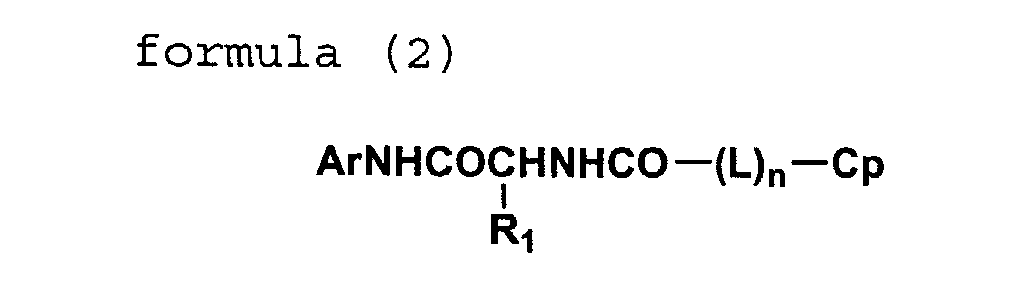
- Ar represents an aryl group or heterocyclic group.
- the aryl groups represented by Ar include, for example, phenyl and naphthyl.
- the heterocyclic group represented by Ar is preferably a 5- to 7-memebered ring, including, for example, 2-furyl,2-thienyl, 2-pyridinyl, 2-benzothiazolyl, 1-pyrrolyl and 1-tetrazolyl. These ary or heterocyclic group represented by Ar may be substituted.
- Substituent groups are not specifically limited and exemplary examples thereof include those cited as substituent groups for R 8 , R 9 and R 10 in formula (1).
- R 1 is preferably an alkyl or aryl group, more preferably alkyl group, and still more preferably an unsubstituted alkyl group.
- L represents a bivalent linkage group, and preferably an alkylene or arylene group; n is 0 or 1, and preferably 0.
- pyrazolotriazoles are preferred as the coupler residue, and more preferably a coupler residue represented by formula (6).
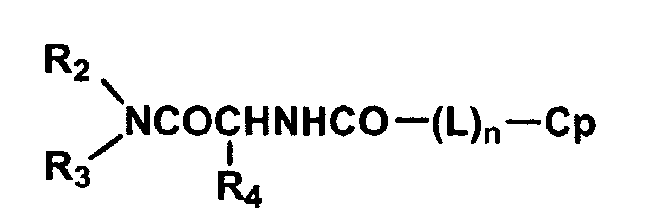
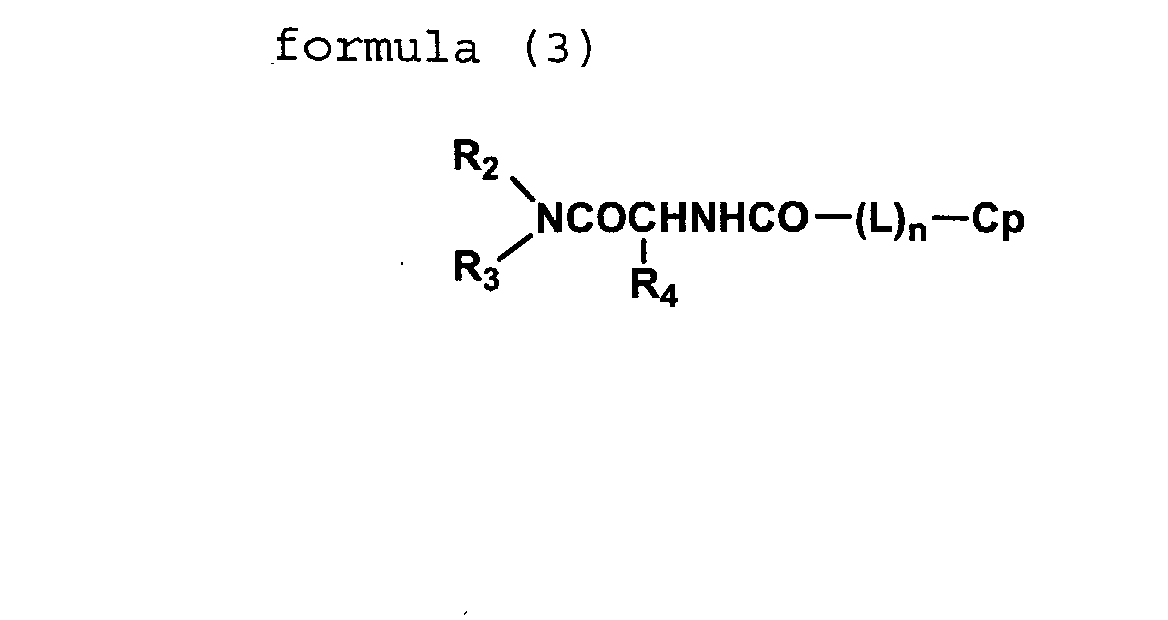
- R 2 , R 3 and R 4 are each an alkyl group, aryl group or heterocyclic group, provided that R 2 and R 3 may combine with each other to form a ring; and examples thereof include those, as cited in R 8 , R 9 and R 10 of formula (1).
- R 2 , R 3 and R 4 are preferably an alkyl group or aryl group.
- R 4 is preferably an alkyl or aryl group, more preferably an alkyl group, and still more preferably an unsubstituted alkyl group.
- L is a bivalent linkage group, and preferably an alkylene group or arylene group; n is 0 or 1, and preferably 0.
- Cp represents a coupler residue
- this coupler residue represented by Cp include those cited as a coupler residue in formula (1).
- coupler residues represented by Cp pyrazolotriazoles are preferred as a coupler residue, and more preferably a coupler residue represented by formula (6).
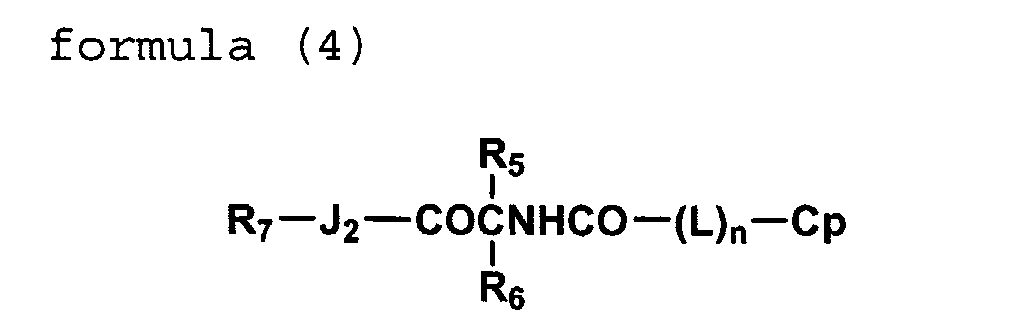
- R 5 is an unsubstituted alkyl group having 5 or more carbon atoms, which may be straight chain or branched, including, for example, hexyl, octyl, decyl, dodecyl and 1,1,3-trimethybutyl.
- R 6 is a hydrogen atom, an alkyl group, aryl group or heterocyclic group and examples of the alkyl, aryl and heterocyclic group represented by R 6 include the same as cited in R 8 , R 9 and R 10 in formula (1); R 6 is preferably a hydrogen atom or alkyl group, and more preferably a hydrogen atom.
- R 7 is preferably an alkyl group or aryl group.
- J 2 is preferably -NR 11 -, in which R 11 is the same as defined in R 11 of formula (1).
- L is a bivalent linkage group, and preferably an alkylene group or arylene group; n is 0 or 1, and preferably.
- Cp represents a coupler residue and Examples thereof include the same as cited in Cp of formula (1); and of the coupler residues represented by Cp is preferably pyrazolotriazoles as the coupler residue and more preferably the coupler residue represented by the foregoing formula (6).
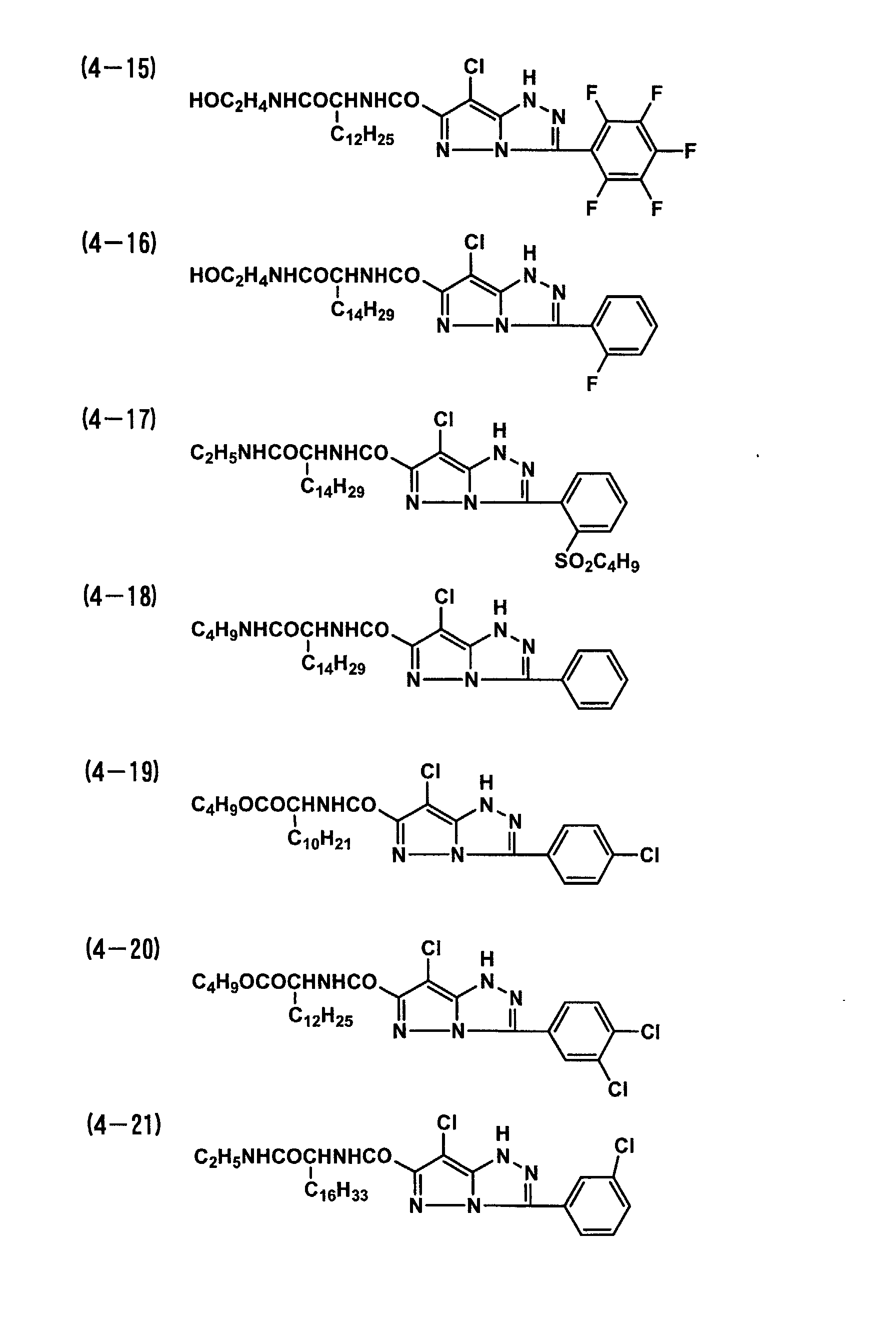
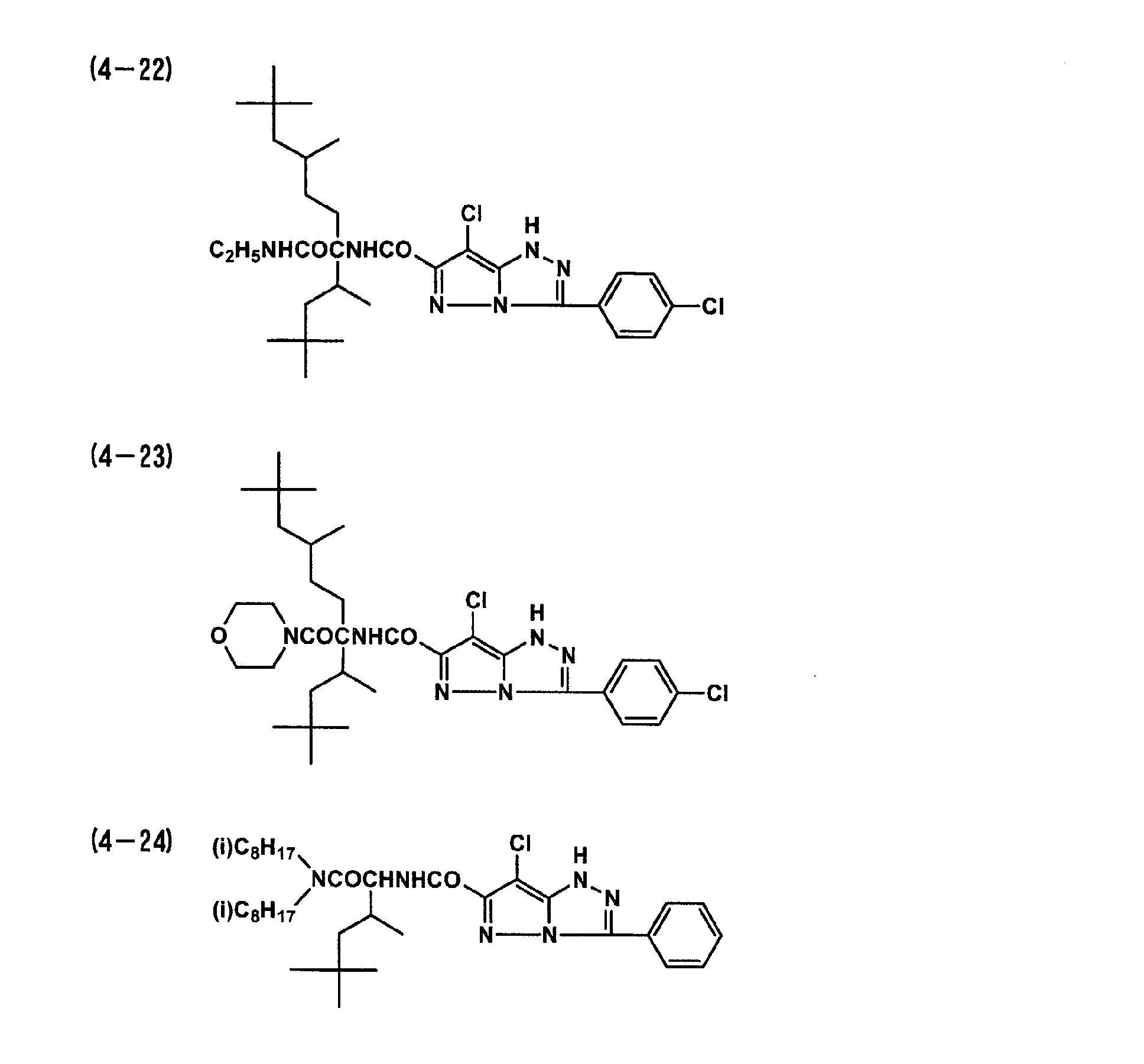
- the couplers of the invention can be synthesized in accordance with methods described in JP-A Nos. 8-171185, 8-311360, 8-339060 and 9-281672.
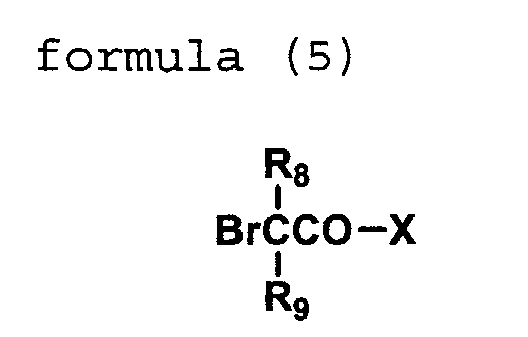
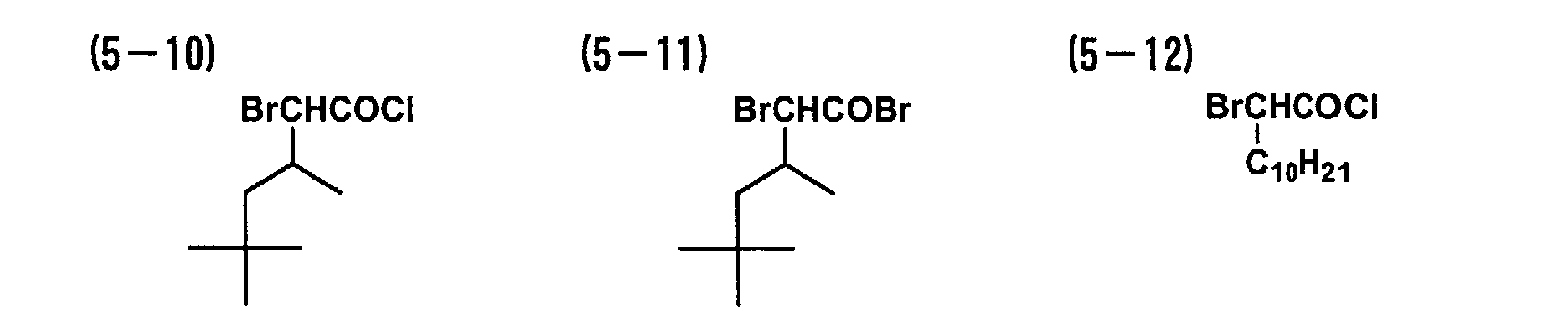
- the coupler represented by the foregoing formula (1) is prepared preferably using a compound, as a raw material, represented by the following formula (5) : wherein R 8 and R9 are the same as R 8 and R 9 as defined in the foregoing formula (1); X is a halogen atom.
- the couplers represented by the foregoing formulas (2) through (4) can also be prepared using the compound represented by formula (5).
- X is a halogen atom (e.g., chlorine, bromine, etc.);
- R 8 and R 9 are the same as R 8 and R 9 defined in formula (1).
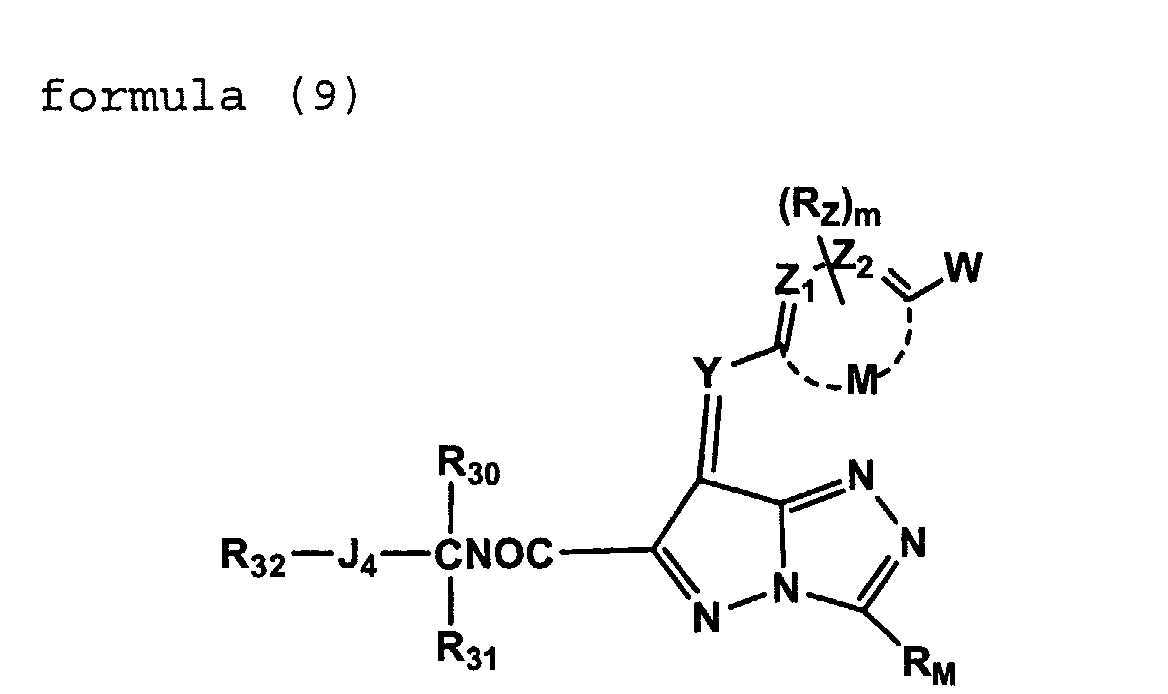
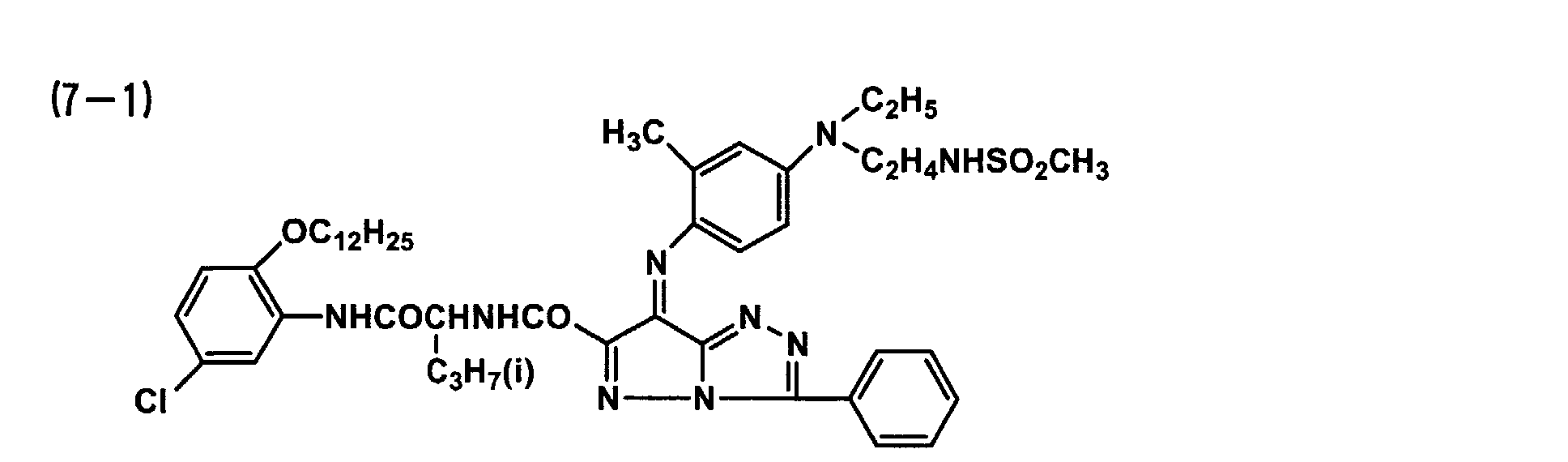
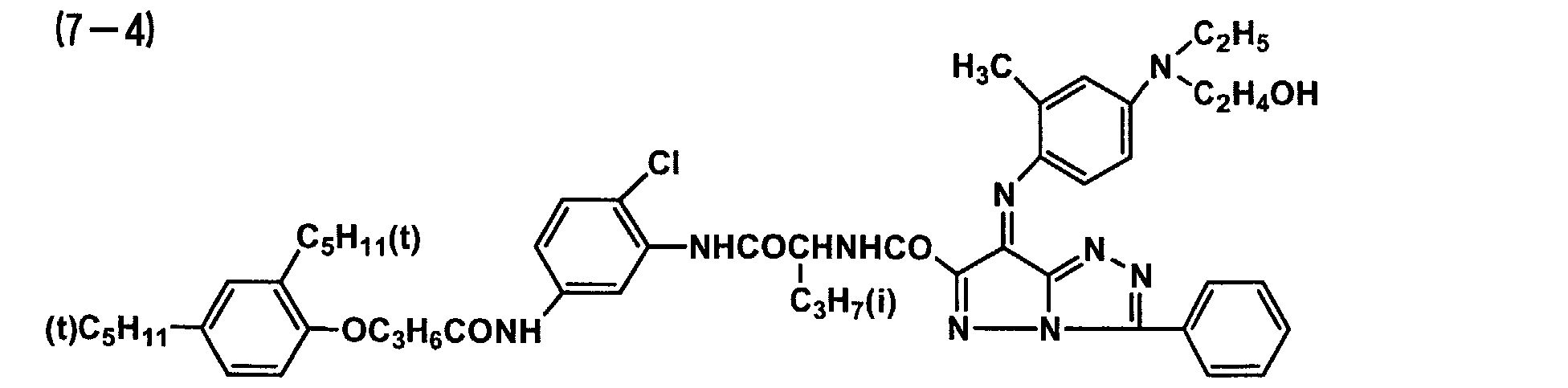
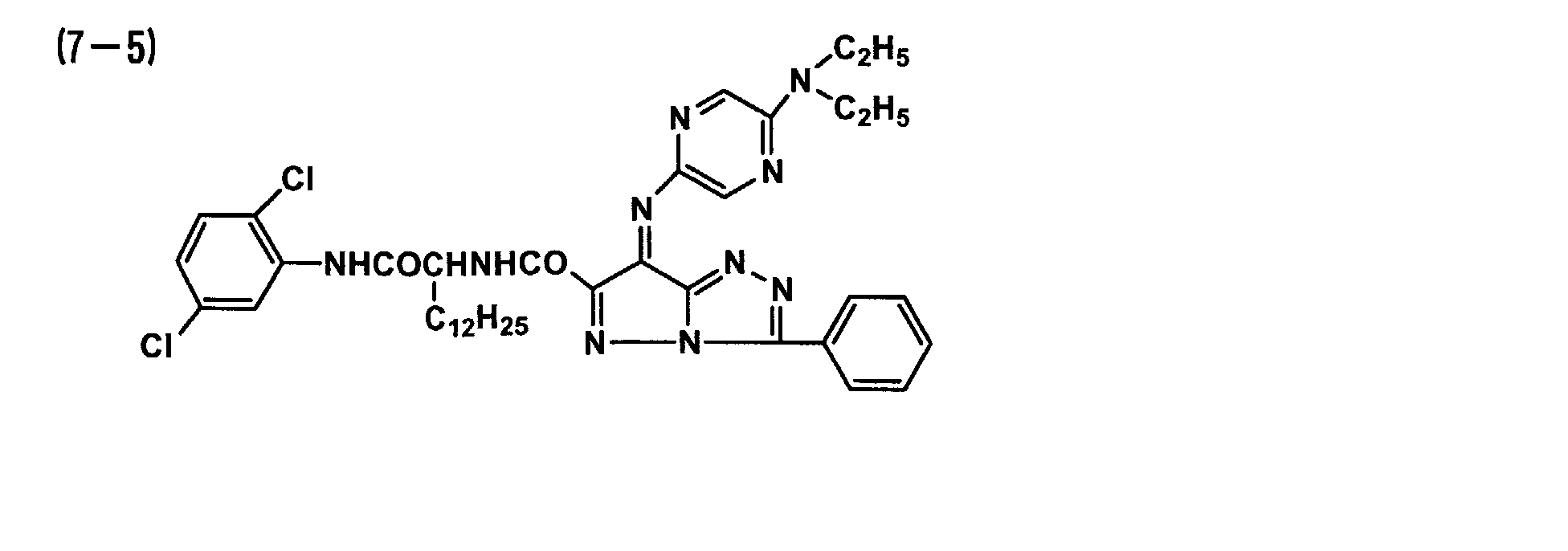
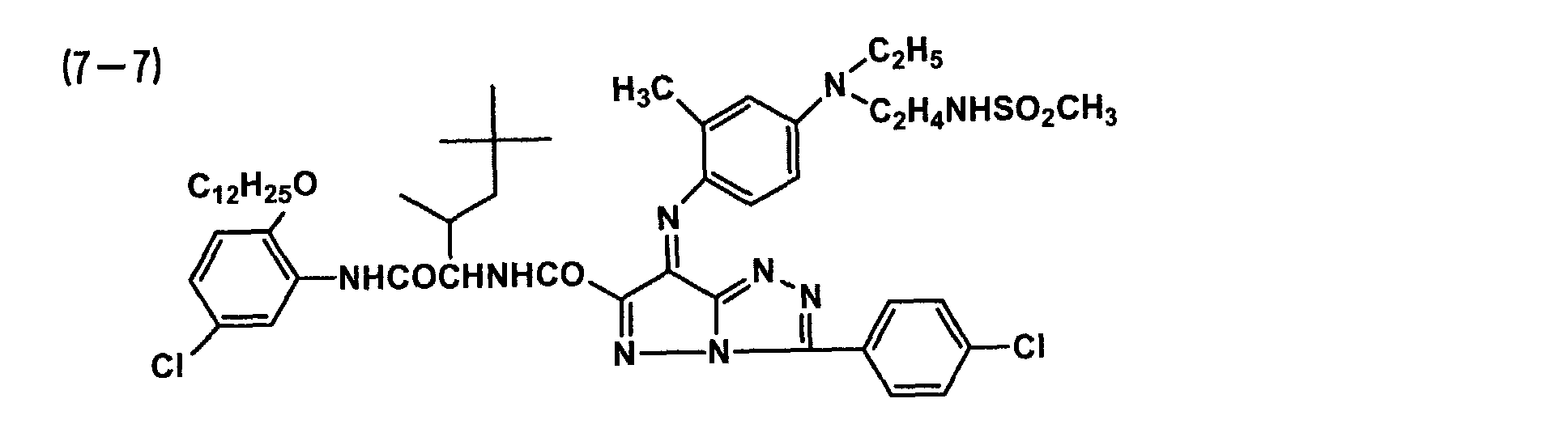
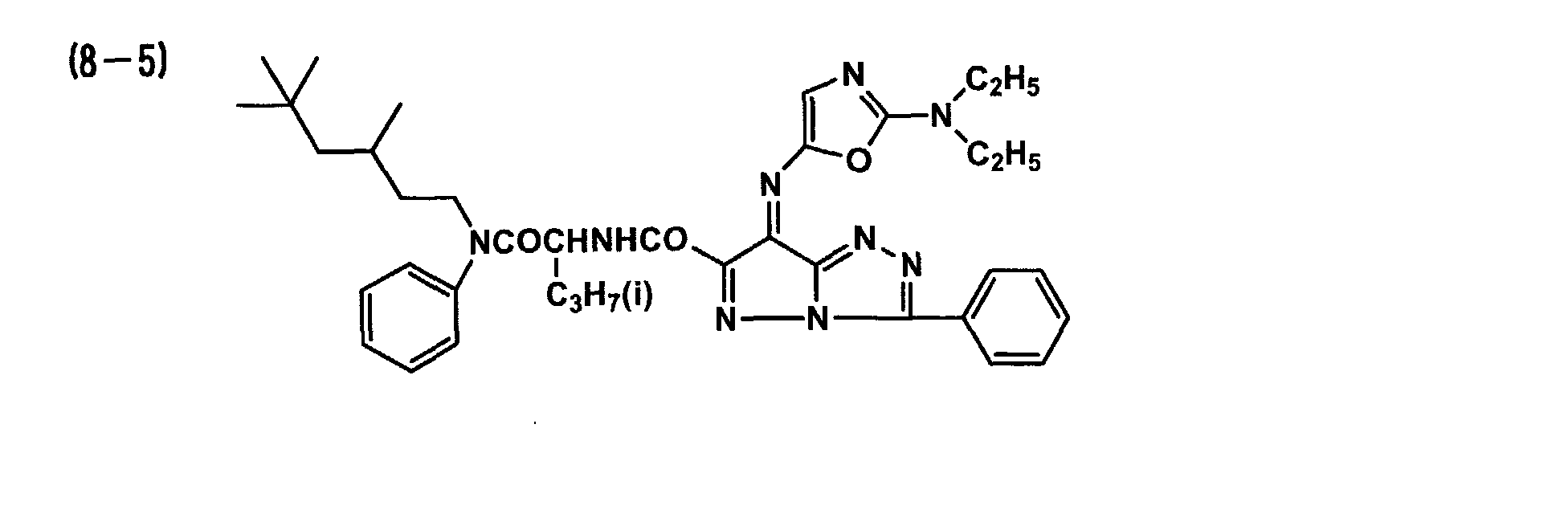
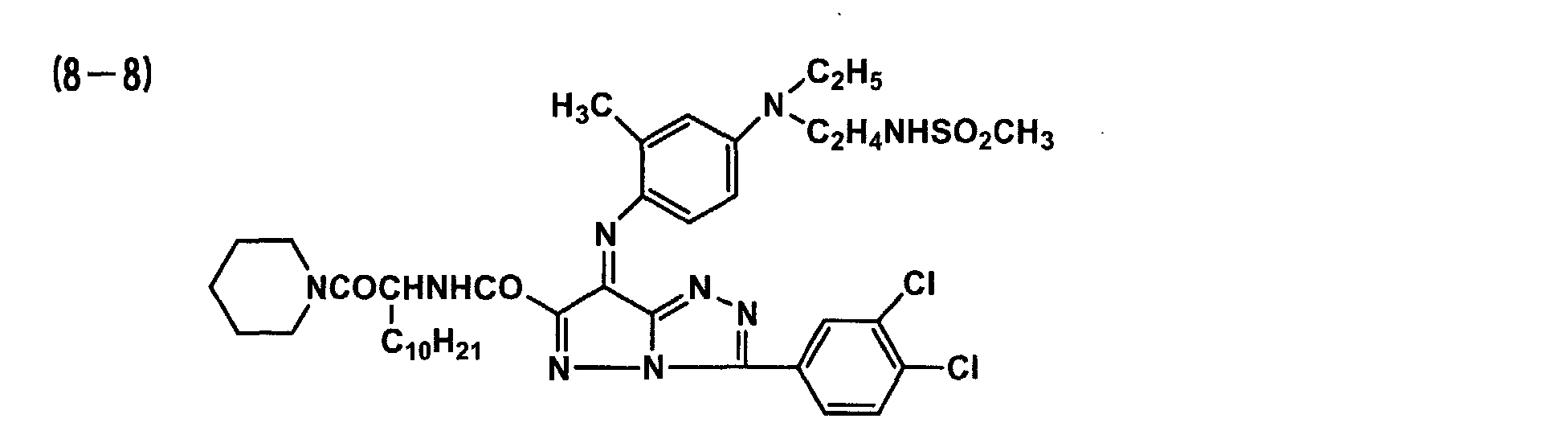
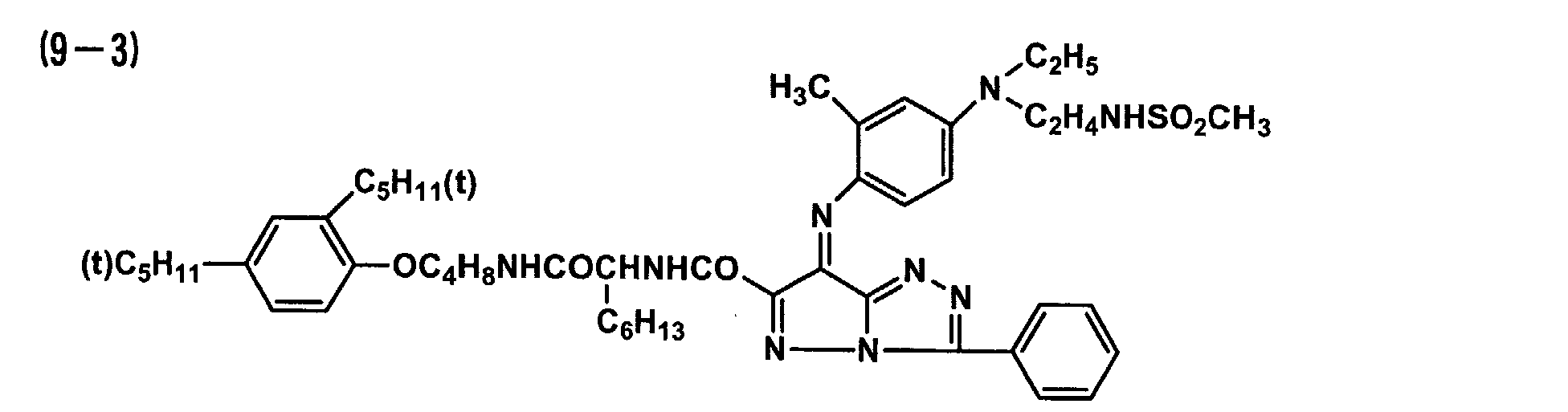
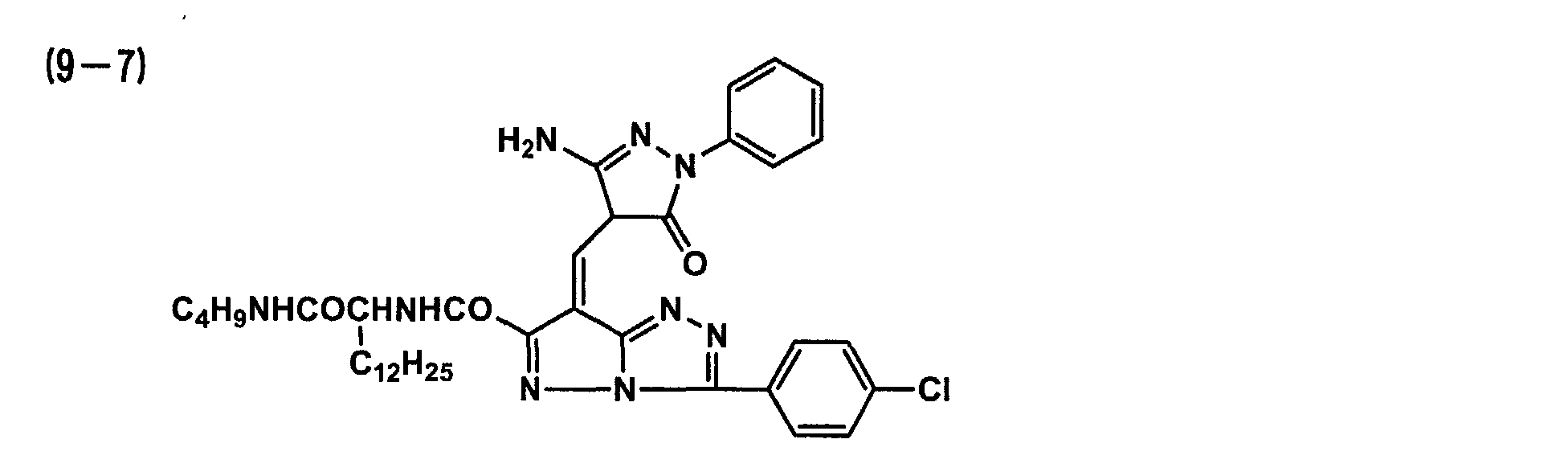
- Dye formed from the foregoing couplers represented by formulas (2), (3) and (4) preferably are those which are represented by the following formulas (7), (8) and (9), respectively: wherein W is -NR x R y , -OH or -OZ, in which R x and Ry are each an alkyl group or an aryl group; Z is an alkali metal ion or a quaternary ammonium ion; R z is a hydrogen atom, a halogen atom or a univalent substituent group; m is an integer of 1 to 3; Z 1 and Z 2 are each a nitrogen atom or C(R 27 ), in which R 27 is a univalent substituent group; M is an atomic group necessary to a 5- or 6-membered aromatic carbon ring or aromatic heterocyclic ring, together with Z 1 , Z 2 and adjacent carbon atoms; Y is a nitrogen atom or CR 28 , in which R 28 is a hydrogen atom, an alkyl group
- W represents -NR x R y , -OH or -OZ, in which R x and R y each represent an alkyl group or an aryl group.
- the alkyl group is preferably methyl, ethyl propyl and butyl, which may be substituted by a substituent group such as hydroxy or a sulfonamido group.
- the aryl group is preferably phenyl.
- Z represents an alkali metal ion or quaternary ammonium ion.
- R z represents a halogen atom (e.g., chlorine, bromine, fluorine, etc.), or a univalent substituent group.
- substituent group include an alkyl group (e.g., methyl ethyl, isopropyl, hydroxyethyl, methoxymethyl, trifluoromethyl, t-butyl, etc.), cycloalkyl group (e.g., cyclopentyl, cyclohexyl, etc.), aralkyl group (e.g., benzyl, 2-phenethyl, etc.), aryl group (e.g., phenyl, naphthyl, p-tolyl, p-chlorophenyl, etc.), alkoxy group (e.g., methoxy, ethoxy, isopropoxy, n-butoxy, etc.), aryloxy group (e.g., phenoxy, etc.),
- the alkali metal ion represented by Z include, for example, sodium ion and potassium ion.
- the quaternary ammonium ion represented by Z include an ammonium ion having 8 or more carbon atoms, such as trimethylbenzylammonium ion, tetrabutylammonium ion, and tetradecylammonium ion.
- M represents an atomic group necessary to form an aromatic carbon ring or aromatic heterocyclic group, together with Z 1 and Z2and carbon atoms adjacent thereto.
- the aromatic carbon ring or aromatic heterocyclic ring composed of M, Z 1 , Z 2 and carbon atoms adjacent thereto include a benzene ring, pyridine ring, pyrimidine ring, pyridazine ring, pyrazine ring, triazine ring, tetrazine ring, pyrrole ring, furan ring, thiophene ring, thiazole ring, oxazole ring, imidazole ring, thiadiazole ring, and oxadiazole ring.
- Z 1 and Z 2 represent a nitrogen atom or C(R 27 ), in which R 27 is a univalent substituent group.
- R 27 is a univalent substituent group.
- the univalent substituent group is the same as cited in R z described above; n is an integer of 1 to 3.
- Y represents a nitrogen atom or CR 28 , in which R 28 is a hydrogen atom, alkyl group or aryl group.
- Ar is the same Ar as defined in formula (2); R 14 is the same as R 14 as efined in formula (2) ; R 17 , R 18 and R 19 are the same as R 2 , R 3 and R 4 , respectively, as defined in in formula (3); R 30 , R 31 , R 32 and J 4 are the same as R 5 , R 6 , R 7 and J 2 , as defined in formula (4).
- the univalent substituent group represented by R M in formulas (7) through (9) is the same as R M as defined in formula (6) and the preferred substituent group is the same as cited therein.
- the intermediate (1b) of 47.5 g was dissolved in 90 ml of N,N-dimethylformamide and 19.4 g (0.105 mol) of potassium phthalimide was added thereto and allowed to react at ca. 90° C for 4 hr. After completion of reaction, the reaction product was extracted by adding ethyl acetate and water, dried and solvents were distilled under reduced pressure. The thus obtained residue was recrystallized in methanol to obtained intermediate (1c) of 46.0 g (yield of 85%).
- the intermediate (1c) of 54.1 g (0.10 mol) was dispersed in 200 ml of ethanol and 7.51 g (0.15 mol) of hydrated hydrazine was added thereto and heated for 3 hr. under reflux. After completion of reaction, the reaction was allowed to stand for cooling, 10.3 ml (0.12 mol) of concentrated hydrochloric acid was added and stirred for 30 min., and crystals were filtered. Thereafter, solvents of the filtrate was distilled under reduced pressure and the residue was added with ethyl acetate and water, neutralized, and an organic layer was extracted therefrom. The extract was washed, dried and solvents were distilled under reduced pressure to obtain intermediate (1d) of 40.3 g (yield of 98%). The obtained intermediate (1d) was used in the subsequent step, without being purified.
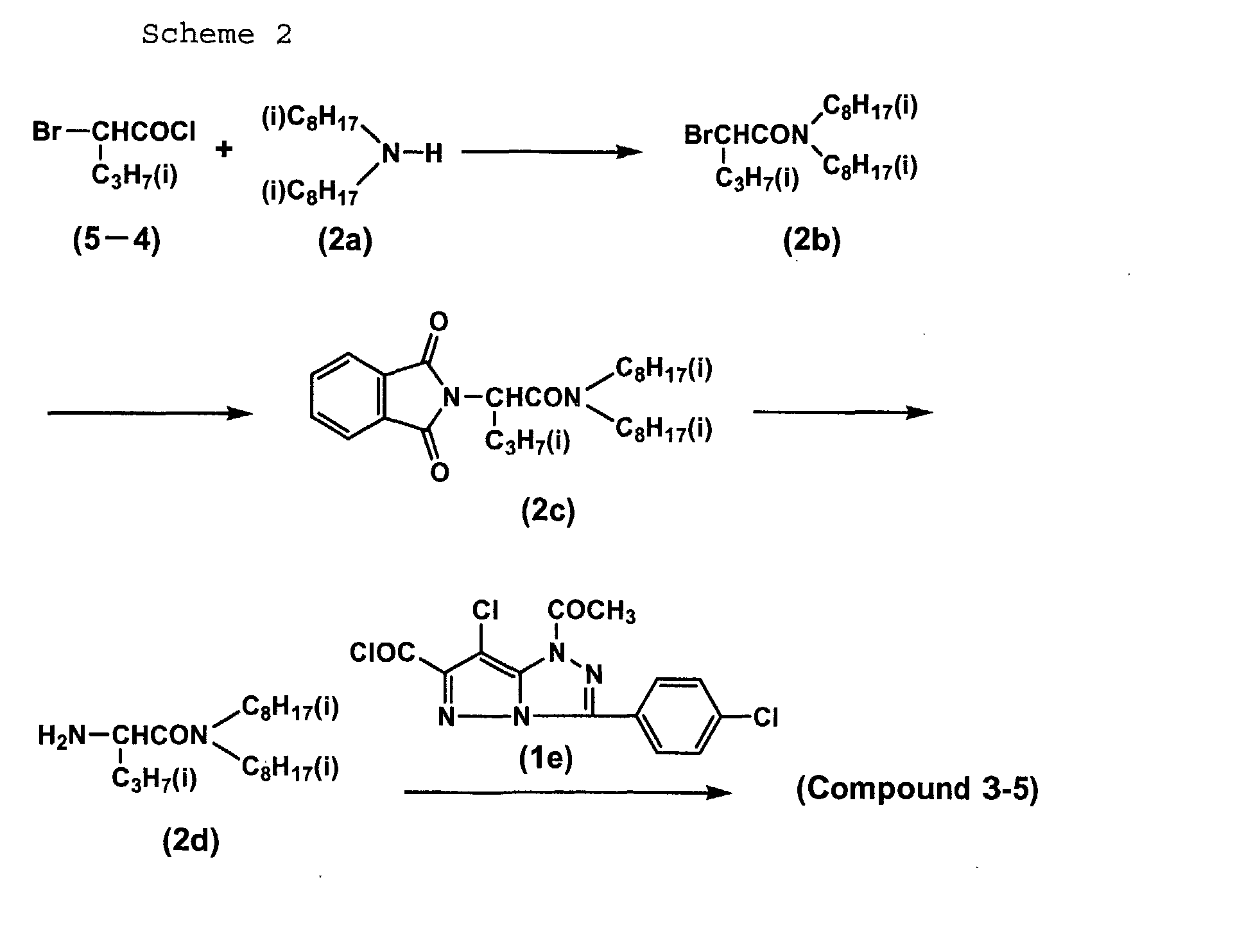
- the intermediate (2c) of 47.0 g (0.10 mol) was dispersed in 200 ml of ethanol and 7.51 g (0.15 mol) of hydrated hydrazine was added thereto and heated for 3 hr. under reflux. After completion of reaction, the reaction was allowed to stand for cooling, 10.3 ml (0.12 mol) of concentrated hydrochloric acid was added and stirred for 30 min., and crystals were filtered. Thereafter, solvents of the filtrate was distilled under reduced pressure and the residue was added with ethyl acetate and water, neutralized, and an organic layer was extracted therefrom. The extract was washed, dried and solvents were distilled under reduced pressure to obtain intermediate (2d) of 34.0 g (yield of 100%). The obtained intermediate (2d) was used in the subsequent step, without being purified.
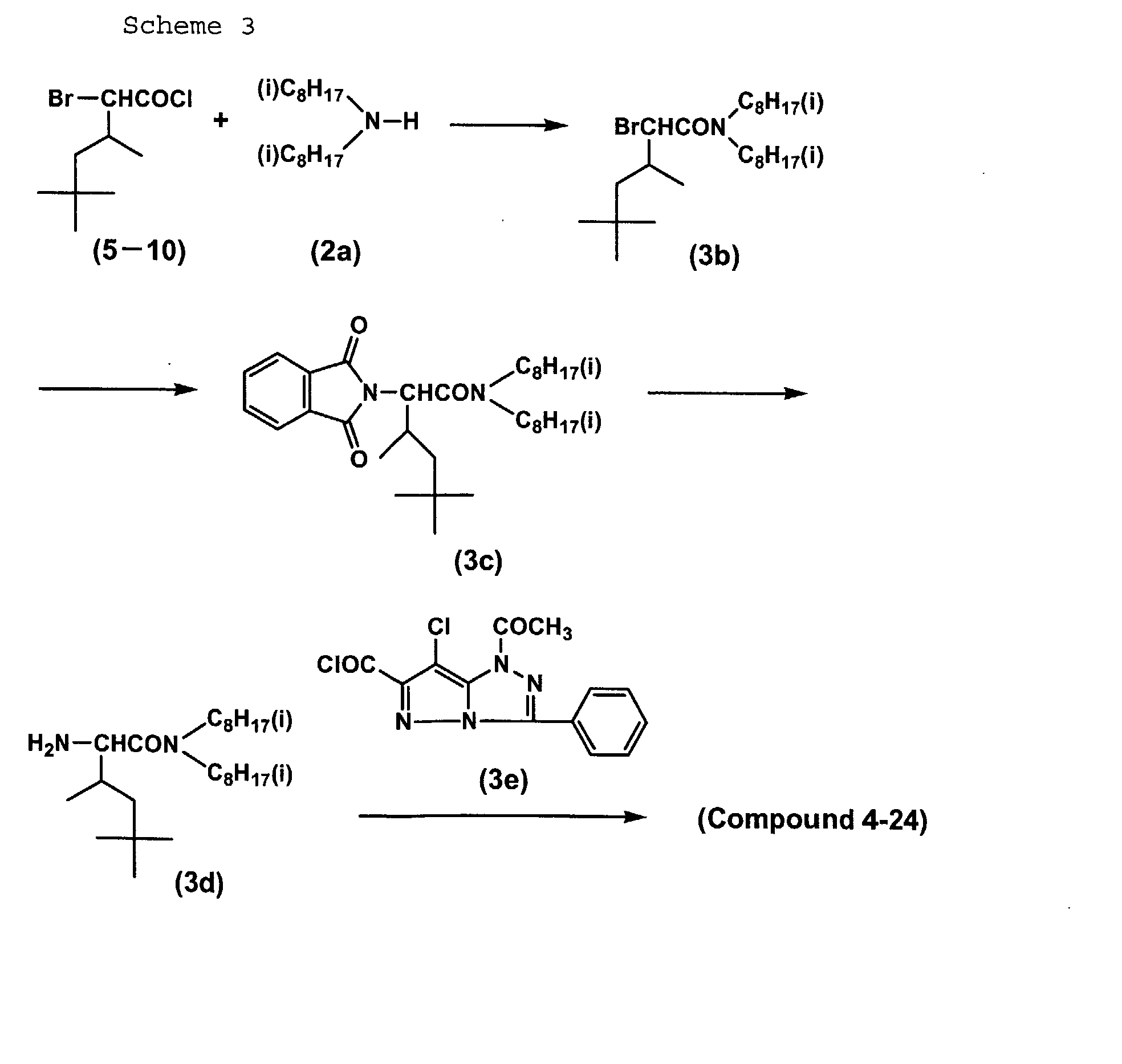
- the intermediate (3b) of 46.1 g (0.10 mol) was dissolved in 80 ml of N,N-dimethylformamide and 19.4 g (0.105 mol) of potassium phthalimide was added thereto and allowed to react at ca. 90° C for 4 hr. After completion of reaction, the reaction product was extracted by adding ethyl acetate and water, dried and solvents were distilled under reduced pressure. The thus obtained residue was recrystallized in methanol to obtained intermediate (3c) of 49.5 g (yield of 94%).
- the intermediate (3c) of 52.7 g (0.10 mol) was dispersed in 200 ml of ethanol and 7.51 g (0.15 mol) of hydrated hydrazine was added thereto and heated for 3 hr. under reflux. After completion of reaction, the reaction was allowed to stand for cooling, 10.3 ml (0.12 mol) of concentrated hydrochloric acid was added and stirred for 30 min., and crystals were filtered. Thereafter, solvents of the filtrate was distilled under reduced pressure and the residue was added with ethyl acetate and water, neutralized, and an organic layer was extracted therefrom. The extract was washed, dried and solvents were distilled under reduced pressure to obtain intermediate (3d) of 39.7 g (yield of 100%). The obtained intermediate (2d) was used in the subsequent step, without being purified.
- Exemplified compound (3-4) of 11.7 g (0.02 mol) and 120 ml of ethyl acetate were stirred at room temperature and thereto was added a separately prepared solution composed of 8.56 g (0.03 mol) of CD-3, 4.15 g (0.03 mol) of potassium carbonate, a small amount of sodium sulfite and 100 ml of water.
- a solution of 6.95 g (0.03 mol) of silver oxide dispersed in 50 ml of water was added dropwise for 20 min. After stirring for 3 hr. at room temperature and using diatomite, silver was filtered with suction and washed with ethyl acetate.
- the coupler of the invention can be used in an amount of 1x10 -3 to 1 mol, and preferably 1x10 -2 to 8x10 -1 mol per mol silver halide.
- the coupler of the invention may be used in combination with other kinds of couplers. Methods and techniques used in conventional couplers are also applicable to the coupler of the invention.
- the coupler of the invention is employed in color photographic materials, such as color negative film, positive film and color print paper.
- Photographic materials, such as color print paper, using the couplers according to the invention may be those for single-color or multicolor use.
- the couplers according to the invention are usually incorporated into a red-sensitive silver halide emulsion layer.
- the multicolor photographic material comprises dye image forming component units having sensitivity in each of three primary color regions of spectrum.
- Each of the component units comprises a single-layered or multi-layered emulsion layer having sensitivity within a given region of spectrum.
- the component layers of the photographic material, including the image forming component units can be arranged in any order, as is known in the art.
- Typical multicolor photographic material comprises a support provided thereon a cyan dye image forming component unit having a red-sensitive silver halide emulsion layer containing a cyan coupler, a magenta dye image forming component unit having a green-sensitive silver halide emulsion layer containing a magenta coupler and a yellow dye image forming component unit having a blue-sensitive silver halide emulsion layer containing a yellow coupler.
- the photographic material may further be provided with additional layer(s), such as a filter layer, interlayer, protective layer and sublayer.
- coupler of the invention there can be employed commonly known methods to incorporate the coupler of the invention.
- a high boiling organic solvent having a boiling point of 175° C or higher such as tricresyl phosphate or dibutyl phthalate or a low boiling solvent, such as butyl acetate or butyl propionate, or in a mixture thereof
- the resulting solution is mixed with an aqueous gelatin solution containing a surfactant and emulsified by a high-speed rotating mixer or colloid mill and the emulsion is incorporated in a silver halide emulsion to obtain a silver halide emulsion used in the invention.
- Silver halide used in photographic materials containing the coupler of the invention is not specifically limited, including silver chloride, silver bromochloride and silver iodobromochloride. In this case, there may be a mixture of silver chloride and silver bromide. In cases where the silver halide emulsion is used in color print payer, rapid-developability is required, so that halide composition of the silver halide preferably contains chlorine, and silver chloride, silver bromochloride or silver iodobromochloride, each of which contains 1 mol% or more chloride, is specifically preferred. These silver halide emulsions are subjected to chemical sensitization in accordance with conventional methods and are also spectrally sensitized to the desired wavelength region.
- Compounds known in the art as an antifoggant or stabilizer may be incorporated into the silver halide emulsion to prevent fogging caused in the process of preparing photographic material, after storage thereof or during photographic processing, and/or to stably maintain photographic performance.
- various additives can be used, including, for example, anti-color staining agent, dye image stabilizer, UV absorber, matting agent and surfactant, as described in Research Disclosure Vol. 176, page 22-31 (December, 1978).
- the photographic material containing the coupler of the invention can be subjected to commonly known color development to form color images, followed by bleaching and fixing. Bleaching may be concurrently conducted with fixing. After fixing, washing is usually conducted. Alternatively, a stabilization treatment may be conducted in place of washing.
- the photographic material containing the coupler of the invention may contain a color developing agent or its precursor in a hydrophilic colloid layer, which can be processed in an alkaline activator bath.
- couplers according to the invention were superior to comparative couplers, in terms of solubility in organic solvents (including high boiling organic solvent and low boiling organic solvent).
- red-sensitive color photographic material sample No. 1 On a paper support laminated on both sides with polyethylene, the following layers were coated in this order from the support to prepare red-sensitive color photographic material sample No. 1.
- the coating amount of a compound was represented in terms of per m 2 and silver halide was represented by equivalent converted to silver.
- Emulsion layer Emulsion layer
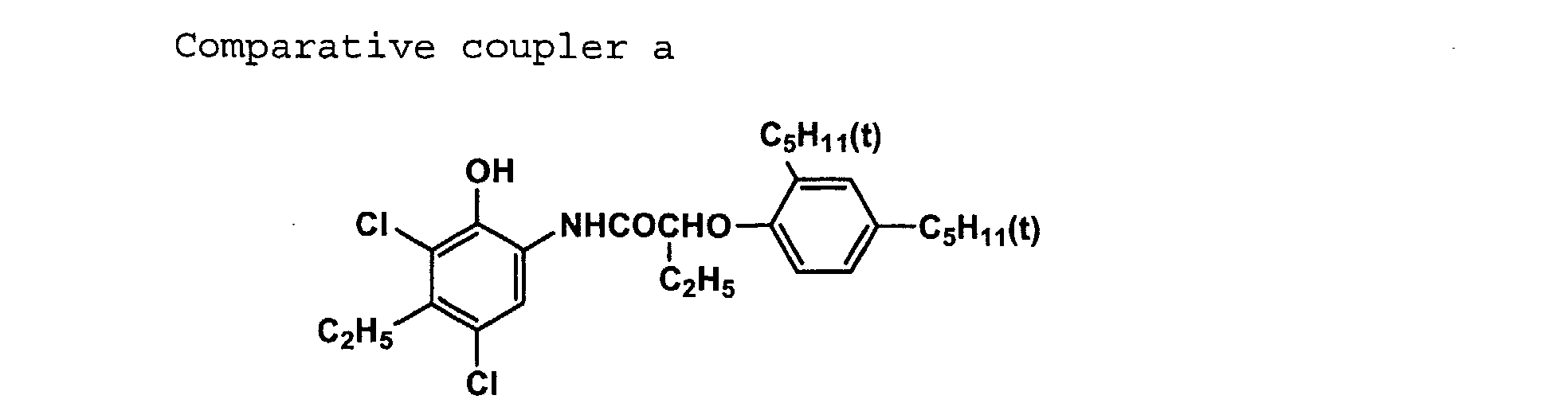
- Red-sensitive emulsion layer comprising 1.3 g of gelatin, 0.21 mol of red-sensitive silver bromochloride emulsion (containing 99.5 mol% chloride) and comparative coupler a (9.1x10 -4 mol) dissolved in 0.45 g of dioctyl phthalate;
- samples No. 2 through No. 18 were prepared similarly to sample No. 1, except that comparative coupler a was replaced by a coupler shown in Table 2 (in an amount of 50 mol% of comparative coupler a), and the red-sensitive silver bromochloride emulsion was used in an amount of 70 mol% of sample No. 1.
- the thus obtained samples Nos. 1 through 18 were each stepwise exposed to light through an optical wedge in accordance with the conventional manner and processed according to the following steps: Process Step Temperature Time Color developing 35.0 ⁇ 0.3° C 45 sec. Bleach-fixing 35.0 ⁇ 0.5° C 45 sec. Stabilizing 30 to 34° C 90 sec. Drying 60 to 80° C 60 sec.
- compositions of processing solutions used in the respective steps are as follows. Color developer solution Pure water 800 ml Triethanolamine 10 g N,N-diethylhydroxylamine 5 g Potassium bromide 0.02 g Potassium chloride 2 g Potassium sulfite 0.3 g 1-Hydroxyethylidene-1,1-diphosphonic acid 1.0 g Ethylenediaminetetraacetic acid 1.0 g Disodium catechol-3,5-disulfonate 1.0 g Diethylene glycol 10 g N-Ethyl-N- ⁇ -methanesulfoneamidoethyl3-methyl-aminoaniline sulfate 4.5 g Brightener (4,4'-diaminostilbenesulfonic acid derivative) 1.0 g Potassium carbonate 27 g
- Coupler Dmax Yellow Stain 1 a 2.30 0.01 2 b 2.08 0.02 3 c 2.04 0.02 4 d 2.10 0.01 5 e 2.19 0.02 6 2-4 2.38 0.01 7 2-5 2.37 0.01 8 2-7 2.36 0.01 9 2-11 2.33 0.01 10 3-4 2.41 0.00 11 3-5 2.39 0.01 12 3-17 2.34 0.01 13 3-24 2.33 0.01 14 3-29 2.40 0.01 15 4-4 2.42 0.01 16 4-12 2.38 0.01 17 4-18 2.36 0.01 18 4-24 2.40 0.00
- the obtained dispersion was mixed with the blue-sensitive silver halide emulsion (containing 8.68 g of silver) to prepare a 1st layer coating solution.
- Coating solutions for the 2nd layer to 7th layer were each prepared similarly to the 1st layer coating solution, and each coating solution was coated so as to have a coating amount as shown below.
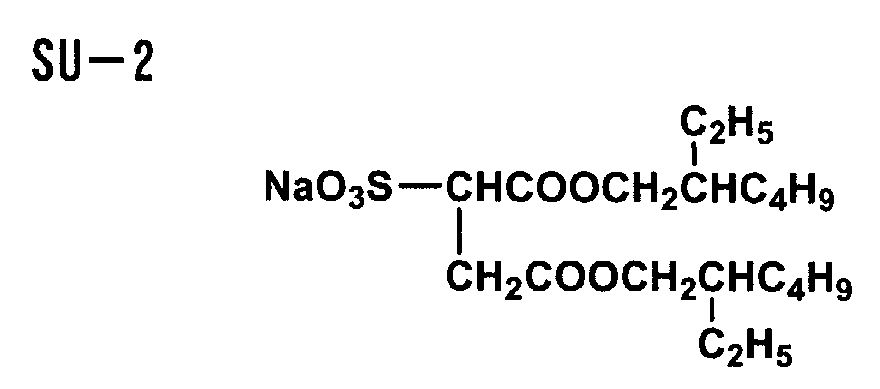
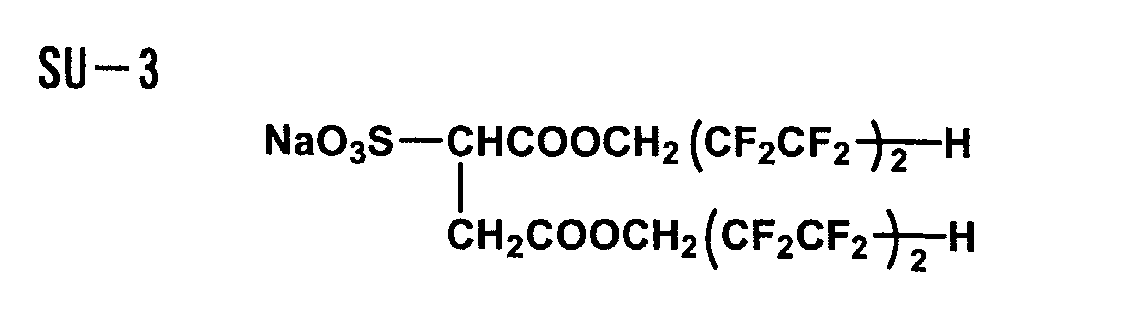
- Hardeners (H-1) and (H-2) were incorporated into the 2nd and 4th layers. There were also incorporated surfactants, (SU-2) and (SU-3) to adjust surface tension. Antiseptic DI-1 was further incorporated. Unless otherwise noted, the coating amounts of respective compounds were represented in terms of grams per m 2 .
- the coating amount of a silver halide emulsion was represented in terms of equivalent converted to silver.
- Solution A Sodium chloride 3.42 g Potassium bromide 0.03 g Water to make 200 ml Solution B Silver nitrate 10 g Water to make 200 ml Solution C Sodium chloride 102.7 g Potassium bromide 1.0 g Water to make 600 ml Solution D Silver nitrate 300 g Water to make 600 ml
- the resulting emulsion was desalted using a 5% aqueous solution of Demol N (produced by Kao-Atlas) and aqueous 20% magnesium sulfate solution, and re-dispersed in a gelatin aqueous solution to obtain a monodisperse cubic grain emulsion (EMP-1) having an average grain size of 0.85 ⁇ m, a coefficient of variation of grain size (S/R) of 0.07 and a chloride content of 99.5 mol%.
- EMP-1 monodisperse cubic grain emulsion having an average grain size of 0.85 ⁇ m, a coefficient of variation of grain size (S/R) of 0.07 and a chloride content of 99.5 mol%.
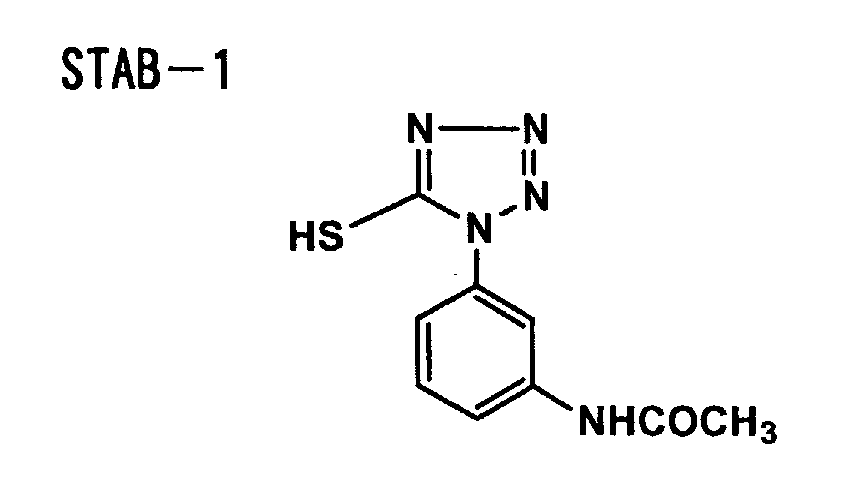
- EMP-1 The emulsion, EMP-1 was chemically sensitized at 50° C for 90 min., using the following compounds to obtain blue-sensitive silver halide emulsion (Em-B).
- Em-B blue-sensitive silver halide emulsion
- Sodium thiosulfate 0.8 mg/mol AgX Chloroauric acid 0.5 mg/mol AgX Stabilizer STAB-1 6x10 -4 mol/mol AgX Sensitizing dye BS-1 4x10 -4 mol/mol AgX Sensitizing dye BS-2 1x10 -4 mol/mol AgX
- Monodisperse cubic grain emulsions EMP-2 having an average grain size of 0.43 ⁇ m, a variation coefficient (S/R) of 0.08 and a chloride content of 99.5 mol% was prepared in the same manner as in preparation of EMP-1, except that an adding time of Solutions A and B, and that of Solution C and D were respectively varied.
- EMP-2 The emulsion, EMP-2 was optimally chemical-sensitized at 55° C for 120 min. using the following compounds to obtain a green-sensitive silver halide emulsion (Em-G).
- Em-G Green-sensitive silver halide emulsion
- Chloroauric acid 1.0 mg /mol AgX Stabilizer STAB-1 6x10 -4 mol/mol AgX Sensitizing dye GS-1 4x10 -4 mol/mol AgX
- Monodisperse cubic grain emulsion EMP-3 having an average grain size of 0.50 ⁇ m, a variation coefficient (S/R) of 0.08 and a chloride content of 99.5 mol% were prepared in the same manner as in preparation of EMP-1, except that an adding time of Solutions A and B, and that of Solution C and D were respectively varied.
- Emulsion EMP-3 was optimally chemically sensitized at 60° C for 90 min. using the following compounds to obtain a red-sensitive silver halide emulsion (EM-P).
- EMP-3 red-sensitive silver halide emulsion
- Sodium thiosulfate 1.8 mg/mol AgX
- Chloroauric acid 2.0 mg/mol
- Photographic material sample Nos. 20 through 31 were prepared similarly to sample No. 19, except that cyan couplers C-1 and C-2 used in the 5 th layer were replaced by a coupler shown in Table 5, in an amount of 50 mol% of the sum of C-1 and C-2, and the red-sensitive silver bromochloride emulsion was changed to 70 mol%.
- the thus obtained samples were each exposed and processed similarly to Example 1, and further subjected to densitometry to determined the maximum density (Dmax) of the red-sensitive layer.
- sample No. 19 containing comparative couplers C-1 and C-2 was markedly insufficient for color reproduction. It was also shown that sample Nos. 20 and 21, in which comparative coupler "b” or “d” was used in an amount of 50 mol% of the sum of C-1 and C-2, and silver halide was changed to 70 mol%, were greatly improved in blue color reproduction but were insufficient for color reproduction of cyan and green, and the maximum density was low, leading to insufficient blackness.
- samples containing the coupler of the invention (in which the coupler was used in an amount of 50 mol% of the sum of C-1 and C-2, and silver halide was changed to 70 mol%) exhibited superior color reproduction, enhanced maximum density and improved blackness.
Landscapes
- Chemical & Material Sciences (AREA)
- Organic Chemistry (AREA)
- Physics & Mathematics (AREA)
- General Physics & Mathematics (AREA)
- Silver Salt Photography Or Processing Solution Therefor (AREA)
- Nitrogen Condensed Heterocyclic Rings (AREA)
Abstract

Description


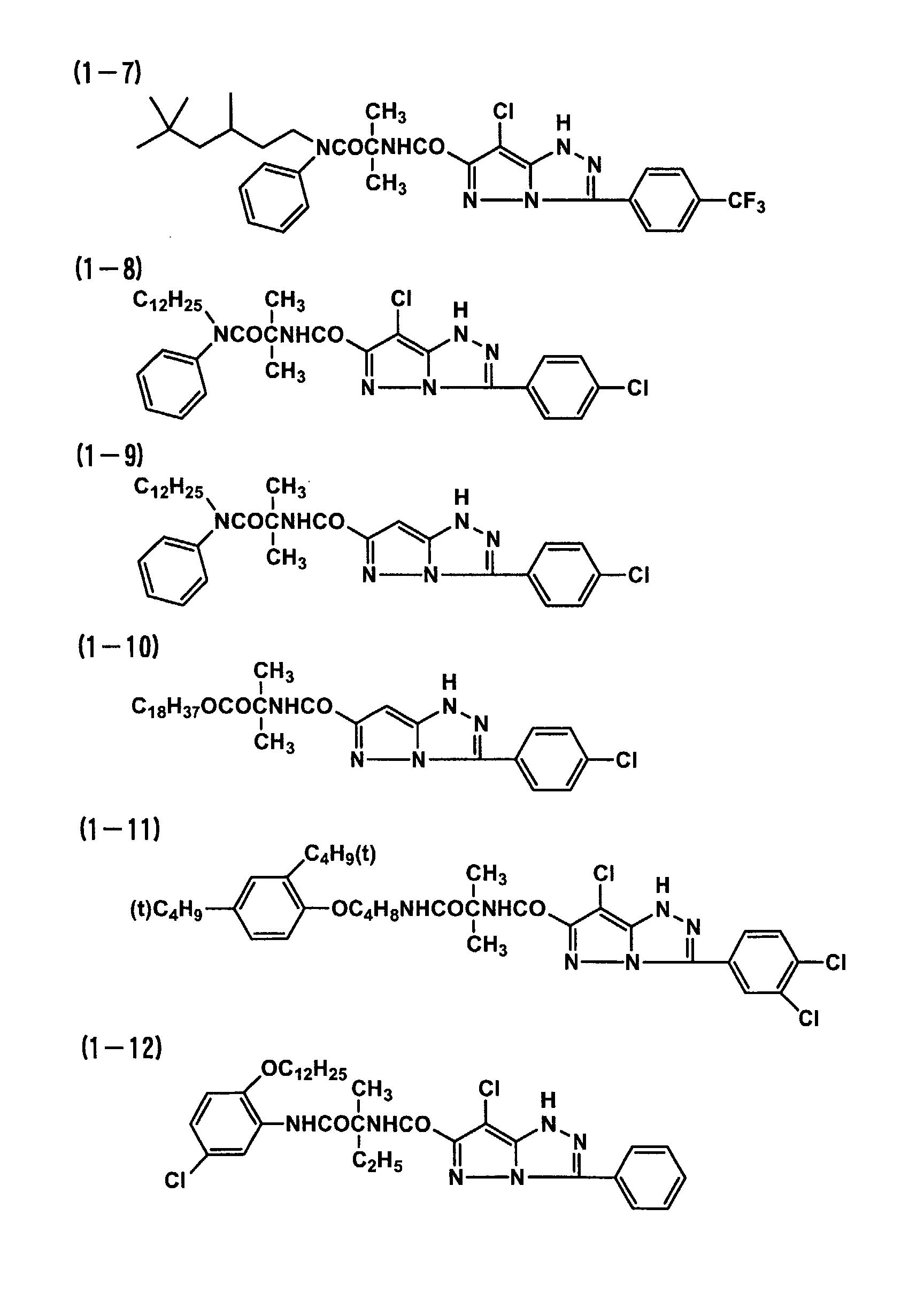


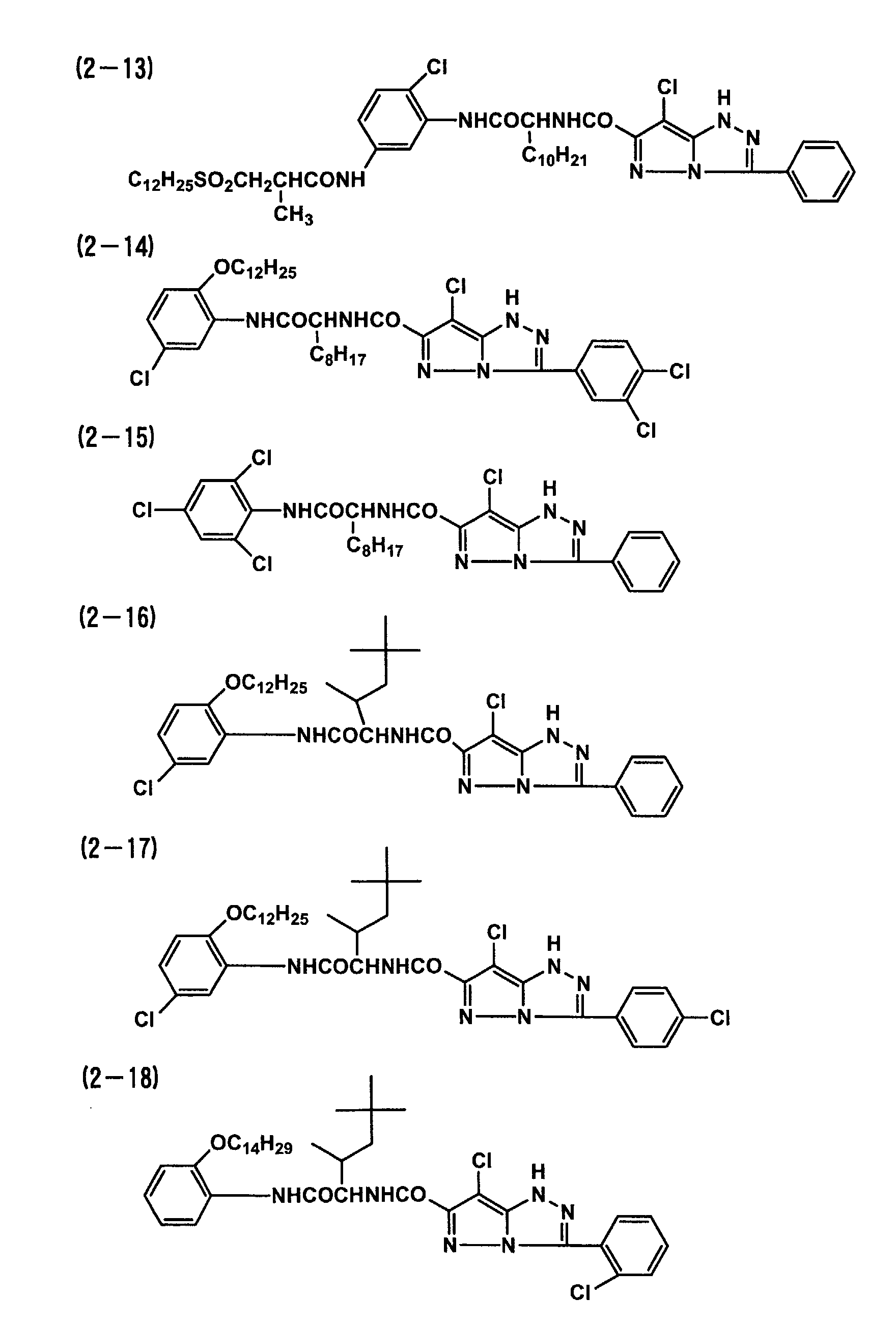


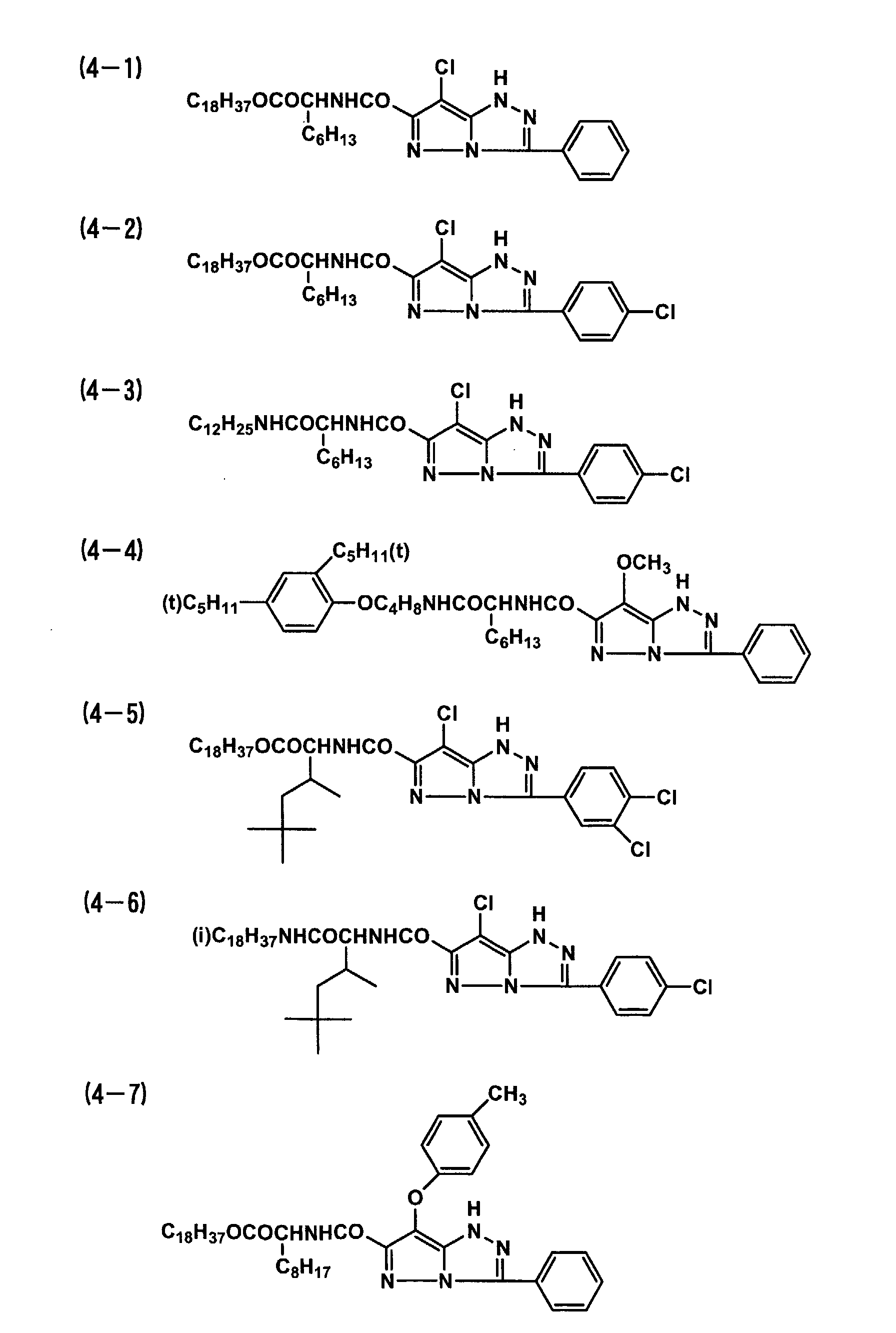
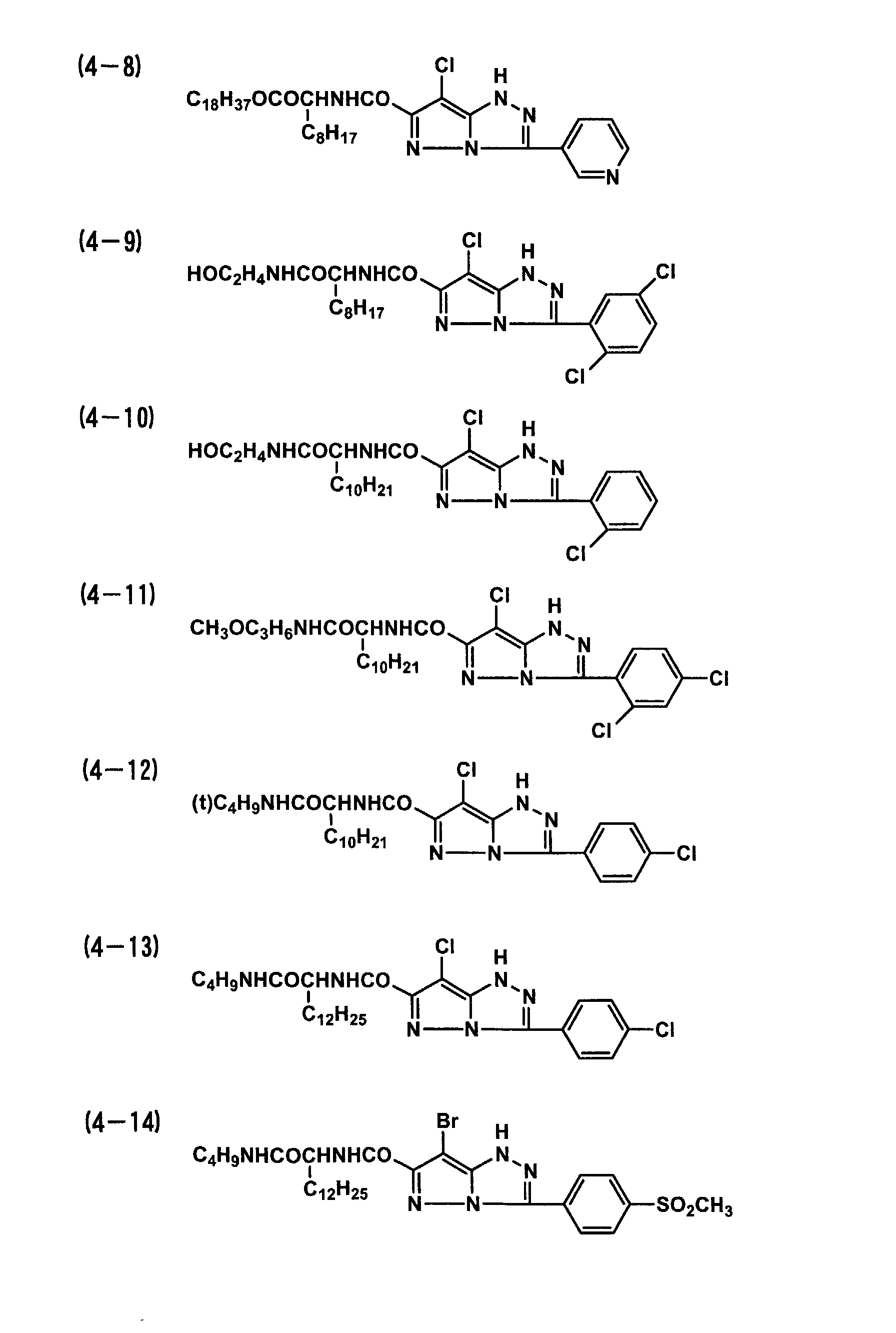


















The thus obtained residue was recrystallized in methanol to obtained intermediate (1c) of 46.0 g (yield of 85%).


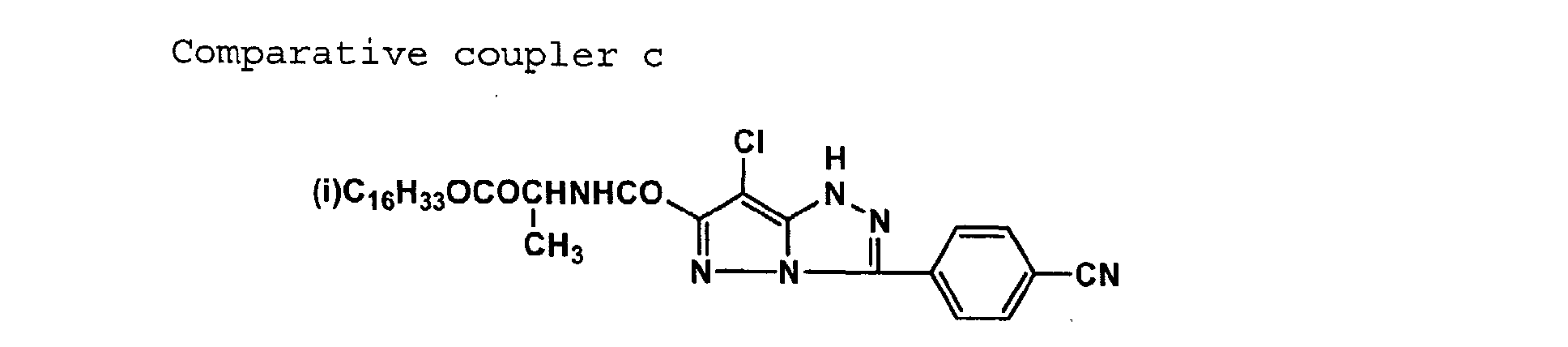
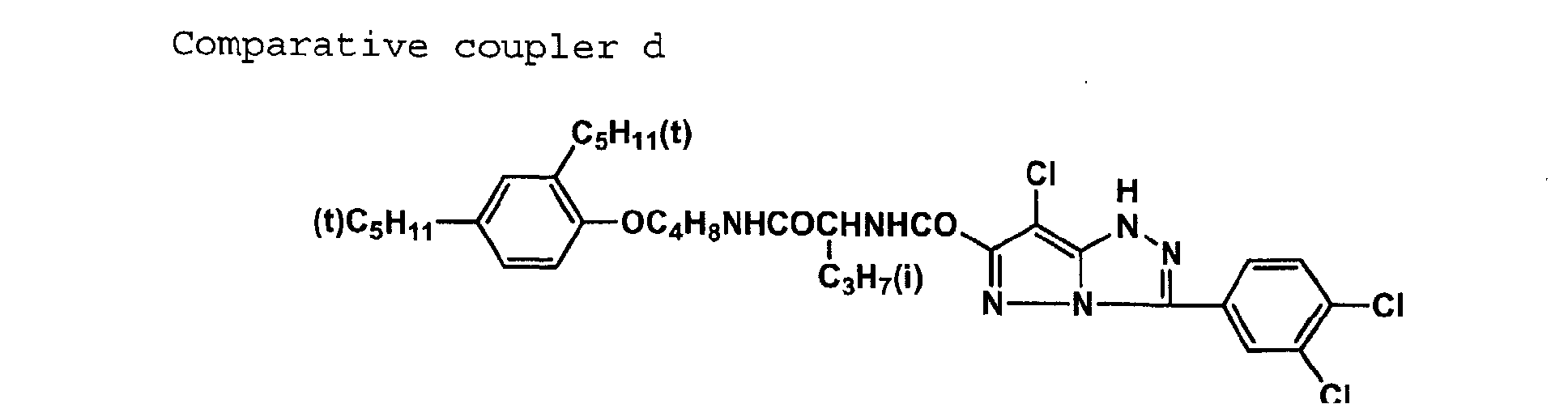
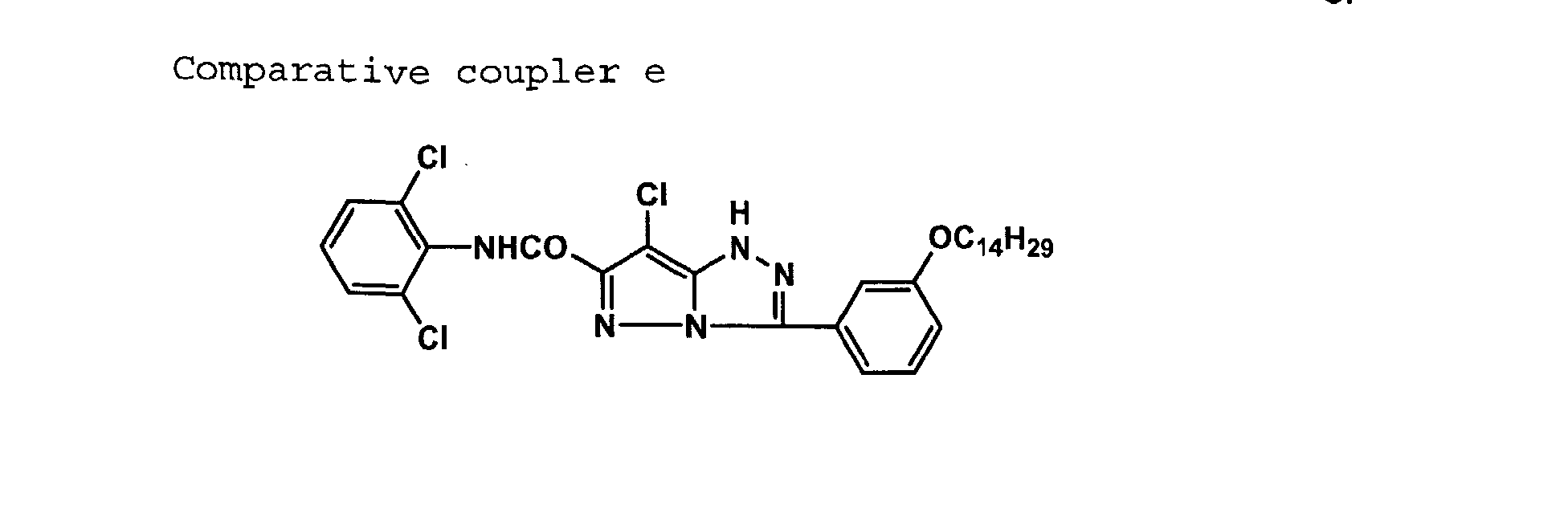
| Experiment No. | Coupler | Dissolution Temperature (°C) |
| 1(Inv.) | 2-4 | 30 |
| 2(Inv.) | 3-4 | Room temperature |
| 3(Inv.) | 3-5 | 30 |
| 4(Inv.) | 4-24 | Room temperature |
| 5(Comp.) | b | 60 |
| 6(Comp.) | d | 60 |
| Process | ||
| Step | Temperature | Time |
| Color developing | 35.0±0.3° C | 45 sec. |
| Bleach-fixing | 35.0±0.5° C | 45 sec. |
| Stabilizing | 30 to 34° C | 90 sec. |
| Drying | 60 to 80° C | 60 sec. |
| Color developer solution | |
| Pure water | 800 ml |
| Triethanolamine | 10 g |
| N,N-diethylhydroxylamine | 5 g |
| Potassium bromide | 0.02 g |
| Potassium chloride | 2 g |
| Potassium sulfite | 0.3 g |
| 1-Hydroxyethylidene-1,1-diphosphonic acid | 1.0 g |
| Ethylenediaminetetraacetic acid | 1.0 g |
| Disodium catechol-3,5-disulfonate | 1.0 g |
| Diethylene glycol | 10 g |
| N-Ethyl-N-β-methanesulfoneamidoethyl3-methyl-aminoaniline sulfate | 4.5 g |
| Brightener (4,4'-diaminostilbenesulfonic acid derivative) | 1.0 g |
| Potassium carbonate | 27 g |
| Bleach-fixer solution | |
| Ethylenediaminetetraacetate, ferric ammonium, dihydrate | 60 g |
| Ethylenediaminetetraacetic acid | 3 g |
| Ammonium thiosulfate (70% aqueous solution) | 100 ml |
| Ammonium sulfite (40% aqueous solution) | 27.5 ml |
| Stabilizer solution | |
| 5-Chloro-2-methyl-4-isothiazoline-3-one | 0.2 |
| 1,2-Benzisothiazoline-3-one | 0.3 g |
| Ethylene glycol | 1.0 g |
| 1-Hydroxyethylidene-1,1-diphosphonic acid | 2.0 g |
| o-Phenylphenol sodium salt | 1.0 g |
| Ethylenediaminetetraacetic acid | 1.0 g |
| Ammonium hydrate (20% aqueous solution) | 3.0 g |
| Brightener (4,4'-diaminostilbenesulfonic | |
| acid derivative) | 1.5 g |
| Sample No. | Coupler | Dmax | Yellow Stain |
| 1 | a | 2.30 | 0.01 |
| 2 | b | 2.08 | 0.02 |
| 3 | c | 2.04 | 0.02 |
| 4 | d | 2.10 | 0.01 |
| 5 | e | 2.19 | 0.02 |
| 6 | 2-4 | 2.38 | 0.01 |
| 7 | 2-5 | 2.37 | 0.01 |
| 8 | 2-7 | 2.36 | 0.01 |
| 9 | 2-11 | 2.33 | 0.01 |
| 10 | 3-4 | 2.41 | 0.00 |
| 11 | 3-5 | 2.39 | 0.01 |
| 12 | 3-17 | 2.34 | 0.01 |
| 13 | 3-24 | 2.33 | 0.01 |
| 14 | 3-29 | 2.40 | 0.01 |
| 15 | 4-4 | 2.42 | 0.01 |
| 16 | 4-12 | 2.38 | 0.01 |
| 17 | 4-18 | 2.36 | 0.01 |
| 18 | 4-24 | 2.40 | 0.00 |
| Layer | Constitution | Amount (g/m2) |
| 7th Layer | Gelatin | 1.00 |
| (Protective layer) | DIDP | 0.005 |
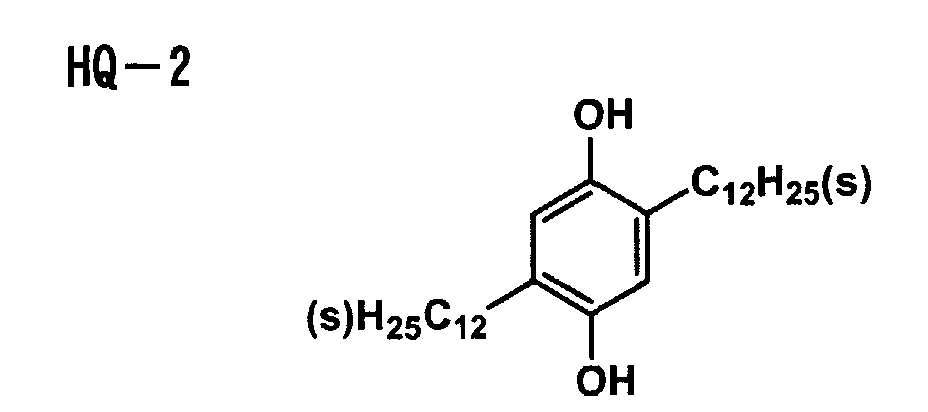
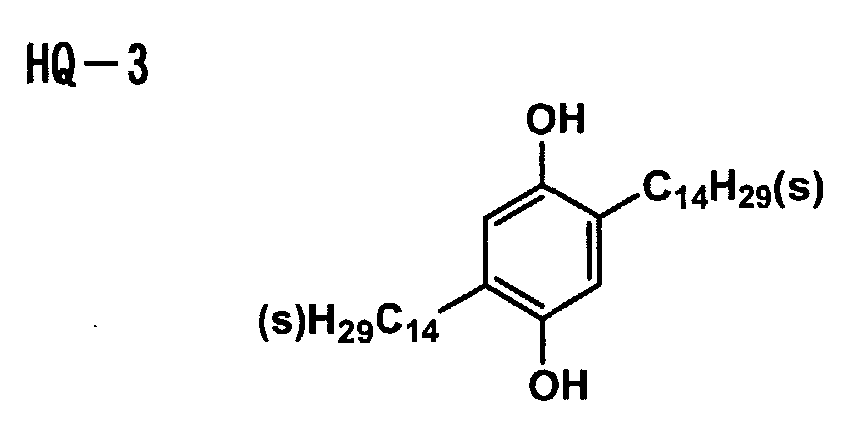
| Additive (HQ-2) | 0.002 | |
| Additive (HQ-3) | 0.002 | |
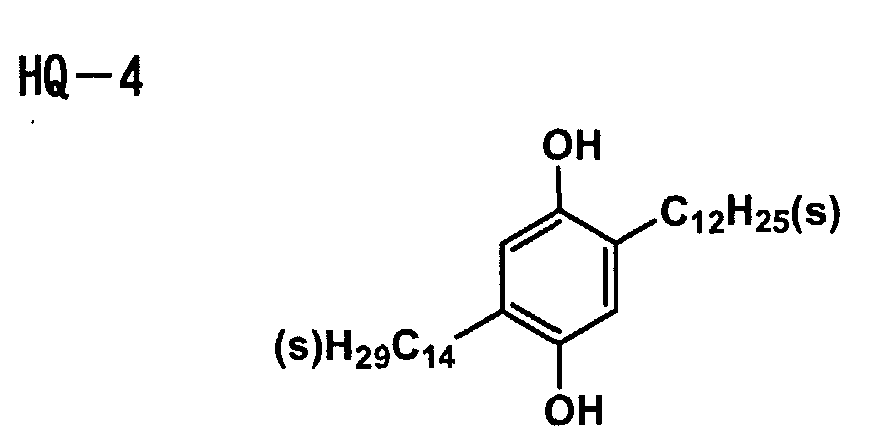
| Additive (HQ-4) | 0.004 | |
| Additive (HQ-5) | 0.02 | |
| Compound (F-1) | 0.002 | |
| 6th Layer | Gelatin | 0.40 |
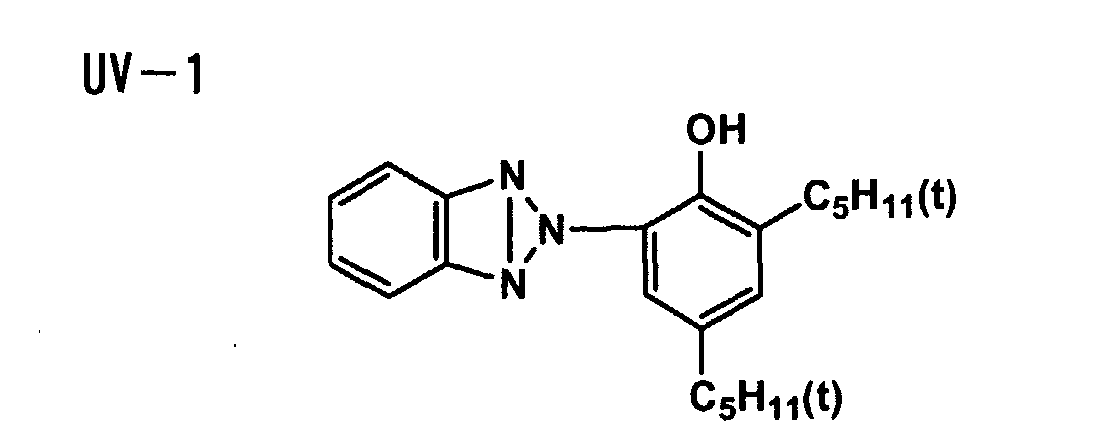
| (UV absorbing layer) | UV absorbent (UV-1) | 0.10 |
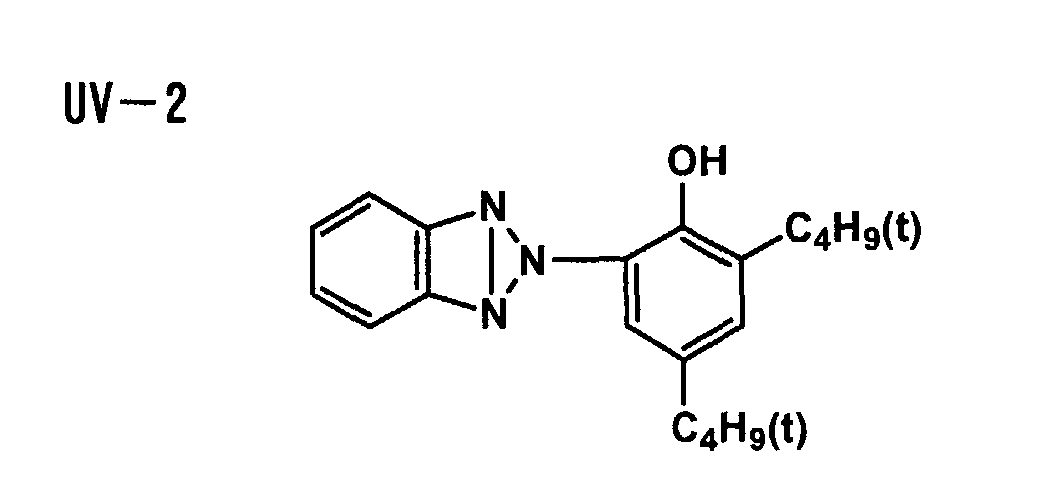
| UV absorbent (UV-2) | 0.04 | |
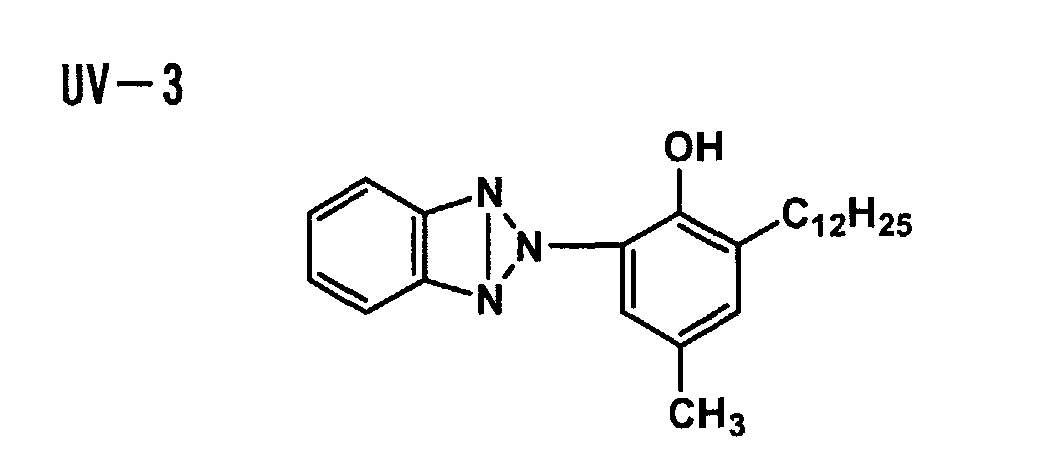
| UV Absorbent (UV-3) | 0.16 | |
| Additive (HQ-5) | 0.04 | |
| DNP | 0.20 | |
| PVP | 0.03 | |
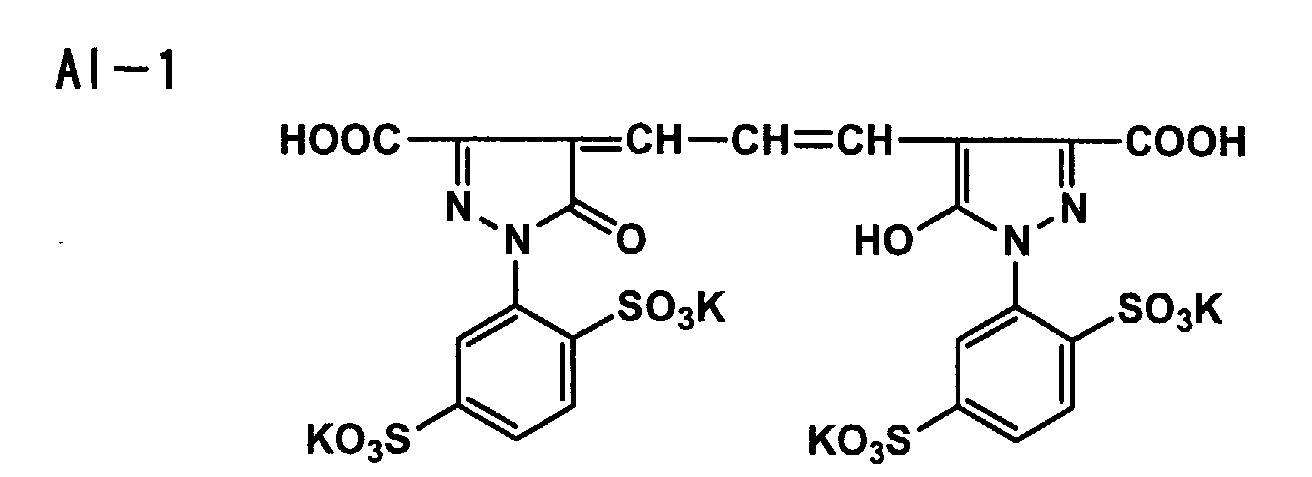
| Antiirradiation dye (AI-2) | 0.02 | |
| Antiirradiation dye (AI-4) | 0.01 | |
| 5th Layer | Gelatin | 1.30 |
| (Red-sensitive layer) | Red-sensitive emulsion (Em-R) 0.21 | |
| Cyan coupler (C-1) | 0.17 | |
| Cyan coupler (C-2) | 0.25 | |
| Dye image stabilizer (ST-1) | 0.20 | |
| Antistaining agent (HQ-1) | 0.01 | |
| HBS-1 | 0.20 | |
| DOP | 0.20 | |
| 4th Layer | Gelatin | 0.94 |
| (UV absorbing layer) | UV absorbent (UV-1) | 0.28 |
| UV absorbent (UV-2) | 0.09 | |
| UV absorbent (UV-3) | 0.38 | |
| Additive (HQ-5) | 0.10 | |
| DNP | 0.40 | |
| 3rd Layer | Gelatin | 1.40 |
| (Green-sensitive layer) | Green-sensitive Emulsion (Em-G) | 0.17 |
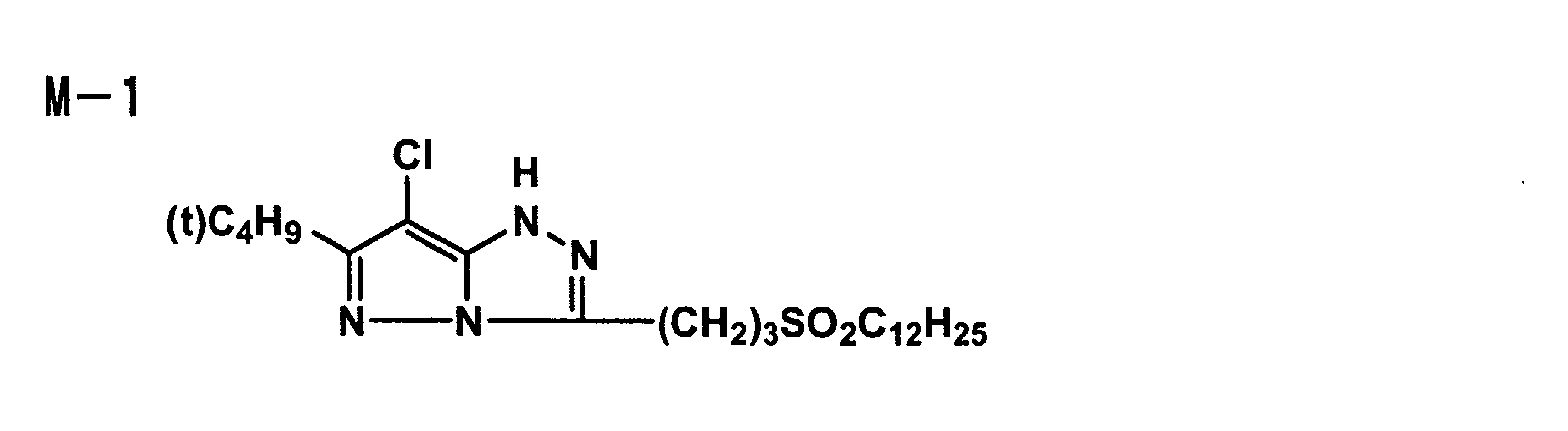
| Magenta coupler (M-1) | 0.23 | |
| Dye image stabilizer (ST-3) | 0.20 | |
| Dye image stabilizer (ST-4) | 0.17 | |
| DIDP | 0.13 | |
| DBP | 0.13 | |
| Antiirradiation dye (AI-1) | 0.01 | |
| 2nd layer | Gelatin | 1.20 |
| (Interlayer) | Antistaining agent (HQ-2) | 0.03 |
| Antistaining agent (HQ-3) | 0.03 | |
| Antistaining agent (HQ-4) | 0.05 | |
| Antistaining agent (HQ-5) | 0.23 | |
| DIDP | 0.06 | |
| Compound (F-1) | 0.002 | |
| 1st layer | Gelatin | 1.20 |
| (Blue-sensitive layer) | Blue-sensitive Emulsion (Em-B) | 0.26 |
| Yellow coupler (Y-1) | 0.80 | |
| Dye image stabilizer (ST-1) | 0.30 | |
| Dye image stabilizer (ST-2) | 0.20 | |
| Additive (HQ-1) | 0.02 | |
| Antiirradiation dye (AI-3) | 0.01 | |
| DNP | 0.20 | |
| Support | Polyethylene-laminated paper |


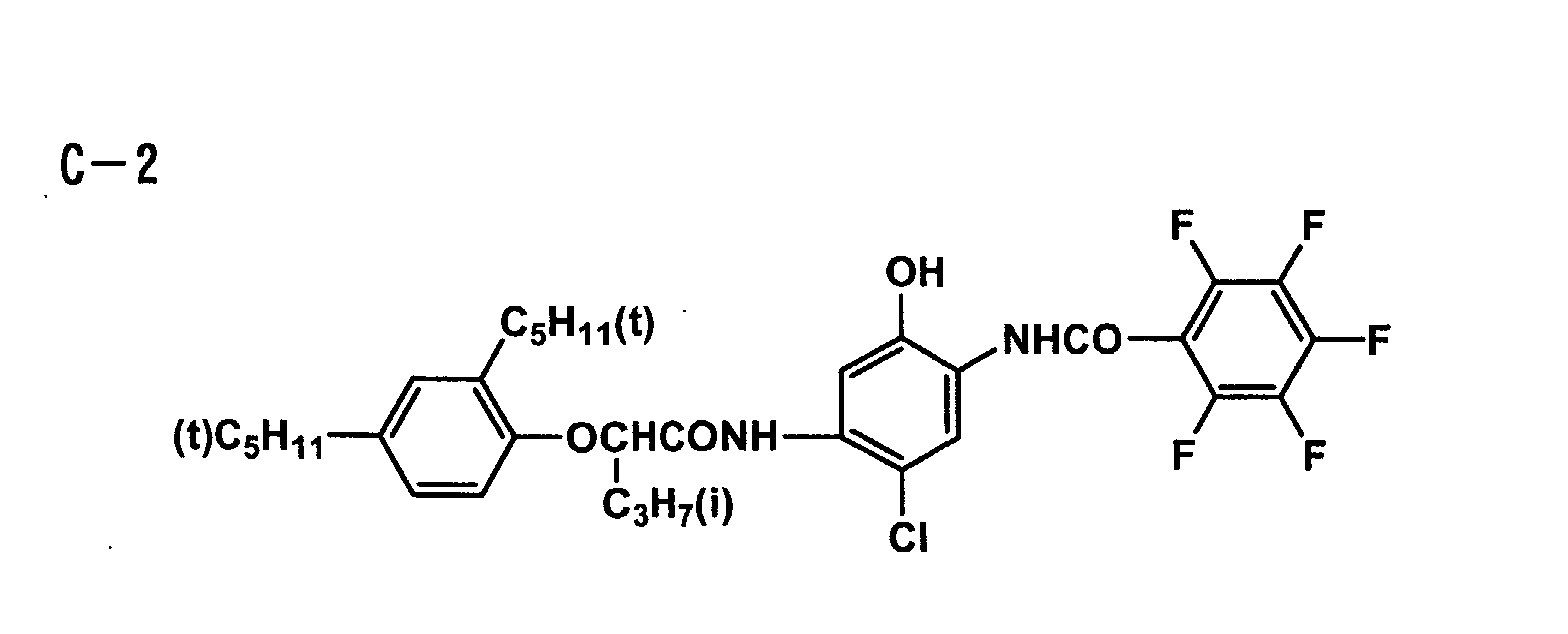

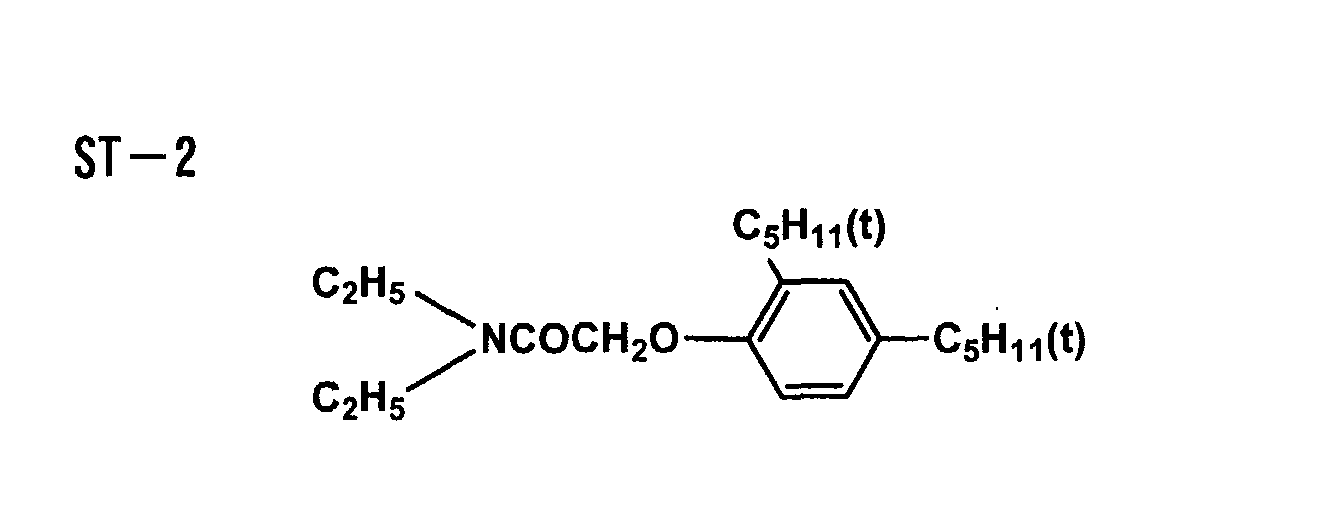
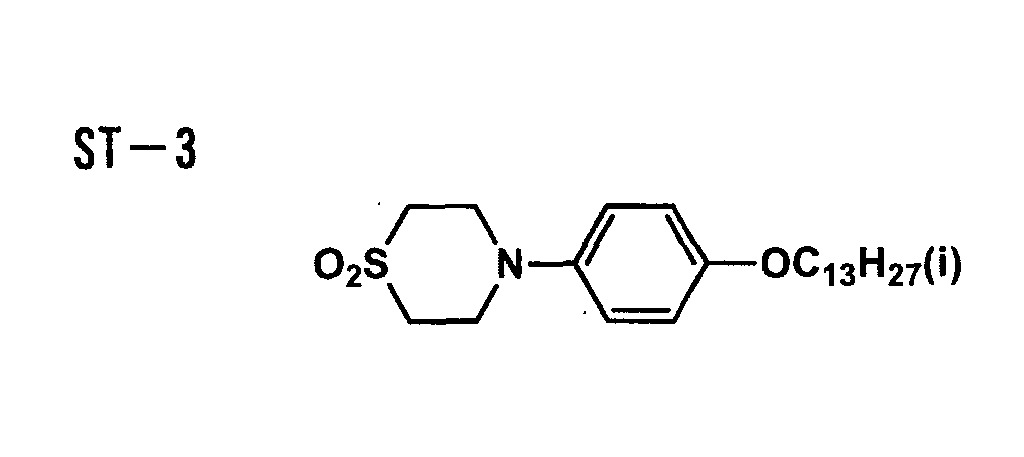
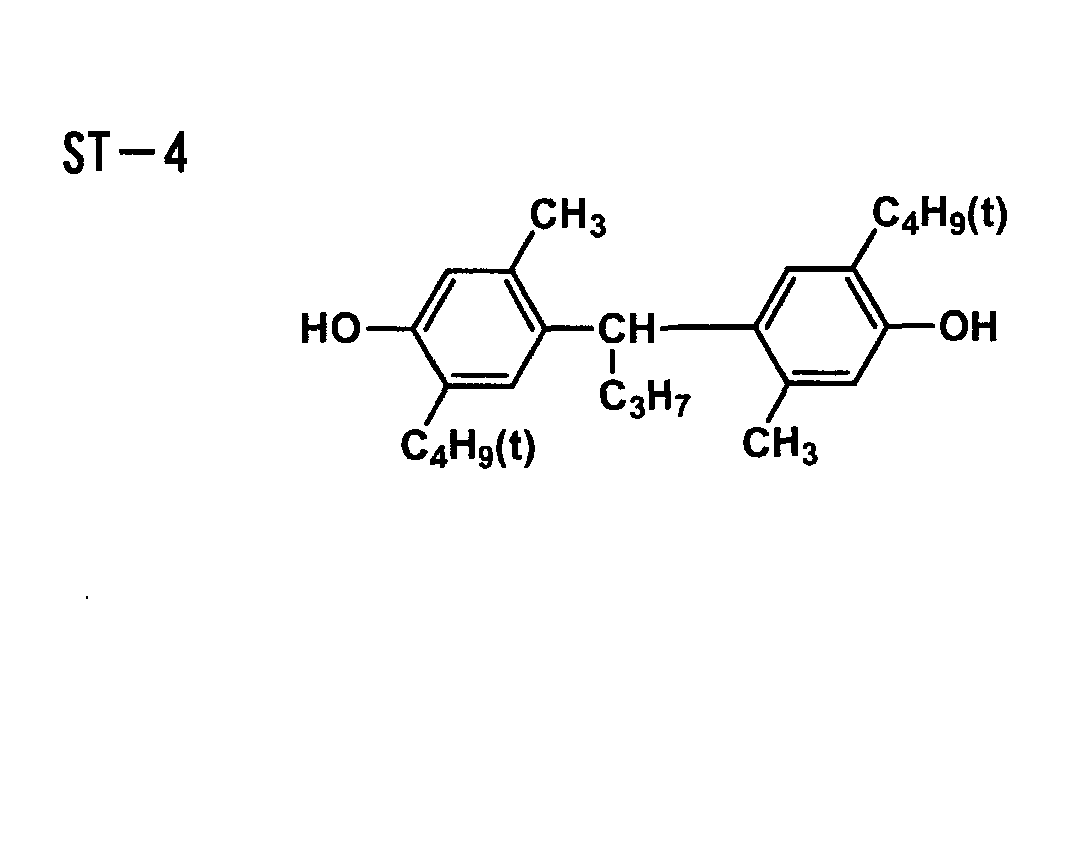
- DBP:
- Dibutyl phthalate
- DOP:
- Dioctyl phthalate
- DNP:
- Dinonyl phthalate
- DIDP:
- Diisodecyl phthalate
- PVP:
- Polyvinyl pyrrolidine







| Solution A | |
| Sodium chloride | 3.42 g |
| Potassium bromide | 0.03 g |
| Water to make | 200 ml |
| Solution B | |
| Silver nitrate | 10 g |
| Water to make | 200 ml |
| Solution C | |
| Sodium chloride | 102.7 g |
| Potassium bromide | 1.0 g |
| Water to make | 600 ml |
| Solution D | |
| Silver nitrate | 300 g |
| Water to make | 600 ml |
| Sodium thiosulfate | 0.8 mg/mol AgX |
| Chloroauric acid | 0.5 mg/mol AgX |
| Stabilizer STAB-1 | 6x10⁻⁴ mol/mol AgX |
| Sensitizing dye BS-1 | 4x10⁻⁴ mol/mol AgX |
| Sensitizing dye BS-2 | 1x10⁻⁴ mol/mol AgX |
| Sodium thiosulfate | 1.5 mg/mol AgX |
| Chloroauric acid | 1.0 mg /mol AgX |
| Stabilizer STAB-1 | 6x10⁻⁴ mol/mol AgX |
| Sensitizing dye GS-1 | 4x10⁻⁴ mol/mol AgX |
| Sodium thiosulfate | 1.8 mg/mol AgX |
| Chloroauric acid | 2.0 mg/mol AgX |
| Stabilizer STAB-1 | 6x10⁻⁴ mol/mol AgX |
| Sensitizing dye RS-1 | 1x10⁻⁴ mol/mol AgX |


- 5 marks:
- 5 persons
- 4 marks:
- 4 persons
- 3 marks:
- 3 persons
- 2 marks:
- 2 persons
- 1 mark:
- 0 to 1 person.
| Sample No. | Cyan Coupler | Dmax | Color Reproduction | Blackness | Remark | ||
| Cyan | Blue | Green | |||||
| 19 | C-1/C-2 | 2.29 | 3 | 3 | 3 | 3 | Comp. |
| 20 | b | 2.08 | 4 | 5 | 3 | 2 | Comp. |
| 21 | d | 2.10 | 4 | 5 | 4 | 2 | Comp. |
| 22 | 2-5 | 2.37 | 5 | 5 | 5 | 5 | Inv. |
| 23 | 2-14 | 2.32 | 5 | 5 | 5 | 5 | Inv. |
| 24 | 2-17 | 2.35 | 5 | 5 | 5 | 5 | Inv. |
| 25 | 3-5 | 2.39 | 5 | 5 | 5 | 5 | Inv. |
| 26 | 3-8 | 2.36 | 5 | 5 | 5 | 5 | Inv. |
| 27 | 3-13 | 2.32 | 5 | 5 | 4 | 5 | Inv. |
| 28 | 3-28 | 2.32 | 5 | 5 | 4 | 5 | Inv. |
| 29 | 4-6 | 2.34 | 5 | 5 | 4 | 5 | Inv. |
| 30 | 4-13 | 2.35 | 5 | 5 | 5 | 5 | Inv. |
| 31 | 4-19 | 2.33 | 5 | 5 | 4 | 5 | Inv. |
Claims (13)
- A silver halide color photographic material comprising a support having thereon at least one silver halide emulsion layer containing a coupler represented by formula (2), (3) or (4) :wherein Ar is an aryl group or a heterocyclic group; R1 is an alkyl group, an aryl group or a heterocyclic group; L is a bivalent linkage group; n is 0 or 1; and Cp is a coupler residue;
 wherein R2, R3, and R4 are each an alkyl group, an aryl group or a heterocyclic group, or R2 and R3 combine with each other to form a ring; L is a bivalent linkage group; n is 0 or 1; and Cp is a coupler residue;
 wherein R5 is an unsubstituted alkyl group having 5 or more carbon atoms; R6 is a hydrogen atom, an alkyl group, an aryl group or a heterocyclic group; R7 is an alkyl group, an aryl group or a heterocyclic group; J2 is -O- or -NR11-, in which R11 is a hydrogen atom, an alkyl group, an aryl group or a heterocyclic group; L is a bivalent linkage group; n is 0 or 1; Cp is a coupler residue.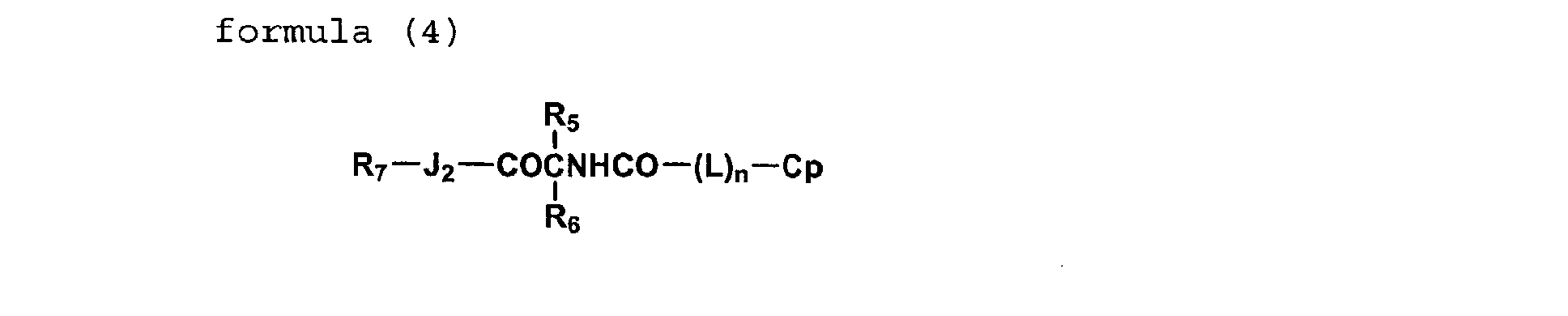
- The photographic material of claim 1, wherein the coupler residue of formulas (2), (3) and (4) is represented by the following formula (6):wherein X is a hydrogen atom, a halogen atom or a group capable of being released upon coupling with an oxidation product of a color developing agent; and RM is a univalent substituent group.

- The photographic material of claim 1, wherein in formula (2), R1 is an alkyl group or an aryl group.
- The photographic material of claim 3, wherein said R1 is an alkyl group.
- The photographic material of claim 1, wherein in formula (3), R2, R3, and R4 are each an alkyl group or an aryl group.
- The photographic material of claim 1, wherein in formula (3), R4 is an alkyl group.
- The photographic material of claim 5, wherein R4 is an alkyl group.
- The photographic material of claim 1, wherein in formula (4), R6 is a hydrogen atom or an alkyl group.
- The photographic material of claim 8, wherein R6 is a hydrogen atom.
- The photographic material of claim 1, wherein in formula (4), J2 is -NR11-.
- The photographic material of claim 1, wherein the silver halide emulsion layer contains the coupler in an amount of 1x10⁻³ to 1 mol per mol of silver halide.
- A silver halide color photographic material comprising a support having thereon at least one red-sensitive silver halide emulsion layer containing a coupler represented by formula (2), (3) or (4):wherein Ar is an aryl group or a heterocyclic group; R1 is an alkyl group, an aryl group or a heterocyclic group; L is a bivalent linkage group; n is 0 or 1; and Cp is a coupler residue;
 wherein R2, R3, and R4 are each an alkyl group, an aryl group or a heterocyclic group, or R2 and R3 combine with each other to form a ring; L is a bivalent linkage group; n is 0 or 1; and Cp is a coupler residue;
 wherein R5 is an unsubstituted alkyl group having 5 or more carbon atoms; R6 is a hydrogen atom, an alkyl group, an aryl group or a heterocyclic group; R7 is an alkyl group, an aryl group or a heterocyclic group; J2 is -O- or -NR11-, in which R11 is a hydrogen atom, an alkyl group, an aryl group or a heterocyclic group; L is a bivalent linkage group; n is 0 or 1; Cp is a coupler residue.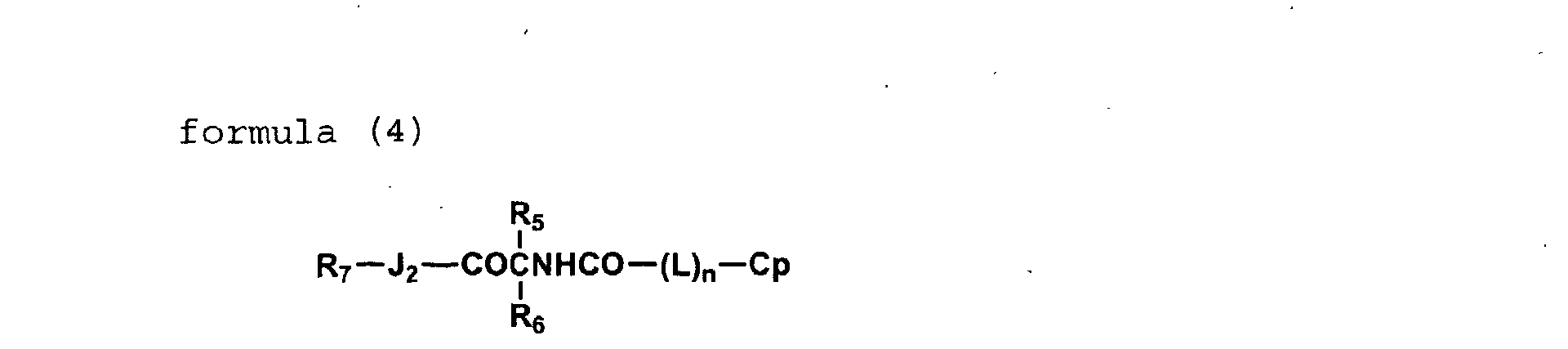
- A silver halide color photographic material comprising a support having thereon at least one red-sensitive silver halide emulsion layer, at least one green-sensitive silver halide emulsion layer and at least one blue-sensitive silver halide emulsion layer, wherein the red-sensitive silver halide emulsion layer contains a coupler represented by formula (2), (3) or (4):wherein Ar is an aryl group or a heterocyclic group; R1 is an alkyl group, an aryl group or a heterocyclic group; L is a bivalent linkage group; n is 0 or 1; and Cp is a coupler residue;
 wherein R2, R3, and R4 are each an alkyl group, an aryl group or a heterocyclic group, or R2 and R3 combine with each other to form a ring; L is a bivalent linkage group; n is 0 or 1; and Cp is a coupler residue;
 wherein R5 is an unsubstituted alkyl group having 5 or more carbon atoms; R6 is a hydrogen atom, an alkyl group, an aryl group or a heterocyclic group; R7 is an alkyl group, an aryl group or a heterocyclic group; J2 is -O- or -NR11-, in which R11 is a hydrogen atom, an alkyl group, an aryl group or a heterocyclic group; L is a bivalent linkage group; n is 0 or 1; Cp is a coupler residue.
Applications Claiming Priority (2)
| Application Number | Priority Date | Filing Date | Title |
|---|---|---|---|
| JP2001183165 | 2001-06-18 | ||
| JP2001183165A JP2003005330A (en) | 2001-06-18 | 2001-06-18 | Method for producing coupler, silver halide color photographic sensitive material, and dye |
Publications (3)
| Publication Number | Publication Date |
|---|---|
| EP1271240A2 true EP1271240A2 (en) | 2003-01-02 |
| EP1271240A3 EP1271240A3 (en) | 2003-11-12 |
| EP1271240B1 EP1271240B1 (en) | 2006-06-28 |
Family
ID=19023148
Family Applications (1)
| Application Number | Title | Priority Date | Filing Date |
|---|---|---|---|
| EP02254138A Expired - Lifetime EP1271240B1 (en) | 2001-06-18 | 2002-06-13 | Silver halide color photographic material |
Country Status (3)
| Country | Link |
|---|---|
| EP (1) | EP1271240B1 (en) |
| JP (1) | JP2003005330A (en) |
| DE (1) | DE60212766T2 (en) |
Cited By (1)
| Publication number | Priority date | Publication date | Assignee | Title |
|---|---|---|---|---|
| WO2005024514A1 (en) * | 2003-09-02 | 2005-03-17 | Konica Minolta Photo Imaging, Inc. | Silver halide color photographic lightsensitive material |
Families Citing this family (1)
| Publication number | Priority date | Publication date | Assignee | Title |
|---|---|---|---|---|
| US7279271B2 (en) | 2003-03-25 | 2007-10-09 | Konica Minolta Photo Imaging Inc. | Color material and silver halide color photographic light-sensitive material |
Family Cites Families (3)
| Publication number | Priority date | Publication date | Assignee | Title |
|---|---|---|---|---|
| JPH0427947A (en) * | 1990-05-23 | 1992-01-30 | Konica Corp | Silver halide color photographic sensitive material |
| JP3663732B2 (en) * | 1996-04-19 | 2005-06-22 | コニカミノルタホールディングス株式会社 | Silver halide color photographic light-sensitive material |
| JP2002014445A (en) * | 2000-06-30 | 2002-01-18 | Konica Corp | Silver halide color photographic sensitive material |
-
2001
- 2001-06-18 JP JP2001183165A patent/JP2003005330A/en not_active Withdrawn
-
2002
- 2002-06-13 EP EP02254138A patent/EP1271240B1/en not_active Expired - Lifetime
- 2002-06-13 DE DE60212766T patent/DE60212766T2/en not_active Expired - Fee Related
Cited By (1)
| Publication number | Priority date | Publication date | Assignee | Title |
|---|---|---|---|---|
| WO2005024514A1 (en) * | 2003-09-02 | 2005-03-17 | Konica Minolta Photo Imaging, Inc. | Silver halide color photographic lightsensitive material |
Also Published As
| Publication number | Publication date |
|---|---|
| EP1271240B1 (en) | 2006-06-28 |
| DE60212766D1 (en) | 2006-08-10 |
| EP1271240A3 (en) | 2003-11-12 |
| JP2003005330A (en) | 2003-01-08 |
| DE60212766T2 (en) | 2007-07-05 |
Similar Documents
| Publication | Publication Date | Title |
|---|---|---|
| JPH06236011A (en) | Novel photographic cyan coupler | |
| JPH07244361A (en) | Novel photographic coupler and silver halide photographic sensitive material | |
| JP2673809B2 (en) | New photographic coupler | |
| EP0717315B1 (en) | Photographic material containing cyan coupler | |
| EP0583472B1 (en) | Silver halide color photographic photosensitive material | |
| EP1271240B1 (en) | Silver halide color photographic material | |
| JP3273280B2 (en) | Silver halide color photographic light-sensitive material | |
| EP0802454B1 (en) | Silver halide color photographic light-sensitive material | |
| EP0620489B1 (en) | Method of forming photographic cyan dye image | |
| EP0744655B1 (en) | Silver halide color photographic light-sensitive material | |
| JP3551396B2 (en) | New cyan coupler for silver halide color photographic light-sensitive materials | |
| EP0656561B1 (en) | Silver halide color photographic light-sensitive material | |
| JP2736928B2 (en) | Silver halide color photographic materials containing novel photographic couplers | |
| EP0827021B1 (en) | Silver halide color photographic light-sensitive material | |
| JPH08339060A (en) | Novel cyan coupler for silver halide color photographic sensitive material | |
| JPH0627615A (en) | Silver halide color photographic sensitive material | |
| JPH04147135A (en) | New photographic coupler | |
| EP0607013A1 (en) | Silver halide color photographic light sensitive material | |
| JP2001215667A (en) | Silver halide color photographic sensitive material | |
| JPH11160839A (en) | Photographic coupler and silver halide photographic sensitive material | |
| JP2001249435A (en) | Silver halide color photographic sensitive material | |
| JPH07261345A (en) | Novel photographic coupler | |
| JPH10123685A (en) | Silver halide color photographic material | |
| JP2000347367A (en) | Silver halide color photo-graphic sensitive material | |
| JPH06258794A (en) | Silver halide color photographic sensitive material |
Legal Events
| Date | Code | Title | Description |
|---|---|---|---|
| PUAI | Public reference made under article 153(3) epc to a published international application that has entered the european phase |
Free format text: ORIGINAL CODE: 0009012 |
|
| AK | Designated contracting states |
Kind code of ref document: A2 Designated state(s): AT BE CH CY DE DK ES FI FR GB GR IE IT LI LU MC NL PT SE TR |
|
| AX | Request for extension of the european patent |
Free format text: AL;LT;LV;MK;RO;SI |
|
| PUAL | Search report despatched |
Free format text: ORIGINAL CODE: 0009013 |
|
| AK | Designated contracting states |
Kind code of ref document: A3 Designated state(s): AT BE CH CY DE DK ES FI FR GB GR IE IT LI LU MC NL PT SE TR |
|
| AX | Request for extension of the european patent |
Extension state: AL LT LV MK RO SI |
|
| 17P | Request for examination filed |
Effective date: 20040416 |
|
| AKX | Designation fees paid |
Designated state(s): DE FR NL |
|
| GRAP | Despatch of communication of intention to grant a patent |
Free format text: ORIGINAL CODE: EPIDOSNIGR1 |
|
| GRAS | Grant fee paid |
Free format text: ORIGINAL CODE: EPIDOSNIGR3 |
|
| GRAA | (expected) grant |
Free format text: ORIGINAL CODE: 0009210 |
|
| AK | Designated contracting states |
Kind code of ref document: B1 Designated state(s): DE FR NL |
|
| PG25 | Lapsed in a contracting state [announced via postgrant information from national office to epo] |
Ref country code: NL Free format text: LAPSE BECAUSE OF FAILURE TO SUBMIT A TRANSLATION OF THE DESCRIPTION OR TO PAY THE FEE WITHIN THE PRESCRIBED TIME-LIMIT Effective date: 20060628 |
|
| REF | Corresponds to: |
Ref document number: 60212766 Country of ref document: DE Date of ref document: 20060810 Kind code of ref document: P |
|
| NLV1 | Nl: lapsed or annulled due to failure to fulfill the requirements of art. 29p and 29m of the patents act | ||
| PLBE | No opposition filed within time limit |
Free format text: ORIGINAL CODE: 0009261 |
|
| STAA | Information on the status of an ep patent application or granted ep patent |
Free format text: STATUS: NO OPPOSITION FILED WITHIN TIME LIMIT |
|
| EN | Fr: translation not filed | ||
| 26N | No opposition filed |
Effective date: 20070329 |
|
| PG25 | Lapsed in a contracting state [announced via postgrant information from national office to epo] |
Ref country code: FR Free format text: LAPSE BECAUSE OF FAILURE TO SUBMIT A TRANSLATION OF THE DESCRIPTION OR TO PAY THE FEE WITHIN THE PRESCRIBED TIME-LIMIT Effective date: 20070511 |
|
| PGFP | Annual fee paid to national office [announced via postgrant information from national office to epo] |
Ref country code: DE Payment date: 20080619 Year of fee payment: 7 |
|
| PG25 | Lapsed in a contracting state [announced via postgrant information from national office to epo] |
Ref country code: FR Free format text: LAPSE BECAUSE OF FAILURE TO SUBMIT A TRANSLATION OF THE DESCRIPTION OR TO PAY THE FEE WITHIN THE PRESCRIBED TIME-LIMIT Effective date: 20060628 |
|
| PG25 | Lapsed in a contracting state [announced via postgrant information from national office to epo] |
Ref country code: DE Free format text: LAPSE BECAUSE OF NON-PAYMENT OF DUE FEES Effective date: 20100101 |