EP1266929A1 - Expandable styrene resin beads and foams produced therefrom - Google Patents
Expandable styrene resin beads and foams produced therefrom Download PDFInfo
- Publication number
- EP1266929A1 EP1266929A1 EP00987675A EP00987675A EP1266929A1 EP 1266929 A1 EP1266929 A1 EP 1266929A1 EP 00987675 A EP00987675 A EP 00987675A EP 00987675 A EP00987675 A EP 00987675A EP 1266929 A1 EP1266929 A1 EP 1266929A1
- Authority
- EP
- European Patent Office
- Prior art keywords
- polystyrene resin
- modified polystyrene
- resin particles
- particles
- foamable
- Prior art date
- Legal status (The legal status is an assumption and is not a legal conclusion. Google has not performed a legal analysis and makes no representation as to the accuracy of the status listed.)
- Withdrawn
Links
Images



Classifications
-
- C—CHEMISTRY; METALLURGY
- C08—ORGANIC MACROMOLECULAR COMPOUNDS; THEIR PREPARATION OR CHEMICAL WORKING-UP; COMPOSITIONS BASED THEREON
- C08J—WORKING-UP; GENERAL PROCESSES OF COMPOUNDING; AFTER-TREATMENT NOT COVERED BY SUBCLASSES C08B, C08C, C08F, C08G or C08H
- C08J9/00—Working-up of macromolecular substances to porous or cellular articles or materials; After-treatment thereof
- C08J9/16—Making expandable particles
- C08J9/20—Making expandable particles by suspension polymerisation in the presence of the blowing agent
-
- C—CHEMISTRY; METALLURGY
- C08—ORGANIC MACROMOLECULAR COMPOUNDS; THEIR PREPARATION OR CHEMICAL WORKING-UP; COMPOSITIONS BASED THEREON
- C08J—WORKING-UP; GENERAL PROCESSES OF COMPOUNDING; AFTER-TREATMENT NOT COVERED BY SUBCLASSES C08B, C08C, C08F, C08G or C08H
- C08J9/00—Working-up of macromolecular substances to porous or cellular articles or materials; After-treatment thereof
- C08J9/16—Making expandable particles
- C08J9/18—Making expandable particles by impregnating polymer particles with the blowing agent
-
- C—CHEMISTRY; METALLURGY
- C08—ORGANIC MACROMOLECULAR COMPOUNDS; THEIR PREPARATION OR CHEMICAL WORKING-UP; COMPOSITIONS BASED THEREON
- C08J—WORKING-UP; GENERAL PROCESSES OF COMPOUNDING; AFTER-TREATMENT NOT COVERED BY SUBCLASSES C08B, C08C, C08F, C08G or C08H
- C08J2203/00—Foams characterized by the expanding agent
- C08J2203/14—Saturated hydrocarbons, e.g. butane; Unspecified hydrocarbons
-
- C—CHEMISTRY; METALLURGY
- C08—ORGANIC MACROMOLECULAR COMPOUNDS; THEIR PREPARATION OR CHEMICAL WORKING-UP; COMPOSITIONS BASED THEREON
- C08J—WORKING-UP; GENERAL PROCESSES OF COMPOUNDING; AFTER-TREATMENT NOT COVERED BY SUBCLASSES C08B, C08C, C08F, C08G or C08H
- C08J2325/00—Characterised by the use of homopolymers or copolymers of compounds having one or more unsaturated aliphatic radicals, each having only one carbon-to-carbon double bond, and at least one being terminated by an aromatic carbocyclic ring; Derivatives of such polymers
- C08J2325/02—Homopolymers or copolymers of hydrocarbons
- C08J2325/04—Homopolymers or copolymers of styrene
- C08J2325/08—Copolymers of styrene
- C08J2325/10—Copolymers of styrene with conjugated dienes
-
- C—CHEMISTRY; METALLURGY
- C08—ORGANIC MACROMOLECULAR COMPOUNDS; THEIR PREPARATION OR CHEMICAL WORKING-UP; COMPOSITIONS BASED THEREON
- C08J—WORKING-UP; GENERAL PROCESSES OF COMPOUNDING; AFTER-TREATMENT NOT COVERED BY SUBCLASSES C08B, C08C, C08F, C08G or C08H
- C08J2351/00—Characterised by the use of graft polymers in which the grafted component is obtained by reactions only involving carbon-to-carbon unsaturated bonds; Derivatives of such polymers
- C08J2351/04—Characterised by the use of graft polymers in which the grafted component is obtained by reactions only involving carbon-to-carbon unsaturated bonds; Derivatives of such polymers grafted on to rubbers
Definitions
- the present invention relates to foamable modified polystyrene resin particles, a process for preparation of the resin particles, a foamed article which is produced by using the resin particles and has excellent balance of break resistance and cushioning property and a process for production of the foamed article.
- HIPS high impact polystyrene resin
- foamable polystyrene resin particles are subjected to pelletizing through extrusion molding, which results in increase in cost. Further in case of a commercially available high impact polystyrene resin, a molecular weight of its polystyrene cannot be increased beyond a certain level.
- an impregnation polymerization method for polymerizing by impregnating styrene polymer particles with a conjugated diene monomer, or the like As a method for improving break resistance at low cost, an impregnation polymerization method for polymerizing by impregnating styrene polymer particles with a conjugated diene monomer, or the like.
- JP-A-6-49263 discloses foamable polystyrene resin particles prepared by copolymerizing a monomer mixture of a styrene monomer and a conjugated diene monomer in a state of the monomer mixture being impregnated around the surface portion of polystyrene resin particles to give polystyrene resin particles containing the obtained conjugated diene copolymer gathering densely around the surface portion of the resin particle, and then impregnating the polystyrene resin particles with a blowing agent. Also it is disclosed that the center portion of the foamable resin particle is rich with polystyrene and, since the blowing agent is kept in the center portion, the resin particles having high expansion ratio can be obtained.
- the monomer mixture is a mixture of 10 to 55 % by weight of styrene monomer and 90 to 45 % by weight of conjugated diene monomer.
- the conjugated diene monomer is used in an amount of not less than 1.5 times that of the styrene monomer and an object of that invention is to obtain polystyrene resin particles, in which a conjugated diene copolymer gathers densely around the surface portion of the resin particle and the center portion of the foamable resin particle is rich with polystyrene. From that point of view, only a monomer mixture comprising the conjugated diene monomer in a larger proportion essentially is disclosed.
- the process mentioned above does not require a pelletizing step and is excellent from the viewpoint of cost.
- the obtained foamed article, particularly the foamed article produced by molding pre-expanded particles within a mold is low in percentage of fused particles (fusion rate) and is insufficient in break resistance (in impact strength by a falling weight method) because the conjugated diene polymer particles are present densely around the surface portion of the resin particle.
- foamable modified polystyrene resin particles obtained by polymerizing a conjugated diene monomer in polystyrene resin particles to form rubber particles of conjugated diene polymer in a uniformly dispersed state in the polystyrene resin particles, impregnating and polymerizing a styrene monomer in the obtained polystyrene resin containing rubber particles and then impregnating the obtained modified polystyrene resin with a blowing agent.
- foamable resin particles are characterized in that when they are expanded, there is substantially no deformation of the rubber particles before and after the expansion and an Izod impact strength of the modified polystyrene resin itself before expanded is lower than that of conventional resin called high impact polystyrene (HIPS).
- HIPS high impact polystyrene
- WO98/29485 discloses impregnation and polymerization of a styrene monomer and a conjugated diene monomer, a mixing ratio thereof disclosed is only 5:10 (weight ratio) in example of the publication. In this case, too, a monomer mixture being rich with the conjugated diene monomer is used.
- the process mentioned above does not necessitate a pelletizing step and is excellent from the viewpoint of cost. Also a fusion rate of pre-expanded particles in a foamed article obtained by expanding them in mold is high and a break resistance (impact strength by a falling weight method) is improved as compared with the foamed article disclosed in the above-mentioned JP-A-6-49263 but an obtained foamed article is not equal to a foamed article of commercially available high impact polystyrene (HIPS) in case of expanding at high expansion ratio (about 50 times or more) into a foamed article having a density of not more than 0.02 g/cm 3 .
- HIPS high impact polystyrene
- the impregnation polymerization method does not necessitate a pelletizing step and can enhance break resistance of polystyrene resin foamed article at low cost.
- HIPS high impact polystyrene
- An object of the present invention is to provide foamable modified polystyrene resin particles which can be produced without a pelletizing step and gives a foamed article having excellent break resistance and cushioning property even at high expansion ratio, a process for preparation thereof and a foamed article obtained by expanding the resin particles.
- the present invention relates to foamable modified polystyrene resin particles which are foamable modified polystyrene resin particles (d) comprising modified polystyrene resin particles (c) containing a blowing agent (e);
- the modified polystyrene resin particles (c) comprise rubber polymer particles (b) dispersed in a polystyrene resin, wherein the rubber polymer particles (b) are dispersed uniformly throughout a continuous phase of the polystyrene resin or in a state of a density of the particles (b) being higher in a center portion of the resin particle than in a surface layer portion thereof, and the modified polystyrene resin particles (c) are modified polystyrene resin particles (c1) obtained by impregnating a monomer mixture consisting essentially of a styrene monomer and a conjugated diene monomer into polystyrene resin particles (a) and carrying out copolymerization, said monomer mixture being containing the st
- the modified polystyrene resin particles (c) may be modified polystyrene resin particles (c2) obtained by impregnating the monomer mixture consisting essentially of the styrene monomer and the conjugated diene monomer into the polystyrene resin particle (a) and carrying out copolymerization; said monomer mixture being containing the styrene monomer in a larger amount than the conjugated diene monomer to give the modified polystyrene resin particles (c1) and further subjecting the obtained polystyrene resin particles to impregnation polymerization of a styrene monomer.
- the above-mentioned rubber polymer particles (b) consists essentially of a copolymer of the styrene monomer and the conjugated diene monomer.
- the modified polystyrene resin particles (c1) are prepared by impregnating 40 to 10 parts by weight of the monomer mixture into 60 to 90 parts by weight of polystyrene polymer particle (a) and carrying out copolymerization; said monomer mixture comprising the styrene monomer of more than 55 % by weight and not more than 90 % by weight and the conjugated diene monomer of more than 10 % by weight and less than 45 % by weight.
- a cushioning coefficient of the foamed article is represented by A and a 50 % failure height thereof according to falling weight method is represented by B
- foamable unmodified polystyrene resin particles (f) prepared by impregnating the polystyrene resin particles (a) with the blowing agent (e) are molded into an un-modified polystyrene resin foamed article having a density of 0.02 g/cm 3
- a cushioning coefficient of the foamed article is represented by C and a 50 % failure height thereof according to falling weight method is represented by D
- the modified polystyrene resin foamed article has a relation that A/C is 1.00 to 1.08 and B/D is 1.35 to 2.35.
- the rubber polymer particles (b) being present in the center portion of the foamable modified polystyrene resin particles (d) have a circle equivalent diameter of average area of 0.01 to 0.20 ⁇ m or a gel content of the modified polystyrene resin particles (c) is 15 to 40 % by weight.
- the above-mentioned rubber polymer particles (b) are flattened in cell membrane of the modified polystyrene resin foamed article obtained by expanding the foamable modified polystyrene resin particles, and particularly an average flatness of the rubber polymer particles (b) flattened in a cell membrane of the modified polystyrene resin foamed article obtained by expanding the foamable modified polystyrene resin particles (d) so that the foamed article has a density of 0.02 g/cm 3 is within a range of 1.1 to 9.
- the present invention relates to foamable modified polystyrene resin particles which are foamable modified polystyrene resin particles (d) comprising modified polystyrene resin particles (c) containing a blowing agent (e); the modified polystyrene resin particles (c) comprise rubber polymer particles (b) dispersed in a polystyrene resin, wherein the rubber polymer particles (b) are dispersed uniformly throughout a continuous phase of the polystyrene resin or in a state of a density of the particles (b) being higher in a center portion of the resin particle than in a surface layer portion thereof, and provided that when the foamable modified polystyrene resin particles (d) are molded into a modified polystyrene resin foamed article having a density of 0.02 g/cm 3 , a cushioning coefficient of the foamed article is represented by A and a 50 % failure height thereof according to falling weight method is represented by B, and that when foamable un-modified polys
- the above-mentioned rubber polymer particles (b) are particles of a copolymer consisting essentially of the styrene monomer and the conjugated diene monomer.
- the rubber polymer particles (b) being present in the center portion of the foamable modified polystyrene resin particles (d) have a circle equivalent diameter of average area of 0.01 to 0.20 ⁇ m or a gel content of the modified polystyrene resin particles (c) is 15 to 40 % by weight.
- the present invention relates to foamable modified polystyrene resin particles which are foamable modified polystyrene resin particles (d) comprising modified polystyrene resin particles (c) containing a blowing agent (e);
- the modified polystyrene resin particles (c) comprise rubber polymer particles (b) dispersed in a polystyrene resin, wherein the rubber polymer particles (b) are dispersed uniformly throughout a continuous phase of the polystyrene resin or in a state of a density of the particles (b) being higher in a center portion of the resin particle than in a surface layer portion thereof, and the rubber polymer particles (b) are flattened in a cell membrane of a modified polystyrene resin foamed article obtained by expanding the foamable modified polystyrene resin particles (d).
- the above-mentioned rubber polymer particles (b) are particles of a copolymer consisting essentially of the styrene monomer and the conjugated diene monomer.
- a cushioning coefficient of the foamed article is represented by A and a 50 % failure height thereof according to falling weight method is represented by B
- foamable unmodified polystyrene resin particles (f) prepared by impregnating polystyrene resin particles (a) with a blowing agent (e) are molded into an un-modified polystyrene resin foamed article having a density of 0.02 g/cm 3
- a cushioning coefficient of the foamed article is represented by C and a 50 % failure height thereof according to falling weight method is represented by D
- the modified polystyrene resin foamed article has a relation that A/C is 1.00 to 1.08 and B/D is 1.35 to 2.35.
- the rubber polymer particles (b) being present in the center portion of the foamable modified polystyrene resin particles (d) have a circle equivalent diameter of average area of 0.01 to 0.20 ⁇ m or a gel content of the modified polystyrene resin particles (c) is 15 to 40 % by weight.
- an average flatness of the rubber polymer particles (b) flattened in a cell membrane of the modified polystyrene resin foamed article obtained by expanding the foamable modified polystyrene resin particles (d) and having a density of 0.02 g/cm 3 is in a range of 1.1 to 9.
- the present invention relates to the modified polystyrene resin foamed article having a cell membrane of modified polystyrene resin comprising a polyester resin and rubber polymer particles (b) dispersed in the resin, wherein the rubber polymer particles (b) are flattened in the cell membrane, and an average flatness of the flattened rubber polymer particles (b) in the cell membrane of the modified polystyrene resin foamed article having a density of 0.02 g/cm 3 is in a range of 1.5 to 8.
- the above-mentioned rubber polymer particles (b) are particles of a copolymer substantially comprising the styrene monomer and the conjugated diene monomer.
- a cushioning coefficient of the modified polystyrene resin foamed article having a density of 0.02 g/cm 3 is represented by A and a 50 % failure height thereof according to falling weight method is represented by B
- a cushioning coefficient of a foamed article of un-modified polystyrene resin containing no rubber polymer particles and having a density of 0.02 g/cm 3 is represented by C
- a 50 % failure height thereof according to falling weight method is represented by D
- the modified polystyrene resin foamed article has a relation that A/C is 1.00 to 1.08 and B/D is 1.35 to 2.35.
- the present invention relates to the modified polystyrene resin foamed article obtained by expanding the above-mentioned foamable modified polystyrene resin particles and the process for producing the modified polystyrene resin foamed article by expanding the above-mentioned foamable modified polystyrene resin particles.
- the present invention relates to the process for producing the foamable modified polystyrene resin particles which comprises:
- the modified polystyrene resin particles (c1) it is preferable that 40 to 10 parts by weight of the monomer mixture is impregnated into 60 to 90 parts by weight of the polystyrene polymer particles (a) and the monomer mixture comprising a styrene monomer of more than 55 % by weight and not more than 90 % by weight and a conjugated diene monomer of more than 10 % by weight and less than 45 % by weight is used.
- the "foamed article” used herein encompasses pre-expanded particles obtained by expanding the foamable resin particles and a molded article obtained by molding the pre-expanded particles in a mold, both of which are described hereinafter. Unless otherwise noted, the word “foamed article” means the both of them.
- the state of the rubber polymer particles (b) "being dispersed uniformly throughout the polystyrene resin particle (a) or a density thereof being higher in a center portion of the resin particle than in a surface layer portion of the resin particle” means that the distributing state of the rubber polymer particles (b) does not differ between the surface layer portion and the center portion of the polystyrene resin particle (a) or is sparser in the surface layer portion.
- the "surface layer portion” means a portion defined between the depth of 2 ⁇ m to 6 ⁇ m from the surface of the modified polystyrene resin particle (c) toward the center thereof.
- the "center portion” means a sphere portion having a radius of 50 ⁇ m, the center of said sphere portion being the center of the modified polystyrene resin particle, provided that the particle is a sphere.
- Fig. 1 is a TEM photograph ( ⁇ 40000) of the "center portion”
- Fig. 2 is a TEM photograph ( ⁇ 40000) of the "surface layer portion”.
- Figs. 3 In Fig. 3, X mark represents the center of the particle
- 4 are photocopies of Figs. 1 and 2, respectively for measuring an area percentage (%) of the rubber particles.
- the area percentage (%) of the rubber particles is measured and calculated as follows.
- the state of "being uniformly dispersed throughout or a density being higher in the center portion than in the surface layer portion” is as mentioned above.
- the area ratio is preferably from 0.10 to 1.15, more preferably 0.30 to 1.15, particularly preferably 0.50 to 1.15.
- the area ratio of rubber particles exceeds 1.15, there is a tendency that fusion between the pre-expanded particles at the time of in-mold molding is inferior. Since the foamable modified polystyrene resin particles of the present invention are uniform throughout or a density of the rubber polymer particles is higher in the center portion than in the surface layer portion, the fusion between the pre-expanded particles is easy and in-mold molding is easy.
- the "cushioning coefficient ratio (A/C)" means the following value.
- the cushioning coefficient is a minimum cushioning coefficient when a 14 kg of a weight is dropped from a height of 60 cm onto a 90 mm ⁇ 90 mm ⁇ 50 mm sample of expanded foamed article and the sample is deformed by 50 to 65 % as compared with the sample before the test according to JIS Z 0235.
- a reference cushioning coefficient C of a foamed article obtained by in-mold molding of un-modified polystyrene resin particles under the expansion-molding conditions mentioned hereinafter is measured, and then a cushioning coefficient A of a foamed article obtained by expansion-molding of polystyrene resin particles to be tested under the same expansion-molding conditions is measured.
- the A/C is called a cushioning coefficient ratio. The smaller the ratio is, the better the cushioning characteristic is.
- the "impact strength ratio (B/D) according to the falling weight method" of the present invention means a value obtained as follows.
- the "density” means the following value.
- a density D (g/cm 3 ) of the foamed article is obtained by the following equation according to JIS K 6767.
- D G/V
- V is calculated by cutting a part of the foamed article into a rectangular parallelepiped and measuring a depth, width and height thereof. Measuring tools and accuracy of measurement are according to JIS K 6767.
- the expansion-molding conditions for the measurements of the above-mentioned impact strength ratio and cushioning coefficient ratio are as follows. Those conditions are used also in examples and comparative examples described hereinafter.
- a normal pressure pre-expanding equipment which was pre-heated is charged with 1 to 2 kg of foamable resin particles, followed by passing steam at about 0.061 MPa and introducing air properly with stirring. Thus the particles are expanded up to a given expansion ratio in about 1 minute to about 3 minutes.
- the "average flatness" of the rubber polymer particles (b) in the cell membrane of the foamed article is determined as follows. Those conditions are used also in examples and comparative examples described hereinafter.
- the foamable resin particles are expansion-molded by the above-mentioned method to give a foamed article having a density of 0.02 g/cm 3 .
- the rubber polymer particles in the cell membrane of the foamed article are dyed with osmium oxide, followed by viewing with a transmission electron microscope (JEM-1200EX available from Nippon Denshi Kabushiki Kaisha, ⁇ 7200 to ⁇ 40000). Then with respect to 100 flattened rubber polymer particles, a dimension thereof in the cell membrane direction and a dimension in a thickness direction thereof are measured. A value obtained by dividing the dimension in the cell membrane direction by the dimension in the thickness direction is assumed to be a flatness. An average value of the flatness of the rubber polymer particles having a flatness of not less than 1.1 is assumed to be an average flatness.
- the "circle equivalent diameter of average area" of the rubber polymer particles (b) in the center portion of the foamable modified polystyrene resin particle (d) is determined as follows. Those conditions are used also in examples and comparative examples described hereinafter.
- the rubber polymer particles in the foamable resin particle are dyed with osmium oxide, and with a transmission electron microscope (JEM-1200EX available from Nippon Denshi Kabushiki Kaisha, ⁇ 40000), a photograph was taken. An area of 3.76 ⁇ m 2 calculated from a scale (0.5 ⁇ m) on the photograph was enlarged by four times and photocopied and a black rubber portion dyed with osmium oxide of the photocopy is cut off (in case of rubber polymer particles containing occlusion polystyrene particles therein, a region of the rubber polymer particles containing the occlusion polystyrene particles is cut off as it is), and a weight E g of all the cut portions of rubber polymer particles is measured.
- JEM-1200EX available from Nippon Denshi Kabushiki Kaisha, ⁇ 40000
- the weight E g of the cut pieces of paper is divided by the number F of rubber polymer particles and an average weight G g of the rubber polymer particles is calculated.
- a portion of the photocopy including the scale (0.5 ⁇ m) was enlarged by four times similarly and photocopied.
- the enlarged portion equivalent to 0.25 ⁇ m 2 is cut off and its weight is measured to determine a weight H g of the paper equivalent to 0.25 ⁇ m 2 .
- An area per 1 g of paper, i.e. I ⁇ m 2 /g is calculated by dividing 0.25 ⁇ m 2 by the paper weight H g equivalent to 0.25 ⁇ m 2 .
- an average area J ⁇ m 2 of the rubber polymer particles is calculated by multiplying the average weight G g of the rubber polymer particles by the area per 1 g of paper, i.e. I ⁇ m 2 /g.
- This average area J ⁇ m 2 of the rubber polymer particles is divided by number ⁇ and a root of the obtained value is multiplied by 2.
- the thus obtained value is assumed to be a circle equivalent diameter of average area K ⁇ m.
- the measurements were made by using Figs. 1 and 2 used for obtaining the rubber portion area ratio.
- the "center portion” means a sphere portion having a radius of 50 ⁇ m, the center of said sphere portion being the center of the foamable modified polystyrene resin particle, provided that the particle is a sphere.
- foamable modified polystyrene resin particles 0.5 Gram of foamable modified polystyrene resin particles is put in a solution comprising 31.8 ml of methyl ethyl ketone and 3.2 ml of methanol. After stirring for eight hours or more, a portion of solution (dissolved portion) is separated from a gel portion (insoluble portion) by centrifugal separation (for 30 minutes at 15,000 rpm), and the portion of solution is removed. Then a solution comprising 31.8 ml of methyl ethyl ketone and 3.2 ml of methanol is added, followed by stirring at 30°C for 30 minutes and separating a portion of solution from a gel portion by centrifugal separation (for 30 minutes at 15,000 rpm). The portion of solution is removed.
- a solution comprising 31.8 ml of methyl ethyl ketone and 3.2 ml of methanol is added, followed by stirring at 50°C for 30 minutes and separating a portion of solution from a gel portion by centrifugal separation (for 30 minutes at 15,000 rpm). Then the portion of solution is removed and the obtained gel portion is dried at 60°C for eight hours to measure a weight of the gel portion. Thus a weight of the gel portion contained in 0.5 g of foamable modified polystyrene resin particles is calculated. The obtained value is assumed to be a gel content.
- This preparation process is a process for producing the modified polystyrene resin particles (c) by impregnating the monomer mixture consisting essentially of the styrene monomer and the conjugated diene monomer into the polystyrene polymer particles (a) and then carrying out copolymerization with the monomer mixture being containing the styrene monomer in a larger amount than the conjugated diene monomer.
- This impregnation polymerization is hereinafter referred to as the first impregnation polymerization, and the obtained polystyrene resin particles are called the modified polystyrene resin particles (c1). If necessary, the resin particles may be subjected to the second impregnation polymerization described later.
- the preparation process is analogous to the preparation processes described in the above-mentioned JP-A-6-49263 and WO98/29485, but substantially differs from them from a point that in the monomer mixture used in the impregnation polymerization, a proportion of the styrene monomer is larger than that of the conjugated diene monomer. As a result, there arise a big difference in physical properties and performance with respect to the obtained modified resin particles and foamed article obtained by expanding them.
- the foamable modified polystyrene resin particles (d) of the present invention explicitly differs from the resin particles of JP-A-6-49263 in the above-mentioned point (1) because rubber polymer particles of the latter resin particles are present densely in a surface portion.
- the resin particles of the present invention explicitly differs from resin particles of WO98/29485 in which there is substantially no deformation of the rubber particles before and after the expansion.
- the resin particles of the present invention differs from conventional high impact polystyrene resin (HIPS) particles in which rubber polymer particles are flattened in the form of string in a cell membrane when expanded. The difference from HIPS is described later.
- HIPS high impact polystyrene resin
- the monomers to be mixed may be mixed in the polystyrene resin particles.
- the styrene monomer and conjugated diene monomer may be impregnated separately in the polystyrene resin particles.
- polystyrene resin particles (a) are less than 60 parts by weight, in some cases a polymerization system becomes unstable when impregnating the monomer mixture. When more than 90 parts by weight, there is a case where break resistance of a foamed article produced from the obtained resin particles becomes insufficient.
- An amount of the polystyrene resin particles (a) is further preferably 65 to 85 parts by weight.
- an amount of the styrene monomer is larger than that of the conjugated diene monomer, and is preferably more than 55 % by weight and not more than 90 % by weight, more preferably 60 to 85 % by weight, further preferably 60 to 80 % by weight from the viewpoint of enhancing break resistance.
- polystyrene resin particles (a) which are raw materials to be used in the present invention
- conventional polystyrene resin examples thereof are styrene homopolymer and a copolymer of styrene with other monomer.
- the other monomer examples include an unsaturated fatty acid ester such as methyl methacrylate or butyl acrylate, an unsaturated fatty acid such as acrylic acid, methacrylic acid or maleic anhydride, ⁇ -methylstyrene, and acrylonitrile.
- HIPS high impact polystyrene
- a weight average molecular weight can be adjusted optionally in a range of about 150,000 to about 600,000.
- the weight average molecular weight is not less than about 250,000, preferably not less than 300,000 from the viewpoint of giving good break resistance to a foamed article, and is not more than about 500,000, preferably not more than about 400,000 from a point that an expansion rate is within a proper range.
- the polystyrene resin particles (a) since those prepared through conventional suspension polymerization method can be used as they are, no specific pelletizing step is required. It is a matter of course that those obtained by bulk polymerization, emulsion polymerization, solution polymerization or the like, and pulverized if necessary can be used. It is preferable that the average particle size is from about 0.1 mm to about 3 mm, usually from 0.5 to 1.5 mm.
- raw polystyrene resin particles (a) may be added conventional additives such as a nucleating agent, filler, plasticizer, flame retarder, lubricant, coloring agent, ultraviolet ray absorber and antioxidant in an amount not impairing effects of the present invention.
- Examples of the conjugated diene monomer to be used in the present invention are one or more of butadiene, isoprene, chloroprene, 1,4-pentadiene, 1,5-hexadiene and the like. Butadiene is particularly preferable.
- An amount the conjugated diene monomer to be subjected to the impregnation polymerization is preferably from 3 to 18 % by weight, more preferably from 5 to 15 % by weight, particularly preferably from 5 to 10 % by weight on the basis of the modified polystyrene resin particles (a) from a point of giving a good break resistance to a foamed article.
- styrene monomer there are styrene derivatives in addition to styrene.
- examples of the styrene derivative are, for instance, ⁇ -methylstyrene, ⁇ -ethylstyrene, ⁇ -chlorostyrene and divinylbenzene.
- Those styrene monomers can be used solely or in a mixture thereof.
- Divinylbenzene is useful in case of a combination use with a styrene monomer other than divinylbenzene.
- non-essential other monomer may be added as a copolymerizing component to an extent not changing properties of the rubber polymer particles (b) substantially.
- the polymerization of the monomer mixture is carried out by using a polymerization initiator.
- the polymerization may be carried out by impregnating the monomer mixture to which the initiator is previously added, into the resin particles (a). It is preferable, in order to obtain the rubber polymer particles (b) in more uniform dispersion state, that the polymerization is carried out after impregnating the monomer mixture uniformly into the resin particles and then impregnating the initiator uniformly.
- polymerization initiator examples include radical polymerization initiators such as benzoyl peroxide, lauroyl peroxide, t-butyl peroxybenzoate and 1,1-di-t-butylperoxy-2,4-di-t-butylcyclohexane.
- the amount of the polymerization initiator is from 0.05 to 5 % by weight, preferably 0.1 to 2 % by weight on the basis of the conjugated diene monomer.
- the first impregnation polymerization can be carried out in the system where the polystyrene resin particles (a) are dispersed and suspended in water by impregnating with the monomer mixture and polymerization initiator uniformly at a polymerization temperature (usually 50° to 100°C) or a temperature lower than that and then holding at the polymerization temperature for 1 to 20 hours (impregnation suspension polymerization).
- a polymerization temperature usually 50° to 100°C
- a dispersing agent for example, an organic dispersing agent such as partly saponified polyvinyl alcohol, polyacrylate, polyvinyl pyrrolidone, carboxymethyl cellulose or methyl cellulose; an inorganic dispersing agent such as calcium pyrophosphate, calcium phosphate, calcium carbonate, magnesium pyrophosphate, magnesium phosphate, magnesium carbonate or magnesium oxide, and the like.
- an organic dispersing agent such as partly saponified polyvinyl alcohol, polyacrylate, polyvinyl pyrrolidone, carboxymethyl cellulose or methyl cellulose
- an inorganic dispersing agent such as calcium pyrophosphate, calcium phosphate, calcium carbonate, magnesium pyrophosphate, magnesium phosphate, magnesium carbonate or magnesium oxide, and the like.
- a combination use of a surfactant is desirable.
- the rubber polymer particles (b) are dispersed uniformly throughout a continuous phase of the polystyrene resin or in a state of a density of the particles (b) being higher in the center portion of the resin particle than in the surface layer portion thereof. It is preferable that a circle equivalent diameter of average area of the rubber polymer particles (b) being present in the center portion is 0.01 to 0.20 ⁇ m.
- the modified polystyrene resin particles (c1) may be further impregnation-polymerized with a styrene monomer.
- This impregnation polymerization is called second impregnation polymerization.
- the modified polystyrene resin particles obtained by the second impregnation polymerization are called modified polystyrene resin particles (c2).
- Examples of the styrene monomer used in the second impregnation polymerization are the styrene monomers exemplified in the first impregnation polymerization.
- the styrene monomer used may be the same as or different from that in the monomer mixture.
- the amount of the styrene monomer used in the second impregnation polymerization is from 3 to 50 % by weight, preferably from 5 to 30 % by weight, further preferably 5 to 20 % by weight on the basis of the polystyrene resin particles (a).
- the weight amount of the rubber polymer particles becomes relatively too small and break resistance of a foamed article becomes insufficient.
- improvement in fusion of the particles tends to be lowered.
- a conjugated diene monomer may be added to an extent not affecting an effect of enhancement of fusion.
- the conjugated diene monomer used are the conjugated diene monomers exemplified in the first impregnation polymerization.
- the conjugated diene monomer used may be the same as or different from that in the monomer mixture.
- other monomer may be added to an extent not affecting an intended break resistance, fusion between the particles and cushioning property.
- the polymerization initiator to be used may be the same as that used in the first impregnation polymerization.
- the amount of the polymerization initiator is usually from 0.05 to 5 % by weight, preferably from 0.5 to 2 % by weight on the basis of the styrene monomer to be used in the second impregnation polymerization, but may be decreased when there remains the polymerization initiator which was not consumed in the first impregnation polymerization.
- the rubber polymer of rubber polymer particles (b) contained in the so-obtained modified polystyrene resin particles (c) has a base structure of random copolymer comprising the styrene monomer and conjugated diene monomer because the both of styrene monomer and conjugated diene monomer are radically polymerized in a state of being contained uniformly in the polystyrene resin particle (a).
- the rubber polymer has such a structure that a part of the random copolymer is grafted on a polystyrene chain of the polystyrene resin particle (a) or a styrene polymer derived from the styrene monomer impregnated in the second impregnation polymerization is graft-polymerized with the polymer obtained in the first impregnation polymerization and further there is crosslinking therebetween.
- the modified polystyrene resin particles (c) have a structure having no blocked portion consisting of the conjugated diene monomer unit.
- the rubber polymer particles (b) contained in the modified polystyrene resin particles (c) of the present invention has a structure entirely different from that of rubber polymer particles (having a long chain consisting of a butadiene unit) of conventional high impact polystyrene resin (HIPS) prepared by polymerizing a styrene monomer solely in a state of a styrene-butadiene block copolymer or a straight chain polybutadiene being dissolved in the styrene monomer.
- HIPS high impact polystyrene resin
- the modified polystyrene resin particles (c) of the present invention can be discriminated from conventional high impact polystyrene resin (for example, JP-B-47-18428, JP-A-7-90105, JP-A-5-116227, JP-A-8-188669, JP-A-8-245822, U.S. Pat. No. 4409338, U.S. Pat. No. 5880166, U.S. Pat. No. 5661191, etc.).
- conventional high impact polystyrene resin for example, JP-B-47-18428, JP-A-7-90105, JP-A-5-116227, JP-A-8-188669, JP-A-8-245822, U.S. Pat. No. 4409338, U.S. Pat. No. 5880166, U.S. Pat. No. 5661191, etc.
- modified polystyrene resin particles of the present invention have a graft structure and crosslinking structure as mentioned above, they have a gel content higher than that of conventional HIPS.
- a preferred gel content is 15 to 40 % by weight, further 20 to 35 % by weight, particularly 23 to 35 % by weight. When the gel content is in that range, a good fusion between the expanded particles is obtained and break resistance and cushioning property of a foamed article are excellent.
- JP-A-6-49263 particle containing rubber polymer particles densely in a surface portion thereof
- a gel content of the particle described therein is in a wide range of 0.1 to 35 % by weight, but the gel content of the actually obtained particle is described as small as 1.8 to 9.3 % by weight and a particle having a gel content of not less than 15 % by weight is not prepared.
- HIPS high impact polystyrene
- occlusion PS occlusion polystyrene
- the rubber polymer particles (b) are featured by consisting essentially of a copolymer of the styrene monomer and the conjugated diene monomer.
- the modified polystyrene resin particles of the present invention can be discriminated from the above-mentioned conventional HIPS.
- the copolymer of styrene monomer and conjugated diene monomer may contain other monomer as a non-essential third component in a range not affecting properties of the rubber polymer particles (b) as a rubber.
- the styrene monomer is contained in the monomer mixture in a considerably large amount, there is a case where a copolymer being rich in the styrene monomer unit is present together, but such a copolymer is not an occlusion polystyrene.
- the preparation process of the present invention differs from that of conventional high impact polystyrene resin (HIPS) as mentioned above, in the rubber polymer particles (b) contained in the modified polystyrene resin particles (c), there exist many rubber polymer particles having a shape which cannot be said to be spherical. Particularly there is a feature that relatively large rubber polymer particles have a comer or are bent (cf. Fig. 1). Also from this point of view, the resin particles of the present invention can be discriminated from conventional HIPS and particles prepared by impregnation polymerization and disclosed in JP-A-6-49263 or WO98/29485.
- HIPS high impact polystyrene resin
- the foamable modified polystyrene resin particles (d) of the present invention are those in which the blowing agent (e) is contained in the modified polystyrene resin particles (c).
- the blowing agent (e) may be introduced into the modified polystyrene resin particles (c), may be introduced together with the monomer mixture during the first impregnation polymerization or may be. impregnated together with the styrene monomer during the second impregnation polymerization.
- the impregnation of the blowing agent is done after the second impregnation polymerization from the points that a pressure inside a reactor is not required to be made high and a dispersion stability is good.
- the blowing agent (e) is preferably of volatile type.
- a content of the blowing agent in the foamable modified polystyrene resin particles (d) may be the same as in the case of unmodified polystyrene resin particles, and may be selected in a range of 3 to 15 parts by weight, usually 5 to 10 parts by weight on the basis of 100 parts by weight of resin particles in consideration of a desired expansion ratio.
- a solvent may be used to improve an expansion rate.
- Suitable solvents are, for example, cyclohexane and aromatic hydrocarbons such as toluene, xylene and ethylbenzene.
- the present invention further relates to the method of producing a foamed article by expanding the foamable modified polystyrene resin particles (d) of the present invention and to the foamed article.
- the foamed article of the present invention encompasses pre-expanded particles obtained by expanding the foamable modified polystyrene resin particles and also an expansion-molded article obtained by molding the pre-expanded particles in mold.
- the pre-expanded particles are obtained by impregnating modified or unmodified polystyrene resin particles with the blowing agent and then heating, for example, with steam or the like for the expansion.
- the pre-expansion method is a well known technique and can be used for the present invention as it is.
- the pre-expanded particles of the present invention have break resistance and can be used as they are for a loose fill type cushioning material. They are particularly useful as a material for a foamed article obtained by in-mold molding which is explained next.
- the in-mold molding is a well known method for producing a foamed article by putting the pre-expanded particles in the mold and heating for fusion between the pre-expanded particles.
- usual pre-expanding conditions may be properly selected.
- the thus produced foamed article has sufficient fusion between the pre-expanded particles, and high break resistance is exhibited.
- the inventors of the present invention have found that when a foamed article is produced by using the foamable modified polystyrene resin particles (d) obtained from the modified polystyrene resin particles (c) containing the blowing agent (e) and comprising the polystyrene resin and rubber polymer particles (b) dispersed in a continuous phase of the resin, particularly a balance of break resistance and cushioning property is excellent when a 50 % failure height according to falling weight method and a cushioning coefficient of the foamed article satisfy specific equations.
- a cushioning coefficient of the modified polystyrene resin foamed article having a density of 0.02 g/cm 3 and obtained from the foamable modified polystyrene resin particles (d) is represented by A and a 50 % failure height according to falling weight method of the modified polystyrene resin foamed article is represented by B and that a cushioning coefficient of un-modified polystyrene resin foamed article having a density of 0.02 g/cm 3 and containing no rubber polymer particles is represented by C and a 50 % failure height according to falling weight method of the un-modified polystyrene resin foamed article is represented by D, particularly useful as a cushioning material is a foamed article having a relation that a cushioning coefficient ratio A/C is 1.00 to 1.08 and an impact strength ratio B/D is 1.35 to 2.35.
- A/C is 1.00 to 1.06 and B/D is 1.45 to 2.35, more preferably A/C is 1.00 to 1.05 and B/D is 1.45 to 2.35.
- the cushioning coefficient ratio (A/C) is not less than 1.08 (represented by a foamed article of conventional HIPS), an energy absorbing ability of a foamed article as a cushioning material is low and cushioning performance is inferior.
- the impact strength ratio (B/D) is not more than 1.35 (represented by un-modified polystyrene resin foamed article), break resistance tends to become insufficient.
- the inventors of the present invention have found that when the modified polystyrene resin foamed article is obtained by expanding the foamable modified polystyrene resin particles (d) in which the modified polystyrene resin particles (c) contains the blowing agent (e) and the rubber polymer particles (b) are dispersed uniformly throughout a continuous phase of the polystyrene resin or in a state of a density of the particles (b) being higher in the center portion of the resin particle than in the surface layer portion thereof, the rubber polymer particles being present in a cell membrane of the obtained foamed article are flattened and particularly when the rubber polymer particles are flattened in an average flatness range of 1.1 to 9, excellent break resistance and cushioning property are exhibited.
- a preferable average flatness is from 1.5 to 8. If the rubber polymer particles are not flattened substantially (average flatness is less than 1.1), break resistance is insufficient when the resin particles are formed into a highly expanded foamed article having a density of not more than 0.02 g/cm 3 . If the average flatness is increased, there is a tendency that a shrinkage of pre-expanded particles increases, a cushioning coefficient increases and cushioning property becomes inferior.
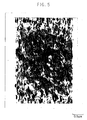
- Fig. 5 shows the rubber polymer particles in the cell membrane when the foamable modified polystyrene resin particles corresponding to Example 2 are formed into a foamed article having a density of 0.02 g/cm 3 .
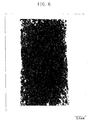
- Fig. 6 shows the rubber polymer particles in the cell membrane when the foamable modified polystyrene resin particles of Comparative Example 3 corresponding to foamable resin particles described in WO98/29485 are formed into a foamed article having a density of 0.02 g/cm 3 .
- the rubber polymer particles are adequately flattened in the cell membrane and differ in their properties from those of the foamable resin particles described in WO98/29485 in which the rubber polymer particles are not deformed.
- the inventors of the present invention have found that with respect to the foamable modified polystyrene resin particles in which the modified polystyrene resin particles contains the blowing agent and the rubber polymer particles are dispersed uniformly throughout a continuous phase of the polystyrene resin or in a state of a density of the particles being higher in the center portion of the resin particle than in the surface layer portion thereof, when the rubber polymer particles being present in the center portion of the foamable modified polystyrene resin particles have a circle equivalent diameter of average area of 0.01 to 0.20 ⁇ m, a balance of break resistance and cushioning property of a foamed article obtained by expanding is excellent.
- a preferable circle equivalent diameter of average area is from 0.02 to 0.18 ⁇ m, more preferably 0.04 to 0.16 ⁇ m, particularly preferably 0.05 to 0.14 ⁇ m.
- the rubber polymer particles which are not spherical substantially are contained among the rubber polymer particles (b) in the modified polystyrene resin particles (c).
- foamable polystyrene resin particles (d) of the present invention A difference between the foamable polystyrene resin particles (d) of the present invention and some conventional foamable polystyrene resin particles is as mentioned above. Then a difference from another known foamable polystyrene resin particles and foamed article is explained briefly in other aspects.
- a foamed article obtained from usual high impact polystyrene resin has an impact strength ratio by a falling weight method in a wide range of from 0.6 to 2.0.
- HIPS high impact polystyrene resin
- a molecular weight of a polystyrene portion is hard to be increased and a repelletizing step for forming into particles is required and a production cost is increased.
- a cushioning coefficient ratio of a foamed article of the high impact polystyrene resin (HIPS) becomes not less than 1.08, and therefore it is hard to say that cushioning property is so excellent. It is understood in general that unless the rubber polymer particles are relatively large, for example, unless a particle size thereof is 1 to 2 ⁇ m or more, good properties are not exhibited.
- JP-A-8-188669 discloses foamable rubber-modified styrene resin particles obtained from rubber-modified styrene resin particles which comprise 8 to 15 % by weight of butadiene rubber particles having a 1,4-cis structure in a proportion of not less than 70 % by weight and an average particle size of 1.5 to 3.0 ⁇ m and a styrene resin (Z average molecular weight: not less than 350,000) and have a mineral oil content of not more than 3 % by weight and a blowing agent content of from 1 to 20 % by weight.
- 1,4-cis structure In order to increase a proportion of 1,4-cis structure to 70 % by weight or more, it is necessary to employ a specific polymerization method specially regulated such as ion polymerization.
- the styrene monomer and conjugated diene monomer are subjected to radical polymerization in an entirely unconditioned state to give a random copolymer. In that case a proportion of 1,4-cis structure is very low. In that point, the rubber polymer particles of the present invention completely differ from those described in JP-A-8-188669.
- a particle size of the rubber polymer particles of JP-A-8-188669 is the same as that of usual HIPS resin particles, and also from this point of view, the invention of JP-A-8-188669 differs from the present invention in which the particle size of the rubber polymer particles is relatively small.
- JP-A-7-11043 describes that a foamed article of high impact polystyrene resin (HIPS) in which rubber polymer particles are flattened in a range of L/D of 10 to 70 has a high break resistance.
- HIPS high impact polystyrene resin
- the resin is HIPS and a preparation process thereof differs from that of the present invention.
- the rubber polymer particles have a structure like salami or a core-shell structure and the structure and properties are entirely different from those of the present invention and therefore a preferred average flatness is in a completely different range.
- JP-A-56-67344 describes a polymer composition obtained by an entirely different preparation process by using a resin which is neither usual HIPS resin nor the resin of the present invention prepared by impregnation polymerization.
- high impact resin particles are prepared by dissolving a straight chain styrene/butadiene block copolymer and a straight chain polybutadiene in toluene, removing toluene by solvent casting method, and then crosslinking polybutadiene at 140°C.
- the rubber portion thereof since the steps of dissolving in the solvent and then removing the solvent by the solvent casting method are employed, the rubber portion thereof has a micro phase separation structure of styrene component and conjugated diene polymer component, and a particle size of the rubber portion is smaller as compared with that of HIPS resin though the both resins are equal from a point that the rubber portions thereof are block copolymers.
- the preparation steps are not practical because a cost is too high.
- the particles of the rubber portion contain a blocked polybutadiene in a large amount and differ in a structure, properties and characteristics from the rubber polymer particles of the present invention which basically comprise a random copolymer of a styrene monomer and conjugated diene monomer.
- a 5-liter reactor with a stirrer was charged with an aqueous suspension comprising 110 parts (part by weight, hereinafter the same) of water, 0.013 part of sodium ⁇ -olefin sulfonate, 0.44 part of calcium phosphate and polystyrene particles having an average particle size of 1 mm in an amount shown in Table 1, and then was sealed. With stirring, the mixture was heated to 80°C, and impregnated with a monomer mixture in an amount shown in Table 1. As the initiator, 0.066 part of lauroyl peroxide was added, followed by the first impregnation polymerization for six hours.
- the reactor was heated to 90°C and 10.1 parts of styrene and 0.049 part of benzoyl peroxide were added additionally over one hour, followed by heating to 115°C over one hour and conducting the second impregnation polymerization for two hours.
- the obtained foamable resin particles were pre-expanded by about 50 times under the above-mentioned conditions to give pre-expanded particles having a density of 0.02 g/cm 3 .
- the pre-expanded particles were allowed to stand for 24 hours, followed by in-mold molding under the above-mentioned conditions to give a foamed article.
- a 5-liter reactor with a stirrer was charged with an aqueous suspension comprising 110 parts of water, 0.013 part of sodium ⁇ -olefin sulfonate, 0.44 part of calcium phosphate and polystyrene particles having an average particle size of 1 mm in an amount shown in Table 1, and then was sealed. With stirring, the mixture was heated to 80°C, and impregnated with a monomer mixture in an amount shown in Table 1. As the initiator, 0.066 part of lauroyl peroxide was added, followed by the first impregnation polymerization for six hours. Then the reactor was heated to 115°C, followed by post-polymerization for two hours.
- the obtained foamable resin particles were pre-expanded by about 50 times in the same manner as in Example 1 to give pre-expanded particles having a density of 0.02 g/cm 3 .
- the pre-expanded particles were subjected to in-mold molding to give a foamed article.
- the obtained foamable resin particles were subjected to pre-expanding and in-mold molding in the same manner as in Example 1 to give a foamed article.
- a 5-liter reactor with a stirrer was charged with an aqueous suspension comprising 96 parts of water, 0.0096 part of sodium ⁇ -olefin sulfonate, 0.32 part of calcium phosphate and 80 parts of polystyrene particles having an average particle size of 1 mm, and then was sealed.
- the obtained mixture was added in the reactor and dispersed together with polystyrene particles in an aqueous medium.
- the dispersion was stirred at 60°C for two hours and the mixture was absorbed in the polystyrene particles.
- the dispersion was then heated to 90°C and held for four hours and further heated to 125°C and held for two hours to copolymerize styrene with butadiene.
- the dispersion was then cooled to 100°C and thereto was added 10 parts of pressurized pentane as a blowing agent, followed by holding for six hours to impregnate the particles with the blowing agent.
- the dispersion was cooled to 30°C, taken out of the reactor, and then dehydrated and dried to give foamable polystyrene particles.
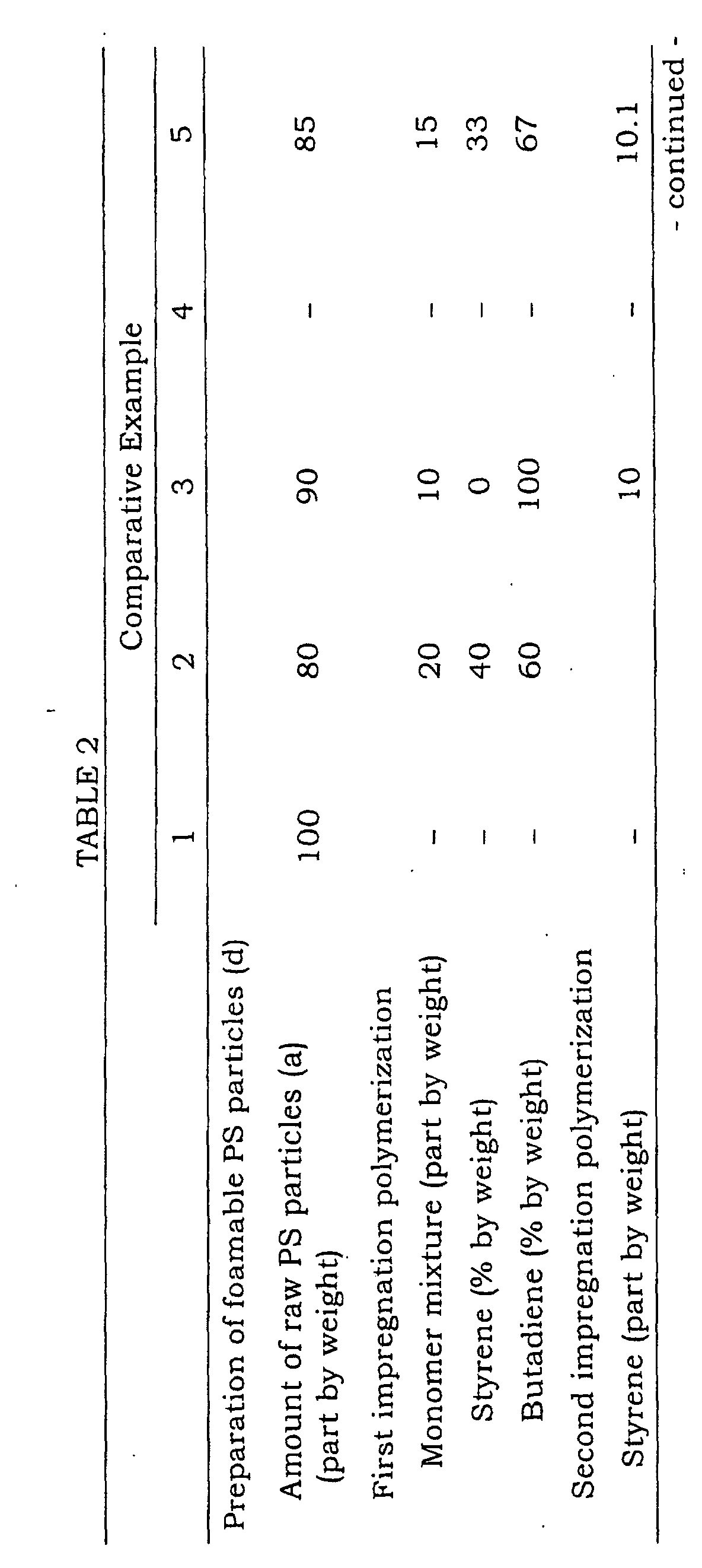
- Foamable polystyrene particles were obtained in the same manner as in Example 1 except that an amount of a monomer mixture was changed to that shown in Table 2.
- the obtained foamable resin particles were subjected to pre-expanding and in-mold molding in the same manner as in Example 1 to give a foamed article.
- a high impact polystyrene resin (HIPS, rubber content: 8 %, molecular weight of a polystyrene portion: 230000) was extruded and cut to give small particles of about 1 mg. Those resin particles were impregnated with a blowing agent in the same manner as in Example 1 to give foamable high impact polystyrene resin particles which were then subjected to pre-expanding and in-mold molding in the same manner as in Example 1 to give a foamed article.
- HIPS high impact polystyrene resin
- Foamable polystyrene particles were obtained in the same manner as in Example 1 except that an amount of a monomer mixture was changed to that shown in Table 2.
- the obtained foamable resin particles were subjected to pre-expanding and in-mold molding in the same manner as in Example 1 to give a foamed article.
- Comparative Example 5 corresponds to the invention disclosed in WO98/29485.
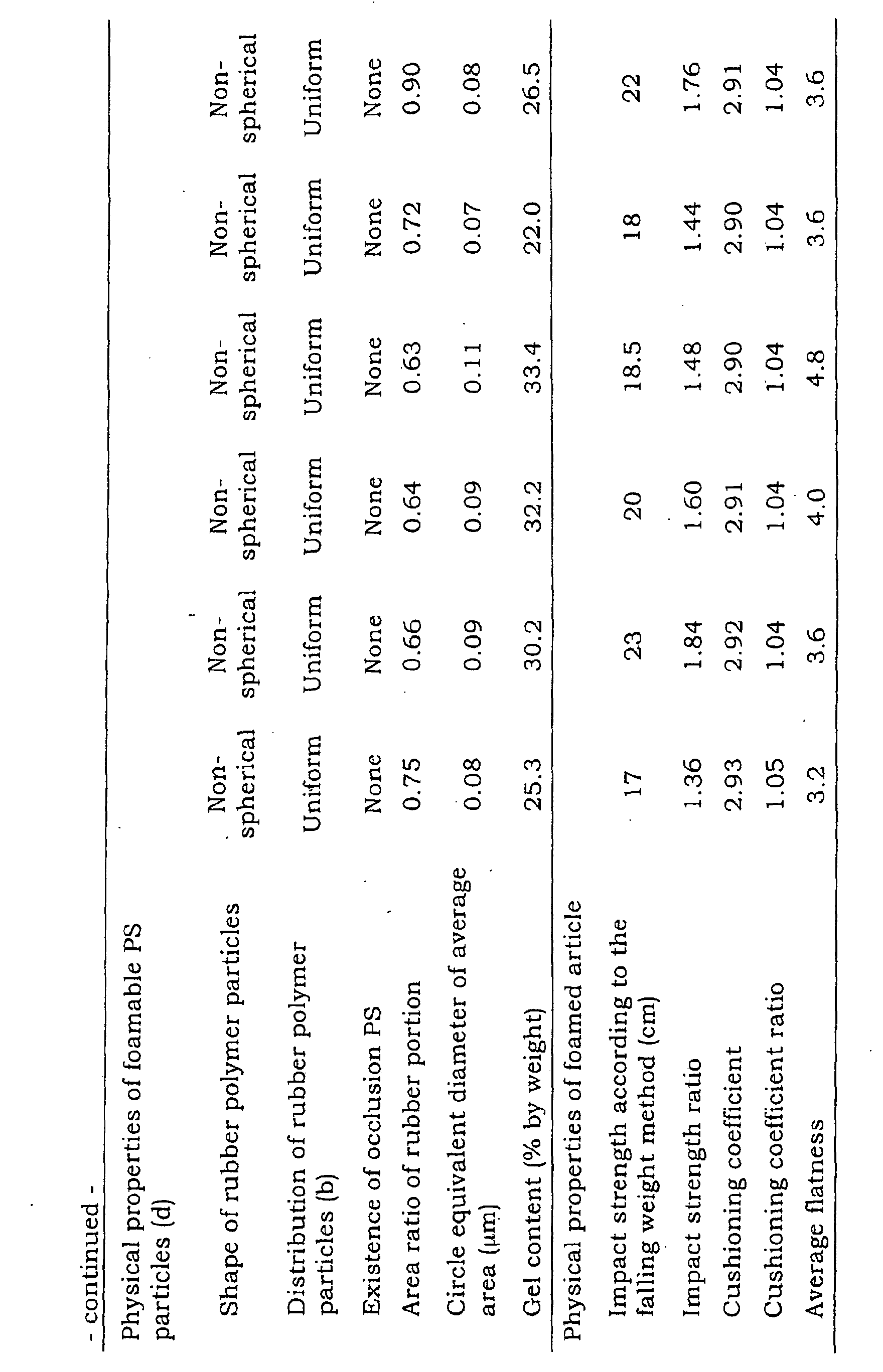
- the foamable modified polystyrene resin particles and foamed article of the present invention can provide a foamed article excellent in break resistance as shown in Table 1.
- Comparative Examples shown in Table 2 particularly in Comparative Examples 3 and 5, in which foamable modified polystyrene resin particles (WO98/29485) containing rubber polymer particles which are not deformed substantially after expanding are used, impact resistance and break resistance are enhanced.
- a modified polystyrene foamed article having excellent break resistance and high fusion rate and foamable modified polystyrene resin particles which are raw materials for producing the foamed article.
- Such a modified polystyrene resin foamed article can be produced at relatively low cost as compared with an expensive high impact polystyrene resin foamed article.
- the foamed article of the present invention can be used for applications where high impact polystyrene resin foamed articles have been used, and is useful as a shock absorbing material particularly for precise electric appliances, for example, OA apparatuses such as CRT and printer and AV apparatuses such as audio system and video Tape recorder.
Landscapes
- Chemical & Material Sciences (AREA)
- Engineering & Computer Science (AREA)
- Materials Engineering (AREA)
- Health & Medical Sciences (AREA)
- Chemical Kinetics & Catalysis (AREA)
- Medicinal Chemistry (AREA)
- Polymers & Plastics (AREA)
- Organic Chemistry (AREA)
- Manufacture Of Porous Articles, And Recovery And Treatment Of Waste Products (AREA)
- Compositions Of Macromolecular Compounds (AREA)
Abstract
wherein the rubber polymer particles (b) are dispersed uniformly throughout a continuous phase of the polystyrene resin or in a state of a density of the particles (b) being higher in a center portion of the resin particle than in a surface layer portion thereof, and
the modified polystyrene resin particles (c) are modified polystyrene resin particles prepared by impregnating a monomer mixture consisting essentially of a styrene monomer and a conjugated diene monomer and comprising the styrene monomer in a larger amount than the conjugated diene monomer, into polystyrene resin particles (a) and carrying out copolymerization.
Description
wherein the rubber polymer particles (b) are dispersed uniformly throughout a continuous phase of the polystyrene resin or in a state of a density of the particles (b) being higher in a center portion of the resin particle than in a surface layer portion thereof, and
the modified polystyrene resin particles (c) are modified polystyrene resin particles (c1) obtained by impregnating a monomer mixture consisting essentially of a styrene monomer and a conjugated diene monomer into polystyrene resin particles (a) and carrying out copolymerization, said monomer mixture being containing the styrene monomer in a larger amount than the conjugated diene monomer.
wherein the rubber polymer particles (b) are dispersed uniformly throughout a continuous phase of the polystyrene resin or in a state of a density of the particles (b) being higher in a center portion of the resin particle than in a surface layer portion thereof, and
provided that when the foamable modified polystyrene resin particles (d) are molded into a modified polystyrene resin foamed article having a density of 0.02 g/cm3, a cushioning coefficient of the foamed article is represented by A and a 50 % failure height thereof according to falling weight method is represented by B, and that when foamable un-modified polystyrene resin particles (f) prepared by impregnating polystyrene resin particles (a) with a blowing agent (e) are molded into an unmodified polystyrene resin foamed article having a density of 0.02 g/cm3, a cushioning coefficient of the foamed article is represented by C and a 50 % failure height thereof according to falling weight method is represented by D, the modified polystyrene resin foamed article has a relation that A/C is 1.00 to 1.08 and B/D is 1.35 to 2.35.
wherein the rubber polymer particles (b) are dispersed uniformly throughout a continuous phase of the polystyrene resin or in a state of a density of the particles (b) being higher in a center portion of the resin particle than in a surface layer portion thereof, and
the rubber polymer particles (b) are flattened in a cell membrane of a modified polystyrene resin foamed article obtained by expanding the foamable modified polystyrene resin particles (d).
wherein the rubber polymer particles (b) are flattened in the cell membrane, and an average flatness of the flattened rubber polymer particles (b) in the cell membrane of the modified polystyrene resin foamed article having a density of 0.02 g/cm3 is in a range of 1.5 to 8.
- impregnation-polymerizing the modified polystyrene resin particles (c1) with a styrene monomer to give the modified polystyrene resin particles (c2) and then
- impregnating the modified polystyrene resin particles (c2) with the blowing agent (e).

Whichever is the larger of the number of broken and unbroken test pieces shall be used. In case where the numbers are the same, either one may be used.


Claims (27)
- Foamable modified polystyrene resin particles which are foamable modified polystyrene resin particles (d) comprising modified polystyrene resin particles (c) containing a blowing agent (e); said modified polystyrene resin particles (c) comprising a polystyrene resin and rubber polymer particles (b) being dispersed in the resin,
wherein the rubber polymer particles (b) are dispersed uniformly throughout a continuous phase of the polystyrene resin or in a state of a density of the particles (b) being higher in a center portion of the resin particle than in a surface layer portion thereof, and
the modified polystyrene resin particles (c) are modified polystyrene resin particles (c1) obtained by impregnating a monomer mixture consisting essentially of a styrene monomer and conjugated diene monomer into polystyrene resin particles (a) and carrying out copolymerization, said monomer mixture being containing the styrene monomer in a larger amount than the conjugated diene monomer. - The foamable modified polystyrene resin particles of Claim 1, wherein said rubber polymer particles (b) consist essentially of a copolymer of the styrene monomer and the conjugated diene monomer.
- The foamable modified polystyrene resin particles of Claim 1 or 2, wherein said modified polystyrene resin particles (c) are modified polystyrene resin particles (c2) obtained by copolymerizing a monomer mixture consisting essentially of the styrene monomer and the conjugated diene monomer and containing the styrene monomer in a larger amount than the conjugated diene monomer with the monomer mixture being impregnated in the polystyrene resin particles (a) to give the modified polystyrene resin particles (c1) and further subjecting the resin particles (c1) to impregnation polymerization of a styrene monomer.
- The foamable modified polystyrene resin particles of any of Claims 1 to 3, wherein said modified polystyrene resin particles (c1) are prepared by impregnating 40 to 10 parts by weight of the monomer mixture into 60 to 90 parts by weight of polystyrene polymer particles (a) and carrying out copolymerization, said monomer mixture comprising the styrene monomer of more than 55 % by weight and not more than 90 % by weight and the conjugated diene monomer of more than 10 % by weight and less than 45 % by weight.
- The foamable modified polystyrene resin particles of any of Claims 1 to 4, wherein provided that when the foamable modified polystyrene resin particles (d) are molded into a modified polystyrene resin foamed article having a density of 0.02 g/cm3, a cushioning coefficient is represented by A and a 50 % failure height according to falling weight method of the foamed article is represented by B, and that when foamable un-modified polystyrene resin particles (f) prepared by impregnating the polystyrene resin particles (a) with the blowing agent (e) are molded into an un-modified polystyrene resin foamed article having a density of 0.02 g/cm3, a cushioning coefficient is represented by C and a 50 % failure height according to falling weight method of the foamed article is represented by D, the modified polystyrene resin foamed article has a relation that A/C is 1.00 to 1.08 and B/D is 1.35 to 2.35.
- The foamable modified polystyrene resin particles of any of Claims 1 to 5, wherein the rubber polymer particles (b) being present in the center portion of the foamable modified polystyrene resin particles (d) have a circle equivalent diameter of average area of 0.01 to 0.20 µm.
- The foamable modified polystyrene resin particles of any of Claims 1 to 6, wherein a gel content of the modified polystyrene resin particles (c) is from 15 to 40 % by weight.
- The foamable modified polystyrene resin particles of any of Claims 1 to 7, wherein the rubber polymer particles (b) are flattened in a cell membrane of the modified polystyrene resin foamed article obtained by expanding the foamable modified polystyrene resin particles.
- The foamable modified polystyrene resin particles of Claim 8, wherein an average flatness of the rubber polymer particles (b) flattened in the cell membrane of the modified polystyrene resin foamed article obtained by expanding the foamable modified polystyrene resin particles (d) is within a range of 1.1 to 9.
- Foamable modified polystyrene resin particles which are foamable modified polystyrene resin particles (d) comprising modified polystyrene resin particles (c) containing a blowing agent (e); said modified polystyrene resin particles (c) comprising a polystyrene resin and rubber polymer particles (b) being dispersed in the resin,
wherein the rubber polymer particles (b) are dispersed uniformly throughout a continuous phase of the polystyrene resin or in a state of a density of the particles (b) being higher in a center portion of the resin particle than in a surface layer portion thereof, and
provided that when the foamable modified polystyrene resin particles (d) are molded into a modified polystyrene resin foamed article having a density of 0.02 g/cm3, a cushioning coefficient is represented by A and a 50 % failure height according to falling weight method of the foamed article is represented by B, and that when foamable un-modified polystyrene resin particles (f) prepared by impregnating polystyrene resin particles (a) with the blowing agent (e) are molded into an unmodified polystyrene resin foamed article having a density of 0.02 g/cm3, a cushioning coefficient is represented by C and a 50 % failure height according to falling weight method of the foamed article is represented by D, the modified polystyrene resin foamed article has a relation that A/C is 1.00 to 1.08 and B/D is 1.35 to 2.35. - The foamable modified polystyrene resin particles of Claim 10, wherein the rubber polymer particles (b) consist essentially of a copolymer of the styrene monomer and the conjugated diene monomer.
- The foamable modified polystyrene resin particles of Claim 10 or 11, wherein the rubber polymer particles (b) being present in the center portion of the foamable modified polystyrene resin particles (d) have a circle equivalent diameter of average area of 0.01 to 0.20 µm.
- The foamable modified polystyrene resin particles of any of Claims 10 to 12, wherein a gel content in the modified polystyrene resin particles (c) is from 15 to 40 % by weight.
- Foamable modified polystyrene resin particles which are foamable modified polystyrene resin particles (d) comprising modified polystyrene resin particles (c) containing a blowing agent (e); said modified polystyrene resin particles (c) comprising a polystyrene resin and rubber polymer particles (b) being dispersed in the resin,
wherein the rubber polymer particles (b) are dispersed uniformly throughout a continuous phase of the polystyrene resin or in a state of a density of the particles (b) being higher in a center portion of the resin particle than in a surface layer portion thereof, and
the rubber polymer particles (b) are flattened in a cell membrane of a modified polystyrene resin foamed article obtained by expanding the foamable modified polystyrene resin particles (d). - The foamable modified polystyrene resin particles of Claim 14, wherein the rubber polymer particles (b) consist essentially of a copolymer of the styrene monomer and the conjugated diene monomer.
- The foamable modified polystyrene resin particles of Claim 14 or 15, wherein provided that when the foamable modified polystyrene resin particles (d) are molded into a modified polystyrene resin foamed article having a density of 0.02 g/cm3, a cushioning coefficient is represented by A and a 50 % failure height according to falling weight method of the foamed article is represented by B, and that when foamable un-modified polystyrene resin particles (f) prepared by impregnating polystyrene resin particles (a) with the blowing agent (e) are molded into an un-modified polystyrene resin foamed article having a density of 0.02 g/cm3, a cushioning coefficient is represented by C and a 50 % failure height according to falling weight method of the foamed article is represented by D, the modified polystyrene resin foamed article has a relation that A/C is 1.00 to 1.08 and B/D is 1.35 to 2.35.
- The foamable modified polystyrene resin particles of any of Claims 13 to 16, wherein the rubber polymer particles (b) being present in the center portion of the foamable modified polystyrene resin particles (d) have a circle equivalent diameter of average area of 0.01 to 0.20 µm.
- The foamable modified polystyrene resin particles of any of Claims 14 to 17, wherein a gel content in the modified polystyrene resin particles (c) is from 15 to 40 % by weight.
- The foamable modified polystyrene resin particles of any of Claims 14 to 18, wherein an average flatness of the rubber polymer particles (b) flattened in a cell membrane of the modified polystyrene resin foamed article obtained by expanding the foamable modified polystyrene resin particles (d) and having a density of 0.02 g/cm3 is within a range of 1.1 to 9.
- A modified polystyrene resin foamed article having a cell membrane of modified polystyrene resin and containing the rubber polymer particles (b) dispersed in the resin, wherein the rubber polymer particles (b) in the cell membrane are flattened, and an average flatness of the rubber polymer particles (b) flattened in the cell membrane of the modified polystyrene resin foamed article having a density of 0.02 g/cm3 is within a range of 1.1 to 9.
- The modified polystyrene resin foamed article of Claim 20,
wherein the rubber polymer particles (b) consist essentially of a copolymer of the styrene monomer and the conjugated diene monomer. - The modified polystyrene resin foamed article of Claim 20 or 21, wherein provided that a cushioning coefficient of the modified polystyrene resin foamed article having a density of 0.02 g/cm3 is represented by A and a 50 % failure height according to falling weight method of the foamed article is represented by B, and that a cushioning coefficient of an un-modified polystyrene resin foamed article containing no rubber polymer particles and having a density of 0.02 g/cm3 is represented by C and a 50 % failure height according to falling weight method of the foamed article is represented by D, the modified polystyrene resin foamed article has a relation that A/C is 1.00 to 1.08 and B/D is 1.35 to 2.35.
- The modified polystyrene resin foamed article obtained by expanding the foamable modified polystyrene resin particles of any of Claims 1 to 19.
- A process for preparing foamable modified polystyrene resin particles comprising:impregnating, into polystyrene resin particles (a), a monomer mixture consisting essentially of a styrene monomer and a conjugated diene monomer and comprising the styrene monomer in a larger amount than the conjugated diene monomer and carrying out copolymerization to give modified polystyrene resin particles (c1), wherein the rubber polymer particles (b) are dispersed uniformly throughout a continuous phase of the polystyrene resin or in a state of a density of the particles (b) being higher in a center portion of the resin particle than in a surface layer portion thereof, andimpregnating the modified polystyrene resin particles (c1) with a blowing agent (e).
- A process for preparing foamable modified polystyrene resin particles comprising:impregnating, into polystyrene resin particles (a), a monomer mixture consisting essentially of a styrene monomer and a conjugated diene monomer and comprising the styrene monomer in a larger amount than the conjugated diene monomer and carrying out copolymerization to give modified polystyrene resin particles (c1),impregnation-polymerizing the modified polystyrene resin particles (c1) with a styrene monomer to give modified polystyrene resin particles (c2), andimpregnating the modified polystyrene resin particles (c2) with a blowing agent (e).
- The process for preparing foamable modified polystyrene resin particles of Claim 24 or 25, wherein in the impregnation polymerization for preparing the modified polystyrene resin particles (c1), 40 to 10 parts by weight of the monomer mixture is impregnated into 60 to 90 parts by weight of the polystyrene polymer particles (a) and the monomer mixture comprises the styrene monomer of more than 55 % by weight and not more than 90 % by weight and the conjugated diene monomer of more than 10 % by weight and less than 45 % by weight.
- A method for producing a modified polystyrene resin foamed article by expanding the foamable modified polystyrene resin particles (d) of any of Claims 1 to 19.
Applications Claiming Priority (3)
| Application Number | Priority Date | Filing Date | Title |
|---|---|---|---|
| JP37246899 | 1999-12-28 | ||
| JP37246899 | 1999-12-28 | ||
| PCT/JP2000/009076 WO2001048068A1 (en) | 1999-12-28 | 2000-12-21 | Expandable styrene resin beads and foams produced therefrom |
Publications (2)
| Publication Number | Publication Date |
|---|---|
| EP1266929A1 true EP1266929A1 (en) | 2002-12-18 |
| EP1266929A4 EP1266929A4 (en) | 2003-03-26 |
Family
ID=18500499
Family Applications (1)
| Application Number | Title | Priority Date | Filing Date |
|---|---|---|---|
| EP00987675A Withdrawn EP1266929A4 (en) | 1999-12-28 | 2000-12-21 | Expandable styrene resin beads and foams produced therefrom |
Country Status (8)
| Country | Link |
|---|---|
| US (1) | US6770682B2 (en) |
| EP (1) | EP1266929A4 (en) |
| JP (1) | JP5296279B2 (en) |
| KR (1) | KR20020055589A (en) |
| CN (1) | CN1311013C (en) |
| MY (1) | MY148556A (en) |
| TW (1) | TWI262200B (en) |
| WO (1) | WO2001048068A1 (en) |
Cited By (2)
| Publication number | Priority date | Publication date | Assignee | Title |
|---|---|---|---|---|
| WO2020035434A1 (en) | 2018-08-13 | 2020-02-20 | Versalis S.P.A. | Expandable vinyl aromatic polymer composition with improved mechanical and insulating properties |
| EP4303254A4 (en) * | 2021-03-03 | 2025-02-26 | Kaneka Corporation | METHOD FOR PRODUCING MODIFIED POLYSTYRENE RESIN PARTICLES, METHOD FOR PRODUCING EXPANDABLE MODIFIED POLYSTYRENE RESIN PARTICLES, AND USE THEREOF |
Families Citing this family (7)
| Publication number | Priority date | Publication date | Assignee | Title |
|---|---|---|---|---|
| JP5107031B2 (en) * | 2005-03-31 | 2012-12-26 | 株式会社カネカ | Expandable thermoplastic resin particles and foam using the same |
| JP5192169B2 (en) * | 2007-04-03 | 2013-05-08 | 株式会社カネカ | Method for producing in-mold foam molding |
| US9453083B2 (en) | 2013-03-14 | 2016-09-27 | Saudi Basic Industries Corporation | Vinyl polymers prepared via suspension polymerization and methods thereof |
| JP7653803B2 (en) * | 2021-03-03 | 2025-03-31 | 株式会社カネカ | Manufacturing method of expandable modified polystyrene resin particles, expandable modified polystyrene resin particles, and use thereof |
| CN113736185A (en) * | 2021-09-29 | 2021-12-03 | 蔚来汽车科技(安徽)有限公司 | Composition for producing a component and component produced therefrom |
| CN117624482A (en) * | 2022-08-10 | 2024-03-01 | 华为技术有限公司 | Pre-foamed materials and preparation methods and applications thereof |
| CN120005315B (en) * | 2023-11-15 | 2026-02-17 | 中国石油化工股份有限公司 | Suitable for free-foaming polystyrene compositions, polystyrene particles, and free-foaming polystyrene bodies |
Family Cites Families (61)
| Publication number | Priority date | Publication date | Assignee | Title |
|---|---|---|---|---|
| US3893989A (en) | 1970-07-08 | 1975-07-08 | Montedison Spa | Process for polymerizing propylene |
| JPS492183B1 (en) | 1970-11-13 | 1974-01-18 | ||
| JPS492183A (en) | 1972-04-20 | 1974-01-10 | ||
| JPS5277174A (en) | 1975-12-24 | 1977-06-29 | Japan Styrene Paper Corp | Process for foaming of polymer particle |
| JPS54158467A (en) | 1978-06-05 | 1979-12-14 | Asahi Chem Ind Co Ltd | Expandable styrene resin composition |
| JPS5667344A (en) | 1979-11-08 | 1981-06-06 | Asahi Chem Ind Co Ltd | Expandable polymer composition |
| US4422877A (en) | 1980-10-28 | 1983-12-27 | Restech Research Limited Partnership | Synthetic polymer-propellant compositions forming cold foamed structures having a temperature at least 30° C. below ambient temperature and containing open and/or closed cells |
| JPS57170725A (en) | 1981-04-16 | 1982-10-21 | Japan Styrene Paper Co Ltd | Manufacture of foamed molding |
| JPS5862024A (en) | 1981-10-08 | 1983-04-13 | Fujikura Ltd | Manufacture of foamed plastic |
| CH648272A5 (en) * | 1981-10-12 | 1985-03-15 | Sika Ag | ALKALIF-FREE SETTING AND HARDENING ACCELERATOR AND METHOD FOR ACCELERATING THE SETTING AND HARDENING OF A HYDRAULIC BINDING AGENT. |
| JPS58136632A (en) | 1982-01-14 | 1983-08-13 | Kanegafuchi Chem Ind Co Ltd | Production of expanded polyolefin resin molding |
| US4424285A (en) * | 1983-01-31 | 1984-01-03 | Atlantic Richfield Company | Process for forming fast-cool vinyl aromatic expandable polymers |
| US4409338A (en) * | 1983-01-31 | 1983-10-11 | Atlantic Richfield Company | Process for forming fast-cool vinyl aromatic expandable polymers |
| EP0122460B1 (en) | 1983-03-23 | 1988-07-06 | Chuo Kagaku Co., Ltd. | Production of resin foam by aqueous medium |
| EP0123144B1 (en) | 1983-03-25 | 1987-10-07 | Japan Styrene Paper Corporation | Polypropylene resin prefoamed particles |
| JPS6090228A (en) | 1983-10-24 | 1985-05-21 | Japan Styrene Paper Co Ltd | Production of preliminarily expanded particle of polypropylene based resin |
| JPS60110734A (en) | 1983-11-21 | 1985-06-17 | Japan Styrene Paper Co Ltd | Pre-expanded particle of uncrosslinked polypropylene resin |
| JPS60168632A (en) | 1984-02-13 | 1985-09-02 | Japan Styrene Paper Co Ltd | Expanded molding of bridged polypropylene resin |
| JPS60188435A (en) | 1984-03-09 | 1985-09-25 | Badische Yuka Co Ltd | Method for producing polyolefin resin foam particles |
| JPS60221440A (en) | 1984-04-19 | 1985-11-06 | Badische Yuka Co Ltd | Production of foamed particles of propylene resin |
| US4676939A (en) | 1984-06-14 | 1987-06-30 | Japan Styrene Paper Corporation | Process for the production of expanded particles of a polypropylene resin |
| JPS614738A (en) | 1984-06-19 | 1986-01-10 | Japan Styrene Paper Co Ltd | Preparation of foamed polypropylene resin particle |
| JPS61103944A (en) | 1984-10-29 | 1986-05-22 | Mitsubishi Yuka Badische Kk | polypropylene foam particles |
| JPS61115940A (en) | 1984-11-09 | 1986-06-03 | Mitsubishi Yuka Badische Kk | polypropylene foam particles |
| US4689351A (en) | 1985-10-08 | 1987-08-25 | Mitsubishi Yuka Badische Co., Ltd. | Process for producing foamed particles of propylene copolymer resin |
| JPS62115042A (en) | 1985-11-14 | 1987-05-26 | Kanegafuchi Chem Ind Co Ltd | Pre-expanded polyolefin resin particle and production thereof |
| JPH0649795B2 (en) | 1985-11-29 | 1994-06-29 | 日本スチレンペ−パ−株式会社 | Method for producing pre-expanded polypropylene resin molded product |
| US4695593A (en) | 1986-02-21 | 1987-09-22 | Japane Styrene Paper Corporation | Prefoamed propylene polymer-base particles, expansion-molded article produced from said particles and production process of said article |
| CA1280549C (en) | 1986-05-27 | 1991-02-19 | Kyoichi Nakamura | Pre-expanded particles of propylene resin |
| JPH0659694B2 (en) | 1986-09-16 | 1994-08-10 | 鐘淵化学工業株式会社 | Method for manufacturing polypropylene resin in-mold foam molding |
| JPH0739501B2 (en) | 1987-06-23 | 1995-05-01 | 日本スチレンペ−パ−株式会社 | Non-crosslinked linear low density polyethylene pre-expanded particles |
| US5229049A (en) | 1988-08-31 | 1993-07-20 | Honda Giken Kogyo Kabushiki Kaisha | Method for manufacturing pre-expanded particles of polyolefin resin |
| PL286051A1 (en) | 1989-07-20 | 1991-03-11 | Warner Lambert Co | Polymer mixture, method for manufacturing a thermoplastic product and a method for manufacturing a thermoplastic alloy |
| JP2887291B2 (en) | 1989-08-30 | 1999-04-26 | 株式会社ジェイエスピー | Method for producing expanded polyolefin resin particles |
| JP2886248B2 (en) | 1990-03-06 | 1999-04-26 | 三菱化学ビーエーエスエフ株式会社 | In-mold molding method for expanded polypropylene resin particles |
| JPH0466125A (en) | 1990-07-04 | 1992-03-02 | Nippon Zeon Co Ltd | Water-absorbing agent, method for producing water-absorbing agent, and method for reducing moisture in powder or granular material using water-absorbing agent |
| JP2670717B2 (en) | 1991-05-04 | 1997-10-29 | 西川ゴム工業株式会社 | Foaming agent for foam rubber |
| EP0524404A1 (en) | 1991-05-28 | 1993-01-27 | Fuji Photo Film Co., Ltd. | Resin composition and packaging material for packaging photosensitive materials |
| JPH069832A (en) | 1992-06-26 | 1994-01-18 | Showa Denko Kk | Adhesive resin composition |
| JPH0649263A (en) * | 1992-07-30 | 1994-02-22 | Sekisui Plastics Co Ltd | Expandable bead of high-impact styrene resin and its production |
| DE4235747A1 (en) | 1992-10-23 | 1994-06-30 | Burger Hans Joachim | Syntactic in-situ foam prodn |
| JP3279382B2 (en) | 1993-03-17 | 2002-04-30 | 株式会社ジエイエスピー | Non-crosslinked polyethylene resin foam particles and method for producing the same |
| JP2600607B2 (en) * | 1993-04-27 | 1997-04-16 | 旭化成工業株式会社 | Method for producing expanded polystyrene-based particles and molded polystyrene-based expanded particles |
| JP2983435B2 (en) | 1993-07-30 | 1999-11-29 | 積水化成品工業株式会社 | Expandable styrenic resin particles and foamed styrenic resin article obtained from the particles |
| JP3341418B2 (en) | 1993-11-16 | 2002-11-05 | 株式会社ジエイエスピー | Method for producing foamed propylene-based resin having communicating voids |
| JP3461583B2 (en) | 1994-07-08 | 2003-10-27 | 鐘淵化学工業株式会社 | Method for producing foamed molded article in polypropylene resin mold |
| US5589545A (en) | 1994-07-18 | 1996-12-31 | Union Carbide Chemicals & Plastics Technology Corporation | Lubricious polymer blends comprising polyethylene oxide, polyethylene and a polylactone |
| JP3254930B2 (en) | 1994-10-13 | 2002-02-12 | 東レ株式会社 | Polyester film |
| DE4436980A1 (en) | 1994-10-15 | 1996-04-18 | Basf Ag | Pre-expanded polyolefin particles made by extrusion |
| JP3436816B2 (en) * | 1995-01-13 | 2003-08-18 | 三菱化学フォームプラスティック株式会社 | Expandable rubber-modified styrenic resin particles, expanded resin particles comprising the same, and expanded molded article |
| US5661191A (en) * | 1995-01-13 | 1997-08-26 | Mitsubishi Chemical Basf Company Limited | Expandable rubber-modified styrene resin beads, expanded beads thereof, and expanded molded articles obtained therefrom |
| JPH08277340A (en) | 1995-04-05 | 1996-10-22 | Jsp Corp | Polypropylene homopolymer expanded particles and expanded particle molded products |
| US6051617A (en) | 1996-08-07 | 2000-04-18 | Jsp Corporation | Foamed particles of modified polypropylene resin and method of preparing same |
| JP3775612B2 (en) | 1996-12-24 | 2006-05-17 | 株式会社ジェイエスピー | Manufacturing method and manufacturing apparatus for foam molded article |
| EP0960904B1 (en) * | 1996-12-26 | 2005-03-09 | Kaneka Corporation | Expandable polystyrene resin beads, process for the preparation of them, and foam made by using the same |
| DE19706884A1 (en) | 1997-02-21 | 1998-08-27 | Huels Chemische Werke Ag | Process for post-expansion of pre-expanded polyolefinic particles |
| US5883141A (en) | 1997-03-25 | 1999-03-16 | Kaneka Corporation | Process for preparing polyolefin resin pre-expanded particles |
| DE19716572A1 (en) * | 1997-04-19 | 1998-10-22 | Basf Ag | Expandable styrene polymers |
| DE19739113A1 (en) | 1997-09-06 | 1999-03-11 | Gefinex Polymerschaeume Gmbh | Pre-expanded polyolefin foam particles |
| JP3692760B2 (en) | 1998-01-30 | 2005-09-07 | 株式会社カネカ | Method for producing foamed molded product in polypropylene resin mold |
| SG77671A1 (en) | 1998-03-23 | 2001-01-16 | Jsp Corp | Foamed and expanded beads of polypropylene resin for molding |
-
2000
- 2000-12-21 WO PCT/JP2000/009076 patent/WO2001048068A1/en not_active Ceased
- 2000-12-21 EP EP00987675A patent/EP1266929A4/en not_active Withdrawn
- 2000-12-21 CN CNB008164894A patent/CN1311013C/en not_active Expired - Lifetime
- 2000-12-21 JP JP2001548601A patent/JP5296279B2/en not_active Expired - Fee Related
- 2000-12-21 US US10/169,140 patent/US6770682B2/en not_active Expired - Fee Related
- 2000-12-21 KR KR1020027005548A patent/KR20020055589A/en not_active Withdrawn
- 2000-12-22 TW TW089127689A patent/TWI262200B/en not_active IP Right Cessation
- 2000-12-26 MY MYPI20006186A patent/MY148556A/en unknown
Cited By (2)
| Publication number | Priority date | Publication date | Assignee | Title |
|---|---|---|---|---|
| WO2020035434A1 (en) | 2018-08-13 | 2020-02-20 | Versalis S.P.A. | Expandable vinyl aromatic polymer composition with improved mechanical and insulating properties |
| EP4303254A4 (en) * | 2021-03-03 | 2025-02-26 | Kaneka Corporation | METHOD FOR PRODUCING MODIFIED POLYSTYRENE RESIN PARTICLES, METHOD FOR PRODUCING EXPANDABLE MODIFIED POLYSTYRENE RESIN PARTICLES, AND USE THEREOF |
Also Published As
| Publication number | Publication date |
|---|---|
| KR20020055589A (en) | 2002-07-09 |
| JP5296279B2 (en) | 2013-09-25 |
| MY148556A (en) | 2013-04-30 |
| JPWO2001048068A1 (en) | 2004-01-08 |
| TWI262200B (en) | 2006-09-21 |
| EP1266929A4 (en) | 2003-03-26 |
| WO2001048068A1 (en) | 2001-07-05 |
| CN1402757A (en) | 2003-03-12 |
| US6770682B2 (en) | 2004-08-03 |
| CN1311013C (en) | 2007-04-18 |
| US20030055119A1 (en) | 2003-03-20 |
Similar Documents
| Publication | Publication Date | Title |
|---|---|---|
| JP4056087B2 (en) | Expandable polystyrene resin particles, process for producing the same, and foam using the same | |
| WO2007099833A1 (en) | Styrene-modified polypropylene resin particle, expandable styrene-modified polypropylene resin particle, styrene-modified polypropylene resin foam particle, styrene-modified polypropylene resin foam molded body, and their production methods | |
| JPWO1998029485A1 (en) | Expandable polystyrene resin particles, their production method, and foams using the same | |
| US6770682B2 (en) | Expandable styrene resin beads and foams produced therefrom | |
| WO2013031417A1 (en) | Composite resin foam particles and molded article thereof | |
| EP0902047B1 (en) | Expandable rubber-modified styrene resin composition | |
| US5132330A (en) | Method for manufacturing expandable styrene type polymer particles | |
| JP2983435B2 (en) | Expandable styrenic resin particles and foamed styrenic resin article obtained from the particles | |
| JP4685788B2 (en) | Styrene-modified polyethylene-based resin particles, styrene-modified polyethylene-based expandable resin particles, methods for producing them, pre-expanded particles, and foamed molded products | |
| CA2033435A1 (en) | Expandable styrene polymers, and aromatic-resistant foams produced therefrom | |
| US7241816B2 (en) | Expandable styrene resin particles, expandable beads, and foamed article | |
| JP4721680B2 (en) | Styrene-modified polyethylene-based resin particles, styrene-modified polyethylene-based expandable resin particles, methods for producing them, pre-expanded particles, and foamed molded products | |
| JP2006070202A (en) | Styrene-modified polyethylene-based resin particles, styrene-modified polyethylene-based expandable resin particles, methods for producing them, pre-expanded particles, and foamed molded products | |
| JP2013223880A (en) | Foamed block for lost foam pattern casting method and processed product thereof | |
| JP2020033446A (en) | Expandable composite resin particles | |
| JP5546002B2 (en) | Method for producing styrene-modified polyethylene-based resin particles, method for producing styrene-modified polyethylene-based expandable resin particles | |
| US20160053100A1 (en) | Modified polystyrene resin particles and manufacturing method therefor, expandable particles and manufacturing method therefor, pre-expanded particles, and expanded molded article | |
| US20230407036A1 (en) | Method for producing modified polystyrene resin particles, method for producing expandable modified polystyrene resin particles, and use thereof | |
| JP7653803B2 (en) | Manufacturing method of expandable modified polystyrene resin particles, expandable modified polystyrene resin particles, and use thereof | |
| JP2000178373A (en) | Rubber-modified styrene resin foamed molding | |
| JPH09104782A (en) | Manufacture of polystyrene foamed particle | |
| JP2001164028A (en) | Expandable styrene-based resin particle and method for producing the same particle |
Legal Events
| Date | Code | Title | Description |
|---|---|---|---|
| PUAI | Public reference made under article 153(3) epc to a published international application that has entered the european phase |
Free format text: ORIGINAL CODE: 0009012 |
|
| 17P | Request for examination filed |
Effective date: 20020729 |
|
| AK | Designated contracting states |
Kind code of ref document: A1 Designated state(s): AT BE CH CY DE DK ES FI FR GB GR IE IT LI LU MC NL PT SE TR |
|
| A4 | Supplementary search report drawn up and despatched |
Effective date: 20030212 |
|
| RIC1 | Information provided on ipc code assigned before grant |
Ipc: 7C 08J 9/16 A Ipc: 7C 08J 9/22 B Ipc: 7C 08J 9/18 B |
|
| RBV | Designated contracting states (corrected) |
Designated state(s): AT BE CH CY DE FR GB LI |
|
| 17Q | First examination report despatched |
Effective date: 20041111 |
|
| STAA | Information on the status of an ep patent application or granted ep patent |
Free format text: STATUS: THE APPLICATION IS DEEMED TO BE WITHDRAWN |
|
| 18D | Application deemed to be withdrawn |
Effective date: 20120530 |