EP1265443A2 - Wavelet domain motion compensation system - Google Patents
Wavelet domain motion compensation system Download PDFInfo
- Publication number
- EP1265443A2 EP1265443A2 EP02012633A EP02012633A EP1265443A2 EP 1265443 A2 EP1265443 A2 EP 1265443A2 EP 02012633 A EP02012633 A EP 02012633A EP 02012633 A EP02012633 A EP 02012633A EP 1265443 A2 EP1265443 A2 EP 1265443A2
- Authority
- EP
- European Patent Office
- Prior art keywords
- coefficients
- image
- block
- phase
- frame
- Prior art date
- Legal status (The legal status is an assumption and is not a legal conclusion. Google has not performed a legal analysis and makes no representation as to the accuracy of the status listed.)
- Withdrawn
Links
- 238000000034 method Methods 0.000 claims description 46
- 230000009466 transformation Effects 0.000 claims description 24
- 239000013598 vector Substances 0.000 claims description 21
- 238000003491 array Methods 0.000 claims description 13
- 238000006073 displacement reaction Methods 0.000 claims description 6
- 230000010363 phase shift Effects 0.000 claims description 6
- 238000001914 filtration Methods 0.000 claims description 4
- 230000001131 transforming effect Effects 0.000 claims 4
- 230000006835 compression Effects 0.000 description 16
- 238000007906 compression Methods 0.000 description 16
- 238000004458 analytical method Methods 0.000 description 9
- 230000014616 translation Effects 0.000 description 9
- 238000013519 translation Methods 0.000 description 9
- 238000010586 diagram Methods 0.000 description 5
- 238000013139 quantization Methods 0.000 description 5
- 238000005070 sampling Methods 0.000 description 5
- 230000005540 biological transmission Effects 0.000 description 4
- 230000008569 process Effects 0.000 description 4
- 238000005314 correlation function Methods 0.000 description 2
- 230000000875 corresponding effect Effects 0.000 description 2
- 230000014509 gene expression Effects 0.000 description 2
- 230000002123 temporal effect Effects 0.000 description 2
- 230000000903 blocking effect Effects 0.000 description 1
- 238000010276 construction Methods 0.000 description 1
- 230000002596 correlated effect Effects 0.000 description 1
- 238000004519 manufacturing process Methods 0.000 description 1
- 230000007246 mechanism Effects 0.000 description 1
- 238000010606 normalization Methods 0.000 description 1
- 230000009467 reduction Effects 0.000 description 1
- 238000010845 search algorithm Methods 0.000 description 1
- 238000011426 transformation method Methods 0.000 description 1
Images



Classifications
-
- H—ELECTRICITY
- H04—ELECTRIC COMMUNICATION TECHNIQUE
- H04N—PICTORIAL COMMUNICATION, e.g. TELEVISION
- H04N19/00—Methods or arrangements for coding, decoding, compressing or decompressing digital video signals
- H04N19/48—Methods or arrangements for coding, decoding, compressing or decompressing digital video signals using compressed domain processing techniques other than decoding, e.g. modification of transform coefficients, variable length coding [VLC] data or run-length data
-
- H—ELECTRICITY
- H04—ELECTRIC COMMUNICATION TECHNIQUE
- H04N—PICTORIAL COMMUNICATION, e.g. TELEVISION
- H04N19/00—Methods or arrangements for coding, decoding, compressing or decompressing digital video signals
- H04N19/50—Methods or arrangements for coding, decoding, compressing or decompressing digital video signals using predictive coding
- H04N19/503—Methods or arrangements for coding, decoding, compressing or decompressing digital video signals using predictive coding involving temporal prediction
-
- H—ELECTRICITY
- H04—ELECTRIC COMMUNICATION TECHNIQUE
- H04N—PICTORIAL COMMUNICATION, e.g. TELEVISION
- H04N19/00—Methods or arrangements for coding, decoding, compressing or decompressing digital video signals
- H04N19/60—Methods or arrangements for coding, decoding, compressing or decompressing digital video signals using transform coding
- H04N19/61—Methods or arrangements for coding, decoding, compressing or decompressing digital video signals using transform coding in combination with predictive coding
- H04N19/619—Methods or arrangements for coding, decoding, compressing or decompressing digital video signals using transform coding in combination with predictive coding the transform being operated outside the prediction loop
-
- H—ELECTRICITY
- H04—ELECTRIC COMMUNICATION TECHNIQUE
- H04N—PICTORIAL COMMUNICATION, e.g. TELEVISION
- H04N19/00—Methods or arrangements for coding, decoding, compressing or decompressing digital video signals
- H04N19/60—Methods or arrangements for coding, decoding, compressing or decompressing digital video signals using transform coding
- H04N19/63—Methods or arrangements for coding, decoding, compressing or decompressing digital video signals using transform coding using sub-band based transform, e.g. wavelets
Definitions
- the present invention relates to digital video and, more particularly, to a motion compensation system for wavelet compressed digital video.
- Digital video compression is dominated by hybrid coding techniques where the data describing an image within a frame of the video sequence is typically transform coded and the images of certain frames are predicted from other frames of the sequence. Neighboring pixels of natural images tend to be highly correlated or spatially redundant. Transform coding decorrelates the image pixels facilitating a reduction in the spatial redundancy of the image data. In addition, there is often very little difference between the images in adjacent frames of the video sequence or substantial temporal redundancy in the sequence. Temporal redundancy is typically reduced by predicting the images in certain frames of the video sequence from the motion-compensated image of a reference frame.
- Interframe predictive coding generally comprises motion estimation to determine the displacement of image content between frames followed by motion compensation to isolate the part of the image content of a "current" frame that differs from that of the displaced image of the reference frame. Only the content differences or residual and the motion vectors describing the content displacement is coded, transmitted, and stored. At the decoder, the predicted ("current") frame is reconstructed by displacing the image content of the decoded reference frame as described by the motion vectors and adding the residual.
- Block-based, transform coding has been used extensively for coding still images and for intraframe coding of video and is specified by a number of digital image coding standards.
- block-based, transform coding utilizing the Discrete Cosine Transform (DCT) is the underlying mechanism of the JPEG (IS 10918) still image compression standard and the intraframe coding process of the MPEG-2 (ISO/IEC 13818) video compression standard.
- DCT Discrete Cosine Transform
- MPEG-2 ISO/IEC 13818
- the interframe motion of the image content is typically estimated by a block matching process.
- the compressed image is expanded in the encoder to reconstruct the image as it would appear at a decoder.
- a block of pixels (search block) from the current frame is isolated and compared to arrays of pixels of a reference frame in a search range around the spatial location of the search block in the current frame.
- the block of reference frame pixels that best matches the search block is typically determined by either a cross-correlation function or by minimization of an error criterion.
- a motion vector representing the motion of the pixels of the search block between its position In the current frame and the position of the best matching block in the reference frame is determined.
- block based compression underlies a number of successful still image and video compression standards, the process has limitations. Images compressed with block-based compression are vulnerable to compression artifacts, particularly at high compression ratios. The most common artifact is the blocking effect where the pixel blocks used for transformation are visible in the reconstructed image.
- the reception bandwidth of data processing networks, such as the Internet is often heterogeneous. For example, one receiver may have a 10 Mbps. Ethernet connection to the network, another a 1.5 Mbps. T1 connection, and another a 54 Kbps. modem connection.
- a scalable bitstream is highly desirable to enable the production of the highest quality images and video at each receiver of the system.
- block based compression is not well suited to encoding as a scalable bitstream. The desire for scalable transmission and higher quality images has motivated interest in wavelet transform based image compression methods.
- Wavelet transform based video compression is a hybrid compression technique that can produce a multi-resolution representation of the video frames that is well suited to a scalable transmission.
- Intraframe compression is accomplished by quantization of a set of wavelet transforms representing the rectangular array of pixels comprising an image.
- wavelet transformation is applied serially to each of the horizontal rows of pixels and then applied serially to each of the vertical columns of pixels making up the image.
- a basic wavelet transformation unit 10 comprises generally a low-pass 12 and a high-pass 14 analysis filter and a down-sampler 16 and 18 for the output of each of the filters.
- wavelet-based image compression has a number of advantages over block-based image compression, it is not well suited to the use of the block matching technique for interframe motion estimation and compensation. If the image is reconstructed from the set of wavelet transform coefficients and block matching is performed on the pixels of the reconstructed image, the desirable scalable nature of the data stream is sacrificed and the coding efficiency is severely impacted because the reference frame, at full resolution, is required to decode the motion compensated predicted frame.
- FIG. 2 schematically illustrates the wavelet transformation of a horizontal row of pixels from a current frame 20 and a reference frame 22.
- the intensity of each pixel is represented as a function of the intensity (Y) for a pixel at an index location (0-5).
- the intensities of the pixels Y(0) are the same in the current and reference frames.
- the pixels of the two rows 20 and 22 are identical, except that the pixels of the reference frame 22 are shifted one pixel or index position to the right of the corresponding pixel in the current frame 20.
- the pixels of each row are represented by two sets of filter coefficients, a low-pass sub-band and a high-pass sub-band.
- the row of pixels 20 of the current frame is represented by low-pass filter coefficients 24 and high-pass filter coefficients 26.
- the filter coefficients for the current and reference frames reflect the translation of pixels between the two frames.
- the wavelet transformation is completed by down-sampling the filter coefficients 28. In the downsampling operation 28 every other filter coefficient is decimated.
- the odd-indexed coefficients of the low-pass sub-band 24 and the even-indexed coefficients of the high-pass sub-band 26 are decimated to create a complete set of low-pass 30 and high-pass 32 wavelet transform coefficients representing the pixels of the image. While the image can be reconstructed from the set of wavelet transform coefficients, the decimation of the filter coefficients creates a phase uncertainty in the sets of wavelet transform coefficients. As illustrated in FIG. 2, translation of image pixels shifts the phase of the wavelet transform coefficients with the result that two sets of wavelet transform coefficients 34 and 36 (indicated by brackets) representing two nearly identical rows of pixels 20 and 22 include no common coefficients.
- the translation of the pixels of the two exemplary rows cannot be detected by matching blocks of corresponding transform coefficients.
- wavelet transform coding is applied to the horizontal rows and columns of image pixels producing phase uncertainty along each axis of the image.
- the accuracy of motion estimation and the interframe coding efficiency is substantially comprised when block matching is performed in the wavelet transform domain.
- a video sequence comprising a plurality of frames is compressed in video encoders 40 and 120.
- the encoders 40 and 120 are motion compensated, hybrid encoders that transform code the rectangular array of pixels of comprising an image in a video frame (intraframe coding) and apply motion estimation and compensation to isolate content differences between frames for more efficient interframe coding.
- Intraframe coding transform code the rectangular array of pixels of comprising an image in a video frame
- motion estimation and compensation to isolate content differences between frames for more efficient interframe coding.
- Like numbered elements of the encoders 40 and 120 are functionally equivalent.
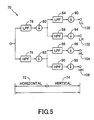
- a wavelet transformation unit 70 generally comprises horizontal 72 and vertical 74 sections.
- the horizontal section 72 comprises a low-pass analysis filter element (LPF) 76 and a high-pass analysis filter element (HPF) 78 to separate and transform the input signal representing the intensities of pixels of a horizontal row of pixels into filter coefficients of a low-frequency sub-band and a high-frequency sub-band.
- the filter coefficients are input to down-sampling units 80 and 82 where every other filter coefficient is decimated.
- the vertical section 74 includes two pairs of low-pass (LPF) 84 and 86 and high-pass analysis filters (HPF) 88 and 90.
- LPF low-pass
- HPF high-pass analysis filters
- One of the outputs of the horizontal section 72 is input to and analyzed by each pair of the vertical section analysis filters.
- a down sampling unit 92, 94, 96, or 98 is connected to the output of each of the vertical section 74 analysis filters.
- the down-sampling units decimate every other transform coefficient output by the vertical section.
- the result of wavelet transformation is a representation of the rows and columns of image pixels with a plurality of filter coefficients that are regularly decimated to form a complete set of decimated coefficients or wavelet transform coefficients.
- the result of downsampling is a lattice of wavelet transform coefficients representing the pixels of the image.
- Wavelet transformation can be performed by computation or by the application of a lifting algorithm comprising the steps of splitting the original signal into odd and even sub-sequences, lifting, and normalization. Transformation by the transformation unit 70 converts the pixels of the image into four sub-bands of transform coefficients; designated LL 100, LH 102, HL 104, and HH 106 according to the order of application of the analysis filters.
- the transform coefficients output by the wavelet transformation unit 46 are typically scanned in an order proceeding from the low frequency band to the high frequency band and quantized 48.
- Quantization indices representing the transform coefficients of intraframe coded reference frames or the coded residual of predicted frames, are input to an entropy encoder 50 where they are typically coded by one or more lossless coding processes such as arithmetic coding, Huffman coding, and run length encoding.
- the coded, quantization indices are then output to a transmission or storage device for ultimate decoding 54.
- the quantization indices are also input to an interframe coding portion of the encoders 40 and 120 where the motion of the image content between frames is estimated and the differences between a "current" frame and a motion compensated representation of the contents of a reference frame are established.
- the quantization indices are converted to quantized values in a dequantizer 56 to reconstruct the transform coefficients for the reference frame 60 with the values that the coefficients will have when decoded.
- the present inventors realized that as a result of downsampling during wavelet transformation, translation of pixels between images produces a phase shift in the wavelet transform coefficients representing the compressed image. Referring again to FIG. 2, this phase shift is not detectable by block matching of the wavelet transforms and substantially reduces the accuracy of motion estimation and, as a consequence, the efficiency of predictive interframe coding.
- the present inventors also realized that since the downsampling operation decimates every other coefficient (either even or odd phase), the accuracy of motion estimation could be improved by resolving the phase uncertainty between the current and reference frames when estimating the motion of the content between the images in the two frames. With the phase uncertainty resolved, the motion of the image content could then be described as the combination of a motion vector indicating motion of a block of transform coefficients between frames and a phase vector resolving the phase uncertainty created by the wavelet transformation.
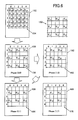
- the motion of image content is determined by matching a block of transform coefficients from a current frame 150 with arrays of coefficients comprising a plurality of phase-allocated coefficient arrays representing phase-shifted versions of a reference frame.
- the filter coefficients of a reference frame for example exemplary reference frame 150, are reconstructed by expanding the reconstructed, decimated wavelet transform coefficients 200.
- the reconstructed filter coefficients are allocated to a plurality of phase-allocated arrays or sets of coefficients 202, 204, 206, and 208.
- the transform coefficients 60 are inverse transformed to image pixels 122 which are filtered in an analysis filter unit 123 to obtain reconstructed filter coefficients.
- the filter coefficients are allocated to four phase-allocated coefficient sets 84 in a phase allocation unit 124.
- the transform coefficients 60 are partially expanded to filter coefficients and allocated to coefficient sets 64 in a phase-allocated expansion unit 62.
- phase-allocated sets of coefficients are created by appropriately decimating either odd or even indexed filter coefficients.
- the results are sets of coefficients shifted in phase relative to each other, simulating a translation of the pixels of rows and columns comprising the image.
- a (0,0) phase-allocated coefficient set 156 is created by allocating even rows and columns of filter coefficients (equivalent to decimating odd rows and columns of coefficients) of the reference frame to the array 202.
- reconstructed filter coefficients of the exemplary reference frame 152 include the coefficients of the rectangular array 154 which are decimated to produce the array of coefficients 158 included in the exemplary (0,0) phase-allocated set 156.
- a (1,0) phase-allocated coefficient set 160 is created by allocating 204 even rows and odd columns of filter coefficients from the reference frame 152. Since a phase shift in the transform domain corresponds to a translation of pixels in the image, the (1,0) phase-allocated coefficient set 160 corresponds to shifting the pixels of the reconstructed image one pixel or index position in a direction congruent with the rows of pixels (horizontally to the right).
- a (0,1) phase-allocated coefficient set 166 including transform coefficient array 164, is created by allocating even rows and odd columns of coefficients to the set 206 to simulate a one index position pixel translation in a direction congruent to the columns of pixels (vertical).
- (1,1) phase-allocated coefficient set 168 (including coefficient array 170) odd rows and odd columns of coefficients of the reference frame are allocated to the set 208 to simulate a one index position diagonal translation of the pixels of the image.
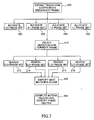
- a search block (for example the coefficients of block 150) of transform coefficients of the current frame 58 is selected 210 and compared to arrays of coefficients in each of the phase allocated sets of coefficients 212, 214, 216, and 218.
- the comparison is performed in a search range around the spatial location of the search block in the current image.
- Block matching can be performed using known search algorithms including an exhaustive search, a 2-dimensional logarithmic search, and a conjugate direction search.
- the block of reference frame coefficients that best matches the search block from the current frame is typically determined by either maximizing a cross-correlation function or by minimization of an error criterion, such as the mean square error (MSE) or the minimum absolute difference (MAD).
- MSE mean square error
- MAD minimum absolute difference
- the best matching block of coefficients is identified 220 by comparing the results from the searches of the four phase-allocated sets of coefficients.
- the motion of the image content represented by the transform coefficients of the search block is determined by computing the motion vector describing the relationship of the search block's spatial location in the current frame and the spatial location of the best matching block of coefficients in the appropriate phase allocated set and by specifying a phase vector that identifies the phase allocated set in which the best matching block is located 222 and, therefore, resolves the phase uncertainty resulting from transformation.
- the phase compensated motion vector is transmitted to the decoder 61 for use in reconstructing the predicted frame of compressed video at the decoder and is input to the motion compensation unit 69 to produce a set of motion compensated reference frame transform coefficients that are subtracted 52 from the complete wavelet transform coefficient set of the current frame to identify the differing or residual content for predictive coding.
- the residual is quantized 48, entropy encoded 50, and transmitted 54.
- the actual content displacement between frames may not be at integer pixel resolution and additional accuracy can be achieved by performing a block matching search at a fractional coefficient resolution.
- best matching blocks can be identified with an integer coefficient search as described above. Referring to FIG. 8, the translations of pixels to locations between integer displacements are estimated by interpolating the results of the search of the phase-allocated coefficient sets. A search block 250 comprising coefficients of the current frame is then compared to the interpolated coefficients of the best matching block 222 of the appropriate phase-allocated set of reference frame coefficients to establish the motion vector with fraction pixel accuracy.
- phase uncertainty resulting from downsampling during wavelet transformation is resolved. This permits accurate estimation of the displacement of the image content between frames for efficient interframe coding.
- motion estimation following transform coding retains the highly desirable scalable nature of the wavelet encoded bitstream.
Landscapes
- Engineering & Computer Science (AREA)
- Multimedia (AREA)
- Signal Processing (AREA)
- Compression Or Coding Systems Of Tv Signals (AREA)
- Compression, Expansion, Code Conversion, And Decoders (AREA)
Abstract
Description
- FIG. 1
- is a block diagram of a one-dimensional wavelet transformation unit.
- FIG. 2
- is schematic representation of wavelet transformation of an exemplary row of pixels.
- FIG. 3
- is a block diagram of an exemplary wavelet-based video encoder.
- FIG. 4
- is a block diagram of an exemplary wavelet-based video encoder of alternative construction.
- FIG. 5
- is a block diagram of a wavelet transformation unit.
- FIG. 6
- is a schematic illustration of an overcomplete expansion of the compressed image.
- FIG. 7
- is a flow diagram of the motion estimation method of the present invention.
- FIG. 8
- is a schematic representation of motion estimation with fractional pixel resolution utilizing block matching at a fractional filter coefficient resolution.
- mv' =
- phase compensated motion vector
- mv =
- motion vector of a block of image content between the current frame and the best matching block of coefficients
- ρv =
- phase vector of the phase-allocated coefficient set that includes the best matching block
Claims (35)
- A method of estimating a motion of a block of pixels between a first image and a second image of a sequence, said method comprising the step of identifying a block of coefficients of a phase-allocated representation of said first image best matching a block of coefficients representing said second image.
- The method of claim 1 wherein the step of identifying a block of coefficients of a phase-allocated representation of said first image best matching a block of coefficients representing said second image comprises the steps of:(a) comparing said block of coefficients representing said second image to a first array of coefficients representing said first image;(b) comparing said block of coefficients representing said second image to a second array of coefficients representing said first image, said coefficients of said second array allocated to shift a phase of said second array relative to a phase of said first array; and(c) identifying a block of coefficients of one said first and said second arrays maximizing a correlation relationship with said block of coefficients representing said second image.
- The method of claim 1 wherein the step of identifying a block of coefficients of a phase-allocated representation of said first image best matching a block of coefficients of said second image comprises the steps of:(a) comparing said block of coefficients representing said second image to a first array of coefficients representing said first image;(b) comparing said block of coefficients representing said second image with a second array of coefficients representing said first image, said coefficients of said second array allocated to shift a phase of said second array relative to a phase of said first array; and(c) identifying a block of coefficients of one said first and said second arrays minimizing an error with said block of coefficients representing said second image.
- The method of claim 3 wherein said error relationship comprises a mean square error relationship.
- The method of claim 3 wherein said error relationship comprises an absolute difference relationship.
- The method of claim 1 further comprising the steps of:(a) expanding a plurality of decimated coefficients representing said first image to create an expanded set of coefficients;(b) allocating a plurality of coefficients of said expanded set to create a first phase-allocated array of coefficients representing said first image; and(c) allocating a second plurality of coefficients of said expanded set to create a second phase-allocated array of coefficients representing said first image, said coefficients of said second plurality allocated to shift a phase of said second array relative to a phase of said first array.
- The method of claim 6 wherein the step of identifying a block of coefficients of a phase-allocated representation of said first image best matching a block of coefficients representing said second image comprises the steps of:(a) comparing said block of coefficients representing said second image to said first array of coefficients representing said first image;(b) comparing said block of coefficients representing said second image to said second array of coefficients representing said first image; and(c) identifying a block of coefficients of one said first and said second arrays maximizing a correlation relationship with said block of coefficients representing said second image.
- The method of claim 6 wherein the step of identifying a block of coefficients of a phase-allocated representation of said first image best matching a block of coefficients of said second image comprises the steps of:(a) comparing said block of coefficients representing said second image to said first array of coefficients representing said first image;(b) comparing said block of coefficients representing said second image to said second array of coefficients representing said first image; and(c) identifying a block of coefficients of one said first and said second arrays minimizing an error with said block of coefficients representing said second image.
- The method of claim 8 wherein said error relationship comprises a mean square error relationship.
- The method of claim 8 wherein said error relationship comprises an absolute difference relationship.
- The method of claim 1 further comprising the steps of:(a) transforming an array of pixels of said first image to a plurality of decimated coefficients;(b) expanding a plurality of said decimated coefficients to create an expanded set of coefficients;(c) allocating a plurality of coefficients of said expanded set to create a first phase-allocated array of coefficients representing said first image; and(d) allocating a second plurality of coefficients of said expanded set to create a second phase-allocated array of coefficients representing said first image, said coefficients of said second plurality allocated to shift a phase of said second array relative to a phase of said first array.
- The method of claim 11 wherein the step of identifying a block of coefficients of a phase-allocated representation of said first image best matching a block of coefficients representing said second image comprises the steps of:(a) comparing said block of coefficients representing said second image to said first array of coefficients representing said first image;(b) comparing said block of coefficients representing said second image to said second array of coefficients representing said first image; and(c) identifying a block of coefficients of one said first and said second arrays maximizing a correlation relationship with said block of coefficients representing said second image.
- The method of claim 11 wherein the step of identifying a block of coefficients of a phase-allocated representation of said first image best matching a block of coefficients of said second image comprises the steps of:(a) comparing said block of coefficients representing said second image to said first array of coefficients representing said first image;(b) comparing said block of coefficients representing said second image to said second array of coefficients representing said first image; and(c) identifying a block of coefficients of one said first and said second arrays minimizing an error with said block of coefficients representing said second image.
- The method of claim 13 wherein said error relationship comprises a mean square error relationship.
- The method of claim 13 wherein said error relationship comprises an absolute difference relationship.
- The method of claim 1 further comprising the steps of:(a) transforming an array of pixels of said first image to a plurality of decimated coefficients;(b) expanding said plurality of decimated coefficients to reconstruct an array of pixels of representing said first image;(c) filtering said reconstructed array of pixels to obtain an expanded set of coefficients;(d) allocating a plurality of coefficients of said expanded set to create a first phase-allocated array of coefficients representing said first image; and(e) allocating a second plurality of coefficients of said expanded set to create a second phase-allocated array of coefficients representing said first image, said coefficients of said second plurality allocated to shift a phase of said second array relative to a phase of said first array.
- The method of claim 16 wherein the step of identifying a block of coefficients of a phase-allocated representation of said first image best matching a block of coefficients representing said second image comprises the steps of:(a) comparing said block of coefficients representing said second image to said first array of coefficients representing said first image;(b) comparing said block of coefficients representing said second image to said second array of coefficients representing said first image; and(c) identifying a block of coefficients of one said first and said second arrays maximizing a correlation relationship with said block of coefficients representing said second image.
- The method of claim 17 further comprising the step of expressing said motion of said block of pixels as a relationship of a first vector specifying a phase-shift of said array that includes said coefficient block of maximum correlation and a second vector specifying a relationship of a spatial location of said block of coefficients in said second frame and a spatial location of said coefficient block of maximum correlation in said array that includes said coefficient block of maximum correlation.
- The method of claim 17 wherein the step of identifying a block of coefficients of a phase-allocated representation of said first image best matching a block of coefficients of said second image comprises the steps of:(a) comparing said block of coefficients representing said second image to said first array of coefficients representing said first image;(b) comparing said block of coefficients representing said second image to said second array of coefficients representing said first image; and(c) identifying a block of coefficients of one said first and said second arrays minimizing an error with said block of coefficients representing said second image.
- The method of claim 19 wherein said error relationship comprises a mean square error relationship.
- The method of claim 19 wherein said error relationship comprises an absolute difference relationship.
- The method of claim 19 further comprising the step of expressing said motion of said block of pixels as a relationship of a first vector specifying a phase-shift of said array that includes said coefficient block of minimum error and a second vector specifying a relationship of a spatial location of said block of coefficients in said second frame and a spatial location of said coefficient block of minimum error in said array that includes said coefficient block of minimum error.
- A method of estimating a motion of a block of pixels between a first frame and a second frame of a video frame sequence, said method comprising the steps of:(a) creating a first phase-allocated representation of said first frame comprising a first plurality of coefficients representing a row and a column of an array of first frame pixels;(b) creating a second phase-allocated representation of said first frame comprising a second plurality of coefficients representing said first frame pixels, said second plurality of coefficients being allocated to simulate a displacement of said first frame pixels in a direction congruent of at least one of said row and said column of pixels relative to said first frame pixels as represented by said first phase-allocated representation;(c) compressing a plurality of image pixels of said second frame to a plurality of second frame coefficients; and(d) identifying a plurality of coefficients included in one of said first phase-allocated representation and said second phase-allocated representation of said first frame best matching a plurality of said second frame coefficients.
- The method of claim 23 wherein the step of identifying a plurality of coefficients included in one of said first phase-allocated representation and said second phase-allocated representation of said first frame best matching a plurality of said second frame coefficients comprises the steps of:(a) comparing said plurality of second frame coefficients to an array of coefficients of said first phase-allocated representation of said first frame;(b) comparing said plurality of second frame coefficients to an array of coefficients of said second phase-allocated representation of said first frame; and(c) identifying an array of said first frame coefficients maximizing a correlation relationship with said plurality of said second frame coefficients.
- The method of claim 23 wherein the step of identifying a plurality of coefficients included in one of said first phase-allocated representation and said second phase-allocated representation of said first frame best matching a plurality of said second frame coefficients comprises the steps of:(a) comparing said plurality of second frame coefficients to an array of coefficients of said first phase-allocated representation of said first frame;(b) comparing said plurality of second frame coefficients to an array of coefficients of said second phase-allocated representation of said first frame; and(c) identifying an array of said first frame coefficients minimizing an error relationship with said plurality of said second frame coefficients.
- The method of claim 25 wherein said error relationship comprises a mean square error relationship.
- The method of claim 25 wherein said error relationship comprises an absolute difference relationship.
- The method of claim 23 further comprising the step of expressing said motion of said block of pixels as a relationship of a first vector specifying a phase-shift of said phase-allocated representation of said first frame that includes said plurality of coefficients best matching said plurality of second frame coefficients and a second vector specifying a relationship of a spatial location of said plurality of said second frame coefficients in said second frame and a spatial location of said best matching plurality of coefficients in said phase-allocated representation of said first frame that includes said plurality of best matching coefficients.
- The method of claim 23 wherein the step of creating a first phase-allocated representation of said first frame comprising a first plurality of coefficients representing a row and a column of an array of first frame pixels comprises the steps of:(a) transforming said first frame pixels to a decimated set of transform coefficients;(b) upsampling said decimated transform coefficients to a set of filter coefficients representing said row and said column of first frame pixels; and(c) including in said first phase-allocated representation of said first frame said filter coefficients representing said first frame pixels of a first row and a first column.
- The method of claim 28 further comprising the step of creating said second phase-allocated representation of said first frame by including in said second representation said filter coefficients representing said first frame pixels of at least one of a row and a column pixels other than said first row and said first column.
- The method of claim 23 wherein the step of creating a first phase-allocated representation of said first frame comprising a first plurality of coefficients representing a row and a column of an array of first frame pixels comprises the steps of:(a) transforming said first frame pixels to a decimated set of transform coefficients;(b) expanding said decimated set of transform coefficients to an array of reconstructed first frame pixels;(c) filtering said array of reconstructed first frame pixels to create a set of filter coefficients representing said row and said column of first frame pixels; and(d) including in said first phase-allocated representation of said first frame said filter coefficients representing a first row and a first column of said first frame pixels.
- The method of claim 31 further comprising the step of creating said second phase-allocated representation of said first frame by including in said second phase-allocated representation filter coefficients representing said first frame pixels of at least one of a row and a column pixels other than said first row and said first column.
- A video encoder comprising(a) a phase-allocated expansion unit to expand a decimated array of transform coefficients representing a first frame of video to a plurality of phase-allocated sets of filter coefficients; and(b) a motion estimation unit to identify a plurality of said filter coefficients included in one of said phase-allocated sets of coefficients most closely matching a plurality of transform coefficients included in a second frame.
- A video encoder comprising:(a) an inverse transformation unit to expand a decimated array of transform coefficients representing a first video frame of video to an array of pixels of a reconstruction of said first video frame;(b) a filter to transform said array of pixels of said reconstructed first video frame to an array of filter coefficients; and(c) a phase allocation unit to assign a plurality of said filter coefficients to each of a plurality of phase-allocated sets of coefficients.
- The encoder of claim 34 further comprising a motion estimation unit to identify a plurality of coefficients included in one of said phase-allocated sets of coefficients most closely matching a plurality of transform coefficients representing a plurality of pixels included in a second frame.
Applications Claiming Priority (2)
| Application Number | Priority Date | Filing Date | Title |
|---|---|---|---|
| US877463 | 2001-06-08 | ||
| US09/877,463 US7242717B2 (en) | 2001-06-08 | 2001-06-08 | Wavelet domain motion compensation system |
Publications (2)
| Publication Number | Publication Date |
|---|---|
| EP1265443A2 true EP1265443A2 (en) | 2002-12-11 |
| EP1265443A3 EP1265443A3 (en) | 2007-05-23 |
Family
ID=25370016
Family Applications (1)
| Application Number | Title | Priority Date | Filing Date |
|---|---|---|---|
| EP02012633A Withdrawn EP1265443A3 (en) | 2001-06-08 | 2002-06-06 | Wavelet domain motion compensation system |
Country Status (3)
| Country | Link |
|---|---|
| US (1) | US7242717B2 (en) |
| EP (1) | EP1265443A3 (en) |
| JP (1) | JP2003102016A (en) |
Cited By (1)
| Publication number | Priority date | Publication date | Assignee | Title |
|---|---|---|---|---|
| WO2019156644A1 (en) * | 2018-02-12 | 2019-08-15 | Aselsan Elektroni̇k Sanayi̇ Ve Ti̇caret Anoni̇m Şi̇rketi̇ | The method enabling the reduction of resource utilization |
Families Citing this family (17)
| Publication number | Priority date | Publication date | Assignee | Title |
|---|---|---|---|---|
| EP2339854A3 (en) * | 2001-11-30 | 2013-11-13 | NTT DoCoMo, Inc. | Moving picture encoding device, moving picture decoding device, moving picture encoding method, moving picture decoding method, program, and computer readable recording medium storing program |
| US7502415B2 (en) * | 2003-07-18 | 2009-03-10 | Microsoft Corporation | Range reduction |
| US8014450B2 (en) * | 2003-09-07 | 2011-09-06 | Microsoft Corporation | Flexible range reduction |
| US7474767B2 (en) * | 2003-09-24 | 2009-01-06 | Avago Technologies Ecbu Ip (Singapore) Pte. Ltd. | Motion detection using multi-resolution image processing |
| US7649539B2 (en) * | 2004-03-10 | 2010-01-19 | Microsoft Corporation | Image formats for video capture, processing and display |
| US7634148B2 (en) * | 2005-01-07 | 2009-12-15 | Ntt Docomo, Inc. | Image signal transforming and inverse-transforming method and computer program product with pre-encoding filtering features |
| JP4677351B2 (en) * | 2006-02-17 | 2011-04-27 | キヤノン株式会社 | Motion compensator, motion compensation processing method, computer program, and storage medium |
| US8880571B2 (en) * | 2006-05-05 | 2014-11-04 | Microsoft Corporation | High dynamic range data format conversions for digital media |
| US8054886B2 (en) * | 2007-02-21 | 2011-11-08 | Microsoft Corporation | Signaling and use of chroma sample positioning information |
| EP2104356A1 (en) * | 2008-03-18 | 2009-09-23 | Deutsche Thomson OHG | Method and device for generating an image data stream, method and device for reconstructing a current image from an image data stream, image data stream and storage medium carrying an image data stream |
| US8326081B1 (en) * | 2009-05-18 | 2012-12-04 | The United States Of America As Represented By The Secretary Of The Navy | Correlation image detector |
| CN102044068B (en) * | 2010-11-12 | 2012-05-09 | 北京空间机电研究所 | A Compensation Method of Wavelet Modulation Transfer Function Based on Optimal Kernel Shape |
| US9313497B2 (en) * | 2012-01-25 | 2016-04-12 | Intel Corporation | Systems, methods, and computer program products for transform coefficient sub-sampling |
| FR2996033B1 (en) * | 2012-09-26 | 2015-10-30 | Commissariat Energie Atomique | DEVICE FOR DECOMPOSING IMAGES BY WAVELET TRANSFORMED |
| US20140327737A1 (en) * | 2013-05-01 | 2014-11-06 | Raymond John Westwater | Method and Apparatus to Perform Optimal Visually-Weighed Quantization of Time-Varying Visual Sequences in Transform Space |
| US10516898B2 (en) | 2013-10-10 | 2019-12-24 | Intel Corporation | Systems, methods, and computer program products for scalable video coding based on coefficient sampling |
| US20240169708A1 (en) * | 2022-11-10 | 2024-05-23 | Qualcomm Incorporated | Processing video data using delta quantization |
Family Cites Families (11)
| Publication number | Priority date | Publication date | Assignee | Title |
|---|---|---|---|---|
| WO1987005769A1 (en) * | 1986-03-19 | 1987-09-24 | British Broadcasting Corporation | Tv picture motion measurement |
| JP3448868B2 (en) * | 1993-07-31 | 2003-09-22 | ソニー株式会社 | Image coincidence detecting device and image coincidence detecting method |
| US5495292A (en) * | 1993-09-03 | 1996-02-27 | Gte Laboratories Incorporated | Inter-frame wavelet transform coder for color video compression |
| JP3889040B2 (en) * | 1994-09-02 | 2007-03-07 | メディアテック インコーポレイション | Method and apparatus for wide area-local block motion estimation |
| JP3655651B2 (en) * | 1994-09-02 | 2005-06-02 | テキサス インスツルメンツ インコーポレイテツド | Data processing device |
| US5740283A (en) * | 1995-07-06 | 1998-04-14 | Rubin, Bednarek & Associates, Inc. | Digital video compression utilizing mixed vector and scalar outputs |
| JP3813320B2 (en) * | 1997-08-27 | 2006-08-23 | 株式会社東芝 | Motion vector detection method and apparatus |
| US6269174B1 (en) * | 1997-10-28 | 2001-07-31 | Ligos Corporation | Apparatus and method for fast motion estimation |
| US6697427B1 (en) * | 1998-11-03 | 2004-02-24 | Pts Corporation | Methods and apparatus for improved motion estimation for video encoding |
| US6519005B2 (en) * | 1999-04-30 | 2003-02-11 | Koninklijke Philips Electronics N.V. | Method of concurrent multiple-mode motion estimation for digital video |
| US7023922B1 (en) * | 2000-06-21 | 2006-04-04 | Microsoft Corporation | Video coding system and method using 3-D discrete wavelet transform and entropy coding with motion information |
-
2001
- 2001-06-08 US US09/877,463 patent/US7242717B2/en not_active Expired - Fee Related
-
2002
- 2002-06-06 JP JP2002165151A patent/JP2003102016A/en active Pending
- 2002-06-06 EP EP02012633A patent/EP1265443A3/en not_active Withdrawn
Non-Patent Citations (2)
| Title |
|---|
| HYUN-WOOK PARK ET AL: "Motion Estimation Using Low-Band-Shift Method for Wavelet-Based Moving-Picture Coding" IEEE TRANSACTIONS ON IMAGE PROCESSING, IEEE SERVICE CENTER, PISCATAWAY, NJ, US, vol. 9, no. 4, April 2000 (2000-04), XP011025569 ISSN: 1057-7149 * |
| XIN LI ET AL: "All-phase Motion Compensated Prediction in the Wavelet Domain for High Performance Video Coding" PROCEEDINGS OF THE 2001 INTERNATIONAL CONFERENCE ON IMAGE PROCESSING (ICIP 2001), vol. 1 of 3, 7 October 2001 (2001-10-07), - 10 October 2001 (2001-10-10) pages 538-541, XP010563402 IEEE, US ISBN: 0-7803-6725-1 * |
Cited By (1)
| Publication number | Priority date | Publication date | Assignee | Title |
|---|---|---|---|---|
| WO2019156644A1 (en) * | 2018-02-12 | 2019-08-15 | Aselsan Elektroni̇k Sanayi̇ Ve Ti̇caret Anoni̇m Şi̇rketi̇ | The method enabling the reduction of resource utilization |
Also Published As
| Publication number | Publication date |
|---|---|
| US7242717B2 (en) | 2007-07-10 |
| EP1265443A3 (en) | 2007-05-23 |
| US20020186772A1 (en) | 2002-12-12 |
| JP2003102016A (en) | 2003-04-04 |
Similar Documents
| Publication | Publication Date | Title |
|---|---|---|
| US7242717B2 (en) | Wavelet domain motion compensation system | |
| KR100388377B1 (en) | Image Encoding Device Decoding Device | |
| CN102450009B (en) | Filter selection for video pre-processing in video applications | |
| KR100664929B1 (en) | Method and apparatus for efficiently compressing motion vectors in multi-layered video coder | |
| JP5014989B2 (en) | Frame compression method, video coding method, frame restoration method, video decoding method, video encoder, video decoder, and recording medium using base layer | |
| US6937659B1 (en) | Apparatus and method for compressing video information | |
| EP1983759A1 (en) | Estimation of separable adaptive interpolation filters for hybrid video coding | |
| US20020110280A1 (en) | Adaptive transforms | |
| JP2010528555A (en) | Video signal processing method and apparatus | |
| EP1578134A1 (en) | Methods and systems for encoding/decoding signals, and computer program product therefor | |
| JP2006503518A (en) | Highly scalable 3D overcomplete wavelet video coding | |
| WO2001006794A1 (en) | Encoding method for the compression of a video sequence | |
| EP1843593A1 (en) | Method for coding video data of a sequence of pictures | |
| US20100086048A1 (en) | System and Method for Video Image Processing | |
| JP2008289132A (en) | Method for transforming data set into transform coefficient | |
| JP4382284B2 (en) | Subband encoding / decoding | |
| KR20050100321A (en) | Method for motion estimation of video frame, and video encoder using the same | |
| JP4844741B2 (en) | Moving picture coding apparatus and moving picture decoding apparatus, method and program thereof | |
| JPH08294119A (en) | Image coding / decoding device | |
| EP1659797A2 (en) | Method and apparatus for compressing motion vectors in video coder based on multi-layer | |
| KR100670459B1 (en) | Image compression coding and decoding method and apparatus | |
| CN101010962A (en) | Method and device for motion estimation | |
| Wang | Fully scalable video coding using redundant-wavelet multihypothesis and motion-compensated temporal filtering | |
| KR0185845B1 (en) | Hierarchical Coder Using Wavelet Converter | |
| JP2010028218A (en) | Image encoder, image decoder, image band decomposition device, and image band composition device |
Legal Events
| Date | Code | Title | Description |
|---|---|---|---|
| PUAI | Public reference made under article 153(3) epc to a published international application that has entered the european phase |
Free format text: ORIGINAL CODE: 0009012 |
|
| AK | Designated contracting states |
Kind code of ref document: A2 Designated state(s): AT BE CH CY DE DK ES FI FR GB GR IE IT LI LU MC NL PT SE TR |
|
| AX | Request for extension of the european patent |
Free format text: AL;LT;LV;MK;RO;SI |
|
| PUAL | Search report despatched |
Free format text: ORIGINAL CODE: 0009013 |
|
| AK | Designated contracting states |
Kind code of ref document: A3 Designated state(s): AT BE CH CY DE DK ES FI FR GB GR IE IT LI LU MC NL PT SE TR |
|
| AX | Request for extension of the european patent |
Extension state: AL LT LV MK RO SI |
|
| AKX | Designation fees paid | ||
| STAA | Information on the status of an ep patent application or granted ep patent |
Free format text: STATUS: THE APPLICATION IS DEEMED TO BE WITHDRAWN |
|
| 18D | Application deemed to be withdrawn |
Effective date: 20071124 |
|
| REG | Reference to a national code |
Ref country code: DE Ref legal event code: 8566 |