EP1263839B1 - Epoxy-functional polysiloxane modified phenolic resin compositions and composites - Google Patents
Epoxy-functional polysiloxane modified phenolic resin compositions and composites Download PDFInfo
- Publication number
- EP1263839B1 EP1263839B1 EP01906967A EP01906967A EP1263839B1 EP 1263839 B1 EP1263839 B1 EP 1263839B1 EP 01906967 A EP01906967 A EP 01906967A EP 01906967 A EP01906967 A EP 01906967A EP 1263839 B1 EP1263839 B1 EP 1263839B1
- Authority
- EP
- European Patent Office
- Prior art keywords
- epoxy
- phenol
- process according
- polysiloxane
- phenolic
- Prior art date
- Legal status (The legal status is an assumption and is not a legal conclusion. Google has not performed a legal analysis and makes no representation as to the accuracy of the status listed.)
- Expired - Lifetime
Links
- OVPFTTCOIWYYMX-UHFFFAOYSA-N OC(C(CC[SiH2+])CCC1)C1OC1=CCCC=C1 Chemical compound OC(C(CC[SiH2+])CCC1)C1OC1=CCCC=C1 OVPFTTCOIWYYMX-UHFFFAOYSA-N 0.000 description 1
Classifications
-
- C—CHEMISTRY; METALLURGY
- C08—ORGANIC MACROMOLECULAR COMPOUNDS; THEIR PREPARATION OR CHEMICAL WORKING-UP; COMPOSITIONS BASED THEREON
- C08L—COMPOSITIONS OF MACROMOLECULAR COMPOUNDS
- C08L61/00—Compositions of condensation polymers of aldehydes or ketones; Compositions of derivatives of such polymers
- C08L61/04—Condensation polymers of aldehydes or ketones with phenols only
- C08L61/06—Condensation polymers of aldehydes or ketones with phenols only of aldehydes with phenols
- C08L61/14—Modified phenol-aldehyde condensates
-
- C—CHEMISTRY; METALLURGY
- C08—ORGANIC MACROMOLECULAR COMPOUNDS; THEIR PREPARATION OR CHEMICAL WORKING-UP; COMPOSITIONS BASED THEREON
- C08G—MACROMOLECULAR COMPOUNDS OBTAINED OTHERWISE THAN BY REACTIONS ONLY INVOLVING UNSATURATED CARBON-TO-CARBON BONDS
- C08G77/00—Macromolecular compounds obtained by reactions forming a linkage containing silicon with or without sulfur, nitrogen, oxygen or carbon in the main chain of the macromolecule
- C08G77/04—Polysiloxanes
- C08G77/38—Polysiloxanes modified by chemical after-treatment
-
- C—CHEMISTRY; METALLURGY
- C08—ORGANIC MACROMOLECULAR COMPOUNDS; THEIR PREPARATION OR CHEMICAL WORKING-UP; COMPOSITIONS BASED THEREON
- C08G—MACROMOLECULAR COMPOUNDS OBTAINED OTHERWISE THAN BY REACTIONS ONLY INVOLVING UNSATURATED CARBON-TO-CARBON BONDS
- C08G77/00—Macromolecular compounds obtained by reactions forming a linkage containing silicon with or without sulfur, nitrogen, oxygen or carbon in the main chain of the macromolecule
- C08G77/42—Block-or graft-polymers containing polysiloxane sequences
-
- C—CHEMISTRY; METALLURGY
- C08—ORGANIC MACROMOLECULAR COMPOUNDS; THEIR PREPARATION OR CHEMICAL WORKING-UP; COMPOSITIONS BASED THEREON
- C08L—COMPOSITIONS OF MACROMOLECULAR COMPOUNDS
- C08L61/00—Compositions of condensation polymers of aldehydes or ketones; Compositions of derivatives of such polymers
- C08L61/04—Condensation polymers of aldehydes or ketones with phenols only
- C08L61/06—Condensation polymers of aldehydes or ketones with phenols only of aldehydes with phenols
-
- C—CHEMISTRY; METALLURGY
- C08—ORGANIC MACROMOLECULAR COMPOUNDS; THEIR PREPARATION OR CHEMICAL WORKING-UP; COMPOSITIONS BASED THEREON
- C08L—COMPOSITIONS OF MACROMOLECULAR COMPOUNDS
- C08L83/00—Compositions of macromolecular compounds obtained by reactions forming in the main chain of the macromolecule a linkage containing silicon with or without sulfur, nitrogen, oxygen or carbon only; Compositions of derivatives of such polymers
- C08L83/04—Polysiloxanes
- C08L83/06—Polysiloxanes containing silicon bound to oxygen-containing groups
-
- Y—GENERAL TAGGING OF NEW TECHNOLOGICAL DEVELOPMENTS; GENERAL TAGGING OF CROSS-SECTIONAL TECHNOLOGIES SPANNING OVER SEVERAL SECTIONS OF THE IPC; TECHNICAL SUBJECTS COVERED BY FORMER USPC CROSS-REFERENCE ART COLLECTIONS [XRACs] AND DIGESTS
- Y10—TECHNICAL SUBJECTS COVERED BY FORMER USPC
- Y10T—TECHNICAL SUBJECTS COVERED BY FORMER US CLASSIFICATION
- Y10T428/00—Stock material or miscellaneous articles
- Y10T428/31504—Composite [nonstructural laminate]
- Y10T428/31652—Of asbestos
- Y10T428/31663—As siloxane, silicone or silane
-
- Y—GENERAL TAGGING OF NEW TECHNOLOGICAL DEVELOPMENTS; GENERAL TAGGING OF CROSS-SECTIONAL TECHNOLOGIES SPANNING OVER SEVERAL SECTIONS OF THE IPC; TECHNICAL SUBJECTS COVERED BY FORMER USPC CROSS-REFERENCE ART COLLECTIONS [XRACs] AND DIGESTS
- Y10—TECHNICAL SUBJECTS COVERED BY FORMER USPC
- Y10T—TECHNICAL SUBJECTS COVERED BY FORMER US CLASSIFICATION
- Y10T428/00—Stock material or miscellaneous articles
- Y10T428/31504—Composite [nonstructural laminate]
- Y10T428/31942—Of aldehyde or ketone condensation product
-
- Y—GENERAL TAGGING OF NEW TECHNOLOGICAL DEVELOPMENTS; GENERAL TAGGING OF CROSS-SECTIONAL TECHNOLOGIES SPANNING OVER SEVERAL SECTIONS OF THE IPC; TECHNICAL SUBJECTS COVERED BY FORMER USPC CROSS-REFERENCE ART COLLECTIONS [XRACs] AND DIGESTS
- Y10—TECHNICAL SUBJECTS COVERED BY FORMER USPC
- Y10T—TECHNICAL SUBJECTS COVERED BY FORMER US CLASSIFICATION
- Y10T428/00—Stock material or miscellaneous articles
- Y10T428/31504—Composite [nonstructural laminate]
- Y10T428/31942—Of aldehyde or ketone condensation product
- Y10T428/31949—Next to cellulosic
- Y10T428/31964—Paper
- Y10T428/31967—Phenoplast
Definitions
- U.S. Patent 5,864,000 to Lightbody is directed to hybrid phenolic/polysiloxane resins derived from (A) reacting a phenolic compound with (a) a siloxane polymer or (b) and aldehyde and (B) reacting the reaction product of (A)(a) with an aldehyde, or (A)(b) with a siloxane polymer to form the hybrid phenolic/polysiloxane resin.
- the siloxane polymer is defined as compounds having -Si-O-Si- groups in their structure. Suitable siloxane polymers were described as alkoxy and/or silanol functional siloxane polymers having a molecular weight of 1000 to 6000.
- U.S. Patent 5,319,005 to Hagiwara et al. relates to epoxy resin molding materials used for sealing electronic components such as transistors and integrated circuits.
- the composition comprises an epoxy resin having at least two epoxy groups per molecule and a phenolic compound having at least two phenolic hydroxyl groups per molecule such as phenol-formaldehyde resin condensates.
- a vinyl group-containing organopolysiloxane and a ⁇ SiH group-containing organopolysiloxane as well as inorganic filler.
- the two types of organopolysiloxanes are permitted to react with one another to effect curing of the epoxy resin.
- the polysiloxanes form a particulate which is dispersed throughout the resin.
- U.S. Patent 4,853,434 to Block teaches a modified thermosetting resin comprising a reaction resin or reaction resin mixture and one or more three-dimensional crosslinked polyorganosiloxane rubbers.
- Suitable reaction resins include epoxy resins and condensation products of aldehydes, including formaldehyde, with aliphatic and aromatic compounds containing amine groups including urea or melamine as well as aromatic compounds such as phenol, resorcinol, xylene and the like.
- the compositions are prepared by dispersing polyorganosiloxane rubber particles in the thermosetting resin or mixture of thermosetting resins in the presence of a crosslinking catalyst at temperatures of from 18 to 120°C.
- U.S. Patent 4,022,753 to Lohse et al. discloses the reaction products of a polysiloxane and polyphenols such as resorcinol, bisphenol A etc. (novolac resins) The resulting product is utilized as a curing agent or modifying agent for epoxy resins.
- U.S. Patent 5,530,063 to Nagai et al. shows organopolysiloxane compositions which are room temperature-curable and which comprise an organopolysiloxane, a polymer of a monomer having an ethylenically unsaturated double bond and an epoxy compound. Suitable curing agents and catalysts are also present in the formulation.
- Phenolic resole resins are modified with epoxy-functional polysiloxane by one of these methods: (1) reacting phenol with the epoxy-functional polysiloxane as the first step of preparation of the phenolic resole; (2) adding the epoxy-functional polysiloxane to the phenolic resole after the phenolic resole has been prepared (i.e. a blend procedure,) or (3) reacting the epoxy-functional polysiloxane with resorcinol, bisphenol-A, or bisphenol-F, and then blending this phenolic functionalized silicone with a resole or reacting it with formaldehyde to make a resole.
- Phenolic resole resin compositions are modified with epoxy-functional polysiloxanes.
- the compositions may be produced by several methods including (1) reacting epoxy-functional polysiloxane with phenol and then reacting the polysiloxane grafted phenol with formaldehyde to form a phenolic resole resin; (2) blending a pre-existing phenolic resin with the epoxy-functional polysiloxane and permitting the grafting reaction to proceed coincident with the curing/hardening of the phenolic resin and (3) reacting an epoxy-functional polysiloxane with a polyhydroxy phenolic monomer, such as resorcinol or a bisphenol, and either combining the reacted material with a pre-existing phenolic resin for curing/hardening or further treating the reacted material with formaldehyde or phenol and formaldehyde to make a silicon-modified phenolic resin.
- a polyhydroxy phenolic monomer such as resorcino
- compositions may be used to impregnate a variety of substrates, such as, but not limited to paper, glass roving or mat, carbon fiber, aramid fibers, kevlar, and nomex honeycomb.
- epoxy-functional polysiloxanes Different types may be used.
- the preferred epoxy-functional polysiloxane epoxy silicone
- the left-hand formula provides a shorthand definition. However, these formulas are illustrative only.
- the epoxy-functional polysiloxane may be any suitable epoxy-functional polysiloxane that provides the desired epoxy-functional polysiloxane-modified phenolic resin.
- the terms epoxy-functional polysiloxane and epoxy-functional silicone may be used interchangeably.
- x is I to 100 and y is 0 to 10,000, and the ratio of x:y is typically from 1:0.5 to 1:100, preferably 1:1 to 1:10, and most preferably 1:1 to 1:5.
- One epoxy-functional polysiloxane available commercially is silicone Y-12940 from OSI Witco.
- any suitable epoxy-functional polysiloxane may be used.
- the polysiloxane may include branching points, and the epoxy-functional repeat units need not be adjacent to one another.
- the copolymer may be a random, alternating, or block copolymer.
- Other epoxy-functional polysiloxanes include, but are not limited to, the following epoxy-functional polysiloxane, where x is 0 to 1000, preferably 0 to 100, and most preferably 5 to 30. This polysiloxane is available commercially as OSI Witco Silicone Y-14362.
- the epoxy-functional polysiloxane-modified phenolic resin may be made by several different procedures identified below as procedures #1, #2, and #3.
- phenol is reacted with the epoxy-functional polysiloxane to open the epoxy ring and form a C-O-C ether linkage between the phenol and the silicone molecule.
- formaldehyde is added to form a phenolic resole resin with excess phenol and with epoxy-functional polysilxane-modified phenol.
- an epoxy-functional polysiloxane is mixed with excess phenol and a basic catalyst, such as sodium hydroxide, and heated to between 120°C and 180°C, preferably about 140°C, for between (30 minutes and 90 minutes. Subsequently, the reaction mixture is cooled to between 45°C and 75°C, preferably about 55°C, and formaldehyde is added. The reaction mixture is then heated to between 65°C and 90°C, preferably about 75 °C, and held at that temperature until a desired free formaldehyde is achieved. Suitable free formaldehyde levels are generally between 0.5 wt% and 4 wt%.
- the weight range of epoxy-functional polysiloxane to phenol is from 100:0.1 to 0.1:100, and the preferred range is 5:100 to 15:100. However, both ranges will be affected by the epoxy equivalent weight of the epoxy-functional polysiloxane.
- the weight range of catalyst to phenol in the first step of the process is 0.01 to 10 parts of catalyst per 100 parts of phenol, preferably 0.1 to 2.5 parts of catalyst per 100 parts of phenol.
- the mole ratio of formaldehyde to phenol is 0.8:1 to 3:1, preferably 1.2:1 to 1.9:1.
- a suitable catalyst such as sodium hydroxide, may be added during the addition of the formaldehyde to promote the reaction between the phenol and formaldehyde.
- An epoxy-functional polysiloxane is blended with a phenolic resole.
- the blend may be used to form composites and then cured with a suitable acid catalyst at low temperatures, or thermally cured with no catalyst at high temperatures.
- a phenolic resole resin is prepared by reacting phenol and formaldehyde typically in the presence of a basic catalyst, such as sodium hydroxide, at a temperature below about 95°C, preferably between 45°C and 85°C. Then an epoxy-functional polysiloxane is blended into the phenolic resin.
- a basic catalyst such as sodium hydroxide
- the resulting mixture is added to a suitable substrate to form a composite and then the mixture is cured with an acid catalyst at a low temperature, 25°C to 100°C, or cured without a catalyst at a high temperature, 100°C to 175°C. During the cure, the epoxy-functional polysiloxane is reacted with the phenolic resin as illustrated below.
- the formaldehyde to phenol mole ratio in the phenolic resole resin is 0.8 to 3.0, preferably 1.2 to 1.9 moles.
- the basic catalyst to phenol mole ratio in preparing the phenolic resole resin is from 0.001 to 0.1 moles of catalyst per mole of phenol, preferably from 0.005 to 0.05.
- the weight range of epoxy-functional polysiloxane added to 100 parts of the phenolic resole is from 1 to 100, preferably from 3 to 20.
- a polyhydroxy compound such as resorcinol
- an epoxy-functional polysiloxane at a temperature of between 180°C and 250°C for 1 to 7 hours.
- the polyhydroxyphenolic-functionalized polysiloxane is blended into a phenolic resole.
- the polyhydroxyphenolic-functionalized silicone is reacted with formaldehyde, or phenol and formaldehyde, to make a silicone-modified phenolic resole.
- the mole ratio of epoxy-functional polysiloxane to polyhydroxy compound is from 0 to 10 moles of polyhydroxy compound per mole of epoxy in the silicone, preferably from 2 to 3.
- the weight range of silicone added to 100 parts of the phenolic resole is from 1 to 100, preferably from 3 to 20.
- the mole ratio of formaldehyde to polyhydroxy compound is from 0.5 to 3.0 moles of formaldehyde per mole of resorcinol, preferably 1.2 to 1.9.
- the weight range of phenol and formaldehyde added to make a silicone-modified phenolic resole is from 0 to 100 parts of phenol per 1 part of silicone.
- Formaldehyde is further added in a molar ratio of 0.9 to 3.0 moles of formaldehyde per mole of phenol, preferably 1.2 to 1.9 moles of formaldehyde per mole of phenol.
- Procedures #1, #2, and #3 include both the prereaction or "grafting" of epoxy-functional polysiloxanes with phenol, alkyl phenols, polyhydroxy phenols such as resorcinol, polyphenol compounds such as bispbenol-A and bisphenol-F, or phenolic resoles, as well as the blending of epoxy-functional polysiloxanes into phenolic resoles, both in the reactor where the phenolic resole is manufactured and in fabricators' tanks prior to manufacture of the composites.
- phenol is used generically to encompass any suitable phenolic compound.
- the present invention is also directed to a mixture of the compositions prepared by procedures #1, #2, and/or #3.
- the phenolic resins have a F:P mole ratio of about 0.8 to about 4.0, preferably about 1.0 to about 2.0, and most preferably about 1.6.
- the phenolic resins are preferably made using a catalyst as known in the art. Suitable catalysts include hydroxides such as sodium hydroxide, or amines such as hexamine.
- the phenolic resins may be made in situ or premade in a separate reactor for blending with the epoxy-functional polysiloxane. Specific resins are described in the examples.
- Suitable epoxy-functional polysiloxanes include OSI Witco Y-12940 and OSI Witco Y-14362.
- Other epoxy-functional silicones include, but are not limited to, Dow Coming 2-8065, DC Toray Silicones BY 1-2940, ShinEtsu KF-105, ShinEtsu X-22-163A, Shin Etsu X-22-163B, and ShinEtsu X-22-163C.
- the resulting epoxy-functional polysiloxane modified phenolic resin may be heat cured or cured in the presence of an acid, either added during the manufacture of the resin as a neutralizing agent, or added externally prior to curing the resin.
- the epoxy-functional polysiloxane modified phenolic resins may be heat cured at a temperature above about 90°C, preferably 100°C to 175°C.
- the acid catalyst may be any suitable acid catalyst known to those skilled in the art such as mineral and organic acids and their derivatives, such as esters and amides or acid catalysts such as those described in U.S. Patent Application 08/681,681.
- Specific acid catalysts include p-toluenesulfonic acid, esters of phosphoric acid, and hydrochloric acid, sulfuric acid, and their derivatives.
- Another suitable acid catalyst is described in Table I. Acid Catalyst Weight % ethylene glycol 40.2 pTSA 23.3 phosphoric acid 1.8 amino phosphonic acid 34.7
- the acid catalyst is added in an amount effective to cure the epoxy-functional polysiloxane modified phenolic resins and the amount depends on the strength of the acid catalyst.
- the operative range is from 1 to 30 parts by weight of catalyst per 100 parts of resin, and the preferred range is from 5 to 15 parts by weight.
- the phenolic component reacts with the epoxy functional group of the silicone to form a C-O-C bond.
- Another embodiment is directed to uncatalyzed or acid catalyzed compositions with a substrate such as paper, glass, glass cloth, carbon fiber, and aramid substrates such as kevlar or nomex to make a composite material such as a laminate, tube, pipe, honeycomb, or various molded parts by processes such as a filament winding, impregnation (prepregging), pultrusion, dipping, spraying, hand lay-up, sheet molding compound, SCRIMP, or other processes known to those familiar with the composites industry.
- a substrate such as paper, glass, glass cloth, carbon fiber, and aramid substrates such as kevlar or nomex
- processes such as a filament winding, impregnation (pregging), pultrusion, dipping, spraying, hand lay-up, sheet molding compound, SCRIMP, or other processes known to those familiar with the composites industry.
- a substrate such as paper, glass, glass cloth, carbon fiber, and aramid substrates
- the range for the amount of resin to be added to the substrate in the practice of the invention varies based on the process used. Generally the weight range is from 1 to 100 parts of resin per 100 parts of substrate. The preferred weight range again varies from process to process, but it is typically in the range of 10 to 50 parts of resin per 100 parts of substrate.
- reaction and blendings are practiced at atmospheric pressure, but reduced pressures to pressurized vessels may also be used.
- An epoxy-functional polysiloxane-modified phenolic resole was made by procedure # 1 above. Eleven parts of epoxy-functional polysiloxane OSI Witco Y-12940 were reacted with 100 parts of phenol in the presence of 0.5 parts of sodium hydroxide at 140°C for 30 minutes. The reaction was then cooled to 55°C, and the phenol was further reacted with 102 parts of 50% formaldehyde (in a 1.6 mole ratio of formaldehyde/phenol) at 70 to 80°C for 4 hours to make a polysiloxane-modified phenolic resole resin. The resin was then distilled until a desired water content was achieved.
- Glass cloth laminates were made from a blend of a phenolic resole and epoxy-functional polysiloxane (OSI Witco Y-12940) as described in procedure #2.
- a phenolic resole was prepared by mixing 100 parts of phenol with 102 parts of 50% formaldehyde (with a 1.6 mole ratio of formaldehyde/phenol) and 0.013 moles of caustic per mole of phenol as a catalyst and reacting the phenol and formaldehyde until a desired free formaldehyde level is achieved. The water present was partially removed to achieve a specific solids content or water content. Finally, 7 parts of epoxy-functional polysiloxane were added to 100 parts of the resole. This mix can then be used to treat glass fibers or cloth to make a composite that is cured by addition of heat, a catalyst, or both.
- a silicone-modified phenolic resole was made by blending the phenolic-functionalized silicone of example 3 with a phenolic resole made in a separate reactor. 100 parts of phenol were mixed with 0.5 parts of sodium hydroxide and 102 parts of 50% formaldehyde at 55°C. The mixture was then reacted at 65°C to 85°C until a desired free formaldehyde level was achieved (1%). The mixture was then distilled until a solids content of 65% was achieved, thus completing the preparation of the phenolic resole (Resin 3 in Table II).
- Phenolic Resole Resin for preparing Blending Mixtures with Epoxy-Functional-Polysiloxane Resin 1 Resin 2 Resin 3 formaldehyde/phenol ratio 1.4 1.6 1.6 caustic, % 0.25 0.25 0.25 free phenol, % 13-15 7-9 8-10 free formaldehyde, % 2.5-3.5 2-2.5 1.0 max water, % 3-4 ⁇ 10 9.5-12.5 solids, % 76-80 76-80 71-75
- a composite made with an epoxy-functional silicone-modified resole showed improved performance upon exposure to hot-wet conditions, measured in terms of retention of interlaminar shear strength (ILSS) for a sample soaked in boiling water versus a sample that was not soaked.
- the data are shown in Table III below.
- the prior art control in Table III is a methoxy-functional silicone. Effect of Silicone Type on Interlaminar Shear Strength (ILSS) Retention of a Phenolic Resin-Based Glass Composite Silicone Type Time in Boiling Water (Months) ILSS Retention vs. No Soak Control (%) Methoxy-functional polysiloxane 1 66 Methoxy-functional polysiloxane 3 54 Epoxy-functional polysiloxane 1 87 Epoxy-functional polysiloxane 3 64
Landscapes
- Chemical & Material Sciences (AREA)
- Health & Medical Sciences (AREA)
- Chemical Kinetics & Catalysis (AREA)
- Medicinal Chemistry (AREA)
- Polymers & Plastics (AREA)
- Organic Chemistry (AREA)
- General Chemical & Material Sciences (AREA)
- Laminated Bodies (AREA)
- Phenolic Resins Or Amino Resins (AREA)
- Compositions Of Macromolecular Compounds (AREA)
- Reinforced Plastic Materials (AREA)
Abstract
Description
- The preparation of hydroxyphenolic-functionalized polysiloxane modified phenolic resole resins and use thereof in composites.
- U.S. Patent 5,864,000 to Lightbody is directed to hybrid phenolic/polysiloxane resins derived from (A) reacting a phenolic compound with (a) a siloxane polymer or (b) and aldehyde and (B) reacting the reaction product of (A)(a) with an aldehyde, or (A)(b) with a siloxane polymer to form the hybrid phenolic/polysiloxane resin. The siloxane polymer is defined as compounds having -Si-O-Si- groups in their structure. Suitable siloxane polymers were described as alkoxy and/or silanol functional siloxane polymers having a molecular weight of 1000 to 6000.
- U.S. Patent 5,319,005 to Hagiwara et al. relates to epoxy resin molding materials used for sealing electronic components such as transistors and integrated circuits. The composition comprises an epoxy resin having at least two epoxy groups per molecule and a phenolic compound having at least two phenolic hydroxyl groups per molecule such as phenol-formaldehyde resin condensates. To the epoxy resin containing phenolic compound are added a vinyl group-containing organopolysiloxane and a ≡SiH group-containing organopolysiloxane as well as inorganic filler. The two types of organopolysiloxanes are permitted to react with one another to effect curing of the epoxy resin. The polysiloxanes form a particulate which is dispersed throughout the resin.
- U.S. Patent 4,853,434 to Block teaches a modified thermosetting resin comprising a reaction resin or reaction resin mixture and one or more three-dimensional crosslinked polyorganosiloxane rubbers. Suitable reaction resins include epoxy resins and condensation products of aldehydes, including formaldehyde, with aliphatic and aromatic compounds containing amine groups including urea or melamine as well as aromatic compounds such as phenol, resorcinol, xylene and the like. The compositions are prepared by dispersing polyorganosiloxane rubber particles in the thermosetting resin or mixture of thermosetting resins in the presence of a crosslinking catalyst at temperatures of from 18 to 120°C.
- U.S. Patent 4,022,753 to Lohse et al. discloses the reaction products of a polysiloxane and polyphenols such as resorcinol, bisphenol A etc. (novolac resins) The resulting product is utilized as a curing agent or modifying agent for epoxy resins.
- U.S. Patent 5,530,063 to Nagai et al. shows organopolysiloxane compositions which are room temperature-curable and which comprise an organopolysiloxane, a polymer of a monomer having an ethylenically unsaturated double bond and an epoxy compound. Suitable curing agents and catalysts are also present in the formulation.
- It is desirable to improve the toughness of phenolic resins without decreasing fire-resistance properties of composites.
- Phenolic resole resins are modified with epoxy-functional polysiloxane by one of these methods: (1) reacting phenol with the epoxy-functional polysiloxane as the first step of preparation of the phenolic resole; (2) adding the epoxy-functional polysiloxane to the phenolic resole after the phenolic resole has been prepared (i.e. a blend procedure,) or (3) reacting the epoxy-functional polysiloxane with resorcinol, bisphenol-A, or bisphenol-F, and then blending this phenolic functionalized silicone with a resole or reacting it with formaldehyde to make a resole.
- Phenolic resole resin compositions are modified with epoxy-functional polysiloxanes. The compositions may be produced by several methods including (1) reacting epoxy-functional polysiloxane with phenol and then reacting the polysiloxane grafted phenol with formaldehyde to form a phenolic resole resin; (2) blending a pre-existing phenolic resin with the epoxy-functional polysiloxane and permitting the grafting reaction to proceed coincident with the curing/hardening of the phenolic resin and (3) reacting an epoxy-functional polysiloxane with a polyhydroxy phenolic monomer, such as resorcinol or a bisphenol, and either combining the reacted material with a pre-existing phenolic resin for curing/hardening or further treating the reacted material with formaldehyde or phenol and formaldehyde to make a silicon-modified phenolic resin.
- The resulting compositions may be used to impregnate a variety of substrates, such as, but not limited to paper, glass roving or mat, carbon fiber, aramid fibers, kevlar, and nomex honeycomb.
- Different types of epoxy-functional polysiloxanes may be used. The preferred epoxy-functional polysiloxane (epoxy silicone) is depicted by the right-hand formula below. The left-hand formula provides a shorthand definition. However, these formulas are illustrative only. The epoxy-functional polysiloxane may be any suitable epoxy-functional polysiloxane that provides the desired epoxy-functional polysiloxane-modified phenolic resin.The terms epoxy-functional polysiloxane and epoxy-functional silicone may be used interchangeably. In the definition of epoxy-functional polysiloxane, x is I to 100 and y is 0 to 10,000, and the ratio of x:y is typically from 1:0.5 to 1:100, preferably 1:1 to 1:10, and most preferably 1:1 to 1:5. One epoxy-functional polysiloxane available commercially is silicone Y-12940 from OSI Witco.

- As stated above, any suitable epoxy-functional polysiloxane may be used. The polysiloxane may include branching points, and the epoxy-functional repeat units need not be adjacent to one another. Thus, the copolymer may be a random, alternating, or block copolymer. Other epoxy-functional polysiloxanes include, but are not limited to, the following epoxy-functional polysiloxane, where x is 0 to 1000, preferably 0 to 100, and most preferably 5 to 30.This polysiloxane is available commercially as OSI Witco Silicone Y-14362.

- The epoxy-functional polysiloxane-modified phenolic resin may be made by several different procedures identified below as procedures #1, #2, and #3.
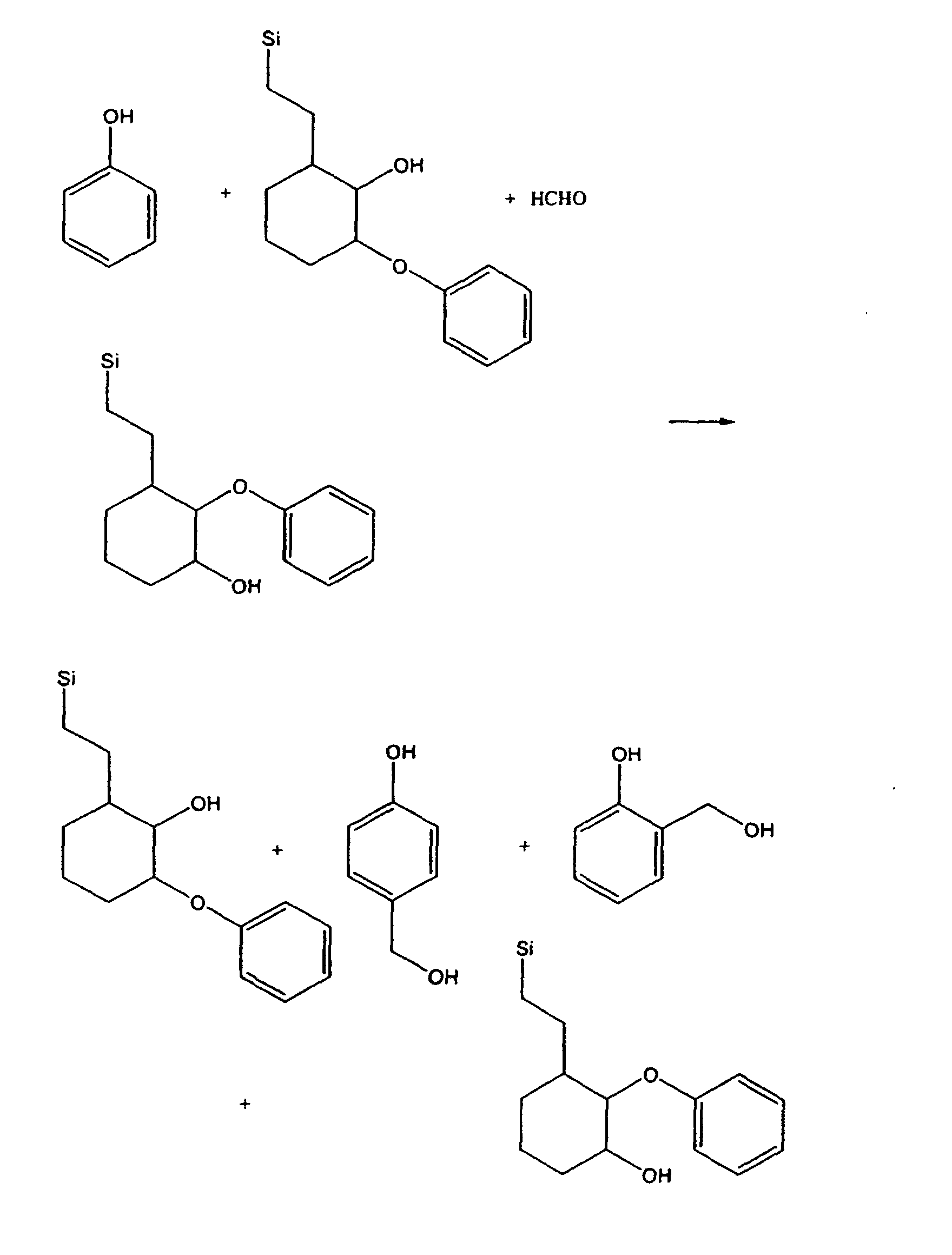
- First, phenol is reacted with the epoxy-functional polysiloxane to open the epoxy ring and form a C-O-C ether linkage between the phenol and the silicone molecule. Then, formaldehyde is added to form a phenolic resole resin with excess phenol and with epoxy-functional polysilxane-modified phenol.
- More specifically, an epoxy-functional polysiloxane is mixed with excess phenol and a basic catalyst, such as sodium hydroxide, and heated to between 120°C and 180°C, preferably about 140°C, for between (30 minutes and 90 minutes. Subsequently, the reaction mixture is cooled to between 45°C and 75°C, preferably about 55°C, and formaldehyde is added. The reaction mixture is then heated to between 65°C and 90°C, preferably about 75 °C, and held at that temperature until a desired free formaldehyde is achieved. Suitable free formaldehyde levels are generally between 0.5 wt% and 4 wt%.
- Generally, the weight range of epoxy-functional polysiloxane to phenol is from 100:0.1 to 0.1:100, and the preferred range is 5:100 to 15:100. However, both ranges will be affected by the epoxy equivalent weight of the epoxy-functional polysiloxane.
- The weight range of catalyst to phenol in the first step of the process is 0.01 to 10 parts of catalyst per 100 parts of phenol, preferably 0.1 to 2.5 parts of catalyst per 100 parts of phenol.
- The mole ratio of formaldehyde to phenol is 0.8:1 to 3:1, preferably 1.2:1 to 1.9:1. A suitable catalyst, such as sodium hydroxide, may be added during the addition of the formaldehyde to promote the reaction between the phenol and formaldehyde.
- The reaction scheme is illustrated below.
- 1. Reaction of phenol with epoxy silicone to open the epoxy ring and form
a C-O-C ether linkage between phenol and the silicone.

- 2. Addition of formaldehyde to form a phenolic resin.
-
- An epoxy-functional polysiloxane is blended with a phenolic resole. The blend may be used to form composites and then cured with a suitable acid catalyst at low temperatures, or thermally cured with no catalyst at high temperatures.
- First, a phenolic resole resin is prepared by reacting phenol and formaldehyde typically in the presence of a basic catalyst, such as sodium hydroxide, at a temperature below about 95°C, preferably between 45°C and 85°C. Then an epoxy-functional polysiloxane is blended into the phenolic resin.
- The resulting mixture is added to a suitable substrate to form a composite and then the mixture is cured with an acid catalyst at a low temperature, 25°C to 100°C, or cured without a catalyst at a high temperature, 100°C to 175°C. During the cure, the epoxy-functional polysiloxane is reacted with the phenolic resin as illustrated below.
- Generally, the formaldehyde to phenol mole ratio in the phenolic resole resin is 0.8 to 3.0, preferably 1.2 to 1.9 moles. The basic catalyst to phenol mole ratio in preparing the phenolic resole resin is from 0.001 to 0.1 moles of catalyst per mole of phenol, preferably from 0.005 to 0.05. The weight range of epoxy-functional polysiloxane added to 100 parts of the phenolic resole is from 1 to 100, preferably from 3 to 20.
- The reaction scheme is illustrated below.
- 1. Reaction of phenol and formaldehyde to form phenolic resin.

- 2. Blend of an epoxy-functional polysiloxane into a phenolic resin and then cure
with an acid catalyst at low temperature or no acid catalyst at high temperature:

-
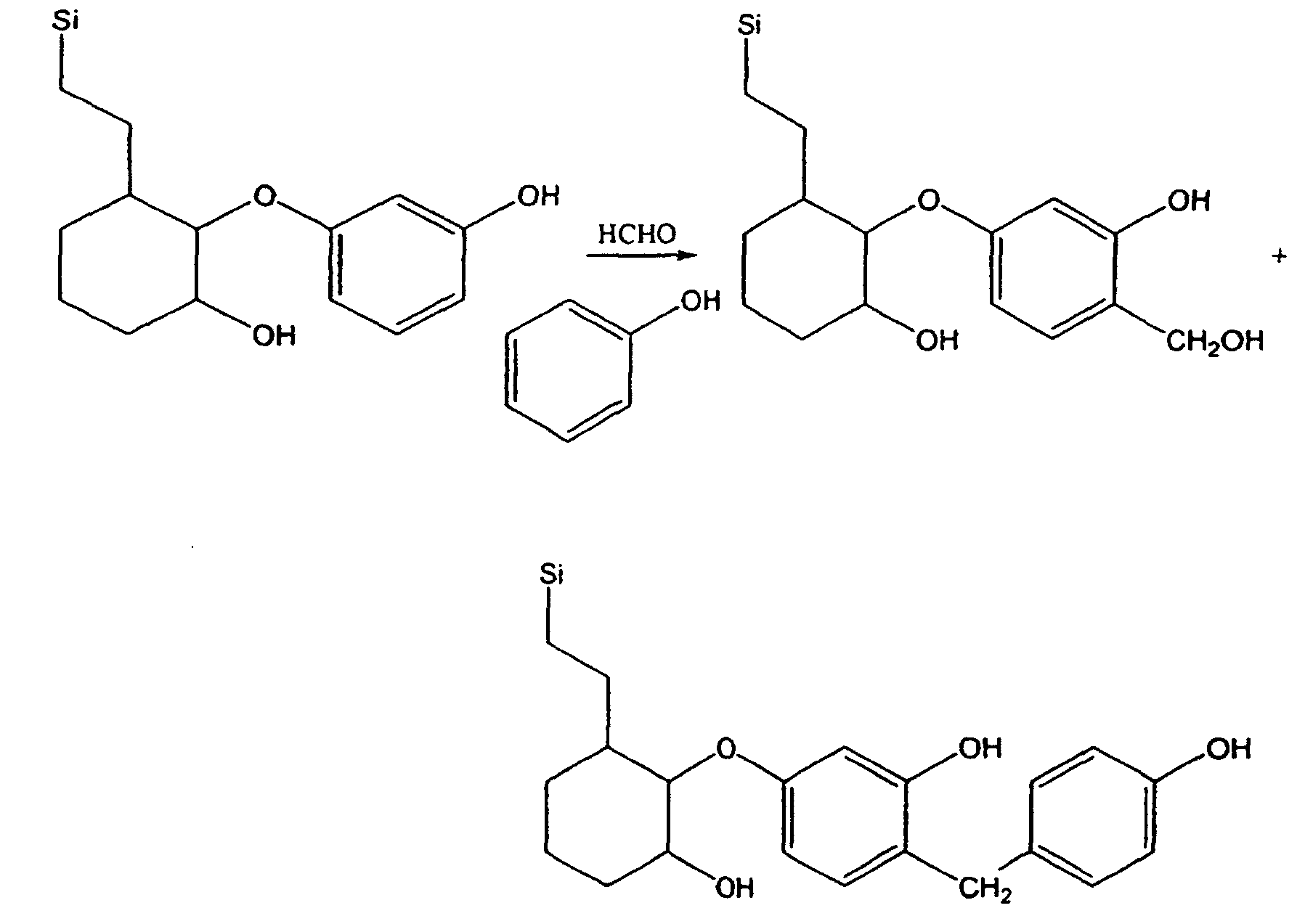
- First a polyhydroxy compound, such as resorcinol, is reacted with an epoxy-functional polysiloxane at a temperature of between 180°C and 250°C for 1 to 7 hours. Then the polyhydroxyphenolic-functionalized polysiloxane is blended into a phenolic resole. Alternatively, the polyhydroxyphenolic-functionalized silicone is reacted with formaldehyde, or phenol and formaldehyde, to make a silicone-modified phenolic resole.
- Generally, the mole ratio of epoxy-functional polysiloxane to polyhydroxy compound is from 0 to 10 moles of polyhydroxy compound per mole of epoxy in the silicone, preferably from 2 to 3.
- The weight range of silicone added to 100 parts of the phenolic resole is from 1 to 100, preferably from 3 to 20.
- The mole ratio of formaldehyde to polyhydroxy compound is from 0.5 to 3.0 moles of formaldehyde per mole of resorcinol, preferably 1.2 to 1.9.
- The weight range of phenol and formaldehyde added to make a silicone-modified phenolic resole is from 0 to 100 parts of phenol per 1 part of silicone. Formaldehyde is further added in a molar ratio of 0.9 to 3.0 moles of formaldehyde per mole of phenol, preferably 1.2 to 1.9 moles of formaldehyde per mole of phenol.
- 1. Reaction of resorcinol with epoxy-functional polysiloxane.

- 2. Blend with premade resole and then cure with an acid catalyst.

- 3. Alternatively, further reaction of the resorcinol-modified epoxy-functional
polysiloxane with formaidehyde or formaldehyde and phenol.
-
- Procedures #1, #2, and #3 include both the prereaction or "grafting" of epoxy-functional polysiloxanes with phenol, alkyl phenols, polyhydroxy phenols such as resorcinol, polyphenol compounds such as bispbenol-A and bisphenol-F, or phenolic resoles, as well as the blending of epoxy-functional polysiloxanes into phenolic resoles, both in the reactor where the phenolic resole is manufactured and in fabricators' tanks prior to manufacture of the composites.
- The term phenol is used generically to encompass any suitable phenolic compound.
- The present invention is also directed to a mixture of the compositions prepared by procedures #1, #2, and/or #3.
- In general, the phenolic resins have a F:P mole ratio of about 0.8 to about 4.0, preferably about 1.0 to about 2.0, and most preferably about 1.6. The phenolic resins are preferably made using a catalyst as known in the art. Suitable catalysts include hydroxides such as sodium hydroxide, or amines such as hexamine. The phenolic resins may be made in situ or premade in a separate reactor for blending with the epoxy-functional polysiloxane. Specific resins are described in the examples.
- Suitable epoxy-functional polysiloxanes include OSI Witco Y-12940 and OSI Witco Y-14362. Other epoxy-functional silicones include, but are not limited to, Dow Coming 2-8065, DC Toray Silicones BY 1-2940, ShinEtsu KF-105, ShinEtsu X-22-163A, Shin Etsu X-22-163B, and ShinEtsu X-22-163C.
- Regardless of which procedure is used, the resulting epoxy-functional polysiloxane modified phenolic resin may be heat cured or cured in the presence of an acid, either added during the manufacture of the resin as a neutralizing agent, or added externally prior to curing the resin.
- The epoxy-functional polysiloxane modified phenolic resins may be heat cured at a temperature above about 90°C, preferably 100°C to 175°C.
- The acid catalyst may be any suitable acid catalyst known to those skilled in the art such as mineral and organic acids and their derivatives, such as esters and amides or acid catalysts such as those described in U.S. Patent Application 08/681,681. Specific acid catalysts include p-toluenesulfonic acid, esters of phosphoric acid, and hydrochloric acid, sulfuric acid, and their derivatives. Another suitable acid catalyst is described in Table I.
Acid Catalyst Weight % ethylene glycol 40.2 pTSA 23.3 phosphoric acid 1.8 amino phosphonic acid 34.7 - The acid catalyst is added in an amount effective to cure the epoxy-functional polysiloxane modified phenolic resins and the amount depends on the strength of the acid catalyst. For the catalyst listed in Table I, and comparable acid catalysts, the operative range is from 1 to 30 parts by weight of catalyst per 100 parts of resin, and the preferred range is from 5 to 15 parts by weight.
- The phenolic component reacts with the epoxy functional group of the silicone to form a C-O-C bond. Some of the advantages of the three procedures include:
- (1) formation of a stable chemical linkage between the silicone and the phenolic component;
- (2) improved compatibility of the silicone with the phenolic network;
- (3) improved reactivity of the phenolic-functionalized silicone with the rest of the phenolic matrix; and
- (4) improved performance upon exposure to hot-wet conditions.
-
- Another embodiment is directed to uncatalyzed or acid catalyzed compositions with a substrate such as paper, glass, glass cloth, carbon fiber, and aramid substrates such as kevlar or nomex to make a composite material such as a laminate, tube, pipe, honeycomb, or various molded parts by processes such as a filament winding, impregnation (prepregging), pultrusion, dipping, spraying, hand lay-up, sheet molding compound, SCRIMP, or other processes known to those familiar with the composites industry. For example, four-ply glass cloth laminates where prepared using the epoxy-functional polysiloxane modified resole of procedure #2 with 11.5 parts of the acid catalyst described in Table I.
- The range for the amount of resin to be added to the substrate in the practice of the invention varies based on the process used. Generally the weight range is from 1 to 100 parts of resin per 100 parts of substrate. The preferred weight range again varies from process to process, but it is typically in the range of 10 to 50 parts of resin per 100 parts of substrate.
- Generally, the reactions and blendings are practiced at atmospheric pressure, but reduced pressures to pressurized vessels may also be used.
- An epoxy-functional polysiloxane-modified phenolic resole was made by procedure # 1 above. Eleven parts of epoxy-functional polysiloxane OSI Witco Y-12940 were reacted with 100 parts of phenol in the presence of 0.5 parts of sodium hydroxide at 140°C for 30 minutes. The reaction was then cooled to 55°C, and the phenol was further reacted with 102 parts of 50% formaldehyde (in a 1.6 mole ratio of formaldehyde/phenol) at 70 to 80°C for 4 hours to make a polysiloxane-modified phenolic resole resin. The resin was then distilled until a desired water content was achieved.
- Glass cloth laminates were made from a blend of a phenolic resole and epoxy-functional polysiloxane (OSI Witco Y-12940) as described in procedure #2. A phenolic resole was prepared by mixing 100 parts of phenol with 102 parts of 50% formaldehyde (with a 1.6 mole ratio of formaldehyde/phenol) and 0.013 moles of caustic per mole of phenol as a catalyst and reacting the phenol and formaldehyde until a desired free formaldehyde level is achieved. The water present was partially removed to achieve a specific solids content or water content. Finally, 7 parts of epoxy-functional polysiloxane were added to 100 parts of the resole. This mix can then be used to treat glass fibers or cloth to make a composite that is cured by addition of heat, a catalyst, or both.
- 100 parts of resorcinol were heated to 195°C, and a blend of 2 parts of benzyldimethylamine and 222 parts of epoxy-functional polysiloxane Y-14362 was added over 5 hours while maintaining a temperature of 195°C. The material was then further heated for 2 hours to make a hydrolysis-resistant phenolic-functionalized silicone.
- A silicone-modified phenolic resole was made by blending the phenolic-functionalized silicone of example 3 with a phenolic resole made in a separate reactor. 100 parts of phenol were mixed with 0.5 parts of sodium hydroxide and 102 parts of 50% formaldehyde at 55°C. The mixture was then reacted at 65°C to 85°C until a desired free formaldehyde level was achieved (1%). The mixture was then distilled until a solids content of 65% was achieved, thus completing the preparation of the phenolic resole (Resin 3 in Table II). 100 parts of phenolic resole were then treated with 10 parts of the phenolic-functionalized polysiloxane from example 3 to make a silicone-modified phenolic resole. Similar compositions were prepared with Resins 1 and 2 of Table II.
Phenolic Resole Resin for preparing Blending Mixtures with Epoxy-Functional-Polysiloxane Resin 1 Resin 2 Resin 3 formaldehyde/phenol ratio 1.4 1.6 1.6 caustic, % 0.25 0.25 0.25 free phenol, % 13-15 7-9 8-10 free formaldehyde, % 2.5-3.5 2-2.5 1.0 max water, % 3-4 <10 9.5-12.5 solids, % 76-80 76-80 71-75 - 100 parts of the material described in example 3 were further mixed with 10 parts of HCHO and 2 parts of sodium hydroxide and heated at 45°C for 24 hours to form a silicone-modified phenolic resin.
- A composite made with an epoxy-functional silicone-modified resole showed improved performance upon exposure to hot-wet conditions, measured in terms of retention of interlaminar shear strength (ILSS) for a sample soaked in boiling water versus a sample that was not soaked. The data are shown in Table III below. The prior art control in Table III is a methoxy-functional silicone.
Effect of Silicone Type on Interlaminar Shear Strength (ILSS) Retention of a Phenolic Resin-Based Glass Composite Silicone Type Time in Boiling Water (Months) ILSS Retention vs. No Soak Control (%) Methoxy-functional polysiloxane 1 66 Methoxy-functional polysiloxane 3 54 Epoxy-functional polysiloxane 1 87 Epoxy-functional polysiloxane 3 64 - The data in Table III above show that laminates made with an epoxy-functional polysiloxane-modified resole retained 87% of their interlaminar shear strength after a one month soak, while the prior art control laminates retained only 66% of their strength. Similarly, for laminates soaked for three months, the epoxy-functional polysiloxane-modified resole laminate retained 64% of its ILSS versus 54% for the prior art control.
Claims (24)
- A process of preparing a phenolic resin comprising reacting phenol with epoxy-functional polysiloxane to open the epoxy ring and form a C-O-C ether linkage between the phenol and the silicone molecule, forming an polyhydroxyphenolic-functionalized polysiloxane phenol and then adding formaldehyde and reacting with excess phenol to form a phenolic resole resin.
- The process according to claim I wherein the phenol is reacted with epoxy-functional polysiloxane at a temperature between 120°C and 180°C for 30 minutes to 90 minutes.
- The process according to claim 1 wherein the formaldehyde is reacted with the excess phenol at a temperature of 65°C to 85°C until a desired free formaldehyde value is achieved.
- The process according to claim I wherein the weight range of epoxy-functional polysiloxane to phenol is from 100:0.1 to 0.1:100.
- The process according to claim 4 wherein the range of epoxy-functional polysiloxane to phenol is from 5:100 to 15:100.
- The process according to claim 1 further comprising curing the polyhydroxyphenolic-functionalized polysiloxane phenol and phenolic resole resin with an acid catalyst.
- A process of preparing a polyhydroxyphenolic-functionalized polysiloxane phenolic resin comprising blending a phenolic resole resin with an epoxy-functional polysiloxane.
- A process according to claim 7 wherein the phenolic resole resin is prepared by reacting phenol and formaldehyde.
- The process according to claim 7 further comprising curing the blend of phenolic resole resin and epoxy-functional polysiloxane in the presence of a catalyst at a temperature of 25°C to 100°C.
- The process according to claim 7 further comprising curing the blend of phenolic resole resin and epoxy-functional polysiloxane without a catalyst at a temperature of 100°C to 175°C.
- The process according to claim 7 wherein 1 to 100 parts by weight epoxy-functional polysiloxane is added per 100 parts of the phenol resole resin.
- A process of preparing a phenolic resin comprising reacting an epoxy-functional polysiloxane with a polyhydroxy phenolic compound at a temperature of between 180°C and 250°C for 1 to 7 hours to form a polyhydroxyphenolic-functionalized polysiloxane and then blending the polyhydroxyphenolic-functionalized polysiloxane into a phenolic resole to form a polyhydroxyphenolic-functionalized polysiloxane modified phenolic resin.
- The process according to claim 12 where the polyhydroxy phenolic compound is resorcinol.
- The process according to claim 12 further comprising reacting the polyhydroxyphenolic-functionalized polysiloxane modified phenolic resin with an acid catalyst.
- The process according to claim 12 wherein the mole ratio of epoxy-functional polysiloxane to polyhydroxy compound is from 0 to 10 moles of polyhydroxy compound per mole of epoxy in the silicone.
- The process according to claim 15 wherein the mole ratio of epoxy-functional polysiloxane to polyhydroxy compound is from 2 to 3.
- The process according to claim 12 wherein from 1 to 100 parts by weight of silicone is added to 100 parts of the phenolic resin
- The process according to claim 17 wherein from 3 to 20 parts by weight of silicone is added to 100 parts of the phenolic resin.
- A process of preparing polyhydroxyphenolic-functionalized polysiloxane modified phenolic resin reacting a polyhydroxy compound with an epoxy-functional polysiloxane at a temperature of between 180°C and 250°C for 1 to 7 hours and then reacting with formaldehyde or formaldehyde and phenol.
- The process according to claim 19 further comprising reacting the polyhydroxyphenolic-functionalized polysiloxane modified phenolic resin with an acid catalyst.
- A composite comprising a substrate selected from the group consisting of glass, paper, glass cloth, carbon fiber, and aramid substrates and the polyhydroxyphenolic-functionalized polysiloxane modified phenolic resin prepared in accordance with claim 1.
- A composite comprising a substrate selected from the group consisting of glass, paper, glass cloth, carbon fiber, and aramid substrates and the polyhydroxyphenolic-functionalized polysiloxane modified phenolic resin prepared in accordance with claim 7.
- A composite comprising a substrate selected from the group consisting of glass, paper, glass cloth, carbon fiber, and aramid substrates and the polyhydroxyphenolic-functionalized polysiloxane modified phenolic resin prepared in accordance with claim 12.
- A composite comprising a substrate selected from the group consisting of glass, paper, glass cloth, carbon fiber, and aramid substrates and the polyhydroxyphenolic-functionalized polysiloxane modified phenolic resin prepared in accordance with claim 19.
Applications Claiming Priority (3)
| Application Number | Priority Date | Filing Date | Title |
|---|---|---|---|
| US09/511,350 US6342303B1 (en) | 2000-02-23 | 2000-02-23 | Epoxy-functional polysiloxane modified phenolic resin compositions and composites |
| US511350 | 2000-02-23 | ||
| PCT/US2001/003618 WO2001062829A1 (en) | 2000-02-23 | 2001-02-05 | Epoxy-functional polysiloxane modified phenolic resin compositions and composites |
Publications (2)
| Publication Number | Publication Date |
|---|---|
| EP1263839A1 EP1263839A1 (en) | 2002-12-11 |
| EP1263839B1 true EP1263839B1 (en) | 2005-04-13 |
Family
ID=24034515
Family Applications (1)
| Application Number | Title | Priority Date | Filing Date |
|---|---|---|---|
| EP01906967A Expired - Lifetime EP1263839B1 (en) | 2000-02-23 | 2001-02-05 | Epoxy-functional polysiloxane modified phenolic resin compositions and composites |
Country Status (6)
| Country | Link |
|---|---|
| US (1) | US6342303B1 (en) |
| EP (1) | EP1263839B1 (en) |
| AU (1) | AU2001234806A1 (en) |
| DE (1) | DE60110051T2 (en) |
| ES (1) | ES2240410T3 (en) |
| WO (1) | WO2001062829A1 (en) |
Families Citing this family (10)
| Publication number | Priority date | Publication date | Assignee | Title |
|---|---|---|---|---|
| US20040211534A1 (en) * | 2003-04-24 | 2004-10-28 | Clungeon Nancy S. | Creping additives for paper webs |
| DE102011051773A1 (en) | 2011-07-12 | 2013-01-17 | Fraunhofer-Gesellschaft zur Förderung der angewandten Forschung e.V. | Polysiloxane-modified resole resin, molded articles and composites obtainable therefrom, and processes for producing the resin, the moldings and the composite |
| US9803131B2 (en) | 2012-11-02 | 2017-10-31 | Wacker Chemical Corporation | Oil and gas well proppants of silicone-resin-modified phenolic resins |
| EP3023467B1 (en) | 2014-11-20 | 2017-05-10 | BYK-Chemie GmbH | Molded product, thermoplast or coating containing polysiloxanes as anti-adhesive and dirt-repellant additives |
| WO2017129529A1 (en) * | 2016-01-28 | 2017-08-03 | Wacker Chemie Ag | Modified reactive resin compositions and use thereof for coating propping agents |
| EP3408347B1 (en) | 2016-01-28 | 2019-04-24 | Wacker Chemie AG | Modified reactive resin compositions and use thereof for coating propping agents |
| CN111087564B (en) * | 2019-12-30 | 2021-09-07 | 西安交通大学 | A kind of phenolic resin modified by organosilicon epoxy monomer and preparation method thereof |
| CN113337075B (en) * | 2021-04-29 | 2022-09-23 | 山东宇世巨化工有限公司 | Two-component polysiloxane modified phenolic resin and preparation method thereof |
| JPWO2024224984A1 (en) * | 2023-04-28 | 2024-10-31 | ||
| CN118599076A (en) * | 2024-06-07 | 2024-09-06 | 武汉珈材科技有限公司 | A kind of tetramethyl diepoxy diphenyl trisiloxane modified phenolic resin and preparation method thereof |
Family Cites Families (12)
| Publication number | Priority date | Publication date | Assignee | Title |
|---|---|---|---|---|
| US2755269A (en) | 1952-01-14 | 1956-07-17 | Dow Corning | Phenol-aldehyde type organosilicon resins |
| US3074903A (en) | 1959-06-16 | 1963-01-22 | Monsanto Chemicals | Laminates |
| US4022753A (en) | 1974-03-25 | 1977-05-10 | Ciba-Geigy Corporation | Reaction products of polysiloxanes and polyphenols |
| US4720515A (en) * | 1985-05-17 | 1988-01-19 | Denki Kagaku Kogyo Kabushiki Kaisha | Epoxy resin composition for encapsulating semiconductor |
| DE3634084A1 (en) | 1986-10-07 | 1988-04-21 | Hanse Chemie Gmbh | MODIFIED REACTION RESIN, METHOD FOR PRODUCING IT AND ITS USE |
| MY107113A (en) | 1989-11-22 | 1995-09-30 | Sumitomo Bakelite Co | Epoxy resin composition for semiconductor sealing. |
| US5108824A (en) | 1990-02-06 | 1992-04-28 | The Dow Chemical Company | Rubber modified epoxy resins |
| US5319005A (en) | 1992-01-27 | 1994-06-07 | Hitachi Chemical Co., Ltd. | Epoxy resin molding material for sealing of electronic component |
| JPH073159A (en) | 1993-06-15 | 1995-01-06 | Shin Etsu Chem Co Ltd | Room temperature curable organopolysiloxane composition |
| US5736619A (en) | 1995-04-21 | 1998-04-07 | Ameron International Corporation | Phenolic resin compositions with improved impact resistance |
| GB9524361D0 (en) | 1995-11-29 | 1996-01-31 | Bp Chem Int Ltd | Phenolic resins |
| JPH10330596A (en) * | 1997-05-30 | 1998-12-15 | Sumitomo Bakelite Co Ltd | Flame retardant resin composition and semiconductor encapsulant using the same |
-
2000
- 2000-02-23 US US09/511,350 patent/US6342303B1/en not_active Expired - Fee Related
-
2001
- 2001-02-05 DE DE60110051T patent/DE60110051T2/en not_active Expired - Fee Related
- 2001-02-05 AU AU2001234806A patent/AU2001234806A1/en not_active Abandoned
- 2001-02-05 ES ES01906967T patent/ES2240410T3/en not_active Expired - Lifetime
- 2001-02-05 WO PCT/US2001/003618 patent/WO2001062829A1/en not_active Ceased
- 2001-02-05 EP EP01906967A patent/EP1263839B1/en not_active Expired - Lifetime
Also Published As
| Publication number | Publication date |
|---|---|
| AU2001234806A1 (en) | 2001-09-03 |
| ES2240410T3 (en) | 2005-10-16 |
| DE60110051T2 (en) | 2006-03-09 |
| WO2001062829A1 (en) | 2001-08-30 |
| DE60110051D1 (en) | 2005-05-19 |
| US6342303B1 (en) | 2002-01-29 |
| EP1263839A1 (en) | 2002-12-11 |
Similar Documents
| Publication | Publication Date | Title |
|---|---|---|
| KR100253975B1 (en) | Phenolic Resin Composition with Improved Impact Resistance | |
| US4657951A (en) | Fibrous material-based friction member | |
| EP0230619B1 (en) | Silicone-modified epoxy resins having improved impact resistance | |
| US20110237761A1 (en) | Siloxane Mixtures Containing Epoxide Resins and Method for the Preparation Thereof and Use Thereof | |
| US6342303B1 (en) | Epoxy-functional polysiloxane modified phenolic resin compositions and composites | |
| US2755269A (en) | Phenol-aldehyde type organosilicon resins | |
| KR940010216B1 (en) | Manufacturing method of resin composition having phenolic hydroxyl group | |
| KR20070110254A (en) | High temperature nanocomposite resin | |
| CN1187836A (en) | Phenolic resin composition with improved impact resistance | |
| EP0869980B1 (en) | Reactive diluents for acid curable phenolic compositions | |
| CN101627071B (en) | Organopolysiloxane, adhesive composition containing the organopolysiloxane, and rubber reinforcement treated thereby | |
| US9328236B2 (en) | Polysiloxane modified resol resin, moulded bodies and composites obtained therefrom and methods for producing the resin, the moulded bodies and the composites | |
| US5066693A (en) | Molding compositions of resole phenolic resin and epoxy resin | |
| US5015529A (en) | Phenolic molding compositions | |
| JPH09118738A (en) | Low-stress resin composition | |
| JP3171266B2 (en) | Method for producing resin composition having phenolic hydroxyl group | |
| JP4562241B2 (en) | Epoxy resin composition | |
| JP2002161188A (en) | Thermosetting resin composition and its hardened matter | |
| JP2002226556A (en) | Epoxy resin composition | |
| JP3912936B2 (en) | Method for producing resin composition having phenolic hydroxyl group | |
| JP4413332B2 (en) | Flame retardant epoxy resin composition | |
| JP3455704B2 (en) | Method for producing modified phenolic resin reinforced with poly (alkylene oxide) | |
| JPS59122522A (en) | Manufacture of foamed phenolic resin | |
| JPH07316396A (en) | Thermosetting resin composition | |
| JPH0741535A (en) | Phenolic resin composition |
Legal Events
| Date | Code | Title | Description |
|---|---|---|---|
| PUAI | Public reference made under article 153(3) epc to a published international application that has entered the european phase |
Free format text: ORIGINAL CODE: 0009012 |
|
| 17P | Request for examination filed |
Effective date: 20020903 |
|
| AK | Designated contracting states |
Kind code of ref document: A1 Designated state(s): AT BE CH CY DE DK ES FI FR GB GR IE IT LI LU MC NL PT SE TR |
|
| AX | Request for extension of the european patent |
Free format text: AL;LT;LV;MK;RO;SI |
|
| GRAP | Despatch of communication of intention to grant a patent |
Free format text: ORIGINAL CODE: EPIDOSNIGR1 |
|
| RAP1 | Party data changed (applicant data changed or rights of an application transferred) |
Owner name: GEORGIA-PACIFIC RESINS, INC. |
|
| GRAS | Grant fee paid |
Free format text: ORIGINAL CODE: EPIDOSNIGR3 |
|
| RBV | Designated contracting states (corrected) |
Designated state(s): DE ES FR GB |
|
| GRAA | (expected) grant |
Free format text: ORIGINAL CODE: 0009210 |
|
| AK | Designated contracting states |
Kind code of ref document: B1 Designated state(s): DE ES FR GB |
|
| REG | Reference to a national code |
Ref country code: GB Ref legal event code: FG4D |
|
| REG | Reference to a national code |
Ref country code: IE Ref legal event code: FG4D |
|
| REF | Corresponds to: |
Ref document number: 60110051 Country of ref document: DE Date of ref document: 20050519 Kind code of ref document: P |
|
| REG | Reference to a national code |
Ref country code: ES Ref legal event code: FG2A Ref document number: 2240410 Country of ref document: ES Kind code of ref document: T3 |
|
| PLBE | No opposition filed within time limit |
Free format text: ORIGINAL CODE: 0009261 |
|
| STAA | Information on the status of an ep patent application or granted ep patent |
Free format text: STATUS: NO OPPOSITION FILED WITHIN TIME LIMIT |
|
| ET | Fr: translation filed | ||
| 26N | No opposition filed |
Effective date: 20060116 |
|
| PGFP | Annual fee paid to national office [announced via postgrant information from national office to epo] |
Ref country code: ES Payment date: 20080212 Year of fee payment: 8 |
|
| PGFP | Annual fee paid to national office [announced via postgrant information from national office to epo] |
Ref country code: DE Payment date: 20080118 Year of fee payment: 8 Ref country code: GB Payment date: 20080118 Year of fee payment: 8 |
|
| PGFP | Annual fee paid to national office [announced via postgrant information from national office to epo] |
Ref country code: FR Payment date: 20080114 Year of fee payment: 8 |
|
| GBPC | Gb: european patent ceased through non-payment of renewal fee |
Effective date: 20090205 |
|
| REG | Reference to a national code |
Ref country code: FR Ref legal event code: ST Effective date: 20091030 |
|
| PG25 | Lapsed in a contracting state [announced via postgrant information from national office to epo] |
Ref country code: DE Free format text: LAPSE BECAUSE OF NON-PAYMENT OF DUE FEES Effective date: 20090901 |
|
| REG | Reference to a national code |
Ref country code: ES Ref legal event code: FD2A Effective date: 20090206 |
|
| PG25 | Lapsed in a contracting state [announced via postgrant information from national office to epo] |
Ref country code: GB Free format text: LAPSE BECAUSE OF NON-PAYMENT OF DUE FEES Effective date: 20090205 Ref country code: FR Free format text: LAPSE BECAUSE OF NON-PAYMENT OF DUE FEES Effective date: 20090302 |
|
| PG25 | Lapsed in a contracting state [announced via postgrant information from national office to epo] |
Ref country code: ES Free format text: LAPSE BECAUSE OF NON-PAYMENT OF DUE FEES Effective date: 20090206 |