EP1262571A1 - Steel product having weld heat-affected zone excellent in rigidity - Google Patents
Steel product having weld heat-affected zone excellent in rigidity Download PDFInfo
- Publication number
- EP1262571A1 EP1262571A1 EP00974966A EP00974966A EP1262571A1 EP 1262571 A1 EP1262571 A1 EP 1262571A1 EP 00974966 A EP00974966 A EP 00974966A EP 00974966 A EP00974966 A EP 00974966A EP 1262571 A1 EP1262571 A1 EP 1262571A1
- Authority
- EP
- European Patent Office
- Prior art keywords
- steel
- toughness
- oxide particles
- haz
- affected zone
- Prior art date
- Legal status (The legal status is an assumption and is not a legal conclusion. Google has not performed a legal analysis and makes no representation as to the accuracy of the status listed.)
- Granted
Links
Images


Classifications
-
- C—CHEMISTRY; METALLURGY
- C22—METALLURGY; FERROUS OR NON-FERROUS ALLOYS; TREATMENT OF ALLOYS OR NON-FERROUS METALS
- C22C—ALLOYS
- C22C38/00—Ferrous alloys, e.g. steel alloys
-
- C—CHEMISTRY; METALLURGY
- C22—METALLURGY; FERROUS OR NON-FERROUS ALLOYS; TREATMENT OF ALLOYS OR NON-FERROUS METALS
- C22C—ALLOYS
- C22C38/00—Ferrous alloys, e.g. steel alloys
- C22C38/002—Ferrous alloys, e.g. steel alloys containing In, Mg, or other elements not provided for in one single group C22C38/001 - C22C38/60
-
- C—CHEMISTRY; METALLURGY
- C22—METALLURGY; FERROUS OR NON-FERROUS ALLOYS; TREATMENT OF ALLOYS OR NON-FERROUS METALS
- C22C—ALLOYS
- C22C38/00—Ferrous alloys, e.g. steel alloys
- C22C38/02—Ferrous alloys, e.g. steel alloys containing silicon
-
- C—CHEMISTRY; METALLURGY
- C22—METALLURGY; FERROUS OR NON-FERROUS ALLOYS; TREATMENT OF ALLOYS OR NON-FERROUS METALS
- C22C—ALLOYS
- C22C38/00—Ferrous alloys, e.g. steel alloys
- C22C38/04—Ferrous alloys, e.g. steel alloys containing manganese
-
- C—CHEMISTRY; METALLURGY
- C22—METALLURGY; FERROUS OR NON-FERROUS ALLOYS; TREATMENT OF ALLOYS OR NON-FERROUS METALS
- C22C—ALLOYS
- C22C38/00—Ferrous alloys, e.g. steel alloys
- C22C38/06—Ferrous alloys, e.g. steel alloys containing aluminium
-
- C—CHEMISTRY; METALLURGY
- C22—METALLURGY; FERROUS OR NON-FERROUS ALLOYS; TREATMENT OF ALLOYS OR NON-FERROUS METALS
- C22C—ALLOYS
- C22C38/00—Ferrous alloys, e.g. steel alloys
- C22C38/14—Ferrous alloys, e.g. steel alloys containing titanium or zirconium
Definitions
- This invention relates to a steel for a welded structure excellent in the toughness of a weld heat-affected zone (hereinafter referred to as "HAZ”) used for ships, marine construction, medium and high-rise buildings and so on.
- HZ weld heat-affected zone
- Japanese Unexamined Patent Publication No. H3-264614 proposes a method of improving the toughness of a HAZ by using the multiphase precipitates of Ti nitrides and MnS as the nuclei of ferrite transformation.
- Japanese Unexamined Patent Publication No. H4-143246 proposes a method of improving the toughness of a HAZ by using the multiphase precipitates of Ti nitrides and BN as the nuclei of the precipitation of intergranular ferrite.
- steels containing Ti oxides are used in various fields of steel plates, sections and the like.
- a steel containing Ti oxides is very effective for improving the toughness of a high heat input HAZ, and the application of the technology to a high tensile steel is promising.
- the principle is as follows: Ti nitrides, MnS and the like precipitate using Ti oxides, which are stable even at the melting temperature of a steel, as precipitation sites during the temperature drop after welding; then fine ferrite forms using the precipitated Ti nitrides, MnS and the like as the sites of the formation; and, as a result, the formation of coarse ferrite detrimental to toughness is suppressed and, thus, the toughness is prevented from deteriorating.
- the cause is the coarsening and agglomeration of Ti oxides and, when it is attempted to increase the number of Ti oxides, coarse Ti oxides 5 ⁇ m or more in diameter, namely so-called inclusions, increase. Inclusions 5 ⁇ m or more in diameter are harmful since they serve as starting points of the fracture of a structure, leading to the deterioration of toughness. To further improve the toughness of a HAZ, therefore, it is necessary to use oxides not prone to coarsen or agglomerate but which are apt to disperse in a steel in finer grains than Ti oxides.
- the method of adding Ti to molten steel substantially not containing strongly deoxidizing elements such as Al is often employed. It is difficult, however, to control the number and dispersion of Ti oxides in a steel by simply adding Ti to molten steel and, moreover, it is also difficult to control the number and dispersion of the precipitates of TiN, MnS and the like. As a consequence, in a steel wherein the Ti oxides are dispersed solely by means of the deoxidation by Ti, there are problems of causing, for instance, an insufficient number of Ti oxides, toughness variation in the thickness direction of a steel plate and the like.
- the upper limit of Al amount is set at a very low figure of 0.007%.
- the toughness of a base metal may deteriorate caused by an insufficient amount of AlN precipitates or the like.
- the toughness of a weld metal may deteriorate.
- Japanese Unexamined Patent Publication No. H6-293937 proposes a technique of utilizing Ti-Al composite oxides formed by adding Al immediately after adding Ti. It is possible, by this technique, to significantly improve the toughness of a HAZ under high heat input welding. Lately, however, shipbuilding and construction industries are promoting a further increase in weld heat input to 200 kJ/cm or more or even to 1,000 kJ/cm and, as a consequence, a steel having higher HAZ toughness is sought. In this situation, the improvement of toughness in the vicinity of a weld fusion zone is particularly required.
- the object of the present invention is, in order to significantly improve the properties of a HAZ even under the above ultra-high heat input welding, to provide a steel excellent in the toughness of a weld heat-affected zone, wherein a HAZ excellent in toughness can be realized by further suppressing the coarsening of austenite grains when the steel is heated for a long time at a high temperature.
- the present invention has been established for solving the above problems, and the gist of the present invention is as follows:
- the present invention is explained in detail hereafter.
- the present inventors studied the method of making reheated austenite grains fine in a HAZ, which is heated to 1,400°C or higher, using an oxide.
- volume percentage of the dispersed grains The higher the volume percentage of the dispersed grains and the larger the diameter of each of them, the larger the effect of the dispersed grains to pin the crystal grain boundaries. It has to be noted, however, that there is an upper limit to the volume percentage of the dispersed grains, determined by the concentrations of the component elements of the grains contained in the steel in question. Therefore, supposing that the volume percentage is constant, a good pinning effect is obtained when the diameter of the grains is not very large. From this viewpoint, the present inventors carried out studies on how to increase the volume percentage of oxides and how to obtain an adequate grain size.
- the present inventors discovered that it was possible to increase the volume percentage of oxides, or the amount of oxides, when Ca at 3% or more and Al at 1% or more were contained in the composition of the oxide particles formed in a steel. Based on this result, the present invention stipulated that the oxide particles in a steel contained at least Ca, Al and O in their composition, and that the oxide particles contained, in the mass percentage of the elements excluding O, Ca at 3% or more and Al at 1% or more.
- the present invention stipulated that the oxide particles in a steel contained at least Ca, Al, Mg and O in their composition, and that, in the mass percentage of the elements excluding O, the oxide particles contained Ca at 5% or more, Al at 5% or more and Mg at 1% or more.
- the present inventors discovered that a further increase in the volume percentage of the dispersed grains could be brought about through the combined effect of oxides and sulfides when sulfides such as CaS and MgS precipitated around oxide particles.
- the present invention stipulated that the particles in a steel contained at least Ca, Al, O and S in their composition, and that, in the mass percentage of the elements excluding O, the particles contained Ca at 5% or more, Al at 5% or more and S at 1% or more, otherwise, that the particles in a steel contained at least Ca, Al, Mg, O and S in their composition, and that, in the mass percentage of the elements excluding O, the particles contained Ca at 5% or more, Al at 5% or more, Mg at 1% or more and S at 1% or more.
- the present inventors confirmed that the effects of the present invention remained unaffected in the above case, even when the oxide particles contained Mg and/or REM, having a deoxidizing strength rated between Al and Ca, as a component element or component elements in the balance of the elements whose contents were specified above.
- the present inventors also confirmed that the effects of the present invention were not hindered even when the particles contained deoxidizing elements milder than Al, such as Si, Mn and Ti, unavoidably included in the oxide particles and/or impurity elements, such as S, inevitably combining with Ca and so on.
- the effect of pinning crystal grain boundaries by dispersed grains increases as the volume percentage of the dispersed grains increases and the size of each of the grains becomes larger.
- the present inventors reasoned that, when the volume percentage of the dispersed grains was constant, the number of the oxide particles would increase as the size of each of the particles became smaller and, as a consequence, pinning effect would increase, and that, when the grain size was too small, the proportion of the crystal grain boundaries occupied by the dispersed grains would decrease and, as a result, the pinning effect would also decrease.
- the present inventors discovered that the pinning effect was the largest when the grain size was from 0.005 to 2.0 ⁇ m. It was also made clear that the pinning force for arresting the migration of austenite grain boundaries became stronger as the size of the dispersed grains increased. Thus, the present inventors discovered that, among the dispersed grains having grain sizes from 0.005 to 2.0 ⁇ m, those having grain sizes from 0.1 to 2.0 ⁇ m were particularly effective. Pinning effect decreases gradually when the grain size decreases to below 0.1 ⁇ m and, when it is below 0.005 ⁇ m, little of the pinning effect appears.
- the oxide particles larger than 2.0 ⁇ m have pinning effect, they sometimes serve as the starting points of brittle fracture and, for this reason, they are undesirable from the viewpoint of the material properties of a steel.
- the present invention stipulates that the required diameter of the oxide particles is from 0.005 to 2.0 ⁇ m, preferably from 0.1 to 2.0 ⁇ m.
- the present inventors studied the number of pinning grains required for securing a desired toughness of a HAZ.
- a HAZ toughness required of a steel material is different in a complicated manner depending on the application of the steel material and the method of welding employed in the application.
- the present inventors discovered that, in order to satisfy a HAZ toughness, for example, of 50 J or more in terms of the absorbed energy at a test temperature of -40°C, corresponding to the toughness level required when a high strength steel for ship construction was welded under a high heat input, which was considered to be a case where especially stringent property requirements were applied, it was necessary that the density of oxide particles 0.005 to 2.0 ⁇ m in circle-equivalent diameter was 100 pieces/mm 2 or more, as shown in Fig. 1.
- an appropriate upper limit of the density of the oxide particles is 3,000 pieces/mm 2 .
- the size and number of the oxide particles can be measured, for instance, in the following manner.
- An extracted replica is produced from a sample taken from a base steel plate, and it is observed at 20 or more visual fields, namely 1,000 ⁇ m 2 or more in terms of the total observation area, under a magnification of ⁇ 10,000 using an electron microscope.
- the size of the particles are determined, for instance, by calculating circle-equivalent diameters of the particles based on micrographs of the particles.
- the extracted replica may be produced from any portion from the surface layer to the thickness center of a steel plate. A lower magnification may be used if the oxide particles can be observed adequately.
- the oxide particles form during the deoxidation process of molten steel.
- the oxides forming at this stage are called primary oxides.
- Ti-Al-Ca oxides form as the temperature of the molten steel falls during the stages of casting and solidification.
- the oxides forming at these stages are called secondary oxides. Either primary oxides or secondary oxides may be used for the purpose of the present invention.
- the present inventors proceeded with further studies for significantly increasing the effects of improving toughness by refining a HAZ structure yet more. As a result, they discovered that, when the reheated austenite grains were made finer by dispersing fine oxide grains in a great amount, an addition of B was very effective for suppressing the growth of ferrite at the grain boundaries and triple boundaries during the process in which a HAZ structure was formed.
- C is an effective component for increasing steel strength and, as such, the lower limit of its content is set at 0.03%. Since its excessive addition remarkably deteriorates the weldability, HAZ toughness and so on of a steel material, the upper limit of its content is set at 0.18%.
- Si is a component necessary for securing the strength of base metal, deoxidizing steel and so on, but the upper limit of its content is set at 0.5% in order to prevent the toughness of a HAZ from lowering through its hardening.
- Mn is an effective component for securing the strength and toughness of base metal and, as such, it has to be added at 0.4% or more, but the upper limit of its content is set at 2.0% in order to control the toughness, cracking property and so on of welded joints within respective tolerable ranges.
- Al is an important deoxidizing element and, for this reason, the lower limit of its content is set at 0.005%.
- the upper limit of its content is set at 0.04%.
- Ti is added at 0.005% or more for the purpose of forming Ti nitrides through the combination with N.
- the HAZ toughness is lowered and, for this reason, the upper limit of its content is set at 0.03%.
- B is an effective element, when it is in a solute state, for suppressing the growth of ferrite forming at the boundaries of reheated austenite grains and, for this reason, B of at least 0.0005% is added.
- B When it is added in a great amount, however, the toughness of a steel material is deteriorated and, therefore, the upper limit of its content is set at 0.003%.
- Cu is effective for enhancing the strength of a steel material but, when it is added in excess of 1.0%, the HAZ toughness is lowered and, therefore, the upper limit of its content is set at 1.0%.
- Ni is effective for enhancing the strength and toughness of a steel material but, as the increase in its addition increases production costs, the upper limit of its content is set at 1.5%.
- Nb is an effective element for enhancing the strength and toughness of base metal through the improvement of hardenability but, since its excessive addition deteriorates the toughness of a HAZ remarkably, the upper limit of its content is set at 0.04%.
- V, Cr and Mo have the same effects as Nb does and, for this reason, the upper limits of their contents are set at 0.1, 0.6 and 0.6%, respectively.
- REM has a deoxidizing strength in molten steel second to Ca and also a function of helping Ca form fine oxide grains, but its addition is more costly than the addition of Ca and, when added excessively, it forms coarse inclusions to deteriorate the toughness of a HAZ and a steel plate. For this reason, the upper limit of its content is set at 0.05%.
- 50-kg class steels having the chemical compositions shown in Table 1 were produced for test purposes.
- Steels 1 to 8 are invented steels and steels 9 to 14 are comparative steels.
- the sample steels were melted in a converter and deoxidized during vacuum degassing treatment in an RH degasser.
- the amount of solute oxygen in molten steel was controlled with Si before the addition of Ti, and then Ti and Al were added in this sequence for deoxidation.
- the steels were cast into slabs 280 mm in thickness by continuous casting and then rolled into steel plates 45 mm in thickness through reheating and rolling.
- the steel plates thus produced were welded through 1 pass of SEGARC welding.
- the heat input was approximately 200 kJ/cm 2 .
- Table 2 shows the composition of oxide particles, the number of the oxide particles 0.005 to 2.0 ⁇ m in diameter, the rolling conditions of the steel plates, the characteristics of base metal and the toughness of the HAZ.
- a Charpy impact value for evaluating the HAZ toughness is the average value of 9 test pieces, each of the values being measured at the portion of a HAZ located 1 mm away from a fusion line.
- steels 1 to 8 according to the present invention have excellent HAZ toughness compared with comparative steels: they are quite excellent in the HAZ toughness at -40°C, as the oxide particle size, the number of oxide particles and the amounts of their components are within the respective ranges specified in the present invention. It is also clear from the table that, among the steels according to the present invention, invented steels 3, 4, 5, 6, and 8 containing the oxide particles 0.1 to 2.0 ⁇ m in diameter within the range from 100 to 3,000 pieces/mm 2 , invented steels 2, 4, 5, 6, 7 and 8 having the oxide particles containing Mg of 1% or more, and invented steels 3, 4 and 5 having the oxide particles containing S of 1% or more are superior in the HAZ toughness to the other invented steels.
- the content of Al in the oxide particles and the number of oxide particles are below the respective lower limits according to the present invention.
- the Charpy test for evaluating the HAZ toughness was done at -40°C, and each of the impact values in the table is the average value of 9 test pieces, each of the values being measured at the portion of a HAZ located 1 mm away from a bond.
- invented steels 17 to 24 have excellent HAZ toughness compared with comparative steels.
- the density of the oxide particles 0.005 to 2.0 ⁇ m in diameter containing Ca and Al by respective prescribed contents is within the range from 100 to 3,000 pieces/mm 2 and, thanks to this, the austenite grain size of the HAZ structure of these steels is smaller compared with that of comparative steels, and the ferrite at the grain boundaries or triple boundaries of austenite grains is also small owing to the effect of B.
- the Charpy absorbed energy value at -40°C of each of these steels far exceeds 50 J, which is the average absorbed energy value generally required of steel structures from the viewpoint of fracture mechanics, and thus the HAZ toughness is quite excellent, as seen in the table.
- the density of the oxide particles 0.1 to 2.0 ⁇ m in diameter is 100 pieces/mm 2 or more and, as a consequence, the austenite grain size is relatively small compared with that of steels 19 and 22, and the Charpy absorbed energy value is high.
- a HAZ toughness value is the average value of the results of Charpy tests at -40°C obtained by applying the Charpy tests to 9 test pieces, each of the values being measured at the portion of a HAZ located 1 mm away from the bond of the steel plates after the welding.
- invented steels 32 to 39 have excellent HAZ toughness compared with comparative steels.
- the density of the oxide particles 0.005 to 2.0 ⁇ m in diameter containing Ca and A1 by respective prescribed contents is within the range from 100 to 3,000 pieces/mm 2 and, thanks to this, the austenite grain size of the HAZ structure of these steels is smaller compared with that of comparative steels, and the ferrite at the grain boundaries or triple boundaries of austenite grains is also small owing to the effect of B.
- the Charpy absorbed energy value at -40°C of each of these steels far exceeds 50 J, which is the average value generally required of steel structures from the viewpoint of fracture mechanics, and thus the HAZ toughness is quite excellent, as seen in the table.
- the density of the oxide particles 0.1 to 2.0 ⁇ m in diameter is 100 pieces/mm 2 or more and, as a consequence, the austenite grain size is relatively small compared with that of steels 34 and 37, and the Charpy absorbed energy value is high.
- the present invention is a steel plate excellent in toughness at a welding joint even in high heat input welding or ultra-high heat input welding with a heat input of 200 kJ/cm 2 or more, and is applicable to general steel materials for welded structures used for ships, marine construction, medium and high-rise buildings, bridges and so on and also to material steel plates for pipes, bars, long steel products, hot-rolled steel sheets and the like.
- a significant improvement in the toughness of a welded joint is obtained in any of these applications.
Landscapes
- Chemical & Material Sciences (AREA)
- Engineering & Computer Science (AREA)
- Materials Engineering (AREA)
- Mechanical Engineering (AREA)
- Metallurgy (AREA)
- Organic Chemistry (AREA)
- Heat Treatment Of Steel (AREA)
- Treatment Of Steel In Its Molten State (AREA)
- Nonmetallic Welding Materials (AREA)
Abstract
Description
- This invention relates to a steel for a welded structure excellent in the toughness of a weld heat-affected zone (hereinafter referred to as "HAZ") used for ships, marine construction, medium and high-rise buildings and so on.
- The demands for better material properties of steels for welding and used in large structures such as ships, marine construction, medium and high-rise buildings and bridges have become more and more stringent over the last few years. On the other hand, in order to enhance welding efficiency, the application of a high heat input welding method, typically such as the flux-copper backing welding method, the electrogas welding method and the electroslag welding method, is required in the construction of these structures. In this situation, besides the toughness of the base metal, a higher toughness of a HAZ is required more and more strongly.
- There have been many proposals focusing on the toughness of the HAZ of steel materials under high heat input welding. An example of such proposed methods is a method of making the austenite grains of a HAZ refine by dispersing fine Ti nitrides in steel and thus improving the toughness of the HAZ, as disclosed in Japanese Examined Patent Publication No. S55-26164 and the like. As another example, Japanese Unexamined Patent Publication No. H3-264614 proposes a method of improving the toughness of a HAZ by using the multiphase precipitates of Ti nitrides and MnS as the nuclei of ferrite transformation. Further, Japanese Unexamined Patent Publication No. H4-143246 proposes a method of improving the toughness of a HAZ by using the multiphase precipitates of Ti nitrides and BN as the nuclei of the precipitation of intergranular ferrite.
- However, a problem here is that most of the Ti nitrides dissolve in the vicinity of the boundary with weld metal (hereinafter referred to as "weld bond portion") where the highest temperature exceeds 1,400°C in a HAZ and therefore the toughness improvement effect deteriorates. Thus, it is difficult to meet the recent stringent demands for the toughness of a HAZ and attain a high toughness of a HAZ under ultra-high heat input welding.
- As a measure for improving toughness in the vicinity of a weld bond portion, steels containing Ti oxides are used in various fields of steel plates, sections and the like. As is exemplified in Japanese Unexamined Patent Publications No. S61-79745 and No. S62-103344, a steel containing Ti oxides is very effective for improving the toughness of a high heat input HAZ, and the application of the technology to a high tensile steel is promising. The principle is as follows: Ti nitrides, MnS and the like precipitate using Ti oxides, which are stable even at the melting temperature of a steel, as precipitation sites during the temperature drop after welding; then fine ferrite forms using the precipitated Ti nitrides, MnS and the like as the sites of the formation; and, as a result, the formation of coarse ferrite detrimental to toughness is suppressed and, thus, the toughness is prevented from deteriorating. However, it is impossible to increase the number of the Ti oxides dispersed in a steel beyond a certain limit.
- The cause is the coarsening and agglomeration of Ti oxides and, when it is attempted to increase the number of Ti oxides, coarse Ti oxides 5 µm or more in diameter, namely so-called inclusions, increase. Inclusions 5 µm or more in diameter are harmful since they serve as starting points of the fracture of a structure, leading to the deterioration of toughness. To further improve the toughness of a HAZ, therefore, it is necessary to use oxides not prone to coarsen or agglomerate but which are apt to disperse in a steel in finer grains than Ti oxides.
- As a method of dispersing Ti oxides in a steel, the method of adding Ti to molten steel substantially not containing strongly deoxidizing elements such as Al is often employed. It is difficult, however, to control the number and dispersion of Ti oxides in a steel by simply adding Ti to molten steel and, moreover, it is also difficult to control the number and dispersion of the precipitates of TiN, MnS and the like. As a consequence, in a steel wherein the Ti oxides are dispersed solely by means of the deoxidation by Ti, there are problems of causing, for instance, an insufficient number of Ti oxides, toughness variation in the thickness direction of a steel plate and the like.
- What is more, in the methods disclosed in aforementioned Japanese Unexamined Patent Publication No. S61-79745 and so on, in order to facilitate the formation of Ti oxides, the upper limit of Al amount is set at a very low figure of 0.007%. When the content of Al in a steel is small, the toughness of a base metal may deteriorate caused by an insufficient amount of AlN precipitates or the like. In addition, when a steel plate containing a small amount of Al is welded using generally used welding materials, the toughness of a weld metal may deteriorate.
- As a countermeasure against these problems, Japanese Unexamined Patent Publication No. H6-293937 proposes a technique of utilizing Ti-Al composite oxides formed by adding Al immediately after adding Ti. It is possible, by this technique, to significantly improve the toughness of a HAZ under high heat input welding. Lately, however, shipbuilding and construction industries are promoting a further increase in weld heat input to 200 kJ/cm or more or even to 1,000 kJ/cm and, as a consequence, a steel having higher HAZ toughness is sought. In this situation, the improvement of toughness in the vicinity of a weld fusion zone is particularly required.
- The object of the present invention is, in order to significantly improve the properties of a HAZ even under the above ultra-high heat input welding, to provide a steel excellent in the toughness of a weld heat-affected zone, wherein a HAZ excellent in toughness can be realized by further suppressing the coarsening of austenite grains when the steel is heated for a long time at a high temperature.
- The present invention has been established for solving the above problems, and the gist of the present invention is as follows:
- (1) A steel excellent in the toughness of a weld
heat-affected zone characterized in that: the steel
contains, in mass,
- C: 0.03 to 0.18%,
- Si: 0.5% or less,
- Mn: 0.4 to 2.0%,
- P: 0.02% or less,
- S: 0.02% or less,
- Al: 0.005 to 0.04%,
- Ti: 0.005 to 0.03%,
- Ca: 0.0005 to 0.003%, and
- N: 0.0005 to 0.007%, with the balance consisting of Fe and unavoidable impurities; the density, defined by pieces per unit area, of oxide particles 0.005 to 2.0 µm in circle-equivalent diameter contained in the steel is 100 to 3,000 pieces/mm2; the oxide particles contain at least Ca, Al and O in their composition; and, in the mass percentage of the elements excluding O, the oxide particles contain Ca at 5% or more and Al at 5% or more with the balance consisting of Fe and other unavoidable impurities.
- (2) A steel excellent in the toughness of a weld heat-affected zone according to the item (1), characterized in that: the steel further contains Mg at 0.0001 to 0.002 mass %; the oxide particles, when the steel contains Mg, contain at least Ca, Al, Mg and O in their composition; and, in the mass percentage of the elements excluding O, the oxides particles contain Ca at 5% or more, Al at 5% or more and Mg at 1% or more.
- (3) A steel excellent in the toughness of a weld heat-affected zone according to the item (1) or (2), characterized in that: the oxide particles in the steel contain at least Ca, Al and S in their composition; and, in the mass percentage of the elements excluding O, the oxide particles contain Ca at 5% or more, Al at 5% or more and S at 1% or more.
- (4) A steel excellent in the toughness of a weld heat-affected zone according to the item (2) or (3), characterized in that: the oxide particles in the steel contain at least Ca, Al, Mg, O and S in their composition; and, in the mass percentage of the elements excluding O, the oxide grains contain Ca at 5% or more, Al at 5% or more, Mg at 1% or more and S at 1% or more.
- (5) A steel excellent in the toughness of a weld heat-affected zone according to the item (1), characterized in that: the steel further contains B at 0.0005 to 0.003 mass %; the oxide particles, when the steel contains B, contain at least Ca, Al and O in their composition; in the mass percentage of the elements excluding O, the oxide particles contain Ca at 3% or more and Al at 1% or more; and the steel satisfies the expression -0.0005 ≦ EN ≦ 0.002, provided that EN is given by the equivalent equation EN = (%N) - 0.292(%Ti) - 1.292.
- (6) A steel excellent in the toughness of a weld heat-affected zone according to any one of the items (1) to (5), characterized in that the steel further contains, in mass, one or more of Cu at 1.0% or less, Ni at 1.5% or less, Nb at 0.04% or less, V at 0.1% or less, Cr at 0.6% or less, Mo at 0.6% or less and REM at 0.05% or less.
- (7) A steel excellent in the toughness of a weld heat-affected zone according to any one of the items (1) to (4), characterized in that the steel satisfies the expression -0.004 ≦ EN ≦ -0.0005, provided that EN is given by the equivalent equation EN = (%N) - 0.292(%Ti) - 1.292.
- (8) A steel excellent in the toughness of a weld
heat-affected zone according to any one of the items (1)
to (4), characterized in that the steel satisfies the
expression 0 ≦ EN ≦ 0.002, provided that EN is given by the equivalent equation EN = (%N) - 0.292(%Ti) - 1.292. - (9) A steel excellent in the toughness of a weld heat-affected zone according to any one of the items (1) to (8), characterized in that the circle-equivalent diameter of oxide particles in the steel is 0.1 to 2.0 µm.
-
-
- Fig. 1 is a graph showing the relation between the number of oxide particles in a steel according to claims 1 to 4 of the present invention and the toughness of a HAZ.
- Fig. 2 is a graph showing the relation between the number of oxide particles in a steel according to claim 5 of the present invention and the toughness of a HAZ.
- Fig. 3 is a graph showing the range of the equivalent equation EN according to the present invention in relation to the toughness of a HAZ.
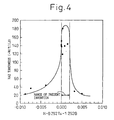
- Fig. 4 is a graph showing the preferable range of the equivalent equation EN according to the present invention in relation to the toughness of a HAZ.
-
- The present invention is explained in detail hereafter. As a metallographic factor to improve the toughness of a HAZ, the present inventors studied the method of making reheated austenite grains fine in a HAZ, which is heated to 1,400°C or higher, using an oxide.
- For making the reheated austenite grains fine, it is necessary to suppress the growth of austenite grains at high temperatures. One of the most effective measures for this is pinning of austenite grain boundaries using dispersed grains and thereby inhibiting the migration of the grain boundaries. The oxides and nitrides of Ti have so far been considered effective as examples of the dispersed grains having this function. As has been explained before, however, the pinning effect of Ti nitrides is decreased at a temperature of 1,400°C or higher since a large proportion is dissolved in a steel in this temperature range and, for this reason, it is necessary to use oxides which are stable, as pinning grains, at high temperatures.
- The higher the volume percentage of the dispersed grains and the larger the diameter of each of them, the larger the effect of the dispersed grains to pin the crystal grain boundaries. It has to be noted, however, that there is an upper limit to the volume percentage of the dispersed grains, determined by the concentrations of the component elements of the grains contained in the steel in question. Therefore, supposing that the volume percentage is constant, a good pinning effect is obtained when the diameter of the grains is not very large. From this viewpoint, the present inventors carried out studies on how to increase the volume percentage of oxides and how to obtain an adequate grain size.
- To increase the content of oxygen is one of the measures to increase the volume percentage of oxides but, as the increase in the oxygen content also causes the formation of coarse oxides detrimental to material quality in a great amount, it is not an effective measure. Facing this situation, in order to make the most of oxygen, the present inventors studied the possibility of using an element having a small solubility product with respect to oxygen. Al is generally used as an element having a small solubility product with respect to oxygen, namely a strongly deoxidizing element. Al alone, however, is not enough for fully utilizing oxygen, and therefore a deoxidizing element stronger than Al is required. Here, it is important to use Ca, which is used for various purposes in the deoxidation process of steel production. Since Ca has a small solubility product with respect to oxygen, it produces more oxides than Al does with the same amount of oxygen. Through tests using Ca as a deoxidizing element, the present inventors discovered that it was possible to increase the volume percentage of oxides, or the amount of oxides, when Ca at 3% or more and Al at 1% or more were contained in the composition of the oxide particles formed in a steel. Based on this result, the present invention stipulated that the oxide particles in a steel contained at least Ca, Al and O in their composition, and that the oxide particles contained, in the mass percentage of the elements excluding O, Ca at 3% or more and Al at 1% or more.
- For forming a great amount of oxides, it is also effective to use Mg together with Ca. Although the effect of Mg is not so large as that of Ca, it is stronger than Al as a deoxidizing element and its solubility product with respect to oxygen is small. Therefore, it becomes possible to further increase the number of the oxide particles when Mg is used for deoxidation in combination with Ca. As a result of tests using Ca as a deoxidizing element, the present inventors discovered that it was possible to further increase the volume percentage of oxides, or the amount of oxides, when Ca at 5% or more, Al at 5% or more and Mg at 1% or more were contained in the composition of the oxide particles formed in a steel. Based on this result, the present invention stipulated that the oxide particles in a steel contained at least Ca, Al, Mg and O in their composition, and that, in the mass percentage of the elements excluding O, the oxide particles contained Ca at 5% or more, Al at 5% or more and Mg at 1% or more.
- In addition to the above, the present inventors discovered that a further increase in the volume percentage of the dispersed grains could be brought about through the combined effect of oxides and sulfides when sulfides such as CaS and MgS precipitated around oxide particles. Based on this finding, the present invention stipulated that the particles in a steel contained at least Ca, Al, O and S in their composition, and that, in the mass percentage of the elements excluding O, the particles contained Ca at 5% or more, Al at 5% or more and S at 1% or more, otherwise, that the particles in a steel contained at least Ca, Al, Mg, O and S in their composition, and that, in the mass percentage of the elements excluding O, the particles contained Ca at 5% or more, Al at 5% or more, Mg at 1% or more and S at 1% or more.
- The present inventors confirmed that the effects of the present invention remained unaffected in the above case, even when the oxide particles contained Mg and/or REM, having a deoxidizing strength rated between Al and Ca, as a component element or component elements in the balance of the elements whose contents were specified above. The present inventors also confirmed that the effects of the present invention were not hindered even when the particles contained deoxidizing elements milder than Al, such as Si, Mn and Ti, unavoidably included in the oxide particles and/or impurity elements, such as S, inevitably combining with Ca and so on.
- The size of the oxide particles effective for the pinning is explained next.
- The effect of pinning crystal grain boundaries by dispersed grains increases as the volume percentage of the dispersed grains increases and the size of each of the grains becomes larger. Here, the present inventors reasoned that, when the volume percentage of the dispersed grains was constant, the number of the oxide particles would increase as the size of each of the particles became smaller and, as a consequence, pinning effect would increase, and that, when the grain size was too small, the proportion of the crystal grain boundaries occupied by the dispersed grains would decrease and, as a result, the pinning effect would also decrease. Through the close examination of the size of austenite grains under a heating to a high temperature, using test pieces having different sizes of the dispersed grains, the present inventors discovered that the pinning effect was the largest when the grain size was from 0.005 to 2.0 µm. It was also made clear that the pinning force for arresting the migration of austenite grain boundaries became stronger as the size of the dispersed grains increased. Thus, the present inventors discovered that, among the dispersed grains having grain sizes from 0.005 to 2.0 µm, those having grain sizes from 0.1 to 2.0 µm were particularly effective. Pinning effect decreases gradually when the grain size decreases to below 0.1 µm and, when it is below 0.005 µm, little of the pinning effect appears. Although the oxide particles larger than 2.0 µm have pinning effect, they sometimes serve as the starting points of brittle fracture and, for this reason, they are undesirable from the viewpoint of the material properties of a steel. Based on the above, the present invention stipulates that the required diameter of the oxide particles is from 0.005 to 2.0 µm, preferably from 0.1 to 2.0 µm.
- Next, the present inventors studied the number of pinning grains required for securing a desired toughness of a HAZ.
- The larger the number of the oxide particles, the finer the structure becomes, and the larger the number of the grains, the higher the HAZ toughness becomes. A HAZ toughness required of a steel material is different in a complicated manner depending on the application of the steel material and the method of welding employed in the application. In this connection, the present inventors discovered that, in order to satisfy a HAZ toughness, for example, of 50 J or more in terms of the absorbed energy at a test temperature of -40°C, corresponding to the toughness level required when a high strength steel for ship construction was welded under a high heat input, which was considered to be a case where especially stringent property requirements were applied, it was necessary that the density of oxide particles 0.005 to 2.0 µm in circle-equivalent diameter was 100 pieces/mm2 or more, as shown in Fig. 1. However, in consideration of the facts that the toughness improvement effect of the oxide particles decreases as their number increases and that, therefore, increasing the number of the oxide particles beyond a certain required number (too much) leads to a higher possibility of the formation of coarse grains harmful to toughness, an appropriate upper limit of the density of the oxide particles is 3,000 pieces/mm2.
- The size and number of the oxide particles can be measured, for instance, in the following manner. An extracted replica is produced from a sample taken from a base steel plate, and it is observed at 20 or more visual fields, namely 1,000 µm2 or more in terms of the total observation area, under a magnification of × 10,000 using an electron microscope. The size of the particles are determined, for instance, by calculating circle-equivalent diameters of the particles based on micrographs of the particles. Here, the extracted replica may be produced from any portion from the surface layer to the thickness center of a steel plate. A lower magnification may be used if the oxide particles can be observed adequately.
- The oxide particles form during the deoxidation process of molten steel. The oxides forming at this stage are called primary oxides. Thereafter, Ti-Al-Ca oxides form as the temperature of the molten steel falls during the stages of casting and solidification. The oxides forming at these stages are called secondary oxides. Either primary oxides or secondary oxides may be used for the purpose of the present invention.
- The effects of the oxides are the same regardless of the production processes of a steel material; normal rolling, controlled rolling or either of these combined with controlled cooling and tempering, quenching and tempering or the like may be employed.
- In the meantime, it was found as a new problem that, by dispersing the oxide particles in a steel through the above processes, the reheated austenite grains of a HAZ are made refine very effectively by the pinning and the toughness of the HAZ is enhanced accordingly but, at the same time, the area of grain boundaries increases and the ferrite forming capacity at the grain boundaries also increases as the austenite grains become finer and that, as a consequence, comparatively coarse ferrite grains especially at the corners of grain boundaries (triple boundaries, i.e., the points where three crystal grains meet) serve as the initiation points of fracture and determine the rate of toughness improvement when a very stringent toughness is required. In other words, if the formation of the comparatively coarse ferrite grains at the grain boundaries and triple boundaries is suppressed or improved, it is possible to significantly improve the toughness of a HAZ, in combination with the refining effect of the structure of the HAZ. The problem of the comparatively coarse ferrite grains forming at the grain boundaries and triple boundaries has been acknowledged for the first time during the attempt of refining the HAZ structure of high heat input welding to an unprecedented extent using an oxide.
- The present inventors proceeded with further studies for significantly increasing the effects of improving toughness by refining a HAZ structure yet more. As a result, they discovered that, when the reheated austenite grains were made finer by dispersing fine oxide grains in a great amount, an addition of B was very effective for suppressing the growth of ferrite at the grain boundaries and triple boundaries during the process in which a HAZ structure was formed. Further studies into the detailed mechanism of the effect of the addition of B made it clear that the balance between B and N was essential, and that the effect of the B addition was enhanced and the toughness of a HAZ consisting of a fine structure was greatly improved and stabilized when B was not caught entirely by N but remained in a solute state at the stage in which ferrite formed during the cooling of a welding heat cycle.
- It was found that, since the affinity between Ti and N was very strong in a steel containing Ti, when the amount of N consumed by Ti was taken into consideration, the toughness of a HAZ could be neatly expressed in relation to the equivalent equation EN = (%N) - 0.292(%Ti) - 1.292(%B), as shown in Fig. 2, and that the effect of B addition was large and the toughness was markedly improved when the value of the equivalent equation was within the range from -0.004 to -0.0005, preferably from 0 to 0.002. When the value of the equivalent equation is below -0.004, Ti and B are in a solute state at the same time and, as a result, hardenability is remarkably increased and the HAZ toughness is deteriorated. When the value exceeds -0.0005, on the other hand, a sufficient amount of solute B is not secured and the effect of fine ferrite formation does not show.
- The effects of the oxides are the same regardless of the production process of the steel material; normal rolling, controlled rolling or either of these combined with controlled cooling and tempering, quenching and tempering or the like may be employed.
- The ranges of the fundamental component elements according to the present invention are explained hereafter.
- C is an effective component for increasing steel strength and, as such, the lower limit of its content is set at 0.03%. Since its excessive addition remarkably deteriorates the weldability, HAZ toughness and so on of a steel material, the upper limit of its content is set at 0.18%.
- Si is a component necessary for securing the strength of base metal, deoxidizing steel and so on, but the upper limit of its content is set at 0.5% in order to prevent the toughness of a HAZ from lowering through its hardening.
- Mn is an effective component for securing the strength and toughness of base metal and, as such, it has to be added at 0.4% or more, but the upper limit of its content is set at 2.0% in order to control the toughness, cracking property and so on of welded joints within respective tolerable ranges.
- The smaller the content of P, the better, but, since it is very costly to reduce its content industrially, the upper limit of its content is set at 0.02%.
- The smaller the content of S, the better, but, since it is very costly to reduce its content industrially, the upper limit of its content is set at 0.02%.
- Al is an important deoxidizing element and, for this reason, the lower limit of its content is set at 0.005%. When a great amount of Al is included in steel, however, the surface quality of cast slabs or blooms is adversely affected and, therefore, the upper limit of its content is set at 0.04%.
- Ti is added at 0.005% or more for the purpose of forming Ti nitrides through the combination with N. When the amount of solute Ti increases, however, the HAZ toughness is lowered and, for this reason, the upper limit of its content is set at 0.03%.
- An addition of Ca at 0.0005% or more is necessary for forming Ca oxides but, since its excessive addition leads to the formation of coarse inclusions, the upper limit of its content is set at 0.003%.
- An addition of Mg at 0.0001% or more is necessary for forming Mg oxides but, since its excessive addition leads to the formation of coarse inclusions, the upper limit of its content is set at 0.002%.
- N has an effect for enhancing the HAZ toughness when it precipitates in the form of TiN and, for this reason, the lower limit of its content is set at 0.0005%. However, since the HAZ toughness is lowered when the amount of solute N increases, the upper limit of its content is set at 0.007%.
- B is an effective element, when it is in a solute state, for suppressing the growth of ferrite forming at the boundaries of reheated austenite grains and, for this reason, B of at least 0.0005% is added. When it is added in a great amount, however, the toughness of a steel material is deteriorated and, therefore, the upper limit of its content is set at 0.003%.
- Cu is effective for enhancing the strength of a steel material but, when it is added in excess of 1.0%, the HAZ toughness is lowered and, therefore, the upper limit of its content is set at 1.0%.
- Ni is effective for enhancing the strength and toughness of a steel material but, as the increase in its addition increases production costs, the upper limit of its content is set at 1.5%.
- Nb is an effective element for enhancing the strength and toughness of base metal through the improvement of hardenability but, since its excessive addition deteriorates the toughness of a HAZ remarkably, the upper limit of its content is set at 0.04%.
- V, Cr and Mo have the same effects as Nb does and, for this reason, the upper limits of their contents are set at 0.1, 0.6 and 0.6%, respectively.
- REM has a deoxidizing strength in molten steel second to Ca and also a function of helping Ca form fine oxide grains, but its addition is more costly than the addition of Ca and, when added excessively, it forms coarse inclusions to deteriorate the toughness of a HAZ and a steel plate. For this reason, the upper limit of its content is set at 0.05%.
- 50-kg class steels having the chemical compositions shown in Table 1 were produced for test purposes. Steels 1 to 8 are invented steels and steels 9 to 14 are comparative steels. The sample steels were melted in a converter and deoxidized during vacuum degassing treatment in an RH degasser. The amount of solute oxygen in molten steel was controlled with Si before the addition of Ti, and then Ti and Al were added in this sequence for deoxidation. Then the steels were cast into slabs 280 mm in thickness by continuous casting and then rolled into steel plates 45 mm in thickness through reheating and rolling. The steel plates thus produced were welded through 1 pass of SEGARC welding. The heat input was approximately 200 kJ/cm2.
- Table 2 shows the composition of oxide particles, the number of the oxide particles 0.005 to 2.0 µm in diameter, the rolling conditions of the steel plates, the characteristics of base metal and the toughness of the HAZ. A Charpy impact value for evaluating the HAZ toughness is the average value of 9 test pieces, each of the values being measured at the portion of a HAZ located 1 mm away from a fusion line.


- As is clear from Table 2, steels 1 to 8 according to the present invention have excellent HAZ toughness compared with comparative steels: they are quite excellent in the HAZ toughness at -40°C, as the oxide particle size, the number of oxide particles and the amounts of their components are within the respective ranges specified in the present invention. It is also clear from the table that, among the steels according to the present invention, invented steels 3, 4, 5, 6, and 8 containing the oxide particles 0.1 to 2.0 µm in diameter within the range from 100 to 3,000 pieces/mm2, invented steels 2, 4, 5, 6, 7 and 8 having the oxide particles containing Mg of 1% or more, and invented steels 3, 4 and 5 having the oxide particles containing S of 1% or more are superior in the HAZ toughness to the other invented steels.
- On the other hand, all of comparative steels 9 to 16 showed low HAZ toughness below 40 J in the Charpy test at -40°C. The reason for this is as follows. In comparative steel 9, the contents of Ca and Mg in the composition of the oxide particles and the number of the oxide particles are below respective lower limits according to the present invention. In
comparative steel 10, the content of Ca in the oxide particles and the number of the oxide particles are below respective lower limits according to the present invention. In comparative steels 11 to 15, the number of the oxide particles is below the lower limit according to the present invention. - Further, in comparative steel 16, the content of Al in the oxide particles and the number of oxide particles are below the respective lower limits according to the present invention.
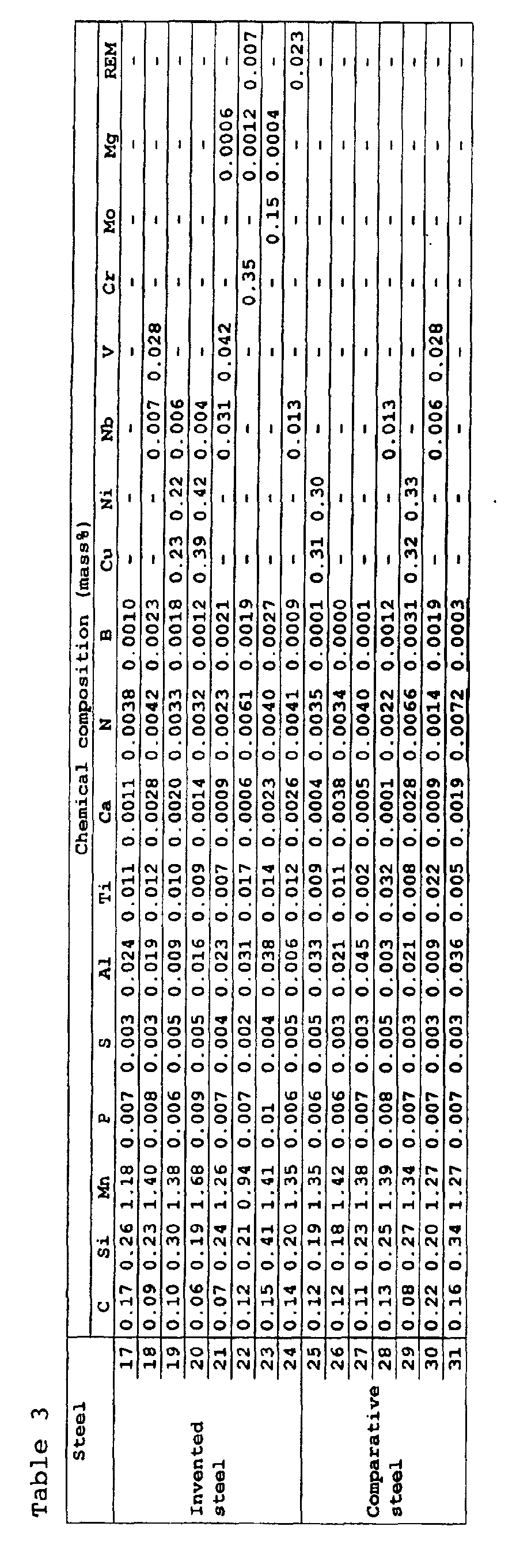
- 50- to 60-kg class steels having the chemical compositions shown in Table 3 were produced for test purposes. Steels 17 to 24 are invented steels and steels 25 to 31 are comparative steels. The steels were melted in a converter and deoxidized during vacuum degassing treatment in an RH degasser. The amount of solute oxygen in molten steel was controlled with Si before the addition of Ti, and then Ti, Al and Ca were added in this sequence for deoxidation. Then the steels were cast into slabs 280 mm in thickness by continuous casting and then rolled into
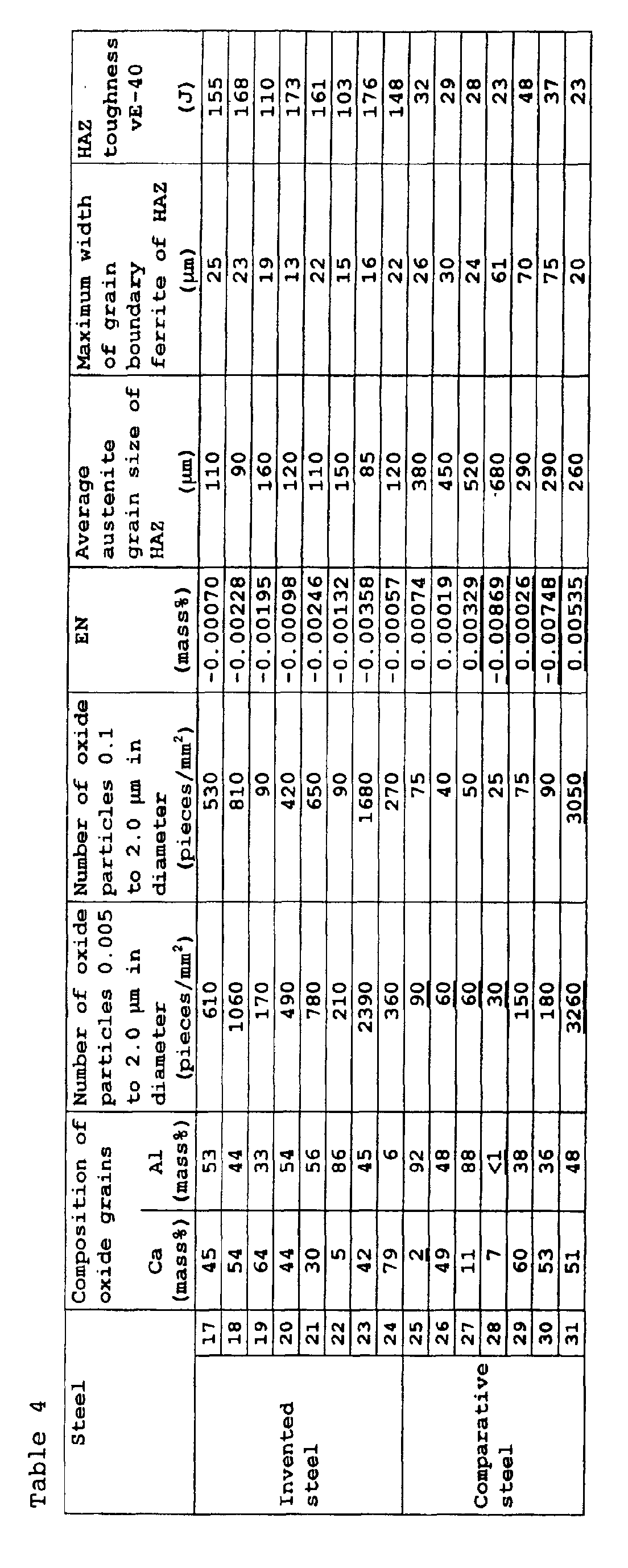
steel plates 50 mm in thickness through reheating and rolling. The steel plates thus produced were welded through 1 pass of electroslag welding. The heat input was approximately 280 kJ/cm2. - Table 4 shows the average composition of oxide particles, the number of the oxide particles 0.005 to 2.0 µm in diameter measured with an electron microscope, the value of EN in the equation EN = (%N) - 0.292(%Ti) - 1.292(%B), the average austenite grain size of the HAZ structure measured by the section method at 20 visual fields under the magnification of × 100 using a light microscope, the maximum ferrite size (width) at the grain boundaries or triple boundaries of austenite grains and the HAZ toughness. The Charpy test for evaluating the HAZ toughness was done at -40°C, and each of the impact values in the table is the average value of 9 test pieces, each of the values being measured at the portion of a HAZ located 1 mm away from a bond.
- As is clear from Table 4, invented steels 17 to 24 have excellent HAZ toughness compared with comparative steels. The density of the oxide particles 0.005 to 2.0 µm in diameter containing Ca and Al by respective prescribed contents is within the range from 100 to 3,000 pieces/mm2 and, thanks to this, the austenite grain size of the HAZ structure of these steels is smaller compared with that of comparative steels, and the ferrite at the grain boundaries or triple boundaries of austenite grains is also small owing to the effect of B. As a result, the Charpy absorbed energy value at -40°C of each of these steels far exceeds 50 J, which is the average absorbed energy value generally required of steel structures from the viewpoint of fracture mechanics, and thus the HAZ toughness is quite excellent, as seen in the table. Note that, in invented
steels 17, 18, 20, 21, 23 and 24, the density of the oxide particles 0.1 to 2.0 µm in diameter is 100 pieces/mm2 or more and, as a consequence, the austenite grain size is relatively small compared with that of steels 19 and 22, and the Charpy absorbed energy value is high. - On the other hand, all of comparative steels 25 to 31 showed low HAZ toughness below 50 J in the Charpy test at -40°C. The reason for this is as follows. In comparative steels 25 to 28, the chemical compositions of the steels are outside the range of the present invention and the composition and number of the oxide particles are also outside the respective ranges specified in the present invention. In comparative steels 29 and 30, although the composition and number of the oxide particles are inside the respective ranges according to the present invention, the equivalent value EN is outside the range of the present invention. In comparative steel 31, the amount of oxygen in the steel is higher than the other steels and the number of the oxide particles is above the upper limit according to the present invention.
- 50- to 60-kg class steels having the chemical compositions shown in Table 5 were produced for test purposes. Steels 32 to 39 are invented steels and steels 40 to 46 are comparative steels. The steels were melted in a converter and deoxidized during vacuum degassing treatment in an RH degasser. The amount of solute oxygen in molten steel was controlled with Si before the addition of Ti, and then Ti, Al and Ca were added in this sequence for deoxidation. Then the steels were cast into slabs 280 mm in thickness by continuous casting and then rolled into
steel plates 50 mm in thickness through reheating and rolling. The steel plates thus produced were welded through 1 pass of electrogas welding. The heat input was approximately 280 kJ/cm2. - Table 6 shows the average composition of oxide particles, the number of the oxide particles 0.005 to 2.0 µm in diameter measured with an electron microscope, the value of EN in the equation EN = (%N) - 0.292(%Ti) - 1.292(%B), the average austenite grain size of the HAZ structure measured by the section method at 20 visual fields in the micrographs under the magnification of × 100 taken by a light microscope, the maximum ferrite size (width) at the grain boundaries or triple boundaries of austenite grains and the HAZ toughness. A HAZ toughness value is the average value of the results of Charpy tests at -40°C obtained by applying the Charpy tests to 9 test pieces, each of the values being measured at the portion of a HAZ located 1 mm away from the bond of the steel plates after the welding.
- As is clear from Table 6, invented steels 32 to 39 have excellent HAZ toughness compared with comparative steels. The density of the oxide particles 0.005 to 2.0 µm in diameter containing Ca and A1 by respective prescribed contents is within the range from 100 to 3,000 pieces/mm2 and, thanks to this, the austenite grain size of the HAZ structure of these steels is smaller compared with that of comparative steels, and the ferrite at the grain boundaries or triple boundaries of austenite grains is also small owing to the effect of B. As a result, the Charpy absorbed energy value at -40°C of each of these steels far exceeds 50 J, which is the average value generally required of steel structures from the viewpoint of fracture mechanics, and thus the HAZ toughness is quite excellent, as seen in the table. Note that, in invented steels 32, 33, 35, 36, 38 and 39, the density of the oxide particles 0.1 to 2.0 µm in diameter is 100 pieces/mm2 or more and, as a consequence, the austenite grain size is relatively small compared with that of steels 34 and 37, and the Charpy absorbed energy value is high.
- On the other hand, all of
comparative steels 40 to 46 showed low HAZ toughness below 50 J in the Charpy test at -40°C. The reason for this is as follows. Incomparative steels 40 to 43, the chemical compositions of the steels are outside the range of the present invention and the composition and number of the oxide particles are also outside the respective ranges according to the present invention. In comparative steels 44 and 45, although the composition and number of the oxide particles are inside the respective ranges according to the present invention, the equivalent value of EN is outside the range of the present invention. In comparative steel 46, the amount of oxygen in the steel is higher than the other steels and the number of the oxide particles is above the upper limit according to the present invention and, as a result, the HAZ toughness is lower than that of invented steels.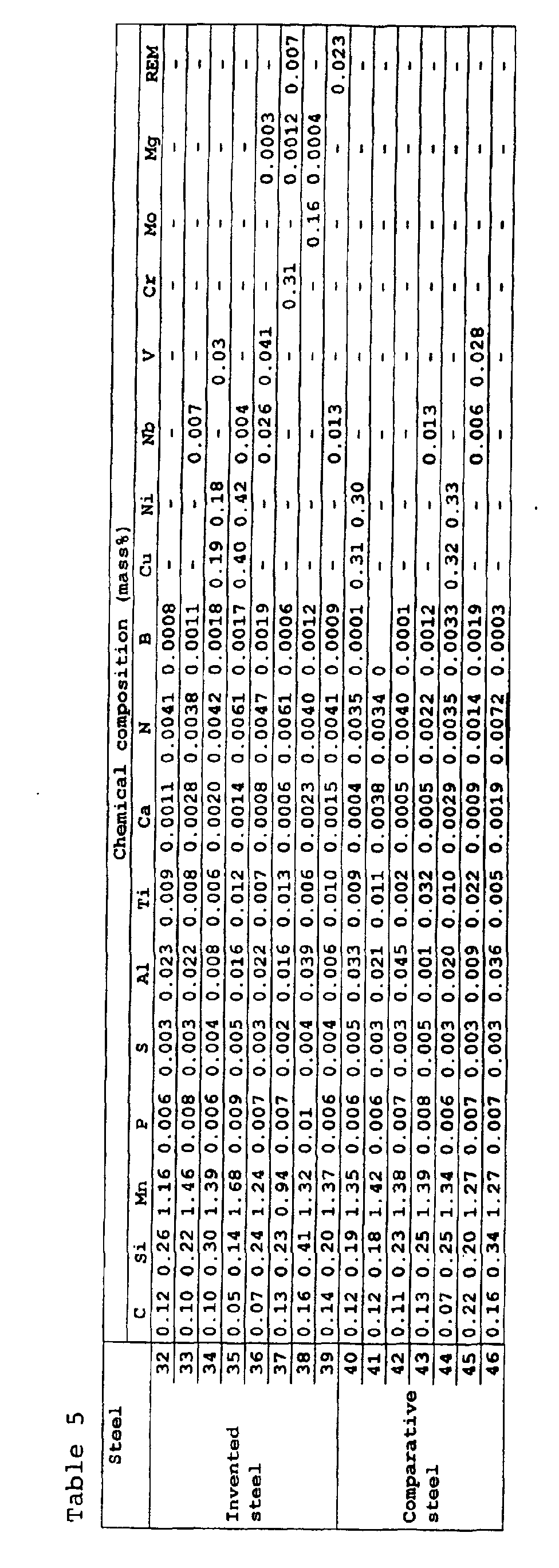

- The present invention is a steel plate excellent in toughness at a welding joint even in high heat input welding or ultra-high heat input welding with a heat input of 200 kJ/cm2 or more, and is applicable to general steel materials for welded structures used for ships, marine construction, medium and high-rise buildings, bridges and so on and also to material steel plates for pipes, bars, long steel products, hot-rolled steel sheets and the like. By the present invention, a significant improvement in the toughness of a welded joint is obtained in any of these applications.
Claims (9)
- A steel excellent in the toughness of a weld heat-affected zone characterized in that: the steel contains, in mass,with the balance consisting of Fe and unavoidable impurities; the density, defined by pieces per unit area, of oxide particles 0.005 to 2.0 µm in circle-equivalent diameter contained in the steel is 100 to 3,000 pieces/mm2; the oxide particles contain at least Ca, Al and O in their composition; and, in the mass percentage of the elements excluding O, the oxide particles contain Ca at 5% or more and Al at 5% or more with the balance consisting of Fe and other unavoidable impurities.C: 0.03 to 0.18%,Si: 0.5% or less,Mn: 0.4 to 2.0%,P: 0.02% or less,S: 0.02% or less,Al: 0.005 to 0.04%,Ti: 0.005 to 0.03%,Ca: 0.0005 to 0.003%, andN: 0.0005 to 0.007%,
- A steel excellent in the toughness of a weld heat-affected zone according to claim 1, characterized in that: the steel further contains Mg at 0.0001 to 0.002 mass %; the oxide particles, when the steel contains Mg, contain at least Ca, Al, Mg and O in their composition; and, in the mass percentage of the elements excluding O, the oxides particles contain Ca at 5% or more, Al at 5% or more and Mg at 1% or more.
- A steel excellent in the toughness of a weld heat-affected zone according to claim 1 or 2, characterized in that: the oxide particles in the steel contain at least Ca, Al and S in their composition; and, in the mass percentage of the elements excluding O, the oxide particles contain Ca at 5% or more, Al at 5% or more and S at 1% or more.
- A steel excellent in the toughness of a weld heat-affected zone according to claim 2 or 3, characterized in that: the oxide particles in the steel contain at least Ca, Al, Mg, O and S in their composition; and, in the mass percentage of the elements excluding O, the oxide particles contain Ca at 5% or more, Al at 5% or more, Mg at 1% or more and S at 1% or more.
- A steel excellent in the toughness of a weld heat-affected zone according to claim 1, characterized in that: the steel further contains B at 0.0005 to 0.003 mass %; the oxide particles, when the steel contains B, contain at least Ca, Al and O in their composition; in the mass percentage of the elements excluding O, the oxide particles contain Ca at 3% or more and Al at 1% or more; and the steel satisfies the expression -0.0005 ≦ EN ≦ 0.002, provided that EN is given by the equivalent equation EN = (%N) - 0.292(%Ti) - 1.292.
- A steel excellent in the toughness of a weld heat-affected zone according to any one of claims 1 to 5, characterized in that the steel further contains, in mass, one or more of Cu at 1.0% or less, Ni at 1.5% or less, Nb at 0.04% or less, V at 0.1% or less, Cr at 0.6% or less, Mo at 0.6% or less and REM at 0.05% or less.
- A steel excellent in the toughness of a weld heat-affected zone according to any one of claims 1 to 4, characterized in that the steel satisfies the expression -0.004 ≦ EN ≦ -0.0005, provided that EN is given by the equivalent equation EN = (%N) - 0.292(%Ti) - 1.292.
- A steel excellent in the toughness of a weld heat-affected zone according to any one of claims 1 to 4, characterized in that the steel satisfies the expression 0 ≦ EN ≦ 0.002, provided that EN is given by the equivalent equation EN = (%N) - 0.292(%Ti) - 1.292.
- A steel excellent in the toughness of a weld heat-affected zone according to any one of claims 1 to 8, characterized in that the circle-equivalent diameter of oxide particles in the steel is 0.1 to 2.0 µm.
Priority Applications (1)
| Application Number | Priority Date | Filing Date | Title |
|---|---|---|---|
| EP04026201A EP1520912B1 (en) | 2000-02-10 | 2000-11-13 | Steel excellent in toughness of weld heat-affected zone |
Applications Claiming Priority (7)
| Application Number | Priority Date | Filing Date | Title |
|---|---|---|---|
| JP2000033242 | 2000-02-10 | ||
| JP2000033241 | 2000-02-10 | ||
| JP2000033241 | 2000-02-10 | ||
| JP2000033242A JP2001226739A (en) | 2000-02-10 | 2000-02-10 | Steel with excellent toughness in the heat affected zone |
| JP2000068210 | 2000-03-13 | ||
| JP2000068210 | 2000-03-13 | ||
| PCT/JP2000/007999 WO2001059167A1 (en) | 2000-02-10 | 2000-11-13 | Steel product having weld heat-affected zone excellent in rigidity |
Related Child Applications (1)
| Application Number | Title | Priority Date | Filing Date |
|---|---|---|---|
| EP04026201A Division EP1520912B1 (en) | 2000-02-10 | 2000-11-13 | Steel excellent in toughness of weld heat-affected zone |
Publications (3)
| Publication Number | Publication Date |
|---|---|
| EP1262571A1 true EP1262571A1 (en) | 2002-12-04 |
| EP1262571A4 EP1262571A4 (en) | 2003-03-26 |
| EP1262571B1 EP1262571B1 (en) | 2005-08-10 |
Family
ID=27342318
Family Applications (2)
| Application Number | Title | Priority Date | Filing Date |
|---|---|---|---|
| EP04026201A Expired - Lifetime EP1520912B1 (en) | 2000-02-10 | 2000-11-13 | Steel excellent in toughness of weld heat-affected zone |
| EP00974966A Expired - Lifetime EP1262571B1 (en) | 2000-02-10 | 2000-11-13 | Steel having weld heat-affected zone excellent in toughness |
Family Applications Before (1)
| Application Number | Title | Priority Date | Filing Date |
|---|---|---|---|
| EP04026201A Expired - Lifetime EP1520912B1 (en) | 2000-02-10 | 2000-11-13 | Steel excellent in toughness of weld heat-affected zone |
Country Status (4)
| Country | Link |
|---|---|
| EP (2) | EP1520912B1 (en) |
| KR (1) | KR100514667B1 (en) |
| DE (2) | DE60033070T2 (en) |
| WO (1) | WO2001059167A1 (en) |
Cited By (3)
| Publication number | Priority date | Publication date | Assignee | Title |
|---|---|---|---|---|
| EP1416059A1 (en) * | 2002-10-29 | 2004-05-06 | The Japan Steel Works, Ltd. | Base material for clad steel plate excellent in low-temperature toughness at weld heat-affected zone and method for producing the clad steel plate |
| US8142574B2 (en) | 2008-07-15 | 2012-03-27 | Nippon Steel Corporation | Steel product for welding |
| CN105008574A (en) * | 2013-03-12 | 2015-10-28 | 杰富意钢铁株式会社 | Thick steel plate with excellent CTOD characteristics of multilayer welded joint and manufacturing method thereof |
Families Citing this family (6)
| Publication number | Priority date | Publication date | Assignee | Title |
|---|---|---|---|---|
| JP4972451B2 (en) * | 2007-04-20 | 2012-07-11 | 株式会社神戸製鋼所 | Low yield ratio high strength steel sheet with excellent low temperature toughness of weld heat affected zone and base metal and method for producing the same |
| US9403242B2 (en) | 2011-03-24 | 2016-08-02 | Nippon Steel & Sumitomo Metal Corporation | Steel for welding |
| CN103649355B (en) * | 2011-07-10 | 2016-08-17 | 塔塔钢铁艾默伊登有限责任公司 | Have the HAZ-of improvement soften repellence hot-rolled high-strength steel band and the method that produces described steel |
| CN105750760B (en) * | 2011-11-25 | 2018-06-08 | 新日铁住金株式会社 | Steel material for welding |
| CN103320692B (en) | 2013-06-19 | 2016-07-06 | 宝山钢铁股份有限公司 | Superhigh tenacity, superior weldability HT550 steel plate and manufacture method thereof |
| CN103320693B (en) | 2013-06-19 | 2015-11-18 | 宝山钢铁股份有限公司 | Anti-zinc fracturing line steel plate and manufacture method thereof |
Family Cites Families (4)
| Publication number | Priority date | Publication date | Assignee | Title |
|---|---|---|---|---|
| JPH08158006A (en) * | 1994-12-06 | 1996-06-18 | Kobe Steel Ltd | High strength steel excellent in toughness in weld heat-affected zone |
| JP3323414B2 (en) * | 1996-12-19 | 2002-09-09 | 新日本製鐵株式会社 | Steel with excellent heat-affected zone toughness in large heat input welding and method for producing the same |
| JP3599556B2 (en) * | 1998-02-16 | 2004-12-08 | 株式会社神戸製鋼所 | High-strength steel sheet excellent in toughness of base material and heat-affected zone of large heat input welding and method of manufacturing the same |
| JP3507339B2 (en) * | 1998-04-15 | 2004-03-15 | 新日本製鐵株式会社 | Steel plate with excellent toughness in weld heat affected zone |
-
2000
- 2000-11-13 EP EP04026201A patent/EP1520912B1/en not_active Expired - Lifetime
- 2000-11-13 DE DE60033070T patent/DE60033070T2/en not_active Expired - Lifetime
- 2000-11-13 WO PCT/JP2000/007999 patent/WO2001059167A1/en not_active Ceased
- 2000-11-13 DE DE60021919T patent/DE60021919T2/en not_active Expired - Lifetime
- 2000-11-13 EP EP00974966A patent/EP1262571B1/en not_active Expired - Lifetime
- 2000-11-13 KR KR10-2002-7010139A patent/KR100514667B1/en not_active Expired - Fee Related
Non-Patent Citations (2)
| Title |
|---|
| No further relevant documents disclosed * |
| See also references of WO0159167A1 * |
Cited By (5)
| Publication number | Priority date | Publication date | Assignee | Title |
|---|---|---|---|---|
| EP1416059A1 (en) * | 2002-10-29 | 2004-05-06 | The Japan Steel Works, Ltd. | Base material for clad steel plate excellent in low-temperature toughness at weld heat-affected zone and method for producing the clad steel plate |
| US8142574B2 (en) | 2008-07-15 | 2012-03-27 | Nippon Steel Corporation | Steel product for welding |
| CN105008574A (en) * | 2013-03-12 | 2015-10-28 | 杰富意钢铁株式会社 | Thick steel plate with excellent CTOD characteristics of multilayer welded joint and manufacturing method thereof |
| EP2975148A4 (en) * | 2013-03-12 | 2016-04-27 | Jfe Steel Corp | THICK STEEL SHEET HAVING EXCELLENT CTOD PROPERTIES IN MULTILAYER WELDED JOINTS, AND METHOD FOR MANUFACTURING THICK STEEL SHEET |
| US10023946B2 (en) | 2013-03-12 | 2018-07-17 | Jfe Steel Corporation | Thick steel sheet having excellent CTOD properties in multilayer welded joints, and manufacturing method for thick steel sheet |
Also Published As
| Publication number | Publication date |
|---|---|
| DE60021919T2 (en) | 2006-06-08 |
| EP1520912A2 (en) | 2005-04-06 |
| KR100514667B1 (en) | 2005-09-14 |
| EP1262571B1 (en) | 2005-08-10 |
| DE60033070D1 (en) | 2007-03-08 |
| KR20020073579A (en) | 2002-09-27 |
| EP1262571A4 (en) | 2003-03-26 |
| WO2001059167A1 (en) | 2001-08-16 |
| DE60033070T2 (en) | 2007-05-31 |
| EP1520912A3 (en) | 2005-04-27 |
| EP1520912B1 (en) | 2007-01-17 |
| DE60021919D1 (en) | 2005-09-15 |
Similar Documents
| Publication | Publication Date | Title |
|---|---|---|
| US5985053A (en) | Steel having improved toughness in welding heat-affected zone | |
| CN105658833B (en) | Ferrito-martensite two phase stainless steel and its manufacture method | |
| EP1736562A1 (en) | Thick high strength steel plate having excellent low temperature toughness in welding heat affected zone caused by high heat input welding | |
| KR20150119285A (en) | Thick steel sheet having excellent ctod properties in multilayer welded joints, and manufacturing method for thick steel sheet | |
| EP3378962B1 (en) | High heat input welded steel material | |
| EP3533891A1 (en) | Steel for high heat input welding | |
| EP1262571B1 (en) | Steel having weld heat-affected zone excellent in toughness | |
| EP1143023B1 (en) | Steel for welded structure purpose exhibiting no dependence of haz toughness on heat input and method for producing the same | |
| JP2001342537A (en) | Steel material excellent in toughness of weld heat affected zone and method of manufacturing the same | |
| JPWO2001027342A1 (en) | Steel for welded structures with HAZ toughness that is not dependent on heat input and its manufacturing method | |
| JP3323414B2 (en) | Steel with excellent heat-affected zone toughness in large heat input welding and method for producing the same | |
| JP4276576B2 (en) | Thick high-strength steel sheet with excellent heat input and heat-affected zone toughness | |
| JP2003313628A (en) | Steel with excellent toughness in the heat affected zone | |
| JP2002371338A (en) | Steel with excellent toughness in laser welds | |
| KR102850915B1 (en) | Steel plate and method for manufacturing steel plate | |
| JP3464567B2 (en) | Welded structural steel with excellent toughness in the heat affected zone | |
| JP3616609B2 (en) | Steel with excellent weld heat-affected zone toughness | |
| JPH07278736A (en) | Weld heat-affected zone steel with excellent toughness | |
| JP3502805B2 (en) | Method for producing steel with excellent toughness in weld joint | |
| JP3464566B2 (en) | Low temperature steel with excellent toughness in the heat affected zone | |
| JP4261968B2 (en) | Steel material excellent in weld heat-affected zone toughness and manufacturing method thereof | |
| JP3502851B2 (en) | 600MPa class steel with excellent weldability and weld joint toughness | |
| JP3502842B2 (en) | 600MPa class steel with excellent low YR characteristics and super high heat input weld joint toughness | |
| JP3477054B2 (en) | Steel sheet with excellent toughness of weld heat affected zone | |
| JP2001226739A (en) | Steel with excellent toughness in the heat affected zone |
Legal Events
| Date | Code | Title | Description |
|---|---|---|---|
| PUAI | Public reference made under article 153(3) epc to a published international application that has entered the european phase |
Free format text: ORIGINAL CODE: 0009012 |
|
| 17P | Request for examination filed |
Effective date: 20020910 |
|
| AK | Designated contracting states |
Kind code of ref document: A1 Designated state(s): AT BE CH CY DE DK ES FI FR GB GR IE IT LI LU MC NL PT SE TR |
|
| A4 | Supplementary search report drawn up and despatched |
Effective date: 20030211 |
|
| RIC1 | Information provided on ipc code assigned before grant |
Ipc: 7C 22C 38/00 A Ipc: 7C 22C 38/04 B |
|
| 17Q | First examination report despatched |
Effective date: 20030526 |
|
| GRAP | Despatch of communication of intention to grant a patent |
Free format text: ORIGINAL CODE: EPIDOSNIGR1 |
|
| RBV | Designated contracting states (corrected) |
Designated state(s): AT BE DE FR |
|
| RTI1 | Title (correction) |
Free format text: STEEL HAVING WELD HEAT-AFFECTED ZONE EXCELLENT IN TOUGHNESS |
|
| RBV | Designated contracting states (corrected) |
Designated state(s): DE FR |
|
| GRAS | Grant fee paid |
Free format text: ORIGINAL CODE: EPIDOSNIGR3 |
|
| GRAA | (expected) grant |
Free format text: ORIGINAL CODE: 0009210 |
|
| AK | Designated contracting states |
Kind code of ref document: B1 Designated state(s): DE FR |
|
| REF | Corresponds to: |
Ref document number: 60021919 Country of ref document: DE Date of ref document: 20050915 Kind code of ref document: P |
|
| ET | Fr: translation filed | ||
| PLBE | No opposition filed within time limit |
Free format text: ORIGINAL CODE: 0009261 |
|
| STAA | Information on the status of an ep patent application or granted ep patent |
Free format text: STATUS: NO OPPOSITION FILED WITHIN TIME LIMIT |
|
| 26N | No opposition filed |
Effective date: 20060511 |
|
| REG | Reference to a national code |
Ref country code: DE Ref legal event code: R082 Ref document number: 60021919 Country of ref document: DE Representative=s name: VOSSIUS & PARTNER, DE Effective date: 20130227 Ref country code: DE Ref legal event code: R081 Ref document number: 60021919 Country of ref document: DE Owner name: NIPPON STEEL & SUMITOMO METAL CORPORATION, JP Free format text: FORMER OWNER: NIPPON STEEL CORP., TOKIO/TOKYO, JP Effective date: 20130227 Ref country code: DE Ref legal event code: R082 Ref document number: 60021919 Country of ref document: DE Representative=s name: VOSSIUS & PARTNER PATENTANWAELTE RECHTSANWAELT, DE Effective date: 20130227 |
|
| REG | Reference to a national code |
Ref country code: FR Ref legal event code: CD Owner name: NIPPON STEEL & SUMITOMO METAL CORPORATION, JP Effective date: 20130913 Ref country code: FR Ref legal event code: CA Effective date: 20130913 |
|
| REG | Reference to a national code |
Ref country code: FR Ref legal event code: PLFP Year of fee payment: 16 |
|
| REG | Reference to a national code |
Ref country code: FR Ref legal event code: PLFP Year of fee payment: 17 |
|
| REG | Reference to a national code |
Ref country code: FR Ref legal event code: PLFP Year of fee payment: 18 |
|
| REG | Reference to a national code |
Ref country code: FR Ref legal event code: PLFP Year of fee payment: 19 |
|
| PGFP | Annual fee paid to national office [announced via postgrant information from national office to epo] |
Ref country code: DE Payment date: 20181030 Year of fee payment: 19 |
|
| PGFP | Annual fee paid to national office [announced via postgrant information from national office to epo] |
Ref country code: FR Payment date: 20181011 Year of fee payment: 19 |
|
| REG | Reference to a national code |
Ref country code: DE Ref legal event code: R082 Ref document number: 60021919 Country of ref document: DE Representative=s name: VOSSIUS & PARTNER PATENTANWAELTE RECHTSANWAELT, DE Ref country code: DE Ref legal event code: R081 Ref document number: 60021919 Country of ref document: DE Owner name: NIPPON STEEL CORPORATION, JP Free format text: FORMER OWNER: NIPPON STEEL & SUMITOMO METAL CORPORATION, TOKYO, JP |
|
| REG | Reference to a national code |
Ref country code: DE Ref legal event code: R119 Ref document number: 60021919 Country of ref document: DE |
|
| PG25 | Lapsed in a contracting state [announced via postgrant information from national office to epo] |
Ref country code: FR Free format text: LAPSE BECAUSE OF NON-PAYMENT OF DUE FEES Effective date: 20191130 Ref country code: DE Free format text: LAPSE BECAUSE OF NON-PAYMENT OF DUE FEES Effective date: 20200603 |