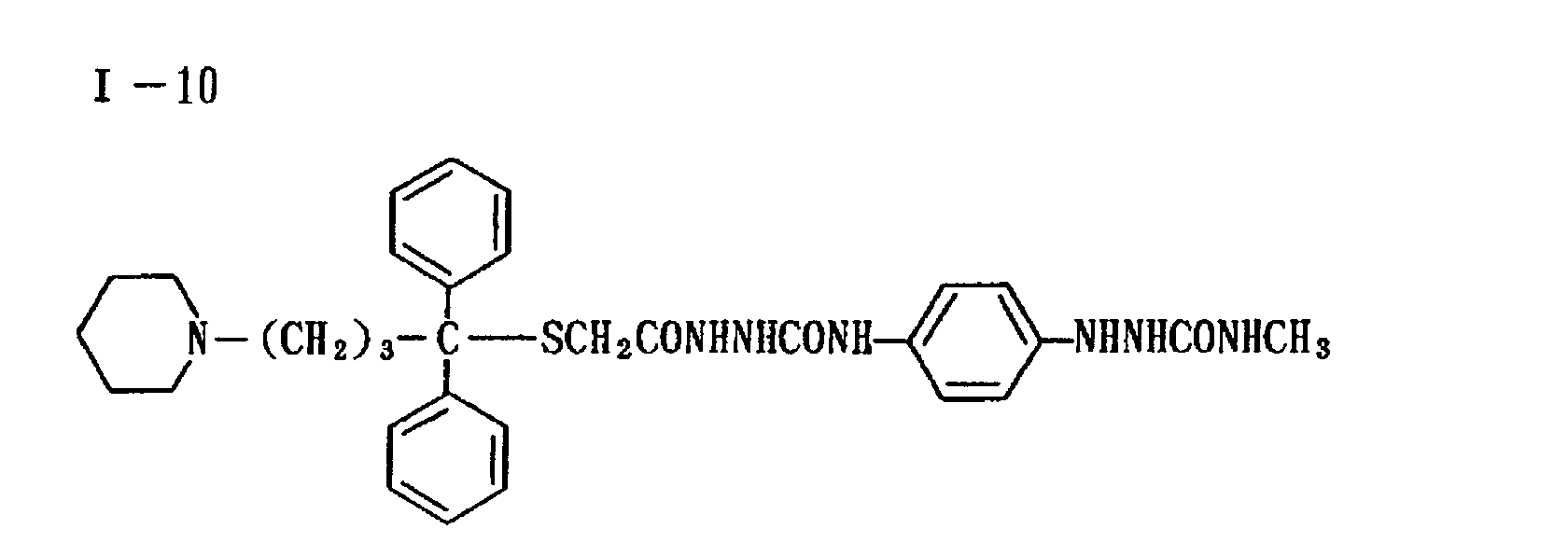
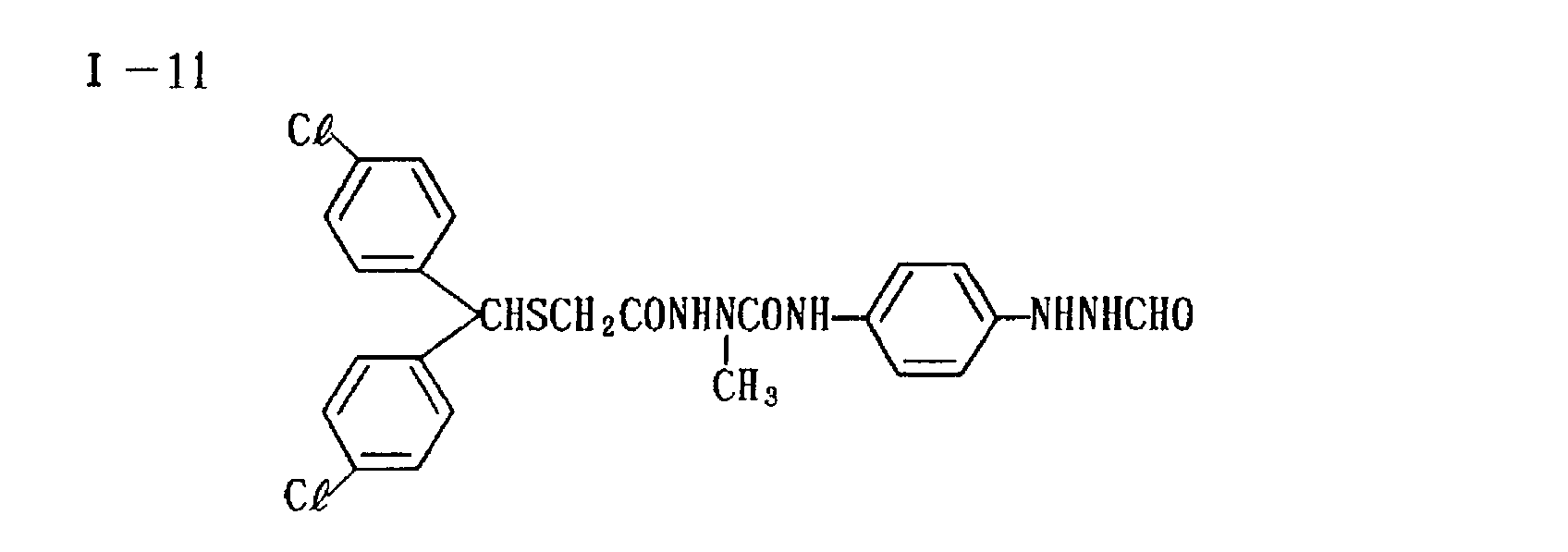
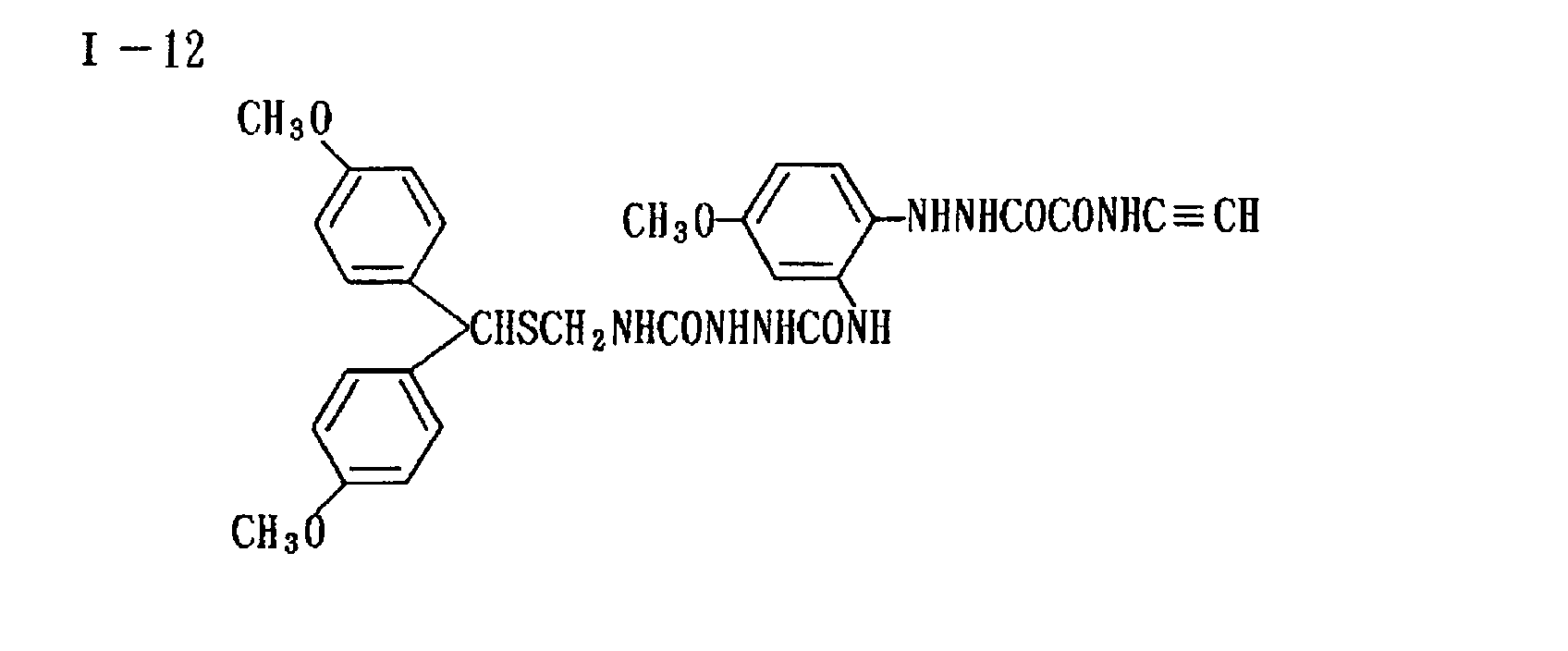
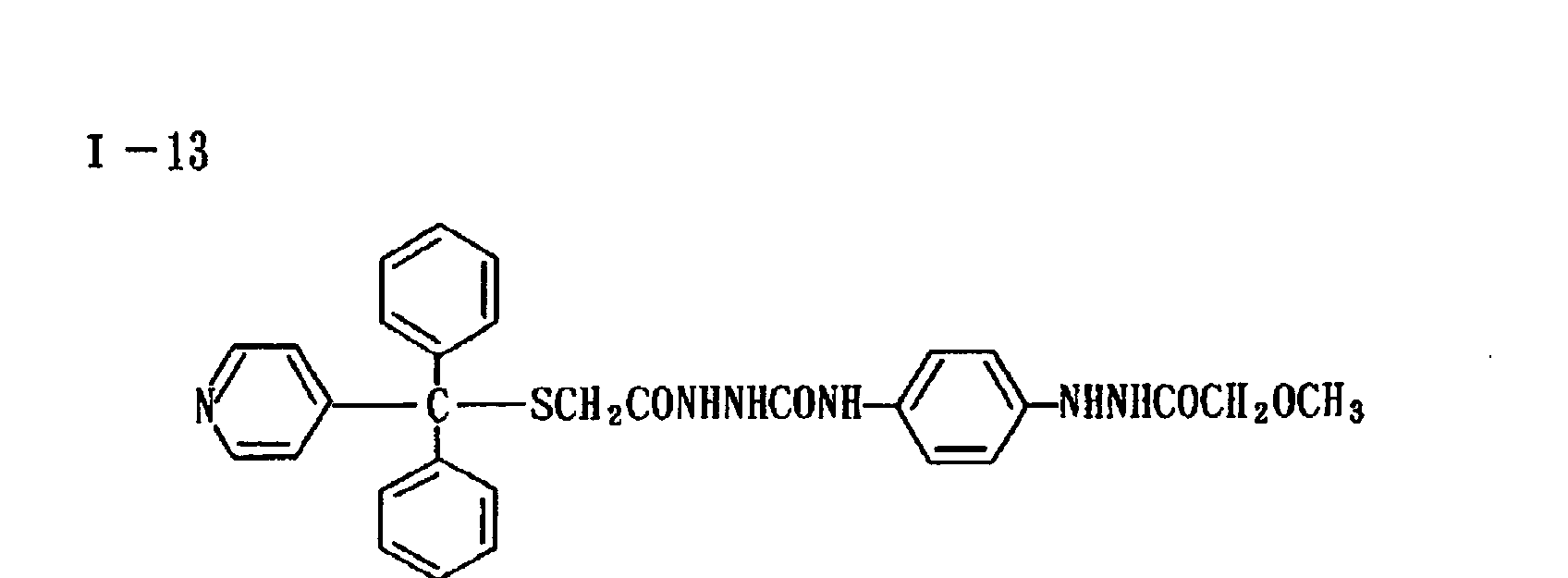
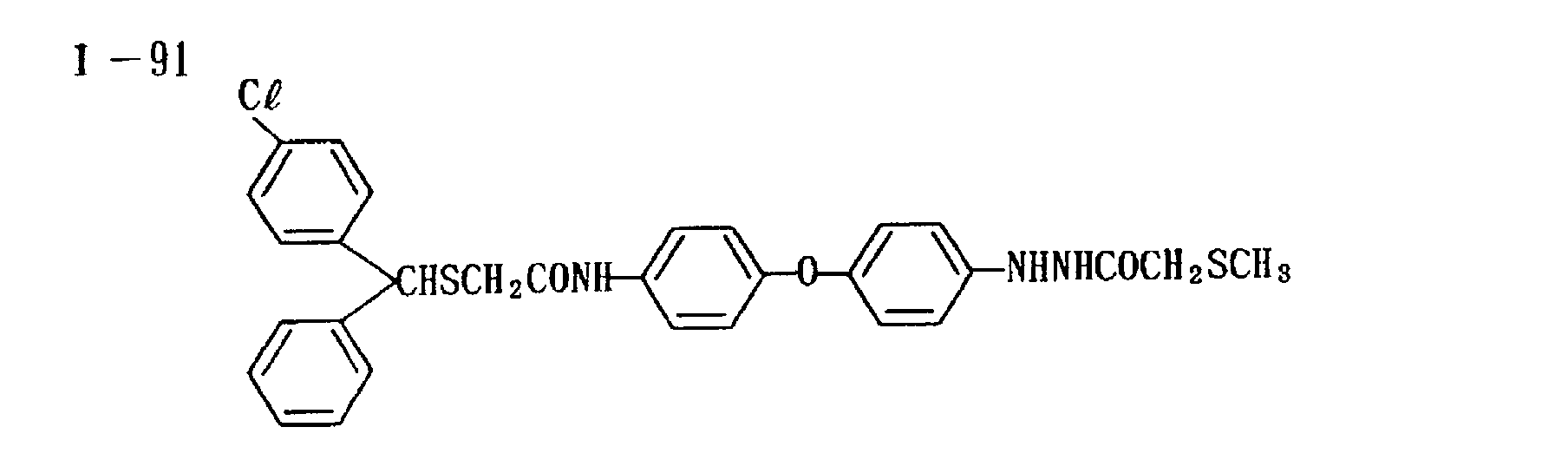
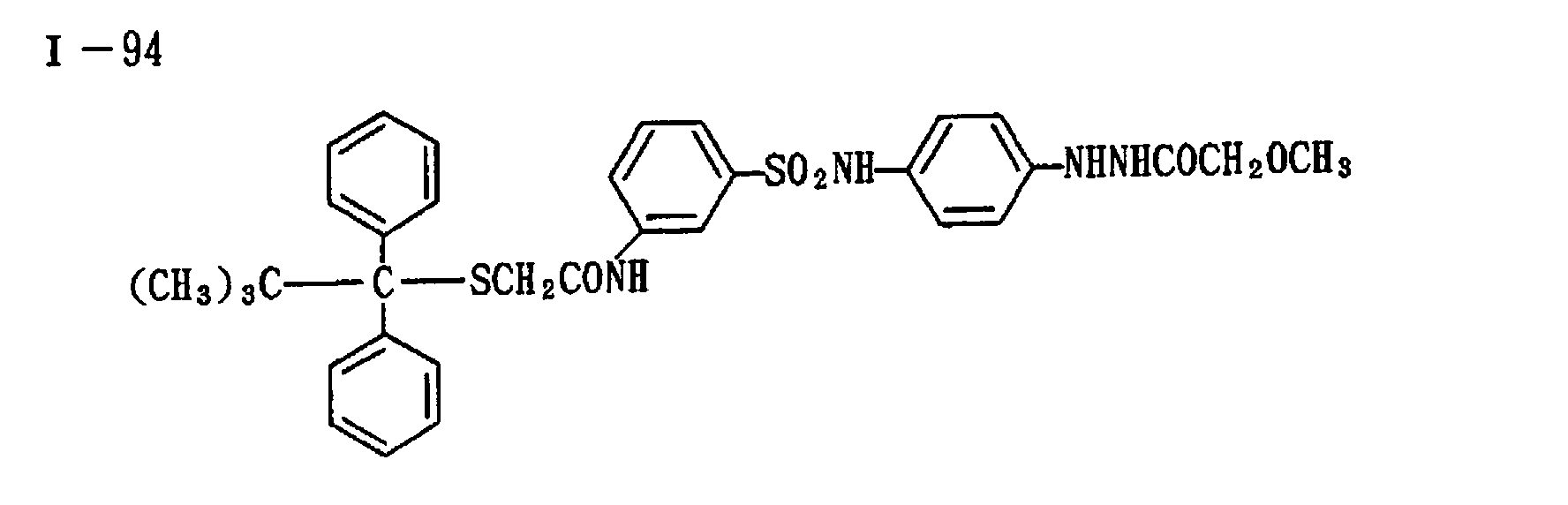
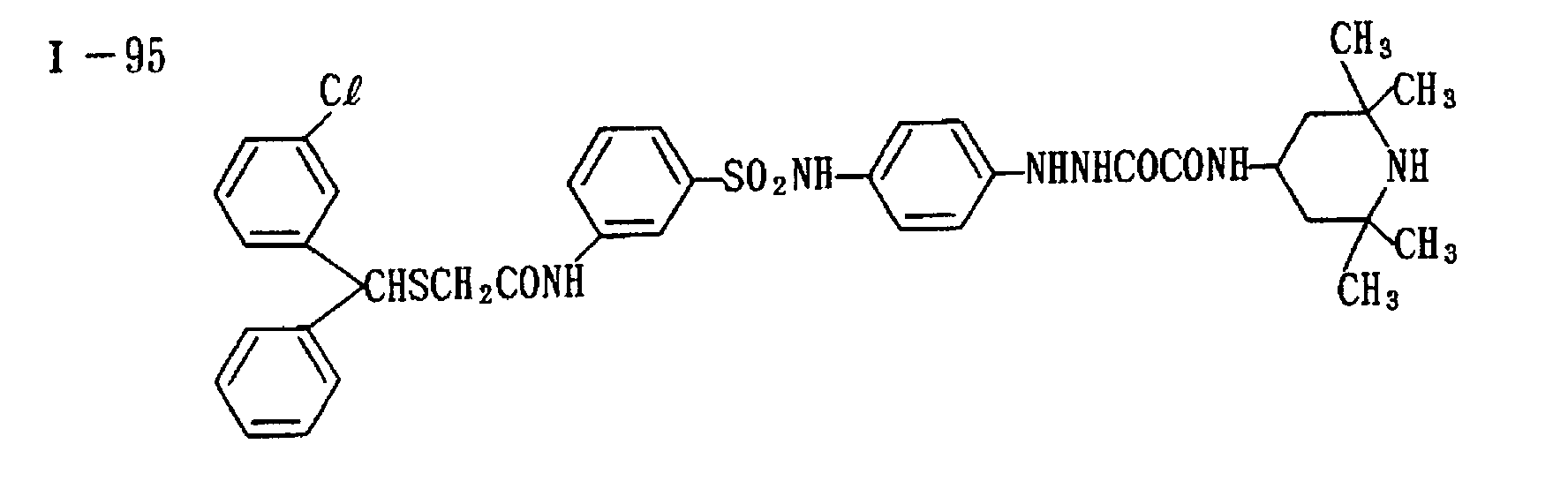
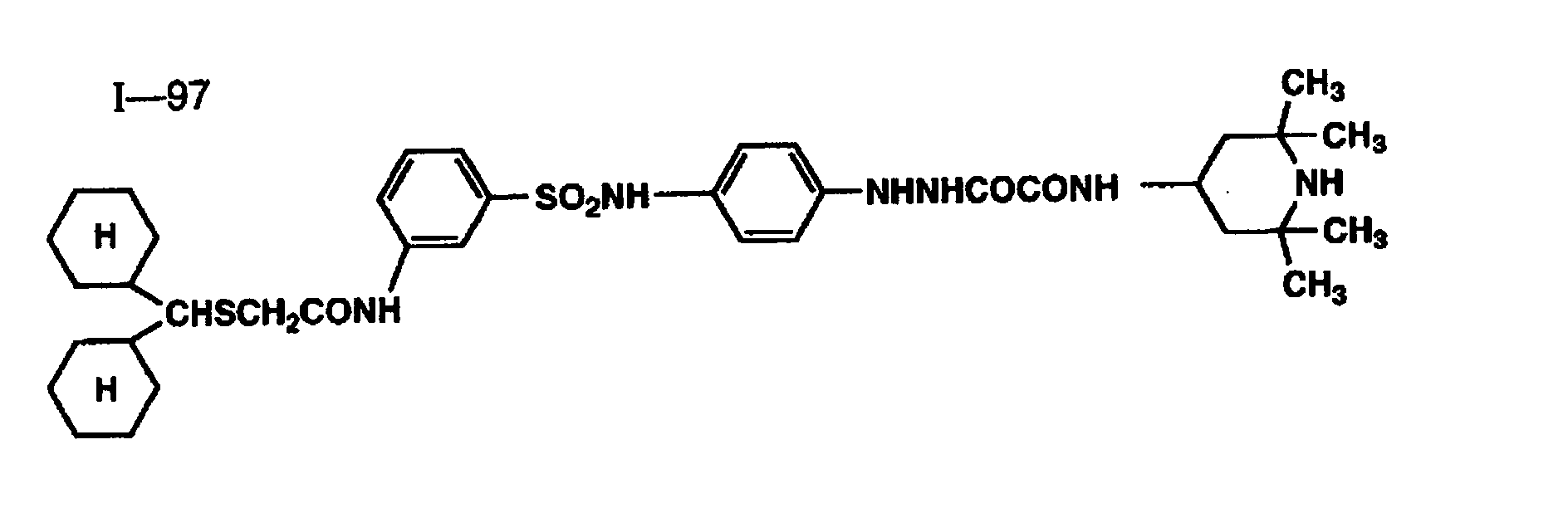
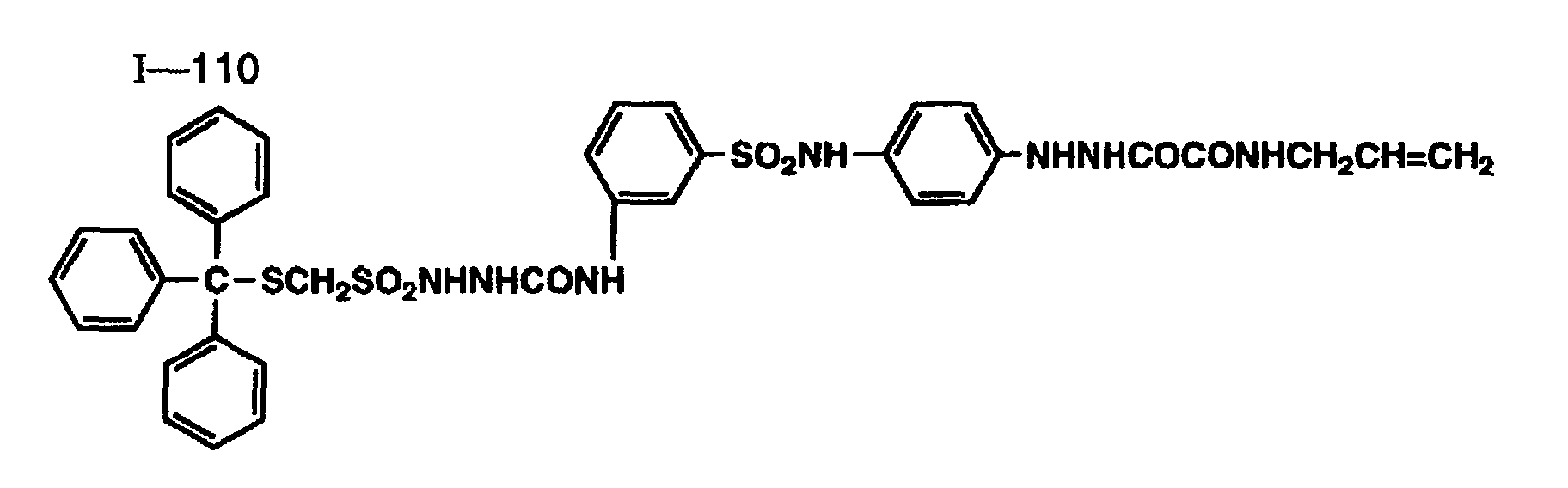
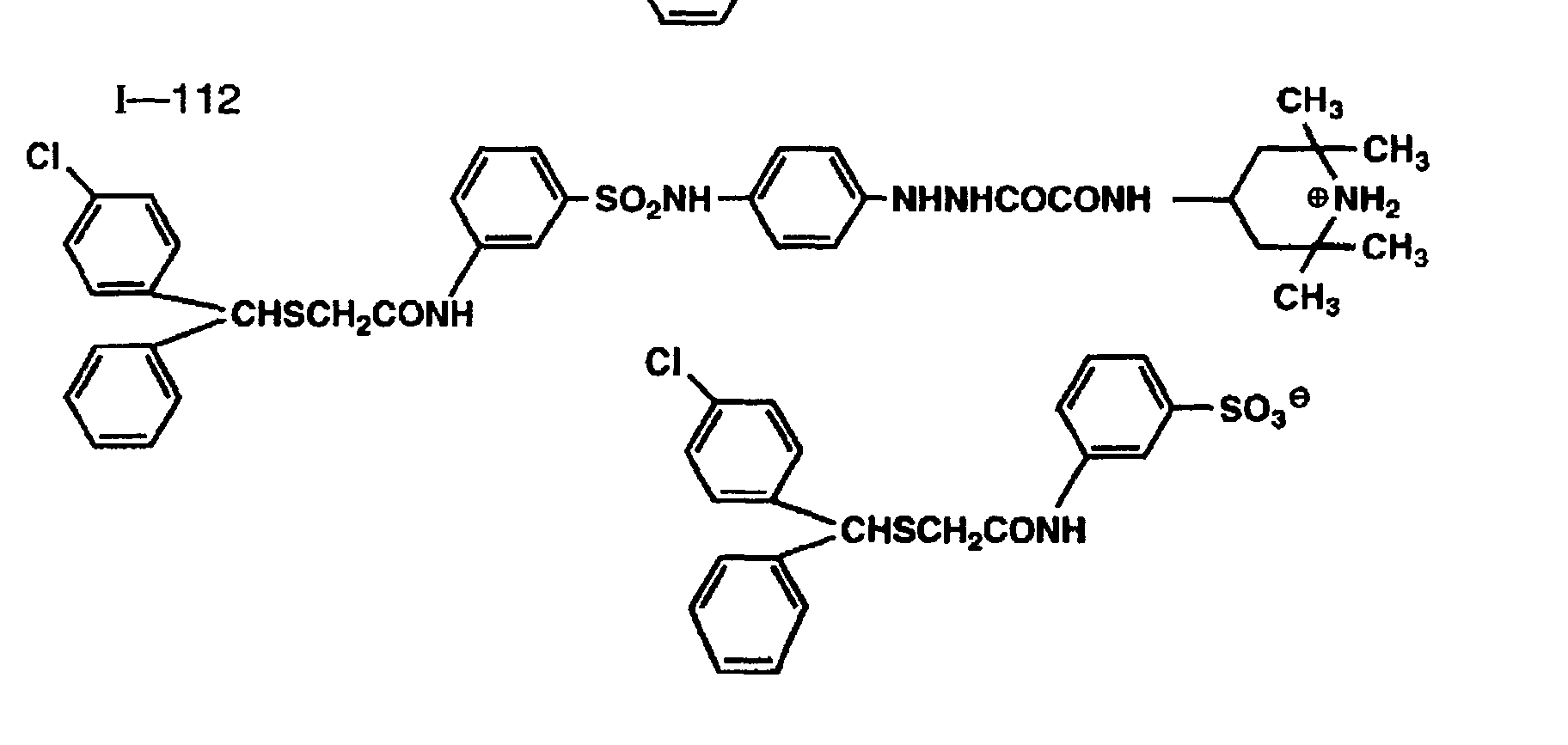
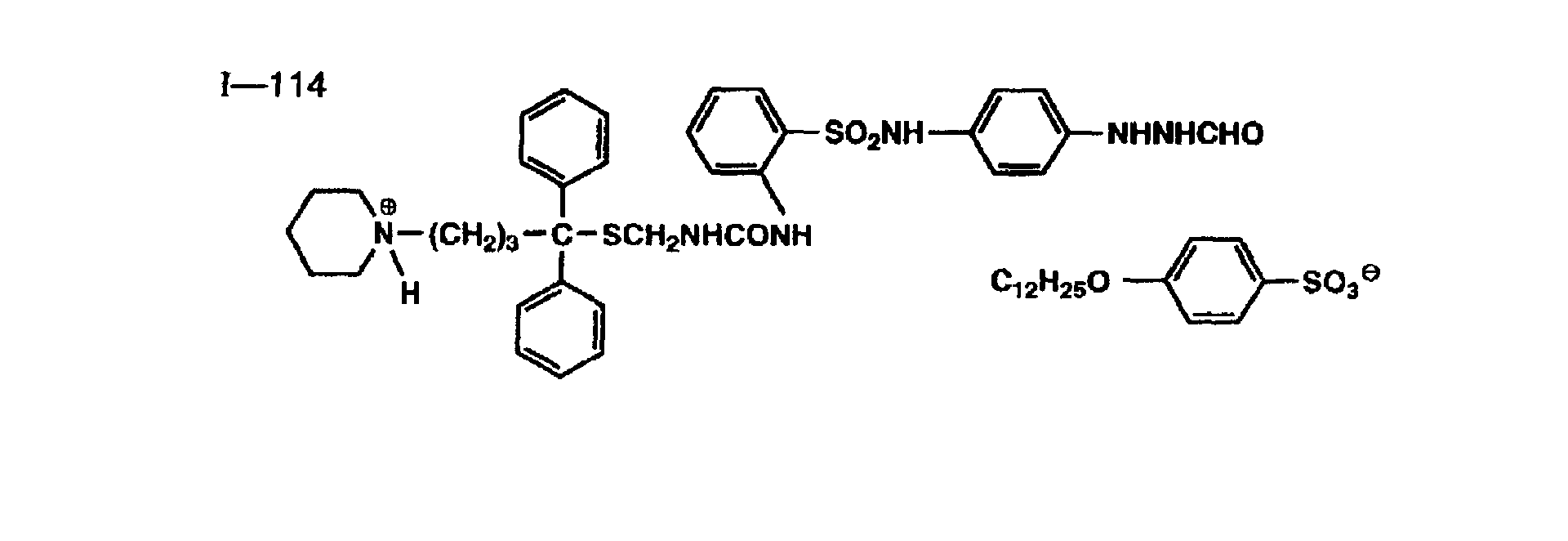
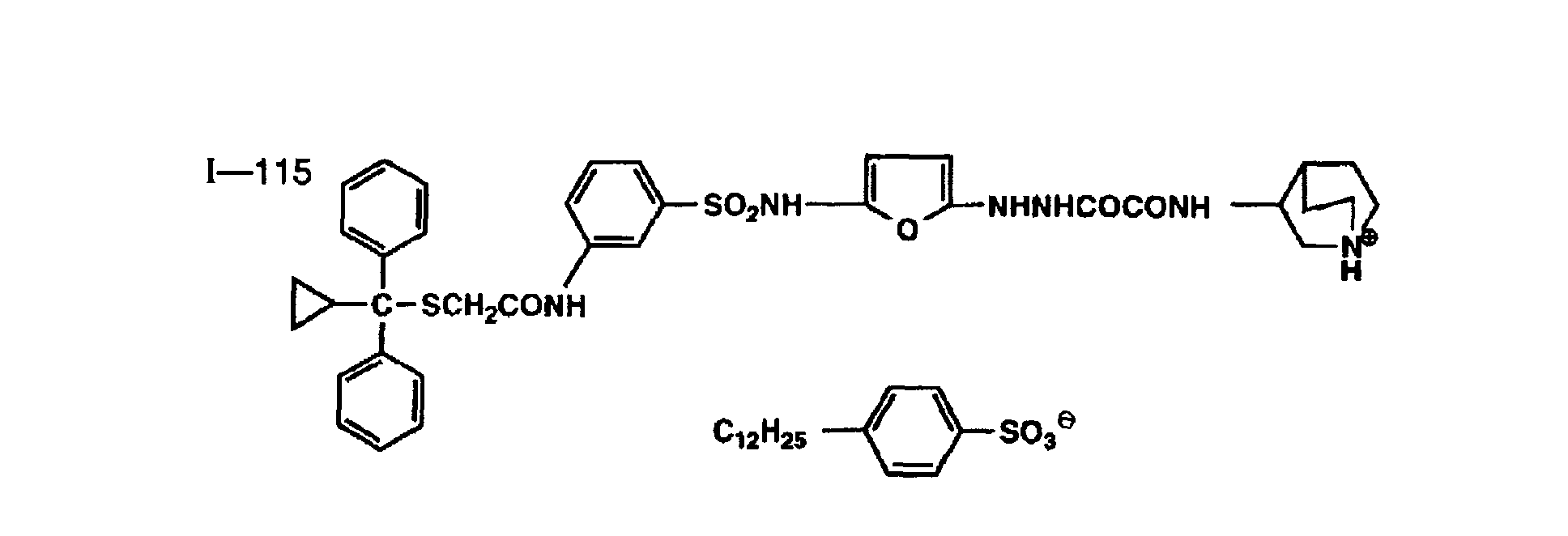
BACKGROUND OF THE INVENTION
1. Field of the Invention
The present invention relates to a silver halide photographic light-sensitive
material and a process for forming an ultra high contrast negative
image using same. It relates in particular to an image formation process using
an ultra high contrast negative photographic light-sensitive material suitable for
a silver halide light-sensitive material for photomechanical plate-making.
2. Description of the Related Art
As one method for exposing a photographic light-sensitive material to
light in an image formation process there is a known method, the so-called
scanner system, in which an original image is scanned and a silver halide
photographic light-sensitive material is exposed to light according to the image
signal so obtained to give a negative image or a positive image of the original
image. There are various types of recorder utilizing an image formation
process involving the scanner system, and the so-called dot generator system
employing a dot generator is widely used at present. These recorders involving
the scanner system use, as a light source for recording, a conventional glow
lamp, xenon lamp, mercury lamp, tungsten lamp, light-emitting diode, etc.
However, all of these light sources have practical defects such as low output
and short lifetime. In order to compensate for these defects, there are
scanners that use as a light source for the scanner system a coherent laser
light source such as a He-Ne laser, an argon laser, a He-Cd laser, or a
semiconductor laser. Light-sensitive materials that can be used with these
scanners are required to have various characteristics and, in particular, it is
essential for them to have high sensitivity and high contrast under conditions
such as those where exposure is carried out using a short exposure time such
as 10-3 to 10-8 sec. Moreover, since output of the laser tube is reduced in order
to ensure a long lifetime, a light-sensitive material having a higher sensitivity is
more advantageous. Furthermore, in order to obtain good dots, it is necessary
to shape the laser beam using a slit, etc. and in order to compensate for a
concomitant reduction in the laser output it is also necessary to use a light-sensitive
material having high sensitivity.
In recent years, a nucleation system that contains a hydrazine derivative
and can give ultra high contrast photographic characteristics has dominated
this field in terms of high sensitivity and high contrast. In order to increase the
sensitivity of a light-sensitive material, it is necessary to increase the sensitivity
of the silver halide used, and the activities of a sensitizing dye and the
hydrazine compound used, but this often causes degradation in the storage
stability.
Moreover, in the printing industry there is a strong desire for a reduction
in the amount of process effluent in terms of influence on the environment, and
there is a widespread need for a reduction in the amounts of developing
solution and fixing solution that are replenished. In order to meet these needs
in the printing industry, there is a desire for the development of a developing
solution and a fixing solution whose compositions in processing solutions vary
little when the replenishment amounts are reduced, and a light-sensitive
material that can suitably be used with small amounts of replenisher.
BRIEF SUMMARY OF THE INVENTION
It is a first object of the present invention to provide an image formation
process using a high sensitivity and high contrast silver halide photographic
light-sensitive material.
A second object of the present invention is to provide a silver halide
photographic light-sensitive material that gives stable photographic
characteristics even when the amount of developing solution replenished is
reduced and that also has excellent storage stability, and a processing system
therefor.
The above-mentioned objects have been accomplished by the invention
below.
BRIEF DESCRIPTION OF THE SEVERAL VIEWS OF THE DRAWINGS
FIG. 1 shows absorption spectra of the emulsion layer side and the back
layer side of a silver halide light-sensitive material in an example of the present
invention.
In FIG. 1, the ordinate denotes absorbance (interval 0.1) and the
abscissa denotes wavelength from 350 to 950 nm. The solid line denotes the
absorption spectrum of the emulsion layer side and the broken line denotes the
absorption spectrum of the back layer side.
DETAILED DESCRIPTION OF THE INVENTION
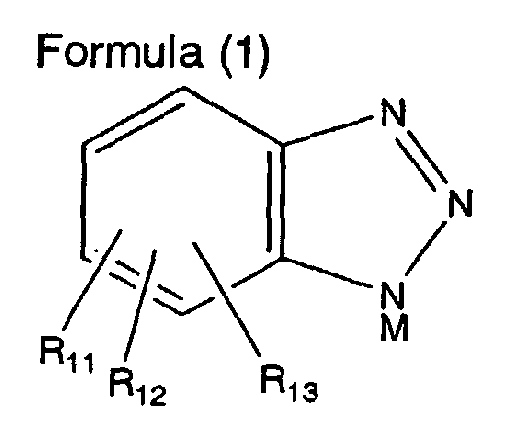
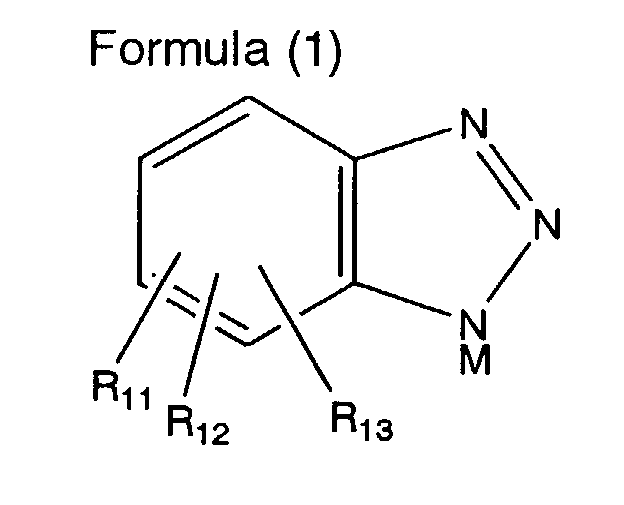
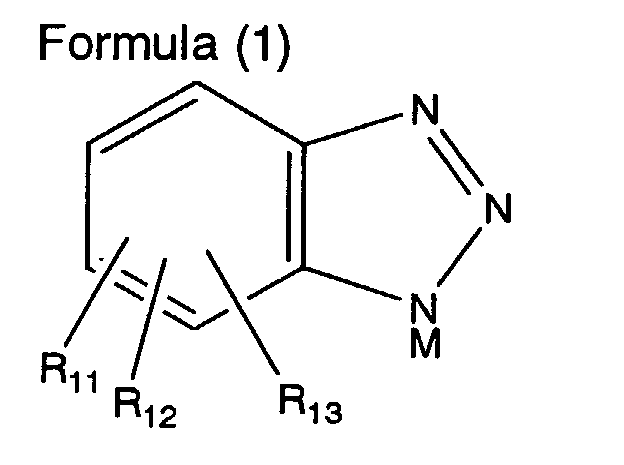
The benzotriazole compound represented by formula (1) is explained
further in detail.
In the formula, M denotes a hydrogen atom, an alkali metal atom (e.g. a
sodium atom, a potassium atom), or a protecting group that can be cleaved by
an alkali (e.g., acetyl, propionyl, pivaloyl, stearoyl, benzyl, p-toluenesulfonyl,
dodecylcarbamoyl, benzoyl, cyclohexylcarbamonyl). R11, R12, and R13 may be
identical to or different from each other and independently represent a
hydrogen atom, a substituted or unsubstituted alkyl group (preferably having up
to 12 carbons, e.g., methyl, ethyl, propyl, hexyl, hydroxyethyl, chloropropyl,
benzyl, cyanoethyl), a substituted or unsubstituted aryl group (preferably
having 6 to 12 carbons, e.g., phenyl, naphthyl, p-tolyl, p-chlorophenyl), halogen
atoms (e.g., chlorine, bromine), a nitro group, a substituted or unsubstituted
alkoxy group (preferably having up to 12 carbons, e.g. methoxy, ethoxy, n-butoxy,
dodecyloxy, hydroxyethoxy), or a cyano group.
Specific examples of the compound represented by formula (1) of the
present invention are listed below, but they are not intended to limit the present
invention.
Particularly preferable compounds are 5-methylbenzotriazoles.
The benzotriazole compound represented by formula (1) in the present
invention may be added to any layer of a silver halide emulsion layer and
another layer comprising a hydrophilic colloid on the silver halide emulsion
layer side of the support, but it is preferably added to the silver halide emulsion
layer or a hydrophilic colloid layer adjoining it.
It is also possible to use two or more types of benzotriazole compound
represented by formula (1) in combination.
The amount thereof added is preferably 1 x 10⁻⁴ to 1 x 10⁻¹ mol per mol of
the silver halide, and particularly preferably 1 x 10⁻³ to 7 x 10⁻² mol.
It should be noted that in the present invention a range such as this
includes the lower figure as the minimum value and the higher figure as the
maximum value.
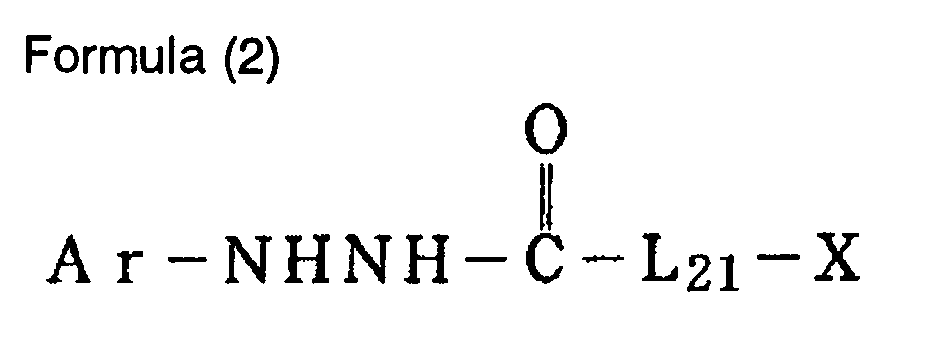
The hydrazine derivative represented by formula (2) is explained further
in detail.
In the formula, Ar represents an aromatic group, L21 represents a
divalent linking group having an electron-withdrawing group, and X represents
an anionic group.
The hydrazine derivative represented by formula (2) is preferably a
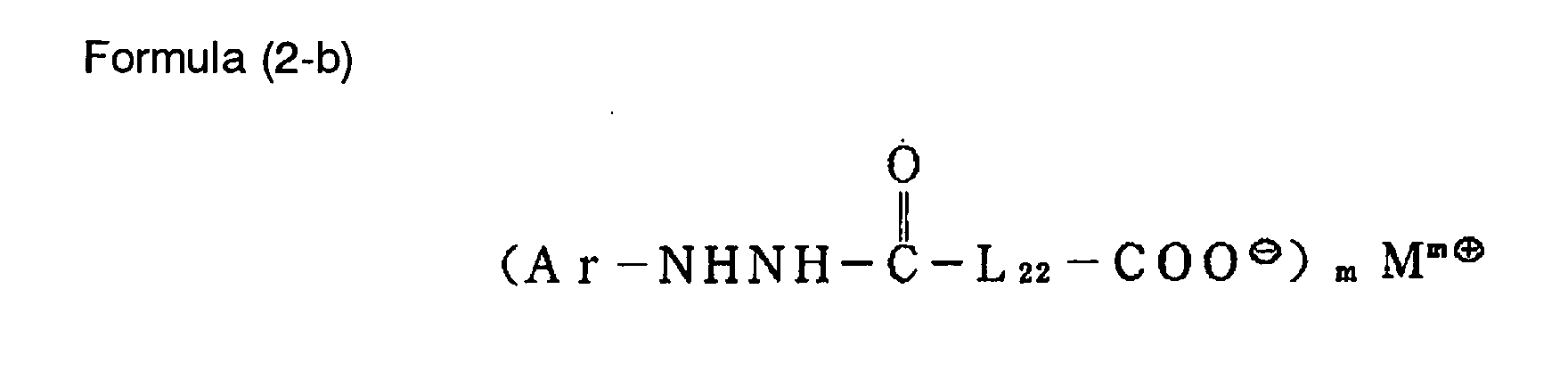
compound represented by formulae (2-a) and (2-b).
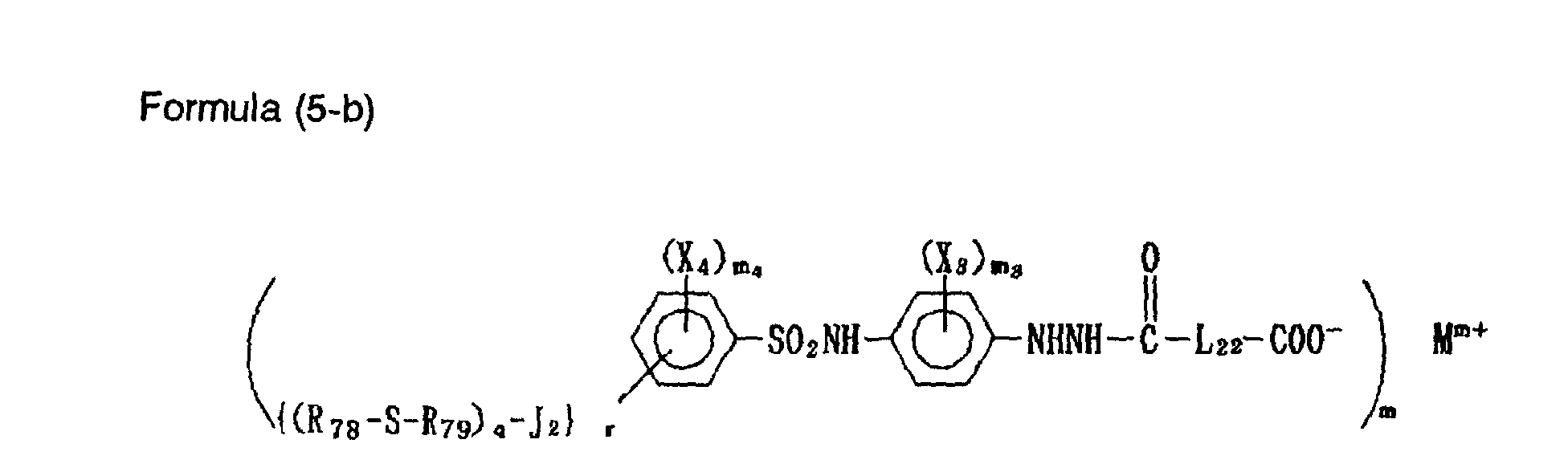
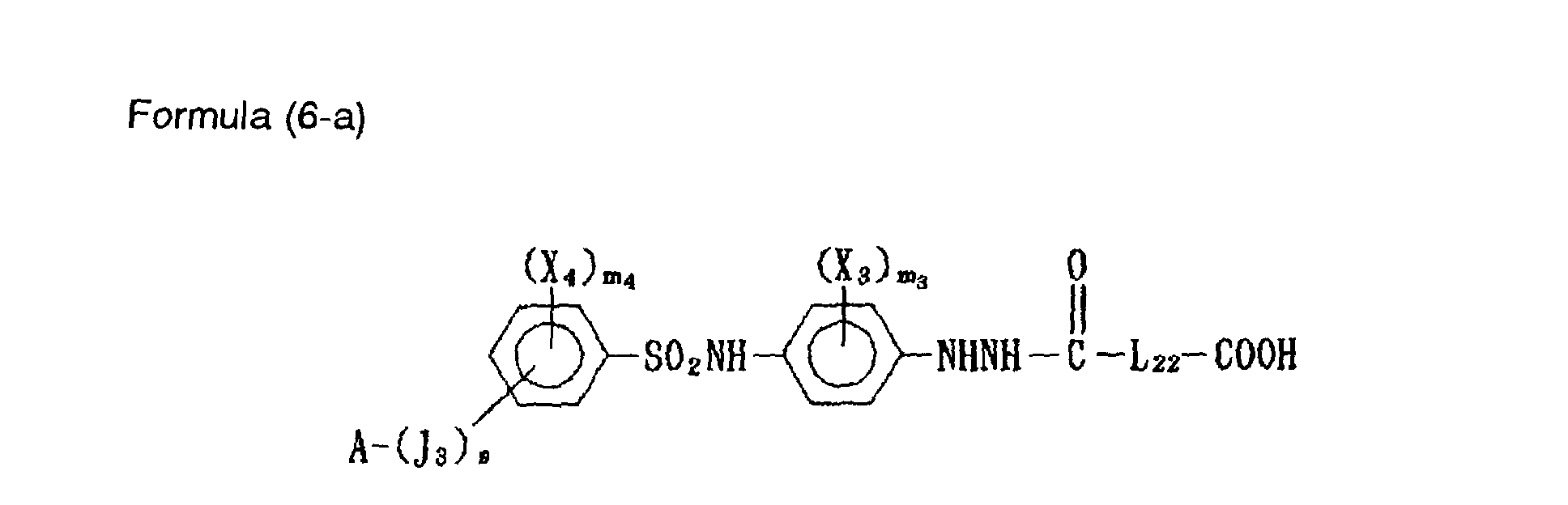
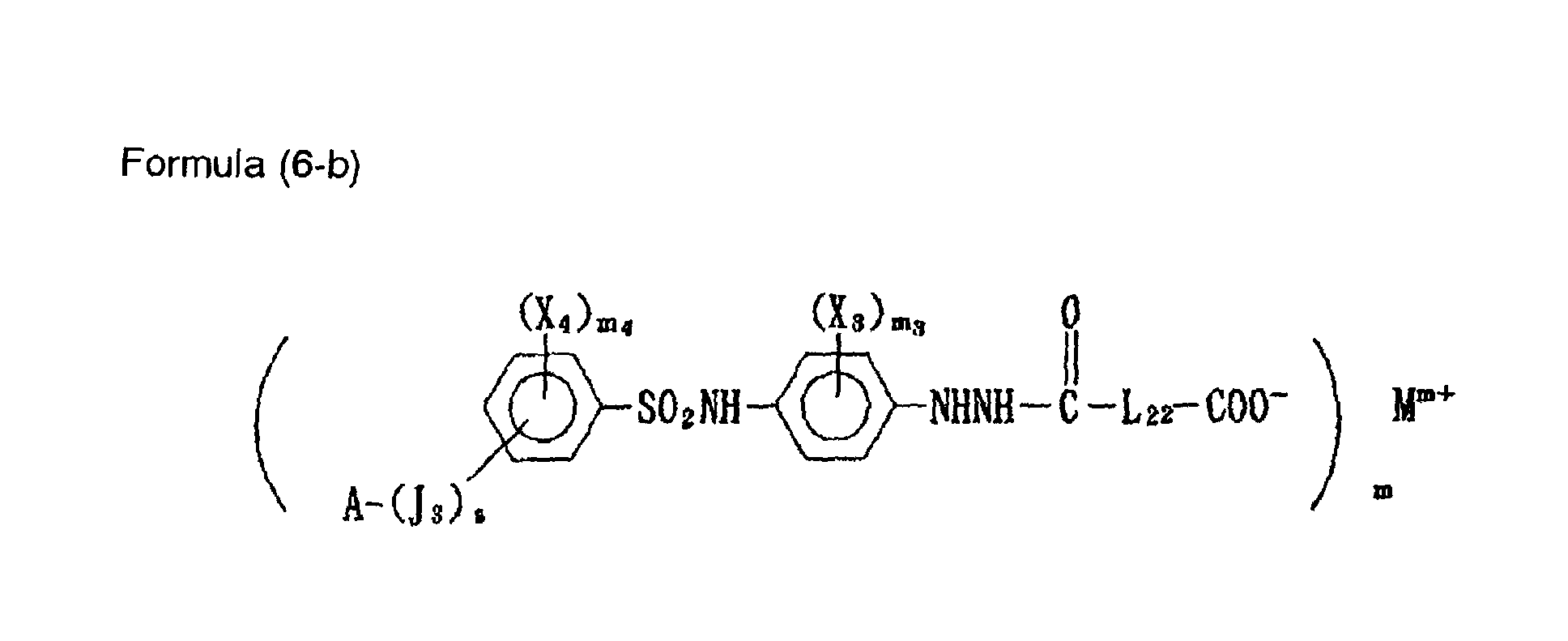
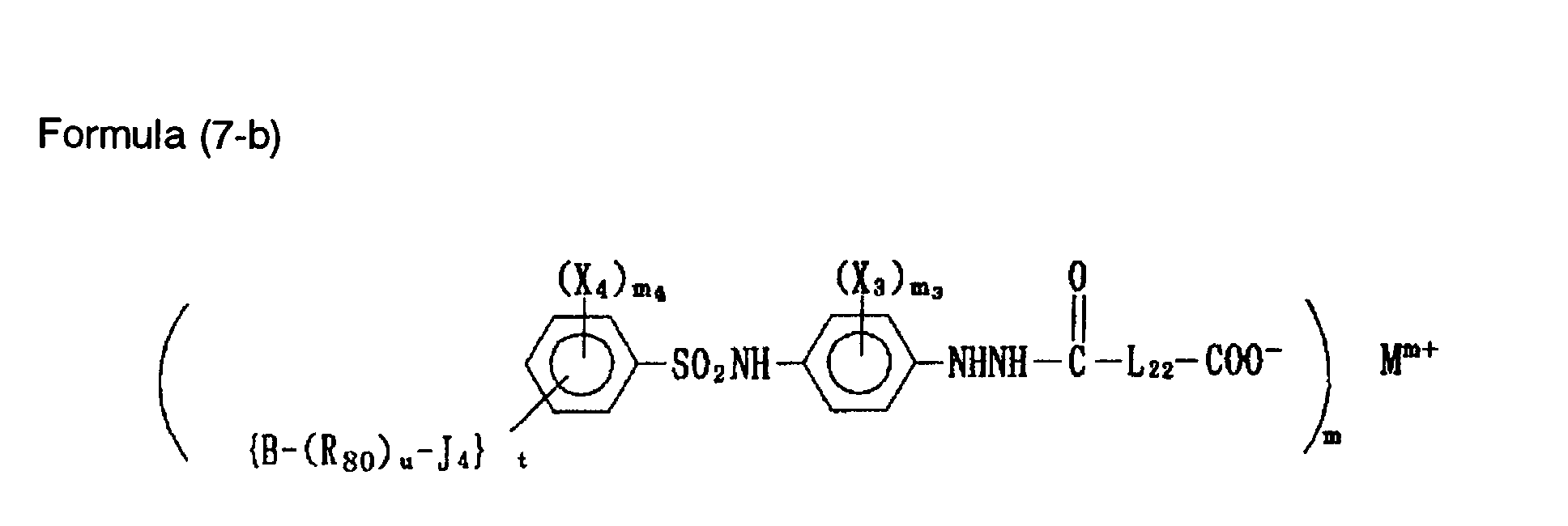
In the formulae, Ar represents an aromatic group and L22 represents a
fluorine-containing divalent alkylene or phenylene group. M represents a
counter cation and m is an integer of 1 to 3.
The most salient feature of the compound of the present invention is the
acyl moiety of the hydrazide; it has both an electron-withdrawing group and an
anionic group as substituents, and as a result the high contrast nucleation
properties of a nucleating agent can be enhanced, and the storage stability can
also improved. These effects are not observed in a hydrazide derivative having
as the acyl group a 2-carboxyethylcarbonyl group that has not been substituted
with an electron-withdrawing group, which is disclosed in JP-A-63-32538 (JP-A
denotes a Japanese unexamined patent application publication).
In the present invention, the anionic group includes a carboxylic acid
group, a sulfonic acid group, a sulfinic acid group, a phosphoric acid group, a
phosphonic acid group, and a salt thereof. The electron-withdrawing group is
an electron-withdrawing substituent excluding these anionic groups, and it
specifically means a substituent having a positive Hammett substituent
constant (σm). The anionic group of the compound for use in this invention is
preferably a carboxylic acid group, a sulfonic acid group, or a salt thereof, and
more preferably a carboxylic acid group or a salt thereof. Examples of the
preferable electron-withdrawing group in the present invention include a
halogen atom, a cyano group, a nitro group, an oxycarbonyl group, a
carbamoyl group, a sulfonamido group, a sulfamoyl group, a quaternary
ammonium group, a sulfonyl group, and an acyl group; a halogen atom is
particularly preferred, and a fluorine atom is more preferred.
With regard to the compound represented by formula (2) of the present
invention, Ar denotes an aromatic group and, more specifically, a substituted or
unsubstituted phenyl group, naphthyl group or heterocyclic group. The group
represented by Ar in formula (2) is preferably a substituted phenyl group, and
examples of the substituent include the following groups.
The substituents in the present invention represent a halogen atom or a
substituent bonded to the ring or main chain through a carbon, oxygen,
nitrogen, or sulfur atom. Examples of the substituent bonded through a carbon
atom include an alkyl group, alkenyl group, alkynyl group, aryl group,
carbamoyl group, alkoxycarbonyl group, aryloxycarbonyl group, acyl group,
carboxyl group, cyano group, and heterocyclic group. Examples of the
substituent bonded through an oxygen atom include a hydroxyl group, alkoxy
group, aryloxy group, heterocyclyloxy group, acyloxy group, carbamoyloxy
group, and sulfonyloxy group. Examples of the substituent bonded through a
nitrogen atom include an acylamino group, amino group, alkylamino group,
arylamino group, heterocyclylamino group, ureido group, sulfamoylamino
group, alkoxycarbonylamino group, aryloxycarbonylamino group, sulfonamido
group, imido group, and heterocyclic group. Examples of the substituent
bonded through a sulfur atom include an alkylthio group, arylthio group,
heterocyclylthio group, sulfamoyl group, alkoxysulfonyl group, aryloxysulfonyl
group, sulfonyl group, sulfo group, and sulfinyl group. These groups each may
be substituted with any of these substituents.
Preferable substituents in the present invention are explained in greater
detail. Examples of the halogen atom include a fluorine atom, chlorine atom,
and bromine atom. The alkyl group is a linear, branched, or cyclic alkyl group
having from 1 to 16, and preferably from 1 to 10, carbon atoms, and examples
thereof include methyl, ethyl, isopropyl, t-butyl, benzyl, and cyclopentyl. The
alkenyl group has from 2 to 16 carbon atoms, and examples thereof include
vinyl, 1-propenyl, 1-hexenyl, and styryl. The alkynyl group has from 2 to 16
carbon atoms, and examples thereof include ethynyl, 1-butynyl, 1-dodecenyl,
and phenylethynyl. The aryl group has from 6 to 24 carbon atoms, and
examples thereof include phenyl, naphthyl, and p-methoxyphenyl.
The carbamoyl group has from 1 to 18 carbon atoms, and examples
thereof include carbamoyl, N-ethylcarbamoyl, N-octylcarbamoyl, and
N-phenylcarbamoyl. The alkoxycarbonyl group has from 2 to 18 carbon atoms,
and examples thereof include methoxycarbonyl and benzyloxycarbonyl. The
aryloxycarbonyl group has from 7 to 18 carbon atoms, and examples thereof
include phenoxycarbonyl. The acyl group has from 1 to 18 carbon atoms, and
examples thereof include acetyl and benzoyl. The heterocyclic group bonded
through a carbon atom on the ring is a five- or six-membered, saturated or
unsaturated heterocyclic group having from 1 to 5 carbon atoms and containing
one or more heteroatoms of one or more elements selected from oxygen,
nitrogen, and sulfur. Examples of the heterocyclic group include 2-furyl,
2-thienyl, 2-pyridyl, and 2-imidazolyl.
The alkoxy group has from 1 to 16, and preferably from 1 to 10, carbon
atoms, and examples thereof include methoxy, 2-methoxyethoxy, and
2-methanesulfonylethoxy. The aryloxy group has from 6 to 24 carbon atoms,
and examples thereof include phenoxy, p-methoxyphenoxy, and
m-(3-hydroxypropionamido)phenoxy. The heterocyclyloxy group is one in
which the heterocycle is a five- or six-membered, saturated or unsaturated
heterocycle having from 1 to 5 carbon atoms and containing one or more
heteroatoms of one or more elements selected from oxygen, nitrogen, and
sulfur, and examples thereof include 1-phenyltetrazolyl-5-oxy,
2-tetrahydropyranyloxy, and 2-pyridyloxy. The acyloxy group has from 1 to 16,
and preferably from 1 to 10, carbon atoms, and examples thereof include
acetoxy, benzoyloxy, and 4-hydroxybutanoyloxy. The carbamoyloxy group has
from 1 to 16, and preferably from 1 to 10, carbon atoms, and examples thereof
include N,N-dimethylcarbamoyloxy, N-hexylcarbamoyloxy, and
N-phenylcarbamoyloxy. The sulfonyloxy group has from 1 to 16 carbon atoms,
and examples thereof include methanesulfonyloxy and benzenesulfonyloxy.
The acylamino group has from 1 to 16, and preferably from 1 to 10,
carbon atoms, and examples thereof include acetamido and
p-chlorobenzoylamido. The alkylamino group has from 1 to 16, and preferably
from 1 to 10, carbon atoms, and examples thereof include N,N-dimethylamino
and N-(2-hydroxyethyl)amino. The arylamino group has from 6 to 24 carbon
atoms, and examples thereof include anilino and N-methylanilino. The
heterocyclylamino group is one in which the heterocycle is a five- or
six-membered, saturated or unsaturated heterocycle having from 1 to 5 carbon
atoms and containing one or more heteroatoms of one or more elements
selected from oxygen, nitrogen, and sulfur, and examples thereof include
2-oxazolylamino, 2-tetrahydropyranylamino, and 4-pyridylamino. The ureido
group has from 1 to 16, and preferably from 1 to 10, carbon atoms, and
examples thereof include ureido, methylureido, N,N-diethylureido, and
2-methanesulfonamidoethylureido.
The sulfamoylamino group has from 0 to 16, and preferably from 0 to 10,
carbon atoms, and examples thereof include methylsulfamoylamino and
2-methoxyethylsulfamoylamino. The alkoxycarbonylamino group has from 2 to
16, and preferably from 2 to 10, carbon atoms, and examples thereof include
methoxycarbonylamino. The aryloxycarbonylamino group has from 7 to 24
carbon atoms, and examples thereof include phenoxycarbonylamino and
2,6-dimethoxyphenoxycarbonylamino. The sulfonamido group has from 1 to
16, and preferably from 1 to 10, carbon atoms, and examples thereof include
methanesulfonamido and p-toluenesulfonamido. The imido group has from 4 to
16 carbon atoms, and examples thereof include N-succinimido and
N-phthalimido. The heterocyclic group bonded through a nitrogen atom of the
ring is a five- to six-membered heterocyclic group in which the ring includes a
nitrogen atom and at least one element selected from carbon, oxygen, and
sulfur, and examples thereof include pyrrolidino, morpholino, and imidazolino.
The alkylthio group has from 1 to 16, and preferably from 1 to 10, carbon
atoms, and examples thereof include methylthio and 2-phenoxyethylthio. The
arylthio group has from 6 to 24 carbon atoms, and examples thereof include
phenylthio and 2-carboxyphenylthio. The heterocyclylthio group is a five- or
six-membered ring, saturated or unsaturated heterocyclylthio group having
from 1 to 5 carbon atoms and the ring comprises one or more heteroatoms of
one or more elements selected from oxygen, nitrogen, and sulfur, and
examples thereof include 2-benzothiazolylthio and 2-pyridylthio.
The sulfamoyl group has from 0 to 16, and preferably from 0 to 10,
carbon atoms, and examples thereof include sulfamoyl, methylsulfamoyl, and
phenylsulfamoyl. The alkoxysulfonyl group has from 1 to 16, and preferably
from 1 to 10, carbon atoms, and examples thereof include methoxysulfonyl.
The aryloxysulfonyl group has from 6 to 24, and preferably from 6 to 12, carbon
atoms, and examples thereof include phenoxysulfonyl. The sulfonyl group has
from 1 to 16, and preferably from 1 to 10, carbon atoms, and examples thereof
include methanesulfonyl and benzenesulfonyl. The sulfinyl group has from 1 to
16, and preferably from 1 to 10, carbon atoms, and examples thereof include
methanesulfinyl and benzenesulfinyl.
Preferable substituents in the present invention are a halogen atom,
alkyl group, aryl group, carbamoyl group, alkoxycarbonyl group,
aryloxycarbonyl group, acyl group, cyano group, alkoxy group, aryloxy group,
carbamoyloxy group, acylamino group, ureido group, sulfamonylamino group,
alkoxycarbonylamino group, sulfonamido group, sulfamoyl group, and sulfonyl
group. More preferred are an alkyl group, aryl group, carbamoyl group, alkoxy
group, acylamino group, ureido group, sulfonamido group, and sulfamoyl
group. Particularly preferred are an acylamino group, ureido group, and
sulfonamido group. The group represented by Ar in formula (2) may have as a
substituent a group that accelerates adsorption onto silver halide grains.
Preferable examples of the group that accelerates adsorption onto silver halide
include a thioamido group, a mercapto group, and a five- or six-membered
nitrogen-containing heterocyclic group. As the thioamido adsorption-accelerating
group there is a divalent group represented by the formula below.

This group may be a part of a ring structure, or may preferably be an
acyclic thioamido group. Useful adsorption-accelerating thioamido groups can
be selected, for example, from the thioamido groups disclosed in U.S. Pat. Nos.
4,030,925, 4,031,127, 4,080,207, 4,245,037, 4,255,511, 4,266,013, and
4,276,364 and Research Disclosure, Vol. 151, No. 15162 (November 1976)
and Vol. 176, No. 17626 (December 1978). Especially preferred thioamido
groups are those represented by formula (A).
In the formula, one of E and E' represents -N(R73)- and the other
represents -O-, -S-, or -N(R74)-; R72 represents a hydrogen atom, an aliphatic
group, or an aromatic group, or is bonded to E or E' to form a five- or
six-membered heterocycle; and R73 and R74 represents a hydrogen atom, an
aliphatic group, or an aromatic group.
Examples of the thioamide represented by formula (A) include thiourea,
thiourethane, and dithiocarbamates. In the case where E or E' is bonded to R72
to form a ring, examples of the structure represented by formula (A) include the
acid nuclei of merocyanine dyes. Specific examples thereof include
4-thiazoline-2-thione, thiazolidine-2-thione, 4-oxazoline-2-thione,
oxazolidine-2-thione, 2-pyrazoline-5-thione, 4-imidazoline-2-thione,
2-thiohydantoin, rhodanine, isorhodanine, 2-thio-2,4-oxazolidinedione,
thiobarbituric acid, tetrazoline-5-thione, 1,2,4-triazoline-3-thione,
1,3,4-thiadiazoline-2-thione, 1,3,4-oxadiazoline-2-thione,
benzimidazoline-2-thione, benzoxazoline-2-thione, and
benzthiazoline-2-thione. These may be further substituted.
The adsorption-accelerating mercapto group may be an aliphatic
mercapto group, an aromatic mercapto group, or a heterocyclic mercapto group
(in the case where the heterocycle contains a nitrogen atom adjacent to the
SH-bonded carbon atom, this heterocycle has been described as a ring-forming
thioamido group, which is a tautomer thereof). Examples of the aliphatic
mercapto group include mercaptoalkyl groups (e.g., mercaptoethyl and
mercaptopropyl), mercaptoalkenyl groups (e.g., mercaptopropenyl), and
mercaptoalkynyl groups (e.g., mercaptobutynyl). Examples of the aromatic
mercapto group include mercaptophenyl and mercaptonaphthyl. Examples of
the heterocyclic mercapto group include 4-mercaptopyridyl,
5-mercaptoquinolinyl, and 6-mercaptobenzthiazolyl, in addition to the groups
enumerated hereinabove with regard to the ring-forming thioamido group.
The five- or six-membered nitrogen-containing heterocyclic group which
accelerates adsorption may be a five- or six-membered nitrogen-containing
heterocycle comprising a combination of nitrogen and oxygen, sulfur and
carbon. Preferable examples thereof include benzotriazole, triazole, tetrazole,
indazole, benzimidazole, imidazole, benzothiazole, thiazole, benzoxazole,
oxazole, thiadiazole, oxadiazole, and triazine. These may have one or more
appropriate substituents. Preferred are benzotriazole, triazole, tetrazole, and
indazole. Benzotriazole is particularly preferred.
Preferred specific examples of the nitrogen-containing heterocycle
include benzotriazol-5-yl, 6-chlorobenzotriazol-5-yl, benzotriazole-5-carbonyl,
5-phenyl-1,3,4-triazol-2-yl, 4-(5-methyl-1,3,4-triazol-2-yl)benzoyl,
1 H-tetrazol-5-yl and 3-cyanoindazol-5-yl.
In the compound represented by formula (2), L21 denotes a divalent
linking group substituted with the electron-withdrawing group described above.
Specific examples thereof include an alkylene group, an alkenylene group, an
alkynylene group, an aralkylene group, an arylene group, and combinations
thereof. L21 is preferably an alkylene group or an arylene group, and
particularly preferably an alkylene group or a phenylene group.
The compound represented by formula (2-a) or (2-b) of the present
invention is now explained.
In formulae (2-a) and (2-b), Ar has the same meaning as in formula (2),
and preferred examples thereof are also in the same range as for formula (2).
L22 represents a divalent alkylene or phenylene group partly or fully substituted
with fluorine atoms. Specific examples of the group represented by L22
include -CF2CF2-, -C3F6-, -CF2CH2-, -CFH-, -(CF2)4-, -(CF2)6-, -C6F4- (tetrafluorop
henylene group), and -CF2-. Especially preferred groups represented by L22
are -CF2CF2- and -C3F6-.
In formula (2-b), M represents a counter cation and m represents an
integer of 1 to 3. Examples of the cation represented by M include a lithium
ion, a sodium ion, a potassium ion, a calcium ion, a magnesium ion, an
aluminum ion, a zinc ion, a barium ion, a quaternary ammonium ion, a
heterocycle containing a quaternized nitrogen atom, and a quaternary
phosphonium ion. M is especially preferably a sodium ion or a potassium ion.
In this case, m is 1.
The group represented by Ar in formulae (2-a) and (2-b) may contain a
substituent group which accelerates adsorption onto silver halide grains.
The compound represented by formula (2) is preferably represented by
the following formulae (3-a) or (3-b).
In the above formulae, L22, M, and m each have the same meaning as in
formulae (2-a) and (2-b). X1 and X2 each represent a group capable of bonding
as a substituent to a benzene ring. m1 and m2 represent an integer of 0 to 4
and an integer of 0 to 5, respectively. When m1 or m2 is an integer of 2 or
above, the groups represented by X1 or X2 may be identical to or different from
each other and may be bonded to each other to form a ring. The substituent
represented by X1 has the same meaning as the substituent described
hereinabove. Preferred examples of the substituent include an alkyl group,
hydroxyl group, amino group, alkylamido group, arylamido group,
alkylsulfonamido group, arylsulfonamido group, carboxyl group, sulfo group, salts of these groups, alkylthio group, mercapto group, acyloxy group, and
heterocyclic group. Especially preferred among the compounds represented by
formula (3-a) or (3-b) are those where m1 is 0. X2 has the same meaning as the
substituent of Ar described hereinabove with regard to formula (2), and
preferred examples thereof are also in the same range. The group represented
by X2 may contain a group which accelerates adsorption onto silver halide
grains. m2 is preferably 1 or 2, and more preferably 1.
Especially preferred among the compounds represented by formula (3-a)
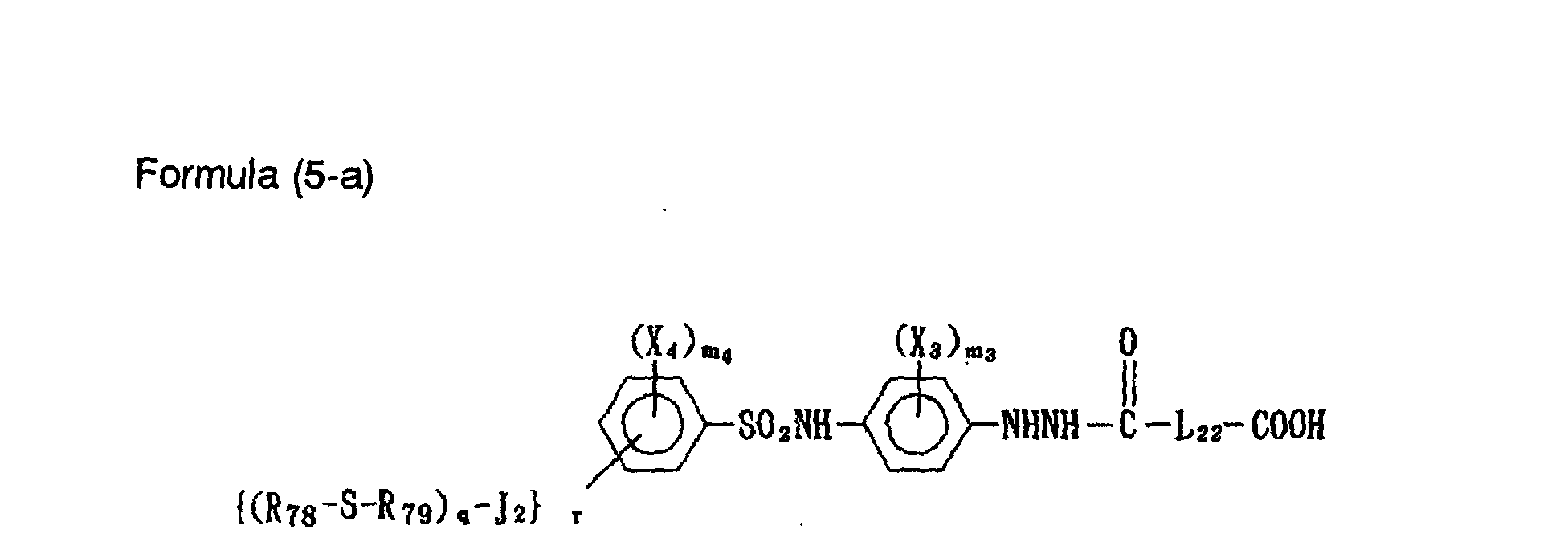
or (3-b) are those represented by the following formulae (4-a, b) to (7-a, b).
In formulae (4-a, b) to (7-a, b), X3 and X4 each represent a substituent,
and have the same meanings as X1 and X2 in formulae (3-a) or (3-b). m3 and
m4 each represent an integer of 0 to 4. J1, J2, J3, and J4 each represent a
divalent linking group. Examples thereof include groups represented
by -SO2NR76 -, -NR76SO2 -, -CONR76 -, -NR76CO-, -COO-, -O-CO-, -O-, -S-, -NR76SO2NR77
-, and -NR76CONR77 -, wherein R76 and R77 each represent a
hydrogen atom, an aliphatic group, or an aromatic group. p, q, r, and t each
represent 1 or 2. When p, r, and t are each 2, m4 represents an integer of 3 or
smaller. s and u each represent 0 or 1.
In formula (4-a) or (4-b), R75 represents a substituted or unsubstituted,
branched or linear alkyl group having from 4 to 16 carbon atoms in total. When
the alkyl group represented by R75 has a substituent, examples of this
substituent include the same groups as the aforementioned examples of the
substituent of Ar in formula (2). Preferred examples of the substituent include
an aryloxy group, alkoxy group (including those containing ethyleneoxy
repeating units), carboxyl group, and alkoxycarbonyl group.
In formula (5-a) or (5-b), R78 represents an alkyl group, a cycloalkyl
group, an aryl group, or a heterocyclic group, and R79 represents a divalent
aliphatic group. The total number of carbon atoms contained in R78 and R79 is
preferably from 2 to 20. These groups may further have a substituent.
Preferred examples of the substituent include an alkoxy group (including those
containing ethyleneoxy repeating units), alkyl group, carboxyl group,
alkoxycarbonyl group, carbamoyl group, ammonium group, amino group,
hydroxyl group, and alkylthio group.
In formula (6-a) or (6-b), A represents a group which accelerates
adsorption onto silver halide grains. Examples of A include the same groups
as the aforementioned adsorption-accelerating substituent groups which Ar in
general formula (1) may have. Preferred examples of A include an aromatic or
heterocyclic group containing a mercapto group, a heterocyclic group having a
mercaptoalkylene group, a thioureido group, a thiourethane group, a thioamido
group, an alkyl or cycloalkyl group containing a disulfide bond, and a
nitrogen-containing heterocyclic group containing two or more nitrogen atoms
at least one of which is bonded to a hydrogen atom. Specific examples thereof
include mercapto, mercaptophenyl, 2-mercapto-1-thia-3,4-diazolyl,
5-mercaptotetrazolyl, 2-mercapto-1,3,4-triazolyl, 2-mercaptobenzoxazolyl,
2-mercaptobenzothiazolyl, 2-mercaptopyridyl,
4-mercapto-1,3,3a,7-tetrazaindenyl, benzotriazolyl, thiatriazolyl, thioureido,
N'-phenylthioureido, and phenylthiourethane.
In formula (7-a) or (7-b), B represents a cationic group and a counter
anion therefor. Examples of the cationic group include a quaternary ammonium
group, a nitrogen-containing heterocyclic group having a quaternized nitrogen
atom, a quaternary phosphonium group, and a tertiary sulfonium group, and
examples of the counter anion include a chlorine anion, bromine anion, iodine
anion, and sulfo anion. The cationic group represented by B is preferably a
quaternary ammonium group or a nitrogen-containing heterocyclic group
having a quaternized nitrogen atom. Examples of these groups include a
trialkylammonium group, pyridinium group, quinolinium group, isoquinolinium
group, phenanthrenium group, triazolinium group, imidazolinium group, and
benzothiazolinium group. These groups may be further substituted with a
substituent. Preferred substituents include an alkyl group, aryl group, alkoxy
group, alkylcarbamoyl group, amino group, ammonium group, and heterocyclic
group. Especially preferred examples of the cationic group represented by B
are a trialkylammonium group and a pyridinium group, and especially preferred
examples of the counter ion are a chlorine anion and a bromine anion. R80
represents a divalent aliphatic group, and may further have a substituent. R80
is preferably an alkylene group, and especially preferably an unsubstituted,
linear or branched alkylene group.
In formulae (4-a, b) to (7-a, b), M and m each have the same meaning as
in formula (1).
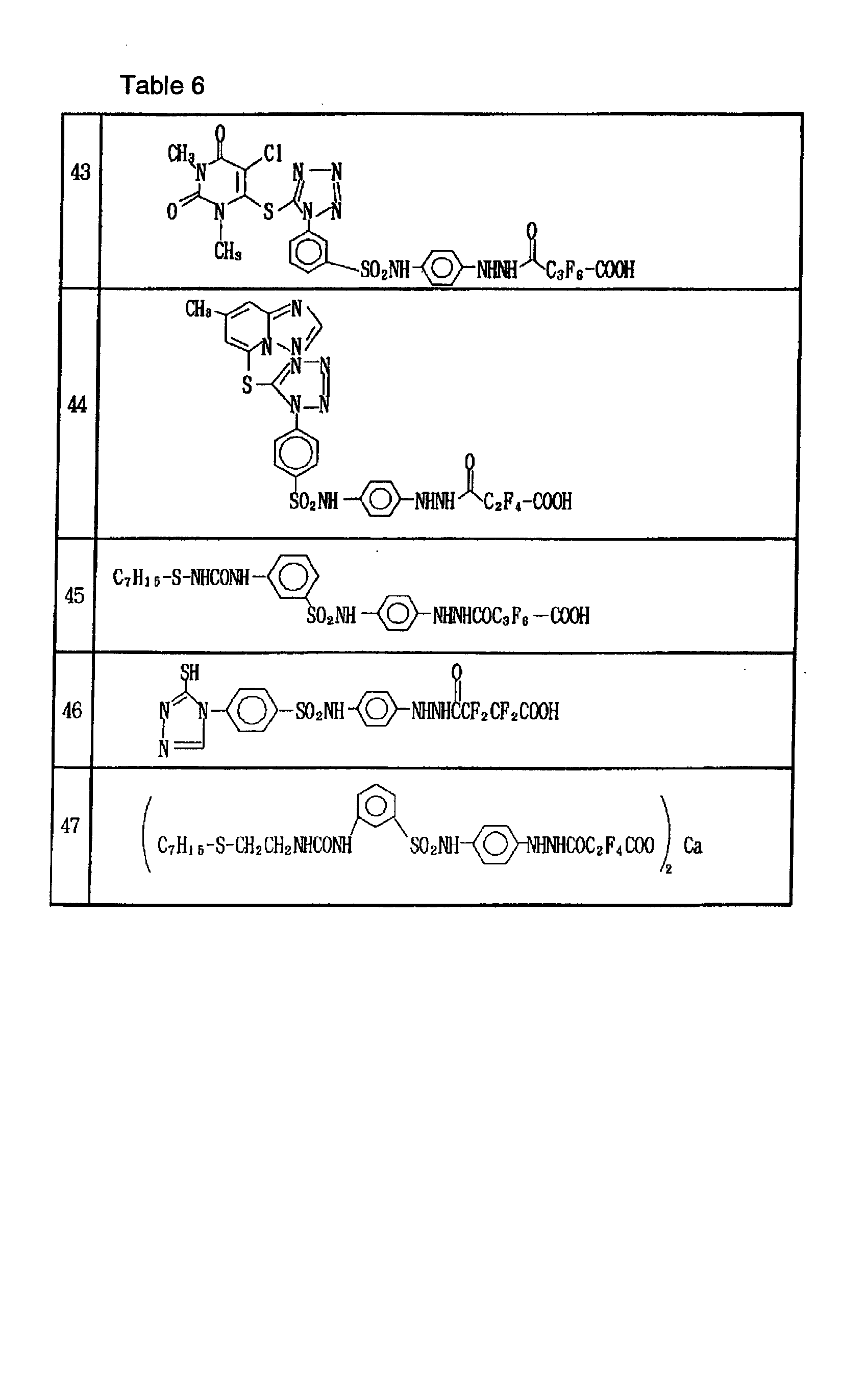
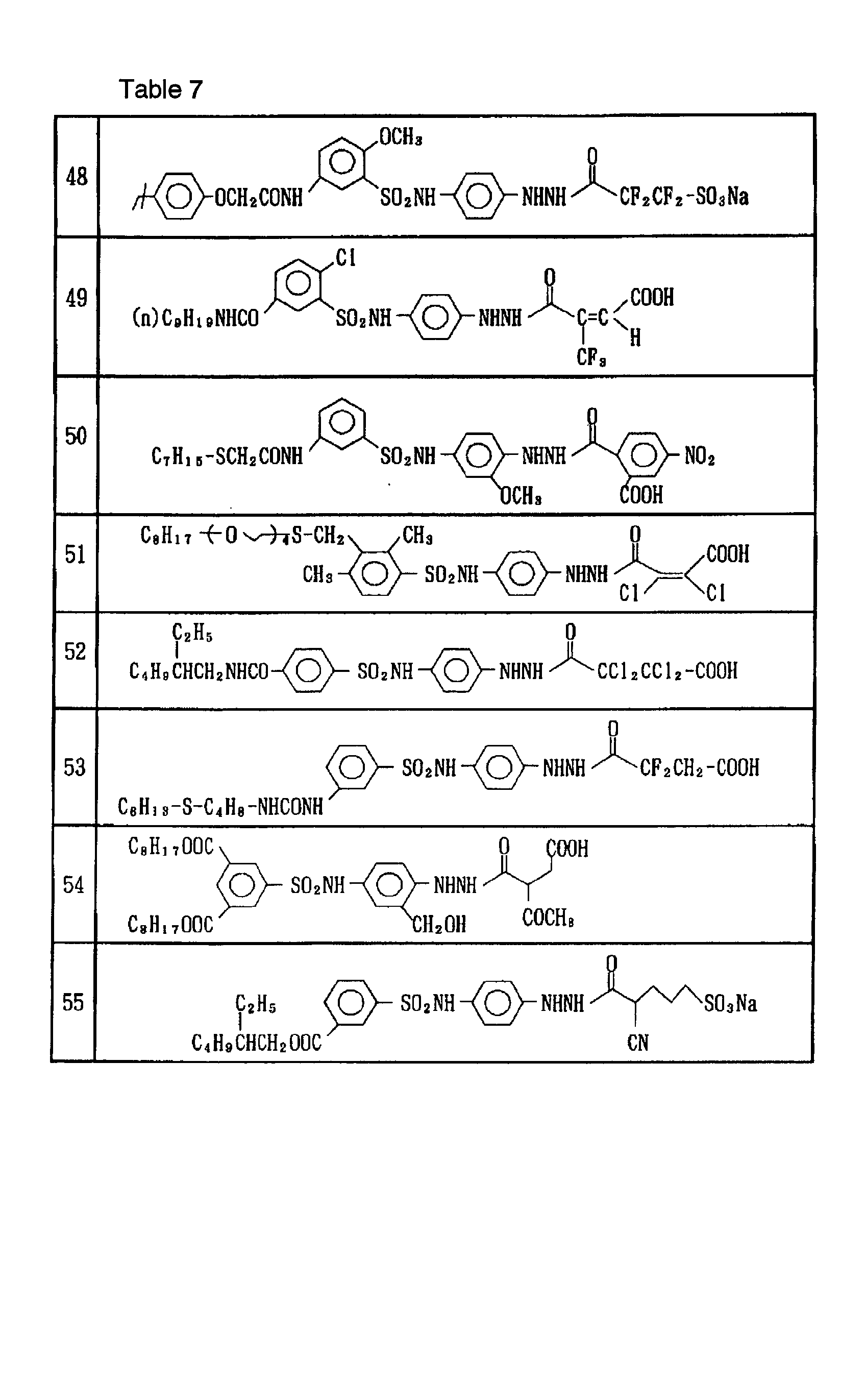
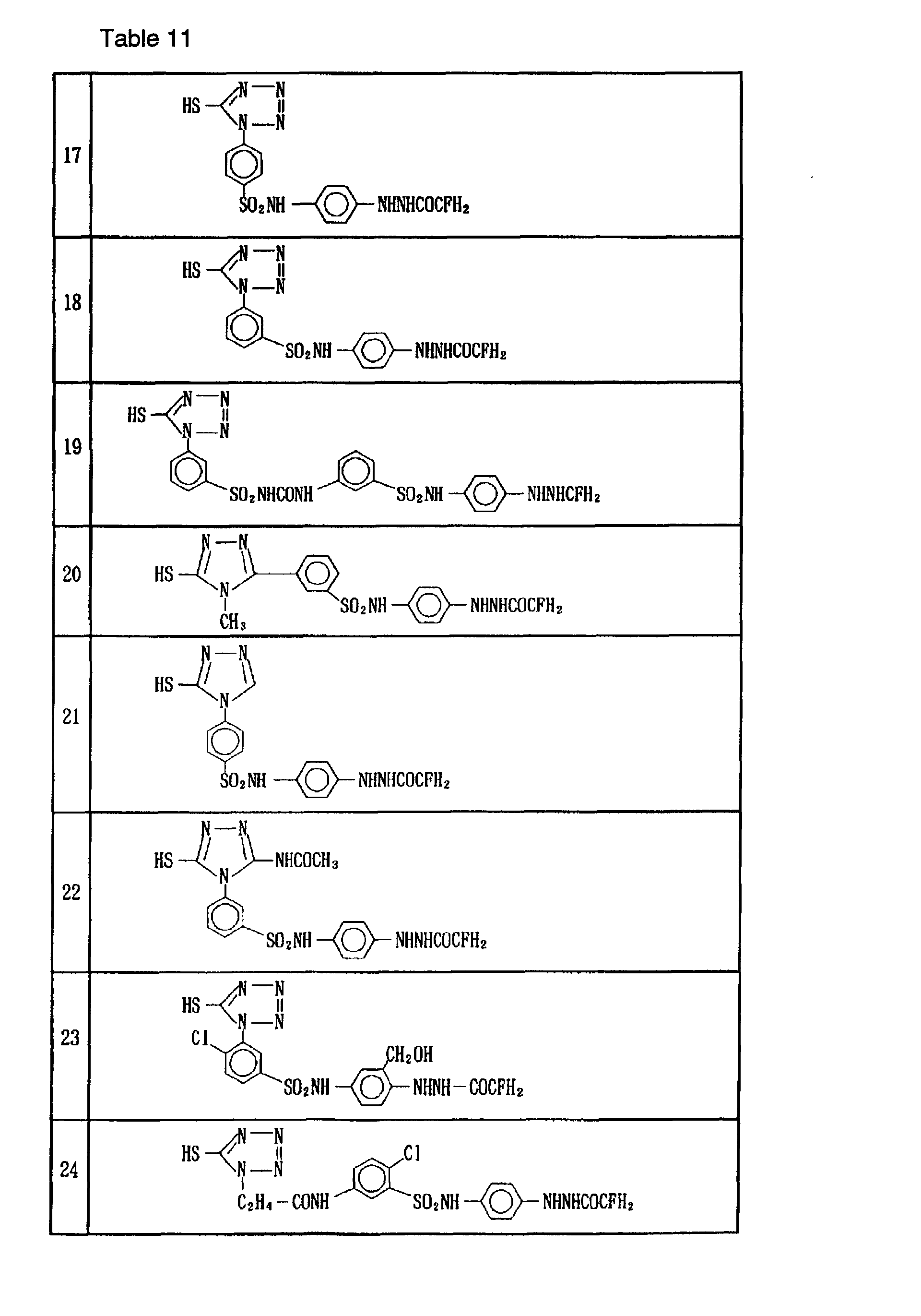
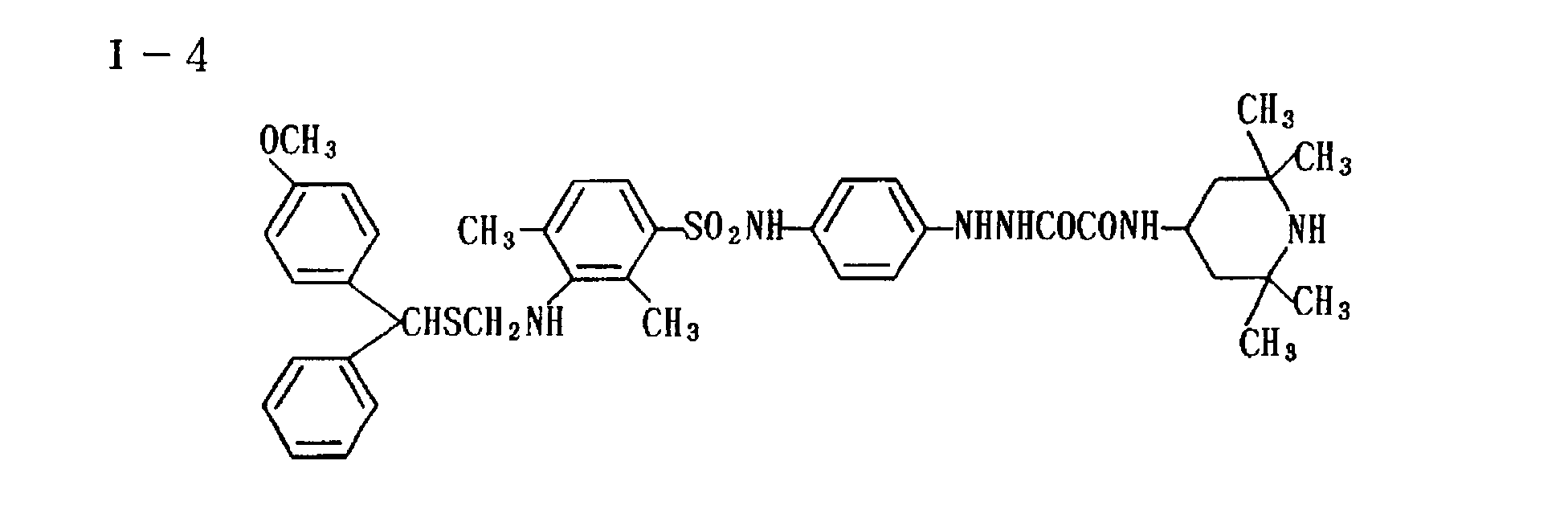
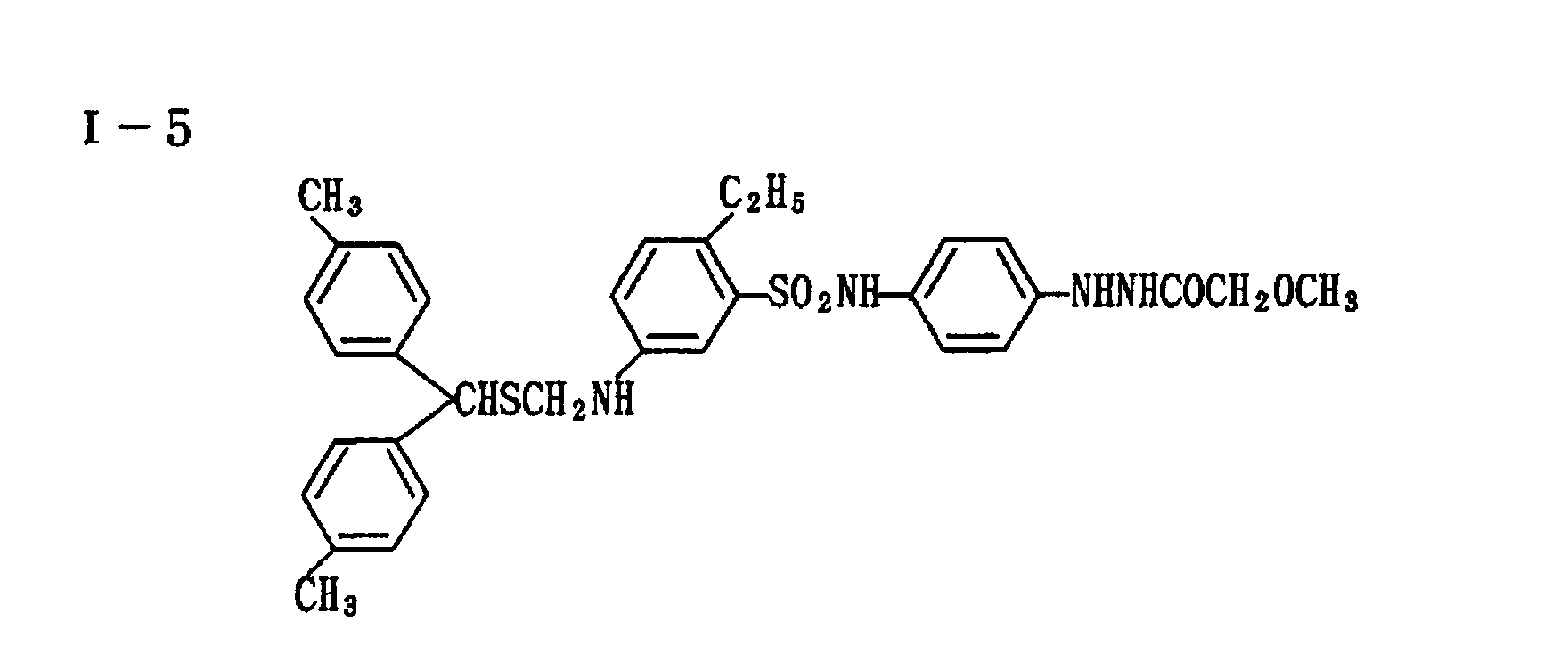
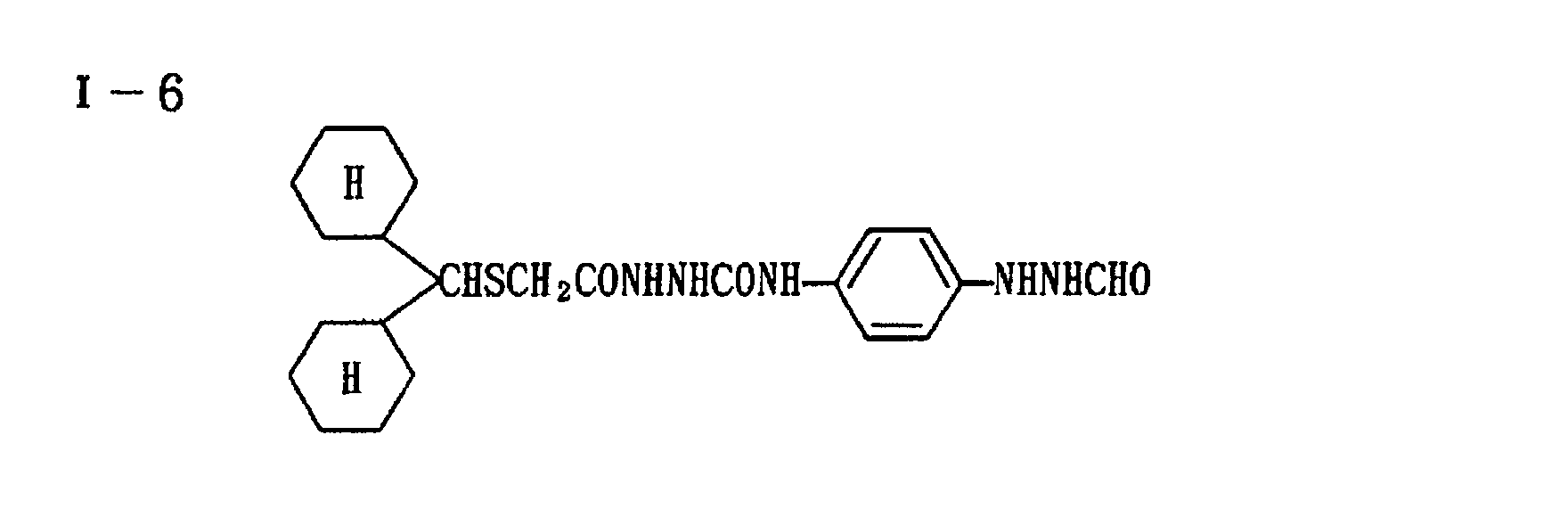
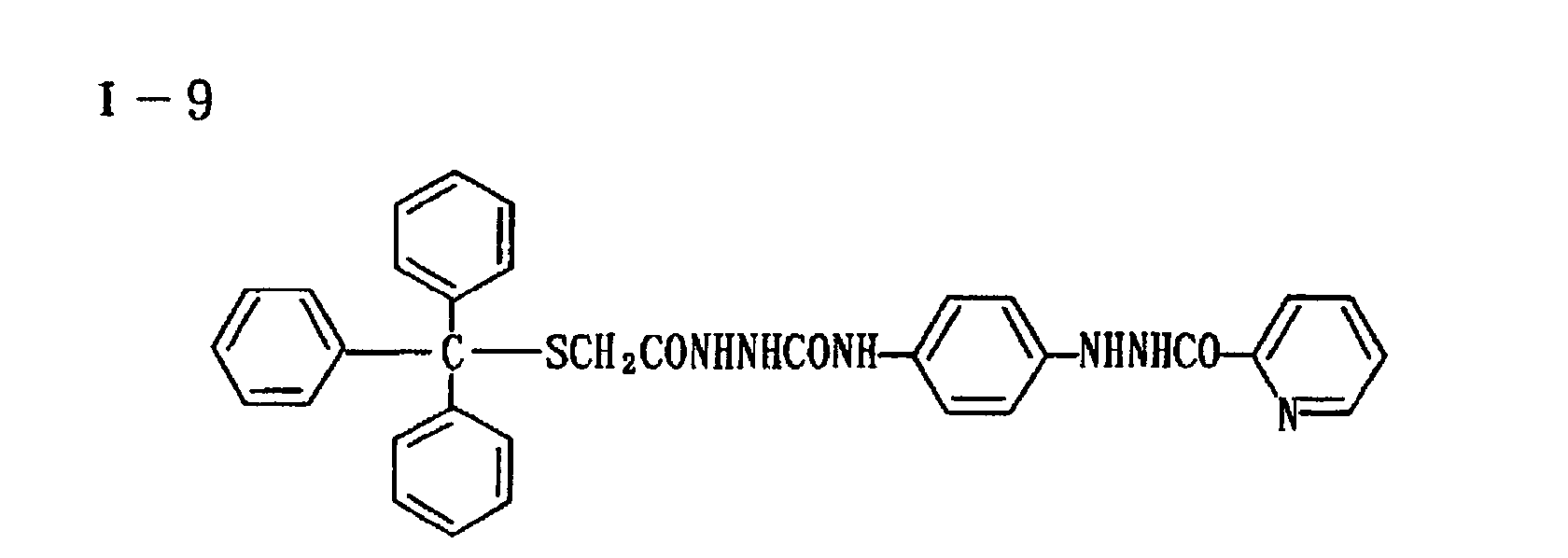
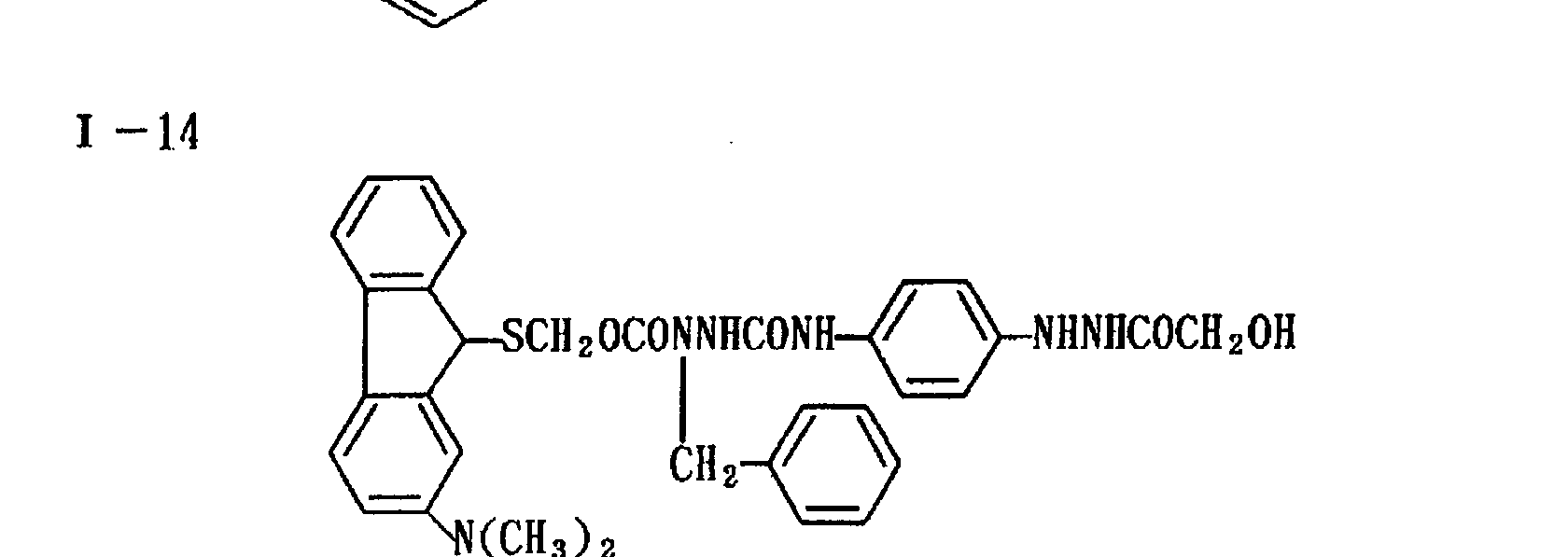
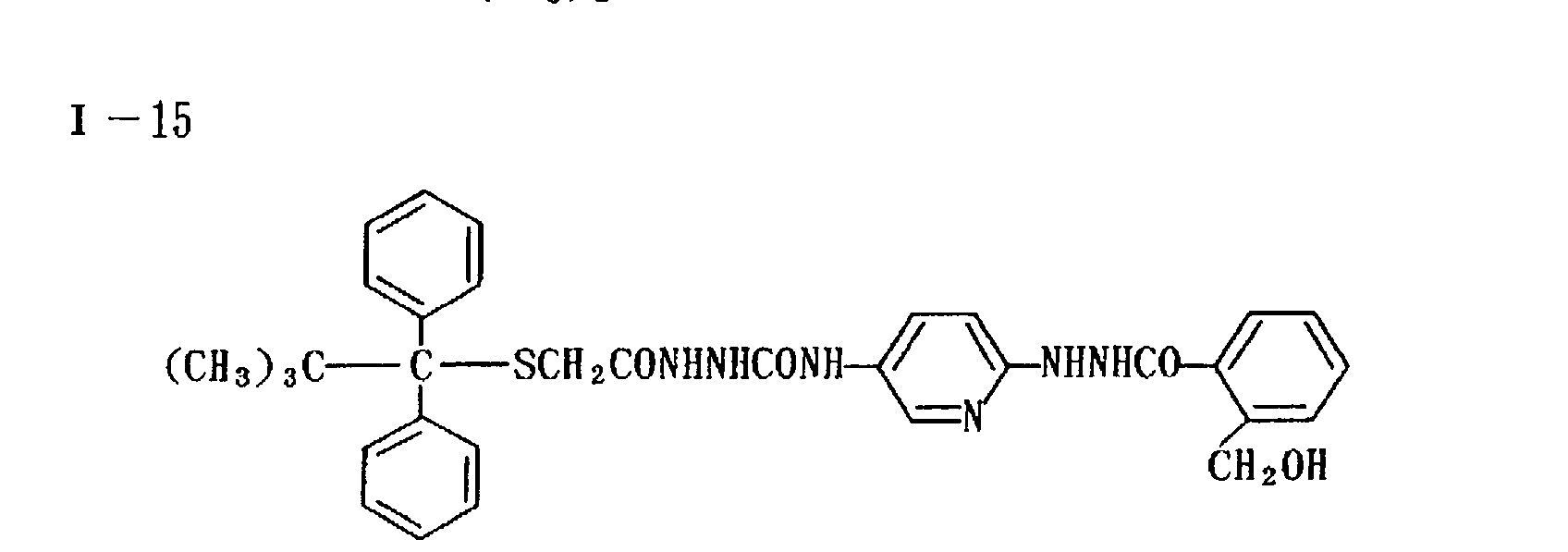
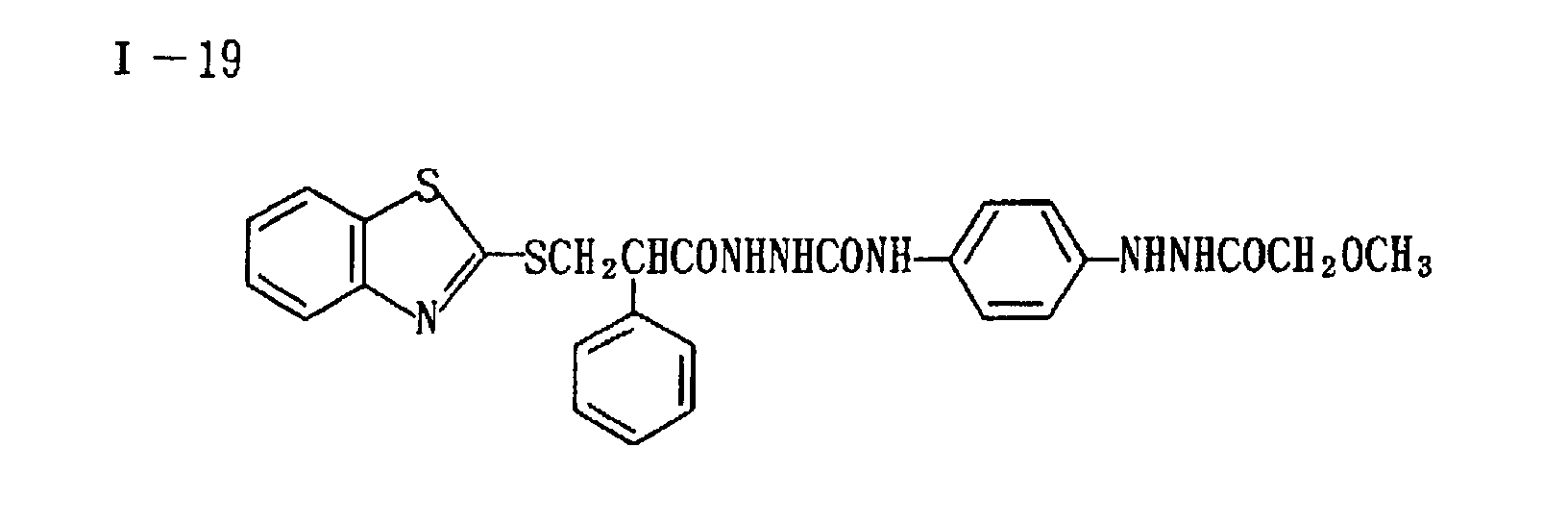
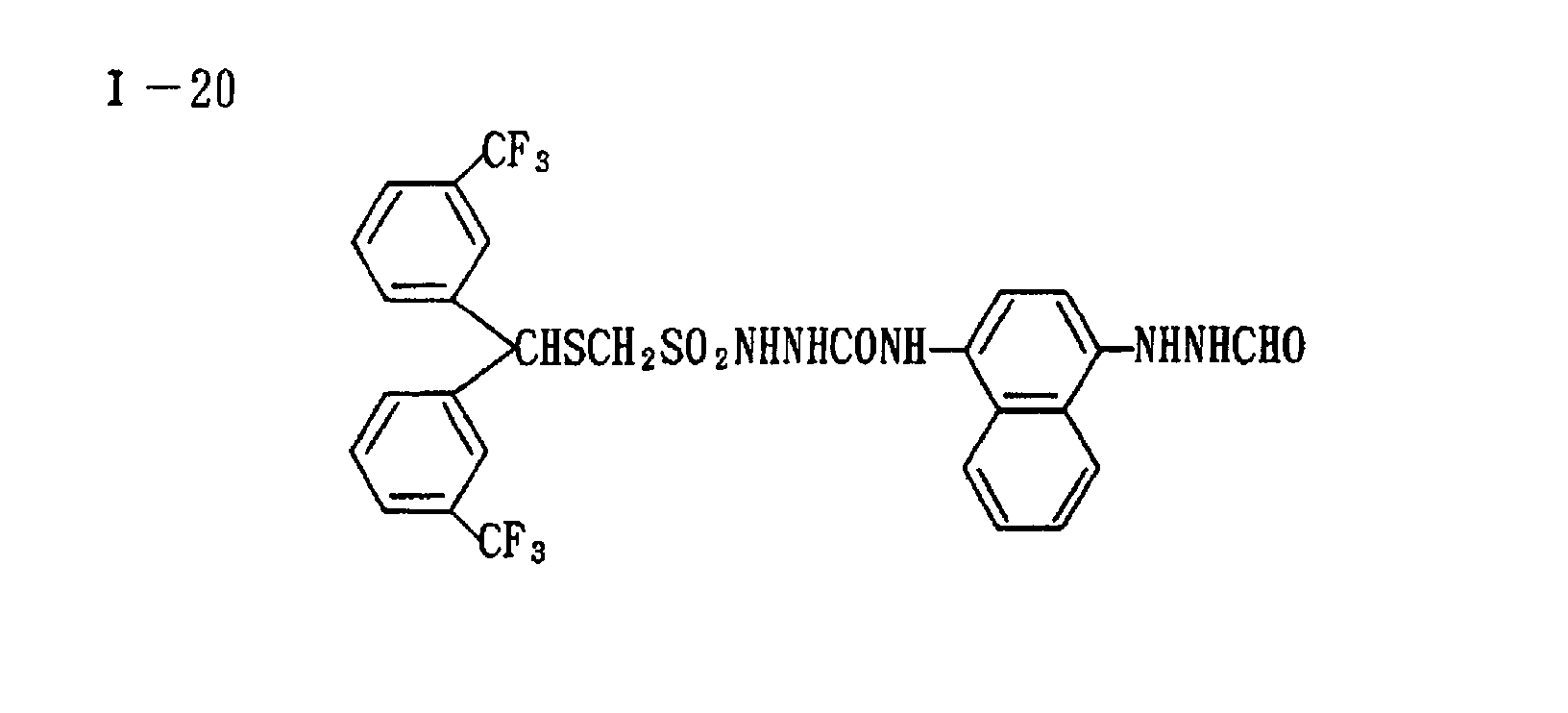
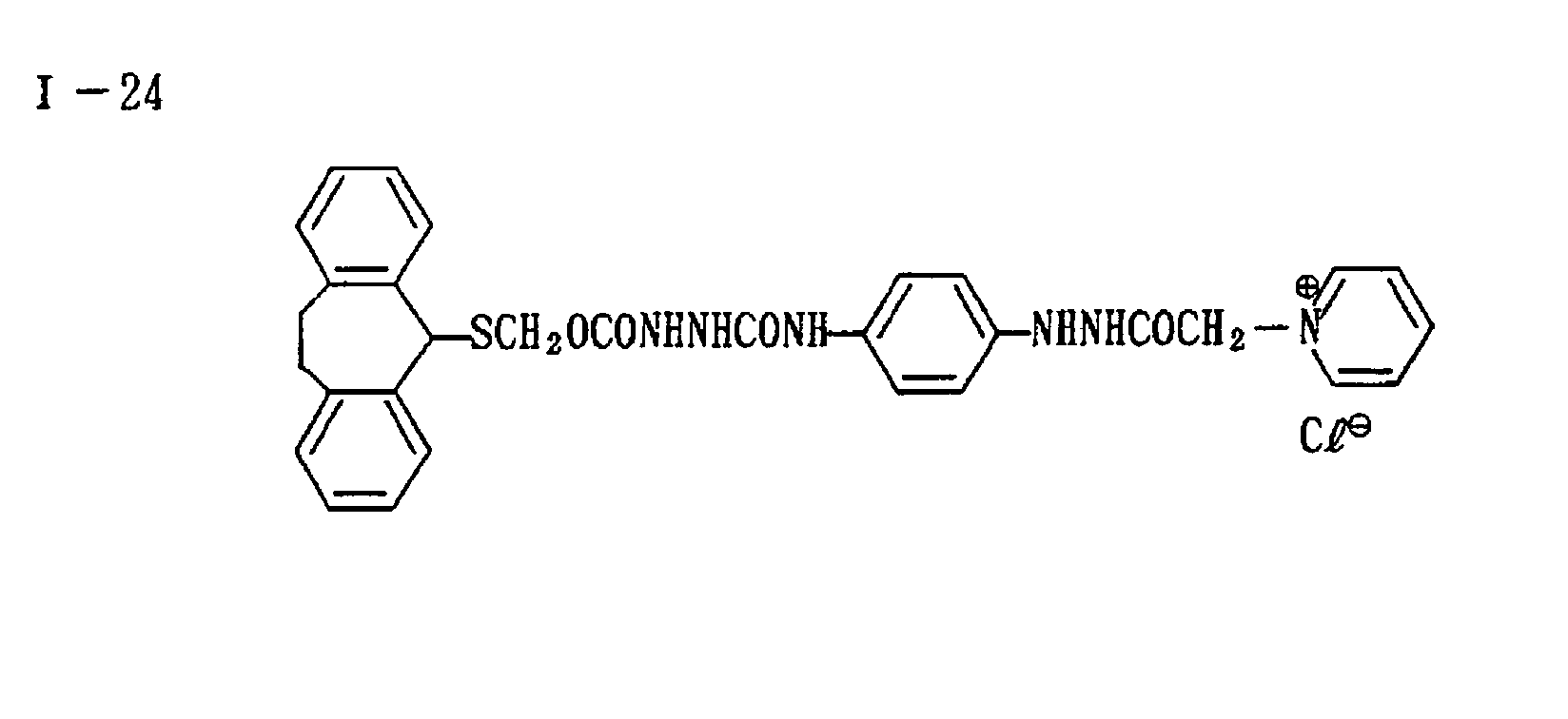
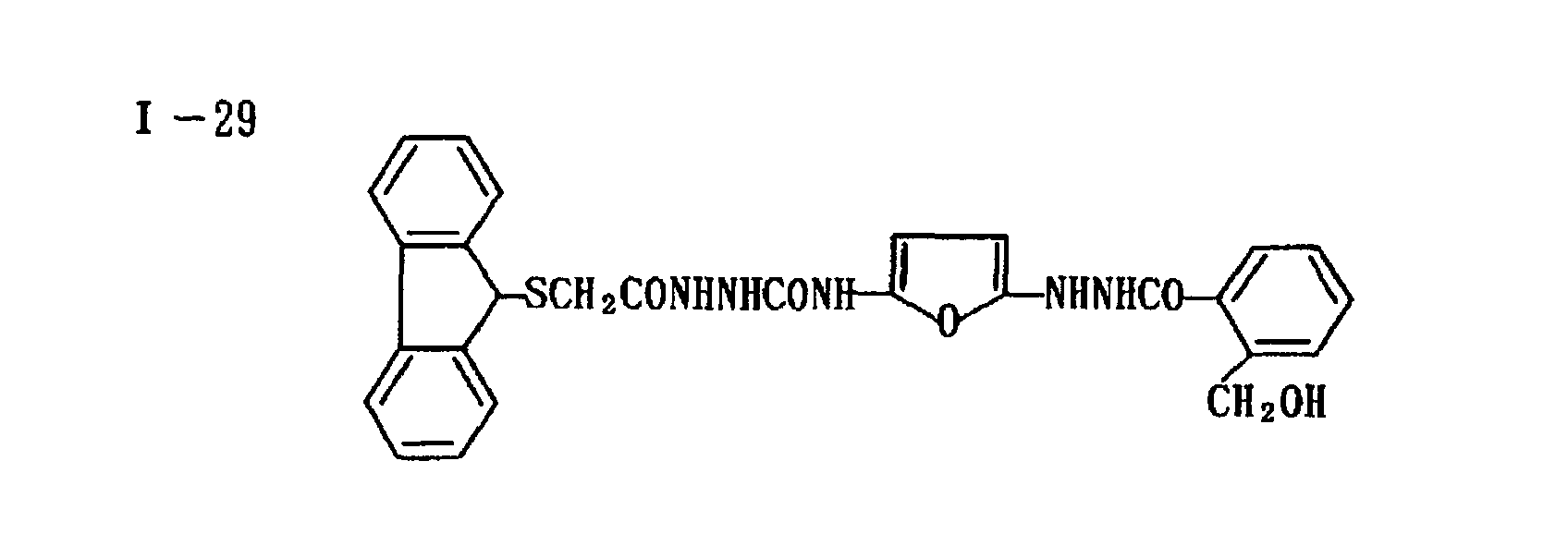
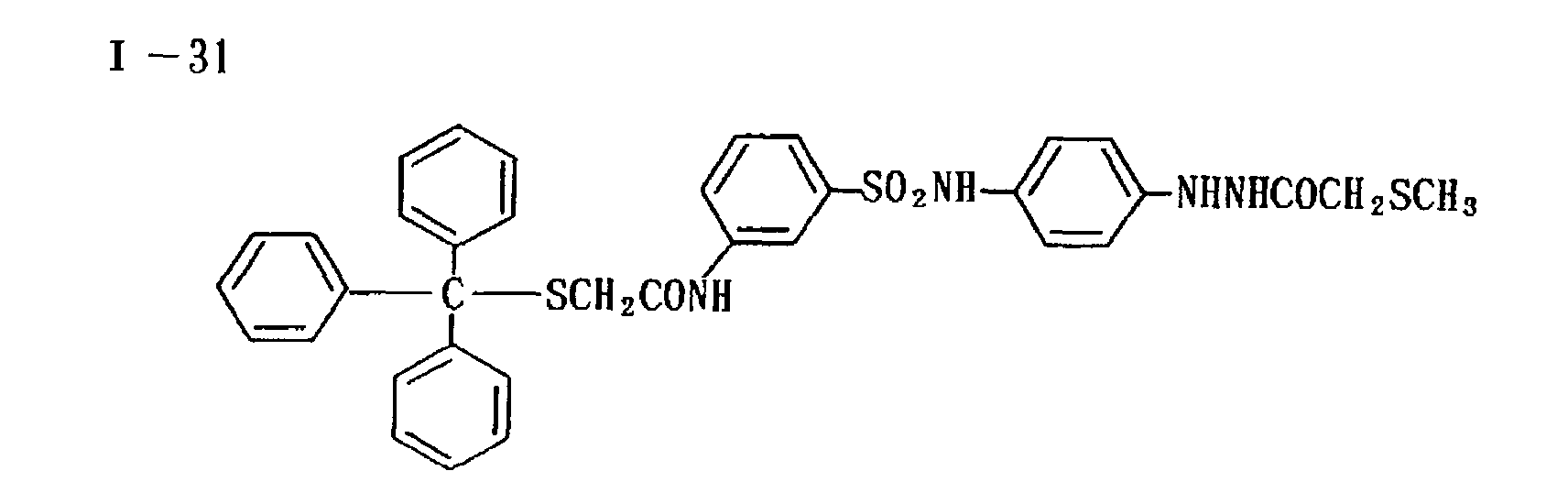
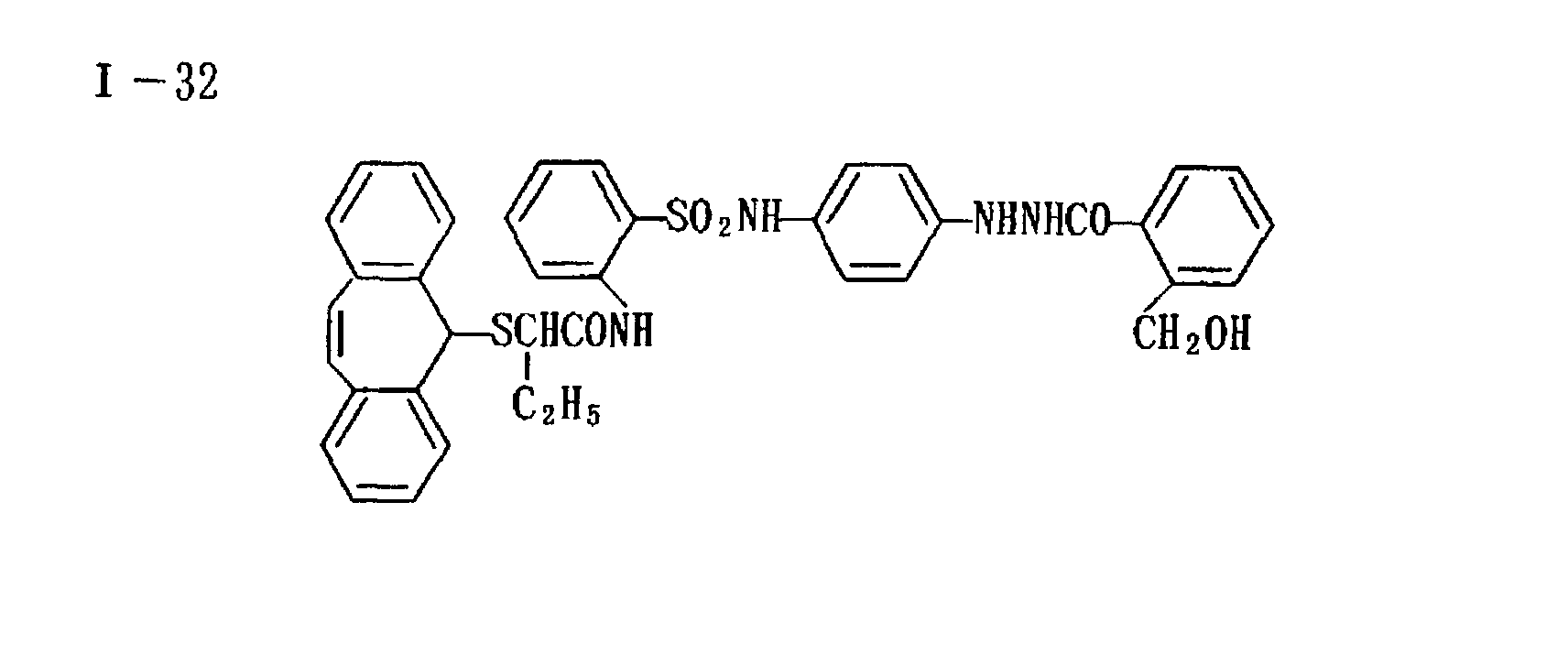
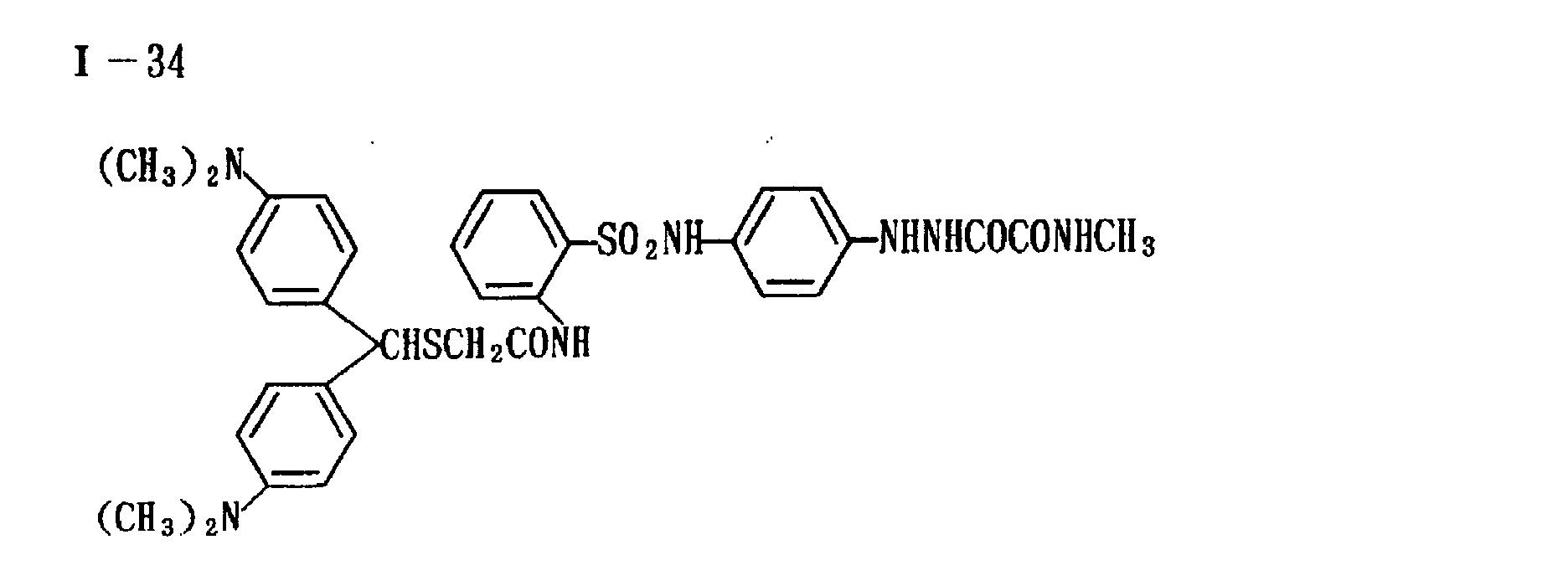
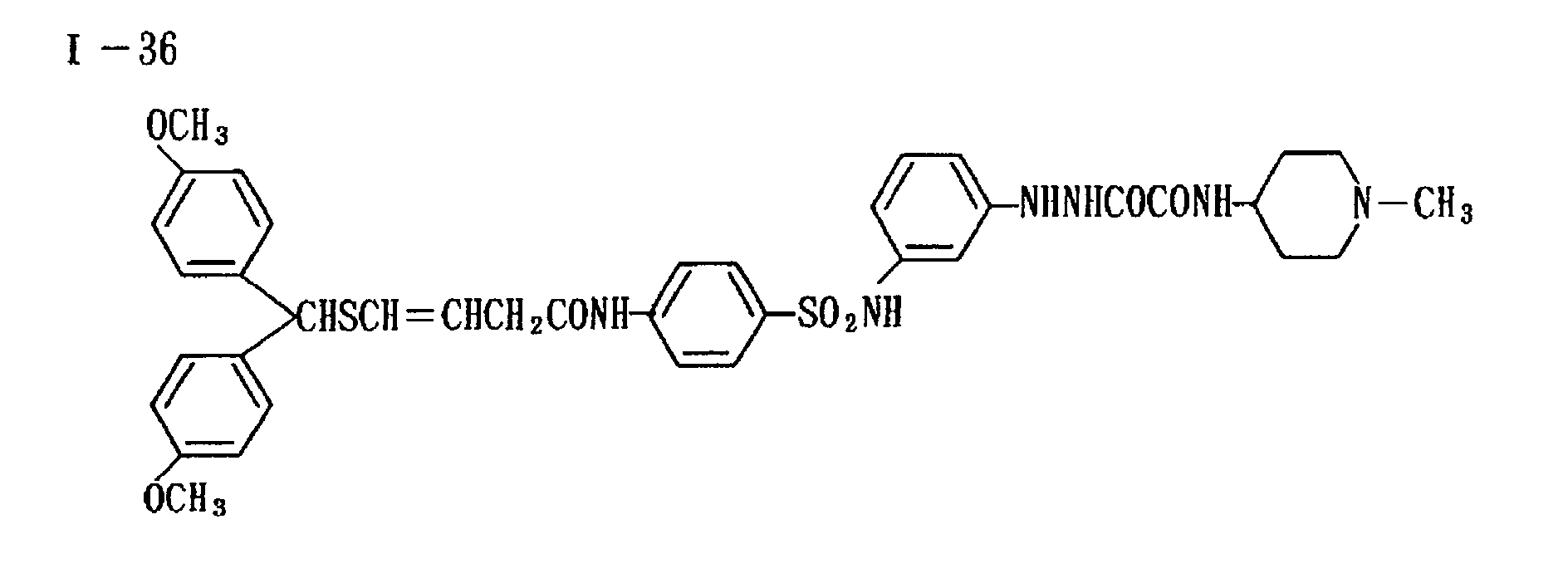
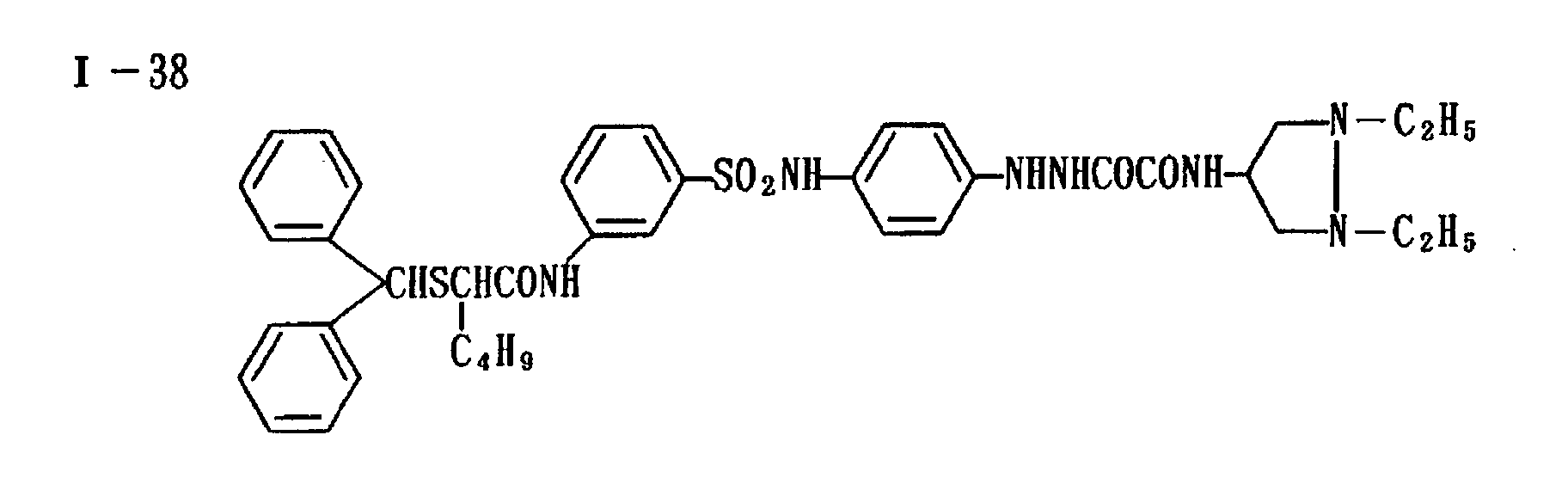
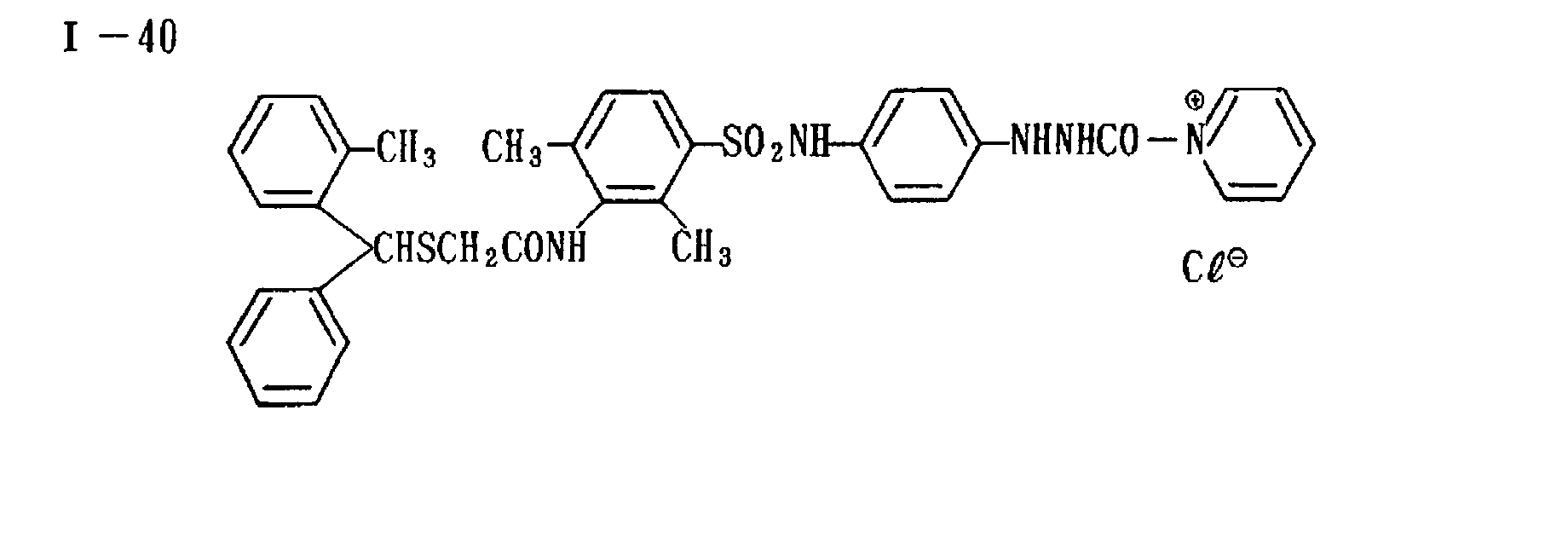
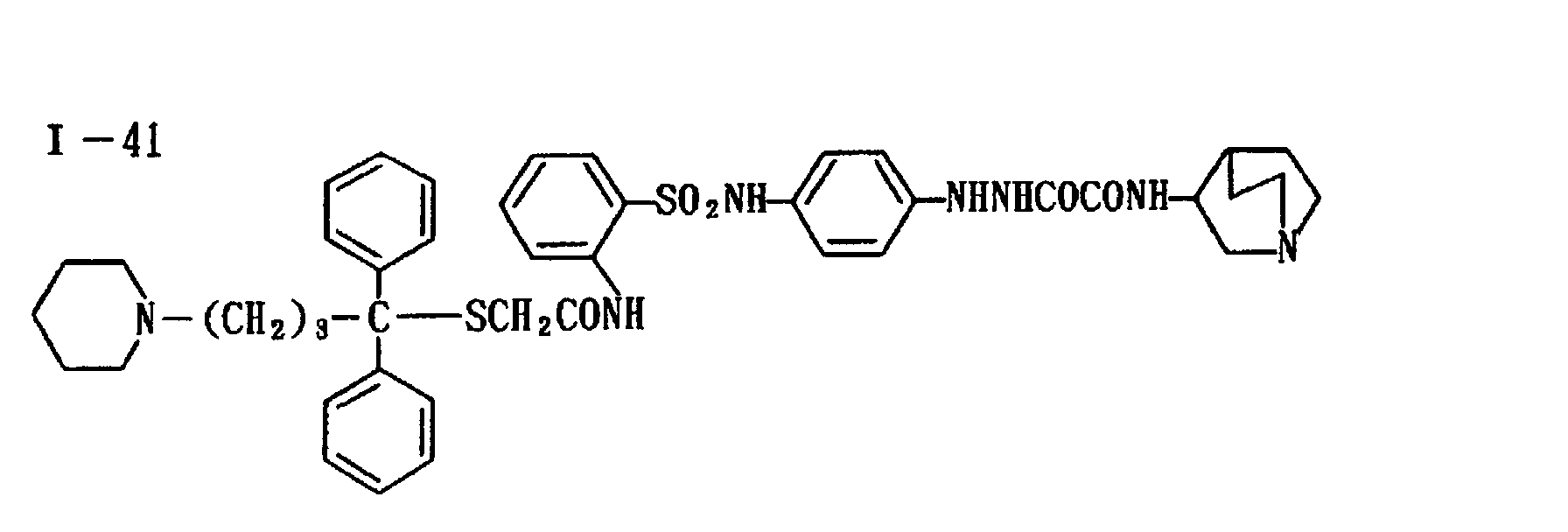
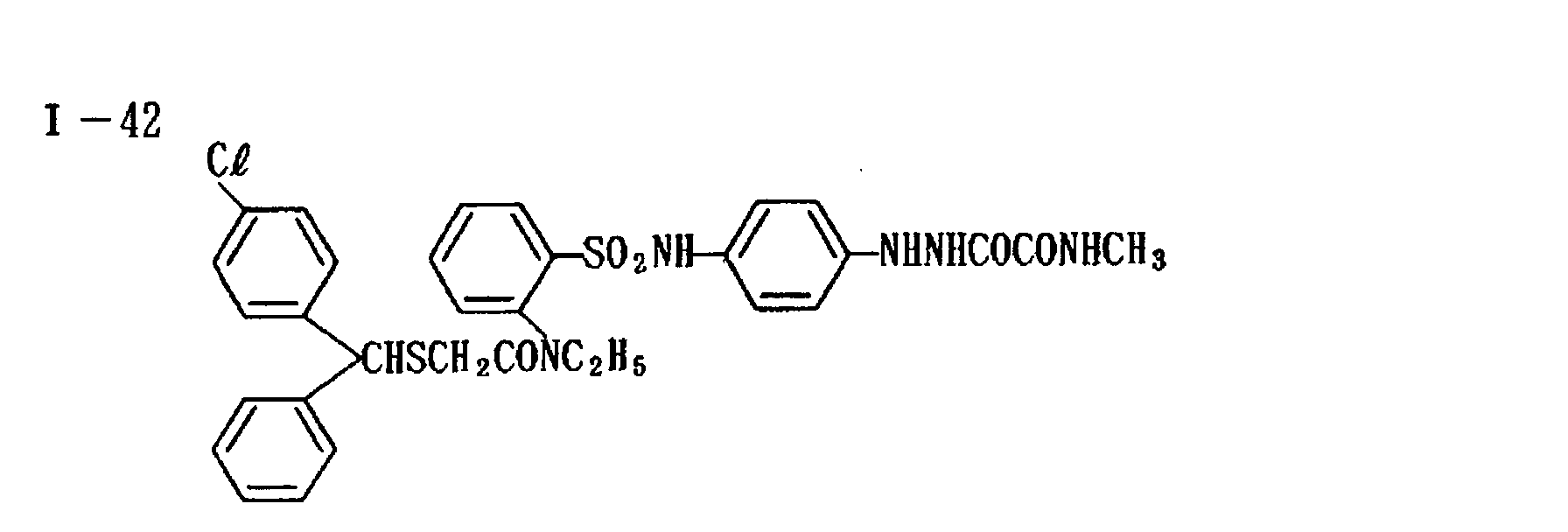
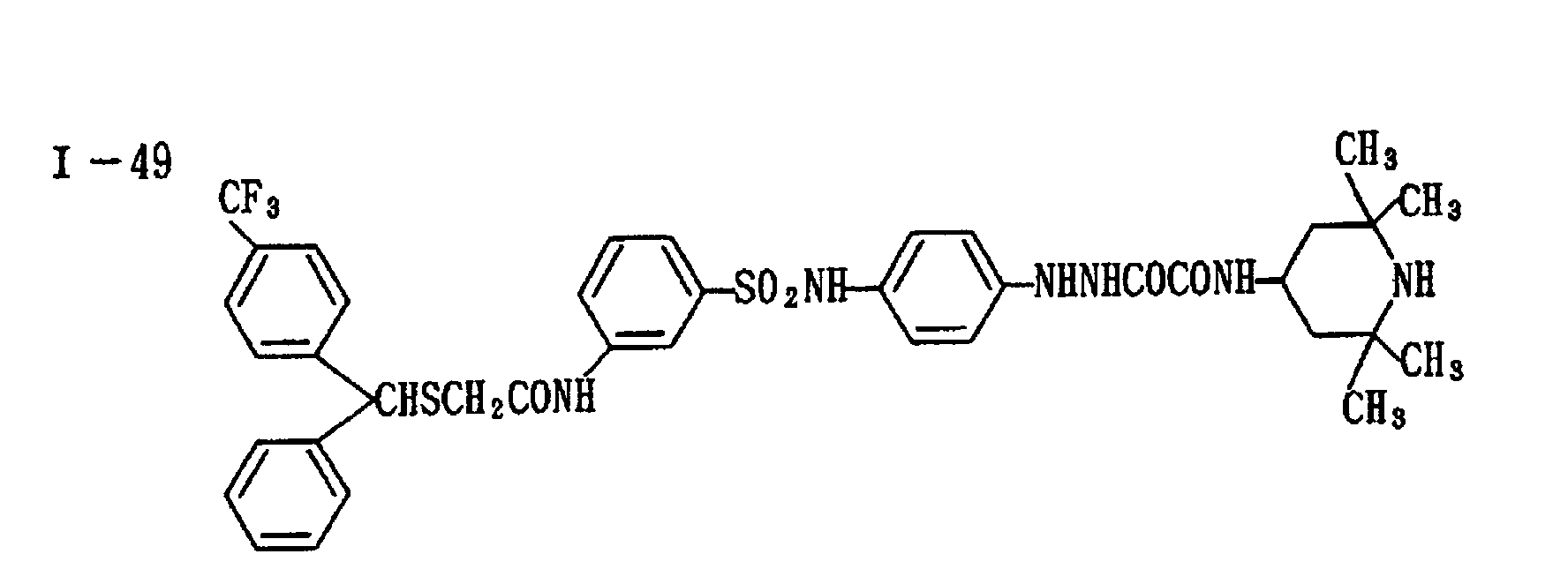
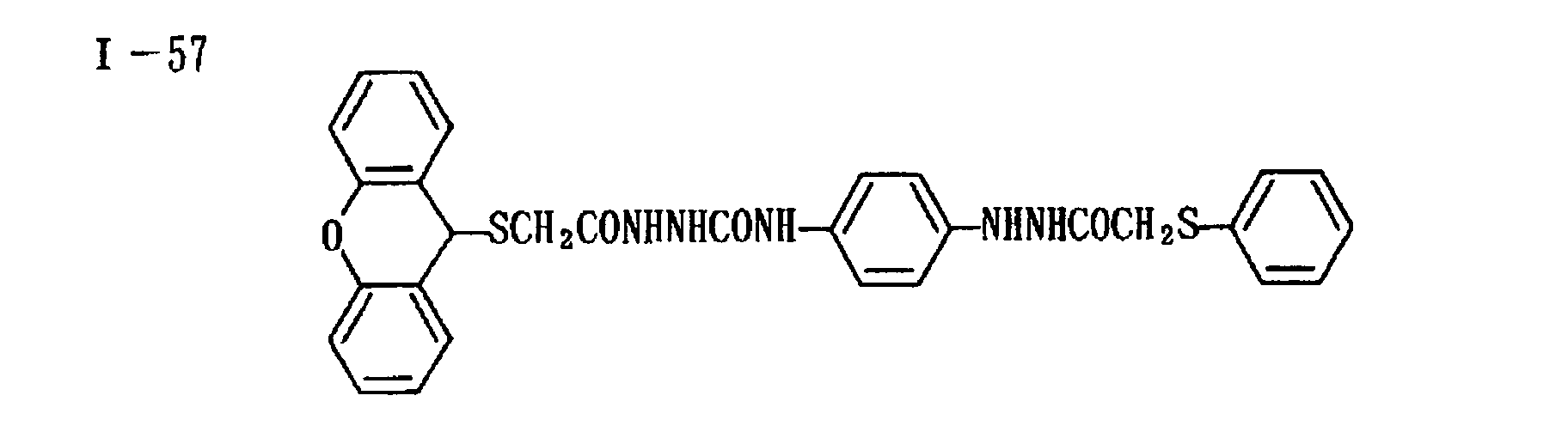
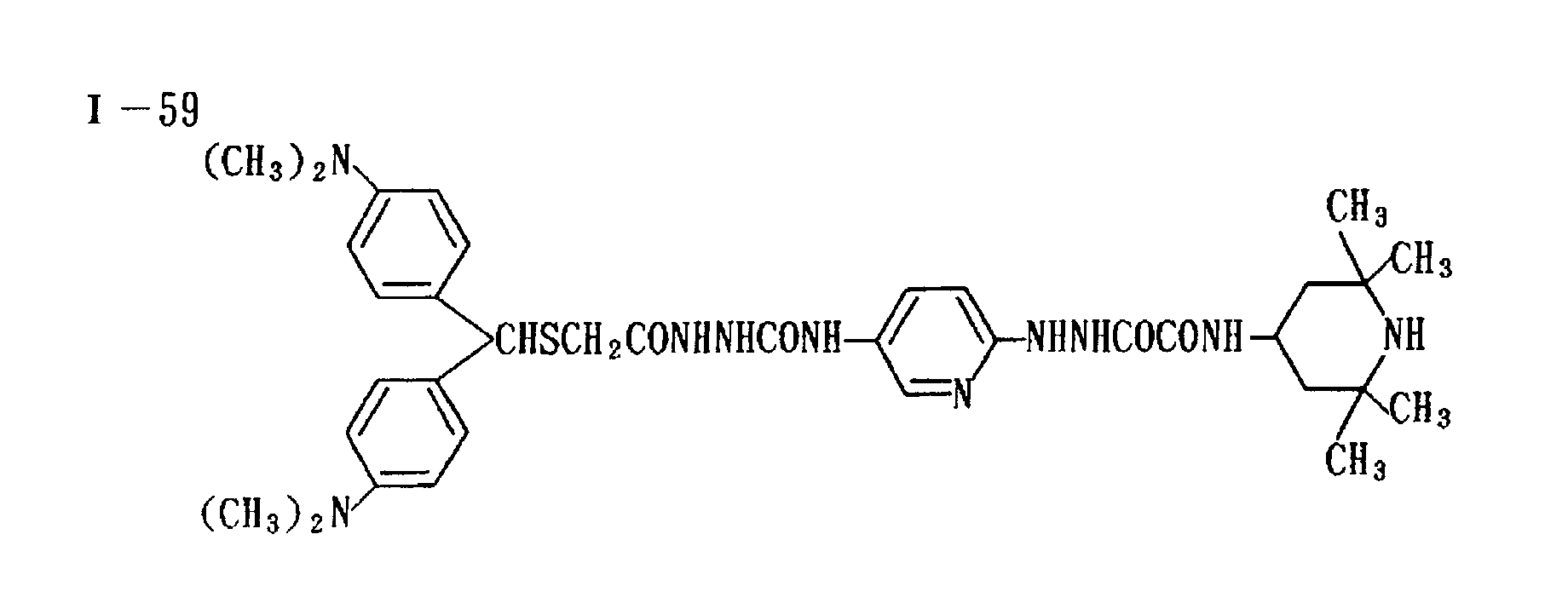
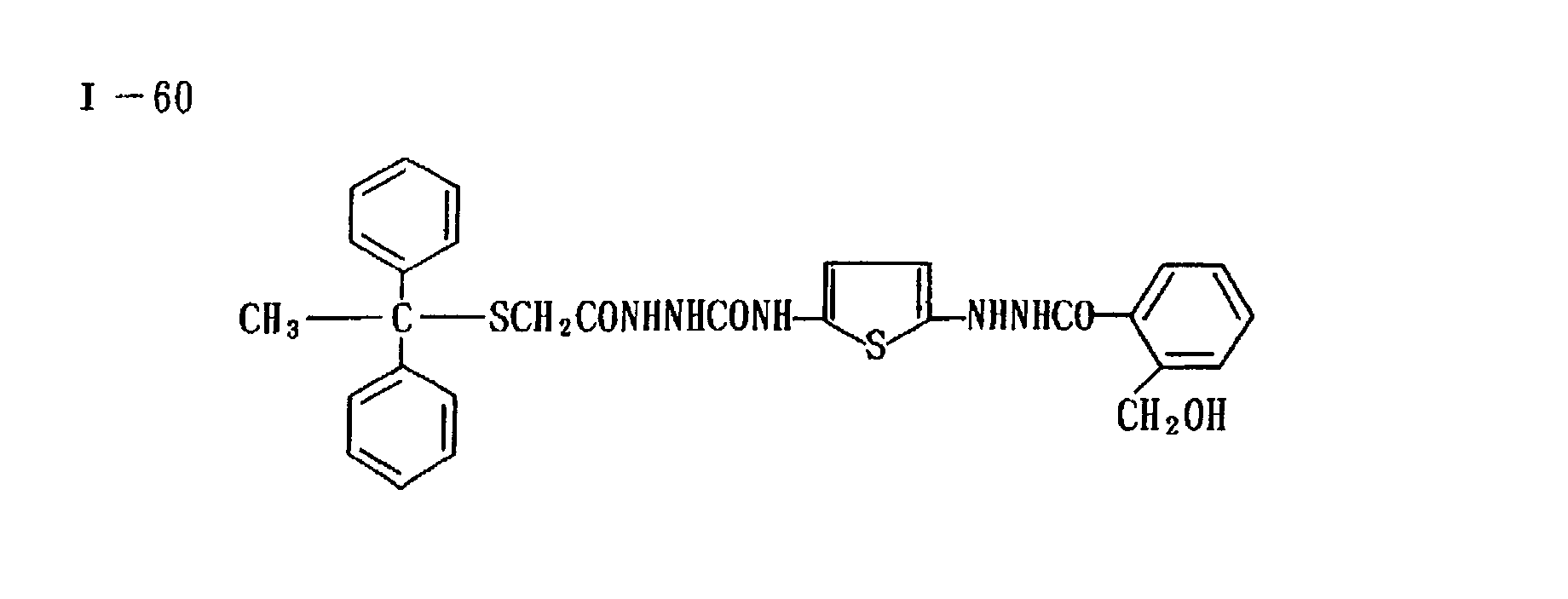
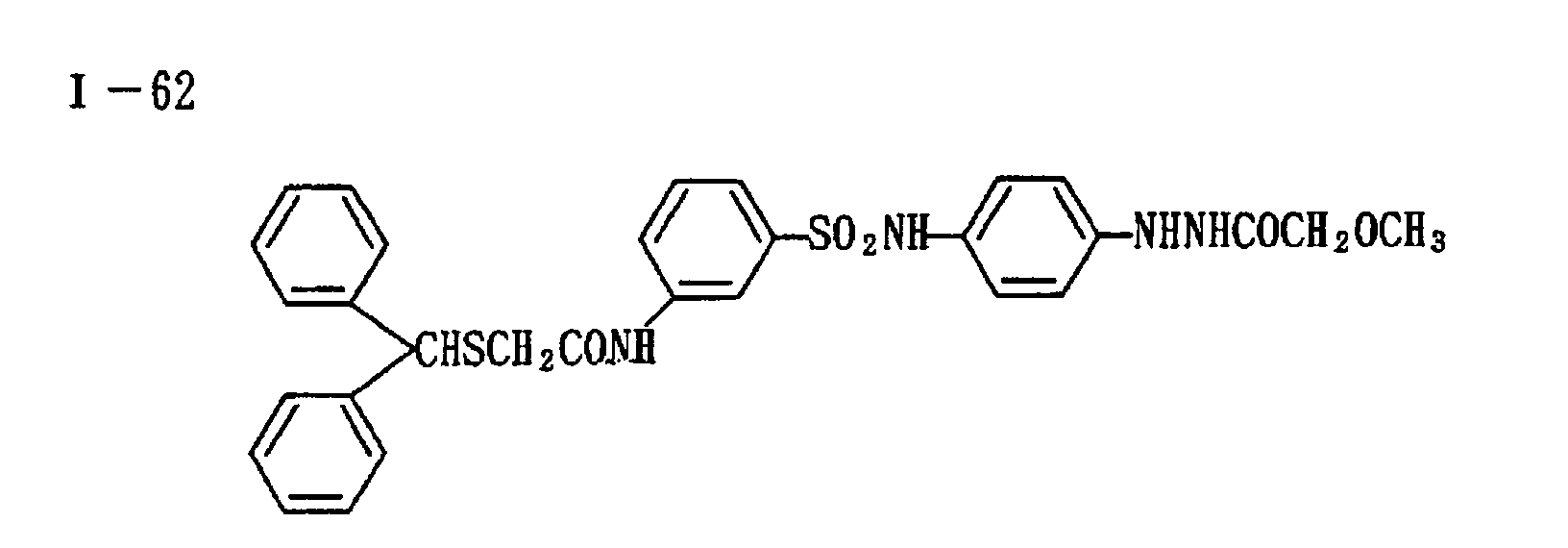
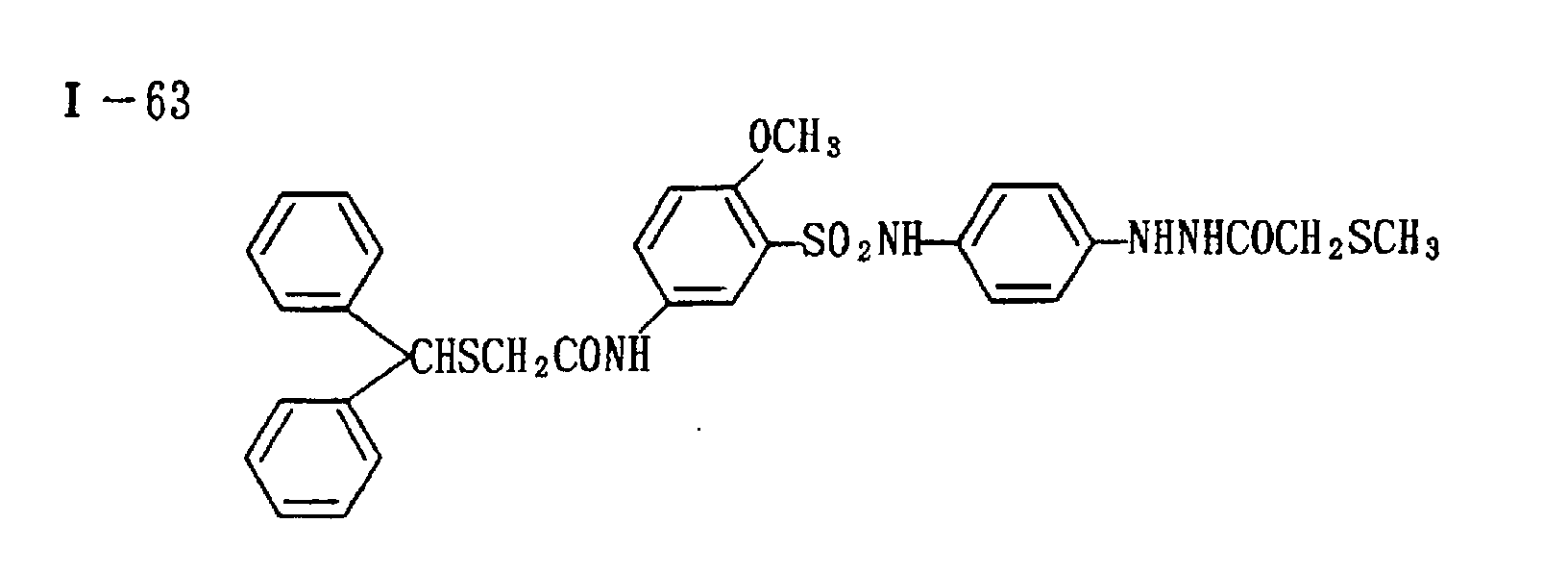
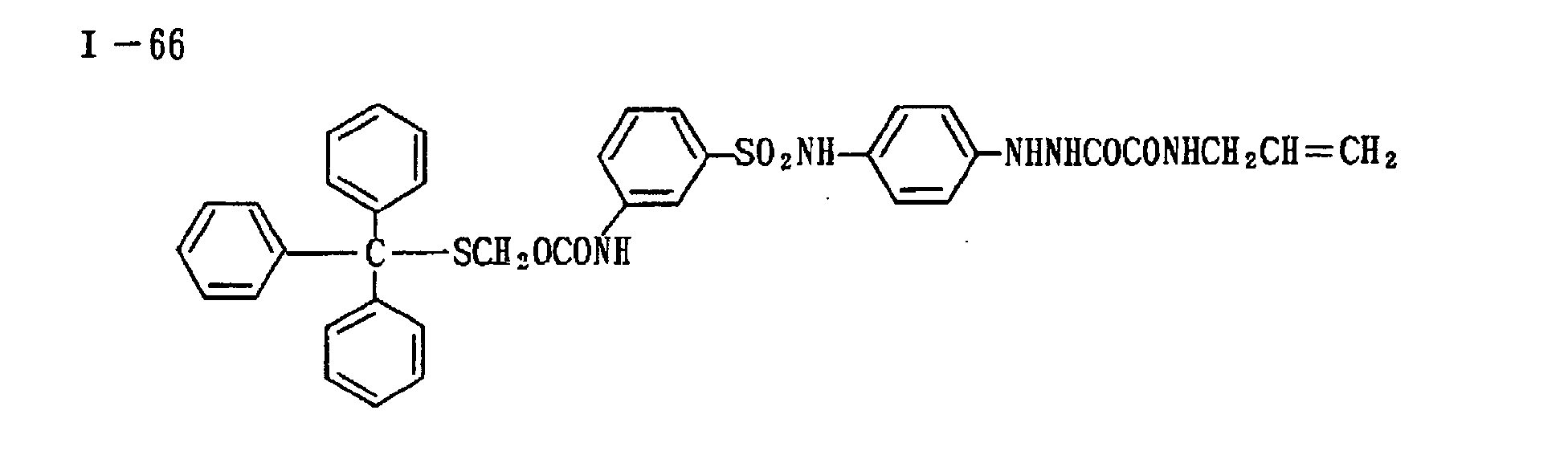
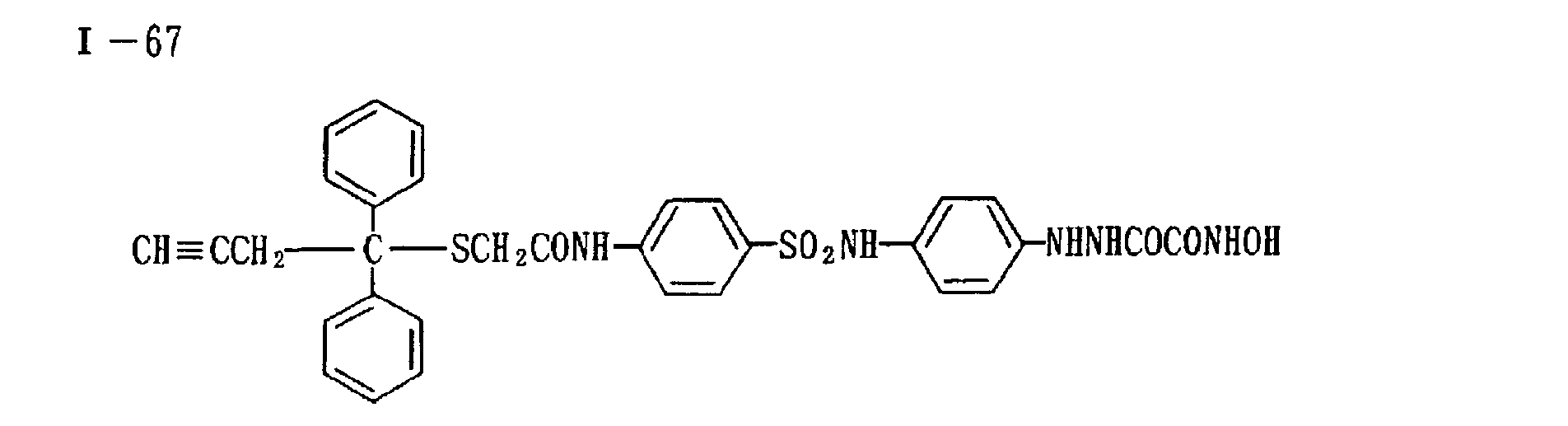
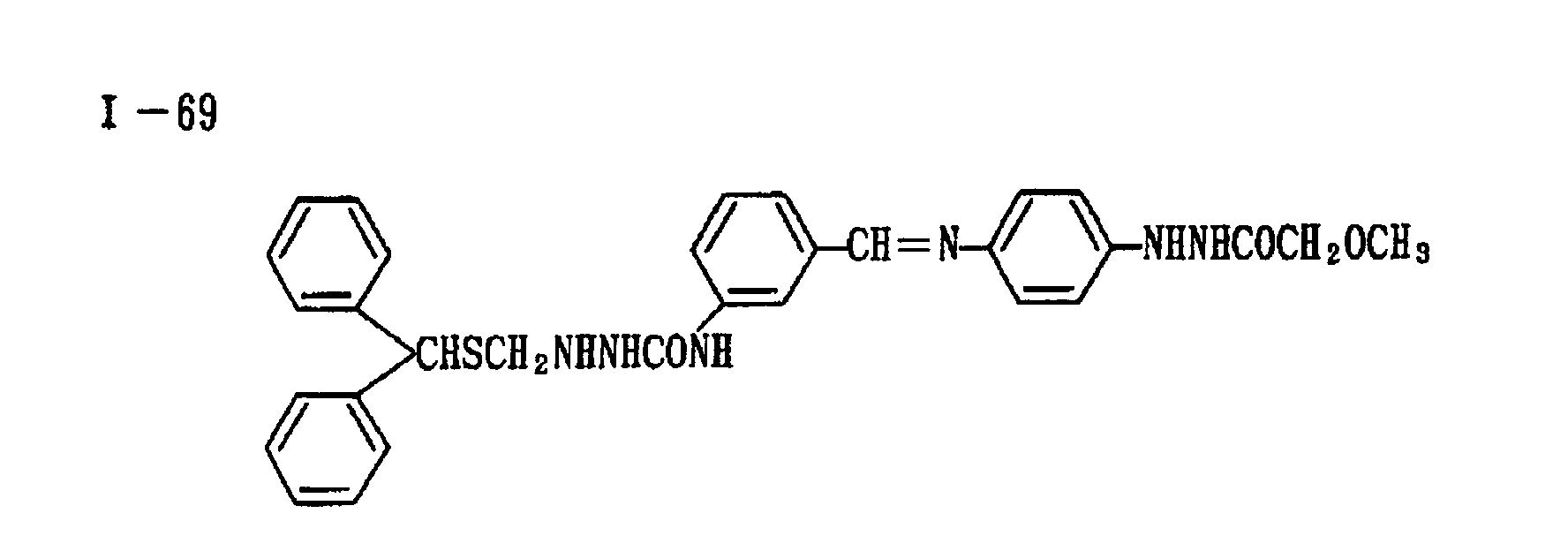
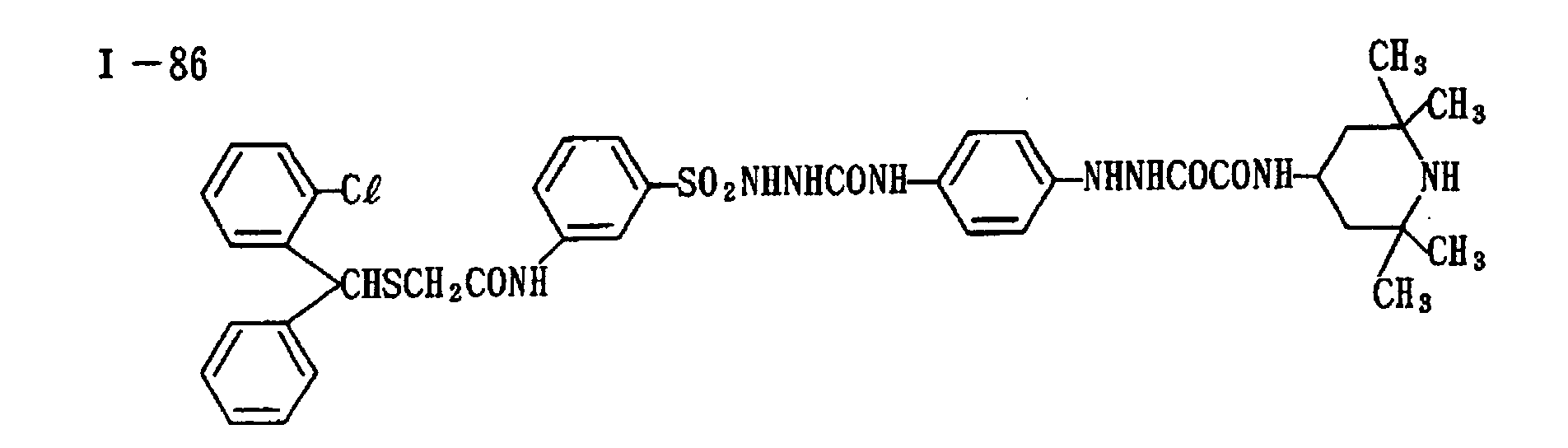
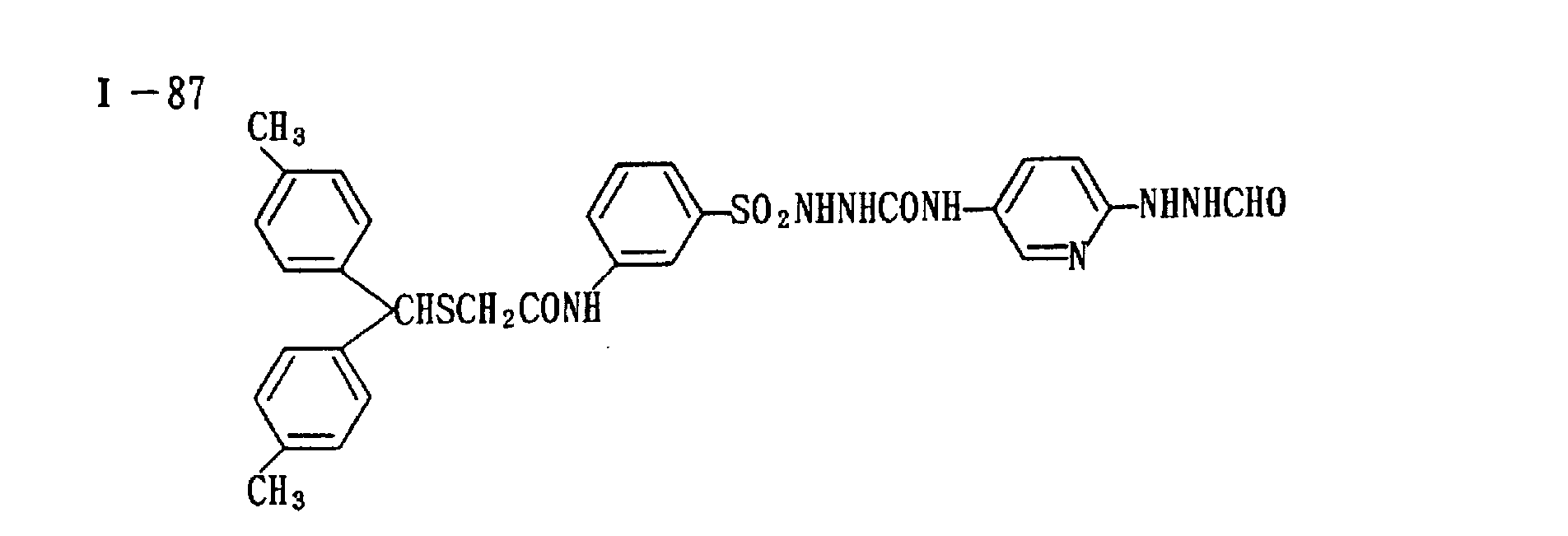
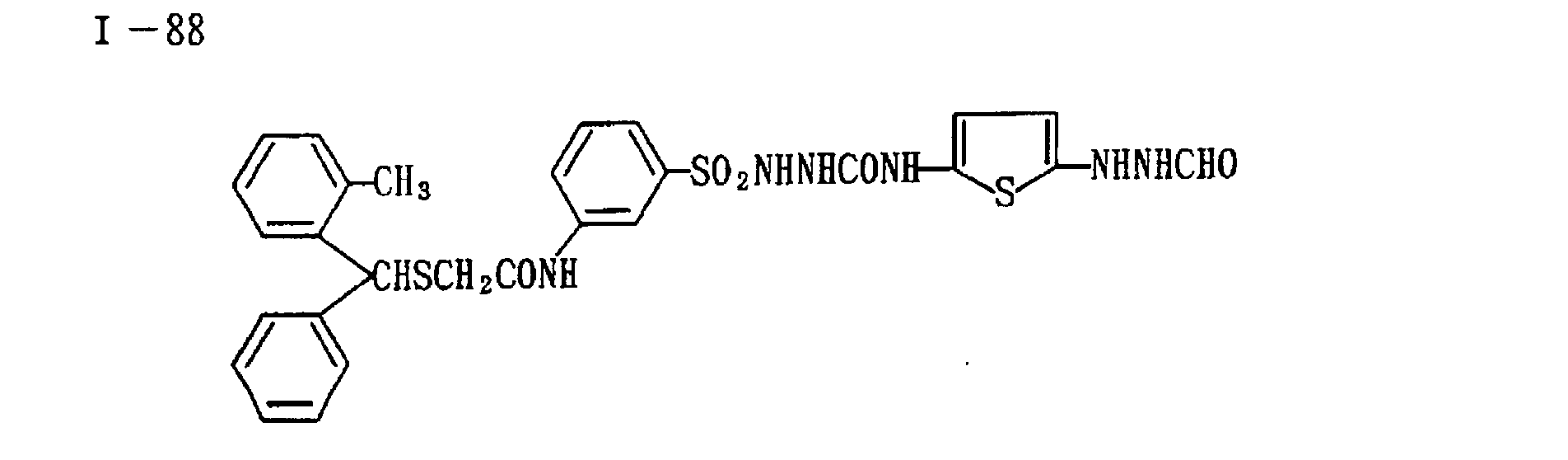
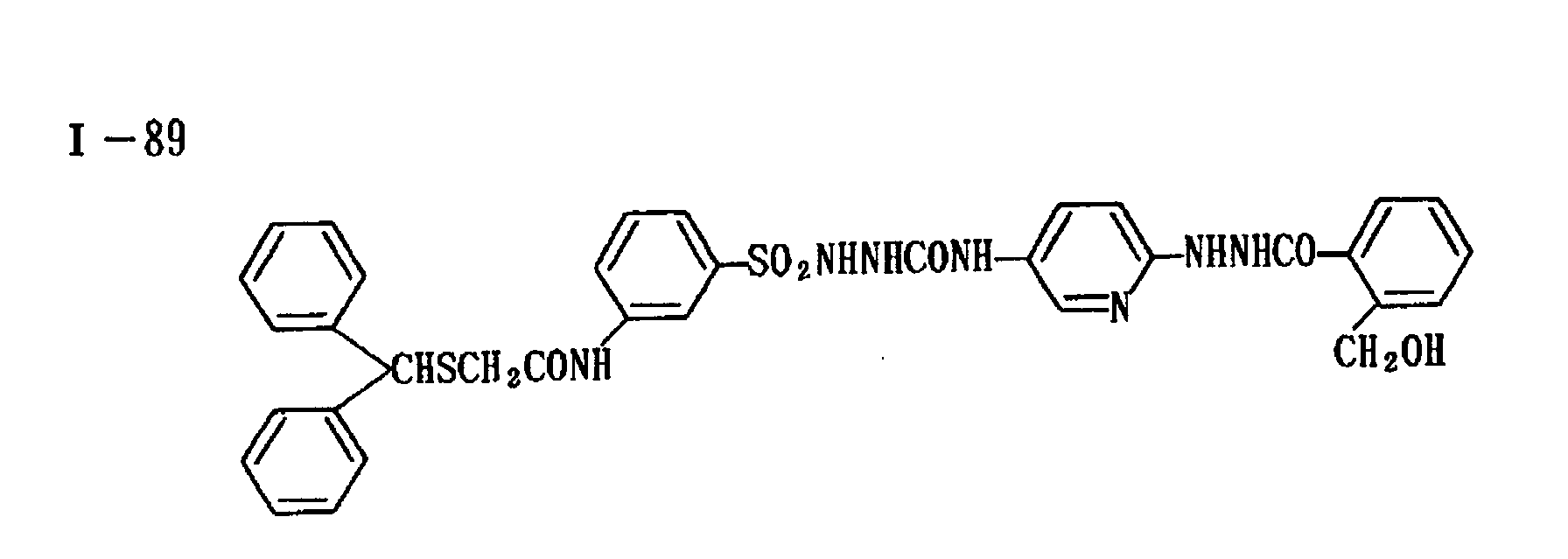
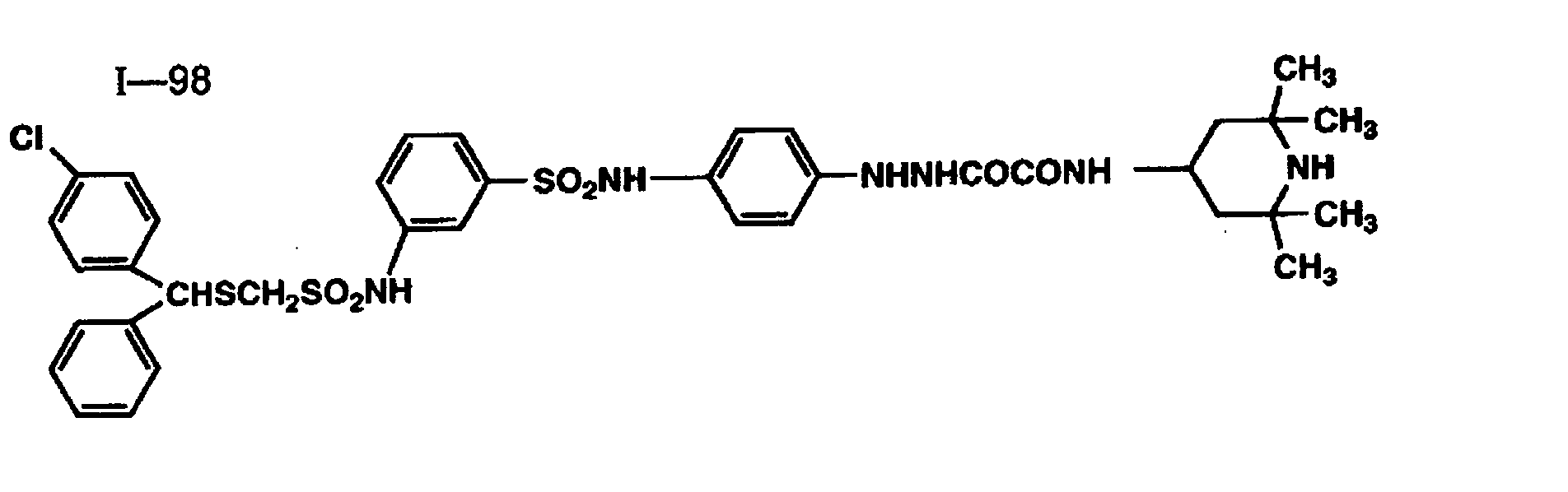
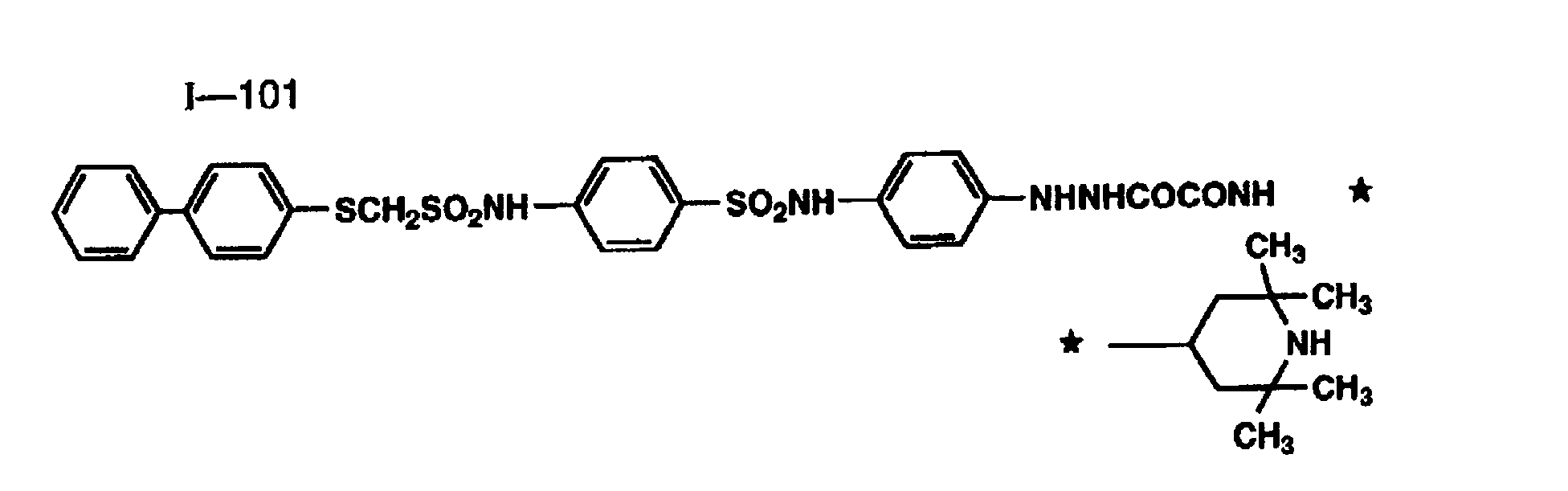
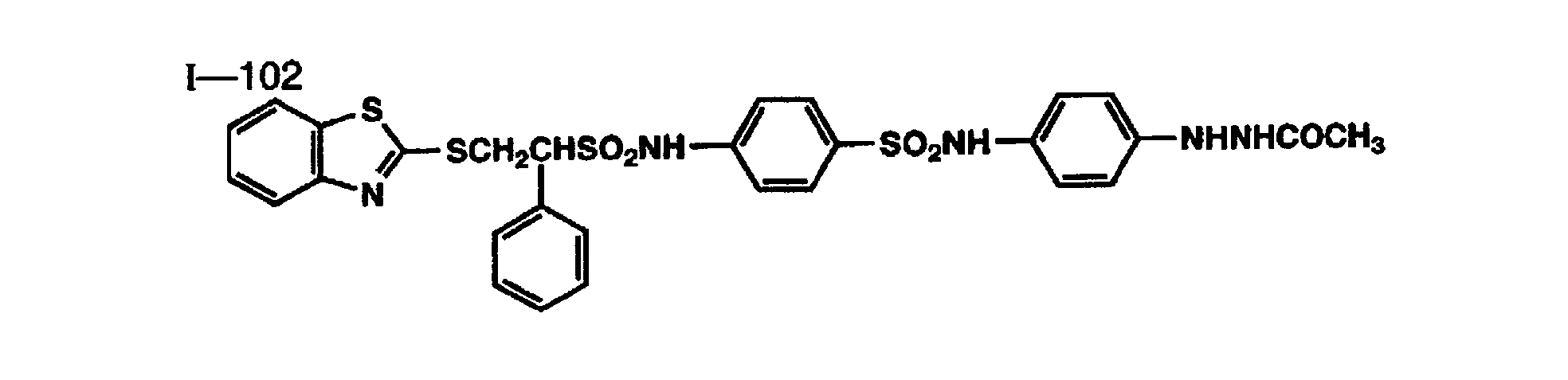
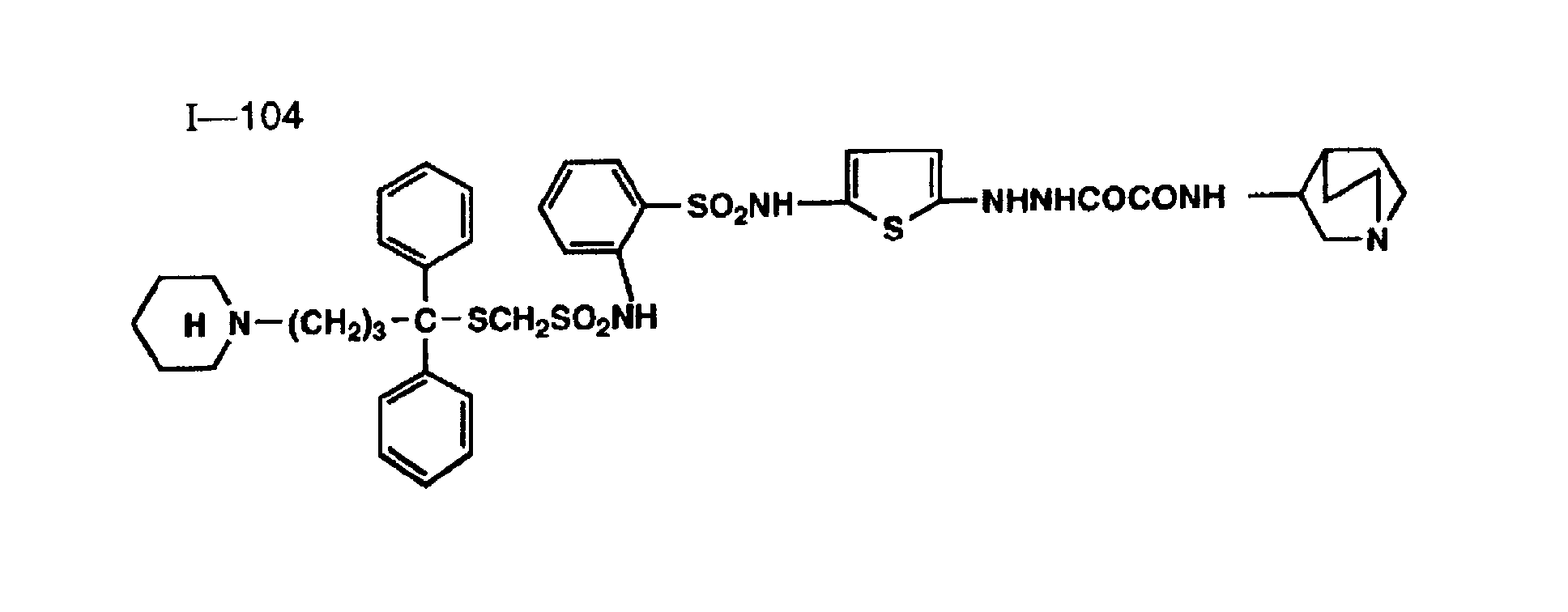
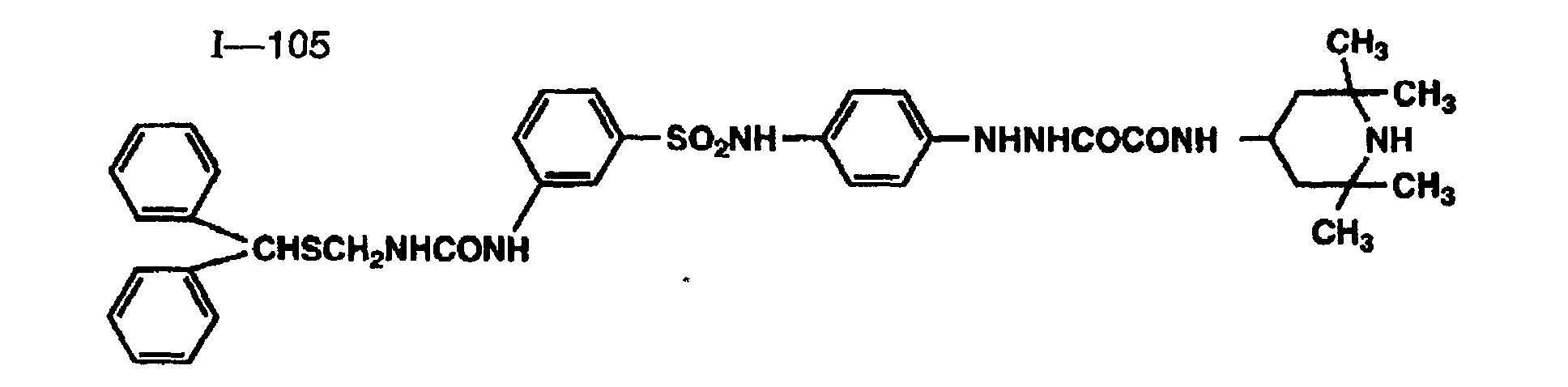
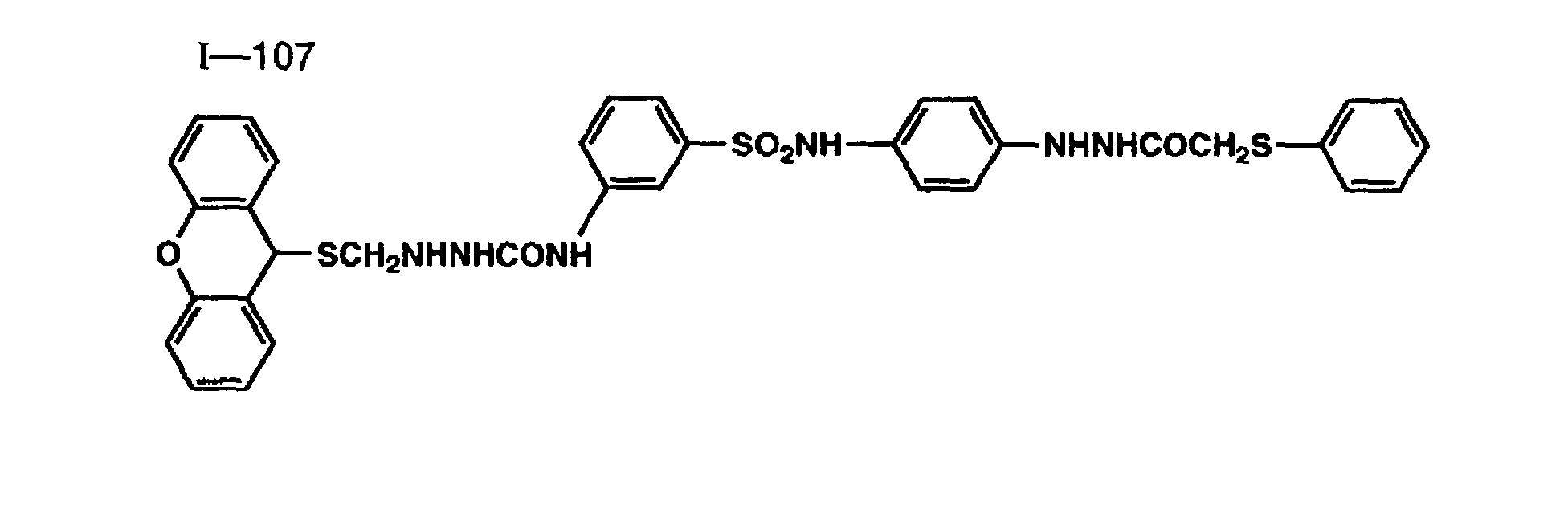
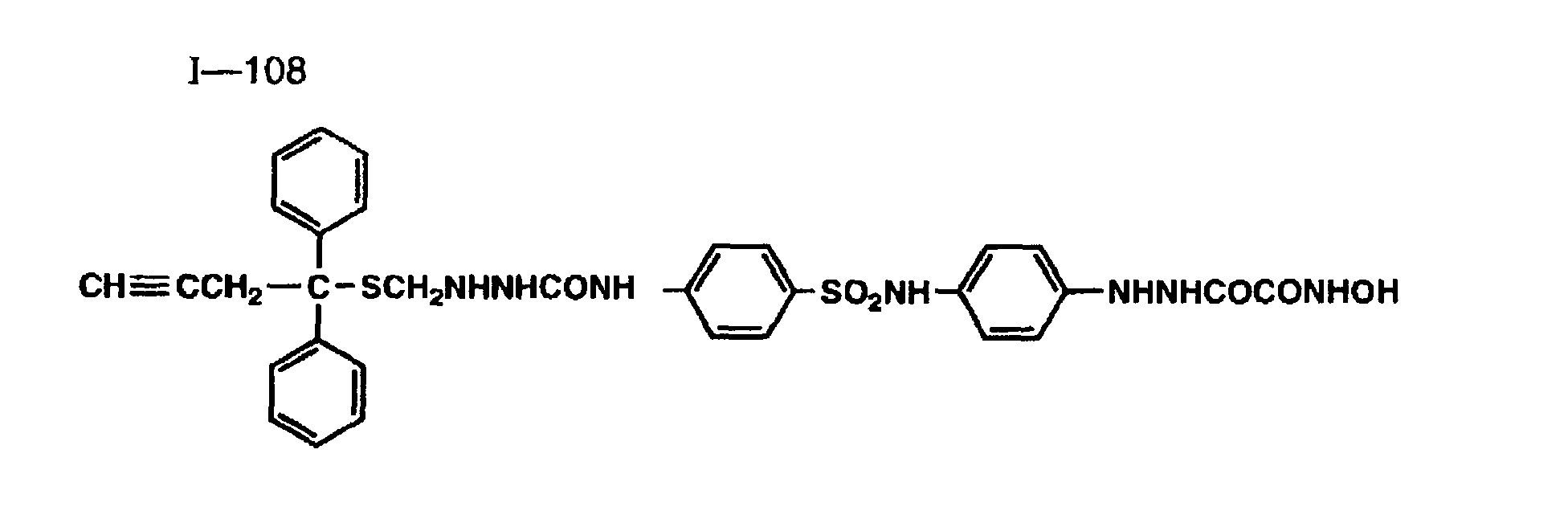
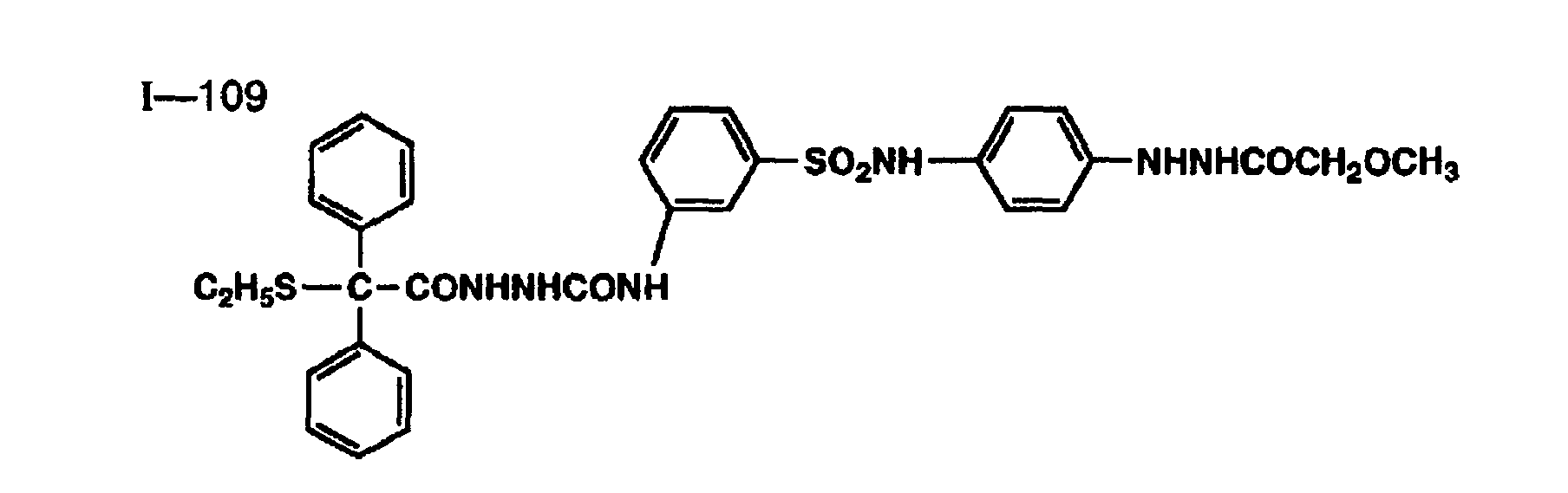
Representative examples of the hydrazine derivative denoted by formula
(2) for use in the present invention are given below, but the present invention
should not be construed as being limited thereto.
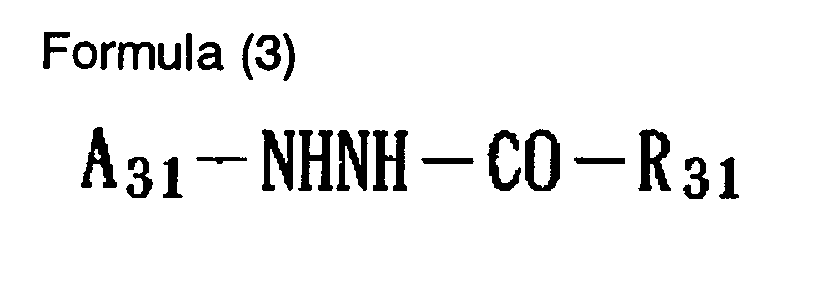
The hydrazine derivative represented by formula (3) is explained further
in detail.
In the formula, R31 denotes a difluoromethyl group or a monofluoromethyl
group, and A31 denotes an aromatic group. Preferred compounds among those
represented by formula (3) are represented by formula (31) below.
X31 ― (R34)m33 ― (L32― R33)m32 ― L31 ― A32-NHNH ― CO ― R32
In the formula, R
32 denotes a difluoromethyl group or a monofluoromethyl
group, A
32 denotes a divalent aromatic group, and X
31 denotes a group that
accelerates adsorption onto silver halide, but X
31 may denotes a hydrogen
atom. R
33 and R
34 denote divalent aliphatic or aromatic groups, L
31 and L
32
denote divalent linking groups, and m
32 and m
33 independently denote 0 or 1.
Preferred compounds among those represented by formula (31) are
represented by formula (32) below.
In the formula, X32, R35, R36, R37, L33, m34, and m35 denote the same
groups as those represented by X31, R32, R33, R34, L32, m32, and m33 respectively
in formula (31), Y denotes a substituent, and n is an integer of 0 to 4.
Next, compounds represented by formula (3) are explained in detail.
In formula (3), the aromatic group represented by A31 is a mono- or bi-cyclic
aryl group or an aromatic heterocyclic group. Specific examples thereof
include a benzene ring, a naphthalene ring, a pyridine ring, a quinoline ring, an
isoquinoline ring, a pyrrole ring, a furan ring, a thiophene ring, a thiazole ring,
and an indole ring. A31 preferably includes a benzene ring and is particularly
preferably a benzene ring. A31 may have a substituent, and examples of the
substituent include an alkyl group, an aralkyl group, an aryl group, an alkoxy
group, an aryloxy group, a hydroxy group, an acyloxy group, an acyl group, an
oxycarbonyl group, a carbamoyl group, an N-sulfonylcarbamonyl group, a
carboxyl group, a substituted amino group, an acylamino group, a sulfonamido
group, a ureido group, a urethane group, a sulfonylureido group, an alkylthio
group, an arylthio group, a sulfonyl group, a sulfamoyl group, an acylsulfamoyl
group, a carbamoylsulfamoyl group, a sulfo group, a cyano group, a halogen
atom, a phosphinyloxy group, a phosphinylamino group, a sulfamoylamino
group, and an oxyamoylamino group. These groups may further be
substituted. Among these, a sulfonamido group, a ureido group, an acylamino
group, a carbamoyl group, an alkoxy group, a substituted amino group, an alkyl
group, a hydroxy group, a halogen atom, a carboxyl group, and an oxycarbonyl
group are preferred, and a sulfonamido group and a ureido group are
particularly preferred. A31 may have a substituent, and at least one substituent
of A31 may be a group that accelerates adsorption onto silver halide.
With regard to a preferable group accelerating adsorption onto silver
halide, a thioamido group, a mercapto group, a group having a disulfide group,
and a five- or six-membered nitrogen-containing heterocyclic group can be
cited. As the thioamido adsorption-accelerating group there is a divalent group
represented by -CS-amino-, which may be a part of a ring structure, or an
acyclic thioamido group. A useful thioamido adsorption-accelerating group can
be chosen from those disclosed in US Pat. Nos. 4,030,925, 4,031,127,
4,080,207, 4,245,037, 4,255,511, 4,266,013, and 4,276,364, and Research
Disclosure, Vol. 151, No. 15162 (Nov. 1976) and Vol. 176, No. 17626 (Dec.
1978).
Specific examples of the acyclic thioamido group include a thioureido
group, a thiourethane group, and a dithiocarbamic acid ester group; and
specific examples of the cyclic thioamido group include 4-thiazoline-2-thione,
4-imidazoline-2-thione, 2-thiohydantoin, rhodanine, thiobarbituric acid,
tetrazolin-5-thione, 1,2,4-triazoline-3-thione, 1,3,4-thiadiazoline-2-thione,
1,3,4-oxadiazoline-2-thione, benzimidazoline-2-thione, benzoxazoline-2-thione,
and benzothiazoline-2-thione, and they may further be substituted. Examples
of the mercapto group include an aliphatic mercapto group, an aromatic
mercapto group, and a heterocyclic mercapto group (if a nitrogen atom is
bonded to the carbon atom to which -SH is bonded, this is the same as the
tautomeric cyclic thioamido group, and specific examples of this group are the
same as those listed above.)
With regard to the five- or six-membered nitrogen-containing
heterocyclic group, there can be cited a five- or six-membered
nitrogen-containing heterocyclic group having a combination of nitrogen,
oxygen, sulfur, and carbon. Preferred examples thereof include benzotriazole,
triazole, tetrazole, indazole, benzimidazole, imidazole, benzothiazole, thiazole,
benzoxazole, oxazole, thiadiazole, oxadiazole, and triazine. They may further
be substituted with an appropriate substituent. Preferred examples of the
adsorption-accelerating group include a cyclic thioamido group (that is,
mercapto-substituted nitrogen-containing heterocycles such as
2-mercaptothiadiazole, 3-mercapto-1,2,4-triazole, 5-mercaptotetrazole,
2-mercapto-1,3,4-oxadiazole, and 2-mercaptobenzoxazole) and an imino silver-forming
nitrogen-containing heterocyclic group (e.g., benzotriazole,
benzimidazole, indazole, etc.) The adsorption-accelerating group includes a
precursor thereof. The precursor referred to here means an adsorption-accelerating
group having a precursor group that only releases an adsorption-accelerating
group by the action of a developing solution during a development
process and its decomposition is triggered by hydroxide ion or sulfite ion in the
developing solution or a reaction with a developing agent. Specific examples
thereof include carbamoyl, 1,3,3a,7-tetrazainden-4-yl, uracil, alkoxycarbonyl,
4-substituted-2,5-dihydroxyphenyl whose 4-position has been substituted with
ureido, sulfonamido, or amido. Examples of a particularly preferable group that
accelerates adsorption onto silver halide that is present in the substituent of A31
in formula (3) include 5-mercaptotetrazole, 3-mercapto-1,2,4-triazole, and
benzotriazole, and most preferably 3-mercapto-1,2,4-triazole and
5-mercaptotetrazole.
Among the compounds represented by formula (3), those represented by
formula (31) are preferred, and are explained in detail below.
R33 and R34 in formula (31) denote divalent aliphatic or aromatic groups.
The divalent aliphatic group includes a substituted or unsubstituted, straight,
branched, or cyclic alkylene, alkenylene, or alkynylene group; and the divalent
aromatic group includes a mono- or bi-cyclic arylene group. R33 and R34 are
preferably alkylene or arylene groups, and most preferably R33 is a phenylene
group and R34 is a phenylene group or an alkylene group. They may have a
substituent such as those explained above for the substituent of A31 in formula
(3). Preferable examples of the substituents of R33 and R34 include a halogen
atom, an alkyl group, an aryl group, a carbamoyl group, an alkoxycarbonyl
group, an aryloxycarbonyl group, an acyl group, a cyano group, an alkoxy
group, an aryloxy group, a carbamoyloxy group, an acylamino group, a ureido
group, a sulfamoylamino group, an alkoxycarbonylamino group, a sulfonamido
group, a sulfamoyl group, and a sulfonyl group, and more preferably an alkyl
group, an aryl group, a carbamoyl group, an alkoxy group, an acylamino group,
a ureido group, a sulfonamido group, and a sulfamoyl group.
The divalent linking groups represented by L31 and L32 in formula (31)
are -O-, -S-, -N-(RN)- (RN denotes a hydrogen atom, an alkyl group, or an aryl
group), -CO-, -SO2-, etc. either singly or in a group formed by combination
thereof. The group formed by combination thereof referred to here is
specifically -CON(RN)-, -SO2N(RN)-, -COO-, -N(RN)CON(RN)-, -SO2N(RN)CO-,
-SO2N(RN)CON(RN)-, -N(RN)COCON(RN)-, -N(RN)SO2N(RN)-, etc. L31 in
formula (31) is preferably -SO2NH-, -NHCONH-, -O-, -S-, or -N(NR)-, and most
preferably -SO2NH- or -NHCONH-. L32 is
preferably -CON(RN)-, -SO2NH-,-NHCONH-, -N(RN)CONH-, or -COO-. When
L32 denotes -CON(RN)- or -N(RN)CONH-, RN may denote, as a substituted
alkyl group, the -R34-X31 group in formula (31).
The divalent aromatic group represented by A32 in formula (31) is
preferably a monocyclic arylene group, and more preferably a phenylene
group. When A32 denotes a phenylene group, it may have a substituent. With
regard to the substituent of the phenylene group, those cited as the substituent
of A31 in formula (3) can be cited; an alkyl group, an alkoxy group, a hydroxy
group, an amino group, an alkylamino group, an acylamino group, a
sulfonamido group, a ureido group, a halogen atom, a carboxyl group, a
sulfone group, etc. are preferred; they preferably have a total number of
carbons of 1 to 12, and particularly preferably 1 to 8. Among the phenylene
groups represented by A32, the unsubstituted phenylene group is particularly
preferred.
In formula (31), X31 denotes a group accelerating adsorption onto silver
halide, but X31 may denotes a hydrogen atom. X31 is the same as that cited for
the group that accelerates adsorption onto silver halide that is present in at
least one substituent of A31 in formula (3), and preferable examples thereof are
also the same.
Among the compounds represented by formula (31), those represented
by formula (32) are preferred. A substituent represented by Y in formula (32) is
the same as those cited for the substituent of A32 in formula (31), and
preferable examples thereof are also the same. n is preferably 0 or 1, and
more preferably 0.
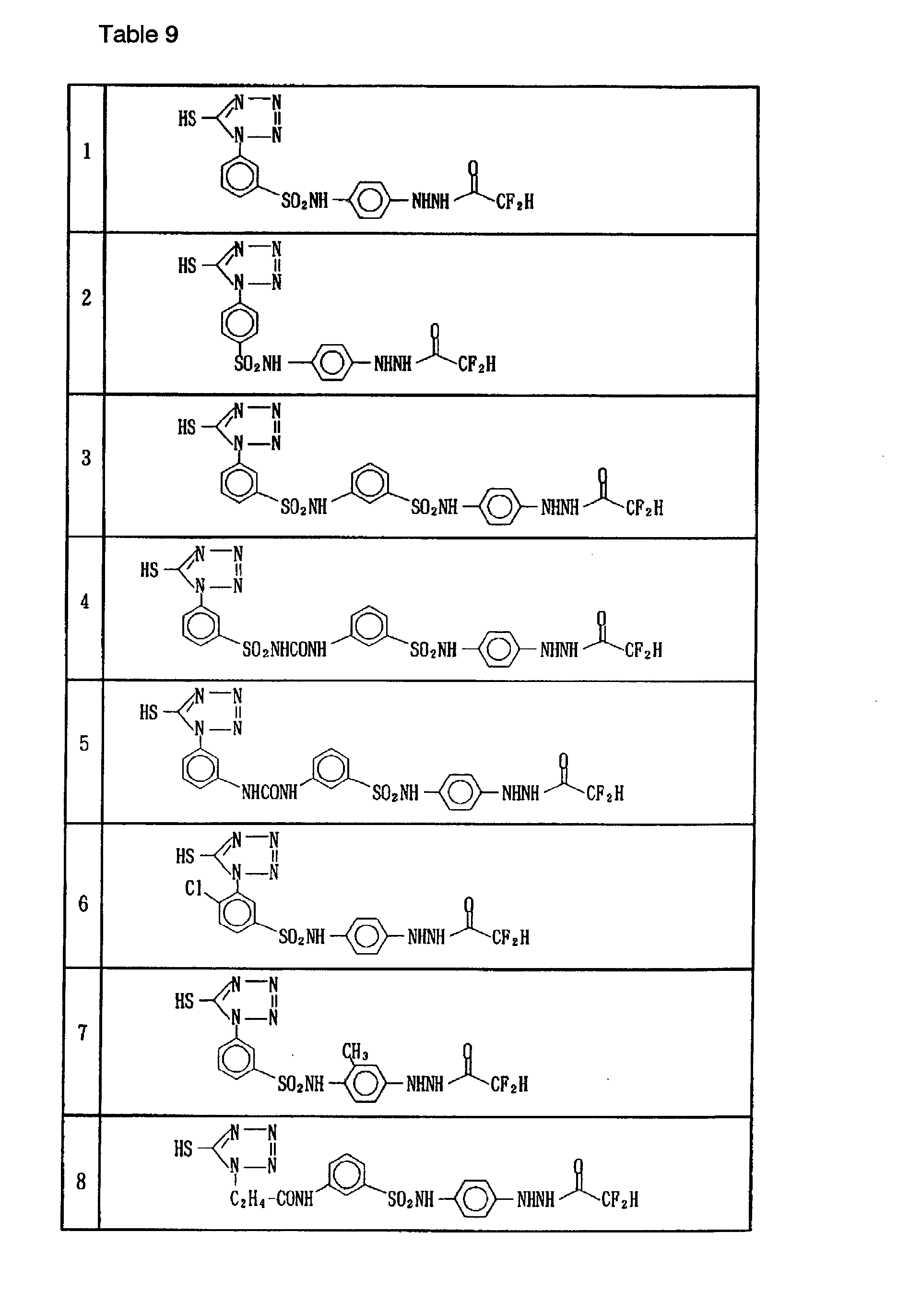
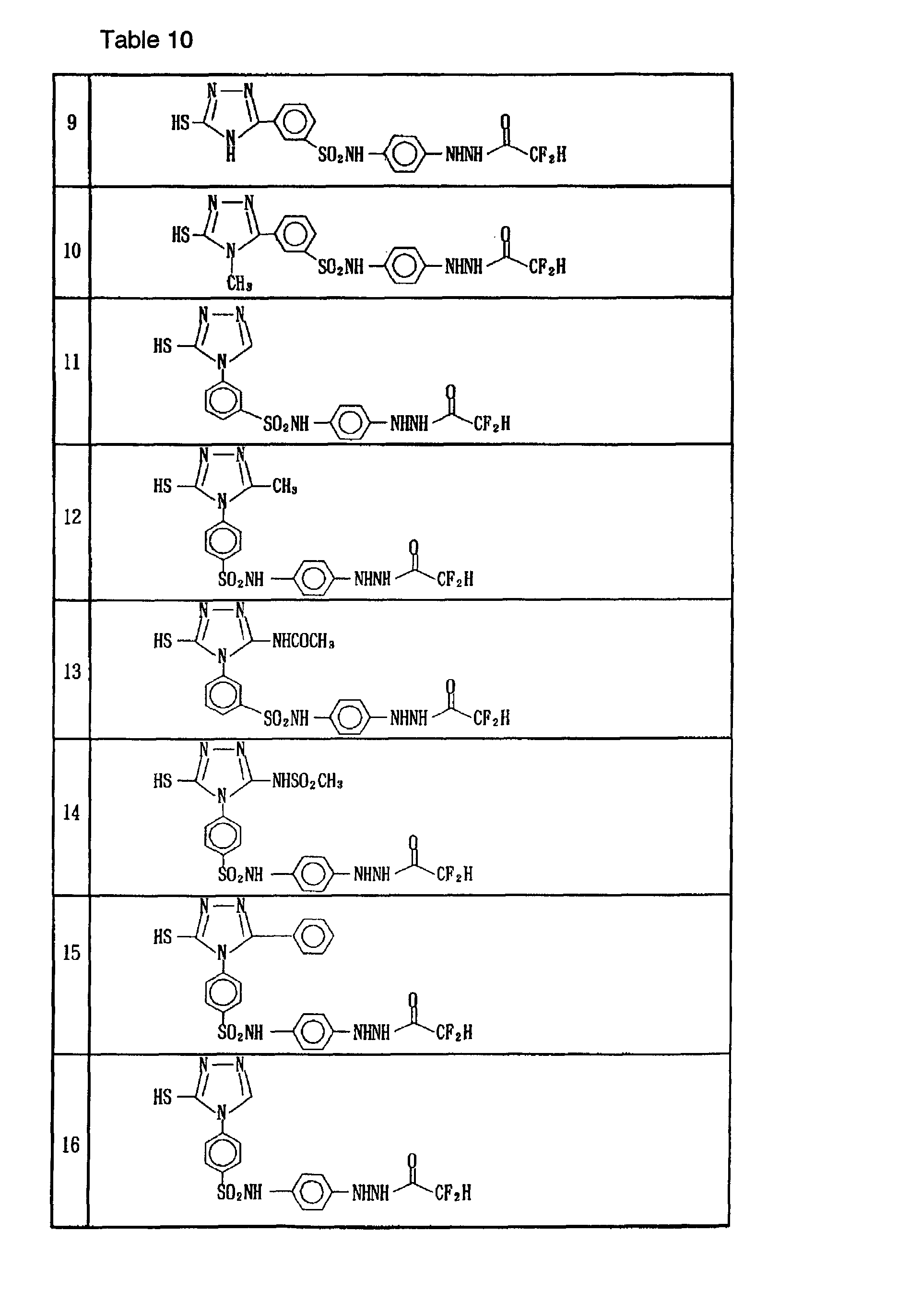
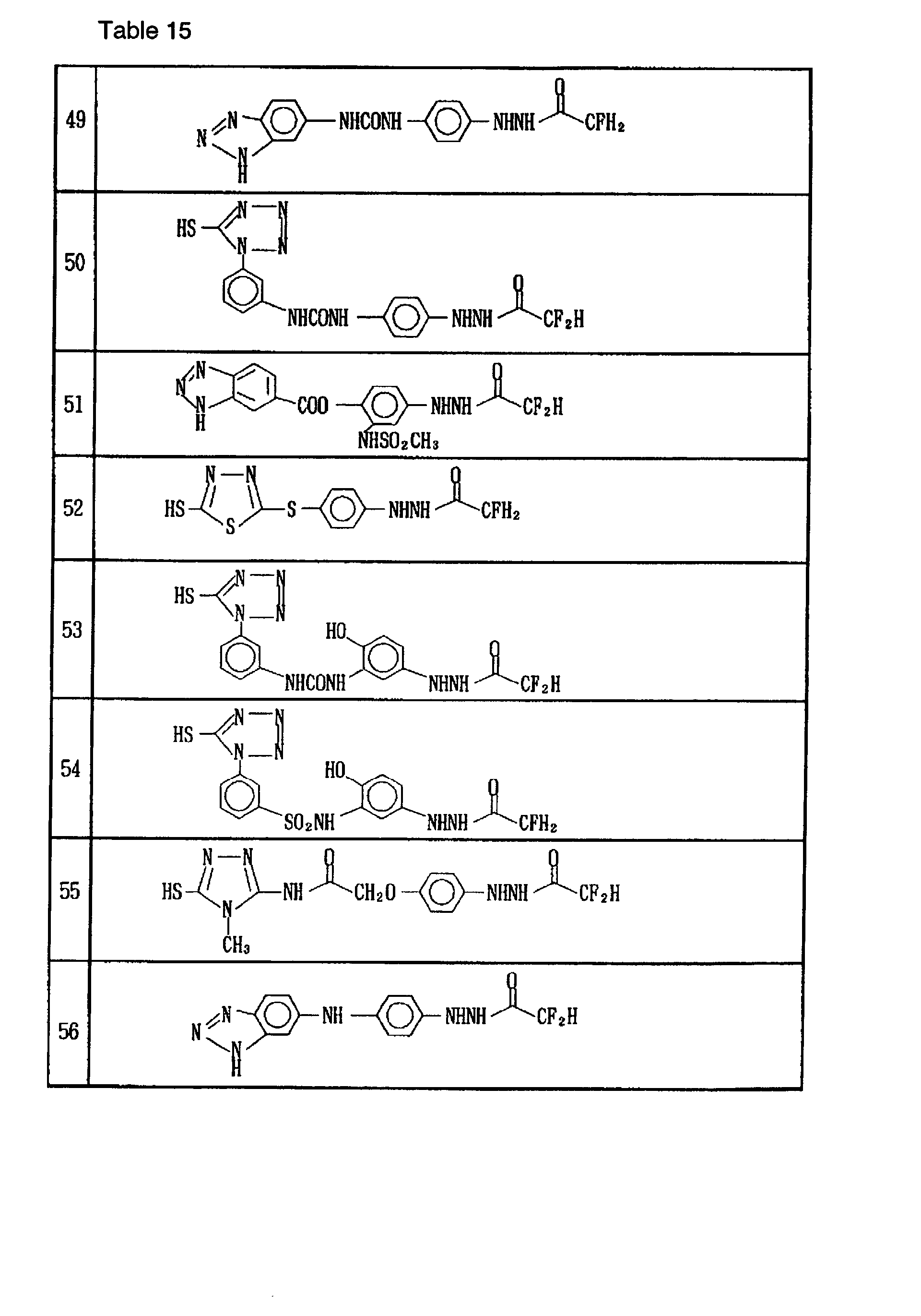
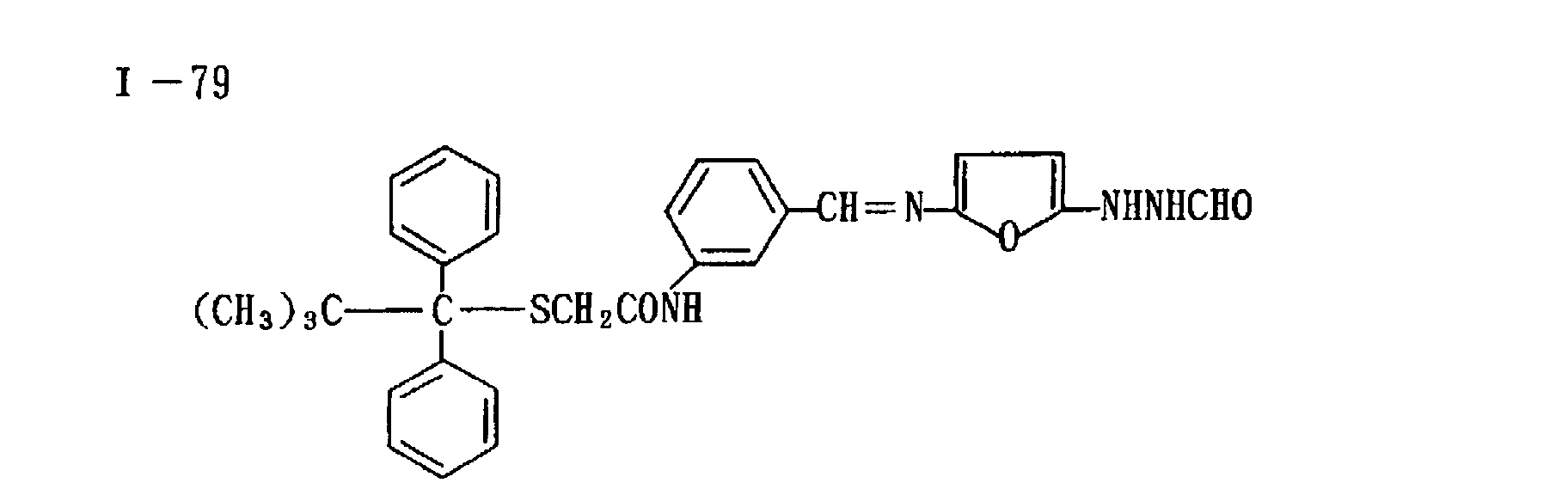
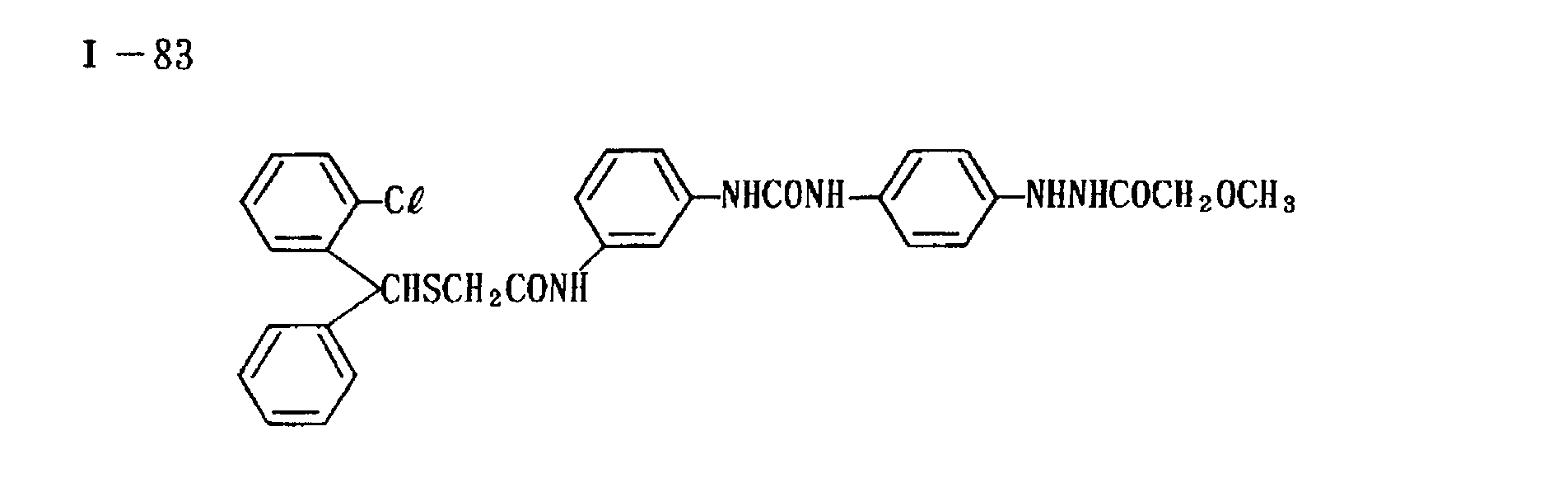
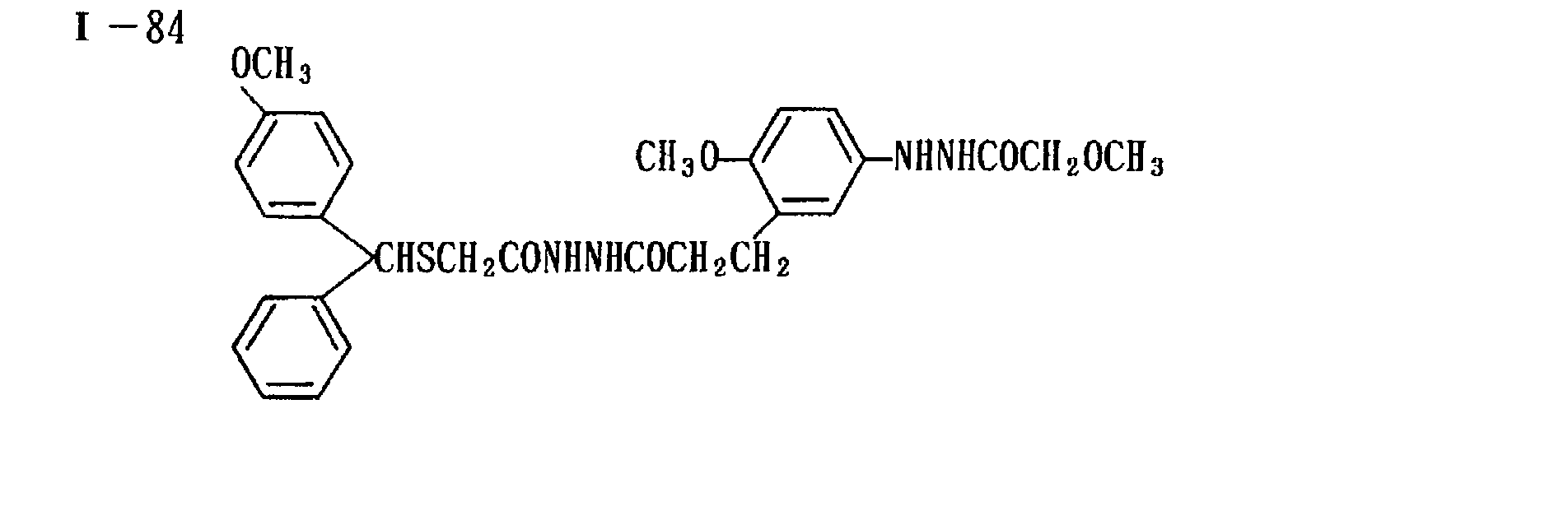
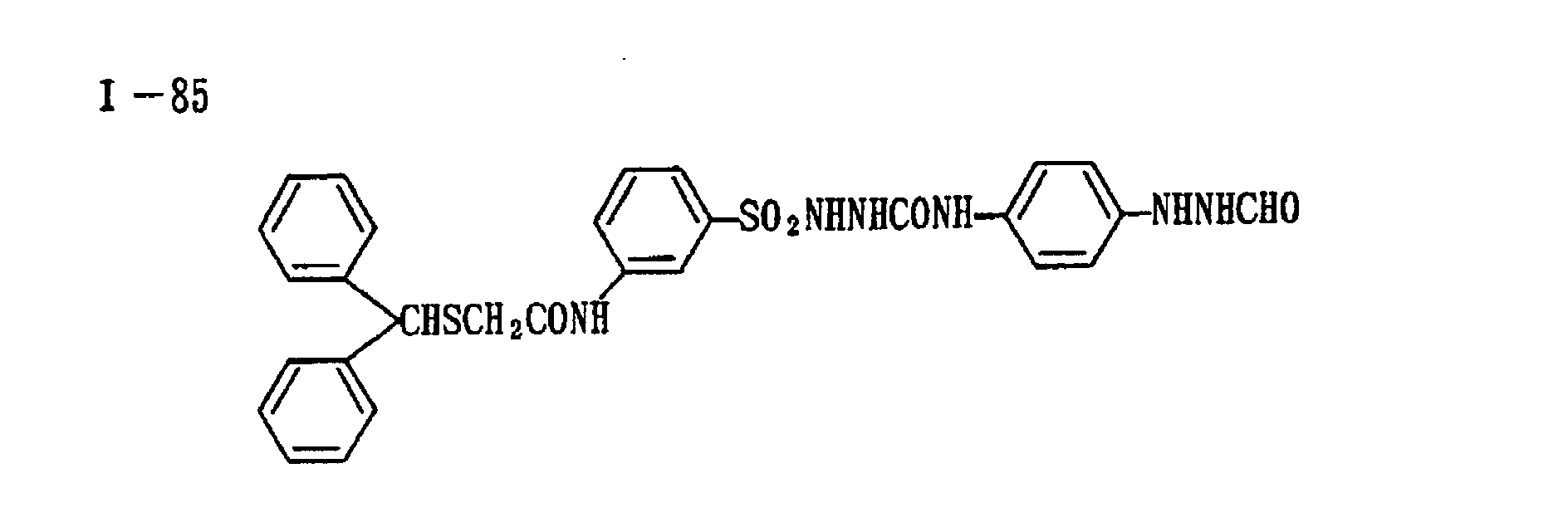
Representative compounds denoted by formula (3) used in the present
invention are listed below, but the present invention is in no way limited
thereby.
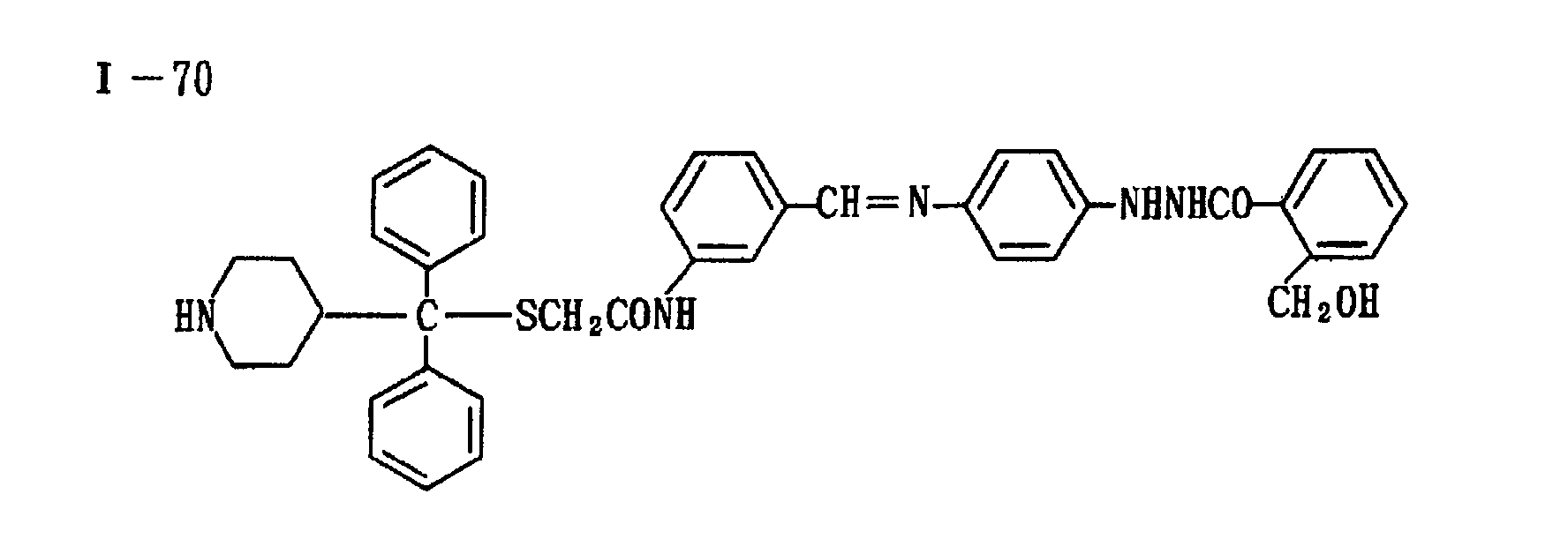
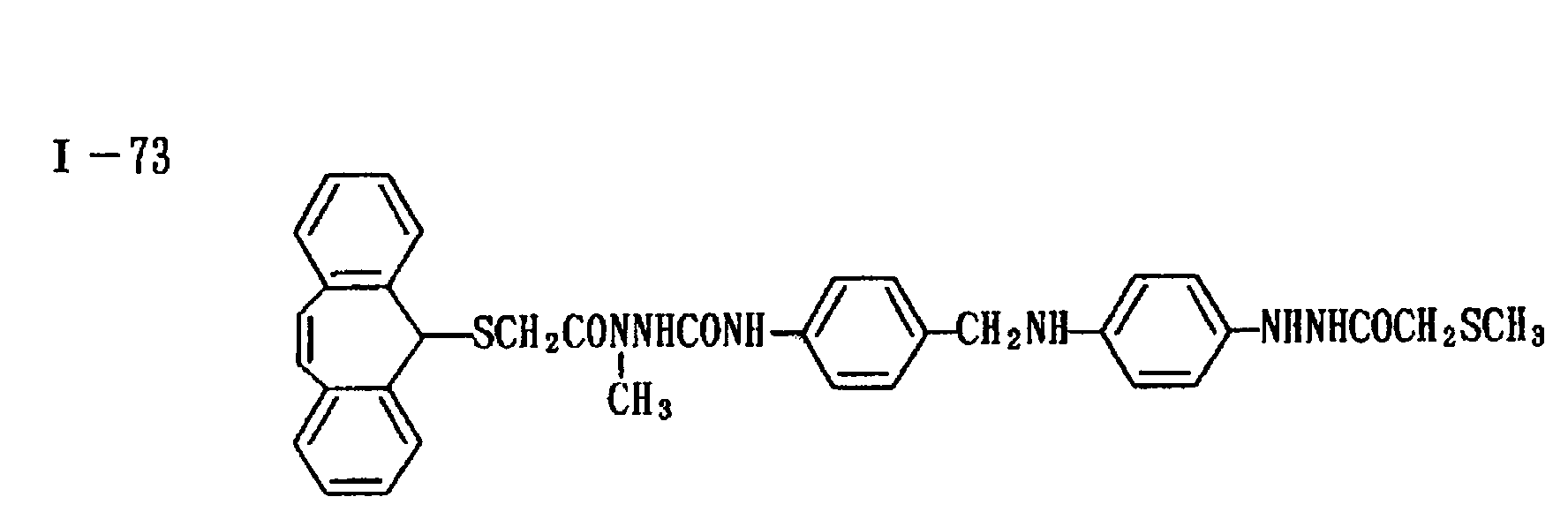
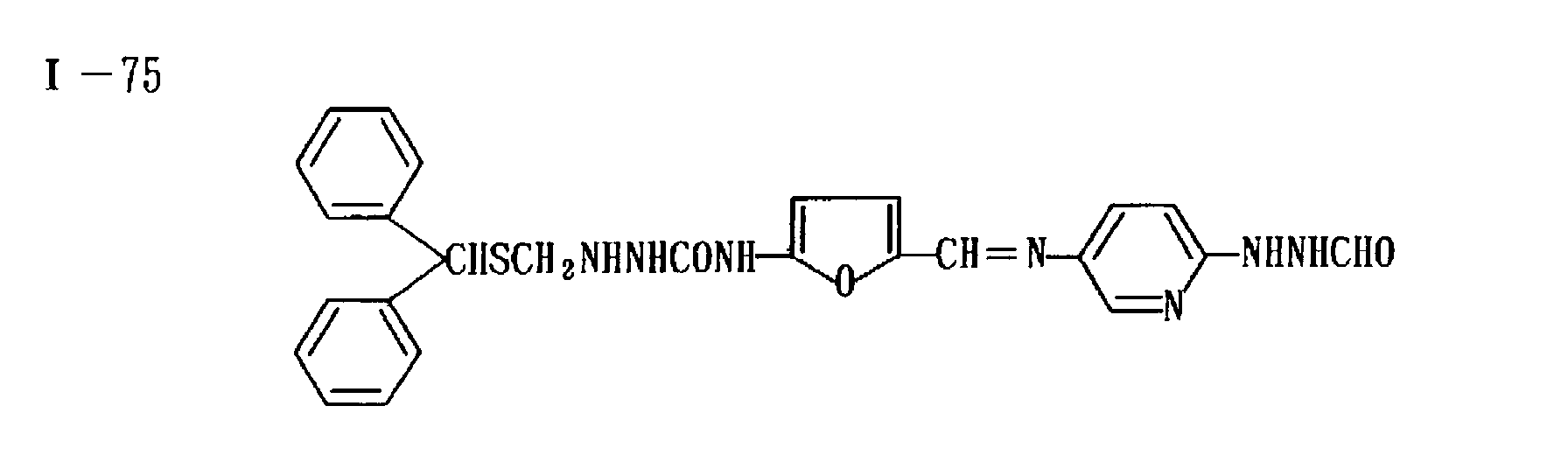
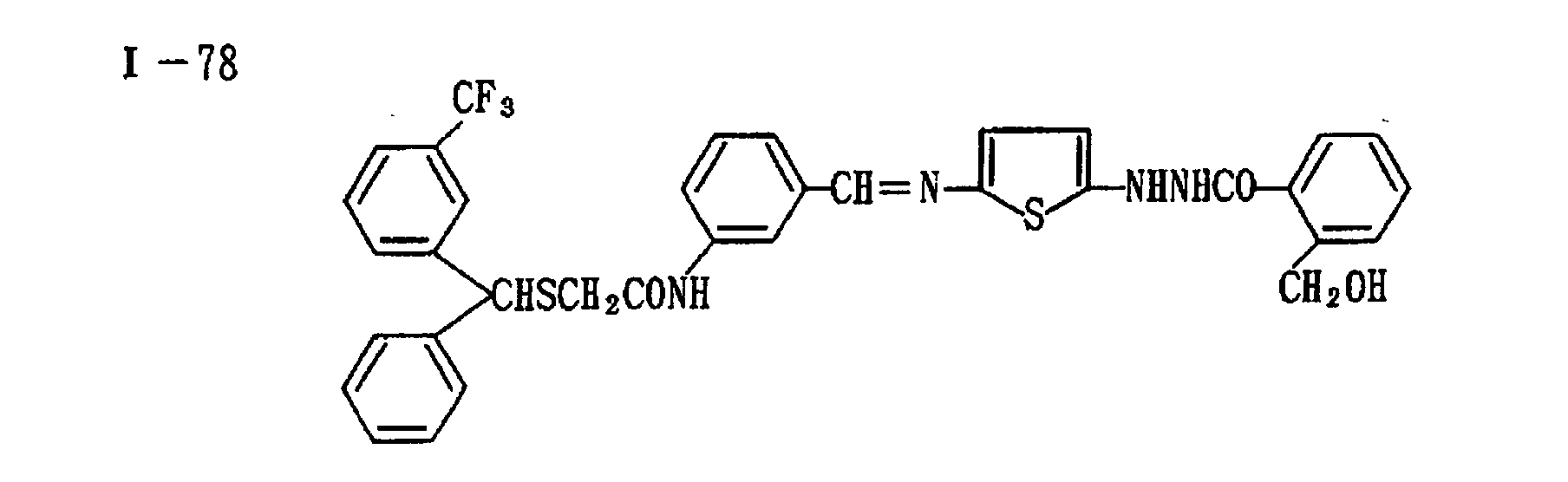
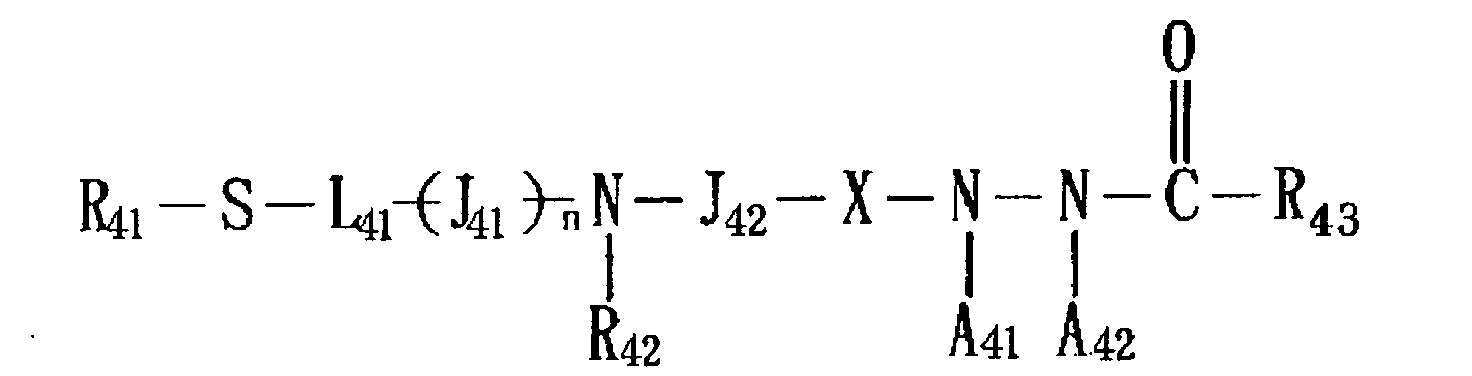
The hydrazine derivatives represented by formula (4) will now be
explained in more detail.
R41 represents an alkyl group (for example, methyl, ethyl, i-propyl, butyl,
t-butyl, hexyl, octyl, t-octyl, decyl, dodecyl, tetradecyl, cyclohexyl,
cyclohexylmethyl, or benzyl) an alkenyl group (e.g., allyl, 1-propenyl,
1,3-butadienyl, 2-butenyl, 2-pentenyl, or cinnamyl), an alkynyl group (e.g.,
propargyl or 2-butynyl), an aryl group (e.g., phenyl, tolyl, di-i-propylphenyl, or
naphthyl), or a heterocyclic group (e.g., pyridyl, furyl, tetrahydrofuryl, thienyl,
oxazolyl, benzooxazolyl, or benzothiazolyl) and these groups may be
substituted with a substituent such as an alkyl group, an aryl group, a
heterocyclic group, an alkoxy group, an aryloxy group, a hydroxy group, a
halogen atom, an amino group, an alkylamino group, an arylamino group, an
acylamino group, a sulfonamido group or a ureido group.
L41 represents an alkylene group (e.g., methylene, ethylene,
trimethylene, methylmethylene, ethylmethylene, butylmethylene,
hexylmethylene or decylmethlene) or an alkenylene group (e.g., propenylene or
butenylene). These groups may be substituted with a substituent such as an
alkyl, aryl or heterocyclic group.
The R41-S-L41 part contains at least two rings. These rings are aromatic
rings (e.g., phenyl or naphthyl), heterocycles (e.g., piperazinyl, pyrazinyl, furyl,
thienyl, pyrrolyl, oxazolyl, thiazolyl or indolyl) or aliphatic rings (e.g., cyclohexyl
or cyclopropyl). The rings may be bonded to each other through a bond and/or
an aliphatic group.
R42 represents a hydrogen atom, an alkyl group (e.g., methyl, ethyl,
methoxyethyl, or benzyl), an aryl group (e.g., phenyl, naphthyl, or
methoxyphenyl) or a heterocyclic group (e.g., pyridyl, thienyl, furyl, or
tetrahydrofuryl).
R43 represents a hydrogen atom or a blocking group, and as specific
examples of the blocking group an alkyl group (e.g., methyl, ethyl, benzyl,
methoxyethyl, trifluoromethyl, phenoxymethyl, hydroxymethyl, methylthiomethyl,
or phenylthiomethyl), an aryl group (e.g., phenyl, chlorophenyl, or
2-hydroxymethylphenyl), a heterocyclic group (e.g., pyridyl, thienyl or
furyl), -CON(R44)(R45), and -COOR46 are preferred.
R44 and R45 each represent a hydrogen atom, an alkyl group (e.g.,
methyl, ethyl, or benzyl), an alkenyl group (e.g., allyl or butenyl), an alkynyl
group (e.g., propargyl or butynyl), an aryl group (e.g., phenyl or naphthyl), a
heterocyclic group (e.g., 2,2,6,6-tetramethylpiperidinyl,
N-ethyl-N'-ethylpyrazolidinyl, or pyridyl), a hydroxy group, an alkoxy group
(e.g., methoxy or ethoxy) or an amino group (e.g., amino or methylamino). R44
and R45 may be combined with a nitrogen atom to form a ring (e.g. piperidino
or morpholino). R46 represents a hydrogen atom, an alkyl group (e.g., methyl,
ethyl, or hydroxyethyl), an alkenyl group (e.g., allyl or butenyl), an alkynyl
group (e.g., propargyl or butynyl), an aryl group (e.g., phenyl or naphthyl), or a
heterocyclic group (e.g., 2,2,6,6-tetramethylpiperidinyl, N-methylpiperidinyl, or
pyridyl).
J41 and J42 each represent a linking group, and examples of J41 are listed
below.
J41 is -CO-, -SO2-, -N(A43)CO-, -N(A43)N(A44)CO-, or -CON(A43)N(A44)CO-,
in which A43 and A44 each represent a hydrogen atom, an alkyl group, an aryl
group, or a heterocyclic group. Preferably, n is 1 and J41 is -CO-.
For J42 there can be specifically cited an acylamino group (e.g.,
benzoylamino or phenoxyacetylamino), a sulfonamido group (e.g.,
benzenesulfonamido or furansulfonamido), a ureido group (e.g., ureido or
phenylureido), an alkylamino group (e.g., benzylamino or furfurylamino), an
anilino group, an alkylideneamino group (e.g., benzylideneamino), an aryloxy
group (e.g., phenoxy), an aminocarbonylalkoxy group (e.g.,
aminocarbonylmethoxy), a sulfonylhydrazinocarbonylamino group (e.g.,
benzenesulfonylhydrazinocarbonylamino), etc. J42 is preferably a
benzenesulfonamido group.
X represents an aromatic residue (e.g., phenylene or naphthylene, which
can be substituted) or a divalent heterocyclic group (e.g., a divalent residue of
pyridine, pyrazole, pyrrole, thiophene, benzothiophene, or furan, which can be
substituted).
A41 and A42 each represent a hydrogen atom, or one of them is a
hydrogen atom and the other one is a group selected from an acyl group (e.g.,
acetyl or trifluoroacetyl), a sulfonyl group (e.g., methanesulfonyl or
toluenesulfonyl) and an oxalyl group (e.g., ethoxyoxalyl). A41 and A42 are
preferably both hydrogen atoms.
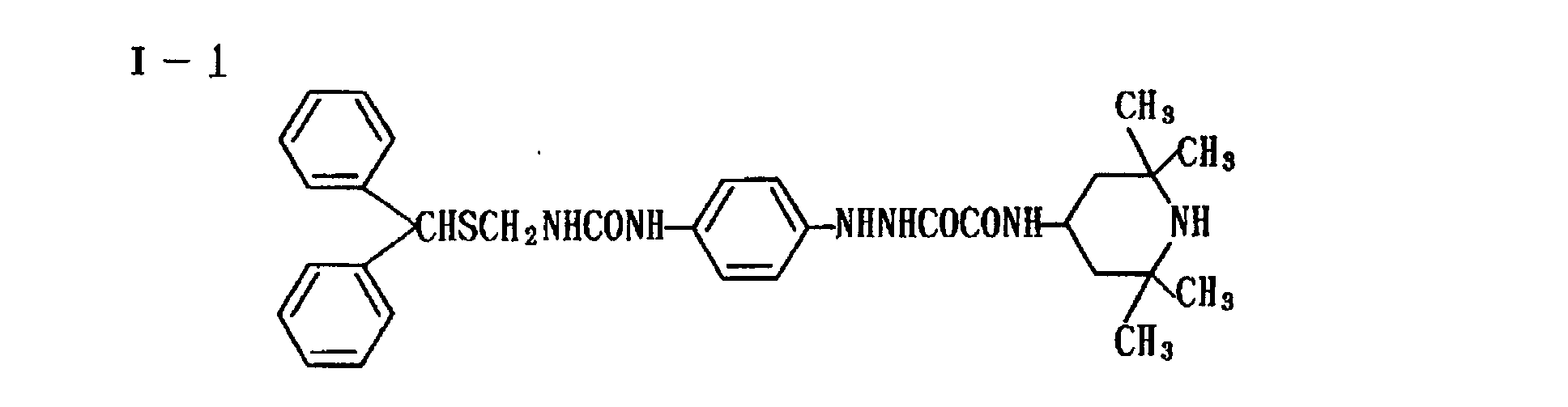
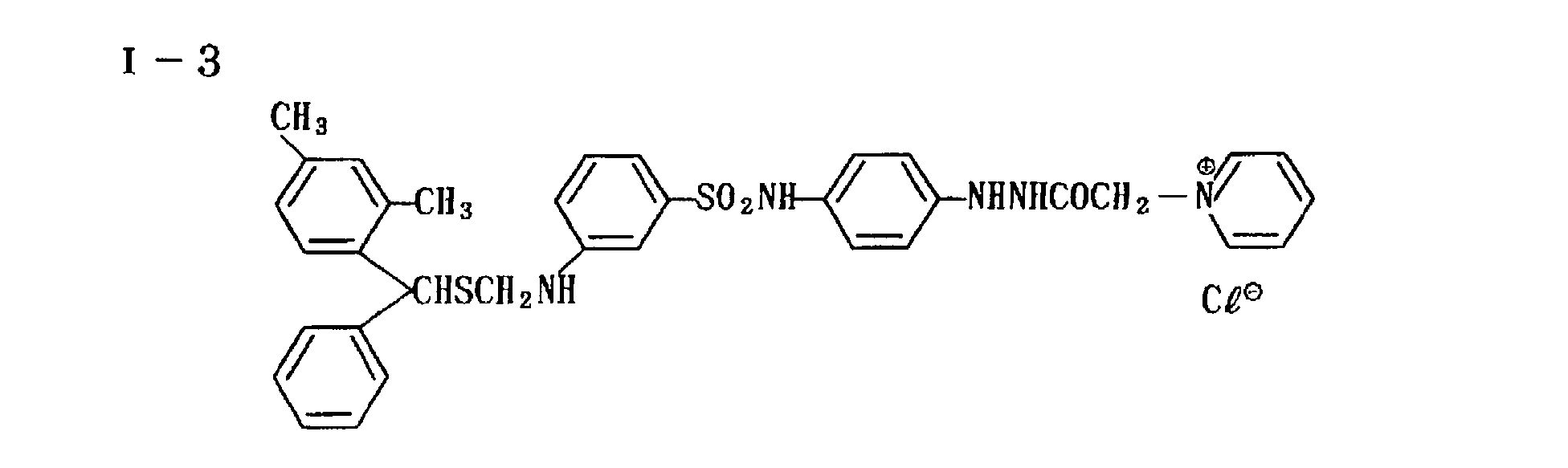
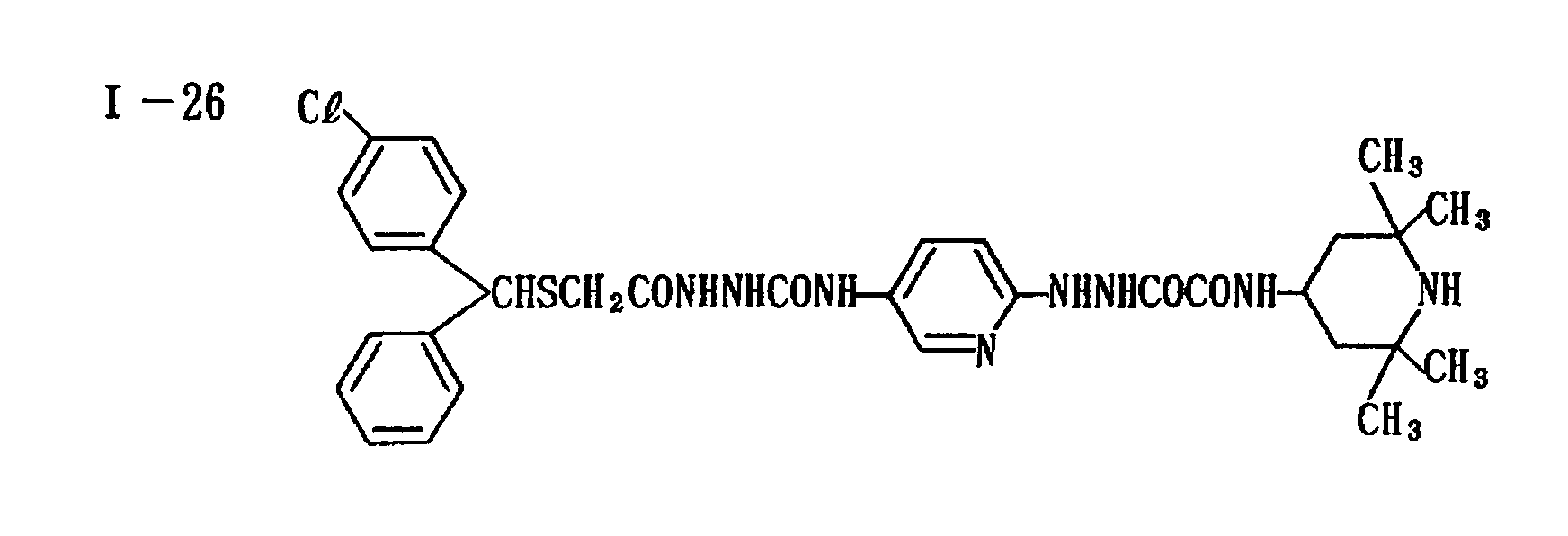
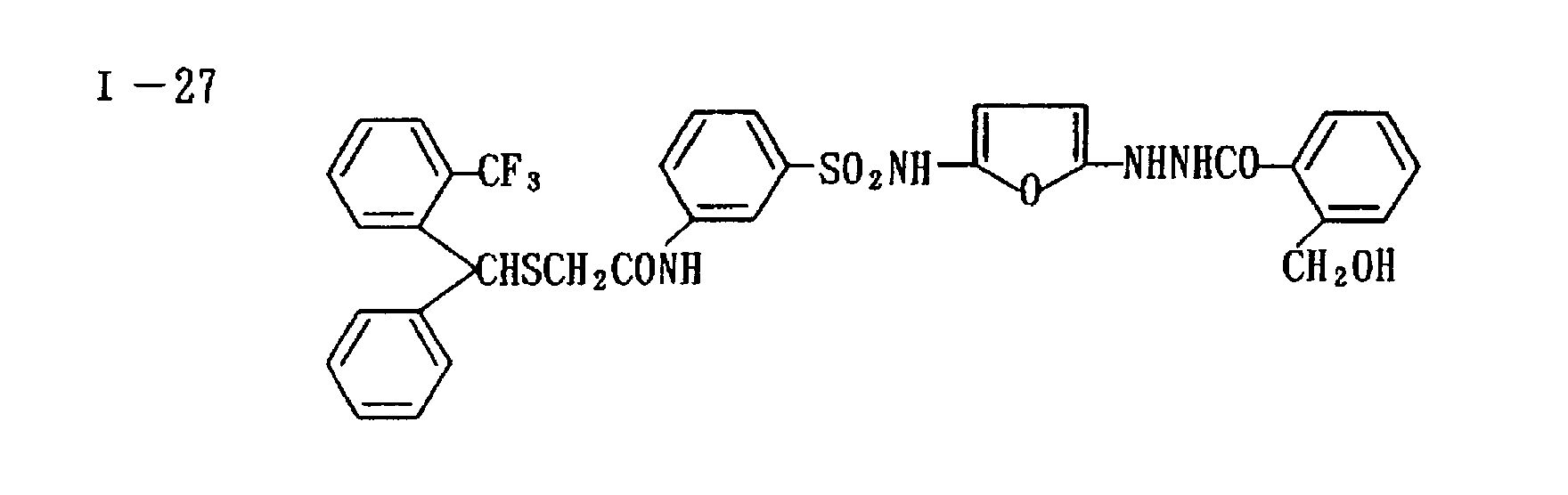
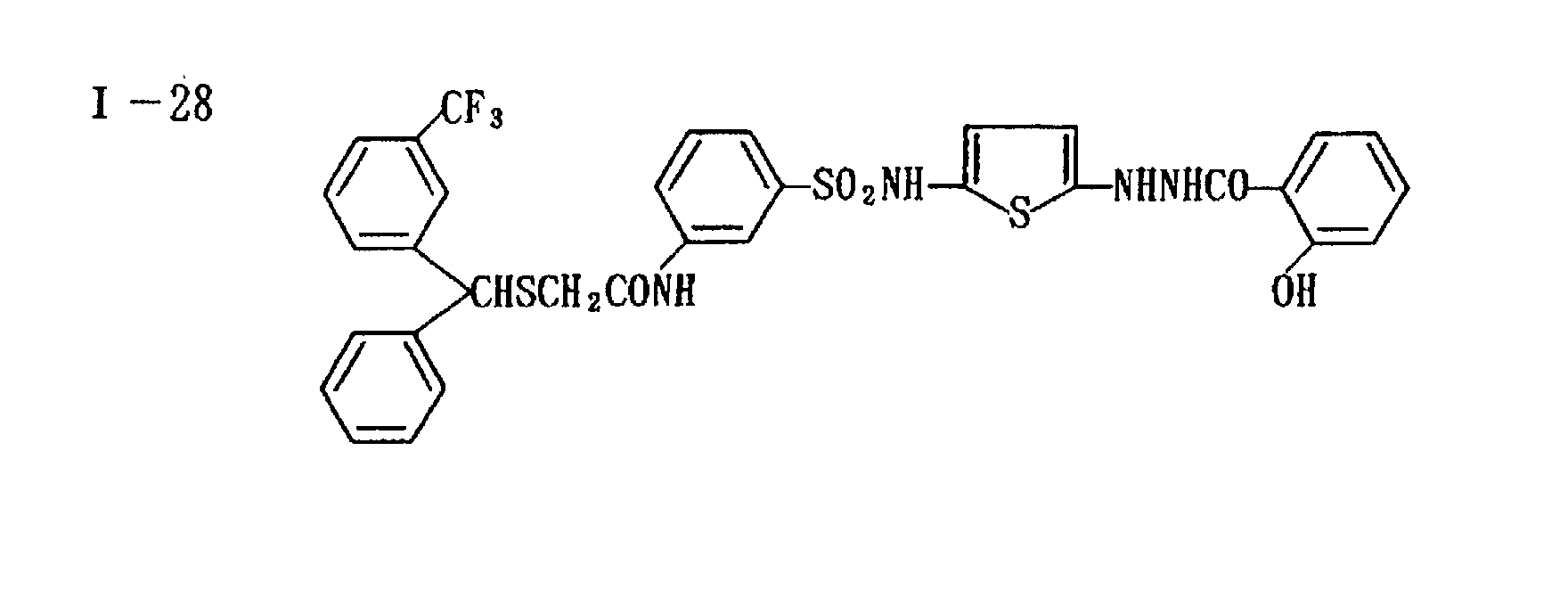
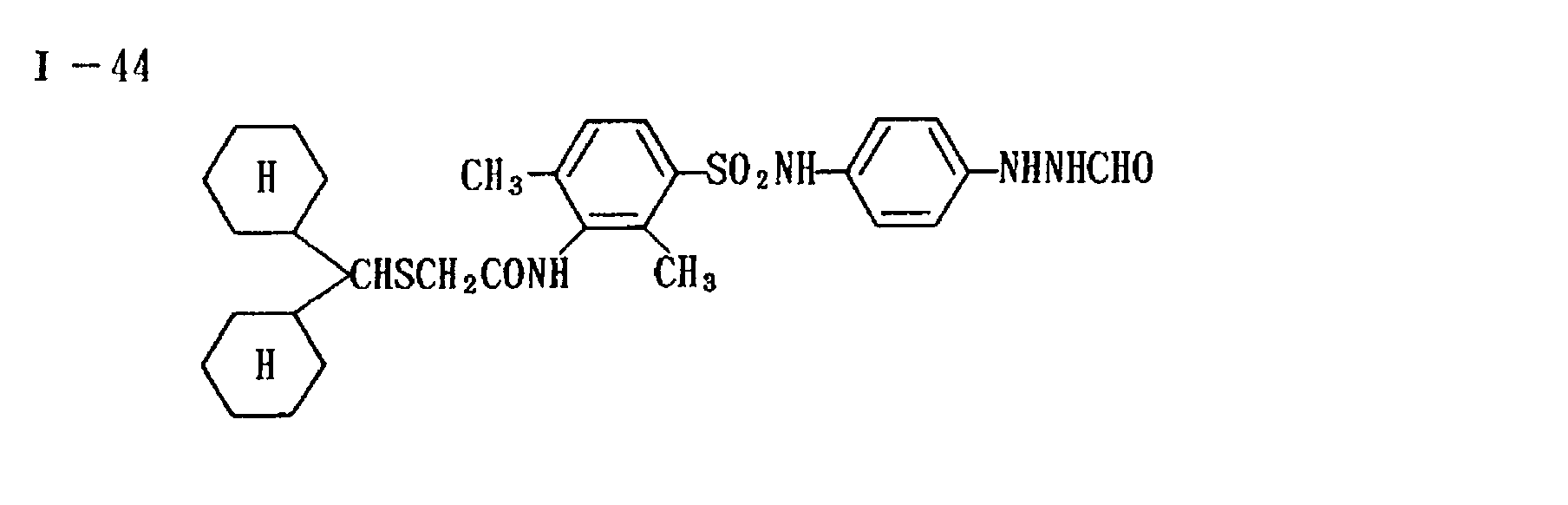
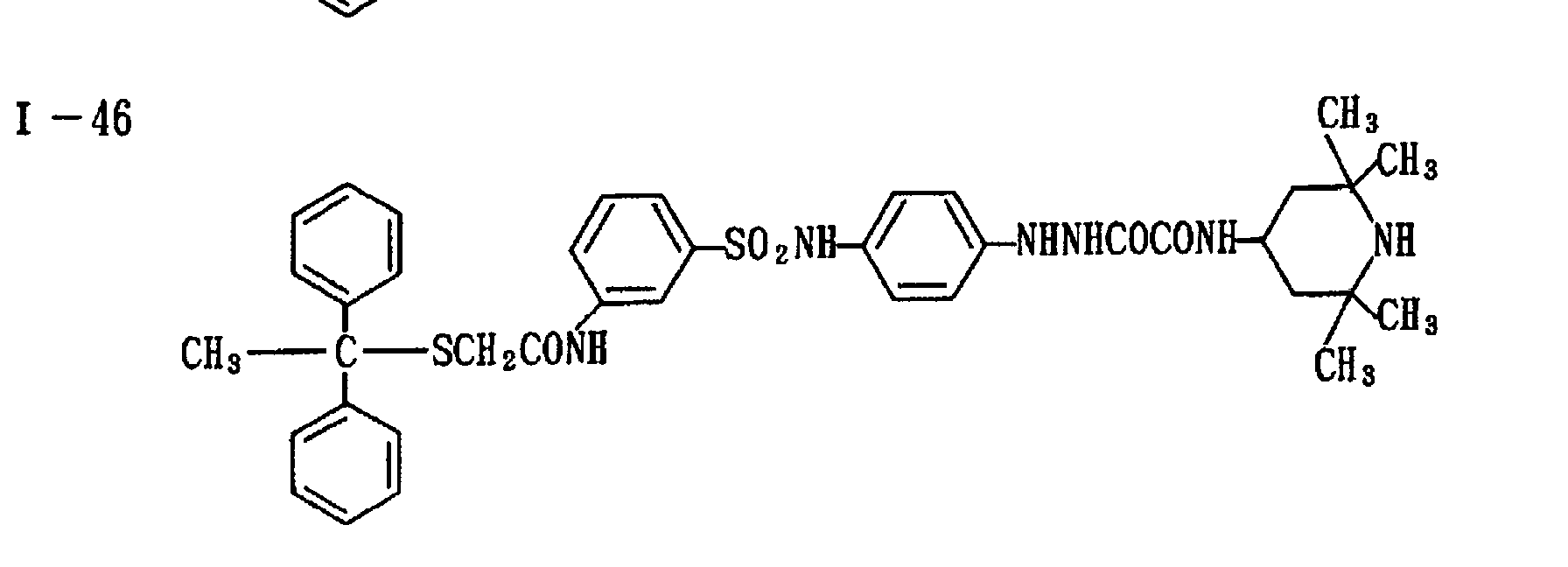
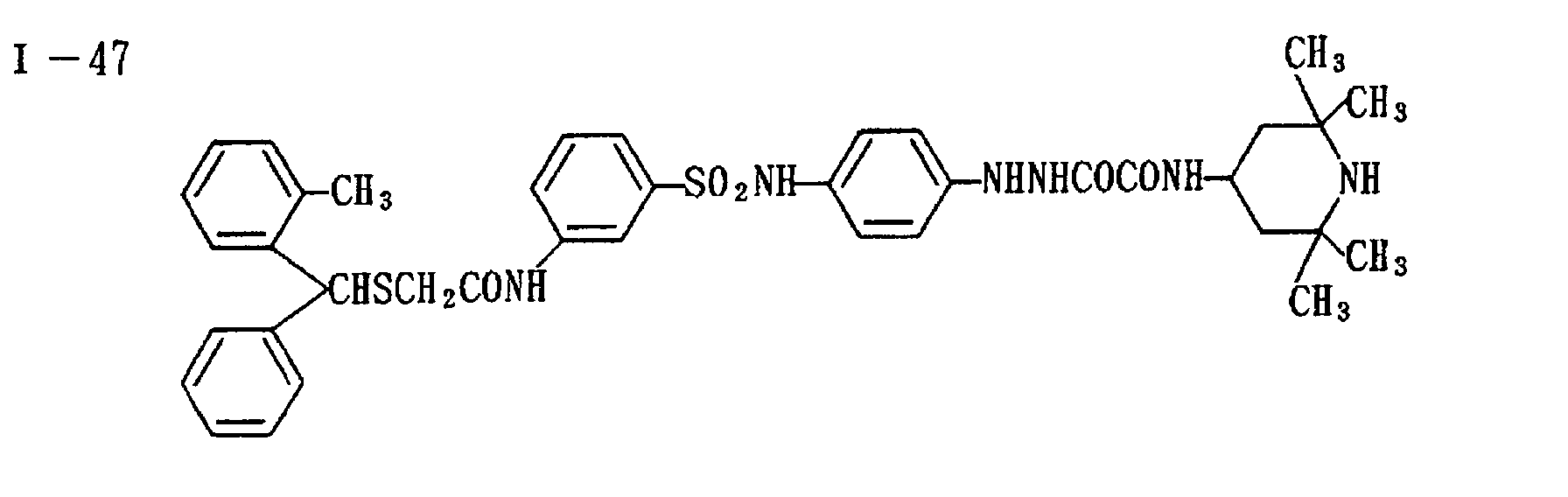
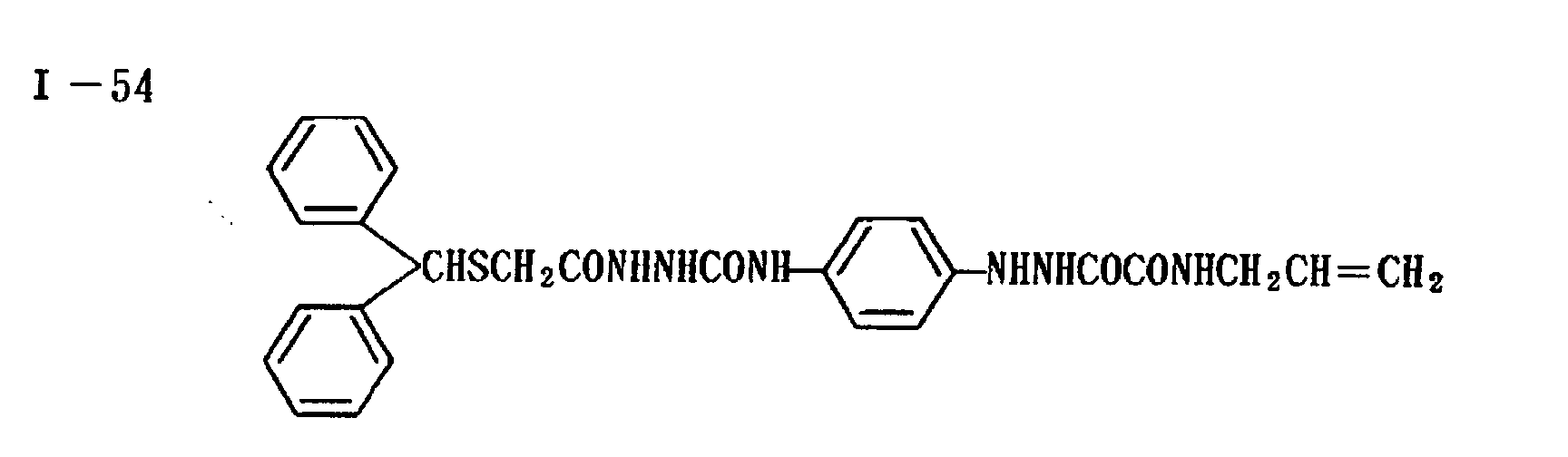
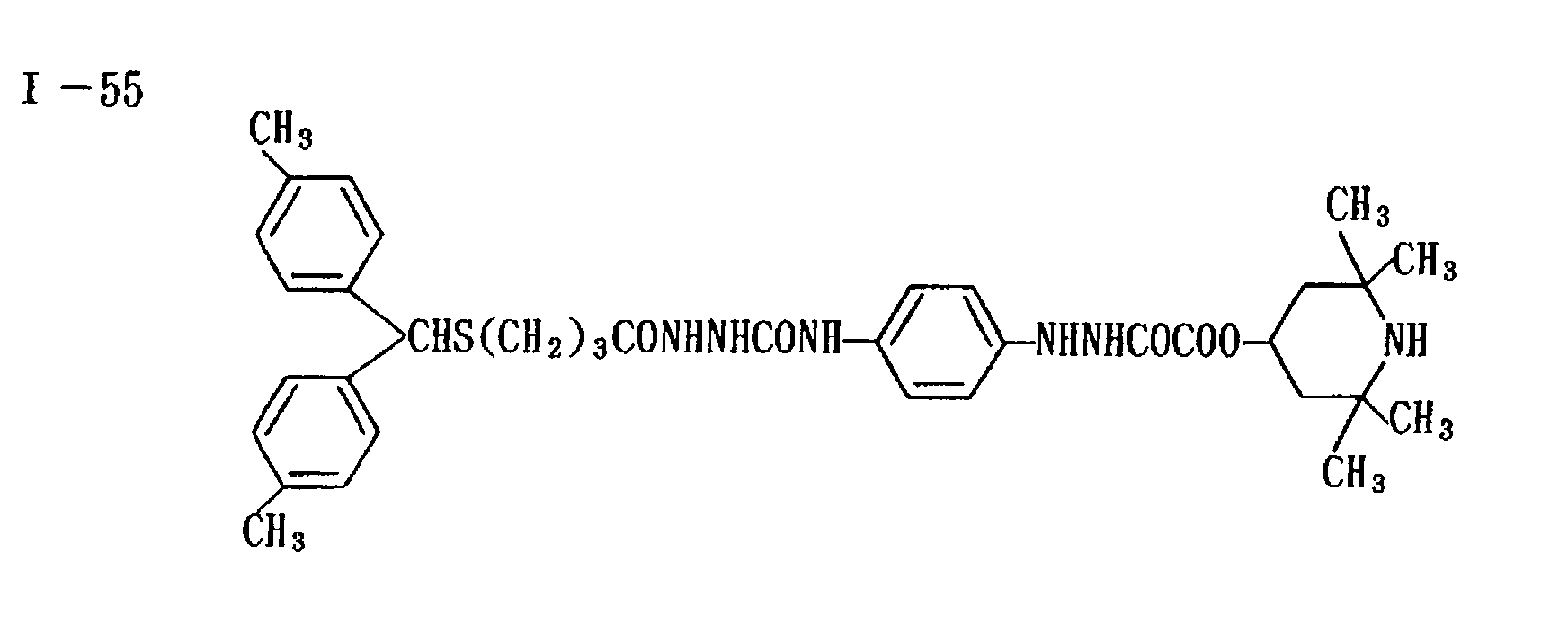
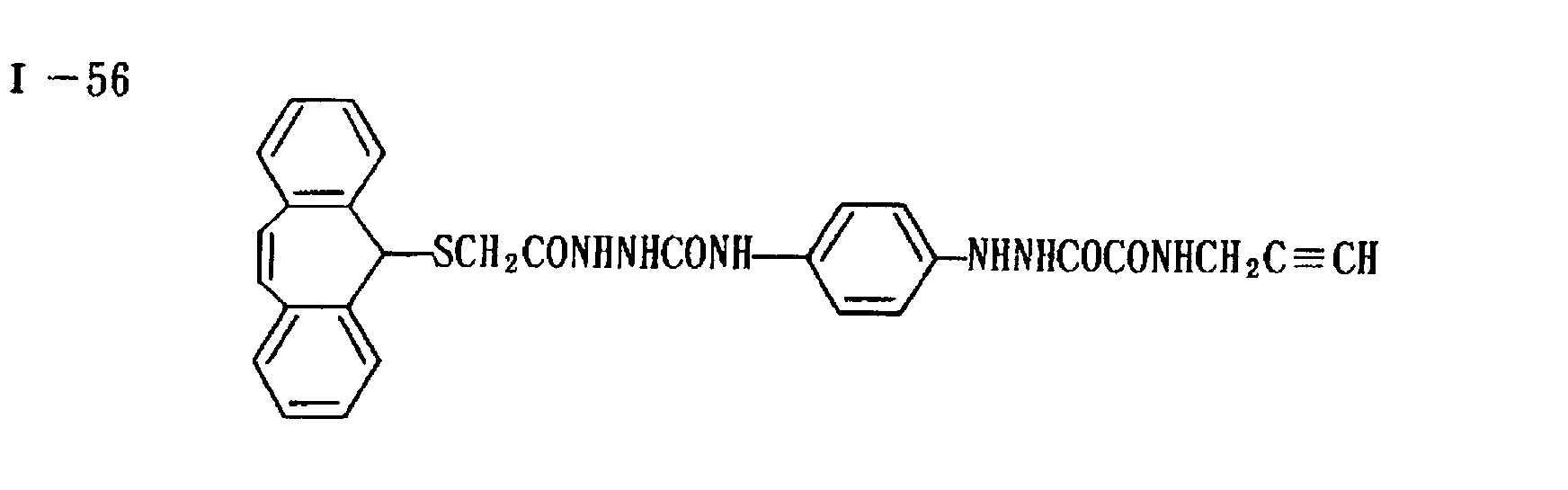
Representative specific examples of the compound represented by
formula (4) are given below, but the invention is not limited thereto.
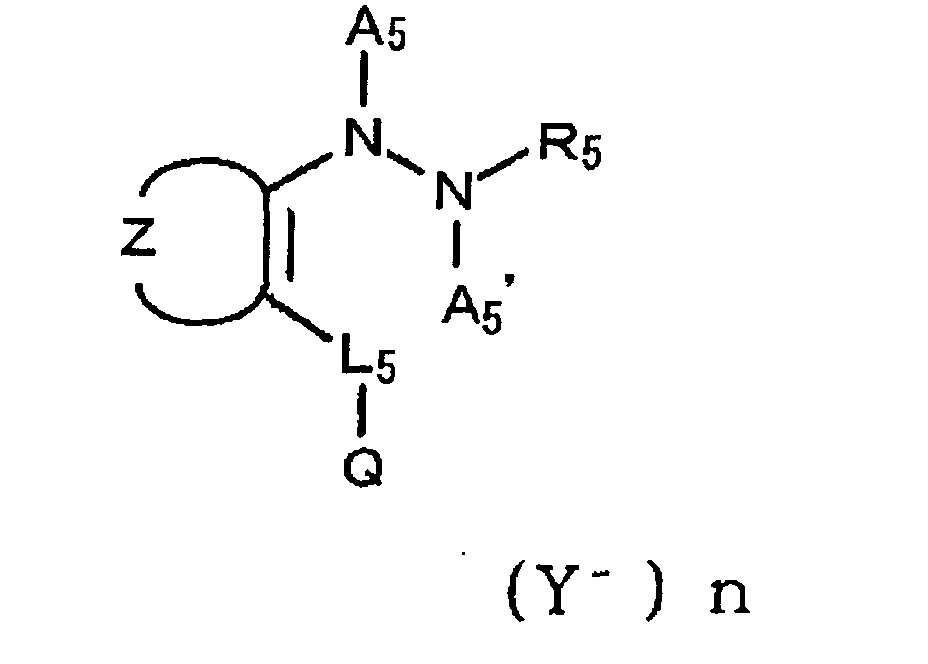
The hydrazine derivative represented by formula (5) is now explained
further in detail.
In the formula, R5 denotes an acyl group chosen from the group
consisting of COR51, SO2R52, SOR53, POR54R55, and COCOR56; R51 and R56
independently represent a hydrogen atom, a substituted or unsubstituted alkyl
group, a substituted or unsubstituted aryl or heteroaryl group, OR57 or NR58R59;
R52 and R53 independently represent a substituted or unsubstituted alkyl group,
a substituted or unsubstituted aryl or heteroaryl group, OR57, or NR58R59; R54
and R55 independently represent one of those cited for R52 or atoms required to
together form a ring. R57 represents a substituted or unsubstituted alkyl group
or a substituted or unsubstituted aryl or heteroaryl group; R58 and R59
independently represent a hydrogen atom, a substituted or unsubstituted alkyl
group, or a substituted or unsubstituted aryl or heteroaryl group, or atoms
required to together form a ring.
A5 and A5' independently represent a hydrogen atom, an SO2R50 group,
or a group that can generate hydrogen under alkaline photographic processing
conditions, provided that when A5 is SO2R50, A5' is hydrogen and vice versa,
and R50 has the same meaning as R52.
L5 is a divalent linking group. Q is a cationic nitrogen-containing
aromatic heterocyclic ring. Y- is a negatively charged counter ion for
neutralizing the positive charge of Q. n is 0 when the compound of formula (5)
is an intramolecular salt, or n is an integer that is equal to the positive charge
of Q. Z represents an atomic group necessary for forming a substituted or
unsubstituted aromatic or heteroaromatic ring.
In the most preferred embodiment, Q is chosen from pyridinium,
quinolinium, and isoquinolinium, and L5 is substituted or unsubstituted
ethylene.
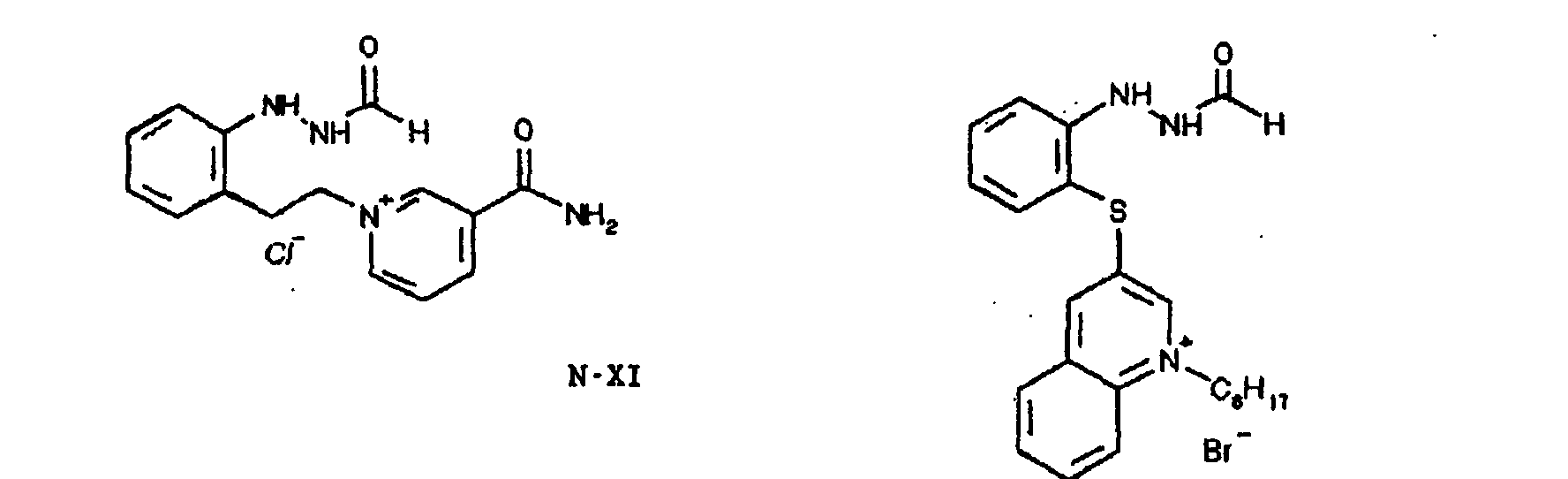
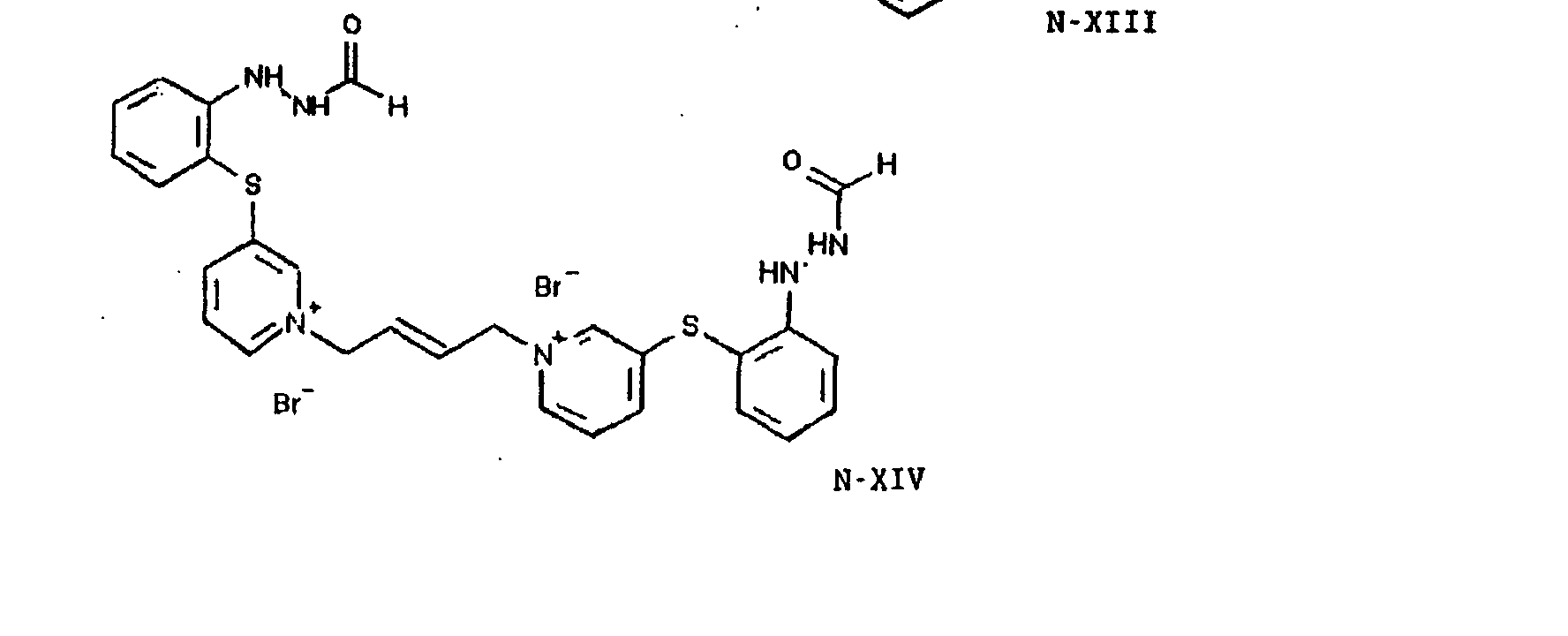
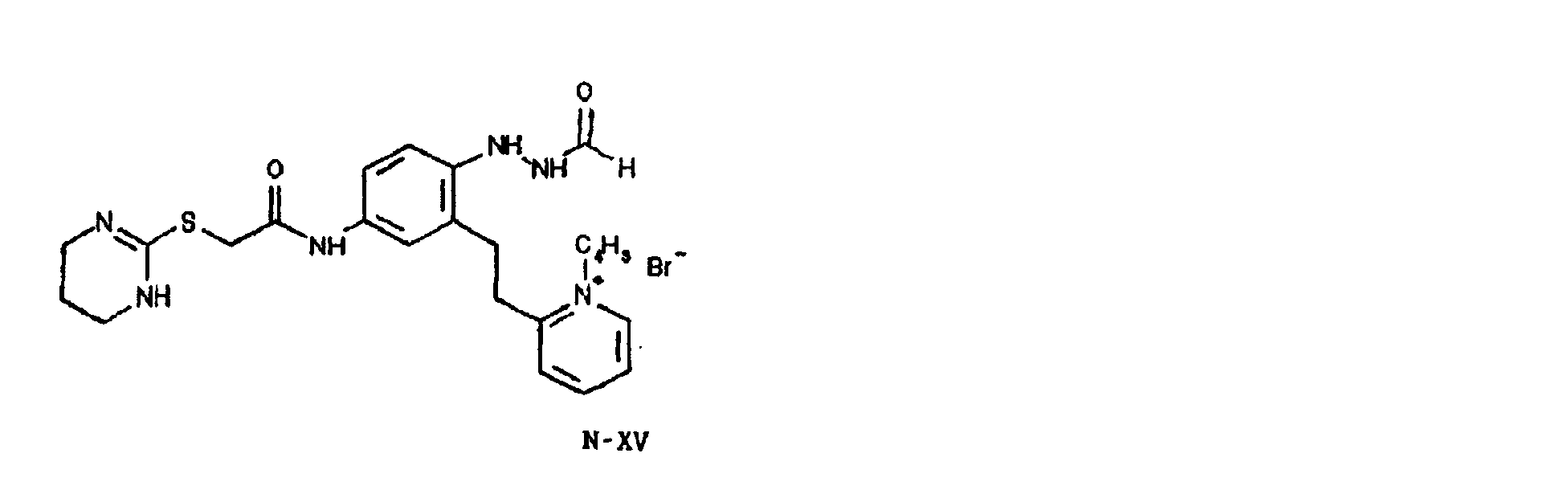
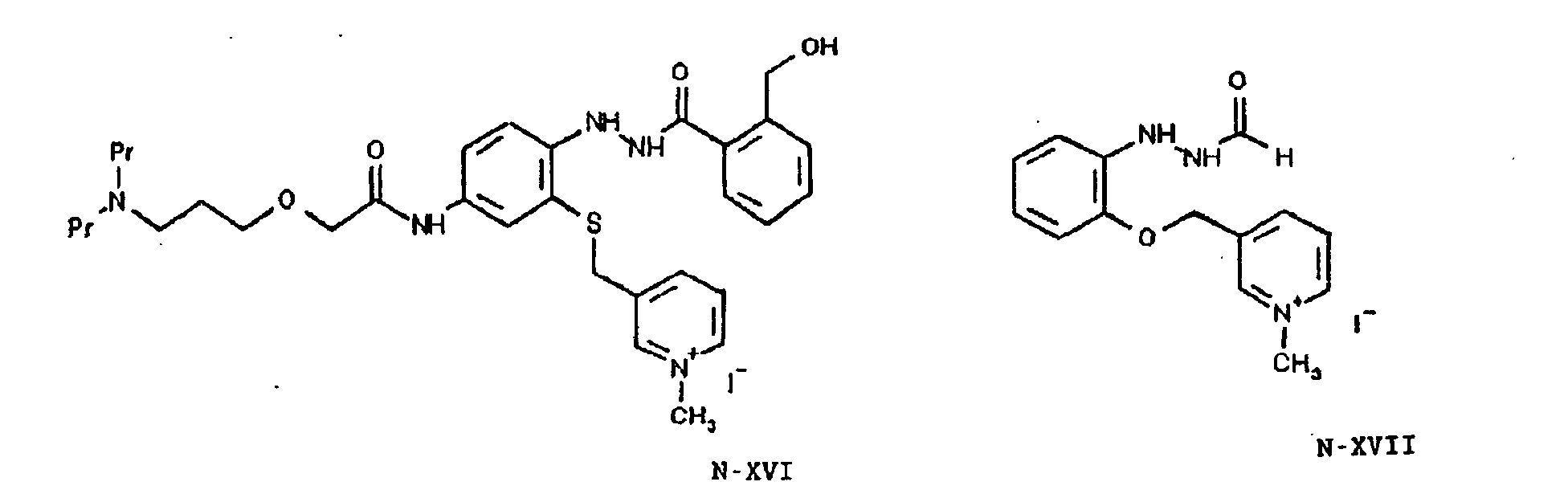
Specific examples of compounds represented by formula (5) are listed
below, but they are not intended to limit the present invention.
The hydrazine derivative represented by formula (6) is now explained
further in detail.
In the formula, R6 denotes an alkyl group having 6 to 18 carbons or a
five- or six-membered heterocycle containing as a ring atom sulfur or oxygen,
R61 denotes an alkyl or alkoxy group having 1 to 12 carbons, X denotes
alkylthio, thioalkyl or alkoxy having 1 to about 5 carbons, a halogen
atom, -NHCOR62, -NHSO2R62, -CONR62R62, or -SO2R62R63 (R62 and R63 may be
identical to or different from each other and denote hydrogen atoms or alkyl
groups having 1 to about 4 carbons), and n is 0, 1, or 2.
Alkyl groups represented by R6 can be straight or branched chain and
can be substituted or unsubstituted. Substituents include alkoxy having from 1
to 4 carbon atoms, halogen atoms (e.g., chlorine and fluorine), or -NHCOR62- or
NHSO2R62- where R62 is as defined above. Preferred R6 alkyl groups contain
from 8 to 16 carbon atoms since alkyl groups of this size impart a greater
degree of insolubility to the hydrazide nucleating agents and thereby reduce
the tendency during development for these agents to be leached into developer
solutions from the layers in which they are coated. Heterocyclic groups
represented by R6 include thienyl and furyl, which can be substituted with alkyl
having from 1 to 4 carbon atoms or with a halogen atom such as chlorine.
Alkyl or alkoxy groups represented by R61 can be straight or branched
chain and can be substituted or unsubstituted. Substituents on these groups
can be alkoxy having from 1 to 4 carbon atoms, halogen atoms (e.g., chlorine
or fluorine); or -NHCOR62 or -NHSO2R62 where R62 is as defined above. R62
may further have a substituent. Preferred alkyl or alkoxy groups contain from 1
to 5 carbon atoms in order to impart sufficient insolubility to the hydrazide
nucleating agents to reduce their tendency to be leached by a developer
solution out of the layers in which they are coated.
Alkyl, thioalkyl and alkoxy groups which are represented by X contain
from 1 to 5 carbon atoms and can be straight or branched chain. When X is a
halogen atom, it may be chlorine, fluorine, bromine or iodine. Where more than
one X is present, such substituents can be identical to or different from each
other.
Specific examples of compounds represented by formula (6) are listed
below, but they are not intended to limit the present invention.
The hydrazine derivative of the present invention can be synthesized by,
for example, methods disclosed in JP-A-61-213847, JP-A-62-260153, US Pat.
Nos. 4,648,604, 3,379,529, 3,620,746, 4,377,634, 4,332,878, JP-A-49-129536,
JP-A-56-153336, JP-A-56-153342, JP-A-1-269936, US Pat. Nos. 4,988,604,
4,994,365, etc.
The hydrazine derivative for use in the present invention may be
dissolved before use in an appropriate water-miscible organic solvent, such as
an alcohol (e.g. methanol, ethanol, propanol, a fluorinated alcohol), a ketone
(e.g. acetone, methyl ethyl ketone), dimethylformamide, dimethylsulfoxide, or
methyl cellosolve.
The hydrazine-series nucleating agent for use in the present invention
may also be used as emulsion dispersion obtained by dissolving the compound
according to an already well-known emulsion dispersion method using an oil,
such as dibutyl phthalate, tricresyl phosphate, glyceryl triacetate, or diethyl
phthalate; or using an auxiliary solvent, such as ethyl acetate or
cyclohexanone, and mechanically processing it into an emulsion dispersion.
Alternatively, the hydrazine derivative powder may be used by dispersing it in
water using a ball mill, a colloid mill, or ultrasonic waves, according to a method
known as a solid dispersion method.
The hydrazine nucleating agent for use in the present invention may be
added to any of a silver halide emulsion layer and other hydrophilic colloid
layers on the silver halide emulsion layer side of a support, but it is preferably
added to the above-described silver halide emulsion layer or to a hydrophilic
colloid layer adjacent thereto. It is also possible to use two or more types of
hydrazine nucleating agent in combination.
The amount added of the nucleating agent for use in the present
invention is preferably from 1 x 10⁻⁵ to 1 x 10⁻² mol, more preferably from
1 x 10⁻⁵ to 5 x 10⁻³ mol, and most preferably from 2 x 10⁻⁵ to 5 x 10⁻³ mol, per mol
of silver halide.
The halogen composition of the light-sensitive silver halide emulsion
used in the present invention can be any chosen from silver chloride, silver
bromide, silver chlorobromide, silver iodobromide, silver iodochloride and silver
iodochlorobromide.
The silver halide grains may have any shape of cubic, tetradecahedral,
octahedral, amorphous, and tabular forms, and cubic or tabular grains are
preferred.
The photographic emulsion for use in the present invention can be
prepared using methods described, for example, by P. Glafkides, in Chimie et
Physique Photographique, Paul Montel (1967); by G. F. Duffin, in Photographic
Emulsion Chemistry, The Focal Press (1966); and by V. L. Zelikman et al., in
Making and Coating Photographic Emulsion, The Focal Press (1964).
More specifically, either an acid process or a neutral process may be
used. Further, a method of reacting a soluble silver salt and a soluble halogen
salt may be carried out by any of a single-sided mixing method, a simultaneous
mixing method, and a combination thereof.
A method of forming grains in the presence of excess silver ion (the
so-called reverse-mixing method) may also be used. As one form of the
simultaneous mixing method, a method of maintaining the pAg constant in the
liquid phase where silver halide is produced, namely, the so-called controlled
double jet method, may be used. Further, it is preferred to form the grains
using a so-called silver halide solvent, such as ammonia, a thioether, or a tetra-substituted
thiourea, and more preferably using a tetra-substituted thiourea
compound, and this is described in JP-A-53-82408 and JP-A-55-77737.
Preferred examples of the thiourea compound include tetramethylthiourea and
1,3-dimethyl-2-imidazolidinethione. The amount of silver halide solvent added
varies depending on the kind of the compound used or the intended grain size
and the intended halogen composition, but it is preferably from 10-5 to 10-2 mol
per mol of silver halide. It is also possible to form grains in the presence of a
nitrogen-containing heterocyclic compound capable of forming a complex with
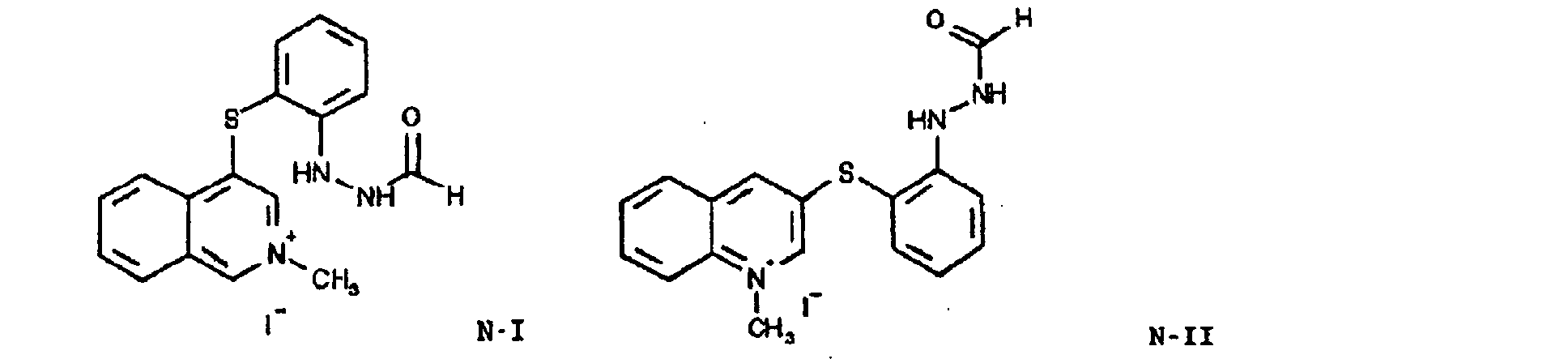
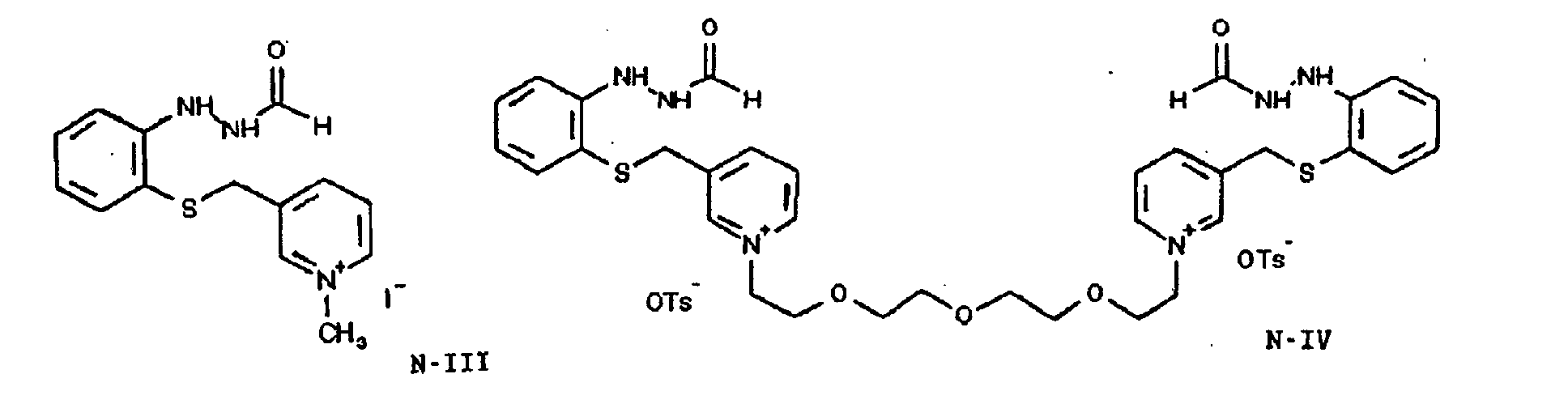
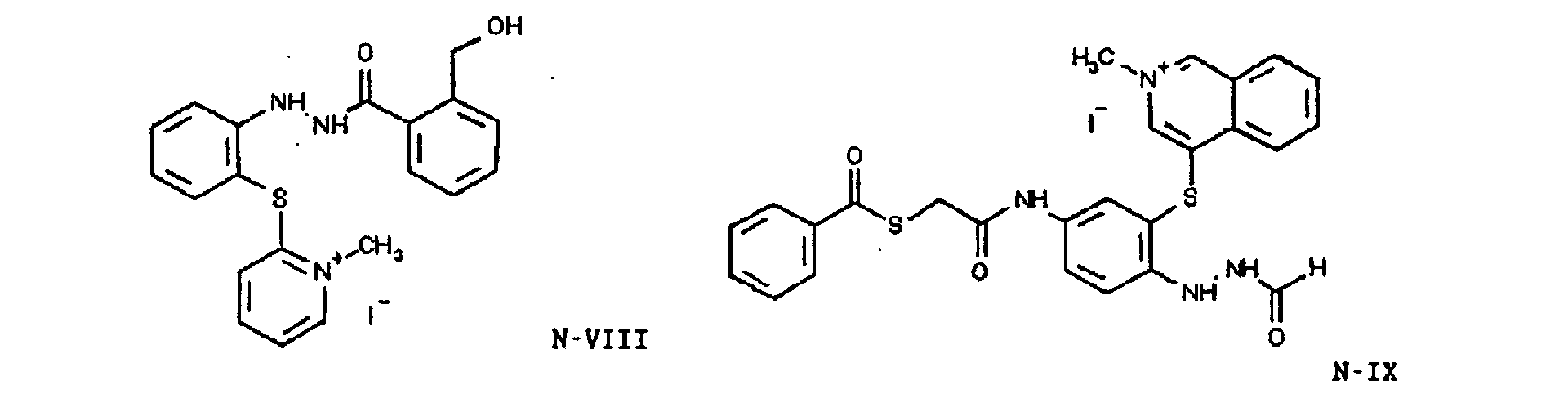
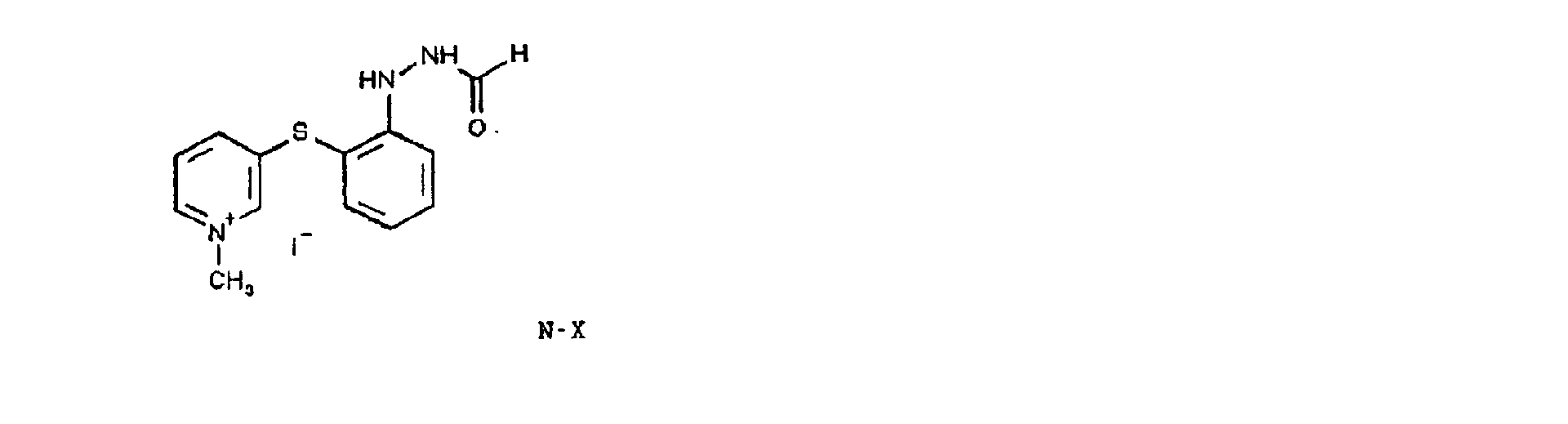
silver, and Compounds N-1 to N-59 described in JP-A-11-344788 are
preferred. The amount of such a compound added varies depending on
various conditions such as the pH, the temperature and the size of the silver
halide grains, but it is preferably 10-6 to 10-2 mol per mol of silver halide. Such
a compound can be added appropriately in any step prior to, during, or
subsequent to formation of the grains, but it is preferably added during
formation of the grains.
According to the controlled double jet method or the method of forming
grains using a silver halide solvent, a silver halide emulsion including grains
having a regular crystal form and a narrow grain size distribution can be easily
prepared. These methods are useful means for preparing the silver halide
emulsion for use in the present invention.
In order to render the grain size uniform, it is preferred to rapidly grow
grains within the range not exceeding the critical saturation, using a method of
changing the addition rate of silver nitrate or alkali halide according to the grain
growth rate, as described in British Patent No. 1,535,016, JP-B-48-36890
("JP-B" means examined Japanese patent publication), and JP-B-52-16364, or
a method of changing the concentration of the aqueous solution, as described
in British Patent No. 4,242,445 and JP-A-55-158124.
The emulsion for use in present invention is preferably a monodisperse
emulsion having a coefficient of variation (deviation coefficient) obtained by the
equation: {(standard deviation of grain size)/(average grain size)} x 100, of 20%
or less, and more preferably 15% or less.
The silver halide emulsion grains preferably have an average grain size
of 0.5 µm or less, and more preferably 0.1 to 0.4 µm.
The light-sensitive silver halide emulsion in the present invention can be
used singly or in a combination of two or more types. When a combination of
two or more types is used, the grain sizes are preferably different from each
other. The difference in grain size, as the average grain length, is preferably
10% or more.
The ratio of the two or more types of silver halide emulsion used in the
present invention is not particularly limited. For example, the ratio of an
emulsion having a larger amount thereof is 1:1 to 1:20 on the basis of the silver
present in the silver halide emulsions, and more preferably 1:1 to 1:10.
It is also preferable to mix at least two types of emulsion to which have
been added different amounts of a nitrogen-containing heterocyclic compound
capable of forming a complex with silver as described in sections 0020 to 0032
of Japanese patent application No. 2000-379706.
The silver halide emulsion used in the present invention can contain a
metal that belongs to Group VIII of the periodic table. In order to achieve high
contrast and low fog, it preferably contains a rhodium compound, an iridium
compound, a ruthenium compound, a rhenium compound, a chromium
compound, etc. A preferred example of these heavy metal compounds is a
metal coordination complex, or a hexa-coordinate complex represented by the
general formula below.
[M(NY)mL6-m]n-
(In the formula, M is a heavy metal chosen from the group consisting of
Ir, Ru, Rh, Re, Cr and Fe. L denotes a bridging ligand. Y is oxygen or sulfur.
m = 0, 1 or 2 and n = 0, 1, 2 or 3.)
With regard to preferable examples of L, halide ligands (fluoride,
chloride, bromide and iodide), a cyanide ligand, a cyanate ligand, a thiocyanate
ligand, a selenocyanate ligand, a tellurocyanate ligand, acid ligands, and an
aquo ligand can be cited. When an aquo ligand is present, it preferably
occupies one ligand or two ligands.
In order to achieve high sensitivity, it is preferable for the silver halide
emulsion to contain an iron compound, and it is particularly preferable for it to
contain a metal coordination complex having a cyan ligand.
These compounds are used as a solution in water or an appropriate
solvent. A method that is usually employed in order to stabilize a solution of
the compound, that is to say, a method in which an aqueous solution of a
hydrogen halide (for example, hydrochloric acid, hydrobromic acid or
hydrofluoric acid) or an alkali halide (for example, KCI, NaCI, KBr or NaBr) is
added can be employed. It is also possible to add and dissolve other silver
halide grains which have been doped with the above-mentioned compounds.
Specific examples of the metal coordination complex are as follows.
- 1.
- [Rh(H2O)Cl5]2-
- 2.
- [RhCl6]3-
- 3.
- [Ru(NO)Cl5]2-
- 4.
- [RuCl6]3-
- 5.
- [Ru(H2O)Cl5]2-
- 6.
- [Ru(NO)(H2O)Cl4]-
- 7.
- [Ru2Cl10O]6-
- 8.
- [Re(NO)Cl5]2-
- 9.
- [Ir(NO)Cl5]2-
- 10.
- [Ir(H2O)Cl5]2-
- 11.
- [Re(H2O)Cl5]2-
- 12.
- [RhBr6]3-
- 13.
- [ReCl6]3-
- 14.
- [IrCl6]3-
- 15.
- [Re(NS)Cl4(SeCN)]2-
- 16.
- [Cr(CN)6]3-
-
- 17.
[Fe(CN)6]3-
In addition to the compounds described above, it is also possible to
preferably use compounds described in sections 0027 to 0056 of Japanese
patent application No. 2000-95144.
The amount of these compounds added is 1 x 10⁻⁸ to 5 x 10⁻⁶ mol per mol
of silver in the silver halide emulsion, and preferably 5 x 10⁻⁸ to 1 x 10⁻⁶ mol.
Furthermore, the above-mentioned heavy metals can be used in combination.
The distribution of the heavy metal in the silver halide grains is not particularly
limited; it can be distributed uniformly or in a core-shell form in which the
distribution differs between the surface and the interior, or the distribution can
be changed continuously. The addition of these compounds can be carried out
appropriately in any step of the production of the silver halide emulsion grains
or prior to coating the emulsion, but it is particularly preferable to add them
during the emulsion formation so as to incorporate them into the silver halide
grains.
In the present invention it is preferable for the light-sensitive silver halide
emulsion layer or another layer comprising a hydrophilic colloid to contain solid
particles that can increase the average value of the integral of the spectral
reflectance in the wavelength range from 850 to 1000 nm by at least 1.5%
relative to a case where they are not added. The amount thereof added is
preferably at least 2% and, from the point of view of degradation of haze, at
most 5%.
In the present invention, the average value of the integral of the spectral
reflectance of the light-sensitive material at wavelengths of 850 to 1000 nm can
be measured simply using a spectrometer. For example, it can be measured
using a U3500 spectrometer manufactured by Hitachi, Ltd. with an integrating
sphere placed in a light-receiving part thereof, by applying probe light to a
light-sensitive material with black paper placed on its back surface, and
integrating the reflected light by means of the integrating sphere.
The material for the solid particles used in the present invention that can
increase the above-mentioned integral value of the reflectance is not
particularly limited as long as the above-mentioned reflectance characteristics
can be provided; any type including inorganic particles and a dispersion of an
organic material can be used as long as the photographic characteristics are
not affected, and those having a refractive index of at least 1.54 are preferred.
The refractive index referred to in the present invention denotes the
refractive index relative to air. The refractive index varies slightly depending on
the wavelength of the light and the temperature, and a value for nD20 that is
obtained at 20°C using the Na-D line (λ = 589.3 nm) as a light source is used.
In the case of a solid, since the refractive index might vary depending on the
direction due to crystal anisotropy, the maximum value is used.
Various compounds can be cited as specific examples of compounds
having a refractive index of at least 1.54, and include silver halides, metal
oxides such as magnesium oxide, alumina, calcite, ZrO2, SnO2, ZnO, Al2O3, and
TiO2, barium sulfate, polystyrene, and a vinylidene chloride resin.
A preferable range for the refractive index is 1.60 and above, and
particularly preferably 1.70 and above.
A preferable range for the particle size of the solid particles depends on
the refractive index, but it is preferably 2 nm to 20 µm, and more preferably 5
nm to 10 µm. The solid particle size referred to here denotes the particle size
obtained by a light scattering method, and more specifically the average
particle size is measured using an ELS-800 manufactured by Otsuka
Electronics Co., Ltd.
The amount of solid particles added is preferably 10 mg to 1 g/m2, and
particularly preferably 20 to 500 mg/m2.
The position at which the solid particles is added is not particularly
limited, and they can be used in an emulsion layer, between the emulsion layer
and a support, in an emulsion protecting layer, in a backing layer, or in the
support, but the uppermost layer on which light emitted by the infrared source
of an infrared sensor directly impinges is particularly preferred.
It is necessary for these solid particles to be in a granular form in the
light-sensitive material and, although it depends on the method used for
dispersing fine particles, the water solubility of the solid particles is preferably
low. Those having the property of dissolving in a processing solution are
preferably used.
Furthermore in the present invention, among the above-mentioned solid
particles, light-insensitive silver halide grains are preferably used.
The halogen composition of the light-sensitive silver halide emulsion
used in the present invention can be any chosen from silver chloride, silver
bromide, silver chlorobromide, silver iodobromide, silver iodochloride and silver
iodochlorobromide.
The silver halide grains may have any shape of cubic, tetradecahedral,
octahedral, amorphous, and tabular forms, and cubic, tetradecahedral, and
tabular grains are preferred.
The light-insensitive silver halide grains for use in the present invention
can be prepared using methods described, for example, by P. Glafkides, in
Chimie et Physique Photographique, Paul Montel (1967); by G. F. Duffin, in
Photographic Emulsion Chemistry, The Focal Press (1966); and by V. L.
Zelikman et al., in Making and Coating Photographic Emulsion, The Focal
Press (1964).
The light-insensitive silver halide grains of the present invention have a
blue region sensitivity that is 1/10 or less of that of the light-sensitive silver
halide grains used in the light-sensitive material of the present invention, and
are preferably not spectrally sensitized. The light-insensitive silver halide
grains of the present invention can be subjected to surface modification such
as metal complex doping or chemical sensitization, described in the section
above related to light-sensitive silver halides.
When the cubic or tetradecahedral grains are used, the light-insensitive
silver halide is preferably in the form of monodisperse grains; its coefficient of
variation obtained by the equation: {(standard deviation of grain size)/(average
grain size)} x 100, is 20% or less, and preferably 15% or less. The average
size of these silver halide grains is preferably at least 0.1 µm, more preferably
0.2 µm to 10 µm, and yet more preferably 0.5 µm to 1.5 µm.
The tabular silver halide grains referred to here means general silver
halide grains having one twin plane or two or more parallel twin planes. The
twin plane refers to a (111) plane when all lattice ions on either side of the
(111) plane are in a mirror image relationship. When viewed from above, these
tabular particles have a triangular, square, hexagonal or roundish circular form,
and the triangular particles, the hexagonal particles, and the circular particles
have respectively triangular, hexagonal, and circular external surfaces that are
parallel to each other.
The light-insensitive emulsion used in the present invention preferably
includes tabular grains having a thickness of 0.02 to 0.20 µm over at least 50%
of the total projection area. The thickness of the grains can be easily obtained
by vapor-depositing a metal both on the grains and on a reference latex from
an oblique direction, measuring the length of the shadow of the grains on an
electron micrograph and calculating using the length of the latex shadow as a
reference.
In the present invention, all the grains of the light-insensitive emulsion
preferably have a circle-equivalent diameter of less than 1.5 µ, and more
preferably 0.2 to 1.2 µm. The coefficient of variation in the circle-equivalent
diameter is preferably at most 40%, more preferably at most 25%, and yet more
preferably 15%.
The tabular silver halide emulsion can be easily prepared by reference
to methods disclosed in JP-A-58-127927, JP-A-58-113927, JP-A-58-113928,
etc. Alternatively, seed crystals having at least 40 wt % of tabular particles are
formed in an atmosphere having a pBr value of 1.3 or below, which is
comparatively low, and the seed crystals are made to grow by simultaneously
adding silver and a halogen solution while maintaining the pBr value at the
same level as above. During this growth process, the silver and the halogen
solution are desirably added so as to prevent growth of new crystal nuclei. The
size of the tabular silver halide grains can be adjusted by controlling the
temperature, the type and the amount of a solvent, and the rates of addition of
a silver salt and a halide during grain growth.
The amount coated of the silver halide emulsion used in the present
invention is preferably 5 g/m2 or below expressed as the amount of silver in
both the light-sensitive and light-insensitive emulsions, and more preferably 2.2
to 4.5 g/m2. The amount of the light-sensitive emulsion is preferably 4.5 g/m2 or
below expressed as the amount of silver, and more preferably 2 to 4 g/m2. The
amount of the light-insensitive emulsion is preferably 0.5 g/m2 or below
expressed as the amount of silver, and more preferably 0.03 to 0.3 g/m2.
The silver halide emulsion for use in the present invention is preferably
subjected to chemical sensitization. The chemical sensitization may be
performed using a known method, such as sulfur sensitization, selenium
sensitization, tellurium sensitization, or noble metal sensitization, and these
sensitization methods may be used singly or in combination. When these
sensitization methods are used in combination, a combination of sulfur
sensitization and gold sensitization; a combination of sulfur sensitization,
selenium sensitization, and gold sensitization; and a combination of sulfur
sensitization, tellurium sensitization, and gold sensitization, are preferred.
The sulfur sensitization employed in the present invention is usually
carried out by adding a sulfur sensitizer to the silver halide emulsion and
stirring the mixture at a high temperature, and preferably at least 40°C, for a
predetermined time. The sulfur sensitizer used may be a known compound,
and examples thereof include, in addition to a sulfur compound present in
gelatin, various types of sulfur compound such as thiosulfates, thioureas,
thiazoles or rhodanines. Furthermore, sulfur sensitizers disclosed in US Pat.
Nos. 1,574,944, 2,410,689, 2,278,947, 2,728,668, 3,501,313, 3,656,955,
German Patent No. 1,422,869, JP-B-56-24937, JP-A-55-45016, etc. can be
used. Preferred sulfur compounds are thiosulfates and thiourea compounds.
The amount of sulfur sensitizer added varies depending on various
conditions such as the pH and the temperature at the time of chemical ripening
and the size of the silver halide grains, but it is preferably 10-7 to 10-2 mol, and
more preferably 10-5 to 10-3 mol per mol of silver halide.
The selenium sensitizer for use in the present invention may be a known
selenium compound. The selenium sensitization is generally performed by
adding a labile and/or non-labile selenium compound and stirring the emulsion
at a high temperature of 40°C or higher for a predetermined time. Preferable
examples of the labile selenium compound include the compounds described in
JP-B-44-15748, JP-B-43-13489, and JP-A-4-25832, JP-A-4-109240,
JP-A-4-324855, etc. Specific examples of the labile selenium compound
include isoselenocyanates (e.g. aliphatic isoselenocyanates such as allyl
isoselenocyanate), selenoureas, selenoketones, selenoamides,
selenocarboxylic acids (e.g. 2-selenopropionic acids, 2-selenobutyric acids),
selenoesters, diacylselenides (e.g. bis(3-chloro-2,6-dimethoxybenzoyl)selenide),
selenophosphates, phosphine selenides, colloidal
metal selenium, etc. The above-mentioned preferable types of labile selenium
compound are not cited for restriction. A person skilled in the art generally
understands that, with regard to a labile selenium compound as a sensitizer for
a photographic emulsion, the structure of the compound is not important as
long as the selenium is labile, and the organic moiety of a selenium sensitizer
molecule has no function other than that of allowing selenium to be present in a
labile form in an emulsion. In the present invention, a labile selenium
compound defined by such a broad concept is advantageously used. With
regard to the non-labile selenium compound used in the present invention,
compounds described in JP-B-46-4553, JP-B-52-34492 and JP-B 52-34491
can be used. Specific examples of the non-labile selenium compound include
selenious acid, potassium selenocyanide, selenazoles, quaternary salts of
selenazoles, diaryl selenides, diaryl diselenides, dialkyl selenides, dialkyl
diselenides, 2-selenazolidindione, 2-selenooxazolidinthione, and derivatives
thereof. Particularly preferred are the compounds represented by formula(VIII)
or (IX) of JP-A-4-324855.
Further, a low-decomposition-activity selenium compound can also be
preferably used. The low-decomposition-activity selenium compound is a
selenium compound such that, when a water/1,4-dioxane (1/1 by volume)
mixed solution (pH: 6.3), containing 10 mmol of AgNO3, 0.5 mmol of the
selenium compound, and 40 mmol of 2-(N-morpholino)ethanesulfonic acid
buffer, is reacted at 40°C, the half-life of the selenium compound is 6 hours or
more. When determining the half-life, the selenium compound can be detected
and analyzed using HPLC, etc. Preferred examples of the low-decomposition-activity
selenium compound include Compounds SE-1 to SE-8 exemplified in
JP-A-9-166841.
The tellurium sensitizer for use in the present invention is a compound
for forming silver telluride, which is presumed to become a sensitization
nucleus, on the surface of or inside a silver halide grain. The rate of formation
of silver telluride in a silver halide emulsion can be examined according to a
method described in JP-A-5-313284.
Specific examples of the tellurium sensitizer to be used include the
compounds described in U.S. Pat. Nos. 1,623,499, 3,320,069, and 3,772,031,
British Patent Nos. 235,211, 1,121,496, 1,295,462, and 1,396,696, Canadian
Patent No. 800,958, JP-A-4-204640, JP-A-4-271341, JP-A-4-333043, and
JP-A-5-303157, J. Chem. Soc. Chem. Commun., 635(1980); ibid., 1102 (1979);
ibid., 645 (1979); J. Chem. Soc. Perkin. Trans., 1, 2191 (1980); S. Patai
(compiler), The Chemistry of Organic Selenium and Tellurium Compounds,
Vol.1 1 (1986); and ibid., Vol. 2 (1987). The compounds represented by
formulae (II), (III), and (IV) of JP-A-5-313284 are particularly preferred.
The amount to be used of the selenium sensitizer or the tellurium
sensitizer for use in the present invention varies depending on the silver halide
grains used, the chemical ripening conditions, etc., but it is generally in the
order of 10-8 to 10-2 mol, and preferably from 10-7 to 10-3 mol, per mol of silver
halide. The conditions of chemical sensitization in the present invention are
not particularly restricted, but the pH is generally from 5 to 8, the pAg is
generally from 6 to 11, and preferably from 7 to 10, and the temperature is
generally from 40 to 95°C, and preferably from 45 to 85°C
Examples of the noble metal sensitizer for use in the present invention
include gold, platinum, palladium, and iridium, and a gold sensitizer is
particularly preferred. With regard to the above-mentioned gold sensitizer, its
gold oxidation state may be monovalent or trivalent, and a gold compound that
is normally used as a gold sensitizer can be used. Representative examples of
the gold sensitizer for use in the present invention include chloroauric acid,
potassium chloroaurate, auric trichloride, potassium auric thiocyanate,
potassium iodoaurate, tetracyanoauric acid, ammonium aurothiocyanate,
pyridyl trichlorogold, and gold sulfide. The gold sensitizer can be used in an
amount of approximately from 10-7 to 10-2 mol per mol of silver halide.
In the silver halide emulsion for use in the present invention, a cadmium
salt, a sulfite, a lead salt, a thallium salt, etc. may also be present during the
formation or physical ripening of the silver halide grains.
In the present invention, reduction sensitization may be employed.
Examples of the reduction sensitizer to be used include stannous salts, amines,
formamidine sulfinic acid, and silane compounds.
To the silver halide emulsion for use in the present invention, a
thiosulfonic acid compound may be added, according to the method described
in European Unexamined Patent Publication (EP) 293,917.
With regard to the silver halide emulsion in the light-sensitive material
used in the present invention, two or more types of emulsion can be used in
combination in a single layer, the emulsions having different types, distributions
and contents of metal complex; different crystal habits and forms; different
types, amounts added and sensitization conditions of chemical sensitizer; and
different types, amounts added and spectral sensitization conditions of spectral
sensitizer, and, moreover, such layers can be formed into a layered structure.
The light-sensitive silver halide emulsion for use in the present invention
may be spectrally sensitized to light having a comparatively long wavelength
such as blue light, green light, red light, or infrared light, by a sensitizing dye,
according to the purpose for which the light-sensitive material is used.
Examples of the sensitizing dye that can be used include a cyanine dye, a
merocyanine dye, a complex cyanine dye, a complex merocyanine dye, a
holopolar cyanine dye, a styryl dye, a hemicyanine dye, an oxonol dye, and a
hemioxonol dye.
Useful sensitizing dyes for use in the present invention are described,
for example, in Research Disclosure, Item 17643, IV-A, page 23 (December,
1978); ibid., Item 18341 X, page 437 (August 1979), and publications cited
therein.
In particular, sensitizing dyes having a spectral sensitivity suitable for
the spectral characteristics of various light sources in a scanner, an image
setter, or a photomechanical process camera, can be advantageously selected.
For example, A) for an argon laser light source, Compounds (I)-1 to (I)-8
described in JP-A-60-162247, Compounds I-1 to 1-28 described in
JP-A-2-48653, Compounds I-1 to 1-13 described in JP-A-4-330434,
Compounds of Examples 1 to 14 described in U.S. Pat. No. 2,161,331, and
Compounds 1 to 7 described in West German Patent No. 936,071; B) for a
helium-neon laser light source and a red laser diode light source, Compounds
I-1 to 1-38 described in JP-A-54-18726, compounds I-1 to 1-35 described in
JP-A-6-75322, Compounds I-1 to 1-34 described in JP-A-7-287338, and
Compounds 2-1, 2-14, 3-1 to 3-14 and 4-1 to 4-6 described in JP 2822138 (JP
denotes Japanese Examined Patent Publication); C) for an LED light source,
Dyes 1 to 20 described in JP-B-55-39818, Compounds I-1 to 1-37 described in
JP-A-62-284343, Compounds I-1 to 1-34 described in JP-A-7-287338, and
Compounds 2-1 to 2-14, 3-1 to 3-14 and 4-1 to 4-6 described in JP 2822138;
D) for a semiconductor laser light source, Compounds I-1 to 1-12 described in
JP-A-59-191032, Compounds I-1 to 1-22 described in JP-A-60-80841,
Compounds I-1 to I-29 described in JP-A-4-335342, and Compounds I-1 to I-18
described in JP-A-59-192242; and E) for a tungsten or xenon light source of a
photomechanical camera, Compounds (1) to (19) represented by general
formula (I) of JP-A-55-45015, Compounds 4-A to 4-S, Compounds 5-A to 5-Q,
and Compounds 6-A to 6-T described in JP-A-6-242547, and Compounds I-1 to
1-97 described, in Japanese Patent Application No. 9-160185 may be
advantageously selected. but the present invention is not limited thereby.
These sensitizing dyes may be used singly or in combination, and a
combination of sensitizing dyes is often used for the purpose of, particularly,
supersensitization. In combination with the sensitizing dye, a dye which itself
has no spectral sensitization effect, or a material that adsorbs substantially no
visible light, but that exhibits supersensitization, may be incorporated into the
emulsion.
Useful sensitizing dyes, combinations of dyes that exhibit
supersensitization, and materials that show supersensitization are described,
for example, in Research Disclosure, Vol. 176, 17643, page 23, Item IV-J
(December 1978); JP-B-49-25500, JP-B-43-4933, JP-A-59-19032, and JP-A-59-192242.
The sensitizing dyes for use in the present invention may be used in a
combination of two or more. The sensitizing dye may be added to a silver
halide emulsion by dispersing it directly in the emulsion, or by dissolving it in a
single or mixed solvent of such solvents as water, methanol, ethanol, propanol,
acetone, methyl cellosolve, 2,2,3,3-tetrafluoropropanol, 2,2,2-trifluoroethanol,
3-methoxy-1-propanol, 3-methoxy-1-butanol, 1-methoxy-2-propanol or N,N-dimethylformamide,
and then adding the solution to the emulsion.
Alternatively, the sensitizing dye may be added to the emulsion by a
method disclosed in U.S. Pat. No. 3,469,987, in which a dye is dissolved in a
volatile organic solvent, the solution is dispersed in water or a hydrophilic
colloid, and the dispersion is added to the emulsion; a method disclosed, for
example, in JP-B-44-23389, JP-B-44-27555, and JP-B-57-22091, in which a
dye is dissolved in an acid, and the solution is added to the emulsion, or a dye
is formed into an aqueous solution in the presence of an acid or base and then
it is added to the emulsion; a method disclosed, for example, in U.S. Pat. Nos.
3,822,135 and 4,006,025, in which a dye is formed into an aqueous solution or
a colloid dispersion in the presence of a surfactant, and the solution or
dispersion is added to the emulsion; a method disclosed in JP-A-53-102733
and JP-A-58-105141, in which a dye is directly dispersed in a hydrophilic
colloid, and the dispersion is added to the emulsion; or a method disclosed in
JP-A-51-74624, in which a dye is dissolved using a compound capable of
producing a red-shift, and the solution is added to the emulsion. Ultrasonic
waves may also be used to form a solution.
The sensitizing dye for use in the present invention may be added to a
silver halide emulsion for use in the present invention at any step known to be
useful during the preparation of a photographic emulsion. For example, the
dye may be added at a silver halide grain formation step, and/or in a period
before desalting, or at a desalting step, and/or in a period after desalting and
before the initiation of chemical ripening, as disclosed, for example, in U.S. Pat.
Nos. 2,735,766, 3,628,960, 4,183,756, and 4,225,666, JP-A-58-184142, and
JP-A-60-196749, or the dye may be added in any period or at any stage before
coating of the emulsion, such as immediately before or during chemical
ripening, or in a period after chemical ripening but before coating, as disclosed,
for example, in JP-A-58-113920. Also, a single kind of compound alone, or a
combination of compounds different in structure, may be added in a divided
manner; for example, a part during grain formation, and the remainder during
chemical ripening, or after completion of the chemical ripening; or a part before
or during chemical ripening, and the remainder after completion of the chemical
ripening, as disclosed, for example, in U.S. Pat. No. 4,225,666 and
JP-A-58-7629. The kind of compounds added in a divided manner, or the kind
of combination of compounds, may be changed.
The amount added of the sensitizing dye for use in the present invention
varies depending upon the shape, size, the halogen composition of the silver
halide grains, the method and degree of chemical sensitization, the kind of
antifoggant, and the like, but the amount added can be from 4 x 10⁻⁶ to 8 x 10⁻³
mol per mol of silver halide. For example, when the silver halide grain size is
from 0.2 to 1.3 µm, the amount added is preferably from 2.0 x 10⁻⁷ to 3.5 x 10⁻⁶,
and more preferably from 6.5 x 10⁻⁷ to 2.0 x 10⁻⁶ mol, per m2 of the surface area
of the silver halide grains.
'Another layer comprising a hydrophilic colloid' referred to in the present
invention denotes a hydrophilic colloid layer that is provided on the same side
as or the opposite side to the silver halide emulsion layer relative to a water
impermeable support. Examples of the former include a protecting layer and
an interlayer, and examples of the latter include a backing layer.
With regard to the support used in the present invention, for example,
baryta paper, polyethylene coated paper, polypropylene synthetic paper, glass
plate, cellulose acetate, cellulose nitrate, a polyester film such as polyethylene
terephthalate, a support made of a styrene system polymer having a
syndiotactic structure described in JP-A-7-234478 or US Pat. No. 5,558,979,
and a support, described in JP-A-64-538 or US Pat. Nos. 4,645,731, 4,933,267
or 4,954,430 formed by coating a polyester film with a vinylidene chloride
copolymer can be cited. These supports are chosen as appropriate according
to the purpose for which the silver halide photographic light-sensitive material
is used.
As a binder for the silver halide emulsion layer and another hydrophilic
colloid layer of the present invention, gelatin is preferably used, but it is also
possible to use a polymer described in paragraph 0025 of JP-A-10-268464.
The amount of binder present in the whole hydrophilic colloid layer on the side
having the silver halide emulsion layer is 3 g/m2 or less (preferably 1.0 to
3.0 g/m2), and the total amount of binder present in the whole hydrophilic
colloid layer on the side having the silver halide emulsion layer and the whole
hydrophilic colloid layer on the opposite side is 7.0 g/m2 or less, and preferably
2.0 to 7.0 g/m2.
In the present invention, in order to control the surface roughness of the
outermost layers of the silver halide light-sensitive material, inorganic and/or
organic polymer fine particles (hereinafter, called a matting agent) are used in
a hydrophilic colloid layer. The surface roughness of the outermost layer on
the side having the silver halide emulsion layer of the light-sensitive material
and the surface roughness of the outermost layer on the opposite side can be
controlled by variously changing the average particle size of the matting agent
and the amount thereof added. The layer to which the matting agent is added
can be any of the light-sensitive material forming layers, but with regard to the
side having the silver halide emulsion layer, it is preferable to add it to a layer
positioned far from the support in order to prevent pinholes, and the outermost
layer is particularly preferred.
The matting agent used in the present invention can be of any type of
solid particles as long as it does not adversely affect the various photographic
characteristics. Specific examples include those described in paragraph Nos.
0009 to 0013 of JP-A-10-268464.
The average particle size of the matting agent used in the present
invention is preferably 20 µm or less, and particularly preferably in the range of
1 to 10 µm. The amount of matting agent added is preferably 5 to 400 mg/m2,
and particularly preferably 10 to 200 mg/m2.
With regard to the surface roughness of the light-sensitive material of
the present invention, at least one of the outermost surfaces of the side having
the emulsion layer, and the side opposite thereto, and preferably both surfaces,
have a Bekk smoothness of 4000 s or less, and preferably 10 to 4000 s. The
Bekk smoothness can be easily determined in accordance with JIS P8119 and
TAPPI T479.
In the present invention, in order to improve settling of the matting agent
when coating and drying the silver halide light-sensitive material and improve
pressure induced sensitivity modification, curl balance, abrasion resistance and
adhesion resistance during automatic transfer, exposure, development, etc.,
colloidal inorganic particles can be used in the silver halide emulsion layer, a
middle layer, a protective layer, a back layer, a back protective layer, etc.
Preferable examples of the colloidal inorganic particles include elongated silica
particles described in paragraphs 0008 to 0014 of JP-A-10-268464, colloidal
silica, and the pearl-like (pearl necklace form) colloidal silica 'Snowtex PS'
manufactured by Nissan Chemical Industries, Ltd.
The amount of colloidal inorganic particles used in the present invention
is 0.01 to 2.0 as a ratio by dry weight relative to the binder (e.g. gelatin) that is
present in the layer to which they are to be added, and preferably 0.1 to 0.6.
In the present invention in order to improve the pressure induced
sensitivity modification, etc., it is preferable to use the polyhydroxybenzene
compounds described on page 10, lower right, line 11 to page 12, lower left,
line 5 of JP-A-3-39948. More specifically, compounds (III)-1 to (III)-25 in the
above specification can be cited.
In the present invention, in order to improve brittleness, dimensional
stability, pressure induced sensitivity modification, etc. a polymer latex can be
used. With regard to examples of the polymer latex, there are polymer latexes
formed from various types of monomer such as an alkyl acrylate and an alkyl
methacrylate described in US Pat. Nos. 2,763,652 and 2,852,382,
JP-A-64-538, JP-A-62-115152, JP-A-5-66512 and JP-A-5-80449,
JP-B-60-15935, 6-64048 and 5-45014, etc. and polymer latexes formed by
copolymerizing a monomer having an activated methylene group and a
monomer such as an alkyl acrylate described in JP-B-45-5819 and
JP-B-46-22507, JP-A-50-73625, JP-A-7-152112 and JP-A-8-137060, etc.
Particularly preferred are polymer latexes having a core/shell structure, the
shell structure having a repeating unit formed from an ethylenically unsaturated
monomer containing an active methylene group, described in JP-A-8-248548,
JP-A-8-208767 and JP-A-8-220669, etc. These core/shell structure polymer
latexes having an active methylene group in the shell part can improve
properties such as brittleness, dimensional stability and adhesion resistance
between photographic light-sensitive materials without degrading the wet film
strength of the light-sensitive material, and the shear stability of the latexes
themselves can also be enhanced.
The amount of polymer latex used is 0.01 to 4.0 as a ratio by dry weight
relative to the binder (e.g. gelatin) that is present in the layer to which the latex
is added, and preferably 0.1 to 2.0.
In the present invention, in order to decrease the pH of the coated film
for the purpose of improving the storage stability, pressure induced sensitivity
modification, etc. of the silver halide light-sensitive material, it is preferable to
use an acidic polymer latex described on page 14, left column, line 1 to right
column, line 30 of JP-A-7-104413. More specifically, compounds II-1) to II-9)
described on page 15 of the above specification and compounds having an
acid group described on page 18, lower right, line 6 to page 19, upper left, line
1 of JP-A-2-103536 can be cited.
The pH of the coated film on the side having the silver halide emulsion
layer is preferably 6 to 4.
At least one of the layers forming the silver halide light-sensitive material
of the present invention can be an electrically conductive layer having a
surface resistivity at 25°C and 25 %RH of 1012 Ω or less.
With regard to an electrically conductive material that is present in the
electrically conductive layer used in the present invention, there are the
electrically conductive materials described on page 2, lower left, line 13 to page
3, upper right, line 7 of JP-A-2-18542. More specifically, metal oxides
described on page 2, lower right, line 2 to line 10 of the above specification,
electrically conductive macromolecular compounds P-1 to P-7 described in the
above specification, and acicular metal oxides described in US Pat. No.
5,575,957, paragraphs 0034 to 0043 of JP-A-10-142738 and paragraphs 0013
to 0019 of JP-A-11-23901 can be used.
In the present invention, in addition to the above-mentioned electrically
conductive material, the fluorine-containing surfactants described on page 4,
upper right, line 2 to page 4, lower right, line 3 from the bottom of JP-A-2-18542
and page 12, lower left, line 6 to page 13, lower right, line 5 of JP-A-3-39948
can be used, thereby further improving the antistatic properties
The silver halide emulsion layer or another hydrophilic colloid layer of
the present invention can contain a coating aid, a dispersing and solubilizing
agent for additives and various types of surfactant in order to enhance
lubrication, prevent adhesion, improve the photographic characteristics (for
example, development acceleration, hard gradation enhancement,
sensitization, storage stability), etc. For example, there are surfactants
described on page 9, upper right, line 7 to lower right, line 3 of JP-A-2-12236,
PEG system surfactants described in page 18, lower left, lines 4 to 7 of
JP-A-2-103536 and, more specifically, Compounds VI-1 to VI-15 described in
the above specification, and fluorine-containing surfactants described on
page 4, upper right, line 2 to lower right, line 3 from the bottom of JP-A-2-18542
and on page 12, lower left, line 6 to page 13, lower right, line 5 of
JP-A-3-39948.
Furthermore, various types of slip agent can be used in the present
invention in order to improve abrasion resistance, pressure induced sensitivity
modification and transport performance of the silver halide light-sensitive
material in an automatic transporter. For example, slip agents described on
page 19, upper left, line 15 to upper right, line 15 of JP-A-2-103536 and in
paragraphs 0006 to 0031 of JP-A-4-214551 can be cited.
With regard to a plasticizer for a coated film of the silver halide light-sensitive
material of the present invention, Compounds described on page 19,
upper left, line 12 to upper right, line 15 of JP-A-2-103536 can be used.
With regard to a cross-linking agent for the hydrophilic binders used in
the emulsion layer and the protective layer, compounds described on page 18,
upper right, line 5 to line 17 of JP-A-2-103536 and paragraphs 0008 to 0011 of
JP-A-5-297508 can be used.
The percentage swelling of the hydrophilic colloid layers including the
emulsion layer and the protective layer of the silver halide photographic light-sensitive
material of the present invention is preferably in the range of 50 to
200%, and more preferably in the range of 70 to 180%. The percentage
swelling of hydrophilic colloid layers is determined by measuring the thickness
(d0) of the hydrophilic colloid layers including the emulsion layer and the
protective layer in the silver halide photographic light-sensitive material,
immersing the silver halide photographic light-sensitive material in distilled
water at 25°C for 1 minute, measuring the thickness increase (Δd) and
calculating the percentage swelling (%) using the formula (Δd/d0) x 100.
The process, environment, and heat treatment for post-coating drying of
the silver halide light-sensitive material of the present invention and winding up
into roll form after drying are determined according to the method described in
paragraphs 0026 to 0032 of JP-A-10-268464.
The light-sensitive material of the present invention is preferably
subjected to a heat treatment at any time after coating and prior to
development. The heat treatment can be carried out immediately after coating
or after a certain period has passed, but it is preferably carried out after a short
time, for example, within 1 day. The heat treatment is carried out mainly in
order to promote hardening so as to make the film strength sufficient to
withstand development. The heat treatment conditions should be determined
appropriately according to the type of hardening agent, the amount thereof
added, the pH of the film, the required film strength, etc. The heat treatment is
preferably carried out at 30 to 60°C, and more preferably 35 to 50°C, preferably
for 30 minutes to 10 days.
It is preferable for the light-sensitive material of the present invention to
contain as a nucleation accelerator an amine derivative, an onium salt, a
disulfide derivative, or a hydroxymethyl derivative. As examples of the
nucleation accelerators used in the present invention there can be cited:
compounds described on page 48, lines 2 to 37 of JP-A-7-77783; and more
specifically, Compounds A-1) to A-73) described on pages 49 to 58;
compounds represented by (Chemical formula 21), (Chemical formula 22), and
(Chemical formula 23) described in JP-A-7-84331; specifically, compounds
described on pages 6 to 8 of the specification; compounds represented by
formulae (Na) and (Nb) described in JP-A-7-104426; specifically, Compounds
Na-1 to Na-22 and Compounds Nb-1 to Nb-12 described on pages 16 to 20 of
the specification; compounds represented by general formulae (1), (2), (3), (4),
(5), (6) and (7) described in JP-A-8-272023 and, more specifically, Compounds
1-1 to 1-19, Compounds 2-1 to 2-22, Compounds 3-1 to 3-36, Compounds 4-1
to 4-5, Compounds 5-1 to 5-41, Compounds 6-1 to 6-58 and Compounds 7-1 to
7-38 described in the above specification; and nucleation accelerators
described on page 55, column 108, line 8 to page 69, column 136, line 44 of
JP-A-9-297377.
Specific examples of the nucleation accelerator for use in the present
invention are illustrated below, but it is not intended to restrict the scope of the
invention to them.
The nucleation accelerator for use in the present invention may be
dissolved in an appropriate water-miscible organic solvent before use, and
examples of the solvent include an alcohol (e.g. methanol, ethanol, propanol, a
fluorinated alcohol), a ketone (e.g. acetone, methyl ethyl ketone),
dimethylformamide, dimethylsulfoxide, or methyl cellosolve.
The nucleation accelerator may be used as an emulsion dispersion
obtained by dissolving the compound according to an already well-known
emulsion dispersion method, using an oil, such as dibutyl phthalate, tricresyl
phosphate, glyceryl triacetate, or diethyl phthalate, or using an auxiliary
solvent, such as ethyl acetate or cyclohexanone, and mechanically processing
it into an emulsion dispersion. Alternatively, the nucleation accelerator powder
may be used by dispersing it in water using a ball mill, a colloid mill, or
ultrasonic waves according to a method known as a solid dispersion method.
The nucleation accelerator for use in the present invention may be
added to any of a silver halide emulsion layer and other hydrophilic colloid
layers on the silver halide emulsion layer side of the support, but it is preferably
added to the silver halide emulsion layer or a hydrophilic colloid layer adjacent
thereto.
The nucleation accelerator for use in the present invention is
preferably added in an amount of from 1 x 10⁻⁶ to 2 x 10⁻² mol, more preferably
from 1 x 10⁻⁵ to 2 x 10⁻² mol, and most preferably from 2 x 10⁻⁵ to 1 x 10⁻² mol,
per mol of silver halide. It is also possible to use two or more types of
nucleation accelerator in combination.
Various additives can be used in the light-sensitive material of the
present invention and are not particularly restricted, and, for example, those
described in the following passages may be preferably used:
Polyhydroxybenzene compounds described in JP-A-3-39948, from page
10, lower right column, line 11, to page 12, lower left column, line 5, and more
specifically, Compounds (III)-1 to (III)-25 described in the above specification;
Compounds described in JP-A-1-118832 represented by formula (I) and
having substantially no absorption maximum in the visible region, and more
specifically, Compounds I-1 to 1-26 described in the above specification;
Antifogging agents described in JP-A-2-103536, page 17, lower right
column, line 19, to page 18, upper right column, line 4;
Polymer latexes described on page 18, lower left, line 12 to line 20 of
JP-A-2-103536; polymer latexes described in JP-A-9-179228 having an active
methylene group represented by general formula (I); more specifically,
Compounds I-1 to 1-16 described in the above specification; polymer latexes
having a core-shell structure described in JP-A-9-179228; more specifically,
Compounds P-1 to P-55 described in the above specification; acidic polymer
latexes described on page 14, left column, line 1 to right column, line 30 of
JP-A-7-104413; more specifically, Compounds II-1) to II-9) described on page
15 of the above specification;
Matting agents, slip agents, and plasticizers described in
JP-A-2-103536, page 19, from upper left column, line 15, to upper right column,
line 15;
Hardening agents described in JP-A-2-103536, page 18, upper right
column, lines 5 to 17;
Compounds having an acid group described in JP-A-2-103536, from
page 18, lower right column, line 6, to page 19, upper left column, line 1;
Electrically conductive materials described in JP-A-2-18542, from page
2, lower left column, line 13, to page 3, upper right column, line 7; specifically,
metal oxides described in the above specification, page 2, lower right column,
lines 2 to 10, and the electrically conductive high-molecular compounds of
Compounds P-1 to P-7 described in the above specification;
Water-soluble dyes described in JP-A-2-103536, page 17, lower left
column, line 1 to lower right, line 18;
Solid disperse dyes described in JP-A-9-179243 represented by general
formulae (FA), (FA1), (FA2) and (FA3); more specifically, Compounds F1 to
F34 described in the above specification, Compounds (11-2) to (II-24) described
in JP-A-7-152112, Compounds (III-5) to (III-18) described in JP-A-7-152112;
Compounds (IV-2) to (IV-7) in JP-A-7-152112; solid disperse dyes described in
JP-A-2-294638 and JP-A-5-11382;
Surfactants described in JP-A-2-12236, from page 9, upper right column,
line 7 to page 9, lower right column, line 3; PEG-series surfactants described in
JP-A-2-103536, page 18, lower left column, lines 4 to 7; fluorinated surfactants
described in JP-A-3-39948, from page 12, lower left column, line 6, to page 13,
lower right column, line 5 and, more specifically, Compounds IV-1 to VI-15
described in the specification;
Redox compounds described in JP-A-5-274816 capable of releasing a
development inhibitor when oxidized, preferably redox compounds represented
by formulae (R-1), (R-2), and (R-3) described in the specification and, more
specifically, Compounds R-1 to R-68 described in the specification; and
Binders described on page 3, lower right, line 1 to line 20 of
JP-A-2-18542.
The processing agents, such as the developing solution and a fixing
solution, and the processing method for use in the present invention are
described below, but it is not intended to restrict the scope of the invention
thereto.
The development process used in the present invention may be
performed by any known method, and a known developing solution may be
used.
A developing agent used in the developing solution (hereinafter, a
developer starter solution and a developer replenisher are together called a
developing solution) used in the present invention is not particularly limited, but
it preferably contains a dihydroxybenzene, an ascorbic acid derivative or a
hydroquinone monosulfonate, which may be used singly or in combination. It is
particularly preferable to use a dihydroxybenzene system developing agent and
an auxiliary developing agent that shows superadditivity therewith. A
combination of a dihydroxybenzene or an ascorbic acid derivative with a
1-phenyl-3-pyrazolidone, a combination of a dihydroxybenzene or an ascorbic
acid derivative with a p-aminophenol, etc. can be cited.
With regard to the developing agent used in the present invention,
hydroquinone, chlorohydroquinone, isopropylhydroquinone,
methylhydroquinone, etc. can be cited as the dihydroxybenzene developing
agent, and hydroquinone is particularly preferred. With regard to the ascorbic
acid derivative developing agent, there are ascorbic acid, isoascorbic acid and
salts thereof, and sodium erythorbate is particularly preferred in terms of
material cost.
With regard to 1-phenyl-3-pyrazolidone developing agents and
derivatives thereof used in the present invention, there are
1-phenyl-3-pyrazolidone, 1-phenyl-4,4-dimethyl-3-pyrazolidone,
1-phenyl-4-methyl-4-hydroxymethyl-3-pyrazolidone, etc.
With regard to the p-aminophenol system developing agents used in the
present invention, there are N-methyl-p-aminophenol, p-aminophenol,
N-(β-hydroxyphenyl)-p-aminophenol, N-(4-hydroxyphenyl)glycine,
o-methoxy-p-(N,N-dimethylamino)phenol, o-methoxy-p-(N-methylamino)phenol,
etc. and, in particular, N-methyl-p-aminophenol and aminophenols described in
JP-A-9-297377 and JP-A-9-297378 are preferred.
The dihydroxybenzene-series developing agent is preferably used in an
amount of generally from 0.05 to 0.8 mol/L. When a dihydroxybenzene
compound and a 1-phenyl-3-pyrazolidone compound or a p-aminophenol
compound are used in combination, the former is preferably used in an amount
of from 0.05 to 0.6 mol/L, and more preferably from 0.10 to 0.5 mol/L, and the
latter is preferably used in an amount of 0.06 mol/L or less, and more
preferably from 0.003 to 0.03 mol/L.
The ascorbic acid derivative developing agent is preferably used in an
amount of 0.01 to 0.5 mol/L, and more preferably 0.05 to 0.3 mol/L. When
using an ascorbic acid derivative and a 1-phenyl-3-pyrazolidone or a
p-aminophenol in combination, it is preferable to use 0.01 to 0.5 mol/L of the
ascorbic acid derivative and 0.005 to 0.2 mol/L of the 1-phenyl-3-pyrazolidone
or p-aminophenol.
The developing solution used in processing the light-sensitive material
of the present invention may contain an additive (e.g. a developing agent, an
alkali agent, a pH buffer, a preservative, a chelating agent) that is commonly
used. Specific examples thereof are described below, but the present invention
is by no means limited thereto.
Examples of the buffer for use in the developing solution used in
processing the light-sensitive material of the present invention include
carbonates, boric acids described in JP-A-62-186259, saccharides (e.g.
saccharose) described in JP-A-60-93433, oximes (e.g. acetoxime), phenols
(e.g. 5-sulfosalicylic acid), and tertiary phosphates (e.g. sodium salt and
potassium salt), with carbonates and boric acids being preferred. The buffer,
particularly the carbonate, is preferably used in an amount of 0.05 mol/L or
more, particularly preferably from 0.08 to 1.0 mol/L.
In the present invention, both the developer starter solution and the
developer replenisher preferably have the property that, when 0.1 mol of
sodium hydroxide is added to 1 L thereof, the increase in the range of 0.2 to
1.5. With regard to a method for confirming that the developer starter solution
or the developer replenisher that is used has the above-mentioned property,
the pH of the developer starter solution or the developer replenisher that is to
be tested is adjusted to 10.5, 0.1 mol of sodium hydroxide is added to 1 L of the
liquid, the pH of the mixture is measured, and it is determined that the solution
or the replenisher has the above-mentioned property if the increase in pH is no
greater than 0.5. In the present invention, it is particularly preferable to use a
developer starter solution or a developer replenisher that shows an increase in
pH of no greater than 0.4 in the above-mentioned test.
Examples of the preservative for use in the present invention include
sodium sulfite, potassium sulfite, lithium sulfite, ammonium sulfite, sodium
bisulfite, potassium metabisulfite, and formaldehyde-sodium bisulfite. The
sulfite is used in an amount of preferably 0.2 mol/L or more, and particularly
preferably 0.3 mol/L or more, but if too much is added, silver staining in the
developing solution is caused. Accordingly, the upper limit is preferably 1.2
mol/L. The amount is particularly preferably from 0.35 to 0.7 mol/L.
As a preservative for the dihydroxybenzene system developing agent, a
small amount of the above-mentioned ascorbic acid derivative can be used in
combination with the sulfite. It is preferable to use sodium erythorbate in terms
of material cost. The amount added is preferably in the range of 0.03 to 0.12
as a molar ratio relative to the dihydroxybenzene system developing agent, and
particularly preferably in the range of 0.05 to 0.10. When an ascorbic acid
derivative is used as the preservative, the developing solution preferably does
not contain a boron compound.
Examples of additives that can be used other than those described
above include a development inhibitor, such as sodium bromide or potassium
bromide; an organic solvent, such as ethylene glycol, diethylene glycol,
triethylene glycol, or dimethylformamide; a development accelerator, such as
an alkanolamine like diethanolamine or triethanolamine, or an imidazole or a
derivative thereof; and a physical development unevenness inhibitor, such as a
heterocyclic mercapto compound (e.g. sodium 3-(5-mercaptotetrazol-1-yl)benzene
sulfonate, 1-phenyl-5-mercaptotetrazole) or the compounds
described in JP-A-62-212651.
Further, a mercapto-series compound, an indazole-series compound, a
benzotriazole-series compound, or a benzimidazole-series compound may be
added as an antifoggant or a black spot (black pepper) inhibitor. Specific
examples thereof include 5-nitroindazole, 5-p-nitrobenzoylaminoindazole,
1-methyl-5-nitroindazole, 6-nitroindazole, 3-methyl-5-nitroindazole,
5-nitrobenzimidazole, 2-isopropyl-5-nitrobenzimidazole, 5-nitrobenzotriazole,
sodium 4-((2-mercapto-1,3,4-thiadiazol-2-yl)thio)butanesulfonate,
5-amino-1,3,4-thiadiazole-2-thiol, methylbenzotriazole, 5-methylbenzotriazole,
and 2-mercaptobenzotriazole. The amount thereof added is generally from
0.01 to 10 mmol, preferably from 0.1 to 2 mmol, per L of the developing
solution.
Further, various kinds of organic or inorganic chelating agents can be
used individually or in combination in the developing solution for use in the
present invention.
Examples of the inorganic chelating agent include sodium
tetrapolyphosphate and sodium hexametaphosphate.
Examples of the organic chelating agent mainly include an organic
carboxylic acid, an aminopolycarboxylic acid, an organic phosphonic acid, an
aminophosphonic acid, and an organic phosphonocarboxylic acid.
Examples of the organic carboxylic acid include acrylic acid, oxalic acid,
malonic acid, succinic acid, glutaric acid, gluconic acid, adipic acid, pimelic
acid, azelaic acid, sebacic acid, nonanedicarboxylic acid, decanedicarboxylic
acid, undecanedicarboxylic acid, maleic acid, itaconic acid, malic acid, citric
acid, and tartaric acid.
Examples of the aminopolycarboxylic acid include iminodiacetic acid,
nitrilotriacetic acid, nitrilotripropionic acid,
ethylenediaminemonohydroxyethyltriacetic acid, ethylenediaminetetraacetic
acid, glycolethertetraacetic acid, 1,2-diaminopropanetetraacetic acid,
diethylenetriaminepentaacetic acid, triethylenetetraminehexaacetic acid,
1,3-diamino-2-propanoltetraacetic acid, glycoletherdiaminetetraacetic acid, and
compounds described in JP-A-52-25632, JP-A-55-67747, JP-A-57-102624 and
JP-B-53-40900.
Examples of the organic phosphonic acid include hydroxyalkylidene-diphosphonic
acids, described in U.S. Pat. Nos. 3,214,454 and 3,794,591 and
West German Patent Publication (OLS) No. 2,227,369, and the compounds
described in Research Disclosure, Vol. 181, Item 18170 (May 1979).
Examples of the aminophosphonic acid include aminotris(methylenephosphonic
acid), ethylenediamine tetramethylenephosphonic
acid, aminotrimethylenephosphonic acid, and the compounds described in
Research Disclosure, No. 18170 (supra), JP-A-57-208554, JP-A-54-61125, JP-A-55-29883,
and JP-A-56-97347.
Examples of the organic phosphonocarboxylic acid include the
compounds described in JP-A-52-102726, JP-A-53-42730, JP-A-54-121127,
JP-A-55-4024, JP-A-55-4025, JP-A-55-126241, JP-A-55-65955, JP-A-55-65956,
and Research Disclosure, No. 18170 (supra).
The organic and/or inorganic chelating agents are not limited to those
described above. The organic and/or inorganic chelating agents may be used
in the form of an alkali metal salt or an ammonium salt. The amount of the
chelating agent added is preferably from 1 x 10⁻⁴ to 1 x 10⁻¹ mol, and more
preferably from 1 x 10⁻³ to 1 x 10⁻² mol, per L of the developing solution.
Examples of a silver stain inhibitor added to the developing solution
include the compounds described in JP-A-56-24347, JP-B-56-46585,
JP-B-62-2849, JP-A-4-362942, and JP-A-8-6215; triazines having one or more
mercapto groups (for example, the compounds described in JP-B-6-23830,
JP-A-3-282457, and JP-A-7-175178); pyrimidines having one or more mercapto
groups (e.g. 2-mercaptopyrimidine, 2,6-dimercaptopyrimidine,
2,4-dimercaptopyrimidine, 5,6-diamino-2,4-dimercaptopyrimidine,
2,4,6-trimercaptopyrimidine, compounds described in JP-A-9-274289);
pyridines having one or more mercapto groups (e.g. 2-mercaptopyridine,
2,6-dimercaptopyridine, 3,5-dimercaptopyridine, 2,4,6-trimercaptopyridine,
compounds described in JP-A-7-248587); pyrazines having one or more
mercapto groups (e.g. 2-mercaptopyrazine, 2,6-dimercaptopyrazine,
2,3-dimercaptopyrazine, 2,3,5-trimercaptopyrazine); pyridazines having one or
more mercapto groups (e.g. 3-mercaptopyridazine, 3,4-dimercaptopyridazine,
3,5-dimercaptopyridazine, 3,4,6-trimercaptopyridazine); the compounds
described in JP-A-7-175177,and polyoxyalkylphosphates described in U.S. Pat.
No. 5,457,011. These silver stain inhibitors may be used individually or in a
combination of two or more.
The amount thereof added is preferably from 0.05 to 10 mmol, and more
preferably from 0.1 to 5 mmol, per L of the developing solution.
The developing solution may contain a compound described in
JP-A-61-267759, as a dissolution aid.
Further, the developing solution may contain a color toner, a surfactant,
an antifoaming agent, or a hardening agent, if necessary.
The pH of the developing solution is preferably in the range of 9.0 to
11.0, particularly preferably 9.6 to 11.0. The alkali agent used for adjusting the
pH may be a usual water-soluble inorganic alkali metal salt (e.g. sodium
hydroxide, potassium hydroxide, sodium carbonate, potassium carbonate).
When the specific gravity of the developing solution is too high, there is
a tendency for the density of blackened areas of the exposed light-sensitive
material to be low. The specific gravity of the developing solution used is
preferably 1.100 or below, more preferably 1.020 to 1.100, and yet more
preferably 1.040 to 1.100.
With respect to cations of the developing solution, potassium ions do not
inhibit development compared with sodium ions and the indentations on the
periphery of the blackened portion, called a fringe, are smaller. When the
developing solution is stored as a concentrated solution, a potassium salt is
generally preferred because of its higher solubility. However, since, in the
fixing solution, the potassium ions cause fixing inhibition at the same level as is
caused by silver ions, if the developing solution has a high potassium ion
concentration the developing solution is carried over by the light-sensitive
material to disadvantageously increase the potassium ion concentration in the
fixing solution. Accordingly, the molar ratio of potassium ion to sodium ion in
the developing solution is preferably between 20:80 and 80:20. The ratio of
potassium ion to sodium ion can be freely controlled within the above-described
range by a counter cation such as a pH buffer, a pH-adjusting agent,
a preservative, or a chelating agent.
In the continuous development processing of the present invention, the
amount of the developing solution that is replenished is generally 390 ml or
less, preferably from 30 to 325 ml, more preferably from 120 to 250 ml, per m2
of the light-sensitive material. The developer replenisher may have the same
composition and/or concentration as the developer starter solution, or it may
have a different composition and/or concentration from the starter solution.
Examples of a fixing agent in a fixing solution for use in the present
invention include ammonium thiosulfate, sodium thiosulfate, and ammonium
sodium thiosulfate. The amount of the fixing agent used may be varied
appropriately, but it is generally from about 0.7 to about 3.0 mol/L.
The fixing solution for use in the present invention may contain a water-soluble
aluminum salt or a water-soluble chromium salt, which acts as a
hardening agent, and of these salts, a water-soluble aluminum salt is preferred.
Examples thereof include aluminum chloride, aluminum sulfate, potassium
alum, ammonium aluminum sulfate, aluminum nitrate, and aluminum lactate.
These are each preferably contained, in terms of an aluminum ion
concentration in the solution used, in an amount of from 0.01 to 0.15 mol/L.
When the fixing solution is stored as a concentrated solution or a solid
agent, it may be constituted by a plurality of parts, preparing the hardening
agent or the like as a separate part, or it may be constituted as a one-part
agent containing all components.
The fixing solution can contain, as desired, a preservative (for example,
a sulfite, a bisulfite, a metabisulfite, etc. at 0.015 mol/L or more, and preferably
0.02 to 0.3 mol/L), a pH buffer solution (for example, acetic acid, sodium
acetate, sodium carbonate, sodium hydrogen carbonate, phosphoric acid,
succinic acid, adipic acid, etc. at 0.1 to 1 mol/L, and preferably 0.2 to
0.7 mol/L), and a compound having an ability to stabilize aluminum or an ability
to soften hard water (for example, gluconic acid, iminodiacetic acid,
5-sulfosalicylic acid, glucoheptanic acid, malic acid, tartaric acid, citric acid,
oxalic acid, maleic acid, glycolic acid, benzoic acid, salicylic acid, Tiron,
ascorbic acid, glutaric acid, aspartic acid, glycine, cysteine, ethylenediamine
tetraacetic acid, nitrilotriacetic acid, derivatives thereof, salts thereof,
saccharides, etc. at 0.001 mol/L to 0.5 mol/L, and more preferably 0.005 mol/L
to 0.3 mol/L), and in terms of recent concerns related to protection of the
environment it is preferable for the fixing solution not to contain a boron system
compound.
In addition, the fixing solution may contain a compound described in
JP-A-62-78551, a pH-adjusting agent (e.g. sodium hydroxide, ammonia,
sulfuric acid), a surfactant, a wetting agent, or a fixing accelerator. Examples of
the surfactant include anionic surfactants, such as sulfated products and
sulfonated products; polyethylene-series surfactants, and amphoteric
surfactants described in JP-A-57-6840. A known antifoaming agent may also
be used. Examples of the wetting agent include alkanolamines and alkylene
glycols. Examples of the fixing accelerator include alkyl- or aryl-substituted
thiosulfonic acids and salts thereof described in JP-A-6-308681; thiourea
derivatives described in JP-B-45-35754, JP-B-58-122535, and
JP-B-58-122536; alcohols having a triple bond within the molecule; thioether
compounds described in U.S. Pat. No. 4,126,459; mercapto compounds
described in JP-A-64-4739, JP-A-1-4739, JP-A-1-159645, and JP-A-3-101728;
and thiocyanates and meso-ionic compounds described in JP-A-4-170539.
The fixing solution for use in the present invention preferably has a pH
of 4.0 or above, and more preferably from 4.5 to 6.0. The pH of the fixing
solution increases due to mingling of the developing solution upon processing
and, in this case, a hardening fixing solution has a pH of 6.0 or less, and
preferably 5.7 or below, and a non-hardening fixing solution has a pH of 7.0 or
below, and preferably 6.7 or below.
The amount of the fixing solution replenished is 500 ml or less,
preferably 390 ml or less, and more preferably from 80 to 320 ml, per m2 of the
light-sensitive material. The replenisher may have the same composition
and/or concentration as the starter solution, or it may have a composition
and/or a concentration different from the starter solution.
The fixing solution may be regenerated and reused using a known fixing
solution regenerating method, such as electrolytic silver recovery. An example
of the regenerator includes model FS-2000 manufactured by Fuji Photo Film,
Co., Ltd.
It is also preferred to remove dyes or the like by the use of an adsorption
filter, such as activated carbon.
When the developing and fixing solutions used in the present invention
are in liquid form, they are preferably stored using a packaging material having
a low oxygen permeability as described in, for example, JP-A-61-73147. When
these liquids are in the form of a concentrated liquid, 1 part of the concentrated
liquid is diluted with 0.2 to 3 parts of water so as to achieve a predetermined
concentration before use.
Use of a developer and a fixer in solid form in the present invention can
give the same results as those with the solutions. The solid processing agents
are described below.
The solid agents used in the present invention can be in any known form
(powder, grain, granule, lump, tablet, compactor, briquette, tabular, rod, paste,
etc.). These solid agents can be coated with a water-soluble coating agent or
film in order to separate components that react with each other on contact, or
may have a multi-layer structure so as to separate components that react with
each other, or the two methods can be employed in combination.
With regard to a coating agent and a granulation aid, a known material
can be used, but it is preferable to use polyvinylpyrrolidone, polyethylene
glycol, polystyrenesulfonic acid or a vinyl series compound. In addition, that
described in column 2, line 48 to column 3, line 13 of JP-A-5-45805 can be
referred to.
In the case of a multi-layer structure, components that do not react with
each other on contact may be sandwiched between components that react with
each other, and they are then formed into tablets, briquettes, etc. Alternatively,
components in a known form may be formed into a similar layer structure and
then packaged. These methods are described in JP-A-61-259921,
JP-A-4-16841, JP-A-4-78848, JP-A-5-93991, etc.
The bulk density of the solid processing agents is preferably 0.5 to
6.0 g/cm3, and particularly preferably 1.0 to 5.0 g/cm3 for tablets and 0.5 to
1.5 g/cm3 for granules.
With regard to a method for producing the solid processing agents used
in the present invention, any known method can be employed. For example,
JP-A-61-259921, JP-A-4-15641, JP-A-4-16841, JP-A-4-32837, JP-A-4-78848,
JP-A-5-93991, JP-A-4-85533, JP-A-4-85534, JP-A-4-85535, JP-A-5-134362,
JP-A-5-197070, JP-A-5-204098, JP-A-5-224361, JP-A-6-138604,
JP-A-6-138605, JP-A-8-286329, etc. can be referred to.
More specifically, a rolling granulation method, an extrusion granulation
method, a compression granulation method, a crushing granulation method, a
stirring granulation method, a spray drying method, a dissolution-solidification
method, a briquetting method, a roller compacting method, etc. can be
employed.
The solubility of the solid agents used in the present invention can be
controlled by varying the surface state (smoothness, porosity, etc.) or the
partial thickness or by making a hollow doughnut form. Furthermore, it is
possible to introduce different solubilities to a plurality of granulated materials
or employ a plurality of forms so as to adjust the degree of solubility of
materials having different solubilities. Moreover, multi-layered granules having
different compositions for their surface and interior may be used.
The solid agents are preferably packaged using a material having low
oxygen and moisture permeability, and the packaging material can be in any
known form such as a bag, a tube, or a box. It is also preferable to make a
foldable form as disclosed in JP-A-6-242585 to JP-A-6-242588,
JP-A-6-247432, JP-A-6-247448, JP-A-6-301189, JP-A-7-5664 and
JP-A-7-5666 to JP-A-7-5669 in terms of saving storage space for waste
packaging materials. These packaging materials may have a screw cap, a pull
top or an aluminum seal in an outlet through which the processing agent is
taken out, and the packaging materials may be heat-sealed; it is also possible
to employ other known materials, and they are not particularly limited. The
waste packaging materials are preferably recycled or reused from the viewpoint
of environmental protection.
The method for dissolving and replenishing the solid processing agents
of the present invention is not particularly limited, and a known method can be
employed. Examples of such a method include a method involving dissolving a
predetermined amount of a solid processing agent using a dissolution device
having a stirring function and replenishing it, a method involving dissolving a
solid processing agent in a dissolution device having a dissolution section and
a stock section for a finished solution as described in JP-A-9-80718 and
replenishing the solution from the stock section, a method for dissolution and
replenishment involving charging a processing agent into a circulation system
of an automatic processor as described in JP-A-5-119454, JP-A-6-19102 and
JP-A-7-261357, a method involving charging a processing agent into an
automatic processor with a built-in dissolution bath as the processing of a light-sensitive
material progresses so as to dissolve the agent, and any other known
methods can be used. The charging of the processing agent can be carried out
manually or using a dissolution device having an unsealing mechanism as
described in JP-A-9-138495 or an automatic processor for automatic unsealing
and automatic charging, and the use of the latter devices is preferred in terms
of the working environment. More specifically, there are methods in which the
inlet is pierced, peeled off, cut out or pushed in, methods described in
JP-A- 6-19102 and JP-A-6-95331, etc.
The light-sensitive material processed through development and fixing is
then subjected to water-washing or stabilization (hereinafter, unless otherwise
specified, water-washing includes stabilization, and the solution for use therein
is called water or washing water). The water for use in water-washing may be
tap water, ion exchanged water, distilled water, or a stabilizing solution. The
amount of the washing water replenished is generally from about 8 to about
17 L per m2 of the light-sensitive material, but an amount lower than the above-described
range may also be used. In particular, when the amount replenished
is 3 L or less (including 0, namely, standing water washing), not only can the
processing achieve water savings, it can also dispense with piping for
installation of an automatic developing machine. When water-washing is
performed with a small amount of water replenished, a rinsing tank of a
squeeze roller or a crossover roller, described in JP-A-63-18350 and
JP-A-62-287252, is preferably provided. Alternatively, addition of various
oxidizing agents (e.g. ozone, hydrogen peroxide, sodium hypochlorite, an
active halogen, chlorine dioxide, sodium carbonate hydrogen peroxide salt) or
filtration may be combined, so as to reduce the pollution load, which is a
problem incurred in the case of water-washing with a small amount of water, or
for preventing water scale.
As the method for reducing the amount of washing water replenished, a
multi-stage countercurrent system (for example, two or three stages) has been
known for a long time, and the amount of washing water replenished is
preferably from 50 to 200 ml per m2 of the light-sensitive material. This effect
can also be obtained similarly in the case of an independent multi-stage system
(a method not using a countercurrent system but supplying a new solution
individually to the multi-stage water-washing tanks).
In the method in the present invention, a means for preventing water
scale may be provided in the water-washing step. The water-scale-preventing
means is not particularly restricted, and a known means may be used.
Examples thereof include a method of adding a fungicide (a so-called water
scale inhibitor), a method of passing electricity, a method of irradiating with
ultraviolet rays, infrared rays, or far infrared rays; a method of applying a
magnetic field, a method of treating with ultrasonic waves, a method of applying
heat, and a method of emptying the tank on standing. The water-scale-preventing
means may be applied according to the processing of the light-sensitive
material; it may be applied at a predetermined interval irrespective of
the state of use, or it may be applied only during a non-processing period, such
as nighttime. Further, the washing water may be pretreated with a water-scale-preventing
means and then replenished. Further, in view of preventing the
generation of resistant microbes, it is preferred to employ different water-scale-preventing
means at predetermined intervals.
It is possible to employ a combination of a water-saving water-scale-preventing
machine model AC-1000 manufactured by Fuji Photo Film, Co., Ltd.
and a water-scale-preventing agent AB-5 manufactured by Fuji Photo Film, Co.,
Ltd., and a method described in JP-A-11-231485 can be used.
he fungicide is not particularly restricted, and a known fungicide may be
used. Examples thereof include, in addition to the above-described oxidizing
agents, glutaraldehyde; a chelating agent, such as aminopolycarboxylic acid; a
cationic surfactant; and a mercaptopyridine oxide (e.g. 2-mercaptopyridine-N-oxide),
and a sole fungicide may be used, or a plurality of fungicides may be
used in combination.
The electricity may be passed according to the method described in
JP-A-3-224685, JP-A-3-224687, JP-A-4-16280, or JP-A-4-18980.
In addition, a known water-soluble surfactant or antifoaming agent may
be added, so as to prevent uneven processing due to bubbling, or to prevent
stain transfer. Further, a dye adsorbent described in JP-A-63-163456 may be
provided in the water-washing system, so as to prevent stains due to a dye
dissolved out from the light-sensitive material.
The overflow solution from the water-washing step may be partly or
wholly used by mixing it with a processing solution having fixing ability, as
described in JP-A-60-235133. It is also preferred, from the viewpoint of
conservation of the natural environment, to reduce the biochemical oxygen
demand (BOD), chemical oxygen demand (COD), or iodine consumption before
discharge, by subjecting the solution to a microorganism treatment (for
example, sulfur oxidizing bacteria or activated sludge treatment, or treatment
with a filter having a porous carrier, such as activated carbon or a ceramic
carrying microorganisms thereon) or oxidation treatment with an oxidizing
agent or electrification, or to reduce the silver concentration in waste water by
passing the solution through a filter, using a polymer having affinity for silver, or
by adding a compound that forms a hardly soluble silver complex, such as
trimercaptotriazine, to precipitate silver, and then passing the solution through
a filter.
In some cases, stabilization may be performed subsequent to the water-washing,
and as one example, a bath containing a compound described in
JP-A-2-201357, JP-A-2-132435, JP-A-1-102553, and JP-A-46-44446 may be
used as a final bath for the light-sensitive material. This stabilization bath may
also contain, if desired, an ammonium compound, a metal compound, such as
Bi or Al, a fluorescent whitening agent, various chelating agents, a film
pH-adjusting agent, a hardening agent, a bactericide, a fungicide, an
alkanolamine, or a surfactant.
The additives, such as the fungicide and the stabilizing agent added to
the water-washing or stabilization bath, may be formed into a solid agent,
similarly to the above-described developing and fixing processing agents.
Wastewater of the developing solution, the fixing solution, the washing
water, or the stabilizing solution for use in the present invention, is preferably
burned for disposal. The wastewater can also be formed into a concentrated
solution or a solid by a concentrating apparatus, as described, for example, in
JP-B-7-83867 and U.S. Pat. No. 5,439,560, and then disposed of.
When the amount of the processing agent replenished is reduced, it is
preferred to prevent evaporation or air oxidation of the solution by reducing the
contact area of the processing tank with air. A roller transportation-type
automatic-developing machine is described, for example, in U.S. Pat. Nos.
3,025,779 and 3,545,971, and in the present specification, it is simply referred
to as a roller transportation-type automatic processor. This automatic
processor includes four steps of development, fixing, water-washing, and
drying, and it is most preferred to follow this four-step processing also in the
present invention, though other steps (e.g. a stopping step) are not excluded.
Further, a rinsing bath may be provided between development and fixing,
and/or between fixing and water-washing.
In the development processing in the present invention, the dry-to-dry
time is preferably from 25 to 160 seconds, the development and fixing time is
40 seconds or less, preferably from 6 to 35 seconds, and the temperature of
each solution is preferably from 25 to 50°C, and more preferably from 30 to
40°C. The temperature and the time of water-washing are preferably from 0 to
50°C and 40 seconds or less, respectively. According to the method in the
present invention, the light-sensitive material after development, fixing, and
water-washing may be passed through squeeze rollers, for squeezing out the
washing water, and then dried. The drying is generally performed at a
temperature of from about 40°C to about 100°C. The drying time may be
appropriately varied depending upon the ambient conditions. The drying
method is not particularly restricted, and any known method may be used, but
hot-air drying, and drying by far infrared rays or a heat roller as described in
JP-A-4-15534, JP-A-5-2256, and JP-A-5-289294 may be used, and a plurality
of drying methods may also be used in combination.
EXAMPLES
The present invention will be described in more detail with reference to the
following examples, but the invention should not be construed as being limited
thereto.
Example 1
Preparation of Emulsion A
| Solution 1 |
| Water |
750 ml |
| Gelatin |
20 g |
| Sodium chloride |
3 g |
| 1,3-Dimethylimidazolidine-2-thione |
20 mg |
| Sodium benzenethiosulfonate |
10 mg |
| Citric acid |
0.7 g |
| Solution 2 |
| Water |
300 ml |
| Silver nitrate |
150 g |
| Solution 3 |
| Water |
300 ml |
| Sodium chloride |
38 g |
| Potassium bromide |
32 g |
| Potassium hexachloroiridate (III)(0.005% in 20% aqueous KCI solution) |
5 ml |
| Ammonium hexachlororhodate(0.001% in 20% aqueous NaCI solution) |
7 ml |
The potassium hexachloroiridate (III) (0.005% in 20% aqueous KCI
solution) and ammonium hexachlororhodate (0.001% in 20% aqueous NaCI
solution) used in Solution 3 were prepared by dissolving powders thereof in a
20% aqueous solution of KCI and a 20% aqueous solution of NaCI respectively
and heating the solutions at 40°C for 120 minutes.
90% of each of Solution 2 and Solution 3 were simultaneously added
over 20 minutes while stirring to
Solution 1 that was maintained at 38°C with a
pH of 4.5 so as to form grain nuclei having a size of 0.16 µm. Subsequently,
Solution 4 and Solution 5 below were added to the above-mentioned mixture
over 8 minutes, and the remaining 10 % of each of Solution 2 and Solution 3
were further added thereto over 2 minutes, thereby growing the grains to
0.21 µm. Moreover, 0.15 g of potassium iodide was added thereto and the
mixture was ripened for 5 minutes, and the grain formation was thus completed.
| Solution 4 |
| Water | 100 ml |
| Silver nitrate | 50 g |
| Solution 5 |
| Water | 100 ml |
| Sodium chloride | 13 g |
| Potassium bromide | 11 g |
| Potassium ferrocyanide | 5 mg |
Thereafter, the emulsion was washed with water by flocculation
according to a standard method. More specifically, the temperature was
decreased to 35°C, 3 g of an anionic precipitating agent -1 below was added,
and the pH was decreased using sulfuric acid until the silver halide precipitated
(the pH was in the range of 3.2 ± 0.2). About 3 L of the supernatant was then
removed (first water washing). A further 3 L of distilled water was added to the
mixture, and sulfuric acid was added until silver halide precipitated. 3 L of the
supernatant was again removed (second water washing). The operational
procedure of the second water washing was repeated once more (third water
washing), and water-washing and desalting steps were thus completed. After
the water-washing and desalting, 45 g of gelatin was added to the emulsion so
as to adjust the pH and the pAg to 5.6 and 7.5 respectively. Thereto, 10 mg of
sodium benzenethiosulfonate, 3 mg of sodium benzenethiosulfinate, 15 mg of
sodium thiosulfate, and 10 mg of chloroauric acid were added, and the mixture
was thus subjected to chemical sensitization to give it an optimal sensitivity at
55°C. Then, 100 mg of 4-hydroxy-6-metyl-1,3,3a,7-tetrazaindene as a
stabilizing agent, and 100 mg of Proxel (trade name, manufactured by ICI Co.,
Ltd.) as an antiseptic were added.
Finally, a silver iodochlorobromide cubic grain emulsion containing 70
mol % of silver chloride and 0.08 mol % of silver iodide and having an average
grain size of 0.22 µm and a coefficient of variation of 9% was obtained (the
final emulsion had a pH of 5.7, a pAg of 7.5, an electrical conductivity of 40
µS/m, a density of 1.2 x 10⁻³ kg/m3, and a viscosity of 50 mPa· s).
Preparation of Emulsion B
| Solution 1 |
| Water |
750 ml |
| Gelatin |
20 g |
| Sodium chloride |
1 g |
| 1,3-Dimethylimidazolidine-2-thione |
20 mg |
| Sodium benzenethiosulfonate |
10 mg |
| Citric acid |
0.7g |
| Solution 2 |
| Water |
300 ml |
| Silver nitrate |
150 g |
| Solution 3 |
| Water |
300 ml |
| Sodium chloride |
38 g |
| Potassium bromide |
32 g |
| Potassium hexachloroiridate (III) (0.005% in 20% aqueous KCI solution) |
5 ml |
| Ammonium hexachlororhodate (0.001% in 20% aqueous NaCI solution) |
15 ml |
The potassium hexachloroiridate (III) (0.005% in 20% aqueous KCI
solution) and ammonium hexachlororhodate (0.001% in 20% aqueous NaCI
solution) used in Solution 3 were prepared by dissolving powders thereof in a
20% aqueous solution of KCI and a 20% aqueous solution of NaCI respectively
and heating the solutions at 40°C for 120 minutes.
90% of each of Solution 2 and Solution 3 were simultaneously added
over 20 minutes while stirring to
Solution 1 that was maintained at 38°C with a
pH of 4.5 so as to form grain nuclei having a size of 0.16 µm. Subsequently,
500 mg of 4-hydroxy-6-metyl-1,3,3a,7-tetrazaindene was added to the above-mentioned
mixture, Solution 4 and Solution 5 below were then added to the
above-mentioned mixture over 8 minutes, and the remaining 10 % of each of
Solution 2 and Solution 3 were further added thereto over 2 minutes, thereby
growing the grains to 0.18 µm. Moreover, 0.15 g of potassium iodide was
added thereto and the mixture was ripened for 5 minutes, and the grain
formation was thus completed.
| Solution 4 |
| Water | 100 ml |
| Silver nitrate | 50 g |
| Solution 5 |
| Water | 100 ml |
| Sodium chloride | 13 g |
| Potassium bromide | 11 g |
| Potassium ferrocyanide | 2 mg |
Thereafter, the emulsion was washed with water by flocculation
according to a standard method. More specifically, the temperature was
decreased to 35°C, 3 g of the anionic precipitating agent -1 below was added,
and the pH was decreased using sulfuric acid until the silver halide precipitated
(the pH was in the range of 3.2 ± 0.2). About 3 L of the supernatant was then
removed (first water washing). A further 3 L of distilled water was added to the
mixture, and sulfuric acid was added until silver halide precipitated. 3 L of the
supernatant was again removed (second water washing). The operational
procedure of the second water washing was repeated once more (third water
washing), and water-washing and desalting steps were thus completed. After
the water-washing and desalting, 45 g of gelatin was added to the emulsion so
as to adjust the pH and the pAg to 5.6 and 7.5 respectively. Thereto, 10 mg of
sodium benzenethiosulfonate, 3 mg of sodium benzenethiosulfinate, 2 mg of
triphenylphosphine selenide, and 1 mg of chloroauric acid were added, and the
mixture was thus subjected to chemical sensitization to give it an optimal
sensitivity at 55°C. Then, 100 mg of 4-hydroxy-6-metyl-1,3,3a,7-tetrazaindene
as a stabilizing agent, and 100 mg of Proxel as an antiseptic were added.
Finally, a silver iodochlorobromide cubic grain emulsion containing
70 mol % of silver chloride and 0.08 mol % of silver iodide and having an
average particle size of 0.18 µm and a coefficient of variation of 10% was
obtained (the final emulsion had a pH of 5.7, a pAg of 7.5, an electrical
conductivity of 40 µS/m, a density of 1.2 x 10⁻³ kg/m3, and a viscosity of
50 mPa· s).
Formulation of light-insensitive silver halide grains 1
| Solution 1 |
| Water |
1 L |
| Gelatin |
20 g |
| Potassium bromide |
0.9 g |
| Citric acid |
0.2 g |
| Ammonium nitrate |
20 g |
| Hydrogen peroxide |
3.5 g |
| Sodium benzenethiosulfonate |
15 mg |
| Solution 2 |
| Water |
400 ml |
| Silver nitrate |
200 g |
| Solution 3 |
| Water |
400 ml |
| Potassium bromide |
140.0 g |
| Potassium hexachloroiridate (III) (0.001% aqueous solution) |
4000 ml |
40 ml of NaOH (1N) was added with stirring to solution 1 maintained at
60°C, and 0.7 g of an aqueous solution of silver nitrate was further added
thereto. After that, one half each of solution 2 and solution 3 were added over
20 minutes to the mixture by the controlled double jet method while maintaining
the silver potential at +24 mV, the mixture was physically aged for 2 minutes,
and the remaining half of each of solution 2 and solution 3 was added over 20
minutes to the mixture by the same controlled double jet method to form grains.
Thereafter, the emulsion was washed with water by flocculation
according to a standard method. More specifically, the temperature was
decreased to 35°C, 3 g of the anionic precipitating agent -1 below was added,
and the pH was decreased using sulfuric acid until the silver halide precipitated
(the pH was in the range of 3.1 ± 0.2). About 3 L of the supernatant was then
removed (first water washing). A further 3 L of distilled water was added to the
mixture, and sulfuric acid was added until silver halide precipitated. 3 L of the
supernatant was again removed (second water washing). The operational
procedure of the second water washing was repeated once more (third water
washing), and water-washing and desalting steps were thus completed. After
the water-washing and desalting, 45 g of gelatin was added to the emulsion so
as to adjust the pH and the pAg to 5.7 and 7.5 respectively. As an antiseptic,
phenoxyethanol was added and Dispersion 1 of a non post-ripened silver
iodochlorobromide tetradecahedral grain emulsion 3 containing on average 30
mol % of silver chloride and 0.08 mol % of silver iodide and having an average
grain size of 0.8 µm and a coefficient of variation of 10% was obtained (the
final emulsion had a pH of 5.7, a pAg of 7.5, an electrical conductivity of 40
µS/m, a density of 1.3 x 10⁻³ kg/m3, and a viscosity of 30 mPa· s).
Grains were formed by adding to the aqueous solutions X-1 to X-4 below
potassium hexachlororhodium (III) in an amount corresponding to 1 x 10⁻⁵ mol
per mole of KBr.
Formulation of light-insensitive silver halide grains 2
| Solution 1 |
| Water |
1 L |
| Gelatin |
20 g |
| Sodium chloride |
3.0 g |
| 1,3-Dimethylimidazolidine-2-thione |
20 mg |
| Sodium benzenethiosulfonate |
8 mg |
| Solution 2 |
| Water |
400 ml |
| Silver nitrate |
100 g |
| Solution 3 |
| Water |
400 ml |
| Sodium chloride |
13.5 g |
| Potassium bromide |
45.0 g |
| Potassium hexachloroiridate (III) (0.001% aqueous solution) |
860 ml |
Solution 1, Solution 2 and Solution 3 that were maintained at 70°C with a
pH of 4.5 were simultaneously added together over 15 minutes while stirring so
as to form grain nuclei. Subsequently, Solution 4 and Solution 5 above were
added to the above-mentioned mixture over 15 minutes. Moreover, 0.15 g of
potassium iodide was added thereto, and the grain formation was thus
completed.
Thereafter, the emulsion was washed with water by flocculation
according to a standard method. More specifically, the temperature was
decreased to 35°C, 3 g of the anionic precipitating agent -1 below was added,
and the pH was decreased using sulfuric acid until the silver halide precipitated
(the pH was in the range of 3.2 ± 0.2). About 3 L of the supernatant was then
removed (first water washing). A further 3 L of distilled water was added to the
mixture, and sulfuric acid was added until silver halide precipitated. 3 L of the
supernatant was again removed (second water washing). The operational
procedure of the second water washing was repeated once more (third water
washing), and water-washing and desalting steps were thus completed. After
the water-washing and desalting, 45 g of gelatin was added to the emulsion so
as to adjust the pH and the pAg to 5.7 and 7.5 respectively. As an antiseptic,
phenoxyethanol was added and Dispersion 1 of a non post-ripened silver
iodochlorobromide cubic grain emulsion 2 containing on average 30 mol % of
silver chloride and 0.08 mol % of silver iodide and having an average grain size
of 0.45 µm and a coefficient of variation of 10% was obtained (the final
emulsion had a pH of 5.7, a pAg of 7.5, an electrical conductivity of 40 µS/m, a
density of a density of 1.3 x 10³ to 1.35 x 10³ kg/m3, and a viscosity of 50
mPa· s).
Preparation of light-insensitive silver halide grains 3
Preparation of 1st solution
1300 mL of an aqueous solution containing 0.6 g of KBr and 1.1 g of
gelatin having an average molecular weight of 15,000 was stirred at 35°C.
Addition 1
24 mL of an Ag-1 aqueous solution (containing 4.9 g of AgNO3 in 100
mL), 24 mL of an X-1 aqueous solution (containing 4.1 g of KBr in 100 mL), and
24 mL of a G-1 aqueous solution (containing 1.8 g of gelatin having an average
molecular weight of 15,000 in 100 mL) were added over 30 seconds at a
constant flow rate by a triple jet method.
After that, 1.3 g of KBr was added, and the temperature was raised to
75°C. After the temperature rise, the mixture was aged for 12 minutes and then
mixed with 300 mL of a G-2 aqueous solution (containing 12.7 g of gelatin in
100 mL, the gelatin being obtained by reacting an alkali-treated ossein gelatin
with trimellitic acid anhydride at 50°C and a pH of 9.0, then removing the
residual trimellitic acid), and 2.1 g of disodium 4,5-dihydroxy-1,3-disulfonate
hydrate and 0.002 g of thiourea dioxide were then added in succession at a
time interval of 1 minute.
Addition 2
Next, 157 mL of an Ag-2 aqueous solution (containing 22.1 g of AgNO3
in 100 mL) and an X-2 aqueous solution (containing 15.5 g of KBr in 100 mL)
were added over 14 minutes by the double jet method. At this point, the A-2
aqueous solution was added while accelerating the flow rate so that the final
flow rate became 3.4 times the initial flow rate, and the X-2 aqueous solution
was added so as to maintain the pAg of the bulk emulsion in the reactor at 8.3.
Addition 3
Next, 329 mL of an Ag-3 aqueous solution (containing 32.0 g of AgNO3
in 100 mL) and an X-3 aqueous solution (containing 21.5 g of KBr and 1.6 g of
KI in 100 mL) were added over 27 minutes by the double jet method. At this
point, the A-3 aqueous solution was added while accelerating the flow rate so
that the final flow rate became 1.6 times the initial flow rate, and the X-3
aqueous solution was added so as to maintain the pAg of the bulk emulsion in
the reactor at 8.3.
Addition 4
Next, 156 mL of an Ag-4 aqueous solution (containing 32.0 g of AgNO3
in 100 mL) and an X-4 aqueous solution (containing 22.4 g of KBr in 100 mL)
were added over 17 minutes by the double jet method. At this point, the A-4
aqueous solution was added at a constant flow rate, and the X-4 aqueous
solution was added so as to maintain the pAg of the bulk emulsion in the
reactor at 8.3.
After that, 0.0025 g of sodium benzenethiosulfonate and 125 mL of a
G-3 aqueous solution (containing 12.0 g of the alkali-treated ossein gelatin in
100 mL) were added in succession to the mixture at a time interval of 1 minute.
Next, 43.7 g of KBr was added, the pAg of the bulk emulsion in the
reactor was adjusted to 9.0, and 73.9 g of Agl fine particles (containing 13.0 g
of Agl fine particles having an average particle size of 0.047 µm in 100 g) was
then added.
Addition 5
2 minutes later, 249 mL of the Ag-4 aqueous solution and the X-4
aqueous solution were added by the double jet method. At this point, the Ag-4
aqueous solution was added over 16 minutes at a constant flow rate, and the
X-4 aqueous solution was added so as to maintain the pAg at 9.10.
Addition 6
For the following 10 minutes, addition was carried out so as to keep the
pAg of the bulk emulsion in the reactor adjusted to 7.5.
The salts were then removed by a standard flocculation method, and
water, NaOH, and the alkali-treated ossein gelatin were added so as to adjust
the pH and pAg at 56°C to 5.8 and 8.9, respectively.
The grains so obtained comprised tabular silver halide grains having a
circle-equivalent diameter of 1.0 µm, a grain thickness of 0.10 µm, an average
Agl content of 3.94 mol %, a (111) plane as the parallel principal plane, and a
coefficient of variation of the circle-equivalent diameter for all the grains of
24%.
Average molecular weight 120,000
Preparation of coated sample
A sample was prepared by coating the materials on a polyethylene
terephthalate film support, which will be described below, having on both its
surfaces a moisture-resistant undercoat layer containing vinylidene chloride so
as to give a layer structure comprising UL layer/emulsion layer/lower protective
layer/upper protective layer.
The methods of preparation, amounts coated and coating methods for
each of the layers are explained below.
Emulsion Layer
Emulsion A and Emulsion B were mixed at a ratio of 1:2, and
5.7 x 10
-4 mol/mol Ag of a sensitizing dye (SD-1) was added to the mixture so
as to carry out spectral sensitization.
| KBr | 3.4 x 10⁻⁴ mol/mol Ag |
| Compound (Cpd-1) | 2.0 x 10⁻⁴ mol/mol Ag |
| Compound (Cpd-2) | 2.0 x 10⁻⁴ mol/mol Ag |
| Compound (Cpd-3) | 8.0 x 10⁻⁴ mol/mol Ag |
| 4-hydroxy-6-metyl-1,3,3a,7-tetrazaindene | 1.2 x 10⁻⁴ mol/mol Ag |
| Hydroquinone | 1.2 x 10⁻² mol/mol Ag |
| Citric acid | 3.0 x 10⁻⁴ mol/mol Ag |
| Hydrazine derivative (as shown in Table 18) | 1.5 x 10⁻⁴ mol/mol Ag |
| Nucleation-accelerator (Cpd-4) | 6.0 x 10⁻⁴ mol/mol Ag |
| Compounds represented by general formula (I) (as shown in Table 18) |
| Sodium 2,4-dichloro-6-hydroxy-1,3,5-triazine | 90 mg/m2 |
| Colloidal silica (having a particle size of 10 µm) | 15 wt % relative to the gelatin |
| Aqueous latex (aqL-6) | 100 mg/m2 |
| Polyethylacrylate latex | 150 mg/m2 |
| Latex copolymer of methyl acrylate, sodium 2-acrylamido-2 methylpropanesulfonate, and 2-acetoxyethyl methacrylate (ratios by weight 88:5:7) | 150 mg/m2a |
| Core-shell type latex (core: styrene/butadiene copolymer (ratio by weight 37/63) | 150 mg/m2 |
| Compound (Cpd-7) | 4wt % relative to the gelatin |
were added to the mixture, and the pH of the coating solution so obtained was
adjusted to 5.6 using citric acid. The emulsion layer coating solution thus
prepared was coated on the support below so that the amount of Ag was 3.0
g/m
2 and the amount of gelatin was 1.3 g/m
2.
| Upper protective layer |
| Gelatin | 0.3 g/m2 |
| Amorphous silica matting agent of av. 3.5 µm | 25 mg/m2 |
| Compound (Cpd-7) (gelatin dispersion) | 20 mg/m2 |
| Colloidal silica having a particle size of 10 to 20 µm | 30 mg/m2 |
| (Snowtex C, manufactured by Nissan Chemical Industries, Ltd.) |
| Compound (Cpd-8) | 50 mg/m2 |
| Sodium dodecylbenzenesulfonate | 20 mg/m2 |
| Compound (Cpd-9) | 20 mg/m2 |
| Compound (Cpd-10) | 20 mg/m2 |
| Antiseptic (Proxel, manufactured by ICI Co., Ltd.) | 1 mg/m2 |
| Lower protective layer |
| Gelatin | 0.5 g/m2 |
| Light-insensitive silver halide grains | 0.1 g/m2 |
| Compound (Cpd-11) | 15 mg/m 2 |
| 1,5-Dihydroxy-2-benzaldoxime | 10 mg/m2 |
| Polyethyl acrylate latex | 150 mg/m2 |
| Compound (Cpd-12) | 3 mg/m2 |
| Antiseptic (Proxel) | 1.5 mg/m2 |
| UL layer |
| Gelatin | 0.5 g/m2 |
| Light-insensitive silver halide grains (as shown in Table 18) | 0.3 g/m2 |
| Polyethyl acrylate latex | 150 mg/m2 |
| Compounds represented by general formula (I) (as shown in Table 18) |
| | Ref. Table 18 |
| Compound (Cpd-6) | 40 mg/m2 |
| Compound (Cpd-13) | 10 mg/m2 |
| Antiseptic (Proxel) | 1.5 mg/m2 |
The viscosity of each of the coating solutions for the respective layers
was adjusted by adding a viscosity increasing agent represented by structure
(Z) below.
Viscosity-increasing agent
Further, the samples used in the present invention had a back layer and
an electrically conductive layer having the following compositions.
| Back layer |
| Gelatin | 3.3 g/m2 |
| Light-insensitive silver halide grains (as shown in Table 18) | 0.3 g/m2 |
| Compound (Cpd-14) | 40 mg/m2 |
| Compound (Cpd-15) | 20 mg/m2 |
| Compound (Cpd-16) | 90 mg/m2 |
| Compound (Cpd-17) | 40 mg/m2 |
| Compound (Cpd-18) | 26 mg/m2 |
| Compound (Cpd-19) | 5 mg/m 2 |
| 1,3-Divinylsulfonyl-2-propanol | 60 mg/m2 |
| Fine grains of polymethyl methacrylate | 30 mg/m2 |
| (average grain size 6.5 µm) |
| Liquid paraffin | 78 mg/m2 |
| Compound (Cpd-6) | 120 mg/m2 |
| Calcium nitrate | 20 mg/m2 |
| Antiseptic (Proxel) | 12 mg/m2 |
| Electrically conductive layer |
| Gelatin | 0.1 g/m2 |
| Sodium dodecylbenzenesulfonate | 20 mg/m2 |
| SnO2/Sb | 200 mg/m2 |
| (9/1 ratio by weight, average grain size 0.25 µm) |
| Antiseptic (Proxel) | 0.3 mg/m2 |
First and second undercoat layers having the compositions below were
coated in that order on both surfaces of a biaxially stretched polyethylene
terephthalate support (thickness 100 µm).
| First undercoat layer |
| Core-shell type vinylidene chloride copolymer 1 | 15 g |
| 2,4-Dichloro-6-hydroxy-s-triazine | 0.25 g |
| Fine polystyrene particles (average particle size 3 µm) | 0.05 g |
| Compound (Cpd-20) | 0.20 g |
| Colloidal silica (Snowtex ZL: particle size 70 to 100 µm, manufactured by Nissan Chemical Industries, Ltd.) | 0.12 g |
| Water | 100g |
The pH of the coating solution was adjusted to 6 using a 10 wt %
aqueous KOH solution and the coating solution was coated on both surfaces of
the support and dried at 180°C for 2 minutes to give a dry thickness of 0.9 µm.
| Second undercoat layer |
| Gelatin | 1 g |
| Methyl cellulose | 0.05 g |
| Compound (Cpd-21) | 0.02 g |
| C12H25O(CH2CH2O)10H | 0.03 g |
| Proxel | 3.5 x 10⁻³ g |
| Acetic acid | 0.2 g |
| Water | 100g |
The coating solution was coated on the first undercoat layers and dried
at 170°C for 2 minutes to give a dry thickness of 0.1 µm.
On the support on which the above-mentioned undercoat layers had
been coated, four layers comprising a UL layer, an emulsion layer, a lower
protective layer and an upper protective layer were coated on the support in
that order as the emulsion layer side by simultaneous multilayer coating by a
slide bead coater method at 35°C while adding a hardening agent, and the
sample was passed through a cold air setting zone (5°C). Subsequently, on
the side of the support opposite to the emulsion layer side, an electrically
conductive layer and a back layer were coated in that order by simultaneous
multilayer coating by a curtain coater method while adding a hardening agent,
and the sample was passed through a cold air setting zone (5°C). At the points
when the sample had passed the respective setting zones the coating solutions
had set adequately. Subsequently, both surfaces were simultaneously dried in
a drying zone under the drying conditions below. After coating the back layer
side, the sample was transported without making contact with any material,
including rollers, until it was wound up. The coating speed at this time was 200
m/min.
Drying conditions
After the layers had set, the sample was dried with dry air at 30°C until
the ratio by weight of water to gelatin became 800% and then with dry air at
35°C/30% until it changed from 800% to 200%; the application of the dry air
was continued. 30 seconds after the surface temperature became 34°C, the
sample was dried with air at 48°C/2% for 1 minute. The drying time was 50
seconds from the start of drying to the water to gelatin ratio becoming 800%, 35
seconds for the ratio changing from 800% to 200%, and 5 seconds from the
ratio being 200% to the completion of drying.
This sensitive material was rewound at 25°C and 55% RH and subjected
to a thermal treatment at 35°C and 30% RH for 72 hours. Subsequently, it was
cut at 25°C and 55% RH, conditioned at 25°C and 50% RH for 8 hours in a
barrier bag that had been conditioned for 6 hours, and then hermetically sealed
together with cardboard that had been conditioned at 25°C and 50% RH for 2
hours, thereby giving the samples shown in Table 18. For comparison,
samples that has not been subjected to the thermal treatment after rewinding
were prepared.
The humidity within the barrier bag was measured and found to be 45%
RH. The pH of the film surface on the emulsion layer side of the sample so
obtained was 5.5 to 5.8, and the pH of the film surface on the back layer side
was 6.0 to 6.5. The absorption spectra of the emulsion layer side and the back
layer side were as shown in FIG. 1. Measurement of the absorption spectra
was carried out using a model U-3500 spectrophotometer manufactured by
Hitachi, Ltd. by removing the coating of a sample on the side opposite to the
side that was to be measured and placing the sample in a 200 mm integrating
sphere arranged in a sample chamber.
Evaluation was carried out as follows.
Evaluation of photographic characteristics
The samples so obtained were exposed to xenon flash light for a
radiation time of 10-6 s via an interference filter having a peak at 667 nm and a
step wedge.
The sample was then processed using an automatic processor model
FG-680A (manufactured by Fuji Photo Film Co., Ltd.) with developing solution
A and fixing solution B having the formulations below under development
conditions of 35°C and 30 s.
| Formulation of Developing solution A |
| 1 L of concentrated developing solution A |
| Water | 600ml |
| Potassium hydroxide | 105.0 g |
| Diethylenetriaminepentaacetic acid | 6.0 g |
| Potassium carbonate | 120.0 g |
| Sodium metabisulfite | 120.0 g |
| Potassium bromide | 9.0 g |
| Hydroquinone | 75.0 g |
| 5-Methylbenzotriazole | 0.24 g |
| 4-Hydroxymethyl-4-methyl-1-phenyl-3-pyrazolidone | 1.35 g |
| Sodium 2-mercaptobenzimidazole-5-sulfonate | 0.432 g |
| 4-(N-carboxymethyl-N-methylamino-2,6-dimercaptopyrimidine | 0.18 g |
| 2-(N-carboxymethyl-N-methylamino-4,6-dimercaptopyrimidine | 0.06 g |
| Sodium erythorbate | 9.0 g |
| Diethylene glycol | 60.0 g |
The pH was adjusted to 10.7 by adding potassium hydroxide and water
to make 1 L.
The starting solution was prepared by mixing the above-mentioned
solution and water at 1:3 (the pH was 10.40). The replenisher was prepared by
mixing the above-mentioned solution and water at 1:2 (the pH was 10.45). The
amount of replenisher was 100 ml per full size sheet (50.8 x 61.0 cm), or 323
ml per m
2.
| Formulation of fixing solution B |
| 1 L of concentrated fixing solution B |
| Ammonium thiosulfate | 360 g |
| Disodium ethylenediaminetetraacetate dihydrate | 0.09 g |
| Sodium thiosulfate pentahydrate | 33.0 g |
| Sodium metabisulfite | 57.0 g |
| Sodium hydroxide | 37.2 g |
| Acetic acid (100%) | 90 g |
| Tartaric acid | 8.7 g |
| Sodium gluconate | 5.1 g |
| Aluminum sulfate | 25.2 g |
| pH | 4.85 |
When the fixing solution was used, 1 part of the above-mentioned
concentrated solution was diluted with 2 parts of water. The pH of the solution
used was 4.8.
The sensitivity was expressed as the reciprocal of the light exposure
which gave a density of fog +1.5, and a relative sensitivity was obtained using
the value for Sample No. 1 shown in Table 18 as 100. The larger the value,
the higher the sensitivity.
Storage stability of light-sensitive material
The samples prepared as shown in Table 18 were stored at 50°C and
45% RH for 5 days as an accelerated storage test, the sensitometry was
evaluated, and the sensitivity S1.5 (thermo) was obtained. The sensitivity
variation (ΔS1.5) relative to the Fr sample (S1.5(Fr)) (not subjected to the
accelerated test) was obtained on a percentage basis using the equation
below.
Sensitivity variation (ΔS1.5) = (S1.5 (thermo) - S1.5(Fr)) / S1.5(Fr) x 100
When the sensitivity increased, the value was positive, whereas when
the sensitivity decreased, the value was negative. A smaller value is preferred,
and it is necessary for the absolute value to be within 25%, and more
preferably within 10%.
Evaluation of practical density
Test steps at 175 lines/inch were output using an RC5600V image setter
manufactured by Fuji Photo Film Co., Ltd. while changing the light intensity,
and developed under the above-mentioned processing conditions, and as a
practical density a Dmax area was measured when light was exposed at an LV
value at which the intermediate halftone dot became 50%. The screen % and
the practical density were measured using a Macbeth TD904.
Evaluation of photographic characteristics using exhausted developing solution
The above-mentioned developing solution (A) was used to process 80%
blackened film samples using 300 full size sheets (50.8 x 61 cm) per day while
replenishing 50 ml per sheet for four consecutive days. The pH of the
developing solution decreased to 10.2 after processing a large amount of film,
and the Br ion concentration increased.
The exhausted developing solution thus obtained was used for
evaluation of the above-mentioned practical density. Exposure to light was
carried out at the same LV value as that used for the developing solution (A),
and the change in practical density was evaluated.
| Samp. | Hydrazine derivative | Compound of formula (1) | Light-insensitive silver halide emulsion |
| No. | Type | Type | Layer added to | Amount (mol/mol Ag) |
| 1 | Compound 11 in Table 2 | - | - | - | 3 |
| 2 | " | 5-Methylbenzotriazole | Emulsion layer | 0.3 x 10⁻² | " |
| 3 | " | Benzotriazole | " | " | " |
| 4 | " | 5-Methylbenzotriazole | UL layer | 1.0x10⁻² | " |
| 5 | " | " | " | " | 1 |
| 6 | " | " | " | " | 2 |
| 7 | Compound 1 in Table 1 | - | - | - | 3 |
| 8 | " | 5-Methylbenzotriazole | UL layer | 1.0x10⁻² | " |
| 9 | Compound 1 in Table 9 | - | - | - | " |
| 10 | " | Benzotriazole | Emulsion layer | 0.3 x 10⁻² | " |
| 11 | Compound 1-95 Chem. 46 | - | - | - | " |
| 12 | " | 5-Methylbenzotriazole | UL layer | 1.0 x 10⁻² | " |
| 13 | " | " | " | " | 1 |
| 14 | Compound N-XIX Chem. 55 | - | - | - | 3 |
| 15 | " | 5-Methylbenzotriazole | UL layer | 1.0 x 10⁻² | " |
| 16 | " | " | " | " | 2 |
| 17 | Compound N3 Chem. 56 | - | - | - | 3 |
| 18 | " | 5-Methylbenzotriazole | UL layer | 1.0x10⁻² | " |
| 19 | " | " | " | " | 2 |
| Samp. | Sensitivity | Storage stability | Practical density | Notes |
| No. | | Sensitivity variation (ΔS1.5) | Developing solution (A) | Exhausted developing solution |
| 1 | 100 | +40% | 4.1 | 3.3 | Comp. Ex. |
| 2 | 105 | +10% | 4.6 | 4.4 | Example |
| 3 | 103 | +15% | 4.3 | 4.0 | " |
| 4 | 105 | +8% | 4.6 | 4.5 | " |
| 5 | 104 | +10% | 4.4 | 4.1 | " |
| 6 | 106 | +12% | 4.4 | 4.0 | " |
| 7 | 101 | +38% | 3.8 | 3.1 | Comp. Ex. |
| 8 | 104 | +10% | 4.3 | 4.0 | Example |
| 9 | 101 | +45% | 3.7 | 3.0 | Comp. Ex. |
| 10 | 104 | +20% | 4.2 | 4.0 | Example |
| 11 | 95 | +50% | 3.6 | 3.0 | Comp. Ex. |
| 12 | 104 | +15% | 4.3 | 4.0 | Example |
| 13 | 102 | +18% | 4.2 | 4.0 | " |
| 14 | 90 | +55% | 3.7 | 3.0 | Comp. Ex. |
| 15 | 100 | +18% | 4.2 | 4.0 | Example |
| 16 | 105 | +20% | 4.1 | 4.0 | " |
| 17 | 102 | +40% | 4.0 | 3.0 | Comp. Ex. |
| 18 | 104 | +10% | 4.5 | 4.1 | Example |
| 19 | 103 | +15% | 4.3 | 4.0 | " |
It was found from the results in Table 18 that the samples of the present
invention had excellent storage stability, showed only a small decrease in the
practical density when processed using the exhausted developing solution, and
had good processing stability.
Example 2
The same experiment as in Example 1 was carried out using a solid
developer (C) and a solid fixer {D) that had been closely packed in
polyethylene containers with the layer orders below according to the
formulation of Example 1 for the developer, and the samples having the
constitution of the present invention showed the same good performance as in Example 1.
| Formulation of solid developer (C) |
| First layer | Hydroquinone |
| Second layer | Other components |
| Third layer | KBr |
| Fourth layer | Na2S2O5 |
| Fifth layer | Potassium carbonate |
| Sixth layer | KOH pellets |
The fixer was formed by packing the formulation below in the same
manner as for the developer.
| Formulation of solid fixer (D) |
| First layer | (NH4)2S2O3/Na2S2O3/SS | 160.0 g |
| Second layer | Na2S2O5 | 15.0 g |
| Third layer | Anhydrous sodium acetate | 32.7 g |
| Fourth layer | Ethylenediaminetetraacetic acid | 0.03 g |
| | Succinic acid | 3.3 g |
| | Tartaric acid | 3.0 g |
| | Sodium gluconate | 1.8 g |
| Fifth layer | Ammonium aluminum sulfate | 23.0 g |
| pH when made up to 1 L of solution | 4.80 |
The same experiment as in Example 1 was carried out using the
developing solution (E) below instead of the developing solution (A) of Example
1, and the samples having the constitution of the present invention showed the
same good performance as in Example 1.
| Formulation of Developing solution E |
| 1 L of concentrated developing solution E |
| Water | 600ml |
| Potassium hydroxide | 96.0 g |
| Diethylenetriaminepentaacetic acid | 6.0 g |
| Potassium carbonate | 48.0 g |
| Sodium metabisulfite | 120.0 g |
| Potassium bromide | 9.0 g |
| Hydroquinone | 70.0 g |
| 5-Methylbenzotriazole | 0.24 g |
| 1-phenyl-3-pyrazolidone | 1.7 g |
| 2-mercaptobenzimidazole | 0.18 g |
| 1-phenyl-5-mercaptotetrazole | 0.06 g |
| Sodium erythorbate | 9.0 g |
| Diethylene glycol | 60.0 g |
The pH was adjusted to 10.8 by adding potassium hydroxide and water
to make 1 L.
A solution for use was prepared by mixing the above-mentioned solution
and water at 1:2 (the pH was 10.45). The amount of replenisher was 100 ml
per full size sheet (50.8 x 61.0 cm), or 323 ml per m2.
Example 4
Processing was carried out as in Examples 1 to 3 except that the
development temperature was 38°C, the fixation temperature was 37°C, and
the development time was 20 sec, the same results as in Examples 1 to 3 were
obtained, and the effect of the present invention was not lost.
Example 5
The procedures of Examples 1 to 4 were repeated except that an FG-680AS
automatic developing machine manufactured by Fuji Photo Film Co.,
Ltd. was used with a linear material transport speed of 1500 mm/min, and the
same results were obtained.
Example 6
Evaluation was carried out in the same manner as in Examples 1 to 5
except that one type of machine chosen from an FT-R5055 imagesetter
manufactured by Dainippon Screen Manufacturing Co., Ltd., a SelectSet 5000,
Avantra 25, or AccuSet 1000 manufactured by Agfa-Gevaert Group, a Dolev
450 or Dolev 800 manufactured by Scitex Corporation Ltd., a Lino 630, Quasar,
Hercules Elite, or Signasetter manufactured by Heidelberg, a Luxel F-9000
manufactured by Fuji Photo Film Co., Ltd., and a Panther Pro 62 manufactured
by PrePress Solutions Inc. was used instead of the LuxSetter RC-5600V
manufactured by Fuji Photo Film Co., Ltd., and the same effects were obtained
using the samples of the present invention.