EP1258518A2 - Flame-retardant curable resin composition and flame-retardant curable adhesive composition - Google Patents
Flame-retardant curable resin composition and flame-retardant curable adhesive composition Download PDFInfo
- Publication number
- EP1258518A2 EP1258518A2 EP02004947A EP02004947A EP1258518A2 EP 1258518 A2 EP1258518 A2 EP 1258518A2 EP 02004947 A EP02004947 A EP 02004947A EP 02004947 A EP02004947 A EP 02004947A EP 1258518 A2 EP1258518 A2 EP 1258518A2
- Authority
- EP
- European Patent Office
- Prior art keywords
- flame
- retardant
- resin composition
- curable resin
- mass
- Prior art date
- Legal status (The legal status is an assumption and is not a legal conclusion. Google has not performed a legal analysis and makes no representation as to the accuracy of the status listed.)
- Granted
Links
Classifications
-
- C—CHEMISTRY; METALLURGY
- C09—DYES; PAINTS; POLISHES; NATURAL RESINS; ADHESIVES; COMPOSITIONS NOT OTHERWISE PROVIDED FOR; APPLICATIONS OF MATERIALS NOT OTHERWISE PROVIDED FOR
- C09K—MATERIALS FOR MISCELLANEOUS APPLICATIONS, NOT PROVIDED FOR ELSEWHERE
- C09K21/00—Fireproofing materials
- C09K21/14—Macromolecular materials
-
- C—CHEMISTRY; METALLURGY
- C08—ORGANIC MACROMOLECULAR COMPOUNDS; THEIR PREPARATION OR CHEMICAL WORKING-UP; COMPOSITIONS BASED THEREON
- C08F—MACROMOLECULAR COMPOUNDS OBTAINED BY REACTIONS ONLY INVOLVING CARBON-TO-CARBON UNSATURATED BONDS
- C08F2/00—Processes of polymerisation
- C08F2/44—Polymerisation in the presence of compounding ingredients, e.g. plasticisers, dyestuffs, fillers
-
- C—CHEMISTRY; METALLURGY
- C08—ORGANIC MACROMOLECULAR COMPOUNDS; THEIR PREPARATION OR CHEMICAL WORKING-UP; COMPOSITIONS BASED THEREON
- C08K—Use of inorganic or non-macromolecular organic substances as compounding ingredients
- C08K5/00—Use of organic ingredients
- C08K5/49—Phosphorus-containing compounds
- C08K5/51—Phosphorus bound to oxygen
Definitions
- the present invention relates to a room temperature curable flame-retardant curable resin composition, particularly a flame-retardant curable adhesive composition, which is excellent in low fuming properties and distortion resistance, and which is useful for adhesion of a metal panel or a metal case.
- a room temperature quick curable acrylic adhesive composition which undergoes curing at room temperature in a short period of time, is preferred in view of labor saving, resource saving and energy saving.
- a room temperature curable adhesive composition a two-fluid quick curable epoxy adhesive composition, an anaerobic adhesive composition, an instant adhesive composition and a second-generation acrylic adhesive composition (SGA) have been known.
- these adhesive compositions are organic high molecular compounds, when the adhesive portions thereof are heated by a fire, they may undergo heat decomposition or depolymerization of high molecular chains, and they may not function as adhesives.
- JP-A-8-283535 discloses a method wherein an adhesive having a flame-retardant filler such as aluminum hydroxide added to an acryl rubber/epoxy resin composite is used as an adhesive for a flexible circuit substrate
- JP-A-8-198907 discloses a method wherein a flame-retardant double-faced tape having antimony trioxide and a flame retardant obtained by brominating an aromatic ring blended is used.
- the elastic modulus of a cured product of the adhesive tends to be high, and removal of residual stress along with shrinkage on curing may be inadequate, whereby residual distortion is likely to form in the vicinity of the interface between the cured product of the adhesive and an adherend, and the adhesive strength of the adhesive portion tends to decrease. Further, if thin plates (metal panels for e.g. panels for elevators) or films are adhered by the adhesive, the surface is likely to be distorted, thus impairing to appearance.
- the present inventors have conducted extensive studies to overcome the above problems, and as a result, have found that a specific flame-retardant curable resin composition is useful for an application in which low fuming properties, distortion resistance and flame retardance are required, such as a metal panel or a metal case, and accomplished the present invention.
- the present invention provides a flame-retardant curable resin composition which comprises (1) a polymerizable vinyl monomer having a glass transition temperature of its homopolymer of at most 0°C, (2) a polymerization initiator, (3) a reducing agent and (4) a flame retardant in an amount of from 25 to 75 parts by mass based on 100 parts by mass of the total of (1) the polymerizable vinyl monomer having a glass transition temperature of its homopolymer of at most 0°C, (2) the polymerization initiator and (3) the reducing agent.
- the present invention provides the flame-retardant curable resin composition which further comprises (5) a polymerizable vinyl monomer having a glass transition temperature of its homopolymer exceeding 0°C; the flame-retardant curable resin composition which further comprises (6) an elastomer component; the flame-retardant curable resin composition, wherein (4) the flame retardant is ammonium polyphosphate; the flame-retardant curable resin composition, wherein the cured product has a storage elastic modulus of at most 1,500 MPa at a temperature of 23°C; and a two-pack type flame-retardant curable resin composition, wherein the components of the flame-retardant curable resin composition are divided into first and second packs, the first pack contains at least (2) the polymerization initiator, and the second pack contains at least (3) the reducing agent.
- the present invention still further provides a flame-retardant curable adhesive composition which consists of the above flame-retardant curable resin composition.
- the polymerizable vinyl monomer to be used in the present invention is not particularly limited so long as it is radical polymerizable.
- polymerizable vinyl monomers preferred is a (meth)acrylic acid derivative in view of curing rate, and it is preferred that the polymerizable vinyl monomer is entirely a (meth)acrylic acid derivative.
- the polymerizable (meth)acrylic acid derivative is a polymerizable acrylic acid derivative and/or a polymerizable methacrylic acid derivative. They are usually liquid or solid.
- a polymerizable vinyl monomer having a glass transition temperature (hereinafter sometimes referred to as Tg) of its homopolymer of at most 0°C is used in view of distortion resistance.
- the polymerizable vinyl monomer having a glass transition temperature of its homopolymer of at most 0°C may, for example, be phenoxyethyl acrylate (Tg: -22°C), phenoxydiethylene glycol acrylate (Tg: -25°C), phenoxytetraethylene glycol acrylate (Tg: - 18°C), methoxyethyl acrylate (Tg: -50°C), methoxybutyl acrylate (Tg: -56°C), 2-ethylhexyl methacrylate (Tg: - 10°C), nonylphenyl tetraethylene glycol acrylate (Tg: - 20°C), nonylphenyl tripropylene glycol acrylate (Tg: - 3°C), 2-ethylhexyl tric
- phenoxytetraethylene glycol acrylate and/or 2-ethylhexyl methacrylate in view of excellent distortion resistance.
- the amount of (1) the polymerizable vinyl monomer having a glass transition temperature of its homopolymer of at most 0°C is preferably from 10 to 40 parts by mass, more preferably from 20 to 30 parts by mass, based on 100 parts by mass of the total of the component (1) and a component (5) to be used as the case requires. If the amount is less than 10 parts by mass, distortion resistance may be small, and if it exceeds 40 parts by mass, the adhesive strength tends to decrease.
- the polymerization initiator to be used in the present invention preferred is an organic peroxide.
- the organic peroxide may, for example, be cumene hydroperoxide, p-menthane hydroperoxide, tert-butylhydroperoxide, diisopropylbenzene dihydroperoxide, methyl ethyl ketone peroxide, benzoyl peroxide or tert-butylperoxybenzoate.
- cumene hydroperoxide in view of reactivity.
- the amount of (2) the polymerization initiator is preferably from 0.1 to 20 parts by mass, more preferably from 1 to 10 parts by mass, based on the polymerizable vinyl monomer. If it is less than 0.1 parts by mass, the curing rate tends to be low, and if it exceeds 20 parts by mass, storage stability tends to be poor.
- the reducing agent to be used in the present invention may be any known reducing agent which reacts with the above polymerization initiator to generate radicals.
- a tertiary amine, a thiourea derivative and a transition metal salt may, for example, be mentioned.
- the tertiary amine may, for example, be triethylamine, tripropylamine, tributylamine or N,N-dimethylparatoluidine.
- the thiourea derivative may, for example, be 2-mercaptobenzimidazole, methylthiourea, dibutylthiourea, tetramethylthiourea or ethylene thiourea.
- the transition metal salt may, for example, be cobalt naphthenate, copper naphthenate or vanadyl acetyl acetonate.
- preferred is ethylene thiourea in view of reactivity
- preferred is vanadyl acetyl acetonate in view of reactivity.
- the amount of (3) the reducing agent is preferably from 0.05 to 15 parts by mass, more preferably from 0.5 to 5 parts by mass, based on 100 parts by mass of the polymerizable vinyl monomer. If it is less than 0.05 parts by mass, the curing rate tends to be low, and if it exceeds 15 parts by mass, the molecular weight of the curable component tends to decrease, and the adhesive strength tends to decrease.
- a conventional flame retardant such as a halogen type flame retardant, a phosphorus type flame retardant, an organic acid metal salt type flame retardant or an inorganic type flame retardant may be mentioned.
- the halogen type flame retardant may, for example, be a bromine type flame retardant such as tetrabromobisphenol A, decabromodiphenyloxide, hexabromocyclododecane, octabromodiphenyloxide, bistribromophenoxyethane, tribromophenol, ethylenebistetrabromophthalimide, a tetrabromobisphenol A polycarbonate oligomer, brominated polystyrene, a tetrabromobisphenol A epoxy oligomer/polymer, decabromodiphenylethane, polydibromophenyloxide, hexabromobenzene, tetradecabromodiphenoxyoxybenzene, a brominated epoxy oligomer, bis(tetrabromophthalimide)ethane, bis(tribromophenoxy)ethane, tetrabromophthalic
- the phosphorus type flame retardant may, for example, be a phosphate type flame retardant such as tricresyl phosphate, resorcinyl diphenyl phosphate, hydroquinonyl diphenyl phosphate, phenylnonylphenyl hydroquinonyl phosphate, triphenyl phosphate, phenyldinonylphenyl phosphate, tetraphenyl resorcinol phosphate, tetracresylbisphenol A diphosphate or tris(nonylphenyl)phosphate, a halogen-containing phosphate (or phosphonate) type flame retardant such as diphenyl-4-hydroxy-2,3,5,6-tetrabromobenzyl phosphonate, dimethyl-4-hydroxy-3,5-dibromobenzyl phosphonate or diphenyl-4-hydroxy-3,5-dibromobenzyl phosphonate, a polyphosphate
- the organic metal salt type flame retardant may, for example, be an organic metal sulfonate, a metal carboxylate or an aromatic sulfoneimide metal salt.
- the inorganic type flame retardant may, for example, be antimony trioxide, aluminum hydroxide, nitrogenated guanidine, antimony pentoxide, magnesium hydroxide, zinc borate, zinc, zinc oxide or a zirconium compound.
- antimony trioxide aluminum hydroxide
- nitrogenated guanidine nitrogenated guanidine
- antimony pentoxide magnesium hydroxide
- zinc borate zinc borate
- zinc oxide zinc oxide
- zirconium compound preferred is aluminum hydroxide, the release temperature of contained water of crystallization of which is close to the thermal decomposition temperature of the adhesive.
- a flame retardant may be used or at least two types thereof may be used together.
- a phosphorus type flame retardant in view of adhesive properties, distortion resistance and flame retardancy.
- phosphorus type flame retardants preferred is a polyphosphate in view of adhesive properties, low fuming properties, distortion resistance and flame retardancy, and more preferred is ammonium polyphosphate.
- ammonium polyphosphate preferred is one formed into fine particles, and particles having no chemical treatment applied to their surface or particles having their surface subjected to microencapsulation with a heat-curable resin may be used.
- the amount of (4) the flame retardant is from 25 to 75 parts by mass, preferably from 30 to 60 parts by mass, based on 100 parts by mass of the curable resin composition which comprises a polymerizable vinyl monomer including the component (1) and the component (5) to be used as the case requires, (2) the polymerization initiator and (3) the reducing agent and (6) an elastomer component to be used as the case requires. If it is less than 25 parts by mass, no adequate flame retardancy may be obtained, and if it exceeds 75 parts by mass, the viscosity tends to increase significantly, whereby coating operation of the adhesive composition tends to be difficult, and the distortion resistance tends to be inadequate.
- a polymerizable vinyl monomer having a glass transition temperature of its homopolymer exceeding 0°C in order to improve adhesive properties.
- the polymerizable vinyl monomer having a glass transition temperature of its homopolymer exceeding 0°C preferred is a polymerizable (meth)acrylic acid derivative having a glass transition temperature of its homopolymer exceeding 0°C.
- the polymerizable vinyl monomer having a glass transition temperature of its homopolymer exceeding 0°C such as a polymerizable (meth)acrylic acid derivative having a glass transition temperature of its homopolymer exceeding 0°C
- a polymerizable (meth)acrylic acid derivative having a glass transition temperature of its homopolymer exceeding 0°C may, for example, be methyl methacrylate (Tg: 105°C), 2-hydroxyethyl methacrylate (Tg: 55°C), isobornyl methacrylate (Tg: 180°C), isobornyl acrylate (Tg: 94°C), methacrylic acid (Tg: 185°C), ethyl methacrylate (Tg: 65°C), isobutyl methacrylate (Tg: 48°C), cyclohexyl methacrylate (Tg: 66°C), benzyl methacrylate (Tg: 54°C), 2-hydroxypropyl me
- methyl methacrylate and/or 2-hydroxyethyl methacrylate in view of excellent curing properties and adhesive properties.
- the amount of (5) the polymerizable vinyl monomer having a glass transition temperature of its homopolymer exceeding 0°C is preferably from 60 to 90 parts by mass, more preferably from 70 to 80 parts by mass, based on 100 parts by mass of the total of the components (1) and (5). If it is less than 60 parts by mass, the adhesive properties tend to be low, and if it exceeds 90 parts by mass, the distortion resistance tends to be small.
- the polymerizable vinyl monomer other than the polymerizable (meth)acrylic acid derivative may, for example, be styrene, ⁇ -alkylstyrene, divinylbenzene, vinyl ether, divinyl ether, N-vinylpyrrolidone, 2-vinylpyridine or a vinyl ester such as vinyl acetate or vinyl propionate.
- an elastomer component may be used in order to improve impact resistance.
- the elastomer component is a high molecular substance having a rubber-like elasticity at room temperature, and preferred is one capable of being dissolved or dispersed in a polymerizable vinyl monomer.
- Such an elastomer component may, for example, be a styrene type thermoplastic elastomer such as an acrylonitrile-butadiene-methacrylic acid copolymer, an acrylonitrile-butadiene-methyl methacrylate copolymer, a butadiene-styrene-methyl methacrylate copolymer (MBS), an acrylonitrile-styrene-butadiene copolymer, a methyl methacrylate-butadiene-acrylonitrile-styrene copolymer (MBAS), or a synthetic rubber such as acrylonitrile-butadiene rubber (NBR), a linear polyurethane, a styrenebutadiene rubber, a chloroprene rubber or a butadiene rubber, or a natural rubber or a styrene-polybutadiene-styrene type synthetic rubber; an olefin
- a methyl methacrylate-butadiene-acrylonitrile-styrene copolymer and/or an acrylonitrile-butadiene rubber in view of adhesive properties and solubility to a compound
- a combination of a methyl methacrylate-butadiene-acrylonitrile-styrene copolymer and an acrylonitrile-butadiene rubber is particularly preferred.
- the amount of (6) the elastomer component is preferably from 5 to 50 parts by mass, more preferably from 10 to 30 parts by mass, based on 100 parts by mass of the polymerizable vinyl monomer. If it is less than 5 parts by mass, the viscosity and toughness tend to decrease, and if it exceeds 50 parts by mass, the viscosity tends to be too high, thus causing inconvenience in operation.
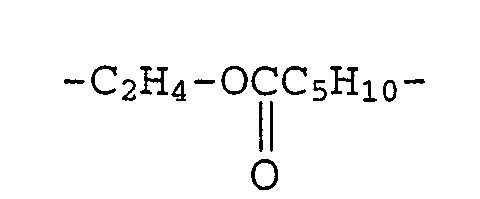
- an acid phosphoric acid compound as represented by the following formula (I) may be used, in order to improve adhesive properties.
- the acid phosphoric acid compound represented by the formula (I) may, for example, be acid phosphoxyethyl (meth)acrylate, acid phosphoxypropyl (meth)acrylate or bis(2-(meth)acryloyloxyethyl)phosphate.
- (2-hydroxyethyl)methacrylic acid phosphate in view of good adhesive properties.
- the amount of the acid phosphoric acid compound represented by the formula (I) is preferably from 0.05 to 10 parts by mass, more preferably from 1 to 7 parts by mass, based on 100 parts by mass of the polymerizable vinyl monomer. If it is less than 0.05 part by mass, no adhesive properties may be obtained, and if it exceeds 10 parts by mass, the adhesive properties tend to be poor.
- a paraffin may be used in order that curing of a portion which is in contact with the air is rapidly carried out.
- the paraffin may, for example, be paraffin, microcrystalline wax, carnauba wax, beeswax, lanolin, spermaceti wax, ceresin or candelilla wax. Among them, preferred is paraffin.
- the melting point of the paraffin is preferably from 40 to 100°C.
- the amount of the paraffin is preferably from 0.1 to 5 parts by mass based on 100 parts by mass of the polymerizable vinyl monomer. If it is less than 0.1 part by mass, curing of a portion which is in contact with the air tends to be poor, and if it exceeds 5 parts by mass, the adhesive strength tends to decrease.
- an antioxidant including a polymerization inhibitor may be used with a purpose of improving storage stability.
- the antioxidant may, for example, be hydroquinone, hydroquinone monomethyl ether, 2,6-di-tert-butyl-p-cresol, 2,2'-methylenebis(4-methyl-6-tert-butylphenol), triphenyl phosphite, phenothiazine or N-isoproyl-N'-phenyl-p-phenylenediamine.
- preferred is p-methoxyphenol.
- the amount of the antioxidant is preferably from 0.001 to 3 parts by mass based on 100 parts by mass of the polymerizable vinyl monomer. If it is less than 0.001 part by mass, no effect may be obtained, and if it exceeds 3 parts by mass, the curing strength may decrease.
- fine particle silica may be used to adjust the viscosity or to adjust viscosity and fluidity.
- a known substance such as a plasticizer, a bulking agent, a coloring agent or an anti-corrosive may be used as the case requires.
- the cured product has a storage elastic modulus at a temperature of 23°C of preferably at most 1,500 MPa, more preferably at most 1,000 MPa. If it exceeds 1,500 MPa, distortion resistance tends to decrease.
- the curable resin composition of the present invention may be used as a two-pack type flame-retardant curable resin composition.
- the two-pack type not all the essential components of the flame-retardant curable resin composition of the present invention are not mixed during storage, the components of the flame-retardant curable resin composition are divided into a first pack and a second pack, and (2) the polymerization initiator and (3) the reducing agent are separately stored in the first and second packs, respectively.
- the two-pack type is preferred in view of excellent storage stability. In such a case, the components in both packs are simultaneously or separately coated and contacted for curing to use them as a two-pack type flame-retardant curable resin composition.
- the method of adding (4) the flame retardant is not particularly limited, and (i) a method of adding the flame retardant in each of the first and second packs in different amounts, (ii) a method of adding it to only one of the two packs, or (iii) a method of adding it to both packs in the same proportion in an equal amount equally, may, for example, be mentioned.
- a method of adding the flame retardant in each of the first and second packs in different amounts (ii) a method of adding it to only one of the two packs, or (iii) a method of adding it to both packs in the same proportion in an equal amount equally, may, for example, be mentioned.
- preferred is the method (iii), since the viscosity of the first pack and the viscosity of the second pack are the same, whereby operation can easily be carried out.
- the flame-retardant curable resin composition of the present invention may be used as a flame-retardant curable adhesive composition.
- the adherend to which the flame-retardant curable adhesive composition of the present invention can be applied for adhesion is not particularly limited, and examples of which include paper, wood, a ceramic, glass, pottery, a rubber, a plastic and a film thereof, mortar, concrete and a metal.
- excellent adhesive properties may be obtained when the adherend is a metal.
- the metal may, for example, be iron, stainless steel or brass.
- the thickness of the metal plate is preferably from 0.1 to 3.2 mm. If it is less than 0.1 mm, it tends to be difficult to carry out bonding in a state without no distortion due to adhesion, and if it exceeds 3.2 mm, the metal plate tends to be heavy, and weight saving of a metal plate such as an elevator panel may not be achieved.
- the metal bonded product obtained by the present invention may be preferably used for an application for which low fuming properties, distortion resistance and flame retardancy are required, such as a metal panel such as a panel for elevators, a panel for inner and external packaging for buildings, or a panel for refrigerators, or a metal case such as an electronic equipment case (such as a patch board) having an electronic equipment mounted thereon.
- a metal panel such as a panel for elevators, a panel for inner and external packaging for buildings, or a panel for refrigerators
- a metal case such as an electronic equipment case (such as a patch board) having an electronic equipment mounted thereon.
- the flame-retardant curable adhesive composition of the present invention has small distortion, such an effect can be obtained that when it is used for adhesion of thin plates (such as metal thin plates to be used for a panel for elevators) or films, the distortion on the surface tends to be small, and a favorable appearance can be obtained.
- ammonium polyphosphate fine particles having their surface coated with a melamine resin were employed, as a paraffin, one having a melting point of 56°C was used, and as an acid phosphoric acid compound, (2-hydroxyethyl)methacrylic acid phosphate was used.
- An adhesive composition was formed into a sheet having a thickness of 1 mm and cured, and the storage elastic modulus of the obtained cured product at a temperature of 23°C was measured by a viscoelasticity measuring apparatus (tension module DMS210 manufactured by Seiko Instruments, Inc.).
- an adhesive composition was coated in a size with a length of 100 mm, a width of 25 mm and a thickness of 2 mm, cured and subjected to aging at room temperature for 24 hours, whereupon the warpage (unit: mm) of the SPCC test specimen was measured. Further, after the aging, presence or absence of distortion was visually evaluated at a position distant from the test specimen by 5 m.
- the evaluation standards are as follows.
- a mixture of first and second packs in an equal amount was coated to one of two test specimens (100 mm ⁇ 25 mm ⁇ 1.6 mm thickness, subjected to SECC-D sand blast treatment). Then, immediately after the other test specimen was overlaid on the above test specimen and bonded, the bonded product was subjected to aging at room temperature for 24 hours to obtain a sample.
- the adhesive strength under tensile shear (unit: MPa) of the sample was measured at a temperature of 23°C at a relative humidity of 50% at a tensile rate of 10 mm/min.
- a cured product having a thickness of 1/8 inch (6.75 cm) was prepared in accordance with UL-94 vertical firing test method, and flammability was evaluated.
- an adhesive composition was coated in a size of 30 mm ⁇ 30 mm ⁇ 2 mm and cured, whereupon fuming properties when burned with a flame from below the SPCC plate were visually evaluated.
- the evaluation standards are such that ⁇ : no fume emitted, ⁇ : slight fume emitted, and ⁇ : remarkable fume emitted.
- composition A for a first pack
- a composition B for a second pack
- monomers ones having compositions as identified in Table 2 were used.
- a two-pack type flame-retardant curable adhesive composition consisting of the first and second packs was prepared, and physical properties were evaluated. The results are shown in Table 3.
- Composition A (for a first pack) Amount NBR 9.5 MBAS 6.5 Monomer 78.0 Cumene hydroperoxide 5.0 Paraffin 0.5 p-Methoxyphenol 0.5
- Example 2 The same operation as in Example 1 was carried out except that a two-pack type flame-retardant curable adhesive composition consisting of first and second packs as identified in Table 4 was prepared, and physical properties were evaluated. The results are shown in Table 4.
- Example 6 The same operation as in Example 1 was carried out except that monomers having compositions as identified in Table 5 were used, compositions A and B were used to prepare a two-pack type flame-retardant curable adhesive composition consisting of first and second packs as identified in Table 6, and physical properties were evaluated. The results are shown in Table 6.
- an adhesive composition which has low fuming properties and is excellent in flame retardancy and distortion resistance can be obtained, and it is preferably used for adhesion of a thin plate (such as a metal thin plate used for a panel for elevators) or a film, or adhesion of a metal panel or a metal case.
- a thin plate such as a metal thin plate used for a panel for elevators
- a film or adhesion of a metal panel or a metal case.
Landscapes
- Chemical & Material Sciences (AREA)
- Organic Chemistry (AREA)
- Health & Medical Sciences (AREA)
- Chemical Kinetics & Catalysis (AREA)
- Medicinal Chemistry (AREA)
- Polymers & Plastics (AREA)
- Engineering & Computer Science (AREA)
- Materials Engineering (AREA)
- Adhesives Or Adhesive Processes (AREA)
- Polymerisation Methods In General (AREA)
- Addition Polymer Or Copolymer, Post-Treatments, Or Chemical Modifications (AREA)
- Graft Or Block Polymers (AREA)
- Compositions Of Macromolecular Compounds (AREA)
Abstract
Description

| Composition A (for a first pack) | Amount |
| NBR | 9.5 |
| MBAS | 6.5 |
| Monomer | 78.0 |
| Cumene hydroperoxide | 5.0 |
| Paraffin | 0.5 |
| p-Methoxyphenol | 0.5 |
| Composition B (for a second pack) | Amount |
| NBR | 9.5 |
| MBAS | 6.5 |
| Monomer | 78.0 |
| Ethylene thiourea | 2.2 |
| Paraffin | 0.5 |
| Acid phosphoric acid compound | 3.3 |
| Unit of the amount: part(s) by mass |
| Composition of monomer (for a first pack) | A-11 | A-12 |
| Methyl methacrylate (Tg=105°C) | 50 | 50 |
| 2-Hydroxyethyl methacrylate (Tg=55°C) | 25 | 25 |
| Phenoxytetraethylene glycol acrylate | - | 25 |
| (Tg=-18°C) | ||
| 2-Ethylhexyl methacrylate (Tg=-10°C) | 25 | - |
| Composition of monomer (for a second pack) | B-11 | B-12 |
| Methyl methacrylate (Tg=105°C) | 50 | 50 |
| 2-Hydroxyethyl methacrylate (Tg=55°C) | 25 | 25 |
| Phenoxytetraethylene glycol acrylate | - | 25 |
| (Tg=-18°C) | ||
| 2-Ethylhexyl methacrylate (Tg=-10°C) | 25 | - |
| Unit of the amount: part(s) by mass Tg: Glass transition temperature of its homopolymer |


Claims (7)
- A flame-retardant curable resin composition which comprises (1) a polymerizable vinyl monomer having a glass transition temperature of its homopolymer of at most 0°C, (2) a polymerization initiator, (3) a reducing agent and (4) a flame retardant in an amount of from 25 to 75 parts by mass based on 100 parts by mass of the total of (1) the polymerizable vinyl monomer having a glass transition temperature of its homopolymer of at most 0°C, (2) the polymerization initiator and (3) the reducing agent.
- The flame-retardant curable resin composition according to Claim 1, which further comprises (5) a polymerizable vinyl monomer having a glass transition temperature of its homopolymer exceeding 0°C.
- The flame-retardant curable resin composition according to Claim 1 or 2, which further comprises (6) an elastomer component.
- The flame-retardant curable resin composition according to any one of Claims 1 to 3, wherein (4) the flame retardant is ammonium polyphosphate.
- The flame-retardant curable resin composition according to any one of Claims 1 to 4, wherein the cured product has a storage elastic modulus of at most 1,500 MPa at a temperature of 23°C.
- A two-pack type flame-retardant curable resin composition, wherein the components of the flame-retardant curable resin composition as defined in any one of Claims 1 to 5 are divided into first and second packs, the first pack contains at least (2) the polymerization initiator, and the second pack contains at least (3) the reducing agent.
- A flame-retardant curable adhesive composition which consists of the flame-retardant curable resin composition as defined in any one of Claims 1 to 6.
Applications Claiming Priority (2)
| Application Number | Priority Date | Filing Date | Title |
|---|---|---|---|
| JP2001064511A JP4627117B2 (en) | 2001-03-08 | 2001-03-08 | Flame retardant curable resin composition and flame retardant curable adhesive composition |
| JP2001064511 | 2001-03-08 |
Publications (3)
| Publication Number | Publication Date |
|---|---|
| EP1258518A2 true EP1258518A2 (en) | 2002-11-20 |
| EP1258518A3 EP1258518A3 (en) | 2003-04-09 |
| EP1258518B1 EP1258518B1 (en) | 2006-01-04 |
Family
ID=18923317
Family Applications (1)
| Application Number | Title | Priority Date | Filing Date |
|---|---|---|---|
| EP02004947A Expired - Lifetime EP1258518B1 (en) | 2001-03-08 | 2002-03-05 | Flame-retardant curable resin composition and flame-retardant curable adhesive composition |
Country Status (7)
| Country | Link |
|---|---|
| US (1) | US6893583B2 (en) |
| EP (1) | EP1258518B1 (en) |
| JP (1) | JP4627117B2 (en) |
| CN (1) | CN1237137C (en) |
| AT (1) | ATE315072T1 (en) |
| DE (1) | DE60208456T2 (en) |
| TW (1) | TW593619B (en) |
Cited By (1)
| Publication number | Priority date | Publication date | Assignee | Title |
|---|---|---|---|---|
| EP1391414A4 (en) * | 2001-05-25 | 2005-05-18 | Mitsubishi Electric Corp | Door installed at platform for elevator |
Families Citing this family (20)
| Publication number | Priority date | Publication date | Assignee | Title |
|---|---|---|---|---|
| IL153812A0 (en) * | 2003-01-06 | 2003-07-31 | Bromine Compounds Ltd | Improved wood-plastic composites |
| DE10312031A1 (en) * | 2003-03-18 | 2004-09-30 | Tesa Ag | Flame retardant PSA, process for its preparation and its use for the production of a PSA tape |
| US7812067B2 (en) * | 2006-10-20 | 2010-10-12 | Hewlett-Packard Development Company, L.P. | Binders for pigmented ink formulations |
| US7838574B2 (en) * | 2006-10-20 | 2010-11-23 | Hewlett-Packard Development Company, L.P. | Dispersed pigments |
| JP2009035046A (en) * | 2007-07-31 | 2009-02-19 | Toray Ind Inc | Automotive hood |
| RU2663755C2 (en) * | 2012-12-21 | 2018-08-09 | Кварцверке Гмбх | Thermotropic polymers |
| CN106459692B (en) * | 2014-06-11 | 2018-03-20 | 日东电工株式会社 | adhesive sheet |
| DE102014217193B3 (en) * | 2014-08-28 | 2016-02-04 | Tesa Se | Water-resistant laser-markable multilayer article for bonding to wet surfaces, especially in automotive applications, methods of manufacture and uses |
| KR101622071B1 (en) * | 2014-11-01 | 2016-05-19 | 삼성에스디아이 주식회사 | Adhesive composition, adhesive film prepared by the same and display member comprising the same |
| US10745597B2 (en) | 2014-11-01 | 2020-08-18 | Samsung Sdi Co., Ltd. | Adhesive composition, adhesive film prepared from the same and display member including the same |
| WO2016094277A1 (en) * | 2014-12-08 | 2016-06-16 | 3M Innovative Properties Company | Acrylic polyvinyl acetal films & composition |
| US20180022967A1 (en) * | 2014-12-30 | 2018-01-25 | 3M Innovative Properties Company | Halogen-free flame retardant pressure sensitive adhesive and tape |
| KR101814247B1 (en) | 2015-06-30 | 2018-01-05 | 삼성에스디아이 주식회사 | Adhesive film and display member comprising the same |
| KR102604119B1 (en) * | 2015-07-30 | 2023-11-20 | 덴카 주식회사 | composition |
| CN108137754B (en) * | 2015-09-15 | 2021-01-22 | 株式会社理光 | Polymers, resin compositions, dimming materials, optical waveguide materials, athermal optical elements, color display elements and optical materials |
| DE102016224169A1 (en) | 2016-12-05 | 2018-06-07 | Tesa Se | Reactive 2-component adhesive system in film form with improved moist heat resistance |
| CA3123036A1 (en) | 2018-12-20 | 2020-06-25 | Stijn COERTJENS | Adhesive with high filler content |
| KR102307896B1 (en) * | 2019-12-10 | 2021-09-30 | 주식회사 포스코 | Thin glass laminated printed steel plate having excellent flammability and manufacturing method thereof |
| JP2024025025A (en) * | 2022-08-10 | 2024-02-26 | 株式会社レゾナック | Resin compositions, cured products, laminates, transparent antennas, and image display devices |
| JP7794873B2 (en) * | 2024-03-18 | 2026-01-06 | 高圧ガス工業株式会社 | adhesive composition |
Family Cites Families (15)
| Publication number | Priority date | Publication date | Assignee | Title |
|---|---|---|---|---|
| DE69115233T2 (en) * | 1990-12-28 | 1996-08-01 | Denki Kagaku Kogyo Kk | Adhesive composition and metal bonded composite body. |
| JPH0633019A (en) * | 1992-07-17 | 1994-02-08 | Rin Kagaku Kogyo Kk | Adhesive composition |
| JPH0680937A (en) * | 1992-09-01 | 1994-03-22 | Okura Ind Co Ltd | Main agent-Primer type acrylic adhesive |
| US5851663A (en) * | 1994-05-25 | 1998-12-22 | Minnesota Mining And Manufacturing Company | Flame retardant pressure-sensitive adhesives and tapes |
| JPH08198907A (en) | 1995-01-27 | 1996-08-06 | Sony Chem Corp | Ultraviolet polymerization type frame retardant tacky agent composition and flame retardant double-side tackey tape |
| JPH08283535A (en) | 1995-04-14 | 1996-10-29 | Toshiba Chem Corp | Adhesive composition for flexible printed circuit board |
| JPH09272844A (en) | 1996-04-04 | 1997-10-21 | Nitto Denko Corp | Photopolymerizable composition, pressure-sensitive flame-retardant adhesive, and adhesive sheets |
| TW353666B (en) * | 1996-04-18 | 1999-03-01 | Denki Kagaku Kogyo Kk | Curable resin composition |
| JPH1120094A (en) * | 1997-07-07 | 1999-01-26 | Bridgestone Corp | Electronic device sealing film |
| JP4913932B2 (en) * | 1999-02-10 | 2012-04-11 | Dic株式会社 | Flame retardant pressure sensitive adhesive and flame retardant pressure sensitive adhesive tape |
| JP2001247836A (en) | 2000-03-06 | 2001-09-14 | Denki Kagaku Kogyo Kk | Adhesive composition |
| JP4459372B2 (en) | 2000-03-23 | 2010-04-28 | 電気化学工業株式会社 | Flame-retardant adhesive composition and metal joined body |
| JP4311852B2 (en) * | 2000-03-23 | 2009-08-12 | 電気化学工業株式会社 | Flame retardant resin composition, flame retardant adhesive composition, and metal joined body |
| JP4306918B2 (en) * | 2000-03-23 | 2009-08-05 | 電気化学工業株式会社 | Flame retardant resin composition, flame retardant adhesive composition, and metal joined body |
| JP4672103B2 (en) | 2000-03-27 | 2011-04-20 | 電気化学工業株式会社 | Flame retardant resin composition, flame retardant adhesive composition, and metal joined body |
-
2001
- 2001-03-08 JP JP2001064511A patent/JP4627117B2/en not_active Expired - Lifetime
-
2002
- 2002-02-28 CN CNB021080437A patent/CN1237137C/en not_active Expired - Lifetime
- 2002-03-05 AT AT02004947T patent/ATE315072T1/en not_active IP Right Cessation
- 2002-03-05 DE DE60208456T patent/DE60208456T2/en not_active Expired - Lifetime
- 2002-03-05 EP EP02004947A patent/EP1258518B1/en not_active Expired - Lifetime
- 2002-03-07 US US10/091,422 patent/US6893583B2/en not_active Expired - Lifetime
- 2002-03-07 TW TW091104301A patent/TW593619B/en not_active IP Right Cessation
Cited By (1)
| Publication number | Priority date | Publication date | Assignee | Title |
|---|---|---|---|---|
| EP1391414A4 (en) * | 2001-05-25 | 2005-05-18 | Mitsubishi Electric Corp | Door installed at platform for elevator |
Also Published As
| Publication number | Publication date |
|---|---|
| EP1258518A3 (en) | 2003-04-09 |
| EP1258518B1 (en) | 2006-01-04 |
| JP2002265509A (en) | 2002-09-18 |
| US6893583B2 (en) | 2005-05-17 |
| CN1237137C (en) | 2006-01-18 |
| US20020193487A1 (en) | 2002-12-19 |
| DE60208456T2 (en) | 2006-07-06 |
| ATE315072T1 (en) | 2006-02-15 |
| TW593619B (en) | 2004-06-21 |
| JP4627117B2 (en) | 2011-02-09 |
| CN1375536A (en) | 2002-10-23 |
| DE60208456D1 (en) | 2006-03-30 |
Similar Documents
| Publication | Publication Date | Title |
|---|---|---|
| EP1258518B1 (en) | Flame-retardant curable resin composition and flame-retardant curable adhesive composition | |
| KR101076134B1 (en) | Halogen-free flame-retardant acrylic pressure-sensitive adhesive sheet or tape | |
| JP3662848B2 (en) | Adhesive composition | |
| US6958368B1 (en) | Cure accelerators for anaerobic curable compositions | |
| EP1279720A1 (en) | Flame retardant, flame-retardant resin composition, molded object, and electronic part | |
| JP2012117046A (en) | Antistatic pressure-sensitive adhesive composition and antistatic pressure-sensitive adhesive obtained by using the same, antistatic pressure-sensitive adhesive sheet | |
| JP2012111937A (en) | Antistatic pressure-sensitive adhesive composition, antistatic pressure-sensitive adhesive obtained using the same, and antistatic pressure-sensitive adhesive sheet | |
| KR20120009547A (en) | Aqueous adhesive composition, manufacturing method thereof, adhesive sheet and wallpaper comprising same | |
| JP4306918B2 (en) | Flame retardant resin composition, flame retardant adhesive composition, and metal joined body | |
| JP4851753B2 (en) | Adhesive composition and adhesive sheet | |
| US20250197625A1 (en) | Tack-Free Properties of Light-Curable Compositions | |
| EP1391414B1 (en) | Door installed at platform for elevator | |
| US20210139751A1 (en) | Flame Retardant Adhesive Composition | |
| JP4459372B2 (en) | Flame-retardant adhesive composition and metal joined body | |
| JP2001261724A (en) | Flame retardant resin composition, flame retardant adhesive composition, and metal joined body | |
| US12421430B2 (en) | Composition based on (meth)acrylate monomers | |
| JP4672103B2 (en) | Flame retardant resin composition, flame retardant adhesive composition, and metal joined body | |
| JP4627133B2 (en) | Resin composition and adhesive | |
| JPH06100712A (en) | Flame-retardant acrylic resin sheet | |
| JP2007238738A (en) | Radically polymerizable flame-retardant resin composition | |
| WO2000077109A2 (en) | Adhesive formulations | |
| JP4606223B2 (en) | Ultraviolet curable resin composition and cured coating film thereof | |
| JP2001240651A (en) | Vinyl ester, vinyl ester resin, resin composition and molding material thereof | |
| JP2003105009A (en) | Flame retardant resin composition, adhesive composition and metal composite | |
| MXPA00004774A (en) | Pressure-sensitive flame retardant adhesive |
Legal Events
| Date | Code | Title | Description |
|---|---|---|---|
| PUAI | Public reference made under article 153(3) epc to a published international application that has entered the european phase |
Free format text: ORIGINAL CODE: 0009012 |
|
| AK | Designated contracting states |
Kind code of ref document: A2 Designated state(s): AT BE CH CY DE DK ES FI FR GB GR IE IT LI LU MC NL PT SE TR |
|
| AX | Request for extension of the european patent |
Free format text: AL;LT;LV;MK;RO;SI |
|
| PUAL | Search report despatched |
Free format text: ORIGINAL CODE: 0009013 |
|
| AK | Designated contracting states |
Kind code of ref document: A3 Designated state(s): AT BE CH CY DE DK ES FI FR GB GR IE IT LI LU MC NL PT SE TR Designated state(s): AT BE CH CY DE DK ES FI FR GB GR IE IT LI LU MC NL PT SE TR |
|
| AX | Request for extension of the european patent |
Extension state: AL LT LV MK RO SI |
|
| RIC1 | Information provided on ipc code assigned before grant |
Ipc: 7C 08K 5/00 B Ipc: 7C 09J 4/00 B Ipc: 7C 08K 3/32 B Ipc: 7C 08K 5/521 B Ipc: 7C 09J 133/06 A Ipc: 7C 09J 7/02 B Ipc: 7C 08L 33/06 B |
|
| 17P | Request for examination filed |
Effective date: 20030520 |
|
| AKX | Designation fees paid |
Designated state(s): AT BE CH CY DE DK ES FI FR GB GR IE IT LI LU MC NL PT SE TR |
|
| 17Q | First examination report despatched |
Effective date: 20050210 |
|
| GRAP | Despatch of communication of intention to grant a patent |
Free format text: ORIGINAL CODE: EPIDOSNIGR1 |
|
| GRAS | Grant fee paid |
Free format text: ORIGINAL CODE: EPIDOSNIGR3 |
|
| GRAA | (expected) grant |
Free format text: ORIGINAL CODE: 0009210 |
|
| AK | Designated contracting states |
Kind code of ref document: B1 Designated state(s): AT BE CH CY DE DK ES FI FR GB GR IE IT LI LU MC NL PT SE TR |
|
| PG25 | Lapsed in a contracting state [announced via postgrant information from national office to epo] |
Ref country code: AT Free format text: LAPSE BECAUSE OF FAILURE TO SUBMIT A TRANSLATION OF THE DESCRIPTION OR TO PAY THE FEE WITHIN THE PRESCRIBED TIME-LIMIT Effective date: 20060104 Ref country code: IT Free format text: LAPSE BECAUSE OF FAILURE TO SUBMIT A TRANSLATION OF THE DESCRIPTION OR TO PAY THE FEE WITHIN THE PRESCRIBED TIME-LIMIT;WARNING: LAPSES OF ITALIAN PATENTS WITH EFFECTIVE DATE BEFORE 2007 MAY HAVE OCCURRED AT ANY TIME BEFORE 2007. THE CORRECT EFFECTIVE DATE MAY BE DIFFERENT FROM THE ONE RECORDED. Effective date: 20060104 Ref country code: FI Free format text: LAPSE BECAUSE OF FAILURE TO SUBMIT A TRANSLATION OF THE DESCRIPTION OR TO PAY THE FEE WITHIN THE PRESCRIBED TIME-LIMIT Effective date: 20060104 Ref country code: BE Free format text: LAPSE BECAUSE OF FAILURE TO SUBMIT A TRANSLATION OF THE DESCRIPTION OR TO PAY THE FEE WITHIN THE PRESCRIBED TIME-LIMIT Effective date: 20060104 Ref country code: CH Free format text: LAPSE BECAUSE OF FAILURE TO SUBMIT A TRANSLATION OF THE DESCRIPTION OR TO PAY THE FEE WITHIN THE PRESCRIBED TIME-LIMIT Effective date: 20060104 Ref country code: LI Free format text: LAPSE BECAUSE OF FAILURE TO SUBMIT A TRANSLATION OF THE DESCRIPTION OR TO PAY THE FEE WITHIN THE PRESCRIBED TIME-LIMIT Effective date: 20060104 |
|
| REG | Reference to a national code |
Ref country code: GB Ref legal event code: FG4D |
|
| REG | Reference to a national code |
Ref country code: CH Ref legal event code: EP |
|
| REG | Reference to a national code |
Ref country code: IE Ref legal event code: FG4D |
|
| PG25 | Lapsed in a contracting state [announced via postgrant information from national office to epo] |
Ref country code: IE Free format text: LAPSE BECAUSE OF NON-PAYMENT OF DUE FEES Effective date: 20060306 |
|
| REF | Corresponds to: |
Ref document number: 60208456 Country of ref document: DE Date of ref document: 20060330 Kind code of ref document: P |
|
| PG25 | Lapsed in a contracting state [announced via postgrant information from national office to epo] |
Ref country code: LU Free format text: LAPSE BECAUSE OF NON-PAYMENT OF DUE FEES Effective date: 20060331 Ref country code: MC Free format text: LAPSE BECAUSE OF NON-PAYMENT OF DUE FEES Effective date: 20060331 |
|
| PG25 | Lapsed in a contracting state [announced via postgrant information from national office to epo] |
Ref country code: SE Free format text: LAPSE BECAUSE OF FAILURE TO SUBMIT A TRANSLATION OF THE DESCRIPTION OR TO PAY THE FEE WITHIN THE PRESCRIBED TIME-LIMIT Effective date: 20060404 Ref country code: DK Free format text: LAPSE BECAUSE OF FAILURE TO SUBMIT A TRANSLATION OF THE DESCRIPTION OR TO PAY THE FEE WITHIN THE PRESCRIBED TIME-LIMIT Effective date: 20060404 |
|
| PG25 | Lapsed in a contracting state [announced via postgrant information from national office to epo] |
Ref country code: ES Free format text: LAPSE BECAUSE OF FAILURE TO SUBMIT A TRANSLATION OF THE DESCRIPTION OR TO PAY THE FEE WITHIN THE PRESCRIBED TIME-LIMIT Effective date: 20060415 |
|
| PG25 | Lapsed in a contracting state [announced via postgrant information from national office to epo] |
Ref country code: PT Free format text: LAPSE BECAUSE OF FAILURE TO SUBMIT A TRANSLATION OF THE DESCRIPTION OR TO PAY THE FEE WITHIN THE PRESCRIBED TIME-LIMIT Effective date: 20060605 |
|
| REG | Reference to a national code |
Ref country code: CH Ref legal event code: PL |
|
| ET | Fr: translation filed | ||
| PLBE | No opposition filed within time limit |
Free format text: ORIGINAL CODE: 0009261 |
|
| STAA | Information on the status of an ep patent application or granted ep patent |
Free format text: STATUS: NO OPPOSITION FILED WITHIN TIME LIMIT |
|
| 26N | No opposition filed |
Effective date: 20061005 |
|
| PG25 | Lapsed in a contracting state [announced via postgrant information from national office to epo] |
Ref country code: GR Free format text: LAPSE BECAUSE OF FAILURE TO SUBMIT A TRANSLATION OF THE DESCRIPTION OR TO PAY THE FEE WITHIN THE PRESCRIBED TIME-LIMIT Effective date: 20060405 |
|
| PG25 | Lapsed in a contracting state [announced via postgrant information from national office to epo] |
Ref country code: TR Free format text: LAPSE BECAUSE OF FAILURE TO SUBMIT A TRANSLATION OF THE DESCRIPTION OR TO PAY THE FEE WITHIN THE PRESCRIBED TIME-LIMIT Effective date: 20060104 |
|
| PG25 | Lapsed in a contracting state [announced via postgrant information from national office to epo] |
Ref country code: CY Free format text: LAPSE BECAUSE OF FAILURE TO SUBMIT A TRANSLATION OF THE DESCRIPTION OR TO PAY THE FEE WITHIN THE PRESCRIBED TIME-LIMIT Effective date: 20060104 |
|
| REG | Reference to a national code |
Ref country code: FR Ref legal event code: PLFP Year of fee payment: 15 |
|
| REG | Reference to a national code |
Ref country code: FR Ref legal event code: PLFP Year of fee payment: 16 |
|
| REG | Reference to a national code |
Ref country code: FR Ref legal event code: PLFP Year of fee payment: 17 |
|
| PGFP | Annual fee paid to national office [announced via postgrant information from national office to epo] |
Ref country code: FR Payment date: 20210210 Year of fee payment: 20 Ref country code: NL Payment date: 20210212 Year of fee payment: 20 |
|
| PGFP | Annual fee paid to national office [announced via postgrant information from national office to epo] |
Ref country code: GB Payment date: 20210225 Year of fee payment: 20 Ref country code: DE Payment date: 20210224 Year of fee payment: 20 |
|
| REG | Reference to a national code |
Ref country code: DE Ref legal event code: R071 Ref document number: 60208456 Country of ref document: DE |
|
| REG | Reference to a national code |
Ref country code: NL Ref legal event code: MK Effective date: 20220304 |
|
| REG | Reference to a national code |
Ref country code: GB Ref legal event code: PE20 Expiry date: 20220304 |
|
| PG25 | Lapsed in a contracting state [announced via postgrant information from national office to epo] |
Ref country code: GB Free format text: LAPSE BECAUSE OF EXPIRATION OF PROTECTION Effective date: 20220304 |