EP1258290A2 - Silicone-modified water-absorbing polymer particles and method for producing the same - Google Patents
Silicone-modified water-absorbing polymer particles and method for producing the same Download PDFInfo
- Publication number
- EP1258290A2 EP1258290A2 EP02010154A EP02010154A EP1258290A2 EP 1258290 A2 EP1258290 A2 EP 1258290A2 EP 02010154 A EP02010154 A EP 02010154A EP 02010154 A EP02010154 A EP 02010154A EP 1258290 A2 EP1258290 A2 EP 1258290A2
- Authority
- EP
- European Patent Office
- Prior art keywords
- water
- silicone
- group
- polymer particles
- absorbing polymer
- Prior art date
- Legal status (The legal status is an assumption and is not a legal conclusion. Google has not performed a legal analysis and makes no representation as to the accuracy of the status listed.)
- Granted
Links
- 229920000642 polymer Polymers 0.000 title claims abstract description 188
- 239000002245 particle Substances 0.000 title claims abstract description 157
- 238000004519 manufacturing process Methods 0.000 title claims description 19
- 229920001296 polysiloxane Polymers 0.000 claims abstract description 142
- 125000000524 functional group Chemical group 0.000 claims abstract description 70
- XLYOFNOQVPJJNP-UHFFFAOYSA-N water Substances O XLYOFNOQVPJJNP-UHFFFAOYSA-N 0.000 claims abstract description 69
- 150000001875 compounds Chemical class 0.000 claims abstract description 62
- 239000002537 cosmetic Substances 0.000 claims abstract description 45
- 239000000126 substance Substances 0.000 claims abstract description 13
- 239000000178 monomer Substances 0.000 claims description 54
- 229920002554 vinyl polymer Polymers 0.000 claims description 22
- 125000000391 vinyl group Chemical group [H]C([*])=C([H])[H] 0.000 claims description 21
- 125000003277 amino group Chemical group 0.000 claims description 15
- QGZKDVFQNNGYKY-UHFFFAOYSA-O ammonium group Chemical group [NH4+] QGZKDVFQNNGYKY-UHFFFAOYSA-O 0.000 claims description 15
- 125000003178 carboxy group Chemical group [H]OC(*)=O 0.000 claims description 15
- 125000003700 epoxy group Chemical group 0.000 claims description 12
- 229920001577 copolymer Polymers 0.000 claims description 10
- 125000002887 hydroxy group Chemical group [H]O* 0.000 claims description 10
- 230000002441 reversible effect Effects 0.000 claims description 10
- 238000010557 suspension polymerization reaction Methods 0.000 claims description 10
- 230000000379 polymerizing effect Effects 0.000 claims description 7
- 238000010438 heat treatment Methods 0.000 claims description 4
- 125000003545 alkoxy group Chemical group 0.000 claims description 3
- 239000000203 mixture Substances 0.000 abstract description 44
- 238000009472 formulation Methods 0.000 abstract description 15
- 238000010521 absorption reaction Methods 0.000 abstract description 7
- 239000000243 solution Substances 0.000 description 61
- 238000006243 chemical reaction Methods 0.000 description 45
- -1 poly(sodium acrylate) Polymers 0.000 description 42
- NIXOWILDQLNWCW-UHFFFAOYSA-M Acrylate Chemical compound [O-]C(=O)C=C NIXOWILDQLNWCW-UHFFFAOYSA-M 0.000 description 33
- CERQOIWHTDAKMF-UHFFFAOYSA-N Methacrylic acid Chemical compound CC(=C)C(O)=O CERQOIWHTDAKMF-UHFFFAOYSA-N 0.000 description 33
- 229940048053 acrylate Drugs 0.000 description 33
- 238000000034 method Methods 0.000 description 33
- 239000003431 cross linking reagent Substances 0.000 description 29
- LFQSCWFLJHTTHZ-UHFFFAOYSA-N Ethanol Chemical compound CCO LFQSCWFLJHTTHZ-UHFFFAOYSA-N 0.000 description 28
- 239000000843 powder Substances 0.000 description 27
- 239000006185 dispersion Substances 0.000 description 25
- XDTMQSROBMDMFD-UHFFFAOYSA-N Cyclohexane Chemical compound C1CCCCC1 XDTMQSROBMDMFD-UHFFFAOYSA-N 0.000 description 24
- 239000003921 oil Substances 0.000 description 24
- 238000006116 polymerization reaction Methods 0.000 description 23
- HEMHJVSKTPXQMS-UHFFFAOYSA-M Sodium hydroxide Chemical compound [OH-].[Na+] HEMHJVSKTPXQMS-UHFFFAOYSA-M 0.000 description 21
- 239000008367 deionised water Substances 0.000 description 21
- 229910021641 deionized water Inorganic materials 0.000 description 21
- 238000010992 reflux Methods 0.000 description 18
- IJGRMHOSHXDMSA-UHFFFAOYSA-N Atomic nitrogen Chemical compound N#N IJGRMHOSHXDMSA-UHFFFAOYSA-N 0.000 description 17
- HEDRZPFGACZZDS-UHFFFAOYSA-N Chloroform Chemical compound ClC(Cl)Cl HEDRZPFGACZZDS-UHFFFAOYSA-N 0.000 description 16
- 150000003839 salts Chemical class 0.000 description 15
- LYCAIKOWRPUZTN-UHFFFAOYSA-N Ethylene glycol Chemical compound OCCO LYCAIKOWRPUZTN-UHFFFAOYSA-N 0.000 description 13
- 235000019441 ethanol Nutrition 0.000 description 13
- 230000002829 reductive effect Effects 0.000 description 13
- 230000000052 comparative effect Effects 0.000 description 12
- 238000004132 cross linking Methods 0.000 description 12
- 150000002430 hydrocarbons Chemical class 0.000 description 12
- 229920000435 poly(dimethylsiloxane) Polymers 0.000 description 12
- 239000000047 product Substances 0.000 description 12
- 238000001704 evaporation Methods 0.000 description 11
- 230000008020 evaporation Effects 0.000 description 11
- CXQXSVUQTKDNFP-UHFFFAOYSA-N octamethyltrisiloxane Chemical compound C[Si](C)(C)O[Si](C)(C)O[Si](C)(C)C CXQXSVUQTKDNFP-UHFFFAOYSA-N 0.000 description 11
- USHAGKDGDHPEEY-UHFFFAOYSA-L potassium persulfate Chemical compound [K+].[K+].[O-]S(=O)(=O)OOS([O-])(=O)=O USHAGKDGDHPEEY-UHFFFAOYSA-L 0.000 description 11
- 239000002904 solvent Substances 0.000 description 11
- UWFRVQVNYNPBEF-UHFFFAOYSA-N 1-(2,4-dimethylphenyl)propan-1-one Chemical compound CCC(=O)C1=CC=C(C)C=C1C UWFRVQVNYNPBEF-UHFFFAOYSA-N 0.000 description 10
- PEDCQBHIVMGVHV-UHFFFAOYSA-N Glycerine Chemical compound OCC(O)CO PEDCQBHIVMGVHV-UHFFFAOYSA-N 0.000 description 10
- 150000001412 amines Chemical class 0.000 description 10
- 230000018044 dehydration Effects 0.000 description 10
- 238000006297 dehydration reaction Methods 0.000 description 10
- 229960001275 dimeticone Drugs 0.000 description 10
- 230000002209 hydrophobic effect Effects 0.000 description 10
- 239000004615 ingredient Substances 0.000 description 10
- 125000002496 methyl group Chemical group [H]C([H])([H])* 0.000 description 10
- 230000035943 smell Effects 0.000 description 10
- 229910001220 stainless steel Inorganic materials 0.000 description 10
- 239000010935 stainless steel Substances 0.000 description 10
- 238000003756 stirring Methods 0.000 description 10
- 230000035900 sweating Effects 0.000 description 10
- 239000002202 Polyethylene glycol Substances 0.000 description 9
- DNIAPMSPPWPWGF-UHFFFAOYSA-N Propylene glycol Chemical compound CC(O)CO DNIAPMSPPWPWGF-UHFFFAOYSA-N 0.000 description 9
- 239000003795 chemical substances by application Substances 0.000 description 9
- 239000002781 deodorant agent Substances 0.000 description 9
- 239000002270 dispersing agent Substances 0.000 description 9
- 229920001223 polyethylene glycol Polymers 0.000 description 9
- AOBIOSPNXBMOAT-UHFFFAOYSA-N 2-[2-(oxiran-2-ylmethoxy)ethoxymethyl]oxirane Chemical compound C1OC1COCCOCC1CO1 AOBIOSPNXBMOAT-UHFFFAOYSA-N 0.000 description 8
- VZCYOOQTPOCHFL-OWOJBTEDSA-N Fumaric acid Chemical compound OC(=O)\C=C\C(O)=O VZCYOOQTPOCHFL-OWOJBTEDSA-N 0.000 description 8
- 102100040160 Rabankyrin-5 Human genes 0.000 description 8
- 101710086049 Rabankyrin-5 Proteins 0.000 description 8
- 238000001816 cooling Methods 0.000 description 8
- VLKZOEOYAKHREP-UHFFFAOYSA-N n-Hexane Chemical compound CCCCCC VLKZOEOYAKHREP-UHFFFAOYSA-N 0.000 description 8
- 229920001059 synthetic polymer Polymers 0.000 description 8
- VZCYOOQTPOCHFL-UHFFFAOYSA-N trans-butenedioic acid Natural products OC(=O)C=CC(O)=O VZCYOOQTPOCHFL-UHFFFAOYSA-N 0.000 description 8
- 229920000297 Rayon Polymers 0.000 description 7
- XLOMVQKBTHCTTD-UHFFFAOYSA-N Zinc monoxide Chemical compound [Zn]=O XLOMVQKBTHCTTD-UHFFFAOYSA-N 0.000 description 7
- 229910052751 metal Inorganic materials 0.000 description 7
- 239000002184 metal Substances 0.000 description 7
- 229910052757 nitrogen Inorganic materials 0.000 description 7
- 229920002545 silicone oil Polymers 0.000 description 7
- 210000004243 sweat Anatomy 0.000 description 7
- RTZKZFJDLAIYFH-UHFFFAOYSA-N Diethyl ether Chemical compound CCOCC RTZKZFJDLAIYFH-UHFFFAOYSA-N 0.000 description 6
- OFOBLEOULBTSOW-UHFFFAOYSA-N Propanedioic acid Natural products OC(=O)CC(O)=O OFOBLEOULBTSOW-UHFFFAOYSA-N 0.000 description 6
- YXFVVABEGXRONW-UHFFFAOYSA-N Toluene Chemical compound CC1=CC=CC=C1 YXFVVABEGXRONW-UHFFFAOYSA-N 0.000 description 6
- 239000002253 acid Substances 0.000 description 6
- 125000000217 alkyl group Chemical group 0.000 description 6
- POJWUDADGALRAB-UHFFFAOYSA-N allantoin Chemical compound NC(=O)NC1NC(=O)NC1=O POJWUDADGALRAB-UHFFFAOYSA-N 0.000 description 6
- VSCWAEJMTAWNJL-UHFFFAOYSA-K aluminium trichloride Chemical compound Cl[Al](Cl)Cl VSCWAEJMTAWNJL-UHFFFAOYSA-K 0.000 description 6
- 239000012298 atmosphere Substances 0.000 description 6
- 230000015572 biosynthetic process Effects 0.000 description 6
- MTHSVFCYNBDYFN-UHFFFAOYSA-N diethylene glycol Chemical compound OCCOCCO MTHSVFCYNBDYFN-UHFFFAOYSA-N 0.000 description 6
- 230000007480 spreading Effects 0.000 description 6
- 238000003892 spreading Methods 0.000 description 6
- 239000004094 surface-active agent Substances 0.000 description 6
- 238000003786 synthesis reaction Methods 0.000 description 6
- 150000007934 α,β-unsaturated carboxylic acids Chemical class 0.000 description 6
- 239000001856 Ethyl cellulose Substances 0.000 description 5
- ZZSNKZQZMQGXPY-UHFFFAOYSA-N Ethyl cellulose Chemical compound CCOCC1OC(OC)C(OCC)C(OCC)C1OC1C(O)C(O)C(OC)C(CO)O1 ZZSNKZQZMQGXPY-UHFFFAOYSA-N 0.000 description 5
- YCZVNBQAIZENBU-UHFFFAOYSA-N NC(=O)N.C(=C)C=CC=C Chemical compound NC(=O)N.C(=C)C=CC=C YCZVNBQAIZENBU-UHFFFAOYSA-N 0.000 description 5
- XUIMIQQOPSSXEZ-UHFFFAOYSA-N Silicon Chemical group [Si] XUIMIQQOPSSXEZ-UHFFFAOYSA-N 0.000 description 5
- 239000002585 base Substances 0.000 description 5
- 125000002091 cationic group Chemical group 0.000 description 5
- 229920002678 cellulose Polymers 0.000 description 5
- 230000001877 deodorizing effect Effects 0.000 description 5
- 235000019325 ethyl cellulose Nutrition 0.000 description 5
- 239000000499 gel Substances 0.000 description 5
- 238000005227 gel permeation chromatography Methods 0.000 description 5
- 235000011187 glycerol Nutrition 0.000 description 5
- 229930195733 hydrocarbon Natural products 0.000 description 5
- 239000002304 perfume Substances 0.000 description 5
- 150000003254 radicals Chemical class 0.000 description 5
- 239000000454 talc Substances 0.000 description 5
- 229910052623 talc Inorganic materials 0.000 description 5
- PUPZLCDOIYMWBV-UHFFFAOYSA-N (+/-)-1,3-Butanediol Chemical compound CC(O)CCO PUPZLCDOIYMWBV-UHFFFAOYSA-N 0.000 description 4
- MYRTYDVEIRVNKP-UHFFFAOYSA-N 1,2-Divinylbenzene Chemical compound C=CC1=CC=CC=C1C=C MYRTYDVEIRVNKP-UHFFFAOYSA-N 0.000 description 4
- SMZOUWXMTYCWNB-UHFFFAOYSA-N 2-(2-methoxy-5-methylphenyl)ethanamine Chemical compound COC1=CC=C(C)C=C1CCN SMZOUWXMTYCWNB-UHFFFAOYSA-N 0.000 description 4
- NIXOWILDQLNWCW-UHFFFAOYSA-N 2-Propenoic acid Natural products OC(=O)C=C NIXOWILDQLNWCW-UHFFFAOYSA-N 0.000 description 4
- HRPVXLWXLXDGHG-UHFFFAOYSA-N Acrylamide Chemical compound NC(=O)C=C HRPVXLWXLXDGHG-UHFFFAOYSA-N 0.000 description 4
- VEXZGXHMUGYJMC-UHFFFAOYSA-N Hydrochloric acid Chemical compound Cl VEXZGXHMUGYJMC-UHFFFAOYSA-N 0.000 description 4
- VYPSYNLAJGMNEJ-UHFFFAOYSA-N Silicium dioxide Chemical compound O=[Si]=O VYPSYNLAJGMNEJ-UHFFFAOYSA-N 0.000 description 4
- WNLRTRBMVRJNCN-UHFFFAOYSA-N adipic acid Chemical compound OC(=O)CCCCC(O)=O WNLRTRBMVRJNCN-UHFFFAOYSA-N 0.000 description 4
- 125000000129 anionic group Chemical group 0.000 description 4
- WQZGKKKJIJFFOK-VFUOTHLCSA-N beta-D-glucose Chemical compound OC[C@H]1O[C@@H](O)[C@H](O)[C@@H](O)[C@@H]1O WQZGKKKJIJFFOK-VFUOTHLCSA-N 0.000 description 4
- 239000001913 cellulose Substances 0.000 description 4
- 150000002148 esters Chemical class 0.000 description 4
- 229920001249 ethyl cellulose Polymers 0.000 description 4
- 125000001495 ethyl group Chemical group [H]C([H])([H])C([H])([H])* 0.000 description 4
- 239000001530 fumaric acid Substances 0.000 description 4
- LEQAOMBKQFMDFZ-UHFFFAOYSA-N glyoxal Chemical compound O=CC=O LEQAOMBKQFMDFZ-UHFFFAOYSA-N 0.000 description 4
- 229920000578 graft copolymer Polymers 0.000 description 4
- BXWNKGSJHAJOGX-UHFFFAOYSA-N hexadecan-1-ol Chemical compound CCCCCCCCCCCCCCCCO BXWNKGSJHAJOGX-UHFFFAOYSA-N 0.000 description 4
- 125000004435 hydrogen atom Chemical group [H]* 0.000 description 4
- 239000003999 initiator Substances 0.000 description 4
- VZCYOOQTPOCHFL-UPHRSURJSA-N maleic acid Chemical compound OC(=O)\C=C/C(O)=O VZCYOOQTPOCHFL-UPHRSURJSA-N 0.000 description 4
- 239000011976 maleic acid Substances 0.000 description 4
- 229920005615 natural polymer Polymers 0.000 description 4
- HMMGMWAXVFQUOA-UHFFFAOYSA-N octamethylcyclotetrasiloxane Chemical compound C[Si]1(C)O[Si](C)(C)O[Si](C)(C)O[Si](C)(C)O1 HMMGMWAXVFQUOA-UHFFFAOYSA-N 0.000 description 4
- 239000003960 organic solvent Substances 0.000 description 4
- 239000007870 radical polymerization initiator Substances 0.000 description 4
- 239000011347 resin Substances 0.000 description 4
- 229920005989 resin Polymers 0.000 description 4
- 239000007921 spray Substances 0.000 description 4
- 150000005846 sugar alcohols Polymers 0.000 description 4
- 238000012360 testing method Methods 0.000 description 4
- 239000011787 zinc oxide Substances 0.000 description 4
- 235000014692 zinc oxide Nutrition 0.000 description 4
- DSEKYWAQQVUQTP-XEWMWGOFSA-N (2r,4r,4as,6as,6as,6br,8ar,12ar,14as,14bs)-2-hydroxy-4,4a,6a,6b,8a,11,11,14a-octamethyl-2,4,5,6,6a,7,8,9,10,12,12a,13,14,14b-tetradecahydro-1h-picen-3-one Chemical compound C([C@H]1[C@]2(C)CC[C@@]34C)C(C)(C)CC[C@]1(C)CC[C@]2(C)[C@H]4CC[C@@]1(C)[C@H]3C[C@@H](O)C(=O)[C@@H]1C DSEKYWAQQVUQTP-XEWMWGOFSA-N 0.000 description 3
- QTBSBXVTEAMEQO-UHFFFAOYSA-N Acetic acid Chemical compound CC(O)=O QTBSBXVTEAMEQO-UHFFFAOYSA-N 0.000 description 3
- POJWUDADGALRAB-PVQJCKRUSA-N Allantoin Natural products NC(=O)N[C@@H]1NC(=O)NC1=O POJWUDADGALRAB-PVQJCKRUSA-N 0.000 description 3
- UHOVQNZJYSORNB-UHFFFAOYSA-N Benzene Chemical compound C1=CC=CC=C1 UHOVQNZJYSORNB-UHFFFAOYSA-N 0.000 description 3
- FBPFZTCFMRRESA-FSIIMWSLSA-N D-Glucitol Natural products OC[C@H](O)[C@H](O)[C@@H](O)[C@H](O)CO FBPFZTCFMRRESA-FSIIMWSLSA-N 0.000 description 3
- FBPFZTCFMRRESA-JGWLITMVSA-N D-glucitol Chemical compound OC[C@H](O)[C@@H](O)[C@H](O)[C@H](O)CO FBPFZTCFMRRESA-JGWLITMVSA-N 0.000 description 3
- 239000004593 Epoxy Substances 0.000 description 3
- DGAQECJNVWCQMB-PUAWFVPOSA-M Ilexoside XXIX Chemical compound C[C@@H]1CC[C@@]2(CC[C@@]3(C(=CC[C@H]4[C@]3(CC[C@@H]5[C@@]4(CC[C@@H](C5(C)C)OS(=O)(=O)[O-])C)C)[C@@H]2[C@]1(C)O)C)C(=O)O[C@H]6[C@@H]([C@H]([C@@H]([C@H](O6)CO)O)O)O.[Na+] DGAQECJNVWCQMB-PUAWFVPOSA-M 0.000 description 3
- OKKJLVBELUTLKV-UHFFFAOYSA-N Methanol Chemical compound OC OKKJLVBELUTLKV-UHFFFAOYSA-N 0.000 description 3
- MUBZPKHOEPUJKR-UHFFFAOYSA-N Oxalic acid Chemical compound OC(=O)C(O)=O MUBZPKHOEPUJKR-UHFFFAOYSA-N 0.000 description 3
- 229930006000 Sucrose Natural products 0.000 description 3
- 150000001252 acrylic acid derivatives Chemical class 0.000 description 3
- 125000002947 alkylene group Chemical group 0.000 description 3
- 229960000458 allantoin Drugs 0.000 description 3
- 230000001166 anti-perspirative effect Effects 0.000 description 3
- 239000003213 antiperspirant Substances 0.000 description 3
- 239000007864 aqueous solution Substances 0.000 description 3
- 230000000903 blocking effect Effects 0.000 description 3
- KRKNYBCHXYNGOX-UHFFFAOYSA-N citric acid Chemical compound OC(=O)CC(O)(C(O)=O)CC(O)=O KRKNYBCHXYNGOX-UHFFFAOYSA-N 0.000 description 3
- 238000004040 coloring Methods 0.000 description 3
- DENRZWYUOJLTMF-UHFFFAOYSA-N diethyl sulfate Chemical compound CCOS(=O)(=O)OCC DENRZWYUOJLTMF-UHFFFAOYSA-N 0.000 description 3
- 229910001873 dinitrogen Inorganic materials 0.000 description 3
- 230000000694 effects Effects 0.000 description 3
- 238000004945 emulsification Methods 0.000 description 3
- STVZJERGLQHEKB-UHFFFAOYSA-N ethylene glycol dimethacrylate Chemical compound CC(=C)C(=O)OCCOC(=O)C(C)=C STVZJERGLQHEKB-UHFFFAOYSA-N 0.000 description 3
- 238000011156 evaluation Methods 0.000 description 3
- 125000005647 linker group Chemical group 0.000 description 3
- 125000001570 methylene group Chemical group [H]C([H])([*:1])[*:2] 0.000 description 3
- 229940088644 n,n-dimethylacrylamide Drugs 0.000 description 3
- YLGYACDQVQQZSW-UHFFFAOYSA-N n,n-dimethylprop-2-enamide Chemical compound CN(C)C(=O)C=C YLGYACDQVQQZSW-UHFFFAOYSA-N 0.000 description 3
- 238000006386 neutralization reaction Methods 0.000 description 3
- 150000002978 peroxides Chemical class 0.000 description 3
- 125000001997 phenyl group Chemical group [H]C1=C([H])C([H])=C(*)C([H])=C1[H] 0.000 description 3
- 239000000049 pigment Substances 0.000 description 3
- 239000003505 polymerization initiator Substances 0.000 description 3
- 229920000193 polymethacrylate Polymers 0.000 description 3
- 229920002451 polyvinyl alcohol Polymers 0.000 description 3
- 229940098458 powder spray Drugs 0.000 description 3
- 239000003755 preservative agent Substances 0.000 description 3
- 235000013772 propylene glycol Nutrition 0.000 description 3
- 230000001953 sensory effect Effects 0.000 description 3
- 229910052710 silicon Inorganic materials 0.000 description 3
- 229910052708 sodium Inorganic materials 0.000 description 3
- 239000011734 sodium Substances 0.000 description 3
- 235000010356 sorbitol Nutrition 0.000 description 3
- 239000000600 sorbitol Substances 0.000 description 3
- 229960004793 sucrose Drugs 0.000 description 3
- 235000000346 sugar Nutrition 0.000 description 3
- 125000003258 trimethylene group Chemical group [H]C([H])([*:2])C([H])([H])C([H])([H])[*:1] 0.000 description 3
- JNYAEWCLZODPBN-JGWLITMVSA-N (2r,3r,4s)-2-[(1r)-1,2-dihydroxyethyl]oxolane-3,4-diol Chemical compound OC[C@@H](O)[C@H]1OC[C@H](O)[C@H]1O JNYAEWCLZODPBN-JGWLITMVSA-N 0.000 description 2
- LNAZSHAWQACDHT-XIYTZBAFSA-N (2r,3r,4s,5r,6s)-4,5-dimethoxy-2-(methoxymethyl)-3-[(2s,3r,4s,5r,6r)-3,4,5-trimethoxy-6-(methoxymethyl)oxan-2-yl]oxy-6-[(2r,3r,4s,5r,6r)-4,5,6-trimethoxy-2-(methoxymethyl)oxan-3-yl]oxyoxane Chemical compound CO[C@@H]1[C@@H](OC)[C@H](OC)[C@@H](COC)O[C@H]1O[C@H]1[C@H](OC)[C@@H](OC)[C@H](O[C@H]2[C@@H]([C@@H](OC)[C@H](OC)O[C@@H]2COC)OC)O[C@@H]1COC LNAZSHAWQACDHT-XIYTZBAFSA-N 0.000 description 2
- 229940058015 1,3-butylene glycol Drugs 0.000 description 2
- JAHNSTQSQJOJLO-UHFFFAOYSA-N 2-(3-fluorophenyl)-1h-imidazole Chemical compound FC1=CC=CC(C=2NC=CN=2)=C1 JAHNSTQSQJOJLO-UHFFFAOYSA-N 0.000 description 2
- JKNCOURZONDCGV-UHFFFAOYSA-N 2-(dimethylamino)ethyl 2-methylprop-2-enoate Chemical compound CN(C)CCOC(=O)C(C)=C JKNCOURZONDCGV-UHFFFAOYSA-N 0.000 description 2
- YQEMORVAKMFKLG-UHFFFAOYSA-N 2-stearoylglycerol Chemical compound CCCCCCCCCCCCCCCCCC(=O)OC(CO)CO YQEMORVAKMFKLG-UHFFFAOYSA-N 0.000 description 2
- ATVJXMYDOSMEPO-UHFFFAOYSA-N 3-prop-2-enoxyprop-1-ene Chemical compound C=CCOCC=C ATVJXMYDOSMEPO-UHFFFAOYSA-N 0.000 description 2
- 229920001817 Agar Polymers 0.000 description 2
- 239000004342 Benzoyl peroxide Substances 0.000 description 2
- OMPJBNCRMGITSC-UHFFFAOYSA-N Benzoylperoxide Chemical compound C=1C=CC=CC=1C(=O)OOC(=O)C1=CC=CC=C1 OMPJBNCRMGITSC-UHFFFAOYSA-N 0.000 description 2
- VTYYLEPIZMXCLO-UHFFFAOYSA-L Calcium carbonate Chemical compound [Ca+2].[O-]C([O-])=O VTYYLEPIZMXCLO-UHFFFAOYSA-L 0.000 description 2
- 239000004215 Carbon black (E152) Substances 0.000 description 2
- 229920002134 Carboxymethyl cellulose Polymers 0.000 description 2
- XMSXQFUHVRWGNA-UHFFFAOYSA-N Decamethylcyclopentasiloxane Chemical compound C[Si]1(C)O[Si](C)(C)O[Si](C)(C)O[Si](C)(C)O[Si](C)(C)O1 XMSXQFUHVRWGNA-UHFFFAOYSA-N 0.000 description 2
- YNQLUTRBYVCPMQ-UHFFFAOYSA-N Ethylbenzene Chemical compound CCC1=CC=CC=C1 YNQLUTRBYVCPMQ-UHFFFAOYSA-N 0.000 description 2
- YCKRFDGAMUMZLT-UHFFFAOYSA-N Fluorine atom Chemical group [F] YCKRFDGAMUMZLT-UHFFFAOYSA-N 0.000 description 2
- 108010010803 Gelatin Proteins 0.000 description 2
- WQZGKKKJIJFFOK-GASJEMHNSA-N Glucose Natural products OC[C@H]1OC(O)[C@H](O)[C@@H](O)[C@@H]1O WQZGKKKJIJFFOK-GASJEMHNSA-N 0.000 description 2
- DHMQDGOQFOQNFH-UHFFFAOYSA-N Glycine Chemical compound NCC(O)=O DHMQDGOQFOQNFH-UHFFFAOYSA-N 0.000 description 2
- OAKJQQAXSVQMHS-UHFFFAOYSA-N Hydrazine Chemical compound NN OAKJQQAXSVQMHS-UHFFFAOYSA-N 0.000 description 2
- UQSXHKLRYXJYBZ-UHFFFAOYSA-N Iron oxide Chemical compound [Fe]=O UQSXHKLRYXJYBZ-UHFFFAOYSA-N 0.000 description 2
- KFZMGEQAYNKOFK-UHFFFAOYSA-N Isopropanol Chemical compound CC(C)O KFZMGEQAYNKOFK-UHFFFAOYSA-N 0.000 description 2
- CERQOIWHTDAKMF-UHFFFAOYSA-M Methacrylate Chemical compound CC(=C)C([O-])=O CERQOIWHTDAKMF-UHFFFAOYSA-M 0.000 description 2
- IMNFDUFMRHMDMM-UHFFFAOYSA-N N-Heptane Chemical compound CCCCCCC IMNFDUFMRHMDMM-UHFFFAOYSA-N 0.000 description 2
- 239000004372 Polyvinyl alcohol Substances 0.000 description 2
- 229920002125 Sokalan® Polymers 0.000 description 2
- 229920002472 Starch Polymers 0.000 description 2
- CZMRCDWAGMRECN-UGDNZRGBSA-N Sucrose Chemical compound O[C@H]1[C@H](O)[C@@H](CO)O[C@@]1(CO)O[C@@H]1[C@H](O)[C@@H](O)[C@H](O)[C@@H](CO)O1 CZMRCDWAGMRECN-UGDNZRGBSA-N 0.000 description 2
- QAOWNCQODCNURD-UHFFFAOYSA-N Sulfuric acid Chemical compound OS(O)(=O)=O QAOWNCQODCNURD-UHFFFAOYSA-N 0.000 description 2
- GWEVSGVZZGPLCZ-UHFFFAOYSA-N Titan oxide Chemical compound O=[Ti]=O GWEVSGVZZGPLCZ-UHFFFAOYSA-N 0.000 description 2
- 229920001615 Tragacanth Polymers 0.000 description 2
- 238000004833 X-ray photoelectron spectroscopy Methods 0.000 description 2
- 230000009471 action Effects 0.000 description 2
- 239000001361 adipic acid Substances 0.000 description 2
- 235000011037 adipic acid Nutrition 0.000 description 2
- 239000008272 agar Substances 0.000 description 2
- 235000010419 agar Nutrition 0.000 description 2
- 229940023476 agar Drugs 0.000 description 2
- 150000001338 aliphatic hydrocarbons Chemical class 0.000 description 2
- AZDRQVAHHNSJOQ-UHFFFAOYSA-N alumane Chemical class [AlH3] AZDRQVAHHNSJOQ-UHFFFAOYSA-N 0.000 description 2
- WNROFYMDJYEPJX-UHFFFAOYSA-K aluminium hydroxide Chemical compound [OH-].[OH-].[OH-].[Al+3] WNROFYMDJYEPJX-UHFFFAOYSA-K 0.000 description 2
- 150000003863 ammonium salts Chemical class 0.000 description 2
- 239000002280 amphoteric surfactant Substances 0.000 description 2
- 239000003945 anionic surfactant Substances 0.000 description 2
- 125000003118 aryl group Chemical group 0.000 description 2
- 125000004429 atom Chemical group 0.000 description 2
- TZCXTZWJZNENPQ-UHFFFAOYSA-L barium sulfate Chemical compound [Ba+2].[O-]S([O-])(=O)=O TZCXTZWJZNENPQ-UHFFFAOYSA-L 0.000 description 2
- 235000019400 benzoyl peroxide Nutrition 0.000 description 2
- 238000009739 binding Methods 0.000 description 2
- 229910021538 borax Inorganic materials 0.000 description 2
- GZUXJHMPEANEGY-UHFFFAOYSA-N bromomethane Chemical compound BrC GZUXJHMPEANEGY-UHFFFAOYSA-N 0.000 description 2
- 235000019437 butane-1,3-diol Nutrition 0.000 description 2
- WERYXYBDKMZEQL-UHFFFAOYSA-N butane-1,4-diol Chemical compound OCCCCO WERYXYBDKMZEQL-UHFFFAOYSA-N 0.000 description 2
- 159000000007 calcium salts Chemical class 0.000 description 2
- 125000004432 carbon atom Chemical group C* 0.000 description 2
- 239000001768 carboxy methyl cellulose Substances 0.000 description 2
- 235000010948 carboxy methyl cellulose Nutrition 0.000 description 2
- 150000001732 carboxylic acid derivatives Chemical class 0.000 description 2
- 239000008112 carboxymethyl-cellulose Substances 0.000 description 2
- 239000003093 cationic surfactant Substances 0.000 description 2
- 229960000541 cetyl alcohol Drugs 0.000 description 2
- LDHQCZJRKDOVOX-NSCUHMNNSA-N crotonic acid Chemical compound C\C=C\C(O)=O LDHQCZJRKDOVOX-NSCUHMNNSA-N 0.000 description 2
- 125000000753 cycloalkyl group Chemical group 0.000 description 2
- 125000000113 cyclohexyl group Chemical group [H]C1([H])C([H])([H])C([H])([H])C([H])(*)C([H])([H])C1([H])[H] 0.000 description 2
- 235000013681 dietary sucrose Nutrition 0.000 description 2
- 239000004205 dimethyl polysiloxane Substances 0.000 description 2
- 235000013870 dimethyl polysiloxane Nutrition 0.000 description 2
- KPUWHANPEXNPJT-UHFFFAOYSA-N disiloxane Chemical class [SiH3]O[SiH3] KPUWHANPEXNPJT-UHFFFAOYSA-N 0.000 description 2
- 238000004821 distillation Methods 0.000 description 2
- 238000009826 distribution Methods 0.000 description 2
- SNRUBQQJIBEYMU-UHFFFAOYSA-N dodecane Chemical compound CCCCCCCCCCCC SNRUBQQJIBEYMU-UHFFFAOYSA-N 0.000 description 2
- 238000001035 drying Methods 0.000 description 2
- 239000003995 emulsifying agent Substances 0.000 description 2
- 229910052731 fluorine Chemical group 0.000 description 2
- 239000011737 fluorine Chemical group 0.000 description 2
- 210000000245 forearm Anatomy 0.000 description 2
- 238000010528 free radical solution polymerization reaction Methods 0.000 description 2
- 239000008273 gelatin Substances 0.000 description 2
- 229920000159 gelatin Polymers 0.000 description 2
- 229940014259 gelatin Drugs 0.000 description 2
- 235000019322 gelatine Nutrition 0.000 description 2
- 235000011852 gelatine desserts Nutrition 0.000 description 2
- 239000008103 glucose Substances 0.000 description 2
- 229910052736 halogen Inorganic materials 0.000 description 2
- IPCSVZSSVZVIGE-UHFFFAOYSA-N hexadecanoic acid Chemical compound CCCCCCCCCCCCCCCC(O)=O IPCSVZSSVZVIGE-UHFFFAOYSA-N 0.000 description 2
- WGCNASOHLSPBMP-UHFFFAOYSA-N hydroxyacetaldehyde Natural products OCC=O WGCNASOHLSPBMP-UHFFFAOYSA-N 0.000 description 2
- QWTDNUCVQCZILF-UHFFFAOYSA-N isopentane Chemical compound CCC(C)C QWTDNUCVQCZILF-UHFFFAOYSA-N 0.000 description 2
- JVTAAEKCZFNVCJ-UHFFFAOYSA-N lactic acid Chemical compound CC(O)C(O)=O JVTAAEKCZFNVCJ-UHFFFAOYSA-N 0.000 description 2
- 159000000003 magnesium salts Chemical class 0.000 description 2
- 239000000463 material Substances 0.000 description 2
- 229910021645 metal ion Inorganic materials 0.000 description 2
- BDAGIHXWWSANSR-UHFFFAOYSA-N methanoic acid Natural products OC=O BDAGIHXWWSANSR-UHFFFAOYSA-N 0.000 description 2
- 229920000609 methyl cellulose Polymers 0.000 description 2
- 239000001923 methylcellulose Substances 0.000 description 2
- 235000010981 methylcellulose Nutrition 0.000 description 2
- UAEPNZWRGJTJPN-UHFFFAOYSA-N methylcyclohexane Chemical compound CC1CCCCC1 UAEPNZWRGJTJPN-UHFFFAOYSA-N 0.000 description 2
- LVHBHZANLOWSRM-UHFFFAOYSA-N methylenebutanedioic acid Natural products OC(=O)CC(=C)C(O)=O LVHBHZANLOWSRM-UHFFFAOYSA-N 0.000 description 2
- SNVLJLYUUXKWOJ-UHFFFAOYSA-N methylidenecarbene Chemical compound C=[C] SNVLJLYUUXKWOJ-UHFFFAOYSA-N 0.000 description 2
- 239000010445 mica Substances 0.000 description 2
- 229910052618 mica group Inorganic materials 0.000 description 2
- 239000004200 microcrystalline wax Substances 0.000 description 2
- 235000019808 microcrystalline wax Nutrition 0.000 description 2
- ZIUHHBKFKCYYJD-UHFFFAOYSA-N n,n'-methylenebisacrylamide Chemical compound C=CC(=O)NCNC(=O)C=C ZIUHHBKFKCYYJD-UHFFFAOYSA-N 0.000 description 2
- KPSSIOMAKSHJJG-UHFFFAOYSA-N neopentyl alcohol Chemical compound CC(C)(C)CO KPSSIOMAKSHJJG-UHFFFAOYSA-N 0.000 description 2
- 239000002736 nonionic surfactant Substances 0.000 description 2
- GLDOVTGHNKAZLK-UHFFFAOYSA-N octadecan-1-ol Chemical compound CCCCCCCCCCCCCCCCCCO GLDOVTGHNKAZLK-UHFFFAOYSA-N 0.000 description 2
- 150000002891 organic anions Chemical class 0.000 description 2
- 229910052760 oxygen Inorganic materials 0.000 description 2
- WXZMFSXDPGVJKK-UHFFFAOYSA-N pentaerythritol Chemical compound OCC(CO)(CO)CO WXZMFSXDPGVJKK-UHFFFAOYSA-N 0.000 description 2
- 229920001451 polypropylene glycol Polymers 0.000 description 2
- 230000002335 preservative effect Effects 0.000 description 2
- 125000004805 propylene group Chemical group [H]C([H])([H])C([H])([*:1])C([H])([H])[*:2] 0.000 description 2
- 150000003242 quaternary ammonium salts Chemical class 0.000 description 2
- 230000009467 reduction Effects 0.000 description 2
- YGSDEFSMJLZEOE-UHFFFAOYSA-N salicylic acid Chemical compound OC(=O)C1=CC=CC=C1O YGSDEFSMJLZEOE-UHFFFAOYSA-N 0.000 description 2
- 239000000377 silicon dioxide Substances 0.000 description 2
- 159000000000 sodium salts Chemical class 0.000 description 2
- 239000004328 sodium tetraborate Substances 0.000 description 2
- 235000010339 sodium tetraborate Nutrition 0.000 description 2
- 239000007787 solid Substances 0.000 description 2
- PRAKJMSDJKAYCZ-UHFFFAOYSA-N squalane Chemical compound CC(C)CCCC(C)CCCC(C)CCCCC(C)CCCC(C)CCCC(C)C PRAKJMSDJKAYCZ-UHFFFAOYSA-N 0.000 description 2
- 239000003381 stabilizer Substances 0.000 description 2
- 239000008107 starch Substances 0.000 description 2
- 235000019698 starch Nutrition 0.000 description 2
- 239000007858 starting material Substances 0.000 description 2
- 239000002562 thickening agent Substances 0.000 description 2
- OGIDPMRJRNCKJF-UHFFFAOYSA-N titanium oxide Inorganic materials [Ti]=O OGIDPMRJRNCKJF-UHFFFAOYSA-N 0.000 description 2
- 238000004448 titration Methods 0.000 description 2
- LDHQCZJRKDOVOX-UHFFFAOYSA-N trans-crotonic acid Natural products CC=CC(O)=O LDHQCZJRKDOVOX-UHFFFAOYSA-N 0.000 description 2
- 125000000725 trifluoropropyl group Chemical group [H]C([H])(*)C([H])([H])C(F)(F)F 0.000 description 2
- 238000005406 washing Methods 0.000 description 2
- 239000001993 wax Substances 0.000 description 2
- 230000002087 whitening effect Effects 0.000 description 2
- JIAARYAFYJHUJI-UHFFFAOYSA-L zinc dichloride Chemical compound [Cl-].[Cl-].[Zn+2] JIAARYAFYJHUJI-UHFFFAOYSA-L 0.000 description 2
- JNYAEWCLZODPBN-KVTDHHQDSA-N (2r,3r,4r)-2-[(1r)-1,2-dihydroxyethyl]oxolane-3,4-diol Chemical compound OC[C@@H](O)[C@H]1OC[C@@H](O)[C@H]1O JNYAEWCLZODPBN-KVTDHHQDSA-N 0.000 description 1
- NAWXUBYGYWOOIX-SFHVURJKSA-N (2s)-2-[[4-[2-(2,4-diaminoquinazolin-6-yl)ethyl]benzoyl]amino]-4-methylidenepentanedioic acid Chemical compound C1=CC2=NC(N)=NC(N)=C2C=C1CCC1=CC=C(C(=O)N[C@@H](CC(=C)C(O)=O)C(O)=O)C=C1 NAWXUBYGYWOOIX-SFHVURJKSA-N 0.000 description 1
- 125000004178 (C1-C4) alkyl group Chemical group 0.000 description 1
- WRIDQFICGBMAFQ-UHFFFAOYSA-N (E)-8-Octadecenoic acid Natural products CCCCCCCCCC=CCCCCCCC(O)=O WRIDQFICGBMAFQ-UHFFFAOYSA-N 0.000 description 1
- QMMJWQMCMRUYTG-UHFFFAOYSA-N 1,2,4,5-tetrachloro-3-(trifluoromethyl)benzene Chemical compound FC(F)(F)C1=C(Cl)C(Cl)=CC(Cl)=C1Cl QMMJWQMCMRUYTG-UHFFFAOYSA-N 0.000 description 1
- QLAJNZSPVITUCQ-UHFFFAOYSA-N 1,3,2-dioxathietane 2,2-dioxide Chemical compound O=S1(=O)OCO1 QLAJNZSPVITUCQ-UHFFFAOYSA-N 0.000 description 1
- ZPFAVCIQZKRBGF-UHFFFAOYSA-N 1,3,2-dioxathiolane 2,2-dioxide Chemical compound O=S1(=O)OCCO1 ZPFAVCIQZKRBGF-UHFFFAOYSA-N 0.000 description 1
- TYMYJUHDFROXOO-UHFFFAOYSA-N 1,3-bis(prop-2-enoxy)-2,2-bis(prop-2-enoxymethyl)propane Chemical compound C=CCOCC(COCC=C)(COCC=C)COCC=C TYMYJUHDFROXOO-UHFFFAOYSA-N 0.000 description 1
- TUSDEZXZIZRFGC-UHFFFAOYSA-N 1-O-galloyl-3,6-(R)-HHDP-beta-D-glucose Natural products OC1C(O2)COC(=O)C3=CC(O)=C(O)C(O)=C3C3=C(O)C(O)=C(O)C=C3C(=O)OC1C(O)C2OC(=O)C1=CC(O)=C(O)C(O)=C1 TUSDEZXZIZRFGC-UHFFFAOYSA-N 0.000 description 1
- FKKAGFLIPSSCHT-UHFFFAOYSA-N 1-dodecoxydodecane;sulfuric acid Chemical compound OS(O)(=O)=O.CCCCCCCCCCCCOCCCCCCCCCCCC FKKAGFLIPSSCHT-UHFFFAOYSA-N 0.000 description 1
- RZRNAYUHWVFMIP-KTKRTIGZSA-N 1-oleoylglycerol Chemical compound CCCCCCCC\C=C/CCCCCCCC(=O)OCC(O)CO RZRNAYUHWVFMIP-KTKRTIGZSA-N 0.000 description 1
- 238000005160 1H NMR spectroscopy Methods 0.000 description 1
- XYHKNCXZYYTLRG-UHFFFAOYSA-N 1h-imidazole-2-carbaldehyde Chemical compound O=CC1=NC=CN1 XYHKNCXZYYTLRG-UHFFFAOYSA-N 0.000 description 1
- DRHABPMHZRIRAH-UHFFFAOYSA-N 2,4,4,6,6-pentamethylhept-2-ene Chemical group CC(C)=CC(C)(C)CC(C)(C)C DRHABPMHZRIRAH-UHFFFAOYSA-N 0.000 description 1
- LCPVQAHEFVXVKT-UHFFFAOYSA-N 2-(2,4-difluorophenoxy)pyridin-3-amine Chemical compound NC1=CC=CN=C1OC1=CC=C(F)C=C1F LCPVQAHEFVXVKT-UHFFFAOYSA-N 0.000 description 1
- OZAIFHULBGXAKX-UHFFFAOYSA-N 2-(2-cyanopropan-2-yldiazenyl)-2-methylpropanenitrile Chemical compound N#CC(C)(C)N=NC(C)(C)C#N OZAIFHULBGXAKX-UHFFFAOYSA-N 0.000 description 1
- FALRKNHUBBKYCC-UHFFFAOYSA-N 2-(chloromethyl)pyridine-3-carbonitrile Chemical compound ClCC1=NC=CC=C1C#N FALRKNHUBBKYCC-UHFFFAOYSA-N 0.000 description 1
- YMTIVRXMVHWIEE-UHFFFAOYSA-N 2-(dimethylamino)ethyl 2-methylprop-2-enoate;styrene Chemical compound C=CC1=CC=CC=C1.CN(C)CCOC(=O)C(C)=C YMTIVRXMVHWIEE-UHFFFAOYSA-N 0.000 description 1
- RFIMISVNSAUMBU-UHFFFAOYSA-N 2-(hydroxymethyl)-2-(prop-2-enoxymethyl)propane-1,3-diol Chemical compound OCC(CO)(CO)COCC=C RFIMISVNSAUMBU-UHFFFAOYSA-N 0.000 description 1
- LBLYYCQCTBFVLH-UHFFFAOYSA-N 2-Methylbenzenesulfonic acid Chemical compound CC1=CC=CC=C1S(O)(=O)=O LBLYYCQCTBFVLH-UHFFFAOYSA-N 0.000 description 1
- SYEWHONLFGZGLK-UHFFFAOYSA-N 2-[1,3-bis(oxiran-2-ylmethoxy)propan-2-yloxymethyl]oxirane Chemical compound C1OC1COCC(OCC1OC1)COCC1CO1 SYEWHONLFGZGLK-UHFFFAOYSA-N 0.000 description 1
- TYIOVYZMKITKRO-UHFFFAOYSA-N 2-[hexadecyl(dimethyl)azaniumyl]acetate Chemical compound CCCCCCCCCCCCCCCC[N+](C)(C)CC([O-])=O TYIOVYZMKITKRO-UHFFFAOYSA-N 0.000 description 1
- 125000000954 2-hydroxyethyl group Chemical group [H]C([*])([H])C([H])([H])O[H] 0.000 description 1
- AUZRCMMVHXRSGT-UHFFFAOYSA-N 2-methylpropane-1-sulfonic acid;prop-2-enamide Chemical compound NC(=O)C=C.CC(C)CS(O)(=O)=O AUZRCMMVHXRSGT-UHFFFAOYSA-N 0.000 description 1
- AGBXYHCHUYARJY-UHFFFAOYSA-N 2-phenylethenesulfonic acid Chemical compound OS(=O)(=O)C=CC1=CC=CC=C1 AGBXYHCHUYARJY-UHFFFAOYSA-N 0.000 description 1
- 125000003903 2-propenyl group Chemical group [H]C([*])([H])C([H])=C([H])[H] 0.000 description 1
- LQJBNNIYVWPHFW-UHFFFAOYSA-N 20:1omega9c fatty acid Natural products CCCCCCCCCCC=CCCCCCCCC(O)=O LQJBNNIYVWPHFW-UHFFFAOYSA-N 0.000 description 1
- GWYFCOCPABKNJV-UHFFFAOYSA-M 3-Methylbutanoic acid Natural products CC(C)CC([O-])=O GWYFCOCPABKNJV-UHFFFAOYSA-M 0.000 description 1
- FYRWKWGEFZTOQI-UHFFFAOYSA-N 3-prop-2-enoxy-2,2-bis(prop-2-enoxymethyl)propan-1-ol Chemical compound C=CCOCC(CO)(COCC=C)COCC=C FYRWKWGEFZTOQI-UHFFFAOYSA-N 0.000 description 1
- OSWFIVFLDKOXQC-UHFFFAOYSA-N 4-(3-methoxyphenyl)aniline Chemical compound COC1=CC=CC(C=2C=CC(N)=CC=2)=C1 OSWFIVFLDKOXQC-UHFFFAOYSA-N 0.000 description 1
- HIQIXEFWDLTDED-UHFFFAOYSA-N 4-hydroxy-1-piperidin-4-ylpyrrolidin-2-one Chemical compound O=C1CC(O)CN1C1CCNCC1 HIQIXEFWDLTDED-UHFFFAOYSA-N 0.000 description 1
- PDQICKRFOKDJCH-UHFFFAOYSA-N 6-amino-2-(dodecanoylamino)hexanoic acid Chemical compound CCCCCCCCCCCC(=O)NC(C(O)=O)CCCCN PDQICKRFOKDJCH-UHFFFAOYSA-N 0.000 description 1
- QSBYPNXLFMSGKH-UHFFFAOYSA-N 9-Heptadecensaeure Natural products CCCCCCCC=CCCCCCCCC(O)=O QSBYPNXLFMSGKH-UHFFFAOYSA-N 0.000 description 1
- QTBSBXVTEAMEQO-UHFFFAOYSA-M Acetate Chemical compound CC([O-])=O QTBSBXVTEAMEQO-UHFFFAOYSA-M 0.000 description 1
- 239000005995 Aluminium silicate Substances 0.000 description 1
- 241000416162 Astragalus gummifer Species 0.000 description 1
- WKBOTKDWSSQWDR-UHFFFAOYSA-N Bromine atom Chemical compound [Br] WKBOTKDWSSQWDR-UHFFFAOYSA-N 0.000 description 1
- KAKZBPTYRLMSJV-UHFFFAOYSA-N Butadiene Chemical group C=CC=C KAKZBPTYRLMSJV-UHFFFAOYSA-N 0.000 description 1
- 0 C*[N+](*(C)(C)[N+](*)[O-])[O-] Chemical compound C*[N+](*(C)(C)[N+](*)[O-])[O-] 0.000 description 1
- ONAIRGOTKJCYEY-XXDXYRHBSA-N CCCCCCCCCCCCCCCCCC(O)=O.O[C@H]1[C@H](O)[C@@H](CO)O[C@@]1(CO)O[C@@H]1[C@H](O)[C@@H](O)[C@H](O)[C@@H](CO)O1 Chemical compound CCCCCCCCCCCCCCCCCC(O)=O.O[C@H]1[C@H](O)[C@@H](CO)O[C@@]1(CO)O[C@@H]1[C@H](O)[C@@H](O)[C@H](O)[C@@H](CO)O1 ONAIRGOTKJCYEY-XXDXYRHBSA-N 0.000 description 1
- UXVMQQNJUSDDNG-UHFFFAOYSA-L Calcium chloride Chemical compound [Cl-].[Cl-].[Ca+2] UXVMQQNJUSDDNG-UHFFFAOYSA-L 0.000 description 1
- VEXZGXHMUGYJMC-UHFFFAOYSA-M Chloride anion Chemical compound [Cl-] VEXZGXHMUGYJMC-UHFFFAOYSA-M 0.000 description 1
- ZAMOUSCENKQFHK-UHFFFAOYSA-N Chlorine atom Chemical compound [Cl] ZAMOUSCENKQFHK-UHFFFAOYSA-N 0.000 description 1
- FBPFZTCFMRRESA-KVTDHHQDSA-N D-Mannitol Chemical compound OC[C@@H](O)[C@@H](O)[C@H](O)[C@H](O)CO FBPFZTCFMRRESA-KVTDHHQDSA-N 0.000 description 1
- FEWJPZIEWOKRBE-JCYAYHJZSA-N Dextrotartaric acid Chemical compound OC(=O)[C@H](O)[C@@H](O)C(O)=O FEWJPZIEWOKRBE-JCYAYHJZSA-N 0.000 description 1
- 239000004641 Diallyl-phthalate Substances 0.000 description 1
- BRLQWZUYTZBJKN-UHFFFAOYSA-N Epichlorohydrin Chemical compound ClCC1CO1 BRLQWZUYTZBJKN-UHFFFAOYSA-N 0.000 description 1
- PIICEJLVQHRZGT-UHFFFAOYSA-N Ethylenediamine Chemical compound NCCN PIICEJLVQHRZGT-UHFFFAOYSA-N 0.000 description 1
- 239000001263 FEMA 3042 Substances 0.000 description 1
- 239000004606 Fillers/Extenders Substances 0.000 description 1
- WHUUTDBJXJRKMK-UHFFFAOYSA-N Glutamic acid Natural products OC(=O)C(N)CCC(O)=O WHUUTDBJXJRKMK-UHFFFAOYSA-N 0.000 description 1
- SXRSQZLOMIGNAQ-UHFFFAOYSA-N Glutaraldehyde Chemical compound O=CCCCC=O SXRSQZLOMIGNAQ-UHFFFAOYSA-N 0.000 description 1
- 239000004471 Glycine Substances 0.000 description 1
- MHAJPDPJQMAIIY-UHFFFAOYSA-N Hydrogen peroxide Chemical compound OO MHAJPDPJQMAIIY-UHFFFAOYSA-N 0.000 description 1
- 229920001479 Hydroxyethyl methyl cellulose Polymers 0.000 description 1
- AVXURJPOCDRRFD-UHFFFAOYSA-N Hydroxylamine Chemical compound ON AVXURJPOCDRRFD-UHFFFAOYSA-N 0.000 description 1
- NHTMVDHEPJAVLT-UHFFFAOYSA-N Isooctane Chemical compound CC(C)CC(C)(C)C NHTMVDHEPJAVLT-UHFFFAOYSA-N 0.000 description 1
- YIVJZNGAASQVEM-UHFFFAOYSA-N Lauroyl peroxide Chemical compound CCCCCCCCCCCC(=O)OOC(=O)CCCCCCCCCCC YIVJZNGAASQVEM-UHFFFAOYSA-N 0.000 description 1
- FYYHWMGAXLPEAU-UHFFFAOYSA-N Magnesium Chemical compound [Mg] FYYHWMGAXLPEAU-UHFFFAOYSA-N 0.000 description 1
- 229930195725 Mannitol Natural products 0.000 description 1
- WHNWPMSKXPGLAX-UHFFFAOYSA-N N-Vinyl-2-pyrrolidone Chemical compound C=CN1CCCC1=O WHNWPMSKXPGLAX-UHFFFAOYSA-N 0.000 description 1
- 229910021586 Nickel(II) chloride Inorganic materials 0.000 description 1
- GRYLNZFGIOXLOG-UHFFFAOYSA-N Nitric acid Chemical compound O[N+]([O-])=O GRYLNZFGIOXLOG-UHFFFAOYSA-N 0.000 description 1
- 239000004677 Nylon Substances 0.000 description 1
- CTQNGGLPUBDAKN-UHFFFAOYSA-N O-Xylene Chemical compound CC1=CC=CC=C1C CTQNGGLPUBDAKN-UHFFFAOYSA-N 0.000 description 1
- HDVDLQFPDLTOSI-UHFFFAOYSA-L O[AlH]O Chemical compound O[AlH]O HDVDLQFPDLTOSI-UHFFFAOYSA-L 0.000 description 1
- YBGZDTIWKVFICR-JLHYYAGUSA-N Octyl 4-methoxycinnamic acid Chemical compound CCCCC(CC)COC(=O)\C=C\C1=CC=C(OC)C=C1 YBGZDTIWKVFICR-JLHYYAGUSA-N 0.000 description 1
- 240000007817 Olea europaea Species 0.000 description 1
- 239000005642 Oleic acid Substances 0.000 description 1
- ZQPPMHVWECSIRJ-UHFFFAOYSA-N Oleic acid Natural products CCCCCCCCC=CCCCCCCCC(O)=O ZQPPMHVWECSIRJ-UHFFFAOYSA-N 0.000 description 1
- 235000021314 Palmitic acid Nutrition 0.000 description 1
- LRBQNJMCXXYXIU-PPKXGCFTSA-N Penta-digallate-beta-D-glucose Natural products OC1=C(O)C(O)=CC(C(=O)OC=2C(=C(O)C=C(C=2)C(=O)OC[C@@H]2[C@H]([C@H](OC(=O)C=3C=C(OC(=O)C=4C=C(O)C(O)=C(O)C=4)C(O)=C(O)C=3)[C@@H](OC(=O)C=3C=C(OC(=O)C=4C=C(O)C(O)=C(O)C=4)C(O)=C(O)C=3)[C@H](OC(=O)C=3C=C(OC(=O)C=4C=C(O)C(O)=C(O)C=4)C(O)=C(O)C=3)O2)OC(=O)C=2C=C(OC(=O)C=3C=C(O)C(O)=C(O)C=3)C(O)=C(O)C=2)O)=C1 LRBQNJMCXXYXIU-PPKXGCFTSA-N 0.000 description 1
- ALQSHHUCVQOPAS-UHFFFAOYSA-N Pentane-1,5-diol Chemical compound OCCCCCO ALQSHHUCVQOPAS-UHFFFAOYSA-N 0.000 description 1
- 229920001744 Polyaldehyde Polymers 0.000 description 1
- 239000005062 Polybutadiene Substances 0.000 description 1
- 239000004698 Polyethylene Substances 0.000 description 1
- 229920002873 Polyethylenimine Polymers 0.000 description 1
- 239000004721 Polyphenylene oxide Substances 0.000 description 1
- 239000004793 Polystyrene Substances 0.000 description 1
- 208000003251 Pruritus Diseases 0.000 description 1
- 239000004902 Softening Agent Substances 0.000 description 1
- HVUMOYIDDBPOLL-XWVZOOPGSA-N Sorbitan monostearate Chemical compound CCCCCCCCCCCCCCCCCC(=O)OC[C@@H](O)[C@H]1OC[C@H](O)[C@H]1O HVUMOYIDDBPOLL-XWVZOOPGSA-N 0.000 description 1
- 235000021355 Stearic acid Nutrition 0.000 description 1
- VBIIFPGSPJYLRR-UHFFFAOYSA-M Stearyltrimethylammonium chloride Chemical compound [Cl-].CCCCCCCCCCCCCCCCCC[N+](C)(C)C VBIIFPGSPJYLRR-UHFFFAOYSA-M 0.000 description 1
- KDYFGRWQOYBRFD-UHFFFAOYSA-N Succinic acid Natural products OC(=O)CCC(O)=O KDYFGRWQOYBRFD-UHFFFAOYSA-N 0.000 description 1
- LSNNMFCWUKXFEE-UHFFFAOYSA-N Sulfurous acid Chemical compound OS(O)=O LSNNMFCWUKXFEE-UHFFFAOYSA-N 0.000 description 1
- FEWJPZIEWOKRBE-UHFFFAOYSA-N Tartaric acid Natural products [H+].[H+].[O-]C(=O)C(O)C(O)C([O-])=O FEWJPZIEWOKRBE-UHFFFAOYSA-N 0.000 description 1
- XEFQLINVKFYRCS-UHFFFAOYSA-N Triclosan Chemical compound OC1=CC(Cl)=CC=C1OC1=CC=C(Cl)C=C1Cl XEFQLINVKFYRCS-UHFFFAOYSA-N 0.000 description 1
- ZJCCRDAZUWHFQH-UHFFFAOYSA-N Trimethylolpropane Chemical compound CCC(CO)(CO)CO ZJCCRDAZUWHFQH-UHFFFAOYSA-N 0.000 description 1
- ACIAHEMYLLBZOI-ZZXKWVIFSA-N Unsaturated alcohol Chemical compound CC\C(CO)=C/C ACIAHEMYLLBZOI-ZZXKWVIFSA-N 0.000 description 1
- XTXRWKRVRITETP-UHFFFAOYSA-N Vinyl acetate Chemical compound CC(=O)OC=C XTXRWKRVRITETP-UHFFFAOYSA-N 0.000 description 1
- QYKIQEUNHZKYBP-UHFFFAOYSA-N Vinyl ether Chemical compound C=COC=C QYKIQEUNHZKYBP-UHFFFAOYSA-N 0.000 description 1
- ZGUQGPFMMTZGBQ-UHFFFAOYSA-N [Al].[Al].[Zr] Chemical compound [Al].[Al].[Zr] ZGUQGPFMMTZGBQ-UHFFFAOYSA-N 0.000 description 1
- 150000007513 acids Chemical class 0.000 description 1
- 150000003926 acrylamides Chemical class 0.000 description 1
- 239000003463 adsorbent Substances 0.000 description 1
- 230000032683 aging Effects 0.000 description 1
- 150000001298 alcohols Chemical class 0.000 description 1
- 229910052783 alkali metal Inorganic materials 0.000 description 1
- 229910052784 alkaline earth metal Inorganic materials 0.000 description 1
- 125000004450 alkenylene group Chemical group 0.000 description 1
- 150000004703 alkoxides Chemical class 0.000 description 1
- 125000005210 alkyl ammonium group Chemical group 0.000 description 1
- 150000001350 alkyl halides Chemical class 0.000 description 1
- 239000002168 alkylating agent Substances 0.000 description 1
- 229940100198 alkylating agent Drugs 0.000 description 1
- DNXNYEBMOSARMM-UHFFFAOYSA-N alumane;zirconium Chemical class [AlH3].[Zr] DNXNYEBMOSARMM-UHFFFAOYSA-N 0.000 description 1
- SMZOGRDCAXLAAR-UHFFFAOYSA-N aluminium isopropoxide Chemical compound [Al+3].CC(C)[O-].CC(C)[O-].CC(C)[O-] SMZOGRDCAXLAAR-UHFFFAOYSA-N 0.000 description 1
- 235000011126 aluminium potassium sulphate Nutrition 0.000 description 1
- 235000012211 aluminium silicate Nutrition 0.000 description 1
- DIZPMCHEQGEION-UHFFFAOYSA-H aluminium sulfate (anhydrous) Chemical compound [Al+3].[Al+3].[O-]S([O-])(=O)=O.[O-]S([O-])(=O)=O.[O-]S([O-])(=O)=O DIZPMCHEQGEION-UHFFFAOYSA-H 0.000 description 1
- HAMGNFFXQJOFRZ-UHFFFAOYSA-L aluminum;zirconium(4+);chloride;hydroxide;hydrate Chemical compound O.[OH-].[Al+3].[Cl-].[Zr+4] HAMGNFFXQJOFRZ-UHFFFAOYSA-L 0.000 description 1
- 235000001014 amino acid Nutrition 0.000 description 1
- 150000001413 amino acids Chemical class 0.000 description 1
- 230000000202 analgesic effect Effects 0.000 description 1
- 229920006318 anionic polymer Polymers 0.000 description 1
- 150000001450 anions Chemical class 0.000 description 1
- 229940121363 anti-inflammatory agent Drugs 0.000 description 1
- 239000002260 anti-inflammatory agent Substances 0.000 description 1
- 239000003963 antioxidant agent Substances 0.000 description 1
- 230000003078 antioxidant effect Effects 0.000 description 1
- 150000004945 aromatic hydrocarbons Chemical class 0.000 description 1
- 125000000732 arylene group Chemical group 0.000 description 1
- 239000000305 astragalus gummifer gum Substances 0.000 description 1
- 239000003212 astringent agent Substances 0.000 description 1
- 159000000009 barium salts Chemical class 0.000 description 1
- GWYFCOCPABKNJV-UHFFFAOYSA-N beta-methyl-butyric acid Natural products CC(C)CC(O)=O GWYFCOCPABKNJV-UHFFFAOYSA-N 0.000 description 1
- ZPOLOEWJWXZUSP-WAYWQWQTSA-N bis(prop-2-enyl) (z)-but-2-enedioate Chemical compound C=CCOC(=O)\C=C/C(=O)OCC=C ZPOLOEWJWXZUSP-WAYWQWQTSA-N 0.000 description 1
- QUDWYFHPNIMBFC-UHFFFAOYSA-N bis(prop-2-enyl) benzene-1,2-dicarboxylate Chemical compound C=CCOC(=O)C1=CC=CC=C1C(=O)OCC=C QUDWYFHPNIMBFC-UHFFFAOYSA-N 0.000 description 1
- 238000009835 boiling Methods 0.000 description 1
- 150000001642 boronic acid derivatives Chemical class 0.000 description 1
- GDTBXPJZTBHREO-UHFFFAOYSA-N bromine Substances BrBr GDTBXPJZTBHREO-UHFFFAOYSA-N 0.000 description 1
- 229910052794 bromium Inorganic materials 0.000 description 1
- BMRWNKZVCUKKSR-UHFFFAOYSA-N butane-1,2-diol Chemical compound CCC(O)CO BMRWNKZVCUKKSR-UHFFFAOYSA-N 0.000 description 1
- KDYFGRWQOYBRFD-NUQCWPJISA-N butanedioic acid Chemical compound O[14C](=O)CC[14C](O)=O KDYFGRWQOYBRFD-NUQCWPJISA-N 0.000 description 1
- 125000000484 butyl group Chemical group [H]C([*])([H])C([H])([H])C([H])([H])C([H])([H])[H] 0.000 description 1
- 229910000019 calcium carbonate Inorganic materials 0.000 description 1
- 229960003563 calcium carbonate Drugs 0.000 description 1
- 235000010216 calcium carbonate Nutrition 0.000 description 1
- 239000001110 calcium chloride Substances 0.000 description 1
- 229910001628 calcium chloride Inorganic materials 0.000 description 1
- AXCZMVOFGPJBDE-UHFFFAOYSA-L calcium dihydroxide Chemical compound [OH-].[OH-].[Ca+2] AXCZMVOFGPJBDE-UHFFFAOYSA-L 0.000 description 1
- 239000000920 calcium hydroxide Substances 0.000 description 1
- 229910001861 calcium hydroxide Inorganic materials 0.000 description 1
- BRPQOXSCLDDYGP-UHFFFAOYSA-N calcium oxide Chemical compound [O-2].[Ca+2] BRPQOXSCLDDYGP-UHFFFAOYSA-N 0.000 description 1
- 239000000292 calcium oxide Substances 0.000 description 1
- ODINCKMPIJJUCX-UHFFFAOYSA-N calcium oxide Inorganic materials [Ca]=O ODINCKMPIJJUCX-UHFFFAOYSA-N 0.000 description 1
- CJZGTCYPCWQAJB-UHFFFAOYSA-L calcium stearate Chemical compound [Ca+2].CCCCCCCCCCCCCCCCCC([O-])=O.CCCCCCCCCCCCCCCCCC([O-])=O CJZGTCYPCWQAJB-UHFFFAOYSA-L 0.000 description 1
- 239000004204 candelilla wax Substances 0.000 description 1
- 235000013868 candelilla wax Nutrition 0.000 description 1
- 229940073532 candelilla wax Drugs 0.000 description 1
- 150000004649 carbonic acid derivatives Chemical class 0.000 description 1
- 150000001735 carboxylic acids Chemical class 0.000 description 1
- 239000004203 carnauba wax Substances 0.000 description 1
- 235000013869 carnauba wax Nutrition 0.000 description 1
- 235000010418 carrageenan Nutrition 0.000 description 1
- 239000000679 carrageenan Substances 0.000 description 1
- 229920001525 carrageenan Polymers 0.000 description 1
- 229940113118 carrageenan Drugs 0.000 description 1
- 239000003518 caustics Substances 0.000 description 1
- 229920002301 cellulose acetate Polymers 0.000 description 1
- 229920003086 cellulose ether Polymers 0.000 description 1
- 238000005119 centrifugation Methods 0.000 description 1
- 239000002738 chelating agent Substances 0.000 description 1
- 239000000460 chlorine Substances 0.000 description 1
- 229910052801 chlorine Inorganic materials 0.000 description 1
- NEHMKBQYUWJMIP-NJFSPNSNSA-N chloro(114C)methane Chemical compound [14CH3]Cl NEHMKBQYUWJMIP-NJFSPNSNSA-N 0.000 description 1
- HRYZWHHZPQKTII-UHFFFAOYSA-N chloroethane Chemical compound CCCl HRYZWHHZPQKTII-UHFFFAOYSA-N 0.000 description 1
- 229910001430 chromium ion Inorganic materials 0.000 description 1
- 235000015165 citric acid Nutrition 0.000 description 1
- 239000008294 cold cream Substances 0.000 description 1
- 238000007796 conventional method Methods 0.000 description 1
- 238000007334 copolymerization reaction Methods 0.000 description 1
- 239000006071 cream Substances 0.000 description 1
- 229920006037 cross link polymer Polymers 0.000 description 1
- 238000007872 degassing Methods 0.000 description 1
- 239000000645 desinfectant Substances 0.000 description 1
- 239000003599 detergent Substances 0.000 description 1
- 235000014113 dietary fatty acids Nutrition 0.000 description 1
- ZBCBWPMODOFKDW-UHFFFAOYSA-N diethanolamine Chemical compound OCCNCCO ZBCBWPMODOFKDW-UHFFFAOYSA-N 0.000 description 1
- 229940043237 diethanolamine Drugs 0.000 description 1
- 229940008406 diethyl sulfate Drugs 0.000 description 1
- AFABGHUZZDYHJO-UHFFFAOYSA-N dimethyl butane Natural products CCCC(C)C AFABGHUZZDYHJO-UHFFFAOYSA-N 0.000 description 1
- VAYGXNSJCAHWJZ-UHFFFAOYSA-N dimethyl sulfate Chemical compound COS(=O)(=O)OC VAYGXNSJCAHWJZ-UHFFFAOYSA-N 0.000 description 1
- JVSWJIKNEAIKJW-UHFFFAOYSA-N dimethyl-hexane Natural products CCCCCC(C)C JVSWJIKNEAIKJW-UHFFFAOYSA-N 0.000 description 1
- JYCKNDWZDXGNBW-UHFFFAOYSA-N dipropyl sulfate Chemical compound CCCOS(=O)(=O)OCCC JYCKNDWZDXGNBW-UHFFFAOYSA-N 0.000 description 1
- SZXQTJUDPRGNJN-UHFFFAOYSA-N dipropylene glycol Chemical compound OCCCOCCCO SZXQTJUDPRGNJN-UHFFFAOYSA-N 0.000 description 1
- 238000012674 dispersion polymerization Methods 0.000 description 1
- 238000000921 elemental analysis Methods 0.000 description 1
- 239000003480 eluent Substances 0.000 description 1
- 239000000839 emulsion Substances 0.000 description 1
- UIWXSTHGICQLQT-UHFFFAOYSA-N ethenyl propanoate Chemical compound CCC(=O)OC=C UIWXSTHGICQLQT-UHFFFAOYSA-N 0.000 description 1
- 150000002170 ethers Chemical class 0.000 description 1
- 229940052303 ethers for general anesthesia Drugs 0.000 description 1
- LQZZUXJYWNFBMV-UHFFFAOYSA-N ethyl butylhexanol Natural products CCCCCCCCCCCCO LQZZUXJYWNFBMV-UHFFFAOYSA-N 0.000 description 1
- 229960003750 ethyl chloride Drugs 0.000 description 1
- 125000000816 ethylene group Chemical group [H]C([H])([*:1])C([H])([H])[*:2] 0.000 description 1
- NUVBSKCKDOMJSU-UHFFFAOYSA-N ethylparaben Chemical compound CCOC(=O)C1=CC=C(O)C=C1 NUVBSKCKDOMJSU-UHFFFAOYSA-N 0.000 description 1
- 239000000284 extract Substances 0.000 description 1
- 239000003925 fat Substances 0.000 description 1
- 239000000194 fatty acid Substances 0.000 description 1
- 229930195729 fatty acid Natural products 0.000 description 1
- 150000004665 fatty acids Chemical class 0.000 description 1
- 239000000835 fiber Substances 0.000 description 1
- 238000001914 filtration Methods 0.000 description 1
- 239000010419 fine particle Substances 0.000 description 1
- 235000019253 formic acid Nutrition 0.000 description 1
- 235000011087 fumaric acid Nutrition 0.000 description 1
- LRBQNJMCXXYXIU-QWKBTXIPSA-N gallotannic acid Chemical compound OC1=C(O)C(O)=CC(C(=O)OC=2C(=C(O)C=C(C=2)C(=O)OC[C@H]2[C@@H]([C@@H](OC(=O)C=3C=C(OC(=O)C=4C=C(O)C(O)=C(O)C=4)C(O)=C(O)C=3)[C@H](OC(=O)C=3C=C(OC(=O)C=4C=C(O)C(O)=C(O)C=4)C(O)=C(O)C=3)[C@@H](OC(=O)C=3C=C(OC(=O)C=4C=C(O)C(O)=C(O)C=4)C(O)=C(O)C=3)O2)OC(=O)C=2C=C(OC(=O)C=3C=C(O)C(O)=C(O)C=3)C(O)=C(O)C=2)O)=C1 LRBQNJMCXXYXIU-QWKBTXIPSA-N 0.000 description 1
- 235000013922 glutamic acid Nutrition 0.000 description 1
- 239000004220 glutamic acid Substances 0.000 description 1
- UPWGQKDVAURUGE-UHFFFAOYSA-N glycerine monooleate Natural products CCCCCCCCC=CCCCCCCCC(=O)OC(CO)CO UPWGQKDVAURUGE-UHFFFAOYSA-N 0.000 description 1
- 125000003976 glyceryl group Chemical group [H]C([*])([H])C(O[H])([H])C(O[H])([H])[H] 0.000 description 1
- 229940015043 glyoxal Drugs 0.000 description 1
- 239000008187 granular material Substances 0.000 description 1
- 238000000227 grinding Methods 0.000 description 1
- 239000003676 hair preparation Substances 0.000 description 1
- 150000004820 halides Chemical class 0.000 description 1
- 239000008269 hand cream Substances 0.000 description 1
- IUJAMGNYPWYUPM-UHFFFAOYSA-N hentriacontane Chemical compound CCCCCCCCCCCCCCCCCCCCCCCCCCCCCCC IUJAMGNYPWYUPM-UHFFFAOYSA-N 0.000 description 1
- 125000005842 heteroatom Chemical group 0.000 description 1
- UQEAIHBTYFGYIE-UHFFFAOYSA-N hexamethyldisiloxane Chemical compound C[Si](C)(C)O[Si](C)(C)C UQEAIHBTYFGYIE-UHFFFAOYSA-N 0.000 description 1
- 229940073561 hexamethyldisiloxane Drugs 0.000 description 1
- XXMIOPMDWAUFGU-UHFFFAOYSA-N hexane-1,6-diol Chemical compound OCCCCCCO XXMIOPMDWAUFGU-UHFFFAOYSA-N 0.000 description 1
- 239000005556 hormone Substances 0.000 description 1
- 229940088597 hormone Drugs 0.000 description 1
- 239000001257 hydrogen Substances 0.000 description 1
- 229910052739 hydrogen Inorganic materials 0.000 description 1
- 150000004679 hydroxides Chemical class 0.000 description 1
- 239000001023 inorganic pigment Substances 0.000 description 1
- 230000003993 interaction Effects 0.000 description 1
- PNDPGZBMCMUPRI-UHFFFAOYSA-N iodine Chemical compound II PNDPGZBMCMUPRI-UHFFFAOYSA-N 0.000 description 1
- INQOMBQAUSQDDS-UHFFFAOYSA-N iodomethane Chemical compound IC INQOMBQAUSQDDS-UHFFFAOYSA-N 0.000 description 1
- 229920000554 ionomer Polymers 0.000 description 1
- 230000002427 irreversible effect Effects 0.000 description 1
- QXJSBBXBKPUZAA-UHFFFAOYSA-N isooleic acid Natural products CCCCCCCC=CCCCCCCCCC(O)=O QXJSBBXBKPUZAA-UHFFFAOYSA-N 0.000 description 1
- XUGNVMKQXJXZCD-UHFFFAOYSA-N isopropyl palmitate Chemical compound CCCCCCCCCCCCCCCC(=O)OC(C)C XUGNVMKQXJXZCD-UHFFFAOYSA-N 0.000 description 1
- 229940089456 isopropyl stearate Drugs 0.000 description 1
- NLYAJNPCOHFWQQ-UHFFFAOYSA-N kaolin Chemical compound O.O.O=[Al]O[Si](=O)O[Si](=O)O[Al]=O NLYAJNPCOHFWQQ-UHFFFAOYSA-N 0.000 description 1
- 239000004310 lactic acid Substances 0.000 description 1
- 235000014655 lactic acid Nutrition 0.000 description 1
- 239000003915 liquefied petroleum gas Substances 0.000 description 1
- 229940057995 liquid paraffin Drugs 0.000 description 1
- 229910003002 lithium salt Inorganic materials 0.000 description 1
- 159000000002 lithium salts Chemical class 0.000 description 1
- 238000010550 living polymerization reaction Methods 0.000 description 1
- 239000006210 lotion Substances 0.000 description 1
- 229910052749 magnesium Inorganic materials 0.000 description 1
- 239000011777 magnesium Substances 0.000 description 1
- 239000000395 magnesium oxide Substances 0.000 description 1
- CPLXHLVBOLITMK-UHFFFAOYSA-N magnesium oxide Inorganic materials [Mg]=O CPLXHLVBOLITMK-UHFFFAOYSA-N 0.000 description 1
- AXZKOIWUVFPNLO-UHFFFAOYSA-N magnesium;oxygen(2-) Chemical compound [O-2].[Mg+2] AXZKOIWUVFPNLO-UHFFFAOYSA-N 0.000 description 1
- 230000014759 maintenance of location Effects 0.000 description 1
- 239000000594 mannitol Substances 0.000 description 1
- 235000010355 mannitol Nutrition 0.000 description 1
- 238000005259 measurement Methods 0.000 description 1
- 150000002739 metals Chemical class 0.000 description 1
- 229940102396 methyl bromide Drugs 0.000 description 1
- GYNNXHKOJHMOHS-UHFFFAOYSA-N methyl-cycloheptane Natural products CC1CCCCCC1 GYNNXHKOJHMOHS-UHFFFAOYSA-N 0.000 description 1
- 229920003087 methylethyl cellulose Polymers 0.000 description 1
- 239000004005 microsphere Substances 0.000 description 1
- 150000002762 monocarboxylic acid derivatives Chemical class 0.000 description 1
- 239000012170 montan wax Substances 0.000 description 1
- LNOPIUAQISRISI-UHFFFAOYSA-N n'-hydroxy-2-propan-2-ylsulfonylethanimidamide Chemical compound CC(C)S(=O)(=O)CC(N)=NO LNOPIUAQISRISI-UHFFFAOYSA-N 0.000 description 1
- WQEPLUUGTLDZJY-UHFFFAOYSA-N n-Pentadecanoic acid Natural products CCCCCCCCCCCCCCC(O)=O WQEPLUUGTLDZJY-UHFFFAOYSA-N 0.000 description 1
- JXTPJDDICSTXJX-UHFFFAOYSA-N n-Triacontane Natural products CCCCCCCCCCCCCCCCCCCCCCCCCCCCCC JXTPJDDICSTXJX-UHFFFAOYSA-N 0.000 description 1
- RQAKESSLMFZVMC-UHFFFAOYSA-N n-ethenylacetamide Chemical compound CC(=O)NC=C RQAKESSLMFZVMC-UHFFFAOYSA-N 0.000 description 1
- ILCQQHAOOOVHQJ-UHFFFAOYSA-N n-ethenylprop-2-enamide Chemical compound C=CNC(=O)C=C ILCQQHAOOOVHQJ-UHFFFAOYSA-N 0.000 description 1
- GOQYKNQRPGWPLP-UHFFFAOYSA-N n-heptadecyl alcohol Natural products CCCCCCCCCCCCCCCCCO GOQYKNQRPGWPLP-UHFFFAOYSA-N 0.000 description 1
- DYUWTXWIYMHBQS-UHFFFAOYSA-N n-prop-2-enylprop-2-en-1-amine Chemical compound C=CCNCC=C DYUWTXWIYMHBQS-UHFFFAOYSA-N 0.000 description 1
- SLCVBVWXLSEKPL-UHFFFAOYSA-N neopentyl glycol Chemical compound OCC(C)(C)CO SLCVBVWXLSEKPL-UHFFFAOYSA-N 0.000 description 1
- QMMRZOWCJAIUJA-UHFFFAOYSA-L nickel dichloride Chemical compound Cl[Ni]Cl QMMRZOWCJAIUJA-UHFFFAOYSA-L 0.000 description 1
- 229910017604 nitric acid Inorganic materials 0.000 description 1
- 239000012454 non-polar solvent Substances 0.000 description 1
- 235000015097 nutrients Nutrition 0.000 description 1
- 229920001778 nylon Polymers 0.000 description 1
- QIQXTHQIDYTFRH-UHFFFAOYSA-N octadecanoic acid Chemical compound CCCCCCCCCCCCCCCCCC(O)=O QIQXTHQIDYTFRH-UHFFFAOYSA-N 0.000 description 1
- OQCDKBAXFALNLD-UHFFFAOYSA-N octadecanoic acid Natural products CCCCCCCC(C)CCCCCCCCC(O)=O OQCDKBAXFALNLD-UHFFFAOYSA-N 0.000 description 1
- UQDVHJGNIFVBLG-UHFFFAOYSA-N octadecanoic acid;propane-1,2,3-triol Chemical compound OCC(O)CO.CCCCCCCCCCCCCCCCCC(O)=O.CCCCCCCCCCCCCCCCCC(O)=O UQDVHJGNIFVBLG-UHFFFAOYSA-N 0.000 description 1
- 230000009965 odorless effect Effects 0.000 description 1
- ZQPPMHVWECSIRJ-KTKRTIGZSA-N oleic acid Chemical compound CCCCCCCC\C=C/CCCCCCCC(O)=O ZQPPMHVWECSIRJ-KTKRTIGZSA-N 0.000 description 1
- 235000021313 oleic acid Nutrition 0.000 description 1
- 230000003287 optical effect Effects 0.000 description 1
- 235000006408 oxalic acid Nutrition 0.000 description 1
- 239000003002 pH adjusting agent Substances 0.000 description 1
- FJKROLUGYXJWQN-UHFFFAOYSA-N papa-hydroxy-benzoic acid Natural products OC(=O)C1=CC=C(O)C=C1 FJKROLUGYXJWQN-UHFFFAOYSA-N 0.000 description 1
- 239000012188 paraffin wax Substances 0.000 description 1
- 230000036961 partial effect Effects 0.000 description 1
- 230000000737 periodic effect Effects 0.000 description 1
- 230000000704 physical effect Effects 0.000 description 1
- 239000002798 polar solvent Substances 0.000 description 1
- 229920000141 poly(maleic anhydride) Polymers 0.000 description 1
- 229920001495 poly(sodium acrylate) polymer Polymers 0.000 description 1
- 239000004584 polyacrylic acid Substances 0.000 description 1
- 229920000768 polyamine Polymers 0.000 description 1
- 229920002857 polybutadiene Polymers 0.000 description 1
- 229920000570 polyether Polymers 0.000 description 1
- 229920000573 polyethylene Polymers 0.000 description 1
- 229920000223 polyglycerol Polymers 0.000 description 1
- 239000001818 polyoxyethylene sorbitan monostearate Substances 0.000 description 1
- 235000010989 polyoxyethylene sorbitan monostearate Nutrition 0.000 description 1
- 229920002223 polystyrene Polymers 0.000 description 1
- 229940050271 potassium alum Drugs 0.000 description 1
- GRLPQNLYRHEGIJ-UHFFFAOYSA-J potassium aluminium sulfate Chemical compound [Al+3].[K+].[O-]S([O-])(=O)=O.[O-]S([O-])(=O)=O GRLPQNLYRHEGIJ-UHFFFAOYSA-J 0.000 description 1
- XAEFZNCEHLXOMS-UHFFFAOYSA-M potassium benzoate Chemical compound [K+].[O-]C(=O)C1=CC=CC=C1 XAEFZNCEHLXOMS-UHFFFAOYSA-M 0.000 description 1
- 125000002924 primary amino group Chemical group [H]N([H])* 0.000 description 1
- 230000008569 process Effects 0.000 description 1
- ZPWFUIUNWDIYCJ-UHFFFAOYSA-N propan-2-yl octadecanoate Chemical compound CCCCCCCCCCCCCCCCCC(=O)OC(C)C ZPWFUIUNWDIYCJ-UHFFFAOYSA-N 0.000 description 1
- 239000003223 protective agent Substances 0.000 description 1
- JUJWROOIHBZHMG-UHFFFAOYSA-O pyridinium Chemical class C1=CC=[NH+]C=C1 JUJWROOIHBZHMG-UHFFFAOYSA-O 0.000 description 1
- 125000001453 quaternary ammonium group Chemical group 0.000 description 1
- 230000005855 radiation Effects 0.000 description 1
- 238000010526 radical polymerization reaction Methods 0.000 description 1
- 230000009257 reactivity Effects 0.000 description 1
- 230000001105 regulatory effect Effects 0.000 description 1
- 239000011369 resultant mixture Substances 0.000 description 1
- 229960004889 salicylic acid Drugs 0.000 description 1
- 229920006298 saran Polymers 0.000 description 1
- 229930195734 saturated hydrocarbon Natural products 0.000 description 1
- 238000005201 scrubbing Methods 0.000 description 1
- 239000010703 silicon Substances 0.000 description 1
- 239000000344 soap Substances 0.000 description 1
- CHQMHPLRPQMAMX-UHFFFAOYSA-L sodium persulfate Substances [Na+].[Na+].[O-]S(=O)(=O)OOS([O-])(=O)=O CHQMHPLRPQMAMX-UHFFFAOYSA-L 0.000 description 1
- 239000003516 soil conditioner Substances 0.000 description 1
- 239000001587 sorbitan monostearate Substances 0.000 description 1
- 235000011076 sorbitan monostearate Nutrition 0.000 description 1
- 229940035048 sorbitan monostearate Drugs 0.000 description 1
- 229940084106 spermaceti Drugs 0.000 description 1
- 239000012177 spermaceti Substances 0.000 description 1
- 229940032094 squalane Drugs 0.000 description 1
- 229940032147 starch Drugs 0.000 description 1
- 239000008117 stearic acid Substances 0.000 description 1
- 229940012831 stearyl alcohol Drugs 0.000 description 1
- 230000001954 sterilising effect Effects 0.000 description 1
- 125000001424 substituent group Chemical group 0.000 description 1
- 229940014800 succinic anhydride Drugs 0.000 description 1
- 239000005720 sucrose Substances 0.000 description 1
- 125000001273 sulfonato group Chemical group [O-]S(*)(=O)=O 0.000 description 1
- 239000006228 supernatant Substances 0.000 description 1
- 238000004381 surface treatment Methods 0.000 description 1
- 229920002258 tannic acid Polymers 0.000 description 1
- 229940033123 tannic acid Drugs 0.000 description 1
- 235000015523 tannic acid Nutrition 0.000 description 1
- 239000011975 tartaric acid Substances 0.000 description 1
- 235000002906 tartaric acid Nutrition 0.000 description 1
- 125000001302 tertiary amino group Chemical group 0.000 description 1
- 125000000383 tetramethylene group Chemical group [H]C([H])([*:1])C([H])([H])C([H])([H])C([H])([H])[*:2] 0.000 description 1
- 125000003944 tolyl group Chemical group 0.000 description 1
- 230000001256 tonic effect Effects 0.000 description 1
- 235000010487 tragacanth Nutrition 0.000 description 1
- 239000000196 tragacanth Substances 0.000 description 1
- 229940116362 tragacanth Drugs 0.000 description 1
- 238000012546 transfer Methods 0.000 description 1
- VPYJNCGUESNPMV-UHFFFAOYSA-N triallylamine Chemical compound C=CCN(CC=C)CC=C VPYJNCGUESNPMV-UHFFFAOYSA-N 0.000 description 1
- 229960003500 triclosan Drugs 0.000 description 1
- ZIBGPFATKBEMQZ-UHFFFAOYSA-N triethylene glycol Chemical compound OCCOCCOCCO ZIBGPFATKBEMQZ-UHFFFAOYSA-N 0.000 description 1
- 229940099259 vaseline Drugs 0.000 description 1
- 235000013311 vegetables Nutrition 0.000 description 1
- 229960000834 vinyl ether Drugs 0.000 description 1
- NLVXSWCKKBEXTG-UHFFFAOYSA-N vinylsulfonic acid Chemical compound OS(=O)(=O)C=C NLVXSWCKKBEXTG-UHFFFAOYSA-N 0.000 description 1
- 239000008096 xylene Substances 0.000 description 1
- 150000003751 zinc Chemical class 0.000 description 1
- 239000011592 zinc chloride Substances 0.000 description 1
- 235000005074 zinc chloride Nutrition 0.000 description 1
- UHVMMEOXYDMDKI-JKYCWFKZSA-L zinc;1-(5-cyanopyridin-2-yl)-3-[(1s,2s)-2-(6-fluoro-2-hydroxy-3-propanoylphenyl)cyclopropyl]urea;diacetate Chemical compound [Zn+2].CC([O-])=O.CC([O-])=O.CCC(=O)C1=CC=C(F)C([C@H]2[C@H](C2)NC(=O)NC=2N=CC(=CC=2)C#N)=C1O UHVMMEOXYDMDKI-JKYCWFKZSA-L 0.000 description 1
- ZNVKGUVDRSSWHV-UHFFFAOYSA-L zinc;4-hydroxybenzenesulfonate Chemical compound [Zn+2].OC1=CC=C(S([O-])(=O)=O)C=C1.OC1=CC=C(S([O-])(=O)=O)C=C1 ZNVKGUVDRSSWHV-UHFFFAOYSA-L 0.000 description 1
Images

Classifications
-
- A—HUMAN NECESSITIES
- A61—MEDICAL OR VETERINARY SCIENCE; HYGIENE
- A61K—PREPARATIONS FOR MEDICAL, DENTAL OR TOILETRY PURPOSES
- A61K8/00—Cosmetics or similar toiletry preparations
- A61K8/18—Cosmetics or similar toiletry preparations characterised by the composition
- A61K8/72—Cosmetics or similar toiletry preparations characterised by the composition containing organic macromolecular compounds
- A61K8/84—Cosmetics or similar toiletry preparations characterised by the composition containing organic macromolecular compounds obtained by reactions otherwise than those involving only carbon-carbon unsaturated bonds
- A61K8/89—Polysiloxanes
- A61K8/891—Polysiloxanes saturated, e.g. dimethicone, phenyl trimethicone, C24-C28 methicone or stearyl dimethicone
- A61K8/892—Polysiloxanes saturated, e.g. dimethicone, phenyl trimethicone, C24-C28 methicone or stearyl dimethicone modified by a hydroxy group, e.g. dimethiconol
-
- A—HUMAN NECESSITIES
- A61—MEDICAL OR VETERINARY SCIENCE; HYGIENE
- A61K—PREPARATIONS FOR MEDICAL, DENTAL OR TOILETRY PURPOSES
- A61K8/00—Cosmetics or similar toiletry preparations
- A61K8/02—Cosmetics or similar toiletry preparations characterised by special physical form
- A61K8/0241—Containing particulates characterized by their shape and/or structure
- A61K8/0279—Porous; Hollow
-
- A—HUMAN NECESSITIES
- A61—MEDICAL OR VETERINARY SCIENCE; HYGIENE
- A61K—PREPARATIONS FOR MEDICAL, DENTAL OR TOILETRY PURPOSES
- A61K8/00—Cosmetics or similar toiletry preparations
- A61K8/18—Cosmetics or similar toiletry preparations characterised by the composition
- A61K8/72—Cosmetics or similar toiletry preparations characterised by the composition containing organic macromolecular compounds
- A61K8/81—Cosmetics or similar toiletry preparations characterised by the composition containing organic macromolecular compounds obtained by reactions involving only carbon-to-carbon unsaturated bonds
- A61K8/8141—Compositions of homopolymers or copolymers of compounds having one or more unsaturated aliphatic radicals, each having only one carbon-to-carbon double bond, and at least one being terminated by only one carboxyl radical, or of salts, anhydrides, esters, amides, imides or nitriles thereof; Compositions of derivatives of such polymers
- A61K8/8152—Homopolymers or copolymers of esters, e.g. (meth)acrylic acid esters; Compositions of derivatives of such polymers
-
- A—HUMAN NECESSITIES
- A61—MEDICAL OR VETERINARY SCIENCE; HYGIENE
- A61K—PREPARATIONS FOR MEDICAL, DENTAL OR TOILETRY PURPOSES
- A61K8/00—Cosmetics or similar toiletry preparations
- A61K8/18—Cosmetics or similar toiletry preparations characterised by the composition
- A61K8/72—Cosmetics or similar toiletry preparations characterised by the composition containing organic macromolecular compounds
- A61K8/81—Cosmetics or similar toiletry preparations characterised by the composition containing organic macromolecular compounds obtained by reactions involving only carbon-to-carbon unsaturated bonds
- A61K8/8141—Compositions of homopolymers or copolymers of compounds having one or more unsaturated aliphatic radicals, each having only one carbon-to-carbon double bond, and at least one being terminated by only one carboxyl radical, or of salts, anhydrides, esters, amides, imides or nitriles thereof; Compositions of derivatives of such polymers
- A61K8/8158—Homopolymers or copolymers of amides or imides, e.g. (meth) acrylamide; Compositions of derivatives of such polymers
-
- A—HUMAN NECESSITIES
- A61—MEDICAL OR VETERINARY SCIENCE; HYGIENE
- A61K—PREPARATIONS FOR MEDICAL, DENTAL OR TOILETRY PURPOSES
- A61K8/00—Cosmetics or similar toiletry preparations
- A61K8/18—Cosmetics or similar toiletry preparations characterised by the composition
- A61K8/72—Cosmetics or similar toiletry preparations characterised by the composition containing organic macromolecular compounds
- A61K8/84—Cosmetics or similar toiletry preparations characterised by the composition containing organic macromolecular compounds obtained by reactions otherwise than those involving only carbon-carbon unsaturated bonds
- A61K8/89—Polysiloxanes
- A61K8/891—Polysiloxanes saturated, e.g. dimethicone, phenyl trimethicone, C24-C28 methicone or stearyl dimethicone
-
- A—HUMAN NECESSITIES
- A61—MEDICAL OR VETERINARY SCIENCE; HYGIENE
- A61K—PREPARATIONS FOR MEDICAL, DENTAL OR TOILETRY PURPOSES
- A61K8/00—Cosmetics or similar toiletry preparations
- A61K8/18—Cosmetics or similar toiletry preparations characterised by the composition
- A61K8/72—Cosmetics or similar toiletry preparations characterised by the composition containing organic macromolecular compounds
- A61K8/84—Cosmetics or similar toiletry preparations characterised by the composition containing organic macromolecular compounds obtained by reactions otherwise than those involving only carbon-carbon unsaturated bonds
- A61K8/89—Polysiloxanes
- A61K8/891—Polysiloxanes saturated, e.g. dimethicone, phenyl trimethicone, C24-C28 methicone or stearyl dimethicone
- A61K8/893—Polysiloxanes saturated, e.g. dimethicone, phenyl trimethicone, C24-C28 methicone or stearyl dimethicone modified by an alkoxy or aryloxy group, e.g. behenoxy dimethicone or stearoxy dimethicone
-
- A—HUMAN NECESSITIES
- A61—MEDICAL OR VETERINARY SCIENCE; HYGIENE
- A61K—PREPARATIONS FOR MEDICAL, DENTAL OR TOILETRY PURPOSES
- A61K8/00—Cosmetics or similar toiletry preparations
- A61K8/18—Cosmetics or similar toiletry preparations characterised by the composition
- A61K8/72—Cosmetics or similar toiletry preparations characterised by the composition containing organic macromolecular compounds
- A61K8/84—Cosmetics or similar toiletry preparations characterised by the composition containing organic macromolecular compounds obtained by reactions otherwise than those involving only carbon-carbon unsaturated bonds
- A61K8/89—Polysiloxanes
- A61K8/896—Polysiloxanes containing atoms other than silicon, carbon, oxygen and hydrogen, e.g. dimethicone copolyol phosphate
- A61K8/898—Polysiloxanes containing atoms other than silicon, carbon, oxygen and hydrogen, e.g. dimethicone copolyol phosphate containing nitrogen, e.g. amodimethicone, trimethyl silyl amodimethicone or dimethicone propyl PG-betaine
-
- A—HUMAN NECESSITIES
- A61—MEDICAL OR VETERINARY SCIENCE; HYGIENE
- A61K—PREPARATIONS FOR MEDICAL, DENTAL OR TOILETRY PURPOSES
- A61K8/00—Cosmetics or similar toiletry preparations
- A61K8/18—Cosmetics or similar toiletry preparations characterised by the composition
- A61K8/72—Cosmetics or similar toiletry preparations characterised by the composition containing organic macromolecular compounds
- A61K8/91—Graft copolymers
-
- A—HUMAN NECESSITIES
- A61—MEDICAL OR VETERINARY SCIENCE; HYGIENE
- A61Q—SPECIFIC USE OF COSMETICS OR SIMILAR TOILETRY PREPARATIONS
- A61Q1/00—Make-up preparations; Body powders; Preparations for removing make-up
- A61Q1/02—Preparations containing skin colorants, e.g. pigments
-
- A—HUMAN NECESSITIES
- A61—MEDICAL OR VETERINARY SCIENCE; HYGIENE
- A61Q—SPECIFIC USE OF COSMETICS OR SIMILAR TOILETRY PREPARATIONS
- A61Q1/00—Make-up preparations; Body powders; Preparations for removing make-up
- A61Q1/12—Face or body powders for grooming, adorning or absorbing
-
- A—HUMAN NECESSITIES
- A61—MEDICAL OR VETERINARY SCIENCE; HYGIENE
- A61Q—SPECIFIC USE OF COSMETICS OR SIMILAR TOILETRY PREPARATIONS
- A61Q15/00—Anti-perspirants or body deodorants
-
- B—PERFORMING OPERATIONS; TRANSPORTING
- B01—PHYSICAL OR CHEMICAL PROCESSES OR APPARATUS IN GENERAL
- B01J—CHEMICAL OR PHYSICAL PROCESSES, e.g. CATALYSIS OR COLLOID CHEMISTRY; THEIR RELEVANT APPARATUS
- B01J20/00—Solid sorbent compositions or filter aid compositions; Sorbents for chromatography; Processes for preparing, regenerating or reactivating thereof
- B01J20/30—Processes for preparing, regenerating, or reactivating
- B01J20/32—Impregnating or coating ; Solid sorbent compositions obtained from processes involving impregnating or coating
- B01J20/3202—Impregnating or coating ; Solid sorbent compositions obtained from processes involving impregnating or coating characterised by the carrier, support or substrate used for impregnation or coating
- B01J20/3206—Organic carriers, supports or substrates
- B01J20/3208—Polymeric carriers, supports or substrates
- B01J20/321—Polymeric carriers, supports or substrates consisting of a polymer obtained by reactions involving only carbon to carbon unsaturated bonds
-
- B—PERFORMING OPERATIONS; TRANSPORTING
- B01—PHYSICAL OR CHEMICAL PROCESSES OR APPARATUS IN GENERAL
- B01J—CHEMICAL OR PHYSICAL PROCESSES, e.g. CATALYSIS OR COLLOID CHEMISTRY; THEIR RELEVANT APPARATUS
- B01J20/00—Solid sorbent compositions or filter aid compositions; Sorbents for chromatography; Processes for preparing, regenerating or reactivating thereof
- B01J20/30—Processes for preparing, regenerating, or reactivating
- B01J20/32—Impregnating or coating ; Solid sorbent compositions obtained from processes involving impregnating or coating
- B01J20/3214—Impregnating or coating ; Solid sorbent compositions obtained from processes involving impregnating or coating characterised by the method for obtaining this coating or impregnating
- B01J20/3217—Resulting in a chemical bond between the coating or impregnating layer and the carrier, support or substrate, e.g. a covalent bond
- B01J20/3219—Resulting in a chemical bond between the coating or impregnating layer and the carrier, support or substrate, e.g. a covalent bond involving a particular spacer or linking group, e.g. for attaching an active group
-
- B—PERFORMING OPERATIONS; TRANSPORTING
- B01—PHYSICAL OR CHEMICAL PROCESSES OR APPARATUS IN GENERAL
- B01J—CHEMICAL OR PHYSICAL PROCESSES, e.g. CATALYSIS OR COLLOID CHEMISTRY; THEIR RELEVANT APPARATUS
- B01J20/00—Solid sorbent compositions or filter aid compositions; Sorbents for chromatography; Processes for preparing, regenerating or reactivating thereof
- B01J20/30—Processes for preparing, regenerating, or reactivating
- B01J20/32—Impregnating or coating ; Solid sorbent compositions obtained from processes involving impregnating or coating
- B01J20/3231—Impregnating or coating ; Solid sorbent compositions obtained from processes involving impregnating or coating characterised by the coating or impregnating layer
- B01J20/3242—Layers with a functional group, e.g. an affinity material, a ligand, a reactant or a complexing group
- B01J20/3244—Non-macromolecular compounds
- B01J20/3246—Non-macromolecular compounds having a well defined chemical structure
- B01J20/3257—Non-macromolecular compounds having a well defined chemical structure the functional group or the linking, spacer or anchoring group as a whole comprising at least one of the heteroatoms nitrogen, oxygen or sulfur together with at least one silicon atom, these atoms not being part of the carrier as such
- B01J20/3259—Non-macromolecular compounds having a well defined chemical structure the functional group or the linking, spacer or anchoring group as a whole comprising at least one of the heteroatoms nitrogen, oxygen or sulfur together with at least one silicon atom, these atoms not being part of the carrier as such comprising at least two different types of heteroatoms selected from nitrogen, oxygen or sulfur with at least one silicon atom
-
- C—CHEMISTRY; METALLURGY
- C08—ORGANIC MACROMOLECULAR COMPOUNDS; THEIR PREPARATION OR CHEMICAL WORKING-UP; COMPOSITIONS BASED THEREON
- C08F—MACROMOLECULAR COMPOUNDS OBTAINED BY REACTIONS ONLY INVOLVING CARBON-TO-CARBON UNSATURATED BONDS
- C08F8/00—Chemical modification by after-treatment
- C08F8/42—Introducing metal atoms or metal-containing groups
-
- C—CHEMISTRY; METALLURGY
- C08—ORGANIC MACROMOLECULAR COMPOUNDS; THEIR PREPARATION OR CHEMICAL WORKING-UP; COMPOSITIONS BASED THEREON
- C08J—WORKING-UP; GENERAL PROCESSES OF COMPOUNDING; AFTER-TREATMENT NOT COVERED BY SUBCLASSES C08B, C08C, C08F, C08G or C08H
- C08J3/00—Processes of treating or compounding macromolecular substances
- C08J3/12—Powdering or granulating
- C08J3/124—Treatment for improving the free-flowing characteristics
-
- A—HUMAN NECESSITIES
- A61—MEDICAL OR VETERINARY SCIENCE; HYGIENE
- A61K—PREPARATIONS FOR MEDICAL, DENTAL OR TOILETRY PURPOSES
- A61K2800/00—Properties of cosmetic compositions or active ingredients thereof or formulation aids used therein and process related aspects
- A61K2800/40—Chemical, physico-chemical or functional or structural properties of particular ingredients
- A61K2800/41—Particular ingredients further characterized by their size
- A61K2800/412—Microsized, i.e. having sizes between 0.1 and 100 microns
-
- A—HUMAN NECESSITIES
- A61—MEDICAL OR VETERINARY SCIENCE; HYGIENE
- A61K—PREPARATIONS FOR MEDICAL, DENTAL OR TOILETRY PURPOSES
- A61K2800/00—Properties of cosmetic compositions or active ingredients thereof or formulation aids used therein and process related aspects
- A61K2800/40—Chemical, physico-chemical or functional or structural properties of particular ingredients
- A61K2800/54—Polymers characterized by specific structures/properties
- A61K2800/546—Swellable particulate polymers
-
- A—HUMAN NECESSITIES
- A61—MEDICAL OR VETERINARY SCIENCE; HYGIENE
- A61K—PREPARATIONS FOR MEDICAL, DENTAL OR TOILETRY PURPOSES
- A61K2800/00—Properties of cosmetic compositions or active ingredients thereof or formulation aids used therein and process related aspects
- A61K2800/40—Chemical, physico-chemical or functional or structural properties of particular ingredients
- A61K2800/60—Particulates further characterized by their structure or composition
- A61K2800/61—Surface treated
- A61K2800/614—By macromolecular compounds
-
- C—CHEMISTRY; METALLURGY
- C08—ORGANIC MACROMOLECULAR COMPOUNDS; THEIR PREPARATION OR CHEMICAL WORKING-UP; COMPOSITIONS BASED THEREON
- C08J—WORKING-UP; GENERAL PROCESSES OF COMPOUNDING; AFTER-TREATMENT NOT COVERED BY SUBCLASSES C08B, C08C, C08F, C08G or C08H
- C08J2300/00—Characterised by the use of unspecified polymers
- C08J2300/14—Water soluble or water swellable polymers, e.g. aqueous gels
-
- Y—GENERAL TAGGING OF NEW TECHNOLOGICAL DEVELOPMENTS; GENERAL TAGGING OF CROSS-SECTIONAL TECHNOLOGIES SPANNING OVER SEVERAL SECTIONS OF THE IPC; TECHNICAL SUBJECTS COVERED BY FORMER USPC CROSS-REFERENCE ART COLLECTIONS [XRACs] AND DIGESTS
- Y10—TECHNICAL SUBJECTS COVERED BY FORMER USPC
- Y10T—TECHNICAL SUBJECTS COVERED BY FORMER US CLASSIFICATION
- Y10T428/00—Stock material or miscellaneous articles
- Y10T428/29—Coated or structually defined flake, particle, cell, strand, strand portion, rod, filament, macroscopic fiber or mass thereof
- Y10T428/2982—Particulate matter [e.g., sphere, flake, etc.]
- Y10T428/2991—Coated
-
- Y—GENERAL TAGGING OF NEW TECHNOLOGICAL DEVELOPMENTS; GENERAL TAGGING OF CROSS-SECTIONAL TECHNOLOGIES SPANNING OVER SEVERAL SECTIONS OF THE IPC; TECHNICAL SUBJECTS COVERED BY FORMER USPC CROSS-REFERENCE ART COLLECTIONS [XRACs] AND DIGESTS
- Y10—TECHNICAL SUBJECTS COVERED BY FORMER USPC
- Y10T—TECHNICAL SUBJECTS COVERED BY FORMER US CLASSIFICATION
- Y10T428/00—Stock material or miscellaneous articles
- Y10T428/29—Coated or structually defined flake, particle, cell, strand, strand portion, rod, filament, macroscopic fiber or mass thereof
- Y10T428/2982—Particulate matter [e.g., sphere, flake, etc.]
- Y10T428/2991—Coated
- Y10T428/2998—Coated including synthetic resin or polymer
Definitions
- This invention relates to water-absorbing polymer particles coated thereon via chemical bonding, with a silicone compound having at least one kind of functional group and a process for producing the same and in particular to silicone-modified water-absorbing polymer particles useful in cosmetics, for example skin care products such as sweat regulators, hair care products, make-up products, etc.
- the water-absorbing polymer is utilized as a sanitary material in sanitary items and diapers, as a water-retaining agent and soil conditioner in the field of agriculture, and artificial snow in an artificial skiing ground, a scrubbing agent in a cleansing cream etc. in various fields.
- JP-A No. 60-81120 discloses that self-crosslinked poly(sodium acrylate) is utilized as a sweat-absorbing sweat regulator in the field of cosmetics.
- this water-absorbing polymer is problematic in stickiness after absorption of sweat.
- JP-A No. 9-13966 discloses a water-absorbing resin prepared by modifying a water-absorbing resin with a silicone type surfactant having an HLB of 7 to 18.
- a silicone type surfactant having an HLB of 7 to 18.
- the silicone type surfactant is adsorbed physically onto the surface of the water-absorbing resin, and owing to interaction with other components in cosmetic formulations, the surfactant cannot be stably present on the surface of the water-absorbing resin.
- the problem of this invention is to provide water-absorbing polymer particles wherein silicone can stably be present on the surface of the water-absorbing polymer particles even in various formulations thereby giving dry feeling for use even after water absorption.
- this invention relates to silicone-modified water-absorbing polymer particles wherein the surfaces of water-absorbing polymer particles have been coated via chemical bonding with a silicone compound having at least one functional group and then the silicone-modified water-absorbing polymer particles of this invention are obtainable and produced by the step of polymerizing a hydrophilic vinyl monomer by reverse phase suspension polymerization in the reaction system in the presence of a silicone compound having at least one functional group, or by reacting a silicone compound having at least one functional group with the surface of water-absorbing polymer particles. Further, this invention relates to cosmetics comprising the silicone-modified water-absorbing polymer particles described above.
- the shape of the silicone-modified water-absorbing polymer particles of this invention is not particularly limited, and may be not only in the form of sphere, egg or lump, but also in the form of scale, plate, fiber, fine-powder agglomerate (granule) or in an amorphous state.
- the silicone-modified water-absorbing polymer particles are in the form of sphere, egg or lump for easy availability, more preferably in the form of sphere for good feeling. These particles may be porous.
- the average particle diameter thereof is preferably 0.1 ⁇ m to 500 ⁇ m , more preferably 0.5 ⁇ m to 250 ⁇ m , particularly preferably 1 ⁇ m to 150 ⁇ m and most preferably 1 to 50 ⁇ m so that the particles are not remarkable in cosmetics.
- the average particle diameter can be determined by analyzing sections of dried water-absorbing polymer particles under an optical microscope.
- the amount of water absorbed into the silicone-modified water-absorbing polymer particles of this invention can be determined by a method of measuring the amount of absorbed water as described later.
- the amount of absorbed water is preferably 5 g/g to 500 g/g, more preferably 5 g/g to 100 g/g, particularly preferably 5 g/g to 50 g/g and most preferably 5 g/g to 20 g/g.
- the polymer particles in this range are preferable because they absorb water sufficiently and feel less sticky.
- the silicone-modified water-absorbing polymer particles of this invention are water-absorbing polymer particles wherein the surfaces of water-absorbing polymer particles have been coated via chemical bonding with a silicone compound having at least one kind of functional group, and the polymer particles have the silicone compound having at least one kind of functional group on the surfaces of the water-absorbing polymer particles via said functional group by chemical bonding, preferably covalent bonding and/or ionic bonding to a functional group present on the surfaces of the water-absorbing polymer particles.
- silicone-modified polymer particles 10 % by weight relative to chloroform
- the lower limit thereof is preferably at least 0.1 part by weight, more preferably at least 0.5 part by weight and particularly preferably at least 1 part by weight relative to 100 parts by weight of the water-absorbing polymer particles.
- the upper limit thereof is preferably at most 30 parts by weight, more preferably at most 10 parts by weight and particularly preferably at most 5 parts by weight.
- An amount of the silicone in this range is preferable because there is no particular sticky feeling after water absorption, and the rate of water absorption is not particularly inhibited.
- the silicone-modified water-absorbing polymer particles of this invention are produced from the starting materials by the production method as described later.
- a natural polymer, a semi-synthetic polymer or a synthetic polymer can be used insofar as it is a polymer having the action of absorbing water.
- it may be a polymer having a crosslinked structure, and such a polymer is a (co)polymer crosslinked by a crosslinking method described later or a (co)polymer having a crosslinkage via a hydrogen bond or hydrophobic bond, a crosslinkage derived from a partial crystalline structure or a crosslinkage derived from a helix structure etc.
- (co)polymer means a polymer or copolymer.].
- the natural polymer and semi-synthetic polymer include starch, carrageenan, gelatin, agar, tragacanth gum, viscose, cellulose (for example, crystalline cellulose), methyl cellulose, ethyl cellulose, hydroxyethyl cellulose and carboxymethyl cellulose, or crosslinked products thereof, for example starch-(meth)acrylate graft copolymers (or its crosslinked products) [(meth)acrylate means acrylate, methacrylate or a mixture thereof.].
- the synthetic polymer includes a crosslinked product of a (co)polymer of a hydrophilic monomer such as anionic monomers or salts thereof, nonionic hydrophilic group-containing monomers, amino group-containing monomers or acid-neutralized products thereof or quaternarized products thereof.
- a hydrophilic monomer such as anionic monomers or salts thereof, nonionic hydrophilic group-containing monomers, amino group-containing monomers or acid-neutralized products thereof or quaternarized products thereof.
- a hydrophlic vinyl monomer is preferable because it is easily manufactured.
- the hydrophilic property of the hydrophilic monomer means that the solubility in 100g of water at 25°C is preferably 6 wt.% or more, more preferably more than 20 wt.%.
- Examples of monomers used in production of the synthetic polymer include anionic monomers such as (meth)acrylic acid, maleic acid, fumaric acid, crotonic acid, itaconic acid, 2-(meth)acryloyl ethane sulfonic acid, 2-(meth)acryloyl propane sulfonic acid, 2-(meth)acrylamide-2-methyl propane sulfonic acid, vinyl sulfonic acid and styrene sulfonic acid or salts thereof; nonionic hydrophilic group-containing monomers such as (meth)acrylamide, N-substituted (meth)acrylamide, 2-hydroxyethyl (meth)acrylate, 2-hydroxypropyl (meth)acrylate, methoxypolyethylene glycol (meth)acrylate, polyethylene glycol(meth)acrylate, N-vinyl pyrrolidone and N-vinyl acetamide; and amino-group containing monomers such as N,N-dimethylamin
- the quaternizing agents which are advantageously used for producing the quaternary ammonium salts include an alkylhalide such as methyl chloride, ethyl chloride, methyl bromide and methyl iodide, and standard alkylating agents such as dimethyl sulfate, diethyl sulfate and di-n-propyl sulfate, for example.
- the acids which are advantageously used for producing the acid-neutralized compounds include hydrochloric acid, sulfuric acid, nitric acid, acetic acid, formic acid, maleic acid, fumaric acid, citric acid, tartaric acid, adipic acid, sulfamic acid, toluene sulfonic acid, lactic acid.
- the hydrophobic monomers such as acrylates, for example methyl (meth)acrylate, ethyl (meth)acrylate and butyl (meth)acrylate, vinyl acetate and vinyl propionate can also be simultaneously copolymerized in an amount of not higher than 50 % by weight, more preferably 20 wt.% or less, of the total monomers.
- the hydrophobic property means that the solubility in 100g of water at 25°C is preferably less than 6 wt.%, more preferably 3 wt.% or less. No lower limit is provided. It may be 0.01 wt.% or more.
- the monomer components used one or more of those enumerated above can be selected, but crosslinked copolymers of ⁇ , ⁇ -unsaturated monocarboxylic acid monomers such as (meth)acrylic acid, maleic acid, fumaric acid, crotonic acid, itaconic acid or salts thereof are preferable because of the high water-absorbing ability and easy availability.
- ⁇ , ⁇ -unsaturated carboxylic acid monomers other monomers can also be copolymerized.
- the amount of ⁇ , ⁇ -unsaturated carboxylic acid monomers is preferably at least 50 % by weight, more preferably at least 70 % by weight and particularly preferably at least 90 % by weight of the total monomers.
- the polymer is more preferably a partially crosslinked polymeric compound having a carboxyl group or a salt thereof, such as crosslinked poly(meth)acrylate, a crosslinked poly(vinyl alcohol/(meth)acrylate) copolymer, a starch-(meth) acrylate graft copolymer and a crosslinked polyvinyl alcohol-poly(maleic anhydride) graft copolymer, particularly preferably crosslinked poly(meth)acrylate or a crosslinked starch-(meth)acrylate graft copolymer, further preferably crosslinked poly(meth)acrylate for a higher water-absorbing ability, and most preferably crosslinked methacrylate for higher pKa and a higher deodorizing ability as described below.
- water-absorbing polymers can be used alone or in combination thereof.
- the “salt” includes e.g. alkali metal salts (sodium salt, potassium salt, lithium salt etc.), alkaline earth metal salts (calcium salt, magnesium salt, barium salt etc.) and ammonium salts (quaternary ammonium salt, quaternary alkyl ammonium salt etc.).
- alkali metal salts sodium salt, potassium salt, lithium salt etc.
- alkaline earth metal salts calcium salt, magnesium salt, barium salt etc.
- ammonium salts quaternary ammonium salt, quaternary alkyl ammonium salt etc.
- the sodium salt is most inexpensive and preferable.
- the degree of neutralization of the water-absorbing polymer particles is preferably 0.01 to 100 %, more preferably 1 to 99 % and particularly preferably 40 to 95 % based on the number of moles of the acid or base group in the water-absorbing polymer.
- the "degree of neutralization” refers to the ratio (on a molar basis) of the salt-forming group to the acid or base group in the water-absorbing polymer, that is, (number of moles of the salt-forming acid or base group)/(number of moles of the salt-formable free acid or base group plus the salt-forming acid or base group) ⁇ 100 (%).
- the method of forming the crosslinked (co)polymers described above involves covalent crosslinking by (a) self-crosslinking during polymerization, (b) copolymerization with a multifunctional monomer, and (c) irradiation with radiation, or ionic crosslinking via (d) polyvalent metal ion.
- (b) is preferable from the viewpoint of easy production and stability of the crosslinked structure
- the multifunctional monomer includes a crosslinking vinyl monomer having at least 2 reactive unsaturated groups in the molecule and a compound having at least 2 functional groups other than unsaturated groups in the molecule.
- crosslinking is conducted preferably during polymerization reaction by the method (a), (b) or (d) described above, but it is also preferable that after polymerization reaction, both the crosslinking agent and silicone-modified water-absorbing polymer particles are allowed to be present and the surface of the polymer particles is crosslinked by the method (b) or (d) is also preferable. It is also preferable that both the methods are conducted.
- crosslinking method (b) or (d) described above is also preferably used when the water-absorbing polymer (or particles) is reacted with silicone having at least one kind of functional group.
- the crosslinking vinyl monomer having at least 2 reactive unsaturated groups in the molecule includes (1) polyhydric alcohol (meth)acrylates such as ethylene glycol di (meth) acrylate, diethylene glycol di(meth)acrylate, polyethylene glycol di(meth)acrylate, propylene glycol di(meth)acrylate, dipropylene glycol di(meth)acrylate, polypropylene glycol di(meth)acrylate, 1,2-butylene glycol di(meth)acrylate, 1,3-butylene glycol di(meth)acrylate, neopentyl glycol di(meth)acrylate, glycerine di(meth)acrylate, glycerine tri(meth)acrylate, trimethylol propane tri(meth)acrylate, and pentaerythritol tetra(meth)acrylate; (2) acrylamide compounds such as N-methyl allyl acrylamide, N-vinyl acrylamide, N,N
- crosslinking vinyl monomers having at least 2 reactive unsaturated groups in the molecule ethylene glycol di(meth)acrylate, polyethylene glycol di(meth)acrylate, divinyl benzene, pentaerythritol triallyl ether, pentaerythritol tetraallyl ether, and methylene bisacrylamide are preferable.
- the compound having at least 2 functional groups other than unsaturated groups in the molecule includes (6) polyhydric alcohols such as ethylene glycol, diethylene glycol, triethyleneglycol, polyethyleneglycol, glycerine, polyglycerine, propylene glycol, 1,4-butanediol, 1,5-pentanediol, 1,6-hexanediol, neopentyl alcohol, diethanol amine, tridiethanol amine, polypropylene glycol, polyvinyl alcohol, pentaerythritol, sorbitol, sorbitan, glucose, mannitol, mannitan, sucrose and glucose; (7) polyglycidyl ethers such as ethylene glycol diglycidyl ether, polyethylene glycol diglycidyl ether, glycerine triglycidyl ether and polyglycerol polyglycidyl ether; (8) haloepoxy compounds such as epich
- ethylene glycol diglycidyl ether and polyethylene glycol diglycidyl ether are preferably used.
- the polyvalent metal salt includes (12) aluminum salts, magnesium salts and calcium salts, specifically hydroxides, halides, carbonates and oxides with metals in the groups 2A, 3B and 8 in the long form of the periodic table, such as calcium hydroxide, calcium chloride, calciumcarbonate, calcium oxide, magnesium borax chloride, magnesium oxide, aluminum chloride, zinc chloride and nickel chloride, borates such as borax, and metal alkoxides such as aluminum isopropylate.
- metals salts can be used in consideration of reactivity.
- the silicone compound having at least one kind of functional group used in this invention is a silicone compound having at least 2 or more silicon atoms, having at least one functional group capable of chemical bonding, preferably covalent bonding and/or ionic bonding, to the surface of water-absorbing polymer particles.
- the silicone compound is preferably hydrophobic.
- the silicone compound is the one having plural kinds of functional groups, which has a functional group not contributing to the reaction, the silicone compound is preferably hydrophobic.
- the hydrophobic compound having at least one kind of functional group refers to the one whose solubility in 100 g water at 25 °C is at most 10 % by weight, preferably at most 1 % by weight, more preferably at most 0.5 % by weight and particularly preferably at most 0.1 % by weight.
- the lower limit of the solubility is not particularly present, but may be at least 0.0001 % by weight.
- the weight average molecular weight of the silicone having at least one kind of functional group used in this invention is preferably 1000 to 500,000, more preferably 3000 to 200,000 and particularly preferably 10,000 to 200,000. Measurement of this weight average molecular weight is conducted by gel permeation chromatography (GPC), using polystyrene as standard and chloroform as eluent.
- GPC gel permeation chromatography
- the functional group is preferably at least one kind of functional group selected from the group consisting of an amino group, ammonium group, hydroxy group, a carboxy group, an epoxy group, a hydrolysable alkoxy group and radical-polymerizable unsaturated group, more preferably at least one kind of functional group selected from the group consisting of an amino group, ammonium group, carboxy group, epoxy group and radical reactive unsaturated group, and particularly preferably an amino group and/or ammonium group.
- These groups may be located at a side chain, one end and/or both ends of siloxane, or may be a mixture thereof. Examples of the silicone compound having at least one kind of functional group used in this invention are shown below. 1) Silicone compound having an amino group and/or ammonium group (referred to hereinafter as amino-modified silicone)
- the amino-modified silicone compound is preferably the one having polymerizable units represented by the general formula (1) below.
- R 1 groups independently represent a hydrogen atom or a C 1-6 hydrocarbon group, for example an alkyl group or phenyl group, preferably a methyl group or ethyl group, more preferably a methyl group.
- R 3 is preferably a C 1-6 linear or branched alkylene group, and includes a methylene group, ethylene group, trimethylene group, propylene group, tetramethylene group etc., more preferably a trimethylene group or propylene group.
- Z is preferably an amino group- or ammonium group-containing group represented by the general formula (2) or (3) below.
- R 4 represents -OCH 2 CH 2 -, or R 5 and R 6 each are the same as or different from one another and represent a hydrogen atom or a monovalent hydrocarbon group, d and e each are the same as or different from one another and represent an integer of 0 to 6, and T - represents a halogen ion or an organic anion.
- the group X is preferably -(CH 2 ) 3 -NH 2 , -(CH 2 ) 3 -N(CH 3 ) 2 -, -(CH 2 ) 3 -NH-(CH 2 ) 2 -NH 2 , -(CH 2 ) 3 -NH-(CH 2 ) 2 -N(CH 3 ) 2 , or -(CH 2 ) 3 -N + (CH 3 ) 3 Cl - , more preferably - (CH 2 ) 3 -NH- (CH 2 ) 2 -NH 2 .
- T - in the general formula (3) examples include halogen ions such as chlorine, iodine, bromine etc. and organic anions such as methosulfate, ethosulfate, methophosphate, ethophosphate etc.
- the weight average molecular weight of the amino-modified silicone is preferably 3000 to 200,000, by GPC as mentioned above, and for easy reaction with anionic functional groups of the water-absorbing polymer and for hydrophobicity of silicone, the amine equivalent thereof is preferably 250 to 10000 (g/mol), more preferably 1000 to 5000(g/mol).
- the amine equivalent can be measured in a solvent such as chloroform, ethanol by titration with hydrochloric acid.
- the carboxy-modified silicone compound is preferably either a compound having a silicon atom and carboxy group bound via a saturated hydrocarbon, or an organopolysiloxane compound having a carboxyl group and/or a salt thereof bound to a silicon atom via a structure shown in the general formulae (4) and/or (5), which is known in JP-A 2002-114849: wherein R 7 , R 8 , R 9 and R 10 are the same or different and each represent a C 2-22 linear or branched alkylene group or alkenylene group or an arylene group, which may have a substituent group containing a heteroatom; X represents an -O- or -NH- group; and M represents a hydrogen atom, a metal, ammonium, C 1-22 alkyl or alkenyl ammonium, C 1-22 alkyl or alkenyl-substituted pyridinium, C 1-22 alkanol ammonium, or a basic amino acid.
- amphoteric ionomer siloxane having two functional groups (carboxyl group and ammonium group) described in JP-A No. 6-1711 can also be preferably used.
- the weight average molecular weight of the carboxy-modified silicone compound is preferably 3000 to 200,000 by GPC mentioned above.
- the carboxy equivalent thereof is preferably 250 to 10000(g/mol), more preferably 1000 to 5000(g/mol).
- the carboxy equivalent can be measured in a solvent such as chloroform,ethanol by titration with sodium hydroxide.
- the epoxy-modified silicone compound is preferably a silicone compound containing an epoxy group at one and/or both ends represented by the general formula (6): wherein R 11 groups are the same or different and each represent a monovalent hydrocarbon group; R 12 represents an epoxy-containing group or a monovalent hydrocarbon group; A represents an epoxy-containing group; and n is an integer of 1 to 10000.
- the monovalent hydrocarbon group represented by R 11 includes an alkyl group such as methyl group and ethyl group, a cycloalkyl group such as cyclohexyl group, an aryl group such as phenyl group, and a fluorine atom-substituted alkyl group such as trifluoropropyl group. All R 11 groups may be the same as or different from one another and are desirably methyl groups.
- the epoxy-containing group represented by A is not particularly limited, but specifically includes the groups shown in the general formulae (7) to (9): wherein a and b are an integer of 1 or more; c is an integer of one or more; AO is the same as or different from one another and ethylenoxy group or propyleneoxy group.
- the epoxy-modified silicone is preferably silicone containing an epoxy group at one end, that is, silicone wherein R 12 is the same group as in R 11 , wherein the hydrocarbon group is preferably an alkyl group such as methyl group and ethyl group, a cycloalkyl group such as cyclohexyl group, an aryl group such as phenyl group and a fluorine atom-substituted alkyl group such as trifluoropropyl group, more preferably a methyl group.
- n is preferably 1 to 500, more preferably 5 to 100 and particularly preferably 10 to 50.
- the silicone compound having a hydroxyl group includes the branched silicone of the general formula (10), the both-terminal type silicone of the general formula (11), and the one-terminal type silicone of the general formula (12). Then it further includes those having the formula (6) in which, however, the epoxy group having the formula (7), (8) or (9) is hydrolyzed and an alkylglyceryl ether-modified silicone disclosed in JP-A 5-112424.
- R 13 is methyl and R 14 is trimethylene.
- AO groups may be the same as or different from each other and represent an ethyleneoxy group or propyleneoxy group;
- R 13 is an alkyl having 1 to 4 carbon atoms;
- R 14 is the same as or different from each other and an alkylene having 1 ⁇ 8 carbon atoms;
- 1 is an integer of 1 or more and m and n are an integer of zero or more.
- the silicone compound having a radical polymerizable unsaturated group can be synthesized for example by a method of utilizing chain transfer by radical polymerization or a method of anion living polymerization.
- the number average molecular weight (Mn) of the silicone compound having a radical polymerizable unsaturated group used in this invention is preferably 500 to 100,000, more preferably 1,000 to 50,000 by GPC as mentioned above, from the viewpoint of the dispersion stability of the formed polymer particles and operativeness for production of the polymer particles.
- the method of producing the silicone-modified water-absorbing polymer particles according to this invention includes Production Method 1 or 2 described below.
- Production Method 1 Method of polymerizing the hydrophilic monomer in the presence of a silicone compound having at least one functional group
- the silicone having at least one functional group is added to the reaction system before and/or during polymerization of the hydrophilic monomer.
- the hydrophilic vinyl monomer may be polymerized by any method, but a method of polymerizing an aqueous solution of the hydrophilic vinyl monomer (preferably at a concentration of 1 to 70 % by weight) is preferable, and various methods such as aqueous solution polymerization, reverse phase suspension polymerization and pearl polymerization can be used.
- aqueous solution polymerization or reverse phase suspension polymerization is preferable in respect of operativeness for polymerization and the water-absorbing ability of the resultant water-absorbing polymer, and reverse phase suspension polymerization is particularly preferable in respect of a higher water-absorbing ability of the water-absorbing polymer.
- the temperature for polymerization of the hydrophilic vinyl monomer is preferably 20 to 120 °C and the polymerization time is preferably 20 to 180 minutes.
- a water-soluble radical polymerization initiator for example a peroxide, hydroperoxide or an azo compound is known in a known amount.
- These polymerization initiators can be used as a mixture thereof, or can be used as redox type polymerization initiators by adding chromium ion, sulfite, hydroxylamine, hydrazine etc. thereto.
- an oil-soluble radical polymerization initiator for example a peroxide type initiator such as benzoyl peroxide or lauroyl peroxide, or an azo type initiator such as azobis(isobutyronitrile) can also be used.
- a dispersant may be used to disperse the hydrophilic vinyl monomer stably in the oil phase(solvent).
- the above shown silicone compound having at least one functional group may be used as the dispersant. It may be combined with another dispersant.
- the dispersant of the silicone compound preferably has at least one functional group selected from amino group, ammonium group, hydroxy group and carboxy group.
- the other dispersant may be an anionic, cationic, nonionic or amphoteric surfactant or a natural, semi-synthetic or synthetic polymer.
- it includes an anionic surfactant such as sodium polyoxyethylene dodecyl ether sulfate and sodium dodecylether sulfate, a cationic or amphoteric surfactant such as trimethylstearylammonium chloride and carboxymethyldimethylcetyl ammonium, a saccharose fatty ester such as saccharose monostearate and saccharose dilaurate, a sorbitan ester such as sorbitan monostearate, a nonionic surfactant such as polyoxyalkylene adducts to sorbitan esters such as polyoxyethylenesorbitan monostearate, a natural or semi-synthetic polymer such as cellulose derivatives such as starch or derivatives thereof, cellulose ethers such as ethyl cellulose and cellulose
- the dispersant may be present in an amount of 0.5 to 30 mass %, more preferably 1-10 mass %, in particular 1-7 mass %, per 100 mass % of the total vinyl monomer constituting the water-absorbing polymer particles.
- the solvent used in reverse phase suspension polymerization is preferably a hydrocarbon type solvent or silicone type solvent or a mixture thereof.
- the hydrocarbon type solvent include aliphatic hydrocarbons such as hexane, heptane, dodecane, cyclohexane, methyl cyclohexane, isooctane and hydrogenated triisobutylene and aromatic hydrocarbons such as benzene, toluene, xylene and ethyl benzene
- examples of the silicone type solvent include octamethyl cyclotetrasiloxane, decamethyl cyclopentasiloxane, hexamethyl disiloxane and octamethyl trisiloxane.
- hexane and cyclohexane are particularly preferable.
- the method of producing silicone-modified water-absorbing polymer particles is preferably a method of polymerizing a hydrophilic vinyl monomer such as ⁇ , ⁇ -unsaturated carboxylic acid monomer and/or a salt thereof by water-in-oil reverse phase suspension polymerization wherein before or during polymerization, the silicone having at least one kind of functional group is allowed to be present in the reaction system by adding it simultaneously with, or separately from, a crosslinking agent.
- the only surface of particle may be cross-linked by adding a cross-linking agent later and reacting under preferably 40 to 150°C.
- the "during polymerization" encompasses a period extending, after the reaction is substantially finished, to a stage before removal of water or solvent by e.g. distillation from the reaction system or before cooling.
- the silicone having at least one kind of functional group is hydrophobic, and by water-in-oil reverse phase suspension polymerization, this silicone is solubilized or uniformly dispersed in the oil phase, to occur in a larger amount on the surface of the water-absorbing polymer particles than in the inside thereof.
- the silicone having at least one kind of functional group can be added directly or as a solution in which the silicone has been solubilized or dispersed by emulsification in an organic solvent, a surfactant etc.
- the crosslinking agent may be previously coexistent with the vinyl monomer or may be added during polymerization.
- a peroxide such as benzoyl peroxide, potassium persulfate or sodium persulfate may be used for self-crosslinking.
- the silicone having at least one kind of functional group is allowed to be present in an amount of preferably 0.5 to 30 parts by weight, more preferably 1 to 10 parts by weight and particularly preferably 1 to 7 parts by weight relative to 100 parts by weight of the total hydrophilic vinyl monomers, whereby a sufficient amount of silicone can be present on the surface of the silicone-modified particles.
- the amount of the crosslinking agent in the reaction system is as described above.
- Production Method 2 Method of allowing a previously obtained water-absorbing polymer particles such as a water-absorbing polymer particles after polymerization or a natural polymer to react with the silicone having at least one kind of functional group.
- the method of producing silicone-modified water-absorbing polymer particles is preferably a method wherein a polymer of the hydrophilic vinyl monomer after polymerization or a previously prepared water-absorbing polymer particles(for example, a natural polymer) and the silicone having at least one functional group are allowed to be present together and heated in the presence of water to which a crosslinking agent and/or a radical polymerization initiator is added if necessary.
- a crosslinking agent and/or a radical polymerization initiator is added if necessary.
- functional groups in the water-absorbing polymer particles are dissociated to react readily with functional groups in the silicone.
- the amount of water in the reaction system is preferably 1 to 200 parts by weight, more preferably 10 to 100 parts by weight, relative to 100 parts by weight of the water-absorbing polymer (particles) . After the reaction, the water is removed, for example, by distillation.
- the above shown oil-soluble radical polymerization initiator is preferably allowed to be coexistent.
- the silicone having at least one kind of functional group can be added directly or as a solution wherein the silicone has been solubilized or dispersed by emulsification in an organic solvent, a surfactant or a dispersant, or in the form of a spray depending on the case.
- the dispersant includes ethyl cellulose, sugar ester or sorbitan ester. Heating for facilitating surface treatment is preferably in the range of 40 to 150 C.
- the silicone having at least one kind of functional group may be mixed with the water-absorbing polymer before or after disruption of the polymer, but it is more preferable that the water-absorbing polymer is disrupted to form water-absorbing polymer particles whose water content is regulated in a suitable range by drying if necessary, and the water-absorbing polymer particles are mixed in e.g. a kneader with the silicone having at least one kind of functional group.
- the amount of the silicone having at least one kind of functional group is preferably 0.5 to 30 parts by weight, more preferably 1 to 10 parts by weight and particularly preferably 1 to 7 parts by weight relative to 100 parts by weight of the water-absorbing polymer (particles).
- the crosslinking agent is allowed to be present in an amount of preferably 0.01 to 10 parts by weight, more preferably 0.01 to 5 parts by weight and particularly preferably 0.01 to 3 parts by weight relative to 100 parts by weight of the water-absorbing polymer (particles).
- the organic solvent in which the silicone is solubilized or dispersed by emulsification in Production Methods 1 and 2 is not particularly limited, but an organic solvent having a boiling temperature in the range of 30 to 200 °C is preferable from the viewpoint of safety and operativeness.
- an organic solvent having a boiling temperature in the range of 30 to 200 °C is preferable from the viewpoint of safety and operativeness.
- a polar solvent methanol, ethanol, isopropanol, chloroform, toluene etc.
- a non-polar solvent aliphatic hydrocarbons and alicyclic hydrocarbons are preferable, and for example n-hexane, cyclohexane, ligroin etc. can be mentioned.
- the functional group of the silicone compound is preferably amino group, ammonium group, hydroxy group or carboxy group.
- the functional group of the silicone compound is preferably amino group, ammonium group, hydroxy group, carboxy group, epoxy group, a hydrolysable alkoxy group or a radically polymerizable unsaturated group.
- the reaction of the water-absorbing polymer particles with the silicone having at least one kind of functional group in Production Methods 1 and 2 is varied depending on the type of the functional group, and the reaction described below is preferable.
- a binding reaction with the crosslinking agent as a linking group is also preferable.
- the functional groups of the water-absorbing polymer particles include a carboxyl group, sulfonate group, amino group, hydroxy group and ammonium group.
- the water-absorbing polymer particles are preferably anionic polymers, more preferably polymers of ⁇ , ⁇ -unsaturated carboxylic acid monomers and/or salts thereof. This is because by a chemical bonding of an amino group and/or ammonium group in the silicone having at least one kind of functional group with a carboxy group of the water-absorbing polymer particles, the polymer particles can have the silicone having at least one kind of functional group.
- the polymer particles after reaction of an epoxy group in polyglycidyl ether with an amino group and/or ammonium group in the silicone can have the silicone having at lease one kind of functional group, via the crosslinking agent as a linking group.
- the water-absorbing polymer particles are preferably polymers of amino group-containing unsaturated monomers or quaternarized monomers thereof, or polymers of ⁇ , ⁇ -unsaturated carboxylic acid monomers and/or salts thereof.
- the water-absorbing polymer particles can, directly via covalent or ionic bonding, have the silicone having at least one kind of functional group.
- the water-absorbing polymer particles are polymers of ⁇ , ⁇ -unsaturated carboxylic acid monomers and/or salts thereof, e.g. a polyvalent metal salt is used as the crosslinking agent, whereby the polymer particles can, via ionic bonding with the crosslinking agent as a linking group, have the silicone having at least one kind of functional group
- the silicone having at least one kind of functional group is a silicone compound having a functional group selected from a hydroxyl group and epoxy group
- the silicone compound is reacted with polymers of ⁇ , ⁇ . unsaturated carboxylic acid monomers and/or salts thereof, whereby the polymer particles can, via chemical bonding, have the silicone having at least one kind of functional group.
- the silicone-modified water-absorbing polymer particles of this invention produced from the starting materials by the production methods as described above is incorporated preferably into cosmetics to give its characteristics to the cosmetics as described below.
- the content of the silicone-modified water-absorbing polymer particles of this invention in cosmetics can be suitably selected depending on the object of cosmetics, and is not particularly limited, but the content is preferably 1 to 50 % by weight, particularly preferably 1 to 30 % by weight. When the amount of the polymer particles incorporated is at least 1 % by weight, the feel of the cosmetics can be sufficiently improved.
- the cosmetics of this invention are not particularly limited insofar as the silicone-modified water-absorbing polymer particles are not directly contacted with water, and may be water-in-oil or oil-in-water emulsified cosmetics, oil cosmetics, spray cosmetics and stick-type cosmetics.
- the type of the cosmetics of this invention is not particularly limited, and the cosmetics of this invention include skin cosmetics such as a pack, foundation, lipstick, lotion, cold cream, hand cream, skin detergent, softening cosmetics, nutrient cosmetics, astringent cosmetics, whitening cosmetics, wrinkle-improving cosmetics, aging-preventing cosmetics, cleansing cosmetics, sweat regulator and deodorant; and hair cosmetics such as a rinse, treatment, hair-dressing, hair tonic, styling agent and hair feel improver.
- skin cosmetics such as a pack, foundation, lipstick, lotion, cold cream, hand cream, skin detergent, softening cosmetics, nutrient cosmetics, astringent cosmetics, whitening cosmetics, wrinkle-improving cosmetics, aging-preventing cosmetics, cleansing cosmetics, sweat regulator and deodorant
- hair cosmetics such as a rinse, treatment, hair-dressing, hair tonic, styling agent and hair feel improver.
- the cosmetics of this invention are preferably used as antiperspirant and deodorant, or preferably used together with another sweating regulator.
- the antiperspirant includes aluminum salts such as allantoin chlorohydroxy aluminum, aluminum chloride, chlorohydroxy aluminum, allantoin dihydroxy aluminum, aluminum sulfate, potassium alum and aluminum hydroxide, aluminum-zirconium complexes such as aluminum zirconium tetrachlorohydroxy glycine and aluminum zirconium pentachlorohydrate, zinc salts such as zinc oxide and zinc p-phenol sulfonate, and salicylic acid, tannic acid etc.
- allantoin chlorohydroxy aluminum, aluminum chloride, chlorohydroxy aluminum and aluminum hydroxide are particularly preferable.
- the amount of the antiperspirant incorporated is preferably 0.01 to 15 % by weight, particularly preferably 0.1 to 5 % by weight in the sweat regulator.
- silicone oil By further incorporating silicone oil into the cosmetics of this invention, the resultant cosmetics can give dry feeling for use with a reduction in sticky feeling.
- silicone oil is not particularly limited, but the one having a viscosity (25 °C) of at most 50 mm 2 /s can be preferably used. This is because if silicone oil is used in a larger amount to increase viscosity, the polymer particles feel oily and are not preferable in feeling for use.
- linear silicones such as low-polymerized dimethyl polysiloxane and methyl phenyl polysiloxane, and octamethyl cyclotetrasiloxane, decamethyl cyclopentasiloxane etc. can be suitably selected and used singly or in combination thereof if necessary.
- the silicone oil is incorporated in an amount of preferably 0.01 to 5 % by weight, particularly preferably 0.1 to 1 % by weight in the cosmetics of this invention.
- the cosmetics of this invention further contain alcohol in order to give dry feeling.
- alcohol includes C 1-6 monohydric or polyhydric alcohols such as ethanol, glycerin, 1,3-butylene glycol, propylene glycol and sorbitol.
- a monohydric alcohol, particularly ethanol is preferable.
- the amount of the alcohol incorporated is preferably 5 to 30 % by weight in the cosmetics of this invention, particularly preferably 2 to 50 parts times by weight of the silicone-modified water-absorbing polymer particles.
- the cosmetics of this invention are produced according to a conventional method.
- the silicone-modified water-absorbing polymer particles of this invention comprise water-absorbing polymer particles coated thereon via chemical bonding, with a silicone compound having at least one kind of functional group. Unlike silicone oil simply mixed in water-absorbing polymer particles, the silicone compound is stably present on the surfaces of the water-absorbing polymer particles even after incorporated into cosmetics.
- the silicone-modified water-absorbing polymer particles of this invention upon absorption of water, exhibit a significant reduction in sticky feeling and gel blocking (phenomenon of forming lumps) attributable to the fusing ability of the surfaces of the polymer particles, and when used as cosmetics, the polymer particles have preferable feeling in use.
- the resultant solution was added to a solution obtained by dissolving 15 g amino-modified silicone A (XF42-703 produced by Toshiba Silicones; viscosity (25 °C), 1000 mm 2 /s; amine equivalent, 1500 g/mol) in 1500 ml cyclohexane in a 3-L beaker, and the mixture was stirred vigorously for 5 minutes at a number of revolutions of 10000 rpm in a homomixer to produce a fine water-in-oil droplet dispersion.
- 15 g amino-modified silicone A XF42-703 produced by Toshiba Silicones; viscosity (25 °C), 1000 mm 2 /s; amine equivalent, 1500 g/mol
- the resultant solution was added to a solution obtained by dissolving 15 g amino-modified silicone A (viscosity (25 °C), 1000 mm 2 /s; amine equivalent, 1500 g/mol) in 1500 ml cyclohexane in a 3-L beaker, and the mixture was stirred vigorously for 5 minutes at a number of revolutions of 10000 rpm in a homomixer to produce a fine water-in-oil droplet dispersion.
- silicone A viscosity (25 °C), 1000 mm 2 /s; amine equivalent, 1500 g/mol
- the resultant solution was added to a solution obtained by dissolving 15 g amino-modified silicone A (viscosity (25 °C), 1000 mm 2 /s; amine equivalent, 1500 g/mol) in 1500 ml cyclohexane in a 2-L beaker, and the mixture was stirred in a homomixer such that the particle diameter of monomer droplets was reduced to about 50 ⁇ m , to produce a fine water-in-oil droplet dispersion.
- silicone A viscosity (25 °C), 1000 mm 2 /s; amine equivalent, 1500 g/mol
- the resultant solution was added to a solution obtained by dissolving 15 g sugar esters (a mixture of Ryoto Sugar Esters S570 and S770 (trade name) in equal amounts, Mitsubishi Shokuhin Co., Ltd.) (5.0 % by weight relative to methacrylic acid) as a dispersion stabilizer in 1500 ml cyclohexane in a 3-L beaker, and the mixture was stirred vigorously for 5 minutes at a number of revolutions of 10000 rpm in a homomixer to produce a fine water-in-oil droplet dispersion.
- sugar esters a mixture of Ryoto Sugar Esters S570 and S770 (trade name) in equal amounts, Mitsubishi Shokuhin Co., Ltd.
- methacrylic acid 5.0 % by weight relative to methacrylic acid
- the obtained solution was added in a 3-L beaker to a solution obtained by dissolving 15 g amino-modified silicone A, XF42-703 produced by Toshiba Silicones, having viscosity (25 °C) of 1000 mm 2 /s and amine equivalent of 1500 g/mol, in 1500 ml of cyclohexane.
- the mixture was stirred vigorously for 5 minutes at a number of revolutions of 10000 rpm in a homomixer to produce a fine water-in-oil droplet dispersion.
- the water-in-oil droplet dispersion was introduced into a 5-L stainless steel reaction vessel equipped with a reflux condenser, stirred at 350 rpm.
- the mixture was stirred vigorously for 5 minutes at a number of revolutions of 10000 rpm in a homomixer to produce a fine water-in-oil droplet dispersion.
- the water-in-oil droplet dispersion was introduced into a 5-L stainless steel reaction vessel equipped with a reflux condenser, stirred at 350 rpm. Purged by nitrogen gas, it was heated at 75 °C and it was kept for 4 hours for polymerization. Thereafter, a dehydration tube was attached, the temperature was raised to remove 340 ml water and the reaction solution was cooled and filtered to separate polymer particles. By evaporation into dryness at a reduced pressure, 290 g dry white polymer in the form of fine powder was obtained. The average particle diameter of the resultant fine polymer particles was 2.3 ⁇ m .
- the mixture was stirred vigorously for 5 minutes at a number of revolutions of 10000 rpm in a homomixer to produce a fine water-in-oil droplet dispersion.
- 900 ml cyclohexane was introduced into a 5-L stainless steel reaction vessel equipped with a reflux condenser, stirred at 350 rpm and heated at 75 °C in the system. Having been replaced by nitrogen, the partially neutralized water-in-oil droplet dispersion of methacrylic acid was added dropwise thereto to initiate polymerization. The whole of the droplet dispersion was added dropwise over 1.5 hours and the reaction solution was kept for additional 4 hours at the reflux temperature.
- the obtained solution was added in a 3-L beaker to a solution obtained by dissolving 15 g carboxy-modified silicone, produced by JP-A 2002-114849, Example 1, being a condensate of aminoethylaminopropyl-modified silicone, KF-869 (tradename of Shinetsu Chemical Co., Ltd.) with succinic anhydride, having a succinic anhydride-modified extent of 93 %, in 1500 ml of cyclohexane.
- the mixture was stirred vigorously for 5 minutes at a number of revolutions of 10000 rpm in a homomixer to produce a fine water-in-oil droplet dispersion.
- the water-in-oil droplet dispersion was introduced into a 5-L stainless steel reaction vessel equipped with a reflux condenser, stirred at 350 rpm. Purged by nitrogen gas, it was heated at 75 °C and it was kept for 4 hours for polymerization. Thereafter a dehydration tube was attached, the temperature was raised to remove 340 ml water and the reaction solution was cooled and filtered to separate polymer particles. By evaporation into dryness at a reduced pressure, 285 g dry white polymer in the form of fine powder was obtained. The average particle diameter of the resultant fine polymer particles was 3.0 ⁇ m .
- the polymer particles obtained in Example was added to cyclohexane and treated with ultrasonic waves to prepare the fine particle dispersion. It was determined in view of particle diameter with a size distribution measuring device of laser diffraction-scattering, LS230(tradename of Horiba, Ltd.) at the relative refraction index of 1.10, provided that the polymer particles had the refraction index of 1.57 and cyclohexane had that of 1.43. The obtained median was taken as an average particle diameter. The particle diameter distribution was obtained by dividing the standard deviation with the average particle diameter.
- the silicone-modified water-absorbing polymer particles (salts) polymerized from methacrylic acid monomers showed a significant deodorizing effect by neutralization of the short-chain carboxylic acid as a cause of bad smell.
- the following ingredients a) to i) were heated, melted and uniformly mixed by a blender, and ingredients j) to n) which had been mixed by a Henschel mixer were added thereto, and the mixture was kneaded by a roll mill. After the mixture was re-melted to regulate its color, and the perfume o) was added thereto at 60 °C thereto with stirring under degassing, and the mixture was poured into a container, then left and cooled to give an oily foundation.
- the resultant oily foundation was scored rank 4 for feeling in use when dry and rank 4 for feeling in use when sweating, and this powder foundation was free of floating of the cosmetics with sweat, kept well in the cosmetics and excellent in usability.
- a deodorant gel was prepared from the composition comprising the below shown (a) to (f) and found to have rank 5 for feeling in use when dry and rank 4 for feeling in use when sweating. The deodorazing effect was confirmed.
- a dispersion was prepared from the composition comprising the below shown (b) to (f) so as to have an impregnating rate to (a) of 270% and a solvent amount to (a) of 108 g/m 2 found to have rank 5 for feeling in use when dry and rank 5 for feeling in use when sweating.
- the deodorazing effect was confirmed.
- Dimethycone6cs was KF96-6cs (tradename of Shinetsu Slicones).
Landscapes
- Health & Medical Sciences (AREA)
- Life Sciences & Earth Sciences (AREA)
- Chemical & Material Sciences (AREA)
- Animal Behavior & Ethology (AREA)
- General Health & Medical Sciences (AREA)
- Public Health (AREA)
- Veterinary Medicine (AREA)
- Birds (AREA)
- Epidemiology (AREA)
- Organic Chemistry (AREA)
- Chemical Kinetics & Catalysis (AREA)
- Analytical Chemistry (AREA)
- Polymers & Plastics (AREA)
- Medicinal Chemistry (AREA)
- General Chemical & Material Sciences (AREA)
- Compositions Of Macromolecular Compounds (AREA)
- Cosmetics (AREA)
- Silicon Polymers (AREA)
Abstract
Description
- This invention relates to water-absorbing polymer particles coated thereon via chemical bonding, with a silicone compound having at least one kind of functional group and a process for producing the same and in particular to silicone-modified water-absorbing polymer particles useful in cosmetics, for example skin care products such as sweat regulators, hair care products, make-up products, etc.
- The water-absorbing polymer is utilized as a sanitary material in sanitary items and diapers, as a water-retaining agent and soil conditioner in the field of agriculture, and artificial snow in an artificial skiing ground, a scrubbing agent in a cleansing cream etc. in various fields. In addition to these uses, JP-A No. 60-81120 discloses that self-crosslinked poly(sodium acrylate) is utilized as a sweat-absorbing sweat regulator in the field of cosmetics. However, this water-absorbing polymer is problematic in stickiness after absorption of sweat.
- On one hand, there is known a method wherein the surface of a water-absorbing polymer is crosslinked via polyvalent metal ions or by an organic crosslinking agent, or rendered hydrophobic by hydrophobic materials such as nonvolatile hydrocarbons or calcium stearate powder, whereby the water-absorbing polymer after water absorption is prevented from becoming sticky or causing gel blocking (phenomenon of forming lumps).
- For example, JP-A No. 9-13966 discloses a water-absorbing resin prepared by modifying a water-absorbing resin with a silicone type surfactant having an HLB of 7 to 18. In this method, however, there is a problem that the silicone type surfactant is adsorbed physically onto the surface of the water-absorbing resin, and owing to interaction with other components in cosmetic formulations, the surfactant cannot be stably present on the surface of the water-absorbing resin.
- The problem of this invention is to provide water-absorbing polymer particles wherein silicone can stably be present on the surface of the water-absorbing polymer particles even in various formulations thereby giving dry feeling for use even after water absorption.
- The present inventors found that if silicone is allowed to be present in an irreversible binding state on the surface of water-absorbing polymer particles, the resultant silicone-modified water-absorbing polymer particles have a high ability to absorb water without becoming sticky even after swollen with water absorbed, and the physical properties of the polymer particles can also be demonstrated in various formulations.
- That is, this invention relates to silicone-modified water-absorbing polymer particles wherein the surfaces of water-absorbing polymer particles have been coated via chemical bonding with a silicone compound having at least one functional group and then the silicone-modified water-absorbing polymer particles of this invention are obtainable and produced by the step of polymerizing a hydrophilic vinyl monomer by reverse phase suspension polymerization in the reaction system in the presence of a silicone compound having at least one functional group, or by reacting a silicone compound having at least one functional group with the surface of water-absorbing polymer particles. Further, this invention relates to cosmetics comprising the silicone-modified water-absorbing polymer particles described above.
- The shape of the silicone-modified water-absorbing polymer particles of this invention is not particularly limited, and may be not only in the form of sphere, egg or lump, but also in the form of scale, plate, fiber, fine-powder agglomerate (granule) or in an amorphous state. Preferably, the silicone-modified water-absorbing polymer particles are in the form of sphere, egg or lump for easy availability, more preferably in the form of sphere for good feeling. These particles may be porous.
- When the silicone-modified water-absorbing polymer particles of this invention are in the form of sphere, egg or lump, the average particle diameter thereof is preferably 0.1 µm to 500 µm, more preferably 0.5 µm to 250 µm, particularly preferably 1 µm to 150 µm and most preferably 1 to 50 µm so that the particles are not remarkable in cosmetics. The average particle diameter can be determined by analyzing sections of dried water-absorbing polymer particles under an optical microscope.
- The amount of water absorbed into the silicone-modified water-absorbing polymer particles of this invention can be determined by a method of measuring the amount of absorbed water as described later. The amount of absorbed water is preferably 5 g/g to 500 g/g, more preferably 5 g/g to 100 g/g, particularly preferably 5 g/g to 50 g/g and most preferably 5 g/g to 20 g/g. The polymer particles in this range are preferable because they absorb water sufficiently and feel less sticky.
- The silicone-modified water-absorbing polymer particles of this invention are water-absorbing polymer particles wherein the surfaces of water-absorbing polymer particles have been coated via chemical bonding with a silicone compound having at least one kind of functional group, and the polymer particles have the silicone compound having at least one kind of functional group on the surfaces of the water-absorbing polymer particles via said functional group by chemical bonding, preferably covalent bonding and/or ionic bonding to a functional group present on the surfaces of the water-absorbing polymer particles. To confirm the presence of such chemical bonding, whether or not silicone is present on the water-absorbing polymer particles is examined after subjecting the silicon-modified polymer particles 3 times to the washing step of treating, with chloroform, the silicone-modified polymer particles (10 % by weight relative to chloroform) for 2 hours under stirring (30 rpm, 50 °C) and then centrifuging the particles.
- The term "coated" means that the surfaces of the water-absorbing polymer particles are coated at least partially to such an extent that the surfaces of the particles swollen with absorbed water are prevented from becoming sticky. A SEM photograph of the silicone-modified water-absorbing polymer particles of this invention in a dry state is shown in Figs. 1 and 2.
- With respect to the amount of the silicone having at least one kind of functional group on the water-absorbing polymer particles, the lower limit thereof is preferably at least 0.1 part by weight, more preferably at least 0.5 part by weight and particularly preferably at least 1 part by weight relative to 100 parts by weight of the water-absorbing polymer particles. The upper limit thereof is preferably at most 30 parts by weight, more preferably at most 10 parts by weight and particularly preferably at most 5 parts by weight. An amount of the silicone in this range is preferable because there is no particular sticky feeling after water absorption, and the rate of water absorption is not particularly inhibited.
- The silicone-modified water-absorbing polymer particles of this invention are produced from the starting materials by the production method as described later.
- As the polymer used in the water-absorbing polymer particles of this invention, a natural polymer, a semi-synthetic polymer or a synthetic polymer can be used insofar as it is a polymer having the action of absorbing water. To attain water-retaining properties, it may be a polymer having a crosslinked structure, and such a polymer is a (co)polymer crosslinked by a crosslinking method described later or a (co)polymer having a crosslinkage via a hydrogen bond or hydrophobic bond, a crosslinkage derived from a partial crystalline structure or a crosslinkage derived from a helix structure etc. [(co)polymer means a polymer or copolymer.].
- For example, the natural polymer and semi-synthetic polymer include starch, carrageenan, gelatin, agar, tragacanth gum, viscose, cellulose (for example, crystalline cellulose), methyl cellulose, ethyl cellulose, hydroxyethyl cellulose and carboxymethyl cellulose, or crosslinked products thereof, for example starch-(meth)acrylate graft copolymers (or its crosslinked products) [(meth)acrylate means acrylate, methacrylate or a mixture thereof.].
- The synthetic polymer includes a crosslinked product of a (co)polymer of a hydrophilic monomer such as anionic monomers or salts thereof, nonionic hydrophilic group-containing monomers, amino group-containing monomers or acid-neutralized products thereof or quaternarized products thereof. In particular a hydrophlic vinyl monomer is preferable because it is easily manufactured. The hydrophilic property of the hydrophilic monomer means that the solubility in 100g of water at 25°C is preferably 6 wt.% or more, more preferably more than 20 wt.%.
- Examples of monomers used in production of the synthetic polymer include anionic monomers such as (meth)acrylic acid, maleic acid, fumaric acid, crotonic acid, itaconic acid, 2-(meth)acryloyl ethane sulfonic acid, 2-(meth)acryloyl propane sulfonic acid, 2-(meth)acrylamide-2-methyl propane sulfonic acid, vinyl sulfonic acid and styrene sulfonic acid or salts thereof; nonionic hydrophilic group-containing monomers such as (meth)acrylamide, N-substituted (meth)acrylamide, 2-hydroxyethyl (meth)acrylate, 2-hydroxypropyl (meth)acrylate, methoxypolyethylene glycol (meth)acrylate, polyethylene glycol(meth)acrylate, N-vinyl pyrrolidone and N-vinyl acetamide; and amino-group containing monomers such as N,N-dimethylaminoethyl (meth)acrylate, N,N-dimethylaminopropyl (meth)acrylate and N,N-dimethylaminopropyl (meth)acrylamide or acid-neutralized product thereof, or quaternarized products thereof. The quaternizing agents which are advantageously used for producing the quaternary ammonium salts include an alkylhalide such as methyl chloride, ethyl chloride, methyl bromide and methyl iodide, and standard alkylating agents such as dimethyl sulfate, diethyl sulfate and di-n-propyl sulfate, for example. The acids which are advantageously used for producing the acid-neutralized compounds include hydrochloric acid, sulfuric acid, nitric acid, acetic acid, formic acid, maleic acid, fumaric acid, citric acid, tartaric acid, adipic acid, sulfamic acid, toluene sulfonic acid, lactic acid. Unless the hydrophilicity of the resultant polymer is extremely inhibited, the hydrophobic monomers such as acrylates, for example methyl (meth)acrylate, ethyl (meth)acrylate and butyl (meth)acrylate, vinyl acetate and vinyl propionate can also be simultaneously copolymerized in an amount of not higher than 50 % by weight, more preferably 20 wt.% or less, of the total monomers.
- The hydrophobic property means that the solubility in 100g of water at 25°C is preferably less than 6 wt.%, more preferably 3 wt.% or less. No lower limit is provided. It may be 0.01 wt.% or more.
- As the monomer components used, one or more of those enumerated above can be selected, but crosslinked copolymers of α,β-unsaturated monocarboxylic acid monomers such as (meth)acrylic acid, maleic acid, fumaric acid, crotonic acid, itaconic acid or salts thereof are preferable because of the high water-absorbing ability and easy availability. In addition to the α,β-unsaturated carboxylic acid monomers, other monomers can also be copolymerized. To improve the water-absorbing ability, the amount of α,β-unsaturated carboxylic acid monomers is preferably at least 50 % by weight, more preferably at least 70 % by weight and particularly preferably at least 90 % by weight of the total monomers.
- The polymer is more preferably a partially crosslinked polymeric compound having a carboxyl group or a salt thereof, such as crosslinked poly(meth)acrylate, a crosslinked poly(vinyl alcohol/(meth)acrylate) copolymer, a starch-(meth) acrylate graft copolymer and a crosslinked polyvinyl alcohol-poly(maleic anhydride) graft copolymer, particularly preferably crosslinked poly(meth)acrylate or a crosslinked starch-(meth)acrylate graft copolymer, further preferably crosslinked poly(meth)acrylate for a higher water-absorbing ability, and most preferably crosslinked methacrylate for higher pKa and a higher deodorizing ability as described below. These water-absorbing polymers can be used alone or in combination thereof.
- The "salt" includes e.g. alkali metal salts (sodium salt, potassium salt, lithium salt etc.), alkaline earth metal salts (calcium salt, magnesium salt, barium salt etc.) and ammonium salts (quaternary ammonium salt, quaternary alkyl ammonium salt etc.). Among these, the sodium salt is most inexpensive and preferable.
- Here, the degree of neutralization of the water-absorbing polymer particles is preferably 0.01 to 100 %, more preferably 1 to 99 % and particularly preferably 40 to 95 % based on the number of moles of the acid or base group in the water-absorbing polymer.
- In this invention, the "degree of neutralization" refers to the ratio (on a molar basis) of the salt-forming group to the acid or base group in the water-absorbing polymer, that is, (number of moles of the salt-forming acid or base group)/(number of moles of the salt-formable free acid or base group plus the salt-forming acid or base group) × 100 (%).
- The method of forming the crosslinked (co)polymers described above involves covalent crosslinking by (a) self-crosslinking during polymerization, (b) copolymerization with a multifunctional monomer, and (c) irradiation with radiation, or ionic crosslinking via (d) polyvalent metal ion. Among these, (b) is preferable from the viewpoint of easy production and stability of the crosslinked structure, and the multifunctional monomer includes a crosslinking vinyl monomer having at least 2 reactive unsaturated groups in the molecule and a compound having at least 2 functional groups other than unsaturated groups in the molecule.
- As will be described in Production Method 1 below, crosslinking is conducted preferably during polymerization reaction by the method (a), (b) or (d) described above, but it is also preferable that after polymerization reaction, both the crosslinking agent and silicone-modified water-absorbing polymer particles are allowed to be present and the surface of the polymer particles is crosslinked by the method (b) or (d) is also preferable. It is also preferable that both the methods are conducted.
- As will also be described in Production Method 2 below, the crosslinking method (b) or (d) described above is also preferably used when the water-absorbing polymer (or particles) is reacted with silicone having at least one kind of functional group.
- In the method (b), the crosslinking vinyl monomer having at least 2 reactive unsaturated groups in the molecule includes (1) polyhydric alcohol (meth)acrylates such as ethylene glycol di (meth) acrylate, diethylene glycol di(meth)acrylate, polyethylene glycol di(meth)acrylate, propylene glycol di(meth)acrylate, dipropylene glycol di(meth)acrylate, polypropylene glycol di(meth)acrylate, 1,2-butylene glycol di(meth)acrylate, 1,3-butylene glycol di(meth)acrylate, neopentyl glycol di(meth)acrylate, glycerine di(meth)acrylate, glycerine tri(meth)acrylate, trimethylol propane tri(meth)acrylate, and pentaerythritol tetra(meth)acrylate; (2) acrylamide compounds such as N-methyl allyl acrylamide, N-vinyl acrylamide, N,N'-methylene bis(meth)acrylamide, and bisacrylamide acetate; (3) divinyl compounds such as divinyl benzene, divinyl ether, and divinyl ethylene urea; (4) polyallyl compounds such as diallyl phthalate, diallyl maleate, diallyl amine, triallyl amine, triallyl ammonium salt, pentaerythritol allyl ether, and sucroze [phonetic] allyl ether having at least 2 allyl ether units in the molecule; and (5) unsaturated alcohol (meth)acrylates such as vinyl (meth)acrylate, allyl (meth)acrylate, and 2-hydroxy-3-acryloyloxy propyl (meth)acrylate.
- Among these crosslinking vinyl monomers having at least 2 reactive unsaturated groups in the molecule, ethylene glycol di(meth)acrylate, polyethylene glycol di(meth)acrylate, divinyl benzene, pentaerythritol triallyl ether, pentaerythritol tetraallyl ether, and methylene bisacrylamide are preferable.
- The compound having at least 2 functional groups other than unsaturated groups in the molecule includes (6) polyhydric alcohols such as ethylene glycol, diethylene glycol, triethyleneglycol, polyethyleneglycol, glycerine, polyglycerine, propylene glycol, 1,4-butanediol, 1,5-pentanediol, 1,6-hexanediol, neopentyl alcohol, diethanol amine, tridiethanol amine, polypropylene glycol, polyvinyl alcohol, pentaerythritol, sorbitol, sorbitan, glucose, mannitol, mannitan, sucrose and glucose; (7) polyglycidyl ethers such as ethylene glycol diglycidyl ether, polyethylene glycol diglycidyl ether, glycerine triglycidyl ether and polyglycerol polyglycidyl ether; (8) haloepoxy compounds such as epichlorohydrin and α-methyl chlorohydrin; (9) polyaldehydes such as glutaraldehyde and glyoxal; (10) polyamine compounds such as ethylene diamine and polyethylene imine; and (11) polyvalent carboxylic acids such as oxalic acid, malonic acid, succinic acid, fumaric acid, maleic acid and adipic acid.
- Among these compounds having at least 2 functional groups other than unsaturated groups in the molecule, ethylene glycol diglycidyl ether and polyethylene glycol diglycidyl ether are preferably used.
- In the method (d), the polyvalent metal salt includes (12) aluminum salts, magnesium salts and calcium salts, specifically hydroxides, halides, carbonates and oxides with metals in the groups 2A, 3B and 8 in the long form of the periodic table, such as calcium hydroxide, calcium chloride, calciumcarbonate, calcium oxide, magnesium borax chloride, magnesium oxide, aluminum chloride, zinc chloride and nickel chloride, borates such as borax, and metal alkoxides such as aluminum isopropylate. One or more of these metals salts can be used in consideration of reactivity.
- The amount of the crosslinking agent added is varied depending on the type of the crosslinking agent and the crosslinking method, but is preferably 0.001 to 20 parts by weight, more preferably 0.01 to 10 parts by weight, particularly preferably 0.01 to 5 parts by weight relative to 100 parts by weight of the total monomers in the reaction system. When the amount of the crosslinking agent is at least 0.001 part by weight, the amount of water absorbed can be maintained due to a low content of water-soluble components in the resulting water-absorbing polymer, while when its amount is at most 20 parts by weight, the density of crosslinkages is suitable and the amount of water absorbed into the resultant water-absorbing polymer is sufficient.
- The silicone compound having at least one kind of functional group used in this invention is a silicone compound having at least 2 or more silicon atoms, having at least one functional group capable of chemical bonding, preferably covalent bonding and/or ionic bonding, to the surface of water-absorbing polymer particles.
- To prevent gel blocking among polymer particles or sticky feeling during use, the silicone compound is preferably hydrophobic. In particular, when the silicone compound is the one having plural kinds of functional groups, which has a functional group not contributing to the reaction, the silicone compound is preferably hydrophobic.
- The hydrophobic compound having at least one kind of functional group refers to the one whose solubility in 100 g water at 25 °C is at most 10 % by weight, preferably at most 1 % by weight, more preferably at most 0.5 % by weight and particularly preferably at most 0.1 % by weight. The lower limit of the solubility is not particularly present, but may be at least 0.0001 % by weight.
- The weight average molecular weight of the silicone having at least one kind of functional group used in this invention is preferably 1000 to 500,000, more preferably 3000 to 200,000 and particularly preferably 10,000 to 200,000. Measurement of this weight average molecular weight is conducted by gel permeation chromatography (GPC), using polystyrene as standard and chloroform as eluent.
- The functional group is preferably at least one kind of functional group selected from the group consisting of an amino group, ammonium group, hydroxy group, a carboxy group, an epoxy group, a hydrolysable alkoxy group and radical-polymerizable unsaturated group, more preferably at least one kind of functional group selected from the group consisting of an amino group, ammonium group, carboxy group, epoxy group and radical reactive unsaturated group, and particularly preferably an amino group and/or ammonium group. These groups may be located at a side chain, one end and/or both ends of siloxane, or may be a mixture thereof. Examples of the silicone compound having at least one kind of functional group used in this invention are shown below. 1) Silicone compound having an amino group and/or ammonium group (referred to hereinafter as amino-modified silicone)
- The amino-modified silicone compound is preferably the one having polymerizable units represented by the general formula (1) below. In the general formula (1), R1 groups independently represent a hydrogen atom or a C1-6 hydrocarbon group, for example an alkyl group or phenyl group, preferably a methyl group or ethyl group, more preferably a methyl group.wherein R1 represents a hydrogen atom or a C1-6 hydrocarbon group; R2 represents R1 or X whereupon X is a reactive functional group represented by -R3-Z (R3 represents a direct bond or a C1-20 divalent hydrocarbon group, and Z represents a primary to tertiary amino group-containing group or a quaternary ammonium group-containing group); and a is an integer of 2 or more, and b is an integer of 1 or more.

- In the general formula (1), R3 is preferably a C1-6 linear or branched alkylene group, and includes a methylene group, ethylene group, trimethylene group, propylene group, tetramethylene group etc., more preferably a trimethylene group or propylene group.
- In the general formula (1), a and b each represent the number of polymerizing repeating units. Preferably, a is a number of 2 to 1000, and b is a number of 1 to 50.
- In the general formula (1), Z is preferably an amino group- or ammonium group-containing group represented by the general formula (2) or (3) below.
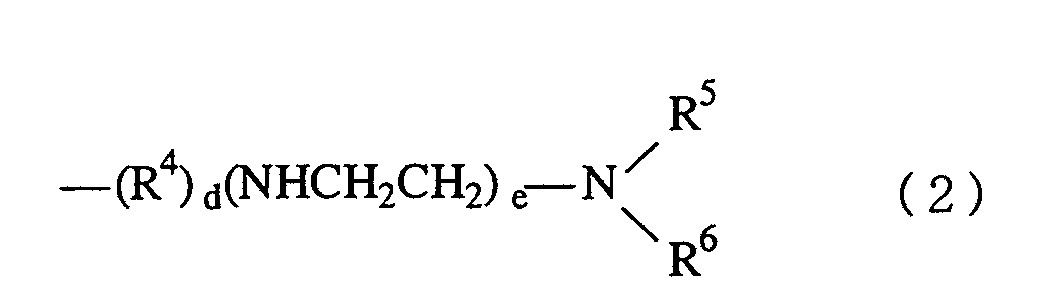 wherein R4 represents -OCH2CH2-,
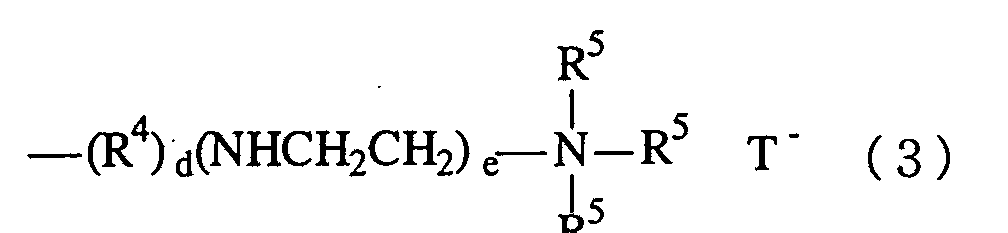 or
or R5 and R6 each are the same as or different from one another and represent a hydrogen atom or a monovalent hydrocarbon group, d and e each are the same as or different from one another and represent an integer of 0 to 6, and T- represents a halogen ion or an organic anion.
- In the general formula (1), the group X is preferably -(CH2)3-NH2, -(CH2)3-N(CH3)2-, -(CH2)3-NH-(CH2)2-NH2, -(CH2)3-NH-(CH2)2-N(CH3)2, or -(CH2)3-N+ (CH3) 3Cl-, more preferably - (CH2)3-NH- (CH2)2-NH2.
- Examples of T- in the general formula (3) include halogen ions such as chlorine, iodine, bromine etc. and organic anions such as methosulfate, ethosulfate, methophosphate, ethophosphate etc.
- The weight average molecular weight of the amino-modified silicone is preferably 3000 to 200,000, by GPC as mentioned above, and for easy reaction with anionic functional groups of the water-absorbing polymer and for hydrophobicity of silicone, the amine equivalent thereof is preferably 250 to 10000 (g/mol), more preferably 1000 to 5000(g/mol). The amine equivalent can be measured in a solvent such as chloroform, ethanol by titration with hydrochloric acid.
- The carboxy-modified silicone compound is preferably either a compound having a silicon atom and carboxy group bound via a saturated hydrocarbon, or an organopolysiloxane compound having a carboxyl group and/or a salt thereof bound to a silicon atom via a structure shown in the general formulae (4) and/or (5), which is known in JP-A 2002-114849:
 wherein R7, R8, R9 and R10 are the same or different and each represent a C2-22 linear or branched alkylene group or alkenylene group or an arylene group, which may have a substituent group containing a heteroatom; X represents an -O- or -NH- group; and M represents a hydrogen atom, a metal, ammonium, C1-22 alkyl or alkenyl ammonium, C1-22 alkyl or alkenyl-substituted pyridinium, C1-22 alkanol ammonium, or a basic amino acid.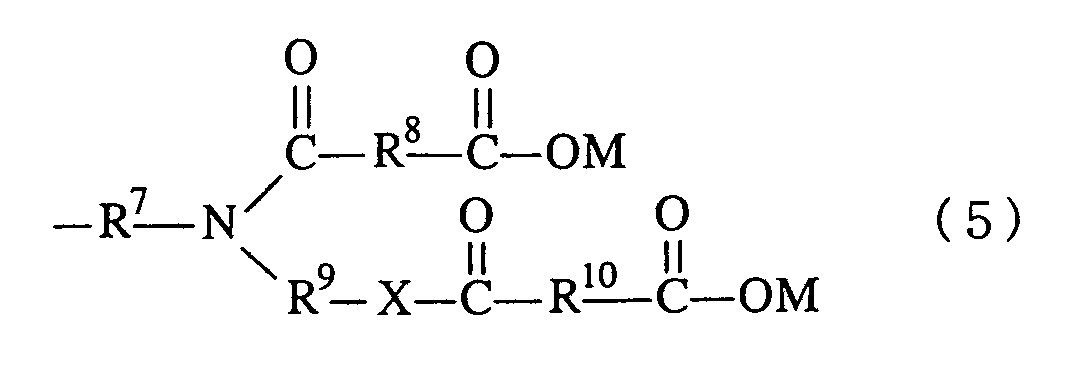
- Further, an amphoteric ionomer siloxane having two functional groups (carboxyl group and ammonium group) described in JP-A No. 6-1711 can also be preferably used.
- The weight average molecular weight of the carboxy-modified silicone compound is preferably 3000 to 200,000 by GPC mentioned above. For easy reaction with cationic functional groups of the water-absorbing polymer and for hydrophobicity of silicone, the carboxy equivalent thereof is preferably 250 to 10000(g/mol), more preferably 1000 to 5000(g/mol). The carboxy equivalent can be measured in a solvent such as chloroform,ethanol by titration with sodium hydroxide.
- The epoxy-modified silicone compound is preferably a silicone compound containing an epoxy group at one and/or both ends represented by the general formula (6):wherein R11 groups are the same or different and each represent a monovalent hydrocarbon group; R12 represents an epoxy-containing group or a monovalent hydrocarbon group; A represents an epoxy-containing group; and n is an integer of 1 to 10000.

- The monovalent hydrocarbon group represented by R11 includes an alkyl group such as methyl group and ethyl group, a cycloalkyl group such as cyclohexyl group, an aryl group such as phenyl group, and a fluorine atom-substituted alkyl group such as trifluoropropyl group. All R11 groups may be the same as or different from one another and are desirably methyl groups.
- In the general formula (6), the epoxy-containing group represented by A is not particularly limited, but specifically includes the groups shown in the general formulae (7) to (9):

 wherein a and b are an integer of 1 or more; c is an integer of one or more; AO is the same as or different from one another and ethylenoxy group or propyleneoxy group.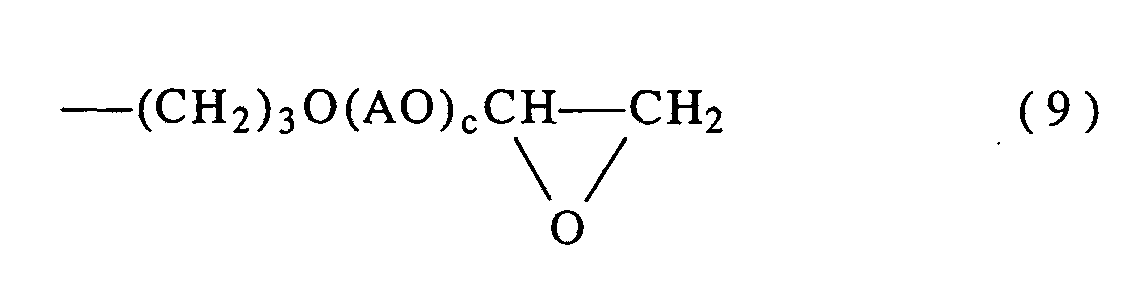
- In the general formula (6), when R12 represents the same group as in R11, the compound is silicone containing an epoxy group at one end, while R12 represents the same group as in A, the compound is silicone containing an epoxy group at both ends.
- The epoxy-modified silicone is preferably silicone containing an epoxy group at one end, that is, silicone wherein R12 is the same group as in R11, wherein the hydrocarbon group is preferably an alkyl group such as methyl group and ethyl group, a cycloalkyl group such as cyclohexyl group, an aryl group such as phenyl group and a fluorine atom-substituted alkyl group such as trifluoropropyl group, more preferably a methyl group.
- In the general formula (6), n is preferably 1 to 500, more preferably 5 to 100 and particularly preferably 10 to 50.
- The silicone compound having a hydroxyl group includes the branched silicone of the general formula (10), the both-terminal type silicone of the general formula (11), and the one-terminal type silicone of the general formula (12). Then it further includes those having the formula (6) in which, however, the epoxy group having the formula (7), (8) or (9) is hydrolyzed and an alkylglyceryl ether-modified silicone disclosed in JP-A 5-112424.
- The numbers represented by 1, m and n respectively in the general formulae (10) to (12) may be preferably an arbitrary combination such that the HLB of the silicone having a hydroxy group is less than 7. More preferably, the HLB is 6 or less. The HLB can be determined by dividing the weight fraction of the polyoxyalkylene group by 5.
- It is preferable that R13 is methyl and R14 is trimethylene.
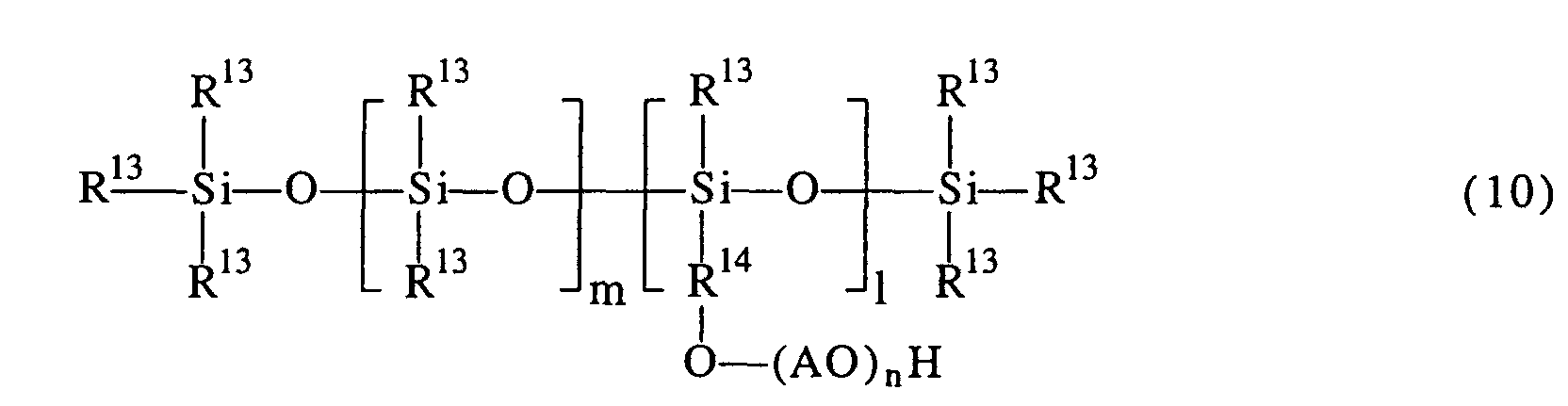
 wherein AO groups may be the same as or different from each other and represent an ethyleneoxy group or propyleneoxy group; R13 is an alkyl having 1 to 4 carbon atoms; R14 is the same as or different from each other and an alkylene having 1 ○ 8 carbon atoms; 1 is an integer of 1 or more and m and n are an integer of zero or more.
- The silicone compound having a radical polymerizable unsaturated group includes e.g. those compounds represented by the general formula (13):wherein A is a group represented by CH2=C(R13)COO-, CH2=C(R13)CONR14- or CH2=CH-C6H4- whereupon R13 is H or CH3-, R14 is H or CyH2y+1- (Y = an integer of 1 to 4); B is a group represented by -(CH2O)m-CnH2n- (m = 0 or 1, n = an integer of 1 to 10); E is a group represented by CpH2p+1- (p = an integer of 1 to 4); and d is an integer of 3 to 1500.

- Among the compounds of the general formula (13), those compounds represented by the general formula (14) are particularly preferable in order to achieve the object of this invention.wherein R13, B and d have the same meanings as defined in the general formula (13) above, and R15 represents a C1-4 alkyl group.

- The silicone compound having a radical polymerizable unsaturated group can be synthesized for example by a method of utilizing chain transfer by radical polymerization or a method of anion living polymerization.
- The number average molecular weight (Mn) of the silicone compound having a radical polymerizable unsaturated group used in this invention is preferably 500 to 100,000, more preferably 1,000 to 50,000 by GPC as mentioned above, from the viewpoint of the dispersion stability of the formed polymer particles and operativeness for production of the polymer particles.
- The method of producing the silicone-modified water-absorbing polymer particles according to this invention includes Production Method 1 or 2 described below. Production Method 1. Method of polymerizing the hydrophilic monomer in the presence of a silicone compound having at least one functional group
- In this method, the silicone having at least one functional group is added to the reaction system before and/or during polymerization of the hydrophilic monomer.
- When a polymer of hydrophilic vinyl monomers is used as the water-absorbing polymer, the hydrophilic vinyl monomer may be polymerized by any method, but a method of polymerizing an aqueous solution of the hydrophilic vinyl monomer (preferably at a concentration of 1 to 70 % by weight) is preferable, and various methods such as aqueous solution polymerization, reverse phase suspension polymerization and pearl polymerization can be used. In particular, aqueous solution polymerization or reverse phase suspension polymerization is preferable in respect of operativeness for polymerization and the water-absorbing ability of the resultant water-absorbing polymer, and reverse phase suspension polymerization is particularly preferable in respect of a higher water-absorbing ability of the water-absorbing polymer. The temperature for polymerization of the hydrophilic vinyl monomer is preferably 20 to 120 °C and the polymerization time is preferably 20 to 180 minutes.
- As the initiator, a water-soluble radical polymerization initiator, for example a peroxide, hydroperoxide or an azo compound is known in a known amount. These polymerization initiators can be used as a mixture thereof, or can be used as redox type polymerization initiators by adding chromium ion, sulfite, hydroxylamine, hydrazine etc. thereto. If necessary, an oil-soluble radical polymerization initiator, for example a peroxide type initiator such as benzoyl peroxide or lauroyl peroxide, or an azo type initiator such as azobis(isobutyronitrile) can also be used.
- The amount of the water-soluble polymerization initiator is preferably 0.03 to 5 wt.%, more preferably 0.1 to 2 wt.%, per the hydrophilic vinyl monomer.
- A dispersant may be used to disperse the hydrophilic vinyl monomer stably in the oil phase(solvent). The above shown silicone compound having at least one functional group may be used as the dispersant. It may be combined with another dispersant. The dispersant of the silicone compound preferably has at least one functional group selected from amino group, ammonium group, hydroxy group and carboxy group.
- The other dispersant may be an anionic, cationic, nonionic or amphoteric surfactant or a natural, semi-synthetic or synthetic polymer. For example, it includes an anionic surfactant such as sodium polyoxyethylene dodecyl ether sulfate and sodium dodecylether sulfate, a cationic or amphoteric surfactant such as trimethylstearylammonium chloride and carboxymethyldimethylcetyl ammonium, a saccharose fatty ester such as saccharose monostearate and saccharose dilaurate, a sorbitan ester such as sorbitan monostearate, a nonionic surfactant such as polyoxyalkylene adducts to sorbitan esters such as polyoxyethylenesorbitan monostearate, a natural or semi-synthetic polymer such as cellulose derivatives such as starch or derivatives thereof, cellulose ethers such as ethyl cellulose and cellulose esters such as cellulose acetate and a synthetic polymer such as polyvinyl alcohol or derivatives thereof, maleic group-having polybutadiene and a quaternary salt of styrene-dimethylaminoethyl methacrylate.
- The dispersant may be present in an amount of 0.5 to 30 mass %, more preferably 1-10 mass %, in particular 1-7 mass %, per 100 mass % of the total vinyl monomer constituting the water-absorbing polymer particles.
- The solvent used in reverse phase suspension polymerization is preferably a hydrocarbon type solvent or silicone type solvent or a mixture thereof. Examples of the hydrocarbon type solvent include aliphatic hydrocarbons such as hexane, heptane, dodecane, cyclohexane, methyl cyclohexane, isooctane and hydrogenated triisobutylene and aromatic hydrocarbons such as benzene, toluene, xylene and ethyl benzene, and examples of the silicone type solvent include octamethyl cyclotetrasiloxane, decamethyl cyclopentasiloxane, hexamethyl disiloxane and octamethyl trisiloxane. Among these solvents, hexane and cyclohexane are particularly preferable.
- The method of producing silicone-modified water-absorbing polymer particles is preferably a method of polymerizing a hydrophilic vinyl monomer such as α,β-unsaturated carboxylic acid monomer and/or a salt thereof by water-in-oil reverse phase suspension polymerization wherein before or during polymerization, the silicone having at least one kind of functional group is allowed to be present in the reaction system by adding it simultaneously with, or separately from, a crosslinking agent. The only surface of particle may be cross-linked by adding a cross-linking agent later and reacting under preferably 40 to 150°C. The "during polymerization" encompasses a period extending, after the reaction is substantially finished, to a stage before removal of water or solvent by e.g. distillation from the reaction system or before cooling.
- It is preferable to polymerize a hydrophlic vinyl monomer and a crosslinking agent in the presence of a silicone having at least one functional group by reverse dispersion polymerization.
- The silicone having at least one kind of functional group is hydrophobic, and by water-in-oil reverse phase suspension polymerization, this silicone is solubilized or uniformly dispersed in the oil phase, to occur in a larger amount on the surface of the water-absorbing polymer particles than in the inside thereof.
- The silicone having at least one kind of functional group can be added directly or as a solution in which the silicone has been solubilized or dispersed by emulsification in an organic solvent, a surfactant etc. The crosslinking agent may be previously coexistent with the vinyl monomer or may be added during polymerization.
- As the initiator, a peroxide such as benzoyl peroxide, potassium persulfate or sodium persulfate may be used for self-crosslinking.
- In the reaction system, the silicone having at least one kind of functional group is allowed to be present in an amount of preferably 0.5 to 30 parts by weight, more preferably 1 to 10 parts by weight and particularly preferably 1 to 7 parts by weight relative to 100 parts by weight of the total hydrophilic vinyl monomers, whereby a sufficient amount of silicone can be present on the surface of the silicone-modified particles.
- The amount of the crosslinking agent in the reaction system is as described above. Production Method 2. Method of allowing a previously obtained water-absorbing polymer particles such as a water-absorbing polymer particles after polymerization or a natural polymer to react with the silicone having at least one kind of functional group.
- The method of producing silicone-modified water-absorbing polymer particles is preferably a method wherein a polymer of the hydrophilic vinyl monomer after polymerization or a previously prepared water-absorbing polymer particles(for example, a natural polymer) and the silicone having at least one functional group are allowed to be present together and heated in the presence of water to which a crosslinking agent and/or a radical polymerization initiator is added if necessary. By the presence of water, functional groups in the water-absorbing polymer particles are dissociated to react readily with functional groups in the silicone. The amount of water in the reaction system is preferably 1 to 200 parts by weight, more preferably 10 to 100 parts by weight, relative to 100 parts by weight of the water-absorbing polymer (particles) . After the reaction, the water is removed, for example, by distillation.
- When the silicone compound having a radically polymerizable unsaturated group is used, the above shown oil-soluble radical polymerization initiator is preferably allowed to be coexistent.
- The silicone having at least one kind of functional group can be added directly or as a solution wherein the silicone has been solubilized or dispersed by emulsification in an organic solvent, a surfactant or a dispersant, or in the form of a spray depending on the case. The dispersant includes ethyl cellulose, sugar ester or sorbitan ester. Heating for facilitating surface treatment is preferably in the range of 40 to 150 C.
- The silicone having at least one kind of functional group may be mixed with the water-absorbing polymer before or after disruption of the polymer, but it is more preferable that the water-absorbing polymer is disrupted to form water-absorbing polymer particles whose water content is regulated in a suitable range by drying if necessary, and the water-absorbing polymer particles are mixed in e.g. a kneader with the silicone having at least one kind of functional group.
- In Production Method 2, the amount of the silicone having at least one kind of functional group is preferably 0.5 to 30 parts by weight, more preferably 1 to 10 parts by weight and particularly preferably 1 to 7 parts by weight relative to 100 parts by weight of the water-absorbing polymer (particles). When a crosslinking agent is used, the crosslinking agent is allowed to be present in an amount of preferably 0.01 to 10 parts by weight, more preferably 0.01 to 5 parts by weight and particularly preferably 0.01 to 3 parts by weight relative to 100 parts by weight of the water-absorbing polymer (particles).
- The organic solvent in which the silicone is solubilized or dispersed by emulsification in Production Methods 1 and 2 is not particularly limited, but an organic solvent having a boiling temperature in the range of 30 to 200 °C is preferable from the viewpoint of safety and operativeness. As a polar solvent, methanol, ethanol, isopropanol, chloroform, toluene etc. can be mentioned. As a non-polar solvent, aliphatic hydrocarbons and alicyclic hydrocarbons are preferable, and for example n-hexane, cyclohexane, ligroin etc. can be mentioned.
- In the production method 1, the functional group of the silicone compound is preferably amino group, ammonium group, hydroxy group or carboxy group. In the production method 2, the functional group of the silicone compound is preferably amino group, ammonium group, hydroxy group, carboxy group, epoxy group, a hydrolysable alkoxy group or a radically polymerizable unsaturated group.
- The reaction of the water-absorbing polymer particles with the silicone having at least one kind of functional group in Production Methods 1 and 2 is varied depending on the type of the functional group, and the reaction described below is preferable.
- When a crosslinking agent is used, a binding reaction with the crosslinking agent as a linking group is also preferable.
- For example, the functional groups of the water-absorbing polymer particles include a carboxyl group, sulfonate group, amino group, hydroxy group and ammonium group.
- When the silicon having at least one kind of functional group is an amino-modified silicone compound, the water-absorbing polymer particles are preferably anionic polymers, more preferably polymers of α,β-unsaturated carboxylic acid monomers and/or salts thereof. This is because by a chemical bonding of an amino group and/or ammonium group in the silicone having at least one kind of functional group with a carboxy group of the water-absorbing polymer particles, the polymer particles can have the silicone having at least one kind of functional group. Further, when polyglycidyl ether is used as the crosslinking agent, the polymer particles after reaction of an epoxy group in polyglycidyl ether with an amino group and/or ammonium group in the silicone can have the silicone having at lease one kind of functional group, via the crosslinking agent as a linking group.
- When the silicone having at least one kind of functional group is a carboxy-modified silicone compound, the water-absorbing polymer particles are preferably polymers of amino group-containing unsaturated monomers or quaternarized monomers thereof, or polymers of α,β-unsaturated carboxylic acid monomers and/or salts thereof. When the water-absorbing polymer particles are polymers of amino group-containing unsaturated monomers or quaternarized monomers thereof, the water-absorbing polymer particles can, directly via covalent or ionic bonding, have the silicone having at least one kind of functional group. When the water-absorbing polymer particles are polymers of α,β-unsaturated carboxylic acid monomers and/or salts thereof, e.g. a polyvalent metal salt is used as the crosslinking agent, whereby the polymer particles can, via ionic bonding with the crosslinking agent as a linking group, have the silicone having at least one kind of functional group
- When the silicone having at least one kind of functional group is a silicone compound having a functional group selected from a hydroxyl group and epoxy group, the silicone compound is reacted with polymers of α,β. unsaturated carboxylic acid monomers and/or salts thereof, whereby the polymer particles can, via chemical bonding, have the silicone having at least one kind of functional group.
- The silicone-modified water-absorbing polymer particles of this invention produced from the starting materials by the production methods as described above is incorporated preferably into cosmetics to give its characteristics to the cosmetics as described below.
- The content of the silicone-modified water-absorbing polymer particles of this invention in cosmetics can be suitably selected depending on the object of cosmetics, and is not particularly limited, but the content is preferably 1 to 50 % by weight, particularly preferably 1 to 30 % by weight. When the amount of the polymer particles incorporated is at least 1 % by weight, the feel of the cosmetics can be sufficiently improved.
- The cosmetics of this invention are not particularly limited insofar as the silicone-modified water-absorbing polymer particles are not directly contacted with water, and may be water-in-oil or oil-in-water emulsified cosmetics, oil cosmetics, spray cosmetics and stick-type cosmetics. The type of the cosmetics of this invention is not particularly limited, and the cosmetics of this invention include skin cosmetics such as a pack, foundation, lipstick, lotion, cold cream, hand cream, skin detergent, softening cosmetics, nutrient cosmetics, astringent cosmetics, whitening cosmetics, wrinkle-improving cosmetics, aging-preventing cosmetics, cleansing cosmetics, sweat regulator and deodorant; and hair cosmetics such as a rinse, treatment, hair-dressing, hair tonic, styling agent and hair feel improver.
- Among these, the cosmetics of this invention are preferably used as antiperspirant and deodorant, or preferably used together with another sweating regulator. The antiperspirant includes aluminum salts such as allantoin chlorohydroxy aluminum, aluminum chloride, chlorohydroxy aluminum, allantoin dihydroxy aluminum, aluminum sulfate, potassium alum and aluminum hydroxide, aluminum-zirconium complexes such as aluminum zirconium tetrachlorohydroxy glycine and aluminum zirconium pentachlorohydrate, zinc salts such as zinc oxide and zinc p-phenol sulfonate, and salicylic acid, tannic acid etc. Among these, allantoin chlorohydroxy aluminum, aluminum chloride, chlorohydroxy aluminum and aluminum hydroxide are particularly preferable. The amount of the antiperspirant incorporated is preferably 0.01 to 15 % by weight, particularly preferably 0.1 to 5 % by weight in the sweat regulator.
- By further incorporating silicone oil into the cosmetics of this invention, the resultant cosmetics can give dry feeling for use with a reduction in sticky feeling. Such silicone oil is not particularly limited, but the one having a viscosity (25 °C) of at most 50 mm2/s can be preferably used. This is because if silicone oil is used in a larger amount to increase viscosity, the polymer particles feel oily and are not preferable in feeling for use. For example, linear silicones such as low-polymerized dimethyl polysiloxane and methyl phenyl polysiloxane, and octamethyl cyclotetrasiloxane, decamethyl cyclopentasiloxane etc. can be suitably selected and used singly or in combination thereof if necessary. The silicone oil is incorporated in an amount of preferably 0.01 to 5 % by weight, particularly preferably 0.1 to 1 % by weight in the cosmetics of this invention.
- Preferably, the cosmetics of this invention further contain alcohol in order to give dry feeling. Such alcohol includes C1-6 monohydric or polyhydric alcohols such as ethanol, glycerin, 1,3-butylene glycol, propylene glycol and sorbitol. In particular, a monohydric alcohol, particularly ethanol is preferable. The amount of the alcohol incorporated is preferably 5 to 30 % by weight in the cosmetics of this invention, particularly preferably 2 to 50 parts times by weight of the silicone-modified water-absorbing polymer particles.
- Depending on the form, type etc. of the cosmetics, other conventional components can be further incorporated as cosmetic components into the cosmetics of this invention in such a range that the effect of this invention is not hindered.
- Such cosmetic components include e.g. extender pigments such as mica, talc, sericite, kaolin, nylon powder, polymethylsilyl sesquioxane and barium sulfate; inorganic pigments such as titanium oxide, zinc white and iron oxide; powders whose surface was rendered hydrophobic by treating these powders with silicone, metal soap or N-acyl glutamic acid; hydrocarbons such as solid or liquid paraffin, solid paraffin, microcrystalline wax, vaseline, ceresin, ozokerite and montan wax; vegetable or animal fats and oils or wax, such as olive, ozokerite, carnauba wax, lanoline and spermaceti; fatty acids or esters thereof such as stearic acid, palmitic acid, oleic acid, glycerine monostearate, glycerine distearate, glycerine monooleate, isopropyl myristate, isopropyl stearate and butyl stearate; higher alcohols such as cetyl alcohol, stearyl alcohol, palmityl alcohol and hexyl dodecyl alcohol; adsorbents or thickening agents such as cationic cellulose, carboxybetaine type polymer and cationic silicone; polyhydric alcohols having a moisture retention action, such as glycol and sorbitol; efficacious components such as whitening agent, analgesic antiinflammatory agents, anti-itching agents, sterilizing disinfectants, astringents, skin softening agents and hormones; water; surfactants; W/O or O/W type emulsifying agents; emulsifying agents for silicone oil, such as polyether-modified silicone, polyether alkyl-modified silicone and glyceryl ether-modified silicone; thickening agents such as methyl cellulose, ethyl cellulose, carboxymethyl cellulose, polyacrylic acid, tragacanth, agar and gelatin; and other components such as emulsion stabilizer, chelating agents, UV protecting agents, pH adjusting agents, preservatives, coloring matters and perfumes.
- The cosmetics of this invention are produced according to a conventional method.
- The silicone-modified water-absorbing polymer particles of this invention comprise water-absorbing polymer particles coated thereon via chemical bonding, with a silicone compound having at least one kind of functional group. Unlike silicone oil simply mixed in water-absorbing polymer particles, the silicone compound is stably present on the surfaces of the water-absorbing polymer particles even after incorporated into cosmetics. The silicone-modified water-absorbing polymer particles of this invention, upon absorption of water, exhibit a significant reduction in sticky feeling and gel blocking (phenomenon of forming lumps) attributable to the fusing ability of the surfaces of the polymer particles, and when used as cosmetics, the polymer particles have preferable feeling in use.
-
- Fig. 1 is a photograph by SEM (scanning electron microscope) of the silicone-modified polymer particles obtained in Example 1.
- Fig. 2 is an enlarged photograph by SEM of the silicone-modified polymer particles in Fig. 1.
-
- 1000 ml water was added to 5 g sample which was then suspended and stirred for 30 minutes (100 rpm, 25 °C) and centrifuged at 2,000 G for 30 minutes, and the supernatant was gently discarded, and the weight of the sample was measured. On the basis of the difference of this weight from the initial weight of the sample, the amount of water absorbed was determined.
-
- (1) A 7 cm×6 mm scent paper (perfume test paper, produced by Daimonji Yoshi Co., Ltd.) is coated (about 1 cm2) with 150 mg silicone-modified polymer particles (5 % by weight in water).
- (2) Then, the same scent paper is impregnated with 50 mg bad-smelling solution [model smell (0.005 % aqueous isovaleric acid solution)].
- (2) The scent paper having the bad smell + the deodorant
is placed in a 3-L beaker which is then sealed with Saran
Wrap (trade name) , left for 20 minutes (20 °C), and the smell
filled in the beaker is by sensory test evaluated. As the
reference, the scent paper having only the bad smell in a
beaker is also prepared.
Smell evaluation: o ○: Odorless or with unspecified smell - ○: Slightly smells.
- Δ: Apparently smells.
- ×: Strongly smells.
-
- 0.2 g sample was applied onto the forearm, then evaluated by sensory test for the extendability and dry and smooth feeling of the powder, and scored according to the following criteria.
- 5: Does not feel sticky, spreads very well and feels very dry and smooth.
- 4: Spreads well and feels dry and smooth.
- 3: Feels slightly sticky and slightly poor in spreading. 2: Poor in spreading, and feels gritty or sticky.
- 1: Very poor in spreading and feels very gritty or sticky.
-
- 0.2 g sample was applied onto the forearm, evaluated by sensory test for stickiness and dry feeling after 30 minutes in a room with 75 % RH at 40 °C, and scored according to the following criteria:
- 5: Does not feel sticky, spreads very well and feels very dry.
- 4: Spreads well and feels dry.
- 3: Feels slightly sticky and slightly poor in spreading. 2: Poor in spreading and feels slimy or sticky.
- 1: Very poor in spreading and feels very slimy or sticky.
-
- 300 g methacrylic acid (Mitsubishi Rayon Co., Ltd.) and 135 g deionized water were placed in a 3-L beaker and then neutralized to a degree of 75 % by adding 348 g of 30 weight% aqueous sodium hydroxide solution dropwise thereto under cooling with stirring, and then a solution of 1.2 g potassium persulfate (0.4 % by weight relative to methacrylic acid) dissolved in 24.3 g deionized water and 15.0 g of a crosslinking agent ethylene glycol diglycidyl ether (trade name, Denacol EX810, Nagase Kasei Co., Ltd.) (5.0 % by weight relative to methacrylic acid) were added thereto, and the mixture was uniformly dissolved. The resultant solution was added to a solution obtained by dissolving 15 g amino-modified silicone A (XF42-703 produced by Toshiba Silicones; viscosity (25 °C), 1000 mm2/s; amine equivalent, 1500 g/mol) in 1500 ml cyclohexane in a 3-L beaker, and the mixture was stirred vigorously for 5 minutes at a number of revolutions of 10000 rpm in a homomixer to produce a fine water-in-oil droplet dispersion. Then, 900 ml cyclohexane was introduced into a 5-L stainless steel reaction vessel equipped with a reflux condenser, stirred at 350 rpm, and heated at 75 °C in the system, and the atmosphere was replaced by nitrogen, followed by dropwise addition of the partially neutralized water-in-oil droplet dispersion of methacrylic acid to initiate polymerization. The whole of the droplet dispersion was added dropwise over 1.5 hours, and the reaction solution was kept for additional 4 hours at the reflux temperature. Thereafter, a dehydration tube was attached, the temperature was raised to remove 340 ml water, and the reaction solution was cooled and filtered to separate polymer particles. By evaporation into dryness under reduced pressure, 376 g dry white polymer in the form of fine powder was obtained. The average particle diameter of the resultant fine polymer particles was 2.2 µm. A photograph by SEM (scanning electron microscope) of the silicone-modified polymer particles in a dry state obtained in Example 1 is shown in Figs. 1 and 2.
- Using the monomers, dispersants and crosslinking agents in Table 1, fine polymer particles were obtained according to the method in Example 1.
- 300 g methacrylic acid (Mitsubishi Rayon Co., Ltd.) and 135 g deionized water were placed in a 3-L beaker and then neutralized to a degree of 75 % by adding 348 g of 30 weight% aqueous sodium hydroxide solution dropwise thereto under cooling with stirring, and then a solution of 1.2 g potassium persulfate (0.4 % by weight relative to methacrylic acid) dissolved in 24.3 g deionized water was added thereto, and the mixture was dissolved uniformly. The resultant solution was added to a solution obtained by dissolving 15 g amino-modified silicone A (viscosity (25 °C), 1000 mm2/s; amine equivalent, 1500 g/mol) in 1500 ml cyclohexane in a 3-L beaker, and the mixture was stirred vigorously for 5 minutes at a number of revolutions of 10000 rpm in a homomixer to produce a fine water-in-oil droplet dispersion. Then, 900 ml cyclohexane was introduced into a 5-L stainless steel reaction vessel equipped with a reflux condenser, and stirred at 350 rpm and heated at 75 °C in the system, and the atmosphere was replaced by nitrogen, followed by dropwise addition of the partially neutralized water-in-oil droplet dispersion of methacrylic acid to initiate polymerization. The whole of the droplet dispersion was added dropwise over 1.5 hours, and the reaction solution was kept for additional 4 hours at the reflux temperature. Thereafter, a dehydration tube was attached, the temperature was raised to remove 300 ml water, and then a solution of 3.0 g of a crosslinking agent ethylene glycol diglycidyl ether (trade name, Denacol EX810, Nagase Kasei Co., Ltd.) (1.0 % by weight relative to methacrylic acid) dissolved in 20 g deionized water was added dropwise thereto for 5 minutes. After aging for 1 hour, 1300 ml cyclohexane was evaporated, and the reaction solution was left and cooled to complete synthesis. By evaporation into dryness under reduced pressure, 380 g dry white polymer in the form of fine powder was obtained. The average particle diameter of the resultant fine polymer particles was 2.9 µm.
- 300 g methacrylic acid (Mitsubishi Rayon Co., Ltd.) and 135 g deionized water were placed in a 3-L beaker and then neutralized to a degree of 75 % by adding 348 g of 30 weight% aqueous sodium hydroxide solution dropwise thereto under cooling with stirring, and then a solution of 1.2 g potassium persulfate (0.4 % by weight relative to methacrylic acid) dissolved in 24.3 g deionized water and 9.0 g of a crosslinking agent ethylene glycol diglycidyl ether (trade name, Denacol EX810, Nagase Kasei Co., Ltd.) (3.0 % by weight relative to methacrylic acid) were added thereto, and the mixture was uniformly dissolved. The resultant solution was added to a solution obtained by dissolving 15 g amino-modified silicone A (viscosity (25 °C), 1000 mm2/s; amine equivalent, 1500 g/mol) in 1500 ml cyclohexane in a 2-L beaker, and the mixture was stirred in a homomixer such that the particle diameter of monomer droplets was reduced to about 50 µm, to produce a fine water-in-oil droplet dispersion. Then, 900 ml cyclohexane was introduced into a 5-L stainless steel reaction vessel equipped with a reflux condenser, then stirred at 350 rpm and heated at 75 °C in the system, and the atmosphere was replaced by nitrogen, followed by dropwise addition of the partially neutralized water-in-oil droplet dispersion of methacrylic acid to initiate polymerization. The whole of the droplet dispersion was added dropwise over 1.5 hours, and the reaction solution was aged for additional 4 hours at the reflux temperature. Thereafter, a dehydration tube was attached, the temperature was raised to remove 340 ml water, and 1300 ml cyclohexane was evaporated, and the reaction solution was left and cooled to complete synthesis. By evaporation into dryness under reduced pressure, 357 g dry white polymer in the form of fine powder was obtained. The average particle diameter of the resultant fine polymer particles was 50 µm.
- 300 g methacrylic acid (Mitsubishi Rayon Co., Ltd.) and 135 g deionized water were placed in a 3-L beaker and then neutralized to a degree of 75 % by adding 348 g of 30 weight% aqueous sodium hydroxide solution dropwise thereto under cooling with stirring, and then a solution of 1.2 g potassium persulfate (0.4 % by weight relative to methacrylic acid) dissolved in 24.3 g deionized water was added thereto, and the mixture was uniformly dissolved. Then, 1500 ml cyclohexane and 15 g of amino-modified silicone C (KF-861 produced by Shin-Etsu Silicones; viscosity (25 °C), 3500 mm2/s; amine equivalent, 2000 g/mol) were introduced into a 5-L stainless steel reaction vessel equipped with a reflux condenser, and heated at 75 °C in the system, and the atmosphere was replaced by nitrogen, followed by dropwise addition of the aqueous partially neutralized methacrylic acid solution to initiate polymerization. The whole of the solution was added dropwise over 1.5 hours, and the reaction solution was aged for additional 4 hours at the reflux temperature. Thereafter, a dehydration tube was attached, the temperature was raised to remove 300 ml water, and then a solution of 3.0 g of a crosslinking agent ethylene glycol diglycidyl ether (trade name, Denacol EX810, Nagase Kasei Co., Ltd.) (1.0 % by weight relative to methacrylic acid) dissolved in 20 g deionized water was added dropwise thereto for 5 minutes. The reaction solution was heated to remove 340 ml water, left and cooled to complete synthesis. By evaporation into dryness under reduced pressure, 364 g dry white polymer in the form of fine powder was obtained. The average particle diameter of the resultant fine polymer particles was 230 µm.
- 300 g methacrylic acid (Mitsubishi Rayon Co., Ltd.) and 135 g deionized water were placed in a 3-L beaker and neutralized to a degree of 75 % by adding 348 g of 30 weight% aqueous sodium hydroxide solution dropwise thereto under cooling with stirring, and then a solution of 1.2 g potassium persulfate (0.4 % by weight relative to methacrylic acid) dissolved in 24.3 g deionized water and 15.0 g of a crosslinking agent ethylene glycol diglycidyl ether (trade name, Denacol EX810, Nagase Kasei Co., Ltd.) (5.0 % by weight relative to methacrylic acid) were added thereto, and the mixture was uniformly dissolved. The resultant solution was added to a solution obtained by dissolving 15 g sugar esters (a mixture of Ryoto Sugar Esters S570 and S770 (trade name) in equal amounts, Mitsubishi Shokuhin Co., Ltd.) (5.0 % by weight relative to methacrylic acid) as a dispersion stabilizer in 1500 ml cyclohexane in a 3-L beaker, and the mixture was stirred vigorously for 5 minutes at a number of revolutions of 10000 rpm in a homomixer to produce a fine water-in-oil droplet dispersion. Then, 900 ml cyclohexane was introduced into a 5-L stainless steel reaction vessel equipped with a reflux condenser, and stirred at 350 rpm and heated at 75 °C in the system, and the atmosphere was replaced by nitrogen, followed by dropwise addition of the partially neutralized water-in-oil droplet dispersion of methacrylic acid to initiate polymerization. The whole of the droplet dispersion was added dropwise over 1.5 hours, and the reaction solution was aged for additional 4 hours at the reflux temperature. Thereafter, a dehydration tube was attached, the temperature was raised to remove 340 ml water, further 1300 ml cyclohexane was evaporated, and the reaction solution was left and cooled to complete synthesis. By evaporation into dryness under reduced pressure, 376 g dry white polymer in the form of fine powder was obtained. The average particle diameter of the resultant dry fine polymer particles was 2.2 µm.
- 372 g of the fine water-absorbing polymer particles obtained in Comparative Example 1 were added to 2000 ml cyclohexane and 15 g amino-modified silicone D (KF-864 produced by Shin-Etsu Silicones; viscosity (25 °C), 1700 mm2/s; amine equivalent, 3800 g/mol) (4 % by weight relative to the water-absorbing polymer), and the system was heated at 75 °C with stirring at 350 rpm for 30 minutes. Then, 150 g deionized water was added dropwise, the mixture was further stirred at 75 °C for 30 minutes, and a solution of 3.0 g crosslinking agent ethylene glycol diglycidyl ether (trade name, Deconal EX810, Nagase Kasei Co., Ltd.) (0.8 % by weight relative to the water-absorbing polymer) dissolved in 20 g deionized water was added dropwise over 5 minutes. The mixture was further aged for 4 hours at the reflux temperature, and after a dehydrating tube was attached, the reaction temperature was raised to remove 100 ml water, and the reaction solution was left and cooled to complete synthesis. By evaporation into dryness under reduced pressure, 375 g dry white polymer in the form of fine powder was obtained. The average particle diameter of the resultant fine polymer particles was 2.4 µm.
- 180 g of a solution of a quarternized product of dimethylaminoethyl methacrylate with diethylsulfuric acid, including 90% of the effective component, 120 g of N,N-dimethylacrylamide, 14 g of polyethylene glycol dimethacrylate, NK-14G (tradename of ShinNakamura Chemical Co., Ltd.), 5 g of methacrylic acid, 415 g of deionized water and 1.2 g of potassium persulfate were introduced in a 3-L beaker and dissolved uniformly. The obtained solution was added in a 3-L beaker to a solution obtained by dissolving 15 g amino-modified silicone A, XF42-703 produced by Toshiba Silicones, having viscosity (25 °C) of 1000 mm2/s and amine equivalent of 1500 g/mol, in 1500 ml of cyclohexane. The mixture was stirred vigorously for 5 minutes at a number of revolutions of 10000 rpm in a homomixer to produce a fine water-in-oil droplet dispersion. The water-in-oil droplet dispersion was introduced into a 5-L stainless steel reaction vessel equipped with a reflux condenser, stirred at 350 rpm. Purged by nitrogen gas, it was heated at 75 °C and it was kept for 4 hours for polymerization. Thereafter, a dehydration tube was attached, the temperature was raised to remove 340 ml water and the reaction solution was cooled and filtered to separate polymer particles. By evaporation into dryness at a reduced pressure, 280 g dry white polymer in the form of fine powder was obtained. The average particle diameter of the resultant fine polymer particles was 2.5 µm.
- 300 g of N,N-dimethylacrylamide, 4.5 g of polyethylene glycol dimethacrylate, NK-14G (tradename of ShinNakamura Chemical Co., Ltd.), 5 g of methacrylic acid, 400 g of deionized water and 1.2 g of potassium persulfate were introduced in a 3-L beaker and dissolved uniformly. The obtained solution was added in a 3-L beaker to a solution obtained by dissolving 15 g amino-modified silicone A, XF42-703 produced by Toshiba Silicones, having viscosity (25 °C) of 1000 mm2/s and amine equivalent of 1500 g/mol, in 1500 ml of cyclohexane. The mixture was stirred vigorously for 5 minutes at a number of revolutions of 10000 rpm in a homomixer to produce a fine water-in-oil droplet dispersion. The water-in-oil droplet dispersion was introduced into a 5-L stainless steel reaction vessel equipped with a reflux condenser, stirred at 350 rpm. Purged by nitrogen gas, it was heated at 75 °C and it was kept for 4 hours for polymerization. Thereafter, a dehydration tube was attached, the temperature was raised to remove 340 ml water and the reaction solution was cooled and filtered to separate polymer particles. By evaporation into dryness at a reduced pressure, 290 g dry white polymer in the form of fine powder was obtained. The average particle diameter of the resultant fine polymer particles was 2.3 µm.
- 300 g methacrylic acid (Mitsubishi Rayon Co., Ltd.) and 135 g deionized water were introduced in a 3-L beaker and then neutralized to a degree of 75 % by adding 348 g of 30 weight % aqueous sodium hydroxide solution dropwise thereto, while cooled and stirred. Then a solution of 1.2 g potassium persulfate, being 0.4 % by weight relative to methacrylic acid, dissolved in 24.3 g of deionized water and 15.0 g of a crosslinking agent of ethylene glycol diglycidyl ether, Denacol EX810 (trade name by Nagase Kasei Co., Ltd.), being 5.0 % by weight relative to methacrylic acid, were added thereto. The mixture was uniformly dissolved. The resultant solution was added in a 3-L beaker to a solution obtained by dissolving 15 g of hydroxy-modified silicone having the formula (1), disclosed in JP-A 5-112424, Production Example 7, in 1500 ml cyclohexane. The mixture was stirred vigorously for 5 minutes at a number of revolutions of 10000 rpm in a homomixer to produce a fine water-in-oil droplet dispersion. Then, 900 ml cyclohexane was introduced into a 5-L stainless steel reaction vessel equipped with a reflux condenser, stirred at 350 rpm and heated at 75 °C in the system. Having been replaced by nitrogen, the partially neutralized water-in-oil droplet dispersion of methacrylic acid was added dropwise thereto to initiate polymerization. The whole of the droplet dispersion was added dropwise over 1.5 hours and the reaction solution was kept for additional 4 hours at the reflux temperature. Thereafter, a dehydration tube was attached, the temperature was raised to remove 340 ml water, and the reaction solution was cooled and filtered to separate polymer particles. By evaporation into dryness under reduced pressure, 355 g of dry white polymer in the form of fine powder was obtained. The average particle diameter of the resultant fine polymer particles was 1.8 µm.

- 180 g of a solution of a quaternized product of dimethylaminoethyl methacrylate with diethylsulfuric acid, including 90% of the effective component, 120 g of N,N-dimethylacrylamide, 14 g of polyethylene glycol dimethacrylate, NK-14G (tradename of ShinNakamura Chemical Co., Ltd.), 415 g of deionized water and 1.2 g of potassium persulfate were introduced in a 3-L beaker and dissolved uniformly. The obtained solution was added in a 3-L beaker to a solution obtained by dissolving 15 g carboxy-modified silicone, produced by JP-A 2002-114849, Example 1, being a condensate of aminoethylaminopropyl-modified silicone, KF-869 (tradename of Shinetsu Chemical Co., Ltd.) with succinic anhydride, having a succinic anhydride-modified extent of 93 %, in 1500 ml of cyclohexane. The mixture was stirred vigorously for 5 minutes at a number of revolutions of 10000 rpm in a homomixer to produce a fine water-in-oil droplet dispersion. The water-in-oil droplet dispersion was introduced into a 5-L stainless steel reaction vessel equipped with a reflux condenser, stirred at 350 rpm. Purged by nitrogen gas, it was heated at 75 °C and it was kept for 4 hours for polymerization. Thereafter a dehydration tube was attached, the temperature was raised to remove 340 ml water and the reaction solution was cooled and filtered to separate polymer particles. By evaporation into dryness at a reduced pressure, 285 g dry white polymer in the form of fine powder was obtained. The average particle diameter of the resultant fine polymer particles was 3.0 µm.
- 255 g of 80 weight% industrial acrylic acid and 135 g deionized water were placed in a 3-L beaker and then neutralized to a degree of 75 % by adding 284 g of 30 weight% aqueous caustic sodium solution dropwise thereto under cooling with stirring, and then a solution of 0.8 g potassium persulfate (0.4 % by weight relative to methacrylic acid) dissolved in 20 g deionized water and 0.1 g of a crosslinking agent ethylene glycol diglycidyl ether (trade name, Deconal EX810, Nagase Kasei Co., Ltd.) (0.05 % by weight relative to acrylic acid) were added thereto, and the mixture was uniformly dissolved. Then, 1000 ml cyclohexane and 10.2 g of ethyl cellulose (trade name, N-100, produced by Hercules Ltd.) were introduced into a 5-L stainless steel reaction vessel equipped with a reflux condenser, and the mixture was stirred at 450 rpm and heated at 75 °C in the system, and the atmosphere was replaced by nitrogen, followed by dropwise addition of the aqueous partially neutralized acrylic acid solution to initiate polymerization. The whole of the solution was added dropwise over 1.5 hours, and the reaction solution was aged for additional 4 hours at the reflux temperature. Thereafter, a dehydration tube was attached, the temperature was raised to remove 250 ml water, and the reaction solution was left and cooled to complete synthesis. By evaporation into dryness under reduced pressure, 250 g dry white polymer in the form of powder was obtained. The average particle diameter of the resultant dry fine polymer particles was 250 µm.
- 0.1 g dimethyl polysiloxane (50 mm2/s), TSF-451-50A produced by GE Toshiba Silicones Co.,Ltd., was added to and sufficiently mixed with 100 g of the dry white polymer obtained in Comparative Example 1.
- 0.1 g polyethylene oxide-modified silicone oil (KF351A produced by Shin-Etsu Silicones) was added to and mixed sufficiently with 100 g of the dry white polymer obtained in Comparative Example 1.
- 30 g polymer particles obtained in each of Example 1 Comparative Examples 3 and 4 were washed 3 times by stirring in 300 ml chloroform (50 °C, 30 rpm, 2 hours) and subsequent centrifugation.
- IPC elemental analysis indicated that in the polymer particles in Example 1, silicon atoms were detected both before and after washing. In the polymer particles in Comparative Examples 3 and 4, silicone atoms could not be detected.
- By ESCA (x-ray electron spectroscopy for chemical analysis), it was found that silicone atoms are present in the vicinity of the surfaces of the polymer particles in Example 1. Further, the polymer particles in Examples 1 to 9 and Comparative Examples 1 and 2 were evaluated for the amount of absorbed water, the deodorizing ability, and the feeling in use (when dry and sweating) , and the results are shown in Table 1.
- 10 g of polymer particles of Example 6, using 5.0 wt.%, per methacrylic acid, of the amino-modified silicone, was obtained by the polymerization, cooling and drying at a reduced pressure without filtration and was extracted by a soxhlet extractor with 400 ml of chloroform at 70°C for 4 hours. The amino-modified silicone of the extract was determined by 1H-NMR. It was calculated that the amount of the amino-modified silicone, not having been extracted out, but remaining immobilized on the polymer particles, was 3.0 wt. per methacrylic acid.
- The polymer particles obtained in Example was added to cyclohexane and treated with ultrasonic waves to prepare the fine particle dispersion. It was determined in view of particle diameter with a size distribution measuring device of laser diffraction-scattering, LS230(tradename of Horiba, Ltd.) at the relative refraction index of 1.10, provided that the polymer particles had the refraction index of 1.57 and cyclohexane had that of 1.43. The obtained median was taken as an average particle diameter. The particle diameter distribution was obtained by dividing the standard deviation with the average particle diameter.
- The silicone-modified water-absorbing polymer particles (salts) polymerized from methacrylic acid monomers showed a significant deodorizing effect by neutralization of the short-chain carboxylic acid as a cause of bad smell.


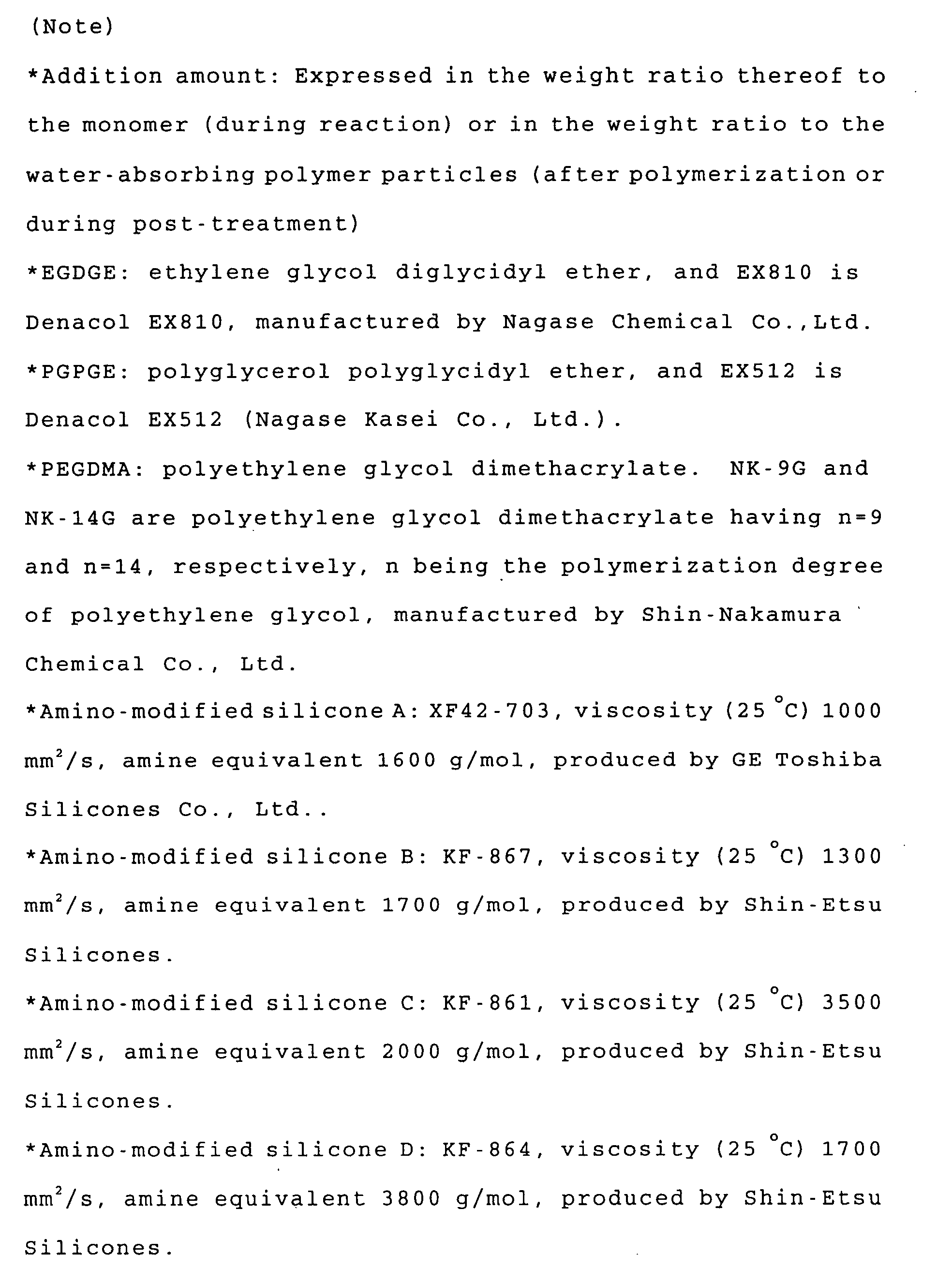
- Formulation Example 1 and 2 and Comparative Formulation
- The ingredients a) to f) in Table 3 were uniformly mixed under heating and introduced into a container, left and cooled to give sweat-regulating sticks. The evaluation results are shown in Table 3.
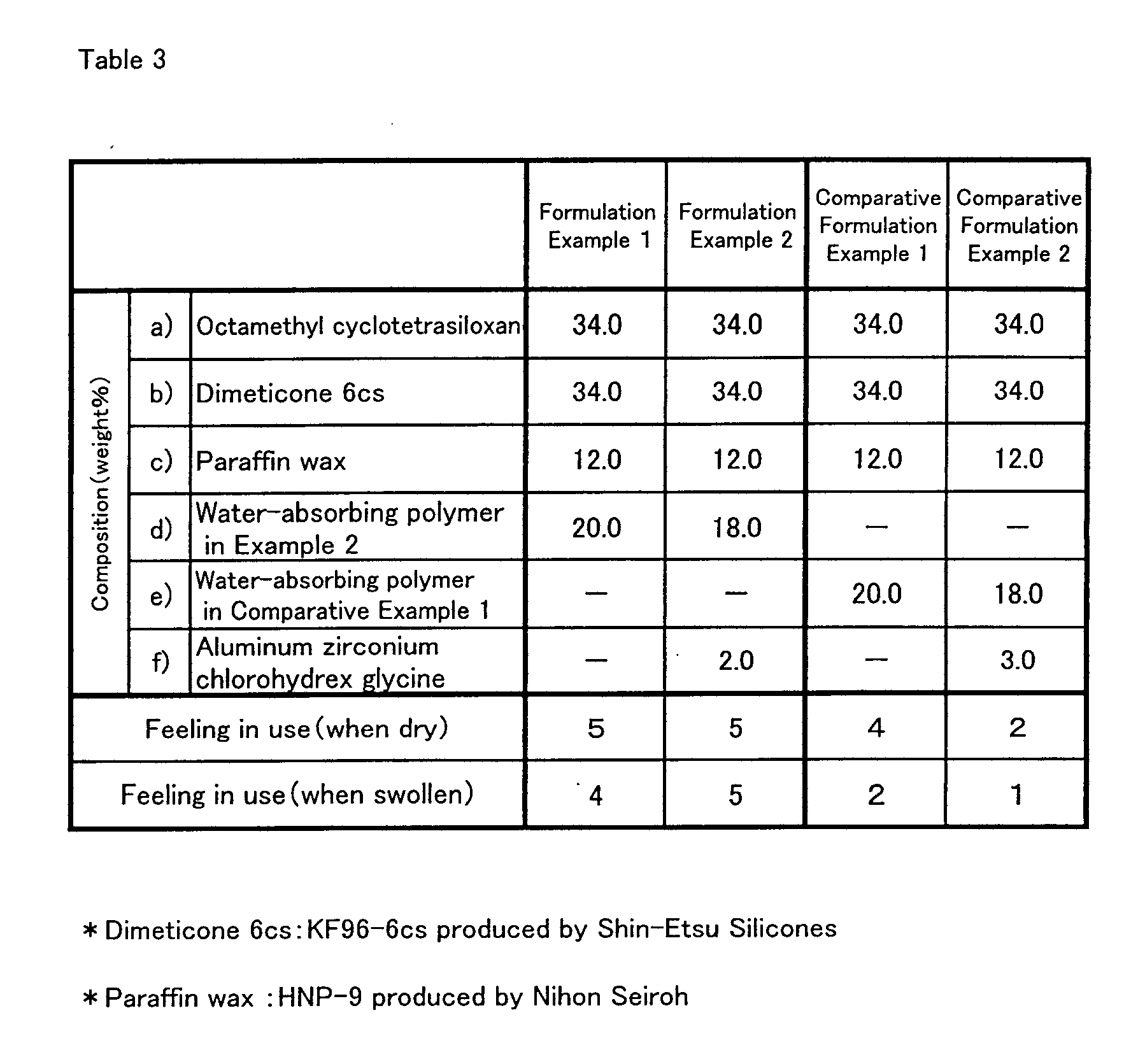
- The ingredients a) to f) in Table 4 were uniformly mixed by a Henschel mixer, and introduced into a container to give sweat-regulating body powder. The evaluation results are shown in Table 4.

- The following ingredients a) to c) were mixed in a kneader, and d) and e) were mixed by a blender, and these were charged into a spray container, and further f) and g) were charged into the spray container, to give a powder spray. The resultant powder spray was scored rank 5 for feeling in use when dry, and rank 4 for feeling in use when sweating.
a) Water-absorbing polymer in Example 1 2.0 weight% b) Acryl polymer particles: Microsphere M305, 7µm, manufactured by Matsumoto Oil and Fat Co., Ltd. 1.0 weight% c) Talc 0.5 weight% d) Isopropyl palmitinate 1.5 weight% e) Perfume 0.2 weight% f) Isopentane 10.0 weight% g) Liquefied petroleum gas balance (100.0 weight% in total) - The following ingredients a) to d) were mixed in a Henschel mixer, and ingredients d) and e) were added to this mixture which was then ground in a grinding device, placed on a middle dish and pressed to give a compact deodorant powder. The resultant compact deodorant powder was scored rank 5 for feeling in use when dry and rank 5 for feeling in use when sweating. Further, its deodorizing effect was confirmed.
a) Water-absorbing polymer in Example 5 50.0 weight% b) N-lauroyl lysine 10.0 weight% c) Talc 20.0 weight% d) Zinc oxide: FINEX-75, manufactured by Sakai Chemical Co., Ltd. 10.0 weight% d) Dimeticone 20cs 2.0 weight% e) Dimeticone 6cs 8.0 weight% * Dimeticone 20cs: KF96-20cs produced by Shin-Etsu Silicones * Dimeticone 6cs: KF96-6cs produced by Shin-Etsu Silicones - The following ingredients a) to e) were mixed and introduced into a roll-on container to prepare a roll-on type sweat-regulating agent. The resultant roll-on type sweat-regulating agent was scored rank 4 for feeling in use when dry and rank 4 for feeling in use when sweating.
a) Octamethyl cyclotetrasiloxane 65.0 weight% b) Dimeticone 6cs 6.0 weight% c) Ethanol 20.0 weight% d) Glycerin 4.0 weight% e) Water-absorbing polymer in Example 6 5.0 weight% * Dimeticone 6cs: KF96-6cs produced by Shin-Etsu Silicones - The following ingredients a) to e) were mixed in a Henschel mixer, and ingredients f) and i) which had been melted by heating were added thereto, mixed and ground. The resultant mixture was placed on a middle plate and pressed to give a powder foundation. The resultant powder foundation was scored rank 5 for feeling in use when dry and rank 5 for feeling in use when sweating, and this powder foundation was free of floating of the cosmetics with sweat, kept well in the cosmetics and excellent in usability.
a) Water-absorbing polymer in Example 4 5.0 weight% b) Zinc oxide: FINER-75, manufactured by Sakai Chemical Co., Ltd. 20.0 weight% c) Spherical silica: NP-30, 3 µm, manufactured by Asahi Glass Co., Ltd. 25.0 weight% d) Mica 15.0 weight% e) Talc 25.0 weight% f) Coloring pigment suitable amount g) Dimeticone 6cs 3.0 weight% h) 2-Ethylhexyl p-methoxy cinnamate 2.5 weight% i) Preservative suitable amount (100.0 weight% in total) * Dimeticone 6cs: KF96-6cs produced by Shin-Etsu Silicones - The following ingredients a) to i) were heated, melted and uniformly mixed by a blender, and ingredients j) to n) which had been mixed by a Henschel mixer were added thereto, and the mixture was kneaded by a roll mill. After the mixture was re-melted to regulate its color, and the perfume o) was added thereto at 60 °C thereto with stirring under degassing, and the mixture was poured into a container, then left and cooled to give an oily foundation. The resultant oily foundation was scored rank 4 for feeling in use when dry and rank 4 for feeling in use when sweating, and this powder foundation was free of floating of the cosmetics with sweat, kept well in the cosmetics and excellent in usability.
a) Octamethyl cyclotetrasiloxane 25.0 weight% b) Dimeticone 6cs 15.0 weight% c) Squalane 5.0 weight% d) Alkyl-modified silicone wax: KF7002, Shinetsu Silicone Co., Ltd. manufactured by 3.0 weight% e) Microcrystalline wax 3.0 weight% f) Candelilla wax 3.0 weight% g) Isopropyl palmitate 3.5 weight% h) Preservative suitable amount i) Antioxidant suitable amount j) Titanium oxide: MT500R, manufactured by Teika Company 15.0 weight% k) Spherical silica: NP=30, 3 µm, manufactured by Asahi Glass Co., Ltd. 10.0 weight% 1) Talc 3.0 weight% m) Water-absorbing polymer in Example 4 3.0 weight% n) Coloring pigment 5.0 weight% o) Perfume suitable amount (100.0 weight% in total) * Dimeticone 6cs: KF96-6cs produced by Shin-Etsu Silicones - A deodorant gel was prepared from the composition comprising the below shown (a) to (f) and found to have rank 5 for feeling in use when dry and rank 4 for feeling in use when sweating. The deodorazing effect was confirmed.
a) copolymer of acrylic acid and alkyl methacrylate, Carbopol C981 (tradename of Goodrich Corporation) 0.3 weight% b) Triclosan 0.1 weight% c) silicone powder, KMP599 (tradename of Shietsu Chemical Co., Ltd.) 1.0 weight% d) the water-absorbing polymer of Example 1 2.0 weight% e) ethanol 3.0 weight% f) water balance for 100 wt.% - A dispersion was prepared from the composition comprising the below shown (b) to (f) so as to have an impregnating rate to (a) of 270% and a solvent amount to (a) of 108 g/m2 found to have rank 5 for feeling in use when dry and rank 5 for feeling in use when sweating. The deodorazing effect was confirmed.
a) Pulp sheet having 40g/cm2 0.3 weight% b) the water-absorbing polymer of Example 1 2.0 weight% c) dimethycone6cs 5.0 weight% d) ethanol 15.0 weight% e) ethyl p-oxybenzoate 0.1 weight% f) water balance for 100 wt.% - Dimethycone6cs was KF96-6cs (tradename of Shinetsu Slicones).
Claims (7)
- Silicone-modified water-absorbing polymer particles wherein the surfaces of the water-absorbing polymer particles have been coated via chemical bonding with a silicone compound having at least one functional group.
- The silicone-modified water-absorbing polymer particles according to claim 1, wherein in the silicone compound having at least one functional group, the functional group is at least one member selected from the group consisting of an amino group, ammonium group, hydroxy group, a carboxy group, an epoxy group,a hydrolysable alkoxy group and a radical polymerizable unsaturated group.
- The silicone-modified water-absorbing polymer particles according to claim 1 or 2, wherein the water-absorbing polymer particles comprise a crosslinked (co)polymer of a hydrophilic vinyl monomer.
- Silicone-modified water-absorbing polymer particles obtainable by polymerizing a hydrophilic vinyl monomer by reverse phase suspension polymerization in the presence of a silicone compound having at least one functional group.
- A method for producing silicone-modified water-absorbing polymer particles wherein the surfaces of water-absorbing polymer particles have been coated via chemical bonding with a silicone compound having at least one functional group, which comprises the step of polymerizing a hydrophilic vinyl monomer by reverse phase suspension polymerization in the presence of a silicone compound having at least one functional group.
- A method for producing silicone-modified water-absorbing polymer particles wherein the surfaces of water-absorbing polymer particles have been coated via chemical bonding with a silicone compound having at least one functional group, which comprises the step of heating water-absorbing polymer particles and a silicone compound having at least one functional group in the presence of water.
- A Cosmetic comprising the silicone-modified water-absorbing polymer particles described in any one of claims 1 to 4.
Applications Claiming Priority (2)
| Application Number | Priority Date | Filing Date | Title |
|---|---|---|---|
| JP2001146733 | 2001-05-16 | ||
| JP2001146733 | 2001-05-16 |
Publications (3)
| Publication Number | Publication Date |
|---|---|
| EP1258290A2 true EP1258290A2 (en) | 2002-11-20 |
| EP1258290A3 EP1258290A3 (en) | 2003-02-19 |
| EP1258290B1 EP1258290B1 (en) | 2011-05-11 |
Family
ID=18992328
Family Applications (1)
| Application Number | Title | Priority Date | Filing Date |
|---|---|---|---|
| EP02010154A Expired - Lifetime EP1258290B1 (en) | 2001-05-16 | 2002-05-13 | Use of silicone-modified water-absorbing polymer particles in cosmetics |
Country Status (3)
| Country | Link |
|---|---|
| US (1) | US7732050B2 (en) |
| EP (1) | EP1258290B1 (en) |
| CA (1) | CA2386269C (en) |
Cited By (12)
| Publication number | Priority date | Publication date | Assignee | Title |
|---|---|---|---|---|
| WO2004043420A1 (en) * | 2002-11-14 | 2004-05-27 | Kao Corporation | Cosmetic composition |
| WO2004043421A1 (en) * | 2002-11-14 | 2004-05-27 | Kao Corporation | Cosmetic compositions |
| WO2005102255A3 (en) * | 2004-04-22 | 2006-01-19 | Coty Bv | Perspiration-absorbent cosmetic product and method for the production thereof |
| WO2006080520A1 (en) | 2005-01-31 | 2006-08-03 | Kao Corporation | Cosmetic skin preparation |
| EP1553124A4 (en) * | 2002-09-19 | 2007-06-06 | Nisshin Spinning | FLAKED PARTICLES AND METHOD OF PRODUCING THE SAME |
| WO2008077781A1 (en) * | 2006-12-22 | 2008-07-03 | Basf Se | Use of fiber compounds as artificial snow |
| WO2009049867A1 (en) * | 2007-10-17 | 2009-04-23 | Byk-Chemie Gmbh | Water storage tank |
| WO2011103291A1 (en) * | 2010-02-18 | 2011-08-25 | Dow Corning Corporation | Siloxane surface-modified hydrogel and hydrogel microparticle compositions |
| CN103442690A (en) * | 2011-03-22 | 2013-12-11 | 株式会社资生堂 | Solid cosmetic |
| US9574109B2 (en) | 2010-02-18 | 2017-02-21 | Dow Corning Corporation | Surface-modified hydrogels and hydrogel microparticles |
| EP3167936A1 (en) | 2008-11-17 | 2017-05-17 | L'oreal | Cosmetic method for treating human perspiration using particles of an expanded amorphous mineral material; compositions |
| EP3777826A4 (en) * | 2018-03-27 | 2022-01-19 | Sumitomo Seika Chemicals Co., Ltd. | Water-absorbing exfoliator, method for producing same, and cosmetic |
Families Citing this family (15)
| Publication number | Priority date | Publication date | Assignee | Title |
|---|---|---|---|---|
| MXPA04005565A (en) * | 2002-06-06 | 2004-12-06 | Nippon Catalytic Chem Ind | Water absorbing agent composition and method for production thereof and, absorbing material and absorbent article. |
| TWI302541B (en) * | 2003-05-09 | 2008-11-01 | Nippon Catalytic Chem Ind | Water-absorbent resin and its production process |
| JP4574978B2 (en) * | 2003-11-28 | 2010-11-04 | ダイセル化学工業株式会社 | Composite particles and dispersions |
| US7148282B2 (en) * | 2003-12-19 | 2006-12-12 | Cornell Research Foundations, Inc. | Composite of high melting polymer and nanoclay with enhanced properties |
| DE102004020647A1 (en) * | 2004-04-22 | 2005-11-24 | Coty B.V. | Sweat-absorbing complex for cosmetic products |
| US7488703B2 (en) * | 2004-10-06 | 2009-02-10 | Patti Donner Rubin | System and method for a fragrant polymer configured for use in a growing medium |
| US20060107589A1 (en) | 2004-11-19 | 2006-05-25 | Rubin Patti D | Compressed growing medium |
| US9756798B2 (en) | 2004-11-19 | 2017-09-12 | Patti D. Rubin | Burrow filling compressed growing medium |
| US20110042612A1 (en) * | 2007-01-29 | 2011-02-24 | Ulrich Riegel | Method for Producing White and Color-Stable Water-Absorbing Polymer Particles Having High Absorbency and High Saline Flow Conductivity |
| US8381439B2 (en) * | 2007-05-18 | 2013-02-26 | Patti D. Rubin | Compressed growing medium including castings |
| WO2014012375A1 (en) * | 2012-07-19 | 2014-01-23 | The Procter & Gamble Company | Cleaning compositions |
| US9302248B2 (en) | 2013-04-10 | 2016-04-05 | Evonik Corporation | Particulate superabsorbent polymer composition having improved stability |
| US9375507B2 (en) | 2013-04-10 | 2016-06-28 | Evonik Corporation | Particulate superabsorbent polymer composition having improved stability |
| CN116947366B (en) * | 2023-06-27 | 2025-08-19 | 合肥市贵谦信息科技有限公司 | Concrete glue reducing agent and preparation method thereof |
| CN118059840B (en) * | 2024-03-26 | 2024-08-09 | 重庆市鲁渝矿业发展有限公司 | Barium sulfate composite porous adsorption material and preparation method thereof |
Family Cites Families (13)
| Publication number | Priority date | Publication date | Assignee | Title |
|---|---|---|---|---|
| JPS6081120A (en) | 1983-10-13 | 1985-05-09 | Shiseido Co Ltd | Cosmetic |
| US5091443A (en) * | 1990-02-07 | 1992-02-25 | Becton, Dickinson And Company | Composition for gelling liquids |
| JPH04339810A (en) | 1991-05-17 | 1992-11-26 | Mitsubishi Petrochem Co Ltd | Manufacturing method of super absorbent polymer |
| JPH0570322A (en) * | 1991-09-11 | 1993-03-23 | Kao Corp | Emulsified cosmetics |
| JP3639874B2 (en) | 1993-04-15 | 2005-04-20 | 大阪有機化学工業株式会社 | Artificial snow seed and method for producing artificial snow |
| EP0621041B1 (en) * | 1993-04-23 | 2002-09-11 | Mitsubishi Chemical Corporation | Highly water-absorptive polymers having enhanced gel strength |
| WO1995033558A1 (en) | 1994-06-06 | 1995-12-14 | Sanyo Chemical Industries, Ltd. | Modified water-absorbent resin particles |
| US5668078A (en) | 1994-10-05 | 1997-09-16 | Sanyo Chemical Industries, Ltd. | Water-absorbent resin particles and the production thereof |
| JPH08319218A (en) * | 1995-03-20 | 1996-12-03 | Shiseido Co Ltd | Makeup cosmetic |
| JPH0913966A (en) | 1995-06-30 | 1997-01-14 | Suzuki Motor Corp | Internal combustion engine cooling system |
| JP2890022B2 (en) * | 1995-11-13 | 1999-05-10 | 三洋化成工業株式会社 | Water-absorbing resin particles and method for producing the same |
| JPH09175939A (en) * | 1995-12-26 | 1997-07-08 | Shiseido Co Ltd | Makeup cosmetic |
| DE19716657A1 (en) | 1997-04-21 | 1998-10-22 | Stockhausen Chem Fab Gmbh | Super absorber with controlled absorption speed |
-
2002
- 2002-05-03 US US10/137,405 patent/US7732050B2/en not_active Expired - Fee Related
- 2002-05-13 EP EP02010154A patent/EP1258290B1/en not_active Expired - Lifetime
- 2002-05-14 CA CA2386269A patent/CA2386269C/en not_active Expired - Fee Related
Non-Patent Citations (1)
| Title |
|---|
| None |
Cited By (19)
| Publication number | Priority date | Publication date | Assignee | Title |
|---|---|---|---|---|
| EP1553124A4 (en) * | 2002-09-19 | 2007-06-06 | Nisshin Spinning | FLAKED PARTICLES AND METHOD OF PRODUCING THE SAME |
| US7387832B2 (en) | 2002-09-19 | 2008-06-17 | Nisshinbo Industries, Inc. | Flat particles and process for production thereof |
| WO2004043421A1 (en) * | 2002-11-14 | 2004-05-27 | Kao Corporation | Cosmetic compositions |
| WO2004043420A1 (en) * | 2002-11-14 | 2004-05-27 | Kao Corporation | Cosmetic composition |
| WO2005102255A3 (en) * | 2004-04-22 | 2006-01-19 | Coty Bv | Perspiration-absorbent cosmetic product and method for the production thereof |
| US8900609B2 (en) | 2004-04-22 | 2014-12-02 | Coty B.V. | Sweat-absorbing cosmetic product and method for the production thereof |
| EP1857093A4 (en) * | 2005-01-31 | 2012-07-11 | Kao Corp | COSMETIC PREPARATION FOR THE SKIN |
| WO2006080520A1 (en) | 2005-01-31 | 2006-08-03 | Kao Corporation | Cosmetic skin preparation |
| WO2008077781A1 (en) * | 2006-12-22 | 2008-07-03 | Basf Se | Use of fiber compounds as artificial snow |
| US8658279B2 (en) | 2007-10-17 | 2014-02-25 | Byk-Chemie | Porous, free-flowing hydrophobic particles loaded with aqueous fluid with compatibilizer additive |
| WO2009049867A1 (en) * | 2007-10-17 | 2009-04-23 | Byk-Chemie Gmbh | Water storage tank |
| EP3167936A1 (en) | 2008-11-17 | 2017-05-17 | L'oreal | Cosmetic method for treating human perspiration using particles of an expanded amorphous mineral material; compositions |
| CN102781977A (en) * | 2010-02-18 | 2012-11-14 | 道康宁公司 | Siloxane surface-modified hydrogel and hydrogel microparticle compositions |
| WO2011103291A1 (en) * | 2010-02-18 | 2011-08-25 | Dow Corning Corporation | Siloxane surface-modified hydrogel and hydrogel microparticle compositions |
| US9574109B2 (en) | 2010-02-18 | 2017-02-21 | Dow Corning Corporation | Surface-modified hydrogels and hydrogel microparticles |
| CN103442690A (en) * | 2011-03-22 | 2013-12-11 | 株式会社资生堂 | Solid cosmetic |
| EP2689772A4 (en) * | 2011-03-22 | 2014-07-30 | Shiseido Co Ltd | SOLID COSMETIC PRODUCT |
| TWI510252B (en) * | 2011-03-22 | 2015-12-01 | Shiseido Co Ltd | Solid shape cosmetic |
| EP3777826A4 (en) * | 2018-03-27 | 2022-01-19 | Sumitomo Seika Chemicals Co., Ltd. | Water-absorbing exfoliator, method for producing same, and cosmetic |
Also Published As
| Publication number | Publication date |
|---|---|
| EP1258290A3 (en) | 2003-02-19 |
| US7732050B2 (en) | 2010-06-08 |
| CA2386269A1 (en) | 2002-11-16 |
| EP1258290B1 (en) | 2011-05-11 |
| US20030065087A1 (en) | 2003-04-03 |
| CA2386269C (en) | 2010-03-30 |
Similar Documents
| Publication | Publication Date | Title |
|---|---|---|
| EP1258290B1 (en) | Use of silicone-modified water-absorbing polymer particles in cosmetics | |
| JP3708901B2 (en) | Silicone-modified water-absorbing polymer particles and production method thereof | |
| KR101884772B1 (en) | Silicone compositions comprising a swollen silicone gel | |
| EP0803513B1 (en) | Fine porous particle and cosmetic | |
| JP4071030B2 (en) | Surface hydrophobized water-absorbing polymer particles | |
| WO2003045337A2 (en) | Cosmetic raw material, cosmetic product, and method for manufacturing a cosmetic product | |
| KR20000077463A (en) | Composition in the form of an oil-in-water emulsion and its uses, in particular its cosmetic uses | |
| JP2013508510A (en) | Hydrophilic modified silicone composition | |
| JP3488494B2 (en) | Cosmetics containing cationic thickener | |
| WO2010025311A1 (en) | Silicone-organic hybrid emulsions in personal care applications | |
| WO2006127883A2 (en) | Personal care compositions comprising saccharide-siloxane copolymers | |
| JP3827992B2 (en) | Particles and production method thereof | |
| JP3880995B2 (en) | Resin particles | |
| JP4236944B2 (en) | Porous polymer particles | |
| JP2003507407A (en) | Cosmetic and / or pharmaceutical preparations containing polysiloxane-containing polymers and uses thereof | |
| WO2003086342A1 (en) | Cosmetic, esp. anti-wrinkle compositions containing water-soluble or -dispersible lcst polymers | |
| EP3459978B1 (en) | Cosmetic for correcting bumps and dips | |
| JP4060167B2 (en) | Cosmetic composition | |
| JP4515006B2 (en) | Porous particles and method for producing the same | |
| JP4047141B2 (en) | Cosmetic composition | |
| JP4004945B2 (en) | Cosmetics for concealing uneven parts | |
| WO2018122014A1 (en) | Superhydrophobic cosmetic composition in aerosol form | |
| JP4137686B2 (en) | Cosmetic composition | |
| JP4047140B2 (en) | Cosmetic composition | |
| JP3592903B2 (en) | Fluoropolymers and cosmetics |
Legal Events
| Date | Code | Title | Description |
|---|---|---|---|
| PUAI | Public reference made under article 153(3) epc to a published international application that has entered the european phase |
Free format text: ORIGINAL CODE: 0009012 |
|
| AK | Designated contracting states |
Kind code of ref document: A2 Designated state(s): AT BE CH CY DE DK ES FI FR GB GR IE IT LI LU MC NL PT SE TR |
|
| AX | Request for extension of the european patent |
Free format text: AL;LT;LV;MK;RO;SI |
|
| PUAL | Search report despatched |
Free format text: ORIGINAL CODE: 0009013 |
|
| RIC1 | Information provided on ipc code assigned before grant |
Ipc: 7B 01J 20/32 A Ipc: 7C 08J 3/12 B Ipc: 7C 08F 8/42 B Ipc: 7A 61K 7/00 B |
|
| AK | Designated contracting states |
Designated state(s): AT BE CH CY DE DK ES FI FR GB GR IE IT LI LU MC NL PT SE TR |
|
| AX | Request for extension of the european patent |
Extension state: AL LT LV MK RO SI |
|
| 17P | Request for examination filed |
Effective date: 20030507 |
|
| AKX | Designation fees paid |
Designated state(s): DE FR GB |
|
| RTI1 | Title (correction) |
Free format text: USE OF SILICONE-MODIFIED WATER-ABSORBING POLYMER PARTICLES IN COSMETICS |
|
| GRAP | Despatch of communication of intention to grant a patent |
Free format text: ORIGINAL CODE: EPIDOSNIGR1 |
|
| RIC1 | Information provided on ipc code assigned before grant |
Ipc: C08J 3/12 20060101AFI20101129BHEP |
|
| GRAS | Grant fee paid |
Free format text: ORIGINAL CODE: EPIDOSNIGR3 |
|
| GRAA | (expected) grant |
Free format text: ORIGINAL CODE: 0009210 |
|
| AK | Designated contracting states |
Kind code of ref document: B1 Designated state(s): DE FR GB |
|
| REG | Reference to a national code |
Ref country code: GB Ref legal event code: FG4D |
|
| REG | Reference to a national code |
Ref country code: DE Ref legal event code: R096 Ref document number: 60239979 Country of ref document: DE Effective date: 20110622 |
|
| PLBE | No opposition filed within time limit |
Free format text: ORIGINAL CODE: 0009261 |
|
| STAA | Information on the status of an ep patent application or granted ep patent |
Free format text: STATUS: NO OPPOSITION FILED WITHIN TIME LIMIT |
|
| 26N | No opposition filed |
Effective date: 20120214 |
|
| REG | Reference to a national code |
Ref country code: DE Ref legal event code: R097 Ref document number: 60239979 Country of ref document: DE Effective date: 20120214 |
|
| REG | Reference to a national code |
Ref country code: FR Ref legal event code: PLFP Year of fee payment: 15 |
|
| PGFP | Annual fee paid to national office [announced via postgrant information from national office to epo] |
Ref country code: DE Payment date: 20160510 Year of fee payment: 15 Ref country code: GB Payment date: 20160511 Year of fee payment: 15 |
|
| PGFP | Annual fee paid to national office [announced via postgrant information from national office to epo] |
Ref country code: FR Payment date: 20160412 Year of fee payment: 15 |
|
| REG | Reference to a national code |
Ref country code: DE Ref legal event code: R119 Ref document number: 60239979 Country of ref document: DE |
|
| GBPC | Gb: european patent ceased through non-payment of renewal fee |
Effective date: 20170513 |
|
| REG | Reference to a national code |
Ref country code: FR Ref legal event code: ST Effective date: 20180131 |
|
| PG25 | Lapsed in a contracting state [announced via postgrant information from national office to epo] |
Ref country code: DE Free format text: LAPSE BECAUSE OF NON-PAYMENT OF DUE FEES Effective date: 20171201 Ref country code: GB Free format text: LAPSE BECAUSE OF NON-PAYMENT OF DUE FEES Effective date: 20170513 |
|
| PG25 | Lapsed in a contracting state [announced via postgrant information from national office to epo] |
Ref country code: FR Free format text: LAPSE BECAUSE OF NON-PAYMENT OF DUE FEES Effective date: 20170531 |