EP1256570A1 - Mehrzähnige unsymmetrische Liganden auf Binaphthylbasis - Google Patents
Mehrzähnige unsymmetrische Liganden auf Binaphthylbasis Download PDFInfo
- Publication number
- EP1256570A1 EP1256570A1 EP02008062A EP02008062A EP1256570A1 EP 1256570 A1 EP1256570 A1 EP 1256570A1 EP 02008062 A EP02008062 A EP 02008062A EP 02008062 A EP02008062 A EP 02008062A EP 1256570 A1 EP1256570 A1 EP 1256570A1
- Authority
- EP
- European Patent Office
- Prior art keywords
- alkyl
- aryl
- phenyl
- haloalkyl
- naphthyl
- Prior art date
- Legal status (The legal status is an assumption and is not a legal conclusion. Google has not performed a legal analysis and makes no representation as to the accuracy of the status listed.)
- Withdrawn
Links
- 239000003446 ligand Substances 0.000 title claims abstract description 53
- ZUOUZKKEUPVFJK-UHFFFAOYSA-N diphenyl Chemical compound C1=CC=CC=C1C1=CC=CC=C1 ZUOUZKKEUPVFJK-UHFFFAOYSA-N 0.000 title 2
- 235000010290 biphenyl Nutrition 0.000 title 1
- 239000004305 biphenyl Substances 0.000 title 1
- -1 chloro, bromo, iodo Chemical group 0.000 claims abstract description 45
- 150000001875 compounds Chemical class 0.000 claims abstract description 33
- 229910052760 oxygen Inorganic materials 0.000 claims abstract description 27
- 229910052717 sulfur Inorganic materials 0.000 claims abstract description 26
- 125000003118 aryl group Chemical group 0.000 claims abstract description 24
- 229910052751 metal Inorganic materials 0.000 claims abstract description 21
- 125000000217 alkyl group Chemical group 0.000 claims abstract description 20
- 125000001997 phenyl group Chemical group [H]C1=C([H])C([H])=C(*)C([H])=C1[H] 0.000 claims abstract description 19
- 238000006243 chemical reaction Methods 0.000 claims abstract description 18
- 239000002184 metal Substances 0.000 claims abstract description 18
- 125000001624 naphthyl group Chemical group 0.000 claims abstract description 18
- 125000003983 fluorenyl group Chemical group C1(=CC=CC=2C3=CC=CC=C3CC12)* 0.000 claims abstract description 14
- 125000001188 haloalkyl group Chemical group 0.000 claims abstract description 14
- 239000003054 catalyst Substances 0.000 claims abstract description 11
- 238000000034 method Methods 0.000 claims abstract description 11
- 125000001424 substituent group Chemical group 0.000 claims abstract description 11
- 125000001072 heteroaryl group Chemical group 0.000 claims abstract description 10
- 125000002887 hydroxy group Chemical group [H]O* 0.000 claims abstract description 10
- 125000000392 cycloalkenyl group Chemical group 0.000 claims abstract description 8
- 125000001153 fluoro group Chemical group F* 0.000 claims abstract description 8
- 125000002023 trifluoromethyl group Chemical group FC(F)(F)* 0.000 claims abstract description 8
- 125000004093 cyano group Chemical group *C#N 0.000 claims abstract description 7
- 125000003866 trichloromethyl group Chemical group ClC(Cl)(Cl)* 0.000 claims abstract description 7
- 125000004404 heteroalkyl group Chemical group 0.000 claims abstract description 6
- 229910052757 nitrogen Inorganic materials 0.000 claims abstract description 6
- 125000005103 alkyl silyl group Chemical group 0.000 claims abstract description 5
- 230000008878 coupling Effects 0.000 claims abstract description 5
- 238000010168 coupling process Methods 0.000 claims abstract description 5
- 238000005859 coupling reaction Methods 0.000 claims abstract description 5
- 125000001495 ethyl group Chemical group [H]C([H])([H])C([H])([H])* 0.000 claims abstract description 5
- 125000002496 methyl group Chemical group [H]C([H])([H])* 0.000 claims abstract description 5
- 229940110728 nitrogen / oxygen Drugs 0.000 claims abstract description 5
- 125000000391 vinyl group Chemical group [H]C([*])=C([H])[H] 0.000 claims abstract description 5
- 229920002554 vinyl polymer Polymers 0.000 claims abstract description 5
- 125000003903 2-propenyl group Chemical group [H]C([*])([H])C([H])=C([H])[H] 0.000 claims abstract description 4
- 125000004429 atom Chemical group 0.000 claims abstract description 4
- 125000001797 benzyl group Chemical group [H]C1=C([H])C([H])=C(C([H])=C1[H])C([H])([H])* 0.000 claims abstract description 4
- 238000005810 carbonylation reaction Methods 0.000 claims abstract description 4
- 150000002500 ions Chemical class 0.000 claims abstract description 4
- 125000004184 methoxymethyl group Chemical group [H]C([H])([H])OC([H])([H])* 0.000 claims abstract description 4
- 238000002360 preparation method Methods 0.000 claims abstract description 4
- 230000008569 process Effects 0.000 claims abstract description 4
- 238000006277 sulfonation reaction Methods 0.000 claims abstract description 4
- 150000004982 aromatic amines Chemical class 0.000 claims abstract description 3
- 230000006315 carbonylation Effects 0.000 claims abstract description 3
- 150000001768 cations Chemical class 0.000 claims abstract description 3
- 238000010511 deprotection reaction Methods 0.000 claims abstract description 3
- 125000004433 nitrogen atom Chemical group N* 0.000 claims abstract description 3
- 125000004430 oxygen atom Chemical group O* 0.000 claims abstract description 3
- 125000004434 sulfur atom Chemical group 0.000 claims abstract description 3
- 229910052723 transition metal Inorganic materials 0.000 claims abstract description 3
- 150000003624 transition metals Chemical class 0.000 claims abstract description 3
- 125000004435 hydrogen atom Chemical group [H]* 0.000 claims description 13
- 125000006552 (C3-C8) cycloalkyl group Chemical group 0.000 claims description 12
- 125000005842 heteroatom Chemical group 0.000 claims description 12
- IJGRMHOSHXDMSA-UHFFFAOYSA-N Atomic nitrogen Chemical compound N#N IJGRMHOSHXDMSA-UHFFFAOYSA-N 0.000 claims description 10
- 239000001257 hydrogen Substances 0.000 claims description 10
- 229910052739 hydrogen Inorganic materials 0.000 claims description 10
- 125000000027 (C1-C10) alkoxy group Chemical group 0.000 claims description 6
- 125000000081 (C5-C8) cycloalkenyl group Chemical group 0.000 claims description 6
- 125000003358 C2-C20 alkenyl group Chemical group 0.000 claims description 6
- 238000007792 addition Methods 0.000 claims description 6
- 230000003647 oxidation Effects 0.000 claims description 6
- 238000007254 oxidation reaction Methods 0.000 claims description 6
- 239000001301 oxygen Substances 0.000 claims description 6
- UFHFLCQGNIYNRP-UHFFFAOYSA-N Hydrogen Chemical compound [H][H] UFHFLCQGNIYNRP-UHFFFAOYSA-N 0.000 claims description 5
- XEEYBQQBJWHFJM-UHFFFAOYSA-N Iron Chemical compound [Fe] XEEYBQQBJWHFJM-UHFFFAOYSA-N 0.000 claims description 5
- PXHVJJICTQNCMI-UHFFFAOYSA-N Nickel Chemical compound [Ni] PXHVJJICTQNCMI-UHFFFAOYSA-N 0.000 claims description 5
- KDLHZDBZIXYQEI-UHFFFAOYSA-N Palladium Chemical compound [Pd] KDLHZDBZIXYQEI-UHFFFAOYSA-N 0.000 claims description 5
- QVGXLLKOCUKJST-UHFFFAOYSA-N atomic oxygen Chemical compound [O] QVGXLLKOCUKJST-UHFFFAOYSA-N 0.000 claims description 5
- 239000000203 mixture Substances 0.000 claims description 5
- BASFCYQUMIYNBI-UHFFFAOYSA-N platinum Chemical compound [Pt] BASFCYQUMIYNBI-UHFFFAOYSA-N 0.000 claims description 5
- 229910052725 zinc Inorganic materials 0.000 claims description 5
- 239000011701 zinc Substances 0.000 claims description 5
- 229910052802 copper Inorganic materials 0.000 claims description 4
- 239000010949 copper Substances 0.000 claims description 4
- SNOOUWRIMMFWNE-UHFFFAOYSA-M sodium;6-[(3,4,5-trimethoxybenzoyl)amino]hexanoate Chemical compound [Na+].COC1=CC(C(=O)NCCCCCC([O-])=O)=CC(OC)=C1OC SNOOUWRIMMFWNE-UHFFFAOYSA-M 0.000 claims description 4
- RYGMFSIKBFXOCR-UHFFFAOYSA-N Copper Chemical compound [Cu] RYGMFSIKBFXOCR-UHFFFAOYSA-N 0.000 claims description 3
- NINIDFKCEFEMDL-UHFFFAOYSA-N Sulfur Chemical compound [S] NINIDFKCEFEMDL-UHFFFAOYSA-N 0.000 claims description 3
- 229910052782 aluminium Inorganic materials 0.000 claims description 3
- 229910052796 boron Inorganic materials 0.000 claims description 3
- 125000001246 bromo group Chemical group Br* 0.000 claims description 3
- 125000003178 carboxy group Chemical group [H]OC(*)=O 0.000 claims description 3
- 125000002579 carboxylato group Chemical group [O-]C(*)=O 0.000 claims description 3
- 125000001309 chloro group Chemical group Cl* 0.000 claims description 3
- 125000002541 furyl group Chemical group 0.000 claims description 3
- 229910052741 iridium Inorganic materials 0.000 claims description 3
- 229910052742 iron Inorganic materials 0.000 claims description 3
- 150000002739 metals Chemical class 0.000 claims description 3
- 229910052759 nickel Inorganic materials 0.000 claims description 3
- 229910052763 palladium Inorganic materials 0.000 claims description 3
- 229910052697 platinum Inorganic materials 0.000 claims description 3
- 230000009467 reduction Effects 0.000 claims description 3
- 238000006722 reduction reaction Methods 0.000 claims description 3
- 238000006268 reductive amination reaction Methods 0.000 claims description 3
- 229910052703 rhodium Inorganic materials 0.000 claims description 3
- 239000010948 rhodium Substances 0.000 claims description 3
- 229910052707 ruthenium Inorganic materials 0.000 claims description 3
- 150000003839 salts Chemical class 0.000 claims description 3
- 229910052706 scandium Inorganic materials 0.000 claims description 3
- 229910052718 tin Inorganic materials 0.000 claims description 3
- 239000011135 tin Substances 0.000 claims description 3
- 229910052719 titanium Inorganic materials 0.000 claims description 3
- 239000010936 titanium Substances 0.000 claims description 3
- 229910052726 zirconium Inorganic materials 0.000 claims description 3
- ZOXJGFHDIHLPTG-UHFFFAOYSA-N Boron Chemical compound [B] ZOXJGFHDIHLPTG-UHFFFAOYSA-N 0.000 claims description 2
- 229910052684 Cerium Inorganic materials 0.000 claims description 2
- VYZAMTAEIAYCRO-UHFFFAOYSA-N Chromium Chemical compound [Cr] VYZAMTAEIAYCRO-UHFFFAOYSA-N 0.000 claims description 2
- 238000005698 Diels-Alder reaction Methods 0.000 claims description 2
- 239000004593 Epoxy Substances 0.000 claims description 2
- 238000003747 Grignard reaction Methods 0.000 claims description 2
- FYYHWMGAXLPEAU-UHFFFAOYSA-N Magnesium Chemical compound [Mg] FYYHWMGAXLPEAU-UHFFFAOYSA-N 0.000 claims description 2
- 238000006845 Michael addition reaction Methods 0.000 claims description 2
- KJTLSVCANCCWHF-UHFFFAOYSA-N Ruthenium Chemical compound [Ru] KJTLSVCANCCWHF-UHFFFAOYSA-N 0.000 claims description 2
- ATJFFYVFTNAWJD-UHFFFAOYSA-N Tin Chemical compound [Sn] ATJFFYVFTNAWJD-UHFFFAOYSA-N 0.000 claims description 2
- RTAQQCXQSZGOHL-UHFFFAOYSA-N Titanium Chemical compound [Ti] RTAQQCXQSZGOHL-UHFFFAOYSA-N 0.000 claims description 2
- HCHKCACWOHOZIP-UHFFFAOYSA-N Zinc Chemical compound [Zn] HCHKCACWOHOZIP-UHFFFAOYSA-N 0.000 claims description 2
- QCWXUUIWCKQGHC-UHFFFAOYSA-N Zirconium Chemical compound [Zr] QCWXUUIWCKQGHC-UHFFFAOYSA-N 0.000 claims description 2
- 238000010958 [3+2] cycloaddition reaction Methods 0.000 claims description 2
- 238000005575 aldol reaction Methods 0.000 claims description 2
- 125000000304 alkynyl group Chemical group 0.000 claims description 2
- 125000000746 allylic group Chemical group 0.000 claims description 2
- XAGFODPZIPBFFR-UHFFFAOYSA-N aluminium Chemical compound [Al] XAGFODPZIPBFFR-UHFFFAOYSA-N 0.000 claims description 2
- ZMIGMASIKSOYAM-UHFFFAOYSA-N cerium Chemical compound [Ce][Ce][Ce][Ce][Ce][Ce][Ce][Ce][Ce][Ce][Ce][Ce][Ce][Ce][Ce][Ce][Ce][Ce][Ce][Ce][Ce][Ce][Ce][Ce][Ce][Ce][Ce][Ce][Ce][Ce][Ce][Ce][Ce][Ce][Ce][Ce][Ce][Ce] ZMIGMASIKSOYAM-UHFFFAOYSA-N 0.000 claims description 2
- 229910017052 cobalt Inorganic materials 0.000 claims description 2
- 239000010941 cobalt Substances 0.000 claims description 2
- GUTLYIVDDKVIGB-UHFFFAOYSA-N cobalt atom Chemical compound [Co] GUTLYIVDDKVIGB-UHFFFAOYSA-N 0.000 claims description 2
- 238000005888 cyclopropanation reaction Methods 0.000 claims description 2
- 238000006735 epoxidation reaction Methods 0.000 claims description 2
- 238000006459 hydrosilylation reaction Methods 0.000 claims description 2
- GKOZUEZYRPOHIO-UHFFFAOYSA-N iridium atom Chemical compound [Ir] GKOZUEZYRPOHIO-UHFFFAOYSA-N 0.000 claims description 2
- 239000011777 magnesium Substances 0.000 claims description 2
- 229910052749 magnesium Inorganic materials 0.000 claims description 2
- WPBNNNQJVZRUHP-UHFFFAOYSA-L manganese(2+);methyl n-[[2-(methoxycarbonylcarbamothioylamino)phenyl]carbamothioyl]carbamate;n-[2-(sulfidocarbothioylamino)ethyl]carbamodithioate Chemical compound [Mn+2].[S-]C(=S)NCCNC([S-])=S.COC(=O)NC(=S)NC1=CC=CC=C1NC(=S)NC(=O)OC WPBNNNQJVZRUHP-UHFFFAOYSA-L 0.000 claims description 2
- 229910052762 osmium Inorganic materials 0.000 claims description 2
- SYQBFIAQOQZEGI-UHFFFAOYSA-N osmium atom Chemical compound [Os] SYQBFIAQOQZEGI-UHFFFAOYSA-N 0.000 claims description 2
- MHOVAHRLVXNVSD-UHFFFAOYSA-N rhodium atom Chemical compound [Rh] MHOVAHRLVXNVSD-UHFFFAOYSA-N 0.000 claims description 2
- SIXSYDAISGFNSX-UHFFFAOYSA-N scandium atom Chemical compound [Sc] SIXSYDAISGFNSX-UHFFFAOYSA-N 0.000 claims description 2
- 239000011593 sulfur Substances 0.000 claims description 2
- 125000001544 thienyl group Chemical group 0.000 claims description 2
- 150000003568 thioethers Chemical class 0.000 claims description 2
- 238000009901 transfer hydrogenation reaction Methods 0.000 claims description 2
- GBXQPDCOMJJCMJ-UHFFFAOYSA-M trimethyl-[6-(trimethylazaniumyl)hexyl]azanium;bromide Chemical compound [Br-].C[N+](C)(C)CCCCCC[N+](C)(C)C GBXQPDCOMJJCMJ-UHFFFAOYSA-M 0.000 claims description 2
- 238000005576 amination reaction Methods 0.000 claims 1
- 150000001728 carbonyl compounds Chemical class 0.000 claims 1
- 229910052804 chromium Inorganic materials 0.000 claims 1
- 239000011651 chromium Substances 0.000 claims 1
- 229910010276 inorganic hydride Inorganic materials 0.000 claims 1
- 125000004076 pyridyl group Chemical group 0.000 claims 1
- 125000000753 cycloalkyl group Chemical group 0.000 abstract description 5
- 125000003545 alkoxy group Chemical group 0.000 abstract description 4
- NAWXUBYGYWOOIX-SFHVURJKSA-N (2s)-2-[[4-[2-(2,4-diaminoquinazolin-6-yl)ethyl]benzoyl]amino]-4-methylidenepentanedioic acid Chemical compound C1=CC2=NC(N)=NC(N)=C2C=C1CCC1=CC=C(C(=O)N[C@@H](CC(=C)C(O)=O)C(O)=O)C=C1 NAWXUBYGYWOOIX-SFHVURJKSA-N 0.000 abstract 1
- 125000004423 acyloxy group Chemical group 0.000 abstract 1
- DOUHZFSGSXMPIE-UHFFFAOYSA-N hydroxidooxidosulfur(.) Chemical compound [O]SO DOUHZFSGSXMPIE-UHFFFAOYSA-N 0.000 abstract 1
- YMWUJEATGCHHMB-UHFFFAOYSA-N Dichloromethane Chemical compound ClCCl YMWUJEATGCHHMB-UHFFFAOYSA-N 0.000 description 33
- XKRFYHLGVUSROY-UHFFFAOYSA-N Argon Chemical compound [Ar] XKRFYHLGVUSROY-UHFFFAOYSA-N 0.000 description 18
- RTZKZFJDLAIYFH-UHFFFAOYSA-N Diethyl ether Chemical compound CCOCC RTZKZFJDLAIYFH-UHFFFAOYSA-N 0.000 description 15
- YXFVVABEGXRONW-UHFFFAOYSA-N Toluene Chemical compound CC1=CC=CC=C1 YXFVVABEGXRONW-UHFFFAOYSA-N 0.000 description 12
- 229910052786 argon Inorganic materials 0.000 description 9
- CSNNHWWHGAXBCP-UHFFFAOYSA-L Magnesium sulfate Chemical compound [Mg+2].[O-][S+2]([O-])([O-])[O-] CSNNHWWHGAXBCP-UHFFFAOYSA-L 0.000 description 8
- 238000006555 catalytic reaction Methods 0.000 description 8
- AFABGHUZZDYHJO-UHFFFAOYSA-N 2-Methylpentane Chemical compound CCCC(C)C AFABGHUZZDYHJO-UHFFFAOYSA-N 0.000 description 6
- XEKOWRVHYACXOJ-UHFFFAOYSA-N Ethyl acetate Chemical compound CCOC(C)=O XEKOWRVHYACXOJ-UHFFFAOYSA-N 0.000 description 6
- ZMXDDKWLCZADIW-UHFFFAOYSA-N N,N-Dimethylformamide Chemical compound CN(C)C=O ZMXDDKWLCZADIW-UHFFFAOYSA-N 0.000 description 6
- WYURNTSHIVDZCO-UHFFFAOYSA-N Tetrahydrofuran Chemical compound C1CCOC1 WYURNTSHIVDZCO-UHFFFAOYSA-N 0.000 description 6
- 239000000047 product Substances 0.000 description 6
- 239000002904 solvent Substances 0.000 description 6
- NLXLAEXVIDQMFP-UHFFFAOYSA-N Ammonia chloride Chemical class [NH4+].[Cl-] NLXLAEXVIDQMFP-UHFFFAOYSA-N 0.000 description 5
- UIIMBOGNXHQVGW-UHFFFAOYSA-M Sodium bicarbonate Chemical compound [Na+].OC([O-])=O UIIMBOGNXHQVGW-UHFFFAOYSA-M 0.000 description 5
- 239000012074 organic phase Substances 0.000 description 5
- 125000003837 (C1-C20) alkyl group Chemical group 0.000 description 4
- VYPSYNLAJGMNEJ-UHFFFAOYSA-N Silicium dioxide Chemical compound O=[Si]=O VYPSYNLAJGMNEJ-UHFFFAOYSA-N 0.000 description 4
- 150000001412 amines Chemical class 0.000 description 4
- HUMNYLRZRPPJDN-UHFFFAOYSA-N benzaldehyde Chemical compound O=CC1=CC=CC=C1 HUMNYLRZRPPJDN-UHFFFAOYSA-N 0.000 description 4
- 238000004140 cleaning Methods 0.000 description 4
- 239000012043 crude product Substances 0.000 description 4
- 229910052943 magnesium sulfate Inorganic materials 0.000 description 4
- 235000019341 magnesium sulphate Nutrition 0.000 description 4
- 239000000741 silica gel Substances 0.000 description 4
- 229910002027 silica gel Inorganic materials 0.000 description 4
- XLYOFNOQVPJJNP-UHFFFAOYSA-N water Substances O XLYOFNOQVPJJNP-UHFFFAOYSA-N 0.000 description 4
- WEVYAHXRMPXWCK-UHFFFAOYSA-N Acetonitrile Chemical compound CC#N WEVYAHXRMPXWCK-UHFFFAOYSA-N 0.000 description 3
- 239000002585 base Substances 0.000 description 3
- HQWPLXHWEZZGKY-UHFFFAOYSA-N diethylzinc Chemical compound CC[Zn]CC HQWPLXHWEZZGKY-UHFFFAOYSA-N 0.000 description 3
- 230000000694 effects Effects 0.000 description 3
- 238000003818 flash chromatography Methods 0.000 description 3
- 150000002466 imines Chemical class 0.000 description 3
- VLKZOEOYAKHREP-UHFFFAOYSA-N n-Hexane Chemical compound CCCCCC VLKZOEOYAKHREP-UHFFFAOYSA-N 0.000 description 3
- 239000012071 phase Substances 0.000 description 3
- 239000000126 substance Substances 0.000 description 3
- YLQBMQCUIZJEEH-UHFFFAOYSA-N tetrahydrofuran Natural products C=1C=COC=1 YLQBMQCUIZJEEH-UHFFFAOYSA-N 0.000 description 3
- 125000004209 (C1-C8) alkyl group Chemical group 0.000 description 2
- OISVCGZHLKNMSJ-UHFFFAOYSA-N 2,6-dimethylpyridine Chemical compound CC1=CC=CC(C)=N1 OISVCGZHLKNMSJ-UHFFFAOYSA-N 0.000 description 2
- CDAWCLOXVUBKRW-UHFFFAOYSA-N 2-aminophenol Chemical compound NC1=CC=CC=C1O CDAWCLOXVUBKRW-UHFFFAOYSA-N 0.000 description 2
- 125000004199 4-trifluoromethylphenyl group Chemical group [H]C1=C([H])C(=C([H])C([H])=C1*)C(F)(F)F 0.000 description 2
- 125000005915 C6-C14 aryl group Chemical group 0.000 description 2
- VEXZGXHMUGYJMC-UHFFFAOYSA-N Hydrochloric acid Chemical compound Cl VEXZGXHMUGYJMC-UHFFFAOYSA-N 0.000 description 2
- JGFZNNIVVJXRND-UHFFFAOYSA-N N,N-Diisopropylethylamine (DIPEA) Chemical compound CCN(C(C)C)C(C)C JGFZNNIVVJXRND-UHFFFAOYSA-N 0.000 description 2
- MZRVEZGGRBJDDB-UHFFFAOYSA-N N-Butyllithium Chemical compound [Li]CCCC MZRVEZGGRBJDDB-UHFFFAOYSA-N 0.000 description 2
- 238000005481 NMR spectroscopy Methods 0.000 description 2
- OFBQJSOFQDEBGM-UHFFFAOYSA-N Pentane Chemical compound CCCCC OFBQJSOFQDEBGM-UHFFFAOYSA-N 0.000 description 2
- 235000019270 ammonium chloride Nutrition 0.000 description 2
- 239000008346 aqueous phase Substances 0.000 description 2
- 125000004432 carbon atom Chemical group C* 0.000 description 2
- 125000002915 carbonyl group Chemical group [*:2]C([*:1])=O 0.000 description 2
- 238000004587 chromatography analysis Methods 0.000 description 2
- 239000013078 crystal Substances 0.000 description 2
- 125000004122 cyclic group Chemical group 0.000 description 2
- FWFSEYBSWVRWGL-UHFFFAOYSA-N cyclohex-2-enone Chemical compound O=C1CCCC=C1 FWFSEYBSWVRWGL-UHFFFAOYSA-N 0.000 description 2
- 238000001035 drying Methods 0.000 description 2
- 230000006698 induction Effects 0.000 description 2
- 150000002736 metal compounds Chemical class 0.000 description 2
- 239000002808 molecular sieve Substances 0.000 description 2
- 238000007122 ortho-metalation reaction Methods 0.000 description 2
- QNGNSVIICDLXHT-UHFFFAOYSA-N para-ethylbenzaldehyde Natural products CCC1=CC=C(C=O)C=C1 QNGNSVIICDLXHT-UHFFFAOYSA-N 0.000 description 2
- 239000011541 reaction mixture Substances 0.000 description 2
- URGAHOPLAPQHLN-UHFFFAOYSA-N sodium aluminosilicate Chemical compound [Na+].[Al+3].[O-][Si]([O-])=O.[O-][Si]([O-])=O URGAHOPLAPQHLN-UHFFFAOYSA-N 0.000 description 2
- 235000017557 sodium bicarbonate Nutrition 0.000 description 2
- 229910000030 sodium bicarbonate Inorganic materials 0.000 description 2
- LOPKSXMQWBYUOI-DTWKUNHWSA-N (1r,2s)-1-amino-2,3-dihydro-1h-inden-2-ol Chemical compound C1=CC=C2[C@@H](N)[C@@H](O)CC2=C1 LOPKSXMQWBYUOI-DTWKUNHWSA-N 0.000 description 1
- MGHWLKZIRIMNHE-NWDGAFQWSA-N (1r,2s)-2-amino-1,2-dihydroacenaphthylen-1-ol Chemical compound C1=CC([C@H](N)[C@@H]2O)=C3C2=CC=CC3=C1 MGHWLKZIRIMNHE-NWDGAFQWSA-N 0.000 description 1
- 125000006686 (C1-C24) alkyl group Chemical group 0.000 description 1
- 125000004178 (C1-C4) alkyl group Chemical group 0.000 description 1
- DIOHEXPTUTVCNX-UHFFFAOYSA-N 1,1,1-trifluoro-n-phenyl-n-(trifluoromethylsulfonyl)methanesulfonamide Chemical compound FC(F)(F)S(=O)(=O)N(S(=O)(=O)C(F)(F)F)C1=CC=CC=C1 DIOHEXPTUTVCNX-UHFFFAOYSA-N 0.000 description 1
- 125000005919 1,2,2-trimethylpropyl group Chemical group 0.000 description 1
- QFMZQPDHXULLKC-UHFFFAOYSA-N 1,2-bis(diphenylphosphino)ethane Chemical compound C=1C=CC=CC=1P(C=1C=CC=CC=1)CCP(C=1C=CC=CC=1)C1=CC=CC=C1 QFMZQPDHXULLKC-UHFFFAOYSA-N 0.000 description 1
- 125000005918 1,2-dimethylbutyl group Chemical group 0.000 description 1
- SNCXDVFXDNRUNB-UHFFFAOYSA-N 1-(2-methoxynaphthalen-1-yl)isoquinoline Chemical compound C1=CC=C2C(C3=C4C=CC=CC4=CC=C3OC)=NC=CC2=C1 SNCXDVFXDNRUNB-UHFFFAOYSA-N 0.000 description 1
- 125000004973 1-butenyl group Chemical group C(=CCC)* 0.000 description 1
- 125000006218 1-ethylbutyl group Chemical group [H]C([H])([H])C([H])([H])C([H])([H])C([H])(*)C([H])([H])C([H])([H])[H] 0.000 description 1
- 125000006039 1-hexenyl group Chemical group 0.000 description 1
- DVWQNBIUTWDZMW-UHFFFAOYSA-N 1-naphthalen-1-ylnaphthalen-2-ol Chemical class C1=CC=C2C(C3=C4C=CC=CC4=CC=C3O)=CC=CC2=C1 DVWQNBIUTWDZMW-UHFFFAOYSA-N 0.000 description 1
- 125000006023 1-pentenyl group Chemical group 0.000 description 1
- 238000001644 13C nuclear magnetic resonance spectroscopy Methods 0.000 description 1
- 238000005160 1H NMR spectroscopy Methods 0.000 description 1
- VEUMANXWQDHAJV-UHFFFAOYSA-N 2-[2-[(2-hydroxyphenyl)methylideneamino]ethyliminomethyl]phenol Chemical compound OC1=CC=CC=C1C=NCCN=CC1=CC=CC=C1O VEUMANXWQDHAJV-UHFFFAOYSA-N 0.000 description 1
- 125000004974 2-butenyl group Chemical group C(C=CC)* 0.000 description 1
- 125000006176 2-ethylbutyl group Chemical group [H]C([H])([H])C([H])([H])C([H])(C([H])([H])*)C([H])([H])C([H])([H])[H] 0.000 description 1
- 125000006026 2-methyl-1-butenyl group Chemical group 0.000 description 1
- 125000006029 2-methyl-2-butenyl group Chemical group 0.000 description 1
- 125000004493 2-methylbut-1-yl group Chemical group CC(C*)CC 0.000 description 1
- 125000005916 2-methylpentyl group Chemical group 0.000 description 1
- 125000006024 2-pentenyl group Chemical group 0.000 description 1
- 125000006027 3-methyl-1-butenyl group Chemical group 0.000 description 1
- 125000003542 3-methylbutan-2-yl group Chemical group [H]C([H])([H])C([H])(*)C([H])(C([H])([H])[H])C([H])([H])[H] 0.000 description 1
- 125000005917 3-methylpentyl group Chemical group 0.000 description 1
- JVVRCYWZTJLJSG-UHFFFAOYSA-N 4-dimethylaminophenol Chemical compound CN(C)C1=CC=C(O)C=C1 JVVRCYWZTJLJSG-UHFFFAOYSA-N 0.000 description 1
- 229960000549 4-dimethylaminophenol Drugs 0.000 description 1
- VHYFNPMBLIVWCW-UHFFFAOYSA-N 4-dimethylaminopyridine Substances CN(C)C1=CC=NC=C1 VHYFNPMBLIVWCW-UHFFFAOYSA-N 0.000 description 1
- 125000004172 4-methoxyphenyl group Chemical group [H]C1=C([H])C(OC([H])([H])[H])=C([H])C([H])=C1* 0.000 description 1
- 125000000590 4-methylphenyl group Chemical group [H]C1=C([H])C(=C([H])C([H])=C1*)C([H])([H])[H] 0.000 description 1
- YSMODUONRAFBET-UHFFFAOYSA-N 5-hydroxylysine Chemical group NCC(O)CCC(N)C(O)=O YSMODUONRAFBET-UHFFFAOYSA-N 0.000 description 1
- 238000006596 Alder-ene reaction Methods 0.000 description 1
- XJUZRXYOEPSWMB-UHFFFAOYSA-N Chloromethyl methyl ether Chemical compound COCCl XJUZRXYOEPSWMB-UHFFFAOYSA-N 0.000 description 1
- MYMOFIZGZYHOMD-UHFFFAOYSA-N Dioxygen Chemical compound O=O MYMOFIZGZYHOMD-UHFFFAOYSA-N 0.000 description 1
- WHXSMMKQMYFTQS-UHFFFAOYSA-N Lithium Chemical compound [Li] WHXSMMKQMYFTQS-UHFFFAOYSA-N 0.000 description 1
- 229910021586 Nickel(II) chloride Inorganic materials 0.000 description 1
- 0 OC(C(C=O)=CC1C2*1)=C2c(c(*1)c1cc1)c1[Al] Chemical compound OC(C(C=O)=CC1C2*1)=C2c(c(*1)c1cc1)c1[Al] 0.000 description 1
- 239000002262 Schiff base Substances 0.000 description 1
- 150000004753 Schiff bases Chemical class 0.000 description 1
- 238000006069 Suzuki reaction reaction Methods 0.000 description 1
- 150000001299 aldehydes Chemical class 0.000 description 1
- 125000003342 alkenyl group Chemical group 0.000 description 1
- PNEYBMLMFCGWSK-UHFFFAOYSA-N aluminium oxide Inorganic materials [O-2].[O-2].[O-2].[Al+3].[Al+3] PNEYBMLMFCGWSK-UHFFFAOYSA-N 0.000 description 1
- 150000001414 amino alcohols Chemical class 0.000 description 1
- 238000011914 asymmetric synthesis Methods 0.000 description 1
- 230000008901 benefit Effects 0.000 description 1
- ZDZHCHYQNPQSGG-UHFFFAOYSA-N binaphthyl group Chemical group C1(=CC=CC2=CC=CC=C12)C1=CC=CC2=CC=CC=C12 ZDZHCHYQNPQSGG-UHFFFAOYSA-N 0.000 description 1
- 230000005540 biological transmission Effects 0.000 description 1
- 230000015572 biosynthetic process Effects 0.000 description 1
- IYYIVELXUANFED-UHFFFAOYSA-N bromo(trimethyl)silane Chemical compound C[Si](C)(C)Br IYYIVELXUANFED-UHFFFAOYSA-N 0.000 description 1
- 239000012018 catalyst precursor Substances 0.000 description 1
- 230000003197 catalytic effect Effects 0.000 description 1
- 238000007036 catalytic synthesis reaction Methods 0.000 description 1
- 239000001913 cellulose Substances 0.000 description 1
- 229920002678 cellulose Polymers 0.000 description 1
- 238000012512 characterization method Methods 0.000 description 1
- 239000003153 chemical reaction reagent Substances 0.000 description 1
- 238000004296 chiral HPLC Methods 0.000 description 1
- 229940061627 chloromethyl methyl ether Drugs 0.000 description 1
- 150000004696 coordination complex Chemical class 0.000 description 1
- SBTSVTLGWRLWOD-UHFFFAOYSA-L copper(ii) triflate Chemical compound [Cu+2].[O-]S(=O)(=O)C(F)(F)F.[O-]S(=O)(=O)C(F)(F)F SBTSVTLGWRLWOD-UHFFFAOYSA-L 0.000 description 1
- 125000001162 cycloheptenyl group Chemical group C1(=CCCCCC1)* 0.000 description 1
- 125000000582 cycloheptyl group Chemical group [H]C1([H])C([H])([H])C([H])([H])C([H])([H])C([H])(*)C([H])([H])C1([H])[H] 0.000 description 1
- 125000000596 cyclohexenyl group Chemical group C1(=CCCCC1)* 0.000 description 1
- 125000000113 cyclohexyl group Chemical group [H]C1([H])C([H])([H])C([H])([H])C([H])(*)C([H])([H])C1([H])[H] 0.000 description 1
- 125000002433 cyclopentenyl group Chemical group C1(=CCCC1)* 0.000 description 1
- 125000001511 cyclopentyl group Chemical group [H]C1([H])C([H])([H])C([H])([H])C([H])(*)C1([H])[H] 0.000 description 1
- HPYNZHMRTTWQTB-UHFFFAOYSA-N dimethylpyridine Natural products CC1=CC=CN=C1C HPYNZHMRTTWQTB-UHFFFAOYSA-N 0.000 description 1
- 239000003480 eluent Substances 0.000 description 1
- 238000005516 engineering process Methods 0.000 description 1
- 238000002474 experimental method Methods 0.000 description 1
- 238000001914 filtration Methods 0.000 description 1
- 238000005187 foaming Methods 0.000 description 1
- 125000002485 formyl group Chemical group [H]C(*)=O 0.000 description 1
- 238000004817 gas chromatography Methods 0.000 description 1
- 150000004678 hydrides Chemical class 0.000 description 1
- 238000011065 in-situ storage Methods 0.000 description 1
- 125000004491 isohexyl group Chemical group C(CCC(C)C)* 0.000 description 1
- 238000002955 isolation Methods 0.000 description 1
- 125000001972 isopentyl group Chemical group [H]C([H])([H])C([H])(C([H])([H])[H])C([H])([H])C([H])([H])* 0.000 description 1
- 125000000555 isopropenyl group Chemical group [H]\C([H])=C(\*)C([H])([H])[H] 0.000 description 1
- 125000001449 isopropyl group Chemical group [H]C([H])([H])C([H])(*)C([H])([H])[H] 0.000 description 1
- 229910052744 lithium Inorganic materials 0.000 description 1
- 229910052748 manganese Inorganic materials 0.000 description 1
- 239000011572 manganese Substances 0.000 description 1
- 238000004519 manufacturing process Methods 0.000 description 1
- 230000004048 modification Effects 0.000 description 1
- 238000012986 modification Methods 0.000 description 1
- 125000004108 n-butyl group Chemical group [H]C([H])([H])C([H])([H])C([H])([H])C([H])([H])* 0.000 description 1
- 125000003136 n-heptyl group Chemical group [H]C([H])([H])C([H])([H])C([H])([H])C([H])([H])C([H])([H])C([H])([H])C([H])([H])* 0.000 description 1
- 125000001280 n-hexyl group Chemical group C(CCCCC)* 0.000 description 1
- 125000000740 n-pentyl group Chemical group [H]C([H])([H])C([H])([H])C([H])([H])C([H])([H])C([H])([H])* 0.000 description 1
- 125000004123 n-propyl group Chemical group [H]C([H])([H])C([H])([H])C([H])([H])* 0.000 description 1
- 125000001971 neopentyl group Chemical group [H]C([*])([H])C(C([H])([H])[H])(C([H])([H])[H])C([H])([H])[H] 0.000 description 1
- QMMRZOWCJAIUJA-UHFFFAOYSA-L nickel dichloride Chemical compound Cl[Ni]Cl QMMRZOWCJAIUJA-UHFFFAOYSA-L 0.000 description 1
- 125000002868 norbornyl group Chemical group C12(CCC(CC1)C2)* 0.000 description 1
- SBOJXQVPLKSXOG-UHFFFAOYSA-N o-amino-hydroxylamine Chemical class NON SBOJXQVPLKSXOG-UHFFFAOYSA-N 0.000 description 1
- 125000003261 o-tolyl group Chemical group [H]C1=C([H])C(*)=C(C([H])=C1[H])C([H])([H])[H] 0.000 description 1
- 125000002524 organometallic group Chemical group 0.000 description 1
- 125000003538 pentan-3-yl group Chemical group [H]C([H])([H])C([H])([H])C([H])(*)C([H])([H])C([H])([H])[H] 0.000 description 1
- ANRQGKOBLBYXFM-UHFFFAOYSA-M phenylmagnesium bromide Chemical compound Br[Mg]C1=CC=CC=C1 ANRQGKOBLBYXFM-UHFFFAOYSA-M 0.000 description 1
- 125000004368 propenyl group Chemical group C(=CC)* 0.000 description 1
- 238000000746 purification Methods 0.000 description 1
- 230000002829 reductive effect Effects 0.000 description 1
- 238000010992 reflux Methods 0.000 description 1
- 125000002914 sec-butyl group Chemical group [H]C([H])([H])C([H])([H])C([H])(*)C([H])([H])[H] 0.000 description 1
- 125000003548 sec-pentyl group Chemical group [H]C([H])([H])C([H])([H])C([H])([H])C([H])(*)C([H])([H])[H] 0.000 description 1
- 239000007787 solid Substances 0.000 description 1
- 238000006250 specific catalysis Methods 0.000 description 1
- 239000007858 starting material Substances 0.000 description 1
- 238000006467 substitution reaction Methods 0.000 description 1
- 239000000758 substrate Substances 0.000 description 1
- 238000003786 synthesis reaction Methods 0.000 description 1
- 238000010189 synthetic method Methods 0.000 description 1
- 125000000999 tert-butyl group Chemical group [H]C([H])([H])C(*)(C([H])([H])[H])C([H])([H])[H] 0.000 description 1
- 125000001973 tert-pentyl group Chemical group [H]C([H])([H])C([H])([H])C(*)(C([H])([H])[H])C([H])([H])[H] 0.000 description 1
- 230000009466 transformation Effects 0.000 description 1
- 238000000844 transformation Methods 0.000 description 1
- 238000007832 transition metal-catalyzed coupling reaction Methods 0.000 description 1
Classifications
-
- C—CHEMISTRY; METALLURGY
- C07—ORGANIC CHEMISTRY
- C07C—ACYCLIC OR CARBOCYCLIC COMPOUNDS
- C07C29/00—Preparation of compounds having hydroxy or O-metal groups bound to a carbon atom not belonging to a six-membered aromatic ring
- C07C29/36—Preparation of compounds having hydroxy or O-metal groups bound to a carbon atom not belonging to a six-membered aromatic ring increasing the number of carbon atoms by reactions with formation of hydroxy groups, which may occur via intermediates being derivatives of hydroxy, e.g. O-metal
- C07C29/38—Preparation of compounds having hydroxy or O-metal groups bound to a carbon atom not belonging to a six-membered aromatic ring increasing the number of carbon atoms by reactions with formation of hydroxy groups, which may occur via intermediates being derivatives of hydroxy, e.g. O-metal by reaction with aldehydes or ketones
- C07C29/40—Preparation of compounds having hydroxy or O-metal groups bound to a carbon atom not belonging to a six-membered aromatic ring increasing the number of carbon atoms by reactions with formation of hydroxy groups, which may occur via intermediates being derivatives of hydroxy, e.g. O-metal by reaction with aldehydes or ketones with compounds containing carbon-to-metal bonds
-
- C—CHEMISTRY; METALLURGY
- C07—ORGANIC CHEMISTRY
- C07B—GENERAL METHODS OF ORGANIC CHEMISTRY; APPARATUS THEREFOR
- C07B53/00—Asymmetric syntheses
-
- C—CHEMISTRY; METALLURGY
- C07—ORGANIC CHEMISTRY
- C07C—ACYCLIC OR CARBOCYCLIC COMPOUNDS
- C07C251/00—Compounds containing nitrogen atoms doubly-bound to a carbon skeleton
- C07C251/02—Compounds containing nitrogen atoms doubly-bound to a carbon skeleton containing imino groups
- C07C251/24—Compounds containing nitrogen atoms doubly-bound to a carbon skeleton containing imino groups having carbon atoms of imino groups bound to carbon atoms of six-membered aromatic rings
-
- C—CHEMISTRY; METALLURGY
- C07—ORGANIC CHEMISTRY
- C07C—ACYCLIC OR CARBOCYCLIC COMPOUNDS
- C07C2602/00—Systems containing two condensed rings
- C07C2602/02—Systems containing two condensed rings the rings having only two atoms in common
- C07C2602/14—All rings being cycloaliphatic
- C07C2602/26—All rings being cycloaliphatic the ring system containing ten carbon atoms
- C07C2602/28—Hydrogenated naphthalenes
Definitions
- the present invention includes new multi-tooth asymmetric Binaphthyl derivatives and their synthesis as well as complexes of these compounds Metals and their use as catalysts for enantioselective Transformations.
- Enantiomerically enriched chiral, multidentate ligands are used in the asymmetric synthesis or asymmetric catalysis used.
- asymmetric catalysis it is essential that the electronic and the stereochemical properties of the ligand on the particular Catalysis problem are optimally coordinated.
- substituents in Such compounds can have electronic and steric properties of the ligand influence specifically, so that selectivity and activity in homogeneous catalytic Processes can be controlled. So there is a big one Need for chiral ligands that are stereochemically and electronically differentiate in order to find the optimal one for a certain asymmetric catalysis find tailor-made ligands.
- N / O ligands oxygen / nitrogen ligands
- the structural diversity of the previously known oxygen / nitrogen ligands (N / O ligands) is very big.
- the structure of these ligands can be broken down, for example Substance classes take place.
- substance classes are amino alcohols, Imino alcohols, amino ethers etc. This classification according to substance classes is special useful to describe the electronic properties of the ligands.
- N / O ligands such as (1 R, 2S) - (+) - cis -1-amino-2-indanol (M. Wills et al., J. Org. Chem., 1997, 62, 5226), Schiff base ligands (AH Vetter and A. Berkessel, Tetrahedron Lett., 1998, 39, 1741), cis -2-amino-1-acenaphthenol (A. Sudo, M. Matsumoto, Y Hashimoto, K. Saigo, Tetrahedron Asymmetry, 1995, 6 (8), 1853) and 1- (2-methoxy-1-naphthyl) isoquinoline (G. Chelucci et al., Tetrahedron Lett., 1999, 40, 553) ,
- the present invention is based on the object of novel, asymmetric, multidentate chiral nitrogen / oxygen ligands (N / O ligands), which are simple in their steric and electronic properties easy to vary over a wide range.
- the task is accomplished through a class of asymmetric multidentate N / O ligands of formulas (I) and (II) solved.
- the invention further relates to complex compounds that have such a chiral Ligand system of formulas (I) and (II) containing at least one metal.
- the modular structure of these ligand systems is particularly advantageous wide range of steric and electronic variations allow through easily introduced modifications are available. Through this range of variation the ligand can be optimized for a specific catalysis problem in order to To increase the selectivity and activity of the catalyst.
- Another advantage of this Ligands is that they have a highly asymmetric coordination sphere in one Can create metal complex.
- the ligands according to the invention preferably have independently of one another as R1-R15 in addition to hydrogen, alkyl, alkenyl, cycloalkyl, alkoxy or Trialkylsilyl substituents, which preferably up to 10, particularly preferably up to to have 6 carbon atoms.
- alkyl and alkoxy substituents are methyl, ethyl, n-propyl, 1-methylethyl, n-butyl, 1-methylpropyl, 1,1-dimethylethyl, n-pentyl, 1-methylbutyl, 2-methylbutyl, 3-methylbutyl, 2,2-dimethylpropyl, 1-ethylpropyl, n-hexyl, 1,1-dimethylpropyl, 1,2-dimethylpropyl, 1-methylpentyl, 2-methylpentyl, 3-methylpentyl, 4-methylpentyl, 1,1-dimethylbutyl, 1,2-dimethylbutyl, 1,3-dimethylbutyl, 2,2-dimethylbutyl, 2,3-dimethylbutyl, 3,3-dimethylbutyl, 1-ethylbutyl, 2-ethylbutyl, 1,1,2-trimethylpropyl, 1,2,2-trimethylpropyl
- the cyclic alkyl substituents are particularly preferably substituted and unsubstituted cyclopentyl, cyclohexyl and cycloheptyl residues.
- alkenyl radicals are vinyl, propenyl, isopropenyl, 1-butenyl, 2-butenyl, 1-pentenyl, 2-pentenyl, 2-methyl-1-butenyl, 2-methyl-2-butenyl, 3-methyl-1-butenyl, 1-hexenyl, 1-heptenyl, 2-heptenyl, 1-octenyl or 2-octenyl.
- cyclic alkenyl substituents cyclopentenyl, Cyclohexenyl, cycloheptenyl and norbornyl.
- Aryl substituents in R1-R15 include, in particular, phenyl, 2-methylphenyl, 3,5-dimethylphenyl, 4-methylphenyl, 4-methoxyphenyl, 3,5-bis (trifluoromethyl) phenyl, 4-trifluoromethylphenyl, 3,5-dimethyl-4-methoxyphenyl, 4-dialkyamino, 2-alkylphenyl, 3-alkylphenyl, 4-alkylphenyl, 2,6-dialkylphenyl, 3,5-dialkylphenyl, 3,4,5-trialkylphenyl, 3,5-bis (trifluoromethyl) phenyl, 4-trifluoromethylphenyl, 2-alkoxyphenyl, 3-alkoxyphenyl, 4-alkoxyphenyl, 2,6-dialkoxylphenyl, 3,5-dialkoxyphenyl, 3,4,5-triialkoxyphenyl, 3,5-dialkyl-4-alkoxyphenyl is preferred, wherein the aforementioned al
- All haloalkyl groups preferably have the general formulas CHal 3 , CH 2 CHal 3 , C 2 Hal 5 , where Hal can in particular represent F, Cl and Br.
- Haloalkyl groups of the formulas CF 3 , CH 2 CF 3 , C 2 F 5 are particularly preferred.
- ligand systems of formulas (I) and (II) are optically active Ligand systems preferred in which an enantiomer is enriched. Especially ligand systems are preferred in which the enantiomer enrichment is 90%, in particular exceeds 98%.
- the class of multidentate N / O ligands according to the invention has a simple and versatile modifiable chiral ligand backbone which can be varied very widely in terms of its steric and electronic properties due to its modular structure and the ease of introduction of the most varied of substituents.
- N / O ligands of the formulas (I) and (II) are able to create a highly asymmetrical coordination sphere in organometallic complexes at the metal center and thus enable effective asymmetric induction.
- the flexibility of the coordination sphere of the complex can be sterically controlled through the ease of introduction of a wide variety of substituents into the N / O ligands.
- the compounds according to the invention are distinguished from many established ligand systems through a particularly simple synthetic Accessibility in a wide range of variations starting from commercially available Educts from. This makes the ligands of the present invention easily accessible and thus industrially producible.
- the selection of a corresponding display method depends on the Availability of the corresponding educts and of the desired one Substitution pattern.
- the following are synthetic methods according to the invention can be described using simple examples, without intending to restrict.
- N / O ligands according to the invention can be produced as follows:
- Coupling intermediate are produced, which is in a transition metal catalyzed Coupling reaction is linked to another coupling intermediate.
- a ortho-metalation followed by a carbonylation reaction provides the corresponding carbonyl intermediate, the following with an amine component to the imine (I) according to the invention or by direct reductive amination to the amine (II) is implemented.
- the amine (II) is also reduced by the corresponding Imins (I) accessible.
- the 2-aryl-2'-hydroxy-1,1'-binaphthyl is in two stages analogous to the procedure (H. Sasaki, R. Irie, T. Hamada, K. Suzuki and T. Katsuki Tetrahedron 1994 , 50 (41) , 11827-38).
- connection is also accessible (according to B. Schilling and DE Kaufmann, Eur. J. Org. Chem. 1998, 4 , 701-9) via a Suzuki coupling.
- the carbonyl group is preferably introduced via an ortho-metalation.
- the hydroxyl group is first converted into an ortho-directing group, lithiated with a lithium base and carbonylated with dimethylformamide. After the ortho-directing group has been split off, a ⁇ -hydroxy-aldehyde is present.
- the aldehyde can be reacted in a wide variety of ways with various aromatic 2-hydroxyamines to give the imines (I) according to the invention.
- the amines (II) can be obtained either directly by reductive amination from the ⁇ -hydroxy aldehydes or by reducing the imines (I).
- Another object of the present invention is thus a method for Preparation of ligands of formula (I) and (II) comprising the following Steps:
- the compounds of the general formulas (I) and (II) can be used as ligands Metals in metal-catalyzed reactions (such as the reduction with anorg. Hydrides, transfer hydrogenations, hydrosilylation, epoxy openings, Epoxidation, allylic oxidation, Bayer-Villinger oxidation, oxidation of Sulfides, cyclopropanations, Diels-Alder reactions, Michael additions, Cyanohydrin reactions, stretchers and stretcher-like reactions, ene reactions, [3 + 2] Cycloadditions, Grignard reactions, addition of zinc organyls Carbonyl compounds or aldol reactions) are used. They are particularly suitable for asymmetric reactions. In particular, it proves it is advantageous here that the ligands of the general formulas (I) and (II) due to their simple, wide changeability sterically and electronically very well have the respective substrate and the catalytic reaction coordinated.
- the complex compounds according to the invention contain at least one metal atom or ion, in particular made of aluminum, zinc, magnesium, titanium, zirconium, iron, Nickel, cobalt, chrome, boron, copper, platinum, palladium, osmium, iridium, scandium, Cerium, tin, manganese, rhodium or ruthenium.
- Complex compounds with fewer than four metal centers are particularly preferred those with one or two metal centers are preferred.
- the metal centers can be occupied with different metal atoms and / or ions.
- metal-ligand complex compounds can be done in situ Reaction of a metal compound or a metal salt or the like Precomplex with the ligands of the general formulas (I) and (II) take place.
- a metal-ligand complex compound can be obtained by reacting one Metal compound or a metal salt or a corresponding Precomplex with the ligands of the general formulas (I) and (II) and subsequent isolation can be obtained.
- the complex compounds based on one or more metals preferred from metallic elements from the group Ru, Co, Rh, Ir, Ni, Pd, Pt, Cu, Al, Zn, Mn, Fe, Sc, Ti, Zr, Sn, B, Os, Ce and at least one according to the invention
- Ligands of formula (I) or (II) can already be used as a catalyst.
- the complex compounds can also be used as a starting material for production modified catalysts can be used.
- reaction solution is hydrolyzed with 10 ml of 1M hydrochloric acid and the aqueous phase is extracted three times with 20 ml of dichloromethane. After the organic phases have dried, the solvent is removed and the crude product is purified by chromatography. The enantiomeric excess is determined using chiral HPLC (Chiralcel OD). Yield: 85% ee: 70%
Landscapes
- Chemical & Material Sciences (AREA)
- Organic Chemistry (AREA)
- Chemical Kinetics & Catalysis (AREA)
- Organic Low-Molecular-Weight Compounds And Preparation Thereof (AREA)
- Catalysts (AREA)
- Low-Molecular Organic Synthesis Reactions Using Catalysts (AREA)
Abstract
Die vorliegende Erfindung beinhaltet neue mehrzähnige unsymmetrische Stickstoff-Sauerstoff-haltige Binaphthylderivate der Formeln (I) und (II) und deren Synthese sowie Komplexe dieser Verbindungen mit Metallen und deren Verwendung als Katalysatoren für enantioselektive Transformationen. <IMAGE>
Description
Die vorliegende Erfindung beinhaltet neue mehrzähnige unsymmetrische
Binaphthylderivate und deren Synthese sowie Komplexe dieser Verbindungen mit
Metallen und deren Verwendung als Katalysatoren für enantioselektive
Transformationen.
Enantiomerenangereicherte chirale, mehrzähnige Liganden werden in der
asymmetrischen Synthese bzw. asymmetrischen Katalyse eingesetzt. Bei der
asymmetrischen Katalyse kommt es wesentlich darauf an, daß die elektronischen
und die stereochemischen Eigenschaften des Liganden auf das jeweilige
Katalyseproblem optimal abgestimmt sind. Durch Variation der Substituenten in
solchen Verbindungen lassen sich die elektronischen und sterischen Eigenschaften
des Liganden gezielt beeinflussen, so daß Selektivität und Aktivität bei homogenkatalytischen
Prozessen gesteuert werden können. Es besteht somit ein großer
Bedarf an chiralen Liganden, die sich stereochemisch und elektronisch
unterscheiden, um den für eine bestimmte asymmetrische Katalyse optimalen
maßgeschneiderten Liganden aufzufinden.
Die Strukturvielfalt der bisher bekannten Sauerstoff/Stickstoff-Liganden (N/O-Liganden)
ist sehr groß. Die Gliederung dieser Liganden kann beispielsweise nach
Stoffklassen erfolgen. Beispiele für solche Stoffklassen sind Aminoalkohole,
Iminoalkohole, Aminoether usw. Diese Einteilung nach Stoffklassen ist insbesondere
nützlich, um die elektronischen Eigenschaften der Liganden zu beschreiben.
Darüber hinaus ist eine Klassifizierung von Stickstoff/Sauerstoff-Liganden nach
ihren Symmetrieeigenschaften oder nach der Zähnigkeit der Liganden möglich.
Diese Strukturierung trägt insbesondere der Stabilität, Aktivität und Stereoselektivität
von Metallkomplexen mit Sauerstoff/Stickstoff-Liganden als Katalysatorvorstufen
oder als Katalysatoren Rechnung. Neben den weit verbreiteten C2-symmetrischen
Ligandsystemen wie Salen (E. N. Jacobsen et al., J. Am. Chem. Soc., 1990, 112,
2801) rücken u. a. unsymmetrische N/O-Liganden immer mehr in den Fokus der
asymmetrischen Katalyse. Wichtige Beispiele sind die große Klasse der chiralen
N/O-Liganden wie z.B. (1 R,2S)-(+)-cis-1-Amino-2-indanol (M. Wills et al., J. Org.
Chem., 1997, 62, 5226), Schiff-Base-Liganden (A. H. Vetter und A. Berkessel,
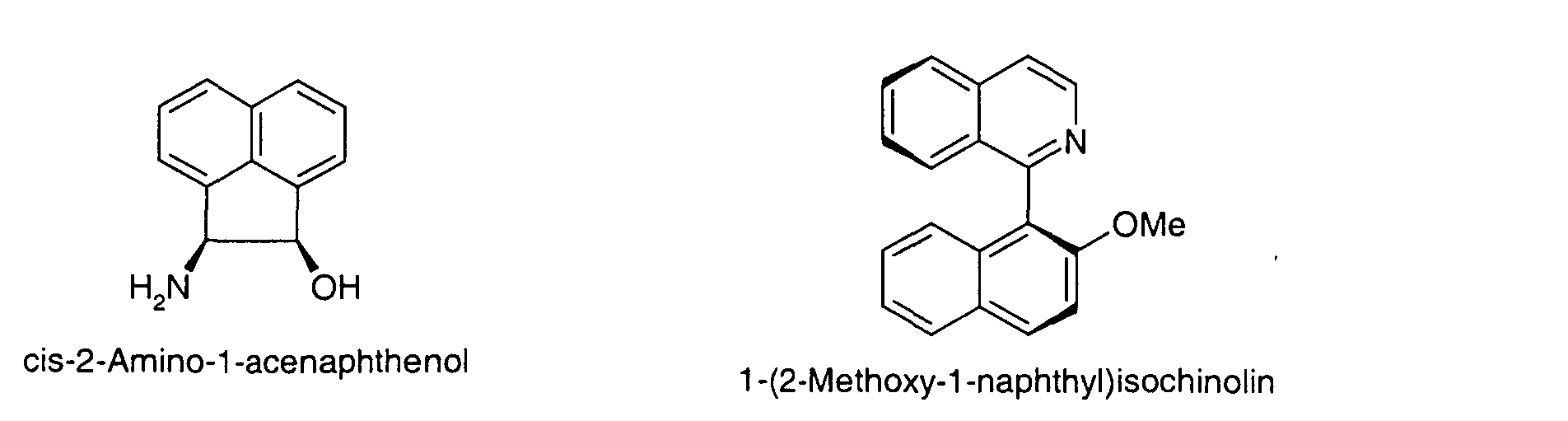
Tetrahedron Lett., 1998, 39, 1741), cis-2-Amino-1-acenaphthenol (A. Sudo, M.
Matsumoto, Y. Hashimoto, K. Saigo, Tetrahedron Asymmetry, 1995, 6 (8), 1853)
und 1-(2-Methoxy-1-naphthyl)isochinolin (G. Chelucci et al., Tetrahedron Lett., 1999,
40, 553).

Ein wichtiger Aspekt dieser Verbindungsklassen wird der Schaffung einer besonders
asymmetrischen Umgebung des Metallzentrums durch diese Ligandsysteme
zugeschrieben. Um eine solche Umgebung für eine effektive Übertragung der
Chiralität zu nutzen, ist es vorteilhaft, die Flexibilität des Ligandsystems als inhärente
Limitierung der asymmetrischen Induktion zu kontrollieren.
Der vorliegenden Erfindung liegt davon ausgehend die Aufgabe zugrunde neuartige,
unsymmetrische, mehrzähnige chirale Stickstoff/Sauerstoff-Liganden (N/O-Liganden),
die sich einfach in ihren sterischen und elektronischen Eigenschaften
einfach über weite Bereiche variieren lassen, bereitzustellen.
Die Aufgabe wird durch eine Klasse unsymmetrischer mehrzähniger N/O-Liganden
der Formeln (I) und (II) gelöst.
Die vorliegende Erfindung betrifft somit Verbindungen der allgemeinen Formeln (I)
und (II),

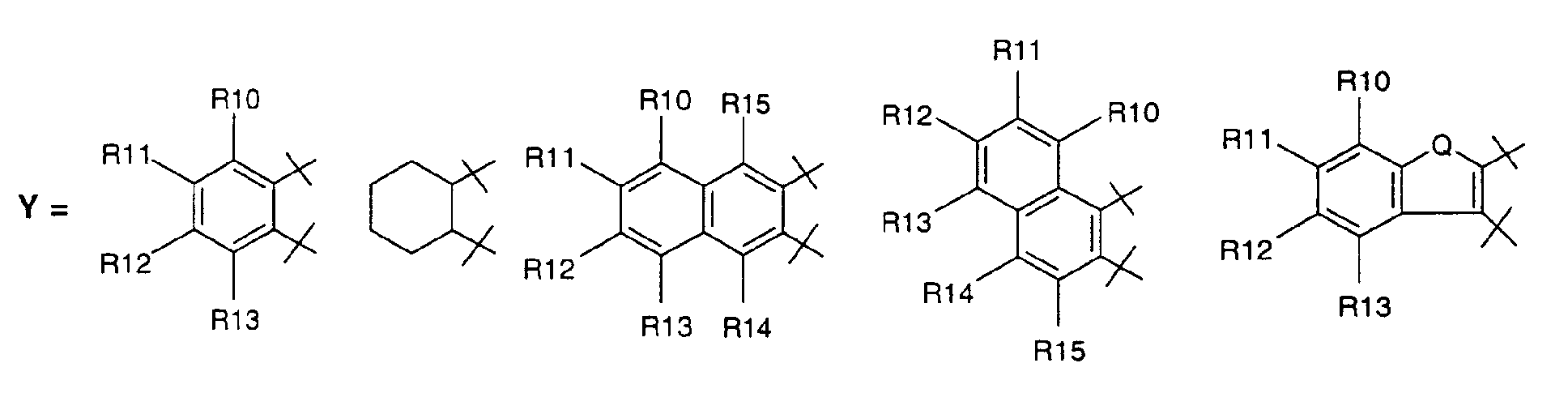 worin n 0 oder 1 sein kann und
- Ar
- Teil eines sechsgliedrigen aromatischen oder 5-6 gliedrigen heteroaromatischen Ringsystems ist, wobei das heteroaromatische Ringsystem entweder 1-3 Stickstoffatome oder 1 Sauerstoffatom oder 1 Schwefelatom an den Positionen A, B, D, E enthalten kann. Der sechsgliedrige Heteroaromat ist vorzugsweise ein Pyridyl-Rest, und der fünfgliedrige Heteroaromat ist vorzugsweise ein Furyl-, Thiophenyl- oder Pyrrolyl-Rest.
- R1-R9
- unabhängig voneinander ein Wasserstoffatom oder C1-C20-Alkyl, C1-C10-Haloalkyl, C3-C8-Cycloalkyl, C5-C8-Cycloalkenyl, wobei der Cyclus auch 1-2 Heteroatome, ausgewählt aus der Gruppe N, O, S, enthalten kann, C6-C14-Aryl, Phenyl, Naphthyl, Fluorenyl, C2-C13-Heteroaryl, wobei die Zahl der Heteroatome, ausgewählt aus der Gruppe N, O, S, 1-4 betragen kann, wobei die cyclischen aliphatischen oder aromatischen Reste bevorzugt 5 bis 7 gliedrige Ringe sind, wobei die vorgenannten Gruppen wiederum ein- oder mehrfach substituiert sein können, wobei diese Substituenten unabhängig voneinander Wasserstoff, C1-C20-Alkyl, C2-C20-Alkenyl, C1-C10 Haloalkyl, C3-C8-Cycloalkyl, C3-C8-Cycloalkenyl, C2-C9-Heteroalkyl, C1-C9-Heteroalkenyl, C6-C8-Aryl, Phenyl, Naphthyl, Fluorenyl, C2-C6 Heteroaryl, wobei die Zahl der Heteroatome, aus der Gruppe N, O, S, 1-4 betragen kann, C1-C10-Alkoxy, C1-C9-Trihalomethylalkyl, Trifluormethyl, Trichlormethyl, Fluoro, Chloro, Bromo, lodo, Cyano, C1-C8-Alkyl oder C6-Aryl darstellt, oder Tri-(C1-C6)-Alkylsilyl sein können, und wobei zwei dieser Substituenten verbrückt sein können, bevorzugt so verbrückt, dass eine 5-7 gliedriger aromatischer oder cyclischaliphatischer Rest vorliegt.
- Z
- kann Wasserstoff, C1-C24-Alkyl, Benzyl, C6-C8-Aryl, Phenyl, Naphthyl, Allyl, oder Vinyl sein,
- X1, X2
- können unabhängig voneinander Wasserstoff, Methyl, Ethyl, Methoxymethyl, Methoxyethyl sein,
- Q
- kann Sauerstoff, Schwefel oder Stickstoff sein,
- R10-R15
- können unabhängig voneinander ein Wasserstoffatom oder C1-C20-Alkyl, C1-C10-Haloalkyl, C3-C8-Cycloalkyl, C5-C8-Cycloalkenyl, wobei der Cyclus auch 1-2 Heteroatome, ausgewählt aus der Gruppe N, O, S, enthalten kann, C6-C14-Aryl, Phenyl, Naphthyl, Fluorenyl, C2-C13-Heteroaryl, wobei die Zahl der Heteroatome, ausgewählt aus der Gruppe N, O, S, 1-4 betragen kann, wobei die cyclischen aliphatischen oder aromatischen Reste bevorzugt 5 bis 7 gliedrige Ringe sind, wobei die vorgenannten Gruppen selbst jeweils ein- oder mehrfach substituiert sein können, diese Substituenten können dabei unabhängig voneinander Wasserstoff, C1-C20-Alkyl, C2-C20-Alkinyl, C2-C20-Alkenyl, C1-C10-Haloalkyl, C3-C8-Cycloalkyl, C3-C8-Cycloalkenyl, C2-C9-Heteroalkyl, C1-C9-Heteroalkenyl, C6-C8-Aryl, Phenyl, Naphthyl, Fluorenyl, C2-C6-Heteroaryl, wobei die Zahl der Heteroatome aus der Gruppe N, O, S 1-4 betragen kann, C1-C10-Alkoxy, C1-C9-Trihalomethylalkyl, Trifluormethyl, Trichlormethyl, Fluoro, Chloro, Bromo, lodo, Cyano, Carboxylato der Formen COOH und COOM' wobei M' entweder ein einwertiges Kation oder C1-C4-Alkyl darstellt, C1-C6-Acyloxy, Sulfinato, C1-C8-Alkyl oder C6-Aryl darstellt, oder Tri-(C1-C6)-Alkylsilyl sein können.
Die Erfindung betrifft ferner Komplexverbindungen, die ein derartiges, chirales
Ligandsystem der Formeln (I) und (II) mit mindestens einem Metall enthalten.
Besonders vorteilhaft ist der modulare Aufbau dieser Ligandensysteme, die eine
große Breite an sterischen und elektronischen Variationen zulassen, die durch
einfach einführbare Modifikationen erhältlich sind. Durch diese Variationsbreite kann
der Ligand jeweils auf ein spezielles Katalyseproblem optimiert werden, um die
Selektivität und Aktivität des Katalysators zu steigern. Ein weiterer Vorteil dieser
Liganden ist, dass sie eine hoch asymmetrische Koordinationsphäre in einem
Metallkomplex schaffen können.
Vorzugsweise weisen die erfindungsgemäßen Liganden unabhängig voneinander
als R1-R15 neben Wasserstoff, Alkyl-, Alkenyl-, Cycloalkyl-, Alkoxy- oder
Trialkylsilyl-Substituenten auf, die bevorzugt bis zu 10, insbesondere bevorzugt bis
zu 6 Kohlenstoffatome besitzen.
Aus der Gruppe der Alkyl- und Alkoxysubstituenten sind Methyl, Ethyl, n-Propyl, 1-Methylethyl,
n-Butyl, 1-Methylpropyl, 1,1-Dimethylethyl, n-Pentyl, 1-Methylbutyl, 2-Methylbutyl,
3-Methylbutyl, 2,2-Dimethylpropyl, 1-Ethylpropyl, n-Hexyl, 1,1-Dimethylpropyl,
1,2-Dimethylpropyl, 1-Methylpentyl, 2-Methylpentyl, 3-Methylpentyl,
4-Methylpentyl, 1,1-Dimethylbutyl, 1,2-Dimethylbutyl, 1,3-Dimethylbutyl, 2,2-Dimethylbutyl,
2,3-Dimethylbutyl, 3,3-Dimethylbutyl, 1-Ethylbutyl, 2-Ethylbutyl, 1,1,2-Trimethylpropyl,
1,2,2-Trimethylpropyl, 1-Ethyl-1 -methylpropyl, n-Heptyl, n-Octyl, n-Nonyl,
n-Decyl, Methoxy, Ethoxy, 1-Propoxy, 2-Propxy, 1-Butoxy, 2-Butoxy, 1,1-Dimethyl-ethoxy
besonders bevorzugt.
Unter den cyclischen Alkylsubstituenten sind besonders bevorzugt substituierte und
unsubstituierte Cyclopentyl-, Cyclohexyl- und Cycloheptyl-Reste.
Als Alkenylreste sind besonders bevorzugte Reste Vinyl, Propenyl, Isopropenyl, 1-Butenyl,
2-Butenyl, 1-Pentenyl, 2-Pentenyl, 2-Methyl-1-butenyl, 2-Methyl-2-butenyl,
3-Methyl-1-butenyl, 1-Hexenyl, 1-Heptenyl, 2-Heptenyl, 1-Octenyl oder 2-Octenyl.
Unter den cyclischen Alkenylsubstituenten sind besonders bevorzugt Cyclopentenyl,
Cyclohexenyl, Cycloheptenyl und Norbornyl.
Unter Arylsubstituenten in R1-R15 sind besonders Phenyl, 2-Methyl-phenyl, 3,5-Dimethyl-phenyl,
4-Methyl-phenyl, 4-Methoxy-phenyl, 3,5-Bis-(trifluormethyl)-phenyl,
4-Trifluormethyl-phenyl, 3,5-Dimethyl-4-Methoxy-phenyl, 4-Dialkyamino, 2-Alkylphenyl,
3-Alkylphenyl, 4-Alkylphenyl, 2,6-Dialkylphenyl, 3,5-Dialkylphenyl, 3,4,5-Trialkylphenyl,
3,5-Bis(trifluormethyl)-phenyl, 4-Trifluormethyl-phenyl, 2-Alkoxyphenyl,
3-Alkoxyphenyl, 4-Alkoxyphenyl, 2,6-Dialkoxylphenyl, 3,5-Dialkoxyphenyl,
3,4,5-Triialkoxyphenyl, 3,5-Dialkyl-4-Alkoxyphenyl bevorzugt, wobei
die vorgenannten Alkyl- und Alkoxygruppen jeweils vorzugsweise 1 bis 6
Kohlenstoffatome enthalten.
Alle Haloalkylgruppen weisen vorzugsweise die allgemeinen Formeln CHal3,
CH2CHal3, C2Hal5 auf, wobei Hal insbesondere für F, Cl und Br stehen kann.
Besonders bevorzugt sind Haloalkylgruppen der Formeln CF3, CH2CF3, C2F5.
Schließlich sind Ligandsysteme der Formeln (I) und (II) als optisch aktive
Ligandsysteme bevorzugt, bei denen ein Enantiomer angereichert ist. Besonders
bevorzugt sind Ligandsysteme, bei denen die Enantiomerenanreicherung 90 %,
insbesondere 98 % übersteigt.
Die erfindungsgemäße Klasse von mehrzähnigen N/O-Liganden besitzt ein einfach
und vielseitig modifizierbares chirales Liganden-Grundgerüst, das sich in Bezug auf
seine sterischen und elektronischen Eigenschaften durch einen modularen Aufbau
und die leichte Einführbarkeit unterschiedlichster Substituenten sehr breit variieren
läßt. N/O-Liganden der Formeln (I) und (II) sind in der Lage in Metallorganischen
Komplexen am Metallzentrum eine hochasymmetrische Koordinationssphäre zu
schaffen und somit eine effektive asymmetrische Induktion zu ermöglichen.
Zusätzlich kann über die einfache Einführbarkeit unterschiedlichster Substituenten in
die N/O-Liganden die Flexibilität der Koordinationssphäre des Komplexes sterisch
kontolliert werden.
Damit kann für Verbindungen der Formel (I) und (II) ein breites Spektrum von Anwendungen erschlossen werden, da die mehrzähnigen N/O-Liganden sterisch und elektronisch, je nach katalystischem Syntheseverfahren durch die Einführung geeigneter Substituenten optimierbar sind.
Damit kann für Verbindungen der Formel (I) und (II) ein breites Spektrum von Anwendungen erschlossen werden, da die mehrzähnigen N/O-Liganden sterisch und elektronisch, je nach katalystischem Syntheseverfahren durch die Einführung geeigneter Substituenten optimierbar sind.
Gleichzeitig zeichnen sich die erfindungsgemäßen Verbindungen im Gegensatz zu
vielen etablierten Ligandsystemen durch eine besonders einfache synthetische
Zugänglichkeit in großer Variationsbreite ausgehend von kommerziell erhältlichen
Edukten aus. Dies macht die Liganden der vorliegenden Erfindung leicht zugänglich
und somit industriell herstellbar.
Die Auswahl eines entsprechenden Darstellungsverfahrens ist abhängig von der
Verfügbarkeit der entsprechenden Edukte und vom gewünschten
Substitutionsmuster. Nachfolgend sollen erfindungsgemäße Syntheseverfahren
anhand von einfachen Beispielen beschrieben werden, ohne es darauf zu
beschränken.
Erfindungsgemäße N/O-Liganden lassen sich wie folgt herstellen:
Ausgehend von einem Binaphthol-Derivat kann in einem geeigneten Lösungsmittel
unter Zugabe vom Base und Sulfonierungsreagenz zunächst ein
Kupplungsintermediat hergestellt werden, das in einer übergangsmetallkatalysierten
Kupplungsreaktion mit einem anderen Kupplungsintermediat verknüpft wird. Eine
ortho-Metallierung gefolgt von einer Carbonylierungsreaktion liefert die
entsprechende Carbonylzwischenstufe, die im folgenden mit einer Aminkomponente
zum erfindungsgemäßen Imin (I) oder durch direkte reduktive Aminierung zum Amin
(II) umgesetzt wird. Das Amin (II) ist auch durch Reduktion des entsprechenden
Imins (I) zugänglich.
Die eben dargestellten Verfahren werden im folgenden anhand bevorzugter
Ausführungsbeispiele näher erläutert.
Das 2-Aryl-2'-hydroxy-1,1'-binaphthyl wird in zwei Stufen analog der Vorschrift (H.
Sasaki, R. Irie, T. Hamada, K. Suzuki und T. Katsuki Tetrahedron 1994, 50(41),
11827-38) hergestellt.
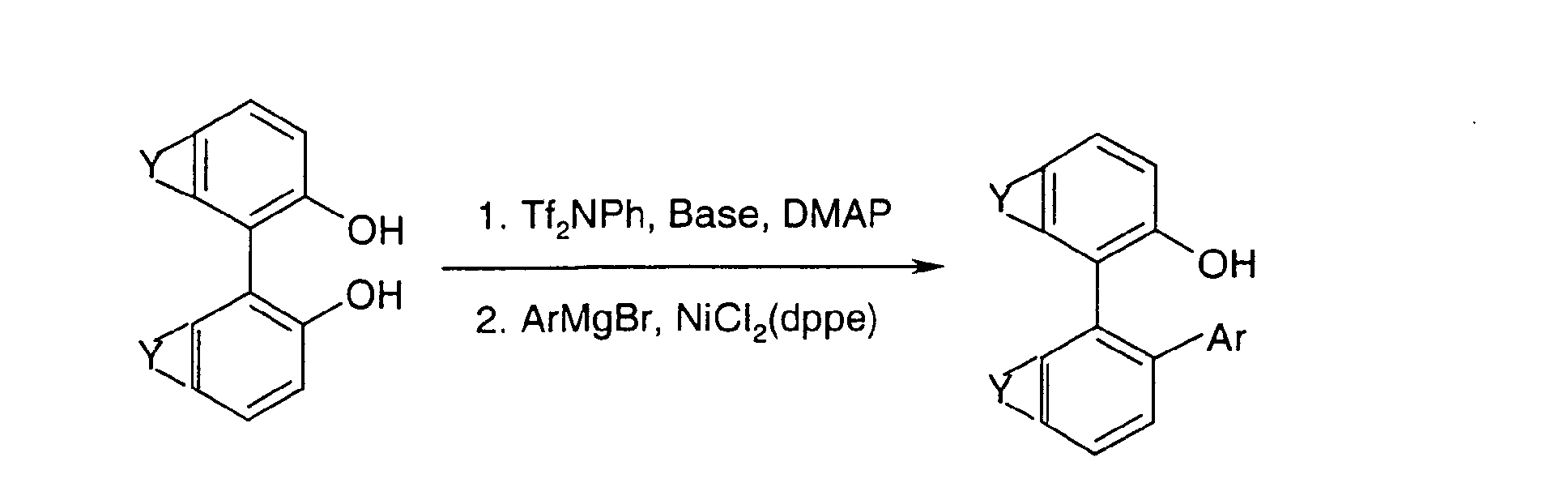
Alternativ ist die Verbindung auch (nach B. Schilling und D. E. Kaufmann, Eur. J.
Org. Chem. 1998, 4, 701-9) über eine Suzuki-Kupplung zugänglich.
Die Carbonylgruppe wird bevorzugt über eine ortho-Metallierung eingeführt. Dazu
wird zunächst die Hydroxygruppe in eine ortho-dirigierende Gruppe überführt, mit
einer Lithiumbase lithiiert und mit Dimethylformamid carbonyliert. Nach Abspaltung
der ortho-dirigierenden Gruppe liegt ein β-Hydroxy-aldehyd vor.

Der Aldehyd kann in großer Variationsbreite mit verschiedenen aromatischen 2-Hydroxy-aminen
zu den erfindungsgemäßen Iminen (I) umgesetzt werden.
Die Amine (II) können entweder direkt durch reduktive Aminierung aus den β-Hydroxy-aldehyden
oder durch Reduktion der Imine (I) erhalten werden.

Somit ist ein weiterer Gegenstand der vorliegenden Erfindung ein Verfahren zur
Herstellung von Liganden der Formel (I) und (II) umfassend folgende
Verfahrensschritte:

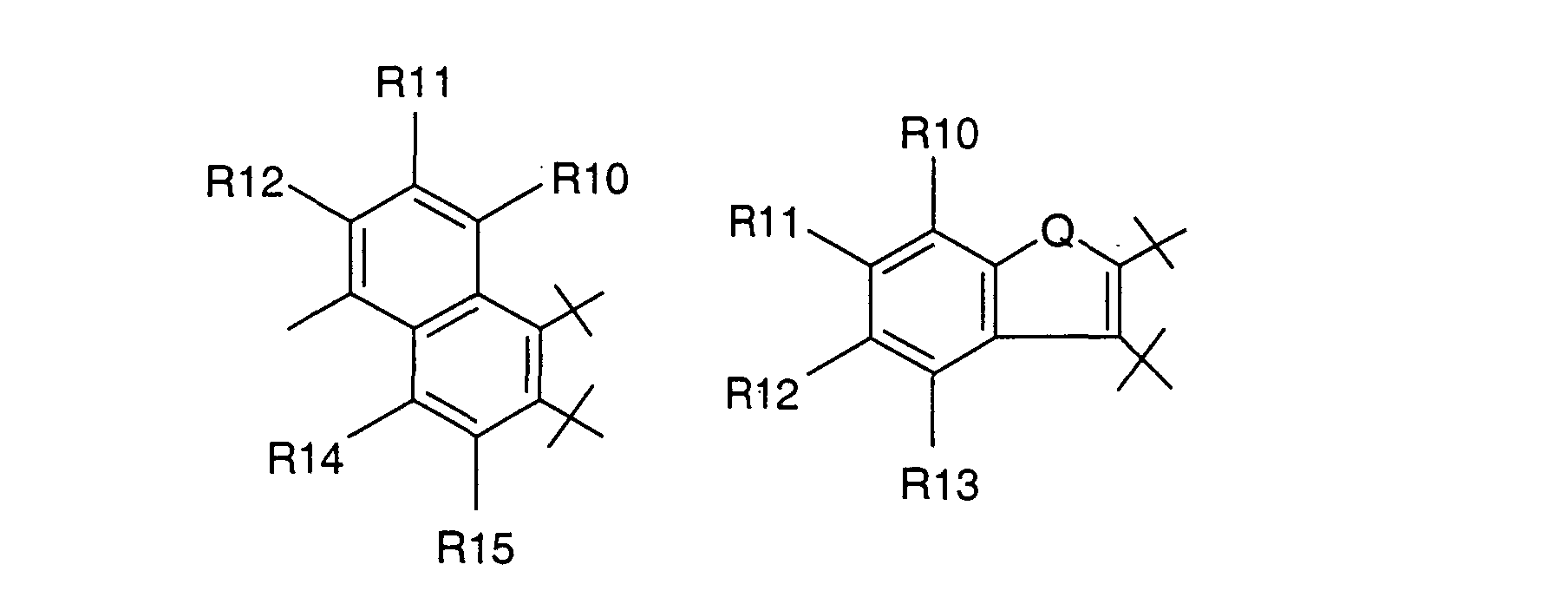

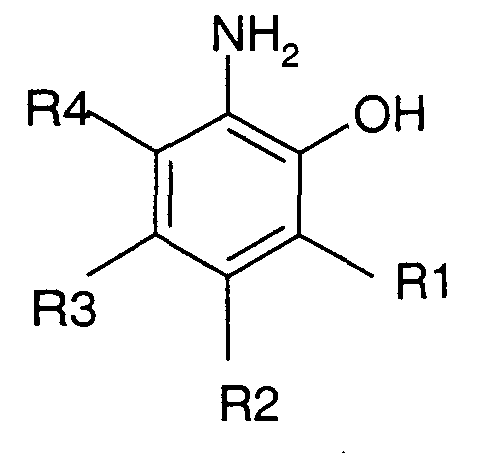
Die Verbindungen der allgemeinen Formeln (I) und (II) können als Liganden an
Metallen in Metall-katalysierten Reaktionen (wie z.B. der Reduktion mit anorg.
Hydriden, Transferhydrierungen, Hydrosilylierung, Epoxidöffnungen,
Epoxidierungen, allylische Oxidationen, Bayer-Villinger Oxidationen, Oxidation von
Sulfiden, Cyclopropanierungen, Diels-Alder Reaktionen, Michael-Additionen,
Cyanhydrinreaktionen, Strecker und streckerartige Reaktionen, En-Reaktionen,
[3+2] Cycloadditionen, Grignard Reaktionen, Addition von Zinkorganylen an
Carbonylverbindungen oder Aldol Reaktionen) eingesetzt werden. Sie sind
insbesondere für asymmetrische Reaktionen gut geeignet. Insbesondere erweist es
sich hier als vorteilhaft, daß sich die Liganden der allgemeinen Formeln (I) und (II)
durch ihre einfache, breite Abwandelbarkeit sterisch und elektronisch sehr gut auf
das jeweilige Substrat und die katalytische Reaktion abstimmen lassen.
Die erfindungsgemäßen Komplexverbindungen enthalten mindestens ein Metallatom
oder -ion, insbesondere aus Aluminium, Zink, Magnesium, Titan, Zirkonium, Eisen,
Nickel, Cobalt, Chrom, Bor, Kupfer, Platin, Palladium, Osmium, Iridium, Scandium,
Cer, Zinn, Mangan, Rhodium oder Ruthenium.
Bevorzugt sind Komplexverbindungen mit weniger als vier Metallzentren, besonders
bevorzugt sind solche mit ein oder zwei Metallzentren. Die Metallzentren können
dabei mit verschiedenen Metallatomen und/oder -ionen besetzt sein.
Die Herstellung dieser Metall-Ligand-Komplexverbindungen kann in situ durch
Reaktion einer Metallverbindung bzw. eins Metallsalzes oder eines entsprechenden
Vorkomplexes mit den Liganden der allgemeinen Formeln (I) und (II) erfolgen.
Darüber hinaus kann eine Metall-Ligand-Komplexverbindung durch Reaktion einer
Metallverbindung bzw. eines Metallsalzes oder eines entsprechenden
Vorkomplexes mit den Liganden der allgemeinen Formeln (I) und (II) und
anschließende Isolierung gewonnen werden.
Die Komplexverbindungen auf Basis von einem oder mehreren Metallen, bevorzugt
aus metallischen Elementen aus der Gruppe Ru, Co, Rh, Ir, Ni, Pd, Pt, Cu, Al, Zn,
Mn, Fe, Sc, Ti, Zr, Sn, B, Os, Ce und mindestens einem erfindungsgemäßen
Liganden der Formel (I) oder (II) können bereits als Katalysator verwendet werden.
Die Komplexverbindungen können aber auch selbst als Edukt zur Herstellung
abgewandelter Katalysatoren genutzt werden.
Im folgenden werden einige Ausführungsbeispiele die Erfindung betreffend
gegeben:
Allgemeines
Allgemeines
Reaktionen luftempfindlicher Verbindungen wurden in einer argongefüllten Glove-Box
oder in Standard Schlenkrohren durchgeführt. Lösungsmittel Tetrahydrofuran
(THF), Diethylether und Dichlormethan wurden entgast und mittels einer
Lösungsmitteltrocknungsanlage (Innovative Technologies) durch Filtration durch
eine mit aktiviertem Aluminiumoxid gefüllte Säule absolutiert, Toluol und Pentan
wurden zusätzlich durch eine mit einem Kupferkatalysator gefüllte Säule von
Sauerstoff befreit.
Die folgenden Beispiele dienen zur Erläuterung der Erfindung. Sie sollen in keiner
Weise eine Beschränkung darstellen.
Unter Argon werden zu einer Lösung aus 3.817 g (13.33 mmol) (R)-2,2'-Dihydroxy-1,1'-binaphthyl
in 50 ml absolutem Dichlormethan 1.631 ml (14 mmol) Lutidin und
170.9 mg (1.4 mmol) DMAP gegeben. Es wird auf 0°C gekühlt und mit 5.00 g (14
mmol) N,N-Bis-trifluormethansulfonyl-anilin versetzt. Nach beendeter Zugabe wird
langsam auf Raumtemperatur erwärmt und nach 3 Tagen zur Trockene eingeengt.
Die Reinigung erfolgt flashsäulenchromatographisch an Kieselgel, Laufmittel: Toluol.
Das Rohprodukt wird ohne weitere Charakterisierung weiter umgesetzt.
Ausbeute: 7.12 g (Rohprodukt)
Ausbeute: 7.12 g (Rohprodukt)
Unter Argon werden zu einer Lösung aus 7.12 g (R)-2-Hydroxy-2'-trifluormethansulfonyl-1,1
'-binaphthyl in 80 ml absolutem Diethylether 138.2 mg
(0.26 mmol) Nickel(II)chlorid(dppe) und 17.4 ml (52.12 mmol)
Phenylmagnesiumbromid (3molare Lösung in Dichlormethan) gegeben. Es wird 1 h
unter Rückfluß und über Nacht bei Raumtemperatur gerührt und durch Zugabe von
gesättigter Ammoniumchlorid-Lösung abgebrochen. Es wird mit Diethylether
extrahiert, die organischen Phasen mit Natriumhydrogencarbonat-Lösung und mit
Wasser gewaschen, über Magnesiumsulfat getrocknet, filtriert und in Vakuum
eingeengt. Die Reinigung erfolgt flashsäulenchromatographisch an Kieselgel,
Laufmittel: iso-Hexan/Ethylacetat (10:1).
Ausbeute: 4.51 g (braunes Öl)
1H-NMR (CDCl3):
δ = 8.00 - 6.90 (m, 17H, Aromat), 5.10 (s, 1H, OH)
Ausbeute: 4.51 g (braunes Öl)
1H-NMR (CDCl3):
δ = 8.00 - 6.90 (m, 17H, Aromat), 5.10 (s, 1H, OH)
Unter Argon werden zu einer Lösung aus 4.51 g (R)-2-Hydroxy-2'-phenyl-1,1'-binaphthyl
in 60 ml absolutem Dichlormethan 7.67 ml (43.44 mmol) N,N-Diisopropylethylamin
und 3.33 ml (43.44 mmol) Chlormethylmethylether gegeben. Nach 24 h
wird die Reaktion durch Zugabe von 10 ml Wasser abgebrochen. Es wird mit
Dichlormethan extrahiert, die organischen Phasen mit Wasser gewaschen und über
Magnesiumsulfat getrocknet. Es wird filtriert und im Vakuum eingeengt.
Das Produkt wird ohne weitere Reinigung weiter umgesetzt.
Das Produkt wird ohne weitere Reinigung weiter umgesetzt.
Unter Argon werden bei -78°C zu einer Lösung aus 13.03 mmol (R)-2-Methoxy-2'-phenyl-1,1
'-binaphthyl in 55 ml absolutem Tetrahydrofuran 17.92 ml (26.06 mmol) n-Buthyllithium
(1.6 molare Lösung in Hexan) gegeben. Nach 3 h wird das
Reaktionsgemisch mit 5.07 ml (65.15 mmol) Dimethylformamid versetzt und über
Nacht auftauend gerührt. Die Reaktion wird durch Zugabe von Ammoniumchlorid-Lösung
abgebrochen und mit Dichlormethan extrahiert. Die organischen Phasen
werden mit Natriumhydrogencarbonat- Lösung und mit Wasser gewaschen, über
Magnesiumsulfat getrocknet, filtriert und im Vakuum eingeengt.
Das Produkt wird ohne weitere Reinigung weiter umgesetzt.
Das Produkt wird ohne weitere Reinigung weiter umgesetzt.
Unter Argon werden zu einer Lösung des Rohproduktes aus Beispiel 4 in 50 ml
absolutem Dichlormethan 2.0 g Molekularsieb 4Å und 6.87 ml (4 Äq., 52.82 mmol)
Bromtrimethylsilan gegeben. Nach 3 h wird das Reaktionsgemisch mit gesättigter
Natriumhydrogencarbonat-Lösung unter Schaumbildung versetzt und mit
Dichlormethan extrahiert. Die organischen Phasen werden über Magnesiumsulfat
getrocknet, filtriert und im Vakuum eingeengt.
Die Reinigung erfolgt flashsäulenchromatographisch an Kieselgel, Laufmittel: iso-Hexan/Toluol (3:7). Zweite Säule: Kieselgel, Laufmittel iso-Hexan/Ethylacetat (10:1). Beim einengen kristallisiert die Verbindung in Form gelber Kristalle.
Ausbeute: 718 mg gelbe Kristalle (2.07 mmol, 15.9 % über 5 Stufen)
1H-NMR (CDCl3):
δ = 10.40 (s, 1H, CHO), 10.10 (s, 1H, OH), 8.20 - 6.90 (m, 16 H, Aromat)
Die Reinigung erfolgt flashsäulenchromatographisch an Kieselgel, Laufmittel: iso-Hexan/Toluol (3:7). Zweite Säule: Kieselgel, Laufmittel iso-Hexan/Ethylacetat (10:1). Beim einengen kristallisiert die Verbindung in Form gelber Kristalle.
Ausbeute: 718 mg gelbe Kristalle (2.07 mmol, 15.9 % über 5 Stufen)
1H-NMR (CDCl3):
δ = 10.40 (s, 1H, CHO), 10.10 (s, 1H, OH), 8.20 - 6.90 (m, 16 H, Aromat)
Unter Argon werden zu 500 mg ausgeheiztem Molekularsieb 187 mg (0.5 mmol) (R)-3-Formyl-2-hydroxy-2'-phenyl-1,1'-binaphthyl
in 6 ml absolutem Dichlormethan
gegeben und mit 57.3 mg (0.525 mmol) 2-Hydroxyanilin versetzt. Nach 5 Tagen wird
über ausgeheizte Cellulose filtriert, mit 2 ml absolutem Dichlormethan eluiert und
das Lösungsmittel unter Vakuum entfernt.
Ausbeute: hellbrauner Feststoff (quantitativ)
1H-NMR (abs. CD2Cl2):
δ = 12.26 (s, 1 H, OH), 8.71 (s, 1H, Imin-H), 8.05 - 6.83 (m, 20 H, Aromat)
13C-NMR (abs. CD2Cl2) 162.16 (Imin-C)
Ausbeute: hellbrauner Feststoff (quantitativ)
1H-NMR (abs. CD2Cl2):
δ = 12.26 (s, 1 H, OH), 8.71 (s, 1H, Imin-H), 8.05 - 6.83 (m, 20 H, Aromat)
13C-NMR (abs. CD2Cl2) 162.16 (Imin-C)
Unter Argon werden 0.021 mmol (R)-3-[(2-Hydroxy-phenylimino)-methyl]-2-hydroxy-2'-phenyl-1,1'-binaphthyl
in 10 ml abs. Toluol gelöst. Zu dieser Lösung werden bei
R.T. 115µl Benzaldehyd gegeben und anschließend 20 min gerührt. Die Lösung wird
danach auf -30°C abgekühlt und tropfenweise mit 1.5 ml 1M Diethylzink-Lösung
versetzt. Die Lösung wird über 60 min auf -5°C erwärmt und weitere 24h bei dieser
Temperatur gerührt. Die Reaktionslösung wird mit 10 ml 1M Salzsäure hydrolysiert
und die wäßrige Phase dreimal mit je 20 ml Dichlormethan extrahiert. Nach dem
Trocknen der organischen Phasen wird das Lösungsmittel entfernt und das
Rohprodukt mittels Chromatographie gereinigt. Der Enantiomerenüberschuß wird
mit Hilfe chiraler HPLC (Chiralcel OD) bestimmt.
| Ausbeute: | 85% |
| ee: | 70% |
Unter Argon werden 0.03 mmol (R)-3-[(2-Hydroxy-phenylimino)-methyl]-2-hydroxy-2'-phenyl-1,1
'-binaphthyl und 0.025 mmol Kupfer(II)triflat in 5ml abs. Acetonitril
gelöst und 1h bei R.T. gerührt. Anschließend wird die Lösung auf -30°C abgekühlt.
Zu dieser Lösung werden 100mg 2-Cyclohexenon und 2.2ml 1M Diethylzink-Lösung
gegeben. Die Reaktionslösung wird 24h bei -30°C gerührt, anschließend auf R.T
erwärmt, mit 10 ml Diethylether verdünnt und mit 10ml Ammoniumchlorid-Lösung
hydrolysiert. Die wäßrige Phase wird dreimal mit 25ml Diethylether extrahiert. Nach
dem Trocknen wird das Lösungsmittel entfernt und das Rohprodukt mittels
Chromatographie gereinigt. Der Enantiomerenüberschuß wird mit Hilfe chiraler
Gaschromatographie (Lipodex A) bestimmt.
| Ausbeute: | 79% |
| ee: | 57% |
Claims (14)
- Chiraler, unsymmetrischer, mehrzähniger Stickstoff/Sauerstoff-Liganden der Formeln (I) und (II)
 worin n 0 oder 1 sein kann und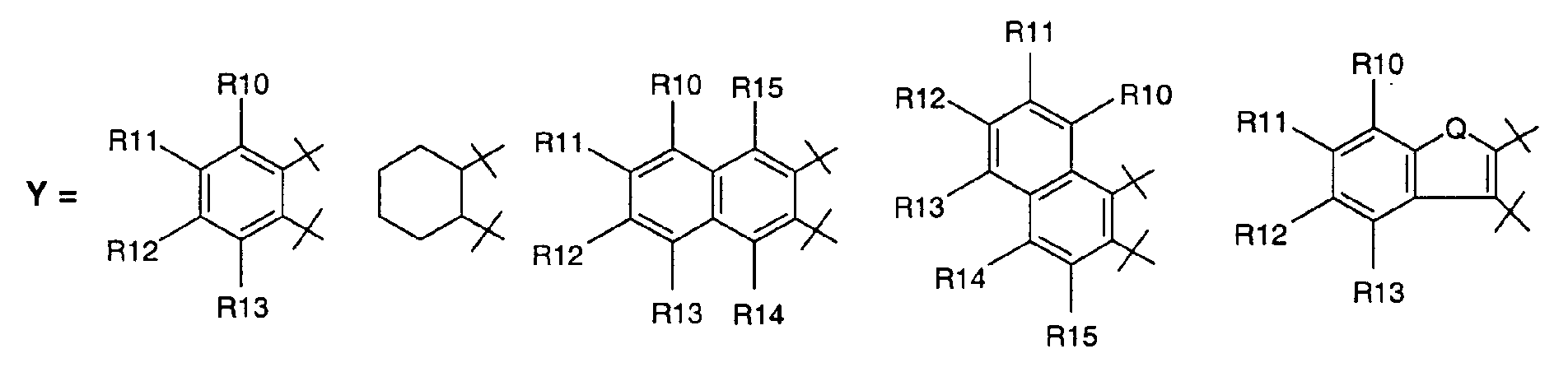
- Ar
- Teil eines sechsgliedrigen aromatischen oder 5- bis 6-gliedrigen heteroaromatischen Ringsystems ist, wobei das heteroaromatische Ringsystem entweder 1-3 Stickstoffatome oder 1 Sauerstoffatom oder 1 Schwefelatom in den Positionen A, B, D, E enthalten kann und
- R1-R9
- unabhängig voneinander ein Wasserstoffatom oder C1-C20-Alkyl, C1-C10-Haloalkyl,
C3-C8-Cycloalkyl, C5-C8-Cycloalkenyl, wobei der Cyclus
auch 1-2 Heteroatome, ausgewählt aus der Gruppe N, O, S, enthalten
kann, C6-C14-Aryl, Phenyl, Naphthyl, Fluorenyl, C2-C13-Heteroaryl,
wobei die Zahl der Heteroatome, ausgewählt aus der Gruppe N, O, S,
1-4 betragen kann und
wobei die vorgenannten Gruppen wiederum ein- oder mehrfach substituiert sein können, wobei diese Substituenten unabhängig voneinander Wasserstoff, C1-C20-Alkyl, C2-C20-Alkenyl, C1-C10-Haloalkyl, C3-C8-Cycloalkyl, C3-C8-Cycloalkenyl, C2-C9-Heteroalkyl, C1-C9-Heteroalkenyl, C6-C8-Aryl, Phenyl, Naphthyl, Fluorenyl, C2-C6 Heteroaryl, wobei die Zahl der Heteroatome, aus der Gruppe N, O, S, 1-4 betragen kann, C1-C10-Alkoxy, C1-C9-Trihalomethylalkyl, Trifluormethyl, Trichlormethyl, Fluoro, Chloro, Bromo, lodo, Cyano, C1-C8-Alkyl oder C6-Aryl darstellt, oder Tri-(C1-C6)-Alkylsilyl sein können, und wobei zwei dieser Substituenten auch verbrückt sein können und worin - Z
- Wasserstoff, C1-C24 Alkyl, Benzyl, C6-C8Aryl, Phenyl, Naphthyl, Allyl, oder Vinyl sein kann und
- X1, X2
- unabhängig voneinander Wasserstoff, Methyl, Ethyl, Methoxymethyl, Methoxyethyl sein können und
- Q
- Sauerstoff, Schwefel oder Stickstoff sein kann und worin
- R10-R15
- unabhängig voneinander ein Wasserstoffatom oder C1-C20-Alkyl, C1-C10-Haloalkyl,
C3-C8-Cycloalkyl, C5-C8-Cycloalkenyl, wobei der Cyclus
auch 1-2 Heteroatome, ausgewählt aus der Gruppe N, O, S, enthalten
kann, C6-C14-Aryl, Phenyl, Naphthyl, Fluorenyl, C2-C13-Heteroaryl,
wobei die Zahl der Heteroatome, ausgewählt aus der Gruppe N, O, S, 1-4 betragen kann, sein können,
wobei die vorgenannten Gruppen selbst jeweils ein- oder mehrfach substituiert sein können, wobei diese Substituenten unabhängig voneinander Wasserstoff, C1-C20-Alkyl, C2-C20-Alkinyl, C2-C20-Alkenyl, C1-C10-Haloalkyl, C3-C8-Cycloalkyl, C3-C8-Cycloalkenyl, C2-C9-Heteroalkyl, C1-C9-Heteroalkenyl, C6-C8-Aryl, Phenyl, Naphthyl, Fluorenyl, C2-C6-Heteroaryl, wobei die Zahl der Heteroatome aus der Gruppe N, O, S 1-4 betragen kann, C1-C10-Alkoxy, C1-C9-Trihalomethylalkyl, Trifluormethyl, Trichlormethyl, Fluoro, Chloro, Bromo, lodo, Cyano, Carboxylato der Formen COOH und COOM' wobei M' entweder ein einwertiges Kation oder C1-C4-Alkyl darstellt, C1-C6-Acyloxy, Sulfinato, C1-C8-Alkyl oder C6-Aryl darstellt, oder Tri-(C1-C6)-Alkylsilyl sein können.
- Verbindung nach Anspruch 1, dadurch gekennzeichnet ist, dass X1 und X2 Wasserstoff sind.
- Verbindung nach Anspruch 1 oder 2, dadurch gekennzeichnet, dass Ar ein Pyridyl-, Furyl-, Thiophenyl- oder Pyrrolyl-Rest ist.
- Verbindungen nach einem der Ansprüche 1 bis 3, dadurch gekennzeichnet, dass die Verbindungen (I) und (II) enantiomerenangereichert sind.
- Verbindungen nach einem der Ansprüche 1 bis 4, dadurch gekennzeichnet sind, dass die Enantiomerenanreicherung 90% übersteigt.
- Verbindungen nach einem der Ansprüche 1 bis 5, dadurch gekennzeichnet, dass die Enantiomerenanreicherung 98% übersteigt.
- Komplexverbindungen enthaltend mindestens einen Liganden nach Anspruch 1 und mindestens ein Metallatom oder -ion.
- Komplexverbindung erhältlich durch Umsetzung mindestens eines Metalls, eines Metallsalzes oder eines Metallvorkomplexes mit mindestens einem Liganden gemäß Anspruch 1.
- Komplexverbindung nach Anspruch 7 oder 8, dadurch gekennzeichnet, dass die Verbindungen Aluminium, Zink, Magnesium, Titan, Zirkonium, Eisen, Nickel, Cobalt, Chrom, Bor, Kupfer, Platin, Palladium, Osmium, Iridium, Scandium, Cer, Zinn, Mangan, Rhodium, Ruthenium oder eine Mischung dieser Metalle enthält.
- Verwendung einer Komplexverbindung nach einem der Ansprüche 7 bis 9 als Katalysator für asymmetrische Reaktionen.
- Verwendung einer Komplexverbindung nach einem der Ansprüche 7 bis 9 als Katalysator für asymmetrische Transferhydrierungen, Reduktionen mit anorganischen Hydriden, Hydrosilylierungen, Epoxidöffnungen, Epoxidierungen, allylische Oxidationen, Bayer-Villinger Oxidationen, Oxidation von Sulfiden, Cyclopropanierungen, Diels-Alder Reaktionen, Michael-Additionen, Cyanhydrinreaktionen, Strecker und streckerartige Reaktionen, En-Reaktionen, [3+2] Cycloadditionen, Grignard Reaktionen, Addition von Zinkorganylen an Carbonylverbindungen oder Aldol-Reaktionen.
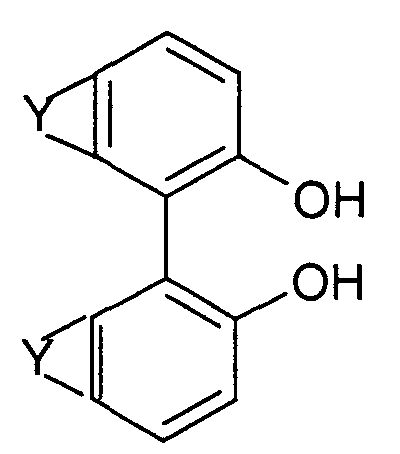
- Verfahren zur Herstellung von Verbindungen gemäß Anspruch 1 umfassend folgende Verfahrensschritte:a) Sulfonierung eines 2,2'-Dihydroxy-1,1'-biaromaten der Formel

 in Anwesenheit einer Base,
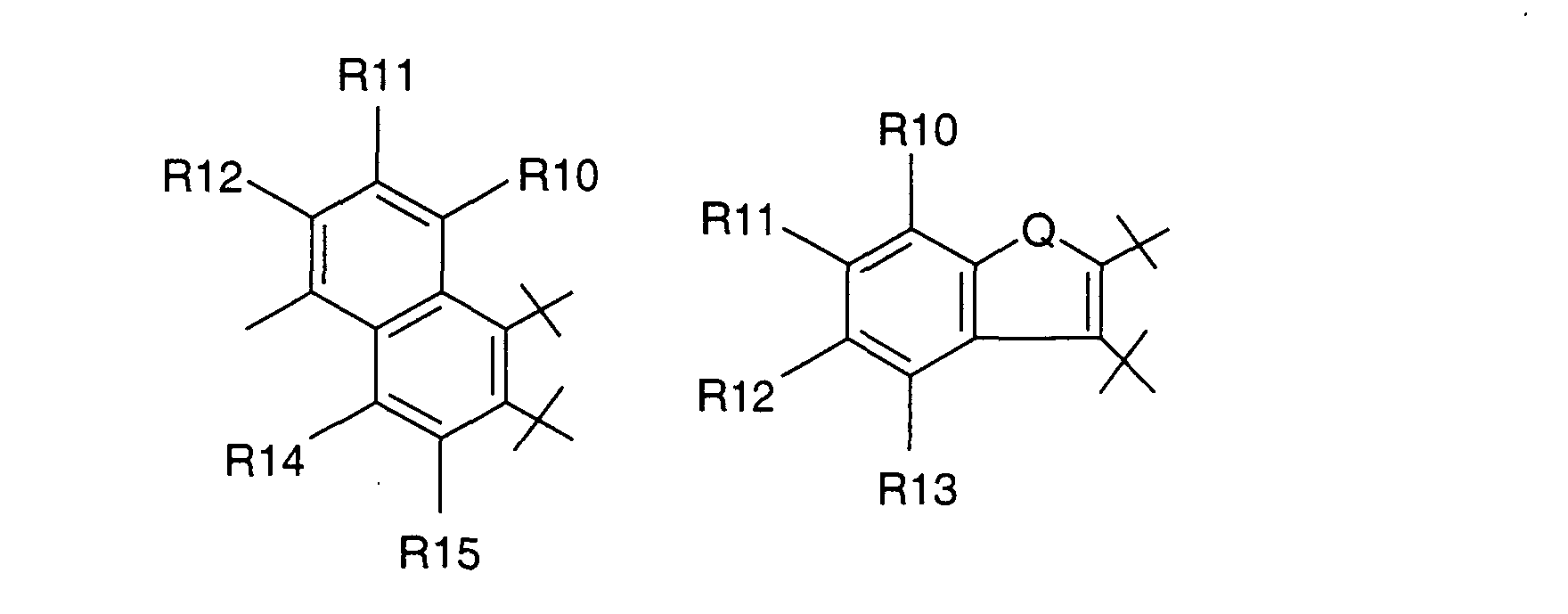 b) Kupplung des unter a) erhaltenen sulfonierten Produktes mit einer ArMgBr-Verbindung mitin Gegenwart eines Übergangsmetall-Katalysators,
 c) Schützung der freien Hydroxygruppen,d) Carbonylierung des unter c) erhaltenen Produktes in ortho-Stellung zur geschützen Hydroxygruppe,e) Entschützung der Hydroxyfunktion und Umsetzung des carbonylierten Produktes aus d) mit einem aromatischen Amin der Formel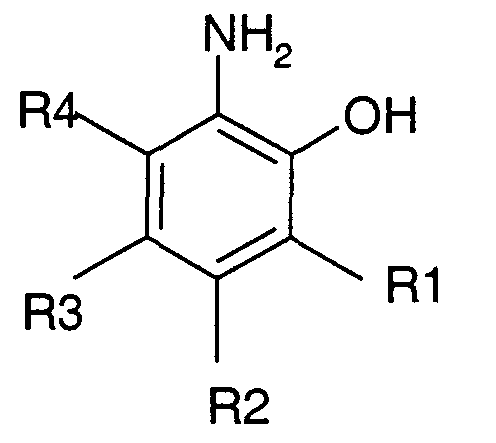
- Verfahren nach Anspruch 12, dadurch gekennzeichnet, dass die Umsetzung in Schritt e) eine reduktive Aminierung ist.
- Verfahren nach Anspruch 12, dadurch gekennzeichnet, dass die Umsetzung in Schritt e) eine Aminierung mit anschließender Reduktion ist.
Applications Claiming Priority (2)
| Application Number | Priority Date | Filing Date | Title |
|---|---|---|---|
| DE10122539 | 2001-05-09 | ||
| DE10122539A DE10122539A1 (de) | 2001-05-09 | 2001-05-09 | Mehrzähnige unsymmetrische Liganden auf Binaphthylbasis |
Publications (1)
| Publication Number | Publication Date |
|---|---|
| EP1256570A1 true EP1256570A1 (de) | 2002-11-13 |
Family
ID=7684166
Family Applications (1)
| Application Number | Title | Priority Date | Filing Date |
|---|---|---|---|
| EP02008062A Withdrawn EP1256570A1 (de) | 2001-05-09 | 2002-04-11 | Mehrzähnige unsymmetrische Liganden auf Binaphthylbasis |
Country Status (4)
| Country | Link |
|---|---|
| US (1) | US20020188123A1 (de) |
| EP (1) | EP1256570A1 (de) |
| JP (1) | JP2003034675A (de) |
| DE (1) | DE10122539A1 (de) |
Families Citing this family (1)
| Publication number | Priority date | Publication date | Assignee | Title |
|---|---|---|---|---|
| CN121091160B (zh) * | 2025-11-10 | 2026-02-13 | 国网四川省电力公司电力科学研究院 | 一种芳基醚类化合物作为变压器故障诊断剂的应用 |
Citations (1)
| Publication number | Priority date | Publication date | Assignee | Title |
|---|---|---|---|---|
| US5599963A (en) * | 1994-09-21 | 1997-02-04 | California Institute Of Technology | Catalysts for production of β-hydroxy carbonyl compounds |
-
2001
- 2001-05-09 DE DE10122539A patent/DE10122539A1/de not_active Withdrawn
-
2002
- 2002-04-11 EP EP02008062A patent/EP1256570A1/de not_active Withdrawn
- 2002-05-02 US US10/136,323 patent/US20020188123A1/en not_active Abandoned
- 2002-05-08 JP JP2002133206A patent/JP2003034675A/ja active Pending
Patent Citations (1)
| Publication number | Priority date | Publication date | Assignee | Title |
|---|---|---|---|---|
| US5599963A (en) * | 1994-09-21 | 1997-02-04 | California Institute Of Technology | Catalysts for production of β-hydroxy carbonyl compounds |
Non-Patent Citations (2)
| Title |
|---|
| CHELUCCI G ET AL: "Enantiomerically pure 1-(2-methoxy-1-naphthyl) and 1-(2-methylthio-1-naphthyl)isoquinoline: two new axially chiral N-O and N-S ligands for asymmetric catalysis", TETRAHEDRON LETTERS, ELSEVIER SCIENCE PUBLISHERS, AMSTERDAM, NL, vol. 40, no. 3, 15 January 1999 (1999-01-15), pages 553 - 556, XP004151382, ISSN: 0040-4039 * |
| VETTER A H ET AL: "Schiff-Base Ligands Carrying Two Elements of Chirality: Matched-Mismatched Effects in the Vanadium-Catalyzed Sulfoxidation of Thioethers with Hydrogen Peroxide", TETRAHEDRON LETTERS, ELSEVIER SCIENCE PUBLISHERS, AMSTERDAM, NL, vol. 39, no. 13, 26 March 1998 (1998-03-26), pages 1741 - 1744, XP004108464, ISSN: 0040-4039 * |
Also Published As
| Publication number | Publication date |
|---|---|
| DE10122539A1 (de) | 2002-11-14 |
| US20020188123A1 (en) | 2002-12-12 |
| JP2003034675A (ja) | 2003-02-07 |
Similar Documents
| Publication | Publication Date | Title |
|---|---|---|
| EP0398132B1 (de) | Phosphorverbindungen | |
| DE69512415T2 (de) | Heteroaromatische diphospine als chirale liganden | |
| DE69511740T2 (de) | Wasserlösliche Phosphin-Derivate | |
| DE69114986T2 (de) | Eine Phosphino-Binapthyl-Verbindung und Übergangsmetall-Komplexe davon. | |
| EP1507783B1 (de) | Hydroxydiphosphine und deren verwendung in der katalyse | |
| EP0579797B1 (de) | Diphosphinliganden | |
| WO1993015089A1 (de) | Diphosphinliganden | |
| EP0530336A1 (de) | Chirale phosphine. | |
| EP0218970B1 (de) | Chirale Rhodium-diphosphinkomplexe für asymmetrische Hydrierungen | |
| EP1175426B1 (de) | Bidentate organophosphorliganden und ihre verwendung | |
| DE602005003572T2 (de) | Ferrocenylliganden für homogene, enantioselektive hydrierungskatalysatoren | |
| DE60102587T2 (de) | Chirale ligande für asymmetrische katalysatoren | |
| US7081533B2 (en) | Cycloaliphatic/aromatic diphosphines and use thereof in catalysis | |
| EP1483276B1 (de) | Ferrocenylliganden und ihre verwendung in der katalyse | |
| DE19936473A1 (de) | Neue chirale Phosphorliganden und ihre Verwendung in der Herstellung optisch aktiver Produkte | |
| EP1109819B1 (de) | Chirale diphosphonite auf ferrocenbasis für die asymmetrische katalyse | |
| EP1201673B1 (de) | Bidentate Organophosphorliganden und ihre Verwendung in der Katalyse | |
| DE10122539A1 (de) | Mehrzähnige unsymmetrische Liganden auf Binaphthylbasis | |
| EP1595887B1 (de) | Chirale C2-symmetrische Biphenyle, deren Herstellung sowie Metallkomplexe enthaltend diese Liganden und deren Verwendung als Katalysatoren in chirogenen Synthesen | |
| EP2099801A1 (de) | Imidazoý1,5-b¨pyridazin-amido-liganden und deren komplexverbindungen | |
| DE102004022900A1 (de) | Chirale Diphosphorverbindungen und deren Übergangsmetallkomplexe | |
| EP1409493B1 (de) | Verfahren zur herstellung von nicht-chiralen und optisch aktiven hydroxygruppen enthaltenden organischen verbindungen | |
| DE102007060918A1 (de) | Verfahren zur Herstellung von cycloplatinierten Platin-Komplexen, durch dieses Verfahren hergestellte Platin-Komplexe sowie deren Verwendung | |
| DE19809341C1 (de) | Verfahren zur selektiven Alkylierung von Aldehyden mit Organozinkverbindungen | |
| WO2005035543A1 (de) | Tricyclische phosphin-phosphinite und ihre verwendung in der katalyse |
Legal Events
| Date | Code | Title | Description |
|---|---|---|---|
| PUAI | Public reference made under article 153(3) epc to a published international application that has entered the european phase |
Free format text: ORIGINAL CODE: 0009012 |
|
| AK | Designated contracting states |
Kind code of ref document: A1 Designated state(s): AT BE CH CY DE DK ES FI FR GB GR IE IT LI LU MC NL PT SE TR |
|
| AX | Request for extension of the european patent |
Free format text: AL;LT;LV;MK;RO;SI |
|
| 17P | Request for examination filed |
Effective date: 20030513 |
|
| AKX | Designation fees paid |
Designated state(s): AT BE CH CY DE DK ES FI FR GB GR IE IT LI LU MC NL PT SE TR |
|
| STAA | Information on the status of an ep patent application or granted ep patent |
Free format text: STATUS: THE APPLICATION HAS BEEN WITHDRAWN |
|
| 18W | Application withdrawn |
Effective date: 20031120 |