EP1255243A1 - Portable telephone and music reproducing method - Google Patents
Portable telephone and music reproducing method Download PDFInfo
- Publication number
- EP1255243A1 EP1255243A1 EP01904363A EP01904363A EP1255243A1 EP 1255243 A1 EP1255243 A1 EP 1255243A1 EP 01904363 A EP01904363 A EP 01904363A EP 01904363 A EP01904363 A EP 01904363A EP 1255243 A1 EP1255243 A1 EP 1255243A1
- Authority
- EP
- European Patent Office
- Prior art keywords
- musical
- storage
- musical tune
- data
- tune
- Prior art date
- Legal status (The legal status is an assumption and is not a legal conclusion. Google has not performed a legal analysis and makes no representation as to the accuracy of the status listed.)
- Granted
Links
Images




Classifications
-
- H—ELECTRICITY
- H04—ELECTRIC COMMUNICATION TECHNIQUE
- H04B—TRANSMISSION
- H04B1/00—Details of transmission systems, not covered by a single one of groups H04B3/00 - H04B13/00; Details of transmission systems not characterised by the medium used for transmission
- H04B1/38—Transceivers, i.e. devices in which transmitter and receiver form a structural unit and in which at least one part is used for functions of transmitting and receiving
- H04B1/40—Circuits
-
- G—PHYSICS
- G10—MUSICAL INSTRUMENTS; ACOUSTICS
- G10H—ELECTROPHONIC MUSICAL INSTRUMENTS; INSTRUMENTS IN WHICH THE TONES ARE GENERATED BY ELECTROMECHANICAL MEANS OR ELECTRONIC GENERATORS, OR IN WHICH THE TONES ARE SYNTHESISED FROM A DATA STORE
- G10H1/00—Details of electrophonic musical instruments
- G10H1/0033—Recording/reproducing or transmission of music for electrophonic musical instruments
- G10H1/0041—Recording/reproducing or transmission of music for electrophonic musical instruments in coded form
-
- G—PHYSICS
- G10—MUSICAL INSTRUMENTS; ACOUSTICS
- G10H—ELECTROPHONIC MUSICAL INSTRUMENTS; INSTRUMENTS IN WHICH THE TONES ARE GENERATED BY ELECTROMECHANICAL MEANS OR ELECTRONIC GENERATORS, OR IN WHICH THE TONES ARE SYNTHESISED FROM A DATA STORE
- G10H2230/00—General physical, ergonomic or hardware implementation of electrophonic musical tools or instruments, e.g. shape or architecture
- G10H2230/005—Device type or category
- G10H2230/021—Mobile ringtone, i.e. generation, transmission, conversion or downloading of ringing tones or other sounds for mobile telephony; Special musical data formats or protocols therefor
-
- G—PHYSICS
- G10—MUSICAL INSTRUMENTS; ACOUSTICS
- G10H—ELECTROPHONIC MUSICAL INSTRUMENTS; INSTRUMENTS IN WHICH THE TONES ARE GENERATED BY ELECTROMECHANICAL MEANS OR ELECTRONIC GENERATORS, OR IN WHICH THE TONES ARE SYNTHESISED FROM A DATA STORE
- G10H2230/00—General physical, ergonomic or hardware implementation of electrophonic musical tools or instruments, e.g. shape or architecture
- G10H2230/025—Computing or signal processing architecture features
- G10H2230/031—Use of cache memory for electrophonic musical instrument processes, e.g. for improving processing capabilities or solving interfacing problems
-
- G—PHYSICS
- G10—MUSICAL INSTRUMENTS; ACOUSTICS
- G10H—ELECTROPHONIC MUSICAL INSTRUMENTS; INSTRUMENTS IN WHICH THE TONES ARE GENERATED BY ELECTROMECHANICAL MEANS OR ELECTRONIC GENERATORS, OR IN WHICH THE TONES ARE SYNTHESISED FROM A DATA STORE
- G10H2240/00—Data organisation or data communication aspects, specifically adapted for electrophonic musical tools or instruments
- G10H2240/171—Transmission of musical instrument data, control or status information; Transmission, remote access or control of music data for electrophonic musical instruments
- G10H2240/201—Physical layer or hardware aspects of transmission to or from an electrophonic musical instrument, e.g. voltage levels, bit streams, code words or symbols over a physical link connecting network nodes or instruments
- G10H2240/241—Telephone transmission, i.e. using twisted pair telephone lines or any type of telephone network
- G10H2240/251—Mobile telephone transmission, i.e. transmitting, accessing or controlling music data wirelessly via a wireless or mobile telephone receiver, analogue or digital, e.g. DECT, GSM, UMTS
Definitions
- This invention relates to portable telephones that produce melody sounds to notify users or subscribers of reception of incoming calls from calling parties, and in particular to music playback methods for playing back musical tones on portable telephones.
- cellular phone systems which are mainly classified into analog cellular systems and digital cellular systems known as 'PDC' (Personal Digital Cellular telecommunication system), and 'PHS' (Personal Handyphone System).
- 'PDC' Personal Digital Cellular telecommunication system
- 'PHS' Personal Handyphone System
- portable telephones At reception of incoming calls, portable telephones produce incoming call sounds to notify users of reception of incoming calls.
- portable telephones conventionally produce beep sounds, which may be offensive to ears of users.
- recent portable telephones produce melody sounds, which are substituted for beep sounds, as incoming call sounds.
- the aforementioned portable telephones may be capable of merely reproducing simple melody lines, which may not be satisfactory in sound quality.
- a music playback device which is applied to a portable telephone to realize an automatic performance function, is constituted by a central processing unit (CPU), a read-only memory (ROM), a random-access memory (RAM), and a sound source, for example.
- the CPU runs automatic performance programs stored in the ROM, so that music data representing the melody and rhythm of a prescribed musical tune are read from the ROM or RAM while tone-generation parameters are adequately set to the sound source.
- the music playback device reproduces the melody of the musical tune.
- the melody IC comprises a sound source, a sequencer, and a ROM for storing musical score data.
- the melody IC Upon receipt of reproduction instructions from the external device, the melody IC reproduces a melody of a prescribed musical tune based on musical score data stored in the ROM.
- the CPU is reduced in processing load because it is not required to perform a music playback process. For this reason, the portable telephone can be designed using the low-cost and low-speed CPU for processing thereof.
- the CPU performs a so-called sequencer process in which music data are translated to adequately set tone-generation parameters to the sound source. For this reason, the CPU is increased in processing load.
- the portable telephone using the music playback device cannot be designed using an inexpensive CPU which cannot not bear increasing loads in processing.
- the portable telephone using the melody IC is advantageous because the CPU is not increased in processing load. However, it has a problem due to limitation in 'reproducible' musical tunes.
- the portable telephones using the aforementioned music playback devices reproduce musical tunes by hardware elements, e.g., FIFO (First-In-First-Out) memories. That is, music data of a reproduced melody is specified upon issuance of a trigger in response to an incoming call and is then transferred to the FIFO memory. Hence, there occurs a small time delay between the trigger for initiating reproduction of the melody and reproduction timings of actually reproducing melody sound.
- FIFO First-In-First-Out
- This invention provides a music playback method applicable to a portable telephone that has a music playback function for reproducing a melody of a musical tune as incoming call sound or hold sound.
- the portable telephone has a first storage for storing music data of plural musical tunes and a second storage (i.e., cache memory) for storing at least one musical tune to be reproduced, wherein the musical tunes are listed in advance in connection with telephone numbers of calling parties who may be likely to call the user of the portable telephone.
- Prescribed rules are described to select a musical tune that is likely to be reproduced from among plural musical tunes on the first storage, so that the music data of the selected musical tune are precedently transferred from the first storage to the second storage.
- the musical tune that is likely to be reproduced is precedently cached in the cache memory so that musical tone signals can be directly reproduced without interruption in a cache hit event, it is possible to remarkably reduce a time lag between a triggering timing in reproduction of a melody and a reproduction timing of actually reproducing the melody.
- the first storage is constituted by a RAM or ROM
- the second storage is constituted by an FIFO memory exclusively used for storing musical score data and a Voice RAM exclusively used for storing tone color data for multiple parts of the musical tune.
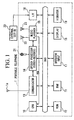
- FIG. 1 shows an electric configuration of a portable telephone having a music playback function in accordance with the preferred embodiment of the invention.
- a communicator 13 having modulation-demodulation functions is connected with a retractable antenna 1a.
- a central processing unit (CPU) 10 runs telephone function programs to perform overall controls on various parts and sections of the system of the portable telephone 1.
- the system CPU 10 has a timer (not shown) that indicates a lapse of time in operation and causes timer interruption in each specific time interval.
- a system RAM 11 contains various areas, that is, a music data storage area, a user setup data storage area, and a work area used for the system CPU 10.
- the music data storage area is used to store music data containing musical score data and tone color data that the portable telephone 1 downloads from the prescribed music download center by way of base stations and/or networks, for example.
- the user setup data storage area of the system RAM 11 stores musical tune specifying data for specifying a musical tune whose melody is to be played back by a music playback section 15 in an incoming call reception mode, a hold mode, and a music playback mode in connection with telephone numbers of calling parties. That is, the user setup data storage area stores a table showing the correspondence between musical tune specifying data and telephone numbers of calling parties. Hence, the user of the portable telephone 1 is able to arbitrarily set the content of the table stored in the user setup data storage area.
- the system RAM 11 also stores playback frequency data representing a playback frequency by which musical tunes are played back by the music playback section 15 in response to incoming calls in the past. Such playback frequency data are updated as necessary. Further, the system RAM 11 stores various kinds of setup data set by user's operations on an operator input section 17.
- a system ROM 12 stores a variety of telephone function programs that are executed by the CPU 10 for transmission and reception of calls.
- the system ROM 12 stores programs regarding processes for assisting music playback processes and various types of fixed data such as preset musical score data and tone color data.
- the system RAM 11 and/or the system ROM 12 is used as a first storage of this invention.
- a communicator 13 demodulates signals received by an antenna 1a, and it also modulates signals which are to be transmitted by the antenna 1a. That is, incoming call signals are demodulated by the communicator 13 and are then decoded by a speech processor (coder-decoder) 14. In addition, a microphone 21 picks up and converts the speech of the user of the portable telephone 1 to speech signals, which are then subjected to compressive coding by the speech processor 14.
- the speech processor 14 performs high-efficiency compressive coding/decoding on speech signals corresponding to the user's speech for transmission. That is, the speech processor 14 is designed as a coder-decoder based on the code excited linear predictive coding (CELPC) system or adaptive differential pulse-code modulation (ADPCM) system, for example.
- a music playback section 15 sends the speech signals given from the speech processor 14 to a speaker 22 to reproduce speech that is transmitted to the portable telephone 1.
- the music playback section 15 reproduces music data to play back a melody of a musical tune as incoming call sound or hold sound.
- the incoming call sound is produced by a speaker 23 to notify the user of the portable telephone 1 of reception of an incoming call.
- the hold sound is mixed with speech signals and is produced by the speaker 22.
- the hold sound is forwarded to the speech processor 14 and the communicator 13, by which it is transmitted to a telephone terminal of a person who is now communicating with the user of the portable telephone 1.
- the music playback section 15 has an internal storage that stores a prescribed amount of musical score data for playback of a musical tune. If a prescribed size of a vacant area emerges within the internal storage of the music playback section 15 that presently proceeds to reproduction of music data, the music playback section 15 supplies an interrupt request signal (IRQ) to the system CPU 10, which in turn accesses the system RAM 11 or system ROM 12 to read remaining parts of the musical score data following the prescribed amount of musical score data that were precedently stored in the internal storage, so that remaining parts of the musical score data are sequentially transferred to the music playback section 15.
- IRQ interrupt request signal
- An interface (I/F) 16 is used to download from an external device 20 such as a personal computer the music data comprising the musical score data and tone color data.
- An operator input section 17 contains numeric keys representing numerals '0' to '9' and other types of keys, all of which are arranged on the portable telephone 1.
- a display 18 displays on the screen thereof menus for telephone functions and other information data instructed by operations of numeric keys (or dial buttons) and other keys.
- a vibrator 19 generates vibration that is substituted for incoming call sound rung by the portable telephone 1. That is, the body of the portable telephone 1 is vibrated by the vibrator 19 in response to an incoming call, by which the user is notified of reception of the incoming call.
- all blocks and sections of the portable telephone 1 are interconnected together by way of a bus 24, which is used to send and receive data and instructions.
- the music playback section 15 shown in FIG. 2 is constituted by an interface (I/F) 30, an FIFO memory 31 for storing musical score data, an INDEX decoder 32, a sequencer 33, a Voice RAM 34 for storing tone color data, a sound source 35 for generating musical tone signals, a digital-to-analog converter (DAC) 36, and a mixer (MIX) 37 that mixes together the output of the digital-to-analog converter 36 and the output of the speech processor 14 shown in FIG. 1.
- the FIFO memory 31 and the Voice RAM 34 are used as a second storage of this invention.
- the music playback section 15 receives various data from the bus 24 by means of the interface 30.
- contents of data DATA, namely musical score data and tone color data
- index data (INDEX) showing indications of received data, so that the data are output via an output terminal 'DATA' while the index data are output via an output terminal 'INDEX'.
- the FIFO memory 31 corresponds to the foregoing internal storage of the music playback section 15, wherein it stores thirty-two words of data, for example. That is, the musical score data are sequentially read from the FIFO memory 31 in a first-in-first-out manner in which data input first is output first. During a reading process of the musical score data from the FIFO memory 31, when the prescribed size of a vacant area emerges, the FIFO memory 31 sends an interrupt request signal (IRQ) to the system CPU 10.
- IRQ interrupt request signal
- the INDEX decoder 32 encodes the index data to produce write pulses (WP) and latch pulses (LP), details of which will be described later. These pulses are supplied to the FIFO memory 31.
- the INDEX decoder 32 also supplies to the sequencer 33 index data AD1 showing an indication of an event in which the interface 30 outputs via the output terminal DATA the prescribed data which should be received by the sequencer 33.
- the INDEX decoder 32 supplies to the Voice RAM 34 index data AD2 showing an indication of an event in which the interface 30 outputs via the output terminal DATA the prescribed data which should be received by the Voice RAM 34.
- the sequencer 33 applies read pulses (Read) to the FIFO memory 31 to sequentially read the musical score data.
- the sequencer 33 sets prescribed tone-generation parameters to the sound source 35 in response to time data contained in the musical score data.
- the sequencer 33 inputs tone color assignment data from the output terminal DATA of the interface 30, so that the sequencer 33 supplies to the Voice RAM 34 tone color numbers which are designated by the tone color assignment data with regard to respective parts of the musical tune.
- the sequencer 33 reads from the Voice RAM 34 tone color parameters corresponding to the tone color numbers, which are set to the sound source 35.
- the Voice RAM 34 is exclusively used to store tone color data, which are output from the output terminal DATA of the interface 30. That is, the Voice RAM 34 has a storage capacity that is capable of storing the tone color data of eight tone colors, for example.
- the FIFO memory 31 and Voice RAM 34 are designed based on prescribed rules for selection of musical tunes, by which music data of a musical tune whose use frequency is highest in the past is to be selected first, for example. Based on these rules, certain music data are selected from among all music data stored in the system RAM 11 or system ROM 12 by the prediction such that they may be likely provided for the reproduction next time. The selected (or predicted) music data are subjected to cache (or precedent write operation).
- a part of musical score data is transferred to the FIFO memory 31 from the system RAM 11 or system ROM 12, while tone color data are transferred to the Voice RAM 34.
- tone color data are transferred to the Voice RAM 34.
- the present embodiment is designed such that only a part of the music data which should be precedently written in the storage is transferred to the FIFO memory 31 which is used as the second storage of this invention and which is limited in storage capacity.
- the present embodiment can be easily modified to employ a memory having a large storage capacity. In this case, all the music data that should be precedently written in the storage can be collectively transferred to such a memory at once; then, the music data are sequentially read from the memory and are supplied to the sound source 35.
- the sound source 35 is capable of simultaneously generating musical tone signals of four parts, for example.
- the prescribed tone colors whose data are respectively read from the Voice RAM 34 in accordance with the tone color assignment data are set to these parts.
- the sound source 35 generates musical tone signals having tone pitches and tone lengths, which are designated by tone-generation parameters given from the sequencer 33, with respect to each of the parts.
- the musical tone signals of four parts are supplied to the digital-to-analog converter 36, by which they are converted to analog musical tone signals in conformity with prescribed reproduction timings.
- the mixer 37 mixes together the analog musical tone signals and the aforementioned speech signals that are decoded by the speech processor 14.
- the display 18 shows musical tune information for listing plural musical tunes on the screen. From the musical tune information, the user of the portable telephone 1 selects one of the musical tunes listed on the screen of the display 18. Then, the music data of the selected musical tune is read from the system RAM 11 and are sent to the music playback section 15 via the bus 24. That is, the interface 30 of the music playback section 15 inputs music data that contain tone color data of eight tone colors and index data.
- the INDEX decoder 32 decodes the index data accompanied with the tone color data to produce index data AD2, which are forwarded to the Voice RAM 34.
- FIG. 4 shows an example of the content of the tone color data of eight tone colors which are written to the Voice RAM 34.
- the Voice RAM 34 stores four types of data, namely a waveform parameter, an envelope parameter, a modulation parameter, and an effect parameter, with respect to each of eight tone colors, namely 'tone color 1' to 'tone color 8' which correspond to tone color numbers.
- the eight tone colors each have specific parameters.
- waveform parameters designate musical tone waveforms.
- the sound source 35 is constituted as a PCM sound source having a waveform table for listing multiple waveforms
- the waveform parameter designates any one of the waveforms listed on the waveform table.
- the waveform parameter designates an algorithm for calculations of frequency modulation.
- the envelope parameter designates an attack rate, a decay rate, a sustain level, and a release rate.
- the modulation parameter designates velocity such as the depth of vibrato or tremolo.
- the effect parameter designates effects in music such as reverb, chorus and variation.
- the music data input to the interface 30 contain tempo data (Tempo) and tone color assignment data having index data as well.
- the INDEX decoder 32 decodes the tempo data and the index data accompanied with the tone color assignment data to produce index data AD1, which is forwarded to the sequencer 33.
- the sequencer 33 accesses the Voice RAM 34 to read tone color parameters, which are designated by the tone color assignment data.
- the tone color parameters are forwarded to the sound source 35.
- FIG. 5 shows an example of a configuration of the tone color assignment data. As shown in FIG. 5, there are provided four parts, namely 'part 1' to 'part 4' to which the tone color numbers are adequately assigned. This realizes assignment of prescribed tone colors to the four parts.
- the sequencer 33 reads the corresponding tone color parameter from the Voice RAM 34.
- the tone color data of the reproduced music data are transferred and written to the Voice RAM 34, which has a storage capacity of storing at least eight tone colors of tone color data in accordance with the present embodiment. That is, even though the Voice RAM 34 has a relatively small storage capacity, it is capable of storing all the tone color data that are required for the reproduction of the music data.
- the present embodiment allows the user to edit the tempo data.
- the music data input by the interface 30 contain musical score data accompanied with index data, which the INDEX decoder 32 decodes to supply write pulses (WP) to the FIFO memory 31.
- WP write pulses
- the musical score data of thirty-two words are written to the FIFO memory 31.
- the thirty-two words represent only a part of the musical score data corresponding to a single musical tune.
- the FIFO memory 31 initially loads a head portion of the musical score data.
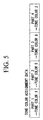
- the musical score data written to the FIFO memory 31 are constituted by note data and rest data respectively having prescribed data configurations, examples of which are shown in FIG. 3. That is, the note data of one word is constituted by an octave code (Oct), a note code (Note), a part number designating a part for locating a note, an interval representing a time length measured from one note to the next note (or next rest), and note length information.
- the rest data of one word is constituted by a rest code representing the type of a rest, a part number designating a part for locating the rest, and an interval representing a time length measured from one rest to the next note (or next rest).
- the aforementioned note data and rest data are sequentially read from the FIFO memory 31, so that a vacant area emerges and is increased in size in proportion to the amount of data being read out.
- the FIFO memory 31 stores only the head portion of the musical score data that consist of thirty-two words, so that following portions of the musical score data are sequentially written to the vacant area of the FIFO memory 31.
- the present embodiment is capable of adequately reproducing the musical score data of a high quality by sequentially writing following portions of the musical score data to the FIFO memory 31.
- the music playback section 15 performs reproduction of music data based on the aforementioned operating principle. In reproduction, it sets in advance the prescribed size (namely, the prescribed number of words) of a vacant area that emerges in the FIFO memory 31 to initiate a write operation of writing the next portion of the musical score data. That is, IRQ Point data is set in advance to designate the number of words as the size of a vacant area that initiates a write operation of writing the next portion of the musical score data to the FIFO memory 31. By setting the IRQ Point data, the FIFO memory 31 issues an interrupt request signal (IRQ) to instruct the system CPU 10 to proceed to the writing operation of writing the next portion of the musical score data.
- IRQ interrupt request signal
- the interruption frequency When the IRQ Point data is set close to zero word, the interruption frequency will be increased; however, the processing load of the system CPU 10 can be reduced because it is possible to decrease the number of words for writing the musical score data in each interruption. In contrast, when the IRQ Point data is set close to thirty-two words, the interruption frequency will be reduced; however, the processing load of the system CPU 10 is increased because of the increased number of words for writing the musical score data in each interruption. For this reason, it is preferable to set the IRQ Point data in consideration of the processing speed of the system CPU 10.
- the sequencer 33 supplies read pulses (Read) to the FIFO memory 31, from which musical score data are being sequentially read.
- Read read pulses
- note data shown in FIG. 3 is read from the FIFO memory 31
- an octave code, a note code, part information, and key-on data are set to the sound source 35 in connection with the timing based on interval information and tempo information that is set in advance, wherein the octave code and note code are used to designate a tone pitch.
- the sound source 35 proceeds to generation of a musical tone signal representing a musical tone having the designated tone pitch in accordance with the tone color parameter that is set to the part.
- the sequencer 33 supplies key-off data to the sound source 35 while designating the part. Hence, the sound source 35 proceeds to a mute operation of the musical tone corresponding to the note data.
- the aforementioned operations are repeatedly performed every time note data is read from the FIFO memory 31.
- the sound source 35 sequentially generates musical tone signals, which are reproduced from the musical score data and are forwarded to the digital-to-analog converter 36.
- the FIFO memory 31 issues an interrupt request signal (IRQ) to the system CPU 10.
- IRQ interrupt request signal
- the system CPU 10 reads the next portion of the musical score data that correspond to (31-IRQ Point) words, which are sent onto the bus 24.
- the next portion of the musical score data is transferred and written to the vacant area of the FIFO memory 31 via the interface 30.
- the sound source 35 reproduces the musical score data read from the FIFO memory 31 in accordance with the preset tempo.
- the present embodiment is capable of reproducing the musical score data, which contain numerous data to realize high-quality reproduction of the musical tune, by using the FIFO memory 31 whose storage is limited to thirty-two words, for example.
- the user makes the prescribed setup on the portable telephone 1 to allow playback of a musical tune in response to an incoming call by the music playback section 15.
- the music playback section 15 performs music playback processes so that the speaker 23 produces musical tones of the musical tune based on the output of the digital-to-analog converter 36 as incoming call sound.
- the user makes the prescribed setup on the portable telephone 1 to allow playback of a musical tune by the music playback section 15 when the user holds the portable telephone 1 for a while.
- the music playback section 15 performs music playback processes so that the speaker 22 produces musical tones of the musical tune based on the output of the digital-to-analog converter 36 as hold sound.
- the sound source 35 outputs to the speech processor 14 musical tone signals that are used for transmission of the hold sound to the telephone terminal of a certain person who is communicating with the user of the portable telephone 1.
- the musical tone signals are transmitted to the telephone terminal by means of the communicator 13 of the portable telephone 1.
- the system CPU 10 initiates an incoming call reception process upon reception of incoming call signals that are transmitted to the portable telephone 1 by radio communication.
- step 100 the system CPU 10 detects an incoming call melody mode in which the portable telephone 1 receives incoming call signals transmitted from the telephone terminal of a calling party.
- telephone number information is informed from the telephone terminal of the calling party and is stored in the system RAM 11.
- step 101 a decision is made as to whether or not the user presses a certain key to designate the incoming call melody mode on the operator input section 17. In other words, a decision is made as to whether or not the portable telephone 1 is set such that the music playback section 15 reproduces musical tones of the musical tune as incoming call sound.
- the system CPU 10 makes the aforementioned decision with reference to the setup data that are stored in the system RAM 11 in advance.
- step 101 When the system CPU 10 determines in step 101 that the user designates the incoming call melody mode for the portable telephone 1, the flow proceeds to step 102 in which a decision is made as to whether or not a cache hit event occurs. It was described before that the music data of the musical tune whose melody is to be reproduced as incoming call sound are precedently written to the music playback section 15, specifically, the musical score data are precedently written to the FIFO memory 31 while the tone color data are precedently written to the Voice RAM 34. Therefore, the system CPU 10 detects a cache hit when the music data precedently written to the music playback section 15 match the music data that are specified by the telephone number information of the telephone terminal of the calling party.
- the aforementioned decision regarding the cache hit is made with reference to a table that is stored in the system RAM 11 to show relationships in correspondence between telephone numbers of certain persons, who may be likely to call the user of the portable telephone 1, and musical tune specifying data for specifying musical tunes that may be likely to be reproduced by the music playback section 15.
- the system CPU 10 retrieves musical tune specifying data for specifying a musical tune that should be reproduced by the music playback section 15.
- the system CPU 10 compares the retrieved musical tune specifying data with musical tune specifying data that are stored in the system RAM 11 and specify music data precedently cached in the music playback section 15.
- the system CPU 10 makes the decision regarding the cache hit by detecting whether the retrieved musical tune specifying data matches the musical tune specifying data for specifying the cached music data.
- step 102 When the system CPU 10 determines in step 102 that a cache hit is detected, the flow proceeds to step 103 to start reproduction of incoming call melody sound. That is, the sound source 35 generates musical tone signals representing musical tones of multiple parts based on tone-generation parameters given from the sequencer 33, so that the speaker 23 produces musical tones as incoming call melody sound. If the system CPU 10 fails to detect a cache hit in step 102, the flow proceeds to step 104 in which initialization is performed on music data for use in production of incoming call melody sound.
- the system CPU 10 instantaneously erases the music data precedently stored in the FIFO memory 31 and Voice RAM 34.
- the system CPU 10 With reference to the table showing relationships in correspondence between telephone numbers of certain persons, who may be likely to call the user of the portable telephone 1, and musical tune specifying data for specifying musical tunes that may be likely to be reproduced by the music playback section 15, the system CPU 10 newly specifies a musical tune whose melody is to be reproduced on the basis of the telephone number of the calling party Music data of the specified musical tune are transferred from the system RAM 11 or system ROM 12 to the FIFO memory 31 and Voice RAM 34.
- the system CPU 10 completes the initialization of the music data with respect to the music playback section 15.
- the flow proceeds to step 103 in which the system CPU 10 starts reproduction of incoming call melody sound corresponding to the musical tune that is newly specified in response to the telephone number of the calling party.
- step 101 When the system CPU 10 determines in step 101 that the user does not designate an incoming call melody mode on the portable telephone 1, the flow proceeds to step 105 in which the sound source 35 generates signals representing standard incoming call sound such as beep sound, so that the speaker 23 produces the standard incoming call sound to notify the user of reception of an incoming call from the calling party.
- the user is allowed to set the portable telephone 1 to activate the vibrator 19 to generate vibration, which is substituted for the standard incoming call sound.
- step 106 a decision is made as to whether or not the user operates a conversation key on the operator input section 17 to proceed to line connection with the telephone terminal of the calling party.
- step 107 the decision step 106 is repeatedly performed until the user operates the conversation key so that the portable telephone 1 continuously rings incoming call sound.
- step 107 the system CPU 10 stops generation of incoming call melody sound or standard incoming call sound that is rung by the portable telephone 1.
- step 108 the system CPU 10 proceeds to a conversation process to allow a conversation conducted between the user of the portable telephone 1 and the calling party of the telephone terminal.
- step 109 a decision is made as to whether or not the line is disconnected. The decision is realized by detecting whether or not the user presses a stop key to stop the conversation.
- the flow returns back to the step 108 to continue the conversation between the user and the calling party.
- step 110 the flow proceeds to step 110 to proceed to a cache process of music data, which is performed in preparation for a next music playback event.
- a musical tune that may be likely to be reproduced in response to a next incoming call is selected from among preset musical tunes in accordance with prescribed rules, so that the music data of the selected musical-tune are precedently transferred from the system RAM 11 or system ROM 12 to the FIFO memory 31 and Voice RAM 34 of the music playback section 15.
- the prescribed rules are described to select a single musical tune from among plural musical tunes stored in advance, so that the music data of the selected musical tune for use in reproduction are precedently written to the music playback section 15. It is possible to employ various types of rules that are implemented by the system CPU 10 to select a single musical tune from among plural musical tunes. In accordance with a first type of rules, for example, the system CPU 10 selects a musical tune that is used most frequently in the past. In accordance with a second type of rules, the system CPU 10 repeatedly selects the same musical tune that was precedently used.
- the system CPU 10 starts executing an incoming call reception process of Figures 7 and 8 in response to reception of incoming call signals that are transmitted from the telephone terminal of a calling party to the portable telephone 1. That is, in step 200, the system CPU 10 detects reception of an incoming call from the telephone terminal whose telephone number information is transmitted to the portable telephone 1. The telephone number information given from the telephone terminal of the calling party is stored in the system RAM 11. In step 201, a decision is made as to whether or not the portable telephone 1 is set in an incoming call OK mode.
- the incoming call OK mode is an operation mode in which the portable telephone 1 is ready to accept an incoming call from the calling party.
- the system CPU 10 makes the decision of step 201 with reference to setup data that are stored in the system RAM 11 in advance.
- step 201 When the system CPU 10 determines in step 201 that the portable telephone 1 is now set in the incoming call OK mode, the portable telephone 1 proceeds to incoming call notification in step 202. That is, the sound source 35 reproduces standard incoming call sound such as beep sound, which is produced by the speaker 23. Alternatively, the system CPU 10 activates the vibrator 19 to generate vibration, which is substituted for incoming call sound. Incidentally, it is possible to modify the step 202 such that the portable telephone 1 produces incoming call melody sound to notify the user of reception of an incoming call as shown in FIG. 6. In step 203, a decision is made as to whether or not the user presses a conversation key on the operator input section 17. When the system CPU 10 detects in step 203 that the user presses the conversation key, the system CPU 10 establishes a line connection with the telephone terminal of the calling party in step 204, and then it proceeds to a conversation process in step 205.
- step 206 a decision is made as to whether or not the user operates a hold key on the operator input section 17.
- the flow proceeds to step 213 in which a decision is made as to whether or not a line is disconnected, in other words, a decision is made as to whether or not the user operates a stop key.
- step 213 a decision is made as to whether or not a line is disconnected, in other words, a decision is made as to whether or not the user operates a stop key.
- the system CPU 10 determines in step 213 that the line is not disconnected, the flow returns to step 205 again so that the system CPU 10 continuously executes the conversation process.
- the system CPU 10 detects in step 213 that the line is disconnected, it ends the incoming call reception process of FIG. 7.
- step 207 a decision is made as to whether or not a cache hit occurs.
- the music data corresponding to the musical tune whose melody is to be reproduced as hold sound are precedently written to the music playback section 15, specifically, the musical score data are written to the FIFO memory 31 while the tone color data are written to the Voice RAM 34. Therefore, the system CPU 10 makes a decision in step 207 as to whether or not the music data precedently written to the music playback section 15 match the music data that are specified by the telephone number information given from the telephone terminal of the calling party.
- the aforementioned decision of the step 207 is made with reference to the table that is stored in the system RAM 11 to indicate relationships in correspondence between musical tune specifying data for specifying musical tunes, which may be likely to be reproduced by the music playback section 15, and telephone numbers of persons who may be likely to call the user of the portable telephone 1.
- the system CPU 10 retrieves musical tune specifying data for specifying a musical tune that should be reproduced by the music playback section 15.
- the system CPU 10 compares the retrieved musical tune specifying data with musical tune specifying data that are stored in the system RAM 11 and specify the music data precedently cached in the music playback section 15.
- the system CPU 10 makes a decision regarding a cache hit by detecting whether the retrieved musical tune specifying data match the musical tune specifying data for specifying the cached music data.
- step 207 When the system CPU 10 detects a cache hit in step 207, the flow proceeds to step 210 in which the music playback section 15 starts reproduction of the melody of the cached musical tune as hold sound. That is, the sound source 35 reproduces musical tone signals for respective parts of the musical tune based on tone-generation parameters given from the sequencer 33 as hold sound. Thus, the speaker 22 produces musical tones of musical tone signals reproduced by the sound source 35. In addition, the musical tone signals are transmitted to the telephone terminal to produce hold sound to notify the calling party of an intermission that the user holds the portable telephone 1 for a while to temporarily stop the conversation.
- step 208 initialization is made on music data for use in generation of hold sound.
- the system CPU 10 instantaneously erases the music data stored in the FIFO memory 31 and Voice RAM 34 of the music playback section 15.
- the system CPU 10 specifies a musical tune on the basis of the telephone number of the calling party, so that the music data of the specified musical tune are transferred from the system RAM 11 or system ROM 12 to the FIFO memory 31 and Voice RAM 34 of the music playback section 15.
- the system CPU 10 completes the initialization on the music data representing the musical tune whose melody is to be reproduced as hold sound.
- the flow proceeds to step 210 in which the music playback section 15 starts reproduction of hold melody sound.
- step 211 a decision is made as to whether a hold condition is released or not. That is, the system CPU 10 makes a decision as to whether or not the user operates a hold release key on the operator input section 17 with reference to the setup information that is stored in the system RAM 11.
- step 212 the system CPU 10 proceeds to a cache process of music data.
- a musical tune is selected for preparation of a next music playback event in accordance with prescribed rules, so that the music data of the selected musical tune are transferred from the system RAM 11 or system ROM 12 to the FIFO memory 31 and Voice RAM 34 of the music playback section 15.
- a single musical tune is selected from among plural musical tunes that are stored in advance in the system RAM 11 or system ROM 12 so that the music data of the selected musical tune are precedently written to the music playback section 15. It is possible to describe the rules such that the musical tune that is used most frequently in the past is to be selected first, or it is possible to describe the rules such that a musical tune that is precedently used is to be selected again. After completion of the cache process of the music data in step 212, the flow returns to step 205 again so that the portable telephone 1 restarts the conversation process. Thereafter, the system CPU 10 performs the foregoing operations.
- step 201 When the system CPU 10 determines in step 201 that the portable telephone 1 is not set in the incoming call OK mode, the flow proceeds to step 221 shown in FIG. 8 in which the portable telephone 1 establishes a line connection with the telephone terminal of the calling party.
- step 222 the portable telephone transmits to the telephone terminal of the calling party a hold voice message that the user is now unable to answer the phone. Such a hold voice message is sent to the telephone terminal by means of the speech processor 14 and communicator 13.
- step 223 the portable telephone 1 automatically disconnects the line with the telephone terminal, and then it ends the incoming call reception process.
- step 203 determines in step 203 that the user does not operate the conversation key
- the flow proceeds to step 214 shown in FIG. 8 in which a decision is made as to whether or not the user operates the hold key on the operator input section 17.
- step 214 determines in step 214 that the user does not operate the hold key
- the flow proceeds to step 230 shown in FIG. 7.
- the system CPU 10 repeats the steps 203 and 214 until the user operates either the conversation key or hold key.
- step 214 When the system CPU 10 detects in step 214 that the user operates the hold key, the flow proceeds to step 215 in which a line connection is established.
- step 216 the system CPU 10 proceeds to reproduction of a hold voice message of "please wait for a while". Such a hold voice message is transmitted to the telephone terminal of the calling party by means of the speech processor 14 and communicator 13.
- step 217 to 220 which are identical to the aforementioned steps 207 to 212 shown in FIG. 7. Details of the steps 217 to 220 are omitted to avoid duplicate description.
- the system CPU 10 detects a cache hit in step 217
- the flow proceeds to step 218.
- the system CPU 10 fails to detect a cache hit in step 217 so that the system CPU 10 performs initialization of music data with respect to hold sound in step 224
- the flow proceeds to step 218.
- step 218 the music playback section 15 starts reproduction of the music data regarding the hold sound.
- step 219 the flow proceeds to step 220 in which the system CPU 10 performs a cache process of music data. After completion of the step 220, the flow returns to step 205 shown in FIG. 7. Thus, the system CPU 10 performs the foregoing conversation process by the established line connection.
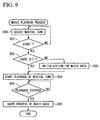
- the music playback process is provided for the user to listen to the musical tune that is played back, regardless of conversation on the portable telephone 1.
- the music playback process provides so-called background music (BGM) that is played back softly during conversation in progress. That is, the user operates a prescribed key on the operator input section 17 to designate the music playback process to be started.
- BGM background music
- the flow firstly proceeds to step 300 that allows the user of the portable telephone 1 to select a musical tune from among plural musical tunes which are listed in advance.
- a music playback menu is displayed on the screen of the display 18 of the portable telephone 1, wherein the user designates a music selection menu providing plural musical tunes. That is, the user operates dial buttons (or numeric keys) on the operator input section 17 to select a desired musical tune from among plural musical tunes.
- the corresponding music data are selected from among plural music data stored in the system RAM 11 and system ROM 12.
- the system ROM 12 stores music data representing preset musical tunes that are preinstalled in the portable telephone 1.
- the system RAM 11 is capable of storing music data representing other musical tunes that are downloaded from the music download center or the external device 20.
- the system CPU 10 makes a decision whether to start playback of the musical tune. That is, a decision is made as to whether or not the user operates a start key on the operator input section 17 to start playback of the musical tune.
- step 301 When the system CPU 10 determines in step 301 that the user does not instruct the portable telephone 1 to start playback of the musical tune, the flow returns to step 300.
- step 301 When the system CPU 10 detects in step 301 that the user instructs the portable telephone 1 to start playback of the musical tune, the flow proceeds to step 302 in which a decision is made as to whether a cache hit occurs or not. It was described before that the prescribed music data are precedently written to the music playback section 15, specifically, the musical score data are written to the FIFO memory 31 while the tone color data are written to the Voice RAM 34. Therefore, the system CPU 10 makes a decision as to whether or not the selected musical tune in step 300 matches the prescribed music data that was precedently written to the music playback section 15.
- the aforementioned decision is made with reference to the musical tune specifying data that are stored in the system RAM 11 to specify musical tunes. That is, the system CPU 10 determines whether or not the musical tune specifying data for specifying the selected musical tune in step 300 match the musical tune specifying data for specifying the musical tune precedently cached in the music playback section 15.
- step 304 the music playback section 15 starts playback of the musical tune, which is selected by the user in step 300 and is precedently cached in the music playback section 15. That is, the sound source 35 reproduces musical tone signals of respective parts of the musical tune based on tone-generation parameters given from the sequencer 33. Thus, the speaker 22 or 23 produces musical tones corresponding to reproduced musical tone signals.
- step 303 the system CPU 10 performs initialization of music data for playback.
- the system CPU 10 instantaneously erases the music data that are previously stored in the FIFO memory 31 and Voice RAM 34 of the music playback section 15.
- the music data of the selected musical tune in step 300 are transferred from the system RAM 11 or system ROM 12 to the FIFO memory 31 and Voice RAM 34. This completes the initialization by which new and desired music data are set to the music playback section 15.
- the flow proceeds to step 304 in which the music playback section 15 starts playback of the musical tune.
- step 305 a decision is made as to whether or not the playback of the musical tune is stopped. In other words, a decision is made as to whether or not the user operates a stop key on the operator input section 17 to stop the playback of the musical tune. The aforementioned decision is made with reference to the setup data that are stored in the system RAM 11 in advance.
- step 306 the system CPU 10 performs a cache process of music data. Then, the system CPU 10 ends the music playback process of FIG. 9.
- a musical tune that may be likely to be played back is selected for preparation of a next music playback event in accordance with prescribed rules, so that the music data of the selected musical tune are transferred from the system RAM 11 or system ROM 12 to the FIFO memory 31 and Voice RAM 34.
- the prescribed rules have been already described in conjunction with the flowcharts shown in Figures 6 to 8. That is, the prescribed rules are described such that a single musical tune will be selected from among plural musical tunes which are listed in advance to realize the precedent write operation of music data which may be likely to be reproduced.
- the rules such that a musical tune which is used most frequently in the past is to be selected first, or it is possible to describe the rules such that a musical tune which is precedently used is selected again.
- the present embodiment has a variety of technical features, which will be summarized below.
- a certain musical tune is automatically selected in accordance with prescribed rules, so that the music data of the selected musical tune are transferred from a first storage (i.e., system RAM 11 or system ROM 12) to a second storage (i.e., FIFO memory 31 and Voice RAM 34). That is, a musical tune that has a high likelihood to be used for reproduction in the next music playback event is precedently cached in the second storage.
- the system CPU 10 detects a cache hit in which the musical tune presently specified for reproduction matches the cached musical tune, it reads the music data of the cashed musical tune from the second storage without accessing the first storage. This eliminates a necessity. in that music data be newly written to the second storage in a cache hit event.
- it is possible to eliminate a time lag between the timing of a trigger for designating reproduction of a melody to specify the music data and the reproduction timing of actually reproducing the melody.
- the system CPU 10 When the system CPU 10 does not detect a cache hit because the musical tune presently specified for reproduction does not match the cached musical tune precedently stored in the second storage, it instantaneously erases the stored content of the second storage. In addition, the music data of the specified musical tune are newly transferred from the first storage to the second storage. Thus, it is possible to reliably reproduce the specified musical tune without interruption.
- the present embodiment employs the prescribed rules for automatically selecting a musical tune that may be likely to be reproduced in the next music playback event from among plural musical tunes listed in advance in the first storage, so that the music data of the selected musical tune are precedently transferred from the first storage to the second storage.
- the present embodiment describes the rules such as to select a musical tune that is used most frequently in the past. This increases a probability in that the musical tune specified for reproduction matches the musical tune which is selected and precedently cached in the second storage. Thus, it is possible to reduce a time lag between the timing of a trigger for designating reproduction of a melody to specify music data and the reproduction timing of actually reproducing the melody.
- the present embodiment is designed in such a manner that the FIFO memory 31 and Voice memory 34 are used as a cache memory for storing only a single musical tune.
- plural cache memories for respectively storing plural musical tunes, e.g., seven or eight musical tunes.
- one of the cache memories is selected in response to the telephone number regarding an incoming call, so that a desired musical tune is to be read from the selected cache memory.
Landscapes
- Engineering & Computer Science (AREA)
- Physics & Mathematics (AREA)
- Acoustics & Sound (AREA)
- Multimedia (AREA)
- Computer Networks & Wireless Communication (AREA)
- Signal Processing (AREA)
- Telephone Function (AREA)
- Electrophonic Musical Instruments (AREA)
- Mobile Radio Communication Systems (AREA)
- Reverberation, Karaoke And Other Acoustics (AREA)
- Information Retrieval, Db Structures And Fs Structures Therefor (AREA)
- Telephonic Communication Services (AREA)
Abstract
Description
Claims (11)
- A portable telephone having a music playback function for reproducing a melody that is stored in advance, comprising:wherein the control device directly accesses the second storage to read and output the music data from the second storage to the musical tone generator when a musical tune presently specified for reproduction matches the selected musical tune which is precedently written to the second storage.a first storage for storing music data of a plurality of musical tunes;a second storage for storing music data of at least one musical tune to be reproduced;a musical tone generator for generating musical tone signals based on the music data stored in the second storage; anda control device for selecting a musical tune from among the plurality of musical tunes stored in the first storage in accordance with prescribed rules, so that music data of the selected musical tune are precedently transferred from the first storage to the second storage,
- A portable telephone according to claim 1, wherein when the musical tune presently specified for reproduction does not match the selected musical tune precedently written to the second storage, the control device automatically transfers music data of the presently specified musical tune from the first storage to the second storage.
- A portable telephone according to claim 1 or 2, wherein the prescribed rules are described such as to select a musical tune that is used most frequently in the past.
- A music playback method for a portable telephone having a melody reproduction function realized by a first storage for storing music data of a plurality of musical tunes and a second storage for storing music data of at least one musical tune to be reproduced, said music playback method comprising the steps of:selecting a musical tune from among the plurality of musical tunes in accordance with prescribed rules;precedently transferring music data of the selected musical tune from the first storage to the second storage;when a musical tune presently specified for reproduction matches the musical tune precedently written to the second storage, directly accessing the second storage to read the music data of the selected musical tune; andgenerating musical tone signals based on the music data of the selected musical tune precedently written to the second storage.
- A music playback method according to claim 4 further comprising the step of:when the musical tune presently specified for reproduction does not match the musical tune precedently written to the second storage, automatically transferring music data of the presently specified musical tune from the first storage to the second storage.
- A music playback method according to claim 4 or 5, wherein the prescribed rules are described such as to select a musical tune that is used most frequently in the past.
- A portable telephone having a music playback function, comprising:a first storage for storing music data of a plurality of musical tunes that are listed in advance in connection with preset telephone numbers regarding incoming calls;a second storage for storing music data of at least one musical tune to be reproduced;a controller for selecting a musical tune that is likely to be reproduced from among the plurality of musical tunes in accordance with prescribed rules, so that music data of the selected musical tune are precedently transferred from the first storage to the second storage; anda sound source for generating musical tone signals based on the music data stored in the second storage in response to an incoming call when a telephone number of the incoming call specifies the musical tune that is precedently written to the second storage.
- A portable telephone according to claim 7, wherein the second storage comprises an FIFO memory for storing musical score data within the music data of the selected musical tune, and a Voice RAM for storing tone color data for plural parts of the selected musical tune.
- A portable telephone according to claim 7, wherein when the telephone number of the incoming call specifies a musical tune that differs from the selected musical tune precedently written to the second storage, the controller automatically transfers music data of the specified musical tune from the first storage to the second storage.
- A portable telephone according to claim 7, wherein the prescribed rules are described such as to select a musical tune that is used most frequently in the past.
- A portable telephone according to claim 7, wherein the prescribed rules are described such as to repeatedly select a musical tune that is precedently used.
Applications Claiming Priority (3)
| Application Number | Priority Date | Filing Date | Title |
|---|---|---|---|
| JP2000032472 | 2000-02-09 | ||
| JP2000032472A JP2001222281A (en) | 2000-02-09 | 2000-02-09 | Portable telephone system and method for reproducing composition from it |
| PCT/JP2001/000909 WO2001059754A1 (en) | 2000-02-09 | 2001-02-09 | Portable telephone and music reproducing method |
Publications (3)
| Publication Number | Publication Date |
|---|---|
| EP1255243A1 true EP1255243A1 (en) | 2002-11-06 |
| EP1255243A4 EP1255243A4 (en) | 2008-07-09 |
| EP1255243B1 EP1255243B1 (en) | 2010-07-14 |
Family
ID=18557072
Family Applications (1)
| Application Number | Title | Priority Date | Filing Date |
|---|---|---|---|
| EP01904363A Expired - Lifetime EP1255243B1 (en) | 2000-02-09 | 2001-02-09 | Portable telephone and music reproducing method |
Country Status (9)
| Country | Link |
|---|---|
| US (1) | US6999752B2 (en) |
| EP (1) | EP1255243B1 (en) |
| JP (1) | JP2001222281A (en) |
| KR (1) | KR100450871B1 (en) |
| CN (1) | CN1227642C (en) |
| AU (1) | AU2001232255A1 (en) |
| DE (1) | DE60142551D1 (en) |
| TW (1) | TW496062B (en) |
| WO (1) | WO2001059754A1 (en) |
Cited By (1)
| Publication number | Priority date | Publication date | Assignee | Title |
|---|---|---|---|---|
| EP1571647A1 (en) * | 2004-02-26 | 2005-09-07 | Lg Electronics Inc. | Apparatus and method for processing bell sound |
Families Citing this family (30)
| Publication number | Priority date | Publication date | Assignee | Title |
|---|---|---|---|---|
| US6636602B1 (en) * | 1999-08-25 | 2003-10-21 | Giovanni Vlacancich | Method for communicating |
| JP3386027B2 (en) * | 1999-12-28 | 2003-03-10 | ヤマハ株式会社 | Mobile phone |
| JP4206608B2 (en) * | 2000-05-23 | 2009-01-14 | ソニー株式会社 | Ringing tone output method for communication terminal and communication terminal apparatus |
| US9942377B2 (en) | 2000-08-11 | 2018-04-10 | Drnc Holdings, Inc. | Portable telephone |
| JP4806840B2 (en) | 2000-08-11 | 2011-11-02 | ソニー株式会社 | Mobile phone |
| US7003083B2 (en) * | 2001-02-13 | 2006-02-21 | International Business Machines Corporation | Selectable audio and mixed background sound for voice messaging system |
| US6683938B1 (en) * | 2001-08-30 | 2004-01-27 | At&T Corp. | Method and system for transmitting background audio during a telephone call |
| JP3879545B2 (en) * | 2002-03-12 | 2007-02-14 | ヤマハ株式会社 | Music reproduction control device, music reproduction control program, and recording medium |
| EP1501072A4 (en) * | 2002-03-25 | 2005-07-20 | Yoshihiko Sano | Representation generation method, representation generation device, and representation generation system |
| JP4039158B2 (en) * | 2002-07-22 | 2008-01-30 | ソニー株式会社 | Information processing apparatus and method, information processing system, recording medium, and program |
| US7356132B1 (en) | 2002-07-23 | 2008-04-08 | At&T Delaware Intellectual Property, Inc. | Tune master telephone |
| US7519166B1 (en) * | 2002-07-23 | 2009-04-14 | At&T Intellectual Property I, L.P. | Tune master caller identification device |
| US7844047B1 (en) | 2002-07-23 | 2010-11-30 | At&T Intellectual Property I, L.P. | Tune master internet protocol device |
| US7197135B1 (en) * | 2002-10-24 | 2007-03-27 | Bellsouth Intellectual Property Corporation | Systems and methods for caller-controlled tune notification of a call |
| JP3938015B2 (en) * | 2002-11-19 | 2007-06-27 | ヤマハ株式会社 | Audio playback device |
| AU2003303785A1 (en) * | 2003-01-17 | 2004-08-13 | Nokia Corporation | Musical audible alert termination |
| US20040176025A1 (en) * | 2003-02-07 | 2004-09-09 | Nokia Corporation | Playing music with mobile phones |
| EP1590055A1 (en) * | 2003-02-07 | 2005-11-02 | Nokia Corporation | Control of multi-user environments |
| JP2007536810A (en) | 2004-05-03 | 2007-12-13 | ソマティック テクノロジーズ インコーポレイテッド | System and method for providing personalized acoustic alarms |
| JP4556574B2 (en) * | 2004-09-13 | 2010-10-06 | 日本電気株式会社 | Call voice generation apparatus and method |
| JP4507801B2 (en) * | 2004-09-30 | 2010-07-21 | カシオ計算機株式会社 | Musical sound control device and musical sound control processing program |
| JP4514641B2 (en) * | 2005-04-11 | 2010-07-28 | アルパイン株式会社 | Processing apparatus and image display method |
| WO2006112585A1 (en) * | 2005-04-18 | 2006-10-26 | Lg Electronics Inc. | Operating method of music composing device |
| WO2007019307A2 (en) | 2005-08-03 | 2007-02-15 | Somatic Technologies, Inc. | Somatic, auditory and cochlear communication system and method |
| TWI270051B (en) * | 2005-08-18 | 2007-01-01 | Sunplus Technology Co Ltd | Structure and method for broadcasting MIDI message and multi-media apparatus |
| KR100792983B1 (en) * | 2005-10-11 | 2008-01-08 | 엘지전자 주식회사 | Method for processing digital broadcasting data |
| US20080032676A1 (en) * | 2006-08-02 | 2008-02-07 | Christian Kraft | Mobile electronic device with telephone and music function |
| CA2569184A1 (en) * | 2006-11-28 | 2008-05-28 | Attila P. Kozak | Communication apparatus and method |
| KR101010282B1 (en) * | 2010-03-02 | 2011-01-24 | (주) 골프존 | Apparatus and method for making a user-defined golf course used for the virtual golf simulation, and a virtual golf simulation method using the same |
| JP6904141B2 (en) * | 2017-07-28 | 2021-07-14 | カシオ計算機株式会社 | Music generators, methods, programs, and electronic musical instruments |
Family Cites Families (25)
| Publication number | Priority date | Publication date | Assignee | Title |
|---|---|---|---|---|
| JPH04168492A (en) * | 1990-10-31 | 1992-06-16 | Brother Ind Ltd | Musical sound playback device |
| JPH05108065A (en) * | 1991-10-15 | 1993-04-30 | Kawai Musical Instr Mfg Co Ltd | Automatic performance device |
| DE69227087T2 (en) * | 1991-11-08 | 1999-02-11 | Sony Corp., Tokio/Tokyo | Cordless telephone set with recording and reproducing means |
| US5390236A (en) * | 1992-03-31 | 1995-02-14 | Klausner Patent Technologies | Telephone answering device linking displayed data with recorded audio message |
| US5710978A (en) * | 1993-06-29 | 1998-01-20 | Swift Computers, Inc. | Logging recorder system for trunking radio |
| WO1995012201A1 (en) * | 1993-10-29 | 1995-05-04 | Kabushiki Kaisha Toshiba | Recording medium and reproducing device for special reproduction |
| JPH0954581A (en) | 1995-08-10 | 1997-02-25 | Roland Corp | Automatic performance device |
| WO1997017681A1 (en) * | 1995-11-10 | 1997-05-15 | Casio Computer Co., Ltd. | Data receiver apparatus |
| JP2904088B2 (en) | 1995-12-21 | 1999-06-14 | ヤマハ株式会社 | Musical sound generation method and apparatus |
| JPH09200303A (en) * | 1996-01-18 | 1997-07-31 | Sony Corp | Telephone set |
| FI102711B1 (en) * | 1996-02-23 | 1999-01-29 | Nokia Mobile Phones Ltd | Formulating a phone's ringtones |
| US6075998A (en) * | 1996-03-13 | 2000-06-13 | Nec Corporation | Communication apparatus capable of announcing reception of a call by a melody sound composed by a user |
| JPH09319373A (en) | 1996-05-28 | 1997-12-12 | Roland Corp | Musical tone forming device |
| FI105308B (en) * | 1996-12-30 | 2000-07-14 | Nokia Mobile Phones Ltd | Programming a phone's ringtones |
| JPH10233822A (en) * | 1997-02-18 | 1998-09-02 | Victor Co Of Japan Ltd | Telephone set |
| JP3356005B2 (en) * | 1997-06-25 | 2002-12-09 | ヤマハ株式会社 | Karaoke equipment |
| FI114769B (en) * | 1997-09-04 | 2004-12-15 | Nokia Corp | Procedure for processing the telephone numbers in mobile station and mobile station |
| JPH11126084A (en) | 1997-10-23 | 1999-05-11 | Yamaha Corp | Karaoke device and karaoke system |
| JPH11164058A (en) * | 1997-11-26 | 1999-06-18 | Hitachi Electron Service Co Ltd | Portable type music selection/viewing system |
| US7123936B1 (en) | 1998-02-18 | 2006-10-17 | Ericsson Inc. | Cellular phone with expansion memory for audio and video storage |
| JPH11331404A (en) | 1998-05-15 | 1999-11-30 | Japan Radio Co Ltd | Peger terminal |
| JP2000083282A (en) * | 1998-09-07 | 2000-03-21 | Mitsubishi Electric Corp | Mobile communication device |
| US20030060211A1 (en) * | 1999-01-26 | 2003-03-27 | Vincent Chern | Location-based information retrieval system for wireless communication device |
| JP3279298B2 (en) | 1999-08-05 | 2002-04-30 | ヤマハ株式会社 | Music playing device, mobile phone device having music playing function, and music playing method |
| JP3279293B2 (en) | 1999-08-05 | 2002-04-30 | ヤマハ株式会社 | Music playback device, mobile phone device having music playback function, and music playback method |
-
2000
- 2000-02-09 JP JP2000032472A patent/JP2001222281A/en active Pending
-
2001
- 2001-02-06 TW TW090102485A patent/TW496062B/en not_active IP Right Cessation
- 2001-02-09 EP EP01904363A patent/EP1255243B1/en not_active Expired - Lifetime
- 2001-02-09 AU AU2001232255A patent/AU2001232255A1/en not_active Abandoned
- 2001-02-09 CN CNB018046460A patent/CN1227642C/en not_active Expired - Fee Related
- 2001-02-09 WO PCT/JP2001/000909 patent/WO2001059754A1/en not_active Ceased
- 2001-02-09 DE DE60142551T patent/DE60142551D1/en not_active Expired - Lifetime
- 2001-02-09 US US10/203,231 patent/US6999752B2/en not_active Expired - Fee Related
- 2001-02-09 KR KR10-2002-7010135A patent/KR100450871B1/en not_active Expired - Fee Related
Cited By (1)
| Publication number | Priority date | Publication date | Assignee | Title |
|---|---|---|---|---|
| EP1571647A1 (en) * | 2004-02-26 | 2005-09-07 | Lg Electronics Inc. | Apparatus and method for processing bell sound |
Also Published As
| Publication number | Publication date |
|---|---|
| US20030013432A1 (en) | 2003-01-16 |
| JP2001222281A (en) | 2001-08-17 |
| US6999752B2 (en) | 2006-02-14 |
| CN1227642C (en) | 2005-11-16 |
| CN1398394A (en) | 2003-02-19 |
| HK1050586A1 (en) | 2003-06-27 |
| WO2001059754A1 (en) | 2001-08-16 |
| EP1255243B1 (en) | 2010-07-14 |
| EP1255243A4 (en) | 2008-07-09 |
| KR100450871B1 (en) | 2004-10-01 |
| AU2001232255A1 (en) | 2001-08-20 |
| DE60142551D1 (en) | 2010-08-26 |
| TW496062B (en) | 2002-07-21 |
| KR20020074503A (en) | 2002-09-30 |
Similar Documents
| Publication | Publication Date | Title |
|---|---|---|
| US6999752B2 (en) | Portable telephone and music reproducing method | |
| JP3719057B2 (en) | Telephone terminal device and communication method | |
| KR100469215B1 (en) | Telephone terminal | |
| KR100460525B1 (en) | Music player applicable to portable telephone terminal | |
| KR100578588B1 (en) | Music reproducing apparatus | |
| CN1227641C (en) | mobile phone | |
| KR20040011516A (en) | Telephone terminal apparatus | |
| JP3279293B2 (en) | Music playback device, mobile phone device having music playback function, and music playback method | |
| JP3279298B2 (en) | Music playing device, mobile phone device having music playing function, and music playing method | |
| JP3641999B2 (en) | Music data distribution device and terminal device | |
| JP2001060990A (en) | Telephone terminal equipment and music data transferring method | |
| HK1050586B (en) | Portable telephone and music playback method | |
| JP2005229511A (en) | Musical sound generation apparatus | |
| JP2001345886A (en) | Telephone terminal equipment |
Legal Events
| Date | Code | Title | Description |
|---|---|---|---|
| PUAI | Public reference made under article 153(3) epc to a published international application that has entered the european phase |
Free format text: ORIGINAL CODE: 0009012 |
|
| 17P | Request for examination filed |
Effective date: 20020807 |
|
| AK | Designated contracting states |
Kind code of ref document: A1 Designated state(s): AT BE CH CY DE DK ES FI FR GB GR IE IT LI LU MC NL PT SE TR |
|
| AX | Request for extension of the european patent |
Free format text: AL;LT;LV;MK;RO;SI |
|
| RBV | Designated contracting states (corrected) |
Designated state(s): DE FR GB |
|
| RAP1 | Party data changed (applicant data changed or rights of an application transferred) |
Owner name: YAMAHA CORPORATION |
|
| A4 | Supplementary search report drawn up and despatched |
Effective date: 20080610 |
|
| 17Q | First examination report despatched |
Effective date: 20080918 |
|
| GRAP | Despatch of communication of intention to grant a patent |
Free format text: ORIGINAL CODE: EPIDOSNIGR1 |
|
| GRAS | Grant fee paid |
Free format text: ORIGINAL CODE: EPIDOSNIGR3 |
|
| GRAA | (expected) grant |
Free format text: ORIGINAL CODE: 0009210 |
|
| AK | Designated contracting states |
Kind code of ref document: B1 Designated state(s): DE FR GB |
|
| REG | Reference to a national code |
Ref country code: GB Ref legal event code: FG4D |
|
| REF | Corresponds to: |
Ref document number: 60142551 Country of ref document: DE Date of ref document: 20100826 Kind code of ref document: P |
|
| PLBE | No opposition filed within time limit |
Free format text: ORIGINAL CODE: 0009261 |
|
| STAA | Information on the status of an ep patent application or granted ep patent |
Free format text: STATUS: NO OPPOSITION FILED WITHIN TIME LIMIT |
|
| 26N | No opposition filed |
Effective date: 20110415 |
|
| REG | Reference to a national code |
Ref country code: DE Ref legal event code: R097 Ref document number: 60142551 Country of ref document: DE Effective date: 20110415 |
|
| PGFP | Annual fee paid to national office [announced via postgrant information from national office to epo] |
Ref country code: FR Payment date: 20120221 Year of fee payment: 12 |
|
| PGFP | Annual fee paid to national office [announced via postgrant information from national office to epo] |
Ref country code: DE Payment date: 20120131 Year of fee payment: 12 |
|
| PGFP | Annual fee paid to national office [announced via postgrant information from national office to epo] |
Ref country code: GB Payment date: 20120208 Year of fee payment: 12 |
|
| GBPC | Gb: european patent ceased through non-payment of renewal fee |
Effective date: 20130209 |
|
| REG | Reference to a national code |
Ref country code: FR Ref legal event code: ST Effective date: 20131031 |
|
| REG | Reference to a national code |
Ref country code: DE Ref legal event code: R119 Ref document number: 60142551 Country of ref document: DE Effective date: 20130903 |
|
| PG25 | Lapsed in a contracting state [announced via postgrant information from national office to epo] |
Ref country code: FR Free format text: LAPSE BECAUSE OF NON-PAYMENT OF DUE FEES Effective date: 20130228 Ref country code: GB Free format text: LAPSE BECAUSE OF NON-PAYMENT OF DUE FEES Effective date: 20130209 Ref country code: DE Free format text: LAPSE BECAUSE OF NON-PAYMENT OF DUE FEES Effective date: 20130903 |