EP1253210A1 - Heat resistant Al die cast material - Google Patents
Heat resistant Al die cast material Download PDFInfo
- Publication number
- EP1253210A1 EP1253210A1 EP02006812A EP02006812A EP1253210A1 EP 1253210 A1 EP1253210 A1 EP 1253210A1 EP 02006812 A EP02006812 A EP 02006812A EP 02006812 A EP02006812 A EP 02006812A EP 1253210 A1 EP1253210 A1 EP 1253210A1
- Authority
- EP
- European Patent Office
- Prior art keywords
- die cast
- alloy
- appx
- sample
- metal
- Prior art date
- Legal status (The legal status is an assumption and is not a legal conclusion. Google has not performed a legal analysis and makes no representation as to the accuracy of the status listed.)
- Granted
Links
- 239000000463 material Substances 0.000 title claims abstract description 22
- 238000004512 die casting Methods 0.000 claims description 2
- 229910052751 metal Inorganic materials 0.000 abstract description 52
- 239000002184 metal Substances 0.000 abstract description 52
- 229910045601 alloy Inorganic materials 0.000 abstract description 30
- 239000000956 alloy Substances 0.000 abstract description 30
- 238000011282 treatment Methods 0.000 abstract description 30
- 238000003483 aging Methods 0.000 abstract description 27
- 229910052749 magnesium Inorganic materials 0.000 abstract description 15
- 229910052725 zinc Inorganic materials 0.000 abstract description 8
- 229910018594 Si-Cu Inorganic materials 0.000 abstract description 5
- 229910008465 Si—Cu Inorganic materials 0.000 abstract description 5
- 230000002708 enhancing effect Effects 0.000 abstract description 3
- 239000000523 sample Substances 0.000 description 32
- 239000000203 mixture Substances 0.000 description 22
- 239000013074 reference sample Substances 0.000 description 21
- 150000002739 metals Chemical class 0.000 description 13
- 238000012360 testing method Methods 0.000 description 12
- 229910000838 Al alloy Inorganic materials 0.000 description 9
- 238000005266 casting Methods 0.000 description 8
- 229910052802 copper Inorganic materials 0.000 description 7
- 229910018505 Ni—Mg Inorganic materials 0.000 description 6
- 229910052710 silicon Inorganic materials 0.000 description 6
- 238000000137 annealing Methods 0.000 description 5
- 239000010705 motor oil Substances 0.000 description 5
- 229910052759 nickel Inorganic materials 0.000 description 5
- 238000005299 abrasion Methods 0.000 description 4
- 230000005496 eutectics Effects 0.000 description 4
- 229910000765 intermetallic Inorganic materials 0.000 description 4
- 239000003921 oil Substances 0.000 description 4
- 229910018563 CuAl2 Inorganic materials 0.000 description 3
- 229910019752 Mg2Si Inorganic materials 0.000 description 3
- 230000015556 catabolic process Effects 0.000 description 3
- 238000002485 combustion reaction Methods 0.000 description 3
- 238000006731 degradation reaction Methods 0.000 description 3
- 230000005484 gravity Effects 0.000 description 3
- 239000000126 substance Substances 0.000 description 3
- 239000000654 additive Substances 0.000 description 2
- 238000001816 cooling Methods 0.000 description 2
- 230000000694 effects Effects 0.000 description 2
- 238000002474 experimental method Methods 0.000 description 2
- 238000010438 heat treatment Methods 0.000 description 2
- 238000003754 machining Methods 0.000 description 2
- 238000000034 method Methods 0.000 description 2
- 239000002904 solvent Substances 0.000 description 2
- 238000009864 tensile test Methods 0.000 description 2
- 230000036962 time dependent Effects 0.000 description 2
- 229910017708 MgZn2 Inorganic materials 0.000 description 1
- 230000002411 adverse Effects 0.000 description 1
- 239000007795 chemical reaction product Substances 0.000 description 1
- 239000012141 concentrate Substances 0.000 description 1
- 239000013078 crystal Substances 0.000 description 1
- 239000007789 gas Substances 0.000 description 1
- 229910052742 iron Inorganic materials 0.000 description 1
- 229910052748 manganese Inorganic materials 0.000 description 1
- 238000005259 measurement Methods 0.000 description 1
- 238000005058 metal casting Methods 0.000 description 1
- 239000000047 product Substances 0.000 description 1
- 238000011160 research Methods 0.000 description 1
- 238000007711 solidification Methods 0.000 description 1
- 230000008023 solidification Effects 0.000 description 1
- 230000006641 stabilisation Effects 0.000 description 1
- 238000011105 stabilization Methods 0.000 description 1
- 230000000087 stabilizing effect Effects 0.000 description 1
Images

Classifications
-
- C—CHEMISTRY; METALLURGY
- C22—METALLURGY; FERROUS OR NON-FERROUS ALLOYS; TREATMENT OF ALLOYS OR NON-FERROUS METALS
- C22F—CHANGING THE PHYSICAL STRUCTURE OF NON-FERROUS METALS AND NON-FERROUS ALLOYS
- C22F1/00—Changing the physical structure of non-ferrous metals or alloys by heat treatment or by hot or cold working
- C22F1/04—Changing the physical structure of non-ferrous metals or alloys by heat treatment or by hot or cold working of aluminium or alloys based thereon
- C22F1/043—Changing the physical structure of non-ferrous metals or alloys by heat treatment or by hot or cold working of aluminium or alloys based thereon of alloys with silicon as the next major constituent
-
- C—CHEMISTRY; METALLURGY
- C22—METALLURGY; FERROUS OR NON-FERROUS ALLOYS; TREATMENT OF ALLOYS OR NON-FERROUS METALS
- C22C—ALLOYS
- C22C21/00—Alloys based on aluminium
- C22C21/02—Alloys based on aluminium with silicon as the next major constituent
Definitions
- the present invention relates generally to a heat resistant Al die cast material and, more particularly, to a heat resistant Al die cast material suited as a part of an internal combustion system, such as a piston.
- Al alloy cast metal is standardized in JIS H 5202 (1992). Table 1 in this standard lists the types of alloys and their codes, Table 2 lists chemical compositions, and Table 3 lists mechanical properties of cast metal test samples. Table 1 through Table 3 below summarize the JIS Table 1 through Table 3.
- the AC8A, AC8B and AC8C Al alloy die cast metals are used for pistons in automobiles.
- Metal molds listed under the "Type of Mold” in the third column of Table 1 represent regular metal casting.
- AC8A is an Al-Si-Cu-Ni-Mg alloy containing 0.8% to 1.3% Cu, 11.0% to 13.0% Si, 0.7% to 1.3% Mg, and 0.8% to 1.5% Ni.
- AC8B is an Al-Si-Cu-Ni-Mg alloy containing 2.0% to 4.0% Cu, 8.5% to 10.5% Si, 0.5% to 1.5% Mg, and 0.1% to 1.0% Ni.
- AC8C is an Al-Si-Cu-Ni-Mg alloy containing 2.0% to 4.0% Cu, 8.5% to 10.5% Si, 0.5% to 1.5% Mg and 0.5% to 1.5% Ni.
- Zn content is less than or equal to 0.15% in AC8A and less than or equal to 0.50% in AC8B and AB8C.
- Less than or equal to means that Zn content can be 0%. In other words, Zn content should not exceed the prescribed amount (0.15% or 0.5%).
- Table 3 lists the mechanical properties of die cast test samples and provides information on whether or not any treatment is applied, and, if so, what type of treatment. For example, the "F" suffix that comes after the AC8A, AC8B and AC8C codes indicates that the alloy has only gone through a casting process. A “T5" suffix indicates that the alloy has been age hardened. The “T6" suffix indicates that the alloy has been age hardened after a solution treatment. For example, the AC8C-T6 alloy in the lower most row goes through a solution treatment for approximately four hours at approximately 510 °C, followed by approximately 10 hours of age hardening at approximately 170 °C. The third column on Table 3 lists the tensile strengths.
- Table 4 is a Reference Table 1 found in JIS H 5302 (1990).
- ADC10 and ADC12 are both Al-Si-Cu alloys, which do not contain Mg. Their compositions are given in JIS H 5302 (1990) and will not be listed here.
- ADC10 and ADC12 are Al alloy die cast metals whose compositions are different from the AC8A, AC8B and AC8C metals discussed above.
- ADC10 which is an as-cast metal, has a tensile strength of 245 N/mm 2 , as shown in the third column of Table 4.
- ADC10 has a different composition and a much greater tensile strength than the AC8A-F, AC8B-F and AC8C-F metals mentioned above, whose tensile strengths are greater than or equal to 170 N/mm 2 .
- ADC12 exhibits similar properties.
- the inventors of this invention assumed that it would be possible to achieve a much higher strength by treating die cast metals, if "T5" age hardening on the AC8A alloy increases the tensile strength from 170 N/mm 2 to 190 N/mm 2 , and "T6" solvent treatment, followed by age hardening, increases AC8A's tensile strength from 170 N/mm2 to 270 N/mm 2 .
- the inventors first performed an experiment in which an AC8A die cast metal was manufactured and treated with T6 solution treatment, followed by age hardening.
- the resulting AC8A-T6 metal was covered by blisters and unusable. It is believed that the alloy incorporates air and other gases during the casting process and remain in the die cast metal as bubbles. These bubbles expand under 510 °C of heat during solvent treatment and lifted the Al alloy, which was softened under high heat.
- Annealing temperature for the T5 age hardening is around 200 °C. Nevertheless, even a die cast AC8A-T5 metal shows blistering to a lesser degree. This experiment has confirmed that the ADC compositions are made different from the AC compositions in the JIS in order to avoid this phenomenon.
- the inventors of this invention believed it would be possible to perform the T5 age hardening on die cast metals with AC compositions by modifying the AC compositions. As a result of various research projects, the inventors discovered compositions that would make the AC die cast metal amenable to the T5 treatment.
- This invention provides heat resistant Al die cast material that contains 12.5% to 14.0% of Si, 3.0% to 4.5% of Cu, 1.4% to 2.0% of Mg, and 1.12% to 2.4% of Zn. This die cast material is age hardened after die casting.
- the die cast material having the above composition is amenable to age hardening, the material offers a much higher mechanical strength andseizure resistance.
- Zn content is less than 1.12%, the die cast metal is prone to anneal cracks.
- Zn content is more than 2.4%, the material exhibits less toughness. Therefore, Zn content should preferably be 1.12% to 2.4%.
- a thick cast metal having the ADC14 "die cast Al alloy" composition (16.0% to 18.0% Si, 4.0% to 5.0% Cu, and 0.45% to 0.65% Mg), defined in JIS H 5302 (1990), tends to show many micro-cracks after casting.
- an alloy with 14.0% Si, 3.3% Cu, and 1.4% Mg contents also exhibits micro-cracks after casting.
- This problem is caused by a reduced eutectic temperature, as low as 536 °C, depending on Cu and Mg contents. Because the eutectic temperature is lower, compressive stress concentrates where thick and thin parts of the die cast metal meet with each other before the annealed material becomes strong enough, as the molten metal in the metal cast in the shape of the end product solidifies and shrinks. As a result, the metal exhibits anneal cracks.
- Die cast metals with the AC compositions listed in Table 4 are prepared by simultaneously adding Mg and Zn to Al alloys containing 3.3% of Cu and 14.0% of Si.
- the resulting die cast metals with the AC compositions were tested for Rockwell hardness (B scale). (Hardness is designated as HRB).
- Age hardening treatment takes place at 250 °C for approximately 20 minutes.
- Sample 1 includes 0.8% of Mg and 0.8% of Zn and has the as-cast hardness (HRB) of 40 and post-age hardening treatment hardness (HRB) of 50.
- HRB as-cast hardness
- HRB post-age hardening treatment hardness
- Sample 2 includes 1.4% of Mg and 0.8% of Zn and has the as-cast hardness (HRB) of 62 and post-age hardening treatment hardness (HRB) of 70. This sample shows that an increased amount of Mg increases hardness.
- Inventive Sample 1 includes 1.6% of Mg and 1.7% of Zn and has the as-cast hardness (HRB) of 70 and post-age hardening treatment hardness (HRB) of 80. Increased amounts of Mg and Zn make this sample harder.
- HRB as-cast hardness
- HRB post-age hardening treatment hardness
- CuAl 2 is a primary intermetallic compound that determines the age hardening characteristics, while Mg 2 Si is a secondary intermetallic compound.
- CuAl 2 and Mg 2 Si are both primary intermetallic compounds that determine the age hardening characteristics.
- a chip-on-disk type abrasion tester was used for testing seizure characteristics using the following steps.
- a rotating disk rotates at a rate of 16 m/sec, and drops of oil are added to this rotating disk at a rate of 240 cm 3 /min.
- a test sample (die cast metal with the AC composition) is pressed against this rotating disk under a prescribed load for three minutes for preconditioning. Next, the supply of oil is stopped, and the test sample continues to be pressed against the rotating disk, rotating at a rate of 16 m/sec under a pressure P. Measurement is taken on the amount of time it takes for the sample to get seized on the rotating disk. Test results are recorded as the PV value (kgf/mm 2 x m/sec) which is a product of pressure P (kgf/mm 2 ) and rate of rotation V (m/sec).
- Table 6 lists the compositions of Samples 2 and 3 of the present embodiment and Reference Sample 3, on which the seizure tests were performed. All test samples have been exposed to the T5 age hardening treatment.
- FIG. 1 is a graph showing the seizure test results for the die cast metal of this invention.
- Inventive Sample 2 in this graph designates a curve that plots multiple points representing PV values at which Inventive Sample 2 shows seizure. Similar curves have been drawn for Inventive Sample 3 and Reference Sample 3. At 1200 seconds (20 minutes), the PV values are 10 for Inventive Sample 2, 5 for Inventive Sample 3, and 3 for Reference Sample 3.
- a significant aspect of this invention is that die cast metals with the AC composition are amenable to annealing. T5 age hardening treatment was performed on die cast metals having the composition shown in Table 7 for Inventive Sample 3.
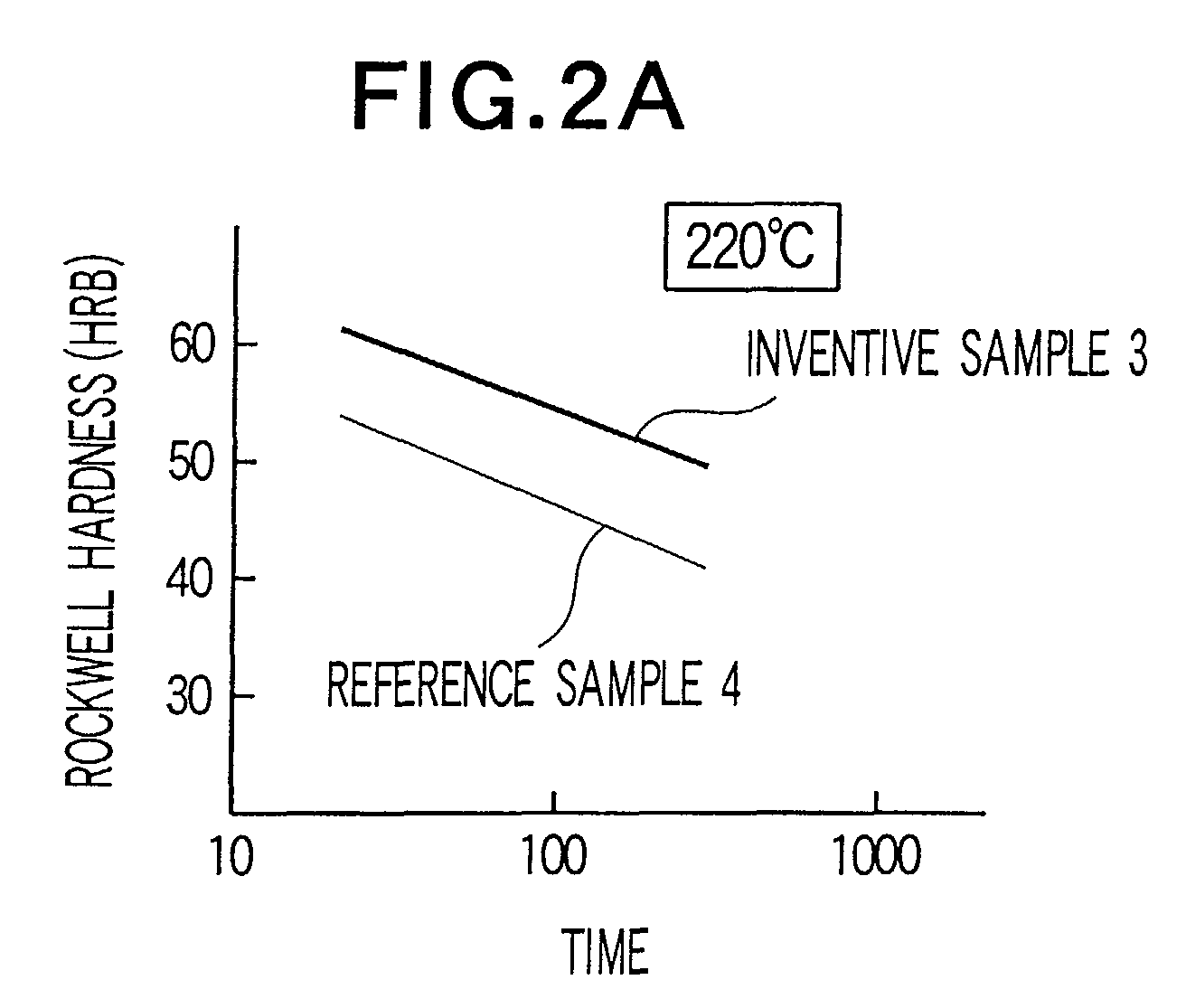
- FIG. 2A and FIG. 2B are graphs showing relationships between temperature and time-dependent degradation in hardness. While the x-axis represents time, the y-axis represents Rockwell hardness (HRB).
- HRB Rockwell hardness
- FIG. 2A shows changes in hardness in Inventive Sample 3 and Reference Sample 4, when temperature is 220 °C.
- Inventive Sample 3 of is always much harder than Reference Sample 4, which has gone through a T7 treatment.
- FIG. 2B shows changes in hardness with Inventive Sample 3 and Reference Sample 4, when temperature is 240 °C.
- Reference Sample 4 degrades much more than Inventive Sample 3.
- Inventive Sample 3 shows superior heat resistance characteristics.
- Table 8 compares various characteristics of Inventive Sample 3, as shown in Table 7, against Reference Sample 5 (AC8A-T7).
- Inventive Sample 3 shows comparable or superior characteristics with respect to the Reference Sample 5 in terms of tensile strength, 0.2% yield strength, and high temperature fatigue strength.
- Inventive Sample 3 (a die cast metal with T5 age hardening treatment) is comparable to the T7 treated (515 °C for four hours of solution treatment and 230 °C for five hours of stabilization treatment) AC8A alloy, which is a superior Al alloy cast metal in terms of heat resistance and widely used for pistons and other applications.
- pistons manufactured with the die cast metal having the AC composition of this invention were built into engines to evaluate the seizure characteristics.
- Tests were performed on engines with 580 cm 3 capacity. 380 cm 3 of oil is added to the engine at the time when the engine starts. As the engine runs, 10 - 20 cm 3 of engine oil is drained every 10 minutes. The engine starts to seize up, when the amount of engine oil is much lower than the minimum required amount or close to zero. If the piston offers superior seizure characteristics, there would be extra time before seizure starts. The results of this test are recorded in terms of the amount of the engine oil remaining when the engine stops running due to seizure.
- Inventive Sample 4 which is a die cast metal of this invention undergoing the T5 treatment, showed 58 cm 3 of remaining engine oil. Only small seizure damages were observed on the surface of the piston, when the engine was taken apart.
- Reference Sample 6, representing the AC8A-T7 alloy showed 70 cm 3 of remaining engine oil. Large seizure damages were observed on the surface of the piston, when the engine was taken apart.
- Si content in the gravity die cast and annealed AC8A alloy must be at least 11.0% (see Table 2).
- Si concentration in the primary crystals and eutectic cells ends up being approximately 1.5% lower than the gravity die cast and treated AC8A alloy, because of rapid cooling and solidification during the die cast process. In other words, approximately 1.5% of Si apparently "disappears," because of the die cast process.
- the die cast metal of this invention must have at least 12.5% of Si, which is comparable to 11.0% plus 1.5%. Because excessive amount of Si would adversely impacts toughness of the alloy, the die cast metal of this invention must have less than 14.0% of Si. In other words, Si content in this invention ranges between 12.5% to 14.0%.
- Cu content is less than 3.0%, the resulting die cast metal does not offer adequate hardness initially after cooling. Furthermore, the metal will not harden adequately under age hardening. When Cu content is more than 4.5%, the resulting metal becomes less tough, creating a problem for machining. For these reasons, Cu content should be 3.0% to 4.5%.
- Mg content is less than 1.4%, the resulting metal does not harden adequately under age hardening.
- Mg content is more than 2.0%, the resulting metal is less tough and causes a problem with machining. For these reasons, Mg content should be between 1.4% and 2.0%.
- Zn content is less than 1.12%, the resulting die cast metal becomes prone to cracks. When Zn content is more than 2.4%, the resulting metal is less tough. For these reasons, Zn content should be between 1.12% and 2.24%.
- the heat resistant Al die cast material of this invention is an Al-Si-Cu die cast alloy having 12.5% to 14.0% of Si, 3.0% to 4.5% of Cu, 1.5% to 2.0% of Mg, and 1.12% to 2.4% of Zn.
- Al die cast metal of this invention may include trace amounts of Fe, Mn, Ni, and other elements.
- heat resistant Al die cast material of this invention is suited for pistons, the material may also be widely used in other applcations that require lightweight, heat resistant, abrasion resistant materials.
- Heat resistant Al die cast material having 12.5% to 14.0% of Si, 3.0% to 4.5% of Cu, 1.4% to 2.0% of Mg, and 1.12% to 2.4% of Zn.
- the die cast metal becomes amenable to age hardening treatment when appropriate amounts of Mg and Zn are added to an Al-Si-Cu alloy for enhancing mechanical strength and seizure characteristics.
Landscapes
- Chemical & Material Sciences (AREA)
- Engineering & Computer Science (AREA)
- Materials Engineering (AREA)
- Mechanical Engineering (AREA)
- Metallurgy (AREA)
- Organic Chemistry (AREA)
- Physics & Mathematics (AREA)
- Thermal Sciences (AREA)
- Crystallography & Structural Chemistry (AREA)
- Molds, Cores, And Manufacturing Methods Thereof (AREA)
- Pistons, Piston Rings, And Cylinders (AREA)
- Mounting, Exchange, And Manufacturing Of Dies (AREA)
- Manufacture Of Alloys Or Alloy Compounds (AREA)
- Cylinder Crankcases Of Internal Combustion Engines (AREA)
Abstract
Description
- The present invention relates generally to a heat resistant Al die cast material and, more particularly, to a heat resistant Al die cast material suited as a part of an internal combustion system, such as a piston.
- Conventional heat resistant Al materials consist of elements like Si, Cu, Mg, Ni and Ti added to Al at concentration levels appropriate for abrasion resistance, seizure resistance, and thermal resistance. An important application for heat resistant Al materials is pistons, which are a part of internal combustion systems. "Al alloy cast metal" is standardized in JIS H 5202 (1992). Table 1 in this standard lists the types of alloys and their codes, Table 2 lists chemical compositions, and Table 3 lists mechanical properties of cast metal test samples. Table 1 through Table 3 below summarize the JIS Table 1 through Table 3.
Comments Codes Types of Alloy Types of Mold Alloy Characteristics Applications AC8A Al-Si-Cu-Ni-Mg metal mold temperature and abrasion resistant small coefficient of expansion high tensile strength automotive
diesel engine piston
naval piston
pulley
bearingsAC8B Al-Si-Cu-Ni-Mg metal mold same as above automotive piston
pulley
bearingsAC8C Al-Si-Cu-Ni-Mg metal mold same as above automotive piston
pulley
bearings - As shown in the right-hand column in Table 1, under the "Applications" header, the AC8A, AC8B and AC8C Al alloy die cast metals are used for pistons in automobiles.
- "Metal molds" listed under the "Type of Mold" in the third column of Table 1 represent regular metal casting.
Unit: % Codes Chemical Compositions Cu Si Mg Zn Fe Mn Ni Ti Pb Sn Cr Al AC8A 0.8 -1.3 11.0 - 13.0 0.7 - 1.3 ≤ 0.15 ≤ 0.8 ≤ 0.15 0.8 - 1.5 ≤ 0.20 ≤ 0.05 ≤ 0.05 ≤ 0.10 Balance AC8B 2.0 - 4.0 8.5 - 10.5 0.50 - 1.5 ≤ 0.50 ≤ 1.0 ≤ 0.50 0.10 - 1.0 ≤ 0.20 ≤ 0.10 ≤ 0.10 ≤ 0.10 Balance AC8C 2.0 - 4.0 8.5 - 10.5 0.50 - 1.5 ≤ 0.50 ≤ 1.0 ≤ 0.50 ≤ 0.50 ≤ 0.20 ≤ 0.10 ≤ 0.10 ≤ 0.10 Balance - Table 2 shows the chemical compositions of the AC8A, AC8B and AC8C Al alloy die cast materials. AC8A is an Al-Si-Cu-Ni-Mg alloy containing 0.8% to 1.3% Cu, 11.0% to 13.0% Si, 0.7% to 1.3% Mg, and 0.8% to 1.5% Ni. AC8B is an Al-Si-Cu-Ni-Mg alloy containing 2.0% to 4.0% Cu, 8.5% to 10.5% Si, 0.5% to 1.5% Mg, and 0.1% to 1.0% Ni. AC8C is an Al-Si-Cu-Ni-Mg alloy containing 2.0% to 4.0% Cu, 8.5% to 10.5% Si, 0.5% to 1.5% Mg and 0.5% to 1.5% Ni.
- As shown in Table 2, Zn content is less than or equal to 0.15% in AC8A and less than or equal to 0.50% in AC8B and AB8C. "Less than or equal to" means that Zn content can be 0%. In other words, Zn content should not exceed the prescribed amount (0.15% or 0.5%).
Types Codes Tensile Test Reference Tensile Strength N/mm2 Lengthening % Brinell Hardness HB (10 / 500) Heat Treatment Annealing Solution Treatment Solution Treatment Temperature °C Time h Temperature °C Time h Temperature °C Time h As cast AC8A-F ≥ 170 - Appx.85 - - - - - - Age hardening AC8A-T5 ≥ 190 - Appx. 90 - - - - Appx. 200 Appx. 4 Solution treatment + age hardening AC8A-T6 ≥ 270 - Appx. 110 - - Appx. 510 Appx. 4 Appx. 170 Appx. 10 As cast AC8B-F ≥ 170 - Appx. 85 - - - - - - Age hardening AC8B-T5 ≥ 180 - Appx. 90 - - - - Appx. 200 Appx. 4 Solution treatment + age hardening AC8B-T6 ≥ 270 - Appx. 110 - - Appx. 510 Appx. 4 Appx. 170 Appx. 10 As cast AC8C-F ≥ 170 - Appx. 85 - - - - - - Age hardening AC8C-T5 ≥ 180 - Appx. 90 - - - - Appx. 200 Appx. 4 Solution treatment + age hardening AC8C-T6 ≥ 270 - Appx. 110 - - Appx. 510 Appx. 4 Appx. 170 Appx. 10 - Table 3 lists the mechanical properties of die cast test samples and provides information on whether or not any treatment is applied, and, if so, what type of treatment. For example, the "F" suffix that comes after the AC8A, AC8B and AC8C codes indicates that the alloy has only gone through a casting process. A "T5" suffix indicates that the alloy has been age hardened. The "T6" suffix indicates that the alloy has been age hardened after a solution treatment. For example, the AC8C-T6 alloy in the lower most row goes through a solution treatment for approximately four hours at approximately 510 °C, followed by approximately 10 hours of age hardening at approximately 170 °C. The third column on Table 3 lists the tensile strengths. Tensile strength is higher for "F" compared with "T5," while tensile strength is higher for "T6" compared with "T5." Therefore, "T5" or "T6" treatment may be used for enhancing strength. These treatments are also effective for improving the dimensional stablity during annealing.
JIS HS5302 Al Alloy Die Cast Reference Table 1: Mechanical properties of as-cast die cast test samples Types Codes Tensile Tests Tensile Strength N/mm2 Lengthening % Average Value Standard Deviation Average Value Standard Deviation Type 10 ADC10 245 20 2.0 0.6 Type 12 ADC12 225 39 1.5 0.6 - Table 4 is a Reference Table 1 found in JIS H 5302 (1990). ADC10 and ADC12 are both Al-Si-Cu alloys, which do not contain Mg. Their compositions are given in JIS H 5302 (1990) and will not be listed here. ADC10 and ADC12 are Al alloy die cast metals whose compositions are different from the AC8A, AC8B and AC8C metals discussed above.
- ADC10, which is an as-cast metal, has a tensile strength of 245 N/mm2, as shown in the third column of Table 4. ADC10 has a different composition and a much greater tensile strength than the AC8A-F, AC8B-F and AC8C-F metals mentioned above, whose tensile strengths are greater than or equal to 170 N/mm2. ADC12 exhibits similar properties.
- While regular cast metals are produced by gravity casting, die cast metals are manufactured by high pressure casting. High pressure casting results in a more dense casting structure, which also results in higher strength.
- The inventors of this invention assumed that it would be possible to achieve a much higher strength by treating die cast metals, if "T5" age hardening on the AC8A alloy increases the tensile strength from 170 N/mm2 to 190 N/mm2, and "T6" solvent treatment, followed by age hardening, increases AC8A's tensile strength from 170 N/mm2 to 270 N/mm2.
- The inventors first performed an experiment in which an AC8A die cast metal was manufactured and treated with T6 solution treatment, followed by age hardening.
- The resulting AC8A-T6 metal was covered by blisters and unusable. It is believed that the alloy incorporates air and other gases during the casting process and remain in the die cast metal as bubbles. These bubbles expand under 510 °C of heat during solvent treatment and lifted the Al alloy, which was softened under high heat.
- Annealing temperature for the T5 age hardening, on the other hand, is around 200 °C. Nevertheless, even a die cast AC8A-T5 metal shows blistering to a lesser degree. This experiment has confirmed that the ADC compositions are made different from the AC compositions in the JIS in order to avoid this phenomenon.
- The inventors of this invention, however, believed it would be possible to perform the T5 age hardening on die cast metals with AC compositions by modifying the AC compositions. As a result of various research projects, the inventors discovered compositions that would make the AC die cast metal amenable to the T5 treatment.
- This invention provides heat resistant Al die cast material that contains 12.5% to 14.0% of Si, 3.0% to 4.5% of Cu, 1.4% to 2.0% of Mg, and 1.12% to 2.4% of Zn. This die cast material is age hardened after die casting.
- Because the die cast material having the above composition is amenable to age hardening, the material offers a much higher mechanical strength andseizure resistance. When Zn content is less than 1.12%, the die cast metal is prone to anneal cracks. When Zn content is more than 2.4%, the material exhibits less toughness. Therefore, Zn content should preferably be 1.12% to 2.4%.
- Appropriate amounts of Mg and Zn added to an Al-Si-Cu alloy has resulted in a die cast metal that is amenable to annealing. This type of alloy has not been previously commercialized because the material was too susceptible to anneal cracks - an important consideration for a die cast alloy.
- For example, a thick cast metal having the ADC14 "die cast Al alloy" composition (16.0% to 18.0% Si, 4.0% to 5.0% Cu, and 0.45% to 0.65% Mg), defined in JIS H 5302 (1990), tends to show many micro-cracks after casting.
- Similarly, an alloy with 14.0% Si, 3.3% Cu, and 1.4% Mg contents also exhibits micro-cracks after casting.
- This problem is caused by a reduced eutectic temperature, as low as 536 °C, depending on Cu and Mg contents. Because the eutectic temperature is lower, compressive stress concentrates where thick and thin parts of the die cast metal meet with each other before the annealed material becomes strong enough, as the molten metal in the metal cast in the shape of the end product solidifies and shrinks. As a result, the metal exhibits anneal cracks.
- Zn has been added in an effort to prevent these micro-cracks. As a result, it was discovered that the eutectic temperature would go upto 547 to 554 °C, if equal amounts of Mg and Zn are added to Al at the same time as other elements. Further studies revealed that similar effects would be achieved as long as Zn concentration was 80% to 120% of the Mg content.
- Certain preferred embodiments of the present invention will be described in detail hereinbelow, by way of example only, with reference to the accompanying drawings, in which:
- FIG. 1 is a graph showing seizure characteristics of the die cast metal of this invention
- FIG. 2A and FIG. 2B are graphs showing relationships between temperature and hardness degradation over time
-
- The following description is merely exemplary in nature and is in no way intended to limit the invention, its application or uses.
Main Additives (%) Rockwell Hardness (HRB) Cu Si Mg Zn As Cast Age Hardened Reference
Sample 13.3 14.0 0.8 0.8 40 50 Reference
Sample 23.3 14.0 1.4 0.8 62 70 Inventive
Sample 13.3 14.0 1.6 1.7 70 80 - Die cast metals with the AC compositions listed in Table 4 (translator- meaning Table 5?) are prepared by simultaneously adding Mg and Zn to Al alloys containing 3.3% of Cu and 14.0% of Si. The resulting die cast metals with the AC compositions were tested for Rockwell hardness (B scale). (Hardness is designated as HRB).
- Age hardening treatment takes place at 250 °C for approximately 20 minutes.
- Sample 1 includes 0.8% of Mg and 0.8% of Zn and has the as-cast hardness (HRB) of 40 and post-age hardening treatment hardness (HRB) of 50.
- Sample 2 includes 1.4% of Mg and 0.8% of Zn and has the as-cast hardness (HRB) of 62 and post-age hardening treatment hardness (HRB) of 70. This sample shows that an increased amount of Mg increases hardness.
- Inventive Sample 1 includes 1.6% of Mg and 1.7% of Zn and has the as-cast hardness (HRB) of 70 and post-age hardening treatment hardness (HRB) of 80. Increased amounts of Mg and Zn make this sample harder.
- Following observations have been made on the age hardened characteristics of the various samples:
- With the alloy of the Reference Sample 1, CuAl2 is a primary intermetallic compound that determines the age hardening characteristics, while Mg2Si is a secondary intermetallic compound.
- With the alloy of the Reference Sample 2, CuAl2 and Mg2Si are both primary intermetallic compounds that determine the age hardening characteristics.
- With the Inventive Sample 1, CuAl2, Mg2Si, and MgZn2 are all primary intermetallic compounds that contribute to the age hardening effect. As a result, the inventive sample, with approximately the same amounts of Zn and Mg, offers very high hardness.
- Because a piston moves back and forth at high speed in an internal combustion cylinder, the piston must not seize up in the cylinder. A chip-on-disk type abrasion tester was used for testing seizure characteristics using the following steps.
- A rotating disk rotates at a rate of 16 m/sec, and drops of oil are added to this rotating disk at a rate of 240 cm3/min. A test sample (die cast metal with the AC composition) is pressed against this rotating disk under a prescribed load for three minutes for preconditioning. Next, the supply of oil is stopped, and the test sample continues to be pressed against the rotating disk, rotating at a rate of 16 m/sec under a pressure P. Measurement is taken on the amount of time it takes for the sample to get seized on the rotating disk. Test results are recorded as the PV value (kgf/mm2 x m/sec) which is a product of pressure P (kgf/mm2) and rate of rotation V (m/sec).

- The left half of Table 6 lists the compositions of
Samples 2 and 3 of the present embodiment andReference Sample 3, on which the seizure tests were performed. All test samples have been exposed to the T5 age hardening treatment. - FIG. 1 is a graph showing the seizure test results for the die cast metal of this invention. Inventive Sample 2 in this graph designates a curve that plots multiple points representing PV values at which Inventive Sample 2 shows seizure. Similar curves have been drawn for
Inventive Sample 3 andReference Sample 3. At 1200 seconds (20 minutes), the PV values are 10 forInventive Sample 2, 5 forInventive Sample Reference Sample 3. - These values, 10, 5, 3, respectively, have been entered into the right-hand column of Table 6. As shown in this Table,
Inventive Sample 3, which includes 1.4% of Mg and 1.6% of Zn, shows superior seizure characteristics, compared withReference Sample 3, which includes 0.8% of Mg and 0.6% of Zn. Inventive Sample 2, which includes 1.0% of Mg and 1.8% of Zn, offers even superior seizure characteristics. These results show that seizure characteristics are improved by adding appropriate amounts of Mg and Zn. - High temperature characteristics of the die cast metals of this invention were next examined.
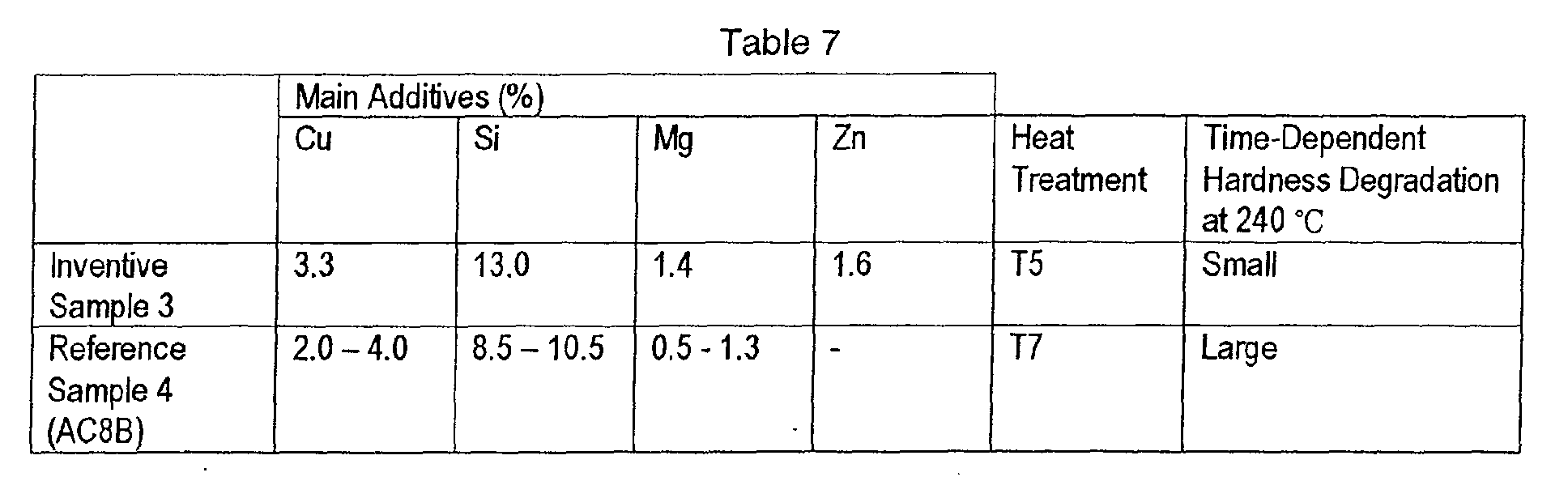
- A significant aspect of this invention is that die cast metals with the AC composition are amenable to annealing. T5 age hardening treatment was performed on die cast metals having the composition shown in Table 7 for
Inventive Sample 3. - T7 solution treatment followed by a stabilizing treatment was performedon the AC8B alloy (composition shown in Table 2) for
Reference Sample 4. - FIG. 2A and FIG. 2B are graphs showing relationships between temperature and time-dependent degradation in hardness. While the x-axis represents time, the y-axis represents Rockwell hardness (HRB).
- FIG. 2A shows changes in hardness in
Inventive Sample 3 andReference Sample 4, when temperature is 220 °C.Inventive Sample 3 of is always much harder thanReference Sample 4, which has gone through a T7 treatment. - FIG. 2B shows changes in hardness with
Inventive Sample 3 andReference Sample 4, when temperature is 240 °C. Reference Sample 4 degrades much more thanInventive Sample 3. In other words,Inventive Sample 3 shows superior heat resistance characteristics. These results are shown in the right hand column of Table 7 under a column title "Time-Dependent Hardness Degradation at 240 degrees C." Entry forSample 3 of this embodiment in this column is "Small", while entry forReference Sample 4 is "Large."Reference Sample 5
(AC8A-T7)Inventive Sample 3Coefficient of Thermal Expansion
(Room Temperature to 100 °C)19.2 X 10⁻⁶- 20.8 X 10-619.4 X 10⁻⁶- 20.3 X 10⁻⁶Thermal Conductance
(cal / cm * sec °C)0.32 X 10⁻⁶ - 0.34 X 10-60.24 X 10-6- 0.25 X 10⁻⁶Young's Module
(kgf/mm2)7500 - 7900 7620 Density
(g/cm3)2.27 2.26 - 2.71 Hardness
(HRB)64 - 68 68 - 82 Tensile Strength
(kgf/mm2)200 °C 2.16 - 26.5 23.5 - 28.6 300 °C 7.5 13.2 - 14.5 0.2 % Yield Strength
(kgf/mm2)200 °C 20.2 - 20.9 20.3 - 24.5 300 °C 5.8 10.2 - 12.1 High-Temperature Fatigue
Strength
(kgf/mm2)200 °C 7.5 - 8.0 8.5 - 9.0 300 °C 3.4 4.3 - Table 8 compares various characteristics of
Inventive Sample 3, as shown in Table 7, against Reference Sample 5 (AC8A-T7).Inventive Sample 3 shows comparable or superior characteristics with respect to theReference Sample 5 in terms of tensile strength, 0.2% yield strength, and high temperature fatigue strength. In other words, Inventive Sample 3 (a die cast metal with T5 age hardening treatment) is comparable to the T7 treated (515 °C for four hours of solution treatment and 230 °C for five hours of stabilization treatment) AC8A alloy, which is a superior Al alloy cast metal in terms of heat resistance and widely used for pistons and other applications. - Next, pistons manufactured with the die cast metal having the AC composition of this invention were built into engines to evaluate the seizure characteristics.
- Tests were performed on engines with 580 cm3 capacity. 380 cm3 of oil is added to the engine at the time when the engine starts. As the engine runs, 10 - 20 cm3 of engine oil is drained every 10 minutes. The engine starts to seize up, when the amount of engine oil is much lower than the minimum required amount or close to zero. If the piston offers superior seizure characteristics, there would be extra time before seizure starts. The results of this test are recorded in terms of the amount of the engine oil remaining when the engine stops running due to seizure.
Main Additives (%) Heat
TreatmentAmount of Oil Remaining at the Time of Seizure Size of Damages on Piston Caused by Seizure Cu Si Mg Zn Inventive
Sample 43.3 13.0 1.6 1.7 T5 58 cm3 Small Reference
Sample 6
(AC8A)0.8 - 1.3 11.0 - 13.0 0.7 - 1.3 - T7 70 cm3 Large -
Inventive Sample 4, which is a die cast metal of this invention undergoing the T5 treatment, showed 58 cm3 of remaining engine oil. Only small seizure damages were observed on the surface of the piston, when the engine was taken apart. On the other hand, Reference Sample 6, representing the AC8A-T7 alloy, showed 70 cm3 of remaining engine oil. Large seizure damages were observed on the surface of the piston, when the engine was taken apart. These results show that a piston consisting of the T5 treated die cast metal, having the AC composition, offers superior seizure characteristics compared with a piston consisting of the conventional AC8A-T7 alloy. - According to the JIS, Si content in the gravity die cast and annealed AC8A alloy must be at least 11.0% (see Table 2). When the same type of alloy is die cast, Si concentration in the primary crystals and eutectic cells ends up being approximately 1.5% lower than the gravity die cast and treated AC8A alloy, because of rapid cooling and solidification during the die cast process. In other words, approximately 1.5% of Si apparently "disappears," because of the die cast process.
- To address this issue, the die cast metal of this invention must have at least 12.5% of Si, which is comparable to 11.0% plus 1.5%. Because excessive amount of Si would adversely impacts toughness of the alloy, the die cast metal of this invention must have less than 14.0% of Si. In other words, Si content in this invention ranges between 12.5% to 14.0%.
- When Cu content is less than 3.0%, the resulting die cast metal does not offer adequate hardness initially after cooling. Furthermore, the metal will not harden adequately under age hardening. When Cu content is more than 4.5%, the resulting metal becomes less tough, creating a problem for machining. For these reasons, Cu content should be 3.0% to 4.5%.
- Similar to Cu, when Mg content is less than 1.4%, the resulting metal does not harden adequately under age hardening. When Mg content is more than 2.0%, the resulting metal is less tough and causes a problem with machining. For these reasons, Mg content should be between 1.4% and 2.0%.
- When Zn content is less than 1.12%, the resulting die cast metal becomes prone to cracks. When Zn content is more than 2.4%, the resulting metal is less tough. For these reasons, Zn content should be between 1.12% and 2.24%.
- In summary, the heat resistant Al die cast material of this invention is an Al-Si-Cu die cast alloy having 12.5% to 14.0% of Si, 3.0% to 4.5% of Cu, 1.5% to 2.0% of Mg, and 1.12% to 2.4% of Zn.
- Furthermore, the Al die cast metal of this invention may include trace amounts of Fe, Mn, Ni, and other elements.
- While the heat resistant Al die cast material of this invention is suited for pistons, the material may also be widely used in other applcations that require lightweight, heat resistant, abrasion resistant materials.
- Heat resistant Al die cast material having 12.5% to 14.0% of Si, 3.0% to 4.5% of Cu, 1.4% to 2.0% of Mg, and 1.12% to 2.4% of Zn. The die cast metal becomes amenable to age hardening treatment when appropriate amounts of Mg and Zn are added to an Al-Si-Cu alloy for enhancing mechanical strength and seizure characteristics.
Claims (2)
- A heat resistant Al die cast material comprising:12.5% to 14.0% of Si;3.0% to 4.5% of Cu;1.4% to 2.0% of Mg; and1.12% to 2.4% of Zn.
- The heat resistant Al die cast material of Claim 1, wherein the material is age hardened after die casting.
Applications Claiming Priority (2)
| Application Number | Priority Date | Filing Date | Title |
|---|---|---|---|
| JP2001094368 | 2001-03-28 | ||
| JP2001094368A JP4648559B2 (en) | 2001-03-28 | 2001-03-28 | Heat-resistant aluminum die-cast product |
Publications (2)
| Publication Number | Publication Date |
|---|---|
| EP1253210A1 true EP1253210A1 (en) | 2002-10-30 |
| EP1253210B1 EP1253210B1 (en) | 2006-02-01 |
Family
ID=18948577
Family Applications (1)
| Application Number | Title | Priority Date | Filing Date |
|---|---|---|---|
| EP02006812A Expired - Lifetime EP1253210B1 (en) | 2001-03-28 | 2002-03-25 | Heat resistant Al die cast material |
Country Status (9)
| Country | Link |
|---|---|
| US (1) | US6706242B2 (en) |
| EP (1) | EP1253210B1 (en) |
| JP (1) | JP4648559B2 (en) |
| KR (1) | KR100648487B1 (en) |
| CN (1) | CN1269982C (en) |
| AU (1) | AU778709B2 (en) |
| CA (1) | CA2379432C (en) |
| DE (1) | DE60208944T8 (en) |
| TW (1) | TW588112B (en) |
Cited By (1)
| Publication number | Priority date | Publication date | Assignee | Title |
|---|---|---|---|---|
| WO2010112725A1 (en) * | 2009-04-02 | 2010-10-07 | Peugeot Citroën Automobiles SA | Heat treatment process and pressure-cast aluminium alloy part |
Families Citing this family (10)
| Publication number | Priority date | Publication date | Assignee | Title |
|---|---|---|---|---|
| JP2009208095A (en) * | 2008-03-03 | 2009-09-17 | Nsk Ltd | Aluminum alloy die-casting component |
| WO2011059412A2 (en) * | 2009-11-13 | 2011-05-19 | Daiki Aluminium Industry (Thailand) Company Limited | Aluminium alloy which is able to be cast by high pressure die casting technique and results in better mechanical properties aluminium alloy product without heat treatment |
| CN102011036A (en) * | 2010-11-24 | 2011-04-13 | 肇庆莱尔达光电科技有限公司 | Die casting aluminum alloy |
| CN102586633B (en) * | 2011-01-18 | 2013-10-30 | 华孚精密金属科技(常熟)有限公司 | Method for improving mechanical properties of Al-Si-Cu series die casting alloys |
| CN102418013B (en) * | 2011-12-08 | 2013-10-16 | 东北大学 | Magnesium-containing regenerated high-silicon wrought aluminum alloy and preparation method thereof |
| DE102013000746A1 (en) * | 2013-01-17 | 2014-07-17 | Kienle + Spiess Gmbh | Method for producing castings for electrical applications |
| CN105112744A (en) * | 2015-10-08 | 2015-12-02 | 江苏佳铝实业股份有限公司 | Manufacturing process of high-silicon aluminum alloy plate |
| KR101756016B1 (en) * | 2016-04-27 | 2017-07-20 | 현대자동차주식회사 | Aluminum alloy for die casting and Method for heat treatment of manufacturing aluminum alloy using thereof |
| CN109355534A (en) * | 2018-12-14 | 2019-02-19 | 广东省海洋工程装备技术研究所 | A kind of multi-element eutectic Al-Si alloy material and preparation method thereof and piston |
| CN110343915B (en) * | 2019-06-25 | 2020-12-11 | 广东伟业铝厂集团有限公司 | High-strength high-thermal-conductivity aluminum alloy material, preparation method thereof and radiator |
Citations (6)
| Publication number | Priority date | Publication date | Assignee | Title |
|---|---|---|---|---|
| US4284429A (en) * | 1980-01-21 | 1981-08-18 | John Savas | Aluminum base casting alloy |
| US4834941A (en) * | 1984-11-28 | 1989-05-30 | Honda Giken Kogyo Kabushiki Kaisha | Heat-resisting high-strength Al-alloy and method for manufacturing a structural member made of the same alloy |
| US4919736A (en) * | 1987-07-30 | 1990-04-24 | Ryobi Limited | Aluminum alloy for abrasion resistant die castings |
| US5028393A (en) * | 1989-06-02 | 1991-07-02 | Daido Metal Company | Al-based alloy for use as sliding material, superior in fatigue resistance and anti-seizure property |
| JPH03170634A (en) * | 1989-11-28 | 1991-07-24 | Toyota Autom Loom Works Ltd | Wear-resistant aluminum alloy for plastic working excellent in heat treating property |
| EP0924310A1 (en) * | 1997-12-20 | 1999-06-23 | Federal-Mogul Bradford Limited | Aluminium alloy containing silicon for use as pistons in automobiles |
Family Cites Families (1)
| Publication number | Priority date | Publication date | Assignee | Title |
|---|---|---|---|---|
| JP2000001731A (en) * | 1998-06-16 | 2000-01-07 | Nippon Light Metal Co Ltd | Hypereutectic Al-Si alloy die casting member and method of manufacturing the same |
-
2001
- 2001-03-28 JP JP2001094368A patent/JP4648559B2/en not_active Expired - Fee Related
-
2002
- 2002-03-22 TW TW091105640A patent/TW588112B/en not_active IP Right Cessation
- 2002-03-25 AU AU27626/02A patent/AU778709B2/en not_active Ceased
- 2002-03-25 DE DE60208944T patent/DE60208944T8/en active Active
- 2002-03-25 EP EP02006812A patent/EP1253210B1/en not_active Expired - Lifetime
- 2002-03-27 US US10/108,527 patent/US6706242B2/en not_active Expired - Lifetime
- 2002-03-27 CA CA002379432A patent/CA2379432C/en not_active Expired - Fee Related
- 2002-03-28 CN CNB021192804A patent/CN1269982C/en not_active Expired - Fee Related
- 2002-03-28 KR KR1020020016994A patent/KR100648487B1/en not_active Expired - Fee Related
Patent Citations (6)
| Publication number | Priority date | Publication date | Assignee | Title |
|---|---|---|---|---|
| US4284429A (en) * | 1980-01-21 | 1981-08-18 | John Savas | Aluminum base casting alloy |
| US4834941A (en) * | 1984-11-28 | 1989-05-30 | Honda Giken Kogyo Kabushiki Kaisha | Heat-resisting high-strength Al-alloy and method for manufacturing a structural member made of the same alloy |
| US4919736A (en) * | 1987-07-30 | 1990-04-24 | Ryobi Limited | Aluminum alloy for abrasion resistant die castings |
| US5028393A (en) * | 1989-06-02 | 1991-07-02 | Daido Metal Company | Al-based alloy for use as sliding material, superior in fatigue resistance and anti-seizure property |
| JPH03170634A (en) * | 1989-11-28 | 1991-07-24 | Toyota Autom Loom Works Ltd | Wear-resistant aluminum alloy for plastic working excellent in heat treating property |
| EP0924310A1 (en) * | 1997-12-20 | 1999-06-23 | Federal-Mogul Bradford Limited | Aluminium alloy containing silicon for use as pistons in automobiles |
Non-Patent Citations (1)
| Title |
|---|
| PATENT ABSTRACTS OF JAPAN vol. 015, no. 413 (C - 0877) 22 October 1991 (1991-10-22) * |
Cited By (2)
| Publication number | Priority date | Publication date | Assignee | Title |
|---|---|---|---|---|
| WO2010112725A1 (en) * | 2009-04-02 | 2010-10-07 | Peugeot Citroën Automobiles SA | Heat treatment process and pressure-cast aluminium alloy part |
| FR2944030A1 (en) * | 2009-04-02 | 2010-10-08 | Peugeot Citroen Automobiles Sa | THERMAL PROCESSING METHOD AND ALUMINUM ALLOY PART ALLOY UNDER PRESSURE |
Also Published As
| Publication number | Publication date |
|---|---|
| AU2762602A (en) | 2002-10-03 |
| DE60208944T8 (en) | 2006-12-14 |
| US20030047250A1 (en) | 2003-03-13 |
| CA2379432C (en) | 2006-01-03 |
| JP2002294380A (en) | 2002-10-09 |
| KR100648487B1 (en) | 2006-11-24 |
| KR20020077184A (en) | 2002-10-11 |
| US6706242B2 (en) | 2004-03-16 |
| TW588112B (en) | 2004-05-21 |
| CA2379432A1 (en) | 2002-09-28 |
| AU778709B2 (en) | 2004-12-16 |
| DE60208944D1 (en) | 2006-04-13 |
| DE60208944T2 (en) | 2006-07-27 |
| JP4648559B2 (en) | 2011-03-09 |
| EP1253210B1 (en) | 2006-02-01 |
| CN1269982C (en) | 2006-08-16 |
| CN1392276A (en) | 2003-01-22 |
Similar Documents
| Publication | Publication Date | Title |
|---|---|---|
| EP2771493B9 (en) | High performance aisimgcu casting alloy | |
| KR20200035740A (en) | Anti corrosive coated steel having good resistance against liquid metal embrittlement and coating adhesion | |
| US20170107599A1 (en) | New high pressure die casting aluminum alloy for high temperature and corrosive applications | |
| EP1253210A1 (en) | Heat resistant Al die cast material | |
| JP3594272B2 (en) | High strength aluminum alloy for welding with excellent stress corrosion cracking resistance | |
| CA2932867A1 (en) | High performance alsimgcu casting alloy | |
| EP2562282B1 (en) | Bearing device | |
| US6074501A (en) | Heat treatment for aluminum casting alloys to produce high strength at elevated temperatures | |
| US9677158B2 (en) | Aluminum alloy suitable for high pressure die casting | |
| KR20190008179A (en) | High-tensile brass alloys and high-tensile brass alloy products | |
| KR100893311B1 (en) | High temperature aluminum alloy brazing sheet and methods for increasing the yield strength of an aluminum alloy brazing sheet product | |
| KR101431355B1 (en) | Aluminum alloy for slide bearing, slide bearing and method for producing same | |
| Suman | The effects of direct aging on mechanical properties and corrosion resistance of diecast magnesium alloys AZ91D and AM60B | |
| JPH01180938A (en) | Wear-resistant aluminum alloy | |
| US4150983A (en) | Tin base white metal bearing alloys | |
| JPS6326188B2 (en) | ||
| GB2316686A (en) | A sliding member. | |
| EP1281781A1 (en) | Alloy composition for making blister-free aluminum forgings and parts made therefrom | |
| US20070187006A1 (en) | Aluminum alloy containing copper and zinc | |
| JPH01219131A (en) | High-strength Al-based alloy composite material with excellent corrosion resistance and its heat treatment method | |
| CN101087895A (en) | Aluminium-based alloy and moulded part consisting of said alloy | |
| US12055182B2 (en) | Method of manufacturing a strip for a bearing | |
| JP2001153141A (en) | Al-Sn bearing material | |
| JP2686140B2 (en) | Alloy for high temperature bolt and method for producing the same | |
| JPH07103455B2 (en) | Method for manufacturing aluminum-based bearing alloy |
Legal Events
| Date | Code | Title | Description |
|---|---|---|---|
| PUAI | Public reference made under article 153(3) epc to a published international application that has entered the european phase |
Free format text: ORIGINAL CODE: 0009012 |
|
| AK | Designated contracting states |
Kind code of ref document: A1 Designated state(s): AT BE CH CY DE DK ES FI FR GB GR IE IT LI LU MC NL PT SE TR |
|
| AX | Request for extension of the european patent |
Free format text: AL;LT;LV;MK;RO;SI |
|
| 17P | Request for examination filed |
Effective date: 20021119 |
|
| AKX | Designation fees paid |
Designated state(s): DE FR GB IT |
|
| 17Q | First examination report despatched |
Effective date: 20050128 |
|
| GRAP | Despatch of communication of intention to grant a patent |
Free format text: ORIGINAL CODE: EPIDOSNIGR1 |
|
| GRAS | Grant fee paid |
Free format text: ORIGINAL CODE: EPIDOSNIGR3 |
|
| GRAA | (expected) grant |
Free format text: ORIGINAL CODE: 0009210 |
|
| AK | Designated contracting states |
Kind code of ref document: B1 Designated state(s): DE FR GB IT |
|
| REG | Reference to a national code |
Ref country code: GB Ref legal event code: FG4D |
|
| REF | Corresponds to: |
Ref document number: 60208944 Country of ref document: DE Date of ref document: 20060413 Kind code of ref document: P |
|
| ET | Fr: translation filed | ||
| PLBE | No opposition filed within time limit |
Free format text: ORIGINAL CODE: 0009261 |
|
| STAA | Information on the status of an ep patent application or granted ep patent |
Free format text: STATUS: NO OPPOSITION FILED WITHIN TIME LIMIT |
|
| 26N | No opposition filed |
Effective date: 20061103 |
|
| REG | Reference to a national code |
Ref country code: FR Ref legal event code: PLFP Year of fee payment: 15 |
|
| REG | Reference to a national code |
Ref country code: FR Ref legal event code: PLFP Year of fee payment: 16 |
|
| REG | Reference to a national code |
Ref country code: FR Ref legal event code: PLFP Year of fee payment: 17 |
|
| PGFP | Annual fee paid to national office [announced via postgrant information from national office to epo] |
Ref country code: IT Payment date: 20190326 Year of fee payment: 18 Ref country code: DE Payment date: 20190312 Year of fee payment: 18 Ref country code: GB Payment date: 20190320 Year of fee payment: 18 |
|
| PGFP | Annual fee paid to national office [announced via postgrant information from national office to epo] |
Ref country code: FR Payment date: 20190213 Year of fee payment: 18 |
|
| REG | Reference to a national code |
Ref country code: DE Ref legal event code: R119 Ref document number: 60208944 Country of ref document: DE |
|
| PG25 | Lapsed in a contracting state [announced via postgrant information from national office to epo] |
Ref country code: FR Free format text: LAPSE BECAUSE OF NON-PAYMENT OF DUE FEES Effective date: 20200331 Ref country code: DE Free format text: LAPSE BECAUSE OF NON-PAYMENT OF DUE FEES Effective date: 20201001 |
|
| GBPC | Gb: european patent ceased through non-payment of renewal fee |
Effective date: 20200325 |
|
| PG25 | Lapsed in a contracting state [announced via postgrant information from national office to epo] |
Ref country code: GB Free format text: LAPSE BECAUSE OF NON-PAYMENT OF DUE FEES Effective date: 20200325 |
|
| PG25 | Lapsed in a contracting state [announced via postgrant information from national office to epo] |
Ref country code: IT Free format text: LAPSE BECAUSE OF NON-PAYMENT OF DUE FEES Effective date: 20200325 |