EP1251110A1 - Weather-resistant ceramic exterior building material - Google Patents
Weather-resistant ceramic exterior building material Download PDFInfo
- Publication number
- EP1251110A1 EP1251110A1 EP20020008763 EP02008763A EP1251110A1 EP 1251110 A1 EP1251110 A1 EP 1251110A1 EP 20020008763 EP20020008763 EP 20020008763 EP 02008763 A EP02008763 A EP 02008763A EP 1251110 A1 EP1251110 A1 EP 1251110A1
- Authority
- EP
- European Patent Office
- Prior art keywords
- ceramic
- resistant
- weather
- building material
- compact
- Prior art date
- Legal status (The legal status is an assumption and is not a legal conclusion. Google has not performed a legal analysis and makes no representation as to the accuracy of the status listed.)
- Withdrawn
Links
Images


Classifications
-
- C—CHEMISTRY; METALLURGY
- C04—CEMENTS; CONCRETE; ARTIFICIAL STONE; CERAMICS; REFRACTORIES
- C04B—LIME, MAGNESIA; SLAG; CEMENTS; COMPOSITIONS THEREOF, e.g. MORTARS, CONCRETE OR LIKE BUILDING MATERIALS; ARTIFICIAL STONE; CERAMICS; REFRACTORIES; TREATMENT OF NATURAL STONE
- C04B35/00—Shaped ceramic products characterised by their composition; Ceramics compositions; Processing powders of inorganic compounds preparatory to the manufacturing of ceramic products
- C04B35/622—Forming processes; Processing powders of inorganic compounds preparatory to the manufacturing of ceramic products
- C04B35/62204—Forming processes; Processing powders of inorganic compounds preparatory to the manufacturing of ceramic products using waste materials or refuse
-
- C—CHEMISTRY; METALLURGY
- C04—CEMENTS; CONCRETE; ARTIFICIAL STONE; CERAMICS; REFRACTORIES
- C04B—LIME, MAGNESIA; SLAG; CEMENTS; COMPOSITIONS THEREOF, e.g. MORTARS, CONCRETE OR LIKE BUILDING MATERIALS; ARTIFICIAL STONE; CERAMICS; REFRACTORIES; TREATMENT OF NATURAL STONE
- C04B18/00—Use of agglomerated or waste materials or refuse as fillers for mortars, concrete or artificial stone; Treatment of agglomerated or waste materials or refuse, specially adapted to enhance their filling properties in mortars, concrete or artificial stone
- C04B18/04—Waste materials; Refuse
- C04B18/06—Combustion residues, e.g. purification products of smoke, fumes or exhaust gases
- C04B18/10—Burned or pyrolised refuse
- C04B18/101—Burned rice husks or other burned vegetable material
-
- C—CHEMISTRY; METALLURGY
- C04—CEMENTS; CONCRETE; ARTIFICIAL STONE; CERAMICS; REFRACTORIES
- C04B—LIME, MAGNESIA; SLAG; CEMENTS; COMPOSITIONS THEREOF, e.g. MORTARS, CONCRETE OR LIKE BUILDING MATERIALS; ARTIFICIAL STONE; CERAMICS; REFRACTORIES; TREATMENT OF NATURAL STONE
- C04B33/00—Clay-wares
- C04B33/02—Preparing or treating the raw materials individually or as batches
- C04B33/13—Compounding ingredients
- C04B33/132—Waste materials; Refuse ; Residues
-
- C—CHEMISTRY; METALLURGY
- C04—CEMENTS; CONCRETE; ARTIFICIAL STONE; CERAMICS; REFRACTORIES
- C04B—LIME, MAGNESIA; SLAG; CEMENTS; COMPOSITIONS THEREOF, e.g. MORTARS, CONCRETE OR LIKE BUILDING MATERIALS; ARTIFICIAL STONE; CERAMICS; REFRACTORIES; TREATMENT OF NATURAL STONE
- C04B33/00—Clay-wares
- C04B33/02—Preparing or treating the raw materials individually or as batches
- C04B33/20—Preparing or treating the raw materials individually or as batches for dry-pressing
-
- C—CHEMISTRY; METALLURGY
- C04—CEMENTS; CONCRETE; ARTIFICIAL STONE; CERAMICS; REFRACTORIES
- C04B—LIME, MAGNESIA; SLAG; CEMENTS; COMPOSITIONS THEREOF, e.g. MORTARS, CONCRETE OR LIKE BUILDING MATERIALS; ARTIFICIAL STONE; CERAMICS; REFRACTORIES; TREATMENT OF NATURAL STONE
- C04B33/00—Clay-wares
- C04B33/32—Burning methods
-
- C—CHEMISTRY; METALLURGY
- C04—CEMENTS; CONCRETE; ARTIFICIAL STONE; CERAMICS; REFRACTORIES
- C04B—LIME, MAGNESIA; SLAG; CEMENTS; COMPOSITIONS THEREOF, e.g. MORTARS, CONCRETE OR LIKE BUILDING MATERIALS; ARTIFICIAL STONE; CERAMICS; REFRACTORIES; TREATMENT OF NATURAL STONE
- C04B35/00—Shaped ceramic products characterised by their composition; Ceramics compositions; Processing powders of inorganic compounds preparatory to the manufacturing of ceramic products
- C04B35/515—Shaped ceramic products characterised by their composition; Ceramics compositions; Processing powders of inorganic compounds preparatory to the manufacturing of ceramic products based on non-oxide ceramics
- C04B35/56—Shaped ceramic products characterised by their composition; Ceramics compositions; Processing powders of inorganic compounds preparatory to the manufacturing of ceramic products based on non-oxide ceramics based on carbides or oxycarbides
- C04B35/565—Shaped ceramic products characterised by their composition; Ceramics compositions; Processing powders of inorganic compounds preparatory to the manufacturing of ceramic products based on non-oxide ceramics based on carbides or oxycarbides based on silicon carbide
-
- C—CHEMISTRY; METALLURGY
- C04—CEMENTS; CONCRETE; ARTIFICIAL STONE; CERAMICS; REFRACTORIES
- C04B—LIME, MAGNESIA; SLAG; CEMENTS; COMPOSITIONS THEREOF, e.g. MORTARS, CONCRETE OR LIKE BUILDING MATERIALS; ARTIFICIAL STONE; CERAMICS; REFRACTORIES; TREATMENT OF NATURAL STONE
- C04B35/00—Shaped ceramic products characterised by their composition; Ceramics compositions; Processing powders of inorganic compounds preparatory to the manufacturing of ceramic products
- C04B35/622—Forming processes; Processing powders of inorganic compounds preparatory to the manufacturing of ceramic products
- C04B35/62204—Forming processes; Processing powders of inorganic compounds preparatory to the manufacturing of ceramic products using waste materials or refuse
- C04B35/62209—Forming processes; Processing powders of inorganic compounds preparatory to the manufacturing of ceramic products using waste materials or refuse using woody material, remaining in the ceramic products
-
- C—CHEMISTRY; METALLURGY
- C04—CEMENTS; CONCRETE; ARTIFICIAL STONE; CERAMICS; REFRACTORIES
- C04B—LIME, MAGNESIA; SLAG; CEMENTS; COMPOSITIONS THEREOF, e.g. MORTARS, CONCRETE OR LIKE BUILDING MATERIALS; ARTIFICIAL STONE; CERAMICS; REFRACTORIES; TREATMENT OF NATURAL STONE
- C04B35/00—Shaped ceramic products characterised by their composition; Ceramics compositions; Processing powders of inorganic compounds preparatory to the manufacturing of ceramic products
- C04B35/622—Forming processes; Processing powders of inorganic compounds preparatory to the manufacturing of ceramic products
- C04B35/62204—Forming processes; Processing powders of inorganic compounds preparatory to the manufacturing of ceramic products using waste materials or refuse
- C04B35/62213—Forming processes; Processing powders of inorganic compounds preparatory to the manufacturing of ceramic products using waste materials or refuse using rice material, e.g. bran or hulls or husks
-
- C—CHEMISTRY; METALLURGY
- C04—CEMENTS; CONCRETE; ARTIFICIAL STONE; CERAMICS; REFRACTORIES
- C04B—LIME, MAGNESIA; SLAG; CEMENTS; COMPOSITIONS THEREOF, e.g. MORTARS, CONCRETE OR LIKE BUILDING MATERIALS; ARTIFICIAL STONE; CERAMICS; REFRACTORIES; TREATMENT OF NATURAL STONE
- C04B35/00—Shaped ceramic products characterised by their composition; Ceramics compositions; Processing powders of inorganic compounds preparatory to the manufacturing of ceramic products
- C04B35/622—Forming processes; Processing powders of inorganic compounds preparatory to the manufacturing of ceramic products
- C04B35/626—Preparing or treating the powders individually or as batches ; preparing or treating macroscopic reinforcing agents for ceramic products, e.g. fibres; mechanical aspects section B
- C04B35/62605—Treating the starting powders individually or as mixtures
- C04B35/6261—Milling
- C04B35/6262—Milling of calcined, sintered clinker or ceramics
-
- C—CHEMISTRY; METALLURGY
- C04—CEMENTS; CONCRETE; ARTIFICIAL STONE; CERAMICS; REFRACTORIES
- C04B—LIME, MAGNESIA; SLAG; CEMENTS; COMPOSITIONS THEREOF, e.g. MORTARS, CONCRETE OR LIKE BUILDING MATERIALS; ARTIFICIAL STONE; CERAMICS; REFRACTORIES; TREATMENT OF NATURAL STONE
- C04B35/00—Shaped ceramic products characterised by their composition; Ceramics compositions; Processing powders of inorganic compounds preparatory to the manufacturing of ceramic products
- C04B35/622—Forming processes; Processing powders of inorganic compounds preparatory to the manufacturing of ceramic products
- C04B35/626—Preparing or treating the powders individually or as batches ; preparing or treating macroscopic reinforcing agents for ceramic products, e.g. fibres; mechanical aspects section B
- C04B35/63—Preparing or treating the powders individually or as batches ; preparing or treating macroscopic reinforcing agents for ceramic products, e.g. fibres; mechanical aspects section B using additives specially adapted for forming the products, e.g.. binder binders
- C04B35/6303—Inorganic additives
- C04B35/6306—Binders based on phosphoric acids or phosphates
- C04B35/6309—Aluminium phosphates
-
- C—CHEMISTRY; METALLURGY
- C04—CEMENTS; CONCRETE; ARTIFICIAL STONE; CERAMICS; REFRACTORIES
- C04B—LIME, MAGNESIA; SLAG; CEMENTS; COMPOSITIONS THEREOF, e.g. MORTARS, CONCRETE OR LIKE BUILDING MATERIALS; ARTIFICIAL STONE; CERAMICS; REFRACTORIES; TREATMENT OF NATURAL STONE
- C04B2235/00—Aspects relating to ceramic starting mixtures or sintered ceramic products
- C04B2235/02—Composition of constituents of the starting material or of secondary phases of the final product
- C04B2235/30—Constituents and secondary phases not being of a fibrous nature
- C04B2235/32—Metal oxides, mixed metal oxides, or oxide-forming salts thereof, e.g. carbonates, nitrates, (oxy)hydroxides, chlorides
- C04B2235/3217—Aluminum oxide or oxide forming salts thereof, e.g. bauxite, alpha-alumina
-
- C—CHEMISTRY; METALLURGY
- C04—CEMENTS; CONCRETE; ARTIFICIAL STONE; CERAMICS; REFRACTORIES
- C04B—LIME, MAGNESIA; SLAG; CEMENTS; COMPOSITIONS THEREOF, e.g. MORTARS, CONCRETE OR LIKE BUILDING MATERIALS; ARTIFICIAL STONE; CERAMICS; REFRACTORIES; TREATMENT OF NATURAL STONE
- C04B2235/00—Aspects relating to ceramic starting mixtures or sintered ceramic products
- C04B2235/02—Composition of constituents of the starting material or of secondary phases of the final product
- C04B2235/30—Constituents and secondary phases not being of a fibrous nature
- C04B2235/48—Organic compounds becoming part of a ceramic after heat treatment, e.g. carbonising phenol resins
-
- C—CHEMISTRY; METALLURGY
- C04—CEMENTS; CONCRETE; ARTIFICIAL STONE; CERAMICS; REFRACTORIES
- C04B—LIME, MAGNESIA; SLAG; CEMENTS; COMPOSITIONS THEREOF, e.g. MORTARS, CONCRETE OR LIKE BUILDING MATERIALS; ARTIFICIAL STONE; CERAMICS; REFRACTORIES; TREATMENT OF NATURAL STONE
- C04B2235/00—Aspects relating to ceramic starting mixtures or sintered ceramic products
- C04B2235/02—Composition of constituents of the starting material or of secondary phases of the final product
- C04B2235/50—Constituents or additives of the starting mixture chosen for their shape or used because of their shape or their physical appearance
- C04B2235/54—Particle size related information
- C04B2235/5418—Particle size related information expressed by the size of the particles or aggregates thereof
- C04B2235/5427—Particle size related information expressed by the size of the particles or aggregates thereof millimeter or submillimeter sized, i.e. larger than 0,1 mm
-
- C—CHEMISTRY; METALLURGY
- C04—CEMENTS; CONCRETE; ARTIFICIAL STONE; CERAMICS; REFRACTORIES
- C04B—LIME, MAGNESIA; SLAG; CEMENTS; COMPOSITIONS THEREOF, e.g. MORTARS, CONCRETE OR LIKE BUILDING MATERIALS; ARTIFICIAL STONE; CERAMICS; REFRACTORIES; TREATMENT OF NATURAL STONE
- C04B2235/00—Aspects relating to ceramic starting mixtures or sintered ceramic products
- C04B2235/02—Composition of constituents of the starting material or of secondary phases of the final product
- C04B2235/50—Constituents or additives of the starting mixture chosen for their shape or used because of their shape or their physical appearance
- C04B2235/54—Particle size related information
- C04B2235/5418—Particle size related information expressed by the size of the particles or aggregates thereof
- C04B2235/5436—Particle size related information expressed by the size of the particles or aggregates thereof micrometer sized, i.e. from 1 to 100 micron
-
- C—CHEMISTRY; METALLURGY
- C04—CEMENTS; CONCRETE; ARTIFICIAL STONE; CERAMICS; REFRACTORIES
- C04B—LIME, MAGNESIA; SLAG; CEMENTS; COMPOSITIONS THEREOF, e.g. MORTARS, CONCRETE OR LIKE BUILDING MATERIALS; ARTIFICIAL STONE; CERAMICS; REFRACTORIES; TREATMENT OF NATURAL STONE
- C04B2235/00—Aspects relating to ceramic starting mixtures or sintered ceramic products
- C04B2235/60—Aspects relating to the preparation, properties or mechanical treatment of green bodies or pre-forms
- C04B2235/604—Pressing at temperatures other than sintering temperatures
-
- C—CHEMISTRY; METALLURGY
- C04—CEMENTS; CONCRETE; ARTIFICIAL STONE; CERAMICS; REFRACTORIES
- C04B—LIME, MAGNESIA; SLAG; CEMENTS; COMPOSITIONS THEREOF, e.g. MORTARS, CONCRETE OR LIKE BUILDING MATERIALS; ARTIFICIAL STONE; CERAMICS; REFRACTORIES; TREATMENT OF NATURAL STONE
- C04B2235/00—Aspects relating to ceramic starting mixtures or sintered ceramic products
- C04B2235/65—Aspects relating to heat treatments of ceramic bodies such as green ceramics or pre-sintered ceramics, e.g. burning, sintering or melting processes
- C04B2235/656—Aspects relating to heat treatments of ceramic bodies such as green ceramics or pre-sintered ceramics, e.g. burning, sintering or melting processes characterised by specific heating conditions during heat treatment
- C04B2235/6562—Heating rate
-
- C—CHEMISTRY; METALLURGY
- C04—CEMENTS; CONCRETE; ARTIFICIAL STONE; CERAMICS; REFRACTORIES
- C04B—LIME, MAGNESIA; SLAG; CEMENTS; COMPOSITIONS THEREOF, e.g. MORTARS, CONCRETE OR LIKE BUILDING MATERIALS; ARTIFICIAL STONE; CERAMICS; REFRACTORIES; TREATMENT OF NATURAL STONE
- C04B2235/00—Aspects relating to ceramic starting mixtures or sintered ceramic products
- C04B2235/65—Aspects relating to heat treatments of ceramic bodies such as green ceramics or pre-sintered ceramics, e.g. burning, sintering or melting processes
- C04B2235/656—Aspects relating to heat treatments of ceramic bodies such as green ceramics or pre-sintered ceramics, e.g. burning, sintering or melting processes characterised by specific heating conditions during heat treatment
- C04B2235/6565—Cooling rate
-
- C—CHEMISTRY; METALLURGY
- C04—CEMENTS; CONCRETE; ARTIFICIAL STONE; CERAMICS; REFRACTORIES
- C04B—LIME, MAGNESIA; SLAG; CEMENTS; COMPOSITIONS THEREOF, e.g. MORTARS, CONCRETE OR LIKE BUILDING MATERIALS; ARTIFICIAL STONE; CERAMICS; REFRACTORIES; TREATMENT OF NATURAL STONE
- C04B2235/00—Aspects relating to ceramic starting mixtures or sintered ceramic products
- C04B2235/65—Aspects relating to heat treatments of ceramic bodies such as green ceramics or pre-sintered ceramics, e.g. burning, sintering or melting processes
- C04B2235/656—Aspects relating to heat treatments of ceramic bodies such as green ceramics or pre-sintered ceramics, e.g. burning, sintering or melting processes characterised by specific heating conditions during heat treatment
- C04B2235/6567—Treatment time
-
- C—CHEMISTRY; METALLURGY
- C04—CEMENTS; CONCRETE; ARTIFICIAL STONE; CERAMICS; REFRACTORIES
- C04B—LIME, MAGNESIA; SLAG; CEMENTS; COMPOSITIONS THEREOF, e.g. MORTARS, CONCRETE OR LIKE BUILDING MATERIALS; ARTIFICIAL STONE; CERAMICS; REFRACTORIES; TREATMENT OF NATURAL STONE
- C04B2235/00—Aspects relating to ceramic starting mixtures or sintered ceramic products
- C04B2235/70—Aspects relating to sintered or melt-casted ceramic products
- C04B2235/94—Products characterised by their shape
-
- C—CHEMISTRY; METALLURGY
- C04—CEMENTS; CONCRETE; ARTIFICIAL STONE; CERAMICS; REFRACTORIES
- C04B—LIME, MAGNESIA; SLAG; CEMENTS; COMPOSITIONS THEREOF, e.g. MORTARS, CONCRETE OR LIKE BUILDING MATERIALS; ARTIFICIAL STONE; CERAMICS; REFRACTORIES; TREATMENT OF NATURAL STONE
- C04B2235/00—Aspects relating to ceramic starting mixtures or sintered ceramic products
- C04B2235/70—Aspects relating to sintered or melt-casted ceramic products
- C04B2235/94—Products characterised by their shape
- C04B2235/945—Products containing grooves, cuts, recesses or protusions
-
- Y—GENERAL TAGGING OF NEW TECHNOLOGICAL DEVELOPMENTS; GENERAL TAGGING OF CROSS-SECTIONAL TECHNOLOGIES SPANNING OVER SEVERAL SECTIONS OF THE IPC; TECHNICAL SUBJECTS COVERED BY FORMER USPC CROSS-REFERENCE ART COLLECTIONS [XRACs] AND DIGESTS
- Y02—TECHNOLOGIES OR APPLICATIONS FOR MITIGATION OR ADAPTATION AGAINST CLIMATE CHANGE
- Y02P—CLIMATE CHANGE MITIGATION TECHNOLOGIES IN THE PRODUCTION OR PROCESSING OF GOODS
- Y02P40/00—Technologies relating to the processing of minerals
- Y02P40/60—Production of ceramic materials or ceramic elements, e.g. substitution of clay or shale by alternative raw materials, e.g. ashes
-
- Y—GENERAL TAGGING OF NEW TECHNOLOGICAL DEVELOPMENTS; GENERAL TAGGING OF CROSS-SECTIONAL TECHNOLOGIES SPANNING OVER SEVERAL SECTIONS OF THE IPC; TECHNICAL SUBJECTS COVERED BY FORMER USPC CROSS-REFERENCE ART COLLECTIONS [XRACs] AND DIGESTS
- Y02—TECHNOLOGIES OR APPLICATIONS FOR MITIGATION OR ADAPTATION AGAINST CLIMATE CHANGE
- Y02W—CLIMATE CHANGE MITIGATION TECHNOLOGIES RELATED TO WASTEWATER TREATMENT OR WASTE MANAGEMENT
- Y02W30/00—Technologies for solid waste management
- Y02W30/50—Reuse, recycling or recovery technologies
- Y02W30/91—Use of waste materials as fillers for mortars or concrete
Definitions
- the invention relates to a weather-resistant exterior building material made of a novel constituent material, and an exterior article making use of the same.
- the weather-resistant building material and the exterior article made up of the same make use of RB ceramic, CRB ceramic or fire-resistant CRB ceramic.
- the RB ceramic, the CRB ceramic or the fire-resistant CRB ceramic is a constituent material produced by the following method.
- RB ceramic carbon material
- the preparation thereof in which the material is obtained by mixing and kneading defatted bran derived from rice bran and the thermosetting resin together followed by drying a compact obtained by pressure forming and subsequently, baking the dried compact in an atmosphere of an inert gas.
- the CRB ceramic used in the invention is an improved material of the RB ceramic that is obtained from defatted bran derived from rice bran, and a thermosetting resin . More particularly, the defatted bran derived from rice bran and a thermosetting resin are mixed and kneaded and subjected to a primary baking in an inert gas at a temperature in a range of 700 to 1000°C, pulverizing the kneaded mixture after the primary baking into carbonized powders passing through a sieve of 60 mesh or below.
- the carbonized powder and the thermosetting resin are further mixed and kneaded, and pressure formed at a pressure in a range of 20 to 30 MPa, subjecting the compact again to a heat treatment in an inert gas atmosphere at a temperature in a range of 100 to 1100°C.
- the CRB ceramic differs largely from the RB ceramic in that, in contrast with the RB ceramic having the contraction ratio of the dimensions of the compact obtained by pressure forming to those of the finished compact at as high as 25%, the CRB ceramic is superior to the RB ceramic in respect of the contraction ratio at not more than 3%, which is very low.
- the ceramic powders are composed of any selected from the group consisting of SiO 2 , Si 3 N 4 , ZrO 2 , Al 2 O 3 , SiC, BN, WC, TiC, Sialon (Si-Al-O-N based compound solid solution), porcelain clay, feldspathic clay, kaolin, and so forth.
- weather-resistant, light, hard, and strong RB ceramic, CRB ceramic, or fire-resistant CRB ceramic is used for an exterior building material.
- These materials are ceramic materials friendly to nature, having the following excellent characteristics.
- the RB ceramic, the CRB ceramic, or the fire-resistant CRB ceramic generally has the following properties:
- these ceramic materials have conditions suitable, particularly, for application to building, such as weather-resistance, light weight, excellent abrasion resistance, insusceptibility to damage, a long service life, and so forth.
- CRB ceramic subjected to a secondary heat treatment at a temperature not lower than 600°C has superior property as the exterior building material because the same has very high hardness, porosity, and good permeability, and is light and strong because of low specific gravity.
- the inventor has discovered that structures having a variety of characteristics can be easily fabricated by use of the CRB ceramic or the fire-resistant CRB ceramic as the exterior building material.
- a contraction ratio of the dimensions of a compact as formed to those of a finished compact is as high as 25%, however, since a compact preformed of the RB ceramic can be adjusted in dimensions by grinding the same, the embodiment of the invention, carried out by use of the RB ceramic, is not to be excluded from the scope of the invention.
- the RB ceramic, the CRB ceramic or the fire-resistant CRB ceramic has substantially the same properties except for the dimensions of the finished compact, and for this reason as well, the invention does not exclude the embodiment wherein the RB ceramic is used.
- structures having a variety of characteristics can be fabricated by combining the exterior building material according to the invention with a building material made of a conventional synthetic resin or a steel based metal as appropriate, and by introducing a design idea to shapes of contact parts within the structures.
- the invention provides the building material having excellent weather resistance, wherein the whole or at least part thereof is formed of the RB ceramic, the CRB ceramic or the fire-resistant CRB ceramic. Furthermore, with a do-it-yourself kit prepared by preforming such ceramic materials as described into compacts, an open veranda, a veranda, and so forth can be fabricated even by an amateur carpenter at home with ease.
- RB ceramic, CRB ceramic, or fire-resistant CRB ceramic material for use in a building material according to the invention is made of defatted bran derived from rice bran, as a main raw material, together with a thermosetting resin.
- the defatted bran may be of either a domestic origin or a foreign origin regardless of the kind of rice.
- thermosetting resin any thermosetting resin may be used as long as it has thermosetting property, and typical examples thereof include phenol resin, diaryl phthalate resin, unsaturated polyester resin, epoxy resin, polyimide resin, and triazine resin.
- phenol resin is preferably used.
- thermoplastic resin such as a polyamide and so forth
- a thermoplastic resin such as a polyamide and so forth
- a mixing ratio of the defatted bran to the thermosetting resin is 50 to 90 : 50 to 10 by weight, however, the mixing ratio of 70 to 80: 30 to 20 is preferably adopted.
- the method comprises the steps of mixing and kneading defatted bran derived from rice bran with a thermosetting resin , subjecting a kneaded mixture thus obtained to a primary baking in an inert gas at a temperature in a range of 700 to 1000°C, pulverizing the kneaded mixture after the primary baking into carbonized powders, mixing and kneading the carbonized powders with a thermosetting resin , pressure forming a kneaded mixture thus obtained into a compact at a pressure in a range of 20 to 30 MPa, and subjecting the compact again to a heat treatment at a temperature in a range of 100 to 1100°C in an inert gas atmosphere.
- thermosetting resin in a liquid state having a relatively small molecular weight, is desirable as the thermosetting resin for use in the primary baking.
- a rotary kiln is normally used in carrying out the primary baking, and baking time is in a range of 40 to 120 min.
- a mixing ratio of the carbonized powders obtained by the primary baking to the thermosetting resin is 50 to 90 : 50 to 10 by weight, however, the mixing ratio of 70 to 80: 30 to 20 is preferably adopted.
- the kneaded mixture of the carbonized powders and the thermosetting resin is pressure formed into the compact at a pressure in a range of 20 to 30 MPa, preferably, in a range of 21 to 25 MPa.
- a die for use is preferably at a temperature of about 150°C.
- heat treatment time is in a range of about 60 to 360 min.
- a heat treatment temperature is preferably in a range of 100 to 1100°C, and a warming rate up to the heat treatment temperature is required to be relatively moderate up to 500°C.
- the warming rate is in a range of 0.5 to 2°C/min, and is preferably about 1°C/min.
- a cooling rate is required to be relatively moderate until reaching 500°C.
- the cooling rate is in a range of 0.5 to 4°C/min, and is preferably about 1°C/min.
- wood and synthetic resin in common use as conventional building materials, can be combined with the RB ceramic or CRB ceramic material as appropriate.
- synthetic resin use may be made of any synthetic resin selected from the group consisting of phenol resin, vinyl chloride resin, polyurethane, polyolefin, polyamide, polyacetal, vinylon, soft or hard synthetic rubber, and so forth.
- a weather-resistant exterior building material according to the invention is basically light in weight, hard, and strong, having further corrosion resistance, and characteristics of keeping away harmful insects such as white ants, and so forth.
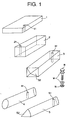
- the weather-resistant exterior building material according to the invention can be formed into a compact in various shapes such as a plate 1 in a standardized size, a square bar 2, a square bar 3 with a square pyramid 32 formed on one side, a cylinder 4, a cylinder 5 with a cone 52 formed on one side, and so forth.
- a plate 1 in a standardized size
- a square bar 2 a square bar 3 with a square pyramid 32 formed on one side
- a cylinder 4 a cylinder 5 with a cone 52 formed on one side, and so forth.
- through holes 11, 21, 31, 41, and 51 for allowing a nail, bolt, line, and rope to pass therethrough, respectively, at the time of forming these compacts.
- the through holes may be of any shape in section among a circle, square, and so forth, however, consideration needs to be given to the size and location of the respective through holes so as not to impair the external appearance of the compacts.
- a washer W is preferably inserted between the bolt B and the compact formed of the CRB ceramic as well as between the nut N and the compact formed of the CRB so as not to allow pressure to bear down directly on the CRB ceramic. Since there is a tendency that the compact formed of the CRB, in particular, to which the secondary heat treatment is applied at a temperature not lower than 600°C has deteriorating impact resistance although it is hard in quality, care is needed not to tighten up the bolt B excessively with the nut N.
- a square bar 6 and a cylinder 7 can be formed so as to have a hollow space defined inside thereof, respectively.
- the weather-resistant exterior building material according to the invention is applicable to any exterior articles, and can be effectively used for an open veranda, a veranda, an outside wall, a storm door box, an eaves trough, stepping-stones, hedge stanchions, and so forth.
- the weather-resistant exterior building material according to the invention is black in color after formed into the compacts, but can be colored by applying a paint thereto. Use of paints for outdoor use, available in the market, is preferable.
- Fig. 1 shows an example of a square bar according to the invention, applied to an open veranda.
- a building material made of CRB ceramic is formed as follows:
- the mixture was subjected to a primary baking at 900°C in a nitrogen atmosphere in a rotary kiln for 60 minutes. Subsequently, a baked product obtained was screened through a 100-mesh sieve, thereby obtaining carbonized powders 50 to 250 ⁇ m in particle diameter.
- the plastic homogeneous mixture was pressure formed at a pressure of 22 MPa into compacts 2, each in the shape of the square bar provided with a nail hole 21, shown in Fig. 1.
- a die used was at a temperature of 150°C.
- the compacts 2 were each taken out of the die, heated in a nitrogen atmosphere up to 500°C at a warming rate of 1°C/min, held at 500°C for 60 min, and heat treated at 700°C for 120 min.
- the temperature of the compacts was lowered at a cooling rate of 2 to 3°C/min until reaching 500°C, and upon the temperature dropping below 500°C, the compacts were left to cool by themselves.
- the compacts 2 in the shape of the square bar were arranged on top of wooden blocks 8, each made of natural wood, and a nail was inserted into respective nail holes 21 to be driven thereinto with a hammer, thereby securely attaching the compacts 2 to the wooden blocks 8.
- An open veranda 9 shown in Fig. 3 has the following features:
- the mixture was subjected to a primary baking at 900°C in a nitrogen atmosphere in a rotary kiln for 60 minutes. Subsequently, a baked product obtained was screened through a 100-mesh sieve, thereby obtaining carbonized powders 50 to 250 ⁇ m in particle diameter.
- the plastic homogeneous mixture was pressure formed at a pressure of 22 MPa into compacts 5, each in the shape of the cylinder with the cone formed on one side thereof, having a through hole 51 defined therein, as shown in Fig. 4.
- a die used was at a temperature of 150°C.
- the compacts 5 were each taken out of the die, heated in a nitrogen atmosphere up to 200°C at a warming rate of 1°C/min, and heat treated at 200°C for 120 min. Subsequently, the compacts were obtained by leaving the same to cool by themselves.
- the compacts 5 thus obtained were arranged at a given interval, and were driven into the ground by tapping the heads thereof with a hammer. Subsequently, the through holes 51 were threaded with a rope 11, thereby building hedge stanchions.
- the hedge stanchions 10 shown in Fig. 4 have the following features:
- the CRB ceramic itself has specific gravity greater than that for Example 1, but has impact resistance sufficient to withstand shocks received when the hedge stanchions 10 were driven into the ground by tapping the heads thereof with a hammer.
- the mixture was baked at 900°C in a nitrogen atmosphere in a rotary kiln for 60 minutes. Subsequently, a baked product obtained was pulverized with the use of a crusher and screened through a 200-mesh sieve, thereby obtaining carbonized powders 90 ⁇ m in average particle diameter.
- the plastic mixture of fire-resistant CRB ceramic thus obtained was pressure formed at a pressure of 40 MPa into compacts, each in the shape of a square bar 6 with a hollow space 63 formed inside thereof, as shown in Fig. 2, and a compact in the shape of a block 13 provided with grooves 14, each having a width substantially identical to the width of the square bar 6, respectively. Dies used were at a temperature of 150°C.
- the compacts were each taken out of the respective dies, heated in a nitrogen atmosphere up to 500°C at a warming rate of 2°C/min, held at 500°C for 60 min, and sintered at 1100°C for 100 to 130 min.
- the temperature of the compacts was lowered at a cooling rate of 2°C/min until reaching 500°C, and upon the temperature dropping below 500°C, the compacts 6 and the compact 13 shown in Fig. 5 were obtained by leaving the same to cool by themselves.
- the compact 6 in the shape of the square bar was embedded in the respective grooves 14 of the compact 13 in the shape of the block by tapping the head of the compact 6 with a wooden hammer, thereby fabricating an open veranda 12 shown in Fig. 5.
- the open veranda 12 has the following features:
- the mixture was subjected to a primary baking at 900°C in a nitrogen atmosphere in a rotary kiln for 60 minutes. Subsequently, a baked product obtained was screened through a 100-mesh sieve, thereby obtaining carbonized powders 50 to 250 ⁇ m in particle diameter.
- the plastic mixture was pressure formed at a pressure of 22 MPa into compacts (not shown), each in the shape of a square bar, and a compact (not shown) in the shape of a block provided with grooves for fitting onto the respective square bars, each having bolt holes defined therein, respectively. Dies used were at a temperature of 150°C.
- the compacts were each taken out of the respective dies, heated in a nitrogen atmosphere up to 500°C at a warming rate of 1°C/min, held at 500°C for 60 min, and heat treated at 600°C for 120 min.
- the temperature of the compacts was lowered at a cooling rate of 2 to 3°C/min until reaching 500°C, and upon the temperature dropping below 500°C, the compacts were left to cool by themselves.
- the compact in the shape of the square bar was placed in the respective grooves of the compact in the shape of the block for fitting onto the respective square bars, bolt holes of the respective square bars were aligned with the bolt holes provided in the respective grooves of the block, and the respective square bars were securely attached to the block by tightening up a bolt inserted in the respective bolt holes with a nut with a washer interposed therebetween, thereby fabricating an open veranda.
- the open veranda obtained has the following features:
Landscapes
- Chemical & Material Sciences (AREA)
- Engineering & Computer Science (AREA)
- Ceramic Engineering (AREA)
- Manufacturing & Machinery (AREA)
- Organic Chemistry (AREA)
- Materials Engineering (AREA)
- Structural Engineering (AREA)
- Inorganic Chemistry (AREA)
- Environmental & Geological Engineering (AREA)
- Dispersion Chemistry (AREA)
- Life Sciences & Earth Sciences (AREA)
- Wood Science & Technology (AREA)
- Civil Engineering (AREA)
- Combustion & Propulsion (AREA)
- Ceramic Products (AREA)
- Building Environments (AREA)
- Finishing Walls (AREA)
- Panels For Use In Building Construction (AREA)
Abstract
Description
- The invention relates to a weather-resistant exterior building material made of a novel constituent material, and an exterior article making use of the same.
- Most of conventional building materials used in exterior articles are wood, and painting and the like are generally applied thereto because they get wet in the rain, however, there has been involved a risk of breakage and so forth occurring thereto because they become brittle after they get rotten and undergo deformation, and so forth, due to their inability to withstand usage over many years. There has also been the need for providing touch-up painting because of deterioration in the external appearance thereof due to cracking and peel-off occurring to outer faces thereof. Further, there have been problems with them in that they become slippery and dangerous to handle when wetted in the rain, and become difficult to handle because water drops on the outer faces continue to stay thereon without being absorbed or evaporated.
- Also, there have been cases where an open veranda and a veranda are built with concrete or the like, however, these have had drawbacks rendering them unpopular, such as slipperiness due to lack of absorbability, and very heavy weight thereof.
- It is therefore an object of the invention to solve some of the drawbacks of the conventional building materials as described above, and to provide a weather-resistant building material which has been unavailable in the past when light weight, weather resistance, corrosion resistance, characteristics of keeping away harmful insects such as white ants, insusceptibility to variation in temperature, hygroscopicity, and easiness in fabrication are taken into account, and an exterior article making use of the same.
- The weather-resistant building material and the exterior article made up of the same make use of RB ceramic, CRB ceramic or fire-resistant CRB ceramic. The RB ceramic, the CRB ceramic or the fire-resistant CRB ceramic is a constituent material produced by the following method.
- An attempt to obtain a carbonaceous material by utilizing rice bran, produced in quantity of 900, 000 tons a year in Japan and in quantity of as much as 33 million tons a year throughout the world, has been well known by researches carried out by Mr. Kazuo Hokkirigawa, the first inventor of the invention (refer to "Functional Material", May issue, 1997, Vol. 17, No. 5, pp. 24 ∼ 28).
- In this literature reference is made to a carbon material ( hereinafter referred to as the RB ceramic) and the preparation thereof, in which the material is obtained by mixing and kneading defatted bran derived from rice bran and the thermosetting resin together followed by drying a compact obtained by pressure forming and subsequently, baking the dried compact in an atmosphere of an inert gas.
- With such a method of forming the RB ceramic as described above, however, it has been practically difficult to form the compact with high precision because there occurs a discrepancy in dimensions by as much as 25% in terms of a contraction ratio of the dimensions of the compact obtained by pressure forming to those of a finished compact obtained after baking the former in the inert gas. However, another ceramic (the CRB ceramic) representing an improvement on the RB ceramic has since been developed.
- The CRB ceramic used in the invention is an improved material of the RB ceramic that is obtained from defatted bran derived from rice bran, and a thermosetting resin . More particularly, the defatted bran derived from rice bran and a thermosetting resin are mixed and kneaded and subjected to a primary baking in an inert gas at a temperature in a range of 700 to 1000°C, pulverizing the kneaded mixture after the primary baking into carbonized powders passing through a sieve of 60 mesh or below. The carbonized powder and the thermosetting resin are further mixed and kneaded, and pressure formed at a pressure in a range of 20 to 30 MPa, subjecting the compact again to a heat treatment in an inert gas atmosphere at a temperature in a range of 100 to 1100°C. The CRB ceramic differs largely from the RB ceramic in that, in contrast with the RB ceramic having the contraction ratio of the dimensions of the compact obtained by pressure forming to those of the finished compact at as high as 25%, the CRB ceramic is superior to the RB ceramic in respect of the contraction ratio at not more than 3%, which is very low.
- Further, with the invention, use can be made of material obtained by replacing part of the carbonized powders of the CRB ceramic with ceramic powders before subjecting the same to a secondary heat treatment. Such material utilizing the ceramic powders in combination with the CRB ceramic is referred to as the fire-resistant CRB ceramic.
- The ceramic powders are composed of any selected from the group consisting of SiO2, Si3N4, ZrO2, Al2O3, SiC, BN, WC, TiC, Sialon (Si-Al-O-N based compound solid solution), porcelain clay, feldspathic clay, kaolin, and so forth.
- With the invention, use can be made of one kind of, or not less than two kinds of the ceramic powders described above, and a blending ratio thereof at 30 to 100 by weight to the carbonized powders at 100 is adequate.
- With the invention, weather-resistant, light, hard, and strong RB ceramic, CRB ceramic, or fire-resistant CRB ceramic is used for an exterior building material. These materials are ceramic materials friendly to nature, having the following excellent characteristics. The RB ceramic, the CRB ceramic, or the fire-resistant CRB ceramic generally has the following properties:
- higher hardness
- smaller expansion coefficient
- good electric conductivity
- small specific gravity and light weight
- excellent abrasion resistance
- easy to form and easy to produce in a die
- ceramic materials having varying characteristics can be produced by blending with various kinds of resins
- the materials being made of rice bran, they have little adverse effect on global environment, leading to conservation of natural resources
- Accordingly, it can be said that these ceramic materials have conditions suitable, particularly, for application to building, such as weather-resistance, light weight, excellent abrasion resistance, insusceptibility to damage, a long service life, and so forth.
- In particular, CRB ceramic subjected to a secondary heat treatment at a temperature not lower than 600°C has superior property as the exterior building material because the same has very high hardness, porosity, and good permeability, and is light and strong because of low specific gravity.
- The inventor has discovered that structures having a variety of characteristics can be easily fabricated by use of the CRB ceramic or the fire-resistant CRB ceramic as the exterior building material. In another embodiment of the invention, wherein the RB ceramic used in the past is adopted, a contraction ratio of the dimensions of a compact as formed to those of a finished compact is as high as 25%, however, since a compact preformed of the RB ceramic can be adjusted in dimensions by grinding the same, the embodiment of the invention, carried out by use of the RB ceramic, is not to be excluded from the scope of the invention. The RB ceramic, the CRB ceramic or the fire-resistant CRB ceramic has substantially the same properties except for the dimensions of the finished compact, and for this reason as well, the invention does not exclude the embodiment wherein the RB ceramic is used.
- With the invention, however, it is preferable to primarily use the CRB ceramic or the fire-resistant CRB because, in such a case, a compact with high precision in dimensions can be obtained through one forming operation.
- Further, it has been discovered that structures having a variety of characteristics can be fabricated by combining the exterior building material according to the invention with a building material made of a conventional synthetic resin or a steel based metal as appropriate, and by introducing a design idea to shapes of contact parts within the structures.
- That is, the invention provides the building material having excellent weather resistance, wherein the whole or at least part thereof is formed of the RB ceramic, the CRB ceramic or the fire-resistant CRB ceramic. Furthermore, with a do-it-yourself kit prepared by preforming such ceramic materials as described into compacts, an open veranda, a veranda, and so forth can be fabricated even by an amateur carpenter at home with ease.
- Fig. 1 is a perspective view of compacts according to the invention;
- Fig. 2 is a perspective view of compacts with a hollow space defined inside thereof, respectively, according to the invention;
- Fig. 3 is a perspective view of an open veranda made up of the compacts according to the invention;
- Fig. 4 is a perspective view of hedge stanchions built by the compacts according to the invention; and
- Fig. 5 is a perspective view of an open veranda making use of the compacts with the hollow space defined inside thereof, according to the invention.
-
- RB ceramic, CRB ceramic, or fire-resistant CRB ceramic material for use in a building material according to the invention is made of defatted bran derived from rice bran, as a main raw material, together with a thermosetting resin.
- The defatted bran may be of either a domestic origin or a foreign origin regardless of the kind of rice.
- Further, for the thermosetting resin, any thermosetting resin may be used as long as it has thermosetting property, and typical examples thereof include phenol resin, diaryl phthalate resin, unsaturated polyester resin, epoxy resin, polyimide resin, and triazine resin. In particular, phenol resin is preferably used.
- Furthermore, a thermoplastic resin, such as a polyamide and so forth, can be used in combination with the resin provided that it is used without departing from the spirit and scope of the invention.
- A mixing ratio of the defatted bran to the thermosetting resin is 50 to 90 : 50 to 10 by weight, however, the mixing ratio of 70 to 80: 30 to 20 is preferably adopted.
- Next, a method of producing the CRB ceramic material is briefly described hereinafter. The method comprises the steps of mixing and kneading defatted bran derived from rice bran with a thermosetting resin , subjecting a kneaded mixture thus obtained to a primary baking in an inert gas at a temperature in a range of 700 to 1000°C, pulverizing the kneaded mixture after the primary baking into carbonized powders, mixing and kneading the carbonized powders with a thermosetting resin , pressure forming a kneaded mixture thus obtained into a compact at a pressure in a range of 20 to 30 MPa, and subjecting the compact again to a heat treatment at a temperature in a range of 100 to 1100°C in an inert gas atmosphere.
- A thermosetting resin in a liquid state, having a relatively small molecular weight, is desirable as the thermosetting resin for use in the primary baking.
- A rotary kiln is normally used in carrying out the primary baking, and baking time is in a range of 40 to 120 min. A mixing ratio of the carbonized powders obtained by the primary baking to the thermosetting resin is 50 to 90 : 50 to 10 by weight, however, the mixing ratio of 70 to 80: 30 to 20 is preferably adopted.
- The kneaded mixture of the carbonized powders and the thermosetting resin is pressure formed into the compact at a pressure in a range of 20 to 30 MPa, preferably, in a range of 21 to 25 MPa. A die for use is preferably at a temperature of about 150°C.
- For the heat treatment, a well controlled electric furnace is normally employed, and heat treatment time is in a range of about 60 to 360 min.
- A heat treatment temperature is preferably in a range of 100 to 1100°C, and a warming rate up to the heat treatment temperature is required to be relatively moderate up to 500°C. In terms of more specific values, the warming rate is in a range of 0.5 to 2°C/min, and is preferably about 1°C/min.
- Further, in lowering the temperature of the compact after baked by the heat treatment, a cooling rate is required to be relatively moderate until reaching 500°C. Upon the temperature dropping below 500°C, the compact is left to cool by itself. In terms of more specific values, the cooling rate is in a range of 0.5 to 4°C/min, and is preferably about 1°C/min. Further, wood and synthetic resin, in common use as conventional building materials, can be combined with the RB ceramic or CRB ceramic material as appropriate.
- For the synthetic resin, use may be made of any synthetic resin selected from the group consisting of phenol resin, vinyl chloride resin, polyurethane, polyolefin, polyamide, polyacetal, vinylon, soft or hard synthetic rubber, and so forth.
- A weather-resistant exterior building material according to the invention is basically light in weight, hard, and strong, having further corrosion resistance, and characteristics of keeping away harmful insects such as white ants, and so forth.
- As shown Fig. 1, the weather-resistant exterior building material according to the invention can be formed into a compact in various shapes such as a plate 1 in a standardized size, a
square bar 2, asquare bar 3 with asquare pyramid 32 formed on one side, acylinder 4, acylinder 5 with acone 52 formed on one side, and so forth. Further, it is possible to define throughholes - When tightening up the compacts formed of the CRB ceramic with a nut N and a bolt B, a washer W is preferably inserted between the bolt B and the compact formed of the CRB ceramic as well as between the nut N and the compact formed of the CRB so as not to allow pressure to bear down directly on the CRB ceramic. Since there is a tendency that the compact formed of the CRB, in particular, to which the secondary heat treatment is applied at a temperature not lower than 600°C has deteriorating impact resistance although it is hard in quality, care is needed not to tighten up the bolt B excessively with the nut N.
- Further, as shown in Fig. 2, a
square bar 6 and a cylinder 7 can be formed so as to have a hollow space defined inside thereof, respectively. By so doing, it is possible not only to save on the RB ceramic and the CRB ceramic but also to reduce the weight of the respective compacts in whole, thereby enhancing easiness in handling. The weather-resistant exterior building material according to the invention is applicable to any exterior articles, and can be effectively used for an open veranda, a veranda, an outside wall, a storm door box, an eaves trough, stepping-stones, hedge stanchions, and so forth. The weather-resistant exterior building material according to the invention is black in color after formed into the compacts, but can be colored by applying a paint thereto. Use of paints for outdoor use, available in the market, is preferable. - Now, embodiments of the invention are summed up as follows:
- (1) A weather-resistant exterior building material making use of a compact formed of RB ceramic, CRB ceramic, or fire-resistant CRB ceramic.
- (2) A weather-resistant exterior building material according to item (1) above, wherein the compact is any one selected from the group consisting of a plate, a square bar, a square bar with a square pyramid formed on one side thereof, a cylinder, and a cylinder with a cone formed on one side thereof.
- (3) A weather-resistant exterior building material according to item (2) above, wherein the compact is provided with a nail hole or bolt hole, defined therein.
- (4) A weather-resistant exterior building material according to item (3) above, wherein painting is applied to outer faces of the compact.
- (5) An exterior article made up of the weather-resistant exterior building material according to any one of items (1) to (4) above.
- (6) An exterior article according to item (5) above, wherein the exterior article is any one selected from the group consisting of an open veranda, a veranda, an outside wall, a storm door box, an eaves trough, a stepping-stone, and a hedge stanchion.
- (7) An open veranda kit comprising a block formed of RB ceramic, CRB ceramic, or fire-resistant CRB ceramic, and a plurality of square bars according to item (2) above, wherein an open veranda is assembled by tightening up the block having preformed grooves for fitting onto the plurality of the square bars, and bolt holes defined in the respective grooves, and the plurality of the square bars each having preformed bolt holes with bolts and nuts.
-
- Examples of structures to which the invention is applied are described hereinafter.
- Fig. 1 shows an example of a square bar according to the invention, applied to an open veranda.
- A building material made of CRB ceramic is formed as follows:
- 75kg of defatted bran derived from rice bran was mixed and kneaded with 25kg of phenol resin (resol) in liquid state while heating both to 50 to 60°C. A plastic homogeneous mixture was obtained.
- The mixture was subjected to a primary baking at 900°C in a nitrogen atmosphere in a rotary kiln for 60 minutes. Subsequently, a baked product obtained was screened through a 100-mesh sieve, thereby obtaining carbonized powders 50 to 250 µm in particle diameter.
- 75kg of the carbonized powders thus obtained was mixed and kneaded with 25kg of phenol resin (resol) in solid state while heating both to 100 to 150°C. A plastic homogeneous mixture was obtained.
- Subsequently, the plastic homogeneous mixture was pressure formed at a pressure of 22 MPa into
compacts 2, each in the shape of the square bar provided with anail hole 21, shown in Fig. 1. A die used was at a temperature of 150°C. - The
compacts 2 were each taken out of the die, heated in a nitrogen atmosphere up to 500°C at a warming rate of 1°C/min, held at 500°C for 60 min, and heat treated at 700°C for 120 min. - Subsequently, the temperature of the compacts was lowered at a cooling rate of 2 to 3°C/min until reaching 500°C, and upon the temperature dropping below 500°C, the compacts were left to cool by themselves.
- As shown in Fig. 3, the
compacts 2 in the shape of the square bar were arranged on top ofwooden blocks 8, each made of natural wood, and a nail was inserted into respective nail holes 21 to be driven thereinto with a hammer, thereby securely attaching thecompacts 2 to the wooden blocks 8. - An
open veranda 9 shown in Fig. 3 has the following features: - light weight and excellent workability
- excellent permeability owing to porosity
- excellent weather resistance and corrosion resistance
- characteristics of keeping white ants away therefrom
- 75kg of defatted bran derived from rice bran was mixed and kneaded with 25kg of phenol resin (resol) in liquid state while heating both to 50 to 60°C. A plastic homogeneous mixture was obtained.
- The mixture was subjected to a primary baking at 900°C in a nitrogen atmosphere in a rotary kiln for 60 minutes. Subsequently, a baked product obtained was screened through a 100-mesh sieve, thereby obtaining carbonized powders 50 to 250 µm in particle diameter.
- 75kg of the carbonized powders thus obtained was mixed and kneaded with 25kg of phenol resin (resol) in solid state while heating both to 100 to 150°C. A plastic homogeneous mixture was obtained.
- Subsequently, the plastic homogeneous mixture was pressure formed at a pressure of 22 MPa into
compacts 5, each in the shape of the cylinder with the cone formed on one side thereof, having a throughhole 51 defined therein, as shown in Fig. 4. A die used was at a temperature of 150°C. - The
compacts 5 were each taken out of the die, heated in a nitrogen atmosphere up to 200°C at a warming rate of 1°C/min, and heat treated at 200°C for 120 min. Subsequently, the compacts were obtained by leaving the same to cool by themselves. - The
compacts 5 thus obtained were arranged at a given interval, and were driven into the ground by tapping the heads thereof with a hammer. Subsequently, the throughholes 51 were threaded with arope 11, thereby building hedge stanchions. - The hedge stanchions 10 shown in Fig. 4 have the following features:
- The CRB ceramic itself has specific gravity greater than that for Example 1, but has impact resistance sufficient to withstand shocks received when the hedge stanchions 10 were driven into the ground by tapping the heads thereof with a hammer.
- excellent weather resistance and corrosion resistance
- characteristics of keeping white ants away therefrom
- There is shown hereinafter an example of forming an
open veranda 12 using thesquare bar 6 with the hollow space formed inside thereof, shown in Fig. 2. - 75kg of defatted bran derived from rice bran was mixed and kneaded with 25kg of phenol resin (resol) in liquid state while heating both to 50 to 60°C. A plastic homogeneous mixture was obtained.
- The mixture was baked at 900°C in a nitrogen atmosphere in a rotary kiln for 60 minutes. Subsequently, a baked product obtained was pulverized with the use of a crusher and screened through a 200-mesh sieve, thereby obtaining carbonized powders 90 µm in average particle diameter.
- Then, 80kg of the carbonized powders thus obtained, 60kg of alumina powders, 10kg of alumium phosphate as a binder, and 25kg of water as a solvent were mixed and kneaded with each other. A plastic homogeneous mixture was obtained.
- Use was made of
alumina powders 10 to 20 µm in average particle diameter - The plastic mixture of fire-resistant CRB ceramic thus obtained was pressure formed at a pressure of 40 MPa into compacts, each in the shape of a
square bar 6 with ahollow space 63 formed inside thereof, as shown in Fig. 2, and a compact in the shape of ablock 13 provided withgrooves 14, each having a width substantially identical to the width of thesquare bar 6, respectively. Dies used were at a temperature of 150°C. - The compacts were each taken out of the respective dies, heated in a nitrogen atmosphere up to 500°C at a warming rate of 2°C/min, held at 500°C for 60 min, and sintered at 1100°C for 100 to 130 min.
- Subsequently, the temperature of the compacts was lowered at a cooling rate of 2°C/min until reaching 500°C, and upon the temperature dropping below 500°C, the
compacts 6 and the compact 13 shown in Fig. 5 were obtained by leaving the same to cool by themselves. - The compact 6 in the shape of the square bar was embedded in the
respective grooves 14 of the compact 13 in the shape of the block by tapping the head of the compact 6 with a wooden hammer, thereby fabricating anopen veranda 12 shown in Fig. 5. - The
open veranda 12 has the following features: - light weight due to its hollow structure, and excellent workability
- excellent weather resistance and corrosion resistance
- no cracking occurring to the compacts even by driving the square bar into the respective grooves by tapping the head of he square bar with the wooden hammer
- characteristics of keeping white ants away therefrom.
- An example of fabricating an open veranda by use of square bars and a block, formed of CRB ceramic
- 75kg of defatted bran derived from rice bran was mixed and kneaded with 25kg of phenol resin (resol) in liquid state while heating both to 50 to 60°C. A plastic homogeneous mixture was obtained.
- The mixture was subjected to a primary baking at 900°C in a nitrogen atmosphere in a rotary kiln for 60 minutes. Subsequently, a baked product obtained was screened through a 100-mesh sieve, thereby obtaining carbonized powders 50 to 250 µm in particle diameter.
- 75kg of the carbonized powders thus obtained was mixed and kneaded with 25kg of phenol resin (resol) in solid state while heating both to 100 to 150°C. A plastic homogeneous mixture was obtained.
- Subsequently, the plastic mixture was pressure formed at a pressure of 22 MPa into compacts (not shown), each in the shape of a square bar, and a compact (not shown) in the shape of a block provided with grooves for fitting onto the respective square bars, each having bolt holes defined therein, respectively. Dies used were at a temperature of 150°C.
- The compacts were each taken out of the respective dies, heated in a nitrogen atmosphere up to 500°C at a warming rate of 1°C/min, held at 500°C for 60 min, and heat treated at 600°C for 120 min.
- Subsequently, the temperature of the compacts was lowered at a cooling rate of 2 to 3°C/min until reaching 500°C, and upon the temperature dropping below 500°C, the compacts were left to cool by themselves.
- The compact in the shape of the square bar was placed in the respective grooves of the compact in the shape of the block for fitting onto the respective square bars, bolt holes of the respective square bars were aligned with the bolt holes provided in the respective grooves of the block, and the respective square bars were securely attached to the block by tightening up a bolt inserted in the respective bolt holes with a nut with a washer interposed therebetween, thereby fabricating an open veranda.
- The open veranda obtained has the following features:
- light weight and excellent workability
- excellent permeability owing to porosity
- excellent weather resistance and corrosion resistance
- It can be fabricated even by an amateur carpenter with a do-it-yourself kit.
- characteristics of keeping white ants away therefrom It has been confirmed that the exterior building material, made of the RB ceramic, the CRB ceramic or the fire-resistant CRB ceramic, according to the invention, is light in weight, has weather resistance, corrosion resistance, and the characteristics of keeping harmful insects such as white ants, and so forth, away therefrom. It has further been confirmed that the CRB ceramic heat-treated at a high temperature is porous and has excellent permeability while the CRB ceramic heat-treated at a low temperature has relatively excellent impact resistance. With a do-it-yourself kit which is prepared by preforming such ceramic material as described into compacts, an open veranda, a veranda, and so forth can be fabricated even by an amateur carpenter at home with ease. The features disclosed in the foregoing description, in the claims and/or in the accompanying drawings may, both separately and in any combination thereof, be material for realising the invention in diverse forms thereof.
Claims (7)
- A weather-resistant exterior building material making use of a compact formed of RB ceramic, CRB ceramic, or fire-resistant CRB ceramic.
- A weather-resistant exterior building material according to Claim 1, wherein the compact is any one selected from the group consisting of a plate (1), a square bar (2), a square bar (3) with a square pyramid formed on one side thereof, a cylinder (4), and a cylinder (5) with a cone formed on one side thereof.
- A weather-resistant exterior building material according to Claim 2, wherein the compact is provided with a nail hole or bolt hole (11, 21, 31, 41, or 51), defined therein.
- A weather-resistant exterior building material according to Claim 3, wherein painting is applied to outer faces of the compact.
- An exterior article made up of the weather-resistant exterior building material according to any one of Claims 1 to 4.
- An exterior article according to Claim 5, wherein the exterior article is any one selected from the group consisting of an open veranda, a veranda, an outside wall, a storm door box, an eaves trough, a stepping-stone, and a hedge stanchion.
- An open veranda kit comprising a block (13) formed of RB ceramic, CRB ceramic, or fire-resistant CRB ceramic, and a plurality of square bars (6), wherein an open veranda is assembled by, wherein an open veranda is assembled by tightening up the block (13) having preformed grooves (14) for fitting onto the plurality of the square bars (6), and bolt holes (21) defined in the respective grooves (14), and the plurality of the square bars (6) having preformed bolt holes (21) with bolts and nuts.
Applications Claiming Priority (2)
| Application Number | Priority Date | Filing Date | Title |
|---|---|---|---|
| JP2001121600 | 2001-04-19 | ||
| JP2001121600A JP2002317525A (en) | 2001-04-19 | 2001-04-19 | Weathering outdoor building material |
Publications (1)
| Publication Number | Publication Date |
|---|---|
| EP1251110A1 true EP1251110A1 (en) | 2002-10-23 |
Family
ID=18971437
Family Applications (1)
| Application Number | Title | Priority Date | Filing Date |
|---|---|---|---|
| EP20020008763 Withdrawn EP1251110A1 (en) | 2001-04-19 | 2002-04-18 | Weather-resistant ceramic exterior building material |
Country Status (3)
| Country | Link |
|---|---|
| US (1) | US6855279B2 (en) |
| EP (1) | EP1251110A1 (en) |
| JP (1) | JP2002317525A (en) |
Families Citing this family (7)
| Publication number | Priority date | Publication date | Assignee | Title |
|---|---|---|---|---|
| US7144932B2 (en) * | 2002-03-01 | 2006-12-05 | Minebea Co., Ltd. | Low-friction, high-dispersion synthetic resin composition containing fine particles of RB ceramic or CRB ceramic and a method for its preparation |
| JP2004011228A (en) * | 2002-06-05 | 2004-01-15 | Minebea Co Ltd | Atmospheric air purifying sound-insulating wall and application thereof |
| JP4116333B2 (en) | 2002-06-05 | 2008-07-09 | ミネベア株式会社 | Super finishing whetstone |
| JP2004019368A (en) | 2002-06-19 | 2004-01-22 | Minebea Co Ltd | Road paving material |
| JP2004211851A (en) * | 2003-01-07 | 2004-07-29 | Minebea Co Ltd | Dynamic pressure bearing device forming oil repellent film thereto and spindle motor for hard disk drive mounting the same |
| US20040258334A1 (en) * | 2003-02-28 | 2004-12-23 | Minebea Co., Ltd. | Underwater sleeve bearing and application thereof |
| US7008196B2 (en) | 2003-03-11 | 2006-03-07 | Minebea Co. Ltd. | Electrically motorized pump having a submersible sleeve bearing |
Citations (6)
| Publication number | Priority date | Publication date | Assignee | Title |
|---|---|---|---|---|
| GB789878A (en) * | 1953-01-21 | 1958-01-29 | Secondi Angelo | Fireproof materials and products manufactured therefrom |
| GB2084212A (en) * | 1980-09-15 | 1982-04-07 | 23 Sz Allami Epitoipari Vallal | A process for the production of insulating panels |
| EP0516294A2 (en) * | 1991-05-30 | 1992-12-02 | Minnesota Mining And Manufacturing Company | Ceramic foam body having closed cell structure |
| JPH06228576A (en) * | 1993-02-05 | 1994-08-16 | Takashi Ataka | Carbonized rice hull and production thereof |
| JPH10251623A (en) * | 1997-03-12 | 1998-09-22 | Akechi Ceramics Kk | Materials for melting and melting ice |
| US5916499A (en) * | 1996-10-01 | 1999-06-29 | Sanwa Yushi Kabushiki Kaisha | Method for producing porous carbon material product |
-
2001
- 2001-04-19 JP JP2001121600A patent/JP2002317525A/en active Pending
-
2002
- 2002-04-18 US US10/125,798 patent/US6855279B2/en not_active Expired - Fee Related
- 2002-04-18 EP EP20020008763 patent/EP1251110A1/en not_active Withdrawn
Patent Citations (6)
| Publication number | Priority date | Publication date | Assignee | Title |
|---|---|---|---|---|
| GB789878A (en) * | 1953-01-21 | 1958-01-29 | Secondi Angelo | Fireproof materials and products manufactured therefrom |
| GB2084212A (en) * | 1980-09-15 | 1982-04-07 | 23 Sz Allami Epitoipari Vallal | A process for the production of insulating panels |
| EP0516294A2 (en) * | 1991-05-30 | 1992-12-02 | Minnesota Mining And Manufacturing Company | Ceramic foam body having closed cell structure |
| JPH06228576A (en) * | 1993-02-05 | 1994-08-16 | Takashi Ataka | Carbonized rice hull and production thereof |
| US5916499A (en) * | 1996-10-01 | 1999-06-29 | Sanwa Yushi Kabushiki Kaisha | Method for producing porous carbon material product |
| JPH10251623A (en) * | 1997-03-12 | 1998-09-22 | Akechi Ceramics Kk | Materials for melting and melting ice |
Non-Patent Citations (4)
| Title |
|---|
| KAZUO HOKKIRIGAWA, FUNCTIONAL MATERIAL, vol. 17, no. 5, May 1997 (1997-05-01), pages 24 - 28 |
| MOHAN ET AL.: "New building materials & techniques for rural housing", INT. J. HOUS. SCI. APPL., vol. 1, no. 4, 1978, pages 381 - 393, XP008006842 * |
| PATENT ABSTRACTS OF JAPAN vol. 018, no. 604 (C - 1275) 17 November 1994 (1994-11-17) * |
| PATENT ABSTRACTS OF JAPAN vol. 1998, no. 14 31 December 1998 (1998-12-31) * |
Also Published As
| Publication number | Publication date |
|---|---|
| US20020152694A1 (en) | 2002-10-24 |
| US6855279B2 (en) | 2005-02-15 |
| JP2002317525A (en) | 2002-10-31 |
Similar Documents
| Publication | Publication Date | Title |
|---|---|---|
| US6855279B2 (en) | Weather-resistant exterior building material | |
| MXPA05003685A (en) | Metal flake-surfaced roofing materials. | |
| US20020152697A1 (en) | Roofing tile and snow-melting, tiled roof using the same | |
| KR20220151520A (en) | Sidewalk blocks and construction materials recycled from waste plastic | |
| CN101348355A (en) | Integrated nano inorganic wall light heat insulation facing section bar and preparation thereof | |
| KR101887089B1 (en) | Brick using earth and sand, and producing method thereof | |
| CN101649665A (en) | Sintered porous brick and preparation method thereof | |
| US20050198917A1 (en) | Roofing tile and snow-melting, tiled roof using the same | |
| KR101992602B1 (en) | Manufacturing method of synthetic wood containing bamboo powder | |
| CN101565975A (en) | Self heat preserving wall body and manufacturing method thereof | |
| KR101510825B1 (en) | Clay bricks comprising barley stone and method for manufacturing the same | |
| KR101952903B1 (en) | Synthetic Wood - Metal Frame Composite for Reinforcement-type of controlled Coefficient of Thermal Expansion and Method for Thereof | |
| DE19534600A1 (en) | Process for the production of lightweight moldings and lightweight moldings produced therewith, in particular lightweight insulation panels | |
| WO2009065521A1 (en) | Building stone and method for production of a building stone | |
| KR200213123Y1 (en) | The block which has holes and utilized by recycling tire | |
| KR102142575B1 (en) | Wood Plastic Composition having excellent Tensile Strength and Flame Retardant | |
| KR100411745B1 (en) | Ceramic clay brick and clay floor brick using lava stone and method for making the same | |
| DE19701858A1 (en) | Open porous expanded glass granular material | |
| DE102012105975A1 (en) | Concrete product e.g. paving stone and tiles, where product is made of cement paste having total concrete volume of fireclay particles such as high-fired clinker particles and surface of product comprises adjustable surface texturing | |
| CN209099707U (en) | A kind of dustproof construction for mushroom room | |
| KR100492273B1 (en) | Method for manufacturing materials of tennis court using ceramic powder | |
| CN1513813A (en) | Light heatinsulating concrete coloured roof artistic tile and its making method | |
| KR101688782B1 (en) | A prefabricated ocher brick and its manufacturing method | |
| KR102675666B1 (en) | Floor covering composition comprising EPDM synthetic rubber chips and cork chips and floor paving construction method using the same | |
| JPH07505356A (en) | Improved cement mixtures and structures for building panels and other building materials |
Legal Events
| Date | Code | Title | Description |
|---|---|---|---|
| PUAI | Public reference made under article 153(3) epc to a published international application that has entered the european phase |
Free format text: ORIGINAL CODE: 0009012 |
|
| AK | Designated contracting states |
Kind code of ref document: A1 Designated state(s): AT BE CH CY DE DK ES FI FR GB GR IE IT LI LU MC NL PT SE TR |
|
| AX | Request for extension of the european patent |
Free format text: AL;LT;LV;MK;RO;SI |
|
| 17P | Request for examination filed |
Effective date: 20030327 |
|
| AKX | Designation fees paid |
Designated state(s): ES IT |
|
| REG | Reference to a national code |
Ref country code: DE Ref legal event code: 8566 |
|
| 17Q | First examination report despatched |
Effective date: 20030821 |
|
| STAA | Information on the status of an ep patent application or granted ep patent |
Free format text: STATUS: THE APPLICATION IS DEEMED TO BE WITHDRAWN |
|
| 18D | Application deemed to be withdrawn |
Effective date: 20071102 |