EP1249959A1 - Procédé de diffusion d'informations multimédia dans un réseau cellulaire et une utilisation du procédé - Google Patents
Procédé de diffusion d'informations multimédia dans un réseau cellulaire et une utilisation du procédé Download PDFInfo
- Publication number
- EP1249959A1 EP1249959A1 EP02100367A EP02100367A EP1249959A1 EP 1249959 A1 EP1249959 A1 EP 1249959A1 EP 02100367 A EP02100367 A EP 02100367A EP 02100367 A EP02100367 A EP 02100367A EP 1249959 A1 EP1249959 A1 EP 1249959A1
- Authority
- EP
- European Patent Office
- Prior art keywords
- multimedia
- message
- information
- terminal
- broadcast
- Prior art date
- Legal status (The legal status is an assumption and is not a legal conclusion. Google has not performed a legal analysis and makes no representation as to the accuracy of the status listed.)
- Granted
Links
- 238000000034 method Methods 0.000 title claims abstract description 31
- 230000001413 cellular effect Effects 0.000 title claims description 41
- 230000015654 memory Effects 0.000 claims description 48
- 238000004891 communication Methods 0.000 claims description 10
- 230000005540 biological transmission Effects 0.000 claims description 9
- 230000011664 signaling Effects 0.000 claims description 2
- 238000009792 diffusion process Methods 0.000 description 9
- 238000012795 verification Methods 0.000 description 6
- 238000003780 insertion Methods 0.000 description 5
- 230000037431 insertion Effects 0.000 description 5
- 238000005520 cutting process Methods 0.000 description 3
- 238000003860 storage Methods 0.000 description 3
- 238000012360 testing method Methods 0.000 description 3
- 238000004364 calculation method Methods 0.000 description 2
- 238000006243 chemical reaction Methods 0.000 description 2
- 238000001514 detection method Methods 0.000 description 2
- 238000009826 distribution Methods 0.000 description 2
- 238000012546 transfer Methods 0.000 description 2
- 238000013475 authorization Methods 0.000 description 1
- 239000000470 constituent Substances 0.000 description 1
- 238000013502 data validation Methods 0.000 description 1
- 238000004519 manufacturing process Methods 0.000 description 1
- 238000012545 processing Methods 0.000 description 1
- 230000008054 signal transmission Effects 0.000 description 1
- 230000009897 systematic effect Effects 0.000 description 1
- 230000002123 temporal effect Effects 0.000 description 1
- 238000012549 training Methods 0.000 description 1
Images


Classifications
-
- H—ELECTRICITY
- H04—ELECTRIC COMMUNICATION TECHNIQUE
- H04L—TRANSMISSION OF DIGITAL INFORMATION, e.g. TELEGRAPHIC COMMUNICATION
- H04L1/00—Arrangements for detecting or preventing errors in the information received
- H04L1/12—Arrangements for detecting or preventing errors in the information received by using return channel
- H04L1/16—Arrangements for detecting or preventing errors in the information received by using return channel in which the return channel carries supervisory signals, e.g. repetition request signals
- H04L1/18—Automatic repetition systems, e.g. Van Duuren systems
- H04L1/1812—Hybrid protocols; Hybrid automatic repeat request [HARQ]
-
- H—ELECTRICITY
- H04—ELECTRIC COMMUNICATION TECHNIQUE
- H04L—TRANSMISSION OF DIGITAL INFORMATION, e.g. TELEGRAPHIC COMMUNICATION
- H04L65/00—Network arrangements, protocols or services for supporting real-time applications in data packet communication
- H04L65/60—Network streaming of media packets
- H04L65/61—Network streaming of media packets for supporting one-way streaming services, e.g. Internet radio
- H04L65/611—Network streaming of media packets for supporting one-way streaming services, e.g. Internet radio for multicast or broadcast
-
- H—ELECTRICITY
- H04—ELECTRIC COMMUNICATION TECHNIQUE
- H04L—TRANSMISSION OF DIGITAL INFORMATION, e.g. TELEGRAPHIC COMMUNICATION
- H04L67/00—Network arrangements or protocols for supporting network services or applications
- H04L67/01—Protocols
- H04L67/04—Protocols specially adapted for terminals or networks with limited capabilities; specially adapted for terminal portability
-
- H—ELECTRICITY
- H04—ELECTRIC COMMUNICATION TECHNIQUE
- H04L—TRANSMISSION OF DIGITAL INFORMATION, e.g. TELEGRAPHIC COMMUNICATION
- H04L1/00—Arrangements for detecting or preventing errors in the information received
- H04L2001/0092—Error control systems characterised by the topology of the transmission link
- H04L2001/0093—Point-to-multipoint
-
- H—ELECTRICITY
- H04—ELECTRIC COMMUNICATION TECHNIQUE
- H04L—TRANSMISSION OF DIGITAL INFORMATION, e.g. TELEGRAPHIC COMMUNICATION
- H04L69/00—Network arrangements, protocols or services independent of the application payload and not provided for in the other groups of this subclass
- H04L69/30—Definitions, standards or architectural aspects of layered protocol stacks
- H04L69/32—Architecture of open systems interconnection [OSI] 7-layer type protocol stacks, e.g. the interfaces between the data link level and the physical level
- H04L69/322—Intralayer communication protocols among peer entities or protocol data unit [PDU] definitions
- H04L69/329—Intralayer communication protocols among peer entities or protocol data unit [PDU] definitions in the application layer [OSI layer 7]
-
- H—ELECTRICITY
- H04—ELECTRIC COMMUNICATION TECHNIQUE
- H04W—WIRELESS COMMUNICATION NETWORKS
- H04W4/00—Services specially adapted for wireless communication networks; Facilities therefor
- H04W4/06—Selective distribution of broadcast services, e.g. multimedia broadcast multicast service [MBMS]; Services to user groups; One-way selective calling services
-
- H—ELECTRICITY
- H04—ELECTRIC COMMUNICATION TECHNIQUE
- H04W—WIRELESS COMMUNICATION NETWORKS
- H04W84/00—Network topologies
- H04W84/02—Hierarchically pre-organised networks, e.g. paging networks, cellular networks, WLAN [Wireless Local Area Network] or WLL [Wireless Local Loop]
- H04W84/04—Large scale networks; Deep hierarchical networks
- H04W84/042—Public Land Mobile systems, e.g. cellular systems
Definitions
- the present invention relates to a diffusion method multimedia information in a cellular network, and use of the process.
- An object of the invention is to provide information dissemination multimedia to a large number of terminals, preferably telephones mobile, connected to a cellular network. Another object of the invention is to broadcast by minimizing the means of communication, particular radio, to use. Another object of the invention is to ensure that all the multimedia information broadcast has been correctly received by all of the terminals connected to the cellular network. Another goal of the invention is to limit the radio communication means used for perform the verification.
- Such a device has, as we have seen, the condition of optimum and stable signal transmission. Loss of information signals are therefore weak during transmission and the use of a code error corrector is enough to correct them.
- the use of such a diffusion process and therefore unsuitable for the environment that exists in cellular networks for mobile terminals. Indeed, in such cellular networks for mobile terminals, reception conditions vary frequently and often brutally. Performed multimedia information dissemination, i.e. a lot of important information, in such a network cellular therefore require the establishment of error control means which are absolutely not foreseen in existing broadcasting systems in the state of the art.
- a dedicated distribution channel is established. That is to say, we allocate radio resource for broadcasting.
- the various terminals connected to the cellular network are then able to recognize the resources allocated for this broadcast.
- These means are for example one or more channels of GSM type communication in the case of a GSM cellular network.
- each terminal of the network wishing to receive the information multimedia broadcast recognizes the radio resources allocated to this broadcast on the base station to which it is connected, then it records the information disseminated.
- TDMA mode multiple access of the division in the time
- a channel is defined by a frequency law as well as dates at which frequencies belonging to the frequency law can be used either to receive or to transmit.
- MBC channel for Multimedia Broadcasting Channel, or multimedia broadcast channel.
- the MBC channel makes it possible to convey, from the broadcasting server to the cellular network terminals, multimedia information packets, encapsulated in information messages corresponding to pieces of a multimedia sequence.
- a multimedia sequence is then either a video or a sound sequence, i.e. either a file at format, for example, M PEG is a file in MP3 format.
- the information messages are then received on a terminal of the cellular network, and the information in this message is extracted.
- the terminal checks the validity of this message. This verification is for example carried out using an error correcting code. If this verification leads to the conclusion that the content of the message is not correct, then the terminal sends, to the broadcasting server, a status message indicating that a message has been received incorrectly.
- the message of status includes the identifier of the badly received broadcast message.
- the broadcasting server receives messages from status.
- the broadcast server can thus retransmit broadcast messages having been badly received by different terminals of the cellular network.
- the broadcast server assesses the quality of reception by the terminals. That is to say, if a terminal too often asks to reissue messages, the broadcast server decides that requests from this terminal for reruns should be ignored.
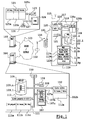
- FIG. 1 shows a cellular network architecture of the type GSM network.
- the teaching of the invention remains valid for other types cellular networks, such as UMTS, PCS, DCS networks or others.
- Figure 1 shows a terminal 101, preferably a telephone mobile 101, connected to a base station 102 of a cellular network mobile telephony 103 of GSM type.
- a broadcast server 104 is also connected to network 103, as well as a server 105 of WAP (Wireless) type Application Protocol, i.e. protocol for wireless application).
- WAP Wireless
- Application Protocol i.e. protocol for wireless application
- the server 104 includes a microprocessor 106 which performs instruction codes stored in a memory 107.
- a microprocessor 106 which performs instruction codes stored in a memory 107.
- the lending an action to a device should be understood as execution, by a microprocessor of this device, stored instruction codes in a memory of this unit.
- Microprocessor 106 and memory 107 are connected via a bus 108.
- a bus is a set of wires or tracks, including the elements in sufficient number, allowing convey address, command, data signals, interruptions, clocks and power.
- Memory 107 has several areas.
- a zone 107a comprises instruction codes that control the microprocessor when it performs actions to produce broadcast messages.
- the messages are produced from the content of a storage memory 109 also connected to bus 106.
- Memory 109 includes sequences 109.1a 109.N multimedia.
- a multimedia sequence is, for example, a file containing video information and / or sound information.
- a such file is for example a file in MPEG format (Moving Pictures Group Expert, group of experts for moving images), or more simply to a sound file.
- Another area 107b includes instruction codes which command the microprocessor 106 when the latter broadcasts the broadcast messages.
- the microprocessor 106 transmits, via bus 108, said broadcast messages to input / output circuits 110.
- the role of circuits 110 is to provide the interface between the server 104 of broadcast and the network 103.
- the circuits 110 are therefore an Ethernet interface, an interface 6 25, an ISDN interface or other interfaces allowing to establish a communication, switched or not, between the server 104 and base stations of the type of station 102.
- the role of circuits 110 is therefore perform a physical conversion between the signals carried by the network 103, and the signals carried by the bus 108.
- An area 107c includes instruction codes which control the microprocessor 106 when it manages the reception of messages from status.
- a status message is sent by the terminal type terminal 101.
- the status message has different areas corresponding to information identifying the message sender, as well as information identifying the status.
- the instruction codes in area 107c therefore allows the microprocessor 106 to manage the updating of a historical memory 111 status messages, 112 blacklist memory, and memory 113 comprising a list of multimedia information packets to be broadcast.
- a multimedia information packet, or packet in description is a piece of a multimedia sequence. Are memories 111 to 113 also connected to bus 106.
- the memory 111 is structured in a table comprising lines and columns. Each line corresponds to a packet and a terminal. Each line therefore includes information relating to reissue requests of a packet through a terminal. Table 111 therefore includes a column 111 a corresponding to a packet identifier, a column 111b corresponding to a terminal identifier and a column 111c corresponding to a number of status messages, originating from the terminal, concerning the packet.
- the identifier of the packet is, for example, a unique number assigned during the cutting of a multimedia sequence into a packet by the microprocessor 106.
- the memory 112 is structured as a table. Each line corresponds to a terminal.
- the memory 112 includes a column 112a corresponding to a terminal identifier and a column 112b corresponding to a date.
- the date corresponds to the date on which the terminal entered the black list. Status messages from a terminal whose identifier is in the list black are ignored by server 104.
- a terminal enters the blacklist, for example, when it transmits too much status messages for the same packet. For example, if the same terminal requests the retransmission of the same packet five times, we consider that its reception conditions are not acceptable, compared to the network load, and that the retransmission requests it sends, do not should no longer be taken into account. This terminal is then placed in the list black. A terminal can exit the black list, for example, after a certain time, hence the usefulness of the date of entry into the black list. In a variant, a terminal enters the blacklist if the number of status messages it is too important, for example greater than 100. In this case a number of status messages greater than 5, for a terminal and a packet, does not cause an entry in the black list. However the messages of next status regarding this package are ignored.
- the memory 113 in fact comprises a list of identifiers, allowing identify packets of multimedia sequences, which must be sent by server 104. Each time a packet has been sent, the identifier is out of the list. When you want to send or re-send a packet, just therefore to write its identifier in memory 113. This identifier, according to whether it is a broadcast or a reissue, is written to a position that is either the end or the beginning, or close to the beginning, of memory 113. Indeed, re-broadcasts must be inserted among the broadcasts. A new show will be put at the end of the list, then a re-broadcast will be rather put towards the beginning of the list.
- Telephone 101 establishes a radio link 114 with station 102 basic.
- the telephone 101 therefore includes an antenna 115 connected to circuits 116.
- the circuits 116 are also connected to a bus 117.
- the role of circuits 116 is to carry out the physical conversion between signal formats used for link 114 and signal formats used on bus 117.
- the telephone 101 also includes a microprocessor 118 which executes instruction codes stored in a memory 119.
- the telephone 101 also includes a screen 120 and a keyboard 121. Elements 118 to 121 are connected to the bus 117.
- the memory 119 includes an area 119a which includes instruction codes that allow phone 101 to connect to sites, host on servers, in WAP format.
- Zone 119b includes instruction codes to be able to record broadcast messages.
- Zone 119c has codes instruction to test the validity of broadcast messages.
- a classic structure for a broadcast message is a header, a data area and a data validation control area.
- This control zone can for example be constituted by a CRC (Check redundancy code, or redundant test code). This code is used to determine whether the data transmitted by the message is received as that they were issued.
- An area 119d includes instruction codes which allow the microprocessor 118 to reconstruct the video sequence which is, we reminds, transmitted in packets via several broadcast messages. These packets, once stored in temporary phone memory 118, and tested, are written progressively in a memory 122 of storage.
- the memory 122 is connected to the bus 117.
- the memory 122 contains the multimedia sequences 122.I to 122.N recorded by the phone 101.
- An area 119e includes instruction codes which allow the phone 101 to issue status messages. If the result of the validity of the message data is not conclusive, a status message is issued to request the retransmission of the broadcast message corresponding to invalid data.
- An area 119f has codes instructions that allow you to configure the recording of sequences multimedia. Instruction codes in area 119f are used together with the instruction codes in area 119a. Indeed, the parameters for recording a multimedia sequence are obtained, for example, via a WAP site presenting the different sequences multimedia that is possible to record.
- An area 119g includes instruction codes allowing the viewing multimedia sequences.
- the 119g zone includes example, a decryption algorithm allowing to clearly transcribe the multimedia sequence, provided that the user of telephone 101 has acquired the key allowing decryption.
- Figure 1 shows that the server 105 includes a microprocessor 123, a program memory 124, a memory 125 for presentation of multimedia sequence of circuits 126 interface between a bus 127 and the network 103. Elements 124 and 125 are connected to bus 127.
- the memory 125 is structured as a table. Each row of the table corresponds to a multimedia sequence.
- Table 125 has a column 125a corresponding to a sequence identifier a column 125b corresponding to a sequence title and a 125c column allowing parameters to save the sequence.
- the user of telephone 101 can therefore connect to a site hosted by server 105 to consult the list of multimedia sequences which is possible to record, select one and thus retrieve the parameters allowing this recording to be made.
- server 105 and the server 104 can very well be only one and the same machine.
- server 104 can very well be only one and the same machine.
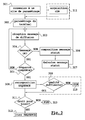
- FIG. 2 shows steps of the method of the invention executed by the broadcast server 104.
- Figure 2 shows a preliminary step 201 of production of broadcast messages.
- Step 201 corresponds to the code 107a training area.
- the microprocessor 106 performs a first step 202 of cutting out a multimedia sequence in information package.
- These information packets have, for example, a size of 1 kilobytes. This means that, if a multimedia sequence, by example video, has a size of 4 mega bytes, this multimedia sequence will be broken down into four thousand packets of information. Each of these information packets will then be identified by an identifier allowing it to be distinguish among all the information packets produced by the server 104.
- an identifier coded on 16 or 32 bytes allowing identify a multimedia information packet.
- the identifier has a lifespan. This means that an identifier ID, corresponds to a multimedia information packet between dates T1 and T2. It is step 203 of numbering the packets.
- Step 204 covers two things.
- a first is the update of the memory 113 comprising the list of packets to be broadcast.
- the microprocessor 106 When the microprocessor 106 has cut a multimedia sequence which it must broadcast in packages, and also numbered these packages, it writes the list of all numbers in the 113 list of packets to broadcast.
- Memory 113 is a simple, but not the only, way to control packet delivery multimedia. The microprocessor 106 therefore permanently reads the content of the memory 113 to know if it should broadcast a packet. If memory 113 has packet numbers, it reads the first packet number, goes look for the corresponding packet in memory 109 and produce a broadcast message.
- a broadcast message 401 includes a header 402, a body 404 and means 408 for verifying the correct transmission of the body.
- a correctly transmitted body is such that the means of verification applied to the received body corresponding to the verification means applied to the body that was issued. This is typically the calculation of a sum of redundancy.
- a broadcast message also includes an identifier of a recipient, as well as an indication that it is a message from dissemination of multimedia information in a cellular network.
- the recipient's identifier actually corresponds to the whole, or to a certain number, of cellular network base station. Information on nature of the message will tell the base station what to do with it message.
- the link between the server 104 and the base 102 is of type IP (Internet Protocol, or Internet protocol)
- IP Internet Protocol
- the destination address, broadcast messages is an address corresponding to a set of base stations in the cellular network.
- the IP message also known as an IP frame, has a field indicating to the base station that it is a broadcast message of a multimedia sequence in a cellular network for mobile terminals.
- the broadcast message also includes, for example in the header, the identifier number of the packet contained in the body of the message.
- the base station 102 For broadcasting broadcast messages as the base station receives from the server 104, the base station 102 uses a dedicated MBC channel.
- a MBC channel is, for example, composed of one or more traffic channels GSM standard.
- a terminal 101 connected to the base station 114 is capable of detecting the MBC channel through, for example, scanning systematic of all channels from base station 102 up to the detection of a particular bit sequence identifying the MBC channel, because broadcast only on this MBC channel. Terminal 101 can also find the MBC channel using information transmitted on the beacon channel of the station 102.
- the MBC channel is formed of at least two channels of standard traffic.
- these standard traffic channels corresponding to two consecutive time windows in a frame GSM.
- a time window is also often called a slot in the GSM domain.
- window 0 contains two types of information.
- a first type of information makes it possible to identify this channel committing the channel 0 of the MBC channel, for example broadcasting a series of bits characteristics.
- a second type of information corresponds to a dissemination a description of the multimedia sequences which are broadcast, via at least another standard traffic channel. This other standard traffic channel would then correspond to time window 1 of the GSM frame.
- the MBC channel uses a GSM frame complete.
- Time window 0 allows detection, and therefore calibration, on the MBC channel, as well as obtaining sequence information multimedia that are deferred in other time windows.
- the time windows 1 to 7 contain corresponding information, for example example, each with a different multimedia sequence.
- the base station 102 therefore receives, from the broadcasting server 104, a broadcast message including a one kilobyte packet of information a multimedia sequence.
- the base station cuts this package multimedia information in smaller packets, of a hundred bits, and broadcast each of these smaller packets in time windows of the MBC channel.
- the broadcast, to terminals by the station basis of a multimedia information package requires the use, in GSM, of dozens of time windows.
- the information that is sent to terminal correspond to the identifier of the multimedia information packet, as well as the multimedia information package itself.
- FIG. 4 makes it possible to view a broadcast message 401.
- This message has a header 402, which itself has a field 403 including the identifier of a multimedia information packet.
- the message 401 has a body 404 including the information packet corresponding to the value of field 403.
- Figure 4 also shows 405 to 407 GSM frames.
- Each frame is divided, according to the GSM standard, into 8 time windows (slot) numbered 0 to 7. According to the description, windows 0 and 1 are used to realize the MBC channel.
- Information concerning terminal 101, at least the package identifier and the package itself are inserted in the windows 1 of the GSM frames. This insertion is carried out by cutting the body 404 into piece whose size is compatible with the carrying capacity of a time window.
- a status message contains several information, for example saved in different message fields.
- a first information identifies the message as a status message.
- a second information consists of a list, one or more identifiers of multimedia information packages.
- a status message 501 includes an identifier 502 of the sender of the status message.
- a status message also includes one or more identifiers 503 of multimedia information packets.
- the combination of the identifier of the sender of the message, as well as a packet identifier of information contained in the message allows you to select a line in table 111. If this line does not exist, it is then created, and the value of column 111 corresponding to this line and incremented by one. Yes the incremented value is less than a threshold, for example 5, then we pass at a step 208 of updating the distribution list.
- the microprocessor 106 inserts the packet number into memory 113 of information to reissue. This insertion is carried out so that this packet will be reissued at short notice. For example this insertion is made in third position in the list of packages to broadcast.
- column 111c has a value above the threshold, then the identifier of the issuer will be inserted in the black list with the current date. Note that each time a status message is received, the microprocessor 106 starts by going through column 112a of the black list to see if the sender of the status message is not one of them. If it is part of it then the status message is ignored. That is, the list of identifiers for packets contained in this status message will not be included in the list packets to broadcast.
- Blacklisting is not final. It can be, by example, timed. For example we consider that a terminal once entered in the black list stays there for an hour. Thus, the microprocessor 106 regularly browses column 112b and compares its content to the time common. A terminal that has entered this blacklist for at least one hour, so he comes out. Leaving the blacklist means that the line corresponding to the terminal in memory 112 is deleted.
- step 208 we go back to step 205, that is to say that the server 104 continues to broadcast multimedia information packets.
- FIG. 3 shows a preliminary step 301 of connection of a cellular network terminal at a configuration site.
- a site of configuration is, in a preferred example, a site in WAP format hosted by the server 105.
- the user of the terminal 101 When the user of the terminal 101 connects to this site, it visualizes a list of multimedia sequence that the server broadcasts 104 broadcasting, and therefore which can be recorded by the terminal 101. The user of the terminal 101 can then browse this list, and select a number of sequences.
- the server 105 sends a configuration message to terminal 101.
- This message configuration can be sent in the form of a short message, an E-Mail or any other form.
- Step 302 corresponds to the configuration of the terminal, that is to say to the processing of the configuration message.
- the setup message contains the parameters of the multimedia sequences which have been selected by the user of terminal 101. These parameters are initially saved in column 125c of table 125 of server 105.
- Server 105 uses from table 125 to produce the list of multimedia sequences which is presented to the different users who connect to the server 105.
- the settings, to record a multimedia sequence are, for example, values identifying information packets: A minimum value, and a maximum value. So all packets with an identifier included between minimum value and maximum value are part of the sequence multimedia.
- the microprocessor 118 therefore records, in a memory of setting the intervals of packet identifiers corresponding to the multimedia sequences that the user of the terminal 101 wishes to record. We pass to a step 303 of reception of the broadcast messages.
- the terminal 101 Before proceeding to step 303, the terminal 101 has previously detected the MBC channel corresponding to the base station to which it is connected. It does this, for example, by scanning the channels of station 102 in order to detect a bit sequence identifying the MBC channel. We recall that this bit sequence is broadcast on time window 0 of the frames GSM. Listening to all time windows 0 traffic channels the base station 102 therefore makes it possible to detect the MBC channel. The terminal 101 then receives the information from time window 0. This information include in addition, indications on the time windows in which multimedia information packets are broadcast corresponding to the sequence, or sequences, of multimedia information phone 101 wants to register. Phone 101 has no so no longer listen to these time windows.
- step 304 terminal 101 recalculates the redundancy code from of the thousand bytes of the multimedia information packet. Then he compares the result of this calculation to the redundancy code it received. If these codes are identical we go to step 305 because it means that the message broadcast information has been correctly received, otherwise we move to a step 306 of composing a status message because the message of broadcast was not received correctly.
- step 306 the microprocessor 118 composes a message status, this status message includes the identifier of the terminal 101, by example a telephone number or an IMSI number, as well as the identifier of the information packet that was badly received.
- the status message can be issued either systematically as soon as a multimedia information packet is badly received, either at regular intervals, or as soon as a certain number of packets information was poorly received.
- the status message is sent as an IP frame, with the GPRS mode (Global Packet radio System or global radio system for packet transmission).
- the recipient address, of the IP transport packet then corresponds to the address of server 104.
- step 304 when an information packet is correctly received, the microprocessor 117 updates a memory 128 of status of reception of information packets.
- This memory 128 is structured like a table and has two columns.
- a first column 128a has package identifiers, a second column 128b has a status.
- the status is either ok or ko. The status is ok when the package has been received correctly, and ko when the packet was not received correctly.
- step 305 the microprocessor 118 scans the memory 128 as well as the configuration memory.
- the setting memory allows to determine extremities, as identifier numbers, of multimedia sequences that the telephone user wishes to record 101. Once it has these ends, the microprocessor 118 traverses the memory 128 to ensure that all of the identifiers between these two ends have a status, whether this status is ok or ko. If one, or several, packets has no status, we go back from step 305 to step 303, that is to say that we continue to receive broadcast messages.
- step 308 the microprocessor 118 puts the end to end contained packets of information that were received correctly. it allows to reconstruct, in the ideal case, the multimedia sequence such that it is recorded on the memory 109 of the server 104.
- step 308 is accompanied by a step 309 of verification of the quality of the multimedia sequence received.
- the microprocessor 118 compares, for a given multimedia sequence, the number of correctly received information packets packets of information badly received. If the number of information packets poorly received represents too large a proportion, more than 5%, of all the packets constituting the multimedia sequence, then we considers that the quality of the multimedia sequence received is unsatisfactory and we go to an end step 310.
- step 310 the user is warned of the terminal 101 that the multimedia sequence could not be saved. In otherwise, we go to a step 311, optional, of acquisition of rights to play the multimedia sequence.
- step 311 the user of the terminal 101 connects to a server like server 105, to acquire rights, and possibly a decryption key, which allows view, or listen to, the multimedia sequence that has just been recorded.
- Step 311 is useful, in the case where an operator plans to record, without the knowledge of the user of terminal 101, sequences multimedia in terminal 101. This recording is generally done from night. The user of terminal 101 then has access to the list of sequences multimedia that are saved in his terminal, and can connect to a site to acquire rights allowing him to view these sequences multimedia. This is an additional service offered by the operator of the cellular network to its users.
- step 312 the user can access the multimedia sequence (in plain text). That is to say the user views a video sequence on the screen 120 of his terminal or listen to an audio sequence via an acoustic device on its terminal.
- step 309 follows step 301. It is say that the acquisition of viewing rights is done at the same time as connection to the terminal configuration site. Multimedia sequences are therefore stored in a memory of the terminal 101. The user of the terminal 101 can access this memory either to read the sequence multimedia, or to erase it.
- the user of the terminal 101 can also have access to this memory to transfer its content to another media, for example, a personal computer.
- the multimedia sequences are transmitted to be viewed on a screen of a terminal 101.
- a screen has general a low resolution, in practice of the order of 160 by 160 picture elements.
- the advantage of transferring the content of the memory of the terminal 101 on a personal computer is therefore limited.
- An advantage that this presents however, is that a computer's storage capacities are much more important, and much less costly, than those of the terminal 101.
- the user of terminal 101 can therefore have, on his computer personal, a library of multimedia sequences that it can load, and download, at will on its terminal in order to view them.
- the advantage of teaching the invention is that it allows to save files, of large sizes, on terminals of a cellular network by saving radio resources.
- the same radio resource i.e. a traffic channel
- the same radio resource is used for all terminals connected to a base station.
- this will mobilize as many channels as there are connected phones at the base station.
- the MBC channel is produced using a number of GSM standard traffic channels.
- This teaching can be transposed to other standards, for example, UMTS, PCS, DCS, and other. In fact, it involves creating a point-to-point link between the server 104 and terminals of a cellular network.
- the realization of the point-to-point link between the terminal 101 and server 104 for sending status messages is performed via an IP transport layer and a GPRS physical layer.
- the realization of the point-to-point link between the terminal 101 and server 104 for sending status messages is performed via an IP transport layer and a GPRS physical layer.
- other modes of transmitting status messages for example example via an SMS message.
Landscapes
- Engineering & Computer Science (AREA)
- Multimedia (AREA)
- Computer Networks & Wireless Communication (AREA)
- Signal Processing (AREA)
- Mobile Radio Communication Systems (AREA)
- Data Exchanges In Wide-Area Networks (AREA)
Abstract
Description
- on produit des paquets d'information multimédia à partir d'une séquence multimédia,
- on diffuse, depuis un serveur de diffusion vers des terminaux du réseau cellulaire, des messages d'informations multimédia, via un canal MBC dédié et identifiable via une séquence particulière présente uniquement sur ce canal ou dans un canal de signalisation, ces messages d'informations comportant un paquet d'information multimédia,
- on reçoit, sur le serveur de diffusion, un message, émis par un terminal du réseau cellulaire, de statut de réception d'un paquet d'information multimédia.
- on identifie, sur un terminal mobile connecté au réseau, un canal MBC dédié la transmission de séquences multimédia,
- on enregistre un paquet d'information multimédia, reçu via le réseau cellulaire, le canal MBC dédié de ce réseau, et un message d'information, dans une mémoire d'un terminal connecté au réseau cellulaire,
- on vérifie l'intégrité du paquet d'information multimédia enregistré,
- on émet, depuis le terminal vers le serveur de diffusion, un message de statut pour un paquet d'information multimédia mal reçu.
- on effectue la diffusion via au moins un canal de communication du réseau cellulaire,
- on effectue l'émission des messages de statut sur un support physique de type GPRS, et selon un protocole de type IP.
- Figure 1 : une illustration des moyens utiles à la mise en oeuvre du procédé selon l'invention.
- Figure 2 : une illustration d'étapes du procédé selon l'invention mises en oeuvre par un serveur de diffusion ;
- Figure 3 : une illustration d'étape du procédé selon l'invention mises en oeuvre par un terminal d'un réseau cellulaire ;
- Figure 4: une illustration d'une structure possible d'un message de diffusion et de son insertion dans des trames de transport GSM ;
- Figure 5: une illustration d'une structure possible d'un message de statut.
Claims (17)
- Procédé de diffusion de séquences (109.1...109.N) multimédia dans un réseau (102-103) cellulaire pour terminaux (101) mobiles caractérisé en ce que :on produit (201) des paquets d'information multimédia à partir d'une séquence (109.1) multimédia,on diffuse (205), depuis un serveur (104) de diffusion vers des terminaux du réseau cellulaire, des messages (401) d'informations multimédia, via un canal MBC dédié et identifiable via une séquence particulière présente uniquement sur ce canal ou dans un canal de signalisation, ces messages d'informations comportant un paquet (404) d'information multimédia,on reçoit (206), sur le serveur de diffusion, un message, émis par un terminal du réseau cellulaire, de statut de réception d'un paquet d'information multimédia.
- Procédé selon la revendication 1, caractérisé en ce que le message (501) de statut comporte un identifiant (502) du terminal qui l'a émis.
- Procédé selon l'une des revendications 1 ou 2, caractérisé en ce que le message de statut comporte des informations (503) permettant de déterminer qu'un paquet d'information multimédia a été mal reçu.
- Procédé selon l'une des revendications 1 à 3, caractérisé en ce qu'on enregistre le contenu des messages de statut dans une mémoire (111) du serveur de diffusion.
- Procédé selon l'une des revendications 1 à 4, caractérisé en ce qu'on rediffuse les messages d'information multimédia signalés comme ayant été mal reçu.
- Procédé selon l'une des revendications 1 à 5, caractérisé en ce qu'un message de statut similaire, même identifiant d'émetteur et même identifiant de paquet d'information, est ignoré, par le serveur de diffusion, au-delà d'un nombre prédéfini d'émission de ce message de statut.
- Procédé selon l'une des revendications 1 à 6, caractérisé en ce que un message d'information multimédia comporte des moyens (408) permettant au terminal recevant le message d'information de s'assurer de la validité du message d'information.
- Procédé selon l'une des revendications 1 à 8, caractérisé en ce que le contenu d'un message d'information est encrypté (204) avant que le message soit diffusé.
- Procédé de diffusion de séquences (109.1...109.N) multimédia dans un réseau (102-103) cellulaire pour terminaux mobiles caractérisé en ce que :on identifie, sur un terminal (101) mobile connecté au réseau, un canal MBC dédié la transmission de séquences multimédia,on enregistre (303) un paquet d'information multimédia, reçu via le réseau cellulaire, le canal MBC dédié de ce réseau, et un message d'information, dans une mémoire d'un terminal connecté au réseau cellulaire,on vérifie (304) l'intégrité du paquet d'information multimédia enregistré,on émet (307), depuis le terminal vers le serveur de diffusion, un message (501) de statut pour un paquet d'information multimédia mal reçu.
- Procédé selon la revendication 9, caractérisé en ce que le message de statut comporte un identifiant (502) du terminal émetteur, et un identifiant (503) du paquet d'information multimédia mal reçu.
- Procédé selon l'une des revendications 9 ou 10, caractérisé en ce que :on se connecte (301), via un terminal du réseau cellulaire, à un serveur de présentation d'informations multimédia diffusées,on émet (301) une requête, au serveur de présentation d'information multimédia diffusées, pour obtenir des paramètres pour enregistrer des paquets d'information multimédia.
- Procédé selon l'une des revendications 9 à 11, caractérisé en ce que :on recompose (308) une séquence multimédia à partir du contenu de plusieurs paquets d'information multimédia enregistrés,on joue (312) la séquence multimédia sur le terminal.
- Procédé selon l'une des revendications 9 à 12, caractérisé en ce que :on obtient (311) une clé de décryptage pour pouvoir décrypter une séquence multimédia,on utilise la clé obtenue pour décrypter la séquence multimédia.
- Procédé selon la revendication 13, caractérisé en ce que la clé de décryptage est obtenue avant le début de l'enregistrement du premier message d'information de la séquence multimédia correspondant à la clef de décryptage.
- Procédé selon la revendication 16, caractérisé en ce que la clé de décryptage est obtenue après une recomposition, satisfaisante (309), de la séquence multimédia correspondant à la clef de décryptage.
- Procédé selon l'une des revendications 1 à 15, caractérisé en ce que un message de statut est acheminé jusqu'au serveur de diffusion selon un protocole de routage de type Protocole Internet.
- Utilisation du procédé selon l'une, ou plusieurs, des revendications 1 à 16, caractérisé en ce que :on effectue la diffusion via au moins un canal de communication du réseau cellulaire,on effectue l'émission des messages de statut sur un support physique de type GPRS, et selon un protocole de type IP.
Applications Claiming Priority (2)
| Application Number | Priority Date | Filing Date | Title |
|---|---|---|---|
| FR0105000 | 2001-04-11 | ||
| FR0105000A FR2823631B1 (fr) | 2001-04-11 | 2001-04-11 | Procede de diffusion d'informations multimedia dans un reseau cellulaire et une utilisation du procede |
Publications (2)
| Publication Number | Publication Date |
|---|---|
| EP1249959A1 true EP1249959A1 (fr) | 2002-10-16 |
| EP1249959B1 EP1249959B1 (fr) | 2004-07-28 |
Family
ID=8862252
Family Applications (1)
| Application Number | Title | Priority Date | Filing Date |
|---|---|---|---|
| EP02100367A Expired - Lifetime EP1249959B1 (fr) | 2001-04-11 | 2002-04-11 | Procédé de diffusion d'informations multimédia dans un réseau cellulaire et une utilisation du procédé |
Country Status (3)
| Country | Link |
|---|---|
| EP (1) | EP1249959B1 (fr) |
| DE (1) | DE60200801T2 (fr) |
| FR (1) | FR2823631B1 (fr) |
Cited By (1)
| Publication number | Priority date | Publication date | Assignee | Title |
|---|---|---|---|---|
| US7869399B2 (en) | 2003-01-06 | 2011-01-11 | Interdigital Technology Corporation | Method and apparatus for controlling the distribution of multimedia broadcast services |
Citations (4)
| Publication number | Priority date | Publication date | Assignee | Title |
|---|---|---|---|---|
| US4975952A (en) * | 1985-09-04 | 1990-12-04 | U. S. Philips Corporation | Method of data communication |
| US5636230A (en) * | 1994-05-31 | 1997-06-03 | Motorola, Inc. | Method for eliminating a receiving data unit as a source of excessive resend requests |
| WO1999052304A1 (fr) * | 1998-03-23 | 1999-10-14 | Nokia Networks Oy | Services a la demande dans un systeme de communication mobile |
| EP1061688A2 (fr) * | 1999-06-17 | 2000-12-20 | Robert Bosch Gmbh | Procédé de retransmission de messages dans un réseau de communication à commande centrale |
-
2001
- 2001-04-11 FR FR0105000A patent/FR2823631B1/fr not_active Expired - Lifetime
-
2002
- 2002-04-11 DE DE60200801T patent/DE60200801T2/de not_active Expired - Lifetime
- 2002-04-11 EP EP02100367A patent/EP1249959B1/fr not_active Expired - Lifetime
Patent Citations (4)
| Publication number | Priority date | Publication date | Assignee | Title |
|---|---|---|---|---|
| US4975952A (en) * | 1985-09-04 | 1990-12-04 | U. S. Philips Corporation | Method of data communication |
| US5636230A (en) * | 1994-05-31 | 1997-06-03 | Motorola, Inc. | Method for eliminating a receiving data unit as a source of excessive resend requests |
| WO1999052304A1 (fr) * | 1998-03-23 | 1999-10-14 | Nokia Networks Oy | Services a la demande dans un systeme de communication mobile |
| EP1061688A2 (fr) * | 1999-06-17 | 2000-12-20 | Robert Bosch Gmbh | Procédé de retransmission de messages dans un réseau de communication à commande centrale |
Non-Patent Citations (1)
| Title |
|---|
| DE LIMA H M ET AL: "Point-to-multipoint SR ARQ scheme with accumulative acknowledgment for satellite communications", COMPUTER NETWORKS AND ISDN SYSTEMS, NORTH HOLLAND PUBLISHING. AMSTERDAM, NL, vol. 30, no. 14, 31 August 1998 (1998-08-31), pages 1311 - 1325, XP004147414, ISSN: 0169-7552 * |
Cited By (4)
| Publication number | Priority date | Publication date | Assignee | Title |
|---|---|---|---|---|
| US7869399B2 (en) | 2003-01-06 | 2011-01-11 | Interdigital Technology Corporation | Method and apparatus for controlling the distribution of multimedia broadcast services |
| US7949299B2 (en) | 2003-01-06 | 2011-05-24 | Interdigital Technology Corporation | Method and system for organizing the cells of a wireless communication system and allocating resources to provide multimedia broadcast services |
| US8958373B2 (en) | 2003-01-06 | 2015-02-17 | Interdigital Technology Corporation | Method and system for controlling the distribution of multimedia broadcast service |
| US10869167B2 (en) | 2003-01-06 | 2020-12-15 | Interdigital Technology Corporation | Controlling the distribution of multimedia broadcast / multicast service |
Also Published As
| Publication number | Publication date |
|---|---|
| FR2823631B1 (fr) | 2003-11-07 |
| DE60200801D1 (de) | 2004-09-02 |
| DE60200801T2 (de) | 2005-09-22 |
| FR2823631A1 (fr) | 2002-10-18 |
| EP1249959B1 (fr) | 2004-07-28 |
Similar Documents
| Publication | Publication Date | Title |
|---|---|---|
| CN100433565C (zh) | 数字移动终端系统及其接入业务的方法 | |
| US6014569A (en) | Mobile interactive radio | |
| US7024156B2 (en) | Information distributing method, information receiving method, information distribution system, information distribution apparatus, reception terminal and storage medium | |
| CN1710927B (zh) | 用于在输出数字广播数据同时,处理所接收的文本消息的移动通信终端和方法 | |
| US20030084108A1 (en) | System and method for providing a push gateway between consumer devices and remote content povider centers | |
| WO2003027860A1 (fr) | Systeme de distribution de contenu pour la distribution de contenu changeant dans le temps, serveur de distribution de contenu, serveur de collectes de sessions, serveur de relais de contenu, terminal d'utilisateur, procede de prise d'etat de visualisation/ecoute, procede de recommandation et procede de fourniture de conten | |
| WO2003039011A1 (fr) | Recepteur de radiodiffusion audio numerique | |
| EP1472875A4 (fr) | Alertes de syntonisation permettant de regler un syntoniseur a distance | |
| FR2849571A1 (fr) | Procede et dispositif de diffusion de contenus multimedia a des terminaux mobiles | |
| FR2937491A1 (fr) | Procedes de transmission et de gestion de trames de voix, produit programme d'ordinateur, moyen de stockage et dispositifs correspondants. | |
| BE1008572A5 (fr) | Procede et systeme de communication selective par telecopie. | |
| EP1249959B1 (fr) | Procédé de diffusion d'informations multimédia dans un réseau cellulaire et une utilisation du procédé | |
| AU701263B2 (en) | Information transmission/reception system | |
| FR2907627A1 (fr) | Dispositif de selection de type de canal de transport pour la diffusion de contenus vers des terminaux de communication | |
| CN1383663A (zh) | 通信系统 | |
| EP1156684A1 (fr) | Procédé pour optimiser la mémorisation des informations dans un terminal mobile de radiocommunication et terminal pour mettre en oeuvre ce procédé | |
| FR2816143A1 (fr) | Procede de diffusion de masse selective d'une annonce dans un reseau de telecommunication, terminal pour mise en oeuvre | |
| EP1138133B1 (fr) | Procede et dispositif pour l'identification d'une chaine de television selectionnee par un decodeur ou recepteur/decodeur numerique | |
| KR100836238B1 (ko) | 네비게이션 정보를 업데이트 하기 위한 방법, 장치 및 이를 구현하기 위한 프로그램이 기록된 기록매체 | |
| EP1354487B1 (fr) | Reseau local de telecommunication prive | |
| FR2925810A1 (fr) | Procede de communicatin entre un terminal et un reseau de communication | |
| KR101845541B1 (ko) | 선택적 공지서비스 제공 가능한 방송 수신 단말 및 그 방법 | |
| EP1659769B1 (fr) | Procédé et dispositif d'émission ou réception d'un message multimédia | |
| WO2004019588A1 (fr) | Dispositif internet fournissant des informations de liaison et de qualite | |
| FR2933836A1 (fr) | Procede de declenchement d'une operation dans un terminal mobile |
Legal Events
| Date | Code | Title | Description |
|---|---|---|---|
| PUAI | Public reference made under article 153(3) epc to a published international application that has entered the european phase |
Free format text: ORIGINAL CODE: 0009012 |
|
| AK | Designated contracting states |
Kind code of ref document: A1 Designated state(s): AT BE CH CY DE DK ES FI FR GB GR IE IT LI LU MC NL PT SE TR |
|
| AX | Request for extension of the european patent |
Free format text: AL;LT;LV;MK;RO;SI |
|
| 17P | Request for examination filed |
Effective date: 20030317 |
|
| AKX | Designation fees paid |
Designated state(s): DE GB |
|
| 17Q | First examination report despatched |
Effective date: 20030605 |
|
| GRAP | Despatch of communication of intention to grant a patent |
Free format text: ORIGINAL CODE: EPIDOSNIGR1 |
|
| GRAS | Grant fee paid |
Free format text: ORIGINAL CODE: EPIDOSNIGR3 |
|
| GRAA | (expected) grant |
Free format text: ORIGINAL CODE: 0009210 |
|
| RIN1 | Information on inventor provided before grant (corrected) |
Inventor name: ROSA, LAURENT Inventor name: NICAISE, PIERRE Inventor name: HEURTAUX, FREDERIC Inventor name: ALOS, RAFAEL |
|
| AK | Designated contracting states |
Kind code of ref document: B1 Designated state(s): DE GB |
|
| REG | Reference to a national code |
Ref country code: GB Ref legal event code: FG4D Free format text: NOT ENGLISH |
|
| GBT | Gb: translation of ep patent filed (gb section 77(6)(a)/1977) |
Effective date: 20040728 |
|
| REF | Corresponds to: |
Ref document number: 60200801 Country of ref document: DE Date of ref document: 20040902 Kind code of ref document: P |
|
| PLBE | No opposition filed within time limit |
Free format text: ORIGINAL CODE: 0009261 |
|
| STAA | Information on the status of an ep patent application or granted ep patent |
Free format text: STATUS: NO OPPOSITION FILED WITHIN TIME LIMIT |
|
| 26N | No opposition filed |
Effective date: 20050429 |
|
| REG | Reference to a national code |
Ref country code: GB Ref legal event code: 732E Free format text: REGISTERED BETWEEN 20120426 AND 20120502 |
|
| REG | Reference to a national code |
Ref country code: GB Ref legal event code: 732E Free format text: REGISTERED BETWEEN 20120503 AND 20120509 |
|
| REG | Reference to a national code |
Ref country code: DE Ref legal event code: R082 Ref document number: 60200801 Country of ref document: DE Representative=s name: J D REYNOLDS & CO., GB Ref country code: DE Ref legal event code: R082 Ref document number: 60200801 Country of ref document: DE Representative=s name: BARDEHLE PAGENBERG PARTNERSCHAFT PATENTANWAELT, DE |
|
| REG | Reference to a national code |
Ref country code: DE Ref legal event code: R082 Ref document number: 60200801 Country of ref document: DE Representative=s name: BARDEHLE PAGENBERG PARTNERSCHAFT PATENTANWAELT, DE |
|
| REG | Reference to a national code |
Ref country code: DE Ref legal event code: R082 Ref document number: 60200801 Country of ref document: DE Representative=s name: BARDEHLE PAGENBERG PARTNERSCHAFT PATENTANWAELT, DE Effective date: 20131118 Ref country code: DE Ref legal event code: R082 Ref document number: 60200801 Country of ref document: DE Representative=s name: BARDEHLE PAGENBERG PARTNERSCHAFT PATENTANWAELT, DE Effective date: 20121205 Ref country code: DE Ref legal event code: R081 Ref document number: 60200801 Country of ref document: DE Owner name: APPLE INC., US Free format text: FORMER OWNER: SAGEM MOBILES, PARIS, FR Effective date: 20131118 Ref country code: DE Ref legal event code: R082 Ref document number: 60200801 Country of ref document: DE Representative=s name: BARDEHLE PAGENBERG PARTNERSCHAFT MBB PATENTANW, DE Effective date: 20121205 Ref country code: DE Ref legal event code: R082 Ref document number: 60200801 Country of ref document: DE Representative=s name: BARDEHLE PAGENBERG PARTNERSCHAFT MBB PATENTANW, DE Effective date: 20131118 Ref country code: DE Ref legal event code: R081 Ref document number: 60200801 Country of ref document: DE Owner name: APPLE INC., CUPERTINO, US Free format text: FORMER OWNER: SAGEM MOBILES, PARIS, FR Effective date: 20131118 |
|
| REG | Reference to a national code |
Ref country code: GB Ref legal event code: 732E Free format text: REGISTERED BETWEEN 20180920 AND 20180926 |
|
| PGFP | Annual fee paid to national office [announced via postgrant information from national office to epo] |
Ref country code: GB Payment date: 20210317 Year of fee payment: 20 |
|
| PGFP | Annual fee paid to national office [announced via postgrant information from national office to epo] |
Ref country code: DE Payment date: 20210316 Year of fee payment: 20 |
|
| REG | Reference to a national code |
Ref country code: DE Ref legal event code: R071 Ref document number: 60200801 Country of ref document: DE |
|
| REG | Reference to a national code |
Ref country code: GB Ref legal event code: PE20 Expiry date: 20220410 |
|
| PG25 | Lapsed in a contracting state [announced via postgrant information from national office to epo] |
Ref country code: GB Free format text: LAPSE BECAUSE OF EXPIRATION OF PROTECTION Effective date: 20220410 |