EP1249429A1 - Process for size classifying ammonium sulphate crystals which are present in a suspension - Google Patents
Process for size classifying ammonium sulphate crystals which are present in a suspension Download PDFInfo
- Publication number
- EP1249429A1 EP1249429A1 EP20010201312 EP01201312A EP1249429A1 EP 1249429 A1 EP1249429 A1 EP 1249429A1 EP 20010201312 EP20010201312 EP 20010201312 EP 01201312 A EP01201312 A EP 01201312A EP 1249429 A1 EP1249429 A1 EP 1249429A1
- Authority
- EP
- European Patent Office
- Prior art keywords
- suspension
- chamber
- crystals
- screen
- ammonium sulphate
- Prior art date
- Legal status (The legal status is an assumption and is not a legal conclusion. Google has not performed a legal analysis and makes no representation as to the accuracy of the status listed.)
- Withdrawn
Links
Images

Classifications
-
- C—CHEMISTRY; METALLURGY
- C01—INORGANIC CHEMISTRY
- C01C—AMMONIA; CYANOGEN; COMPOUNDS THEREOF
- C01C1/00—Ammonia; Compounds thereof
- C01C1/24—Sulfates of ammonium
- C01C1/248—Preventing coalescing or controlling form or size of the crystals
Definitions
- the invention relates to a process for at least partially separating fine ammonium sulphate crystals below a predetermined size from coarse ammonium sulphate crystals above the predetermined size using a screening apparatus.
- the goal of the invention is to provide a process in which the clogging of pores is prevented or at least reduced to a considerably extent.
- This goal is achieved according to the invention by providing a process for at least partially separating fine ammonium sulphate crystals below a predetermined size from coarse ammonium sulphate crystals above the predetermined size using a screening apparatus, said screening apparatus comprising a first chamber, a second chamber and a screen, said screen separating the first chamber and the second chamber, said screen having openings which are permeable to said fine crystals and which are not permeable to said coarse crystals, said process comprising the steps of
- the immersion in liquid prevents evaporation close to the openings of the screen, so that crystallization of ammonium sulphate on the screen, which may lead to clogging, is prevented or at least reduced to a considerably extent.
- the flow rates of the feed suspension entering the first chamber, the permeate suspension exiting the second chamber and product suspension exiting the first chamber are chosen such that both sides of the screen are kept immersed in liquid. This may be done by any method known to the skilled person, for instance by using adjustable valves.
- the percentage of crystals in the feed suspension is less than 50 vol.%, more preferably less than 40 vol.%, in particular less than 30 vol.%, more in particular less than 25 vol.%. Decreasing the percentage of crystals in the feed suspension has the advantage that transport is facilitated and that a higher percentage of fine crystals may be separated without the screen running dry. There is no specific lower limit for the percentage crystals in the feed suspension. Generally, the percentage of crystals in the feed suspension is higher than 0.1 vol.%, preferably higher than 0.5 vol.%, more preferably higher than 1 vol.%, in particular higher than 2 vol.%.
- the percentage of crystals in the product suspension is less than 70 vol.%, more preferably less than 60 vol.%, in particular less than 50 vol.%, more in particular less than 40 vol.%. Decreasing the percentage of crystals in the product suspension has the advantage that transport of the product suspension is facilitated.
- transport of the suspension in the first chamber takes place in a direction essentially parallel to the screen.
- This has the advantage that blocking of the pores by ammonium sulphate crystals is further reduced.
- transport of the suspension in the first chamber in the direction parallel to the screen takes place at a rate of at least 0.01 m/s, more preferably at least 0.05 m/s, in particular at least 0.1 m/s, more in particular at least 0.25 m/s.
- the screening apparatus is provided with an agitator and the screen is cleaned using said agitator.
- the agitator is inside the first chamber.
- at least part of the wall of the first chamber forms a cylinder, said cylindrical part including at least part of the screen, the agitator being inside the first chamber and the agitator being rotatable around an axis parallel to the length axis of the cylindrical.
- a Russel Eco Self Cleaning Filter® may advantageously be used for this purpose.
- the dimensions of the openings of the screen are not limited to a specific value.
- the openings of the screen have such dimensions that they are permeable to crystals having a diameter of 0.05 mm, more preferably 0.1 mm, in particular 0.2 mm, and more in particular 0.5 mm.
- the openings of the screen have such dimensions that they are not permeable to crystals having a diameter of 10 mm, more preferably 5 mm, most preferably 2 mm.
- the ammonium sulphate concentration is not limited to a specific value.
- the ammonium sulphate solution contains at least 1 wt.% of dissolved ammonium sulfate, preferably at least 5 wt.%, more preferably at least 10 wt.%, in particular at least 20 wt.%, more in particular at least 30 wt.%.
- the ammonium sulphate concentration is lower than 60 wt.%, preferably lower than 50 wt.%, more preferably lower than 45 wt.%.
- the feed suspension originates from a crystallizer.
- at least part of the permeate suspension is fed to a crystallizer.
- ammonium sulphate solution originating from the permeate suspension and/or product suspension is introduced into the first chamber, preferably via the feed suspension.
- an apparatus (see fig. 1) comprising an inner tube 1 (the first chamber) and an outer tube 2 (second chamber).
- the screen 3 is located in the wall of the inner tube 1.
- a narrowing 4 is located at the bottom of the apparatus.
- the feed suspension 6 enters the inner tube 1 through the top.
- the suspension 7 then flows along the screen 3.
- Fine ammonium sulphate crystals and ammonium sulphate solution 8 travel through the openings into outer tube 2 and leaves the outer tube 2 through outlet 5.
- the stream exiting outlet 5 is the permeate suspension.
- the product suspension 9 leaves the inner tube 1 through the bottom.
- the apparatus may be placed in a vertical position but this is not necessary.
- the inner tube 1 was a metal tube of 25 mm inside diameter. In the wall of this tube there were located over a length of 20 cm four rows of slits 1.4 mm wide and 5 cm long. The slits were spaced about 1 mm apart. The longitudinal direction of the slits was parallel to the longitudinal direction of the inner tube. An adjustable valve was used for the narrowing at the bottom of the inner tube.
- the outer tube 2 had an inside diameter of about 30 cm.
- the feed suspension was supplied through the inner tube from the top at the flow rate of 3 m 3 per hour.
- the streams were controlled so that the flow rate of the product suspension was equal to the flow rate of the permeate suspension.
- Samples were taken of both the feed suspension and the product suspension. The samples were analysed as follows.
- Table 1 shows the particle size distribution of the ammonium sulphate crystals in the feed suspension and the particle size distribution of the ammonium sulphate crystals in the product suspension.
- the amount of crystals with diameter ⁇ 1.25 mm had been reduced by the process of the invention by 37%.
- Example II The procedure described in Example I was repeated. In this instance the feed suspension contained 4 % by weight ammonium sulphate crystals.
- Example II The procedure described in Example I was repeated.
- the ammonium sulphate suspension to be classified contained 8.5 % by weight ammonium sulphate crystals.
- the permeate suspension was added to the ammonium sulphate suspension so that a feed suspension containing 4.3 % by weight ammonium sulphate crystals was obtained.
- the flow rate of the feed suspension was 1.9 m 3 /h.
- the streams were controlled so that the flow rate of the product suspension was equal to the flow rate of the permeate suspension.
- the inner tube 1 was a metal tube of 107 mm inside diameter. In the wall of this tube there were located over the total length of 37,2 cm slits of 1.4 mm wide. The slits were spaced about 1 mm apart. The longitudinal direction of the slits was parallel to the longitudinal direction of the inner tube.
- the outer tube 2 had an inside diameter of about 17 cm.
- the feed suspension was supplied through the inner tube from the top at the flow rate of 23 m 3 per hour.
- the streams were controlled so that the flow rate of the product suspension was equal to the flow rate of the permeate suspension.
- Samples were taken of both the permeate suspension and the product suspension. The samples were analysed as follows.
- Table 2 shows the particle size distribution of the ammonium sulphate crystals in the permeate suspension and the particle size distribution of the ammonium sulphate crystals in the product suspension.
- Table 3 shows the total concentration of crystals in the feed and in the product suspension and the mass flow of fines coming with each stream. The amount of crystals with diameter ⁇ 1.4 mm had been reduced by the process of the invention by 49%.
- Example IV The procedure described in Example IV was repeated.
- the feed suspension contained 5,4 % by weight ammonium sulphate crystals, while the opening of the slits amounted 0.5 mm.
- the feed flow amounted 21 m 3 /h.
- the streams were controlled so that the flow rate of the product suspension was equal to the flow rate of the permeate suspension.
- the procedure described in Example IV was repeated.
- the ammonium sulphate suspension to be classified contained 26 % by weight ammonium sulphate crystals.
- the flow rate of the feed suspension was 14m 3 /h and the slit opening was 0.5 mm.
- the streams were controlled so that the flow rate of the product suspension was 1.5 times the flow rate of the permeate suspension.
Landscapes
- Chemical & Material Sciences (AREA)
- Organic Chemistry (AREA)
- Inorganic Chemistry (AREA)
- Separation Of Solids By Using Liquids Or Pneumatic Power (AREA)
- Fertilizers (AREA)
- Combined Means For Separation Of Solids (AREA)
- Organic Low-Molecular-Weight Compounds And Preparation Thereof (AREA)
- Paper (AREA)
Abstract
The invention relates to a process for at least partially separating
fine ammonium sulphate crystals below a predetermined size from coarse
ammonium sulphate crystals above the predetermined size using a screening
apparatus, said screening apparatus comprising a first chamber, a second
chamber and a screen, said screen separating the first chamber and the second
chamber, said screen having openings which are permeable to said fine crystals
and which are not permeable to said coarse crystals, said process comprising the
steps of
Description
- The invention relates to a process for at least partially separating fine ammonium sulphate crystals below a predetermined size from coarse ammonium sulphate crystals above the predetermined size using a screening apparatus.
- Processes for size classifying ammonium sulphate crystals are described in JP-A-3150217 and in JP-A-426512. In the known processes a suspension which originates from a crystallizer and which comprises ammonium sulphate solution and ammonium sulphate crystals is supplied to a screen. Using the screen the suspension is separated in a coarse crystal fraction and into a fine crystal fraction. The fine crystal fraction is recycled to the crystallizer, the coarse crystal fraction being subjected to drying to obtain ammonium sulphate product crystals.
- The known processes have the disadvantage that they are sensitive to clogging of pores by ammonium sulphate crystals, which results in a less effective separation.
- The goal of the invention is to provide a process in which the clogging of pores is prevented or at least reduced to a considerably extent.
- This goal is achieved according to the invention by providing a process for at least partially separating fine ammonium sulphate crystals below a predetermined size from coarse ammonium sulphate crystals above the predetermined size using a screening apparatus, said screening apparatus comprising a first chamber, a second chamber and a screen, said screen separating the first chamber and the second chamber, said screen having openings which are permeable to said fine crystals and which are not permeable to said coarse crystals, said process comprising the steps of
- a) introducing a feed suspension into the first chamber, said feed suspension comprising said fine crystals, said coarse crystals, and ammonium sulphate solution
- b) withdrawing a permeate suspension from the second chamber, said permeate suspension comprising fine crystals and ammonium sulphate solution which have been transported through the openings
- c) withdrawing a product suspension from the first chamber, said product suspension comprising crystals and ammonium sulphate solution which have not been transported through the openings wherein both sides of the screen are kept immersed in liquid.
-
- Without wishing to be bound by any scientific theory it is believed that the immersion in liquid prevents evaporation close to the openings of the screen, so that crystallization of ammonium sulphate on the screen, which may lead to clogging, is prevented or at least reduced to a considerably extent.
- Preferably, the flow rates of the feed suspension entering the first chamber, the permeate suspension exiting the second chamber and product suspension exiting the first chamber are chosen such that both sides of the screen are kept immersed in liquid. This may be done by any method known to the skilled person, for instance by using adjustable valves.
- Preferably, the percentage of crystals in the feed suspension is less than 50 vol.%, more preferably less than 40 vol.%, in particular less than 30 vol.%, more in particular less than 25 vol.%. Decreasing the percentage of crystals in the feed suspension has the advantage that transport is facilitated and that a higher percentage of fine crystals may be separated without the screen running dry. There is no specific lower limit for the percentage crystals in the feed suspension. Generally, the percentage of crystals in the feed suspension is higher than 0.1 vol.%, preferably higher than 0.5 vol.%, more preferably higher than 1 vol.%, in particular higher than 2 vol.%.
- Preferably, the percentage of crystals in the product suspension is less than 70 vol.%, more preferably less than 60 vol.%, in particular less than 50 vol.%, more in particular less than 40 vol.%. Decreasing the percentage of crystals in the product suspension has the advantage that transport of the product suspension is facilitated.
- Preferably, transport of the suspension in the first chamber takes place in a direction essentially parallel to the screen. This has the advantage that blocking of the pores by ammonium sulphate crystals is further reduced. As a result of the flow in a direction parallel to the screen, crystals that are not separated via the openings of the screen are wiped off. Preferably, transport of the suspension in the first chamber in the direction parallel to the screen takes place at a rate of at least 0.01 m/s, more preferably at least 0.05 m/s, in particular at least 0.1 m/s, more in particular at least 0.25 m/s.
- Preferably, the screening apparatus is provided with an agitator and the screen is cleaned using said agitator. This has the advantage that blocking of the pores by ammonium sulphate crystals is further reduced. Preferably, the agitator is inside the first chamber. In a preferred embodiment, at least part of the wall of the first chamber forms a cylinder, said cylindrical part including at least part of the screen, the agitator being inside the first chamber and the agitator being rotatable around an axis parallel to the length axis of the cylindrical. A Russel Eco Self Cleaning Filter® may advantageously be used for this purpose.
- The dimensions of the openings of the screen are not limited to a specific value. Preferably the openings of the screen have such dimensions that they are permeable to crystals having a diameter of 0.05 mm, more preferably 0.1 mm, in particular 0.2 mm, and more in particular 0.5 mm. Preferably, the openings of the screen have such dimensions that they are not permeable to crystals having a diameter of 10 mm, more preferably 5 mm, most preferably 2 mm.
- The ammonium sulphate concentration is not limited to a specific value. Generally, the ammonium sulphate solution contains at least 1 wt.% of dissolved ammonium sulfate, preferably at least 5 wt.%, more preferably at least 10 wt.%, in particular at least 20 wt.%, more in particular at least 30 wt.%. Generally, the ammonium sulphate concentration is lower than 60 wt.%, preferably lower than 50 wt.%, more preferably lower than 45 wt.%.
- Preferably, the feed suspension originates from a crystallizer. Preferably, at least part of the permeate suspension is fed to a crystallizer.
- Optionally ammonium sulphate solution originating from the permeate suspension and/or product suspension is introduced into the first chamber, preferably via the feed suspension.
-
- Fig. 1 is a schematic diagram of a preferred embodiment of the process according to the invention.
-
- In this preferred embodiment, use is made of an apparatus (see fig. 1) comprising an inner tube 1 (the first chamber) and an outer tube 2 (second chamber). In the outer tube 2 is an outlet 5. The
screen 3 is located in the wall of theinner tube 1. A narrowing 4 is located at the bottom of the apparatus. The joining point of theinner tube 1 and the outer tube 2 is sealed via a liquid-tight seal. Thefeed suspension 6 enters theinner tube 1 through the top. The suspension 7 then flows along thescreen 3. Fine ammonium sulphate crystals andammonium sulphate solution 8 travel through the openings into outer tube 2 and leaves the outer tube 2 through outlet 5. The stream exiting outlet 5 is the permeate suspension. Theproduct suspension 9 leaves theinner tube 1 through the bottom. The apparatus may be placed in a vertical position but this is not necessary. - The invention is illustrated by the following examples without being limited thereto.
- A feed suspension of 19 % by weight ammonium sulphate crystals in an ammonium sulphate solution, with 43 % by weight dissolved ammonium sulphate as the continuous phase, was classified using the apparatus shown in Figure 1. The
inner tube 1 was a metal tube of 25 mm inside diameter. In the wall of this tube there were located over a length of 20 cm four rows of slits 1.4 mm wide and 5 cm long. The slits were spaced about 1 mm apart. The longitudinal direction of the slits was parallel to the longitudinal direction of the inner tube. An adjustable valve was used for the narrowing at the bottom of the inner tube. The outer tube 2 had an inside diameter of about 30 cm. The feed suspension was supplied through the inner tube from the top at the flow rate of 3 m3 per hour. The streams were controlled so that the flow rate of the product suspension was equal to the flow rate of the permeate suspension. Samples were taken of both the feed suspension and the product suspension. The samples were analysed as follows. - 1. The sample was filtered with the aid of a "Büchner funnel".
- 2. The crystals obtained were washed with wash liquor consisting of 36.2 % by weight methanol, 54.5 % by weight water with 9.3 % by weight dissolved ammonium sulphate.
- 3. The crystals were washed twice with methanol.
- 4. The crystals were washed with diethyl ether.
- 5. The crystals were dried at a temperature of 40°C.
-
- Table 1 shows the particle size distribution of the ammonium sulphate crystals in the feed suspension and the particle size distribution of the ammonium sulphate crystals in the product suspension. The amount of crystals with diameter < 1.25 mm had been reduced by the process of the invention by 37%.
- The procedure described in Example I was repeated. In this instance the feed suspension contained 4 % by weight ammonium sulphate crystals.
- The results are shown in Table 1.
The amount of crystals with a diameter < 1.25 mm had decreased by 52 %. - The procedure described in Example I was repeated. The ammonium sulphate suspension to be classified contained 8.5 % by weight ammonium sulphate crystals. On being rid of solids by filtration, the permeate suspension was added to the ammonium sulphate suspension so that a feed suspension containing 4.3 % by weight ammonium sulphate crystals was obtained. The flow rate of the feed suspension was 1.9 m3/h. The streams were controlled so that the flow rate of the product suspension was equal to the flow rate of the permeate suspension.
- The results are shown in Table 1. The amount of particles with a diameter < 1.25 mm had decreased by 50%.
- A feed suspension of 6,5 % by weight ammonium sulphate crystals in an ammonium sulphate solution, with 43 % by weight dissolved ammonium sulphate as the continuous phase, was classified using the apparatus shown in Figure 1, but is in this case provided with an agitator, being a screw. The
inner tube 1 was a metal tube of 107 mm inside diameter. In the wall of this tube there were located over the total length of 37,2 cm slits of 1.4 mm wide. The slits were spaced about 1 mm apart. The longitudinal direction of the slits was parallel to the longitudinal direction of the inner tube. The outer tube 2 had an inside diameter of about 17 cm. The feed suspension was supplied through the inner tube from the top at the flow rate of 23 m3 per hour. The streams were controlled so that the flow rate of the product suspension was equal to the flow rate of the permeate suspension. Samples were taken of both the permeate suspension and the product suspension. The samples were analysed as follows. - 1. The sample was filtered with the aid of a "Büchner funnel".
- 2. The crystals obtained were washed with wash liquor consisting of 36.2 % by weight methanol, 54.5 % by weight water with 9.3 % by weight dissolved ammonium sulphate.
- 3. The crystals were washed twice with methanol.
- 4. The crystals were dried at a temperature of 40°C.
- 5. The particle size distribution of the crystals was determined with sieve analysis.
-
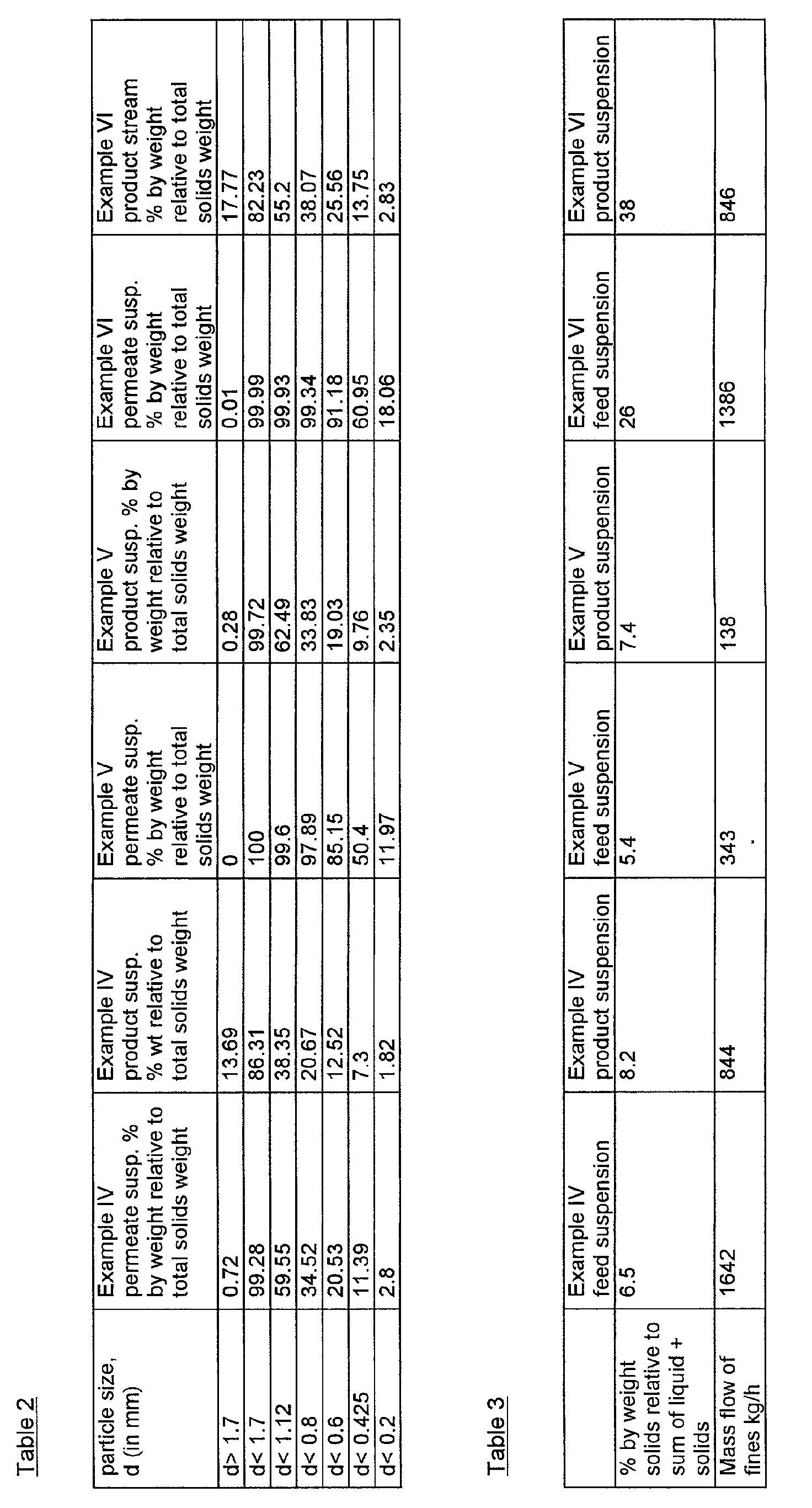
- Table 2 shows the particle size distribution of the ammonium sulphate crystals in the permeate suspension and the particle size distribution of the ammonium sulphate crystals in the product suspension. Table 3 shows the total concentration of crystals in the feed and in the product suspension and the mass flow of fines coming with each stream. The amount of crystals with diameter < 1.4 mm had been reduced by the process of the invention by 49%.
- The procedure described in Example IV was repeated. In this instance the feed suspension contained 5,4 % by weight ammonium sulphate crystals, while the opening of the slits amounted 0.5 mm. The feed flow amounted 21 m3/h. The streams were controlled so that the flow rate of the product suspension was equal to the flow rate of the permeate suspension.
- The results are shown in Table 2 and Table 3. The amount of crystals with a diameter < 0.5 mm had decreased by 60%.
- The procedure described in Example IV was repeated. The ammonium sulphate suspension to be classified contained 26 % by weight ammonium sulphate crystals. The flow rate of the feed suspension was 14m3/h and the slit opening was 0.5 mm. The streams were controlled so that the flow rate of the product suspension was 1.5 times the flow rate of the permeate suspension.
- The results are shown in Table 2 and Table 3. The amount of particles with a diameter < 0.5 mm had decreased by 39%.

Claims (9)
- Process for at least partially separating fine ammonium sulphate crystals below a predetermined size from coarse ammonium sulphate crystals above the predetermined size using a screening apparatus, said screening apparatus comprising a first chamber, a second chamber and a screen, said screen separating the first chamber and the second chamber, said screen having openings which are permeable to said fine crystals and which are not permeable to said coarse crystals, said process comprising the steps ofwherein both sides of the screen are kept immersed in liquid.(a) introducing a feed suspension into the first chamber, said feed suspension comprising said fine crystals, said coarse crystals, and ammonium sulphate solution(b) withdrawing a permeate suspension from the second chamber, said permeate suspension comprising fine crystals and ammonium sulphate solution which have been transported through the openings of the screen(c) withdrawing a product suspension from the first chamber, said product suspension comprising crystals and ammonium sulphate solution which have not been transported through the openings of the screen
- Process according to claim 1, characterized in that the flow rates of the feed suspension entering the first chamber, the permeate suspension exiting the second chamber and product suspension exiting the first chamber are chosen such that both sides of the screen are kept immersed in liquid.
- Process according to claim 1 or claim 2, characterized in that the percentage of crystals in the feed suspension is less than 25 vol.%.
- Process according to any one of claims 1 to 3, characterized in that the percentage of crystals in the product suspension is less than 50 vol.%.
- Process according to any one of claims 1 to 4, characterized in that transport of the suspension in the first chamber takes place in a direction essentially parallel to the screen.
- Process according to claim 5, characterized in that transport of the suspension in the first chamber in the direction parallel to the screen takes place at a rate of at least 0.01 m/s.
- Process according to any one of claims 1 to 6, characterized in that the screening apparatus is provided with an agitator and that the screen is cleaned using said agitator.
- Process according to claim 7, characterized in that the agitator is inside the first chamber.
- Process according to claim 8, characterized in that at least part of the wall of the first chamber forms a cylinder, said cylindrical part including at least part of the screen, that the agitator is inside the first chamber and that the agitator can be rotated around an axis parallel to the length axis of the cylinder
Priority Applications (17)
| Application Number | Priority Date | Filing Date | Title |
|---|---|---|---|
| EP20010201312 EP1249429A1 (en) | 2001-04-09 | 2001-04-09 | Process for size classifying ammonium sulphate crystals which are present in a suspension |
| TW091106875A TWI258457B (en) | 2001-04-09 | 2002-04-04 | Process for size classifying ammonium sulfate crystals which are present in a suspension |
| BRPI0208792-8A BR0208792B1 (en) | 2001-04-09 | 2002-04-05 | A process for size classification of ammonium sulfate crystals present in a suspension. |
| DE60200948T DE60200948T2 (en) | 2001-04-09 | 2002-04-05 | Method for size classification of suspended ammonium sulfate crystals |
| JP2002579370A JP4108484B2 (en) | 2001-04-09 | 2002-04-05 | Method for classifying ammonium sulfate crystals present in suspension |
| US10/474,439 US7380671B2 (en) | 2001-04-09 | 2002-04-05 | Process for size classifying ammonium sulfate crystals which are present in a suspension |
| KR1020037013222A KR100870358B1 (en) | 2001-04-09 | 2002-04-05 | How to classify the size of ammonium sulfate crystals in suspension |
| CNB028116097A CN1214979C (en) | 2001-04-09 | 2002-04-05 | Process for size classifying ammonium sulfate crystals which are present in suspension |
| PL366474A PL201508B1 (en) | 2001-04-09 | 2002-04-05 | Process for size classifying ammonium sulfate crystals which are present in a suspension |
| CZ20032769A CZ303410B6 (en) | 2001-04-09 | 2002-04-05 | Classification method of ammonium sulfate crystals being present in a suspension according to particle size |
| EA200301090A EA005090B1 (en) | 2001-04-09 | 2002-04-05 | Process for size classifying ammonium sulfate crystals which are present in a suspension |
| ES02718712T ES2227454T3 (en) | 2001-04-09 | 2002-04-05 | PROCEDURE TO CLASSIFY FOR CRYSTAL SIZES OF AMMONIUM SULPHATE THAT ARE PRESENT IN A SUSPENSION. |
| AT02718712T ATE273242T1 (en) | 2001-04-09 | 2002-04-05 | METHOD FOR CLASSIFICATION BY SIZE OF AMMONIUM SULFATE CRYSTALS PRESENT IN A SUSPENSION |
| MXPA03009350A MXPA03009350A (en) | 2001-04-09 | 2002-04-05 | Process for size classifying ammonium sulfate crystals which are present in a suspension. |
| EP02718712A EP1381566B1 (en) | 2001-04-09 | 2002-04-05 | Process for size classifying ammonium sulfate crystals which are present in a suspension |
| PCT/NL2002/000222 WO2002081374A1 (en) | 2001-04-09 | 2002-04-05 | Process for size classifying ammonium sulfate crystals which are present in a suspension |
| MYPI20021251A MY131251A (en) | 2001-04-09 | 2002-04-08 | Process for size classifying ammonium sulfate crystals which are present in a suspension |
Applications Claiming Priority (1)
| Application Number | Priority Date | Filing Date | Title |
|---|---|---|---|
| EP20010201312 EP1249429A1 (en) | 2001-04-09 | 2001-04-09 | Process for size classifying ammonium sulphate crystals which are present in a suspension |
Publications (1)
| Publication Number | Publication Date |
|---|---|
| EP1249429A1 true EP1249429A1 (en) | 2002-10-16 |
Family
ID=8180129
Family Applications (2)
| Application Number | Title | Priority Date | Filing Date |
|---|---|---|---|
| EP20010201312 Withdrawn EP1249429A1 (en) | 2001-04-09 | 2001-04-09 | Process for size classifying ammonium sulphate crystals which are present in a suspension |
| EP02718712A Expired - Lifetime EP1381566B1 (en) | 2001-04-09 | 2002-04-05 | Process for size classifying ammonium sulfate crystals which are present in a suspension |
Family Applications After (1)
| Application Number | Title | Priority Date | Filing Date |
|---|---|---|---|
| EP02718712A Expired - Lifetime EP1381566B1 (en) | 2001-04-09 | 2002-04-05 | Process for size classifying ammonium sulfate crystals which are present in a suspension |
Country Status (16)
| Country | Link |
|---|---|
| US (1) | US7380671B2 (en) |
| EP (2) | EP1249429A1 (en) |
| JP (1) | JP4108484B2 (en) |
| KR (1) | KR100870358B1 (en) |
| CN (1) | CN1214979C (en) |
| AT (1) | ATE273242T1 (en) |
| BR (1) | BR0208792B1 (en) |
| CZ (1) | CZ303410B6 (en) |
| DE (1) | DE60200948T2 (en) |
| EA (1) | EA005090B1 (en) |
| ES (1) | ES2227454T3 (en) |
| MX (1) | MXPA03009350A (en) |
| MY (1) | MY131251A (en) |
| PL (1) | PL201508B1 (en) |
| TW (1) | TWI258457B (en) |
| WO (1) | WO2002081374A1 (en) |
Families Citing this family (4)
| Publication number | Priority date | Publication date | Assignee | Title |
|---|---|---|---|---|
| US9085014B2 (en) * | 2011-03-23 | 2015-07-21 | Carter Day International, Inc. | Vertical drop product cleaner with perforated intake manifold |
| WO2014044593A1 (en) * | 2012-09-24 | 2014-03-27 | Dsm Ip Assets B.V. | Process for preparing crystalline ammonium sulfate product |
| CN115520880B (en) * | 2021-06-25 | 2024-03-26 | 中国石油化工股份有限公司 | Preparation method, crystallizer and production device of uniform large-particle ammonium sulfate |
| CN116173704B (en) * | 2023-03-21 | 2024-03-19 | 国家能源集团泰州发电有限公司 | Flue gas desulfurization and denitrification treatment system for coal-fired power plant |
Citations (5)
| Publication number | Priority date | Publication date | Assignee | Title |
|---|---|---|---|---|
| US2883273A (en) * | 1954-03-04 | 1959-04-21 | Olin Mathieson | Crystallization |
| GB1134963A (en) * | 1966-04-22 | 1968-11-27 | Inventa Ag | Separating catalyst particles from hydroxylamine salt solution |
| US4357306A (en) * | 1979-03-21 | 1982-11-02 | Richter Gedeon Vegyeszeti Gyar Rt. | Crystallization apparatus |
| JPH0426512A (en) * | 1990-05-21 | 1992-01-29 | Kawasaki Steel Corp | Production of granular ammonium sulfate |
| EP0577213A1 (en) * | 1992-07-02 | 1994-01-05 | Dsm N.V. | Process for the preparation and purification of a hydroxylammonium salt solution |
Family Cites Families (8)
| Publication number | Priority date | Publication date | Assignee | Title |
|---|---|---|---|---|
| US2203405A (en) * | 1938-06-13 | 1940-06-04 | Walter E Lippmann | Sand classifier |
| DE926244C (en) * | 1952-05-08 | 1955-04-14 | Rheinelbe Bergbau Ag | Saettiger for the production of ammonium salts, preferably for ammonium sulfate |
| US3006470A (en) * | 1958-06-20 | 1961-10-31 | Tongeren N V Bureau Van | Apparatus for classifying particulate material |
| GB1181363A (en) * | 1966-01-21 | 1970-02-18 | Nat Res Dev | Process and Apparatus for Classifying Fibres |
| US4042503A (en) * | 1973-12-10 | 1977-08-16 | Beloit Corporation | Classifier and process for recycled fiber separation |
| US5392921A (en) * | 1992-04-07 | 1995-02-28 | Aks, Incorporated | Process and apparatus for processing resins |
| SE511483C2 (en) * | 1998-02-04 | 1999-10-04 | Sunds Defibrator Ind Ab | Pressure screen with scrap separation |
| FR2805181B1 (en) * | 2000-02-21 | 2004-12-10 | Christian Monjarret | CALIBRATION, BY SIEVING, OF FEATHERS, DOWN, WOOD NEEDLES, OR THE LIKE KEEPING SUSPENDED IN A FLUID |
-
2001
- 2001-04-09 EP EP20010201312 patent/EP1249429A1/en not_active Withdrawn
-
2002
- 2002-04-04 TW TW091106875A patent/TWI258457B/en not_active IP Right Cessation
- 2002-04-05 WO PCT/NL2002/000222 patent/WO2002081374A1/en not_active Ceased
- 2002-04-05 EA EA200301090A patent/EA005090B1/en not_active IP Right Cessation
- 2002-04-05 US US10/474,439 patent/US7380671B2/en not_active Expired - Fee Related
- 2002-04-05 DE DE60200948T patent/DE60200948T2/en not_active Expired - Lifetime
- 2002-04-05 MX MXPA03009350A patent/MXPA03009350A/en active IP Right Grant
- 2002-04-05 JP JP2002579370A patent/JP4108484B2/en not_active Expired - Fee Related
- 2002-04-05 PL PL366474A patent/PL201508B1/en not_active IP Right Cessation
- 2002-04-05 EP EP02718712A patent/EP1381566B1/en not_active Expired - Lifetime
- 2002-04-05 ES ES02718712T patent/ES2227454T3/en not_active Expired - Lifetime
- 2002-04-05 BR BRPI0208792-8A patent/BR0208792B1/en not_active IP Right Cessation
- 2002-04-05 AT AT02718712T patent/ATE273242T1/en not_active IP Right Cessation
- 2002-04-05 CZ CZ20032769A patent/CZ303410B6/en not_active IP Right Cessation
- 2002-04-05 KR KR1020037013222A patent/KR100870358B1/en not_active Expired - Fee Related
- 2002-04-05 CN CNB028116097A patent/CN1214979C/en not_active Expired - Fee Related
- 2002-04-08 MY MYPI20021251A patent/MY131251A/en unknown
Patent Citations (5)
| Publication number | Priority date | Publication date | Assignee | Title |
|---|---|---|---|---|
| US2883273A (en) * | 1954-03-04 | 1959-04-21 | Olin Mathieson | Crystallization |
| GB1134963A (en) * | 1966-04-22 | 1968-11-27 | Inventa Ag | Separating catalyst particles from hydroxylamine salt solution |
| US4357306A (en) * | 1979-03-21 | 1982-11-02 | Richter Gedeon Vegyeszeti Gyar Rt. | Crystallization apparatus |
| JPH0426512A (en) * | 1990-05-21 | 1992-01-29 | Kawasaki Steel Corp | Production of granular ammonium sulfate |
| EP0577213A1 (en) * | 1992-07-02 | 1994-01-05 | Dsm N.V. | Process for the preparation and purification of a hydroxylammonium salt solution |
Non-Patent Citations (1)
| Title |
|---|
| DATABASE WPI Section Ch Week 199211, Derwent World Patents Index; Class C04, AN 1992-084275, XP002152910 * |
Also Published As
| Publication number | Publication date |
|---|---|
| BR0208792A (en) | 2004-03-09 |
| KR100870358B1 (en) | 2008-11-25 |
| EA005090B1 (en) | 2004-10-28 |
| KR20040004581A (en) | 2004-01-13 |
| ES2227454T3 (en) | 2005-04-01 |
| DE60200948D1 (en) | 2004-09-16 |
| CN1214979C (en) | 2005-08-17 |
| EA200301090A1 (en) | 2004-04-29 |
| EP1381566B1 (en) | 2004-08-11 |
| WO2002081374A1 (en) | 2002-10-17 |
| EP1381566A1 (en) | 2004-01-21 |
| JP2004523461A (en) | 2004-08-05 |
| PL366474A1 (en) | 2005-02-07 |
| MY131251A (en) | 2007-07-31 |
| CN1514806A (en) | 2004-07-21 |
| US20050006503A1 (en) | 2005-01-13 |
| BR0208792B1 (en) | 2011-11-29 |
| PL201508B1 (en) | 2009-04-30 |
| MXPA03009350A (en) | 2004-05-21 |
| JP4108484B2 (en) | 2008-06-25 |
| ATE273242T1 (en) | 2004-08-15 |
| DE60200948T2 (en) | 2005-09-01 |
| CZ20032769A3 (en) | 2004-05-12 |
| TWI258457B (en) | 2006-07-21 |
| CZ303410B6 (en) | 2012-09-05 |
| US7380671B2 (en) | 2008-06-03 |
Similar Documents
| Publication | Publication Date | Title |
|---|---|---|
| CA1220728A (en) | Apparatus for concentrating a suspension | |
| TWI426950B (en) | Process for continuous production of large crystal products | |
| US4960525A (en) | Hydrocyclone for washing particles in liquid suspension | |
| US20030180202A1 (en) | Device for producing crystals | |
| WO1993019826A1 (en) | Process for crystallization in a draft tube baffle crystallizer | |
| EP1381566B1 (en) | Process for size classifying ammonium sulfate crystals which are present in a suspension | |
| CA1288216C (en) | Process for separating solid particles and/or liquid from a suspension, and wash column | |
| US3168379A (en) | Apparatus and method of producing brine | |
| EP2897903B1 (en) | Process for preparing crystalline ammonium sulfate product | |
| DE3308287A1 (en) | METHOD AND DEVICE FOR FILTERING SOLID-LOADED LIQUIDS | |
| CA1193960A (en) | Apparatus for and method of preparing crystals for washing | |
| DE2645740A1 (en) | METHOD OF ELIMINATING THE LIQUID PHASE OF HYDROCARBONS OR DERIVATIVES FROM AN AEROSOL AND FILTER TO CARRY OUT THE PROCEDURE | |
| RU2075441C1 (en) | Method and apparatus for treating potassium chloride-containing mixture | |
| DE3540508C2 (en) | ||
| PL81654B1 (en) | ||
| DE2225682C3 (en) | Process for treating liquids | |
| US4357306A (en) | Crystallization apparatus | |
| DE202019103650U1 (en) | Device for non-destructive, continuous removal of filter materials from water filters | |
| DE2719936C2 (en) | Method and device for the recovery of Mg SO? 3? from a mixed salt solution | |
| SU1736567A1 (en) | For joint screening of sand and sludge and relevant method | |
| SU1284579A1 (en) | Mass exchange apparatus | |
| DE313127C (en) | ||
| TH27870B (en) | Method for separating the size of ammonium sulfate crystals present in suspensions. | |
| DD278954A1 (en) | METHOD FOR CLEANING AND CLASSIFYING LIGHT SOLID SOLUTIONS | |
| CS234835B1 (en) | The method of trapping the sublimate of dimethyl terephthalate |
Legal Events
| Date | Code | Title | Description |
|---|---|---|---|
| PUAI | Public reference made under article 153(3) epc to a published international application that has entered the european phase |
Free format text: ORIGINAL CODE: 0009012 |
|
| AK | Designated contracting states |
Kind code of ref document: A1 Designated state(s): AT BE CH CY DE DK ES FI FR GB GR IE IT LI LU MC NL PT SE TR |
|
| AX | Request for extension of the european patent |
Free format text: AL;LT;LV;MK;RO;SI |
|
| AKX | Designation fees paid | ||
| REG | Reference to a national code |
Ref country code: DE Ref legal event code: 8566 |
|
| RAP1 | Party data changed (applicant data changed or rights of an application transferred) |
Owner name: DSM IP ASSETS B.V. |
|
| STAA | Information on the status of an ep patent application or granted ep patent |
Free format text: STATUS: THE APPLICATION IS DEEMED TO BE WITHDRAWN |
|
| 18D | Application deemed to be withdrawn |
Effective date: 20030417 |