EP1248843B1 - Gene nphs2 implique dans le syndrome nephrotique cortico-resistant - Google Patents
Gene nphs2 implique dans le syndrome nephrotique cortico-resistant Download PDFInfo
- Publication number
- EP1248843B1 EP1248843B1 EP01907652A EP01907652A EP1248843B1 EP 1248843 B1 EP1248843 B1 EP 1248843B1 EP 01907652 A EP01907652 A EP 01907652A EP 01907652 A EP01907652 A EP 01907652A EP 1248843 B1 EP1248843 B1 EP 1248843B1
- Authority
- EP
- European Patent Office
- Prior art keywords
- sequence
- nucleic acid
- polypeptide
- seq
- gene
- Prior art date
- Legal status (The legal status is an assumption and is not a legal conclusion. Google has not performed a legal analysis and makes no representation as to the accuracy of the status listed.)
- Expired - Lifetime
Links
- 108090000623 proteins and genes Proteins 0.000 title claims abstract description 26
- 101150052769 NPHS2 gene Proteins 0.000 title abstract description 29
- 102000004169 proteins and genes Human genes 0.000 title abstract description 8
- 230000001225 therapeutic effect Effects 0.000 title abstract description 4
- OMFXVFTZEKFJBZ-UHFFFAOYSA-N Corticosterone Natural products O=C1CCC2(C)C3C(O)CC(C)(C(CC4)C(=O)CO)C4C3CCC2=C1 OMFXVFTZEKFJBZ-UHFFFAOYSA-N 0.000 title abstract description 3
- OMFXVFTZEKFJBZ-HJTSIMOOSA-N corticosterone Chemical compound O=C1CC[C@]2(C)[C@H]3[C@@H](O)C[C@](C)([C@H](CC4)C(=O)CO)[C@@H]4[C@@H]3CCC2=C1 OMFXVFTZEKFJBZ-HJTSIMOOSA-N 0.000 title abstract description 3
- 208000011580 syndromic disease Diseases 0.000 title description 3
- 206010029164 Nephrotic syndrome Diseases 0.000 claims abstract description 24
- 108091028043 Nucleic acid sequence Proteins 0.000 claims abstract description 16
- 150000007523 nucleic acids Chemical class 0.000 claims description 44
- 108090000765 processed proteins & peptides Proteins 0.000 claims description 43
- 229920001184 polypeptide Polymers 0.000 claims description 40
- 102000004196 processed proteins & peptides Human genes 0.000 claims description 40
- 230000035772 mutation Effects 0.000 claims description 38
- 241000282414 Homo sapiens Species 0.000 claims description 37
- 108020004414 DNA Proteins 0.000 claims description 36
- 102100036037 Podocin Human genes 0.000 claims description 35
- 108020004707 nucleic acids Proteins 0.000 claims description 32
- 102000039446 nucleic acids Human genes 0.000 claims description 32
- 238000000034 method Methods 0.000 claims description 25
- 101000595193 Homo sapiens Podocin Proteins 0.000 claims description 23
- 230000003321 amplification Effects 0.000 claims description 20
- 238000003199 nucleic acid amplification method Methods 0.000 claims description 20
- 239000002773 nucleotide Substances 0.000 claims description 18
- 125000003729 nucleotide group Chemical group 0.000 claims description 18
- 101710162479 Podocin Proteins 0.000 claims description 17
- 238000009396 hybridization Methods 0.000 claims description 14
- 238000001514 detection method Methods 0.000 claims description 12
- 230000037430 deletion Effects 0.000 claims description 11
- 238000012217 deletion Methods 0.000 claims description 11
- 239000012472 biological sample Substances 0.000 claims description 10
- 238000011282 treatment Methods 0.000 claims description 9
- 239000013598 vector Substances 0.000 claims description 9
- 230000000295 complement effect Effects 0.000 claims description 7
- 230000037431 insertion Effects 0.000 claims description 7
- 238000003780 insertion Methods 0.000 claims description 7
- 239000012634 fragment Substances 0.000 claims description 6
- 108091034117 Oligonucleotide Proteins 0.000 claims description 5
- JLCPHMBAVCMARE-UHFFFAOYSA-N [3-[[3-[[3-[[3-[[3-[[3-[[3-[[3-[[3-[[3-[[3-[[5-(2-amino-6-oxo-1H-purin-9-yl)-3-[[3-[[3-[[3-[[3-[[3-[[5-(2-amino-6-oxo-1H-purin-9-yl)-3-[[5-(2-amino-6-oxo-1H-purin-9-yl)-3-hydroxyoxolan-2-yl]methoxy-hydroxyphosphoryl]oxyoxolan-2-yl]methoxy-hydroxyphosphoryl]oxy-5-(5-methyl-2,4-dioxopyrimidin-1-yl)oxolan-2-yl]methoxy-hydroxyphosphoryl]oxy-5-(6-aminopurin-9-yl)oxolan-2-yl]methoxy-hydroxyphosphoryl]oxy-5-(6-aminopurin-9-yl)oxolan-2-yl]methoxy-hydroxyphosphoryl]oxy-5-(6-aminopurin-9-yl)oxolan-2-yl]methoxy-hydroxyphosphoryl]oxy-5-(6-aminopurin-9-yl)oxolan-2-yl]methoxy-hydroxyphosphoryl]oxyoxolan-2-yl]methoxy-hydroxyphosphoryl]oxy-5-(5-methyl-2,4-dioxopyrimidin-1-yl)oxolan-2-yl]methoxy-hydroxyphosphoryl]oxy-5-(4-amino-2-oxopyrimidin-1-yl)oxolan-2-yl]methoxy-hydroxyphosphoryl]oxy-5-(5-methyl-2,4-dioxopyrimidin-1-yl)oxolan-2-yl]methoxy-hydroxyphosphoryl]oxy-5-(5-methyl-2,4-dioxopyrimidin-1-yl)oxolan-2-yl]methoxy-hydroxyphosphoryl]oxy-5-(6-aminopurin-9-yl)oxolan-2-yl]methoxy-hydroxyphosphoryl]oxy-5-(6-aminopurin-9-yl)oxolan-2-yl]methoxy-hydroxyphosphoryl]oxy-5-(4-amino-2-oxopyrimidin-1-yl)oxolan-2-yl]methoxy-hydroxyphosphoryl]oxy-5-(4-amino-2-oxopyrimidin-1-yl)oxolan-2-yl]methoxy-hydroxyphosphoryl]oxy-5-(4-amino-2-oxopyrimidin-1-yl)oxolan-2-yl]methoxy-hydroxyphosphoryl]oxy-5-(6-aminopurin-9-yl)oxolan-2-yl]methoxy-hydroxyphosphoryl]oxy-5-(4-amino-2-oxopyrimidin-1-yl)oxolan-2-yl]methyl [5-(6-aminopurin-9-yl)-2-(hydroxymethyl)oxolan-3-yl] hydrogen phosphate Polymers Cc1cn(C2CC(OP(O)(=O)OCC3OC(CC3OP(O)(=O)OCC3OC(CC3O)n3cnc4c3nc(N)[nH]c4=O)n3cnc4c3nc(N)[nH]c4=O)C(COP(O)(=O)OC3CC(OC3COP(O)(=O)OC3CC(OC3COP(O)(=O)OC3CC(OC3COP(O)(=O)OC3CC(OC3COP(O)(=O)OC3CC(OC3COP(O)(=O)OC3CC(OC3COP(O)(=O)OC3CC(OC3COP(O)(=O)OC3CC(OC3COP(O)(=O)OC3CC(OC3COP(O)(=O)OC3CC(OC3COP(O)(=O)OC3CC(OC3COP(O)(=O)OC3CC(OC3COP(O)(=O)OC3CC(OC3COP(O)(=O)OC3CC(OC3COP(O)(=O)OC3CC(OC3COP(O)(=O)OC3CC(OC3COP(O)(=O)OC3CC(OC3CO)n3cnc4c(N)ncnc34)n3ccc(N)nc3=O)n3cnc4c(N)ncnc34)n3ccc(N)nc3=O)n3ccc(N)nc3=O)n3ccc(N)nc3=O)n3cnc4c(N)ncnc34)n3cnc4c(N)ncnc34)n3cc(C)c(=O)[nH]c3=O)n3cc(C)c(=O)[nH]c3=O)n3ccc(N)nc3=O)n3cc(C)c(=O)[nH]c3=O)n3cnc4c3nc(N)[nH]c4=O)n3cnc4c(N)ncnc34)n3cnc4c(N)ncnc34)n3cnc4c(N)ncnc34)n3cnc4c(N)ncnc34)O2)c(=O)[nH]c1=O JLCPHMBAVCMARE-UHFFFAOYSA-N 0.000 claims description 5
- 230000004071 biological effect Effects 0.000 claims description 5
- 238000000338 in vitro Methods 0.000 claims description 5
- 208000017169 kidney disease Diseases 0.000 claims description 5
- 239000013068 control sample Substances 0.000 claims description 4
- 239000013604 expression vector Substances 0.000 claims description 4
- 239000008194 pharmaceutical composition Substances 0.000 claims description 4
- 239000000872 buffer Substances 0.000 claims description 3
- 238000010367 cloning Methods 0.000 claims description 3
- 238000003745 diagnosis Methods 0.000 claims description 3
- 238000004519 manufacturing process Methods 0.000 claims description 3
- 238000000746 purification Methods 0.000 claims description 3
- 230000008569 process Effects 0.000 claims description 2
- 125000003275 alpha amino acid group Chemical group 0.000 claims 2
- 239000013599 cloning vector Substances 0.000 claims 1
- 150000001413 amino acids Chemical class 0.000 abstract description 20
- 210000003734 kidney Anatomy 0.000 description 16
- 235000001014 amino acid Nutrition 0.000 description 13
- 239000002299 complementary DNA Substances 0.000 description 13
- 210000004027 cell Anatomy 0.000 description 12
- 229940024606 amino acid Drugs 0.000 description 11
- 239000000523 sample Substances 0.000 description 11
- 239000000047 product Substances 0.000 description 10
- 108700024394 Exon Proteins 0.000 description 8
- 206010042602 Supraventricular extrasystoles Diseases 0.000 description 8
- 239000003246 corticosteroid Substances 0.000 description 8
- 238000006467 substitution reaction Methods 0.000 description 7
- 108091032973 (ribonucleotides)n+m Proteins 0.000 description 6
- 230000002068 genetic effect Effects 0.000 description 6
- 235000018102 proteins Nutrition 0.000 description 6
- 230000005856 abnormality Effects 0.000 description 5
- 239000000427 antigen Substances 0.000 description 5
- 102000036639 antigens Human genes 0.000 description 5
- 108091007433 antigens Proteins 0.000 description 5
- 230000015572 biosynthetic process Effects 0.000 description 5
- 208000020832 chronic kidney disease Diseases 0.000 description 5
- 201000010099 disease Diseases 0.000 description 5
- 208000037265 diseases, disorders, signs and symptoms Diseases 0.000 description 5
- 208000028208 end stage renal disease Diseases 0.000 description 5
- 201000000523 end stage renal failure Diseases 0.000 description 5
- 230000001605 fetal effect Effects 0.000 description 5
- 210000000557 podocyte Anatomy 0.000 description 5
- 201000001474 proteinuria Diseases 0.000 description 5
- 238000012216 screening Methods 0.000 description 5
- 238000012163 sequencing technique Methods 0.000 description 5
- 108020004705 Codon Proteins 0.000 description 4
- 108700026244 Open Reading Frames Proteins 0.000 description 4
- 230000000694 effects Effects 0.000 description 4
- 238000002474 experimental method Methods 0.000 description 4
- 239000011859 microparticle Substances 0.000 description 4
- 230000007170 pathology Effects 0.000 description 4
- 239000000243 solution Substances 0.000 description 4
- 238000002054 transplantation Methods 0.000 description 4
- 108091026890 Coding region Proteins 0.000 description 3
- 108091092878 Microsatellite Proteins 0.000 description 3
- 239000003795 chemical substances by application Substances 0.000 description 3
- 238000011161 development Methods 0.000 description 3
- 230000018109 developmental process Effects 0.000 description 3
- 238000002405 diagnostic procedure Methods 0.000 description 3
- 230000006870 function Effects 0.000 description 3
- 230000001434 glomerular Effects 0.000 description 3
- PCHJSUWPFVWCPO-UHFFFAOYSA-N gold Chemical compound [Au] PCHJSUWPFVWCPO-UHFFFAOYSA-N 0.000 description 3
- 229910052737 gold Inorganic materials 0.000 description 3
- 239000010931 gold Substances 0.000 description 3
- 230000001900 immune effect Effects 0.000 description 3
- 238000007901 in situ hybridization Methods 0.000 description 3
- 239000003550 marker Substances 0.000 description 3
- 239000000203 mixture Substances 0.000 description 3
- 238000003757 reverse transcription PCR Methods 0.000 description 3
- 239000007790 solid phase Substances 0.000 description 3
- 150000003431 steroids Chemical class 0.000 description 3
- 238000003786 synthesis reaction Methods 0.000 description 3
- 210000001519 tissue Anatomy 0.000 description 3
- 238000001890 transfection Methods 0.000 description 3
- 239000003981 vehicle Substances 0.000 description 3
- 102000040650 (ribonucleotides)n+m Human genes 0.000 description 2
- 229920002134 Carboxymethyl cellulose Polymers 0.000 description 2
- 241000588724 Escherichia coli Species 0.000 description 2
- ZHNUHDYFZUAESO-UHFFFAOYSA-N Formamide Chemical compound NC=O ZHNUHDYFZUAESO-UHFFFAOYSA-N 0.000 description 2
- DHMQDGOQFOQNFH-UHFFFAOYSA-N Glycine Chemical compound NCC(O)=O DHMQDGOQFOQNFH-UHFFFAOYSA-N 0.000 description 2
- 101100240462 Homo sapiens RASAL2 gene Proteins 0.000 description 2
- 208000026350 Inborn Genetic disease Diseases 0.000 description 2
- 241000124008 Mammalia Species 0.000 description 2
- 241001465754 Metazoa Species 0.000 description 2
- 101150118584 NPHS1 gene Proteins 0.000 description 2
- 238000000636 Northern blotting Methods 0.000 description 2
- 241000283973 Oryctolagus cuniculus Species 0.000 description 2
- 102100035410 Ras GTPase-activating protein nGAP Human genes 0.000 description 2
- 241000700161 Rattus rattus Species 0.000 description 2
- VYPSYNLAJGMNEJ-UHFFFAOYSA-N Silicium dioxide Chemical compound O=[Si]=O VYPSYNLAJGMNEJ-UHFFFAOYSA-N 0.000 description 2
- 230000001594 aberrant effect Effects 0.000 description 2
- 239000012190 activator Substances 0.000 description 2
- 239000001506 calcium phosphate Substances 0.000 description 2
- 229910000389 calcium phosphate Inorganic materials 0.000 description 2
- 235000011010 calcium phosphates Nutrition 0.000 description 2
- 235000010948 carboxy methyl cellulose Nutrition 0.000 description 2
- 125000002091 cationic group Chemical group 0.000 description 2
- 230000008859 change Effects 0.000 description 2
- 238000004587 chromatography analysis Methods 0.000 description 2
- 238000003935 denaturing gradient gel electrophoresis Methods 0.000 description 2
- 230000029087 digestion Effects 0.000 description 2
- 239000003814 drug Substances 0.000 description 2
- 238000001914 filtration Methods 0.000 description 2
- 201000005206 focal segmental glomerulosclerosis Diseases 0.000 description 2
- 238000009472 formulation Methods 0.000 description 2
- 208000016361 genetic disease Diseases 0.000 description 2
- 206010061989 glomerulosclerosis Diseases 0.000 description 2
- 230000003053 immunization Effects 0.000 description 2
- 238000002347 injection Methods 0.000 description 2
- 239000007924 injection Substances 0.000 description 2
- 230000003902 lesion Effects 0.000 description 2
- 239000002502 liposome Substances 0.000 description 2
- 239000012188 paraffin wax Substances 0.000 description 2
- 230000008488 polyadenylation Effects 0.000 description 2
- 102000054765 polymorphisms of proteins Human genes 0.000 description 2
- 238000003793 prenatal diagnosis Methods 0.000 description 2
- 102200087339 rs74315342 Human genes 0.000 description 2
- 210000002966 serum Anatomy 0.000 description 2
- 238000010561 standard procedure Methods 0.000 description 2
- 239000000126 substance Substances 0.000 description 2
- 238000012360 testing method Methods 0.000 description 2
- 238000002560 therapeutic procedure Methods 0.000 description 2
- 238000013518 transcription Methods 0.000 description 2
- 230000035897 transcription Effects 0.000 description 2
- QORWJWZARLRLPR-UHFFFAOYSA-H tricalcium bis(phosphate) Chemical compound [Ca+2].[Ca+2].[Ca+2].[O-]P([O-])([O-])=O.[O-]P([O-])([O-])=O QORWJWZARLRLPR-UHFFFAOYSA-H 0.000 description 2
- MTCFGRXMJLQNBG-REOHCLBHSA-N (2S)-2-Amino-3-hydroxypropansäure Chemical compound OC[C@H](N)C(O)=O MTCFGRXMJLQNBG-REOHCLBHSA-N 0.000 description 1
- LEBVLXFERQHONN-UHFFFAOYSA-N 1-butyl-N-(2,6-dimethylphenyl)piperidine-2-carboxamide Chemical compound CCCCN1CCCCC1C(=O)NC1=C(C)C=CC=C1C LEBVLXFERQHONN-UHFFFAOYSA-N 0.000 description 1
- BFSVOASYOCHEOV-UHFFFAOYSA-N 2-diethylaminoethanol Chemical compound CCN(CC)CCO BFSVOASYOCHEOV-UHFFFAOYSA-N 0.000 description 1
- FWMNVWWHGCHHJJ-SKKKGAJSSA-N 4-amino-1-[(2r)-6-amino-2-[[(2r)-2-[[(2r)-2-[[(2r)-2-amino-3-phenylpropanoyl]amino]-3-phenylpropanoyl]amino]-4-methylpentanoyl]amino]hexanoyl]piperidine-4-carboxylic acid Chemical compound C([C@H](C(=O)N[C@H](CC(C)C)C(=O)N[C@H](CCCCN)C(=O)N1CCC(N)(CC1)C(O)=O)NC(=O)[C@H](N)CC=1C=CC=CC=1)C1=CC=CC=C1 FWMNVWWHGCHHJJ-SKKKGAJSSA-N 0.000 description 1
- 208000030507 AIDS Diseases 0.000 description 1
- 208000007122 AIDS-Associated Nephropathy Diseases 0.000 description 1
- 239000004475 Arginine Substances 0.000 description 1
- 208000002109 Argyria Diseases 0.000 description 1
- DCXYFEDJOCDNAF-UHFFFAOYSA-N Asparagine Natural products OC(=O)C(N)CC(N)=O DCXYFEDJOCDNAF-UHFFFAOYSA-N 0.000 description 1
- 241000894006 Bacteria Species 0.000 description 1
- 241000132028 Bellis Species 0.000 description 1
- 102000004506 Blood Proteins Human genes 0.000 description 1
- 108010017384 Blood Proteins Proteins 0.000 description 1
- 241000283690 Bos taurus Species 0.000 description 1
- 108020004635 Complementary DNA Proteins 0.000 description 1
- 206010060737 Congenital nephrotic syndrome Diseases 0.000 description 1
- 108091029523 CpG island Proteins 0.000 description 1
- 238000000018 DNA microarray Methods 0.000 description 1
- 208000007342 Diabetic Nephropathies Diseases 0.000 description 1
- 102000004190 Enzymes Human genes 0.000 description 1
- 108090000790 Enzymes Proteins 0.000 description 1
- WHUUTDBJXJRKMK-UHFFFAOYSA-N Glutamic acid Natural products OC(=O)C(N)CCC(O)=O WHUUTDBJXJRKMK-UHFFFAOYSA-N 0.000 description 1
- 239000004471 Glycine Substances 0.000 description 1
- 208000028782 Hereditary disease Diseases 0.000 description 1
- 241000238631 Hexapoda Species 0.000 description 1
- 241000282412 Homo Species 0.000 description 1
- 101100352765 Homo sapiens NPHS2 gene Proteins 0.000 description 1
- 102000008394 Immunoglobulin Fragments Human genes 0.000 description 1
- 108010021625 Immunoglobulin Fragments Proteins 0.000 description 1
- XUJNEKJLAYXESH-REOHCLBHSA-N L-Cysteine Chemical compound SC[C@H](N)C(O)=O XUJNEKJLAYXESH-REOHCLBHSA-N 0.000 description 1
- ONIBWKKTOPOVIA-BYPYZUCNSA-N L-Proline Chemical compound OC(=O)[C@@H]1CCCN1 ONIBWKKTOPOVIA-BYPYZUCNSA-N 0.000 description 1
- QNAYBMKLOCPYGJ-REOHCLBHSA-N L-alanine Chemical compound C[C@H](N)C(O)=O QNAYBMKLOCPYGJ-REOHCLBHSA-N 0.000 description 1
- ODKSFYDXXFIFQN-BYPYZUCNSA-P L-argininium(2+) Chemical compound NC(=[NH2+])NCCC[C@H]([NH3+])C(O)=O ODKSFYDXXFIFQN-BYPYZUCNSA-P 0.000 description 1
- DCXYFEDJOCDNAF-REOHCLBHSA-N L-asparagine Chemical compound OC(=O)[C@@H](N)CC(N)=O DCXYFEDJOCDNAF-REOHCLBHSA-N 0.000 description 1
- CKLJMWTZIZZHCS-REOHCLBHSA-N L-aspartic acid Chemical compound OC(=O)[C@@H](N)CC(O)=O CKLJMWTZIZZHCS-REOHCLBHSA-N 0.000 description 1
- WHUUTDBJXJRKMK-VKHMYHEASA-N L-glutamic acid Chemical compound OC(=O)[C@@H](N)CCC(O)=O WHUUTDBJXJRKMK-VKHMYHEASA-N 0.000 description 1
- ZDXPYRJPNDTMRX-VKHMYHEASA-N L-glutamine Chemical compound OC(=O)[C@@H](N)CCC(N)=O ZDXPYRJPNDTMRX-VKHMYHEASA-N 0.000 description 1
- HNDVDQJCIGZPNO-YFKPBYRVSA-N L-histidine Chemical compound OC(=O)[C@@H](N)CC1=CN=CN1 HNDVDQJCIGZPNO-YFKPBYRVSA-N 0.000 description 1
- AGPKZVBTJJNPAG-WHFBIAKZSA-N L-isoleucine Chemical compound CC[C@H](C)[C@H](N)C(O)=O AGPKZVBTJJNPAG-WHFBIAKZSA-N 0.000 description 1
- ROHFNLRQFUQHCH-YFKPBYRVSA-N L-leucine Chemical compound CC(C)C[C@H](N)C(O)=O ROHFNLRQFUQHCH-YFKPBYRVSA-N 0.000 description 1
- KDXKERNSBIXSRK-YFKPBYRVSA-N L-lysine Chemical compound NCCCC[C@H](N)C(O)=O KDXKERNSBIXSRK-YFKPBYRVSA-N 0.000 description 1
- FFEARJCKVFRZRR-BYPYZUCNSA-N L-methionine Chemical compound CSCC[C@H](N)C(O)=O FFEARJCKVFRZRR-BYPYZUCNSA-N 0.000 description 1
- COLNVLDHVKWLRT-QMMMGPOBSA-N L-phenylalanine Chemical compound OC(=O)[C@@H](N)CC1=CC=CC=C1 COLNVLDHVKWLRT-QMMMGPOBSA-N 0.000 description 1
- AYFVYJQAPQTCCC-GBXIJSLDSA-N L-threonine Chemical compound C[C@@H](O)[C@H](N)C(O)=O AYFVYJQAPQTCCC-GBXIJSLDSA-N 0.000 description 1
- QIVBCDIJIAJPQS-VIFPVBQESA-N L-tryptophane Chemical compound C1=CC=C2C(C[C@H](N)C(O)=O)=CNC2=C1 QIVBCDIJIAJPQS-VIFPVBQESA-N 0.000 description 1
- OUYCCCASQSFEME-QMMMGPOBSA-N L-tyrosine Chemical compound OC(=O)[C@@H](N)CC1=CC=C(O)C=C1 OUYCCCASQSFEME-QMMMGPOBSA-N 0.000 description 1
- KZSNJWFQEVHDMF-BYPYZUCNSA-N L-valine Chemical compound CC(C)[C@H](N)C(O)=O KZSNJWFQEVHDMF-BYPYZUCNSA-N 0.000 description 1
- ROHFNLRQFUQHCH-UHFFFAOYSA-N Leucine Natural products CC(C)CC(N)C(O)=O ROHFNLRQFUQHCH-UHFFFAOYSA-N 0.000 description 1
- KDXKERNSBIXSRK-UHFFFAOYSA-N Lysine Natural products NCCCCC(N)C(O)=O KDXKERNSBIXSRK-UHFFFAOYSA-N 0.000 description 1
- 239000004472 Lysine Substances 0.000 description 1
- 108700013802 NPHS2 Proteins 0.000 description 1
- 108020004485 Nonsense Codon Proteins 0.000 description 1
- 238000002944 PCR assay Methods 0.000 description 1
- 102000007079 Peptide Fragments Human genes 0.000 description 1
- 108010033276 Peptide Fragments Proteins 0.000 description 1
- 102220468501 Podocin_L172V_mutation Human genes 0.000 description 1
- 102220468499 Podocin_R168S_mutation Human genes 0.000 description 1
- 241000288906 Primates Species 0.000 description 1
- ONIBWKKTOPOVIA-UHFFFAOYSA-N Proline Natural products OC(=O)C1CCCN1 ONIBWKKTOPOVIA-UHFFFAOYSA-N 0.000 description 1
- 241001510071 Pyrrhocoridae Species 0.000 description 1
- 101000595189 Rattus norvegicus Podocin Proteins 0.000 description 1
- 102000007056 Recombinant Fusion Proteins Human genes 0.000 description 1
- 108010008281 Recombinant Fusion Proteins Proteins 0.000 description 1
- 102000002278 Ribosomal Proteins Human genes 0.000 description 1
- 108010000605 Ribosomal Proteins Proteins 0.000 description 1
- 241000283984 Rodentia Species 0.000 description 1
- 240000004808 Saccharomyces cerevisiae Species 0.000 description 1
- 229920005654 Sephadex Polymers 0.000 description 1
- 239000012507 Sephadex™ Substances 0.000 description 1
- MTCFGRXMJLQNBG-UHFFFAOYSA-N Serine Natural products OCC(N)C(O)=O MTCFGRXMJLQNBG-UHFFFAOYSA-N 0.000 description 1
- 108700037714 Stomatin Proteins 0.000 description 1
- 108010006785 Taq Polymerase Proteins 0.000 description 1
- 241001080024 Telles Species 0.000 description 1
- AYFVYJQAPQTCCC-UHFFFAOYSA-N Threonine Natural products CC(O)C(N)C(O)=O AYFVYJQAPQTCCC-UHFFFAOYSA-N 0.000 description 1
- 239000004473 Threonine Substances 0.000 description 1
- QIVBCDIJIAJPQS-UHFFFAOYSA-N Tryptophan Natural products C1=CC=C2C(CC(N)C(O)=O)=CNC2=C1 QIVBCDIJIAJPQS-UHFFFAOYSA-N 0.000 description 1
- KZSNJWFQEVHDMF-UHFFFAOYSA-N Valine Natural products CC(C)C(N)C(O)=O KZSNJWFQEVHDMF-UHFFFAOYSA-N 0.000 description 1
- 230000002378 acidificating effect Effects 0.000 description 1
- 208000037919 acquired disease Diseases 0.000 description 1
- 230000004913 activation Effects 0.000 description 1
- 235000004279 alanine Nutrition 0.000 description 1
- 230000004075 alteration Effects 0.000 description 1
- 238000004458 analytical method Methods 0.000 description 1
- 125000000129 anionic group Chemical group 0.000 description 1
- 230000000692 anti-sense effect Effects 0.000 description 1
- 230000000890 antigenic effect Effects 0.000 description 1
- 238000013459 approach Methods 0.000 description 1
- ODKSFYDXXFIFQN-UHFFFAOYSA-N arginine Natural products OC(=O)C(N)CCCNC(N)=N ODKSFYDXXFIFQN-UHFFFAOYSA-N 0.000 description 1
- 208000037849 arterial hypertension Diseases 0.000 description 1
- 210000004507 artificial chromosome Anatomy 0.000 description 1
- 235000009582 asparagine Nutrition 0.000 description 1
- 229960001230 asparagine Drugs 0.000 description 1
- 235000003704 aspartic acid Nutrition 0.000 description 1
- 230000001363 autoimmune Effects 0.000 description 1
- 230000004888 barrier function Effects 0.000 description 1
- 210000002469 basement membrane Anatomy 0.000 description 1
- 230000009286 beneficial effect Effects 0.000 description 1
- OQFSQFPPLPISGP-UHFFFAOYSA-N beta-carboxyaspartic acid Natural products OC(=O)C(N)C(C(O)=O)C(O)=O OQFSQFPPLPISGP-UHFFFAOYSA-N 0.000 description 1
- 230000033228 biological regulation Effects 0.000 description 1
- 238000001574 biopsy Methods 0.000 description 1
- 230000037396 body weight Effects 0.000 description 1
- 239000007853 buffer solution Substances 0.000 description 1
- 229960003150 bupivacaine Drugs 0.000 description 1
- 239000006227 byproduct Substances 0.000 description 1
- 239000001768 carboxy methyl cellulose Substances 0.000 description 1
- 239000008112 carboxymethyl-cellulose Substances 0.000 description 1
- 150000001768 cations Chemical class 0.000 description 1
- 230000001413 cellular effect Effects 0.000 description 1
- 239000013043 chemical agent Substances 0.000 description 1
- 238000001311 chemical methods and process Methods 0.000 description 1
- VDQQXEISLMTGAB-UHFFFAOYSA-N chloramine T Chemical compound [Na+].CC1=CC=C(S(=O)(=O)[N-]Cl)C=C1 VDQQXEISLMTGAB-UHFFFAOYSA-N 0.000 description 1
- 210000000349 chromosome Anatomy 0.000 description 1
- 238000004440 column chromatography Methods 0.000 description 1
- 238000007796 conventional method Methods 0.000 description 1
- 238000009223 counseling Methods 0.000 description 1
- 238000012258 culturing Methods 0.000 description 1
- 235000018417 cysteine Nutrition 0.000 description 1
- XUJNEKJLAYXESH-UHFFFAOYSA-N cysteine Natural products SCC(N)C(O)=O XUJNEKJLAYXESH-UHFFFAOYSA-N 0.000 description 1
- 206010012601 diabetes mellitus Diseases 0.000 description 1
- 208000033679 diabetic kidney disease Diseases 0.000 description 1
- 229940079593 drug Drugs 0.000 description 1
- 239000003937 drug carrier Substances 0.000 description 1
- 239000000975 dye Substances 0.000 description 1
- 230000004064 dysfunction Effects 0.000 description 1
- 238000001493 electron microscopy Methods 0.000 description 1
- 238000001962 electrophoresis Methods 0.000 description 1
- 238000004520 electroporation Methods 0.000 description 1
- 210000003038 endothelium Anatomy 0.000 description 1
- 230000002255 enzymatic effect Effects 0.000 description 1
- 230000009144 enzymatic modification Effects 0.000 description 1
- 210000002919 epithelial cell Anatomy 0.000 description 1
- 230000001747 exhibiting effect Effects 0.000 description 1
- 239000000284 extract Substances 0.000 description 1
- 201000004954 familial nephrotic syndrome Diseases 0.000 description 1
- 239000007850 fluorescent dye Substances 0.000 description 1
- 238000001215 fluorescent labelling Methods 0.000 description 1
- 230000003485 founder effect Effects 0.000 description 1
- 238000005194 fractionation Methods 0.000 description 1
- 239000000499 gel Substances 0.000 description 1
- 238000001502 gel electrophoresis Methods 0.000 description 1
- 238000001415 gene therapy Methods 0.000 description 1
- 102000054766 genetic haplotypes Human genes 0.000 description 1
- 238000003205 genotyping method Methods 0.000 description 1
- 230000024924 glomerular filtration Effects 0.000 description 1
- 235000013922 glutamic acid Nutrition 0.000 description 1
- 239000004220 glutamic acid Substances 0.000 description 1
- ZDXPYRJPNDTMRX-UHFFFAOYSA-N glutamine Natural products OC(=O)C(N)CCC(N)=O ZDXPYRJPNDTMRX-UHFFFAOYSA-N 0.000 description 1
- 239000001963 growth medium Substances 0.000 description 1
- 238000004128 high performance liquid chromatography Methods 0.000 description 1
- HNDVDQJCIGZPNO-UHFFFAOYSA-N histidine Natural products OC(=O)C(N)CC1=CN=CN1 HNDVDQJCIGZPNO-UHFFFAOYSA-N 0.000 description 1
- 125000000487 histidyl group Chemical group [H]N([H])C(C(=O)O*)C([H])([H])C1=C([H])N([H])C([H])=N1 0.000 description 1
- 230000036732 histological change Effects 0.000 description 1
- 210000004408 hybridoma Anatomy 0.000 description 1
- 208000016036 idiopathic nephrotic syndrome Diseases 0.000 description 1
- 229940127121 immunoconjugate Drugs 0.000 description 1
- 238000010166 immunofluorescence Methods 0.000 description 1
- 238000002991 immunohistochemical analysis Methods 0.000 description 1
- 230000001506 immunosuppresive effect Effects 0.000 description 1
- 238000011065 in-situ storage Methods 0.000 description 1
- 230000000415 inactivating effect Effects 0.000 description 1
- 238000005342 ion exchange Methods 0.000 description 1
- AGPKZVBTJJNPAG-UHFFFAOYSA-N isoleucine Natural products CCC(C)C(N)C(O)=O AGPKZVBTJJNPAG-UHFFFAOYSA-N 0.000 description 1
- 229960000310 isoleucine Drugs 0.000 description 1
- 238000011862 kidney biopsy Methods 0.000 description 1
- 238000002372 labelling Methods 0.000 description 1
- 230000004807 localization Effects 0.000 description 1
- 239000006166 lysate Substances 0.000 description 1
- 229920002521 macromolecule Polymers 0.000 description 1
- 210000004962 mammalian cell Anatomy 0.000 description 1
- 238000013507 mapping Methods 0.000 description 1
- 229930182817 methionine Natural products 0.000 description 1
- 238000013508 migration Methods 0.000 description 1
- 230000005012 migration Effects 0.000 description 1
- 230000004048 modification Effects 0.000 description 1
- 238000012986 modification Methods 0.000 description 1
- 238000001823 molecular biology technique Methods 0.000 description 1
- 210000000885 nephron Anatomy 0.000 description 1
- 230000015413 nephron development Effects 0.000 description 1
- 230000008775 paternal effect Effects 0.000 description 1
- 230000007310 pathophysiology Effects 0.000 description 1
- 230000035699 permeability Effects 0.000 description 1
- 239000012071 phase Substances 0.000 description 1
- COLNVLDHVKWLRT-UHFFFAOYSA-N phenylalanine Natural products OC(=O)C(N)CC1=CC=CC=C1 COLNVLDHVKWLRT-UHFFFAOYSA-N 0.000 description 1
- 108091033319 polynucleotide Proteins 0.000 description 1
- 102000040430 polynucleotide Human genes 0.000 description 1
- 239000002157 polynucleotide Substances 0.000 description 1
- 230000001376 precipitating effect Effects 0.000 description 1
- 238000001556 precipitation Methods 0.000 description 1
- 238000004393 prognosis Methods 0.000 description 1
- 230000001737 promoting effect Effects 0.000 description 1
- 238000000159 protein binding assay Methods 0.000 description 1
- 238000011002 quantification Methods 0.000 description 1
- 230000002285 radioactive effect Effects 0.000 description 1
- 230000008707 rearrangement Effects 0.000 description 1
- 230000006798 recombination Effects 0.000 description 1
- 238000005215 recombination Methods 0.000 description 1
- 230000009467 reduction Effects 0.000 description 1
- 230000007261 regionalization Effects 0.000 description 1
- 210000005084 renal tissue Anatomy 0.000 description 1
- 230000010076 replication Effects 0.000 description 1
- 230000003362 replicative effect Effects 0.000 description 1
- 102200087337 rs530318579 Human genes 0.000 description 1
- 102200087295 rs561887984 Human genes 0.000 description 1
- 102200087678 rs61747727 Human genes 0.000 description 1
- 102200087680 rs61747728 Human genes 0.000 description 1
- 102200087330 rs74315344 Human genes 0.000 description 1
- 102200087311 rs74315345 Human genes 0.000 description 1
- 102200087335 rs74315346 Human genes 0.000 description 1
- 102200087334 rs74315347 Human genes 0.000 description 1
- 102200087763 rs74315348 Human genes 0.000 description 1
- 102200087677 rs748812981 Human genes 0.000 description 1
- 102200087668 rs775006954 Human genes 0.000 description 1
- 102200087336 rs786204583 Human genes 0.000 description 1
- 102200087349 rs869025495 Human genes 0.000 description 1
- 239000000377 silicon dioxide Substances 0.000 description 1
- 239000001509 sodium citrate Substances 0.000 description 1
- NLJMYIDDQXHKNR-UHFFFAOYSA-K sodium citrate Chemical compound O.O.[Na+].[Na+].[Na+].[O-]C(=O)CC(O)(CC([O-])=O)C([O-])=O NLJMYIDDQXHKNR-UHFFFAOYSA-K 0.000 description 1
- 238000010186 staining Methods 0.000 description 1
- 239000008174 sterile solution Substances 0.000 description 1
- 239000006228 supernatant Substances 0.000 description 1
- 210000001550 testis Anatomy 0.000 description 1
- 229960001479 tosylchloramide sodium Drugs 0.000 description 1
- 238000012546 transfer Methods 0.000 description 1
- WFKWXMTUELFFGS-UHFFFAOYSA-N tungsten Chemical compound [W] WFKWXMTUELFFGS-UHFFFAOYSA-N 0.000 description 1
- 229910052721 tungsten Inorganic materials 0.000 description 1
- 239000010937 tungsten Substances 0.000 description 1
- OUYCCCASQSFEME-UHFFFAOYSA-N tyrosine Natural products OC(=O)C(N)CC1=CC=C(O)C=C1 OUYCCCASQSFEME-UHFFFAOYSA-N 0.000 description 1
- 238000000108 ultra-filtration Methods 0.000 description 1
- 241000701161 unidentified adenovirus Species 0.000 description 1
- 241001430294 unidentified retrovirus Species 0.000 description 1
- 238000011144 upstream manufacturing Methods 0.000 description 1
- 210000002700 urine Anatomy 0.000 description 1
- 210000004291 uterus Anatomy 0.000 description 1
- 239000004474 valine Substances 0.000 description 1
- 108700026220 vif Genes Proteins 0.000 description 1
- 239000013603 viral vector Substances 0.000 description 1
Images

Classifications
-
- C—CHEMISTRY; METALLURGY
- C07—ORGANIC CHEMISTRY
- C07K—PEPTIDES
- C07K14/00—Peptides having more than 20 amino acids; Gastrins; Somatostatins; Melanotropins; Derivatives thereof
- C07K14/435—Peptides having more than 20 amino acids; Gastrins; Somatostatins; Melanotropins; Derivatives thereof from animals; from humans
- C07K14/705—Receptors; Cell surface antigens; Cell surface determinants
-
- A—HUMAN NECESSITIES
- A61—MEDICAL OR VETERINARY SCIENCE; HYGIENE
- A61P—SPECIFIC THERAPEUTIC ACTIVITY OF CHEMICAL COMPOUNDS OR MEDICINAL PREPARATIONS
- A61P13/00—Drugs for disorders of the urinary system
- A61P13/12—Drugs for disorders of the urinary system of the kidneys
-
- A—HUMAN NECESSITIES
- A61—MEDICAL OR VETERINARY SCIENCE; HYGIENE
- A61K—PREPARATIONS FOR MEDICAL, DENTAL OR TOILETRY PURPOSES
- A61K38/00—Medicinal preparations containing peptides
Definitions
- NPHS2 A new gene, which encodes a protein involved in corticosteroid-resistant nephrotic syndrome is described here.
- Idiopathic nephrotic syndrome is a pathology that occurs mainly in children, characterized by massive proteinuria, and non-specific histological changes in the kidney, sometimes including focal segmental glomerular sclerosis (FSGS). These characteristics are associated with a diffuse effacement of pedicels of podocytes observed by electron microscopy (Broyer et al ., 1998), revealing nephrotic syndromes whatever their cause. Most cases respond to steroid therapy and have a good prognosis, but about 20% are steroid-resistant and progress to end-stage renal disease, leading to complete glomerular sclerosis. This is called a corticosteroid-resistant nephrotic syndrome.
- FSGS focal segmental glomerular sclerosis
- Ultrafiltration of plasma macromolecules during the formation of primary urine in the glomerulus is one of the central functions of the human kidney.
- the structurally complex capillary wall responsible for this function is composed of a basement membrane covered with a fenestrated endothelium on its inner surface and specialized epithelial cells (podocytes) that form pedicels on the outer surface.
- podocytes epithelial cells
- SEQ ID No. 1 represents the cDNA fragment of the NPHS2 gene in humans corresponding to the open reading frame (ORF).
- ORF open reading frame
- This ORF contains 1149 bases and code for a protein of 383 amino acids, called podocine, whose sequence is presented SEQ ID No. 2.
- sequence SEQ ID No. 11 covers part of exon 5, exons 6 and 7 and a large part of exon 8 (base 9,792 of cDNA).
- sequences SEQ ID Nos. 12 to 27 are useful primers for the amplification of human sequences.
- sequence SEQ ID No. 28 is the rat podocin cDNA sequence, the sequence SEQ ID No. 29 being the corresponding amino acid sequence.
- the present invention relates to a nucleic acid as defined in claims 1, 4, 5, 6 and 9.
- a homologous nucleotide sequence according to the invention is identical to at least 75% of the sequences SEQ ID No. 1, more preferably at least 85%, or at least 90%.
- a homologous nucleotide sequence hybridizes specifically to the sequences complementary to the sequences SEQ ID No. 1, 3 to 10, and 28 under stringent conditions.
- the parameters defining the stringency conditions depend on the temperature at which 50% of the paired strands separate (Tm).
- Tm 4 (G + C) + 2 (A + T).
- the hybridization temperature is approximately 5 to 30 ° C, preferably 5 to 10 ° C below Tm, and the hybridization buffers used are preferably solutions of high ionic strength such as a 6xSSC solution for example.
- a nucleotide sequence homologous to the ORF shown in SEQ ID NO: 1 or 28 includes any nucleotide sequence which differs from SEQ ID NO: 1 or 28 by mutation, insertion, deletion or substitution of one or more bases, or by the degeneracy of the genetic code, so far as it encodes a polypeptide exhibiting the biological activity of podocine, as defined below.
- homologous sequences are included the sequences of mammalian genes other than human coding for podicin, preferably of a primate, a bovine, ovine or porcine, or a rodent, as well as allelic variants, or polymorphic sequences.
- the present invention also relates to an isolated polypeptide as defined in claim 2 or 3.
- homologous amino acid sequence means any amino acid sequence which differs from the sequence SEQ ID No. 2 or 29 by substitution, deletion and / or insertion of an amino acid or a reduced number of amino acids, in particular by substitution of natural amino acids by non-natural amino acids or pseudo amino acids at positions such that these modifications do not significantly affect the biological activity of podocine.
- substitutions are preferably conservative substitutions, i.e. amino acid substitutions of the same class, such as amino acid substitutions to uncharged side chains (such as asparagine, glutamine, serine, threonine, and tyrosine), amino acids with basic side chains (such as lysine, arginine, and histidine), amino acids with acidic side chains (such as aspartic acid and glutamic acid); from amino acids to apolar side chains (such as glycine, alanine, valine, leucine, isoleucine, proline, phenylalanine, methionine, tryptophan, and cysteine).
- amino acid substitutions to uncharged side chains such as asparagine, glutamine, serine, threonine, and tyrosine
- amino acids with basic side chains such as lysine, arginine, and histidine
- amino acids with acidic side chains such as aspartic acid and glutamic acid
- such a homologous amino acid sequence is at least 85% identical to the sequence SEQ ID No. 2 or 29, preferably at least 95%.
- Homology is generally determined using sequence analysis software (eg, Sequence Analysis Software Package of the Genetics Computer Group, University of Wisconsin Biotechnology Center, 1710 University Avenue, Madison, WI 53705). Similar amino acid sequences are aligned to obtain the maximum degree of homology (i.e. identity). To this end, it may be necessary to artificially introduce gaps in the sequence. Once the optimal alignment is achieved, the degree of homology (i.e. identity) is established by recording all the positions for which the amino acids of the two compared sequences are identical, relative to the total number of positions.
- the biological activity of podocin refers to maintaining the integrity of the glomerular filter. The absence or the alteration of the podocine causes the leakage of proteins in the glomerulus and consequently the appearance of proteinuria.
- polypeptide of the present invention can be synthesized by any of the methods well known to those skilled in the art.
- the polypeptide of the invention may for example be synthesized by synthetic chemistry techniques, such as Merrifield-type synthesis which is advantageous for reasons of purity, antigenic specificity, absence of undesired by-products and for its ease of production.
- a recombinant podocin can also be produced by a method, wherein a nucleic acid containing vector comprising the sequence SEQ ID No. 1 or No. 28 or a homologous sequence is transferred into a host cell which is cultured under conditions permitting the expression of the corresponding polypeptide.
- the podocin produced can then be recovered and purified.
- the purification methods used are known to those skilled in the art.
- the recombinant polypeptide obtained can be purified from lysates and cell extracts, from the supernatant of the culture medium, by methods used individually or in combination, such as fractionation, chromatography methods, immunoaffinity techniques using specific mono- or polyclonal antibodies, etc.
- the nucleic acid sequence of interest coding for podocin, may be inserted into an expression vector, in which it is operably linked to elements allowing the regulation of its expression, such as, in particular, promoters, activators and / or transcription terminators.
- the signals controlling the expression of the nucleotide sequences are chosen as a function of the cellular host used.
- the nucleotide sequences according to the invention may be inserted into autonomously replicating vectors within the chosen host, or integrative vectors of the chosen host.
- Such vectors will be prepared according to methods commonly used by those skilled in the art, and the resulting clones can be introduced into a suitable host by standard methods, such as for example electroporation or calcium phosphate precipitation.
- the cloning and / or expression vectors of claim 7 are also part of the present invention.
- the invention is further directed to host cells transiently or stably transfected with these expression vectors.
- These cells can be obtained by introducing into a host cell, prokaryotic or eukaryotic, a nucleotide sequence inserted into a vector as defined above, and then culturing said cells under conditions allowing replication and / or expression of the transfected nucleotide sequence.
- host cells include mammalian cells, such as COS-7, 293, MDCK cells, insect cells such as SF9 cells, bacteria such as E. coli and yeast strains such as YRG2. .
- the different nucleotide sequences described here may be of artificial origin or not. They may be DNA or RNA sequences obtained by screening sequence libraries using probes prepared on the basis of SEQ ID No. 1 or 28 and 3 to 10. Such libraries may be prepared. by conventional molecular biology techniques known to those skilled in the art.
- nucleotide sequences described herein can also be prepared by chemical synthesis, or by mixed methods including the chemical or enzymatic modification of sequences obtained by screening libraries.
- nucleotide sequences allow the production of probes or primers, specifically hybridizing with a sequence SEQ ID No. 1 or 28, or 3 to 10, according to the invention, or its complementary strand.
- the appropriate hybridization conditions correspond to the temperature and ionic strength conditions usually used by those skilled in the art, preferably under stringent conditions as defined above.
- probes can be used as an in vitro diagnostic tool for the detection, by hybridization experiments, in particular "in situ” hybridization, specific transcripts of the polypeptide of the invention in biological samples or for the detection aberrant syntheses or genetic abnormalities resulting from polymorphism, mutations or poor splicing.
- nucleic acids of the invention useful as probes comprise at least 10 nucleotides, preferably at least 20 nucleotides, and preferably at least 100 nucleotides.
- the nucleic acids useful as primers comprise at least 10 nucleotides, preferably at least 14 nucleotides, and preferably less than 40 nucleotides.
- nucleic acid having at least 10 nucleotides, which specifically hybridizes with one of the nucleic acid sequences SEQ ID No. 1 or 28, or 3 to 10 or its complement, under stringent conditions of hybridization.
- nucleic acid consisting of the sequence SEQ ID No. 11, which covers part of exon 5, exons 6 and 7 and a large part of exon 8 (of base 728 at base 1792 of the cDNA).
- nucleic acids consisting of the sequences SEQ ID No. 12 to SEQ ID No. 27.
- the probes or primers of the invention are labeled prior to their use.
- several techniques are within the reach of the skilled person such as fluorescent labeling, radioactive, chemiluminescent or enzymatic.
- DGGE Denaturing Gradient Gel Electrophoresis
- SSCP Single Strand Conformation Polymorphism
- DHPLC Denaturing High Performance Liquid Chromatography, Kuklin et al ., 1997, Huber et al. , 1995
- DGGE Denaturing Gradient Gel Electrophoresis
- SSCP Single Strand Conformation Polymorphism
- DHPLC Denaturing High Performance Liquid Chromatography, Kuklin et al ., 1997, Huber et al. , 1995
- RT-PCR method may advantageously be used to detect abnormalities in the NPHS2 transcript, since it makes it possible to visualize the consequences of a splicing mutation causing the loss of one or more exons at the level of the transcript, or aberrant splicing due to activation of a cryptic site.
- This process is also preferably followed by direct sequencing. More recently developed methods using DNA chips can also be used to detect an abnormality in the NPHS2 gene (Bellis e
- the cloning of the NPHS2 gene as well as the identification of various mutations responsible for the corticosteroid-resistant nephrotic syndrome make it possible to envisage direct diagnoses.
- the specificity and reliability of such diagnostic methods are particularly valuable for prenatal diagnosis.
- the nucleic acid sequences described here therefore represent a particularly interesting tool for genetic counseling.
- the present invention therefore relates to the use according to claim 13.
- isolated nucleic acids consisting of a sequence different from the sequence SEQ ID No. 1 by a mutation, insertion or deletion, especially in at least one of the nucleotide positions 481, 173/174, 488, 924/925, 128, 343, 482, 548, 607 and 940, or 1033, 529, 622, 774-782, 154, 422, 442, 571, 572, 583, 783, 794 and 848; provided that said isolated nucleic acid is involved in a corticosteroid-resistant nephrotic syndrome.
- Table 1 Mutations in the NPHS2 gene Type of mutation a Nucleotide change Effect on the coding sequence exon identification number of the family concerned Status of the mutation b Position on SEQ ID No.
- the detection of a mutation in the NPHS2 gene makes it possible to modify the treatment (and in particular to avoid immunosuppressive treatments that will be ineffective) and to predict the absence of recurrence after renal transplantation.
- This diagnostic test can also be used to look for the association of certain polymorphic variants of podocin in other pathologies that involve secondarily glomerular filter abnormalities (diabetic nephropathy, AIDS nephropathy, nephron reduction, arterial hypertension). These variants may represent susceptibility factors for the onset or progression of nephropathy in these diseases.
- the subject of the invention is also antibodies directed against the podocin polypeptide as defined in claim 2 or 3.
- They may be poly- or monoclonal antibodies or their fragments, chimeric antibodies, in particular humanized or immunoconjugated antibodies.
- polyclonal antibodies can be obtained from the serum of an animal immunized against a polypeptide according to the usual procedures.
- an appropriate peptide fragment which can be coupled through a reactive residue to a protein or other peptide can be used as an antigen.
- Rabbits are immunized with the equivalent of 1 mg of the peptide antigen according to the procedure described by Benoit et al . (1982). At four week intervals, the animals are treated with injections of 200 ⁇ g of antigen and bled 10 to 14 days later. After the third injection, the anti-serum is examined for its ability to bind to the iodinated radiolabeled antigen peptide prepared by the chloramine-T method and is then purified by carboxymethyl cellulose ion exchange column chromatography. (CMC). The antibody molecules are then collected in mammals and isolated to the desired concentration by the well-known methods of those skilled in the art, for example, using DEAE Sephadex to obtain the IgG fraction.
- the antibodies can be purified by immunoaffinity chromatography using solid phase immunizing polypeptides.
- the antibody is contacted with the solid phase immunizing polypeptide for a period of time sufficient to immuno-react the polypeptide with the antibody molecule to form a solid phase immunological complex.
- polyclonal antibodies in rabbits have been produced against two recombinant proteins comprising amino acid fragments 15 to 89 and 135 to 383 of podocine, coupled to six histidine residues on the N-terminal side, the cDNAs having were subcloned into the vector PQ E32 (Quiagen), and expressed in E. coli.
- Monoclonal antibodies can be obtained according to the conventional method of hybridoma culture described by Köhler and Milstein (1975).
- the antibodies or antibody fragments of the invention may be for example chimeric antibodies, humanized antibodies, Fab and F (ab ') 2 fragments. They can also be in the form of immunoconjugates or labeled antibodies.
- the antibodies of the invention may especially be used for immunohistochemical analysis of podocin on specific tissue sections, for example by immunofluorescence, gold labeling, immunoperoxidase, etc.
- the antibodies thus produced can be advantageously used in any situation where the expression of podocin must be observed.
- the invention also relates to the use of at least one antibody according to claim 11 for the detection or purification of a polypeptide as defined in claim 2 or 3 in a biological sample.
- an in vitro method for detecting or measuring the expression level of podocin in a biological sample comprising contacting at least one antibody as defined is described here. previously with said biological sample under conditions allowing the possible formation of specific immunological complexes between podocine and said antibody (s) and the detection of specific immunological complexes possibly formed.
- the development of such a test (of ELlSA type, for example) could be particularly useful for investigating the development of anti-podocin antibodies after renal transplantation, in certain autoimmune renal diseases, or even in corticosteroid nephrotic syndrome. sensitive.
- the invention also relates to a pharmaceutical composition
- a pharmaceutical composition comprising a podocin polypeptide as defined in claim 2 or 3 or a nucleic acid encoding said polypeptide, in combination with a pharmaceutically acceptable vehicle.
- the modes of administration, the dosages and the galenical forms of the pharmaceutical compositions according to the invention, containing at least one polypeptide can be determined in the usual manner by those skilled in the art, in particular according to the criteria generally taken into account for the establishment of a therapeutic treatment adapted to a patient, such as age or body weight of the patient, severity of his general condition, tolerance to treatment, and side effects noted, etc.
- a therapeutically or prophylactically effective amount ranging from about 0.1 ⁇ g to about 1 mg may be administered to human adults.
- a pharmaceutical composition comprising a nucleic acid as defined above, encoding a polypeptide having podocin activity and a pharmaceutically acceptable carrier, said composition being intended for use in gene therapy.
- the nucleic acid preferably inserted in a generally viral vector (such as adenoviruses and retroviruses) can be administered in a bare form, free of any vehicle promoting the transfer to the target cell, such as anionic liposomes, cationic lipids, microparticles, for example gold microparticles, precipitating agents, for example calcium phosphate, or any other agent facilitating transfection.
- the polynucleotide can be simply diluted in a physiologically acceptable solution, such as a sterile solution or a sterile buffer solution, in the presence or absence of a vehicle.
- a nucleic acid of the invention may be associated with agents that facilitate transfection. It may be, among others, (i) associated with a chemical agent that modifies cell permeability such as bupivacaine; (ii) encapsulated in liposomes, optionally in the presence of additional substances facilitating the transfection; or (iii) associated with cationic lipids or microparticles of silica, gold or tungsten.
- agents that facilitate transfection may be, among others, (i) associated with a chemical agent that modifies cell permeability such as bupivacaine; (ii) encapsulated in liposomes, optionally in the presence of additional substances facilitating the transfection; or (iii) associated with cationic lipids or microparticles of silica, gold or tungsten.
- nucleic acid constructs of the invention cover microparticles, they can be injected intradermally or intraepidermally by the gene gun technique ("gene gun”).
- gene gun gene gun
- the amount to be used as a drug depends in particular on the nucleic acid construct itself, the individual to whom this nucleic acid is administered, the mode of administration and the type of formulation, and the pathology. In general, a therapeutically or prophylactically effective amount ranging from about 0.1 ⁇ g to about 1 mg, preferably from about 1 ⁇ g to about 800 ⁇ g, and preferably from about 25 ⁇ g to about 250 ⁇ g, may to be administered to human adults.
- the nucleic acid constructs of the invention may be administered by any conventional route of administration such as parenterally.
- the choice of the route of administration depends in particular on the formulation chosen.
- Targeted administration to renal tissue, particularly glomeruli, may be particularly beneficial.
- polypeptide of the invention or the nucleic acid encoding this polypeptide is useful as a medicament, especially for the treatment of a renal disease, in particular for the treatment of a corticosteric nephrotic syndrome linked to a mutation of the NPHS2 gene or occurring as part of a general disease (AIDS, diabetes ).
- the intended patient is usually a human, but the application can also be extended to any mammal where appropriate.
- the attached figure is a map of the NPHS2 region.
- the candidate region of 2.5 Mb is delimited by the markers D1S1640 and 183f10-CA.
- the position on the map of polymorphic markers and STS sequences (in bold and italic) and unique EST sequences and UniGene EST clusters (in normal characters) is indicated.
- the YACs, PACs and cosmids are represented by lines.
- Genes are indicated by hatched frames.
- NGAP is represented by two frames separated by a horizontal line which symbolizes the presence of alternately spliced exons at the 5 'position probably due to an alternative promoter.
- RPS14P a pseudogen of the S14 ribosomal protein, is located within the NGAP intron .
- the approach used by the authors of the present invention to identify the NPHS2 gene was to define the minimal genetic range where the gene was located, then to establish the physical map of the region by constructing a CAP contig covering the region, to inventory known genes and ESTs in the region and to characterize ESTs (by RACE-PCR and fetal kidney cDNA library screening).
- a microsatellite marker binding assay (Dib et al., 1996), as well as new patient families, made it possible to locate the NPHS2 locus between the D1S480 and D1S2883 markers.
- a YAC contig (20 clones) covering the region between these two markers was constructed.
- a contig of artificial chromosomes P1 (PAC) has also been constructed to cover this estimated region of about 3 Mb.
- Other microsatellite markers could then be characterized in this contig.
- Two families with recombination events were able to precisely locate the disease locus between D1S1640 and 183F10CA, a new microsatellite marker identified by sequencing subclones from the region.
- the PAC contig between these two markers covers about 2 to 2.5 Mb, but contains 5 holes partially filled by 14 cosmids.
- the authors of the invention located on this contig, by searching in the data banks the potentially localized sequences in the region and by sequencing the ends of the YACs, PACs and cosmids as well as subclones of different PACs containing potentially CpG islands, previously known genes, EST clusters (UniGene) and independent ESTs.
- PAC 545A16 contained the D1S215 marker located near the telomeric terminal of the region of interest, as well as EST AA398634, which came from a testis bank. and contained short sequences weakly homologous to the stomatin gene, but curiously a priori in the opposite direction to the EST. The authors of the invention then located this EST on cosmid 28e17 and on PAC 302d13 and showed by RT-PCR that it was expressed in the kidney.
- this gene was an excellent candidate gene, a hypothesis reinforced by the virtual absence of amplification product by RT-PCR, using primers located at the both in the 5 'part and in the 3' part of the cDNA, with the RNA extracted from the terminal kidney of a patient.
- the complete cDNA of the NPHS2 gene was cloned by screening a human fetal kidney cDNA library with the probe used to hybridize Northern Blot (Sequence ID No. 11).
- Intron-exon junctions and genomic sequences upstream of exon 1 were obtained by direct sequencing of PAC 302d13 and cosmid 28e17.
- SSCP Single Strand Conformation Polymorphism
- the exons were amplified by PCR using flanking intron primers.
- the PCR conditions and primers were chosen using the Oligo 5.0 (NBI) program and were as follows: at hybridization temperatures of 50 ° C (exon 6), 55 ° C (exons 2, 3, 4 and 5), 60 ° C (exons 1, 7 and 8). Due to the high GC content of exon 1, PCR was performed using Qiagen Taq polymerase and the -Q solution according to the manufacturer's instructions. In addition, because of its size, the PCR product of exon 1 had to be digested with the SmaI enzyme in two fragments before gel electrophoresis.
- the migration was conducted for two hours at 600 V, 25 mA and 15 W with the Genephor Electrophoresis Unit, using the GeneGel Excel 12.5 / 24 kit (Pharmacia). Staining was performed with a "GeneStain Automated Gel Stainer” dye using the PlusOne Silver Staining Kit (Pharmacia).
- missense mutations R138Q was found in six unrelated individuals from the same part of Europe, suggesting the possibility of a founder effect for this mutation.
- Paraffin-coated 6 ⁇ m kidney sections were stripped of paraffin and rehydrated and then microwaved in sodium citrate buffer (0.01M, pH 6) to increase the hybridization signal.
- the NPHS2 riboprobes were synthesized from the 1065 base pair PCR product (position 728 to 1792 of the NPHS2 cDNA, SEQ ID No. 1) subcloned into the PGEM-Teasy vector.
- the antisense probe was synthesized after digestion with Sal I using T7 polymerase and sense probe after Sac II digestion using Sp6 polymerase.
- Riboprobes were labeled with either digoxigenin-11-UTP (Boehringer Mannheim) according to the manufacturer's instructions or with [ 35 S] UTP as described in Sibony et al, 1995. In situ hybridization experiments were performed. as described in Kalatzis et al . (1998) and Heidet et al . (1997) for the probes digoxigenin-11-UTP and [35 S] UTP, respectively.
Landscapes
- Health & Medical Sciences (AREA)
- Chemical & Material Sciences (AREA)
- Life Sciences & Earth Sciences (AREA)
- Organic Chemistry (AREA)
- Medicinal Chemistry (AREA)
- General Health & Medical Sciences (AREA)
- Toxicology (AREA)
- Gastroenterology & Hepatology (AREA)
- Biochemistry (AREA)
- Biophysics (AREA)
- Zoology (AREA)
- Genetics & Genomics (AREA)
- Immunology (AREA)
- Molecular Biology (AREA)
- Proteomics, Peptides & Aminoacids (AREA)
- Cell Biology (AREA)
- Engineering & Computer Science (AREA)
- Veterinary Medicine (AREA)
- Urology & Nephrology (AREA)
- Chemical Kinetics & Catalysis (AREA)
- General Chemical & Material Sciences (AREA)
- Nuclear Medicine, Radiotherapy & Molecular Imaging (AREA)
- Pharmacology & Pharmacy (AREA)
- Animal Behavior & Ethology (AREA)
- Public Health (AREA)
- Bioinformatics & Cheminformatics (AREA)
- Measuring Or Testing Involving Enzymes Or Micro-Organisms (AREA)
- Peptides Or Proteins (AREA)
- Medicines That Contain Protein Lipid Enzymes And Other Medicines (AREA)
- Preparation Of Compounds By Using Micro-Organisms (AREA)
- Micro-Organisms Or Cultivation Processes Thereof (AREA)
- Pharmaceuticals Containing Other Organic And Inorganic Compounds (AREA)
- Paper (AREA)
- Medicines Containing Material From Animals Or Micro-Organisms (AREA)
- Investigating Or Analysing Biological Materials (AREA)
Description
- On décrit ici un nouveau gène, appelé NPHS2, qui code pour une protéine impliquée dans le syndrome néphrotique cortico-résistant.
- Le syndrome néphrotique idiopathique est une pathologie qui apparaît principalement chez l'enfant, et qui se caractérise par une protéinurie massive, et des changement histologiques non spécifiques du rein incluant parfois une sclérose glomérulaire segmentaire et focale (FSGS). Ces caractéristiques sont associées avec un effacement diffus des pédicelles des podocytes observé en microscopie électronique (Broyer et al., 1998), révélateur des syndromes néphrotiques quelle que soit leur cause. La plupart des cas répondent à une thérapie à base de stéroïdes et ont un bon pronostic, mais environ 20% sont résistants aux stéroïdes et évoluent vers l'insuffisance rénale terminale, conduisant à une sclérose glomérulaire complète. On parle alors de syndrome néphrotique cortico-résistant.
- L'ultrafiltration des macromolécules du plasma durant la formation de l'urine primaire dans le glomérule est l'une des fonctions centrales du rein humain. La paroi capillaire structurellement complexe qui est responsable de cette fonction est composée d'une membrane basale recouverte d'un endothélium fenestré sur sa surface interne et par des cellules épithéliales spécialisées (podocytes) qui forment des pédicelles sur la surface externe. On observe dans un grand nombre de maladies acquises ou héréditaires un dysfonctionnement du filtre glomérulaire résultant en une perte excessive des protéines plasmatiques, menant à un syndrome néphrotique, puis éventuellement à une insuffisance rénale terminale.
- L'étude des maladies génétiques affectant la barrière de filtration fournit des modèles utiles pour comprendre la physiopathologie du processus de filtration glomérulaire. Plusieurs de ces affections héréditaires avec protéinurie et syndrome néphrotique ont été décrites. Le plus sévère est le syndrome néphrotique congénital de type finlandais (CNF), qui est une maladie récessive autosomique avec une forte protéinurie in utero, un syndrome néphrotique à la naissance conduisant habituellement à une insuffisance rénale terminale durant les deux premières années de la vie. Le CNF est provoqué par des mutations dans le gène NPHS1 (Kestilä, 1998). Par ailleurs, des cas de protéinurie familiale ou de syndrome néphrotique avec des lésions histologiques de sclérose glomérulaire segmentaire ou focale (FSGS) ont été décrits chez des patients plus âgés, en particulier à l'âge adulte. Deux locus génétiques pour la FSGS dominante autosomique ont été cartographiés respectivement sur le locus 19q13 proche du locus du gène NPHS1 (Mathis et al., 1998) et sur le locus 11q21-q22 (Winn et al., 1999).
- En 1995, une nouvelle entité de syndrome néphrotique corticorésistant de transmission autosomique récessive a été caractérisée selon les critères suivants : début précoce entre trois mois et cinq ans, résistance à une thérapie à base de stéroïdes, évolution vers l'insuffisance rénale terminale avant l'âge de dix ans, absence de récidive après transplantation rénale et absence de quelconque désordre extra-rénal. Histologiquement, on n'observe que des modifications minimes dans les biopsies précoces mais une FSGS est généralement présente à des stades ultérieurs. Un locus génétique impliqué dans ce syndrome néphrotique corticorésistant, a été cartographié dans la région 1q25-q31 entre les marqueurs D1S452 et D1S466, cette région s'étendant sur environ 12 cM (Fuchshuber, 1995). Cette localisation a été confirmée par une autre équipe (Lench et al., 1998) et plus récemment, une liaison à cette région a également été démontrée dans une famille présentant une FSGS débutant à l'âge adulte (Tsukaguchi et al., 1999).
- Les auteurs de la présente invention sont maintenant parvenus à identifier de manière précise un nouveau gène impliqué dans l'entité de syndrome néphrotique cortico-résistant décrite ci-dessus. Ce gène a d'abord été appelé SRN1 puis a été renommé NPHS2.
- En annexe se trouve une liste de séquences, dans laquelle la séquence SEQ ID n° 1 représente le fragment d'ADNc du gène NPHS2 chez l'homme correspondant au cadre de lecture ouvert (ORF). Cet ORF contient 1149 bases et code pour une protéine de 383 acides aminés, dénommée podocine, dont la séquence est présentée SEQ ID n° 2.
- Les séquences SEQ ID n° 3 à SEQ ID n° 10 représentent des fragments de l'ADN génomique du gène NPHS2 humain incluant respectivement 8 exons (en caractères gras dans le listing annexé), comme suit :
- SEQ ID n° 3 :
- Il y a 683 paires de bases avant l'ATG. Les clones d'ADNc obtenus par criblage d'une banque d'ADNc de rein foetal humain (banque Clontech clonée dans le phage λgt11) commencent généralement entre les bases 615 et 619. Il y a 274 paires de bases de l'ATG au site d'épissage (exon 1), puis 147 paires de bases de séquences introniques.
- SEQ ID n° 4 :
- Il y a 151 paires de bases d'intron, puis 104 paires de bases de codant (exon 2), puis 123 paires de bases d'intron.
- SEQ ID n° 5:
- Il y a 336 paires de bases d'intron, puis 73 paires de bases de codant (exon 3), puis 291 paires de bases d'intron.
- SEQ ID n° 6 :
- Il y a 187 paires de bases d'intron, puis 83 paires de bases de codant (exon 4), puis 90 pb d'intron.
- SEQ ID n° 7 :
- Il y a 250 paires de bases d'intron, puis 204 paires de bases de codant (exon 5), puis 195 paires de bases d'intron.
- SEQ ID n° 8 :
- Il y a 367 paires de bases d'intron, puis 56 paires de bases de codant (exon 6), puis 169 paires de bases d'intron.
- SEQ ID n° 9 :
- Il y a 327 pb d'intron, puis 79 paires de bases de codant (exon 7), puis 310 paires de bases d'intron.
- SEQ ID n° 10 :
- Il y a 285 paires de bases d'intron, puis 911 paires de bases de séquence d'ADNc jusqu'au site de polyadénylation utilisé (exon 8). Le codon stop est en position 562, puis 109 paires de bases de séquences génomiques supplémentaires couvrant les autres sites potentiels de polyadénylation.
- La séquence SEQ ID n° 11 couvre une partie de l'exon 5, les exons 6 et 7 et une grande partie de l'exon 8 (de la base 9 792 de l'ADNc).
- Les séquences SEQ ID n° 12 à n° 27 sont des amorces utiles pour l'amplification des séquences humaines.
- La séquence SEQ ID n° 28 est la séquence d'ADNc de podocine de rat, la séquence SEQ ID n° 29 étant la séquence d'acides aminés correspondante. La présente invention concerne un acide nucléique tel que défini dans les revendications 1, 4, 5, 6 et 9.
- Par ailleurs, on décrit, un acide nucléique isolé, dont la séquence est choisie parmi SEQ ID n° 3 à SEQ ID n° 10, ou une séquence homologue, définie comme
- i) une séquence identique à au moins 70% de la séquence SEQ ID n° 3 à SEQ ID n°10 ; ou
- ii) une séquence hybridant avec la séquence SEQ ID n° 3 à SEQ ID n° 10 ou leurs séquences complémentaires, dans des conditions stringentes d'hybridation.
- La présente invention a également pour objet un acide nucléique isolé, comprenant la séquence SEQ ID n° 1 ou 28, ou une séquence homologue, définie comme
- i) une séquence identique à au moins 70% de la séquence SEQ ID n° 1 ; ou
- ii) une séquence hybridant avec la séquence SEQ ID n° 1 ou sa séquence complémentaire, dans des conditions stringentes d'hybridation, ou
- iii) une séquence codant pour le polypeptide, dénommé podocine, tel que défini précédemment.
- De préférence, une séquence nucléotidique homologue selon l'invention est identique à au moins 75 % des séquences SEQ ID n°1, de préférence encore au moins 85 %, ou au moins 90 %.
- De manière préférentielle, une séquence nucléotidique homologue hybride spécifiquement aux séquences complémentaires des séquences SEQ ID n° 1, 3 à 10, et 28 dans des conditions stringentes. Les paramètres définissant les conditions de stringence dépendent de la température à laquelle 50% des brins appariés se séparent (Tm).
- Pour les séquences comprenant plus de 30 bases, Tm est définie par la relation : Tm=81,5+0,41(%G+C)+16,6Log(concentration en cations) - 0,63(%formamide) -(600/nombre de bases) (Sambrook et al., 1989).
- Pour les séquences de longueur inférieure à 30 bases, Tm est définie par la relation : Tm= 4(G+C) + 2 (A+T).
- Dans des conditions de stringence appropriées, auxquelles les séquences aspécifiques n'hybrident pas, la température d'hybridation est approximativement de 5 à 30°C, de préférence de 5 à 10°C en dessous de Tm, et les tampons d'hybridation utilisés sont de préférence des solutions de force ionique élevée telle qu'une solution 6xSSC par exemple.
- Une séquence nucléotidique homologue à l'ORF représentée à la SEQ ID n° 1 ou 28 inclut toute séquence nucléotidique qui diffère de la séquence SEQ ID n° 1 ou 28 par mutation, insertion, délétion ou substitution d'une ou plusieurs bases, ou par la dégénérescence du code génétique, pour autant qu'elle code pour un polypeptide présentant l'activité biologique de la podocine, comme définie plus bas.
- Parmi de telles séquences homologues, sont comprises les séquences des gènes de mammifères autres que l'homme, codant pour la podicine, de préférence d'un primate, d'un bovin, ovin ou porc, ou encore d'un rongeur, ainsi que les variants alléliques, ou séquences polymorphiques.
- Le tableau ci-après présente un certain nombre de polymorphismes identifiés dans le gène NPHS2 :
-
Exon Polymorphisme Position sur les séquences listées 1 -51/ATGT>C +19 sur SEQ ID n° 1 nt 102 (G>A) = G34G +171 sur SEQ ID n° 1 2 nt 288 (G>T) = S96S +357 sut SEQ ID n° 1 5 nt 686 (G>A) = R229Q +755 sur SEQ ID n° 1 7 873 +7 A>G +413 sur SEQ ID n° 9 8 nt 954 (T>C) = A318A +1023 sur SEQ ID n° 1 nt 1038 (A>G) = L346L +1107 sur SEQ ID n° 1 - La présente invention a également pour object un polypeptide isolé tel que défini dans la revendication 2 ou 3.
- On décrit également ici un polypeptide isolé comprenant la séquence d'acides aminés SEQ ID n° 2 ou 29, ou une séquence homologue, définie comme
- i) une séquence identique à au moins 70% de la séquence SEQ ID n° 2 ou 29 ; ou
- ii) une séquence codée par une séquence d'acide nucléique homologue telle que définie dans la revendication 2 ii), c'est-à-dire une séquence d'acide nucléique hybridant avec la séquence SEQ ID n° 2 ou 29 ou sa séquence complémentaire, dans des conditions stringentes d'hybridation.
- Plus généralement, par « séquence d'acides aminés homologue », on entend toute séquence d'acides aminés qui diffère de la séquence SEQ ID n°2 ou 29 par substitution, délétion et/ou insertion d'un acide aminé ou d'un nombre réduit d'acides aminés, notamment par substitution d'acides aminés naturels par des acides aminés non naturels ou pseudoacides aminés à des positions telles que ces modifications ne portent pas significativement atteinte à l'activité biologique de la podocine.
- Lesdites substitutions sont de préférence des substitutions conservatives, c'est-à-dire des substitutions d'acides aminés de même classe, telles que des substitutions d'acides aminés aux chaînes latérales non chargées (tels que l'asparagine, la glutamine, la serine, la thréonine, et la tyrosine), d'acides aminés aux chaînes latérales basiques (tels que la lysine, l'arginine, et l'histidine), d'acides aminés aux chaînes latérales acides (tels que l'acide aspartique et l'acide glutamique) ; d'acides aminés aux chaînes latérales apolaires (tels que la glycine, l'alanine, la valine, la leucine, l'isoleucine, la proline, la phénylalanine, la méthionine, le tryptophane, et la cystéine).
- De préférence, une telle séquence d'acides aminés homologue est identique à au moins 85 % de la séquence SEQ ID n° 2 ou 29, de préférence au moins 95 %.
- L'homologie est généralement déterminée en utilisant un logiciel d'analyse de séquence (par exemple, Sequence Analysis Software Package of the Genetics Computer Group, University of Wisconsin Biotechnology Center, 1710 University Avenue, Madison, WI 53705). Des séquences d'acides aminés similaires sont alignées pour obtenir le maximum de degré d'homologie (i.e. identité). A cette fin, il peut être nécessaire d'introduire de manière artificielle des espaces (« gaps ») dans la séquence. Une fois l'alignement optimal réalisé, le degré d'homologie (i.e. identité) est établi par enregistrement de toutes les positions pour lesquelles les acides aminés des deux.séquences comparées sont identiques, par rapport au nombre total de positions.
- "L'activité biologique de la podocine" se réfère au maintien de l'intégrité du filtre glomérulaire. L'absence ou l'altération de la podocine provoque la fuite de protéines au niveau du glomérule et par conséquent l'apparition d'une protéinurie.
- Le polypeptide de la présente invention peut être synthétisé par toutes les méthodes bien connues de l'homme du métier. Le polypeptide de l'invention peut par exemple être synthétisé par les techniques de la chimie de synthèse, telles que la synthèse de type Merrifield qui est avantageuse pour des raisons de pureté, de spécificité antigénique, d'absence de produits secondaires non désirés et pour sa facilité de production.
- Une podocine recombinante peut également être produite par un procédé, dans lequel un vecteur contenant un acide nucléique comprenant la séquence SEQ ID n° 1 ou n° 28 ou une séquence homologue est transféré dans une cellule hôte qui est mise en culture dans des conditions permettant l'expression du polypeptide correspondant.
- La podocine produite peut ensuite être récupérée et purifiée.
- Les procédés de purification utilisés sont connus de l'homme du métier. Le polypeptide recombinant obtenu peut être purifié à partir de lysats et extraits cellulaires, du surnageant du milieu de culture, par des méthodes utilisées individuellement ou en combinaison, telles que le fractionnement, les méthodes de chromatographie, les techniques d'immunoaffinité à l'aide d'anticorps mono- ou polyclonaux spécifiques, etc.
- La séquence d'acide nucléique d'intérêt, codant pour la podocine, peut être insérée dans un vecteur d'expression, dans lequel elle est liée de manière opérante à des éléments permettant la régulation de son expression, tels que notamment des promoteurs, activateurs et/ou terminateurs de transcription.
- Les signaux contrôlant l'expression des séquences nucléotidiques (promoteurs, activateurs, séquences de terminaison...) sont choisis en fonction de l'hôte cellulaire utilisé. A cet effet, les séquences nucléotidiques selon l'invention peuvent être insérées dans des vecteurs à réplication autonome au sein de l'hôte choisi, ou des vecteurs intégratifs de l'hôte choisi. De tels vecteurs seront préparés selon les méthodes couramment utilisées par l'homme du métier, et les clones en résultant peuvent être introduits dans un hôte approprié par des méthodes standard, telles que par exemple l'électroporation ou la précipitation au phosphate de calcium.
- Les vecteurs de clonage et/ou d'expression selon la revendication 7 font également partie de la présente invention.
- L'invention vise en outre les cellules hôtes transfectées, de manière transitoire ou stable, par ces vecteurs d'expression. Ces cellules peuvent être obtenues par l'introduction dans des cellules hôtes, procaryotes ou eucaryotes, d'une séquence nucléotidique insérée dans un vecteur tel que défini ci-dessus, puis la mise en culture desdites cellules dans des conditions permettant la réplication et/ou l'expression de la séquence nucléotidique transfectée.
- Des exemples de cellules hôtes incluent notamment des cellules de mammifères, telles que les cellules COS-7, 293, MDCK, des cellules d'insectes telles que les cellules SF9, des bactéries telles que E. coli et des souches de levures telles que YRG2.
- Les différentes séquence nucléotidiques décrites ici peuvent être d'origine artificielle ou non. Il peut s'agir de séquences d'ADN ou d'ARN, obtenues par criblage de banques de séquences au moyen de sondes élaborées sur la base des séquences SEQ ID n° 1 ou 28 et 3 à 10. De telles banques peuvent être préparées par des techniques classiques de biologie moléculaire, connues de l'homme de l'art.
- Les séquences nucléotidiques décrites ici peuvent également être préparées par synthèse chimique, ou encore par des méthodes mixtes incluant la modification chimique ou enzymatique de séquences obtenues par criblage des banques.
- Ces séquences nucléotidiques permettent la réalisation de sondes ou amorces, hybridant spécifiquement avec une séquence SEQ ID n° 1 ou 28, ou 3 à 10, selon l'invention, ou son brin complémentaire. Les conditions d'hybridation appropriées correspondent aux conditions de température et de force ionique usuellement utilisées par l'homme du métier, de préférence dans des conditions stringentes telles que définies précédemment. Ces sondes peuvent être utilisées comme outil de diagnostic in vitro pour la détection, par des expériences d'hybridation, notamment d'hybridation "in situ", de transcrits spécifiques du polypeptide de l'invention dans des échantillons biologiques ou pour la mise en évidence de synthèses aberrantes ou d'anomalies génétiques résultant d'un polymorphisme, de mutations ou d'un mauvais épissage.
- Les acides nucléiques de l'invention utiles comme sondes comportent au minimum 10 nucléotides, préférentiellement au moins 20 nucléotides, préférentiellement encore au moins 100 nucléotides. Les acides nucléiques utiles comme amorces comportent au minimum 10 nucléotides, de préférence au moins 14 nucléotides, et préférentiellement moins de 40 nucléotides.
- Plus précisément, on décrit ici un acide nucléique ayant au moins 10 nucléotides, qui hybride spécifiquement avec l'une des séquences d'acide nucléique SEQ ID n° 1 ou 28, ou 3 à 10 ou son complémentaire, dans des conditions stringentes d'hybridation.
- De manière avantageuse, on peut utiliser comme sonde l'acide nucléique constitué de la séquence SEQ ID n° 11, qui couvre une partie de l'exon 5, les exons 6 et 7 et une grande partie de l'exon 8 (de la base 728 à la base 1792 de l'ADNc).
- On peut par ailleurs utiliser comme amorce, pour une amplification (par exemple par PCR), les acides nucléiques constitués des séquences SEQ ID n°12 à SEQ ID n°27.
- Préférentiellement, les sondes ou amorces de l'invention sont marquées, préalablement à leur utilisation. Pour cela, plusieurs techniques sont à la portée de l'homme du métier comme par exemple le marquage fluorescent, radioactif, chimioluminescent ou enzymatique.
- Les méthodes de diagnostic in vitro dans lesquelles ces oligonucléotides sont mis en oeuvre pour la détection de mutations ou de remaniements génomiques, au niveau du gène NPHS2, sont incluses dans la présente description.
- L'homme du métier connaît bien les méthodes standard pour analyser l'ADN contenu dans un échantillon biologique et pour diagnostiquer un désordre génétique. De nombreuses stratégies d'analyse génotypique sont disponibles (Antonarakis et al., 1989 ; Cooper et al., 1991).
- De préférence, on peut utiliser la méthode DGGE (Electrophorèse sur gel de gradient dénaturant), la méthode SSCP (Polymorphisme de conformation simple brin) ou la méthode DHPLC (Chromatographie liquide haute performance dénaturante ; Kuklin et al., 1997; Huber et al., 1995) pour détecter une anomalie dans le gène NPHS2. De telles méthodes sont de préférence suivies par un séquençage direct. Le procédé de RT-PCR peut être avantageusement mis en oeuvre pour détecter des anomalies dans le transcript de NPHS2, car il permet de visualiser les conséquences d'une mutation d'épissage provoquant la perte d'un ou plusieurs exons au niveau du transcrit, ou un épissage aberrant dû à l'activation d'un site cryptique. Ce procédé est également de préférence suivi d'un séquençage direct. Les procédés plus récemment développés utilisant des puces à ADN peuvent également être mis en oeuvre pour détecter une anomalie dans le gène NPHS2 (Bellis et al., 1997).
- Le clonage du gène NPHS2 ainsi que l'identification de diverses mutations responsables du syndrome néphrotique cortico-résistant permettent d'envisager des diagnostics directs. La spécificité et la fiabilité de telles méthodes de diagnostic sont particulièrement appréciables pour un diagnostic prénatal. Les séquences d'acides nucléiques décrites ici représentent donc un outil particulièrement intéressant pour le conseil génétique.
- La présente invention a donc pour objet l'utilisation selon la revendication 13.
- L'invention a, par suite, pour objet un procédé de diagnostic in vitro d'un syndrome néphrotique cortico-résistant lié à une mutation du gène NPHS2, comprenant les étapes consistant à :
- a1) mettre en présence un échantillon biologique contenant de l'ADN avec des oligonucléotides spécifiques permettant l'amplification de tout ou partie du gène NPHS2, défini comme comprenant une séquence d'acide nucléique selon la revendication 1 ;
- b1) amplifier ledit ADN ;
- c1) détecter les produits d'amplifcation ;
- d1) comparer les produits d'amplification obtenus à ceux obtenus avec un échantillon contrôle, et détecter de cette manière une éventuelle anomalie dans ledit gène NPHS2, indicatrice d'un syndrome néphrotique cortico-résistant lié à une mutation du gène NPHS2 ;
- a2) mettre en présence un échantillon biologique contenant de l'ARN avec des oligonucléotides spécifiques permettant l'amplification de tout ou partie du transcrit du gène NPHS2, défini comme comprenant une séquence d'acide nucléique de la revendication 5 ou 6 ;
- b2) amplifier ledit ARN ;
- c2) détecter les produits d'amplification ;
- d2) comparer les produits d'amplification obtenus à ceux obtenus avec un échantillon contrôle, et détecter de cette manière une éventuelle anomalie dans ledit transcrit du gène NPHS2, indicatrice d'un syndrome néphrotique cortico-résistant lié à une mutation du gène NPHS2.
- Font également partie de l'invention les acides nucléiques isolés, consistant en une séquence différant de la séquence SEQ ID n° 1 par une mutation, insertion ou délétion, notamment dans l'une au moins des positions des nucléotides 481, 173/174, 488, 924/925, 128, 343, 482, 548, 607 et 940, ou encore 1033, 529, 622, 774-782, 154, 422, 442, 571, 572, 583, 783, 794 et 848; sous réserve que ledit acide nucléique isolé soit impliqué dans un syndrome néphrotique cortico-résistant.
- Parmi les mutations déjà identifiées, on relève notamment les suivantes, présentées dans les tableaux 1 et 2.
Tableau 1 : Mutations dans le gène NPHS2 Type de mutationa Changement de nucléotide Effet sur la séquence codante Exon n° d'identification de la famille concernée Statut de la mutationb Position sur SEQ ID n° 1 Non-sens C→T à 412 R138X 3 8 H 481 Délétion/Insertion Insertion de G à 104/5 Décalage 1 14 h 173/174 Délétion de G à 419 Décalage 3 14 hc 488 Délétion de AA à 855/6 Décalage 7 9 h 924/925 C→T à 59 P20L 1 15 H 128 Faux-sens G→T à 274 G92C 1 3 hc,d 343 G→A à 413 R138Q 3 4 hc 482 6 H 7 H 11 H 12 h 13 H A→G à 479 D160G 4 16 H 548 G→A à 538 V180M 5 10 H 607 12 h 940 C→T à 871 R291W 7 2 hc a : la position des mutations est indiquée en prenant pour base 1, le A du codon ATG et selon la nomenclature de Antonarakis et al
b : H = mutation homozygote ; h = mutation hétérozygote
c : uniquement la mutation paternelle détectée
d : implique le dernier nucléotide de l'exon 1 et donc probablement altère aussi l'épissageTableau 2 : Autres mutations dans le gène NPHS2 Type de Mutation Changement de Nucléotide a Effet sur la Séquence Codante Exon Nombre de familles Statut de la Mutation b Position sur SEQ ID n°1 Non-sens C→T à 964 R322X 8 1 h 1033 Délétion/Insertion Insertion T à 460 Décalage 4 1 h 529 Déletion T 553 Décalage 5 1 h 622 Délétion 9pb à 705-713 Délétion TER 236-238 5 1 H 774-782 Faux-sens G→A à 85 A29T 1 1 h 154 C→T à 353 P118L 2 1 h 422 G→A à 373 A125I 2 1 h 442 C→A à 502 R168S 4 1 h 571 C→T à 502 R168C 4 1 h 571 G→A à 503 R168H 4 1 h 572 C→G à 514 L172V 4 1 h 583 G→T à 714 R238S 5 1 h 783 C→T à 725 A242V 5 2 h 794 T→A à 779 V260E 6 2 H 848 a la position des mutations est indiquée en prenant pour base 1, le A du codon ATG et selon la nomenclature de Antonarakis et al.
b H = mutation homozygote; h = mutation hétérozygote. - Ces tests peuvent être notamment mis à profit dans les familles qui ont déjà un enfant atteint, pour le diagnostic présymptomatique (en particulier, diagnostic prénatal).
- Dans les cas sporadiques, la détection d'une mutation du gène NPHS2 permet de modifier le traitement (et en particulier d'éviter des traitements immunosuppresseurs qui seront inefficaces) et de prédire l'absence de récidive après transplantation rénale.
- Ce test diagnostic peut également servir à rechercher l'association de certains variants polymorphes de la podocine dans d'autres pathologies impliquant secondairement des anomalies du filtre glomérulaire (néphropathie diabétique, néphropathie du SIDA, réduction néphronique, hypertension artérielle). Ces variants pourraient représenter des facteurs de susceptibilité au déclenchement ou à la progression de la néphropathie dans ces maladies.
- L'invention a également pour objet des anticorps dirigés contre le polypeptide podocine tel que défini dans la revendication 2 ou 3.
- Il peut s'agir d'anticorps poly- ou monoclonaux ou de leurs fragments, d'anticorps chimériques, notamment humanisés ou immunoconjugués.
- Les anticorps polyclonaux peuvent être obtenus à partir du sérum d'un animal immunisé contre un polypeptide selon les modes opératoires usuels.
- Selon un mode de réalisation de l'invention, on peut utiliser comme antigène un fragment peptidique approprié, pouvant être couplé par l'intermédiaire d'un résidu réactif à une protéine ou un autre peptide. Des lapins sont immunisés avec l'équivalent de 1mg de l'antigène peptidique selon la procédure décrite par Benoit et al. (1982). A des intervalles de quatre semaines, les animaux sont traités par des injections de 200 µg d'antigène et saignés 10 à 14 jours plus tard. Après la troisième injection, l'anti-sérum est examiné pour déterminer sa capacité à se lier au peptide antigène radiomarqué à l'iode, préparé par la méthode chloramine-T et est ensuite purifié par une chromatographie sur colonne échangeuse d'ion carboxyméthyl cellulose (CMC). Les molécules d'anticorps sont ensuite recueillies dans les mammifères et isolées jusqu'à la concentration souhaitée par les méthodes bien connues de l'homme de l'art, par exemple, en utilisant DEAE Sephadex pour obtenir la fraction IgG.
- Afin d'augmenter la spécificité du sérum polyclonal, les anticorps peuvent être purifiés par une chromatographie d'immuno-affinité en utilisant des polypeptides immunisant en phase solide. L'anticorps est mis en contact avec le polypeptide immunisant en phase solide pendant une durée suffisante de façon à faire immuno-réagir le polypeptide avec la molécule d'anticorps afin de former un complexe immunologique en phase solide.
- A titre d'exemple, des anticorps polyclonaux chez le lapin ont été produits contre deux protéines recombinantes comprenant les fragments des acides aminés 15 à 89 et 135 à 383 de la podocine, couplés à six résidus histidine du côté N-terminal, les ADNc ayant été sous-clonés dans le vecteur PQ E32 (Quiagen), et exprimés dans E. coli.
- Des anticorps monoclonaux peuvent être obtenus selon la méthode classique de culture d'hybridomes décrite par Köhler et Milstein (1975).
- Les anticorps ou fragments d'anticorps de l'invention peuvent être par exemple des anticorps chimériques, des anticorps humanisés, des fragments Fab et F(ab')2. Ils peuvent également se présenter sous forme d'immunoconjugués ou d'anticorps marqués.
- Les anticorps de l'invention, en particulier les anticorps monoclinaux, peuvent notamment être utilisés pour l'analyse par immunohistochimie de la podocine sur des coupes de tissus spécifiques, par exemple par immunofluorescence, marquage à l'or, immunoperoxydase...
- Les anticorps ainsi produits peuvent être avantageusement mis en oeuvre dans toute situation où l'expression de la podocine doit être observée.
- L'invention a également pour objet l'utilisation d'au moins un anticorps selon la revendication 11 pour la détection ou la purification d'un polypeptide tel que défini dans la revendication 2 ou 3 dans un échantillon biologique.
- Plus précisément, on décrit ici une méthode in vitro pour la détection ou la mesure du taux d'expression de la podocine dans un prélèvement biologique comprenant la mise en contact d'au moins un anticorps tel que défini précédemment avec ledit prélèvement biologique dans des conditions permettant la formation éventuelle de complexes immunologiques spécifiques entre la podocine et le ou lesdits anticorps et la détection des complexes immunologiques spécifiques éventuellement formés. La mise au point d'un tel test (de type ELlSA par exemple) pourrait être en particulier utile pour rechercher le développement d'anticorps anti-podocine après transplantation rénale, dans certaines maladies rénales auto-immunes, voire dans le syndrome néphrotique cortico-sensible.
- On décrit également un kit pour la mise en oeuvre de cette méthode comprenant :
- au moins un anticorps spécifique de la podocine, éventuellement fixé sur un support ;
- des moyens de révélation de la formation de complexes antigènes/anticorps spécifiques entre la podocine et ledit anticorps et/ou des moyens de quantification de ces complexes.
- L'invention a également pour objet une composition pharmaceutique comprenant un polypeptide podocine tel que défini dans la revendication 2 ou 3 ou un acide nucléique codant pour ledit polypeptide, en association avec un véhicule pharmaceutiquement acceptable.
- Les modes d'administration, les posologies et les formes galéniques des compositions pharmaceutiques selon l'invention, contenant au moins un polypeptide, peuvent être déterminées de manière usuelle par l'homme du métier, notamment selon les critères généralement pris en compte pour l'établissement d'un traitement thérapeutique adapté à un patient, comme par exemple l'âge ou le poids corporel du patient, la gravité de son état général, la tolérance au traitement, et les effets secondaires constatés, etc.
- De manière générale, une quantité thérapeutiquement ou prophylactiquement efficace variant d'environ 0,1 µg à environ 1 mg peut être administrée à des adultes humains.
- On décrit également une composition pharmaceutique comprenant un acide nucléique tel que défini précédemment, codant pour un polypeptide à activité de podocine et un véhicule pharmaceutiquement acceptable, ladite composition étant destinée à être utilisée en thérapie génique. L'acide nucléique de préférence inséré dans un vecteur généralement viral (tels que les adénovirus et les rétrovirus) peut être administré sous forme nue, exempt de tout véhicule favorisant le transfert à la cellule cible, tels que des liposomes anioniques, des lipides cationiques, des microparticules, par exemple des microparticules d'or, des agents de précipitation, par exemple du phosphate de calcium, ou tout autre agent facilitant la transfection. Dans ce cas, le polynucléotide peut être simplement dilué dans une solution physiologiquement acceptable, telle qu'une solution stérile ou une solution stérile tampon, en présence ou en l'absence d'un véhicule.
- De manière alternative, un acide nucléique de l'invention peut être associé à des agents qui facilitent la transfection. Il peut être, entre autres , (i) associé à un agent chimique qui modifie la perméabilité cellulaire tel que la bupivacaïne ; (ii) encapsulé dans des liposomes, éventuellement en présence de substances supplémentaires facilitant la transfection ; ou (iii) associé à des lipides cationiques ou des microparticules de silice, d'or ou de tungstène.
- Lorsque les constructions d'acide nucléique de l'invention recouvrent des microparticules, celles-ci peuvent être injectées par voie intradermique ou intraépidermique par la technique du canon à gènes, "gene gun" (
WO 94/24263 - La quantité à utiliser comme médicament dépend notamment de la construction d'acide nucléique elle-même, de l'individu auquel cet acide nucléique est administré, du mode d'administration et du type de formulation, et de la pathologie. De manière générale, une quantité thérapeutiquement ou prophylactiquement efficace variant d'environ 0,1 µg à environ 1 mg, de préférence d'environ 1 µg à environ 800 µg et, de manière préférentielle d'environ 25 µg à environ 250 µg, peut être administrée à des adultes humains.
- Les constructions d'acides nucléiques de l'invention peuvent être administrées par toute voie d'administration conventionnelle telle que notamment par voie parentérale. Le choix de la voie d'administration dépend en particulier de la formulation choisie. Une administration ciblée au tissu rénal, en particulier aux glomérules, peut être particulièrement avantageuse.
- Le polypeptide de l'invention ou l'acide nucléique codant pour ce polypeptide sont utiles à titre de médicament, notamment pour le traitement d'une maladie rénale, en particulier pour le traitement d'un syndrome néphrotique cortico-résistant lié à une mutation du gène NPHS2 ou survenant dans le cadre d'une maladie générale (SIDA, diabète...).
- On décrit aussi une méthode de traitement thérapeutique, dans laquelle on administre à un patient nécessitant un tel traitement, une quantité efficace d'un polypeptide podocine tel que défini précédemment ou un acide nucléique codant pour ce polypeptide.
- Le patient visé est généralement un être humain, mais l'application peut également être étendue à tout mammifère le cas échéant.
- Les exemples suivants ainsi que la figure annexée illustrent l'invention sans en limiter sa portée.
- La figure annexée est une carte de la région NPHS2. La région candidate de 2,5 Mb est délimitée par les marqueurs D1S1640 et 183f10-CA. La position sur la carte des marqueurs polymorphes et des séquences STS (en caractères gras et italiques) et des séquences EST uniques et des clusters UniGene de EST (en caractère normal) est indiquée. Les YAC, PAC et cosmides sont représentés par des lignes. Les gènes sont indiqués par des cadres hachurés. NGAP est représenté par deux cadres séparés par une ligne horizontale qui symbolise la présence des exons épissés de manière alternative en position 5' probablement due à un promoteur alternatif. RPS14P, un pseudogène de la protéine ribosomale S14, est localisé à l'intérieur de l'intron de NGAP.
- L'approche utilisée par les auteurs de la présente invention pour identifier le gène NPHS2, a été de définir l'intervalle génétique minimal où se situait le gène, puis d'établir la carte physique de la région en construisant un contig de PAC couvrant la région, de faire l'inventaire des gènes connus et des EST de la région et de caractériser les EST (par RACE-PCR et criblage de banque d'ADNc de rein foetal).
- Une analyse de liaison à l'aide de marqueurs microsatellite (Dib et al., 1996) ainsi que de nouvelles familles de patients, a permis de localiser le locus NPHS2 entre les marqueurs D1S480 et D1S2883. Un contig de YAC (20 clones) couvrant la région entre ces deux marqueurs a été construit. Un contig de chromosomes artificiels P1 (PAC) a également été construit pour couvrir cette région estimée à environ 3 Mb. D'autres marqueurs microsatellites ont alors pu être caractérisés dans ce contig. Deux familles présentant des événements de recombinaison ont permis de localiser précisément le locus de la maladie entre D1S1640 et 183F10CA, nouveau marqueur microsatellite identifié par séquençage de sous-clones de la région. Le contig de 35 PAC entre ces deux marqueurs couvre environ 2 à 2,5 Mb, mais contient 5 trous partiellement remplis par 14 cosmides.
- Les auteurs de l'invention ont alors localisé sur ce contig, en recherchant dans les banques de données les séquences potentiellement localisées dans la région et en séquençant les extrémités des YAC, des PAC et des cosmides ainsi que des sous-clones de différents PAC contenant potentiellement des îlots CpG, des gènes déjà connus, des clusters d'EST (UniGene) et des EST indépendants.
- En consultant la base de données du Sanger Centre, il a été trouvé que le PAC 545A16 contenait le marqueur D1S215 localisé près de la borne télomérique de la région d'intérêt, ainsi que l'EST AA398634, qui provenait d'une banque de testicule et contenait de courtes séquences faiblement homologues au gène de la stomatine, mais curieusement a priori dans le sens opposé à l'EST. Les auteurs de l'invention ont alors localisé cet EST sur le cosmide 28e17 et sur le PAC 302d13 et montré par RT-PCR qu'il était exprimé dans le rein.
- De multiples essais de RACE-PCR ont ensuite été nécessaires pour obtenir un ADNc à partir de cet EST. En effet, les produits obtenus correspondaient, dans la plupart des expériences, à des ADN génomiques qui paraissaient non épissés. Toutefois, l'un des produits obtenu correspondait à un transcrit contenant une courte phase ouverte de lecture et homologue à six EST (cluster Unigene Hs. 192657), provenant tous d'une banque de rein humain, mais qui n'avaient pas été localisés sur le génome. Il s'avère en fait que les EST du cluster Unigene Hs. 254975 auquel appartient l'EST AA398634 semblent appartenir à un autre gène ou pseudogène dont le sens de la transcription est opposé à NPHS2 et qui chevauche partiellement la séquence 3' de NPHS2, ce qui explique les données fournies par les banques de données concernant l'EST AA398634. En utilisant ce produit de RACE-PCR décrit ci-dessus comme sonde pour hybrider un Northern blot contenant des ARN de différents tissus, il a été montré que ce-transcrit d'environ 2 kb était exprimé seulement dans le rein. Ces résultats ont été confirmés en hybridant un dot blot contenant des ARN de 50 tissus différents (Clontech). Un fort signal a été obtenu seulement avec le rein adulte et le rein foetal. La localisation de ce gène sur le contig et son expression quasi-exclusive dans le rein faisaient de ce gène un excellent gène candidat, hypothèse renforcée par la quasi-absence de produit d'amplification par RT-PCR, en utilisant des amorces situées à la fois dans la partie 5' et dans la partie 3' de l'ADNc, avec l'ARN extrait du rein terminal d'un patient. L'ADNc complet du gène NPHS2 a été cloné par criblage d'une banque d'ADNc de rein foetal humain avec la sonde utilisée pour hybrider le Northern Blot (séquence ID n° 11).
- Les jonctions introns-exons et les séquences génomiques en amont de l'exon 1 ont été obtenues par séquençage direct du PAC 302d13 et du cosmide 28e17.
- Les auteurs de l'invention ayant caractérisé la structure intron-exon du gène, ils ont ensuite recherché par SSCP ("Single Strand Conformation Polymorphism") des mutations chez 16 patients non apparentés présentant un syndrome néphrotique cortico-résistant familial tel que décrit précédemment (début précoce, évolution rapide vers l'insuffisance rénale terminale, pas de récidive après transplantation et lésions de sclérose glomérulaire segmentaire et focale sur les biopsies rénales) et appartenant à des familles dans lesquelles l'étude des haplotypes était compatible avec une liaison au locus NPHS2.
- Pour cette analyse SSCP, les exons ont été amplifiées par PCR en utilisant des amorces introniques flanquantes. Les conditions de PCR et les amorces ont été choisies en utilisant le programme Oligo 5.0 (NBI) et étaient les suivantes :


 à des températures d'hybridation de 50°C (exon 6), 55°C (exons 2, 3, 4 et 5), 60°C (exons 1, 7 et 8). En raison de la forte teneur en GC de l'exon 1, la PCR a été effectuée en utilisant la Taq polymérase de Qiagen et la solution -Q selon les instructions du fabricant. De plus, à cause de sa taille, le produit de PCR de l'exon 1 a dû être digéré par l'enzyme Smal en deux fragments avant l'électrophorèse sur gel. La migration a été menée pendant deux heures à 600 V, 25 mA et 15 W avec le Genephor Electrophoresis Unit, en utilisant le kit GeneGel Excel 12.5/24 (Pharmacia). La coloration a été réalisée avec un colorateur "GeneStain Automated Gel Stainer" en utilisant le kit PlusOne Silver Staining (Pharmacia).
- Dix mutations différentes ont été observées. Certaines aboutissent à un décalage du cadre de lecture ou à l'apparition d'un codon stop prématuré et sont donc des mutations inactivatrices, ce qui prouve que le gène identifié est bien le gène NPHS2. D'autres sont des mutations faux-sens survenant dans des régions très conservées de la protéine, ségregeant dans les familles avec la maladie, et non retrouvées dans 80 chromosomes témoins, ce qui suggère fortement que ces mutations sont bien responsables du phénotype chez les enfants atteints.
- Une des mutations faux-sens (R138Q) a été retrouvée chez six individus non apparentés mais provenant de la même partie de l'Europe, suggérant la possibilité d'un effet fondateur pour cette mutation.
- Des sections de rein de 6 µm recouvertes de paraffine ont été débarrassées de leur paraffine et réhydratées puis traitées aux micro-ondes dans du tampon de citrate de sodium (0,01 M, pH 6) pour augmenter le signal d'hybridation. Les ribosondes de NPHS2 ont été synthétisées à partir du produit de PCR de 1065 paires de bases (position 728 à 1792 de l'ADNc de NPHS2, SEQ ID n° 1) sous-cloné dans le vecteur PGEM-Teasy. La sonde antisens a été synthétisée après digestion avec SalI en utilisant la polymérase T7 et la sonde sens après digestion avec Sacll en utilisant la polymérase Sp6. Les ribosondes ont été marquées avec soit de la digoxigénine-11-UTP (Boehringer Mannheim) selon les instructions du fabricant ou avec la [35S]UTP comme décrit dans Sibony et al, 1995. Des expériences d'hybridation in situ ont été réalisées comme décrit dans Kalatzis et al. (1998) et Heidet et al. (1997) pour des sondes de digoxigénine-11-UTP et [35S]UTP, respectivement.
- Ces expériences d'hybridation in situ ont permis de montrer que le gène NPHS2 était exprimé uniquement au niveau des podocytes dans le rein mature. Dans les reins foetaux, aucun signal n'a été observé aux stades précoces du développement du néphron. En revanche, des signaux intenses ont été détectés dans le segment inférieur du corps en S, dans la région correspondant aux futurs podocytes. Cette expression persiste dans les glomérules immatures et dans les glomérules matures du cortex profond. Ces résultats qui montrent l'expression exclusive du gène NPHS2 dans les podocytes, à la fois précocement au cours du développement et dans les glomérules matures, sont tout à fait en accord avec la pathologie observée et justifient la dénomination de "podocine" pour la protéine codée par le gène NPHS2.
-
- Antonarakis S.E., Diagnosis of genetic disorders at the DNA level. N Engl J. Med. 320:153-163 (1989).
- Antonarakis, S.E., Recommendations for a nomenclature system for human gene mutations. Nomenclature Working Group. Hum. Mut. 11, 1-3 (1998).
- Bellis et al., medecine/sciences, 13:1317-24, (1997).
- Benoit et al., PNAS USA, 79, 917-921 (1982).
- Broyer M., Meyrier A., Niaudet P. & Habib R. Minimal changes and focal segmental glomerular sclerosis. In Oxford Textbook of Clinical Nephrology 2nd ed. (eds Davison A.M. et al.) 493-535 (Oxford University Press, Inc., 1998).
- Cooper et al., Diagnosis of genetic disease using recombinant DNA, 3rd Edition, Hum Genet., 87:519-560 (1991).
- Conton, P.J. et al., Clinical and pathologic features of familial focal segmental glomerulosclerosis. Am. J. Kidney Dis. 26, 34-40 (1995).
- Dib, C. et al. A comprehensive genetic map of the human genome based on 5,264 microsatellites. Nature 380, 152-154 (1996).
- Fuchshuber, A. et al. Mapping a gene (NPHS2) to chromosome 1 q25-q31 in idiopathic nephrotic syndrome confirms a distinct entity of autosomal recessive nephrosis. Hum. Mol. Genet. 4, 2155-2158 (1995).
- Heidet, L. et al. Diffuse leiomyomatosis associated with X-linked Alport syndrome: extracellular matrix study using immunohistochemistry and in situ hybridization. Lab. Invest. 76, 233-243 (1997).
- Huber, C.G. et al., Rapid and accurate sizing of DNA fragments by ion-pair chromatography on alkylated nonporous poly(styrenedivinylbenzene) particles. Anal. Chem. 67, 578-585 (1995).
- Kuklin, A. et al., Detection of single-nucleotide polymorphisms with the WAVE™ DNA fragment analysis system. Genetic Testing 1, 201-206 (1997/98).
- Kalatzis, V., Sahly, I., El-Amraoui, A. & Petit, C. Eya1 expression in the developing ear and kidney: towards the understanding of the pathogenesis of Branchio-Oto-Renal (BOR) syndrome. Dev. Dyn. 213, 486-499 (1998).
- Kestilä, M. et al. Positionally cloned gene for a novel glomerular protein-nephrin-is mutated in congenital nephrotic syndrome. Mol. Cell 1, 575-582 (1998)
- Köhler et Milstein, Nature, 256, 495-497, (1975).
- Lench et al., Am. J. Hum. Genet. 63, A296 (1998).
- Mathis, B.J. et al. A locus for inherited focal segmental glomerulosclerosis maps to chromosome 19q13. Kidney. Int. 53, 282-286 (1998).
- Sambrook et al., Molecular cloning, a laboratory manual Spring Harbor Laboratory Press, 9.54-62 (1989)
- Tsukaguchi et al., Adult onset familial FSGS mapping to chromosome 1 q. J. Am. Soc. Nephrol. 10, 443A (1999).
- Winn, M.P. et al. Linkage of a gene causing familial focal segmental glomerulosclerosis to chromosome 11 and further évidence of genetic heterogeneity. Genomics 58, 113-120 (1999).
-
- <110> INSERM
- <120> Gène NPHS2 impliqué dans le syndrome néphrotique cortico-résistant, protéine codée par ce gène et utilisations diagnostiques et thérapeutiques
- <130> BFF 99/0667
- <140>
<141> - <150>
FR 0000709
<151> 2000-01-20 - <160> 29
- <170> PatentIn Ver. 2.1
- <210> 1
<211> 1853
<212> ADN
<213> Homo sapiens - <220>
<221> CDS
<222> (70) .. (1221) - <400> 1

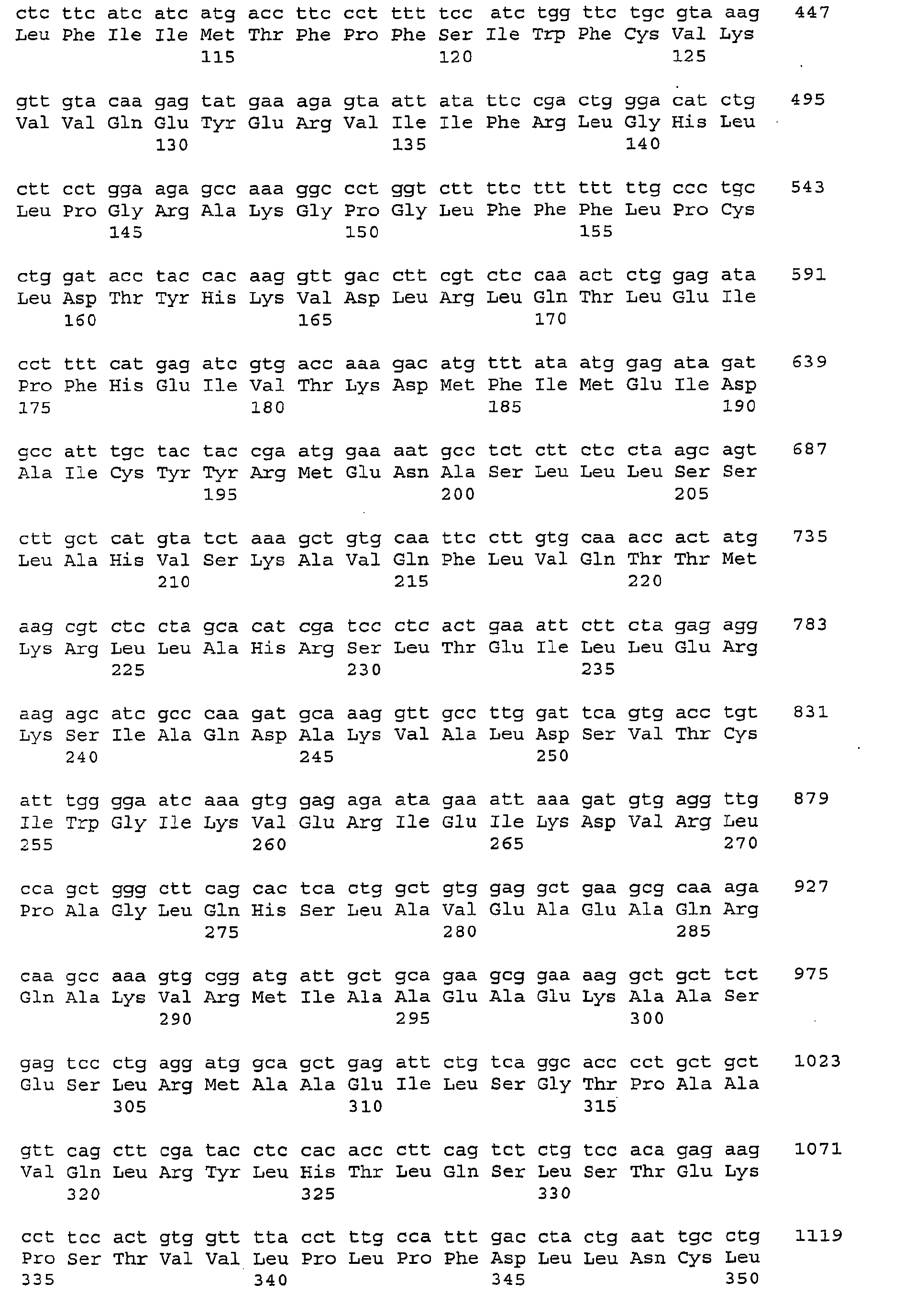
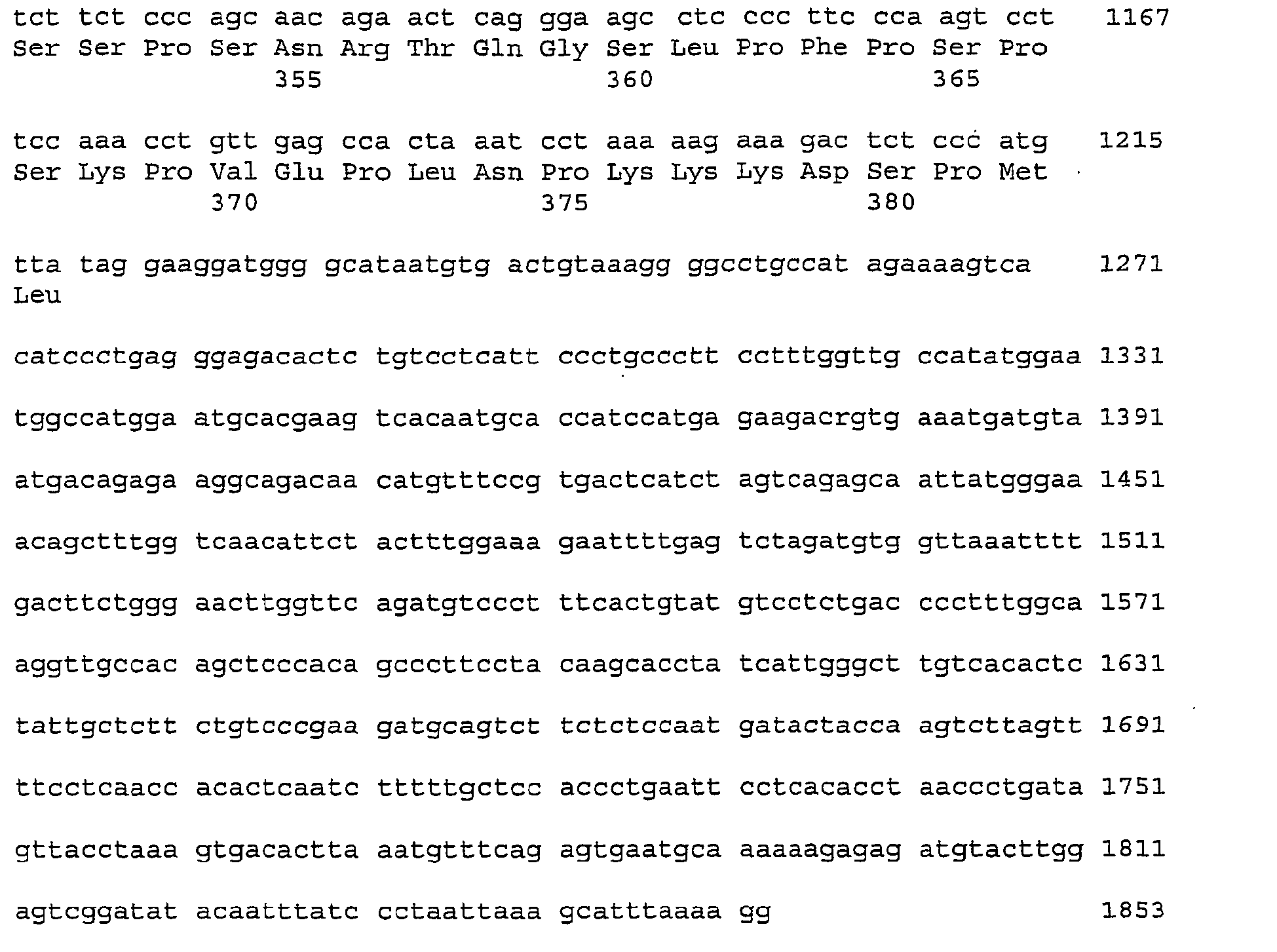
- <210> 2
<211> 383
<212> PRT
<213> Homo sapiens - <400> 2


- <210> 3
<211> 1104
<212> ADN
<213> Homo sapiens - <400> 3


- <210> 4
<211> 378
<212> ADN
<213> Homo sapiens - <400> 4

- <210> 5
<211> 700
<212> ADN
<213> Homo sapiens - <400> 5

- <210> 6
<211> 360
<212> ADN
<213> Homo sapiens - <400> 6

- <210> 7
<211> 649
<212> ADN
<213> Homo sapiens - <400> 7

- <210> 8
<211> 592
<212> ADN
<213> Homo sapiens - <400> 8

- <210> 9
<211> 716
<212> ADN
<213> Homo sapiens - <400> 9


- <210> 10
<211> 1305
<212> ADN
<213> Homo sapiens - <400> 10

- <210> 11
<211> 1065
<212> ADN
<213> Homo sapiens - <400> 11

- <210> 12
<211> 20
<212> ADN
<213> Homo sapiens - <400> 12
gcagcgactc cacagggact 20 - <210> 13
<211> 20
<212> ADN
<213> Homo sapiens - <400> 13
tcagtgggtc tcgtggggat 20 - <210> 14
<211> 20
<212> ADN
<213> Homo sapiens - <400> 14
aggcagtgaa tacagtgaag 20 - <210> 15
<211> 19
<212> ADN
<213> Homo sapiens - <400> 15
ggcctcagga aattaccta 19 - <210> 16
<211> 20
<212> ADN
<213> Homo sapiens - <400> 16
ttctgggagt gatttgaaag 20 - <210> 17
<211> 20
<212> ADN
<213> Homo sapiens - <400> 17
tgaagaaatt ggcaagtcag 20 - <210> 18
<211> 19
<212> ADN
<213> Homo sapiens - <400> 18
aaggtgaaac ccaaacagc 19 - <210> 19
<211> 20
<212> ADN
<213> Homo sapiens - <400> 19
cggtaggtag accatggaaa 20 - <210> 20
<211> 20
<212> ADN
<213> Homo sapiens - <400> 20
cataggaaag gagcccaaga 20 - <210> 21
<211> 20
<212> ADN
<213> Homo sapiens - <400> 21
tttcagcata ttggccatta 20 - <210> 22
<211> 17
<212> ADN
<213> Homo sapiens - <400> 22
ctcccactga catctga 17 - <210> 23
<211> 20
<212> ADN
<213> Homo sapiens - <400> 23
aatttaaaat gaaaccagaa 20 - <210> 24
<211> 20
<212> ADN
<213> Homo sapiens - <400> 24
ctaaatcatg gctgcacacc 20 - <210> 25
<211> 20
<212> ADN
<213> Homo sapiens - <400> 25
cttcctaaag ggcagtctgg 20 - <210> 26
<211> 20
<212> ADN
<213> Homo sapiens - <400> 26
ggtgaagcct tcagggaatg 20 - <210> 27
<211> 20
<212> ADN
<213> Homo sapiens - <400> 27
ttctatggca ggccccttta 20 - <210> 28
<211> 1652
<212> ADN
<213> Rattus rattus - <220>
<221> CDS
<222> (47) .. (1195) - <400> 28


- <210> 29
<211> 383
<212> PRT
<213> Rattus rattus - <400> 29


Claims (16)
- Acide nucléique isolé, dont la séquence est choisie parmi SEQ ID n° 3 à SEQ ID n° 10, qui représente un fragment de l'ADN génomique du gène humain désigné NPHS2.
- Polypeptide isolé, dénommé podocine, consistant en la séquence d'acides aminés SEQ ID n° 2.
- Polypeptide isolé, consistant en une séquence homologue à la séquence d'acides aminés SEQ ID n°2, ladite séquence homologue étant définie comme :i) une séquence identique à au moins 70% de la séquence SEQ ID n° 2; ouii) une séquence codée par une séquence d'acide nucléique hybridant avec la séquence SEQ ID n° 1 ou sa séquence complémentaire, dans des conditions stringentes d'hybridation, telles que fournies par une température d'hybridation inférieure de 5 à 30°C au Tm, et un tampon d'hybridation 6xSSC,étant entendu que ledit polypeptide présente l'activité biologique de la podocine, polypeptide de séquence SEQ ID n°2.
- Acide nucléique isolé, consistant en une séquence différant de la séquence SEQ ID n° 1 par une mutation, insertion ou délétion, dans au moins une position parmi les nucléotides 481, 173/174, 488, 924/925, 128, 343, 482, 548, 607 et 940, ou encore 1033, 529, 622, 774-782, 154, 422, 442, 571, 572, 583, 783, 794 et 848,
sous réserve que ledit acide nucléique isolé soit impliqué dans un syndrome néphrotique cortico-résistant. - Acide nucléique isolé, consistant en la séquence SEQ ID n° 1 codant pour un polypeptide désigné podocine.
- Acide nucléique isolé, consistant en une séquence homologue de la séquence SEQ ID n°1, ladite séquence homologue étant définie comme :i) une séquence identique à au moins 70 % de la séquence SEQ ID n° 1, étant entendu que ladite séquence code pour un polypeptide présentant l'activité biologique du polypeptide désigné podocine de séquence SEQ ID n°2; ouii) une séquence codant pour le polypeptide, tel que défini à la revendication 2 ou 3.
- Vecteur de clonage et/ou d'expression contenant un acide nucléique selon l'une des revendications 1, 4, 5, ou 6.
- Cellule hôte transfectée par un vecteur selon la revendication 7.
- Acide nucléique constitué d'une séquence choisie parmi les séquences SEQ ID n° 11 à SEQ ID n° 27.
- Procédé de production d'un polypeptide podocine recombinant, dans laquelle un vecteur contenant un acide nucléique selon la revendication 5 ou 6 est transféré dans une cellule hôte, qui est mise en culture dans des conditions permettant l'expression du polypeptide selon la revendication 2 ou 3 respectivement.
- Anticorps dirigé contre le polypeptide tel que défini dans la revendication 2 ou 3.
- Utilisation d'au moins un anticorps selon la revendication 11 pour la détection ou la purification d'un polypeptide tel que défini dans la revendication 2 ou 3 dans un échantillon biologique.
- Utilisation d'au moins un acide nucléique selon la revendication 1, 4, 5, ou 6, pour la détection d'une anomalie dans le gène NPHS2, défini comme comprenant une séquence d'acide nucléique selon la revendication 1 ou, dans son transcrit, défini comme comprenant une séquence d'acide nucléique de la revendication 5 ou 6.
- Procédé de diagnostic in vitro d'un syndrome néphrotique cortico-résistant, comprenant les étapes consistant à :a1) mettre en présence un échantillon biologique contenant de l'ADN avec des oligonucléotides spécifiques permettant l'amplification de tout ou partie du gène NPHS2, défini comme comprenant une séquence d'acide nucléique selon la revendication 1;b1) amplifier ledit ADN ;c1) détecter les produits d'amplification ;d1) comparer les produits d'amplification obtenus à ceux obtenus avec un échantillon contrôle, et détecter de cette manière une éventuelle anomalie dans ledit gène NPHS2, indicatrice d'un syndrome néphrotique cortico-résistant ;ou, selon une alternative,a2) mettre en présence un échantillon biologique contenant de l'ARN avec des oligonucléotides spécifiques permettant l'amplification de tout ou partie du transcrit du gène NPHS2, défini comme comprenant une séquence d'acide nucléique de la revendication 5 ou 6 ;b2) amplifier ledit ARN ;c2) détecter les produits d'amplification ;d2) comparer les produits d'amplification obtenus à ceux obtenus avec un échantillon contrôle, et détecter de cette manière une éventuelle anomalie dans ledit transcrit du gène NPHS2, indicatrice d'un syndrome néphrotique cortico-résistant.
- Composition pharmaceutique comprenant un polypeptide selon la revendication 2 ou 3, ou un acide nucléique codant pour ledit polypeptide, en association avec un véhicule pharmaceutiquement acceptable.
- Polypeptide selon la revendication 2 ou 3, ou un acide nucléique codant pour ledit polypeptide, pour son utilisation dans le traitement de maladies rénales, notamment d'un syndrome néphrotique cortico-résistant.
Applications Claiming Priority (3)
| Application Number | Priority Date | Filing Date | Title |
|---|---|---|---|
| FR0000709A FR2804127B1 (fr) | 2000-01-20 | 2000-01-20 | Gene srn1 implique dans le syndrome nephrotique cortico- resistant, proteine codee par ce gene et utilisations diagnostiques et therapeutiques |
| FR0000709 | 2000-01-20 | ||
| PCT/FR2001/000188 WO2001053347A2 (fr) | 2000-01-20 | 2001-01-19 | Gene nphs2 implique dans le syndrome nephrotique cortico-resistant, proteine codee par ce gene et utilisations diagnostiques et therapeutiques |
Publications (2)
| Publication Number | Publication Date |
|---|---|
| EP1248843A2 EP1248843A2 (fr) | 2002-10-16 |
| EP1248843B1 true EP1248843B1 (fr) | 2010-04-28 |
Family
ID=8846112
Family Applications (1)
| Application Number | Title | Priority Date | Filing Date |
|---|---|---|---|
| EP01907652A Expired - Lifetime EP1248843B1 (fr) | 2000-01-20 | 2001-01-19 | Gene nphs2 implique dans le syndrome nephrotique cortico-resistant |
Country Status (9)
| Country | Link |
|---|---|
| US (2) | US6924110B2 (fr) |
| EP (1) | EP1248843B1 (fr) |
| JP (2) | JP4176993B2 (fr) |
| AT (1) | ATE466082T1 (fr) |
| CA (1) | CA2398083C (fr) |
| DE (1) | DE60141947D1 (fr) |
| ES (1) | ES2342255T3 (fr) |
| FR (1) | FR2804127B1 (fr) |
| WO (1) | WO2001053347A2 (fr) |
Families Citing this family (10)
| Publication number | Priority date | Publication date | Assignee | Title |
|---|---|---|---|---|
| FR2804127B1 (fr) * | 2000-01-20 | 2004-12-24 | Inst Nat Sante Rech Med | Gene srn1 implique dans le syndrome nephrotique cortico- resistant, proteine codee par ce gene et utilisations diagnostiques et therapeutiques |
| WO2011084548A2 (fr) * | 2009-12-15 | 2011-07-14 | King Faisal Specialist Hospital & Research Centre | Méthodes et compositions permettant de dépister la forme familiale récessive de la fsgs et leurs utilisations |
| JP5830329B2 (ja) * | 2010-09-28 | 2015-12-09 | 国立大学法人 岡山大学 | 腎障害の新規マーカー |
| WO2015066640A1 (fr) * | 2013-11-01 | 2015-05-07 | The Research Institute At Nationwide Children's Hospital | Kit et procédé pour identifier la sensibilité individuelle à la thérapie stéroïde du syndrome néphrotique |
| US10881686B2 (en) | 2017-10-27 | 2021-01-05 | Zeta Biolongevity, Inc | Compositions and methods for treating and preventing proteinuria and endothelial erosion |
| GB201900702D0 (en) * | 2019-01-18 | 2019-03-06 | Univ Bristol | Therapy |
| GB202003109D0 (en) * | 2020-03-04 | 2020-04-15 | Univ Bristol | Gene therapy |
| GB202009039D0 (en) | 2020-06-15 | 2020-07-29 | Univ Bristol | Therapy |
| CN113186189A (zh) * | 2021-05-19 | 2021-07-30 | 中国人民解放军总医院第一医学中心 | 一种用于敲除猪NPHS2基因的gRNA及其相关应用 |
| WO2025194082A1 (fr) * | 2024-03-15 | 2025-09-18 | The Children's Medical Center Corporation | Compositions et méthodes d'introduction d'acides nucléiques dans des podocytes |
Family Cites Families (2)
| Publication number | Priority date | Publication date | Assignee | Title |
|---|---|---|---|---|
| FR2804127B1 (fr) * | 2000-01-20 | 2004-12-24 | Inst Nat Sante Rech Med | Gene srn1 implique dans le syndrome nephrotique cortico- resistant, proteine codee par ce gene et utilisations diagnostiques et therapeutiques |
| US6812339B1 (en) * | 2000-09-08 | 2004-11-02 | Applera Corporation | Polymorphisms in known genes associated with human disease, methods of detection and uses thereof |
-
2000
- 2000-01-20 FR FR0000709A patent/FR2804127B1/fr not_active Expired - Fee Related
-
2001
- 2001-01-19 ES ES01907652T patent/ES2342255T3/es not_active Expired - Lifetime
- 2001-01-19 AT AT01907652T patent/ATE466082T1/de not_active IP Right Cessation
- 2001-01-19 DE DE60141947T patent/DE60141947D1/de not_active Expired - Lifetime
- 2001-01-19 EP EP01907652A patent/EP1248843B1/fr not_active Expired - Lifetime
- 2001-01-19 JP JP2001553819A patent/JP4176993B2/ja not_active Expired - Fee Related
- 2001-01-19 CA CA2398083A patent/CA2398083C/fr not_active Expired - Lifetime
- 2001-01-19 WO PCT/FR2001/000188 patent/WO2001053347A2/fr not_active Ceased
-
2002
- 2002-07-19 US US10/199,945 patent/US6924110B2/en not_active Expired - Lifetime
-
2005
- 2005-06-22 US US11/159,516 patent/US7388086B2/en not_active Expired - Lifetime
-
2008
- 2008-02-04 JP JP2008023877A patent/JP2008167759A/ja active Pending
Also Published As
| Publication number | Publication date |
|---|---|
| ATE466082T1 (de) | 2010-05-15 |
| CA2398083A1 (fr) | 2001-07-26 |
| DE60141947D1 (de) | 2010-06-10 |
| EP1248843A2 (fr) | 2002-10-16 |
| FR2804127A1 (fr) | 2001-07-27 |
| FR2804127B1 (fr) | 2004-12-24 |
| WO2001053347A2 (fr) | 2001-07-26 |
| ES2342255T3 (es) | 2010-07-05 |
| WO2001053347A3 (fr) | 2002-02-07 |
| US6924110B2 (en) | 2005-08-02 |
| JP4176993B2 (ja) | 2008-11-05 |
| JP2008167759A (ja) | 2008-07-24 |
| US20050266484A1 (en) | 2005-12-01 |
| CA2398083C (fr) | 2013-11-19 |
| JP2004500077A (ja) | 2004-01-08 |
| US7388086B2 (en) | 2008-06-17 |
| US20030152954A1 (en) | 2003-08-14 |
Similar Documents
| Publication | Publication Date | Title |
|---|---|---|
| JP4117017B2 (ja) | パーレカンドメインiスプライシング変異体の治療および診断への利用 | |
| US20120135000A1 (en) | Methods and compositions for treating ocular disorders | |
| EP1100825B1 (fr) | Mutations geniques mink humaines associees a l'arythmie | |
| JP2008167759A (ja) | ステロイド抵抗性ネフローゼ症候群に関与するnphs2遺伝子、上記遺伝子によりコードされるタンパク質、並びにそれらの診断的及び治療的使用 | |
| CA2506331A1 (fr) | Proteine specifique des cellules pancreatiques beta des ilots de langerhans et ses applications | |
| US20080038365A1 (en) | TRPC6 involved in glomerulonephritis | |
| EP0980427B1 (fr) | Utilisation des proteines ulip dans le diagnostic et la therapie des cancers et des syndromes neurologiques paraneoplasiques | |
| US7105291B2 (en) | Nephrin gene and protein | |
| FR2918075A1 (fr) | Controle de la fertilite d'un etre humain de sexe masculin via spata16 | |
| US20080261231A1 (en) | Diabetes gene | |
| WO2000071751A1 (fr) | Gene du diabete | |
| JP2002512041A (ja) | 緑内障および前眼部形成不全の診断および予後判定のためのfreac3遺伝子における新規変異 | |
| WO2002022777A2 (fr) | Genes cellulaires impliques dans l'oncogenese, les produits de ces genes et leurs applications diagnostiques et therapeutiques | |
| US7351534B2 (en) | Gene mutation associated with age-related macular degeneration | |
| CA2405124A1 (fr) | Gene codant pour l'erbin et utilisations diagnostiques et therapeutiques | |
| WO2001020037A2 (fr) | Alpha recepteur active par proliferateur de peroxysome et troubles du metabolisme des lipides | |
| EP2113286B1 (fr) | Utilisations de BNIPXL-beta dans la canitie précoce | |
| FR2832420A1 (fr) | Sequence d'adn associee au syndrome d'alstrom(alms1) | |
| WO2002036630A2 (fr) | Proteine recepteur de la renine et/ou de la prorenine, acide nucleique codant pour ce recepteur et leurs applications | |
| WO2004074302A2 (fr) | Acides nucleiques et polypeptides associes a une polykystose renale autosomique recessive | |
| Le Saux et al. | ABCC6: FROM PSEUDOXANTHOMA ELASTICUM | |
| WO2001062937A1 (fr) | Sequences retrovirales associees a des affections cutanees | |
| Taherimahmoudi et al. | FP031 EFFECT OF RENAL TRANSPLANTATION ON SPERM QUALITY AND SEX HORMONES LEVEL | |
| HK1113690B (en) | Methods and compositions for diagnosing age-related macular degeneration |
Legal Events
| Date | Code | Title | Description |
|---|---|---|---|
| PUAI | Public reference made under article 153(3) epc to a published international application that has entered the european phase |
Free format text: ORIGINAL CODE: 0009012 |
|
| 17P | Request for examination filed |
Effective date: 20020710 |
|
| AK | Designated contracting states |
Kind code of ref document: A2 Designated state(s): AT BE CH CY DE DK ES FI FR GB GR IE IT LI LU MC NL PT SE TR |
|
| 17Q | First examination report despatched |
Effective date: 20030618 |
|
| GRAP | Despatch of communication of intention to grant a patent |
Free format text: ORIGINAL CODE: EPIDOSNIGR1 |
|
| GRAS | Grant fee paid |
Free format text: ORIGINAL CODE: EPIDOSNIGR3 |
|
| GRAA | (expected) grant |
Free format text: ORIGINAL CODE: 0009210 |
|
| AK | Designated contracting states |
Kind code of ref document: B1 Designated state(s): AT BE CH CY DE DK ES FI FR GB GR IE IT LI LU MC NL PT SE TR |
|
| REG | Reference to a national code |
Ref country code: GB Ref legal event code: FG4D Free format text: NOT ENGLISH |
|
| REG | Reference to a national code |
Ref country code: CH Ref legal event code: EP |
|
| REG | Reference to a national code |
Ref country code: IE Ref legal event code: FG4D Free format text: LANGUAGE OF EP DOCUMENT: FRENCH |
|
| REF | Corresponds to: |
Ref document number: 60141947 Country of ref document: DE Date of ref document: 20100610 Kind code of ref document: P |
|
| REG | Reference to a national code |
Ref country code: ES Ref legal event code: FG2A Ref document number: 2342255 Country of ref document: ES Kind code of ref document: T3 |
|
| REG | Reference to a national code |
Ref country code: NL Ref legal event code: T3 |
|
| PG25 | Lapsed in a contracting state [announced via postgrant information from national office to epo] |
Ref country code: SE Free format text: LAPSE BECAUSE OF FAILURE TO SUBMIT A TRANSLATION OF THE DESCRIPTION OR TO PAY THE FEE WITHIN THE PRESCRIBED TIME-LIMIT Effective date: 20100428 |
|
| REG | Reference to a national code |
Ref country code: IE Ref legal event code: FD4D |
|
| PG25 | Lapsed in a contracting state [announced via postgrant information from national office to epo] |
Ref country code: FI Free format text: LAPSE BECAUSE OF FAILURE TO SUBMIT A TRANSLATION OF THE DESCRIPTION OR TO PAY THE FEE WITHIN THE PRESCRIBED TIME-LIMIT Effective date: 20100428 Ref country code: AT Free format text: LAPSE BECAUSE OF FAILURE TO SUBMIT A TRANSLATION OF THE DESCRIPTION OR TO PAY THE FEE WITHIN THE PRESCRIBED TIME-LIMIT Effective date: 20100428 |
|
| PG25 | Lapsed in a contracting state [announced via postgrant information from national office to epo] |
Ref country code: GR Free format text: LAPSE BECAUSE OF FAILURE TO SUBMIT A TRANSLATION OF THE DESCRIPTION OR TO PAY THE FEE WITHIN THE PRESCRIBED TIME-LIMIT Effective date: 20100729 Ref country code: CY Free format text: LAPSE BECAUSE OF FAILURE TO SUBMIT A TRANSLATION OF THE DESCRIPTION OR TO PAY THE FEE WITHIN THE PRESCRIBED TIME-LIMIT Effective date: 20100428 |
|
| PG25 | Lapsed in a contracting state [announced via postgrant information from national office to epo] |
Ref country code: IE Free format text: LAPSE BECAUSE OF FAILURE TO SUBMIT A TRANSLATION OF THE DESCRIPTION OR TO PAY THE FEE WITHIN THE PRESCRIBED TIME-LIMIT Effective date: 20100428 Ref country code: DK Free format text: LAPSE BECAUSE OF FAILURE TO SUBMIT A TRANSLATION OF THE DESCRIPTION OR TO PAY THE FEE WITHIN THE PRESCRIBED TIME-LIMIT Effective date: 20100428 Ref country code: PT Free format text: LAPSE BECAUSE OF FAILURE TO SUBMIT A TRANSLATION OF THE DESCRIPTION OR TO PAY THE FEE WITHIN THE PRESCRIBED TIME-LIMIT Effective date: 20100830 |
|
| PLBE | No opposition filed within time limit |
Free format text: ORIGINAL CODE: 0009261 |
|
| STAA | Information on the status of an ep patent application or granted ep patent |
Free format text: STATUS: NO OPPOSITION FILED WITHIN TIME LIMIT |
|
| 26N | No opposition filed |
Effective date: 20110131 |
|
| BERE | Be: lapsed |
Owner name: INSTITUT NATIONAL DE LA SANTE ET DE LA RECHERCHE Effective date: 20110131 |
|
| PG25 | Lapsed in a contracting state [announced via postgrant information from national office to epo] |
Ref country code: MC Free format text: LAPSE BECAUSE OF NON-PAYMENT OF DUE FEES Effective date: 20110131 |
|
| REG | Reference to a national code |
Ref country code: CH Ref legal event code: PL |
|
| PG25 | Lapsed in a contracting state [announced via postgrant information from national office to epo] |
Ref country code: LI Free format text: LAPSE BECAUSE OF NON-PAYMENT OF DUE FEES Effective date: 20110131 Ref country code: CH Free format text: LAPSE BECAUSE OF NON-PAYMENT OF DUE FEES Effective date: 20110131 |
|
| PG25 | Lapsed in a contracting state [announced via postgrant information from national office to epo] |
Ref country code: BE Free format text: LAPSE BECAUSE OF NON-PAYMENT OF DUE FEES Effective date: 20110131 |
|
| PG25 | Lapsed in a contracting state [announced via postgrant information from national office to epo] |
Ref country code: LU Free format text: LAPSE BECAUSE OF NON-PAYMENT OF DUE FEES Effective date: 20110119 |
|
| PG25 | Lapsed in a contracting state [announced via postgrant information from national office to epo] |
Ref country code: TR Free format text: LAPSE BECAUSE OF FAILURE TO SUBMIT A TRANSLATION OF THE DESCRIPTION OR TO PAY THE FEE WITHIN THE PRESCRIBED TIME-LIMIT Effective date: 20100428 |
|
| REG | Reference to a national code |
Ref country code: FR Ref legal event code: PLFP Year of fee payment: 16 |
|
| REG | Reference to a national code |
Ref country code: FR Ref legal event code: PLFP Year of fee payment: 17 |
|
| PGFP | Annual fee paid to national office [announced via postgrant information from national office to epo] |
Ref country code: NL Payment date: 20161220 Year of fee payment: 17 Ref country code: GB Payment date: 20161228 Year of fee payment: 17 |
|
| PGFP | Annual fee paid to national office [announced via postgrant information from national office to epo] |
Ref country code: ES Payment date: 20161222 Year of fee payment: 17 |
|
| PGFP | Annual fee paid to national office [announced via postgrant information from national office to epo] |
Ref country code: DE Payment date: 20161219 Year of fee payment: 17 |
|
| PGFP | Annual fee paid to national office [announced via postgrant information from national office to epo] |
Ref country code: IT Payment date: 20170103 Year of fee payment: 17 |
|
| REG | Reference to a national code |
Ref country code: FR Ref legal event code: PLFP Year of fee payment: 18 |
|
| REG | Reference to a national code |
Ref country code: DE Ref legal event code: R119 Ref document number: 60141947 Country of ref document: DE |
|
| REG | Reference to a national code |
Ref country code: NL Ref legal event code: MM Effective date: 20180201 |
|
| GBPC | Gb: european patent ceased through non-payment of renewal fee |
Effective date: 20180119 |
|
| PG25 | Lapsed in a contracting state [announced via postgrant information from national office to epo] |
Ref country code: DE Free format text: LAPSE BECAUSE OF NON-PAYMENT OF DUE FEES Effective date: 20180801 |
|
| PG25 | Lapsed in a contracting state [announced via postgrant information from national office to epo] |
Ref country code: NL Free format text: LAPSE BECAUSE OF NON-PAYMENT OF DUE FEES Effective date: 20180201 Ref country code: GB Free format text: LAPSE BECAUSE OF NON-PAYMENT OF DUE FEES Effective date: 20180119 |
|
| PG25 | Lapsed in a contracting state [announced via postgrant information from national office to epo] |
Ref country code: IT Free format text: LAPSE BECAUSE OF NON-PAYMENT OF DUE FEES Effective date: 20180119 |
|
| REG | Reference to a national code |
Ref country code: ES Ref legal event code: FD2A Effective date: 20190731 |
|
| PG25 | Lapsed in a contracting state [announced via postgrant information from national office to epo] |
Ref country code: ES Free format text: LAPSE BECAUSE OF NON-PAYMENT OF DUE FEES Effective date: 20180120 |
|
| PGFP | Annual fee paid to national office [announced via postgrant information from national office to epo] |
Ref country code: FR Payment date: 20191219 Year of fee payment: 20 |