EP1248497A1 - Electroluminescence element - Google Patents
Electroluminescence element Download PDFInfo
- Publication number
- EP1248497A1 EP1248497A1 EP00978056A EP00978056A EP1248497A1 EP 1248497 A1 EP1248497 A1 EP 1248497A1 EP 00978056 A EP00978056 A EP 00978056A EP 00978056 A EP00978056 A EP 00978056A EP 1248497 A1 EP1248497 A1 EP 1248497A1
- Authority
- EP
- European Patent Office
- Prior art keywords
- derivative
- polyimide
- electroluminescent device
- group
- acid
- Prior art date
- Legal status (The legal status is an assumption and is not a legal conclusion. Google has not performed a legal analysis and makes no representation as to the accuracy of the status listed.)
- Granted
Links
Classifications
-
- C—CHEMISTRY; METALLURGY
- C08—ORGANIC MACROMOLECULAR COMPOUNDS; THEIR PREPARATION OR CHEMICAL WORKING-UP; COMPOSITIONS BASED THEREON
- C08G—MACROMOLECULAR COMPOUNDS OBTAINED OTHERWISE THAN BY REACTIONS ONLY INVOLVING UNSATURATED CARBON-TO-CARBON BONDS
- C08G73/00—Macromolecular compounds obtained by reactions forming a linkage containing nitrogen with or without oxygen or carbon in the main chain of the macromolecule, not provided for in groups C08G12/00 - C08G71/00
- C08G73/06—Polycondensates having nitrogen-containing heterocyclic rings in the main chain of the macromolecule
- C08G73/10—Polyimides; Polyester-imides; Polyamide-imides; Polyamide acids or similar polyimide precursors
-
- C—CHEMISTRY; METALLURGY
- C09—DYES; PAINTS; POLISHES; NATURAL RESINS; ADHESIVES; COMPOSITIONS NOT OTHERWISE PROVIDED FOR; APPLICATIONS OF MATERIALS NOT OTHERWISE PROVIDED FOR
- C09K—MATERIALS FOR MISCELLANEOUS APPLICATIONS, NOT PROVIDED FOR ELSEWHERE
- C09K11/00—Luminescent materials, e.g. electroluminescent or chemiluminescent
- C09K11/06—Luminescent materials, e.g. electroluminescent or chemiluminescent containing organic luminescent materials
-
- H—ELECTRICITY
- H05—ELECTRIC TECHNIQUES NOT OTHERWISE PROVIDED FOR
- H05B—ELECTRIC HEATING; ELECTRIC LIGHT SOURCES NOT OTHERWISE PROVIDED FOR; CIRCUIT ARRANGEMENTS FOR ELECTRIC LIGHT SOURCES, IN GENERAL
- H05B33/00—Electroluminescent light sources
- H05B33/12—Light sources with substantially two-dimensional [2D] radiating surfaces
- H05B33/14—Light sources with substantially two-dimensional [2D] radiating surfaces characterised by the chemical or physical composition or the arrangement of the electroluminescent material, or by the simultaneous addition of the electroluminescent material in or onto the light source
-
- H—ELECTRICITY
- H10—SEMICONDUCTOR DEVICES; ELECTRIC SOLID-STATE DEVICES NOT OTHERWISE PROVIDED FOR
- H10K—ORGANIC ELECTRIC SOLID-STATE DEVICES
- H10K50/00—Organic light-emitting devices
- H10K50/10—OLEDs or polymer light-emitting diodes [PLED]
- H10K50/11—OLEDs or polymer light-emitting diodes [PLED] characterised by the electroluminescent [EL] layers
-
- H—ELECTRICITY
- H10—SEMICONDUCTOR DEVICES; ELECTRIC SOLID-STATE DEVICES NOT OTHERWISE PROVIDED FOR
- H10K—ORGANIC ELECTRIC SOLID-STATE DEVICES
- H10K50/00—Organic light-emitting devices
- H10K50/10—OLEDs or polymer light-emitting diodes [PLED]
- H10K50/14—Carrier transporting layers
-
- H—ELECTRICITY
- H10—SEMICONDUCTOR DEVICES; ELECTRIC SOLID-STATE DEVICES NOT OTHERWISE PROVIDED FOR
- H10K—ORGANIC ELECTRIC SOLID-STATE DEVICES
- H10K85/00—Organic materials used in the body or electrodes of devices covered by this subclass
- H10K85/10—Organic polymers or oligomers
- H10K85/111—Organic polymers or oligomers comprising aromatic, heteroaromatic, or aryl chains, e.g. polyaniline, polyphenylene or polyphenylene vinylene
-
- H—ELECTRICITY
- H10—SEMICONDUCTOR DEVICES; ELECTRIC SOLID-STATE DEVICES NOT OTHERWISE PROVIDED FOR
- H10K—ORGANIC ELECTRIC SOLID-STATE DEVICES
- H10K85/00—Organic materials used in the body or electrodes of devices covered by this subclass
- H10K85/30—Coordination compounds
- H10K85/321—Metal complexes comprising a group IIIA element, e.g. Tris (8-hydroxyquinoline) gallium [Gaq3]
- H10K85/324—Metal complexes comprising a group IIIA element, e.g. Tris (8-hydroxyquinoline) gallium [Gaq3] comprising aluminium, e.g. Alq3
-
- H—ELECTRICITY
- H10—SEMICONDUCTOR DEVICES; ELECTRIC SOLID-STATE DEVICES NOT OTHERWISE PROVIDED FOR
- H10K—ORGANIC ELECTRIC SOLID-STATE DEVICES
- H10K85/00—Organic materials used in the body or electrodes of devices covered by this subclass
- H10K85/60—Organic compounds having low molecular weight
- H10K85/631—Amine compounds having at least two aryl rest on at least one amine-nitrogen atom, e.g. triphenylamine
-
- C—CHEMISTRY; METALLURGY
- C09—DYES; PAINTS; POLISHES; NATURAL RESINS; ADHESIVES; COMPOSITIONS NOT OTHERWISE PROVIDED FOR; APPLICATIONS OF MATERIALS NOT OTHERWISE PROVIDED FOR
- C09K—MATERIALS FOR MISCELLANEOUS APPLICATIONS, NOT PROVIDED FOR ELSEWHERE
- C09K2211/00—Chemical nature of organic luminescent or tenebrescent compounds
- C09K2211/14—Macromolecular compounds
- C09K2211/1408—Carbocyclic compounds
- C09K2211/1433—Carbocyclic compounds bridged by heteroatoms, e.g. N, P, Si or B
-
- H—ELECTRICITY
- H10—SEMICONDUCTOR DEVICES; ELECTRIC SOLID-STATE DEVICES NOT OTHERWISE PROVIDED FOR
- H10K—ORGANIC ELECTRIC SOLID-STATE DEVICES
- H10K2102/00—Constructional details relating to the organic devices covered by this subclass
- H10K2102/10—Transparent electrodes, e.g. using graphene
- H10K2102/101—Transparent electrodes, e.g. using graphene comprising transparent conductive oxides [TCO]
- H10K2102/103—Transparent electrodes, e.g. using graphene comprising transparent conductive oxides [TCO] comprising indium oxides, e.g. ITO
-
- H—ELECTRICITY
- H10—SEMICONDUCTOR DEVICES; ELECTRIC SOLID-STATE DEVICES NOT OTHERWISE PROVIDED FOR
- H10K—ORGANIC ELECTRIC SOLID-STATE DEVICES
- H10K85/00—Organic materials used in the body or electrodes of devices covered by this subclass
- H10K85/60—Organic compounds having low molecular weight
- H10K85/615—Polycyclic condensed aromatic hydrocarbons, e.g. anthracene
- H10K85/621—Aromatic anhydride or imide compounds, e.g. perylene tetra-carboxylic dianhydride or perylene tetracarboxylic di-imide
-
- Y—GENERAL TAGGING OF NEW TECHNOLOGICAL DEVELOPMENTS; GENERAL TAGGING OF CROSS-SECTIONAL TECHNOLOGIES SPANNING OVER SEVERAL SECTIONS OF THE IPC; TECHNICAL SUBJECTS COVERED BY FORMER USPC CROSS-REFERENCE ART COLLECTIONS [XRACs] AND DIGESTS
- Y10—TECHNICAL SUBJECTS COVERED BY FORMER USPC
- Y10S—TECHNICAL SUBJECTS COVERED BY FORMER USPC CROSS-REFERENCE ART COLLECTIONS [XRACs] AND DIGESTS
- Y10S428/00—Stock material or miscellaneous articles
- Y10S428/917—Electroluminescent
-
- Y—GENERAL TAGGING OF NEW TECHNOLOGICAL DEVELOPMENTS; GENERAL TAGGING OF CROSS-SECTIONAL TECHNOLOGIES SPANNING OVER SEVERAL SECTIONS OF THE IPC; TECHNICAL SUBJECTS COVERED BY FORMER USPC CROSS-REFERENCE ART COLLECTIONS [XRACs] AND DIGESTS
- Y10—TECHNICAL SUBJECTS COVERED BY FORMER USPC
- Y10T—TECHNICAL SUBJECTS COVERED BY FORMER US CLASSIFICATION
- Y10T428/00—Stock material or miscellaneous articles
- Y10T428/31504—Composite [nonstructural laminate]
- Y10T428/31721—Of polyimide
Definitions
- This invention relates to an electroluminescent device comprising at least one electroluminescent organic layer including a light emitting material layer interposed between an anode and a cathode, wherein the light emitting material layer emits light upon application of a voltage between the anode and the cathode.
- an object of the invention is to provide an organic electroluminescent device which is restrained from thermal degradation and has improved heat resistance and durability.
- an electroluminescent device comprising at least one electroluminescent organic layer interposed between the anode and the cathode, especially an electroluminescent device in which an organic hole transporting layer and a light emitting material layer are sequentially deposited on an inorganic electrode (ITO electrode etc.) serving as the anode and the cathode is disposed thereon
- ITO electrode etc. an inorganic electrode
- improved adhesion and durability are achieved by providing an auxiliary carrier transporting layer between the anode and the organic layer (especially between the inorganic electrode and the organic hole transporting layer), and forming the auxiliary carrier transporting layer from a soluble, electrically conductive compound or polymer in the form of a salt that the polyimide precursor and/or polyimide defined below forms with an electron accepting dopant.
- the invention provides an electroluminescent device comprising an anode, a cathode, and at least one electroluminescent organic layer interposed therebetween, wherein a luminescent material in the organic layer emits light upon application of a voltage between the anode and the cathode, characterized in that a salt of an electron accepting dopant with a polyimide precursor and/or polyimide having oligo-aniline units on side chains is formed as an auxiliary carrier transporting layer between the anode and the organic layer, the polyimide precursor and/or polyimide being obtained from a diamine component containing at least 1 mol% of an oligo-aniline unit-bearing diaminobenzene derivative represented by the following general formula (1) and a tetracarboxylic dianhydride or derivative thereof.
- a salt of an electron accepting dopant with a polyimide precursor and/or polyimide having oligo-aniline units on side chains is formed as an auxiliary carrier transporting layer between the anode
- R 1 to R 9 each are independently hydrogen, an alkyl group, an alkoxy group, a sulfonate group, or a substituted or unsubstituted cyclohexyl, biphenyl, bicyclohexyl or phenylcyclohexyl group, n is a positive number of at least 1,
- A is a single bond or a divalent organic group selected from the group consisting of -O-, -COO-, -CONH- and -NH-, and R 0 is a trivalent organic group containing an aromatic ring.
- an aniline oligomer is attached to the polyimide backbone as a side chain, and the aniline oligomer is doped with a halogen, Lewis acid, protonic acid, transition metal compound or electrolyte anion to impart electric conductivity for acquiring an electrode function.
- a halogen, Lewis acid, protonic acid, transition metal compound or electrolyte anion to impart electric conductivity for acquiring an electrode function.
- the electroluminescent device of the invention includes an anode, a cathode and an electroluminescent organic layer sandwiched therebetween.
- the anode and cathode used herein may be well-known electrodes.
- the anode may be an inorganic electrode (or transparent electrode) of ITO or the like formed on a glass substrate.
- the cathode may be a metallic electrode of aluminum, MgAg alloy or the like.
- the electroluminescent organic layer includes a light emitting material layer and may be of well-known construction.
- a laminate construction in which a hole transporting layer, a light emitting material layer, and a carrier transporting layer are sequentially stacked from the cathode side is typical, though the invention is not limited thereto.
- the hole transporting material is not critical although it is generally selected from tertiary aromatic amines such as N,N,N-tris(p-toluyl)amine (TPD), 1,1-bis[(di-4-toluylamine)phenyl]cyclohexane, N,N'-diphenyl-N,N'-bis(3-methylphenyl)(1,1'-biphenyl)-4,4'-diamine, N,N,N',N'-tetrakis(4-methylphenyl)(1,1'-biphenyl)-4,4'-diamine, N,N'-bis(1-naphthyl)-N,N'-diphenyl-1,1'-bisphenyl-4,4'-diamine, and 4,4',4"-tris(3-methylphenylamino)triphenylamine.
- TPD tertiary aromatic amine
- TPD p-tolu
- the carrier transporting material is not critical although generally aromatic fused ring compounds and metal complex compounds are often used.
- metal complex compounds such as tris(8-hydroxyquinoline)aluminum (Alq3) and bis(10-hydroxybenzo[h]quinolate)beryllium (BeBq2), 1,3,4-oxathiazole derivatives, 1,2,4-triazole derivatives, bis(benzimidazole) derivatives of perylene dicarboxyimide, and thiopyrane sulfone derivatives.
- the light emitting material examples include metal complex compounds such as Alq3 and tris(5-cyano-8-hydroxyquinoline)aluminum (A1(Q-CN)), and dyes such as oxathiazoles, e.g., biphenyl-p-(t-butyl)phenyl-1,3,4-oxathiazole, triazoles, allylenes, and coumarins though is not limited thereto.
- metal complex compounds such as Alq3 and tris(5-cyano-8-hydroxyquinoline)aluminum (A1(Q-CN)
- dyes such as oxathiazoles, e.g., biphenyl-p-(t-butyl)phenyl-1,3,4-oxathiazole, triazoles, allylenes, and coumarins though is not limited thereto.
- an auxiliary carrier transporting layer is interposed between the anode and the organic layer, and when the organic layer includes a plurality of layers, between the anode and a layer disposed most closely thereto, typically a hole transporting layer, for assisting in charge transportation.
- the auxiliary carrier transporting layer is a thin film of a salt of an electron accepting dopant with a polyimide precursor and/or polyimide having oligo-aniline units on side chains, the polyimide precursor and/or polyimide being obtained from a diamine component containing at least 1 mol% of an oligo-aniline unit-bearing diaminobenzene derivative represented by the following general formula (1) and a tetracarboxylic dianhydride or derivative thereof.
- R 1 to R 9 each are independently hydrogen, an alkyl group, an alkoxy group, a sulfonate group, or a substituted or unsubstituted cyclohexyl, biphenyl, bicyclohexyl or phenylcyclohexyl group, n is a positive number of at least 1, "A" is a single bond or a divalent organic group selected from among -O-, -COO-, -CONH- and -NH-, and R° is a trivalent organic group containing an aromatic ring.
- R 1 to R 9 are most often hydrogen, although alkyl, alkoxy, cyclohexyl, biphenyl, bicyclohexyl, phenylcyclohexyl and sulfonate groups are preferred for increasing solvent solubility. More preferably, R 1 to R 9 are hydrogen, alkyl groups having 1 to 20 carbon atoms or alkoxy groups having 1 to 20 carbon atoms. It is noted that R 1 to R 9 may be the same or different.
- alkyl groups examples include methyl, ethyl, propyl, isopropyl, butyl, t-butyl, hexyl, octyl, decyl, and dodecyl.
- Alkyl groups having 1 to 4 carbon atoms are especially preferred.
- alkoxy groups examples include methoxy, ethoxy, propoxy, isopropoxy, butoxy, isobutoxy, s-butoxy, t-butoxy, hexyloxy, octyloxy, decyloxy and dodecyloxy.
- Alkoxy groups having 1 to 4 carbon atoms are especially preferred.
- R 0 is a trivalent organic group containing an aromatic ring such as a phenyl, biphenyl or naphthyl group as represented below.
- the diaminobenzene derivative used in the polyimide precursor and/or polyimide according to the invention is composed of the diamine moiety, the oligo-aniline moiety and the linkage A joining them together as described above.
- the synthesis method is not critical, the diaminobenzene derivative can be synthesized, for example, by the method described below.
- a general procedure is by first synthesizing a corresponding dinitro compound of the following general formula (2) and then reducing the nitro group in a customary manner for conversion to an amino group.
- R 1 to R 9 , R 0 , n and A are as defined above.
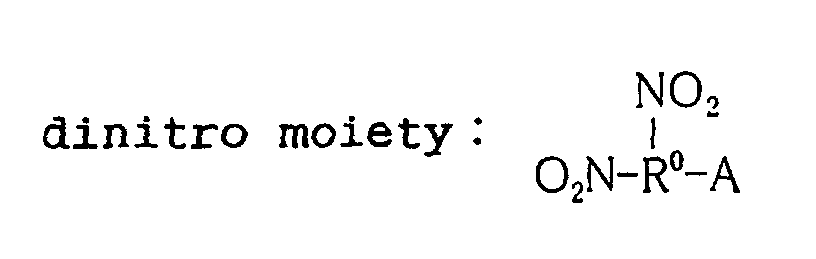
- the method generally employed for the synthesis of the compound of formula (2) involves the steps of joining a dinitro moiety of the following formula to an oligo-aniline moiety through the linkage A and thereafter, bonding substituents R 1 to R 9 , or the steps of previously synthesizing an oligo-aniline having substituents, and thereafter, joining a dinitro moiety thereto through the linkage A.
- linkage "A” is a single bond, ether bond -O-, ester bond -COO-, amide bond -CONH- or secondary amine bond -NH-. These linking groups can be formed by conventional organic synthesis techniques.
- the ether bond is generally formed by reacting a corresponding halide derivative with a hydroxyl-substituted derivative in the presence of an alkali.
- the ester bond is generally formed by reacting a corresponding acid chloride with a hydroxyl-substituted derivative in the presence of an alkali.
- the amide bond is generally formed by reacting a corresponding acid chloride with an amino-substituted derivative in the presence of an alkali.
- the secondary amine bond is generally formed by effecting dehydration condensation reaction of a corresponding primary amine group with a hydroxyl-substituted derivative.
- Examples of the reactant from which the dinitro moiety is formed include dinitrobenzene, dinitronaphthalene and dinitrobiphenyl which have been substituted with a substituent to form the linkage A, for example, a halogen atom, hydroxyl, haloacyl or amino group.
- the preferred reactant is a dinitrobenzene having the substituent.
- Examples of the substituted dinitrobenzene include 2,3-dinitrobenzene, 2,4-dinitrobenzene, 2,5-dinitrobenzene, 2,6-dinitrobenzene, 3,4-dinitrobenzene and 3,5-dinitrobenzene.
- the oligo-aniline is obtained by effecting dechlorination ammonium reaction of an aromatic amine hydrochloride having the above substituent with an aromatic amine.
- n has a value of 1 or more, and desirably n has a value of 2 or more for electrical conductivity, and also a value of 20 or less for solvent solubility. More desirably, n has a value of 8 or less.
- the diaminobenzene derivative of general formula (1) obtained by the method described above is then subjected to polycondensation with a tetracarboxylic acid or derivative thereof, such as tetracarboxylic acid, tetracarboxylic dihalide and tetracarboxylic dianhydride, whereby a polyimide having oligo-aniline units on side chains is synthesized.
- a tetracarboxylic acid or derivative thereof such as tetracarboxylic acid, tetracarboxylic dihalide and tetracarboxylic dianhydride
- the tetracarboxylic acids and derivatives thereof are not critical.
- Preferred are alicyclic tetracarboxylic acids, especially 1,2,3,4-cyclobutanetetracarboxylic dianhydride, heterocyclic tetracarboxylic acids, aromatic ring tetracarboxylic acids, fused ring tetracarboxylic acids, and derivatives thereof.
- aromatic tetracarboxylic acids and dianhydrides and dicarboxylic acid diacid halides thereof such as, for example, pyromellitic acid, 2,3,6,7-naphthalenetetracarboxylic acid, 1,2,5,6-naphthalenetetracarboxylic acid, 1,4,5,8-naphthalenetetracarboxylic acid, 3,3',4,4'-biphenyltetracarboxylic acid, 2,3,3',4-biphenyltetracarboxylic acid, bis(3,4-dicarboxyphenyl) ether, 3,3',4,4'-benzophenonetetracarboxylic acid, bis(3,4-dicarboxyphenyl)-sulfone, bis(3,4-dicarboxyphenyl)methane, 2,2-bis(3,4-dicarboxyphenyl)propane, 1,1,1,3,3,3-hexafluoro-2,2-bis(3,4-dica
- tetracarboxylic acids and derivatives may be used alone or in admixture of two or more.
- diamine (1) diaminobenzene derivative of general formula (1)
- ordinary diamine another ordinary diamine, abbreviated hereinafter as ordinary diamine
- a polyimide having a molecular chain having an electrically conductive side chain which is used as a coating.
- the diamine used to produce the polyimide essentially includes diamine (1).
- the ordinary diamine other than diamine (1) is selected from primary diamines commonly used in the synthesis of polyimides and not critical.
- Examples of the ordinary diamine include aromatic diamines such as p-phenylenediamine, m-phenylenediamine, 2,5-diaminotoluene, 2,6-diaminotoluene, 4,4'-diaminobiphenyl, 3,3'-dimethyl-4,4'-diaminobiphenyl, diaminodiphenylmethane, diaminodiphenyl ether, 2,2'-diaminodiphenylpropane, bis(3,5-diethyl-4-aminophenyl)methane, diaminodiphenylsulfone, diaminobenzophenone, diaminonaphthalene, 1,4-bis(4-aminophenoxy)benzene, 1,4-bis(4-aminophenyl)benzene, 9,
- diamines may be used alone or in admixture of two or more. It is noted that the polyimide can be improved in surface properties such as water repellency by adjusting the ratio of the moles of diamine (1) to the total moles of diamines used during polyimide polymerization.
- m is an integer of 1 to 10.
- a polyimide precursor is obtained by reacting the tetracarboxylic acid or derivative thereof with the diamine (1) and optionally, the ordinary diamine for polymerization, the polyimide precursor is then subjected to ring-closing imidization.
- the tetracarboxylic acid or derivative thereof used herein is typically a tetracarboxylic dianhydride.
- the ratio of the moles of the tetracarboxylic dianhydride to the total moles of the diamine (1) and the ordinary diamine combined is preferably from 0.8 to 1.2.
- a polymer having a higher degree of polymerization is obtained as this molar ratio becomes closer to 1.
- Too low a degree of polymerization may result in a polyimide film having insufficient strength on use, whereas too high a degree of polymerization may worsen the efficiency of operation during polyimide film formation.
- the product of the above reaction should preferably have such a degree of polymerization that a polyimide precursor solution (having a concentration of 0.5 g/dl in N-methylpyrrolidone at a temperature of 30°C) may have a reduced viscosity of 0.05 to 5.00 dl/g.
- any desired method may be employed.
- One commonly used method is by dissolving the primary diamine in a polar organic solvent such as N-methylpyrrolidone, N,N-dimethylacetamide or N,N-dimethylformamide, adding the tetracarboxylic dianhydride to the solution, and reacting them to synthesize a polyimide precursor, followed by dehydration ring-closure reaction for imidization.
- the reaction temperature may be any temperature selected in the range of -20°C to 150°C, preferably -5°C to 100°C.
- the polyimide precursor can be converted to a polyimide by heating the polyimide precursor at 100°C to 400°C for dehydration or subjecting the polyimide precursor to chemical imidization in the presence of a commonly used imidization catalyst such as triethylamine/acetic anhydride.
- a commonly used imidization catalyst such as triethylamine/acetic anhydride.
- the diaminobenzene derivative of formula (1) simply diamine (1), is used in an amount of at least 1 mol%, and preferably at least 5 mol% of the entire diamines.
- the polyimide precursor solution is directly applied to a substrate and heated on the substrate for imidization to form a polyimide coating.
- the polyimide precursor solution used herein may be the polymerization solution as such or a solution obtained by pouring the polyimide precursor formed into a large volume of a poor solvent such as water or methanol, recovering the precipitate, and dissolving it again in a solvent.
- the diluent solvent for the polyimide precursor and/or the solvent for dissolving again the precipitated and recovered polyimide precursor may be any solvent as long as the polyimide precursor is dissolvable therein.
- the solvent examples include N-methylpyrrolidone, N,N-dimethylacetamide and N,N-dimethylformamide. These solvents may be used alone or in admixture. Even a solvent which by itself cannot form a uniform medium may be added to the above solvent insofar as a uniform medium is obtainable. Examples of such solvents include ethyl cellosolve, butyl cellosolve, ethyl Carbitol, butyl Carbitol, ethyl Carbitol acetate, and ethylene glycol.
- a polyimide coating on a substrate it is, of course, preferred to add an additive such as a coupling agent to the polyimide solution for the purpose of further enhancing the adhesion between the polyimide coating and the substrate.
- an additive such as a coupling agent
- the temperature used for heat imidization may be any temperature in the range of 100 to 400°C, with a range of 150 to 350°C being especially preferred.
- the polyimide precursor resulting from reaction of the tetracarboxylic dianhydride with the primary diamine may be imidized in the solution to form a polyimide solution.
- a method of inducing dehydration ring-closure by heating is generally employed.
- the temperature of ring-closure by heat dehydration is any temperature selected in the range of 150 to 350°C, and preferably 120 to 250°C.
- Another method of converting the polyimide precursor to the polyimide is chemical ring-closure using well-known dehydration ring-closure catalysts.
- the polyimide solution thus obtained may be used without further treatment or after it is precipitated in a poor solvent such as methanol or ethanol, isolated and dissolved again in a suitable solvent.
- the solvent used for dissolving the polyimide again is not critical as long as the polyimide is dissolvable therein.
- Exemplary solvents include 2-pyrrolidone, N-methylpyrrolidone, N-ethylpyrrolidone, N-vinylpyrrolidone, N,N-dimethylacetamide, N,N-dimethylformamide, and ⁇ -butyrolactone.
- a solvent which by itself cannot dissolve the polyimide may be added to the foregoing solvent insofar as the desired solubility is not impaired.
- solvents include ethyl cellosolve, butyl cellosolve, ethyl Carbitol, butyl Carbitol, ethyl Carbitol acetate, and ethylene glycol.
- a polyimide coating on a substrate it is, of course, preferred to add an additive such as a coupling agent to the polyimide solution for the purpose of further enhancing the adhesion between the polyimide coating and the substrate.
- an additive such as a coupling agent
- a polyimide coating By applying the solution onto a substrate and evaporating the solvent, a polyimide coating can be formed on the substrate. Any temperature may be used at this stage as long as the solvent evaporates. Usually a temperature of 80 to 150°C is sufficient.
- the coating method of forming a thin film of the polyimide according to the invention includes dipping, spin coating, transfer printing, roll coating and brush coating, but is not limited thereto.
- the coating thickness is not critical although a coating as thin as possible is desirable for improving external emission efficiency. Usually, a thickness of 100 to 1,000 ⁇ is preferred.
- the polyimide precursor and/or polyimide having oligo-aniline units on side chains as described above forms a salt with an electron accepting dopant, which salt is interposed as an auxiliary carrier transporting layer between the anode and the organic layer.
- the electron accepting dopant is selected from among Lewis acids, protonic acids, transition metal compounds, electrolyte salts, halides and the like. Doping with these dopants enables to form polyimide thin films with a lower resistance.
- Lewis acids include FeCl 3 , PF 5 , AsF 5 , SbF 5 , BF 5 , BCl 3 , and BBr 3 .
- Protonic acids include inorganic acids such as HF, HCl, HNO 5 , H 2 SO 4 and HClO 4 , and organic acids such as benzene sulfonic acid, p-toluenesulfonic acid, dodecylbenzenesulfonic acid, polyvinylsulfonic acid, methanesulfonic acid, 1-butanesulfonic acid, vinylphenylsulfonic acid and camphorsulfonic acid.
- inorganic acids such as HF, HCl, HNO 5 , H 2 SO 4 and HClO 4
- organic acids such as benzene sulfonic acid, p-toluenesulfonic acid, dodecylbenzenesulfonic acid, polyvinylsulfonic acid, methanesulfonic acid, 1-butanesulfonic acid, vinylphenylsulfonic acid and camphorsulfonic acid.
- Transition metal compounds include FeOCl, TiCl 4 , ZrCl 4 , HfCl 4 , NbF 5 , NbCl 5 , TaCl 5 and MoF 5 .
- Electrolyte salts include LiSbF 6 , LiAsF 6 , NaAsF 6 , NaSbF 6 , KAsF 6 , KSbF 6 , [(n-Bu) 4 N]AsF 6 , [(n-Bu) 4 N]SbF 6 , [(n-Et) 4 N]AsF 6 and [(n-Et) 4 N]SbF 6 .
- Halides includes Cl 2 , Br 2 , I 2 , ICl, ICl 3 , IBr and IF.
- ferric chloride is the preferred Lewis acid
- hydrochloric acid is the preferred protonic acid
- perchloric acid is the preferred inorganic acid
- p-toluenesulfonic acid and camphorsulfonic acid are the preferred organic acids.
- Doping may be carried out in a solution of the polyimide precursor or polyimide in an organic solvent or after a thin film is formed therefrom.
- ferrous chloride among the transition metal compounds and p-toluenesulfonic acid and other organic acids are desirably used as the dopant.
- the doping concentration differs depending on the molecular weight of the aniline oligomer.
- the dopant is preferably added such that one or less dopant molecule is available per nitrogen atom in the aniline oligomer.
- it can be doped by exposing it to hydrochloric acid vapor or iodine vapor.
- the auxiliary carrier transporting layer when the polyimide precursor and/or polyimide is doped in its organic solvent solution, this solution is used to form a thin film by a well-known method on the inorganic electrode (transparent electrode) of ITO etc. which has been formed on the glass substrate and serves as the anode.
- the inorganic electrode used herein has been removed of foreign matter such as organic matter on the surface by cleaning treatment such as back sputtering, ozone treatment or acid pickling.
- auxiliary carrier transporting layer After the auxiliary carrier transporting layer is formed on the electrode-bearing substrate in this way, organic layers for electroluminescence are deposited.
- the layer structure largely varies and is not critical. Most often, a device in which a hole transporting layer, a light emitting layer and a carrier transporting layer are sequentially deposited by evaporation is used.
- the hole transporting material As the hole transporting material, carrier transporting material and light emitting material, the aforementioned compounds are used. These materials are sequentially deposited by vacuum evaporation and on the top of them, a MgAg alloy is evaporated as a cathode. This results in an electroluminescent device which emits light of a specific wavelength upon application of a voltage thereacross.
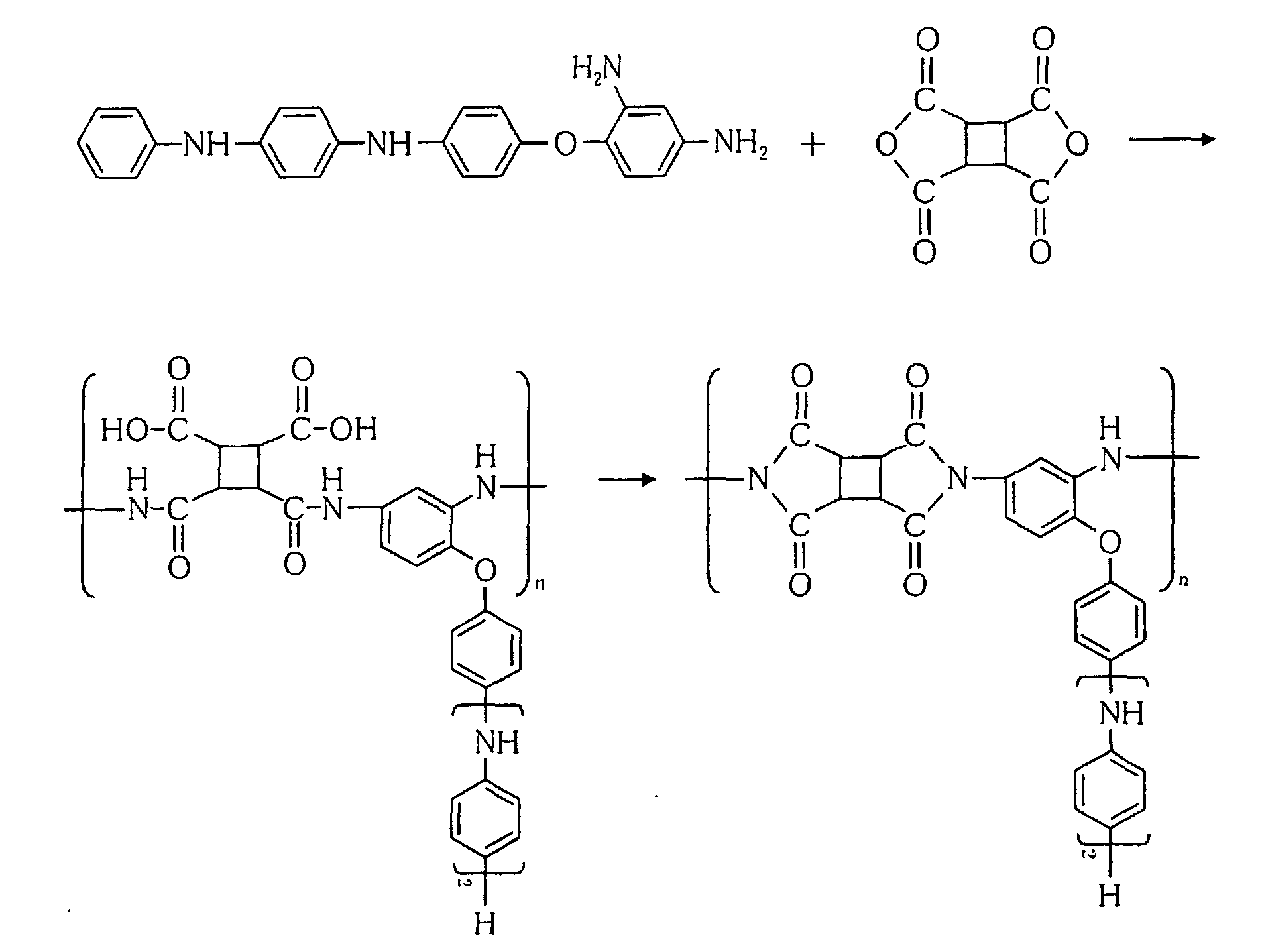
- a polyimide precursor solution was prepared, as shown by the scheme below, by dissolving 3 g (0.00786 mol) of [4- ⁇ (4-(2,4-diaminophenoxy)phenyl)amino ⁇ phenyl]phenylamine in 25.22 g of N-methylpyrrolidone, adding 1.45 g (0.00741 mol) of 4,9-dioxatricyclo[5.3.0.0 2,6 ]decane thereto, and effecting polycondensation reaction for 24 hours at room temperature.
- the polyimide precursor thus obtained had a reduced viscosity of 0.52 dl/g (0.5 wt%, 25°C). This solution was coated onto a glass substrate and heat treated at 250°C for one hour, forming a uniform polyimide film. IR analysis confirmed that the coating was a polyimide containing aniline oligomers.
- the polyimide varnish obtained above was doped with camphorsulfonic acid as the dopant, it was applied onto an ITO electrode to a thickness of 100 ⁇ . Thereafter, TPD of 400 ⁇ thick, Alq of 600 ⁇ thick, and MgAg were successively deposited thereon by an evaporation technique.
- the thus fabricated device was measured for threshold voltage for emission, maximum luminance, luminous efficiency and current efficiency.
- Electroluminescent device's properties Dopant camphorsulfonic acid 5-sulfosalicylic acid Threshold voltage for emission (V) 9 9 Maximum luminance (cd/m 2 ) 3200 (25 V) 1300 (20 V) Luminous efficiency (lm/W) 0.81 (17 V) 0.49 (24 V) Current efficiency (cd/A) 4.73 (20 V) 3.54 (24 V)
- a polyimide precursor solution was prepared, as shown by the scheme below, by dissolving 3 g (0.00640 mol) of [4- ⁇ (4-(2,4-diaminophenoxy)phenyl)amino ⁇ phenyl](4-phenylamino)phenylamine in 25.22 g of N-methylpyrrolidone, adding 1.45 g (0.00741 mol) of 4,9-dioxatricyclo[5.3.0.0 2,6 ]decane thereto, and effecting polycondensation reaction for 24 hours at room temperature.
- the polyimide precursor thus obtained had a reduced viscosity of 0.55 dl/g (0.5 wt%, 25°C). This solution was coated onto a glass substrate and heat treated at 250°C for one hour, forming a uniform polyimide film. IR analysis confirmed that the coating was a polyimide containing aniline oligomers.
- the polyimide varnish obtained above was doped with camphorsulfonic acid as the dopant, it was applied onto an ITO electrode to a thickness of 100 ⁇ . Thereafter, TPD of 400 ⁇ thick, Alq of 600 ⁇ thick, and MgAg were successively deposited thereon by an evaporation technique.
- the diaminobenzene derivatives used herein are easy to synthesize and are used as one of reactants to produce polyimides having improved heat resistance, film strength and coating properties as well as antistatic and low charge accumulation properties.
- polyimides as the auxiliary carrier transporting layer, electroluminescent devices having enhanced reliability are obtainable.
Landscapes
- Chemical & Material Sciences (AREA)
- Engineering & Computer Science (AREA)
- Materials Engineering (AREA)
- Physics & Mathematics (AREA)
- Organic Chemistry (AREA)
- Optics & Photonics (AREA)
- Medicinal Chemistry (AREA)
- Health & Medical Sciences (AREA)
- Chemical Kinetics & Catalysis (AREA)
- Polymers & Plastics (AREA)
- Spectroscopy & Molecular Physics (AREA)
- Inorganic Chemistry (AREA)
- Macromolecular Compounds Obtained By Forming Nitrogen-Containing Linkages In General (AREA)
- Electroluminescent Light Sources (AREA)
Abstract
Description



| Electroluminescent device's properties | ||
| Dopant | camphorsulfonic acid | 5-sulfosalicylic acid |
| Threshold voltage for emission (V) | 9 | 9 |
| Maximum luminance (cd/m2) | 3200 (25 V) | 1300 (20 V) |
| Luminous efficiency (lm/W) | 0.81 (17 V) | 0.49 (24 V) |
| Current efficiency (cd/A) | 4.73 (20 V) | 3.54 (24 V) |

| Electroluminescent device's properties | ||
| Dopant | camphorsulfonic acid | 5-sulfosalicylic acid |
| Threshold voltage for emission (V) | 6 | 6 |
| Maximum luminance (cd/m2) | 2900 (21 V) | 3700 (20 V) |
| Luminous efficiency (lm/W) | 0.91 (13 V) | 0.93 (15 V) |
| Current efficiency (cd/A) | 4.21 (16 V) | 4.85 (17 V) |
Claims (9)
- An electroluminescent device comprising an anode, a cathode, and at least one electroluminescent organic layer interposed therebetween, wherein a luminescent material in said organic layer emits light upon application of a voltage between the anode and the cathode, characterized in that a salt of an electron accepting dopant with a polyimide precursor and/or polyimide having oligo-aniline units on side chains is formed as an auxiliary carrier transporting layer between said anode and said organic layer, the polyimide precursor and/or polyimide being obtained from a diamine component containing at least 1 mol% of an oligo-aniline unit-bearing diaminobenzene derivative represented by the following general formula (1) and a tetracarboxylic dianhydride or derivative thereof,wherein R1 to R9 are independently selected from the group consisting of hydrogen, an alkyl group, an alkoxy group, a sulfonate group, and a substituted or unsubstituted cyclohexyl, biphenyl, bicyclohexyl or phenylcyclohexyl group, n is a positive number of at least 1, A is a single bond or a divalent organic group selected from the group consisting of -O-, -COO-, -CONH- and -NH-, and R0 is a trivalent organic group containing an aromatic ring.

- The electroluminescent device of claim 1 wherein in formula (1), R1 to R9 each are independently hydrogen, an alkyl group having 1 to 20 carbon atoms or an alkoxy group having 1 to 20 carbon atoms, and n is an integer of 1 to 20.
- The electroluminescent device of claim 1 or 2 wherein the polyimide contains at least 5 mol% of units based on the diaminobenzene derivative of formula (1).
- The electroluminescent device of any one of claims 1 to 3 wherein the tetracarboxylic acid or derivative thereof is an alicyclic tetracarboxylic acid or derivative thereof.
- The electroluminescent device of claim 4 wherein the alicyclic tetracarboxylic acid or derivative thereof is 1,2,3,4-cyclobutanetetracarboxylic dianhydride.
- The electroluminescent device of any one of claims 1 to 3 wherein the tetracarboxylic acid or derivative thereof is a heterocyclic tetracarboxylic acid or derivative thereof.
- The electroluminescent device of any one of claims 1 to 4 wherein the tetracarboxylic acid or derivative thereof is an aromatic ring tetracarboxylic acid or derivative thereof.
- The electroluminescent device of any one of claims 1 to 4 wherein the tetracarboxylic acid or derivative thereof is a fused ring tetracarboxylic acid or derivative thereof.
- The electroluminescent device of any one of claims 1 to 8 wherein the dopant is selected from the group consisting of a Lewis acid, protonic acid, transition metal compound, electrolyte salt and halide.
Applications Claiming Priority (3)
| Application Number | Priority Date | Filing Date | Title |
|---|---|---|---|
| JP34274299 | 1999-12-02 | ||
| JP34274299A JP4407776B2 (en) | 1999-12-02 | 1999-12-02 | Electroluminescent device |
| PCT/JP2000/008524 WO2001041513A1 (en) | 1999-12-02 | 2000-12-01 | Electroluminescence element |
Publications (3)
| Publication Number | Publication Date |
|---|---|
| EP1248497A1 true EP1248497A1 (en) | 2002-10-09 |
| EP1248497A4 EP1248497A4 (en) | 2007-04-04 |
| EP1248497B1 EP1248497B1 (en) | 2008-10-15 |
Family
ID=18356149
Family Applications (1)
| Application Number | Title | Priority Date | Filing Date |
|---|---|---|---|
| EP00978056A Expired - Lifetime EP1248497B1 (en) | 1999-12-02 | 2000-12-01 | Electroluminescence element |
Country Status (7)
| Country | Link |
|---|---|
| US (1) | US6821648B2 (en) |
| EP (1) | EP1248497B1 (en) |
| JP (1) | JP4407776B2 (en) |
| KR (1) | KR100788335B1 (en) |
| DE (1) | DE60040557D1 (en) |
| TW (1) | TW506231B (en) |
| WO (1) | WO2001041513A1 (en) |
Cited By (2)
| Publication number | Priority date | Publication date | Assignee | Title |
|---|---|---|---|---|
| US7455792B2 (en) | 2002-02-20 | 2008-11-25 | Nissan Chemical Industries, Ltd. | Organic conductive material and conductive varnish |
| EP1728827A4 (en) * | 2004-03-25 | 2010-02-03 | Nissan Chemical Ind Ltd | Charge-transporting varnish and organic electro- luminescent devices made by using the same |
Families Citing this family (26)
| Publication number | Priority date | Publication date | Assignee | Title |
|---|---|---|---|---|
| EP1209185B1 (en) * | 1999-06-30 | 2006-06-14 | Nissan Chemical Industries, Ltd. | Diaminobenzene derivative, polyimide obtained therefrom, and liquid-crystal alignment film |
| WO2003065770A1 (en) * | 2002-01-31 | 2003-08-07 | Sumitomo Chemical Company, Limited | Organic electroluminescence device |
| EP1785413B1 (en) * | 2004-08-31 | 2014-01-22 | Nissan Chemical Industries, Ltd. | Arylsulfonic acid compound and use thereof as electron-acceptor material |
| US7087351B2 (en) * | 2004-09-29 | 2006-08-08 | Eastman Kodak Company | Antistatic layer for electrically modulated display |
| JP2006210538A (en) * | 2005-01-27 | 2006-08-10 | Asahi Glass Co Ltd | ORGANIC EL DEVICE, ITS MANUFACTURING METHOD, AND ORGANIC EL DISPLAY DEVICE |
| KR100782437B1 (en) * | 2005-12-30 | 2007-12-05 | 제일모직주식회사 | Liquid crystal aligning agent |
| JP2009076865A (en) | 2007-08-29 | 2009-04-09 | Fujifilm Corp | Organic electroluminescence device |
| KR101548382B1 (en) | 2007-09-14 | 2015-08-28 | 유디씨 아일랜드 리미티드 | Organic electroluminescence device |
| US8319214B2 (en) | 2007-11-15 | 2012-11-27 | Fujifilm Corporation | Thin film field effect transistor with amorphous oxide active layer and display using the same |
| US7982216B2 (en) | 2007-11-15 | 2011-07-19 | Fujifilm Corporation | Thin film field effect transistor with amorphous oxide active layer and display using the same |
| JP5243972B2 (en) | 2008-02-28 | 2013-07-24 | ユー・ディー・シー アイルランド リミテッド | Organic electroluminescence device |
| JP4555358B2 (en) | 2008-03-24 | 2010-09-29 | 富士フイルム株式会社 | Thin film field effect transistor and display device |
| JP4531836B2 (en) | 2008-04-22 | 2010-08-25 | 富士フイルム株式会社 | Organic electroluminescent device, novel platinum complex compound and novel compound that can be a ligand |
| JP2010153820A (en) | 2008-11-21 | 2010-07-08 | Fujifilm Corp | Organic electroluminescent element |
| JP2010182449A (en) | 2009-02-03 | 2010-08-19 | Fujifilm Corp | Organic electroluminescent display device |
| JP2010186723A (en) | 2009-02-13 | 2010-08-26 | Fujifilm Corp | Organic el device and method of manufacturing the same |
| JP2010205650A (en) | 2009-03-05 | 2010-09-16 | Fujifilm Corp | Organic el display device |
| EP2461390B1 (en) | 2009-07-31 | 2018-05-23 | UDC Ireland Limited | Organic electroluminescent element |
| JP2011060549A (en) | 2009-09-09 | 2011-03-24 | Fujifilm Corp | Optical member for organic el device, and organic el device |
| JP5657243B2 (en) | 2009-09-14 | 2015-01-21 | ユー・ディー・シー アイルランド リミテッド | Color filter and light emitting display element |
| JP5473506B2 (en) | 2009-09-14 | 2014-04-16 | ユー・ディー・シー アイルランド リミテッド | Color filter and light emitting display element |
| JP6492564B2 (en) * | 2014-02-13 | 2019-04-03 | Jsr株式会社 | Liquid Crystal Alignment Agent, Liquid Crystal Alignment Film, Liquid Crystal Display Element, Retardation Film, Method of Producing Retardation Film, Polymer, and Compound |
| EP3473635B1 (en) | 2014-05-08 | 2020-07-22 | Universal Display Corporation | Stabilized imidazophenanthridine materials |
| KR102584846B1 (en) | 2015-05-05 | 2023-10-04 | 유니버셜 디스플레이 코포레이션 | Organic electroluminescent materials and devices |
| TWI633064B (en) | 2017-06-05 | 2018-08-21 | 財團法人工業技術研究院 | Electrolytic reduction module unit and water purification device |
| EP3492480B1 (en) | 2017-11-29 | 2021-10-20 | Universal Display Corporation | Organic electroluminescent materials and devices |
Family Cites Families (23)
| Publication number | Priority date | Publication date | Assignee | Title |
|---|---|---|---|---|
| US3172862A (en) | 1960-09-29 | 1965-03-09 | Dow Chemical Co | Organic electroluminescent phosphors |
| US3173050A (en) | 1962-09-19 | 1965-03-09 | Dow Chemical Co | Electroluminescent cell |
| US3710167A (en) | 1970-07-02 | 1973-01-09 | Rca Corp | Organic electroluminescent cells having a tunnel injection cathode |
| US4356429A (en) | 1980-07-17 | 1982-10-26 | Eastman Kodak Company | Organic electroluminescent cell |
| US4855361A (en) * | 1988-02-22 | 1989-08-08 | Lockheed Corporation | Conductive polymer-polyimide blends and method for producing same |
| US4851487A (en) * | 1988-02-22 | 1989-07-25 | Lockheed Corporation | Conductive polymer materials and method of producing same |
| EP0443861B2 (en) * | 1990-02-23 | 2008-05-28 | Sumitomo Chemical Company, Limited | Organic electroluminescence device |
| US5227092A (en) * | 1991-07-10 | 1993-07-13 | Allied-Signal Inc. | Process for forming conjugated backbone block copolymers |
| JP2848189B2 (en) | 1993-05-28 | 1999-01-20 | 凸版印刷株式会社 | Organic thin film EL device |
| JPH0722696A (en) | 1993-07-01 | 1995-01-24 | Sanyo Electric Co Ltd | Semiconductor laser element |
| JP2949554B2 (en) * | 1993-09-21 | 1999-09-13 | 株式会社巴川製紙所 | Composite molded article and method for producing the same |
| US5589108A (en) * | 1993-12-29 | 1996-12-31 | Nitto Chemical Industry Co., Ltd. | Soluble alkoxy-group substituted aminobenzenesulfonic acid aniline conducting polymers |
| JPH07226296A (en) * | 1994-02-14 | 1995-08-22 | Denki Kagaku Kogyo Kk | Organic electric field electroluminescent element |
| JPH08328005A (en) * | 1995-05-26 | 1996-12-13 | Hitachi Chem Co Ltd | Liquid crystal oriented film, treatment of liquid crystal oriented film, liquid crystal holding substrate, liquid crystal display element, production of liquid crystal display element and material for liquid crystal oriented film |
| US5719467A (en) * | 1995-07-27 | 1998-02-17 | Hewlett-Packard Company | Organic electroluminescent device |
| DE69613093T2 (en) * | 1995-08-21 | 2001-11-22 | Koninklijke Philips Electronics N.V., Eindhoven | ELECTROLUMINESCENT DEVICE |
| KR0176017B1 (en) * | 1996-08-05 | 1999-05-15 | 이서봉 | Water Soluble Conductive Polyaniline Composite |
| US6403236B1 (en) * | 1997-09-04 | 2002-06-11 | Sumitomo Chemical Company, Limited | Polymer light emitting device |
| US6497969B2 (en) | 1997-09-05 | 2002-12-24 | Nessdisplay Co., Ltd. | Electroluminescent device having an organic layer including polyimide |
| JPH11199864A (en) * | 1997-10-10 | 1999-07-27 | Koto Gijutsu Kenkyuin Kenkyu Kumiai | Manufacturing method of electroluminescent element |
| JP3956034B2 (en) * | 1997-10-17 | 2007-08-08 | 日産化学工業株式会社 | Diamines and polyimides with oligoaniline units |
| JP4269113B2 (en) * | 1998-11-10 | 2009-05-27 | 日産化学工業株式会社 | Aromatic amine derivatives and soluble conductive compounds |
| JP4258583B2 (en) * | 1999-02-23 | 2009-04-30 | 淳二 城戸 | Electroluminescent device |
-
1999
- 1999-12-02 JP JP34274299A patent/JP4407776B2/en not_active Expired - Lifetime
-
2000
- 2000-12-01 DE DE60040557T patent/DE60040557D1/en not_active Expired - Lifetime
- 2000-12-01 KR KR1020027007114A patent/KR100788335B1/en not_active Expired - Lifetime
- 2000-12-01 WO PCT/JP2000/008524 patent/WO2001041513A1/en not_active Ceased
- 2000-12-01 TW TW089125646A patent/TW506231B/en not_active IP Right Cessation
- 2000-12-01 EP EP00978056A patent/EP1248497B1/en not_active Expired - Lifetime
- 2000-12-01 US US10/148,614 patent/US6821648B2/en not_active Expired - Lifetime
Cited By (3)
| Publication number | Priority date | Publication date | Assignee | Title |
|---|---|---|---|---|
| US7455792B2 (en) | 2002-02-20 | 2008-11-25 | Nissan Chemical Industries, Ltd. | Organic conductive material and conductive varnish |
| EP1728827A4 (en) * | 2004-03-25 | 2010-02-03 | Nissan Chemical Ind Ltd | Charge-transporting varnish and organic electro- luminescent devices made by using the same |
| US8822039B2 (en) | 2004-03-25 | 2014-09-02 | Nissan Chemical Industries, Ltd. | Charge-transporting varnish and organic electro-luminescent devices made by using the same |
Also Published As
| Publication number | Publication date |
|---|---|
| JP2001160493A (en) | 2001-06-12 |
| US6821648B2 (en) | 2004-11-23 |
| US20020197494A1 (en) | 2002-12-26 |
| DE60040557D1 (en) | 2008-11-27 |
| WO2001041513A1 (en) | 2001-06-07 |
| EP1248497B1 (en) | 2008-10-15 |
| KR100788335B1 (en) | 2007-12-27 |
| JP4407776B2 (en) | 2010-02-03 |
| EP1248497A4 (en) | 2007-04-04 |
| KR20020070307A (en) | 2002-09-05 |
| TW506231B (en) | 2002-10-11 |
Similar Documents
| Publication | Publication Date | Title |
|---|---|---|
| EP1248497B1 (en) | Electroluminescence element | |
| JP3227130B2 (en) | Electroluminescent device having organic thin film layer containing polyimide | |
| JP5110257B2 (en) | Charge transporting varnish and organic electroluminescence device using the same | |
| JP5110282B2 (en) | Charge transporting varnish containing charge transporting polymer and organic electroluminescence device using the same | |
| JP2000044683A (en) | Diamine having oligo-aniline unit and polyimide | |
| KR102815685B1 (en) | Polymers for use in electronic devices | |
| JP5682956B2 (en) | Image display device and organic electroluminescence element | |
| CN101100525B (en) | Polyimide precursor, polyimide and use thereof | |
| EP1175130A1 (en) | Electroluminescent element | |
| TWI813704B (en) | Polymers for use in electronic devices | |
| JPH11116676A (en) | Diamine containing oligoaniline unit and polyimide |
Legal Events
| Date | Code | Title | Description |
|---|---|---|---|
| PUAI | Public reference made under article 153(3) epc to a published international application that has entered the european phase |
Free format text: ORIGINAL CODE: 0009012 |
|
| 17P | Request for examination filed |
Effective date: 20020621 |
|
| AK | Designated contracting states |
Kind code of ref document: A1 Designated state(s): AT BE CH CY DE DK ES FI FR GB GR IE IT LI LU MC NL PT SE TR |
|
| RBV | Designated contracting states (corrected) |
Designated state(s): DE FR GB NL |
|
| A4 | Supplementary search report drawn up and despatched |
Effective date: 20070301 |
|
| RIC1 | Information provided on ipc code assigned before grant |
Ipc: H01L 51/30 20060101AFI20070223BHEP |
|
| 17Q | First examination report despatched |
Effective date: 20070606 |
|
| GRAP | Despatch of communication of intention to grant a patent |
Free format text: ORIGINAL CODE: EPIDOSNIGR1 |
|
| RIC1 | Information provided on ipc code assigned before grant |
Ipc: H01L 51/54 20060101AFI20071214BHEP |
|
| GRAS | Grant fee paid |
Free format text: ORIGINAL CODE: EPIDOSNIGR3 |
|
| GRAA | (expected) grant |
Free format text: ORIGINAL CODE: 0009210 |
|
| AK | Designated contracting states |
Kind code of ref document: B1 Designated state(s): DE FR GB NL |
|
| REG | Reference to a national code |
Ref country code: GB Ref legal event code: FG4D |
|
| REF | Corresponds to: |
Ref document number: 60040557 Country of ref document: DE Date of ref document: 20081127 Kind code of ref document: P |
|
| PLBE | No opposition filed within time limit |
Free format text: ORIGINAL CODE: 0009261 |
|
| STAA | Information on the status of an ep patent application or granted ep patent |
Free format text: STATUS: NO OPPOSITION FILED WITHIN TIME LIMIT |
|
| 26N | No opposition filed |
Effective date: 20090716 |
|
| REG | Reference to a national code |
Ref country code: FR Ref legal event code: PLFP Year of fee payment: 16 |
|
| REG | Reference to a national code |
Ref country code: FR Ref legal event code: PLFP Year of fee payment: 17 |
|
| REG | Reference to a national code |
Ref country code: FR Ref legal event code: PLFP Year of fee payment: 18 |
|
| PGFP | Annual fee paid to national office [announced via postgrant information from national office to epo] |
Ref country code: DE Payment date: 20191127 Year of fee payment: 20 Ref country code: NL Payment date: 20191126 Year of fee payment: 20 |
|
| PGFP | Annual fee paid to national office [announced via postgrant information from national office to epo] |
Ref country code: FR Payment date: 20191126 Year of fee payment: 20 |
|
| PGFP | Annual fee paid to national office [announced via postgrant information from national office to epo] |
Ref country code: GB Payment date: 20191219 Year of fee payment: 20 |
|
| REG | Reference to a national code |
Ref country code: DE Ref legal event code: R071 Ref document number: 60040557 Country of ref document: DE |
|
| REG | Reference to a national code |
Ref country code: NL Ref legal event code: MK Effective date: 20201130 |
|
| REG | Reference to a national code |
Ref country code: GB Ref legal event code: PE20 Expiry date: 20201130 |
|
| PG25 | Lapsed in a contracting state [announced via postgrant information from national office to epo] |
Ref country code: GB Free format text: LAPSE BECAUSE OF EXPIRATION OF PROTECTION Effective date: 20201130 |