EP1247366B1 - Bitstromverschachtelungsverfahren in einem mobiltelefonsystem - Google Patents
Bitstromverschachtelungsverfahren in einem mobiltelefonsystem Download PDFInfo
- Publication number
- EP1247366B1 EP1247366B1 EP00992080A EP00992080A EP1247366B1 EP 1247366 B1 EP1247366 B1 EP 1247366B1 EP 00992080 A EP00992080 A EP 00992080A EP 00992080 A EP00992080 A EP 00992080A EP 1247366 B1 EP1247366 B1 EP 1247366B1
- Authority
- EP
- European Patent Office
- Prior art keywords
- bits
- mod
- block
- sub
- blocks
- Prior art date
- Legal status (The legal status is an assumption and is not a legal conclusion. Google has not performed a legal analysis and makes no representation as to the accuracy of the status listed.)
- Expired - Lifetime
Links
- 238000000034 method Methods 0.000 title claims abstract description 38
- 238000003780 insertion Methods 0.000 claims abstract description 6
- 230000037431 insertion Effects 0.000 claims abstract description 6
- 230000005540 biological transmission Effects 0.000 description 6
- 238000010586 diagram Methods 0.000 description 3
- 238000005562 fading Methods 0.000 description 3
- 230000008901 benefit Effects 0.000 description 2
- 238000004891 communication Methods 0.000 description 2
- 108010014173 Factor X Proteins 0.000 description 1
- 238000007792 addition Methods 0.000 description 1
- 230000001413 cellular effect Effects 0.000 description 1
- 238000012937 correction Methods 0.000 description 1
- 230000007423 decrease Effects 0.000 description 1
- 230000000694 effects Effects 0.000 description 1
- 230000002045 lasting effect Effects 0.000 description 1
- 238000010561 standard procedure Methods 0.000 description 1
Images


Classifications
-
- H—ELECTRICITY
- H04—ELECTRIC COMMUNICATION TECHNIQUE
- H04W—WIRELESS COMMUNICATION NETWORKS
- H04W88/00—Devices specially adapted for wireless communication networks, e.g. terminals, base stations or access point devices
- H04W88/18—Service support devices; Network management devices
- H04W88/181—Transcoding devices; Rate adaptation devices
-
- H—ELECTRICITY
- H04—ELECTRIC COMMUNICATION TECHNIQUE
- H04L—TRANSMISSION OF DIGITAL INFORMATION, e.g. TELEGRAPHIC COMMUNICATION
- H04L1/00—Arrangements for detecting or preventing errors in the information received
- H04L1/004—Arrangements for detecting or preventing errors in the information received by using forward error control
- H04L1/0056—Systems characterized by the type of code used
- H04L1/0057—Block codes
-
- H—ELECTRICITY
- H04—ELECTRIC COMMUNICATION TECHNIQUE
- H04L—TRANSMISSION OF DIGITAL INFORMATION, e.g. TELEGRAPHIC COMMUNICATION
- H04L1/00—Arrangements for detecting or preventing errors in the information received
- H04L1/004—Arrangements for detecting or preventing errors in the information received by using forward error control
- H04L1/0056—Systems characterized by the type of code used
- H04L1/0071—Use of interleaving
Definitions
- the present invention relates to a method for interleaving a bit flow corresponding to the content of a voice or data communication in digital format between two units of a mobile telephone system.
- M 8 sub-blocks i(B,j)
- the parameter n1 takes all the integer values lower than Bs/M so that said known alternation method can be applied only if the value of Bs/M is not divisible by the factors 7 and 2 (M is an even number). Even if the value of the constant a, is simply modified with a number different from 49, the known method is still not applicable corresponding to even values of Bs/M.
- Object of the present invention is therefore to supply an interleaving method without these drawbacks, that is, a method whose use could be extended to all the mobile telephone systems. This is attained through a method whose main characteristics are specified in the main claim and other characteristics are specified in the appended claims.
- the interleaving method according to the present invention can be adapted to any dimension of the data block in input to the interleaving unit, to a generic value of the interleaving depth, offering at the same time the possibility to control the distance among the bits in the bit flow at the output of the interleaving unit.
- This method can therefore be used in a completely general context and results applicable not only to systems characterized by a continuous transmission, such as for instance the FDD-UTRA system or other systems having frequency division duplex access, but also to systems characterized by a discontinuous transmission in which each user transmits in a well defined time slot inside a hierarchical structure of higher level (frame), which periodically repeats in time.
- Examples of these last systems are the systems with frequency division duplex access, like the GSM system, or systems with time division duplex access, like DECT and TDD-UTRA systems.
- This method can also be used both in presence of channels supporting a traffic of the voice type and in presence of channels supporting a data traffic.
- the Bs bits of the blocks c(0,k), c(1,k) and c(2,k) in input to the unit performing interleaving are distributed according to a two-step alternation technique.
- the bits of said blocks are mixed among each other in order to obtain M sub-blocks of Bs/M bits each.
- the bits of the last M/2 sub-blocks are alternated with the bits of the first M/2 sub-blocks obtained mixing among them the Bs bits of the next block, and so on. It is evident that in order to correctly implement the interleaving of bits, M must be an even positive number and Bs must be a positive number divisible by M.
- the result of the application of said formula is a distribution of the Bs bits of a generic block c(n,k) over M sub-blocks , using the positions having even indexes in the first M/2 sub-blocks and the positions having odd indexes in the last M/2 sub-blocks .
- the bits belonging to the next block c(n+1,k) employ the even numbered positions of the last M/2 sub-blocks obtained from the previous block and the odd numbered positions of the first M/2 sub-blocks obtained from the next block.
- each sub-block at the output of the interleaving unit contains Bs/M bits of data coming from the block c(n,k) and Bs/M bits coming from the next block c(n+1,k).
- the dimension of each sub-block i(B,j) is therefore (2 * Bs/M) bits.
- the result of the alternation method is a distribution of the Bs bits belonging to the block c(n,k) over M sub-blocks, employing the even index positions of the first M/2 sub-blocks and the odd index positions of the last M/2 sub-blocks .
- the rule according to which the single bits are arranged inside each sub-block substantially changes.
- the introduction of the parameters ⁇ and ⁇ enables to separately control the dependence of j from the expression (k div M), thanks to the parameter ⁇ , and from the expression (k mod M), thanks to the parameter ⁇ .
- the parameter ⁇ which now has no more necessarily the value of M among its factors, allows to control the arrangement of the bits in a generic sub-block and therefore, indirectly, determines the value of the distance among said bits inside the sub-block itself. Moreover, the value of ⁇ affects also the distance at the output of the alternation unit among bits inserted in adjacent sub-blocks.
- the distance d(k1,k2) is equal at least to 2Bs/M and therefore it can also go unchecked if we deem that the value of 2Bs/M is sufficiently high.
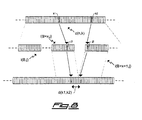
- the sub-blocks having Bs/M dimension obtained from a block c(n,k) are diagonally alternated with those coming from the next block c(n+1,k) in order that adjacent bits in the sequence of interleaved data belong to separate blocks.
- the distances d1(p), d2,(p), d3(q) and d4(q) expressed in the formulas described above are functions of the parameters ⁇ and ⁇ appearing in the alternation method according to the present invention.
- the selection of the parameters ⁇ and ⁇ shall be made in order to maximize said distances corresponding to appropriate values of p and q.
- the first type of system is characterized by a subdivision of the time axis in time intervals, known as time slots. Each user employs a well-defined time slot cyclically repeating on the time axis in a given period called frame, for the transmission of its information.
- This survey includes the systems employing TDMA access techniques, among which the GSM system itself and those employing TD-CDMA techniques, such as for instance the TDD-UTRA system.
- the second type includes on the contrary, the mobile telephone systems characterized by a continuous transmission on the time axis, such as for instance the FDD-UTRA system.
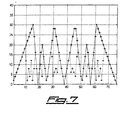
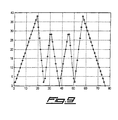
- the minimum value of the distance D min ( ⁇ opt ) that can be guaranteed decreases as the number of bits of which one wants to control the distance increases, that is, as P increases, since the number of the functions to be considered in the formula of D min ( ⁇ ) is always higher.
- the bits, whose position is controlled, have among each other a distance in the block c(n,k) lower than or equal to ((P + 1) * M - 1), that is respectively lower than or equal to 39 and 63, the bits that at the output of the interleaving unit occupy adjacent positions having even or odd index have a distance in the original block equal at least to 40 and 64.
- the value of P to be considered, is therefore the result of a compromise choice between the value of the minimum distance to be guaranteed and the number of bits the position of which has to be controlled. This compromise depends also on the characteristics of the used code for error correction.
Landscapes
- Engineering & Computer Science (AREA)
- Computer Networks & Wireless Communication (AREA)
- Signal Processing (AREA)
- Error Detection And Correction (AREA)
- Mobile Radio Communication Systems (AREA)
- Detection And Prevention Of Errors In Transmission (AREA)
Claims (5)
- Verfahren zur Verschachtelung eines Bitstroms in einem Mobiltelefonsystem, wobei der besagte Strom in Bitblöcke unterteilt ist, die ihrerseits diagonal in Bitunterblöcke unterteilt sind, nach der Formel:
k = 0, 1,...,Bs-1;
n = 0,1,...,N,N+1,...; - Verfahren nach dem vorhergehenden Anspruch, dadurch gekennzeichnet, dass der besagte Parameter α gleich einem Wert αopt ist, welcher den Wert der Funktion Dmin(α) = min{d1(1),d2(1),...d1(P),d2(P)} maximiert, wobei:d(k1,k2) der über die Anzahl der Bits ausgedrückte, im verschachtelten Strom berechnete Abstand zwischen zwei Bits ist, die in einem Block c(n,k) mit den Indizes k1 und k2, mit k1 < k2, versehen sind;j1 und j2 die Positionen dieser zwei Bits in einem Unterblock i(B,j) sind;p ein Parameter mit einem Wert zwischen 1 und einem maximalen Wert P ist, der entsprechend der Anzahl von im Anfangs-Bitstrom in benachbarten Positionen angeordneten Bits, die gleich ((P + 1) * M - 1) ist, gewählt wird, deren Abstand im verschachtelten Bitstrom man steuern und maximieren möchte;
- Verfahren nach Anspruch 1, dadurch gekennzeichnet, dass der besagte Parameter α gleich einem Wert αopt ist, welcher den Wert der Funktiond(k1,k2) der über die Anzahl der Bits ausgedrückte, im verschachtelten Strom berechnete Abstand zwischen zwei Bits ist, die in einem Block c(n,k) mit den Indizes k1 und k2, mit k1 < k2, versehen sind;j1 und j2 die Positionen dieser zwei Bits innerhalb von zwei benachbarten Unterblöcken, i(B,j) und i(B+1,j), sind;p ein Parameter mit einem Wert zwischen 1 und einem maximalen Wert P ist, der entsprechend der Anzahl von im Anfangs-Bitstrom in benachbarten Positionen angeordneten Bits, die gleich ((P + 1) * M - 1) ist, gewählt wird, deren Abstand im verschachtelten Bitstrom man steuern und maximieren möchte;q ein Parameter mit einem Wert zwischen 0 und einem maximalen Wert Q=P ist;
- Verfahren nach einem der vorhergehenden Ansprüche, dadurch gekennzeichnet, dass β = 0 ist.
- Verfahren nach einem der Ansprüche 1 bis 3, dadurch gekennzeichnet, dass β ≅ (Bs/M)/(M-1) ist.
Applications Claiming Priority (3)
| Application Number | Priority Date | Filing Date | Title |
|---|---|---|---|
| IT1999MI002698A IT1314319B1 (it) | 1999-12-23 | 1999-12-23 | Metodo di interlacciamento di un flusso di bit in un sistema ditelefonia radiomobile |
| ITMI992698 | 1999-12-23 | ||
| PCT/EP2000/013124 WO2001047157A2 (en) | 1999-12-23 | 2000-12-21 | Method for interleaving a bit flow in a mobile telephone system |
Publications (2)
| Publication Number | Publication Date |
|---|---|
| EP1247366A2 EP1247366A2 (de) | 2002-10-09 |
| EP1247366B1 true EP1247366B1 (de) | 2003-07-09 |
Family
ID=11384185
Family Applications (1)
| Application Number | Title | Priority Date | Filing Date |
|---|---|---|---|
| EP00992080A Expired - Lifetime EP1247366B1 (de) | 1999-12-23 | 2000-12-21 | Bitstromverschachtelungsverfahren in einem mobiltelefonsystem |
Country Status (10)
| Country | Link |
|---|---|
| US (1) | US20030103530A1 (de) |
| EP (1) | EP1247366B1 (de) |
| JP (1) | JP2003518816A (de) |
| CN (1) | CN1208907C (de) |
| AT (1) | ATE244964T1 (de) |
| CA (1) | CA2394547A1 (de) |
| DE (1) | DE60003855T2 (de) |
| ES (1) | ES2202222T3 (de) |
| IT (1) | IT1314319B1 (de) |
| WO (1) | WO2001047157A2 (de) |
Families Citing this family (11)
| Publication number | Priority date | Publication date | Assignee | Title |
|---|---|---|---|---|
| GB2381417A (en) * | 2001-10-24 | 2003-04-30 | Ipwireless Inc | Transmission power control based on path loss |
| JP2008508815A (ja) | 2004-07-29 | 2008-03-21 | クゥアルコム・インコーポレイテッド | 変調ダイバーシティのためのシステム及び方法 |
| US8391410B2 (en) | 2004-07-29 | 2013-03-05 | Qualcomm Incorporated | Methods and apparatus for configuring a pilot symbol in a wireless communication system |
| US9246728B2 (en) | 2004-07-29 | 2016-01-26 | Qualcomm Incorporated | System and method for frequency diversity |
| US8897828B2 (en) | 2004-08-12 | 2014-11-25 | Intellectual Ventures Holding 81 Llc | Power control in a wireless communication system |
| US9391751B2 (en) | 2005-07-29 | 2016-07-12 | Qualcomm Incorporated | System and method for frequency diversity |
| US9042212B2 (en) | 2005-07-29 | 2015-05-26 | Qualcomm Incorporated | Method and apparatus for communicating network identifiers in a communication system |
| CN102684842B (zh) * | 2011-08-17 | 2017-02-01 | 国家新闻出版广电总局广播科学研究院 | 一种交织和解交织比特流的方法以及交织器与解交织器 |
| WO2015137712A1 (en) | 2014-03-14 | 2015-09-17 | Samsung Electronics Co., Ltd. | Method and apparatus for controlling interleaving depth |
| KR102370903B1 (ko) * | 2014-03-14 | 2022-03-08 | 삼성전자주식회사 | 인터리빙 깊이를 조절하기 위한 장치 및 방법 |
| US10440685B2 (en) * | 2017-05-05 | 2019-10-08 | Motorola Mobility Llc | Interleaving sequential data in time and frequency domains |
Family Cites Families (3)
| Publication number | Priority date | Publication date | Assignee | Title |
|---|---|---|---|---|
| US5898710A (en) * | 1995-06-06 | 1999-04-27 | Globespan Technologies, Inc. | Implied interleaving, a family of systematic interleavers and deinterleavers |
| JP3010142B2 (ja) * | 1996-10-01 | 2000-02-14 | 株式会社次世代デジタルテレビジョン放送システム研究所 | 階層伝送方式とその送受信装置 |
| US6507629B1 (en) * | 1998-04-07 | 2003-01-14 | Sony Corporation | Address generator, interleave unit, deinterleave unit, and transmission unit |
-
1999
- 1999-12-23 IT IT1999MI002698A patent/IT1314319B1/it active
-
2000
- 2000-12-21 CN CN00817657.4A patent/CN1208907C/zh not_active Expired - Fee Related
- 2000-12-21 DE DE60003855T patent/DE60003855T2/de not_active Expired - Fee Related
- 2000-12-21 EP EP00992080A patent/EP1247366B1/de not_active Expired - Lifetime
- 2000-12-21 JP JP2001547773A patent/JP2003518816A/ja not_active Abandoned
- 2000-12-21 CA CA002394547A patent/CA2394547A1/en not_active Abandoned
- 2000-12-21 WO PCT/EP2000/013124 patent/WO2001047157A2/en not_active Ceased
- 2000-12-21 AT AT00992080T patent/ATE244964T1/de not_active IP Right Cessation
- 2000-12-21 US US10/168,101 patent/US20030103530A1/en not_active Abandoned
- 2000-12-21 ES ES00992080T patent/ES2202222T3/es not_active Expired - Lifetime
Also Published As
| Publication number | Publication date |
|---|---|
| CA2394547A1 (en) | 2001-06-28 |
| JP2003518816A (ja) | 2003-06-10 |
| ITMI992698A0 (it) | 1999-12-23 |
| ITMI992698A1 (it) | 2001-06-23 |
| EP1247366A2 (de) | 2002-10-09 |
| CN1208907C (zh) | 2005-06-29 |
| WO2001047157A3 (en) | 2001-12-27 |
| CN1413386A (zh) | 2003-04-23 |
| ATE244964T1 (de) | 2003-07-15 |
| DE60003855T2 (de) | 2004-06-03 |
| US20030103530A1 (en) | 2003-06-05 |
| ES2202222T3 (es) | 2004-04-01 |
| WO2001047157A2 (en) | 2001-06-28 |
| DE60003855D1 (de) | 2003-08-14 |
| IT1314319B1 (it) | 2002-12-09 |
Similar Documents
| Publication | Publication Date | Title |
|---|---|---|
| FI108180B (fi) | TDMA-radioliikennemenetelmä | |
| KR102662438B1 (ko) | Sidelink 자원구성 방법 및 장치, Sidelink 통신방법 및 장치, 기지국, 단말기 및 저장매체 | |
| US6512748B1 (en) | Radio paging signal coding control scheme using variable number of logical channels according to paging signal traffic | |
| RU2450491C1 (ru) | Способ для сигнализации размещения ресурсов для регулировки степени разбиения в системе сотовой связи с несколькими несущими | |
| US6545997B1 (en) | Transmission method and transmission apparatus for transmitting signals on the basis of a OFDM/TDMA-system with pilot symbols | |
| TW461205B (en) | Bandwidth efficient QAM on a TDM-FDM system for wireless communications | |
| US8498226B2 (en) | Method for determining random access channel number and sending sounding reference signal | |
| EP2238798B1 (de) | System und verfahren für burst-trennung und erhöhte verschachtelungslänge | |
| EP0980153A2 (de) | Verfahren zur Informationsformatierung und -Übertragung in einem schnurlosen Telekommunikationssystem | |
| US20030103530A1 (en) | Method for interleaving bit flow in a mobile telephone system | |
| US20100323740A1 (en) | Method for allocating resources | |
| JPH04196822A (ja) | データインタリーブ方式および回路 | |
| US7039069B2 (en) | Interleaving method | |
| EP1257068A2 (de) | Verbessertes Frequenzsprungverfahren und drahtloses Endgerät dafür | |
| AU7700294A (en) | Method for digital semi-duplex transmission | |
| US8355374B2 (en) | Method for signaling uplink system configuration information | |
| KR100804860B1 (ko) | 무선 네트워크에서 낮은 데이터 레이트 트래픽의 조기 종료 | |
| EP2028772B1 (de) | Datenburstkommunikationsverfahren zur Verwendung bei steigendem Datendurchsatz zu mobilen Kommunikationsvorrichtungen | |
| EP1338163A1 (de) | Verfahren zur zuweisung von funkressourcen an mobilstationen, telekommunikationsnetz sowie mobilstation | |
| CN116506094A (zh) | 5g小基站设备基于多用户的srs资源分配方法和装置 | |
| CN120583522A (zh) | 一种跳频方法及装置、终端、网络设备、存储介质、程序产品 | |
| GB2376380A (en) | Transmitting voice data and non-voice data in TDMA channels |
Legal Events
| Date | Code | Title | Description |
|---|---|---|---|
| PUAI | Public reference made under article 153(3) epc to a published international application that has entered the european phase |
Free format text: ORIGINAL CODE: 0009012 |
|
| AK | Designated contracting states |
Kind code of ref document: A2 Designated state(s): AT BE CH CY DE DK ES FI FR GB GR IE IT LI LU MC NL PT SE TR |
|
| AX | Request for extension of the european patent |
Free format text: AL;LT;LV;MK;RO;SI |
|
| 17P | Request for examination filed |
Effective date: 20020614 |
|
| R17D | Deferred search report published (corrected) |
Effective date: 20011227 |
|
| GRAH | Despatch of communication of intention to grant a patent |
Free format text: ORIGINAL CODE: EPIDOS IGRA |
|
| GRAH | Despatch of communication of intention to grant a patent |
Free format text: ORIGINAL CODE: EPIDOS IGRA |
|
| RAP1 | Party data changed (applicant data changed or rights of an application transferred) |
Owner name: SIEMENS MOBILE COMMUNICATIONS S.P.A. |
|
| GRAA | (expected) grant |
Free format text: ORIGINAL CODE: 0009210 |
|
| AK | Designated contracting states |
Designated state(s): AT BE CH CY DE DK ES FI FR GB GR IE IT LI LU MC NL PT SE TR |
|
| PG25 | Lapsed in a contracting state [announced via postgrant information from national office to epo] |
Ref country code: TR Free format text: LAPSE BECAUSE OF FAILURE TO SUBMIT A TRANSLATION OF THE DESCRIPTION OR TO PAY THE FEE WITHIN THE PRESCRIBED TIME-LIMIT Effective date: 20030709 Ref country code: NL Free format text: LAPSE BECAUSE OF FAILURE TO SUBMIT A TRANSLATION OF THE DESCRIPTION OR TO PAY THE FEE WITHIN THE PRESCRIBED TIME-LIMIT Effective date: 20030709 Ref country code: LI Free format text: LAPSE BECAUSE OF FAILURE TO SUBMIT A TRANSLATION OF THE DESCRIPTION OR TO PAY THE FEE WITHIN THE PRESCRIBED TIME-LIMIT Effective date: 20030709 Ref country code: CH Free format text: LAPSE BECAUSE OF FAILURE TO SUBMIT A TRANSLATION OF THE DESCRIPTION OR TO PAY THE FEE WITHIN THE PRESCRIBED TIME-LIMIT Effective date: 20030709 Ref country code: BE Free format text: LAPSE BECAUSE OF FAILURE TO SUBMIT A TRANSLATION OF THE DESCRIPTION OR TO PAY THE FEE WITHIN THE PRESCRIBED TIME-LIMIT Effective date: 20030709 Ref country code: AT Free format text: LAPSE BECAUSE OF FAILURE TO SUBMIT A TRANSLATION OF THE DESCRIPTION OR TO PAY THE FEE WITHIN THE PRESCRIBED TIME-LIMIT Effective date: 20030709 |
|
| REG | Reference to a national code |
Ref country code: GB Ref legal event code: FG4D |
|
| REG | Reference to a national code |
Ref country code: CH Ref legal event code: EP |
|
| REF | Corresponds to: |
Ref document number: 60003855 Country of ref document: DE Date of ref document: 20030814 Kind code of ref document: P |
|
| REG | Reference to a national code |
Ref country code: IE Ref legal event code: FG4D |
|
| PG25 | Lapsed in a contracting state [announced via postgrant information from national office to epo] |
Ref country code: GR Free format text: LAPSE BECAUSE OF FAILURE TO SUBMIT A TRANSLATION OF THE DESCRIPTION OR TO PAY THE FEE WITHIN THE PRESCRIBED TIME-LIMIT Effective date: 20031009 Ref country code: DK Free format text: LAPSE BECAUSE OF FAILURE TO SUBMIT A TRANSLATION OF THE DESCRIPTION OR TO PAY THE FEE WITHIN THE PRESCRIBED TIME-LIMIT Effective date: 20031009 |
|
| REG | Reference to a national code |
Ref country code: SE Ref legal event code: TRGR |
|
| NLV1 | Nl: lapsed or annulled due to failure to fulfill the requirements of art. 29p and 29m of the patents act | ||
| PGFP | Annual fee paid to national office [announced via postgrant information from national office to epo] |
Ref country code: SE Payment date: 20031204 Year of fee payment: 4 |
|
| PG25 | Lapsed in a contracting state [announced via postgrant information from national office to epo] |
Ref country code: PT Free format text: LAPSE BECAUSE OF FAILURE TO SUBMIT A TRANSLATION OF THE DESCRIPTION OR TO PAY THE FEE WITHIN THE PRESCRIBED TIME-LIMIT Effective date: 20031209 |
|
| PGFP | Annual fee paid to national office [announced via postgrant information from national office to epo] |
Ref country code: ES Payment date: 20031209 Year of fee payment: 4 |
|
| PGFP | Annual fee paid to national office [announced via postgrant information from national office to epo] |
Ref country code: FR Payment date: 20031219 Year of fee payment: 4 |
|
| PG25 | Lapsed in a contracting state [announced via postgrant information from national office to epo] |
Ref country code: LU Free format text: LAPSE BECAUSE OF NON-PAYMENT OF DUE FEES Effective date: 20031221 Ref country code: CY Free format text: LAPSE BECAUSE OF FAILURE TO SUBMIT A TRANSLATION OF THE DESCRIPTION OR TO PAY THE FEE WITHIN THE PRESCRIBED TIME-LIMIT Effective date: 20031221 |
|
| PG25 | Lapsed in a contracting state [announced via postgrant information from national office to epo] |
Ref country code: IE Free format text: LAPSE BECAUSE OF NON-PAYMENT OF DUE FEES Effective date: 20031222 |
|
| LTIE | Lt: invalidation of european patent or patent extension |
Effective date: 20030709 |
|
| PG25 | Lapsed in a contracting state [announced via postgrant information from national office to epo] |
Ref country code: MC Free format text: LAPSE BECAUSE OF NON-PAYMENT OF DUE FEES Effective date: 20031231 |
|
| REG | Reference to a national code |
Ref country code: CH Ref legal event code: PL |
|
| PGFP | Annual fee paid to national office [announced via postgrant information from national office to epo] |
Ref country code: DE Payment date: 20040216 Year of fee payment: 4 |
|
| REG | Reference to a national code |
Ref country code: ES Ref legal event code: FG2A Ref document number: 2202222 Country of ref document: ES Kind code of ref document: T3 |
|
| ET | Fr: translation filed | ||
| PLBE | No opposition filed within time limit |
Free format text: ORIGINAL CODE: 0009261 |
|
| STAA | Information on the status of an ep patent application or granted ep patent |
Free format text: STATUS: NO OPPOSITION FILED WITHIN TIME LIMIT |
|
| 26N | No opposition filed |
Effective date: 20040414 |
|
| REG | Reference to a national code |
Ref country code: IE Ref legal event code: MM4A |
|
| PGFP | Annual fee paid to national office [announced via postgrant information from national office to epo] |
Ref country code: FI Payment date: 20041109 Year of fee payment: 5 |
|
| PG25 | Lapsed in a contracting state [announced via postgrant information from national office to epo] |
Ref country code: GB Free format text: LAPSE BECAUSE OF NON-PAYMENT OF DUE FEES Effective date: 20041221 |
|
| PG25 | Lapsed in a contracting state [announced via postgrant information from national office to epo] |
Ref country code: SE Free format text: LAPSE BECAUSE OF NON-PAYMENT OF DUE FEES Effective date: 20041222 Ref country code: ES Free format text: LAPSE BECAUSE OF NON-PAYMENT OF DUE FEES Effective date: 20041222 |
|
| PG25 | Lapsed in a contracting state [announced via postgrant information from national office to epo] |
Ref country code: DE Free format text: LAPSE BECAUSE OF NON-PAYMENT OF DUE FEES Effective date: 20050701 |
|
| EUG | Se: european patent has lapsed | ||
| GBPC | Gb: european patent ceased through non-payment of renewal fee |
Effective date: 20041221 |
|
| PG25 | Lapsed in a contracting state [announced via postgrant information from national office to epo] |
Ref country code: FR Free format text: LAPSE BECAUSE OF NON-PAYMENT OF DUE FEES Effective date: 20050831 |
|
| REG | Reference to a national code |
Ref country code: FR Ref legal event code: ST |
|
| PG25 | Lapsed in a contracting state [announced via postgrant information from national office to epo] |
Ref country code: IT Free format text: LAPSE BECAUSE OF NON-PAYMENT OF DUE FEES Effective date: 20051221 Ref country code: FI Free format text: LAPSE BECAUSE OF NON-PAYMENT OF DUE FEES Effective date: 20051221 |
|
| REG | Reference to a national code |
Ref country code: ES Ref legal event code: FD2A Effective date: 20041222 |