EP1245685A1 - Method for producing metal or metal compound comprising process of treating with fluorine and adjusted raw material used therein - Google Patents
Method for producing metal or metal compound comprising process of treating with fluorine and adjusted raw material used therein Download PDFInfo
- Publication number
- EP1245685A1 EP1245685A1 EP00981794A EP00981794A EP1245685A1 EP 1245685 A1 EP1245685 A1 EP 1245685A1 EP 00981794 A EP00981794 A EP 00981794A EP 00981794 A EP00981794 A EP 00981794A EP 1245685 A1 EP1245685 A1 EP 1245685A1
- Authority
- EP
- European Patent Office
- Prior art keywords
- hydrofluoric acid
- raw material
- substance
- ore
- ingredient
- Prior art date
- Legal status (The legal status is an assumption and is not a legal conclusion. Google has not performed a legal analysis and makes no representation as to the accuracy of the status listed.)
- Withdrawn
Links
Classifications
-
- C—CHEMISTRY; METALLURGY
- C22—METALLURGY; FERROUS OR NON-FERROUS ALLOYS; TREATMENT OF ALLOYS OR NON-FERROUS METALS
- C22B—PRODUCTION AND REFINING OF METALS; PRETREATMENT OF RAW MATERIALS
- C22B3/00—Extraction of metal compounds from ores or concentrates by wet processes
- C22B3/04—Extraction of metal compounds from ores or concentrates by wet processes by leaching
- C22B3/06—Extraction of metal compounds from ores or concentrates by wet processes by leaching in inorganic acid solutions, e.g. with acids generated in situ; in inorganic salt solutions other than ammonium salt solutions
- C22B3/10—Hydrochloric acid, other halogenated acids or salts thereof
-
- C—CHEMISTRY; METALLURGY
- C22—METALLURGY; FERROUS OR NON-FERROUS ALLOYS; TREATMENT OF ALLOYS OR NON-FERROUS METALS
- C22B—PRODUCTION AND REFINING OF METALS; PRETREATMENT OF RAW MATERIALS
- C22B34/00—Obtaining refractory metals
- C22B34/20—Obtaining niobium, tantalum or vanadium
- C22B34/24—Obtaining niobium or tantalum
-
- Y—GENERAL TAGGING OF NEW TECHNOLOGICAL DEVELOPMENTS; GENERAL TAGGING OF CROSS-SECTIONAL TECHNOLOGIES SPANNING OVER SEVERAL SECTIONS OF THE IPC; TECHNICAL SUBJECTS COVERED BY FORMER USPC CROSS-REFERENCE ART COLLECTIONS [XRACs] AND DIGESTS
- Y02—TECHNOLOGIES OR APPLICATIONS FOR MITIGATION OR ADAPTATION AGAINST CLIMATE CHANGE
- Y02P—CLIMATE CHANGE MITIGATION TECHNOLOGIES IN THE PRODUCTION OR PROCESSING OF GOODS
- Y02P10/00—Technologies related to metal processing
- Y02P10/20—Recycling
Definitions
- the present invention relates to a method of producing a metal or a similar substance comprising collecting and refining the metal or substance contained in an ore or a concentrate containing a radioactive substance, and to an ingredient-regulated raw material employed in the method.
- the technical idea of the method and the raw material according to the present invention are usefully applied to production of tantalum, niobium, or compounds thereof.
- a widely-known method of producing a metal or a metal compound from an ore or a concentrate containing a radioactive substance serving as a raw material involves a fluoridation process ⁇ i.e., treating the raw material with hydrofluoric acid or a mixed acid containing, as an essential component, hydrofluoric acid, and separating the resultant mixture into an extract into which a metallic component is eluted and a residue ⁇ and collection and refinement of the metallic component from the extract.
- Typical examples of metals and metal compounds produced through the above method include tantalum and niobium, which are contained in naturally occurring ores, and typical examples of ores employed in the method include rare earth ores containing a plurality of metallic elements; i.e., misch metals.
- the thus-produced metal, metal compound, or similar material is typically employed as a certain additive.
- tantalum, niobium, or compounds thereof find use such as an alloying element or compound for producing special steel or material for producing electronic apparatus, and such substances have become of interest.
- the range of such applications and the amount of the substances have increased remarkably.
- This trend has been accompanied by remarkably increasing demand for ores such as tantalite and columbite and concentrates obtained therefrom, which serve as raw material for collecting tantalum, niobium, or a similar substance.
- ores per se which are subjected to the production method contain small amounts (e.g., some wt.%) of radioactive element compounds such as oxides.
- radioactive element compounds such as oxides.
- ores or concentrates which are employed for producing tantalum, niobium, or a similar material have been known to contain uranium oxide (U 3 O 8 ) and thorium oxide (ThO 2 ).
- U 3 O 8 uranium oxide
- ThO 2 thorium oxide
- these radioactive substances cannot be completely removed even when the ores are refined to corresponding concentrates through flotation, and remain as unavoidable components in the concentrates.
- Japanese Patent Application Laid-Open ( kokai ) No. 10-212532 also discloses such unavoidable components.
- radioactive substance content In terms of material containing at least a certain level of a radioactive substance, properties such as radioactive substance content are strictly limited by a variety of laws. For example, the Basel Convention prohibits cross-border transportation of a substance harmful to the human body. Thus, in some cases, as-prepared concentrate products cannot be imported and cannot be employed in the metal production industry. In such cases, the composition of ore material and concentrate material must be modified in accordance with the radioactive substance content.
- ores or concentrates when ores or concentrates contain a metal, a metal compound, or a similar substance at high content, the amount of the residue remaining after completion of extraction and refinement of a target metal, a target metal compound, or a similar substance is small.
- the smaller the amount of generated residue the higher the concentration of radioactive substances in the residue.
- Such a high concentration of radioactive substances is problematic in safety of handling the residue, and requires particular apparatus and a strict operational procedure.
- the above-described ores or concentrates are not preferred, in that handling the residue becomes more difficult and costs for waste disposal increase.
- a method of producing a metal or a metal compound from an ingredient-regulated raw material obtained by mixing an ore or a concentrate containing a radioactive substance which method involves a fluoridation process ⁇ i.e., treating the ingredient-regulated raw material with hydrofluoric acid or a mixed acid containing, as an essential component, hydrofluoric acid, and separating the resultant mixture into an extract into which a metallic component is eluted and an extraction residue ⁇ and collection and refinement of the metallic component from the extract, wherein the employed ingredient-regulating raw material comprises the ore or the concentrate containing a radioactive substance and, as an additive, a substance insoluble to hydrofluoric acid or to a mixed acid containing, as an essential component, hydrofluoric acid, to thereby control to an arbitrary value of 1.0 wt.% or less the ratio of the amount of the radioactive substance remaining in the extraction residue generated through the fluoridation process to the weight of the extraction residue.
- a method of producing tantalum, niobium, or a similar substance from an ingredient-regulated raw material obtained by mixing an ore or a concentrate containing at least one of tantalum and niobium and a radioactive substance which method involves a fluoridation process ⁇ i.e., treating the ingredient-regulated raw material with hydrofluoric acid or a mixed acid containing, as an essential component, hydrofluoric acid, and separating the resultant mixture into an extract into which a metallic component is eluted and an extraction residue ⁇ and collection and refinement of tantalum, niobium, or a similar substance from the extract, wherein the employed ingredient-regulating raw material comprises the ore or the concentrate containing a radioactive substance and, as an additive, a substance insoluble to hydrofluoric acid or to a mixed acid containing, as an essential component, hydrofluoric acid, to thereby control to an arbitrary value of 1.0 wt.% or less the ratio of the total amount of
- the method of producing a metal or a metal compound according to the present invention can be applied to a variety of those methods which employ an ore or a concentrate containing a radioactive substance and involve a fluoridation process; i.e., treating a raw material with hydrofluoric acid or a mixed acid containing, as an essential component, hydrofluoric acid, and separating the resultant mixture into an extract into which a metallic component is eluted and an extraction residue.
- the types of ores and concentrates and the species and the amounts of the radioactive substances contained in the ores or concentrates vary in accordance with the type of the target metal or substance to be collected and refined. Therefore, imposing definite limitations on the above values and uses in claim 1 is difficult.
- claim 1 the present inventors have not imposed such limitations.
- the idea of claim 1 of the present invention is considered to be applied to production of zirconium, hafnium, tungsten, molybdenum, and titanium as well as to tantalum and niobium.
- a method of producing tantalum, niobium, or a similar substance is recited in claim 2.
- a method of producing tantalum, niobium, or a similar substance as recited in claim 2 can be considered to be one example for describing the present invention as recited in claim 1.
- the idea of the present invention as recited in claim 1 is also described hereunder with reference to claim 2.
- One predominant target application of the method of the present invention is considered to be application to the case in which naturally-occurring ores of high radioactive element content which are subjected to elevation of tantalum and niobium grade through a method such as flotation, to thereby form corresponding concentrates also having a high radioactive element content.
- the reason why ores are transformed to concentrates is that raw materials of high target component content are generally preferred for production of tantalum, niobium, or a similar substance, in view of transportation efficiency and productivity of raw material.
- an ore or a concentrate for producing tantalum, niobium, or a similar substance refers to an ore such as columbite ore, tantalite ore, samarskite ore, pyrochlore, or euxenite, or a corresponding concentrate whose tantalum grade or niobium grade is enriched through a physical method such as flotation.
- a corresponding ore or concentrate is used.
- the expression also encompasses appropriate ingredient-regulated mixtures of the aforementioned ore and concentrate, two or more ores, and two or more concentrates.
- columbite ore contains Nb 2 O 5 at a content of approximately 70-85 wt.%
- tantalite ore contains Ta 2 O 3 at a content of approximately 75-90 wt.%
- samarskite ore contains Nb 2 O 5 and Ta 2 O 3 at a total content of approximately 40-60 wt.%.
- these ores contain, as impurity components, compounds such as silicates, iron oxide, and manganese oxide.
- ores are classified into three types: ores for producing tantalum and tantalum compounds; ores for producing niobium and niobium compounds; and ores for simultaneously producing tantalum, niobium, and compounds thereof.
- the expression "tantalum, niobium, or a compound thereof" in the present specification refers to tantalum or a tantalum compound; niobium or a niobium compound; and tantalum, niobium, and compounds containing tantalum and/or niobium.
- ores also contain small amounts of radioactive elements, such as uranium and thorium in the forms of U 3 O 8 and ThO 2 , and these radioactive elements are incorporated into concentrates which are obtained from the corresponding ores through flotation.
- typically-employed concentrates contain these radioactive elements in a total amount of approximately 0.05 wt.% (U 3 O 8 + ThO 2 )
- some ores to be processed into the corresponding concentrates contain more than 0.1 wt.% of radioactive elements. Since ores or concentrates, inter alia ores, generally have a low radioactive element content, the content per se does not present a serious problem. However, some concentrates have a radioactive element content of more than 1 wt.%, depending on the degree of flotation of the corresponding ores, as will be described in another portion of the specification.
- an extraction process including alkali pre-treatment will be described.
- an ore or a concentrate is treated with caustic soda.
- the pH of the solution is adjusted to 3 or less, to thereby elute into the alkali pretreated solution a silicate, an iron compound, or a manganese compound contained in the ore or concentrate.
- components such as niobium and tantalum are converted to insoluble basic salts thereof, remaining in precipitates formed during the pretreatment.
- the precipitates are treated with an extracting agent, in the form of hydrofluoric acid or a mixed acid containing hydrofluoric acid as an essential component, to thereby elute components such as tantalum and niobium into the resultant extract.
- the insoluble extraction residue is then separated from the extract by use of means such as a filter press.
- the expression "fluoridation process employing hydrofluoric acid or a mixed acid containing hydrofluoric acid as an essential component” refers to the above steps.
- the components such as tantalum and niobium contained in the thus-formed extract are collected and refined through a generally known method.
- Another method is a direct extraction method in which the above-performed alkali pretreatment by use of caustic soda is not employed. Instead, an ore or a concentrate is directly treated with an extracting agent, in the form of hydrofluoric acid or a mixed acid containing hydrofluoric acid as an essential component, to thereby elute components such as tantalum and niobium into the resultant extract. The insoluble extraction residue is then separated from the extract by use of means such as a filter press.
- the expression "fluoridation process employing hydrofluoric acid or a mixed acid containing hydrochloric acid as an essential component" refers to the above step.
- the extract contains not only target components such as tantalum and niobium but also impurity components such as iron and manganese which are simultaneously dissolved into the extract.
- the insoluble extraction residue is then separated from the extract by use of means such as a filter press, and the components contained in the thus-formed extract are collected and refined.
- these methods also include a fluoridation process employing, as an extracting agent, hydrofluoric acid or a mixed acid containing hydrofluoric acid as an essential component.
- the present inventors have performed extensive studies on radioactive elements contained in ores and concentrates employed in collection and refinement of tantalum, niobium, or a similar substance, and have found that the radioactive elements contained in ores and concentrates cannot be removed through the alkali pre-treatment involved in the extraction method; cannot be dissolved in hydrofluoric acid or a mixed acid containing hydrofluoric acid as an essential component; and remain in the extraction residue generated during the fluoridation process.
- Such an extraction residue is produced in a certain amount based on the weight of the employed ore or concentrate, the amount varying depending on the type of ore and the flotation level.
- the greater amount of the initially contained radioactive elements remains in the extraction residue.
- the radioactive element content in the extraction residue is elevated several fold as compared with that in the ore or concentrate; i.e., the content in an initial stage.
- Generation of the extraction residue is one serious problem encountered in the methods of producing tantalum, niobium, or a similar substance.
- the present inventors have deduced the concept that, if the percentage (i.e., %content) of radioactive substances present in the extraction residue is the problem, an increase in the total amount of the residue results in a decrease in the percentage of the radioactive substances contained in the residue. It is considered that one of the simplest and most effective ways to increase the total amount of the extraction residue is incorporation of an additive which constitutes the residue.
- properties of the additive must be taken into consideration in the aforementioned case; i.e., an additive which adversely affects collection and refinement of tantalum, niobium, or a similar substance thereof cannot be employed.
- additives which deteriorate recovery, purity, or a similar property of produced tantalum, niobium, or a similar substance thereof in the production process cannot be employed.
- the present inventors have investigated as many methods of producing tantalum, niobium, or a similar substance as possible, and have found that a fluoridation process in which extraction treatment is performed by use of hydrofluoric acid or a mixed acid containing hydrofluoric acid as an essential component is only one possible stage where the additive component added to raw material is modified to adversely affect collection and refinement.
- the additive when the additive is not modified by hydrofluoric acid or a mixed acid containing hydrofluoric acid as an essential component employed in the fluoridation process or forms precipitates by the acids, the additive remains in the extraction residue. In this case, the additive does not affect collection and refinement of tantalum, niobium, or a similar substance.
- sulfuric acid is employed as an acid which constitutes the mixed acid containing hydrofluoric acid as an essential component.
- acids such as hydrochloric acid and nitric acid may be employed in accordance with the nature of the employed production method.
- a substance insoluble to hydrofluoric acid or to a mixed acid containing hydrofluoric acid as an essential component is employed as an additive which does not completely dissolve and remains in the residue even when the additive is treated with hydrofluoric acid or with a mixed acid containing hydrofluoric acid as an essential component.
- the additive is incorporated into an ore or a concentrate serving as a raw material, to thereby prepare an ingredient-regulated raw material. By use of the thus-prepared raw material, the relative radioactive element content in the extraction residue is lowered.
- the radioactive content of substance is restricted by standard values determined by each country on the basis of scientific criteria that take into consideration effects on the human body and the environment. Since in each country the standard values are codified in laws, radioactive substances must be handled while respecting and obeying such laws. In direct opposition to this, from a viewpoint of producers who carry out collection and refinement of tantalum, niobium, or a similar substance, the larger the amount of the extraction residue, the greater the costs required for residue treatment.
- the waste cost may elevate the price of products of tantalum, niobium, or a similar substance, and the elevated price retards distribution of such products, to thereby possibly retard development of the industry.
- the amount of extraction residue must be determined for respective countries in consideration of laws and minimum production costs.
- the amount of an insoluble substance incorporated into the ingredient-regulated raw material must be controlled in accordance with the tantalum grade or niobium grade and the radioactive element content of employed ores or concentrates.
- the amount of the insoluble substance is considered to be determined within a range so as to most effectively satisfy laws of each country throughout the world and avoid adverse effects on the human body.
- claim 2 discloses no clear amount of the insoluble substance to be added and that the amount is determined on the basis of the amount of radioactive substance in the extraction residue which results from a fluoridation process.
- the insoluble substance is added so as to "control to an arbitrary value of 1.0 wt.% or less the ratio of the total amount of the radioactive substances, U 3 O 8 and ThO 2 , remaining in the extraction residue generated through the fluoridation process to the weight of the extraction residue.”
- control for attaining an arbitrary value of the ratio of the total amount of the radioactive substances remaining in the extraction residue to the weight of the extraction residue can readily be carried out by controlling the amount of the additive during preparation of ingredient-regulated raw material.
- the present specification employs the expression "the radioactive substances, U 3 O 8 and ThO 2 , remaining in the extraction residue" included in the method of producing tantalum, niobium, or a similar substance, for the following reasons.
- the total amount of U 3 O 8 and ThO 2 is obtained by analyzing an extraction residue by means of an X-ray fluorescent analyzer to thereby determine the amounts of U and Th and calculating the amounts of oxides; i.e., U 3 O 8 and ThO 2 .
- X-ray fluorescent analyzer When determination is performed through instrumental analysis such as X-ray fluorescent analysis, bonding states of U and Th cannot be obtained, and specific radioactive species in which the bonding states are clearly elucidated are difficult to determine. From another viewpoint, the above analysis can readily be controlled when such widely employed instruments such as an X-ray fluorescence analyzer are employed.
- the methods of producing tantalum, niobium, or a similar substance as recited in claims 1 and 3 are advantageous when an ore or a concentrate serving as a raw material originally contains a radioactive substance at a level exceeding the standard value.
- a certain amount of an additive is added to the raw material, to thereby prepare an ingredient-regulated raw material, which enables the raw material to be handled more easily.
- claim 3 of the present invention Another method for reducing the radioactive element content in an extraction residue is recited in claim 3 of the present invention.
- a method of producing a metal or a metal compound from an ore or a concentrate containing a radioactive substance which method involves a fluoridation process ⁇ i.e., treating the ingredient-regulated raw material with hydrofluoric acid or a mixed acid containing hydrofluoric acid as an essential component, and separating the resultant mixture into an extract into which a metallic component is eluted and an extraction residue ⁇ and collection and refinement of the metallic component from the extract, wherein the ore or the concentrate containing a radioactive substance is employed as a raw material, and a substance insoluble to hydrofluoric acid or to a mixed acid containing hydrofluoric acid as an essential component employed in a fluoridation process is added during the fluoridation process, to thereby control to an arbitrary value of 1.0 wt.% or less the ratio of the amount of the radioactive substance remaining in the extraction residue generated through
- a method of producing tantalum, niobium, or a similar substance from an ore or a concentrate containing at least one of tantalum and niobium and a radioactive substance which method involves a fluoridation process ⁇ i.e., treating the ingredient-regulated raw material with hydrofluoric acid or a mixed acid containing hydrofluoric acid as an essential component, and separating the resultant mixture into an extract into which a metallic component is eluted and an extraction residue ⁇ and collection and refinement of the metallic component from the extract, wherein the ore or the concentrate containing at least one of tantalum and niobium and a radioactive substance is employed as a raw material, and a substance insoluble to hydrofluoric acid or to a mixed acid containing hydrofluoric acid as an essential component employed in a fluoridation process is added during the fluoridation process, to thereby control to an arbitrary value of 1.0 wt.% or less the ratio of the amount of the radioactive substances
- a substance insoluble to hydrofluoric acid or to a mixed acid containing hydrofluoric acid as an essential component employed in a fluoridation process is added during the fluoridation process.
- Several modes for addition can be employed; e.g., (1) pretreating an ore or a concentrate with an alkali such as caustic soda as employed in an extraction method including alkali pretreatment employed for producing tantalum or niobium; adding an additive immediately before subjection to a fluoridation process; and performing treatment in an extraction bath containing the additive and a mixed acid containing hydrofluoric acid as an essential component; (2) adding the additive to an extraction bath containing a mixed acid containing hydrofluoric acid as an essential component during a fluoridation process and treating an ore or a concentrate in the bath; and (3) treating an ore or a concentrate in an extraction bath containing a mixed acid containing hydrofluoric acid as an essential component during a fluoridation process and adding a certain amount of the additive to the resulting extraction
- the radioactive substance content in the extraction residue can be controlled to an arbitrary value as recited in claims 1 and 2.
- the radioactive substance content can be controlled to an arbitrary value in accordance with the standard value employed in the respective country.
- claims 5 and 6 specify the compositional range of an ore or a concentrate to be employed and the amount of the additive to be added to the ore or the concentrate.
- ingredient-regulated raw material refers to a mixture comprising an ore or a concentrate and, as an additive, a substance insoluble to hydrofluoric acid.
- the mixture is employed in a production method as recited in claim 1 or 2. Selection of such ingredient-regulated raw material described herein is based on the following two reasons.
- an ingredient-regulated raw material according to the present invention which incorporates an additive in the form of a substance insoluble to hydrofluoric acid, can prevent concentration of a radioactive substance at a problematic level in a residue generated through a subsequent fluoridation process ⁇ one step for producing tantalum, niobium, or a similar substance.
- the concentration of a radioactive substance in the residue generated through a fluoridation process does not present a serious problem.
- the degree of concentration varies slightly in accordance with the production method, ores to be employed, and other factors, and "a total amount of Ta 2 O 3 and Nb 2 O 5 of 50 wt.% or more based on the weight of the ore or the concentrate" as recited in claim 3 also varies slightly.
- the ingredient-regulated raw material is suited for an ore or a concentrate containing Ta 2 O 3 and Nb 2 O 5 in a total amount (grade) of 50 wt.% or more based on the weight of the ore or the concentrate.
- the ingredient-regulated raw material as recited in claim 5 or 6 contains "at least, as an additive, a substance insoluble to hydrofluoric acid in an amount corresponding to the amount of the raw material removed through dissolution-extraction by use of hydrofluoric acid or insoluble to a mixed acid containing hydrofluoric acid as an essential component employed in the fluoridation process.”
- a substance insoluble to hydrofluoric acid in an amount corresponding to the amount of the raw material removed through dissolution-extraction by use of hydrofluoric acid or insoluble to a mixed acid containing hydrofluoric acid as an essential component employed in the fluoridation process.
- the radioactive substance content in the extraction residue and that of the ore or the concentrate are equal to each other.
- the amount of the insoluble substance can be determined easily, and the method is appropriate in consideration of safe operation.
- an ingredient-regulated raw material as recited in claim 5 or 6, wherein the substance insoluble to hydrofluoric acid or a mixed acid containing hydrofluoric acid as an essential component serving as an additive for the raw material is added such that the amount of the substance reaches 5-50 wt.% of the ingredient-regulated raw material.
- an ingredient-regulated raw material as recited in claim 5 or 7, wherein the substance insoluble to hydrofluoric acid or a mixed acid containing hydrofluoric acid as an essential component serving as an additive is at least one component included in an extraction residue of an ore or a concentrate generated through a fluoridation process involved in a method of producing a metal or a metal compound.
- the appropriate proportion of the insoluble substance in the ingredient-regulated raw material is defined in this claim.
- the insoluble substance is added in a required amount which is determined on the basis of the amount of the extraction residue generated through a fluoridation process of an ore or a concentrate for producing tantalum, niobium, or a similar substance.
- the relative radioactive substance content in the residue is preferably controlled to as low a level as possible by adding the insoluble substance.
- the lower relative radioactive substance content is equivalent to the larger amount of the extraction residue.
- the large amount affects efficiency of producing a metal or a similar substance to be collected and elevates the load of residue treatment.
- the amount of an insoluble substance to be added is appropriately modified in consideration of the aforementioned effects.
- the insoluble substance is added such that the amount of the substance is controlled to 5-50 wt.% of the weight of the ingredient-regulated raw material.
- the proportion of the added insoluble substance is less than 5 wt.% based on the weight of the ingredient-regulated raw material, dilution effect is poor in the case in which a currently available high-grade concentrate is employed; i.e., the relative radioactive substance content in the extraction residue cannot effectively be reduced (one object of the present invention).
- such an addition is not effective when the operational safety factor is taken into account.
- the present inventors have investigated factors such as the grade of currently available ores and concentrates and safety factor in operation, and have found that, most preferably, the insoluble substance is added such that the amount of the substance reaches 16-33 wt.% of the ingredient-regulated raw material, in view of production efficiency and safety to the human body.
- Claims 7 and 8 are based on the aforementioned criteria.
- the additive i.e., "a substance insoluble to hydrofluoric acid or to a mixed acid containing hydrofluoric acid as an essential component" must not be detrimental to efficiency of collection and refinement of the products, purity of the products, and other properties in a method of the present invention of producing a metal or a metal compound such as tantalum, niobium, or a compound thereof.
- the present inventors have analyzed the components contained in the extraction residue generated by subjecting an additive-free ore or concentrate to a fluoridation process by use of hydrofluoric acid or a mixed acid containing hydrofluoric acid as an essential component during production of a metal or a metal compound, and have considered that a component contained in the residue is employed as "a substance insoluble to hydrofluoric acid or to a mixed acid containing hydrofluoric acid as an essential component.”
- an ingredient-regulated raw material as recited in claim 5 or 7, wherein at least one component contained in an extraction residue generated by subjecting an ore or a concentrate to a fluoridation process involved in a method of producing a metal or a metal compound is employed as the additive; i.e., as a substance insoluble to hydrofluoric acid or to a mixed acid containing hydrofluoric acid as an essential component.
- an ingredient-regulated raw material as recited in claim 6 or 7, wherein the substance insoluble to hydrofluoric acid or to a mixed acid containing hydrofluoric acid as an essential component serving as an additive, comprises at least one species selected from among barium oxide, barium sulfate, aluminum oxide, calcium salts, and lanthanide compounds serving as components of an extraction residue generated by subjecting an ore or a concentrate for collecting tantalum, niobium, or a similar substance to a fluoridation process involved in a method of producing tantalum, niobium, or a similar substance.
- the present inventors have investigated, through a method such as X-ray diffractometry, the extraction residue generated through a fluoridation process involved in production of tantalum, niobium, or a similar substance, and have identified a variety of components other than species recited in claim 9.
- the reason for selecting, as the additive which is substance insoluble to hydrofluoric acid or a mixed acid containing hydrofluoric acid as an essential component, the species recited in claim 9 from all identified components will next be described.
- the compound In order to employ a compound as the additive; i.e., a substance insoluble to hydrofluoric acid or a mixed acid containing hydrofluoric acid as an essential component, the compound must be a component contained in the extraction residue; must be insoluble to a high-concentration acid solution containing hydrofluoric acid or a mixed acid containing hydrofluoric acid as an essential component; and must be stable against heat applied or chemicals employed during production of tantalum, niobium, or a similar substance.
- a compound such as iron oxide is a component of the extraction residue
- the compound which dissolves in a high-concentration acid solution cannot provide an effect for increasing the amount of the extraction residue.
- resin particles some types of these particles dissolve in a high-concentration acid solution, and others melt at high temperature, failing to maintain the powder state.
- barium oxide, barium sulfate, and aluminum oxide exhibit excellent chemical and thermal stability during production of tantalum and niobium.
- surfaces of the particles are rough, and therefore, the particles physically adsorb components in an extraction residue to thereby possibly fix and remove the components and enhance recovery of the residue.
- commercial products of these compounds are easily available in a variety of particle sizes with high size uniformity.
- Calcium salts and lanthanide compounds are brought into contact with a solution containing hydrofluoric acid, to thereby form fluorides thereof. Similarly, these compounds are brought into contact with a mixed acid containing hydrofluoric acid and sulfuric acid, to thereby form a type of gypsum. These fluorides and gypsum species exhibit excellent chemical and thermal stability during production of tantalum and niobium.
- Examples of employable calcium salts include calcium carbonate, calcium hydroxide, calcium oxide, calcium sulfates such as gypsum, and calcium fluoride. Other than calcium fluoride, some salts form calcium fluoride in the solution containing hydrofluoric acid, resulting in consumption of hydrofluoric acid.
- the amount of hydrofluoric acid must be controlled to compensate for the above loss.
- employable lanthanide compounds include oxides, water-soluble salts, and fluorides of lanthanide such as lanthanum or cerium. Similar to the case of calcium salts, other than fluorides, the amount of hydrofluoric acid must be controlled to compensate for the above loss.
- the aforementioned compounds are suitably employed as the additives and may be employed in combination of a plurality of species.
- the substance insoluble to hydrofluoric acid or a mixed acid containing hydrofluoric acid as an essential component serving as an additive is a powder having an average particle size of 0.5 ⁇ m to 100 ⁇ m.
- the substance insoluble to hydrofluoric acid or a mixed acid containing hydrofluoric acid as an essential component and serving as the additive is such a powder, the substance readily disperses in the solution to form a slurry.
- the reason for controlling the average particle size of "the substance insoluble to hydrofluoric acid or a mixed acid containing hydrofluoric acid as an essential component and serving as an additive" to 0.5 m ⁇ to 100 ⁇ m is that collection of the extraction residue is planned to be carried out through a method such as a sedimentation method involving allowing the solution to stand, or a filtration method making use of a filter such as a filter-press.
- a sedimentation method involving allowing the solution to stand
- a filtration method making use of a filter such as a filter-press.
- Example 1 which is based on a direct extraction method, a concentrate (species A) which had been obtained by subjecting an ore containing tantalum and niobium to flotation was employed as a raw material.
- the concentrate was subjected to X-ray fluorescent analysis (employed analyzer: LAB CENTER XRF-1700, product of Shimadzu Corporation), to thereby obtain the chemical composition as shown in Table 1.
- Quantitative determination was performed through a fundamental parameter method. The analysis revealed that uranium oxide and thorium oxide ⁇ radioactive substances ⁇ were contained at 0.03 wt.% and 0.02 wt.%, respectively.
- the radioactivity was measured through total ⁇ ray dosimetry, to provide a total ⁇ ray dose of 55.5 Bq/g (1.5 nCi/g).
- Gypsum (CaSO 4 ⁇ H 2 O) powder (1 kg) was added to the thus-prepared concentrate (1 kg), to thereby prepare an ingredient-regulated raw material.
- a fluoridation process was carried out. Specifically, the raw material was placed into a solvent-extraction bath, and a 80 wt.% hydrofluoric acid solution (1 kg) was added to the bath. The mixture was stirred at 85°C for 16 hours, to thereby effect extraction. Subsequently, a 98 wt.% sulfuric acid solution (300 ml) was introduced to the extraction bath, and the mixture was stirred. After completion of cooling, the mixture was subjected to filtration by means of a filter-press, to thereby separate the mixture into an extract and an extraction residue.
- tantalum and niobium were collected.
- the produced tantalum product and niobium product were confirmed to have excellent physical properties and purity.
- Comparative Example 1 the procedure of Example 1 was repeated, except that the concentrate (species A) to which no gypsum powder had been added was used.
- the obtained extraction residue was weighed, and the residue was subjected to chemical analysis.
- Table 1 the uranium oxide content and the thorium oxide content in the extraction residue were 0.17 wt.% and 0.10 wt.%, respectively, indicating that the content values of the concentrate (species A) were concentrated by a factor of five or more. In Japan, such a high-radioactive-substance-content extraction residue must be handled with particular care.
- Example 2 which is based on an extraction method involving an alkali pretreatment, a concentrate (species A) which had been obtained by subjecting an ore containing tantalum and niobium to flotation was employed as a raw material.
- gypsum (CaSO 4 ⁇ H 2 O) powder (1 kg) was added to the concentrate (1 kg), to thereby prepare an ingredient-regulated raw material.
- the raw material was placed into an alkali-pretreatment bath, and a 48 wt.% caustic soda solution (2 1) was added to the bath.
- the mixture was stirred at 90°C for 24 hours, to thereby carry out alkali pretreatment.
- a sulfuric acid solution was added to the alkali-pretreatment bath, to thereby adjust the pH to 2.
- the mixture was subjected to filtration, to thereby separate the mixture into an alkali pretreatment extract and an alkali pretreatment extraction residue.
- Example 1 In a manner similar to that of Example 1, the obtained extraction residue was weighed and subjected to chemical analysis. The results are also shown in Table 1. As is clear from table 1, the uranium oxide content and the thorium oxide content in the extraction residue were 0.02 wt.% and 0.02 wt.%, respectively, which are the same levels as those of the concentrate (species A). This indicates that no concentration of radioactive substances occurs in the extraction residue.
- tantalum and niobium were collected from the thus-obtained extract. The produced tantalum product and niobium product were confirmed to have excellent physical properties and purity.
- the radioactive substance content in an ore or a concentrate can be controlled arbitrarily in the production of tantalum, niobium, or a similar substance, and the radioactive substance content can be maintained in an extraction residue generated through a fluoridation process.
- the radioactive substance content can be maintained in an extraction residue generated through a fluoridation process.
Landscapes
- Chemical & Material Sciences (AREA)
- Engineering & Computer Science (AREA)
- Organic Chemistry (AREA)
- Materials Engineering (AREA)
- Mechanical Engineering (AREA)
- Metallurgy (AREA)
- Manufacturing & Machinery (AREA)
- Inorganic Chemistry (AREA)
- Life Sciences & Earth Sciences (AREA)
- Environmental & Geological Engineering (AREA)
- General Life Sciences & Earth Sciences (AREA)
- Geochemistry & Mineralogy (AREA)
- Geology (AREA)
- Manufacture And Refinement Of Metals (AREA)
Abstract
An object of the present invention is to provide a
method for preventing concentration of a radioactive
substance in a generated extraction residue in a method of
producing tantalum, niobium, or a similar substance including
collecting and refining a raw material containing the
substances through a fluoridation process by use of a
hydrofluoric acid-containing solution. The object can be
attained by employing an ingredient-regulated raw material
prepared from an ore or a concentrate and, as an additive, a
substance insoluble to hydrofluoric acid or a mixed acid
containing hydrofluoric acid as an essential component; or by
increasing the amount of the extraction residue through
addition of the insoluble substance to a solvent during the
fluoridation process, to thereby reduce the relative
radioactive substance content to an arbitrary value.
Description
The present invention relates to a method of producing
a metal or a similar substance comprising collecting and
refining the metal or substance contained in an ore or a
concentrate containing a radioactive substance, and to an
ingredient-regulated raw material employed in the method.
Particularly, the technical idea of the method and the raw
material according to the present invention are usefully
applied to production of tantalum, niobium, or compounds
thereof.
A widely-known method of producing a metal or a metal
compound from an ore or a concentrate containing a
radioactive substance serving as a raw material involves a
fluoridation process―i.e., treating the raw material with
hydrofluoric acid or a mixed acid containing, as an essential
component, hydrofluoric acid, and separating the resultant
mixture into an extract into which a metallic component is
eluted and a residue―and collection and refinement of the
metallic component from the extract.
Typical examples of metals and metal compounds produced
through the above method include tantalum and niobium, which
are contained in naturally occurring ores, and typical
examples of ores employed in the method include rare earth
ores containing a plurality of metallic elements; i.e., misch
metals. The thus-produced metal, metal compound, or similar
material is typically employed as a certain additive.
For example, tantalum, niobium, or compounds thereof
(hereinafter these substances may be referred to as simply
"tantalum, niobium, or a similar substance") find use such as
an alloying element or compound for producing special steel
or material for producing electronic apparatus, and such
substances have become of interest. Thus, the range of such
applications and the amount of the substances have increased
remarkably. This trend has been accompanied by remarkably
increasing demand for ores such as tantalite and columbite
and concentrates obtained therefrom, which serve as raw
material for collecting tantalum, niobium, or a similar
substance.
However, in most cases, ores per se which are subjected
to the production method contain small amounts (e.g., some
wt.%) of radioactive element compounds such as oxides. For
example, ores or concentrates which are employed for
producing tantalum, niobium, or a similar material have been
known to contain uranium oxide (U3O8) and thorium oxide (ThO2).
In such a case, these radioactive substances cannot be
completely removed even when the ores are refined to
corresponding concentrates through flotation, and remain as
unavoidable components in the concentrates. Japanese Patent
Application Laid-Open (kokai) No. 10-212532 also discloses
such unavoidable components.
In terms of material containing at least a certain
level of a radioactive substance, properties such as
radioactive substance content are strictly limited by a
variety of laws. For example, the Basel Convention prohibits
cross-border transportation of a substance harmful to the
human body. Thus, in some cases, as-prepared concentrate
products cannot be imported and cannot be employed in the
metal production industry. In such cases, the composition of
ore material and concentrate material must be modified in
accordance with the radioactive substance content.
In view of the foregoing, regarding ores or
concentrates containing a radioactive substance employed for
collecting a metal or a metal compound; i.e., the target of
the present invention, those containing a large amount of a
metal or a metal compound cannot be simply regarded as an
excellent raw material in the industry at present.
Throughout the industries of modern society, product
stability and safety must be assured in consideration of
steps of production, consumption, disposal, and further
recycling. In addition, safety issues involving the
environmental load imposed by wastes must be considered in
view of the circumstances.
Specifically, when ores or concentrates contain a metal,
a metal compound, or a similar substance at high content, the
amount of the residue remaining after completion of
extraction and refinement of a target metal, a target metal
compound, or a similar substance is small. Given an initial
level of radioactive elements in the ore or concentrate is ,
the smaller the amount of generated residue, the higher the
concentration of radioactive substances in the residue. Such
a high concentration of radioactive substances is problematic
in safety of handling the residue, and requires particular
apparatus and a strict operational procedure. Thus, the
above-described ores or concentrates are not preferred, in
that handling the residue becomes more difficult and costs
for waste disposal increase.
In addition, in recent years, the raw material
situation has disadvantageously been aggravated.
Particularly, the raw material situation for tantalum and
niobium has become tighter in accordance with an increasing
demand therefor, and raw materials of low radioactive element
content are difficult to obtain. In view of the foregoing,
there has been demand for a technique for safe transportation
of concentrates containing a radioactive substance, exerting
effects on refinement of tantalum, niobium, and similar
substances.
The present inventors have conducted earnest studies,
and as a result have accomplished the present invention as
described hereunder.
In claim 1 of the present invention, there is provided
a method of producing a metal or a metal compound from an
ingredient-regulated raw material obtained by mixing an ore
or a concentrate containing a radioactive substance, which
method involves a fluoridation process―i.e., treating the
ingredient-regulated raw material with hydrofluoric acid or a
mixed acid containing, as an essential component,
hydrofluoric acid, and separating the resultant mixture into
an extract into which a metallic component is eluted and an
extraction residue―and collection and refinement of the
metallic component from the extract, wherein the employed
ingredient-regulating raw material comprises the ore or the
concentrate containing a radioactive substance and, as an
additive, a substance insoluble to hydrofluoric acid or to a
mixed acid containing, as an essential component,
hydrofluoric acid, to thereby control to an arbitrary value
of 1.0 wt.% or less the ratio of the amount of the
radioactive substance remaining in the extraction residue
generated through the fluoridation process to the weight of
the extraction residue.
In claim 2 of the present invention, there is provided
a method of producing tantalum, niobium, or a similar
substance from an ingredient-regulated raw material obtained
by mixing an ore or a concentrate containing at least one of
tantalum and niobium and a radioactive substance, which
method involves a fluoridation process―i.e., treating the
ingredient-regulated raw material with hydrofluoric acid or a
mixed acid containing, as an essential component,
hydrofluoric acid, and separating the resultant mixture into
an extract into which a metallic component is eluted and an
extraction residue―and collection and refinement of
tantalum, niobium, or a similar substance from the extract,
wherein the employed ingredient-regulating raw material
comprises the ore or the concentrate containing a radioactive
substance and, as an additive, a substance insoluble to
hydrofluoric acid or to a mixed acid containing, as an
essential component, hydrofluoric acid, to thereby control to
an arbitrary value of 1.0 wt.% or less the ratio of the total
amount of the radioactive substances, U3O8 and ThO2, remaining
in the extraction residue generated through the fluoridation
process to the weight of the extraction residue.
The method of producing a metal or a metal compound
according to the present invention can be applied to a
variety of those methods which employ an ore or a concentrate
containing a radioactive substance and involve a fluoridation
process; i.e., treating a raw material with hydrofluoric acid
or a mixed acid containing, as an essential component,
hydrofluoric acid, and separating the resultant mixture into
an extract into which a metallic component is eluted and an
extraction residue. The types of ores and concentrates and
the species and the amounts of the radioactive substances
contained in the ores or concentrates vary in accordance with
the type of the target metal or substance to be collected and
refined. Therefore, imposing definite limitations on the
above values and uses in claim 1 is difficult. Thus, in
claim 1, the present inventors have not imposed such
limitations. The idea of claim 1 of the present invention is
considered to be applied to production of zirconium, hafnium,
tungsten, molybdenum, and titanium as well as to tantalum and
niobium.
In order to clarify that the method can be suitably
applied to collection and refinement of tantalum, niobium, or
a similar substance; i.e., the issue of current interest, a
method of producing tantalum, niobium, or a similar substance
is recited in claim 2. As is clear from claims 1 and 2, a
method of producing tantalum, niobium, or a similar substance
as recited in claim 2 can be considered to be one example for
describing the present invention as recited in claim 1. Thus,
the idea of the present invention as recited in claim 1 is
also described hereunder with reference to claim 2.
One predominant target application of the method of the
present invention is considered to be application to the case
in which naturally-occurring ores of high radioactive element
content which are subjected to elevation of tantalum and
niobium grade through a method such as flotation, to thereby
form corresponding concentrates also having a high
radioactive element content. The reason why ores are
transformed to concentrates is that raw materials of high
target component content are generally preferred for
production of tantalum, niobium, or a similar substance, in
view of transportation efficiency and productivity of raw
material.
In the present specification, the expression "an ore or
a concentrate for producing tantalum, niobium, or a similar
substance" refers to an ore such as columbite ore, tantalite
ore, samarskite ore, pyrochlore, or euxenite, or a
corresponding concentrate whose tantalum grade or niobium
grade is enriched through a physical method such as flotation.
When other metallic species are to be collected, a
corresponding ore or concentrate is used. The expression
also encompasses appropriate ingredient-regulated mixtures of
the aforementioned ore and concentrate, two or more ores, and
two or more concentrates.
Regarding ores for producing tantalum, niobium, or a
similar substance, columbite ore contains Nb2O5 at a content
of approximately 70-85 wt.%, tantalite ore contains Ta2O3 at
a content of approximately 75-90 wt.%, and samarskite ore
contains Nb2O5 and Ta2O3 at a total content of approximately
40-60 wt.%. Other than Nb2O5 and Ta2O3, these ores contain,
as impurity components, compounds such as silicates, iron
oxide, and manganese oxide. Thus, these ores are classified
into three types: ores for producing tantalum and tantalum
compounds; ores for producing niobium and niobium compounds;
and ores for simultaneously producing tantalum, niobium, and
compounds thereof. Accordingly, the expression "tantalum,
niobium, or a compound thereof" in the present specification
refers to tantalum or a tantalum compound; niobium or a
niobium compound; and tantalum, niobium, and compounds
containing tantalum and/or niobium.
These ores also contain small amounts of radioactive
elements, such as uranium and thorium in the forms of U3O8
and ThO2, and these radioactive elements are incorporated
into concentrates which are obtained from the corresponding
ores through flotation. Although typically-employed
concentrates contain these radioactive elements in a total
amount of approximately 0.05 wt.% (U3O8 + ThO2), some ores to
be processed into the corresponding concentrates contain more
than 0.1 wt.% of radioactive elements. Since ores or
concentrates, inter alia ores, generally have a low
radioactive element content, the content per se does not
present a serious problem. However, some concentrates have a
radioactive element content of more than 1 wt.%, depending on
the degree of flotation of the corresponding ores, as will be
described in another portion of the specification.
In order to obtain tantalum, niobium, and compounds
thereof from the above-described concentrates or ores, there
has been widely employed a fluoridation treatment process in
which components such as tantalum and niobium are taken up
through extraction by use of hydrofluoric acid or a mixed
acid solution containing hydrofluoric acid as an essential
component. For the sake of understanding of the description
of the present invention and simplicity, some typical methods
of producing tantalum, niobium, and a similar material will
be described.
At first, an extraction process including alkali pre-treatment
will be described. As a first step, an ore or a
concentrate is treated with caustic soda. After completion
of the alkali pretreatment, the pH of the solution is
adjusted to 3 or less, to thereby elute into the alkali
pretreated solution a silicate, an iron compound, or a
manganese compound contained in the ore or concentrate.
During alkali pretreatment, components such as niobium and
tantalum are converted to insoluble basic salts thereof,
remaining in precipitates formed during the pretreatment.
Subsequently, the precipitates are treated with an extracting
agent, in the form of hydrofluoric acid or a mixed acid
containing hydrofluoric acid as an essential component, to
thereby elute components such as tantalum and niobium into
the resultant extract. The insoluble extraction residue is
then separated from the extract by use of means such as a
filter press. In the above method, the expression
"fluoridation process employing hydrofluoric acid or a mixed
acid containing hydrofluoric acid as an essential component"
refers to the above steps. Subsequently, the components such
as tantalum and niobium contained in the thus-formed extract
are collected and refined through a generally known method.
Another method is a direct extraction method in which
the above-performed alkali pretreatment by use of caustic
soda is not employed. Instead, an ore or a concentrate is
directly treated with an extracting agent, in the form of
hydrofluoric acid or a mixed acid containing hydrofluoric
acid as an essential component, to thereby elute components
such as tantalum and niobium into the resultant extract. The
insoluble extraction residue is then separated from the
extract by use of means such as a filter press. In the case
of the direct extraction process, the expression
"fluoridation process employing hydrofluoric acid or a mixed
acid containing hydrochloric acid as an essential component"
refers to the above step. Being different from the
extraction method including alkali pretreatment, the extract
contains not only target components such as tantalum and
niobium but also impurity components such as iron and
manganese which are simultaneously dissolved into the extract.
In a manner similar to that of the extraction method
including alkali pretreatment, the insoluble extraction
residue is then separated from the extract by use of means
such as a filter press, and the components contained in the
thus-formed extract are collected and refined.
In addition to the above two methods, a variety of
methods of producing tantalum, niobium, or a similar
substance are known. Without exception, these methods also
include a fluoridation process employing, as an extracting
agent, hydrofluoric acid or a mixed acid containing
hydrofluoric acid as an essential component.
The present inventors have performed extensive studies
on radioactive elements contained in ores and concentrates
employed in collection and refinement of tantalum, niobium,
or a similar substance, and have found that the radioactive
elements contained in ores and concentrates cannot be removed
through the alkali pre-treatment involved in the extraction
method; cannot be dissolved in hydrofluoric acid or a mixed
acid containing hydrofluoric acid as an essential component;
and remain in the extraction residue generated during the
fluoridation process.
Such an extraction residue is produced in a certain
amount based on the weight of the employed ore or concentrate,
the amount varying depending on the type of ore and the
flotation level. The greater amount of the initially
contained radioactive elements remains in the extraction
residue. Thus, the radioactive element content in the
extraction residue is elevated several fold as compared with
that in the ore or concentrate; i.e., the content in an
initial stage. Generation of the extraction residue is one
serious problem encountered in the methods of producing
tantalum, niobium, or a similar substance.
In view of the foregoing, the present inventors have
deduced the concept that, if the percentage (i.e., %content)
of radioactive substances present in the extraction residue
is the problem, an increase in the total amount of the
residue results in a decrease in the percentage of the
radioactive substances contained in the residue. It is
considered that one of the simplest and most effective ways
to increase the total amount of the extraction residue is
incorporation of an additive which constitutes the residue.
However, properties of the additive must be taken into
consideration in the aforementioned case; i.e., an additive
which adversely affects collection and refinement of tantalum,
niobium, or a similar substance thereof cannot be employed.
In other words, additives which deteriorate recovery, purity,
or a similar property of produced tantalum, niobium, or a
similar substance thereof in the production process cannot be
employed.
Thus, the present inventors have investigated as many
methods of producing tantalum, niobium, or a similar
substance as possible, and have found that a fluoridation
process in which extraction treatment is performed by use of
hydrofluoric acid or a mixed acid containing hydrofluoric
acid as an essential component is only one possible stage
where the additive component added to raw material is
modified to adversely affect collection and refinement. In
other words, when the additive is not modified by
hydrofluoric acid or a mixed acid containing hydrofluoric
acid as an essential component employed in the fluoridation
process or forms precipitates by the acids, the additive
remains in the extraction residue. In this case, the
additive does not affect collection and refinement of
tantalum, niobium, or a similar substance. Typically,
sulfuric acid is employed as an acid which constitutes the
mixed acid containing hydrofluoric acid as an essential
component. Other than sulfuric acid, acids such as
hydrochloric acid and nitric acid may be employed in
accordance with the nature of the employed production method.
Thus, in claims 1 and 2 of the present invention, "a
substance insoluble to hydrofluoric acid or to a mixed acid
containing hydrofluoric acid as an essential component" is
employed as an additive which does not completely dissolve
and remains in the residue even when the additive is treated
with hydrofluoric acid or with a mixed acid containing
hydrofluoric acid as an essential component. The additive is
incorporated into an ore or a concentrate serving as a raw
material, to thereby prepare an ingredient-regulated raw
material. By use of the thus-prepared raw material, the
relative radioactive element content in the extraction
residue is lowered.
The radioactive content of substance is restricted by
standard values determined by each country on the basis of
scientific criteria that take into consideration effects on
the human body and the environment. Since in each country
the standard values are codified in laws, radioactive
substances must be handled while respecting and obeying such
laws. In direct opposition to this, from a viewpoint of
producers who carry out collection and refinement of tantalum,
niobium, or a similar substance, the larger the amount of the
extraction residue, the greater the costs required for
residue treatment. The waste cost may elevate the price of
products of tantalum, niobium, or a similar substance, and
the elevated price retards distribution of such products, to
thereby possibly retard development of the industry.
Under such circumstances, the amount of extraction
residue must be determined for respective countries in
consideration of laws and minimum production costs. In
addition, the amount of an insoluble substance incorporated
into the ingredient-regulated raw material must be controlled
in accordance with the tantalum grade or niobium grade and
the radioactive element content of employed ores or
concentrates. Thus, definite determination of the amount of
the insoluble substance is difficult. In the present
invention, the amount of the insoluble substance is
considered to be determined within a range so as to most
effectively satisfy laws of each country throughout the world
and avoid adverse effects on the human body.
Thus, the present inventors have considered that claim
2 discloses no clear amount of the insoluble substance to be
added and that the amount is determined on the basis of the
amount of radioactive substance in the extraction residue
which results from a fluoridation process. As recited in
claim 2, the insoluble substance is added so as to "control
to an arbitrary value of 1.0 wt.% or less the ratio of the
total amount of the radioactive substances, U3O8 and ThO2,
remaining in the extraction residue generated through the
fluoridation process to the weight of the extraction
residue." According to the present invention, control for
attaining an arbitrary value of the ratio of the total amount
of the radioactive substances remaining in the extraction
residue to the weight of the extraction residue can readily
be carried out by controlling the amount of the additive
during preparation of ingredient-regulated raw material.
The present specification employs the expression "the
radioactive substances, U3O8 and ThO2, remaining in the
extraction residue" included in the method of producing
tantalum, niobium, or a similar substance, for the following
reasons. In the present specification, the total amount of
U3O8 and ThO2 is obtained by analyzing an extraction residue
by means of an X-ray fluorescent analyzer to thereby
determine the amounts of U and Th and calculating the amounts
of oxides; i.e., U3O8 and ThO2. When determination is
performed through instrumental analysis such as X-ray
fluorescent analysis, bonding states of U and Th cannot be
obtained, and specific radioactive species in which the
bonding states are clearly elucidated are difficult to
determine. From another viewpoint, the above analysis can
readily be controlled when such widely employed instruments
such as an X-ray fluorescence analyzer are employed.
In addition, the methods of producing tantalum, niobium,
or a similar substance as recited in claims 1 and 3 are
advantageous when an ore or a concentrate serving as a raw
material originally contains a radioactive substance at a
level exceeding the standard value. In this case, a certain
amount of an additive is added to the raw material, to
thereby prepare an ingredient-regulated raw material, which
enables the raw material to be handled more easily.
Another method for reducing the radioactive element
content in an extraction residue is recited in claim 3 of the
present invention. In claim 3, there is provided a method of
producing a metal or a metal compound from an ore or a
concentrate containing a radioactive substance, which method
involves a fluoridation process―i.e., treating the
ingredient-regulated raw material with hydrofluoric acid or a
mixed acid containing hydrofluoric acid as an essential
component, and separating the resultant mixture into an
extract into which a metallic component is eluted and an
extraction residue―and collection and refinement of the
metallic component from the extract, wherein the ore or the
concentrate containing a radioactive substance is employed as
a raw material, and a substance insoluble to hydrofluoric
acid or to a mixed acid containing hydrofluoric acid as an
essential component employed in a fluoridation process is
added during the fluoridation process, to thereby control to
an arbitrary value of 1.0 wt.% or less the ratio of the
amount of the radioactive substance remaining in the
extraction residue generated through the fluoridation process
to the weight of the extraction residue.
In claim 4, there is provided a method of producing
tantalum, niobium, or a similar substance from an ore or a
concentrate containing at least one of tantalum and niobium
and a radioactive substance, which method involves a
fluoridation process―i.e., treating the ingredient-regulated
raw material with hydrofluoric acid or a mixed acid
containing hydrofluoric acid as an essential component, and
separating the resultant mixture into an extract into which a
metallic component is eluted and an extraction residue―and
collection and refinement of the metallic component from the
extract, wherein the ore or the concentrate containing at
least one of tantalum and niobium and a radioactive substance
is employed as a raw material, and a substance insoluble to
hydrofluoric acid or to a mixed acid containing hydrofluoric
acid as an essential component employed in a fluoridation
process is added during the fluoridation process, to thereby
control to an arbitrary value of 1.0 wt.% or less the ratio
of the amount of the radioactive substances, U3O8 and ThO2,
remaining in the extraction residue generated through the
fluoridation process to the weight of the extraction residue.
The production methods as recited in claims 3 and 4 are
advantageous particularly when the radioactive substance
content of the extraction residue generated through the
aforementioned fluoridation process presents a serious
problem even though an ore or a concentrate serving as a raw
material originally contains a radioactive substance at a
level below the standard value. Since the relationship
between claims 3 and 4 is similar to that between claims 1
and 2, claim 4 will be described to also cover description of
claim 3.
Specifically, a substance insoluble to hydrofluoric
acid or to a mixed acid containing hydrofluoric acid as an
essential component employed in a fluoridation process is
added during the fluoridation process. Several modes for
addition can be employed; e.g., (1) pretreating an ore or a
concentrate with an alkali such as caustic soda as employed
in an extraction method including alkali pretreatment
employed for producing tantalum or niobium; adding an
additive immediately before subjection to a fluoridation
process; and performing treatment in an extraction bath
containing the additive and a mixed acid containing
hydrofluoric acid as an essential component; (2) adding the
additive to an extraction bath containing a mixed acid
containing hydrofluoric acid as an essential component during
a fluoridation process and treating an ore or a concentrate
in the bath; and (3) treating an ore or a concentrate in an
extraction bath containing a mixed acid containing
hydrofluoric acid as an essential component during a
fluoridation process and adding a certain amount of the
additive to the resulting extraction residue.
By controlling the amount of additive in a manner as
mentioned above, the radioactive substance content in the
extraction residue can be controlled to an arbitrary value as
recited in claims 1 and 2. Thus, the radioactive substance
content can be controlled to an arbitrary value in accordance
with the standard value employed in the respective country.
The ingredient-regulated raw material which is to be
employed in claim 1 or 2 will next be described. Regarding
the ingredient-regulated raw material, claims 5 and 6 specify
the compositional range of an ore or a concentrate to be
employed and the amount of the additive to be added to the
ore or the concentrate.
In claim 5 there is provided an ingredient-regulated
raw material to be employed in a method of producing a metal
or a metal compound as recited in claim 1, which is a mixture
comprising an ore or a concentrate containing a radioactive
substance and a target metal or a similar substance at a
grade of 50 wt.% or more based on the weight of the ore or
the concentrate and at least, as an additive, a substance
insoluble to hydrofluoric acid in an amount corresponding to
the amount of the raw material removed through dissolution-extraction
by use of hydrofluoric acid or insoluble to a
mixed acid containing hydrofluoric acid as an essential
component employed in the fluoridation process. In claim 6,
there is provided an ingredient-regulated raw material to be
employed in a method of producing tantalum, niobium, or a
compound thereof as recited in claim 2, which is a mixture
comprising an ore or a concentrate containing Ta2O3 and Nb2O5
in a total amount of 50 wt.% or more based on the weight of
the ore or the concentrate and at least, as an additive, a
substance insoluble to hydrofluoric acid in an amount
corresponding to the amount of the raw material removed
through dissolution-extraction by use of hydrofluoric acid or
insoluble to a mixed acid containing hydrofluoric acid as an
essential component employed in the fluoridation process.
The term "ingredient-regulated raw material" refers to
a mixture comprising an ore or a concentrate and, as an
additive, a substance insoluble to hydrofluoric acid. The
mixture is employed in a production method as recited in
claim 1 or 2. Selection of such ingredient-regulated raw
material described herein is based on the following two
reasons.
One reason is to assure safety in cross-border
international trading of raw material employed for collecting
and refining tantalum, niobium, or a similar substance. For
example, when an ore obtained in a certain country possessing
a mine exhibits a high original radioactive substance content
or the ore is subjected to flotation to prepare the
corresponding concentrate in the country, the radioactive
substance content in the ore or the concentrate may exceed
the legal standard value of another county which imports the
ore or the concentrate. In such a case, other minerals have
been added to the ore or the concentrate to satisfy the
standard value of the said other country. However, no
particular consideration has been given to the minerals to be
added. Accordingly, an ingredient-regulated raw material
according to the present invention, which incorporates an
additive in the form of a substance insoluble to hydrofluoric
acid, can prevent concentration of a radioactive substance at
a problematic level in a residue generated through a
subsequent fluoridation process―one step for producing
tantalum, niobium, or a similar substance.
The other reason will now be described. The present
inventors have conducted earnest studies, and have found, so
far as the present inventors have confirmed, that problematic
concentration of a radioactive substance in a residue during
a fluoridation process for producing tantalum, niobium, or a
similar substance occurs only when the ore or the concentrate
contains Ta2O3 and Nb2O5 in a total amount of 50 wt.% or more
based on the weight of the ore or the concentrate and the
resultant extraction residue accounts for a low amount. In
other words, when the ore or the concentrate contains Ta2O3
and Nb2O5 in a total amount of 50 wt.% or less based on the
weight of the ore or the concentrate, no additive is required.
Even though a certain additive is employed, the concentration
of a radioactive substance in the residue generated through a
fluoridation process does not present a serious problem. The
degree of concentration varies slightly in accordance with
the production method, ores to be employed, and other factors,
and "a total amount of Ta2O3 and Nb2O5 of 50 wt.% or more
based on the weight of the ore or the concentrate" as recited
in claim 3 also varies slightly. However, by taking into
account a safety factor of treatment of the residue in which
a radioactive substance is concentrated, the ingredient-regulated
raw material is suited for an ore or a concentrate
containing Ta2O3 and Nb2O5 in a total amount (grade) of 50
wt.% or more based on the weight of the ore or the
concentrate.
The ingredient-regulated raw material as recited in
claim 5 or 6 contains "at least, as an additive, a substance
insoluble to hydrofluoric acid in an amount corresponding to
the amount of the raw material removed through dissolution-extraction
by use of hydrofluoric acid or insoluble to a
mixed acid containing hydrofluoric acid as an essential
component employed in the fluoridation process." Briefly,
when the ore or the concentrate to be employed as a raw
material which contains a radioactive substance in such a low
amount that presents no problem, preventing concentration of
the radioactive substance in the residue generated during the
fluoridation process is sufficient. Accordingly, when an
additive is added at least in an amount corresponding to the
difference between the initial weight of the ore or the
concentrate and the weight of the extraction residue, the
radioactive substance content in the extraction residue and
that of the ore or the concentrate are equal to each other.
Thus, the amount of the insoluble substance can be determined
easily, and the method is appropriate in consideration of
safe operation.
In claim 7, there is provided an ingredient-regulated
raw material as recited in claim 5 or 6, wherein the
substance insoluble to hydrofluoric acid or a mixed acid
containing hydrofluoric acid as an essential component
serving as an additive for the raw material is added such
that the amount of the substance reaches 5-50 wt.% of the
ingredient-regulated raw material. In claim 8, there is
provided an ingredient-regulated raw material as recited in
claim 5 or 7, wherein the substance insoluble to hydrofluoric
acid or a mixed acid containing hydrofluoric acid as an
essential component serving as an additive is at least one
component included in an extraction residue of an ore or a
concentrate generated through a fluoridation process involved
in a method of producing a metal or a metal compound. The
appropriate proportion of the insoluble substance in the
ingredient-regulated raw material is defined in this claim.
As described above, the insoluble substance is added in
a required amount which is determined on the basis of the
amount of the extraction residue generated through a
fluoridation process of an ore or a concentrate for producing
tantalum, niobium, or a similar substance. Accordingly, the
relative radioactive substance content in the residue is
preferably controlled to as low a level as possible by adding
the insoluble substance. However, the lower relative
radioactive substance content is equivalent to the larger
amount of the extraction residue. As a result, the large
amount affects efficiency of producing a metal or a similar
substance to be collected and elevates the load of residue
treatment. Thus, the amount of an insoluble substance to be
added is appropriately modified in consideration of the
aforementioned effects.
The present inventors have conducted extensive studies,
and have found that, most preferably, the insoluble substance
is added such that the amount of the substance is controlled
to 5-50 wt.% of the weight of the ingredient-regulated raw
material. When the proportion of the added insoluble
substance is less than 5 wt.% based on the weight of the
ingredient-regulated raw material, dilution effect is poor in
the case in which a currently available high-grade
concentrate is employed; i.e., the relative radioactive
substance content in the extraction residue cannot
effectively be reduced (one object of the present invention).
In addition, such an addition is not effective when the
operational safety factor is taken into account. When a low-grade
ore such as an ore of a grade of 10 wt.% or less is
employed, addition of the insoluble substance in a small
amount may be acceptable. In such a case, a 5 wt.% addition
is considered to be sufficient even when the operational
safety factor is taken into account.
In contrast, addition of the insoluble substance such
that the amount of the substance reaches 50 wt.% or more of
the ingredient-regulated raw material presents no problem, or
is preferred in that the relative radioactive substance
content is reduced. However, generally, taking into account
the minimum required production efficiency for attaining
commercial viability and costs for extraction residue
treatment, when the amount of added insoluble substance is in
excess of 50 wt.% based on the ingredient-regulated raw
material, cost performance is drastically lowered and
commercial operation becomes difficult. In addition, the
present inventors have investigated factors such as the grade
of currently available ores and concentrates and safety
factor in operation, and have found that, most preferably,
the insoluble substance is added such that the amount of the
substance reaches 16-33 wt.% of the ingredient-regulated raw
material, in view of production efficiency and safety to the
human body. Claims 7 and 8 are based on the aforementioned
criteria.
The additive; i.e., "a substance insoluble to
hydrofluoric acid or to a mixed acid containing hydrofluoric
acid as an essential component" must not be detrimental to
efficiency of collection and refinement of the products,
purity of the products, and other properties in a method of
the present invention of producing a metal or a metal
compound such as tantalum, niobium, or a compound thereof.
Thus, the present inventors have analyzed the components
contained in the extraction residue generated by subjecting
an additive-free ore or concentrate to a fluoridation process
by use of hydrofluoric acid or a mixed acid containing
hydrofluoric acid as an essential component during production
of a metal or a metal compound, and have considered that a
component contained in the residue is employed as "a
substance insoluble to hydrofluoric acid or to a mixed acid
containing hydrofluoric acid as an essential component."
When a component originally contained in the extraction
residue is employed as an additive, factors such as
efficiency of collection and refinement of the products and
purity of the products are not affected and no additional
step is required during residue treatment. From this
criterion, in claim 8, there is provided an ingredient-regulated
raw material as recited in claim 5 or 7, wherein at
least one component contained in an extraction residue
generated by subjecting an ore or a concentrate to a
fluoridation process involved in a method of producing a
metal or a metal compound is employed as the additive; i.e.,
as a substance insoluble to hydrofluoric acid or to a mixed
acid containing hydrofluoric acid as an essential component.
Needless to say, the composition of an extraction
residue varies in accordance with the type of ores or
concentrates employed. In order to obtain tantalum and
niobium―metals of interest at present, in claim 9, there
is provided an ingredient-regulated raw material as recited
in claim 6 or 7, wherein the substance insoluble to
hydrofluoric acid or to a mixed acid containing hydrofluoric
acid as an essential component serving as an additive,
comprises at least one species selected from among barium
oxide, barium sulfate, aluminum oxide, calcium salts, and
lanthanide compounds serving as components of an extraction
residue generated by subjecting an ore or a concentrate for
collecting tantalum, niobium, or a similar substance to a
fluoridation process involved in a method of producing
tantalum, niobium, or a similar substance.
The present inventors have investigated, through a
method such as X-ray diffractometry, the extraction residue
generated through a fluoridation process involved in
production of tantalum, niobium, or a similar substance, and
have identified a variety of components other than species
recited in claim 9. The reason for selecting, as the
additive which is substance insoluble to hydrofluoric acid or
a mixed acid containing hydrofluoric acid as an essential
component, the species recited in claim 9 from all identified
components will next be described.
In order to employ a compound as the additive; i.e., a
substance insoluble to hydrofluoric acid or a mixed acid
containing hydrofluoric acid as an essential component, the
compound must be a component contained in the extraction
residue; must be insoluble to a high-concentration acid
solution containing hydrofluoric acid or a mixed acid
containing hydrofluoric acid as an essential component; and
must be stable against heat applied or chemicals employed
during production of tantalum, niobium, or a similar
substance. For example, although a compound such as iron
oxide is a component of the extraction residue, the compound
which dissolves in a high-concentration acid solution cannot
provide an effect for increasing the amount of the extraction
residue. When employment of resin particles is considered,
some types of these particles dissolve in a high-concentration
acid solution, and others melt at high
temperature, failing to maintain the powder state.
From these criteria, barium oxide, barium sulfate, and
aluminum oxide exhibit excellent chemical and thermal
stability during production of tantalum and niobium. When
these compounds are produced by a wet process, surfaces of
the particles are rough, and therefore, the particles
physically adsorb components in an extraction residue to
thereby possibly fix and remove the components and enhance
recovery of the residue. In addition, although the details
will be provided in a later portion of the specification,
commercial products of these compounds are easily available
in a variety of particle sizes with high size uniformity.
Calcium salts and lanthanide compounds are brought into
contact with a solution containing hydrofluoric acid, to
thereby form fluorides thereof. Similarly, these compounds
are brought into contact with a mixed acid containing
hydrofluoric acid and sulfuric acid, to thereby form a type
of gypsum. These fluorides and gypsum species exhibit
excellent chemical and thermal stability during production of
tantalum and niobium. Examples of employable calcium salts
include calcium carbonate, calcium hydroxide, calcium oxide,
calcium sulfates such as gypsum, and calcium fluoride. Other
than calcium fluoride, some salts form calcium fluoride in
the solution containing hydrofluoric acid, resulting in
consumption of hydrofluoric acid. Thus, the amount of
hydrofluoric acid must be controlled to compensate for the
above loss. Examples of employable lanthanide compounds
include oxides, water-soluble salts, and fluorides of
lanthanide such as lanthanum or cerium. Similar to the case
of calcium salts, other than fluorides, the amount of
hydrofluoric acid must be controlled to compensate for the
above loss. The aforementioned compounds are suitably
employed as the additives and may be employed in combination
of a plurality of species.
In claim 10, there is provided an ingredient-regulated
raw material as described in any one of claims 5 to 9, the
substance insoluble to hydrofluoric acid or a mixed acid
containing hydrofluoric acid as an essential component
serving as an additive is a powder having an average particle
size of 0.5 µm to 100 µm. When the substance insoluble to
hydrofluoric acid or a mixed acid containing hydrofluoric
acid as an essential component and serving as the additive is
such a powder, the substance readily disperses in the
solution to form a slurry.
The reason for controlling the average particle size of
"the substance insoluble to hydrofluoric acid or a mixed acid
containing hydrofluoric acid as an essential component and
serving as an additive" to 0.5 mµ to 100 µm is that
collection of the extraction residue is planned to be carried
out through a method such as a sedimentation method involving
allowing the solution to stand, or a filtration method making
use of a filter such as a filter-press. Specifically, when
the particles have an average particle size of less than 0.5
µm, the sedimentation rate is slow during sedimentation and
leakage from a filter easily occurs during filtration,
whereas when the particles have an average particle size in
excess of 100 µm, an excessively high sedimentation rate
results in poor dispersibility during dissolution to form a
slurry. Thus, dispersion of a radioactive substance is
insufficient and segregation thereof possibly occurs in the
bottom of the sedimentation bath. Also, particles having an
average particle size in excess of 100 µm are disadvantageous,
since these particles cause damage to an acid-resistant
lining of an apparatus such as a stirrer or a pump.
The present invention will next be described by way of
Examples, and Comparative Example.
In Example 1, which is based on a direct
extraction method, a concentrate (species A) which had been
obtained by subjecting an ore containing tantalum and niobium
to flotation was employed as a raw material. The concentrate
was subjected to X-ray fluorescent analysis (employed
analyzer: LAB CENTER XRF-1700, product of Shimadzu
Corporation), to thereby obtain the chemical composition as
shown in Table 1. Quantitative determination was performed
through a fundamental parameter method. The analysis
revealed that uranium oxide and thorium oxide―radioactive
substances―were contained at 0.03 wt.% and 0.02 wt.%,
respectively. The radioactivity was measured through total β
ray dosimetry, to provide a total β ray dose of 55.5 Bq/g
(1.5 nCi/g).
Gypsum (CaSO4·H2O) powder (1 kg) was added to the thus-prepared
concentrate (1 kg), to thereby prepare an
ingredient-regulated raw material. Subsequently, a
fluoridation process was carried out. Specifically, the raw
material was placed into a solvent-extraction bath, and a 80
wt.% hydrofluoric acid solution (1 kg) was added to the bath.
The mixture was stirred at 85°C for 16 hours, to thereby
effect extraction. Subsequently, a 98 wt.% sulfuric acid
solution (300 ml) was introduced to the extraction bath, and
the mixture was stirred. After completion of cooling, the
mixture was subjected to filtration by means of a filter-press,
to thereby separate the mixture into an extract and an
extraction residue.
The thus-obtained extraction residue was dried at low
temperature and weighed. Chemical analysis of the residue
was performed through X-ray fluorescent analysis. The
results are shown in Table 1. As is clear from table 1, the
uranium oxide content and the thorium oxide content in the
extraction residue were 0.02 wt.% and 0.02 wt.%, respectively,
which are the same levels as those of the concentrate
(species A). This indicates that no concentration of
radioactive substances occurs in the extraction residue.
From the aforementioned extract, tantalum and niobium
were collected. The produced tantalum product and niobium
product were confirmed to have excellent physical properties
and purity.
In order to confirm the aforementioned effect of
Example 1, the present inventors carried out the following
Comparative Example (hereinafter referred to as Comparative
Example 1). In Comparative Example 1, the procedure of
Example 1 was repeated, except that the concentrate (species
A) to which no gypsum powder had been added was used. In a
manner similar to that of Example 1, the obtained extraction
residue was weighed, and the residue was subjected to
chemical analysis. The results are also shown in Table 1.
As is clear from table 1, the uranium oxide content and the
thorium oxide content in the extraction residue were 0.17
wt.% and 0.10 wt.%, respectively, indicating that the content
values of the concentrate (species A) were concentrated by a
factor of five or more. In Japan, such a high-radioactive-substance-content
extraction residue must be handled with
particular care.
In Example 2, which is based on an extraction
method involving an alkali pretreatment, a concentrate
(species A) which had been obtained by subjecting an ore
containing tantalum and niobium to flotation was employed as
a raw material.
In a manner similar to that of Example 1, gypsum
(CaSO4·H2O) powder (1 kg) was added to the concentrate (1 kg),
to thereby prepare an ingredient-regulated raw material.
Subsequently, the raw material was placed into an alkali-pretreatment
bath, and a 48 wt.% caustic soda solution (2 1)
was added to the bath. The mixture was stirred at 90°C for
24 hours, to thereby carry out alkali pretreatment.
Subsequently, a sulfuric acid solution was added to the
alkali-pretreatment bath, to thereby adjust the pH to 2. The
mixture was subjected to filtration, to thereby separate the
mixture into an alkali pretreatment extract and an alkali
pretreatment extraction residue.
To the alkali pretreatment extraction residue, an 80
wt.% hydrofluoric acid solution (1.5 l) was added. The
mixture was stirred 60°C for 36 hours. After completion of
the treatment, a 98 wt.% sulfuric acid solution was further
added such that the sulfuric acid concentration was regulated
to 1 mol/l, to thereby separate the mixture into an extract
and an extraction residue.
In a manner similar to that of Example 1, the obtained
extraction residue was weighed and subjected to chemical
analysis. The results are also shown in Table 1. As is
clear from table 1, the uranium oxide content and the thorium
oxide content in the extraction residue were 0.02 wt.% and
0.02 wt.%, respectively, which are the same levels as those
of the concentrate (species A). This indicates that no
concentration of radioactive substances occurs in the
extraction residue. In a manner similar to that of Example 1,
tantalum and niobium were collected from the thus-obtained
extract. The produced tantalum product and niobium product
were confirmed to have excellent physical properties and
purity.
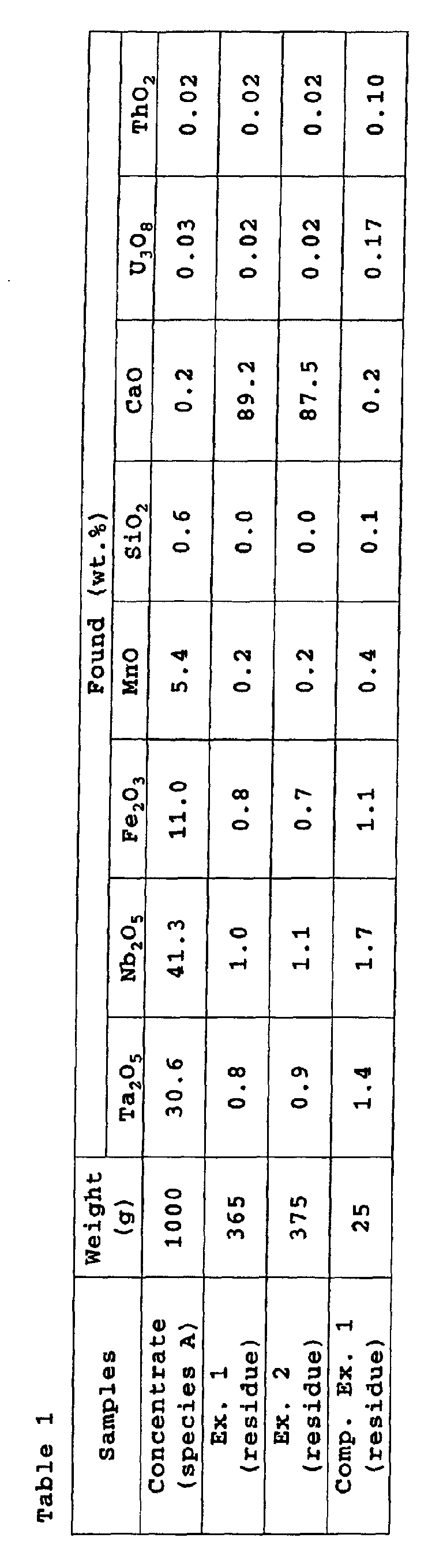
As is clear from Table 1, in Comparative Example 1,
concentration of radioactive substances occurred in the
extraction residue of small amount, whereas concentration of
radioactive substances in the extraction residue can be
prevented by employment of the method according to the
present invention.
According to the method of the present invention, the
radioactive substance content in an ore or a concentrate can
be controlled arbitrarily in the production of tantalum,
niobium, or a similar substance, and the radioactive
substance content can be maintained in an extraction residue
generated through a fluoridation process. As a result, since
no concentration of radioactive elements occurs, strict
measures against radioactivity can be omitted during
treatment of the extraction residue while the operator's
safety can be assured.
Claims (10)
- A method of producing a metal or a metal compound from an ingredient-regulated raw material obtained by mixing an ore or a concentrate containing a radioactive substance,
which method involves a fluoridation process and collection and refinement of the metallic component from the extract,
the fluoridation process including treating the ingredient-regulated raw material with hydrofluoric acid or a mixed acid containing, as an essential component, hydrofluoric acid, and separating the resultant mixture into an extract into which a metallic component is eluted and an extraction residue,
wherein the employed ingredient-regulating raw material comprises the ore or the concentrate containing a radioactive substance and, as an additive, a substance insoluble to hydrofluoric acid or to a mixed acid containing, as an essential component, hydrofluoric acid, to thereby control to an arbitrary value of 1.0 wt.% or less the ratio of the amount of the radioactive substance remaining in the extraction residue generated through the fluoridation process to the weight of the extraction residue. - A method of producing tantalum, niobium, or a similar substance from an ingredient-regulated raw material obtained by mixing an ore or a concentrate containing at least one of tantalum and niobium and a radioactive substance,
which method involves a fluoridation process and collection and refinement of tantalum, niobium, or a similar substance from the extract,
the fluoridation process including treating the ingredient-regulated raw material with hydrofluoric acid or a mixed acid containing, as an essential component, hydrofluoric acid, and separating the resultant mixture into an extract into which a metallic component is eluted and an extraction residue,
wherein the employed ingredient-regulating raw material comprises the ore or the concentrate containing a radioactive substance and, as an additive, a substance insoluble to hydrofluoric acid or to a mixed acid containing, as an essential component, hydrofluoric acid, to thereby control to an arbitrary value of 1.0 wt.% or less the ratio of the total amount of the radioactive substances, U3O8 and ThO2, remaining in the extraction residue generated through the fluoridation process to the weight of the extraction residue. - A method of producing a metal or a metal compound from an ore or a concentrate containing a radioactive substance,
which method involves a fluoridation process and collection and refinement of the metallic component from the extract,
the fluoridation process including treating said ingredient-regulated raw material with hydrofluoric acid or a mixed acid containing hydrofluoric acid as an essential component, and separating the resultant mixture into an extract into which a metallic component is eluted and an extraction residue,
wherein the ore or the concentrate containing a radioactive substance is employed as a raw material, and a substance insoluble to hydrofluoric acid or to a mixed acid containing hydrofluoric acid as an essential component employed in a fluoridation process is added during said fluoridation process, to thereby control to an arbitrary value of 1.0 wt.% or less the ratio of the amount of the radioactive substance remaining in the extraction residue generated through the fluoridation process to the weight of the extraction residue. - A method of producing tantalum, niobium, or a similar substance from an ore or a concentrate containing at least one of tantalum and niobium and a radioactive substance,
which method involves a fluoridation process and collection and refinement of the metallic component from the extract,
the fluoridation process including treating said ingredient-regulated raw material with hydrofluoric acid or a mixed acid containing hydrofluoric acid as an essential component, and separating the resultant mixture into an extract into which a metallic component is eluted and an extraction residue,
wherein the ore or the concentrate containing at least one of tantalum and niobium and a radioactive substance is employed as a raw material, and a substance insoluble to hydrofluoric acid or to a mixed acid containing hydrofluoric acid as an essential component employed in a fluoridation process is added during said fluoridation process, to thereby control to an arbitrary value of 1.0 wt.% or less the ratio of the amount of the radioactive substances, U3O8 and ThO2, remaining in the extraction residue generated through the fluoridation process to the weight of the extraction residue. - An ingredient-regulated raw material to be employed in a method of producing a metal or a metal compound as recited in claim 1, said ingredient-regulated raw material being a mixture comprising an ore or a concentrate containing a radioactive substance and a target metal or a similar substance at a grade of 50 wt.% or more based on the weight of the ore or the concentrate and at least, as an additive, a substance insoluble to hydrofluoric acid in an amount corresponding to the amount of the raw material removed through dissolution-extraction by use of hydrofluoric acid or insoluble to a mixed acid containing hydrofluoric acid as an essential component employed in the fluoridation process.
- An ingredient-regulated raw material to be employed in a method of producing tantalum, niobium, or a compound thereof as recited in claim 2, said ingredient-regulated raw material being a mixture comprising an ore or a concentrate containing Ta2O3 and Nb2O5 in a total amount of 50 wt.% or more based on the weight of the ore or the concentrate and at least, as an additive, a substance insoluble to hydrofluoric acid in an amount corresponding to the amount of the raw material removed through dissolution-extraction by use of hydrofluoric acid or insoluble to a mixed acid containing hydrofluoric acid as an essential component employed in the fluoridation process.
- An ingredient-regulated raw material as recited in claim 5 or 6, wherein the substance insoluble to hydrofluoric acid or a mixed acid containing hydrofluoric acid as an essential component serving as an additive for the raw material is added such that the amount of the substance reaches 5-50 wt.% of the ingredient-regulated raw material.
- An ingredient-regulated raw material as recited in claim 5 or 7, wherein the substance insoluble to hydrofluoric acid or a mixed acid containing hydrofluoric acid as an essential component serving as an additive is at least one component included in an extraction residue of an ore or a concentrate generated through a fluoridation process involved in a method of producing a metal or a metal compound.
- An ingredient-regulated raw material as recited in claim 6 or 7, wherein the substance insoluble to hydrofluoric acid or to a mixed acid containing hydrofluoric acid as an essential component serving as an additive, comprises at least one species selected from among barium oxide, barium sulfate, aluminum oxide, calcium salts, and lanthanide compounds serving as components of an extraction residue generated by subjecting an ore or a concentrate for collecting tantalum, niobium, or a similar substance to a fluoridation process involved in a method of producing tantalum, niobium, or a similar substance.
- An ingredient-regulated raw material as described in any one of claims 5 to 9, the substance insoluble to hydrofluoric acid or a mixed acid containing hydrofluoric acid as an essential component serving as an additive is a powder having an average particle size of 0.5 µm to 100 µm.
Applications Claiming Priority (3)
| Application Number | Priority Date | Filing Date | Title |
|---|---|---|---|
| JP2000276366 | 2000-09-12 | ||
| JP2000276366 | 2000-09-12 | ||
| PCT/JP2000/008948 WO2002022895A1 (en) | 2000-09-12 | 2000-12-18 | Method for producing metal or metal compound comprising process of treating with fluorine and adjusted raw material used therein |
Publications (2)
| Publication Number | Publication Date |
|---|---|
| EP1245685A1 true EP1245685A1 (en) | 2002-10-02 |
| EP1245685A4 EP1245685A4 (en) | 2005-06-08 |
Family
ID=26344997
Family Applications (1)
| Application Number | Title | Priority Date | Filing Date |
|---|---|---|---|
| EP00981794A Withdrawn EP1245685A4 (en) | 2000-09-12 | 2000-12-18 | PROCESS FOR PRODUCING METAL OR METAL COMPOUND COMPRISING FLUORINE TREATMENT PROCESS AND RAW MATERIAL USED THEREIN |
Country Status (10)
| Country | Link |
|---|---|
| US (1) | US6641641B2 (en) |
| EP (1) | EP1245685A4 (en) |
| JP (1) | JPWO2002022895A1 (en) |
| CN (1) | CN1378604A (en) |
| AU (1) | AU779342B2 (en) |
| BR (1) | BR0007290A (en) |
| EA (1) | EA004123B1 (en) |
| EE (1) | EE200100310A (en) |
| IL (1) | IL142616A (en) |
| WO (1) | WO2002022895A1 (en) |
Cited By (1)
| Publication number | Priority date | Publication date | Assignee | Title |
|---|---|---|---|---|
| WO2006136948A3 (en) * | 2005-02-03 | 2007-03-08 | Krupinite Corp Ltd | Chemical beneficiation of raw material, containing tantalum-niobium |
Families Citing this family (6)
| Publication number | Priority date | Publication date | Assignee | Title |
|---|---|---|---|---|
| CN100554445C (en) * | 2007-01-05 | 2009-10-28 | 中国科学院过程工程研究所 | A method for separating tantalum and niobium in potassium metatantalate and potassium metaniobate mixture |
| RU2421531C1 (en) * | 2010-02-01 | 2011-06-20 | Лидия Алексеевна Воропанова | Procedure for extraction of niobium from water solution containing fluorine |
| CN106929697A (en) * | 2017-04-18 | 2017-07-07 | 江苏圣亚有色金属材料有限公司 | A kind of purifying technique of pure niobium |
| CN111826521B (en) * | 2020-07-27 | 2022-02-01 | 东华理工大学 | Method for removing and separating uranium and thorium from ferrocolumbium concentrate |
| CN112080654B (en) * | 2020-09-25 | 2022-08-16 | 贵州省地质矿产中心实验室(贵州省矿产品黄金宝石制品质量检验站) | Method for recovering acid and silicon from phosphorus rare earth chemical concentrate leachate |
| EE01577U1 (en) * | 2020-10-13 | 2022-08-15 | Vaitkus Algirdas | A method for complete processing of organic and inorganic compounds |
Family Cites Families (11)
| Publication number | Priority date | Publication date | Assignee | Title |
|---|---|---|---|---|
| JPS4838320B1 (en) * | 1970-07-31 | 1973-11-16 | ||
| GB1382837A (en) * | 1971-09-17 | 1975-02-05 | Pilkington Brothers Ltd | Manufacture of patterned glass |
| AU8223375A (en) * | 1974-06-21 | 1976-12-23 | Univ Melbourne | Benefication of titaniferous ores |
| US4182744A (en) * | 1978-08-04 | 1980-01-08 | Teledyne Industries, Inc. | Extracting columbium-tantalum values from pyrochlore ores |
| SE415752B (en) * | 1979-02-20 | 1980-10-27 | Asea Atom Ab | SET TO REMOVE FLUOR IN THE FORM OF LOST FLUORIDES FROM A SOLUTION CONTAINING UP TO 20 G FLUOR |
| JPS5924730B2 (en) | 1979-12-25 | 1984-06-12 | 三菱マテリアル株式会社 | Method for removing and recovering uranium or/and thorium from a liquid containing uranium or/and thorium |
| CA1144376A (en) * | 1980-06-02 | 1983-04-12 | Gilles Legault | Leaching process for niobium and (or) tantalum minerals |
| US4451438A (en) * | 1982-03-26 | 1984-05-29 | Herman C. Starck Berlin | Process for recovering niobium and/or tantalum metal compounds from such ores further containing complexes of uranium, thorium, titanium and/or rare earth metals |
| BR8703766A (en) * | 1987-07-20 | 1989-01-31 | Mamore Mineracao E Metalurgica | MINING OPENING PROCESS |
| JPS6426199A (en) * | 1987-07-22 | 1989-01-27 | Syst Nogyo Center Kk | Treatment of radioactive waste |
| US5384105A (en) * | 1992-05-29 | 1995-01-24 | Eco Tek, Inc. | Metal and fluorine values recovery from mineral ore treatment |
-
2000
- 2000-12-18 US US09/787,908 patent/US6641641B2/en not_active Expired - Fee Related
- 2000-12-18 EE EEP200100310A patent/EE200100310A/en unknown
- 2000-12-18 IL IL14261600A patent/IL142616A/en not_active IP Right Cessation
- 2000-12-18 BR BR0007290A patent/BR0007290A/en not_active Application Discontinuation
- 2000-12-18 JP JP2001545475A patent/JPWO2002022895A1/en active Pending
- 2000-12-18 EP EP00981794A patent/EP1245685A4/en not_active Withdrawn
- 2000-12-18 CN CN00802512A patent/CN1378604A/en active Pending
- 2000-12-18 WO PCT/JP2000/008948 patent/WO2002022895A1/en not_active Ceased
- 2000-12-18 EA EA200100442A patent/EA004123B1/en not_active IP Right Cessation
- 2000-12-18 AU AU18932/01A patent/AU779342B2/en not_active Ceased
Cited By (2)
| Publication number | Priority date | Publication date | Assignee | Title |
|---|---|---|---|---|
| WO2006136948A3 (en) * | 2005-02-03 | 2007-03-08 | Krupinite Corp Ltd | Chemical beneficiation of raw material, containing tantalum-niobium |
| US7718147B2 (en) | 2005-02-03 | 2010-05-18 | Krupinite Corporation Ltd. | Chemical beneficiation of raw material containing tantalum-niobium |
Also Published As
| Publication number | Publication date |
|---|---|
| EP1245685A4 (en) | 2005-06-08 |
| AU779342B2 (en) | 2005-01-20 |
| BR0007290A (en) | 2002-04-30 |
| IL142616A (en) | 2004-06-20 |
| US20020174744A1 (en) | 2002-11-28 |
| AU1893201A (en) | 2002-03-26 |
| EA200100442A1 (en) | 2002-10-31 |
| US6641641B2 (en) | 2003-11-04 |
| EE200100310A (en) | 2003-04-15 |
| IL142616A0 (en) | 2002-06-30 |
| CN1378604A (en) | 2002-11-06 |
| EA004123B1 (en) | 2003-12-25 |
| WO2002022895A1 (en) | 2002-03-21 |
| JPWO2002022895A1 (en) | 2004-01-22 |
Similar Documents
| Publication | Publication Date | Title |
|---|---|---|
| Berry et al. | Alkali pug bake process for the decomposition of monazite concentrates | |
| Innocenzi et al. | Secondary yttrium from spent fluorescent lamps: Recovery by leaching and solvent extraction | |
| Nettleton et al. | The leaching of uranium from betafite | |
| Bahri et al. | Production of rare earth elements from Malaysian monazite by selective precipitation | |
| US6641641B2 (en) | Method for producing metal or metal compound comprising process of treating with fluorine and adjusted raw material used therein | |
| RU2180927C2 (en) | Processes of recovery of valuable metals from tantalumniobium ore carrying insoluble fluorides | |
| US5273725A (en) | Metal and fluorine values recovery from mineral ore treatment | |
| Figueiredo et al. | Determination of lanthanides (La, Ce, Nd, Sm) and other elements in metallic gallium by instrumental neutron activation analysis | |
| Rodriguez et al. | The effects of carboxylic acid addition on hydrofluoric acid autoclave leaching of a ferrocolumbite | |
| CA1241543A (en) | Processes for extracting radium from uranium mill tailings | |
| US4964996A (en) | Liquid/liquid extraction of rare earth/cobalt values | |
| US5384105A (en) | Metal and fluorine values recovery from mineral ore treatment | |
| CN104975192A (en) | Method for extracting scandium from scandium-containing material | |
| CA2166407C (en) | Method of extracting fluorine from minerals or mineral species | |
| US5385713A (en) | Metal and fluorine values recovery from mineral ore treatment | |
| El-Hazek et al. | Characterization and breakdown of South Gabal EL A’urf polymineralized ore material | |
| JP3709979B2 (en) | Method for producing raw material solution used for collecting and purifying tantalum, niobium, etc. | |
| Supriyatna et al. | Neodymium upgrading of tin slag using acid leaching and multistage precipitation | |
| Kanga et al. | RESEARCH ON THE PRESENCE AND REMOVAL OF RADIOACTIVE COLLOID IN THE SODIUM PHOSPHATE FROM MONAZITE | |
| AU696980B2 (en) | Method of extracting fluorine from minerals or mineral species | |
| US2894806A (en) | Recovery of protactinium from aqueous solutions | |
| EP4680779A2 (en) | Method for the preparation of mixed rare earth metal carbonates from monazite | |
| DE2536846C3 (en) | Gallium extraction process from gallium-containing alkali solutions of rare diffused metals | |
| DE102014206776B4 (en) | Process for treating iron-containing titanium raw materials | |
| Amaral et al. | Recovery of rare earth, uranium and thorium from industry residue leaching experiments |
Legal Events
| Date | Code | Title | Description |
|---|---|---|---|
| PUAI | Public reference made under article 153(3) epc to a published international application that has entered the european phase |
Free format text: ORIGINAL CODE: 0009012 |
|
| 17P | Request for examination filed |
Effective date: 20020429 |
|
| AK | Designated contracting states |
Kind code of ref document: A1 Designated state(s): AT BE CH CY DE DK ES FI FR GB GR IE IT LI LU MC NL PT SE TR |
|
| RBV | Designated contracting states (corrected) |
Designated state(s): AT BE DE |
|
| A4 | Supplementary search report drawn up and despatched |
Effective date: 20050425 |
|
| 17Q | First examination report despatched |
Effective date: 20050701 |
|
| STAA | Information on the status of an ep patent application or granted ep patent |
Free format text: STATUS: THE APPLICATION IS DEEMED TO BE WITHDRAWN |
|
| 18D | Application deemed to be withdrawn |
Effective date: 20051112 |