EP1245629A2 - High strength rubber formulations, and shear ply made from the same - Google Patents
High strength rubber formulations, and shear ply made from the same Download PDFInfo
- Publication number
- EP1245629A2 EP1245629A2 EP02252318A EP02252318A EP1245629A2 EP 1245629 A2 EP1245629 A2 EP 1245629A2 EP 02252318 A EP02252318 A EP 02252318A EP 02252318 A EP02252318 A EP 02252318A EP 1245629 A2 EP1245629 A2 EP 1245629A2
- Authority
- EP
- European Patent Office
- Prior art keywords
- conjugated
- kpa
- ethylenically unsaturated
- rubber component
- group
- Prior art date
- Legal status (The legal status is an assumption and is not a legal conclusion. Google has not performed a legal analysis and makes no representation as to the accuracy of the status listed.)
- Granted
Links
Images
Classifications
-
- F—MECHANICAL ENGINEERING; LIGHTING; HEATING; WEAPONS; BLASTING
- F02—COMBUSTION ENGINES; HOT-GAS OR COMBUSTION-PRODUCT ENGINE PLANTS
- F02K—JET-PROPULSION PLANTS
- F02K9/00—Rocket-engine plants, i.e. plants carrying both fuel and oxidant therefor; Control thereof
- F02K9/08—Rocket-engine plants, i.e. plants carrying both fuel and oxidant therefor; Control thereof using solid propellants
- F02K9/32—Constructional parts; Details not otherwise provided for
- F02K9/34—Casings; Combustion chambers; Liners thereof
- F02K9/346—Liners, e.g. inhibitors
-
- C—CHEMISTRY; METALLURGY
- C08—ORGANIC MACROMOLECULAR COMPOUNDS; THEIR PREPARATION OR CHEMICAL WORKING-UP; COMPOSITIONS BASED THEREON
- C08F—MACROMOLECULAR COMPOUNDS OBTAINED BY REACTIONS ONLY INVOLVING CARBON-TO-CARBON UNSATURATED BONDS
- C08F8/00—Chemical modification by after-treatment
- C08F8/04—Reduction, e.g. hydrogenation
-
- C—CHEMISTRY; METALLURGY
- C08—ORGANIC MACROMOLECULAR COMPOUNDS; THEIR PREPARATION OR CHEMICAL WORKING-UP; COMPOSITIONS BASED THEREON
- C08K—Use of inorganic or non-macromolecular organic substances as compounding ingredients
- C08K5/00—Use of organic ingredients
- C08K5/04—Oxygen-containing compounds
- C08K5/09—Carboxylic acids; Metal salts thereof; Anhydrides thereof
- C08K5/098—Metal salts of carboxylic acids
-
- C—CHEMISTRY; METALLURGY
- C08—ORGANIC MACROMOLECULAR COMPOUNDS; THEIR PREPARATION OR CHEMICAL WORKING-UP; COMPOSITIONS BASED THEREON
- C08K—Use of inorganic or non-macromolecular organic substances as compounding ingredients
- C08K5/00—Use of organic ingredients
- C08K5/04—Oxygen-containing compounds
- C08K5/14—Peroxides
-
- C—CHEMISTRY; METALLURGY
- C08—ORGANIC MACROMOLECULAR COMPOUNDS; THEIR PREPARATION OR CHEMICAL WORKING-UP; COMPOSITIONS BASED THEREON
- C08L—COMPOSITIONS OF MACROMOLECULAR COMPOUNDS
- C08L15/00—Compositions of rubber derivatives
- C08L15/005—Hydrogenated nitrile rubber
-
- Y—GENERAL TAGGING OF NEW TECHNOLOGICAL DEVELOPMENTS; GENERAL TAGGING OF CROSS-SECTIONAL TECHNOLOGIES SPANNING OVER SEVERAL SECTIONS OF THE IPC; TECHNICAL SUBJECTS COVERED BY FORMER USPC CROSS-REFERENCE ART COLLECTIONS [XRACs] AND DIGESTS
- Y10—TECHNICAL SUBJECTS COVERED BY FORMER USPC
- Y10S—TECHNICAL SUBJECTS COVERED BY FORMER USPC CROSS-REFERENCE ART COLLECTIONS [XRACs] AND DIGESTS
- Y10S526/00—Synthetic resins or natural rubbers -- part of the class 520 series
- Y10S526/938—Rubbery property
Definitions
- the present invention pertains to the field of high strength elastomers. More particularly, the present invention pertains to high strength elastomers suited for use in high temperature shear ply applications, such as for transferring loads from the pressure vessel of either a stand-alone composite rocket motor or strap-on composite booster to a rocket skirt.
- rocket motors generally comprise an outer motor casing for housing an energetic fuel or propellant.
- the outer motor casing houses a solid propellant formulated to undergo combustion while contributing to the production of adequate thrust for attaining propulsion of the rocket motor.
- Other types of rocket motors such as hybrid, reverse-hybrid motors, and bi-liquid motors, make use of a liquid oxidizer and/or liquid fuel.
- a rubber insulation layer and a liner positioned between the casing and the propellant serve to protect the rocket motor casing from high temperature combustion products generated as the propellant burns.
- Rocket motor casings are generally made of metal, a composite material, or a combination of metal and composite materials.
- Composite materials are typically prepared by winding a resin-impregnated fiber on a mandrel to shape the rocket motor casing.
- the resin may be a curable resin, and is normally either an epoxy or phenolic resin.
- the fibers are usually carbon graphite fibers or aramid fibers.
- the aft end portion of the rocket motor casing is directed to a rocket skirt.
- an outer surface portion of a composite rocket motor casing is covered with a shear ply layer for coupling the rocket motor casing to the skirt.
- High strength rubber compositions are often used for the forming shear ply layers that connect the rocket skirt with the composite rocket motor casing.
- Silica-filled nitrile polybutadiene rubber (NBR) compositions are presently used to form shear ply layers that connect a rocket skirt with a stand-alone composite rocket motor casing.
- the conventional NBR compositions have been found generally to exhibit a tensile strength and ultimate elongation on the order of 20,684 kPa (3000 psi) and 700 percent, respectively. Although these properties are adequate for stand-alone motor applications, new developments in rocketry call for the use of strap-on boosters across a wide temperature range.
- the strap-on design imparts higher loads to the shear ply than a stand-alone rocket motor. These higher load designs encountered in strap-on booster applications have created a perceived need for a novel shear ply material that possesses a higher tensile strength and improved high temperature properties compared to conventional silica-filled NBR compositions.
- Another object of the invention is to provide a rubber material that may have sufficient flexion, strength, and high temperature properties for use in a shear ply for rocketry applications. It is especially preferred by this object that the rubber material have a tensile strength and ultimate elongation that are sufficient for the intended preferred application of a shear ply.
- It is another object of this invention to provide a rocket motor assembly comprising a shear ply constructed and arranged for transferring loads between a coupled casing and skirt of the rocket motor assembly.
- Yet another object of the invention is to provide corresponding methods for making the high strength rubber material from the precursor composition, as well as methods of making and applying shear ply articles using the high strength rubber composition.
- a precursor composition that is curable into a rubber component and comprises:
- a rubber component formed from the precursor composition.
- a method in which components (a) and (b) of the precursor composition are mixed together to form a blend, and the blend is cured with a curing agent, such as a peroxide curing agent, to form the rubber component.
- a curing agent such as a peroxide curing agent
- a method for coupling a skirt to a composite rocket motor case of a rocket motor engine involves providing a rubber shear ply comprising the rubber component of this invention, and interposing the rubber shear ply between a skirt and a composite rocket motor case of a rocket motor assembly.
- the present invention overcomes the problems that are outlined above, addresses the above and other objects, and advances the art by providing a high strength rubber composition having improved strength across a broad temperature range for use in various applications. These applications include, but are not limited to, rocketry applications, especially in the context of forming shear ply layers.
- the term "rubber” is defined to encompass both synthetic and natural elastomers.
- the rubber composition in its various embodiments and methodologies, can facilitate the use of stronger rocket motors, as well as new types of motors.
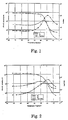
- Fig. 1 is a graph depicting spectrophotometrically estimated temperature dependant dynamic mechanical properties of a presently preferred rubber composition illustrating the present invention
- Fig. 2 is a graph showing comparative information with respect to that shown in Fig. 1, but where the data was obtained from the best available prior art material for use in making shear ply layers;
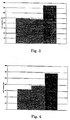
- Fig. 3 is a bar graph showing the relative shear strengths of prior art silica filled rubber compositions at 22°C (72°F) versus a presently preferred material illustrating the present invention.
- Fig. 4 is a comparative bar graph identical to Fig. 3, but showing data obtained from identical specimens at 38°C (100°F).
- the precursor composition according to an embodiment of this invention comprises a first hydrogenated nitrile conjugated-diene copolymer modified by a metal salt unsaturated carboxylic acid ester, and a second hydrogenated nitrile conjugated-diene copolymer not modified with the metal salt unsaturated carboxylic acid ester.
- Each of the hydrogenated nitrile conjugated-diene copolymers is derived from a respective composition comprising at least one respective ethylenically unsaturated nitrile and at least one respective conjugated diene.
- the ethylenically unsaturated nitriles of the first and second hydrogenated nitrile conjugated-diene copolymers may be the same or different.
- ethylenically unsaturated nitriles are acrylonitrile and methacrylonitrile, with acrylonitrile currently being preferred.
- ethylenically unsaturated means the presence of at least one carbon-carbon double bond.
- the conjugated dienes of the first and second hydrogenated nitrile conjugated-diene copolymers may be the same or different.
- Representative conjugated dienes for use in this invention include, for example, one or more members selected from the group consisting of butadiene, isoprene, dimethylbutadiene, 1,3-pentadiene, and piperylene. Of these, butadiene is currently preferred.
- the metal salt unsaturated carboxylic acid ester is derived from an ethylenically unsaturated carboxylic acid, which is preferably an ⁇ , ⁇ -ethylenically unsaturated carboxylic acid having at least one carboxyl group.
- the ethylenically unsaturated carboxylic acid may comprise at least one unsaturated monocarboxylic acid selected from the group consisting of acrylic acid, methacrylic acid, crotonic acid, and 3-butenic acid.
- the ethylenically unsaturated carboxylic acid may comprise at least one unsaturated dicarboxylic acid selected from the group consisting of maleic acid, fumaric acid, and itaconic acid. It is also possible to use combinations of monocarboxylic and dicarboxylic acids.
- Representative metals for the metal salt unsaturated carboxylic acid ester include zinc, magnesium, calcium, and aluminum, and combinations thereof.
- the metal salt unsaturated carboxylic acid ester may be derived from a metallic compound, such as a metal oxide, especially zinc oxide.
- the currently preferred metal salt unsaturated carboxylic acid ester comprises zinc dimethacrylate.
- the weight ratio of component (a) to component (b) in the precursor composition may be in a range of 85:15 to 30:70.
- a peroxide curing agent may constitute from 1 weight percent to 2 weight percent of the total weight of the precursor composition.
- the curing agent is preferably dispersed in a clay or other carrier that itself comprises from 1 weight percent to 3 weight percent of the total weight of the precursor composition.
- the peroxide curing agent is typically heated to an activation temperature whereupon the agent cleaves at the peroxide to form a pair of free-radicals that initiate the polymerization reaction.
- An especially preferred peroxide curing agent is 2,2'-bis(t-butylperoxy)diisopropyl benzene, which is preferably heated to an activation temperature of about 149°C (300°F) to 160°C (320°F) to initiate polymerization.
- Other conventional peroxide curing agents may be used to initiate at different temperatures as a matter of design choice.
- other initiators e.g., nitrobenzyl photoinitiators, may be used to initiate polymerization.
- the precursor has various rheological properties that facilitate related manufacturing processes using the precursor.
- Various precursor formulations that are described above have demonstrated the following rheological properties:
- Preferred precursors also contain an antioxidant in an amount ranging from 2 weight percent to 3 weight percent of the total weight of the precursor composition.
- the antioxidant preferably comprises an amine, and is most preferably selected from the group consisting of di-n-butylamine and phenyl- ⁇ -naphylamine.
- An imidazole antioxidant may be used in synergistic combination with the amine antioxidant, and the imidazole preferably comprises zinc 2-percaptotoluolimidazole.
- the invention pertains to a cured rubber composition that is derived from the precursor.
- the rubber composition may be formulated to provide an average shear strength in the finished rubber product greater than 17,237 kPa (2500 psi) when tested between 21°C (70°F) and 38°C (100°F) by single-lap shear specimens of structural rubber bonded to a graphite/fiber epoxy composite with a cross head rate of 0.051 cm/min (0.02 in/min).
- the 17,237 kPa (2500 psi) shear strength is approximately equal to the shear strength that is obtainable from the best silica-filled compositions available in the prior art.
- shear strength is normally greater than about 20,684 kPa (3000 psi), and shear strengths of 24,132 kPa (3500) psi are frequently obtained from finished shear ply materials that are formed of the rubber compositions described above.
- Other structural properties of the finished rubber composition may include one or more of the following properties, where the temperature is at about 21°C (70°F) unless otherwise specified:
- the precursor and finished rubber composition are, in presently preferred but merely illustrative embodiments of the invention, essentially free of silica, where the term "essentially” is hereby defined to mean free from all but trace elements of silica or as comprising less than 1% silica.
- the invention pertains to a method of making the rubber composition by blending components (a) and (b) into a mixture, and adding a crosslinking agent.
- Suitable blenders include conventional rubber mixing equipment, such as the BRABENDER and RELIABLE brand mixers. Mixing is preferably performed in a two-pass procedure, with the crosslinker and any cure catalysts or accelerants added in the second pass.
- Yet another aspect includes a method of making a shear ply material using the rubber composition and precursor.
- the aforementioned method of making the rubber composition may be modified to include making a shear ply for use in connecting a skirt to a rocket motor.
- This method includes the step of obtaining a precursor mixture as described above, adding a curing agent, activating the curing agent to polymerize the mixture, forming a laminate using the mixture; and adapting the laminate for use as a shear ply connecting a skirt with a rocket motor.
- the step of forming a laminate preferably includes forming a laminate made of the mixture and a fibrous material, such as a graphite fiber/epoxy composite.
- Table 1 The following ingredients shown in Table 1 were purchased from commercial vendors and combined into precursors for use in making structural rubber compositions. The materials were placed in a BRABENDER internal mixer to form 300 gram batch sizes for evaluation.
- ZSC 2295TM and Zetpol 2020TM were purchased from Zeon Chemicals of Louisville, Kentucky.
- the Zetpol 2020 product contains amine-stabilized butadiene in an amount ranging from 62.5 weight percent to 65.1 weight percent and acrylonitrile ranging from 34.9 weight percent to 37.5 weight percent of the product, where the product is hydrogenated to 91% saturation.
- Agerite Stalite S was purchased from the B.F. Goodrich Corporation of New York, New York.
- Agerite Stalite S functions as an amine antioxidant.
- Vanox ZMTI was purchased from the R.T. Vanderbilt Company, Inc. of New York, New York.
- Vanox ZMTI contains zinc 2-percaptotoluolimidazole, which functions as an imidazole antioxidant that is known to act synergistically with Agerite Stalite S to prolong the life of finished rubber products.
- Vul-Cup 40KE was purchased from Hercules Incorporated Corporation of Wilmington, Delaware.
- Vul-Cup 40KE contains 2,2'-bis(t-butylperoxy)diisopropyl benzene, which is dispersed in a clay carrier to a 40 percent by weight concentration.
- the examples were each prepared by a two-pass procedure. In the first pass, all ingredients other than the curative were added to a BRABENDER mixer at 25-40 rpm. This batch was dumped at 93°C (200°F). The second pass was performed at the same mixing speed, and dumped at 71°C (160°F).
- Table 1 shows the weight percentages of ingredients according to each mixture.
- Example 2 From these measurements, the rubber that resulted from Example 2 was determined to have the best properties for use in a shear ply layer for rocketry applications. However, all of the rubbers tested demonstrated sufficient properties of flexion and strength for use in these applications.
- Example 2 had superior properties of strength, flexibility and adhesion, so a scaled-up batch of Example 2 was produced in a 3000 gram batch size. A two-pass procedure was again used, with mixing speeds of 40 rpm in a RELIABLE brand mixer. Dump temperatures were 104°C (220°F) and 68°C (155°F) for the first and second passes, respectively.
- the scaled-up batch had the following rheological properties and physical properties shown in Tables 4 and 5, respectively.
- Property Example 2 Scale Up Mooney viscosity, ML 1 + 4 at 100°C (212°F) 65.7
- the following properties were determined by oscillating disk rheometer, 160°C (320°F), 5-degree arc ts2, min. 3.3 ML, in.-lb. 2.0 MH (after 2 hours), in.-lb. 49.0 Mc(90), in.-lb. 44.3 tc(90), min.
- Fig. 1 provides a graph of data that was obtained from the scale up formulation of Example 2 using a Rheometrics Dynamic Spectrometer at a frequency of 1 radian/second and at a strain of 0.2 percent.
- the peak occurred at -27.1°C for Example 2.
- a prior art silica filled NBR rubber composition that Thiokol Propulsion currently uses in its shear ply layers provided the results shown in Fig. 2, where the glass transition temperature is estimated at -31.5°C.
- Example 2 shows that the low temperature performance characteristics of the two rubber compositions are nearly the same with flexion of the prior art silica-filled composition being slightly better in terms of minimum temperature performance.
- the transition for Example 2 is much steeper, which indicates that Example 2 loses flexion over a narrower temperature range.
- the storage modulus G' of Example 2 falls well below the storage modulus of the prior art silica-filled composition at -10°C.
- a precursor as previously described was used to make a shear ply layer.
- the load bearing structural capacity of a shear ply layer including the solid rubbed composition was tested by curing a rubber sample, laminating the rubber sample to a graphite fiber/epoxy composite, then curing the composite. Similar laminates were made and tested using the prior art silica-filled composition. The samples were tested at 22°C (72°F) and 38°C (100°F) using a conventional lap shear testing machine at a cross-head rate of 0.051 cm/minute (0.02 inches/minute). Fig.
- Fig. 4 provides an identical comparison to that shown in Fig. 3, except the results shown in Fig. 4 were obtained at 38°C (100°F).
- the silica-filled specimens show a shear strength performance reduction to less than 13,789 kPa (2000 psi), while Example 2 continued to demonstrate performance in excess of 17,237 kPa (2500 psi).
Landscapes
- Chemical & Material Sciences (AREA)
- Polymers & Plastics (AREA)
- Health & Medical Sciences (AREA)
- Chemical Kinetics & Catalysis (AREA)
- Medicinal Chemistry (AREA)
- Organic Chemistry (AREA)
- Engineering & Computer Science (AREA)
- Combustion & Propulsion (AREA)
- Mechanical Engineering (AREA)
- General Engineering & Computer Science (AREA)
- General Chemical & Material Sciences (AREA)
- Compositions Of Macromolecular Compounds (AREA)
- Manufacture Of Macromolecular Shaped Articles (AREA)
Abstract
Description
- a Mooney viscosity ranging between 60 and 80 determined as ML1 + 4 at 100°C (212°F),
- a TS2 ranging between 3.0 and 4.5 minutes determined by oscillating disk rheometer at 160°C (320°F) over a 5° arc,
- a minimum torque (ML) ranging from 0.45 to 1.13 N·m (4.0 to 10.0 in-lb) determined by oscillating disk rheometer at 160°C (320°F) over a 5° arc,
- a maximum torque (MH) after 2 hours ranging between 4.5 to 7.9 N·m (40 and 70 in-lb),
- an Mc(90) ranging between 4.0 to 6.8 N·m (35 and 60 in-lb) determined by oscillating disk rheometer at 160°C (320°F) over a 5° arc, and
- a tc(90) ranging from 20 and 45 minutes determined by oscillating disk rheometer at 160°C (320°F) over a 5° arc.
- a specific gravity in a range of 1.07 to 1.14,
- a Shore A hardness in a range of 60 to 75,
- a 100 percent modulus in a range from 2413 kPa (350 psi) to 5861 kPa (850 psi),
- a tensile strength in a range from 37,921 kPa (5500 psi) to 44,126 kPa (6400 psi),
- an elongation percent in a range of 423 to 564, and
- a tear resistance in a range of 1896 kPa (275 psi) and 2586 kPa (375 psi).
| STRUCTURAL RUBBER FORMULATIONS (Parts By Weight) | ||||
| Commercial Product | Example 1 | Example 2 | Example 3 | Example 4 |
| ZSC 2295 | 60.00 | 60.00 | 50.00 | 50.00 |
| Zetpol 2020 | 40.00 | 40.00 | 50.00 | 50.00 |
| Agerite Stalite S | 1.50 | 1.50 | 1.50 | 1.50 |
| Vanox ZMTI | 1.00 | 1.00 | 1.00 | 1.00 |
| Vul-Cup 40KE | 5.00 | 3.00 | 5.00 | 3.00 |
| Total | 107.50 | 105.50 | 107.50 | 105.50 |
| RHEOLOGICAL CHARACTERISTICS | ||||
| Property | Example 1 | Example 2 | Example 3 | Example 4 |
| Mooney viscosity, ML 1 + 4 at 100°C (212 F) | 66.8 | 69.4 | 68.4 | 72.2 |
| The following properties were determined by oscillating disk | ||||
| rheometer, 160°C (320°F), 5-degree arc | ||||
| ts2,min. | 3.2 | 3.7 | 3.3 | 3.9 |
| ML, in.-lb. | 5.2 | 4.8 | 4.8 | 8.0 |
| MH (after 2 hours), in.-lb. | 60.0 | 47.5 | 52.5 | 45.5 |
| Mc(90), in.-lb. | 54.5 | 43.2 | 47.7 | 41.8 |
| tc (90), min. | 26.1 | 28.4 | 27.1 | 37.5 |
| PHYSICAL PROPERTIES OF THE STRUCTURAL RUBBERS AFTER THERMAL ACTIVATION OF CURING AGENT AT 160°C | ||||
| Property | Example 1 | Example 2 | Example 3 | Example 4 |
| Specific gravity | 1.1207 | 1.1118 | 1.0938 | 1.0851 |
| Shore A hardness | 71.2 | 67.0 | 66.3 | 63.1 |
| 100 percent modulus, psi | 766 | 527 | 547 | 372 |
| Tensile strength, psi | 6140 | 6100 | 6000 | 5940 |
| Elongation, percent | 423 | 539 | 442 | 564 |
| Tear resistance, psi | 317 | 347 | 296 | 312 |
| PROCESSING CHARACTERISTICS AND CURING PROPERTIES OF THE SCALED UP VERSION OF EXAMPLE 2 | |
| Property | Example 2 (Scale Up) |
| Mooney viscosity, ML 1 + 4 at 100°C (212°F) | 65.7 |
| The following properties were determined by oscillating disk rheometer, 160°C (320°F), 5-degree arc | |
| ts2, min. | 3.3 |
| ML, in.-lb. | 2.0 |
| MH (after 2 hours), in.-lb. | 49.0 |
| Mc(90), in.-lb. | 44.3 |
| tc(90), min. | 36.0 |
| PHYSICAL PROPERTIES OF THE SCALED UP VERSION OF EXAMPLE 2 | |
| Property | Example 2 (Scale Up) |
| Specific gravity | 1.1058 |
| Shore A hardness | 72.6 |
| 100 percent modulus, psi | 540 |
| Tensile strength psi | 5440 |
| Elongation, percent | 460 |
| Tear resistance, psi | 347 |
Claims (73)
- A precursor composition having a total weight and curable into a rubber component, the precursor composition comprising:wherein (a) and (b) are intermixed.(a) a first hydrogenated nitrile conjugated-diene copolymer modified by a metal salt unsaturated carboxylic acid ester, wherein the hydrogenated nitrile conjugated-diene copolymer is derived from a first composition comprising a first ethylenically unsaturated nitrile and a first conjugated diene;(b) a second hydrogenated nitrile conjugated-diene copolymer derived from a second composition comprising a second ethylenically unsaturated nitrile and a second conjugated diene; and(c) a curing agent,
- A precursor composition according to claim 1, wherein the first and second ethylenically unsaturated nitriles are identical or different, and are each selected to comprise at least one member selected from the group consisting of acrylonitrile and methacrylonitrile.
- A precursor composition according to claim 1, wherein the first and second ethylenically unsaturated nitriles each comprise acrylonitrile.
- A precursor composition according to claim 1, wherein the first and second conjugated dienes are identical or different, and are each selected to comprise at least one member selected from the group consisting of butadiene, isoprene, dimethylbutadiene, 1,3-pentadiene, and piperylene.
- A precursor composition according to claim 1, wherein the first and second conjugated dienes each comprise butadiene.
- A precursor composition according to claim 1, wherein the metal salt unsaturated carboxylic acid ester is derived from at least one ethylenically unsaturated monocarboxylic acid and at least one member selected from the group consisting of a metal and metallic compound, and
wherein the ethylenically unsaturated monocarboxylic acid comprises at least one member selected from the group consisting of acrylic acid, methacrylic acid, crotonic acid, and 3-butenic acid. - A precursor composition according to claim 1, wherein the metal salt unsaturated carboxylic acid ester is derived from at least one ethylenically unsaturated dicarboxylic acid and at least one member selected from the group consisting of a metal and metallic compound, and wherein the ethylenically unsaturated dicarboxylic acid comprises at least one member selected from the group consisting of maleic acid, fumaric acid, and itaconic acid.
- A precursor composition according to claim 1, wherein the metal salt comprises at least one element selected from the group consisting of zinc, magnesium, calcium, and aluminum.
- A precursor composition according to claim 1, wherein the metal salt unsaturated carboxylic acid ester comprises zinc dimethacrylate.
- A precursor composition according to claim 1, wherein the curing agent comprises a peroxide curing agent.
- A precursor composition according to claim 1, wherein the curing agent comprises 2,2'-bis(t-butylperoxy)diisopropyl benzene.
- A precursor composition according to claim 1, wherein the curing agent is dispersed in a clay carrier.
- A precursor composition according to claim 1, wherein the precursor composition is essentially free of silica.
- A precursor composition according to claim 1, wherein (a) and (b) are formulated and present in an effective ratio to provide:a Mooney viscosity in a range of 60 to 80 determined as ML1+4 at 100°C;a TS2 ranging in a range of 3.0 to 4.5 minutes determined by oscillating disk rheometer at 160°C over a 5° arc;a ML ranging in a range of 4.0 to 10.0 in.-lb determined by oscillating disk rheometer at 160°C over a 5° arc;a MH after 2 hours in a range of 40.0 to 70 in.-lb;an Mc(90) in a range of 35 to 60 in.-lb determined by oscillating disk rheometer at 160°C over a 5° arc; anda tc(90) in a range of 20 to 45 minutes determined by oscillating disk rheometer at 160°C over a 5° arc.
- A precursor composition according to claim 1, wherein (a), (b), and (c) are formulated and present in effective ratios to provide, upon curing of the precursor composition into the rubber component, an average shear strength in the rubber product greater than 24,132 kPa when tested at 21°C by single-lap shear specimens of the rubber product bonded to a graphite/fiber epoxy composite with acrosshead rate of 0.0508 cm/min.
- A precursor composition according to claim 1, wherein (a), (b), and (c) are formulated and present in effective ratios to provide, upon curing of the precursor composition into the rubber component, an average shear strength in the rubber product greater than 17237 kPa when tested at 38°C by single-lap shear specimens of the rubber product bonded to a graphite/fiber epoxy composite with acrosshead rate of 0.0508 cm/min.
- A precursor composition according to claim 1, wherein (a), (b), and (c) are formulated and present in effective ratios to provide, upon curing of the precursor composition into the rubber component, as determined at 21°C,
a specific gravity in a range of 1.07 to 1.14,
a Shore A hardness in a range of 60 to 75,
a 100 percent modulus in a range of 2413 kPa to 5861 kPa,
a tensile strength in a range of 37,921 kPa to 44,126 kPa,
an elongation percent in a range of 400 to 575, and
a tear resistance in a range of 1896 kPa to 2586 kPa. - A precursor composition according to claim 1, wherein carbon-carbon double bonds in each of the first hydrogenated nitrile conjugated-diene copolymer and the second hydrogenated nitrile conjugated-diene copolymer are hydrogenated to 85% to 95% of saturation.
- A precursor composition according to claim 1, wherein carbon-carbon double bonds in each of the first hydrogenated nitrile conjugated-diene copolymer and the second hydrogenated nitrile conjugated-diene copolymer are hydrogenated to 90% to 92% of saturation.
- A rubber component having a total weight, the rubber component being formed from a precursor composition comprising:wherein (a) and (b) are intermixed.(a) a first hydrogenated nitrile conjugated-diene copolymer modified by a metal salt unsaturated carboxylic acid ester, wherein the hydrogenated nitrile conjugated-diene copolymer is derived from a first composition comprising a first ethylenically unsaturated nitrile and a first conjugated diene;(b) a second hydrogenated nitrile conjugated-diene copolymer derived from a second composition comprising a second ethylenically unsaturated nitrile and a second conjugated diene; and(c) a curing agent,
- A rubber component according to claim 20, wherein the first and second ethylenically unsaturated nitriles are identical or different, and are each selected to comprise at least one member selected from the group consisting of acrylonitrile and methacrylonitrile.
- A rubber component according to claim 20, wherein the first and second ethylenically unsaturated nitriles each comprise acrylonitrile.
- A rubber component according to claim 20, wherein the first and second conjugated dienes are identical or different, and are each selected to comprise at least one member selected from the group consisting of butadiene, isoprene, dimethylbutadiene, 1,3-pentadiene, and piperylene.
- A rubber component according to claim 20, wherein the first and second conjugated dienes each comprise butadiene.
- A rubber component according to claim 20, wherein the metal salt unsaturated carboxylic acid ester is derived from at least one ethylenically unsaturated monocarboxylic acid and at least one member selected from the group consisting of a metal and metallic compound, and wherein the ethylenically unsaturated monocarboxylic acid comprises at least one member selected from the group consisting of acrylic acid, methacrylic acid, crotonic acid, and 3-butenic acid.
- A rubber component according to claim 20, wherein the metal salt unsaturated carboxylic acid ester is derived from at least one ethylenically unsaturated dicarboxylic acid and at least one member selected from the group consisting of a metal and metallic compound, and wherein the ethylenically unsaturated dicarboxylic acid comprises at least one member selected from the group consisting of maleic acid, fumaric acid, and itaconic acid.
- A rubber component according to claim 20, wherein the metal salt comprises at least one element selected from the group consisting of zinc, magnesium, calcium, and aluminum.
- A rubber component according to claim 20, wherein the metal salt unsaturated carboxylic acid ester comprises zinc dimethacrylate.
- A rubber component according to claim 20, wherein the curing agent comprises a peroxide curing agent.
- A rubber component according to claim 20, wherein the curing agent comprises 2,2'-bis(t-butylperoxy)diisopropyl benzene.
- A rubber component according to claim 20, wherein the curing agent is dispersed in a clay carrier.
- A rubber component according to claim 20, wherein the rubber component is essentially free of silica.
- A rubber component according to claim 20, wherein (a), (b), and (c) are formulated and present in effective ratios to provide the rubber component with an average shear strength in the rubber product greater than 24,132 kPa when tested at 21°C by single-lap shear specimens of the rubber product bonded to a graphite/fiber epoxy composite with acrosshead rate of 0.0508 cm/min.
- A rubber component according to claim 20, wherein (a), (b), and (c) are formulated and present in effective ratios to provide the rubber component with an average shear strength in the rubber product greater than 17237 kPa when tested at 38°C by single-lap shear specimens of the rubber product bonded to a graphite/fiber epoxy composite with acrosshead rate of 0.0508 cm/min.
- A rubber component according to claim 20, wherein (a), (b), and (c) are formulated and present in effective ratios to provide the rubber component with, as determined at 21°C,
a specific gravity in a range of 1.07 to 1.14,
a Shore A hardness in a range of 60 to 75,
a 100 percent modulus in a range of 2413 kPa to 5861 kPa,
a tensile strength in a range of 37,921 kPa to 44,126 kPa,
an elongation percent in a range of 400 to 575, and
a tear resistance in a range of 1896 kPa to 2586 kPa. - A rubber component according to claim 20, wherein carbon-carbon double bonds in each of the first hydrogenated nitrile conjugated-diene copolymer and the second hydrogenated nitrile conjugated-diene copolymer are hydrogenated to 85% to 95% of saturation.
- A rubber component according to claim 20, wherein carbon-carbon double bonds in each of the first hydrogenated nitrile conjugated-diene copolymer and the second hydrogenated nitrile conjugated-diene copolymer are hydrogenated to 90% to 92% of saturation.
- A method of making a rubber component, the method comprising:(a) providing a first hydrogenated nitrile conjugated-diene copolymer modified with a metal salt unsaturated carboxylic acid ester, wherein the hydrogenated nitrile conjugated-diene copolymer is derived from a first composition comprising a first ethylenically unsaturated nitrile and a first conjugated diene;(b) providing a second hydrogenated nitrile conjugated-diene copolymer derived from a second composition comprising a second ethylenically unsaturated nitrile and a second conjugated diene;(c) blending components provided by (a) and (b) to form a blend; and(d) curing the blend with a curing agent to form the rubber component.
- A method according to claim 38, wherein the first and second ethylenically unsaturated nitriles are identical or different, and are each selected to comprise at least one member selected from the group consisting of acrylonitrile and methacrylonitrile.
- A method according to claim 38, wherein the first and second ethylenically unsaturated nitrites each comprise acrylonitrile.
- A method according to claim 38, wherein the first and second conjugated dienes are identical or different, and are each selected to comprise at least one member selected from the group consisting of butadiene, isoprene, dimethylbutadiene, 1,3-pentadiene, and piperylene.
- A method according to claim 38, wherein the first and second conjugated dienes each comprise butadiene.
- A method according to claim 38, wherein the metal salt unsaturated carboxylic acid ester is derived from at least one ethylenically unsaturated monocarboxylic acid and at least one member selected from the group consisting of a metal and metallic compound, and wherein the ethylenically unsaturated monocarboxylic acid comprises at least one member selected from the group consisting of acrylic acid, methacrylic acid, crotonic acid, and 3-butenic acid.
- A method according to claim 38, wherein the metal salt unsaturated carboxylic acid ester is derived from at least one ethylenically unsaturated dicarboxylic acid and at least one member selected from the group consisting of a metal and metallic compound, and wherein the ethylenically unsaturated dicarboxylic acid comprises at least one member selected from the group consisting of maleic acid, fumaric acid, and itaconic acid.
- A method according to claim 38, wherein the metal salt comprises at least one element selected from the group consisting of zinc, magnesium, calcium, and aluminum.
- A method according to claim 38, wherein the metal salt unsaturated carboxylic acid ester comprises zinc dimethacrylate.
- A method according to claim 38, wherein the curing agent comprises a peroxide curing agent.
- A method according to claim 38, wherein the curing agent comprises 2,2'-bis(t-butylperoxy)diisopropyl benzene.
- A method according to claim 38, wherein the curing agent is dispersed in a clay carrier.
- A method according to claim 38, wherein the rubber component is essentially free of silica.
- A method according to claim 38, wherein the rubber component is formulated to provide an average shear strength in the rubber product greater than 24,132 kPa when tested at 21°C by single-lap shear specimens of the rubber product bonded to a graphite/fiber epoxy composite with acrosshead rate of 0.0508 cm/min.
- A method according to claim 38, wherein the rubber component is formulated to provide an average shear strength in the rubber product greater than 17237 kFa when tested at 38°C by single-lap shear specimens of the rubber product bonded to a graphite/fiber epoxy composite with acrosshead rate of 0.0508 cm/min.
- A method according to claim 38, wherein the rubber component is formulated to provide, as determined at 21°C,
a specific gravity in a range of 1.07 to 1.14,
a Shore A hardness in a range of 60 to 75,
a 100 percent modulus in a range of 2413 kPa to 5861 kPa,
a tensile strength in a range of 37,921 kPa to 44,126 kPa,
an elongation percent in a range of 400 to 575, and
a tear resistance in a range of 1896 kPa to 2586 kPa. - A method according to claim 38, wherein carbon-carbon double bonds in each of the first hydrogenated nitrile conjugated-diene copolymer and the second hydrogenated nitrile conjugated-diene copolymer are hydrogenated to 85% to 95% of saturation.
- A method according to claim 38, wherein carbon-carbon double bonds in each of the first hydrogenated nitrile conjugated-diene copolymer and the second hydrogenated nitrile conjugated-diene copolymer are hydrogenated to 90% to 92% of saturation.
- A method of transferring loads between a skirt and a composite rocket motor case of a rocket motor assembly, the method comprising:(a) providing a first hydrogenated nitrile conjugated-diene copolymer modified with a metal salt unsaturated carboxylic acid ester, wherein the hydrogenated nitrile conjugated-diene copolymer is derived from a first composition comprising a first ethylenically unsaturated nitrile and a first conjugated diene, wherein the metal salt unsaturated carboxylic acid ester is derived from an ethylenically unsaturated carboxylic acid having at least one carboxyl group and at least one member selected from the group consisting of a metal and metallic compound;(b) providing a second hydrogenated nitrile conjugated-diene copolymer derived from a second composition comprising a second ethylenically unsaturated nitrile and a second conjugated diene;(c) blending components (a) and (b) to form a blend;(d) curing the blend with a curing agent to form a rubber shear ply; and(e) interposing the rubber shear ply between the skirt and the composite rocket motor case.
- A method according to claim 56, wherein the first and second ethylenically unsaturated nitriles are identical or different, and are each selected to comprise at least one member selected from the group consisting of acrylonitrile and methacrylonitrile.
- A method according to claim 56, wherein the first and second ethylenically unsaturated nitriles each comprise acrylonitrile.
- A method according to claim 56, wherein the first and second conjugated dienes are identical or different, and are each selected to comprise at least one member selected from the group consisting of butadiene, isoprene, dimethylbutadiene, 1,3-pentadiene, and piperylene.
- A method according to claim 56, wherein the first and second conjugated dienes each comprise butadiene.
- A method according to claim 56, wherein the metal salt unsaturated carboxylic acid ester is derived from at least one ethylenically unsaturated monocarboxylic acid and at least one member selected from the group consisting of a metal and metallic compound, and wherein the ethylenically unsaturated monocarboxylic acid comprises at least one member selected from the group consisting of acrylic acid, methacrylic acid, crotonic acid, and 3-butenic acid.
- A method according to claim 56, wherein the metal salt unsaturated carboxylic acid ester is derived from at least one ethylenically unsaturated dicarboxylic acid and at least one member selected from the group consisting of a metal and metallic compound, and wherein the ethylenically unsaturated dicarboxylic acid comprises at least one member selected from the group consisting of maleic acid, fumaric acid, and itaconic acid.
- A method according to claim 56, wherein the metal salt comprises at least one element selected from the group consisting of zinc, magnesium, calcium, and aluminum.
- A method according to claim 56, wherein the metal salt unsaturated carboxylic acid ester comprises zinc dimethacrylate.
- A method according to claim 56, wherein the curing agent comprises a peroxide curing agent.
- A method according to claim 56, wherein the curing agent comprises 2,2'-bis(t-butylperoxy)diisopropyl benzene.
- A method according to claim 56, wherein the curing agent is dispersed in a clay carrier.
- A method according to claim 56, wherein the rubber shear ply is essentially free of silica.
- A method according to claim 56, wherein the rubber shear ply is formulated to provide an average shear strength in the rubber product greater than 24,132 kPa when tested at 21°C by single-lap shear specimens of the rubber product bonded to a graphite/fiber epoxy composite with acrosshead rate of 0.0508 cm/min.
- A method according to claim 56, wherein the rubber shear component is formulated to provide an average shear strength in the rubber product greater than 17237 kPa when tested at 38°C by single-lap shear specimens of the rubber product bonded to a graphite/fiber epoxy composite with acrosshead rate of 0.0508 cm/min.
- A method according to claim 56, wherein the rubber shear ply is formulated to provide, as determined at 21°C,
a specific gravity in a range of 1.07 to 1.14,
a Shore A hardness in a range of 60 to 75,
a 100 percent modulus in a range of 2413 kPa to 5861 kPa,
a tensile strength in a range of 37,921 kPa to 44,126 kPa,
an elongation percent in a range of 400 to 575, and
a tear resistance in a range of 1896 kPa to 2586 kPa. - A method according to claim 56, wherein carbon-carbon double bonds in each of the first hydrogenated nitrile conjugated-diene copolymer and the second hydrogenated nitrile conjugated-diene copolymer are hydrogenated to 85% to 95% of saturation.
- A method according to claim 56, wherein carbon-carbon double bonds in each of the first hydrogenated nitrile conjugated-diene copolymer and the second hydrogenated nitrile conjugated-diene copolymer are hydrogenated to 90% to 92% of saturation.
Applications Claiming Priority (2)
| Application Number | Priority Date | Filing Date | Title |
|---|---|---|---|
| US27956001P | 2001-03-29 | 2001-03-29 | |
| US279560P | 2001-03-29 |
Publications (3)
| Publication Number | Publication Date |
|---|---|
| EP1245629A2 true EP1245629A2 (en) | 2002-10-02 |
| EP1245629A3 EP1245629A3 (en) | 2003-09-24 |
| EP1245629B1 EP1245629B1 (en) | 2006-08-16 |
Family
ID=23069504
Family Applications (1)
| Application Number | Title | Priority Date | Filing Date |
|---|---|---|---|
| EP02252318A Expired - Lifetime EP1245629B1 (en) | 2001-03-29 | 2002-03-28 | High strength rubber formulations, and shear ply made from the same |
Country Status (3)
| Country | Link |
|---|---|
| US (2) | US6750293B2 (en) |
| EP (1) | EP1245629B1 (en) |
| JP (1) | JP4328056B2 (en) |
Cited By (2)
| Publication number | Priority date | Publication date | Assignee | Title |
|---|---|---|---|---|
| WO2006132325A1 (en) | 2005-06-10 | 2006-12-14 | Nok Corporation | Rubber blend composition |
| EP2294133A4 (en) * | 2008-07-02 | 2011-12-07 | Zeon Chemicals Lp | Fast curing vulcanizable multi-part elastomer composition, and process for blending, injection molding and curing of elastomer composition |
Families Citing this family (2)
| Publication number | Priority date | Publication date | Assignee | Title |
|---|---|---|---|---|
| US6750293B2 (en) * | 2001-03-29 | 2004-06-15 | Alliant Techsystems, Inc. | High-strength rubber formulations, and shear ply made from the same |
| US8426524B2 (en) * | 2006-12-06 | 2013-04-23 | Veyance Technologies, Inc | Elastomeric blend for vehicle timing belt |
Family Cites Families (21)
| Publication number | Priority date | Publication date | Assignee | Title |
|---|---|---|---|---|
| US3620901A (en) * | 1969-06-23 | 1971-11-16 | Gen Tire & Rubber Co | Elastomeric laminate composition |
| JPH086007B2 (en) * | 1988-06-10 | 1996-01-24 | 日本ゼオン株式会社 | Vulcanizable rubber composition |
| US4953476A (en) * | 1990-01-16 | 1990-09-04 | Sayles David C | Siloxane-based elastomeric interceptor motor insulation |
| JP2599056B2 (en) | 1991-10-04 | 1997-04-09 | 東海ゴム工業株式会社 | Rubber composition |
| US5370915A (en) | 1992-01-08 | 1994-12-06 | The Yokohama Rubber Co., Ltd. | Rubber-rubber bonded composite structure |
| US5257761A (en) * | 1992-02-24 | 1993-11-02 | Hercules Incorporated | Assembly and method for attaching a pressure vessel to another object |
| JP3243829B2 (en) * | 1992-03-27 | 2002-01-07 | 日本ゼオン株式会社 | Vulcanizable rubber composition |
| US5756586A (en) | 1993-03-31 | 1998-05-26 | Nippon Zeon Co., Ltd. | Vulcanizable rubber composition with unsaturated and metal compounds and organic peroxides |
| US5731371A (en) | 1995-12-18 | 1998-03-24 | Lisco, Inc. | ZDMA grafted HNBR in a one-piece golf ball |
| DE69729082T2 (en) | 1996-03-29 | 2005-04-21 | Zeon Corp | HIGH-SATURATED NITRILE-COPOLYMER RUBBER, METHOD OF ITS PRODUCTION, RUBBER COMPOSITIONS CONTAINING RUBBER, AND COMPOSITE MATERIALS CONTAINING RUBBER AND FIBER |
| JP2843549B2 (en) * | 1996-04-23 | 1999-01-06 | 三ツ星ベルト株式会社 | Manufacturing method of double cog belt |
| CA2203617C (en) * | 1996-04-26 | 2000-08-08 | Hiroshi Jonen | Power transmission belt |
| US6739854B1 (en) * | 1997-01-16 | 2004-05-25 | Mitsubishi Belting Ltd. | Method and system for treating a power transmission belt/belt sleeve |
| CA2229629C (en) | 1997-03-13 | 2007-08-14 | The Goodyear Tire & Rubber Company | High modulus belt composition and belts made therewith |
| US6132328A (en) * | 1997-03-31 | 2000-10-17 | Mitsuboshi Belting Ltd. | Load carrying cord and power transmission belt incorporating the load carrying cord |
| US6352488B1 (en) * | 1999-03-05 | 2002-03-05 | The Goodyear Tire & Rubber Company | Power transmission belt |
| US6606852B1 (en) | 1999-07-12 | 2003-08-19 | Alliant Techsystems Inc. | Rocket motor insulation containing hydrophobic particles |
| US6554936B1 (en) * | 1999-09-08 | 2003-04-29 | Alliant Techsystems Inc. | Method of constructing insulated metal dome structure for a rocket motor |
| US6443866B1 (en) * | 2000-08-14 | 2002-09-03 | The Goodyear Tire & Rubber Company | Power transmission belt |
| US6403722B1 (en) * | 2000-10-03 | 2002-06-11 | The University Of Akron | Dynamically vulcanized elastomeric blends including hydrogenated acrylonitrile-butadiene copolymers |
| US6750293B2 (en) * | 2001-03-29 | 2004-06-15 | Alliant Techsystems, Inc. | High-strength rubber formulations, and shear ply made from the same |
-
2002
- 2002-03-27 US US10/107,594 patent/US6750293B2/en not_active Expired - Lifetime
- 2002-03-28 EP EP02252318A patent/EP1245629B1/en not_active Expired - Lifetime
- 2002-03-29 JP JP2002094453A patent/JP4328056B2/en not_active Expired - Fee Related
-
2004
- 2004-02-19 US US10/783,867 patent/US20040167278A1/en not_active Abandoned
Cited By (3)
| Publication number | Priority date | Publication date | Assignee | Title |
|---|---|---|---|---|
| WO2006132325A1 (en) | 2005-06-10 | 2006-12-14 | Nok Corporation | Rubber blend composition |
| EP1806381A4 (en) * | 2005-06-10 | 2008-06-18 | Nok Corp | Rubber blend composition |
| EP2294133A4 (en) * | 2008-07-02 | 2011-12-07 | Zeon Chemicals Lp | Fast curing vulcanizable multi-part elastomer composition, and process for blending, injection molding and curing of elastomer composition |
Also Published As
| Publication number | Publication date |
|---|---|
| JP2003041061A (en) | 2003-02-13 |
| US20040167278A1 (en) | 2004-08-26 |
| EP1245629A3 (en) | 2003-09-24 |
| JP4328056B2 (en) | 2009-09-09 |
| EP1245629B1 (en) | 2006-08-16 |
| US6750293B2 (en) | 2004-06-15 |
| US20020193524A1 (en) | 2002-12-19 |
Similar Documents
| Publication | Publication Date | Title |
|---|---|---|
| JP2939489B2 (en) | Rubber roll and rubber composition for rubber roll | |
| US5821284A (en) | Durable motor insulation | |
| JP3936293B2 (en) | Method for directly bonding rubber and at least one second substrate and article obtained by said method | |
| JP4384818B2 (en) | New EPDM rocket motor insulator | |
| US4878431A (en) | Elastomeric insulating materials for rocket motors | |
| US4507165A (en) | Elastomer insulation compositions for rocket motors | |
| JPS6142941B2 (en) | ||
| JPH08509520A (en) | Aqueous adhesive based on chlorosulfonated polyethylene | |
| JPH05194922A (en) | Rubber-base adhesive and sealant | |
| JP2842786B2 (en) | Toothed belt | |
| US4663065A (en) | Elastomer insulation compositions for rocket motors | |
| US6750293B2 (en) | High-strength rubber formulations, and shear ply made from the same | |
| US6037025A (en) | Reinforced rubber hose | |
| US4591618A (en) | Anaerobic adhesive composition comprising modified unsaturated polymer and (meth)acrylic acid | |
| KR20000057171A (en) | Liquid ebonite anticorrosive coating for metals | |
| JPH03258840A (en) | Rubber composition for vibration-insulating rubber | |
| Navale et al. | Effect of additives on liner properties of case-bonded composite propellants | |
| EP0321166B1 (en) | Adhesive composition,methods for the production and use thereof. | |
| JP3304601B2 (en) | Rubber laminated metal plate | |
| JPH0568500B2 (en) | ||
| US2424736A (en) | Rubber composition and method of making same | |
| JP2000119615A (en) | Aqueous adhesive composition | |
| US4529536A (en) | Thixotropic flame inhibitors for rocket propellant grains | |
| JP2000053939A (en) | Aqueous adhesive composition | |
| JPS63234044A (en) | Viscoelastic composition for vibration-damping metal plate |
Legal Events
| Date | Code | Title | Description |
|---|---|---|---|
| PUAI | Public reference made under article 153(3) epc to a published international application that has entered the european phase |
Free format text: ORIGINAL CODE: 0009012 |
|
| AK | Designated contracting states |
Kind code of ref document: A2 Designated state(s): AT BE CH CY DE DK ES FI FR GB GR IE IT LI LU MC NL PT SE TR |
|
| AX | Request for extension of the european patent |
Free format text: AL;LT;LV;MK;RO;SI |
|
| PUAL | Search report despatched |
Free format text: ORIGINAL CODE: 0009013 |
|
| AK | Designated contracting states |
Kind code of ref document: A3 Designated state(s): AT BE CH CY DE DK ES FI FR GB GR IE IT LI LU MC NL PT SE TR |
|
| AX | Request for extension of the european patent |
Extension state: AL LT LV MK RO SI |
|
| RIC1 | Information provided on ipc code assigned before grant |
Ipc: 7F 02K 9/00 B Ipc: 7C 08L 15/00 A Ipc: 7C 08K 5/098 B |
|
| 17P | Request for examination filed |
Effective date: 20031203 |
|
| 17Q | First examination report despatched |
Effective date: 20040218 |
|
| AKX | Designation fees paid |
Designated state(s): FR GB IT |
|
| REG | Reference to a national code |
Ref country code: DE Ref legal event code: 8566 |
|
| GRAP | Despatch of communication of intention to grant a patent |
Free format text: ORIGINAL CODE: EPIDOSNIGR1 |
|
| GRAS | Grant fee paid |
Free format text: ORIGINAL CODE: EPIDOSNIGR3 |
|
| GRAA | (expected) grant |
Free format text: ORIGINAL CODE: 0009210 |
|
| AK | Designated contracting states |
Kind code of ref document: B1 Designated state(s): FR GB IT |
|
| PG25 | Lapsed in a contracting state [announced via postgrant information from national office to epo] |
Ref country code: IT Free format text: LAPSE BECAUSE OF FAILURE TO SUBMIT A TRANSLATION OF THE DESCRIPTION OR TO PAY THE FEE WITHIN THE PRESCRIBED TIME-LIMIT;WARNING: LAPSES OF ITALIAN PATENTS WITH EFFECTIVE DATE BEFORE 2007 MAY HAVE OCCURRED AT ANY TIME BEFORE 2007. THE CORRECT EFFECTIVE DATE MAY BE DIFFERENT FROM THE ONE RECORDED. Effective date: 20060816 |
|
| REG | Reference to a national code |
Ref country code: GB Ref legal event code: FG4D |
|
| ET | Fr: translation filed | ||
| PLBE | No opposition filed within time limit |
Free format text: ORIGINAL CODE: 0009261 |
|
| STAA | Information on the status of an ep patent application or granted ep patent |
Free format text: STATUS: NO OPPOSITION FILED WITHIN TIME LIMIT |
|
| 26N | No opposition filed |
Effective date: 20070518 |
|
| PGFP | Annual fee paid to national office [announced via postgrant information from national office to epo] |
Ref country code: GB Payment date: 20080327 Year of fee payment: 7 Ref country code: IT Payment date: 20080326 Year of fee payment: 7 |
|
| PGFP | Annual fee paid to national office [announced via postgrant information from national office to epo] |
Ref country code: FR Payment date: 20080317 Year of fee payment: 7 |
|
| GBPC | Gb: european patent ceased through non-payment of renewal fee |
Effective date: 20090328 |
|
| REG | Reference to a national code |
Ref country code: FR Ref legal event code: ST Effective date: 20091130 |
|
| PG25 | Lapsed in a contracting state [announced via postgrant information from national office to epo] |
Ref country code: FR Free format text: LAPSE BECAUSE OF NON-PAYMENT OF DUE FEES Effective date: 20091123 Ref country code: GB Free format text: LAPSE BECAUSE OF NON-PAYMENT OF DUE FEES Effective date: 20090328 |
|
| PG25 | Lapsed in a contracting state [announced via postgrant information from national office to epo] |
Ref country code: IT Free format text: LAPSE BECAUSE OF NON-PAYMENT OF DUE FEES Effective date: 20090328 |