EP1244049A1 - Système de communication sans fil entre plusieurs émetteurs-récepteurs et des transpondeurs - Google Patents
Système de communication sans fil entre plusieurs émetteurs-récepteurs et des transpondeurs Download PDFInfo
- Publication number
- EP1244049A1 EP1244049A1 EP01810307A EP01810307A EP1244049A1 EP 1244049 A1 EP1244049 A1 EP 1244049A1 EP 01810307 A EP01810307 A EP 01810307A EP 01810307 A EP01810307 A EP 01810307A EP 1244049 A1 EP1244049 A1 EP 1244049A1
- Authority
- EP
- European Patent Office
- Prior art keywords
- frequency
- frequencies
- communication
- receiver
- listening
- Prior art date
- Legal status (The legal status is an assumption and is not a legal conclusion. Google has not performed a legal analysis and makes no representation as to the accuracy of the status listed.)
- Granted
Links
Images


Classifications
-
- G—PHYSICS
- G06—COMPUTING OR CALCULATING; COUNTING
- G06K—GRAPHICAL DATA READING; PRESENTATION OF DATA; RECORD CARRIERS; HANDLING RECORD CARRIERS
- G06K7/00—Methods or arrangements for sensing record carriers, e.g. for reading patterns
- G06K7/10—Methods or arrangements for sensing record carriers, e.g. for reading patterns by electromagnetic radiation, e.g. optical sensing; by corpuscular radiation
- G06K7/10009—Methods or arrangements for sensing record carriers, e.g. for reading patterns by electromagnetic radiation, e.g. optical sensing; by corpuscular radiation sensing by radiation using wavelengths larger than 0.1 mm, e.g. radio-waves or microwaves
- G06K7/10019—Methods or arrangements for sensing record carriers, e.g. for reading patterns by electromagnetic radiation, e.g. optical sensing; by corpuscular radiation sensing by radiation using wavelengths larger than 0.1 mm, e.g. radio-waves or microwaves resolving collision on the communication channels between simultaneously or concurrently interrogated record carriers.
- G06K7/10069—Methods or arrangements for sensing record carriers, e.g. for reading patterns by electromagnetic radiation, e.g. optical sensing; by corpuscular radiation sensing by radiation using wavelengths larger than 0.1 mm, e.g. radio-waves or microwaves resolving collision on the communication channels between simultaneously or concurrently interrogated record carriers. the collision being resolved in the frequency domain, e.g. by hopping from one frequency to the other
-
- G—PHYSICS
- G06—COMPUTING OR CALCULATING; COUNTING
- G06K—GRAPHICAL DATA READING; PRESENTATION OF DATA; RECORD CARRIERS; HANDLING RECORD CARRIERS
- G06K7/00—Methods or arrangements for sensing record carriers, e.g. for reading patterns
- G06K7/0008—General problems related to the reading of electronic memory record carriers, independent of its reading method, e.g. power transfer
-
- G—PHYSICS
- G06—COMPUTING OR CALCULATING; COUNTING
- G06K—GRAPHICAL DATA READING; PRESENTATION OF DATA; RECORD CARRIERS; HANDLING RECORD CARRIERS
- G06K7/00—Methods or arrangements for sensing record carriers, e.g. for reading patterns
- G06K7/10—Methods or arrangements for sensing record carriers, e.g. for reading patterns by electromagnetic radiation, e.g. optical sensing; by corpuscular radiation
- G06K7/10009—Methods or arrangements for sensing record carriers, e.g. for reading patterns by electromagnetic radiation, e.g. optical sensing; by corpuscular radiation sensing by radiation using wavelengths larger than 0.1 mm, e.g. radio-waves or microwaves
- G06K7/10316—Methods or arrangements for sensing record carriers, e.g. for reading patterns by electromagnetic radiation, e.g. optical sensing; by corpuscular radiation sensing by radiation using wavelengths larger than 0.1 mm, e.g. radio-waves or microwaves using at least one antenna particularly designed for interrogating the wireless record carriers
- G06K7/10356—Methods or arrangements for sensing record carriers, e.g. for reading patterns by electromagnetic radiation, e.g. optical sensing; by corpuscular radiation sensing by radiation using wavelengths larger than 0.1 mm, e.g. radio-waves or microwaves using at least one antenna particularly designed for interrogating the wireless record carriers using a plurality of antennas, e.g. configurations including means to resolve interference between the plurality of antennas
Definitions
- the present invention relates to a communication system and method. wirelessly between a plurality of receiver-transmitters, respectively arranged in a plurality of demarcated spaces each having at least one entrance, and portable electronic units equipped with radiocommunication means with said plurality of receiver-transmitters, in particular with a view to detecting each of these electronic units which enter one of said spaces delimited.
- the present invention relates more particularly to a system and a method of communication between people or objects equipped with said units portable electronics and a plurality of transceivers arranged in a plurality of delimited spaces neighboring or located close to each other.
- the delimited spaces can be fixed places, such as zones delimited by amusement park or sports center, or be mobile as compartments or wagons of a means of public transport.
- the transponders used are generally of the active type, that is to say including their own source of energy. These active transponders or labels electronic or contactless electronic cards are named later "portable electronic units". As depicted in the application EP 1 065 625, the portable electronic units are equipped with means of low frequency communication and high communication means frequency. Preferably, the electronic units are in standby state at low frequency and are awakened by reception of a low frequency signal emitted in the input-output regions, the following high frequency communication according to a communication protocol given.
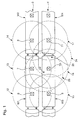
- the inventors have detected a problem related to high frequency communication when monitoring access to and / or the presence in several neighboring demarcated areas as shown in the figure 1.
- this figure are represented schematically and partially the wagons W1 and W2 of a first train 2 and wagons W3 and W4 of a second train 4 located on a neighboring parallel track, as may occur in particular in a train station.
- transceivers with high frequency 6 to 11.
- the areas inside from which the portable electronic units 20, 22 can receive a signal from one transceivers 6 to 11 are represented by circles 12 to 17. From even, the regions in which units 20 and 22 emitting at high frequency a signal that can be received by transceivers are shown schematically by circles 24 and 26 in broken lines.
- the portable unit 20 can have a communication to bidirectional high frequency with transceivers 10 and 11 located in two adjacent cars of train 4.
- the portable unit 22 located in car W3 can have two-way communication with transceivers 7 and 10 located in cars W1 and W3 respectively belonging to the two trains 2 and 4. It is thus understood that, in the absence of other precautions, communications can be established between a portable unit located in a wagon and fixed transceivers located in other cars. This can on the one hand lead to unwanted communications and in particular to false detection the presence of people or objects in a given delimited space.
- An object of the present invention is to solve the problem set out above. while providing an efficient communication system and method capable of particular to be used for the detection of persons equipped with electronic units portable and capable of entering any one of a plurality of spaces demarcated with high frequency communication means, for example greater than 3 MHz.
- the transmission means transmit in the frequency own selected an occupancy signal of this own frequency at least periodically during at least the next communication period, the communication system having means for communicating information relative to the natural frequency selected for incoming portable electronic units and / or outgoing and / or located in the delimited space inside which is arranged the receiver-transmitter considered before establishing a high-frequency communication frequency.
- the listening means and the means are activated alternately in any frequency of said frequency set to determine if this frequency is free and report intend to occupy it.
- the selection of a frequency clean for a receiver-transmitter only intervenes after several alternations activation of the listening and transmission means, without this frequency is received by the listening means.
- the period of activation of the listening means is preferably made for the period of activation of the listening means to be different for occupancy means associated with receiver-transmitters arranged in neighboring demarcated spaces.
- the portable electronic units are arranged so that they can communicate in any frequency among said set of frequencies mentioned above or in subsets associated with these frequencies, like this will be explained in more detail below.
- a person skilled in the art knows how to design such units whose communication frequency can be set and selected among several predetermined channels.
- the natural frequency selected by a or more transceivers located in a given delimited space is communicated to portable units entering and possibly leaving by one or several low frequency transmitters arranged at the entrances of the plurality of spaces boundaries associated with the communication system according to the invention.
- Communication at low frequency is located in the region of the inputs so that only the portable units that pass through the entrances, in one direction or the other, can receive information as to the natural frequency selected. So when a unit is woken up by a low frequency transmitter located near a entry to a given delimited space, this transmitter sends an information signal regarding which high frequency communication channels should be used later according to a predefined communication protocol.
- the transmission means continue to transmit without interruption a signal of occupation at this natural frequency, periodically or continuously, until start of and during the communication period.
- the communication method according to the invention it is possible to safely select a free frequency as the natural frequency of communication for a transceiver or transceivers associated with the same delimited space. Indeed, the method according to the invention makes it possible to determine effectively if a frequency is free and to properly inform other means occupancy associated with other transceivers due to the selection of a frequency given to allow these other means of occupation not to select a frequency already taken.
- FIG. 2 is shown an embodiment of occupancy means of a natural frequency associated with a receiver-transmitter of a system of communication according to the invention.
- occupancy means include an antenna 30 can be used in a listening mode or in a transmission mode.
- the occupancy means include listening means formed by a bandpass filter 32 and a low noise amplifier 34 (LNA).
- LNA low noise amplifier
- the outgoing signal from the amplifier 34 is supplied to a multiplier 36 which also receives as input a sinusoidal signal of a frequency (F0 + n ⁇ f) - IF supplied by a locking loop phase 38 (PLL 2).
- the circuit 38 receives as input a time signal supplied by a time base 40.
- several frequency channels are available different receiver-transmitters.
- This circuit therefore sends a frequency signal (F0 + n ⁇ f) -IF to the multiplier 36, IF being a intermediate frequency, for example 455kHz, corresponding to the center frequency of the narrow band filter 46.
- the filter 46 outputs a signal whose frequency corresponds to the difference between the frequency of the signal supplied by the antenna 30 and the frequency of the signal supplied by the circuit 38.
- the filter 46 is chosen so that the width band is less than ⁇ f so that the different channels of communication planned.
- the filtered signal is then supplied to a demodulator 48 (DEM), the signal demodulated being supplied to the microprocessor 42 for its processing; especially for determine if a busy signal is received for a certain frequency, i.e. for a certain n. If for a given frequency channel, no tone is received during a listening period or if a received signal has an amplitude less than a given threshold, the unit 42 sends a command signal COM to switch to means for transmitting an occupancy signal of this channel. At the same time, unit 42 provides an OCT modulation signal to a multiplier 52 which also receives input a frequency signal supplied by a phase locked loop 54 (PLL 1).
- PLL phase locked loop 54
- This circuit 54 generates a sinusoidal signal at the frequency F0 + n ⁇ f defining a carrier for the busy signal transmitted.
- the outgoing signal of the multiplier 52 is amplified by a power amplifier 56 and goes to through a filter 58 before being emitted by the antenna 30.
- This method of selecting an available frequency from a set of scheduled frequencies occurs in a period preliminary to a period of communication between the receiver-transmitter in question and electronic units portable.
- the frequency channel tested first corresponds to that used during a previous communication period.
- the probability that this frequency channel to be available again is relatively high. This would be always the case when the neighboring delimited spaces keep positions relative fixed in time. This is the case for different areas of a park of attraction and also for the various wagons of a train already formed.
- the first period prior to a first communication period will be used by each delimited space to select a different natural frequency.
- the microprocessor 42 changes the addressing n of register 44 to select a new listening channel.
- the first variant is to have periods listening and transmission which are fixed, even when the frequency channel is varied.
- the listening period for a new channel tested corresponds substantially to the remaining listening time when receiving a busy signal.
- the reception of a busy signal again initializes a period listening for the new channel tested before the transmission period of a signal.
- the method of selecting a natural frequency in a preliminary phase to high frequency communication begins with a listening period.
- FIG 3 is shown schematically the alternation of periods transmission and listening periods in said preliminary phase for two means occupancy of a natural frequency associated respectively with two receiver-transmitters arranged in two neighboring demarcated spaces.
- the preliminary phase here begins substantially simultaneously at time t0 and ends at time t1.
- the alternation period of the emission means and the means listening is T1 while in the lower graph B, this period is equal to T2.
- T1 and T2 are provided different for different means of occupying a frequency. This prevents a simultaneous initiation of the preliminary phases, in particular before the opening of the doors of a means of transport, results in a superposition of listening and broadcast periods that would prevent the selection of natural frequencies.
- the first means corresponding to the graph A start to transmit just before the second pleas corresponding to the graph B, we see that these are the first means that detect a signal frequency F0. Consequently, these first means pass to the frequency F0 + ⁇ f. If no other busy signals are received, at the end of the preliminary phase, the first means will therefore have selected the frequency F0 + ⁇ f while the second means have selected the frequency F0.
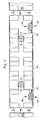
- the antennas 74 and 76 are arranged in housings separated from the HF transceivers and located by example at a shorter distance from the transverse walls 80 and 82 of wagon 64. In arranging the antennas 74, 76 relatively close to the walls 80, 82, we cover better the neighboring regions of the two wagons adjacent to wagon 64. This can allow greater efficiency in the process of selecting natural frequencies different for neighboring demarcated spaces.
- the units 70 and 72 may only form HF antennas connected to a central electronic unit for wagon 64.
- the means of transmitting said means of occupation continue to transmit without interruption of a busy signal at this natural frequency, periodically or continues, until the start of the planned communication period and during this last.
- the means of listening to a signal are deactivated. Sending the occupancy signal of the natural frequency during a communication period can be carried out periodically as in the preliminary phase or continuously or almost continuously since it listening periods are no longer planned.
- FIG 5 is shown schematically and partially a communication protocol planned with portable electronic units.
- several communication channels are provided for each receiver-transmitter in order to increase the efficiency of an anti-collision protocol.
- the graphs C, D, E, F correspond respectively to the natural frequencies selected by four HF transceivers arranged in 4 delimited spaces different.
- the frequency subsets associated with these natural frequencies are intended for communication with portable electronic units.
- the frequency own selected is F0.
- the communications frequencies are F1, F2, F3, ..., Fx.
- the frequencies F0 to Fx are distributed uniformly.
- the channels provided for communication are offset relative to F1-Fx by a value corresponding to the offset of the selected natural frequency relative to F0, namely ⁇ f, 2 ⁇ f and 3 ⁇ f. So each natural frequency selectable is associated with a subset of frequencies that are different frequencies of the other subsets of frequencies planned for the HF communication and also different frequencies of all natural frequencies used for busy signals.
Landscapes
- Engineering & Computer Science (AREA)
- Physics & Mathematics (AREA)
- Toxicology (AREA)
- Health & Medical Sciences (AREA)
- General Physics & Mathematics (AREA)
- Theoretical Computer Science (AREA)
- Computer Vision & Pattern Recognition (AREA)
- Artificial Intelligence (AREA)
- Computer Networks & Wireless Communication (AREA)
- Electromagnetism (AREA)
- General Health & Medical Sciences (AREA)
- Mobile Radio Communication Systems (AREA)
- Radar Systems Or Details Thereof (AREA)
- Transceivers (AREA)
- Train Traffic Observation, Control, And Security (AREA)
- Lock And Its Accessories (AREA)
Abstract
Description
- des moyens d'écoute agencés pour déterminer si un signal d'occupation est présent sur l'une quelconque fréquence parmi ledit ensemble de fréquence et/ou si un seuil d'amplitude donné est dépassé à la réception de cette fréquence;
- des moyens d'émission agencés pour émettre dans une quelconque fréquence dudit ensemble de fréquences, et
- des moyens pour sélectionner, dans une période préliminaire à une période de communication avec des unités électroniques portables, une fréquence propre parmi ledit ensemble de fréquences qui ne contient pas de signal d'occupation ou dont le niveau d'amplitude reçu est inférieur audit seuil.
- écoute dans une première fréquence dudit ensemble de fréquences pour déterminer si un signal d'occupation est présent sur cette première fréquence et/ou si un seuil d'amplitude donné est reçu pour cette première fréquence;
- changement de canal pour écouter sur une autre fréquence dudit ensemble si un signal d'occupation est reçu sur ladite première fréquence ou si le niveau d'amplitude reçu pour cette première fréquence est supérieur au seuil; et ceci jusqu'à ce qu'une fréquence soit libre, laquelle est alors sélectionnée comme fréquence propre. Ce procédé comprend en outre les étapes suivantes :
- envoi d'un signal d'occupation de ladite fréquence propre sélectionnée, de manière à ce qu'elle ne soit pas prise ultérieurement par des récepteurs-émetteurs agencés dans des espaces délimités voisins, au moins lors d'une période de communication suivante à la fréquence propre sélectionnée et/ou dans un sous-ensemble de fréquences associé à cette fréquence propre;
- communication aux unités électroniques entrant et/ou sortant et/ou situées dans l'espace délimité considéré la fréquence propre sélectionnée pour une communication à haute fréquence.
- la figure 1 déjà décrite, représente schématiquement des wagons de deux trains équipés d'émetteurs-récepteurs à haute fréquence pour une communication sans fil avec des unités portables munies de leur source d'énergie;
- la figure 2 montre schématiquement un mode de réalisation de moyens d'occupation d'une fréquence propre associé à un récepteur-émetteur;
- la figure 3 représente l'alternance d'activation de moyens d'écoute et de moyens d'émission de deux moyens d'occupation associés à deux récepteurs-émetteurs agencés respectivement dans deux espaces délimités ;
- la figure 4 représente schématiquement l'agencement d'un espace délimité selon un mode de réalisation préféré;
- la figure 5 montre schématiquement la mise en oeuvre d'un protocole d'anticollision pour plusieurs récepteurs-émetteurs à haute fréquence pouvant être implémenté dans le procédé de communication selon l'invention.
Claims (13)
- Système de communication entre une pluralité de récepteurs-émetteurs, agencés respectivement dans une pluralité d'espaces délimités présentant chacun au moins une entrée, et des unités électroniques portables équipées de moyens de radiocommunication avec ladite pluralité de récepteurs-émetteurs, notamment en vue d'une détection de chacune de ces unités électroniques qui pénètre dans un desdits espaces délimités, caractérisé en ce que lesdits récepteurs-émetteurs et lesdites unités électroniques sont agencées pour pouvoir communiquer, parmi un ensemble de fréquences données et/ou de sous-ensembles de fréquences respectivement associés à ces fréquences, dans une quelconque fréquence et/ou un sous-ensemble de fréquences associé, chacun desdits récepteurs-émetteurs étant associé à des moyens d'occupation d'une fréquence propre qui comprennent :lesdits moyens d'émission émettant dans la fréquence propre sélectionnée un signal d'occupation de cette fréquence propre au moins de manière périodique durant au moins ladite période de communication, ce système ayant des moyens (62) pour communiquer une information relative à ladite fréquence propre aux unités portables entrant et/ou sortant et/ou situées dans l'espace délimité à l'intérieur duquel est agencé le récepteur-émetteur considéré.des moyens d'écoute (30, 32, 34, 36, 38, 46, 48) agencés pour déterminer si un signal d'occupation est présent sur une quelconque fréquence parmi ledit ensemble de fréquences et/ou si un seuil d'amplitude donné est dépassé en réception pour cette fréquence;des moyens d'émission (30, 52, 54, 56, 58) agencés pour émettre dans une quelconque fréquence dudit ensemble de fréquences; etdes moyens pour sélectionner (42, 44, 38, 54), dans une période préliminaire à une période de communication avec des unités électroniques, une fréquence propre parmi ledit ensemble de fréquences qui ne contient pas de signal d'occupation ou dont le niveau d'amplitude reçu est inférieur audit seuil;
- Système selon la revendication 1, caractérisé en ce que lesdits moyens pour sélectionner une fréquence propre comprennent des moyens de commande (42) pour activer alternativement lesdits moyens d'écoute et lesdits moyens d'émission dans une quelconque fréquence dudit ensemble de fréquences et des moyens (44, 38, 54) pour passer à une autre fréquence de cet ensemble dès que ledit signal d'occupation de cette fréquence est reçu par lesdits moyens d'écoute ou que le niveau de puissance reçu sur cette fréquence est supérieur audit seuil.
- Système selon la revendication 2, caractérisé en ce que la sélection d'une fréquence propre est opérée seulement après plusieurs alternances d'activation desdits moyens d'écoute et moyens d'émission, sans que cette fréquence soit reçue par lesdits moyens d'écoute.
- Système selon la revendication 2 ou 3, caractérisé en ce que la période d'activation desdits moyens d'écoute est prévue différente pour chaque récepteur-émetteur dudit système.
- Système selon l'une des revendications précédentes, caractérisé en ce que ledit ensemble de fréquence est situé dans les hautes fréquences, ladite fréquence propre sélectionnée pour un récepteur-émetteur étant communiquée aux unités électroniques à basse fréquence par un ou plusieurs émetteurs placés respectivement à ladite entrée ou aux entrées de l'espace délimité de ce récepteur-émetteur.
- Système selon l'une des revendications précédentes, caractérisé en ce que lors de ladite phase préliminaire, lesdits moyens d'écoute sont activés premièrement dans une fréquence ayant servi à une période de communication précédente.
- Système selon l'une des revendications précédentes, caractérisé en ce que chaque fréquence dudit ensemble de fréquence est associée à un sous-ensemble de fréquences qui sont différentes des fréquences des autres sous-ensembles de fréquences et également différentes des fréquences dudit ensemble de fréquence, de manière à permettre la mise en oeuvre d'un protocole d'anticollision qui répartit les fréquences de communication avec lesdites unités électroniques sur un sous-ensemble de fréquences associées à ladite fréquence propre.
- Procédé de communication entre des récepteurs-émetteurs, agencés respectivement dans des espaces délimités voisins l'un de l'autre ou susceptibles de l'être au moins temporairement et des unités électroniques portables équipées de moyens de radiocommunication et susceptibles de pénétrer dans ces espaces délimités, lesdits récepteurs-émetteurs et lesdites unités électroniques étant agencées pour permettre une communication à haute fréquence, parmi un ensemble de fréquences données et/ou de sous-ensembles de fréquences respectivement associés à ces fréquences, dans une quelconque fréquence et/ou un sous-ensemble de fréquences associé, ce procédé ayant pour chaque récepteur-émetteur les étapes suivantes dans une période préliminaire à une période de communication à haute fréquence :ce procédé comprenant en outre les étapes suivantes:écoute dans une première fréquence dudit ensemble de fréquences pour déterminer si un signal d'occupation est présent sur cette première fréquence et/ou si un seuil d'amplitude donné est dépassé pour cette première fréquence;changement de canal pour écouter sur une autre fréquence dudit ensemble de fréquences si un signal d'occupation est reçu sur ladite première fréquence ou si le niveau d'amplitude reçu pour cette première fréquence est supérieur audit seuil; et ceci jusqu'à ce qu'une fréquence soit libre, laquelle est alors sélectionnée comme fréquence propre,envoi d'un signal d'occupation de ladite fréquence propre sélectionnée, de manière à ce qu'elle ne soit pas prise ultérieurement par des récepteurs-émetteurs agencés dans des espaces délimités voisins, au moins lors d'une période de communication suivante à ladite fréquence propre et/ou dans ledit sous-ensemble de fréquences associé à cette fréquence propre;communication aux unités électroniques entrant et/ou sortant et/ou situées dans l'espace délimité considéré une information relative à ladite fréquence propre sélectionnée pour une communication à haute fréquence.
- Procédé de communication selon la revendication 8, caractérisé en ce que la communication de l'information relative à ladite fréquence propre sélectionnée est effectuée à basse fréquence par des émetteurs situés aux entrées desdits espaces délimités.
- Procédé selon la revendication 8 ou 9, caractérisé en ce que lors de ladite période préliminaire, un signal est émis en alternance avec l'écoute à une même fréquence dudit ensemble de fréquences, ladite sélection de ladite fréquence propre intervenant seulement après un certain nombre d'alternances écoute-émission.
- Procédé selon la revendication 10, caractérisé en ce que la période des alternances écoute-émission est prévue différente pour chaque espace délimité.
- Procédé selon la revendication 10 ou 11, caractérisé en ce que, dès qu'une fréquence propre est sélectionnée, lesdits moyens d'émission continuent d'émettre sans interruption ledit signal à cette fréquence propre, de manière périodique ou continue, jusqu'au début de ladite période de communication et durant cette dernière, ce signal formant ledit signal d'occupation.
- Procédé selon l'une des revendications 8 à 12, caractérisé en ce que lesdits moyens d'écoute sont désactivés durant ladite période de communication.
Priority Applications (6)
| Application Number | Priority Date | Filing Date | Title |
|---|---|---|---|
| DE60137192T DE60137192D1 (de) | 2001-03-23 | 2001-03-23 | Drathloses Kommunikationssystem zwischen mehreren Transceivern und Transpondern |
| EP01810307A EP1244049B1 (fr) | 2001-03-23 | 2001-03-23 | Système de communication sans fil entre plusieurs émetteurs-récepteurs et des transpondeurs |
| AT01810307T ATE419590T1 (de) | 2001-03-23 | 2001-03-23 | Drathloses kommunikationssystem zwischen mehreren transceivern und transpondern |
| US10/084,058 US6588661B2 (en) | 2001-03-23 | 2002-02-28 | System and method for wireless communication between several transceivers, arranged respectively in several delimited spaces, and portable electronic units |
| CN02108002A CN1378350A (zh) | 2001-03-23 | 2002-03-22 | 限定空间内几个电子单元之间进行无线通信的系统和方法 |
| JP2002080160A JP2002335209A (ja) | 2001-03-23 | 2002-03-22 | それぞれが区切られたスペース内に配置された複数のトランシーバとポータブル電子ユニットの間におけるワイヤレス通信のためのシステムおよび方法 |
Applications Claiming Priority (1)
| Application Number | Priority Date | Filing Date | Title |
|---|---|---|---|
| EP01810307A EP1244049B1 (fr) | 2001-03-23 | 2001-03-23 | Système de communication sans fil entre plusieurs émetteurs-récepteurs et des transpondeurs |
Publications (2)
| Publication Number | Publication Date |
|---|---|
| EP1244049A1 true EP1244049A1 (fr) | 2002-09-25 |
| EP1244049B1 EP1244049B1 (fr) | 2008-12-31 |
Family
ID=8183822
Family Applications (1)
| Application Number | Title | Priority Date | Filing Date |
|---|---|---|---|
| EP01810307A Expired - Lifetime EP1244049B1 (fr) | 2001-03-23 | 2001-03-23 | Système de communication sans fil entre plusieurs émetteurs-récepteurs et des transpondeurs |
Country Status (6)
| Country | Link |
|---|---|
| US (1) | US6588661B2 (fr) |
| EP (1) | EP1244049B1 (fr) |
| JP (1) | JP2002335209A (fr) |
| CN (1) | CN1378350A (fr) |
| AT (1) | ATE419590T1 (fr) |
| DE (1) | DE60137192D1 (fr) |
Cited By (2)
| Publication number | Priority date | Publication date | Assignee | Title |
|---|---|---|---|---|
| WO2005029698A2 (fr) | 2003-09-15 | 2005-03-31 | Rf Saw Components, Incorporated | Procede de discrimination d'etiquettes d'identification a ondes acoustiques de surface |
| EP1710726A1 (fr) * | 2005-04-06 | 2006-10-11 | Fujitsu Limited | Méthode pour la détection d'onde porteuse et RFID correspondant |
Families Citing this family (24)
| Publication number | Priority date | Publication date | Assignee | Title |
|---|---|---|---|---|
| US7325723B2 (en) * | 2001-05-14 | 2008-02-05 | Em Microelectronic-Marin Sa | System and method for detecting persons or objects in definite areas provided each with at least an entrance |
| JP4527636B2 (ja) * | 2005-08-30 | 2010-08-18 | 富士通株式会社 | Rfid質問器及びデータ通信方法 |
| EP2119025A1 (fr) | 2007-02-28 | 2009-11-18 | Rf Surgical Systems, Inc. | Procédé, appareil et article de détection d'objets dotés d'une étiquette à transpondeur, par exemple pendant une intervention chirurgicale |
| US7696877B2 (en) | 2007-05-01 | 2010-04-13 | Rf Surgical Systems, Inc. | Method, apparatus and article for detection of transponder tagged objects, for example during surgery |
| WO2009151946A2 (fr) | 2008-05-27 | 2009-12-17 | Rf Surgical Systems, Inc. | Transpondeur multimode et procédé et appareil de détection de celui-ci |
| US8111162B2 (en) * | 2008-05-28 | 2012-02-07 | Rf Surgical Systems, Inc. | Method, apparatus and article for detection of transponder tagged objects, for example during surgery |
| US20100093274A1 (en) * | 2008-10-15 | 2010-04-15 | Jian Xu | Fault-tolerant non-random signal repeating system for building electric control |
| US8866599B2 (en) | 2008-10-24 | 2014-10-21 | International Business Machines Corporation | Method of activating a supplemental visual warning signal based on frequency emitted from a generator of a primary audible warning signal |
| US8264342B2 (en) | 2008-10-28 | 2012-09-11 | RF Surgical Systems, Inc | Method and apparatus to detect transponder tagged objects, for example during medical procedures |
| US8726911B2 (en) | 2008-10-28 | 2014-05-20 | Rf Surgical Systems, Inc. | Wirelessly detectable objects for use in medical procedures and methods of making same |
| US9226686B2 (en) | 2009-11-23 | 2016-01-05 | Rf Surgical Systems, Inc. | Method and apparatus to account for transponder tagged objects used during medical procedures |
| JP4685960B2 (ja) * | 2010-04-21 | 2011-05-18 | 富士通株式会社 | リーダー |
| JP6381152B2 (ja) * | 2014-01-28 | 2018-08-29 | 華為終端(東莞)有限公司 | リソース割振り方法およびユーザ機器 |
| CN110680516A (zh) | 2014-03-31 | 2020-01-14 | 柯惠Lp公司 | 一种应答器检测装置 |
| AU2014389444B2 (en) | 2014-03-31 | 2019-07-25 | Covidien Lp | Method, apparatus and article for detection of transponder tagged objects, for example during surgery |
| US10660726B2 (en) | 2015-01-21 | 2020-05-26 | Covidien Lp | Sterilizable wirelessly detectable objects for use in medical procedures and methods of making same |
| AU2016200113B2 (en) | 2015-01-21 | 2019-10-31 | Covidien Lp | Wirelessly detectable objects for use in medical procedures and methods of making same |
| WO2016118749A1 (fr) | 2015-01-21 | 2016-07-28 | Covidien Lp | Éponge détectable pour utilisation dans des procédures médicales et procédés de fabrication, d'emballage et de comptabilité de celles-ci |
| US9690963B2 (en) | 2015-03-02 | 2017-06-27 | Covidien Lp | Hand-held dual spherical antenna system |
| USD775331S1 (en) | 2015-03-02 | 2016-12-27 | Covidien Lp | Hand-held antenna system |
| US10193209B2 (en) | 2015-04-06 | 2019-01-29 | Covidien Lp | Mat based antenna and heater system, for use during medical procedures |
| US20180054402A1 (en) | 2016-08-18 | 2018-02-22 | Adam Modras | Communication support system |
| US11620464B2 (en) | 2020-03-31 | 2023-04-04 | Covidien Lp | In-vivo introducible antenna for detection of RF tags |
| US12626809B2 (en) | 2021-08-09 | 2026-05-12 | Covidien Lp | Inventory systems and methods for detecting and counting potentially retained surgical items |
Citations (4)
| Publication number | Priority date | Publication date | Assignee | Title |
|---|---|---|---|---|
| EP0589046A1 (fr) * | 1992-02-18 | 1994-03-30 | Citizen Watch Co. Ltd. | Systeme porteur de donnees |
| US5804810A (en) * | 1996-06-26 | 1998-09-08 | Par Government Systems Corporation | Communicating with electronic tags |
| EP1022674A2 (fr) * | 1999-01-20 | 2000-07-26 | Anatoli Stobbe | Système pour identifier automatiquement au moins un transpondeur dans le champ électro-magnétique d'une station de base |
| EP1065625A1 (fr) | 1999-07-02 | 2001-01-03 | EM Microelectronic-Marin SA | Système de détection d'individus ou d'objets à transpondeur |
Family Cites Families (6)
| Publication number | Priority date | Publication date | Assignee | Title |
|---|---|---|---|---|
| US5805082A (en) * | 1990-05-17 | 1998-09-08 | At/Comm Incorporated | Electronic vehicle toll collection system and method |
| DE4310580A1 (de) * | 1993-03-31 | 1994-10-06 | Siemens Ag | Automatisches Gebührenerfassungssystem |
| SE516959C2 (sv) * | 1993-05-28 | 2002-03-26 | Combitech Traffic Syst Ab | Förfarande och anordning för registrering av fordon i en vägtull |
| US5809142A (en) * | 1996-08-14 | 1998-09-15 | Texas Instruments Incorporated | Method and system for calculating a user account balance in a recognition system |
| US6107910A (en) * | 1996-11-29 | 2000-08-22 | X-Cyte, Inc. | Dual mode transmitter/receiver and decoder for RF transponder tags |
| IL122105A0 (en) * | 1997-11-04 | 1998-04-05 | Rozin Alexander | A two-way radio-based electronic toll collection method and system for highway |
-
2001
- 2001-03-23 DE DE60137192T patent/DE60137192D1/de not_active Expired - Lifetime
- 2001-03-23 AT AT01810307T patent/ATE419590T1/de not_active IP Right Cessation
- 2001-03-23 EP EP01810307A patent/EP1244049B1/fr not_active Expired - Lifetime
-
2002
- 2002-02-28 US US10/084,058 patent/US6588661B2/en not_active Expired - Lifetime
- 2002-03-22 CN CN02108002A patent/CN1378350A/zh active Pending
- 2002-03-22 JP JP2002080160A patent/JP2002335209A/ja active Pending
Patent Citations (4)
| Publication number | Priority date | Publication date | Assignee | Title |
|---|---|---|---|---|
| EP0589046A1 (fr) * | 1992-02-18 | 1994-03-30 | Citizen Watch Co. Ltd. | Systeme porteur de donnees |
| US5804810A (en) * | 1996-06-26 | 1998-09-08 | Par Government Systems Corporation | Communicating with electronic tags |
| EP1022674A2 (fr) * | 1999-01-20 | 2000-07-26 | Anatoli Stobbe | Système pour identifier automatiquement au moins un transpondeur dans le champ électro-magnétique d'une station de base |
| EP1065625A1 (fr) | 1999-07-02 | 2001-01-03 | EM Microelectronic-Marin SA | Système de détection d'individus ou d'objets à transpondeur |
Cited By (4)
| Publication number | Priority date | Publication date | Assignee | Title |
|---|---|---|---|---|
| WO2005029698A2 (fr) | 2003-09-15 | 2005-03-31 | Rf Saw Components, Incorporated | Procede de discrimination d'etiquettes d'identification a ondes acoustiques de surface |
| EP1665526A4 (fr) * | 2003-09-15 | 2008-09-10 | Rf Saw Components Inc | Procede de discrimination d'etiquettes d'identification a ondes acoustiques de surface |
| EP1710726A1 (fr) * | 2005-04-06 | 2006-10-11 | Fujitsu Limited | Méthode pour la détection d'onde porteuse et RFID correspondant |
| US7953370B2 (en) | 2005-04-06 | 2011-05-31 | Fujitsu Limited | Carrier sensing method and RFID transceiver device using the same |
Also Published As
| Publication number | Publication date |
|---|---|
| US20020134833A1 (en) | 2002-09-26 |
| CN1378350A (zh) | 2002-11-06 |
| EP1244049B1 (fr) | 2008-12-31 |
| US6588661B2 (en) | 2003-07-08 |
| DE60137192D1 (de) | 2009-02-12 |
| ATE419590T1 (de) | 2009-01-15 |
| JP2002335209A (ja) | 2002-11-22 |
Similar Documents
| Publication | Publication Date | Title |
|---|---|---|
| EP1244049B1 (fr) | Système de communication sans fil entre plusieurs émetteurs-récepteurs et des transpondeurs | |
| EP2517147B1 (fr) | Procede de protection dans une communication radiofrequence sans contact | |
| EP1200931B1 (fr) | Procede et systeme de detection d'individus ou d'objets dans un espace delimite presentant une entree | |
| EP1399878B1 (fr) | Systeme et procede de detection d'individus ou d'objets dans les espaces delimites presentant chacun au moins une entree | |
| EP0854600A1 (fr) | Procédé auto-adaptatif de transmission de données et dispositif de mise en oeuvre | |
| FR2977358A1 (fr) | Systeme avertisseur de situations dangereuses en milieu agressif | |
| FR2786047A1 (fr) | Systeme pour securiser une transmission bidirectionnelle de donnees pour l'acces a un espace clos, en particulier pour l'acces a un vehicule | |
| EP0429568B1 (fr) | Systeme d'identification entre un poste d'interrogation et un repondeur, par voie hertzienne | |
| FR2878964A1 (fr) | Procede pour la localisation d'un dispositif d'emission et de reception | |
| FR2838524A1 (fr) | Systeme et procede de localisation d'un terminal mobile, notamment pour le sauvetage d'une personne en detresse, et dispositif d'eveil d'un terminal mobile correspondant | |
| WO2002052521A2 (fr) | Recepteur radiofrequence pour la telereleve de compteurs et methode de telereleve de compteurs comprenant un tel recepteur | |
| EP3716242B1 (fr) | Système d'alarme à communication radiofréquence sécurisée | |
| EP2388043B1 (fr) | Procédé de recherche et de sélection d'un canal de télémétrie RF pour l'établissement d'une liaison avec un dispositif médical actif | |
| EP4209958A1 (fr) | Détection de dispositif nfc | |
| EP1348204A1 (fr) | Systeme de detection du passage d'individus ou objets par une entree-sortie a un espace delimite | |
| EP1459265B1 (fr) | Systeme et procede de detection du passage d'un individu ou d'un objet par une entree-sortie a un espace delimite | |
| FR2807588A1 (fr) | Dispositif d'acces "mains libres", notamment pour vehicule automobile | |
| EP1037397B1 (fr) | Dispositif de transmission radio multifréquences et procédé associé | |
| EP1583248B1 (fr) | Récepteur radiofréquence multibande avec dispostif de réduction de consommation d'énergie | |
| EP1002294A1 (fr) | Objet portatif a communication sans contact suivant deux voies de communication, inductive et hertzienne | |
| EP1258829A1 (fr) | Système de détection d'individus ou d'objets dans des espaces délimités présentant une entrée | |
| EP1453217B1 (fr) | Procédé d'atténuation de l'influence d'interférences produites par des systèmes de transmission radio en rafales sur des communications UWB | |
| EP0671702A1 (fr) | Système d'identification hyperfréquence courte portée | |
| US10567966B1 (en) | Self-masking receive system | |
| WO2021176006A1 (fr) | Procede de communication et de localisation en continu ultra haute fréquence d'un dispositif portable d'accès « mains libres » à un véhicule automobile |
Legal Events
| Date | Code | Title | Description |
|---|---|---|---|
| PUAI | Public reference made under article 153(3) epc to a published international application that has entered the european phase |
Free format text: ORIGINAL CODE: 0009012 |
|
| AK | Designated contracting states |
Kind code of ref document: A1 Designated state(s): AT BE CH CY DE DK ES FI FR GB GR IE IT LI LU MC NL PT SE TR |
|
| AX | Request for extension of the european patent |
Free format text: AL;LT;LV;MK;RO;SI |
|
| 17P | Request for examination filed |
Effective date: 20030325 |
|
| AKX | Designation fees paid |
Designated state(s): AT BE CH CY DE DK ES FI FR GB GR IE IT LI LU MC NL PT SE TR |
|
| 17Q | First examination report despatched |
Effective date: 20061124 |
|
| GRAP | Despatch of communication of intention to grant a patent |
Free format text: ORIGINAL CODE: EPIDOSNIGR1 |
|
| GRAS | Grant fee paid |
Free format text: ORIGINAL CODE: EPIDOSNIGR3 |
|
| GRAA | (expected) grant |
Free format text: ORIGINAL CODE: 0009210 |
|
| AK | Designated contracting states |
Kind code of ref document: B1 Designated state(s): AT BE CH CY DE DK ES FI FR GB GR IE IT LI LU MC NL PT SE TR |
|
| REG | Reference to a national code |
Ref country code: GB Ref legal event code: FG4D Free format text: NOT ENGLISH Ref country code: CH Ref legal event code: EP |
|
| REF | Corresponds to: |
Ref document number: 60137192 Country of ref document: DE Date of ref document: 20090212 Kind code of ref document: P |
|
| REG | Reference to a national code |
Ref country code: IE Ref legal event code: FG4D Free format text: LANGUAGE OF EP DOCUMENT: FRENCH |
|
| REG | Reference to a national code |
Ref country code: CH Ref legal event code: NV Representative=s name: ICB INGENIEURS CONSEILS EN BREVETS SA |
|
| PG25 | Lapsed in a contracting state [announced via postgrant information from national office to epo] |
Ref country code: NL Free format text: LAPSE BECAUSE OF FAILURE TO SUBMIT A TRANSLATION OF THE DESCRIPTION OR TO PAY THE FEE WITHIN THE PRESCRIBED TIME-LIMIT Effective date: 20081231 Ref country code: FI Free format text: LAPSE BECAUSE OF FAILURE TO SUBMIT A TRANSLATION OF THE DESCRIPTION OR TO PAY THE FEE WITHIN THE PRESCRIBED TIME-LIMIT Effective date: 20081231 |
|
| NLV1 | Nl: lapsed or annulled due to failure to fulfill the requirements of art. 29p and 29m of the patents act | ||
| PG25 | Lapsed in a contracting state [announced via postgrant information from national office to epo] |
Ref country code: ES Free format text: LAPSE BECAUSE OF FAILURE TO SUBMIT A TRANSLATION OF THE DESCRIPTION OR TO PAY THE FEE WITHIN THE PRESCRIBED TIME-LIMIT Effective date: 20090411 |
|
| REG | Reference to a national code |
Ref country code: IE Ref legal event code: FD4D |
|
| PG25 | Lapsed in a contracting state [announced via postgrant information from national office to epo] |
Ref country code: AT Free format text: LAPSE BECAUSE OF FAILURE TO SUBMIT A TRANSLATION OF THE DESCRIPTION OR TO PAY THE FEE WITHIN THE PRESCRIBED TIME-LIMIT Effective date: 20081231 Ref country code: PT Free format text: LAPSE BECAUSE OF FAILURE TO SUBMIT A TRANSLATION OF THE DESCRIPTION OR TO PAY THE FEE WITHIN THE PRESCRIBED TIME-LIMIT Effective date: 20090601 Ref country code: SE Free format text: LAPSE BECAUSE OF FAILURE TO SUBMIT A TRANSLATION OF THE DESCRIPTION OR TO PAY THE FEE WITHIN THE PRESCRIBED TIME-LIMIT Effective date: 20090331 |
|
| BERE | Be: lapsed |
Owner name: EM MICROELECTRONIC-MARIN SA Effective date: 20090331 |
|
| PG25 | Lapsed in a contracting state [announced via postgrant information from national office to epo] |
Ref country code: DK Free format text: LAPSE BECAUSE OF FAILURE TO SUBMIT A TRANSLATION OF THE DESCRIPTION OR TO PAY THE FEE WITHIN THE PRESCRIBED TIME-LIMIT Effective date: 20081231 Ref country code: MC Free format text: LAPSE BECAUSE OF NON-PAYMENT OF DUE FEES Effective date: 20090331 Ref country code: IE Free format text: LAPSE BECAUSE OF FAILURE TO SUBMIT A TRANSLATION OF THE DESCRIPTION OR TO PAY THE FEE WITHIN THE PRESCRIBED TIME-LIMIT Effective date: 20081231 |
|
| PLBE | No opposition filed within time limit |
Free format text: ORIGINAL CODE: 0009261 |
|
| STAA | Information on the status of an ep patent application or granted ep patent |
Free format text: STATUS: NO OPPOSITION FILED WITHIN TIME LIMIT |
|
| GBPC | Gb: european patent ceased through non-payment of renewal fee |
Effective date: 20090331 |
|
| 26N | No opposition filed |
Effective date: 20091001 |
|
| PG25 | Lapsed in a contracting state [announced via postgrant information from national office to epo] |
Ref country code: BE Free format text: LAPSE BECAUSE OF NON-PAYMENT OF DUE FEES Effective date: 20090331 |
|
| PG25 | Lapsed in a contracting state [announced via postgrant information from national office to epo] |
Ref country code: GB Free format text: LAPSE BECAUSE OF NON-PAYMENT OF DUE FEES Effective date: 20090331 |
|
| PG25 | Lapsed in a contracting state [announced via postgrant information from national office to epo] |
Ref country code: GR Free format text: LAPSE BECAUSE OF FAILURE TO SUBMIT A TRANSLATION OF THE DESCRIPTION OR TO PAY THE FEE WITHIN THE PRESCRIBED TIME-LIMIT Effective date: 20090401 |
|
| PG25 | Lapsed in a contracting state [announced via postgrant information from national office to epo] |
Ref country code: IT Free format text: LAPSE BECAUSE OF FAILURE TO SUBMIT A TRANSLATION OF THE DESCRIPTION OR TO PAY THE FEE WITHIN THE PRESCRIBED TIME-LIMIT Effective date: 20081231 |
|
| PG25 | Lapsed in a contracting state [announced via postgrant information from national office to epo] |
Ref country code: LU Free format text: LAPSE BECAUSE OF NON-PAYMENT OF DUE FEES Effective date: 20090323 |
|
| PG25 | Lapsed in a contracting state [announced via postgrant information from national office to epo] |
Ref country code: TR Free format text: LAPSE BECAUSE OF FAILURE TO SUBMIT A TRANSLATION OF THE DESCRIPTION OR TO PAY THE FEE WITHIN THE PRESCRIBED TIME-LIMIT Effective date: 20081231 |
|
| PG25 | Lapsed in a contracting state [announced via postgrant information from national office to epo] |
Ref country code: CY Free format text: LAPSE BECAUSE OF FAILURE TO SUBMIT A TRANSLATION OF THE DESCRIPTION OR TO PAY THE FEE WITHIN THE PRESCRIBED TIME-LIMIT Effective date: 20081231 |
|
| REG | Reference to a national code |
Ref country code: FR Ref legal event code: PLFP Year of fee payment: 16 |
|
| REG | Reference to a national code |
Ref country code: FR Ref legal event code: PLFP Year of fee payment: 17 |
|
| REG | Reference to a national code |
Ref country code: FR Ref legal event code: PLFP Year of fee payment: 18 |
|
| PGFP | Annual fee paid to national office [announced via postgrant information from national office to epo] |
Ref country code: DE Payment date: 20200218 Year of fee payment: 20 |
|
| PGFP | Annual fee paid to national office [announced via postgrant information from national office to epo] |
Ref country code: CH Payment date: 20200221 Year of fee payment: 20 |
|
| PGFP | Annual fee paid to national office [announced via postgrant information from national office to epo] |
Ref country code: FR Payment date: 20200220 Year of fee payment: 20 |
|
| REG | Reference to a national code |
Ref country code: DE Ref legal event code: R071 Ref document number: 60137192 Country of ref document: DE |
|
| REG | Reference to a national code |
Ref country code: CH Ref legal event code: PL |