EP1243637A2 - Additive zur Inhibierung der Gashydratbildung - Google Patents
Additive zur Inhibierung der Gashydratbildung Download PDFInfo
- Publication number
- EP1243637A2 EP1243637A2 EP02005587A EP02005587A EP1243637A2 EP 1243637 A2 EP1243637 A2 EP 1243637A2 EP 02005587 A EP02005587 A EP 02005587A EP 02005587 A EP02005587 A EP 02005587A EP 1243637 A2 EP1243637 A2 EP 1243637A2
- Authority
- EP
- European Patent Office
- Prior art keywords
- alkyl
- bis
- gas hydrate
- gas
- ring
- Prior art date
- Legal status (The legal status is an assumption and is not a legal conclusion. Google has not performed a legal analysis and makes no representation as to the accuracy of the status listed.)
- Granted
Links
Classifications
-
- F—MECHANICAL ENGINEERING; LIGHTING; HEATING; WEAPONS; BLASTING
- F17—STORING OR DISTRIBUTING GASES OR LIQUIDS
- F17D—PIPE-LINE SYSTEMS; PIPE-LINES
- F17D1/00—Pipe-line systems
- F17D1/02—Pipe-line systems for gases or vapours
- F17D1/04—Pipe-line systems for gases or vapours for distribution of gas
- F17D1/05—Preventing freezing
-
- C—CHEMISTRY; METALLURGY
- C09—DYES; PAINTS; POLISHES; NATURAL RESINS; ADHESIVES; COMPOSITIONS NOT OTHERWISE PROVIDED FOR; APPLICATIONS OF MATERIALS NOT OTHERWISE PROVIDED FOR
- C09K—MATERIALS FOR MISCELLANEOUS APPLICATIONS, NOT PROVIDED FOR ELSEWHERE
- C09K8/00—Compositions for drilling of boreholes or wells; Compositions for treating boreholes or wells, e.g. for completion or for remedial operations
- C09K8/52—Compositions for preventing, limiting or eliminating depositions, e.g. for cleaning
-
- C—CHEMISTRY; METALLURGY
- C10—PETROLEUM, GAS OR COKE INDUSTRIES; TECHNICAL GASES CONTAINING CARBON MONOXIDE; FUELS; LUBRICANTS; PEAT
- C10L—FUELS NOT OTHERWISE PROVIDED FOR; NATURAL GAS; SYNTHETIC NATURAL GAS OBTAINED BY PROCESSES NOT COVERED BY SUBCLASSES C10G OR C10K; LIQUIFIED PETROLEUM GAS; USE OF ADDITIVES TO FUELS OR FIRES; FIRE-LIGHTERS
- C10L3/00—Gaseous fuels; Natural gas; Synthetic natural gas obtained by processes not covered by subclass C10G, C10K; Liquefied petroleum gas
- C10L3/06—Natural gas; Synthetic natural gas obtained by processes not covered by C10G, C10K3/02 or C10K3/04
-
- C—CHEMISTRY; METALLURGY
- C09—DYES; PAINTS; POLISHES; NATURAL RESINS; ADHESIVES; COMPOSITIONS NOT OTHERWISE PROVIDED FOR; APPLICATIONS OF MATERIALS NOT OTHERWISE PROVIDED FOR
- C09K—MATERIALS FOR MISCELLANEOUS APPLICATIONS, NOT PROVIDED FOR ELSEWHERE
- C09K2208/00—Aspects relating to compositions of drilling or well treatment fluids
- C09K2208/22—Hydrates inhibition by using well treatment fluids containing inhibitors of hydrate formers
-
- Y—GENERAL TAGGING OF NEW TECHNOLOGICAL DEVELOPMENTS; GENERAL TAGGING OF CROSS-SECTIONAL TECHNOLOGIES SPANNING OVER SEVERAL SECTIONS OF THE IPC; TECHNICAL SUBJECTS COVERED BY FORMER USPC CROSS-REFERENCE ART COLLECTIONS [XRACs] AND DIGESTS
- Y02—TECHNOLOGIES OR APPLICATIONS FOR MITIGATION OR ADAPTATION AGAINST CLIMATE CHANGE
- Y02E—REDUCTION OF GREENHOUSE GAS [GHG] EMISSIONS, RELATED TO ENERGY GENERATION, TRANSMISSION OR DISTRIBUTION
- Y02E60/00—Enabling technologies; Technologies with a potential or indirect contribution to GHG emissions mitigation
- Y02E60/30—Hydrogen technology
- Y02E60/34—Hydrogen distribution
-
- Y—GENERAL TAGGING OF NEW TECHNOLOGICAL DEVELOPMENTS; GENERAL TAGGING OF CROSS-SECTIONAL TECHNOLOGIES SPANNING OVER SEVERAL SECTIONS OF THE IPC; TECHNICAL SUBJECTS COVERED BY FORMER USPC CROSS-REFERENCE ART COLLECTIONS [XRACs] AND DIGESTS
- Y10—TECHNICAL SUBJECTS COVERED BY FORMER USPC
- Y10S—TECHNICAL SUBJECTS COVERED BY FORMER USPC CROSS-REFERENCE ART COLLECTIONS [XRACs] AND DIGESTS
- Y10S585/00—Chemistry of hydrocarbon compounds
- Y10S585/949—Miscellaneous considerations
- Y10S585/95—Prevention or removal of corrosion or solid deposits
Definitions
- the present invention relates to an additive and a method for inhibiting Nucleation, growth and / or agglomeration of gas hydrates by one tend to hydrate, consisting of water, gas and possibly condensate Multi-phase mixture or a drilling fluid that tends to form gas hydrate an effective amount of an inhibitor is added, the ester of alkoxylated Contains hydroxycarboxamides.
- Gas hydrates are crystalline inclusion compounds of gas molecules in water, which occur under certain temperature and pressure conditions (low Temperature and high pressure).
- the water molecules form Cage structures around the corresponding gas molecules. That from the Lattice structure formed by water molecules is thermodynamically unstable and only becomes stabilized by the inclusion of gas molecules.
- These ice-like Connections can also depend on pressure and gas composition exist beyond the freezing point of water (up to over 25 ° C).
- gas hydrates are particularly large Importance, which consists of water and the natural gas components methane, ethane, Form propane, isobutane, n-butane, nitrogen, carbon dioxide and hydrogen sulfide.
- methane, ethane, Form propane, isobutane, n-butane, nitrogen, carbon dioxide and hydrogen sulfide Especially in today's natural gas production, the existence of this gas hydrates a big problem, especially when wet gas or Multi-phase mixtures of water, gas and alkane mixtures under high pressure exposed to low temperatures.
- gas hydrate formation can also be tapped during the drilling process new gas or oil deposits with appropriate pressure and Temperature conditions can cause problems by moving in the Drilling fluids form gas hydrates.
- thermodynamic inhibition causes the thermodynamic Limit of gas hydrate formation after lower temperatures and higher pressures is shifted (thermodynamic inhibition).
- thermodynamic inhibitors pose major safety problems (Flash point and toxicity of alcohols), logistical problems (large storage tanks, Recycling of these solvents) and accordingly high costs, especially in the offshore production.
- thermodynamic inhibitors Today, therefore, attempts are being made to replace thermodynamic inhibitors by one at temperature and pressure ranges in which gas hydrates can form, Additives in amounts of ⁇ 2% add to the gas hydrate formation either in time delay (kinetic inhibitors) or the gas hydrate agglomerates small and keep it pumpable so that it can be transported through the pipeline (so-called agglomerate inhibitors or anti-agglomerates).
- the used Inhibitors either hinder the nucleation and / or the growth of the Gas hydrate particles or modify the hydrate growth so that smaller ones Hydrate particles result.
- gas hydrate inhibitors in the patent literature in addition to the known thermodynamic inhibitors a variety of monomeric as well as polymeric Substance classes described, the kinetic inhibitors or agglomerate inhibitors represent. Polymers with a carbon backbone, which in the side groups both cyclic (pyrrolidone or Caprolactam residues) as well as acyclic amide structures. Furthermore are surface active compounds with both non-ionic and cationic Structure known for use as a gas hydrate inhibitor.
- DE-C-199 20 152 describes modified polyglycol ether carboxylic acid amides as Additives to inhibit gas hydrate formation, which depending on the structure a wide range Show effectiveness and both nucleation or growth or the Prevent agglomeration of gas hydrates.
- the disclosed compounds show however, poor biodegradability, which is primarily used in off-shore applications conflict.
- the object of the present invention was therefore to find improved additives which are completely biodegradable and have a wide range of applications have high potential to both the formation of gas hydrates slow down (kinetic inhibitors) as well as gas hydrate agglomerates small and keep pumpable (anti-agglomerates).
- both water-soluble ones are suitable as well as oil-soluble esters of alkoxylated hydroxycarboxamides as Gas hydrate inhibitors.
- the products can both nucleate and delay growth of gas hydrates (kinetic gas hydrate inhibitors) as also suppress the agglomeration of gas hydrates (agglomerate inhibitors).
- the products are slightly organic due to the hydrolyzable ester function degradable.
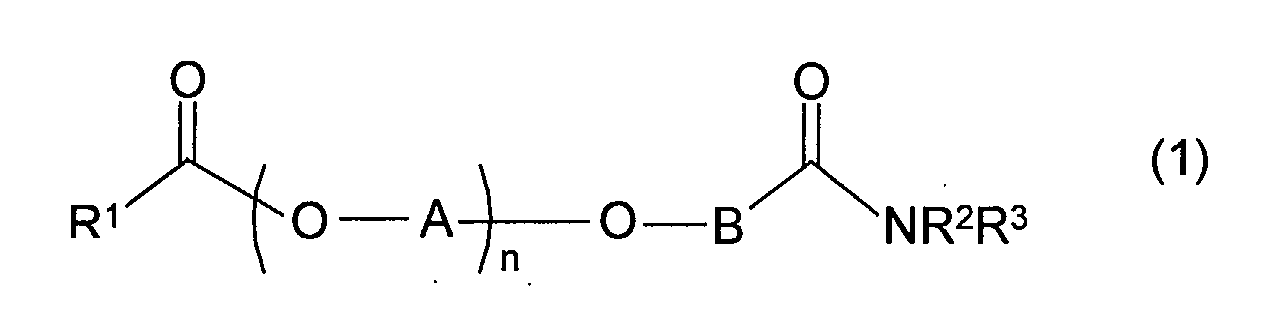
- R 1 is preferably C 1 to C 8 alkyl or C 8 to C 24 alkyl.
- R 2 and R 3 are preferably hydrogen or C 1 - to C 6 -alkyl.
- A stands for one or different C 2 - to C 4 -alkylene groups. This means that the compounds of the formula (1) can be alkoxylated with up to 40 C 2 - to C 4 -alkoxy units, which can be either a pure ethoxylation, propoxylation or butoxylation or a mixed alkoxylation.
- A is preferably an ethylene or propylene group, in particular an ethylene group.
- A is an ethylene radical and n is an integer from 1 to 10.
- B represents a C 1 -C 7 alkylene group which is both straight-chain and branched and which can be linked to the rest of the molecule at any carbon atom by the ether function.
- B is preferably a methylene, ethylene or propylene group, in particular a methylene group. If B is branched, it is preferably linked via the ether function, that is to say that the polymethylene group lying between the amide and the ether function preferably has more carbon atoms than the alkyl side chains.
- the compounds of formula (1) are by alkoxylation of hydroxycarboxamides and their subsequent esterification with corresponding carboxylic acids, Carboxylic acid anhydrides or carboxylic acid chlorides accessible.
- hydroxycarboxamides are from hydroxycarboxylic acids or from the corresponding lactones obtainable by amidation with appropriate amines. Esterification, amidation as well as alkoxylation takes place according to methods known from the literature.
- carboxylic acids examples include acetic acid, propionic acid, butyric acid, Valeric acid, iso-valeric acid, hexanoic acid, 2-ethylhexanoic acid, nonanoic acid, iso-nonanoic acid, decanoic acid, iso-decanoic acid, dodecanoic acid, tetradecanoic acid, Hexadecanoic acid, octadecanoic acid, oleic acid, their anhydrides or acid chlorides and synthetic or native fatty acid cuts.
- Hydroxycarboxylic acids or lactones which are expediently used are glycolic acid, Lactic acid, 2-hydroxy-iso-butyric acid, 2-hydroxy-iso-caproic acid, propiolactone, Butyrolactone and caprolactone.
- Suitable amines for the amidation of the hydroxycarboxylic acids or the corresponding lactones are amines with 1 to 7 carbon atoms such as methylamine, ethylamine, propylamine, n-butylamine, isobutylamine, sec-butylamine, pentylamine, hexylamine, dimethylamine, diethylamine, dipropylamine, dibutylamine , Diisopropylamine, cyclopentylamine, cyclohexylamine, pyrrolidine, piperidine or morpholine.
- Amines with C 3 -C 5 alkyl radicals or cyclic amines with 5 to 7 ring members are particularly suitable.
- Diethylamine, isopropylamine, isobutylamine, isopentylamine, cyclopentylamine, piperidine and pyrrolidine are particularly preferred.
- the amidation can be carried out with or without the use of catalysts at reaction temperatures between 80 and 200 ° C., preferably between 100 and 180 ° C.
- the properties can be dependent on the structure according to formula (1) modify the connections in such a way that they are targeted according to the given conditions, as specific additives inhibit gas hydrate formation can.
- water-soluble products are obtained which suppress the nucleation of the gas hydrates and act as kinetic inhibitors or can enhance the action of other kinetic inhibitors as synergistic components, as in the attached examples.
- Water-soluble is understood here to mean substances of which at least 5 g are clearly soluble in 1 liter of water.
- conditionally oil-soluble compounds with a surfactant character are obtained which wet the surface of gas hydrate particles with oil and thus hinder the accumulation of the hydrates. They therefore act as agglomerate inhibitors.
- the agglomerate inhibitors are generally at least partially soluble in the condensate phase of the multiphase mixture.
- Conditionally oil-soluble is understood here to mean substances of which at least 1 g is clearly soluble in solvent naphtha.
- Suitable as an alcoholic solvent for the compounds of the invention water-soluble monoalcohols, such as. B. propanols, butanols and ethoxylated Mono alcohols such as butyl glycol, isobutyl glycol, butyl diglycol and polyglycols. It clear solutions are generally formed.
- the compounds can be used alone or in combination with other known ones Gas hydrate inhibitors are used. In general, one becomes System tending to hydrate so much of the gas hydrate inhibitor according to the invention add that one under the given pressure and temperature conditions receives sufficient inhibition.
- the gas hydrate inhibitors according to the invention are generally in amounts between 0.01 and 2 wt .-% (based on the Weight of the aqueous phase), corresponding to 100 to 20,000 ppm, preferably 0.02 to 1 wt .-% used. Will the gas hydrate inhibitors according to the invention used in a mixture with other gas hydrate inhibitors, the Concentration of the mixture 0.01 to 2 or 0.02 to 1 wt .-% in the aqueous Phase.
- Particularly suitable as gas hydrate inhibitors and thus a preferred one Embodiments of this invention are also mixtures of the compounds according to Formula (1) with one or more polymers with one by polymerization obtained carbon backbone and amide bonds in the side chains.
- polymers such as polyvinyl pyrrolidone, polyvinyl caprolactam, Polyisopropylacrylamide, polyacryloylpyrrolidine, copolymers of vinylpyrrolidone and Vinylcaprolactam, copolymers of vinylcaprolactam and N-methyl-N-vinyl acetamide and terpolymers of vinylpyrrolidone, vinylcaprolactam and other anionic, cationic and neutral comonomers with vinyl double bond such as 2-dimethylaminomethacrylate, 1-olefins, N-alkylacrylamides, N-vinylacetamide, Acrylamide, sodium 2-acrylamido-2-methyl-1-propanesulfonate (AMPS) or Acrylic acid.
- AMPS
- N, N-dialkylacrylamides such as N-acryloylpyrrolidine, N-acryloylmorpholine and N-acryloylpiperidine or N-alkylacrylamides such as isopropylacrylamide and homo- as copolymers of alkoxyalkyl-substituted (meth) acrylic acid esters are also suitable.
- N, N-dialkylacrylamides such as N-acryloylpyrrolidine, N-acryloylmorpholine and N-acryloylpiperidine
- N-alkylacrylamides such as isopropylacrylamide and homo- as copolymers of alkoxyalkyl-substituted (meth) acrylic acid esters are also suitable.
- alkyl polyglycosides such as hydroxyethyl cellulose, Carboxymethyl cellulose and other ionic or nonionic Suitable surfactant molecules.
- the gas hydrate inhibitors according to the invention are used in a mixture with polymers which are disclosed in WO-A-96/08672.
- These polymers are structural units of the formula in which R 1 is a hydrocarbon group having 1 to 10 carbon atoms and 0 to 4 heteroatoms selected from N, O and S, R 2 is a hydrocarbon group of the same definition as R 1 and X is the average number of repeating units, where the latter is such that the polymer has a molecular weight of 1,000 to 6,000,000.
- Polyisopropylacrylamides and polyacryloylpyrrolidines are particularly suitable for use within the scope of the present invention.
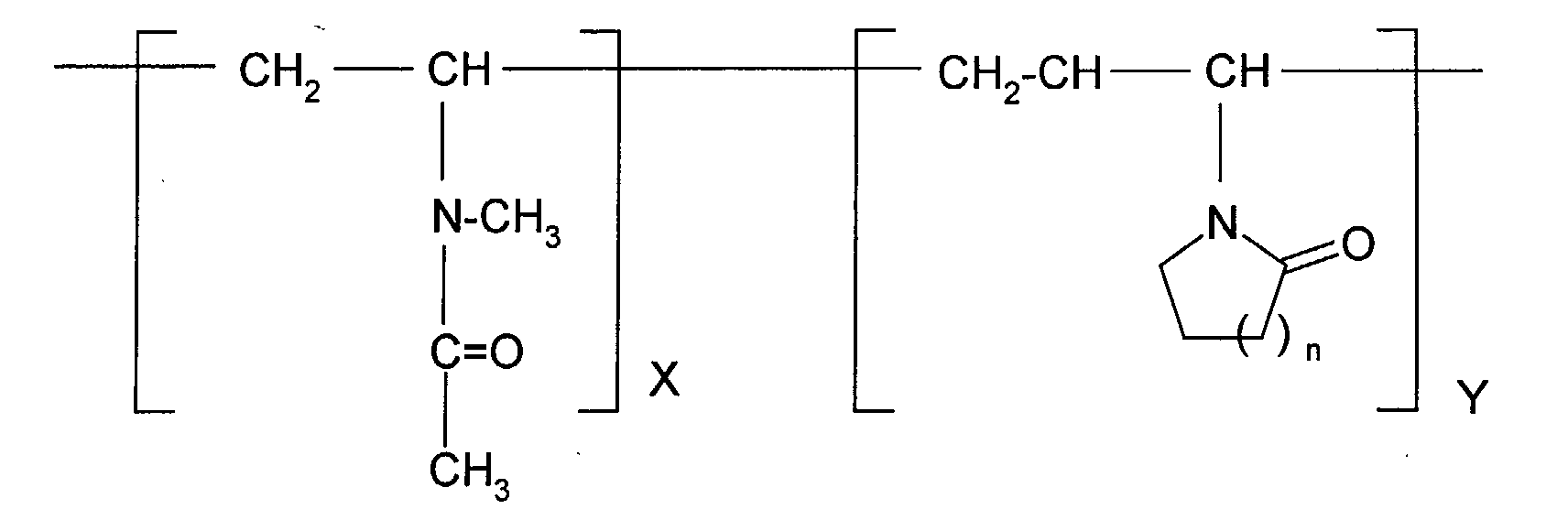
- gas hydrate inhibitors according to the invention are used in a mixture with polymers which are disclosed in WO-A-96/41785.
- This document discloses gas hydrate inhibitors comprising structural units of the formula wherein n is a number from 1 to 3 and x and y represent the number of repetitive units, which is dimensioned such that the molecular weight of the polymer is between 1,000 and 6,000,000.
- Copolymers of N-vinylcaprolactam and N-vinyl-N-methylacetamide or vinylpyrrolidone are particularly suitable for use within the scope of the present invention.
- the gas hydrate inhibitors according to the invention in a mixture with other polymers used which are disclosed in WO-A-94/12761.
- the document discloses additives to prevent the formation of gas hydrates comprising polymers contain cyclic substituents with 5 to 7 ring members.
- polyvinylcaprolactam, Polyvinyl pyrrolidone and hydroxyethyl cellulose are suitable.
- Mixtures of the polymers according to the invention are also particularly suitable Maleic anhydride-based gas hydrate inhibitors as described in WO-A-97/6506 are described, in particular reacted with mono- and / or diamines Maleic anhydride copolymers. These include, in particular, modified ones Vinyl acetate-maleic anhydride copolymers are particularly preferred.
- the concentration ratios are between the gas hydrate inhibitors according to the invention and the admixed ones Components from 90:10 to 10:90 percent by weight are preferred Mixtures in the ratios 75:25 to 25:75 and in particular 60:40 to 40:60 used.
- the compounds can Gas hydrate inhibitors, in the oil and gas production or the preparation of Drilling fluids using common equipment such as injection pumps or the like for the Hydrate formation-prone multiphase mixture can be added due to the good solubility of the polymers according to the invention is rapid and uniform distribution of the inhibitor in the tendency to hydrate formation Given water phase or the condensate phase.
- the inhibitors primarily nucleate and grow hydrate nuclei delay or prevent agglomeration, the addition of the inhibitor preferably before gas hydrate formation occurs, i.e. still above the Equilibrium temperature of hydrate formation. This is the case, for example, if the inhibitor e.g. directly at the natural gas source or at the beginning of the inhibiting pipeline.
- the time from reaching the minimum temperature of 2 ° C to the first gas uptake (T ind ) is used as a measure of the inhibitory effect of the additive. Long induction times indicate an effect as a kinetic inhibitor.
- the pressure drop and temperature rise reflect the amount of hydrate crystals formed.
- the torque measured in the autoclave serves as a parameter for the agglomeration of the hydrate crystals. With a good antiagglomerant, the torque that builds up after the formation of gas hydrates is significantly reduced compared to the blank value. Ideally, snow-like, fine hydrate crystals are formed in the condensate phase, which do not accumulate and therefore do not lead to clogging of the installations used for gas transport and gas production.
- the preparation of the invention is first Additive components and then described their effectiveness as a gas hydrate inhibitor.
- glycolic acid isobutylamide 656 g were placed in a 2 l autoclave and placed under Alkali catalysis at 150 ° C up to a maximum of 4 bar with the appropriate amount of EO fumigated. The reaction was continued for 1 hour at 4.5 bar nitrogen pressure.
- glycolic acid isobutylamide triethoxylate 49.2 g were placed in a 100 ml four-necked flask and 20.4 g of acetic anhydride and under nitrogen flushing and reflux Warmed for 5 h. The resulting acetic acid was then removed under vacuum (4 mbar) distilled off.
- glycolic acid isobutylamide triethoxylate 49.2 g were placed in a 100 ml four-necked flask and 26 g of propionic anhydride and under nitrogen flushing and reflux Warmed for 5 h. The resulting propionic acid was then under vacuum (4 mbar) distilled off.
- glycolic acid isobutylamide triethoxylate 49.2 g were placed in a 250 ml four-necked flask and 25 g propionic acid (excess) in 50 g Shellsol® 100/140 (mainly aliphatic solvent mixtures in various boiling ranges). To 0.1 g of p-toluenesulfonic acid were added and the reaction mixture was added Reflux heated for 2 h. Then the water of reaction formed completely circled and the solvent and unreacted propionic acid distilled off under vacuum (4 mbar).
- glycolic acid isobutylamide pentaethoxylate 50.4 g were placed in a 250 ml four-necked flask and 25 g of propionic acid (excess) in 50 g of Shellsol 100/140. 0.1 g of p-toluenesulfonic acid was added and the reaction mixture was added Reflux heated for 2 h. Then the water of reaction formed completely circled and the solvent and unreacted propionic acid distilled off under vacuum (4 mbar).
- glycolic acid isobutylamide triethoxylate 49.2 g were placed in a 100 ml four-necked flask and 43.2 g of 2-ethylhexanoic acid and after adding 0.5 g of FASCAT under Nitrogen purge and reflux heated for 2 h. Then the emerging Water of reaction is distilled off continuously.
- glycolic acid isobutylamide triethoxylate 49.2 g were placed in a 100 ml four-necked flask and 84.6 g of oleic acid and after adding 0.5 g of FASCAT Nitrogen purge and reflux heated for 2 h. Then the emerging Water of reaction is distilled off continuously.
- glycolic acid isobutylamide pentaethoxylate 50.4 g were placed in a 100 ml four-necked flask and 26.0 g of propionic anhydride and submitted with a nitrogen purge and heated to reflux for 5 h. The resulting acetic acid was then added Vacuum (4 mbar) distilled off.
- glycolic acid isobutylamide pentaethoxylate 50.4 g were placed in a 100 ml four-necked flask and 43.2 g of 2-ethylhexanoic acid and after adding 0.5 g FASCAT heated under nitrogen purge and reflux for 2 h. Then that became water of reaction formed is distilled off continuously.
- T 1 and T 2 are the supercooling below the equilibrium temperature of the hydrate formation at 50 and 100 bar.
- PVCap polyvinylcaprolactam
- the products according to the invention especially those with short alkyl radicals R 1 and a high degree of ethoxylation relative to the alkyl radical, act as kinetic hydrate inhibitors and show a marked improvement over the prior art. They can also be used to increase (synergy effect) the performance of inhibitors of the prior art.
- TBAB tetrabutylammonium bromide
Landscapes
- Chemical & Material Sciences (AREA)
- Engineering & Computer Science (AREA)
- Organic Chemistry (AREA)
- Oil, Petroleum & Natural Gas (AREA)
- Life Sciences & Earth Sciences (AREA)
- General Life Sciences & Earth Sciences (AREA)
- Materials Engineering (AREA)
- Mechanical Engineering (AREA)
- General Engineering & Computer Science (AREA)
- Chemical Kinetics & Catalysis (AREA)
- General Chemical & Material Sciences (AREA)
- Organic Low-Molecular-Weight Compounds And Preparation Thereof (AREA)
Abstract

- R1
- C1- bis C24-Alkyl, C2- bis C24-Alkenyl oder einen C6- bis C18-Arylrest, der mit einer C1- bis C12-Alkylgruppe substituiert sein kann,
- R2, R3
- unabhängig voneinander Wasserstoff, C1- bis C18-Alkyl, C5- bis C7-Cycloalkyl, oder R2 und R3, unter Einschluss des Stickstoffatoms, an das sie gebunden sind, einen Ring von 4 bis 8 Ringatomen, in dem außer Kohlenstoff auch Sauerstoff- oder Stickstoffatome enthalten sein können,
- A
- gleichartige oder verschiedene C2- bis C4-Alkylenreste,
- B
- C1- bis C7-Alkylen,
- n
- eine ganze Zahl von 1 - 40
Description

- R1
- C1- bis C24-Alkyl, C2- bis C24-Alkenyl oder einen C6- bis C18-Arylrest, der mit einer C1- bis C12-Alkylgruppe substituiert sein kann,
- R2, R3
- unabhängig voneinander Wasserstoff, C1- bis C18-Alkyl, C5- bis C7-Cycloalkyl, oder R2 und R3, unter Einschluss des Stickstoffatoms, an das sie gebunden sind, einen Ring von 4 bis 8 Ringatomen, in dem außer Kohlenstoff auch Sauerstoff- oder Stickstoffatome enthalten sein können,
- A
- gleichartige oder verschiedene C2- bis C4-Alkylenreste,
- B
- C1- bis C7-Alkylen,
- n
- eine ganze Zahl von 1 - 40


- R1
- Wasserstoff oder C1-C6-Alkyl
- R2
- C1-C24-Alkyl, C2-C24-Alkylen oder ein C6-C18-Arylrest, der mit einer C1-C12-Alkylgruppe substituiert sein kann,
- A
- gleichartige oder verschiedene C2-C4-Alkylenreste und
- x
- eine ganze Zahl von 2 - 40 bedeuten,
| Zusammensetzung und Eigenschaften der verwendeten Erdgase | ||
| Gas 1 | Gas 2 | |
| Methan | 79,3 | 92,1 |
| Ethan | 10,8 | 3,5 |
| Propan | 4,8 | 0,8 |
| Butan | 1,9 | 0,7 |
| Kohlendioxid | 1,4 | 0,6 |
| Stickstoff | 1,8 | 2,3 |
| T1 | 12°C | 7°C |
| T2 | 18°C | 12°C |
| Wirksamkeit der Additive als Gashydratinhibitoren | ||||||
| Beispiel Nr. | Additiv gemäß Beispiel Nr. | Gas | Druck p (bar) | Tind | Druckverlust Δ p (bar) | Temperaturanstieg Δ T (K) |
| 21(V) | ohne | 1 | 50 | 0 | > 40 | > 1,5 |
| 22(V) | ohne | 2 | 100 | 0 | > 40 | > 1,5 |
| 23 | 7 | 1 | 50 | < 5 min | 27,0 | 0,3 |
| 24 | 7 | 2 | 100 | < 5 min | 22,0 | 0,25 |
| 25 | 8 | 1 | 50 | < 5 min | 17,4 | 0,2 |
| 26 | 8 | 2 | 50 | < 5 min | 0,8 | 0 |
| 27 | 8 | 2 | 100 | < 5 min | 7,1 | 0,1 |
| 28 | 11 | 1 | 50 | 120 min | 0,1 | 0 |
| 29 | 11 | 2 | 100 | < 5 min | 4,0 | 0,1 |
| 30 | 13 | 1 | 50 | < 5 min | 20,1 | 0,2 |
| 31 | 14 | 1 | 50 | < 5 min | 23,0 | 0,25 |
| 32 | 17 | 1 | 50 | 20 min | 5,8 | 0,1 |
| 33 | 17 | 2 | 100 | 30 min | 10,8 | 0,2 |
| 34 | 18 | 1 | 50 | < 5 min | 13,1 | 0,3 |
| 35 | 19 | 1 | 50 | 70 min | 4,3 | 0,1 |
| 36 | 20 | 1 | 50 | 40 min | 5,4 | 0,1 |
| 37(V) | PVCap | 1 | 50 | < 5 min | 10,0 | 0,4 |
| 38(V) | PVCap | 2 | 100 | < 5 min | 6,0 | 0,1 |
| Auftretende Drehmomente | ||||
| Beispiel Nr. | Additiv gemäß Beispiel Nr. | Druckverlust Δ p (bar) | Temperaturanstieg Δ T (K) | Drehmoment Mmax (Ncm) |
| 39(V) | ohne | > 40 | > 8,0 | 15,9 |
| 40 | 11 | 13,4 | 0,2 | 0,3 |
| 41 | 12 | 22,1 | 2,5 | 1,2 |
| 42 | 15 | 25,3 | 5,3 | 8,8 |
| 43 | 16 | 16,8 | 0,8 | 0,9 |
| 44(V) | TBAB | 21,5 | 1,0 | 1,5 |
| 45(V) | TBAB | 15,0 | 1,0 | 1,2 |
Claims (9)
- Verwendung von Verbindungen der Formel (1)worin

- R1
- C1- bis C24-Alkyl, C2- bis C24-Alkenyl oder einen C6- bis C18-Arylrest, der mit einer C1- bis C12-Alkylgruppe substituiert sein kann,
- R2, R3
- unabhängig voneinander Wasserstoff, C1- bis C18-Alkyl, C5- bis C7-Cycloalkyl, oder R2 und R3, unter Einschluss des Stickstoffatoms, an das sie gebunden sind, einen Ring von 4 bis 8 Ringatomen, in dem außer Kohlenstoff auch Sauerstoff- oder Stickstoffatome enthalten sein können,
- A
- gleichartige oder verschiedene C2- bis C4-Alkylenreste,
- B
- C1- bis C7-Alkylen,
- n
- eine ganze Zahl von 1 - 40
- Verwendung nach Anspruch 1, wobei R1 C1- bis C8-Alkyl bedeutet.
- Verwendung nach Anspruch 1, wobei R1 C8- bis C24-Alkyl bedeutet.
- Verwendung nach einem oder mehreren der Ansprüche 1 bis 3, wobei R2 und R3 unabhängig voneinander Wasserstoff oder C1- bis C4-Alkyl bedeuten.
- Verwendung nach einem oder mehreren der Ansprüche 1 bis 4, wobei A für einen Ethylenrest steht.
- Verwendung nach einem oder mehreren der Ansprüche 1 bis 5, wobei B für eine Methylen-, Ethylen- oder Propylengruppe steht.
- Verwendung nach einem oder mehreren der Ansprüche 1 bis 6, wobei n eine Zahl von 2 bis 10 bedeutet.
- Additiv zur Inhibierung der Gashydratbildung, umfassend eine Verbindung der Formel (1) gemäß einem oder mehreren der Ansprüche 1 bis 7.
- Additiv zur Inhibierung der Gashydratbildung gemäß Anspruch 8, umfassendA) eine Verbindung der Formel (1)worin
- R1
- C1- bis C24-Alkyl, C2- bis C24-Alkenyl oder einen C6- bis C18-Arylrest, der mit einer C1- bis C12-Alkylgruppe substituiert sein kann,
- R2, R3
- unabhängig voneinander Wasserstoff, C1- bis C18-Alkyl, C5- bis C7-Cycloalkyl, oder R2 und R3, unter Einschluss des Stickstoffatoms, an das sie gebunden sind, einen Ring von 4 bis 8 Ringatomen, in dem außer Kohlenstoff auch Sauerstoff- oder Stickstoffatome enthalten sein können,
- A
- gleichartige oder verschiedene C2- bis C4-Alkylenreste,
- B
- C1- bis C7-Alkylen,
- n
- eine ganze Zahl von 1 - 40
B) wenigstens ein wasserlösliches Polymer, ausgewählt aus der Gruppe bestehend aus Polyisopropylacrylamid, Polyacryloylpyrrolidin, Polyvinylcaprolactam, Polyvinylpyrrolidon, Copolymeren aus Vinylcaprolactam mit Vinylpyrrolidon, N-Vinyl-N-Methylacetamid oder alkoxyalkylsubstituierte (Meth)Acrylsäureester und Copolymeren, die Struktureinheiten von Maleinsäure oder deren Anhydrid oder Amidderivate enthalten.
Applications Claiming Priority (2)
| Application Number | Priority Date | Filing Date | Title |
|---|---|---|---|
| DE10114638A DE10114638C1 (de) | 2001-03-24 | 2001-03-24 | Additive zur Inhibierung der Gashydratbildung und deren Verwendung |
| DE10114638 | 2001-03-24 |
Publications (3)
| Publication Number | Publication Date |
|---|---|
| EP1243637A2 true EP1243637A2 (de) | 2002-09-25 |
| EP1243637A3 EP1243637A3 (de) | 2004-01-02 |
| EP1243637B1 EP1243637B1 (de) | 2007-08-15 |
Family
ID=7678965
Family Applications (1)
| Application Number | Title | Priority Date | Filing Date |
|---|---|---|---|
| EP02005587A Expired - Lifetime EP1243637B1 (de) | 2001-03-24 | 2002-03-12 | Additive zur Inhibierung der Gashydratbildung |
Country Status (5)
| Country | Link |
|---|---|
| US (1) | US6894007B2 (de) |
| EP (1) | EP1243637B1 (de) |
| DE (2) | DE10114638C1 (de) |
| MX (1) | MXPA02003080A (de) |
| NO (1) | NO330063B1 (de) |
Cited By (1)
| Publication number | Priority date | Publication date | Assignee | Title |
|---|---|---|---|---|
| EP1449940A1 (de) * | 2003-02-24 | 2004-08-25 | Clariant GmbH | Korrosions- und Gashydratinhibitoren mit verbesserter Wasserlöslichkeit und erhöhter biologischer Abbaubarkeit |
Families Citing this family (30)
| Publication number | Priority date | Publication date | Assignee | Title |
|---|---|---|---|---|
| DE10059816C1 (de) * | 2000-12-01 | 2002-04-18 | Clariant Gmbh | Verwendung von Additiven zur Inhibierung der Gashydratbildung |
| GB0123409D0 (en) * | 2001-09-28 | 2001-11-21 | Atkinson Stephen | Method for the recovery of hydrocarbons from hydrates |
| DE10307728B4 (de) | 2003-02-24 | 2005-09-22 | Clariant Gmbh | Korrosions-und Gashydratinhibitoren mit verbesserter Wasserlöslichkeit und erhöhter biologischer Abbaubarkeit und derartige Verbindungen |
| DE10307729B8 (de) * | 2003-02-24 | 2004-12-09 | Clariant Gmbh | Additive zur Inhibierung der Gashydratbildung |
| DE10307725B4 (de) | 2003-02-24 | 2007-04-19 | Clariant Produkte (Deutschland) Gmbh | Korrosions-und Gashydratinhibitoren mit verbesserter Wasserlöslichkeit und erhöhter biologischer Abbaubarkeit |
| DE10307730B3 (de) | 2003-02-24 | 2004-11-11 | Clariant Gmbh | Verwendung von Verbindungen als Korrosions- und Gashydratinhibitoren mit verbesserter Wasserlöslichkeit und erhöhter biologischer Abbaubarkeit und diese Verbindungen |
| US20050085396A1 (en) * | 2003-10-21 | 2005-04-21 | Vaithilingam Panchalingam | Methods for inhibiting hydrate blockage in oil and gas pipelines using amino alcohols and ester compounds |
| DE102004048778B3 (de) | 2004-10-07 | 2006-06-22 | Clariant Gmbh | Korrosions-und Gashydratinhibitoren mit erhöhter biologischer Abbaubarkeit und verminderter Toxizität |
| DE102005006421A1 (de) * | 2005-02-12 | 2006-08-24 | Clariant Produkte (Deutschland) Gmbh | Polymere und ihre Herstellung und Verwendung als Gashydratinhibitoren |
| US20090014199A1 (en) * | 2006-06-23 | 2009-01-15 | Chiruvella Raman V | Insulated non-halogenated heavy metal free vehicular cable |
| US7408116B2 (en) * | 2006-06-23 | 2008-08-05 | Delphi Technologies, Inc. | Insulated non-halogenated heavy metal free vehicular cable |
| DE102006053500A1 (de) * | 2006-11-14 | 2008-05-15 | Evonik Goldschmidt Gmbh | Antimikrobielle Zusammensetzungen |
| DE102007037017A1 (de) * | 2007-08-06 | 2009-02-19 | Clariant International Ltd. | 1-Alkyl-5-oxo-pyrrolidin-3-carbonsäureester mit verbesserter biologischer Abbaubarkeit |
| DE102007037016B4 (de) * | 2007-08-06 | 2011-06-30 | Clariant International Limited | Verwendung von 1-Alkyl-5-oxo-pyrrolidin-3-carbonsäureestern als Gashydratinhibitoren mit verbesserter biologischer Abbaubarkeit |
| US9567852B2 (en) | 2012-12-13 | 2017-02-14 | Halliburton Energy Services, Inc. | Systems and methods for measuring fluid additive concentrations for real time drilling fluid management |
| US9222351B2 (en) | 2012-12-13 | 2015-12-29 | Halliburton Energy Services, Inc. | Systems and methods for real-time sag detection |
| US9335438B2 (en) | 2012-12-13 | 2016-05-10 | Halliburton Energy Services, Inc. | Systems and methods for real time monitoring of gas hydrate formation |
| US9000358B2 (en) | 2012-12-13 | 2015-04-07 | Halliburton Energy Services, Inc. | Systems and methods for real time drilling fluid management |
| FR3044321B1 (fr) * | 2015-11-27 | 2020-08-07 | Ceca Sa | Composition pour limiter la formation et/ou l'agglomeration d'hydrates de gaz |
| CN121667302A (zh) * | 2015-11-30 | 2026-03-17 | 联合利华知识产权控股有限公司 | 冷冻产品的生产方法 |
| CN108219762B (zh) * | 2016-12-14 | 2020-04-07 | 中国科学院广州能源研究所 | 一种新型水合物动力学抑制剂及其制备方法和应用 |
| US10793762B2 (en) | 2017-08-15 | 2020-10-06 | Saudi Arabian Oil Company | Layered double hydroxides for oil-based drilling fluids |
| US10876039B2 (en) | 2017-08-15 | 2020-12-29 | Saudi Arabian Oil Company | Thermally stable surfactants for oil based drilling fluids |
| SG11202001271PA (en) | 2017-08-15 | 2020-03-30 | Saudi Arabian Oil Co | Thermally stable surfactants for oil based drilling fluids |
| US10676658B2 (en) | 2017-08-15 | 2020-06-09 | Saudi Arabian Oil Company | Oil-based drilling fluids for high pressure and high temperature drilling operations |
| US10988659B2 (en) | 2017-08-15 | 2021-04-27 | Saudi Arabian Oil Company | Layered double hydroxides for oil-based drilling fluids |
| US10745606B2 (en) | 2017-08-15 | 2020-08-18 | Saudi Arabian Oil Company | Oil-based drilling fluid compositions which include layered double hydroxides as rheology modifiers |
| US10647903B2 (en) | 2017-08-15 | 2020-05-12 | Saudi Arabian Oil Company | Oil-based drilling fluid compositions which include layered double hydroxides as rheology modifiers and amino amides as emulsifiers |
| US10640696B2 (en) | 2017-08-15 | 2020-05-05 | Saudi Arabian Oil Company | Oil-based drilling fluids for high pressure and high temperature drilling operations |
| CN109776723B (zh) * | 2018-12-26 | 2020-06-12 | 中国科学院广州能源研究所 | 一种酰胺类共聚物水合物动力学抑制剂及其应用 |
Family Cites Families (8)
| Publication number | Priority date | Publication date | Assignee | Title |
|---|---|---|---|---|
| US5432292A (en) * | 1992-11-20 | 1995-07-11 | Colorado School Of Mines | Method for controlling clathrate hydrates in fluid systems |
| US5600044A (en) * | 1994-09-15 | 1997-02-04 | Exxon Production Research Company | Method for inhibiting hydrate formation |
| USH1749H (en) * | 1994-09-15 | 1998-09-01 | Exxon Production Research Company | Method for inhibiting hydrate formation |
| AU684689B2 (en) * | 1995-06-08 | 1997-12-18 | Exxon Production Research Company | Method for inhibiting clathrate hydrate formation |
| GB9516441D0 (en) | 1995-08-10 | 1995-10-11 | Philips Electronics Uk Ltd | Light pen input systems |
| NZ502968A (en) * | 1997-09-09 | 2002-02-01 | Shell Int Research | Method and substituted di-isopropanol ammonium bromides for inhibiting the plugging of conduits by gas hydrates |
| DE19920152C1 (de) * | 1999-05-03 | 2000-10-12 | Clariant Gmbh | Additive zur Inhibierung der Gashydratbildung und deren Verwendung |
| NO992278L (no) * | 1999-05-11 | 2000-11-13 | Rf Procom As | FremgangsmÕte for forhindring av tilstopping rørledninger med gasshydrater |
-
2001
- 2001-03-24 DE DE10114638A patent/DE10114638C1/de not_active Expired - Fee Related
-
2002
- 2002-03-12 EP EP02005587A patent/EP1243637B1/de not_active Expired - Lifetime
- 2002-03-12 DE DE50210670T patent/DE50210670D1/de not_active Expired - Lifetime
- 2002-03-20 US US10/102,584 patent/US6894007B2/en not_active Expired - Lifetime
- 2002-03-21 NO NO20021419A patent/NO330063B1/no not_active IP Right Cessation
- 2002-03-22 MX MXPA02003080A patent/MXPA02003080A/es active IP Right Grant
Cited By (1)
| Publication number | Priority date | Publication date | Assignee | Title |
|---|---|---|---|---|
| EP1449940A1 (de) * | 2003-02-24 | 2004-08-25 | Clariant GmbH | Korrosions- und Gashydratinhibitoren mit verbesserter Wasserlöslichkeit und erhöhter biologischer Abbaubarkeit |
Also Published As
| Publication number | Publication date |
|---|---|
| DE10114638C1 (de) | 2002-05-23 |
| MXPA02003080A (es) | 2002-11-05 |
| NO20021419D0 (no) | 2002-03-21 |
| EP1243637B1 (de) | 2007-08-15 |
| US6894007B2 (en) | 2005-05-17 |
| EP1243637A3 (de) | 2004-01-02 |
| US20030013614A1 (en) | 2003-01-16 |
| DE50210670D1 (de) | 2007-09-27 |
| NO20021419L (no) | 2002-09-25 |
| NO330063B1 (no) | 2011-02-14 |
Similar Documents
| Publication | Publication Date | Title |
|---|---|---|
| DE10114638C1 (de) | Additive zur Inhibierung der Gashydratbildung und deren Verwendung | |
| EP1050567B1 (de) | Additive zur Inhibierung der Gashydratbildung | |
| DE10307729B3 (de) | Additive zur Inhibierung der Gashydtratbildung | |
| DE10059816C1 (de) | Verwendung von Additiven zur Inhibierung der Gashydratbildung | |
| EP2445984B1 (de) | Additive zur inhibierung der gashydratbildung | |
| DE19803384C1 (de) | Additive zur Inhibierung der Gashydratbildung und Verfahren zur Inhibierung der Bildung von Gashydraten | |
| DE102007037016B4 (de) | Verwendung von 1-Alkyl-5-oxo-pyrrolidin-3-carbonsäureestern als Gashydratinhibitoren mit verbesserter biologischer Abbaubarkeit | |
| EP0914407B1 (de) | Verfahren zur inhibierung der gashydratbildung | |
| DE102007037015B3 (de) | Verwendung von substituierten Polyethyleniminen als Gashydratinhibitoren mit verbesserter biologischer Abbaubarkeit | |
| DE10307727B3 (de) | Verwendung von Verbindungen als Korrosions- und Gashydratinhibitoren mit verbesserter Wasserlöslichkeit und erhöhter biologischer Abbaubarkeit und diese Verbindungen | |
| EP1452580A1 (de) | Korrosions- und Gashydratinhibitoren mit verbesserter Wasserlöslichkeit und erhöhter biologischer Abbaubarkeit | |
| EP1951841B1 (de) | Verwendung von pyroglutaminsäureestern als gashydratinhibitoren mit verbesserter biologischer abbaubarkeit | |
| EP1951666B1 (de) | Pyroglutaminsäureester mit verbesserter biologischer abbaubarkeit | |
| DE102005006421A1 (de) | Polymere und ihre Herstellung und Verwendung als Gashydratinhibitoren | |
| EP1858834B1 (de) | Biologisch abbaubare gashydratinhibitoren | |
| DE102005007287B4 (de) | Verwendung von Polyestern als Gashydratinhibitoren | |
| DE102010022759A1 (de) | Additive zur Inhibierung der Gashydratbildung | |
| DE10163260C1 (de) | Additive, Verwendung und Verfahren zur Inhibierung der Gashydratbildung | |
| DE10122613C1 (de) | Additive zur Inhibierung der Gashydratbildung | |
| DE10163259C1 (de) | Additive, Verwendung und Verfahren zur Inhibierung der Gashydratbildung | |
| WO2002084072A1 (de) | Additive zur inhibierung der gashydratbildung |
Legal Events
| Date | Code | Title | Description |
|---|---|---|---|
| PUAI | Public reference made under article 153(3) epc to a published international application that has entered the european phase |
Free format text: ORIGINAL CODE: 0009012 |
|
| AK | Designated contracting states |
Kind code of ref document: A2 Designated state(s): AT BE CH CY DE DK ES FI FR GB GR IE IT LI LU MC NL PT SE TR |
|
| AX | Request for extension of the european patent |
Free format text: AL;LT;LV;MK;RO;SI |
|
| PUAL | Search report despatched |
Free format text: ORIGINAL CODE: 0009013 |
|
| AK | Designated contracting states |
Kind code of ref document: A3 Designated state(s): AT BE CH CY DE DK ES FI FR GB GR IE IT LI LU MC NL PT SE TR |
|
| AX | Request for extension of the european patent |
Extension state: AL LT LV MK RO SI |
|
| 17P | Request for examination filed |
Effective date: 20040702 |
|
| AKX | Designation fees paid |
Designated state(s): DE FR GB IT NL |
|
| 17Q | First examination report despatched |
Effective date: 20041015 |
|
| RAP1 | Party data changed (applicant data changed or rights of an application transferred) |
Owner name: CLARIANT PRODUKTE (DEUTSCHLAND) GMBH |
|
| GRAP | Despatch of communication of intention to grant a patent |
Free format text: ORIGINAL CODE: EPIDOSNIGR1 |
|
| GRAS | Grant fee paid |
Free format text: ORIGINAL CODE: EPIDOSNIGR3 |
|
| GRAA | (expected) grant |
Free format text: ORIGINAL CODE: 0009210 |
|
| AK | Designated contracting states |
Kind code of ref document: B1 Designated state(s): DE FR GB IT NL |
|
| REG | Reference to a national code |
Ref country code: GB Ref legal event code: FG4D Free format text: NOT ENGLISH |
|
| REF | Corresponds to: |
Ref document number: 50210670 Country of ref document: DE Date of ref document: 20070927 Kind code of ref document: P |
|
| GBT | Gb: translation of ep patent filed (gb section 77(6)(a)/1977) |
Effective date: 20071025 |
|
| ET | Fr: translation filed | ||
| PLBE | No opposition filed within time limit |
Free format text: ORIGINAL CODE: 0009261 |
|
| STAA | Information on the status of an ep patent application or granted ep patent |
Free format text: STATUS: NO OPPOSITION FILED WITHIN TIME LIMIT |
|
| 26N | No opposition filed |
Effective date: 20080516 |
|
| REG | Reference to a national code |
Ref country code: FR Ref legal event code: PLFP Year of fee payment: 14 |
|
| PGFP | Annual fee paid to national office [announced via postgrant information from national office to epo] |
Ref country code: IT Payment date: 20150226 Year of fee payment: 14 Ref country code: DE Payment date: 20150216 Year of fee payment: 14 |
|
| PGFP | Annual fee paid to national office [announced via postgrant information from national office to epo] |
Ref country code: GB Payment date: 20150211 Year of fee payment: 14 Ref country code: FR Payment date: 20150304 Year of fee payment: 14 |
|
| PGFP | Annual fee paid to national office [announced via postgrant information from national office to epo] |
Ref country code: NL Payment date: 20150212 Year of fee payment: 14 |
|
| REG | Reference to a national code |
Ref country code: DE Ref legal event code: R119 Ref document number: 50210670 Country of ref document: DE |
|
| REG | Reference to a national code |
Ref country code: NL Ref legal event code: MM Effective date: 20160401 |
|
| GBPC | Gb: european patent ceased through non-payment of renewal fee |
Effective date: 20160312 |
|
| REG | Reference to a national code |
Ref country code: FR Ref legal event code: ST Effective date: 20161130 |
|
| PG25 | Lapsed in a contracting state [announced via postgrant information from national office to epo] |
Ref country code: FR Free format text: LAPSE BECAUSE OF NON-PAYMENT OF DUE FEES Effective date: 20160331 Ref country code: NL Free format text: LAPSE BECAUSE OF NON-PAYMENT OF DUE FEES Effective date: 20160401 Ref country code: GB Free format text: LAPSE BECAUSE OF NON-PAYMENT OF DUE FEES Effective date: 20160312 Ref country code: DE Free format text: LAPSE BECAUSE OF NON-PAYMENT OF DUE FEES Effective date: 20161001 |
|
| PG25 | Lapsed in a contracting state [announced via postgrant information from national office to epo] |
Ref country code: IT Free format text: LAPSE BECAUSE OF NON-PAYMENT OF DUE FEES Effective date: 20160312 |