EP1241527A1 - Positive type photosensitive polyimide resin composition - Google Patents
Positive type photosensitive polyimide resin composition Download PDFInfo
- Publication number
- EP1241527A1 EP1241527A1 EP00977917A EP00977917A EP1241527A1 EP 1241527 A1 EP1241527 A1 EP 1241527A1 EP 00977917 A EP00977917 A EP 00977917A EP 00977917 A EP00977917 A EP 00977917A EP 1241527 A1 EP1241527 A1 EP 1241527A1
- Authority
- EP
- European Patent Office
- Prior art keywords
- repeating units
- formula
- group
- bis
- units represented
- Prior art date
- Legal status (The legal status is an assumption and is not a legal conclusion. Google has not performed a legal analysis and makes no representation as to the accuracy of the status listed.)
- Withdrawn
Links
Classifications
-
- G—PHYSICS
- G03—PHOTOGRAPHY; CINEMATOGRAPHY; ANALOGOUS TECHNIQUES USING WAVES OTHER THAN OPTICAL WAVES; ELECTROGRAPHY; HOLOGRAPHY
- G03F—PHOTOMECHANICAL PRODUCTION OF TEXTURED OR PATTERNED SURFACES, e.g. FOR PRINTING, FOR PROCESSING OF SEMICONDUCTOR DEVICES; MATERIALS THEREFOR; ORIGINALS THEREFOR; APPARATUS SPECIALLY ADAPTED THEREFOR
- G03F7/00—Photomechanical, e.g. photolithographic, production of textured or patterned surfaces, e.g. printing surfaces; Materials therefor, e.g. comprising photoresists; Apparatus specially adapted therefor
- G03F7/004—Photosensitive materials
- G03F7/022—Quinonediazides
- G03F7/023—Macromolecular quinonediazides; Macromolecular additives, e.g. binders
-
- H—ELECTRICITY
- H10—SEMICONDUCTOR DEVICES; ELECTRIC SOLID-STATE DEVICES NOT OTHERWISE PROVIDED FOR
- H10P—GENERIC PROCESSES OR APPARATUS FOR THE MANUFACTURE OR TREATMENT OF DEVICES COVERED BY CLASS H10
- H10P14/00—Formation of materials, e.g. in the shape of layers or pillars
- H10P14/60—Formation of materials, e.g. in the shape of layers or pillars of insulating materials
- H10P14/68—Organic materials, e.g. photoresists
- H10P14/683—Organic materials, e.g. photoresists carbon-based polymeric organic materials, e.g. polyimides, poly cyclobutene or PVC
-
- C—CHEMISTRY; METALLURGY
- C08—ORGANIC MACROMOLECULAR COMPOUNDS; THEIR PREPARATION OR CHEMICAL WORKING-UP; COMPOSITIONS BASED THEREON
- C08K—Use of inorganic or non-macromolecular organic substances as compounding ingredients
- C08K5/00—Use of organic ingredients
- C08K5/16—Nitrogen-containing compounds
- C08K5/20—Carboxylic acid amides
-
- C—CHEMISTRY; METALLURGY
- C08—ORGANIC MACROMOLECULAR COMPOUNDS; THEIR PREPARATION OR CHEMICAL WORKING-UP; COMPOSITIONS BASED THEREON
- C08K—Use of inorganic or non-macromolecular organic substances as compounding ingredients
- C08K5/00—Use of organic ingredients
- C08K5/16—Nitrogen-containing compounds
- C08K5/22—Compounds containing nitrogen bound to another nitrogen atom
- C08K5/27—Compounds containing a nitrogen atom bound to two other nitrogen atoms, e.g. diazoamino-compounds
- C08K5/28—Azides
-
- C—CHEMISTRY; METALLURGY
- C08—ORGANIC MACROMOLECULAR COMPOUNDS; THEIR PREPARATION OR CHEMICAL WORKING-UP; COMPOSITIONS BASED THEREON
- C08L—COMPOSITIONS OF MACROMOLECULAR COMPOUNDS
- C08L79/00—Compositions of macromolecular compounds obtained by reactions forming in the main chain of the macromolecule a linkage containing nitrogen with or without oxygen or carbon only, not provided for in groups C08L61/00 - C08L77/00
- C08L79/04—Polycondensates having nitrogen-containing heterocyclic rings in the main chain; Polyhydrazides; Polyamide acids or similar polyimide precursors
- C08L79/08—Polyimides; Polyester-imides; Polyamide-imides; Polyamide acids or similar polyimide precursors
-
- G—PHYSICS
- G03—PHOTOGRAPHY; CINEMATOGRAPHY; ANALOGOUS TECHNIQUES USING WAVES OTHER THAN OPTICAL WAVES; ELECTROGRAPHY; HOLOGRAPHY
- G03F—PHOTOMECHANICAL PRODUCTION OF TEXTURED OR PATTERNED SURFACES, e.g. FOR PRINTING, FOR PROCESSING OF SEMICONDUCTOR DEVICES; MATERIALS THEREFOR; ORIGINALS THEREFOR; APPARATUS SPECIALLY ADAPTED THEREFOR
- G03F7/00—Photomechanical, e.g. photolithographic, production of textured or patterned surfaces, e.g. printing surfaces; Materials therefor, e.g. comprising photoresists; Apparatus specially adapted therefor
- G03F7/004—Photosensitive materials
- G03F7/022—Quinonediazides
- G03F7/023—Macromolecular quinonediazides; Macromolecular additives, e.g. binders
- G03F7/0233—Macromolecular quinonediazides; Macromolecular additives, e.g. binders characterised by the polymeric binders or the macromolecular additives other than the macromolecular quinonediazides
Definitions
- the present invention relates to a photosensitive material useful for electric/electronic devices, particular for semiconductor devices. More particularly, it relates to a positive type photosensitive polyimide resin composition excellent in the adhesion to a substrate, the developability, etc.
- a method for imparting photosensitivity to a polyimide resin there may, for example, be mentioned a method of chemically bonding a crosslinkable group to a soluble polyimide precursor as disclosed in e.g. JP-A-54-116216 and JP-A-54-116217, or a method of mixing crosslinkable monomers as disclosed in JP-A-54-145794 and JP-A-57-168942.
- the above methods are of a negative type wherein an exposed portion is crosslinked and made insoluble by light, and they have a problem with respect to safety as an organic solvent is used for development, and further have a drawback that it is difficult to carry out fine processing at a high resolution, since the exposed portion will be swelled by a developing solution.
- JP-A-64-60630 discloses a method of mixing an o-quinonediazide compound to an organic solvent-soluble polyimide resin having hydroxyl groups introduced.
- JP-A-3-209478 discloses a method wherein a resin excellent in transparency is used as an organic solvent-soluble polyimide resin, and accordingly, by mixing an o-quinonediazide compound, a very high sensitivity and a high resolution can be attained.
- the present invention has been made in view of the above-mentioned situations and is intended to provide a positive type photosensitive resin composition which can be developed with an aqueous alkaline solution and which is excellent in the developability and the adhesion to a substrate.
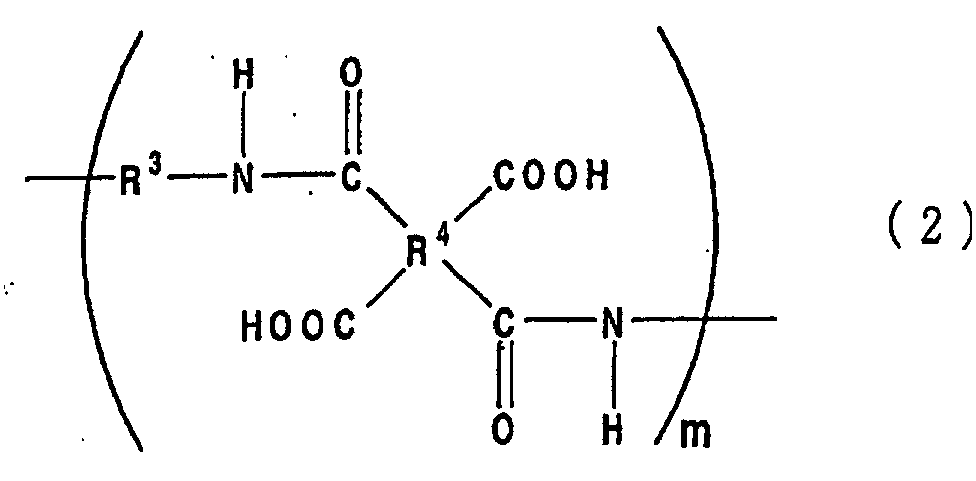
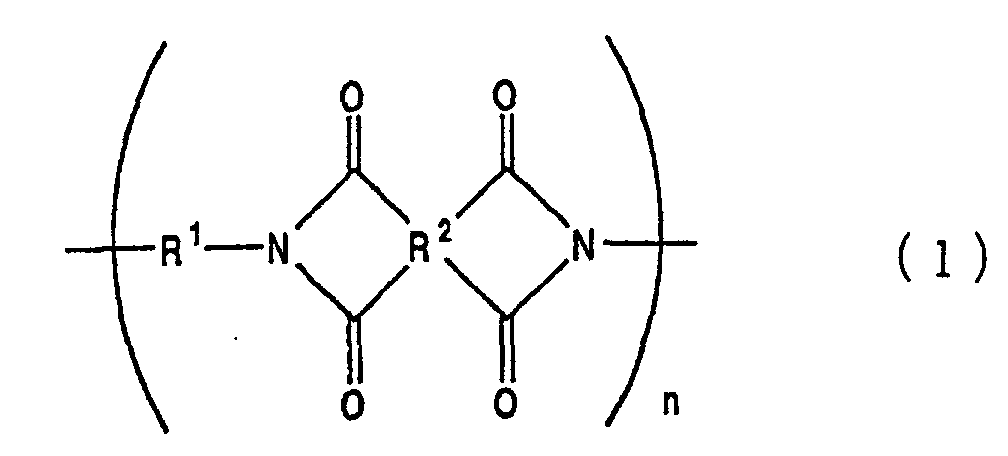
- the present invention relates to a positive type photosensitive polyimide resin composition characterized by comprising 100 parts by weight of a solvent-soluble polyimide having repeating units represented by the formula (1): (wherein repeating units n is an integer of from 3 to 1000, R 1 represents a bivalent organic group constituting a diamine, R 2 represents a tetravalent organic group constituting a tetracarboxylic acid or its derivative, and R 1 is a bivalent organic group wherein from 1 to 90 mol% of the diamine component has one or plural groups of at least one type selected from the group consisting of a phenolic hydroxyl group, a carboxyl group, a thiophenol group and a sulfonic group, and from 10 to 99 mol% has no phenolic hydroxyl, carboxylic, thiophenol or sulfonic group) and from 1 to 50 parts by weight of a polyimide precursor having repeating units represented by the formula (2): (wherein repeating units m is an integer of from 3
- the bivalent organic group constituting a diamine for R 3 in the polyimide precursor having the repeating units represented by the formula (2) is such that from 1 to 100 mol% of the diamine component is a silicone diamine, and further, it relates to the positive type photosensitive polyimide resin composition, wherein in the solvent-soluble polyimide resin having repeating units represented by the formula (1) and in the polyimide precursor having repeating units represented by the formula (2), R 2 and R 4 are cyclobutane moieties.
- the diamine constituting R 1 in the above formula (1) of the present invention is not particularly limited so long as from 1 to 90 mol% of the diamine component is a bivalent organic group having one or plural groups of at least one type selected from the group consisting of a phenolic hydroxyl group, a carboxyl group, a thiophenol group and a sulfonic group, and from 10 to 99 mol% is a bivalent organic group having no phenolic hydroxyl, carboxylic, thiophenol or sulfonic group.
- the above diamine component of from 1 to 90 mol%, and the diamine component of from 10 to 99 mol% may, respectively, be single or plural.
- the diamine having a phenolic hydroxyl group, a carboxyl group, a thiophenol group and/or a sulfonic group may, for example, be a diamine having a phenolic hydroxyl group, such as 1,3-diamino-4-hydroxybenzene, 1,3-diamino-5-hydroxybenzene, 1,3-diamino-4,6-dihydroxybenzene, 1,3-diamino-2-hydroxybenzene, 1,4-diamino-2,5-dihydroxybenzene, bis(3-amino-4-hydroxyphenyl) ether, bis(4-amino-3-hydroxyphenyl) ether, bis(4-amino-3,5-dihydroxyphenyl) ether, bis(3-amino-4-hydroxyphen
- the diamine having no phenolic hydroxyl, carboxyl, thiophenol or sulfonic group may, for example, be 4,4-methylene-bis(2,6-ethylaniline), 4,4'-methylene-bis(2-isopropyl-6-methylaniline), 4,4'-methylene-bis(2,6-diisopropylaniline), bis[4-(3-aminophenoxy)phenyl]sulfone, 2,2'-bis[4-(3-aminophenoxy)phenyl]propane, 2,2-bis[4-(3-aminophenoxy)phenyl]hexafluoropropane, 4,4'-diamino-3,3'-dimethyldicyclohexylmethane, 4,4'-diaminodiphenyl ether, 4,4'-diaminodiphenylmethane, 1,4-bis(4-aminophenoxy)benzene, 1,3-bis(4
- siloxane-containing diamine component which will be described hereinafter, may, for example, be: (wherein p represents an integer of from 1 to 10).
- the tetracarboxylic acid or its derivative, which constitutes R 2 in the formula (1) is not particularly limited.
- aromatic tetracarboxylic acids such as 1,2,4,5-benzenetetracarboxylic acid, 3,3',4,4'-biphenyltetracarboxylic acid, 3,3',4,4'-benzophenone tetracarboxylic acid, bis(3,4-dicarboxyphenyl) ether, 2,2-bis(3-4-dicarboxyphenyl)hexafluoropropane and bis(3,4-dicarboxyphenyl)sulfone, and their dianhydrides and their dicarboxylic diacid halides, may, for example, be mentioned.
- tetracarboxylic acids such as 3,3',4,4'-biphenyltetracarboxylic acid, 3,3',4,4'-benzophenone tetracarboxylic acid, 2,2-bis(3,4-dicarboxyphenyl)hexafluoropropane and bis(3,4-dicarboxyphenyl)sulfone, and their dianhydrides and their dicarboxylic diacid halides, are preferred.
- alicyclic tetracarboxylic acids such as cyclobutane-1,2,3,4-tetracarboxylic acid, 3,4-dicarboxy-1,2,3,4-tetrahydro-1-naphthalenesuccinic acid, 2,3,5-tricarboxycyclopentylacetic acid, bicyclo(2,2,2-octo-7-ene-2,3,5,6-tetracarboxylic acid and tetrahydrofuran-2,3,4,5-tetracarboxylic acid, and their dianhydrides and their dicarboxylic diacid halides, may, for example, be mentioned.
- aliphatic tetracarboxylic acids such as butanetetracarboxylic acid, and their dianhydrides and their dicarboxylic diacid halides, may also be mentioned.
- cyclobutane-1,2,3,4-tetracarboxylic acid, and its dianhydride and its dicarboxylic diacid halide may, for example, be preferred among them.
- a method for obtaining the solvent-soluble polyimide of the present invention is not particularly limited. It is common to employ a method wherein a polyimide precursor is synthesized by a reaction of a tetracarboxylic dianhydride with a diamine in a polar solvent such as N-methylpyrrolidone or dimethylacetamide, followed by dehydration ring-closure.
- the temperature for the reaction of the tetracarboxylic dianhydride with the diamine can be optionally selected within a range of from -20°C to 150°C, preferably from -5°C to 100°C.
- the polyimide precursor may be heated in the state of a solution at a temperature of from 150°C to 250°C, and to remove water formed by the dehydration ring closure, toluene or xylene may, for example, be added, and azeotropic dehydration may be carried out.
- catalytic imidation may be mentioned as a simpler method for converting the polyimide precursor to a polyimide.
- acetic anhydride and a tertiary amine such as triethylamine, pyridine, isoquinoline or imidazole, may be added to a polyimide precursor solution, and imidation can be carried out at an optional temperature of from 0°C to 250°C.
- the diamine which constitutes R 3 in the above formula (2) of the present invention is not particularly limited, but it is preferred to employ one wherein from 1 to 100 mol% of the diamine component constituting R 3 is silicone diamine, whereby the adhesion to a substrate can be improved, and it is particularly preferred that from 5 to 100 mol% is a silicone diamine.
- silicone diamine may be single or plural.
- the silicone-containing diamine component may, for example, be: (wherein p represents an integer of from 1 to 10). Further, these diamines may be used alone or in combination as a mixture of two or more of them.
- Diamines other than silicone diamines may, for example, be 4,4-methylene-bis(2,6-ethylaniline), 4,4'-methylene-bis(2-isopropyl-6-methylaniline), 4,4'-methylene-bis(2,6-diisopropylaniline), bis[4-(3-aminophenoxy)phenyl]sulfone, 2,2-bis[4-(3-aminophenoxy)phenyl]propane, 2,2-bis[4-(3-aminophenoxy)phenyl]hexafluoropropane, 4,4'-diamino-3,3'-dimethyldicyclohexylmethane, 4,4'-diaminodiphenylether, 4,4'-diaminodiphenylmethane, 1,4-bis(4-aminophenoxy)benzene, 1,3-bis(4-aminophenoxy)benzene, bis[4-(4-aminoph
- the tetracarboxylic acid or its derivative, which constitutes R 4 in the formula (2), is not particularly limited.
- aromatic tetracarboxylic acids such as 1,2,4,5-benzenetetracarboxylic acid, 3,3',4,4'-biphenyltetracarboxylic acid, 3,3',4,4'-benzophenonetetracarboxylic acid, bis(3,4-dicarboxyphenyl)ether, 2,2-bis(3,4-dicarboxyphenyl)hexafluoropropane and bis(3,4-dicarboxyphenyl)sulfone, and their dianhydrides and their dicarboxylic diacid halides, may, for example, be mentioned.
- alicyclic tetracarboxylic acids such as cyclobutane-1,2,3,4-tetracarboxylic acid, 3,4-dicarboxy-1,2,3,4-tetrahydro-1-naphthalenesuccinic acid, 2,3,5-tetracarboxycyclopentylacetic acid, bicyclo(2,2,2)octo-7-ene-2,3,5,6-tetracarboxylic acid and tetrahydrofuran-2,3,4,5-tetracarboxylic acid, and their dianhydrides and their dicarboxylic diacid halides, may be mentioned.
- aliphatic tetracarboxylic acids such as butanetetracarboxylic acid, and their dianhydrides and their dicarboxylic diacid halides, may also be mentioned.
- cyclobutane-1,2,3,4-tetracarboxylic acid, and its dianhydride and its dicarboxylic diacid halide may, for example, be preferred.
- a method for obtaining the polyimide precursor of the present invention is not particularly limited. Usually, it can be obtained by reacting and polymerizing a tetracarboxylic dianhydride with a diamine in a polar solvent such as N-methylpyrrolidone or dimethylacetamide.
- the temperature for the reaction of the tetracarboxylic dianhydride with the diamine may suitably be selected within a range of from -20°C to 150°C, preferably from -5°C to 100°C.
- the blending amount of the above polyimide precursor is from 1 to 100 parts by weight per 100 parts by weight of the above organic solvent-soluble polyimide. If the blending amount is smaller than 1 part by weight, the adhesion of the resulting composition at the time of forming a pattern, tends to be inadequate, and if it exceeds 100 parts by weight, the coating film tends to undergo phase separation, whereby a whitening phenomenon is likely to result, and even if a coating film is formed, the alkali solubility of a non-exposed portion tends to be too high to obtain a good pattern shape.
- the o-quinonediazide compound constituting the positive type photosensitive polyimide resin composition of the present invention may be a compound which contains an o-quinonediazide group in its molecule, and is not particularly limited.
- an o-benzoquinonediazide compound, an o-naphthoquinonediazide compound, or an o-quinolinequinonediazide compound may, for example, be mentioned.
- These compounds are those which are commonly used in so-called phenol novolak-type positive photosensitive compositions. Among them, it is common to employ an o-naphthoquinonediazide compound.
- the above o-quinonediazide compound is used usually in the form of an o-quinonediazide sulfonic acid ester.
- Such an o-quinonediazide sulfonic acid ester is obtained usually by a condensation reaction of an o-quinonediazide sulfonic acid chloride with a compound having phenolic hydroxyl groups.
- the o-quinonediazide sulfonic acid component constituting the above o-quinonediazide sulfonic acid chloride may, for example, be 1,2-naphtoquinone-2-diazide-4-sulfonic acid, 1,2-naphthoquinone-2-diazide-5-sulfonic acid or 1,2-naphthoquinone-2-diazide-6-sulfonic acid.
- the above compound having phenolic hydroxyl groups may, for example, be 2,4-dihydroxybenzophenone, 2,3,4-trihydroxybenzophenone, 2,2',4,4'-tetrahydroxybenzophenone, 2,3,4,4'-tetrahydroxybenzophenone, 2,2-bis(4-hydroxyphenyl)propane, 2,2-bis(2,3,4-hydroxyphenyl)propane or 4,4'-dihydroxyphenylsulfone.
- phenolic hydroxyl groups of such a compound are substituted by the above-mentioned o-quinonediazide sulfonic acid group to obtain a disubstituted, tri-substituted, tetra-substituted, pentasubstituted or hexa-substituted product, and such substituted products are used alone or in combination as a mixture thereof.
- the blending amount of the above o-quinonediazide compound is from 1 to 100 parts by weight per 100 parts by weight of the total amount of the above organic solvent-soluble polyimide and the polyimide precursor. If the blending amount is less than 1 part by weight, the sensitivity at the time of exposure of the resulting composition tends to be so low that a pattern can hardly be formed. On the other hand, if it exceeds 100 parts by weight, the mechanical properties, electrical characteristics, etc. of a film formed by the resulting composition tend to be low.
- the positive type photosensitive polyimide resin composition of the present invention is to be used for e.g. electric/electronic devices, it is used in the form of a solution as dissolved in an organic solvent.
- This organic solvent is not particularly limited so long as it is capable of uniformly dissolving the polyimide, the polyimide precursor and the o-quinonediazide compound. Its specific examples include, for example, N,N-dimethylformamide, N,N-dimethylacetamide, N-methylpyrrolidone, N-vinylpyrrolidone, dimethylsulfoxide, m-cresol, and ⁇ -butyrolactone.
- organic solvents may be incorporated so long as they do not hinder the solubility of the composition.
- organic solvents include ethyl cellosolve, butyl cellosolve, ethylcarbitol, butylcarbitol, ethylcarbitol acetate, butylcarbitol acetate, and ethylene glycol.
- a polyimide precursor solution and the o-quinonediazide compound may be dissolved in a solution wherein the organic solvent-soluble polyimide has been reacted and polymerized. Otherwise, the organic solvent-soluble polyimide resin and the polyimide precursor resin precipitated and recovered by means of a poor solvent, may be dissolved together with the above o-quinonediazide compound in the above organic solvent.
- the concentration of the above positive type photosensitive polyimide resin composition in the organic solvent solution is not particularly limited so long as the polyimide and the o-quinonediazide compound are uniformly dissolved in the organic solvent. From the viewpoint of processing efficiency, a concentration within a range of from 1 to 50 wt% is common.
- the positive type photosensitive polyimide resin composition of the present invention may be spin-coated on a substrate such as a silicon wafer, followed by preliminary drying at a temperature of from 80 to 130°C to form a film.
- the coating film obtained from this composition has high adhesion, whereby it is not necessary to use a substrate treated with e.g. a silane type coupling agent.
- a mask having a prescribed pattern is mounted, followed by irradiation with light and by development with an alkaline developer, whereby the exposed portion will be washed off. After the development, rinsing is carried out by means of distilled water, whereby a relief pattern having a sharp edge surface can be obtained.
- the irradiation light to be used here may be ultraviolet light, visible light, etc. It is preferably light having a wavelength of from 200 to 500 nm.
- the developer may be of any type, so long as it is an aqueous alkaline solution, and an aqueous solution of an alkali metal hydroxide such as potassium hydroxide or sodium hydroxide, an aqueous solution of quaternary ammonium hydroxide, such as tetramethylammonium hydroxide, tetraethylammonium hydroxide or chorine, or an aqueous solution of an amine such as ethanolamine, propylamine or ethylenediamine, may, for example, be mentioned.
- an alkali metal hydroxide such as potassium hydroxide or sodium hydroxide
- an aqueous solution of quaternary ammonium hydroxide such as tetramethylammonium hydroxide, tetraethylammonium hydroxide or chorine
- an aqueous solution of an amine such as ethanolamine, propylamine or ethylenediamine
- the substrate having a relief pattern thus obtained may be heat-treated at a temperature of from 200°C to 400°C, whereby a polyimide coating film which is excellent in heat resistance, chemical resistance and electrical characteristics and which has a good relief pattern, can be obtained.
- composition of the present invention has positive type photosensitive characteristics of high sensitivity and high resolution and yet is easy for etching with an aqueous alkaline solution, whereby by exposure by means of a mask having a prescribed pattern, a polyimide resin coating film having a relief pattern with fine shapes and high dimensional precision, can easily be obtained.
- a relief pattern can be formed without pretreatment of a substrate with e.g. a silane type coupling agent, and the development speed can be improved as compared with a mixed composition comprising only the solvent-soluble polyimide and the o-quinonediazide compound, whereby a substantial improvement in efficiency of the pattern-forming process, can be attained.
- the positive type photosensitive polyimide resin composition of the present invention can be used for e.g. an interlayer insulation film, a passivation layer film or a buffer coating layer film for semiconductor devices, or for an insulation layer film for a multilayer circuit board.
- DABA 1,3-diamino-5-carboxybenzene
- BAPS bis[4-(3-aminophenoxy)phenyl]sulfone
- CBDA cyclobutanetetracarboxylic dianhydride
- the number average molecular weight was measured by GPC system SSC-7200, manufactured by Senshu Kagaku Corporation. At that time, as a standard substance, polyethylene glycol was employed. The number average molecular weights disclosed hereinafter, were measured in the same manner.
- a naphthoquinone type positive photosensitizer (a compound of 2,3,4,4'-tetrahydroxybenzophenone substituted with 3 mols of 1,2-naphthoquinone-2-diazide-5-sulfonic acid) was added, followed by stirring at room temperature for 1 hour, and then by filtration by means of a filter of 0.4 ⁇ m, to obtain a solution of a positive type photosensitive polyimide resin composition of the present invention.
- This photosensitive polyimide solution was directly coated on a silicon wafer by means of a spin coating and heated at 120°C for 3 minutes on a hot plate to obtain a coating film having a thickness of about 2 ⁇ m.
- ultraviolet light was irradiated for 1 minute through a test mask (relief printing plate test chart: a mask having a number of patterns with line widths of from 1 to 50 ⁇ m arranged) by an ultraviolet irradiation apparatus PLA-501, manufactured by Canon Corporation.
- the ultraviolet light irradiation intensity at the exposed surface was 5 mW/cm 2 at a wavelength of 350 nm (as measured by an ultraviolet ray illuminometer UV-M01, manufactured by Oak Seisakusho Corporation).
- the photosensitive polyimide solution was coated on a silicon wafer and subjected to prebaking at 120°C for 3 minutes, followed by heating in a circulation drying oven at 170°C for 60 minutes and at 350°C for 30 minutes, to obtain a cured coating film.
- Cross cut lines (11 ⁇ 11 lines) were imparted to this coating film by a cutter, followed by an adhesive tape peeling test. No peeling of the coating film was observed, and it was found that the adhesion property of the coating film after curing was also excellent.
- NMP solution of a polyimide precursor was obtained under the same conditions as in Example 1 except that in the preparation of a polyimide precursor in Example 1, the diamine component was changed to BAPS and bis ( ⁇ -aminopropyl)tetramethyldisiloxane (APTS), which were charged in a molar ratio of 95:5, respectively.
- 20 g of a 20% NMP solution of the same polyimide resin as in Example 1 and 2.67 g of a 15% NMP solution of this polyimide precursor were mixed to obtain a mixed solution of the solvent-soluble polyimide and the polyimide precursor in a ratio of 10:1.
- a naphthoquinone type positive photosensitizer (a compound of 2,3,4,4'-tetrahydroxybenzophenone substituted by 3 mols of 1,2-naphthoquinone-2-diazide-5-sulfonic acid) was added, and in the same manner as in Example 1, a solution of a positive type photosensitive polyimide resin composition of the present invention was obtained.
- This photosensitive polyimide solution was directly coated on a silicon wafer by means of a spin coater and heated at 120°C for 3 minutes on a hot plate to obtain a coating film having a thickness of about 2 ⁇ m.
- ultraviolet light having the same irradiation intensity as in Example 1 was irradiated for 1 minute through a test mask by an ultraviolet light irradiation apparatus PLA-501, manufactured by Canon Corporation. After the exposure, by immersion for 140 seconds in an alkaline developer (NMD-3, manufactured by Tokyo Ohka K.K.) at about 23°C, elution of only the exposed portion, was confirmed.
- the film thickness after the development and rinsing was about 2 ⁇ m.
- the photosensitive polyimide solution was coated on a silicon wafer in the same manner and subjected to prebaking at 120°C for 3 minutes, followed by heating at 170°C for 60 minutes and at 350°C for 30 minutes by a circulation drying oven, to obtain a cured coating film.
- Cross cut lines (11 ⁇ 11 lines) were imparted to this coating film by a cutter and subjected to an adhesive tape peeling test. No peeling of the coating film was observed, and it was observed that the adhesion of the coating film after the curing, was also excellent.
- This photosensitive polyimide solution was coated directly on a silicon wafer by means of a spin coater and heated at 120°C for 3 minutes on a hot plate, to obtain a coating film having a thickness of about 2 ⁇ m.
- ultraviolet light having the same irradiation intensity as in Example, was irradiated for 1 minute through a test mask by an ultraviolet light irradiation apparatus PLA-501, manufactured by Canon Corporation.
- development was carried out by immersion for 150 seconds in an alkaline developer (NMD-3, manufactured by Tokyo Ohka K.K.) at about 23°C. However, during the development, peeling of all patterns was observed.
- a naphthoquinone type positive photosensitizer (a compound of 2,3,4,4'-tetrahydroxybenzophenone substituted by 3 mols of 1,2-naphthoquinone-2-diazide-5-sulfonic acid) was added to 30 g of a 15% NMP solution of a polyimide precursor component prepared as in Example 2.
- a solution of a positive type photosensitive polyimide resin composition was obtained.
- This photosensitive polyimide solution was coated directly on a silicon wafer by means of a spin coating and heated at 120°C for 3 minutes on a hot plate to obtain a coating film having a thickness of about 2 ⁇ m.
- ultraviolet light having the same irradiation intensity as in Example 1 was irradiated for 1 minute through a test mask by an ultraviolet light irradiation apparatus PLA-501, manufactured by Canon Corporation.
- development was carried out by immersion for 150 seconds in an alkaline developer (NMD-3, manufactured by Tokyo Ohka K.K.) at about 23°C.
- NMD-3 manufactured by Tokyo Ohka K.K.
- an aminosilane type coupling agent was coated on a silicon wafer by means of a spin coater. Further, the photosensitive polyimide solution of Comparative Example 1 was coated by means of a spin coating and heated at 120°C for 3 minutes on a hot plate to obtain a coating film having a thickness of about 2 ⁇ m.
- ultraviolet light having the same irradiation intensity as in Example 1 was irradiated for 1 minute through a test mask by an ultraviolet light irradiation apparatus PLA-501, manufactured by Canon Corporation.
- development was carried out with an alkaline developer (NMD-3, manufactured by Tokyo Ohka K.K.) at about 23°C, whereby immersion for 200 seconds was required to have the exposed portion eluted completely. As a result, patterns were formed without peeling to a line width of 3 ⁇ m. Further, when the development time was changed to 300 seconds, patterns were formed without peeling to 10 ⁇ m.
- a positive type photosensitive polyimide resin composition whereby a high pattern adhesive property can be obtained without pretreatment of a substrate and which is excellent in developability (a high development speed) was found by using as a base resin a substance obtained by mixing a solvent soluble polyimide resin solution and a polyimide precursor solution, which contain, as constituting components, diamines having acidic groups.
Landscapes
- Chemical & Material Sciences (AREA)
- Physics & Mathematics (AREA)
- Health & Medical Sciences (AREA)
- Chemical Kinetics & Catalysis (AREA)
- Medicinal Chemistry (AREA)
- Polymers & Plastics (AREA)
- Organic Chemistry (AREA)
- Spectroscopy & Molecular Physics (AREA)
- General Physics & Mathematics (AREA)
- Materials For Photolithography (AREA)
- Macromolecular Compounds Obtained By Forming Nitrogen-Containing Linkages In General (AREA)
- Compositions Of Macromolecular Compounds (AREA)
Abstract

Description


Claims (4)
- A positive type photosensitive polyimide resin composition characterized by comprising 100 parts by weight of a solvent-soluble polyimide having repeating units represented by the formula (1):(wherein repeating units n is an integer of from 3 to 1000, R1 represents a bivalent organic group constituting a diamine, R2 represents a tetravalent organic group constituting a tetracarboxylic acid or its derivative, and R1 is a bivalent organic group wherein from 1 to 90 mol% of the diamine component has one or plural groups of at least one type selected from the group consisting of a phenolic hydroxyl group, a carboxyl group, a thiophenol group and a sulfonic group, and from 10 to 99 mol% has no phenolic hydroxyl, carboxylic, thiophenol or sulfonic group) and from 1 to 50 parts by weight of a polyimide precursor having repeating units represented by the formula (2):
 (wherein repeating units m is an integer of from 3 to 1000, R3 is a bivalent organic group constituting a diamine, and R4 is a tetravalent organic group constituting a tetracarboxylic acid or its derivative), and by further containing an o-quinonediazide compound in an amount of from 1 to 100 parts by weight per 100 parts by weight of the total amount of the repeating units represented by the formula (1) and the repeating units represented by the formula (2).
- The positive type photosensitive polyimide resin composition according to Claim 1, wherein in the polyimide precursor having the repeating units represented by the formula (2), the bivalent organic group constituting a diamine for R3, is such that from 1 to 100 mol% of the diamine component is a silicone diamine.
- The positive type photosensitive polyimide resin composition according to Claim 1 or 2, wherein in the solvent-soluble polyimide resin having repeating units represented by the formula (1) and in the polyimide precursor having repeating units represented by the formula (2), R2 and R4 are cyclobutane residues.
- The positive type photosensitive polyimide resin composition according to any one of Claims 1 to 3, which contains the o-quinonediazide compound in an amount of from 5 to 50 parts by weight per 100 parts by weight of the total amount of the repeating units represented by the formula (1) and the repeating units represented by the formula (2).
Applications Claiming Priority (3)
| Application Number | Priority Date | Filing Date | Title |
|---|---|---|---|
| JP33951899 | 1999-11-30 | ||
| JP33951899 | 1999-11-30 | ||
| PCT/JP2000/008296 WO2001040873A1 (en) | 1999-11-30 | 2000-11-24 | Positive type photosensitive polyimide resin composition |
Publications (2)
| Publication Number | Publication Date |
|---|---|
| EP1241527A1 true EP1241527A1 (en) | 2002-09-18 |
| EP1241527A4 EP1241527A4 (en) | 2003-01-15 |
Family
ID=18328249
Family Applications (1)
| Application Number | Title | Priority Date | Filing Date |
|---|---|---|---|
| EP00977917A Withdrawn EP1241527A4 (en) | 1999-11-30 | 2000-11-24 | POSITIVE TYPE PHOTOSENSITIVE POLYIMIDE RESIN COMPOSITION |
Country Status (6)
| Country | Link |
|---|---|
| US (1) | US6677099B1 (en) |
| EP (1) | EP1241527A4 (en) |
| KR (1) | KR100732895B1 (en) |
| CN (1) | CN1208683C (en) |
| TW (1) | TWI254833B (en) |
| WO (1) | WO2001040873A1 (en) |
Cited By (4)
| Publication number | Priority date | Publication date | Assignee | Title |
|---|---|---|---|---|
| EP1411088A4 (en) * | 2001-07-26 | 2004-11-17 | Nissan Chemical Ind Ltd | Polyamic acid resin composition |
| EP1431822A4 (en) * | 2001-09-26 | 2005-01-05 | Nissan Chemical Ind Ltd | Positive photosensitive polyimide resin composition |
| EP1666972A4 (en) * | 2003-08-28 | 2008-09-10 | Nissan Chemical Ind Ltd | COMPOSITION CONTAINING POLYAMIDE ACID FOR FORMING ANTIREFLECTIVE FILM |
| EP3225647A4 (en) * | 2014-11-27 | 2018-08-01 | Toray Industries, Inc. | Resin and photosensitive resin composition |
Families Citing this family (22)
| Publication number | Priority date | Publication date | Assignee | Title |
|---|---|---|---|---|
| JP4390028B2 (en) | 2000-10-04 | 2009-12-24 | 日産化学工業株式会社 | Positive photosensitive polyimide resin composition |
| WO2003038526A1 (en) * | 2001-10-30 | 2003-05-08 | Kaneka Corporation | Photosensitive resin composition and photosensitive films and laminates made by using the same |
| TWI287028B (en) | 2002-05-17 | 2007-09-21 | Hitachi Chem Dupont Microsys | Photosensitive polymer composition, method of forming relief patterns, and electronic equipment |
| US7019093B2 (en) * | 2002-10-18 | 2006-03-28 | Dow Global Technologies Inc. | Aqueous developable, photosensitive benzocyclobutene-based oligomers and polymers with high moisture resistance |
| JP5209844B2 (en) * | 2004-11-30 | 2013-06-12 | 株式会社リコー | ELECTRONIC DEVICE AND METHOD FOR MANUFACTURING THE SAME, OPERATION ELEMENT AND DISPLAY ELEMENT |
| JP2006206756A (en) * | 2005-01-28 | 2006-08-10 | Sony Chem Corp | Polyimide compound and flexible wiring board |
| US7851121B2 (en) * | 2006-02-10 | 2010-12-14 | Central Glass Co., Ltd. | Photosensitive polyimide composition and polyimide precursor composition |
| EP2011842B1 (en) * | 2006-03-03 | 2014-02-26 | PI R & D Co., Ltd. | Photosensitive ink composition for screen printing and method of forming positive relief pattern with use thereof |
| WO2008069813A1 (en) * | 2006-12-04 | 2008-06-12 | Central Glass Co., Ltd. | Photosensitive polyimides and methods of making the same |
| KR101588364B1 (en) * | 2007-12-14 | 2016-01-25 | 닛산 가가쿠 고교 가부시키 가이샤 | Method for producing polyhydroxyimide and positive photosensitive resin composition containing polyhydroxyimide obtained by the production method |
| KR101113063B1 (en) * | 2008-05-22 | 2012-02-15 | 주식회사 엘지화학 | Photosensitive resin composition containing polyimide and novolak resin |
| KR101520622B1 (en) * | 2008-09-08 | 2015-05-18 | 삼성전자주식회사 | Ink-jet printhead and manufacturing method thereof |
| EP2530103A4 (en) * | 2010-01-25 | 2014-04-09 | Mitsui Chemicals Inc | POLYIMIDE RESIN COMPOSITION, ADHESIVE AGENT AND LAMINATE CONTAINING EACH COMPOSITION |
| CN102336910B (en) * | 2010-07-14 | 2015-04-08 | 株式会社Lg化学 | Low temperature curable polyimide resin and preparation method thereof |
| KR101299651B1 (en) * | 2010-07-14 | 2013-08-23 | 주식회사 엘지화학 | Low temperature curable Polyimide resin and method of preparing the same |
| JP5792548B2 (en) * | 2011-07-28 | 2015-10-14 | 東京応化工業株式会社 | Glass processing method |
| US20140296408A1 (en) * | 2012-01-13 | 2014-10-02 | Lg Chem, Ltd. | Insulation Material for Electronic Device |
| CN107924125B (en) * | 2015-09-03 | 2020-12-25 | 东丽株式会社 | Positive photosensitive resin composition, uncured and cured pattern formed therefrom, semiconductor device using the same, and method for manufacturing the same |
| WO2021065540A1 (en) * | 2019-10-03 | 2021-04-08 | 太陽ホールディングス株式会社 | Photosensitive resin composition, dry film, cured object, and electronic component |
| CN111303420A (en) * | 2019-11-19 | 2020-06-19 | 上海极紫科技有限公司 | Alkali-developable positive polyimide photosensitive resin and preparation method thereof |
| CN111607082A (en) * | 2020-06-05 | 2020-09-01 | 北京大学 | A kind of preparation method of low thermal expansion coefficient polyimide film |
| CN111965940B (en) * | 2020-08-31 | 2024-03-26 | 杭州福斯特电子材料有限公司 | Positive photosensitive polyimide resin composition, preparation method of resin composition and application of resin composition |
Family Cites Families (18)
| Publication number | Priority date | Publication date | Assignee | Title |
|---|---|---|---|---|
| JPS6046421B2 (en) | 1978-03-01 | 1985-10-16 | 東レ株式会社 | Heat-resistant photosensitive material |
| JPS5952823B2 (en) | 1978-03-01 | 1984-12-21 | 東レ株式会社 | Heat-resistant photosensitive material |
| JPS5952822B2 (en) | 1978-04-14 | 1984-12-21 | 東レ株式会社 | Heat-resistant photosensitive material |
| JPS57168942A (en) | 1981-04-13 | 1982-10-18 | Hitachi Ltd | Photosensitive polymer composition |
| US4927736A (en) | 1987-07-21 | 1990-05-22 | Hoechst Celanese Corporation | Hydroxy polyimides and high temperature positive photoresists therefrom |
| DE3837612A1 (en) * | 1988-11-05 | 1990-05-23 | Ciba Geigy Ag | POSITIVE PHOTO RESISTS OF POLYIMID TYPE |
| JP2906637B2 (en) | 1989-10-27 | 1999-06-21 | 日産化学工業株式会社 | Positive photosensitive polyimide resin composition |
| US5288588A (en) * | 1989-10-27 | 1994-02-22 | Nissan Chemical Industries Ltd. | Positive photosensitive polyimide resin composition comprising an o-quinone diazide as a photosensitive compound |
| DE69021022T2 (en) * | 1989-12-07 | 1996-01-18 | Toshiba Kawasaki Kk | Photosensitive composition and resin-coated semiconductor device. |
| US5114826A (en) * | 1989-12-28 | 1992-05-19 | Ibm Corporation | Photosensitive polyimide compositions |
| DE69128187T2 (en) * | 1990-09-28 | 1998-03-26 | Toshiba Kawasaki Kk | Photosensitive resin composition for producing a polyimide film pattern and method for producing a polyimide film pattern |
| JP2600487B2 (en) * | 1990-11-30 | 1997-04-16 | 日産化学工業株式会社 | Photosensitive resin composition |
| JP3026459B2 (en) * | 1991-03-14 | 2000-03-27 | 株式会社東芝 | Photosensitive resin composition |
| KR0134753B1 (en) * | 1993-02-26 | 1998-04-18 | 사토 후미오 | Polyamic acid composition |
| JP3209478B2 (en) * | 1994-07-29 | 2001-09-17 | シャープ株式会社 | Computer numerical display |
| JPH09319082A (en) * | 1996-05-27 | 1997-12-12 | Hitachi Ltd | Positive photosensitive resin composition and electronic device using the same |
| JPH1184653A (en) * | 1997-09-11 | 1999-03-26 | Hitachi Chem Co Ltd | Heat-resistant photopolymer composition and method for producing pattern |
| KR19980079775A (en) | 1997-03-03 | 1998-11-25 | 이사오 우치가사키 | Heat-resistant photosensitive polymer composition, method of manufacturing pattern and semiconductor device |
-
2000
- 2000-11-24 WO PCT/JP2000/008296 patent/WO2001040873A1/en not_active Ceased
- 2000-11-24 KR KR1020027006881A patent/KR100732895B1/en not_active Expired - Lifetime
- 2000-11-24 US US10/148,396 patent/US6677099B1/en not_active Expired - Lifetime
- 2000-11-24 EP EP00977917A patent/EP1241527A4/en not_active Withdrawn
- 2000-11-24 CN CNB008163944A patent/CN1208683C/en not_active Expired - Lifetime
- 2000-11-28 TW TW089125248A patent/TWI254833B/en not_active IP Right Cessation
Cited By (6)
| Publication number | Priority date | Publication date | Assignee | Title |
|---|---|---|---|---|
| EP1411088A4 (en) * | 2001-07-26 | 2004-11-17 | Nissan Chemical Ind Ltd | Polyamic acid resin composition |
| US6927012B2 (en) | 2001-07-26 | 2005-08-09 | Nissan Chemical Industries, Ltd. | Polyamic acid resin composition |
| EP1431822A4 (en) * | 2001-09-26 | 2005-01-05 | Nissan Chemical Ind Ltd | Positive photosensitive polyimide resin composition |
| EP1666972A4 (en) * | 2003-08-28 | 2008-09-10 | Nissan Chemical Ind Ltd | COMPOSITION CONTAINING POLYAMIDE ACID FOR FORMING ANTIREFLECTIVE FILM |
| US7598182B2 (en) | 2003-08-28 | 2009-10-06 | Nissan Chemical Industries, Ltd. | Anti-reflective coating forming composition containing polyamic acid |
| EP3225647A4 (en) * | 2014-11-27 | 2018-08-01 | Toray Industries, Inc. | Resin and photosensitive resin composition |
Also Published As
| Publication number | Publication date |
|---|---|
| WO2001040873A1 (en) | 2001-06-07 |
| KR100732895B1 (en) | 2007-06-27 |
| US6677099B1 (en) | 2004-01-13 |
| KR20030009327A (en) | 2003-01-29 |
| TWI254833B (en) | 2006-05-11 |
| CN1402841A (en) | 2003-03-12 |
| EP1241527A4 (en) | 2003-01-15 |
| CN1208683C (en) | 2005-06-29 |
Similar Documents
| Publication | Publication Date | Title |
|---|---|---|
| US6677099B1 (en) | Positive type photosensitive polyimide resin composition | |
| EP0424940B1 (en) | Positive photosensitive polyimide resin composition | |
| EP1329769B1 (en) | Positive photosensitive polyimide resin composition | |
| US5288588A (en) | Positive photosensitive polyimide resin composition comprising an o-quinone diazide as a photosensitive compound | |
| TWI710586B (en) | Polymer having a structure of polyamide, polyamide-imide, or polyimide, photosensitive resin composition, patterning process, photosensitive dry film, and protective film for electric and electronic parts | |
| KR102414559B1 (en) | Positive photosensitive resin composition, patterning process, method of forming cured film, interlayer insulation film, surface protective film, and electronic component | |
| JP5381491B2 (en) | Resin and positive photosensitive resin composition | |
| EP1431822A1 (en) | Positive photosensitive polyimide resin composition | |
| WO2016035593A1 (en) | Resin and photosensitive resin composition | |
| KR101102256B1 (en) | Polyimide Polymer Compound and Positive Polyimide Photosensitive Resin Composition Comprising the Same | |
| KR100605414B1 (en) | Positive type photosensitive resin precursor composition and its manufacturing method | |
| JP4450136B2 (en) | Positive photosensitive polyimide resin composition | |
| JP2020094194A (en) | Resin composition, resin sheet, cured film, cured film relief pattern manufacturing method, protective film, insulator film, electronic component, and display device | |
| JPH0673003A (en) | Bismaleimide compound and photosensitive resin composition | |
| JP5030743B2 (en) | Polymer and positive photosensitive resin composition | |
| JP2008297342A (en) | Polyamide and positive photosensitive resin composition | |
| JPH04284455A (en) | Photosensitive resin composition | |
| JP2018095721A (en) | Resin composition, resin sheet and cured film | |
| JP2600487B2 (en) | Photosensitive resin composition | |
| JP2600478B2 (en) | Positive photosensitive resin composition | |
| WO2001075525A1 (en) | Positive photosensitive polyimide resin composition | |
| JP2001343747A (en) | Positive type photosensitive polyimide resin composition | |
| JP4946757B2 (en) | Method for producing positive photosensitive resin composition |
Legal Events
| Date | Code | Title | Description |
|---|---|---|---|
| PUAI | Public reference made under article 153(3) epc to a published international application that has entered the european phase |
Free format text: ORIGINAL CODE: 0009012 |
|
| 17P | Request for examination filed |
Effective date: 20020529 |
|
| AK | Designated contracting states |
Kind code of ref document: A1 Designated state(s): AT BE CH CY DE DK ES FI FR GB GR IE IT LI LU MC NL PT SE TR |
|
| A4 | Supplementary search report drawn up and despatched |
Effective date: 20021128 |
|
| AK | Designated contracting states |
Kind code of ref document: A4 Designated state(s): AT BE CH CY DE DK ES FI FR GB GR IE IT LI LU MC NL PT SE TR |
|
| RIC1 | Information provided on ipc code assigned before grant |
Free format text: 7G 03F 7/00 A, 7C 08K 5/28 B, 7C 08L 79/08 B |
|
| 17Q | First examination report despatched |
Effective date: 20031015 |
|
| RBV | Designated contracting states (corrected) |
Designated state(s): AT BE CH CY DE FR GB LI NL |
|
| GRAP | Despatch of communication of intention to grant a patent |
Free format text: ORIGINAL CODE: EPIDOSNIGR1 |
|
| RBV | Designated contracting states (corrected) |
Designated state(s): DE FR GB NL |
|
| STAA | Information on the status of an ep patent application or granted ep patent |
Free format text: STATUS: THE APPLICATION IS DEEMED TO BE WITHDRAWN |
|
| 18D | Application deemed to be withdrawn |
Effective date: 20060322 |