EP1241238A2 - Bonding body and method of producing the same - Google Patents
Bonding body and method of producing the same Download PDFInfo
- Publication number
- EP1241238A2 EP1241238A2 EP02251820A EP02251820A EP1241238A2 EP 1241238 A2 EP1241238 A2 EP 1241238A2 EP 02251820 A EP02251820 A EP 02251820A EP 02251820 A EP02251820 A EP 02251820A EP 1241238 A2 EP1241238 A2 EP 1241238A2
- Authority
- EP
- European Patent Office
- Prior art keywords
- thickness
- bonding body
- fluorene skeleton
- resin
- adhesives
- Prior art date
- Legal status (The legal status is an assumption and is not a legal conclusion. Google has not performed a legal analysis and makes no representation as to the accuracy of the status listed.)
- Granted
Links
Images


Classifications
-
- C—CHEMISTRY; METALLURGY
- C09—DYES; PAINTS; POLISHES; NATURAL RESINS; ADHESIVES; COMPOSITIONS NOT OTHERWISE PROVIDED FOR; APPLICATIONS OF MATERIALS NOT OTHERWISE PROVIDED FOR
- C09J—ADHESIVES; NON-MECHANICAL ASPECTS OF ADHESIVE PROCESSES IN GENERAL; ADHESIVE PROCESSES NOT PROVIDED FOR ELSEWHERE; USE OF MATERIALS AS ADHESIVES
- C09J5/00—Adhesive processes in general; Adhesive processes not provided for elsewhere, e.g. relating to primers
-
- C—CHEMISTRY; METALLURGY
- C08—ORGANIC MACROMOLECULAR COMPOUNDS; THEIR PREPARATION OR CHEMICAL WORKING-UP; COMPOSITIONS BASED THEREON
- C08L—COMPOSITIONS OF MACROMOLECULAR COMPOUNDS
- C08L33/00—Compositions of homopolymers or copolymers of compounds having one or more unsaturated aliphatic radicals, each having only one carbon-to-carbon double bond, and only one being terminated by only one carboxyl radical, or of salts, anhydrides, esters, amides, imides or nitriles thereof; Compositions of derivatives of such polymers
-
- C—CHEMISTRY; METALLURGY
- C08—ORGANIC MACROMOLECULAR COMPOUNDS; THEIR PREPARATION OR CHEMICAL WORKING-UP; COMPOSITIONS BASED THEREON
- C08L—COMPOSITIONS OF MACROMOLECULAR COMPOUNDS
- C08L63/00—Compositions of epoxy resins; Compositions of derivatives of epoxy resins
-
- C—CHEMISTRY; METALLURGY
- C09—DYES; PAINTS; POLISHES; NATURAL RESINS; ADHESIVES; COMPOSITIONS NOT OTHERWISE PROVIDED FOR; APPLICATIONS OF MATERIALS NOT OTHERWISE PROVIDED FOR
- C09J—ADHESIVES; NON-MECHANICAL ASPECTS OF ADHESIVE PROCESSES IN GENERAL; ADHESIVE PROCESSES NOT PROVIDED FOR ELSEWHERE; USE OF MATERIALS AS ADHESIVES
- C09J2433/00—Presence of (meth)acrylic polymer
-
- C—CHEMISTRY; METALLURGY
- C09—DYES; PAINTS; POLISHES; NATURAL RESINS; ADHESIVES; COMPOSITIONS NOT OTHERWISE PROVIDED FOR; APPLICATIONS OF MATERIALS NOT OTHERWISE PROVIDED FOR
- C09J—ADHESIVES; NON-MECHANICAL ASPECTS OF ADHESIVE PROCESSES IN GENERAL; ADHESIVE PROCESSES NOT PROVIDED FOR ELSEWHERE; USE OF MATERIALS AS ADHESIVES
- C09J2463/00—Presence of epoxy resin
-
- Y—GENERAL TAGGING OF NEW TECHNOLOGICAL DEVELOPMENTS; GENERAL TAGGING OF CROSS-SECTIONAL TECHNOLOGIES SPANNING OVER SEVERAL SECTIONS OF THE IPC; TECHNICAL SUBJECTS COVERED BY FORMER USPC CROSS-REFERENCE ART COLLECTIONS [XRACs] AND DIGESTS
- Y10—TECHNICAL SUBJECTS COVERED BY FORMER USPC
- Y10T—TECHNICAL SUBJECTS COVERED BY FORMER US CLASSIFICATION
- Y10T428/00—Stock material or miscellaneous articles
- Y10T428/24—Structurally defined web or sheet [e.g., overall dimension, etc.]
- Y10T428/24942—Structurally defined web or sheet [e.g., overall dimension, etc.] including components having same physical characteristic in differing degree
-
- Y—GENERAL TAGGING OF NEW TECHNOLOGICAL DEVELOPMENTS; GENERAL TAGGING OF CROSS-SECTIONAL TECHNOLOGIES SPANNING OVER SEVERAL SECTIONS OF THE IPC; TECHNICAL SUBJECTS COVERED BY FORMER USPC CROSS-REFERENCE ART COLLECTIONS [XRACs] AND DIGESTS
- Y10—TECHNICAL SUBJECTS COVERED BY FORMER USPC
- Y10T—TECHNICAL SUBJECTS COVERED BY FORMER US CLASSIFICATION
- Y10T428/00—Stock material or miscellaneous articles
- Y10T428/24—Structurally defined web or sheet [e.g., overall dimension, etc.]
- Y10T428/24942—Structurally defined web or sheet [e.g., overall dimension, etc.] including components having same physical characteristic in differing degree
- Y10T428/2495—Thickness [relative or absolute]
-
- Y—GENERAL TAGGING OF NEW TECHNOLOGICAL DEVELOPMENTS; GENERAL TAGGING OF CROSS-SECTIONAL TECHNOLOGIES SPANNING OVER SEVERAL SECTIONS OF THE IPC; TECHNICAL SUBJECTS COVERED BY FORMER USPC CROSS-REFERENCE ART COLLECTIONS [XRACs] AND DIGESTS
- Y10—TECHNICAL SUBJECTS COVERED BY FORMER USPC
- Y10T—TECHNICAL SUBJECTS COVERED BY FORMER US CLASSIFICATION
- Y10T428/00—Stock material or miscellaneous articles
- Y10T428/26—Web or sheet containing structurally defined element or component, the element or component having a specified physical dimension
- Y10T428/263—Coating layer not in excess of 5 mils thick or equivalent
- Y10T428/264—Up to 3 mils
- Y10T428/265—1 mil or less
-
- Y—GENERAL TAGGING OF NEW TECHNOLOGICAL DEVELOPMENTS; GENERAL TAGGING OF CROSS-SECTIONAL TECHNOLOGIES SPANNING OVER SEVERAL SECTIONS OF THE IPC; TECHNICAL SUBJECTS COVERED BY FORMER USPC CROSS-REFERENCE ART COLLECTIONS [XRACs] AND DIGESTS
- Y10—TECHNICAL SUBJECTS COVERED BY FORMER USPC
- Y10T—TECHNICAL SUBJECTS COVERED BY FORMER US CLASSIFICATION
- Y10T428/00—Stock material or miscellaneous articles
- Y10T428/31504—Composite [nonstructural laminate]
- Y10T428/31551—Of polyamidoester [polyurethane, polyisocyanate, polycarbamate, etc.]
- Y10T428/31616—Next to polyester [e.g., alkyd]
Definitions
- the present invention relates to a bonding body in which a first member and a second member are connected by means of adhesives, particularly relates to a bonding body in which one of them or both of them are thin.
- various types of the bonding bodies in which the first member and the second member are connected by means of the adhesives are known.
- various kinds of the adhesives used for this purpose are also known.
- epoxy resin, acrylate resin, polyurethane resin, polyimide resin and silicone resin are known.
- the epoxy resin exhibits a high bonding strength. However, if it is used as the adhesive layer, it generates a thickness variation of the adhesive layer since it has a large viscosity. Therefore, it is not possible to obtain the adhesive layer having a uniform thickness. In this case, when the member of the bonding body using the epoxy resin as the adhesive layer is ground or polished to have a thin member, there is a drawback such that a thickness variation of the member occurs.
- the acrylate resin forms the adhesive layer having a uniform thickness since it has a low viscosity. However, when the member of the bonding body using acrylate resin is ground or polished to have a thin member, a fracture or a peel-off of the member occurs.
- the member having a thickness of not more than 10 ⁇ m it is not possible to obtain the member having a thickness of not more than 10 ⁇ m.
- the members each having a different thermal expansion coefficient are connected by heat so as to harden them, there is also a drawback such that the bonding body is bended due to a stress generated from a thermal expansion coefficient difference of the members.
- An object of the present invention is to eliminate the drawbacks mentioned above and to provide a bonding body and a method of producing the same, in which a preferred connection can be achieved without generating a peel-off of the member even if one of or both of the members are thin.
- a bonding body comprises a first member, a second member and an adhesive layer arranged between the first member and the second member, wherein the adhesive layer is made of a resin composition having fluorene skeleton and at least one of the first member and the second member has a thickness of not less than 0.1 ⁇ m and not more than 10 ⁇ m.
- a method of producing a bonding body having a first member, a second member and an adhesive layer arranged between the first member and the second member, wherein one of the first member and the second member has a thickness of not less than 0.1 ⁇ m and not more than 10 ⁇ m comprises a step of connecting the first member and the second member by means of the adhesive layer made of a resin composition having fluorene skeleton.
- the bonding body is optical parts, and particularly the members constituting the bonding body are lithium niobate, lithium niobate including MgO and lithium tantalate.
- the resin composition having fluorene skeleton is an epoxy resin having fluorene skeleton or an acrylate resin having fluorene skeleton.
- a feature of the invention is to obtain the bonding body in which one of or both of the members constituting the bonding body are extremely thin by using the resin composition having fluorene skeleton as the adhesives.
- the resin composition having fluorene skeleton has a high glass transition temperature Tg and a decomposition temperature. Among them, Tg is not less than 200°C. Therefore, it is possible to obtain the bonding body having an excellent heat resistance. If an optical single crystal or a glass is used for the member, it is possible to utilize the bonding body as an optical waveguide.
- Fig. 1 is a schematic view showing one embodiment of a bonding body according to the invention.
- a bonding body 11 comprises a first member 1, a second member 2 and an adhesive member 3 arranged between the first member 1 and the second member 2.
- the adhesive layer 3 is constituted by a resin composition having fluorene skeleton.
- at least one of the first member 1 and the second member 2 (in the embodiment shown in Fig. 1, the first member 1 only) have a thickness of not less than 0.1 ⁇ m and not more than 10 ⁇ m.
- the resin having fluorene skeleton can exhibit a sufficient bonding strength easily due to its specific resin composition. Moreover, the resin having fluorene skeleton is hard and is not deformed by a stress generated during a thin working of the member. In addition, since the resin having fluorene skeleton before hardening can be diluted by solvents, it is possible to control a viscosity of the resin to a predetermined value. Therefore, it is possible to control a thickness of the adhesive layer 3.
- the bonding body 11 connected by utilizing the resin having fluorene skeleton it is possible to perform a precise grinding or polishing so as to obtain the first member 1 and/or the second member 2 having a thickness of not more than 10 ⁇ m. Moreover, it is possible to reduce a bending of the bonding body 11 in which the members each having different thermal expansion coefficient are connected by heat so as to be hardened, by performing a grinding or polishing operation so as to obtain the first member 1 or the second member 2 constituting the bonding body 11 having a thickness of not more than 10 ⁇ m.
- the resin composition having fluorene skeleton use may be made of epoxy resin having fluorene skeleton, acrylate resin having fluorene skeleton, polyimide resin having fluorene skeleton, polyamide resin having fluorene skeleton, polysulfone resin having fluorene skeleton, polyester resin having fluorene skeleton and so on.
- epoxy resin having fluorene skeleton and acrylate resin having fluorene skeleton it is particularly preferred to use epoxy resin having fluorene skeleton and acrylate resin having fluorene skeleton.
- epoxy resin and acrylate resin etc. do not have fluorene skeleton.
- an effect of the present invention can be achieved by using specific epoxy resin and acrylate resin etc. each having fluorene skeleton.
- any materials and shapes can be used as the first member 1 and the second member 2. Moreover, use may be made of the structure having a preliminarily required shape or a material layer formed on the other material layer by a film forming method as the first member 1 and the second member 2. A thin working for the first member 1 and the second member 2 is not limited. Use may be made of grinding, lapping, polishing, slicing, sand blasting, RIE, ion trimming, etching by acid or alkali, and so on.
- a bonding method between the first member 1 and the second member 2 and a hardening method of the adhesives are not particularly limited.
- the bonding method use may be made of a method in which the adhesives are dropped on the member and the other member is pressed to the member via the adhesives, a method in which the adhesives are coated on the member by a spin coating method or a dip coating method and the other member is pressed to the member via the adhesives, and a method in which the members are arranged in face to face state and the adhesives are inserted into a space between the members.
- a thickness of the adhesive layer 3 is not particularly limited.
- a bonding strength is varied corresponding to a kind of the adhesives and a thickness of the adhesive layers.
- a value of the bonding strength to be required is also varied corresponding to the member and a method of working the member thin. For example, in the case that a bonding body is produced by connecting two lithium niobate single crystal substrate via acrylate resin having fluorene skeleton and one of the lithium niobate single crystal substrate is worked thin by the lapping method, it is preferred to set the bonding strength to not less than 60 kgf/cm2.
- a thickness of the adhesive layer 3 it is preferred to set a thickness of the adhesive layer 3 to not less than 0.05 ⁇ m more preferably not less than 0.1 ⁇ m. Moreover, in order to work the members 1 and 2 thin precisely, it is preferred to minimize a thickness variation of the adhesive layer 3.
- a method of reducing the thickness variation of the adhesive layer 3 for example, use may be made of a method in which a thickness of the adhesive layer 3 is made thin. In this case, it is preferred to control a thickness of the adhesive layer 3 to not more than 1 ⁇ m more preferably not more than 0.5 ⁇ m.
- a thickness of the adhesive layer 3 In order to make a thickness of the adhesive layer 3 thin, use may be made of a method in which a pressure is applied during a bonding operation, a method in which a resin having a low viscosity is used, and a method in which these two methods mentioned above are combined.
- a thickness of the adhesive layer 3 is not more than 1 ⁇ m under a pressure of not more than 3 kgf/cm2, it is preferred to control a viscosity of the adhesives to not more than 200 cps more preferably not more than 100 cps.
- a peel-off state of the bonding body according to the invention was investigated.
- epoxy resin having fluorene skeleton was prepared as the adhesives.
- an X-cut lithium niobate substrate (first member) having a thickness of 1 mm and a dimension of 15 mm ⁇ 15 mm and an X-cut lithium niobate substrate (second member) having a thickness of 1 mm and a dimension of 20 mm ⁇ 20 mm were connected via the prepared adhesives.
- the epoxy resin having fluorene skeleton use was made of a cardo epoxy resin (V-259EH) manufactured by Nippon Steel Chemical Co., Ltd., a viscosity of which was controlled at 7 cps. After the first member and the second member were washed, a solution of epoxy resin having fluorene skeleton was dropped on the second member, and the first member was pressed to the second member via the adhesives. Then, after the thus bonded substrates were subjected to a preliminary hardening at 100°C for 1 hour, the bonded substrates were hardened by heat at 200°C for 1 hour so as to obtain the bonding body. A thickness of the adhesive layer of the bonding body was 0.1 ⁇ m.
- the first member was ground and polished by a mechanical grinder and a polisher so as to obtain the first member having a thickness of 3 ⁇ m. A fracture and a peel-off were not detected to the first member. Moreover, the bonding body was further exposed at 121°C for 96 hours under a high temperature/ high humidity condition in which humidity was 100 %, but no peel-off of the first member was detected.
- acrylate resin having fluorene skeleton was prepared as the adhesives. Then, a Y-cut lithium niobate including MgO substrate (first member) having a thickness of 1 mm and a dimension of 15 mm ⁇ 15 mm and a Y-cut lithium niobate including MgO substrate (second member) having a thickness of 1 mm and a dimension of 20 mm ⁇ 20 mm were connected via the prepared adhesives.
- acrylate resin having fluorene skeleton use was made of a cardo acrylate resin (V-259PA) manufactured by Nippon Steel Chemical Co., Ltd., a viscosity of which was controlled at 70 cps. After the first member and the second member were washed, a solution of acrylate resin having fluorene skeleton was dropped on the second member, and the first member was pressed to the second member via the adhesives. Then, after the thus bonded substrates were subjected to a preliminary hardening at 100°C for 1 hour, the bonded substrates were hardened by heat at 200°C for 1 hour so as to obtain the bonding body. A thickness of the adhesive layer of the bonding body was 0.2 ⁇ m.
- the first member was ground and polished by a mechanical grinder and a polisher so as to obtain the first member having a thickness of 3 ⁇ m. A fracture and a peel-off were not detected to the first member. Moreover, the bonding body was further exposed at 121 °C for 96 hours under a high temperature/ high humidity condition in which humidity was 100 %, but no peel-off of the first member was detected.
- acrylate resin having fluorene skeleton was prepared as the adhesives. Then, a Y-cut lithium niobate including MgO substrate (first member) having a thickness of 0.5 mm and a dimension of 15 mm ⁇ 15 mm and an X-cut lithium niobate substrate (second member) having a thickness of 1 mm and a dimension of 20 mm ⁇ 20 mm were connected via the prepared adhesives.
- acrylate resin having fluorene skeleton use was made of a cardo acrylate resin (V-259PA) manufactured by Nippon Steel Chemical Co., Ltd., a viscosity of which was controlled at 70 cps. After the first member and the second member were washed, a solution of acrylate resin having fluorene skeleton was dropped on the second member, and the first member was pressed to the second member via the adhesives. Then, after the thus bonded substrates were subjected to a preliminary hardening at 100°C for 1 hour, the bonded substrates were hardened by heat at 200°C for 1 hour so as to obtain the bonding body. A thickness of the adhesive layer of the bonding body was 0.2 ⁇ m.
- the first member was ground and polished by a mechanical grinder and a polisher so as to obtain the first member having a thickness of 3 ⁇ m. A fracture and a peel-off were not detected to the first member. Moreover, the bonding body was further exposed at 121°C for 96 hours under a high temperature/ high humidity condition in which humidity was 100 %, but no peel-off of the first member was detected.
- acrylate resin having fluorene skeleton was prepared as the adhesives. Then, an X-cut lithium niobate substrate (first member) having a thickness of 0.5 mm and a dimension of 35 mm ⁇ 35 mm and an X-cut lithium niobate substrate (second member) having a thickness of 1 mm and a dimension of 45 mm ⁇ 45 mm were connected via the prepared adhesives.
- acrylate resin having fluorene skeleton use was made of a cardo acrylate resin (V-259PA) manufactured by Nippon Steel Chemical Co., Ltd., a viscosity of which was controlled at 70 cps. After the first member and the second member were washed, a solution of acrylate resin having fluorene skeleton was dropped on the second member, and the first member was pressed to the second member via the adhesives. Then, after the thus bonded substrates were subjected to a preliminary hardening at 100°C for 1 hour, the bonded substrates were hardened by heat at 200°C for 1 hour so as to obtain the bonding body. A thickness of the adhesive layer of the bonding body was 0.3 ⁇ m.
- the first member was ground and polished by a mechanical grinder and a polisher so as to obtain the first member having a thickness of 3 ⁇ m. A fracture and a peel-off were not detected to the first member. Moreover, the bonding body was further exposed at 121°C for 96 hours under a high temperature/high humidity condition in which humidity was 100%, but no peel-off of the first member was detected.
- acrylate resin having fluorene skeleton was prepared as the adhesives. Then, a Y-cut lithium niobate including MgO substrate (first member) having a thickness of 0.5 mm and a dimension of 35 mm ⁇ 35 mm and a Y-cut lithium niobate including MgO substrate (second member) having a thickness of 1 mm and a dimension of 45 mm ⁇ 45 mm were connected via the prepared adhesives.
- acrylate resin having fluorene skeleton use was made of a cardo acrylate resin (V-259PA) manufactured by Nippon Steel Chemical Co., Ltd., a viscosity of which was controlled at 70 cps. After the first member and the second member were washed, a solution of acrylate resin having fluorene skeleton was dropped on the second member, and the first member was pressed to the second member via the adhesives. Then, after the thus bonded substrates were subjected to a preliminary hardening at 100°C for 1 hour, the bonded substrates were hardened by heat at 200°C for 1 hour so as to obtain the bonding body. A thickness of the adhesive layer of the bonding body was 0.3 ⁇ m.
- the first member was ground and polished by a mechanical grinder and a polisher so as to obtain the first member having a thickness of 3 ⁇ m. A fracture and a peel-off were not detected to the first member. Moreover, the bonding body was further exposed at 121°C for 96 hours under a high temperature/ high humidity condition in which humidity was 100 %, but no peel-off of the first member was detected.
- acrylate resin having fluorene skeleton was prepared as the adhesives. Then, a Y-cut lithium niobate including MgO substrate (first member) having a thickness of 0.5 mm and a dimension of 35 mm ⁇ 35 mm and an X-cut lithium niobate substrate (second member) having a thickness of 1 mm and a dimension of 45 mm ⁇ 45 mm were connected via the prepared adhesives.
- acrylate resin having fluorene skeleton use was made of a cardo acrylate resin (V-259PA) manufactured by Nippon Steel Chemical Co., Ltd., a viscosity of which was controlled at 70 cps. After the first member and the second member were washed, a solution of acrylate resin having fluorene skeleton was dropped on the second member, and the first member was pressed to the second member via the adhesives. Then, after the thus bonded substrates were subjected to a preliminary hardening at 100°C for 1 hour, the bonded substrates were hardened by heat at 200°C for 1 hour so as to obtain the bonding body. A thickness of the adhesive layer of the bonding body was 0.3 ⁇ m.
- the first member was ground and polished by a mechanical grinder and a polisher so as to obtain the first member having a thickness of 3 ⁇ m. A fracture and a peel-off were not detected to the first member. Moreover, the bonding body was further exposed at 121°C for 96 hours under a high temperature/ high humidity condition in which humidity was 100 %, but no peel-off of the first member was detected.
- epoxy resin having fluorene skeleton was prepared as the adhesives. Then, a Z-cut lithium niobate including MgO substrate (first member) having a thickness of 0.5 mm and a dimension of 35 mm ⁇ 35 mm and a Z-cut lithium niobate substrate (second member) having a thickness of 1 mm and a dimension of 45 mm ⁇ 45 mm were connected via the prepared adhesives.
- epoxy resin having fluorene skeleton use was made of a cardo epoxy resin (V-259EH) manufactured by Nippon Steel Chemical Co., Ltd., a viscosity of which was controlled at 5 cps. After the first member and the second member were washed, a solution of epoxy resin having fluorene skeleton was applied on the second member by a spin-coater rotated at 4000 rpm and then dried, and the first member was pressed to the second member via the adhesives. Then, after the thus bonded substrates were subjected to a preliminary hardening at 100°C for 1 hour, the bonded substrates were hardened by heat at 200°C for 1 hour so as to obtain the bonding body.
- V-259EH cardo epoxy resin manufactured by Nippon Steel Chemical Co., Ltd.
- a thickness of the adhesive layer of the bonding body was 0.4 ⁇ m. Then, the first member was ground and polished by a mechanical grinder and a polisher so as to obtain the first member having a thickness of 3 ⁇ m. A fracture and a peel-off were not detected to the first member. Moreover, the bonding body was further exposed at 121°C for 96 hours under a high temperature/ high humidity condition in which humidity was 100 %, but no peel-off of the first member was detected.
- acrylate resin having fluorene skeleton was prepared as the adhesives. Then, a Y-cut lithium niobate including MgO wafer (first member) having a thickness of 1 mm and a diameter of 3 inches and an X-cut lithium niobate wafer (second member) having a thickness of 1 mm and a diameter of 3 inches were connected via the prepared adhesives.
- acrylate resin having fluorene skeleton use was made of a cardo acrylate resin (V-259PA) manufactured by Nippon Steel Chemical Co., Ltd., a viscosity of which was controlled at 70 cps. After the first member and the second member were washed, a solution of acrylate resin having fluorene skeleton was dropped on the second member, and the first member was pressed to the second member via the adhesives. A pressure was gradually applied from a center portion to a peripheral portion of the member by using a silicone rubber disc, in which a center portion is expanded by 0.5 mm as compared with a peripheral portion, so that the connecting operation was performed under such a condition that a thickness of the adhesive layer was even.
- V-259PA cardo acrylate resin manufactured by Nippon Steel Chemical Co., Ltd.
- the bonded substrates were hardened by heat at 200°C for 1 hour so as to obtain the bonding body.
- a thickness of the adhesive layer of the bonding body was 0.4 ⁇ m.
- the first member was ground and polished by a mechanical grinder and a polisher so as to obtain the first member having a thickness of 3 ⁇ m. A fracture and a peel-off were not detected to the first member.
- the bonding body was further exposed at 121°C for 96 hours under a high temperature/ high humidity condition in which humidity was 100 %, but no peel-off of the first member was detected.
- acrylate resin having fluorene skeleton was prepared as the adhesives. Then, a Z-cut lithium niobate including MgO wafer (first member) having a thickness of 1 mm and a diameter of 3 inches and a Z-cut lithium niobate wafer (second member) having a thickness of 1 mm and a diameter of 3 inches were connected via the prepared adhesives. In this connection, in order to remove residual adhesives, one or more recesses each having a width of 100 ⁇ m and a depth of 20 ⁇ m were formed to a connection surface of the first member or the second member.
- acrylate resin having fluorene skeleton use was made of a cardo acrylate resin (V-259PA) manufactured by Nippon Steel Chemical Co., Ltd., a viscosity of which was controlled at 70 cps. After the first member and the second member were washed, a solution of acrylate resin having fluorene skeleton was dropped on the second member, and the first member was pressed to the second member via the adhesives. Then, after the thus bonded substrates were subjected to a preliminary hardening at 100°C for 1 hour, the bonded substrates were hardened by heat at 200°C for 1 hour so as to obtain the bonding body. A thickness of the adhesive layer of the bonding body was 0.4 ⁇ m.
- the first member was ground and polished by a mechanical grinder and a polisher so as to obtain the first member having a thickness of 3 ⁇ m. A fracture and a peel-off were not detected to the first member. Moreover, the bonding body was further exposed at 121 °C for 96 hours under a high temperature/ high humidity condition in which humidity was 100 %, but no peel-off of the first member was detected.
- acrylate resin having fluorene skeleton was prepared as the adhesives. Then, a Y-cut lithium niobate including MgO wafer (first member) having a thickness of 0.5 mm and a diameter of 3 inches and an X-cut lithium niobate wafer (second member) having a thickness of 1 mm and a diameter of 3 inches were connected via the prepared adhesives.
- acrylate resin having fluorene skeleton use was made of a cardo acrylate resin (V-259PA) manufactured by Nippon Steel Chemical Co., Ltd., a viscosity of which was controlled at 5 cps. After the first member and the second member were washed, a solution of acrylate resin having fluorene skeleton was applied on the second member by a spin-coater rotated at 4000 rpm and then dried, and the first member was pressed to the second member via the adhesives. Then, after the thus bonded substrates were subjected to a preliminary hardening at 100°C for 1 hour, the bonded substrates were hardened by heat at 200°C for 1 hour so as to obtain the bonding body.
- V-259PA cardo acrylate resin manufactured by Nippon Steel Chemical Co., Ltd.
- a thickness of the adhesive layer of the bonding body was 0.4 ⁇ m. Then, the first member was ground and polished by a mechanical grinder and a polisher so as to obtain the first member having a thickness of 3 ⁇ m. A fracture and a peel-off were not detected to the first member. Moreover, the bonding body was further exposed at 121°C for 96 hours under a high temperature/ high humidity condition in which humidity was 100 %, but no peel-off of the first member was detected.
- acrylate resin having fluorene skeleton was prepared as the adhesives. Then, a Y-cut lithium niobate including MgO wafer (first member) having a thickness of 0.5 mm and a diameter of 3 inches and a Y-cut lithium niobate including MgO wafer (second member) having a thickness of 1 mm and a diameter of 3 inches were connected via the prepared adhesives.
- acrylate resin having fluorene skeleton use was made of a cardo acrylate resin (V-259PA) manufactured by Nippon Steel Chemical Co., Ltd., a viscosity of which was controlled at 15 cps. After the first member and the second member were washed, a solution of acrylate resin having fluorene skeleton was dropped on the second member and the first member was overlapped on the second member. Then, the bonding body was rotated at 5000 rpm by using a spin-coater so as to extend the adhesives between the first member and the second member, so that a thickness of the adhesive layer became even.
- V-259PA cardo acrylate resin manufactured by Nippon Steel Chemical Co., Ltd.
- the bonded substrates were hardened by heat at 200°C for 1 hour so as to obtain the bonding body.
- a thickness of the adhesive layer of the bonding body was 0.4 ⁇ m.
- the first member was ground and polished by a mechanical grinder and a polisher so as to obtain the first member having a thickness of 3 ⁇ m. A fracture and a peel-off were not detected to the first member.
- the bonding body was further exposed at 121°C for 96 hours under a high temperature/ high humidity condition in which humidity was 100 %, but no peel-off of the first member was detected.
- a relation between a thickness of the member and a deformation amount of the member due to thermal expansion coefficient difference was investigated in the bonding body according to the invention.
- Acrylate resin having fluorene skeleton was prepared as the adhesives.
- an X-cut lithium niobate substrate (first member) having a thickness of 1 mm and a dimension of 15 mm ⁇ 15 mm and a lithium tantalate substrate (second member) of 27° off-cut Y surface (63° Z-cut) having a thickness of 0.35 mm and a dimension of 20 mm ⁇ 20 mm were connected via the prepared adhesives.
- acrylate resin having fluorene skeleton use was made of a cardo acrylate resin (V-259PA) manufactured by Nippon Steel Chemical Co., Ltd., a viscosity of which was controlled at 70 cps. After the first member and the second member were washed, a solution of acrylate resin having fluorene skeleton was dropped on the second member, and the first member was pressed to the second member via the adhesives. Then, after the thus bonded substrates were subjected to a preliminary hardening at 100°C for 1 hour, the bonded substrates were hardened by heat at 200°C for 1 hour so as to obtain the bonding body.
- V-259PA cardo acrylate resin manufactured by Nippon Steel Chemical Co., Ltd.
- a thickness of the adhesive layer of the bonding body was 0.2 ⁇ m. A deformation was generated to the bonding body due to a thermal expansion coefficient difference between the first member and the second member. Then, the first member was ground and polished by a mechanical grinder and a polisher so as to make the first member thin. As a result, if a thickness of the first member became not more than 10 ⁇ m, a deformation amount of the bonding body was extraordinarily decreased. The results are shown in Fig. 3.
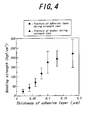
- a relation between a thickness of the member and a compression shear bonding strength was investigated in the bonding body according to the invention.
- the acrylate resin having fluorene skeleton use was made of a cardo acrylate resin (V-259PA). Two X-cut lithium niobate single crystals each having a dimension of 15 mm ⁇ 15 mm were connected as is the same as the example 1. In this case, a viscosity of the cardo acrylate resin was varies so as to vary a thickness of the adhesive layer. From the thus obtained bonding body, a sample having a dimension of 5 mm ⁇ 5 mm was cut out, and a compression shear bonding strength of the cut-out sample was measured. The results are shown in Fig. 4.
- a target bonding strength of not less than 60 kgf/cm 2 can be achieved if a thickness of the adhesive layer is not less than 0.05 ⁇ m.
- a substrate fracture range, which is not originated from the fracture of the adhesive layer is not less than 0.1 ⁇ m, it is understood that a thickness of the adhesive layer is preferably not less than 0.1 ⁇ m.
- the bonding body in which a sufficient bonding strength can be obtained and a thickness of the member is even and thin, can be obtained, if at least one of the first member and the second member is not less than 0.1 ⁇ m and not more than 10 ⁇ m.
- a thickness of the adhesive layer of the bonding body is preferably not less than 0.05 ⁇ m more preferably not less than 0.1 ⁇ m.
- the first member and the second member are connected via the adhesives made of a resin having fluorene skeleton, it is possible to obtain the bonding body having a sufficient bonding strength even if at least one of the members are thin as not less than 0.1 ⁇ m and not more than 10 ⁇ m.
Landscapes
- Chemical & Material Sciences (AREA)
- Organic Chemistry (AREA)
- Adhesives Or Adhesive Processes (AREA)
- Laminated Bodies (AREA)
Abstract
Description
A thickness of the adhesive layer of the bonding body was 0.1 µm. Then, the first member was ground and polished by a mechanical grinder and a polisher so as to obtain the first member having a thickness of 3 µm. A fracture and a peel-off were not detected to the first member. Moreover, the bonding body was further exposed at 121°C for 96 hours under a high temperature/ high humidity condition in which humidity was 100 %, but no peel-off of the first member was detected.
Then, the first member was ground and polished by a mechanical grinder and a polisher so as to obtain the first member having a thickness of 3 µm. A fracture and a peel-off were not detected to the first member. Moreover, the bonding body was further exposed at 121°C for 96 hours under a high temperature/ high humidity condition in which humidity was 100 %, but no peel-off of the first member was detected.
Then, the first member was ground and polished by a mechanical grinder and a polisher so as to obtain the first member having a thickness of 3 µm. A fracture and a peel-off were not detected to the first member. Moreover, the bonding body was further exposed at 121°C for 96 hours under a high temperature/high humidity condition in which humidity was 100%, but no peel-off of the first member was detected.
Then, the first member was ground and polished by a mechanical grinder and a polisher so as to obtain the first member having a thickness of 3 µm. A fracture and a peel-off were not detected to the first member. Moreover, the bonding body was further exposed at 121°C for 96 hours under a high temperature/ high humidity condition in which humidity was 100 %, but no peel-off of the first member was detected.
| Thickness of first member (µm) | Status of first member | ||||
| resin A | resin B | resin | resin D | ||
| 50 | ○ | Δ | Δ | ○ | |
| 30 | ○ | Δ | Δ | ○ | |
| 10 | ○ | Δ | Δ | × | |
| 5 | ○ | Δ | Δ | - | |
| 3 | ○ | Δ | Δ | - | |
| 1 | ○ | Δ | Δ | - | |
| 0.5 | ○ | × | × | - | |
| 0.3 | ○ | - | - | - | |
| 0.1 | ○ | - | - | - | |
| 0.05 | × | - | - | - | |
| ○ : fracture and peel-off of first member are not detected after polishing, and thickness of first member is even. | |||||
| Δ : fracture and peel-off of first member are not detected after polishing, but thickness of first member is not even. | |||||
| × : fracture and peel-off of first member are detected after polishing. | |||||
| - : not examined |
Claims (10)
- A bonding body comprising a first member, a second member and an adhesive layer arranged between the first member and the second member, wherein the adhesive layer is made of a resin composition having fluorene skeleton and at least one of the first member and the second member has a thickness of not less than 0.1 µm and not more than 10 µm.
- The bonding body according to claim 1, wherein the bonding body is optical parts.
- The bonding body according to claim 1, wherein the resin composition having fluorene skeleton is an epoxy resin having fluorene skeleton or an acrylate resin having fluorene skeleton.
- The bonding body according to claim 1, wherein the first member and the second member are lithium niobate.
- The bonding body according to claim 1, wherein the first member and the second member are lithium niobate including MgO.
- The bonding body according to claim 1, wherein the first member is lithium niobate including MgO and the second body is lithium niobate.
- The bonding body according to claim 1, wherein the first member is lithium niobate and the second member is lithium tantalate.
- A method of producing a bonding body having a first member, a second member and an adhesive layer arranged between the first member and the second member, wherein one of the first member and the second member has a thickness of not less than 0.1 µm and not more than 10 µm, comprising a step of connecting the first member and the second member by means of the adhesive layer made of a resin composition having fluorene skeleton.
- The method of producing a bonding body according to claim 8, wherein the bonding body is optical parts.
- The method of producing a bonding body according to claim 8, wherein the resin composition having fluorene skeleton is an epoxy resin having fluorene skeleton or an acrylate resin having fluorene skeleton.
Applications Claiming Priority (4)
| Application Number | Priority Date | Filing Date | Title |
|---|---|---|---|
| JP2001076022 | 2001-03-16 | ||
| JP2001076022 | 2001-03-16 | ||
| JP2001378199 | 2001-12-12 | ||
| JP2001378199A JP3911154B2 (en) | 2001-03-16 | 2001-12-12 | Adhesive and production method thereof |
Publications (3)
| Publication Number | Publication Date |
|---|---|
| EP1241238A2 true EP1241238A2 (en) | 2002-09-18 |
| EP1241238A3 EP1241238A3 (en) | 2003-04-02 |
| EP1241238B1 EP1241238B1 (en) | 2004-09-22 |
Family
ID=26611430
Family Applications (1)
| Application Number | Title | Priority Date | Filing Date |
|---|---|---|---|
| EP20020251820 Expired - Lifetime EP1241238B1 (en) | 2001-03-16 | 2002-03-14 | Bonding body and method of producing the same |
Country Status (4)
| Country | Link |
|---|---|
| US (1) | US7087294B2 (en) |
| EP (1) | EP1241238B1 (en) |
| JP (1) | JP3911154B2 (en) |
| DE (1) | DE60201280T2 (en) |
Cited By (2)
| Publication number | Priority date | Publication date | Assignee | Title |
|---|---|---|---|---|
| EP2048209A4 (en) * | 2006-08-04 | 2012-01-18 | Hitachi Chemical Co Ltd | ADHESIVE COMPOSITION AND CONNECTION STRUCTURE FOR CIRCUIT ELEMENT |
| JP2018048337A (en) * | 2017-10-19 | 2018-03-29 | デクセリアルズ株式会社 | Connection body and method of manufacturing connection body |
Families Citing this family (6)
| Publication number | Priority date | Publication date | Assignee | Title |
|---|---|---|---|---|
| JP4733094B2 (en) | 2007-09-28 | 2011-07-27 | 住友大阪セメント株式会社 | Optical element |
| JP2011087079A (en) * | 2009-10-14 | 2011-04-28 | Ngk Insulators Ltd | Surface acoustic wave device |
| JP6190816B2 (en) * | 2012-09-24 | 2017-08-30 | 日本碍子株式会社 | Terahertz wave detecting element, manufacturing method thereof, and observation apparatus |
| JP6144684B2 (en) | 2012-09-24 | 2017-06-07 | 日本碍子株式会社 | Terahertz wave detecting element, manufacturing method thereof, and observation apparatus |
| JP6144685B2 (en) | 2012-09-24 | 2017-06-07 | 日本碍子株式会社 | Terahertz wave detecting element, manufacturing method thereof, and observation apparatus |
| JP6231394B2 (en) * | 2014-02-03 | 2017-11-15 | デクセリアルズ株式会社 | Method for measuring reaction rate of acrylic adhesive and acrylic adhesive |
Family Cites Families (17)
| Publication number | Priority date | Publication date | Assignee | Title |
|---|---|---|---|---|
| US4769399A (en) | 1987-03-12 | 1988-09-06 | Minnesota Mining And Manufacturing Company | Epoxy adhesive film for electronic applications |
| US4902574A (en) * | 1987-10-14 | 1990-02-20 | The United States Of America As Represented By The Administrator Of The National Aeronautics And Space Administration | Methods of using fluoroepoxy compounds as adhesives for fluoroplastic adherends and products made therefrom |
| US4980234A (en) | 1987-12-23 | 1990-12-25 | Minnesota Mining And Manufacturing Co. | Epoxide resin compositions and method |
| US4983672A (en) | 1987-12-23 | 1991-01-08 | Minnesota Mining And Manufacturing Company | Epoxide resin compositions and method |
| JPH03106918A (en) | 1989-09-19 | 1991-05-07 | Nitto Denko Corp | Ultraviolet-curable resin composition |
| EP0444209B1 (en) * | 1989-09-20 | 2000-11-08 | Ibiden Co., Ltd. | Thin film of lithium niobate single crystal and production thereof |
| JPH03243185A (en) | 1990-02-21 | 1991-10-30 | Sanyo Electric Co Ltd | Superconductive rotary machine |
| US5551959A (en) * | 1994-08-24 | 1996-09-03 | Minnesota Mining And Manufacturing Company | Abrasive article having a diamond-like coating layer and method for making same |
| EP0848031B1 (en) * | 1995-08-24 | 2003-06-04 | Asahi Glass Company Ltd. | Fluorinated film, laminate produced therefrom, and process for producing the laminate |
| JPH09241340A (en) | 1996-03-13 | 1997-09-16 | Nippon Steel Chem Co Ltd | Acrylate resin for optical material and optical material using the same |
| US6002515A (en) * | 1997-01-14 | 1999-12-14 | Matsushita Electric Industrial Co., Ltd. | Method for producing polarization inversion part, optical wavelength conversion element using the same, and optical waveguide |
| JP3094948B2 (en) * | 1997-05-26 | 2000-10-03 | 日本電気株式会社 | Method of connecting circuit board for mounting semiconductor element and semiconductor element |
| JP2000305117A (en) * | 1999-02-19 | 2000-11-02 | Fuji Xerox Co Ltd | Optical device, method of driving optical device, and method of manufacturing optical device |
| EP1109054B1 (en) * | 1999-12-15 | 2005-08-17 | Ngk Insulators, Ltd. | Travelling wave optical modulators and a method for the production thereof |
| JP4354100B2 (en) * | 2000-07-27 | 2009-10-28 | 日本碍子株式会社 | Optical waveguide device |
| US6846428B2 (en) * | 2001-03-20 | 2005-01-25 | Wisconsin Alumni Research Foundation | Thin film lithium niobate and method of producing the same |
| JP2002293861A (en) * | 2001-04-02 | 2002-10-09 | Yokohama Rubber Co Ltd:The | Curable resin composition having curable compound and its compound, and method for easily demolishing cured material |
-
2001
- 2001-12-12 JP JP2001378199A patent/JP3911154B2/en not_active Expired - Lifetime
-
2002
- 2002-03-11 US US10/095,290 patent/US7087294B2/en not_active Expired - Lifetime
- 2002-03-14 EP EP20020251820 patent/EP1241238B1/en not_active Expired - Lifetime
- 2002-03-14 DE DE2002601280 patent/DE60201280T2/en not_active Expired - Lifetime
Cited By (2)
| Publication number | Priority date | Publication date | Assignee | Title |
|---|---|---|---|---|
| EP2048209A4 (en) * | 2006-08-04 | 2012-01-18 | Hitachi Chemical Co Ltd | ADHESIVE COMPOSITION AND CONNECTION STRUCTURE FOR CIRCUIT ELEMENT |
| JP2018048337A (en) * | 2017-10-19 | 2018-03-29 | デクセリアルズ株式会社 | Connection body and method of manufacturing connection body |
Also Published As
| Publication number | Publication date |
|---|---|
| US7087294B2 (en) | 2006-08-08 |
| DE60201280D1 (en) | 2004-10-28 |
| JP2002337274A (en) | 2002-11-27 |
| EP1241238A3 (en) | 2003-04-02 |
| JP3911154B2 (en) | 2007-05-09 |
| DE60201280T2 (en) | 2005-12-29 |
| EP1241238B1 (en) | 2004-09-22 |
| US20020187339A1 (en) | 2002-12-12 |
Similar Documents
| Publication | Publication Date | Title |
|---|---|---|
| KR100643450B1 (en) | Pressure sensitive adhesive sheet, method of protecting semiconductor wafer surface and method of processing work | |
| EP0755085B1 (en) | Piezoelectric device and method of manufacturing the same | |
| KR100469758B1 (en) | Energy-curing pressure-sensitive adhesive composition and its use method | |
| KR101313471B1 (en) | Pressure-sensitive adhesive for polarizing plates, polarizing plate with pressure-sensitive adhesive and production process for the same | |
| KR930009624B1 (en) | Optical disk | |
| KR100661282B1 (en) | Wafer back polishing method | |
| EP1241238B1 (en) | Bonding body and method of producing the same | |
| US7779522B2 (en) | Method for forming a MEMS | |
| WO2005001950A1 (en) | Single crystal piezoelectric apparatus and method of forming same | |
| KR20080085769A (en) | Adhesive sheet | |
| CN108475619B (en) | Mounting technique for semiconductor wafer with diamond bottom for device processing | |
| KR101072767B1 (en) | Double-faced adhesive film without base | |
| US4335187A (en) | Method for bonding polycarbonate to metal | |
| WO2000017284A1 (en) | Workpiece retainer and method for attaching/detaching workpiece by using the same | |
| JP3924252B2 (en) | Polishing film and method for producing the same | |
| WO2013039231A1 (en) | Method for processing hard substrate laminated body, and clamp jig | |
| KR940002346B1 (en) | Optical Disc Manufacturing Equipment | |
| JP4955200B2 (en) | Peelable lithium tantalate single crystal composite substrate | |
| JP4321305B2 (en) | Wafer processing method | |
| JP2007088292A (en) | Cutting method of plate member | |
| KR20220021802A (en) | Adhesive sheet for thin glass, and thin film glass processing method using same | |
| CA2190730A1 (en) | Sanding pad and sanding process using same | |
| TWI519422B (en) | A method for producing a sheet-like article using a method for peeling off a translucent hard substrate laminate, and a method for producing the same | |
| JPH05228828A (en) | Method and jig for polishing crystal body | |
| JPH0750438A (en) | Manufacturing method of thin plate material |
Legal Events
| Date | Code | Title | Description |
|---|---|---|---|
| PUAI | Public reference made under article 153(3) epc to a published international application that has entered the european phase |
Free format text: ORIGINAL CODE: 0009012 |
|
| AK | Designated contracting states |
Kind code of ref document: A2 Designated state(s): AT BE CH CY DE DK ES FI FR GB GR IE IT LI LU MC NL PT SE TR |
|
| AX | Request for extension of the european patent |
Free format text: AL;LT;LV;MK;RO;SI |
|
| PUAL | Search report despatched |
Free format text: ORIGINAL CODE: 0009013 |
|
| AK | Designated contracting states |
Kind code of ref document: A3 Designated state(s): AT BE CH CY DE DK ES FI FR GB GR IE IT LI LU MC NL PT SE TR Designated state(s): AT BE CH CY DE DK ES FI FR GB GR IE IT LI LU MC NL PT SE TR |
|
| AX | Request for extension of the european patent |
Extension state: AL LT LV MK RO SI |
|
| 17P | Request for examination filed |
Effective date: 20030929 |
|
| AKX | Designation fees paid |
Designated state(s): DE FR GB |
|
| GRAP | Despatch of communication of intention to grant a patent |
Free format text: ORIGINAL CODE: EPIDOSNIGR1 |
|
| GRAS | Grant fee paid |
Free format text: ORIGINAL CODE: EPIDOSNIGR3 |
|
| GRAA | (expected) grant |
Free format text: ORIGINAL CODE: 0009210 |
|
| AK | Designated contracting states |
Kind code of ref document: B1 Designated state(s): DE FR GB |
|
| REG | Reference to a national code |
Ref country code: GB Ref legal event code: FG4D |
|
| REG | Reference to a national code |
Ref country code: IE Ref legal event code: FG4D |
|
| REF | Corresponds to: |
Ref document number: 60201280 Country of ref document: DE Date of ref document: 20041028 Kind code of ref document: P |
|
| PLBE | No opposition filed within time limit |
Free format text: ORIGINAL CODE: 0009261 |
|
| STAA | Information on the status of an ep patent application or granted ep patent |
Free format text: STATUS: NO OPPOSITION FILED WITHIN TIME LIMIT |
|
| ET | Fr: translation filed | ||
| 26N | No opposition filed |
Effective date: 20050623 |
|
| REG | Reference to a national code |
Ref country code: FR Ref legal event code: PLFP Year of fee payment: 15 |
|
| REG | Reference to a national code |
Ref country code: FR Ref legal event code: PLFP Year of fee payment: 16 |
|
| REG | Reference to a national code |
Ref country code: FR Ref legal event code: PLFP Year of fee payment: 17 |
|
| PGFP | Annual fee paid to national office [announced via postgrant information from national office to epo] |
Ref country code: FR Payment date: 20210210 Year of fee payment: 20 |
|
| PGFP | Annual fee paid to national office [announced via postgrant information from national office to epo] |
Ref country code: GB Payment date: 20210308 Year of fee payment: 20 Ref country code: DE Payment date: 20210302 Year of fee payment: 20 |
|
| REG | Reference to a national code |
Ref country code: DE Ref legal event code: R071 Ref document number: 60201280 Country of ref document: DE |
|
| REG | Reference to a national code |
Ref country code: GB Ref legal event code: PE20 Expiry date: 20220313 |
|
| PG25 | Lapsed in a contracting state [announced via postgrant information from national office to epo] |
Ref country code: GB Free format text: LAPSE BECAUSE OF EXPIRATION OF PROTECTION Effective date: 20220313 |