EP1241216A1 - Processed blend useful as culinary thickeners comprising a modified starch and a flour - Google Patents
Processed blend useful as culinary thickeners comprising a modified starch and a flour Download PDFInfo
- Publication number
- EP1241216A1 EP1241216A1 EP02005219A EP02005219A EP1241216A1 EP 1241216 A1 EP1241216 A1 EP 1241216A1 EP 02005219 A EP02005219 A EP 02005219A EP 02005219 A EP02005219 A EP 02005219A EP 1241216 A1 EP1241216 A1 EP 1241216A1
- Authority
- EP
- European Patent Office
- Prior art keywords
- starch
- processed composition
- processed
- composition
- flour
- Prior art date
- Legal status (The legal status is an assumption and is not a legal conclusion. Google has not performed a legal analysis and makes no representation as to the accuracy of the status listed.)
- Granted
Links
- 239000000203 mixture Substances 0.000 title claims abstract description 172
- 235000013312 flour Nutrition 0.000 title claims abstract description 88
- 229920000881 Modified starch Polymers 0.000 title claims abstract description 53
- 235000019426 modified starch Nutrition 0.000 title claims abstract description 53
- 239000004368 Modified starch Substances 0.000 title claims abstract description 46
- 239000002562 thickening agent Substances 0.000 title claims description 41
- 238000000034 method Methods 0.000 claims abstract description 47
- 230000008569 process Effects 0.000 claims abstract description 41
- 235000013305 food Nutrition 0.000 claims abstract description 39
- 229920002472 Starch Polymers 0.000 claims description 140
- 235000019698 starch Nutrition 0.000 claims description 140
- 239000008107 starch Substances 0.000 claims description 103
- 235000015067 sauces Nutrition 0.000 claims description 56
- 235000021307 Triticum Nutrition 0.000 claims description 30
- 241000209140 Triticum Species 0.000 claims description 30
- 235000007688 Lycopersicon esculentum Nutrition 0.000 claims description 20
- 240000003768 Solanum lycopersicum Species 0.000 claims description 20
- 229920002261 Corn starch Polymers 0.000 claims description 19
- 238000010411 cooking Methods 0.000 claims description 17
- 238000004945 emulsification Methods 0.000 claims description 12
- 239000007787 solid Substances 0.000 claims description 11
- 240000008042 Zea mays Species 0.000 claims description 9
- 238000012545 processing Methods 0.000 claims description 9
- 235000013804 distarch phosphate Nutrition 0.000 claims description 8
- 108700028369 Alleles Proteins 0.000 claims description 7
- 241000196324 Embryophyta Species 0.000 claims description 7
- 235000019759 Maize starch Nutrition 0.000 claims description 7
- 239000001245 distarch phosphate Substances 0.000 claims description 7
- 239000003153 chemical reaction reagent Substances 0.000 claims description 6
- 235000013882 gravy Nutrition 0.000 claims description 6
- 235000014347 soups Nutrition 0.000 claims description 6
- GOOHAUXETOMSMM-UHFFFAOYSA-N Propylene oxide Chemical compound CC1CO1 GOOHAUXETOMSMM-UHFFFAOYSA-N 0.000 claims description 5
- 238000002036 drum drying Methods 0.000 claims description 4
- 235000013399 edible fruits Nutrition 0.000 claims description 4
- 230000005945 translocation Effects 0.000 claims description 4
- 229920000107 Acetylated distarch adipate Polymers 0.000 claims description 3
- 235000013351 cheese Nutrition 0.000 claims description 3
- 238000000576 coating method Methods 0.000 claims description 3
- 235000013409 condiments Nutrition 0.000 claims description 3
- 239000006071 cream Substances 0.000 claims description 3
- 235000011850 desserts Nutrition 0.000 claims description 3
- 235000014505 dips Nutrition 0.000 claims description 3
- 235000015071 dressings Nutrition 0.000 claims description 3
- 235000021183 entrée Nutrition 0.000 claims description 3
- 235000015250 liver sausages Nutrition 0.000 claims description 3
- 235000015090 marinades Nutrition 0.000 claims description 3
- 230000007306 turnover Effects 0.000 claims description 3
- 235000013311 vegetables Nutrition 0.000 claims description 3
- 235000014348 vinaigrettes Nutrition 0.000 claims description 3
- RCJVRSBWZCNNQT-UHFFFAOYSA-N dichloridooxygen Chemical compound ClOCl RCJVRSBWZCNNQT-UHFFFAOYSA-N 0.000 claims description 2
- 230000008719 thickening Effects 0.000 abstract description 5
- 239000012530 fluid Substances 0.000 description 25
- 238000000926 separation method Methods 0.000 description 17
- 235000019197 fats Nutrition 0.000 description 15
- 239000000243 solution Substances 0.000 description 14
- 240000003183 Manihot esculenta Species 0.000 description 13
- 235000016735 Manihot esculenta subsp esculenta Nutrition 0.000 description 13
- 235000010804 Maranta arundinacea Nutrition 0.000 description 13
- 235000012419 Thalia geniculata Nutrition 0.000 description 13
- 239000008120 corn starch Substances 0.000 description 12
- 235000002017 Zea mays subsp mays Nutrition 0.000 description 11
- 229920001592 potato starch Polymers 0.000 description 11
- 238000012986 modification Methods 0.000 description 10
- 230000004048 modification Effects 0.000 description 10
- 235000014121 butter Nutrition 0.000 description 9
- XLYOFNOQVPJJNP-UHFFFAOYSA-N water Substances O XLYOFNOQVPJJNP-UHFFFAOYSA-N 0.000 description 9
- 244000145580 Thalia geniculata Species 0.000 description 7
- 241000482268 Zea mays subsp. mays Species 0.000 description 7
- 239000000463 material Substances 0.000 description 7
- 239000007921 spray Substances 0.000 description 7
- 244000151018 Maranta arundinacea Species 0.000 description 6
- 230000015572 biosynthetic process Effects 0.000 description 6
- XHXFXVLFKHQFAL-UHFFFAOYSA-N phosphoryl trichloride Chemical compound ClP(Cl)(Cl)=O XHXFXVLFKHQFAL-UHFFFAOYSA-N 0.000 description 6
- 239000000047 product Substances 0.000 description 6
- 239000002002 slurry Substances 0.000 description 6
- 239000000839 emulsion Substances 0.000 description 5
- 238000012360 testing method Methods 0.000 description 5
- 238000009472 formulation Methods 0.000 description 4
- 238000005259 measurement Methods 0.000 description 4
- 238000002156 mixing Methods 0.000 description 4
- 229920000856 Amylose Polymers 0.000 description 3
- 235000016383 Zea mays subsp huehuetenangensis Nutrition 0.000 description 3
- 238000004132 cross linking Methods 0.000 description 3
- 239000011363 dried mixture Substances 0.000 description 3
- 238000010438 heat treatment Methods 0.000 description 3
- 235000009973 maize Nutrition 0.000 description 3
- 239000002245 particle Substances 0.000 description 3
- 238000002360 preparation method Methods 0.000 description 3
- 230000000087 stabilizing effect Effects 0.000 description 3
- 239000000126 substance Substances 0.000 description 3
- 240000007594 Oryza sativa Species 0.000 description 2
- 235000007164 Oryza sativa Nutrition 0.000 description 2
- 244000061456 Solanum tuberosum Species 0.000 description 2
- 235000002595 Solanum tuberosum Nutrition 0.000 description 2
- 238000005054 agglomeration Methods 0.000 description 2
- 230000002776 aggregation Effects 0.000 description 2
- 239000003125 aqueous solvent Substances 0.000 description 2
- 238000000889 atomisation Methods 0.000 description 2
- 238000009395 breeding Methods 0.000 description 2
- 230000001488 breeding effect Effects 0.000 description 2
- 239000007853 buffer solution Substances 0.000 description 2
- 235000013339 cereals Nutrition 0.000 description 2
- 239000012153 distilled water Substances 0.000 description 2
- 238000005516 engineering process Methods 0.000 description 2
- 238000011156 evaluation Methods 0.000 description 2
- 230000035772 mutation Effects 0.000 description 2
- 239000000843 powder Substances 0.000 description 2
- 235000009566 rice Nutrition 0.000 description 2
- 150000003839 salts Chemical class 0.000 description 2
- 238000005507 spraying Methods 0.000 description 2
- 238000006467 substitution reaction Methods 0.000 description 2
- 230000000007 visual effect Effects 0.000 description 2
- GUOCOOQWZHQBJI-UHFFFAOYSA-N 4-oct-7-enoxy-4-oxobutanoic acid Chemical compound OC(=O)CCC(=O)OCCCCCCC=C GUOCOOQWZHQBJI-UHFFFAOYSA-N 0.000 description 1
- 240000001592 Amaranthus caudatus Species 0.000 description 1
- 235000009328 Amaranthus caudatus Nutrition 0.000 description 1
- 229920000945 Amylopectin Polymers 0.000 description 1
- 235000007319 Avena orientalis Nutrition 0.000 description 1
- 241000209763 Avena sativa Species 0.000 description 1
- 235000007558 Avena sp Nutrition 0.000 description 1
- 235000005273 Canna coccinea Nutrition 0.000 description 1
- 240000008555 Canna flaccida Species 0.000 description 1
- 235000002566 Capsicum Nutrition 0.000 description 1
- YASYEJJMZJALEJ-UHFFFAOYSA-N Citric acid monohydrate Chemical compound O.OC(=O)CC(O)(C(O)=O)CC(O)=O YASYEJJMZJALEJ-UHFFFAOYSA-N 0.000 description 1
- 108090000790 Enzymes Proteins 0.000 description 1
- 102000004190 Enzymes Human genes 0.000 description 1
- 240000008620 Fagopyrum esculentum Species 0.000 description 1
- 235000009419 Fagopyrum esculentum Nutrition 0.000 description 1
- 244000068988 Glycine max Species 0.000 description 1
- 235000010469 Glycine max Nutrition 0.000 description 1
- 241000282414 Homo sapiens Species 0.000 description 1
- 240000005979 Hordeum vulgare Species 0.000 description 1
- 235000007340 Hordeum vulgare Nutrition 0.000 description 1
- 244000017020 Ipomoea batatas Species 0.000 description 1
- 235000002678 Ipomoea batatas Nutrition 0.000 description 1
- 241001465754 Metazoa Species 0.000 description 1
- 240000005561 Musa balbisiana Species 0.000 description 1
- 235000018290 Musa x paradisiaca Nutrition 0.000 description 1
- 229910019142 PO4 Inorganic materials 0.000 description 1
- 239000006002 Pepper Substances 0.000 description 1
- 235000016761 Piper aduncum Nutrition 0.000 description 1
- 240000003889 Piper guineense Species 0.000 description 1
- 235000017804 Piper guineense Nutrition 0.000 description 1
- 235000008184 Piper nigrum Nutrition 0.000 description 1
- 240000004713 Pisum sativum Species 0.000 description 1
- 235000010582 Pisum sativum Nutrition 0.000 description 1
- 241000209056 Secale Species 0.000 description 1
- 235000007238 Secale cereale Nutrition 0.000 description 1
- 240000003829 Sorghum propinquum Species 0.000 description 1
- 235000011684 Sorghum saccharatum Nutrition 0.000 description 1
- 238000010793 Steam injection (oil industry) Methods 0.000 description 1
- 235000005824 Zea mays ssp. parviglumis Nutrition 0.000 description 1
- 150000001242 acetic acid derivatives Chemical class 0.000 description 1
- 239000002253 acid Substances 0.000 description 1
- 238000005903 acid hydrolysis reaction Methods 0.000 description 1
- 235000012735 amaranth Nutrition 0.000 description 1
- 239000004178 amaranth Substances 0.000 description 1
- 125000000129 anionic group Chemical group 0.000 description 1
- 235000015278 beef Nutrition 0.000 description 1
- 230000000903 blocking effect Effects 0.000 description 1
- 238000009835 boiling Methods 0.000 description 1
- 235000014633 carbohydrates Nutrition 0.000 description 1
- 150000001720 carbohydrates Chemical class 0.000 description 1
- 125000002091 cationic group Chemical group 0.000 description 1
- 238000006243 chemical reaction Methods 0.000 description 1
- 210000000349 chromosome Anatomy 0.000 description 1
- 229960002303 citric acid monohydrate Drugs 0.000 description 1
- 235000021270 cold food Nutrition 0.000 description 1
- 239000012084 conversion product Substances 0.000 description 1
- 238000001816 cooling Methods 0.000 description 1
- 235000005822 corn Nutrition 0.000 description 1
- 238000009402 cross-breeding Methods 0.000 description 1
- 230000007812 deficiency Effects 0.000 description 1
- 238000007865 diluting Methods 0.000 description 1
- 238000009826 distribution Methods 0.000 description 1
- 230000009977 dual effect Effects 0.000 description 1
- 230000000694 effects Effects 0.000 description 1
- 150000002148 esters Chemical class 0.000 description 1
- 150000002170 ethers Chemical class 0.000 description 1
- MVPICKVDHDWCJQ-UHFFFAOYSA-N ethyl 3-pyrrolidin-1-ylpropanoate Chemical compound CCOC(=O)CCN1CCCC1 MVPICKVDHDWCJQ-UHFFFAOYSA-N 0.000 description 1
- 238000002474 experimental method Methods 0.000 description 1
- 238000007710 freezing Methods 0.000 description 1
- 230000008014 freezing Effects 0.000 description 1
- 239000004615 ingredient Substances 0.000 description 1
- 230000002401 inhibitory effect Effects 0.000 description 1
- 230000005764 inhibitory process Effects 0.000 description 1
- 235000021374 legumes Nutrition 0.000 description 1
- 230000014759 maintenance of location Effects 0.000 description 1
- 238000004519 manufacturing process Methods 0.000 description 1
- 235000008390 olive oil Nutrition 0.000 description 1
- 239000004006 olive oil Substances 0.000 description 1
- 230000003647 oxidation Effects 0.000 description 1
- 238000007254 oxidation reaction Methods 0.000 description 1
- 235000021317 phosphate Nutrition 0.000 description 1
- 150000003013 phosphoric acid derivatives Chemical class 0.000 description 1
- 108090000623 proteins and genes Proteins 0.000 description 1
- -1 smooth Opaque Substances 0.000 description 1
- 239000001509 sodium citrate Substances 0.000 description 1
- 229940045902 sodium stearyl fumarate Drugs 0.000 description 1
- 238000010561 standard procedure Methods 0.000 description 1
- 238000003860 storage Methods 0.000 description 1
- KDYFGRWQOYBRFD-UHFFFAOYSA-L succinate(2-) Chemical compound [O-]C(=O)CCC([O-])=O KDYFGRWQOYBRFD-UHFFFAOYSA-L 0.000 description 1
- 150000003900 succinic acid esters Chemical class 0.000 description 1
- 238000010257 thawing Methods 0.000 description 1
- 210000001519 tissue Anatomy 0.000 description 1
- 235000015113 tomato pastes and purées Nutrition 0.000 description 1
- 230000009466 transformation Effects 0.000 description 1
- HRXKRNGNAMMEHJ-UHFFFAOYSA-K trisodium citrate Chemical compound [Na+].[Na+].[Na+].[O-]C(=O)CC(O)(CC([O-])=O)C([O-])=O HRXKRNGNAMMEHJ-UHFFFAOYSA-K 0.000 description 1
- 229940038773 trisodium citrate Drugs 0.000 description 1
- 235000019263 trisodium citrate Nutrition 0.000 description 1
- 238000009827 uniform distribution Methods 0.000 description 1
Classifications
-
- C—CHEMISTRY; METALLURGY
- C08—ORGANIC MACROMOLECULAR COMPOUNDS; THEIR PREPARATION OR CHEMICAL WORKING-UP; COMPOSITIONS BASED THEREON
- C08L—COMPOSITIONS OF MACROMOLECULAR COMPOUNDS
- C08L3/00—Compositions of starch, amylose or amylopectin or of their derivatives or degradation products
-
- A—HUMAN NECESSITIES
- A23—FOODS OR FOODSTUFFS; TREATMENT THEREOF, NOT COVERED BY OTHER CLASSES
- A23L—FOODS, FOODSTUFFS OR NON-ALCOHOLIC BEVERAGES, NOT OTHERWISE PROVIDED FOR; PREPARATION OR TREATMENT THEREOF
- A23L23/00—Soups; Sauces; Preparation or treatment thereof
-
- A—HUMAN NECESSITIES
- A23—FOODS OR FOODSTUFFS; TREATMENT THEREOF, NOT COVERED BY OTHER CLASSES
- A23L—FOODS, FOODSTUFFS OR NON-ALCOHOLIC BEVERAGES, NOT OTHERWISE PROVIDED FOR; PREPARATION OR TREATMENT THEREOF
- A23L29/00—Foods or foodstuffs containing additives; Preparation or treatment thereof
- A23L29/20—Foods or foodstuffs containing additives; Preparation or treatment thereof containing gelling or thickening agents
- A23L29/206—Foods or foodstuffs containing additives; Preparation or treatment thereof containing gelling or thickening agents of vegetable origin
- A23L29/212—Starch; Modified starch; Starch derivatives, e.g. esters or ethers
- A23L29/219—Chemically modified starch; Reaction or complexation products of starch with other chemicals
-
- A—HUMAN NECESSITIES
- A23—FOODS OR FOODSTUFFS; TREATMENT THEREOF, NOT COVERED BY OTHER CLASSES
- A23L—FOODS, FOODSTUFFS OR NON-ALCOHOLIC BEVERAGES, NOT OTHERWISE PROVIDED FOR; PREPARATION OR TREATMENT THEREOF
- A23L29/00—Foods or foodstuffs containing additives; Preparation or treatment thereof
- A23L29/20—Foods or foodstuffs containing additives; Preparation or treatment thereof containing gelling or thickening agents
- A23L29/206—Foods or foodstuffs containing additives; Preparation or treatment thereof containing gelling or thickening agents of vegetable origin
- A23L29/212—Starch; Modified starch; Starch derivatives, e.g. esters or ethers
- A23L29/225—Farinaceous thickening agents other than isolated starch or derivatives
-
- C—CHEMISTRY; METALLURGY
- C08—ORGANIC MACROMOLECULAR COMPOUNDS; THEIR PREPARATION OR CHEMICAL WORKING-UP; COMPOSITIONS BASED THEREON
- C08L—COMPOSITIONS OF MACROMOLECULAR COMPOUNDS
- C08L3/00—Compositions of starch, amylose or amylopectin or of their derivatives or degradation products
- C08L3/02—Starch; Degradation products thereof, e.g. dextrin
-
- C—CHEMISTRY; METALLURGY
- C08—ORGANIC MACROMOLECULAR COMPOUNDS; THEIR PREPARATION OR CHEMICAL WORKING-UP; COMPOSITIONS BASED THEREON
- C08L—COMPOSITIONS OF MACROMOLECULAR COMPOUNDS
- C08L3/00—Compositions of starch, amylose or amylopectin or of their derivatives or degradation products
- C08L3/04—Starch derivatives, e.g. crosslinked derivatives
Definitions
- This invention relates to a thickening composition comprising a "co-processed" combination of modified starch and flour.
- the invention relates to the process for providing such "ready-for-use” compositions and the improved food products prepared from the co-processed compositions.
- starches or flours as thickening agents has long been known in the art.
- Common uses of the starches and/or flours include the thickening of soup mixes or gravies to give body to the product. Starches have also been used as thickeners in processed products in the food industries.
- thickeners employing modified starches do not possess these process tolerance limitations inherent to unmodified starches and/or flours, thickeners prepared from modified starches do not have the desirable cooked flour taste and appearance of thickeners prepared from unmodified starches and/or flours.
- modified starch thickeners in foods often imparts a "synthetic" appearance as the foods are more translucent and have a glossy shine compared to foods prepared from unmodified starch and/or flour thickeners.
- This invention relates to a thickening composition comprising a "co-processed" combination of modified starch and flour.
- the invention relates to the process for providing such "ready-for-use” compositions and the improved food products prepared from the co-processed compositions.
- the process comprises blending at least one modified starch, particularly a stabilized and cross-linked or thermally-inhibited starch, with at least one flour, particularly wheat flour, and co-processing the blend.
- modified starch particularly a stabilized and cross-linked or thermally-inhibited starch
- flour particularly wheat flour
- the foods prepared from these superior thickeners have improved appearance, taste, process tolerance, emulsification, cold and hot temperature stability and instant viscosity properties compared to foods containing food service industry standard thickeners prepared from modified or unmodified starches.
- This invention relates to a composition comprising a "co-processed" combination of modified starch and wheat flour having desirable appearance, taste, process tolerance, emulsification, cold and hot temperature stability and instant viscosity properties.
- the invention relates to the process for providing such "ready-for-use” compositions and the improved food products prepared from the co-processed compositions.
- starches and flours may be suitable for use as the base starch herein and may be derived from any native source.
- the base starch will be subsequently modified unless the base starch is inherently stabilized as described infra, though an inherently stabilized starch may also be subject to subsequent modification.
- a native starch as used herein, is one as it is found in nature.
- starch or flours derived from a plant grown from artificial mutations and variations of the above generic composition which may be produced by known standard methods of mutation breeding are also suitable for use as the base starch as defined herein.
- Typical sources for the base starches which are to be modified are cereals, tubers, roots, legumes and fruits.
- the native source can be corn, pea, potato, sweet potato, banana, barley, wheat, rice, sago, amaranth, tapioca, arrowroot, canna, sorghum, and waxy or high amylose varieties thereof.
- Sources of particularly useful base starches are tapioca, dent corn, waxy maize, potato, sago, and rice.
- the term "waxy” is intended to include a starch or flour containing at least about 95% by weight amylopectin and the term "high amylose” is intended to include a starch or flour containing at least about 40% by weight amylose.
- Base starches suitable for subsequent modification are also intended to include conversion products derived from any of the starches, including fluidity or thin-boiling starches prepared by oxidation, enzyme conversion, acid hydrolysis, heat and or acid dextrinization, thermal and or sheared products.
- Modification of the base starch may be accomplished via a variety of know methods, provided the modification does not destroy the granular nature of the starch.
- the base starch may be treated by a combination of modifications in any order.
- modified starches are intended to include, without limitation, crosslinked starches, thermally inhibited starches, stabilized starches, acetylated and organically esterified starches, hydroxyethylated and hydroxypropylated starches, phosphorylated and inorganically esterified starches, cationic, anionic, nonionic, and zwitterionic starches, and succinate and substituted succinate derivatives of starch.
- Such modifications and combinations thereof are known and their preparation are described in the art.
- stabilized starch is intended to include starches which are substituted on the base starch by monofunctional chemical “blocking groups” and base starches which inherently demonstrate stabilized properties. Accordingly, a base starch which demonstrates inherently stabilized properties is also defined to be a modified starch for the purposes of this application. Foods containing stabilized starches are characterized by the ability to substantially retain their texture (viscosity) and other desirable properties, such as color and clarity, after being frozen and then thawed to room temperature.
- Examples of useful monofunctional substituted stabilized starches include, without limitation, starch esters and ethers, including starch acetates, starch octenylsuccinate, starch phosphates, and starch hydroxyalkylates.
- the preparation and properties of such stabilized starches are known in the art and described, for example, in Whistler R.L., BeMiller J.N., and Paschall E.F., Chpt 9, Sect 5, pg 343-349, Starch Chemistry and Technology , 2 nd Ed, Academic Press, Inc. London (1984) and Whistler R.L. and Daniel J.R., Chpt 3, pg 119, Carbohydrates, Food Chemistry , 2 nd Ed., edited by Fenenma O.R., Marcel Dekker, Inc., NY, (1985).
- Starches which are inherently stabilized include, without limitation, waxy maize starches having at least one recessive sugary-2 allele.
- An example of such a starch includes waxy maize starch derived from a plant having endosperm tissue which is heterozygous, with either one or two doses, for the recessive sugary-2 allele, described further in U.S. Patent No. 5,954,883, the disclosure of which is incorporated herein by reference.
- Another example includes starch derived from a waxy maize plant of a wxsu2 (homozygous) genotype and translocations, inversions, mutants and variants thereof, discussed in U.S. Patent No. 4,428,972, the disclosure of which is incorporated herein by reference.
- Particularly useful modified starches are food quality starches in which the starch is dually modified by “stabilizing” and crosslinking the starch or by “stabilizing” and thermally inhibiting the starch (i.e stabilized and crosslinked or thermally inhibited).
- Especially useful stabilized and crosslinked starches are, for example, hydroxypropylated distarch phosphate, acetylated distarch adipate and waxy maize starches having at least one recessive sugary-2 allele which are subsequently crosslinked or thermally inhibited.
- Particularly useful hydroxypropylated distarch phosphates are those in which the degree of substitution is in the range of from about 3.5% to about 8.8%, preferably from about 5.7% to about 6.7% by weight of the bound propylene oxide on starch; and the degree of crosslinking is from about .001% to about 0.04%, preferably from 0.01% to about 0.025% weight of phosphorus oxychloride reagent used to crosslink the starch. Weight percents are by weight of the starch..
- food quality starches are starches which are edible by animals, including human beings.
- Flours that are particularly useful for preparing co-processed compositions of the present invention include, without limitation, wheat, tapioca, rye, oat, buckwheat and soybean, especially wheat flour.
- Particularly useful wheat flours have less than 16% protein content and especially useful wheat flours have less than 10% protein content.
- the process for obtaining the co-processed composition of the present invention comprises blending a modified starch with a flour and co-processing the blend.
- Particularly useful blends are composed of modified starch to flour over a range of weight percent ratios of from about 72:28 to 93:7 starch:flour.
- Especially useful are starches modified by both crosslinking and stabilizing that are blended with wheat flour in ratios of between about 80:20 to about 90:10 (modified starch:flour).
- the blend is then co-processed.
- Co-processing involves subjecting the blend to a spray-cooking or drum-drying process.
- Particularly useful spray-cooking processes include the Steam Injection Dual Atomization (“SIDA") process or the spray-cooking process known as the "EK Process" disclosed in U.S. Patent Nos. 5,131,953, 5,188,674, 5,281,432, 5,318,635, 5,435,851 and 5,571,552, the disclosures of which are incorporated herein by reference.
- the EK Process is a continuous coupled process in which a starch slurry is jet-cooked, then conveyed at high temperature to a spray drier, and spray dried.
- the most particularly useful process is the SIDA process.
- the SIDA process is disclosed in U.S. Patent Nos. 4,600,472 and 4,280,851, the disclosures of which are incorporated herein by reference. Where appropriate small-scale modifications of the SIDA process may be used. Such modifications are known to those of skill in the art, an example of which is presented herein, infra., in Example 1.
- the blend is initially mixed in an aqueous solvent (e.g. a slurry is formed) at the desired solids level and ratio of modified starch to flour.
- the desired solids level is between about 25% and about 43%, preferably between about 30 and about 35% by weight.
- the aqueous mixture (e.g. a slurry) is then atomized into an enclosed chamber to form a relatively fine spray which may be uniformly cooked or gelatinized.
- a heating medium is interjected into the atomized material in the chamber to cook the material.
- Atomization of the mixture of the blend and aqueous solvent (e.g. slurry) is effectuated in a multi-fluid nozzle through which is conveyed the mixture and steam (the heating medium) is interjected into the atomized material.
- the gelatinized mixture is transferred to a spray tower and dried, optionally to about a 3% to about a 12% moisture content by weight of the dried mixture.
- the processed material may optionally be agglomerated.
- Agglomeration may be achieved by methods known in the art, including, for instance, via batch or continuous processing.
- a particularly useful method of agglomeration involves spraying the material recovered from the spray tower with water until the individual particles adhere to one another. The particles are then dried to a moisture content of from about 3% to about 12% by the use of hot air.
- the final moisture content of the co-processed material is from about 3% to about 12%, irregardless of the method used to process the blend.
- compositions of the present invention demonstrate a combination of desirable appearance, taste, process tolerance, emulsification, cold and hot temperature stability and instant viscosity properties.
- One measure of desirable appearance is the relative opacity of the compositions of the present invention as determined by their relative turbidities in comparison to the "plastic" translucent appearance generally conferred by the use of a modified starch.
- the turbidities of a co-processed composition was compared to the corresponding modified starch (pregelatinized modified waxy maize) and unmodified starch (dent corn starch), each at 4% solids at 22°C.
- the co-processed composition of the present invention gave a high value of 3775 Nephelometric Turbidity Units ("NTUs”), comparable to the value of the corresponding unmodified starch (2501 NTUs) solution.
- NTUs Nephelometric Turbidity Units
- the corresponding modified starch which is the pregelatinized modified starch component of the co-processed composition, gave a much lower value (824 NTUs), reflecting the relative unsatisfactory translucency of the modified starch solution.
- the co-processed compositions of the present invention preferably have at least two times the opacity, more preferably three times and especially preferably four times the opacity of the corresponding (pregelatinized) modified starch as measured in NTUs.
- the superior process tolerance of the co-processed compositions is demonstrated by their ability to maintain their viscosity at high temperatures over time over a range of pH. For instance, in a conventional Brown sauce held at 71 °C over eight hours at a pH of 6.26, the co-processed composition of the present invention substantially maintained its viscosity, dropping from its peak viscosity by only 20%. By comparison industry standard thickeners containing unmodified starches show at least a 40% drop. In a conventional tomato sauce held over eight hours at a pH of 4.41, the co-processed composition showed only a 9% drop in viscosity compared to the industry standard thickeners which dropped their viscosities by more than 28%.
- thickeners prepared from corresponding blends of a "non-co-processed" pregelatinized modified starch and flour do not provide the superior process tolerance, emulsification stability and enduring uniformity of mixture that the co-processed compositions do.
- the co-processed compositions exhibit superior emulsion stability when used in sauces after cooking, and are able to maintain a uniform emulsion more than 24 hours after cooking.
- sauces prepared from a corresponding non-co-processed blend or a modified starch lose their emulsion and begin to separate the fat component of the sauce immediately after cooking.
- the co-processed compositions also demonstrate superior retention of viscosity in cooked sauces as well as providing an advantageously enduring uniform distribution of the modified starch and flour throughout the composition as compared to the corresponding non-co-processed blend.
- the ability of the co-processed compositions to resist separation into the component starch and flour during shipping enables the use of these compositions without requiring the extra step of ensuring adequate distribution by re-mixing the blend before use.
- the co-processed compositions of the present invention exhibit excellent cold temperature stability as demonstrated by superior free/thaw properties.
- the co-processed compositions are the only thickeners able to substantially return to their initial state after four freeze/thaw cycles when used in sauces which cover range of pHs.
- a substantial return to initial state, as defined herein, indicates a food having a substantially unchanged texture, appearance, and viscosity.
- the co-processed compositions of the present invention give instant viscosity in sauces over a range of pHs, achieving approximately 82% of its peak viscosity in about four minutes. Accordingly, the co-processed compositions function as "ready-for-use" products that other industry standards thickeners cannot provide.
- compositions of the present invention advantageously combine the superior taste and appearance of unmodified starch-containing thickeners with the process tolerance, emulsification, temperature stability and instant viscosity properties of thickeners containing modified starches.
- Foods in which the thickeners prepared from the co-processed composition of the present invention are useful include, without limitation, sauces, gravies, dips, dressings, fillings, cheese sauce, fruit toppings, turnover fillings, marinades, soups, condiments, chowders, relishes, pate, batters, desserts, glazes, vinaigrettes, coatings, frozen entrees, dry mixes, and cream style vegetables.
- Embodiments of the present invention may be further expressed as follows.
- Dent corn starch (also referred to herein as "corn starch”) widely commercially available as corn starch.
- Arrowroot flour commercially available, for example, from Neshaminy Valley Natural Foods.
- Potato starch commercially available, for example, from Avebe.
- Tapioca starch commercially available, for example, from National Starch and Chemical Company. (Tapioca Starch)
- Modified starch a pregelatinized dihydroxypropylated distarch phosphate waxy maize starch stabilized to a degree of from about 5.7% to about 6.7% by weight bound propylene oxide on the starch (by wt% starch), and crosslinked from about 0.01% to about 0.025% by weight of phosphorus oxychloride reagent (by wt% starch) used to crosslink the starch.
- a 1 ⁇ 4 J system comprising an air atomizing nozzle in combination with air and fluid caps was used to effect the spray cooking.
- the uniform mixture of the slurry was pumped at 140 psi into the air cap and gelatinized via steam at 135psi.
- the resulting gelatinized mixture was then atomized by the resulting steam pressure through orifices in the cap.
- the atomized mixture was then dried as it dropped through the spray tower (associated with the 1 ⁇ 4 J system) with air at a temperature of 236 °C and recovered as a pregelatinized dry powder.
- the moisture content of such powders was between about 3 to about 12% by weight of the co-processed composition.
- the dried mixture was then agglomerated by fluidizing the dried pregelatinized mixture in a fluidized bed at a temperature of 90 °C while spraying water onto the dried mixture until the individual particles adhered to one another and a loose bulk density of 0.18 to 0.35 grams/cc was achieved.
- the turbidity, which corresponds to opacity, of the co-processed composition was even higher than that of the solution prepared from the corresponding unmodified starch and was desirably more opaque than that of the modified starch.
- a conventional brown sauce having a pH of 6.25 was formulated from each starch (dent corn starch, wheat flour, CPC prepared according to Example 1, tapioca starch, arrowroot flour, and potato flour) as follows: beef broth: 90.17%, butter 6.20%, starch 2.76%, salt 0.74% and pepper 0.13%. All percentages are weight percents.
- Each sauce was brought to a rapid boil on the stove top, reduced to a simmer and held for two minutes. A portion of the sauce was then separated off for freeze/thaw testing as described in Example 4, infra. The remaining sauce was placed on a steam table unit and held at 71 °C for eight hours. Viscosity testing was performed every hour.
- the brown sauce containing the co-processed composition of the present invention (“CPC") was able to maintain its viscosity over eight hours showing only a 20% drop.
- sauces containing an unmodified starch showed at least a 40% drop in viscosity.
- a conventional Tomato Sauce having a pH of 4.41 was formulated from each starch (dent corn starch, wheat flour, CPC prepared according to Example 1, tapioca starch, arrowroot flour, and potato flour) as follows: water 64.63%, tomato paste 30.60%, olive oil 1.97%, starch 1.50% and salt 1.30%. All percentages are weight percents.
- Each sauce was brought to a rapid boil on the stove top, reduced to a simmer and held for two minutes. A portion of the sauce was then separated off for freeze/thaw testing as described in Example 5, infra. The remaining sauce was placed on a steam table unit and held at 71 °C for eight hours. Viscosity testing was performed every hour. An RVT Brookfield Viscometer was used for viscosity measurements. All viscosities are reported in Centipoise (cps).
- the tomato sauce containing the co-processed composition of the present invention (“CPC") was able maintain its viscosity over eight hours showing only about a 9% drop.
- sauces prepared from industry standard thickeners containing an unmodified starch showed at least a 28% drop.
- the brown and tomato sauces prepared according to Examples 3 and 4, respectively, were placed in 4 ounce jars and frozen for a minimum period of 24 hours. After each cycle of 24 hours, the sample was brought to room temperature (about 22 °C) and evaluated visually. The samples were then heated to 71 °C and evaluated visually. The results are presented in Tables 4 and 5 for the brown sauce and tomato sauce, respectively.
- the co-processed thickener of the present invention was able to return to its initial state after more than one freeze/thaw cycle.
- the co-processed thickener of the tomato sauce maintained its cold temperature stability throughout more than four free/thaw cycles.
- Samples of each starch and the co-processed composition were tested for their initial viscosity and processing stability during a heating and hold profile. All samples were tested on the Newport Scientific Series 4 Rapid Visco Analyser (RVA). All samples were prepared and tested at 5.00% solids in water and run at pHs of 3.0 and 6.0, by adjusting the pH with a buffer solution.
- the buffer solution was prepared by mixing 1.5 volumes of solution A with 1.0 volumes of solution B.
- Solution A was prepared by diluting citric acid monohydrate (210.2 g) in distilled water (1000 ml).
- Solution B was prepared by diluted tri-sodium citrate, dihydrate in distilled water (1000 ml).
- RVA Configuration Profile was set as follows: RVA Configuration Profile Time Function Temp/Speed Value 00:00:00 Temp 30°C 00:00:00 Speed 560 rpm 00:00:30 Speed 160 rpm 00:01:00 Temp 30°C 00:05:00 Temp 90°C 00:15:00 Temp 90°C
- RVA Viscosity Data All results are reported in centipoise (cps) Sample pH Viscosity @ 30°C 0 minutes Viscosity @ 71.1°C 3 min. 45 sec.
- CPC co-processed composition of the present invention
- Example 7 Comparison Co-processed Composition with a Corresponding Non-Co-Processed Blend
- This example illustrates improved emulsification properties of thickeners prepared from the co-processed composition of the present invention as compared to a corresponding non-co-processed blend.
- Example 2 Three brown sauces were made according to the preparation described in Example 2.
- the starch was either the co-processed composition prepared according to Example 1 ("CPC"), a corresponding dry blend of modified starch and wheat flour (dry blend), or the modified starch alone.
- the sample containing CPC remained uniform and fluid throughout 24 hours, with no separation of the fat in the system.
- the sample containing the dry blend began to separate within five minutes after cooking the sample, but remained in uniformly distributed pockets of butter throughout the sample.
- the sample containing only the modified starch began to separate immediately after cooking, forming uniformly distributed pockets of butter throughout the sample, which ultimately formed a ring of 8 ml of butter that solidified on the surface of the sauce.
Landscapes
- Chemical & Material Sciences (AREA)
- Health & Medical Sciences (AREA)
- Polymers & Plastics (AREA)
- Nutrition Science (AREA)
- Life Sciences & Earth Sciences (AREA)
- Engineering & Computer Science (AREA)
- Food Science & Technology (AREA)
- Chemical Kinetics & Catalysis (AREA)
- Dispersion Chemistry (AREA)
- Medicinal Chemistry (AREA)
- Organic Chemistry (AREA)
- Grain Derivatives (AREA)
- Jellies, Jams, And Syrups (AREA)
- Seeds, Soups, And Other Foods (AREA)
- General Preparation And Processing Of Foods (AREA)
- Compositions Of Macromolecular Compounds (AREA)
- Bakery Products And Manufacturing Methods Therefor (AREA)
Abstract
Description
- This invention relates to a thickening composition comprising a "co-processed" combination of modified starch and flour. In addition, the invention relates to the process for providing such "ready-for-use" compositions and the improved food products prepared from the co-processed compositions.
- The use of starches or flours as thickening agents has long been known in the art. Common uses of the starches and/or flours include the thickening of soup mixes or gravies to give body to the product. Starches have also been used as thickeners in processed products in the food industries.
- The use of starches, both unmodified and modified, in thickening agents presents long recognized problems, particularly for professionals in the food service industry. Unmodified starch-containing thickeners must be precooked before being used to increase the viscosity of cold or precooked foods. However, the use of a precooked, unmodified starch often imparts an undesirable stringiness to the texture of the food. While the addition of a modified starch can confer a satisfactory texture to cold or precooked foods, these foods do not provide the desirable taste and appearance of foods prepared from thickeners containing modified starches which have been precooked with flour. This is particularly true of foods such as gravies and soups that rely upon the traditional taste and opacity conveyed by an industry standard thickener containing a cooked flour and/or modified starch.
- Further, in the food service industry it is often necessary to maintain foods at high temperatures over relatively long periods of time. This is particularly true of thickener-containing foods such as gravies and soups. However, under these conditions an unmodified starch thickener is often unable to maintain a desirable viscosity. Moreover, after cooking and cooling foods containing an unmodified starch thickener, there is often an undesirable separation of fat or absorbed water from a previously homogeneous mix or emulsion. In addition, undesirable weeping and syneresis may occur, particularly after cold storage or freezing and thawing.
- While thickeners employing modified starches do not possess these process tolerance limitations inherent to unmodified starches and/or flours, thickeners prepared from modified starches do not have the desirable cooked flour taste and appearance of thickeners prepared from unmodified starches and/or flours. As a result, the use of modified starch thickeners in foods often imparts a "synthetic" appearance as the foods are more translucent and have a glossy shine compared to foods prepared from unmodified starch and/or flour thickeners.
- Attempts to overcome the deficiencies of the unmodified starches by using a thickening mixture containing a combination of pregelatinized wheat flour, and/or starch (which may be modified), an edible gum and sodium stearyl fumarate has been reported in U.S. Patent No. 3,554,764. However, this process requires the undesirable addition of expensive chemicals and requires pregelatinization of the wheat flour component.
- According, there is an ongoing need to provide a thickener appropriate for use in the food service industry which combines the desirable properties of a modified starch while imparting the traditional appearance and taste of industry standard thickeners prepared from unmodified starches and flour.
- This invention relates to a thickening composition comprising a "co-processed" combination of modified starch and flour. In addition, the invention relates to the process for providing such "ready-for-use" compositions and the improved food products prepared from the co-processed compositions.
- The process comprises blending at least one modified starch, particularly a stabilized and cross-linked or thermally-inhibited starch, with at least one flour, particularly wheat flour, and co-processing the blend. The resultant co-processed compositions may advantageously be used as "ready-for-use" thickeners having superior properties to thickeners prepared with modified or unmodified starches.
- The foods prepared from these superior thickeners have improved appearance, taste, process tolerance, emulsification, cold and hot temperature stability and instant viscosity properties compared to foods containing food service industry standard thickeners prepared from modified or unmodified starches.
- This invention relates to a composition comprising a "co-processed" combination of modified starch and wheat flour having desirable appearance, taste, process tolerance, emulsification, cold and hot temperature stability and instant viscosity properties. In addition, the invention relates to the process for providing such "ready-for-use" compositions and the improved food products prepared from the co-processed compositions.
- All starches and flours (hereinafter "starch") may be suitable for use as the base starch herein and may be derived from any native source. The base starch will be subsequently modified unless the base starch is inherently stabilized as described infra, though an inherently stabilized starch may also be subject to subsequent modification. A native starch as used herein, is one as it is found in nature. Also suitable as the base starch are starches and flours derived from a plant obtained by standard breeding techniques including crossbreeding, translocation, inversion, transformation or any other method of gene or chromosome engineering to include variations thereof. In addition, starch or flours derived from a plant grown from artificial mutations and variations of the above generic composition which may be produced by known standard methods of mutation breeding are also suitable for use as the base starch as defined herein.
- Typical sources for the base starches which are to be modified are cereals, tubers, roots, legumes and fruits. The native source can be corn, pea, potato, sweet potato, banana, barley, wheat, rice, sago, amaranth, tapioca, arrowroot, canna, sorghum, and waxy or high amylose varieties thereof. Sources of particularly useful base starches are tapioca, dent corn, waxy maize, potato, sago, and rice. A used herein, the term "waxy" is intended to include a starch or flour containing at least about 95% by weight amylopectin and the term "high amylose" is intended to include a starch or flour containing at least about 40% by weight amylose.
- Base starches suitable for subsequent modification are also intended to include conversion products derived from any of the starches, including fluidity or thin-boiling starches prepared by oxidation, enzyme conversion, acid hydrolysis, heat and or acid dextrinization, thermal and or sheared products.
- Modification of the base starch may be accomplished via a variety of know methods, provided the modification does not destroy the granular nature of the starch. The base starch may be treated by a combination of modifications in any order. As used herein, modified starches are intended to include, without limitation, crosslinked starches, thermally inhibited starches, stabilized starches, acetylated and organically esterified starches, hydroxyethylated and hydroxypropylated starches, phosphorylated and inorganically esterified starches, cationic, anionic, nonionic, and zwitterionic starches, and succinate and substituted succinate derivatives of starch. Such modifications and combinations thereof are known and their preparation are described in the art. See, for example, Whistler, R.L., BeMiller, J.N. and Paschall E.F., Chpt. 9, Sect. 3, Starch Chemistry and Technology, 2nd Ed., Academic Press, Inc. London, pg 324-349 (1984) and Modified Starches: Properties and Uses, Editor: Wurzburg, CRC Press, Inc., Florida (1986). Further, modification by thermal inhibition, described in the family of patents represented by WO 95/04082, which have matured into U.S. Patent Nos. 5,725,676, 5,932,017 and 6,231675, the disclosures of which are incorporated herein by reference, is also suitable for use herein.
- The term "stabilized starch" is intended to include starches which are substituted on the base starch by monofunctional chemical "blocking groups" and base starches which inherently demonstrate stabilized properties. Accordingly, a base starch which demonstrates inherently stabilized properties is also defined to be a modified starch for the purposes of this application. Foods containing stabilized starches are characterized by the ability to substantially retain their texture (viscosity) and other desirable properties, such as color and clarity, after being frozen and then thawed to room temperature.
- Examples of useful monofunctional substituted stabilized starches include, without limitation, starch esters and ethers, including starch acetates, starch octenylsuccinate, starch phosphates, and starch hydroxyalkylates. The preparation and properties of such stabilized starches are known in the art and described, for example, in Whistler R.L., BeMiller J.N., and Paschall E.F., Chpt 9, Sect 5, pg 343-349, Starch Chemistry and Technology, 2nd Ed, Academic Press, Inc. London (1984) and Whistler R.L. and Daniel J.R., Chpt 3, pg 119, Carbohydrates, Food Chemistry, 2nd Ed., edited by Fenenma O.R., Marcel Dekker, Inc., NY, (1985).
- Starches which are inherently stabilized (demonstrate stabilized properties without monofunctional substitution) include, without limitation, waxy maize starches having at least one recessive sugary-2 allele. An example of such a starch includes waxy maize starch derived from a plant having endosperm tissue which is heterozygous, with either one or two doses, for the recessive sugary-2 allele, described further in U.S. Patent No. 5,954,883, the disclosure of which is incorporated herein by reference. Another example includes starch derived from a waxy maize plant of a wxsu2 (homozygous) genotype and translocations, inversions, mutants and variants thereof, discussed in U.S. Patent No. 4,428,972, the disclosure of which is incorporated herein by reference.
- Particularly useful modified starches are food quality starches in which the starch is dually modified by "stabilizing" and crosslinking the starch or by "stabilizing" and thermally inhibiting the starch (i.e stabilized and crosslinked or thermally inhibited). Especially useful stabilized and crosslinked starches are, for example, hydroxypropylated distarch phosphate, acetylated distarch adipate and waxy maize starches having at least one recessive sugary-2 allele which are subsequently crosslinked or thermally inhibited.
- Particularly useful hydroxypropylated distarch phosphates are those in which the degree of substitution is in the range of from about 3.5% to about 8.8%, preferably from about 5.7% to about 6.7% by weight of the bound propylene oxide on starch; and the degree of crosslinking is from about .001% to about 0.04%, preferably from 0.01% to about 0.025% weight of phosphorus oxychloride reagent used to crosslink the starch. Weight percents are by weight of the starch.. As used herein, food quality starches are starches which are edible by animals, including human beings.
- Flours that are particularly useful for preparing co-processed compositions of the present invention include, without limitation, wheat, tapioca, rye, oat, buckwheat and soybean, especially wheat flour. Particularly useful wheat flours have less than 16% protein content and especially useful wheat flours have less than 10% protein content.
- The process for obtaining the co-processed composition of the present invention comprises blending a modified starch with a flour and co-processing the blend. Particularly useful blends are composed of modified starch to flour over a range of weight percent ratios of from about 72:28 to 93:7 starch:flour. Especially useful are starches modified by both crosslinking and stabilizing that are blended with wheat flour in ratios of between about 80:20 to about 90:10 (modified starch:flour).
- The blend is then co-processed. Co-processing involves subjecting the blend to a spray-cooking or drum-drying process. Particularly useful spray-cooking processes include the Steam Injection Dual Atomization ("SIDA") process or the spray-cooking process known as the "EK Process" disclosed in U.S. Patent Nos. 5,131,953, 5,188,674, 5,281,432, 5,318,635, 5,435,851 and 5,571,552, the disclosures of which are incorporated herein by reference. As disclosed in these patents, the EK Process is a continuous coupled process in which a starch slurry is jet-cooked, then conveyed at high temperature to a spray drier, and spray dried. The most particularly useful process is the SIDA process.
- The SIDA process is disclosed in U.S. Patent Nos. 4,600,472 and 4,280,851, the disclosures of which are incorporated herein by reference. Where appropriate small-scale modifications of the SIDA process may be used. Such modifications are known to those of skill in the art, an example of which is presented herein, infra., in Example 1. According to the SIDA process, the blend is initially mixed in an aqueous solvent (e.g. a slurry is formed) at the desired solids level and ratio of modified starch to flour. Typically, the desired solids level is between about 25% and about 43%, preferably between about 30 and about 35% by weight.
- The aqueous mixture (e.g. a slurry) is then atomized into an enclosed chamber to form a relatively fine spray which may be uniformly cooked or gelatinized. A heating medium is interjected into the atomized material in the chamber to cook the material. Atomization of the mixture of the blend and aqueous solvent (e.g. slurry) is effectuated in a multi-fluid nozzle through which is conveyed the mixture and steam (the heating medium) is interjected into the atomized material.
- After gelatinizing the starch and flour in the atomized material, the gelatinized mixture is transferred to a spray tower and dried, optionally to about a 3% to about a 12% moisture content by weight of the dried mixture.
- After being subjected to the spray-cooking or drum-drying process, the processed material may optionally be agglomerated. Agglomeration may be achieved by methods known in the art, including, for instance, via batch or continuous processing. A particularly useful method of agglomeration involves spraying the material recovered from the spray tower with water until the individual particles adhere to one another. The particles are then dried to a moisture content of from about 3% to about 12% by the use of hot air.
- The final moisture content of the co-processed material, is from about 3% to about 12%, irregardless of the method used to process the blend.
- The co-processed compositions of the present invention demonstrate a combination of desirable appearance, taste, process tolerance, emulsification, cold and hot temperature stability and instant viscosity properties.
- One measure of desirable appearance is the relative opacity of the compositions of the present invention as determined by their relative turbidities in comparison to the "plastic" translucent appearance generally conferred by the use of a modified starch. The turbidities of a co-processed composition was compared to the corresponding modified starch (pregelatinized modified waxy maize) and unmodified starch (dent corn starch), each at 4% solids at 22°C. The co-processed composition of the present invention gave a high value of 3775 Nephelometric Turbidity Units ("NTUs"), comparable to the value of the corresponding unmodified starch (2501 NTUs) solution. In contrast, the corresponding modified starch, which is the pregelatinized modified starch component of the co-processed composition, gave a much lower value (824 NTUs), reflecting the relative unsatisfactory translucency of the modified starch solution. The co-processed compositions of the present invention preferably have at least two times the opacity, more preferably three times and especially preferably four times the opacity of the corresponding (pregelatinized) modified starch as measured in NTUs.
- The superior process tolerance of the co-processed compositions is demonstrated by their ability to maintain their viscosity at high temperatures over time over a range of pH. For instance, in a conventional Brown sauce held at 71 °C over eight hours at a pH of 6.26, the co-processed composition of the present invention substantially maintained its viscosity, dropping from its peak viscosity by only 20%. By comparison industry standard thickeners containing unmodified starches show at least a 40% drop. In a conventional tomato sauce held over eight hours at a pH of 4.41, the co-processed composition showed only a 9% drop in viscosity compared to the industry standard thickeners which dropped their viscosities by more than 28%.
- Further, in addition to not providing good taste in pre-cooked or cold foods, thickeners prepared from corresponding blends of a "non-co-processed" pregelatinized modified starch and flour (said blend containing a "pregelatinized" version of the modified starch component of the corresponding co-processed composition and flour at the same ratios present in the co-processed composition) do not provide the superior process tolerance, emulsification stability and enduring uniformity of mixture that the co-processed compositions do. For example, the co-processed compositions exhibit superior emulsion stability when used in sauces after cooking, and are able to maintain a uniform emulsion more than 24 hours after cooking. In contrast, sauces prepared from a corresponding non-co-processed blend or a modified starch lose their emulsion and begin to separate the fat component of the sauce immediately after cooking. The co-processed compositions also demonstrate superior retention of viscosity in cooked sauces as well as providing an advantageously enduring uniform distribution of the modified starch and flour throughout the composition as compared to the corresponding non-co-processed blend. The ability of the co-processed compositions to resist separation into the component starch and flour during shipping enables the use of these compositions without requiring the extra step of ensuring adequate distribution by re-mixing the blend before use.
- Additionally, the co-processed compositions of the present invention exhibit excellent cold temperature stability as demonstrated by superior free/thaw properties. In comparison to industry standard unmodified starch thickeners, the co-processed compositions are the only thickeners able to substantially return to their initial state after four freeze/thaw cycles when used in sauces which cover range of pHs. A substantial return to initial state, as defined herein, indicates a food having a substantially unchanged texture, appearance, and viscosity.
- Finally, unlike current industry standard thickeners containing unmodified starch, the co-processed compositions of the present invention give instant viscosity in sauces over a range of pHs, achieving approximately 82% of its peak viscosity in about four minutes. Accordingly, the co-processed compositions function as "ready-for-use" products that other industry standards thickeners cannot provide.
- The co-processed compositions of the present invention advantageously combine the superior taste and appearance of unmodified starch-containing thickeners with the process tolerance, emulsification, temperature stability and instant viscosity properties of thickeners containing modified starches.
- Foods in which the thickeners prepared from the co-processed composition of the present invention are useful include, without limitation, sauces, gravies, dips, dressings, fillings, cheese sauce, fruit toppings, turnover fillings, marinades, soups, condiments, chowders, relishes, pate, batters, desserts, glazes, vinaigrettes, coatings, frozen entrees, dry mixes, and cream style vegetables.
- Embodiments of the present invention may be further expressed as follows.
- 1. A co-processed composition comprising a modified starch and a flour wherein the starch and flour are blended and co-processed to provide a thickener which provides a combination of good opacity, process tolerance, cold and hot temperature stability, emulsification and instant viscosity properties in foods.
- 2. The co-processed composition of embodiment 1 wherein the co-processing is selected from the group consisting of drum-drying, SIDA or EK processing.
- 3. The co-processed composition of embodiment 1 wherein the modified starch is a stabilized starch.
- 4. The co-processed composition of embodiment 3 wherein the stabilized starch is further crosslinked or thermally inhibited.
- 5. The co-processed composition of embodiment 3 wherein the stabilized starch is a monofunctional substituted starch.
- 6. The co-processed composition of embodiment 3 wherein the stabilized starch is derived from a waxy maize plant having at least one recessive sugary-2 allele.
- 7. The co-processed composition of embodiment 6 wherein the waxy maize plant is a plant that is heterozygous for the sugary-2 allele or a plant of a wxsu2 (homozygous) genotype, and translocations, inversions, mutants and variations thereof.
- 8. The co-processed composition of embodiment 4 wherein the modified starch is a hydroxyalkylated distarch phosphate, an acetylated distarch adipate.
- 9. The co-processed composition of embodiment 1 wherein the flour is a wheat flour having a protein content of less than 16%.
- 10. The co-processed composition of embodiment 4 wherein the flour is a wheat flour having a protein content of less than 10%.
- 11. The co-processed composition of Embodiment 1 wherein the starch and the flour are present in a ratio of from about 72:28 to about 93:7 by weight, respectively.
- 12. The co-processed composition of Embodiment 11 wherein the starch and the flour are present in a ratio of from 80:20 to about 90:10 by weight, respectively.
- 13. The co-processed composition of embodiment 1 wherein the hot temperature process tolerance is characterized by an ability of a conventional Brown or Tomato sauce containing the co-processed composition to have less than a 20% drop in viscosity from its peak viscosity over eight hours at about 71 °C.
- 14. The co-processed composition of embodiment 13 wherein the hot temperature process tolerance is characterized by the ability of a conventional Tomato sauce containing the co-processed composition to have less than a 10% drop from its peak viscosity over eight hours at about 100°C.
- 15. The co-processed composition of embodiment 1 wherein the cold temperature stability is characterized by the ability of a conventional Tomato sauce containing the co-processed composition to substantially return to its initial state after one freeze thaw cycle.
- 16. The co-processed composition of embodiment 1 wherein the cold temperature stability is characterized by the ability of a conventional Tomato or Brown sauce containing the co-processed composition to substantially return to its initial state after two freeze thaw cycles.
- 17. The co-processed composition of embodiment 16 wherein the cold temperature stability is characterized by the ability of a conventional Tomato or Brown sauce containing the co-processed composition to substantially return to its initial state after three freeze thaw cycles.
- 18. The co-processed composition of embodiment 17 wherein the cold temperature stability is characterized by the ability of a conventional Tomato or Brown sauce containing the co-processed composition to substantially return to its initial state after four freeze thaw cycles.
- 19. The co-processed composition of embodiment 1 wherein the opacity of a solution containing 4% solids of the co-processed composition at 22 °C composition is at least two times greater as measured in Nephelomatic Turbity Units than the opacity of a solution containing a corresponding pregelatinized modified starch measured under the same conditions.
- 20. The co-processed composition of embodiment 19 wherein the opacity of a solution containing 4% solids of the co-processed composition at 22 °C composition is at least three times greater as measured in Nephelomatic Turbity Units than the opacity of a solution containing a corresponding modified starch measured under the same conditions.
- 21. The co-processed composition of embodiment 20 wherein the opacity of a solution containing 4% solids of the co-processed composition at 22 °C composition is at least four times greater as measured in Nephelomatic Turbity Units than the opacity of a solution containing a corresponding modified starch measured under the same conditions.
- 22. The co-processed composition of embodiment 1 wherein the emulsification property of the co-processed composition is characterized by the ability of a conventional Brown sauce containing the co-processed composition to maintain its emulsification twenty four hours after cooking.
- 23. The co-processed composition of embodiment 1 having an instant viscosity at zero minutes and achieving about 80% of its peak viscosity in less than four minutes.
- 24. A co-processed composition according to embodiment 1 wherein the modified starch is a dihydroxypropylated distarch phosphate waxy maize starch substituted to a degree of from about 5.7% to about 6.7% by weight of propylene oxide reagent used to stabilize the starch, and substituted from about 0.01% to about 0.025% by weight of phoshorus oxychloride reagent used to crosslink the starch and the flour is a wheat flour having a 10% protein content, said starch and flour are present in a ratio of 85:15 (wt% starch:flour) co-processed via the SIDA process.
- 25. A process for using the composition of Embodiment 1 as a thickener in foods comprising the step of adding the composition to a food.
- 26. The process of Embodiment 25 wherein the food is selected from the group consisting of sauces, gravies, dips, dressings, fillings, cheese sauce, fruit toppings, turnover fillings, marinades, soups, condiments, chowders, relishes, pate, batters, desserts, glazes, vinaigrettes, coatings, frozen entrees, dry mixes, and cream style vegetables.
-
- The following examples are presented to further illustrate and explain the present invention and should not be taken as limiting in any regard. All parts and percentages are given by weight and all temperatures in degrees Celsius (°C ) unless otherwise noted.
- The following ingredients were used throughout the examples.
- Wheat flour commercially available, for example, from General Mills as SOFTASILK® Wheat Flour.
- Dent corn starch (also referred to herein as "corn starch") widely commercially available as corn starch.
- Arrowroot flour, commercially available, for example, from Neshaminy Valley Natural Foods.
- Potato starch, commercially available, for example, from Avebe.
- Tapioca starch, commercially available, for example, from National Starch and Chemical Company. (Tapioca Starch)
- Modified starch: a pregelatinized dihydroxypropylated distarch phosphate waxy maize starch stabilized to a degree of from about 5.7% to about 6.7% by weight bound propylene oxide on the starch (by wt% starch), and crosslinked from about 0.01% to about 0.025% by weight of phosphorus oxychloride reagent (by wt% starch) used to crosslink the starch.
- Wheat flour (5.0 kg) and starch (28.3 kg, hydroxypropylated distarch phosphate waxy maize starch abilized to a degree of from about 5.7% to about 6.7% by weight bound propylene oxide (by wt% starch) on the starch, and crosslinked from about 0.01% to about 0.025% by weight of phosphorus oxychloride reagnt (by wt% starch) used to crosslink the starch) were mixed slowly with sufficient water in a batch tank (about 170 kg) so that dilatancy does not occur. The resultant slurry was then mechanically agitated with a Lightnin® Mixer to afford a uniform mixture which was then subjected to a small-scale modification of the SIDA spray-cooking process.
- A ¼ J system comprising an air atomizing nozzle in combination with air and fluid caps was used to effect the spray cooking. The uniform mixture of the slurry was pumped at 140 psi into the air cap and gelatinized via steam at 135psi. The resulting gelatinized mixture was then atomized by the resulting steam pressure through orifices in the cap. The atomized mixture was then dried as it dropped through the spray tower (associated with the ¼ J system) with air at a temperature of 236 °C and recovered as a pregelatinized dry powder. The moisture content of such powders was between about 3 to about 12% by weight of the co-processed composition.
- The dried mixture was then agglomerated by fluidizing the dried pregelatinized mixture in a fluidized bed at a temperature of 90 °C while spraying water onto the dried mixture until the individual particles adhered to one another and a loose bulk density of 0.18 to 0.35 grams/cc was achieved.
- Solutions of modified starch, unmodified starches (dent corn starch, arrowroot flour, potato starch, tapioca starch, and wheat flour) and the co-processed composition ("CPC") prepared according to Example 1 was mixed in water at 4:00% solids, heated to 85 °C and held at this temperature for ten minutes. The sample was allowed to cool to room temperature (about 22 °C) then heated to 71 °C and their turbidity measured in a Turbidometer (Model 2100 AN, available from HACH Company, set to measure in Nephelometric Turbidity Units ("NTUs") with Ratio mode on) at each temperature. The results are presented below in Table 1.
Turbidity Measurements STARCH NTU @ 22.22°C* NTU @ 71.1°C* CPC 3775 3182 Pregelatinized ("PG") Modified Waxy Maize 824 928 Dent Corn Starch 2501 2006 Arrowroot Flour 101 101 Potato Starch 88.2 64.7 Tapioca Starch 94.8 90.6 Wheat Flour 8971 6601 - As the data in Table 1 illustrates, the turbidity, which corresponds to opacity, of the co-processed composition ("CPC") was even higher than that of the solution prepared from the corresponding unmodified starch and was desirably more opaque than that of the modified starch.
- A conventional brown sauce having a pH of 6.25 was formulated from each starch (dent corn starch, wheat flour, CPC prepared according to Example 1, tapioca starch, arrowroot flour, and potato flour) as follows: beef broth: 90.17%, butter 6.20%, starch 2.76%, salt 0.74% and pepper 0.13%. All percentages are weight percents. Each sauce was brought to a rapid boil on the stove top, reduced to a simmer and held for two minutes. A portion of the sauce was then separated off for freeze/thaw testing as described in Example 4, infra. The remaining sauce was placed on a steam table unit and held at 71 °C for eight hours. Viscosity testing was performed every hour. An RVT model Brookfield Viscometer (available from Brookfield Engineering Laboratories, Inc.) was used for viscosity measurements. The Brookfield was set at 20 rpm using spindle 3. All viscosities are reported in centipoise (cps).

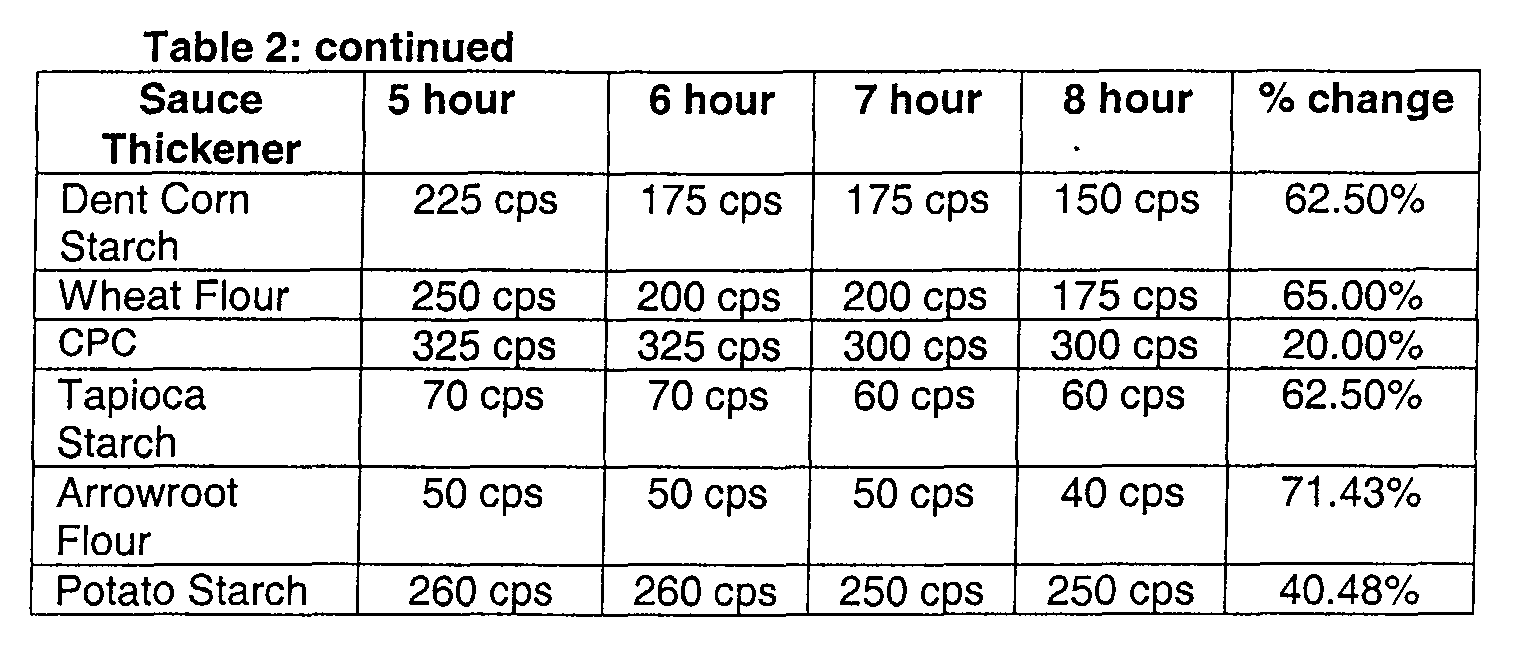
- As the data in Table 2 shows, the brown sauce containing the co-processed composition of the present invention ("CPC") was able to maintain its viscosity over eight hours showing only a 20% drop. In comparison, sauces containing an unmodified starch showed at least a 40% drop in viscosity.
- Further, the arrowroot flour, potato starch and wheat flour samples all exhibited very poor emulsion stability of the butter in the brown sauce formulation. All three of these samples had complete butter separation at about the two hour time.
- A conventional Tomato Sauce having a pH of 4.41 was formulated from each starch (dent corn starch, wheat flour, CPC prepared according to Example 1, tapioca starch, arrowroot flour, and potato flour) as follows: water 64.63%, tomato paste 30.60%, olive oil 1.97%, starch 1.50% and salt 1.30%. All percentages are weight percents. Each sauce was brought to a rapid boil on the stove top, reduced to a simmer and held for two minutes. A portion of the sauce was then separated off for freeze/thaw testing as described in Example 5, infra. The remaining sauce was placed on a steam table unit and held at 71 °C for eight hours. Viscosity testing was performed every hour. An RVT Brookfield Viscometer was used for viscosity measurements. All viscosities are reported in Centipoise (cps).
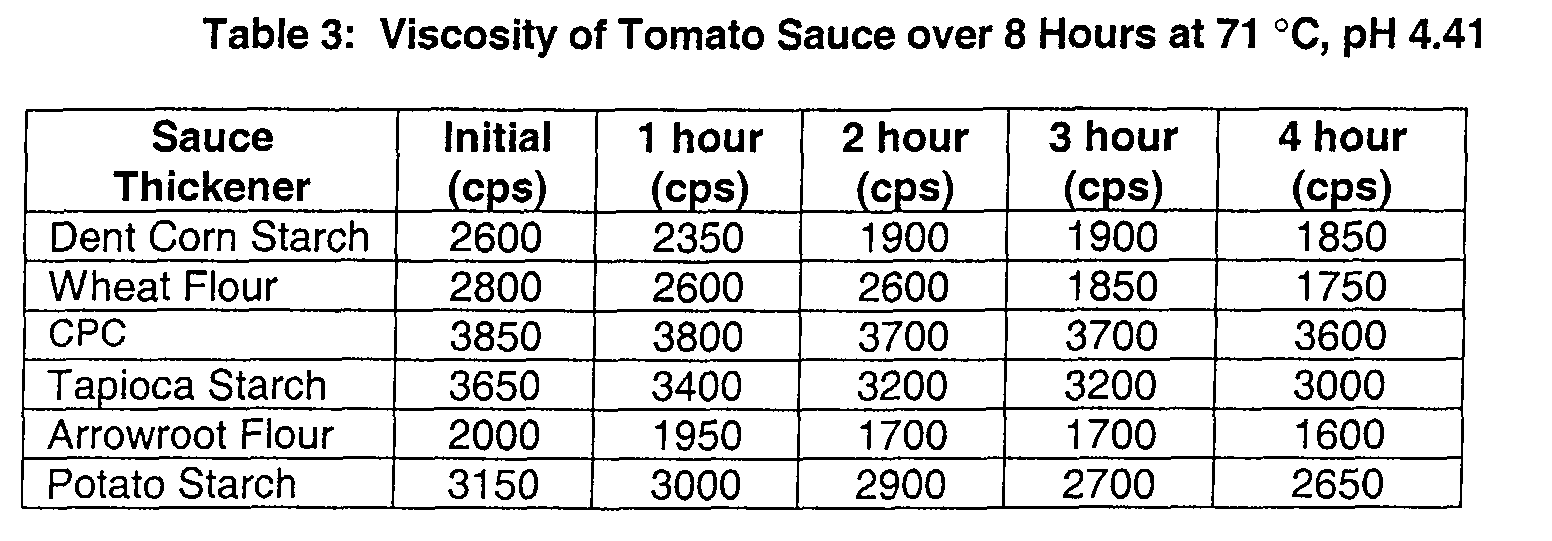

- As the data in Table 3 shows, the tomato sauce containing the co-processed composition of the present invention ("CPC") was able maintain its viscosity over eight hours showing only about a 9% drop. In comparison, sauces prepared from industry standard thickeners containing an unmodified starch showed at least a 28% drop.
- The brown and tomato sauces prepared according to Examples 3 and 4, respectively, were placed in 4 ounce jars and frozen for a minimum period of 24 hours. After each cycle of 24 hours, the sample was brought to room temperature (about 22 °C) and evaluated visually. The samples were then heated to 71 °C and evaluated visually. The results are presented in Tables 4 and 5 for the brown sauce and tomato sauce, respectively.
Brown Sauce Visual Evaluation at 22.22°C Sauce
ThickenerInitial 1 F/T
cycle2 F/T
cycles3 F/T
cycles4 F/T
cyclesCPC Good opacity, fluid, smooth, uniform Opaque, fluid, smooth Opaque, fluid, smooth Slight fat separation , fluid, slightly more opaque Slight fat separation, fluid, slightly more opaque Wheat Flour Slight gel set, slight butter separation Cuttable gel, opaque, syneresis Cuttable gel, opaque, syneresis Cuttable gel, opaque, a lot of syneresis Cuttable gel, opaque, a lot of syneresis Corn Starch Slight gel set, uniform Cuttable gel, opaque, syneresis Cuttable . gel, opaque, syneresis Cuttable gel, opaque, a lot of syneresis Cuttable gel, opaque, a lot of syneresis Arrowroot Flour No opacity, glossy, fluid, slight butter separation Complete fat separation , grainy, cohesive, fluid and thin with gel pockets Complete fat separation , grainy, cohesive, fluid and thin with gel pockets Complete fat separation , grainy, cohesive, fluid and thin with gel pockets Complete fat separation, grainy, cohesive, fluid and thin with gel pockets Tapioca Starch No opacity, glossy, fluid, slight butter separation Complete fat separation , grainy, cohesive, fluid and thin with gel pockets Complete fat separation , grainy, cohesive, fluid and thin with gel pockets Complete fat separation , grainy, cohesive, fluid and thin with gel pockets Complete fat separation, grainy, cohesive, fluid and thin with gel pockets Potato Starch Slight gel set, no opacity, slight grain Very opaque, gel pockets, grainy Very opaque, gel pockets, grainy Very opaque, gel pockets, grainy Very opaque, gelled, grainy - As Table 4 shows, after the first freeze/thaw cycle, only the co-processed composition of the present invention and the arrowroot flour sample returned to their initial state. However, the arrowroot flour sample did not return to its initial state in contrast to the co-processed composition of the present invention which maintained its cold temperature stability for more than 4 freeze/thaw cycles.
Tomato Sauce Visual Evaluation at 22.22°C Sauce
ThickenerInitial 1 F/T
cycle2 F/T
cycles3 F/T
cycles4 F/T
cyclesCPC Thick, uniform, fluid Thick, uniform, fluid Thick, uniform, fluid Thick, uniform, fluid Thick, uniform, fluid Wheat Flour Slight gel set, slight opacity Cuttable gel, opaque, syneresis Cuttable gel, opaque, syneresis Cuttable gel, opaque, a lot of syneresis Cuttable gel, opaque, a lot of syneresis Corn Starch Slight gel set, uniform Cuttable gel, opaque, syneresis Cuttable gel, opaque, syneresis Cuttable gel, opaque, a lot of syneresis Cuttable gel, opaque, a lot of syneresis Arrowroot Flour Thin, fluid, slightly glossy appearance (overcooked) Slight gel formation, syneresis Slight gel formation, syneresis Slight gel formation, syneresis Stronger gel set, more syneresis Tapioca Starch Thin, fluid, slightly glossy appearance (overcooked) Slight gel formation, syneresis Slight gel formation, syneresis Slight gel formation, syneresis Stronger gel set, more syneresis Potato Starch Very grainy, thin, overcooked appearance Gelled, syneresis Gelled, syneresis Gelled, syneresis Cuttable gel, syneresis - As illustrated in Table 5, only the co-processed thickener of the present invention was able to return to its initial state after more than one freeze/thaw cycle. Advantageously, the co-processed thickener of the tomato sauce maintained its cold temperature stability throughout more than four free/thaw cycles.
- Samples of each starch and the co-processed composition (prepared according to Example 1) were tested for their initial viscosity and processing stability during a heating and hold profile. All samples were tested on the Newport Scientific Series 4 Rapid Visco Analyser (RVA). All samples were prepared and tested at 5.00% solids in water and run at pHs of 3.0 and 6.0, by adjusting the pH with a buffer solution. The buffer solution was prepared by mixing 1.5 volumes of solution A with 1.0 volumes of solution B. Solution A was prepared by diluting citric acid monohydrate (210.2 g) in distilled water (1000 ml). Solution B was prepared by diluted tri-sodium citrate, dihydrate in distilled water (1000 ml).
- The RVA Configuration Profile was set as follows:
RVA Configuration Profile Time Function Temp/Speed Value 00:00:00 Temp 30°C 00:00:00 Speed 560 rpm 00:00:30 Speed 160 rpm 00:01:00 Temp 30°C 00:05:00 Temp 90°C 00:15:00 Temp 90°C - The samples were then heated to 90 °C and held at that temperature for ten minutes. The RVA viscosity data is reported in Table 6.
RVA Viscosity Data
All results are reported in centipoise (cps)Sample pH Viscosity @ 30°C 0 minutes Viscosity @ 71.1°C 3 min. 45 sec. % Peak Achieved @ 71.1°C Peak Viscosity Final Viscosity CPC 3.0 326 549 81.82% 671 617 Wheat Flour 3.0 72 63 35.40% 178 109 Corn Starch 3.0 67 61 17.23% 354 278 Arrowroot Flour 3.0 74 64 12.75% 502 142 Potato Starch 3.0 76 112 15.20% 737 354 Tapioca Starch 3.0 72 66 11.00% 599 175 CPC 6.0 311 453 86.62% 523 408 Wheat Flour 6.0 75 73 51.40% 142 124 Corn Starch 6.0 71 67 20.74% 323 284 Arrowroot Flour 6.0 71 91 17.70% 514 279 Potato Starch 6.0 67 95 8.61 % 1103 1021 Tapioca Starch 6.0 64 52 8.65% 601 365 - Only the co-processed composition of the present invention ("CPC") advantageously gave instant viscosity at 0 minutes and achieved approximately 82.00% of its peak viscosity by 4 minutes, characterizing it as a "ready-for-use" product. In contrast, none of the other industry standards were able to provide a "ready-for-use" product.
- This example illustrates improved emulsification properties of thickeners prepared from the co-processed composition of the present invention as compared to a corresponding non-co-processed blend.
- Three brown sauces were made according to the preparation described in Example 2. In each sauce the starch was either the co-processed composition prepared according to Example 1 ("CPC"), a corresponding dry blend of modified starch and wheat flour (dry blend), or the modified starch alone.
- To prepare the corresponding dry blend, amounts of the modified starch and wheat flour were hand mixed in the same ratios as in the CPC composition so that a uniform blend was obtained.
- A sample of each brown sauce (100 ml) was placed in a graduated cylinder. The amount of separated fat or ringing was then measured for each sauce immediately after cooking, periodically during the first hour after cooking and 24 hours later.
- The sample containing CPC remained uniform and fluid throughout 24 hours, with no separation of the fat in the system. The sample containing the dry blend began to separate within five minutes after cooking the sample, but remained in uniformly distributed pockets of butter throughout the sample. The sample containing only the modified starch began to separate immediately after cooking, forming uniformly distributed pockets of butter throughout the sample, which ultimately formed a ring of 8 ml of butter that solidified on the surface of the sauce.
- This experiment demonstrated that the CPC compositions of the present invention advantageously provided a superior sauce wherein the component fat of the sauce formulation remained emulsified more than 24 hours after cooking.
Claims (26)
- A co-processed composition comprising a modified starch and a flour wherein the starch and flour are blended and co-processed to provide a thickener which provides a combination of good opacity, process tolerance, cold and hot temperature stability, emulsification and instant viscosity properties in foods.
- The co-processed composition of claim 1 wherein the co-processing is selected from the group consisting of drum-drying, SIDA or EK processing.
- The co-processed composition of claims 1-2 wherein the modified starch is a stabilized starch.
- The co-processed composition of claims 1-3 wherein the stabilized starch is further crosslinked or thermally inhibited.
- The co-processed composition of claims 1-3 wherein the stabilized starch is a monofunctional substituted starch.
- The co-processed composition of claims 1- 3 wherein the stabilized starch is derived from a waxy maize plant having at least one recessive sugary-2 allele.
- The co-processed composition of claim 6 wherein the waxy maize plant is a plant that is heterozygous for the sugary-2 allele or a plant of a wxsu2 (homozygous) genotype, and translocations, inversions, mutants and variations thereof.
- The co-processed composition of claims 1-4 wherein the modified starch is a hydroxyalkylated distarch phosphate, an acetylated distarch adipate.
- The co-processed composition of claims 1-8 wherein the flour is a wheat flour having a protein content of less than 16%.
- The co-processed composition of claims1-9 wherein the flour is a wheat flour having a protein content of less than 10%.
- The co-processed composition of Claims 1-10 wherein the starch and the flour are present in a ratio of from about 72:28 to about 93:7 by weight, respectively.
- The co-processed composition of Claims 1-11 wherein the starch and the flour are present in a ratio of from 80:20 to about 90:10 by weight, respectively.
- The co-processed composition of claims 1-12 wherein the hot temperature process tolerance is characterized by an ability of a conventional Brown or Tomato sauce containing the co-processed composition to have less than a 20% drop in viscosity from its peak viscosity over eight hours at about 71 °C.
- The co-processed composition of claims 1-13 wherein the hot temperature process tolerance is characterized by the ability of a conventional Tomato sauce containing the co-processed composition to have less than a 10% drop from its peak viscosity over eight hours at about 100 °C.
- The co-processed composition of claims 1-14 wherein the cold temperature stability is characterized by the ability of a conventional Tomato sauce containing the co-processed composition to substantially return to its initial state after one freeze thaw cycle.
- The co-processed composition of claims 1-15 wherein the cold temperature stability is characterized by the ability of a conventional Tomato or Brown sauce containing the co-processed composition to substantially return to its initial state after two freeze thaw cycles.
- The co-processed composition of claims 1-16 wherein the cold temperature stability is characterized by the ability of a conventional Tomato or Brown sauce containing the co-processed composition to substantially return to its initial state after three freeze thaw cycles.
- The co-processed composition of claims 1-17 wherein the cold temperature stability is characterized by the ability of a conventional Tomato or Brown sauce containing the co-processed composition to substantially return to its initial state after four freeze thaw cycles.
- The co-processed composition of claims 1-18 wherein the opacity of a solution containing 4% solids of the co-processed composition at 22 °C composition is at least two times greater as measured in Nephelomatic Turbity Units than the opacity of a solution containing a corresponding pregelatinized modified starch measured under the same conditions.
- The co-processed composition of claims 1-19 wherein the opacity of a solution containing 4% solids of the co-processed composition at 22 °C composition is at least three times greater as measured in Nephelomatic Turbity Units than the opacity of a solution containing a corresponding modified starch measured under the same conditions.
- The co-processed composition of claims 1-20 wherein the opacity of a solution containing 4% solids of the co-processed composition at 22 °C composition is at least four times greater as measured in Nephelomatic Turbity Units than the opacity of a solution containing a corresponding modified starch measured under the same conditions.
- The co-processed composition of claims 1-21 wherein the emulsification property of the co-processed composition is characterized by the ability of a conventional Brown sauce containing the co-processed composition to maintain its emulsification twenty four hours after cooking.
- The co-processed composition of claim 1-22 having an instant viscosity at zero minutes and achieving about 80% of its peak viscosity in less than four minutes.
- A co-processed composition according to claim 1 wherein the modified starch is a dihydroxypropylated distarch phosphate waxy maize starch substituted to a degree of from about 5.7% to about 6.7% by weight of propylene oxide reagent used to stabilize the starch, and substituted from about 0.01% to about 0.025% by weight of phoshorus oxychloride reagent used to crosslink the starch and the flour is a wheat flour having a 10% protein content, said starch and flour are present in a ratio of 85:15 (wt% starch:flour) co-processed via the SIDA process.
- A process for using the composition of Claims 1-24 as a thickener in foods comprising the step of adding the composition to a food.
- The process of Claim 25 wherein the food is selected from the group consisting of sauces, gravies, dips, dressings, fillings, cheese sauce, fruit toppings, turnover fillings, marinades, soups, condiments, chowders, relishes, pate, batters, desserts, glazes, vinaigrettes, coatings, frozen entrees, dry mixes, and cream style vegetables.
Applications Claiming Priority (4)
| Application Number | Priority Date | Filing Date | Title |
|---|---|---|---|
| US42442 | 1979-05-25 | ||
| US80996801A | 2001-03-16 | 2001-03-16 | |
| US809968 | 2001-03-16 | ||
| US10/042,442 US6777015B2 (en) | 2001-03-16 | 2002-01-08 | Co-processed compositions useful as culinary thickeners |
Publications (2)
| Publication Number | Publication Date |
|---|---|
| EP1241216A1 true EP1241216A1 (en) | 2002-09-18 |
| EP1241216B1 EP1241216B1 (en) | 2006-06-07 |
Family
ID=26719239
Family Applications (1)
| Application Number | Title | Priority Date | Filing Date |
|---|---|---|---|
| EP02005219A Expired - Lifetime EP1241216B1 (en) | 2001-03-16 | 2002-03-07 | Processed blend useful as culinary thickeners comprising a modified starch and a flour |
Country Status (14)
| Country | Link |
|---|---|
| US (2) | US6777015B2 (en) |
| EP (1) | EP1241216B1 (en) |
| JP (1) | JP4350932B2 (en) |
| KR (1) | KR20020073415A (en) |
| CN (1) | CN100346711C (en) |
| AR (1) | AR032977A1 (en) |
| AT (1) | ATE328956T1 (en) |
| AU (1) | AU784637B2 (en) |
| BR (1) | BR0200811A (en) |
| CA (1) | CA2375690A1 (en) |
| DE (1) | DE60211985T2 (en) |
| DK (1) | DK1241216T3 (en) |
| ES (1) | ES2264455T3 (en) |
| MX (1) | MXPA02002934A (en) |
Cited By (12)
| Publication number | Priority date | Publication date | Assignee | Title |
|---|---|---|---|---|
| DE10336880A1 (en) * | 2003-08-11 | 2005-06-02 | Dr. August Oetker Nahrungsmittel Kg | Dry mix for preparing ready-to-serve desserts and process for making end-products made therefrom |
| WO2010133560A1 (en) * | 2009-05-19 | 2010-11-25 | Wacker Chemie Ag | Bioplastics |
| WO2016149305A1 (en) * | 2015-03-16 | 2016-09-22 | Solae Llc | Instant thickened dry food compositions |
| WO2019089656A1 (en) * | 2017-11-03 | 2019-05-09 | Corn Products Development, Inc. | Starch blends and uses thereof |
| WO2020126293A1 (en) | 2018-12-20 | 2020-06-25 | Unilever N.V. | Agglomerated composition comprising an edible solid particulate component and a potato starch |
| US20210401018A1 (en) * | 2018-11-30 | 2021-12-30 | Cargill, Incorporated | Non-grain compositions comprising thermally inhibited and/or heat moisture treated waxy tapioca |
| US20220132890A1 (en) * | 2019-02-21 | 2022-05-05 | Cargill, Incorporated | Compositions for shelf stable wet pet food applications |
| RU2795458C2 (en) * | 2017-11-03 | 2023-05-03 | Корн Продактс Дивелопмент, Инк. | Starch mixtures and their applications |
| WO2023138898A1 (en) * | 2022-01-21 | 2023-07-27 | Roquette Freres | Method for producing thermally modified starch blends |
| US12295392B2 (en) | 2018-12-20 | 2025-05-13 | Conopco Inc. | Savoury composition |
| US12440051B2 (en) | 2018-12-20 | 2025-10-14 | Conopco Inc. | Food article |
| US12593858B2 (en) | 2018-12-20 | 2026-04-07 | Conopco Inc. | Savoury composition |
Families Citing this family (23)
| Publication number | Priority date | Publication date | Assignee | Title |
|---|---|---|---|---|
| US6777015B2 (en) * | 2001-03-16 | 2004-08-17 | National Starch And Chemical Investment Holding Corporation | Co-processed compositions useful as culinary thickeners |
| GB0206419D0 (en) * | 2002-03-19 | 2002-05-01 | Cerestar Holding Bv | Non-sticky, free-flowing comestible and a process for its preparation |
| US20050042331A1 (en) * | 2003-08-22 | 2005-02-24 | Billmers Robert L. | Starches for reduced fat in fried foods systems |
| US20060034997A1 (en) * | 2004-08-16 | 2006-02-16 | Carver Janet M | Instant roux |
| DE102005026037A1 (en) * | 2005-06-03 | 2006-12-07 | Bernhard Zamek Gmbh & Co. Kg | Modular food system |
| US20080160142A1 (en) * | 2006-12-22 | 2008-07-03 | Basimah Khulusi | Beverage Products And Method Of Making Same |
| US20090017186A1 (en) * | 2007-07-11 | 2009-01-15 | National Starch And Chemical Investment Holding Corporation | Hydrocolloid Blend For Innovative Texture |
| US8983581B2 (en) | 2008-05-27 | 2015-03-17 | Massachusetts Institute Of Technology | System and method for large field of view, single cell analysis |
| US20100015306A1 (en) * | 2008-07-15 | 2010-01-21 | Pepsico, Inc. | Method for Preparing a Low Viscosity Whole Grain Flour Slurry |
| US9155471B2 (en) | 2009-05-27 | 2015-10-13 | Lumicell, Inc'. | Methods and systems for spatially identifying abnormal cells |
| US9314304B2 (en) | 2010-12-08 | 2016-04-19 | Lumicell, Inc. | Methods and system for image guided cell ablation with microscopic resolution |
| JP5839537B2 (en) * | 2011-02-23 | 2016-01-06 | キユーピー株式会社 | salad |
| WO2012130260A1 (en) * | 2011-03-31 | 2012-10-04 | N.V. Nutricia | A process for the production of a powdered composition, the powdered composition obtained thereby and uses thereof |
| US9351508B2 (en) | 2012-03-10 | 2016-05-31 | Corn Products Development, Inc. | Delayed gelling starch compositions |
| KR20160037834A (en) | 2013-03-14 | 2016-04-06 | 루미셀, 아이엔씨. | Medical imaging device and methods of use |
| US10172368B2 (en) * | 2014-08-15 | 2019-01-08 | Corn Products Development, Inc. | Food products containing a modified waxy cassava starch |
| EP3000327B2 (en) * | 2014-08-15 | 2020-10-21 | Corn Products Development, Inc. | Food products containing a modified waxy cassava starch |
| US10582720B2 (en) * | 2017-03-17 | 2020-03-10 | Corn Products Development, Inc. | Baked snack coating using waxy corn starch |
| JP7144337B2 (en) * | 2019-02-04 | 2022-09-29 | 株式会社日清製粉ウェルナ | Sources containing astaxanthin |
| US20230002512A1 (en) * | 2019-11-27 | 2023-01-05 | Cargill, Incorporated | Clean label starch compositions |
| US20240225058A9 (en) * | 2021-03-04 | 2024-07-11 | Corn Products Development, Inc. | Compositions opacified with sweet flour |
| EP4637390A1 (en) * | 2022-12-21 | 2025-10-29 | GEA Process Engineering A/S | Method and system for drying of proteins as well as functionalized protein obtained |
| WO2024190117A1 (en) * | 2023-03-16 | 2024-09-19 | ハウス食品株式会社 | Packaged liquid or pasty food composition, method for manufacturing same, and use application of same |
Citations (4)
| Publication number | Priority date | Publication date | Assignee | Title |
|---|---|---|---|---|
| US4428972A (en) * | 1981-10-23 | 1984-01-31 | National Starch And Chemical Corporation | Starch thickener characterized by improved low-temperature stability |
| DD255877A1 (en) * | 1986-12-24 | 1988-04-20 | Inst Getreideverarbeitung | METHOD FOR PRODUCING A MODIFIED THICKNESS-CONTAINING THICKENING AGENT |
| US5165950A (en) * | 1991-08-28 | 1992-11-24 | American Amaranth, Inc. | Microwave expandable half product and process for its manufacture |
| US5976607A (en) * | 1997-05-14 | 1999-11-02 | Kerry Inc. | Water dispersible coating composition for fat-fried foods |
Family Cites Families (22)
| Publication number | Priority date | Publication date | Assignee | Title |
|---|---|---|---|---|
| US3554764A (en) * | 1967-12-21 | 1971-01-12 | Gen Foods Corp | Freeze-thaw resistant flour and starch thickener blend |
| DE3243963C1 (en) * | 1982-11-27 | 1984-04-12 | Maizena Gmbh, 2000 Hamburg | Process for the production of a lump-free, hot-dispersible base product for bound sauces and soups |
| US5149799A (en) * | 1990-01-26 | 1992-09-22 | National Starch And Chemical Investment Holding Corporation | Method and apparatus for cooking and spray-drying starch |
| CA2052969A1 (en) * | 1990-10-12 | 1992-04-13 | James Zallie | Foods containing soluble high amylose starch |
| JPH06502310A (en) * | 1990-10-31 | 1994-03-17 | ザ、プロクター、エンド、ギャンブル、カンパニー | calcium fortified sauce |
| US5344663A (en) * | 1992-01-15 | 1994-09-06 | Anne M. Jewell | Process for producing a fat-substitute bakery dough and the fat substitute bakery products |
| US6451121B2 (en) * | 1993-07-30 | 2002-09-17 | National Starch And Chemical Investment Holding Corporation | Thermally-inhibited non-pregelatinized granular starches and flours and process for their preparation |
| US6221420B1 (en) * | 1993-07-30 | 2001-04-24 | National Starch And Chemical Investment Holding Corporation | Foods containing thermally-inhibited starches and flours |
| US5932017A (en) * | 1993-07-30 | 1999-08-03 | National Starch And Chemical Investment Holding Corporation | Thermally-inhibited non-pregelatinized granular starches and flours and process for their preparation |
| ATE196723T1 (en) * | 1994-07-29 | 2000-10-15 | Nestle Sa | BINDER THAT IS DISPERSIBLE IN HOT WATER BASED ON FLOURY PARTICLES COVERED WITH FAT |
| DE69532146T3 (en) | 1994-07-29 | 2009-04-02 | National Starch And Chemical Investment Holding Corp., Wilmington | Thermally inhibited starches and flours and processes for their preparation |
| BR9706990A (en) * | 1996-01-16 | 1999-07-20 | Procter & Gamble | Fried snack |
| US6488980B1 (en) * | 1996-03-22 | 2002-12-03 | National Starch And Chemical Investment Holding Corporation | Stabilized or stabilized, crosslinked waxy potato starch |
| US5954883A (en) * | 1996-10-08 | 1999-09-21 | National Starch And Chemical Investment Holding Corporation | Waxy maize starch derived from grain of a plant which is heterozygous for the sugary-2 allele |
| US5849351A (en) * | 1997-05-14 | 1998-12-15 | Kerry Ingredients, Inc. | Water dispersible coating composition for fat-fried foods |
| US5891496A (en) * | 1997-08-06 | 1999-04-06 | Hannah; Scott C. | Fat-free chopped and formed potato products and process |
| JP5289652B2 (en) * | 1999-01-29 | 2013-09-11 | コーオペラティー、アベベ、ユー.アー. | Compositions based on cross-linked and depolymerized starch suitable as gelatin substitutes |
| FR2794756B1 (en) * | 1999-06-09 | 2001-08-24 | Jean Bernard Lacadee | PROCESS FOR THE MANUFACTURE OF A SUBSTITUTE FOR STARCH, PARTICULARLY FROM BUT AND THE SUBSTITUTE OBTAINED |
| WO2001011994A1 (en) | 1999-08-13 | 2001-02-22 | Aftoora William F | Flavored solid-form food product and method of preparation |
| US20010041209A1 (en) * | 2000-02-07 | 2001-11-15 | Visee Frans Leonard | Cheese sauce and method for producing it |
| PT1138210E (en) * | 2000-03-31 | 2004-12-31 | Nestle Sa | THICKNESS INSTANTANEO |
| US6777015B2 (en) * | 2001-03-16 | 2004-08-17 | National Starch And Chemical Investment Holding Corporation | Co-processed compositions useful as culinary thickeners |
-
2002
- 2002-01-08 US US10/042,442 patent/US6777015B2/en not_active Expired - Lifetime
- 2002-03-07 AT AT02005219T patent/ATE328956T1/en not_active IP Right Cessation
- 2002-03-07 ES ES02005219T patent/ES2264455T3/en not_active Expired - Lifetime
- 2002-03-07 CN CNB021067651A patent/CN100346711C/en not_active Expired - Fee Related
- 2002-03-07 EP EP02005219A patent/EP1241216B1/en not_active Expired - Lifetime
- 2002-03-07 DK DK02005219T patent/DK1241216T3/en active
- 2002-03-07 CA CA002375690A patent/CA2375690A1/en not_active Abandoned
- 2002-03-07 DE DE60211985T patent/DE60211985T2/en not_active Expired - Fee Related
- 2002-03-08 AR ARP020100858A patent/AR032977A1/en not_active Application Discontinuation
- 2002-03-14 KR KR1020020013818A patent/KR20020073415A/en not_active Withdrawn
- 2002-03-14 BR BR0200811-4A patent/BR0200811A/en not_active IP Right Cessation
- 2002-03-14 AU AU24617/02A patent/AU784637B2/en not_active Ceased
- 2002-03-15 JP JP2002071439A patent/JP4350932B2/en not_active Expired - Fee Related
- 2002-03-15 MX MXPA02002934A patent/MXPA02002934A/en active IP Right Grant
-
2004
- 2004-08-16 US US10/919,183 patent/US20050095339A1/en not_active Abandoned
Patent Citations (4)
| Publication number | Priority date | Publication date | Assignee | Title |
|---|---|---|---|---|
| US4428972A (en) * | 1981-10-23 | 1984-01-31 | National Starch And Chemical Corporation | Starch thickener characterized by improved low-temperature stability |
| DD255877A1 (en) * | 1986-12-24 | 1988-04-20 | Inst Getreideverarbeitung | METHOD FOR PRODUCING A MODIFIED THICKNESS-CONTAINING THICKENING AGENT |
| US5165950A (en) * | 1991-08-28 | 1992-11-24 | American Amaranth, Inc. | Microwave expandable half product and process for its manufacture |
| US5976607A (en) * | 1997-05-14 | 1999-11-02 | Kerry Inc. | Water dispersible coating composition for fat-fried foods |
Cited By (16)
| Publication number | Priority date | Publication date | Assignee | Title |
|---|---|---|---|---|
| DE10336880A1 (en) * | 2003-08-11 | 2005-06-02 | Dr. August Oetker Nahrungsmittel Kg | Dry mix for preparing ready-to-serve desserts and process for making end-products made therefrom |
| WO2010133560A1 (en) * | 2009-05-19 | 2010-11-25 | Wacker Chemie Ag | Bioplastics |
| WO2016149305A1 (en) * | 2015-03-16 | 2016-09-22 | Solae Llc | Instant thickened dry food compositions |
| WO2019089656A1 (en) * | 2017-11-03 | 2019-05-09 | Corn Products Development, Inc. | Starch blends and uses thereof |
| RU2795458C2 (en) * | 2017-11-03 | 2023-05-03 | Корн Продактс Дивелопмент, Инк. | Starch mixtures and their applications |
| CN112367856A (en) * | 2017-11-03 | 2021-02-12 | 玉米产品开发公司 | Starch blends and uses thereof |
| US20210401018A1 (en) * | 2018-11-30 | 2021-12-30 | Cargill, Incorporated | Non-grain compositions comprising thermally inhibited and/or heat moisture treated waxy tapioca |
| AU2019409732B2 (en) * | 2018-12-20 | 2022-04-14 | Unilever Ip Holdings B.V. | Agglomerated composition comprising an edible solid particulate component and a potato starch |
| CN113226060A (en) * | 2018-12-20 | 2021-08-06 | 联合利华知识产权控股有限公司 | Agglomerated compositions comprising an edible solid particulate component and potato starch |
| WO2020126293A1 (en) | 2018-12-20 | 2020-06-25 | Unilever N.V. | Agglomerated composition comprising an edible solid particulate component and a potato starch |
| US12295392B2 (en) | 2018-12-20 | 2025-05-13 | Conopco Inc. | Savoury composition |
| US12440051B2 (en) | 2018-12-20 | 2025-10-14 | Conopco Inc. | Food article |
| US12593858B2 (en) | 2018-12-20 | 2026-04-07 | Conopco Inc. | Savoury composition |
| US20220132890A1 (en) * | 2019-02-21 | 2022-05-05 | Cargill, Incorporated | Compositions for shelf stable wet pet food applications |
| WO2023138898A1 (en) * | 2022-01-21 | 2023-07-27 | Roquette Freres | Method for producing thermally modified starch blends |
| FR3132101A1 (en) * | 2022-01-21 | 2023-07-28 | Roquette Freres | PROCESS FOR MANUFACTURING THERMALLY MODIFIED STARCH BLENDS |
Also Published As
| Publication number | Publication date |
|---|---|
| JP2002335878A (en) | 2002-11-26 |
| ES2264455T3 (en) | 2007-01-01 |
| CA2375690A1 (en) | 2002-09-16 |
| CN100346711C (en) | 2007-11-07 |
| AU784637B2 (en) | 2006-05-18 |
| DE60211985T2 (en) | 2007-06-14 |
| US20050095339A1 (en) | 2005-05-05 |
| KR20020073415A (en) | 2002-09-26 |
| DE60211985D1 (en) | 2006-07-20 |
| AU2461702A (en) | 2002-09-19 |
| EP1241216B1 (en) | 2006-06-07 |
| ATE328956T1 (en) | 2006-06-15 |
| MXPA02002934A (en) | 2003-08-20 |
| US6777015B2 (en) | 2004-08-17 |
| BR0200811A (en) | 2002-12-31 |
| JP4350932B2 (en) | 2009-10-28 |
| DK1241216T3 (en) | 2006-09-25 |
| AR032977A1 (en) | 2003-12-03 |
| CN1375219A (en) | 2002-10-23 |
| US20030039741A1 (en) | 2003-02-27 |
Similar Documents
| Publication | Publication Date | Title |
|---|---|---|
| US6777015B2 (en) | Co-processed compositions useful as culinary thickeners | |
| US3515591A (en) | Cold water-dispersible starch composition and method for making same | |
| Moore et al. | Applications of starches in foods | |
| JP7674327B2 (en) | Inhibited waxy starch and methods of use thereof | |
| JP2893003B2 (en) | Hydroxypropylated cross-linked waxy potato starch | |
| Murray | Cellulosics | |
| JP2003501494A (en) | Thermally suppressed starch produced by oligosaccharides | |
| IE48594B1 (en) | Novel,starch containing food products and process for preparing same | |
| AU696688B2 (en) | Foods containing thermally-inhibited starches and flours | |
| US20100240775A1 (en) | Pasteurisation stable starch compositions | |
| KR101986841B1 (en) | Process for preparing noodle with starches | |
| EP0639056B1 (en) | Starch-thickened foodstuff and process for preparing it | |
| US20060034997A1 (en) | Instant roux | |
| JP2004215563A (en) | Quality improvers for dairy products | |
| KR19990036944A (en) | Water-binding composition for food | |
| JP3921555B2 (en) | A bowl-like confectionery filled in a container and a method for producing the same | |
| CA1091653A (en) | Protein/starch complex and a method of producing a protein/starch complex | |
| US20220160004A1 (en) | Instant cream for use in pastries, containing atomised pea starch | |
| JP2025071955A (en) | Quality improver for noodles | |
| JPH04311377A (en) | Production of foreign style sauce having stable viscosity |
Legal Events
| Date | Code | Title | Description |
|---|---|---|---|
| PUAI | Public reference made under article 153(3) epc to a published international application that has entered the european phase |
Free format text: ORIGINAL CODE: 0009012 |
|
| AK | Designated contracting states |
Kind code of ref document: A1 Designated state(s): AT BE CH CY DE DK ES FI FR GB GR IE IT LI LU MC NL PT SE TR |
|
| AX | Request for extension of the european patent |
Free format text: AL;LT;LV;MK;RO;SI |
|
| 17P | Request for examination filed |
Effective date: 20021212 |
|
| AKX | Designation fees paid |
Designated state(s): AT BE CH CY DE DK ES FI FR GB GR IE IT LI LU MC NL PT SE TR |
|
| 17Q | First examination report despatched |
Effective date: 20031002 |
|
| GRAP | Despatch of communication of intention to grant a patent |
Free format text: ORIGINAL CODE: EPIDOSNIGR1 |
|
| GRAS | Grant fee paid |
Free format text: ORIGINAL CODE: EPIDOSNIGR3 |
|
| GRAA | (expected) grant |
Free format text: ORIGINAL CODE: 0009210 |
|
| AK | Designated contracting states |
Kind code of ref document: B1 Designated state(s): AT BE CH CY DE DK ES FI FR GB GR IE IT LI LU MC NL PT SE TR |
|
| PG25 | Lapsed in a contracting state [announced via postgrant information from national office to epo] |
Ref country code: IT Free format text: LAPSE BECAUSE OF FAILURE TO SUBMIT A TRANSLATION OF THE DESCRIPTION OR TO PAY THE FEE WITHIN THE PRESCRIBED TIME-LIMIT;WARNING: LAPSES OF ITALIAN PATENTS WITH EFFECTIVE DATE BEFORE 2007 MAY HAVE OCCURRED AT ANY TIME BEFORE 2007. THE CORRECT EFFECTIVE DATE MAY BE DIFFERENT FROM THE ONE RECORDED. Effective date: 20060607 |
|
| REG | Reference to a national code |
Ref country code: GB Ref legal event code: FG4D |
|
| REG | Reference to a national code |
Ref country code: CH Ref legal event code: EP |
|
| REG | Reference to a national code |
Ref country code: IE Ref legal event code: FG4D |
|
| REF | Corresponds to: |
Ref document number: 60211985 Country of ref document: DE Date of ref document: 20060720 Kind code of ref document: P |
|
| REG | Reference to a national code |
Ref country code: CH Ref legal event code: NV Representative=s name: ISLER & PEDRAZZINI AG |
|
| REG | Reference to a national code |
Ref country code: DK Ref legal event code: T3 |
|
| REG | Reference to a national code |
Ref country code: SE Ref legal event code: TRGR |
|
| PG25 | Lapsed in a contracting state [announced via postgrant information from national office to epo] |
Ref country code: PT Free format text: LAPSE BECAUSE OF FAILURE TO SUBMIT A TRANSLATION OF THE DESCRIPTION OR TO PAY THE FEE WITHIN THE PRESCRIBED TIME-LIMIT Effective date: 20061107 |
|
| REG | Reference to a national code |
Ref country code: ES Ref legal event code: FG2A Ref document number: 2264455 Country of ref document: ES Kind code of ref document: T3 |
|
| ET | Fr: translation filed | ||
| PLBE | No opposition filed within time limit |
Free format text: ORIGINAL CODE: 0009261 |
|
| STAA | Information on the status of an ep patent application or granted ep patent |
Free format text: STATUS: NO OPPOSITION FILED WITHIN TIME LIMIT |
|
| 26N | No opposition filed |
Effective date: 20070308 |
|
| REG | Reference to a national code |
Ref country code: CH Ref legal event code: PCAR Free format text: ISLER & PEDRAZZINI AG;POSTFACH 1772;8027 ZUERICH (CH) |
|
| PG25 | Lapsed in a contracting state [announced via postgrant information from national office to epo] |
Ref country code: MC Free format text: LAPSE BECAUSE OF NON-PAYMENT OF DUE FEES Effective date: 20070331 |
|
| PG25 | Lapsed in a contracting state [announced via postgrant information from national office to epo] |
Ref country code: GR Free format text: LAPSE BECAUSE OF FAILURE TO SUBMIT A TRANSLATION OF THE DESCRIPTION OR TO PAY THE FEE WITHIN THE PRESCRIBED TIME-LIMIT Effective date: 20060908 |
|
| PGFP | Annual fee paid to national office [announced via postgrant information from national office to epo] |
Ref country code: CH Payment date: 20080108 Year of fee payment: 7 Ref country code: DK Payment date: 20080212 Year of fee payment: 7 Ref country code: ES Payment date: 20080317 Year of fee payment: 7 |
|
| PGFP | Annual fee paid to national office [announced via postgrant information from national office to epo] |
Ref country code: FI Payment date: 20080229 Year of fee payment: 7 Ref country code: GB Payment date: 20080211 Year of fee payment: 7 Ref country code: IE Payment date: 20080123 Year of fee payment: 7 Ref country code: IT Payment date: 20080322 Year of fee payment: 7 Ref country code: NL Payment date: 20080219 Year of fee payment: 7 Ref country code: SE Payment date: 20080310 Year of fee payment: 7 |
|
| PGFP | Annual fee paid to national office [announced via postgrant information from national office to epo] |
Ref country code: AT Payment date: 20080211 Year of fee payment: 7 |
|
| PGFP | Annual fee paid to national office [announced via postgrant information from national office to epo] |
Ref country code: DE Payment date: 20080331 Year of fee payment: 7 Ref country code: FR Payment date: 20080307 Year of fee payment: 7 |
|
| PGFP | Annual fee paid to national office [announced via postgrant information from national office to epo] |
Ref country code: TR Payment date: 20080102 Year of fee payment: 7 Ref country code: BE Payment date: 20080403 Year of fee payment: 7 |
|
| REG | Reference to a national code |
Ref country code: GB Ref legal event code: 732E |
|
| REG | Reference to a national code |
Ref country code: FR Ref legal event code: TP Ref country code: FR Ref legal event code: AU |
|
| REG | Reference to a national code |
Ref country code: FR Ref legal event code: CL Ref country code: FR Ref legal event code: AU |
|
| PG25 | Lapsed in a contracting state [announced via postgrant information from national office to epo] |
Ref country code: CY Free format text: LAPSE BECAUSE OF FAILURE TO SUBMIT A TRANSLATION OF THE DESCRIPTION OR TO PAY THE FEE WITHIN THE PRESCRIBED TIME-LIMIT Effective date: 20060607 Ref country code: LU Free format text: LAPSE BECAUSE OF NON-PAYMENT OF DUE FEES Effective date: 20070307 |
|
| BERE | Be: lapsed |
Owner name: *NATIONAL STARCH AND CHEMICAL INVESTMENT HOLDING C Effective date: 20090331 |
|
| PG25 | Lapsed in a contracting state [announced via postgrant information from national office to epo] |
Ref country code: AT Free format text: LAPSE BECAUSE OF NON-PAYMENT OF DUE FEES Effective date: 20090307 Ref country code: FI Free format text: LAPSE BECAUSE OF NON-PAYMENT OF DUE FEES Effective date: 20090307 |
|
| REG | Reference to a national code |
Ref country code: CH Ref legal event code: PL |
|
| REG | Reference to a national code |
Ref country code: DK Ref legal event code: EBP |
|
| EUG | Se: european patent has lapsed | ||
| GBPC | Gb: european patent ceased through non-payment of renewal fee |
Effective date: 20090307 |
|
| NLV4 | Nl: lapsed or anulled due to non-payment of the annual fee |
Effective date: 20091001 |
|
| REG | Reference to a national code |
Ref country code: FR Ref legal event code: ST Effective date: 20091130 |
|
| PG25 | Lapsed in a contracting state [announced via postgrant information from national office to epo] |
Ref country code: CH Free format text: LAPSE BECAUSE OF NON-PAYMENT OF DUE FEES Effective date: 20090331 Ref country code: LI Free format text: LAPSE BECAUSE OF NON-PAYMENT OF DUE FEES Effective date: 20090331 Ref country code: DE Free format text: LAPSE BECAUSE OF NON-PAYMENT OF DUE FEES Effective date: 20091001 Ref country code: IE Free format text: LAPSE BECAUSE OF NON-PAYMENT OF DUE FEES Effective date: 20090309 |
|
| PG25 | Lapsed in a contracting state [announced via postgrant information from national office to epo] |
Ref country code: NL Free format text: LAPSE BECAUSE OF NON-PAYMENT OF DUE FEES Effective date: 20091001 Ref country code: BE Free format text: LAPSE BECAUSE OF NON-PAYMENT OF DUE FEES Effective date: 20090331 |
|
| PG25 | Lapsed in a contracting state [announced via postgrant information from national office to epo] |
Ref country code: GB Free format text: LAPSE BECAUSE OF NON-PAYMENT OF DUE FEES Effective date: 20090307 Ref country code: FR Free format text: LAPSE BECAUSE OF NON-PAYMENT OF DUE FEES Effective date: 20091123 Ref country code: DK Free format text: LAPSE BECAUSE OF NON-PAYMENT OF DUE FEES Effective date: 20090331 |
|
| REG | Reference to a national code |
Ref country code: ES Ref legal event code: FD2A Effective date: 20090309 |
|
| PG25 | Lapsed in a contracting state [announced via postgrant information from national office to epo] |
Ref country code: ES Free format text: LAPSE BECAUSE OF NON-PAYMENT OF DUE FEES Effective date: 20090309 |
|
| PG25 | Lapsed in a contracting state [announced via postgrant information from national office to epo] |
Ref country code: IT Free format text: LAPSE BECAUSE OF NON-PAYMENT OF DUE FEES Effective date: 20090307 |
|
| PG25 | Lapsed in a contracting state [announced via postgrant information from national office to epo] |
Ref country code: SE Free format text: LAPSE BECAUSE OF NON-PAYMENT OF DUE FEES Effective date: 20090308 |
|
| PG25 | Lapsed in a contracting state [announced via postgrant information from national office to epo] |
Ref country code: TR Free format text: LAPSE BECAUSE OF NON-PAYMENT OF DUE FEES Effective date: 20090307 |