EP1239457B1 - Voice synthesizing apparatus - Google Patents
Voice synthesizing apparatus Download PDFInfo
- Publication number
- EP1239457B1 EP1239457B1 EP02005149A EP02005149A EP1239457B1 EP 1239457 B1 EP1239457 B1 EP 1239457B1 EP 02005149 A EP02005149 A EP 02005149A EP 02005149 A EP02005149 A EP 02005149A EP 1239457 B1 EP1239457 B1 EP 1239457B1
- Authority
- EP
- European Patent Office
- Prior art keywords
- template
- pitch
- voice
- feature parameters
- phoneme
- Prior art date
- Legal status (The legal status is an assumption and is not a legal conclusion. Google has not performed a legal analysis and makes no representation as to the accuracy of the status listed.)
- Expired - Lifetime
Links
- 230000002194 synthesizing effect Effects 0.000 title claims description 49
- 239000011295 pitch Substances 0.000 claims description 240
- 238000000034 method Methods 0.000 claims description 47
- 230000008859 change Effects 0.000 claims description 46
- 230000000630 rising effect Effects 0.000 claims description 13
- 230000008569 process Effects 0.000 claims description 9
- 230000006870 function Effects 0.000 description 23
- 230000007704 transition Effects 0.000 description 23
- 238000010586 diagram Methods 0.000 description 17
- 238000001228 spectrum Methods 0.000 description 15
- 230000005284 excitation Effects 0.000 description 13
- 230000014509 gene expression Effects 0.000 description 8
- 230000015572 biosynthetic process Effects 0.000 description 7
- 238000003786 synthesis reaction Methods 0.000 description 7
- 241001342895 Chorus Species 0.000 description 6
- HAORKNGNJCEJBX-UHFFFAOYSA-N cyprodinil Chemical compound N=1C(C)=CC(C2CC2)=NC=1NC1=CC=CC=C1 HAORKNGNJCEJBX-UHFFFAOYSA-N 0.000 description 6
- 238000004519 manufacturing process Methods 0.000 description 4
- 101100357018 Trypanosoma brucei brucei RNR2 gene Proteins 0.000 description 3
- 238000004590 computer program Methods 0.000 description 3
- 230000000694 effects Effects 0.000 description 3
- 238000004891 communication Methods 0.000 description 2
- 230000003247 decreasing effect Effects 0.000 description 2
- 230000006866 deterioration Effects 0.000 description 2
- 230000004048 modification Effects 0.000 description 2
- 238000012986 modification Methods 0.000 description 2
- 230000008602 contraction Effects 0.000 description 1
- 230000001419 dependent effect Effects 0.000 description 1
- 238000000695 excitation spectrum Methods 0.000 description 1
- 238000002474 experimental method Methods 0.000 description 1
- 239000000284 extract Substances 0.000 description 1
- 238000013213 extrapolation Methods 0.000 description 1
- 210000004072 lung Anatomy 0.000 description 1
- 230000002035 prolonged effect Effects 0.000 description 1
- 230000000717 retained effect Effects 0.000 description 1
- HODRFAVLXIFVTR-RKDXNWHRSA-N tevenel Chemical compound NS(=O)(=O)C1=CC=C([C@@H](O)[C@@H](CO)NC(=O)C(Cl)Cl)C=C1 HODRFAVLXIFVTR-RKDXNWHRSA-N 0.000 description 1
- 210000001260 vocal cord Anatomy 0.000 description 1
- 230000001755 vocal effect Effects 0.000 description 1
Images


Classifications
-
- G—PHYSICS
- G10—MUSICAL INSTRUMENTS; ACOUSTICS
- G10L—SPEECH ANALYSIS TECHNIQUES OR SPEECH SYNTHESIS; SPEECH RECOGNITION; SPEECH OR VOICE PROCESSING TECHNIQUES; SPEECH OR AUDIO CODING OR DECODING
- G10L13/00—Speech synthesis; Text to speech systems
- G10L13/06—Elementary speech units used in speech synthesisers; Concatenation rules
-
- G—PHYSICS
- G10—MUSICAL INSTRUMENTS; ACOUSTICS
- G10L—SPEECH ANALYSIS TECHNIQUES OR SPEECH SYNTHESIS; SPEECH RECOGNITION; SPEECH OR VOICE PROCESSING TECHNIQUES; SPEECH OR AUDIO CODING OR DECODING
- G10L13/00—Speech synthesis; Text to speech systems
- G10L13/02—Methods for producing synthetic speech; Speech synthesisers
- G10L13/033—Voice editing, e.g. manipulating the voice of the synthesiser
Definitions
- the present invention relates to a voice synthesizing apparatus, and more particularly to a voice synthesizing apparatus for synthesizing human singing voice.
- Human voice consists of phones or phonemes that consist of a plurality of formants.
- synthesis of human singing voice first, all formants constituting each of all phonemes that human can speak are generated to form necessary phones. Next, a plurality of generated phones are sequentially concatenated and pitches are controlled in accordance with the melody.
- This synthesizing method is applicable not only to human voices but also to musical sounds generated by a musical instrument such as a wind instrument.
- Japanese Patent No. 2504172 discloses a formant sound generating apparatus which can generate a formant sound having even a high pitch without generating unnecessary spectra.
- JP-A-HEI-6-308997 a database storing several phonemes at each pitch is used to select proper phoneme pieces in accordance with the voice pitch.
- JP-A-HEI-6-308997 discloses a voice synthesizing technique for overlaying the necessary phoneme wave data read from the wave dictionary by using a pitch as an index. In order to match for the designated pitch, a pitch formant frequency is changed in the frequency region.
- the dictionary of the prior art stores wave data whereas the present invention stores the feature parameters that is not wave data.
- the prior art fails to disclose the template for giving time variation to the read data (the read feature parameters).
- JP-A-HEI-6-308997 discloses a synthesizing process by designating a phoneme type and a pitch, reading consonant phoneme from a consonant table and vowel phoneme corresponding to the designated type and pitch from a vowel table and synthesizing consonant and vowel phonemes. Since the phoneme is divided by a wave editing tool, wave data are stored as phoneme.
- EP-A-0 942 409 discloses a phoneme based speech synthesis wherein the search target is changed to a substitute phoneme having lower phonemic context dependency when the original search target is not present in the database.
- a second phoneme is generated in consideration of a phonemic context with respect to a first phoneme as a search target.
- Phonemic piece data corresponding to the second phoneme is searched out from a database.
- a third phoneme is generated by changing the phonemic context on the basis of the search result, and phonemic piece data corresponding to the third phoneme is re-searched out from the database.
- the search or re-search result is registered in a table in correspondence with the second or third phoneme.
- EP-A-0 848 372 discloses a speech synthesizing system that can reduce a waveform database size by storing one pitch waveform representing a group of waveforms. Here also, wave data are stored, requiring a large amount of memory space.
- a speech synthesizing system using a redundancy-reduced waveform database is disclosed. Each waveform of a sample set of voice segments necessary and sufficient for speech synthesis is divided into pitch waveforms, which are classified into groups of pitch waveforms closely similar to one another. One of the pitch waveforms of each group is selected as a representative of the group and is given a pitch waveform ID.
- the waveform database at least comprises a pitch waveform pointer table each record of which comprises a voice segment ID of each of the voice segments and pitch waveform IDs the pitch waveforms of which, when combined in the listed order, constitute a waveform identified by the voice segment ID and a pitch waveform table of pitch waveform IDs and corresponding pitch waveforms.
- a pitch waveform pointer table each record of which comprises a voice segment ID of each of the voice segments and pitch waveform IDs the pitch waveforms of which, when combined in the listed order, constitute a waveform identified by the voice segment ID and a pitch waveform table of pitch waveform IDs and corresponding pitch waveforms.
- CANO P ET AL "Voice morphing system for impersonating in karaoke applications" ICMC. INTERNATIONAL COMPUTER MUSIC CONFERENCE. PROCEEDINGS, 2000, pages 1-4, XP002246647 discloses a voice morphing system that converts a voice on a real-time base.
- US-A-5 642 470 relates to a singing voice synthesizing device for synthesizing natural chorus voices by modulating synthesized voice with fluctuation and emphasis and discloses that music information and word information are input to a music/word information input unit.
- a voice part extracting unit extracts note length information, pitch information, loudness information, and phonetic symbols from the music information and the word information for each voice part.
- a note length information changing unit changes the note length information extracted for each voice part.
- a pitch information changing unit changes the pitch information extracted for each voice part.
- a loudness information changing unit detects a solo in a chorus and changes the loudness information of the solo.
- a singing voice signal synthesizing unit provided for each voice part synthesizes a singing voice signal according to the note length information extracted and changed for each voice part, the pitch information extracted and changed for each voice part, the changed loudness information, and the phonetic symbols.
- a chorus signal generating unit generates a singing voice signal in a chorus from the singing voice signals synthesized for each voice part.
- a singing voice output unit generates singing voices of the chorus from the singing voice signals of the chorus and outputs them.
- the formant frequency does not depend only upon the pitch, but it depends also upon other parameters such as dynamics, the data amount increases in the unit of square and cube.
- a voice synthesizing apparatus as set forth in claim 1.
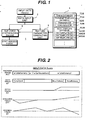
- Fig. 1 is a block diagram showing the structure of a voice synthesizing apparatus 1.
- the voice synthesizing apparatus 1 has a data input unit 2, a feature parameter generating unit 3, a database 4 and an EpR voice synthesizing engine 5.
- Input data Score input to the data input unit 2 is sent to the feature parameter generating unit 3 and EpR voice synthesizing engine 5.
- the feature parameter generating unit 3 reads feature parameters and various templates to be described later from the database 4.
- the feature parameter generating unit 3 applies various templates to the read feature parameters to generate final feature parameters and send them to the EpR voice synthesizing engine 5.
- the EpR voice synthesizing unit 5 generates pulses in accordance with the pitches, dynamics and the like of the input data Score, and applies feature parameters to the generated pulses to synthesize and output voices.
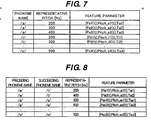
- Fig. 2 is a conceptual diagram showing an example of the input data Score.
- the input data Score is constituted of a phoneme track PHT, a note track NT, a pitch track PIT, a dynamics track DYT, and an opening track OT.
- the input data Score is song data of song phrases or the whole song, and changes with time.
- the phoneme track PHT includes phoneme names and their voice production continuation times. Each phoneme is classified into two parts: Articulation representative of a transition part between phonemes; and Stationary representative of a stationary part. Each phoneme includes flags for distinguishing between Articulation and Stationary. Since Articulation is the transition part, it has phoneme names, namely preceding and succeeding phoneme names. Since Stationary is the stationary part, it has only one phoneme name.
- the note track NT records flags each indicating one of a note attack (NoteAttack), a note-to-note (NoteToNote) and a note release (NoteRelease).
- NoteAttack, NoteToNote and NoteRelease are commands for designating musical expression at the rising (attack) time of voice production, at the pitch change time, and at the falling (release) time of voice production, respectively.
- the pitch track PIT records the fundamental frequency at each timing of a voice to be vocalized.
- the pitch of an actually generated sound is calculated in accordance with pitch information recorded in the pitch track PIT and other information. Therefore, the pitch of an actually produced sound may differ from the pitch recorded in this pitch track PIT.
- the dynamics track DYT records a dynamics value at each timing, which value is a parameter indicating an intensity of voice.
- the dynamics value takes a value from 0 to 1.
- the opening track OT records an opening value at each timing, which value is a parameter indicating the opening degree of lips (lip opening degree).
- the opening value takes a value from 0 to 1.
- the feature parameter generating unit 3 reads data from the database 4, and as will be later described, generates feature parameters in accordance with the input data Score and the data read from the database 4, and outputs the feature parameters to the EpR voice synthesizing engine 5.
- the feature parameters to be generated by the feature parameter generating unit 3 can be classified, for example, into four types: an envelope of excitation waveform spectra; excitation resonances; formants; and differential spectra. These four feature parameters can be obtained by resolving a spectrum envelope (original spectrum envelope) of harmonic components obtained by analyzing voices (original voices) of a person or the like.
- ExcitationCurve The envelope (ExcitationCurve) of excitation waveform spectra is constituted of three parameters: EGain indicating an amplitude (dB) of a glottal waveform; ESlopeDepth indicating a slope of the spectrum envelope of the glottal waveform; and ESlope indicating a depth (dB) from a maximum value to a minimum value of the spectrum envelope of the glottal waveform.
- the excitation resonance is a chest resonance.
- the excitation resonance is constituted of three parameters including a center frequency (ERFreq), a band width (ERBW) and an amplitude (ERAmp), and has the second-order filter characteristics.
- the formant indicates a vocal tract resonance made of twelve resonances.
- the formant is constituted of three parameters including a center frequency (FormantFreqi), a band width (FormantBW1) and an amplitude (FormantAmpi), where "i” takes a value from 1 to 12 (1 ⁇ i ⁇ 12).
- the differential spectrum is a feature parameter that has a differential spectrum from the original spectrum, the differential spectrum being unable to be expressed by the three parameters: the envelope of excitation waveform spectra, excitation resonances and formants.
- the database 4 is constituted of, at least a Timbre database TDB, a phoneme template database PDB and a note template database NDB.
- Timbre is a tone color of a phoneme and is expressed by feature parameters at one timing point (a set of the excitation spectrum, excitation resonance, formant and differential spectrum).
- Fig. 3 shows an example of the Timbre database TDB. This database has a phoneme name and a pitch as its indices.
- Timbre database TDB shown in Fig. 3 is used in this embodiment, a database having four indices including the phoneme name, pitch, dynamics and opening such as shown in Fig. 4 may be used.
- the phoneme template database PDB is constituted of a stationary template database and an articulation template database.
- the template is a set of a sequence having: pairs of a feature parameter P and a pitch Pitch disposed at a predetermined time interval; and a length T (sec) of the sequence.
- Fig. 5 shows an example of the stationary template database.
- the stationary template database uses a phoneme name and a representative pitch as its indices, and has stationary templates of all phonemes of voiced sounds.
- the stationary template can be created by analyzing voices having stable phonemes and pitches by utilizing an EpR model.
- one voice of a voiced sound e.g., "a"
- some pitch e.g., at C4
- the feature parameters such as pitches and formant frequencies are generally constant and stationary.
- this fluctuation does not exist and the feature parameters are perfectly constant, synthesized voices are flat and mechanical. In other words, this fluctuation expresses the individuality and naturalness of each person.
- Timbre i.e., the feature parameters at one timing
- the same template is again applied from the time point. If the voice reaches the end of the template, a template with a reversed time axis may be applied. With this method, discontinuity at the connection point between the templates does not exist.
- the time axis of the template is stretched or shortened, the speed of a change in the feature parameters and pitches change greatly and the naturalness is degraded. It is preferable not to change the time axis of the template, also from the viewpoint that a human being does not consciously control the fluctuation in the stationary part.
- the stationary template does not have the time series of feature parameters themselves in the stationary part, but it has representative typical feature parameters of each phoneme and change amounts of the feature parameters.
- the change amounts of the feature parameters in the stationary part are small. Therefore, as compared to having feature parameters themselves, having the change amounts reduces the information amount so that the size of the database can be made small.
- Fig. 6 shows an example of the articulation template database.
- the articulation template database uses a preceding phoneme name, a succeeding phoneme name, and a representative pitch as its indices.
- the articulation template has combinations of phonemes of a language which phonemes can be actually realized.
- the articulation template can be obtained by analyzing voices of phonemes in the concatenated part with a stable pitch by utilizing an EpR model.
- the feature parameter P(t) may be either an absolute value or a differential value.
- This phenomenon is generally called co-articulation.
- the concatenating part between phonemes is provided in the form of LPC coefficients and speech waveforms.
- the articulation part between two phonemes is synthesized by using an articulation template having differential information of feature parameters and pitches.
- transition part For example, consider the case wherein a song having two continuous words "a” and “i” of a quarter note at the same pitch is synthesized. There is a transition part from “a” to "i” in the boundary area between two notes. Both “a” and “i” are vowels and a voiced sound. This transition part corresponds to an articulation from V (voiced sound) to V (voiced sound).
- the feature parameters in the transition part can be obtained by applying the articulation template by using a method of Type 2 to be described later.
- the feature parameters of "a” and “i” are read from the Timbre database TDB and the articulation template from "a” to "i” is applied to the feature parameters. In this manner, the feature parameters having a natural change of the transition part can be obtained.
- Feature parameters of "a” are read from the Timbre database TDB and an articulation template from "a” to “s” is applied to the read feature parameters. In this manner, the feature parameters having a natural change of the transition part can be obtained.
- Type 1 i.e., a difference from the start part of the template, is used for the articulation from V (voiced sound) to U (unvoiced sound) is simply because pitches and feature parameters do not exist in U (unvoiced sound) corresponding to the end part.
- Feature parameters of "u” are read from the Timbre database TDB and an articulation template from “s" to “u” is applied to the feature parameters to obtain the feature parameters of the transition part from “s" to "u”.
- the articulation template having differential information of feature parameters is advantageous in that the data size becomes smaller than the template having absolute value feature parameters.
- the note template database NDB has at least a note attack template (NA template) database NADB, a note release template (NR template) database NRDB, and a note-to-note template (NN template) database NNDB.
- NA template note attack template
- NR template note release template
- NN template note-to-note template
- Fig. 7 shows an example of the NA template database NADB.
- the NA template has information of feature parameters and pitches in the voice rising part.
- the NA template database NADB stores NA templates for phonemes of all voiced sounds by using a phoneme name and a representative pitch as indices.
- the NA template is obtained by analyzing actually produced voices in the rising part.
- the NR template has information of the feature parameters and pitches in the voice falling part.
- the NR template database NRDB has the same structure as that of the NA template database NADB, and has NR templates for phonemes of all voiced sounds by using a phoneme name and a representative pitch as indices.
- NA template obtained by analyzing the rising part of an actual human voice e.g., "a”
- a natural change in the human voice in the rising part can be given.
- NA templates for all phonemes are prepared, it is possible to give a change in every phoneme to the attack part.
- a song is sung by making the rising speed up and down in order to give particular musical expression.
- the NA template has one rising time, the speed in the rising part of the NA template can be increased or decreased by linearly expanding or contracting the time axis of the template.
- NA templates having lengths at several levels may be prepared and the template having the length nearest to the attack part is selected and expanded or contracted. Other methods may also be used.
- the amplitudes, pitches and formants change in the end part of an utterance, i.e., falling (Release) part.
- an NR template obtained by analyzing human actual voices in the falling part is applied to the feature parameters of a phoneme just before the start of the falling part.
- the NN template has the feature parameters of voices in the pitch changing part.
- the NN template data base NNDB stores NN templates for all phonemes of voiced sounds and has as indices a phoneme name, a pitch at the start timing of the template and a pitch at the end timing of the template.
- a template having a small pitch change width is selected with a priority over a template having a small pitch absolute value difference.
- the selected NN template is applied by using a method of Type 3 to be later described.
- the reason why the NN template having the small pitch change width is selected is as follows. There is a possibility that the NN template obtained from the part where the pitch changes greatly has big values. If this NN template is applied to the part where the pitch change width is small, the change shape of the original NN template cannot be retained and there is a possibility that the change becomes unnatural.
- An NN template obtained from a voice of a particular phoneme e.g., "a" whose pitch changes may be used for the pitch change of all phonemes.
- a voice of a particular phoneme e.g., "a”
- Type 1 is used mainly when the template is applied to the feature parameter in the note release part.
- the reason for this is as follows. A voice in the stationary part exists in the start portion of the note release so that it is necessary to maintain the parameter continuity, i.e., voice continuity in the start portion of the note release, whereas no voice exists in the end portion of the note release so that it is not necessary to maintain the parameter continuity.
- Type 2 is used mainly when the template is applied to the feature parameter in the note attack part.
- the reason for this is as follows. A voice in the stationary part exists in the end portion of the note attack so that it is necessary to maintain the parameter continuity, i.e., voice continuity in the end portion of the note attack, whereas no voice exists in the start portion of the note attack so that it is not necessary to maintain the parameter continuity.
- Type 4 is used mainly when the template is applied to the stationary part. Type 4 gives natural fluctuation to the relatively long stationary part of a voice.
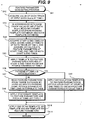
- Fig. 9 is a flow chart illustrating a feature parameter generating process. This process generates feature parameters at the time t. The feature parameters generating process repeats at a predetermined time interval increasing the time t to synthesize whole voices in the phrase or song.
- Step SA1 the feature parameter generating process starts to thereafter advance to the next Step SA2.
- Step SA2 values of each track of the input data Score at the time t are acquired. Specifically, of the input data Score at the time t, the phoneme name, distinguishment between articulation and stationary, distinguishment between note attack, note-to-note and note release, a pitch, a dynamics value and an opening value are acquired. Thereafter, the flow advances to the next Step SA3.
- Step SA3 in accordance with the value of each track of the input data Score acquired at Step SA2, necessary templates are read from the phoneme template database PDB and note template database NDB. Thereafter, the flow advances to the Next Step SA4.
- Reading the phoneme template at Step SA3 is performed, for example, by the following procedure. If it is judged that the phoneme at the time t is articulation, the articulation template database is searched to read a template having the coincident preceding and succeeding phoneme names and the nearest pitch.
- the stationary template database is searched to read a template having the coincident phoneme name and the nearest pitch.
- Reading the note template is performed by the following procedure. If it is judged that the note track at the time t is note attack, the NA template database NADB is searched to read a template having the coincident phoneme name and the nearest pitch.
- the NR template database NRDB is searched to read a template having the coincident phoneme name and the nearest pitch.
- the NN template database NNDB is searched to read a template having the coincident phoneme names and the nearest distance d.
- the distance d is calculated by the following equation (H) by using the start pitches and end pitches.
- the equation (H) uses as a distance scale the value obtained by adding a weighted change amount of frequencies and a weighted change amount of average values.
- d 0.8 ⁇ TempInterval - Interval + 0.2 ⁇ TempAve - Ave
- TempInterval
- TempAve (template start point pitch + template end point pitch)/2
- Interval
- Ave (note track start point pitch + note track end point pitch)/2.
- the template having the nearest pitch change amount rather than the nearest pitch absolute value can be read.
- Step SA4 the start and end times of the area having the same attribute of the note track at the current time t are acquired. If the phoneme track is stationary, in accordance with distinguishment between note attack, note-to-note and note release, the feature parameters at the start time, end time or at the start and end times is acquired or calculated. Thereafter, the flow advances to the next Step SA5.
- the Timbre database TDB is searched to read feature parameters having the coincident phoneme name and the coincident pitch at the note attack end time.
- two sets of feature parameters having the coincident phoneme name and the pitches sandwiching the pitch at the note attack end time are acquired.
- the two sets of feature parameters are interpolated to calculate the feature parameters at the note attack end time. The details of interpolation will be later given.
- the Timbre database TDB is searched to read feature parameters having the coincident phoneme name and the coincident pitch at the note release start time.
- two sets of feature parameters having the coincident phoneme name and the pitches sandwiching the pitch at the note release start time are acquired.
- the two sets of feature parameters are interpolated to calculate the feature parameters at the note release attack start time. The details of interpolation will be later given.
- the Timbre database TDB is searched to read feature parameters having the coincident phoneme name and the coincident pitch at the note-to-note end time.
- two sets of feature parameters having the coincident phoneme name and the pitches sandwiching the pitch at the note-to-note start (end) time are acquired.
- the two sets of feature parameters are interpolated to calculate the feature parameters at the note-to-note start (end) time. The details of interpolation will be later given.
- the phoneme track is articulation
- the feature parameters at the start and end times are acquired or calculated.
- the Timbre database TDB is searched to read feature parameters having the coincident phoneme names and the coincident pitch at the articulation start time and a feature parameter having the coincident phoneme names and the coincident pitch at the articulation end time.
- two sets of feature parameters having the coincident phoneme names and the pitches sandwiching the pitch at the articulation start (end) time are acquired.
- the two sets of feature parameters are interpolated to calculate the feature parameters at the articulation start (end) time.
- Step SA5 the template read at Step SA3 is applied to the feature parameters and pitches at the start and end times read at Step SA4 to obtain the pitch and dynamics at the time t.
- the NA template is applied to the note attack part by Type 2 by using the feature parameters of the note attack part at the end time read at Step SA4. After the template is applied, the pitch and dynamics (EGain) at the time t are stored.
- the NR template is applied to the note release part by Type 1 by using the feature parameters of the note release part at the note release start point read at Step SA4. After the template is applied, the pitch and dynamics (EGain) at the time t are stored.
- the NN template is applied to the note-to-note part by Type 3 by using the feature parameters of the note-to-note start and end times read at Step SA4. After the template is applied, the pitch and dynamics (EGain) at the time t are stored.
- the pitch and dynamics (EGain) of the input data Score are stored.
- Step SA6 After one of the above-described processes is performed, the flow advances to the next Step SA6.
- Step SA6 it is judged from the values of each track obtained at Step SA2 whether the phoneme at the time t is articulation or not. If the phoneme is articulation, the flow branches to Step SA9 indicated by a YES arrow, whereas if not, i.e., if the phoneme at the time t is stationary, the flow advances to Step SA7 indicated by a NO arrow.
- Step SA7 the feature parameters are read from the Timbre database TDB by using as indices the phoneme name obtained at Step SA2 and the pitch and dynamics obtained at Step SA5.
- the feature parameters are used for interpolation.
- a read and interpolation method is similar to that used at Step SA4. Thereafter, the flow advances to Step SA8.
- Step SA8 the stationary template obtained at Step SA3 is applied to the feature parameters and pitch at the time t obtained at Step SA7 by Type 4.
- Step SA8 By applying the stationary template at Step SA8, the feature parameters and pitch at the time t are renewed to add voice fluctuation given by the stationary template. Thereafter, the flow advances to Step SA10.
- Step SA9 the articulation template read at Step SA3 is applied to the feature parameters in the articulation part obtained at Step SA4 at the start and end times to obtain the feature parameters and pitch at the time t. Thereafter, the flow advances to Step SA10.
- Type 1 is used for a transition from a voiced sound (V) to an unvoiced sound (U)
- Type 2 is used for a transition from a unvoiced sound (U) to a voiced sound (V)
- Type 3 is used for a transition from a voiced sound (V) to an unvoiced sound (U) or a transition from a unvoiced sound (U) to a voiced sound (V).
- the template applying method is alternatively used in the manner described above in order to realize a natural voice change contained in the template while maintaining continuity of the voiced sound part.
- Step SA10 one of the NA template, NR template and NN template is applied to the feature parameters obtained at Step SA8 or SA9.
- the template is not applied to EGain of the feature parameters. Thereafter, the flow advances to Step SA11 whereat the feature parameter generating process is terminated.
- the NA template obtained at Step SA3 is applied by Type 2 to renew the feature parameters.
- the NR template obtained at Step SA3 is applied by Type 1 to renew the feature parameters.
- the NN template obtained at Step SA3 is applied by Type 3 to renew the feature parameters.
- the template is not applied to EGain of the feature parameters.
- the pitch obtained before Step 10 is directly used.
- Interpolation for feature parameters to be performed at Step SA4 shown in Fig. 9 will be described.
- Interpolation for feature parameters includes interpolation of two sets of feature parameters and estimation from one set of feature parameters.
- feature parameters are stored in the Timbre database TDB by selecting about three points at an equal interval on the logarithmic axis of the compass of two to three octaves corresponding to the human singing compass.
- the feature parameters are obtained through interpolation (linear interpolation) of two sets of feature parameters or estimation (extrapolation) from one set of feature parameters.
- Feature parameters at different pitches are prepared at about three points. The reason for this is as follows. Even if a voice has the same phoneme and pitch, the feature parameters changes with time. Therefore, a difference between interpolation at about three points and interpolation at finely divided points is less meaningful.
- f 2 - f P 2 P 1 + P 2 + P 1 f - f 1 f 2 - f 1
- the estimation from one set of feature parameters is utilized when the feature parameters outside of the compass of data stored in the database are estimated.
- the feature parameters having the highest pitch in the database are used for synthesizing voices having a pitch higher than the compass of the database, the sound quality is apparently degraded.
- the sound quality is also degraded. In this embodiment, therefore, the sound quality is prevented from being degraded by changing the feature parameters in the following manner by using rules basing upon knowing from observations of actual voice data.
- a value PitchDiff [cents] is calculated by subtracting the highest pitch HighestPitch [cents] in the database from the target pitch TargetPitch [cents].
- the feature parameters having the highest pitch are read from the database.
- the excitation resonance frequency EpRFreq and i-th formant frequency FormantFreqi are added with PitchDiff [cents] to obtain EpRFreq' and FormantFreqi' which are used as the feature parameters of the target pitch.
- a value PitchDiff [cents] is calculated by subtracting the lowest pitch LowestPitch [cents] in the database from the target pitch TargetPitch [cents].
- the feature parameters having the lowest pitch are read from the database.
- the feature parameters are replaced in the following manner to use the replaced feature parameters as the feature parameters at the target pitch.
- the first to fourth formant amplitudes FormantAmp 1 to FormantAmp 4 are made large in proportion to PitchDiff by using the following equations (J5) to (J8) to be replaced by FormantAmp 1' to FormantAmp 4':
- Formant Amp 1 ⁇ FormantAmp 1 - 8 ⁇ PitchDiff / 1200
- Formant Amp 2 ⁇ FormantAmp 2 - 5 ⁇ PitchDiff / 1200
- Formant Amp 3 ⁇ FormantAmp 3 - 12 ⁇ PitchDiff / 1200
- Formant Amp 4 ⁇ FormantAmp 4 - 15 ⁇ PitchDiff / 1200
- Timbre database TDB shown in Fig. 4 it is preferable to form the Timbre database TDB shown in Fig. 4 using the pitch, dynamics and opening as indices. However, if there are restrictions of time and database size, the database of this embodiment shown in Fig. 3 using only the pitch as the index is used.
- the feature parameters using only the pitch as the index are changed by using a dynamics function and an opening function.
- the effects of using the Timbre database TDB using the pitch, dynamics and opening as indices can be obtained mimetically.
- dynamics and opening can be obtained.
- the dynamics function and opening function can be obtained by analyzing a correlation between the feature parameters and the actual voices vocalized by changing the dynamics and opening.
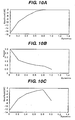
- Figs. 10A to 10C are graphs showing examples of the dynamics function.
- Fig. 10A is a graph showing a function fEG
- Fig. 10B is a graph showing a function fES
- Fig. 10C is a graph showing a function fESD.
- the dynamics value is reflected upon the feature parameters ExcitationGain (EG), ExcitationSlope (Es) and ExcitationSlopeDepth (ESD).
- EG ExcitationGain
- Es ExcitationSlope
- ESD ExcitationSlopeDepth
- All of the functions fEG, fES and fESD shown in Figs. 10A to 10C are input with a dynamics value which takes a value from 0 to 1.
- the feature parameters EG', ES' and ESD' are calculated by the following equations (K1) to (K3) by using the functions fEG, fES and fESD to use as the feature parameters at the dynamic value dyn:
- EG ⁇ fEG dyn
- ES ⁇ ES ⁇ ⁇ fES dyn
- ESD ⁇ ESD + fESD dyn
- Figs. 10A to 10C The functions fEG, fES and fESD shown in Figs. 10A to 10C are only illustrative. By using various functions for singers, voices having more naturalness can be synthesized.
- Fig. 11 is a graph showing an example of the opening function.
- the horizontal axis represents a frequency (Hz) and the vertical axis represents an amplitude (dB).
- ERFreq' is obtained from the excitation resonance frequency ERFreq by using the following equation (L1) to use it as the feature parameters at the opening value Open:
- ERFreq ⁇ ERFreq + fOpen ERFreq ⁇ 1 - Open where fOpen (freq) is the opening function.
- An i-th formant frequency FormantFreqi' is obtained from the i-th formant frequency FormantFreqi by using the following equation (L2) to use it as the feature parameters at the opening value Open:
- Formant Freq i ⁇ FormantFreq i + fOpen FormantFreq i ⁇ 1 - Open
- the amplitudes of formants in the frequency range from 0 to 500 Hz can be increased or decreased in proportion to the opening value so that synthesized voices can be given a change in voice to be caused by the lip opening degree.
- Synthesized voices can be changed in various ways by preparing the functions to be input with opening values for each singer and changing the functions.
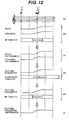
- Fig. 12 is a diagram illustrating an example of a first application of templates according to the embodiment. Voices of a song shown by a score at (a) in Fig. 12 are synthesized by the embodiment method.
- the pitch of the first half note is “so"
- the intensity is “piano (soft)”
- the pronunciation is "a”.
- the pitch of the second half note is “do”
- the intensity is "mezzo-forte (somewhat loud)”
- the pronunciation is "a”. Since the two notes are concatenated by legato, two voices are smoothly concatenated without any pose.
- the frequencies of two pitches are given from the sound names of the notes. Thereafter, the end and start points of the two pitches are interconnected by a straight line to obtain the pitches in the boundary area between the notes as indicated at (b) in Fig. 12.
- the pitches and dynamics values obtained in the above manner are used, the pitches and dynamics change abruptly in the boundary area.
- the NN template is applied to the boundary area as indicated at (b) in Fig. 12.
- the NN template is applied only to the pitches and dynamics to obtain pitches and dynamics which smoothly concatenate the boundary area between two notes as indicated at (c) in Fig. 12.
- the stationary template corresponding to the phoneme name "a" as indicated at (d) in Fig. 12 is applied to the feature parameters at each timing to add voice fluctuation to the stationary parts other than the concatenated points at the boundaries of the notes and obtain the feature parameters as indicated at (e) in Fig. 12.
- the NN template for the remaining parameters (such as formant frequencies) excepting the pitches and dynamics applied as indicated at (b) in Fig. 12 is applied to the feature parameters indicated at (e) in Fig. 12 to add fluctuation to the formant frequencies and the like in the boundary area between the notes as indicated at (f) in Fig. 12.
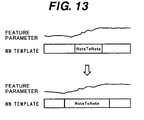
- the time width of the NN template as indicated at (b) in Fig. 12 can be broadened, for example, as shown in Fig. 13. As shown in Fig. 13, as the time width of the NN template is broadened, the stretched NN template is applied so that voices of a song can be synthesized having a gentle change.
- glissando by which the pitch is changed at each halftone or the pitch is changed stepwise only at the scale of a key of a song (e.g., in C major, do, re, mi, fa, so, la, ti, do), as different from legato by which the pitch is changed perfectly continuously.
- an NN template is formed from actual voices vocalized by glissando and applied to voices, voices concatenating two notes smoothly can be synthesized.
- the NN template used is formed from voices of the same phoneme and different pitches.
- An NN template may be formed from voices of different phonemes such as from "a” to "e” and different pitches.
- synthesized voices can be made more like actual voices of a song.
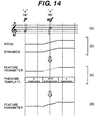
- Fig. 14 is a diagram illustrating an example of a second application of templates according to the embodiment. Voices of a song shown by a score at (a) in Fig. 14 are synthesized by the embodiment method.
- the pitch of the first half note is “so"
- the intensity is “piano (soft)”
- the pronunciation is "a”.
- the pitch of the second half note is “do”
- the intensity is "mezzo-forte (somewhat loud)”
- the pronunciation is "e”.
- the frequencies of two pitches are given from the pitch names of the notes. Thereafter, the end and start points of the two pitches are interconnected by a straight line to obtain the pitches in the boundary area between the notes as indicated at (b) in Fig. 14.
- the feature parameters at each timing are obtained from the Timbre database TDB as indicated at (c) in Fig. 14.
- the feature parameters in the articulation part are obtained by linear interpolation, for example, by using a straight line interconnecting the end point of the phoneme "a" and the start point of the phoneme "e”.
- a stationary template of "a”, an articulation template from “a” to “e” and a stationary template of "e” are applied to the corresponding ones of the feature parameters to obtain feature parameters as indicated at (d) in Fig. 14.
- the articulation time from “a” to "e” can be controlled and voices changing slowly or voices changing quickly can be synthesized by stretching or shrinking one template.
- the phoneme transition time can therefore be controlled.
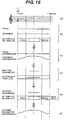
- Fig. 15 is a diagram illustrating an example of a third application of templates according to the embodiment. Voices of a song shown by a score at (a) in Fig. 15 are synthesized by the embodiment method.
- the pitch of the whole note is "so"
- the pronunciation is “a”
- the intensity of the whole note is gradually raised in the rising part and gradually lowered in the falling part.
- the pitches and dynamics are flat as indicated at (b) in Fig. 15.
- the NA template is applied to the start of the pitches and dynamics, and the NR template is applied to the end of the note, to thereby obtain and determine the pitches and dynamics as indicated at (c) in Fig. 15.
- the stationary template is applied to the feature parameters in the intermediate part indicated at (d) in Fig. 15 to obtain feature parameters given fluctuation as indicated at (e) in Fig. 15.
- the feature parameters in the attack part and release part are obtained.
- the feature parameters in the attack part are obtained by applying the NA template of the phoneme "a” by Type 2 to the start point of the intermediate part (end point of the attack part).
- the feature parameters in the release part are obtained by applying the NR template of the phoneme "a" by Type 1 to the end point of the intermediate part (start point of the release part).
- the feature parameters are modified by using phoneme templates obtained by analyzing actual voices sung by a singer. It is therefore possible to generate natural synthesized voices reflecting the characteristics of a stretched vowel part and a phonetic transition of voices of the song.
- the feature parameters are modified by using phoneme templates obtained by analyzing actual voices sung by a singer. It is therefore possible to generate synthesized voices having musical intensity expression that is not a mere volume difference.
- the embodiment even if data providing finely changed musical expression such as pitches, dynamics and opening is not prepared, other data can be used through interpolation. Therefore, the number of samples can be made small so that the size of a database can be made small and the time for forming the database can be shortened.
- the input data Score is constituted of the phoneme track PHT, note track NT, pitch track PIT, dynamics track DYT and opening track OT
- the structure of the input data Score is not limited only thereto.
- a vibrato track may be added to the input data Score shown in Fig. 2.
- the vibrato track records a vibrato value from 0 to 1.
- a function that returns a sequence of pitches and dynamics by using a vibrato value as an argument or stores a table of vibrato templates is stored in the database 4.
- the vibrato template is applied so that pitches and dynamics added the vibrato effects can be obtained.
- the vibrato template can be obtained by analyzing actual human singing voice.
- the embodiment may be realized by a computer or the like installed with a computer program and the like realizing the embodiment functions.
- the computer program and the like realizing the embodiment functions may be stored in a computer readable storage medium such as a CD-ROM and a floppy disc to distribute it to a user.
- the computer and the like are connected to the communication network such as a LAN, the Internet and a telephone line, the computer program, data and the like may be supplied via the communication network.
- the communication network such as a LAN, the Internet and a telephone line
Landscapes
- Engineering & Computer Science (AREA)
- Computational Linguistics (AREA)
- Health & Medical Sciences (AREA)
- Audiology, Speech & Language Pathology (AREA)
- Human Computer Interaction (AREA)
- Physics & Mathematics (AREA)
- Acoustics & Sound (AREA)
- Multimedia (AREA)
- Electrophonic Musical Instruments (AREA)
- Telephone Function (AREA)
- Toys (AREA)
Priority Applications (1)
| Application Number | Priority Date | Filing Date | Title |
|---|---|---|---|
| EP06009153A EP1688911B1 (en) | 2001-03-09 | 2002-03-07 | Singing voice synthesizing apparatus and method |
Applications Claiming Priority (2)
| Application Number | Priority Date | Filing Date | Title |
|---|---|---|---|
| JP2001067258A JP3838039B2 (ja) | 2001-03-09 | 2001-03-09 | 音声合成装置 |
| JP2001067258 | 2001-03-09 |
Related Child Applications (2)
| Application Number | Title | Priority Date | Filing Date |
|---|---|---|---|
| EP06009153A Division EP1688911B1 (en) | 2001-03-09 | 2002-03-07 | Singing voice synthesizing apparatus and method |
| EP06009153.5 Division-Into | 2006-05-03 |
Publications (3)
| Publication Number | Publication Date |
|---|---|
| EP1239457A2 EP1239457A2 (en) | 2002-09-11 |
| EP1239457A3 EP1239457A3 (en) | 2003-11-12 |
| EP1239457B1 true EP1239457B1 (en) | 2006-12-13 |
Family
ID=18925637
Family Applications (2)
| Application Number | Title | Priority Date | Filing Date |
|---|---|---|---|
| EP02005149A Expired - Lifetime EP1239457B1 (en) | 2001-03-09 | 2002-03-07 | Voice synthesizing apparatus |
| EP06009153A Expired - Lifetime EP1688911B1 (en) | 2001-03-09 | 2002-03-07 | Singing voice synthesizing apparatus and method |
Family Applications After (1)
| Application Number | Title | Priority Date | Filing Date |
|---|---|---|---|
| EP06009153A Expired - Lifetime EP1688911B1 (en) | 2001-03-09 | 2002-03-07 | Singing voice synthesizing apparatus and method |
Country Status (4)
| Country | Link |
|---|---|
| US (1) | US7065489B2 (enExample) |
| EP (2) | EP1239457B1 (enExample) |
| JP (1) | JP3838039B2 (enExample) |
| DE (2) | DE60231347D1 (enExample) |
Families Citing this family (26)
| Publication number | Priority date | Publication date | Assignee | Title |
|---|---|---|---|---|
| JP3879402B2 (ja) * | 2000-12-28 | 2007-02-14 | ヤマハ株式会社 | 歌唱合成方法と装置及び記録媒体 |
| JP4067762B2 (ja) * | 2000-12-28 | 2008-03-26 | ヤマハ株式会社 | 歌唱合成装置 |
| JP3709817B2 (ja) | 2001-09-03 | 2005-10-26 | ヤマハ株式会社 | 音声合成装置、方法、及びプログラム |
| JP4153220B2 (ja) | 2002-02-28 | 2008-09-24 | ヤマハ株式会社 | 歌唱合成装置、歌唱合成方法及び歌唱合成用プログラム |
| JP3823930B2 (ja) | 2003-03-03 | 2006-09-20 | ヤマハ株式会社 | 歌唱合成装置、歌唱合成プログラム |
| JP4622356B2 (ja) * | 2004-07-16 | 2011-02-02 | ヤマハ株式会社 | 音声合成用スクリプト生成装置及び音声合成用スクリプト生成プログラム |
| DE602006003723D1 (de) * | 2006-03-17 | 2009-01-02 | Svox Ag | Text-zu-Sprache-Synthese |
| CN101542593B (zh) * | 2007-03-12 | 2013-04-17 | 富士通株式会社 | 语音波形内插装置及方法 |
| JP4455633B2 (ja) * | 2007-09-10 | 2010-04-21 | 株式会社東芝 | 基本周波数パターン生成装置、基本周波数パターン生成方法及びプログラム |
| US8244546B2 (en) * | 2008-05-28 | 2012-08-14 | National Institute Of Advanced Industrial Science And Technology | Singing synthesis parameter data estimation system |
| JP5471858B2 (ja) * | 2009-07-02 | 2014-04-16 | ヤマハ株式会社 | 歌唱合成用データベース生成装置、およびピッチカーブ生成装置 |
| JP5293460B2 (ja) * | 2009-07-02 | 2013-09-18 | ヤマハ株式会社 | 歌唱合成用データベース生成装置、およびピッチカーブ生成装置 |
| US8731931B2 (en) * | 2010-06-18 | 2014-05-20 | At&T Intellectual Property I, L.P. | System and method for unit selection text-to-speech using a modified Viterbi approach |
| JP5605066B2 (ja) * | 2010-08-06 | 2014-10-15 | ヤマハ株式会社 | 音合成用データ生成装置およびプログラム |
| JP6024191B2 (ja) | 2011-05-30 | 2016-11-09 | ヤマハ株式会社 | 音声合成装置および音声合成方法 |
| JP6047922B2 (ja) | 2011-06-01 | 2016-12-21 | ヤマハ株式会社 | 音声合成装置および音声合成方法 |
| US20130030789A1 (en) * | 2011-07-29 | 2013-01-31 | Reginald Dalce | Universal Language Translator |
| US10860946B2 (en) * | 2011-08-10 | 2020-12-08 | Konlanbi | Dynamic data structures for data-driven modeling |
| JP5821824B2 (ja) * | 2012-11-14 | 2015-11-24 | ヤマハ株式会社 | 音声合成装置 |
| CN104123938A (zh) * | 2013-04-29 | 2014-10-29 | 富泰华工业(深圳)有限公司 | 语音控制系统、电子装置及语音控制方法 |
| JP6171711B2 (ja) * | 2013-08-09 | 2017-08-02 | ヤマハ株式会社 | 音声解析装置および音声解析方法 |
| JP6729539B2 (ja) * | 2017-11-29 | 2020-07-22 | ヤマハ株式会社 | 音声合成方法、音声合成システムおよびプログラム |
| US10902841B2 (en) | 2019-02-15 | 2021-01-26 | International Business Machines Corporation | Personalized custom synthetic speech |
| CN110910895B (zh) * | 2019-08-29 | 2021-04-30 | 腾讯科技(深圳)有限公司 | 一种声音处理的方法、装置、设备和介质 |
| CN112420015B (zh) * | 2020-11-18 | 2024-07-19 | 腾讯音乐娱乐科技(深圳)有限公司 | 一种音频合成方法、装置、设备及计算机可读存储介质 |
| CN112967538B (zh) * | 2021-03-01 | 2023-09-15 | 郑州铁路职业技术学院 | 一种英语发音信息采集系统 |
Family Cites Families (10)
| Publication number | Priority date | Publication date | Assignee | Title |
|---|---|---|---|---|
| JP2504172B2 (ja) | 1989-03-29 | 1996-06-05 | ヤマハ株式会社 | フォルマント音発生装置 |
| JP2745865B2 (ja) | 1990-12-15 | 1998-04-28 | ヤマハ株式会社 | 楽音合成装置 |
| JP3317458B2 (ja) * | 1993-04-21 | 2002-08-26 | 日本電信電話株式会社 | 音声合成方法 |
| JP3333022B2 (ja) * | 1993-11-26 | 2002-10-07 | 富士通株式会社 | 歌声合成装置 |
| JP3349905B2 (ja) * | 1996-12-10 | 2002-11-25 | 松下電器産業株式会社 | 音声合成方法および装置 |
| JP3834804B2 (ja) | 1997-02-27 | 2006-10-18 | ヤマハ株式会社 | 楽音合成装置および方法 |
| JPH113096A (ja) * | 1997-06-12 | 1999-01-06 | Baazu Joho Kagaku Kenkyusho:Kk | 音声合成方法及び音声合成システム |
| JP3884856B2 (ja) * | 1998-03-09 | 2007-02-21 | キヤノン株式会社 | 音声合成用データ作成装置、音声合成装置及びそれらの方法、コンピュータ可読メモリ |
| JP3854713B2 (ja) * | 1998-03-10 | 2006-12-06 | キヤノン株式会社 | 音声合成方法および装置および記憶媒体 |
| DE60018626T2 (de) * | 1999-01-29 | 2006-04-13 | Yamaha Corp., Hamamatsu | Vorrichtung und Verfahren zur Eingabe von Steuerungsdateien für Musikvorträge |
-
2001
- 2001-03-09 JP JP2001067258A patent/JP3838039B2/ja not_active Expired - Fee Related
-
2002
- 2002-03-07 DE DE60231347T patent/DE60231347D1/de not_active Expired - Lifetime
- 2002-03-07 EP EP02005149A patent/EP1239457B1/en not_active Expired - Lifetime
- 2002-03-07 EP EP06009153A patent/EP1688911B1/en not_active Expired - Lifetime
- 2002-03-07 DE DE60216651T patent/DE60216651T2/de not_active Expired - Lifetime
- 2002-03-08 US US10/094,154 patent/US7065489B2/en not_active Expired - Lifetime
Also Published As
| Publication number | Publication date |
|---|---|
| EP1688911A2 (en) | 2006-08-09 |
| EP1688911B1 (en) | 2009-02-25 |
| DE60216651D1 (de) | 2007-01-25 |
| EP1688911A3 (en) | 2006-09-13 |
| EP1239457A3 (en) | 2003-11-12 |
| US7065489B2 (en) | 2006-06-20 |
| DE60216651T2 (de) | 2007-09-27 |
| JP3838039B2 (ja) | 2006-10-25 |
| EP1239457A2 (en) | 2002-09-11 |
| US20020184032A1 (en) | 2002-12-05 |
| DE60231347D1 (de) | 2009-04-09 |
| JP2002268659A (ja) | 2002-09-20 |
Similar Documents
| Publication | Publication Date | Title |
|---|---|---|
| EP1239457B1 (en) | Voice synthesizing apparatus | |
| Bonada et al. | Synthesis of the singing voice by performance sampling and spectral models | |
| US6804649B2 (en) | Expressivity of voice synthesis by emphasizing source signal features | |
| US6304846B1 (en) | Singing voice synthesis | |
| US7464034B2 (en) | Voice converter for assimilation by frame synthesis with temporal alignment | |
| JP4302788B2 (ja) | 音声合成用の基本周波数テンプレートを収容する韻律データベース | |
| Macon et al. | A singing voice synthesis system based on sinusoidal modeling | |
| Rodet | Synthesis and processing of the singing voice | |
| JPH07146695A (ja) | 歌声合成装置 | |
| JP3576840B2 (ja) | 基本周波数パタン生成方法、基本周波数パタン生成装置及びプログラム記録媒体 | |
| US6944589B2 (en) | Voice analyzing and synthesizing apparatus and method, and program | |
| JP2761552B2 (ja) | 音声合成方法 | |
| JP5360489B2 (ja) | 音素符号変換装置および音声合成装置 | |
| JP4353174B2 (ja) | 音声合成装置 | |
| JP3233036B2 (ja) | 歌唱音合成装置 | |
| Bonada et al. | Sample-based singing voice synthesizer using spectral models and source-filter decomposition. | |
| KR20040015605A (ko) | 가상노래 합성장치 및 방법 | |
| JP6191094B2 (ja) | 音声素片切出装置 | |
| JP2000010581A (ja) | 音声合成装置 | |
| JPH10301599A (ja) | 音声合成装置 | |
| JP2006084854A (ja) | 音声合成装置、音声合成方法および音声合成プログラム | |
| EP1160766B1 (en) | Coding the expressivity in voice synthesis | |
| Siivola | A survey of methods for the synthesis of the singing voice | |
| KR100994340B1 (ko) | 문자음성합성을 이용한 음악 컨텐츠 제작장치 | |
| Macon et al. | E. Bryan George** School of Electrical and Computer Engineering, Georgia Institute of Technology, Atlanta, GA 30332-0250 |
Legal Events
| Date | Code | Title | Description |
|---|---|---|---|
| PUAI | Public reference made under article 153(3) epc to a published international application that has entered the european phase |
Free format text: ORIGINAL CODE: 0009012 |
|
| AK | Designated contracting states |
Kind code of ref document: A2 Designated state(s): AT BE CH CY DE DK ES FI FR GB GR IE IT LI LU MC NL PT SE TR |
|
| AX | Request for extension of the european patent |
Free format text: AL;LT;LV;MK;RO;SI |
|
| PUAL | Search report despatched |
Free format text: ORIGINAL CODE: 0009013 |
|
| AK | Designated contracting states |
Kind code of ref document: A3 Designated state(s): AT BE CH CY DE DK ES FI FR GB GR IE IT LI LU MC NL PT SE TR |
|
| AX | Request for extension of the european patent |
Extension state: AL LT LV MK RO SI |
|
| 17P | Request for examination filed |
Effective date: 20040122 |
|
| 17Q | First examination report despatched |
Effective date: 20040615 |
|
| AKX | Designation fees paid |
Designated state(s): DE GB |
|
| GRAP | Despatch of communication of intention to grant a patent |
Free format text: ORIGINAL CODE: EPIDOSNIGR1 |
|
| GRAS | Grant fee paid |
Free format text: ORIGINAL CODE: EPIDOSNIGR3 |
|
| GRAA | (expected) grant |
Free format text: ORIGINAL CODE: 0009210 |
|
| AK | Designated contracting states |
Kind code of ref document: B1 Designated state(s): DE GB |
|
| REG | Reference to a national code |
Ref country code: GB Ref legal event code: FG4D |
|
| REF | Corresponds to: |
Ref document number: 60216651 Country of ref document: DE Date of ref document: 20070125 Kind code of ref document: P |
|
| RAP2 | Party data changed (patent owner data changed or rights of a patent transferred) |
Owner name: YAMAHA CORPORATION |
|
| PLBE | No opposition filed within time limit |
Free format text: ORIGINAL CODE: 0009261 |
|
| STAA | Information on the status of an ep patent application or granted ep patent |
Free format text: STATUS: NO OPPOSITION FILED WITHIN TIME LIMIT |
|
| 26N | No opposition filed |
Effective date: 20070914 |
|
| PGFP | Annual fee paid to national office [announced via postgrant information from national office to epo] |
Ref country code: DE Payment date: 20180220 Year of fee payment: 17 Ref country code: GB Payment date: 20180307 Year of fee payment: 17 |
|
| REG | Reference to a national code |
Ref country code: DE Ref legal event code: R119 Ref document number: 60216651 Country of ref document: DE |
|
| GBPC | Gb: european patent ceased through non-payment of renewal fee |
Effective date: 20190307 |
|
| PG25 | Lapsed in a contracting state [announced via postgrant information from national office to epo] |
Ref country code: GB Free format text: LAPSE BECAUSE OF NON-PAYMENT OF DUE FEES Effective date: 20190307 Ref country code: DE Free format text: LAPSE BECAUSE OF NON-PAYMENT OF DUE FEES Effective date: 20191001 |