EP1238582B1 - Method and device for determining vibration characteristics of vibrated articles such as eggs - Google Patents
Method and device for determining vibration characteristics of vibrated articles such as eggs Download PDFInfo
- Publication number
- EP1238582B1 EP1238582B1 EP20020075855 EP02075855A EP1238582B1 EP 1238582 B1 EP1238582 B1 EP 1238582B1 EP 20020075855 EP20020075855 EP 20020075855 EP 02075855 A EP02075855 A EP 02075855A EP 1238582 B1 EP1238582 B1 EP 1238582B1
- Authority
- EP
- European Patent Office
- Prior art keywords
- hammer
- handle
- arm portion
- tapping
- plane
- Prior art date
- Legal status (The legal status is an assumption and is not a legal conclusion. Google has not performed a legal analysis and makes no representation as to the accuracy of the status listed.)
- Expired - Lifetime
Links
Images

Classifications
-
- G—PHYSICS
- G01—MEASURING; TESTING
- G01N—INVESTIGATING OR ANALYSING MATERIALS BY DETERMINING THEIR CHEMICAL OR PHYSICAL PROPERTIES
- G01N29/00—Investigating or analysing materials by the use of ultrasonic, sonic or infrasonic waves; Visualisation of the interior of objects by transmitting ultrasonic or sonic waves through the object
- G01N29/04—Analysing solids
- G01N29/045—Analysing solids by imparting shocks to the workpiece and detecting the vibrations or the acoustic waves caused by the shocks
-
- A—HUMAN NECESSITIES
- A01—AGRICULTURE; FORESTRY; ANIMAL HUSBANDRY; HUNTING; TRAPPING; FISHING
- A01K—ANIMAL HUSBANDRY; AVICULTURE; APICULTURE; PISCICULTURE; FISHING; REARING OR BREEDING ANIMALS, NOT OTHERWISE PROVIDED FOR; NEW BREEDS OF ANIMALS
- A01K43/00—Testing, sorting or cleaning eggs ; Conveying devices ; Pick-up devices
-
- G—PHYSICS
- G01—MEASURING; TESTING
- G01N—INVESTIGATING OR ANALYSING MATERIALS BY DETERMINING THEIR CHEMICAL OR PHYSICAL PROPERTIES
- G01N29/00—Investigating or analysing materials by the use of ultrasonic, sonic or infrasonic waves; Visualisation of the interior of objects by transmitting ultrasonic or sonic waves through the object
- G01N29/22—Details, e.g. general constructional or apparatus details
- G01N29/225—Supports, positioning or alignment in moving situation
-
- G—PHYSICS
- G01—MEASURING; TESTING
- G01N—INVESTIGATING OR ANALYSING MATERIALS BY DETERMINING THEIR CHEMICAL OR PHYSICAL PROPERTIES
- G01N33/00—Investigating or analysing materials by specific methods not covered by groups G01N1/00 - G01N31/00
- G01N33/02—Food
- G01N33/08—Eggs, e.g. by candling
-
- G—PHYSICS
- G01—MEASURING; TESTING
- G01N—INVESTIGATING OR ANALYSING MATERIALS BY DETERMINING THEIR CHEMICAL OR PHYSICAL PROPERTIES
- G01N2291/00—Indexing codes associated with group G01N29/00
- G01N2291/26—Scanned objects
- G01N2291/265—Spherical objects
-
- G—PHYSICS
- G01—MEASURING; TESTING
- G01N—INVESTIGATING OR ANALYSING MATERIALS BY DETERMINING THEIR CHEMICAL OR PHYSICAL PROPERTIES
- G01N2291/00—Indexing codes associated with group G01N29/00
- G01N2291/26—Scanned objects
- G01N2291/269—Various geometry objects
- G01N2291/2698—Other discrete objects, e.g. bricks
Definitions
- the present invention relates to a device for determining vibration characteristics of vibrated, supported, generally round, substantially ellipsoid articles, such as eggs, comprising:
- tapping is a repetitive phenomenon, to be qualified as bouncing. This is used, for instance, in EP738888, also in applicant's name. In this document, essentially the reaction of impact on the tapping element itself is examined. If any resonances can be measured there at all, these will often be disturbed by the repetitive tap mentioned.
- the present invention has resulted in a device which contemplates a further improvement and is characterized in that the handle adjacent the axis consists of an arm portion to be driven which is connected, through a hinge element, with a handle end having at the extremity thereof a mount having therein a ball as a head, while at least the hinge element and the handle end are connected such that they act as a hammer rod in one piece, the hinge element connection between the arm portion and the handle end being such that upon excitation of the handle driving element a single tapping pulse is obtained.
- Such a pulse is very suitable for further signal processing, in particular for determining the frequency spectrum associated with such a pulse.
- Such a spectrum contains all possible information about the resonance modes which, as a result of tapping, are generated by the tapped articles.
- the device is characterized in that the plane passes through the long axis of the article, that at least a single microphone is arranged in said plane, or through the long axis in a second plane, substantially perpendicular to said plane.
- Another embodiment of the device according to the invention is characterized in that the hammer rod and the arm portion constitute one whole, with the hammer rod forming a leaf spring portion having a spring constant k between 1.2 and 1.6 N/m.
- the pulses herewith obtained are very suitable and short, and thus result in a corresponding, highly suitable frequency spectrum.
- the device is characterized in that the handle driving element further comprises a holder with pin hole for a pin perpendicular to the first plane and through the arm portion, with an electromagnet attached to the holder for reciprocating the hammer generally in said plane, with a magnet included in the arm portion adjacent the electromagnet, and with a stop element for the arm portion during the forward movement.
- the device is characterized in that the handle driving element further comprises a stop for interrupting the return movement of the hammer, and in a still further embodiment that the ball is made of steel, and that the handle driving element further comprises a holding element with which the hammer is held after a return movement, the holding element consisting of a stop block for the leaf spring portion and a holding magnet for the ball.
- the device is characterized in that the hammer rod is further coupled with the arm portion by means of a bistable switch, the switch having a first and a second snap position, while the hammer rod is movable either into the first snap position or into the second snap position.
- a bistable switch the switch having a first and a second snap position, while the hammer rod is movable either into the first snap position or into the second snap position.
- the device is characterized in that the hammer rod in the forward movement is switched to the first snap position, and in the return movement is switched to the second snap position.
- the invention comprises a method for determining vibration characteristics of vibrated articles such as eggs, characterized in that the tapping of the articles is performed with the above-mentioned device, in particular characterized in that tapping consists in a single momentary tapping pulse.
- the present method is used in a sorting device for eggs, wherein in particular the eggs are tapped at least twice. In a highly suitable manner, thus a suitable sorting criterion is created.
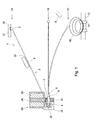
- the device for tapping comprises a hammer 1, with handle 2 and head 3, for instance a small steel ball framed in the end thereof.
- the hammer with handle and head preferably constitute one whole and are manufactured from a well-selected plastic.
- the handle consists of a handle end 4 which is connected through a hinge element 5 with an arm portion 6, having a magnet 7 arranged therein.
- a pin 8 is arranged allowing the hammer to rotate.
- Hinge element 5 and handle end 4 are connected to constitute a hammer rod in one piece.
- arm portion and hammer rod form one whole, with the hammer rod forming a leaf spring portion having a spring constant k between 1.2 and 1.6 N/m.
- the pin 8 fits into a pin hole 22 of a holder 21 of handle driving element 20.
- An electromagnet 23 with core 24 is fixedly connected with this holder 21.
- the leaf spring portion during the "forward" movement can bend so that the ball 3 just taps an egg 10 disposed on a support 11, more particularly between two rollers or hourglass-shaped rollers jointly forming a nest, mounted on a shaft 12, associated with a conveyor of an egg sorting device.
- a microphone 9 With a microphone 9, the acoustic vibrations resulting from tapping can be picked up.
- the eggs disposed on rollers 11 are passed under these hammers 1 to be tapped during transport.
- the further features to be determined can be used for sorting further downstream in the sorting device.
- the S20, S30, and S40 resonance modes can be observed.
- the shape of such a resonance signal for instance of the amplitude, or also of the frequency spectrum, contains information about the condition of the egg shell, i.e. yes/no fracture or crack, egg shell strength, or also information about the contents of the egg.
- the hammer is represented in three positions, viz. in rest position 1A, in central position 1B, and in tapping position 1C.
- the hammer rests against a holding element, consisting of a holder block 30 with holder magnet 31, and a stop block 32.
- the operation can be elucidated as follows. From its rest position 1A, after excitation of the electromagnet 23, the hammer 1, through its arm portion 6 having therein magnet 7, is forced to move downwards, to be seen as the "forward" movement.
- position 1B the arm portion 6 butts against a stop 25 which is arranged on the holder 21.
- the device of the invention according to this exemplary embodiment in particular with the handle end 4, makes it possible for this handle end with the ball 3 to bend or swing so far that the ball just taps the egg 10, as indicated in tapping position 1C.
- the pulse which is thus administered is very short in duration, also referred to as Dirac pulse.
- Dirac pulse a very suitable acoustic vibration signal is obtained, to be transformed into a broad frequency spectrum through application of Fourier analysis, in particular using so-called FFT, i.e. Fast Fourier Transform.
- the energization can now be set such that during the return or backward movement, the arm portion is momentarily attracted and the hammer will be retained by the holding element. The ball will then cling to holder magnet 31, while any further bending will be prevented by stop block 32.
- the excitation of the electromagnet 23, and hence the stroke of the reciprocating movement of the hammer 1 can be adjusted and controlled, for instance by first measuring the size, and then using this signal for the purpose of excitation.
- the whole hammer can be manufactured from the same plastic, for instance through injection molding.
- the back-and-forth movement can also take place in a direction other than the vertical direction.
- Fig. 2 schematically represents a situation similar to that in Fig. 1.
- the reciprocating movement of the hammer 1 take place approximately in a vertical plane, with microphone 9 disposed approximately in the "equator" plane, i.e. the plane perpendicular to said vertical plane and likewise passing through the long axis of the article, such as an egg 10 here.
- positions 9' or 9 are also eligible in the same vertical plane through the long axis of the article, depending on the space left clear next to the hammer 1.
- two signal lines are indicated, line 19 for the microphone and line 26 for the electromagnet 23, respectively leading to a signal processing device, not shown, and a control device, not shown either.
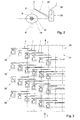
- a top plan view of a part of a sorting device 50 is represented, with the positions of the articles, for instance eggs, schematically represented as the intersections 51 of the chain-dotted lines.
- the transport direction of the sorting device is designated by arrow T.
- hammers 1 and handle driving elements 20 are also indicated. In order to tap the eggs several times, the hammers are so arranged that in the example shown, each egg can be tapped four times, without the hammers being in each other's way.
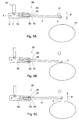
- a second exemplary embodiment according to the invention is shown, in which the arm portion 6 and the handle end 4 are mutually connected through a hinge element 51, for instance a separate pin, or also a joint in which the pin, handle end and arm portion are formed as one whole, for instance through injection molding of a suitable plastic.
- a bistable switch 60 is indicated, consisting in particular of a magnet 61 in the part of the handle end located adjacent the arm portion, as well as two magnets 62 and 63, located at some distance therefrom, in the arm portion 6, with an interspace 64, whilst the handle end clings either to one magnet 62 or to the other magnet 63, which positions constitute snap positions for this handle end.
- the arm portion in the plane referred to will start the forward movement towards the egg 10 represented here, indicated with an arrow F, with the handle end snapped by magnet 63, shown in Fig. 4A.
- the hinge element 51 will allow the handle end to snap from one snap position to the other, the handle end now clinging to magnet 62, whereby the tapping pulse is shortened with great advantage and bouncing is avoided. Ideally, this will take place precisely during the tapping pulse.
- the forward or backward movement is shown in Fig. 4C and indicated with an arrow B, whereby the hammer returns to the starting position and the ball 3 clings to holder magnet 31 again.
- an additional contribution to this movement can be made by suitably exciting the electromagnet in the holder 20.
- the materials can be suitably selected to thereby improve elasticity. Less elastic materials may even suffice, because the bistable switch will prevent bouncing in an advantageous manner.
- a third embodiment is shown.
- the hinge element is a leaf spring 52.
- the operation is otherwise entirely comparable to that of the embodiment according to Fig. 4.
- adhering elements and bistable switches can be used, such as, respectively, springs without adhering elements, or also in combination with electromagnets.
Landscapes
- Life Sciences & Earth Sciences (AREA)
- Chemical & Material Sciences (AREA)
- Physics & Mathematics (AREA)
- Health & Medical Sciences (AREA)
- Biochemistry (AREA)
- General Physics & Mathematics (AREA)
- Pathology (AREA)
- Analytical Chemistry (AREA)
- Immunology (AREA)
- General Health & Medical Sciences (AREA)
- Engineering & Computer Science (AREA)
- Food Science & Technology (AREA)
- Environmental Sciences (AREA)
- Medicinal Chemistry (AREA)
- Animal Husbandry (AREA)
- Biodiversity & Conservation Biology (AREA)
- Acoustics & Sound (AREA)
- Investigating Or Analyzing Materials By The Use Of Ultrasonic Waves (AREA)
Description
- a hammer with a handle and head, for tapping and thereby acoustically vibrating such article,
- a handle driving element for reciprocating the hammer generally in a plane around an axis in the handle,
- a microphone arranged immediately adjacent to and directed to the article, for picking up acoustic vibrations generated by the article, and
- a signal processing means for processing the signals picked up by the microphone for determining vibration characteristics of the article.
| plastic | PBT (polybutylene terephthalate) |
| angle between 1A and | 24 ° |
| centre-to-centre distance axis-ball | 198mm |
| length of arm portion | 40 mm |
| ball diameter | 4.5 mm |
| density ball (steel) | 7.8 kg/m3 |
| tapping pulse duration | 0.5 ms |
| tapping speed | 1.5 m/second |
| thickness of end of leaf spring | 0.9 mm |
| thickness of beginning of leaf spring | 1.2 mm |
| width of end of | 4 mm |
| width of beginning of | 8 mm |
Claims (13)
- A device for determining vibration characteristics of vibrated, supported, generally round, substantially ellipsoid articles (10), such as eggs, comprising:characterized in thatan elastic hammer with handle (4, 5, 6) and head (3), for tapping and thereby acoustically vibrating such article,a handle driving element (20) for reciprocating the hammer generally in a plane around an axis in the handle,a microphone (9) arranged immediately adjacent to and directed to the article (10), for picking up acoustic vibrations generated by the article (10), anda signal processing means for processing the signals picked up by the microphone (9) for determining vibration characteristics of the article (10),
the handle adjacent the axis consists of an arm portion (6) to be driven which is connected, through a hinge element (5; 51; 52), with a handle end (4) having at the extremity thereof a mount having therein a ball (3) as a head, while at least the hinge element (5; 51; 52) and the handle end (4), are connected such that they act as a hammer rod in one piece, the hinge element (5; 51; 52) connection between the arm portion (6) and the handle end (4) being such that upon excitation of the handle driving element (20) a single tapping pulse is obtained. - A device according to claim 1, characterized in that
the plane passes through the long axis of the article (10). - A device according to claim 1 or 2, characterized in that
at least a single microphone (9) is arranged in said plane, or through the long axis in a second plane substantially perpendicular to said plane. - A device according to any one of the preceding claims, characterized in that the hammer rod (4, 5) and the arm portion (6) form a whole, with the hammer rod (4, 5) forming a leaf spring portion having a spring constant k in the range between 1.2 and 1.6 N/m.
- A device according to any one of the preceding claims, characterized in that the handle driving element (20) further comprises a holder (21) with pin hole (22) for a pin (8) perpendicular to the first plane and through the arm portion (6), with an electromagnet (23) attached to the holder (21) for reciprocating the hammer (4, 6) generally in said plane, with a magnet (7; 61) included in the arm portion (6) adjacent the electromagnet (23), and with a stop element (25) for the arm portion (6) during the forward movement.
- A device according to claim 5, characterized in that
the handle driving element (20) further comprises a stop for interrupting the backward movement of the hammer (4, 6). - A device according to claim 5 or 6, characterized in that
the ball (3) is made of steel, and that the handle driving elements (20) further comprises a holding element (30, 31) with which the hammer (4, 6) is held after a backward movement, the holding element (30, 31) consisting of a stop block (32) for the leaf spring portion (4) and a holding magnet (31) for the ball (3). - A device according to claim 1, characterized in that the hammer rod (4, 51;, 4, 52) is further coupled by means of a bistable switch with the arm portion (6), the switch having a first and a second snap position, and the hammer rod (4, 51; 4, 52) being movable either to the first snap position or to the second snap position.
- A device according to claim 8, characterized in that
the hammer rod (4, 51; 4, 52) in the forward movement is switched to the first snap position, and in the backward movement to the second snap position. - A method for determining vibration characteristics of vibrated articles (10) such as eggs, characterized in that tapping of the articles (10) is carried out with a device according to any one of the preceding claims.
- A method according to claim 10, characterized in that tapping consists of a single momentary tapping pulse.
- A method according to claim 10 or 11, characterized in that the method is applied in a sorting device for eggs.
- A method according to claim 10, 11 or 12, characterized in that the eggs are tapped at least twice.
Priority Applications (1)
| Application Number | Priority Date | Filing Date | Title |
|---|---|---|---|
| EP20020075855 EP1238582B1 (en) | 2001-03-05 | 2002-03-05 | Method and device for determining vibration characteristics of vibrated articles such as eggs |
Applications Claiming Priority (3)
| Application Number | Priority Date | Filing Date | Title |
|---|---|---|---|
| EP01200783 | 2001-03-05 | ||
| EP01200783 | 2001-03-05 | ||
| EP20020075855 EP1238582B1 (en) | 2001-03-05 | 2002-03-05 | Method and device for determining vibration characteristics of vibrated articles such as eggs |
Publications (3)
| Publication Number | Publication Date |
|---|---|
| EP1238582A2 EP1238582A2 (en) | 2002-09-11 |
| EP1238582A3 EP1238582A3 (en) | 2003-01-29 |
| EP1238582B1 true EP1238582B1 (en) | 2004-06-02 |
Family
ID=26076846
Family Applications (1)
| Application Number | Title | Priority Date | Filing Date |
|---|---|---|---|
| EP20020075855 Expired - Lifetime EP1238582B1 (en) | 2001-03-05 | 2002-03-05 | Method and device for determining vibration characteristics of vibrated articles such as eggs |
Country Status (1)
| Country | Link |
|---|---|
| EP (1) | EP1238582B1 (en) |
Families Citing this family (5)
| Publication number | Priority date | Publication date | Assignee | Title |
|---|---|---|---|---|
| BR0012894B1 (en) * | 1999-07-30 | 2009-05-05 | process and device for determining the hardness of a product. | |
| WO2010074572A1 (en) | 2008-12-23 | 2010-07-01 | Fps Food Processing Systems B.V. | Method and apparatus for classifying eggs |
| CN103261884B (en) | 2010-11-05 | 2015-10-07 | Moba集团有限公司 | Method and device for inspecting eggs |
| CN102680573B (en) * | 2012-05-07 | 2014-07-16 | 刘镇波 | Timber vibration property tester based on uniform force knocking method |
| CN104662420B (en) | 2012-07-05 | 2017-02-22 | 墨巴集团有限公司 | Method and apparatus for detecting cracks in eggshells |
Family Cites Families (5)
| Publication number | Priority date | Publication date | Assignee | Title |
|---|---|---|---|---|
| US3067605A (en) | 1957-08-09 | 1962-12-11 | George N Bliss | Cracked egg detector |
| US3744299A (en) * | 1970-10-28 | 1973-07-10 | Diamond Int Corp | Crack detector |
| NL9401388A (en) | 1994-08-26 | 1996-04-01 | Leuven K U Res & Dev | Device for checking eggs |
| NL1000177C2 (en) | 1995-04-19 | 1996-10-22 | Food Processing Systems | Probe, device and method for testing eggs. |
| JP3749961B2 (en) * | 1997-02-14 | 2006-03-01 | 孝子 義▲高▼ | Egg cracking degree detecting device and egg sorting device equipped with this detecting device |
-
2002
- 2002-03-05 EP EP20020075855 patent/EP1238582B1/en not_active Expired - Lifetime
Also Published As
| Publication number | Publication date |
|---|---|
| EP1238582A2 (en) | 2002-09-11 |
| EP1238582A3 (en) | 2003-01-29 |
Similar Documents
| Publication | Publication Date | Title |
|---|---|---|
| US6722201B2 (en) | Method and device for determining vibration characteristics of vibrated articles such as eggs | |
| JP5830105B2 (en) | Method and apparatus for inspecting eggs | |
| CN1208620C (en) | Method and device for determining the firmness of a product such as fruit | |
| US6998559B2 (en) | Detection system for sorting apparatus | |
| DE69616640T2 (en) | Test head, device and method for testing eggs | |
| US5696325A (en) | Apparatus for testing eggs | |
| JP2606885B2 (en) | Egg inspection method and apparatus for determining the presence of cracks or damage in an eggshell through inspection of eggshell elasticity | |
| JP6236404B2 (en) | System and method for determining object characteristics | |
| EP1238582A2 (en) | Method and device for determining vibration characteristics of vibrated articles such as eggs | |
| US5535538A (en) | Automatic jigging device for fishing | |
| AU2001260796A1 (en) | Detection system for sorting apparatus | |
| HRP20190587T1 (en) | Shaking device for harvesting small fruit | |
| KR102095157B1 (en) | Apparatus for nondestructive inspection and ultrasonic probe using the same | |
| JPH11311585A (en) | Variable impact test apparatus | |
| JP2002131174A (en) | Apparatus and method for evaluating performance of vibration isolator | |
| US20100199771A1 (en) | Ultrasonic scanning apparatus with a tuning fork-type vibrator | |
| JP2001074707A (en) | Hammering apparatus for inspecting internal quality of agricultural products | |
| CN202994742U (en) | Composition structure of ultrasonic probe | |
| JP2003266388A (en) | Chicken eggshell cutting equipment | |
| JPS5880532A (en) | Oscillation frequency measuring device | |
| SU320831A1 (en) | MANIPULATOR DEVICES FOR AUTOMATIC | |
| KR101935930B1 (en) | Apparatus and method for measuring dynamic modulus and poisson's ratio of an object using impulse technique | |
| SU1167492A1 (en) | Method of determining presence of defects in articles | |
| JP2003065929A (en) | Vibrator and receiver for measuring Young's modulus of wood such as veneer veneer and Young's modulus measuring device | |
| Weidner et al. | Application-Relevant Factors for Acoustic Resonance Testing of Sintered Parts |
Legal Events
| Date | Code | Title | Description |
|---|---|---|---|
| PUAI | Public reference made under article 153(3) epc to a published international application that has entered the european phase |
Free format text: ORIGINAL CODE: 0009012 |
|
| AK | Designated contracting states |
Kind code of ref document: A2 Designated state(s): AT BE CH CY DE DK ES FI FR GB GR IE IT LI LU MC NL PT SE TR |
|
| AX | Request for extension of the european patent |
Free format text: AL;LT;LV;MK;RO;SI |
|
| PUAL | Search report despatched |
Free format text: ORIGINAL CODE: 0009013 |
|
| AK | Designated contracting states |
Designated state(s): AT BE CH CY DE DK ES FI FR GB GR IE IT LI LU MC NL PT SE TR |
|
| AX | Request for extension of the european patent |
Extension state: AL LT LV MK RO SI |
|
| 17P | Request for examination filed |
Effective date: 20030130 |
|
| 17Q | First examination report despatched |
Effective date: 20030507 |
|
| GRAP | Despatch of communication of intention to grant a patent |
Free format text: ORIGINAL CODE: EPIDOSNIGR1 |
|
| AKX | Designation fees paid |
Designated state(s): DE FR GB IT NL |
|
| GRAS | Grant fee paid |
Free format text: ORIGINAL CODE: EPIDOSNIGR3 |
|
| GRAA | (expected) grant |
Free format text: ORIGINAL CODE: 0009210 |
|
| AK | Designated contracting states |
Kind code of ref document: B1 Designated state(s): DE FR GB IT NL |
|
| REG | Reference to a national code |
Ref country code: GB Ref legal event code: FG4D |
|
| REF | Corresponds to: |
Ref document number: 60200557 Country of ref document: DE Date of ref document: 20040708 Kind code of ref document: P |
|
| REG | Reference to a national code |
Ref country code: IE Ref legal event code: FG4D |
|
| ET | Fr: translation filed | ||
| PGFP | Annual fee paid to national office [announced via postgrant information from national office to epo] |
Ref country code: FR Payment date: 20050322 Year of fee payment: 4 |
|
| PLBE | No opposition filed within time limit |
Free format text: ORIGINAL CODE: 0009261 |
|
| STAA | Information on the status of an ep patent application or granted ep patent |
Free format text: STATUS: NO OPPOSITION FILED WITHIN TIME LIMIT |
|
| PGFP | Annual fee paid to national office [announced via postgrant information from national office to epo] |
Ref country code: DE Payment date: 20050511 Year of fee payment: 4 |
|
| 26N | No opposition filed |
Effective date: 20050303 |
|
| PGFP | Annual fee paid to national office [announced via postgrant information from national office to epo] |
Ref country code: GB Payment date: 20060308 Year of fee payment: 5 |
|
| PGFP | Annual fee paid to national office [announced via postgrant information from national office to epo] |
Ref country code: IT Payment date: 20060331 Year of fee payment: 5 |
|
| PG25 | Lapsed in a contracting state [announced via postgrant information from national office to epo] |
Ref country code: NL Free format text: LAPSE BECAUSE OF NON-PAYMENT OF DUE FEES Effective date: 20061001 |
|
| PG25 | Lapsed in a contracting state [announced via postgrant information from national office to epo] |
Ref country code: DE Free format text: LAPSE BECAUSE OF NON-PAYMENT OF DUE FEES Effective date: 20061003 |
|
| NLV4 | Nl: lapsed or anulled due to non-payment of the annual fee |
Effective date: 20061001 |
|
| REG | Reference to a national code |
Ref country code: FR Ref legal event code: ST Effective date: 20061130 |
|
| GBPC | Gb: european patent ceased through non-payment of renewal fee |
Effective date: 20070305 |
|
| PG25 | Lapsed in a contracting state [announced via postgrant information from national office to epo] |
Ref country code: FR Free format text: LAPSE BECAUSE OF NON-PAYMENT OF DUE FEES Effective date: 20060331 |
|
| PG25 | Lapsed in a contracting state [announced via postgrant information from national office to epo] |
Ref country code: GB Free format text: LAPSE BECAUSE OF NON-PAYMENT OF DUE FEES Effective date: 20070305 |
|
| PG25 | Lapsed in a contracting state [announced via postgrant information from national office to epo] |
Ref country code: IT Free format text: LAPSE BECAUSE OF NON-PAYMENT OF DUE FEES Effective date: 20070305 |