EP1238559B1 - Detektierung einer betrügerischen mobilstation in einem mobilen kommunikationssystem unter verwendung der aufenthaltsortsinformation einer mobilstation - Google Patents
Detektierung einer betrügerischen mobilstation in einem mobilen kommunikationssystem unter verwendung der aufenthaltsortsinformation einer mobilstation Download PDFInfo
- Publication number
- EP1238559B1 EP1238559B1 EP00987504A EP00987504A EP1238559B1 EP 1238559 B1 EP1238559 B1 EP 1238559B1 EP 00987504 A EP00987504 A EP 00987504A EP 00987504 A EP00987504 A EP 00987504A EP 1238559 B1 EP1238559 B1 EP 1238559B1
- Authority
- EP
- European Patent Office
- Prior art keywords
- mobile
- mobile station
- communication system
- location information
- fraudulent
- Prior art date
- Legal status (The legal status is an assumption and is not a legal conclusion. Google has not performed a legal analysis and makes no representation as to the accuracy of the status listed.)
- Expired - Lifetime
Links
- 238000010295 mobile communication Methods 0.000 title claims abstract description 26
- 230000008859 change Effects 0.000 claims abstract description 24
- 238000000034 method Methods 0.000 claims abstract description 24
- 230000008569 process Effects 0.000 claims abstract description 14
- 238000012544 monitoring process Methods 0.000 claims abstract description 12
- 230000001960 triggered effect Effects 0.000 claims abstract description 5
- 230000000737 periodic effect Effects 0.000 claims description 8
- 238000001514 detection method Methods 0.000 claims description 7
- 101000946191 Galerina sp Laccase-1 Proteins 0.000 description 7
- 101150117600 msc1 gene Proteins 0.000 description 7
- 101000952113 Homo sapiens Probable ATP-dependent RNA helicase DDX5 Proteins 0.000 description 6
- 102100037434 Probable ATP-dependent RNA helicase DDX5 Human genes 0.000 description 6
- 101150081322 LAC3 gene Proteins 0.000 description 5
- 101100020526 Pycnoporus cinnabarinus LCC3-1 gene Proteins 0.000 description 5
- 238000004590 computer program Methods 0.000 description 5
- 238000010586 diagram Methods 0.000 description 4
- 101100028130 Danio rerio ora1 gene Proteins 0.000 description 3
- 230000007704 transition Effects 0.000 description 3
- 230000000903 blocking effect Effects 0.000 description 2
- 230000007257 malfunction Effects 0.000 description 2
- 101150084453 LAC5 gene Proteins 0.000 description 1
- 101100078001 Saccharomyces cerevisiae (strain ATCC 204508 / S288c) MSC2 gene Proteins 0.000 description 1
- 230000002159 abnormal effect Effects 0.000 description 1
- 230000001413 cellular effect Effects 0.000 description 1
- 230000001419 dependent effect Effects 0.000 description 1
Images

Classifications
-
- H—ELECTRICITY
- H04—ELECTRIC COMMUNICATION TECHNIQUE
- H04W—WIRELESS COMMUNICATION NETWORKS
- H04W12/00—Security arrangements; Authentication; Protecting privacy or anonymity
- H04W12/12—Detection or prevention of fraud
- H04W12/126—Anti-theft arrangements, e.g. protection against subscriber identity module [SIM] cloning
-
- H—ELECTRICITY
- H04—ELECTRIC COMMUNICATION TECHNIQUE
- H04W—WIRELESS COMMUNICATION NETWORKS
- H04W12/00—Security arrangements; Authentication; Protecting privacy or anonymity
- H04W12/60—Context-dependent security
- H04W12/63—Location-dependent; Proximity-dependent
Definitions
- This invention relates to the detection of a fraudulent mobile station in a mobile communication system.
- the term fraudulent mobile station refers in this context to a mobile station which has adopted the identity of another mobile station.
- the charges of services used by the fraudulent mobile station will be charged in the telephone bill of the original mobile station, i.e. the mobile station whose identity the fraudulent mobile station has adopted.
- the GSM system Global System for Mobile communications
- the identity of a GSM mobile station depends on the information stored in a SIM card (Subscriber Identity Module) which is inserted in the mobile station.
- SIM cards are manufactured in such a way that it should be impossible to make copies of them. If, however, someone succeeds in producing a duplicate of an existing SIM card, then the duplicate could be used in another mobile station.
- the fraudulent mobile station containing the duplicate SIM card is then able to register into the mobile communication system with the same mobile identity as the original mobile station, i.e. the mobile station containing the original SIM card.
- Known GSM systems for instance, do not have any efficient means for detecting the presence of a fraudulent mobile station. Instead, known GSM networks register the fraudulent mobile station by normal location update procedures.
- EP-A1-0 544 449 an arrangement for detecting fraudulent mobile stations in a cellular mobile telecommunications network.
- state transitions are examined to see if a particular state transition is likely in view of the prior state of the mobile station. Whenever an unlikely state transition is detected, a record is made for the network administration.
- An object of the present invention is to solve the above mentioned drawback and to provide a method allowing an operator to detect the presence of a fraudulent mobile station more efficiently and as soon as possible. This object is achieved by a method of detecting a fraudulent mobile station according to independent claim 1.
- Another object of the present invention is to provide a mobile communication system which is able to detect the presence of a fraudulent mobile station. This object is achieved by a mobile communication system according to independent claim 4.
- Still a further object of the present invention is to provide an apparatus for a mobile communication system according to independent claim 9.
- the invention is based on the idea that it is possible to detect the presence of a fraudulent mobile station by monitoring the processes which trigger changes of location information in the subscriber register.
- a situation where a fraudulent mobile station (with a duplicated SIM card) is used in a mobile communication system at the same time as the original mobile station (with the original SIM card) will lead to location updates which normally should not occur.
- It is possible to define a list of processes which should not trigger a change of location information. Processes which should not trigger a change of location information include: a mobile originated call (MOC), a mobile originated short message (MOSMS), mobile originated unstructured supplementary service data (MOUSSD), a mobile originated supplementary service (MOSS), and a periodic location update (PLU).
- MOC mobile originated call
- MOSMS mobile originated short message
- MOUSSD mobile originated unstructured supplementary service data
- MOSS mobile originated supplementary service
- PLU periodic location update
- a situation where the location information is changed in connection with a MOC, MOSMS, MOUSSD, MOSS or a PLU should not be possible, as the location information should have been changed already earlier, i.e. at the time when the mobile station in question changed its location (and performed a location update due to the new location), or when the mobile station was turned on (IMSI attach).
- This list can be stored for instance in the memory of the subscriber register together with a computer program that monitors the processes which trigger change of location information.
- the subscriber register is able to detect abnormal changes of location information, which in this case indicates the presence of a fraudulent mobile station.
- the invention makes it possible to identify an IMSI (international Mobile Station Identity) which has been duplicated.
- IMSI international Mobile Station Identity
- the most significant advantages of the present invention are that the presence of a fraudulent mobile station can be identified almost immediately, or in any case before the fraudulent mobile station is able to use the services provided by the network, and that the present invention can be easily applied to existing mobile communication systems by making changes in the computer programs used by the subscriber registers.
- the present invention is applied in a subscriber register which is associated with a mobile switching center and which contains data about subscribers located within the coverage area of said mobile switching center.
- a subscriber register which is associated with a mobile switching center and which contains data about subscribers located within the coverage area of said mobile switching center.
- such a register is called a Visitor Location Register VLR.
- VLR Visitor Location Register
- each mobile station arriving to a new location area should immediately perform a location update which will trigger a process where the subscriber data for the mobile station in question is stored in the VLR.
- Figure 1 is a flow diagram of a first preferred embodiment of the method in accordance with the invention. In the following it is assumed by way of example that the solution described in connection with Figure 1 is used in a GSM system, and, more precisely, in a VLR register of a GSM system.
- Block A of Figure 1 the processes which trigger changes in location information stored in the VLR register are monitored. This can be accomplished, for instance, by adding a computer program for this purpose to the VLR register. If a change of LAC (Location Area Code) for a mobile station MS is detected, then Block B is entered.
- LAC Location Area Code
- a change of LAC means that the LAC of a subscriber whose subscriber data is already stored in the VLR is changed or that the subscriber data (including LAC) of a subscriber is stored in the VLR for the first time.
- Block B the reason for the change of LAC is analyzed. If the reason for the change of LAC is a MOC (Mobile Originated Call), a MOSMS (Mobile Originated Short Message), MOUSSD (Mobile Originated Unstructured Supplementary Service Data), a MOSS (Mobile Originated Supplementary Service), or a PLU (Periodic Location Update), then Block C is entered.
- MOC Mobile Originated Call
- MOSMS Mobile Originated Short Message
- MOUSSD Mobile Originated Unstructured Supplementary Service Data
- MOSS Mobile Originated Supplementary Service
- PLU Periodic Location Update
- the LAC of a specific mobile station should normally change only when the mobile station enters a new location area and transmits a location update request, or when the power of the mobile station is turned on and the mobile station transmits an IMSI attach message. From that moment on, until the mobile station is turned off or the mobile station moves on and enters a new location area, the LAC of the mobile station should remain unchanged in the VLR register.
- a predetermined message is generated and transmitted to the NMS (Network Management System).
- the message preferably includes the information needed for identifying the mobile station in question.
- the IMSI International Mobile Subscriber Identity
- the NMS should be aware of any malfunctions in the system. Thus it is possible for the operator to ensure, prior to blocking said mobile station, that no loss of data has recently occurred in the VLR which detected the presence of a fraudulent mobile station.
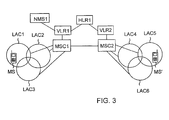
- Figures 2 and 3 are block diagrams of a first preferred embodiment of a mobile communication system according to the present invention.
- the mobile communication system of Figures 2 and 3 is, by way of example, assumed to be a GSM system.
- Figure 2 shows a situation where the fraudulent mobile station MS' is located within the coverage area of the same mobile Switching center as the original mobile station MS
- Figure 3 shows a situation where the fraudulent mobile station MS' and the original mobile station MS are located in the coverage area of two different mobile switching centers.
- Figure 2 shows a part of a GSM network of a first operator.
- the geographical area of the network is divided into location areas. Three different location areas are shown in Figure 2.
- Each location area is given a location area code LAC1 to LAC3, and each location area is covered by one or several base stations (not shown in the Figures).
- the base stations are arranged to regularly broadcast the location area code of the location area to which they belong. Thus for instance the mobile station MS is able to identify the location area code of the base station which is located closest to it.
- FIG. 2 shows one mobile switching center MSC1 which covers location areas LAC1 to LAC3. Thus all mobile stations located within these location areas communicate through the mobile switching center MSC1.
- a Visitor location register VLR1 is arranged in connection with the MSC1.
- the VLR1 comprises means for storing subscriber data of all subscribers currently located within the coverage area of the MSC1, in other words within the location areas LAC1 to LAC3.
- the identity of the mobile station MS has been duplicated by a fraudulent mobile station MS'. Both mobile stations MS and MS' have performed a normal location update when they arrived to the coverage area of the mobile switching center MSC1.
- the subscriber data of the mobile station MS has been retrieved from the Home Location Register HLR1 of the subscriber and stored into the VLR1.
- the subscriber data of the MS stored in the VLR1 also includes a location area code.
- the database of the VLR1 includes a location area LAC3 for the mobile station MS. If the user of the original mobile station at this moment attempts to make a call, in other words a MOC, then the VLR1 receives information about this call attempt. The information received by the VLR1 also includes information about the location area from where the call is originated. Thus the VLR1 discovers that the call attempt originates from LAC1 while the database of the VLR1 indicates that the location area of the MS should be LAC3 (the location of the fraudulent mobile station). When the VLR1 discovers that the information in the database is wrong, it makes a change in the data and stores LAC1 (to its database) as the location area of MS.
- the VLR1 includes monitoring means 1, which may consist of one or several computer programs.
- the monitoring means 1 discover a change of LAC in the VLR1, they activate a process for finding out the reason for the change of LAC.
- the detection means 2 which may also consist of one or several computer programs, detect that the reason for the change of LAC is a MOC.
- the detection means are programmed to know that a MOC should not trigger a change of LAC, and thus they generate and transmit a predetermined message (including the IMSI of the mobile station MS) to the Network Management System NMS1. The operator of the system is thereby informed that the presence of a fraudulent mobile station has been detected.
- the monitoring and detecting means can be arranged somewhere else in the system than in the VLR register, as shown in Figures 2 and 3.
- An alternative would be to arrange the monitoring and detecting means for instance in a HLR register. In such a case it would be necessary to ensure that the HLR information needed to monitor the processes which cause changes in location information is transmitted to the HLR.
- the Periodic Location Update PLU which is in use for instance in the GSM system, can be used according to the present invention be used for detecting a fraudulent mobile station.
- the mobile stations are programmed to transmit a location update request at regular intervals.
- the interval between the periodic location updates is in the range of 6 minutes to slightly more than 24 hours.
- the interval is selected by the operator of the system, and the mobile stations are informed of the selected interval by a value broadcasted by the base stations.
- the LOCATION UPDATE REQUEST message used for location updates in the GSM system includes a type information element.
- the type information element indicates a periodic updating, if the reason for the location update is a PLU. Thus it is possible to identify a PLU by analyzing the type information element.
- a PLU should not normally trigger a change of LAC in a VLR. If a mobile station moves, it should transmit a location update request upon arrival in a new location area. Thus a change of LAC triggered by a PLU can be used, according to the present invention, to detect the presence of a fraudulent mobile station.
- Figure 3 illustrates a situation where the fraudulent mobile station MS' and the original mobile station MS are located in the coverage area of two different mobile switching centers MSC1 and MSC2.
- the VLR1 contains the subscriber data of the MS, which includes a location area code LAC1
- the home location register HLR1 of the mobile station MS includes information that the mobile station is located in the coverage area of the VLR1.
- the fraudulent mobile station transmits therefore an IMSI attach message, which leads to a location update where the subscriber data of the MS is retrieved from the HLR1 and stored in the VLR2.
- the location area code LAC5 is also stored in VLR2.
- the data in the HLR1 is updated to indicate that the mobile station MS is located in the coverage area of VLR2 (which actually is not correct). In such a situation the HLR1 will transmit a message to the VLR1 to indicate that the mobile station is no longer within the coverage area of the VLR1. The message triggers the VLR1 to delete the subscriber data of the MS from its database.
- the VLR1 detects that the data of the mobile station MS is not included in its database, the data then being retrieved from the HLR1.
- the monitoring means 1 of the VLR1 will detect a change of LAC in the VLR1 (as a location area code of a new mobile station is stored into the database of the VLR1).
- the detection means 2 analyzes the reason for the change of LAC and discovers that the reason is a MOC, MOSMS, MOUSSD, MOSS or PLU, in other words, a process that should not trigger a change of LAC.
- a predetermined message indicating the detection of a fraudulent mobile station is transmitted to the Network Management System NMS1.
- the operator thus receives information that a fraudulent mobile station has been detected.
- the operator can then perform necessary actions, such as blocking the use of any mobile station with the identity (IMSI) of the mobile station MS.
- IMSI identity
Landscapes
- Engineering & Computer Science (AREA)
- Computer Security & Cryptography (AREA)
- Computer Networks & Wireless Communication (AREA)
- Signal Processing (AREA)
- Mobile Radio Communication Systems (AREA)
- Traffic Control Systems (AREA)
Claims (10)
- Verfahren zum Erkennen eines betrügerischen Mobilfunkendgeräts in einem Mobilfunkkommunikationssystem, umfassend eine Mobilfunkvermittlungsstelle und ein Teilnehmerregister mit Aufenthaltsinformation, die den Aufenthalt eines Mobilfunkendgeräts anzeigt, dadurch gekennzeichnet, dass das Verfahren die Schritte umfasst:Überwachen der Vorgänge, die Aufenthaltsinformationsänderungen in einem Teilnehmerregister auslösen, undAnzeigen des Vorhandenseins eines betrügerischen Mobilfunkendgeräts, wenn eine Aufenthaltsinformationsänderung ausgelöst wurde durch: einen mobil entstandenen Ruf, eine mobil entstandene Kurznachricht, mobil entstandene unstrukturierte Hilfsdienstdaten, einen mobil entstandenen Hilfsdienst oder eine periodische Aufenthaltsaktualisierung.
- Verfahren nach Anspruch 1, dadurch gekennzeichnet, dass das Teilnehmerregister ein Register ist, das Daten über Mobilfunkendgeräte enthält, die sich gerade innerhalb des Erfassungsbereiches der Mobilfunkvermittlungsstelle aufhalten.
- Verfahren nach einem der Ansprüche 1 oder 2 , dadurch gekennzeichnet, dass das Vorhandensein eines betrügerischen. Mobilfunkendgeräts durch Übertragen einer Nachricht von dem Teilnehmerregister zu einem Netzwerkverwaltungssystem des Mobilfunkkommunikationssystems angezeigt wird.
- Mobilfunkkommunikationssystem, umfassend:Mobilfunkendgeräte (MS, MS'),eine Mobilfunkvermittlungsstelle (MSC1), undein Teilnehmerregister (VLR1), das Teilnehmerdaten enthält, welche Aufenthaltsinformation enthalten, die den Aufenthalt von Mobilfunkendgeräten anzeigen, dadurch gekennzeichnet, dass das System umfasst :ein Überwachungsmittel (1) zum Überwachen des Vorgangs, der Aufenthaltsinformationsänderung in dem Teilnehmerregister (VLR1) auslöst, undein Erkennungsmittel (2) zum Erkennen und Anzeigen des Vorhandenseins eines betrügerischen Mobilfunkendgeräts (MS'), wenn eine Aufenthaltsinformationsänderung ausgelöst wird durch: einen mobil entstandenen Ruf , eine mobil entstandene Kurznachricht, mobil entstandene unstrukturierte Hilfsdienstdaten, einen mobil entstandenen Hilfsdienst oder eine periodische Aufenthaltsaktualisierung.
- Mobilfunkkommunikationssystem nach Anspruch 4, dadurch gekennzeichnet, dass das Erkennungsmittel in dem Teilnehmerregister (VLR1) angeordnet ist.
- Mobilfunkkommunikationssystem nach einem der Ansprüche 4 bis 5, dadurch gekennzeichnet, dass das Teilnehmerregister (VLR1) ein Register ist, das Daten über Mobilfunkendgeräte enthält, die sich gerade innerhalb eines Erfassungsbereiches der Mobilfunkvermittlungsstelle (MSC1) aufhalten.
- Mobilfunkkommunikationssystem nach einem der Ansprüche 4 bis 6, dadurch gekennzeichnet, dass das Mobilfunkkommunikationssystem ein Netzwerkverwaltungssystem (NMS1) umfasst und das Erkennungsmittel (2) eingerichtet ist, das Vorhandensein eines betrügerischen Mobilfunkendgeräts (MS') durch Übertragen einer vorgegebenen Nachricht an das Netzwerkverwaltungssystem (NMS1) anzuzeigen.
- Mobilfunkkommunikationssystem nach einem der Ansprüche 4 bis 7, dadurch gekennzeichnet, dass das Mobilfunkkommunikationssystem ein GSM-System ist.
- Vorrichtung für ein Mobilfunkkommunikationssystem, dadurch gekennzeichnet, dass die Vorrichtung umfasst:ein Überwachungsmittel (1) zum Überwachen von Vorgängen, die Aufenthaltsinformationsänderungen in einem Teilnehmerregister (VLR1) auslösen, undein Erkennungsmittel (2) zum Erkennen und Anzeigen des Vorhandenseins eines betrügerischen Mobilfunkendgeräts (MS'), wenn eine Aufenthaltsinformationsänderung ausgelöst wurde durch: einen mobil entstandenen Ruf, eine mobil entstandene Kurznachricht, mobil entstandene unstrukturierte Hilfsdienstdaten, einen mobil entstandenen Hilfsdienst oder eine periodische Aufenthaltsortaktualisierung.
- Vorrichtung nach Anspruch 9, dadurch gekennzeichnet, dass die Vorrichtung ein Teilnehmerregister (VLR1) ist, das Teilnehmerdaten enthält, welche Aufenthaltsinformation enthalten, die den Aufenthaltsort der Mobilfunkendgeräte anzeigen.
Applications Claiming Priority (3)
| Application Number | Priority Date | Filing Date | Title |
|---|---|---|---|
| FI992671 | 1999-12-13 | ||
| FI992671A FI112582B (fi) | 1999-12-13 | 1999-12-13 | Matkaviestinjärjestelmä |
| PCT/FI2000/001084 WO2001045444A1 (en) | 1999-12-13 | 2000-12-12 | Detecting a fraudulent mobile station in a mobile communication system using location information of mobile station |
Publications (2)
| Publication Number | Publication Date |
|---|---|
| EP1238559A1 EP1238559A1 (de) | 2002-09-11 |
| EP1238559B1 true EP1238559B1 (de) | 2007-08-29 |
Family
ID=8555739
Family Applications (1)
| Application Number | Title | Priority Date | Filing Date |
|---|---|---|---|
| EP00987504A Expired - Lifetime EP1238559B1 (de) | 1999-12-13 | 2000-12-12 | Detektierung einer betrügerischen mobilstation in einem mobilen kommunikationssystem unter verwendung der aufenthaltsortsinformation einer mobilstation |
Country Status (9)
| Country | Link |
|---|---|
| US (1) | US8442487B2 (de) |
| EP (1) | EP1238559B1 (de) |
| JP (1) | JP3845308B2 (de) |
| AT (1) | ATE372035T1 (de) |
| AU (1) | AU2375501A (de) |
| CA (1) | CA2389189C (de) |
| DE (1) | DE60036225T2 (de) |
| FI (1) | FI112582B (de) |
| WO (1) | WO2001045444A1 (de) |
Families Citing this family (8)
| Publication number | Priority date | Publication date | Assignee | Title |
|---|---|---|---|---|
| GB0210241D0 (en) * | 2002-05-03 | 2002-06-12 | Cerebrus | Local usage monitoring and fraud detection for radio communication networks |
| DE602004014542D1 (de) * | 2004-06-08 | 2008-07-31 | Ericsson Telefon Ab L M | Verfahren und Funkkommunikationsnetz zur Erkennung der anwesenheit betrügerisher Teilnehmeridentitätsmodule |
| FR2932639B1 (fr) * | 2008-06-12 | 2010-08-20 | Alcatel Lucent | Detection d'anomalie de trafic emis par un terminal mobile dans un reseau de radiocommunication |
| US9167599B2 (en) * | 2010-09-22 | 2015-10-20 | Motorola Solutions, Inc. | Channel structure for non-contention based windows and contention based random access requests |
| US9572036B2 (en) | 2014-11-20 | 2017-02-14 | At&T Intellectual Property I, L.P. | Detection and blocking of cloned mobile devices |
| EP3644580A1 (de) * | 2018-10-25 | 2020-04-29 | Kido Dynamics SA | Verfahren zur messung der menschlichen mobilität |
| US11483709B2 (en) | 2019-03-14 | 2022-10-25 | At&T Intellectual Property I, L.P. | Authentication technique to counter subscriber identity module swapping fraud attack |
| CA3077838C (en) * | 2020-04-03 | 2024-06-04 | Telus Communications Inc. | System and method for managing visitor location register (vlr) records by removing duplicate records |
Family Cites Families (10)
| Publication number | Priority date | Publication date | Assignee | Title |
|---|---|---|---|---|
| CA2078195C (en) * | 1991-11-27 | 1999-03-09 | Jack Kozik | Arrangement for detecting fraudulently identified mobile stations in a cellular mobile telecommunications network |
| US5535431A (en) * | 1994-04-05 | 1996-07-09 | Grube; Gary W. | Method of detecting unauthorized use of a communication unit |
| US5734977A (en) | 1994-11-10 | 1998-03-31 | Telefonaktiebolaget Lm Ericsson | Fraud detection in radio communications network |
| US5727057A (en) * | 1994-12-27 | 1998-03-10 | Ag Communication Systems Corporation | Storage, transmission, communication and access to geographical positioning data linked with standard telephony numbering and encoded for use in telecommunications and related services |
| WO1996041488A1 (en) * | 1995-06-07 | 1996-12-19 | The Dice Company | Fraud detection system for electronic networks using geographical location coordinates |
| JP3406992B2 (ja) | 1996-05-14 | 2003-05-19 | 日本電信電話株式会社 | 移動端末の接続制御システム |
| US5970404A (en) | 1996-10-25 | 1999-10-19 | Telefonaktiebolaget Lm Ericsson | System and method of detecting and preventing fraudulent telephone calls in a radio telecommunications network |
| US5953652A (en) * | 1997-01-24 | 1999-09-14 | At&T Wireless Services Inc. | Detection of fraudulently registered mobile phones |
| US6181934B1 (en) * | 1998-11-13 | 2001-01-30 | Ericsson Inc. | System and method for providing efficient signaling for a positioning request and an indication of when a mobile station becomes available for location services |
| US6611684B1 (en) * | 1998-12-10 | 2003-08-26 | Nortel Networks Limited | Method and apparatus for implementing customer group functionality in a wireless environment |
-
1999
- 1999-12-13 FI FI992671A patent/FI112582B/fi not_active IP Right Cessation
-
2000
- 2000-12-12 AU AU23755/01A patent/AU2375501A/en not_active Abandoned
- 2000-12-12 US US10/168,051 patent/US8442487B2/en not_active Expired - Fee Related
- 2000-12-12 DE DE60036225T patent/DE60036225T2/de not_active Expired - Lifetime
- 2000-12-12 AT AT00987504T patent/ATE372035T1/de not_active IP Right Cessation
- 2000-12-12 WO PCT/FI2000/001084 patent/WO2001045444A1/en not_active Ceased
- 2000-12-12 CA CA002389189A patent/CA2389189C/en not_active Expired - Fee Related
- 2000-12-12 JP JP2001546197A patent/JP3845308B2/ja not_active Expired - Fee Related
- 2000-12-12 EP EP00987504A patent/EP1238559B1/de not_active Expired - Lifetime
Also Published As
| Publication number | Publication date |
|---|---|
| CA2389189A1 (en) | 2001-06-21 |
| EP1238559A1 (de) | 2002-09-11 |
| CA2389189C (en) | 2005-03-22 |
| DE60036225D1 (de) | 2007-10-11 |
| FI19992671L (fi) | 2001-06-14 |
| AU2375501A (en) | 2001-06-25 |
| FI112582B (fi) | 2003-12-15 |
| US8442487B2 (en) | 2013-05-14 |
| DE60036225T2 (de) | 2008-05-15 |
| JP3845308B2 (ja) | 2006-11-15 |
| ATE372035T1 (de) | 2007-09-15 |
| US20040038666A1 (en) | 2004-02-26 |
| JP2003517801A (ja) | 2003-05-27 |
| WO2001045444A1 (en) | 2001-06-21 |
Similar Documents
| Publication | Publication Date | Title |
|---|---|---|
| US5839063A (en) | Authentication system and method for preventing wireless communication fraud | |
| US7318159B2 (en) | Detecting copied identity of terminal equipment | |
| US5335265A (en) | Apparatus for detecting and preventing subscriber number cloning in a cellular mobile telephone system | |
| EP0848567B1 (de) | Verfahren zur Erkundung von zellularen Mobilfunknetzen und Gerät hierfür | |
| US6167266A (en) | Method for handling of positioning triggers for batch location requests within a location services system | |
| EP1754390B1 (de) | Verfahren und Funkkommunikationsnetz zur Erkennung der anwesenheit betrügerisher Teilnehmeridentitätsmodule | |
| US6370373B1 (en) | System and method for detecting cloning fraud in cellular/PCS communications | |
| US5467382A (en) | Method and apparatus for clone detection in a communication system | |
| US6377791B2 (en) | Method and system for identifying an illegal terminal in a cellular radio system | |
| US7383035B2 (en) | Method of furnishing illegal mobile equipment user information | |
| CA2189770C (en) | Connection release in a telecommunications system | |
| WO1998037709A2 (en) | Telecommunications arrangements and methods | |
| US6173174B1 (en) | Method and apparatus for automated SSD updates on an a-key entry in a mobile telephone system | |
| US6738629B1 (en) | Method for flood paging in a telecommunications network | |
| EP1497968B1 (de) | Überwachung auf infektionsbasis eines teilnehmers in einem kommunikationsnetzwerk | |
| EP1238559B1 (de) | Detektierung einer betrügerischen mobilstation in einem mobilen kommunikationssystem unter verwendung der aufenthaltsortsinformation einer mobilstation | |
| US6226511B1 (en) | Method and apparatus for configuration of authentication center operations in a mobile telephone system | |
| JPH08508387A (ja) | 移動通信システムにおいてサービスを提供する方法 | |
| EP4035443B1 (de) | Identifizieren und melden einer betrügerischen basisstation | |
| US7474899B1 (en) | Method and apparatus for communicating using wireless control channels | |
| AU763852B2 (en) | Method in a radio telecommunications network of providing signal strength and mobile station information to monitoring agency | |
| EP1079654A1 (de) | Identifikation von defekten oder gestohlenen Mobiltelefonen und Verhinderung ihrer Benutzung | |
| MXPA00012776A (en) | Method in a radio telecommunications network of providing signal strength and mobile station information to a monitoring agency |
Legal Events
| Date | Code | Title | Description |
|---|---|---|---|
| PUAI | Public reference made under article 153(3) epc to a published international application that has entered the european phase |
Free format text: ORIGINAL CODE: 0009012 |
|
| 17P | Request for examination filed |
Effective date: 20020531 |
|
| AK | Designated contracting states |
Kind code of ref document: A1 Designated state(s): AT BE CH CY DE DK ES FI FR GB GR IE IT LI LU MC NL PT SE TR |
|
| AX | Request for extension of the european patent |
Free format text: AL;LT;LV;MK;RO;SI |
|
| GRAP | Despatch of communication of intention to grant a patent |
Free format text: ORIGINAL CODE: EPIDOSNIGR1 |
|
| GRAS | Grant fee paid |
Free format text: ORIGINAL CODE: EPIDOSNIGR3 |
|
| GRAA | (expected) grant |
Free format text: ORIGINAL CODE: 0009210 |
|
| AK | Designated contracting states |
Kind code of ref document: B1 Designated state(s): AT BE CH CY DE DK ES FI FR GB GR IE IT LI LU MC NL PT SE TR |
|
| REG | Reference to a national code |
Ref country code: GB Ref legal event code: FG4D |
|
| REG | Reference to a national code |
Ref country code: CH Ref legal event code: EP |
|
| REG | Reference to a national code |
Ref country code: IE Ref legal event code: FG4D |
|
| REF | Corresponds to: |
Ref document number: 60036225 Country of ref document: DE Date of ref document: 20071011 Kind code of ref document: P |
|
| ET | Fr: translation filed | ||
| PG25 | Lapsed in a contracting state [announced via postgrant information from national office to epo] |
Ref country code: ES Free format text: LAPSE BECAUSE OF FAILURE TO SUBMIT A TRANSLATION OF THE DESCRIPTION OR TO PAY THE FEE WITHIN THE PRESCRIBED TIME-LIMIT Effective date: 20071210 Ref country code: FI Free format text: LAPSE BECAUSE OF FAILURE TO SUBMIT A TRANSLATION OF THE DESCRIPTION OR TO PAY THE FEE WITHIN THE PRESCRIBED TIME-LIMIT Effective date: 20070829 Ref country code: NL Free format text: LAPSE BECAUSE OF FAILURE TO SUBMIT A TRANSLATION OF THE DESCRIPTION OR TO PAY THE FEE WITHIN THE PRESCRIBED TIME-LIMIT Effective date: 20070829 |
|
| NLV1 | Nl: lapsed or annulled due to failure to fulfill the requirements of art. 29p and 29m of the patents act | ||
| PG25 | Lapsed in a contracting state [announced via postgrant information from national office to epo] |
Ref country code: AT Free format text: LAPSE BECAUSE OF FAILURE TO SUBMIT A TRANSLATION OF THE DESCRIPTION OR TO PAY THE FEE WITHIN THE PRESCRIBED TIME-LIMIT Effective date: 20070829 Ref country code: CH Free format text: LAPSE BECAUSE OF FAILURE TO SUBMIT A TRANSLATION OF THE DESCRIPTION OR TO PAY THE FEE WITHIN THE PRESCRIBED TIME-LIMIT Effective date: 20070829 Ref country code: LI Free format text: LAPSE BECAUSE OF FAILURE TO SUBMIT A TRANSLATION OF THE DESCRIPTION OR TO PAY THE FEE WITHIN THE PRESCRIBED TIME-LIMIT Effective date: 20070829 |
|
| REG | Reference to a national code |
Ref country code: CH Ref legal event code: PL |
|
| PG25 | Lapsed in a contracting state [announced via postgrant information from national office to epo] |
Ref country code: BE Free format text: LAPSE BECAUSE OF FAILURE TO SUBMIT A TRANSLATION OF THE DESCRIPTION OR TO PAY THE FEE WITHIN THE PRESCRIBED TIME-LIMIT Effective date: 20070829 |
|
| PG25 | Lapsed in a contracting state [announced via postgrant information from national office to epo] |
Ref country code: GR Free format text: LAPSE BECAUSE OF FAILURE TO SUBMIT A TRANSLATION OF THE DESCRIPTION OR TO PAY THE FEE WITHIN THE PRESCRIBED TIME-LIMIT Effective date: 20071130 Ref country code: DK Free format text: LAPSE BECAUSE OF FAILURE TO SUBMIT A TRANSLATION OF THE DESCRIPTION OR TO PAY THE FEE WITHIN THE PRESCRIBED TIME-LIMIT Effective date: 20070829 |
|
| PG25 | Lapsed in a contracting state [announced via postgrant information from national office to epo] |
Ref country code: PT Free format text: LAPSE BECAUSE OF FAILURE TO SUBMIT A TRANSLATION OF THE DESCRIPTION OR TO PAY THE FEE WITHIN THE PRESCRIBED TIME-LIMIT Effective date: 20080129 |
|
| PG25 | Lapsed in a contracting state [announced via postgrant information from national office to epo] |
Ref country code: SE Free format text: LAPSE BECAUSE OF FAILURE TO SUBMIT A TRANSLATION OF THE DESCRIPTION OR TO PAY THE FEE WITHIN THE PRESCRIBED TIME-LIMIT Effective date: 20071129 |
|
| PLBE | No opposition filed within time limit |
Free format text: ORIGINAL CODE: 0009261 |
|
| STAA | Information on the status of an ep patent application or granted ep patent |
Free format text: STATUS: NO OPPOSITION FILED WITHIN TIME LIMIT |
|
| PG25 | Lapsed in a contracting state [announced via postgrant information from national office to epo] |
Ref country code: MC Free format text: LAPSE BECAUSE OF NON-PAYMENT OF DUE FEES Effective date: 20071231 |
|
| 26N | No opposition filed |
Effective date: 20080530 |
|
| PG25 | Lapsed in a contracting state [announced via postgrant information from national office to epo] |
Ref country code: IE Free format text: LAPSE BECAUSE OF NON-PAYMENT OF DUE FEES Effective date: 20071212 |
|
| PG25 | Lapsed in a contracting state [announced via postgrant information from national office to epo] |
Ref country code: CY Free format text: LAPSE BECAUSE OF FAILURE TO SUBMIT A TRANSLATION OF THE DESCRIPTION OR TO PAY THE FEE WITHIN THE PRESCRIBED TIME-LIMIT Effective date: 20070829 |
|
| PG25 | Lapsed in a contracting state [announced via postgrant information from national office to epo] |
Ref country code: LU Free format text: LAPSE BECAUSE OF NON-PAYMENT OF DUE FEES Effective date: 20071212 |
|
| PG25 | Lapsed in a contracting state [announced via postgrant information from national office to epo] |
Ref country code: TR Free format text: LAPSE BECAUSE OF FAILURE TO SUBMIT A TRANSLATION OF THE DESCRIPTION OR TO PAY THE FEE WITHIN THE PRESCRIBED TIME-LIMIT Effective date: 20070829 |
|
| PGFP | Annual fee paid to national office [announced via postgrant information from national office to epo] |
Ref country code: FR Payment date: 20101224 Year of fee payment: 11 |
|
| PG25 | Lapsed in a contracting state [announced via postgrant information from national office to epo] |
Ref country code: IT Free format text: LAPSE BECAUSE OF NON-PAYMENT OF DUE FEES Effective date: 20071231 |
|
| PGFP | Annual fee paid to national office [announced via postgrant information from national office to epo] |
Ref country code: GB Payment date: 20101208 Year of fee payment: 11 |
|
| GBPC | Gb: european patent ceased through non-payment of renewal fee |
Effective date: 20111212 |
|
| REG | Reference to a national code |
Ref country code: FR Ref legal event code: ST Effective date: 20120831 |
|
| PG25 | Lapsed in a contracting state [announced via postgrant information from national office to epo] |
Ref country code: GB Free format text: LAPSE BECAUSE OF NON-PAYMENT OF DUE FEES Effective date: 20111212 |
|
| PG25 | Lapsed in a contracting state [announced via postgrant information from national office to epo] |
Ref country code: FR Free format text: LAPSE BECAUSE OF NON-PAYMENT OF DUE FEES Effective date: 20120102 |
|
| REG | Reference to a national code |
Ref country code: DE Ref legal event code: R082 Ref document number: 60036225 Country of ref document: DE Representative=s name: SAMSON & PARTNER PATENTANWAELTE MBB, DE Ref country code: DE Ref legal event code: R081 Ref document number: 60036225 Country of ref document: DE Owner name: NOKIA TECHNOLOGIES OY, FI Free format text: FORMER OWNER: NOKIA CORP., 02610 ESPOO, FI |
|
| PGFP | Annual fee paid to national office [announced via postgrant information from national office to epo] |
Ref country code: DE Payment date: 20161206 Year of fee payment: 17 |
|
| REG | Reference to a national code |
Ref country code: DE Ref legal event code: R119 Ref document number: 60036225 Country of ref document: DE |
|
| PG25 | Lapsed in a contracting state [announced via postgrant information from national office to epo] |
Ref country code: DE Free format text: LAPSE BECAUSE OF NON-PAYMENT OF DUE FEES Effective date: 20180703 |
|
| REG | Reference to a national code |
Ref country code: DE Ref legal event code: R082 Ref document number: 60036225 Country of ref document: DE Representative=s name: BARKHOFF REIMANN VOSSIUS, DE Ref country code: DE Ref legal event code: R081 Ref document number: 60036225 Country of ref document: DE Owner name: WSOU INVESTMENTS, LLC, LOS ANGELES, US Free format text: FORMER OWNER: NOKIA TECHNOLOGIES OY, ESPOO, FI |