EP1237998B1 - Method for reclaiming polyester or polyester mixtures - Google Patents
Method for reclaiming polyester or polyester mixtures Download PDFInfo
- Publication number
- EP1237998B1 EP1237998B1 EP20000975943 EP00975943A EP1237998B1 EP 1237998 B1 EP1237998 B1 EP 1237998B1 EP 20000975943 EP20000975943 EP 20000975943 EP 00975943 A EP00975943 A EP 00975943A EP 1237998 B1 EP1237998 B1 EP 1237998B1
- Authority
- EP
- European Patent Office
- Prior art keywords
- polyester
- dicarboxylic acid
- dialkyl ester
- acid dialkyl
- separated
- Prior art date
- Legal status (The legal status is an assumption and is not a legal conclusion. Google has not performed a legal analysis and makes no representation as to the accuracy of the status listed.)
- Expired - Lifetime
Links
Images

Classifications
-
- C—CHEMISTRY; METALLURGY
- C08—ORGANIC MACROMOLECULAR COMPOUNDS; THEIR PREPARATION OR CHEMICAL WORKING-UP; COMPOSITIONS BASED THEREON
- C08J—WORKING-UP; GENERAL PROCESSES OF COMPOUNDING; AFTER-TREATMENT NOT COVERED BY SUBCLASSES C08B, C08C, C08F, C08G or C08H
- C08J11/00—Recovery or working-up of waste materials
- C08J11/04—Recovery or working-up of waste materials of polymers
- C08J11/06—Recovery or working-up of waste materials of polymers without chemical reactions
- C08J11/08—Recovery or working-up of waste materials of polymers without chemical reactions using selective solvents for polymer components
-
- C—CHEMISTRY; METALLURGY
- C08—ORGANIC MACROMOLECULAR COMPOUNDS; THEIR PREPARATION OR CHEMICAL WORKING-UP; COMPOSITIONS BASED THEREON
- C08J—WORKING-UP; GENERAL PROCESSES OF COMPOUNDING; AFTER-TREATMENT NOT COVERED BY SUBCLASSES C08B, C08C, C08F, C08G or C08H
- C08J2367/00—Characterised by the use of polyesters obtained by reactions forming a carboxylic ester link in the main chain; Derivatives of such polymers
-
- Y—GENERAL TAGGING OF NEW TECHNOLOGICAL DEVELOPMENTS; GENERAL TAGGING OF CROSS-SECTIONAL TECHNOLOGIES SPANNING OVER SEVERAL SECTIONS OF THE IPC; TECHNICAL SUBJECTS COVERED BY FORMER USPC CROSS-REFERENCE ART COLLECTIONS [XRACs] AND DIGESTS
- Y02—TECHNOLOGIES OR APPLICATIONS FOR MITIGATION OR ADAPTATION AGAINST CLIMATE CHANGE
- Y02W—CLIMATE CHANGE MITIGATION TECHNOLOGIES RELATED TO WASTEWATER TREATMENT OR WASTE MANAGEMENT
- Y02W30/00—Technologies for solid waste management
- Y02W30/50—Reuse, recycling or recovery technologies
- Y02W30/62—Plastics recycling; Rubber recycling
Definitions
- the invention relates to a method for recovery of polyesters or polyester mixtures of polyester or waste containing polyester.
- polyester have proven to be special for many applications suitable plastics have been proven. So they are in the food industry as packaging or used for containers. Another important area of application PCBs for polyester plastics for the electronics industry.
- US 5,866,622 discloses a method for recovery from polyesters or polyester mixtures Waste containing polyester.
- the waste will be in a dicarboxylic acid dialkyl ester bath at temperatures dissolved between 160 and 250 ° C and then with a solid-liquid separation by means of cooling and Crystallization separated from the solution.
- it is exclusively aromatic Dicarboxylic acid dialkyl esters, namely dimethyl terephthalate (DMT), methyl paratholoate (MPT) and dimethyl isophthalate (DME).
- DMT dimethyl terephthalate
- MPT methyl paratholoate
- DME dimethyl isophthalate
- the disadvantage here is that at DMT for a hazardous substance according to the hazard class WGK 2 deals. It is not biodegradable guaranteed.
- the waste should be cleaned in advance and by Contaminants are freed, taking a screening and / or a wash, possibly with a swim-sink separation can be carried out.
- dicarboxylic acid dialkyl ester mixture has that under the name DBE commercially available from DuPont.
- the dissolved polyesters can be made from the dicarboxylic acid dialkyl ester solution by a mechanical and / or thermal solid-liquid separation. This can be a conventional precipitation alone act.
- dialkyl dicarboxylic acid or a dicarboxylic acid dialkyl ester mixture up to continue to heat above the boiling temperature and to evaporate so that the polyester by drying can be won.
- Precipitation can also be other fixed, i.e. in dialkyl dicarboxylic acid insoluble elements and connections be separated.
- Such a separation can be, for example, adsorptive, by filtering or by separation in the centrifugal field can be achieved.
- polyester can then follow the separation of the other types of plastic respectively other dialkyl esters soluble in dicarboxylic acid be carried out selectively.
- Suitable polyesters are for recovery Polyethylene terephthalate (PET) and / or polybutylene terephthalate (PBT).
- PET Polyethylene terephthalate
- PBT polybutylene terephthalate
- the solid-liquid separation should at least to the extent that the proportion of Dicarboxylic acid dialkyl ester kept below 15 ppm becomes.
- the polyester content can also waste in the form of composite materials, e.g. metallized polyethylene terephthalate films and of course also otherwise soiled or pasted or printed waste processed according to the invention and the polyester content in addition to the metals be recovered.
- the PET recyclate obtained had a slightly reduced glass transition temperature T G of 80 ° C. compared to original PET.
- the shredded waste that is prepared in this way is disposed of in a precursor in dicarboxylic acid dialkyl ester (DBE), however at relatively low temperatures leading to Solving polyester is not enough, soluble Components solved.
- DBE dicarboxylic acid dialkyl ester
- the next step will be these Components, for example other polymers, additives or other contaminants through solid-liquid separation separated, and optionally discharged Dicarbonchuredialkylester can be refilled.
- Dicarbonchuredialkylester can be refilled.
- This high solids solution will then by lowering the temperature ⁇ 150 ° C of a precipitation subjected to excess dicarboxylic acid dialkyl ester deducted and into the previously described Prepress or in place of the prepress discharged Dicarbonkladialkylesters returned becomes.
- the dried PET can subsequently be extruded and processed as recycled PET.
- the example according to FIG. 2 differs in some Method steps from the example according to FIG. 1, the PET solution being filtered, during which inert dirt, cardboard, paper scraps and also metals removed before precipitation and evaporation (e.g. Spray drying) is cleaned.
- inert dirt, cardboard, paper scraps and also metals removed before precipitation and evaporation e.g. Spray drying
- Drying supplement e.g. (Solid phases after condensation) of powdered PET recyclate Conditioning before the dried PET with increased Quality can be reused.
Landscapes
- Chemical & Material Sciences (AREA)
- Life Sciences & Earth Sciences (AREA)
- Sustainable Development (AREA)
- Health & Medical Sciences (AREA)
- Chemical Kinetics & Catalysis (AREA)
- Medicinal Chemistry (AREA)
- Polymers & Plastics (AREA)
- Organic Chemistry (AREA)
- Separation, Recovery Or Treatment Of Waste Materials Containing Plastics (AREA)
Abstract
Description
Die Erfindung betrifft ein Verfahren zur Wiedergewinnung von Polyestern oder Polyestergemischen aus Polyester oder Polyester enthaltenden Abfällen. Polyester haben sich für viele Applikationen als besonders geeignete Kunststoffe erwiesen. So werden sie in der Lebensmittelindustrie als Verpackungsmittel oder für Behälter eingesetzt. Ein anderes wichtiges Einsatzgebiet für Polyesterkunststoffe sind Leiterplatten für die Elektronikindustrie.The invention relates to a method for recovery of polyesters or polyester mixtures of polyester or waste containing polyester. polyester have proven to be special for many applications suitable plastics have been proven. So they are in the food industry as packaging or used for containers. Another important area of application PCBs for polyester plastics for the electronics industry.
Da für die Wiederverwendung von Kunststoffen aus Polyester hohe Qualitätsanforderungen gestellt werden und bereits benutzte im Recyclingkreislauf geführte Abfälle teilweise bedruckt, mit Etiketten beklebt oder in Form von Verbundwerkstoffen, wie im Falle der Leiterplatten enthalten sind, sind der Wiederverwendung bisher Grenzen gesetzt, da entweder die erreichbare Qualität oder auch der finanzielle Aufwand für die Aufarbeitung dem entgegen stehen.As for the reuse of plastics made of polyester high quality requirements are made and already used in the recycling loop Waste partially printed, stuck with labels or in the form of composite materials, as in the case of Printed circuit boards are included are re-use so far set limits, since either the achievable Quality or the financial outlay for the processing is opposed to this.
Die US 5,866,622 offenbart ein Verfahren zur Wiedergewinnung von Polyestern oder Polyestergemischen aus Polyester enthaltenden Abfällen. Die Abfälle werden in einem Dicarbonsäuredialkylesterbad bei Temperaturen zwischen 160 und 250 °C gelöst und anschließend mit einer Fest-Flüssig-Trennung mittels Kühlung und Kristallisation aus der Lösung separiert. Hierbei handelt es sich ausschließlich um aromatische Dicarbonsäuredialkylester, nämlich Dimethylterephthalat (DMT), Methylparatholoat (MPT) und Dimethylisophthalat (DME). Nachteilig ist hier, dass sich bei DMT um einen Gefahrstoff gemäß der Gefährdungsklasse WGK 2 handelt. Eine Bioabbaubarkeit ist damit nicht gewährleistet.US 5,866,622 discloses a method for recovery from polyesters or polyester mixtures Waste containing polyester. The waste will be in a dicarboxylic acid dialkyl ester bath at temperatures dissolved between 160 and 250 ° C and then with a solid-liquid separation by means of cooling and Crystallization separated from the solution. in this connection it is exclusively aromatic Dicarboxylic acid dialkyl esters, namely dimethyl terephthalate (DMT), methyl paratholoate (MPT) and dimethyl isophthalate (DME). The disadvantage here is that at DMT for a hazardous substance according to the hazard class WGK 2 deals. It is not biodegradable guaranteed.
Es ist daher Aufgabe der Erfindung, eine Möglichkeit vorzuschlagen, mit der Polyester oder Polyestergemische kostengünstig und in guter Qualität wiedergewonnen werden können und so die natürlichen Ressourcen geschont werden. It is therefore an object of the invention to provide one possibility propose with the polyester or polyester blends recovered inexpensively and in good quality can become and so are natural resources be spared.
Erfindungsgemäß wird diese Aufgabe mit den Merkmalen des Anspruchs 1 gelöst. Vorteilhafte Ausgestaltungsformen und Weiterbildungen der Erfindung ergeben sich mit den in den untergeordneten Ansprüchen genannten Merkmalen.According to the invention, this object is achieved with the features of claim 1 solved. Advantageous designs and further developments of the invention result with those mentioned in the subordinate claims Features.
Bei dem erfindungsgemäßen Verfahren zur Wiedergewinnung von Polyestern oder Polyestergemischen aus Polyester oder Polyester enthaltenden Abfällen wird so vorgegangen, dass die entsprechenden vorsortierten Abfälle in einem Dicarbonsäuredialkylesterbad erwärmt werden, wobei sich die Polyesteranteile bei einer Temperatur oberhalb 150 °C, bevorzugt oberhalb 180 °C und ganz besonders bevorzugt kurz unterhalb der Siedetemperatur von Dicarbonsäuredialkylester, ausgewählt aus Dialkylester von Oxalsäure, Malonsäure, Bersteinsäure, Glutarsäure und/oder Adipinsäure, die bei ca. 210 °C liegt, gelöst wird.In the recovery method according to the invention of polyesters or polyester mixtures of polyester or waste containing polyester is so proceeded that the corresponding pre-sorted Waste heated in a dialkyl dicarboxylic acid bath be, the polyester content at a Temperature above 150 ° C, preferably above 180 ° C and very particularly preferably just below the boiling point of dialkyl dicarboxylic acid from dialkyl esters of oxalic acid, malonic acid, Succinic acid, glutaric acid and / or adipic acid, the at approx. 210 ° C, is solved.
Dabei sollten die Abfälle vorab gereinigt und von Verunreinigungen befreit werden, wobei eine Siebung und/oder eine Wäsche gegebenenfalls mit Schwimm-Sink-Trennung durchgeführt werden kann.The waste should be cleaned in advance and by Contaminants are freed, taking a screening and / or a wash, possibly with a swim-sink separation can be carried out.
Günstig ist es auch, die Abfälle vor dem Lösevorgang mechanisch zu zerkleinern, so dass die Oberflächenverhältnisse zum Lösen verbessert werden.It is also beneficial to waste before the dissolving process mechanically shred so that the surface conditions be improved to solve.
Als ein besonders geeignetes Dicarbonsäuredialkylestergemisch hat sich das unter der Bezeichnung DBE von der Firma DuPont kommerziell erhältliche erwiesen.As a particularly suitable dicarboxylic acid dialkyl ester mixture has that under the name DBE commercially available from DuPont.
Die gelösten Polyester können aus der Dicarbonsäuredialkylesterlösung durch eine mechanische und/oder thermische fest-flüssig Trennung separiert werden. Dabei kann es sich allein um eine herkömmliche Fällung handeln.The dissolved polyesters can be made from the dicarboxylic acid dialkyl ester solution by a mechanical and / or thermal solid-liquid separation. This can be a conventional precipitation alone act.
Günstiger ist es jedoch, das Dicarbonsäuredialkylester oder ein Dicarbonsäuredialkylestergemisch bis oberhalb der Siedetemperatur weiter zu erwärmen und zu verdampfen, so dass das Polyester durch Trocknung gewonnen werden kann.However, it is cheaper to use the dialkyl dicarboxylic acid or a dicarboxylic acid dialkyl ester mixture up to continue to heat above the boiling temperature and to evaporate so that the polyester by drying can be won.
Selbstverständlich kann auch eine Kombination von Fällung und Verdampfung eingesetzt werden. Mit der Fällung können außerdem andere feste, d.h. in Dicarbonsäuredialkylester nicht lösliche Elemente und Verbindungen separiert werden.Of course, a combination of Precipitation and evaporation can be used. With the Precipitation can also be other fixed, i.e. in dialkyl dicarboxylic acid insoluble elements and connections be separated.
Eine solche Separation kann beispielsweise adsorptiv, durch eine Filterung oder durch Separation im Zentrifugalfeld erreicht werden.Such a separation can be, for example, adsorptive, by filtering or by separation in the centrifugal field can be achieved.
Mit dem erfindungsgemäßen Verfahren ist es außerdem möglich, andere Kunststoffe außer Polyestern durch Lösen in Dicarbonsäuredialkylester wieder zu gewinnen. Dabei kann es sich um Polyolefine handeln, die dann in Vorstufen, bei denen niedrigere Temperaturen zum Lösen eingehalten werden, in Lösung gehen und abgetrennt werden.It is also with the method according to the invention possible to use plastics other than polyesters Dissolve in dicarboxylic acid dialkyl esters again. These can be polyolefins that then in preliminary stages where lower temperatures to be adhered to, go into solution and be separated.
Die Separation von Polyester kann dann im Nachgang an die Separation der anderen Kunststoffarten bzw. auch anderer in Dicarbonsäuredialkylester löslicher Substanzen selektiv durchgeführt werden.The separation of polyester can then follow the separation of the other types of plastic respectively other dialkyl esters soluble in dicarboxylic acid be carried out selectively.
Bei dem erfindungsgemäßen Verfahren ist es auch sehr vorteilhaft, dass der Verbrauch an frischem Dicarbonsäuredialkylester durch Rückführung des verdampften und anschließend kondensierten Dicarbonsäuredialkylesters verringert wird.It is also very great in the method according to the invention advantageous that the consumption of fresh dialkyl dicarboxylic acid by returning the vaporized and then condensed dialkyl dicarboxylic acid is reduced.
Für die Wiedergewinnung geeignete Polyester sind Polyethylenterephthalat (PET) und/oder Polybutylentherephthalat (PBT).Suitable polyesters are for recovery Polyethylene terephthalate (PET) and / or polybutylene terephthalate (PBT).
Sollen die wieder gewonnenen Polyester wieder, beispielsweise in der Lebensmittelindustrie zu Verpakungszwecken oder als Behältnisse für Getränke eingesetzt werden, sollte die fest-flüssig Trennung zumindest soweit durchgeführt werden, dass der Anteil an Dicarbonsäuredialkylester unterhalb 15 ppm gehalten wird.Should the recovered polyester again, for example in the food industry for packaging purposes or used as containers for drinks the solid-liquid separation should at least to the extent that the proportion of Dicarboxylic acid dialkyl ester kept below 15 ppm becomes.
Wird zum Lösen der Kunststoffe reines Dicarbonsäuredialkylester (DBE) verwendet, kann in der Lösung Polyester mit einem Anteil von bis zu 20 % enthalten sein. Für bestimmte Anwendungsfälle können aber auch Lösungen von Dicarbonsäuredialkylester oder entsprechende Emulsionen, in denen Dicarbonsäuredialkylester enthalten ist, vorteilhaft eingesetzt werden.Pure dicarboxylic acid dialkyl ester is used to dissolve the plastics (DBE) can be used in the solution polyester with a share of up to 20% his. However, for certain applications Solutions of dicarboxylic acid dialkyl esters or equivalent Emulsions in which dialkyl dicarboxylic acid is included, can be used advantageously.
Mit der Erfindung können die Kosten für das erhaltene Polyesterrecyclat gegenüber entsprechender Neuware auf bis zu 50 % reduziert werden.With the invention, the cost of what is obtained Polyester recyclate compared to corresponding new goods can be reduced to up to 50%.
Wie bereits erwähnt, können auch die Polyesteranteile von Abfällen in Form von Verbundmaterialien, z.B. metallisierte Polyethylenterephthalatfolien und selbstverständlich auch anderweitig verschmutzte bzw. beklebte oder bedruckte Abfälle erfindungsgemäß verarbeitet und der Polyesteranteil neben den Metallen wiedergewonnen werden.As already mentioned, the polyester content can also waste in the form of composite materials, e.g. metallized polyethylene terephthalate films and of course also otherwise soiled or pasted or printed waste processed according to the invention and the polyester content in addition to the metals be recovered.
Bei dem erfindungsgemäßen Verfahren ist es außerdem vorteilhaft, dass auf zusätzliche Fällungsmittel verzichtet werden kann und keine zweite flüssige oder auch eine zusätzliche Gasphase anfällt und dementsprechend keine spezielle Fällapparatur und keine energie- und kostenintensive Löse- und Fällmittelaufbereitung erforderlich ist.It is also in the method according to the invention advantageous that no additional precipitants are used can be and not a second liquid or there is also an additional gas phase and accordingly no special felling equipment and none energy and cost intensive solvent and precipitant treatment is required.
Bei Versuchen, bei denen PET-Abfälle (Soft-Drink-Flaschenschredder) sowie flexible Leiterbahnen, Kupfer beschichtete PET-Folie, bei verschiedenen S/L-Verhältnissen eingesetzt und Temperatur-Zeitbelastungen eingehalten worden sind, wurde mittels HPLC/MS-Messungen keine signifikante Zunahme der Oligomere festgestellt. Mit Hilfe der Hochtemperatur-headspace-Gaschromatographie (HS-GC) wurde ein Anstieg des Anteils an Acetaldehyd, aber ansonsten keine Veränderung und insbesondere keine Umesterung festgestellt, die die Eigenschaften der Polyester negativ beeinflusst.In experiments in which PET waste (soft drink bottle shredder) as well as flexible conductor tracks, copper coated PET film, with different S / L ratios used and temperature-time loads were observed by means of HPLC / MS measurements no significant increase in oligomers was observed. With the help of high temperature headspace gas chromatography (HS-GC) has seen an increase in the proportion of acetaldehyde, but otherwise no change and in particular, no transesterification found the Properties of the polyester adversely affected.
Das erhaltene PET-Recyclat wies eine geringfügig verringerte Glasübergangstemeperatur TG von 80 °C, gegenüber von originalem PET auf. The PET recyclate obtained had a slightly reduced glass transition temperature T G of 80 ° C. compared to original PET.
Mechanische Eigenschaften von PET-Recyclat sind in
nachfolgender Tabelle festgehalten:
Mittelwert
Mittelwert
Average
Average
Nachfolgend soll das erfindungsgemäße Verfahren anschaulicher erläutert werden.The method according to the invention is intended to be more illustrative below are explained.
Dabei zeigen:
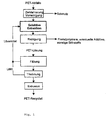
- Figur 1
- ein Beispiel einer Verfahrensführung für die Wiedergewinnung von PET-Abfällen und
- Figur 2
- einen zweiten Verfahrensablauf für die Wiedergewinnung von Polyestern aus PET-Abfällen.
- Figure 1
- an example of a procedure for the recovery of PET waste and
- Figure 2
- a second process for the recovery of polyesters from PET waste.
Bei dem in Figur 1 schematisch dargestellten Verfahrensablauf für ein Beispiel einer erfindungsgemäßen Vorgehensweise, werden in einem ersten Schritt die anfallenden und gesammelten PET-Abfälle zerkleinert und vorgereinigt. Bei der Vorreinigung kann eine Entfernung von losen metallischen Teilen, ein Sieben, ein Waschen und auch eine Schwimm-Sink-Trennung durchgeführt werden. In the procedure shown schematically in Figure 1 for an example of an inventive Procedure, in a first step the crushed and collected PET waste and pre-cleaned. Removal can be done during pre-cleaning of loose metallic parts, a seven, a wash and also a swim-sink separation be performed.
Die so vorbereiteten geschredderten Abfälle werden in einer Vorstufe in Dicarbonsäuredialkylester (DBE), jedoch bei relativ niedrigen Temperaturen, die zum Lösen von Polyester noch nicht ausreichen, lösliche Komponenten gelöst. Im nächsten Schritt werden diese Komponenten, beispielsweise andere Polymere, Additive oder sonstige Störstoffe durch fest-flüssig Trennung separiert, und gegebenenfalls ausgetragenes Dicarbonsäuredialkylester kann wieder aufgefüllt werden. Nach weiterer Erwärmung kann sich PET in Dicarbonsäuredialkylester lösen. Diese feststoffreiche Lösung wird dann durch Temperaturerniedrigung < 150 °C einer Fällung unterzogen, wobei überschüssiges Dicarbonsäuredialkylester abgezogen und in die bereits vorab beschriebene Vorstufe oder an Stelle des in der Vorstufe ausgetragenen Dicarbonsäuredialkylesters zurückgeführt wird. Nachfolgend an die Fällung wird das Polyester getrocknet, d.h. es wird gegebenenfalls unter reduziertem Druck weiter erwärmt, bis die Siedetemperatur von Dicarbonsäuredialkylester überschritten wird. Das gasförmige Dicarbonsäuredialkylester kann nach Kondensation ebenfalls im Kreislauf rückgeführt werden.The shredded waste that is prepared in this way is disposed of in a precursor in dicarboxylic acid dialkyl ester (DBE), however at relatively low temperatures leading to Solving polyester is not enough, soluble Components solved. The next step will be these Components, for example other polymers, additives or other contaminants through solid-liquid separation separated, and optionally discharged Dicarbonsäuredialkylester can be refilled. To Further warming may occur in dialkyl dicarboxylic acid to solve. This high solids solution will then by lowering the temperature <150 ° C of a precipitation subjected to excess dicarboxylic acid dialkyl ester deducted and into the previously described Prepress or in place of the prepress discharged Dicarbonsäuredialkylesters returned becomes. Following the precipitation that will be Polyester dried, i.e. it will if necessary heated further under reduced pressure until the boiling temperature of dicarboxylic acid dialkyl ester exceeded becomes. The gaseous dicarboxylic acid dialkyl ester can also circulate after condensation be returned.
Dabei können die verschiedenen Verfahrensschritte in unterschiedlichen Reaktionsgefäßen, die für den jeweiligen Anwendungsfall besonders günstig gestaltet sein können, durchgeführt werden.The various process steps in different reaction vessels for each Use case designed particularly cheap can be carried out.
Das getrocknete PET kann nachfolgend extrudiert und als PET-Recyclat weiter verarbeitet werden.The dried PET can subsequently be extruded and processed as recycled PET.
Das Beispiel nach Figur 2 unterscheidet sich in einigen Verfahrensschritten vom Beispiel nach Figur 1, wobei die PET-Lösung durch eine Filtration, bei der inerter Schmutz, Pappe, Papierreste und auch Metalle entfernt werden, vor dem Fällen und Verdampfen (z.B. Sprühtrocknung) gereinigt wird. Zusätzlich erfolgt in Ergänzung zur Trocknung z.B. (Festphasen nach Kondensation) des pulverförmigen PET-Recyclats auch eine Konditionierung, bevor das getrocknete PET mit erhöhter Qualität wieder verwendet werden kann.The example according to FIG. 2 differs in some Method steps from the example according to FIG. 1, the PET solution being filtered, during which inert dirt, cardboard, paper scraps and also metals removed before precipitation and evaporation (e.g. Spray drying) is cleaned. In addition, in Drying supplement e.g. (Solid phases after condensation) of powdered PET recyclate Conditioning before the dried PET with increased Quality can be reused.
Auch bei diesem Beispiel wird das in verschiedenen Verfahrensschritten anfallende überschüssige DBE wieder rückgeführt.In this example, too, this is done in different ways Process steps accruing excess DBE again recycled.
Claims (12)
- Method of recovering polyesters or polyester mixtures from polyester or waste materials containing polyester, in which polyester and/or waste materials containing polyester are heated in a bath of dicarboxylic acid dialkyl ester to temperatures above 150°C, wherein polyesters are dissolved in dicarboxylic acid dialkyl ester selected from dialkyl ester of oxalic acid, malonic acid, succinic acid, glutaric acid and/or adipic acid, and separated from the solution by means of a solid-liquid separation.
- Method according to Claim 1, characterised in that the separation of polyester and solvent is achieved by precipitation and/or evaporation of dicarboxylic acid dialkyl ester.
- Method according to Claim 1 or 2, characterised in that the separation is conducted at reduced temperature.
- Method according to one of Claims 1 to 3, characterised in that dicarboxylic acid dialkyl ester containing polyester in dissolved form is evaporated at temperatures above 205°C and the condensed gas phase is returned to a bath.
- Method according to one of Claims 1 to 4, characterised in that contaminants are separated from the solution by means of solid-liquid separation.
- Method according to Claim 5, characterised in that the solution is filtered or separated in the centrifugal field.
- Method according to one of Claims 1 to 6, characterised in that further constituents of the waste product dissolved in dicarboxylic acid dialkyl ester are separated off separately in previous stages.
- Method according to Claim 7, characterised in that polyolefins or polystyrene dissolved in dicarboxylic acid dialkyl ester are separated in a previous stage.
- Method according to one of Claims 1 to 8, characterised in that the waste materials are crushed before being put into solution.
- Method according to one of Claims 1 to 9, characterised in that waste materials containing polyethylene terephthalate (PET) and/or polybutylene terephthalate (PBT) are used.
- Method according to one of Claims 1 to 10, characterised in that the solid-liquid separation is conducted until a proportion of dicarboxylic acid dialkyl ester of <15 ppm is retained in the polyester obtained.
- Method according to one of Claims 1 to 11, characterised in that the dissolving of polyester in dicarboxylic acid dialkyl ester and the solid-liquid separation are conducted in separate reactions.
Priority Applications (1)
| Application Number | Priority Date | Filing Date | Title |
|---|---|---|---|
| DK00975943T DK1237998T3 (en) | 2000-10-27 | 2000-10-27 | Process for the recovery of polyesters or polyester blends |
Applications Claiming Priority (5)
| Application Number | Priority Date | Filing Date | Title |
|---|---|---|---|
| DE19955495 | 1999-11-18 | ||
| DE19955495 | 1999-11-18 | ||
| DE10017707 | 2000-04-05 | ||
| DE10017707A DE10017707A1 (en) | 1999-11-18 | 2000-04-05 | Process for the recovery of polyesters or polyester mixtures |
| PCT/EP2000/010600 WO2001036523A1 (en) | 1999-11-18 | 2000-10-27 | Method for reclaiming polyester or polyester mixtures |
Publications (2)
| Publication Number | Publication Date |
|---|---|
| EP1237998A1 EP1237998A1 (en) | 2002-09-11 |
| EP1237998B1 true EP1237998B1 (en) | 2004-07-07 |
Family
ID=26005249
Family Applications (1)
| Application Number | Title | Priority Date | Filing Date |
|---|---|---|---|
| EP20000975943 Expired - Lifetime EP1237998B1 (en) | 1999-11-18 | 2000-10-27 | Method for reclaiming polyester or polyester mixtures |
Country Status (5)
| Country | Link |
|---|---|
| US (1) | US7135503B1 (en) |
| EP (1) | EP1237998B1 (en) |
| AT (1) | ATE270690T1 (en) |
| ES (1) | ES2222928T3 (en) |
| WO (1) | WO2001036523A1 (en) |
Cited By (1)
| Publication number | Priority date | Publication date | Assignee | Title |
|---|---|---|---|---|
| DE102004018287A1 (en) * | 2004-04-15 | 2005-11-10 | Fraunhofer-Gesellschaft zur Förderung der angewandten Forschung e.V. | Process for recycling polyesters or polyester mixtures from polyester-containing waste |
Families Citing this family (5)
| Publication number | Priority date | Publication date | Assignee | Title |
|---|---|---|---|---|
| AU2002246886A1 (en) * | 2000-11-08 | 2002-08-06 | E. I. Du Pont De Nemours And Company | Method for separating polystyrene and polyethylene terephthalate |
| US11161960B2 (en) | 2019-05-20 | 2021-11-02 | Octal Saoc Fzc | Process for reclamation of polyester by reactor addition |
| US11518865B2 (en) | 2019-05-20 | 2022-12-06 | Octal Saoc Fzc | Process for reclamation of polyester by reactor addition |
| US12570793B2 (en) | 2019-05-20 | 2026-03-10 | Octal Saoc Fzc | Process for formation of additive-containing polyester |
| WO2025126483A1 (en) * | 2023-12-15 | 2025-06-19 | アースリサイクル株式会社 | Method and equipment for selectively recovering pbt resin component from waste containing pbt resin |
Family Cites Families (11)
| Publication number | Priority date | Publication date | Assignee | Title |
|---|---|---|---|---|
| CA1061947A (en) * | 1975-06-11 | 1979-09-04 | Horizons Research Incorporated | Solvent recovery of thermoplastic polyesters |
| JPS59115811A (en) * | 1982-12-23 | 1984-07-04 | Toyo Rubber Chem Ind Co Ltd | Reclaiming method of resin |
| US5328982A (en) * | 1992-11-02 | 1994-07-12 | Eastman Chemical Company | Depolymerization of substantially amorphous polyesters |
| US5814412A (en) * | 1994-04-27 | 1998-09-29 | Matsushita Electric Industrial Co., Ltd. | Base and solvent-decomposed thermosetting molding with aliphatic polyester |
| US5554657A (en) * | 1995-05-08 | 1996-09-10 | Shell Oil Company | Process for recycling mixed polymer containing polyethylene terephthalate |
| JP2846278B2 (en) | 1996-02-19 | 1999-01-13 | 和歌山県 | Recycling of cured unsaturated polyester resin waste |
| ATE259851T1 (en) * | 1996-12-31 | 2004-03-15 | M & G Polimeri Italia Spa | METHOD FOR RECOVERING SOLID MICROPOROUS POLYESTER FROM A RECYCLING STREAM AND PRODUCTS THEREOF |
| US5866622A (en) * | 1997-04-18 | 1999-02-02 | E. I. Du Pont De Nemours And Company | Recovery of polyester from contaminated polyester waste |
| DE19732673A1 (en) | 1997-07-29 | 1999-02-04 | Fraunhofer Ges Forschung | Process for the recovery of soluble polymers or polymer mixtures from plastic-containing materials |
| TWI249548B (en) * | 1998-12-08 | 2006-02-21 | Toyo Boseki | Void-containing polyester-based film |
| US6291574B1 (en) * | 1999-08-27 | 2001-09-18 | General Electric Company | Polyester molded articles |
-
2000
- 2000-10-27 WO PCT/EP2000/010600 patent/WO2001036523A1/en not_active Ceased
- 2000-10-27 AT AT00975943T patent/ATE270690T1/en not_active IP Right Cessation
- 2000-10-27 EP EP20000975943 patent/EP1237998B1/en not_active Expired - Lifetime
- 2000-10-27 US US10/130,496 patent/US7135503B1/en not_active Expired - Fee Related
- 2000-10-27 ES ES00975943T patent/ES2222928T3/en not_active Expired - Lifetime
Cited By (2)
| Publication number | Priority date | Publication date | Assignee | Title |
|---|---|---|---|---|
| DE102004018287A1 (en) * | 2004-04-15 | 2005-11-10 | Fraunhofer-Gesellschaft zur Förderung der angewandten Forschung e.V. | Process for recycling polyesters or polyester mixtures from polyester-containing waste |
| DE102004018287B4 (en) * | 2004-04-15 | 2006-04-27 | Fraunhofer-Gesellschaft zur Förderung der angewandten Forschung e.V. | Process for recycling polyesters or polyester mixtures from polyester-containing waste |
Also Published As
| Publication number | Publication date |
|---|---|
| EP1237998A1 (en) | 2002-09-11 |
| WO2001036523A1 (en) | 2001-05-25 |
| US7135503B1 (en) | 2006-11-14 |
| ES2222928T3 (en) | 2005-02-16 |
| ATE270690T1 (en) | 2004-07-15 |
Similar Documents
| Publication | Publication Date | Title |
|---|---|---|
| EP1737904B1 (en) | Method for recycling polyesters or polyester mixtures from polyester-containing waste | |
| DE60000414T2 (en) | GLYCOLYSIS PROCESS FOR RECYCLING PET WASTE | |
| DE69826616T2 (en) | Labels, bottles with these labels, and methods of recycling them | |
| EP0894818B1 (en) | Process for recycling soluble polymers or polymer blends from plastic containing materials | |
| AT515557B1 (en) | Process for the preparation of packaging material | |
| EP3559100B1 (en) | Solvent and method of separating a plastic from a solid within a suspension | |
| WO1993001036A1 (en) | Process for preparing used polyolefine objects to provide reusable raw material | |
| DE60206508T2 (en) | ISOLATION, FORMULATION AND INFORMING OF MACROCYCLIC OLIGOESTERS | |
| DE10062710A1 (en) | Production of a polypropylene blend | |
| DE69424168T2 (en) | PRODUCTION OF DICARBONIC ACIDS | |
| DE10062437A1 (en) | Process for preparing a plastic mixture | |
| DE69922533T2 (en) | Process for cleaning and decontamination of polyester | |
| EP0500837A1 (en) | Process for recovering metals and coatings from composite materials | |
| DE69727650T2 (en) | Process for the recovery of solid microporous polyester from a recycling stream and products from it | |
| EP1237998A1 (en) | Method for reclaiming polyester or polyester mixtures | |
| EP1392766A1 (en) | Method for obtaining ldpe from used plastic films | |
| EP2192150B1 (en) | Polyester with etching material mixing method and mixing reactor | |
| DE10017707A1 (en) | Process for the recovery of polyesters or polyester mixtures | |
| JP2000327828A (en) | Separation method of plastic mixture and fractionation solvent therefor | |
| DE102024204994B3 (en) | Process for recycling at least one polyolefin containing impurities | |
| EP1077747B1 (en) | Method for the material decomposition of composites containing artificial resin | |
| US5423922A (en) | Delacquering of aluminum cans for recycling | |
| WO2017108014A1 (en) | Method for separating composite packaging materials | |
| DE102022128972B4 (en) | Process for preparing a pourable, flowable or pasty starting substrate and device for carrying out the process | |
| DE19712521C2 (en) | Process for the material digestion of composite materials containing synthetic resin and metallic components |
Legal Events
| Date | Code | Title | Description |
|---|---|---|---|
| PUAI | Public reference made under article 153(3) epc to a published international application that has entered the european phase |
Free format text: ORIGINAL CODE: 0009012 |
|
| 17P | Request for examination filed |
Effective date: 20020419 |
|
| AK | Designated contracting states |
Kind code of ref document: A1 Designated state(s): AT BE CH CY DE DK ES FI FR GB GR IE IT LI LU MC NL PT SE |
|
| 17Q | First examination report despatched |
Effective date: 20021126 |
|
| RAP1 | Party data changed (applicant data changed or rights of an application transferred) |
Owner name: FRAUNHOFER-GESELLSCHAFT ZUR FOERDERUNG DERANGEWAND |
|
| GRAP | Despatch of communication of intention to grant a patent |
Free format text: ORIGINAL CODE: EPIDOSNIGR1 |
|
| GRAS | Grant fee paid |
Free format text: ORIGINAL CODE: EPIDOSNIGR3 |
|
| GRAA | (expected) grant |
Free format text: ORIGINAL CODE: 0009210 |
|
| AK | Designated contracting states |
Kind code of ref document: B1 Designated state(s): AT BE CH CY DE DK ES FI FR GB GR IE IT LI LU MC NL PT SE |
|
| PG25 | Lapsed in a contracting state [announced via postgrant information from national office to epo] |
Ref country code: CY Free format text: LAPSE BECAUSE OF FAILURE TO SUBMIT A TRANSLATION OF THE DESCRIPTION OR TO PAY THE FEE WITHIN THE PRESCRIBED TIME-LIMIT Effective date: 20040707 Ref country code: IE Free format text: LAPSE BECAUSE OF FAILURE TO SUBMIT A TRANSLATION OF THE DESCRIPTION OR TO PAY THE FEE WITHIN THE PRESCRIBED TIME-LIMIT Effective date: 20040707 Ref country code: FI Free format text: LAPSE BECAUSE OF FAILURE TO SUBMIT A TRANSLATION OF THE DESCRIPTION OR TO PAY THE FEE WITHIN THE PRESCRIBED TIME-LIMIT Effective date: 20040707 |
|
| REG | Reference to a national code |
Ref country code: GB Ref legal event code: FG4D Free format text: NOT ENGLISH |
|
| REG | Reference to a national code |
Ref country code: CH Ref legal event code: EP |
|
| REG | Reference to a national code |
Ref country code: CH Ref legal event code: NV Representative=s name: PA ALDO ROEMPLER |
|
| REG | Reference to a national code |
Ref country code: IE Ref legal event code: FG4D Free format text: GERMAN |
|
| REF | Corresponds to: |
Ref document number: 50007024 Country of ref document: DE Date of ref document: 20040812 Kind code of ref document: P |
|
| GBT | Gb: translation of ep patent filed (gb section 77(6)(a)/1977) |
Effective date: 20040802 |
|
| PG25 | Lapsed in a contracting state [announced via postgrant information from national office to epo] |
Ref country code: SE Free format text: LAPSE BECAUSE OF FAILURE TO SUBMIT A TRANSLATION OF THE DESCRIPTION OR TO PAY THE FEE WITHIN THE PRESCRIBED TIME-LIMIT Effective date: 20041007 Ref country code: GR Free format text: LAPSE BECAUSE OF FAILURE TO SUBMIT A TRANSLATION OF THE DESCRIPTION OR TO PAY THE FEE WITHIN THE PRESCRIBED TIME-LIMIT Effective date: 20041007 |
|
| PG25 | Lapsed in a contracting state [announced via postgrant information from national office to epo] |
Ref country code: MC Free format text: LAPSE BECAUSE OF NON-PAYMENT OF DUE FEES Effective date: 20041031 |
|
| REG | Reference to a national code |
Ref country code: DK Ref legal event code: T3 |
|
| REG | Reference to a national code |
Ref country code: ES Ref legal event code: FG2A Ref document number: 2222928 Country of ref document: ES Kind code of ref document: T3 |
|
| ET | Fr: translation filed | ||
| REG | Reference to a national code |
Ref country code: IE Ref legal event code: FD4D |
|
| PLBE | No opposition filed within time limit |
Free format text: ORIGINAL CODE: 0009261 |
|
| STAA | Information on the status of an ep patent application or granted ep patent |
Free format text: STATUS: NO OPPOSITION FILED WITHIN TIME LIMIT |
|
| 26N | No opposition filed |
Effective date: 20050408 |
|
| PG25 | Lapsed in a contracting state [announced via postgrant information from national office to epo] |
Ref country code: PT Free format text: LAPSE BECAUSE OF NON-PAYMENT OF DUE FEES Effective date: 20041207 |
|
| PGFP | Annual fee paid to national office [announced via postgrant information from national office to epo] |
Ref country code: LU Payment date: 20071023 Year of fee payment: 8 |
|
| REG | Reference to a national code |
Ref country code: CH Ref legal event code: PCAR Free format text: ALDO ROEMPLER PATENTANWALT;BRENDENWEG 11 POSTFACH 154;9424 RHEINECK (CH) |
|
| PGFP | Annual fee paid to national office [announced via postgrant information from national office to epo] |
Ref country code: CH Payment date: 20091026 Year of fee payment: 10 Ref country code: DK Payment date: 20091023 Year of fee payment: 10 Ref country code: AT Payment date: 20091022 Year of fee payment: 10 |
|
| PG25 | Lapsed in a contracting state [announced via postgrant information from national office to epo] |
Ref country code: LU Free format text: LAPSE BECAUSE OF NON-PAYMENT OF DUE FEES Effective date: 20081027 |
|
| REG | Reference to a national code |
Ref country code: DK Ref legal event code: EBP |
|
| REG | Reference to a national code |
Ref country code: CH Ref legal event code: PL |
|
| PG25 | Lapsed in a contracting state [announced via postgrant information from national office to epo] |
Ref country code: CH Free format text: LAPSE BECAUSE OF NON-PAYMENT OF DUE FEES Effective date: 20101031 Ref country code: LI Free format text: LAPSE BECAUSE OF NON-PAYMENT OF DUE FEES Effective date: 20101031 |
|
| PG25 | Lapsed in a contracting state [announced via postgrant information from national office to epo] |
Ref country code: AT Free format text: LAPSE BECAUSE OF NON-PAYMENT OF DUE FEES Effective date: 20101027 |
|
| PG25 | Lapsed in a contracting state [announced via postgrant information from national office to epo] |
Ref country code: DK Free format text: LAPSE BECAUSE OF NON-PAYMENT OF DUE FEES Effective date: 20101031 |
|
| PGFP | Annual fee paid to national office [announced via postgrant information from national office to epo] |
Ref country code: BE Payment date: 20121022 Year of fee payment: 13 Ref country code: FR Payment date: 20121113 Year of fee payment: 13 |
|
| PGFP | Annual fee paid to national office [announced via postgrant information from national office to epo] |
Ref country code: GB Payment date: 20121023 Year of fee payment: 13 Ref country code: ES Payment date: 20121023 Year of fee payment: 13 Ref country code: IT Payment date: 20121024 Year of fee payment: 13 |
|
| PGFP | Annual fee paid to national office [announced via postgrant information from national office to epo] |
Ref country code: NL Payment date: 20121018 Year of fee payment: 13 |
|
| BERE | Be: lapsed |
Owner name: *FRAUNHOFER-GESELLSCHAFT ZUR FORDERUNG DER ANGEWAN Effective date: 20131031 |
|
| REG | Reference to a national code |
Ref country code: NL Ref legal event code: V1 Effective date: 20140501 |
|
| GBPC | Gb: european patent ceased through non-payment of renewal fee |
Effective date: 20131027 |
|
| PG25 | Lapsed in a contracting state [announced via postgrant information from national office to epo] |
Ref country code: GB Free format text: LAPSE BECAUSE OF NON-PAYMENT OF DUE FEES Effective date: 20131027 |
|
| REG | Reference to a national code |
Ref country code: FR Ref legal event code: ST Effective date: 20140630 |
|
| PG25 | Lapsed in a contracting state [announced via postgrant information from national office to epo] |
Ref country code: NL Free format text: LAPSE BECAUSE OF NON-PAYMENT OF DUE FEES Effective date: 20140501 Ref country code: FR Free format text: LAPSE BECAUSE OF NON-PAYMENT OF DUE FEES Effective date: 20131031 Ref country code: IT Free format text: LAPSE BECAUSE OF NON-PAYMENT OF DUE FEES Effective date: 20131027 |
|
| PG25 | Lapsed in a contracting state [announced via postgrant information from national office to epo] |
Ref country code: BE Free format text: LAPSE BECAUSE OF NON-PAYMENT OF DUE FEES Effective date: 20131031 |
|
| REG | Reference to a national code |
Ref country code: ES Ref legal event code: FD2A Effective date: 20141107 |
|
| PG25 | Lapsed in a contracting state [announced via postgrant information from national office to epo] |
Ref country code: ES Free format text: LAPSE BECAUSE OF NON-PAYMENT OF DUE FEES Effective date: 20131028 |
|
| PGFP | Annual fee paid to national office [announced via postgrant information from national office to epo] |
Ref country code: DE Payment date: 20151022 Year of fee payment: 16 |
|
| REG | Reference to a national code |
Ref country code: DE Ref legal event code: R119 Ref document number: 50007024 Country of ref document: DE |
|
| PG25 | Lapsed in a contracting state [announced via postgrant information from national office to epo] |
Ref country code: DE Free format text: LAPSE BECAUSE OF NON-PAYMENT OF DUE FEES Effective date: 20170503 |