EP1237382A2 - Zugriff eines gemeinsamen Kommunikationskanals in einer Umgebung mit überlappender Bedeckung - Google Patents
Zugriff eines gemeinsamen Kommunikationskanals in einer Umgebung mit überlappender Bedeckung Download PDFInfo
- Publication number
- EP1237382A2 EP1237382A2 EP02100199A EP02100199A EP1237382A2 EP 1237382 A2 EP1237382 A2 EP 1237382A2 EP 02100199 A EP02100199 A EP 02100199A EP 02100199 A EP02100199 A EP 02100199A EP 1237382 A2 EP1237382 A2 EP 1237382A2
- Authority
- EP
- European Patent Office
- Prior art keywords
- period
- medium
- time
- shared
- backoff
- Prior art date
- Legal status (The legal status is an assumption and is not a legal conclusion. Google has not performed a legal analysis and makes no representation as to the accuracy of the status listed.)
- Withdrawn
Links
- 238000004891 communication Methods 0.000 title claims abstract description 147
- 238000000034 method Methods 0.000 claims abstract description 76
- 230000005540 biological transmission Effects 0.000 claims abstract description 68
- 238000011084 recovery Methods 0.000 claims abstract description 17
- 230000004044 response Effects 0.000 claims description 26
- 230000000977 initiatory effect Effects 0.000 claims description 20
- 230000006870 function Effects 0.000 claims description 8
- 230000007246 mechanism Effects 0.000 abstract description 3
- VYLDEYYOISNGST-UHFFFAOYSA-N bissulfosuccinimidyl suberate Chemical compound O=C1C(S(=O)(=O)O)CC(=O)N1OC(=O)CCCCCCC(=O)ON1C(=O)C(S(O)(=O)=O)CC1=O VYLDEYYOISNGST-UHFFFAOYSA-N 0.000 description 29
- 238000010586 diagram Methods 0.000 description 27
- 238000007726 management method Methods 0.000 description 5
- 238000012546 transfer Methods 0.000 description 4
- 230000008901 benefit Effects 0.000 description 3
- 239000000835 fiber Substances 0.000 description 3
- 238000012545 processing Methods 0.000 description 3
- 238000001228 spectrum Methods 0.000 description 3
- 230000001413 cellular effect Effects 0.000 description 2
- 238000012986 modification Methods 0.000 description 2
- 230000004048 modification Effects 0.000 description 2
- 239000004020 conductor Substances 0.000 description 1
- 238000013461 design Methods 0.000 description 1
- 230000002542 deteriorative effect Effects 0.000 description 1
- 238000005516 engineering process Methods 0.000 description 1
- 238000009434 installation Methods 0.000 description 1
- 230000002452 interceptive effect Effects 0.000 description 1
- 230000000116 mitigating effect Effects 0.000 description 1
- 239000012466 permeate Substances 0.000 description 1
- 230000008569 process Effects 0.000 description 1
Images




Classifications
-
- H—ELECTRICITY
- H04—ELECTRIC COMMUNICATION TECHNIQUE
- H04W—WIRELESS COMMUNICATION NETWORKS
- H04W74/00—Wireless channel access
- H04W74/08—Non-scheduled access, e.g. ALOHA
- H04W74/0808—Non-scheduled access, e.g. ALOHA using carrier sensing, e.g. carrier sense multiple access [CSMA]
- H04W74/0816—Non-scheduled access, e.g. ALOHA using carrier sensing, e.g. carrier sense multiple access [CSMA] with collision avoidance
-
- H—ELECTRICITY
- H04—ELECTRIC COMMUNICATION TECHNIQUE
- H04W—WIRELESS COMMUNICATION NETWORKS
- H04W24/00—Supervisory, monitoring or testing arrangements
-
- H—ELECTRICITY
- H04—ELECTRIC COMMUNICATION TECHNIQUE
- H04W—WIRELESS COMMUNICATION NETWORKS
- H04W74/00—Wireless channel access
- H04W74/02—Hybrid access
-
- H—ELECTRICITY
- H04—ELECTRIC COMMUNICATION TECHNIQUE
- H04W—WIRELESS COMMUNICATION NETWORKS
- H04W84/00—Network topologies
- H04W84/02—Hierarchically pre-organised networks, e.g. paging networks, cellular networks, WLAN [Wireless Local Area Network] or WLL [Wireless Local Loop]
- H04W84/10—Small scale networks; Flat hierarchical networks
- H04W84/12—WLAN [Wireless Local Area Networks]
Definitions
- the present invention relates generally to wireless communications, and more particularly, to spectrum sharing in wireless information networks with multiple overlapping coverage areas.
- Communications networks use a communications medium to transmit information in the form of computer data, voice, music, video, etc., between users or between users and service providers.
- the communications medium may be a wire link, a fiber optic link, or a wireless link.
- the wireless link may include, but is not limited to, radio frequency, infrared, laser light, and microwave.
- the network may, in fact, use a combination of different communications links. With the exception of a small number of networks that use dedicated communications links between each user, most information networks use a shared communications medium to carry the transmitted information. Examples of information networks using a shared communications medium include: Ethernet, token ring, and wireless Ethernet (IEEE 802.11).
- Sharing of the transmission medium is more problematic with wireless networks than with wired networks since there is no "containment" of the transmitted information.
- information When information is transmitted over-the-air, it is broadcast all over the network (and beyond), often ending up in places where the user did not intend for it to be. This is different from the case of a wired transmission medium where the medium physically contains the information.
- frequency planning An example of a network using frequency planning can be seen in cellular telephone networks. In cellular telephone networks, if one cell is set to operate in a particular frequency band, adjacent cells do not use that frequency band. Frequency planning is adequate for low bandwidth applications such as voice telephony, but for applications requiring high bandwidth, such as high-speed data networks, frequency planning is inadequate because it places severe bandwidth constraints on the networks, due to the fact that overall bandwidth available to each network is only a fraction of the total available bandwidth. Additionally, there may not be sufficient available spectrum to allocate a separate frequency band for each network to have its own frequency band.
- Another solution for mitigating the problem of overlapping coverage areas and interference resulting from overlapping coverage is to force networks to transmit at a lower signal power.
- the signals propagate less (reducing the effective size of the network) and therefore the overlap is reduced or even eliminated.
- the network's effective range is reduced along with network data rates.
- more networks are required to provide an equivalent amount of coverage.
- the present invention provides a method for initiating contention-free bursts in a network with a shared communications medium by determining the status of the shared medium and waiting a specified period of time, where the specified period of time is based on the status of the medium, and transmitting to initiate the contention-free burst after waiting the requisite period of time.
- the present invention provides an access recovery method when collisions occur during a contention-free burst by first initiating a contention-free burst and then waiting for an expected response from the destination. If the expected response is not detected, then the status of the shared medium is detected and a wait based on the status of the shared medium is performed. After the waiting is complete, regaining control of the shared medium.
- a preferred embodiment of the present invention has a principal advantage in that it allows for contention in a shared communications channel between multiple networks such that the multiple networks share the available network bandwidth fairly without incurring an appreciable drop in network performance or a large amount of computational overhead.
- a preferred embodiment of the present invention has an additional advantage in that it minimizes the amount of network bandwidth wasted when the multiple networks are contending for the same-shared communications channel.
- a preferred embodiment of the present invention has yet another advantage in that it allows for a smaller waiting period when contention for the shared communications channel is from within a single network, hence reducing medium idle time.
- Sharing a communications medium is a necessity for a majority of the communications networks (networks) available today. Only in a small number of networks are there enough resources to permit dedicating communications media between pairs of users. For most purposes, dedicating a connection between pairs of users is an inefficient use of bandwidth resources. Sharing a communications medium between multiple users allow for more efficient use of the medium, because when one user may be idle, another user may have data to transmit. Sharing is also more cost efficient because a smaller amount of the media is needed to support the information network. Note that this is also true of wireless, over-the-air networks, where if sharing were not used, then more "air", i.e., spectrum, must be dedicated to supporting the network.
- FIG 1 a diagram (prior art) of a typical wireless local area network (LAN) installation according to the IEEE 802.11 technical standard, "ANSI/IEEE Std 802.11, 1999 Edition; Information technology - Telecommunications and information exchange between systems - Local and metropolitan area networks - Specific requirements. Part 11: Wireless LAN Medium Access Control (MAC) and Physical Layer (PHY) Specifications", which is incorporated herein by reference.
- Figure 1 provides an illustration of the basic building blocks of an IEEE 802.11 network.
- FIG. 1 displays a first basic service set (BSS) 110 and a second BSS 120.
- a BSS is the basic building block of an IEEE 802.11 network and can be thought of as a coverage area within which member stations may participate in direct communications.
- a BSS is started, formed, and maintained by an access point (AP).
- BSS 110 corresponds to AP 130 and BSS 120 corresponds to AP 140.
- An AP is a station that is connected to a distribution system (DS) 150.
- DS distribution system
- a DS allows multiple BSSs to interconnect with one another and form an extended service set (ESS) 160.
- the medium used in a DS may be the same as the medium used in the BSSs or it may be different, e.g., the medium used in the BSSs may be wireless radio frequency (RF) while a DS may use fiber optic.
- RF radio frequency
- a DS may use fiber optic.
- AP 130 and a wireless station (STA) 170 Internal to BSS 110 is an AP 130 and a wireless station (STA) 170 while internal to BSS 120 is an AP 140 and a STA 180.
- a BSS may contain more than two stations (e.g., a maximum of about 20 stations per BSS is typical today), but it will have one AP.
- BSS 110 is connected to DS 150 via the access point 130 and the second access point 140 connects DS 150 to BSS 120.
- an access point also contains a wireless station and can be addressed like any other wireless station.
- a user may be thought of as a device or an entity that uses a station to communicate with other users who are using other stations to communicate. Therefore, in the remainder of this discussion, the terms stations and users will be used interchangeably without loss of information.
- MAC protocol data units MPDU
- MMPDU MAC management protocol data units
- Timing is a crucial aspect of an IEEE 802.11 wireless LAN. Spans of time are used to prevent or allow certain types of communications. Other spans of time are used to begin and end communications. The most commonly referred time spans are SIFS, PIFS, and DIFS.
- SIFS is a short inter-frame space and is typically the smallest time span in the LAN.
- a PIFS is a point coordinating function (PCF) inter-frame space.
- a PIFS is equal to one SIFS plus one slot time.
- a DIFS is a distributed coordinating function (DCF) inter-frame space.
- a DIFS is equal to one PIFS plus one slot time.
- a slot time is the maximum amount of time for a station to sense a frame, due to signal processing delay and propagation delay that is transmitted from any other station within the same BSS.
- IEEE 802.11b an 11 mega-bits per second (Mbps) variant, referred to as IEEE 802.11b, has three non-overlapping communications channels over which stations are permitted to transmit and receive information. With only three communications channels, a maximum of three BSSs can be located in adjacent geographical areas and communicate freely without interfering with one another. If more than three BSSs are operating in adjacent geographical areas, then communications channel sharing must take place.
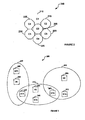
- FIG. 2 a diagram illustrates a coverage area map 200 of several BSSs.
- the coverage area map 200 displays seven adjacent BSSs and their respective coverage areas.
- a BSS 205 in the center of Figure 2 is surrounded by six other BSSs (210, 215, 220, 225, 230, and 235). Since the seven BSSs displayed in the coverage area map 200 are adjacent to each other, in order to have interference free communications, each BSS must use a different communications channel. Therefore, the seven BSSs require seven different communications channels.
- the IEEE 802.11b technical standard there is an insufficient number of communications channels to allow for interference-free communications in a densely populated concentration of BSSs. In such a situation, multiple BSSs must share the limited number of communications channels.
- no mechanism is in place to allow the sharing of a communications channel between multiple BSSs. Accordingly, existing mechanisms for sharing the communications channel between different stations within a single BSS are used.
- a station or a central controller (also called a hybrid coordinator in IEEE 802.11e, yet another IEEE 802.11 technical standard) wishes to transmit, it is required to wait until the shared communications channel becomes idle and then it is required to wait an additional period of time.
- a station is required to wait a DIFS period plus a random backoff period while a central controller is required to wait a PIFS period.
- the shorter waiting period required for a central controller grants a preference to the central controller, allowing it an opportunity to obtain access to the shared communications channel before a station does.
- FIG. 3 a diagram illustrates an exemplary wireless LAN 300 made up of multiple, overlapping BSSs.
- the wireless LAN 300 is made up of three BSSs (310, 320 and 330).
- the first BSS is controlled by a hybrid coordinator (HC) 335 and has three wireless stations 340, 345, and 350.
- Wireless station 340 is also within range of the second BSS 320
- wireless station 350 is also within range of the third BSS 330.
- the second and the third BSSs 320 and 330 are controlled by HCs 355 and 365 respectively.
- the second BSS 320 further contains a wireless station 360
- the third BSS 330 further contains a wireless station 370.
- the IEEE 802.11e March 2001 draft standard does not provide for a technique to support communications in the case where there are BSSs with overlapping coverage sharing a single communications channel.
- an existing algorithm for contention communications is used.
- a hybrid coordinator (HC) in a BSS can begin a contention-free burst (CFB) or a contention-free period (CFP) for contention-free transfer on a shared communications channel if the channel has been idle for one PIFS period. Additionally, if a CFB or CFP was interrupted as a result of an inferred collision, the HC must wait one PIFS idle period before re-initiating the CFB or CFP.
- An inferred collision is a collision that was not actually detected, but assumed to have taken place due to the absence of an expected acknowledgment transmission or an expected data transmission.
- a flow diagram illustrates an algorithm 405 for contention access of a shared communications channel in an operating environment where multiple BSSs have overlapping coverage areas and uses a common frequency band according to a preferred embodiment of the present invention.
- the algorithm 405 executes in an HC of a BSS. According to a preferred embodiment of the present invention, each HC would be executing a copy of the algorithm 405.
- the algorithm 405 starts execution when the HC desires to start a CFB or CFP in which the HC transmits data or polls stations within the same BSS, one at a time, for data transmissions from those stations. If the HC does not need to start a CFB or CFP, then the algorithm 405 is not executing. When the HC has frames to transmit, it must first detect the status of the shared communications channel (410). The shared communications channel is either busy (used by some other HC or station) or idle. If the shared communications channel is idle, then the HC determines how long the channel has been idle (415). If the channel has been idle for less than one PIFS period, the algorithm 405 will force the HC to wait until the channel has been idle for one PIFS period. If the channel has been idle for a period equal to or greater than one PIFS period, the algorithm 405 allows the HC to transmit (420).
- the shared communications channel is either busy (used by some other HC or station) or idle. If the shared communications channel is idle, then the HC determine
- the HC will determine if the channel is busy due to a contention-based transmission from a station within its own BSS or from some other BSS (425).
- the HC can determine the source of the transmission by listening in on the transmission. In fact, since the network uses a shared communications medium, all stations are required to listen in on transmissions to detect transmissions intended for them.
- the algorithm 405 will force the HC to wait until the shared communications channel becomes idle. However, if the channel had been busy due to transmissions from a station within the same BSS, the HC will only need to wait for the channel to become idle for a time equal to a SIFS period (430) after the end of an acknowledgment frame. If the shared communications channel had been busy due to transmissions from some other BSS, then the HC will need to wait for the channel to become idle for a time equal to a PIFS period (435). Once the shared communications channel becomes idle and the HC has waited for the requisite amount of time (either a PIFS or a SIFS), then the HC is permitted to transmit. When the HC completes transmitting, the algorithm 405 terminates.
- the HC is permitted to maintain a CFB up to a maximum prespecified amount of time. If the HC has more data to transmit, or finds some other stations in the BSS that has more data to transmit by contention-free transfer, than the maximum prespecified amount of time allows for, then the HC must give up the shared communications channel and attempt to reacquire the channel at a later time to start another CFB. If the HC does not need to continue the CFB up to the maximum prespecified amount of time, then the HC will give up the shared communications channel after it finishes transmitting or the last polled station finishes transmitting and receiving acknowledgment if such an acknowledgment is required.
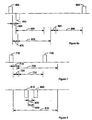
- FIGS 5a-c timing diagrams illustrate the state of a shared communications channel in an environment where multiple BSSs have overlapping coverage areas, operate on a common frequency band, and use the algorithm for initiating a CFB or CFP to provide contention-free traffic transfers as described in Figure 4 according to a preferred embodiment of the present invention.
- Figures 5a-c display the status (idle or busy) of the shared communications channel as a function of time as an HC attempts to transmit a frame to start a CFB or CFP for contention-free data transfers within the BSS.
- a timing diagram 505 illustrates the operation of the algorithm for initiating a CFB or CFP by an HC when the shared communications channel is busy according to a preferred embodiment of the present invention.
- the timing diagram 505 displays that the shared communications channel is busy 510 for a period of time and then becomes idle.
- an HC wishes to transmit a frame to start a CFB or CFP. But, since the shared communications channel is busy, the HC must wait.
- the HC by listening in on the transmission, knows that the transmission is between a pair of stations from a different BSS than the one it resides in. Once the shared communications channel becomes idle, the HC must wait for a PIFS period 515 before it can begin transmitting. After the shared communications channel is idle for a PIFS period 515, the HC can begin transmitting 520.
- a timing diagram 530 illustrates the operation of the algorithm for initiating a CFB or CFP by an HC when the shared communications channel is idle according to a preferred embodiment of the present invention.
- the timing diagram 530 displays that the shared communications channel is in the idle state. While the shared communications channel is idle, an HC wishes to transmit a frame to start a CFB or CFP. In order for the HC to transmit, the HC must verify that the shared communications channel has been idle for one PIFS period. Once the HC has been able to verify that the shared communications channel has been idle for one PIFS period, then the HC is free to transmit, displayed as segment 540.
- a timing diagram 560 illustrates the operation of the algorithm for initiating a CFB or CFP by an HC when the shared communications channel is busy from transmissions between a pair of stations from the same BSS as an HC wishes to transmit a frame to start a CFB or CFP according to a preferred embodiment of the present invention.
- the timing diagram 560 displays that the shared communications channel is busy 565 for a period of time and then becomes idle. During the time that the shared communications channel is busy 565, an HC wishes to transmit a frame to start a CFB or CFP. But, since the shared communications channel is busy, the HC must wait.
- the HC since the shared communications channel is busy due to communications originating from the same BSS as the HC, the HC is not required to wait a PIFS period after the communications has ended prior to initiating its own transmission. Because the communications originates from the same BSS as the HC, the HC may wait only a SIFS period after the communications has ended prior to transmitting.
- a timing diagram illustrates the state of a shared communications channel and the operation of an access recovery method when the shared communications channel is found busy for a period less than a transmission opportunity (TXOP) granted to a wireless station by an HC according to a preferred embodiment of the present invention.
- An HC initiates a frame exchange sequence by transmitting a frame 605 to a wireless station. It is expected that the wireless station sends a response 610 (i.e., an acknowledgment or data frame) to either the HC or another wireless station within one SIFS period 615 after the end of the frame 605 sent by the HC.
- a response 610 i.e., an acknowledgment or data frame
- the HC When the HC does not correctly receive the response frame 610 (displayed as a dotted box), but rather finds that the shared communications channel has become busy 625 within one PIFS period 620 after it has transmitted frame 605, the HC infers that a collision has taken place. Note that if a collision had not taken place, the HC would have been able to listen in on the shared communications channel and correctly receive the response frame 610.
- the HC granted the wireless station a TXOP 630 of a specific duration specified in a TXOP field. If the frame 605 did not specify a TXOP, then the TXOP is assumed to be equal to a period of time equal to the amount of time required to transmit an acknowledgment frame.
- One possible scenario involves a transmission from some other BSS arriving at the HC at the same time as the transmission of the response frame 610 arrives at the HC. The two transmissions interfere with one another and the HC is not able to receive the response frame 610 correctly.
- Another possible scenario involves the wireless station receiving the frame 605 from the HC and using the granted TXOP to transmit frames to a second wireless station. However, if the second wireless station is close to the transmitting wireless station, then the frames transmitted by the transmitting wireless station might have been transmitted at a low signal power. The low signal power may have been too low for the HC to accurately decode information from the transmission.
- the HC attempts to minimize future collisions by waiting until the granted TXOP 630 expires before it attempts to regain control of the shared communications channel.
- the HC waits a PIFS period 635 plus a random backoff period 640 prior to transmitting again.
- the backoff period is generated in a fashion similar to the random backoff period generated by wireless stations using distributed contention access during a contention period, i.e., by using a contention window to draw a random backoff.
- the maximum size CWHCmax has a default value that is equal to CWHCmin, which in turn has a default value of three.
- MIB management information base
- the HC After the HC has waited the PIFS period 635 and the backoff period 640, the HC is free to regain control of the shared communications channel and send a frame 645 to start a new CFB.
- the HC may attempt to repeat the previous frame exchange or it may chose to perform a frame exchange with a different wireless station.
- FIG. 6b a timing diagram illustrates the state of a shared communications channel and the operation of an access recovery method when the shared communications channel is found busy for a period greater than a TXOP granted to a wireless station by an HC according to a preferred embodiment of the present invention.
- the diagram in Figure 6b displays the alternative case to the case displayed in Figure 6a.
- the shared communications channel remains busy 675 after a TXOP 680 granted by the HC to a wireless station by frame 655 expires.
- the HC attempts to reduce future collisions by waiting until the shared communications channel becomes idle (rather than waiting for the expiration of the transmission opportunity) before attempting to regain control of the shared communications channel.
- the HC After the shared communications channel becomes idle, the HC then waits for a PIFS idle period 685 and a random backoff period 690 to start a new CFB by sending a frame 695.
- the random backoff period is generated the same way as described in Figure 6a.
- FIG. 7 a timing diagram illustrates the state of a shared communications channel and the operation of an access recovery method when the shared communications channel is found to be idle after a TXOP is granted to a wireless station by an HC according to a preferred embodiment of the present invention.
- Figures 6a and 6b illustrate the cases when an HC grants a TXOP to a wireless station but does not correctly receive a response from the wireless station and yet detects the presence of a transmission corresponding to the granted TXOP.
- Figure 7 displays a case when the HC grants a TXOP to a wireless station but does not correctly receive a response from the wireless station nor can it detect the presence of a transmission corresponding to the granted TXOP.
- the HC assumes that the frame 710 was corrupted during the transmission process.
- One possible scenario involves the arrival of another frame from some other BSS arriving at the wireless station at the same time as frame 710 arrives at the wireless station. The frames interfere and the wireless station is not able to decode the information in frame 710 and hence does not respond.
- the HC Since the HC has concluded that a transmission opportunity 720 granted in frame 710 has been lost due to the corruption of the transmission itself, the HC immediately attempts to regain control of the shared communications channel. As discussed above, the HC waits for a PIFS period 725 plus a random backoff period 730. After the end of the backoff period 730, the HC regains control of the shared communications channel and initiates a new CFB by transmitting frame 735.
- Collisions of frames are not limited to frames originating from an HC.
- Frames from wireless stations are just as likely to have collisions as frames from HCs.
- the scenarios detailed in Figures 6a and 6b are likely the result of a frame from a wireless station being damaged during transmissions.
- a timing diagram illustrates the state of a shared communications channel and the operation of an access recovery method when the shared communications channel is found to be idle after a frame, which requires a response (such as an acknowledgment), is transmitted by a wireless station according to a preferred embodiment of the present invention.
- a first wireless station transmits a frame 810 to a second wireless station (or an HC) during a TXOP 815 granted it by the HC responsible for the BSS that the wireless station is located in. However, the first wireless station does not receive an expected response within on SIFS period 820 after the transmission of frame 810.
- the first wireless station will wait for one entire PIFS period 830 to expire and then reclaims the shared communications channel by transmitting another frame 840 if there is sufficient time remaining in the first wireless station's TXOP 815. If the first wireless station does not transmit in the remaining TXOP, the HC may claim the channel at the end of the TXOP by transmitting a frame (not shown).
- a first scenario involves the first wireless station sending the frame 810 to a second wireless station (or HC) and the second wireless station does indeed respond to frame 810. However, a simultaneous transmission, near the first wireless station, from another BSS damages the response frame from the second wireless station.
- a second scenario involves the first wireless station sending the frame 810 to a second wireless station (or HC) and a simultaneous transmission, near the second wireless station (or HC), from another BSS damages the frame 810, and therefore the second wireless station does not actually receive the frame 810 and hence does not respond.
- a single HC or wireless station
- limits must be placed on an amount of time that a single HC (or wireless station) may control the shared communications channel. If the single HC (or wireless station) was granted control of the shared communications channel for an arbitrary amount of time, then it might prevent other HCs (or wireless stations) from obtaining access of the shared communications channel, i.e., the other HCs (or wireless stations) may be starved-out.
- the duration of a CFB nor is there any specified techniques to facilitate sharing a common communications channel between multiple BSSs.
- the only current limit on the size of a CFB is the size of the contention period or the contention-free period, depending on which period the HC wishes to initiate a CFB.
- a limit on the duration of a CFB is set at a value of aMaxCFBLimit.
- the parameter aMaxCFBLimit is a management information base (MIB) attribute that is specified by designers of the HC.
- MIB management information base
- a typical value for aMaxCFBLimit would be such that more than one CFB can fit within a single contention period or contention-free period.
- the HC must perform a backoff procedure one PIFS period after the end of its previous CFB to regain control of the shared communications channel. The wait and backoff procedure allows other HCs (or wireless stations) an opportunity to obtain access of the shared communications channel.
- a timing diagram illustrates the state of a shared communications channel shared by multiple BSS according to a preferred embodiment of the present invention.
- the timing diagram displays a series of frame transmission from an HC (blocks above the horizontal line) and from wireless stations (blocks below the horizontal line) grouped together in a first interval 910 and a second interval 920, respectively.
- the first interval 910 represents a CFB from one HC of one BSS that is sharing the communications channel.
- the second interval 920 represents a second CFB originating from the same HC or another HC.
- the CFB from the HC ends when the HC completes its necessary communications or when the CFB has reached a maximum duration as specified by aMaxCFBLimit.
- aMaxCFBLimit As discussed previously, should the HC wish to regain control of the shared communications channel after its CFB expires, it must wait a PIFS period 930 and a random backoff period 940 before it can regain control of the shared communications channel and begin a new CFB 920.
- the actual backoff procedure is similar to the backoff procedure for a station using distributed contention to access a communications medium during a contention period.
- the HC performing the backoff procedure randomly selects a backoff period from the above specified contention window and places the backoff period into a backoff counter.
- the backoff counter decrements one value for each time slot that passes and the shared communications channel is idle. When the backoff counter reaches zero, the HC transmits.
- the HC involved in the collision repeats backoff procedure with a new backoff period randomly selected from the contention window of [0, CWHC), where CWHC is equal to the minimum of CWHCmax plus one or twice the previous CW.
- the backoff procedure is repeated for each subsequent collision.
- a maximum size limit has been placed on the size of the contention window.
- the contention window cannot be larger than [0, CWHCmax], a range which includes both 0 and CWHCmax.
- the default value of CWHCmax is equal to CWHCmin, while the default value of CWHCmin is three time slots. Both CWHCmin and CWHCmax are MIB parameters.
- a block diagram illustrates a station 1000 with hardware support for access recovery and channel sharing according to a preferred embodiment of the present invention.
- the station 1000 may be an HC or a wireless station.
- the station 1000 has a processor 1010 that is responsible for controlling all communications, which includes but is not limited to: organizing data into frames for transmission, processing received frames, initiating CFBs, detecting the occurrence of errors, decoding transmissions carried on the shared communications channel, etc.
- the processor 1010 is coupled to a memory unit 1015 which can be used to store data to be transmitted or received.
- the error processor 1012 is responsible for detecting the occurrence of errors due to collisions and transmissions that are not received and to initiate a recovery procedure to recover from the collision. For example, if an expected response from a receiving wireless station were not received nor detected by the HC, the error processor 1012 would note the lack of the expected response and notify the processor 1010 that an error has occurred and initiate an access recovery procedure. In another example, the error processor 1012 could note that the shared medium was busy after an expected response was not received correctly. Based on this particular set of circumstances, the error processor 1012 would initiate a different access recovery procedure.
- a transmit and receive unit 1020 is also coupled to the processor.
- the transmit and receive unit 1020 is responsible for transmitting and receiving frames.
- a medium sensor unit 1025 is also coupled to the processor 1010.
- the medium sensor unit 1025 is responsible for detecting the state of a communications medium 1030, either idle or busy. Coupled to the transmit and receive unit 1020 and the medium sensor 1025 is the communications medium 1030.
- the medium sensor unit 1025 once determining the state of the communications medium 1030, places a value into a register (not shown) inside the processor 1010. For example, if the communications medium 1030 is busy, then the medium sensor unit 1025 will place a certain value into the register. The medium sensor unit 1025 places a different value into the register if the communications medium 1030 is idle. According to another preferred embodiment of the present invention, the medium sensor unit 1025 asserts a medium status flag signal line (not shown) one way if the communications medium 1030 is idle and another way if it is busy.
- the medium sensor unit 1025 is internal to the transmit and receive unit 1020. With the medium sensor unit 1025 inside the transmit and receive unit 1020, the medium sensor unit 1025 can make use of some of the hardware existing in the transmit and receive unit 1020 to determine the state of the communications medium 1030. For example, the medium sensor unit 1025 may use portions of the receiver hardware to detect the status (busy or idle) of the communications medium 1030.
- the communications medium 1030 is shown in Figure 10 as being a physical, wired connection.
- the communications medium 1030 may be any medium that is capable of transmitting data. Examples of different possible communications medium include, but are not limited to: wire (power line, telephone line, twisted pair, coaxial cable, multi-conductor wire, etc.), fiber optics (single mode and multi-mode), wireless (radio frequency, infrared, microwave, laser light, etc.).
Landscapes
- Engineering & Computer Science (AREA)
- Computer Networks & Wireless Communication (AREA)
- Signal Processing (AREA)
- Mobile Radio Communication Systems (AREA)
- Small-Scale Networks (AREA)
Applications Claiming Priority (4)
| Application Number | Priority Date | Filing Date | Title |
|---|---|---|---|
| US27221901P | 2001-02-28 | 2001-02-28 | |
| US272219 | 2001-02-28 | ||
| US09/966,393 US20020120740A1 (en) | 2001-02-28 | 2001-09-28 | Shared communications channel access in an overlapping coverage environment |
| US966393 | 2001-09-28 |
Publications (2)
| Publication Number | Publication Date |
|---|---|
| EP1237382A2 true EP1237382A2 (de) | 2002-09-04 |
| EP1237382A3 EP1237382A3 (de) | 2006-05-31 |
Family
ID=26955373
Family Applications (1)
| Application Number | Title | Priority Date | Filing Date |
|---|---|---|---|
| EP02100199A Withdrawn EP1237382A3 (de) | 2001-02-28 | 2002-02-28 | Zugriff eines gemeinsamen Kommunikationskanals in einer Umgebung mit überlappender Bedeckung |
Country Status (3)
| Country | Link |
|---|---|
| US (1) | US20020120740A1 (de) |
| EP (1) | EP1237382A3 (de) |
| JP (1) | JP2002319895A (de) |
Cited By (7)
| Publication number | Priority date | Publication date | Assignee | Title |
|---|---|---|---|---|
| WO2003043265A1 (en) | 2001-11-13 | 2003-05-22 | Koninklijke Philips Electronics N.V. | APPARATUS AND METHOD FOR PROVIDING IEEE 802.11e HYBRID COORDINATOR RECOVERY AND BACKOFF RULES |
| WO2003007550A3 (en) * | 2001-07-09 | 2003-06-05 | Koninkl Philips Electronics Nv | A system and method for sharing bandwidth between co-located 802.11 a/e and hiperlan/2 systems |
| WO2004039009A1 (ja) * | 2002-10-23 | 2004-05-06 | Sharp Kabushiki Kaisha | 通信管理方法、中央制御局、通信局、通信管理プログラム、通信管理プログラムを格納したコンピュータ読み取り可能な記録媒体 |
| WO2004073259A1 (en) * | 2003-02-13 | 2004-08-26 | Koninklijke Philips Electronics, N.V. | Maintaining synchronization between a q0s access point and q0s stations in an ieee 802.11e wlan |
| CN100401702C (zh) * | 2003-02-13 | 2008-07-09 | 皇家飞利浦电子股份有限公司 | 在ieee 802.11e wlan中的qos接入点与qos站之间保持同步 |
| EP1805944A4 (de) * | 2004-10-28 | 2011-11-30 | Univ California | Dynamische anpassung für die drahtlose kommunikation mit verbesserter dienstgüte |
| EP2282570A4 (de) * | 2008-05-26 | 2015-09-23 | Panasonic Ip Man Co Ltd | Verfahren zur öffnung eines kanals zur verwendung in einer funkkommunikationsvorrichtung und funkkommunikationssystem |
Families Citing this family (23)
| Publication number | Priority date | Publication date | Assignee | Title |
|---|---|---|---|---|
| US8762551B2 (en) * | 2002-07-30 | 2014-06-24 | Intel Corporation | Point coordinator delegation in a wireless network |
| US7260392B2 (en) * | 2002-09-25 | 2007-08-21 | Intel Corporation | Seamless teardown of direct link communication in a wireless LAN |
| US20040071154A1 (en) * | 2002-10-08 | 2004-04-15 | Wentink Maarten Menzo | Achieving high priority and bandwidth efficiency in a shared communications medium |
| US7801092B2 (en) * | 2003-03-21 | 2010-09-21 | Cisco Technology, Inc. | Method for a simple 802.11e HCF implementation |
| JP4160435B2 (ja) * | 2003-03-31 | 2008-10-01 | 松下電器産業株式会社 | 無線通信方法及び無線通信装置 |
| KR100560738B1 (ko) * | 2003-07-29 | 2006-03-13 | 삼성전자주식회사 | 씨에스엠에이/씨에이 기반 무선 랜 시스템의 매체 접근제어 방법 및 그 방법을 수행하는 단말 |
| US7409448B2 (en) * | 2003-11-25 | 2008-08-05 | International Business Machines Corporation | Method, system, and storage medium for resolving contention issues during channel program execution |
| KR100934985B1 (ko) * | 2004-01-19 | 2010-01-06 | 삼성전자주식회사 | Dcf를 따르는 무선통신방법 |
| US7680150B2 (en) * | 2004-04-13 | 2010-03-16 | Texas Instruments Incorporated | Virtual clear channel avoidance (CCA) mechanism for wireless communications |
| US20060040666A1 (en) * | 2004-08-17 | 2006-02-23 | Murali Narasimha | Mobile assisted handoff in wireless local area network |
| US7551606B2 (en) * | 2004-08-20 | 2009-06-23 | Sony Corporation | Isochronous transmission for IP-oriented network |
| WO2006035366A1 (en) * | 2004-09-29 | 2006-04-06 | Philips Intellectual Property & Standards Gmbh | Network array, forwarder device and method of operating a forwarder device |
| WO2006041673A2 (en) * | 2004-10-08 | 2006-04-20 | Interdigital Technology Corporation | Wireless local area network medium access control extensions for station power efficiency and resource management |
| KR100678946B1 (ko) | 2004-11-26 | 2007-02-07 | 삼성전자주식회사 | 조정자 기반 무선 네트워크에서 채널을 공유하는 방법 및장치 |
| US8619658B2 (en) | 2005-09-21 | 2013-12-31 | Interdigital Technology Corporation | Method and apparatus for transmission management in a wireless communication system |
| KR100738557B1 (ko) * | 2006-02-08 | 2007-07-11 | 삼성전자주식회사 | 무선 랜 단말에서의 데이터 프레임 전송장치 및 그 방법 |
| US20070266157A1 (en) * | 2006-05-11 | 2007-11-15 | Texas Instruments Incorporated | Reducing collisions in wireless systems |
| US8537850B2 (en) * | 2008-07-18 | 2013-09-17 | Samsung Electronics Co., Ltd. | Method and system for directional virtual sensing random access for wireless networks |
| US9538431B2 (en) * | 2014-09-24 | 2017-01-03 | Intel Corporation | Handover at spectrum release for licensed shared access |
| WO2016089069A1 (ko) | 2014-12-02 | 2016-06-09 | 주식회사 윌러스표준기술연구소 | 클리어 채널 할당을 위한 무선 통신 단말 및 무선 통신 방법 |
| US9775170B2 (en) * | 2014-12-04 | 2017-09-26 | Intel Corporation | Apparatus, system and method of allocation using a frame |
| US10879989B2 (en) * | 2015-04-09 | 2020-12-29 | Intel IP Corporation | Apparatus, system and method of beamforming |
| US10194364B2 (en) * | 2015-09-23 | 2019-01-29 | Mediatek Inc. | Method of enhancing transmission opportunity and wireless device using the same |
Family Cites Families (13)
| Publication number | Priority date | Publication date | Assignee | Title |
|---|---|---|---|---|
| US6006017A (en) * | 1995-05-02 | 1999-12-21 | Motorola Inc. | System for determining the frequency of repetitions of polling active stations relative to the polling of inactive stations |
| US5642360A (en) * | 1995-08-28 | 1997-06-24 | Trainin; Solomon | System and method for improving network performance through inter frame spacing adaptation |
| US6173330B1 (en) * | 1996-09-17 | 2001-01-09 | Motorola, Inc. | Delivery and acquisition of data segments with optimized inter-arrival time |
| US6085248A (en) * | 1997-02-11 | 2000-07-04 | Xaqtu Corporation | Media access control transmitter and parallel network management system |
| US6003017A (en) * | 1997-05-30 | 1999-12-14 | Adaptec, Inc. | Methods and apparatuses for automatic bank switching in a host adapter memory |
| US6081570A (en) * | 1997-09-02 | 2000-06-27 | The United States Of America As Represented By The Administrator Of The National Aeronautics And Space Administration | Parallel integrated frame synchronizer chip |
| US6400695B1 (en) * | 1998-05-22 | 2002-06-04 | Lucent Technologies Inc. | Methods and apparatus for retransmission based access priority in a communications system |
| US6285662B1 (en) * | 1999-05-14 | 2001-09-04 | Nokia Mobile Phones Limited | Apparatus, and associated method for selecting a size of a contention window for a packet of data system |
| US6640325B1 (en) * | 1999-06-04 | 2003-10-28 | Advanced Micro Devices, Inc. | Immediate negative acknowledgement for a communication network |
| US6754176B1 (en) * | 2000-03-01 | 2004-06-22 | Sharewave, Inc. | Scheme for managing overlapping wireless computer networks |
| US6813260B1 (en) * | 2000-03-16 | 2004-11-02 | Ericsson Inc. | Systems and methods for prioritized access in a contention based network |
| US7292598B2 (en) * | 2000-12-18 | 2007-11-06 | Texas Instruments Incorporated | Adaptive algorithms for optimal control of contention access |
| US6965942B1 (en) * | 2001-01-12 | 2005-11-15 | 3Com Corporation | Method and system for improving throughput over wireless local area networks with a dynamic contention window |
-
2001
- 2001-09-28 US US09/966,393 patent/US20020120740A1/en not_active Abandoned
-
2002
- 2002-02-27 JP JP2002051052A patent/JP2002319895A/ja active Pending
- 2002-02-28 EP EP02100199A patent/EP1237382A3/de not_active Withdrawn
Cited By (10)
| Publication number | Priority date | Publication date | Assignee | Title |
|---|---|---|---|---|
| WO2003007550A3 (en) * | 2001-07-09 | 2003-06-05 | Koninkl Philips Electronics Nv | A system and method for sharing bandwidth between co-located 802.11 a/e and hiperlan/2 systems |
| WO2003043265A1 (en) | 2001-11-13 | 2003-05-22 | Koninklijke Philips Electronics N.V. | APPARATUS AND METHOD FOR PROVIDING IEEE 802.11e HYBRID COORDINATOR RECOVERY AND BACKOFF RULES |
| US7221681B2 (en) | 2001-11-13 | 2007-05-22 | Koninklijke Philips Electronics N.V. | Apparatus and method for providing IEEE 802.11e hybrid coordinator recovery and backoff rules |
| WO2004039009A1 (ja) * | 2002-10-23 | 2004-05-06 | Sharp Kabushiki Kaisha | 通信管理方法、中央制御局、通信局、通信管理プログラム、通信管理プログラムを格納したコンピュータ読み取り可能な記録媒体 |
| US7508762B2 (en) | 2002-10-23 | 2009-03-24 | Sharp Kabushiki Kaisha | Network communication management method and system |
| CN1708951B (zh) * | 2002-10-23 | 2012-05-30 | 夏普株式会社 | 通信管理方法、中央控制台、通信台、通信管理程序及记录媒体 |
| WO2004073259A1 (en) * | 2003-02-13 | 2004-08-26 | Koninklijke Philips Electronics, N.V. | Maintaining synchronization between a q0s access point and q0s stations in an ieee 802.11e wlan |
| CN100401702C (zh) * | 2003-02-13 | 2008-07-09 | 皇家飞利浦电子股份有限公司 | 在ieee 802.11e wlan中的qos接入点与qos站之间保持同步 |
| EP1805944A4 (de) * | 2004-10-28 | 2011-11-30 | Univ California | Dynamische anpassung für die drahtlose kommunikation mit verbesserter dienstgüte |
| EP2282570A4 (de) * | 2008-05-26 | 2015-09-23 | Panasonic Ip Man Co Ltd | Verfahren zur öffnung eines kanals zur verwendung in einer funkkommunikationsvorrichtung und funkkommunikationssystem |
Also Published As
| Publication number | Publication date |
|---|---|
| US20020120740A1 (en) | 2002-08-29 |
| JP2002319895A (ja) | 2002-10-31 |
| EP1237382A3 (de) | 2006-05-31 |
Similar Documents
| Publication | Publication Date | Title |
|---|---|---|
| US20020120740A1 (en) | Shared communications channel access in an overlapping coverage environment | |
| CN112188640B (zh) | 通信保护方法及装置 | |
| US7248600B2 (en) | ‘Shield’: protecting high priority channel access attempts in overlapped wireless cells | |
| US7983231B2 (en) | Staggered startup for cyclic prioritized multiple access (CPMA) contention-free sessions | |
| US7773625B2 (en) | Access method for periodic contention-free sessions | |
| US8068470B2 (en) | Preemptive packet for maintaining contiguity in cyclic prioritized multiple access (CPMA) contention-free sessions | |
| EP0615365B1 (de) | Verfahren zum Zugriff auf ein Übertragungsmedium | |
| US8064415B2 (en) | Fixed deterministic post-backoff for cyclic prioritized multiple access (CPMA) contention-free sessions | |
| US7522630B2 (en) | Unified channel access for supporting quality of service (QoS) in a local area network | |
| WO2003041427A1 (en) | 'shield': protecting high priority channel access attempts in overlapped wireless cells | |
| US20050025131A1 (en) | Medium access control in wireless local area network | |
| CN101582818A (zh) | 在混合无线网络中减少控制信令开销的方法及装置 | |
| KR100608915B1 (ko) | 의사 시분할 다중화를 이용한 무선랜 매체 접속 제어방법 | |
| KR100799584B1 (ko) | 무선랜 환경에서의 매체접속 방법 | |
| Roy | Traffic and QoS Analysis of an Infrastructure CSMA/CA Network With Multiple Service Classes |
Legal Events
| Date | Code | Title | Description |
|---|---|---|---|
| PUAI | Public reference made under article 153(3) epc to a published international application that has entered the european phase |
Free format text: ORIGINAL CODE: 0009012 |
|
| AK | Designated contracting states |
Kind code of ref document: A2 Designated state(s): AT BE CH CY DE DK ES FI FR GB GR IE IT LI LU MC NL PT SE TR |
|
| AX | Request for extension of the european patent |
Free format text: AL;LT;LV;MK;RO;SI |
|
| RIC1 | Information provided on ipc code assigned before grant |
Ipc: 7H 04Q 7/38 B Ipc: 7H 04L 12/56 B Ipc: 7H 04Q 7/28 A |
|
| PUAL | Search report despatched |
Free format text: ORIGINAL CODE: 0009013 |
|
| AK | Designated contracting states |
Kind code of ref document: A3 Designated state(s): AT BE CH CY DE DK ES FI FR GB GR IE IT LI LU MC NL PT SE TR |
|
| AX | Request for extension of the european patent |
Extension state: AL LT LV MK RO SI |
|
| RIC1 | Information provided on ipc code assigned before grant |
Ipc: H04L 12/56 20060101ALI20060411BHEP Ipc: H04Q 7/38 20060101ALI20060411BHEP Ipc: H04L 12/28 20060101AFI20060411BHEP |
|
| AKX | Designation fees paid | ||
| REG | Reference to a national code |
Ref country code: DE Ref legal event code: 8566 |
|
| STAA | Information on the status of an ep patent application or granted ep patent |
Free format text: STATUS: THE APPLICATION IS DEEMED TO BE WITHDRAWN |
|
| 18D | Application deemed to be withdrawn |
Effective date: 20061201 |