EP1237339A1 - Mehrträgerempfänger mit Hochfrequenzstörungsschätzungsfähigkeit - Google Patents
Mehrträgerempfänger mit Hochfrequenzstörungsschätzungsfähigkeit Download PDFInfo
- Publication number
- EP1237339A1 EP1237339A1 EP01400548A EP01400548A EP1237339A1 EP 1237339 A1 EP1237339 A1 EP 1237339A1 EP 01400548 A EP01400548 A EP 01400548A EP 01400548 A EP01400548 A EP 01400548A EP 1237339 A1 EP1237339 A1 EP 1237339A1
- Authority
- EP
- European Patent Office
- Prior art keywords
- rfi
- band
- carriers
- carrier
- signal
- Prior art date
- Legal status (The legal status is an assumption and is not a legal conclusion. Google has not performed a legal analysis and makes no representation as to the accuracy of the status listed.)
- Withdrawn
Links
- 239000000969 carrier Substances 0.000 claims abstract description 42
- 230000003595 spectral effect Effects 0.000 claims description 4
- 230000005540 biological transmission Effects 0.000 abstract description 7
- 230000000694 effects Effects 0.000 description 4
- 238000010586 diagram Methods 0.000 description 3
- 230000008878 coupling Effects 0.000 description 2
- 238000010168 coupling process Methods 0.000 description 2
- 238000005859 coupling reaction Methods 0.000 description 2
- 230000007423 decrease Effects 0.000 description 2
- 238000000034 method Methods 0.000 description 1
- 230000000116 mitigating effect Effects 0.000 description 1
Images
Classifications
-
- H—ELECTRICITY
- H04—ELECTRIC COMMUNICATION TECHNIQUE
- H04L—TRANSMISSION OF DIGITAL INFORMATION, e.g. TELEGRAPHIC COMMUNICATION
- H04L27/00—Modulated-carrier systems
- H04L27/26—Systems using multi-frequency codes
- H04L27/2601—Multicarrier modulation systems
- H04L27/2602—Signal structure
-
- H—ELECTRICITY
- H04—ELECTRIC COMMUNICATION TECHNIQUE
- H04B—TRANSMISSION
- H04B1/00—Details of transmission systems, not covered by a single one of groups H04B3/00 - H04B13/00; Details of transmission systems not characterised by the medium used for transmission
- H04B1/06—Receivers
- H04B1/10—Means associated with receiver for limiting or suppressing noise or interference
- H04B1/1027—Means associated with receiver for limiting or suppressing noise or interference assessing signal quality or detecting noise/interference for the received signal
- H04B1/1036—Means associated with receiver for limiting or suppressing noise or interference assessing signal quality or detecting noise/interference for the received signal with automatic suppression of narrow band noise or interference, e.g. by using tuneable notch filters
-
- H—ELECTRICITY
- H04—ELECTRIC COMMUNICATION TECHNIQUE
- H04L—TRANSMISSION OF DIGITAL INFORMATION, e.g. TELEGRAPHIC COMMUNICATION
- H04L27/00—Modulated-carrier systems
- H04L27/26—Systems using multi-frequency codes
- H04L27/2601—Multicarrier modulation systems
- H04L27/2647—Arrangements specific to the receiver only
Definitions
- the present invention relates to a multi-carrier receiver as defined in the non-characteristic part of claim 1.
- Such a multi-carrier receiver is already known in the art, e.g. from the article 'Mitigation of radio Interference in xDSL Transmission' from the authors Luc de Clercq, Miguel Peeters, NASAd Schelstraete and Thierry Pollet. This article has been published in IEEE Communications Magazine, March 2000, pag. 168-173.
- the DMT (Discrete Multi Tone) receiver drawn in Figure 3 of this article and described on page 172 in the paragraph entitled 'Digital RFI Canceling' receives a multi-carrier DMT signal and demodulates digital data contained in DMT symbols from the set of carriers constituting the multi-carrier DMT signal.
- the PSD Power Spectral Density
- RFI Radio Frequency Interference
- the narrowband disturber is a sine or cosine shaped signal (the sine or cosine model in practice is not used but gives an indication why two parameters can be considered)
- the amplitude and phase are for instance two characteristics that can be estimated.
- the known DMT receiver selects antennas within the RFI band.
- An antenna is a reserved carrier out of the set of carriers that constitute the DMT signal, whereto no or a substantially low amount of power and data bits are assigned. All carriers within the RFI band are candidate antennas because the PSD (Power Spectral Density) of the multi-carrier DMT signal anyhow has to stay low in the RFI band, e.g.
- the multi-carrier receiver can determine characteristics of the narrowband disturber. This is explained at page 172 of the cited IEEE publication, right column, second paragraph.
- the location of the antennas relative to the RFI signal frequency is critical for the estimation of the RFI signal characteristics.
- the narrowband disturber is located e.g. near an edge of the RFI band
- the prior art DMT receiver cannot estimate the characteristics of the narrowband disturber accurately, because the two antennas cannot be located optimally.
- One of these antennas has to be selected too close to the RFI disturber, or both antennas have to be chosen at the same side of the RFI disturber.
- This minimum guaranteed capacity is the capacity (measured in bits per second received) in the worst case scenario.
- This worst case scenario corresponds to a situation where the narrowband disturber is located at an edge of the RFI band, because the harmonics of the narrowband disturber then affect the carriers out of the RFI band most strongly.
- the prior art DMT receiver fails to accurately determine the characteristics of the narrowband disturber so that the disturbing effects thereof cannot be compensated for optimally.
- An object of the present invention is to provide multi-carrier receiver similar to the known one, but which is able to estimate the characteristics of a narrowband disturber in the standardised RFI band accurately, irrespective of the location of this narrowband disturber in the RFI band, and whose minimum guaranteed capacity is increased.
- the antennas no longer have to be chosen exclusively within the RFI band, but alternatively may be chosen amongst the carriers in the RFI band and at least two carriers located outside the RFI band.
- the narrowband interferer is not optimally located, i.e. near to an edge of the RFI band, one antenna can be selected inside the RFI band and a second antenna can be chosen outside the RFI band so that the two antennas are located at opposite sides of the narrowband disturber and at sufficient distance thereof in order to allow an accurate estimation of the characteristics of the narrowband disturber.
- the effects of the worst case narrowband disturber can be compensated for more optimally resulting in an increased minimum guaranteed capacity.
- a minor disadvantage of the multi-carrier receiver according to the present invention is that its maximum achievable capacity is lower than that of the known DMT receiver because at least two carriers outside the RFI band are set to zero (no or small amount of power and data bits allocated thereto).
- the maximum achievable capacity however is a less relevant parameter than the minimum guaranteed capacity for multi-carrier transmission systems like DMT (Discrete Multi Tone) based ADSL (Asynchronous Digital Subscriber line) or VDSL (Very High Speed Digital Subscriber Line) transmission.
- the relative decrease of the maximum achievable capacity through implementation of the present invention gets smaller in systems with a high number of carriers such as VDSL systems (because the number of carriers to be set zero remains two), whereas the increase of the minimum guaranteed capacity gets higher in systems with a high number of carriers (because a higher number of carriers is affected in the worst case situation if the prior art solution is applied).
- the receiver itself can reserve at least two carriers outside the RFI band that may be selected later on as antenna for estimation of the characteristics of the RFI disturber, by assigning a low amount of power and data bits to these carriers. This is for instance the situation in ADSL systems or VDSL systems, wherein the receiver determines the amount of power and data bits to be allocated to each carrier and communicates these amounts to the transmitter via the so called BiGi-information.
- the minimum amount of carriers (which is two) is set to zero outside the RFI band, and the antennas can always be chosen at opposite sides of the RFI disturber irrespective of which edge of the RFI band the narrowband disturber is laying near.
- a further optional feature of the multi-carrier receiver according to the present invention is defined by claim 4.
- the selection of the carriers that may be used as antennas is optimal for an RFI signal located exactly at the edge of the RFI band, i.e. the worst case situation.
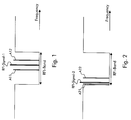
- Fig. 1 illustrates the operation of a prior art multi-carrier receiver.
- the receiver receives a multi-carrier signal containing for instance 1024 carriers modulated with digital data.
- the interspacing between two carriers equals 4.3125 kHz.
- Part of the carriers have frequencies inside the Radio Frequency Interference band, RFI-Band in Fig. 1.
- This RFI-Band is a predetermined, standardised frequency interval reserved for e.g. radio amateur transmission.
- the power spectral density of the multi-carrier signal within this RFI-Band should be -80 dB/Hz or -60 dB/Hz. This is drawn in Fig.
- the prior art multi-carrier receiver contains circuitry and software to roughly determine the location of a narrowband disturber RFI-Signal-1, e.g. a radio amateur signal, in the RFI-Band. Thereupon, the prior art multi-carrier receiver selects two carriers having frequencies inside the RFI-Band to act as antennas, A1 1 and A12. The receiver senses the level of the signal received at the frequencies of the antennas A11 and A12, and with this information estimates the characteristics of the narrowband disturber RFI-Signal 1.
- RFI-Signal-1 e.g. a radio amateur signal
- RFI-Signal-1 An accurate estimation of the characteristics of the narrowband disturber, RFI-Signal-1, enables the multi-carrier receiver to compensate for the effects of the disturber. This is important, in particular because the tail of the narrowband disturber which is due to harmonics, might affect the carriers outside the RFI-Band that carry large amounts of data bits. In case the antennas A11 and A12 are chosen close to the narrowband disturber RFI-Signal-1, the characteristics of the peak of the narrowband disturber can be estimated accurately, but the tail cannot be estimated accurately.
- the antennas A11 and A12 are chosen far away from the narrowband disturber RFI-Signal-1, the effect of the narrowband disturber RFI-Signal-1 at the frequency of the antennas may stay below the noise level, so that the receiver senses the noise instead of the disturbance coming from RFI-Signal-1.
- the location of the antennas A11 and A12 relative to the frequency of the narrowband disturber RFI-Signal-1 is thus critical.
- the prior art receiver can always select a pair of antennas, A11 and A12, that enable an accurate estimation of the characteristics of the narrowband disturber.
- the prior art receiver For a narrowband disturber RFI-Signal-2 that is located sub-optimally, i.e. near an edge of the RFI-Band as is drawn in Fig. 2, the prior art receiver has to select one antenna A21 close to the narrowband disturber RFI-Signal-2, or has to select the two antennas on one side of the narrowband disturber RFI-Signal-2. Both choices do not enable the receiver to accurately estimate and compensate for the RFI disturber RFI-Signal-2. As a consequence, the minimum guaranteed capacity decreases as already explained in the introductory part of this patent application.
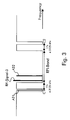
- Fig. 3 illustrates the working of a multi-carrier system according to the present invention.
- two other carriers C1 and C2 are kept zero. This means that no data bits and no power is allocated to the carriers C1 and C2, although these carriers do not have frequencies within the RFI-Band.
- Carrier C1 as is denoted in Fig. 3, is located at a frequency 17 times 4.3125 kHz below the lower edge of the RFI-Band, whereas carrier C2 is located at a frequency 17 times 4.3125 kHz above the upper edge of the RFI-Band.
- the receiver according to the present invention again contains circuitry or software to roughly estimate the location of a narrowband disturber RFI-Signal-3.
- the multi-carrier receiver selects carrier C1 as the first antenna and another carrier A32 inside the RFI-Band as second antenna for estimating the characteristics of the narrowband disturber RFI-Signal-3. If the narrowband disturber would be located in the middle of the RFI-Band, the multi-carrier receiver will select the two antennas within the RFI-Band, similar to the situation depicted in Fig. 1 for the prior art multi-carrier receiver.
- the multi-carrier receiver will select a first antenna within the RFI-Band and will select carrier C2 as second antenna. Once the antennas are selected, the procedure or algorithm used for determining the characteristics of the narrowband disturber could be manifold, depending on the application and assumptions made.
- applicability of the present invention is not limited to multi-carrier receivers which also have the capability to assign amounts of power and data bits to the different carriers.
- ADSL Asymmetric Digital Subscriber Line
- VDSL Very High Speed Digital Subscriber Line
- assigning bits and gains to individual carriers could also be the responsibility of the transmitter, a unit separated from the transmitter and receiver, or could even be predetermined by a standard specification.
- the concept of selecting the antennas at the receiver amongst carriers inside the RFI-Band and at least two carriers outside the RFI-Band can be implemented irrespective of the location of the functionality that assigns bits and gains.
- applicability of the concept according to the present invention is not limited to a particular modulation type such as DMT (Discrete Multi Tone), Zipper, OFDM (Orthogonal Frequency Division Multiplexing), ... or to a particular application such as ADSL, VDSL.
- the present invention provides an advantageous solution to cope with narrowband interferers in any multi-carrier transmission system without drastically affecting the minimum guaranteed capacity.
- a further remark is that the functionality to select the antennas for estimating RFI characteristics may be implemented in hardware, in software, or partially in hardware and partially in software.
- the precise algorithm or selection criteria for the antennas can be manifold, but since the inventive nature of the present invention is not in the criteria used for selecting the antennas, this aspect is not further deepened in this patent application.
Landscapes
- Engineering & Computer Science (AREA)
- Computer Networks & Wireless Communication (AREA)
- Signal Processing (AREA)
- Noise Elimination (AREA)
Priority Applications (2)
| Application Number | Priority Date | Filing Date | Title |
|---|---|---|---|
| EP01400548A EP1237339A1 (de) | 2001-03-01 | 2001-03-01 | Mehrträgerempfänger mit Hochfrequenzstörungsschätzungsfähigkeit |
| US10/084,055 US6917795B2 (en) | 2001-03-01 | 2002-02-28 | Multi-carrier receiver with improved radio frequency interference canceling |
Applications Claiming Priority (1)
| Application Number | Priority Date | Filing Date | Title |
|---|---|---|---|
| EP01400548A EP1237339A1 (de) | 2001-03-01 | 2001-03-01 | Mehrträgerempfänger mit Hochfrequenzstörungsschätzungsfähigkeit |
Publications (1)
| Publication Number | Publication Date |
|---|---|
| EP1237339A1 true EP1237339A1 (de) | 2002-09-04 |
Family
ID=8182641
Family Applications (1)
| Application Number | Title | Priority Date | Filing Date |
|---|---|---|---|
| EP01400548A Withdrawn EP1237339A1 (de) | 2001-03-01 | 2001-03-01 | Mehrträgerempfänger mit Hochfrequenzstörungsschätzungsfähigkeit |
Country Status (2)
| Country | Link |
|---|---|
| US (1) | US6917795B2 (de) |
| EP (1) | EP1237339A1 (de) |
Cited By (2)
| Publication number | Priority date | Publication date | Assignee | Title |
|---|---|---|---|---|
| WO2003081869A1 (en) * | 2002-03-21 | 2003-10-02 | Globespan Virata Incorporated | Adaptive rfi canceller for dsl |
| WO2007051933A1 (fr) * | 2005-11-07 | 2007-05-10 | France Telecom | Procédé et système de mesure d'occupation et d'allocation du spectre de transmission |
Families Citing this family (4)
| Publication number | Priority date | Publication date | Assignee | Title |
|---|---|---|---|---|
| SE511521C3 (sv) * | 1997-11-18 | 1999-11-22 | Telia Ab | Foerbaettringar av eller med avseende paa abonnentledningstransmissionssystem |
| EP1351064A1 (de) * | 2002-04-06 | 2003-10-08 | Agilent Technologies, Inc. - a Delaware corporation - | Messgerät mit Spektrum-Analysator und Verfahren hierfür |
| DE102004047717B4 (de) * | 2004-09-30 | 2008-07-10 | Infineon Technologies Ag | Verfahren und Schaltungsanordung zur Reduzierung von RFI-Störungen |
| US8600312B2 (en) * | 2010-01-25 | 2013-12-03 | Qualcomm Incorporated | Method and apparatus for spectral sensing |
Citations (3)
| Publication number | Priority date | Publication date | Assignee | Title |
|---|---|---|---|---|
| US5479447A (en) * | 1993-05-03 | 1995-12-26 | The Board Of Trustees Of The Leland Stanford, Junior University | Method and apparatus for adaptive, variable bandwidth, high-speed data transmission of a multicarrier signal over digital subscriber lines |
| WO1997040609A1 (en) * | 1996-04-19 | 1997-10-30 | Amati Communications Corporation | Mitigation of radio frequency interference in multi-carrier transmission systems |
| WO1999026365A1 (en) * | 1997-11-18 | 1999-05-27 | Telia Ab (Publ) | Improvement in, or relating to, subscriber line transmission systems |
Family Cites Families (2)
| Publication number | Priority date | Publication date | Assignee | Title |
|---|---|---|---|---|
| US6504420B1 (en) * | 1998-11-12 | 2003-01-07 | Broadcom Corporation | Temperature compensation for internal inductor resistance |
| US6760230B2 (en) * | 2001-02-28 | 2004-07-06 | Andrew Corporation | Compact, high efficiency, high isolation power amplifier |
-
2001
- 2001-03-01 EP EP01400548A patent/EP1237339A1/de not_active Withdrawn
-
2002
- 2002-02-28 US US10/084,055 patent/US6917795B2/en not_active Expired - Lifetime
Patent Citations (3)
| Publication number | Priority date | Publication date | Assignee | Title |
|---|---|---|---|---|
| US5479447A (en) * | 1993-05-03 | 1995-12-26 | The Board Of Trustees Of The Leland Stanford, Junior University | Method and apparatus for adaptive, variable bandwidth, high-speed data transmission of a multicarrier signal over digital subscriber lines |
| WO1997040609A1 (en) * | 1996-04-19 | 1997-10-30 | Amati Communications Corporation | Mitigation of radio frequency interference in multi-carrier transmission systems |
| WO1999026365A1 (en) * | 1997-11-18 | 1999-05-27 | Telia Ab (Publ) | Improvement in, or relating to, subscriber line transmission systems |
Non-Patent Citations (3)
| Title |
|---|
| BINGHAM J A C: "RFI SUPPRESSION IN MULTICARRIER TRANSMISSION SYSTEMS", PHOENIX, MAY 4 - 7, 1997,NEW YORK, IEEE,US, vol. CONF. 47, 18 November 1996 (1996-11-18), pages 1026 - 1030, XP000741584, ISBN: 0-7803-3660-7 * |
| CLERCQ DE L ET AL: "MITIGATION OF RADIO INTERFERENCE IN XDSL TRANSMISSION", IEEE COMMUNICATIONS MAGAZINE,IEEE SERVICE CENTER. PISCATAWAY, N.J,US, vol. 38, no. 3, March 2000 (2000-03-01), pages 168 - 173, XP000948537, ISSN: 0163-6804 * |
| SPRUYT P ET AL: "Solving the issue of radio interference when deploying digital subscriber lines", NOC '97, BROADBAND ACCESS NETWORKS, 17 June 1997 (1997-06-17) - 19 June 1997 (1997-06-19), Amsterdam, Netherlands, IOS Press, Netherlands, pages 98 - 105, XP002940575, ISBN: 90-5199-339-0 * |
Cited By (4)
| Publication number | Priority date | Publication date | Assignee | Title |
|---|---|---|---|---|
| WO2003081869A1 (en) * | 2002-03-21 | 2003-10-02 | Globespan Virata Incorporated | Adaptive rfi canceller for dsl |
| US7120211B2 (en) | 2002-03-21 | 2006-10-10 | Conexant, Inc. | Adaptive RFI canceller for DSL |
| WO2007051933A1 (fr) * | 2005-11-07 | 2007-05-10 | France Telecom | Procédé et système de mesure d'occupation et d'allocation du spectre de transmission |
| FR2893202A1 (fr) * | 2005-11-07 | 2007-05-11 | France Telecom | Procede et systeme de mesure d'occupation et d'allocation du spectre de transmission |
Also Published As
| Publication number | Publication date |
|---|---|
| US6917795B2 (en) | 2005-07-12 |
| US20020123321A1 (en) | 2002-09-05 |
Similar Documents
| Publication | Publication Date | Title |
|---|---|---|
| EP1973257B1 (de) | OFDM-Übertragungs-/Empfangsvorrichtung | |
| US5867528A (en) | Method and modem for adaptive allocation of the pilot carrier in a multi-carrier system | |
| US7283498B2 (en) | Method and apparatus for allocating a pilot carrier adaptively in an orthogonal frequency division multiple access system | |
| JP4009641B2 (ja) | 通信システム、通信方法、送信装置、受信装置及び制御プログラム | |
| EP0894389B1 (de) | Verringerung von funkfrequenzstörungen in mehrträgerübertragungssystemen | |
| US6014412A (en) | Digital radio frequency interference canceller | |
| KR19990088086A (ko) | 다중반송파전송시스템,장치및방법 | |
| JP2010154417A (ja) | 無線通信システム、無線通信方法、及び無線送受信装置 | |
| US6917795B2 (en) | Multi-carrier receiver with improved radio frequency interference canceling | |
| KR100895053B1 (ko) | Ofdm/ofdma 방식을 지원하는 mimo 무선통신시스템에서의 채널 추정 장치 및 방법 | |
| JP2002538669A (ja) | デジタル加入者回線システムにおけるトーン割り当て装置および方法 | |
| US8477882B2 (en) | Radio apparatus | |
| CN101594334B (zh) | 具有频率陷波的多载波系统中的改进导频分配 | |
| KR100699139B1 (ko) | 블라인드 간섭 제거 방법 | |
| CA2387814A1 (en) | Bit allocation method and apparatus for improving transmission bit rate in a multicarrier system | |
| CN102077632A (zh) | 使用连续波频调的发射机覆盖标识 |
Legal Events
| Date | Code | Title | Description |
|---|---|---|---|
| PUAI | Public reference made under article 153(3) epc to a published international application that has entered the european phase |
Free format text: ORIGINAL CODE: 0009012 |
|
| AK | Designated contracting states |
Kind code of ref document: A1 Designated state(s): AT BE CH CY DE DK ES FI FR GB GR IE IT LI LU MC NL PT SE TR |
|
| AX | Request for extension of the european patent |
Free format text: AL;LT;LV;MK;RO;SI |
|
| 17P | Request for examination filed |
Effective date: 20030304 |
|
| AKX | Designation fees paid |
Designated state(s): AT BE CH CY DE DK ES FI FR GB GR IE IT LI LU MC NL PT SE TR |
|
| 17Q | First examination report despatched |
Effective date: 20030429 |
|
| STAA | Information on the status of an ep patent application or granted ep patent |
Free format text: STATUS: THE APPLICATION HAS BEEN WITHDRAWN |
|
| 18W | Application withdrawn |
Effective date: 20040917 |