EP1237134A2 - Elektronische Transaktionen - Google Patents
Elektronische Transaktionen Download PDFInfo
- Publication number
- EP1237134A2 EP1237134A2 EP02251180A EP02251180A EP1237134A2 EP 1237134 A2 EP1237134 A2 EP 1237134A2 EP 02251180 A EP02251180 A EP 02251180A EP 02251180 A EP02251180 A EP 02251180A EP 1237134 A2 EP1237134 A2 EP 1237134A2
- Authority
- EP
- European Patent Office
- Prior art keywords
- information
- user equipment
- entity
- transaction
- data
- Prior art date
- Legal status (The legal status is an assumption and is not a legal conclusion. Google has not performed a legal analysis and makes no representation as to the accuracy of the status listed.)
- Ceased
Links
Images


Classifications
-
- G—PHYSICS
- G06—COMPUTING OR CALCULATING; COUNTING
- G06Q—INFORMATION AND COMMUNICATION TECHNOLOGY [ICT] SPECIALLY ADAPTED FOR ADMINISTRATIVE, COMMERCIAL, FINANCIAL, MANAGERIAL OR SUPERVISORY PURPOSES; SYSTEMS OR METHODS SPECIALLY ADAPTED FOR ADMINISTRATIVE, COMMERCIAL, FINANCIAL, MANAGERIAL OR SUPERVISORY PURPOSES, NOT OTHERWISE PROVIDED FOR
- G06Q20/00—Payment architectures, schemes or protocols
- G06Q20/04—Payment circuits
-
- G—PHYSICS
- G06—COMPUTING OR CALCULATING; COUNTING
- G06Q—INFORMATION AND COMMUNICATION TECHNOLOGY [ICT] SPECIALLY ADAPTED FOR ADMINISTRATIVE, COMMERCIAL, FINANCIAL, MANAGERIAL OR SUPERVISORY PURPOSES; SYSTEMS OR METHODS SPECIALLY ADAPTED FOR ADMINISTRATIVE, COMMERCIAL, FINANCIAL, MANAGERIAL OR SUPERVISORY PURPOSES, NOT OTHERWISE PROVIDED FOR
- G06Q20/00—Payment architectures, schemes or protocols
- G06Q20/30—Payment architectures, schemes or protocols characterised by the use of specific devices or networks
- G06Q20/32—Payment architectures, schemes or protocols characterised by the use of specific devices or networks using wireless devices
- G06Q20/322—Aspects of commerce using mobile devices [M-devices]
-
- G—PHYSICS
- G06—COMPUTING OR CALCULATING; COUNTING
- G06Q—INFORMATION AND COMMUNICATION TECHNOLOGY [ICT] SPECIALLY ADAPTED FOR ADMINISTRATIVE, COMMERCIAL, FINANCIAL, MANAGERIAL OR SUPERVISORY PURPOSES; SYSTEMS OR METHODS SPECIALLY ADAPTED FOR ADMINISTRATIVE, COMMERCIAL, FINANCIAL, MANAGERIAL OR SUPERVISORY PURPOSES, NOT OTHERWISE PROVIDED FOR
- G06Q20/00—Payment architectures, schemes or protocols
- G06Q20/30—Payment architectures, schemes or protocols characterised by the use of specific devices or networks
- G06Q20/32—Payment architectures, schemes or protocols characterised by the use of specific devices or networks using wireless devices
- G06Q20/325—Payment architectures, schemes or protocols characterised by the use of specific devices or networks using wireless devices using wireless networks
-
- G—PHYSICS
- G06—COMPUTING OR CALCULATING; COUNTING
- G06Q—INFORMATION AND COMMUNICATION TECHNOLOGY [ICT] SPECIALLY ADAPTED FOR ADMINISTRATIVE, COMMERCIAL, FINANCIAL, MANAGERIAL OR SUPERVISORY PURPOSES; SYSTEMS OR METHODS SPECIALLY ADAPTED FOR ADMINISTRATIVE, COMMERCIAL, FINANCIAL, MANAGERIAL OR SUPERVISORY PURPOSES, NOT OTHERWISE PROVIDED FOR
- G06Q20/00—Payment architectures, schemes or protocols
- G06Q20/30—Payment architectures, schemes or protocols characterised by the use of specific devices or networks
- G06Q20/32—Payment architectures, schemes or protocols characterised by the use of specific devices or networks using wireless devices
- G06Q20/326—Payment applications installed on the mobile devices
- G06Q20/3265—Payment applications installed on the mobile devices characterised by personalisation for use
Definitions
- the present invention relates to electronic transactions, and in particular, but not exclusively, to exchange of transaction information between a user equipment and another party.
- a mobile user equipment may be capable of communication via a wireless interface with another device such as a base station of a mobile telecommunication network or any other station.
- a mobile user equipment will be referred to in the following as a mobile station.
- the mobile station can be adapted for voice, text message or data communication via the wireless link.
- the mobile user equipment could also be used for exchange of confidential information such as exchange of personal information required for transactions between two or more parties.
- the possible transactions could include, without restricting to these, transactions such as ordering of goods and/or services, transactions that associate with payment of purchased goods and/or services, provision of a receipt, or transactions associated with banking services and so on.
- the mobile user equipment could also be used for exchange and/or storage of other information such as personal identification data, passport data and so on. It shall thus be appreciated that in this specification the term 'transaction' is not restricted to commercial transactions between parties but instead the term transaction refers to exchange of any information that may of confidential or personal nature.
- a typical transaction mechanism can be defined to comprise features such as the communication media between the parties of the transaction, transaction protocols and parameters, content transfer and presentation formats, security mechanisms and other functions that may also associate with an electronic transaction between the parties.
- the user In a typical transaction the user needs to provide the other party, such a merchant of goods and/or services with at least some user information, such as a name and address or other contact information of the user.
- user information such as a name and address or other contact information of the user.
- Other confidential information such as credit card number or a personal identity code (e.g. a social security number or national insurance code) may also be required.
- this information is inserted i.e. filled in an appropriate form.
- the form may be a paper document or an electronic document such as a markup language document.
- the users may find the insertion of the information inconvenient and at least time consuming. It is also possible that a user may type in incorrect information, e.g. an incorrect credit card number. Furthermore, any means that could improve security of transactions while being easy to use would be welcomed by the users of transaction devices.
- Embodiments of the present invention aim to address one or several of the above problems or unsolved issues that associate with exchange of transaction information.
- a method of accomplishing a transaction by user equipment comprising: insertion of transaction information in at least one data field of an information entity associated with the transaction based on information available at the user equipment; and transmitting the information entity from the user equipment over a wireless interface.
- a further embodiment comprising said insertion of transaction information is authorised by authorisation means.
- the authorisation may be based on unique identity code or identity module associated with the user equipment.
- the authorisation may be accomplished at the user equipment and/or by a service provider.
- the user information insertion may occur automatically in response to a predefined event.
- At least part of the transaction information to be inserted in the information entity may be obtained from a storage means provided at the user equipment. At least part of the transaction information to be inserted in the information entity may be obtained from another information entity.
- Said information entity may be transported by means of a standardised data entity.
- a user equipment comprising: processing means for insertion transaction information available for the processing means in at least one data field of an information entity that associates with an electronic transaction; and transmitter means for transmitting the information entity from the user equipment to a co-operative device over a wireless interface.
- a transaction system comprising: user equipment adapted to exchange transaction information with another party of a transaction; storage means for storing information; processing means for fetching information from the storage means and for insertion of the information in at least one data field of a data entity associated with said transaction; and communication means for transmitting the data entity from the user equipment to a co-operative device over a wireless interface.
- the embodiments of the invention may provide an arrangement wherein confidential information can be automatically or semiautomatically exchanged between parties of a transaction.
- confidential information can be automatically or semiautomatically exchanged between parties of a transaction.
- the user friendliness may be increased.
- the user may be freed from inserting at least a part of information (e.g. credit card details) he/she would be required to give if the embodiments were not in use at the user equipment.
- the information inserting procedure may be made faster by means of the embodiments.
- a more detailed embodiment provides improved security for by means of authorisation procedures.
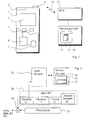
- Figure 1 shows a mobile user equipment that may be used in the embodiments of the present invention. More particularly, Figure 1 is a partially sectioned view of a mobile station 1 that may be used for communication over a wireless interface.
- the mobile station 1 may be adapted to communicate with a transceiver entity of the mobile communication network.
- the transceiver entity may comprise a base station (BTS) 10 of the cellular system or any other appropriate element with which the mobile station may communicate with over a wireless interface.
- BTS base station
- Possible transceivers entities are known and are thus not illustrated or described in any greater detail herein.
- the mobile station 1 may be provided with user interface means comprising a display 2 and input means.
- user interface means comprising a display 2 and input means.
- the skilled person is familiar with the user interface of a mobile station and therefore these will not be described in more detail herein.
- the input means may be formed by control buttons 3 or they may include e.g. voice activation or touch screen means and so on.
- the mobile station 1 may also be provided with communication interface means such as antenna means for communication with the transceiver entity 10.
- the antenna means may comprise an external antenna element 4, or then built-in or integrated antenna means may be used. It should be appreciated that antenna means are not an essential requirement in the embodiments of the present invention.
- the mobile station 1 is adapted to facilitate use thereof for electronic transactions and for exchange of confidential user information between the mobile station and a remote party.
- the user of the mobile station 1 may pay for various goods and/or services by means of the mobile station 1 or access various banking services by the mobile station 1.
- the mobile station 1 may be provided with a credit card type transaction facility or account means wherein the user may load money. The balance can then be deducted from the account means whenever a payment is made.
- the mobile station 1 may also be used for transactions that associate with negotiating a purchase of goods and/or services, receiving a receipt of a purchase or with any other operation where information associated with a transaction needs to be exchanged between the user and another party. Examples of other possibilities include use of the mobile station 1 for transactions that associate betting or insurance services. Possible transaction data processing means will be described in more detail with reference to Figure 2 after the following description of the other elements of the Figure 1 arrangement.
- the mobile station 1 is shown to comprise a processor means 6 and a data storage means 7.
- the processor means 6 is for processing and/or controlling transactions between the mobile station and other parties.
- the processor means 6 may be integrated with at least one other processor function of the mobile station 1.
- the processor means may alternatively be adapted to process data that associates with the transaction processing function only.
- the data storage means 7 may also be either integrated with the other functions of the mobile station 1 or be assigned solely for the transaction data processing functions. Separation of the transaction functions from other functions of the mobile station 1 may be preferred e.g. for security or usability reasons.
- the above referenced account means may be implemented by means of the data storage means 7.
- Figure 1 shows an arrangement where said other party comprises a service provider entity 12.
- the mobile user equipment 1 may be a mobile station that subscribes to a mobile communication network. In such a case communication between the network and the mobile station 1 occurs over a wireless interface 11, as is indicated by the double headed arrow.
- the communication network may thus provide a communication media between the mobile station 1 and the service provider entity 12 for the electronic transactions.
- Communication over the wireless interface between the mobile station and a base station may be based on any appropriate technique and wireless communication protocol.
- the possible protocols include, without limiting to these, a Short Message Service message (SMS), WAP (wireless application protocol) messages, email messages or any other messages that are based on the Internet protocol (IP).
- SMS Short Message Service message
- WAP wireless application protocol
- IP Internet protocol
- the service provider entity 12 may comprise a site 14 that may comprise a page that has been implemented based e.g. on an appropriate markup language.
- the possible site implementations are known by the person skilled in the art. Examples of the markup languages include WML (Wireless Markup Language), HTML (Hypertext Markup Language), and XHTML (extended hypertext markup language).
- the mobile station 1 may load data from the markup language page 14.
- the user may be enabled to request or download e.g. an order form or questionnaire from the site 14.
- the service provider entity 12 may push data towards the user e.g. by means of a server 13.
- Data may be transported between the mobile station and the service provider entity 12 based on an appropriate messaging protocol.
- FIG. 2 discloses a possible architecture for a system providing means for modifying the operation of an electronic wallet function in accordance with an embodiment of the present the invention.
- the electronic wallet function is designated by block 20.
- the electronic wallet block 20 is shown to comprise different subfunction blocks 21 to 24. These function blocks are shown to illustrate that an electronic transaction facility may provide several different usage scenarios and that these may be implemented by means of different functions of the wallet block 20. It shall be appreciated that these functions are not necessary in all applications. Other subfunctions may also be provided in the wallet block 20.
- Figure 2 shows blocks such as 'provision' 21, 'tickets' 22, 'receipt' 23 and 'dynamic template' 24.
- the provision block 21 refers to an ability of the mobile station 1 to update its own configuration based on information stored in the wallet function.
- the provision block 21 may contain required user information or be enabled to access the user information.
- the user information may be stored in the memory of the mobile station 1 or on a smart card. Examples of the smart cards include the subscriber identity module (SIM) or secondary smart card. Multiple sets of information may be stored in the storage. For example, credit card data may be stored for two different credit card companies.
- SIM subscriber identity module
- the tickets function block 22 refers to entries that result from a transaction. These entries may represent a certain value that may be used for another transaction. For example, an entrance ticket can be acquired to the mobile station via a wireless connection from a ticket issuer. The ticket may then be redeemed later on at an entrance gate thereby enabling use of the mobile station as an authorisation device for the entrance.
- the function block receipt 23 may be for processing information associated with a proof of transaction.
- the template function block 24 may be for storing information based on which the way the wallet function interacts with its environment can be modified.
- the dynamic template block 24 may contain information regarding rules, references, parameters and so on that are required for the operation of the electronic wallet function. That is, the information stored in the dynamic template block 24 can be used in the control of the electronic wallet function.
- FIG. 2 shows also three function blocks 28, 29 and 30. These blocks will be referred to commonly in the following by definition electronic wallet management function. At least a part of the functionality of the electronic wallet management function may be controlled by the management service provider 12 of Figure 1.
- Browser block 26 provided in the mobile station is also shown.
- the browser 26 may be used by the user for communication with the server of the service provider.
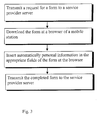
- the user may thus use the browser to pull i.e. download a form from a service provider server or similar source.
- the user equipment may e.g. fetch an order form from the server, fill it in and transmit the completed order form back to the server to order goods specified in the form.
- the user may also use the browser for searching possible new service providers, goods and/or services he may be interested in.
- Figure 2 shows also a service provider function block 12.
- the service provider function is shown to include a further block 14 that designates the form the user may download by means of the browser function 26.
- the form is shown to include data fields 15 to be filed in by the user equipment 1.
- Information that may need to be inserted in a form may include, for example, the name and address of the user, credit card number, passport number, telephone number, personal identity code and so on. This information may be stored in the wallet block 20.
- the wallet function is adapted to insert information in correct data fields 15 of the form.
- the automatic insertion of information is accomplished by the wallet function, the user may experience this as it would be done by the browser 26.
- the filling may alternatively be accomplished by the browser function that is adapted to analyse the received data entity containing a document that requires insertion of information and based on said analysis to fill the required information.
- the browser function may also launch a Electronic Commerce Modelling Language (ECML) parser of the wallet function 20 to fill in the required data in the form received from the service provider server.
- ECML Electronic Commerce Modelling Language
- the ECML parser is adapted to identify ECML modelling language fields in a downloaded content page and to fill these fields with appropriate information available for the wallet function. That is, the parser may e.g. detect a field 'address, home' and look if user information tied to this field is available. If the information is available, the parser fills the field with the data and continues to next field.
- ECML Electronic Commerce Modelling Language
- the communication between the mobile station and the service provider may be based on standardised data entities.
- An example of such data entities is an electronic data card based on the so called the Electronic Commerce Modelling Language (ECML).
- ECML is an open specification that is indented for use in the exchange of purchase related information such as order and payment information in the World Wide Web (WWW).
- WWW World Wide Web
- the EMCL defines also a way how specific field information like names, addresses and credit card information can be formatted and transported in the WWW in a standardised manner.
- the ECML data card format can be used for the transportation of information between the service provider entity and the mobile station.
- the mobile station may be adapted to automatically recognise that the incoming data comprises a ECML data card form and to automatically fill in the data fields thereof in response to this recognition.
- the electronic business card content type that is sometimes referred to as digital business card content type, is known by the skilled person.
- the electronic business cards are designed to be used instead of conventional business cards and may be used for transmitting and interchanging contact information and other information regarding a person or a group of persons to a user terminal.
- the user terminal may be an Internet enabled computer terminal, a mobile station, hand held organiser, personal information manager, personal data assistant, pager, fax, office equipment, and so on. That is, the user terminal may be any device capable of processing data in electronic form.
- the destination terminal may also store the information it received on the electronic business card.
- the data that may be transmitted on conventional electronic business cards may include simple text, and also elements like pictures, company logos, Web addresses, and so on.
- vCard An example of the electronic business card applications available for the public is marketed under name 'vCard'.
- the content type vCard is a mandatory feature.
- the vCard may be implemented on a WAP/WWW page as an object. If data is loaded to a WAP page at the service provider server, the fields of the vCard content type are mapped to WAP page.
- a still further example of formats that may be used for the data entity is a format based on an appropriate electronic calendar format.
- An example of the electronic calendar formats is the vCal.
- a data entity can be adapted to carry certain type of information in a certain data field thereof. Therefore it is possible to adapt the mobile station to recognise the specific fields and to insert appropriate information to the fields.
- Information may be inserted in the fields of the electronic data card e.g. in the following manner: Field Content Example NAME Name of the user plus any other identity information that needs to be known "John Smith” Content
- a data field including e.g. a credit card number "Card No”; "expiry date” Address Delivery address information "Street n, city xyz” KEY Signature F4f9hergn7hgsaw7fa 87gUyg8gytv4IuFyt
- the signature provides additional security for the data transportation and against fraudulent use of e.g. credit card numbers.
- the digital signature may be based on any appropriate authorisation technique, such as public and/or private keys. The skilled person is aware of these techniques and they will not be explained in more detail herein.
- the insertion of data in the data fields is authorised based on an identification code.
- the identification code may be a code that associates with the user equipment.
- the user equipment verifies internally that the automatic information insertion procedure is allowed (see Figure 4).
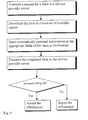
- user equipment may be identified by the service provider for the authentication purposes based on the identification code (see Figure 5).
- the authorisation may also be based on identity codes such as a personal identity number (PIN) or a unique product code assigned for each user equipment, such as the IMEI (International Mobile station Equipment Identity), the international mobile subscriber identity (IMSI) code and so on.
- PIN personal identity number
- IMEI International Mobile station Equipment Identity
- IMSI international mobile subscriber identity
- Figure 4 illustrates a verification operation that is accomplished at the user equipment.
- the arrangement may be such that the PIN code of the user equipment or a user specific PIN code is required for the authorisation of the automatic form filling.
- the user equipment may ask for the PIN code every time the controller of the wallet function recognises that a form is to be filled in.
- the arrangement may also be such that automatic form filling is in an authorised state if the PIN code was input when the user equipment was switched on or if the PIN code has been input within a predefined time before the automatic filling is required.
- Each transaction may also require the PIN to be inserted to make sure that the user has accepted the specific transaction.
- the acceptance of the automatic form filling may be asked each time from the user who then inputs the PIN into the user equipment.
- the data fields of the form may then be filled in.
- a digital signature may also be attached to the form, if it has a field for it.
- the server may then check the signature to see that the user has accepted the transaction and to verify the user identity. It is thus possible to use both of the methods illustrated by Figures 4 and 5 for a single form filling operation.
- the form itself includes a security indicator that is verified at the user equipment. If the form is determined as being sent by a trusted party, the wallet function of the user equipment automatically fills in the form.
- the security indication may comprise e.g. a key of a key pair, wherein the other key associates with the user equipment.
- the user may be provided with a possibility to fill in the form manually.
- Figure 5 shows an embodiment where the authorisation is arranged to occur at the service provider.
- the wallet function may attach an identification code such as an appropriate equipment identifier to the form.
- the service provider may then compare the identification code with a record of codes. Based on the verification the service provider may then either accept or reject the information supplied on the form.
- the service provider may have been provided with information associated with the identification code e.g. by the network operator the user equipment subscribes to.
- the user may also provide the code to the service provider e.g. when signing a service agreement or when using the service for the first time.
- the user has a dedicated filling function somewhere in the communication network.
- the dedicated filling function may be a server that is adapted to perform the filling operation for the user.
- the user may simply redirect the form to the server.
- the server may then ask the user for approval, although this is not necessary in all embodiments.
- the server fills in the form and sends it to the other party.
- Figure 6 illustrates an embodiment wherein transaction information can be inserted into a form or similar data entity based on information available in another form.
- the information may be copied from a first form to a second form at the user equipment.
- the user is freed from manual insertion of information that is already available in electronic format.
- the user may be freed from inserting same information twice. If a form received at the user equipment included information required by another form the user does not need to fill in the information at all. It is enough if he/she copies the information from one form to another form or several other forms.
- Figure 6 shows an embodiment wherein shipping information is copied from a shipping particulars form to a billing particulars form (or vice versa or to a third form).
- the boxes 61, 62 and 63 illustrate displays that are shown to the user by display means of the user equipment.
- the displays 61 and 62 are for asking a permission to copy the information from the two different forms.
- Display 63 is for confirming what information is to be copied.
- the two forms may include one or more field that associate with the same information (e.g. address, product ID, order No. and so on).
- the shipping details and billing details forma may contain at least one identical information field.
- the user may select by display 63 one or more fields that is to be copied e.g. from the form 61 to form 62.
- the user may select a field of the form 62 to filled in and if the user equipment detects that the information is already available at the form 61 the user equipment may display a confirmation query 'COPY FROM BILLING DETAILS?'
- the user may also select whether all information from a form is copied to another form or only selected information is copied. If the user opt to copy only selected fields the field may be displayed to him/her one by one, and the user needs to confirm the copying for each field. After copying a field from the billing details the user equipment returns to shipping details to enable filling in of a next field. If all fields of the shipping details form are to be filled based on information on the billing details form, said fields are filled in with the copied information before the user equipment returns to the shipping details display.
- the user equipment may prompt for a confirmation before replacing any old information.
- the user equipment may also check if the information is available before continuing the information insertion procedure. If a field is empty at the source document (e.g. at the billing detail form), no query is launched.
- the mobile station 1 be provided with a wireless transmitter and/or receiver module 5.
- the module 5 is not for communication with the base station 10 of the cellular communication system, but is instead for the provision of a local communication link with a co-operative device.
- the data forms or similar entities are not transmitted between the user equipment 1 and the service provider via the communication network. Instead, the communication occurs via local wireless links.
- the module 5 may be based on use of infrared links, short range radio links, and so on.
- the infrared link may be based e.g. on the IrDA.
- the IrDA is a standard defined by Infrared Data Association.
- the short range radio link may be based e.g. on the BluetoothTM protocol.
- BluetoothTM refers to a technology specification by Bluetooth special interest group (SIG) for small factor, low-cost, short range radio links (SRRL) between various devices provided with a BluetoothTM wireless modules.
- SIG Bluetooth special interest group
- SRRL short range radio links
- Another example of the short range interfaces is based on technology used for the so called contactless cards or proximity cards.
- a short range link for proximity cards is defined e.g. by the International Standardisation Organisation (ISO) specification No. ISO 14443.
- the user equipment uses different communication means for the transportation of the form or other information entity for the reception and transmission thereof.
- the user equipment receives the information entity via a first type of interface and returns the information entity via a second type of interface.
- the form may be provided to the user equipment by means of a WAP communication.
- the completed form may then be returned via BluetoothTM interface.
- the information entity may be filled in accordance with predefined set of instructions.
- the user equipment may be provided with a user profile based on which different events may be responded differently.
- the instructions may e.g. define what information is to be inserted in the information entity in response to an event and which fields are to be left blank.
- the instructions may also define the source of information to be used for a certain type of information entities, the level of "privacy" to be used for different information entities and so on.
Landscapes
- Business, Economics & Management (AREA)
- Engineering & Computer Science (AREA)
- Accounting & Taxation (AREA)
- Strategic Management (AREA)
- Physics & Mathematics (AREA)
- General Business, Economics & Management (AREA)
- General Physics & Mathematics (AREA)
- Theoretical Computer Science (AREA)
- Computer Networks & Wireless Communication (AREA)
- Mobile Radio Communication Systems (AREA)
- Financial Or Insurance-Related Operations Such As Payment And Settlement (AREA)
Applications Claiming Priority (2)
| Application Number | Priority Date | Filing Date | Title |
|---|---|---|---|
| GB0105265A GB2372904B (en) | 2001-03-02 | 2001-03-02 | Electronic transactions |
| GB0105265 | 2001-03-02 |
Publications (2)
| Publication Number | Publication Date |
|---|---|
| EP1237134A2 true EP1237134A2 (de) | 2002-09-04 |
| EP1237134A3 EP1237134A3 (de) | 2006-12-06 |
Family
ID=9909899
Family Applications (1)
| Application Number | Title | Priority Date | Filing Date |
|---|---|---|---|
| EP02251180A Ceased EP1237134A3 (de) | 2001-03-02 | 2002-02-21 | Elektronische Transaktionen |
Country Status (4)
| Country | Link |
|---|---|
| US (2) | US7885686B2 (de) |
| EP (1) | EP1237134A3 (de) |
| JP (1) | JP2002351833A (de) |
| GB (1) | GB2372904B (de) |
Cited By (7)
| Publication number | Priority date | Publication date | Assignee | Title |
|---|---|---|---|---|
| US7349871B2 (en) | 2002-08-08 | 2008-03-25 | Fujitsu Limited | Methods for purchasing of goods and services |
| US7353382B2 (en) | 2002-08-08 | 2008-04-01 | Fujitsu Limited | Security framework and protocol for universal pervasive transactions |
| US7606560B2 (en) | 2002-08-08 | 2009-10-20 | Fujitsu Limited | Authentication services using mobile device |
| US7784684B2 (en) | 2002-08-08 | 2010-08-31 | Fujitsu Limited | Wireless computer wallet for physical point of sale (POS) transactions |
| US7801826B2 (en) | 2002-08-08 | 2010-09-21 | Fujitsu Limited | Framework and system for purchasing of goods and services |
| US7822688B2 (en) | 2002-08-08 | 2010-10-26 | Fujitsu Limited | Wireless wallet |
| US7877605B2 (en) | 2004-02-06 | 2011-01-25 | Fujitsu Limited | Opinion registering application for a universal pervasive transaction framework |
Families Citing this family (24)
| Publication number | Priority date | Publication date | Assignee | Title |
|---|---|---|---|---|
| GB2372904B (en) * | 2001-03-02 | 2004-09-08 | Nokia Mobile Phones Ltd | Electronic transactions |
| US7822621B1 (en) | 2001-05-16 | 2010-10-26 | Perot Systems Corporation | Method of and system for populating knowledge bases using rule based systems and object-oriented software |
| US7236940B2 (en) | 2001-05-16 | 2007-06-26 | Perot Systems Corporation | Method and system for assessing and planning business operations utilizing rule-based statistical modeling |
| US7831442B1 (en) | 2001-05-16 | 2010-11-09 | Perot Systems Corporation | System and method for minimizing edits for medical insurance claims processing |
| US7216088B1 (en) | 2001-07-26 | 2007-05-08 | Perot Systems Corporation | System and method for managing a project based on team member interdependency and impact relationships |
| US7313531B2 (en) | 2001-11-29 | 2007-12-25 | Perot Systems Corporation | Method and system for quantitatively assessing project risk and effectiveness |
| US20040127256A1 (en) * | 2002-07-30 | 2004-07-01 | Scott Goldthwaite | Mobile device equipped with a contactless smart card reader/writer |
| US20040230489A1 (en) * | 2002-07-26 | 2004-11-18 | Scott Goldthwaite | System and method for mobile payment and fulfillment of digital goods |
| ITRM20030311A1 (it) * | 2003-06-23 | 2004-12-24 | Piero Protti | Metodo per l'autorizzazione di delegazioni di pagamento, |
| US20050097106A1 (en) * | 2003-10-29 | 2005-05-05 | Lineman David J. | Methods, systems and computer program products for multi-protocol self-service application access |
| US7659915B2 (en) * | 2004-04-02 | 2010-02-09 | K-Nfb Reading Technology, Inc. | Portable reading device with mode processing |
| US20110071949A1 (en) * | 2004-09-20 | 2011-03-24 | Andrew Petrov | Secure pin entry device for mobile phones |
| KR100599174B1 (ko) * | 2004-12-16 | 2006-07-12 | 삼성전자주식회사 | 프로파일 정보를 이용한 서비스 제공방법 및 서비스제공시스템 |
| WO2006085805A1 (en) * | 2005-02-14 | 2006-08-17 | Smarttrust Ab | Method for performing an electronic transaction |
| US7221949B2 (en) * | 2005-02-28 | 2007-05-22 | Research In Motion Limited | Method and system for enhanced security using location-based wireless authentication |
| US8929857B2 (en) | 2007-06-28 | 2015-01-06 | Kajeet, Inc. | Policy management of electronic devices |
| US7945238B2 (en) | 2007-06-28 | 2011-05-17 | Kajeet, Inc. | System and methods for managing the utilization of a communications device |
| US9846897B2 (en) * | 2008-11-13 | 2017-12-19 | At&T Intellectual Property I, L.P. | Systems and methods for providing direct shipping to mobile subscribers |
| WO2010142839A1 (en) * | 2009-06-12 | 2010-12-16 | Nokia Corporation | Method and apparatus for user interaction |
| US9137389B2 (en) | 2011-11-08 | 2015-09-15 | Kajeet, Inc. | Master limits and filters for electronic devices |
| US8918080B2 (en) | 2012-01-17 | 2014-12-23 | Kajeet, Inc. | Mobile device management |
| US20140181691A1 (en) * | 2012-12-20 | 2014-06-26 | Rajesh Poornachandran | Sharing of selected content for data collection |
| US10757267B2 (en) | 2013-06-13 | 2020-08-25 | Kajeet, Inc. | Platform for enabling sponsors to sponsor functions of a computing device |
| US10313532B2 (en) | 2013-06-13 | 2019-06-04 | Kajeet, Inc. | Platform for enabling users to sign up for sponsored functions on computing devices |
Family Cites Families (59)
| Publication number | Priority date | Publication date | Assignee | Title |
|---|---|---|---|---|
| US5671436A (en) * | 1991-08-21 | 1997-09-23 | Norand Corporation | Versatile RF data capture system |
| HU215619B (hu) * | 1993-06-15 | 1999-01-28 | Celltrace Communications Limited | Távközlési rendszer, továbbá előfizetői egységet távközlési rendszerben vezérlő modul |
| FR2707408B1 (fr) * | 1993-07-09 | 1995-08-18 | Cga Hbs | Procédé pour la transmission rapide et sûre de données contenues dans une carte à puce lors d'une télétransaction. |
| US5867688A (en) * | 1994-02-14 | 1999-02-02 | Reliable Transaction Processing, Inc. | Data acquisition and retrieval system with wireless handheld user interface |
| US6771981B1 (en) * | 2000-08-02 | 2004-08-03 | Nokia Mobile Phones Ltd. | Electronic device cover with embedded radio frequency (RF) transponder and methods of using same |
| US5687385A (en) * | 1995-06-01 | 1997-11-11 | Epi | Data entry using linked lists |
| US5764899A (en) * | 1995-11-13 | 1998-06-09 | Motorola, Inc. | Method and apparatus for communicating an optimized reply |
| US5864757A (en) * | 1995-12-12 | 1999-01-26 | Bellsouth Corporation | Methods and apparatus for locking communications devices |
| US5878397A (en) * | 1996-07-10 | 1999-03-02 | Telefonaktiebolaget L M Ericsson (Publ) | Method for transporting short messages in a wireless telecommunications system |
| EP0848361B1 (de) * | 1996-12-13 | 1999-08-25 | Telefonaktiebolaget L M Ericsson (Publ) | Verfahren und System zur Durchführung von Geldtransaktionen |
| SE508844C2 (sv) * | 1997-02-19 | 1998-11-09 | Postgirot Bank Ab | Förfarande för behörighetskontroll med SIM-kort |
| DE19716068A1 (de) * | 1997-04-17 | 1998-10-22 | Giesecke & Devrient Gmbh | Verfahren zur Erzeugung eines Guthabens mittels eines vorausbezahlten Wertgutscheins |
| AU8113798A (en) * | 1997-06-13 | 1998-12-30 | Gemplus S.C.A. | Smart card, cordless telephone, system and method for access and communication by internet |
| DE19739792A1 (de) * | 1997-09-10 | 1999-03-11 | Siemens Ag | Dezentrale Ausführung von Funktionen/Diensten eines Mobilfunksystems |
| DE19747438C2 (de) * | 1997-10-28 | 1999-11-18 | Ibm | Verfahren zum Abrufen von benutzerspezifizierten Informationen mittels eines Mobiltelefons |
| US6192380B1 (en) | 1998-03-31 | 2001-02-20 | Intel Corporation | Automatic web based form fill-in |
| US6195533B1 (en) * | 1998-05-27 | 2001-02-27 | Glenayre Electronics, Inc. | Method for storing an application's transaction data in a wireless messaging system |
| FR2779896B1 (fr) * | 1998-06-15 | 2000-10-13 | Sfr Sa | PROCEDE POUR PAYER A DISTANCE, AU MOYEN D'UN RADIOTELEPHONIQUE MOBILE, l'ACQUISITION D'UN BIEN ET/OU D'UN SERVICE ET SYSTEME ET RADIOTELEPHONE MOBILE CORRESPONDANTS |
| ATE442746T1 (de) * | 1998-09-10 | 2009-09-15 | Swisscom Ag | Verfahren zum kaufen von waren oder dienstleistungen mit einem mobiltelefon |
| FR2785135B1 (fr) * | 1998-10-22 | 2000-12-29 | Sfr Sa | Procede de lancement d'une application par un terminal, sous commande d'un module d'identification d'abonne, module d'identification d'abonne et terminal correspondants |
| US6910179B1 (en) * | 1998-11-10 | 2005-06-21 | Clarita Corporation | Method and apparatus for automatic form filling |
| FR2787273B1 (fr) * | 1998-12-14 | 2001-02-16 | Sagem | Procede de paiement securise |
| US6643824B1 (en) * | 1999-01-15 | 2003-11-04 | International Business Machines Corporation | Touch screen region assist for hypertext links |
| US20020055847A1 (en) * | 1999-01-20 | 2002-05-09 | Masahiro Nakano | Method and apparatus of providing secure transactions on a network |
| US8117125B1 (en) * | 1999-06-11 | 2012-02-14 | Citicorp Developement Center, Inc. | Method and system for controlling certificate based open payment transactions |
| JP4503143B2 (ja) * | 1999-07-14 | 2010-07-14 | パナソニック株式会社 | 電子チケットシステムとサービスサーバとモバイル端末 |
| AU7391100A (en) * | 1999-08-15 | 2001-03-13 | Lionel Nicholas Mantzivis | Electronic commerce system |
| US7343351B1 (en) * | 1999-08-31 | 2008-03-11 | American Express Travel Related Services Company, Inc. | Methods and apparatus for conducting electronic transactions |
| SE522260C2 (sv) * | 1999-10-01 | 2004-01-27 | Ericsson Telefon Ab L M | Metod, system och säkerhetsadapter för att exekvera säker dataöverföring i ett trådlöst nät |
| US6944669B1 (en) * | 1999-10-22 | 2005-09-13 | America Online, Inc. | Sharing the personal information of a network user with the resources accessed by that network user |
| ATE232327T1 (de) * | 1999-10-25 | 2003-02-15 | Swisscom Mobile Ag | Zahlungstransaktionsverfahren und zahlungstransaktionssystem |
| DE59913180D1 (de) * | 1999-11-16 | 2006-04-27 | Swisscom Mobile Ag | Produktebestellungsverfahren und system |
| GB2356511B (en) * | 1999-11-18 | 2004-06-23 | Hewlett Packard Co | Information capture and processing |
| DE60032863D1 (de) * | 1999-11-30 | 2007-02-22 | Citibank Na | System und Verfahren zur Durchführung einer elektronischen Transaktion mit einer elektronischen Geldbörse mittels eines Transaktionproxys |
| JP2001160108A (ja) * | 1999-12-03 | 2001-06-12 | Nec Corp | 電子決済システム、電子決済方法、決済端末、支払端末および決済センタ |
| SE518290C2 (sv) * | 1999-12-29 | 2002-09-17 | Ericsson Telefon Ab L M | Bärbar kommunikationsapparat med en optisk eller magnetisk läsanordning |
| US6928623B1 (en) * | 1999-12-30 | 2005-08-09 | International Business Machines Corporation | Method and system for selecting a target window for automatic fill-in |
| US6845448B1 (en) * | 2000-01-07 | 2005-01-18 | Pennar Software Corporation | Online repository for personal information |
| FI112286B (fi) * | 2000-01-24 | 2003-11-14 | Smarttrust Systems Oy | Maksupalvelulaitteisto ja menetelmä turvalliseksi maksamiseksi |
| AU2001243473A1 (en) * | 2000-03-07 | 2001-09-17 | American Express Travel Related Services Company, Inc. | System for facilitating a transaction |
| EP1277180A2 (de) * | 2000-04-24 | 2003-01-22 | Visa International Service Association | Beglaubigungsdienst für online-bezahler |
| US6760841B1 (en) * | 2000-05-01 | 2004-07-06 | Xtec, Incorporated | Methods and apparatus for securely conducting and authenticating transactions over unsecured communication channels |
| US20020065831A1 (en) * | 2000-06-29 | 2002-05-30 | Depaolo David John | Method and apparatus for providing automated form preparation and processing |
| US7933589B1 (en) * | 2000-07-13 | 2011-04-26 | Aeritas, Llc | Method and system for facilitation of wireless e-commerce transactions |
| US20020025796A1 (en) * | 2000-08-30 | 2002-02-28 | Taylor William Stuart | System and method conducting cellular POS transactions |
| AU2001290829A1 (en) * | 2000-09-14 | 2002-03-26 | Gemplus | Smart device facilitating computer network interaction |
| US7043231B2 (en) * | 2000-09-22 | 2006-05-09 | Ericsson Inc. | System, method and apparatus for polling telecommunications nodes for real-time information |
| AU2002213430A1 (en) * | 2000-09-28 | 2002-04-08 | Ipdev Co. | Method for simplified one-touch ordering of goods and services from a wired or wireless phone or terminal |
| US7337144B1 (en) * | 2000-09-28 | 2008-02-26 | Microsoft Corporation | Method and system for restricting the usage of payment accounts |
| US20020162009A1 (en) * | 2000-10-27 | 2002-10-31 | Shimon Shmueli | Privacy assurance for portable computing |
| US20060039564A1 (en) * | 2000-11-17 | 2006-02-23 | Bindu Rama Rao | Security for device management and firmware updates in an operator network |
| US20020077993A1 (en) * | 2000-12-18 | 2002-06-20 | Nokia Corporation | Method and system for conducting wireless payments |
| US20020112027A1 (en) * | 2000-12-18 | 2002-08-15 | Mchugh Adrian J | Method of providing user-related information between devices on a data network |
| US7242921B2 (en) * | 2000-12-29 | 2007-07-10 | Intel Corporation | Anonymous electronic transactions |
| US6931382B2 (en) * | 2001-01-24 | 2005-08-16 | Cdck Corporation | Payment instrument authorization technique |
| GB2372904B (en) | 2001-03-02 | 2004-09-08 | Nokia Mobile Phones Ltd | Electronic transactions |
| US6873851B2 (en) | 2001-05-03 | 2005-03-29 | International Business Machines Corporation | Method, system, and program for providing user location information for a personal information management system from transmitting devices |
| US7032003B1 (en) * | 2001-08-13 | 2006-04-18 | Union Gold Holdings, Ltd. | Hybrid replication scheme with data and actions for wireless devices |
| US7877082B2 (en) | 2004-05-06 | 2011-01-25 | Massachusetts Institute Of Technology | Combined short range radio network and cellular telephone network for interpersonal communications |
-
2001
- 2001-03-02 GB GB0105265A patent/GB2372904B/en not_active Expired - Lifetime
-
2002
- 2002-02-21 EP EP02251180A patent/EP1237134A3/de not_active Ceased
- 2002-02-26 US US10/083,169 patent/US7885686B2/en not_active Expired - Fee Related
- 2002-03-01 JP JP2002056386A patent/JP2002351833A/ja not_active Withdrawn
-
2010
- 2010-12-30 US US12/982,245 patent/US8447359B2/en not_active Expired - Fee Related
Cited By (7)
| Publication number | Priority date | Publication date | Assignee | Title |
|---|---|---|---|---|
| US7349871B2 (en) | 2002-08-08 | 2008-03-25 | Fujitsu Limited | Methods for purchasing of goods and services |
| US7353382B2 (en) | 2002-08-08 | 2008-04-01 | Fujitsu Limited | Security framework and protocol for universal pervasive transactions |
| US7606560B2 (en) | 2002-08-08 | 2009-10-20 | Fujitsu Limited | Authentication services using mobile device |
| US7784684B2 (en) | 2002-08-08 | 2010-08-31 | Fujitsu Limited | Wireless computer wallet for physical point of sale (POS) transactions |
| US7801826B2 (en) | 2002-08-08 | 2010-09-21 | Fujitsu Limited | Framework and system for purchasing of goods and services |
| US7822688B2 (en) | 2002-08-08 | 2010-10-26 | Fujitsu Limited | Wireless wallet |
| US7877605B2 (en) | 2004-02-06 | 2011-01-25 | Fujitsu Limited | Opinion registering application for a universal pervasive transaction framework |
Also Published As
| Publication number | Publication date |
|---|---|
| US7885686B2 (en) | 2011-02-08 |
| GB2372904A (en) | 2002-09-04 |
| EP1237134A3 (de) | 2006-12-06 |
| US8447359B2 (en) | 2013-05-21 |
| GB2372904B (en) | 2004-09-08 |
| US20020187772A1 (en) | 2002-12-12 |
| JP2002351833A (ja) | 2002-12-06 |
| GB0105265D0 (en) | 2001-04-18 |
| US20110167082A1 (en) | 2011-07-07 |
Similar Documents
| Publication | Publication Date | Title |
|---|---|---|
| US8447359B2 (en) | Electronic transactions | |
| US7848740B2 (en) | Electronic transactions | |
| EP1069539B1 (de) | Elektronisches Ticket, elektronische Börse und Informationsterminal | |
| EP1237133A2 (de) | Elektronische Transaktionen mittels einer drahtlosen Schnittstelle | |
| EP1281265B1 (de) | Verfahren zur transaktionensermächtigung | |
| US20040030658A1 (en) | Electronic ticket, system for issuing electronic tickets, and devices for using and performing operations on electronic tickets | |
| US20030162565A1 (en) | Method for processing transactions by means of wireless devices | |
| WO2007012085A2 (en) | Mobile electronic transaction system | |
| US7017804B2 (en) | Method for providing identification data of a banking card to a user | |
| US7970653B2 (en) | Electronic authorisation | |
| EP1197929A2 (de) | Formatierte elektronische Transaktionen | |
| KR100432838B1 (ko) | 전자 화폐 처리 방법, 프로그램을 기록한 기록 매체 및 전자 화폐 카드의 처리 방법 | |
| FI108490B (fi) | Valtuutusinformaation võlittõminen | |
| KR100379659B1 (ko) | 이동통신 단말장치를 통한 신원 확인 방법 | |
| GB2367935A (en) | Exchanging transaction information using electronic data card format | |
| JP2002324219A (ja) | カード認証システム | |
| US20050246277A1 (en) | Transaction processing system | |
| KR100399776B1 (ko) | 이동통신 단말기를 이용한 신용카드 현금서비스 제공 방법 | |
| GB2359707A (en) | Secure network transactions | |
| EP1396139B1 (de) | Verfahren und Systeme zur Verbesserung der Sicherheit in einem Datenkommunikationsnetz | |
| KR20220049288A (ko) | 기업공용카드의 개인화 처리 방법 | |
| KR20050040083A (ko) | 휴대 단말기를 이용한 거래 내역 조회 방법 |
Legal Events
| Date | Code | Title | Description |
|---|---|---|---|
| PUAI | Public reference made under article 153(3) epc to a published international application that has entered the european phase |
Free format text: ORIGINAL CODE: 0009012 |
|
| 17P | Request for examination filed |
Effective date: 20020302 |
|
| AK | Designated contracting states |
Kind code of ref document: A2 Designated state(s): AT BE CH CY DE DK ES FI FR GB GR IE IT LI LU MC NL PT SE TR |
|
| AX | Request for extension of the european patent |
Free format text: AL;LT;LV;MK;RO;SI |
|
| PUAL | Search report despatched |
Free format text: ORIGINAL CODE: 0009013 |
|
| AK | Designated contracting states |
Kind code of ref document: A3 Designated state(s): AT BE CH CY DE DK ES FI FR GB GR IE IT LI LU MC NL PT SE TR |
|
| AX | Request for extension of the european patent |
Extension state: AL LT LV MK RO SI |
|
| RIC1 | Information provided on ipc code assigned before grant |
Ipc: H04Q 7/22 20060101ALI20061027BHEP Ipc: G07F 19/00 20060101AFI20020425BHEP |
|
| 17Q | First examination report despatched |
Effective date: 20070621 |
|
| AKX | Designation fees paid |
Designated state(s): AT BE CH CY DE DK ES FI FR GB GR IE IT LI LU MC NL PT SE TR |
|
| STAA | Information on the status of an ep patent application or granted ep patent |
Free format text: STATUS: THE APPLICATION HAS BEEN REFUSED |
|
| 18R | Application refused |
Effective date: 20090218 |