EP1237121A2 - Neuronalnetzwerkimplementierung in einer Datenbank - Google Patents
Neuronalnetzwerkimplementierung in einer Datenbank Download PDFInfo
- Publication number
- EP1237121A2 EP1237121A2 EP02251260A EP02251260A EP1237121A2 EP 1237121 A2 EP1237121 A2 EP 1237121A2 EP 02251260 A EP02251260 A EP 02251260A EP 02251260 A EP02251260 A EP 02251260A EP 1237121 A2 EP1237121 A2 EP 1237121A2
- Authority
- EP
- European Patent Office
- Prior art keywords
- neural network
- database system
- representation
- perform
- data
- Prior art date
- Legal status (The legal status is an assumption and is not a legal conclusion. Google has not performed a legal analysis and makes no representation as to the accuracy of the status listed.)
- Withdrawn
Links
Images

Classifications
-
- G—PHYSICS
- G06—COMPUTING OR CALCULATING; COUNTING
- G06N—COMPUTING ARRANGEMENTS BASED ON SPECIFIC COMPUTATIONAL MODELS
- G06N3/00—Computing arrangements based on biological models
- G06N3/02—Neural networks
- G06N3/10—Interfaces, programming languages or software development kits, e.g. for simulating neural networks
- G06N3/105—Shells for specifying net layout
Definitions
- the invention relates to implementing neural networks in database systems.
- a neural network (also referred as an artificial neural network) includes a relatively large number of interconnected processing elements (analogous to neurons) that are tied together with weighted connections (that are analogous to synapses).
- the term "neuron” refers to a brain cell of a human, and a “synapse” refers to the gap or connection between two neurons.
- An artificial neural network is designed to mimic a biological neural network made up of neurons and synapses. Artificial neural networks can be used to perform a number of different tasks, such as pattern recognition (e.g., image, character, and signal recognition) and other tasks. Advantages of artificial neural networks include their ability to learn and their ability to produce relatively more accurate results (than those produced by standard computer systems) despite distortions in input data.
- a typical artificial neural network has three layers: an input layer, a hidden layer, and an output layer.
- the input layer receives signals from outside the neural network, with the signals passed to the hidden layer, which contains interconnected neurons for pattern recognition and interpretation. The signals are then directed to the output layer.
- neurons are each assigned a weight, which can be changed by performing training procedures.
- a training data set is used. Once a neural network is trained, the neural network can be used to perform pattern recognition or other tasks on a target data set, which contains the target pattern or object to be processed by the neural network.
- the invention resides in a database system comprising:
- the storage module(s) preferably store training data, the processor(s) being adapted to train the neural network by modifying the neural network representation using the training data. In particular, training is achieved by adjusting weights of the neural network representation, the weights being contained in a blob and the blob representing a hidden layer of the neural network representation.
- the storage module(s) further store answer data, the processor(s) being adapted to train the neural network representation using the training data and the answer data, the answer data containing expected answers when the training data is applied as input to the neural network representation.
- the relational table is capable of storing data according to predefined data types, the neural network representation being one of the predefined data types.
- the database system comprises a plurality of storage modules, the processor(s) comprising a plurality of nodes each capable of accessing a corresponding storage module, the neural network representation being duplicated in each of the storage modules.
- a plurality of processors perform the operation in parallel.
- the invention resides in a process of implementing a neural network, comprising:
- Invoking the one or more user-defined methods to perform the operation preferably comprises performing a pattern recognition operation, for example by invoking a first method to perform a pattern matching operation and a second method to train the neural network by adjusting weights of neural network elements in the representation.
- another method to configure the neural network may be invoked by specifying an input size, an output size, and a hidden layer size.
- the invention may also be defined in terms of a database system comprising:
- the invention may be defined as an article comprising at least one storage medium containing instructions that when executed cause a database system to:
- the instructions when executed preferably cause the database system to:
- Input data is preferably stores and applied to the neural network object to perform the pattern recognition operation.
- the neural network object may also be configured by specifying an input size, an output size, and a hidden layer size.
- Fig. 1 illustrates one example embodiment of a database system 10 that is coupled to a client system 14 over a data network 12.
- the data network 12 include a local area network (LAN), a wide area network (WAN), or a public network (such as the Internet).
- a user at the client system 14 is able to issue requests, such as Structured Query Language (SQL) statements or other standard database-query statements, to the database system 10 to extract data and to perform other tasks in the database system 10.
- SQL is one language of relational databases, and is defined by the American National Standards Institute (ANSI).
- a user is able to issue SQL statements from a user interface 16 in the client system 14.
- SQL statements to invoke neural network capabilities of the database system 10 can be issued by a user from the client terminal 14.
- the database system 10 includes multiple nodes 26A and 26B (two or more). In an alternative embodiment, the database system 10 can be a single-node system.
- the nodes 26A and 26B are coupled by an interconnect network 50, which is in turn connected to an interface node 20.
- the interface node 20 includes a query coordinator 22 to receive queries from the client system 14, to parse the received requests, and to generate access requests to one or more access modules 30 in corresponding nodes 26A, 26B.
- the interface node 20 also includes a network interface 24 that enables communications over the data network 12.
- Each access module 30 includes a database manager that creates, modifies, or deletes definitions of tables; inserts, deletes, or modifies rows within the tables; retrieves information from definitions and tables; and locks databases and tables.
- the access module is the access module processor (AMP), used in some TERADATA® database systems from NCR Corporation. Multiple AMPs can reside on each node 26.
- Each access module 30 sends input/output (I/O) requests to and receives data from a respective storage module 28 through a respective file system 32.
- storage module can refer to one or plural storage devices, such as hard disk drives, disk arrays, tape drives, and other magnetic, optical, or other media.
- an object (referred to as a neural network search object or NNSO) according to a predefined data type is stored in each storage module 28 to enable the implementation of a neural network in the database system 10.
- a neural network is a mathematical model that is implemented as a software routine or routines executable to recognize patterns or to perform other tasks.
- a neural network is "trained” to recognize patterns by presenting it correct and incorrect patterns and supplying feedback when patterns are recognized.
- the neural network model is stored in neural network search objects, which are stored in NNSO tables 34 stored in storage modules 28A and 28B.
- a "neural network object" refers to any object (e.g., file, data, software method, software routine or module, etc.) that represents a neural network and that is accessible by other components to perform operations (e.g., pattern recognition).
- each NNSO table 34 is a relational table in a relational database management system (RDBMS).
- RDBMS relational database management system
- Data types defined in many relational database management systems include relatively simple data types, such as integers, real numbers, and character strings.
- an object relational management database system enables the definition of "complex" data types to store such information in objects.
- the NNSO is an object of an object relational database management system.
- the NNSO is defined as a "simpler" data type in a relational database management system.
- other embodiments can employ other types of database systems in which user-defined methods or functions can be created to implement the neural network.
- the NNSO representing a neural network model or algorithm, is trained by using training data 36, also stored in the storage modules 28. Once trained, the NNSO is able to perform pattern recognition of input target data 38, also stored in the storage modules 28.
- a benefit of the arrangement shown in Fig.1 is that the NNSO table 34, training data 36, and target data 38 are stored on multiple storage modules that are independently accessible by corresponding nodes 26A, 26B.
- the neural network implemented with NNSOs distributed across the different nodes 26A, 26B can be executed in parallel to enhance performance. This is particularly advantageous where the pattern recognition involves relatively complex data, such as DNA sequences, images, and so forth.
- duplicate copies of the NNSO and NNSO table 34 are stored in the multiple storage modules 28, with different portions of the input target data 38 distributed across the multiple storage modules for parallel execution.
- the NNSO table 34 can be duplicated by the parallel logic to the different nodes in response to an SQL Select statement in which a comparison of the data in the NNSO table 34 is requested.
- the duplication of the NNSO table 34 is performed by a database optimizer program, which is responsible for selecting a "low cost" execution plan for a given query.
- a first method is a CONFIGURE_NET method 48, which is used for configuring the NNSO stored in the NNSO table 34.
- a TRAIN method 46 is used to train the NNSO in each storage module 28.
- a MATCH method 44 is used to match the target data 38 using the NNSO.
- Other methods can also be defined for neural network operations.
- the methods 44, 46, and 48 (and other methods) are initially stored in each storage module 28 and loaded into the node 26 for execution when called or invoked by a neural network routine 49 executable in each node 26.
- the various software routines, modules, or methods are executable on one or plural control units 40 in the node 26.
- the node 26 also includes a memory 42 that is coupled to the one or plural control units 40. Although illustrated as single components, the control unit 40 and memory 42 can be multiple components in other embodiments.
- a greater number of nodes can be used for implementing the neural network in accordance with some embodiments.
- the NNSO and associated methods are implementable on a single node in the database system 10.
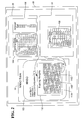
- Fig. 2 shows the NNSO table 34, training data 36, and target data 38 in more detail.
- the NNSO table 34 stores an NNSO 100, which contains training weights 102.
- the training weights are initially set to random or some other predetermined values.
- the training weights 102 are represented as a blob (binary large object).
- a blob is a large object having a collection of bytes, which in this case represent weights.
- the training weights 102 are represented in a different type of object or file.
- the training weights 102 are represented as a matrix. In the example of Fig. 2, the matrix size is nine rows by four columns. Further, in the example of Fig. 2, the input size of the NNSO is 9 inputs, and the output size is 1 output.
- a neural network also includes one or more hidden layers of neurons.
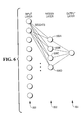
- a three-layered neural network model is shown in Fig. 6.
- the input layer 500 has nine input neurons to receive nine inputs, as defining by the NNSO 100.
- the hidden layer 502 (one hidden layer in this example) has a number of pattern neurons that are "fully" connected to the input layer neurons. "Fully” connected means that each input layer neuron is connected to each hidden layer or pattern neuron 506A, 506B, 506C, or 506D. Weights are applied to each connection between a pair of input layer neuron and hidden layer neuron 506.
- the four hidden layer neurons 506A-D are connected to one neuron (corresponding to the one output defined by the NNSO 100) in the output layer 504.
- Each column 110A, 110B, 110C, or 110D of the training weights matrix 102 shown in Fig. 2 contains the weights of connections between a respective pattern neuron 506 and the nine input layer neurons.
- the column 110A contains the nine weights of the nine connections between the pattern neuron 506A and the respective nine input layer neurons.
- the column 110B contains the weights of the connection between the pattern neuron 506B and the input layer neurons, and so forth.
- the hidden layer array is 4x1 (one hidden layer with four neurons). In other arrangements, an MxN hidden layer array can be employed, which indicates N layers each with M pattern neurons per layer.
- the inputs received by the input layer neurons are multiplied by respective weight values and provided to the pattern neurons 506A-506B.
- Each neuron 506 sums the received nine weighted inputs.
- the summed values are applied through a function (e.g., a non-linear function) to produce an output.
- the function can be a threshold function to determine whether the summed value is above or below a threshold to correspond to a true or false state.
- a neural network employing a "Backprop" algorithm is used.
- the Backprop algorithm enables input data to be propagated forward in the neural network for pattern recognition, and the feedback of failure information backwards for training purposes.
- other types of neural networks can be implemented with the neural network object 100.
- the value of the training weights 102 is set by using training data 36, which includes an input training table 104 (also referred to as the TRAINING_DATA table) and an expected answer set table 106 (also referred to as the ANSWER_SET table).
- the NNSO 100 is expected to produce an answer listed in the answer set table 106.
- the input training table 104 contains a number of rows corresponding to different DNA sequences. Based on the DNA sequences, the output is expected to be "0" (false) or "1" (true).
- the NNSO is trained to return a true value for certain types of DNA sequences and return false values for other DNA sequences.
- the NNSO can be trained to recognize other types of data (e.g., images, audio, multimedia, etc.)
- a target data table 108 (also referred as the TARGET_DATA table), which makes up the target data 38, is provided as input to the NNSO 100 for pattern matching.
- the target data table 108 includes several rows corresponding to different DNA sequences. Based on the training weights 102, the NNSO 100 will produce a true result for certain ones of the DNA sequences and produce a false result for other DNA sequences in the target database 108.
- each NNSO table 34 can be stored in each storage module 28.
- the multiple NNSO tables can store NNSOs associated with other types of input target data.
- one NNSO table is used for performing DNA sequence matching
- a second NNSO table is used for performing facial image matching
- a third NNSO table is used for performing vehicle matching
- each NNSO table 34 contains multiple NNSOs.
- one NNSO can be trained to detect for a first pattern in the target data 38, while another NNSO can be trained to detect for another pattern in the target data 38.
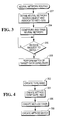
- Fig. 3 is a flow diagram of a process performed by the neural network routine 49 in each node 26.
- the neural network routine 49 first defines (at 202) the NNSO 100 and the associated methods 44, 46, and 48.
- the various tables 34, 104, 106, and 108 are configured (at 204) and the neural network is trained (by adjusting the training weights of the NNSO).
- the neural network routine determines if a request to perform matching has been received (at 206). For example, a user can send a request (e.g., in the form of an SQL SELECT statement) from the client terminal 14 (Fig. 1). Alternatively, the pattern matching can be performed in response to some other stimuli. If a request to perform matching is received, the neural network routine 49 performs (at 208) a match by calling the MATCH method 44, which matches the target data 38 using the NNSOs 100 stored in the tables 34 to produce output results.
- the parameter InputSize represents the number of inputs to the NNSO 100
- the parameter OutputSize represents the number of outputs
- the HiddenLayer array represents an array of interconnected pattern neurons, which are associated with training weights in the blob TrainingWeights.
- the CREATE TYPE statement binds the neural network into the database system 10 as a new data type.
- the neural network routine 49 creates (at 304) the CONFIGURE_NET method, which in one example embodiment can be performed by issuing the following SQL statement: CREATE METHOD CONFIGURE_NET(INTEGER, INTEGER, ARRAY [1..2] INTEGER).
- the CONFIGURE_NET method specifies the input size (InputSize), output size (OutputSize), and array size of the hidden layer.
- the TRAIN method is created (at 306) by issuing the following statement: CREATE METHOD TRAIN(STRING, STRING), where the first string represents the input training table 104 and the second string represents the answer set table 106.
- the MATCH method is created (at 308) by issuing the following statement:
- the input string to the MATCH method is the target data table 108, and the output is the boolean state true or false.
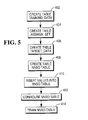
- the neural network routine 49 configures and trains various tables (204 in Fig. 3).
- the routine 49 creates (at 402) the TRAINING_DATA table 36 by issuing the following statement: CREATE TABLE TRAINING_DATA (ID string, SEQ string). An identifier (ID) is assigned to each DNA sequence (SEQ) in the TRAINING_DATA table.
- the ANSWER_SET table is created (at 404) by providing the following statement: CREATE TABLE ANSWER_SET (ANSWER Boolean).
- the ANSWER_SET table contains entries that have a true or false state.
- the TARGET_DATA table is created (at 406) by issuing the following statement: CREATE TABLE TARGET_DATA (ID string, SEQ string).
- the NNSO table 34 is created (at 408) by issuing the following statement: CREATE TABLE NNSO_TABLE (ID integer, DESCRIPTION string, NN NNSO).
- the NNSO table 34 is associated with an identifier (ID), a description (DESCRIPTION), and the NNSO having the type created at 302 in Fig. 4. Once the NNSO table is created, values can be inserted (at 410) into the NNSO table 34.
- this is accomplished by issuing the SQL INSERT statement: INSERT INTO NNSO_TABLE VALUES (1, "Backprop", NNSO()).
- the INSERT statement issued above inserts one NNSO into the NNSO table 34, with the neural network defined as the Backprop neural network.
- the SELECT statement invokes the MATCH method and performs a join of the NNSO from the NNSO table 34 with column(s) of the TARGET_DATA table 108.
- a join operation involves combining rows or other objects from plural tables. Data having characteristics of two or more patterns can be obtained by joining two or more NNSO searches (e.g., two or more NNSOs in each NNSO table) in a query.
- a neural network By implementing a neural network in a database system, such as a relational database management system, performance of the neural network is enhanced by taking advantage of efficient data access mechanisms that are present in such database systems. Further, in parallel database systems that have multiple processors capable of parallel access to data in the database system, the neural network performance is further enhanced by distributing the pattern searching across parallel processors.
- the parallel processors can be software routines executable on plural control units in a single node or in plural nodes.
- TERADATA® database system from NCR Corporation.
- the neural network can be defined as an object, such as an object in an object relational database management system.
- object relational database management system The definition of a neural network as an object in a database system simplifies neural network implementation.
- control unit includes various software routines or modules. Such software routines or modules are executable on corresponding control units.
- the various control units include microprocessors, microcontrollers, or other control or computing devices.
- a "controller” or “processor” refers to a hardware component, software component, or a combination of the two.
- a “controller” or “processor” can also refer to plural hardware components, software components, or a combination of hardware components and software components.
- the storage modules referred to in this discussion include one or more machine-readable storage media for storing data and instructions.
- the storage media include different forms of memory including semiconductor memory devices such as dynamic or static random access memories (DRAMs or SRAMs), erasable and programmable read-only memories (EPROMs), electrically erasable and programmable read-only memories (EEPROMs) and flash memories; magnetic disks such as fixed, floppy and removable disks; other magnetic media including tape; or optical media such as compact disks (CDs) or digital video disks (DVDs).
- DRAMs or SRAMs dynamic or static random access memories
- EPROMs erasable and programmable read-only memories
- EEPROMs electrically erasable and programmable read-only memories
- flash memories such as fixed, floppy and removable disks
- magnetic media such as fixed, floppy and removable disks
- optical media such as compact disks (CDs) or digital video disks (DVDs).
- the instructions of the software routines, or modules are loaded or transported to each device or system in one of many different ways.
- code segments including instructions stored on floppy disks, CD or DVD media, a hard disk, or transported through a network interface card, modem, or other interface device are loaded into the device or system and executed as corresponding software routines or modules.
- data signals that are embodied in carrier waves (transmitted over telephone lines, network lines, wireless links, cables, and the like) communicate the code segments, including instructions, to the device or system.
- carrier waves are in the form of electrical, optical, acoustical, electromagnetic, or other types of signals.
Landscapes
- Engineering & Computer Science (AREA)
- Computing Systems (AREA)
- Software Systems (AREA)
- Physics & Mathematics (AREA)
- Theoretical Computer Science (AREA)
- Data Mining & Analysis (AREA)
- General Health & Medical Sciences (AREA)
- Biomedical Technology (AREA)
- Biophysics (AREA)
- Computational Linguistics (AREA)
- Life Sciences & Earth Sciences (AREA)
- Evolutionary Computation (AREA)
- Artificial Intelligence (AREA)
- Molecular Biology (AREA)
- General Engineering & Computer Science (AREA)
- General Physics & Mathematics (AREA)
- Mathematical Physics (AREA)
- Health & Medical Sciences (AREA)
- Information Retrieval, Db Structures And Fs Structures Therefor (AREA)
- Image Analysis (AREA)
Applications Claiming Priority (2)
| Application Number | Priority Date | Filing Date | Title |
|---|---|---|---|
| US797353 | 2001-02-28 | ||
| US09/797,353 US20020120435A1 (en) | 2001-02-28 | 2001-02-28 | Implementing a neural network in a database system |
Publications (2)
| Publication Number | Publication Date |
|---|---|
| EP1237121A2 true EP1237121A2 (de) | 2002-09-04 |
| EP1237121A3 EP1237121A3 (de) | 2007-12-19 |
Family
ID=25170597
Family Applications (1)
| Application Number | Title | Priority Date | Filing Date |
|---|---|---|---|
| EP02251260A Withdrawn EP1237121A3 (de) | 2001-02-28 | 2002-02-25 | Neuronalnetzwerkimplementierung in einer Datenbank |
Country Status (3)
| Country | Link |
|---|---|
| US (1) | US20020120435A1 (de) |
| EP (1) | EP1237121A3 (de) |
| JP (1) | JP2003016422A (de) |
Cited By (1)
| Publication number | Priority date | Publication date | Assignee | Title |
|---|---|---|---|---|
| CN110070224A (zh) * | 2019-04-20 | 2019-07-30 | 北京工业大学 | 一种基于多步骤递归预测的空气质量预测方法 |
Families Citing this family (15)
| Publication number | Priority date | Publication date | Assignee | Title |
|---|---|---|---|---|
| DE10025260B4 (de) * | 2000-05-22 | 2004-11-25 | Conti Temic Microelectronic Gmbh | Verfahren zur Detektion von Überrollvorgängen bei Kraftfahrzeugen mit Sicherheitseinrichtungen |
| US7778996B2 (en) * | 2002-09-25 | 2010-08-17 | Teradata Us, Inc. | Sampling statistics in a database system |
| US20080168013A1 (en) * | 2006-12-05 | 2008-07-10 | Paul Cadaret | Scalable pattern recognition system |
| US10552851B2 (en) | 2012-02-20 | 2020-02-04 | Ameriprise Financial, Inc. | Opportunity list engine |
| JP2017182710A (ja) * | 2016-03-31 | 2017-10-05 | ソニー株式会社 | 情報処理装置、情報処理方法および情報提供方法 |
| US10445356B1 (en) * | 2016-06-24 | 2019-10-15 | Pulselight Holdings, Inc. | Method and system for analyzing entities |
| US11397159B1 (en) * | 2018-08-31 | 2022-07-26 | Byte Nutrition Science Incorporated | Systems, devices and methods for analyzing constituents of a material under test |
| US12591761B2 (en) * | 2018-12-05 | 2026-03-31 | Shape Security, Inc. | Execution of trained neural networks using a database system |
| US11934931B2 (en) | 2018-12-17 | 2024-03-19 | Shape Security, Inc. | Decision tree training using a database system |
| US11894113B2 (en) * | 2018-12-31 | 2024-02-06 | Cerner Innovation, Inc. | Ontological standards based approach to charting utilizing a generic concept content based framework across multiple localized proprietary domains |
| US12468992B2 (en) | 2019-02-01 | 2025-11-11 | Target Brands, Inc. | Item substitution techniques for assortment optimization and product fulfillment |
| US11373233B2 (en) | 2019-02-01 | 2022-06-28 | Target Brands, Inc. | Item recommendations using convolutions on weighted graphs |
| US12406209B1 (en) | 2019-06-28 | 2025-09-02 | Shape Security, Inc. | Decision tree training using a database system |
| US11948059B2 (en) * | 2020-11-19 | 2024-04-02 | International Business Machines Corporation | Media capture device with power saving and encryption features for partitioned neural network |
| US20230376744A1 (en) * | 2022-05-20 | 2023-11-23 | Microsoft Technology Licensing, Llc | Data structure correction using neural network model |
Family Cites Families (7)
| Publication number | Priority date | Publication date | Assignee | Title |
|---|---|---|---|---|
| JP3329806B2 (ja) * | 1990-11-09 | 2002-09-30 | 株式会社日立製作所 | ニューラルネット構築装置 |
| US5461699A (en) * | 1993-10-25 | 1995-10-24 | International Business Machines Corporation | Forecasting using a neural network and a statistical forecast |
| US5692107A (en) * | 1994-03-15 | 1997-11-25 | Lockheed Missiles & Space Company, Inc. | Method for generating predictive models in a computer system |
| US5701400A (en) * | 1995-03-08 | 1997-12-23 | Amado; Carlos Armando | Method and apparatus for applying if-then-else rules to data sets in a relational data base and generating from the results of application of said rules a database of diagnostics linked to said data sets to aid executive analysis of financial data |
| US6108648A (en) * | 1997-07-18 | 2000-08-22 | Informix Software, Inc. | Optimizer with neural network estimator |
| WO2000020999A1 (en) * | 1998-10-02 | 2000-04-13 | Ncr Corporation | Techniques for deploying analytic models in parallel |
| US6704717B1 (en) * | 1999-09-29 | 2004-03-09 | Ncr Corporation | Analytic algorithm for enhanced back-propagation neural network processing |
-
2001
- 2001-02-28 US US09/797,353 patent/US20020120435A1/en not_active Abandoned
-
2002
- 2002-02-25 EP EP02251260A patent/EP1237121A3/de not_active Withdrawn
- 2002-02-27 JP JP2002100610A patent/JP2003016422A/ja active Pending
Cited By (1)
| Publication number | Priority date | Publication date | Assignee | Title |
|---|---|---|---|---|
| CN110070224A (zh) * | 2019-04-20 | 2019-07-30 | 北京工业大学 | 一种基于多步骤递归预测的空气质量预测方法 |
Also Published As
| Publication number | Publication date |
|---|---|
| JP2003016422A (ja) | 2003-01-17 |
| US20020120435A1 (en) | 2002-08-29 |
| EP1237121A3 (de) | 2007-12-19 |
Similar Documents
| Publication | Publication Date | Title |
|---|---|---|
| US20020120435A1 (en) | Implementing a neural network in a database system | |
| CA2493352C (en) | Data base and knowledge operating system | |
| US6735578B2 (en) | Indexing of knowledge base in multilayer self-organizing maps with hessian and perturbation induced fast learning | |
| US6697794B1 (en) | Providing database system native operations for user defined data types | |
| Alrahwan et al. | ASCF: Optimization of the Apriori Algorithm Using Spark‐Based Cuckoo Filter Structure | |
| US7620615B1 (en) | Joins of relations in an object relational database system | |
| Polyzotis | Selectivity-based partitioning: A divide-and-union paradigm for effective query optimization | |
| Vaghela et al. | Students' Admission Prediction using GRBST with Distributed Data Mining | |
| Barnden et al. | Artificial intelligence and neural networks | |
| US12254407B2 (en) | Storage and inference method for deep-learning neural network | |
| Guo | Toward automated retrieval for a software component repository | |
| Hammer et al. | Representational Diversity in Multidatabase Systems | |
| Maudal | Preprocessing data for neural network based classifiers: Rough sets vs Principal Component Analysis | |
| Johnson | SQL in the Clouds | |
| Chen et al. | Ontoquest: Exploring ontological data made easy | |
| Jin et al. | Neural network-based decision support for incomplete database systems: knowledge acquisition and performance analysis | |
| Jordanov | Neural network training and stochastic global optimization | |
| Zheng et al. | Radial Basis Function Network Training Using a Fuzzy Clustering Scheme. | |
| Hurson et al. | Neural network-based decision making for large incomplete databases | |
| Rao et al. | A New Neural Network Architecture with Associative Memory, Pruning and Order-Sensitive Learning | |
| Badal | Neural network recognition of human face images stored in the database | |
| Jin | Neural network-based decision support for incomplete databases | |
| Ma | Data mining using relational database management system | |
| Klein | Beagle SQL, A Client/Server Database for Linux | |
| Abdelguerfi et al. | Knowledge Engineering |
Legal Events
| Date | Code | Title | Description |
|---|---|---|---|
| PUAI | Public reference made under article 153(3) epc to a published international application that has entered the european phase |
Free format text: ORIGINAL CODE: 0009012 |
|
| AK | Designated contracting states |
Kind code of ref document: A2 Designated state(s): AT BE CH CY DE DK ES FI FR GB GR IE IT LI LU MC NL PT SE TR |
|
| AX | Request for extension of the european patent |
Free format text: AL;LT;LV;MK;RO;SI |
|
| PUAL | Search report despatched |
Free format text: ORIGINAL CODE: 0009013 |
|
| AK | Designated contracting states |
Kind code of ref document: A3 Designated state(s): AT BE CH CY DE DK ES FI FR GB GR IE IT LI LU MC NL PT SE TR |
|
| AX | Request for extension of the european patent |
Extension state: AL LT LV MK RO SI |
|
| 17P | Request for examination filed |
Effective date: 20080619 |
|
| AKX | Designation fees paid |
Designated state(s): DE FR GB |
|
| STAA | Information on the status of an ep patent application or granted ep patent |
Free format text: STATUS: THE APPLICATION HAS BEEN WITHDRAWN |
|
| 17Q | First examination report despatched |
Effective date: 20080820 |
|
| 18W | Application withdrawn |
Effective date: 20080901 |