EP1237116B1 - Procédé et appareil de détection des cadres de caractère utilisant un processus de vote - Google Patents
Procédé et appareil de détection des cadres de caractère utilisant un processus de vote Download PDFInfo
- Publication number
- EP1237116B1 EP1237116B1 EP02004286A EP02004286A EP1237116B1 EP 1237116 B1 EP1237116 B1 EP 1237116B1 EP 02004286 A EP02004286 A EP 02004286A EP 02004286 A EP02004286 A EP 02004286A EP 1237116 B1 EP1237116 B1 EP 1237116B1
- Authority
- EP
- European Patent Office
- Prior art keywords
- gray
- voting
- character frame
- set forth
- combinations
- Prior art date
- Legal status (The legal status is an assumption and is not a legal conclusion. Google has not performed a legal analysis and makes no representation as to the accuracy of the status listed.)
- Expired - Lifetime
Links
Images






Classifications
-
- G—PHYSICS
- G06—COMPUTING OR CALCULATING; COUNTING
- G06V—IMAGE OR VIDEO RECOGNITION OR UNDERSTANDING
- G06V10/00—Arrangements for image or video recognition or understanding
- G06V10/10—Image acquisition
-
- G—PHYSICS
- G06—COMPUTING OR CALCULATING; COUNTING
- G06V—IMAGE OR VIDEO RECOGNITION OR UNDERSTANDING
- G06V30/00—Character recognition; Recognising digital ink; Document-oriented image-based pattern recognition
- G06V30/40—Document-oriented image-based pattern recognition
- G06V30/41—Analysis of document content
- G06V30/412—Layout analysis of documents structured with printed lines or input boxes, e.g. business forms or tables
-
- G—PHYSICS
- G06—COMPUTING OR CALCULATING; COUNTING
- G06V—IMAGE OR VIDEO RECOGNITION OR UNDERSTANDING
- G06V30/00—Character recognition; Recognising digital ink; Document-oriented image-based pattern recognition
- G06V30/10—Character recognition
- G06V30/14—Image acquisition
- G06V30/148—Segmentation of character regions
- G06V30/155—Removing patterns interfering with the pattern to be recognised, such as ruled lines or underlines
-
- G—PHYSICS
- G06—COMPUTING OR CALCULATING; COUNTING
- G06V—IMAGE OR VIDEO RECOGNITION OR UNDERSTANDING
- G06V30/00—Character recognition; Recognising digital ink; Document-oriented image-based pattern recognition
- G06V30/10—Character recognition
Definitions
- the present invention relates to a method and apparatus for detecting character frames such as frames of a zip code of a postal card.
- US-A-5 966 473 discloses a system for recognizing a quadrilateral object contained in an input bitmap image.
- a field position/size determination program scans the image and produces a histogram.
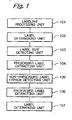
- reference numeral 101 designates a labeling processing unit for carrying out a labeling process to detect character frames which are so-called labels
- 102 designates a label determining unit for determining whether each of the detected labels is prescribed or non-prescribed
- 103 designates a label size detecting unit for detecting a size of the detected prescribed labels
- 104 designates a prescribed label extracting unit for extracting prescribed labels from the detected non-prescribed label
- 105 designates a non-prescribed label hyphen excluding unit for excluding a hyphen of the detected non-prescribed label
- 106 designates a prescribed label extracting unit for extracting prescribed labels from the hyphen-excluded non-prescribed label
- 107 designates a label determining unit for determining whether or not the prescribed labels extracted by the prescribed label extracting unit 106 are the same as those determined by the label determining unit 102.
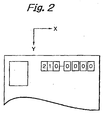
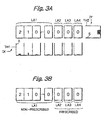
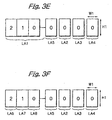
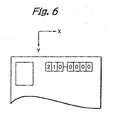
- FIG. 2 A first operation of the character frame detecting apparatus of Fig. 1 performed upon a postal card as illustrated in Fig. 2 is explained next with reference to Figs. 3A, 3B, 3C, 3D, 3E and 3F. Note that seven labels are printed on the postal card of Fig. 2.
- the label processing unit 101 detects character frames, i.e., labels by an X-directional image IX and a Y-directional image IY.
- character frames i.e., labels by an X-directional image IX and a Y-directional image IY.
- four labels LA1, LA2, LA3 and LA4 are detected by using sharp shades S in the images IX and IY. That is, lines of the labels LA1, LA2, LA3 and LA4 are detected by whether or not the sharp shades S are higher than a threshold value TH1 or TH2.
- the label determining unit 102 determines whether each of detected labels LA1, LA2, LA3 and LA4 is a prescribed label or a non-prescribed label.
- the labels LA2, LA3 and LA4 have substantially the same size, so that the labels LA2, LA3 and LA4 are determined to be prescribed.
- the label LA1 is non-prescribed.
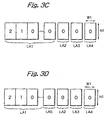
- the label siz detecting unit 103 detects a size of the prescribed labels LA2, LA3 and LA4. In this case, a width W1 in the X-direction and a height H1 in the Y-direction are detected for the prescribed labels LA2, LA3 and LA4.
- the prescribed label extracting unit 104 extracts a prescribed label LA5 from the non-prescribed label LA1 by using the size of W1 ⁇ L1.
- the non-prescribed label hyphen excluding unit 105 excludes an edge, i.e., a hyphen from the non-prescribed label LA1.
- the prescribed label extracting unit 106 extracts three prescribed labels LA6, LA7 and LA8 by dividing the hyphen-excluded non-prescribed label LA1 by 3.
- the label determining unit 107 determines whether or not each of the labels LA6, LA7 and LA8 are prescribed, i.e., each of the labels LA6, LA7 and LA8 has a size of W1 ⁇ H1. Only when each of the labels LA6, LA7 and LA8 has a size of W1 ⁇ H1, is it determined that seven prescribed labels LA2 to LA8 are detected.
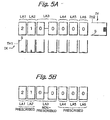
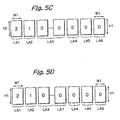
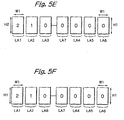
- FIG. 5A, 5B, 5C, 5D, 5E and 5F A second operation of the character frame detecting apparatus of Fig. 1 performed upon a postal card as illustrated in Fig. 4 is explained next with reference to Figs. 5A, 5B, 5C, 5D, 5E and 5F. Note that seven labels are also printed on the postal card of Fig. 4.
- the label processing unit 101 detects character frames, i.e., labels by an X-directional image IX and a Y-directional image IY.
- character frames i.e., labels by an X-directional image IX and a Y-directional image IY.
- six labels LA1, LA2, LA3, LA4, LA5 and LA6 are detected by using sharp shades S in the images IX and IY. That is, lines of the labels LA1, LA2, LA3 ,LA4, LA5 and LA6 are detected by whether or not the sharp shades S are higher than a threshold value TH1 or TH2.
- the label determining unit 102 determines whether each of detected labels LA1, LA2, LA3 ,LA4, LA5 and LA6 is a prescribed label or a non-prescribed label.
- the labels LA1, LA2 ,LA4, LA5 and LA6 have substantially the same size, so that the labels LA1, LA2, LA4, LA5 and LA6 are determined to be prescribed.
- the label LA3 is non-prescribed.
- the label size detecting unit 103 detects a size of the prescribed labels LA1, LS2, LA4, LA5 and LA6. In this case, a width W1 in the X-direction and a height H1 in the Y-direction are detected for the prescribed labels LA1, LA2, LA4, LA5 and LA6.
- the prescribed label, extracting unit 104 extracts a prescribed label LA7 from the non-prescribed label LA3 by using the size of W1 ⁇ L1.
- the non-prescribed label hyphen excluding unit 105 excludes an edge, i.e., a hyphen from the non-prescribed label LA3.
- the prescribed label extracting unit 106 extracts a prescribed label LA8, i.e., the hyphen-excluded non-prescribed label LA3.
- the label determining unit 107 determines whether or not each of the labels LA7 and LA8 are prescribed, i.e., each of the labels LA7 and LA8 has a size of W1 ⁇ H1. Only when each of the labels LA7 and LA8 has a size of W1 ⁇ H1, is it determined that seven prescribed labels LA1, LA2, LA4 through LA8 are detected.
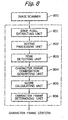
- reference numeral 800 designates an image scanner for reading gray pixel image of a postal card or the like.
- the gray pixel image of the image scanner 800 is supplied to an edge extracting unit 801.
- the edge pixel extracting unit 801 extracts edge pixels at edges of lines of the gray pixel image by calculating a differential value of each pixel and determining whether or not the differential value is larger than a threshold value.
- the extracted edge pixel is supplied to a voting processing unit 802.
- the voting processing unit 802 performs a voting process upon a voting region which is set in accordance with a gray gradient of the extracted edge pixel.
- the voting region is expected to include a center of an expected character frame. Note that a voting process increments a voting count by + 1 at each coordinate within the voting region. Generally, since there are a lot of edge pixels, there are a lot of voting regions. Therefore, the voting processing unit 802 carries out a lot of voting processes.
- a peak detecting unit 803 detects peak points having peak voting counts from all the coordinates by determining whether or not the voting count of each coordinate is larger than a threshold value.
- the peak points are registered as character frame center candidates.
- a score calculating unit 805 calculates a score for each of the character frame combinations. The score is dependent upon the voting counts, equi-interval degree and horizontality degree of coordinates of the character frame center candidates of each of the character frame combinations.
- a character frame determining unit 806 selects one of the character frame combinations having the largest score, and determines whether or not the score of a selected character frame combination is larger that a threshold value. Only when this score is larger than the threshold value, are the character frame center candidates of such a selected character frame combination determined to be character frame centers.
- the character frame detecting apparatus of Fig. 8 is constructed by a computer including a central processing unit (CPU), a read-only memory (ROM) for storing programs and fixed data, a random access memory (RAM) for storing temporary data and the like.
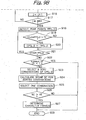
- the CPU carries out an operation in accordance with a flowchart as illustrated in Fig. 9.
- the CPU fetches image data from the image scanner 800.
- the fetched image data is a postal card having a zip code of seven digits as illustrated in Fig. 10A, 10B, 10C, 10D, 10E or 10F where character frames (labels) have a size of W ⁇ H.
- step 902 an initialization is carried out, i.e., V i , j ⁇ 0 i ⁇ 0 j ⁇ 0
- a coordinate (i, j) is defined as shown in Fig. 11, so that i is 0 to iMAX and j is 0 to jMAX. Also, V(i, j) is a voting count at a coordinate (i, j)
- a differential value F(i, j) is calculated by F i , j ⁇ A i , j - A i + 1 , j 2 + A ( i , j ) - A i , j + 1 2 where A(i, j) is a gray value of the image data at a pixel (i, j).
- the differential value F(i, j) can be a square root value thereof.
- step 904 it is determined whether or not the differential value F(i, j) is larger that a threshold value TF. Only when F(i, j) > TF, does the control proceed to step 905. Otherwise, the control proceeds to step 914.
- a gradient ⁇ (i, j)of the coordinate (i, j) is calculated by ⁇ i , j ⁇ arc tan [ ⁇ A i , j - A i , j + 1 ⁇ / A ( i , j ) - A i + 1 , j ]
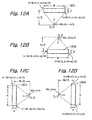
- step 906 it is determined whether the gradient ⁇ (i, j) is upward, i.e., - ⁇ / 2 - ⁇ ⁇ ⁇ i , j ⁇ - ⁇ / 2 + ⁇ where ⁇ is a small definite value. Only when the gradient ⁇ (i, j) is upward, does the control proceed to step 907 which carries out an upward voting process. That is, as illustrated in Fig.
- a rectangular voting region 1201 having a start coordinate (i-W/2, j-(H+d)/2) and an end coordinate (i+W/2, j-(H-d)/2) where d is a small definite value is set, and V(i', j') whose coordinate (i', j') belongs to the rectangular voting region 1201 is incremented by +1, i.e., V i ⁇ , j ⁇ ⁇ V i ⁇ , j ⁇ + 1 where i' is (i-W/2) to (i+W/2), and j' is (j-(H + d)/2) to (j-(H-d)/2).
- step 906 the control proceeds from step 906 to step 908.
- step 908 it is determined whether the gradient ⁇ (i, j) is downward, i.e., ⁇ / 2 - ⁇ ⁇ ⁇ i , j ⁇ ⁇ / 2 + ⁇
- step 909 Only when the gradient ⁇ (i, j) is downward, does the control proceed to step 909 which carries out a downward voting process. That is, as illustrated in Fig. 12B, a rectangular voting region 1202 having a start coordinate (i-W/2, j+(H-d)/2) and an end coordinate (i+W/2, j+(H+d)/2) is set, and V(i', j') whose coordinate (i', j') belongs to the rectangular voting region 1202 is incremented by +1, i.e., V i ⁇ , j ⁇ ⁇ V i ⁇ , j ⁇ + 1 where i' is (i-W/2) to (i+W/2), and j' is (j+(H - d)/2) to (j+(H+d)/2).
- step 908 the control proceeds from step 908 to step 910.
- step 910 it is determined whether the gradient ⁇ (i, j) is leftward, i.e., ⁇ - ⁇ ⁇ ⁇ i , j ⁇ ⁇ + ⁇
- step 911 Only when the gradient ⁇ (i, j) is leftward, does the control proceed to step 911 which carries out a leftward voting process. That is, as illustrated in Fig. 12C, a rectangular voting region 1203 having a start coordinate (i-(W+d)/2, j-H/2) and an end coordinate (i-(W-d)/2, j+H/2) is set, and V(i', j') whose coordinate (i', j') belongs to the rectangular voting region 1203 is incremented by +1, i.e., V i ⁇ , j ⁇ ⁇ V i ⁇ , j ⁇ + 1 where i' is (i-(W+d)/2) to (i-(W-d)/2), and j' is (j-H/2) to (j+H/2).
- step 910 the control proceeds from step 910 to step 912.
- step 912 it is determined whether the gradient ⁇ (i, j) is rightward, i.e., - ⁇ ⁇ ⁇ i , j ⁇ + ⁇
- a rectangular voting region 1204 having a start coordinate (i+(W+d)/2, j-H/2) and an end coordinate (i+(W+d)/2, j+H/2) is set, and V(i', j') whose coordinate (i', j') belongs to the rectangular voting region 1204 is incremented by +1, i.e., V i ⁇ , j ⁇ ⁇ V i ⁇ , j ⁇ + 1 where i' is (i+(W+d)/2) to (i+(W-d)/2), and j' is (j-H/2) to (j+H/2).
- control 1 proceeds from step 912 to step 914.
- Steps 914 through 917 repeat the operation at steps 903 through 913 for all the coordinates (i, j) within the postal card having a size of W0 ⁇ H0 as illustrated in Fig. 11.
- step 918 peak points of the voting counts V(i, j) are detected. That is, it is determined whether or not all the following conditions are satisfied for a coordinate (i, j): V i , j > V i - 1 , j V i , j > V i , j - 1 V i , j > V i + 1 , j V i , j > V i , j + 1
- step 919 it is determined whether or not V(i, j) at PP(i, j) is larger than a threshold value TV. Only when V(i, j) at PP(i, j) > TV, does the control proceed to step 920 which registers the peak point PP(i, j) as a character frame (label) center candidate CP(i, j). Otherwise, the control proceeds directly to step 921.
- Step 921 repeats the operation at steps 919 and 920 for all the peak points PP(i, j).
- step 922 it is determined whether or not the number of registered character frame center candidates CP(i, j) is smaller than 7, since the number of character frames (labels) was assumed to be 7 as illustrated in Figs. 12A, 12B, 12C, 12D, 12E and 12F.
- the control proceeds to step 923. Otherwise, the control proceeds directly to step 928.
- a score SC is calculated for each sorted combination of the character frame (label) center candidates CP(i, j) by SC ⁇ W 1 ⁇ SUM + W 2 ⁇ INT + W 3 ⁇ HOR
- AVE1 designates an average interval of the three most significant digits (labels)
- AVE2 designates an average interval of the four least significant digits (labels). That is, the smaller the equi-interval degree INT, the larger the possibility of character frames (labels) for a postal card.
- the horizontality degree HOR is calculated by HOR ⁇ ( j 2 - j 1 ) 2 + ( j 3 - j 2 ) 2 + ( j 4 - j 3 ) 2 + ( j 5 - j 4 ) 2 + ( j 6 - j 5 ) ⁇ 2 + ( j 7 - j 6 ) ⁇ 2
- step 925 the CPU selects one sorted combination having a largest score from the sorted combinations.
- step 926 it is determined whether or not the score SC of the selected combination at step 925 are larger than a threshold value TS. Only when SC > TS, does the control proceed to step 927 which determines that the selected combination of character frames at step 925 is character frames (labels) in the postal card. Otherwise, it is determined that there is no character frames (labels) in the postal card, and thus, the control proceeds directly to step 928.
- step 928 the routine of Fig. 9 is completed by step 928.
- step 904 of Fig. 9 it is determined whether or not the differential value F(i, j) is larger than the threshold value TF. As a result, if a noise image or background image is included in the fetched image data, the detection of noise image or background image can be suppressed. Additionally, F(i, j) ⁇ TF, the operation at steps 905 through 913 are skipped to increase the operation speed.
- a voting process is performed upon only four gray gradients, i.e., - ⁇ /2, ⁇ /2, ⁇ and 0. That is, a voting process is performed upon only straight lines along the X-direction and the Y-direction. As a result, no voting process is performed upon oblique lines with respect to the X- and Y-directions, characters including curved lines and the like. Therefore, character frames including only such straight lines can be surely detected.
- the center of the character frame can be surely detected, so that various arrangements as illustrated in Figs. 10A, 10B, 10C, 10D, 10E and 10F can be surely detected. Additionally, if one or two lines of one character frame are oblique, vague or missing, the concentration of voting counts on the center of the character frame is hardly affected, the center thereof can also be surely detected.
- step 922 it is determined whether or not the number of registered character frame center candidates CP(i, j) is smaller than n. Since the number of character frames (labels) was assumed to be 7 as illustrated in Figs. 12A, 12B, 12C, 12D, 12E and 12F, when the number of registered character frame center candidates CP(i, j) is not smaller than 7, the control proceeds to step 923.
- step 924 if one sorted combination is given by coordinates (i1, j1), (i2, j2), (i3, j3), ⁇ , (i(n-1), j(n-1) and (in, jn), the sum SUM is calculated by SUM ⁇ V i 1 , j 1 + V i 2 , j 2 + V i 3 , j 3 + ⁇ + V ( i n - 1 , j n - 1 + V in , j n
- the horizontality degree HOR is calculated by HOR ⁇ ( j 2 - j 1 ) 2 + ( j 3 - j 2 ) 2 + ( j 4 - j 3 ) 2 + ⁇ ⁇ ⁇ + ( j n - 1 - j n - 2 ) 2 + jn - j n - 1 2
- various kinds of character frame arrangements can be surely detected in spite of hyphens and intervals of character frames. Also, even if a noise image or background image is added, character frames can be surely detected. Further, even if some of lines of character frames are oblique, vague or missing, the deterioration of detection of character frames can be suppressed.
Landscapes
- Engineering & Computer Science (AREA)
- Computer Vision & Pattern Recognition (AREA)
- Physics & Mathematics (AREA)
- General Physics & Mathematics (AREA)
- Multimedia (AREA)
- Theoretical Computer Science (AREA)
- Artificial Intelligence (AREA)
- Character Input (AREA)
- Character Discrimination (AREA)
Claims (28)
- Procédé de détection de cadres de caractères comprenant les étapes consistant à :extraire des pixels de contour au niveau des bords de lignes de cadres de caractères à partir de pixels gris d'une image en pixels gris ;calculer des déclinaisons de gris (θ, (i, j)) au niveau desdits pixels de contour ;configurer des régions de vote (1201, 1202, 1203, 1204) par rapport auxdits pixels de contour selon lesdites déclinaisons de gris de ceux-ci ;déterminer si chacune desdites déclinaisons de gris est sensiblement une valeur parmi les valeurs de 90°, -90°, 180° et 0° par rapport à un axe de ladite image en pixels de gris,de sorte que quand une desdites déclinaisons de gris est sensiblement une valeur parmi les valeurs de 90°, -90°, 180° et 0° par rapport à l'axe de ladite image en pixels de gris, ladite étape de configuration de région de vote configure une desdites régions de vote selon ladite une desdites déclinaisons de gris ;dans lequel, quand une première déclinaison desdites déclinaisons de gris est sensiblement une valeur parmi les valeurs de 90°, -90° par rapport à l'axe de ladite image en pixels de gris, une première région de vote correspondante desdites régions de vote a une largeur (W) identique à la largeur (W) d'une taille de cadre de caractère escomptée et est distante d'un pixel correspondant desdits pixels de contour selon une hauteur (H/2) égale à la moitié de la hauteur (H) de ladite taille de cadre de caractère escomptée le long de ladite première déclinaison desdites déclinaisons de gris ; et
dans lequel, quand une seconde déclinaison desdites déclinaisons de gris est sensiblement une valeur parmi les valeurs de 180° et 0° par rapport à l'axe de ladite image en pixels de gris, une seconde région de vote correspondante desdites régions de vote a une hauteur (H) identique à la hauteur (H) d'une taille de cadre de caractère escomptée et est distante d'un pixel correspondant desdits pixels de contour selon une largeur (W/2) égale à la moitié de la largeur (W) de ladite taille de cadre de caractère escomptée le long de ladite seconde déclinaison desdites déclinaisons de gris ;
exécuter des processus de vote en incrémentant des comptes de vote au niveau de coordonnées dans lesdites régions de vote ; et
détecter des coordonnées de crête (PP (i, j)) ayant des comptes de vote de crête à partir desdites coordonnées, de sorte que lesdites coordonnées de crête soient déterminées de façon à constituer les centres desdits cadres de caractères. - Procédé selon la revendication 1, dans lequel ladite étape d'extraction de pixels de contour comprend les étapes consistant à :calculer des valeurs différentielles au niveau desdits pixels de gris ; etdéterminer si chacune des valeurs différentielles est supérieure à une valeur de seuil de valeur différentielle (TF) ou non, de sorte que, quand chacune desdites valeurs différentielles est supérieure à ladite valeur de seuil de valeur différentielle, un pixel correspondant desdits pixels de gris soit déterminé comme étant un desdits pixels de contour.
- Procédé selon la revendication 2, dans lequel ladite étape de calcul de valeur différentielle calcule lesdites valeurs différentielles F(i, j) aux coordonnées (i, j) par

où A(i, j) est une valeur de gris d'un pixel de gris au niveau de (i, j) et A(i+1, j) et A(i, j+1) sont des valeurs de gris de pixels de gris au niveau de coordonnées adjacentes à (i, j). - Procédé selon la revendication 2, dans lequel ladite étape de calcul de valeur différentielle calcule lesdites valeurs différentielles F(i, j) aux coordonnées (i, j) par

où A(i, j) est une valeur de gris d'un pixel de gris au niveau de (i, j) et A(i+1, j) et A(i, j+1) sont des valeurs de gris de pixels de gris au niveau de coordonnées adjacentes à (i, j). - Procédé selon l'une quelconque des revendications 1 à 4, dans lequel chacune des régions de vote est rectangulaire.
- Procédé selon la revendication 5, dans lequel chacune des régions de vote est distante d'un pixel correspondant desdits pixels de contour selon une distance prédéterminée (H/2, W/2) et perpendiculaire à sa déclinaison de gris.
- Procédé selon la revendication 5 ou 6, dans lequel chacune desdites régions de vote a une longueur de la largeur (W) ou de la hauteur (H) d'une taille de cadre de caractère escomptée.
- Procédé selon l'une quelconque des revendications 1 à 7, dans lequel ladite étape de détection de crête comprend les étapes consistant à :déterminer si le compte de vote de chacune desdites coordonnées de crête est supérieur à une valeur de seuil de crête (TV) ou non ; etenregistrer chacune desdites coordonnées de crête comme candidat de centre de cadre de caractère (CP(i, j)) quand le compte de vote de chacune desdites coordonnées de crête est supérieur à ladite valeur de seuil de crête, de sorte que ledit candidat de centre de cadre de caractère soit déterminé comme étant un centre desdits cadres de caractères.
- Procédé selon la revendication 8, comprenant en outre les étapes consistant à :générer des combinaisons d'un certain nombre prédéterminé de candidats de centre de cadre de caractère enregistrés ;calculer un score (SC) de chacune desdites combinaisons par une somme des comptes de vote desdits candidats de centre de cadre de caractère enregistrés lui appartenant ; etdéterminer que les candidats de centre de cadre de caractère enregistrés d'une desdites combinaisons sont lesdits centres desdits cadres de caractères.
- Procédé selon la revendication 9, dans lequel ladite étape de calcul de score calcule le score de chacune desdites combinaisons en soustrayant un degré à intervalle équidistant desdits candidats de centre de cadre de caractère enregistrés dans chacune desdites combinaisons de leur somme des comptes de vote.
- Procédé selon la revendication 8 ou 9, dans lequel ladite étape de calcul de score calcule le score de chacune desdites combinaisons en soustrayant un degré d'horizontalité desdits candidats de centre de cadre de caractère enregistrés dans chacune desdites combinaisons de leur somme des comptes de vote.
- Procédé selon la revendication 9, dans lequel ladite étape de calcul de score calcule le score de chacune desdites combinaisons en soustrayant un degré à intervalle équidistant et un degré d'horizontalité desdits candidats de centre de cadre de caractère enregistrés dans chacune desdites combinaisons de leur somme des comptes de vote.
- Procédé selon la revendication 9, 10, 11 ou 12, dans lequel ladite étape de détermination de centre de cadre de caractère comprend les étapes consistant à :sélectionner une desdites combinaisons ayant un plus grand score parmi lesdites combinaisons ; etdéterminer si le score de ladite combinaison sélectionnée est supérieur à une valeur de seuil de combinaison (TS) ou non, de sorte que les candidats de centre de cadre de caractère enregistrés de ladite combinaison sélectionnée desdits candidats de centre de cadre de caractère soient déterminés pour être lesdits centres desdits cadres de caractères.
- Procédé selon l'une quelconque des revendications 1 à 13, dans lequel ladite image en pixels de gris est une image de carte postale.
- Dispositif de détection de cadres de caractères comprenant :une unité d'extraction de pixels de contour (801) pour extraire des pixels de contour au niveau des bords de ligne de cadres de caractères à partir des pixels gris d'une image de pixel gris ;une unité de traitement de vote (802) pour calculer des déclinaisons de gris (θ, (i, j)) au niveau desdits pixels de contour, configurer des régions de vote (1201, 1202, 1203, 1204) par rapport auxdits pixels de contour selon lesdites déclinaisons de gris de ceux-ci, et exécuter des processus de vote en incrémentant des comptes de vote à des coordonnées dans lesdites régions de vote ;dans lequel ladite unité de traitement de vote comprend des moyens pour déterminer si chacune desdites déclinaisons de gris est sensiblement une valeur parmi les valeurs de 90°, -90°, 180° et 0° par rapport à l'axe de ladite image en pixels de gris,de sorte que quand une desdites déclinaisons de gris est sensiblement une valeur parmi les valeurs de 90°, -90°, 180° et 0° par rapport à un axe de ladite image en pixels de gris, ladite étape de configuration de région de vote configure une desdites régions de vote selon ladite une desdites déclinaisons de gris ;
dans lequel, quand une première déclinaison desdites déclinaisons de gris est sensiblement une valeur parmi les valeurs de 90°, -90° par rapport à l'axe de ladite image en pixels de gris, une première région de vote correspondante desdites régions de vote a une largeur (W) identique à la largeur (W) d'une taille de cadre de caractère escomptée et est distante d'un pixel correspondant desdits pixels de contour selon une hauteur (H/2) égale à la moitié de la hauteur (H) de ladite taille de cadre de caractère escomptée le long de ladite première déclinaison desdites déclinaisons de gris ; et
dans lequel, quand une seconde déclinaison desdites déclinaisons de gris est sensiblement une valeur parmi les valeurs de 180° et 0° par rapport à l'axe de ladite image en pixels de gris, une seconde région de vote correspondante desdites régions de vote a une hauteur (H) identique à la hauteur (H) d'une taille de cadre de caractère escomptée et est distante d'un pixel correspondant desdits pixels de contour selon une largeur (W/2) égale à la moitié de la largeur (W) de ladite taille de cadre de caractère escomptée le long de ladite seconde déclinaison desdites déclinaisons de gris ;
une unité de détection de crête (803) pour détecter des coordonnées de crête (PP (i, j)) ayant des comptes de vote de crête à partir desdites coordonnées, de sorte que lesdites coordonnées de crête soient déterminées pour être les centres desdits cadres de caractères. - Dispositif selon la revendication 15, dans lequel ladite unité d'extraction de pixel de contour comprend :des moyens pour calculer des valeurs différentielles au niveau desdits pixels de gris ; etdes moyens pour déterminer si chacune desdites valeurs différentielles est supérieure à une valeur de seuil de valeur différentielle (TF) ou non, de sorte que quand chacune desdites valeurs différentielles est supérieure à ladite valeur de seuil de valeur différentielle, un pixel correspondant desdits pixels de gris est déterminé pour être un desdits pixels de contour.
- Dispositif selon la revendication 16, dans lequel lesdits moyens de calcul de valeur différentielle calculent lesdites valeurs différentielles F(i, j) aux coordonnées (i, j) par

où A(i, j) est une valeur de gris d'un pixel de gris au niveau de (i, j) et A(i+1, j) et A(i, j+1) sont des valeurs de gris de pixels de gris au niveau de coordonnées adjacentes à (i, j). - Dispositif selon la revendication 16, dans lequel lesdits moyens de calcul de valeur différentielle calculent lesdites valeurs différentielles F(i, j) aux coordonnées (i, j) par

où A(i, j) est une valeur de gris d'un pixel de gris au niveau de (i, j) et A(i+1, j) et A(i, j+1) sont des valeurs de gris de pixels de gris au niveau de coordonnées adjacentes à (i, j). - Dispositif selon l'une quelconque des revendications 15 à 18, dans lequel chacune desdites régions de vote est rectangulaire.
- Dispositif selon la revendication 19, dans lequel chacune desdites régions de vote est distante d'un pixel correspondant desdits pixels de contour selon une distance prédéterminée (H/2, W/2) et perpendiculaire à sa déclinaison de gris.
- Dispositif selon la revendication 19 ou 20,
dans lequel chacune desdites régions de vote a une longueur de la largeur (W) ou de la hauteur (H) d'une taille de cadre de caractère escomptée. - Dispositif selon l'une quelconque des revendications 15 à 21, dans lequel ladite unité de détection de crête comprend :des moyens pour déterminer si le compte de vote de chacune desdites coordonnées de crête est supérieur à une valeur de seuil de crête (TV) ; etdes moyens pour enregistrer ladite chaque coordonnée desdites coordonnées de crête comme candidat de centre de cadre de caractère (CP(i, j)) quand le compte de vote de chacune desdites coordonnées de crête est supérieur à ladite valeur de seuil de crête, de sorte que lesdits candidats de centre de cadre de caractère soient déterminés pour constituer le centre desdits cadres de caractères.
- Dispositif selon la revendication 22, comprenant en outre :une unité de génération de combinaison de cadres de caractères (804) pour générer des combinaisons d'un certain nombre prédéterminé de candidats de centre de cadre de caractère enregistrés ;une unité de calcul de score (805) pour calculer un score (SC) de chacune desdites combinaisons par une somme des comptes de vote desdits candidats de centre de cadre de caractère enregistrés lui appartenant ; etune unité de détermination de cadres de caractères (806) pour déterminer que les candidats de centre de cadre de caractère enregistrés d'une desdites combinaisons constituent lesdits centres desdits cadres de caractères.
- Dispositif selon la revendication 23, dans lequel ladite unité de calcul de score calcule le score de chacune desdites combinaisons en soustrayant un degré à intervalle équidistant desdits candidats de centre de cadre de caractère enregistrés dans chacune desdites combinaisons de leur somme des comptes de vote.
- Dispositif selon la revendication 23, dans lequel ladite étape de calcul de score calcule le score de chacune desdites combinaisons en soustrayant un degré d'horizontalité desdits candidats de centre de cadre de caractère enregistrés dans chacune desdites combinaisons de leur somme des comptes de vote.
- Dispositif selon la revendication 23, dans lequel ladite étape de calcul de score calcule le score de chacune desdites combinaisons en soustrayant un degré à intervalle équidistant et un degré d'horizontalité desdits candidats de centre de cadre de caractère enregistrés dans chacune desdites combinaisons de leur somme des comptes de vote.
- Dispositif selon l'une quelconque des revendications 23 à 26, dans lequel ladite unité de détermination de centre de cadres de caractères comprend :des moyens pour sélectionner une desdites combinaisons ayant un plus grand score parmi lesdites combinaisons ; etdes moyens pour déterminer si le score de ladite combinaison sélectionnée est supérieur à une valeur de seuil de combinaison (TS) ou non, de sorte que ladite combinaison sélectionnée desdits candidats de centre de cadre de caractère soit déterminée pour être lesdits centres desdits cadres de caractères.
- Dispositif selon l'une quelconque des revendications 15 à 27, dans lequel ladite image en pixels gris est une image de carte postale.
Applications Claiming Priority (4)
| Application Number | Priority Date | Filing Date | Title |
|---|---|---|---|
| JP2001053433 | 2001-02-28 | ||
| JP2001053433 | 2001-02-28 | ||
| JP2002019278 | 2002-01-28 | ||
| JP2002019278A JP3705216B2 (ja) | 2001-02-28 | 2002-01-28 | 文字記入枠検出方法、文字記入枠検出装置及びプログラム |
Publications (3)
| Publication Number | Publication Date |
|---|---|
| EP1237116A2 EP1237116A2 (fr) | 2002-09-04 |
| EP1237116A3 EP1237116A3 (fr) | 2004-12-15 |
| EP1237116B1 true EP1237116B1 (fr) | 2006-11-29 |
Family
ID=26610252
Family Applications (1)
| Application Number | Title | Priority Date | Filing Date |
|---|---|---|---|
| EP02004286A Expired - Lifetime EP1237116B1 (fr) | 2001-02-28 | 2002-02-27 | Procédé et appareil de détection des cadres de caractère utilisant un processus de vote |
Country Status (5)
| Country | Link |
|---|---|
| EP (1) | EP1237116B1 (fr) |
| JP (1) | JP3705216B2 (fr) |
| KR (1) | KR100466370B1 (fr) |
| BR (1) | BRPI0201387B1 (fr) |
| DE (1) | DE60216342T2 (fr) |
Families Citing this family (2)
| Publication number | Priority date | Publication date | Assignee | Title |
|---|---|---|---|---|
| JP4909311B2 (ja) * | 2008-03-31 | 2012-04-04 | 富士通フロンテック株式会社 | 文字認識装置 |
| CN104268864B (zh) * | 2014-09-18 | 2017-04-12 | 小米科技有限责任公司 | 卡片边缘提取方法和装置 |
Family Cites Families (9)
| Publication number | Priority date | Publication date | Assignee | Title |
|---|---|---|---|---|
| US5459797A (en) * | 1991-03-30 | 1995-10-17 | Kabushiki Kaisha Toshiba | Character reading system |
| JP2951814B2 (ja) * | 1993-02-25 | 1999-09-20 | 富士通株式会社 | 画像抽出方式 |
| KR100313991B1 (ko) * | 1993-07-12 | 2002-02-19 | 구자홍 | 문서영상의기울기검출방법 |
| US5815595A (en) * | 1995-12-29 | 1998-09-29 | Seiko Epson Corporation | Method and apparatus for identifying text fields and checkboxes in digitized images |
| JP3113827B2 (ja) * | 1996-11-28 | 2000-12-04 | インターナショナル・ビジネス・マシーンズ・コーポレ−ション | 矩形オブジェクトの認識方法及び認識装置 |
| KR100259804B1 (ko) * | 1997-08-14 | 2000-06-15 | 구자홍 | 도표형태의문서인식방법 |
| KR19990062036A (ko) * | 1997-12-31 | 1999-07-26 | 윤종용 | 미분 연산자를 사용한 에지 검출 방법 |
| JP4242962B2 (ja) * | 1999-01-08 | 2009-03-25 | パナソニック コミュニケーションズ株式会社 | 文字切出装置 |
| JP3930192B2 (ja) * | 1999-03-19 | 2007-06-13 | 株式会社東芝 | 枠検出装置及び枠検出方法 |
-
2002
- 2002-01-28 JP JP2002019278A patent/JP3705216B2/ja not_active Expired - Lifetime
- 2002-02-27 DE DE60216342T patent/DE60216342T2/de not_active Expired - Lifetime
- 2002-02-27 EP EP02004286A patent/EP1237116B1/fr not_active Expired - Lifetime
- 2002-02-28 BR BRPI0201387A patent/BRPI0201387B1/pt not_active IP Right Cessation
- 2002-02-28 KR KR10-2002-0011014A patent/KR100466370B1/ko not_active Expired - Fee Related
Also Published As
| Publication number | Publication date |
|---|---|
| DE60216342T2 (de) | 2007-03-15 |
| BR0201387A (pt) | 2002-12-03 |
| EP1237116A3 (fr) | 2004-12-15 |
| EP1237116A2 (fr) | 2002-09-04 |
| JP2002329168A (ja) | 2002-11-15 |
| BRPI0201387B1 (pt) | 2015-09-08 |
| KR20020070647A (ko) | 2002-09-10 |
| JP3705216B2 (ja) | 2005-10-12 |
| KR100466370B1 (ko) | 2005-01-14 |
| DE60216342D1 (de) | 2007-01-11 |
Similar Documents
| Publication | Publication Date | Title |
|---|---|---|
| US6226402B1 (en) | Ruled line extracting apparatus for extracting ruled line from normal document image and method thereof | |
| US7302098B2 (en) | Character segmentation method and apparatus | |
| Taylor et al. | Extraction of data from preprinted forms | |
| US6950533B2 (en) | Sorting images for improved data entry productivity | |
| JP2940496B2 (ja) | パタンマッチング符号化装置及び方法 | |
| US8208725B2 (en) | Methods and systems for identifying text orientation in a digital image | |
| US20080317341A1 (en) | Methods and Systems for Identifying Text Orientation in a Digital Image | |
| US6760490B1 (en) | Efficient checking of key-in data entry | |
| CN108830133A (zh) | 合同影像图片的识别方法、电子装置及可读存储介质 | |
| CN109685059B (zh) | 文字图像标注方法、装置及计算机可读存储介质 | |
| CN110008960B (zh) | 一种检测字符片段完整性的方法及终端 | |
| JP4733577B2 (ja) | 帳票認識装置及び帳票認識プログラム | |
| EP1237116A2 (fr) | Procédé et appareil de détection des cadres de caractère utilisant un processus de vote | |
| JP3303246B2 (ja) | 画像処理装置 | |
| CN112052766B (zh) | 一种基于黑色标签的文档归类方法及设备 | |
| JP3440501B2 (ja) | 運転免許証認識装置 | |
| JPH06187489A (ja) | 文字認識装置 | |
| EP0601730A1 (fr) | Procédé de traitement d'images pour la correction de l'inclinaison de caractères | |
| JPH02116987A (ja) | 文字認識装置 | |
| CN111695559A (zh) | 基于YoloV3模型的运单图片信息打码方法及系统 | |
| KR910005385B1 (ko) | 스트로크 근사 직선 추출에 의한 문자인식방법 | |
| JP2000339472A (ja) | セグメント文字パターンの印字判定方法及び装置 | |
| Fadeel | An efficient segmentation algorithm for arabic handwritten characters recognition system | |
| JP3534997B2 (ja) | 罫線抽出装置および方法 | |
| JP2975067B2 (ja) | 文字の認識方法 |
Legal Events
| Date | Code | Title | Description |
|---|---|---|---|
| PUAI | Public reference made under article 153(3) epc to a published international application that has entered the european phase |
Free format text: ORIGINAL CODE: 0009012 |
|
| AK | Designated contracting states |
Kind code of ref document: A2 Designated state(s): AT BE CH CY DE DK ES FI FR GB GR IE IT LI LU MC NL PT SE TR |
|
| AX | Request for extension of the european patent |
Free format text: AL;LT;LV;MK;RO;SI |
|
| PUAL | Search report despatched |
Free format text: ORIGINAL CODE: 0009013 |
|
| AK | Designated contracting states |
Kind code of ref document: A3 Designated state(s): AT BE CH CY DE DK ES FI FR GB GR IE IT LI LU MC NL PT SE TR |
|
| AX | Request for extension of the european patent |
Extension state: AL LT LV MK RO SI |
|
| 17P | Request for examination filed |
Effective date: 20041108 |
|
| 17Q | First examination report despatched |
Effective date: 20050413 |
|
| AKX | Designation fees paid |
Designated state(s): DE FR GB |
|
| GRAP | Despatch of communication of intention to grant a patent |
Free format text: ORIGINAL CODE: EPIDOSNIGR1 |
|
| GRAS | Grant fee paid |
Free format text: ORIGINAL CODE: EPIDOSNIGR3 |
|
| GRAA | (expected) grant |
Free format text: ORIGINAL CODE: 0009210 |
|
| AK | Designated contracting states |
Kind code of ref document: B1 Designated state(s): DE FR GB |
|
| REG | Reference to a national code |
Ref country code: GB Ref legal event code: FG4D |
|
| REF | Corresponds to: |
Ref document number: 60216342 Country of ref document: DE Date of ref document: 20070111 Kind code of ref document: P |
|
| ET | Fr: translation filed | ||
| PLBE | No opposition filed within time limit |
Free format text: ORIGINAL CODE: 0009261 |
|
| STAA | Information on the status of an ep patent application or granted ep patent |
Free format text: STATUS: NO OPPOSITION FILED WITHIN TIME LIMIT |
|
| 26N | No opposition filed |
Effective date: 20070830 |
|
| REG | Reference to a national code |
Ref country code: FR Ref legal event code: PLFP Year of fee payment: 15 |
|
| PGFP | Annual fee paid to national office [announced via postgrant information from national office to epo] |
Ref country code: DE Payment date: 20160223 Year of fee payment: 15 |
|
| PGFP | Annual fee paid to national office [announced via postgrant information from national office to epo] |
Ref country code: FR Payment date: 20160108 Year of fee payment: 15 Ref country code: GB Payment date: 20160224 Year of fee payment: 15 |
|
| REG | Reference to a national code |
Ref country code: DE Ref legal event code: R119 Ref document number: 60216342 Country of ref document: DE |
|
| GBPC | Gb: european patent ceased through non-payment of renewal fee |
Effective date: 20170227 |
|
| REG | Reference to a national code |
Ref country code: FR Ref legal event code: ST Effective date: 20171031 |
|
| PG25 | Lapsed in a contracting state [announced via postgrant information from national office to epo] |
Ref country code: FR Free format text: LAPSE BECAUSE OF NON-PAYMENT OF DUE FEES Effective date: 20170228 Ref country code: DE Free format text: LAPSE BECAUSE OF NON-PAYMENT OF DUE FEES Effective date: 20170901 |
|
| PG25 | Lapsed in a contracting state [announced via postgrant information from national office to epo] |
Ref country code: GB Free format text: LAPSE BECAUSE OF NON-PAYMENT OF DUE FEES Effective date: 20170227 |