EP1237116B1 - Method and apparatus for detecting character frames using voting process - Google Patents
Method and apparatus for detecting character frames using voting process Download PDFInfo
- Publication number
- EP1237116B1 EP1237116B1 EP02004286A EP02004286A EP1237116B1 EP 1237116 B1 EP1237116 B1 EP 1237116B1 EP 02004286 A EP02004286 A EP 02004286A EP 02004286 A EP02004286 A EP 02004286A EP 1237116 B1 EP1237116 B1 EP 1237116B1
- Authority
- EP
- European Patent Office
- Prior art keywords
- gray
- voting
- character frame
- set forth
- combinations
- Prior art date
- Legal status (The legal status is an assumption and is not a legal conclusion. Google has not performed a legal analysis and makes no representation as to the accuracy of the status listed.)
- Expired - Lifetime
Links
Images






Classifications
-
- G—PHYSICS
- G06—COMPUTING OR CALCULATING; COUNTING
- G06V—IMAGE OR VIDEO RECOGNITION OR UNDERSTANDING
- G06V10/00—Arrangements for image or video recognition or understanding
- G06V10/10—Image acquisition
-
- G—PHYSICS
- G06—COMPUTING OR CALCULATING; COUNTING
- G06V—IMAGE OR VIDEO RECOGNITION OR UNDERSTANDING
- G06V30/00—Character recognition; Recognising digital ink; Document-oriented image-based pattern recognition
- G06V30/40—Document-oriented image-based pattern recognition
- G06V30/41—Analysis of document content
- G06V30/412—Layout analysis of documents structured with printed lines or input boxes, e.g. business forms or tables
-
- G—PHYSICS
- G06—COMPUTING OR CALCULATING; COUNTING
- G06V—IMAGE OR VIDEO RECOGNITION OR UNDERSTANDING
- G06V30/00—Character recognition; Recognising digital ink; Document-oriented image-based pattern recognition
- G06V30/10—Character recognition
- G06V30/14—Image acquisition
- G06V30/148—Segmentation of character regions
- G06V30/155—Removing patterns interfering with the pattern to be recognised, such as ruled lines or underlines
-
- G—PHYSICS
- G06—COMPUTING OR CALCULATING; COUNTING
- G06V—IMAGE OR VIDEO RECOGNITION OR UNDERSTANDING
- G06V30/00—Character recognition; Recognising digital ink; Document-oriented image-based pattern recognition
- G06V30/10—Character recognition
Definitions
- the present invention relates to a method and apparatus for detecting character frames such as frames of a zip code of a postal card.
- US-A-5 966 473 discloses a system for recognizing a quadrilateral object contained in an input bitmap image.
- a field position/size determination program scans the image and produces a histogram.
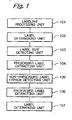
- reference numeral 101 designates a labeling processing unit for carrying out a labeling process to detect character frames which are so-called labels
- 102 designates a label determining unit for determining whether each of the detected labels is prescribed or non-prescribed
- 103 designates a label size detecting unit for detecting a size of the detected prescribed labels
- 104 designates a prescribed label extracting unit for extracting prescribed labels from the detected non-prescribed label
- 105 designates a non-prescribed label hyphen excluding unit for excluding a hyphen of the detected non-prescribed label
- 106 designates a prescribed label extracting unit for extracting prescribed labels from the hyphen-excluded non-prescribed label
- 107 designates a label determining unit for determining whether or not the prescribed labels extracted by the prescribed label extracting unit 106 are the same as those determined by the label determining unit 102.
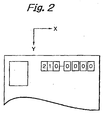
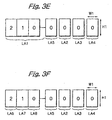
- FIG. 2 A first operation of the character frame detecting apparatus of Fig. 1 performed upon a postal card as illustrated in Fig. 2 is explained next with reference to Figs. 3A, 3B, 3C, 3D, 3E and 3F. Note that seven labels are printed on the postal card of Fig. 2.
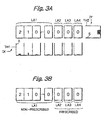
- the label processing unit 101 detects character frames, i.e., labels by an X-directional image IX and a Y-directional image IY.
- character frames i.e., labels by an X-directional image IX and a Y-directional image IY.
- four labels LA1, LA2, LA3 and LA4 are detected by using sharp shades S in the images IX and IY. That is, lines of the labels LA1, LA2, LA3 and LA4 are detected by whether or not the sharp shades S are higher than a threshold value TH1 or TH2.
- the label determining unit 102 determines whether each of detected labels LA1, LA2, LA3 and LA4 is a prescribed label or a non-prescribed label.
- the labels LA2, LA3 and LA4 have substantially the same size, so that the labels LA2, LA3 and LA4 are determined to be prescribed.
- the label LA1 is non-prescribed.
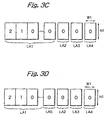
- the label siz detecting unit 103 detects a size of the prescribed labels LA2, LA3 and LA4. In this case, a width W1 in the X-direction and a height H1 in the Y-direction are detected for the prescribed labels LA2, LA3 and LA4.
- the prescribed label extracting unit 104 extracts a prescribed label LA5 from the non-prescribed label LA1 by using the size of W1 ⁇ L1.
- the non-prescribed label hyphen excluding unit 105 excludes an edge, i.e., a hyphen from the non-prescribed label LA1.
- the prescribed label extracting unit 106 extracts three prescribed labels LA6, LA7 and LA8 by dividing the hyphen-excluded non-prescribed label LA1 by 3.
- the label determining unit 107 determines whether or not each of the labels LA6, LA7 and LA8 are prescribed, i.e., each of the labels LA6, LA7 and LA8 has a size of W1 ⁇ H1. Only when each of the labels LA6, LA7 and LA8 has a size of W1 ⁇ H1, is it determined that seven prescribed labels LA2 to LA8 are detected.
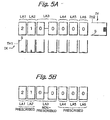
- FIG. 5A, 5B, 5C, 5D, 5E and 5F A second operation of the character frame detecting apparatus of Fig. 1 performed upon a postal card as illustrated in Fig. 4 is explained next with reference to Figs. 5A, 5B, 5C, 5D, 5E and 5F. Note that seven labels are also printed on the postal card of Fig. 4.
- the label processing unit 101 detects character frames, i.e., labels by an X-directional image IX and a Y-directional image IY.
- character frames i.e., labels by an X-directional image IX and a Y-directional image IY.
- six labels LA1, LA2, LA3, LA4, LA5 and LA6 are detected by using sharp shades S in the images IX and IY. That is, lines of the labels LA1, LA2, LA3 ,LA4, LA5 and LA6 are detected by whether or not the sharp shades S are higher than a threshold value TH1 or TH2.
- the label determining unit 102 determines whether each of detected labels LA1, LA2, LA3 ,LA4, LA5 and LA6 is a prescribed label or a non-prescribed label.
- the labels LA1, LA2 ,LA4, LA5 and LA6 have substantially the same size, so that the labels LA1, LA2, LA4, LA5 and LA6 are determined to be prescribed.
- the label LA3 is non-prescribed.
- the label size detecting unit 103 detects a size of the prescribed labels LA1, LS2, LA4, LA5 and LA6. In this case, a width W1 in the X-direction and a height H1 in the Y-direction are detected for the prescribed labels LA1, LA2, LA4, LA5 and LA6.
- the prescribed label, extracting unit 104 extracts a prescribed label LA7 from the non-prescribed label LA3 by using the size of W1 ⁇ L1.
- the non-prescribed label hyphen excluding unit 105 excludes an edge, i.e., a hyphen from the non-prescribed label LA3.
- the prescribed label extracting unit 106 extracts a prescribed label LA8, i.e., the hyphen-excluded non-prescribed label LA3.
- the label determining unit 107 determines whether or not each of the labels LA7 and LA8 are prescribed, i.e., each of the labels LA7 and LA8 has a size of W1 ⁇ H1. Only when each of the labels LA7 and LA8 has a size of W1 ⁇ H1, is it determined that seven prescribed labels LA1, LA2, LA4 through LA8 are detected.
- reference numeral 800 designates an image scanner for reading gray pixel image of a postal card or the like.
- the gray pixel image of the image scanner 800 is supplied to an edge extracting unit 801.
- the edge pixel extracting unit 801 extracts edge pixels at edges of lines of the gray pixel image by calculating a differential value of each pixel and determining whether or not the differential value is larger than a threshold value.
- the extracted edge pixel is supplied to a voting processing unit 802.
- the voting processing unit 802 performs a voting process upon a voting region which is set in accordance with a gray gradient of the extracted edge pixel.
- the voting region is expected to include a center of an expected character frame. Note that a voting process increments a voting count by + 1 at each coordinate within the voting region. Generally, since there are a lot of edge pixels, there are a lot of voting regions. Therefore, the voting processing unit 802 carries out a lot of voting processes.
- a peak detecting unit 803 detects peak points having peak voting counts from all the coordinates by determining whether or not the voting count of each coordinate is larger than a threshold value.
- the peak points are registered as character frame center candidates.
- a score calculating unit 805 calculates a score for each of the character frame combinations. The score is dependent upon the voting counts, equi-interval degree and horizontality degree of coordinates of the character frame center candidates of each of the character frame combinations.
- a character frame determining unit 806 selects one of the character frame combinations having the largest score, and determines whether or not the score of a selected character frame combination is larger that a threshold value. Only when this score is larger than the threshold value, are the character frame center candidates of such a selected character frame combination determined to be character frame centers.
- the character frame detecting apparatus of Fig. 8 is constructed by a computer including a central processing unit (CPU), a read-only memory (ROM) for storing programs and fixed data, a random access memory (RAM) for storing temporary data and the like.
- the CPU carries out an operation in accordance with a flowchart as illustrated in Fig. 9.
- the CPU fetches image data from the image scanner 800.
- the fetched image data is a postal card having a zip code of seven digits as illustrated in Fig. 10A, 10B, 10C, 10D, 10E or 10F where character frames (labels) have a size of W ⁇ H.
- step 902 an initialization is carried out, i.e., V i , j ⁇ 0 i ⁇ 0 j ⁇ 0
- a coordinate (i, j) is defined as shown in Fig. 11, so that i is 0 to iMAX and j is 0 to jMAX. Also, V(i, j) is a voting count at a coordinate (i, j)
- a differential value F(i, j) is calculated by F i , j ⁇ A i , j - A i + 1 , j 2 + A ( i , j ) - A i , j + 1 2 where A(i, j) is a gray value of the image data at a pixel (i, j).
- the differential value F(i, j) can be a square root value thereof.
- step 904 it is determined whether or not the differential value F(i, j) is larger that a threshold value TF. Only when F(i, j) > TF, does the control proceed to step 905. Otherwise, the control proceeds to step 914.
- a gradient ⁇ (i, j)of the coordinate (i, j) is calculated by ⁇ i , j ⁇ arc tan [ ⁇ A i , j - A i , j + 1 ⁇ / A ( i , j ) - A i + 1 , j ]
- step 906 it is determined whether the gradient ⁇ (i, j) is upward, i.e., - ⁇ / 2 - ⁇ ⁇ ⁇ i , j ⁇ - ⁇ / 2 + ⁇ where ⁇ is a small definite value. Only when the gradient ⁇ (i, j) is upward, does the control proceed to step 907 which carries out an upward voting process. That is, as illustrated in Fig.
- a rectangular voting region 1201 having a start coordinate (i-W/2, j-(H+d)/2) and an end coordinate (i+W/2, j-(H-d)/2) where d is a small definite value is set, and V(i', j') whose coordinate (i', j') belongs to the rectangular voting region 1201 is incremented by +1, i.e., V i ⁇ , j ⁇ ⁇ V i ⁇ , j ⁇ + 1 where i' is (i-W/2) to (i+W/2), and j' is (j-(H + d)/2) to (j-(H-d)/2).
- step 906 the control proceeds from step 906 to step 908.
- step 908 it is determined whether the gradient ⁇ (i, j) is downward, i.e., ⁇ / 2 - ⁇ ⁇ ⁇ i , j ⁇ ⁇ / 2 + ⁇
- step 909 Only when the gradient ⁇ (i, j) is downward, does the control proceed to step 909 which carries out a downward voting process. That is, as illustrated in Fig. 12B, a rectangular voting region 1202 having a start coordinate (i-W/2, j+(H-d)/2) and an end coordinate (i+W/2, j+(H+d)/2) is set, and V(i', j') whose coordinate (i', j') belongs to the rectangular voting region 1202 is incremented by +1, i.e., V i ⁇ , j ⁇ ⁇ V i ⁇ , j ⁇ + 1 where i' is (i-W/2) to (i+W/2), and j' is (j+(H - d)/2) to (j+(H+d)/2).
- step 908 the control proceeds from step 908 to step 910.
- step 910 it is determined whether the gradient ⁇ (i, j) is leftward, i.e., ⁇ - ⁇ ⁇ ⁇ i , j ⁇ ⁇ + ⁇
- step 911 Only when the gradient ⁇ (i, j) is leftward, does the control proceed to step 911 which carries out a leftward voting process. That is, as illustrated in Fig. 12C, a rectangular voting region 1203 having a start coordinate (i-(W+d)/2, j-H/2) and an end coordinate (i-(W-d)/2, j+H/2) is set, and V(i', j') whose coordinate (i', j') belongs to the rectangular voting region 1203 is incremented by +1, i.e., V i ⁇ , j ⁇ ⁇ V i ⁇ , j ⁇ + 1 where i' is (i-(W+d)/2) to (i-(W-d)/2), and j' is (j-H/2) to (j+H/2).
- step 910 the control proceeds from step 910 to step 912.
- step 912 it is determined whether the gradient ⁇ (i, j) is rightward, i.e., - ⁇ ⁇ ⁇ i , j ⁇ + ⁇
- a rectangular voting region 1204 having a start coordinate (i+(W+d)/2, j-H/2) and an end coordinate (i+(W+d)/2, j+H/2) is set, and V(i', j') whose coordinate (i', j') belongs to the rectangular voting region 1204 is incremented by +1, i.e., V i ⁇ , j ⁇ ⁇ V i ⁇ , j ⁇ + 1 where i' is (i+(W+d)/2) to (i+(W-d)/2), and j' is (j-H/2) to (j+H/2).
- control 1 proceeds from step 912 to step 914.
- Steps 914 through 917 repeat the operation at steps 903 through 913 for all the coordinates (i, j) within the postal card having a size of W0 ⁇ H0 as illustrated in Fig. 11.
- step 918 peak points of the voting counts V(i, j) are detected. That is, it is determined whether or not all the following conditions are satisfied for a coordinate (i, j): V i , j > V i - 1 , j V i , j > V i , j - 1 V i , j > V i + 1 , j V i , j > V i , j + 1
- step 919 it is determined whether or not V(i, j) at PP(i, j) is larger than a threshold value TV. Only when V(i, j) at PP(i, j) > TV, does the control proceed to step 920 which registers the peak point PP(i, j) as a character frame (label) center candidate CP(i, j). Otherwise, the control proceeds directly to step 921.
- Step 921 repeats the operation at steps 919 and 920 for all the peak points PP(i, j).
- step 922 it is determined whether or not the number of registered character frame center candidates CP(i, j) is smaller than 7, since the number of character frames (labels) was assumed to be 7 as illustrated in Figs. 12A, 12B, 12C, 12D, 12E and 12F.
- the control proceeds to step 923. Otherwise, the control proceeds directly to step 928.
- a score SC is calculated for each sorted combination of the character frame (label) center candidates CP(i, j) by SC ⁇ W 1 ⁇ SUM + W 2 ⁇ INT + W 3 ⁇ HOR
- AVE1 designates an average interval of the three most significant digits (labels)
- AVE2 designates an average interval of the four least significant digits (labels). That is, the smaller the equi-interval degree INT, the larger the possibility of character frames (labels) for a postal card.
- the horizontality degree HOR is calculated by HOR ⁇ ( j 2 - j 1 ) 2 + ( j 3 - j 2 ) 2 + ( j 4 - j 3 ) 2 + ( j 5 - j 4 ) 2 + ( j 6 - j 5 ) ⁇ 2 + ( j 7 - j 6 ) ⁇ 2
- step 925 the CPU selects one sorted combination having a largest score from the sorted combinations.
- step 926 it is determined whether or not the score SC of the selected combination at step 925 are larger than a threshold value TS. Only when SC > TS, does the control proceed to step 927 which determines that the selected combination of character frames at step 925 is character frames (labels) in the postal card. Otherwise, it is determined that there is no character frames (labels) in the postal card, and thus, the control proceeds directly to step 928.
- step 928 the routine of Fig. 9 is completed by step 928.
- step 904 of Fig. 9 it is determined whether or not the differential value F(i, j) is larger than the threshold value TF. As a result, if a noise image or background image is included in the fetched image data, the detection of noise image or background image can be suppressed. Additionally, F(i, j) ⁇ TF, the operation at steps 905 through 913 are skipped to increase the operation speed.
- a voting process is performed upon only four gray gradients, i.e., - ⁇ /2, ⁇ /2, ⁇ and 0. That is, a voting process is performed upon only straight lines along the X-direction and the Y-direction. As a result, no voting process is performed upon oblique lines with respect to the X- and Y-directions, characters including curved lines and the like. Therefore, character frames including only such straight lines can be surely detected.
- the center of the character frame can be surely detected, so that various arrangements as illustrated in Figs. 10A, 10B, 10C, 10D, 10E and 10F can be surely detected. Additionally, if one or two lines of one character frame are oblique, vague or missing, the concentration of voting counts on the center of the character frame is hardly affected, the center thereof can also be surely detected.
- step 922 it is determined whether or not the number of registered character frame center candidates CP(i, j) is smaller than n. Since the number of character frames (labels) was assumed to be 7 as illustrated in Figs. 12A, 12B, 12C, 12D, 12E and 12F, when the number of registered character frame center candidates CP(i, j) is not smaller than 7, the control proceeds to step 923.
- step 924 if one sorted combination is given by coordinates (i1, j1), (i2, j2), (i3, j3), ⁇ , (i(n-1), j(n-1) and (in, jn), the sum SUM is calculated by SUM ⁇ V i 1 , j 1 + V i 2 , j 2 + V i 3 , j 3 + ⁇ + V ( i n - 1 , j n - 1 + V in , j n
- the horizontality degree HOR is calculated by HOR ⁇ ( j 2 - j 1 ) 2 + ( j 3 - j 2 ) 2 + ( j 4 - j 3 ) 2 + ⁇ ⁇ ⁇ + ( j n - 1 - j n - 2 ) 2 + jn - j n - 1 2
- various kinds of character frame arrangements can be surely detected in spite of hyphens and intervals of character frames. Also, even if a noise image or background image is added, character frames can be surely detected. Further, even if some of lines of character frames are oblique, vague or missing, the deterioration of detection of character frames can be suppressed.
Landscapes
- Engineering & Computer Science (AREA)
- Computer Vision & Pattern Recognition (AREA)
- Physics & Mathematics (AREA)
- General Physics & Mathematics (AREA)
- Multimedia (AREA)
- Theoretical Computer Science (AREA)
- Artificial Intelligence (AREA)
- Character Input (AREA)
- Character Discrimination (AREA)
Description
- The present invention relates to a method and apparatus for detecting character frames such as frames of a zip code of a postal card.
- In a prior art character frame detecting apparatus, a labeling process using the shades of character frames is performed upon the character frames to detect lines thereof (see: JP-A-2000-268126). This will be explained later in detail.
- In the above-mentioned prior art character frame detecting apparatus, however, unexpected arrangement of character frames cannot be detected. Also, if noise image or background image is added to the arrangement of character frames, such character frames may not be detected. Further, if one or two lines of the character frames are oblique, vague or missing, the shades of lines of the character frames are vague or missing, so that the character frames may not be detected, or the detection accuracy of the character frames deteriorates.
- US-A-5 966 473 discloses a system for recognizing a quadrilateral object contained in an input bitmap image. A field position/size determination program scans the image and produces a histogram.
- It is an object of the present invention to provide a method and apparatus for detecting character frames with a high detection accuracy. This object is achieved with the features of the claims.
- The present invention will be more clearly understood from the description set forth below, as compared with the prior art, with reference to the accompanying drawings, wherein:
- Fig. 1 is a block circuit diagram illustrating a prior art character frame detecting apparatus;
- Fig. 2 is a diagram illustrating a postal card upon which a first operation of the character frame detecting apparatus of Fig. 1 is performed;
- Figs. 3A through 3F are diagrams for explaining the first operation of the character frame detecting apparatus of Fig. 1 performed upon the postal card of Fig. 2;
- Fig. 4 is a diagram illustrating a postal card upon which a second operation of the character frame detecting apparatus of Fig. 1 is performed;
- Figs. 5A through 5F are diagrams for explaining the second operation of the character frame detecting apparatus of Fig. 1 performed upon the postal card of Fig. 4;
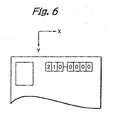
- Fig. 6 is a diagram illustrating a postal card upon which the operation of the character frame detecting apparatus of Fig. 1 is not performed;
- Fig. 7 is a diagram illustrating a postal card upon which the operation of the character frame detecting apparatus of Fig. 1 is erroneously performed;
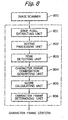
- Fig. 8 is a block circuit diagram illustrating an embodiment of the character frame detecting apparatus according to the present invention;
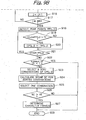
- Fig. 9 is a flowchart for explaining an operation of the character frame detecting apparatus of Fig. 8 where the apparatus of Fig. 8 is constructed by a computer;
- Figs. 10A, 10B, 10C, 10D, 10E and 10F are diagrams illustrating postal cards upon which the operation of the character frame detecting apparatus of Fig. 8 is performed;
- Fig. 11 is a diagram for explaining a size of a postal card upon which the operation of the character frame detecting appartus of Fig. 8 is performed;
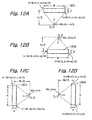
- Figs. 12A, 12B, 12C and 12D are diagrams for explaining voting regions used in the flowchart of Fig. 9;
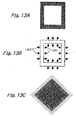
- Fig. 13A is a diagram illustrating a character frame upon which the operation as illustrated in Fig. 9 is performed;
- Fig. 13B is a diagram illustrating the character frame of Fig. 13A with gray gradients;
- Fig. 13C is a diagram illustrating voting counts of the character frame of Fig. 13B;
- Fig. 14 is a diagram illustrating another character frame arrangement upon which the operation of the flowchart as illustrated in Fig. 9 is performed.
- Before the description of the preferred embodiment, a prior art character frame detecting apparatus will be explained with reference to Figs. 1, 2, 3A, 3B, 3C, 3D, 3E, 3F, 4, 5A, 5B, 5C, 5D, 5E and 5F.
- In Fig. 1, which illustrates a prior art character frame detecting apparatus (see: JP-A-2000-268126),
reference numeral 101 designates a labeling processing unit for carrying out a labeling process to detect character frames which are so-called labels, 102 designates a label determining unit for determining whether each of the detected labels is prescribed or non-prescribed, 103 designates a label size detecting unit for detecting a size of the detected prescribed labels, 104 designates a prescribed label extracting unit for extracting prescribed labels from the detected non-prescribed label, 105 designates a non-prescribed label hyphen excluding unit for excluding a hyphen of the detected non-prescribed label, 106 designates a prescribed label extracting unit for extracting prescribed labels from the hyphen-excluded non-prescribed label, and 107 designates a label determining unit for determining whether or not the prescribed labels extracted by the prescribedlabel extracting unit 106 are the same as those determined by thelabel determining unit 102. - A first operation of the character frame detecting apparatus of Fig. 1 performed upon a postal card as illustrated in Fig. 2 is explained next with reference to Figs. 3A, 3B, 3C, 3D, 3E and 3F. Note that seven labels are printed on the postal card of Fig. 2.
- First, referring to Fig. 3A, the
label processing unit 101 detects character frames, i.e., labels by an X-directional image IX and a Y-directional image IY. As a result, four labels LA1, LA2, LA3 and LA4 are detected by using sharp shades S in the images IX and IY. That is, lines of the labels LA1, LA2, LA3 and LA4 are detected by whether or not the sharp shades S are higher than a threshold value TH1 or TH2. - Next, referring to Fig. 3B, the
label determining unit 102 determines whether each of detected labels LA1, LA2, LA3 and LA4 is a prescribed label or a non-prescribed label. In this case, there are generally a plurality of prescribed labels. Therefore, the labels LA2, LA3 and LA4 have substantially the same size, so that the labels LA2, LA3 and LA4 are determined to be prescribed. On the other hand, the label LA1 is non-prescribed. - Next, referring to Fig. 3C, the label
siz detecting unit 103 detects a size of the prescribed labels LA2, LA3 and LA4. In this case, a width W1 in the X-direction and a height H1 in the Y-direction are detected for the prescribed labels LA2, LA3 and LA4. - Next, referring to Fig. 3D, the prescribed
label extracting unit 104 extracts a prescribed label LA5 from the non-prescribed label LA1 by using the size of W1 × L1. - Next, referring to Fig. 3E, the non-prescribed label
hyphen excluding unit 105 excludes an edge, i.e., a hyphen from the non-prescribed label LA1. - Next, referring to Fig. 3F, the prescribed
label extracting unit 106 extracts three prescribed labels LA6, LA7 and LA8 by dividing the hyphen-excluded non-prescribed label LA1 by 3. - Finally, the
label determining unit 107 determines whether or not each of the labels LA6, LA7 and LA8 are prescribed, i.e., each of the labels LA6, LA7 and LA8 has a size of W1 × H1. Only when each of the labels LA6, LA7 and LA8 has a size of W1 × H1, is it determined that seven prescribed labels LA2 to LA8 are detected. - A second operation of the character frame detecting apparatus of Fig. 1 performed upon a postal card as illustrated in Fig. 4 is explained next with reference to Figs. 5A, 5B, 5C, 5D, 5E and 5F. Note that seven labels are also printed on the postal card of Fig. 4.
- First, referring to Fig. 5A, the
label processing unit 101 detects character frames, i.e., labels by an X-directional image IX and a Y-directional image IY. As a result, six labels LA1, LA2, LA3, LA4, LA5 and LA6 are detected by using sharp shades S in the images IX and IY. That is, lines of the labels LA1, LA2, LA3 ,LA4, LA5 and LA6 are detected by whether or not the sharp shades S are higher than a threshold value TH1 or TH2. - Next, referring to Fig. 5B, the
label determining unit 102 determines whether each of detected labels LA1, LA2, LA3 ,LA4, LA5 and LA6 is a prescribed label or a non-prescribed label. In this case, there are generally a plurality of prescribed labels. Therefore, the labels LA1, LA2 ,LA4, LA5 and LA6 have substantially the same size, so that the labels LA1, LA2, LA4, LA5 and LA6 are determined to be prescribed. On the other hand, the label LA3 is non-prescribed. - Next, referring to Fig. 5C, the label
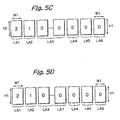
size detecting unit 103 detects a size of the prescribed labels LA1, LS2, LA4, LA5 and LA6. In this case, a width W1 in the X-direction and a height H1 in the Y-direction are detected for the prescribed labels LA1, LA2, LA4, LA5 and LA6. - Next, referring to Fig. 5D, the prescribed label, extracting
unit 104 extracts a prescribed label LA7 from the non-prescribed label LA3 by using the size of W1 × L1. - Next, referring to Fig. 5E, the non-prescribed label
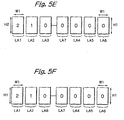
hyphen excluding unit 105 excludes an edge, i.e., a hyphen from the non-prescribed label LA3. - Next, referring to Fig. 5F, the prescribed
label extracting unit 106 extracts a prescribed label LA8, i.e., the hyphen-excluded non-prescribed label LA3. - Finally, the
label determining unit 107 determines whether or not each of the labels LA7 and LA8 are prescribed, i.e., each of the labels LA7 and LA8 has a size of W1 × H1. Only when each of the labels LA7 and LA8 has a size of W1 × H1, is it determined that seven prescribed labels LA1, LA2, LA4 through LA8 are detected. - Thus, in the character frame detecting appartus of Fig. 1, since lines of the labels (character frames) are detected by sharp shades S in the images IX any IY, even when characters are deviated from the labels or placed on the lines thereof, the labels can be surely detected. Also, since a proximity relationship between the labels is recognized by the size and location thereof, coordinates of labels in close proximity thereto can be surely detected.
- In the character frame detecting apparatus of Fig. 1, however, the following problems exist:
- First, unexpected arrangement of labels cannot be detected. That is, only expected arrangements of labels as illustrated in Figs. 2 and 4 can be surely detected; however, other arrangements such as an arrangement as illustrated in Fig. 6 cannot be detected.
- Second, if a noise image or background image is added to the arrangement of labels, such labels may not be detected.
- Third, if one or two lines of labels are oblique, vague or missing as illustrated in Fig. 7, the shades of lines of labels are vague or missing, so that the labels may not be detected or the detection accuracy of the labels deteriorates.
- In Fig. 8, which illustrates an embodiment of the character frame detecting apparatus according to the present invention,
reference numeral 800 designates an image scanner for reading gray pixel image of a postal card or the like. The gray pixel image of theimage scanner 800 is supplied to anedge extracting unit 801. - The edge
pixel extracting unit 801 extracts edge pixels at edges of lines of the gray pixel image by calculating a differential value of each pixel and determining whether or not the differential value is larger than a threshold value. The extracted edge pixel is supplied to avoting processing unit 802. - The
voting processing unit 802 performs a voting process upon a voting region which is set in accordance with a gray gradient of the extracted edge pixel. The voting region is expected to include a center of an expected character frame. Note that a voting process increments a voting count by + 1 at each coordinate within the voting region. Generally, since there are a lot of edge pixels, there are a lot of voting regions. Therefore, thevoting processing unit 802 carries out a lot of voting processes. - A
peak detecting unit 803 detects peak points having peak voting counts from all the coordinates by determining whether or not the voting count of each coordinate is larger than a threshold value. The peak points are registered as character frame center candidates. - A character frame
combination generating unit 804 generates combinations of a predetermined number of the character frame center candidates detected by thepeak detecting unit 803. For example, if there are seven character frames in a postal card, each character frame combination includes seven character frame center candidates. In this case, if there are eight character frame center candidates, eight character frame combinations are generated (8 = 8C7). Of course, if the number of character frame center candidates is less than 7, the character framecombination generating unit 804 is not operated. - A
score calculating unit 805 calculates a score for each of the character frame combinations. The score is dependent upon the voting counts, equi-interval degree and horizontality degree of coordinates of the character frame center candidates of each of the character frame combinations. - A character
frame determining unit 806 selects one of the character frame combinations having the largest score, and determines whether or not the score of a selected character frame combination is larger that a threshold value. Only when this score is larger than the threshold value, are the character frame center candidates of such a selected character frame combination determined to be character frame centers. - The character frame detecting apparatus of Fig. 8 is constructed by a computer including a central processing unit (CPU), a read-only memory (ROM) for storing programs and fixed data, a random access memory (RAM) for storing temporary data and the like. In this case, the CPU carries out an operation in accordance with a flowchart as illustrated in Fig. 9.
- First, at step 901. the CPU fetches image data from the
image scanner 800. For example, assume that the fetched image data is a postal card having a zip code of seven digits as illustrated in Fig. 10A, 10B, 10C, 10D, 10E or 10F where character frames (labels) have a size of W × H. - Next, at
step 902, an initialization is carried out, i.e.,
- Note that a coordinate (i, j) is defined as shown in Fig. 11, so that i is 0 to iMAX and j is 0 to jMAX. Also, V(i, j) is a voting count at a coordinate (i, j)
- Next, at
step 903, a differential value F(i, j) is calculated by
where A(i, j) is a gray value of the image data at a pixel (i, j). Note that the differential value F(i, j) can be a square root value thereof. - Next, at
step 904, it is determined whether or not the differential value F(i, j) is larger that a threshold value TF. Only when F(i, j) > TF, does the control proceed to step 905. Otherwise, the control proceeds to step 914. - At
step 905, a gradient θ(i, j)of the coordinate (i, j)is calculated by
- Next, at
step 906, it is determined whether the gradient θ(i, j) is upward, i.e.,
where α is a small definite value. Only when the gradient θ(i, j) is upward, does the control proceed to step 907 which carries out an upward voting process. That is, as illustrated in Fig. 12A, arectangular voting region 1201 having a start coordinate (i-W/2, j-(H+d)/2) and an end coordinate (i+W/2, j-(H-d)/2) where d is a small definite value is set, and V(i', j') whose coordinate (i', j') belongs to therectangular voting region 1201 is incremented by +1, i.e.,
where i' is (i-W/2) to (i+W/2), and j' is (j-(H + d)/2) to (j-(H-d)/2). - Otherwise, i.e., when the gradient θ (i, j) is not upward, the control proceeds from
step 906 to step 908. - At
step 908, it is determined whether the gradient θ(i, j) is downward, i.e.,
- Only when the gradient θ(i, j) is downward, does the control proceed to step 909 which carries out a downward voting process. That is, as illustrated in Fig. 12B, a
rectangular voting region 1202 having a start coordinate (i-W/2, j+(H-d)/2) and an end coordinate (i+W/2, j+(H+d)/2) is set, and V(i', j') whose coordinate (i', j') belongs to therectangular voting region 1202 is incremented by +1, i.e.,
where i' is (i-W/2) to (i+W/2), and j' is (j+(H - d)/2) to (j+(H+d)/2). - Otherwise, i.e., when the gradient θ(i, j) is not downward, the control proceeds from
step 908 to step 910. - At
step 910, it is determined whether the gradient θ(i, j) is leftward, i.e.,
- Only when the gradient θ(i, j) is leftward, does the control proceed to step 911 which carries out a leftward voting process. That is, as illustrated in Fig. 12C, a rectangular voting region 1203 having a start coordinate (i-(W+d)/2, j-H/2) and an end coordinate (i-(W-d)/2, j+H/2) is set, and V(i', j') whose coordinate (i', j') belongs to the rectangular voting region 1203 is incremented by +1, i.e.,

where i' is (i-(W+d)/2) to (i-(W-d)/2), and j' is (j-H/2) to (j+H/2). - Otherwise, i.e., when the gradient θ(i, j) is not leftward, the control proceeds from
step 910 to step 912. - At
step 912, it is determined whether the gradient θ(i, j) is rightward, i.e.,
- Only when the gradient θ(i, j) is rightward, does the control proceed to step 913 which carries out a rightward voting process. That is, as illustrated in Fig. 12D, a
rectangular voting region 1204 having a start coordinate (i+(W+d)/2, j-H/2) and an end coordinate (i+(W+d)/2, j+H/2) is set, and V(i', j') whose coordinate (i', j') belongs to therectangular voting region 1204 is incremented by +1, i.e.,
where i' is (i+(W+d)/2) to (i+(W-d)/2), and j' is (j-H/2) to (j+H/2). - Otherwise, i.e., when when the gradient θ(i,j) is not rightward, the
control 1 proceeds fromstep 912 to step 914. -
Steps 914 through 917 repeat the operation atsteps 903 through 913 for all the coordinates (i, j) within the postal card having a size of W0 × H0 as illustrated in Fig. 11. - Thus, only when the gradient θ (i, j) is substantially π/2, -π/2, π or 0, in other words, 90° ,-90°, 180° or 0° (mod. 360°) with respect to the X-direction, is a voting process carried out.
- Next, at
step 918, peak points of the voting counts V(i, j) are detected. That is, it is determined whether or not all the following conditions are satisfied for a coordinate (i, j):


- Only when all the above-mentioned four conditions are satisfied, is this coordinate (i, j) detected as a peak point PP(i, j). Note that a plurality of peak points are generally detected.
- Next, at
step 919 it is determined whether or not V(i, j) at PP(i, j) is larger than a threshold value TV. Only when V(i, j) at PP(i, j) > TV, does the control proceed to step 920 which registers the peak point PP(i, j) as a character frame (label) center candidate CP(i, j). Otherwise, the control proceeds directly to step 921. - Step 921 repeats the operation at
steps - Next, at
step 922, it is determined whether or not the number of registered character frame center candidates CP(i, j) is smaller than 7, since the number of character frames (labels) was assumed to be 7 as illustrated in Figs. 12A, 12B, 12C, 12D, 12E and 12F. When the number of registered character frame center candidates CP(i, j) is not smaller than 7, the control proceeds to step 923. Otherwise, the control proceeds directly to step 928. - At
step 923, the CPU selects a combination of seven ones from the registered character frame (label) center candidates CP(i, j). For example, if the number of the registered character frame (label) center candidates CP(i, j) is 7, the number of combinations of seven character frame (label) center candidates is 1(= 7C7). Also, if the number of the registered character frame (label) center candidates CP(i, j) is 8, the number of combinations of seven character frame (label) center candidates is 8(= 8C7). Further, if the number of the registered character frame (label) center candidates CP(i, j) is 9, the number of combinations of seven character frame (label) center candidates is 36(= 9C7). Then, each of the selected combinations of character frame (label) center candidates CP(i, j) are sorted in accordance with the X-direction. - Next, at
step 924, a score SC is calculated for each sorted combination of the character frame (label) center candidates CP(i, j) by

- where SUM is a sum of the voting counts at the character frame (label) center candidates CP(i, j) within one sorted combination;
- INT is an equi-interval degree of the character frame (label) center candidates CP(i, j) within the one sorted combination;
- HOR is a horizontality degree of the character frame (label) center candidates CP(i, j) within the one sorted combination; and
- W1, W2 and W3 are weighted factors where W1 is positive and W2 and W3 are negative.
- If one sorted combination is given by coordinates (i1, j1), (i2, j2), (i3, j3), (i4, j4), (i5, j5), (i6, j6) and (i7, j7), the sum SUM is calculated by

- That is, the larger the sum SUM, the larger the possibility of character frames (labels) for a postal card.
- Also, the equi-interval degree INT is calculated by

where

- Note that AVE1 designates an average interval of the three most significant digits (labels), and AVE2 designates an average interval of the four least significant digits (labels). That is, the smaller the equi-interval degree INT, the larger the possibility of character frames (labels) for a postal card.
- Further, the horizontality degree HOR is calculated by

- That is, the smaller the horizontality, the larger the possibility of character frames (labels) for a postal card.
- Next, at
step 925, the CPU selects one sorted combination having a largest score from the sorted combinations. - Next, at
step 926, it is determined whether or not the score SC of the selected combination atstep 925 are larger than a threshold value TS. Only when SC > TS, does the control proceed to step 927 which determines that the selected combination of character frames atstep 925 is character frames (labels) in the postal card. Otherwise, it is determined that there is no character frames (labels) in the postal card, and thus, the control proceeds directly to step 928. - Thus, the routine of Fig. 9 is completed by
step 928. - At
step 904 of Fig. 9, it is determined whether or not the differential value F(i, j) is larger than the threshold value TF. As a result, if a noise image or background image is included in the fetched image data, the detection of noise image or background image can be suppressed. Additionally, F(i, j) ≦ TF, the operation atsteps 905 through 913 are skipped to increase the operation speed. - Also, at
steps 906 through 913 of Fig. 9, a voting process is performed upon only four gray gradients, i.e., - π/2, π/2, π and 0. That is, a voting process is performed upon only straight lines along the X-direction and the Y-direction. As a result, no voting process is performed upon oblique lines with respect to the X- and Y-directions, characters including curved lines and the like. Therefore, character frames including only such straight lines can be surely detected. - If the voting process as illustrated at
steps 905 to 917 in Fig. 9 is applied to a character frame as illustrated in Fig. 13A, the gray gradient θ of edge pixels are inward at the inner edges of lines of the character frame as indicated by 1301, while the gray gradient θ of edge pixels are outward at the outer edges of lines of the character frame as indicated by 1302 in Fig. 13B. As a result, as illustrated in Fig. 13C, since the voting counts by the outward gray gradient θ at the outer edges are dispersed, the voting counts are concentrated on the center of the character frame by the inward gradient θ at the inner edges. Also, since the concentration of voting counts on the center of the character frame is not affected by hyphens and intervals between character frames, the center of the character frame can be surely detected, so that various arrangements as illustrated in Figs. 10A, 10B, 10C, 10D, 10E and 10F can be surely detected. Additionally, if one or two lines of one character frame are oblique, vague or missing, the concentration of voting counts on the center of the character frame is hardly affected, the center thereof can also be surely detected. - The above-described embodiment relates to a seven-digit character frame arrangement as illustrated in Figs. 10A, 10B, 10C, 10D, 10E and 10F; however, the present invention can be applied to an n-digit character frame arrangement as illustrated in Fig. 14. In this case, at
step 922, it is determined whether or not the number of registered character frame center candidates CP(i, j) is smaller than n. Since the number of character frames (labels) was assumed to be 7 as illustrated in Figs. 12A, 12B, 12C, 12D, 12E and 12F, when the number of registered character frame center candidates CP(i, j) is not smaller than 7, the control proceeds to step 923. - Also, at
step 924, if one sorted combination is given by coordinates (i1, j1), (i2, j2), (i3, j3), ···, (i(n-1), j(n-1) and (in, jn), the sum SUM is calculated by
- Also, the equi-interval degree INT is calculated by


where
- Further, the horizontality degree HOR is calculated by

- As explained hereinabove, according to the present invention, various kinds of character frame arrangements can be surely detected in spite of hyphens and intervals of character frames. Also, even if a noise image or background image is added, character frames can be surely detected. Further, even if some of lines of character frames are oblique, vague or missing, the deterioration of detection of character frames can be suppressed.
Claims (28)
- A character frame detecting method comprising the steps of:extracting edge pixels at edges of lines of character frames from gray pixels of a gray pixel image;calculating gray gradients (θ(i, j)) at said edge pixels;setting voting regions (1201, 1202, 1203, 1204) with respect to said edge pixels in accordance with said gray gradients thereof;determining whether each of said gray gradients is substantially one of 90° , -90° ,180° and 0° with respect to one axis of said gray pixel image,so that when one of said gray gradients is substantially one of 90° , -90° ,180° and 0° with respect to the axis of said gray pixel image, said voting region setting step sets one of said voting regions in accordance with said one of said gray gradients;wherein, when a first one of said gray gradients is substantially one of 90° and -90° with respect to the axis of said gray pixel image, a first corresponding one of said voting regions has a width (W) the same as the width (W) of an expected character frame size and is distant from a corresponding one of said edge pixels by a height (H/2) half the height (H) of said expected character frame size along the first one of said gray gradients; andwherein, when a second one of said gray gradients is substantially one of 180° and 0° with respect to the axis of said gray pixel image, a second corresponding one of said voting regions has a height (H) the same as the height (H) of said expected character frame size and is distant from a corresponding one of said edge pixels by a width (W/2) half the width (W) of said expected character frame size along the second one of said gray gradients;carrying out voting processes by incrementing voting counts at coordinates within said voting regions; anddetecting peak coordinates (PP(i, j)) having peak voting counts from said coordinates, so that said peak coordinates are determined to be centers of said character frames.
- The method as set forth in claim 1, wherein said edge pixel extracting step comprises the steps of:calculating differential values at said gray pixels; anddetermining whether or not each of said differential values is larger than a differential value threshold value(TF), so that, when each of said differential values is larger than said differential value threshold value, a corresponding one of said gray pixels is determined to be one of said edge pixels.
- The method as set forth in claim 2, wherein said differential value calculating step calculates said differential values F(i, j) at coordinates (i, j) by

where A(i, j) is a gray value of a gray pixel at (i, j) and A(i + 1, j) and A(i, j + 1) are gray values of gray pixels at adjacent coordinates to (i, j) - The method as set forth in claim 2, wherein said differential value calculating step calculates said differential values F(i, j) at coordinates (i, j) by

where A(i, j) is a gray value of a gray pixel at (i, j) and A(1+ 1, j) and A(i, j + 1) are gray values of gray pixels at adjacent coordinates to (i, j). - The method as set forth in any one of claim 1 to 4, wherein each of said voting regions is rectangular.
- The method as set forth in claim 5, wherein each of said voting regions is distant from a corresponding one of said edge pixels by a predetermined distance (H/2, W/2) and perpendicular to the gray gradient thereof.
- The method as set forth in claim 5 or 6, wherein each of said voting regions has a length of one of the width (W) and height (H) of an expected character frame size.
- The method as set forth in any one of claims 1 to 7, wherein in said peak detecting step comprises the steps of:determining whether or not the voting count of each of said peak coordinates is larger than a peak threshold value (TV); andregistering said each of said peak coordinates as a character frame center candidate (CP(i, j)) when the voting count of said each of said peak coordinates is larger than said peak threshold value, so that said character frame center candidate is determined to be one center of said character frames.
- The method as set forth in claim 8, further comprising the steps of :generating combinations of a predetermined number of registered character frame center candidates;calculating a score (SC) of each of said combinations by a sum of the voting counts of said registered character frame center candidates belonging thereto; anddetermining that the registered character frame center candidates of one of said combinations are said centers of said character frames.
- The method as set forth in claim 9, wherein said score calculating step calculates the score of each of said combinations by subtracting an equi-interval degree of said registered character frame center candidates within said each of said combinations from the sum of the voting counts thereof.
- The method as set forth in claim 8 or 9, wherein said score calculating step calculates the score of each of said combinations by subtracting a horizontality degree of said registered character frame center candidates within said each of said combinations from the sum of the voting counts thereof.
- The method as set forth in claim 9, wherein said score calculating step calculates the score of each of said combinations by subtracting an equi-interval degree and a horizontality degree of said registered character frame center candidates within said each of said combinations from the sum of the voting counts thereof
- The method as set forth in claim 9, 10, 11 or 12, wherein said character frame center determining step comprises the steps of:selecting one of said combinations having a largest score from said combinations; anddetermining whether or not the score of said selected combination is larger than a combination threshold value (TS), so that the registered character frame center candidates of said selected combination of said character frame center candidates are determined to be said centers of said character frames.
- The method as set forth in any one of claims 1 to 13, wherein said gray pixel image is a postal card image.
- A character frame detecting apparatus comprising:an edge pixel extracting unit (801) for extracting edge pixels at edges of lines of character frames from gray pixels of a gray pixel image;a voting processing unit (802) for calculating gray gradients (θ(i, j)) at said edge pixels, setting voting regions (1201, 1202, 1203, 1204) with respect to said edge pixels in accordance with said gray gradients thereof, and carrying out voting processes by incrementing voting counts at coordinates within said voting regions;wherein said voting processing unit comprises means for determining whether each of said gray gradients is substantially one of 90° , -90° , 180° and 0° with respect to one axis of said gray pixel image, so that when one of said gray gradients is substantially one of 90° , -90° ,180° and 0° with respect to the axis of said gray pixel image, said voting region setting step sets one of said voting regions in accordance with said one of said gray gradients;wherein, when a first one of said gray gradients is substantially one of 90° and -90° with respect to the axis of said gray pixel image, a first corresponding one of said voting regions has a width (W) the same as the width (W) of an expected character frame size and is distant from a corresponding one of said edge pixels by a height (H/2) half the height (H) of said expected character frame size along the first one of said gray gradients; andwherein, when a second one of said gray gradients is substantially one of 180° and 0° with respect to the axis of said gray pixel image, a second corresponding one of said voting regions has a height (H) the same as the height (H) of said expected character frame size and is distant from a corresponding one of said edge pixels by a width (W/2) half the width (W) of said expected character frame size along the second one of said gray gradients;a peak detecting unit (803) for detecting peak coordinates (PP(i, j)) having peak voting counts from said coordinates, so that said peak coordinates are determined to be centers of said character frames.
- The apparatus as set forth in claim 15, wherein said edge pixel extracting unit comprises:means for calculating differential values at said gray pixels; andmeans for determining whether or not each or said differential values is larger than a differential value threshold value(TF), so that, when each of said differential values is larger than said differential value threshold value, a corresponding one of said gray pixels is determined to be one of said wedge pixel.
- The apparatus as set forth in claim 16, wherein said differential value calculating means calculates said differential values F(i, j) at coordinates (i, j) by

where A(i, j) is a gray value of a gray pixel at (i, j) and A(i + 1, j) and A(i, j + 1) are gray values of gray pixels at adjacent coordinates to (i, j). - The apparatus as set forth in claim 20, wherein said differential value calculating means calculates said differential values F(i, j) at coordinates (i, j) by

where A(i, j) is a gray value of a gray pixels at (i, j) and A(i + 1, j) and A(i, j + 1) are gray values of gray pixels at adjacent coordinates to (i, j). - The apparatus as set forth in any one of claims 15 to 18, wherein each of said voting regions is rectangular.
- The apparatus as set forth in claim 19, wherein each of said voting regions is distant from a corresponding one of said edge pixels by a predetermined distance (H/2, W/2) and perpendicular to the gray gradient thereof.
- The apparatus as set forth in claim 19 or 20, wherein each of said voting regions has a length of one of the width (W) and height (H) of an expected character frame size.
- The apparatus as set forth in any one of claims 15 to 21, wherein said peak detecting unit comprises:means for determining whether or not the voting count of each of said peak coordinates is larger than a peak threshold value (TV); andmeans for registering said each of said peak coordinates as a character frame center candidate (CP(1, j)) when the voting count of said each of said peak coordinates is larger than said peak threshold value, so that said character frame center candidate is determined to be one center of said character frames.
- The apparatus as set forth in claim 22, further comprising:a character frame combination generating unit (804) for generating combinations of a predetermined number of registered character frame center candidates;a score calculating unit (805) for calculating a score (SC) of each of said combinations by a sum of the voting counts of said registered character frame center candidates belonging thereto; anda character frame determining unit (806) for determining that the registered character frame center candidates of one of said combinations are said centers of said character frames.
- The apparatus as set forth in claim 23, wherein said score calculating unit calculates the score of each of said combinations by subtracting an equi-interval degree of said registered character frame center candidates within said each of said combinations from the sum of the voting counts thereof.
- The apparatus as set forth in claim 23, wherein said score calculating unit calculates the score of each of said combinations by subtracting a horizontality degree of said registered character frame center candidates within said each of said combinations from the sum of the voting counts thereof.
- The apparatus as set forth in claim 23, wherein said score calculating unit calculates the score of each of said combinations by subtracting an equi-interval degree and a horizontality degree of said registered character frame center candidates within said each of said combinations from the sum of the voting counts thereof.
- The apparatus as set forth in any one of claims 23 to 26, wherein said character frame center determining unit comprises:means for selecting one of said combinations having a largest score from said combinations; andmeans for determining whether or not the score of said selected combination is larger than a combination threshold value (TS), so that said selected combination of said character frame center candidates are determined to be said centers of said character frames.
- The apparatus as set forth in any one of claims 15 to 27, wherein said gray pixel image is a postal card image.
Applications Claiming Priority (4)
| Application Number | Priority Date | Filing Date | Title |
|---|---|---|---|
| JP2001053433 | 2001-02-28 | ||
| JP2001053433 | 2001-02-28 | ||
| JP2002019278 | 2002-01-28 | ||
| JP2002019278A JP3705216B2 (en) | 2001-02-28 | 2002-01-28 | Character entry frame detection method, character entry frame detection device and program |
Publications (3)
| Publication Number | Publication Date |
|---|---|
| EP1237116A2 EP1237116A2 (en) | 2002-09-04 |
| EP1237116A3 EP1237116A3 (en) | 2004-12-15 |
| EP1237116B1 true EP1237116B1 (en) | 2006-11-29 |
Family
ID=26610252
Family Applications (1)
| Application Number | Title | Priority Date | Filing Date |
|---|---|---|---|
| EP02004286A Expired - Lifetime EP1237116B1 (en) | 2001-02-28 | 2002-02-27 | Method and apparatus for detecting character frames using voting process |
Country Status (5)
| Country | Link |
|---|---|
| EP (1) | EP1237116B1 (en) |
| JP (1) | JP3705216B2 (en) |
| KR (1) | KR100466370B1 (en) |
| BR (1) | BRPI0201387B1 (en) |
| DE (1) | DE60216342T2 (en) |
Families Citing this family (2)
| Publication number | Priority date | Publication date | Assignee | Title |
|---|---|---|---|---|
| JP4909311B2 (en) * | 2008-03-31 | 2012-04-04 | 富士通フロンテック株式会社 | Character recognition device |
| CN104268864B (en) * | 2014-09-18 | 2017-04-12 | 小米科技有限责任公司 | Card edge extracting method and device |
Family Cites Families (9)
| Publication number | Priority date | Publication date | Assignee | Title |
|---|---|---|---|---|
| US5459797A (en) * | 1991-03-30 | 1995-10-17 | Kabushiki Kaisha Toshiba | Character reading system |
| JP2951814B2 (en) * | 1993-02-25 | 1999-09-20 | 富士通株式会社 | Image extraction method |
| KR100313991B1 (en) * | 1993-07-12 | 2002-02-19 | 구자홍 | Method for detecting slope of document image |
| US5815595A (en) * | 1995-12-29 | 1998-09-29 | Seiko Epson Corporation | Method and apparatus for identifying text fields and checkboxes in digitized images |
| JP3113827B2 (en) * | 1996-11-28 | 2000-12-04 | インターナショナル・ビジネス・マシーンズ・コーポレ−ション | Method and apparatus for recognizing rectangular object |
| KR100259804B1 (en) * | 1997-08-14 | 2000-06-15 | 구자홍 | Letter cognition method for guidepost shape |
| KR19990062036A (en) * | 1997-12-31 | 1999-07-26 | 윤종용 | Edge Detection Method Using Differential Operators |
| JP4242962B2 (en) * | 1999-01-08 | 2009-03-25 | パナソニック コミュニケーションズ株式会社 | Character extractor |
| JP3930192B2 (en) * | 1999-03-19 | 2007-06-13 | 株式会社東芝 | Frame detection apparatus and frame detection method |
-
2002
- 2002-01-28 JP JP2002019278A patent/JP3705216B2/en not_active Expired - Lifetime
- 2002-02-27 DE DE60216342T patent/DE60216342T2/en not_active Expired - Lifetime
- 2002-02-27 EP EP02004286A patent/EP1237116B1/en not_active Expired - Lifetime
- 2002-02-28 BR BRPI0201387A patent/BRPI0201387B1/en not_active IP Right Cessation
- 2002-02-28 KR KR10-2002-0011014A patent/KR100466370B1/en not_active Expired - Fee Related
Also Published As
| Publication number | Publication date |
|---|---|
| DE60216342T2 (en) | 2007-03-15 |
| BR0201387A (en) | 2002-12-03 |
| EP1237116A3 (en) | 2004-12-15 |
| EP1237116A2 (en) | 2002-09-04 |
| JP2002329168A (en) | 2002-11-15 |
| BRPI0201387B1 (en) | 2015-09-08 |
| KR20020070647A (en) | 2002-09-10 |
| JP3705216B2 (en) | 2005-10-12 |
| KR100466370B1 (en) | 2005-01-14 |
| DE60216342D1 (en) | 2007-01-11 |
Similar Documents
| Publication | Publication Date | Title |
|---|---|---|
| US6226402B1 (en) | Ruled line extracting apparatus for extracting ruled line from normal document image and method thereof | |
| US7302098B2 (en) | Character segmentation method and apparatus | |
| Taylor et al. | Extraction of data from preprinted forms | |
| US6950533B2 (en) | Sorting images for improved data entry productivity | |
| JP2940496B2 (en) | Pattern matching encoding apparatus and method | |
| US8208725B2 (en) | Methods and systems for identifying text orientation in a digital image | |
| US20080317341A1 (en) | Methods and Systems for Identifying Text Orientation in a Digital Image | |
| US6760490B1 (en) | Efficient checking of key-in data entry | |
| CN108830133A (en) | Recognition methods, electronic device and the readable storage medium storing program for executing of contract image picture | |
| CN109685059B (en) | Text image labeling method, text image labeling device and computer readable storage medium | |
| CN110008960B (en) | Method and terminal for detecting integrity of character segment | |
| JP4733577B2 (en) | Form recognition device and form recognition program | |
| EP1237116A2 (en) | Method and apparatus for detecting character frames using voting process | |
| JP3303246B2 (en) | Image processing device | |
| CN112052766B (en) | Document classification method and device based on black label | |
| JP3440501B2 (en) | Driver's license recognition device | |
| JPH06187489A (en) | Character recognizing device | |
| EP0601730A1 (en) | Image processing method for correcting character slant | |
| JPH02116987A (en) | Character recognizing device | |
| CN111695559A (en) | Freight note picture information coding method and system based on YoloV3 model | |
| KR910005385B1 (en) | Character recognition system by means of extracting approximated stroke lines | |
| JP2000339472A (en) | Method and apparatus for determining printing of segment character pattern | |
| Fadeel | An efficient segmentation algorithm for arabic handwritten characters recognition system | |
| JP3534997B2 (en) | Ruled line extraction device and method | |
| JP2975067B2 (en) | Character recognition method |
Legal Events
| Date | Code | Title | Description |
|---|---|---|---|
| PUAI | Public reference made under article 153(3) epc to a published international application that has entered the european phase |
Free format text: ORIGINAL CODE: 0009012 |
|
| AK | Designated contracting states |
Kind code of ref document: A2 Designated state(s): AT BE CH CY DE DK ES FI FR GB GR IE IT LI LU MC NL PT SE TR |
|
| AX | Request for extension of the european patent |
Free format text: AL;LT;LV;MK;RO;SI |
|
| PUAL | Search report despatched |
Free format text: ORIGINAL CODE: 0009013 |
|
| AK | Designated contracting states |
Kind code of ref document: A3 Designated state(s): AT BE CH CY DE DK ES FI FR GB GR IE IT LI LU MC NL PT SE TR |
|
| AX | Request for extension of the european patent |
Extension state: AL LT LV MK RO SI |
|
| 17P | Request for examination filed |
Effective date: 20041108 |
|
| 17Q | First examination report despatched |
Effective date: 20050413 |
|
| AKX | Designation fees paid |
Designated state(s): DE FR GB |
|
| GRAP | Despatch of communication of intention to grant a patent |
Free format text: ORIGINAL CODE: EPIDOSNIGR1 |
|
| GRAS | Grant fee paid |
Free format text: ORIGINAL CODE: EPIDOSNIGR3 |
|
| GRAA | (expected) grant |
Free format text: ORIGINAL CODE: 0009210 |
|
| AK | Designated contracting states |
Kind code of ref document: B1 Designated state(s): DE FR GB |
|
| REG | Reference to a national code |
Ref country code: GB Ref legal event code: FG4D |
|
| REF | Corresponds to: |
Ref document number: 60216342 Country of ref document: DE Date of ref document: 20070111 Kind code of ref document: P |
|
| ET | Fr: translation filed | ||
| PLBE | No opposition filed within time limit |
Free format text: ORIGINAL CODE: 0009261 |
|
| STAA | Information on the status of an ep patent application or granted ep patent |
Free format text: STATUS: NO OPPOSITION FILED WITHIN TIME LIMIT |
|
| 26N | No opposition filed |
Effective date: 20070830 |
|
| REG | Reference to a national code |
Ref country code: FR Ref legal event code: PLFP Year of fee payment: 15 |
|
| PGFP | Annual fee paid to national office [announced via postgrant information from national office to epo] |
Ref country code: DE Payment date: 20160223 Year of fee payment: 15 |
|
| PGFP | Annual fee paid to national office [announced via postgrant information from national office to epo] |
Ref country code: FR Payment date: 20160108 Year of fee payment: 15 Ref country code: GB Payment date: 20160224 Year of fee payment: 15 |
|
| REG | Reference to a national code |
Ref country code: DE Ref legal event code: R119 Ref document number: 60216342 Country of ref document: DE |
|
| GBPC | Gb: european patent ceased through non-payment of renewal fee |
Effective date: 20170227 |
|
| REG | Reference to a national code |
Ref country code: FR Ref legal event code: ST Effective date: 20171031 |
|
| PG25 | Lapsed in a contracting state [announced via postgrant information from national office to epo] |
Ref country code: FR Free format text: LAPSE BECAUSE OF NON-PAYMENT OF DUE FEES Effective date: 20170228 Ref country code: DE Free format text: LAPSE BECAUSE OF NON-PAYMENT OF DUE FEES Effective date: 20170901 |
|
| PG25 | Lapsed in a contracting state [announced via postgrant information from national office to epo] |
Ref country code: GB Free format text: LAPSE BECAUSE OF NON-PAYMENT OF DUE FEES Effective date: 20170227 |