EP1236815A2 - Process for improving an anodizing film, an anodizing film structure and an aluminum-alloy-made outboard engine - Google Patents
Process for improving an anodizing film, an anodizing film structure and an aluminum-alloy-made outboard engine Download PDFInfo
- Publication number
- EP1236815A2 EP1236815A2 EP02004768A EP02004768A EP1236815A2 EP 1236815 A2 EP1236815 A2 EP 1236815A2 EP 02004768 A EP02004768 A EP 02004768A EP 02004768 A EP02004768 A EP 02004768A EP 1236815 A2 EP1236815 A2 EP 1236815A2
- Authority
- EP
- European Patent Office
- Prior art keywords
- film
- pores
- anodizing film
- anodizing
- primer
- Prior art date
- Legal status (The legal status is an assumption and is not a legal conclusion. Google has not performed a legal analysis and makes no representation as to the accuracy of the status listed.)
- Granted
Links
Images



Classifications
-
- C—CHEMISTRY; METALLURGY
- C25—ELECTROLYTIC OR ELECTROPHORETIC PROCESSES; APPARATUS THEREFOR
- C25D—PROCESSES FOR THE ELECTROLYTIC OR ELECTROPHORETIC PRODUCTION OF COATINGS; ELECTROFORMING; APPARATUS THEREFOR
- C25D11/00—Electrolytic coating by surface reaction, i.e. forming conversion layers
- C25D11/02—Anodisation
- C25D11/04—Anodisation of aluminium or alloys based thereon
- C25D11/18—After-treatment, e.g. pore-sealing
-
- C—CHEMISTRY; METALLURGY
- C25—ELECTROLYTIC OR ELECTROPHORETIC PROCESSES; APPARATUS THEREFOR
- C25D—PROCESSES FOR THE ELECTROLYTIC OR ELECTROPHORETIC PRODUCTION OF COATINGS; ELECTROFORMING; APPARATUS THEREFOR
- C25D11/00—Electrolytic coating by surface reaction, i.e. forming conversion layers
- C25D11/02—Anodisation
- C25D11/04—Anodisation of aluminium or alloys based thereon
- C25D11/18—After-treatment, e.g. pore-sealing
- C25D11/24—Chemical after-treatment
- C25D11/246—Chemical after-treatment for sealing layers
-
- B—PERFORMING OPERATIONS; TRANSPORTING
- B63—SHIPS OR OTHER WATERBORNE VESSELS; RELATED EQUIPMENT
- B63B—SHIPS OR OTHER WATERBORNE VESSELS; EQUIPMENT FOR SHIPPING
- B63B59/00—Hull protection specially adapted for vessels; Cleaning devices specially adapted for vessels
Definitions
- This invention relates to the construction of an anodizing film which improves the corrosion resistance of an aluminum alloy product or part used in the presence of water, such as a boat propeller or hull used in a sea or lake, a water pump or sprayer driven by a general-purpose engine or an agricultural machine used in a paddy field.
- Every such product or part is usually covered with a rustor corrosion-preventing surface coating.
- a rust-proofing coating which enables any such product or part to stand seawater containing salt as an element accelerating corrosion.
- a large number of technical proposals have hitherto been made about rust- or corrosion-preventing coating, and include Japanese Patent Laid-Open Publication No. HEI-2-250997 entitled "Method for the Rust-Proofing Treatment of an Aluminum Material and an Aluminum Outboard Engine", which is characterized by forming an anodizing film on the surface of an aluminum or aluminum alloy material, sealing its pores with molybdenum disulfide and forming a surface coating thereon.
- the proposed aluminum outboard engine has, however, been found to exhibit only the corrosion resistance which was satisfactory as intended in those days, but which never satisfies the severe requirements of recent years.
- This invention provides a rust-proofing structure of improved corrosion resistance.
- molybdenum disulfide is a crystalline substance which does not form any layer of passivity with aluminum, but merely closes the pores of an anodizing film and adheres to it, and is not satisfactory in durability.
- a process for improving an anodizing film which comprises the steps of forming an anodizing film on the surface of an aluminum alloy material, impregnating the film with an amorphous substance capable of forming a layer of passivity with aluminum to fill pores formed in the film during its growth, and sealing the pores to close their inlets to confine the amorphous substance therein.
- the anodizing film is impregnated with an amorphous substance so that a layer of passivity may be formed between the amorphous substance and aluminum if the film should have any flaw reaching the aluminum alloy material.
- the formation of such a layer makes it possible to restrain corrosion.
- zirconium phosphate is used as the amorphous substance.
- Zirconium phosphate or chromium chromate can be used as an amorphous substance forming a layer of passivity with aluminum, but chromium chromate is a harmful heavy metal and gives waste water incurring a high cost of disposal.
- Zirconium phosphate is preferred, since it does not require any such costly treatment, but enables a reduction of cost for an improved anodizing film. According to a preferred example, it is adequate to use zirconium phosphate in the amount of about 15 mg/cm 2 to 45 mg/cm 2 .
- the process may further include the step of coating the surface of the anodizing film with a primer after the sealing of its pores.
- the anodizing film and primer protect the aluminum alloy material if they are sound, while if the film is damaged, zirconium phosphate and aluminum form a layer of passivity which protects the aluminum alloy material.
- phosphomolybdic acid is used as a pigment for the primer.
- Zinc phosphate or tripolyphosphoric acid can also be used as the pigment.
- Phosphomolybdic acid is, however, preferred for corrosion resistance. According to a preferred example, it is adequate to use phosphomolybdic acid in the proportion of 5 to 15% by weight.
- an anodizing film structure which comprises an anodizing film formed on the surface of an aluminum alloy material, zirconium phosphate impregnating the film to fill pores formed therein during its growth, and a seal closing the inlets of the pores.
- the anodizing film is impregnated with an amorphous substance so that a layer of passivity may be formed between zirconium phosphate and aluminum if the film should have any flaw reaching the aluminum alloy material.
- the formation of such a layer makes it possible to restrain corrosion.
- the film having its pores sealed protects the aluminum alloy material if it is sound, while if it is damaged, zirconiumphosphate and aluminum form a layer of passivity which protects the aluminum alloy material.
- the structure therefore, provides a long time of protection for the aluminum alloy material.
- the amount of zirconium phosphate as the impregnant it is adequate to use about 15 mg/cm 2 .
- the structure may further include a primer layer formed on the surface of the anodizing film including the seal.
- the primer layer and the film having its pores sealed protect the aluminum alloy material if they are sound, while if the film is damaged, zirconium phosphate and aluminum form a layer of passivity which protects the aluminum alloy material.
- the structure therefore, provides a still longer time of protection for the aluminum alloy material.
- the primer layer may be of a primer containing phosphomolybdic acid as a pigment. Zinc phosphate or tripolyphosphoric acid can also be used as the pigment. Phosphomolybdic acid is, however, preferred for corrosion resistance.
- an aluminum-alloy-made outboard engine which comprises an engine cover, an under cover attached to the bottom of the engine cover, an extension case attached to the bottom of the under cover and a gear case attached to the bottom of the extension case, each of at least the extension and gear cases having an anodizing film structure comprising an anodizing film formed on the surface of an aluminum alloy material, zirconium phosphate impregnating the film to fill pores formed therein during its growth, and a seal closing the inlets of the pores.
- the outboard engine is exposed to salt water and sea breezes, and the gear and extension cases are, among others, exposed to seawater and attacked by chlorine ions in seawater, etc.
- the anodizing film covers the aluminum alloy material to prevent its corrosion by chlorine ions, and the pores of the film are filled with zirconium phosphate and closed at their inlets.
- the anodizing film structure gives the outboard engine a greatly improved corrosion resistance and protects it from corrosion.
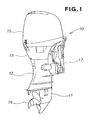
- an outboard engine 10 embodying this invention has a gear case 11, an extension case 12, an under cover 13 and an engine cover 15.
- a screw 16 is driven by an engine, a vertical shaft and a gear set enclosed in the engine cover 15, though not shown.
- the outboard engine 10 is attached to the stern of a ship not shown by a stern bracket 17, and an anodizing film structure according to this invention is applied to, among others, the gear and extension cases 11 and 12 which are dipped in seawater.
- the structure is, of course, applicable to any other part, too.
- the anodizing film structure of this invention is applicable to any aluminum alloy product or part used in the presence of water, such as a ship propeller or hull used in a sea or lake, a water pump or sprayer driven by a general-purpose engine or an agricultural machine used in a paddy field.
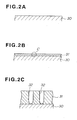
- FIG. 2A shows an aluminum alloy material 30.
- An anodizing film 31 having a thickness of about 15 microns is formed on the surface of the aluminum alloy material 30 by a known anodizing method, as shown in FIG. 2B.
- the anodizing film 31 is an oxide film consisting mainly of Al2O3 and fine pores 32 are unavoidably formed in the film during its growth from bottom to top, as shown in FIG. 2C showing an enlarged portion C of FIG. 2B.
- FIG. 2D An amorphous substance 33 capable of forming a layer of passivity with aluminum is introduced into the pores 32, as shown in FIG. 2D. It would be more adequate to say that the film 31 is impregnated with the amorphous substance 33, insofar as the pores 32 are so small.
- the amorphous substance 33 may be zirconium phosphate or chromium chromate.
- FIG. 2E shows a sealing process in which the pores 32 are being closed at their inlets 34 by a known sealant. Nickel acetate (amorphous) or sodium silicate (crystalline) can, for example, be used as the sealant.
- FIG. 2F shows two alternative forms of anodizing film structure as completed by the sealing process.
- One structure 36A comprises an anodizing film 31 formed on the surface of an aluminum alloy material 30, zirconium phosphate 33 impregnating the film 31 to fill its pores 32, and a seal 35 closing the inlets of the pores 32.
- the other structure 36B comprises an anodizing film 31 formed on the surface of an aluminum alloy material 30, zirconium phosphate 33 impregnating the film 31 to fill its pores 32, a seal 35 closing the inlets of the pores 32 and a primer layer 37 formed on the surface of the film 31 including the seal 35.
- the primer layer 37 is preferably of a primer containing an epoxy resin as a base and phosphomolybdic acid as a pigment.
- FIG. 3 is a flowchart showing a process embodying this invention for improving an anodizing film by the steps shown in FIGS. 2A to 2F.
- the basic process of this invention consists of the steps of forming an anodizing film on the surface of an aluminum alloy material, impregnating the filmwith an amorphous substance capable of forming a layer of passivity with aluminum to fill pores formed in the film, and sealing the pores to close their inlets to confine the amorphous substance therein.
- FIGS. 4A and 4B show the function of the anodizing film structure according to this invention.
- FIG. 4A shows a flaw 41 made in the anodizing film structure 36A by a sharp object 39 and reaching the aluminum alloy material 30.
- FIG. 4B shows a layer 42 of passivity formed by the amorphous substance 33 covering the exposed portion of the aluminum alloy material 30. The layer 42 protects the aluminum alloy material 30 from attack by chlorine ions in salt water.
- the layer 42 of passivity is, of course, lower in corrosion resistance than the anodizing film structure 36A or 36B shown in FIG. 2F. It, however, provides corrosion resistance for emergency purposes if the structure 36A or 36B is locally destroyed. The destruction of an ordinary anodizing film results in corrosion. According to this invention, however, the layer 42 of passivity is formed in the anodizing film structure 36A or 36B to resist corrosion even if the anodizing film 31 may be destroyed.
- this invention is concerned with a corrosion-resistant film or coating structure, its evaluation is mainly made for corrosion resistance by conducting a salt spray test as described below, and determining the width of a corroded area found after a specific length of time.
- the salt spray test was conducted by employing a spray chamber, a solution of NaCl having a concentration of 5 plus or minus 0.5%, compressed air having a pressure of 68.6 to 177 kpa and a temperature controller for maintaining a temperature of 35 plus or minus 1 deg. C, and spraying salt water against each test specimen for a specific length of time at a relative humidity of 95 to 98% and a temperature of 35 plus or minus 1 deg. C in accordance with the requirements of the Japanese Industrial Standard, JIS Z 2371 - Method for a Salt Spray Test.
- Each test specimen 25 was prepared by anodizing a piece of an aluminum alloy measuring 70 mm by 150 mm by 3.0 mm, applying a primer to it and cutting X-shaped lines 26 therein with a knife.
- FIG. 5B shows corroded areas 27 as found on the test specimen 25 along the cut lines 26 after a salt spray test lasting for a specific length of time. The width W of each corroded area was measured on either side of the line 26, as shown in FIG. 5B.
- Table 1 shows the chemical composition of the aluminum alloy material (JIS - ADC12) employed in these examples. Symbol Chemical composition (%) Cu Si Mg Zn Fe Mn Ni Sn Al ADC12 1.5-3.5 9.6-120 3.0 or less 1.0 or less 1.3 or less 0.5 or less 0.5 or less 0.3 or less Balance
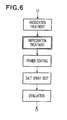
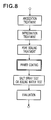
- FIGS. 6 to 8 show three flowcharts employed for conducting three groups of experiments concerning this invention, respectively, as will now be described.
- Each test specimen was prepared by anodizing the aluminum alloy material, impregnating the anodizing film to fill its pores and coating it with a primer, as shown in FIG. 6. Its salt spray test was conducted and the results thereof were evaluated. A different substance was employed from one experiment to another for impregnating the anodizing film, and was compared with another. More specifically, there were employed for comparison nickel acetate and zirconium phosphate as amorphous sealants, and zinc phosphate as a crystalline one.
- Example 1 The results of Example 1, in which nickel acetate had been used as the impregnant, were evaluated as Good (G), since the corroded areas had a width of 1.7 to 4.3 mm after 2000 hours of test indicating a generally allowable degree of corrosion.
- G Good
- the corrosion was apparently due to the fact that nickel acetate did not have the property of forming a layer of passivity with aluminum, though it was an amorphous substance. It was, however, found to be capable of sealing the inlets of pores in the anodizing film and restricting the progress of corrosion to some extent.
- Example 2 The results of Example 2, in which zirconium phosphate was used, were evaluated as Excellent (E), since the corroded areas had the minimum width in the range of 1.2 to 2.8 mm after 2000 hours.
- Example 3 The results of Example 3, in which zinc phosphate was used, were evaluated as Borderline (BL), since the corroded areas had a width of 2.7 to 4.3 mm after 2000 hours, as zinc phosphate was a crystalline substance not capable of forming a layer of passivity with aluminum.
- Borderline BL
- Example 2 As the results of Example 2 as shown in Table 2 indicated that zirconium phosphate was the best impregnant, all of the further experiments were made by employing zirconium phosphate.
- Example 3 Every experiment shown in Table 3 was made by forming an anodizing film having a thickness of 15 microns on an aluminum alloy equivalent to ADC12 according to JIS, impregnating it with zirconium phosphate and coating it with a layer of a common epoxy paint having a thickness of 20 microns.
- the amount of zirconium phosphate was, however, varied from one example to another in the range of 3 to 60 mg/cm 2 , so that an adequate amount thereof might be found.
- the result of Example 4 was evaluated as No Good (NG) since the corroded area had a width W of 2.8 mm.
- the result of Example 5 was evaluated as Borderline (BL) since the corroded area had a width W of 1.8 mm.
- Example 6 was evaluated as Excellent (E), since the corroded area had a width W of as small as 1.2 mm.
- the result of Example 7 was evaluated as Good (G) since the corroded area had a width W of 1.5 mm.
- the result of Example 8 was evaluated as No Good (NG), since the corroded area had a width W of 2.4 mm.
- the result of Example 8 was apparently due to the fact that the amount of the impregnant were so large that it gathered between the anodizing film and the primer and caused the primer to be separated from the anodizing film.
- zirconium phosphate An adequate amount of the impregnant (zirconium phosphate) was, therefore, concluded as about 15 mg/cm 2 to 45 mg/cm 2 for an anodizing film having a thickness of 15 microns, and all of the further experiments were made by using that amount of zirconium phosphate.
- Each test specimen was prepared by anodizing the aluminum alloy material, impregnating the anodizing film to fill its pores, sealing the pores and coating it with a primer, as shown in FIG. 7. Its salt spray test was conducted and the results thereof were evaluated. These experiments were made for evaluating different kinds of sealants used for closing the pores.
- Every experiment shown in Table 4 was made by forming an anodizing film having a thickness of 15 microns on an aluminum alloy equivalent to ADC12 (JIS), impregnating it with zirconium phosphate in the amount of 15 mg/cm 2 , applying a sealant to it and coating it with a layer of a common epoxy paint having a thickness of 20 microns.
- a different sealant was used from one example to another, so that an adequate substance might be selected.
- Example 9 was evaluated as Borderline (BL), since the corroded area had a width W of 1.2 mm as no sealing was made.
- the result of Example 10 was evaluated as Good (G), since the corroded area had a width W of 0.8 mm as reduced by sealing with boiling pure water.
- the result of Example 11 was evaluated as Excellent (E), since the corroded area had a width W of 0.5 mm as reduced by sealing with nickel acetate.
- the result of Example 12 was evaluated as Good (G), since the corroded area had a width W of 0.8 mm after sealing with sodium silicate.
- Each test specimen was prepared by anodizing the aluminum alloy material, impregnating the anodizing film to fill its pores, sealing the pores and coating it with a primer, as shown in FIG. 8. Its salt spray test was conducted and the results thereof were evaluated. These experiments were made for evaluating different kinds of primers.
- Table 5 Every experiment shown in Table 5 was made by forming an anodizing film having a thickness of 15 microns on an aluminum alloy equivalent to ADC12 (JIS), impregnating it with zirconium phosphate in the amount of 15 mg/cm 2 , subjecting it to 20 minutes of sealing treatment with nickel acetate and coating it with a layer of a common epoxy paint.
- a different primer containing a different pigment was used from one example to another, so that an adequate substance might be selected. Although no width of any corroded area is shown, the evaluation for each example was based on the result of 2000 hours of a salt spray test.
- Example 13 The result of Example 13, in which zinc phosphate was used as a pigment in an epoxy resin primer, was evaluated as Borderline (BL), since some corrosion was found. It appears that zinc phosphate can make only a weak bond with an anodizing film.
- Example 14 in which phosphomolybdic acid was used as a pigment in an epoxy resin primer, was evaluated as Good (G), since only a small degree of corrosion was found. It appears that phosphomolybdic acid can make a strong bond with an anodizing film.
- Example 15 in which tripolyphosphoric acid was used as a pigment in an epoxy resin primer, was evaluated as Borderline (BL), since some corrosion was found. It appears that tripolyphosphoric acid can make only a weak bond with an anodizing film.
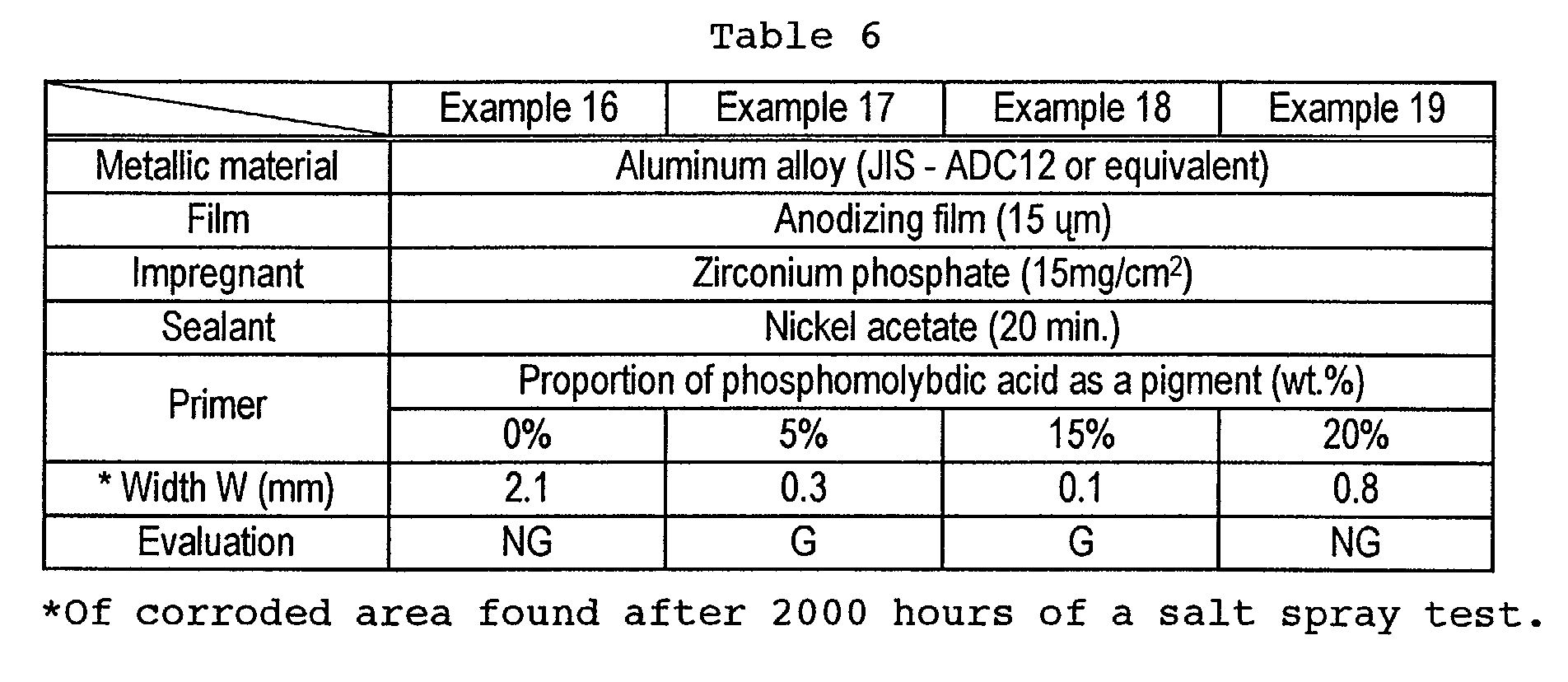
- Table 6 Every experiment shown in Table 6 was made by forming an anodizing film having a thickness of 15 microns on an aluminum alloy equivalent to ADC12 (JIS), impregnating it with zirconium phosphate in the amount of 15 mg/cm 2 , subjecting it to 20 minutes of sealing treatment with nickel acetate and coating it with a layer of a common epoxy paint containing phosphomolybdic acid as a pigment.
- the evaluation was based on the results of a salt spray test.
- Example 16 was evaluated as No Good (NG), since the primer did not contain any pigment.
- phosphomolybdic acid as a pigment in the amount of 5 to 15% by weight.
- Table 7 Every experiment shown in Table 7 was made by forming an anodizing film having a thickness of 15 microns on an aluminum alloy equivalent to ADC12 (JIS), impregnating it with zirconium phosphate in the amount of 15 mg/cm 2 , subjecting it to 20 minutes of sealing treatment with nickel acetate and coating it with a layer of a common epoxy paint containing 10% by weight of phosphomolybdic acid.
- the primer had a different epoxy resin proportion from one example to another.
- the evaluation was based on the result of a boilingwater test conducted by cutting a checkered pattern of 1 mm square notches in each test specimen with a knife and leaving it to stand in boiling water for eight hours.
- Example 20 The result of Example 20, in which the primer had an epoxy resin proportion of 20% by weight, was evaluated as No Good (NG), since the boiling water test resulted in a blister giving a poor outward appearance.
- Example 23 The result of Example 23, in which the primer had an epoxy resin proportion of 60% by weight, was also evaluated as Good (G), since the boiling water test did not result in any blister, but allowed the test specimen to maintain a good appearance.
- Example 24 The result of Example 24, in which the primer had an epoxy resin proportion of 70% by weight, was evaluated as No Good (NG), since the boilingwater test resulted in a blister giving the test specimen a poor appearance.
- ADC12 JIS
- ADC3 JIS
- the film is impregnated with an amorphous substance (33) which fills pores (32) formed in the film during its growth. If the film has a flaw (41) reaching the aluminum alloy material, the amorphous substance and aluminum form a layer of passivity (42) which restrains the corrosion of the aluminum alloy material.
Landscapes
- Chemical & Material Sciences (AREA)
- Engineering & Computer Science (AREA)
- Chemical Kinetics & Catalysis (AREA)
- Electrochemistry (AREA)
- Materials Engineering (AREA)
- Metallurgy (AREA)
- Organic Chemistry (AREA)
- General Chemical & Material Sciences (AREA)
- Other Surface Treatments For Metallic Materials (AREA)
- Chemical Treatment Of Metals (AREA)
- Laminated Bodies (AREA)
- Application Of Or Painting With Fluid Materials (AREA)
Abstract

Description
| Symbol | Chemical composition (%) | ||||||||
| Cu | Si | Mg | Zn | Fe | Mn | Ni | Sn | Al | |
| ADC12 | 1.5-3.5 | 9.6-120 | 3.0 or less | 1.0 or less | 1.3 or less | 0.5 or less | 0.5 or less | 0.3 or less | Balance |



Claims (15)
- A process for improving an anodizing film, comprising the steps of:forming an anodizing film (31) on a surface of an aluminum alloy material (30);impregnating the film with an amorphous substance (33) capable of forming a layer of passivity (42) with aluminum to fill pores (32) formed in the film during its growth; andsealing the pores to close their inlets (34) to confine the amorphous substance therein.
- The process of claim 1, wherein the amorphous substance is zirconium phosphate.
- The process of claim 2, wherein the zirconium phosphate is used in the amount of 15 mg/cm2 to 45 mg/cm2.
- The process of claim 1, wherein nickel acetate is used for the sealing of the pores.
- The process of claim 1, further including the step of coating the surface of the film with a primer after the sealing of the pores.
- The process of claim 5, wherein the primer contains phosphomolybdic acid as a pigment.
- The process of claim 6, wherein the phosphomolybdic acid occupies a proportion of 5 to 15% by weight.
- An anodizing film structure (36A) comprising:an anodizing film (31) formed on a surface of an aluminum alloy material (30);zirconium phosphate impregnating the film to fill pores (32) formed therein during its growth; anda seal (35) closing inlets (34) of the pores.
- The structure of claim 8, wherein the zirconium phosphate is used in the amount of 15 mg/cm2 to 45 mg/cm2.
- The structure of claim 8, further including a primer layer (37) formed on the surface of the film including the seal.
- The structure of claim 10, wherein the primer layer is of a primer containing phosphomolybdic acid as a pigment.
- An aluminum-alloy-made outboard engine comprising:an engine cover (15);an under cover (13) attached to the bottom of the engine cover;an extension case (12) attached to the bottom of the under cover; anda gear case (11) attached to the bottom of the extension case, each of at least the extension and gear cases having an anodizing film structure comprising an anodizing film (31) formed on a surface of an aluminum alloy material (30), zirconium phosphate impregnating the film to fill pores (32) formed therein during its growth, and a seal (35) closing inlets (34) of the pores.
- The outboard engine of claim 12, wherein the zirconium phosphate is used in the amount of 15 mg/cm2 to 45 mg/cm2.
- The outboard engine of claim 12, wherein the structure further includes a primer layer formed on the surface of the film including the seal.
- The outboard engine of claim 14, wherein the primer layer is of a primer containing phosphomolybdic acid as a pigment.
Applications Claiming Priority (2)
| Application Number | Priority Date | Filing Date | Title |
|---|---|---|---|
| JP2001057868 | 2001-03-02 | ||
| JP2001057868A JP4359001B2 (en) | 2001-03-02 | 2001-03-02 | Anodized film modification method, anodized film structure, and aluminum alloy outboard motor |
Publications (3)
| Publication Number | Publication Date |
|---|---|
| EP1236815A2 true EP1236815A2 (en) | 2002-09-04 |
| EP1236815A3 EP1236815A3 (en) | 2004-02-04 |
| EP1236815B1 EP1236815B1 (en) | 2008-05-21 |
Family
ID=18917680
Family Applications (1)
| Application Number | Title | Priority Date | Filing Date |
|---|---|---|---|
| EP02004768A Expired - Lifetime EP1236815B1 (en) | 2001-03-02 | 2002-03-01 | Process for improving an anodizing film, an anodizing film structure and an aluminum-alloy-made outboard engine |
Country Status (7)
| Country | Link |
|---|---|
| US (1) | US6672917B2 (en) |
| EP (1) | EP1236815B1 (en) |
| JP (1) | JP4359001B2 (en) |
| KR (1) | KR100849652B1 (en) |
| CN (1) | CN100392156C (en) |
| CA (1) | CA2373823C (en) |
| DE (1) | DE60226656D1 (en) |
Cited By (3)
| Publication number | Priority date | Publication date | Assignee | Title |
|---|---|---|---|---|
| EP1847582A1 (en) * | 2006-04-20 | 2007-10-24 | Agfa-Gevaert | Radiation image phosphor or scintillator panel. |
| EP1873278A1 (en) * | 2006-06-30 | 2008-01-02 | Henkel Kommanditgesellschaft Auf Aktien | Silicate treatment of sealed anodised aluminum |
| WO2013038249A3 (en) * | 2011-09-12 | 2013-08-01 | Toyota Jidosha Kabushiki Kaisha | Internal combustion engine and method for manufacturing the same |
Families Citing this family (25)
| Publication number | Priority date | Publication date | Assignee | Title |
|---|---|---|---|---|
| US8372205B2 (en) * | 2003-05-09 | 2013-02-12 | Applied Materials, Inc. | Reducing electrostatic charge by roughening the susceptor |
| US20040221959A1 (en) * | 2003-05-09 | 2004-11-11 | Applied Materials, Inc. | Anodized substrate support |
| DE10346005B4 (en) * | 2003-10-02 | 2006-04-13 | Siemens Ag | Air intake module for an internal combustion engine with impulse charging |
| US20050218004A1 (en) * | 2003-11-26 | 2005-10-06 | Calphalon Corporation | Process for making a composite aluminum article |
| US7323230B2 (en) * | 2004-08-02 | 2008-01-29 | Applied Materials, Inc. | Coating for aluminum component |
| US7732056B2 (en) | 2005-01-18 | 2010-06-08 | Applied Materials, Inc. | Corrosion-resistant aluminum component having multi-layer coating |
| US8173228B2 (en) * | 2006-01-27 | 2012-05-08 | Applied Materials, Inc. | Particle reduction on surfaces of chemical vapor deposition processing apparatus |
| US20070235334A1 (en) * | 2006-03-31 | 2007-10-11 | Knapheide Maunfacturing Co. | Electrophoretic deposition system |
| JP5094291B2 (en) * | 2007-09-05 | 2012-12-12 | 日本ペイント株式会社 | Surface treatment agent for anodized aluminum metal materials |
| JP4974986B2 (en) * | 2007-09-28 | 2012-07-11 | 富士フイルム株式会社 | Solar cell substrate and solar cell |
| FI20095630A0 (en) * | 2009-06-05 | 2009-06-05 | Beneq Oy | Protective coating, method of protecting a substrate and use of the method |
| JP2011052292A (en) * | 2009-09-03 | 2011-03-17 | Shingijutsu Kenkyusho:Kk | Aluminum alloy article, aluminum alloy member, and method for producing the same |
| EP2518190A1 (en) * | 2009-12-25 | 2012-10-31 | FUJIFILM Corporation | Insulated substrate, process for production of insulated substrate, process for formation of wiring line, wiring substrate, and light-emitting element |
| US8609254B2 (en) | 2010-05-19 | 2013-12-17 | Sanford Process Corporation | Microcrystalline anodic coatings and related methods therefor |
| US8512872B2 (en) | 2010-05-19 | 2013-08-20 | Dupalectpa-CHN, LLC | Sealed anodic coatings |
| USD666633S1 (en) * | 2011-02-10 | 2012-09-04 | Suzuki Motor Corporation | Outboard motor |
| JP5913227B2 (en) * | 2013-08-05 | 2016-04-27 | トヨタ自動車株式会社 | Internal combustion engine and manufacturing method thereof |
| CN103469276B (en) * | 2013-09-16 | 2015-09-09 | 杭州和韵科技有限公司 | A kind of method improving aluminum anodized film acid-alkali-corrosive-resisting performance |
| CN107794487B (en) * | 2016-08-29 | 2019-08-09 | 中国科学院金属研究所 | A Pore Sealing Treatment Method for Thermal Spraying Amorphous Alloy Coating |
| JP6585759B1 (en) | 2018-03-28 | 2019-10-02 | 株式会社Uacj | Aluminum member and manufacturing method thereof |
| US20210180203A1 (en) * | 2019-12-11 | 2021-06-17 | GM Global Technology Operations LLC | Vacuum impregnation of anodic oxidation coating (aoc) treated surfaces on valve metal substrates |
| KR20230095527A (en) * | 2021-12-22 | 2023-06-29 | 주식회사 포스코 | Insulation coating composition for electrical steel sheet, electrical steel sheet, and method for manufacturing the same |
| CN115044258B (en) * | 2022-05-13 | 2023-10-31 | 海盐华港印刷股份有限公司 | Garment hanging tag not easy to fade |
| WO2024043900A1 (en) * | 2022-08-26 | 2024-02-29 | Cummins Filtration Inc. | Filtration system with additive |
| DE102023121790A1 (en) * | 2023-08-15 | 2025-02-20 | Andreas Stihl Ag & Co. Kg | Mixture formation device, method for producing a mixture formation device and working device or internal combustion engine |
Family Cites Families (17)
| Publication number | Priority date | Publication date | Assignee | Title |
|---|---|---|---|---|
| GB965837A (en) * | 1962-06-19 | 1964-08-06 | Charles Calvin Cohn | Treatment of aluminum oxide coatings |
| JPS525010B2 (en) * | 1971-12-24 | 1977-02-09 | ||
| US4148670A (en) * | 1976-04-05 | 1979-04-10 | Amchem Products, Inc. | Coating solution for metal surface |
| JPS58133871A (en) * | 1982-02-05 | 1983-08-09 | Asahi Glass Co Ltd | Corrosion preventive coating method |
| JPS58197293A (en) * | 1982-05-10 | 1983-11-16 | Tookaro Kk | Textile machine parts having excellent resistance to wear and corrosion |
| JPS60165392A (en) * | 1984-02-07 | 1985-08-28 | Meiban Kogei Kk | White coloring method for anodic oxide film of aluminum |
| WO1986004618A1 (en) * | 1985-02-06 | 1986-08-14 | Fujitsu Limited | Process for forming composite aluminum film |
| JPH02250997A (en) * | 1989-03-23 | 1990-10-08 | Honda Motor Co Ltd | Rustproof treatment of aluminum material and outboard engine body made of aluminum |
| JP3180197B2 (en) * | 1992-05-29 | 2001-06-25 | 加美電子工業株式会社 | Surface treatment of aluminum and aluminum alloys |
| JP2894901B2 (en) * | 1992-09-17 | 1999-05-24 | 中国塗料株式会社 | Primary rust preventive paint composition |
| US5374347A (en) * | 1993-09-27 | 1994-12-20 | The United States Of America As Represented By The Secretary Of The Navy | Trivalent chromium solutions for sealing anodized aluminum |
| GB9422952D0 (en) * | 1994-11-14 | 1995-01-04 | Secr Defence | Corrosion inhibitor |
| US6410144B2 (en) * | 1995-03-08 | 2002-06-25 | Southwest Research Institute | Lubricious diamond-like carbon coatings |
| US6190780B1 (en) * | 1996-02-05 | 2001-02-20 | Nippon Steel Corporation | Surface treated metal material and surface treating agent |
| US5756218A (en) * | 1997-01-09 | 1998-05-26 | Sandia Corporation | Corrosion protective coating for metallic materials |
| GB9825043D0 (en) * | 1998-11-16 | 1999-01-13 | Agfa Gevaert Ltd | Production of support for lithographic printing plate |
| JP2001073168A (en) * | 1999-09-03 | 2001-03-21 | Honda Motor Co Ltd | Painted structure with corrosion resistance |
-
2001
- 2001-03-02 JP JP2001057868A patent/JP4359001B2/en not_active Expired - Fee Related
-
2002
- 2002-02-28 CA CA002373823A patent/CA2373823C/en not_active Expired - Fee Related
- 2002-03-01 DE DE60226656T patent/DE60226656D1/en not_active Expired - Lifetime
- 2002-03-01 EP EP02004768A patent/EP1236815B1/en not_active Expired - Lifetime
- 2002-03-01 US US10/090,062 patent/US6672917B2/en not_active Expired - Lifetime
- 2002-03-02 KR KR1020020011161A patent/KR100849652B1/en not_active Expired - Fee Related
- 2002-03-02 CN CNB021056331A patent/CN100392156C/en not_active Expired - Lifetime
Cited By (4)
| Publication number | Priority date | Publication date | Assignee | Title |
|---|---|---|---|---|
| EP1847582A1 (en) * | 2006-04-20 | 2007-10-24 | Agfa-Gevaert | Radiation image phosphor or scintillator panel. |
| EP1873278A1 (en) * | 2006-06-30 | 2008-01-02 | Henkel Kommanditgesellschaft Auf Aktien | Silicate treatment of sealed anodised aluminum |
| US7851025B2 (en) | 2006-06-30 | 2010-12-14 | Henkel Ag & Co. Kgaa | Silicate treatment of sealed anodized aluminum |
| WO2013038249A3 (en) * | 2011-09-12 | 2013-08-01 | Toyota Jidosha Kabushiki Kaisha | Internal combustion engine and method for manufacturing the same |
Also Published As
| Publication number | Publication date |
|---|---|
| DE60226656D1 (en) | 2008-07-03 |
| CN1386915A (en) | 2002-12-25 |
| US20020164909A1 (en) | 2002-11-07 |
| KR20020070893A (en) | 2002-09-11 |
| EP1236815A3 (en) | 2004-02-04 |
| CN100392156C (en) | 2008-06-04 |
| JP4359001B2 (en) | 2009-11-04 |
| JP2002256492A (en) | 2002-09-11 |
| CA2373823A1 (en) | 2002-09-02 |
| KR100849652B1 (en) | 2008-08-01 |
| EP1236815B1 (en) | 2008-05-21 |
| US6672917B2 (en) | 2004-01-06 |
| CA2373823C (en) | 2009-11-24 |
Similar Documents
| Publication | Publication Date | Title |
|---|---|---|
| EP1236815B1 (en) | Process for improving an anodizing film, an anodizing film structure and an aluminum-alloy-made outboard engine | |
| US8432244B2 (en) | Power distribution transformer and tank therefor | |
| Kaufman | Corrosion of aluminum and aluminum alloys | |
| JP4393291B2 (en) | Marine steel with excellent corrosion resistance | |
| EP3231896B1 (en) | Steel sheet for fuel tank | |
| Sinyavskii et al. | Marine corrosion and protection of aluminum alloys according to their composition and structure | |
| JPH11513747A (en) | Non-chromate corrosion inhibitor for aluminum alloys | |
| KR20200064081A (en) | Paint and coated steel | |
| KR20180007676A (en) | Painting steel material and method for producing the same | |
| EP1080795B1 (en) | Coating structure having corrosion resistance | |
| CN100562598C (en) | Steel for ships with excellent corrosion resistance | |
| EP3239359A1 (en) | Steel plate for use in fuel tank | |
| JP4749827B2 (en) | Gasket material | |
| Paul | Behavior of damaged thermally sprayed aluminum (TSA) in aerated and deaerated seawater | |
| US4275111A (en) | Corrosion protection structure | |
| KR100489247B1 (en) | A making methods of steel panle for outside construction and the steel panel thereof | |
| US4298635A (en) | Corrosion protection method | |
| JP7723942B2 (en) | Salt removal and repainting methods | |
| Ojaniittu | Corrosion of cruise vessel outfitting parts | |
| JP2004315873A (en) | Corrosion-resistant steel and corrosion protection method | |
| Sutton | Protection of Metal Parts of Aircraft against Corrosion | |
| Horton et al. | CHARACTERIZATION OF LONGEVITY OF THERMAL SPRAY NON-SKID COATING UNDER ALTERNATIVE SEALANTS AND TOPCOATS |
Legal Events
| Date | Code | Title | Description |
|---|---|---|---|
| PUAI | Public reference made under article 153(3) epc to a published international application that has entered the european phase |
Free format text: ORIGINAL CODE: 0009012 |
|
| AK | Designated contracting states |
Kind code of ref document: A2 Designated state(s): AT BE CH CY DE DK ES FI FR GB GR IE IT LI LU MC NL PT SE TR |
|
| AX | Request for extension of the european patent |
Free format text: AL;LT;LV;MK;RO;SI |
|
| PUAL | Search report despatched |
Free format text: ORIGINAL CODE: 0009013 |
|
| RIC1 | Information provided on ipc code assigned before grant |
Ipc: 7C 25D 11/24 B Ipc: 7B 63H 20/32 A Ipc: 7C 25D 11/18 B |
|
| AK | Designated contracting states |
Kind code of ref document: A3 Designated state(s): AT BE CH CY DE DK ES FI FR GB GR IE IT LI LU MC NL PT SE TR |
|
| AX | Request for extension of the european patent |
Extension state: AL LT LV MK RO SI |
|
| 17P | Request for examination filed |
Effective date: 20040319 |
|
| 17Q | First examination report despatched |
Effective date: 20040707 |
|
| AKX | Designation fees paid |
Designated state(s): DE GB SE |
|
| GRAP | Despatch of communication of intention to grant a patent |
Free format text: ORIGINAL CODE: EPIDOSNIGR1 |
|
| GRAC | Information related to communication of intention to grant a patent modified |
Free format text: ORIGINAL CODE: EPIDOSCIGR1 |
|
| GRAS | Grant fee paid |
Free format text: ORIGINAL CODE: EPIDOSNIGR3 |
|
| GRAA | (expected) grant |
Free format text: ORIGINAL CODE: 0009210 |
|
| AK | Designated contracting states |
Kind code of ref document: B1 Designated state(s): DE GB SE |
|
| REG | Reference to a national code |
Ref country code: GB Ref legal event code: FG4D |
|
| REF | Corresponds to: |
Ref document number: 60226656 Country of ref document: DE Date of ref document: 20080703 Kind code of ref document: P |
|
| REG | Reference to a national code |
Ref country code: SE Ref legal event code: TRGR |
|
| PLBE | No opposition filed within time limit |
Free format text: ORIGINAL CODE: 0009261 |
|
| STAA | Information on the status of an ep patent application or granted ep patent |
Free format text: STATUS: NO OPPOSITION FILED WITHIN TIME LIMIT |
|
| 26N | No opposition filed |
Effective date: 20090224 |
|
| PGFP | Annual fee paid to national office [announced via postgrant information from national office to epo] |
Ref country code: GB Payment date: 20180228 Year of fee payment: 17 Ref country code: DE Payment date: 20180214 Year of fee payment: 17 |
|
| PGFP | Annual fee paid to national office [announced via postgrant information from national office to epo] |
Ref country code: SE Payment date: 20180313 Year of fee payment: 17 |
|
| REG | Reference to a national code |
Ref country code: DE Ref legal event code: R119 Ref document number: 60226656 Country of ref document: DE |
|
| REG | Reference to a national code |
Ref country code: SE Ref legal event code: EUG |
|
| PG25 | Lapsed in a contracting state [announced via postgrant information from national office to epo] |
Ref country code: SE Free format text: LAPSE BECAUSE OF NON-PAYMENT OF DUE FEES Effective date: 20190302 |
|
| GBPC | Gb: european patent ceased through non-payment of renewal fee |
Effective date: 20190301 |
|
| PG25 | Lapsed in a contracting state [announced via postgrant information from national office to epo] |
Ref country code: GB Free format text: LAPSE BECAUSE OF NON-PAYMENT OF DUE FEES Effective date: 20190301 Ref country code: DE Free format text: LAPSE BECAUSE OF NON-PAYMENT OF DUE FEES Effective date: 20191001 |