EP1236632A1 - Procédé et dispositif de commande de freinage - Google Patents
Procédé et dispositif de commande de freinage Download PDFInfo
- Publication number
- EP1236632A1 EP1236632A1 EP02290509A EP02290509A EP1236632A1 EP 1236632 A1 EP1236632 A1 EP 1236632A1 EP 02290509 A EP02290509 A EP 02290509A EP 02290509 A EP02290509 A EP 02290509A EP 1236632 A1 EP1236632 A1 EP 1236632A1
- Authority
- EP
- European Patent Office
- Prior art keywords
- motor
- ceiling
- current
- clamping force
- force
- Prior art date
- Legal status (The legal status is an assumption and is not a legal conclusion. Google has not performed a legal analysis and makes no representation as to the accuracy of the status listed.)
- Granted
Links
- 238000000034 method Methods 0.000 title claims abstract description 13
- 230000010354 integration Effects 0.000 claims abstract description 4
- 230000002441 reversible effect Effects 0.000 claims description 5
- 230000009471 action Effects 0.000 claims description 3
- 230000002401 inhibitory effect Effects 0.000 claims description 2
- 230000002427 irreversible effect Effects 0.000 claims description 2
- 230000009467 reduction Effects 0.000 description 9
- 238000006073 displacement reaction Methods 0.000 description 5
- 206010010904 Convulsion Diseases 0.000 description 4
- 239000003638 chemical reducing agent Substances 0.000 description 4
- 238000001514 detection method Methods 0.000 description 3
- 238000012545 processing Methods 0.000 description 3
- 238000013461 design Methods 0.000 description 2
- 238000012423 maintenance Methods 0.000 description 2
- 238000005259 measurement Methods 0.000 description 2
- 230000007246 mechanism Effects 0.000 description 2
- 241000861223 Issus Species 0.000 description 1
- 230000001133 acceleration Effects 0.000 description 1
- 230000008901 benefit Effects 0.000 description 1
- 230000008878 coupling Effects 0.000 description 1
- 238000010168 coupling process Methods 0.000 description 1
- 238000005859 coupling reaction Methods 0.000 description 1
- 230000007257 malfunction Effects 0.000 description 1
- 210000000056 organ Anatomy 0.000 description 1
- 230000002829 reductive effect Effects 0.000 description 1
Images


Classifications
-
- B—PERFORMING OPERATIONS; TRANSPORTING
- B60—VEHICLES IN GENERAL
- B60T—VEHICLE BRAKE CONTROL SYSTEMS OR PARTS THEREOF; BRAKE CONTROL SYSTEMS OR PARTS THEREOF, IN GENERAL; ARRANGEMENT OF BRAKING ELEMENTS ON VEHICLES IN GENERAL; PORTABLE DEVICES FOR PREVENTING UNWANTED MOVEMENT OF VEHICLES; VEHICLE MODIFICATIONS TO FACILITATE COOLING OF BRAKES
- B60T13/00—Transmitting braking action from initiating means to ultimate brake actuator with power assistance or drive; Brake systems incorporating such transmitting means, e.g. air-pressure brake systems
- B60T13/74—Transmitting braking action from initiating means to ultimate brake actuator with power assistance or drive; Brake systems incorporating such transmitting means, e.g. air-pressure brake systems with electrical assistance or drive
- B60T13/741—Transmitting braking action from initiating means to ultimate brake actuator with power assistance or drive; Brake systems incorporating such transmitting means, e.g. air-pressure brake systems with electrical assistance or drive acting on an ultimate actuator
Definitions
- the present invention relates to the field of vehicles automobiles, passenger cars, transport vehicles common, goods transport vehicles, special vehicles, agricultural, handling, works, etc.
- WO 99/43968 describes a brake system automatic parking with two operating modes, one first all or nothing mode when the vehicle is stationary, the maximum tightening being detected when the current is greater than one predefined threshold, and a second proportional mode when the speed of the vehicle is greater than a certain speed.
- proportional tightening corresponds to the maximum slope and the maximum admissible load of the vehicle, which results in oversizing the caliper brake and mechanical parts, which increases costs, or by reduced reliability and durability of these parts.
- detection of the maximum clamping force by thresholding the current is not sufficient because a very large current draw has place during engine acceleration, each time said engine is started engine.
- the invention proposes to improve the parking brakes automatic.
- the invention provides an automatic, reliable parking brake, inexpensive, and providing high security in the use of the vehicle on which it is mounted.
- the control method is intended for a vehicle braking means. It implements a detection of the current I consumed by a brake applying motor to deduce a clamping force F. If a clamping force criterion is greater than a predetermined ceiling F p , the clamping force is maintained. Otherwise, the motor is supplied according to a tightening instruction, said ceiling being an electrical load and said criterion being calculated by integrating the current consumed.
- said criterion is calculated by integrating the current consumed above a predetermined threshold.
- the ceiling is determined so that the motor exerts a force upon loosening greater than that required by the clamping force previously exercised.
- the engine is slaved in position on a control pallet.
- the assembly formed by the clamping motor and the braking means is reversible, the maintaining the clamping force is achieved by maintaining the motor power supply at maximum current.
- the assembly formed by the clamping motor and the braking means is irreversible, the maintenance of the clamping force is obtained by the engine power supply cut off.
- the control system of a vehicle braking means comprises a motor for tightening brake, a means of detecting the current I consumed by the motor brake application to deduce a clamping force F, a means of maintaining the clamping force if a clamping force criterion is higher than a predetermined ceiling, and a means of supplying the motor according to a tightening instruction if the force criterion of tightening is less than said ceiling, said ceiling being a load electric and said criterion being calculated by integration of the current consumed.
- the system includes a means for integrating the current consumed above a predetermined threshold.
- the system includes a control paddle and a servo means in position of the motor on the control paddle.
- the system includes mechanical brake control means capable of inhibiting the action of the electric motor.
- the system includes an operating indicator.
- the invention also provides a vehicle equipped with a system comprising a brake application motor, a means for detecting the current I consumed by the brake application motor to deduce a clamping force F, a means of maintaining the supply electric motor if a clamping force criterion is greater than a predetermined ceiling, and a means for supplying the motor with function of a tightening setpoint if the tightening force criterion is lower than said ceiling, said ceiling being an electrical charge and said criterion being calculated by integration of the current consumed.
- the system includes a control pallet 1 fitted with at least one position sensor la, a man-machine interface 2, such as an indicator light, a emergency control 3 able to be actuated by the driver, a assembly 4 comprising an electric motor 4a coupled to a reduction gear 4b equipped with a position sensor 4c, a clamping cable 5, one or several calipers 6 or braking drums allowing to immobilize the vehicle, and a control unit 7 of the engine 4a.
- a position signal is sent by the position sensor 1a to the control unit 7.
- An information signal can be sent by the control unit 7 to the man-machine interface 2.
- the control unit control 7 is also connected to assembly 4.
- a mechanical connection is provided between the emergency control 3 and the assembly 4.
- the cable clamp 5 is disposed between the assembly 4 and the stirrup (s) 6.
- the position of the pallet 1 determines a setpoint of the driver and is supplied to the control unit 7 by the sensor 1a.
- the motor 4a is controlled in position on the pallet position reference 1.
- the clamping force F is estimated by measuring and processing the intensity I of the current passing through the motor 4a. If the maximum clamping force F max is reached, the system becomes inactive and this as long as the position of the pallet 1 corresponds to a clamping force greater than the force F max supplied by the motor 4a. It is not necessary to maintain the current, because the system is not reversible. Just cut off the power to the electric motor. This has the advantage that, in the event of an accidental shutdown of the engine supply, the braking force is maintained. However, in a reversible variant, the current I is maintained at its previous value. When the value of the setpoint supplied by the pallet 1 becomes lower than this position, the motor 4a returns to slaving on the position setpoint of the pallet 1.
- the control unit 7 is simple in design, using analog electronics with few logical components and without the need to have a software processing unit such as a microprocessor.
- the unit 7 is compatible with the driver's use of a traditional instrumented control lever while ensuring parking brake, dynamic emergency brake functions as well as security requirements.
- the electric parking brake proposed by the invention is easily integrated into a parking brake architecture manual, reproduces the operation of a parking brake conventional mechanics while allowing great freedom of vehicle interior design. There is no need to provide a computer with microprocessor and software.
- the seizure of the system is avoided by tightening less than the capacity of maximum loosening. Wear of brake parts is compensated by adapting the position of the motor to the actual braking force by the current measurement I.
- a backup control can be activated work and engaged in a simple way. Possible faults can be detected and displayed by the human-machine interface 2.
- the sensor 1a measures the entire travel of the pallet 1.
- the sensor and its connection (wire and connector) to the motor control unit 7 can be doubled to ensure redundancy on the order.
- Emergency control 3 allows the driver to loosen by a mechanical action, the brake if it is blocked following a system failure, mechanical seizure, or failure of electrical energy.
- Emergency control 3 releases the parking brake parking by mechanically uncoupling the cable 5 from the reduction gear 4b.
- the cable 5 is reset on the reduction gear 4b automatically when the reduction gear 4b is in the brake position released.
- the electric motor 4a is a direct current motor controlled by the engine control unit 7. It drives the reducer 4b whose role is to increase the angular displacement of the motor in a translational movement on the cable and to amplify the torque of the motor in a tensile force on the cable.
- the system is non-reversible, screw-nut type, thus ensuring maintenance of the force on the cable even when the motor is no longer powered.
- the clamping cable 5 connects the reduction gear 4b to the stirrups or brake drums 6.
- the cable hook contains a device for disengaging for manual emergency control 3. Reclosing done mechanically when the brake is in position totally relaxed.
- the brake calipers or drums 6 are organs traditionally used with a mechanical parking brake by cable control. They can be fitted to the rear or front wheels of the vehicle and lock the wheels when the brake cable parking is tight.
- the clamping force depends on the movement of the cable.
- the position of the cable 5 which corresponds to the maximum force admissible may vary depending on the wear of the brake calipers 6, cable 5 or brake reducer 4b.
- the role of the engine control unit 7 consists in controlling the cable position measured in 4 from the setpoint given by the pallet position sensor 1.
- the current is important for a very short time because the torque is important to shift the engine from speed zero at its maximum speed of movement.
- the proposed method for detecting tightening by force maximum consists in integrating the current I when this is greater than the low threshold value.
- the current value as well integrated is greater than a predetermined threshold, it is estimated that we have reaches the maximum allowable clamping force.
- the current draw at start of tightening being maintained for a very short time, its contribution is small.
- the low threshold makes it possible not to integrate the current during the motor displacement phase in the area where the cable is not stretched.
- This method detects the maximum authorized tightening by compensating for the wear of the stirrups / drums or elements of friction (discs / drums, pads or segments). These measures is only active when tightening. This method guarantees therefore in addition to having a loosening potential greater than the tightening potential to prevent system seizures.
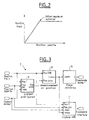
- the control unit 7 therefore ensures a proportional relationship between the position of the control paddle 1 and the position of the brake as long as the clamping force is less than its maximum value permitted, and maintains the brake position if the pallet position 1 is greater than the pallet position corresponding to the maximum effort (see figure 2).
- control unit 7 manages the display for the interface 2. If the position of pallet 1 is greater than a certain value, a signal indicates that the parking brake is engaged to display a interface 2 indicator. If a fault is detected, a signal is activated to display a flashing LED on the interface 2.
- the power stage 10 transforms the current setpoint into a current to be applied to the motor terminals by a PWM command (Pulse Width Modulation), for example.
- PWM command Pulse Width Modulation
- the servo block in position 8 calculates an error of position between the position of the motor assembly 4a, reduction gear 4b and cable 5 and the position setpoint from the current stop logic block 9. Regulation, for example of the Proportional Integral Derivative type, transforms this error into a setpoint current to be sent to the step of power 10.
- Setpoint sub-block 12 provides the setpoint position for the servo unit in position 8. If a "stop i" signal is not activated, then the set position is the position of the pallet 1 (copy of the input signal "Pos pal”). If the "stop i" signal is activated and if the pallet position 1 is greater than the position of the assembly motor 4a, reducer 4b and cable 5, then the set position is the position of the brake (copy of the "brake pos" signal). In addition, if the position of pallet 1 is less than the set position, the loosening signal is activated. This mechanism can be achieved by example from some NOT type electronic components, AND and toggle S-R.
- the "current processing" sub-block 13 integrates the current of the motor I if this is above a "low threshold” and compare this value at a threshold. If the integrated current is above this threshold, then the "stop i" signal is activated. The integrator is reset to zero if the signal loosening is activated.
- This mechanism can be implemented for example at using some electronic components of the comparator type and integrator based on operational amplifiers.
- the "interface logic" block 11 detects malfunctions and activates the signals for the interface.
Landscapes
- Engineering & Computer Science (AREA)
- Transportation (AREA)
- Mechanical Engineering (AREA)
- Regulating Braking Force (AREA)
Abstract
Description
- la figure 1 est une vue schématique d'un système selon l'invention;
- la figure 2 est une courbe montrant la relation entre la position de la palette et l'effort de serrage;
- la figure 3 est une vue schématique de l'unité de pilotage; et
- la figure 4 est une vue schématique de la logique d'arrêt du courant.
avec :
- la position palette de commande,
- la position frein, et
- la mesure courant moteur.
- la commande moteur, et
- la commande des voyants de l'interface pour les défauts.
- un bloc d'asservissement en position 8,
- un bloc de logique d'arrêt courant 9,
- un bloc d'étage de puissance 10, et
- un bloc de logique pour l'interface 11.
- le sous-bloc "consigne" 12, et
- le sous-bloc "traitement courant" 13.
Claims (12)
- Procédé de commande d'un moyen de freinage d'un véhicule, dans lequel, le conducteur ayant actionné un moteur de serrage de frein, on détecte le courant I consommé par le moteur de serrage de frein pour en déduire une force de serrage F, on compare la valeur de la force de serrage F à un plafond déterminé Fp, on maintient la force de serrage si celle-ci est supérieure au plafond Fp, sinon on alimente le moteur en fonction d'une consigne de serrage, le dit plafond Fp étant une charge électrique et la force F étant calculée par intégration du courant consommé.
- Procédé selon la revendication 1, dans lequel la valeur de la force de serrage est calculé par intégration du courant consommé au dessus d'un seuil prédéterminé.
- Procédé selon la revendication 1 ou 2, dans lequel le plafond est déterminé de façon que le moteur exerce au desserrage une force supérieure à celle rendue nécessaire par la force de serrage préalablement exercée.
- Procédé selon l'une quelconque des revendications précédentes, dans lequel le moteur est asservi en position sur une palette de commande.
- Procédé selon l'une quelconque des revendications 1 à 4, dans lequel l'ensemble formé par le moteur de serrage et le moyen de freinage est réversible, le maintien de la force de serrage est obtenu par le maintien de l'alimentation électrique du moteur à un courant maximal.
- Procédé selon l'une quelconque des revendications 1 à 4, dans lequel l'ensemble formé par le moteur de serrage et le moyen de freinage est irréversible, le maintien de la force de serrage est obtenu par la coupure de l'alimentation électrique du moteur.
- Système de commande d'un moyen de freinage de véhicule, caractérisé par le fait qu'il comprend un moteur (4a) de serrage de frein, un moyen de détection du courant I consommé par le moteur de serrage de frein, un moyen de comparaison d'une valeur de force de serrage par rapport à un plafond prédéterminé, un moyen de maintien de la force de serrage si la valeur est supérieure au plafond et un moyen d'alimentation du moteur en fonction d'une consigne de serrage si la valeur est inférieure au plafond, ledit plafond étant une charge électrique et ladite valeur de force de serrage étant calculée par l'intermédiaire d'un intégrateur du courant consommé.
- Système selon la revendication 7, caractérisé par le fait qu'il comprend un moyen d'intégration du courant consommé au dessus d'un seuil prédéterminé.
- Système selon la revendication 7 ou 8, caractérisé par le fait qu'il comprend une palette de commande (1) et un moyen d'asservissement en position du moteur sur la palette de commande.
- Système selon l'une quelconque des revendications 7 à 9, caractérisé par le fait qu'il comprend un moyen de commande mécanique (3) du frein apte à inhiber l'action du moteur électrique.
- Système selon l'une quelconque des revendications 7 à 10, caractérisé par le fait qu'il comprend un indicateur du fonctionnement (2).
- Véhicule équipé d'un moyen de freinage et comprenant un système selon l'une quelconque des revendications 7 à 11.
Applications Claiming Priority (2)
| Application Number | Priority Date | Filing Date | Title |
|---|---|---|---|
| FR0102818 | 2001-03-01 | ||
| FR0102818A FR2821653B1 (fr) | 2001-03-01 | 2001-03-01 | Procede et dispositif de commande de freinage |
Publications (2)
| Publication Number | Publication Date |
|---|---|
| EP1236632A1 true EP1236632A1 (fr) | 2002-09-04 |
| EP1236632B1 EP1236632B1 (fr) | 2008-07-23 |
Family
ID=8860626
Family Applications (1)
| Application Number | Title | Priority Date | Filing Date |
|---|---|---|---|
| EP20020290509 Expired - Lifetime EP1236632B1 (fr) | 2001-03-01 | 2002-03-01 | Procédé et dispositif de commande de freinage |
Country Status (3)
| Country | Link |
|---|---|
| EP (1) | EP1236632B1 (fr) |
| DE (1) | DE60227732D1 (fr) |
| FR (1) | FR2821653B1 (fr) |
Cited By (2)
| Publication number | Priority date | Publication date | Assignee | Title |
|---|---|---|---|---|
| US7052093B2 (en) * | 2003-08-25 | 2006-05-30 | Asmo Co., Ltd. | Electric parking brake system and method for controlling the same |
| US11623626B2 (en) * | 2017-07-27 | 2023-04-11 | Freni Brembo S.P.A. | Method for estimating a braking force applicable between pad and brake disc by an electric parking-braking system of a vehicle and electric parking-braking system of a vehicle implementing such method |
Citations (3)
| Publication number | Priority date | Publication date | Assignee | Title |
|---|---|---|---|---|
| WO1990015734A1 (fr) * | 1989-06-20 | 1990-12-27 | Volkswagen Aktiengesellschaft | Dispositif d'actionnement du frein de stationnement de vehicules a moteur |
| DE19859605A1 (de) * | 1998-12-23 | 2000-06-29 | Continental Teves Ag & Co Ohg | Verfahren und Vorrichtung zum Ansteuern einer elektromechanisch betätigbaren Feststellbremse |
| DE19858763A1 (de) * | 1998-12-18 | 2000-06-29 | Siemens Ag | Verfahren zum Steuern eines elektromagnetischen Radbremsaktors in einem Kraftfahrzeug |
Family Cites Families (1)
| Publication number | Priority date | Publication date | Assignee | Title |
|---|---|---|---|---|
| US6213259B1 (en) | 1998-02-25 | 2001-04-10 | Dura Automotive Systems, Inc. | Device, method and system for control of an electrically powered parking brake |
-
2001
- 2001-03-01 FR FR0102818A patent/FR2821653B1/fr not_active Expired - Fee Related
-
2002
- 2002-03-01 DE DE60227732T patent/DE60227732D1/de not_active Expired - Lifetime
- 2002-03-01 EP EP20020290509 patent/EP1236632B1/fr not_active Expired - Lifetime
Patent Citations (3)
| Publication number | Priority date | Publication date | Assignee | Title |
|---|---|---|---|---|
| WO1990015734A1 (fr) * | 1989-06-20 | 1990-12-27 | Volkswagen Aktiengesellschaft | Dispositif d'actionnement du frein de stationnement de vehicules a moteur |
| DE19858763A1 (de) * | 1998-12-18 | 2000-06-29 | Siemens Ag | Verfahren zum Steuern eines elektromagnetischen Radbremsaktors in einem Kraftfahrzeug |
| DE19859605A1 (de) * | 1998-12-23 | 2000-06-29 | Continental Teves Ag & Co Ohg | Verfahren und Vorrichtung zum Ansteuern einer elektromechanisch betätigbaren Feststellbremse |
Cited By (2)
| Publication number | Priority date | Publication date | Assignee | Title |
|---|---|---|---|---|
| US7052093B2 (en) * | 2003-08-25 | 2006-05-30 | Asmo Co., Ltd. | Electric parking brake system and method for controlling the same |
| US11623626B2 (en) * | 2017-07-27 | 2023-04-11 | Freni Brembo S.P.A. | Method for estimating a braking force applicable between pad and brake disc by an electric parking-braking system of a vehicle and electric parking-braking system of a vehicle implementing such method |
Also Published As
| Publication number | Publication date |
|---|---|
| FR2821653A1 (fr) | 2002-09-06 |
| EP1236632B1 (fr) | 2008-07-23 |
| DE60227732D1 (de) | 2008-09-04 |
| FR2821653B1 (fr) | 2003-09-05 |
Similar Documents
| Publication | Publication Date | Title |
|---|---|---|
| EP1679242B1 (fr) | Procédé de protection dans un système de freinage de véhicule à freins électriques | |
| FR2900210A1 (fr) | Frein a disque de vehicule et procede de surveillance de la force de frein | |
| FR2743762A1 (fr) | Vehicule automobile a boite de vitesses equipe d'une logique de commande a fonction de verrouillage du levier de vitesses en position parking et fonction de verrouillage de la clef de contact | |
| FR2957319A1 (fr) | Procede de gestion d'un systeme de freinage pour aeronef equipe de freins electromecaniques. | |
| AU2020289747B2 (en) | Electrically Actuated Mechanical Park Brake System | |
| EP1400423B1 (fr) | Procédé de commande du dispositif de freinage d'une remorque et dispositif de freinage fonctionnant selon ce procédé | |
| FR2597052A1 (fr) | Systeme hydraulique de freinage equipe d'un dispositif de regulation du glissement de roue | |
| EP1236632B1 (fr) | Procédé et dispositif de commande de freinage | |
| FR2763108A1 (fr) | Dispositif de commande d'un etat d'embrayage | |
| EP2958779B1 (fr) | Système de freinage d'un véhicule | |
| US11267446B2 (en) | Trailer braking system | |
| EP1499815A2 (fr) | Frein a disque muni d au moins une plaquette de frein inclin able | |
| FR3120338A1 (fr) | Système de freinage pour véhicule automobile | |
| FR3131721A1 (fr) | Procede de gestion de l’alimentation electrique d’un systeme de freinage | |
| WO2010112684A1 (fr) | Dispositif de commande d'un systeme de repartition du couple moteur, vehicule muni de celui-ci | |
| FR2935658A1 (fr) | Systeme et procede de gestion du freinage d'un vehicule automobile | |
| FR2813837A1 (fr) | Procede et dispositif de commande de freinage | |
| WO2002022414A1 (fr) | Procede et dispositif de commande de freinage | |
| EP2139738B1 (fr) | Procede de freinage recuperatif pour vehicule hybride tenant compte d'un appui pedale et d'un gradient de pression pour l'application d'un freinage electrique | |
| FR2869282A1 (fr) | Dispositif de freinage pour vehicule automobile | |
| WO2004071832A2 (fr) | Procede et systeme de pilotage des freins d’un vehicule automobile | |
| FR3142420A1 (fr) | Système de freinage comportant un dispositif de freinage de parking a sécurité de fonctionnement augmentée | |
| CA3130037A1 (fr) | Systeme de freinage ferroviaire comportant un dispositif afficheur d'un etat d'un frein de service et/ou d'un etat d'un frein de parking et vehicule ferroviaire pourvu d'un tel systeme | |
| FR2850923A1 (fr) | Procede de gestion de l'etat et du fonctionnement d'un vehicule automobile et systeme pour la mise en oeuvre de ce procede | |
| FR3003515A1 (fr) | Groupe motopropulseur et procede de protection d'une transmission secondaire |
Legal Events
| Date | Code | Title | Description |
|---|---|---|---|
| PUAI | Public reference made under article 153(3) epc to a published international application that has entered the european phase |
Free format text: ORIGINAL CODE: 0009012 |
|
| AK | Designated contracting states |
Kind code of ref document: A1 Designated state(s): AT BE CH CY DE DK ES FI FR GB GR IE IT LI LU MC NL PT SE TR |
|
| AX | Request for extension of the european patent |
Free format text: AL;LT;LV;MK;RO;SI |
|
| AKX | Designation fees paid | ||
| 17P | Request for examination filed |
Effective date: 20030221 |
|
| RBV | Designated contracting states (corrected) |
Designated state(s): BE DE GB |
|
| REG | Reference to a national code |
Ref country code: DE Ref legal event code: 8566 |
|
| GRAP | Despatch of communication of intention to grant a patent |
Free format text: ORIGINAL CODE: EPIDOSNIGR1 |
|
| GRAS | Grant fee paid |
Free format text: ORIGINAL CODE: EPIDOSNIGR3 |
|
| GRAA | (expected) grant |
Free format text: ORIGINAL CODE: 0009210 |
|
| AK | Designated contracting states |
Kind code of ref document: B1 Designated state(s): BE DE GB |
|
| REG | Reference to a national code |
Ref country code: GB Ref legal event code: FG4D Free format text: NOT ENGLISH |
|
| REF | Corresponds to: |
Ref document number: 60227732 Country of ref document: DE Date of ref document: 20080904 Kind code of ref document: P |
|
| PLBE | No opposition filed within time limit |
Free format text: ORIGINAL CODE: 0009261 |
|
| STAA | Information on the status of an ep patent application or granted ep patent |
Free format text: STATUS: NO OPPOSITION FILED WITHIN TIME LIMIT |
|
| 26N | No opposition filed |
Effective date: 20090424 |
|
| PGFP | Annual fee paid to national office [announced via postgrant information from national office to epo] |
Ref country code: DE Payment date: 20150320 Year of fee payment: 14 |
|
| PGFP | Annual fee paid to national office [announced via postgrant information from national office to epo] |
Ref country code: GB Payment date: 20150319 Year of fee payment: 14 |
|
| PGFP | Annual fee paid to national office [announced via postgrant information from national office to epo] |
Ref country code: BE Payment date: 20150319 Year of fee payment: 14 |
|
| PG25 | Lapsed in a contracting state [announced via postgrant information from national office to epo] |
Ref country code: BE Free format text: LAPSE BECAUSE OF NON-PAYMENT OF DUE FEES Effective date: 20160331 |
|
| REG | Reference to a national code |
Ref country code: DE Ref legal event code: R119 Ref document number: 60227732 Country of ref document: DE |
|
| GBPC | Gb: european patent ceased through non-payment of renewal fee |
Effective date: 20160301 |
|
| PG25 | Lapsed in a contracting state [announced via postgrant information from national office to epo] |
Ref country code: DE Free format text: LAPSE BECAUSE OF NON-PAYMENT OF DUE FEES Effective date: 20161001 Ref country code: GB Free format text: LAPSE BECAUSE OF NON-PAYMENT OF DUE FEES Effective date: 20160301 |