EP1233530B1 - Mobilfunkendgerät eines Mobilfunknetzwerkes mit Sender- und Empfänger-Schaltungen und zwei Antennen - Google Patents
Mobilfunkendgerät eines Mobilfunknetzwerkes mit Sender- und Empfänger-Schaltungen und zwei Antennen Download PDFInfo
- Publication number
- EP1233530B1 EP1233530B1 EP02290352.0A EP02290352A EP1233530B1 EP 1233530 B1 EP1233530 B1 EP 1233530B1 EP 02290352 A EP02290352 A EP 02290352A EP 1233530 B1 EP1233530 B1 EP 1233530B1
- Authority
- EP
- European Patent Office
- Prior art keywords
- chain
- reception
- transmission
- antenna
- inhibition
- Prior art date
- Legal status (The legal status is an assumption and is not a legal conclusion. Google has not performed a legal analysis and makes no representation as to the accuracy of the status listed.)
- Expired - Lifetime
Links
- 230000005540 biological transmission Effects 0.000 claims description 31
- 230000005764 inhibitory process Effects 0.000 claims description 10
- 230000003071 parasitic effect Effects 0.000 claims description 8
- 230000017105 transposition Effects 0.000 claims description 5
- 230000002401 inhibitory effect Effects 0.000 claims description 4
- 238000000034 method Methods 0.000 description 5
- 230000003321 amplification Effects 0.000 description 3
- 238000003199 nucleic acid amplification method Methods 0.000 description 3
- 244000045947 parasite Species 0.000 description 3
- 230000002238 attenuated effect Effects 0.000 description 2
- 238000001914 filtration Methods 0.000 description 2
- 230000010363 phase shift Effects 0.000 description 2
- 230000006978 adaptation Effects 0.000 description 1
- 230000002457 bidirectional effect Effects 0.000 description 1
- 230000001413 cellular effect Effects 0.000 description 1
- 230000000694 effects Effects 0.000 description 1
- 230000008030 elimination Effects 0.000 description 1
- 238000003379 elimination reaction Methods 0.000 description 1
- 238000000605 extraction Methods 0.000 description 1
- 238000000926 separation method Methods 0.000 description 1
- 238000011144 upstream manufacturing Methods 0.000 description 1
Images

Classifications
-
- H—ELECTRICITY
- H04—ELECTRIC COMMUNICATION TECHNIQUE
- H04B—TRANSMISSION
- H04B1/00—Details of transmission systems, not covered by a single one of groups H04B3/00 - H04B13/00; Details of transmission systems not characterised by the medium used for transmission
- H04B1/38—Transceivers, i.e. devices in which transmitter and receiver form a structural unit and in which at least one part is used for functions of transmitting and receiving
- H04B1/40—Circuits
- H04B1/50—Circuits using different frequencies for the two directions of communication
- H04B1/52—Hybrid arrangements, i.e. arrangements for transition from single-path two-direction transmission to single-direction transmission on each of two paths or vice versa
- H04B1/525—Hybrid arrangements, i.e. arrangements for transition from single-path two-direction transmission to single-direction transmission on each of two paths or vice versa with means for reducing leakage of transmitter signal into the receiver
Definitions
- the present invention relates to radio transmissions by mobile radio terminals.
- a mobile radio terminal communicates with the others by a bidirectional link, for which it has a frequency for each direction of transmission.
- the transmitter of the terminal is a powerful disrupter for its receiver.
- the first technique is to operate the terminal alternately, that is to say to cyclically inhibit the receiver and the transmitter.
- the electrical balance of the duplexer to achieve the desired power of separation or decoupling between channels, requires that the antenna maintains a suitable impedance, of determined value, in the transmission frequency band and in that of reception.
- the antenna In practice, to achieve this goal, the antenna must also remain adapted in the unused band separating the useful bands.
- the antenna must be broadband, in terms of its adaptation, that is to say, relatively complex and bulky.
- the cost and the volume of the duplexer are also high and, moreover, it has losses that must be compensated by a higher level of emission, which affects the energy autonomy of the terminal.
- the present invention relates to this second technique, full-duplex operation, and aims to overcome the above disadvantages related to the duplexer.
- the preamble of claim 1 is based on the document WO 9615596 .
- the merit of the plaintiff is to have gone against the prejudice that, in order to solve the problem of the protection of a reception channel against the radio signals of a transmission channel, it was necessary to provide a duplexer of decoupling the strings inside the terminal's radio interface.
- the plaintiff has indeed posed differently the problem above, that is to say that she considered that the real problem, in its generality, was to prevent the signals generated by the transmission chain from arriving at the output of the reception chain, and that solutions without a duplexer should be considered.
- each antenna may be of limited size since it only processes its useful frequency band.
- the inhibiting means comprise harmonic elimination filtering of a frequency band of the transmission chain.
- the reception chain comprises non-linear elements capable of frequency transposition by a parasitic demodulation, these elements do not receive a harmonic signal that may be transposed to the reception frequency.
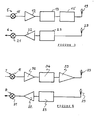
- the figure 1 represents two radio channels of a cellular radiotelephone mobile terminal, the reference 1 denoting a transmission channel and the reference 2 a reception channel.
- the transmission system 1 operates here in a 60 MHz range or band, centered on 1950 MHz, and the reception system 2 operates here in a 60 MHz band centered on 2140 MHz.
- the transmission channel 1 comprises a conventional modulator 11 providing a carrier in the low band considered, modulated by data or bits to be transmitted.
- the signal from the modulator 11 passes through an amplifier 12 followed by a channel separator filter 13, attenuating the noise emitted in the high band of the reception channel 2 here.
- This is therefore a pass filter. low that transmits at 1980 MHz and attenuates at 2110 MHz.
- the filter 13 could have been provided of the band-pass or band-stop type and then tuned to the reception frequency band.
- the reception chain 2 comprises a dedicated reception antenna 29 connected, here indirectly, to a band-pass input filter 23, tuned to the reception band, controlling an amplifier 22, with a low-noise input stage.
- the amplifier 22 controls a conventional demodulator 21 providing a stream of bits extracted from the signal that has been received by the antenna 29.
- the chains 1 and 2 are connected to each other in order to inhibit the reception of spurious emission signals in the reception band.
- the antennas 19 and 29 are indeed close to each other, since it is a portable terminal, and, even if the filter 13 has a good filtering efficiency, the attenuated parasites that it transmits at the transmitting antenna 19 are received, without significant attenuation of radio transmission, by the receiving antenna 29.
- the channel derived above consists of an adjustable phase-shifter 17 in series with an attenuator 18, receiving a part of the signal applied to the antenna 19, taken by a capacitive microstrip coupler 14.
- the mutated derivative channel 17, 18 is set to provide a signal of the same amplitude as the emission spurious signal picked up by the receiving antenna 29.
- the inhibition signal is subtracted from the received signal, that is to say that the addition of two opposite signals, of equal amplitude and displaced by 180 degrees, is performed.
- the phase shift of 180 degrees can be realized in the phase-shifter 17, and the amplifier 24 is then an adder, or the phase-shifter 17 is set to a zero phase shift with respect to the parasite of the receiving antenna 29 and the amplifier 24 is then a subtractor, as shown on the figure 1 .
- the transmission chain 3 comprises, in the propagation direction of the signals, the modulator 11, the amplifier 12, the bandpass filter 13, the coupler diverter 14 and the antenna 19.
- the reception chain 4 comprises the antenna 29 connected directly to the bandpass filter 23 followed by the amplifier 22 and the demodulator 21.
- a muting coupler 44 is capacitively coupled to the input link of the demodulator 44 to inject an inhibition signal from the transmission chain 3.
- the muting coupler 44 has, overall, a function similar to that of the amplifier 24. It is connected to the extraction coupler 14 by a frequency transposition circuit 16 which provides a radio interference inhibition signal, this inhibition being carried out after amplification in the amplifier 22.
- the associated control circuits 17, 18 have not been drawn.
- the figure 3 represents a transmission chain 5 and a reception chain 6.
- the transmission chain 5 comprises, in order, the modulator 11, the amplifier 12, the low-pass filter 13, the antenna 19 and moreover a notch filter, notch, in series between the modulator 11 and the antenna 19, here connecting thereto the low-pass filter 13.
- the notch filter 15 is here frequency adjustable by programming.
- the notch filter 15 attenuates the noise created by the amplifier at the receive frequency.
- the notch filter 15 consists of resonant circuits stages, inductance and capacitance, or equivalent circuits (dielectric resonators, ...), to cover in total at least the desired 60 MHz by shifting the resonance frequency of the filtered.
- Each stage comprises a conventional inductance associated with a diode with variable capacitance biased by a DC voltage of adjustment of the capacitance, adjustment coming from a programming processor of the filter 15.
- the programming processor is connected to the radio block to remotely program the filter 15 from the telephone network.
- the reception chain 6 comprises the antenna 29, directly connected to the bandpass filter 23 controlling the amplifier 22 followed by the demodulator 21. These last two elements may have nonlinearities and thus have a parasitic demodulator effect transposing, in the reception band, a portion of the energy of a spurious signal.
- the notch filter 15 is thereby set to attenuate the signals transmitted at the receive frequency of the receiver.
- the attenuated frequency band is set according to the reception frequency.
Landscapes
- Engineering & Computer Science (AREA)
- Computer Networks & Wireless Communication (AREA)
- Signal Processing (AREA)
- Transceivers (AREA)
Claims (6)
- Mobiles Endgerät eines Funktelefonnetzwerkes mit Funkmitteln umfassend eine Sendekette (1) und eine Empfangskette (2), die dazu eingerichtet sind, in Voll-Duplex in zwei jeweiligen Frequenzbereichen betrieben zu werden, wobei jede Kette (1, 2) eine dedizierte Antenne (19, 29) umfasst und die Funkmittel Mittel (13, 15, 16, 17, 24, 44) umfassen, die dazu eingerichtet sind, den Empfang von parasitären Sendesignalen in einem Empfangsfrequenzbereich zu unterdrücken,
dadurch gekennzeichnet, dass
die Unterdrückungsmittel eine Frequenztransponierungsschaltung (16) umfassen, die zwischen der Sendekette (1) und der Empfangskette (2) gekoppelt ist, wobei die Frequenztransponierungsschaltung (16) mit der Empfangskette (2) über einen kapazitiven Koppler (44) gekoppelt ist, so dass die Frequenztransponierungsschaltung (16) der Eingangsverbindung eines Demodulators (21) ein Unterdrückungssignal liefert. - Endgerät nach Anspruch 1, bei welchem die Empfangskette (1) Mittel (14) zur Steuerung der Unterdrückungsmittel (13, 15, 16, 17, 24, 44) umfasst.
- Endgerät nach Anspruch 1 oder 2, bei welchem zumindest ein Teil der Unterdrückungsmittel (13, 15) in der Sendekette (1) in Serie geschaltet ist.
- Endgerät nach Anspruch 2, bei welchem die Steuerungsmittel einen kapazitiven Koppler mit Mikrostrip (14) umfassen.
- Endgerät nach einem der Ansprüche 1 bis 4, bei welchem die Unterdrückungsmittel in der Sendekette (1) Mittel (14) zum Ableiten, in der Empfangskette (2), von parasitären Sendesignalen, und, in der Empfangskette (2), Mittel (44) umfassen, um den von der Antenne (29) der Empfangskette (2) empfangenen parasitären Sendesignalen diese abgeleiteten parasitären Sendesignale entgegenzusetzen.
- Endgerät nach Anspruch 5, bei welchem die Mittel zum Entgegensetzen einen Unterdrückungskoppler mit Mikrostrip (44) umfassen, der mit der Empfangskette (2) kapazitiv gekoppelt ist.
Applications Claiming Priority (2)
| Application Number | Priority Date | Filing Date | Title |
|---|---|---|---|
| FR0102058A FR2820930B1 (fr) | 2001-02-15 | 2001-02-15 | Terminal mobile de reseau de radiotelephonie a deux chaines d'emission et de reception et deux antennes |
| FR0102058 | 2001-02-15 |
Publications (2)
| Publication Number | Publication Date |
|---|---|
| EP1233530A1 EP1233530A1 (de) | 2002-08-21 |
| EP1233530B1 true EP1233530B1 (de) | 2013-11-06 |
Family
ID=8860048
Family Applications (1)
| Application Number | Title | Priority Date | Filing Date |
|---|---|---|---|
| EP02290352.0A Expired - Lifetime EP1233530B1 (de) | 2001-02-15 | 2002-02-13 | Mobilfunkendgerät eines Mobilfunknetzwerkes mit Sender- und Empfänger-Schaltungen und zwei Antennen |
Country Status (2)
| Country | Link |
|---|---|
| EP (1) | EP1233530B1 (de) |
| FR (1) | FR2820930B1 (de) |
Families Citing this family (3)
| Publication number | Priority date | Publication date | Assignee | Title |
|---|---|---|---|---|
| GB2435985B (en) | 2006-03-07 | 2008-04-02 | Motorola Inc | A terminal for use in a wireless communication system, a system including the terminal and a method of operation of the terminal |
| EP2119024B1 (de) * | 2007-03-05 | 2012-04-11 | Nxp B.V. | System und verfahren zum verarbeiten eines empfangenen signals |
| US9553712B2 (en) * | 2013-11-25 | 2017-01-24 | Raytheon Company | Feed-forward canceller |
Citations (2)
| Publication number | Priority date | Publication date | Assignee | Title |
|---|---|---|---|---|
| WO1996015596A1 (en) * | 1994-11-15 | 1996-05-23 | University Of Bristol | Full-duplex radio transmitter/receiver |
| US5815805A (en) * | 1993-08-06 | 1998-09-29 | Motorola, Inc. | Apparatus and method for attenuating an undesired signal in a radio transceiver |
Family Cites Families (3)
| Publication number | Priority date | Publication date | Assignee | Title |
|---|---|---|---|---|
| US5444864A (en) * | 1992-12-22 | 1995-08-22 | E-Systems, Inc. | Method and apparatus for cancelling in-band energy leakage from transmitter to receiver |
| GB2329560A (en) * | 1997-07-28 | 1999-03-24 | Roke Manor Research | Bias control for radio transmitter |
| US6169912B1 (en) * | 1999-03-31 | 2001-01-02 | Pericom Semiconductor Corp. | RF front-end with signal cancellation using receiver signal to eliminate duplexer for a cordless phone |
-
2001
- 2001-02-15 FR FR0102058A patent/FR2820930B1/fr not_active Expired - Fee Related
-
2002
- 2002-02-13 EP EP02290352.0A patent/EP1233530B1/de not_active Expired - Lifetime
Patent Citations (2)
| Publication number | Priority date | Publication date | Assignee | Title |
|---|---|---|---|---|
| US5815805A (en) * | 1993-08-06 | 1998-09-29 | Motorola, Inc. | Apparatus and method for attenuating an undesired signal in a radio transceiver |
| WO1996015596A1 (en) * | 1994-11-15 | 1996-05-23 | University Of Bristol | Full-duplex radio transmitter/receiver |
Also Published As
| Publication number | Publication date |
|---|---|
| EP1233530A1 (de) | 2002-08-21 |
| FR2820930B1 (fr) | 2003-05-16 |
| FR2820930A1 (fr) | 2002-08-16 |
Similar Documents
| Publication | Publication Date | Title |
|---|---|---|
| US5815804A (en) | Dual-band filter network | |
| CN100391111C (zh) | 具有提供gps功能的天线的设备和提供gps功能的天线的方法 | |
| EP0441500A2 (de) | Funksende-Empfänger | |
| US20110134810A1 (en) | Module for use in mobile communication terminal and mobile communication terminal applying the same therein | |
| HUP0200304A2 (en) | Integrated antenna coupler element | |
| JP2007525857A (ja) | 周波数選択性の装置、およびそれの無線マルチバンド装置における通信信号の受信/送信方法 | |
| JP2004266361A (ja) | フロントエンドモジュール | |
| FR2682838A1 (fr) | Recepteur et emetteur radio produisant une diversite. | |
| CN105577206A (zh) | 具有相移部件的分集接收机前端系统 | |
| WO2008029055A2 (fr) | Système de transmission de données sans fil entre une station de base et une antenne relais d'un réseau de téléphonie mobile | |
| CN107113050A (zh) | 与分集接收机相关的系统、设备和方法 | |
| US8457685B1 (en) | Method and system for increasing efficiency in a radio front-end | |
| EP1233530B1 (de) | Mobilfunkendgerät eines Mobilfunknetzwerkes mit Sender- und Empfänger-Schaltungen und zwei Antennen | |
| EP1187317A2 (de) | Sender und drahtloses Nachrichtengerät | |
| FR3004007A1 (fr) | Coupleur large bande | |
| CN1211114A (zh) | 无天线共用器的天线转换分集装置及其操作方法 | |
| FR2802737A1 (fr) | Composant composite pour hautes frequences et appareil de telecommunications mobile l'incorporant | |
| EP1283599A1 (de) | Sende- und Empfangssystem fÜr ein Mehrband und multimode Mobiltelefon | |
| JP2004200853A (ja) | 高周波回路装置 | |
| EP1189356B1 (de) | Multimodales Kommunikationsgerät mit einem Sendeempfänger mit mehreren Eingängen | |
| KR100884374B1 (ko) | 통신용 이종 소자간 결합 모듈 | |
| KR101298129B1 (ko) | 트리플렉서를 이용한 삼중 대역 증폭기 | |
| JPH04304003A (ja) | 共用器 | |
| KR100716796B1 (ko) | 트리플렉서 | |
| FI98013B (fi) | Suurtaajuuskaistanpäästösuodatin |
Legal Events
| Date | Code | Title | Description |
|---|---|---|---|
| PUAI | Public reference made under article 153(3) epc to a published international application that has entered the european phase |
Free format text: ORIGINAL CODE: 0009012 |
|
| AK | Designated contracting states |
Kind code of ref document: A1 Designated state(s): AT BE CH CY DE DK ES FI FR GB GR IE IT LI LU MC NL PT SE TR |
|
| AX | Request for extension of the european patent |
Free format text: AL;LT;LV;MK;RO;SI |
|
| 17P | Request for examination filed |
Effective date: 20030221 |
|
| AKX | Designation fees paid |
Designated state(s): DE FR GB |
|
| RAP1 | Party data changed (applicant data changed or rights of an application transferred) |
Owner name: SAGEM COMMUNICATION |
|
| RAP1 | Party data changed (applicant data changed or rights of an application transferred) |
Owner name: SAGEM MOBILES |
|
| 17Q | First examination report despatched |
Effective date: 20110722 |
|
| RAP1 | Party data changed (applicant data changed or rights of an application transferred) |
Owner name: APPLE INC. |
|
| RIC1 | Information provided on ipc code assigned before grant |
Ipc: H04B 1/50 20060101AFI20130430BHEP Ipc: H04B 1/12 20060101ALI20130430BHEP Ipc: H04B 1/52 20060101ALI20130430BHEP |
|
| GRAP | Despatch of communication of intention to grant a patent |
Free format text: ORIGINAL CODE: EPIDOSNIGR1 |
|
| INTG | Intention to grant announced |
Effective date: 20130617 |
|
| GRAS | Grant fee paid |
Free format text: ORIGINAL CODE: EPIDOSNIGR3 |
|
| GRAA | (expected) grant |
Free format text: ORIGINAL CODE: 0009210 |
|
| AK | Designated contracting states |
Kind code of ref document: B1 Designated state(s): DE FR GB |
|
| REG | Reference to a national code |
Ref country code: GB Ref legal event code: FG4D Free format text: NOT ENGLISH |
|
| REG | Reference to a national code |
Ref country code: DE Ref legal event code: R096 Ref document number: 60245718 Country of ref document: DE Effective date: 20140102 |
|
| REG | Reference to a national code |
Ref country code: DE Ref legal event code: R097 Ref document number: 60245718 Country of ref document: DE |
|
| PLBE | No opposition filed within time limit |
Free format text: ORIGINAL CODE: 0009261 |
|
| STAA | Information on the status of an ep patent application or granted ep patent |
Free format text: STATUS: NO OPPOSITION FILED WITHIN TIME LIMIT |
|
| 26N | No opposition filed |
Effective date: 20140807 |
|
| REG | Reference to a national code |
Ref country code: DE Ref legal event code: R097 Ref document number: 60245718 Country of ref document: DE Effective date: 20140807 |
|
| REG | Reference to a national code |
Ref country code: FR Ref legal event code: ST Effective date: 20141031 |
|
| PG25 | Lapsed in a contracting state [announced via postgrant information from national office to epo] |
Ref country code: FR Free format text: LAPSE BECAUSE OF NON-PAYMENT OF DUE FEES Effective date: 20140228 |
|
| PGFP | Annual fee paid to national office [announced via postgrant information from national office to epo] |
Ref country code: DE Payment date: 20210202 Year of fee payment: 20 Ref country code: GB Payment date: 20210203 Year of fee payment: 20 |
|
| REG | Reference to a national code |
Ref country code: DE Ref legal event code: R071 Ref document number: 60245718 Country of ref document: DE |
|
| REG | Reference to a national code |
Ref country code: GB Ref legal event code: PE20 Expiry date: 20220212 |
|
| PG25 | Lapsed in a contracting state [announced via postgrant information from national office to epo] |
Ref country code: GB Free format text: LAPSE BECAUSE OF EXPIRATION OF PROTECTION Effective date: 20220212 |