EP1233079A1 - Cold reduced enamelling steel sheet and an enamelled structure comprising a component of such a steel sheet - Google Patents
Cold reduced enamelling steel sheet and an enamelled structure comprising a component of such a steel sheet Download PDFInfo
- Publication number
- EP1233079A1 EP1233079A1 EP01200567A EP01200567A EP1233079A1 EP 1233079 A1 EP1233079 A1 EP 1233079A1 EP 01200567 A EP01200567 A EP 01200567A EP 01200567 A EP01200567 A EP 01200567A EP 1233079 A1 EP1233079 A1 EP 1233079A1
- Authority
- EP
- European Patent Office
- Prior art keywords
- steel sheet
- sheet according
- max
- enamelled
- mpa
- Prior art date
- Legal status (The legal status is an assumption and is not a legal conclusion. Google has not performed a legal analysis and makes no representation as to the accuracy of the status listed.)
- Granted
Links
Classifications
-
- C—CHEMISTRY; METALLURGY
- C22—METALLURGY; FERROUS OR NON-FERROUS ALLOYS; TREATMENT OF ALLOYS OR NON-FERROUS METALS
- C22C—ALLOYS
- C22C38/00—Ferrous alloys, e.g. steel alloys
- C22C38/16—Ferrous alloys, e.g. steel alloys containing copper
-
- C—CHEMISTRY; METALLURGY
- C22—METALLURGY; FERROUS OR NON-FERROUS ALLOYS; TREATMENT OF ALLOYS OR NON-FERROUS METALS
- C22C—ALLOYS
- C22C38/00—Ferrous alloys, e.g. steel alloys
- C22C38/001—Ferrous alloys, e.g. steel alloys containing N
-
- C—CHEMISTRY; METALLURGY
- C22—METALLURGY; FERROUS OR NON-FERROUS ALLOYS; TREATMENT OF ALLOYS OR NON-FERROUS METALS
- C22C—ALLOYS
- C22C38/00—Ferrous alloys, e.g. steel alloys
- C22C38/004—Very low carbon steels, i.e. having a carbon content of less than 0,01%
-
- C—CHEMISTRY; METALLURGY
- C21—METALLURGY OF IRON
- C21D—MODIFYING THE PHYSICAL STRUCTURE OF FERROUS METALS; GENERAL DEVICES FOR HEAT TREATMENT OF FERROUS OR NON-FERROUS METALS OR ALLOYS; MAKING METAL MALLEABLE, e.g. BY DECARBURISATION OR TEMPERING
- C21D8/00—Modifying the physical properties of ferrous metals or ferrous alloys by deformation combined with, or followed by, heat treatment
- C21D8/02—Modifying the physical properties of ferrous metals or ferrous alloys by deformation combined with, or followed by, heat treatment during manufacturing of plates or strips
- C21D8/04—Modifying the physical properties of ferrous metals or ferrous alloys by deformation combined with, or followed by, heat treatment during manufacturing of plates or strips to produce plates or strips for drawing, e.g. for deep-drawing
- C21D8/0478—Modifying the physical properties of ferrous metals or ferrous alloys by deformation combined with, or followed by, heat treatment during manufacturing of plates or strips to produce plates or strips for drawing, e.g. for deep-drawing involving a particular surface treatment
Definitions
- the invention relates to cold reduced enamelling steel sheet.
- the invention also relates to an enamelled structure comprising a component of such a steel sheet.
- Cold reduced enamelling steel sheet is frequently used to fabricate products such as domestic appliances. During fabrication of such products, the steel sheet material is usually coated with an enamel layer. It is then desirable to obtain an enamel layer with good adhesion to the steel sheet, and with at most only a few visible defects such as fish scale patterns. It is known that the resistance to fish scale formation can be improved by a synergistic effect of boron and nitrogen content in cold reduced steel sheet when boron in an amount of 83 ppm by weight or more and nitrogen in an amount of 89 ppm by weight or more, are present in the steel sheet.
- an enamelling steel sheet with a minimum of alloying elements that has deep drawing properties which are sufficiently good. After applying and firing white enamel, the steel sheet is essentially free from fish scale defects, and the enamel adhesion is satisfactory.
- the combination of B and N enables formation of precipitates that help suppress the formation of fish scales.
- the atomic ratio B/N should be more than 0.80. It is now found that the mechanical properties, in particular deep drawing properties, are better if the amount of excess B above the atomic ratio B/N of 1.00 is limited to at most 83/6 ppm by weight. The recrystallisation temperature is also lower in that case. Thus, when the B-content exceeds B max , the mechanical properties are unnecessarily deteriorating. This deterioration is currently thought to be related to the presence of acid soluble B in the steel matrix.
- Oxygen can be present in the steel sheet after oxygen steel making process typically up to an amount of 35 ppm.
- oxygen is not added to extra amounts, since it might form unnecessary precipitates that are unfavourable for the mechanical properties.
- the amount of acid soluble Al should be limited to at most 300 ppm. Deep drawing properties may improve as the amount of Al as is kept low as possible, preferably lower than 150 ppm.
- the total amount of Al that may be present in the steel depends primarily on the oxygen content. The total amount of Al is preferably sufficiently high to bind essentially all the oxygen that is present in the steel sheet.
- Mn is important for forming MnS precipitates, and MnO precipitates in the case that not all oxygen is already bound by Al. S may be, and in practice often is present in the steel sheet as unintentional element. A significant effect is obtained when at least 0.10 wt. % of Mn is present in the steel sheet. Preferably, the amount of Mn is at least 0.23 wt. % to gain full advantage of this alloying element. However, for maintaining sufficient deep drawing capability of the steel sheet, the Mn content should be kept to a maximum of 0.50 wt. %.
- the optimal atomic ratio Cu/P will depend on the sheet velocity in a pickling unit. When the atomic ratio Cu/P can lie anywhere between 1.00 and 2.00, the atomic ratio can be freely optimised to the particular pickling conditions of an existing pickling line.
- an atomic ratio Cu/P of between 1.00 and 1.50 is preferred, since under this condition in most cases the pickling behaviour is sufficiently good, with less Cu added to the alloy.
- B min N ⁇ 0.90 ⁇ 10.8/14.
- B/N the atomic ratio
- B min N ⁇ 1.00 ⁇ 10.8/14.
- the atomic ratio B/N is higher than 1.00. It has been found that a small excess of B can be tolerated regarding the mechanical properties, with the advantage that it ensures that all N is indeed precipitated. Herewith the formation of fish scales is essentially fully suppressed.
- the steel sheet comprises:
- the steel sheet comprises less than 89 ppm N. It has been found that the amount of added B can then be reduced while the formation of fish scale defects is nevertheless sufficiently reduced.
- the steel sheet comprises less than 89 ppm N
- B max N ⁇ 1.20 ⁇ 10.8/14.
- the maximum amount of C in the steel sheet is 50 ppm by weight.
- the ageing properties are better suited.
- the maximum amount of C is 40 ppm.
- the amount of C in the steel sheet is lower than 30 ppm by weight.
- the strengthening of the steel sheet by ageing is maximised.
- the cold reduced enamelling steel sheet has a composition of C, Mn, Al, S, N, B, Cu, P in the amounts as specified above, the balance being Fe and unintentional and/or inevitable impurities such as O, Si.
- the steel sheet as described above has a grain size according to ASTM of 9.5 units or less.
- ASTM ASTM of 9.5 units or less.
- the yield strength is between 140 MPa and 190 MPa
- the tensile strength is between 270 MPa and 350 MPa
- the elongation to fracture is at least 35 %, all numbers measured in cross sectional direction to rolling in annealed, unaged and 1 % temper rolled condition.
- the steel sheet can have an r -value (at 90° to rolling direction) of higher than 1.85, and/or an n -value exceeding 0.233.
- the invention in another aspect, relates to an enamelled structure comprising at least one component made of the above described steel sheet, provided with an enamel layer.
- Cold reduced enamelling steel sheet can be produced by preparing a suitable steel melt and casting the melt into a slab.
- the production process can include operations of hot rolling the slab, pickling the rolled product, cold rolling, annealing, temper rolling.
- cold rolling can be applied to a reduction exceeding 50 %, or exceeding 70 %, and in an embodiment not exceeding 90 %.
- annealing can be performed to a temperature between the recrystallisation temperature of the rolled sheet and the Ar 3 temperature. Annealing may be performed as coil annealing, continuous annealing, or any suitable type of annealing.
- temper rolling may be performed to a reduction between 0.5 % and 2 %.
- the embodiments of the invention are, however, not limited to these operations and conditions.
- the atomic ratio B/N is also included in Table I.
- the melts were cast and hot rolled, with a finishing temperature of 930 °C. Then the sheets were cooled at a velocity of 20 °C/s, and coiled at a temperature of 690 °C.
- the sheets were pickled at a temperature of 70 °C, and cold rolled to three reductions of 75 %, 80 %, and 85 % (corresponding to respective final thicknesses of 1.0 mm, 0.8 mm, and 0.6 mm) for each type.
- the recrystallisation temperature for tight coil annealing was determined for each type for various reductions using a heating rate of 2.4 ⁇ 10 -5 /sec in HN x . Each sample was heated to a certain temperature, and cooled, and successively heated to a temperature 10° above the previous temperature. After each cooling step, a microscopic study of the microstructure of the sample was performed to determine whether recrystallisation had occurred. The thus found recrystallisation temperatures are given in °C in the following Table II. Type Cold reduced by: 75% 80% 85% Ref. 640 640 640 1 640 640 640 2 610 620 620 It has been found that the presence of B does not result in an increase of the recrystallisation temperature. This is believed to be a result of no free B being present in the steel sheets.
- each type of thus obtained and rolled steel sheet was tight-coil annealed at 640 °C using a heating rate of 2.4 ⁇ 10 -5 /sec, and after cooling down to room temperature subsequently temper rolled to a 1 % reduction.
- White enamel was applied to these steel sheets, using various firing temperatures between 780 and 860°C.
- the reference steel sheet showed a high abundance of fish scales after application of white enamel, while none of the steel sheets of types 1 or 2 suffered from visible fish scale defects. This shows that in cold rolled sheet even a low B content of 64 ppm can be sufficient to suppress fish scale formation, as long as the amount of B is carefully adapted to the amount of N that is present in the steel sheet. Also, the adhesion of the white enamel was excellent.
- Table IV shows results of mechanical tests of temper rolled (1 %) non-aged sheet sheets. The results are average results obtained on 75, 80, and 85 % cold reduced sheets, measured in the transverse direction, according to the small Euronorm using a small rod from the sheet.
- R p denotes yield strength
- R m is the tensile strength
- a g is the uniform elongation
- a 80 the elongation to fracture.
- transverse r -value 90°
- n -value Type R p R m A g A 80 r n MPa MPa % % Ref.
- Both types 1 and 2 being embodiments of the invention have better mechanical properties than the reference steel sheet.
- the elongation percentages of steel type 1 slightly exceed those of type 2.
- Type 1 contains more Al as than type 2, yet type 1 has slightly better mechanical properties. The present understanding is that this shows the onset of the adverse effect of excess B, since in type 2 both the absolute amount of B as well as the atomic ratio B/N are higher than those of type 1.
- An embodiment of the enamelling steel sheet according to the invention has also been prepared in a production plant.
- the spectroscopically analysed composition is given in Table V.
- the cast melt was hot rolled, and cold rolled to a cold reduction of 80 % and a final thickness of 0.9 mm.
- the cold rolled steel sheet was coil annealed to a temperature of 650°C, and subsequently cooled down to room temperature and temper rolled by 0.8 %.
- the grain size in cross section to rolling direction was determined to be 9.0 ASTM units using the ASTM standard.
Landscapes
- Chemical & Material Sciences (AREA)
- Engineering & Computer Science (AREA)
- Materials Engineering (AREA)
- Mechanical Engineering (AREA)
- Metallurgy (AREA)
- Organic Chemistry (AREA)
- Heat Treatment Of Sheet Steel (AREA)
Abstract
- 50 ≤ P ≤ 160; in combination with
- Cumin ≤ Cu ≤ Cumax;
Description
- The invention relates to cold reduced enamelling steel sheet. The invention also relates to an enamelled structure comprising a component of such a steel sheet.
- Cold reduced enamelling steel sheet is frequently used to fabricate products such as domestic appliances. During fabrication of such products, the steel sheet material is usually coated with an enamel layer. It is then desirable to obtain an enamel layer with good adhesion to the steel sheet, and with at most only a few visible defects such as fish scale patterns. It is known that the resistance to fish scale formation can be improved by a synergistic effect of boron and nitrogen content in cold reduced steel sheet when boron in an amount of 83 ppm by weight or more and nitrogen in an amount of 89 ppm by weight or more, are present in the steel sheet.
- It is an object of the present invention to provide an alternative enamelling steel sheet. It is another object of the invention to provide a cheap enamelling steel sheet that is suitable for white enamel. It is another object of the invention to provide an enamelling steel sheet with improved balance in enamelling behaviour and mechanical properties, in particular elongation.
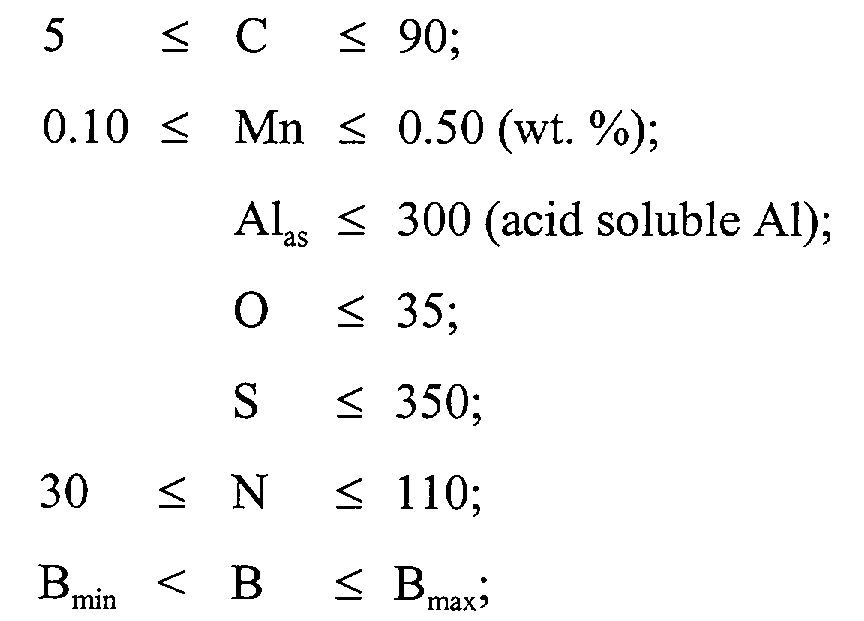
- The cold reduced enamelling steel sheet according to the invention comprises (in weight ppm unless otherwise indicated)wherein Bmin = N×0.80×10.8/14 and Bmax = N×10.8/14 + 83/6; and optionally
 wherein Cumin = P×1.00×63.6/31 and Cumax = P×2.00×63.6/31; in each case the balance being Fe and unintentional and/or inevitable impurities.
- Herewith is provided an enamelling steel sheet with a minimum of alloying elements that has deep drawing properties which are sufficiently good. After applying and firing white enamel, the steel sheet is essentially free from fish scale defects, and the enamel adhesion is satisfactory.
- The combination of B and N enables formation of precipitates that help suppress the formation of fish scales. In order to sufficiently suppress the formation of fish scale defects, the atomic ratio B/N should be more than 0.80. It is now found that the mechanical properties, in particular deep drawing properties, are better if the amount of excess B above the atomic ratio B/N of 1.00 is limited to at most 83/6 ppm by weight. The recrystallisation temperature is also lower in that case. Thus, when the B-content exceeds Bmax, the mechanical properties are unnecessarily deteriorating. This deterioration is currently thought to be related to the presence of acid soluble B in the steel matrix.
- Oxygen can be present in the steel sheet after oxygen steel making process typically up to an amount of 35 ppm.
- In an embodiment, oxygen is not added to extra amounts, since it might form unnecessary precipitates that are unfavourable for the mechanical properties.
- The amount of acid soluble Al (Alas) should be limited to at most 300 ppm. Deep drawing properties may improve as the amount of Alas is kept low as possible, preferably lower than 150 ppm. The total amount of Al that may be present in the steel depends primarily on the oxygen content. The total amount of Al is preferably sufficiently high to bind essentially all the oxygen that is present in the steel sheet.
- Mn is important for forming MnS precipitates, and MnO precipitates in the case that not all oxygen is already bound by Al. S may be, and in practice often is present in the steel sheet as unintentional element. A significant effect is obtained when at least 0.10 wt. % of Mn is present in the steel sheet. Preferably, the amount of Mn is at least 0.23 wt. % to gain full advantage of this alloying element. However, for maintaining sufficient deep drawing capability of the steel sheet, the Mn content should be kept to a maximum of 0.50 wt. %.
- Optionally the steel sheet also contains:
- However, an atomic ratio Cu/P of between 1.00 and 1.50 is preferred, since under this condition in most cases the pickling behaviour is sufficiently good, with less Cu added to the alloy.
- It is preferred that Bmin = N×0.90×10.8/14. Herewith the atomic ratio B/N is higher than 0.90. Herewith it is better assured that all nitrogen is indeed precipitated with B.
- It is more preferred that Bmin = N×1.00×10.8/14. Herewith the atomic ratio B/N is higher than 1.00. It has been found that a small excess of B can be tolerated regarding the mechanical properties, with the advantage that it ensures that all N is indeed precipitated. Herewith the formation of fish scales is essentially fully suppressed.
- In an embodiment, the steel sheet comprises:
- 45 ≤ N ≤ 110. The formation of fish scale defects has been found to be suppressed better if the amount of N present in the steel sheet is at least 45 ppm.
- In an embodiment, the steel sheet comprises less than 89 ppm N. It has been found that the amount of added B can then be reduced while the formation of fish scale defects is nevertheless sufficiently reduced.
- In an embodiment wherein the steel sheet comprises less than 89 ppm N, it is preferred that Bmax = N×1.20×10.8/14. By keeping the atomic ratio B/N smaller than or equal to 1.20, the mechanical properties are kept close to their optimum. It is more preferred to keep the atomic ratio B/N smaller than or equal to 1.10. Herewith it is even better assured that no deteriorating effect on the mechanical properties results from the B addition.
- In a preferred embodiment, the maximum amount of C in the steel sheet is 50 ppm by weight. Herewith the ageing properties are better suited. In a more preferred embodiment, the maximum amount of C is 40 ppm. In a yet more preferred embodiment, the amount of C in the steel sheet is lower than 30 ppm by weight. Herewith, the strengthening of the steel sheet by ageing is maximised.
- In an embodiment of the invention the cold reduced enamelling steel sheet has a composition of C, Mn, Al, S, N, B, Cu, P in the amounts as specified above, the balance being Fe and unintentional and/or inevitable impurities such as O, Si.
- In an embodiment of the invention, the steel sheet as described above has a grain size according to ASTM of 9.5 units or less. Herewith the desired mechanical properties and the pickling properties are achieved.
- In an embodiment, the yield strength is between 140 MPa and 190 MPa, the tensile strength is between 270 MPa and 350 MPa, and the elongation to fracture is at least 35 %, all numbers measured in cross sectional direction to rolling in annealed, unaged and 1 % temper rolled condition. With these mechanical properties, the enamelling steel is sufficiently suited for most deep drawing applications. The steel sheet can have an r-value (at 90° to rolling direction) of higher than 1.85, and/or an n-value exceeding 0.233.
- In another aspect, the invention relates to an enamelled structure comprising at least one component made of the above described steel sheet, provided with an enamel layer.
- The invention will be explained according to some embodiments of the invention.
- Cold reduced enamelling steel sheet can be produced by preparing a suitable steel melt and casting the melt into a slab. The production process can include operations of hot rolling the slab, pickling the rolled product, cold rolling, annealing, temper rolling. In particular, cold rolling can be applied to a reduction exceeding 50 %, or exceeding 70 %, and in an embodiment not exceeding 90 %. In particular, annealing can be performed to a temperature between the recrystallisation temperature of the rolled sheet and the Ar3 temperature. Annealing may be performed as coil annealing, continuous annealing, or any suitable type of annealing. In particular, temper rolling may be performed to a reduction between 0.5 % and 2 %. The embodiments of the invention are, however, not limited to these operations and conditions.
- Laboratory melts were provided with various compositions as determined using spectrometric analysis and shown in Table I, in wt. ppm except for Mn in which case wt. % is used.
Type C Mn O Al Alas B N B/N Si Cu P S Ref. 35 0.44 19 180 150 0 32 0 70 220 70 350 1 26 0.45 20 140 100 64 92 0.90 80 230 70 80 2 26 0.42 33 40 0 73 83 1.14 40 260 70 90 - B was added to the melt in the form of FeB after Al and Mn had been added. The composition of the melts were determined using spectrometric analysis of the melts. The amount of C in these steel types (between 20 and 30 ppm) can be achieved in most oxygen blowing steel making factories.
- The melts were cast and hot rolled, with a finishing temperature of 930 °C. Then the sheets were cooled at a velocity of 20 °C/s, and coiled at a temperature of 690 °C.
- After coil cooling, the sheets were pickled at a temperature of 70 °C, and cold rolled to three reductions of 75 %, 80 %, and 85 % (corresponding to respective final thicknesses of 1.0 mm, 0.8 mm, and 0.6 mm) for each type.
- The recrystallisation temperature for tight coil annealing was determined for each type for various reductions using a heating rate of 2.4×10⁻⁵ /sec in HNx. Each sample was heated to a certain temperature, and cooled, and successively heated to a temperature 10° above the previous temperature. After each cooling step, a microscopic study of the microstructure of the sample was performed to determine whether recrystallisation had occurred. The thus found recrystallisation temperatures are given in °C in the following Table II.
Type Cold reduced by: 75% 80% 85% Ref. 640 640 640 1 640 640 640 2 610 620 620 - After cold reduction, each type of thus obtained and rolled steel sheet was tight-coil annealed at 640 °C using a heating rate of 2.4×10⁻⁵ /sec, and after cooling down to room temperature subsequently temper rolled to a 1 % reduction.
- The final grain structure in cross section of the rolling direction was determined after cold rolling, annealing, and temper rolling to a 1 % reduction according to the ASTM standard. The results are given in the following Table III in ASTM units.
Type Cold reduced by 75 % 80 % 85 % Ref. 9.5 9.5 10 1 9.0 9.5 9.5 2 9.0 9.0 9.0 - White enamel was applied to these steel sheets, using various firing temperatures between 780 and 860°C. The reference steel sheet showed a high abundance of fish scales after application of white enamel, while none of the steel sheets of types 1 or 2 suffered from visible fish scale defects. This shows that in cold rolled sheet even a low B content of 64 ppm can be sufficient to suppress fish scale formation, as long as the amount of B is carefully adapted to the amount of N that is present in the steel sheet. Also, the adhesion of the white enamel was excellent.
- The following Table IV shows results of mechanical tests of temper rolled (1 %) non-aged sheet sheets. The results are average results obtained on 75, 80, and 85 % cold reduced sheets, measured in the transverse direction, according to the small Euronorm using a small rod from the sheet. R p denotes yield strength, R m is the tensile strength, A g is the uniform elongation, and A80 the elongation to fracture. Also given are transverse r-value (90°) and n-value.
Type R p R m A g A80 r n MPa MPa % % Ref. 195 320 22 31 1.48 0.214 1 162 301 26 38 1.94 0.241 2 160 296 26 37 2.07 0.243 - An embodiment of the enamelling steel sheet according to the invention has also been prepared in a production plant. The spectroscopically analysed composition is given in Table V.
Type C Mn O Al Alas B N B/N Si Cu P S 3 50 0.29 20 260 230 59 60 1.27 10 250 100 130 - The mechanical properties of this steel sheet were determined in cross section to the rolling direction as was done with the laboratory melts above. The results are shown in Table VI.
Type R p R m A g A80 r n MPa MPa % % 3 162 297 24 45 1.97 0.220
Claims (14)
- Cold reduced enamelling steel sheet comprising (in weight ppm unless otherwise indicated)wherein Bmin = N×0.80×10.8/14 and Bmax = N×10.8/14 + 83/6; and optionally
 wherein Cumin = P×1.00×63.6/31 and Cumax = P×2.00×63.6/31; in each case the balance being Fe and unintentional and/or inevitable impurities.
- Steel sheet according to claim 1, wherein Bmin = N×0.90×10.8/14.
- Steel sheet according to claim 1 or 2, wherein Bmin = N×1.00×10.8/14.
- Steel sheet according to claim 1, 2, or 3, wherein
- Steel sheet according to claim 1, 2, or 3, wherein
- Steel sheet according to claim 5, wherein Bmax = N×1.20×10.8/14.
- Steel sheet according to any one of the claims 1 to 6, wherein Cumax = P×1.50×63.6/31.
- Steel sheet according to any one of the claims 1 to 7, wherein the maximum amount of C is 30 ppm by weight.
- Cold reduced enamelling steel sheet having a composition of C, Mn, Al, S, N, B, Cu, P in the amounts as specified in any one of the claims 1 to 8, the balance being Fe and unintentional an/or inevitable impurities such as O, Si.
- Steel sheet according to any one of the preceding claims, wherein the grain size according to ASTM is 9.5 units or less.
- Steel sheet according to any one of the preceding claims, wherein the yield strength is between 140 MPa and 190 MPa, the tensile strength is between 270 MPa and 350 MPa, and the elongation to fracture is at least 35 %.
- Enamelled structure comprising at least one component made of the steel sheet according to any one of the claims 1 to 11 inclusive, provided with an enamel layer.
- Enamelled structure according to claim 12, wherein the enamel is white enamel.
- Enamelled structure according to claim 12 or 13, wherein the at least one component has been deep drawn.
Priority Applications (3)
| Application Number | Priority Date | Filing Date | Title |
|---|---|---|---|
| EP01200567A EP1233079B1 (en) | 2001-02-16 | 2001-02-16 | Cold reduced enamelling steel sheet and an enamelled structure comprising a component of such a steel sheet |
| ES01200567T ES2383168T3 (en) | 2001-02-16 | 2001-02-16 | Thin sheet of enamelled steel, cold reduced, and an enameled structure comprising a component of a similar sheet of thin steel |
| AT01200567T ATE553224T1 (en) | 2001-02-16 | 2001-02-16 | COLD-FORMED ENAMELLED STEEL SHEET AND ENAMELED STRUCTURE COMPRISING A COMPONENT OF SUCH A STEEL SHEET |
Applications Claiming Priority (1)
| Application Number | Priority Date | Filing Date | Title |
|---|---|---|---|
| EP01200567A EP1233079B1 (en) | 2001-02-16 | 2001-02-16 | Cold reduced enamelling steel sheet and an enamelled structure comprising a component of such a steel sheet |
Publications (2)
| Publication Number | Publication Date |
|---|---|
| EP1233079A1 true EP1233079A1 (en) | 2002-08-21 |
| EP1233079B1 EP1233079B1 (en) | 2012-04-11 |
Family
ID=8179900
Family Applications (1)
| Application Number | Title | Priority Date | Filing Date |
|---|---|---|---|
| EP01200567A Expired - Lifetime EP1233079B1 (en) | 2001-02-16 | 2001-02-16 | Cold reduced enamelling steel sheet and an enamelled structure comprising a component of such a steel sheet |
Country Status (3)
| Country | Link |
|---|---|
| EP (1) | EP1233079B1 (en) |
| AT (1) | ATE553224T1 (en) |
| ES (1) | ES2383168T3 (en) |
Cited By (4)
| Publication number | Priority date | Publication date | Assignee | Title |
|---|---|---|---|---|
| WO2003038140A1 (en) * | 2001-10-29 | 2003-05-08 | Nippon Steel Corporation | Steel sheet for vitreous enameling and method for producing the same |
| WO2014170315A1 (en) * | 2013-04-15 | 2014-10-23 | Tata Steel Ijmuiden B.V. | Cold reduced enamelling steel sheet, method for its production, and use of such steel |
| CN109844158A (en) * | 2016-10-17 | 2019-06-04 | 塔塔钢铁艾默伊登有限责任公司 | Steel base for painted parts |
| WO2021091878A1 (en) * | 2019-11-04 | 2021-05-14 | Ak Steel Properties, Inc. | Cold rolled enameling sheet steel with enhanced formability |
Citations (8)
| Publication number | Priority date | Publication date | Assignee | Title |
|---|---|---|---|---|
| JPS57104627A (en) * | 1980-12-19 | 1982-06-29 | Nippon Kokan Kk <Nkk> | Manufacture of cold rolled soft steel plate with superior press formability by continuous annealing |
| US4576657A (en) * | 1982-02-19 | 1986-03-18 | Kawasaki Steel Corporation | Process of manufacturing a cold rolled steel sheet having excellent press formability |
| JPH0230738A (en) * | 1988-07-20 | 1990-02-01 | Kawasaki Steel Corp | Steel plate for direct one treatment enameling having excellent resistance to fault of bubble and black spot |
| EP0672758A1 (en) * | 1994-02-17 | 1995-09-20 | Kawasaki Steel Corporation | Method of manufacturing canning steel sheet with non-aging property and superior workability |
| JPH08199299A (en) * | 1995-01-25 | 1996-08-06 | Nkk Corp | Enamel steel with excellent nail resistance, black spot resistance and aging resistance |
| JPH0987748A (en) * | 1995-09-25 | 1997-03-31 | Nkk Corp | Production of non-if steel-based nonaging dead soft cold-rolled steel sheet |
| EP0769565A1 (en) * | 1995-03-27 | 1997-04-23 | Nippon Steel Corporation | Ultralow-carbon cold-rolled sheet and galvanized sheet both excellent in fatigue characteristics and process for producing both |
| JPH09227947A (en) * | 1996-02-26 | 1997-09-02 | Nkk Corp | Manufacturing method of steel plate for ultra-low carbon can |
-
2001
- 2001-02-16 AT AT01200567T patent/ATE553224T1/en active
- 2001-02-16 ES ES01200567T patent/ES2383168T3/en not_active Expired - Lifetime
- 2001-02-16 EP EP01200567A patent/EP1233079B1/en not_active Expired - Lifetime
Patent Citations (8)
| Publication number | Priority date | Publication date | Assignee | Title |
|---|---|---|---|---|
| JPS57104627A (en) * | 1980-12-19 | 1982-06-29 | Nippon Kokan Kk <Nkk> | Manufacture of cold rolled soft steel plate with superior press formability by continuous annealing |
| US4576657A (en) * | 1982-02-19 | 1986-03-18 | Kawasaki Steel Corporation | Process of manufacturing a cold rolled steel sheet having excellent press formability |
| JPH0230738A (en) * | 1988-07-20 | 1990-02-01 | Kawasaki Steel Corp | Steel plate for direct one treatment enameling having excellent resistance to fault of bubble and black spot |
| EP0672758A1 (en) * | 1994-02-17 | 1995-09-20 | Kawasaki Steel Corporation | Method of manufacturing canning steel sheet with non-aging property and superior workability |
| JPH08199299A (en) * | 1995-01-25 | 1996-08-06 | Nkk Corp | Enamel steel with excellent nail resistance, black spot resistance and aging resistance |
| EP0769565A1 (en) * | 1995-03-27 | 1997-04-23 | Nippon Steel Corporation | Ultralow-carbon cold-rolled sheet and galvanized sheet both excellent in fatigue characteristics and process for producing both |
| JPH0987748A (en) * | 1995-09-25 | 1997-03-31 | Nkk Corp | Production of non-if steel-based nonaging dead soft cold-rolled steel sheet |
| JPH09227947A (en) * | 1996-02-26 | 1997-09-02 | Nkk Corp | Manufacturing method of steel plate for ultra-low carbon can |
Non-Patent Citations (5)
| Title |
|---|
| PATENT ABSTRACTS OF JAPAN vol. 006, no. 191 (C - 127) 30 September 1982 (1982-09-30) * |
| PATENT ABSTRACTS OF JAPAN vol. 014, no. 184 (C - 0709) 13 April 1990 (1990-04-13) * |
| PATENT ABSTRACTS OF JAPAN vol. 1996, no. 12 26 December 1996 (1996-12-26) * |
| PATENT ABSTRACTS OF JAPAN vol. 1997, no. 07 31 July 1997 (1997-07-31) * |
| PATENT ABSTRACTS OF JAPAN vol. 1998, no. 01 30 January 1998 (1998-01-30) * |
Cited By (7)
| Publication number | Priority date | Publication date | Assignee | Title |
|---|---|---|---|---|
| WO2003038140A1 (en) * | 2001-10-29 | 2003-05-08 | Nippon Steel Corporation | Steel sheet for vitreous enameling and method for producing the same |
| US7922837B2 (en) | 2001-10-29 | 2011-04-12 | Nippon Steel Corporation | Steel sheet for vitreous enameling and method for producing the same |
| US8491735B2 (en) | 2001-10-29 | 2013-07-23 | Nippon Steel & Sumitomo Metal Corporation | Steel sheet for vitreous enameling and method for producing the same |
| WO2014170315A1 (en) * | 2013-04-15 | 2014-10-23 | Tata Steel Ijmuiden B.V. | Cold reduced enamelling steel sheet, method for its production, and use of such steel |
| CN109844158A (en) * | 2016-10-17 | 2019-06-04 | 塔塔钢铁艾默伊登有限责任公司 | Steel base for painted parts |
| CN109844158B (en) * | 2016-10-17 | 2021-09-07 | 塔塔钢铁艾默伊登有限责任公司 | Steel base for painted parts |
| WO2021091878A1 (en) * | 2019-11-04 | 2021-05-14 | Ak Steel Properties, Inc. | Cold rolled enameling sheet steel with enhanced formability |
Also Published As
| Publication number | Publication date |
|---|---|
| ES2383168T3 (en) | 2012-06-18 |
| ATE553224T1 (en) | 2012-04-15 |
| EP1233079B1 (en) | 2012-04-11 |
Similar Documents
| Publication | Publication Date | Title |
|---|---|---|
| EP2554699B1 (en) | Steel sheet with high tensile strength and superior ductility and method for producing same | |
| EP2009130B1 (en) | Process for producing alloyed hot-dip zinc-coated steel sheet satisfactory in processability, non-powdering property, and sliding property | |
| US8691031B2 (en) | Aluminum alloy sheet and method for manufacturing the same | |
| EP0672758B1 (en) | Method of manufacturing canning steel sheet with non-aging property and superior workability | |
| US20150267284A1 (en) | Methods for production of highly formable extra deep draw enameling steel -- product and process for manufacture thereof | |
| EP1577407B1 (en) | Alloyed-molten-zinc-plated steel sheet with excellent processability and high strength and process for producing the same | |
| AU716905B2 (en) | Bake hardenable vanadium containing steel | |
| KR100264258B1 (en) | Cold rolled steel strip and hot dip coated cold rolled steel strip for use as building material and manufacturing method thereof | |
| EP1002884A1 (en) | Cold rolled steel plate of excellent moldability, panel shape characteristics and denting resistance, molten zinc plated steel plate, and method of manufacturing these steel plates | |
| EP3683328B1 (en) | Steel sheet having excellent image clarity after coating and method for manufacturing same | |
| EP1233079B1 (en) | Cold reduced enamelling steel sheet and an enamelled structure comprising a component of such a steel sheet | |
| JP4422645B2 (en) | Method for producing alloyed hot-dip galvanized steel sheet with good workability | |
| EP1336665B1 (en) | Cold reduced enamelling steel sheet and an enamelled structure comprising a component of such a steel sheet | |
| JPH07126758A (en) | Method for producing ferritic stainless steel sheet with excellent bending workability | |
| JP2948416B2 (en) | High strength cold rolled steel sheet and hot dip galvanized steel sheet with excellent deep drawability | |
| JP3043901B2 (en) | Method for producing high-strength cold-rolled steel sheet and galvanized steel sheet with excellent deep drawability | |
| JP3222239B2 (en) | Hard surface-treated original sheet with high BH property and excellent workability | |
| JP3247152B2 (en) | Cold-rolled steel sheet for enamel having high strength after firing enamel and method for producing the same | |
| JP2003213358A (en) | Al-Mg based alloy rolled sheet temper excellent in bending workability and method for producing the same | |
| JPH05179357A (en) | Production of cold rolled ferritic stainless steel sheet | |
| JPH0261033A (en) | Cold rolled steel sheet for deep drawing | |
| EP4473133A1 (en) | Method of manufacturing a low-carbon steel strip having improved formability | |
| JPH0250940A (en) | Cold rolled steel plate for deep drawing having excellent corrosion resistance | |
| JPH0653914B2 (en) | Steel plate for enamel and its manufacturing method | |
| JP2951241B2 (en) | Manufacturing method of cold rolled steel sheet with excellent workability and enamel properties |
Legal Events
| Date | Code | Title | Description |
|---|---|---|---|
| PUAI | Public reference made under article 153(3) epc to a published international application that has entered the european phase |
Free format text: ORIGINAL CODE: 0009012 |
|
| AK | Designated contracting states |
Kind code of ref document: A1 Designated state(s): AT BE CH CY DE DK ES FI FR GB GR IE IT LI LU MC NL PT SE TR |
|
| AX | Request for extension of the european patent |
Free format text: AL;LT;LV;MK;RO;SI |
|
| 17P | Request for examination filed |
Effective date: 20030221 |
|
| AKX | Designation fees paid |
Designated state(s): AT DE ES IT SE |
|
| RAP1 | Party data changed (applicant data changed or rights of an application transferred) |
Owner name: TATA STEEL IJMUIDEN BV |
|
| GRAP | Despatch of communication of intention to grant a patent |
Free format text: ORIGINAL CODE: EPIDOSNIGR1 |
|
| GRAS | Grant fee paid |
Free format text: ORIGINAL CODE: EPIDOSNIGR3 |
|
| GRAA | (expected) grant |
Free format text: ORIGINAL CODE: 0009210 |
|
| AK | Designated contracting states |
Kind code of ref document: B1 Designated state(s): AT DE ES IT SE |
|
| REG | Reference to a national code |
Ref country code: AT Ref legal event code: REF Ref document number: 553224 Country of ref document: AT Kind code of ref document: T Effective date: 20120415 |
|
| REG | Reference to a national code |
Ref country code: DE Ref legal event code: R096 Ref document number: 60146367 Country of ref document: DE Effective date: 20120606 |
|
| REG | Reference to a national code |
Ref country code: ES Ref legal event code: FG2A Ref document number: 2383168 Country of ref document: ES Kind code of ref document: T3 Effective date: 20120618 |
|
| REG | Reference to a national code |
Ref country code: SE Ref legal event code: TRGR |
|
| PLBE | No opposition filed within time limit |
Free format text: ORIGINAL CODE: 0009261 |
|
| STAA | Information on the status of an ep patent application or granted ep patent |
Free format text: STATUS: NO OPPOSITION FILED WITHIN TIME LIMIT |
|
| 26N | No opposition filed |
Effective date: 20130114 |
|
| REG | Reference to a national code |
Ref country code: DE Ref legal event code: R097 Ref document number: 60146367 Country of ref document: DE Effective date: 20130114 |
|
| PGFP | Annual fee paid to national office [announced via postgrant information from national office to epo] |
Ref country code: AT Payment date: 20180201 Year of fee payment: 18 |
|
| PGFP | Annual fee paid to national office [announced via postgrant information from national office to epo] |
Ref country code: ES Payment date: 20190301 Year of fee payment: 19 |
|
| PGFP | Annual fee paid to national office [announced via postgrant information from national office to epo] |
Ref country code: SE Payment date: 20190227 Year of fee payment: 19 |
|
| REG | Reference to a national code |
Ref country code: AT Ref legal event code: MM01 Ref document number: 553224 Country of ref document: AT Kind code of ref document: T Effective date: 20190216 |
|
| PG25 | Lapsed in a contracting state [announced via postgrant information from national office to epo] |
Ref country code: AT Free format text: LAPSE BECAUSE OF NON-PAYMENT OF DUE FEES Effective date: 20190216 |
|
| PGFP | Annual fee paid to national office [announced via postgrant information from national office to epo] |
Ref country code: IT Payment date: 20200220 Year of fee payment: 20 Ref country code: DE Payment date: 20200227 Year of fee payment: 20 |
|
| REG | Reference to a national code |
Ref country code: SE Ref legal event code: EUG |
|
| PG25 | Lapsed in a contracting state [announced via postgrant information from national office to epo] |
Ref country code: SE Free format text: LAPSE BECAUSE OF NON-PAYMENT OF DUE FEES Effective date: 20200217 |
|
| REG | Reference to a national code |
Ref country code: DE Ref legal event code: R071 Ref document number: 60146367 Country of ref document: DE |
|
| REG | Reference to a national code |
Ref country code: ES Ref legal event code: FD2A Effective date: 20210706 |
|
| PG25 | Lapsed in a contracting state [announced via postgrant information from national office to epo] |
Ref country code: ES Free format text: LAPSE BECAUSE OF NON-PAYMENT OF DUE FEES Effective date: 20200217 |