EP1231568A1 - Dispositif de simulation de déformations de matériaux, notamment de tissus corporels mous - Google Patents
Dispositif de simulation de déformations de matériaux, notamment de tissus corporels mous Download PDFInfo
- Publication number
- EP1231568A1 EP1231568A1 EP02290254A EP02290254A EP1231568A1 EP 1231568 A1 EP1231568 A1 EP 1231568A1 EP 02290254 A EP02290254 A EP 02290254A EP 02290254 A EP02290254 A EP 02290254A EP 1231568 A1 EP1231568 A1 EP 1231568A1
- Authority
- EP
- European Patent Office
- Prior art keywords
- mesh
- vertex
- vertices
- computer
- edge
- Prior art date
- Legal status (The legal status is an assumption and is not a legal conclusion. Google has not performed a legal analysis and makes no representation as to the accuracy of the status listed.)
- Granted
Links
Images


Classifications
-
- G—PHYSICS
- G06—COMPUTING OR CALCULATING; COUNTING
- G06T—IMAGE DATA PROCESSING OR GENERATION, IN GENERAL
- G06T17/00—Three-dimensional [3D] modelling for computer graphics
- G06T17/20—Finite element generation, e.g. wire-frame surface description, tesselation
-
- G—PHYSICS
- G06—COMPUTING OR CALCULATING; COUNTING
- G06T—IMAGE DATA PROCESSING OR GENERATION, IN GENERAL
- G06T13/00—Animation
- G06T13/20—Three-dimensional [3D] animation
Definitions
- the invention relates to the simulation of deformations of materials, especially soft body tissue.
- a visualization interface is provided to represent at least one object in a predetermined form, meshed with a selected mesh pattern.
- An interface user equipped with a mechanical gripping device allows simulate one or more forces exerted globally on the object.
- a computer capable of cooperating with the memory area evaluates new vertex positions, depending on the stress applied and mechanical parameters of the material. To view the deformation and / or return to a rest position of the moving object, the computer determines a temporal evolution of the positions of the vertices according to this request.
- qualified personnel such as a surgeon can follow the simulation of a deformation and / or return to a rest position.
- the present invention improves the situation.
- the mesh pattern chosen includes at least one triangular base.
- the mesh chosen is preferably triangular, so that the calculator is able to determine a composition of the forces at each vertex of the triangle, depending on the difference between the current length of each edge of the triangle and the length of this edge at rest.
- the chosen mesh is preferably tetrahedral, so that the calculator determines a composition of the forces in each tetrahedron vertex, depending on the gap between the current length of each edge of the tetrahedron and the length of this edge at rest.
- the memory area is arranged to store, in association with each mesh, mechanical parameters of the mesh material, at least partially defined locally, especially at the mesh or element level of it.
- the computer is arranged to determine said deviation from running and resting lengths, in order to estimate a derivative of the potential energy of deformation of each mesh, expressed as a function of a Green-St Venant tensor and mechanical coefficients specific to the material in this mesh.
- the computer In estimating the potential energy derivatives at vertices, expressed as a function of a Green-St tensor Coming, the computer is arranged to determine, more precisely, differences between the squares of the lengths current and at rest of each edge, in order to determine the composition of the aforementioned forces.
- the above mechanical parameters advantageously include the Lamé coefficients of the material in each mesh considered.
- the device according to the invention then makes it possible to simulate large displacements and / or nonlinear elasticity, the case of heterogeneous objects, made of materials different.
- a mesh should be applied tetrahedral to the object and a triangular mesh to the skin and to assign mechanical parameters to each type of mesh adequate. Provision may also be made to simulate the movements of soft objects (such as muscles), in the presence rigid and interdependent objects (such as bones), as will see further.
- Step c) also involves an allocation of indices of elements of the meshes, within the framework of the development of a data structure, and, where appropriate, by simplification of the structure of the object, as we will see later.
- Steps e) and f) are based on a model developed by the Applicant and which will be described in detail below.
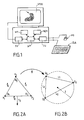
- Figure 1 in which the device is presented, in the embodiment described, under the form of a PC computer.
- Computer includes memory permanent MEM (for example of ROM type) in which are saved vertex position calculation programs of mesh and the resulting forces in these vertices as well that a ⁇ P processor capable of cooperating with a memory of MV work (for example RAM type) to perform these calculations.
- memory permanent MEM for example of ROM type
- a ⁇ P processor capable of cooperating with a memory of MV work (for example RAM type) to perform these calculations.
- MV work for example RAM type
- the aforementioned modules of the computer described above can, if necessary, take the form of programs stored in MEM memory, or be loaded into the working memory MT, from reading a medium in an external device (not shown), such as a floppy, CD-ROM, or even received from a communication link, for example by MODEM. Well heard, such programs appear as ways particularly important for implementing the invention. As such, the present invention also relates to such programs, if necessary on a support of the aforementioned type (floppy disk, CD-ROM, etc.), including detailed production examples will be given later.
- the computer further includes a VISU monitor connected to the ⁇ P processor via graphical interface IG, the set VISU and IG (called “visualization interface” above) allowing to visualize the shape of an object whose the deformation is simulated.
- the computer also includes a UI user interface linked to a mechanical input device such as a CLA keyboard or MO mouse, allowing a user to simulate a force globally exerted on the object, or a displacement, with initial deformation, of this object.
- the shape of the object to be meshed can be a represented surface in three dimensions.
- the mesh is triangular ( Figure 2A).
- the shape of the object to be meshed can be a full three-dimensional and in this case the mesh is tetrahedral ( Figure 2B).
- a module of mesh is stored in the MEM memory and can be set operated by the ⁇ P processor, cooperating with the interface IG graphic, to visualize a shape of the mesh object on the VISU monitor.
- a triangle T0 (P0, P1, P2) of the form at rest, edges (1 0 , 1 1 , 1 2 ).
- the elastic potential energy of this strain is expressed here using the Cauchy-Green strain tensor C (formula F1 in the appendix).
- C Cauchy-Green strain tensor
- the gradient of the deformation is expressed at any point X of the triangle by the formula F2, where A is the area of the triangle T0, nj is the unit vector perpendicular to the segment (Pj + 1, Pj + 2), and the ⁇ j are the vectors of the shape of the triangle.
- the strain tensor C then becomes given by the expression of formula F3.
- this tensor of strain is invariant by translation and therefore does not depend not of the choice of the origin of the reference.
- the origin of the coordinate system is placed in the center of the circumscribed circle to the deformed triangle T, of radius r ( Figure 2A), which allows to express the tensor C in the form given to the formula F4, where Lp is the length of the deformed edge joining the vertices Qj and Qk.
- the elastic force applied by the triangle on one of its vertices is obtained by deriving the elastic energy with respect to the position of this vertex.
- the vertex P0 has the deformed position Q0.
- L 2 p By deriving the terms L 2 p to obtain the expression of the force according to the formula F11, which is the equation of the elastic force exerted by the triangle on each of its highs.
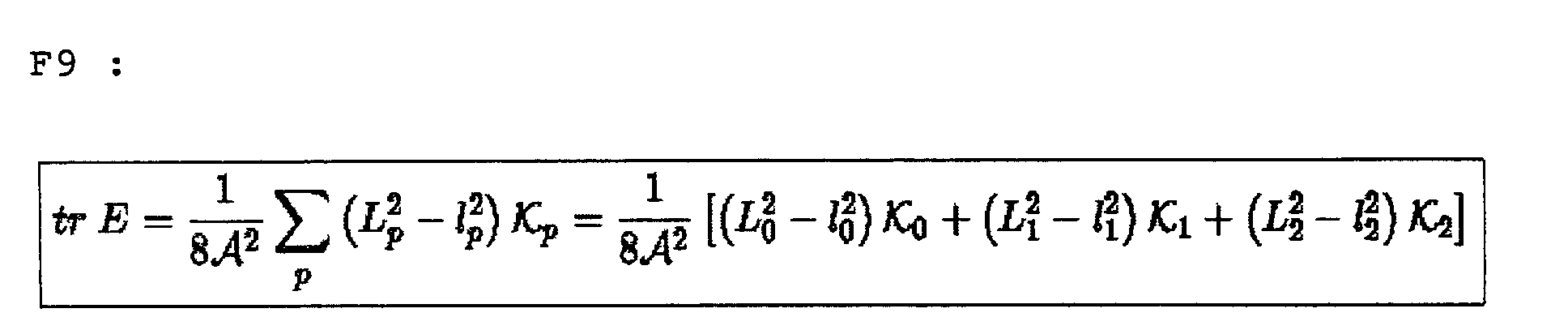
- This force is clearly expressed only as a function of the variations in length of the edges of the triangle (L i 2 - l i 2 ), of the mechanical parameters of the material ( ⁇ and ⁇ ) and of the shape of the triangle at rest (given by the terms Ki).
- this force implicitly contains a invariance property by rotation since all its terms remain zero as long as the lengths of the edges of the triangle do not do not change, i.e. as long as the triangle does not deform not.
- the displacement calculations can be simplified because it is no longer necessary to compensate for transformations rigid, the invariance by rigid transformation being intrinsic to the formulation of the deformable model.
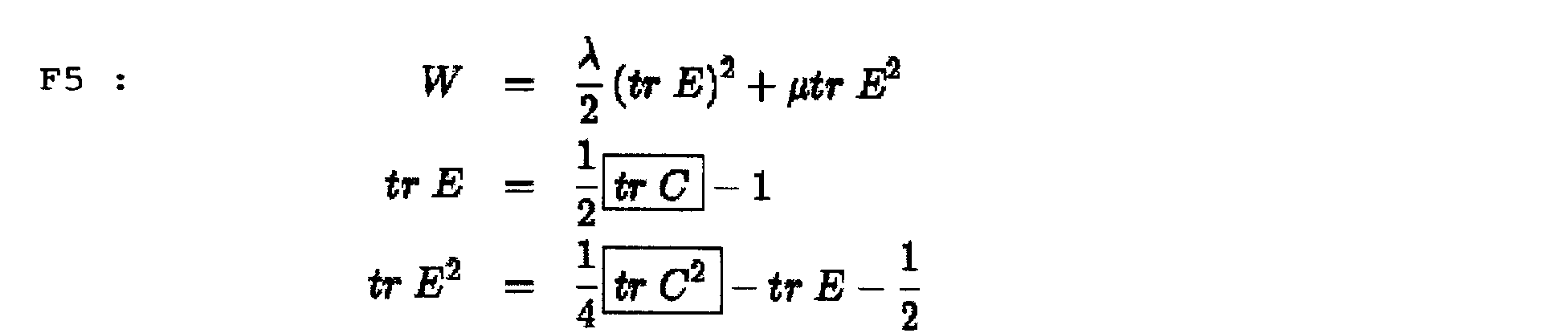
- the elastic strain energy is expressed as a function of the Green-Saint Venant strain tensor (referenced E), but, in a 3D mesh (formula F15).
- the expression of the trace of the tensor C is still expressed with the scalar products ( ⁇ j. ⁇ k), using the cosine law for the dihedral angles and as a function of the lengths of the edges of the tetrahedron (formulas 16 and 17).
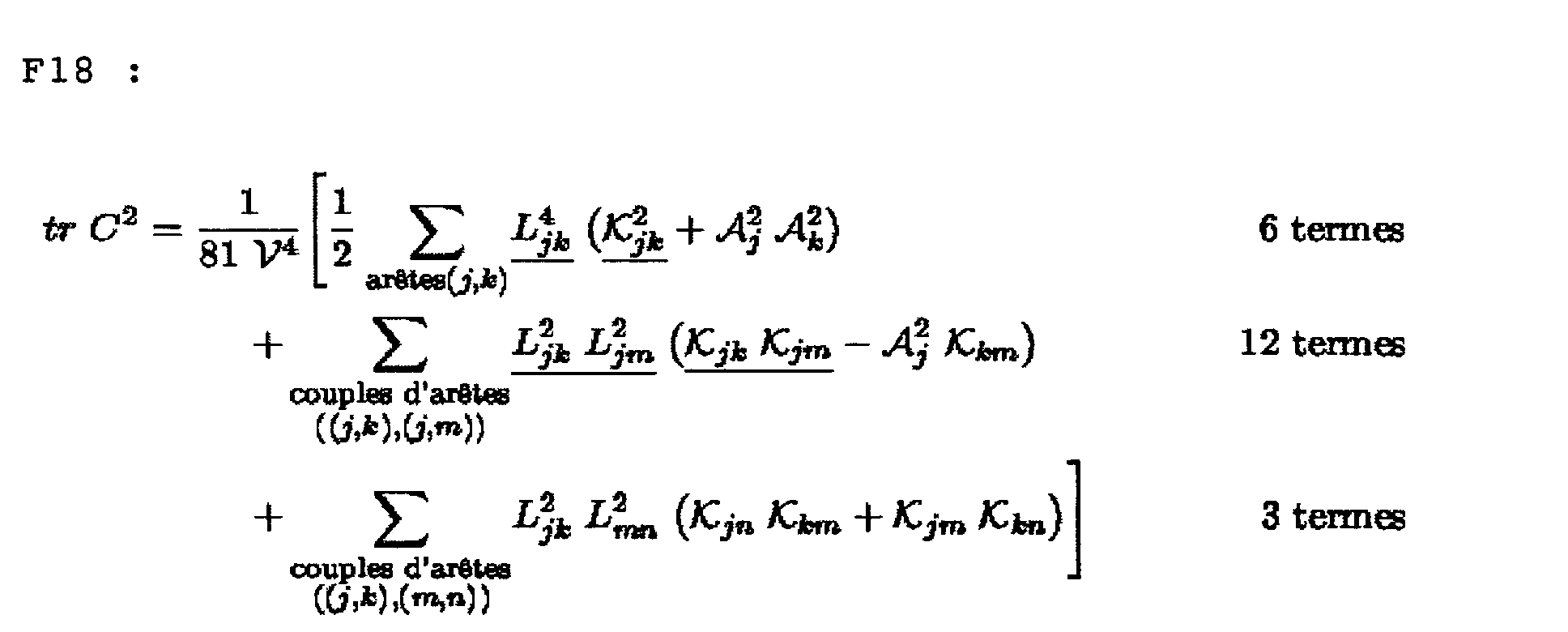
- the trace of C 2 is written according to the formula F18.
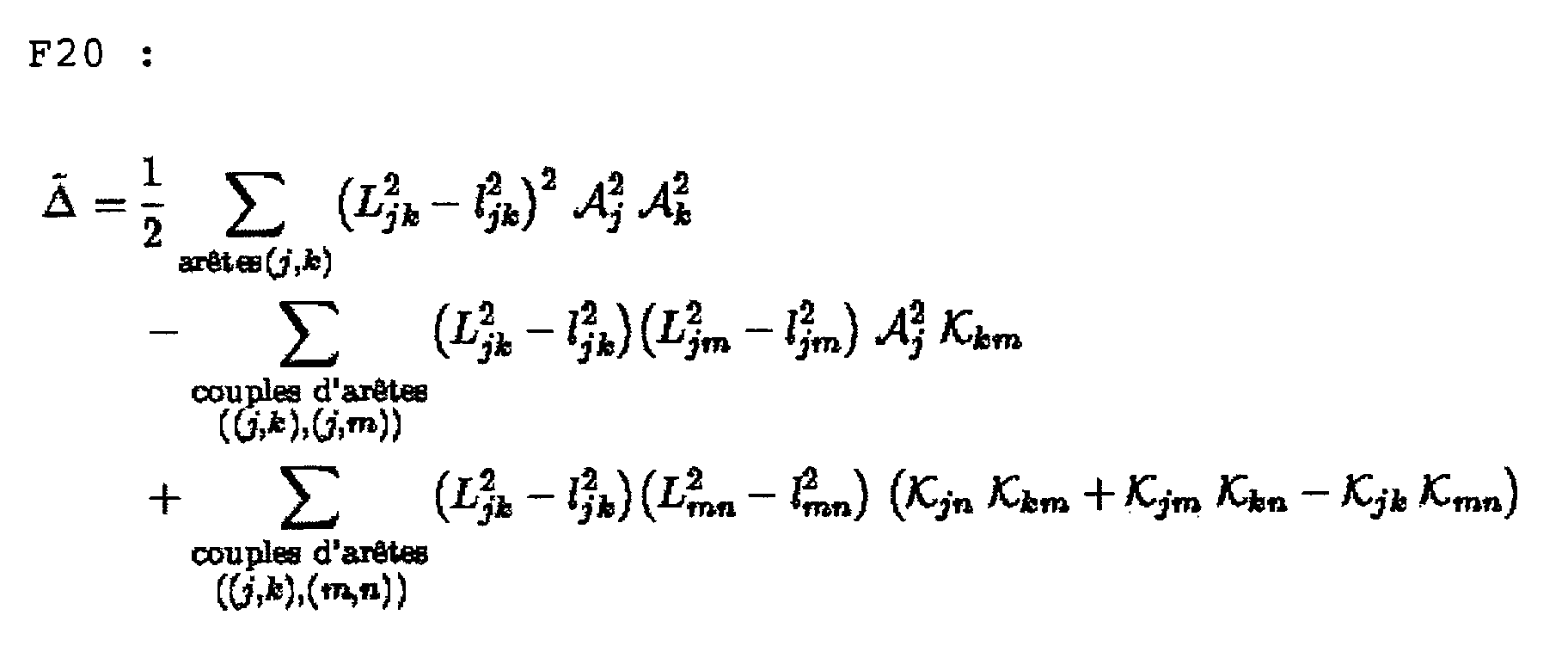
- the Applicant shows that the elastic deformation energy is expressed by the formula F19 in the appendix (supplemented by the formula F20).
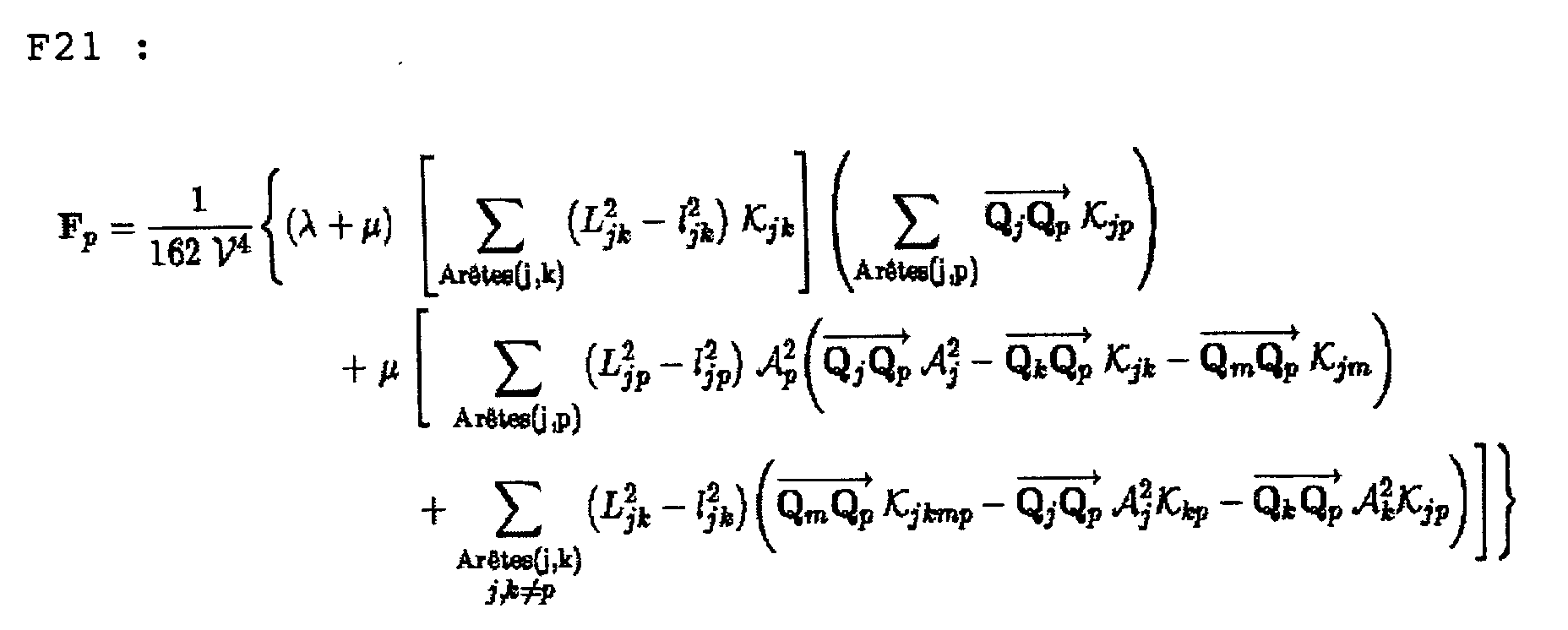
- the sum on the edges (j, p) means that it is necessary to traverse the three edges adjacent to the vertex Pp (on which the force is exerted) while the sum on the edges (j, k) (indices different from p) involves the three edges located on the face opposite the vertex Pp.
- the discretization of the object using finite elements is equivalent to approximating the elastic energy on a set of subdomains defined by geometric shapes Simple.
- the above model thus offers, on each subdomain, an energy formulation which only depends of the change of form of this domain.
- the visualization of a simulated deformation considering an initial form of rest seems more natural than those simulated with known models.
- consideration an initial form of rest avoids precision problems that appear when the model departs significantly from its rest position.
- the orientation of the three vertices in the triangle is done as follows.
- each edge is traversed in two different directions when we browse each of its two adjacent triangles.
- the edge Ai of index i is the edge opposite the vertex Si of index i in this triangle.
- the adjacent triangle with index i is the neighboring triangle TV, adjacent to edge Ai.
- each triangle always has three adjacent triangles.
- the structure of given of a tetrahedron volume consists of a list of tetrahedrons, a list of triangles, a list of edges and a list of summits.
- Each tetrahedron is oriented. From the orientation of four vertices ABCD, we are looking for the orientation of the four triangles: BCD, ADC, ABD, ACB. So that the mesh is correctly oriented, each triangle must be traveled in two different directions by traversing each of its two adjacent tetrahedra. Finally each tetrahedron is always adjacent to four tetrahedra. We introduce the notion of so-called “virtual” vertices and “virtual tetrahedrons” for take into account the edges of the mesh.
- the Applicant faced the difficulty of ensuring a conformity of the mesh, a definition of which is given below.
- each edge must belong to at most two triangles and the neighborhood topological of each vertex must remain homeomorphic to a circle (or semicircle), that is, if two triangles share the same vertex, then there must be a set of adjacent triangles which allow move from one triangle to another.
- the triangular mesh shown is non-conforming because the two triangles have an intersection following a vertex, while there are no adjacent triangles allowing to go from one to the other of these two triangles.
- each triangle belongs to at most two tetrahedra and that the topological neighborhood of each vertex is homeomorphic to a sphere (or a hemisphere if it is on the edge). he So if two tetrahedra share the same vertex, then there is a set of adjacent tetrahedra between them which allow you to go from one tetrahedron to another.
- Equation E2 The equation that governs the movement of the elastic model linear is the Newtonian differential equation E1 of Annex. This equation is related to the differential equations encountered in continuous medium mechanics (equation E2).
- the mass matrix M and the damping matrix C are hollow and depend on the properties of each tetrahedron.
- these matrices M and C can be considered here as diagonal, that is to say that the mass and the damping effects are concentrated on the vertices of the mesh.
- This simplification called masselumping, decouples the movements of each of the nodes and therefore makes it possible to write the previous equation E2 as a set of independent differential equations of type E1, with an equation for each vertex.
- the time step used for digital integration must be small enough.
- the critical time step depends of the greatest eigenvalue of the stiffness matrix and local values of mass and depreciation.
- the mass matrix is fixed as being equal to identity, and optimizing values local depreciation, in order to limit the risks oscillations, have the effect of improving conditioning of the linear system, and therefore to stabilize its resolution.
- FIG. 7 a flow diagram schematically represents the different stages of treatment applied to a three-dimensional surface triangulated, as an example.
- the processing begins with a first step 10, in which the structure of the data described above is applied, with an allocation of suitable indices.
- a first step 10 in which the structure of the data described above is applied, with an allocation of suitable indices.
- each triangle T n in step 12 for which we look for the Lamé coefficients ⁇ n and ⁇ n , as well as the area of triangle A (step 14).
- j being an integer from 0 to 2
- we calculate the difference of the squares of the edge lengths, between the current length l j and the previous edge length L j step 16. From these differences in lengths of squared edges, the forces exerted at each vertex S j of the triangle T n are deduced (force F j n calculated in step 18 of the flowchart).
- force F j n calculated in step 18 of the flowchart
- the new positions Q ′ n of the vertices S j of the deformed triangles are determined from their previous position Q n and from the forces F n .
- integration is carried out on all the deformed objects.
- the estimation of the new positions of the vertices S j is preferably carried out using the above-mentioned equations E1, E2 and E3.
- the two respective integrations have been represented (of the forces F j n and of the positions of the vertices S j in the deformed objects), separately.
- provision may be made to carry out some of the steps 12 to 20, at the same time or after certain of the steps 30 to 36. This choice depends on the structure of the two modules described above, which the above-mentioned computer comprises, and, where applicable, the data structure.
- a test 42 is preferably provided to find out whether the object has fully recovered its form of rest, namely: is there an edge in the object, the length of which is significantly different from that of the previous length?
- a time loop (step 44) is incremented, to go to a next time and show a gradual return to a form of rest of the object, using, where appropriate, equation E3.
- This time loop can be initialized after the first starting step 10.
- the invention is not limited to a application to the simulation of tissue deformation soft bodily.
- moving a rigid object for example for a bone attached to a muscle
- integral with the soft tissue can also be simulated.
- a torsor expression known per se
- strain tensor of the type described above.
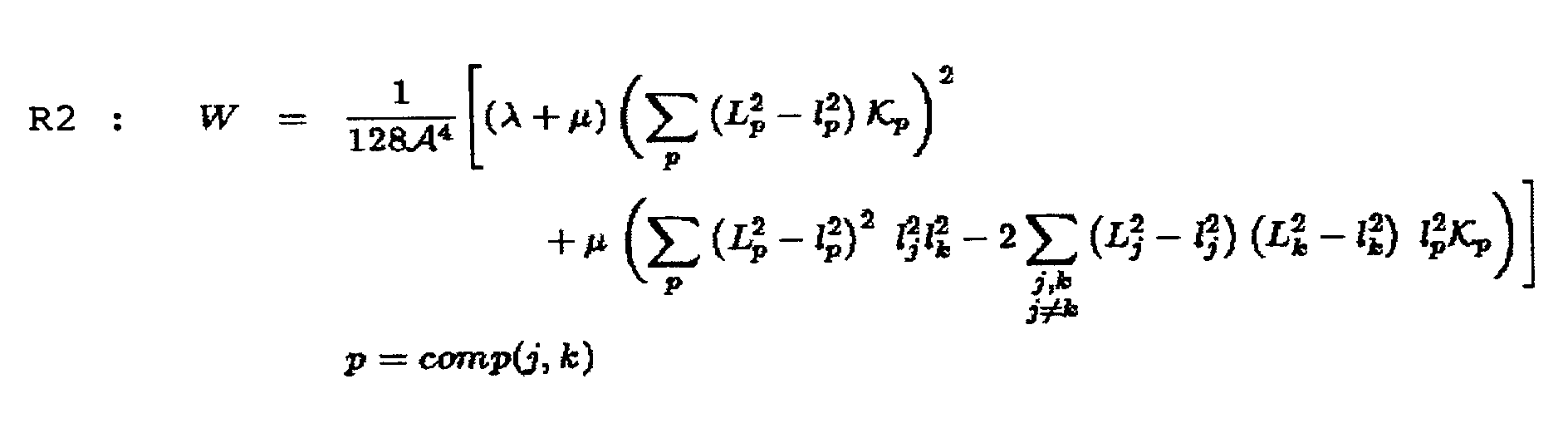
- the formula of the energy of deformation W is given above by way of example and depends on the material in which is envisaged the object whose deformation is simulated. However, it is generally expressed by a combination of the traces of the tensor E and the tensor E 2 . In special cases, only the trace of the tensor E (or of the tensor E 2 ) can intervene.
Landscapes
- Engineering & Computer Science (AREA)
- Physics & Mathematics (AREA)
- General Physics & Mathematics (AREA)
- Theoretical Computer Science (AREA)
- Computer Graphics (AREA)
- Geometry (AREA)
- Software Systems (AREA)
- Image Generation (AREA)
- Management, Administration, Business Operations System, And Electronic Commerce (AREA)
- Prostheses (AREA)
- Processing Or Creating Images (AREA)
- Measurement Of The Respiration, Hearing Ability, Form, And Blood Characteristics Of Living Organisms (AREA)
- Investigating Strength Of Materials By Application Of Mechanical Stress (AREA)
- Image Analysis (AREA)
- Instructional Devices (AREA)
- Apparatus For Radiation Diagnosis (AREA)
Abstract
Description
- des paramètres mécaniques du matériau dans lequel l'objet considéré est prévu,
- des données de position de l'objet, prises en des sommets d'un maillage choisi, et
- des données de force, représentant, en intensité et position, une sollicitation à exercer sur l'objet.
- un module apte à déterminer itérativement, pour chaque maille, l'écart entre la longueur courante d'une arête de la maille et sa longueur au repos, ainsi qu'à stocker des données de force respectives pour chaque sommet de la maille, et
- un module apte à déterminer itérativement, pour chaque sommet, de nouvelles données de position de ce sommet en fonction de la composition des forces qui s'y exerce, de données portant sur au moins une position antérieure du sommet et des paramètres mécaniques du matériau.
- la figure 1 représente schématiquement un dispositif selon une forme de réalisation de l'invention,
- les figures 2A et 2B représentent schématiquement des mailles triangulaires, respectivement initiale et déformée, avec les notations des points du triangle utilisées par la suite, dans l'estimation de la composition des forces en chaque sommet du triangle,
- la figure 3A est un schéma de tétraèdre aidant à comprendre les notations utilisées pour un point Pj du tétraèdre et le vecteur normal nj de la face opposée,
- les figures 3B à 3D sont des schémas de tétraèdres aidant à comprendre, avec la figure 3A précitée, comment se calculent des sommes sur des arêtes et des couples d'arêtes d'un tétraèdre, pour évaluer une force que subit un sommet Pp du tétraèdre,
- les figures 4A et 4B sont des schémas d'aide à la compréhension de l'attribution d'indices dans différentes mailles triangulaires,
- les figures 5A et 5B sont respectivement des schémas de motifs triangulaires comprenant un sommet courant (représenté par un carré) et un sommet virtuel (représenté par un disque), avant simplification, et de la même forme maillée après simplification,
- la figure 6 représente schématiquement un exemple d'un maillage triangulaire non conforme, et
- la figure 7 représente un organigramme schématique du déroulement des calculs de forces et de positions des sommets représentant l'objet.
- dans la deuxième ligne, k et m sont les indices complémentaires de j et p,
- dans la dernière ligne, m est l'indice complémentaire de j, k et p, et : Kjkmp = KjpKkm + KjmKkp - KjkKmp
- la somme sur les arêtes (j,p) fait intervenir trois termes (figure 3A),
- la somme sur les couples d'arêtes ((j,p),(k,p)) fait intervenir trois termes (figure 3B),
- la somme sur les couples d'arêtes ((j,p),(j,k)) fait intervenir six termes (figure 3C) et
- la somme sur les couples d'arêtes ((j,k),(m,p)) fait intervenir trois termes (figure 3D).
- pour chaque sommet, on détermine une arête adjacente,
- pour chaque arête, on détermine un pointeur sur les deux triangles adjacents, et les deux sommets qui forment l'arête,
- pour chaque triangle, on détermine les pointeurs sur les trois sommets qui forment le triangle, les trois arêtes du triangle, les trois triangles adjacents à chaque arête, ainsi que trois valeurs donnant l'indice d'adjacence du triangle courant pour chaque triangle adjacent.
- les pointeurs sur les quatre sommets qui forment le tétraèdre,
- les pointeurs sur les six arêtes du tétraèdre,
- les pointeurs sur les quatre triangles du tétraèdre, et
- les pointeurs sur les quatre tétraèdres voisins opposés à chacun des quatre sommets.













Claims (14)
- Dispositif de simulation de déformations de matériaux, notamment de tissus corporels mous, comprenant :caractérisé en ce que le calculateur comprend:une zone-mémoire (MEM,MT) apte à stocker, pour un objet au moins :des paramètres mécaniques du matériau de l'objet (λ,µ),des données de position de l'objet (Lj), prises en des sommets (Sj) d'au moins un maillage choisi (Tn), etdes données de force (Fj n), représentant, en intensité et position, une sollicitation à exercer sur l'objet,ainsi qu'un calculateur (µP,MT) capable de coopérer avec la zone-mémoire (MEM) pour évaluer de nouvelles positions des sommets (Sj), en fonction de la sollicitation exercée et des paramètres mécaniques du matériau,un module (12,14,16,18,20) apte à déterminer itérativement, pour chaque maille, l'écart entre la longueur courante (lj) d'une arête de la maille et sa longueur précédente et/ou au repos (Lj), ainsi qu'à stocker des données de force respectives (Fj n) pour chaque sommet de la maille, etun module (30,32,36) apte à déterminer itérativement, pour chaque sommet, de nouvelles données de position de ce sommet (Sj(Qn)) en fonction de la composition des forces qui s'y exerce (Fj n), de données portant sur au moins une position antérieure du sommet (Sj(Tn)) et des paramètres mécaniques du matériau.
- Dispositif selon la revendication 1, caractérisé en ce que, pour un objet présentant la forme d'une enveloppe tridimensionnelle creuse, le maillage choisi est triangulaire, de sorte que le calculateur est apte à déterminer une composition des forces en chaque sommet de triangle, en fonction de l'écart entre la longueur courante de chaque arête du triangle et la longueur de cette arête au repos.
- Dispositif selon l'une des revendications 1 et 2, caractérisé en ce que, pour un objet présentant une forme tridimensionnelle pleine, le maillage choisi est tétraédrique, de sorte que le calculateur est apte à estimer une composition des forces en chaque sommet de tétraèdre, en fonction de l'écart entre la longueur courante de chaque arête du tétraèdre et la longueur de cette arête au repos.
- Dispositif selon l'une des revendications précédentes, caractérisé en ce que le calculateur est agencé pour déterminer des différences entre les carrés des longueurs courante (lj) et précédente et/ou au repos (Lj) de chaque arête pour déterminer ladite composition des forces.
- Dispositif selon l'une des revendications précédentes, caractérisé en ce que la zone-mémoire est agencée pour stocker, en association avec chaque maille, des paramètres mécaniques du matériau de la maille (λn,µn), au moins partiellement définis localement, en particulier au niveau de la maille ou d'éléments de celle-ci.
- Dispositif selon la revendication 5, caractérisé en ce que le calculateur est agencé pour une déterminer ledit écart de longueurs courante et au repos, en vue d'estimer une dérivée de l'énergie potentielle de déformation (W) de chaque maille, exprimée en fonction d'un tenseur de Green-St Venant (E) et de coefficients mécaniques propres au matériau dans cette maille.
- Dispositif selon la revendication 6, caractérisé en ce que lesdits paramètres mécaniques comprennent les coefficients de Lamé du matériau dans chaque maille considérée (λn,µn).
- Dispositif selon l'une des revendications précédentes, caractérisé en ce qu'il comporte un module pour élaborer une structure de données et agencé pour supprimer des arêtes (Ai) de maille qui relient deux sommets dits "virtuels" (Si).
- Dispositif selon la revendication 8, caractérisé en ce que le module pour élaborer la structure de données est agencé en outre pour vérifier que le maillage respecte des propriétés de conformité prédéfinies.
- Dispositif selon l'une des revendications précédentes, caractérisé en ce que le module (30,32,36), apte à déterminer les nouvelles données de position des sommets (Q'n) en fonction de la composition des forces en chaque sommet, est agencé pour déterminer lesdites nouvelles données de position, en fonction du temps (E3), ce qui permet de suivre une évolution temporelle des positions respectives des sommets.
- Dispositif selon la revendication 10, caractérisé en ce que la détermination des nouvelles données de position des sommets (Q'n) utilise un modèle de résolution d'équation différentielle appliquée à chaque sommet.
- Dispositif selon l'une des revendications précédentes, caractérisé en ce que le calculateur est capable de déterminer répétitivement les données de position des sommets du maillage, en vue de déterminer une évolution temporelle (t+Δt) desdites positions.
- Dispositif selon la revendication 12, caractérisé en ce qu'il comporte une interface de visualisation (VISU,IG) propre à représenter l'objet suivant une forme prédéterminée et maillée selon le motif choisi, et en ce que l'interface de visualisation est apte à coopérer avec le calculateur pour représenter la forme de l'objet en mouvement.
- Dispositif selon l'une des revendications précédentes, caractérisé en ce qu'il comporte une interface utilisateur (IU) munie d'un organe de saisie (CLA,MO) pour simuler une ou plusieurs forces globalement exercées sur l'objet.
Applications Claiming Priority (2)
| Application Number | Priority Date | Filing Date | Title |
|---|---|---|---|
| FR0101717A FR2820534B1 (fr) | 2001-02-08 | 2001-02-08 | Dispositif de simulation de deformations de materiaux, notamment de tissus corporels mous |
| FR0101717 | 2001-02-08 |
Publications (2)
| Publication Number | Publication Date |
|---|---|
| EP1231568A1 true EP1231568A1 (fr) | 2002-08-14 |
| EP1231568B1 EP1231568B1 (fr) | 2004-11-17 |
Family
ID=8859780
Family Applications (1)
| Application Number | Title | Priority Date | Filing Date |
|---|---|---|---|
| EP02290254A Expired - Lifetime EP1231568B1 (fr) | 2001-02-08 | 2002-02-04 | Dispositif de simulation de déformations de matériaux, notamment de tissus corporels mous |
Country Status (5)
| Country | Link |
|---|---|
| US (1) | US7239992B2 (fr) |
| EP (1) | EP1231568B1 (fr) |
| AT (1) | ATE282862T1 (fr) |
| DE (1) | DE60201923T2 (fr) |
| FR (1) | FR2820534B1 (fr) |
Families Citing this family (24)
| Publication number | Priority date | Publication date | Assignee | Title |
|---|---|---|---|---|
| US7353149B2 (en) * | 2001-04-25 | 2008-04-01 | Telekinesys Research Limited | Method and apparatus for simulating dynamic contact of objects |
| US7363199B2 (en) * | 2001-04-25 | 2008-04-22 | Telekinesys Research Limited | Method and apparatus for simulating soft object movement |
| JP4720964B2 (ja) * | 2001-05-31 | 2011-07-13 | 日本電気株式会社 | Fem解析方法、プログラム、およびシステム |
| US7363198B2 (en) * | 2001-10-29 | 2008-04-22 | The Board Of Trustees Of The Leland Stanford Junior University | Long elements method for simulation of deformable objects |
| JP3851848B2 (ja) * | 2002-06-20 | 2006-11-29 | 株式会社東芝 | 流体と剛体の連携シミュレーション装置、流体と剛体の連携シミュレーションプログラム |
| AU2003901155A0 (en) * | 2003-03-13 | 2003-03-27 | Monash University | Method of generating a computer model of a deformable object |
| JP4714444B2 (ja) * | 2004-08-31 | 2011-06-29 | 国立大学法人北海道大学 | 四面体メッシュ生成方法およびプログラム |
| US7620530B2 (en) * | 2004-11-16 | 2009-11-17 | Nvidia Corporation | System with PPU/GPU architecture |
| US7788071B2 (en) | 2004-12-03 | 2010-08-31 | Telekinesys Research Limited | Physics simulation apparatus and method |
| US8786613B2 (en) | 2006-04-08 | 2014-07-22 | Alan Millman | Method and system for interactive simulation of materials and models |
| WO2007117586A2 (fr) * | 2006-04-08 | 2007-10-18 | Allan Millman | Procédé et système de simulation interactive de matériaux |
| EP1905377B1 (fr) * | 2006-09-28 | 2013-05-29 | BrainLAB AG | Planification pré-opératoire des chemins de déplacement de dispositifs chirurgicaux |
| US7952595B2 (en) * | 2007-02-13 | 2011-05-31 | Technische Universität München | Image deformation using physical models |
| US9076203B2 (en) * | 2007-11-26 | 2015-07-07 | The Invention Science Fund I, Llc | Image guided surgery with dynamic image reconstruction |
| US8290757B2 (en) * | 2008-06-06 | 2012-10-16 | Pixar | Method, system and computer readable media for deforming simulation meshes used in posing animated characters |
| US9396669B2 (en) * | 2008-06-16 | 2016-07-19 | Microsoft Technology Licensing, Llc | Surgical procedure capture, modelling, and editing interactive playback |
| CA2760905C (fr) * | 2009-05-06 | 2017-12-19 | Real Imaging Ltd. | Systeme et procedes de fourniture d'informations concernant une partie d'un tissu d'un sujet |
| US9092666B2 (en) | 2012-01-03 | 2015-07-28 | Samsung Electronics Co., Ltd. | Method and apparatus for estimating organ deformation model and medical image system |
| KR101874400B1 (ko) | 2012-07-10 | 2018-07-04 | 삼성전자주식회사 | 환자에 특화된 대상 장기의 모델을 생성하는 방법 및 장치 |
| KR101768526B1 (ko) | 2012-07-27 | 2017-08-17 | 삼성전자주식회사 | 혈관 구조에 기초하여 환자에 특화된 대상 장기의 모델을 생성하는 방법 및 장치 |
| CN103400023B (zh) * | 2013-06-28 | 2016-11-02 | 华北水利水电大学 | 软组织形变仿真方法 |
| US9971406B2 (en) * | 2014-12-05 | 2018-05-15 | International Business Machines Corporation | Visually enhanced tactile feedback |
| WO2017031718A1 (fr) * | 2015-08-26 | 2017-03-02 | 中国科学院深圳先进技术研究院 | Procédé de modélisation de mouvements de déformation d'un objet élastique |
| US10249083B2 (en) * | 2016-02-03 | 2019-04-02 | Nvidia Corporation | Strain based dynamics for rendering special effects |
Citations (1)
| Publication number | Priority date | Publication date | Assignee | Title |
|---|---|---|---|---|
| FR2771202A1 (fr) * | 1997-11-19 | 1999-05-21 | Inst Nat Rech Inf Automat | Dispositif electronique de traitement de donnees-image, pour la simulation du comportement deformable d'un objet |
Family Cites Families (9)
| Publication number | Priority date | Publication date | Assignee | Title |
|---|---|---|---|---|
| US5588032A (en) * | 1992-10-14 | 1996-12-24 | Johnson; Steven A. | Apparatus and method for imaging with wavefields using inverse scattering techniques |
| JP3252623B2 (ja) * | 1994-11-09 | 2002-02-04 | 松下電器産業株式会社 | 形状モデル生成装置 |
| JP2985697B2 (ja) * | 1994-12-16 | 1999-12-06 | 株式会社日立製作所 | 画像情報の音響出力方法 |
| US5594651A (en) * | 1995-02-14 | 1997-01-14 | St. Ville; James A. | Method and apparatus for manufacturing objects having optimized response characteristics |
| ATE419789T1 (de) * | 1997-05-23 | 2009-01-15 | Prorhythm Inc | Wegwerfbarer fokussierender ultraschallapplikator hoher intensität |
| JP3634677B2 (ja) * | 1999-02-19 | 2005-03-30 | キヤノン株式会社 | 画像の補間方法、画像処理方法、画像表示方法、画像処理装置、画像表示装置、及びコンピュータプログラム記憶媒体 |
| WO2001088882A2 (fr) * | 2000-05-19 | 2001-11-22 | Simbionics Ltd. | Systeme tutoriel endoscopique pour le systeme pancreatique |
| US7353151B2 (en) * | 2000-05-22 | 2008-04-01 | Kabushiki Kaisha Toyota Chuo Kenkyusho | Method and system for analyzing behavior of whole human body by simulation using whole human body |
| JP3760793B2 (ja) * | 2000-05-22 | 2006-03-29 | 株式会社豊田中央研究所 | 人体モデル作成方法、プログラムおよび記録媒体 |
-
2001
- 2001-02-08 FR FR0101717A patent/FR2820534B1/fr not_active Expired - Fee Related
-
2002
- 2002-02-04 DE DE60201923T patent/DE60201923T2/de not_active Expired - Lifetime
- 2002-02-04 EP EP02290254A patent/EP1231568B1/fr not_active Expired - Lifetime
- 2002-02-04 AT AT02290254T patent/ATE282862T1/de not_active IP Right Cessation
- 2002-02-04 US US10/061,455 patent/US7239992B2/en not_active Expired - Fee Related
Patent Citations (1)
| Publication number | Priority date | Publication date | Assignee | Title |
|---|---|---|---|---|
| FR2771202A1 (fr) * | 1997-11-19 | 1999-05-21 | Inst Nat Rech Inf Automat | Dispositif electronique de traitement de donnees-image, pour la simulation du comportement deformable d'un objet |
Also Published As
| Publication number | Publication date |
|---|---|
| FR2820534B1 (fr) | 2003-06-27 |
| DE60201923D1 (de) | 2004-12-23 |
| US7239992B2 (en) | 2007-07-03 |
| US20020183992A1 (en) | 2002-12-05 |
| ATE282862T1 (de) | 2004-12-15 |
| FR2820534A1 (fr) | 2002-08-09 |
| DE60201923T2 (de) | 2005-11-24 |
| EP1231568B1 (fr) | 2004-11-17 |
Similar Documents
| Publication | Publication Date | Title |
|---|---|---|
| EP1231568B1 (fr) | Dispositif de simulation de déformations de matériaux, notamment de tissus corporels mous | |
| US10366534B2 (en) | Selective surface mesh regeneration for 3-dimensional renderings | |
| Kolluri et al. | Spectral surface reconstruction from noisy point clouds | |
| EP0953168B1 (fr) | Dispositif electronique de traitement de donnees-image, pour la simulation du comportement deformable d'un objet | |
| FR2974928A1 (fr) | Elasticite efficace pour le skinning de personnages | |
| EP3292541B1 (fr) | Procede des simplification de modele de geometrie | |
| CN102136156B (zh) | 用于介观几何结构调制的系统和方法 | |
| CA2464800C (fr) | Optimisation de l'ergonomie lors du deplacement d'un mannequin virtuel | |
| CN112991504B (zh) | 一种改进的基于tof相机三维重建的补空洞方法 | |
| Mandal et al. | Interactive physics-based virtual sculpting with haptic feedback | |
| Campos et al. | Splat-based surface reconstruction from defect-laden point sets | |
| FR2868180A1 (fr) | Procede et dispositif de simulation interactive du contact entre objets | |
| CN101923729A (zh) | 基于单张灰度图像的月表三维形状重构方法 | |
| CN115147556B (zh) | 三维人脸几何模型、人脸彩色模型的构建方法、装置 | |
| Kenwright | Convex Hulls: Surface Mapping onto a Sphere | |
| CN114119923A (zh) | 三维人脸重建方法、装置以及电子设备 | |
| Bouchara et al. | Immersive sonification of protein surface | |
| CN120088381A (zh) | Ar眼镜实时物体扫描与建模系统 | |
| CN118154779A (zh) | 基于单张图像进行高精度人头重建的方法及系统 | |
| US20230222710A1 (en) | Correction of artifacts of tomographic reconstructions by neuron networks | |
| Tada et al. | Finger shell: predicting finger pad deformation under line loading | |
| Tankelevich et al. | Three-dimensional image reconstruction using the PF/MFS technique | |
| Halstead | Efficient techniques for surface design using constrained optimization | |
| CA2277788C (fr) | Methode de detection d'une discontinuite geologique presente dans un milieu par utilisation du flux optique | |
| EP0445173B1 (fr) | Procede de visualisation d'un objet decompose en un objet octree |
Legal Events
| Date | Code | Title | Description |
|---|---|---|---|
| PUAI | Public reference made under article 153(3) epc to a published international application that has entered the european phase |
Free format text: ORIGINAL CODE: 0009012 |
|
| AK | Designated contracting states |
Kind code of ref document: A1 Designated state(s): AT BE CH CY DE DK ES FI FR GB GR IE IT LI LU MC NL PT SE TR |
|
| AX | Request for extension of the european patent |
Free format text: AL;LT;LV;MK;RO;SI |
|
| 17P | Request for examination filed |
Effective date: 20021001 |
|
| AKX | Designation fees paid |
Designated state(s): AT BE CH CY DE DK ES FI FR GB GR IE IT LI LU MC NL PT SE TR |
|
| 17Q | First examination report despatched |
Effective date: 20040108 |
|
| GRAP | Despatch of communication of intention to grant a patent |
Free format text: ORIGINAL CODE: EPIDOSNIGR1 |
|
| GRAS | Grant fee paid |
Free format text: ORIGINAL CODE: EPIDOSNIGR3 |
|
| GRAA | (expected) grant |
Free format text: ORIGINAL CODE: 0009210 |
|
| AK | Designated contracting states |
Kind code of ref document: B1 Designated state(s): AT BE CH CY DE DK ES FI FR GB GR IE IT LI LU MC NL PT SE TR |
|
| PG25 | Lapsed in a contracting state [announced via postgrant information from national office to epo] |
Ref country code: IE Free format text: LAPSE BECAUSE OF FAILURE TO SUBMIT A TRANSLATION OF THE DESCRIPTION OR TO PAY THE FEE WITHIN THE PRESCRIBED TIME-LIMIT Effective date: 20041117 Ref country code: FI Free format text: LAPSE BECAUSE OF FAILURE TO SUBMIT A TRANSLATION OF THE DESCRIPTION OR TO PAY THE FEE WITHIN THE PRESCRIBED TIME-LIMIT Effective date: 20041117 Ref country code: AT Free format text: LAPSE BECAUSE OF FAILURE TO SUBMIT A TRANSLATION OF THE DESCRIPTION OR TO PAY THE FEE WITHIN THE PRESCRIBED TIME-LIMIT Effective date: 20041117 Ref country code: TR Free format text: LAPSE BECAUSE OF FAILURE TO SUBMIT A TRANSLATION OF THE DESCRIPTION OR TO PAY THE FEE WITHIN THE PRESCRIBED TIME-LIMIT Effective date: 20041117 |
|
| REG | Reference to a national code |
Ref country code: GB Ref legal event code: FG4D Free format text: NOT ENGLISH |
|
| REG | Reference to a national code |
Ref country code: CH Ref legal event code: EP |
|
| REG | Reference to a national code |
Ref country code: IE Ref legal event code: FG4D Free format text: FRENCH |
|
| REF | Corresponds to: |
Ref document number: 60201923 Country of ref document: DE Date of ref document: 20041223 Kind code of ref document: P |
|
| PG25 | Lapsed in a contracting state [announced via postgrant information from national office to epo] |
Ref country code: LU Free format text: LAPSE BECAUSE OF NON-PAYMENT OF DUE FEES Effective date: 20050204 Ref country code: CY Free format text: LAPSE BECAUSE OF FAILURE TO SUBMIT A TRANSLATION OF THE DESCRIPTION OR TO PAY THE FEE WITHIN THE PRESCRIBED TIME-LIMIT Effective date: 20050204 |
|
| PG25 | Lapsed in a contracting state [announced via postgrant information from national office to epo] |
Ref country code: GR Free format text: LAPSE BECAUSE OF FAILURE TO SUBMIT A TRANSLATION OF THE DESCRIPTION OR TO PAY THE FEE WITHIN THE PRESCRIBED TIME-LIMIT Effective date: 20050217 Ref country code: DK Free format text: LAPSE BECAUSE OF FAILURE TO SUBMIT A TRANSLATION OF THE DESCRIPTION OR TO PAY THE FEE WITHIN THE PRESCRIBED TIME-LIMIT Effective date: 20050217 Ref country code: SE Free format text: LAPSE BECAUSE OF FAILURE TO SUBMIT A TRANSLATION OF THE DESCRIPTION OR TO PAY THE FEE WITHIN THE PRESCRIBED TIME-LIMIT Effective date: 20050217 |
|
| PG25 | Lapsed in a contracting state [announced via postgrant information from national office to epo] |
Ref country code: ES Free format text: LAPSE BECAUSE OF FAILURE TO SUBMIT A TRANSLATION OF THE DESCRIPTION OR TO PAY THE FEE WITHIN THE PRESCRIBED TIME-LIMIT Effective date: 20050228 Ref country code: BE Free format text: LAPSE BECAUSE OF NON-PAYMENT OF DUE FEES Effective date: 20050228 Ref country code: MC Free format text: LAPSE BECAUSE OF NON-PAYMENT OF DUE FEES Effective date: 20050228 |
|
| REG | Reference to a national code |
Ref country code: CH Ref legal event code: NV Representative=s name: KATZAROV S.A. |
|
| GBT | Gb: translation of ep patent filed (gb section 77(6)(a)/1977) |
Effective date: 20050311 |
|
| REG | Reference to a national code |
Ref country code: IE Ref legal event code: FD4D |
|
| BERE | Be: lapsed |
Owner name: INRIA INSTITUT NATIONAL DE RECHERCHE EN INFORMATIQ Effective date: 20050228 |
|
| PLBE | No opposition filed within time limit |
Free format text: ORIGINAL CODE: 0009261 |
|
| STAA | Information on the status of an ep patent application or granted ep patent |
Free format text: STATUS: NO OPPOSITION FILED WITHIN TIME LIMIT |
|
| REG | Reference to a national code |
Ref country code: HK Ref legal event code: WD Ref document number: 1050260 Country of ref document: HK |
|
| 26N | No opposition filed |
Effective date: 20050818 |
|
| BERE | Be: lapsed |
Owner name: INSTITUT NATIONAL DE RECHERCHE EN INFORMATIQUE ET Effective date: 20050228 |
|
| PG25 | Lapsed in a contracting state [announced via postgrant information from national office to epo] |
Ref country code: PT Free format text: LAPSE BECAUSE OF NON-PAYMENT OF DUE FEES Effective date: 20050417 |
|
| PGFP | Annual fee paid to national office [announced via postgrant information from national office to epo] |
Ref country code: IT Payment date: 20100225 Year of fee payment: 9 |
|
| PGFP | Annual fee paid to national office [announced via postgrant information from national office to epo] |
Ref country code: CH Payment date: 20100518 Year of fee payment: 9 |
|
| PGFP | Annual fee paid to national office [announced via postgrant information from national office to epo] |
Ref country code: NL Payment date: 20110330 Year of fee payment: 10 |
|
| REG | Reference to a national code |
Ref country code: CH Ref legal event code: PL |
|
| PG25 | Lapsed in a contracting state [announced via postgrant information from national office to epo] |
Ref country code: LI Free format text: LAPSE BECAUSE OF NON-PAYMENT OF DUE FEES Effective date: 20110228 Ref country code: CH Free format text: LAPSE BECAUSE OF NON-PAYMENT OF DUE FEES Effective date: 20110228 |
|
| PG25 | Lapsed in a contracting state [announced via postgrant information from national office to epo] |
Ref country code: IT Free format text: LAPSE BECAUSE OF NON-PAYMENT OF DUE FEES Effective date: 20110204 |
|
| REG | Reference to a national code |
Ref country code: NL Ref legal event code: V1 Effective date: 20120901 |
|
| PG25 | Lapsed in a contracting state [announced via postgrant information from national office to epo] |
Ref country code: NL Free format text: LAPSE BECAUSE OF NON-PAYMENT OF DUE FEES Effective date: 20120901 |
|
| REG | Reference to a national code |
Ref country code: FR Ref legal event code: PLFP Year of fee payment: 15 |
|
| REG | Reference to a national code |
Ref country code: FR Ref legal event code: PLFP Year of fee payment: 16 |
|
| PGFP | Annual fee paid to national office [announced via postgrant information from national office to epo] |
Ref country code: FR Payment date: 20170217 Year of fee payment: 16 Ref country code: DE Payment date: 20170217 Year of fee payment: 16 |
|
| PGFP | Annual fee paid to national office [announced via postgrant information from national office to epo] |
Ref country code: GB Payment date: 20170216 Year of fee payment: 16 |
|
| REG | Reference to a national code |
Ref country code: DE Ref legal event code: R119 Ref document number: 60201923 Country of ref document: DE |
|
| GBPC | Gb: european patent ceased through non-payment of renewal fee |
Effective date: 20180204 |
|
| REG | Reference to a national code |
Ref country code: FR Ref legal event code: ST Effective date: 20181031 |
|
| PG25 | Lapsed in a contracting state [announced via postgrant information from national office to epo] |
Ref country code: DE Free format text: LAPSE BECAUSE OF NON-PAYMENT OF DUE FEES Effective date: 20180901 |
|
| PG25 | Lapsed in a contracting state [announced via postgrant information from national office to epo] |
Ref country code: FR Free format text: LAPSE BECAUSE OF NON-PAYMENT OF DUE FEES Effective date: 20180228 Ref country code: GB Free format text: LAPSE BECAUSE OF NON-PAYMENT OF DUE FEES Effective date: 20180204 |