EP1231205A1 - Vinylphenylpropionic acid derivatives, processes for production of the derivatives, polymers thereof and radiosensitive resin compositions - Google Patents
Vinylphenylpropionic acid derivatives, processes for production of the derivatives, polymers thereof and radiosensitive resin compositions Download PDFInfo
- Publication number
- EP1231205A1 EP1231205A1 EP00974921A EP00974921A EP1231205A1 EP 1231205 A1 EP1231205 A1 EP 1231205A1 EP 00974921 A EP00974921 A EP 00974921A EP 00974921 A EP00974921 A EP 00974921A EP 1231205 A1 EP1231205 A1 EP 1231205A1
- Authority
- EP
- European Patent Office
- Prior art keywords
- group
- styrene
- substituted
- represented
- above formula
- Prior art date
- Legal status (The legal status is an assumption and is not a legal conclusion. Google has not performed a legal analysis and makes no representation as to the accuracy of the status listed.)
- Withdrawn
Links
- 0 CC(OC1*CCCC1)=O Chemical compound CC(OC1*CCCC1)=O 0.000 description 3
- PPBRXRYQALVLMV-UHFFFAOYSA-N C=Cc1ccccc1 Chemical compound C=Cc1ccccc1 PPBRXRYQALVLMV-UHFFFAOYSA-N 0.000 description 1
- RJGPJMPYISJLPU-UHFFFAOYSA-N CC(C)(C)OC(CCc1ccc(C=C)cc1)=O Chemical compound CC(C)(C)OC(CCc1ccc(C=C)cc1)=O RJGPJMPYISJLPU-UHFFFAOYSA-N 0.000 description 1
- YCOBLOXJQTXVEU-UHFFFAOYSA-N CC(OC1(CCCCC1)c1ccccc1)=O Chemical compound CC(OC1(CCCCC1)c1ccccc1)=O YCOBLOXJQTXVEU-UHFFFAOYSA-N 0.000 description 1
- CQIHAIYSPKOVSG-UHFFFAOYSA-N CC(c1ccccc1)(c1ccc(C)cc1)OC(C)=O Chemical compound CC(c1ccccc1)(c1ccc(C)cc1)OC(C)=O CQIHAIYSPKOVSG-UHFFFAOYSA-N 0.000 description 1
Images



Classifications
-
- G—PHYSICS
- G03—PHOTOGRAPHY; CINEMATOGRAPHY; ANALOGOUS TECHNIQUES USING WAVES OTHER THAN OPTICAL WAVES; ELECTROGRAPHY; HOLOGRAPHY
- G03F—PHOTOMECHANICAL PRODUCTION OF TEXTURED OR PATTERNED SURFACES, e.g. FOR PRINTING, FOR PROCESSING OF SEMICONDUCTOR DEVICES; MATERIALS THEREFOR; ORIGINALS THEREFOR; APPARATUS SPECIALLY ADAPTED THEREFOR
- G03F7/00—Photomechanical, e.g. photolithographic, production of textured or patterned surfaces, e.g. printing surfaces; Materials therefor, e.g. comprising photoresists; Apparatus specially adapted therefor
- G03F7/004—Photosensitive materials
- G03F7/039—Macromolecular compounds which are photodegradable, e.g. positive electron resists
- G03F7/0392—Macromolecular compounds which are photodegradable, e.g. positive electron resists the macromolecular compound being present in a chemically amplified positive photoresist composition
- G03F7/0397—Macromolecular compounds which are photodegradable, e.g. positive electron resists the macromolecular compound being present in a chemically amplified positive photoresist composition the macromolecular compound having an alicyclic moiety in a side chain
-
- C—CHEMISTRY; METALLURGY
- C07—ORGANIC CHEMISTRY
- C07C—ACYCLIC OR CARBOCYCLIC COMPOUNDS
- C07C67/00—Preparation of carboxylic acid esters
- C07C67/30—Preparation of carboxylic acid esters by modifying the acid moiety of the ester, such modification not being an introduction of an ester group
- C07C67/333—Preparation of carboxylic acid esters by modifying the acid moiety of the ester, such modification not being an introduction of an ester group by isomerisation; by change of size of the carbon skeleton
- C07C67/343—Preparation of carboxylic acid esters by modifying the acid moiety of the ester, such modification not being an introduction of an ester group by isomerisation; by change of size of the carbon skeleton by increase in the number of carbon atoms
-
- C—CHEMISTRY; METALLURGY
- C07—ORGANIC CHEMISTRY
- C07C—ACYCLIC OR CARBOCYCLIC COMPOUNDS
- C07C69/00—Esters of carboxylic acids; Esters of carbonic or haloformic acids
- C07C69/612—Esters of carboxylic acids having a carboxyl group bound to an acyclic carbon atom and having a six-membered aromatic ring in the acid moiety
- C07C69/618—Esters of carboxylic acids having a carboxyl group bound to an acyclic carbon atom and having a six-membered aromatic ring in the acid moiety having unsaturation outside the six-membered aromatic ring
-
- C—CHEMISTRY; METALLURGY
- C07—ORGANIC CHEMISTRY
- C07D—HETEROCYCLIC COMPOUNDS
- C07D309/00—Heterocyclic compounds containing six-membered rings having one oxygen atom as the only ring hetero atom, not condensed with other rings
- C07D309/02—Heterocyclic compounds containing six-membered rings having one oxygen atom as the only ring hetero atom, not condensed with other rings having no double bonds between ring members or between ring members and non-ring members
- C07D309/08—Heterocyclic compounds containing six-membered rings having one oxygen atom as the only ring hetero atom, not condensed with other rings having no double bonds between ring members or between ring members and non-ring members with hetero atoms or with carbon atoms having three bonds to hetero atoms with at the most one bond to halogen, e.g. ester or nitrile radicals, directly attached to ring carbon atoms
- C07D309/10—Oxygen atoms
- C07D309/12—Oxygen atoms only hydrogen atoms and one oxygen atom directly attached to ring carbon atoms, e.g. tetrahydropyranyl ethers
-
- C—CHEMISTRY; METALLURGY
- C08—ORGANIC MACROMOLECULAR COMPOUNDS; THEIR PREPARATION OR CHEMICAL WORKING-UP; COMPOSITIONS BASED THEREON
- C08F—MACROMOLECULAR COMPOUNDS OBTAINED BY REACTIONS ONLY INVOLVING CARBON-TO-CARBON UNSATURATED BONDS
- C08F30/00—Homopolymers or copolymers of compounds having one or more unsaturated aliphatic radicals, each having only one carbon-to-carbon double bond, and containing phosphorus, selenium, tellurium or a metal
- C08F30/02—Homopolymers or copolymers of compounds having one or more unsaturated aliphatic radicals, each having only one carbon-to-carbon double bond, and containing phosphorus, selenium, tellurium or a metal containing phosphorus
-
- G—PHYSICS
- G03—PHOTOGRAPHY; CINEMATOGRAPHY; ANALOGOUS TECHNIQUES USING WAVES OTHER THAN OPTICAL WAVES; ELECTROGRAPHY; HOLOGRAPHY
- G03F—PHOTOMECHANICAL PRODUCTION OF TEXTURED OR PATTERNED SURFACES, e.g. FOR PRINTING, FOR PROCESSING OF SEMICONDUCTOR DEVICES; MATERIALS THEREFOR; ORIGINALS THEREFOR; APPARATUS SPECIALLY ADAPTED THEREFOR
- G03F7/00—Photomechanical, e.g. photolithographic, production of textured or patterned surfaces, e.g. printing surfaces; Materials therefor, e.g. comprising photoresists; Apparatus specially adapted therefor
- G03F7/004—Photosensitive materials
- G03F7/0045—Photosensitive materials with organic non-macromolecular light-sensitive compounds not otherwise provided for, e.g. dissolution inhibitors
-
- G—PHYSICS
- G03—PHOTOGRAPHY; CINEMATOGRAPHY; ANALOGOUS TECHNIQUES USING WAVES OTHER THAN OPTICAL WAVES; ELECTROGRAPHY; HOLOGRAPHY
- G03F—PHOTOMECHANICAL PRODUCTION OF TEXTURED OR PATTERNED SURFACES, e.g. FOR PRINTING, FOR PROCESSING OF SEMICONDUCTOR DEVICES; MATERIALS THEREFOR; ORIGINALS THEREFOR; APPARATUS SPECIALLY ADAPTED THEREFOR
- G03F7/00—Photomechanical, e.g. photolithographic, production of textured or patterned surfaces, e.g. printing surfaces; Materials therefor, e.g. comprising photoresists; Apparatus specially adapted therefor
- G03F7/004—Photosensitive materials
- G03F7/039—Macromolecular compounds which are photodegradable, e.g. positive electron resists
Definitions
- the present invention relates to vinylphenylpropionic acid derivatives, a production process therefore, a polymer thereof and a radiation sensitive resin composition. More specifically, it relates to vinylphenylpropionic acid derivatives preferably having an acid decomposable substituent, a production process therefore, a polymer thereof and a radiation sensitive resin composition which comprises the polymer and is useful for lithography using radiation such as far ultraviolet radiation typically from a KrF excimer laser or ArF excimer laser, charged corpuscular beams such as electron beams or X-radiation such as synchrotron radiation.
- radiation such as far ultraviolet radiation typically from a KrF excimer laser or ArF excimer laser, charged corpuscular beams such as electron beams or X-radiation such as synchrotron radiation.
- Examples of such radiation having a short wavelength include far ultraviolet radiation from a KrF excimer laser (wavelength of 248 nm) or ArF excimer laser (wavelength of 193 nm), X-radiation such as synchrotron radiation and charged corpuscular beams such as electron beams.
- X-radiation such as synchrotron radiation
- charged corpuscular beams such as electron beams.
- a positive type chemically amplified resist basically comprises a substance which generates an acid upon exposure to radiation (to be referred to as "radiation sensitive acid generating agent” hereinafter) and a resin which is protected by an acid dissociable group, is insoluble or hardly soluble in an alkali and becomes alkali-soluble when the acid dissociable group is dissociated (to be referred to as "acid dissociable group-containing resin” hereinafter).
- a resist pattern is formed, making use of a phenomenon that when the resist film is exposed to radiation (to be referred to as "exposure” hereinafter), the radiation sensitive acid generating agent generates an acid, the decomposition reaction of the acid dissociable group is carried out in the resist film by the catalytic function of this acid, and an exposed portion becomes soluble in a developer.
- the acid dissociable group-containing resin is obtained by substituting the acidic functional group of a resin containing at least one acidic functional group such as a phenolic hydroxyl group or carboxyl group by at least one acid dissociable group which can be dissociated in the presence of an acid and the resin itself is insoluble or hardly soluble in an alkali.
- a resin containing at least one acidic functional group such as a phenolic hydroxyl group or carboxyl group
- the acid dissociable group-containing resin having a carboxyl group is generally known a copolymer of acrylic acid or methacrylic acid protected by a t-butyl group or tetrahydropyranyl (THP) group and another monomer.
- a resin containing an acrylic acid or methacrylic acid unit protected by a t-butyl group or THP has low resistance to dry etching and therefore can be used in combination with only a unit having high resistance to dry etching.
- acid dissociable group-containing monomers having high resistance to dry etching for example, aliphatic carboxylic acid derivatives having an acid decomposable substituent and substituted by a vinylphenyl group
- the resin can be copolymerized with a larger number of monomers, which would be useful for the optimization of a resist resin structure.
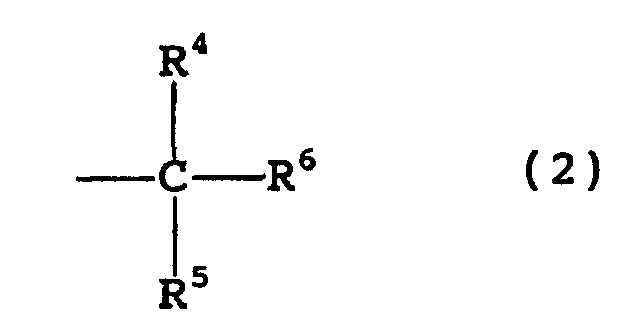
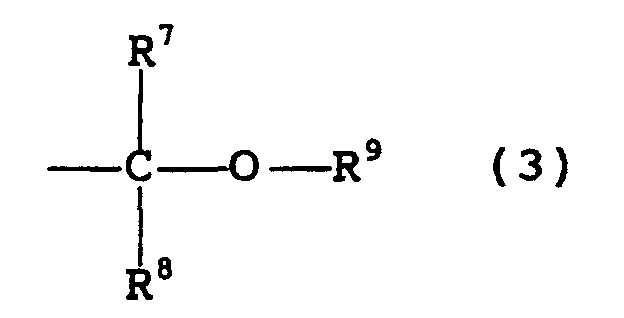
- vinylphenylpropionic acid derivatives represented by the following formula (1): wherein R 1 is a hydrogen atom or a methyl group, R 2 and R 3 may be the same or different and each a hydrogen atom, an alkyl group having 1 to 8 carbon atoms which may be substituted or a phenyl group which may be substituted, and Z 1 is a group represented by the following formula (2): wherein R 4 , R 5 and R 6 may be the same or different and each a hydrogen atom, an alkyl group having 1 to 8 carbon atoms which may be substituted or a phenyl group which may be substituted, or any two of R 4 , R 5 and R 6 may be bonded together with a carbon atom bonded thereto to form a cyclic aliphatic group, or a group represented by the following formula (3): wherein R 7 , R 8 and R 9 may be the same or different and each a hydrogen atom,
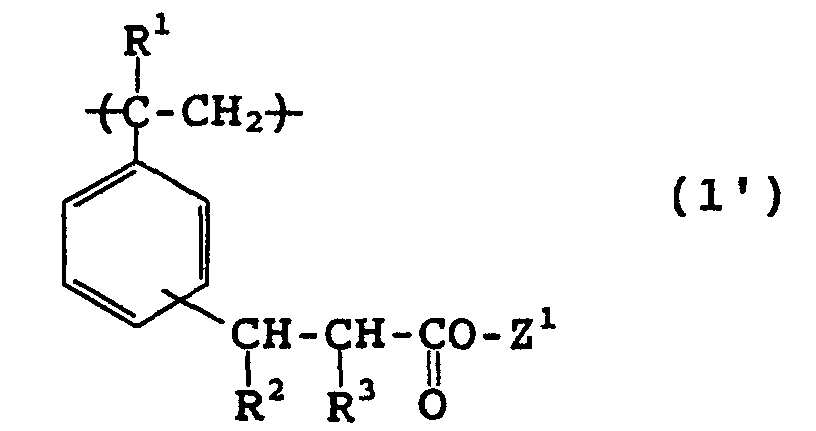
- a polymer which comprises a recurring unit represented by the following formula (1'): wherein R 1 , R 2 and Z 1 are as defined in the above formula (1), and which as a weight average molecular weight in terms of polystyrene measured by gel permeation chromatography (GPC) of 1,000 to 500,000.
- GPC gel permeation chromatography
- a radiation sensitive resin composition which contains (A) the above polymer of the present invention and (B) a radiation sensitive acid generating agent.
- the vinylphenylpropionic acid derivatives of the present invention is represented by the above formula (1).
- R 1 is a hydrogen atom or a methyl group
- R 2 and R 3 may be the same or different and each a hydrogen atom, an alkyl group having 1 to 8 carbon atoms which may be substituted or a phenyl group which may be substituted.
- the alkyl group having 1 to 8 carbon atoms which may be substituted may be linear, branched or cyclic.
- Examples of the alkyl group include methyl group, ethyl group, propyl group, butyl group, hexyl group, cyclohexyl group, octyl group and decyl group.
- the substituent is an alkoxyl group such as methoxyl group or ethoxyl group; or halogen atom such as fluorine, chlorine, bromine or iodine.
- the substituent of the phenyl group which may be substituted is an alkyl group such as methyl group, ethyl group, n-propyl group or i-propyl group; alkoxyl group such as methoxyl group or ethoxyl group; or halogen atom such as fluorine, chlorine, bromine or iodine.
- Z 1 is a group represented by the above formula (2) or (3).
- R 4 , R 5 and R 6 in the formula (2) may be the same or different and each a hydrogen atom, an alkyl group having 1 to 8 carbon atoms which may be substituted or a phenyl group which may be substituted, or any two of R 4 , R 5 and R 6 may be bonded together with a carbon atom bonded thereto to form a cyclic aliphatic group.
- the bonding position of -CHR 2 CHR 3 COOZ 1 is not particularly limited but preferably the para-position from the viewpoints of acquisition ease of a raw material and performance when the obtained product is used as a resist material.
- R 7 and R 8 may be the same or different and each a hydrogen atom, an alkyl group having 1 to 8 carbon atoms which may be substituted or a phenyl group which may be substituted, and R 9 is an alkyl group having 1 to 8 carbon atoms which may be substituted or a phenyl group which may be substituted, or any two of R 7 , R 8 and R 9 may be bonded together with a carbon atom bonded thereto to form a cyclic aliphatic group.
- alkyl group having 1 to 8 carbon atoms which may be substituted and the phenyl group which may be substituted in the formulas (2) and (3) are the same as those listed for the formula (1).
- the above cyclic aliphatic group in the formulas (2) and (3) is preferably a 5- to 7-membered ring, particularly preferably a 6-membered ring, for example, a cyclohexylidene group in the formula (2) and 2-oxacyclclopentylidene or 2-oxacyclohexylidene group in the formula (3).
- the group represented by is preferably an acid dissociable group which generates a carboxyl group (-COOH) in the presence of an acid.
- the acid dissociable group include linear, branched and cyclic alkoxycarbonyl groups such as methoxycarbonyl group, ethoxycarbonyl group, n-propoxycarbonyl group, i-propoxycarbonyl group, n-butoxycarbonyl group, 2-methylpropoxycarbonyl group, 1-methylpropoxycarbonyl group, t-butoxycarbonyl group, n-pentyloxycarbonyl group, t-pentyloxycarbonyl group, n-hexyloxycarbonyl group, 1-methyl-1-ethylpropoxycarbonyl group, n-heptyloxycarbonyl group, 1,1-dimethylpentyloxycarbonyl group, 1,1-dimethyl-3-methylbutoxycarbonyl group, n-octyloxycarbonyl group,
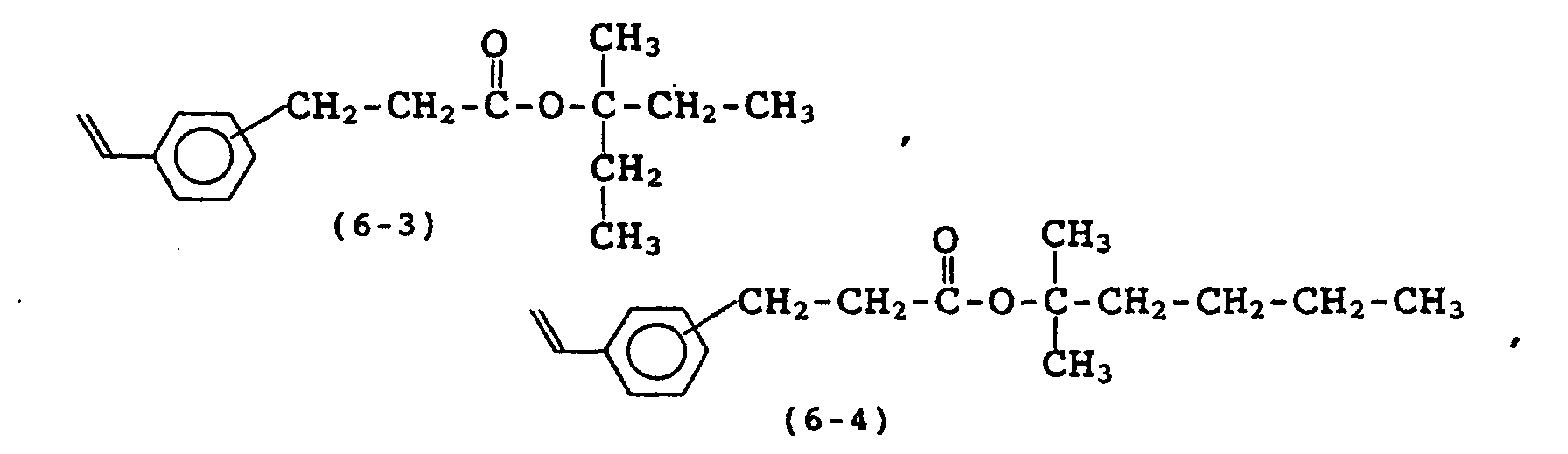
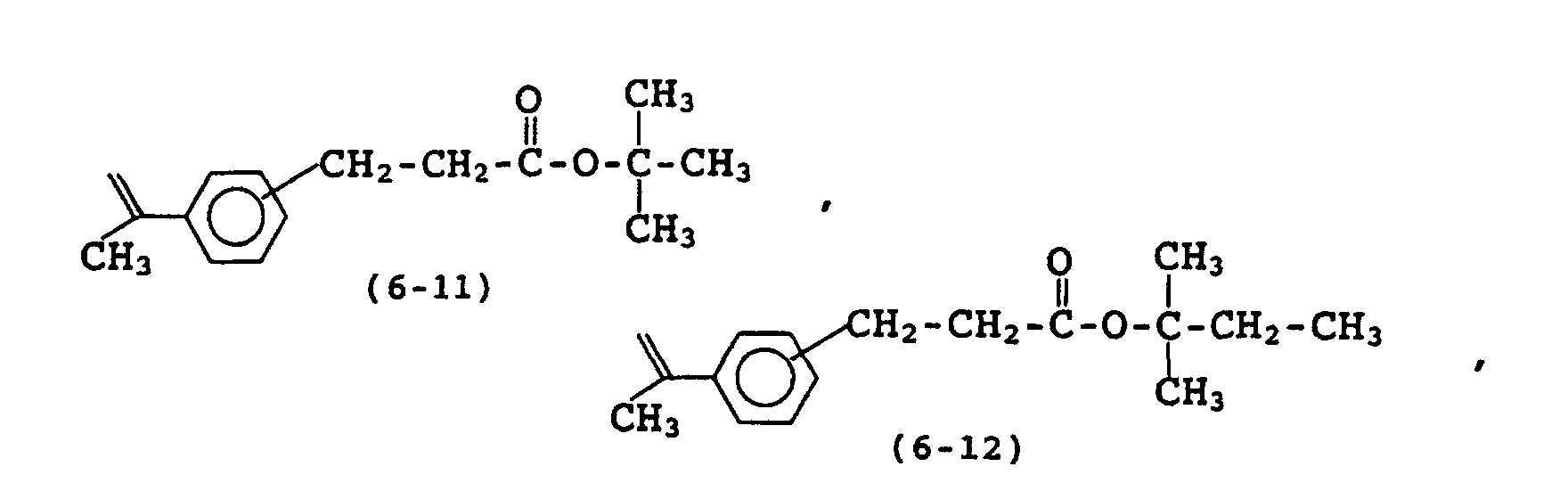
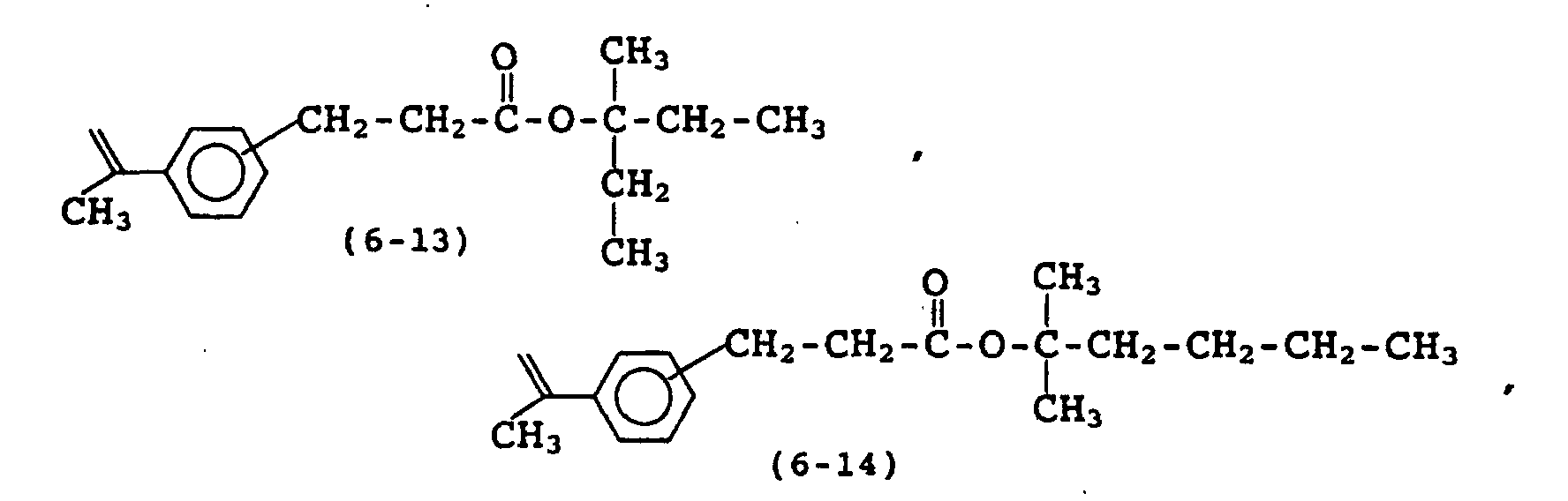
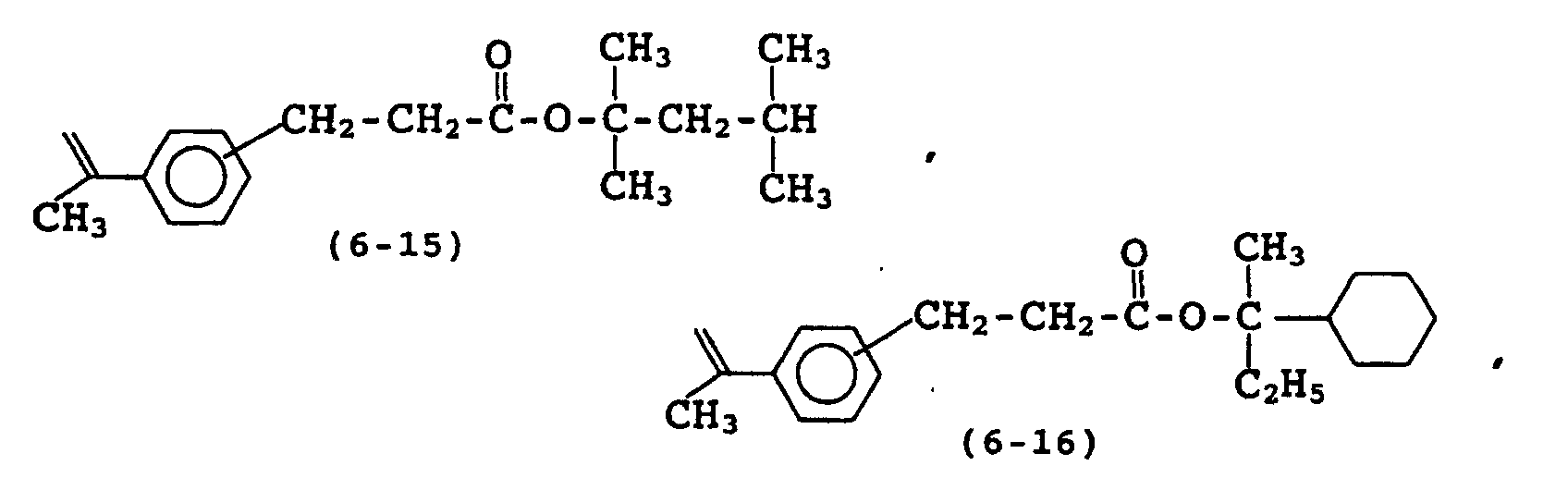
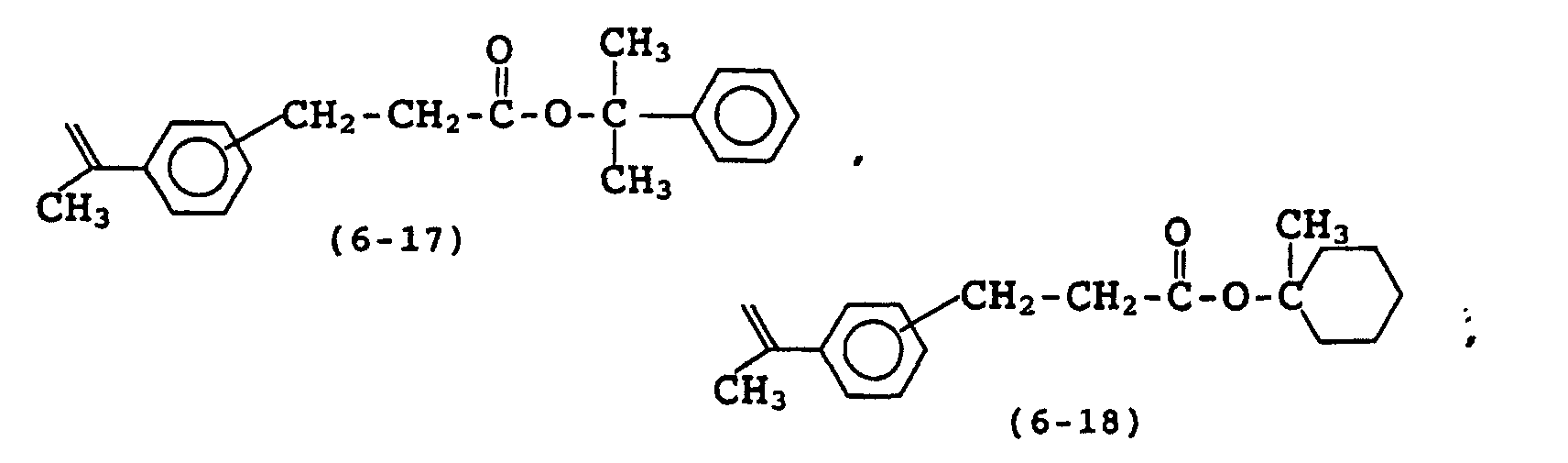
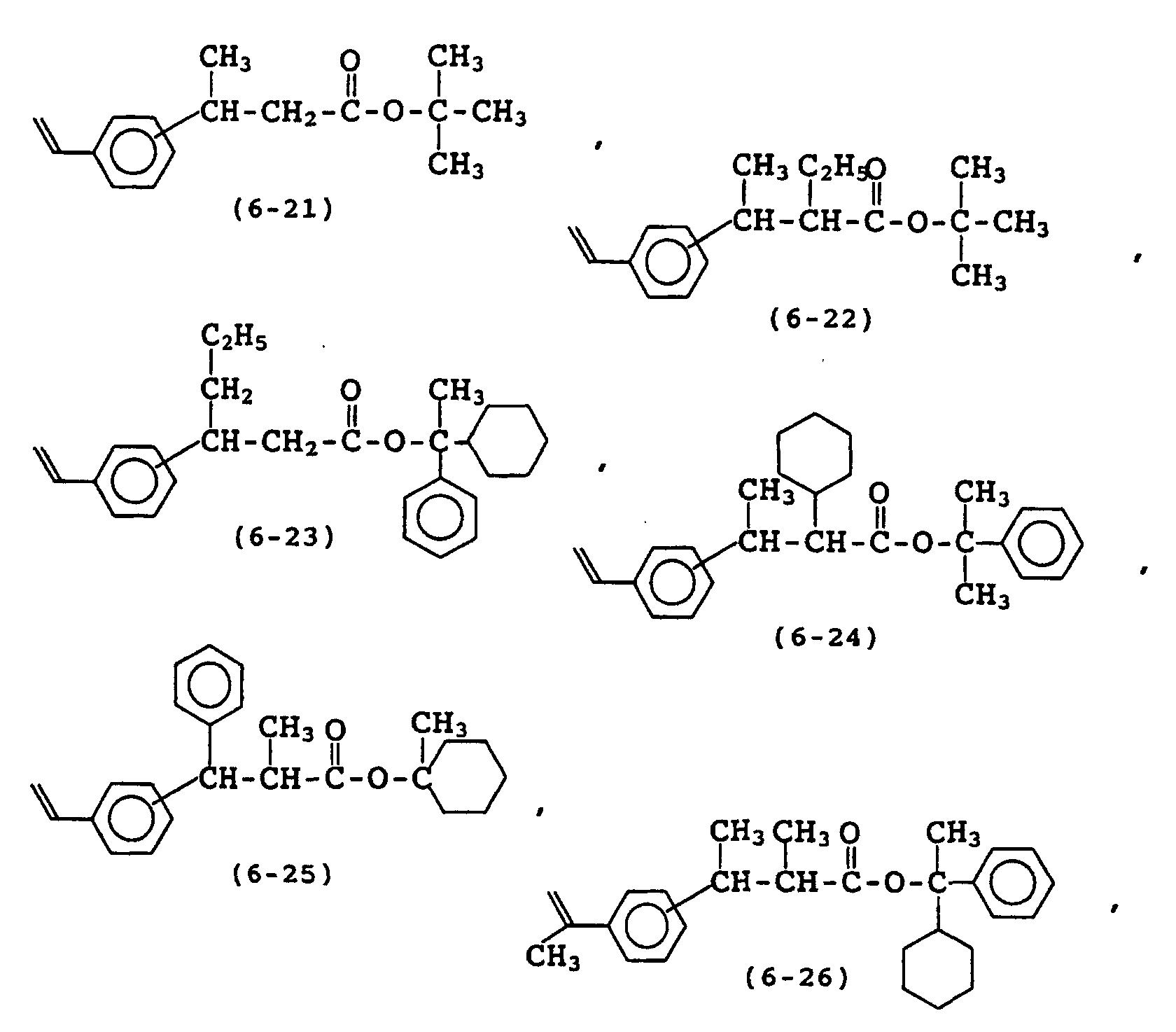
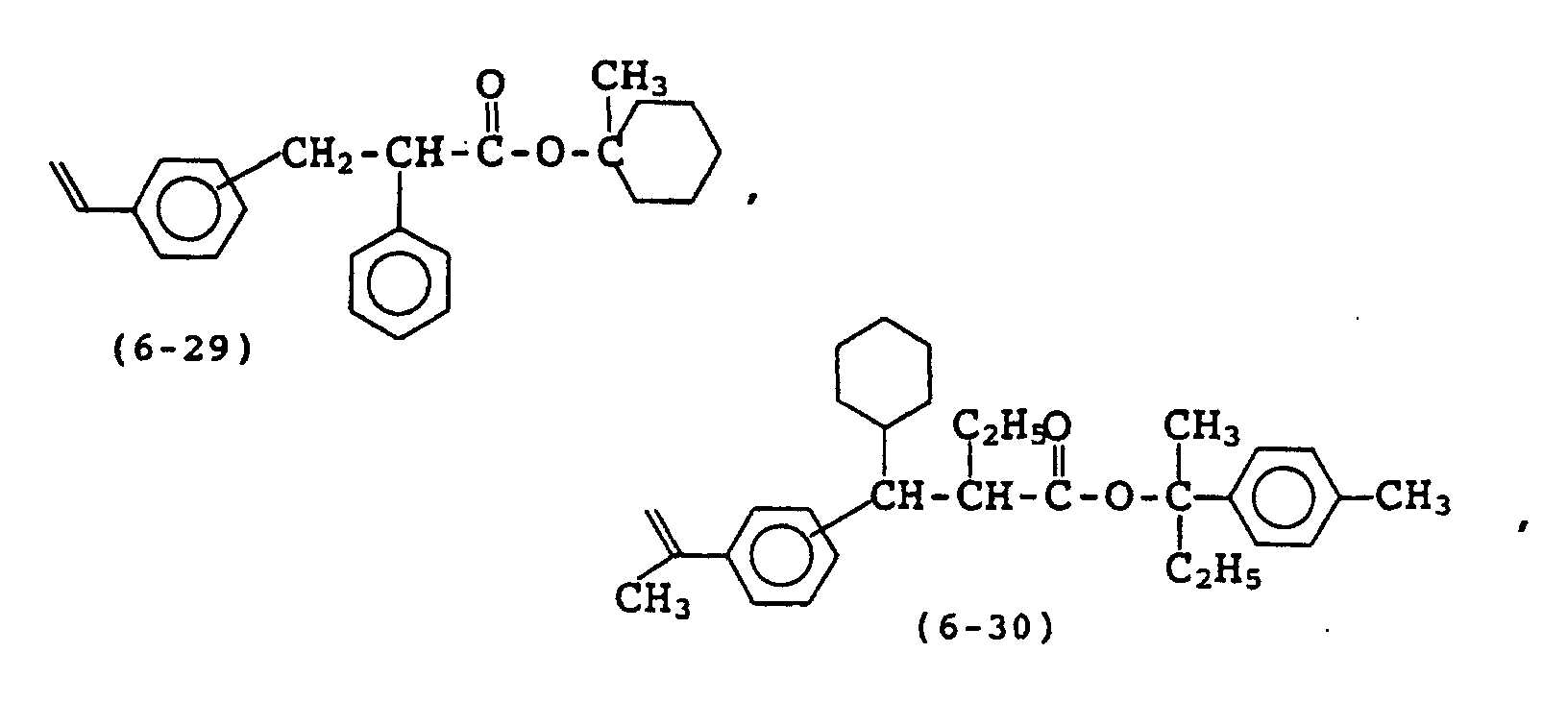
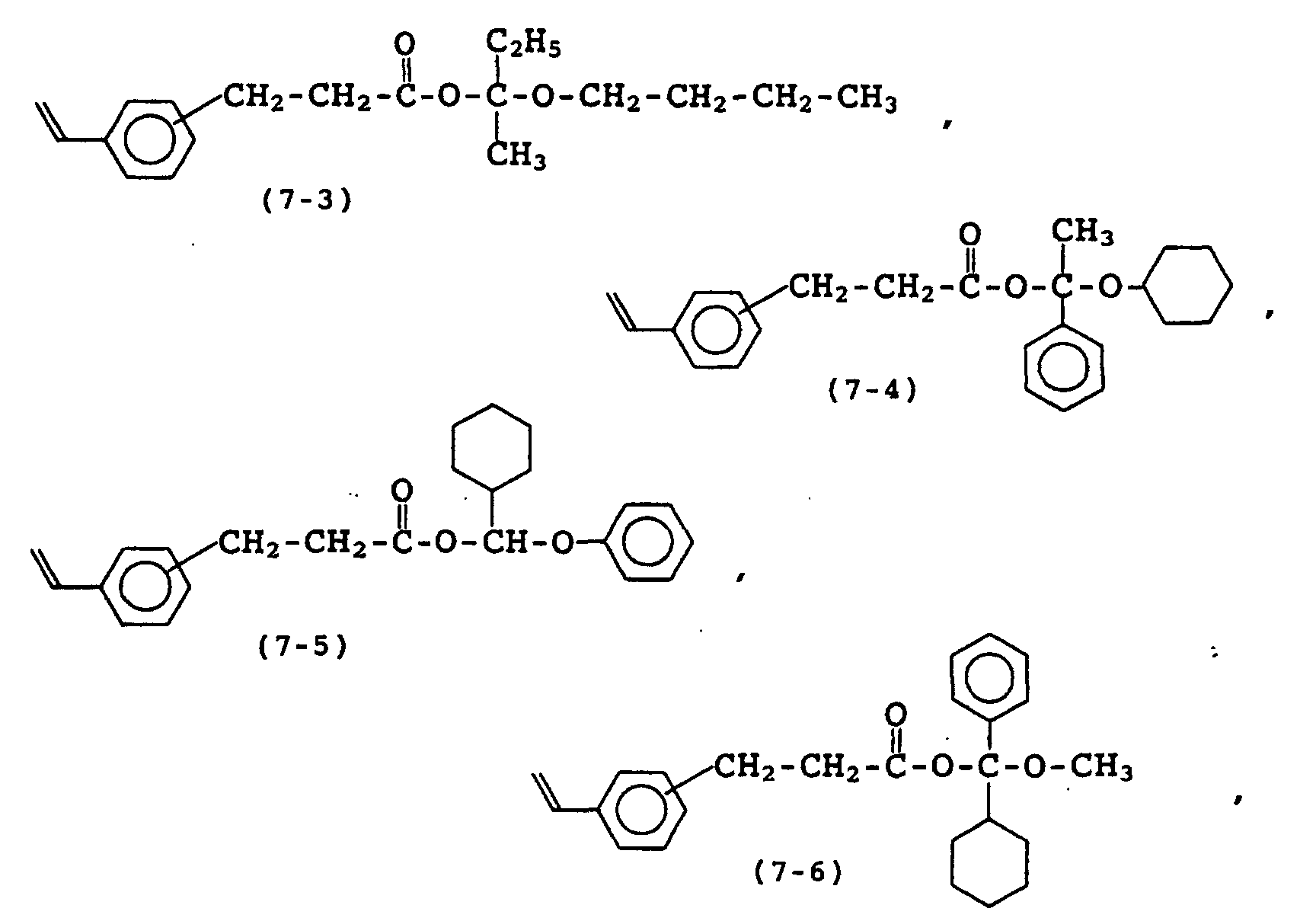
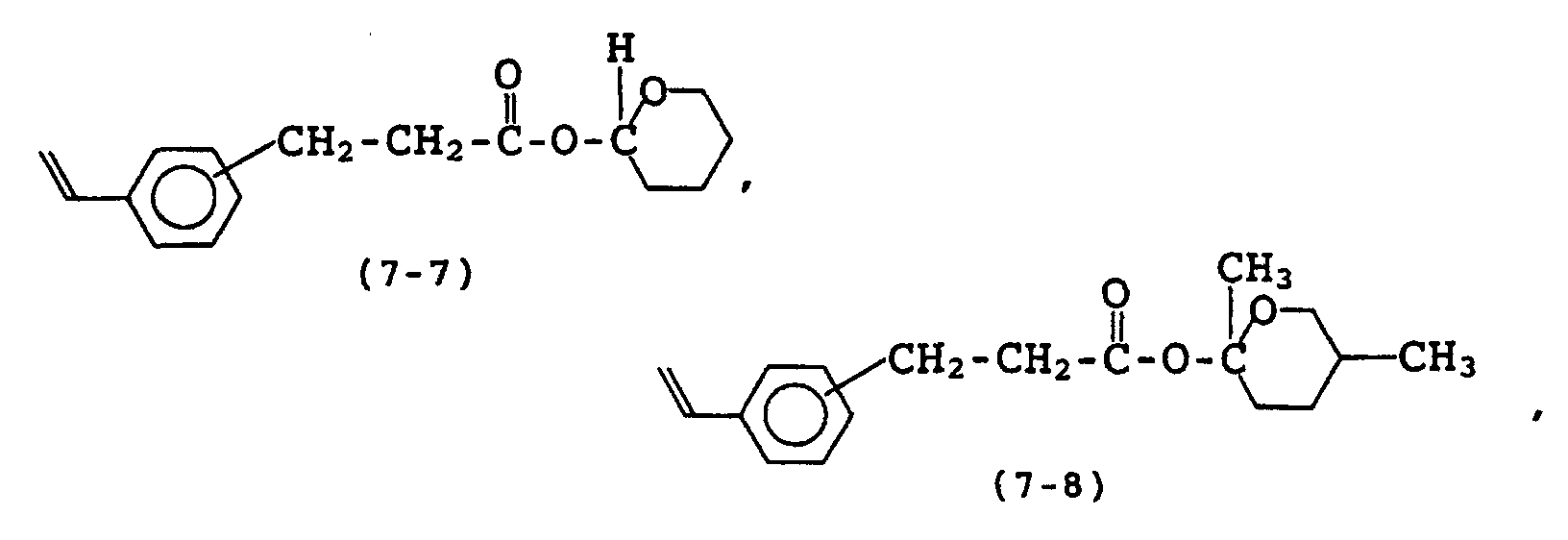
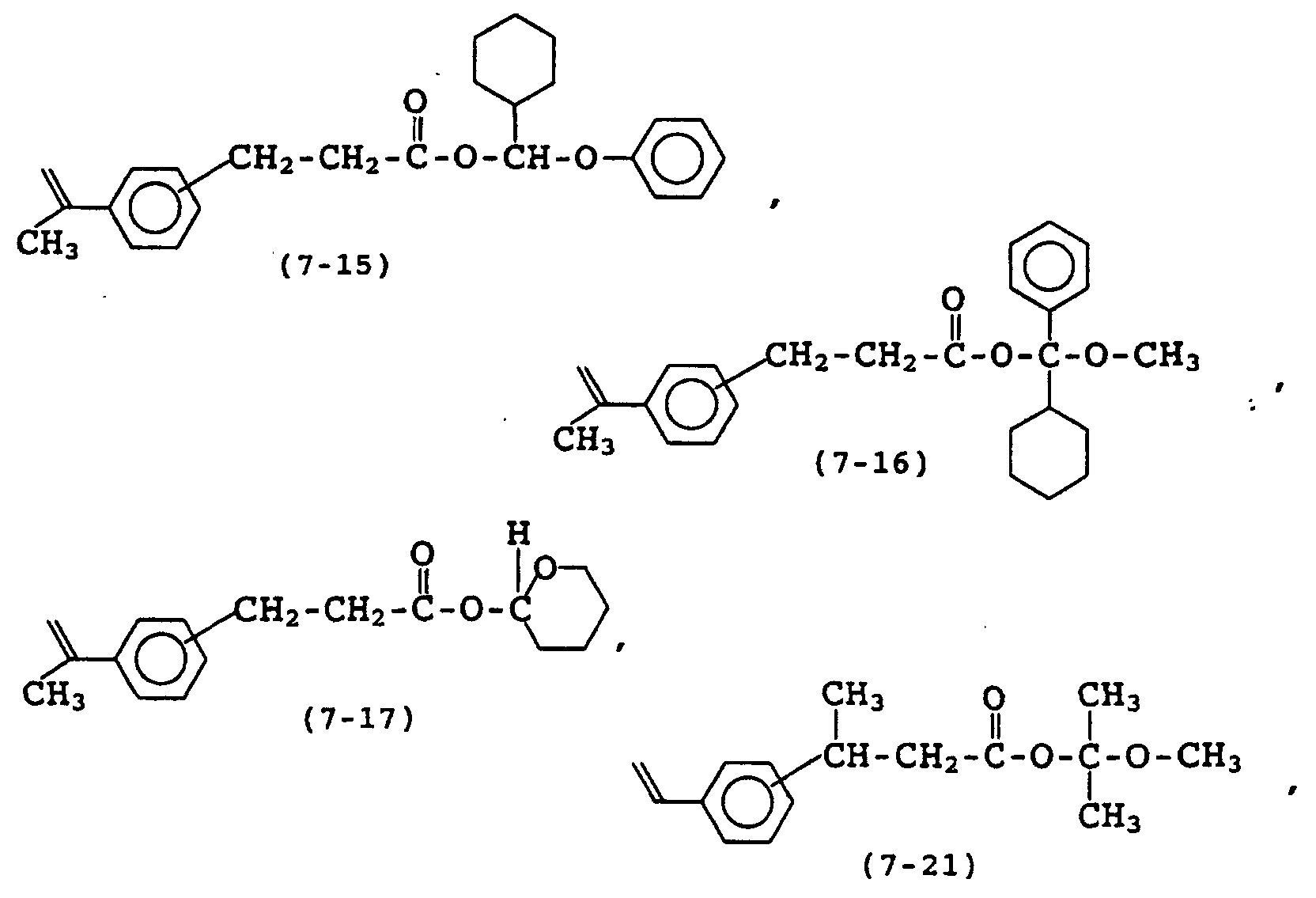
- Examples of the compound represented by the above formula (1) include compounds represented by the following formulas (6-1) to (6-32) (compounds of the formula (1) in which Z 1 is a group of the formula (2)) and compounds represented by the following formulas (7-1) to (7-22) (compounds of the formula (1) in which Z 1 is a group of the formula (3)). Out of these, compounds in which the bonding position is the para-position are preferred.
- vinylphenylpropionic acid derivatives have an acid decomposable group in the side chain
- polymers obtained by homopolymerizing the derivatives alone or copolymerizing them with other monomers can be changed in polarity because a hydrophobic alkoxycarbonyl group is decomposed by an acid to become an oxycarbonyl group having high hydrophilic nature.
- these vinylphenylpropionic acid derivatives have a benzene ring having high resistance to dry etching, they can be combined with various monomers for the design of a resist resin, which is useful for the optimization of a resist resin structure.
- the vinylphenylpropionic acid derivatives of the present invention can be advantageously produced by the process of the present invention which comprises the steps (i) to (iv) as described above.
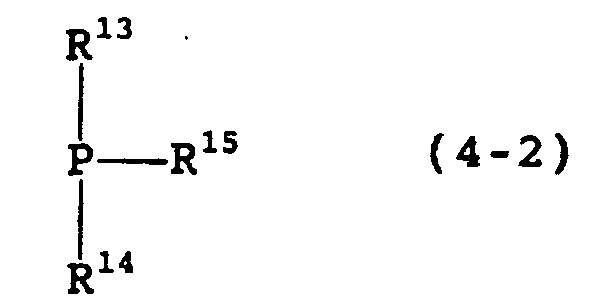
- step (i) an ethyl acetate represented by the formula (4-1) and a trialkylphosphine represented by the formula (4-2) are reacted with each other.
- R 3 is as defined in the formula (1) and its examples are the same as those listed above.
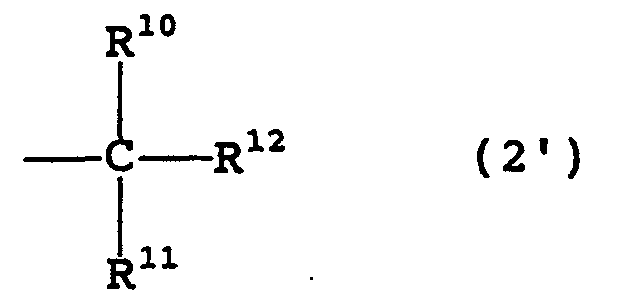
- Z 2 is a group represented by the above formula (2') or (3).
- R 10 , R 11 and R 12 in the formula (2') are the same as R 4 , R 5 and R 6 in the formula (2).
- X 1 is an eliminating group and its examples are those which are generally used for organic synthesis, for example, halogen atoms such as chlorine, bromine and iodine, and sulfonyl groups such as methylsulfonyl group and p-methylphenylsulfonyl group.
- the trialkylphosphine used in the step (i) is not particularly limited but preferably triethylphosphine, tri-n-butylphosphine or tricyclohexylphosphine.
- the reaction in the step (i) is preferably carried out at -10 to +80°C for 2 to 40 hours.
- the reaction temperature and time are more preferably +10 to +50°C and 4 to 10 hours, respectively.
- the reaction is preferably carried out in a nitrogen atmosphere.
- the solvent used in the reaction of the step (i) is preferably a water-miscible nonprotonic organic solvent. Examples of the solvent include tetrahydrofuran, 1,4-dioxane, N,N-dimethylformamide, dimethyl sulfoxide and acetonitrile.
- the first quaternary phosphonium salt represented by the above formula (4-3) is formed by the reaction of the step (i).
- the definitions and illustrative examples of R 3 , Z 2 and X 1 in the formula (4-3) are as described above.
- step (ii) the first quaternary phosphonium salt formed in the step (i) and a base are reacted with each other.
- the base may be used various bases having strong basicity or super strong basicity.
- Illustrative examples of the base include 1,5-diazabicyclo[4.3.0]nonene-5, 1,8-diazabicyclo[5.4.0]undecene-7, potassium (sodium or lithium) methoxide, potassium (sodium or lithium) ethoxide, potassium (sodium or lithium) n-propoxide, potassium (sodium or lithium) isopropoxide, potassium (sodium or lithium) n-butoxide, potassium (sodium or lithium) sec-butoxide, potassium (sodium or lithium) isobutoxide, potassium (sodium or lithium) t-butoxide, lithium diisopropylamide, lithium (sodium, potassium or calcium) hydride, methyl lithium and n-butyl (sec-butyl or t-butyl)lithium.
- the reaction in the step (ii) is preferably carried out at -80 to +80°C. It is desirably carried out at +20 to +50°C in the case of a strong base and -20°C or less in the case of a super strong base.
- the reaction time is preferably 0.25 to 10 hours, more preferably 0.5 to 2 hours.
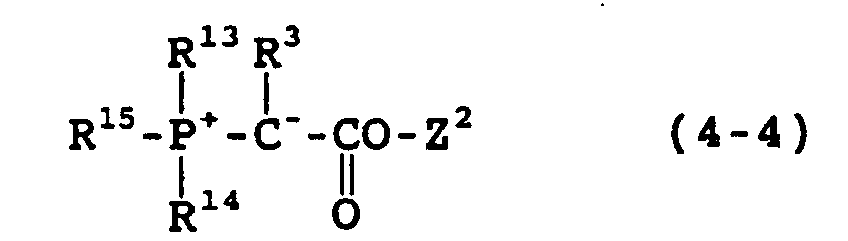
- the phosphorus ylide represented by the above formula (4-4) is formed by the reaction in the step (ii).
- the definitions and examples of R 3 and Z 2 are as described above.
- step (iii) the phosphorus ylide formed in the step (ii) is reacted with a styrene derivative represented by the formula (4-5).
- X 1 and R 2 are as described above.
- X 2 is an eliminating group and its examples are the same as those listed for X 1 in the formula (4-1).
- the temperature and the reaction time in the step (iii) are preferably 0 to +80° C and 1 to 96 hours, more preferably +20 to +50°C and 2 to 48 hours, respectively.
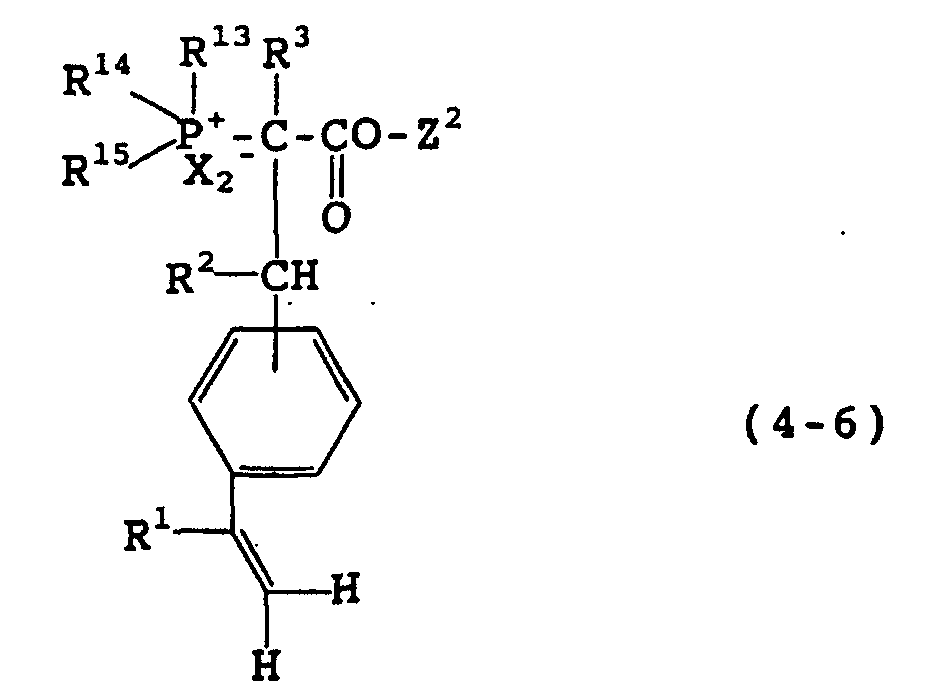
- the second quaternary phosphonium salt represented by the formula (4-6) is formed by the reaction in the step (iii).
- the definitions and examples of R 1 , R 2 , R 3 and Z 2 in the formula (4-6) are as described above.
- the reaction temperature and the reaction time in the step (iv) are preferably 0 to +80°C and 1 to 48 hours, more preferably +20 to +50°C and 2 to 24 hours, respectively.
- the alkali aqueous solution used in this reaction may be an aqueous solution of an ordinary inorganic or organic base.
- Examples of the base include sodium (or potassium) bicarbonate, sodium (or potassium), sodium (or potassium) carbonate, sodium (or potassium) hydroxide, ammonia, tetramethylammonium carbonate (or hydroxide), tetrabutylammonium carbonate (or hydroxide), triethylamine and 1,5-diazabicyclo[4.3.0]nonene-5, 1,8-dizabicyclo [5.4.0]undecene-7.
- the reaction solvent used for the hydrolytic reaction in the step (iv) is water or a mixed solvent of water and an organic solvent.
- an organic solvent miscible with water for example, methanol, ethanol, tetrahydrofuran, 1,4-dioxane, N,N-dimethylformamide, dimethyl sulfoxide or acetonitrile is particularly preferred.
- the reaction temperature and the reaction time in the step (iv) are 0 to +100°C and 0.25 to 96 hours, more preferably +20 to +80°C and 1 to 24 hours, respectively.
- the production process comprising the above steps (i) to (iv) can be carried out in one pot.
- the reaction solvents used in the step (ii) and the step (iii) may be the same organic solvent as the reaction solvent used in the step (i) or a mixed solvent containing the reaction solvent used in the step (i).
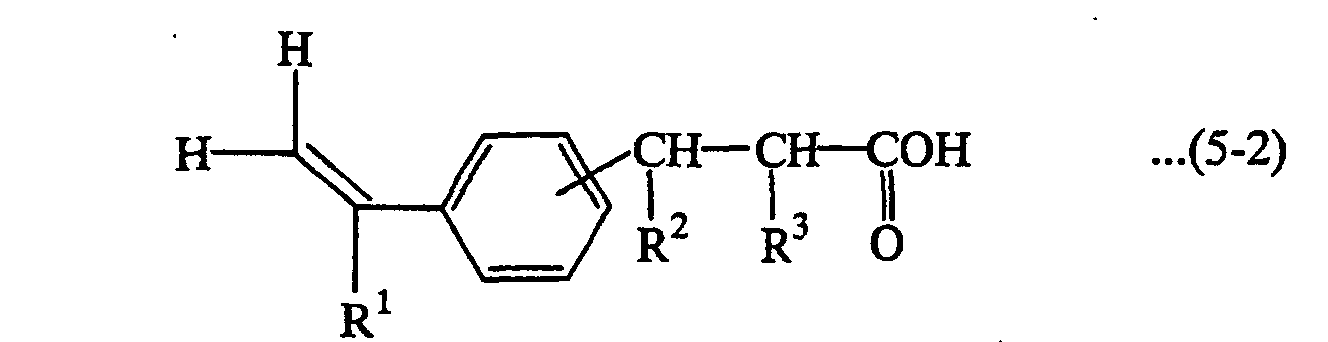
- the vinylphenylpropionic acid derivatives of the present invention may be produced by hydrolyzing methyl (or ethyl) vinylphenylpropionate represented by the following formula (5-1): wherein R 1 , R 2 and R 3 are as defined in the above formula (1), and Y is a methyl group or an ethyl group, to form a vinylphenylpropionic acid represented by the following formula (5-2): wherein R 1 , R 2 and R 3 are as defined in the above formula (1), and esterifying this vinylphenylpropionic acid with a corresponding esterifying agent such as an alcohol.
- This process is particularly useful when the chemical stability of the carboxylic acid derivative represented by the above formula (4-1) is poor.
- the above hydrolytic reaction can be carried out by a generally known method for hydrolyzing a carboxylate.
- the esterification reaction can be carried out by a general method for esterifying a carboxylate or an addition reaction between a carboxylic acid and an olefin.
- a polymerization inhibitor is desirably used to prevent a polymerization reaction.
- the polymerization inhibitor include commercially available polymerization inhibitors such as 2,6-di-t-butylphenol, 2,6-di-t-butyl-4-ethylphenol and 2,4,6-tris(3',5'-di-t-butyl-4'-hydroxybenzyl)mesitylene.
- the amount of the polymerization inhibitor is preferably 0.001 to 20 wt%, more preferably 1.1 to 10 wt% based on the total of all the raw materials used in the reactions except the solvent.
- the polymer in the present invention is a polymer (to be referred to as "polymer (A)" hereinafter) which comprises a recurring unit (to be referred to as “recurring unit (1') hereinafter) represented by the above formula (1') as an essential unit.
- the content of the recurring unit (1') in the polymer (A) is preferably 5 to 80 wt%.
- the monomer which provides the recurring unit (1') is a vinylphenylpropionic acid derivative represented by the above formula (1).
- the polymer (A) can have a unit derived from a monofunctional monomer (to be referred to as "other recurring unit ( ⁇ )” hereinafter) having one polymerizable unsaturated bond and/or a unit (to be referred to as "other recurring unit ( ⁇ )” hereinafter) derived from a polyfunctional monomer having two or more polymerizable unsaturated bonds in addition to the recurring unit (1').
- Monomers which provide the other recurring unit ( ⁇ ) include styrene-based monomers which may be substituted by a linear, branched or cyclic alkyl group, such as styrene, ⁇ -methylstyrene, o-methylstyrene, m-methylstyrene and p-methylstyrene; styrene-based monomers substituted by a hydroxyl group, such as o-hydroxystyrene, m-hydroxystyrene, p-hydroxystyrene and p-hydroxy- ⁇ -methylstyrene; styrene-based monomers substituted by a linear, branched or cyclic alkoxyl group, such as o-methoxystyrene, m-methoxystyrene, p-methoxystyrene, o-t-butoxystyrene, m-t-butoxystyrene,
- styrene preferred are styrene, p-hydroxystyrene, p-hydroxy- ⁇ -methylstyrene, p-t-butoxystyrene, p-(1-methoxyethoxy)styrene, p-(1-ethoxyethoxy)styrene, p-(1-cyclohexyloxyethoxy)styrene, p-(1-benzyloxyethoxy)styrene, p- ⁇ 1-(1'-naphthylmethoxy)ethoxy) ⁇ styrene, p-(1-methoxypropoxy)styrene, p-(1-ethoxypropoxy)styrene, p-(1-benzyloxypropoxy)styrene, p- ⁇ 1-(1'-naphthylmethoxy)propoxy) ⁇ styrene, p-
- the above monofunctional monomers may be used alone or in combination of two or more.
- the content of the other recurring unit ( ⁇ ) in the polymer (A) is preferably 80 wt% or less, more preferably 5 to 70 wt%.
- Polyfunctional monomers which provide the other recurring unit ( ⁇ ) include esters of a compound having two or more hydroxyl groups in the molecule, such as a polyhydric alcohol having two or more hydroxyl groups, polyether diol or polyester diol, and (meth)acrylic acid; adducts of a compound having two or more epoxy groups in the molecule typified by an epoxy resin and (meth)acrylic acid; and condensates of a compound having two or more amino groups in the molecule and (meth)acrylic acid.
- esters of a compound having two or more hydroxyl groups in the molecule such as a polyhydric alcohol having two or more hydroxyl groups, polyether diol or polyester diol, and (meth)acrylic acid
- adducts of a compound having two or more epoxy groups in the molecule typified by an epoxy resin and (meth)acrylic acid
- condensates of a compound having two or more amino groups in the molecule and (meth)acrylic acid
- polyfunctional monomers include ethylene glycol di(meth)acrylate, diethylene glycol di(meth)acrylate, triethylene glycol di(meth)acrylate, propylene glycol di(meth)acrylate, dipropylene glycol di(meth)acrylate, tripropylene glycol di(meth)acrylate, 1,4-butanediol di(meth)acrylate, trimethylolpropane di(meth)acrylate, trimethylolpropane tri(meth)acrylate, pentaerythritol tri(meth)acrylate, pentaerythritol tetra(meth)acrylate, 2,5-dimethyl-2,5-hexanediol di(meth)acrylate, tricyclodecanedimethanol di(meth)acrylate, di(meth)acrylates of a bisphenol A adduct with ethylene glycol or propylene glycol, epoxy (meth)acrylates such as (meth)acrylates
- ethylene glycol di(meth)acrylate, 2,5-dimethyl-2,5-hexanediol di(meth)acrylate, tricyclodecanedimethanol di(meth)acrylate and (meth)acrylic acid bi-adduct of bisphenol A diglycidyl ether are particularly preferred.
- the above polyfunctional monomers may be used alone or in combination of two or more.
- a suitable crosslinking structure is introduced to reduce the mobility of a polymer molecular chain, thereby making it possible to suppress thermal deformation and improve heat resistance.
- the crosslinking structure introduced by the polyfunctional monomer has acid dissociability, a reduction in molecular weight by exposure and the difference of dissolution speed in a developer between an exposed portion and an unexposed portion become larger than a linear resin or when the crosslinking structure has no acid dissociability, thereby making it possible to further improve resolution.
- the content of the other recurring unit ( ⁇ ) in the polymer (A) is preferably 10 wt% or less, more preferably 7 wt% or less, particularly preferably 6 wt% or less.
- the polymer (A) can be produced by selecting a monomer for the recurring unit (1) and optionally a monomer(s) for the other recurring unit ( ⁇ ) and/or the other recurring unit ( ⁇ ), as well as a suitable radical polymerization initiator, in accordance with a suitable method such as bulk polymerization, solution polymerization, precipitation polymerization, emulsion polymerization, suspension polymerization or bulk-suspension polymerization, preferably solution polymerization.
- a suitable method such as bulk polymerization, solution polymerization, precipitation polymerization, emulsion polymerization, suspension polymerization or bulk-suspension polymerization, preferably solution polymerization.
- Preferred examples of the radical polymerization initiator used for polymerization for the production of the polymer (A) include azobisisobutyronitrile and dimethyl-2,2'-azobis(2-methylpropionate).
- the reaction medium can be suitably selected from n-butyl acetate, tetrahydrofuran and propylene glycol monomethyl ether.
- the polymerization conditions for producing the polymer (A) include a reaction temperature of preferably 50 to 90°C, more preferably 60 to 85°C and a reaction time of preferably 3 to 10 hours.
- the weight average molecular weight (to be referred to as "Mw” hereinafter) in terms of polystyrene measured by gel permeation chromatography (GPC) of the polymer (A) is 1,000 to 500,000. Mw of the polymer (A) depends on the existence of a crosslinking structure introduced by the polyfunctional monomer.
- Mw of the polymer (A) having no crosslinking structure introduced by the polyfunctional monomer is preferably 1,000 to 100,000, more preferably 3,000 to 40,000, particularly preferably 3,000 to 30,000.
- Mw of the polymer (A) is less than 1,000, the sensitivity and heat resistance of the polymer as a resist lower and when Mw is more than 100,000, the solubility in a developer deteriorates.
- the ratio (Mw/Mn) of Mw to the number average molecular weight (to be referred to as "Mn” hereinafter) in terms of polystyrene measured by gel permeation chromatography (GPC) of the polymer (A) having no crosslinking structure introduced by the polyfunctional monomer is preferably 1.0 to 5.0, more preferably 1.0 to 4.0, particularly preferably 1.0 to 3.0.
- Mw of the polymer (A) having a crosslinking structure introduced by the polyfunctional monomer is preferably 3,000 to 500,000, more preferably 5,000 to 400,000, particularly preferably 8,000 to 300,000.
- Mw of the polymer (A) is less than 3,000, the sensitivity and heat resistance of the polymer as a resist lower and when Mw is more than 500,000, the developability of the polymer as a resist deteriorates.
- Mw/Mn of the polymer (A) having a crosslinking structure introduced by the polyfunctional monomer is preferably 1.5 to 20.0, more preferably 1.5 to 15.0.
- the polymer (A) has extremely low absorption of radiation and is very useful as a resin component of a radiation sensitive resin composition suitable for use as a chemically amplified resist.
- the radiation sensitive resin composition can reduce the difference of effective exposure amount between an upper portion and a lower portion of a resist film, can retain the rectangularity of even a fine pattern and has high sensitivity (small amount of exposure energy).
- the radiation sensitive resin composition of the present invention comprises the above polymer (A) and (B) a radiation sensitive acid generating agent (to be referred to as "acid generating agent (B)" hereinafter) which generates an acid upon exposure.
- a radiation sensitive acid generating agent to be referred to as "acid generating agent (B)” hereinafter
- the acid generating agent (B) is selected from (1) an onion salt, (2) sulfone compound, (3) sulfonate compound, (4) sulfonyloxyimide compound, (5) disulfonyldiazomethane compound and (6) disulfonylmethane derivative.
- the onium salt is, for example, an iodonium salt, sulfonium salt (including a tetrahydrothiophenium salt), phosphonium salt, diazonium salt, ammonium salt or pyridinium salt.
- onium salt examples include bis(4-t-butylphenyl)iodonium trifluoromethanesulfonate, bis(4-t-butylphenyl)iodonium nonafluoro-n-butanesulfonate, bis(4-t-butylphenyl)iodonium perfluoro-n-octanesulfonate, bis(4-t-butylphenyl)iodonium pyrenesulfonate, bis(4-t-butylphenyl)iodonium n-dodecylbenzenesulfonate, bis(4-t-butylphenyl)iodonium p-toluenesulfonate, bis(4-t-butylphenyl)iodonium benzenesulfonate, bis(4-t-butylphenyl)iodonium 10-camphorsulfonate, bis(4-t-but
- the sulfone compound is, for example, ⁇ -ketosulfone, ⁇ -sulfonylsulfone or ⁇ -diazo compound thereof.
- Illustrative examples of the sulfone compound include phenacyl phenyl sulfone, mesityl phenacyl sulfone, bis(phenylsulfonyl)methane and 4-trisphenacyl sulfone.
- the sulfonate compound is, for example, alkyl sulfonate, haloalkyl sulfonate, aryl sulfonate or iminosulfonate.
- Illustrative examples of the sulfonate compound include benzoin tosylate, pyrogallol tris(trifluoromethanesulfonate), pyrogallol tris(nonafluoro-n-butanesulfonate), pyrogallol tris(methanesulfonate), nitrobenzyl-9,10-diethoxyanthracene-2-sulfonate, ⁇ -methylolbenzoin tosylate, ⁇ -methylolbenzoin n-octanesulfonate, ⁇ -methylolbenzoin trifluoromethanesulfonate and ⁇ -methylolbenzoin n-dodecanesulfonate.
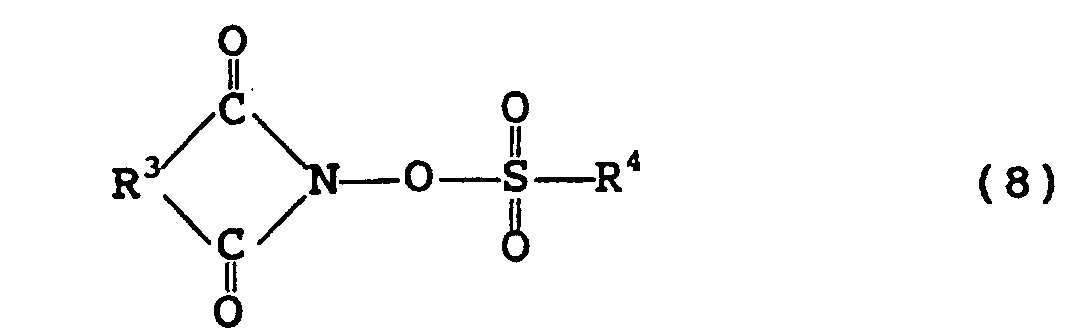
- the sulfonyloxyimide compound is, for example, a compound represented by the following formula (8): wherein R 3 is a divalent group such as a linear, branched or cyclic alkylene group, arylene group or alkoxylene group, and R 4 is a monovalent group such as a linear, branched or cyclic alkyl group, aryl group, linear, branched or cyclic halogen-substituted alkyl group or halogen-substituted aryl group.
- R 3 is a divalent group such as a linear, branched or cyclic alkylene group, arylene group or alkoxylene group
- R 4 is a monovalent group such as a linear, branched or cyclic alkyl group, aryl group, linear, branched or cyclic halogen-substituted alkyl group or halogen-substituted aryl group.
- sulfonyloxyimide compound examples include N-(trifluoromethylsulfonyloxy)succinimide, N-(trifluoromethylsulfonyloxy)phthalimide, N-(trifluoromethylsulfonyloxy)diphenylmaleimide, N-(trifluoromethylsulfonyloxy)bicyclo[2.2.1]hept-5-ene-2, 3-dicarboxyimide, N-(trifluoromethylsulfonyloxy)-7-oxabicyclo[2.2.1]hept-5 -ene-2,3-dicarboxyimide, N-(trifluoromethylsulfonyloxy)bicyclo[2.2.1]heptan-5,6-oxy-2,3-dicarboxyimide, N-(trifluoromethylsulfonyloxy)naphthylimide, N-(10-camphorsulfonyloxy)succinimide, N-(
- the disulfonyldiazomethane compound is, for example, a compound represented by the following formula (9): wherein R 5 and R 6 are each independently a monovalent group such as a linear, branched or cyclic alkyl group, aryl group, linear, branched or cyclic halogen-substituted alkyl group or halogen-substituted aryl group.
- disulfonyldiazomethane compound examples include bis(trifluoromethylsulfonyl)diazomethane, bis(cyclohexylsulfonyl)diazomethane, bis(phenylsulfonyl)diazomethane, bis(p-toluenesulfonyl)diazomethane, bis(2,4-dimethylphenylsulfonyl)diazomethane, methylsulfonyl p-toluenesulfonyldiazomethane, bis(4-t-butylphenylsulfonyl)diazomethane, bis(4-chlorophenylsulfonyl)diazomethane, cyclohexylsulfonyl p-toluenesulfonyldiazomethane, 1-cyclohexylsulfon
- the disulfonylmethane derivative is, for example, a compound represented by the following formula (10): wherein R 7 and R 8 are each independently a monovalent linear or branched aliphatic hydrocarbon group, cycloalkyl group, aryl group, aralkyl group or monovalent other organic group having a hetero atom, V and W are each independently an aryl group, hydrogen atom, monovalent linear or branched aliphatic hydrocarbon group or monovalent other organic group having a hetero atom, and at least one of V and W is an aryl group, or V and W are bonded together to form a single ring or multiple rings having at least one unsaturated bond, or V and W are bonded together to form a group represented by the following formula: wherein V' and W' are each independently a hydrogen atom, halogen atom, linear or branched alkyl group, cycloalkyl group, aryl group or aralkyl group, or V' and W' bonded to the same or
- the above acid generating agents (B) may be used alone or in combination of two or more.
- the amount of the acid generating agent (B) is preferably 0.1 to 20 parts by weight, more preferably 0.5 to 15 parts by weight based on 100 parts by weight of the polymer (A).
- the radiation sensitive resin composition of the present invention further comprises an acid diffusion control agent which has the function of controlling such a phenomenon that an acid generated from the acid generating agent (B) by exposure is dispersed in a resist film in order to suppress an unfavorable chemical reaction in an unexposed area.
- an acid diffusion control agent which has the function of controlling such a phenomenon that an acid generated from the acid generating agent (B) by exposure is dispersed in a resist film in order to suppress an unfavorable chemical reaction in an unexposed area.
- the storage stability of the composition and the resolution of the composition as a resist can be improved and changes in the line width of the resist pattern caused by fluctuations in PED can be further suppressed, thereby making it possible to obtain very excellent process stability.
- the acid diffusion control agent is preferably a nitrogen-containing organic compound whose basicity is not changed by exposure or a heat treatment in the step of forming a resist pattern.
- the nitrogen-containing organic compound is a compound represented by the following formula (11): wherein R 9 , R 10 and R 11 are each independently a hydrogen atom, linear, branched or cyclic alkyl group, aryl group or aralkyl group all of which may be substituted by a functional group such as a hydroxy group (to be referred to as "nitrogen-containing compound (I)” hereinafter), diamino compound having two nitrogen atoms in the molecule (to be referred to as “nitrogen-containing compound (II)” hereinafter), polyamino polymer having three or more nitrogen atoms (to be referred to as "nitrogen-containing compound (III)” hereinafter), amide group-containing compound, urea compound or nitrogen-containing heterocyclic compound.
- R 9 , R 10 and R 11 are each independently a hydrogen atom, linear, branched or cyclic alkyl group, aryl group or aralkyl group all of which may be substituted by a functional group such as
- nitrogen-containing compound (I) examples include monoalkylamines such as n-hexylamine, n-heptylamine, n-octylamine, n-nonylamine, n-decylamine and cyclohexylamine; dialkylamines such as di-n-butylamine, di-n-pentylamine, di-n-hexylamine, di-n-heptylamine, di-n-octylamine, di-n-nonylamine, di-n-decylamine, methyl cyclohexylamine and dicyclohexylamine; trialkylamines such as triethylamine, tri-n-propylamine, tri-n-butylamine, tri-n-pentylamine, tri-n-hexylamine, tri-n-heptylamine, tri-n-octylamine, tri-n-nonylamine, tri-
- nitrogen-containing compound (II) examples include ethylenediamine, N,N,N',N'-tetramethylethylenediamine, N,N,N',N'-tetrakis(2-hydroxypropyl)ethylenediamine, tetramethylenediamine, hexamethylenediamine, 4,4'-diaminodiphenylmethane, 4,4'-diaminodiphenylether, 4,4'-diaminobenzophenone, 4,4'-diaminodiphenylamine, 2,2-bis(4'-aminophenyl)propane, 2-(3'-aminophenyl)-2-(4'-aminophenyl)propane, 2-(4'-aminophenyl)-2-(3'-hydroxyphenyl)propane, 2-(4'-aminophenyl)-2-(4'-hydroxyphenyl)propane, 1,4-bis[1'-(4'
- nitrogen-containing compound (III) examples include (co)polymers of polyethyleneimine, polyallylamine and N-2-dimethylaminoethyl acrylamide.
- amide group-containing compound examples include formamide, N-methylforamide, N,N-dimethylformamide, acetamide, N-methylacetamide, N,N-dimethylacetamide, propionamide, benzamide, pyrrolidone and N-methylpyrrolidone.
- urea compound examples include urea, methylurea, 1,1-dimethylurea, 1,3-dimethylurea, 1,1,3,3-tetramethylurea, 1,3-diphenylure and tri-n-butylthiourea.
- nitrogen-containing heterocyclic compound examples include imidazoles such as imidazole, benzimidazole, 4-methylimidazole, 4-methyl-2-phenylimiadzole and 2-phenylbenzimidazole; pyridines such as pyridine, 2-methylpyridine, 4-methylpyridine, 2-ethylpyridine, 4-ethylpyridine, 2-phenylpyridine, 4-phenylpyridine, 2-methyl-4-phenylpyridine, 2,2'.6',2''-terpyridine, nicotine, nicotinic acid, nicotinamide, quinoline, 8-oxyquinoline and acridine; pyrazine, pyrazole, pyridazine, quinoxaline, purine, pyrrolidine, piperidine, morpholine, 4-methylmorpholine, piperazine, 1,4-dimethylpiperazine and 1,4-diazabicycio[2.2.2]octane.
- imidazoles such
- nitrogen-containing compounds (I), nitrogen-containing compounds (II) and nitrogen-containing heterocyclic compounds are preferred.
- the above acid diffusion control agents may be used alone or in combination of two or more.
- the amount of the acid diffusion control agent is preferably 15 parts or less by weight, more preferably 0.001 to 10 parts by weight, particularly preferably 0.005 to 5 parts by weight based on 100 parts by weight of the polymer (A).
- the amount of the acid diffusion control agent is larger than 15 parts by weight, the sensitivity of the composition as a resist and the developability of an exposed portion tend to lower.
- the amount of the acid diffusion control agent is smaller than 0.001 part by weight, the pattern shape and dimensional accuracy of the composition as a resist may lower according to process conditions.
- the radiation sensitive resin composition of the present invention may comprise a surfactant which shows the function of improving the coatability and striation of the composition and the developability of the composition as a resist.
- surfactant examples include polyoxyethylene lauryl ether, polyoxyethylene stearyl ether, polyoxyethylene oleyl ether, polyoxyethylene n-octylphenol ether, polyoxyethylene n-nonylphenol ether, polyethylene glycol dilaurate and polyethylene glycol distearate.
- F Top EF301, EF303 and EF352 of Tokem Products Co., Ltd.
- Megafax F171 and F173 of Dainippon Ink and Chemicals, Inc.
- Florade FC430 and FC431 of Sumitomo 3M Limited
- Asahi Guard AG710, Surflon S-382, SC101, SC102, SC103, SC104, SC105 and SC106 of Asahi Glass Co., Ltd.
- KP341 of Shin-Etsu Chemical Co., Ltd.
- Polyflow No. 75 and No. 95 of Kyoeisha Kagaku Co., Ltd.
- the above surfactants may be used alone or in combination of two or more.
- the amount of the surfactant is preferably 2 parts or less by weight based on 100 parts by weight of the polymer (A).
- the radiation sensitive resin composition of the present invention may further comprise a sensitizer which shows the function of absorbing the energy of radiation and transmitting the energy to the acid generating agent (B) to increase the amount of an acid and has the effect of improving the apparent sensitivity of the resist.
- Preferred examples of the sensitizer include benzophenones, Rose Bengales and anthracenes.
- the amount of the sensitizer is preferably 50 parts or less by weight based on 100 parts by weight of the polymer (A).
- the latent image of an exposed portion can be visualized and the influence of halation at the time of exposure can be alleviated by blending a dye and/or a pigment and adhesion to a substrate can be improved by blending an adhesive aid.
- a halation preventing agent such as 4-hydroxy-4'-methyl chalcone, shape improving agent, storage stabilizer, anti-foaming agent and other additives may also be blended.
- the radiation sensitive resin composition of the present invention is prepared in the form of a solution by uniformly dissolving the composition in a solvent to ensure that the total solids content should become 1 to 50 wt%, preferably 5 to 40 wt% and filtering the resulting solution with a filter having an opening diameter of about 0.2 ⁇ m before use.
- Examples of the solvent used to prepare the above composition solution include ethylene glycol monoalkyl ether acetates such as ethylene glycol monomethyl ether acetate, ethylene glycol monoethyl ether acetate, ethylene glycol mono-n-propyl ether acetate and ethylene glycol mono-n-butyl ether acetate; propylene glycol monoalkyl ethers such as propylene glycol monomethyl ether, propylene glycol monoethyl ether, propylene glycol mono-n-propyl ether and propylene glycol mono-n-butyl ether; propylene glycol dialkyl ethers such as propylene glycol dimethyl ether, propylene glycol diethyl ether, propylene glycol di-n-propyl ether and propylene glycol di-n-butyl ether; propylene glycol monoalkyl ether acetates such as propylene glycol monomethyl ether acetate, propylene
- solvents may be used alone or in combination of two or more.
- the composition solution prepared as described above is applied to a substrate such as a silicon wafer or a wafer coated with aluminum by suitable coating means such as rotational coating, cast coating or roll coating to form a resist film which is then prebaked (to be abbreviated as PB hereinafter) at a temperature of 70 to 160°C according to the circumstances and exposed through a predetermined mask pattern.
- suitable coating means such as rotational coating, cast coating or roll coating to form a resist film which is then prebaked (to be abbreviated as PB hereinafter) at a temperature of 70 to 160°C according to the circumstances and exposed through a predetermined mask pattern.
- the radiation used for exposure is suitably selected from far ultraviolet radiation typically from an ArF excimer laser (wavelength of 193 nm) or KrF excimer laser (wavelength of 248 nm), charged corpuscular beams such as electron beams and X-radiation such as synchrotron radiation according to the type of the acid generating agent (B). Exposure conditions such as the amount of exposure are suitably selected according to the composition of the radiation sensitive resin composition and the types of additives.
- post-exposure baking (to be abbreviated as PEB hereinafter) is preferably carried out at a temperature of 70 to 160°C for 30 seconds or more after exposure.
- PEB post-exposure baking
- the exposed resist film is developed with an alkali developer at preferably 10 to 50°C for 10 to 200 seconds, more preferably at 15 to 30° C for 15 to 100 seconds, particularly preferably at 20 to 25°C for 15 to 90 seconds to form a predetermined resist pattern.
- an alkali developer at preferably 10 to 50°C for 10 to 200 seconds, more preferably at 15 to 30° C for 15 to 100 seconds, particularly preferably at 20 to 25°C for 15 to 90 seconds to form a predetermined resist pattern.
- the above alkali developer is, for example, an alkaline aqueous solution prepared by dissolving at least one alkaline compound such as an alkali metal hydroxide, ammonia water, mono-, di- or tri-alkylamine, mono-, di- or tri-alkanolamine, heterocyclic amine, tetraalkylammonium hydroxide, choline, 1,8-diazabicyclo[5.4.0]-7-undecene or 1,5-diazabicyclo[4.3.0]-5-nonene to a concentration of preferably 1 to 10 wt%, more preferably 1 to 5 wt%, particularly preferably 1 to 3 wt%.
- alkaline compound such as an alkali metal hydroxide, ammonia water, mono-, di- or tri-alkylamine, mono-, di- or tri-alkanolamine, heterocyclic amine, tetraalkylammonium hydroxide, choline, 1,8-di
- the above developer which is an alkaline aqueous solution may contain a water-soluble organic solvent such as methanol or ethanol and a surfactant in a suitable amount.
- a water-soluble organic solvent such as methanol or ethanol
- a surfactant in a suitable amount.
- An organic or inorganic anti-reflection film may be formed on the substrate to develop the maximum potential of the radiation sensitive resin composition before the formation of a resist pattern, and a protective film may also be formed on the resist film to prevent the influence of basic impurities contained in an environmental atmosphere, or these technologies may be combined together.
- reaction solution was cooled and poured into a large amount of methanol, the precipitated polymer was separated by decantation, and 15 g of triethylamine was added to carry out a reaction in order to hydrolyze the acetoxy group contained in the p-acetoxystyrene unit.
- the obtained polymer was a copolymer of t-butyl 4-vinylphenylpropionate/1-acryloyloxy-3-hydroxyadamantane/p-hydroxystyrene (weight ratio of 30/30/40) and had an Mw of 14,000. The yield was 70 %.
- This polymer was designated as polymer (A-1).
- the obtained polymer was a copolymer of t-butyl 4-vinylphenylpropionate/1-acryloyloxy-3-hydroxyadamantane/4-vinylphenylpropionic acid (weight ratio of 30/30/40) and had an Mw of 14,000. The yield was 78 %.
- This polymer was designated as polymer (A-2).
- reaction solution was cooled and poured into a large amount of methanol, the precipitated polymer was separated by decantation, and 15 g of triethylamine was added to carry out a reaction in order to hydrolyze an acetoxy group contained in the p-acetoxystyrene unit.
- the obtained polymer was a copolymer of t-butyl 4-vinylphenylpropionate/3-acryloyloxymethyl-8-hydroxytetracyclododecane/p-hydroxystyrene (weight ratio of 40/20/40) and had an Mw of 14,000. The yield was 68 %.
- This polymer was designated as polymer (A-3).
- reaction solution was cooled and poured into a large amount of methanol, the precipitated polymer was separated by decantation, and 15 g of triethylamine was added to carry out a reaction in order to hydrolyze an acetoxy group contained in the p-acetoxystyrene unit.
- the obtained polymer was a copolymer of 2'-tetrahydropyranyl 4-vinylphenylpropionate/1-acryloyloxy-3-hydroxyadamantane/p-hydroxystyrene (weight ratio of 30/30/40) and had an Mw of 14,000. The yield was 72 %.
- This polymer was designated as polymer (A-4).
- the obtained polymer was a copolymer of 2'-tetrahydropyranyl 4-vinylphenylpropionate/1-acryloyloxy-3-hydroxyadamantane/4-vinylphenylpropionic acid (weight ratio of 30/30/40) and had an Mw of 14,000. The yield was 80 %.
- This polymer was designated as polymer (A-5).
- reaction solution was cooled and poured into a large amount of methanol, the precipitated polymer was separated by decantation, and 15 g of triethylamine was added to carry out a reaction in order to hydrolyze an acetoxy group contained in the p-acetoxystyrene unit.
- the obtained polymer was a copolymer of 2'-tetrahydropyranyl 4-vinylphenylpropionate/3-acryloyloxymethyl-8-hydroxytetracyclododecane/p-hydroxystyrene (weight ratio of 40/20/40) and had an Mw of 14,000. The yield was 67 %.
- This polymer was designated as polymer (A-6).
- the obtained polymer was a copolymer of t-butyl 4-vinylphenylpropionate/1-acryloyloxy-3-hydroxyadamantane/4-vinylphenylpropinic acid/2,5-dimethyl-2,5-hexanediol diacrylate (weight ratio of 25/25/45/5) and had an Mw of 30,000. The yield was 81 %.
- This polymer was designated as polymer (A-7).
- the obtained polymer was a copolymer of t-butyl 4-vinylphenylpropionate/1-acryloyloxy-3-hydroxyadamantane/4-vinylphenylpropinic acid/tricyclodecanedimethanol diacrylate (weight ratio of 25/25/45/5) and had an Mw of 30,000. The yield was 78 %.
- This polymer was designated as polymer (A-8).
- composition solutions Components shown in Table 1 (parts are based on weight) were mixed together to prepare uniform solutions which were then filtered with a Teflon membrane filter having an opening diameter of 0.2 pm to prepare composition solutions.
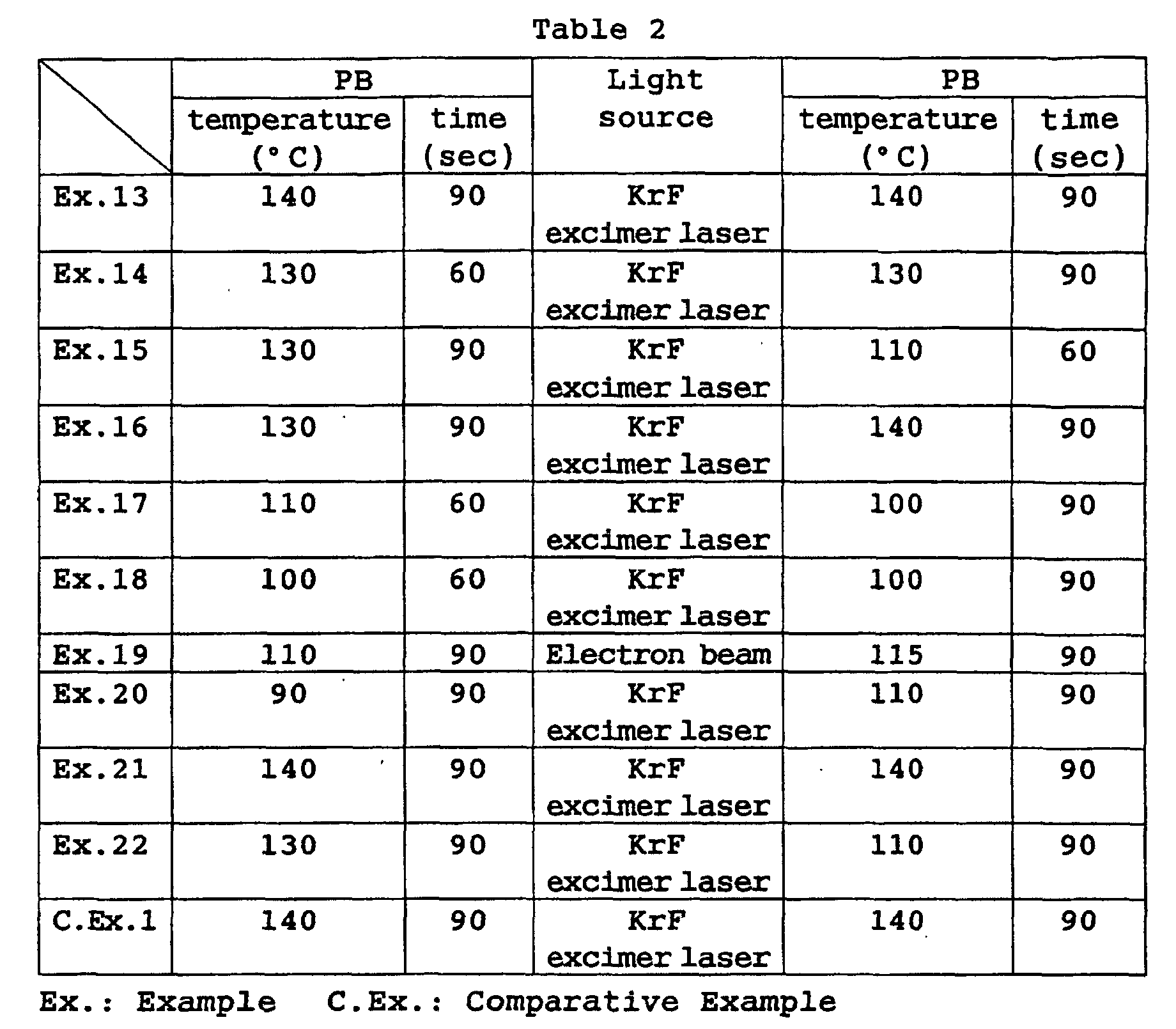
- each of the above composition solutions was applied to a silicone wafer by rotational coating and PB was carried at a temperature shown in Table 2 for a time shown in Table 2 to form a 0.5 ⁇ m-thick resist film.
- This resist film was then exposed to light from a KrF excimer laser (wavelength of 248 nm) through a mask pattern using the KrF excimer laser stepper (trade name: NSR-2205 EX12A, numerical aperture: 0.55) of Nikon Corporation by changing the amount of exposure.
- a simple electron beam direct drawing device acceleration voltage of 50 KeV
- PEB was carried out at a temperature shown in Table 2 for a time shown in Table 2. Thereafter, the resist film was developed with an aqueous solution of tetramethylammonium hydroxide, rinsed in water for 30 seconds and dried to form a resist pattern.
- Mw GPC columns (2 x G2000HXL, 1 x G3000HXL, 1 x G4000HXL) manufactured by Toso Co., Ltd. are used to measure Mw by gel permeation chromatography (GPC) using monodisperse polystyrene as the standard under the following analytical conditions.
- flow rate 1.0 ml/minute eluting solvent: tetrahydrofuran column temperature: 40°C
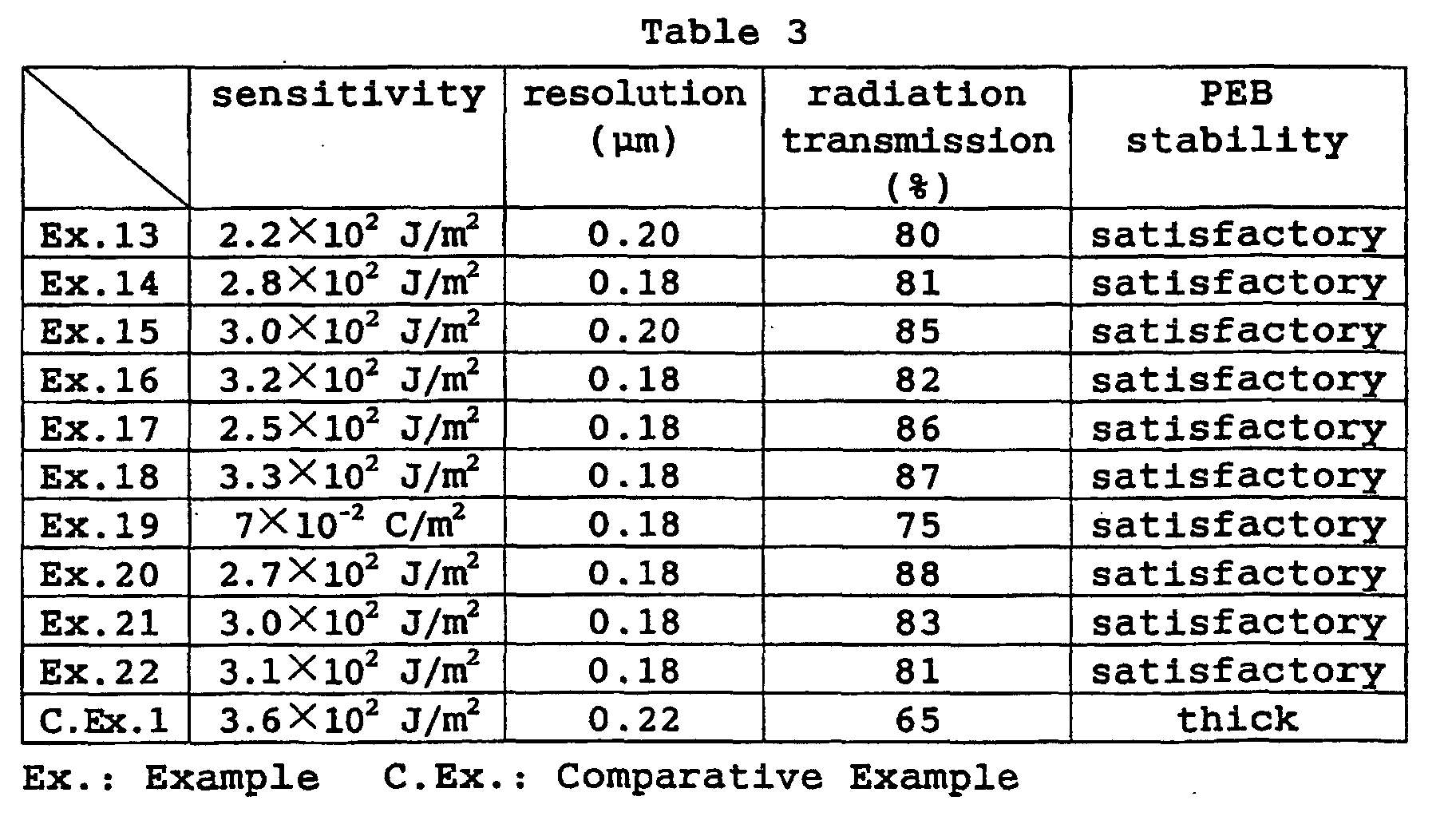
- the amount of exposure for forming a line-and-space pattern (1L1S) having a design line width of 0.22 ⁇ m to a line/space width ratio of 1:1 is taken as the optimum amount of exposure and sensitivity is evaluated based on this optimum amount of exposure.
- the transmission at a wavelength of 248 nm of a resist film formed by applying a composition solution to a circular quartz plate by spin coating and PB is measured by ultraviolet absorptiometry.
- the thickness of the resist film is measured with stylars based surface profiler film thickness measuring instrument and a transmission when the film thickness is 50 ⁇ m is calculated from the measured transmission and taken as radiation transmission.
- a sample which is exposed to the optimum amount of light when PEB is carried right after exposure and developed is placed in a chamber in which the concentration of ammonia in the atmosphere is controlled to 5 ppb for 2 hours, PEB is carried and the sample is developed to form a line-and-space pattern (1L1S) having a design line width of 0.22 ⁇ m.
- the line width on the top of the pattern (Ltop) is measured by a scanning electron microscope and evaluated based on the following criteria. 0.22 ⁇ 0.85 ⁇ Ltop ⁇ 0.22 ⁇ 1.1: satisfactory 0.22 ⁇ 0.85 ⁇ Ltop: thin 0.22 ⁇ 1.1 ⁇ Ltop: thick
- Components other than the polymers (A-1) to (A-7) used in Examples and Comparative Examples are as follows.
- novel vinylphenylpropionic acid derivatives can be obtained and a suitable substituent can be easily introduced into them.
- These vinylphenylpropionic acid derivatives have polymerization activity and polymers having physical properties suitable for application purpose can be obtained from vinylphenylpropionic acid derivatives having a suitable substituent.
- a polymer containing a recurring unit represented by the above formula (1') as an essential unit has extremely low absorption of radiation and is very useful as a resin component of a radiation sensitive resin composition suitable for use as a chemically amplified resist.
- the radiation sensitive resin composition of the present invention containing this polymer can reduce the difference of effective exposure amount between an upper portion and a lower portion of a resist film, can ensure the rectangularity of even a fine pattern, has high sensitivity (small amount of exposure energy) to radiation such as far ultraviolet radiation typically from a KrF excimer laser or ArF excimer laser, charged corpuscular beams such as electron beams or X-radiation such as synchrotron radiation, is free from a change in the line width of a pattern formed therefrom or the T-shaped deformation of the pattern caused by fluctuations in PED and has excellent resolution. Therefore, the radiation sensitive resin composition of the present invention can be extremely advantageously used as a chemically amplified resist for the production of semiconductor devices whose design rule is expected to be much smaller in the future
Landscapes
- Chemical & Material Sciences (AREA)
- Organic Chemistry (AREA)
- Physics & Mathematics (AREA)
- Spectroscopy & Molecular Physics (AREA)
- General Physics & Mathematics (AREA)
- Health & Medical Sciences (AREA)
- Chemical Kinetics & Catalysis (AREA)
- Medicinal Chemistry (AREA)
- Polymers & Plastics (AREA)
- Materials For Photolithography (AREA)
- Organic Low-Molecular-Weight Compounds And Preparation Thereof (AREA)
- Addition Polymer Or Copolymer, Post-Treatments, Or Chemical Modifications (AREA)
Abstract
Description

or a group represented by the following formula (3):

or a group represented by the above formula (3), and X1 is an eliminating group,
with an alkylphosphine represented by the following formula (4-2):
to form a first quaternary phosphonium salt represented by the following formula (4-3):


to form a second quaternary phosphonium salt represented by the following formula (4-6):















Mw
flow rate: 1.0 ml/minute
eluting solvent: tetrahydrofuran
column temperature: 40°C
bis(1,4-dioxaspiro[4.5]decane-7-sulfonyl)diazomethane

Claims (4)
- Vinylphenylpropionic acid derivatives represented by the following formula (1):wherein R1 is a hydrogen atom or a methyl group, R2 and R3 may be the same or different and each a hydrogen atom, an alkyl group having 1 to 8 carbon atoms which may be substituted or a phenyl group which may be substituted, and Z1 is a group represented by the following formula (2):
 wherein R4, R5 and R6 may be the same or different and each a hydrogen atom, an alkyl group having 1 to 8 carbon atoms which may be substituted or a phenyl group which may be substituted, or any two of R4, R5 and R6 may be bonded together with a carbon atom bonded thereto to form a cyclic aliphatic group,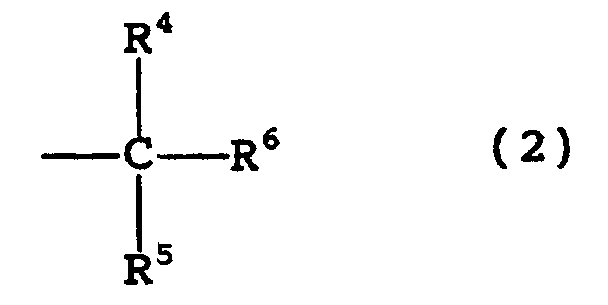
or a group represented by the following formula (3):wherein R7 and R8 may be the same or different and each a hydrogen atom, an alkyl group having 1 to 8 carbon atoms which may be substituted or a phenyl group which may be substituted, R9 is an alkyl group having 1 to 8 carbon atoms which may be substituted or a phenyl group which may be substituted, or any two of R7, R8 and R9 may be bonded together with a carbon atom bonded thereto to form a cyclic aliphatic group.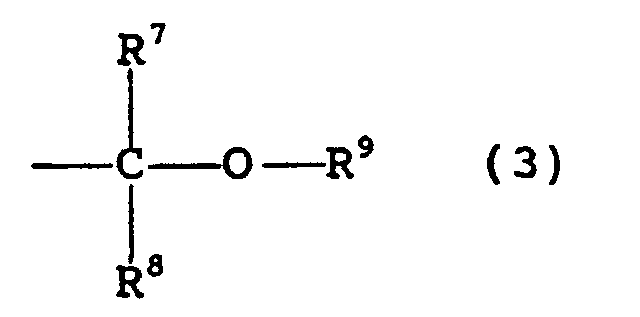
- A process for producing vinylphenylpropionic acid derivatives represented by the above formula (1), comprising the steps of:(i) reacting an acetate represented by the following formula (4-1):wherein R3 is as defined in the above formula (1), Z2 is a group represented by the following formula (2'):
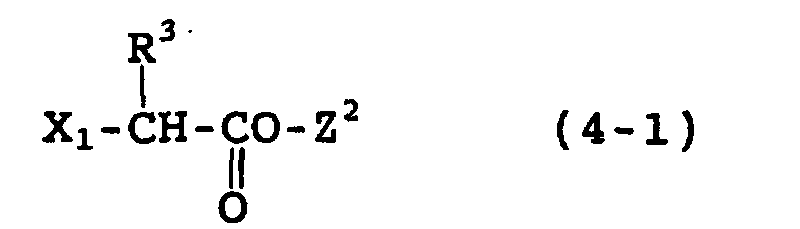 wherein R10, R11 and R12 may be the same or different and each a hydrogen atom, an alkyl group having 1 to 8 carbon atoms which may be substituted or a phenyl group which may be substituted, or any two of R10, R11 and R12 may be bonded together with a carbon atoms bonded thereto to form a cyclic aliphatic group,
or a group represented by the above formula (3), and X1 is an eliminating group,
with a trialkylphosphine represented by the following formula (4-2):wherein R13, R14 and R15 may be the same or different and each an alkyl group having 1 to 8 carbon atoms which may be substituted,
to form a first quaternary phosphonium salt represented by the following formula (4-3):wherein R3 is as defined in the above formula (1), Z2 and X1 are as defined in the above formula (4-1), and R13, R14 and R15 are as defined in the above formula (4-2),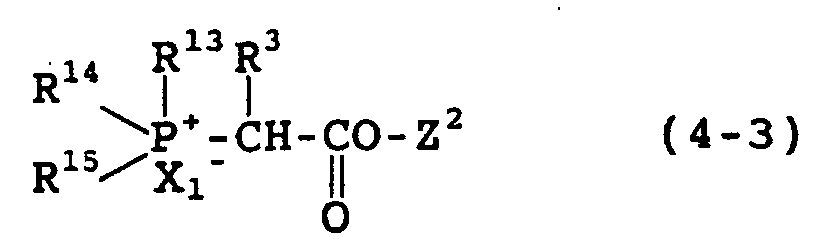 (ii) reacting the formed first quaternary phosphonium salt with a base to form a phosphorus ylide represented by the following formula (4-4):wherein R3 is as defined in the above formula (1), Z2 is as defined in the above formula (4-1), and R13, R14 and R15 are as defined in the above formula (4-2),
 (iii) reacting the formed phosphorus ylide with a styrene derivative represented by the following formula (4-5):wherein R1 and R2 are as defined in the above formula (1), and X2 is an eliminating group,
to form a second quaternary phosphonium salt represented by the following formula (4-6):wherein R1, R2 and R3 are as defined in the above formula (1), Z2 is as defined in the above formula (4-1), and R13, R14 and R15 are as defined in the above formula (4-2), and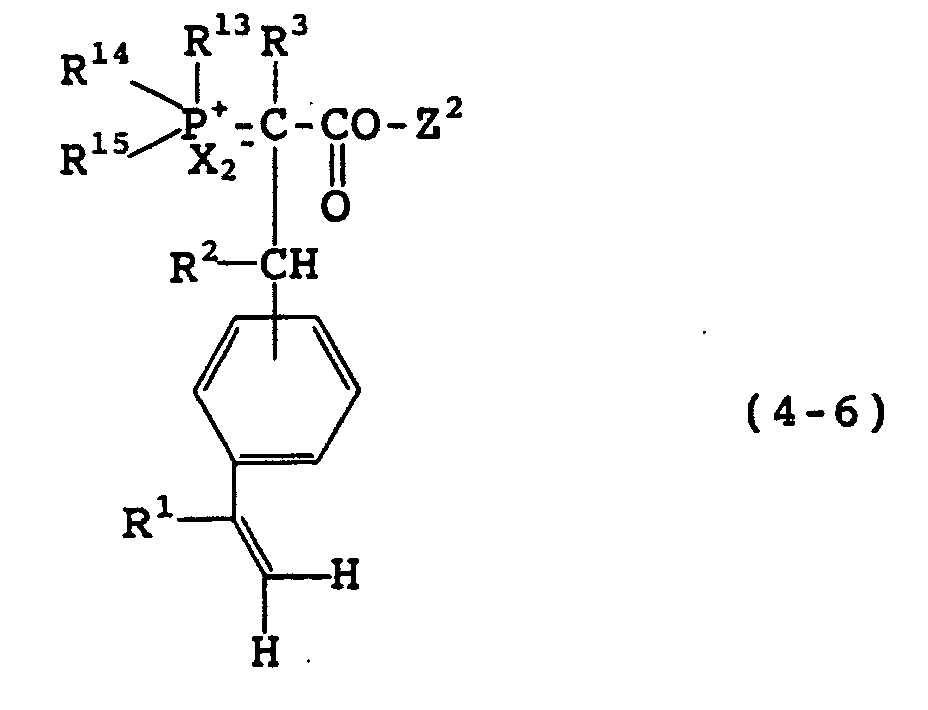 (iv) hydrolyzing the formed quaternary phosphonium salt.
 - A polymer which comprises a recurring unit represented by the following formula (1'):wherein R1, R2, R3 and Z1 are as defined in the above formula (1),

and which has a weight average molecular weight in terms of polystyrene measured by gel permeation chromatography (GPC) of 1,000 to 500,000. - A radiation sensitive resin composition which comprises (A) the polymer of claim 3 and (B) a radiation sensitive acid generating agent.
Applications Claiming Priority (5)
| Application Number | Priority Date | Filing Date | Title |
|---|---|---|---|
| JP32441399A JP2001139632A (en) | 1999-11-15 | 1999-11-15 | Styrene compound having carboxyl group in side chain and method for producing the same |
| JP32441399 | 1999-11-15 | ||
| JP2000133334 | 2000-05-02 | ||
| JP2000133334A JP2001316333A (en) | 2000-05-02 | 2000-05-02 | Vinylphenylpropionic acid derivative and method for producing the same |
| PCT/JP2000/007950 WO2001036370A1 (en) | 1999-11-15 | 2000-11-10 | Vinylphenylpropionic acid derivatives, processes for production of the derivatives, polymers thereof and radiosensitive resin compositions |
Publications (2)
| Publication Number | Publication Date |
|---|---|
| EP1231205A1 true EP1231205A1 (en) | 2002-08-14 |
| EP1231205A4 EP1231205A4 (en) | 2004-05-26 |
Family
ID=26571486
Family Applications (1)
| Application Number | Title | Priority Date | Filing Date |
|---|---|---|---|
| EP00974921A Withdrawn EP1231205A4 (en) | 1999-11-15 | 2000-11-10 | Vinylphenylpropionic acid derivatives, processes for production of the derivatives, polymers thereof and radiosensitive resin compositions |
Country Status (5)
| Country | Link |
|---|---|
| US (1) | US6770780B1 (en) |
| EP (1) | EP1231205A4 (en) |
| KR (1) | KR20020050277A (en) |
| TW (1) | TWI258465B (en) |
| WO (1) | WO2001036370A1 (en) |
Cited By (2)
| Publication number | Priority date | Publication date | Assignee | Title |
|---|---|---|---|---|
| EP1273970A3 (en) * | 2001-07-05 | 2004-01-28 | Fuji Photo Film Co., Ltd. | Positive photosensitive composition |
| EP2252915A4 (en) * | 2008-03-14 | 2012-10-17 | Fujifilm Corp | RESERVE COMPOSITION AND METHOD USING THE SAME TO FORM A PATTERN |
Families Citing this family (1)
| Publication number | Priority date | Publication date | Assignee | Title |
|---|---|---|---|---|
| US9296026B2 (en) | 2007-10-18 | 2016-03-29 | Amut S.P.A. | Machine and method for continuously washing containers made of plastic material, and removal of contaminants and labels from their surface |
Family Cites Families (6)
| Publication number | Priority date | Publication date | Assignee | Title |
|---|---|---|---|---|
| US3006895A (en) * | 1959-04-27 | 1961-10-31 | Dow Chemical Co | Vinylbenzyl ketones and esters and polymers thereof |
| JPH0561197A (en) | 1991-09-02 | 1993-03-12 | Japan Synthetic Rubber Co Ltd | Radiation-sensitive composition |
| EP0546997B1 (en) | 1991-12-10 | 2000-02-02 | Arch Specialty Chemicals, Inc. | Radiation-sensitive polymer |
| JP3116751B2 (en) | 1993-12-03 | 2000-12-11 | ジェイエスアール株式会社 | Radiation-sensitive resin composition |
| JPH07295221A (en) * | 1994-04-27 | 1995-11-10 | Mitsubishi Electric Corp | Photosensitive resin composition |
| JP3628135B2 (en) * | 1997-02-18 | 2005-03-09 | 沖電気工業株式会社 | Chemically amplified resist and pattern forming method |
-
2000
- 2000-11-10 WO PCT/JP2000/007950 patent/WO2001036370A1/en not_active Ceased
- 2000-11-10 KR KR1020027006176A patent/KR20020050277A/en not_active Withdrawn
- 2000-11-10 US US10/129,119 patent/US6770780B1/en not_active Expired - Lifetime
- 2000-11-10 EP EP00974921A patent/EP1231205A4/en not_active Withdrawn
- 2000-11-14 TW TW089124100A patent/TWI258465B/en not_active IP Right Cessation
Cited By (7)
| Publication number | Priority date | Publication date | Assignee | Title |
|---|---|---|---|---|
| EP1273970A3 (en) * | 2001-07-05 | 2004-01-28 | Fuji Photo Film Co., Ltd. | Positive photosensitive composition |
| US7192681B2 (en) | 2001-07-05 | 2007-03-20 | Fuji Photo Film Co., Ltd. | Positive photosensitive composition |
| US7514201B2 (en) | 2001-07-05 | 2009-04-07 | Fujifilm Corporation | Positive photosensitive composition |
| EP2296039A1 (en) * | 2001-07-05 | 2011-03-16 | Fujifilm Corporation | Positive photosensitive composition |
| EP2296040A1 (en) * | 2001-07-05 | 2011-03-16 | Fujifilm Corporation | Positive photosensitive composition |
| US7977029B2 (en) | 2001-07-05 | 2011-07-12 | Fujifilm Corporation | Positive photosensitive composition |
| EP2252915A4 (en) * | 2008-03-14 | 2012-10-17 | Fujifilm Corp | RESERVE COMPOSITION AND METHOD USING THE SAME TO FORM A PATTERN |
Also Published As
| Publication number | Publication date |
|---|---|
| KR20020050277A (en) | 2002-06-26 |
| WO2001036370A1 (en) | 2001-05-25 |
| TWI258465B (en) | 2006-07-21 |
| US6770780B1 (en) | 2004-08-03 |
| EP1231205A4 (en) | 2004-05-26 |
Similar Documents
| Publication | Publication Date | Title |
|---|---|---|
| US6849374B2 (en) | Photoacid generators and photoresists comprising same | |
| KR100760146B1 (en) | Radiation Sensitive Resin Composition | |
| KR19990067934A (en) | Radiation Sensitive Resin Composition | |
| KR20090013727A (en) | Positive resist composition for electron beam, X-ray, or EV, and pattern formation method using the same | |
| JP2001166478A (en) | Radiation-sensitive resin composition | |
| JP2008046594A (en) | Chemically amplified positive resist composition | |
| JP3627465B2 (en) | Radiation sensitive resin composition | |
| KR100828893B1 (en) | Radiation-Sensitive Resin Composition | |
| JP2001166474A (en) | Radiation-sensitive resin composition | |
| KR100967468B1 (en) | Polymer mixture, and radiation-sensitive resin composition | |
| JP4682345B2 (en) | Radiation sensitive composition | |
| KR101000181B1 (en) | Radiation-sensitive resin composition | |
| KR100634942B1 (en) | Photosensitive Resin Composition | |
| US6770780B1 (en) | Vinylphenylpropionic acid derivatives, production process therefor, polymer thereof and radiation sensitive resin composition | |
| JP2002023370A (en) | Acid dissociable organic group-containing styrenic polymer and radiation-sensitive resin composition | |
| JP2005316272A (en) | Positive radiation sensitive resin composition | |
| JP4525440B2 (en) | Radiation sensitive resin composition | |
| KR101086581B1 (en) | Radiation-sensitive resin composition | |
| JP4240663B2 (en) | Radiation sensitive resin composition | |
| JP2005258362A (en) | Copolymer and radiation-sensitive resin composition using the same | |
| JP4043078B2 (en) | Radiation sensitive resin composition | |
| JP3861679B2 (en) | Radiation sensitive resin composition | |
| JP4352831B2 (en) | Radiation sensitive resin composition | |
| JP2005234377A (en) | Radiation sensitive resin composition | |
| JP4200936B2 (en) | Positive radiation sensitive resin composition |
Legal Events
| Date | Code | Title | Description |
|---|---|---|---|
| PUAI | Public reference made under article 153(3) epc to a published international application that has entered the european phase |
Free format text: ORIGINAL CODE: 0009012 |
|
| 17P | Request for examination filed |
Effective date: 20020514 |
|
| AK | Designated contracting states |
Kind code of ref document: A1 Designated state(s): AT BE CH CY DE DK ES FI FR GB GR IE IT LI LU MC NL PT SE TR |
|
| RAP1 | Party data changed (applicant data changed or rights of an application transferred) |
Owner name: JSR CORPORATION |
|
| RBV | Designated contracting states (corrected) |
Designated state(s): AT BE CH CY DE FR GB IT LI NL |
|
| RIC1 | Information provided on ipc code assigned before grant |
Ipc: 7C 07C 69/618 B Ipc: 7C 07C 67/343 B Ipc: 7G 03F 7/004 B Ipc: 7C 08F 30/02 B Ipc: 7G 03F 7/039 B Ipc: 7C 07D 309/12 A |
|
| A4 | Supplementary search report drawn up and despatched |
Effective date: 20040413 |
|
| STAA | Information on the status of an ep patent application or granted ep patent |
Free format text: STATUS: THE APPLICATION IS DEEMED TO BE WITHDRAWN |
|
| 18D | Application deemed to be withdrawn |
Effective date: 20050601 |