EP1229011A1 - Process for producing styrene - Google Patents
Process for producing styrene Download PDFInfo
- Publication number
- EP1229011A1 EP1229011A1 EP01956948A EP01956948A EP1229011A1 EP 1229011 A1 EP1229011 A1 EP 1229011A1 EP 01956948 A EP01956948 A EP 01956948A EP 01956948 A EP01956948 A EP 01956948A EP 1229011 A1 EP1229011 A1 EP 1229011A1
- Authority
- EP
- European Patent Office
- Prior art keywords
- catalyst
- reaction
- dehydrogenation
- styrene
- potassium
- Prior art date
- Legal status (The legal status is an assumption and is not a legal conclusion. Google has not performed a legal analysis and makes no representation as to the accuracy of the status listed.)
- Withdrawn
Links
Classifications
-
- C—CHEMISTRY; METALLURGY
- C07—ORGANIC CHEMISTRY
- C07C—ACYCLIC OR CARBOCYCLIC COMPOUNDS
- C07C15/00—Cyclic hydrocarbons containing only six-membered aromatic rings as cyclic parts
- C07C15/40—Cyclic hydrocarbons containing only six-membered aromatic rings as cyclic parts substituted by unsaturated carbon radicals
- C07C15/42—Cyclic hydrocarbons containing only six-membered aromatic rings as cyclic parts substituted by unsaturated carbon radicals monocyclic
- C07C15/44—Cyclic hydrocarbons containing only six-membered aromatic rings as cyclic parts substituted by unsaturated carbon radicals monocyclic the hydrocarbon substituent containing a carbon-to-carbon double bond
- C07C15/46—Styrene; Ring-alkylated styrenes
-
- C—CHEMISTRY; METALLURGY
- C07—ORGANIC CHEMISTRY
- C07C—ACYCLIC OR CARBOCYCLIC COMPOUNDS
- C07C5/00—Preparation of hydrocarbons from hydrocarbons containing the same number of carbon atoms
- C07C5/32—Preparation of hydrocarbons from hydrocarbons containing the same number of carbon atoms by dehydrogenation with formation of free hydrogen
- C07C5/327—Formation of non-aromatic carbon-to-carbon double bonds only
- C07C5/333—Catalytic processes
Definitions
- the present invention relates to an improvement of a process for producing styrene by dehydrogenating ethylbenzene.
- the invention enables to produce styrene with maintaining a high yield and a high selectivity over a long period of time.
- the reaction-generated gas effused from the oxidation catalyst-packed bed contains a decreased concentration of hydrogen and is at an elevated temperature due to the heat generated by the combustion of hydrogen, and hence the dehydrogenation reaction can again be conducted at a high reaction rate. Therefore, use of a reaction apparatus wherein the dehydrogenation reaction-packed bed. and the oxidation catalyst-packed bed are disposed alternately enables to finally attain an extremely high conversion of ethylbenzene.
- a subject of the invention is to provide a process for producing styrene from ethylbenzene containing a combination of dehydrogenation reaction and oxidation reaction wherein styrene can be produced with a high yield over a long period of time.
- styrene can be produced stably with a high yield over a long period of time by maintaining the carbon dioxide-generating ratio in the dehydrogenation step at a level less than 2.1 times that at the initial stage of the reaction, thus having achieved the invention based on the finding.
- one aspect of the invention lies in a process for producing styrene by dehydrogenation of ethylbenzene, which contains the steps of (i) feeding a raw material gas containing ethylbenzene and steam to a first dehydrogenating step to produce a reacted gas containing ethylbenzene, styrene and hydrogen in the presence of a dehydrogenation catalyst, (ii) feeding the reacted gas obtained in the first dehydrogenating step to an oxidizing step to combust at least part of hydrogen in the presence of an oxidation catalyst, and (iii) feeding the reacted gas obtained in the oxidizing step to a second dehydrogenating step to produce styrene from ethylbenzene in the presence of the dehydrogenation catalyst, with maintaining the carbon dioxide-generating ratio in the second dehydrogenating step at a level less than 2.1 times that at the initial stage of the reaction.
- Another aspect of the invention lies in a process for producing styrene by dehydrogenation of ethylbenzene in the presence of a potassium-containing, iron-based catalyst, which contains filling a catalyst showing a lower potassium-flying rate in the upstream portion of the catalyst-packed bed within the dehydrogenation reactor.
- the step to be used in the process of the invention for producing styrene by dehydrogenation of ethylbenzene is a step wherein two or more dehydrogenating steps are connected in series.
- a dehydrogenating step or steps in parallel there may be provided a dehydrogenating step or steps in parallel.
- an oxidizing'step may be provided between any two dehydrogenating steps connected.
- an oxidizing step is provided between any two dehydrogenating steps connected.
- ethylbenzene is dehydrogenated to produce styrene and hydrogen.
- Ethylbenzene to be introduced into this dehydrogenating step is commonly mixed with steam to use.
- Mixing ratio of steam to ethylbenzene is usually in the range of 1 to 15 in molar ratio, preferably 1 to 10.
- a fixed bed apparatus packed with a dehydrogenation catalyst is usually used as an apparatus to be used for the dehydrogenating step.
- the dehydrogenation reaction of the invention is preferably a fixed bed-passing reaction wherein the above-described raw material is passed as a gas through a fixed bed catalyst reactor.
- the reaction temperature is usually 500°C or higher, preferably 550°C or higher, and is usually 700°C or lower, preferably 670°C or lower.
- a method of previously heating the raw materials-mixed gas to about the reaction temperature then. introducing the heated gas into the reactor.
- the pressure is usually in the range of from 0.0049 to 0.98 MPa. Since the dehydrogenation reaction of ethylbenzene is an endothermic reaction, the temperature within the reactor decreases with the progress of the reaction.
- Constituents of the dehydrogenation catalyst are not particularly limited, but there may usually be used those disclosed in Japanese Patent Laid-Open No. 130531/1985, that is, iron-based catalysts containing an alkali metal or an alkaline earth metal or the iron-based catalysts further containing other metals such as zirconium, tungsten, molybdenum, vanadium and chromium.
- iron-based catalysts containing an alkali metal or an alkaline earth metal or the iron-based catalysts further containing other metals such as zirconium, tungsten, molybdenum, vanadium and chromium.
- potassium-containing, iron-based catalysts which contain iron oxide as a major component and potassium oxide and, if desired, the above-described or other metals are preferred.
- Japanese Patent Laid-Open No. 277030/1992 that is, a catalyst which contains iron oxide and potassium oxide as major components and titanium oxide as a co-catalyst component.
- Deterioration of the catalyst in this case means that, in the case of, for example, potassium-containing, iron-based catalysts, potassium flies off, that is, potassium is released from the catalyst and flies off entrained with the reacted gas.
- the catalyst deteriorated with the elapse of time shows not only a reduced activity but a reduced styrene selectivity.
- One factor of this phenomenon is that the catalyst deteriorated with the elapse of time functions to convert hydrocarbons such as styrene to carbon dioxide by the steam reforming reaction.
- Another factor is that the resultant carbon dioxide in turn functions as a catalyst poison.
- the steam reforming reaction takes place in the vicinity of the inlet of a reactor for the dehydrogenating step, that is, in the high-temperature portion of the catalyst layer.
- the dehydrogenation catalyst a catalyst-packed bed provided in the reactor in which bed a catalyst showing a lower potassium-flying rate is located in the upstream side of the passage of reacted gas.
- a dehydrogenation catalyst showing a lower potassium-flying rate it is possible to use one kind of a dehydrogenation catalyst showing a lower potassium-flying rate, or to use a catalyst showing a lower potassium-flying rate in the upstream side and one or more catalysts showing a relatively higher potassium-flying rate than that of the catalyst in the downstream side.
- potassium-flying rate and activity can be measured in the following manner.
- a reaction tube of 21 mm in inside diameter is fit with a tube of 4 mm in outside diameter for inserting a thermocouple, and 24 ml of an oxidation catalyst of about 3 mm in particle size is charged thereinto, followed by charging 7 ml of a dehydrogenation catalyst of about 3 to about 4 mm in particle size into the downstream side of the reaction tube.
- the oxidation catalyst the catalyst prepared by the process disclosed in Example 1 of Japanese Patent Laid-Open No. 225140/1986, which comprises a carrier of alumina supporting thereon 0.2% by weight of platinum, 0.5% by weight of tin and 0.2% by weight of lithium, is used.
- This reaction tube is placed in an electric furnace, and heated while introducing thereinto nitrogen at a rate of 20 ml/min. At a point when the inlet temperature of the dehydrogenation catalyst layer reaches 550°C, the nitrogen is changed to steam (1.5 g/min).
- a mixed gas of ethylbenzene, styrene and hydrogen and a mixed gas of air and nitrogen are respectively fed to the reaction tube to conduct oxidation reaction of hydrogen in the oxidation catalyst layer and dehydrogenation reaction of ethylbenzene in the succeeding dehydrogenation catalyst layer.
- the reaction is conducted for 2000 hours at a temperature of 640°C and at a pressure of 0.065 MPa in the dehydrogenation catalyst layer and at an LHSV of sum of ethylbenzene and styrene to the oxidation catalyst of 3.5 hr -1 .
- the dehydrogenation catalyst is taken out.
- the atomic ratio of potassium to iron of the dehydrogenation catalyst is measured before and after the reaction according to an atomic absorption method.
- a reaction tube of 21 mm in inside diameter is fit with a tube of 4 mm in outside diameter for inserting a thermocouple, and 70 ml of a dehydrogenation catalyst of about 3 to about 4 mm in particle size is charged into the reaction tube.
- This reaction tube is placed in an electric furnace, and heated while introducing thereinto nitrogen at a rate of 20 ml/min. At a point when the inlet temperature of the dehydrogenation catalyst layer reaches 550°C, the nitrogen is changed to steam (1.5 g/min).
- the flying rate of the catalyst showing a lower potassium-flying rate is 15% or less, preferably 10% or less, more preferably 8% or less, in terms of the value measured and calculated in the above-described manner.
- the catalyst showing a lower potassium-flying rate has the activity-showing value of preferably 60% or more, more preferably 65% or more in terms of the activity measured and calculated in the above-described manner.
- the reacted gas effused from the dehydrogenating step usually contains ethylbenzene, styrene, hydrogen and steam, and its temperature is lower than that at the inlet of the dehydrogenating step.
- Molar ratio of hydrogen to styrene is usually in the range of from 1.0 to 1.3.
- the reacted gas effused from the above-described dehydrogenating step may be introduced into another dehydrogenating step or into an oxidizing step.
- the oxidizing step is a step where hydrogen is selectively combusted.
- the mixture fed to the oxidizing step contains oxygen in order to combust hydrogen.
- oxygen any of oxygen-containing gases may be used with no limitation, and there are illustrated, for, example, air, diluted air, air enriched with oxygen and inert gas-diluted oxygen.
- a method for feeding an oxygen-containing gas For example, it is possible to feed the oxygen-containing gas to the reacted gas effused from the dehydrogenating step and introduce the thus mixed gas into the oxidizing step, or to feed the oxygen-containing gas to the oxidizing step.
- Apparatus to be used for the oxidizing step is not particularly limited, and a fixed bed reaction apparatus packed with a solid oxidation catalyst is commonly used.
- any one may be employed that can selectively combust hydrogen in the co-presence of styrene and ethylbenzene.
- a noble metal-based oxidation catalyst is used.
- a catalyst disclosed in Japanese Patent Laid-Open No. 130531/1985 that is, a catalyst containing platinum and potassium, or containing platinum, tin and potassium
- a catalyst disclosed in Japanese Patent Laid-Open No. 225140/1986 that is, a catalyst containing an alkali metal or alkaline earth metal, the group 4A element such as germanium, tin or lead, and a noble metal.
- 298678/1994 that is, a tin catalyst or a catalyst containing tin and an alkali metal
- a catalyst disclosed in 322303/1999 that is, a catalyst containing platinum and niobium or tantalum may also be used.
- the reacted gas effused from the oxidizing step has been heated by the heat generated due to oxidation reaction of hydrogen.
- the temperature of this gas is usually in the range of from 550 to 670°C.
- the reacted gas effused from the oxidizing step is introduced into the second dehydrogenating step.
- Apparatus, catalyst, reaction conditions, etc. for the second dehydrogenating step may freely be selected from those described with respect to the above-described dehydrogenating step, and the second dehydrogenating step can be conducted independently from the first dehydrogenating step.
- the above-described dehydrogenation catalyst is usually deteriorated by oxygen. Therefore, it is' preferred for the gas effused from the oxidizing step substantially not to contain oxygen.
- the gas effused from the oxidizing step substantially not to contain oxygen.
- a steam reforming reaction proceeds with deterioration of the catalyst with the elapse of time.
- the steam reforming reaction takes place markedly in the vicinity of the inlet of the reactor, that is, in the high-temperature portion of the catalyst layer. Further, the steam reforming reaction proceeds more markedly when the amount of hydrogen to styrene is 0.8 or less, particularly 0.5 or less, in terms of molar ratio.
- the steam reforming reaction takes place particularly markedly in the second dehydrogenating step.
- hydrocarbons such as styrene are converted to carbon dioxide by the steam reforming reaction, thus selectivity of styrene being decreased.
- Generated carbon dioxide in turn functions as a poison for the dehydrogenation catalyst and, as a result, conversion of ethylbenzene is decreased.
- production of styrene can be continued with maintaining the activity and the selectivity at levels of initial stage of the reaction over a long period of time, by maintaining the carbon dioxide-generating ratio within a definite range.
- the carbon dioxide-generating ratio is kept at a level of less than 2.1 times, preferably less than 2.0 times, more preferably less than 1.9 times as much as that at the initial stage of the reaction.
- initial stage of the reaction means the point at which activity of the dehydrogenation catalyst becomes stable after initiation of feeding ethylbenzene to the reactor for the dehydrogenating step. Additionally, activity of the dehydrogenation catalyst usually changes greatly immediately after initiation of feeding ethylbenzene, and becomes stable 1000 to 2000 hours after initiation of feeding ethylbenzene.
- means for maintaining the amount of generated carbon dioxide within a certain range is not particularly limited but, specifically, it is preferred to employ the following embodiments.
- the lower limit is 0.8 times, preferably 0.9 times, based on styrene, in terms of molar ratio
- the upper limit is 2.0 times, preferably 1.3 times, based on styrene, in terms of molar ratio.
- preferred range of the amount is 0.8 to 2.0 times, with more preferred range being 0.9 to 1.3 times.
- the means to realize such amount there are illustrated, for example, to feed hydrogen to the reacted gas effused from the oxidizing step, to feed hydrogen to the reacted gas to be introduced, into the oxidizing step, and to introduce hydrogen into the second dehydrogenating step. These means may be employed alone or in combination.
- hydrogen is fed to the reacted gas to be introduced into the oxidizing step.
- To feed hydrogen to the reacted gas to be introduced into the oxidizing step also serves to improve selectivity of the combustion reaction of hydrogen in the oxidizing step.
- Deterioration of the catalyst causes a reduction in activity and, in order to maintain the yield of the product, it is commonly employed to raise the reaction temperature.
- a point where the reaction temperature reaches 620°C or above, preferably 630°C or above, is selected.
- the dehydrogenation catalyst As another embodiment for maintaining the amount of generated carbon dioxide at a level within a definite range, it is preferred to use, as the dehydrogenation catalyst, the above-described potassium-containing, iron-based catalyst wherein a catalyst showing a less potassium-flying rate is provided in the upstream side of the passage of reacted gas. Specifically, there are illustrated to use one kind of a dehydrogenation catalyst showing a less potassium-flying rate and to use the catalyst showing a less potassium-flying rate in the upstream side and one or more kinds of a catalyst showing a relatively higher potassium-flying rate than that of the catalyst in the downstream side.
- the two or more dehydrogenation catalysts are particularly preferably used in such manner that the catalyst showing a relatively lower activity is used in the upstream side and the catalyst showing a relatively higher activity in the downstream side.
- the flying rate of the catalyst showing a lower potassium-flying rate the value determined by measuring and calculating according to the method described hereinbefore is usually 15% or less, preferably 10% or less, more preferably 8% or less.
- the catalyst showing a lower potassium-flying rate has the activity value determined by measuring and calculating in the above-described manner of preferably 60% or more, more preferably 65% or more.
- the steam reforming reaction is markedly depressed by one, or a combination, of the above-described preferred embodiments, thus the amount of generated carbon dioxide being reduced.
- reduction in activity and selectivity is markedly depressed even when production of styrene is continued for a long period of time.
- the process of the invention is an industrially extremely advantageous process for producing styrene.
- the second dehydrogenating step of the invention is a dehydrogenating step provided in the downstream of the oxidizing step, as described above. That is, a dehydrogenating step into which a reacted gas having been subjected to the oxidizing step to selectively oxidize hydrogen is to be introduced can be the second dehydrogenating step of the invention. Therefore, in the case where three or more dehydrogenating steps are provided, for example, where a second oxidizing step and a third dehydrogenating step are provided, too, it should be understood that embodiments coinciding with the above-described conditions be within the scope of the invention.
- the reacted gas effused from the second dehydrogenating step can be introduced into a product-recovering system to recover ethylbenzene and styrene, with ethylbenzene being recycled to use. If desired, hydrogen can also be recovered and recycled to use.
- Oxidation catalyst (a) is :
- a catalyst containing Nb 2 O 5 carrying thereon 0.2% by weight of Pt and produced according to Example 8 in Japanese Patent Laid-Open No. 29095/1997 was used.
- a catalyst prepared according to Example 6 in Japanese Patent Laid-Open No. 277030/1992 was used.
- This catalyst underwent a reduction in potassium content from 8.2% by weight to 0.17% by weight, which was analyzed according to the atomic absorption method.
- a reaction tube of 21 mm in inside diameter was fitted with a thermocouple-introducing tube of 4 mm in outside diameter, and 24 ml of oxidation catalyst (a), 24 ml of deteriorated dehydrogenation catalyst (a) and 36 ml of normal'dehydrogenation catalyst (a) were packed, from the upstream side, in the reaction tube in this order to form a catalyst-packed bed containing the oxidation catalyst layer and the dehydrogenation catalyst layers one of which was a deteriorated catalyst layer and the other of which was a normal catalyst layer. Additionally, a space was provided between the oxidation catalyst layer and the dehydrogenation catalyst layer, and a hydrogen-feeding pipe was connected to the space.
- This reaction tube was placed in an electric furnace and heated while feeding a nitrogen gas at a rate of 20 ml/min. At a point when temperature of the inlet portion of the dehydrogenation catalyst layer reached 550°C, the nitrogen gas was changed to steam (1.5 g/min).
- the feed gas was changed to a combination of a mixed gas of ethylbenzene, styrene, steam, hydrogen and carbon dioxide and a mixed gas of air and nitrogen, with feeding hydrogen through the hydrogen-feeding pipe, to thereby conduct selective combustion reaction of hydrogen with the aid of the oxidation catalyst and dehydrogenation reaction of ethylbenzene with the aid of the dehydrogenation catalyst.
- the temperature at the inlet of the dehydrogenation catalyst layer was kept at 640°C, and the temperature at the outlet of the dehydrogenation catalyst layer was kept at 610°C.
- the feed gas was fed to the reaction tube at a pressure of 0.065 MPa and an LHSV of the sum of ethylbenzene and styrene based on the dehydrogenation catalyst of 1.2 hr -1 .
- Hydrogen was fed through the hydrogen-feeding pipe in such amount that the molar ratio of hydrogen to styrene contained in the gas introduced into the dehydrogenation catalyst layer became 1.06.
- the nitrogen gas was changed to steam (1.5 g/min). Then, at a point when the temperature at the inlet portion of the dehydrogenation catalyst layer reached 600°C, the feed gas was changed to a combination of a mixed gas of ethylbenzene, styrene, steam, hydrogen and carbon dioxide and a mixed gas of air and nitrogen, with feeding hydrogen through the hydrogen-feeding pipe, to thereby conduct selective combustion reaction of hydrogen with the aid of the oxidation catalyst and dehydrogenation reaction of ethylbenzene with the aid of the dehydrogenation catalyst.
- the feed gas was fed to the reaction tube at a pressure of 0.065 MPa and an LHSV of the sum of ethylbenzene and styrene based on the dehydrogenation catalyst of 10 hr -1 .
- Hydrogen was fed through the hydrogen-feeding pipe in such amount that the molar ratio of hydrogen to styrene contained in the gas introduced into the dehydrogenation catalyst layer became 1.06.
- Reaction was conducted in the same manner as in Example 1 except for increasing the amount of oxygen in the gas fed to the oxidation catalyst layer and not feeding hydrogen through the hydrogen-feeding pipe. Results are shown in Table 1. Additionally, molar ratio of hydrogen to styrene in the gas introduced into the dehydrogenation catalyst layer was 0.28.
- Example 1 Data for the initial stage reaction were obtained in the following manner. That is, the reaction was conducted in the same manner as that for obtaining the data for the initial stage reaction in Example 1 except for increasing the amount of oxygen in the gas introduced into the oxidation catalyst layer and not feeding hydrogen through the hydrogen-feeding pipe. Results thus obtained are shown in Table 2. Additionally, molar ratio of hydrogen to styrene in the gas introduced into the dehydrogenation catalyst layer was 0.28.
- Example 1 Com. Example 1 Com.
- Example 2 Blank Conversion of ethylbenzene 28.9 23.9 20.8 - Selectivity to styrene 93.6 92.2 90.0 - Ratio of generating carbon dioxide 3.3 3.9 4.7 2.2 Ratio of carbon dioxide-generating ratio to that of the initial stage of the reaction 1.4 2.1 3.1 - Benzene-generating ratio 0.45 0.51 0.62 -
- Example 2 In the Initial Stage of the reaction Blank In the Initial Stage of the reaction Conversion of ethylbenzene 42.9 43.8 44.7 - Selectivity to styrene 95.1 95.2 95.2 - Ratio of generating carbon dioxide 3.0 3.0 3.0 2.2 Benzene-generating ratio 0.34 0.34 0.34 -
- Example 4 Blank Conversion of ethylbenzene 31.0 27.1 25.0 - Selectivity to styrene 94.0 93.1 92.2 - Ratio of generating carbon dioxide 3.2 3.7 4.3 2.2 Ratio of carbon dioxide-generating ratio to that of the initial stage of the reaction 1.3 2.1 3.0 - Benzene-generating ratio 0.44 0.50 0.61 -
- Example 2 In the Initial Stage of the reaction Com.
- Example 3 In the Initial Stage of the reaction Com.
- Example 4 In the Initial Stage of the reaction Blank In the Initial Stage of the reaction Conversion of ethylbenzene 45.5 46.8 47.9 - Selectivity to styrene 95.5 95.6 95.6 - Ratio of generating carbon dioxide 3.0 2.9 2.9 2.2 Benzene-generating ratio 0.34 0.34 0.34 -
- reaction tube of 21 mm in inside diameter was fitted with a thermocouple-introducing tube of 4 mm in outside diameter, and 24 ml of oxidation catalyst (a) and 60 ml of dehydrogenation catalyst (b) were packed, from 'the upstream side, in the reaction tube in this order to form a two-layered catalyst bed. Additionally, a little space was provided between the oxidation catalyst layer and the dehydrogenation catalyst layer so as to collect a gas effused from the oxidation catalyst layer.
- This reaction tube was placed in an electric furnace and heated while feeding a nitrogen gas at a rate of 20 ml/min. At a point when temperature of the inlet portion of the dehydrogenation catalyst layer reached 550°C, the nitrogen gas was changed to steam (1.5 g/min).
- the mixed gas was fed to the reaction tube at a pressure of 0.065 MPa and at an LHSV of the sum of ethylbenzene and styrene based on the dehydrogenation catalyst of 10 hr -1 .
- the dehydrogenation catalyst layer was kept at 640°C in the inlet temperature and 610°C in outlet temperature.
- Example 3 Dehydrogenation reaction of ethylbenzene was conducted in absolutely the same manner as in Example 3 except for using dehydrogenation catalyst (c) in place of dehydrogenation catalyst (b) in Example 3. Results thus obtained are shown in Tables 5 and 6.
- Example 5 Blank Conversion of ethylbenzene 42.0 23.9 - Selectivity to styrene 95.3 92.2 - Ratio of generating carbon dioxide 3.0 3.9 2.2 Ratio of carbon dioxide-generating ratio to that of the initial stage of the reaction 1.1 2.4 - Benzene-generating ratio 0.34 0.51 -
- Example 3 In the Initial Stage of the reaction Com.
- Example 5 In the Initial Stage of the reaction Blank Conversion of ethylbenzene 43.1 43.8 - Selectivity to styrene 95.3 95.2 - Ratio of generating carbon dioxide 2.9 2.9 2.2 Benzene-generating ratio 0.34 0.34 -
- a reaction tube of 21 mm in inside diameter was fitted with a thermocouple-introducing tube of 4 mm in outside diameter, and 24 ml of oxidation catalyst (a), 24 ml of dehydrogenation catalyst (b), and 36 ml of dehydrogenation catalyst (d) were packed, from the upstream side, in the reaction tube in this order to form a three-layered catalyst bed. Additionally, a little space was provided between the oxidation catalyst layer and the dehydrogenation catalyst layer so as to collect a gas effused from the oxidation catalyst layer.
- This reaction tube was placed in an electric furnace and heated while feeding a nitrogen gas at a rate of 20 ml/min.
- the mixed gas was fed to the reaction tube at a pressure of 0.065 MPa and at an LHSV of the sum of ethylbenzene and styrene based on the dehydrogenation catalyst of 10 hr -1 .
- the dehydrogenation catalyst layer was kept at 640°C in the inlet temperature and 610°C in outlet temperature.
- Example 4 Dehydrogenation reaction of ethylbenzene was conducted in absolutely the same manner as in Example 4 except for using, as the dehydrogenation catalyst, 60 ml of dehydrogenation catalyst (d) in place of 24 ml of dehydrogenation catalyst (b) and 36 ml of dehydrogenation catalyst (d) in Example 4. Results thus obtained are shown in Tables 7 and 8. Example 4 Com.
- Example 6 Blank Conversion of ethylbenzene 50.3 29.0 - Selectivity to styrene 95.3 92.5 - Ratio of generating carbon dioxide 3.3 4.2 2.2 Ratio of carbon dioxide-generating ratio to that of the initial stage of the reaction 1.2 2.5 - Benzene-generating ratio 0.34 0.50 -
- Example 4 In the Initial Stage of the reaction Com.
- Example 6 In the Initial Stage of the reaction Blank Conversion of ethylbenzene 51.4 55.3 - Selectivity to styrene 95.3 95.2 - Ratio of generating carbon dioxide 3.1 3.0 2.2 Benzene-generating ratio 0.33 0.34 -
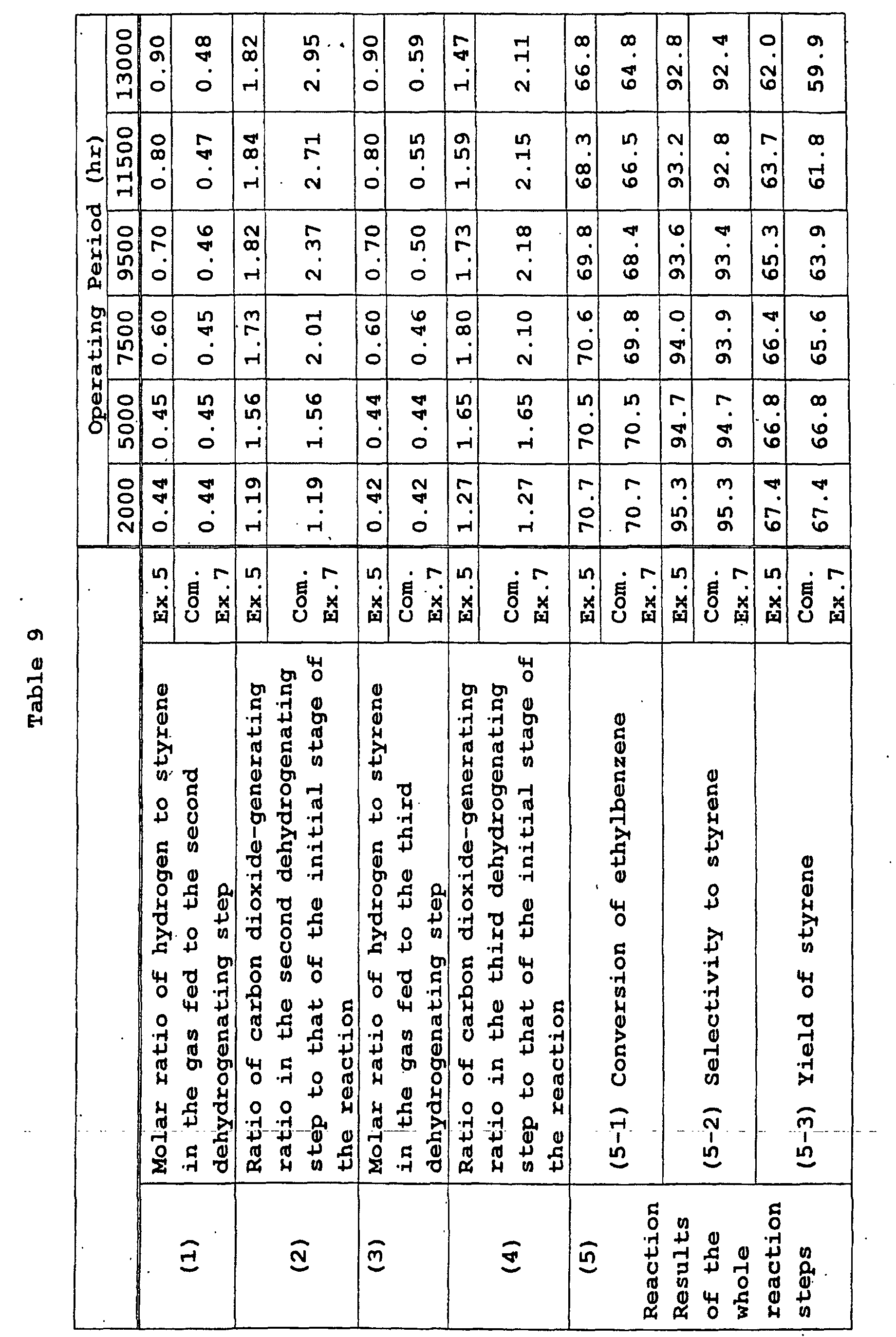
- styrene By controlling the carbon dioxide-generating ratio at a level less than 2.1 times that in the initial stage of the reaction, styrene can be produced with maintaining a high yield and a high selectivity even after operating for 7500 hours.
- styrene in the process of producing a styrene from ethylbenzene containing the combination of dehydrogenation reaction and oxidation reaction, styrene can be produced in a high yield over a long period of time.
Landscapes
- Chemical & Material Sciences (AREA)
- Organic Chemistry (AREA)
- Chemical Kinetics & Catalysis (AREA)
- Low-Molecular Organic Synthesis Reactions Using Catalysts (AREA)
- Organic Low-Molecular-Weight Compounds And Preparation Thereof (AREA)
Abstract
Description
| Example 1 | Com. Example 1 | Com. Example 2 | Blank | |
| Conversion of ethylbenzene | 28.9 | 23.9 | 20.8 | - |
| Selectivity to styrene | 93.6 | 92.2 | 90.0 | - |
| Ratio of generating carbon dioxide | 3.3 | 3.9 | 4.7 | 2.2 |
| Ratio of carbon dioxide-generating ratio to that of the initial stage of the reaction | 1.4 | 2.1 | 3.1 | - |
| Benzene-generating ratio | 0.45 | 0.51 | 0.62 | - |
| Example 1 In the Initial Stage of the reaction | Com. Example 1 In the Initial Stage of the reaction | Com. Example 2 In the Initial Stage of the reaction | Blank In the Initial Stage of the reaction | |
| Conversion of ethylbenzene | 42.9 | 43.8 | 44.7 | - |
| Selectivity to styrene | 95.1 | 95.2 | 95.2 | - |
| Ratio of generating carbon dioxide | 3.0 | 3.0 | 3.0 | 2.2 |
| Benzene-generating ratio | 0.34 | 0.34 | 0.34 | - |
| Example 2 | Com. Example 3 | Com. Example 4 | Blank | |
| Conversion of ethylbenzene | 31.0 | 27.1 | 25.0 | - |
| Selectivity to styrene | 94.0 | 93.1 | 92.2 | - |
| Ratio of generating carbon dioxide | 3.2 | 3.7 | 4.3 | 2.2 |
| Ratio of carbon dioxide-generating ratio to that of the initial stage of the reaction | 1.3 | 2.1 | 3.0 | - |
| Benzene-generating ratio | 0.44 | 0.50 | 0.61 | - |
| Example 2 In the Initial Stage of the reaction | Com. Example 3 In the Initial Stage of the reaction | Com. Example 4 In the Initial Stage of the reaction | Blank In the Initial Stage of the reaction | |
| Conversion of ethylbenzene | 45.5 | 46.8 | 47.9 | - |
| Selectivity to styrene | 95.5 | 95.6 | 95.6 | - |
| Ratio of generating carbon dioxide | 3.0 | 2.9 | 2.9 | 2.2 |
| Benzene-generating ratio | 0.34 | 0.34 | 0.34 | - |
| Example 3 | Com. Example 5 | Blank | |
| Conversion of ethylbenzene | 42.0 | 23.9 | - |
| Selectivity to styrene | 95.3 | 92.2 | - |
| Ratio of generating carbon dioxide | 3.0 | 3.9 | 2.2 |
| Ratio of carbon dioxide-generating ratio to that of the initial stage of the reaction | 1.1 | 2.4 | - |
| Benzene-generating ratio | 0.34 | 0.51 | - |
| Example 3 In the Initial Stage of the reaction | Com. Example 5 In the Initial Stage of the reaction | Blank | |
| Conversion of ethylbenzene | 43.1 | 43.8 | - |
| Selectivity to styrene | 95.3 | 95.2 | - |
| Ratio of generating carbon dioxide | 2.9 | 2.9 | 2.2 |
| Benzene-generating ratio | 0.34 | 0.34 | - |
| Example 4 | Com. Example 6 | Blank | |
| Conversion of ethylbenzene | 50.3 | 29.0 | - |
| Selectivity to styrene | 95.3 | 92.5 | - |
| Ratio of generating carbon dioxide | 3.3 | 4.2 | 2.2 |
| Ratio of carbon dioxide-generating ratio to that of the initial stage of the reaction | 1.2 | 2.5 | - |
| Benzene-generating ratio | 0.34 | 0.50 | - |
| Example 4 In the Initial Stage of the reaction | Com. Example 6 In the Initial Stage of the reaction | Blank | |
| Conversion of ethylbenzene | 51.4 | 55.3 | - |
| Selectivity to styrene | 95.3 | 95.2 | - |
| Ratio of generating carbon dioxide | 3.1 | 3.0 | 2.2 |
| Benzene-generating ratio | 0.33 | 0.34 | - |
Claims (13)
- A process for producing styrene by dehydrogenation of ethylbenzene, which comprises the steps of (i) feeding a raw material gas comprising ethylbenzene and steam to a first dehydrogenating step to produce a reacted gas comprising ethylbenzene, styrene and hydrogen in the presence of a dehydrogenation catalyst, (ii) feeding the reacted gas obtained in the first dehydrogenating step to an oxidizing step to combust at least part of hydrogen in the presence of an oxidation catalyst, and (iii) feeding the reacted gas obtained in the oxidizing step to a second dehydrogenating step to produce styrene from ethylbenzene in the presence of the dehydrogenation catalyst, with maintaining the carbon dioxide-generating ratio in the second dehydrogenating step at a level less than 2.1 times that at the initial stage of the reaction.
- The process as claimed in claim 1, wherein the carbon dioxide-generating ratio is maintained at a level less than 2.0 times that at the initial stage of the reaction.
- The process as claimed in claim 1 or 2, wherein the reacted gas to be fed to the second dehydrogenating step has a molar ratio of hydrogen to styrene in the range of from 0.8 to 2.0.
- The process as claimed in claim 1 or 2, wherein the reacted gas to be fed to the second dehydrogenating step has a molar ratio of hydrogen to styrene in the range of from 0.9 to 1.3.
- The process as claimed in any one of claims 1 to 4, wherein the reacted gas generated in the first dehydrogenating step is mixed with oxygen and hydrogen, and fed to the oxidizing step.
- The process as claimed in any one of claims 1 to 5, wherein the reacted gas generated in the oxidizing step is mixed with hydrogen, and fed to the second dehydrogenating step.
- The process as claimed in any one of claims 1 to 6, wherein the catalyst in the second dehydrogenating step is a potassium-containing, iron-based catalyst in which the ratio of potassium to iron in the 5% by weight portion of the catalyst in the inlet portion of the reactor is 15% or less of the ratio of potassium to iron in the rest portion of the catalyst.
- The process as claimed in any one of claims 1 to 6, wherein the catalyst in the second dehydrogenating step is a potassium-containing, iron-based catalyst in which the ratio of potassium to iron in the 10% by weight portion of the catalyst in the inlet portion of the reactor is 15% or less of the ratio of potassium to iron in the rest portion of the catalyst.
- The process as claimed in any one of claims 1 to 8, wherein the temperature of the reacted gas to be fed to the second dehydrogenating step is 620°C or higher than that.
- The process as claimed in any one of claims 1 to 9, wherein the dehydrogenation catalyst is a potassium-containing, iron-based catalyst wherein a catalyst having a lower potassium-flying rate is used in the upstream side of the catalyst-packed bed within the reactor.
- The process as claimed in any one of claims 1 to 10, wherein two kinds of dehydrogenation catalysts different from each other in potassium-flying rate are used in the dehydrogenating step of or after the second dehydrogenating step, and one catalyst showing a relatively lower potassium-flying rate is used in the upstream side and the other catalyst showing a relatively higher potassium-flying rate is used on the downstream side.
- The process as claimed in any one of claims 1 to 11, wherein a second oxidizing step and a third dehydrogenating step are provided.
- A process for producing styrene by dehydrogenation of ethylbenzene in the presence of a potassium-containing, iron-based catalyst, which comprises filling a catalyst showing a lower potassium-flying rate in the upstream portion of the catalyst-packed bed within the dehydrogenation reactor.
Applications Claiming Priority (7)
| Application Number | Priority Date | Filing Date | Title |
|---|---|---|---|
| JP2000248094 | 2000-08-18 | ||
| JP2000248094 | 2000-08-18 | ||
| JP2000269613 | 2000-09-06 | ||
| JP2000269612 | 2000-09-06 | ||
| JP2000269612 | 2000-09-06 | ||
| JP2000269613 | 2000-09-06 | ||
| PCT/JP2001/007091 WO2002016292A1 (en) | 2000-08-18 | 2001-08-17 | Process for producing styrene |
Publications (2)
| Publication Number | Publication Date |
|---|---|
| EP1229011A1 true EP1229011A1 (en) | 2002-08-07 |
| EP1229011A4 EP1229011A4 (en) | 2009-11-25 |
Family
ID=27344375
Family Applications (1)
| Application Number | Title | Priority Date | Filing Date |
|---|---|---|---|
| EP01956948A Withdrawn EP1229011A4 (en) | 2000-08-18 | 2001-08-17 | PROCESS FOR PRODUCING STYRENE |
Country Status (7)
| Country | Link |
|---|---|
| US (1) | US6884915B2 (en) |
| EP (1) | EP1229011A4 (en) |
| JP (1) | JP2008266339A (en) |
| CN (1) | CN1191215C (en) |
| AU (1) | AU2001278766A1 (en) |
| CA (1) | CA2387715C (en) |
| WO (1) | WO2002016292A1 (en) |
Cited By (3)
| Publication number | Priority date | Publication date | Assignee | Title |
|---|---|---|---|---|
| WO2008061938A3 (en) * | 2006-11-20 | 2008-08-28 | Basf Se | Method for the dehydrogenation of hydrocarbons, entailing dehydrogenation and oxidation steps |
| CN101171214B (en) * | 2005-06-10 | 2011-04-20 | 三菱化学株式会社 | How to make styrene |
| CN103933964A (en) * | 2014-04-17 | 2014-07-23 | 陕西师范大学 | A kind of CO The preparation method of the vanadium-based catalyst that oxidizes ethylbenzene and dehydrogenates styrene |
Families Citing this family (10)
| Publication number | Priority date | Publication date | Assignee | Title |
|---|---|---|---|---|
| CN100368364C (en) * | 2004-10-29 | 2008-02-13 | 中国石油化工股份有限公司 | Multi-stage adiabatic negative pressure dehydrogenation method for the production of styrene |
| HRP20110404T1 (en) * | 2005-11-08 | 2011-08-31 | Ambrx | Accelerants for the modification of non-natural amino acids and non-natural amino acid polypeptides |
| CN100372819C (en) * | 2006-06-22 | 2008-03-05 | 华东理工大学 | A kind of reaction method of hydrogen oxidation preparation styrene |
| US8237000B2 (en) | 2008-06-19 | 2012-08-07 | Lummus Technology, Inc. | Combined carbon dioxide and oxygen process for ethylbenzene dehydrogenation to styrene |
| US20110004037A1 (en) * | 2009-07-02 | 2011-01-06 | Uop Llc | Use of Mixed Activity Dehydrogenation Catalyst Following Oxidative Reheat |
| US8173852B1 (en) | 2011-05-17 | 2012-05-08 | Uop Llc | Methods and apparatuses for producing styrene from ethylbenzene |
| CN103120917A (en) * | 2011-11-18 | 2013-05-29 | 中国石油化工股份有限公司 | Device for preparing styrene through dehydrogenation and hydro-oxidation of ethylbenzene |
| CN103121917B (en) * | 2011-11-18 | 2015-09-09 | 中国石油化工股份有限公司 | Reduce the method for ethylbenzene dividing potential drop in ethylbenzene dehydrogenation reaction process |
| CN104353443A (en) * | 2014-11-18 | 2015-02-18 | 沈阳化工大学 | Method for preparing styrene catalyst by ethylbenzene dehydrogenation |
| CN106582684B (en) * | 2015-10-16 | 2019-12-10 | 中国石油化工股份有限公司 | catalyst for dehydrogenation of alkyl aromatic hydrocarbon |
Family Cites Families (16)
| Publication number | Priority date | Publication date | Assignee | Title |
|---|---|---|---|---|
| JPS5889945A (en) * | 1981-11-26 | 1983-05-28 | Mitsubishi Petrochem Co Ltd | Selective oxidatative catalyst for hydrogen in dehydrogenated product of ethyl benzene |
| US4691071A (en) * | 1986-12-11 | 1987-09-01 | Uop Inc. | Dehydrogenation of dehydrogenatable hydrocarbons |
| US4788371A (en) * | 1987-12-30 | 1988-11-29 | Uop Inc. | Catalytic oxidative steam dehydrogenation process |
| US5605428A (en) * | 1993-03-05 | 1997-02-25 | Jenoptik Gmbh | Device for indexing magazine compartments and wafer-shaped objects in the compartments |
| DE19535871C2 (en) * | 1995-09-27 | 2000-02-10 | Jenoptik Jena Gmbh | Indexer for magazine compartments of a magazine and disc-shaped objects contained therein |
| CA2297071C (en) * | 1997-07-17 | 2006-07-11 | Mitsubishi Chemical Corporation | Process for producing styrene |
| DE19752510B4 (en) * | 1997-11-27 | 2005-11-24 | Brooks Automation (Germany) Gmbh | Device and method for detecting and distinguishing geometrically different types of fan-forming supports in cassettes and disk-shaped objects deposited thereon |
| US6219313B1 (en) * | 1999-01-19 | 2001-04-17 | Storage Technology Corporation | System and method for adaptive cartridge engagement in an automated cartridge library |
| JP2000248094A (en) | 1999-02-26 | 2000-09-12 | Nitto Denko Corp | Porous film and method for producing the same |
| JP2000269612A (en) | 1999-03-16 | 2000-09-29 | Sony Corp | Double-sided flexible printed wiring board |
| JP2000269613A (en) | 1999-03-18 | 2000-09-29 | Matsushita Electric Ind Co Ltd | Unwanted radiation printed circuit board |
| US6763281B2 (en) * | 1999-04-19 | 2004-07-13 | Applied Materials, Inc | Apparatus for alignment of automated workpiece handling systems |
| TW469483B (en) * | 1999-04-19 | 2001-12-21 | Applied Materials Inc | Method and apparatus for aligning a cassette |
| US6388436B1 (en) * | 1999-08-06 | 2002-05-14 | International Business Machines Corporation | Apparatus for calibrating the alignment of a wafer cassette holder to a robot blade |
| US6461995B1 (en) * | 2000-05-08 | 2002-10-08 | Corning Incorporated | Extruded honeycomb dehydrogenation catalyst and method |
| US6542839B1 (en) * | 2000-09-29 | 2003-04-01 | Taiwan Semiconductor Manufacturing Co., Ltd | Apparatus and method for calibrating the position of a cassette indexer |
-
2001
- 2001-08-17 AU AU2001278766A patent/AU2001278766A1/en not_active Abandoned
- 2001-08-17 WO PCT/JP2001/007091 patent/WO2002016292A1/en not_active Ceased
- 2001-08-17 EP EP01956948A patent/EP1229011A4/en not_active Withdrawn
- 2001-08-17 CA CA002387715A patent/CA2387715C/en not_active Expired - Lifetime
- 2001-08-17 CN CN01802428.9A patent/CN1191215C/en not_active Expired - Lifetime
-
2002
- 2002-04-18 US US10/124,318 patent/US6884915B2/en not_active Expired - Fee Related
-
2008
- 2008-05-09 JP JP2008123166A patent/JP2008266339A/en not_active Withdrawn
Cited By (4)
| Publication number | Priority date | Publication date | Assignee | Title |
|---|---|---|---|---|
| CN101171214B (en) * | 2005-06-10 | 2011-04-20 | 三菱化学株式会社 | How to make styrene |
| WO2008061938A3 (en) * | 2006-11-20 | 2008-08-28 | Basf Se | Method for the dehydrogenation of hydrocarbons, entailing dehydrogenation and oxidation steps |
| CN103933964A (en) * | 2014-04-17 | 2014-07-23 | 陕西师范大学 | A kind of CO The preparation method of the vanadium-based catalyst that oxidizes ethylbenzene and dehydrogenates styrene |
| CN103933964B (en) * | 2014-04-17 | 2016-04-06 | 陕西师范大学 | A kind of CO 2the preparation method of the catalytic component based on vanadium of oxidation ethyl benzene dehydrogenation preparation of styrene |
Also Published As
| Publication number | Publication date |
|---|---|
| US20020165418A1 (en) | 2002-11-07 |
| CA2387715A1 (en) | 2002-02-28 |
| JP2008266339A (en) | 2008-11-06 |
| WO2002016292A1 (en) | 2002-02-28 |
| AU2001278766A1 (en) | 2002-03-04 |
| EP1229011A4 (en) | 2009-11-25 |
| CA2387715C (en) | 2009-03-24 |
| US6884915B2 (en) | 2005-04-26 |
| CN1191215C (en) | 2005-03-02 |
| CN1388799A (en) | 2003-01-01 |
Similar Documents
| Publication | Publication Date | Title |
|---|---|---|
| Palmer et al. | Dry reforming of methane catalysed by molten metal alloys | |
| TWI227229B (en) | Oxidation process for the production of alkenes and carboxylic acids | |
| JP2008266339A (en) | Method for producing styrene | |
| RU2002730C1 (en) | Method of acetic acid synthesis and a catalyst for its realization | |
| Müller et al. | Combustion of methane over palladium/zirconia: effect of Pd-particle size and role of lattice oxygen | |
| RU2208480C2 (en) | Catalyst for oxidizing ethane and/or ethylene into acetic acid (options) and acetic acid production method | |
| EP1043064B1 (en) | Mixed metal oxide catalyst and use thereof in oxidation reactions | |
| EP0274681B1 (en) | Process for production of acrylic acid | |
| EP1296925A1 (en) | Process for the production of vinyl acetate | |
| EP3707115B1 (en) | Controlling carbon dioxide output from an odh process | |
| KR102908238B1 (en) | Limitations of acetic acid production in the ethane ODH process | |
| US6326523B1 (en) | Process for the dehydrogenation of a hydrocarbon feed stock | |
| JP4154877B2 (en) | Method for producing styrene | |
| Låte et al. | Selective combustion of hydrogen in the presence of hydrocarbons: Part 2. Metal oxide based catalysts | |
| Bartsch et al. | Catalyst development for oxidative methane coupling | |
| KR101135416B1 (en) | Process for production of styrene | |
| US7619099B2 (en) | Reduction of acrylic acid in the production of maleic anhydride | |
| Yao et al. | A kinetic study of methanol oxidation over SiO2 | |
| Ramos et al. | Oxidative dehydrogenation of propane to propene, 1: Kinetic study on V/MgO | |
| US7589217B2 (en) | Yield improvement in the production of maleic anhydride | |
| JP2007016027A (en) | Method for producing styrene | |
| Låte et al. | Catalytic dehydrogenation of propane over a PtSn/SiO2 catalyst with oxygen addition: Selective oxidation of H2 in the presence of hydrocarbons | |
| JP2004099534A (en) | Apparatus and method for producing acrylic acid | |
| JPS61200195A (en) | Production of reducible gas | |
| TH32998A (en) | Oxidizing propane to form an industrial homogeneous catalytic gas-phase acrylide. |
Legal Events
| Date | Code | Title | Description |
|---|---|---|---|
| PUAI | Public reference made under article 153(3) epc to a published international application that has entered the european phase |
Free format text: ORIGINAL CODE: 0009012 |
|
| 17P | Request for examination filed |
Effective date: 20020517 |
|
| AK | Designated contracting states |
Kind code of ref document: A1 Designated state(s): AT BE CH CY DE DK ES FI FR GB GR IE IT LI LU MC NL PT SE TR |
|
| AX | Request for extension of the european patent |
Free format text: AL;LT;LV;MK;RO;SI |
|
| RBV | Designated contracting states (corrected) |
Designated state(s): DE GB NL |
|
| RAP1 | Party data changed (applicant data changed or rights of an application transferred) |
Owner name: MITSUBISHI CHEMICAL CORPORATION |
|
| RAP1 | Party data changed (applicant data changed or rights of an application transferred) |
Owner name: MITSUBISHI CHEMICAL CORPORATION |
|
| A4 | Supplementary search report drawn up and despatched |
Effective date: 20091022 |
|
| 17Q | First examination report despatched |
Effective date: 20100707 |
|
| RAP1 | Party data changed (applicant data changed or rights of an application transferred) |
Owner name: MITSUBISHI CHEMICAL CORPORATION |
|
| GRAP | Despatch of communication of intention to grant a patent |
Free format text: ORIGINAL CODE: EPIDOSNIGR1 |
|
| GRAJ | Information related to disapproval of communication of intention to grant by the applicant or resumption of examination proceedings by the epo deleted |
Free format text: ORIGINAL CODE: EPIDOSDIGR1 |
|
| GRAP | Despatch of communication of intention to grant a patent |
Free format text: ORIGINAL CODE: EPIDOSNIGR1 |
|
| INTG | Intention to grant announced |
Effective date: 20150702 |
|
| INTG | Intention to grant announced |
Effective date: 20150715 |
|
| STAA | Information on the status of an ep patent application or granted ep patent |
Free format text: STATUS: THE APPLICATION IS DEEMED TO BE WITHDRAWN |
|
| 18D | Application deemed to be withdrawn |
Effective date: 20151126 |