EP1228575B1 - Apparatus and method of implementing a universal home network on a customer premises isdn bus - Google Patents
Apparatus and method of implementing a universal home network on a customer premises isdn bus Download PDFInfo
- Publication number
- EP1228575B1 EP1228575B1 EP00961571A EP00961571A EP1228575B1 EP 1228575 B1 EP1228575 B1 EP 1228575B1 EP 00961571 A EP00961571 A EP 00961571A EP 00961571 A EP00961571 A EP 00961571A EP 1228575 B1 EP1228575 B1 EP 1228575B1
- Authority
- EP
- European Patent Office
- Prior art keywords
- wire
- isdn
- path
- network
- home network
- Prior art date
- Legal status (The legal status is an assumption and is not a legal conclusion. Google has not performed a legal analysis and makes no representation as to the accuracy of the status listed.)
- Expired - Lifetime
Links
- 238000000034 method Methods 0.000 title claims description 13
- 238000004804 winding Methods 0.000 claims description 18
- 230000008878 coupling Effects 0.000 claims description 9
- 238000010168 coupling process Methods 0.000 claims description 9
- 238000005859 coupling reaction Methods 0.000 claims description 9
- 230000000295 complement effect Effects 0.000 claims description 3
- 238000001914 filtration Methods 0.000 claims description 2
- 230000005540 biological transmission Effects 0.000 abstract description 16
- 238000013507 mapping Methods 0.000 abstract 1
- 238000010586 diagram Methods 0.000 description 6
- 230000006855 networking Effects 0.000 description 6
- 238000005516 engineering process Methods 0.000 description 4
- 230000008901 benefit Effects 0.000 description 3
- 239000003990 capacitor Substances 0.000 description 3
- 238000002955 isolation Methods 0.000 description 2
- 230000000737 periodic effect Effects 0.000 description 2
- 230000002411 adverse Effects 0.000 description 1
- 238000004378 air conditioning Methods 0.000 description 1
- 230000002457 bidirectional effect Effects 0.000 description 1
- 238000004891 communication Methods 0.000 description 1
- 238000001514 detection method Methods 0.000 description 1
- 238000011161 development Methods 0.000 description 1
- 238000010438 heat treatment Methods 0.000 description 1
- 230000007246 mechanism Effects 0.000 description 1
- 238000012986 modification Methods 0.000 description 1
- 230000004048 modification Effects 0.000 description 1
- 238000011084 recovery Methods 0.000 description 1
- 238000009877 rendering Methods 0.000 description 1
- 238000012360 testing method Methods 0.000 description 1
Images

Classifications
-
- H—ELECTRICITY
- H04—ELECTRIC COMMUNICATION TECHNIQUE
- H04B—TRANSMISSION
- H04B1/00—Details of transmission systems, not covered by a single one of groups H04B3/00 - H04B13/00; Details of transmission systems not characterised by the medium used for transmission
- H04B1/38—Transceivers, i.e. devices in which transmitter and receiver form a structural unit and in which at least one part is used for functions of transmitting and receiving
- H04B1/40—Circuits
- H04B1/54—Circuits using the same frequency for two directions of communication
- H04B1/58—Hybrid arrangements, i.e. arrangements for transition from single-path two-direction transmission to single-direction transmission on each of two paths or vice versa
-
- H—ELECTRICITY
- H04—ELECTRIC COMMUNICATION TECHNIQUE
- H04Q—SELECTING
- H04Q11/00—Selecting arrangements for multiplex systems
- H04Q11/04—Selecting arrangements for multiplex systems for time-division multiplexing
- H04Q11/0428—Integrated services digital network, i.e. systems for transmission of different types of digitised signals, e.g. speech, data, telecentral, television signals
- H04Q11/0435—Details
- H04Q11/0471—Terminal access circuits
-
- H—ELECTRICITY
- H04—ELECTRIC COMMUNICATION TECHNIQUE
- H04B—TRANSMISSION
- H04B1/00—Details of transmission systems, not covered by a single one of groups H04B3/00 - H04B13/00; Details of transmission systems not characterised by the medium used for transmission
- H04B1/38—Transceivers, i.e. devices in which transmitter and receiver form a structural unit and in which at least one part is used for functions of transmitting and receiving
- H04B1/40—Circuits
- H04B1/54—Circuits using the same frequency for two directions of communication
- H04B1/58—Hybrid arrangements, i.e. arrangements for transition from single-path two-direction transmission to single-direction transmission on each of two paths or vice versa
- H04B1/581—Hybrid arrangements, i.e. arrangements for transition from single-path two-direction transmission to single-direction transmission on each of two paths or vice versa using a transformer
-
- H—ELECTRICITY
- H04—ELECTRIC COMMUNICATION TECHNIQUE
- H04L—TRANSMISSION OF DIGITAL INFORMATION, e.g. TELEGRAPHIC COMMUNICATION
- H04L12/00—Data switching networks
- H04L12/28—Data switching networks characterised by path configuration, e.g. LAN [Local Area Networks] or WAN [Wide Area Networks]
- H04L12/2803—Home automation networks
-
- H—ELECTRICITY
- H04—ELECTRIC COMMUNICATION TECHNIQUE
- H04L—TRANSMISSION OF DIGITAL INFORMATION, e.g. TELEGRAPHIC COMMUNICATION
- H04L12/00—Data switching networks
- H04L12/28—Data switching networks characterised by path configuration, e.g. LAN [Local Area Networks] or WAN [Wide Area Networks]
- H04L12/2803—Home automation networks
- H04L2012/284—Home automation networks characterised by the type of medium used
- H04L2012/2845—Telephone line
-
- H—ELECTRICITY
- H04—ELECTRIC COMMUNICATION TECHNIQUE
- H04L—TRANSMISSION OF DIGITAL INFORMATION, e.g. TELEGRAPHIC COMMUNICATION
- H04L25/00—Baseband systems
- H04L25/02—Details ; arrangements for supplying electrical power along data transmission lines
- H04L25/0264—Arrangements for coupling to transmission lines
- H04L25/0266—Arrangements for providing Galvanic isolation, e.g. by means of magnetic or capacitive coupling
-
- H—ELECTRICITY
- H04—ELECTRIC COMMUNICATION TECHNIQUE
- H04Q—SELECTING
- H04Q2213/00—Indexing scheme relating to selecting arrangements in general and for multiplex systems
- H04Q2213/13096—Digital apparatus individually associated with a subscriber line, digital line circuits
-
- H—ELECTRICITY
- H04—ELECTRIC COMMUNICATION TECHNIQUE
- H04Q—SELECTING
- H04Q2213/00—Indexing scheme relating to selecting arrangements in general and for multiplex systems
- H04Q2213/13166—Fault prevention
-
- H—ELECTRICITY
- H04—ELECTRIC COMMUNICATION TECHNIQUE
- H04Q—SELECTING
- H04Q2213/00—Indexing scheme relating to selecting arrangements in general and for multiplex systems
- H04Q2213/1319—Amplifier, attenuation circuit, echo suppressor
-
- H—ELECTRICITY
- H04—ELECTRIC COMMUNICATION TECHNIQUE
- H04Q—SELECTING
- H04Q2213/00—Indexing scheme relating to selecting arrangements in general and for multiplex systems
- H04Q2213/13209—ISDN
-
- H—ELECTRICITY
- H04—ELECTRIC COMMUNICATION TECHNIQUE
- H04Q—SELECTING
- H04Q2213/00—Indexing scheme relating to selecting arrangements in general and for multiplex systems
- H04Q2213/1322—PBX
-
- H—ELECTRICITY
- H04—ELECTRIC COMMUNICATION TECHNIQUE
- H04Q—SELECTING
- H04Q2213/00—Indexing scheme relating to selecting arrangements in general and for multiplex systems
- H04Q2213/13299—Bus
Definitions
- the present invention relates to network interfacing, and more particularly to methods and systems for controlling transmission of data between network stations connected to a telephone line medium.
- the Home Phoneline Networking Alliance "Simple, high-speed ethernet technology for the home", a White Paper, June 1998 discloses the principles of phone line network technology. In particular, the paper discusses the challenges surrounding the development of a standard for home networking using conventional telephone lines.
- An additional problem in telephone wiring networks is that the signal condition (i.e.. shape) of a transmitted waveform depends largely on the wiring topology. Numerous branch connections in the twisted pair telephone line medium, as well as the different associated lengths of the branch connections, may cause multiple signal reflections on a transmitted network signal. Telephone wiring topology may cause the network signal from one network station to have a peak to peak voltage on the order of 10 to 20 millivolts, whereas network signals from another network station may have a value on the order of one to two volts. Hence, the amplitude and shape of a received pulse may be so distorted that recovery of a transmitted clock or transmit data from the received pulse becomes substantially difficult.
- NTBA network termination basic access
- ISDN Integrated Services Digital Network
- NTBA devices map a two wire ISDN signal from a central office into a four wire S0 bus having a two wire send path and a two wire receive path for sending and receiving the ISDN-based signals throughout a customer premises.
- the ISDN-based signals generate harmonic reflections on the S0 bus that cause substantial interference with the higher-frequency network signals.
- the zero crossing of an ISDN-based signal interferes substantially with the transmitted network signals, rendering the transmitted network signal unusable due to the harsh conditions on the four wire S0 signal bus.
- manufacturers of NTBA devices and ISDN terminal devices may have internal capacitors to minimize electromagnetic interference (EMI) of the devices. These internal capacitors, however, induce capacitive loads on the bus. These capacitive, while compliant with ISDN amplitude and timing requirements, severely attenuate the higher frequency network signals and substantially limit the distance that the network signals can be transmitted.
- EMI electromagnetic interference
- NTBA network termination basic access
- filters are coupled between each ISDN device and the four-wire S0 bus, insuring that the four-wire S0 bus is isolated from the capacitive influences of the ISDN devices. This isolation of the S0 bus insures the proper transmission of the higher frequency home network signals.
- One aspect of the present invention provides a method of implementing a local area network in a home telephone network having a connector, configured for sending and receiving ISDN-based signals to and from a public switched telephone network, and a four-wire bus.
- the four-wire bus includes a two-wire send path and a two-wire receive path for sending and receiving the ISDN-based signals, respectively, between the connector and connected ISDN terminal devices.
- the method includes connecting a low pass filter between the two wires of the two-wire send path at an output terminal of the connector, the low pass filter configured for passing the ISDN-based signals and rejecting harmonics thereof and isolating capacitive influences of the connector from the two-wire send path.
- the method also includes isolating capacitive influences of each of the connected ISDN terminal devices from the two-wire send path, and transmitting by a network node a first home network signal onto the two-wire send path and a second home network signal, complementary to the first home network signal, onto the two-wire receive path.
- Connection of the low pass filter insures that any harmonics of the ISDN-based signals to not interfere with the home network signals.
- the isolation of each of the connected ISDN terminal devices insures that the circuitry within the ISDN terminal devices does not induce any capacitive loads onto the two-wire send path that may adversely affect transmission of the home network signals.
- the transmission of the first and second home network signals onto the two-wire send path and the two-wire receive path enables the two-wire home network signal to be transmitted onto a four-wire bus, substantially increasing the effective diameter of the transmission medium and greatly improving transmission performance.
- the computer network includes a connector configured for sending and receiving ISDN-based signals to and from a public switched telephone network.
- the computer network also includes a four-wire bus having a two-wire send path and a two-wire receive path for sending and receiving the ISDN-based signals between the connector and ISDN terminal devices.
- a low pass filter coupled between the two-wire send path and the connector, is configured for isolating capacitive influences of the connector from the two-wire send path and filtering ISDN harmonic signals occurring substantially at the frequencies of network data signals.
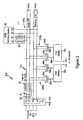
- FIG. 1 is a block diagram illustrating an Ethernet (IEEE 802.3) local area network 10 implemented in a home environment using ISDN-based signals according to an embodiment of the present invention.
- the home environment includes a network termination basic access (NTBA) device 12, configured for sending and receiving Integrated Services Digital Network (ISDN) signals to and from a public switched telephone network via a two-wire twisted pair.
- the NTBA device 12 is configured for outputting ISDN signals onto a four-wire S0 bus 14, having two wires for a send path 16 and two wires for a receive path 18.
- the S0 bus fourteen may have multiple connections, or "taps" 20 connected in parallel off the S0 bus 14.
- the S0 bus may be internal to a PBX system; as such, the NTBA 12 serves as a connector for the S0 bus 14 to the two-wire twisted pair from the public switched telephone network.
- the NTBA 12 maps the ISDN signals into a two-wire send path 16, and a two-wire receive path 18.
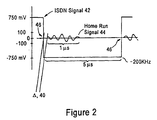
- the receive path 18 reflects the ISDN signal transmitted on the send path 16, with a 2-bit spacing relative to the ISDN clock frequency of about 200 kHz (e.g., 192 kHz).
- home PNA due to the high level of ISDN noise in the frequency used for home networking, referred to as home PNA by the Home Phone Network Alliance, transmissions of home PNA data on the ISDN S0 bus 14 is normally not possible.
- a low pass filter 30 is installed in the send path 16 of the NTBA 12.
- the low pass filter 30 is illustrated as external to the NTBA 12, although the low pass filter 30 may also be integrated internally within the NTBA 12; in either case, the low pass filter 30 will be coupled to the output terminal of the NTBA device 12, either internally or externally.
- the low pass filter 30 includes an inductor 32 (e.g., 2 x 4.7 millihenries) and a capacitor 34 (e.g., 1 nanofarad) that attenuates the high frequency noise caused by the harmonics of the 192 kHz ISDN signal.
- the send path 16 and receive path 18 are free of high frequency harmonics that may affect the home network signals between end stations 22a and 22b.
- the inductor 32 implemented for example as a common mode choke, isolates the capacitive influence of NTBA 12 from the two-wire send path 16, enabling the high frequency home network signals to be transmitted without capacitive loading by the NTBA 12.
- the disclosed network 10 also includes ISDN terminal filters 62 configured for isolating each of the connected ISDN terminal devices 60 from the two-wire send path 16.
- Each ISDN terminal filter 62 is preferably implemented as a common mode choke (e.g., 2 x 4.7 millihenries) which is connected between the corresponding ISDN terminal device 60 and the two wire send path 16.
- the low pass filter 30 and the ISDN terminal filters 62 isolate the respective ISDN devices from the two-wire send path 16, providing optimal conditions for transmission of the home network signals having a frequency of at least about 7.5 MHz.
- transformers 64a and 64b are symmetrically connected to the two wires a1, b1 of the send direction 16 and the two wires a2, b2 of the S0 bus 14, respectively.
- the ends of transformers 64c and 64d are symmetrically connected to the two wires a1, b1 of the send direction 16 and the two wires a2, b2 of the S0 bus 14, respectively.
- FIG. 3 is a diagram illustrating an alternative implementation of the local area network 10 of Figure 1 according to another embodiment of the present invention.
- the network 200 includes a private branch exchange (PBX) 210.
- the PBX 210 includes an internal connector 212 for an internal S0 bus 214 having a send path 216 and a receive path 218.
- the internal connector 212 has circuitry that is configured for connecting the internal S0 bus 214 to the S0 bus 14 (also referred to as the external S0 bus) for communication with the public switched telephone network.
- the PBX 210 will typically have four to eight analog (tip-and-ring) connectors (not shown), one external connector for connection to the external S0 bus, and up to eight digital connections off the S0 bus 214.
Landscapes
- Engineering & Computer Science (AREA)
- Computer Networks & Wireless Communication (AREA)
- Signal Processing (AREA)
- Power Engineering (AREA)
- Telephonic Communication Services (AREA)
- Small-Scale Networks (AREA)
- Data Exchanges In Wide-Area Networks (AREA)
Applications Claiming Priority (5)
| Application Number | Priority Date | Filing Date | Title |
|---|---|---|---|
| US16323999P | 1999-11-03 | 1999-11-03 | |
| US163239P | 1999-11-03 | ||
| US09/495,123 US6522728B1 (en) | 1999-11-03 | 2000-02-01 | Apparatus and method of implementing a universal home network on a customer premises ISDN bus |
| US495123 | 2000-02-01 | ||
| PCT/US2000/024395 WO2001033724A2 (en) | 1999-11-03 | 2000-09-05 | Apparatus and method of implementing a universal home network on a customer premises isdn bus |
Publications (2)
| Publication Number | Publication Date |
|---|---|
| EP1228575A2 EP1228575A2 (en) | 2002-08-07 |
| EP1228575B1 true EP1228575B1 (en) | 2003-11-12 |
Family
ID=26859468
Family Applications (1)
| Application Number | Title | Priority Date | Filing Date |
|---|---|---|---|
| EP00961571A Expired - Lifetime EP1228575B1 (en) | 1999-11-03 | 2000-09-05 | Apparatus and method of implementing a universal home network on a customer premises isdn bus |
Country Status (10)
| Country | Link |
|---|---|
| US (1) | US6522728B1 (enExample) |
| EP (1) | EP1228575B1 (enExample) |
| JP (1) | JP2003513583A (enExample) |
| KR (1) | KR100683278B1 (enExample) |
| CN (1) | CN1144385C (enExample) |
| AT (1) | ATE254361T1 (enExample) |
| AU (1) | AU763432B2 (enExample) |
| DE (1) | DE60006572T2 (enExample) |
| TW (1) | TWI231118B (enExample) |
| WO (1) | WO2001033724A2 (enExample) |
Families Citing this family (22)
| Publication number | Priority date | Publication date | Assignee | Title |
|---|---|---|---|---|
| US6480510B1 (en) | 1998-07-28 | 2002-11-12 | Serconet Ltd. | Local area network of serial intelligent cells |
| US6690677B1 (en) | 1999-07-20 | 2004-02-10 | Serconet Ltd. | Network for telephony and data communication |
| US6836546B1 (en) * | 1999-11-03 | 2004-12-28 | Advanced Micro Devices, Inc. | Apparatus and method of coupling home network signals between an analog phone line and a digital bus |
| US6549616B1 (en) * | 2000-03-20 | 2003-04-15 | Serconet Ltd. | Telephone outlet for implementing a local area network over telephone lines and a local area network using such outlets |
| IL135744A (en) | 2000-04-18 | 2008-08-07 | Mosaid Technologies Inc | Telephone communication system over a single telephone line |
| US6842459B1 (en) | 2000-04-19 | 2005-01-11 | Serconet Ltd. | Network combining wired and non-wired segments |
| IL144158A (en) | 2001-07-05 | 2011-06-30 | Mosaid Technologies Inc | Socket for connecting an analog telephone to a digital communications network that carries digital voice signals |
| IL161190A0 (en) * | 2001-10-11 | 2004-08-31 | Serconet Ltd | Outlet with analog signal adapter, method for use thereof and a network using said outlet |
| IL154234A (en) * | 2003-01-30 | 2010-12-30 | Mosaid Technologies Inc | Method and system for providing dc power on local telephone lines |
| IL154921A (en) * | 2003-03-13 | 2011-02-28 | Mosaid Technologies Inc | A telephone system that includes many separate sources and accessories for it |
| IL157787A (en) | 2003-09-07 | 2010-12-30 | Mosaid Technologies Inc | Modular outlet for data communications network |
| IL159838A0 (en) | 2004-01-13 | 2004-06-20 | Yehuda Binder | Information device |
| IL160417A (en) * | 2004-02-16 | 2011-04-28 | Mosaid Technologies Inc | Unit added to the outlet |
| IL161869A (en) | 2004-05-06 | 2014-05-28 | Serconet Ltd | A system and method for carrying a signal originating is wired using wires |
| US7873058B2 (en) | 2004-11-08 | 2011-01-18 | Mosaid Technologies Incorporated | Outlet with analog signal adapter, a method for use thereof and a network using said outlet |
| US7813451B2 (en) | 2006-01-11 | 2010-10-12 | Mobileaccess Networks Ltd. | Apparatus and method for frequency shifting of a wireless signal and systems using frequency shifting |
| WO2009053910A2 (en) | 2007-10-22 | 2009-04-30 | Mobileaccess Networks Ltd. | Communication system using low bandwidth wires |
| US8175649B2 (en) | 2008-06-20 | 2012-05-08 | Corning Mobileaccess Ltd | Method and system for real time control of an active antenna over a distributed antenna system |
| CN102232191B (zh) | 2009-02-08 | 2015-07-08 | 康宁移动接入有限公司 | 采用携带以太网信号的电缆的通信系统 |
| WO2013142662A2 (en) | 2012-03-23 | 2013-09-26 | Corning Mobile Access Ltd. | Radio-frequency integrated circuit (rfic) chip(s) for providing distributed antenna system functionalities, and related components, systems, and methods |
| US9184960B1 (en) | 2014-09-25 | 2015-11-10 | Corning Optical Communications Wireless Ltd | Frequency shifting a communications signal(s) in a multi-frequency distributed antenna system (DAS) to avoid or reduce frequency interference |
| CN115776421B (zh) * | 2022-11-02 | 2024-09-20 | 西安现代控制技术研究所 | 一种高速网络总线的电磁隔离电路及方法 |
Family Cites Families (6)
| Publication number | Priority date | Publication date | Assignee | Title |
|---|---|---|---|---|
| JPS56161750A (en) * | 1980-05-16 | 1981-12-12 | Iwatsu Electric Co Ltd | Synchronizing system in telephone set |
| JP3225637B2 (ja) * | 1992-11-12 | 2001-11-05 | 株式会社村田製作所 | チップ型チョークコイル |
| US5719856A (en) | 1995-04-07 | 1998-02-17 | Motorola, Inc. | Transmitter/receiver interface apparatus and method for a bi-directional transmission path |
| US6430199B1 (en) * | 1998-03-27 | 2002-08-06 | Telcordia Technologies, Inc. | Method and system for distributing telephone and broadband services over the copper pairs within a service location |
| US6188750B1 (en) * | 1998-11-19 | 2001-02-13 | Excelsus Technologies, Inc. | Impedance blocking filter circuit |
| KR20010001792A (ko) * | 1999-06-08 | 2001-01-05 | 이영준 | 디지털 오디오파일 전송시스템 |
-
2000
- 2000-02-01 US US09/495,123 patent/US6522728B1/en not_active Expired - Fee Related
- 2000-09-05 CN CNB008153175A patent/CN1144385C/zh not_active Expired - Fee Related
- 2000-09-05 EP EP00961571A patent/EP1228575B1/en not_active Expired - Lifetime
- 2000-09-05 KR KR1020027005780A patent/KR100683278B1/ko not_active Expired - Fee Related
- 2000-09-05 WO PCT/US2000/024395 patent/WO2001033724A2/en not_active Ceased
- 2000-09-05 AT AT00961571T patent/ATE254361T1/de not_active IP Right Cessation
- 2000-09-05 DE DE60006572T patent/DE60006572T2/de not_active Expired - Lifetime
- 2000-09-05 AU AU73510/00A patent/AU763432B2/en not_active Ceased
- 2000-09-05 JP JP2001535306A patent/JP2003513583A/ja active Pending
- 2000-09-20 TW TW089119303A patent/TWI231118B/zh not_active IP Right Cessation
Also Published As
| Publication number | Publication date |
|---|---|
| DE60006572D1 (de) | 2003-12-18 |
| CN1387701A (zh) | 2002-12-25 |
| TWI231118B (en) | 2005-04-11 |
| US6522728B1 (en) | 2003-02-18 |
| DE60006572T2 (de) | 2004-09-16 |
| WO2001033724A2 (en) | 2001-05-10 |
| CN1144385C (zh) | 2004-03-31 |
| KR100683278B1 (ko) | 2007-02-15 |
| WO2001033724A3 (en) | 2001-12-06 |
| KR20020052201A (ko) | 2002-07-02 |
| ATE254361T1 (de) | 2003-11-15 |
| EP1228575A2 (en) | 2002-08-07 |
| AU7351000A (en) | 2001-05-14 |
| JP2003513583A (ja) | 2003-04-08 |
| AU763432B2 (en) | 2003-07-24 |
Similar Documents
| Publication | Publication Date | Title |
|---|---|---|
| EP1226705B1 (en) | Apparatus and method for transmitting data over a home telephone network | |
| US6522728B1 (en) | Apparatus and method of implementing a universal home network on a customer premises ISDN bus | |
| EP1169821B1 (en) | Apparatus and method for coupling analog subscriber lines in a home network | |
| US6624745B1 (en) | Low pass filter for a universal home network on a customer premises european installation bus | |
| EP1171992B1 (en) | Apparatus and method of implementing a home network by filtering isdn-based signals | |
| US6393109B1 (en) | Apparatus and method of coupling home network signals between an analog phone line and a digital UPN line | |
| US6377665B1 (en) | Apparatus and method of implementing a universal home network on a customer premises UPN telephone lines |
Legal Events
| Date | Code | Title | Description |
|---|---|---|---|
| PUAI | Public reference made under article 153(3) epc to a published international application that has entered the european phase |
Free format text: ORIGINAL CODE: 0009012 |
|
| 17P | Request for examination filed |
Effective date: 20020529 |
|
| AK | Designated contracting states |
Kind code of ref document: A2 Designated state(s): AT BE CH CY DE DK ES FI FR GB GR IE IT LI LU MC NL PT SE |
|
| AX | Request for extension of the european patent |
Free format text: AL;LT;LV;MK;RO;SI |
|
| GRAH | Despatch of communication of intention to grant a patent |
Free format text: ORIGINAL CODE: EPIDOS IGRA |
|
| GRAS | Grant fee paid |
Free format text: ORIGINAL CODE: EPIDOSNIGR3 |
|
| GRAA | (expected) grant |
Free format text: ORIGINAL CODE: 0009210 |
|
| AK | Designated contracting states |
Kind code of ref document: B1 Designated state(s): AT BE CH CY DE DK ES FI FR GB GR IE IT LI LU MC NL PT SE |
|
| PG25 | Lapsed in a contracting state [announced via postgrant information from national office to epo] |
Ref country code: ES Free format text: LAPSE BECAUSE OF FAILURE TO SUBMIT A TRANSLATION OF THE DESCRIPTION OR TO PAY THE FEE WITHIN THE PRESCRIBED TIME-LIMIT Effective date: 20031112 Ref country code: FI Free format text: LAPSE BECAUSE OF FAILURE TO SUBMIT A TRANSLATION OF THE DESCRIPTION OR TO PAY THE FEE WITHIN THE PRESCRIBED TIME-LIMIT Effective date: 20031112 Ref country code: LI Free format text: LAPSE BECAUSE OF FAILURE TO SUBMIT A TRANSLATION OF THE DESCRIPTION OR TO PAY THE FEE WITHIN THE PRESCRIBED TIME-LIMIT Effective date: 20031112 Ref country code: AT Free format text: LAPSE BECAUSE OF FAILURE TO SUBMIT A TRANSLATION OF THE DESCRIPTION OR TO PAY THE FEE WITHIN THE PRESCRIBED TIME-LIMIT Effective date: 20031112 Ref country code: CY Free format text: LAPSE BECAUSE OF FAILURE TO SUBMIT A TRANSLATION OF THE DESCRIPTION OR TO PAY THE FEE WITHIN THE PRESCRIBED TIME-LIMIT Effective date: 20031112 Ref country code: BE Free format text: LAPSE BECAUSE OF FAILURE TO SUBMIT A TRANSLATION OF THE DESCRIPTION OR TO PAY THE FEE WITHIN THE PRESCRIBED TIME-LIMIT Effective date: 20031112 Ref country code: FR Free format text: LAPSE BECAUSE OF FAILURE TO SUBMIT A TRANSLATION OF THE DESCRIPTION OR TO PAY THE FEE WITHIN THE PRESCRIBED TIME-LIMIT Effective date: 20031112 Ref country code: NL Free format text: LAPSE BECAUSE OF FAILURE TO SUBMIT A TRANSLATION OF THE DESCRIPTION OR TO PAY THE FEE WITHIN THE PRESCRIBED TIME-LIMIT Effective date: 20031112 Ref country code: CH Free format text: LAPSE BECAUSE OF FAILURE TO SUBMIT A TRANSLATION OF THE DESCRIPTION OR TO PAY THE FEE WITHIN THE PRESCRIBED TIME-LIMIT Effective date: 20031112 Ref country code: IT Free format text: LAPSE BECAUSE OF FAILURE TO SUBMIT A TRANSLATION OF THE DESCRIPTION OR TO PAY THE FEE WITHIN THE PRESCRIBED TIME-LIMIT;WARNING: LAPSES OF ITALIAN PATENTS WITH EFFECTIVE DATE BEFORE 2007 MAY HAVE OCCURRED AT ANY TIME BEFORE 2007. THE CORRECT EFFECTIVE DATE MAY BE DIFFERENT FROM THE ONE RECORDED. Effective date: 20031112 |
|
| REG | Reference to a national code |
Ref country code: GB Ref legal event code: FG4D |
|
| REG | Reference to a national code |
Ref country code: CH Ref legal event code: EP |
|
| REF | Corresponds to: |
Ref document number: 60006572 Country of ref document: DE Date of ref document: 20031218 Kind code of ref document: P |
|
| REG | Reference to a national code |
Ref country code: IE Ref legal event code: FG4D |
|
| PG25 | Lapsed in a contracting state [announced via postgrant information from national office to epo] |
Ref country code: SE Free format text: LAPSE BECAUSE OF FAILURE TO SUBMIT A TRANSLATION OF THE DESCRIPTION OR TO PAY THE FEE WITHIN THE PRESCRIBED TIME-LIMIT Effective date: 20040212 Ref country code: DK Free format text: LAPSE BECAUSE OF FAILURE TO SUBMIT A TRANSLATION OF THE DESCRIPTION OR TO PAY THE FEE WITHIN THE PRESCRIBED TIME-LIMIT Effective date: 20040212 Ref country code: GR Free format text: LAPSE BECAUSE OF FAILURE TO SUBMIT A TRANSLATION OF THE DESCRIPTION OR TO PAY THE FEE WITHIN THE PRESCRIBED TIME-LIMIT Effective date: 20040212 |
|
| LTIE | Lt: invalidation of european patent or patent extension |
Effective date: 20031112 |
|
| NLV1 | Nl: lapsed or annulled due to failure to fulfill the requirements of art. 29p and 29m of the patents act | ||
| REG | Reference to a national code |
Ref country code: CH Ref legal event code: PL |
|
| PG25 | Lapsed in a contracting state [announced via postgrant information from national office to epo] |
Ref country code: LU Free format text: LAPSE BECAUSE OF NON-PAYMENT OF DUE FEES Effective date: 20040905 |
|
| PG25 | Lapsed in a contracting state [announced via postgrant information from national office to epo] |
Ref country code: IE Free format text: LAPSE BECAUSE OF NON-PAYMENT OF DUE FEES Effective date: 20040906 |
|
| PLBE | No opposition filed within time limit |
Free format text: ORIGINAL CODE: 0009261 |
|
| STAA | Information on the status of an ep patent application or granted ep patent |
Free format text: STATUS: NO OPPOSITION FILED WITHIN TIME LIMIT |
|
| PG25 | Lapsed in a contracting state [announced via postgrant information from national office to epo] |
Ref country code: MC Free format text: LAPSE BECAUSE OF NON-PAYMENT OF DUE FEES Effective date: 20040930 |
|
| 26N | No opposition filed |
Effective date: 20040813 |
|
| EN | Fr: translation not filed | ||
| REG | Reference to a national code |
Ref country code: IE Ref legal event code: MM4A |
|
| PG25 | Lapsed in a contracting state [announced via postgrant information from national office to epo] |
Ref country code: PT Free format text: LAPSE BECAUSE OF NON-PAYMENT OF DUE FEES Effective date: 20040412 |
|
| REG | Reference to a national code |
Ref country code: GB Ref legal event code: 732E Free format text: REGISTERED BETWEEN 20091210 AND 20091216 |
|
| PGFP | Annual fee paid to national office [announced via postgrant information from national office to epo] |
Ref country code: GB Payment date: 20100809 Year of fee payment: 11 |
|
| PGFP | Annual fee paid to national office [announced via postgrant information from national office to epo] |
Ref country code: DE Payment date: 20110831 Year of fee payment: 12 |
|
| GBPC | Gb: european patent ceased through non-payment of renewal fee |
Effective date: 20110905 |
|
| PG25 | Lapsed in a contracting state [announced via postgrant information from national office to epo] |
Ref country code: GB Free format text: LAPSE BECAUSE OF NON-PAYMENT OF DUE FEES Effective date: 20110905 |
|
| PG25 | Lapsed in a contracting state [announced via postgrant information from national office to epo] |
Ref country code: DE Free format text: LAPSE BECAUSE OF NON-PAYMENT OF DUE FEES Effective date: 20130403 |
|
| REG | Reference to a national code |
Ref country code: DE Ref legal event code: R119 Ref document number: 60006572 Country of ref document: DE Effective date: 20130403 |