EP1228432B1 - Verfahren zur dynamischen speicherverwaltung - Google Patents
Verfahren zur dynamischen speicherverwaltung Download PDFInfo
- Publication number
- EP1228432B1 EP1228432B1 EP00974452A EP00974452A EP1228432B1 EP 1228432 B1 EP1228432 B1 EP 1228432B1 EP 00974452 A EP00974452 A EP 00974452A EP 00974452 A EP00974452 A EP 00974452A EP 1228432 B1 EP1228432 B1 EP 1228432B1
- Authority
- EP
- European Patent Office
- Prior art keywords
- memory
- allocated
- pool
- portions
- fill level
- Prior art date
- Legal status (The legal status is an assumption and is not a legal conclusion. Google has not performed a legal analysis and makes no representation as to the accuracy of the status listed.)
- Expired - Lifetime
Links
Images
Classifications
-
- G—PHYSICS
- G06—COMPUTING OR CALCULATING; COUNTING
- G06F—ELECTRIC DIGITAL DATA PROCESSING
- G06F9/00—Arrangements for program control, e.g. control units
- G06F9/06—Arrangements for program control, e.g. control units using stored programs, i.e. using an internal store of processing equipment to receive or retain programs
- G06F9/46—Multiprogramming arrangements
- G06F9/50—Allocation of resources, e.g. of the central processing unit [CPU]
- G06F9/5005—Allocation of resources, e.g. of the central processing unit [CPU] to service a request
- G06F9/5011—Allocation of resources, e.g. of the central processing unit [CPU] to service a request the resources being hardware resources other than CPUs, Servers and Terminals
- G06F9/5016—Allocation of resources, e.g. of the central processing unit [CPU] to service a request the resources being hardware resources other than CPUs, Servers and Terminals the resource being the memory
-
- G—PHYSICS
- G06—COMPUTING OR CALCULATING; COUNTING
- G06F—ELECTRIC DIGITAL DATA PROCESSING
- G06F12/00—Accessing, addressing or allocating within memory systems or architectures
- G06F12/02—Addressing or allocation; Relocation
- G06F12/0223—User address space allocation, e.g. contiguous or non contiguous base addressing
- G06F12/023—Free address space management
-
- Y—GENERAL TAGGING OF NEW TECHNOLOGICAL DEVELOPMENTS; GENERAL TAGGING OF CROSS-SECTIONAL TECHNOLOGIES SPANNING OVER SEVERAL SECTIONS OF THE IPC; TECHNICAL SUBJECTS COVERED BY FORMER USPC CROSS-REFERENCE ART COLLECTIONS [XRACs] AND DIGESTS
- Y10—TECHNICAL SUBJECTS COVERED BY FORMER USPC
- Y10S—TECHNICAL SUBJECTS COVERED BY FORMER USPC CROSS-REFERENCE ART COLLECTIONS [XRACs] AND DIGESTS
- Y10S707/00—Data processing: database and file management or data structures
- Y10S707/99951—File or database maintenance
- Y10S707/99952—Coherency, e.g. same view to multiple users
- Y10S707/99953—Recoverability
-
- Y—GENERAL TAGGING OF NEW TECHNOLOGICAL DEVELOPMENTS; GENERAL TAGGING OF CROSS-SECTIONAL TECHNOLOGIES SPANNING OVER SEVERAL SECTIONS OF THE IPC; TECHNICAL SUBJECTS COVERED BY FORMER USPC CROSS-REFERENCE ART COLLECTIONS [XRACs] AND DIGESTS
- Y10—TECHNICAL SUBJECTS COVERED BY FORMER USPC
- Y10S—TECHNICAL SUBJECTS COVERED BY FORMER USPC CROSS-REFERENCE ART COLLECTIONS [XRACs] AND DIGESTS
- Y10S707/00—Data processing: database and file management or data structures
- Y10S707/99951—File or database maintenance
- Y10S707/99956—File allocation
- Y10S707/99957—Garbage collection
Definitions
- the invention relates to a method for dynamic memory management according to the preamble of claim 1.
- the disadvantage here is that only a memory access to a slower memory takes place, but no allocation of memory.
- Another disadvantage is that a program block contains only one instruction. As a result, an identifier must be added to each individual statement as to whether or not the instruction is allowed to wait, and this identifier must be checked during the execution of the program.
- a further disadvantage is that a memory access, regardless of how important it is, may not be executed, which may result in a not inconsiderable delay.
- the inventive method has the advantage that a distinction is made between program parts that need to be processed in real time and therefore also very fast storage space must be assigned and program parts that do not have to be processed in real time and therefore not so fast memory space must be assigned ,
- the priority of the program part is evaluated according to the invention, from which the memory requirement comes.
- only portions of the program which have to be processed in real time and therefore have a minimum priority must store storage sections in a pool, which reduces the storage space to be stored for a storage request in the pool.
- the free memory is searched for a suitable memory area.
- each individual program instruction is assigned its own priority, but rather entire program parts which consist of several program instructions. Since individual program instructions usually do not execute a complete function anyway, in most cases the same priority must first be assigned to several directly consecutive program instructions. By assigning a priority to program parts, it is much less necessary to check which priority is currently present. This speeds up program execution.
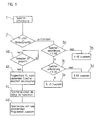
- step 2 which priority has the program part requesting the memory.
- the program part works in real time and must also be allocated the requested memory in real time according to a first procedure 3. This is done by determining how much memory was requested in steps 3a and 3c and then from a previously allocated or for real-time applications reserved memory pool SP1 (FIG. FIG.
- step 3b a 4 kbyte memory section is assigned, or an 8 kbyte large memory block SP2 in step 3d, or a 16 kbyte memory block SP3 in step 3e. If an even larger memory section has been requested, an error message is output because it is assumed that no memory sections larger than 16 kbytes are needed. In order to meet the set real-time conditions, no non-real-time memory allocation method is used because it would be too slow. Furthermore, it must be ensured that the storage pools SP1 - SP3 always have sufficient storage sections in stock.
- step 4a it is first checked in step 4a whether, by means of a semaphore Sp, access to a fragment list FL into which all occupied and unused memory areas are entered, is locked. If this is not the case, the fragment list FL is searched for a memory section which matches the memory request, otherwise the system waits until the fragment list FL is released for access. During access, the fragment list FL is blocked by the semaphore Sp for further access.
- step 4c If a matching memory section has been found, it is identified in step 4c in the fragment list FL as occupied by the requesting program part and assigned to the requesting program part in step 4d. Subsequently, the fragment list FL is released again for access by means of the semaphores Sp.
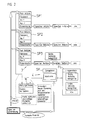
- Fig. 2 is a possible realization of the memory management according to the invention shown.
- a memory section previously reserved for this pool SP1 which is at least as large as the requested memory, is allocated to the program section from a memory pool SP1 .
- a plurality of memory pools SP1 - SP3 are provided which each contain memory sections of the same size.
- a first memory pool SP1 memory sections with a first size of 4 KBytes in a second memory pool SP2 memory sections with a second size of 8 KBytes and in a third memory pool SP3 memory sections with a third size of 16 KByte are reserved .
- the size is always doubled.
- the sizes of the memory sections in the memory pools SP1-SP3 are selected such that on the one hand not unnecessarily much memory space is wasted, for example, for a request of more than 3 kbyte, a 16 kbyte memory section must be allocated because smaller memory sections are not available.
- the size of the memory sections is chosen so that multiple memory blocks are not allocated for a memory request If, for example, 10 kByte are requested and then a block with 64 kByte must be assigned, because 16 kByte memory sections are not available.
- Each memory pool SP1 - SP3 contains information about the current memory capacity, in particular it has a specific fill level, which indicates how many memory sections are reserved in the memory pool SP1 - SP3. Furthermore, each storage pool SP1 - SP3 is assigned a minimum filling level MinP and a maximum filling level MaxP.
- the minimum filling level MinP indicates at which level a maintenance thread WT is activated in order to occupy new storage sections for the respective storage pool SP1-SP3.
- the maximum level MaxP indicates at which level a maintenance thread WT is activated, so that superfluous memory sections are removed from the memory pool SP1 - SP3, thus releasing memory for other purposes.
- each memory pool SP1-SP3 is provided with a reference to the first memory section in the list of memory sections present in the respective memory pool SP1-SP3.
- Each memory section contains a reference to the next memory section of the memory pools SP1-SP3, such that the memory sections of each memory pool SP1-SP3 refer to each other as a linked list, as shown in FIG Fig. 2 is pictured.
- the minimum filling level MinP is increased by the value by which this minimum value of the minimum filling level MinP was undershot.
- the maximum level MaxP is defined as a certain multiple, for example twice, the minimum level MinP and adjusted accordingly to the new value for the minimum level MinP.
- the Memory requirements are therefore divided into groups that differ in size by integer multiples of 4 kbytes, depending on the size of the required memory section.
- the number of storage pools SP1-SP3, the minimum level and the maximum level in each storage pool SP1-SP3 and the size of the storage sections in the storage pools SP1-SP3 can be set .
- the values determined in this way can be stored in a non-volatile memory for each memory pool SP1-SP3 and taken into account the next time the program is started. In this way, parameters for memory management are set adaptively and optimize themselves.
- a non-volatile memory can be provided for each memory pool SP1-SP3 in which the absolute minimum of the level of the respective memory pool SP1-SP3 is stored. By reading this memory, it is also possible to detect minimum levels of the memory pools SP1-SP3 that occur during real-time processing during which the maintenance thread WT has no access to the fill levels of the memory pools SP1-SP3.
- the maintenance thread WT advantageously receives a priority that lies immediately below the threshold for real-time processing. This ensures that immediately after completion of program parts that are processed in real time, it is checked whether the number of memory sections in the memory pools SP1 - SP3 is still above the minimum level MinP and possibly even during program execution in real time.
- a second procedure is used to allocate memory.
- the maintenance thread WT first checks a semaphore Sp. This semaphore Sp indicates whether a fragment list FL is being used for storage. In such a fragment list FL For each memory area of the physical memory at least its size, start address and its occupancy state (free or occupied) are stored.
- the maintenance thread must wait until the fragment list FL is free again, which is recognized by the semaphore SP. Then, the maintenance thread WT searches from the fragment list FL for a free memory area having at least the requested size. The required size memory is allocated for the requesting program part and assigned to the requesting program part.
- An alternative for the allocation of storage areas in real time according to a first procedure is that only a single storage pool is provided, which includes storage sections of a minimum size of, for example, 4 kbytes. Furthermore, a memory manager is provided which recodes logical to physical addresses and vice versa. Then, in a real-time memory request, so many memory sections are extracted from the memory pool and provided by the memory manager with contiguous addresses until the requested memory size is at least reached and the memory area thus assembled is assigned to the requesting program section.
- the first three memory sections of the linked list are selected from a memory pool with 4 kbyte memory sections. These memory sections can be arranged as desired in the available physical memory, in particular not immediately following one another. By the memory manager transcoding of logical addresses into physical addresses and vice versa in these three memory sections is such that the logical addresses of the three memory sections immediately follow each other. This assembles a contiguous address space for the requested memory area and can be the requesting one Program as a contiguous memory area.
- the memory areas that are no longer required can be returned to the memory pools SP1 - SP3.
- the fragment list FL is used to check the size of the memory area returned by the program. Subsequently, this memory section in the fragment list FL is marked as reserved and hooked into the linked list of the appropriate memory pool. If the fill level of the memory pool then exceeds the maximum size MaxP, memory sections are removed from the linked list by the maintenance thread WT and identified as free in the fragment list FL.
- memory areas that are no longer needed by the program can be entered in a separate list.
- the memory area entered in this list then identifies the maintenance thread directly in the fragment list FL as free.
- a further advantage is that memory areas can be released in this way, for the size of which no memory pool exists.
Landscapes
- Engineering & Computer Science (AREA)
- Theoretical Computer Science (AREA)
- Software Systems (AREA)
- Physics & Mathematics (AREA)
- General Engineering & Computer Science (AREA)
- General Physics & Mathematics (AREA)
- Memory System (AREA)
- Debugging And Monitoring (AREA)
- Memory System Of A Hierarchy Structure (AREA)
Applications Claiming Priority (3)
| Application Number | Priority Date | Filing Date | Title |
|---|---|---|---|
| DE19951716 | 1999-10-27 | ||
| DE19951716A DE19951716A1 (de) | 1999-10-27 | 1999-10-27 | Verfahren zur dynamischen Speicherverwaltung |
| PCT/EP2000/010492 WO2001031454A1 (de) | 1999-10-27 | 2000-10-25 | Verfahren zur dynamischen speicherverwaltung |
Publications (2)
| Publication Number | Publication Date |
|---|---|
| EP1228432A1 EP1228432A1 (de) | 2002-08-07 |
| EP1228432B1 true EP1228432B1 (de) | 2008-06-18 |
Family
ID=7927032
Family Applications (1)
| Application Number | Title | Priority Date | Filing Date |
|---|---|---|---|
| EP00974452A Expired - Lifetime EP1228432B1 (de) | 1999-10-27 | 2000-10-25 | Verfahren zur dynamischen speicherverwaltung |
Country Status (6)
| Country | Link |
|---|---|
| US (1) | US7035990B1 (enExample) |
| EP (1) | EP1228432B1 (enExample) |
| JP (1) | JP2003523555A (enExample) |
| AT (1) | ATE398807T1 (enExample) |
| DE (2) | DE19951716A1 (enExample) |
| WO (1) | WO2001031454A1 (enExample) |
Cited By (1)
| Publication number | Priority date | Publication date | Assignee | Title |
|---|---|---|---|---|
| CN106648907A (zh) * | 2017-02-24 | 2017-05-10 | 郑州云海信息技术有限公司 | 一种提高内存复用的方法和装置 |
Families Citing this family (26)
| Publication number | Priority date | Publication date | Assignee | Title |
|---|---|---|---|---|
| US8060680B2 (en) * | 2002-09-16 | 2011-11-15 | Hewlett-Packard Development Company, L.P. | Method of allocating memory |
| JP4175185B2 (ja) * | 2003-06-06 | 2008-11-05 | 日本電気株式会社 | ネットワーク情報記録装置 |
| US7814554B1 (en) * | 2003-11-06 | 2010-10-12 | Gary Dean Ragner | Dynamic associative storage security for long-term memory storage devices |
| US20050144401A1 (en) * | 2003-12-30 | 2005-06-30 | Pantalone Brett A. | Multiprocessor mobile terminal with shared memory arbitration |
| JP2005301801A (ja) * | 2004-04-14 | 2005-10-27 | Nec Corp | 情報処理装置、メモリ管理装置、およびプログラム |
| US7574419B2 (en) * | 2004-05-13 | 2009-08-11 | Oracle International Corporation | Automatic tuning of undo retention |
| US8756200B2 (en) * | 2004-05-14 | 2014-06-17 | Oracle International Corporation | Undo advisor |
| JP2005339299A (ja) * | 2004-05-28 | 2005-12-08 | Hitachi Ltd | ストレージ装置のキャッシュ制御方法 |
| JP4144609B2 (ja) * | 2004-09-29 | 2008-09-03 | ソニー株式会社 | 情報処理装置、メモリ領域管理方法、並びにコンピュータ・プログラム |
| US7689794B2 (en) * | 2004-10-22 | 2010-03-30 | Scientific-Atlanta, Llc | System and method for handling memory allocation failures through reserve allocation of event data |
| US7885939B2 (en) * | 2005-10-11 | 2011-02-08 | Oracle International Corporation | Longest query duration for auto tuning undo retention |
| US7801932B2 (en) * | 2005-10-11 | 2010-09-21 | Oracle International Corporation | Undo hints to speed up segment extension and tuning of undo retention |
| US7958312B2 (en) * | 2005-11-15 | 2011-06-07 | Oracle America, Inc. | Small and power-efficient cache that can provide data for background DMA devices while the processor is in a low-power state |
| US7873788B1 (en) | 2005-11-15 | 2011-01-18 | Oracle America, Inc. | Re-fetching cache memory having coherent re-fetching |
| US7934054B1 (en) | 2005-11-15 | 2011-04-26 | Oracle America, Inc. | Re-fetching cache memory enabling alternative operational modes |
| US7899990B2 (en) * | 2005-11-15 | 2011-03-01 | Oracle America, Inc. | Power conservation via DRAM access |
| US7516274B2 (en) * | 2005-11-15 | 2009-04-07 | Sun Microsystems, Inc. | Power conservation via DRAM access reduction |
| US7788243B2 (en) * | 2006-09-08 | 2010-08-31 | Sybase, Inc. | System and methods for optimizing data transfer among various resources in a distributed environment |
| JP5016880B2 (ja) * | 2006-09-21 | 2012-09-05 | 富士通株式会社 | 優先クラスに応じたメモリ管理方法及び装置 |
| US7831772B2 (en) * | 2006-12-12 | 2010-11-09 | Sybase, Inc. | System and methodology providing multiple heterogeneous buffer caches |
| DE102007026693A1 (de) | 2007-06-08 | 2008-12-11 | Robert Bosch Gmbh | Verfahren und Vorrichtung zum Umorganisieren von Daten in einem Speichersystem, insbesondere für Steuergeräte in Kraftfahrzeugen |
| CN102253893A (zh) * | 2011-04-02 | 2011-11-23 | 赵悦 | 一种内存扩展方法 |
| JP2012221217A (ja) * | 2011-04-08 | 2012-11-12 | Sony Corp | メモリ管理装置、メモリ管理方法、および、制御プログラム |
| US9218206B2 (en) * | 2011-06-20 | 2015-12-22 | Microsoft Technology Licensing, Llc | Memory management model and interface for new applications |
| CN103246568A (zh) * | 2013-04-16 | 2013-08-14 | 深圳桑菲消费通信有限公司 | 一种通过手机设置应用优先级的方法和装置 |
| CN120780676A (zh) * | 2024-04-03 | 2025-10-14 | 戴尔产品有限公司 | 用于执行文件系统检查的方法、设备和计算机程序产品 |
Family Cites Families (17)
| Publication number | Priority date | Publication date | Assignee | Title |
|---|---|---|---|---|
| JPH06105440B2 (ja) * | 1990-03-08 | 1994-12-21 | 株式会社日立製作所 | 主メモリ管理方法 |
| JPH04314147A (ja) * | 1991-04-12 | 1992-11-05 | Nec Corp | メモリ管理方式 |
| US5367637A (en) * | 1992-03-26 | 1994-11-22 | International Business Machines Corporation | Self-tuning virtual storage management for dedicated real-time computer system |
| DE4224080C1 (de) * | 1992-07-21 | 1994-01-05 | Siemens Ag | Verfahren zur dynamischen Verwaltung eines freien Speichers einer Rechenanlage, des Freispeichers, für den eine Unterteilung in wenigstens zwei logische Speicherbereiche, die sich in ihren Zugriffseigenschaften unterscheiden, vorgesehen ist |
| US5727185A (en) * | 1992-07-21 | 1998-03-10 | Siemens Aktiengesellschaft | Memory allocation method for allocating two logical store areas to a free store, that is one common physical store area of a computer |
| US5535364A (en) * | 1993-04-12 | 1996-07-09 | Hewlett-Packard Company | Adaptive method for dynamic allocation of random access memory to procedures having differing priorities based on first and second threshold levels of free RAM |
| US5680573A (en) * | 1994-07-12 | 1997-10-21 | Sybase, Inc. | Method of buffering data objects in a database |
| JP2874571B2 (ja) * | 1994-12-14 | 1999-03-24 | 日本電気株式会社 | メモリ管理装置 |
| US5784698A (en) * | 1995-12-05 | 1998-07-21 | International Business Machines Corporation | Dynamic memory allocation that enalbes efficient use of buffer pool memory segments |
| JP3451594B2 (ja) * | 1995-12-21 | 2003-09-29 | 株式会社森精機ハイテック | 数値制御装置における記憶手段アクセス制御方法および数値制御装置 |
| US5819304A (en) * | 1996-01-29 | 1998-10-06 | Iowa State University Research Foundation, Inc. | Random access memory assembly |
| US5784699A (en) * | 1996-05-24 | 1998-07-21 | Oracle Corporation | Dynamic memory allocation in a computer using a bit map index |
| US5978893A (en) * | 1996-06-19 | 1999-11-02 | Apple Computer, Inc. | Method and system for memory management |
| US5950231A (en) * | 1996-11-25 | 1999-09-07 | Northern Telecom Limited | Memory manager system |
| US5905889A (en) * | 1997-03-20 | 1999-05-18 | International Business Machines Corporation | Resource management system using next available integer from an integer pool and returning the integer thereto as the next available integer upon completion of use |
| US6046817A (en) * | 1997-05-12 | 2000-04-04 | Lexmark International, Inc. | Method and apparatus for dynamic buffering of input/output ports used for receiving and transmitting print data at a printer |
| JP2002521749A (ja) * | 1998-07-24 | 2002-07-16 | サン・マイクロシステムズ・インコーポレーテッド | コンピュータ・システムにおける決定論的メモリ割り当て応答の達成方法および装置 |
-
1999
- 1999-10-27 DE DE19951716A patent/DE19951716A1/de not_active Withdrawn
-
2000
- 2000-10-25 WO PCT/EP2000/010492 patent/WO2001031454A1/de not_active Ceased
- 2000-10-25 DE DE50015218T patent/DE50015218D1/de not_active Expired - Lifetime
- 2000-10-25 AT AT00974452T patent/ATE398807T1/de not_active IP Right Cessation
- 2000-10-25 JP JP2001533522A patent/JP2003523555A/ja active Pending
- 2000-10-25 EP EP00974452A patent/EP1228432B1/de not_active Expired - Lifetime
- 2000-10-25 US US10/111,885 patent/US7035990B1/en not_active Expired - Fee Related
Cited By (1)
| Publication number | Priority date | Publication date | Assignee | Title |
|---|---|---|---|---|
| CN106648907A (zh) * | 2017-02-24 | 2017-05-10 | 郑州云海信息技术有限公司 | 一种提高内存复用的方法和装置 |
Also Published As
| Publication number | Publication date |
|---|---|
| US7035990B1 (en) | 2006-04-25 |
| DE50015218D1 (de) | 2008-07-31 |
| EP1228432A1 (de) | 2002-08-07 |
| ATE398807T1 (de) | 2008-07-15 |
| JP2003523555A (ja) | 2003-08-05 |
| WO2001031454A1 (de) | 2001-05-03 |
| DE19951716A1 (de) | 2001-05-03 |
Similar Documents
| Publication | Publication Date | Title |
|---|---|---|
| EP1228432A1 (de) | Verfahren zur dynamischen speicherverwaltung | |
| DE69930855T2 (de) | Verfahren und vorrichtung zur durchführung einer deterministischen speicherzuordnungsantwort in einem computer-system | |
| EP0703534B1 (de) | Speicherverwaltungssystem eines Rechnersystems | |
| DE69325992T2 (de) | Adaptives Verfahren zur Zuweisung von Speicher mit wahlfreiem Zugriff an Prozeduren mit unterschiedlichen Prioritäten | |
| DE68923433T2 (de) | Einrichtung und Methode um Festwertspeicher in einem Rechnerspeicherbereich anzuordnen. | |
| EP0010570A2 (de) | Verfahren und Einrichtung zur selbstadaptiven Zuordnung der Arbeitslast einer Datenverarbeitungsanlage | |
| DE102018107860A1 (de) | System und Verfahren zum Zugriff auf Daten in einem Mehrkern-Verarbeitungssystem, um Zugriffe auf externe Speicher zu verringern | |
| EP1079307B1 (de) | Verfahren zum Betrieb eines Speichersystems sowie Speichersystem | |
| DE10120615B4 (de) | Dynamische Speicherverwaltung für Objekte unterschiedlicher Größe | |
| EP1332501B1 (de) | Speicherverwaltungslogik zur erweiterten nutzung von festwertspeichern | |
| DE102023126127B4 (de) | Verwaltung des elektronischen datenzugriffs in einem verteilten computersystem | |
| WO2017220721A1 (de) | Verfahren zur automatischen und dynamischen zuteilung der zuständigkeit für aufgaben an die verfügbaren rechenkomponenten in einem hochverteilten datenverarbeitungssystem | |
| EP3583520B1 (de) | Verfahren zum betrieb eines datenspeichersystems, computerprogramm zur implementierung des verfahrens sowie nach dem verfahren arbeitendes datenspeichersystem | |
| EP2284710A1 (de) | Verfahren zum Verwalten von Speicherressourcen in einem portablen Datenträger | |
| EP3108360A1 (de) | Vergrössern des verfügbaren flash-speichers eines micro-controllers | |
| EP2151762B1 (de) | Speicherverwaltung in einem portablen Datenträger | |
| WO2017072312A2 (de) | Verfahren und vorrichtung zum beschleunigten ausführen von applikationen | |
| EP0491202A2 (de) | Zugriffsverfahren | |
| EP0651897B1 (de) | Verfahren zur dynamischen verwaltung eines freien speichers einer rechenanlage, des freispeichers, für den eine unterteilung in wenigstens zwei logische speicherbereiche, die sich in ihren zugriffseigenschaften unterscheiden, vorgesehen ist | |
| DE10339053B4 (de) | Speicherverwaltung bei einem tragbaren Datenträger | |
| EP2177995B1 (de) | Speicherverwaltung in einem portablen Datenträger | |
| EP2021928B1 (de) | Verfahren und vorrichtung zur beschleunigung von prozessor-zugriffen | |
| DE10128752A1 (de) | Verfahren zur Ablage von Daten in einen Speicherbaustein | |
| WO2006131167A2 (de) | Verfahren zur speicherverwaltung von digitalen recheneinrichtungen | |
| EP2177990A1 (de) | Speicherverwaltung in einem portablen Datenträger |
Legal Events
| Date | Code | Title | Description |
|---|---|---|---|
| PUAI | Public reference made under article 153(3) epc to a published international application that has entered the european phase |
Free format text: ORIGINAL CODE: 0009012 |
|
| 17P | Request for examination filed |
Effective date: 20020527 |
|
| AK | Designated contracting states |
Kind code of ref document: A1 Designated state(s): AT BE CH CY DE DK ES FI FR GB GR IE IT LI LU MC NL PT SE |
|
| 17Q | First examination report despatched |
Effective date: 20020911 |
|
| GRAP | Despatch of communication of intention to grant a patent |
Free format text: ORIGINAL CODE: EPIDOSNIGR1 |
|
| GRAS | Grant fee paid |
Free format text: ORIGINAL CODE: EPIDOSNIGR3 |
|
| GRAA | (expected) grant |
Free format text: ORIGINAL CODE: 0009210 |
|
| AK | Designated contracting states |
Kind code of ref document: B1 Designated state(s): AT BE CH CY DE DK ES FI FR GB GR IE IT LI LU MC NL PT SE |
|
| REG | Reference to a national code |
Ref country code: GB Ref legal event code: FG4D Free format text: NOT ENGLISH |
|
| REF | Corresponds to: |
Ref document number: 50015218 Country of ref document: DE Date of ref document: 20080731 Kind code of ref document: P |
|
| REG | Reference to a national code |
Ref country code: CH Ref legal event code: EP |
|
| REG | Reference to a national code |
Ref country code: IE Ref legal event code: FG4D Free format text: LANGUAGE OF EP DOCUMENT: GERMAN |
|
| PG25 | Lapsed in a contracting state [announced via postgrant information from national office to epo] |
Ref country code: FI Free format text: LAPSE BECAUSE OF FAILURE TO SUBMIT A TRANSLATION OF THE DESCRIPTION OR TO PAY THE FEE WITHIN THE PRESCRIBED TIME-LIMIT Effective date: 20080618 |
|
| PG25 | Lapsed in a contracting state [announced via postgrant information from national office to epo] |
Ref country code: NL Free format text: LAPSE BECAUSE OF FAILURE TO SUBMIT A TRANSLATION OF THE DESCRIPTION OR TO PAY THE FEE WITHIN THE PRESCRIBED TIME-LIMIT Effective date: 20080618 |
|
| NLV1 | Nl: lapsed or annulled due to failure to fulfill the requirements of art. 29p and 29m of the patents act | ||
| PG25 | Lapsed in a contracting state [announced via postgrant information from national office to epo] |
Ref country code: SE Free format text: LAPSE BECAUSE OF FAILURE TO SUBMIT A TRANSLATION OF THE DESCRIPTION OR TO PAY THE FEE WITHIN THE PRESCRIBED TIME-LIMIT Effective date: 20080918 Ref country code: ES Free format text: LAPSE BECAUSE OF FAILURE TO SUBMIT A TRANSLATION OF THE DESCRIPTION OR TO PAY THE FEE WITHIN THE PRESCRIBED TIME-LIMIT Effective date: 20080929 Ref country code: PT Free format text: LAPSE BECAUSE OF FAILURE TO SUBMIT A TRANSLATION OF THE DESCRIPTION OR TO PAY THE FEE WITHIN THE PRESCRIBED TIME-LIMIT Effective date: 20081118 |
|
| REG | Reference to a national code |
Ref country code: IE Ref legal event code: FD4D |
|
| PLBE | No opposition filed within time limit |
Free format text: ORIGINAL CODE: 0009261 |
|
| STAA | Information on the status of an ep patent application or granted ep patent |
Free format text: STATUS: NO OPPOSITION FILED WITHIN TIME LIMIT |
|
| BERE | Be: lapsed |
Owner name: DR. JOHANNES HEIDENHAIN G.M.B.H. Effective date: 20081031 |
|
| PG25 | Lapsed in a contracting state [announced via postgrant information from national office to epo] |
Ref country code: IE Free format text: LAPSE BECAUSE OF FAILURE TO SUBMIT A TRANSLATION OF THE DESCRIPTION OR TO PAY THE FEE WITHIN THE PRESCRIBED TIME-LIMIT Effective date: 20080618 Ref country code: DK Free format text: LAPSE BECAUSE OF FAILURE TO SUBMIT A TRANSLATION OF THE DESCRIPTION OR TO PAY THE FEE WITHIN THE PRESCRIBED TIME-LIMIT Effective date: 20080618 |
|
| 26N | No opposition filed |
Effective date: 20090319 |
|
| PG25 | Lapsed in a contracting state [announced via postgrant information from national office to epo] |
Ref country code: MC Free format text: LAPSE BECAUSE OF NON-PAYMENT OF DUE FEES Effective date: 20081031 |
|
| REG | Reference to a national code |
Ref country code: CH Ref legal event code: PL |
|
| PG25 | Lapsed in a contracting state [announced via postgrant information from national office to epo] |
Ref country code: BE Free format text: LAPSE BECAUSE OF NON-PAYMENT OF DUE FEES Effective date: 20081031 |
|
| PG25 | Lapsed in a contracting state [announced via postgrant information from national office to epo] |
Ref country code: CH Free format text: LAPSE BECAUSE OF NON-PAYMENT OF DUE FEES Effective date: 20081031 Ref country code: LI Free format text: LAPSE BECAUSE OF NON-PAYMENT OF DUE FEES Effective date: 20081031 |
|
| PG25 | Lapsed in a contracting state [announced via postgrant information from national office to epo] |
Ref country code: AT Free format text: LAPSE BECAUSE OF NON-PAYMENT OF DUE FEES Effective date: 20081025 |
|
| PG25 | Lapsed in a contracting state [announced via postgrant information from national office to epo] |
Ref country code: LU Free format text: LAPSE BECAUSE OF NON-PAYMENT OF DUE FEES Effective date: 20081025 Ref country code: CY Free format text: LAPSE BECAUSE OF FAILURE TO SUBMIT A TRANSLATION OF THE DESCRIPTION OR TO PAY THE FEE WITHIN THE PRESCRIBED TIME-LIMIT Effective date: 20080618 |
|
| PG25 | Lapsed in a contracting state [announced via postgrant information from national office to epo] |
Ref country code: GR Free format text: LAPSE BECAUSE OF FAILURE TO SUBMIT A TRANSLATION OF THE DESCRIPTION OR TO PAY THE FEE WITHIN THE PRESCRIBED TIME-LIMIT Effective date: 20080919 |
|
| PGFP | Annual fee paid to national office [announced via postgrant information from national office to epo] |
Ref country code: GB Payment date: 20131021 Year of fee payment: 14 Ref country code: FR Payment date: 20131022 Year of fee payment: 14 |
|
| PGFP | Annual fee paid to national office [announced via postgrant information from national office to epo] |
Ref country code: IT Payment date: 20131030 Year of fee payment: 14 |
|
| GBPC | Gb: european patent ceased through non-payment of renewal fee |
Effective date: 20141025 |
|
| PG25 | Lapsed in a contracting state [announced via postgrant information from national office to epo] |
Ref country code: GB Free format text: LAPSE BECAUSE OF NON-PAYMENT OF DUE FEES Effective date: 20141025 |
|
| REG | Reference to a national code |
Ref country code: FR Ref legal event code: ST Effective date: 20150630 |
|
| PG25 | Lapsed in a contracting state [announced via postgrant information from national office to epo] |
Ref country code: FR Free format text: LAPSE BECAUSE OF NON-PAYMENT OF DUE FEES Effective date: 20141031 Ref country code: IT Free format text: LAPSE BECAUSE OF NON-PAYMENT OF DUE FEES Effective date: 20141025 |
|
| PGFP | Annual fee paid to national office [announced via postgrant information from national office to epo] |
Ref country code: DE Payment date: 20181019 Year of fee payment: 19 |
|
| REG | Reference to a national code |
Ref country code: DE Ref legal event code: R119 Ref document number: 50015218 Country of ref document: DE |
|
| PG25 | Lapsed in a contracting state [announced via postgrant information from national office to epo] |
Ref country code: DE Free format text: LAPSE BECAUSE OF NON-PAYMENT OF DUE FEES Effective date: 20200501 |