EP1226915A1 - Cellular molded article in mold pattern having a surface skin and a producing method thereof - Google Patents
Cellular molded article in mold pattern having a surface skin and a producing method thereof Download PDFInfo
- Publication number
- EP1226915A1 EP1226915A1 EP02001807A EP02001807A EP1226915A1 EP 1226915 A1 EP1226915 A1 EP 1226915A1 EP 02001807 A EP02001807 A EP 02001807A EP 02001807 A EP02001807 A EP 02001807A EP 1226915 A1 EP1226915 A1 EP 1226915A1
- Authority
- EP
- European Patent Office
- Prior art keywords
- surface skin
- above mentioned
- mold
- mold pattern
- resin
- Prior art date
- Legal status (The legal status is an assumption and is not a legal conclusion. Google has not performed a legal analysis and makes no representation as to the accuracy of the status listed.)
- Withdrawn
Links
- 230000001413 cellular effect Effects 0.000 title claims abstract description 51
- 238000000034 method Methods 0.000 title claims abstract description 28
- 229920005989 resin Polymers 0.000 claims abstract description 113
- 239000011347 resin Substances 0.000 claims abstract description 113
- 239000000463 material Substances 0.000 claims abstract description 80
- 229910052751 metal Inorganic materials 0.000 claims abstract description 73
- 239000002184 metal Substances 0.000 claims abstract description 73
- 239000011324 bead Substances 0.000 claims abstract description 64
- 150000001336 alkenes Chemical class 0.000 claims abstract description 31
- JRZJOMJEPLMPRA-UHFFFAOYSA-N olefin Natural products CCCCCCCC=C JRZJOMJEPLMPRA-UHFFFAOYSA-N 0.000 claims abstract description 31
- -1 polyethylene Polymers 0.000 claims abstract description 26
- 238000000465 moulding Methods 0.000 claims abstract description 24
- 239000004698 Polyethylene Substances 0.000 claims abstract description 15
- 229920000573 polyethylene Polymers 0.000 claims abstract description 15
- 238000013461 design Methods 0.000 claims abstract description 11
- 229920002725 thermoplastic elastomer Polymers 0.000 claims abstract description 11
- 239000011159 matrix material Substances 0.000 claims abstract description 9
- 229920001577 copolymer Polymers 0.000 claims description 10
- 229920001971 elastomer Polymers 0.000 claims description 10
- 239000004743 Polypropylene Substances 0.000 claims description 9
- 229920001155 polypropylene Polymers 0.000 claims description 7
- 238000003856 thermoforming Methods 0.000 claims description 5
- 229920000092 linear low density polyethylene Polymers 0.000 claims description 3
- 239000004707 linear low-density polyethylene Substances 0.000 claims description 3
- 229910052782 aluminium Inorganic materials 0.000 claims 1
- XAGFODPZIPBFFR-UHFFFAOYSA-N aluminium Chemical compound [Al] XAGFODPZIPBFFR-UHFFFAOYSA-N 0.000 claims 1
- 239000002994 raw material Substances 0.000 claims 1
- 230000003578 releasing effect Effects 0.000 abstract description 12
- 229920000098 polyolefin Polymers 0.000 description 72
- 238000010438 heat treatment Methods 0.000 description 17
- 239000010410 layer Substances 0.000 description 9
- 230000006837 decompression Effects 0.000 description 8
- 229920005992 thermoplastic resin Polymers 0.000 description 7
- 229920001169 thermoplastic Polymers 0.000 description 6
- 239000004416 thermosoftening plastic Substances 0.000 description 6
- 238000007666 vacuum forming Methods 0.000 description 6
- XLYOFNOQVPJJNP-UHFFFAOYSA-N water Substances O XLYOFNOQVPJJNP-UHFFFAOYSA-N 0.000 description 6
- 238000010025 steaming Methods 0.000 description 5
- VXNZUUAINFGPBY-UHFFFAOYSA-N 1-Butene Chemical compound CCC=C VXNZUUAINFGPBY-UHFFFAOYSA-N 0.000 description 4
- 239000011248 coating agent Substances 0.000 description 4
- 238000000576 coating method Methods 0.000 description 4
- 230000000052 comparative effect Effects 0.000 description 4
- 150000001993 dienes Chemical class 0.000 description 4
- 239000000203 mixture Substances 0.000 description 4
- 229920000642 polymer Polymers 0.000 description 4
- 238000001816 cooling Methods 0.000 description 3
- 238000004132 cross linking Methods 0.000 description 3
- 238000002156 mixing Methods 0.000 description 3
- 239000008188 pellet Substances 0.000 description 3
- AFFLGGQVNFXPEV-UHFFFAOYSA-N 1-decene Chemical compound CCCCCCCCC=C AFFLGGQVNFXPEV-UHFFFAOYSA-N 0.000 description 2
- LIKMAJRDDDTEIG-UHFFFAOYSA-N 1-hexene Chemical compound CCCCC=C LIKMAJRDDDTEIG-UHFFFAOYSA-N 0.000 description 2
- KWKAKUADMBZCLK-UHFFFAOYSA-N 1-octene Chemical compound CCCCCCC=C KWKAKUADMBZCLK-UHFFFAOYSA-N 0.000 description 2
- WSSSPWUEQFSQQG-UHFFFAOYSA-N 4-methyl-1-pentene Chemical compound CC(C)CC=C WSSSPWUEQFSQQG-UHFFFAOYSA-N 0.000 description 2
- 239000012752 auxiliary agent Substances 0.000 description 2
- 125000004432 carbon atom Chemical group C* 0.000 description 2
- 238000001035 drying Methods 0.000 description 2
- 230000000694 effects Effects 0.000 description 2
- 229920000554 ionomer Polymers 0.000 description 2
- 229920001684 low density polyethylene Polymers 0.000 description 2
- 239000004702 low-density polyethylene Substances 0.000 description 2
- 238000004519 manufacturing process Methods 0.000 description 2
- YWAKXRMUMFPDSH-UHFFFAOYSA-N pentene Chemical compound CCCC=C YWAKXRMUMFPDSH-UHFFFAOYSA-N 0.000 description 2
- 150000002978 peroxides Chemical class 0.000 description 2
- 229920001083 polybutene Polymers 0.000 description 2
- 238000012545 processing Methods 0.000 description 2
- 230000005855 radiation Effects 0.000 description 2
- 239000000126 substance Substances 0.000 description 2
- 229920002554 vinyl polymer Polymers 0.000 description 2
- 239000004711 α-olefin Substances 0.000 description 2
- RRKODOZNUZCUBN-CCAGOZQPSA-N (1z,3z)-cycloocta-1,3-diene Chemical compound C1CC\C=C/C=C\C1 RRKODOZNUZCUBN-CCAGOZQPSA-N 0.000 description 1
- PRBHEGAFLDMLAL-GQCTYLIASA-N (4e)-hexa-1,4-diene Chemical compound C\C=C\CC=C PRBHEGAFLDMLAL-GQCTYLIASA-N 0.000 description 1
- HECLRDQVFMWTQS-RGOKHQFPSA-N 1755-01-7 Chemical compound C1[C@H]2[C@@H]3CC=C[C@@H]3[C@@H]1C=C2 HECLRDQVFMWTQS-RGOKHQFPSA-N 0.000 description 1
- JURLNXPXCMWCHE-UHFFFAOYSA-N 3-ethylidenebicyclo[2.2.1]heptane Chemical compound C1CC2C(=CC)CC1C2 JURLNXPXCMWCHE-UHFFFAOYSA-N 0.000 description 1
- YHQXBTXEYZIYOV-UHFFFAOYSA-N 3-methylbut-1-ene Chemical compound CC(C)C=C YHQXBTXEYZIYOV-UHFFFAOYSA-N 0.000 description 1
- AJQVASAUQUTVJK-UHFFFAOYSA-N 3-methylidenebicyclo[2.2.1]heptane Chemical compound C1CC2C(=C)CC1C2 AJQVASAUQUTVJK-UHFFFAOYSA-N 0.000 description 1
- LDTAOIUHUHHCMU-UHFFFAOYSA-N 3-methylpent-1-ene Chemical compound CCC(C)C=C LDTAOIUHUHHCMU-UHFFFAOYSA-N 0.000 description 1
- VGGSQFUCUMXWEO-UHFFFAOYSA-N Ethene Chemical compound C=C VGGSQFUCUMXWEO-UHFFFAOYSA-N 0.000 description 1
- JOYRKODLDBILNP-UHFFFAOYSA-N Ethyl urethane Chemical compound CCOC(N)=O JOYRKODLDBILNP-UHFFFAOYSA-N 0.000 description 1
- 239000005977 Ethylene Substances 0.000 description 1
- NIXOWILDQLNWCW-UHFFFAOYSA-N acrylic acid group Chemical group C(C=C)(=O)O NIXOWILDQLNWCW-UHFFFAOYSA-N 0.000 description 1
- 239000003963 antioxidant agent Substances 0.000 description 1
- 230000003078 antioxidant effect Effects 0.000 description 1
- 239000002216 antistatic agent Substances 0.000 description 1
- 229920001400 block copolymer Polymers 0.000 description 1
- 239000003795 chemical substances by application Substances 0.000 description 1
- 238000000748 compression moulding Methods 0.000 description 1
- 238000010276 construction Methods 0.000 description 1
- 239000003431 cross linking reagent Substances 0.000 description 1
- 230000007547 defect Effects 0.000 description 1
- 239000002355 dual-layer Substances 0.000 description 1
- 239000000806 elastomer Substances 0.000 description 1
- HQQADJVZYDDRJT-UHFFFAOYSA-N ethene;prop-1-ene Chemical group C=C.CC=C HQQADJVZYDDRJT-UHFFFAOYSA-N 0.000 description 1
- 239000005038 ethylene vinyl acetate Substances 0.000 description 1
- 229920005674 ethylene-propylene random copolymer Polymers 0.000 description 1
- 238000011156 evaluation Methods 0.000 description 1
- 238000001125 extrusion Methods 0.000 description 1
- 238000005187 foaming Methods 0.000 description 1
- 239000004088 foaming agent Substances 0.000 description 1
- 229920001903 high density polyethylene Polymers 0.000 description 1
- 239000004700 high-density polyethylene Substances 0.000 description 1
- 239000011256 inorganic filler Substances 0.000 description 1
- 229910003475 inorganic filler Inorganic materials 0.000 description 1
- 229920001179 medium density polyethylene Polymers 0.000 description 1
- 239000004701 medium-density polyethylene Substances 0.000 description 1
- TVMXDCGIABBOFY-UHFFFAOYSA-N n-Octanol Natural products CCCCCCCC TVMXDCGIABBOFY-UHFFFAOYSA-N 0.000 description 1
- 150000001451 organic peroxides Chemical class 0.000 description 1
- 239000000049 pigment Substances 0.000 description 1
- 229920001200 poly(ethylene-vinyl acetate) Polymers 0.000 description 1
- 238000003672 processing method Methods 0.000 description 1
- QQONPFPTGQHPMA-UHFFFAOYSA-N propylene Natural products CC=C QQONPFPTGQHPMA-UHFFFAOYSA-N 0.000 description 1
- 125000004805 propylene group Chemical group [H]C([H])([H])C([H])([*:1])C([H])([H])[*:2] 0.000 description 1
- 229920001384 propylene homopolymer Polymers 0.000 description 1
- 229920005604 random copolymer Polymers 0.000 description 1
- 238000004064 recycling Methods 0.000 description 1
- 238000003756 stirring Methods 0.000 description 1
- 229920001897 terpolymer Polymers 0.000 description 1
- 238000012546 transfer Methods 0.000 description 1
Images




Classifications
-
- B—PERFORMING OPERATIONS; TRANSPORTING
- B32—LAYERED PRODUCTS
- B32B—LAYERED PRODUCTS, i.e. PRODUCTS BUILT-UP OF STRATA OF FLAT OR NON-FLAT, e.g. CELLULAR OR HONEYCOMB, FORM
- B32B27/00—Layered products comprising a layer of synthetic resin
- B32B27/06—Layered products comprising a layer of synthetic resin as the main or only constituent of a layer, which is next to another layer of the same or of a different material
- B32B27/08—Layered products comprising a layer of synthetic resin as the main or only constituent of a layer, which is next to another layer of the same or of a different material of synthetic resin
-
- B—PERFORMING OPERATIONS; TRANSPORTING
- B32—LAYERED PRODUCTS
- B32B—LAYERED PRODUCTS, i.e. PRODUCTS BUILT-UP OF STRATA OF FLAT OR NON-FLAT, e.g. CELLULAR OR HONEYCOMB, FORM
- B32B27/00—Layered products comprising a layer of synthetic resin
- B32B27/32—Layered products comprising a layer of synthetic resin comprising polyolefins
-
- C—CHEMISTRY; METALLURGY
- C08—ORGANIC MACROMOLECULAR COMPOUNDS; THEIR PREPARATION OR CHEMICAL WORKING-UP; COMPOSITIONS BASED THEREON
- C08J—WORKING-UP; GENERAL PROCESSES OF COMPOUNDING; AFTER-TREATMENT NOT COVERED BY SUBCLASSES C08B, C08C, C08F, C08G or C08H
- C08J9/00—Working-up of macromolecular substances to porous or cellular articles or materials; After-treatment thereof
- C08J9/22—After-treatment of expandable particles; Forming foamed products
- C08J9/228—Forming foamed products
- C08J9/232—Forming foamed products by sintering expandable particles
-
- B—PERFORMING OPERATIONS; TRANSPORTING
- B32—LAYERED PRODUCTS
- B32B—LAYERED PRODUCTS, i.e. PRODUCTS BUILT-UP OF STRATA OF FLAT OR NON-FLAT, e.g. CELLULAR OR HONEYCOMB, FORM
- B32B2274/00—Thermoplastic elastomer material
-
- B—PERFORMING OPERATIONS; TRANSPORTING
- B32—LAYERED PRODUCTS
- B32B—LAYERED PRODUCTS, i.e. PRODUCTS BUILT-UP OF STRATA OF FLAT OR NON-FLAT, e.g. CELLULAR OR HONEYCOMB, FORM
- B32B2305/00—Condition, form or state of the layers or laminate
- B32B2305/02—Cellular or porous
-
- B—PERFORMING OPERATIONS; TRANSPORTING
- B32—LAYERED PRODUCTS
- B32B—LAYERED PRODUCTS, i.e. PRODUCTS BUILT-UP OF STRATA OF FLAT OR NON-FLAT, e.g. CELLULAR OR HONEYCOMB, FORM
- B32B2605/00—Vehicles
- B32B2605/003—Interior finishings
-
- C—CHEMISTRY; METALLURGY
- C08—ORGANIC MACROMOLECULAR COMPOUNDS; THEIR PREPARATION OR CHEMICAL WORKING-UP; COMPOSITIONS BASED THEREON
- C08J—WORKING-UP; GENERAL PROCESSES OF COMPOUNDING; AFTER-TREATMENT NOT COVERED BY SUBCLASSES C08B, C08C, C08F, C08G or C08H
- C08J2323/00—Characterised by the use of homopolymers or copolymers of unsaturated aliphatic hydrocarbons having only one carbon-to-carbon double bond; Derivatives of such polymers
-
- Y—GENERAL TAGGING OF NEW TECHNOLOGICAL DEVELOPMENTS; GENERAL TAGGING OF CROSS-SECTIONAL TECHNOLOGIES SPANNING OVER SEVERAL SECTIONS OF THE IPC; TECHNICAL SUBJECTS COVERED BY FORMER USPC CROSS-REFERENCE ART COLLECTIONS [XRACs] AND DIGESTS
- Y10—TECHNICAL SUBJECTS COVERED BY FORMER USPC
- Y10T—TECHNICAL SUBJECTS COVERED BY FORMER US CLASSIFICATION
- Y10T428/00—Stock material or miscellaneous articles
- Y10T428/249921—Web or sheet containing structurally defined element or component
- Y10T428/249953—Composite having voids in a component [e.g., porous, cellular, etc.]
- Y10T428/249987—With nonvoid component of specified composition
- Y10T428/249988—Of about the same composition as, and adjacent to, the void-containing component
- Y10T428/249989—Integrally formed skin
-
- Y—GENERAL TAGGING OF NEW TECHNOLOGICAL DEVELOPMENTS; GENERAL TAGGING OF CROSS-SECTIONAL TECHNOLOGIES SPANNING OVER SEVERAL SECTIONS OF THE IPC; TECHNICAL SUBJECTS COVERED BY FORMER USPC CROSS-REFERENCE ART COLLECTIONS [XRACs] AND DIGESTS
- Y10—TECHNICAL SUBJECTS COVERED BY FORMER USPC
- Y10T—TECHNICAL SUBJECTS COVERED BY FORMER US CLASSIFICATION
- Y10T428/00—Stock material or miscellaneous articles
- Y10T428/249921—Web or sheet containing structurally defined element or component
- Y10T428/249953—Composite having voids in a component [e.g., porous, cellular, etc.]
- Y10T428/249987—With nonvoid component of specified composition
- Y10T428/249991—Synthetic resin or natural rubbers
Definitions
- This invention relates to a cellular molded article in a mold pattern having a surface skin, which is used for e.g. the interior trim material of an automobile, and a producing method thereof.
- thermoplastic resin As a conventional producing method of a cellular molded article having a surface skin in this kind, it is known as a so-called simultaneous unification molding into one piece that, for example, on either one of two metal molds by which a mold pattern is formed, a surface skin material of thermoplastic resin is arranged, and after clamping the metal molds, pre-expanded beads are fed into this mold pattern, then the pre-expanded beads are expanded and melt united each other by steam heating, and at the same time, these pre-expanded beads and the above mentioned surface skin material of thermoplastic resin are melt united together to one piece.
- a chamber connected with for example a steam valve, a decompression valve are provided inside each of the above mentioned two metal molds.
- a decompression valve is provided on the one metal mold to which the above mentioned surface skin material will be arranged.
- a plural number of decompression holes which connect with the above mentioned chamber are provided, at the same time, on the other metal mold, a plural number of decompression holes which connect with the above mentioned chamber are provided.
- the above mentioned expansion molding by means of supplying steam into the mold pattern from the steam holes on the above mentioned other metal mold, the filled pre-expanded beads in this mold pattern are heat expanded.
- This invention is to solve the above mentioned problems, and even in a case of preheating the above mentioned one metal mold, sticking of the surface skin material on the above mentioned one metal mold will practically not appear, and therefore, it is an object to provide a producing method of the cellular molded article in the mold pattern having the surface skin and a molded article thereby, which are free from problems of the molding operation.
- Preferred embodiments of the present invention correspond to the method as claimed in claims 1 to 9 and to the article as claimed in any of claims 10 to 12.
- the above mentioned cellular molded article in the mold pattern of polyolefin line resin 2 is a molded article by expansion molding in the mold pattern of pre-expanded beads of a polyolefin line resin.
- polyolefin line resin for example, low density polyethylene, medium density polyethylene, high density polyethylene, linear low density polyethylene, ethylene-vinyl acetate copolymer, propylene homopolymer, ethylene-propylene random copolymer, ethylene-propylene-butene random terpolymer, propylene-vinyl chloride copolymer, propylene-butene copolymer, propylene-maleic anhydride copolymer, and polyethylene line resin or polypropylene line resin of poly (butene-1) or the like can be mentioned among others, and these can be used alone or as a mixture of not less than two of them.
- This polyolefin line resin is preferably not crosslinked however, it may also be crosslinked by using a peroxide, radiation or the like.
- thermoplastic resin in a case of blending with the above mentioned polypropylene line resin, for example, low density polyethylene, linear low density polyethylene, aromatic vinyl line polymer, polybutene, and ionomer can be mentioned among others. While, in case of blending with the above mentioned polyethylene line resin, for example, aromatic vinyl line polymer, polybutene and ionomer can be mentioned among others. And in these cases, the amount of the thermoplastic resin to be blended is preferably not more than 20 parts by weight based on 100 parts by weight of the polyolefin line resin, more preferably 5 to 10 parts by weight.
- the above mentioned pre-expanded beads of polyolefin line resin 8 can be produced for example by a process that a polyolefin line resin as mentioned above is molded to pellet shape in advance.
- This polyolefin line resin pellet is made to be impregnated with a volatile foaming agent in an autoclave and then is dispersed in water while keeping on stirring. After heating it up to a prescribed foaming temperature, this dispersed pellet in water is released into a low pressure zone, and thus, the pre-expanded state is produced.
- An olefin line copolymer rubber which is employed as the above mentioned TPO surface skin material (olefin line thermoplastic elastomer) 3 is for example, a non-regular type random elastic copolymer with an olefin as its main component, which is, for example, ethylene-propylene line copolymer rubber, ethylene-propylene-nonconjugated diene line rubber, ethylene-butene-nonconjugated diene line rubber, or propylene-butadiene line copolymer rubber.
- an ethylene-propylene-nonconjugated diene line rubber is particularly preferable.
- nonconjugated diene dicyclopentadiene, 1,4-hexadiene, cyclooctadiene, methylene norbornane, ethylidene norbornane can be mentioned among others.
- An olefin line copolymer rubber for the surface skin material is usually crosslinked, and a suitable elasticity is caused by this. Therefore, if a crosslinking by a peroxide or a radiation works effectively, such method will not be limited whatsoever.
- a preferable olefin line resin which is employed for the above mentioned TPO surface skin material (olefin line thermoplastic elastomer) 3, is a polypropylene line resin, and preferably said polypropylene line resin is a polypropylene and / or a random or block copolymer resin of propylene and ⁇ -olefin having two or more carbon atoms.
- ⁇ -olefin having two or more carbon atoms ethylene, 1-butene, 1-pentene, 3-methyl-1-butene, 1-hexene, 1-decene, 3-methyl-1-pentene, 4-methyl-1-pentene or 1-octene can be mentioned among others.
- an olefin line resin for the surface skin material as in this description is preferably excluding a polyethylene line resin, and even if a polyethylene polymer is included, the minimum amount of it can improve its releasing property from a mold pattern. The reason of this property is not cleared yet, but it is thought that, because of a low softening temperature of polyethylene line resin, this resin sticks on a metal mold, and thus, its releasing property gets worse. Therefore, in a case of 100 % by weight of olefin line resin for the surface skin material the blending amount of a polyethylene polymer should not be more than 15 % by weight, preferably not more than 5 % by weight, and more preferably not more than 1 % by weight. The most preferably, it should be reduced further, however, as long as achieving an object of the present invention, it is not limited to these.
- TPO surface skin material 3 comprises the above mentioned olefin line copolymer rubber (domain) and an olefin line resin (matrix), and a ratio of each of them can be determined or selected by one's discretion according to its object.
- a crosslinking agent which makes a partial crosslinking of the above mentioned each mixture, in general, an organic peroxide is suitably employed.
- an auxiliary agent such as a crosslinking auxiliary agent, flow promoter, inorganic filler, antioxidant, weather-proof agent, antistatic agent, pigment can be blended therewith.
- a coating material for scratch protection which comprises a thermoplastic elastomer and which is coated on the sheet surface
- a thermoplastic elastomer which is coated on the sheet surface
- an urethane line or acrylic line coating material can be mentioned.
- a processing method of a laminated surface skin material in which such material is employed it can be mentioned among others that, during processing or after processing of sheet molding by, for example, calendar molding or T-die extrusion molding of a thermoplastic elastomer according to the above mentioned method, a resinous cellular article layer is laminated, and then, in its lower stream process, a coating material is coated on a surface of the thermoplastic elastomer which will be the utmost outer layer using a coating machine such as a gravure coater.
- a producing method of the cellular molded article in the mold pattern having the surface skin of polyolefin line resin 1 is that on the one metal mold 5 of two metal molds 5 and 6, which compose mold pattern 4, TPO surface skin material 3 is arranged and clamped, after then pre-expanded beads of a polyolefin line resin 8 are fed into this mold pattern 7, and, by means of steam heating, these pre-expanded beads of a polyolefin line resin 8 are expanded to make melt uniting together, and at the same time, these pre-expanded beads of a polyolefin line resin 8 are melt united to one piece with the above mentioned TPO surface skin material 3.
- the above mentioned TPO surface skin material 3 is arranged on the above mentioned one metal mold 5, and then the mold pattern is clamped.
- the above mentioned mold pattern 4 is, for example, composed of two metal molds 5 and 6, which are capable to clamp and open in vertical direction.
- the above mentioned one metal mold 5 is, for example, composed of a concave shape in sectional side view, and chamber 5b is formed in its inside, and a plural number of decompression holes 5c, which are connected with the above mentioned chamber 5b, are formed on its surface 5a side.
- the above mentioned chamber 5b is connected with a steam valve A1, a decompression valve B1 and a drain valve C1 respectively.
- the other metal mold 6a is, for example, composed of a convex shape in sectional side view, and chamber 6b is formed in its inside, and a plural number of steam holes 6c, which are connected with the above mentioned chamber 6b, are formed on its surface 6a side.
- the above mentioned chamber 6b is connected with a steam valve A2, a decompression valve B2 and a drain valve C2 respectively, and feeder 10 for feeding pre-expanded beads of polyolefin line resin 8 into the above mentioned mold pattern 7 is provided.
- Arranging the above mentioned TPO surface skin material 3 on surface 5a of the one metal mold 5 may be made by forming the above-mentioned TPO surface skin material 3 in advance in a suitable shape to conform to surface 5a shape of the above mentioned one metal mold 5, for example, by vacuum forming.
- a suitable shape to conform to surface 5a shape of the above mentioned one metal mold 5, for example, by vacuum forming.
- thermo-forming of this TPO surface skin material 3 it is not limited to vacuum forming but other forming such as compression molding can be applied.
- the above mentioned one metal mold 5 is heated up to a prescribed temperature, for example, by steam or a heater which is separately mounted on temperature drop of heat-softened TPO surface skin material 3 to be contacted with said the one metal mold 5 can be minimized, thus there is a merit that a design pattern of the one metal mold 5 can be effectively printed on (transferred to) the TPO surface skin material 3. Further, during the heat molding or in the subsequent expansion molding in the mold pattern, in order to prevent a heat drop of TPO surface skin material 3, heating up by, for example, a heater may continue during the thermo-forming or even after it, or a stepwise heating which is changing the setting temperature in steps from the beginning may also be done.
- the above mentioned TPO surface skin material 3 comprises a polyolefin line resin
- the temperature of the one metal mold 5 before the thermo-forming operation is in a range of 60 to 150°C, preferably at 60 to 130°C, more preferably at 70 to 120°C
- the above mentioned TPO surface skin material 3 can be thermo-formed in a suitable softening condition and there is a merit to make a good finishing.
- a prescribed shaped inserting member (not shown) is arranged in advance, and at the time of the expanding operation in the mold pattern of the above mentioned pre-expanded beads of the polyolefin line resin 8, this inserting member may be melt united to one piece with the cellular molded article in the mold pattern of a polyolefin line resin 2.
- pre-expanded beads of a polyolefin line resin 8 are fed into the mold pattern 7 from the above mentioned feeder 10.
- the inside air can be evacuated by only steam holes 6c of the above mentioned other metal mold 6, consequently, to make a smooth feeding of the above mentioned pre-expanded beads of the polyolefin line resin 8, or a small opening between the two metal molds may be made so that these pre-expanded beads of the polyolefin line resin 8 will not go through, but the inside air can be evacuated from this small opening at a time of the feeding.
- the above mentioned pre-expanded beads of the polyolefin line resin 8 may be fed into the above mentioned mold pattern 7 in a state that a compressed gas is penetrated into their insides in advance and an inner pressure in each of them is given, or may be fed in a compressed state by a compressed gas, or may be fed as they are without giving an inside pressure or compressing.
- a steam valve A2 which connects with chamber 6b of the above mentioned other metal mold 6, is opened, and steam S is fed into mold pattern 7 through the above mentioned steam holes 6c, and the above mentioned pre-expanded beads of a polyolefin line resin 8 are heat expanded.
- pre-expanded beads of a polyolefin line resin 8 are pre-heated in advance at a lower temperature than the temperature of their melt uniting together, before the regular heating of these pre-expanded beads of the polyolefin line resin 8 at a higher temperature than the temperature of their melt uniting together, pre-expanded beads of the polyolefin line resin 8 can be sufficiently heated up to a state without causing a problem of melt uniting each other.
- the latent heat of fed steam S can be effectively utilized in between the above mentioned pre-expanded beads of the polyolefin line resin 8, particularly, in a case of forming a thick cellular molded article in the mold pattern of the polyolefin line resin 2 and there is a merit that the above mentioned pre-expanded beads of the polyolefin line resin 8 can be more uniformly heated.
- steaming can be made by continuous steam S supply, or by suspending steam S supply, or, if necessary, in a condition of opening drain valve C2.
- a method for evacuation of this drain as, for example, illustrated in Fig.5, a method that, a decompression valve B2, which is connected with chamber 6b of the above mentioned other metal mold 6, is opened and vacuuming inside of mold pattern 7 through the above mentioned steam holes 6c, or a method of making a slit between the two metal molds 5 and 6 by making a small opening in the mold pattern 4, and dry air at a high temperature, which is however not so high to cause melt uniting of the pre-expanded beads of the polyolefin line resin 8, penetrates into the mold pattern so as to evacuate the drain through the above mentioned slit, can be mentioned among others.
- the regular heating is carried out at a higher temperature than the temperature of melt uniting the above mentioned pre-expanded beads of the polyolefin line resin 8.
- This regular heating is carried out, as illustrated in Fig.6, by supplying steam S into the mold pattern 7 from the above mentioned steam holes 6 by opening the above mentioned steam valve A2.
- the above mentioned steam S for the regular heating can be supplied more smoothly into the mold pattern 7.
- the temperature of steam S at this stage is preferably higher than the temperature at which the above mentioned pre-expanded beads of the polyolefin line resin 8 are melt uniting each other.
- shrinkage of the obtained cellular molded article in the mold pattern of the polyolefin line resin 2 will become excessively large.
- the above mentioned mold pattern 4 may be cooled down in advance.
- the cellular molded article in the mold pattern having the surface skin of the polyolefin line resin 1a which has been obtained is preferably dried, for example, by keeping it in a dried room, right after release from the mold pattern 4. While, as described in this embodiment, in a case that the above mentioned edge part 3c is formed by an excessive edge part of the above mentioned TPO surface skin material 3, this edge part 3c can be cut off after releasing the article from the mold pattern, as is described above and after drying it or before keeping it in a drying room and the cellular molded article in the mold pattern having the surface skin of the polyolefin line resin 1, which is illustrated in Fig.1, can be obtained.
- the above mentioned pre-expanded beads of the polyolefin line resin 8 are pre-heated and steamed by steam S, and then, by making a regular heating, when the cellular molded article in the mold pattern of the polyolefin line resin 2 is produced from the pre-expanded beads of the polyolefin line resin 8, simultaneously said cellular molded article in the mold pattern of the polyolefin line resin 2 can be tightly melt united into one piece with the above mentioned TPO surface skin material 3, and furthermore, a cellular molded article in the mold pattern having the surface skin of the polyolefin line resin 1, in which the above mentioned cellular molded article in the mold pattern of a polyolefin line resin 2 is free from insufficient melt uniting of the pre-expanded beads of the polyolefin line resin 8, can be produced.
- a cellular molded article in the mold pattern having the surface skin of the polyolefin line resin 11 illustrated in Fig.8 is an example that, on surface 3a of the above mentioned TPO surface skin material 3, a thermoplastic surface skin material for the outer layer 13 is laminated.
- thermoplastic surface skin material 3 with at least one layer of a thermoplastic surface skin material for the outer layer 13 is melt uniting to one piece with the above mentioned cellular molded article in the mold pattern of the polyolefin line resin 2, the TPO surface skin material 3 is hidden by the above mentioned thermoplastic surface skin material for the outer layer 13, by means of employing a thermoplastic surface skin material for the outer layer 13 which comprises a material which will not stick with the one metal mold 5, or furthermore, has a better printing property for the design so that a better appearance can be made.
- this TPO surface skin material can be made from a desirable composition in consideration of a better melt uniting property with the pre-expanded beads of the polyolefin line resin, a better vacuum forming property or the like.
- the above mentioned one metal mold 5 is a concave mold (female mold) of which sectional side view is concave shape.
- the above mentioned one metal mold is a convex mold (male mold) and the other metal mold 6 is a concave mold (female mold).
- the cellular molded article in the mold pattern having the surface skin by the present invention various industrial products such as sports goods field or parts for building and housing can be mentioned.
- an instrument panel, console box, arm rest, head rest, door trim, rear panel, pillar trim, sun visor, trunk room trim, trunk lid trim, head liner, globe box and ceiling material can be mentioned among others.
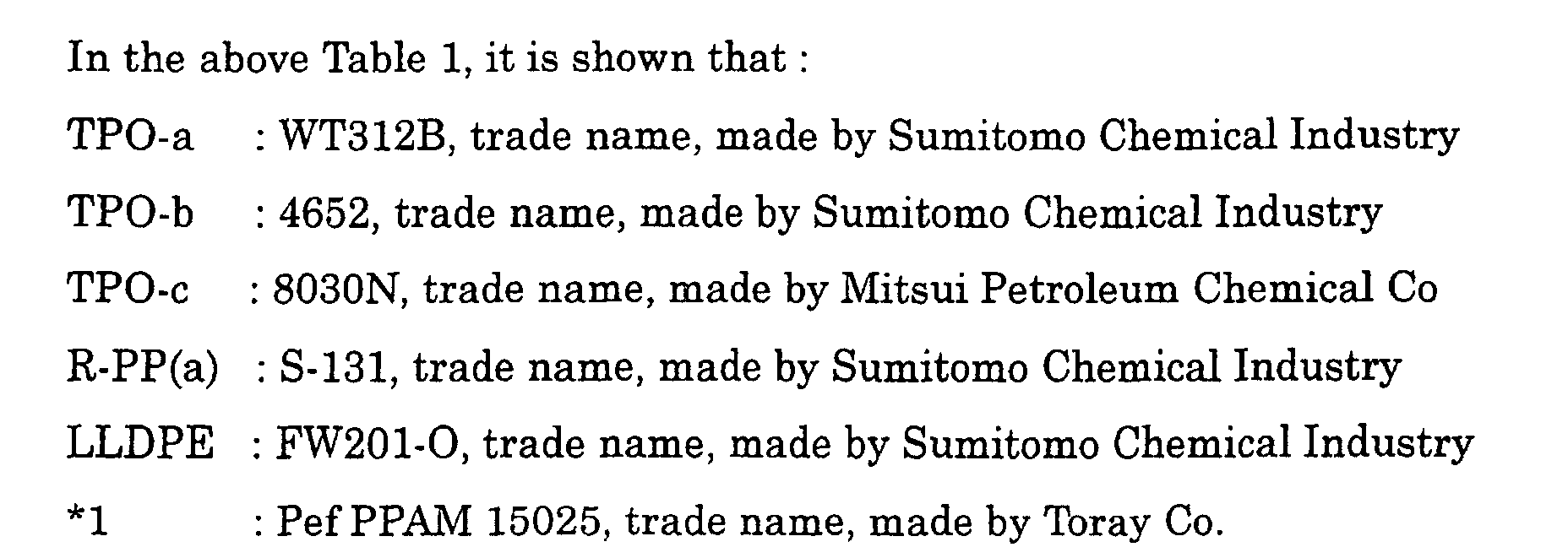
- Example 1 to 3 In a female mold and a male mold which compose a mold pattern, after arranging a surface skin material on the above mentioned female mold by vacuum forming, an expansion molding in this mold pattern was carried out. In inside of a portion on which a cavity face of the above mentioned female mold is composed, a flow line for passing a thermo-medium is formed in meandering shape, and by means of passing steam through this flow line, the temperature of cavity face is kept as shown in Table 1. And, on the above mentioned male mold, steam holes for feeding steam into the mold pattern at a time of expansion molding and a feeder for supplying pre-expanded beads were mounted.
- thermoplastic resin sheet of polyolefine line resin (TPO sheet) as the above mentioned surface skin material was employed, and after heating this sheet, it was arranged on the above mentioned female mold, then it was shaped by a vacuum pump.
- TPO sheet polyolefine line resin
- pre-expanded beads Eperan PP (trade name, produced by Kanegafuchi Chemical Industry Co., expansion rate was 15 times, its inner pressure was 2 kg cm 2 •G given by air pressure in a pressure container in advance) was employed, and after clamping the mold pattern, these pre-expanded beads were fed into the mold pattern through the above mentioned feeder.
- a producing method for a cellular molded article in the mold pattern having a surface skin and a molded article thereof which are relating to the present invention exhibit an excellent effect in printing of a design of the metal mold onto a surface skin material, and an excellent automatic releasing property from a mold metal. Accordingly, there are a lot of advantageous effects such as good appearance, easy recycling or light weight.
Landscapes
- Chemical & Material Sciences (AREA)
- Engineering & Computer Science (AREA)
- Materials Engineering (AREA)
- Health & Medical Sciences (AREA)
- Chemical Kinetics & Catalysis (AREA)
- Medicinal Chemistry (AREA)
- Polymers & Plastics (AREA)
- Organic Chemistry (AREA)
- Laminated Bodies (AREA)
- Casting Or Compression Moulding Of Plastics Or The Like (AREA)
- Molding Of Porous Articles (AREA)
- Manufacture Of Porous Articles, And Recovery And Treatment Of Waste Products (AREA)
Abstract
A cellular molded article in a mold pattern having the surface skin, which
has an excellent releasing property from a metal mold as well as an
excellent printing property of a design formed on a surface of metal mold,
and a producing method thereof are provided.
The cellular molded article in the mold pattern having the surface skin
and a producing method thereof, in which, at least a face of surface skin
material, which contacts with a metal mold, is an olefin line thermoplastic
elastomer sheet which is composed of an olefin line resin without containing
a polyethylene line resin as its matrix, and pre-expanded beads, which are
employed for an expansion molding in a mold pattern, are pre-expanded
beads of an olefin line resin.
Description
- This invention relates to a cellular molded article in a mold pattern having a surface skin, which is used for e.g. the interior trim material of an automobile, and a producing method thereof.
- As a conventional producing method of a cellular molded article having a surface skin in this kind, it is known as a so-called simultaneous unification molding into one piece that, for example, on either one of two metal molds by which a mold pattern is formed, a surface skin material of thermoplastic resin is arranged, and after clamping the metal molds, pre-expanded beads are fed into this mold pattern, then the pre-expanded beads are expanded and melt united each other by steam heating, and at the same time, these pre-expanded beads and the above mentioned surface skin material of thermoplastic resin are melt united together to one piece.
- In this simultaneous unification molding into one piece, inside each of the above mentioned two metal molds, a chamber connected with for example a steam valve, a decompression valve are provided. And, on the one metal mold to which the above mentioned surface skin material will be arranged, a plural number of decompression holes which connect with the above mentioned chamber are provided, at the same time, on the other metal mold, a plural number of decompression holes which connect with the above mentioned chamber are provided. And, at a time of the above mentioned expansion molding, by means of supplying steam into the mold pattern from the steam holes on the above mentioned other metal mold, the filled pre-expanded beads in this mold pattern are heat expanded.
- In this step, in order to make an effective expansion molding by pre-heating the above mentioned surface skin material, before arranging this surface skin material, by means of supplying steam into the above mentioned chamber, the above mentioned other metal mold is often pre-heated.
- However, in a case of preheating the above mentioned one metal mold as in the above, if an olefin line thermoplastic resin elastomer is employed as the above mentioned surface skin material, after molding it, at a time of mold releasing of the cellular molded article in the mold pattern having the surface skin from the above mentioned one metal mold, the above mentioned surface skin material will stick on the above mentioned one metal mold, and therefore it will often cause a hard release from the above mentioned one metal mold.
- Usually, before releasing it, it is cooled down by water or the like, but it will not be sufficient. While, a long time cooling is not preferable due to a longer producing cycle.
- At a time of releasing the cellular molded article in the mold pattern having the surface skin after the end of molding, if the above mentioned surface skin material sticks on the metal mold as in the above, an automatic releasing of the molded article from the molding machine becomes hard, subsequently, it will raise its production cost by a longer time of molding cycle, or by addition of equipment, tools or the like for releasing the molded article from the molding machine. Furthermore, as releasing the stuck molded article by force from the face of metal mold, there is a problem that design of the surface skin will be deteriorated.
- This invention is to solve the above mentioned problems, and even in a case of preheating the above mentioned one metal mold, sticking of the surface skin material on the above mentioned one metal mold will practically not appear, and therefore, it is an object to provide a producing method of the cellular molded article in the mold pattern having the surface skin and a molded article thereby, which are free from problems of the molding operation.
- Preferred embodiments of the present invention correspond to the method as claimed in claims 1 to 9 and to the article as claimed in any of
claims 10 to 12. - For the better understanding of the invention as well as other objects and features thereof, reference is made to the following detailed description to be read in conjunction with the accompanying drawings, wherein:
- Fig.1 illustrates a sectional side view of a cellular molded article in the
mold pattern having a surface skin of a polyolefin line resin. The meaning
of the numbers used in Figure 3 is as follows:
- 1 cellular molded article in mold pattern having surface skin of a polyolefin line resin
- 2 cellular molded article of a polyolefin line resin
- 3 TPO surface material
- Fig.2 illustrates a sectional side explanation view that, in a producing method of a cellular molded article in the mold pattern having the surface skin of polyolefin line resin, it is shown a state that a TPO surface skin material is arranged on the surface of the one metal mold and then clamped.
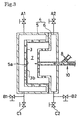
- Fig.3 illustrates a sectional side explanation view in which a state of
feeding pre-expanded beads of a polyolefin line resin into a mold pattern is
shown. The meaning of the numbers used in Fig. 3 is as folows:
- 3 TPO surface material
- 4 mold pattern
- 5 the one metal mold
- 6 the other metal mold
- 7 inside of the mold pattern
- 8 pre-expended beads of a polyolefin line resin
- Fig.4 illustrates a sectional side explanation view in which, after feeding pre-expanded beads of a polyolefin line resin, a state of feeding steam into a mold pattern is shown.
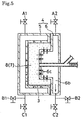
- Fig.5 illustrates a sectional side explanation view in which a state of vacuuming inside of a mold pattern is shown.
- Fig.6 illustrates a sectional side explanation view in which a state of feeding steam into a mold pattern and expanding pre-expanded beads of a polyolefin line resin are shown.
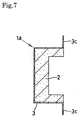
- Fig.7 illustrates a sectional side view of the cellular molded article in the mold pattern having the surface skin of a polyolefin line resin, which is released from a mold pattern and thus edge part of the surface skin material is attached as it is molded.
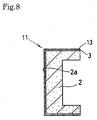
- Fig.8 illustrates a sectional side view of the cellular molded article in the
mold pattern having the surface skin of a polyolefin line resin, in which a
dual layer surface skin material is employed. The
number 13 as used in Figure 8 means: - 13 thermoplastic surface skin material for outer layer
-
- In the above mentioned drawings, marks represent as follows;
- 1 cellular molded article in the mold pattern having the surface skin of a polyolefin line resin
- 2 cellular molded article of a polyolefin line resin
- 3 TPO surface material
- 4 mold pattern
- 5 the one metal mold
- 6 the other metal mold
- 7 inside of the mold pattern
- 8 pre-expanded beads of a polyolefin line resin
- 13 thermoplastic surface skin material for outer layer Embodiments of this invention are described below based on the attached drawings. As illustrated in Fig.1, a cellular molded article having a surface skin of a polyolefin line resin 1 comprises the cellular molded article in the mold pattern of a
-
- The above mentioned cellular molded article in the mold pattern of
polyolefin line resin 2 is a molded article by expansion molding in the mold pattern of pre-expanded beads of a polyolefin line resin. As the above mentioned polyolefin line resin, for example, low density polyethylene, medium density polyethylene, high density polyethylene, linear low density polyethylene, ethylene-vinyl acetate copolymer, propylene homopolymer, ethylene-propylene random copolymer, ethylene-propylene-butene random terpolymer, propylene-vinyl chloride copolymer, propylene-butene copolymer, propylene-maleic anhydride copolymer, and polyethylene line resin or polypropylene line resin of poly (butene-1) or the like can be mentioned among others, and these can be used alone or as a mixture of not less than two of them. - This polyolefin line resin is preferably not crosslinked however, it may also be crosslinked by using a peroxide, radiation or the like.
- Furthermore, a mixture of this polyolefin line resin and another thermoplastic resin can be employed. As such kind of a thermoplastic resin, in a case of blending with the above mentioned polypropylene line resin, for example, low density polyethylene, linear low density polyethylene, aromatic vinyl line polymer, polybutene, and ionomer can be mentioned among others. While, in case of blending with the above mentioned polyethylene line resin, for example, aromatic vinyl line polymer, polybutene and ionomer can be mentioned among others. And in these cases, the amount of the thermoplastic resin to be blended is preferably not more than 20 parts by weight based on 100 parts by weight of the polyolefin line resin, more preferably 5 to 10 parts by weight.
- The above mentioned pre-expanded beads of
polyolefin line resin 8 can be produced for example by a process that a polyolefin line resin as mentioned above is molded to pellet shape in advance. This polyolefin line resin pellet is made to be impregnated with a volatile foaming agent in an autoclave and then is dispersed in water while keeping on stirring. After heating it up to a prescribed foaming temperature, this dispersed pellet in water is released into a low pressure zone, and thus, the pre-expanded state is produced. - When these pre-expanded beads of a
polyolefin line resin 8 are expanded in the mold pattern and the expansion rate is less than 3 times, for example, the buffer property of the obtained cellular molded article in the mold pattern ofpolyolefin line resin 2 tends to be reduced, while in a case where the expansion rate is more than 60 times, shrinkage of the cellular molded article in the mold pattern of apolyolefin line resin 2 becomes too large and also for example its strength becomes low due to excessive softness. Therefore, an expansion rate of 3 to 60 times is desirable, preferably 5 to 50 times, more preferably 8 to 45 times, and most preferably 10 to 35 times. As such pre-expanded beads of apolyolefin line resin 8, for example, Eperan PP (trade name, made by Kanegafuchi Chemical Industry, Co. expansion rate is 15 times) can be suitably employed among others. - An olefin line copolymer rubber which is employed as the above mentioned TPO surface skin material (olefin line thermoplastic elastomer) 3 is for example, a non-regular type random elastic copolymer with an olefin as its main component, which is, for example, ethylene-propylene line copolymer rubber, ethylene-propylene-nonconjugated diene line rubber, ethylene-butene-nonconjugated diene line rubber, or propylene-butadiene line copolymer rubber. Among these, an ethylene-propylene-nonconjugated diene line rubber is particularly preferable. As a nonconjugated diene, dicyclopentadiene, 1,4-hexadiene, cyclooctadiene, methylene norbornane, ethylidene norbornane can be mentioned among others.
- An olefin line copolymer rubber for the surface skin material is usually crosslinked, and a suitable elasticity is caused by this. Therefore, if a crosslinking by a peroxide or a radiation works effectively, such method will not be limited whatsoever.
- A preferable olefin line resin, which is employed for the above mentioned TPO surface skin material (olefin line thermoplastic elastomer) 3, is a polypropylene line resin, and preferably said polypropylene line resin is a polypropylene and / or a random or block copolymer resin of propylene and α-olefin having two or more carbon atoms. As a typical example of an α-olefin having two or more carbon atoms, ethylene, 1-butene, 1-pentene, 3-methyl-1-butene, 1-hexene, 1-decene, 3-methyl-1-pentene, 4-methyl-1-pentene or 1-octene can be mentioned among others.
- In the present invention, an olefin line resin for the surface skin material as in this description is preferably excluding a polyethylene line resin, and even if a polyethylene polymer is included, the minimum amount of it can improve its releasing property from a mold pattern. The reason of this property is not cleared yet, but it is thought that, because of a low softening temperature of polyethylene line resin, this resin sticks on a metal mold, and thus, its releasing property gets worse. Therefore, in a case of 100 % by weight of olefin line resin for the surface skin material the blending amount of a polyethylene polymer should not be more than 15 % by weight, preferably not more than 5 % by weight, and more preferably not more than 1 % by weight. The most preferably, it should be reduced further, however, as long as achieving an object of the present invention, it is not limited to these.
- That is, in the present invention, an olefin line resin without containing a polyethylene line resin as a matrix is described as in the above definition. TPO
surface skin material 3 comprises the above mentioned olefin line copolymer rubber (domain) and an olefin line resin (matrix), and a ratio of each of them can be determined or selected by one's discretion according to its object. As a crosslinking agent, which makes a partial crosslinking of the above mentioned each mixture, in general, an organic peroxide is suitably employed. - In a producing method of the above mentioned TPO surface skin material, if necessary, an auxiliary agent such as a crosslinking auxiliary agent, flow promoter, inorganic filler, antioxidant, weather-proof agent, antistatic agent, pigment can be blended therewith.
- Furthermore, as a coating material for scratch protection, which comprises a thermoplastic elastomer and which is coated on the sheet surface, preferably an urethane line or acrylic line coating material can be mentioned.
- As a processing method of a laminated surface skin material in which such material is employed, it can be mentioned among others that, during processing or after processing of sheet molding by, for example, calendar molding or T-die extrusion molding of a thermoplastic elastomer according to the above mentioned method, a resinous cellular article layer is laminated, and then, in its lower stream process, a coating material is coated on a surface of the thermoplastic elastomer which will be the utmost outer layer using a coating machine such as a gravure coater.
- Next, a producing method of the cellular molded article in the mold pattern having the surface skin of polyolefin line resin 1 will be explained. As illustrated in Fig.2 to Fig.7 inclusive, a producing method of the cellular molded article in the mold pattern having the surface skin of olefin line resin 1, which is relating to this embodiment of the present invention, is that on the one
metal mold 5 of twometal molds mold pattern 4, TPOsurface skin material 3 is arranged and clamped, after then pre-expanded beads of apolyolefin line resin 8 are fed into thismold pattern 7, and, by means of steam heating, these pre-expanded beads of apolyolefin line resin 8 are expanded to make melt uniting together, and at the same time, these pre-expanded beads of apolyolefin line resin 8 are melt united to one piece with the above mentioned TPOsurface skin material 3. - That is, as illustrated in Fig.2, the above mentioned TPO
surface skin material 3 is arranged on the above mentioned onemetal mold 5, and then the mold pattern is clamped. - At this stage, the above mentioned
mold pattern 4 is, for example, composed of twometal molds - In these two
metal molds metal mold 5 is, for example, composed of a concave shape in sectional side view, andchamber 5b is formed in its inside, and a plural number of decompression holes 5c, which are connected with the above mentionedchamber 5b, are formed on itssurface 5a side. And, the above mentionedchamber 5b is connected with a steam valve A1, a decompression valve B1 and a drain valve C1 respectively. Theother metal mold 6a is, for example, composed of a convex shape in sectional side view, andchamber 6b is formed in its inside, and a plural number of steam holes 6c, which are connected with the above mentionedchamber 6b, are formed on itssurface 6a side. And, the above mentionedchamber 6b is connected with a steam valve A2, a decompression valve B2 and a drain valve C2 respectively, andfeeder 10 for feeding pre-expanded beads ofpolyolefin line resin 8 into the above mentionedmold pattern 7 is provided. - Arranging the above mentioned TPO
surface skin material 3 onsurface 5a of the onemetal mold 5 may be made by forming the above-mentioned TPOsurface skin material 3 in advance in a suitable shape to conform to surface 5a shape of the above mentioned onemetal mold 5, for example, by vacuum forming. However, as it is in this embodiment, in a case of arranging it by heat forming such as vacuum forming, there is a merit that the labor for forming it in advance can be omitted. And, thermo-forming of this TPOsurface skin material 3, it is not limited to vacuum forming but other forming such as compression molding can be applied. - At this stage, when using vacuum forming, the above mentioned TPO
surface skin material 3 is heat-softened beforehand, and it is contacted with the onemetal mold 5 as it is, thereafter decompression valve B1, which is connected with the above mentionedchamber 5b, is opened. - In this case, by means that the above mentioned one
metal mold 5 is heated up to a prescribed temperature, for example, by steam or a heater which is separately mounted on temperature drop of heat-softened TPOsurface skin material 3 to be contacted with said the onemetal mold 5 can be minimized, thus there is a merit that a design pattern of the onemetal mold 5 can be effectively printed on (transferred to) the TPOsurface skin material 3. Further, during the heat molding or in the subsequent expansion molding in the mold pattern, in order to prevent a heat drop of TPOsurface skin material 3, heating up by, for example, a heater may continue during the thermo-forming or even after it, or a stepwise heating which is changing the setting temperature in steps from the beginning may also be done. - And, in a case that the above mentioned TPO
surface skin material 3 comprises a polyolefin line resin, when the temperature of the onemetal mold 5 before the thermo-forming operation is in a range of 60 to 150°C, preferably at 60 to 130°C, more preferably at 70 to 120°C, the above mentioned TPOsurface skin material 3 can be thermo-formed in a suitable softening condition and there is a merit to make a good finishing. - While, in a case that the cellular molded article in the mold pattern having the surface skin of a polyolefin line resin 1 to be obtained by this process is, for example, required to have a fitting tool or the like, on
surface 6a of the above mentionedother metal mold 6, a prescribed shaped inserting member (not shown) is arranged in advance, and at the time of the expanding operation in the mold pattern of the above mentioned pre-expanded beads of thepolyolefin line resin 8, this inserting member may be melt united to one piece with the cellular molded article in the mold pattern of apolyolefin line resin 2. - Next, as illustrated in Fig.3, pre-expanded beads of a
polyolefin line resin 8 are fed into themold pattern 7 from the above mentionedfeeder 10. - At this stage, as TPO
surface skin material 3 is arranged onsurface 5a of the above mentioned onemetal mold 5 in a clamped condition, the inside air can be evacuated by only steam holes 6c of the above mentionedother metal mold 6, consequently, to make a smooth feeding of the above mentioned pre-expanded beads of thepolyolefin line resin 8, or a small opening between the two metal molds may be made so that these pre-expanded beads of thepolyolefin line resin 8 will not go through, but the inside air can be evacuated from this small opening at a time of the feeding. - And, the above mentioned pre-expanded beads of the
polyolefin line resin 8 may be fed into the above mentionedmold pattern 7 in a state that a compressed gas is penetrated into their insides in advance and an inner pressure in each of them is given, or may be fed in a compressed state by a compressed gas, or may be fed as they are without giving an inside pressure or compressing. - Thereafter, as illustrated in Fig.4, a steam valve A2, which connects with
chamber 6b of the above mentionedother metal mold 6, is opened, and steam S is fed intomold pattern 7 through the above mentioned steam holes 6c, and the above mentioned pre-expanded beads of apolyolefin line resin 8 are heat expanded. - At this stage, by means that the above mentioned pre-expanded beads of a
polyolefin line resin 8 are pre-heated in advance at a lower temperature than the temperature of their melt uniting together, before the regular heating of these pre-expanded beads of thepolyolefin line resin 8 at a higher temperature than the temperature of their melt uniting together, pre-expanded beads of thepolyolefin line resin 8 can be sufficiently heated up to a state without causing a problem of melt uniting each other. - Furthermore, after a pre-heating as in the above, by steaming the above mentioned pre-expanded beads of the
polyolefin line resin 8 with steam S, the latent heat of fed steam S can be effectively utilized in between the above mentioned pre-expanded beads of thepolyolefin line resin 8, particularly, in a case of forming a thick cellular molded article in the mold pattern of thepolyolefin line resin 2 and there is a merit that the above mentioned pre-expanded beads of thepolyolefin line resin 8 can be more uniformly heated. - And, after the pre-heating, steaming can be made by continuous steam S supply, or by suspending steam S supply, or, if necessary, in a condition of opening drain valve C2.
- After steaming of the above mentioned pre-expanded beads of the
polyolefin line resin 8 by steam S, there remains drain (moisture) in between the above mentioned pre-expanded beads of thepolyolefin line resin 8, and if in this situation a regular heating is made there will happen insufficient melt uniting of the pre-expanded beads of thepolyolefin line resin 8. Therefore, evacuation of the above mentioned drain is desirable. - As a method for evacuation of this drain as, for example, illustrated in Fig.5, a method that, a decompression valve B2, which is connected with
chamber 6b of the above mentionedother metal mold 6, is opened and vacuuming inside ofmold pattern 7 through the above mentioned steam holes 6c, or a method of making a slit between the twometal molds mold pattern 4, and dry air at a high temperature, which is however not so high to cause melt uniting of the pre-expanded beads of thepolyolefin line resin 8, penetrates into the mold pattern so as to evacuate the drain through the above mentioned slit, can be mentioned among others. - Subsequently, the regular heating is carried out at a higher temperature than the temperature of melt uniting the above mentioned pre-expanded beads of the
polyolefin line resin 8. This regular heating is carried out, as illustrated in Fig.6, by supplying steam S into themold pattern 7 from the above mentionedsteam holes 6 by opening the above mentioned steam valve A2. At this step, as described above, in a case that, after the steaming by steam S, vacuuming of the above mentionedmold pattern 7 is carried out for evacuation of the drain, the above mentioned steam S for the regular heating can be supplied more smoothly into themold pattern 7. - In addition, the temperature of steam S at this stage is preferably higher than the temperature at which the above mentioned pre-expanded beads of the
polyolefin line resin 8 are melt uniting each other. However, in a case of excessively high temperature, shrinkage of the obtained cellular molded article in the mold pattern of thepolyolefin line resin 2 will become excessively large. - After the regular heating as described above, in order to transfer the heat by steam S into the above mentioned pre-expanded beads of the
polyolefin line resin 8 sufficiently, it is desirable to keep in its condition. - Subsequently, by opening the above mentioned
mold pattern 4, as is illustrated in Fig.7, a cellular molded article in the mold pattern having the surface skin of thepolyolefin line resin 1a and having anedge part 3c can be obtained. - And, before opening the mold pattern, the above mentioned
mold pattern 4 may be cooled down in advance. Also, the cellular molded article in the mold pattern having the surface skin of thepolyolefin line resin 1a which has been obtained is preferably dried, for example, by keeping it in a dried room, right after release from themold pattern 4. While, as described in this embodiment, in a case that the above mentionededge part 3c is formed by an excessive edge part of the above mentioned TPOsurface skin material 3, thisedge part 3c can be cut off after releasing the article from the mold pattern, as is described above and after drying it or before keeping it in a drying room and the cellular molded article in the mold pattern having the surface skin of the polyolefin line resin 1, which is illustrated in Fig.1, can be obtained. - As is described above, the above mentioned pre-expanded beads of the
polyolefin line resin 8 are pre-heated and steamed by steam S, and then, by making a regular heating, when the cellular molded article in the mold pattern of thepolyolefin line resin 2 is produced from the pre-expanded beads of thepolyolefin line resin 8, simultaneously said cellular molded article in the mold pattern of thepolyolefin line resin 2 can be tightly melt united into one piece with the above mentioned TPOsurface skin material 3, and furthermore, a cellular molded article in the mold pattern having the surface skin of the polyolefin line resin 1, in which the above mentioned cellular molded article in the mold pattern of apolyolefin line resin 2 is free from insufficient melt uniting of the pre-expanded beads of thepolyolefin line resin 8, can be produced. - A cellular molded article in the mold pattern having the surface skin of the
polyolefin line resin 11 illustrated in Fig.8 is an example that, on surface 3a of the above mentioned TPOsurface skin material 3, a thermoplastic surface skin material for theouter layer 13 is laminated. - When such laminated TPO
surface skin material 3 with at least one layer of a thermoplastic surface skin material for theouter layer 13 is melt uniting to one piece with the above mentioned cellular molded article in the mold pattern of thepolyolefin line resin 2, the TPOsurface skin material 3 is hidden by the above mentioned thermoplastic surface skin material for theouter layer 13, by means of employing a thermoplastic surface skin material for theouter layer 13 which comprises a material which will not stick with the onemetal mold 5, or furthermore, has a better printing property for the design so that a better appearance can be made. Accordingly, there will not be a need to consider a sticking problem of the TPOsurface skin material 3 with the onemetal mold 5 nor its appearance problem, and therefore, there is a merit that this TPO surface skin material can be made from a desirable composition in consideration of a better melt uniting property with the pre-expanded beads of the polyolefin line resin, a better vacuum forming property or the like. - Furthermore, in the
above embodiment 1 and 2 which are illustrated in Fig.7 and Fig. 8, it was described a case that the above mentioned onemetal mold 5 is a concave mold (female mold) of which sectional side view is concave shape. However, it is not limited to this, but it can also be that the above mentioned one metal mold is a convex mold (male mold) and theother metal mold 6 is a concave mold (female mold). - As use of the cellular molded article in the mold pattern having the surface skin by the present invention, various industrial products such as sports goods field or parts for building and housing can be mentioned. As the interior trim material for an automobile, an instrument panel, console box, arm rest, head rest, door trim, rear panel, pillar trim, sun visor, trunk room trim, trunk lid trim, head liner, globe box and ceiling material can be mentioned among others.
- Next, more details of the present invention will be described by examples of the invention however, it is not limited to these examples.
- [Example 1 to 3] In a female mold and a male mold which compose a mold pattern, after arranging a surface skin material on the above mentioned female mold by vacuum forming, an expansion molding in this mold pattern was carried out. In inside of a portion on which a cavity face of the above mentioned female mold is composed, a flow line for passing a thermo-medium is formed in meandering shape, and by means of passing steam through this flow line, the temperature of cavity face is kept as shown in Table 1. And, on the above mentioned male mold, steam holes for feeding steam into the mold pattern at a time of expansion molding and a feeder for supplying pre-expanded beads were mounted.
- In this stage, a thermoplastic resin sheet of polyolefine line resin (TPO sheet) as the above mentioned surface skin material was employed, and after heating this sheet, it was arranged on the above mentioned female mold, then it was shaped by a vacuum pump. As pre-expanded beads, Eperan PP (trade name, produced by Kanegafuchi Chemical Industry Co., expansion rate was 15 times, its inner pressure was 2 kg cm2•G given by air pressure in a pressure container in advance) was employed, and after clamping the mold pattern, these pre-expanded beads were fed into the mold pattern through the above mentioned feeder.
- After the feeding of pre-expanded beads, steam (vapor pressure was 1.5 kg cm2•G) was fed into the mold pattern through the steam holes mounted on the above mentioned male mold, and pre-heated. Then, after steaming of the pre-expanded beads, the drain and steam were suctioned and evacuated by employing a vacuum pump. Thereafter, steam (vapor pressure was 3.2 to 3.7 kg cm2•G) was fed into the mold pattern again through the above mentioned steam holes and a regular heating was carried out, and then, after cooled down by water, by opening the mold pattern, the cellular molded article in the mold pattern having the surface skin was obtained. While, cooling of the female mold during the above mentioned water cooling time was carried out by feeding a cooled water into the above mentioned flow line.
- [Comparative example 1 to 2] The cellular molded article in the mold pattern having the surface skin was obtained by the same manner as in example 1 to 3 except employing the surface skin material shown in Table 1.
- [Comparative example 3 to 6] The surface temperature of female mold pattern was changed as shown in Table 1, and comparative example 4 shows the result in which Pef PPAM (trade name of Toray company) was employed as the surface skin material.
- In addition, at a time of opening the mold pattern in example 1 to 3 and comparative example 1 to 6, a presence of sticking of the surface skin material with the female mold pattern was observed. Also, a surface appearance of each of the obtained cellular molded article in the mold pattern having the surface skin was examined. Its result is shown in Table 1.
- Presence of sticking of the surface skin material with the female mold pattern ;
- o ○: none of presence of sticking with the metal mold
- ○: some presence of sticking with the metal mold, but it can be released without trouble
- ▴: presence of sticking with the metal mold is observed and automatic releasing from the metal mold is difficult
- ×: strong sticking with the metal mold and cannot be released from the metal mold
-
- Printing property of the design to the molded article ;
- o ○: design of the metal mold is sufficiently printed on
- ○: design of the metal mold is almost printed on
- ▴: design of the metal mold is printed on, but defect is observed
- ×: design of the metal mold is not sufficiently printed on
-
- Melt uniting property of the beads with the surface skin material
- o ○: beads are tightly melt united with the surface skin material
- ○: beads are melt united with the surface skin material
- ▴: beads are melt united with the surface skin material but not tightly
- ×: beads are not sufficiently united with the surface skin material
-
- A producing method for a cellular molded article in the mold pattern having a surface skin and a molded article thereof which are relating to the present invention exhibit an excellent effect in printing of a design of the metal mold onto a surface skin material, and an excellent automatic releasing property from a mold metal. Accordingly, there are a lot of advantageous effects such as good appearance, easy recycling or light weight.
- Although the invention has been described in its preferred form with certain degree of particularity, it is understood that the present disclosure of the preferred form has been changed in the details of construction and the combination and arrangement of parts may be resorted to without departing from the spirit and the scope of the invention as hereinafter claimed.

Claims (12)
- A producing method of a cellular molded article in a mold pattern having a surface skin is that, after thermoforming of a surface skin material along with a metal mold face of either one of two metal molds which compose a mold pattern, by means of expansion molding in this mold pattern, the above mentioned surface skin material is melt united to one piece with a surface of the cellular molded article in the mold pattern to be molded, characterized in that at least a face of the above mentioned surface skin material, which contacts the metal mold, is an olefin line thermoplastic elastomer sheet which comprises an olefin line resin without containing a polyethylene line resin as its matrix, and the pre-expanded beads, which are employed for the expansion molding in the mold pattern, are pre-expanded beads of an olefine line resin.
- A producing method of a cellular molded article in a mold pattern having a surface skin is that, after thermoforming of a surface skin material along with a metal mold face of either one of two metal molds which compose a mold pattern, by means of expansion molding in this mold pattern, the above mentioned surface skin material is melt united to one piece with a surface of the cellular molded article in the mold pattern to be molded, characterized in that at least a face of the above mentioned surface skin material, which contacts the metal mold, is an olefin line thermoplastic elastomer sheet which comprises an olefin line copolymer rubber as a domain and an olefin line resin as a matrix without containing a polyethylene line resin as its matrix, and the pre-expanded beads, which are employed for the expansion molding in the mold pattern, are pre-expanded beads of an olefine line resin.
- The method according to claim 1 or 2, characterized in that, at least a face of the above mentioned surface skin material contacting the metal mold comprises a domain, which contains a polyethylene line resin as its composing raw material resin and is formed by dynamic curing, and an olefin line thermoplastic elastomer sheet which comprises an olefin line resin without containing a polyethylene line resin as a matrix, and the pre-expanded beads to be employed for the expansion molding in the mold pattern are pre-expanded beads of an olefin line resin.
- The method according to any of claims 1 to 3, characterized in that, the above mentioned olefin line pre-expanded beads are pre-expanded beads of a polypropylene line resin.
- The method according to anyone of claims 1 to 4, characterized in that, the above mentioned pre-expanded beads of an olefin line resin are pre-expanded beads of a polyethylene line resin.
- The method according to anyone of claims 1 to 5 characterized in that, the above mentioned olefin line resin as a matrix is a polypropylene line resin.
- The method according to anyone of claims 1 to 6, characterized in that, the above mentioned polyethylene line resin which is not included as a matrix is a linear low density polyethylene line resin.
- The method according to anyone of claims 1 to 7, characterized in that, at least the one metal mold is composed of an aluminum line metal.
- The method according to anyone of claims 1 to 8, characterized in that, on the surface of the above mentioned one metal mold, a design pattern, which will be printed on the sheet at the time of thermal forming of the sheet, is attached.
- A cellular molded article in a mold pattern having a surface skin, obtainable according to any of claims 1 to 9.
- The cellular molded article according to claim 10, wherein it is characterized in that, the cellular molded article in the mold pattern having the surface skin is that, at least one face of the above mentioned surface skin material which contacts the metal mold is an olefin line thermoplastic elastomer sheet composed of an olefin line resin without containing a polyethylene line resin, and pre-expanded beads, which will be employed for the expansion molding, are pre-expanded beads of an olefin line resin.
- An interior trim material of an automobile comprising a cellular molded article in the mold pattern having the surface skin as claimed in claim 10 or 11.
Applications Claiming Priority (2)
| Application Number | Priority Date | Filing Date | Title |
|---|---|---|---|
| JP2001016528A JP2002219726A (en) | 2001-01-25 | 2001-01-25 | In-mold foam molded article with skin and method for producing the same |
| JP2001016528 | 2001-01-25 |
Publications (1)
| Publication Number | Publication Date |
|---|---|
| EP1226915A1 true EP1226915A1 (en) | 2002-07-31 |
Family
ID=18882883
Family Applications (1)
| Application Number | Title | Priority Date | Filing Date |
|---|---|---|---|
| EP02001807A Withdrawn EP1226915A1 (en) | 2001-01-25 | 2002-01-25 | Cellular molded article in mold pattern having a surface skin and a producing method thereof |
Country Status (3)
| Country | Link |
|---|---|
| US (2) | US6787077B2 (en) |
| EP (1) | EP1226915A1 (en) |
| JP (1) | JP2002219726A (en) |
Families Citing this family (6)
| Publication number | Priority date | Publication date | Assignee | Title |
|---|---|---|---|---|
| JP2002219726A (en) * | 2001-01-25 | 2002-08-06 | Kanegafuchi Chem Ind Co Ltd | In-mold foam molded article with skin and method for producing the same |
| US8282912B2 (en) * | 2002-03-22 | 2012-10-09 | Kuros Biosurgery, AG | Compositions for tissue augmentation |
| WO2006001650A1 (en) * | 2004-06-23 | 2006-01-05 | Samsung Electronics Co., Ltd. | Method of configuring and updating connection identifier in a broadband wireless access communication system |
| AT500869B1 (en) * | 2004-08-20 | 2007-05-15 | Steiner Peter | DEVICE FOR PRODUCING CONTAINERS COATED WITH A FILM |
| US20090051079A1 (en) * | 2007-08-22 | 2009-02-26 | Ronan Jeffrey J | Roofing components having vacuum-formed thermoset materials and related manufacturing methods |
| JP6144999B2 (en) * | 2013-08-30 | 2017-06-07 | リケンテクノス株式会社 | Skin film, decorative molded product and method for producing the same |
Citations (5)
| Publication number | Priority date | Publication date | Assignee | Title |
|---|---|---|---|---|
| EP0326408A2 (en) * | 1988-01-29 | 1989-08-02 | Mitsui Petrochemical Industries, Ltd. | Multilayered molding and method of manufacturing the same |
| EP0544501A2 (en) * | 1991-11-28 | 1993-06-02 | Mitsui Petrochemical Industries, Ltd. | Process for preparing composite foamed molded article |
| JPH06246858A (en) * | 1993-02-26 | 1994-09-06 | Honda Motor Co Ltd | Interior material and manufacturing method thereof |
| US5811039A (en) * | 1991-12-12 | 1998-09-22 | Montell Italia S.P.A. | Process for fabricating bodies of polymeric material with foamed core |
| EP1157819A1 (en) * | 1998-12-16 | 2001-11-28 | Chisso Corporation | Thermoplastic resin structure |
Family Cites Families (9)
| Publication number | Priority date | Publication date | Assignee | Title |
|---|---|---|---|---|
| US3696452A (en) * | 1970-03-25 | 1972-10-10 | Dow Chemical Co | Hull construction for vessels and the like |
| US5795526A (en) * | 1993-02-19 | 1998-08-18 | Sumitomo Chemical Company, Limited | Process for producing multilayer molded article |
| JP3328360B2 (en) * | 1993-03-31 | 2002-09-24 | 三井化学株式会社 | Thermoplastic elastomer |
| US6261489B1 (en) * | 1996-06-28 | 2001-07-17 | Kaneka Corporation | Method of manufacturing skin-carrying internal-mold expansion molded body of synthetic resin and metal mold used for the same method |
| JP4050374B2 (en) * | 1998-01-26 | 2008-02-20 | 株式会社ジェイエスピー | Method for producing foamed molded product with skin and foamed molded product with skin |
| US5916672A (en) * | 1997-04-25 | 1999-06-29 | Brunswick Corporation | Thermoplastic multi-layer composite structure |
| JPH1199531A (en) * | 1997-09-29 | 1999-04-13 | Kanegafuchi Chem Ind Co Ltd | Core material for automobile bumpers |
| JP3664865B2 (en) | 1998-02-06 | 2005-06-29 | 三菱重工業株式会社 | Corrugating machine |
| JP2002219726A (en) * | 2001-01-25 | 2002-08-06 | Kanegafuchi Chem Ind Co Ltd | In-mold foam molded article with skin and method for producing the same |
-
2001
- 2001-01-25 JP JP2001016528A patent/JP2002219726A/en active Pending
- 2001-09-13 US US09/950,699 patent/US6787077B2/en not_active Expired - Lifetime
-
2002
- 2002-01-25 EP EP02001807A patent/EP1226915A1/en not_active Withdrawn
-
2004
- 2004-06-29 US US10/878,252 patent/US20040234708A1/en not_active Abandoned
Patent Citations (5)
| Publication number | Priority date | Publication date | Assignee | Title |
|---|---|---|---|---|
| EP0326408A2 (en) * | 1988-01-29 | 1989-08-02 | Mitsui Petrochemical Industries, Ltd. | Multilayered molding and method of manufacturing the same |
| EP0544501A2 (en) * | 1991-11-28 | 1993-06-02 | Mitsui Petrochemical Industries, Ltd. | Process for preparing composite foamed molded article |
| US5811039A (en) * | 1991-12-12 | 1998-09-22 | Montell Italia S.P.A. | Process for fabricating bodies of polymeric material with foamed core |
| JPH06246858A (en) * | 1993-02-26 | 1994-09-06 | Honda Motor Co Ltd | Interior material and manufacturing method thereof |
| EP1157819A1 (en) * | 1998-12-16 | 2001-11-28 | Chisso Corporation | Thermoplastic resin structure |
Non-Patent Citations (1)
| Title |
|---|
| PATENT ABSTRACTS OF JAPAN vol. 018, no. 636 (M - 1715) 5 December 1994 (1994-12-05) * |
Also Published As
| Publication number | Publication date |
|---|---|
| US6787077B2 (en) | 2004-09-07 |
| US20020146554A1 (en) | 2002-10-10 |
| US20040234708A1 (en) | 2004-11-25 |
| JP2002219726A (en) | 2002-08-06 |
Similar Documents
| Publication | Publication Date | Title |
|---|---|---|
| CA2004041C (en) | Laminated molded articles and processes for preparing same | |
| US5096652A (en) | Method of manufacturing a multilayered molding | |
| JP3710014B2 (en) | Method for producing foamed article with skin material and vehicle interior material obtained thereby | |
| CA2030422C (en) | Pressure and vacuum formable foam foil for lining the interior spaces of motor vehicles | |
| US20020018876A1 (en) | Composite molded article and producing method thereof as well as inner mold and metal mold being used for producing cellular molded article in mold pattern having surface skin | |
| US6492000B1 (en) | Skin-carrying in-mold expanded molded body manufacturing method, the molded body, and mold used for manufacturing the same | |
| US6261489B1 (en) | Method of manufacturing skin-carrying internal-mold expansion molded body of synthetic resin and metal mold used for the same method | |
| CN111055570A (en) | TPO composition for forming TPO artificial leather and corresponding TPO artificial leather | |
| US5407991A (en) | Thermoplastic elastomer composition, covering materials for industrial parts comprising the composition and laminates comprising the covering materials | |
| US5188882A (en) | Multilayered molding | |
| US6787077B2 (en) | Cellular molded article in mold pattern having surface skin and producing method thereof | |
| US20080264544A1 (en) | Foamed thermoplastic resin molding with a functional component | |
| JP2019111727A (en) | Decorative molding and method for producing the same | |
| CN1827340B (en) | Method for preparing thermoplastic resin product | |
| JP4597410B2 (en) | Treatment method for skin edge material | |
| US20060163764A1 (en) | Method for producing a thermoplastic resin article | |
| JP5068165B2 (en) | Synthetic resin foam material and use thereof | |
| JPH1015974A (en) | Polyolefin resin-in-mold foamed product with skin and method for producing the same | |
| JP4388853B2 (en) | Method for producing thermoplastic resin foam molded article | |
| JPH1015973A (en) | Method for producing foamed molded article in synthetic resin mold with skin | |
| JP4344651B2 (en) | Method for producing thermoplastic resin foam molded article | |
| JP2008207549A (en) | Method for producing thermoplastic resin molded article | |
| JP3774787B2 (en) | Method for producing in-mold foam molded body with skin | |
| JPH10309754A (en) | Interior materials for car doors | |
| JPH0390330A (en) | Manufacture of hollow-molded product |
Legal Events
| Date | Code | Title | Description |
|---|---|---|---|
| PUAI | Public reference made under article 153(3) epc to a published international application that has entered the european phase |
Free format text: ORIGINAL CODE: 0009012 |
|
| AK | Designated contracting states |
Kind code of ref document: A1 Designated state(s): AT BE CH CY DE DK ES FI FR GB GR IE IT LI LU MC NL PT SE TR |
|
| AX | Request for extension of the european patent |
Free format text: AL;LT;LV;MK;RO;SI |
|
| 17P | Request for examination filed |
Effective date: 20020919 |
|
| AKX | Designation fees paid |
Designated state(s): BE DE FR GB |
|
| 17Q | First examination report despatched |
Effective date: 20040129 |
|
| STAA | Information on the status of an ep patent application or granted ep patent |
Free format text: STATUS: THE APPLICATION IS DEEMED TO BE WITHDRAWN |
|
| 18D | Application deemed to be withdrawn |
Effective date: 20080801 |