EP1225479A2 - Chemical amplifying type positive resist composition - Google Patents
Chemical amplifying type positive resist composition Download PDFInfo
- Publication number
- EP1225479A2 EP1225479A2 EP02001028A EP02001028A EP1225479A2 EP 1225479 A2 EP1225479 A2 EP 1225479A2 EP 02001028 A EP02001028 A EP 02001028A EP 02001028 A EP02001028 A EP 02001028A EP 1225479 A2 EP1225479 A2 EP 1225479A2
- Authority
- EP
- European Patent Office
- Prior art keywords
- resist composition
- positive resist
- type positive
- amplifying type
- acid
- Prior art date
- Legal status (The legal status is an assumption and is not a legal conclusion. Google has not performed a legal analysis and makes no representation as to the accuracy of the status listed.)
- Granted
Links
Classifications
-
- G—PHYSICS
- G03—PHOTOGRAPHY; CINEMATOGRAPHY; ANALOGOUS TECHNIQUES USING WAVES OTHER THAN OPTICAL WAVES; ELECTROGRAPHY; HOLOGRAPHY
- G03F—PHOTOMECHANICAL PRODUCTION OF TEXTURED OR PATTERNED SURFACES, e.g. FOR PRINTING, FOR PROCESSING OF SEMICONDUCTOR DEVICES; MATERIALS THEREFOR; ORIGINALS THEREFOR; APPARATUS SPECIALLY ADAPTED THEREFOR
- G03F7/00—Photomechanical, e.g. photolithographic, production of textured or patterned surfaces, e.g. printing surfaces; Materials therefor, e.g. comprising photoresists; Apparatus specially adapted therefor
- G03F7/004—Photosensitive materials
- G03F7/039—Macromolecular compounds which are photodegradable, e.g. positive electron resists
-
- G—PHYSICS
- G03—PHOTOGRAPHY; CINEMATOGRAPHY; ANALOGOUS TECHNIQUES USING WAVES OTHER THAN OPTICAL WAVES; ELECTROGRAPHY; HOLOGRAPHY
- G03F—PHOTOMECHANICAL PRODUCTION OF TEXTURED OR PATTERNED SURFACES, e.g. FOR PRINTING, FOR PROCESSING OF SEMICONDUCTOR DEVICES; MATERIALS THEREFOR; ORIGINALS THEREFOR; APPARATUS SPECIALLY ADAPTED THEREFOR
- G03F7/00—Photomechanical, e.g. photolithographic, production of textured or patterned surfaces, e.g. printing surfaces; Materials therefor, e.g. comprising photoresists; Apparatus specially adapted therefor
- G03F7/004—Photosensitive materials
- G03F7/039—Macromolecular compounds which are photodegradable, e.g. positive electron resists
- G03F7/0392—Macromolecular compounds which are photodegradable, e.g. positive electron resists the macromolecular compound being present in a chemically amplified positive photoresist composition
- G03F7/0397—Macromolecular compounds which are photodegradable, e.g. positive electron resists the macromolecular compound being present in a chemically amplified positive photoresist composition the macromolecular compound having an alicyclic moiety in a side chain
-
- G—PHYSICS
- G03—PHOTOGRAPHY; CINEMATOGRAPHY; ANALOGOUS TECHNIQUES USING WAVES OTHER THAN OPTICAL WAVES; ELECTROGRAPHY; HOLOGRAPHY
- G03F—PHOTOMECHANICAL PRODUCTION OF TEXTURED OR PATTERNED SURFACES, e.g. FOR PRINTING, FOR PROCESSING OF SEMICONDUCTOR DEVICES; MATERIALS THEREFOR; ORIGINALS THEREFOR; APPARATUS SPECIALLY ADAPTED THEREFOR
- G03F7/00—Photomechanical, e.g. photolithographic, production of textured or patterned surfaces, e.g. printing surfaces; Materials therefor, e.g. comprising photoresists; Apparatus specially adapted therefor
- G03F7/004—Photosensitive materials
- G03F7/0048—Photosensitive materials characterised by the solvents or agents facilitating spreading, e.g. tensio-active agents
-
- Y—GENERAL TAGGING OF NEW TECHNOLOGICAL DEVELOPMENTS; GENERAL TAGGING OF CROSS-SECTIONAL TECHNOLOGIES SPANNING OVER SEVERAL SECTIONS OF THE IPC; TECHNICAL SUBJECTS COVERED BY FORMER USPC CROSS-REFERENCE ART COLLECTIONS [XRACs] AND DIGESTS
- Y10—TECHNICAL SUBJECTS COVERED BY FORMER USPC
- Y10S—TECHNICAL SUBJECTS COVERED BY FORMER USPC CROSS-REFERENCE ART COLLECTIONS [XRACs] AND DIGESTS
- Y10S430/00—Radiation imagery chemistry: process, composition, or product thereof
- Y10S430/1053—Imaging affecting physical property or radiation sensitive material, or producing nonplanar or printing surface - process, composition, or product: radiation sensitive composition or product or process of making binder containing
- Y10S430/1055—Radiation sensitive composition or product or process of making
- Y10S430/106—Binder containing
-
- Y—GENERAL TAGGING OF NEW TECHNOLOGICAL DEVELOPMENTS; GENERAL TAGGING OF CROSS-SECTIONAL TECHNOLOGIES SPANNING OVER SEVERAL SECTIONS OF THE IPC; TECHNICAL SUBJECTS COVERED BY FORMER USPC CROSS-REFERENCE ART COLLECTIONS [XRACs] AND DIGESTS
- Y10—TECHNICAL SUBJECTS COVERED BY FORMER USPC
- Y10S—TECHNICAL SUBJECTS COVERED BY FORMER USPC CROSS-REFERENCE ART COLLECTIONS [XRACs] AND DIGESTS
- Y10S430/00—Radiation imagery chemistry: process, composition, or product thereof
- Y10S430/1053—Imaging affecting physical property or radiation sensitive material, or producing nonplanar or printing surface - process, composition, or product: radiation sensitive composition or product or process of making binder containing
- Y10S430/1055—Radiation sensitive composition or product or process of making
- Y10S430/106—Binder containing
- Y10S430/111—Polymer of unsaturated acid or ester
Definitions
- the present invention relates to a resist composition suitable e.g. for lithography, which acts by high energy rays such as far ultraviolet rays (including excimer laser), electron beam, X rays or radiation light.
- high energy rays such as far ultraviolet rays (including excimer laser), electron beam, X rays or radiation light.
- acids generated from an acid generating agent at a part irradiated with radiation are diffused by the subsequent heat treatment (post exposure bake; hereinafter, abbreviated as PEB in some cases), and the solubility of the irradiated part in an alkali developer is changed by a reaction using this acid as a catalyst.
- PEB post exposure bake
- An object of the present invention is to provide a chemical amplifying type positive resist composition having excellent sensitivity and resolution and showing less scum problem.
- This object could be achieved on the basis of the finding that excellent performances can be obtained without generation of scum by using a specific copolymer as a resin component of a chemical amplifying type positive resist and allowing polypropylene glycol to be contained in the resist.
- the present invention provides a chemical amplifying type positive resist composition comprising
- the resin component in the resist composition of the present invention has essentially at least two polymerization units, a polymerization unit derived from hydroxystyrene and a polymerization unit derived from 2-ethyl-2-adamantyl (meth)acrylate.
- the resin component causes a chemical change by the action of an acid to become alkali-soluble though it is insoluble or poorly soluble itself in an alkali.
- These polymerization units are formed by opening of a double bond in a styrene part and a double bond in a (meth)acryl part, respectively, and specifically, can be represented by the following formula (I) and formula (II), respectively.
- R 1 represents a hydrogen atom or methyl group
- R 2 represents an ethyl group.
- hydroxystyrene unit of the formula (I) positional relation between a hydroxyl group and vinyl group is not particularly restricted, but p-hydroxystyrene is generally used.
- the resin having a polymerization unit derived from hydroxystyrene and a polymerization unit derived from 2-ethyl-2-adamantyl (meth)acrylate can be produced, for example, as follows. First, acetoxystyrene and 2-ethyl-2-adamantyl (meth)acrylate are copolymerized by an ordinary method, then, the copolymer is hydrolyzed to a suitable degree to change a part or all of acetoxy groups into hydroxyl groups, to produce the resin.
- the copolymerization using hydroxystyrene or acetoxystyrene and 2-ethyl-2-adamantyl (meth)acrylate further, if necessary, a monomer having a group unstable to an acid and/or other monomers can be conducted according to an ordinary method.
- a method is adopted in which raw material monomers are dissolved in a suitable solvent, a polymerization initiator is added to this solution to initiate polymerization, and the reaction is continued under heating or cooling.
- reaction solvent examples include alcohols such as methanol, ethanol, 2-propanol and tert-butanol, aromatic hydrocarbons such as benzene, toluene and xylene and ethers such as tetrahydrofuran and 1,4-dioxane can be used.
- alcohols such as methanol, ethanol, 2-propanol and tert-butanol
- aromatic hydrocarbons such as benzene, toluene and xylene
- ethers such as tetrahydrofuran and 1,4-dioxane
- azo compounds such as 2,2'-azobis(isobutyronitrile) and dimethyl 2,2'-azobis(2-methylpropionate), peroxides such as benzoyl peroxide and tert-butyl peroxide, redox type initiators such as hydrogen peroxide/ferrous salt and benzoyl peroxide/dimethylaniline and alkylated metals such as butyllithium and triethylaluminum can be used.
- peroxides such as benzoyl peroxide and tert-butyl peroxide
- redox type initiators such as hydrogen peroxide/ferrous salt and benzoyl peroxide/dimethylaniline
- alkylated metals such as butyllithium and triethylaluminum
- the resin component constituting the positive resist composition of the present invention may further contain other polymerization units, for example, polymerization units derived from styrene, acrylonitrile, methyl methacrylate and methyl acrylate.
- the resin component may be partially hydrogenated, or an alkyl group, alkoxy group and the like may also be introduced in a phenol nuclei in amount maintaining alkali-solubility, for improvement of transparency.
- the total amount of a polymerization unit derived from hydroxystyrene and a polymerization unit derived from 2-ethyl-2-adamantyl (meth)acrylate occupies 50 mol% or more based on the whole polymerization units in the resin.
- the ratio of these polymerization units is usually from 99:1 to 60:40, preferably from 95:5 to 70:30 in terms of molar ratio of polymerization unit derived from hydroxystyrene to polymerization unit derived from 2-ethyl-2-adamantyl (meth)acrylate.
- the proportion of a polymerization unit having a group unstable to an acid is usually 50 mol% or less, preferably 10 mol% or more and 45 mol% or less.
- the acid generating agent used in the present invention is a substance which is decomposed to generate an acid by applying a radiation such as light or an electron beam on the substance itself or on a resist composition containing the substance.
- the acid generated from the acid generating agent acts on said resin resulting in cleavage of the group cleavable by the action of an acid existing in the resin.
- Such acid generating agents include other onium salt compounds, organo-halogen compound such as 1,3 5-triazine compounds, sulfone compounds and sulfonate compounds.
- Polypropylene glycol which is another component of the positive resist composition of the present invention can prevent generation of scum by promoting generation of an acid and dissociation of a group unstable to an acid when an acid generated from an acid generating agent by light and heat acts on the above-mentioned resin to dissociate a group unstable to an acid.
- the content of propylene glycol used here is appropriately selected depending on the kind of the photoresist composition, and is from 0.1 to 5% by weight of total solid contents in the resist.
- the molecular weight of polypropylene glycol is appropriately selected depending on the kind of photoresist composition, and usually from 500 to 5000 in terms of weight-average molecular weight.
- the alkyl represented by R11 to R17 and alkoxy represented by R 13 to R 15 may have about 1 to 6 carbon atoms.
- the cycloalkyl represented by R 11 to R 17 may have about 5 to 10 carbon atoms and the aryl represented by R 11 to R 15 and R 17 may have about 6 to 10 carbon atoms.
- the alkylene represented by A may have about 1 to 6 carbon atoms and may be straight-chained or branched.
- Hindered amine compounds having piperidine skeleton such as those disclosed in JP-A-11-52575, can also be used as quenchers.
- the resist composition of the present invention preferably contains the resin in an amount of 80 to 99.9 % by weight, and the acid generating agent in an amount of 0.1 to 20 % by weight based on the total solid component weight of the resist composition.
- a basic compound is used as a quencher, it is preferably contained in an amount of 1 % by weight or less based on the total solid component weight of the resist composition.
- the composition may also contain, if required, a small amount of various additives such as sensitizers, dissolution inhibitors, resins other than the above resin, surfactants, stabilizers, and dyes so far as the objects of the present invention is not harmed.
- the resist composition of the present invention generally becomes a resist solution in the state in which the above-described components are dissolved in a solvent to be applied on a substrate such as a silicon wafer.
- the solvent herein used may be one which dissolves each component, has an appropriate drying rate, and provides a uniform and smooth coating after evaporation of the solvent, and can be one which is generally used in this field.
- glycol ether esters such as ethylcellosolve acetate, methylcellosolve acetate and propylene glycol monomethyl ether acetate
- esters such as ethyl lactate, butyl acetate, amyl acetate and ethyl pyruvate
- ketones such as acetone, methyl isobutyl ketone, 2-heptanone and cyclohexanone
- cyclic esters such as ⁇ -butyrolactone
- alcohols such as 3-methoxy-1-butanol.
- the resist film applied on a substrate, and dried is subjected to an exposure treatment for patterning. Then, after a heat-treatment(PEB) for promoting a protecting deblocking reaction, development by an alkali developer is conducted.
- the alkali developer herein used can be various kinds of alkaline aqueous solutions used in this field. In general, an aqueous solution of tetramethylammoniumhydroxide or (2-hydroxyethyl)trimethylammoniumhydroxide (so-called colline) is often used.
- the present invention will be described in more detail by way of examples, which should not be construed as limiting the scope of the present invention. All "%" and parts for representing content or used amount in examples are by weight unless otherwise stated.
- the weight-average molecular weight (Mw) or degree of dispersion (Mw/Mn) is a value determined from gel permeation chromatography using polystyrene as a reference standard.
- the crystal of the copolymer of 2-ethyl-2-adamantyl methacrylate and p-hydroxystyrene was obtained in an amount of 95.9 g.
- the resin had a weight-average molecular weight of about 8600 and a degree of dispersion of 1.65 (GPC method: in terms of polystyrene), and revealed a copolymerization ratio of about 20:80 measured by a nuclear magnetic resonance ( 13 C-NMR) spectrometer. This resin is called Resin A.
- the mixture was kept for about 0.3 hours at 75°C and for about 12 hours under reflux, then, diluted with acetone, and charged into methanol to precipitate a crystal which was removed by filtration.
- the crude crystal of the copolymer of 2-ethyl-2-adamantyl methacrylate and p-acetoxystyrene was obtained in an amount of 250 g.
- the crystal of the copolymer of 2-ethyl-2-adamantyl methacrylate and p-hydroxystyrene was obtained in an amount of 102.8 g.
- the resin had a weight-average molecular weight of about 8200 and a degree of dispersion of 1.68 (GPC method: in terms of polystyrene), and revealed a copolymerization ratio of about 30:70 measured by a nuclear magnetic resonance ( 13 C-NMR) spectrometer. This resin is called Resin B.
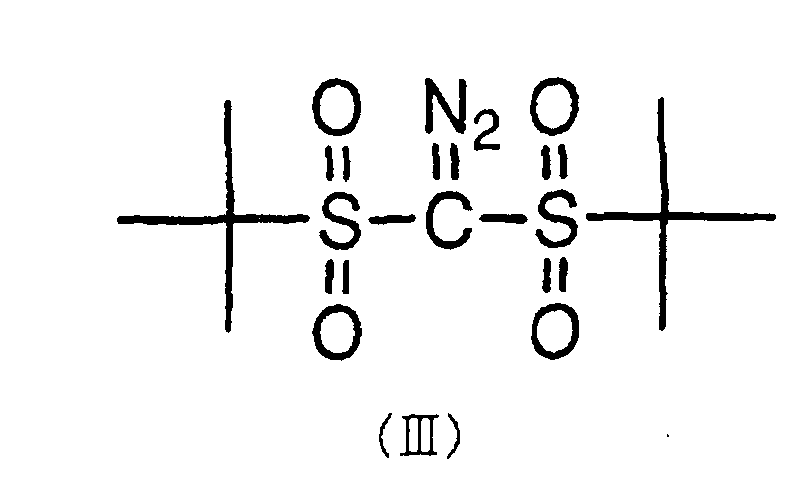
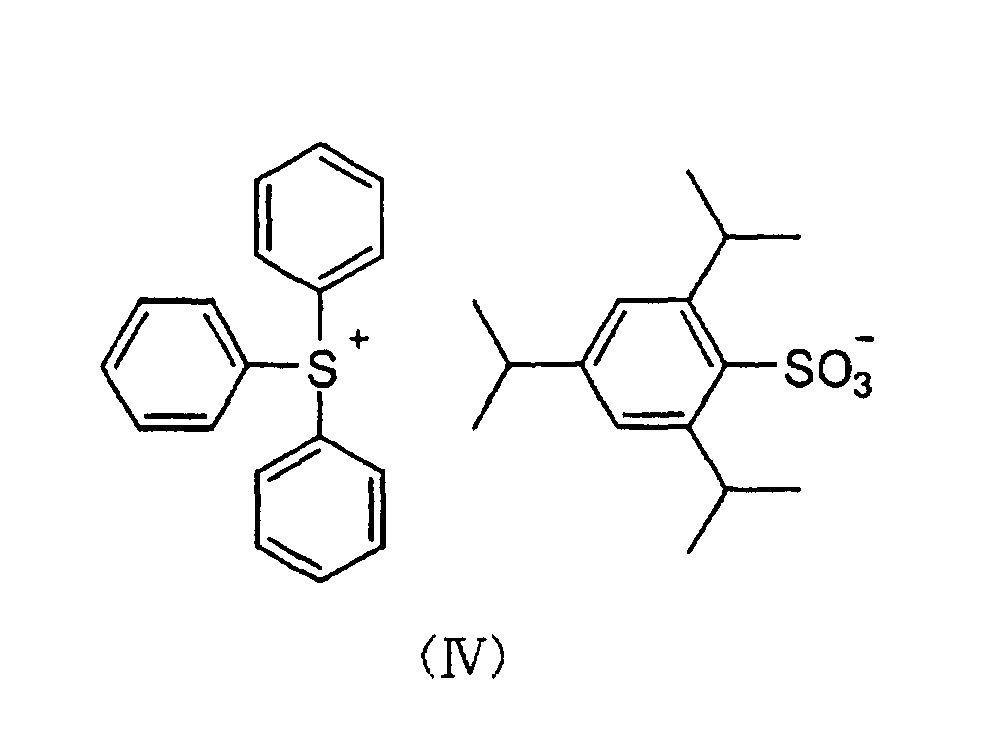
- Resin A and Resin B was mixed at a ratio of 1:1 to give a resin, and this resin was mixed with acid generating agents of the following formulae (III) and (IV), quencher and solvent in a formulation shown below to provide a solution. This solution was further filtrated through a fluorine resin filter having a pore diameter of 0.2 ⁇ m to prepare a resist solution.
- Resin mixture 13.5 parts Acid generating agent acid generating agent (III) 0.45 parts acid generating agent (IV) 0.45 parts Quencher diisopropylaniline 0.055 parts Solvent propylene glycol monomethyl ether acetate 90 parts
- PPG polypropylene glycols
- an anti-reflection film ["DUV-42" manufactured by Nissan Chemical Industries. Ltd.] was applied under pre-bake conditions of 215°C and 60 seconds to give a thickness of 0.06 ⁇ m. Then, each resist solution was spin-coated on this, followed by pre-baking on a proximity hot plate under conditions of 110°C and 60 seconds to form a resist film having a thickness of 0.42 ⁇ m.
- PEB was conducted under conditions of 130°C and 60 seconds on a hot plate, further, paddle development was conducted for 60 seconds with a 2.38% tetramethyl ammonium hydroxide aqueous solution. Patterns after development were observed by a scanning electron microscope, and sensitivity, resolution and presence of scum were checked as described below. Results are shown in Table 2.
- Film penetrating sensitivity This was indicated by the minimum exposure required for film penetration of 2 mm square open field after exposure and development. This is represented by Eth.
- Effective sensitivity This was indicated by exposure amount at which 0.13 ⁇ m line and space pattern was 1:1. This is represented by Eo.
- Presence of scum A wafer carrying patterns formed at exposure at which 0.15 ⁇ m line and space pattern was 1:1 was observed from the upper surface using a scanning electron microscope, and presence of scum (residue) at exposed parts was checked. Observation of one or more scums was represented by ⁇ , and observation of no scum was represented by ⁇ .
- the resist composition of the present invention has excellent sensitivity and resolution, and manifests no generation of scum. Therefore, fine resist patterns can be formed with good precision by using this composition.
Landscapes
- Physics & Mathematics (AREA)
- Spectroscopy & Molecular Physics (AREA)
- General Physics & Mathematics (AREA)
- Materials For Photolithography (AREA)
Abstract
Description


on the substance itself or on a resist composition containing the substance. The acid generated from the acid generating agent acts on said resin resulting in cleavage of the group cleavable by the action of an acid existing in the resin.


| Resin mixture | 13.5 parts | |
| Acid generating agent | acid generating agent (III) | 0.45 parts |
| acid generating agent (IV) | 0.45 parts | |
| Quencher | diisopropylaniline | 0.055 parts |
| Solvent | propylene glycol monomethyl ether acetate | 90 parts |
| Example No. | Molecular weight of PPG |
| Example 1 | 1000 |
| Example 2 | 2000 |
| Example 3 | 3000 |
| Comparative example 1 | No addition |
| Example No. | Molecular weight of PPG | Sensitivity | Resolution (µm) | Presence of scum | |
| (mJ/cm2) | |||||
| Eth | Eo | ||||
| Example 1 | 1000 | 11 | 32 | 0.13 | ○ |
| Example 2 | 2000 | 11 | 32 | 0.13 | ○ |
| Example 3 | 3000 | 11 | 32 | 0.13 | ○ |
| Comparative example 1 | 11 | 32 | 0.13 | × |
Claims (4)
- A chemical amplifying type positive resist composition comprisinga resin which has a polymerization unit derived from hydroxystyrene and a polymerization unit derived from 2-ethyl-2-adamantyl (meth)acrylate, and is insoluble or poorly soluble itself in an alkali, but becomes alkali-soluble after dissociation of the above-mentioned acid unstable group by the action of an acid;a radiation sensitive acid generating agent; and polypropylene glycol.
- The chemical amplifying type positive resist composition according to claim 1, wherein the content of the propylene glycol is from 0.1 to 5% by weight of the total solid content in the resist.
- The chemical amplifying type positive resist composition according to claim 1, wherein the weight-average molecular weight of the polypropylene glycol is from 500 to 5000.
- The chemical amplifying type positive resist composition according to claim 1, wherein the radiation sensitive acid generating agent contains at least one compound selected from onium salt compounds, organo-halogen compound, sulfone compounds and sulfonate compounds.
Applications Claiming Priority (2)
| Application Number | Priority Date | Filing Date | Title |
|---|---|---|---|
| JP2001011291 | 2001-01-19 | ||
| JP2001011291 | 2001-01-19 |
Publications (3)
| Publication Number | Publication Date |
|---|---|
| EP1225479A2 true EP1225479A2 (en) | 2002-07-24 |
| EP1225479A3 EP1225479A3 (en) | 2005-01-05 |
| EP1225479B1 EP1225479B1 (en) | 2012-12-05 |
Family
ID=18878442
Family Applications (1)
| Application Number | Title | Priority Date | Filing Date |
|---|---|---|---|
| EP02001028A Expired - Lifetime EP1225479B1 (en) | 2001-01-19 | 2002-01-17 | A chemical amplifying type positive resist composition |
Country Status (6)
| Country | Link |
|---|---|
| US (1) | US6953651B2 (en) |
| EP (1) | EP1225479B1 (en) |
| KR (1) | KR100858831B1 (en) |
| CN (1) | CN1321351C (en) |
| SG (1) | SG105527A1 (en) |
| TW (1) | TW538316B (en) |
Cited By (1)
| Publication number | Priority date | Publication date | Assignee | Title |
|---|---|---|---|---|
| US6893794B2 (en) | 2002-07-25 | 2005-05-17 | Sumitomo Chemical Company, Limited | Chemical amplification type positive resist composition |
Families Citing this family (12)
| Publication number | Priority date | Publication date | Assignee | Title |
|---|---|---|---|---|
| JP4595275B2 (en) * | 2001-09-28 | 2010-12-08 | 住友化学株式会社 | Chemically amplified positive resist composition |
| US7776505B2 (en) * | 2001-11-05 | 2010-08-17 | The University Of North Carolina At Charlotte | High resolution resists for next generation lithographies |
| JP2004333548A (en) | 2003-04-30 | 2004-11-25 | Tokyo Ohka Kogyo Co Ltd | Positive photoresist composition and method for forming resist pattern |
| TWI361948B (en) * | 2003-05-23 | 2012-04-11 | Sumitomo Chemical Co | Coloring photosensitive resin composition |
| JP4152810B2 (en) * | 2003-06-13 | 2008-09-17 | 東京応化工業株式会社 | Positive resist composition and resist pattern forming method |
| US7361447B2 (en) | 2003-07-30 | 2008-04-22 | Hynix Semiconductor Inc. | Photoresist polymer and photoresist composition containing the same |
| JP4505357B2 (en) * | 2005-03-16 | 2010-07-21 | 富士フイルム株式会社 | Photosensitive composition, compound used for photosensitive composition, and pattern formation method using the photosensitive composition |
| WO2009152276A2 (en) | 2008-06-10 | 2009-12-17 | University Of North Carolina At Charlotte | Photoacid generators and lithographic resists comprising the same |
| TWI461850B (en) * | 2008-12-02 | 2014-11-21 | Sumitomo Chemical Co | Resist composition |
| US8808960B2 (en) * | 2009-03-11 | 2014-08-19 | Sumitomo Chemical Company, Limited | Compound and chemically amplified positive resist composition |
| US8614047B2 (en) * | 2011-08-26 | 2013-12-24 | International Business Machines Corporation | Photodecomposable bases and photoresist compositions |
| KR102723279B1 (en) * | 2021-10-19 | 2024-10-28 | 인하대학교 산학협력단 | Photoresist polymer resins for ultraviolet lithography using continuous flow reaction process, and preparation method thereof |
Family Cites Families (26)
| Publication number | Priority date | Publication date | Assignee | Title |
|---|---|---|---|---|
| JP2881969B2 (en) | 1990-06-05 | 1999-04-12 | 富士通株式会社 | Radiation-sensitive resist and pattern forming method |
| US6013416A (en) * | 1995-06-28 | 2000-01-11 | Fujitsu Limited | Chemically amplified resist compositions and process for the formation of resist patterns |
| JPH0980746A (en) * | 1995-09-14 | 1997-03-28 | Fuji Photo Film Co Ltd | Damping-waterless planographic printing plate |
| DE69628996T2 (en) * | 1995-12-21 | 2004-04-22 | Wako Pure Chemical Industries, Ltd. | Polymer composition and material for the resist |
| JP3409619B2 (en) * | 1995-12-21 | 2003-05-26 | 和光純薬工業株式会社 | Polymer composition and resist material comprising the same |
| ATE199985T1 (en) * | 1996-02-09 | 2001-04-15 | Wako Pure Chem Ind Ltd | POLYMER AND RESIST MATERIAL |
| US5962184A (en) * | 1996-12-13 | 1999-10-05 | International Business Machines Corporation | Photoresist composition comprising a copolymer of a hydroxystyrene and a (meth)acrylate substituted with an alicyclic ester substituent |
| JP3052917B2 (en) * | 1997-10-24 | 2000-06-19 | 日本電気株式会社 | Chemical amplification resist |
| JP3810538B2 (en) * | 1997-11-28 | 2006-08-16 | 富士写真フイルム株式会社 | Positive image forming material |
| JP3993692B2 (en) * | 1997-11-28 | 2007-10-17 | 関西ペイント株式会社 | Resist pattern forming method |
| KR100524446B1 (en) * | 1998-03-30 | 2005-10-26 | 후지 샤신 필름 가부시기가이샤 | Positive-working photoresist composition |
| JP3743187B2 (en) * | 1998-05-08 | 2006-02-08 | 住友化学株式会社 | Photoresist composition |
| JP3473410B2 (en) * | 1998-06-11 | 2003-12-02 | 住友化学工業株式会社 | Positive resist composition using narrowly dispersible polymer |
| JP4126760B2 (en) * | 1998-07-09 | 2008-07-30 | 住友化学株式会社 | Narrow dispersive polymer production method, narrow dispersible polymer and application thereof to resist |
| US6291130B1 (en) * | 1998-07-27 | 2001-09-18 | Fuji Photo Film Co., Ltd. | Positive photosensitive composition |
| KR20000076531A (en) * | 1999-01-28 | 2000-12-26 | 무네유키 가코우 | Positive silicone-containing photosensitive composition |
| US6479211B1 (en) * | 1999-05-26 | 2002-11-12 | Fuji Photo Film Co., Ltd. | Positive photoresist composition for far ultraviolet exposure |
| US6492086B1 (en) * | 1999-10-08 | 2002-12-10 | Shipley Company, L.L.C. | Phenolic/alicyclic copolymers and photoresists |
| JP4453138B2 (en) * | 1999-12-22 | 2010-04-21 | 住友化学株式会社 | Chemically amplified positive resist composition |
| TWI286664B (en) * | 2000-06-23 | 2007-09-11 | Sumitomo Chemical Co | Chemical amplification type positive resist composition and sulfonium salt |
| TWI269118B (en) * | 2001-03-05 | 2006-12-21 | Sumitomo Chemical Co | Chemical amplifying type positive resist composition |
| JP2002341525A (en) * | 2001-05-14 | 2002-11-27 | Fuji Photo Film Co Ltd | Positive photoresist transfer material and substrate surface processing method using the same |
| CN100524019C (en) * | 2001-08-29 | 2009-08-05 | 住友化学工业株式会社 | Photoetching adhesive composition |
| JP3894001B2 (en) * | 2001-09-06 | 2007-03-14 | 住友化学株式会社 | Chemically amplified positive resist composition |
| JP4595275B2 (en) * | 2001-09-28 | 2010-12-08 | 住友化学株式会社 | Chemically amplified positive resist composition |
| JP4068892B2 (en) * | 2002-05-20 | 2008-03-26 | 富士フイルム株式会社 | Image forming material |
-
2002
- 2002-01-10 TW TW091100224A patent/TW538316B/en not_active IP Right Cessation
- 2002-01-11 SG SG200200217A patent/SG105527A1/en unknown
- 2002-01-16 CN CNB021018634A patent/CN1321351C/en not_active Expired - Fee Related
- 2002-01-17 KR KR1020020002782A patent/KR100858831B1/en not_active Expired - Lifetime
- 2002-01-17 US US10/046,742 patent/US6953651B2/en not_active Expired - Lifetime
- 2002-01-17 EP EP02001028A patent/EP1225479B1/en not_active Expired - Lifetime
Cited By (2)
| Publication number | Priority date | Publication date | Assignee | Title |
|---|---|---|---|---|
| US6893794B2 (en) | 2002-07-25 | 2005-05-17 | Sumitomo Chemical Company, Limited | Chemical amplification type positive resist composition |
| BE1015614A3 (en) * | 2002-07-25 | 2005-06-07 | Sumitomo Chemical Co | Reserve positive composition chemical amplification type. |
Also Published As
| Publication number | Publication date |
|---|---|
| EP1225479B1 (en) | 2012-12-05 |
| EP1225479A3 (en) | 2005-01-05 |
| US6953651B2 (en) | 2005-10-11 |
| TW538316B (en) | 2003-06-21 |
| US20020147259A1 (en) | 2002-10-10 |
| KR100858831B1 (en) | 2008-09-17 |
| CN1321351C (en) | 2007-06-13 |
| CN1366212A (en) | 2002-08-28 |
| SG105527A1 (en) | 2004-08-27 |
| KR20020062204A (en) | 2002-07-25 |
Similar Documents
| Publication | Publication Date | Title |
|---|---|---|
| US6537726B2 (en) | Chemically amplified positive resist composition | |
| US6495306B2 (en) | Chemically amplified positive resist composition | |
| US7202010B2 (en) | Chemical amplification type positive resist composition | |
| US6835527B2 (en) | Chemical amplifying type positive resist composition | |
| KR100647451B1 (en) | Chemically amplified positive resist composition | |
| EP0982628A2 (en) | A chemical amplifying type positive resist composition | |
| US6846609B2 (en) | Chemical amplification type positive resist composition | |
| EP1122606A2 (en) | Chemically amplified positive resist composition | |
| EP0856773B1 (en) | Chemical amplification type positive resist composition | |
| EP1225479B1 (en) | A chemical amplifying type positive resist composition | |
| JP4135346B2 (en) | Chemically amplified positive resist composition | |
| US6696218B2 (en) | Chemical amplification type positive resist composition | |
| JP4604367B2 (en) | Chemically amplified positive resist composition | |
| US20020164540A1 (en) | Chemical amplifying type positive resist composition | |
| US20020081524A1 (en) | Chemical amplifying type positive resist composition | |
| US6677102B2 (en) | Chemical amplifying type positive resist composition | |
| US20040191670A1 (en) | Chemical amplification type positive resist composition | |
| JP4395946B2 (en) | Chemically amplified positive resist composition |
Legal Events
| Date | Code | Title | Description |
|---|---|---|---|
| PUAI | Public reference made under article 153(3) epc to a published international application that has entered the european phase |
Free format text: ORIGINAL CODE: 0009012 |
|
| AK | Designated contracting states |
Kind code of ref document: A2 Designated state(s): AT BE CH CY DE DK ES FI FR GB GR IE IT LI LU MC NL PT SE TR |
|
| AX | Request for extension of the european patent |
Free format text: AL;LT;LV;MK;RO;SI |
|
| PUAL | Search report despatched |
Free format text: ORIGINAL CODE: 0009013 |
|
| RAP1 | Party data changed (applicant data changed or rights of an application transferred) |
Owner name: SUMITOMO CHEMICAL COMPANY, LIMITED |
|
| AK | Designated contracting states |
Kind code of ref document: A3 Designated state(s): AT BE CH CY DE DK ES FI FR GB GR IE IT LI LU MC NL PT SE TR |
|
| AX | Request for extension of the european patent |
Extension state: AL LT LV MK RO SI |
|
| 17P | Request for examination filed |
Effective date: 20050617 |
|
| AKX | Designation fees paid |
Designated state(s): BE DE FR GB IT NL |
|
| 17Q | First examination report despatched |
Effective date: 20101116 |
|
| GRAP | Despatch of communication of intention to grant a patent |
Free format text: ORIGINAL CODE: EPIDOSNIGR1 |
|
| GRAS | Grant fee paid |
Free format text: ORIGINAL CODE: EPIDOSNIGR3 |
|
| GRAA | (expected) grant |
Free format text: ORIGINAL CODE: 0009210 |
|
| AK | Designated contracting states |
Kind code of ref document: B1 Designated state(s): BE DE FR GB IT NL |
|
| REG | Reference to a national code |
Ref country code: GB Ref legal event code: FG4D |
|
| REG | Reference to a national code |
Ref country code: DE Ref legal event code: R096 Ref document number: 60244143 Country of ref document: DE Effective date: 20130131 |
|
| PGFP | Annual fee paid to national office [announced via postgrant information from national office to epo] |
Ref country code: DE Payment date: 20130109 Year of fee payment: 12 |
|
| REG | Reference to a national code |
Ref country code: NL Ref legal event code: VDEP Effective date: 20121205 |
|
| PGFP | Annual fee paid to national office [announced via postgrant information from national office to epo] |
Ref country code: BE Payment date: 20130114 Year of fee payment: 12 |
|
| PG25 | Lapsed in a contracting state [announced via postgrant information from national office to epo] |
Ref country code: NL Free format text: LAPSE BECAUSE OF FAILURE TO SUBMIT A TRANSLATION OF THE DESCRIPTION OR TO PAY THE FEE WITHIN THE PRESCRIBED TIME-LIMIT Effective date: 20121205 |
|
| PLBE | No opposition filed within time limit |
Free format text: ORIGINAL CODE: 0009261 |
|
| STAA | Information on the status of an ep patent application or granted ep patent |
Free format text: STATUS: NO OPPOSITION FILED WITHIN TIME LIMIT |
|
| REG | Reference to a national code |
Ref country code: FR Ref legal event code: ST Effective date: 20130930 |
|
| 26N | No opposition filed |
Effective date: 20130906 |
|
| PG25 | Lapsed in a contracting state [announced via postgrant information from national office to epo] |
Ref country code: FR Free format text: LAPSE BECAUSE OF NON-PAYMENT OF DUE FEES Effective date: 20130205 |
|
| PG25 | Lapsed in a contracting state [announced via postgrant information from national office to epo] |
Ref country code: IT Free format text: LAPSE BECAUSE OF FAILURE TO SUBMIT A TRANSLATION OF THE DESCRIPTION OR TO PAY THE FEE WITHIN THE PRESCRIBED TIME-LIMIT Effective date: 20121205 |
|
| REG | Reference to a national code |
Ref country code: DE Ref legal event code: R097 Ref document number: 60244143 Country of ref document: DE Effective date: 20130906 |
|
| BERE | Be: lapsed |
Owner name: SUMITOMO CHEMICAL COMPANY, LTD Effective date: 20140131 |
|
| REG | Reference to a national code |
Ref country code: DE Ref legal event code: R119 Ref document number: 60244143 Country of ref document: DE |
|
| REG | Reference to a national code |
Ref country code: DE Ref legal event code: R119 Ref document number: 60244143 Country of ref document: DE Effective date: 20140801 |
|
| PG25 | Lapsed in a contracting state [announced via postgrant information from national office to epo] |
Ref country code: DE Free format text: LAPSE BECAUSE OF NON-PAYMENT OF DUE FEES Effective date: 20140801 |
|
| PG25 | Lapsed in a contracting state [announced via postgrant information from national office to epo] |
Ref country code: BE Free format text: LAPSE BECAUSE OF NON-PAYMENT OF DUE FEES Effective date: 20140131 |
|
| PGFP | Annual fee paid to national office [announced via postgrant information from national office to epo] |
Ref country code: GB Payment date: 20210106 Year of fee payment: 20 |
|
| REG | Reference to a national code |
Ref country code: GB Ref legal event code: PE20 Expiry date: 20220116 |
|
| PG25 | Lapsed in a contracting state [announced via postgrant information from national office to epo] |
Ref country code: GB Free format text: LAPSE BECAUSE OF EXPIRATION OF PROTECTION Effective date: 20220116 |