EP1220079A2 - Verfahren zur gemeinsamen Benutzung eines verschlüsselten Datenbereichs zwischen Prozessen in einem betrugssicheren Prozessor - Google Patents
Verfahren zur gemeinsamen Benutzung eines verschlüsselten Datenbereichs zwischen Prozessen in einem betrugssicheren Prozessor Download PDFInfo
- Publication number
- EP1220079A2 EP1220079A2 EP01310918A EP01310918A EP1220079A2 EP 1220079 A2 EP1220079 A2 EP 1220079A2 EP 01310918 A EP01310918 A EP 01310918A EP 01310918 A EP01310918 A EP 01310918A EP 1220079 A2 EP1220079 A2 EP 1220079A2
- Authority
- EP
- European Patent Office
- Prior art keywords
- encrypted
- processes
- key
- data region
- shared
- Prior art date
- Legal status (The legal status is an assumption and is not a legal conclusion. Google has not performed a legal analysis and makes no representation as to the accuracy of the status listed.)
- Withdrawn
Links
Images




Classifications
-
- G—PHYSICS
- G06—COMPUTING OR CALCULATING; COUNTING
- G06F—ELECTRIC DIGITAL DATA PROCESSING
- G06F12/00—Accessing, addressing or allocating within memory systems or architectures
- G06F12/14—Protection against unauthorised use of memory or access to memory
- G06F12/1458—Protection against unauthorised use of memory or access to memory by checking the subject access rights
- G06F12/1466—Key-lock mechanism
-
- G—PHYSICS
- G06—COMPUTING OR CALCULATING; COUNTING
- G06F—ELECTRIC DIGITAL DATA PROCESSING
- G06F12/00—Accessing, addressing or allocating within memory systems or architectures
- G06F12/14—Protection against unauthorised use of memory or access to memory
- G06F12/1408—Protection against unauthorised use of memory or access to memory by using cryptography
-
- G—PHYSICS
- G06—COMPUTING OR CALCULATING; COUNTING
- G06F—ELECTRIC DIGITAL DATA PROCESSING
- G06F2221/00—Indexing scheme relating to security arrangements for protecting computers, components thereof, programs or data against unauthorised activity
- G06F2221/21—Indexing scheme relating to G06F21/00 and subgroups addressing additional information or applications relating to security arrangements for protecting computers, components thereof, programs or data against unauthorised activity
- G06F2221/2115—Third party
Definitions
- the present invention relates to a microprocessor having a function for assisting a multi-task program execution environment, and more particularly, to a microprocessor having a function for encrypting/decrypting programs and data which is capable of sharing hidden programs or hidden data among a plurality of processes safely.
- a microprocessor In recent years, the performance of a microprocessor has improved considerably such that the microprocessor is capable of realizing reproduction and editing of video images and audio sounds, in addition to the conventional functions such as computations and graphics.
- a microprocessor By implementing such a microprocessor in a system designed for end-user (which will be referred to as PC hereafter), the users can enjoy various video images and audio sounds on monitors. Also, by combing the function for reproducing video images and audio sounds with the computational power of the PC, the applicability to games or the like can be improved.
- Such a microprocessor is not designed for any specific hardware and can be implemented in a variety of hardwares so that there is an advantage that the users who already possess PCs can enjoy reproduction and editing of video images and audio sounds inexpensively.
- tamper resistant software technique In the case of handling video images and audio sounds on PCs, there arises a problem of a protection of the copyright of original images or music.
- a technique called tamper resistant software technique has been used (see David Aucsmith et al., "Tamper Resistant Software: An Implementation", Proceedings of the 1996 Intel Software Developer's Conference).
- the tamper resistant software technique is a technique for protecting know-how or the like contained in the software from analysis and preventing analysis and alternation of the software by encrypting the software.
- the tamper resistant software technique is basically a technique which makes analysis using tools such as de-assembler or debugger difficult by encrypting a portion of the program that requires protection before the execution of the program starts, decrypting that portion immediately before executing that portion and encrypting that portion again immediately after the execution of that portion is completed. Consequently, as along as the program is executable by a processor, it is always possible to analyze the program by carrying out the analysis step by step starting from the start of the program. This fact has been an obstacle for providing copyright protected contents or sophisticated information services through the PC or applying programs containing know-how of an enterprise or individual to the PC.
- the PC is an open platform so that there is also a possibility of an attack by altering the operating system (OS) which is intended to be a basis of the system's software configuration.
- OS operating system
- a skilled and malicious user can alter the OS of his own PC to carry out operations to invalidate or analyze the copyright protection mechanisms incorporated in application programs by utilizing privileges given to the OS, instead of carrying out the normal operations of the OS.
- the current OS realizes the multi-task environment for seemingly processing a plurality of tasks in parallel by utilizing a privileged operation function with respect to a memory and an execution control function provided in CPU.
- the OS carries out an allocation of resources necessary for the execution of a program, i.e., an allocation of a CPU time to the execution of the program and an allocation of a memory space necessary for the execution of the program, and controls accesses to devices, network and application QoS that are under the control of the computer.
- the OS has the following two privileges.
- the first privilege is that the OS can interrupt or restart an application program at arbitrary timing in order to carry out the CPU time allocation.
- the second privilege is that the OS can move a content of a memory space allocated to an application program to a memory of a different hierarchical level at arbitrary timing, such that the OS can provide a flat memory space to the application by concealing normally hierarchical memory systems with different access speeds and capacities from the application.
- the OS can interrupt an execution state of the application and take a snap shot of it at arbitrary timing, and restart it after making a copy of it or rewriting it.
- This function can also be used as a tool for analyzing secrets hidden in the application.
- the context switching is carried out to switch some processes by the OS when the execution of the program is stopped by the interruption or when the program voluntarily calls up a software interruption command due to the system call up.
- the OS stores an execution state (which will be referred to as a context information hereafter) of the program indicating a set of register values at that point into a memory, and restores the context information of another program stored in the memory in advance Into the registers.
- the context switching is an indispensable function in order to operate a plurality of programs in parallel.
- the OS can read the register values at a time of the context switching, so that it is possible to guess most of the operations made by the programs, according to how the execution state of that program has changed.
- the OS can also arbitrarily rewrite the register information that has been moved to the memory.
- the OS can store arbitrary state of the application so that it is possible to analyze the operation of the program by rewriting the register values and operating the program repeatedly.
- the present inventors have proposed a technique for automatically encrypting a part or whole of the context information in the registers within the microprocessor and saving it to a memory external of the processor at a time of the context switching, as disclosed in the commonly assigned co-pending U.S. patent application serial No. 09/781.284. Using this technique, the attacks by the OS at a time of the context switching can be prevented.
- the meaningful data sharing cannot be realized by simply utilizing the memory sharing mechanism provided by the OS, because the other process that requests the sharing of the encrypted memory region does not know the key necessary for this region.
- the read/write of the encrypted memory region is carried out by using the key corresponding to this memory region.
- the key is maintained secretly within the processor. For this reason, if the same key can be shared within the processor by the other process as well, the meaningful read/write becomes possible. Here, however, it is necessary to carry out this key sharing safely between two processes.
- the safe key sharing between processes which know the key in advance can be realized by embedding the key in the encrypted state within the program. However, if the key cannot be embedded in advance or if the key is to be shared between processes (programs) to which the key should not be notified in advance, there is a need to establish a safe key exchange sequence between processes.
- the present invention is directed to the case where there is a need to carry out the key exchange between processes within the computer, separately from the key exchange sequence via a network, and it is presupposed that the temporary data to be used for the key exchange or key calculation are also to be placed within the computer.
- a method for sharing encrypted data region among two or more processes on a tamper resistant processor having a program and data encryption/decryption function comprising: giving a common key to each one of the two or more processes in advance; shifting an execution mode of the tamper resistant processor to an encrypted instruction execution mode; operating an owner process among the two or more processes to generate a shared encrypted data region valid only with respect to the common key in a process space of the owner process; operating each client process other than the owner process among the two or more processes to map the shared encrypted data region generated by the owner process to a process space of the each client process; and setting address information of the shared encrypted data region for each process among the two or more processes in relation to the common key in an encrypted attribute register inside the tamper resistant processor.
- a method for sharing encrypted data region among two processes on a tamper resistant processor having a program and data encryption/decryption function comprising: (a) shifting an execution mode of the tamper resistant processor to an encrypted instruction execution mode; (b) operating each process among the two processes to generate a hidden data region of the each process in a process space of the each process; (c) operating the two processes to generate mutually different key pairs to be used in a key exchange and carry out the key exchange between the two processes; (d) operating the each process to generate a common key according to the key exchange; (e) generating a shared encrypted data region to be shared by the two processes which is valid only with respect to the common key; and (f) storing the common key and data used in a course of the key exchange in the hidden data region of the each process.
- a method for sharing encrypted data region among three or more processes on a tamper resistant processor having a program and data encryption/decryption function comprising: (a) shifting an execution mode of the tamper resistant processor to an encrypted instruction execution mode; (b) operating an owner process among the three or more processes to generate a shared encrypted data region to be shared among the three or more processes; (c) operating the owner process to specify a common key for the shared encrypted data region; (d) operating the three or more processes to generate an encrypted key notification region for each client process other than the owner process among the three or more processes, the encrypted key notification region being shared only between the owner process and the each client process; (e) operating the owner process to notify the common key to the each client process through the encrypted key notification region for the each client process; (f) operating the each client process to map the shared encrypted data region generated by the owner process to a process space of the each client process; and (g) setting address information of the shared encrypted data region for each process among the three or
- a tamper resistant processor having a program and data encryption/decryption function and a memory that stores computer readable program codes for sharing encrypted data region among two or more processes
- the computer readable program codes include: a first computer readable program code for causing said computer to give a common key to each one of the two or more processes in advance; a second computer readable program code for causing said computer to shift an execution mode of the tamper resistant processor to an encrypted instruction execution mode; a third computer readable program code for causing said computer to operate an owner process among the two or more processes to generate a shared encrypted data region valid only with respect to the common key in a process space of the owner process; a fourth computer readable program code for causing said computer to operate each client process other than the owner process among the two or more processes to map the shared encrypted data region generated by the owner process to a process space of the each client process; and a fifth computer readable program code for causing said computer to set address information of the shared encrypted data region for each process
- a tamper resistant processor having a program and data encryption/decryption function and a memory that stores computer readable program codes for sharing encrypted data region among two processes
- the computer readable program codes include: a first computer readable program code for causing said computer to shift an execution mode of the tamper resistant processor to an encrypted instruction execution mode; a second computer readable program code for causing said computer to operate each process among the two processes to generate a hidden data region of the each process in a process space of the each process; a third computer readable program code for causing said computer to operate the two processes to generate mutually different key pairs to be used in a key exchange and carry out the key exchange between the two processes; a fourth computer readable program code for causing said computer to operate the each process to generate a common key according to the key exchange; a fifth computer readable program code for causing said computer to generate a shared encrypted data region to be shared by the two processes which is valid only with respect to the common key; and a sixth computer readable program codes
- a tamper resistant processor having program and data encryption/decryption function and a memory that stores computer readable program codes for sharing encrypted data region among three or more processes
- the computer readable program codes include: a first computer readable program code for causing said computer to shift an execution mode of the tamper resistant processor to an encrypted instruction execution mode; a second computer readable program code for causing said computer to operate an owner process among the three or more processes to generate a shared encrypted data region to be shared among the three or more processes; a third computer readable program code for causing said computer to operate the owner process to specify a common key for the shared encrypted data region; a fourth computer readable program code for causing said computer to operate the three or more processes to generate an encrypted key notification region for each client process other than the owner process among the three or more processes, the encrypted key notification region being shared only between the owner process and the each client process; a fifth computer readable program code for causing said computer to operate the owner process to notify the common key to the each
- the present invention presupposes the use of a tamper resistant microprocessor with an execution environment in which the execution codes of the encrypted program and the encrypted data processed by that program can be utilized only by proper execution processes.
- a method for giving a common key to the two processes in advance and a method for generating a common key at a time of creating the encrypted data region to be shared and notifying the generated common key to the sharing partner process are available.
- the common key is given in advance to each process involved in the inter-process sharing, so that this method can be extended to the sharing of the encrypted data region among arbitrary number of processes.
- This method contains a step of giving the common key in advance to each one of two or more processes for sharing the encrypted data region on a processor having a program and data encryption/decryption function, and a step of shifting the execution mode of the processor to the encrypted instruction execution mode. Then, the first process among the two or more processes generates a shared encrypted region valid only for the given common Key in its own process space and the other process maps the shared encrypted region generated by the first process to its own process space. In addition, an address of the shared encrypted region of each process is registered in an encrypted attribute register inside the processor in relation to the respectively given common key.
- the execution mode of the processor is shifted to the encrypted instruction execution mode on a processor having a program and data encryption/decryption function first.
- each process generates its own hidden data region in its own process space.
- An address of each hidden data region is registered in the encrypted attribute register inside the processor in relation to a respectively corresponding key for that hidden data region.
- each process generates a key pair to be used for the key exchange which is different for different processes, and the key exchange is carried out between the two processes.
- Each process generates the common key according to the key exchange.
- a shared encrypted region to be shared between the two processes which is valid only for this common key is generated.
- the common key and the data used in a course of the key exchange are stored in the hidden data region of each process.
- the shared encrypted region is generated in such a manner that one process (owner process) among the two processes generates the shared encrypted region in its own process space, and the other process (client process) that requests the sharing maps this shared encrypted region to its own process space.
- each process registers an address of the shared encrypted region in the encrypted attribute register inside the processor in relation to the respective common key.
- the common key is generated in a secret state, and the data used for it as well as the common key itself are stored in the hidden data region, so that the shared encrypted region cannot be accessed by any processes other than the two processes which know the common key or even by the OS.
- the key exchange between the two processes is carried out according to the verification of the message signature. More specifically, each process generates a random number and requests the authentication to the other process by sending this random number and a certificate produced by a public organization. When the authentication is successful, each process calculates a phase value for the key exchange, attaches a signature to this phase value and sends it to the other process. Each process generates the common key by using the received phase value and the authenticated random number generated by each process itself.
- the execution mode of the processor is shifted to the encrypted instruction execution mode first. Then, the first process among the three or more processes generates a shared encrypted data region to be shared among all these processes. In addition, the first process specifies a common key for the generated shared encrypted data region. Then, an encrypted key notification region to be shared only between the first process and the other arbitrary one process is generated for each one of the other processes. The common key is notified to the other process through the encrypted key notification region shared between two processes. Then, each one of the other processes maps the shared encrypted data region generated by the first process to its own process space. Finally. an address of the shared encrypted data region mapped by each process is registered in the corresponding encrypted attribute register within the processor in relation to the notified common key.
- the generation of the encrypted key notification region to be shared between the first process and the other arbitrary one process can be realized by utilizing the sharing method between the two processes described above.
- the key notification region shared between two processes functions as a safe communication path between these processes, and the common key for the shared encrypted data region to be shared eventually by all the processes can be notified to each process through the safe communication path, so that it is possible to share one encrypted data region safely even among three or more processes.
- the microprocessor to which the present invention is to be applied has an architecture capable of handling the execution programs and data in both plaintext form and encrypted form, and it is assumed to be the tamper resistant processor in which the execution codes of the encrypted programs and the processing target encrypted data can be utilized only by proper execution processes. From a viewpoint of the security, it is possible to consider the use of a dedicated microprocessor in which the execution of plaintext programs is not allowed, but the use of such a dedicated microprocessor is not preferable because it has a poor portability and it eliminates a possibility for introducing a program for creating/debugging programs before the encryption or a program for decryption.
- Fig. 1 shows a basic configuration of the microprocessor to which the present invention is to be applied.
- This microprocessor 1 has an instruction TLB (Table Look-up Buffer) 2, a processor core 3, an exception processing unit 8, a data TLB 9, and a secondary cache 10.
- the processor core 3 has an instruction execution unit 4, a primary cache 5, a code and data encryption/decryption unit 6, and a bus interface unit 7.
- the code and data encryption/decryption unit 6 has an encrypted attribute register 20.
- This microprocessor 1 differs significantly from the ordinary processor in that the code and data encryption/decryption unit 6 is provided inside the processor core 3.
- the encrypted execution codes and data will flow through the bus in the encrypted state.
- the execution codes and data entered into the processor core 3 are decrypted by the code and data encryption/decryption unit 6 before being fetched into the primary cache 5.
- these execution codes and data are to be outputted to the bus again, they are outputted in the encrypted state.
- the instruction execution unit 4 has a register set (not shown), and the plaintext data are processed inside the register.
- the OS supporting the multi-task attacks for eavesdropping the register information by forcefully causing the context switching by a faked OS or the like can be considered.
- the scheme disclosed in the commonly assigned co-pending U.S. patent application serial No. 09/781,284 it is possible to prevent such attacks as the encryption/decryption function is automatically activated at times of saving and recovering the context.
- a secret key specific to the processor according to the public key cryptosystem is maintained in such a manner that it cannot be read out by any privileged program.
- This secret key is used inside the processor automatically at a time of decrypting the program or data encrypted by using the corresponding public key.
- the codes and data to be protected are in the encrypted form while they are existing on an external memory device or memory, and decrypted only while they are read into the primary cache and the registers inside the processor.
- the encryption processing is automatically applied inside the processor as already mentioned above.
- the decrypted (plaintext) form of the encrypted instruction codes and data is confined inside the processor so as to prevent a disclosure of the plaintext data on the registers at a time of the context switching.
- Fig. 2 shows an exemplary configuration of the encrypted attribute register 20.
- the encrypted attribute register 20 comprises a plurality of hidden registers for storing a key corresponding to each program or data to be decrypted (encrypted) separately inside the processor, in such a manner that any privileged program cannot read the encrypted attribute register 20 and the microprocessor 1 can utilize the encrypted attribute register 20 only during the execution of the proper program.
- the encrypted attribute register 20 registers information such as a start address and an end address (or a region size) of the encrypted region, an applied encryption algorithm, an offset to a key storage data 30, a key size, etc.
- the key storage data 30 contains a key value and a signature.
- the execution mode is shifted to a mode called encrypted instruction execution mode.
- the microprocessor 1 automatically decrypts the encrypted execution code by utilizing the decryption key registered in the corresponding encrypted attribute register 20 and carries out the instruction execution.
- data to be piled up in the stack and data to be written into the other data regions are also automatically encrypted and then automatically decrypted at a time of reading.
- Data in the decrypted plaintext state exist only on the register and the primary cache lines of the instruction execution unit 4, and data are put in the encrypted state again when data are to be outputted to an external memory through the bus.
- An access to the encrypted data is normally made in the encrypted instruction execution mode, but it is also possible to make an access to the encrypted data from the plaintext instruction execution mode (normal instruction execution mode) and automatically carry out read/write of data in the encrypted form on an external memory.
- an access to data that should be encrypted should preferably be made after shifting to the encrypted instruction execution mode for the purpose of making the analysis difficult by preventing a tracing of the instruction execution sequence by the processor.
- the context (the register information, etc.) of the executed process is saved in an external memory, and within this context, the encrypted attribute register information, etc., that should be hidden from the other processes are saved on the memory after the microprocessor 1 carried out the encryption processing.
- the context switching processing is carried out in a form which guarantees that it is not available to the processor except at a time of the execution of this process (i.e., not available at a time of the execution of an other process).
- microprocessor with the above described features will be referred to as the tamper resistant processor in the present invention.
- the procedure for executing the protected program on a computer having the microprocessor (tamper resistant processor) 1 inside will be described. It is assumed that the protection target program is already installed in this computer prior to the program execution. It is also assumed that the key necessary for the processor 1 to decrypt the encrypted execution code is encrypted by using the public key corresponding to the secret key specific to the processor by a creator, a provider or the like of the program and downloaded and installed in the computer in advance via the Internet or by means of the distribution medium. There can also be cases where the decryption key necessary for the program execution is encrypted by using the public key corresponding to the processor owned by the user by a creator, a provider or the like of the program and embedded inside the protection target program.
- the microprocessor 1 utilizes this key. For this reason, there is a need to set this execution code decryption key in the plaintext state into the encrypted attribute register 20 inside the processor at an early stage of the protected program execution and before entering the encrypted execution code section.
- the decryption key is encrypted by using the public key specific to the processor, but it can be decrypted by using the secret key of the processor inside the processor and safely set in the plaintext state into the encrypted attribute register 20 by issuing the following instruction. setck decryption key data encrypted by using the public key of the processor
- the above example shows an exemplary instruction targeting at a system capable of setting only one decryption key with respect to the currently executed process. Namely, in this system, the same decryption key will be shared even when a plurality of plaintext execution codes and encrypted execution codes coexist inside the program.
- the instruction for setting the execution code decryption key into the encrypted attribute register 20 becomes as follows. setk segment ID decryption key encrypted by using the public key of the processor (1)
- the information of the encrypted region is specified by using a region ID given in a form of the segment ID.
- the segment ID is an ID by which the microprocessor 1 identifies a region, which corresponds to an identifier of a segment information storing a top address of the region or a combination of a top address and a region size (or an end address) of the region.
- the program is constructed by linking various execution codes (object codes) including libraries.
- the execution code (object code) contains an instruction section, a data section, and a link information section (which may also contain a debugging information at a time of debugging), and the encryption using the same key or the encryption using different keys can be applied with respect to these sections.
- a stack region and a dynamically allocated data region are set up by the assistance of the OS, the program loader and the dynamic linker, so as to put the program in an execution possible state.
- the program In order to start the program execution, the program is loaded (mapped) onto the memory by the program loader (and the OS) first, and initial setting of the execution codes and regions for stack and data is made.
- the preliminary processing is carried out such that the dynamic linker and the dynamic library will be called up appropriately at a time of the execution.
- the key corresponding to each region is specified and set in the plaintext state into the encrypted attribute register 20 inside the microprocessor 1 in advance, as described above.
- the encryption related information of the region may be embedded inside the program by a creator, a provider or the like of the program, or may be downloaded into the computer separately from the program.
- the encryption related information is embedded inside the program, the storing position depends on the execution binary format.
- the key corresponding to each region is set into the encrypted attribute register 20 by using the instruction (1), and this setting is carried out at a time of the program loading and the mapping to the address space by the program loader (and the OS).
- Fig. 3 shows an exemplary key setting in the encrypted attribute register 20 at a time of executing the program in which plural types of execution codes are combined.
- the encrypted attribute register 20 stores the start address, the end address and the key of the corresponding region in the plaintext state.
- the configuration of the encrypted attribute register 20 is simplified here for the sake of explanation.
- the program is constructed from:
- the key entries 11 to 14 encrypted by using the public key of the processor are supplied from an external of the program.
- the keys Ka, Kb, Kc and Kd are decrypted from the key entries 11 to 14 and the region information, the key information, etc. are registered into entries 22 to 26 of the encrypted attribute register 20 in correspondence to the respective encrypted regions arranged in the process space, inside the microprocessor 1.
- mode shifting instruction cryptomode (target address to jump)
- an instruction for returning to the ordinary plaintext instruction execution mode from the encrypted instruction execution mode is as follows.
- mode releasing instruction retmode (target address to return)
- the Jumping target address and the returning target address can be omitted, and when they are omitted, the mode shifting processing is carried out immediately before the instruction next to the mode shifting instruction or the mode releasing instruction.
- the microprocessor 1 continues the decryption and the execution by regarding the execution code indicated by the program counter as an encrypted one.
- the shifting to the execution mode of the calling source cannot be carried out automatically in this way. For this reason, at a time of shifting to another encrypted instruction execution mode (or the plaintext instruction execution mode) after entering one encrypted instruction execution mode (i.e., at a time of calling), the ID of the original encrypted attribute register 20 of the calling source is added to the stack in addition to the returning address. Else, it is maintained inside the processor as a back link information and a flag is set up such that the original instruction execution mode is recovered according to this information at a time of returning.
- the encrypted attribute register is set up in advance at a time of mapping the encrypted region to the memory and the shifting of the execution mode is automatically judged at a time of the execution in the encryption target code region or the reading/writing with respect to the encryption target data region or the stack region, and the shifting of the execution mode is carried out whenever necessary, without using the explicit mode shifting instruction described above.
- the information on a region in which the execution code is encrypted is to be stored into the encrypted attribute register 20 within the processor in advance by using the instruction (1).
- mode shifting is carried out automatically when the execution enters the specified region or the execution proceeds to the execution code section other than the specified regions.
- the mode shifting corresponding to the proceeding target encrypted execution code is automatically carried out.
- the similar Judgement and execution are also carried out with respect to the encryption target data region and the stack region.
- microprocessor 1 Presupposing the tamper resistant processor (microprocessor 1) having the above described configuration, embodiments of the method for sharing encrypted data region among processes according to the present invention will now be described in detail.
- data to be read/write with respect to the shared data region to be generated here is encrypted/decrypted by a hardware inside the microprocessor and hidden from the other processes which do not know the key.
- the first method is the simplest method in which the programs for the inter-process sharing are put in a state of knowing the key for the encrypted data region to be shared in advance or a state capable of sharing the key for the encrypted data region to be shared.
- the second method is a method for safely notifying the key information to a proper process that requests the sharing of the encrypted data, in the case where the key cannot be shared in advance.
- the encrypted data is shared among a plurality of processes as far as the same program is concerned so that the encryption/decryption key for the encrypted data region can be set up to be identical in advance.
- the key set up method can be (1) a method for directly storing the key in the encrypted data region within the execution code, or (11) a method for determining the key uniquely by utilizing the initial value and the algorithm such that the same key can always be generated, and setting the key in the encrypted attribute register corresponding to the encrypted data region.
- the setting of the key in the encrypted attribute register can be realized by the instruction (1) described above.
- the key to be specified in the encrypted attribute register is encrypted by using the public key specific to the processor, but in the case of setting the common key between processes, the instruction execution code and the decryption key themselves are already encrypted, so that it is also possible to set the decryption key directly by the following instruction. setik segment ID decryption key (2)
- the other process that requests the memory sharing already knows the key corresponding to the target encrypted data region, so that once the access right with respect to the region can be obtained, the memory access with respect to this encrypted data region becomes possible similarly as the creating source process (owner process) of the encrypted data region.
- the second method i.e., in the case where the key information for the encrypted data region cannot be shared in advance at a time of creating programs, there is a need for a process (owner process) that created the encrypted data region to determine the key information to be used for the encryption/decryption and safely notify the key information to the other proper process (client process) that requests the data sharing.
- owner process a process that created the encrypted data region to determine the key information to be used for the encryption/decryption and safely notify the key information to the other proper process (client process) that requests the data sharing.
- the initial value of the key directly stored in the encrypted data region within the execution code can be utilized, or the same initial value of the key can be used every occasion by determining the key uniquely by utilizing the initial value and the algorithm such that the same key can always be generated, similarly as in the case of the first method described above, but besides these, it is also possible to generate the initial value of the key dynamically by setting the initial value by calling up a random number generation routine (software) or a random number generator (hardware). In this case, by generating/using the different keys at different occasions of the program execution, the strength against the analysis can be improved.
- This key initial value determination sequence should preferably be carried out in the encrypted instruction execution mode.
- the key for the encrypted data region that is available only between two processes is obtained by carrying out the key exchange with the other process that requests the sharing of the encrypted data region.
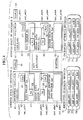
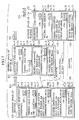
- Fig. 4 and Fig. 5 show the processing procedure in the case of sharing the encrypted data region by generating the common key at each occasion.
- the Diffie-Hellman (D-H) key exchange sequence is utilized.
- Kab denotes the common key, which is calculated from the values of Ka and Kb by the exponential calculation using the keys Xa and Xb for the key exchange as exponents.
- the owner process A and the client process B are currently executed.
- the owner process A is a process that generates the shared encrypted data region Sab to be shared between processes
- the client process B is a process that requests the sharing of the shared encrypted data region Sab.
- the owner process A generates an encrypted execution code/data region 42 in an execution process space (or address space) and specifies a key Ekp[Kx] that is stored in an encrypted state in an external memory, for example, so as to make a shift to the encrypted instruction execution mode (step S81).
- the key Kx is decrypted by using the secret key Kp specific to the microprocessor 1, and the decrypted key Kx is set in relation to the start address and the end address of the encrypted execution code/data region 42 in the encrypted attribute register 52.
- the owner process A also independently allocates a hidden data region Ha for the encrypted data to be hidden from other processes to its own process space, and specifies a key Kha for the hidden data region with respect to this hidden data region Ha (step S82).
- this key will be used, but it is also possible to generate an initial value by a random number generator and produce the key Kha dynamically.
- the key Kha is maintained in the encrypted execution code/data region 42 of the owner process A.
- the start address and the end address of the hidden data region Ha is set in relation to the key Kha for this region in the encrypted attribute register 53.
- the key Ka of the process A is handled similarly as the public key and exchanged in a plaintext form through bus and memory beyond the process space.
- the key Xa for the key exchange is handled similarly as the secret key and placed in the encrypted hidden data region Ha.
- the process B specifies an encrypted execution code/data region 62 in the corresponding process space (step S91), and independently generates a hidden data region Hb 64 and specifies a key Khb for the hidden data region Hb 64 (step S92).
- the addresses and the corresponding key for these regions are set in corresponding entries 72 and 73 in the encrypted attribute register 71.
- the keys Kb and Xb necessary for the key exchange with the process A are calculated according to the D-H scheme (step S93).
- the key Kb is placed in an ordinary data region Db 63 in a plaintext state, while the key Xb is placed in the hidden data region Hb 64.
- the owner process A transmits the key Ka to the process B (step S84).
- the key Ka is handled similarly as the public key, so that it can be transmitted by utilizing arbitrary inter-process communication function such as API provided by the library or the OS.
- the client process B also transmits the key Kb to the process A by utilizing the similar inter-process communication function (step S94).
- the owner process A generates the shared encrypted data region Sab for which accesses are permitted only from the processes A and B (step S86).
- the shared encrypted data region Sab is created by utilizing a memory allocation function provided by the library or the OS.
- the start address and the end address of the shared encrypted data region Sab are set in relation to the common key Kab stored at the process A in the encrypted attribute register 54.
- the client process B maps the shared encrypted data region Sab created by the owner process A to its own process space by utilizing the memory sharing function provided by the OS (step S96). There is no need to encrypt the memory sharing information to be exchanged here.
- the start address and the end address are set in relation to the common key Kab stored at the process B in the encrypted attribute register 74.
- the processes A and B can freely carry out read/write with respect to the shared encrypted data region Sab (or Sab') (step S100). Accesses to the shared encrypted data region are made through the encrypted attribute register of the microprocessor (tamper resistant processor) 1, so that only the processes A and B that know the common key can make accesses. Any other processes which do not know the common key cannot make accesses, so that the sharing of the encrypted data region only between two processes can be realized safely.
- the encryption/decryption of data is automatically carried out between the primary cache and the external memory by referring to the information of the encrypted attribute register inside the processor core. In this way, the secret of the processing data for the encrypted program can also be protected.
- the shared encrypted data region is realized by carrying out the key exchange between two processes and registering the common key in the respective encrypted attribute registers.
- the second embodiment provides the method for sharing the encrypted data region more safely by carrying out the authentication in the key exchange.
- the application of the key exchange scheme of the first embodiment will cause no problem, but if it is a system to which a program can be freely added such as a general purpose OS on the PC, there is a possibility of receiving the attack.
- the client process B that requests the sharing of the encrypted data region sends a challenge random number Bn generated by a random number generator and a certificate Bcert produced by the public organization, to the owner process A so as to request the authentication.
- the certificate Bcert is a certificate produced by the public organization by using a secret key Ksg, in which the public key Kab of the client process B issued by the public organization is embedded, and from which this public key Kab can be extracted by using the public key Kpg of the public organization.
- the owner process A carries out the verification of the completeness of the received certificate Bcert by using the public key Kpg of the public organization.
- the owner process A calculates a key exchange first phase value Av.
- the public key Kpb of the client process B is also obtained.
- the owner process A sends a challenge random number An and a certificate Acert to the client process B so as to request the authentication.
- the client process B verifies the completeness of the received certificate Acert, and when it is judged that the signature by the public organization is proper, a key exchange first phase value Bv is calculated.
- the public key Kpa of the owner process A is also obtained.
- the owner process A produces a message signature for the key exchange first phase value Av and the challenge random number Bn of the process B, and sends it to the client process B.
- the client process B similarly produces a message signature for the key exchange first phase value Bv and the challenge random number An of the process A, and sends it to the owner process A.
- the owner process A checks the message signature received from the client process B by using the public key Kpb of the client process B, and verifies that this message signature is not changed.
- the owner process A calculates the authenticated common key Kab (or Kauth) between the processes A and B by using a random number and the verified phase value Bv.
- the client process B similarly checks the message signature received from the owner process A by using the public key Kpa of the owner process A, and verifies that this message signature is not changed.
- the client process B calculates the authenticated common key Kab (or Kauth) between the processes A and B by using a random number and the verified phase value Av.
- the owner process A creates the shared encrypted data region Sab to be accessed only from the processes A and B that know the common key Kab (or Kauth), similarly as in the step S86 of Fig. 5 (the first embodiment).
- the shared encrypted data region Sab is created by utilizing the memory allocation function provided by the library or the OS.
- the start address, the region size (or the end address), the attribute value, etc. of the shared encrypted data region Sab are placed under the memory resource management of the OS.
- the common key Kab (or Kauth) is set in relation to the region addresses in the encrypted attribute register.
- the client process B maps the shared encrypted data region Sab created by the owner process A to its own process space by utilizing the memory sharing function provided by the OS, similarly as in the step S96 of Fig. 5 (the first embodiment). There is no need to encrypt this memory sharing information to be exchanged here.
- information including the common key Kab (or Kauth) is also set in the encrypted attribute register for the region Sab' of the process B.
- the first and second embodiments are directed to the method for sharing the shared encrypted data region between two processes.
- a procedure for constructing a shared encrypted data region Hshare to be shared among three or more processes will be described.
- Fig. 7 shows respective address spaces of the processes A, B and C, and an exemplary configuration of the shared encrypted data region to be shared by these processes.
- the process A is an owner process which is a creator of the shared encrypted data region Hshare.
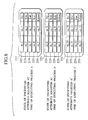
- Fig. 8 shows an exemplary configuration of the encrypted attribute registers of the respective processes for the purpose of creating the shared encrypted data region.
- the owner process A is shifted to the encrypted instruction execution mode, and creates the shared encrypted data region Hshare 106 in its own address space.
- a key Kshare for the region Hshare may be embedded in the program code in advance, or an initial value can be generated by using a random number generator or the like and the key can be generated by utilizing this initial value. In the case where the key Kshare is generated dynamically, this key is maintained in the hidden data region.
- the addresses of the shared encrypted data region Hshare 106 and the key Kshare for this region are set in the encrypted attribute register 216 inside the microprocessor 1.
- the owner process A creates the shared encrypted data region Sab 104 to be shared only between the processes A and B in its own address space according to the method of the first embodiment. Similarly, the owner process A also creates the shared encrypted data region Sac to be shared only between the processes A and C. Namely, placing the owner process A at a center, the shared encrypted data region Sax to be shared in a one-to-one fashion with each process with which the encrypted data region Hshare should be shared is created.
- the addresses of the shared encrypted data regions Sab and Sac of the owner process A in the example of Fig. 7 and the common keys Kab and Kac for making accesses to these regions are set in relation in the encrypted attribute registers 214 and 215 respectively.
- the shared encrypted data region Sax to be shared in a one-to-one fashion between the owner process A and each client process will function as a communication path for safely notifying the key Kshare for the eventual shared encrypted data region Hshare among processes.
- the shared encrypted data region Sax between two processes can be referred to as a key notification region.
- the process A writes the key Kshare for the shared encrypted data region Hshare into the shared encrypted data region Sab with respect to the process B.
- the process B creates the shared encrypted data region Sab' virtually in its own address space, and reads the key Kshare by using regions Sab-Sab' as a secure communication path. In this way, the key Kshare for the region Hshare can be shared between the processes A and B.
- the process B also maps the shared encrypted data region Hshare of the owner process A to its own address space by utilizing the memory sharing function provided by the OS similarly as in the case of the ordinary shared memory. In this way, the shared encrypted data region Hshare is virtually created in its own address space.
- the addresses of the region Sab' and the eventual shared encrypted data region Hshare' of the process B and the keys Kab and Kshare for these regions are set in relation in the encrypted attribute registers 224 and 225 of the process B respectively.
- the process C can share the region Hshare by reading the key Kshare for the region Hshare written into the region Sac by the owner process A through a secure communication path Sac-Sac', and mapping the region Hshare of the process A to its own address space.
- the addresses of the key notification region Sac' and the shared encrypted data region Hshare" and the keys Kac and Kshare for these regions are set in relation in the encrypted attribute registers 234 and 235 of the process C respectively.
- the encrypted data region can be shared among four or more processes by the similar method.
- the encrypted data region Hshare can be shared only among these processes by forming n-1 sets of the secure communication paths, i.e., the shared regions Sax, between the owner process and the client processes, and carrying out the notification of the common key Kshare through these secure communication paths.
- each process carries out the key exchange after the execution mode is shifted to the encrypted instruction execution mode, in order to share the encrypted data region between two processes.
- the common key and temporary data used for the calculation of the common key are placed on the hidden data region that can only be read by each process or the register inside the processor, so that it is possible to realize the safe key sharing which is protected even from the privileges of the OS.
- one process creates the encrypted data region to be shared according to the common key generated as a result of the safe key exchange, and the other process maps that region to its own address space (or process space).
- the addresses of the shared encrypted data region and the common key of each process are set in relation in the encrypted attribute register inside the microprocessor, so that it is possible to share the encrypted data region safely.
- the shared encrypted data region to be shared between the owner process and the other arbitrary process is utilized as a secure communication path for the purpose of the key notification, so that it is possible to share the eventual shared encrypted data region among three or more proper processes safely.
Landscapes
- Engineering & Computer Science (AREA)
- Theoretical Computer Science (AREA)
- Computer Security & Cryptography (AREA)
- Physics & Mathematics (AREA)
- General Engineering & Computer Science (AREA)
- General Physics & Mathematics (AREA)
- Storage Device Security (AREA)
Applications Claiming Priority (2)
| Application Number | Priority Date | Filing Date | Title |
|---|---|---|---|
| JP2000402672A JP4074057B2 (ja) | 2000-12-28 | 2000-12-28 | 耐タンパプロセッサにおける暗号化データ領域のプロセス間共有方法 |
| JP2000402672 | 2000-12-28 |
Publications (2)
| Publication Number | Publication Date |
|---|---|
| EP1220079A2 true EP1220079A2 (de) | 2002-07-03 |
| EP1220079A3 EP1220079A3 (de) | 2004-05-12 |
Family
ID=18866918
Family Applications (1)
| Application Number | Title | Priority Date | Filing Date |
|---|---|---|---|
| EP01310918A Withdrawn EP1220079A3 (de) | 2000-12-28 | 2001-12-28 | Verfahren zur gemeinsamen Benutzung eines verschlüsselten Datenbereichs zwischen Prozessen in einem betrugssicheren Prozessor |
Country Status (3)
| Country | Link |
|---|---|
| US (2) | US20030126458A1 (de) |
| EP (1) | EP1220079A3 (de) |
| JP (1) | JP4074057B2 (de) |
Cited By (6)
| Publication number | Priority date | Publication date | Assignee | Title |
|---|---|---|---|---|
| DE10345468A1 (de) * | 2003-09-30 | 2005-05-25 | Infineon Technologies Ag | Verfahren zur sicheren Ausführung von Programmen |
| CN1729660B (zh) * | 2002-10-17 | 2011-06-08 | 松下电器产业株式会社 | 分组发送接收装置 |
| CN112256460A (zh) * | 2020-11-24 | 2021-01-22 | 北京元心科技有限公司 | 进程间通信方法、装置、电子设备及计算机可读存储介质 |
| US11743241B2 (en) | 2020-12-30 | 2023-08-29 | International Business Machines Corporation | Secure data movement |
| US11991293B2 (en) | 2021-08-17 | 2024-05-21 | International Business Machines Corporation | Authorized secure data movement |
| US12481796B2 (en) | 2020-12-30 | 2025-11-25 | International Business Machines Corporation | Secure memory sharing |
Families Citing this family (54)
| Publication number | Priority date | Publication date | Assignee | Title |
|---|---|---|---|---|
| JP4115759B2 (ja) * | 2002-07-01 | 2008-07-09 | 株式会社東芝 | 耐タンパプロセッサにおける共有ライブラリの使用方法およびそのプログラム |
| FR2849233B1 (fr) * | 2002-12-24 | 2005-05-20 | Trusted Logic | Procede de securisation des systemes informatiques par confinement logiciel |
| JP3880933B2 (ja) * | 2003-01-21 | 2007-02-14 | 株式会社東芝 | 耐タンパマイクロプロセッサ及びキャッシュメモリ搭載プロセッサによるデータアクセス制御方法 |
| JP4501349B2 (ja) * | 2003-03-13 | 2010-07-14 | ソニー株式会社 | システムモジュール実行装置 |
| JP4729839B2 (ja) * | 2003-05-20 | 2011-07-20 | 株式会社日立製作所 | Icカード |
| JP4691337B2 (ja) * | 2003-08-26 | 2011-06-01 | パナソニック株式会社 | プログラム実行装置、認証局装置 |
| EP1680724B1 (de) | 2003-08-26 | 2019-05-08 | Panasonic Intellectual Property Corporation of America | Programmausführungseinrichtung |
| JP4263976B2 (ja) * | 2003-09-24 | 2009-05-13 | 株式会社東芝 | オンチップマルチコア型耐タンパプロセッサ |
| JP4282472B2 (ja) * | 2003-12-26 | 2009-06-24 | 株式会社東芝 | マイクロプロセッサ |
| JP4612461B2 (ja) * | 2004-06-24 | 2011-01-12 | 株式会社東芝 | マイクロプロセッサ |
| JP4559794B2 (ja) * | 2004-06-24 | 2010-10-13 | 株式会社東芝 | マイクロプロセッサ |
| JP4447977B2 (ja) | 2004-06-30 | 2010-04-07 | 富士通マイクロエレクトロニクス株式会社 | セキュアプロセッサ、およびセキュアプロセッサ用プログラム。 |
| JP4204522B2 (ja) * | 2004-07-07 | 2009-01-07 | 株式会社東芝 | マイクロプロセッサ |
| JP2006085676A (ja) * | 2004-08-20 | 2006-03-30 | Matsushita Electric Ind Co Ltd | 暗号化命令処理装置 |
| US7877608B2 (en) * | 2004-08-27 | 2011-01-25 | At&T Intellectual Property I, L.P. | Secure inter-process communications |
| JP3814620B2 (ja) * | 2004-10-15 | 2006-08-30 | 株式会社東芝 | 情報処理装置および情報処理方法 |
| US8332653B2 (en) * | 2004-10-22 | 2012-12-11 | Broadcom Corporation | Secure processing environment |
| US8266438B2 (en) | 2004-10-25 | 2012-09-11 | Security First Corp. | Secure data parser method and system |
| JP4750719B2 (ja) * | 2004-11-26 | 2011-08-17 | パナソニック株式会社 | プロセッサ、セキュア処理システム |
| US20060195689A1 (en) * | 2005-02-28 | 2006-08-31 | Carsten Blecken | Authenticated and confidential communication between software components executing in un-trusted environments |
| US7874009B2 (en) | 2005-05-26 | 2011-01-18 | Panasonic Corporation | Data processing device |
| US20060288209A1 (en) * | 2005-06-20 | 2006-12-21 | Vogler Dean H | Method and apparatus for secure inter-processor communications |
| JP4836504B2 (ja) * | 2005-06-30 | 2011-12-14 | 富士通株式会社 | Icチップ、ボード、情報処理装置及びコンピュータプログラム |
| US7784087B2 (en) * | 2005-08-04 | 2010-08-24 | Toshiba Corporation | System and method for securely sharing electronic documents |
| CN103384196A (zh) | 2005-11-18 | 2013-11-06 | 安全第一公司 | 安全数据解析方法和系统 |
| US7631207B1 (en) * | 2006-04-21 | 2009-12-08 | Sun Microsystems, Inc. | Reducing power consumption for processing of common values in microprocessor registers and execution units |
| US8788829B2 (en) | 2006-08-17 | 2014-07-22 | Aol Inc. | System and method for interapplication communications |
| US7822206B2 (en) * | 2006-10-26 | 2010-10-26 | International Business Machines Corporation | Systems and methods for management and auto-generation of encryption keys |
| JP4976991B2 (ja) * | 2007-11-22 | 2012-07-18 | 株式会社東芝 | 情報処理装置、プログラム検証方法及びプログラム |
| JP2009278491A (ja) * | 2008-05-16 | 2009-11-26 | Casio Comput Co Ltd | マイクロプロセッサ及びマイクロプロセッサ応用装置 |
| JP5322620B2 (ja) | 2008-12-18 | 2013-10-23 | 株式会社東芝 | 情報処理装置、プログラム開発システム、プログラム検証方法及びプログラム |
| JP4631974B2 (ja) * | 2009-01-08 | 2011-02-16 | ソニー株式会社 | 情報処理装置、情報処理方法、プログラム、および情報処理システム |
| TWI377468B (en) * | 2009-02-05 | 2012-11-21 | Nuvoton Technology Corp | Integrated circuit and memory protection apparatus and methods thereof |
| KR101070473B1 (ko) * | 2009-10-13 | 2011-10-06 | 아주대학교산학협력단 | 동적 그룹키 생성 방법 |
| CN104917780A (zh) | 2009-11-25 | 2015-09-16 | 安全第一公司 | 对移动中数据进行保护的系统和方法 |
| WO2011101972A1 (ja) | 2010-02-18 | 2011-08-25 | 株式会社東芝 | プログラム |
| EP2553904A2 (de) | 2010-03-31 | 2013-02-06 | Rick L. Orsini | Systeme und verfahren zur sicherung von daten in bewegung |
| US20110258430A1 (en) * | 2010-04-15 | 2011-10-20 | Nokia Corporation | Method and apparatus for applying execution context criteria for execution context sharing |
| US8601498B2 (en) | 2010-05-28 | 2013-12-03 | Security First Corp. | Accelerator system for use with secure data storage |
| US8495386B2 (en) * | 2011-04-05 | 2013-07-23 | Mcafee, Inc. | Encryption of memory device with wear leveling |
| US9465755B2 (en) | 2011-07-18 | 2016-10-11 | Hewlett Packard Enterprise Development Lp | Security parameter zeroization |
| JP5959917B2 (ja) * | 2012-04-24 | 2016-08-02 | 日本電産サンキョー株式会社 | 履歴情報管理装置及び履歴情報の管理方法 |
| US9069896B2 (en) * | 2012-08-29 | 2015-06-30 | Freescale Semiconductor, Inc. | Data processor device for handling a watchpoint and method thereof |
| US9262639B2 (en) * | 2013-01-09 | 2016-02-16 | Cisco Technology Inc. | Plaintext injection attack protection |
| US9055038B1 (en) * | 2013-02-04 | 2015-06-09 | Stealth Software Technologies, Inc. | Apparatus, system, and method to garble programs |
| WO2014127147A1 (en) | 2013-02-13 | 2014-08-21 | Security First Corp. | Systems and methods for a cryptographic file system layer |
| US10031863B2 (en) | 2014-01-30 | 2018-07-24 | Hewlett Packard Enterprise Development Lp | Access controlled memory region |
| CN105791234A (zh) * | 2014-12-23 | 2016-07-20 | 宇龙计算机通信科技(深圳)有限公司 | 用于终端的数据共享方法、数据共享装置和终端 |
| US9940455B2 (en) * | 2015-02-25 | 2018-04-10 | International Business Machines Corporation | Programming code execution management |
| KR102458351B1 (ko) * | 2015-10-02 | 2022-10-26 | 삼성전자주식회사 | 공개키 암호 시스템 기반의 인증 장치, 그것을 갖는 모바일 장치 및 그것의 인증 방법 |
| US11070380B2 (en) * | 2015-10-02 | 2021-07-20 | Samsung Electronics Co., Ltd. | Authentication apparatus based on public key cryptosystem, mobile device having the same and authentication method |
| US10721067B2 (en) * | 2016-08-10 | 2020-07-21 | Lenovo Enterprise Solutions (Singapore) Pte. Ltd. | Secure processor for multi-tenant cloud workloads |
| IL258380A (en) * | 2018-03-26 | 2018-05-31 | Kazuar Advanced Tech Ltd | A method and system for secure communication between protected containers |
| US12407496B2 (en) * | 2020-11-13 | 2025-09-02 | Nippon Telegraph And Telephone Corporation | Program execution system, data processing apparatus, program execution method and program |
Family Cites Families (25)
| Publication number | Priority date | Publication date | Assignee | Title |
|---|---|---|---|---|
| US4847902A (en) * | 1984-02-10 | 1989-07-11 | Prime Computer, Inc. | Digital computer system for executing encrypted programs |
| US5123045A (en) * | 1989-08-18 | 1992-06-16 | Massachusetts Institute Of Technology | Comprehensive software protection system |
| US5224166A (en) * | 1992-08-11 | 1993-06-29 | International Business Machines Corporation | System for seamless processing of encrypted and non-encrypted data and instructions |
| US6408388B1 (en) * | 1993-05-05 | 2002-06-18 | Addison M. Fischer | Personal date/time notary device |
| US5666411A (en) * | 1994-01-13 | 1997-09-09 | Mccarty; Johnnie C. | System for computer software protection |
| US5805706A (en) * | 1996-04-17 | 1998-09-08 | Intel Corporation | Apparatus and method for re-encrypting data without unsecured exposure of its non-encrypted format |
| US5940510A (en) * | 1996-01-31 | 1999-08-17 | Dallas Semiconductor Corporation | Transfer of valuable information between a secure module and another module |
| US6009543A (en) * | 1996-03-01 | 1999-12-28 | Massachusetts Institute Of Technology | Secure software system and related techniques |
| US5852666A (en) * | 1996-07-01 | 1998-12-22 | Sun Microsystems, Inc. | Capability security for distributed object systems |
| US5781633A (en) * | 1996-07-01 | 1998-07-14 | Sun Microsystems, Inc. | Capability security for transparent distributed object systems |
| US5825878A (en) * | 1996-09-20 | 1998-10-20 | Vlsi Technology, Inc. | Secure memory management unit for microprocessor |
| US5937063A (en) * | 1996-09-30 | 1999-08-10 | Intel Corporation | Secure boot |
| JPH10327147A (ja) * | 1997-05-21 | 1998-12-08 | Hitachi Ltd | 電子認証公証方法およびシステム |
| US6307936B1 (en) * | 1997-09-16 | 2001-10-23 | Safenet, Inc. | Cryptographic key management scheme |
| US6249866B1 (en) * | 1997-09-16 | 2001-06-19 | Microsoft Corporation | Encrypting file system and method |
| US6704871B1 (en) * | 1997-09-16 | 2004-03-09 | Safenet, Inc. | Cryptographic co-processor |
| US6003117A (en) * | 1997-10-08 | 1999-12-14 | Vlsi Technology, Inc. | Secure memory management unit which utilizes a system processor to perform page swapping |
| US6088800A (en) * | 1998-02-27 | 2000-07-11 | Mosaid Technologies, Incorporated | Encryption processor with shared memory interconnect |
| JPH11282667A (ja) | 1998-03-31 | 1999-10-15 | Nakamichi Corp | 多重鍵方式の暗号処理機能を有するマイクロプロセッサ |
| US6684330B1 (en) * | 1998-10-16 | 2004-01-27 | Tecsec, Inc. | Cryptographic information and flow control |
| US6370250B1 (en) * | 1998-10-29 | 2002-04-09 | International Business Machines Corporation | Method of authentication and storage of private keys in a public key cryptography system (PKCS) |
| US6907608B1 (en) * | 1999-01-22 | 2005-06-14 | Sun Microsystems, Inc. | Techniques for permitting access across a context barrier in a small footprint device using global data structures |
| US6651171B1 (en) * | 1999-04-06 | 2003-11-18 | Microsoft Corporation | Secure execution of program code |
| WO2000067257A2 (en) * | 1999-04-28 | 2000-11-09 | Matsushita Electric Industrial Co., Ltd. | Optical disk, optical disk recording and reproducing apparatus, method for recording, reproducing and deleting data on optical disk, and information processing system |
| JP2002014872A (ja) * | 2000-06-29 | 2002-01-18 | Fujitsu Ltd | 暗号制御装置 |
-
2000
- 2000-12-28 JP JP2000402672A patent/JP4074057B2/ja not_active Expired - Fee Related
-
2001
- 2001-12-28 EP EP01310918A patent/EP1220079A3/de not_active Withdrawn
- 2001-12-28 US US10/028,794 patent/US20030126458A1/en not_active Abandoned
-
2006
- 2006-10-03 US US11/538,225 patent/US7657760B2/en not_active Expired - Fee Related
Cited By (7)
| Publication number | Priority date | Publication date | Assignee | Title |
|---|---|---|---|---|
| CN1729660B (zh) * | 2002-10-17 | 2011-06-08 | 松下电器产业株式会社 | 分组发送接收装置 |
| DE10345468A1 (de) * | 2003-09-30 | 2005-05-25 | Infineon Technologies Ag | Verfahren zur sicheren Ausführung von Programmen |
| DE10345468B4 (de) * | 2003-09-30 | 2006-09-14 | Infineon Technologies Ag | Verfahren zur sicheren Ausführung von Programmen |
| CN112256460A (zh) * | 2020-11-24 | 2021-01-22 | 北京元心科技有限公司 | 进程间通信方法、装置、电子设备及计算机可读存储介质 |
| US11743241B2 (en) | 2020-12-30 | 2023-08-29 | International Business Machines Corporation | Secure data movement |
| US12481796B2 (en) | 2020-12-30 | 2025-11-25 | International Business Machines Corporation | Secure memory sharing |
| US11991293B2 (en) | 2021-08-17 | 2024-05-21 | International Business Machines Corporation | Authorized secure data movement |
Also Published As
| Publication number | Publication date |
|---|---|
| EP1220079A3 (de) | 2004-05-12 |
| US20030126458A1 (en) | 2003-07-03 |
| US7657760B2 (en) | 2010-02-02 |
| JP2002202720A (ja) | 2002-07-19 |
| JP4074057B2 (ja) | 2008-04-09 |
| US20080046763A1 (en) | 2008-02-21 |
Similar Documents
| Publication | Publication Date | Title |
|---|---|---|
| US7657760B2 (en) | Method for sharing encrypted data region among processes in tamper resistant processor | |
| US7721114B2 (en) | Method for using shared library in tamper resistant microprocessor | |
| US6983374B2 (en) | Tamper resistant microprocessor | |
| JP4226760B2 (ja) | マイクロプロセッサ、これを用いたマルチタスク実行方法、およびマルチレッド実行方法 | |
| US7469346B2 (en) | Dual virtual machine architecture for media devices | |
| CN100354786C (zh) | 开放型通用抗攻击cpu及其应用系统 | |
| US8438392B2 (en) | Method and system for control of code execution on a general purpose computing device and control of code execution in a recursive security protocol | |
| KR100823374B1 (ko) | 휴면 보호 | |
| RU2295834C2 (ru) | Инициализация, поддержание, обновление и восстановление защищенного режима работы интегрированной системы, использующей средство управления доступом к данным | |
| JP3801833B2 (ja) | マイクロプロセッサ | |
| JP2006203564A (ja) | マイクロプロセッサ、ノード端末、コンピュータシステム及びプログラム実行証明方法 | |
| CN113591098B (zh) | 一种基于sgx的远程安全异构计算方法和系统 | |
| US7603566B2 (en) | Authenticated process switching on a microprocessor | |
| WO2005098570A1 (ja) | 実行装置 | |
| CN114600102B (zh) | 用于保护共享对象的装置和方法 | |
| JP4551231B2 (ja) | プログラム実行保護システム、プログラム実行保護方法 | |
| KR101604892B1 (ko) | 안드로이드 기반 어플리케이션의 부정사용 방지 방법 및 장치 | |
| JP2004272816A (ja) | マルチタスク実行システム及びマルチタスク実行方法 | |
| Bove | Secure services for standard risc-v architectures | |
| WO2001008345A1 (en) | A computer system and process for accessing an encrypted and self-decrypting digital information product | |
| WO2006011888A1 (en) | Dual virtual machine architecture for media devices |
Legal Events
| Date | Code | Title | Description |
|---|---|---|---|
| PUAI | Public reference made under article 153(3) epc to a published international application that has entered the european phase |
Free format text: ORIGINAL CODE: 0009012 |
|
| 17P | Request for examination filed |
Effective date: 20020111 |
|
| AK | Designated contracting states |
Kind code of ref document: A2 Designated state(s): AT BE CH CY DE DK ES FI FR GB GR IE IT LI LU MC NL PT SE TR |
|
| AX | Request for extension of the european patent |
Free format text: AL;LT;LV;MK;RO;SI |
|
| PUAL | Search report despatched |
Free format text: ORIGINAL CODE: 0009013 |
|
| AK | Designated contracting states |
Kind code of ref document: A3 Designated state(s): AT BE CH CY DE DK ES FI FR GB GR IE IT LI LU MC NL PT SE TR |
|
| AX | Request for extension of the european patent |
Extension state: AL LT LV MK RO SI |
|
| RIC1 | Information provided on ipc code assigned before grant |
Ipc: 7G 06F 9/46 B Ipc: 7G 06F 12/14 B Ipc: 7G 06F 1/00 A |
|
| 17Q | First examination report despatched |
Effective date: 20041022 |
|
| AKX | Designation fees paid |
Designated state(s): DE FR GB |
|
| RIC1 | Information provided on ipc code assigned before grant |
Ipc: G06F 9/46 20060101ALI20071016BHEP Ipc: G06F 12/14 20060101ALI20071016BHEP Ipc: G06F 21/00 20060101AFI20071016BHEP |
|
| GRAP | Despatch of communication of intention to grant a patent |
Free format text: ORIGINAL CODE: EPIDOSNIGR1 |
|
| STAA | Information on the status of an ep patent application or granted ep patent |
Free format text: STATUS: THE APPLICATION IS DEEMED TO BE WITHDRAWN |
|
| 18D | Application deemed to be withdrawn |
Effective date: 20080411 |