EP1219740A1 - Knitting method for waste yarn disposal - Google Patents
Knitting method for waste yarn disposal Download PDFInfo
- Publication number
- EP1219740A1 EP1219740A1 EP00955084A EP00955084A EP1219740A1 EP 1219740 A1 EP1219740 A1 EP 1219740A1 EP 00955084 A EP00955084 A EP 00955084A EP 00955084 A EP00955084 A EP 00955084A EP 1219740 A1 EP1219740 A1 EP 1219740A1
- Authority
- EP
- European Patent Office
- Prior art keywords
- yarn
- knitting
- knitted fabric
- unused
- edge
- Prior art date
- Legal status (The legal status is an assumption and is not a legal conclusion. Google has not performed a legal analysis and makes no representation as to the accuracy of the status listed.)
- Granted
Links
Images



Classifications
-
- D—TEXTILES; PAPER
- D04—BRAIDING; LACE-MAKING; KNITTING; TRIMMINGS; NON-WOVEN FABRICS
- D04B—KNITTING
- D04B1/00—Weft knitting processes for the production of fabrics or articles not dependent on the use of particular machines; Fabrics or articles defined by such processes
- D04B1/06—Non-run fabrics or articles
-
- D—TEXTILES; PAPER
- D04—BRAIDING; LACE-MAKING; KNITTING; TRIMMINGS; NON-WOVEN FABRICS
- D04B—KNITTING
- D04B1/00—Weft knitting processes for the production of fabrics or articles not dependent on the use of particular machines; Fabrics or articles defined by such processes
- D04B1/22—Weft knitting processes for the production of fabrics or articles not dependent on the use of particular machines; Fabrics or articles defined by such processes specially adapted for knitting goods of particular configuration
-
- D—TEXTILES; PAPER
- D04—BRAIDING; LACE-MAKING; KNITTING; TRIMMINGS; NON-WOVEN FABRICS
- D04B—KNITTING
- D04B7/00—Flat-bed knitting machines with independently-movable needles
- D04B7/04—Flat-bed knitting machines with independently-movable needles with two sets of needles
- D04B7/06—Flat-bed knitting machines with independently-movable needles with two sets of needles for purl work or Links-Links loop formation
-
- D—TEXTILES; PAPER
- D04—BRAIDING; LACE-MAKING; KNITTING; TRIMMINGS; NON-WOVEN FABRICS
- D04B—KNITTING
- D04B7/00—Flat-bed knitting machines with independently-movable needles
- D04B7/22—Flat-bed knitting machines with independently-movable needles with special provision for commencing goods, e.g. with non-run edges
-
- D—TEXTILES; PAPER
- D10—INDEXING SCHEME ASSOCIATED WITH SUBLASSES OF SECTION D, RELATING TO TEXTILES
- D10B—INDEXING SCHEME ASSOCIATED WITH SUBLASSES OF SECTION D, RELATING TO TEXTILES
- D10B2403/00—Details of fabric structure established in the fabric forming process
- D10B2403/03—Shape features
- D10B2403/033—Three dimensional fabric, e.g. forming or comprising cavities in or protrusions from the basic planar configuration, or deviations from the cylindrical shape as generally imposed by the fabric forming process
- D10B2403/0333—Three dimensional fabric, e.g. forming or comprising cavities in or protrusions from the basic planar configuration, or deviations from the cylindrical shape as generally imposed by the fabric forming process with tubular portions of variable diameter or distinct axial orientation
Definitions
- the present invention relates to a knitting method for disposing an unused yarn edge produced in the yarn-in operation in which a knitting yarn is newly introduced in knitting a knitted fabric by using a flat knitting machine and/or in the yarn-out operation in which the knitting yarn used in knitting is withdrawn from the knitting.
- the present invention provides a knitting method for disposing an unused yarn edge produced in yarn-in and/or yarn-out of a knitting yarn used in knitting a knitted fabric by using a flat knitting machine having at least a pair of front and back needle beds, either or both of which are movable in a longitudinal direction thereof, the knitting method comprising (a) the step that two or more unused-yarn-edge disposal loops are formed from the knitting yarn introduced in and/or drawn out in knitting by using an empty needle around an end side of a knitted fabric body; and (b) the step that the unused-yarn-edge disposal loops thus formed are moved and laid in order, one each, to and over loops of different courses of the knitted fabric body located at an end side thereof in knitting the next course of the knitted fabric body.
- an unused yarn edge portion of the knitting yarn introduced in and/or drawn out in knitting is formed in the form of unused-yarn-edge disposal loops, which are then moved and laid in order, one each, to and over loops of different courses of the knitted fabric body located at an end side thereof, while the knitted fabric body is knitted.
- the unused yarn edge is allowed to extend in the lengthwise direction of the knitted fabric in the state of being interwoven into the knitted fabric at the end side of the knitted fabric.
- the unused yarn edge to be disposed is the unused yarn edge on the yarn-in side produced in the yarn-in and the unused-yarn-edge disposal loops formed from the unused yarn edge are laid over the loops of the knitted fabric body in order of from a finally formed unused-yarn-edge disposal loop to a firstly formed unused-yarn-edge disposal loop, which is one of the characteristic features of the present invention.
- the unused yarn edge to be disposed may be the unused yarn edge on the yarn-out side produced in the yarn-out and the unused-yarn-edge disposal loops formed from the unused yarn edge may be laid over the loops of the knitted fabric body in order of from a firstly formed unused-yarn-edge disposal loop to a finally formed unused-yarn-edge disposal loop, which is also one of the characteristic features of the present invention.
- the unused-yarn-edge disposal loops are laid over the loops of the knitted fabric body in order of from the loop at a side far from the end of the unused yarn edge to the loop at the near side. This can allow the unused yarn edge to be held by the loops of the knitted fabric body in the state of extending substantially straight.
- the knitted fabric having the unused yarn edge to be disposed may be a tubular knitted fabric whose front knitted fabric and back knitted fabric are continuously joined at both ends thereof, which is one of the characteristic features of the present invention. According to this constitution of the present invention, the unused-yarn-edge disposal loops laid over the loops of the knitted fabric body are advantageously hidden in the inside of the tubular knitted fabric.
- the knitting yarn introduced in and/or drawn out is subjected to a knotting knitting to fixedly knot a basal end portion of the unused yarn edge to the knitted fabric body
- the unused-yarn-edge disposal loops are moved to and laid over the loops of the knitted fabric body in order, which is one of the characteristic features of the present invention.
- the basal end of the unused yarn edge is fixed to the knitted fabric body by the knotting knitting, so that even when the knitted fabric is stretched, the unused yarn edge is restrained from being loosened and pulled out from the loops of the knitted fabric body.
- FIG. 1 shows a tubular knitted fabric 1 treated by the knitting method for disposing unused yarn edge of the present invention, with its unused yarn edges as yet uncut.
- the tubular knitted fabric 1 is formed by a front knitted fabric 3 and a back knitted fabric 5 being continuously joined at both ends thereof.
- a ribbed hem 7 comprising a front ribbed hem 7a formed in the front knitted fabric 3 and a back ribbed hem 7b formed in the back knitted fabric 5
- a plain weave fabric 9 comprising a front plain weave portion 9a formed in the front knitted fabric 3 and a back plain weave portion 9b formed in the back knitted fabric 5 are formed.
- the plain weave fabric 9 has lower half portions 3a and 5a and upper half portions 3b and 5b, which are knitted with different yarns.
- FIGS. 2-4 are knitting course diagram illustrating the first embodiment.
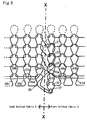
- FIG. 5 is a looping diagram thereof.
- a two-bed flat knitting machine comprising only a pair of front and back needle beds is used in such a manner that odd needles are used for knitting the front knitted fabric and even needles are used for knitting the back knitted fabric, while reserving empty needles on the opposed needle bed, so that a interlock stitch fabric, such as a rib stitch fabric, can be knitted by using both of the front and back needle beds in the course of knitting the knitted fabric into a tubular shape.
- the tubular knitted fabric can be knitted without any empty needles being situated between the knitting needles for use in forming the loops.
- the course 0 of FIG. 2 shows the state that a waste course knitting taken place prior to regular knitting is completed.
- a desired knitted fabric hereinafter it is referred to as the knitted fabric body
- the knitted fabric body is knitted and then the waste course is separated and removed from the knitted fabric body
- FIG. 1 shows the state that the waste course was separated and removed.
- the knitting of the waste course taken place prior to knitting the knitted fabric body can allow a pull-down tensile force to be exerted on the knitted fabric body from the first knitting course of the knitted fabric body.
- a knitting yarn 15 that is newly introduced from the course 1 into the knitting is held at its yarn end by a yarn end holding device 17 disposed at a lateral side of a knitting area and is extended through a yarn carrier (not shown) that moves in reciprocation along a needle gap between the both front and back needle beds.
- the knitting yarn 15 held at its yarn end is led to the knitting area by the yarn carrier and a portion of the knitting yarn extending between the yarn end and the carrier is captured by a hook of the needle and drawn in by it to do the knitting.
- the needles C-M of the front bed and the needles d-n of the back needle bed are used for knitting the knitted fabric body.
- the needles A and B located outside of those needles are used for the knitting process for disposing an unused yarn edge as described later.
- the loop on the needle d of the back bed is transferred to the needle D of the front bed in advance, for preparation of the next knitting.
- the yarn carrier is shifted rightward and the yarn is fed to the needle B of the front bed situated next to the needle C on which the loop at the end side of the knitted fabric body is formed.
- no loop in the preceding course is formed on the needle B, so that the knitting yarn fed to the needle B comes into the state of being held in the hook of the needle B.
- this knitting process wherein the knitting yarn is fed to the empty needle holding no loop, so as to be held in the hook of the needle is referred to as "the empty needle knitting process" in the embodiment, and the knitting yarn held in the needle by such an empty needle knitting process is referred to as "the empty needle knitting loop".
- the empty needle knitting loop 21 is held in the needle B of the front bed by the knitting of the course 1.
- the yarn carrier Prior to going on to the knitting of the course 2, the yarn carrier is reversed in traveling direction and is shifted to the left side of the needle b to which the yarn is fed in the course 3.
- the yarn carrier In the knitting of the course 2, the yarn carrier is shifted rightward and the yarn is fed to the needle b to form thereon the empty needle knitting loop 23 in the same manner as in the needle B.
- the yarn carrier is reversed and the yarn is carried leftward and fed to the needle A of the front bed to form the empty needle knitting loop 25 therein.
- the knitting processes of the courses 1 to 3 form the first half of the knitting process for disposing the unused yarn edge, and the empty needle knitting loops 21, 23 and 25 formed in these knitting processes are each called "the unused-yarn-edge disposal loop".
- the first half of this knitting process may proceed, prior to forming the unused-yarn-edge disposal loop, as in this embodiment. Alternatively, it may proceed after the initiation of the knitting of the knitted fabric body by taking the step that the yarn is fed to the needle used for knitting the knitted fabric body, prior to forming the unused-yarn-edge disposal loop, and then the needle is moved up to the knitting yarn extending between the endmost side of the knitted fabric body and the yarn end to capture it into the hook of the needle.
- the remaining second half of the knitting process proceeds in parallel with the knitting of the courses of the knitted fabric body after the initiation of the knitting of the knitted fabric body.
- the yarn carrier Prior to the knitting of the course 4, the yarn carrier is reversed and shifted rightward. Thereafter, in the knitting of the course 4, the yarn is carried leftward and fed to the needles D and C of the front bed, to form the loops 27 and 29 thereon. In the knitting of the course 5, the yarn is carried rightward and fed to the needle d of the back bed, to form the loop 31 thereon. In the knitting of the course 6, the loop 27 on the needle C to which the yarn is fed in the knitting of the course 4 is transferred to the needle c of the back bed. In the knitting of the course 7, the yarn is carried leftward and fed to the needle c of the back bed, to form the loop 33 thereon. In the course 8, the loop 33 is transferred to the needle C of the front bed.
- the needle D of the back bed holding the loop 31 formed in the knitting of the course 4 is advanced or retracted without feeding the yarn thereto, so as to shake off the held loop 31 from the needle D.
- the loop 31 on the needle D of the front bed is transferred to the needle d of the back bed.
- the knitting processes of the courses 4-10 form the knotting knitting for the unused yarn edge extending out from the knitted fabric to be knotted at a basal end thereof so as to be tied on the knitted fabric body, so as to prevent the unused yarn edge from being drawn into the knitted fabric body even when force acts on the knitted fabric.
- the knotting knitting is not indispensable.
- the knotting knitting may selectively be made in accordance with knitting conditions, such as quality and thickness of the knitting yarn used and size of the loops formed, and the number of loops formed to dispose the unused yarn edge.
- the knitting of the knitted fabric body is started from the course 12 of FIG. 3.
- the loops on the needles d, h and 1 of the back bed are transferred to the needles D, H and L of the front bed.
- the yarn is fed to the needles D, H and L of the front bed and the needles f, j and n of the back bed alternately, to form the loops 35a, 35b, 35c, 35d, 35e and 35f thereon.
- the yarn is fed to the needles n, j and f of the back bed to form the loops 37a, 37b and 37c thereon.
- the yarn is fed to the needles D, H and L of the front bed to form the loops 39a, 39b and 39c thereon, so as to prevent loosening of the stitches, and the back knitted fabric 1 is cast on.
- the loops 39a, 39b and 39c of the back knitted fabric 5 held on the needles D, H and L of the front bed are transferred to the corresponding needles d, h and 1 of the back bed and, prior to casting on the front knitted fabric 3, the loops of a waste knitting portion held on the needles E, I and M of the front bed are transferred to the back bed.
- the yarn is fed to the needles C, G and K of the front bed and the needles e, i and m of the back bed alternately, to form the loops 41a, 41b, 41c, 41d, 41e and 41f thereon.
- the yarn is fed to the needles C, G and K of the front bed to form the loops 43a, 43b and 43c thereon.
- the yarn is fed to the needles m, i and e of the back bed to form the loops 45a, 45b and 45c thereon, so as to prevent loosening of the stitches of the front knitted fabric 3.
- the loops 45a, 45b and 45c of the front knitted fabric held on the needles e, i and m of the back bed are transferred to the needles E, I and M of the front bed, so that all loops of the front knitted fabric 3 are transferred to the front bed.
- the yarn is fed to the needles D, F, H, J, L and N of the back bed to knit the back knitted fabric 5.
- the unused-yarn-edge disposal loop 25 formed in the needle A of the front bed by the empty needle knitting process in the knitting of the course 3 is transferred to the needle c of the back bed.
- the unused-yarn-edge disposal loop 25 is further transferred to the needle C of the front bed and laid over the loop 43a of the front knitted fabric 3 held on the needle C.
- the yarn is fed to the needles M, K, I, G, E and C of the front bed to knit the front knitted fabric 3.
- the loops of the back knitted fabric 5 held on the needles d, h and 1 of the back bed are transferred to the needles D, H and L of the front bed, for preparation of knitting the back knitted fabric 5 in the form of a 1 ⁇ 1 rib stitch structure.
- the yarn is fed to the needles D, H and L of the front bed and the needles f, j and n of the back bed to knit the back knitted fabric 5 in the form of the 1 ⁇ 1 rib stitch structure.
- the unused-yarn-edge disposal loop 23 formed in the course 2 and held on the needle b of the back bed is transferred to the needle C of the front bed and laid over the loop 47 of the front knitted fabric 3.
- the loops of the back knitted fabric 5 held on the needles D, H and L of the front bed are transferred back to the needles d, h and 1 of the back bed and also the loops of the front knitted fabric 3 held on the needles E, I and M of the front bed are transferred to the needles e, i and m of the back bed, for preparation of knitting the front knitted fabric 3 in the form of the 1 ⁇ 1 rib stitch structure.
- the yarn is fed to the needles e, i and m of the back bed and the needles C, G and K of the front bed alternately, to knit the front knitted fabric 3 in the form of the rib stitch structure.
- the loops of the front knitted fabric 3 transferred to the back bed and the loops of the back knitted fabric 5 formed as the back stitches are transferred to the front bed.
- the yarn is fed to the needles D, H and L of the front bed and the needles f, j and n of the back bed alternately, to knit the back knitted fabric 5 in the form of the rib stitch structure.
- the unused-yarn-edge disposal loop 21 held on the needle B formed in the knitting of the course 1 is transferred to the needle c of the back bed.
- the unused-yarn-edge disposal loop 21 is further transferred to the needle C of the front bed and laid over the loop 49 of the front knitted fabric 3.
- the knitting processes of the courses 22, 23, 27, 32 and 33 form the second half of the knitting process for disposing the unused yarn edge.
- the knitting process wherein the unused-yarn-edge disposal loops 21, 23 and 25 formed prior to knitting the knitted fabric body in the first half of the knitting process for disposing the unused yarn edge are laid over the loops of the knitted fabric body in order of from the finally formed loop 25 to the firstly formed loop 21 proceeds in parallel with the knitting of the knitted fabric body. Subsequently, the knitting processes illustrated in the courses 28 to 31 are repeated to form the rib stitch 7 of the tubular knitted fabric 1 shown in FIG. 1.
- FIG. 5 shows only the loops formed by the knitting the courses starting from the course 1 of FIG. 2, with the loops formed by knitting the waste course omitted.
- the dashed line X-X indicates a boundary between the front knitted fabric 3 and the back knitted fabric 5.
- the front knitted fabric 3 is on the right hand of the line X-X, and the back knitted fabric 5 is on the left hand of the same. As shown in FIG.
- the knitted fabric comes into the state in which the unused-yarn-edge disposal loops 21, 23 and 25 formed in the unused yarn edge in the first half of the knitting of the courses 1 to 3 are held by the loops of the knitted fabric body.
- the unused yarn edge 11 at which no loop is formed in a cast-on portion of the knitted fabric body 1 is in the state of extending out from the knitted fabric, as shown in FIG. 1.
- the unused yarn edge 11 is cut at its portion close to the knitted fabric.
- the unused yarn edge 11 thus treated is held in the form of the unused-yarn-edge disposal loops 21, 23 and 25 by the loops of the knitted fabric body.
- the unused yarn edge 11 comes into the state of being accommodated in the knitted fabric as if it is linked into the knitted fabric. Consequently, the need of linking the unused yarn edge into the knitted fabric separately can be eliminated.
- the knotting knitting is performed, prior to knitting the knitted fabric body. Accordingly, closing the loop 27 by pulling the unused yarn edge in a drawing direction prior to cutting it can make it hard for the unused yarn edge 11 to be drawn into the knitted fabric body.
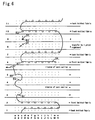
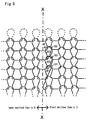
- FIGS. 6-7 are knitting course diagrams illustrating the second embodiment and FIG. 8 is a looping diagram of the same.
- the second embodiment provides the knitting method for disposing the unused yarn edge 13 which is produced in the yarn-out operation performed in the course of the plain weave portion 7 of the tubular knitted fabric 1 being knitted by repeating the knitting of the courses 1 to 2 of FIG. 6. In the courses 3 to 5 of FIG.
- the same knitting as in the knitting of the courses 1 to 3 of the first embodiment is performed by using the knitting yarn subjected to the yarn-out operation, so as to form the unused-yarn-edge disposal loops 51, 53 and 55.
- the knitting yarn 57 used in the knitting of the lower half of the tubular knitted fabric 1 is moved out of the knitting area.
- the front knitted fabric 3 is knitted by using the different knitting yarn 59 used in the next knitting of the upper half of the tubular knitted fabric 1.
- the back knitted fabric 5 is knitted by using the same knitting yarn.
- the unused-yarn-edge disposal loop 51 formed in the knitting of the course 3 is transferred to the needle c of the back bed.
- it is transferred to the needle C of the front bed and laid over the loop 61 of the knitted fabric body.
- the front knitted fabric 3 is knitted, and in the knitting of the course 11, the back knitted fabric 5.
- the unused-yarn-edge disposal loop 53 formed in the knitting of the course 4 is transferred to the needle C of the front bed and laid over the loop 63 of the knitted fabric body.
- the front knitted fabric 3 is knitted, and in the knitting of the course 14, the back knitted fabric 5 is knitted.
- the unused-yarn-edge disposal loop 55 formed in the knitting of the course 5 is transferred to the needle c of the back bed.
- the knitting of the course 17 it is transferred to the needle C of the front bed and laid over the loop 65 of the knitted fabric body.
- the unused-yarn-edge disposal loops 51, 53 and 55 are laid over the loops of the knitted fabric body in order of from the firstly formed loop 51 to the finally formed loop 55.
- the second embodiment is different in this aspect from the first embodiment in which the unused-yarn-edge disposal loops are laid over the loops of the knitted fabric body in order of from the finally formed loop to the firstly formed loop, it is common to the first embodiment in that the unused-yarn-edge disposal loops are laid over the loops of the knitted fabric body in order of from the loop at a side far from the end of the unused yarn edge to the loop at the near side.
- the unused yarn edge can be disposed by simply cutting the unused yarn edge at its portion close to the knitted fabric, as is the case with the yarn-in operation.
- the knotting knitting is not involved in the second embodiment, it may be added, if required. In that case, the knotting knitting should be performed after completion of the knitting of the course 2.
- the unused-yarn-edge disposal loops are laid over the loops of the same wale of the knitted fabric body at the endmost side of the knitted fabric body so that the unused yarn edge can be knitted into the knitted fabric without particular distinction, the unused-yarn-edge disposal loops may be laid over the loops of the other wale of the knitted fabric body. While three unused-yarn-edge disposal loops are formed in the embodiments, the number of unused-yarn-edge disposal loops formed is not limited to three.
- the loop of the knitted fabric body is laid over the unused-yarn-edge disposal loop at each time one course of the knitted fabric body is formed, it may be laid over the unused-yarn-edge disposal loop at each time two or more courses of the knitted fabric body are formed. Further, the unused-yarn-edge disposal loop may be laid over the loop of the back knitted fabric.
- the knitted fabric body is knitted in the form of the tubular knitted fabric, it may be knitted in any other form, without being limited thereto.
- the embodiments described above are just taken as an example of the embodied forms of the present invention. The method of the present invention is not limited to those disclosed in the embodiments and modifications may be made in the invention, without departing from the spirit and scope of the invention.
- This can allow the unused yarn edge to be disposed by simply cutting it at its portion close to the knitted fabric, without the troublesome work including the linking.
- the knitted fabric having the unused yarn edge to be disposed is the tubular knitted fabric whose front knitted fabric and back knitted fabric are continuously joined at both ends thereof
- the unused-yarn-edge disposal loops are advantageously hidden in the inside of knitted fabric areas between the front knitted fabric and the back knitted fabric. Further, when the unused-yarn-edge disposal loops are moved to and laid over the loops of the knitted fabric body in order after the knotting knitting is performed, the basal end of the unused yarn edge is fixed to the knitted fabric body by the knotting, so that even when the knitted fabric is stretched, the unused yarn edge is restrained from being pulled out from the loops of the knitted fabric body.
Landscapes
- Engineering & Computer Science (AREA)
- Textile Engineering (AREA)
- Knitting Of Fabric (AREA)
- Knitting Machines (AREA)
Abstract
Description
Claims (5)
- A knitting method for disposing an unused yarn edge produced in yarn-in and/or yarn-out of a knitting yarn used in knitting a knitted fabric by using a flat knitting machine having at least a pair of front and back needle beds, either or both of which are movable in a longitudinal direction thereof, the knitting method comprising:(a) the step that two or more unused-yarn-edge disposal loops are formed from the knitting yarn introduced in and/or drawn out in knitting by using an empty needle around an end side of a knitted fabric body; and(b) the step that the unused-yarn-edge disposal loops thus formed are moved and laid in order, one each, to and over loops of different courses of the knitted fabric body located at an end side thereof in knitting the next course of the knitted fabric body.
- The knitting method for disposing an unused yarn edge according to Claim 1, wherein the unused yarn edge to be disposed is the unused yarn edge on the yarn-in side produced in the yarn-in and wherein the step (b) proceeds in order of from a finally formed unused-yarn-edge disposal loop to a firstly formed unused-yarn-edge disposal loop.
- The knitting method for disposing an unused yarn edge according to Claim 1, wherein the unused yarn edge to be disposed is the unused yarn edge on the yarn-out side produced in the yarn-out and wherein the step (b) proceeds in order of from a firstly formed unused-yarn-edge disposal loop to a finally formed unused-yarn-edge disposal loop.
- The knitting method for disposing an unused yarn edge according to any one of Claims 1 to 3, wherein the knitted fabric having the unused yarn edge to be disposed is a tubular knitted fabric whose front knitted fabric and back knitted fabric are continuously joined at both ends thereof.
- The knitting method for disposing an unused yarn edge according to any one of Claims 1 to 3, wherein after the knitting yarn introduced in and/or drawn out is subjected to a knotting knitting to fixedly knot a basal end portion of the unused yarn edge to the knitted fabric body, the unused-yarn-edge disposal loops are moved to and laid over the loops of the knitted fabric body in order.
Applications Claiming Priority (3)
| Application Number | Priority Date | Filing Date | Title |
|---|---|---|---|
| JP24564699 | 1999-08-31 | ||
| JP24564699 | 1999-08-31 | ||
| PCT/JP2000/005815 WO2001016416A1 (en) | 1999-08-31 | 2000-08-28 | Knitting method for waste yarn disposal |
Publications (3)
| Publication Number | Publication Date |
|---|---|
| EP1219740A1 true EP1219740A1 (en) | 2002-07-03 |
| EP1219740A4 EP1219740A4 (en) | 2003-01-08 |
| EP1219740B1 EP1219740B1 (en) | 2007-05-23 |
Family
ID=17136751
Family Applications (1)
| Application Number | Title | Priority Date | Filing Date |
|---|---|---|---|
| EP00955084A Expired - Lifetime EP1219740B1 (en) | 1999-08-31 | 2000-08-28 | Knitting method for waste yarn disposal |
Country Status (7)
| Country | Link |
|---|---|
| US (1) | US6578389B1 (en) |
| EP (1) | EP1219740B1 (en) |
| JP (1) | JP3541192B2 (en) |
| KR (1) | KR100634388B1 (en) |
| DE (1) | DE60034958T2 (en) |
| TW (1) | TW470795B (en) |
| WO (1) | WO2001016416A1 (en) |
Cited By (6)
| Publication number | Priority date | Publication date | Assignee | Title |
|---|---|---|---|---|
| EP1266989A4 (en) * | 2000-02-17 | 2003-05-21 | Shima Seiki Mfg | Method of knitting stripe pattern of tubular knitting fabric and the knitting fabric |
| GB2443627A (en) * | 2006-11-10 | 2008-05-14 | Carraig Donn Patent Ltd | A method of knitting in which loose yarn ends are secured within a row of stitches during knitting |
| CN102534981A (en) * | 2010-12-10 | 2012-07-04 | 株式会社岛精机制作所 | Bind-off method of knitted fabric and knitted fabric |
| EP2447399A3 (en) * | 2010-10-28 | 2015-01-14 | Shima Seiki Manufacturing., Ltd. | Knitting method on a flat knitting machine having a plurality of yarn feeders and a corresponding knitted fabric |
| JP2015151631A (en) * | 2014-02-12 | 2015-08-24 | 株式会社島精機製作所 | Method for knitting tubular fabric |
| CN110644121A (en) * | 2019-09-18 | 2020-01-03 | 斓帛职业培训学校(桐乡)有限公司 | A weaving method for improving the dislocation of full-form stripe patterns |
Families Citing this family (11)
| Publication number | Priority date | Publication date | Assignee | Title |
|---|---|---|---|---|
| DE10047514C1 (en) * | 2000-09-22 | 2002-03-21 | Michael Reschewitz | Fine, comfortable stretch-knit clothing for sports and especially cycling, has independently knitted front and rear sections with a seamless join at the edges |
| JP4002870B2 (en) * | 2003-08-08 | 2007-11-07 | 株式会社島精機製作所 | Method for knitting a tubular knitted fabric having a stripe pattern and a tubular knitted fabric having a stripe pattern |
| JP4559053B2 (en) * | 2003-10-10 | 2010-10-06 | 株式会社島精機製作所 | Seamless gloves with high support characteristics. |
| WO2007058091A1 (en) * | 2005-11-17 | 2007-05-24 | Shima Seiki Mfg., Ltd. | Method for knitting tubular fabric having border pattern |
| EP1990452B1 (en) * | 2006-02-28 | 2014-04-23 | Shima Seiki Manufacturing., Ltd. | Method of knitting tubular knitted fabric |
| CN102264962B (en) * | 2008-12-24 | 2013-09-25 | 株式会社岛精机制作所 | Method for preventing ravel of knitting yarn and knitted fabric |
| JP5955212B2 (en) * | 2012-12-20 | 2016-07-20 | 株式会社島精機製作所 | How to stop knitting yarn |
| JP6292828B2 (en) * | 2013-06-14 | 2018-03-14 | 株式会社島精機製作所 | Method for preventing unraveling of knitting yarn and knitted fabric |
| JP6153509B2 (en) | 2014-12-27 | 2017-06-28 | 株式会社島精機製作所 | How to organize |
| CN107299451A (en) * | 2017-08-22 | 2017-10-27 | 江苏金龙科技股份有限公司 | A kind of method that straight-bar machines reversible cloth hides the end of a thread |
| CN114438646B (en) * | 2022-01-05 | 2024-10-01 | 福建泉州凹凸精密机械有限公司 | Double-sided fabric thread-off preventing process |
Family Cites Families (6)
| Publication number | Priority date | Publication date | Assignee | Title |
|---|---|---|---|---|
| US2307607A (en) * | 1939-11-29 | 1943-01-05 | Vanity Fair Silk Mills | Stocking, knitted fabric, and their method of production |
| JP2610208B2 (en) * | 1992-04-27 | 1997-05-14 | 株式会社島精機製作所 | Piping processing method at knitted fabric end and knitted fabric with knitted fabric piping at piping end |
| DE59403821D1 (en) * | 1993-03-16 | 1997-10-02 | Stoll & Co H | Method for forming a thread securing knot on a flat knitting machine, knitted fabric with a thread securing knot and use of a flat knitting machine for producing the knot |
| JPH07324259A (en) * | 1994-05-27 | 1995-12-12 | Shima Seiki Mfg Ltd | Weaving of intarsia knit fabric and cam-lock therefor |
| JPH09217254A (en) * | 1996-02-13 | 1997-08-19 | Tsudakoma Corp | Formation of crossing yarn-fixing part |
| DE19701425B4 (en) * | 1997-01-17 | 2005-01-05 | H. Stoll Gmbh & Co. | Method for incorporating thread starts or thread ends into a fabric |
-
2000
- 2000-08-04 TW TW089115677A patent/TW470795B/en not_active IP Right Cessation
- 2000-08-28 US US10/048,976 patent/US6578389B1/en not_active Expired - Fee Related
- 2000-08-28 KR KR1020027002046A patent/KR100634388B1/en not_active Expired - Fee Related
- 2000-08-28 WO PCT/JP2000/005815 patent/WO2001016416A1/en not_active Ceased
- 2000-08-28 DE DE60034958T patent/DE60034958T2/en not_active Expired - Lifetime
- 2000-08-28 EP EP00955084A patent/EP1219740B1/en not_active Expired - Lifetime
- 2000-08-28 JP JP2001519951A patent/JP3541192B2/en not_active Expired - Fee Related
Cited By (9)
| Publication number | Priority date | Publication date | Assignee | Title |
|---|---|---|---|---|
| EP1266989A4 (en) * | 2000-02-17 | 2003-05-21 | Shima Seiki Mfg | Method of knitting stripe pattern of tubular knitting fabric and the knitting fabric |
| US6715324B2 (en) | 2000-02-17 | 2004-04-06 | Shima Seiki Mfg., Ltd. | Method of knitting stripe pattern of tubular knitted fabric, and the knitted fabric |
| GB2443627A (en) * | 2006-11-10 | 2008-05-14 | Carraig Donn Patent Ltd | A method of knitting in which loose yarn ends are secured within a row of stitches during knitting |
| GB2443627B (en) * | 2006-11-10 | 2011-01-05 | Carraig Donn Patent Ltd | A method of manufacturing a knitted garment |
| EP2447399A3 (en) * | 2010-10-28 | 2015-01-14 | Shima Seiki Manufacturing., Ltd. | Knitting method on a flat knitting machine having a plurality of yarn feeders and a corresponding knitted fabric |
| CN102534981A (en) * | 2010-12-10 | 2012-07-04 | 株式会社岛精机制作所 | Bind-off method of knitted fabric and knitted fabric |
| JP2015151631A (en) * | 2014-02-12 | 2015-08-24 | 株式会社島精機製作所 | Method for knitting tubular fabric |
| CN110644121A (en) * | 2019-09-18 | 2020-01-03 | 斓帛职业培训学校(桐乡)有限公司 | A weaving method for improving the dislocation of full-form stripe patterns |
| CN110644121B (en) * | 2019-09-18 | 2020-10-02 | 斓帛职业培训学校(桐乡)有限公司 | Weaving method for improving dislocation of full-formed stripe patterns |
Also Published As
| Publication number | Publication date |
|---|---|
| JP3541192B2 (en) | 2004-07-07 |
| KR20020025223A (en) | 2002-04-03 |
| US6578389B1 (en) | 2003-06-17 |
| WO2001016416A1 (en) | 2001-03-08 |
| EP1219740B1 (en) | 2007-05-23 |
| DE60034958T2 (en) | 2008-02-28 |
| KR100634388B1 (en) | 2006-10-16 |
| TW470795B (en) | 2002-01-01 |
| EP1219740A4 (en) | 2003-01-08 |
| DE60034958D1 (en) | 2007-07-05 |
Similar Documents
| Publication | Publication Date | Title |
|---|---|---|
| EP1219740B1 (en) | Knitting method for waste yarn disposal | |
| EP1371767B1 (en) | Method for knitting fabric | |
| EP2157219B1 (en) | Knitting method for knitted fabric and knitted fabric | |
| EP2634299B1 (en) | Knitting method of knitted fabric with fringe | |
| EP1266989B1 (en) | Method of knitting stripe pattern of tubular knitting fabric and the knitting fabric | |
| CN102264962A (en) | Method for preventing ravel of knitting yarn and knitted fabric | |
| JPWO2001016416A1 (en) | Knitting method for processing end yarn | |
| US6581417B2 (en) | Knit wear knitting method | |
| CN102383250B (en) | Set up method of knitted fabric | |
| US6318131B1 (en) | Method of knitting 3-d shape knit fabric | |
| CN101395312B (en) | Method of forming increase and knitted fabric where increases are formed inner side of knitting width direction end of knitted fabric | |
| CN1292114C (en) | Knitting fabric having novel set up structure and method of knitting it | |
| EP1842948A1 (en) | Method for knitting double tubular fabric | |
| JPS6043460B2 (en) | knitting machine | |
| EP0940491B1 (en) | A widening method | |
| EP0466439A2 (en) | Cast on method for knitting and knitted fabric formed by the same | |
| JP2008303489A (en) | Knitting method for knit fabric, and knit fabric | |
| CN117626512B (en) | Knitting method of knitted fabric | |
| JP2010133055A (en) | Method for knitting knitted fabric | |
| JP2006225776A (en) | Knitting method for miss-pattern by flat-knitting machine and the resulting knitted fabric | |
| JP3954324B2 (en) | Bind-off method and bind-off knitted fabric | |
| CN121853260A (en) | Knitting methods, knitting procedures, storage media, and knitted fabrics | |
| JPH09209248A (en) | Knitting loop increase in circular knitting | |
| JPH09143843A (en) | Knitting increased stitch in cylindrical knitting |
Legal Events
| Date | Code | Title | Description |
|---|---|---|---|
| PUAI | Public reference made under article 153(3) epc to a published international application that has entered the european phase |
Free format text: ORIGINAL CODE: 0009012 |
|
| 17P | Request for examination filed |
Effective date: 20020228 |
|
| AK | Designated contracting states |
Kind code of ref document: A1 Designated state(s): AT BE CH CY DE DK ES FI FR GB GR IE IT LI LU MC NL PT SE |
|
| AX | Request for extension of the european patent |
Free format text: AL;LT;LV;MK;RO;SI |
|
| A4 | Supplementary search report drawn up and despatched |
Effective date: 20021121 |
|
| AK | Designated contracting states |
Kind code of ref document: A4 Designated state(s): AT BE CH CY DE FR GB IT LI |
|
| RBV | Designated contracting states (corrected) |
Designated state(s): AT BE CH CY DE FR GB IT LI |
|
| GRAP | Despatch of communication of intention to grant a patent |
Free format text: ORIGINAL CODE: EPIDOSNIGR1 |
|
| RBV | Designated contracting states (corrected) |
Designated state(s): DE FR GB IT |
|
| GRAS | Grant fee paid |
Free format text: ORIGINAL CODE: EPIDOSNIGR3 |
|
| GRAA | (expected) grant |
Free format text: ORIGINAL CODE: 0009210 |
|
| AK | Designated contracting states |
Kind code of ref document: B1 Designated state(s): DE FR GB IT |
|
| REG | Reference to a national code |
Ref country code: GB Ref legal event code: FG4D |
|
| REF | Corresponds to: |
Ref document number: 60034958 Country of ref document: DE Date of ref document: 20070705 Kind code of ref document: P |
|
| ET | Fr: translation filed | ||
| PLBE | No opposition filed within time limit |
Free format text: ORIGINAL CODE: 0009261 |
|
| STAA | Information on the status of an ep patent application or granted ep patent |
Free format text: STATUS: NO OPPOSITION FILED WITHIN TIME LIMIT |
|
| 26N | No opposition filed |
Effective date: 20080226 |
|
| PGFP | Annual fee paid to national office [announced via postgrant information from national office to epo] |
Ref country code: FR Payment date: 20100824 Year of fee payment: 11 |
|
| PGFP | Annual fee paid to national office [announced via postgrant information from national office to epo] |
Ref country code: GB Payment date: 20100825 Year of fee payment: 11 |
|
| GBPC | Gb: european patent ceased through non-payment of renewal fee |
Effective date: 20110828 |
|
| REG | Reference to a national code |
Ref country code: FR Ref legal event code: ST Effective date: 20120430 |
|
| PG25 | Lapsed in a contracting state [announced via postgrant information from national office to epo] |
Ref country code: FR Free format text: LAPSE BECAUSE OF NON-PAYMENT OF DUE FEES Effective date: 20110831 Ref country code: GB Free format text: LAPSE BECAUSE OF NON-PAYMENT OF DUE FEES Effective date: 20110828 |
|
| PGFP | Annual fee paid to national office [announced via postgrant information from national office to epo] |
Ref country code: DE Payment date: 20140821 Year of fee payment: 15 |
|
| PGFP | Annual fee paid to national office [announced via postgrant information from national office to epo] |
Ref country code: IT Payment date: 20140819 Year of fee payment: 15 |
|
| REG | Reference to a national code |
Ref country code: DE Ref legal event code: R119 Ref document number: 60034958 Country of ref document: DE |
|
| PG25 | Lapsed in a contracting state [announced via postgrant information from national office to epo] |
Ref country code: IT Free format text: LAPSE BECAUSE OF NON-PAYMENT OF DUE FEES Effective date: 20150828 |
|
| PG25 | Lapsed in a contracting state [announced via postgrant information from national office to epo] |
Ref country code: DE Free format text: LAPSE BECAUSE OF NON-PAYMENT OF DUE FEES Effective date: 20160301 |