EP1219732A1 - Poly(trimethylene terephthalate) modified cross-section yarn - Google Patents
Poly(trimethylene terephthalate) modified cross-section yarn Download PDFInfo
- Publication number
- EP1219732A1 EP1219732A1 EP00955047A EP00955047A EP1219732A1 EP 1219732 A1 EP1219732 A1 EP 1219732A1 EP 00955047 A EP00955047 A EP 00955047A EP 00955047 A EP00955047 A EP 00955047A EP 1219732 A1 EP1219732 A1 EP 1219732A1
- Authority
- EP
- European Patent Office
- Prior art keywords
- fiber
- section
- range
- cross
- modified cross
- Prior art date
- Legal status (The legal status is an assumption and is not a legal conclusion. Google has not performed a legal analysis and makes no representation as to the accuracy of the status listed.)
- Withdrawn
Links
Images



Classifications
-
- D—TEXTILES; PAPER
- D01—NATURAL OR MAN-MADE THREADS OR FIBRES; SPINNING
- D01F—CHEMICAL FEATURES IN THE MANUFACTURE OF ARTIFICIAL FILAMENTS, THREADS, FIBRES, BRISTLES OR RIBBONS; APPARATUS SPECIALLY ADAPTED FOR THE MANUFACTURE OF CARBON FILAMENTS
- D01F6/00—Monocomponent artificial filaments or the like of synthetic polymers; Manufacture thereof
- D01F6/58—Monocomponent artificial filaments or the like of synthetic polymers; Manufacture thereof from homopolycondensation products
- D01F6/62—Monocomponent artificial filaments or the like of synthetic polymers; Manufacture thereof from homopolycondensation products from polyesters
-
- D—TEXTILES; PAPER
- D01—NATURAL OR MAN-MADE THREADS OR FIBRES; SPINNING
- D01D—MECHANICAL METHODS OR APPARATUS IN THE MANUFACTURE OF ARTIFICIAL FILAMENTS, THREADS, FIBRES, BRISTLES OR RIBBONS
- D01D5/00—Formation of filaments, threads, or the like
- D01D5/253—Formation of filaments, threads, or the like with a non-circular cross section; Spinnerette packs therefor
-
- Y—GENERAL TAGGING OF NEW TECHNOLOGICAL DEVELOPMENTS; GENERAL TAGGING OF CROSS-SECTIONAL TECHNOLOGIES SPANNING OVER SEVERAL SECTIONS OF THE IPC; TECHNICAL SUBJECTS COVERED BY FORMER USPC CROSS-REFERENCE ART COLLECTIONS [XRACs] AND DIGESTS
- Y10—TECHNICAL SUBJECTS COVERED BY FORMER USPC
- Y10T—TECHNICAL SUBJECTS COVERED BY FORMER US CLASSIFICATION
- Y10T428/00—Stock material or miscellaneous articles
- Y10T428/29—Coated or structually defined flake, particle, cell, strand, strand portion, rod, filament, macroscopic fiber or mass thereof
- Y10T428/2913—Rod, strand, filament or fiber
-
- Y—GENERAL TAGGING OF NEW TECHNOLOGICAL DEVELOPMENTS; GENERAL TAGGING OF CROSS-SECTIONAL TECHNOLOGIES SPANNING OVER SEVERAL SECTIONS OF THE IPC; TECHNICAL SUBJECTS COVERED BY FORMER USPC CROSS-REFERENCE ART COLLECTIONS [XRACs] AND DIGESTS
- Y10—TECHNICAL SUBJECTS COVERED BY FORMER USPC
- Y10T—TECHNICAL SUBJECTS COVERED BY FORMER US CLASSIFICATION
- Y10T428/00—Stock material or miscellaneous articles
- Y10T428/29—Coated or structually defined flake, particle, cell, strand, strand portion, rod, filament, macroscopic fiber or mass thereof
- Y10T428/2913—Rod, strand, filament or fiber
- Y10T428/2933—Coated or with bond, impregnation or core
- Y10T428/2964—Artificial fiber or filament
- Y10T428/2967—Synthetic resin or polymer
- Y10T428/2969—Polyamide, polyimide or polyester
-
- Y—GENERAL TAGGING OF NEW TECHNOLOGICAL DEVELOPMENTS; GENERAL TAGGING OF CROSS-SECTIONAL TECHNOLOGIES SPANNING OVER SEVERAL SECTIONS OF THE IPC; TECHNICAL SUBJECTS COVERED BY FORMER USPC CROSS-REFERENCE ART COLLECTIONS [XRACs] AND DIGESTS
- Y10—TECHNICAL SUBJECTS COVERED BY FORMER USPC
- Y10T—TECHNICAL SUBJECTS COVERED BY FORMER US CLASSIFICATION
- Y10T428/00—Stock material or miscellaneous articles
- Y10T428/29—Coated or structually defined flake, particle, cell, strand, strand portion, rod, filament, macroscopic fiber or mass thereof
- Y10T428/2913—Rod, strand, filament or fiber
- Y10T428/2973—Particular cross section
Definitions
- the present invention relates to a polytrimethylene terephthalate fiber obtained by a melt spinning method and to a method for producing the same. More specifically, the present invention relates to a polytrimethylene terephthalate fiber having a trilobal cross-section suitable for the clothing use and a method for industrially producing such a modified cross-sectional fiber in a stable manner for a long period.
- PET fiber having a modified cross-sectional shape such as a trilobal shape similar to a triangle
- PET fiber having a modified cross-sectional shape such as a trilobal shape similar to a triangle
- the modified cross-sectional PET fiber is produced by extruding a polymer either containing no titanium oxide used as a delusterant or containing a relatively small amount thereof in comparison with that in a polymer of a circular cross-section (generally called as a bright polymer) through a spinneret having Y or T-shaped spinning orifices or a modification thereof.
- the trilobal cross-sectional PET fiber containing a small amount of titanium oxide exhibits a silk-like elegant luster due to the combined effect of the brightness and the cross-sectional shape of the polymer. Accordingly, this fiber has been mass-produced as silky polyester fiber which is evaluated as a high grade product in the clothing field.
- the polytrimethylene terephthalate (hereinafter briefly referred to as 3GT) fiber is disclosed in the prior art documents such as (A) Japanese Unexamined Patent Publication No. 52-5320; (B) Japanese Unexamined Patent Publication No. 52-8123; (C) Japanese Unexamined Patent Publication No. 52-8124; (D) Japanese Unexamined Patent Publication No. 58-104216; (E) J. Polymer Science; Polymer Physics Edition vol. 14, pages 263 to 274 (1976); or (F) Chemical Fibers International vol. 45 (April), pages 110 to 111 (1995). According to the description in (F), the 3GT fiber is characterized in a lower Young's modulus and a higher elastic recovery of elongation (that is, a larger elastic limit) than those of PET fiber due to its solid structure.
- Japanese Unexamined Patent Publication No. 9-3724 discloses a 3GT fiber having a modified cross-sectional shape such as a trilobal shape, but this 3GT fiber having a modified cross-sectional shape described in this publication is a BCF fiber for producing a carpet yarn having a single-fiber size of 15 deniers (16.7 dtex) or more and is unsuitable for clothing use. Also, there is nothing but the term "trilobal" regarding the cross-sectional shape thereof, and the details of the shape are not described or suggested.
- the prior art does not describe a 3GT fiber having a trilobal cross-section and a single-fiber size of 8.9 dtex (8 deniers) or less suitable for clothing use as well as the content of titanium oxide necessary for a silky 3GT fiber suitable for clothing use.
- an outer periphery is preferably of a trilobal outwardly concave cross-section to obtain a silky luster.
- the fiber having such a trilobal cross-section exhibits glitter which deteriorates the elegance.
- the trilobal cross-section is insufficient for obtaining the elegant silky luster and, instead, a more complicated multilobal cross-section such as a pentalobal or octalobal cross-section is necessarily adopted (see "Fiber Configuration" edited by the Fiber Society, pages 170 to 173 (1982)).
- Japanese Unexamined Patent Publication No. 5-78904 proposes the production of polyester fiber having a trilobal cross-section by using a spinning orifice of a modified Y-shaped opening as shown in Fig. 7 in which d/D is in a range from 1/3 to 2/3.
- D is a length (mm) of a vertical line extending from a center of the trilobal orifice to one side of a circumscribed triangle of the outer periphery of the orifice opening
- d is a distance (mm) between the center and a cross point of the above-mentioned vertical line with the arcuate side.
- Japanese Unexamined Patent Publication No. 11-200143 proposes to maintain a surface of the spinneret at a certain temperature, to apply a release agent thereto and to determine a polymer surface area per one orifice of the spinneret at a predetermined value for mitigating the white-eye phenomenon.
- a release agent there is neither description of how the white-eye phenomenon in a fiber having the modified cross-section occurs nor a suggestion of a countermeasure for mitigating the same.
- a first object of the present invention is to provide a 3GT fiber having a uniform trilobal cross-section suitable for clothing, carpets or industrial use, which generates less fluff during the production process and the post-treatment process, and a method for continuously producing this modified cross-sectional fiber for a long period on an industrial scale.
- a second object of the present invention is to provide a bright and silky 3GT fiber having a uniform cross-section and a single-fiber size of 8.9 dtex (8 deniers) or less suitable for the clothing use which generates less fluff during the production process and the post-treatment process such as a false-twist texturing process, a weaving or knitting process, and a method for continuously spinning this modified cross-sectional fiber for a long period on an industrial scale.
- the 3GT fiber exhibits a unique frictional characteristic in comparison with PET fiber, and has high coefficients of static and dynamic friction between fiber/fiber, fiber/metal, and fiber/ceramics.
- the fiber breakage and fluff are liable to occur due to the friction during the drawing or post-treatment process.
- this tendency is particularly true in a so-called bright polymer containing less of the titanium oxide used as a delusterant.
- the inventors of the present invention have found, as a result of diligent study, that it is possible to suppress the contamination of a spinning orifice with polymer (the white-eye or eye mucus phenomenon) and to prolong the wiping interval to as long as twelve hours or more by using a spinneret of a special configuration, more concretely closer to a triangle rather than a Y-shape, and limiting the spinning temperature, the surface temperature of the spinneret and the linear speed V of the extruded polymer to a specified range.
- the fiber of the modified cross-section obtained from the inventive method has a uniform cross-sectional shape and the generation of fluff is less during treatment.
- the content of titanium oxide in 3GT polymer is limited to the specified range, the frictional characteristic becomes proper when the 3GT polymer is used as a bright polymer, whereby the generation of fiber breakage or fluff is suppressed during the drawing and post-treatment process of the fiber having a trilobal cross-section. Simultaneously therewith, a silky luster is exhibited.
- the present invention is:
- a 3GT fiber according to the present invention is composed of 95 mol% or more of trimethylene terephthalate repeating units and 5 mol% or less of other ester repeating units and has an intrinsic viscosity [ ⁇ ] in a range from 0.7 to 1.3 (dl/g) and a trilobal type cross-section, an outer periphery of which consists solely of outwardly convex sections or both of outwardly convex sections and straight sections.
- the inventive modified cross-sectional 3GT fiber includes a multifilament and a staple fiber obtained by cutting the former.
- the inventive 3GT is composed of 95 mol% or more of trimethylene terephthalate repeating units and 5 mol% or less of other ester repeating units. That is, the inventive 3GT includes a 3GT homopolymer, a homo 3GT and a copolymerized 3GT containing 5 mol% or less of other ester repeating units.
- copolymerized components are as follows:
- An acidic component includes aromatic dicarboxylic acid represented by isophthalic acid or 5-sodium sulfoisophthalate, aliphatic dicarboxylic acid represented by adipic acid or itaconic acid.
- a glycolic component includes trimethylene glycol, ethylene glycol, polyethylene glycol or others. Also, it includes hydroxy-dicarboxylic acid such as hydroxy-benzoate. Further, a plurality of copoymerized components may be contained.
- An intrinsic viscosity [ ⁇ ] of the inventive 3GT is in a range from 0.7 to 1.3 (dl/g).
- the intrinsic viscosity [ ⁇ ] is measured by a method described later. If the intrinsic viscosity [ ⁇ ] is less than 0.7 (dl/g), a strength at break of the fiber becomes 2.65 cN/dtex (3 g/d) or less which is too low to be put into practical use. Contrarily, if the intrinsic viscosity [ ⁇ ] exceeds 1.3 (dl/g), the dimensional stability of a multifilamentary yarn against heat is deteriorated, as well as a production cost of 3GT used as a raw material becomes higher.
- the intrinsic viscosity [ ⁇ ] is preferably in a range from 0.8 to 1.1 (dl/g).
- a delusterant such as titanium oxide, a heat stabilizer, an antioxidant, an antistatic agent, an ultraviolet screening agent, anti-fungus agent or various pigments may be contained in or copolymerized with the inventive 3GT.
- the inventive 3GT fiber has a trilobal type cross-section to provide a good feeling of touch and a silky luster.
- the cross-section of the inventive 3GT fiber has the outer periphery consisting solely of outwardly convex sections or both of outwardly convex sections and straight sections (such a cross-sectional shape is hereinafter referred to as a rice ball type).
- Figs. 1 and 2 illustrate examples of the rice ball type cross-sectional shape.
- a trilobal type cross-section has an outer periphery consisting of outwardly concave sections as shown in Fig. 3, the white-eye phenomenon is significant during the production of the modified cross-sectional fiber. This substantially disables the spinning operation to be continued, and the resultant fiber has much fluff to make the knitting or weaving thereof difficult. Also, since 3GT has a different refractive index from that of PET, the 3GT fiber having the modified cross-section shown in Fig. 3, which is often seen in the PET fiber, is unsuitable for the clothing use due to its excessive glitter.
- the modified cross-sectional fiber of a rice ball type shown in Figs. 1 and 2 can be continuously spun for a long time, and is excellent in processibility in the knitting and weaving process. Also, it has a soft luster free from glitter and is most suitable for clothing use.
- the above-mentioned rice ball type cross-section may be either a regular triangle defined by three corners (Fig. 1), an equilateral triangle (Fig. 4) or a triangle having sides of different lengths (Fig. 5), and a degree of modification of the rice ball is preferably small (closer to a triangle) rather than large (closer to a circle).
- a single-fiber size of the inventive 3GT fiber having a modified cross-section is not particularly limited, 8.9 dtex (8 deniers) or less is preferable if it is used for the clothing. If the fiber size exceeds 8.9 dtex, a feeling of touch is liable to be hard.
- the size of fiber with soft touch suitable for clothing use is preferably 6.7 dtex (6 deniers) or less, more preferably in a range from 0.6 to 3.3 dtex (from 0.5 to 3 deniers).
- a content of titanium oxide in the inventive 3GT fiber having a modified cross-section is not particularly limited, it is preferably in a range from 0.03 to 0.15 wt%. Titanium oxide added to the fiber as a delusterant has an influence on a coefficient of friction. If the content is 0.03 wt% or less, the coefficient of friction becomes so high that the processibility of the fiber deteriorates in the spinning process or the post-treatment process. Also, the resultant product unfavorably glitters and is unsuitable for the clothing use in some cases. Contrarily, if the content of titanium oxide exceeds 0.15 wt%, the brightness disappears too much to result in a favorable silky luster.
- the content of titanium oxide is more preferably in a range from 0.03 to 0.09 wt%.
- the inventive 3GT fiber preferably has a degree of modification measured by a method described later in a range from 1.15 to 1.35. If the degree of modification is less than 1.15, the glossiness becomes insufficient whereby the difference from that of a fiber having a circular cross-section is small. Contrarily, if the degree of modification exceeds 1.35, the white-eye phenomenon becomes significant during the spinning and the resultant fiber has much fluff and slack which is sometimes unsuitable for the post-treatment.
- the inventive 3GT fiber is preferably has a glossiness measured by a method described later in a range from 50 to 75. If the glossiness is less than 50, the luster becomes insufficient whereby the difference from that of a fiber having a circular cross-section is small. Contrarily, if the glossiness exceeds 75, the luster becomes so significant that the fiber may be unsuitable for the clothing use.
- the glossiness is more preferably in a range from 55 to 70, further more preferably from 60 to 70.
- the preferable glossiness is achievable from a suitable combination of the content of titanium oxide with the degree of modification.
- the inventive 3GT fiber is favorably obtained by a method for producing a 3GT fiber having a modified cross-section, comprising a step of extruding polytrimethylene terephthalate comprising 95 mol% or more of trimethylene terephthalate repeating units and 5 mol% or less of other ester repeating units, and having an intrinsic viscosity [ ⁇ ] in a range from 0.7 to 1.3 (dl/g), through a spinneret having spinning orifices of a trilobal opening, wherein
- the outer periphery of the trilobal type orifice of the spinneret consists of three semicircular corners and outwardly concave arcuate sections connecting every adjacent corner with the others wherein all of the d/D values are in a range from 0.70 to 1.0.
- the trilobal type orifice for obtaining the fiber having the cross-section shown in Fig 4 or 5 three d/D values are different from each other.
- the resultant fiber has a generally circular cross-section and cannot be referred to as a modified cross-sectional fiber.
- a preferable range of d/D is from 0.70 to 0.90.
- a spinning temperature is in a range from 255 to 275°C.
- the spinning temperature is a temperature within a spin pack 5 (see Fig. 8) which is the same as a temperature of melted 3GT prior to being spun.
- 3GT is liable to be decomposed by heating in comparison with PET, and therefore, if the spinning temperature exceeds 275°C as in the spinning of PET, a smooth spinning is not expected due to the bending of fiber or the generation of bubbles of decomposition gas, whereby the resultant fiber is inferior in physical properties.
- the spinning temperature is lower than 255°C, a smooth spinning operation becomes difficult due to melt fracture or others even if other conditions have been favorably prepared.
- the spinning temperature is preferably in a range from 255 to 270°C which is completely free from both of melt fracture and heat decomposition problems.
- a surface temperature of a spinneret is in a range from 250 to 275°C.
- the present inventors have found at the first time in the world that the white-eye phenomenon due to the adhesion of polymer in the vicinity of the spinning orifice is liable to generate as the surface temperature of the spinneret is lower. If the surface temperature of the spinneret is lower than 250°C, the white-eye phenomenon is significant to make the continuation of the spinning operation impossible. Contrarily, if the surface temperature of the spinneret exceeds 275°C, the size variation U% of a multifilamentary yarn becomes problematically large to cause a fiber quality to deviate from a proper range.
- the surface temperature of the spinneret is preferably in a range from 255 to 270°C, more preferably from 258 to 270°C.
- the surface temperature of the spinneret varies in relation to the spinning temperature (a spin head temperature) to be generally lower by 5 to 15°C than the latter.
- the surface temperature of the spinneret may be adjusted independently from the spinning temperature by positively heating the spinneret or the atmosphere directly beneath the spinneret.
- a product of a linear speed V of the molten polymer extruded from the spinneret and the intrinsic viscosity [ ⁇ ]; i.e., V ⁇ [ ⁇ ] must be in a range from 4 to 13 (m/min) (dl/g). If the product V ⁇ [ ⁇ ] is less than 4 (m/min) (dl/g), the extruded polymer is not evenly thinned during the fiber formation. That is, there is a lengthwise irregularity in size of the resultant fiber (i.e., the fiber has a large U%).
- the white-eye phenomenon becomes significant to disturb the continuous spinning operation.
- the product V ⁇ [ ⁇ ] is preferably in a range from 4 to 9 (m/min) (dl/g).
- the linear speed V of the melted polymer extruded from the orifice is adjusted by regulating the extrusion area of the orifice.
- the content of titanium oxide in 3GT is preferably in a range from 0.03 to 0.15 wt%.
- the reason therefor and the preferable range thereof are the same as those already described on the modified cross-sectional fiber.
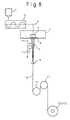
- 3GT pellets defined by the present invention are continuously put into a continuous pellet drier 1 and dried with hot air so that the moisture content is 30 ppm.
- the dried pellets are subsequently fed to an extruder 2 maintained at a temperature in a range from 255 to 265°C, heated to a temperature above the melting point of 3GT and melted.
- the melted 3GT is fed to a spin head 4 maintained at a predetermined temperature via a bend 3, adjusted to the spinning temperature and filtrated in the spin pack 5.
- the melted 3GT is extruded through a spinneret 6 having trilobal type orifices to form a multifilamentary yarn 7 of modified cross-sectional fibers.
- the extruded 3GT multifilamentary yarn 7 is then introduced into a cooling zone and thinned to a predetermined fiber size by the withdrawing force of godet rolls 11 rotating at a peripheral speed of 500 m/min or more while being cooled to a room temperature by a cooling air 8, during which a finishing agent is imparted thereto through an oiling nozzle 9, whereby an undrawn yarn 10 of multifilamentary fibers having a modified cross-section is obtained.
- the undrawn yarn 10 is taken up by a winder 12 to form an undrawn yarn package 13.
- the undrawn yarn package 13 is transferred to a drawing machine shown in Fig. 9.
- the undrawn yarn 10 is drawn at a predetermined draw ratio and heat-treated with a hot plate 15 maintained at a temperature in a range from 100 to 150°C to be a drawn yarn 16.
- the draw ratio is defined by a ratio in speed between the feed roll 14 and a draw roll 17.
- the resultant drawn yarn 16 is wound either in a pirn form of a twisted yarn or in a cheese form of a non-twisted yarn, in accordance with the need.
- the yarn is embedded in melted paraffin, which is left for about five minutes and solidified. Thereafter, the embedded sample is cut, vertical to the fiber axis, by a microtome to obtain a cut piece of 5 to 7 ⁇ m thick. Then, the cut piece is placed on a slide glass which is heated to melt the paraffin. Thereafter, one drop of olive oil is dropped thereon and pressed by a cover glass.
- a cross-section of the fiber is observed and photographed by using an optical microscope (manufactured by Olympus Kogaku Kogyo K.K.; a trade name "BH-2"-Type B071) to obtain a cross-sectional photograph.
- the magnification is selected within a range from 200 to 500 as necessary.
- a machine-made paper is adhered to an aluminum plate of 7 cm long, 5 cm wide and 1 mm thick, and a yarn is wound around the same to form six layers under a load of 1 cN/dtex.
- a winding pitch is 100 end/cm while taking care not to generate a gap.
- a glossiness of the sample fiber plate at a measurement angle 60 degrees is measured by using a variangular type digital glossmeter (UGV-4D type; manufactured by Suga Shikenki K.K.) in accordance with JIS-1013 (B method). The measurement is carried out both on front and back surfaces of the sample fiber plate, and an average value of the two is used as the glossiness.
- GV-4D type manufactured by Suga Shikenki K.K.
- a trilobal cross-section type multifilamentary yarn of 38.9 dtex (35 deniers)/24 filaments was test-produced from 3GT bright pellets containing 0.05 wt% of titanium oxide and having the intrinsic viscosity [ ⁇ ] of 0.90 (dl/g) by using a spinning apparatus and a drawing machine shown in Figs. 8 and 9.
- the spinning apparatus could be simultaneously provided with sixteen spinnerets.
- the sixteen undrawn yarn packages in the same doff were simultaneously supplied to a drawing machine, wherein two drawn yarn packages of 2.5 kg weight were obtained from one undrawn yarn package. Such a drawing process was repeated four times (corresponding to the four doffs of the undrawn yarn).
- the respective spinning orifice is of a regular-triangle type wherein the value of d/D common to three sides thereof is shown in Table 1.
- the cross-sectional shape of the fiber in the resultant multifilamentary yarn was a Fig. 3 type in the spinning orifices A, B, C and G (Comparative examples 1, 2, 3 and 4); a Fig. 2 type in the spinning orifice F (Example 3); and a Fig. 1 type in the spinning orifices D, E and H (Examples 1, 2 and 4).
- the Fig. 1 type means that the cross-sectional shape looks like that shown in Fig. 1 and so on.
- the white-eye phenomenon was relatively slight within 25.6 hours, making it possible to continue the spinning operation at least until the fourth doff.
- the wiping period could be 12 hours or more under the condition of Examples 1 to 4, the industrial production may be possible under such a condition.
- Example 4 having an approximately circular cross-section is slightly poor in luster, while Comparative examples 1 to 4 are high in luster but unfavorably glitter.
- the luster is evaluated according to the sensory test made on a tubular knit fabric by three experts wherein ⁇ represents "good", ⁇ represents "ordinary” and ⁇ represents "not good”.
- the knittability was evaluated by the number of machine stoppages when the warp knitting machine operates one day under the following condition, wherein ⁇ represents "good”, ⁇ represents "ordinary” and ⁇ represents "not good”:
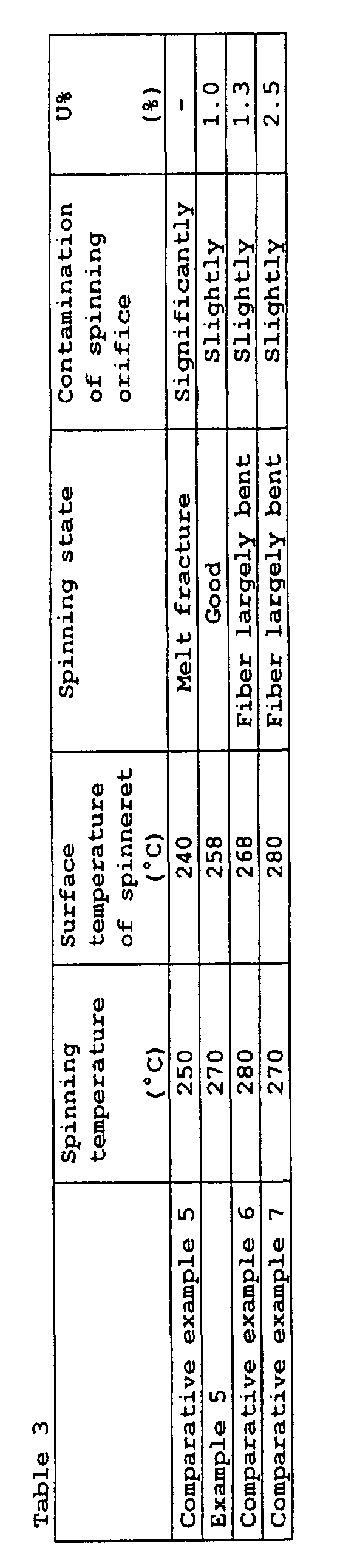
- Example 3 A test was conducted in the same manner as in Example 3 except for varying the spinning temperature and the surface temperature. The results are shown in Table 3.
- Example 5 wherein the spinning temperature is 270°C, the spinning state and the contamination of the spinneret were favorable.
- Example 4 A spinning test was conducted in the same manner as in Example 3 except for varying the content of titanium oxide. The glossiness, the luster and the yield of the drawing process (in No. 2-2 of the drawing doff) were evaluated in the resultant fiber. The results are shown in Table 4.
- Example 6 wherein the content of titanium oxide is 0.01 wt%, had a higher glossiness than that of Example 7, wherein the content of titanium oxide is 0.05 wt%, and unfavorably glittered, as well as the yield of the drawing process was also somewhat lowered in comparison with Example 7.
- Example 6 0.01 73 ⁇ 87.5
- Example 7 0.05 65.5 ⁇ 100
- Example 8 0.3 51 ⁇ 100
- the inventive 3GT fiber having a trilobal type modified cross-section is suitable for clothing, subsistence stores and industrial uses because it generates less fluff and fiber breakage during the production as well as is excellent in processibility in the post-treatment thereof.
- a bright type fiber of the modified cross-section having a fiber size of 8.9 dtex (8 deniers) or less, and never obtained before, is most suitable for clothing use because of its silky luster.
- the inventive producing method it is possible to largely minimize the polymer adhesion or contamination (white-eye phenomenon) of the spinning orifice of the spinneret and prolong the wiping period to twelve hours or longer.
- the 3GT fiber is produced, having the modified cross-section composed of bright polymer suitable for the clothing use, fluff or yarn breakage are largely reduced during the drawing process because of the improvement in frictional characteristics thereof.
- the present invention makes it possible to continuously produce a 3GT fiber having a modified cross-section of a trilobal type particularly suitable for clothing use under industrially stable conditions.
Landscapes
- Engineering & Computer Science (AREA)
- Textile Engineering (AREA)
- Chemical & Material Sciences (AREA)
- Chemical Kinetics & Catalysis (AREA)
- General Chemical & Material Sciences (AREA)
- Mechanical Engineering (AREA)
- Artificial Filaments (AREA)
- Spinning Methods And Devices For Manufacturing Artificial Fibers (AREA)
- Polyesters Or Polycarbonates (AREA)
Abstract
The present invention is to provide a
polytrimethylene terephthalate fiber having a trilobal
type modified cross-section, composed of 95 mol% or more
of trimethylene terephthalate repeating units and 5 mol%
or less of other ester repeating units to have an
intrinsic viscosity in a range from 0.7 to 1.3 (dl/g),
wherein the outer periphery of the trilobal type cross-section
consists of outwardly convex sections or of
outwardly convex section and straight sections. According
to the inventive method, it is possible to produce the
above-mentioned fiber of the modified cross-section in an
industrially stable manner while minimizing the adhesion
of polymer scum to the spinning orifice or the
contamination thereof to suppress the generation of fluff
or yarn breakage.
Description
The present invention relates to a polytrimethylene
terephthalate fiber obtained by a melt spinning method
and to a method for producing the same. More
specifically, the present invention relates to a
polytrimethylene terephthalate fiber having a trilobal
cross-section suitable for the clothing use and a method
for industrially producing such a modified cross-sectional
fiber in a stable manner for a long period.
A polyethylene terephthalate (hereinafter referred
to as PET) fiber having a modified cross-sectional shape
such as a trilobal shape similar to a triangle has
already been well-known in the art and is mass-produced
on an industrial scale. In general, the modified cross-sectional
PET fiber is produced by extruding a polymer
either containing no titanium oxide used as a delusterant
or containing a relatively small amount thereof in
comparison with that in a polymer of a circular cross-section
(generally called as a bright polymer) through a
spinneret having Y or T-shaped spinning orifices or a
modification thereof. The trilobal cross-sectional PET
fiber containing a small amount of titanium oxide
exhibits a silk-like elegant luster due to the combined
effect of the brightness and the cross-sectional shape of
the polymer. Accordingly, this fiber has been mass-produced
as silky polyester fiber which is evaluated as a
high grade product in the clothing field.
Strictly speaking, there are various kinds in the
trilobal shape although they commonly have three corners
in correspondence to three distal ends of the Y or T-shaped
orifice of the spinneret. For instance, there are
a group (i) in which an outer periphery of the trilobal
cross-section consists of outwardly concave sections
except for three corner portions (see Fig. 3); a group
(ii) in which an outer periphery of the trilobal cross-section
consists of outwardly convex sections except for
three corner portions (see Fig. 1); and a group (iii) in
which an outer periphery of the trilobal cross-section is
approximately a triangle (see Fig. 2).
On the other hand, the polytrimethylene
terephthalate (hereinafter briefly referred to as 3GT)
fiber is disclosed in the prior art documents such as (A)
Japanese Unexamined Patent Publication No. 52-5320; (B)
Japanese Unexamined Patent Publication No. 52-8123; (C)
Japanese Unexamined Patent Publication No. 52-8124; (D)
Japanese Unexamined Patent Publication No. 58-104216; (E)
J. Polymer Science; Polymer Physics Edition vol. 14,
pages 263 to 274 (1976); or (F) Chemical Fibers
International vol. 45 (April), pages 110 to 111 (1995).
According to the description in (F), the 3GT fiber is
characterized in a lower Young's modulus and a higher
elastic recovery of elongation (that is, a larger elastic
limit) than those of PET fiber due to its solid
structure.
As described above, the PET fiber having a modified
cross-sectional shape has been industrially mass-produced
and various studies have been made on its cross-sectional
shape. Contrarily, there are very few prior arts
regarding the 3GT fiber having a modified cross-sectional
shape. Japanese Unexamined Patent Publication No. 9-3724
(EP 745711 A1) discloses a 3GT fiber having a modified
cross-sectional shape such as a trilobal shape, but this
3GT fiber having a modified cross-sectional shape
described in this publication is a BCF fiber for
producing a carpet yarn having a single-fiber size of 15
deniers (16.7 dtex) or more and is unsuitable for
clothing use. Also, there is nothing but the term
"trilobal" regarding the cross-sectional shape thereof,
and the details of the shape are not described or
suggested.
As described above, the prior art does not describe
a 3GT fiber having a trilobal cross-section and a single-fiber
size of 8.9 dtex (8 deniers) or less suitable for
clothing use as well as the content of titanium oxide
necessary for a silky 3GT fiber suitable for clothing
use.
In the PET fiber having a modified cross-sectional
shape, it has been known that an outer periphery is
preferably of a trilobal outwardly concave cross-section
to obtain a silky luster. However, the fiber having such
a trilobal cross-section exhibits glitter which
deteriorates the elegance. Thus, in the modified cross-sectional
PET fiber, the trilobal cross-section is
insufficient for obtaining the elegant silky luster and,
instead, a more complicated multilobal cross-section such
as a pentalobal or octalobal cross-section is necessarily
adopted (see "Fiber Configuration" edited by the Fiber
Society, pages 170 to 173 (1982)).
On the other hand, in addition to the difference in
refractive index between 3GT and PET, a cross-sectional
shape of 3GT fiber suitable for obtaining elegant luster
and the relationship between the cross-sectional shape
and the glossiness have not been known until now.
It is known that when polyester or polyamide is
continuously melt-spun for a predetermined period, a
contaminant composed of polymer decomposition product or
others is adhered to the periphery of spinning orifices
of the spinneret (generally called as a white-eye
phenomenon or an eye-mucus phenomenon). Since such
contaminant disturbs the smooth formation of fiber, fiber
breakage increases to interrupt the spinning operation.
Therefore, in the industrial sense, the surface of the
spinneret is ordinarily wiped off at frequent intervals,
to remove the contaminant, for the purpose of maintaining
a smooth spinning operation. Since the spinning operation
is interrupted by the wiping, the fiber production is
disturbed. Accordingly, the interval between the
respective wiping operations is preferably as long as
possible in view of the operating efficiency and the
yield of raw polymer.
A study has been made to prolong the wiping interval
by mitigating the white-eye phenomenon. For example,
Japanese Unexamined Patent Publication No. 5-78904
proposes the production of polyester fiber having a
trilobal cross-section by using a spinning orifice of a
modified Y-shaped opening as shown in Fig. 7 in which d/D
is in a range from 1/3 to 2/3. In this regard, D is a
length (mm) of a vertical line extending from a center of
the trilobal orifice to one side of a circumscribed
triangle of the outer periphery of the orifice opening,
and d is a distance (mm) between the center and a cross
point of the above-mentioned vertical line with the
arcuate side.
Since the white-eye phenomenon is particularly
significant in the case of 3GT fiber, Japanese Unexamined
Patent Publication No. 11-200143 proposes to maintain a
surface of the spinneret at a certain temperature, to
apply a release agent thereto and to determine a polymer
surface area per one orifice of the spinneret at a
predetermined value for mitigating the white-eye
phenomenon. However, there is neither description of how
the white-eye phenomenon in a fiber having the modified
cross-section occurs nor a suggestion of a countermeasure
for mitigating the same.
A first object of the present invention is to
provide a 3GT fiber having a uniform trilobal cross-section
suitable for clothing, carpets or industrial use,
which generates less fluff during the production process
and the post-treatment process, and a method for
continuously producing this modified cross-sectional
fiber for a long period on an industrial scale.
A second object of the present invention is to
provide a bright and silky 3GT fiber having a uniform
cross-section and a single-fiber size of 8.9 dtex (8
deniers) or less suitable for the clothing use which
generates less fluff during the production process and
the post-treatment process such as a false-twist
texturing process, a weaving or knitting process, and a
method for continuously spinning this modified cross-sectional
fiber for a long period on an industrial scale.
The inventors of the present invention have
diligently studied to achieve the above-mentioned objects
and found that there are problems in the production of
3GT fiber as follows:
In comparison with PET, 3GT is liable to generate
polymer adhesion or contamination (a so-called white-eye
or eye mucus phenomenon) in the vicinity a spinning
orifice of a spinneret during the melt-spinning process.
Accordingly, in the prior art, fiber breakage occurs in a
very short time after starting the spinning, which makes
it difficult to continue the spinning operation. Also,
when the white-eye phenomenon has occurred, a cross-sectional
shape of the resultant fiber having the
modified cross-section is liable to vary, or fluff is
liable to increase due to the filament breakage. These
problems are not solved even though the spinneret having
a modified Y-shaped orifice shown in Fig. 7 is used.
Also, the 3GT fiber exhibits a unique frictional
characteristic in comparison with PET fiber, and has high
coefficients of static and dynamic friction between
fiber/fiber, fiber/metal, and fiber/ceramics. Thereby,
the fiber breakage and fluff are liable to occur due to
the friction during the drawing or post-treatment
process. Particularly, this tendency is particularly true
in a so-called bright polymer containing less of the
titanium oxide used as a delusterant.
Further, the inventors of the present invention have
found, as a result of diligent study, that it is possible
to suppress the contamination of a spinning orifice with
polymer (the white-eye or eye mucus phenomenon) and to
prolong the wiping interval to as long as twelve hours or
more by using a spinneret of a special configuration,
more concretely closer to a triangle rather than a Y-shape,
and limiting the spinning temperature, the surface
temperature of the spinneret and the linear speed V of
the extruded polymer to a specified range.
Also, it has been found that the fiber of the
modified cross-section obtained from the inventive method
has a uniform cross-sectional shape and the generation of
fluff is less during treatment. Particularly, it has been
found that if the content of titanium oxide in 3GT
polymer is limited to the specified range, the frictional
characteristic becomes proper when the 3GT polymer is
used as a bright polymer, whereby the generation of fiber
breakage or fluff is suppressed during the drawing and
post-treatment process of the fiber having a trilobal
cross-section. Simultaneously therewith, a silky luster
is exhibited.
That is, the present invention is:
The present invention will be described in more
detail below.
In this regard, the explanation on the cross-sectional
shape of a fiber having a modified cross-section
is based on photographs taken according to
microphotography described later.
A 3GT fiber according to the present invention is
composed of 95 mol% or more of trimethylene terephthalate
repeating units and 5 mol% or less of other ester
repeating units and has an intrinsic viscosity [η] in a
range from 0.7 to 1.3 (dl/g) and a trilobal type cross-section,
an outer periphery of which consists solely of
outwardly convex sections or both of outwardly convex
sections and straight sections. The inventive modified
cross-sectional 3GT fiber includes a multifilament and a
staple fiber obtained by cutting the former.
The inventive 3GT is composed of 95 mol% or more of
trimethylene terephthalate repeating units and 5 mol% or
less of other ester repeating units. That is, the
inventive 3GT includes a 3GT homopolymer, a homo 3GT and
a copolymerized 3GT containing 5 mol% or less of other
ester repeating units.
Examples of the copolymerized components are as
follows:
An acidic component includes aromatic dicarboxylic
acid represented by isophthalic acid or 5-sodium
sulfoisophthalate, aliphatic dicarboxylic acid
represented by adipic acid or itaconic acid. A glycolic
component includes trimethylene glycol, ethylene glycol,
polyethylene glycol or others. Also, it includes hydroxy-dicarboxylic
acid such as hydroxy-benzoate. Further, a
plurality of copoymerized components may be contained.
An intrinsic viscosity [η] of the inventive 3GT is
in a range from 0.7 to 1.3 (dl/g). The intrinsic
viscosity [η] is measured by a method described later.
If the intrinsic viscosity [η] is less than 0.7 (dl/g),
a strength at break of the fiber becomes 2.65 cN/dtex (3
g/d) or less which is too low to be put into practical
use. Contrarily, if the intrinsic viscosity [η] exceeds
1.3 (dl/g), the dimensional stability of a
multifilamentary yarn against heat is deteriorated, as
well as a production cost of 3GT used as a raw material
becomes higher. For the clothing use, the intrinsic
viscosity [η] is preferably in a range from 0.8 to 1.1
(dl/g).
A delusterant such as titanium oxide, a heat
stabilizer, an antioxidant, an antistatic agent, an
ultraviolet screening agent, anti-fungus agent or various
pigments may be contained in or copolymerized with the
inventive 3GT.
It is necessary that the inventive 3GT fiber has a
trilobal type cross-section to provide a good feeling of
touch and a silky luster. Further, the cross-section of
the inventive 3GT fiber has the outer periphery
consisting solely of outwardly convex sections or both of
outwardly convex sections and straight sections (such a
cross-sectional shape is hereinafter referred to as a
rice ball type). Figs. 1 and 2 illustrate examples of the
rice ball type cross-sectional shape.
If a trilobal type cross-section has an outer
periphery consisting of outwardly concave sections as
shown in Fig. 3, the white-eye phenomenon is significant
during the production of the modified cross-sectional
fiber. This substantially disables the spinning operation
to be continued, and the resultant fiber has much fluff
to make the knitting or weaving thereof difficult. Also,
since 3GT has a different refractive index from that of
PET, the 3GT fiber having the modified cross-section
shown in Fig. 3, which is often seen in the PET fiber, is
unsuitable for the clothing use due to its excessive
glitter.
Contrarily, the modified cross-sectional fiber of a
rice ball type shown in Figs. 1 and 2 can be continuously
spun for a long time, and is excellent in processibility
in the knitting and weaving process. Also, it has a soft
luster free from glitter and is most suitable for
clothing use.
The above-mentioned rice ball type cross-section may
be either a regular triangle defined by three corners
(Fig. 1), an equilateral triangle (Fig. 4) or a triangle
having sides of different lengths (Fig. 5), and a degree
of modification of the rice ball is preferably small
(closer to a triangle) rather than large (closer to a
circle).
While a single-fiber size of the inventive 3GT fiber
having a modified cross-section is not particularly
limited, 8.9 dtex (8 deniers) or less is preferable if it
is used for the clothing. If the fiber size exceeds 8.9
dtex, a feeling of touch is liable to be hard. The size
of fiber with soft touch suitable for clothing use is
preferably 6.7 dtex (6 deniers) or less, more preferably
in a range from 0.6 to 3.3 dtex (from 0.5 to 3 deniers).
While a content of titanium oxide in the inventive
3GT fiber having a modified cross-section is not
particularly limited, it is preferably in a range from
0.03 to 0.15 wt%. Titanium oxide added to the fiber as a
delusterant has an influence on a coefficient of
friction. If the content is 0.03 wt% or less, the
coefficient of friction becomes so high that the
processibility of the fiber deteriorates in the spinning
process or the post-treatment process. Also, the
resultant product unfavorably glitters and is unsuitable
for the clothing use in some cases. Contrarily, if the
content of titanium oxide exceeds 0.15 wt%, the
brightness disappears too much to result in a favorable
silky luster. On account of preventing yarn breakage or
fluff from generating in the spinning process and the
post-treatment process as well as obtaining the silky
luster in the resultant product, the content of titanium
oxide is more preferably in a range from 0.03 to 0.09
wt%.
The inventive 3GT fiber preferably has a degree of
modification measured by a method described later in a
range from 1.15 to 1.35. If the degree of modification is
less than 1.15, the glossiness becomes insufficient
whereby the difference from that of a fiber having a
circular cross-section is small. Contrarily, if the
degree of modification exceeds 1.35, the white-eye
phenomenon becomes significant during the spinning and
the resultant fiber has much fluff and slack which is
sometimes unsuitable for the post-treatment.
The inventive 3GT fiber is preferably has a
glossiness measured by a method described later in a
range from 50 to 75. If the glossiness is less than 50,
the luster becomes insufficient whereby the difference
from that of a fiber having a circular cross-section is
small. Contrarily, if the glossiness exceeds 75, the
luster becomes so significant that the fiber may be
unsuitable for the clothing use. The glossiness is more
preferably in a range from 55 to 70, further more
preferably from 60 to 70. The preferable glossiness is
achievable from a suitable combination of the content of
titanium oxide with the degree of modification.
The inventive 3GT fiber is favorably obtained by a
method for producing a 3GT fiber having a modified cross-section,
comprising a step of extruding polytrimethylene
terephthalate comprising 95 mol% or more of trimethylene
terephthalate repeating units and 5 mol% or less of other
ester repeating units, and having an intrinsic viscosity
[η] in a range from 0.7 to 1.3 (dl/g), through a
spinneret having spinning orifices of a trilobal opening,
wherein
According to the inventive producing method, for the
purpose of decreasing the occurrence of white-eye
phenomenon and obtaining a fiber having a uniform
modified cross-section in a stable manner for a long
period, the outer periphery of the trilobal type orifice
of the spinneret consists of three semicircular corners
and outwardly concave arcuate sections connecting every
adjacent corner with the others wherein all of the d/D
values are in a range from 0.70 to 1.0. In the trilobal
type orifice for obtaining the fiber having the cross-section
shown in Fig 4 or 5, three d/D values are
different from each other. If d/D exceeds 1.0 or the
arcuate section is outwardly convex, the resultant fiber
has a generally circular cross-section and cannot be
referred to as a modified cross-sectional fiber. A
preferable range of d/D is from 0.70 to 0.90.
According to the inventive producing method, a
spinning temperature is in a range from 255 to 275°C. In
this regard, the spinning temperature is a temperature
within a spin pack 5 (see Fig. 8) which is the same as a
temperature of melted 3GT prior to being spun. Generally
speaking, 3GT is liable to be decomposed by heating in
comparison with PET, and therefore, if the spinning
temperature exceeds 275°C as in the spinning of PET, a
smooth spinning is not expected due to the bending of
fiber or the generation of bubbles of decomposition gas,
whereby the resultant fiber is inferior in physical
properties. Contrarily, if the spinning temperature is
lower than 255°C, a smooth spinning operation becomes
difficult due to melt fracture or others even if other
conditions have been favorably prepared. This is because
the viscosity of the melted polymer becomes extremely
high as a the spinning temperature lower than 255°C is
close to the melting point of 3GT. The spinning
temperature is preferably in a range from 255 to 270°C
which is completely free from both of melt fracture and
heat decomposition problems.
In the inventive producing method, a surface
temperature of a spinneret is in a range from 250 to
275°C. The present inventors have found at the first time
in the world that the white-eye phenomenon due to the
adhesion of polymer in the vicinity of the spinning
orifice is liable to generate as the surface temperature
of the spinneret is lower. If the surface temperature of
the spinneret is lower than 250°C, the white-eye
phenomenon is significant to make the continuation of the
spinning operation impossible. Contrarily, if the surface
temperature of the spinneret exceeds 275°C, the size
variation U% of a multifilamentary yarn becomes
problematically large to cause a fiber quality to deviate
from a proper range. In view of the white-eye phenomenon
and the size variation U%, the surface temperature of the
spinneret is preferably in a range from 255 to 270°C,
more preferably from 258 to 270°C.
As apparent from Fig. 8, since a spinneret 6 is
built in the spin pack 5 usually installed in a spin head
4, the surface temperature of the spinneret varies in
relation to the spinning temperature (a spin head
temperature) to be generally lower by 5 to 15°C than the
latter.
Alternatively, the surface temperature of the
spinneret may be adjusted independently from the spinning
temperature by positively heating the spinneret or the
atmosphere directly beneath the spinneret.
According to the inventive producing method, a
product of a linear speed V of the molten polymer
extruded from the spinneret and the intrinsic viscosity
[η]; i.e., V× [η] must be in a range from 4 to 13 (m/min)
(dl/g). If the product V × [η] is less than 4 (m/min)
(dl/g), the extruded polymer is not evenly thinned during
the fiber formation. That is, there is a lengthwise
irregularity in size of the resultant fiber (i.e., the
fiber has a large U%). Contrarily, if the product V ×[η]
exceeds 13 (m/min) (dl/g), the white-eye phenomenon
becomes significant to disturb the continuous spinning
operation. On account both of U% and the white-eye
phenomenon, the product V ×[η] is preferably in a range
from 4 to 9 (m/min) (dl/g).
In this regard, the linear speed V of the melted
polymer extruded from the spinneret is a function of an
extrusion area of the orifice and an extrusion rate of
the polymer per orifice and is calculated by the
following equation (1):
V (cm/min) = (X/ρ) / Y
wherein X represents the extrusion rate of the polymer
per orifice (g/min), Y represents the extrusion area of
the orifice (cm2), and ρ represents a density of melted
3GT (g/cm3) which is 1.15 g/cm3.
Usually, since a single fiber size which is
identical to the extrusion rate X of the polymer per
orifice is initially determined, the linear speed V of
the melted polymer extruded from the orifice is adjusted
by regulating the extrusion area of the orifice.
According to the inventive producing method, the
content of titanium oxide in 3GT is preferably in a range
from 0.03 to 0.15 wt%. The reason therefor and the
preferable range thereof are the same as those already
described on the modified cross-sectional fiber.
One aspect of a method for producing the inventive
modified cross-sectional 3GT fiber will be explained with
reference to Figs. 8 and 9.
First, as shown in Fig. 8, 3GT pellets defined by
the present invention are continuously put into a
continuous pellet drier 1 and dried with hot air so that
the moisture content is 30 ppm. The dried pellets are
subsequently fed to an extruder 2 maintained at a
temperature in a range from 255 to 265°C, heated to a
temperature above the melting point of 3GT and melted.
Thereafter, the melted 3GT is fed to a spin head 4
maintained at a predetermined temperature via a bend 3,
adjusted to the spinning temperature and filtrated in the
spin pack 5.
Thereafter, the melted 3GT is extruded through a
spinneret 6 having trilobal type orifices to form a
multifilamentary yarn 7 of modified cross-sectional
fibers. The extruded 3GT multifilamentary yarn 7 is then
introduced into a cooling zone and thinned to a
predetermined fiber size by the withdrawing force of
godet rolls 11 rotating at a peripheral speed of 500
m/min or more while being cooled to a room temperature by
a cooling air 8, during which a finishing agent is
imparted thereto through an oiling nozzle 9, whereby an
undrawn yarn 10 of multifilamentary fibers having a
modified cross-section is obtained. The undrawn yarn 10
is taken up by a winder 12 to form an undrawn yarn
package 13.
Then, the undrawn yarn package 13 is transferred to
a drawing machine shown in Fig. 9. After being heated by
a feed roll 14 at a temperature in a range from 45 to
65°C, the undrawn yarn 10 is drawn at a predetermined
draw ratio and heat-treated with a hot plate 15
maintained at a temperature in a range from 100 to 150°C
to be a drawn yarn 16. The draw ratio is defined by a
ratio in speed between the feed roll 14 and a draw roll
17. The resultant drawn yarn 16 is wound either in a pirn
form of a twisted yarn or in a cheese form of a non-twisted
yarn, in accordance with the need.
The measurement, evaluation and observation of a
cross-sectional shape used in the present invention will
be described below.
The intrinsic viscosity [η] is a value defined by
the following equation (2):
[η] = lim (ηr - 1) / C
C→0
wherein ηr is referred to as a relative viscosity
obtained by dividing a viscosity of a solution of 3GT
polymer dissolved in o-chlorophenol of 98% purity or more
and diluted to have a predetermined polymer concentration
C (g/100 ml) measured at 35°C by a viscosity of the
solvent measured at the same temperature.
Values of the relative viscosity are measured on
several polymer concentrations C, and the intrinsic
viscosity [η] is obtained by extrapolating C to zero.
The yarn is embedded in melted paraffin, which is
left for about five minutes and solidified. Thereafter,
the embedded sample is cut, vertical to the fiber axis,
by a microtome to obtain a cut piece of 5 to 7µm thick.
Then, the cut piece is placed on a slide glass which is
heated to melt the paraffin. Thereafter, one drop of
olive oil is dropped thereon and pressed by a cover
glass.
Next, a cross-section of the fiber is observed and
photographed by using an optical microscope (manufactured
by Olympus Kogaku Kogyo K.K.; a trade name "BH-2"-Type
B071) to obtain a cross-sectional photograph. The
magnification is selected within a range from 200 to 500
as necessary.
A radius r of a maximum inscribed circle for the
cross-section and a radius R of a minimum circumscribed
circle therefor are measured from the cross-sectional
photograph taken in accordance with the above-mentioned
method (b), and substituted into the following equation
(3):
Degree of modification = R/r
A machine-made paper is adhered to an aluminum plate
of 7 cm long, 5 cm wide and 1 mm thick, and a yarn is
wound around the same to form six layers under a load of
1 cN/dtex. A winding pitch is 100 end/cm while taking
care not to generate a gap. Thus, a sample fiber plate is
obtained.
A glossiness of the sample fiber plate at a
measurement angle 60 degrees is measured by using a
variangular type digital glossmeter (UGV-4D type;
manufactured by Suga Shikenki K.K.) in accordance with
JIS-1013 (B method). The measurement is carried out both
on front and back surfaces of the sample fiber plate, and
an average value of the two is used as the glossiness.
A trilobal cross-section type multifilamentary yarn
of 38.9 dtex (35 deniers)/24 filaments was test-produced
from 3GT bright pellets containing 0.05 wt% of titanium
oxide and having the intrinsic viscosity [η] of 0.90
(dl/g) by using a spinning apparatus and a drawing
machine shown in Figs. 8 and 9.
In this test, the influence of the product V ×[η] of
the linear speed V of the polymer extruded from a Y-shaped
orifice of a spinneret and the intrinsic viscosity
[η] of the 3GT on the modified fiber cross-section of
the multifilamentary yarn, the generation of the white-eye
phenomenon and the time period for which the spinning
operation is continued in a stable manner was studied.
The spinning apparatus could be simultaneously
provided with sixteen spinnerets.
In the respective example, sixteen undrawn yarns
were simultaneously spun which were doffed four times,
respectively, as packages of 5 kg weight. This means that
the spinning operation continuously lasts for 26 hours
unless there is a yarn breakage.
In the subsequent drawing process, the sixteen
undrawn yarn packages in the same doff were
simultaneously supplied to a drawing machine, wherein two
drawn yarn packages of 2.5 kg weight were obtained from
one undrawn yarn package. Such a drawing process was
repeated four times (corresponding to the four doffs of
the undrawn yarn).
In each of Examples and Comparative examples, one of
eight kinds of spinning orifices (A to H) shown in Table
1 was used for the test.
The respective spinning orifice is of a regular-triangle
type wherein the value of d/D common to three
sides thereof is shown in Table 1.
In this test, the following points were evaluated on
the eight kinds (A to H) of the spinning orifice shown in
Table 1:
After the spinneret has been wiped off prior to
initiating the spinning, the spinning test was carried
out and the results are shown in Tables 1 and 2.
The cross-sectional shape of the fiber in the
resultant multifilamentary yarn was a Fig. 3 type in the
spinning orifices A, B, C and G (Comparative examples 1,
2, 3 and 4); a Fig. 2 type in the spinning orifice F
(Example 3); and a Fig. 1 type in the spinning orifices
D, E and H (Examples 1, 2 and 4). In this connection, the
Fig. 1 type means that the cross-sectional shape looks
like that shown in Fig. 1 and so on.
According to an observation with the naked eye, it
was found that, in the spinning orifices A and B, the
contamination in the vicinity of the spinning orifice on
the spinneret began directly after the initiation of
spinning and developed with time, and the white-eye
phenomenon became significant in the second doff, making
it impossible to further continue the spinning operation
because of the increase in yarn breakage.
In the spinning orifices C and G, it was found that
the contamination began three hours after the initiation
of the spinning and developed with time, and the white-eye
phenomenon became significant in the third doff,
making it impossible to further continue the spinning
operation because of the increase in yarn breakage.
In the spinning orifices D, E, F and H, the white-eye
phenomenon was relatively slight within 25.6 hours,
making it possible to continue the spinning operation at
least until the fourth doff.
The undrawn yarns thus obtained were drawn and the
yield thereof in the drawing process is shown in Table 2.
The yield of drawing process was calculated by the
following equation (4):
Yield of drawing process = 100×[16 - (the number of
yarn breakage)] / 16
As the criterion of the yield of drawing process,
that in the drawing doff No. 2-2 which is carried out
12.8 hours after the initiation of the drawing process
was adopted such that, if it is 93.8% or higher, the
yield is "very good"; if 81.3% or higher, the yield is
"good"; and if less than 81.3%, the yield is "not good".
In Comparative examples 1 to 4, since the
continuation of the spinning operation became impossible
or the yield reduced to a great extent in a period
shorter than 12 hours from the initiation, it is
impossible to extend the wiping period to 12 hours or
more if the spinneret having the spinning orifice A, B, C
or G is used.
Contrarily, in Examples 1 to 4, no yarn breakage
occurred even though the spinning operation lasts for 24
hours or more and the yield of the drawing process is
also maintained at 87.5% or more even after 15 hours or
more.
Since the wiping period could be 12 hours or more
under the condition of Examples 1 to 4, the industrial
production may be possible under such a condition.
The luster of the resultant yarn was evaluated, and
it was found that Example 4 having an approximately
circular cross-section is slightly poor in luster, while
Comparative examples 1 to 4 are high in luster but
unfavorably glitter. In this regard, the luster is
evaluated according to the sensory test made on a tubular
knit fabric by three experts wherein ○ represents
"good", Δ represents "ordinary" and × represents "not
good".
When warp knit fabrics were prepared by using these
yarns, it was found that the number of machine stoppages
was less in Examples 1 to 4, but more in Comparative
examples 1 to 4 and were unsuitable for practical use.
The knittability was evaluated by the number of
machine stoppages when the warp knitting machine operates
one day under the following condition, wherein ○
represents "good", Δ represents "ordinary" and ×
represents "not good":
back read: 100 cm/480 courses

A test was conducted in the same manner as in
Example 3 except for varying the spinning temperature and
the surface temperature. The results are shown in Table
3.
In Comparative example 5, the melt fracture occurred
because the spinning temperature is low, and the low.
In Comparative example 6 wherein the spinning
temperature is high, while no contamination occurred in
the spinning orifice, the yarn largely bent to cause much
yarn breakage during the spinning operation.
In Example 5 wherein the spinning temperature is
270°C, the spinning state and the contamination of the
spinneret were favorable.
In Comparative example 7 wherein the surface
temperature of the spinneret is higher by using a
spinneret heater, although there was no contamination in
the spinning orifice, both of the yarn breakage and U%
are unfavorable.
A spinning test was conducted in the same manner as
in Example 3 except for varying the content of titanium
oxide. The glossiness, the luster and the yield of the
drawing process (in No. 2-2 of the drawing doff) were
evaluated in the resultant fiber. The results are shown
in Table 4.
As shown in Table 4, Example 6, wherein the content
of titanium oxide is 0.01 wt%, had a higher glossiness
than that of Example 7, wherein the content of titanium
oxide is 0.05 wt%, and unfavorably glittered, as well as
the yield of the drawing process was also somewhat
lowered in comparison with Example 7.
| Content of titanium oxide (%) | Glossiness | Luster | Yield of Drawing process (%) | |
| Example 6 | 0.01 | 73 | Δ | 87.5 |
| Example 7 | 0.05 | 65.5 | ○ | 100 |
| Example 8 | 0.3 | 51 | Δ | 100 |
The inventive 3GT fiber having a trilobal type
modified cross-section is suitable for clothing,
subsistence stores and industrial uses because it
generates less fluff and fiber breakage during the
production as well as is excellent in processibility in
the post-treatment thereof. Particularly, a bright type
fiber of the modified cross-section having a fiber size
of 8.9 dtex (8 deniers) or less, and never obtained
before, is most suitable for clothing use because of its
silky luster.
According to the inventive producing method, it is
possible to largely minimize the polymer adhesion or
contamination (white-eye phenomenon) of the spinning
orifice of the spinneret and prolong the wiping period to
twelve hours or longer. Particularly, when the 3GT fiber
is produced, having the modified cross-section composed
of bright polymer suitable for the clothing use, fluff or
yarn breakage are largely reduced during the drawing
process because of the improvement in frictional
characteristics thereof.
The present invention makes it possible to
continuously produce a 3GT fiber having a modified cross-section
of a trilobal type particularly suitable for
clothing use under industrially stable conditions.
Claims (7)
- A polytrimethylene terephthalate fiber having a modified cross-section, composed of polytrimethylene terephthalate comprising 95 mol% or more of trimethylene terephthalate repeating units and 5 mol% or less of other ester repeating units, and having an intrinsic viscosity [η] in a range from 0.7 to 1.3 (dl/g), wherein the fiber has a trilobal cross-section in which the outer periphery consists solely of outwardly convex sections or both of outwardly convex sections and straight sections.
- A polytrimethylene terephthalate fiber having a modified cross-section as defined by claim 1, wherein the fiber contains titanium oxide in a range from 0.03 to 0.15 wt%, and has a fiber size of 8.9 dtex (8 deniers) or less.
- A polytrimethylene terephthalate fiber having a modified cross-section as defined by claim 1 or 2, wherein the modification degree is in a range from 1.15 to 1.35.
- A polytrimethylene terephthalate fiber having a modified cross-section as defined by claim 1, 2 or 3, wherein the glossiness is in a range from 50 to 75.
- A method for producing a polytrimethylene terephthalate fiber having a modified cross-section, comprising a step of extruding polytrimethylene terephthalate comprising 95 mol% or more of trimethylene terephthalate repeating units and 5 mol% or less of other ester repeating units, and having an intrinsic viscosity [η] in a range from 0.7 to 1.3 (dl/g), through a spinneret having spinning orifices of a trilobal opening, whereini) the outer periphery of the trilobal cross-section comprises three semicircular corners and outwardly concave arcuate sections connecting every adjacent corners with the others, and all of the d/D values for three sides are in a range from 0.70 to 1.0 (wherein D is a length (mm) of a vertical line extending from a center of the trilobal orifice to one side of a circumscribed triangle in the outer periphery of the orifice opening, and d is a distance (mm) between the center and a cross point of the above-mentioned vertical line with the arcuate side);ii) a spinning temperature is in a range from 255 to 275°C;iii) a surface temperature of the spinneret is in a range from 250 to 275°C; andiv) a product of a linear speed V of the melted polymer extruded from the spinneret and the intrinsic viscosity [η] of polytrimethylene terephthalate; i.e., V x [η] is in a range from 4 to 13 (m/min) (dl/g).
- A method for producing a polytrimethylene terephthalate fiber having a modified cross-section as defined by claim 5, wherein the 3GT contains titanium oxide in a range from 0.03 to 0.15 wt%.
- A polytrimethylene terephthalatefiber having a modified cross-section obtained by a method defined by claim 5 or 6.
Applications Claiming Priority (3)
| Application Number | Priority Date | Filing Date | Title |
|---|---|---|---|
| JP23951999 | 1999-08-26 | ||
| JP23951999 | 1999-08-26 | ||
| PCT/JP2000/005773 WO2001016413A1 (en) | 1999-08-26 | 2000-08-25 | Poly(trimethylene terephthalate) modified cross-section yarn |
Publications (2)
| Publication Number | Publication Date |
|---|---|
| EP1219732A1 true EP1219732A1 (en) | 2002-07-03 |
| EP1219732A4 EP1219732A4 (en) | 2005-03-09 |
Family
ID=17046016
Family Applications (1)
| Application Number | Title | Priority Date | Filing Date |
|---|---|---|---|
| EP00955047A Withdrawn EP1219732A4 (en) | 1999-08-26 | 2000-08-25 | Poly(trimethylene terephthalate) modified cross-section yarn |
Country Status (12)
| Country | Link |
|---|---|
| US (1) | US6620505B1 (en) |
| EP (1) | EP1219732A4 (en) |
| JP (1) | JP3580796B2 (en) |
| KR (1) | KR100422029B1 (en) |
| CN (1) | CN1195910C (en) |
| AU (1) | AU6732000A (en) |
| BR (1) | BR0013509A (en) |
| HK (1) | HK1049357B (en) |
| MX (1) | MXPA02001374A (en) |
| TR (1) | TR200200504T2 (en) |
| TW (1) | TW567257B (en) |
| WO (1) | WO2001016413A1 (en) |
Cited By (2)
| Publication number | Priority date | Publication date | Assignee | Title |
|---|---|---|---|---|
| NL1035682C2 (en) * | 2008-07-10 | 2010-01-12 | Desseaux H Tapijtfab | Synthetic turf field. |
| WO2010071775A1 (en) | 2008-12-18 | 2010-06-24 | E. I. Du Pont De Nemours And Company | Poly-trimethylene terephthalate solid core fibrillation-resistant filament having a substantially triangular cross section, a spinneret for producing the filament, and a carpet made therefrom |
Families Citing this family (15)
| Publication number | Priority date | Publication date | Assignee | Title |
|---|---|---|---|---|
| HK1049357B (en) * | 1999-08-26 | 2005-07-29 | 旭化成株式会社 | Poly(trimethylene terephthalate) modified cross-section yarn |
| KR20030047192A (en) * | 2001-12-08 | 2003-06-18 | 주식회사 효성 | Modified Cross-section Polytrimethylene Terephthalate Fiber And Method For Producing The Same |
| TWI252241B (en) * | 2002-06-13 | 2006-04-01 | Asahi Kasei Corp | Polytrimethylene terephthalate resin |
| US7578957B2 (en) * | 2002-12-30 | 2009-08-25 | E. I. Du Pont De Nemours And Company | Process of making staple fibers |
| US20090036613A1 (en) | 2006-11-28 | 2009-02-05 | Kulkarni Sanjay Tammaji | Polyester staple fiber (PSF) /filament yarn (POY and PFY) for textile applications |
| WO2010021933A2 (en) * | 2008-08-22 | 2010-02-25 | Invista Technologies S.A.R.L. | Bulked continuous filaments with trilobal cross-section and round central void and spinneret plates for producing filament |
| KR200450560Y1 (en) * | 2008-09-05 | 2010-10-12 | 주식회사 세원 | Air filter element mounting structure |
| US20100159186A1 (en) * | 2008-12-18 | 2010-06-24 | E. I. Du Pont De Nemours And Company | Poly-trimethylene terephthalate solid core fibrillation-resistant filament having a substantially triangular cross section, a spinneret for producing the filament, and a carpet made therefrom |
| US20130034658A1 (en) * | 2011-08-01 | 2013-02-07 | E. I. Du Pont De Nemours And Company | Poly-trimethylene terephthalate solid core fibrillation-resistant filament having a substantially triangular cross section, a spinneret for producing the filament, and a carpet made therefrom |
| US10993369B2 (en) * | 2013-03-04 | 2021-05-04 | Shakespeare Company, Llc | Trimmer line for string trimmers |
| CN103215671A (en) * | 2013-04-17 | 2013-07-24 | 江苏好易纺织科技有限公司 | Polytrimethylene-tereph-thalate (PTT) fiber of carpet and preparation method for PTT fiber |
| CN105951196A (en) * | 2016-06-29 | 2016-09-21 | 马海燕 | Spiral plastic steel wire and production method thereof |
| US11692284B2 (en) | 2016-08-18 | 2023-07-04 | Aladdin Manufacturing Corporation | Trilobal filaments and spinnerets for producing the same |
| USD841838S1 (en) | 2016-11-04 | 2019-02-26 | Mohawk Industries, Inc. | Filament |
| US20210130982A1 (en) * | 2018-07-04 | 2021-05-06 | The Hong Kong Research Institute Of Textiles And Apparel Limited | Application of profiled fiber in infrared radiation material and textiile |
Family Cites Families (12)
| Publication number | Priority date | Publication date | Assignee | Title |
|---|---|---|---|---|
| US2939202A (en) * | 1959-12-31 | 1960-06-07 | Du Pont | Synthetic polymer textile filament |
| GB964459A (en) * | 1961-10-26 | 1964-07-22 | Monsanto Chemicals | Artificial textile filaments and spinnerets for their production |
| US3681188A (en) | 1971-02-19 | 1972-08-01 | Du Pont | Helically crimped fibers of poly(trimethylene terephthalate) having asymmetric birefringence |
| JPS6297917A (en) | 1985-10-21 | 1987-05-07 | Mitsubishi Rayon Co Ltd | Method for manufacturing polyester fiber |
| JPH0672323B2 (en) | 1986-05-13 | 1994-09-14 | 株式会社クラレ | Method for producing high-gloss synthetic fibers |
| JPH0578904A (en) | 1991-09-19 | 1993-03-30 | Teijin Ltd | Spinneret for modified section fiber |
| EP0745711B1 (en) | 1995-05-08 | 2001-11-28 | Shell Internationale Researchmaatschappij B.V. | Process for preparing poly (trimethylene terephthalate) yarns |
| ES2232960T3 (en) | 1997-09-03 | 2005-06-01 | Asahi Kasei Kabushiki Kaisha | FIBER OF POLYESTER AND FABRICS MANUFACTURED USING THE SAME. |
| JP3235982B2 (en) | 1997-12-26 | 2001-12-04 | 旭化成株式会社 | Polyester spinning method |
| JP3167677B2 (en) | 1998-04-23 | 2001-05-21 | 旭化成株式会社 | Polyester irregular cross section fiber |
| CN1107129C (en) * | 1998-10-15 | 2003-04-30 | 旭化成株式会社 | Polytrimethylene terephthalate fiber |
| HK1049357B (en) * | 1999-08-26 | 2005-07-29 | 旭化成株式会社 | Poly(trimethylene terephthalate) modified cross-section yarn |
-
2000
- 2000-08-25 HK HK03101553.4A patent/HK1049357B/en not_active IP Right Cessation
- 2000-08-25 TR TR2002/00504T patent/TR200200504T2/en unknown
- 2000-08-25 US US10/069,373 patent/US6620505B1/en not_active Expired - Fee Related
- 2000-08-25 BR BR0013509-7A patent/BR0013509A/en not_active Application Discontinuation
- 2000-08-25 JP JP2001519949A patent/JP3580796B2/en not_active Expired - Fee Related
- 2000-08-25 EP EP00955047A patent/EP1219732A4/en not_active Withdrawn
- 2000-08-25 TW TW089117275A patent/TW567257B/en not_active IP Right Cessation
- 2000-08-25 KR KR10-2002-7002457A patent/KR100422029B1/en not_active Expired - Fee Related
- 2000-08-25 AU AU67320/00A patent/AU6732000A/en not_active Abandoned
- 2000-08-25 WO PCT/JP2000/005773 patent/WO2001016413A1/en not_active Ceased
- 2000-08-25 CN CNB008119236A patent/CN1195910C/en not_active Expired - Fee Related
- 2000-08-25 MX MXPA02001374A patent/MXPA02001374A/en active IP Right Grant
Cited By (5)
| Publication number | Priority date | Publication date | Assignee | Title |
|---|---|---|---|---|
| NL1035682C2 (en) * | 2008-07-10 | 2010-01-12 | Desseaux H Tapijtfab | Synthetic turf field. |
| EP2143834A1 (en) * | 2008-07-10 | 2010-01-13 | Tapijtfabriek H. Desseaux N.V. | Artificial grass fibre |
| US8273424B2 (en) | 2008-07-10 | 2012-09-25 | Tapijtfabriek H. Desseaux N.V. | Artificial grass field |
| WO2010071775A1 (en) | 2008-12-18 | 2010-06-24 | E. I. Du Pont De Nemours And Company | Poly-trimethylene terephthalate solid core fibrillation-resistant filament having a substantially triangular cross section, a spinneret for producing the filament, and a carpet made therefrom |
| AU2009327479B2 (en) * | 2008-12-18 | 2016-01-14 | E. I. Du Pont De Nemours And Company | Poly-trimethylene terephthalate solid core fibrillation-resistant filament having a substantially triangular cross section, a spinneret for producing the filament, and a carpet made therefrom |
Also Published As
| Publication number | Publication date |
|---|---|
| MXPA02001374A (en) | 2004-07-16 |
| WO2001016413A1 (en) | 2001-03-08 |
| EP1219732A4 (en) | 2005-03-09 |
| HK1049357B (en) | 2005-07-29 |
| BR0013509A (en) | 2002-07-09 |
| TW567257B (en) | 2003-12-21 |
| AU6732000A (en) | 2001-03-26 |
| CN1195910C (en) | 2005-04-06 |
| JP3580796B2 (en) | 2004-10-27 |
| HK1049357A1 (en) | 2003-05-09 |
| TR200200504T2 (en) | 2002-05-21 |
| CN1370246A (en) | 2002-09-18 |
| KR100422029B1 (en) | 2004-03-10 |
| US6620505B1 (en) | 2003-09-16 |
| KR20020025994A (en) | 2002-04-04 |
Similar Documents
| Publication | Publication Date | Title |
|---|---|---|
| US6620505B1 (en) | Poly(trimethylene terephthalate) modified cross-section yarn | |
| JP5810199B2 (en) | Partially oriented poly (trimethylene terephthalate) yarn | |
| EP1230450B1 (en) | Process for making poly(trimethylene terephthalate) staple fibers, and poly(trimethylene terephthalate) staple fibers, yarns and fabrics | |
| EP1365049A1 (en) | Complex fiber excellent in post-processability and method of producing the same | |
| JP3827672B2 (en) | Polyester-based composite fiber pan | |
| TWI294926B (en) | Polyester fine false twisting textured yarn, and methods for producing the same | |
| JP7277680B1 (en) | Polytrimethylene terephthalate fiber and method for producing the same | |
| CA2519586A1 (en) | Polytrimethylene terephthalate hollow composite staple fibers and process for producing same | |
| JPWO2001016413A1 (en) | Polytrimethylene terephthalate modified yarn | |
| EP1172467A1 (en) | Poly(trimethylene terephthalate) fiber | |
| JP2009150022A (en) | Core-sheath composite fiber and fiber fabric thereof | |
| US6572967B1 (en) | Poly(trimethylene terephthalate) multifilament yarn | |
| JP4346197B2 (en) | Base for melt spinning | |
| WO2001068498A1 (en) | Stretched yarn pirn | |
| JP3998667B2 (en) | Polytrimethylene terephthalate modified yarn | |
| EP4696823A1 (en) | Polytrimethylene terephthalate fiber, method for producing same, air-mixed filament yarn containing said polytrimethylene terephthalate fiber, and fabric composed thereof | |
| JPWO2001023650A1 (en) | Polytrimethylene terephthalate multifilament yarn | |
| JP4059800B2 (en) | Method for producing polytrimethylene terephthalate composite fiber | |
| JP3910038B2 (en) | Pre-oriented yarn package and manufacturing method thereof | |
| JP2003129337A (en) | Polytrimethylene terephthalate fiber and method for producing the same | |
| JP4059681B2 (en) | Process for producing pre-oriented yarn of polytrimethylene terephthalate | |
| JP4119065B2 (en) | Polyester multifilament | |
| CN118119742A (en) | Polytrimethylene terephthalate fiber and method for producing the same | |
| CA3288964A1 (en) | Polytrimethylene terephthalate fiber, method for producing same, air-mixed filament yarn containing said polytrimethylene terephthalate fiber, and fabric composed thereof | |
| TW202500821A (en) | Polyester composite fiber and polyester false twisted yarn, and their manufacturing methods |
Legal Events
| Date | Code | Title | Description |
|---|---|---|---|
| PUAI | Public reference made under article 153(3) epc to a published international application that has entered the european phase |
Free format text: ORIGINAL CODE: 0009012 |
|
| 17P | Request for examination filed |
Effective date: 20020205 |
|
| AK | Designated contracting states |
Kind code of ref document: A1 Designated state(s): AT BE CH CY DE DK ES FI FR GB GR IE IT LI LU MC NL PT SE |
|
| AX | Request for extension of the european patent |
Free format text: AL;LT;LV;MK;RO;SI |
|
| A4 | Supplementary search report drawn up and despatched |
Effective date: 20050124 |
|
| 17Q | First examination report despatched |
Effective date: 20060913 |
|
| STAA | Information on the status of an ep patent application or granted ep patent |
Free format text: STATUS: THE APPLICATION IS DEEMED TO BE WITHDRAWN |
|
| 18D | Application deemed to be withdrawn |
Effective date: 20090826 |