EP1217674A2 - Electrochemical cell having an electrode of silver vanadium oxide coated to a current collector - Google Patents
Electrochemical cell having an electrode of silver vanadium oxide coated to a current collector Download PDFInfo
- Publication number
- EP1217674A2 EP1217674A2 EP01310528A EP01310528A EP1217674A2 EP 1217674 A2 EP1217674 A2 EP 1217674A2 EP 01310528 A EP01310528 A EP 01310528A EP 01310528 A EP01310528 A EP 01310528A EP 1217674 A2 EP1217674 A2 EP 1217674A2
- Authority
- EP
- European Patent Office
- Prior art keywords
- electrode
- fluorinated
- resins
- binder
- current collector
- Prior art date
- Legal status (The legal status is an assumption and is not a legal conclusion. Google has not performed a legal analysis and makes no representation as to the accuracy of the status listed.)
- Withdrawn
Links
Images

Classifications
-
- H—ELECTRICITY
- H01—ELECTRIC ELEMENTS
- H01M—PROCESSES OR MEANS, e.g. BATTERIES, FOR THE DIRECT CONVERSION OF CHEMICAL ENERGY INTO ELECTRICAL ENERGY
- H01M4/00—Electrodes
- H01M4/02—Electrodes composed of, or comprising, active material
- H01M4/62—Selection of inactive substances as ingredients for active masses, e.g. binders, fillers
- H01M4/621—Binders
- H01M4/622—Binders being polymers
- H01M4/623—Binders being polymers fluorinated polymers
-
- H—ELECTRICITY
- H01—ELECTRIC ELEMENTS
- H01M—PROCESSES OR MEANS, e.g. BATTERIES, FOR THE DIRECT CONVERSION OF CHEMICAL ENERGY INTO ELECTRICAL ENERGY
- H01M4/00—Electrodes
- H01M4/02—Electrodes composed of, or comprising, active material
- H01M4/36—Selection of substances as active materials, active masses, active liquids
- H01M4/48—Selection of substances as active materials, active masses, active liquids of inorganic oxides or hydroxides
-
- H—ELECTRICITY
- H01—ELECTRIC ELEMENTS
- H01M—PROCESSES OR MEANS, e.g. BATTERIES, FOR THE DIRECT CONVERSION OF CHEMICAL ENERGY INTO ELECTRICAL ENERGY
- H01M4/00—Electrodes
- H01M4/02—Electrodes composed of, or comprising, active material
- H01M4/62—Selection of inactive substances as ingredients for active masses, e.g. binders, fillers
- H01M4/621—Binders
-
- H—ELECTRICITY
- H01—ELECTRIC ELEMENTS
- H01M—PROCESSES OR MEANS, e.g. BATTERIES, FOR THE DIRECT CONVERSION OF CHEMICAL ENERGY INTO ELECTRICAL ENERGY
- H01M4/00—Electrodes
- H01M4/02—Electrodes composed of, or comprising, active material
- H01M4/64—Carriers or collectors
- H01M4/66—Selection of materials
- H01M4/661—Metal or alloys, e.g. alloy coatings
-
- H—ELECTRICITY
- H01—ELECTRIC ELEMENTS
- H01M—PROCESSES OR MEANS, e.g. BATTERIES, FOR THE DIRECT CONVERSION OF CHEMICAL ENERGY INTO ELECTRICAL ENERGY
- H01M10/00—Secondary cells; Manufacture thereof
- H01M10/05—Accumulators with non-aqueous electrolyte
- H01M10/052—Li-accumulators
- H01M10/0525—Rocking-chair batteries, i.e. batteries with lithium insertion or intercalation in both electrodes; Lithium-ion batteries
-
- H—ELECTRICITY
- H01—ELECTRIC ELEMENTS
- H01M—PROCESSES OR MEANS, e.g. BATTERIES, FOR THE DIRECT CONVERSION OF CHEMICAL ENERGY INTO ELECTRICAL ENERGY
- H01M4/00—Electrodes
- H01M4/02—Electrodes composed of, or comprising, active material
- H01M4/04—Processes of manufacture in general
- H01M4/0402—Methods of deposition of the material
- H01M4/0404—Methods of deposition of the material by coating on electrode collectors
-
- H—ELECTRICITY
- H01—ELECTRIC ELEMENTS
- H01M—PROCESSES OR MEANS, e.g. BATTERIES, FOR THE DIRECT CONVERSION OF CHEMICAL ENERGY INTO ELECTRICAL ENERGY
- H01M4/00—Electrodes
- H01M4/02—Electrodes composed of, or comprising, active material
- H01M4/36—Selection of substances as active materials, active masses, active liquids
- H01M4/48—Selection of substances as active materials, active masses, active liquids of inorganic oxides or hydroxides
- H01M4/54—Selection of substances as active materials, active masses, active liquids of inorganic oxides or hydroxides of silver
-
- H—ELECTRICITY
- H01—ELECTRIC ELEMENTS
- H01M—PROCESSES OR MEANS, e.g. BATTERIES, FOR THE DIRECT CONVERSION OF CHEMICAL ENERGY INTO ELECTRICAL ENERGY
- H01M4/00—Electrodes
- H01M4/02—Electrodes composed of, or comprising, active material
- H01M4/36—Selection of substances as active materials, active masses, active liquids
- H01M4/58—Selection of substances as active materials, active masses, active liquids of inorganic compounds other than oxides or hydroxides, e.g. sulfides, selenides, tellurides, halogenides or LiCoFy; of polyanionic structures, e.g. phosphates, silicates or borates
- H01M4/583—Carbonaceous material, e.g. graphite-intercalation compounds or CFx
-
- Y—GENERAL TAGGING OF NEW TECHNOLOGICAL DEVELOPMENTS; GENERAL TAGGING OF CROSS-SECTIONAL TECHNOLOGIES SPANNING OVER SEVERAL SECTIONS OF THE IPC; TECHNICAL SUBJECTS COVERED BY FORMER USPC CROSS-REFERENCE ART COLLECTIONS [XRACs] AND DIGESTS
- Y02—TECHNOLOGIES OR APPLICATIONS FOR MITIGATION OR ADAPTATION AGAINST CLIMATE CHANGE
- Y02E—REDUCTION OF GREENHOUSE GAS [GHG] EMISSIONS, RELATED TO ENERGY GENERATION, TRANSMISSION OR DISTRIBUTION
- Y02E60/00—Enabling technologies; Technologies with a potential or indirect contribution to GHG emissions mitigation
- Y02E60/10—Energy storage using batteries
-
- Y—GENERAL TAGGING OF NEW TECHNOLOGICAL DEVELOPMENTS; GENERAL TAGGING OF CROSS-SECTIONAL TECHNOLOGIES SPANNING OVER SEVERAL SECTIONS OF THE IPC; TECHNICAL SUBJECTS COVERED BY FORMER USPC CROSS-REFERENCE ART COLLECTIONS [XRACs] AND DIGESTS
- Y10—TECHNICAL SUBJECTS COVERED BY FORMER USPC
- Y10T—TECHNICAL SUBJECTS COVERED BY FORMER US CLASSIFICATION
- Y10T29/00—Metal working
- Y10T29/49—Method of mechanical manufacture
- Y10T29/49002—Electrical device making
- Y10T29/49108—Electric battery cell making
- Y10T29/49115—Electric battery cell making including coating or impregnating
Definitions
- the present invention relates to the conversion of chemical energy to electrical energy and, more particularly, to a cathode of silver vanadium oxide (SVO) admixed with a combination of polymeric binders.
- SVO silver vanadium oxide
- the silver vanadium oxide admixture is coated to a current collector for incorporation into an electrochemical cell.
- SVO could only be contacted to a current collector as a pressed powder or as a free-standing sheet.
- the preferred binder formulation is a mixture of a halogenated polymeric binder and a polymide binder, most preferably polyvinylidene fluoride (PVDF) and a polyimide.
- PVDF polyvinylidene fluoride
- the present electrodes built from SVO containing the mixed polymeric binders are useful in both primary and secondary cells discharged at elevated and low temperatures.
- Halogenated polymeric materials have been used extensively as binders for electrodes in all types of nonaqueous electrochemical cells, and particularly lithium cells.
- polyvinylidene fluoride is a material that functions well as an electrode active binder at or near ambient temperature.
- PVDF is soluble in organic electrolytes at elevated temperatures. Thus, cells manufactured with PVDF as the sole binder material cannot be used in high temperature applications or survive high temperature exposure, such as occurs in an autoclave, without severe degradation.
- Non-halogenated polymeric materials as binders in nonaqueous, alkali metal electrochemical cells.
- Exemplary is U.S. Patent No. 5,468,571 to Asami et al. which discloses that polyimide (PI) is useful as an anode binder in lithium secondary cells. Electrodes containing such non-halogenated polymers as the sole binder material are somewhat brittle and have a tendency to crack.
- U.S. Patent No. 6,001,507 to Ono et al. describes electrodes for secondary cells prepared from a mixture of a soluble polyimide and PVDF combined with an active material such as LiCoO 2 .
- the soluble polyimide is a material which is converted to the imide before it is mixed with the depolarizing active mixture. This is done to prevent water from entering the electrochemical system.
- fabricating an electrode with binders which are soluble in nonaqueous solvents hinders the active mixture/current collector contact interface, especially after repeated cycling.
- U.S. Patent No. 5,571,640 to Takeuchi et al. describes a process for manufacturing a cathode component from a free-standing sheet of active material, such as of SVO.
- the comminuted SVO is combined with a binder and conductive additives suspended in a solvent to form a paste.
- the paste is then fed into a series of roll mills to form a silver vanadium oxide sheet, which is then pressed to a current collector.
- This patent is described as being an improvement over building cathodes from a powdered silver vanadium oxide pressed to a current collector.
- the present invention is, therefore, directed to an electrode built of an active material including a mixture of two polymeric binders useful in nonaqueous organic electrolytes activating alkali metal or alkali metal ion electrochemical cells and a method that provide flexible, non-brittle electrodes, particularly of silver vanadium oxide, dischargeable at elevated temperatures.
- the first binder is preferably a halogenated polymeric binder and, more preferably, a fluorinated polymeric material, such as PVDF.
- the second binder is polyimide, and preferably one derived from heating a polyamic acid prior to activating the electrochemical couple.
- a preferred binder mixture is PVDF and PI.
- an electrode for example of a mixture of silver vanadium oxide, polyamic acid and PVDF, and possibly a conductive diluent
- the active admixture is first formed into a slurry having the consistency of a milk shake and coated to a current collector.
- This electrode assembly is then heated to convert the polyamic acid to an insoluble polyimide prior to being incorporated into an electrochemical cell.
- pulse means a short burst of electrical current of a significantly greater amplitude than that of a pre-pulse current immediately prior to the pulse.
- a pulse train consists of at least two pulses of electrical current delivered in relatively short succession with or without open circuit rest between the pulses.
- An exemplary pulse train may consist of four 10 second pulses with a 15 second rest between each pulse.
- the present invention is directed to the fabrication of electrodes for use in primary and secondary electrochemical cells dischargeable at elevated temperatures, such as occur in down hole well drilling operations and in an autoclave, without diminished discharge performance in comparison to cells of a similar active chemistry discharged at or near ambient temperatures. Additionally, the present cells are dischargeable at ambient temperatures with increased discharge capability in comparison to similar conventional cells.
- the electrode active material is intimately combined with a binder mixture consisting of a first, halogenated polymeric constituent and a second, polyamic acid to form an electrode active admixture.
- a conductive diluent can also be added to the admixture to promote conductivity.
- the polyamic acid is converted to a polyimide.
- the active mixture is coated to a conductive current collector prior to the conversion heating step.
- Halogenated polymeric materials suitable as the first binder constituent are preferably fluorinated resins, for example, polytetrafluoroethylene, modified polytetrafluoroethylene, polyhexafluoropropylene, tetrafluoroethylene-hexafluoropropylene copolymers, tetrafluoroethylene-perfluoroalkyl vinyl ether copolymers, polytrifluoroethylene, ethylene-tetrafluoroethylene copolymers, fluoroethylene-hydrocarbon vinyl ether copolymers, polychlorotrifluoroethylene, ethylene-chlorotrifluoroethylene copolymers, polyvinyl fluoride, polyvinylidene fluoride (PVDF), vinylidene fluoride-hexafluoropropylene copolymers, fluorinated (meth)acrylate resins, 2-fluoroacrylate resins, fluorinated epoxy resins, fluorinated epoxy (meth)acrylate resins
- the first binder constituent can also be a fluorinated elastomer such as vinylidene fluoride-hexafluoropropylene fluoroelastomer, vinylidene fluoride-tetrafluoroethylene fluoroelastomer, tetrafluoroethylene-perfluoroalkyl vinyl ether fluoroelastomer, vinylidene fluoride-tetrafluoroethylenehexafluoropropylene fluoroelastomer, vinylidene fluoride-tetrafluoroethylene-perfluoroalkyl vinyl ether fluoroelastomer, tetrafluoroethylene-perfluoroalkyl vinyl ether fluoroelastomer, propylene-tetrafluorcethylene fluoroelastomer, fluorosilicone rubber, fluorinated phosphazene rubber, fluorinated thermoplastic rubbers, and flexible fluorocarbon resins. Any one of the fluorinated
- the second binder constituent is a polyimide derived from a polyamic acid precursor.
- the product polyimide is insoluble in nonaqueous solvents typically used as activating electrolytes for alkali metal and alkali metal ion-containing cells.
- the content of the fluorinated polymer is not particularly limited, but is preferably at least 20%, by weight, of the mixture of the first and second binders. Less than 20% by weight of the fluorinated polymer constituent results in insufficient cohesion of the electrode active material during electrode fabrication and assembly of the cell, and during charge/discharge cycling.
- a typical electrode for a nonaqueous, alkali metal electrochemical cell is made from a mixture of 80 to 95 weight percent of an electrode active material, 1 to 10 weight percent of a conductive diluent and 3 to 25 weight percent of a mixture of the polymeric binders according to the present invention comprising the first, halogenated polymeric constituent and the second, polyamic acid conversion polyimide constituent.
- the first binder is preferably used in a powdered form while the second binder is typically provided in a solvent slurry.
- Less than 3 weight percent of the binder mixture provides insufficient cohesiveness to the loosely agglomerated electrode active materials to prevent delamination, sloughing and cracking during electrode preparation and cell fabrication and during cell discharge. More than 25 weight percent of the binder mixture provides a cell with diminished capacity and reduced current density due to lowered electrode active density.
- the above-described binder mixture is generally used by dissolving or dispersing the materials in respective powder and liquid acidic forms in a solvent, although the binder materials may sometimes be used without a solvent.
- Suitable solvents include water, methyl ethyl ketone, cyclohexanone, isophoron, N-methyl-2-pyrrolidone (NMP), N,N-dimethylformamide, N,N-dimethylacetamide, toluene, and mixtures thereof.
- the most preferred binder formulation according to the present invention comprises a mixture of polyvinylidene fluoride (PVDF) as the first binder constituent and polyamic acid conversion polyimide (PI) as the second binder constituent.
- the preferred binder composition ranges from, by weight, about 1% PVDF:99% PI to about 99% PVDF:1% PI with a more preferred composition ranging from about 40% PVDF: 60% PI to about 60% PVDF: 40% PI, and most preferably about 50% PVDF to 50% PI.
- Suitable conductive diluents include acetylene black, carbon black and/or graphite. Metals such as nickel, aluminum, titanium and stainless steel in powder form are also useful as conductive diluents when mixed with the above listed active materials.
- Fig. 1 is a schematic of a roll coating assembly 10 according to one preferred method of coating an electrode active mixture onto a current collector 12.
- the current collector is of a conductive material such as of a titanium, aluminum, nickel, stainless steel, or copper. This may be utilised as foil or expanded screen or grid provided in bulk rolled up on an unwind roller 14.
- the active slurry 16 including the present binder mixture is contained in a weep tray 18 provided in a fluid flow communication with an application roller 20 rotating in a clockwise direction, as indicated by arrow 22.
- the application roller rotates in conjunction with a metering roller 24, also rotating in a clockwise direction as indicated by arrow 26, to regulate the thickness of the slurry laid down on to the unwinding current collector 12.
- the metering roller 24 is spaced from the application roller 20 by a gap, indicated by arrows 28, set at the desired thickness of the active coating on the current collector 12. This gap is adjustable.
- the electrode active coating preferably has a thickness in the range of from about 0.001 inches to about 0.05 inches.
- Fig. 2 shows another preferred assembly 30 for coating an active slurry onto the current collector 12 playing out from the unwind roller 14.
- This method is similar to that shown in Fig. 1 except that the thickness of the active slurry 16 laid down on the unwinding current collector is accomplished in a different manner.
- a doctor blade 32 is use.
- the doctor blade 32 is spaced from the application roller 20 by a gap, indicated by arrows 34, set at the desired thickness of the active slurry coating on the current collector 12.
- This gap between the doctor blade 32 and the application roller 12 is adjustable to provide the electrode active coating preferably having a thickness in the range of from about 0.001 inches to about 0.05 inches.
- Another embodiment of the present invention for coating the active slurry 16 on the current collector 12 is termed a "knife over roll" technique.
- This technique is similar to that shown in Fig. 2, but does not include the current collector 12 rolled up on an unwind roller separate from the application roller. Instead, the current collector unfurls from the unwind roller spaced from the doctor blade by a gap directly related to the intended thickness of the slurry coating on the current collector. The coated current collector then moves to the oven for curing.
- the knife over roll technique eliminates the unwind roller 14 from the assembly of Fig. 2.
- the active coating is layered on both sides of a perforated current collector with an intermediate curing step. This serves to lock the active material together through openings provided in the intermediate grid.
- the final dimension thickness of the laminate is in the range of about 0.003 to about 0.1 inches.
- the active slurry coated current collector is preferably first cured in an oven 36 (Figs. 1 and 2). This occurs at a temperature of about 130°C to about 360°C for a period of about 30 minutes to about 5 hours. A more preferred curing protocol is to heat the electrode at about 260°C for about 1 hour. Secondary cell negative electrodes must be cured under an argon atmosphere to prevent oxidation of the copper current collector.
- An electrochemical cell constructed according to the present invention includes an anode active material selected from Groups IA, IIA, or IIIB of the Periodic Table of Elements, including lithium, sodium, potassium, etc., and their alloys and intermetallic compounds including, for example Li-Si, Li-B, Li-Mg, and Li-Si-B alloys and intermetallic compounds.
- the preferred anode active material comprises lithium.
- the preferred anode comprises a lithium alloy, the preferred lithium alloy being a lithium-aluminum alloy. The greater the amount of aluminum present by weight in the alloy, however, the lower the energy density of the cell.
- a carbonaceous negative electrode is preferred.
- the carbon comprises any of the various forms of carbon (e.g., coke, graphite, acetylene black, carbon black, etc.) which are capable of reversibly retaining the lithium species.
- Graphite is preferred due to its relatively high lithium-retention capacity.
- Carbon fibers are particularly advantageous because they have excellent mechanical properties which permit them to be fabricated into rigid electrodes that are capable of withstanding degradation during repeated charge-discharge cycling. Moreover, their high surface area allows rapid charge/discharge rates.
- the carbon may be contacted to a conductive substrate such as by pressing, bonding, and the like.
- a preferred carbonaceous material for the negative electrode of a secondary electrochemical cell is described in U.S. Patent No. 5,443,928 to Takeuchi et al., which is assigned to the assignee of the present invention and incorporated herein by reference.
- a typical secondary cell negative electrode is fabricated by mixing about 90 to 97 weight percent graphite with 3 to 10 weight percent of the present invention mixture of a first, halogenated polymeric binder and a second, polyamic acid.
- the form of the anode or negative electrode may vary.
- the anode in a primary cell the anode is preferably a thin metal sheet or foil of the anode metal, pressed or rolled on a metallic anode current collector, i.e., preferably comprising nickel.
- the anode component further has an extended tab or lead of the same material as the anode current collector, i.e., preferably nickel, integrally formed therewith such as by welding and contacted by a weld to a cell case of conductive metal in a case-negative electrical configuration.
- the anode may be formed in some other geometry, such as a bobbin shape, cylinder or pellet to allow an alternate low surface cell design.
- the cathode or positive electrode of both a primary and a secondary cell is preferably of a solid, lithium retention material and the electrochemical reaction at the cathode involves conversion of ions which migrate from the anode to the cathode in atomic or molecular forms.
- the solid cathode material may comprise a metal, a metal oxide, a mixed metal oxide, a metal sulfide or a carbonaceous compound, and combinations thereof.
- One preferred mixed metal oxide useful as the cathode of a primary cell has the general formula SM x V 2 O y wherein SM is a metal selected from Groups IB to VIIB and VIII of the Periodic Table of Elements, and wherein x is about 0.30 to 2.0 and y is about 4.5 to 6.0 in the general formula.
- SM is a metal selected from Groups IB to VIIB and VIII of the Periodic Table of Elements
- x is about 0.30 to 2.0 and y is about 4.5 to 6.0 in the general formula.
- Another preferred composite cathode active material for primary cells has the general formula Cu x Ag y V 2 O z , (CSVO) and the range of material compositions is preferably about 0.01 ⁇ x ⁇ 1.0, about 0.01 ⁇ y ⁇ 1.0 and about: 5.01 ⁇ z ⁇ 6.5.
- CSVO Cu x Ag y V 2 O z
- the range of material compositions is preferably about 0.01 ⁇ x ⁇ 1.0, about 0.01 ⁇ y ⁇ 1.0 and about: 5.01 ⁇ z ⁇ 6.5.
- the current collector is preferably of aluminum or titanium, the latter being preferred.
- One preferred electrochemical couple is of a lithium/silver vanadium oxide chemistry.
- the cathode is formed by adding PVDF to a polyamic acid/solvent slurry. This slurry is stirred to create a low viscosity mixture.
- dry SVO is milled with conductive additives to create a homogeneous mixture which is then mixed with the diluted binder slurry causing uniform coating of the SVO with the binder materials.
- the slurry is then coated onto a current collector as shown in Fig. 1.
- the polyamic acid containing cathode structure is then heat cured to cross link the packed SVO together and in close contact with the substrate. Using a higher curing temperature increases the amount of polyimide cross linking which in turn allows less expansion of the SVO and, consequently, less delamination from the current collector substrate.
- cathode active materials useful for fabrication of primary cells include manganese dioxide, copper vanadium oxide, titanium disulfide, copper oxide, copper sulfide, iron sulfide, iron disulfide, fluorinated carbon, and mixtures thereof.
- the cathode comprises from about 80 to about 99 weight percent of the cathode active material.
- a primary electrochemical cell can comprise a liquid depolarizer/catholyte, such as sulfur dioxide or oxyhalides including phosphoryl chloride, thionyl chloride and sulfuryl chloride used individually or in combination with each other or in combination with halogens and interhalogens, such as bromine trifluoride, or other electrochemical promoters or stabilizers.
- a liquid depolarizer/catholyte such as sulfur dioxide or oxyhalides including phosphoryl chloride, thionyl chloride and sulfuryl chloride used individually or in combination with each other or in combination with halogens and interhalogens, such as bromine trifluoride, or other electrochemical promoters or stabilizers.
- the cathode preferably comprises a lithiated material that is stable in air and readily handled.
- air-stable lithiated cathode materials include oxides, sulfides, selenides, and tellurides of such metals as vanadium, titanium, chromium, copper, molybdenum, niobium, iron, nickel, cobalt and manganese.
- the more preferred oxides include LiNiO 2 , LiMn 2 O 4 , LiCoO 2 , LiCo 0.92 Sn 0.08 O 2 and LiCo 1-x Ni x O 2 . Because conversion of polyamic acid to a polyimide results in hydrous by-products, these materials are not useful with the binder mixture of the present invention.
- the lithium metal comprising the positive electrode is intercalated into the carbonaceous negative electrode by applying an externally generated electrical potential to recharge the cell.
- the applied recharging electrical potential serves to draw the alkali metal ions from the cathode active material, through the electrolyte and into the carbonaceous anode material comprising the negative electrode.
- the cell is then provided with an electrical potential and discharged in a normal manner.
- An alternate secondary cell construction comprises intercalating the carbonaceous material with the active alkali material before the anode is incorporated into the cell.
- the cathode body can be solid and comprise, but not be limited to, such materials as manganese dioxide, silver vanadium oxide, titanium disulfide, copper oxide, copper sulfide, iron sulfide, iron disulfide and fluorinated carbon.
- This approach is compromised by the problems associated with handling lithiated carbon outside of the cell. Lithiated carbon tends to react with explosive results when contacted by air. However, since these materials do not contain lithium ions, they are useful active materials with the present binder mixture.
- a separator is provided to physically segregate the anode and cathode active electrodes.
- the separator is of an electrically insulative material to prevent an internal electrical short circuit between the electrodes, and the separator material also is chemically unreactive with the anode and cathode active materials and both chemically unreactive with and insoluble in the electrolyte.
- the separator material has a degree of porosity sufficient to allow flow there through of the electrolyte during the electrochemical reaction of the cell.
- the form of the separator typically is a sheet which is placed between the anode and cathode electrodes.
- Suitable nonaqueous electrolytes comprise an inorganic salt dissolved in a nonaqueous solvent, and more preferably an alkali metal salt dissolved in a mixture of aprotic organic solvents comprising a low viscosity solvent including organic esters, ethers and dialkyl carbonates, and mixtures thereof, and a high permittivity solvent including cyclic carbonates, cyclic esters and cyclic amides, and mixtures thereof.
- Suitable nonaqueous solvents are substantially inert to the anode and cathode electrode materials and preferred low viscosity solvents include tetrahydrofuran (THF), methyl acetate (MA), diglyme, triglyme, tetraglyme, dimethyl carbonate (DMC), diethyl carbonate (DEC), dipropyl carbonate (DPC), methyl ethyl carbonate (MEC), methyl propyl carbonate (MPC), ethyl propyl carbonate (EPC), 1,2-dimethoxyethane (DME), and mixtures thereof.
- THF tetrahydrofuran
- MA methyl acetate
- DMC diethyl carbonate
- DPC dipropyl carbonate
- MEC methyl ethyl carbonate
- MEC methyl propyl carbonate
- EPC ethyl propyl carbonate
- DME 1,2-dimethoxyethane
- Preferred high permittivity solvents include propylene carbonate (PC), ethylene carbonate (EC), butylene carbonate (BC), acetonitrile, dimethyl sulfoxide, dimethyl formamide, dimethyl acetamide, ⁇ -butyrolactone (GBL), ⁇ -valerolactone, N-methyl-pyrrolidinone (NMP), and mixtures thereof.
- PC propylene carbonate
- EC ethylene carbonate
- BC butylene carbonate
- acetonitrile dimethyl sulfoxide
- dimethyl formamide dimethyl acetamide
- GBL ⁇ -butyrolactone
- NMP N-methyl-pyrrolidinone
- lithium salts that are useful as a vehicle for transport of alkali metal ions from the anode to the cathode, and back again include LiPF 6 , LiBF 4 , LiAsF 6 , LiSbF 6 , LiClO 4 , LiAlCl 4 , LiGaCl 4 , LiC(SO 2 CF 3 ) 3 , LiO 2 , LiNO 3 , LiO 2 CCF 3 , LiN(SO 2 CF 3 ) 2 , LiSCN, LiO 3 SCF 2 CF 3 , LiC 6 F 5 SO 3 , LiO 2 CF 3 , LiSO 3 F, LiB(C 6 H 5 ) 4 , LiCF 3 SO 3 , and mixtures thereof.
- Suitable salt concentrations typically range between about 0.8 to 1.5 molar.
- the assembly of the cells described herein is preferably in the form of a wound element configuration. That is, the fabricated negative electrode, positive electrode and separator are wound together in a "jellyroll” type configuration or “wound element cell stack" such that the negative electrode is on the outside of the roll to make electrical contact with the cell case in a case-negative configuration.
- the wound cell stack is inserted into a metallic case of a suitable size dimension.
- the metallic case may comprise materials such as stainless steel, mild steel, nickel-plated mild steel, titanium, tantalum or aluminum, but not limited thereto, so long as the metallic material is compatible for use with the other cell components.
- the cell header comprises a metallic disc-shaped body with a first hole to accommodate a glass-to-metal seal/terminal pin feedthrough and a second hole for electrolyte filling.
- the glass used is of a corrosion resistant type having up to about 50% by weight silicon such as CABAL 12, TA 23, FUSITE 425 or FUSITE 435.
- the positive terminal pin feedthrough preferably comprises titanium although molybdenum, aluminum, nickel alloy, or stainless steel can also be used.
- the cell header is typically of a material similar to that of the case.
- the positive terminal pin supported in the glass-to-metal seal is, in turn, supported by the header, which is welded to the case containing the electrode stack.
- the cell is thereafter filled with the electrolyte solution described hereinabove and hermetically sealed such as by close-welding a stainless steel ball over the fill hole, but not limited thereto.
- a first set of fifteen test cells (Group 1) were built, each having a cathode prepared according to the prior art process described in U.S. Patent No. 5,571,640 to Takeuchi et al.
- the cathode current collectors were of a titanium current collector screen.
- the cathodes were coupled with a lithium anode and activated by an electrolyte comprising LiAsF 6 dissolved in a solvent system of, by volume, 50:50 PC:DME.
- a second and third sets of fifteen test cells (Groups 2 and 3) were built, each having a cathode comprising a binder slurry of, by weight, 4% polyamic acid/1% PVDF in NMP having a concentration of 8% solids.
- the slurry was mixed at low shear for 15 minutes.
- a powder mixture consisting essentially of, by weight, 91% SVO and 5% carbonaceous diluent was dry milled until a homogenous mixture was obtained. The milled solids were then added to the previously prepared binder slurry with a second low shear mixing step for ten minutes.
- the resulting active slurry was coated onto an aluminum foil using either a roll coating method or a doctor blade.
- the resulting cathodes were cured according to the following protocol: about 140°C for about 30 minutes, then about 200°C for about 30 minutes, and finally about 350°C for about one hour. These cathodes were then coupled with a lithium anode and activated by an electrolyte comprising LiAsF 6 dissolved in a solvent system of, by volume, 50:50 PC:DME.
- the difference between the Group 2 test cells and those of Group 3 is that the former included aluminum terminal leads welded to the aluminum foil cathode current collector by resistance welding.
- a suitable ultrasonic welder for this purpose is commercially available from Amtech as model Ultra Weld 40.
- the terminal lead can be either a terminal pin or the cell casing, as is well known to those skilled in the art.
- the Groups 1 and 2 cells were pulse discharged using a 3.0 amp current for a duration of 10 seconds.
- the cells were rested at open circuit voltage for 30 minutes after each pulse train of four pulses, the pulses being separated from each other by 15 seconds.
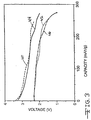
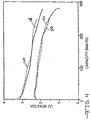
- Figs. 3 and 4 illustrate the pulse discharge curves of representative one of the Group 2 cells.
- Fig. 3 shows curves 40 and 42 which are the respective prepulse and pulse 1 minima of a representative Group 1 cell and curves 44 and 46 which are similar curves of a representative Group 2 cell.
- curves 40 and 42 are of the same cell illustrated in Fig. 3 and curves 48 and 50 are similar curves of another representative Group 2 cell.
- the results demonstrate that although the current loading was about 250% greater for the Group 2 cells, the voltage drop was approximately the same as that of the Group 1 cell having the cathode of a sheet pressed to the current collector.
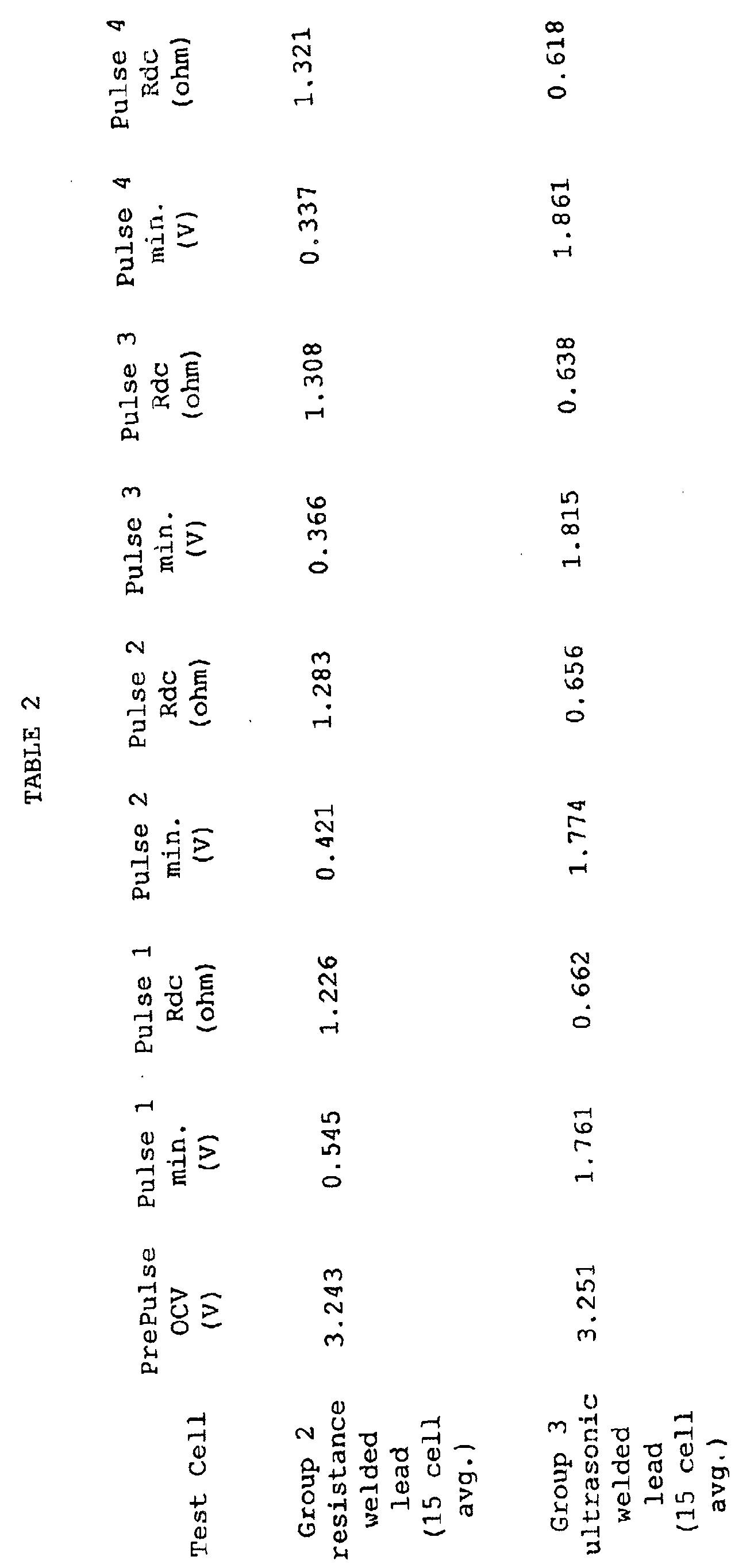
- the fifteen Groups 2 and 3 cells were then each pulse discharged using respective 2.2 and 2.25 amp currents for a duration of 10 seconds.
- the cells were rested at open circuit voltage for 30 minutes after each pulse train of four pulses, the pulses being separated from each other by 15 seconds.
- the respective current pulses were used to normalize the current loading per gram of SVO material
- the average of the Group 3 cells using the ultrasonically welded tabs displayed approximately half the dc (internal) resistance as that of the average of the Group 2 cells.
- Internal resistance (Rdc) is most pronounced in Li/SVO after about 40% of the useful energy has been discharged from the cell. Internal resistance is undesirable as it results in reduced energy especially during pulse discharge.
Landscapes
- Chemical & Material Sciences (AREA)
- Chemical Kinetics & Catalysis (AREA)
- Electrochemistry (AREA)
- General Chemical & Material Sciences (AREA)
- Inorganic Chemistry (AREA)
- Engineering & Computer Science (AREA)
- Materials Engineering (AREA)
- Battery Electrode And Active Subsutance (AREA)
- Secondary Cells (AREA)
- Cell Electrode Carriers And Collectors (AREA)
- Primary Cells (AREA)
- Connection Of Batteries Or Terminals (AREA)
Abstract
Description
The positive terminal pin supported in the glass-to-metal seal is, in turn, supported by the header, which is welded to the case containing the electrode stack. The cell is thereafter filled with the electrolyte solution described hereinabove and hermetically sealed such as by close-welding a stainless steel ball over the fill hole, but not limited thereto.
| Test Cell | SVO Wt(g) | pulse current (mA) | (mA/g of SVO) |
| | 7.332 | 3000 | 409.2 |
| Group 2 (Fig. 2) | 2.816 | 3000 | 1065.5 |
| Group 2 (Fig. 3) | 3.099 | 3000 | 968.1 |
Claims (23)
- An electrode for an electrochemical cell, the electrode comprising:a) an electrode active material;b) a first binder consisting of a halogenated polymeric material; andc) a second binder consisting of polyamic acid to form an admixture slurry wherein the admixture slurry has been coated on a conductive current collector and then cured to convert the polyamic acid to a polyimide.
- The electrode according to Claim 1 wherein the halogen is fluorine.
- The electrode according to Claim 1 or 2 wherein the first binder is selected from the groups consisting of polytetrafluoroethylene, modified polytetrafluoroethylene, polyhexafluoropropylene, tetrafluoroethylene-hexafluoropropylene copolymers, tetrafluoroethylene-perfluoroalkyl vinyl ether copolymers, polytrifluoroethylene, ethylene-tetrafluoroethylene copolymers, fluoroethylene-hydrocarbon vinyl ether copolymers, polychlorotrifluoroethylene, ethylene-chlorotrifluoroethylene copolymers, polyvinyl fluoride, polyvinylidene fluoride, vinylidene fluoride-hexafluoropropylene copolymers, fluorinated (meth)acrylate resins, 2-fluoroacrylate resins, fluorinated epoxy resins, fluorinated epoxy (meth)acrylate resins, fluorinated polyether resins, fluorinated polyimide resins, fluorinated polyester resins, fluorinated polyamide resins, fluorinated polycarbonate resins, fluorinated polyformal resins, fluorinated polyketone resins, fluorinated polyazomethine resins, fluorinated polyazole resins, fluorinated polyallyloxysilane resins, vinylidene fluoride-hexafluoropropylene fluoroelastomer, vinylidene fluoride-tetrafluoroethylene fluoroelastomer, tetrafluoroethylene-perfluoroalkyl vinyl ether fluoroelastomer, vinylidene fluoride-tetrafluoroethylenehexafluoropropylene fluoroelastomer, vinylidene fluoride-tetrafluoroethylene-perfluoroalkyl vinyl ether fluoroelastomer, tetrafluoroethylene-perfluoroalkyl vinyl ether fluoroelastomer, propylene-tetrafluoroethylene fluoroelastomer, fluorosilicone rubber, fluorinated phosphazene rubber, fluorinated thermoplastic rubbers and flexible fluorocarbon resins, and mixtures thereof.
- The electrode according to any preceding claim wherein the ratio of the first binder to the second binder is, by weight, 1:99 to 99:1, preferably 40:60 to 60:40 such as 50:50.
- The electrode according to any preceding claim wherein the electrode active material is silver vanadium oxide.
- The electrode according to any preceding claim characterized as having been cured at a temperature of 130°C to 360°C.
- The electrode according to any preceding claim wherein curing is effected for 30 minutes to 5 hours.
- The electrode according to any preceding claim wherein the current collector has been contacted to a terminal lead by ultrasonic welding.
- The electrode according to any preceding claim wherein the active slurry is coated on the current collector at a thickness of 2.5 x 10⁻⁵ m (0.001 inches) to 12.7 x 10⁻⁴ m (0.05 inches).
- An electrochemical cell, which comprises:a) a negative electrode;b) a positive electrode comprising an electrode active material; andc) an electrolyte activating the negative and the positive electrodes, wherein at least one of the negative electrode and the positive electrode is as defined in any one of the preceding claims.
- The electrochemical cell of Claim 10 as either a primary or a secondary cell.
- The electrochemical cell of Claim 10 or 11 which includes lithium/silver vanadium oxide couple.
- The electrochemical cell of Claim 10, 11 or 12 wherein the cell is a lithium ion cell having the positive electrode comprised of lithiated cathode material and wherein the negative electrode is comprised of a carbonaceous material.
- The electrochemical cell of Claim 10, 11, 12 or 13 wherein the at least one of the negative electrode and the positive electrode has been heat cured prior to being activated by the electrolyte.
- A method for providing an electrochemical cell, comprising the steps of:a) providing a negative electrode and a positive in electrical association with each other;b) providing at least one of the negative electrode and the positive electrode of an electrode active material combined with a binder mixture comprising at least a first binder consisting of a halogenated polymeric material and a second binder consisting of polyamic acid to form an electrode active slurry;c) coating the electrode active slurry onto a conductive substrate to form an electrode structure; andd) heating the electrode structure to convert the polyamic acid to a polyimide insoluble in the electrolyte.
- The method of Claim 15 including providing the first binder in a powdered form.
- The method of Claims 15 or 16 including combining the electrode active material and the binder mixture in a solvent.
- The method of Claims 15, 16 or 17 wherein the electrode is a cathode in an alkali metal electrochemical cell or a cathode current collector is a cell containing a liquid depolarizer/catholyte.
- The method of any one of Claims 15 to 18 wherein the electrode is either a negative or a positive electrode in a secondary electrochemical cell.
- The method of any one of Claims 15 to 19 wherein the electrode is intended for incorporation into a lithium ion cell as a positive electrode devoid of lithium material or as a negative electrode comprised of a carbonaceous material.
- The method of any one of Claims 15 to 20 including heating the electrode at a first temperature of about 140°C for about 30 minutes, followed by heating at a second temperature of about 200°C for about 30 minutes, followed by heating at a third temperature of about 350°C for about one hour.
- The method of any one of Claims 15 to 21 including connecting the current collector to a terminal lead by ultrasonic welding.
- The method of any one of Claims 15 to 22 wherein the terminal lead is either a terminal pin or a casing for the cell.
Applications Claiming Priority (2)
| Application Number | Priority Date | Filing Date | Title |
|---|---|---|---|
| US25650400P | 2000-12-15 | 2000-12-15 | |
| US256504P | 2000-12-15 |
Publications (2)
| Publication Number | Publication Date |
|---|---|
| EP1217674A2 true EP1217674A2 (en) | 2002-06-26 |
| EP1217674A3 EP1217674A3 (en) | 2004-10-20 |
Family
ID=22972481
Family Applications (1)
| Application Number | Title | Priority Date | Filing Date |
|---|---|---|---|
| EP01310528A Withdrawn EP1217674A3 (en) | 2000-12-15 | 2001-12-17 | Electrochemical cell having an electrode of silver vanadium oxide coated to a current collector |
Country Status (4)
| Country | Link |
|---|---|
| US (1) | US6797019B2 (en) |
| EP (1) | EP1217674A3 (en) |
| JP (1) | JP2002270185A (en) |
| CA (1) | CA2365189A1 (en) |
Cited By (2)
| Publication number | Priority date | Publication date | Assignee | Title |
|---|---|---|---|---|
| EP1221732A2 (en) * | 2000-11-29 | 2002-07-10 | Wilson Greatbatch Ltd. | Electrodes containing a heat-treated polyamic acid-pvdf binder mixture |
| EP1487036A4 (en) * | 2002-03-19 | 2008-12-24 | Bridgestone Corp | POSITIVE ELECTRODE FOR LITHIUM CELL AND METHOD FOR PRODUCING SAME, LITHIUM CELL |
Families Citing this family (36)
| Publication number | Priority date | Publication date | Assignee | Title |
|---|---|---|---|---|
| US6893772B2 (en) * | 1993-11-19 | 2005-05-17 | Medtronic, Inc. | Current collector for lithium electrode |
| JP4423699B2 (en) | 1999-05-27 | 2010-03-03 | ソニー株式会社 | Semiconductor laser device and manufacturing method thereof |
| US6790561B2 (en) * | 2001-03-15 | 2004-09-14 | Wilson Greatbatch Ltd. | Process for fabricating continuously coated electrodes on a porous current collector and cell designs incorporating said electrodes |
| US6677076B2 (en) | 2002-01-15 | 2004-01-13 | Quallion Llc | Electric storage battery construction and method of manufacture |
| US6670071B2 (en) | 2002-01-15 | 2003-12-30 | Quallion Llc | Electric storage battery construction and method of manufacture |
| WO2005091403A1 (en) * | 2003-01-15 | 2005-09-29 | Quallion Llc | Battery |
| US7459234B2 (en) * | 2003-11-24 | 2008-12-02 | The Gillette Company | Battery including aluminum components |
| KR100556101B1 (en) * | 2003-12-16 | 2006-03-03 | 주식회사 엘지화학 | Secondary battery module |
| US8080329B1 (en) | 2004-03-25 | 2011-12-20 | Quallion Llc | Uniformly wound battery |
| KR100627360B1 (en) * | 2004-09-24 | 2006-09-21 | 삼성에스디아이 주식회사 | Collector plate and its secondary battery and battery module |
| US7972725B2 (en) * | 2004-11-08 | 2011-07-05 | 3M Innovative Properties Company | Polyimide electrode binders |
| US8241788B1 (en) | 2004-12-13 | 2012-08-14 | Greatbatch Ltd. | Method for making flat and high-density cathode for use in electrochemical cells |
| CN100370643C (en) * | 2004-12-27 | 2008-02-20 | 深圳市比克电池有限公司 | Manufacturing method of lithium-ion battery positive electrode sheet, positive electrode sheet and lithium-ion battery manufactured by the method |
| KR20080087782A (en) * | 2005-10-11 | 2008-10-01 | 엑셀라트론 솔리드 스테이트 엘엘씨 | Lithium Battery Manufacturing Method |
| US20070178383A1 (en) * | 2006-01-31 | 2007-08-02 | Viavattine Joseph J | Current collector |
| KR100839369B1 (en) * | 2006-11-27 | 2008-06-19 | 삼성에스디아이 주식회사 | Anode active material composition for lithium secondary battery, anode for lithium secondary battery manufactured using same and lithium secondary battery |
| CN100550486C (en) * | 2007-08-29 | 2009-10-14 | 中国工程物理研究院电子工程研究所 | A preparation method of a flow battery composite conductive plastic current collector |
| US20090246617A1 (en) * | 2008-03-28 | 2009-10-01 | Howard William G | Vanadium connector in an electrochemical cell for an implantable medical device |
| JP5233393B2 (en) * | 2008-05-07 | 2013-07-10 | 住友ベークライト株式会社 | Secondary battery electrode composition, secondary battery electrode and secondary battery |
| US8034485B2 (en) | 2008-05-29 | 2011-10-11 | 3M Innovative Properties Company | Metal oxide negative electrodes for lithium-ion electrochemical cells and batteries |
| US20120164526A1 (en) | 2009-03-27 | 2012-06-28 | Zpower, Llc | Cathode |
| KR101230684B1 (en) * | 2009-09-24 | 2013-02-07 | 다이니폰 스크린 세이조우 가부시키가이샤 | Battery manufacturing method and battery |
| US9184444B2 (en) | 2009-11-03 | 2015-11-10 | Zpower, Llc | Electrodes and rechargeable batteries |
| US20120107689A1 (en) * | 2010-06-30 | 2012-05-03 | Daikin Industries Building | Binder composition for electrode |
| KR101277996B1 (en) * | 2010-06-30 | 2013-06-27 | 다이킨 고교 가부시키가이샤 | Binder composition for electrode |
| CA2812180C (en) | 2010-09-24 | 2019-03-05 | Zpower, Llc | Doped silver cathode |
| US8906549B1 (en) | 2010-09-24 | 2014-12-09 | Greatbatch Ltd. | Development of mixed binder system for primary cell cathodes |
| WO2012172308A1 (en) * | 2011-06-14 | 2012-12-20 | Bae Systems Plc | Component including a rechargeable battery |
| US9899655B2 (en) | 2012-09-14 | 2018-02-20 | Greatbatch Ltd. | Electrochemical current collector screen designs utilizing ultrasonic welding |
| CA2886154A1 (en) | 2012-09-27 | 2014-04-03 | Zpower, Llc | Cathode |
| JP6269966B2 (en) * | 2012-10-12 | 2018-01-31 | Jsr株式会社 | Electrode binder composition |
| EP3353844B1 (en) | 2015-03-27 | 2022-05-11 | Mason K. Harrup | All-inorganic solvents for electrolytes |
| CN106252714A (en) * | 2016-09-09 | 2016-12-21 | 贵州梅岭电源有限公司 | A kind of lithium ion battery with long charged storage life and preparation method thereof |
| US9893361B1 (en) * | 2016-09-19 | 2018-02-13 | Marc Jaker | Electrochemical cells and methods for making same |
| US10707531B1 (en) | 2016-09-27 | 2020-07-07 | New Dominion Enterprises Inc. | All-inorganic solvents for electrolytes |
| EP4475204A1 (en) * | 2023-06-09 | 2024-12-11 | Hindustan Petroleum Corporation Limited | Pvdf plasticizer for electrode fabrication and universal battery application thereof |
Family Cites Families (22)
| Publication number | Priority date | Publication date | Assignee | Title |
|---|---|---|---|---|
| US4310609A (en) * | 1979-12-17 | 1982-01-12 | Wilson Greatbatch Ltd. | Metal oxide composite cathode material for high energy density batteries |
| US4830940A (en) * | 1986-01-14 | 1989-05-16 | Wilson Greatbatch Ltd. | Non-agueous lithium battery |
| JP3133530B2 (en) * | 1992-12-28 | 2001-02-13 | 三洋電機株式会社 | Rechargeable battery |
| US5340368A (en) * | 1993-08-04 | 1994-08-23 | Valence Technology, Inc. | Method for in situ preparation of an electrode composition |
| US5435874A (en) * | 1993-11-01 | 1995-07-25 | Wilson Greatbatch Ltd. | Process for making cathode components for use in electrochemical cells |
| JP3329161B2 (en) * | 1995-10-31 | 2002-09-30 | 松下電器産業株式会社 | Non-aqueous electrolyte secondary battery |
| AU2591397A (en) * | 1996-07-02 | 1998-01-21 | Wilson Greatbatch Ltd. | Preparation and use of thin flexible cathodes in alkali metal electrochemical cells |
| JPH10188992A (en) * | 1996-12-24 | 1998-07-21 | Sony Corp | Non-aqueous electrolyte battery |
| US5895733A (en) * | 1997-02-03 | 1999-04-20 | Medtronic, Inc. | Synthesis method for silver vanadium oxide |
| TW369735B (en) * | 1997-02-05 | 1999-09-11 | Sumitomo Chemical Co | Cathode for lithium secondary battery |
| US5935728A (en) * | 1997-04-04 | 1999-08-10 | Wilson Greatbatch Ltd. | Electrochemical cell having multiplate and jellyroll electrodes with differing discharge rate regions |
| JPH1131513A (en) * | 1997-05-13 | 1999-02-02 | Sony Corp | Non-aqueous electrolyte secondary battery |
| JPH11158277A (en) * | 1997-12-01 | 1999-06-15 | Kanegafuchi Chem Ind Co Ltd | Binder resin for battery electrode and method for producing the same |
| US6008625A (en) * | 1998-01-16 | 1999-12-28 | Wilson Greatbatch Ltd. | Use of double cells to power an implantable medical device |
| US6027827A (en) * | 1998-06-30 | 2000-02-22 | Wilson Greatbatch Ltd. | Organic nitrite additives for nonaqueous electrolyte in alkali metal electrochemical cells |
| US6060184A (en) * | 1998-07-09 | 2000-05-09 | Wilson Greatbatch Ltd. | Inorganic and organic nitrate additives for nonaqueous electrolyte in alkali metal electrochemical cells |
| US6136477A (en) * | 1998-10-22 | 2000-10-24 | Wilson Greatbatch Ltd. | Nitrate additives for nonaqueous electrolyte rechargeable cells |
| US6228534B1 (en) * | 1998-12-21 | 2001-05-08 | Wilson Greatbatch Ltd. | Annealing of mixed metal oxide electrodes to reduce polarization resistance |
| US6403256B1 (en) * | 1999-01-25 | 2002-06-11 | Wilson Greatbatch Ltd. | Alkali metal electrochemical cell activated with a nonaqueous electrolyte having a sulfite additive |
| US6566007B1 (en) * | 2000-04-14 | 2003-05-20 | Wilson Greatbatch Ltd. | Synthetic method for preparation of a low surface area, single phase silver vanadium oxide |
| US6743550B2 (en) * | 2000-11-17 | 2004-06-01 | Wilson Greatbatch Ltd. | Double current collector cathode design using chemically similar active materials for alkali metal electrochemical |
| US6759164B2 (en) * | 2000-11-29 | 2004-07-06 | Wilson Greatbatch Ltd. | Use of heat-treated electrodes containing a polyamic acid-PVDF binder mixture |
-
2001
- 2001-12-10 US US10/013,287 patent/US6797019B2/en not_active Expired - Fee Related
- 2001-12-12 JP JP2001402673A patent/JP2002270185A/en not_active Withdrawn
- 2001-12-14 CA CA002365189A patent/CA2365189A1/en not_active Withdrawn
- 2001-12-17 EP EP01310528A patent/EP1217674A3/en not_active Withdrawn
Cited By (2)
| Publication number | Priority date | Publication date | Assignee | Title |
|---|---|---|---|---|
| EP1221732A2 (en) * | 2000-11-29 | 2002-07-10 | Wilson Greatbatch Ltd. | Electrodes containing a heat-treated polyamic acid-pvdf binder mixture |
| EP1487036A4 (en) * | 2002-03-19 | 2008-12-24 | Bridgestone Corp | POSITIVE ELECTRODE FOR LITHIUM CELL AND METHOD FOR PRODUCING SAME, LITHIUM CELL |
Also Published As
| Publication number | Publication date |
|---|---|
| US20030198868A1 (en) | 2003-10-23 |
| EP1217674A3 (en) | 2004-10-20 |
| CA2365189A1 (en) | 2002-06-15 |
| JP2002270185A (en) | 2002-09-20 |
| US6797019B2 (en) | 2004-09-28 |
Similar Documents
| Publication | Publication Date | Title |
|---|---|---|
| US6797019B2 (en) | Electrochemical cell having an electrode of silver vanadium oxide coated to a current collector | |
| US6759164B2 (en) | Use of heat-treated electrodes containing a polyamic acid-PVDF binder mixture | |
| US6790561B2 (en) | Process for fabricating continuously coated electrodes on a porous current collector and cell designs incorporating said electrodes | |
| US6727022B2 (en) | Powder process for double current collector screen cathode preparation | |
| US6743547B2 (en) | Pellet process for double current collector screen cathode preparation | |
| US7820328B1 (en) | Electrochemical cell electrode with improved particle-to-particle contact and method of manufacturing | |
| US6537698B2 (en) | Electrochemical cell having an electrode with a phosphonate additive in the electrode active mixture | |
| US6673493B2 (en) | Double current collector cathode design using the same active material in varying formulations for alkali metal or ion electrochemical cells | |
| EP1087453A2 (en) | Enhanced capacity Li/CFx electrochemical cell | |
| EP2117066A1 (en) | In parallel hybrid power source comprising a lithium/oxyhalide electrochemical cell coupled with a lithium ion cell | |
| JP2002319406A (en) | Electrochemical battery having electrode containing carbonate additives in electrode active substance mixture | |
| US8906549B1 (en) | Development of mixed binder system for primary cell cathodes | |
| US7052804B2 (en) | Double current collector positive electrode for alkali metal ion electrochemical cells | |
| JP2002237334A (en) | Double collector type negative electrode structure for alkaline metal ion battery | |
| US6562515B2 (en) | Electrochemical cell having an electrode with a nitrate additive in the electrode active mixture | |
| JP2002367601A (en) | Method of manufacturing electrode coated continuously with porous current collector and battery design incorporating the electrode | |
| US6528207B2 (en) | Electrochemical cell having an electrode with a nitrite additive in the electrode active mixture | |
| JP2002313346A (en) | Electrochemical cell having electrode with dicarbonate additive in electrode active mixture | |
| EP0999604A1 (en) | Mixed cathode material for high energy density electrochemical cells | |
| US20080081259A1 (en) | Hybrid Cathode Design For An Electrochemical Cell | |
| EP1914823B1 (en) | Hybrid cathode design for an electrochemical cell | |
| US20100196765A1 (en) | Reducing DC Resistance In Electrochemical Cells By Increasing Cathode Basis Weight | |
| US9231256B2 (en) | Flat and high-density cathodes for use in electrochemical cells | |
| US20110183215A1 (en) | Layered Electrode For An Electrochemical Cell |
Legal Events
| Date | Code | Title | Description |
|---|---|---|---|
| PUAI | Public reference made under article 153(3) epc to a published international application that has entered the european phase |
Free format text: ORIGINAL CODE: 0009012 |
|
| AK | Designated contracting states |
Kind code of ref document: A2 Designated state(s): AT BE CH CY DE DK ES FI FR GB GR IE IT LI LU MC NL PT SE TR |
|
| AX | Request for extension of the european patent |
Free format text: AL;LT;LV;MK;RO;SI |
|
| PUAL | Search report despatched |
Free format text: ORIGINAL CODE: 0009013 |
|
| AK | Designated contracting states |
Kind code of ref document: A3 Designated state(s): AT BE CH CY DE DK ES FI FR GB GR IE IT LI LU MC NL PT SE TR |
|
| AX | Request for extension of the european patent |
Extension state: AL LT LV MK RO SI |
|
| 17P | Request for examination filed |
Effective date: 20041215 |
|
| 17Q | First examination report despatched |
Effective date: 20050324 |
|
| AKX | Designation fees paid |
Designated state(s): AT BE CH CY DE DK ES FI FR GB GR IE IT LI LU MC NL PT SE TR |
|
| STAA | Information on the status of an ep patent application or granted ep patent |
Free format text: STATUS: THE APPLICATION HAS BEEN WITHDRAWN |
|
| 18W | Application withdrawn |
Effective date: 20050920 |